<?xml version="1.0" encoding="ISO-8859-1"?><article xmlns:mml="http://www.w3.org/1998/Math/MathML" xmlns:xlink="http://www.w3.org/1999/xlink" xmlns:xsi="http://www.w3.org/2001/XMLSchema-instance">
<front>
<journal-meta>
<journal-id>0034-7744</journal-id>
<journal-title><![CDATA[Revista de Biología Tropical]]></journal-title>
<abbrev-journal-title><![CDATA[Rev. biol. trop]]></abbrev-journal-title>
<issn>0034-7744</issn>
<publisher>
<publisher-name><![CDATA[Universidad de Costa Rica]]></publisher-name>
</publisher>
</journal-meta>
<article-meta>
<article-id>S0034-77442012000100035</article-id>
<title-group>
<article-title xml:lang="en"><![CDATA[A method for seedling recovery in Jatropha curcas after cryogenic exposure of the seeds]]></article-title>
</title-group>
<contrib-group>
<contrib contrib-type="author">
<name>
<surname><![CDATA[Silva]]></surname>
<given-names><![CDATA[Rafael de C.]]></given-names>
</name>
<xref ref-type="aff" rid="A01"/>
</contrib>
<contrib contrib-type="author">
<name>
<surname><![CDATA[Camillo]]></surname>
<given-names><![CDATA[Julcéia]]></given-names>
</name>
<xref ref-type="aff" rid="A02"/>
</contrib>
<contrib contrib-type="author">
<name>
<surname><![CDATA[Scherwinski-Pereira]]></surname>
<given-names><![CDATA[Jonny E.]]></given-names>
</name>
<xref ref-type="aff" rid="A03"/>
</contrib>
</contrib-group>
<aff id="A01">
<institution><![CDATA[,Federal University of Amazonas Post-Graduate Program in Biotechnology ]]></institution>
<addr-line><![CDATA[ ]]></addr-line>
<country>Brazil</country>
</aff>
<aff id="A02">
<institution><![CDATA[,University of Brasília Post-Graduate Program in Agronomy ]]></institution>
<addr-line><![CDATA[ Brasília]]></addr-line>
<country>Brazil</country>
</aff>
<aff id="A03">
<institution><![CDATA[,Plant Tissue Culture Laboratory Embrapa Genetic Resources and Biotechnology ]]></institution>
<addr-line><![CDATA[ Brasília]]></addr-line>
<country>Brazil</country>
</aff>
<pub-date pub-type="pub">
<day>00</day>
<month>03</month>
<year>2012</year>
</pub-date>
<pub-date pub-type="epub">
<day>00</day>
<month>03</month>
<year>2012</year>
</pub-date>
<volume>60</volume>
<numero>1</numero>
<fpage>473</fpage>
<lpage>482</lpage>
<copyright-statement/>
<copyright-year/>
<self-uri xlink:href="http://www.scielo.sa.cr/scielo.php?script=sci_arttext&amp;pid=S0034-77442012000100035&amp;lng=en&amp;nrm=iso"></self-uri><self-uri xlink:href="http://www.scielo.sa.cr/scielo.php?script=sci_abstract&amp;pid=S0034-77442012000100035&amp;lng=en&amp;nrm=iso"></self-uri><self-uri xlink:href="http://www.scielo.sa.cr/scielo.php?script=sci_pdf&amp;pid=S0034-77442012000100035&amp;lng=en&amp;nrm=iso"></self-uri><abstract abstract-type="short" xml:lang="en"><p><![CDATA[Actually, the germplasm of Jatropha spp. is conserved as whole plants in field collections. Under this storage method, the genetic resources are exposed to disease, pest and natural hazards such as human error, drought and weather damage. Besides, field genebanks are costly to maintain and with important requirements of trained personnel. Thus, the development of efficient techniques to ensure its safe conservation and regeneration is therefore of paramount importance. In this work we describe a method for Jatropha curcas seeds cryoexposure and seedling recovery after thawed. In a first experiment, an efficient protocol for in vitro plant recovery was carried out using zygotic embryo or seeds with or without coat. In a second experiment, desiccated seeds with or without coat were exposed to liquid nitrogen and evaluated after cryoexposure. Germination percentages were variable among treatments, and seeds demonstrated tolerance to liquid nitrogen exposure under certain conditions. Seeds of J. curcas presented up to 99.6% germination after seed coat removal. Seeds with coat cultured in vitro did not germinate, and were 60% contaminated. The germination of the zygotic embryos was significantly higher in the ½ MS medium (93.1%) than in WPM medium (76.2%), but from zygotic embryo, abnormal seedlings reached up to 99%. Seeds with coat exposed to liquid nitrogen showed 60% germination in culture after coat removal with good plant growth, and seeds cryopreserved without coat presented 82% germination, but seedlings showed a reduced vigor and a significant increase in abnormal plants. Seeds cultured in vitro with coat did not germinate, independently of cryoexposure or not. This study reports the first successful in vitro seedling recovery methodology for Jatropha curcas seeds, after a cryopreservation treatment, and is recommended as an efficient procedure for in vitro plant recovery, when seeds are conserved in germplasm banks by low or cryotemperatures.]]></p></abstract>
<abstract abstract-type="short" xml:lang="es"><p><![CDATA[Actualmente, el germoplasma de las especies de Jatropha ssp. se conserva como plantas enteras en las colecciones de campo. Bajo este método de almacenamiento, los recursos genéticos están expuestos a enfermedades, plagas y desastres naturales tales como el error humano, la sequía y las inclemencias del tiempo. Además, los bancos de germoplasma de campo son costosos de mantener y requieren bastante personal capacitado. Por lo tanto, el desarrollo de técnicas eficientes para asegurar su conservación segura así como su regeneración, es de suma importancia. En este trabajo se describe un método de recuperación para semillas y plántulas crioexpuestas de Jatropha curcas después de descongeladas. En un primer experimento, se llevó a cabo un protocolo eficiente para la recuperación de plantas in vitro mediante el uso de embriones cigóticos o semillas con o sin testa. En un segundo experimento, las semillas disecadas, con o sin testa fueron expuestas a nitrógeno líquido y se evaluaron después de la crioexposición. Los porcentajes de germinación fueron variables entre los tratamientos, y las semillas demostraron tolerancia a la exposición del nitrógeno líquido bajo ciertas condiciones. Las semillas de J. curcas presentaron hasta un 99.6% de germinación después de la eliminación de la testa. Las semillas con la testa cultivadas in vitro no germinaron, y el 60% se contaminaron. La germinación de los embriones cigóticos fue significativamente alta en el medio ½ MS (93.1%) en comparación con el medio WPM (76.2%), pero desde los embriones zigóticos, las plántulas anormales alcanzaron más del 99%. Semillas con la testa inmersa en nitrógeno líquido mostraron un 60% de germinacion en cultivos despúes de la remoción de la testa con un buen crecimiento de la planta, y las semillas criopreservadas sin testa presentaron un 82% de germinación, pero las plántulas mostraron un reducido vigor y un incremento significativo de plantas anormales. Semillas con testa cultivadas in vitro no germinaron, independientemente de la criopreservación o no. Este estudio reporta el primer éxito in vitro de una metodología de recuperación de plántulas para semillas de Jatropha curcas, después de un tratamiento de criopreservación, que se recomienda como un procedimiento eficaz para la recuperación de plantas in vitro, cuando las semillas se conservan en bancos de germoplasma a bajas o crio-temperaturas.]]></p></abstract>
<kwd-group>
<kwd lng="en"><![CDATA[Jatropha sp.]]></kwd>
<kwd lng="en"><![CDATA[ex situ conservation]]></kwd>
<kwd lng="en"><![CDATA[cryopreservation]]></kwd>
<kwd lng="en"><![CDATA[plant genetic resources]]></kwd>
<kwd lng="en"><![CDATA[plant tissue culture]]></kwd>
<kwd lng="en"><![CDATA[agroenergy]]></kwd>
<kwd lng="en"><![CDATA[biodiesel]]></kwd>
<kwd lng="es"><![CDATA[Jatropha sp.]]></kwd>
<kwd lng="es"><![CDATA[conservación ex situ]]></kwd>
<kwd lng="es"><![CDATA[criopreservación]]></kwd>
<kwd lng="es"><![CDATA[recursos fitogenéticos]]></kwd>
<kwd lng="es"><![CDATA[cultivo de tejidos vegetales]]></kwd>
<kwd lng="es"><![CDATA[agroenergía]]></kwd>
<kwd lng="es"><![CDATA[biodisel]]></kwd>
</kwd-group>
</article-meta>
</front><body><![CDATA[ <div style="text-align: justify;">     <div style="text-align: center;"><font style="font-weight: bold;"  size="4"><span style="font-family: verdana;">A method for seedling recovery in Jatropha curcas after cryogenic exposure of the seeds</span></font><br  style="font-family: verdana;"> </div> <br style="font-family: verdana;">     <div style="text-align: center;"><font size="2"><span  style="font-family: verdana;">Rafael de C. Silva<sup><a href="#1">1</a><a  name="4"></a>*</sup>, Julc&eacute;ia Camillo<sup><a href="#2">2</a><a name="5"></a>*</sup> &amp; Jonny E. Scherwinski-Pereira<sup><a href="#3">3</a><a name="6"></a>*</sup></span></font><br  style="font-family: verdana;"> </div> <font size="2"><span style="font-family: verdana;">    <br> <a name="Correspondencia2"></a>*<a href="#Correspondencia1">Direcci&oacute;n para correspondencia</a></span></font><br style="font-family: verdana;"> <font size="2"><span style="font-family: verdana;"></span></font></div> <hr  style="width: 100%; height: 2px; margin-left: 0px; margin-right: 0px;">     <div style="text-align: justify;"><font style="font-weight: bold;"      size="3"><span style="font-family: verdana;">Abstract</span></font><br      style="font-family: verdana;">     <font size="2"></font><br style="font-family: verdana;">     <font size="2"><span style="font-family: verdana;">Actually, the     germplasm of <span style="font-style: italic;">Jatropha     ]]></body>
<body><![CDATA[</span>spp. is conserved as whole plants in field collections. Under     this     storage method, the genetic resources are exposed to disease, pest and     natural hazards such as human error, drought and weather damage.     Besides, field genebanks are costly to maintain and with important     requirements of trained personnel. Thus, the development of efficient     techniques to ensure its safe conservation and regeneration is     therefore of paramount importance. In this work we describe a method     for <span style="font-style: italic;">Jatropha curcas</span> seeds     cryoexposure and seedling recovery after     ]]></body>
<body><![CDATA[thawed. In a first experiment, an efficient protocol for<span      style="font-style: italic;"> in vitro </span>plant     recovery was carried out using zygotic embryo or seeds with or without     coat. In a second experiment, desiccated seeds with or without coat     were exposed to liquid nitrogen and evaluated after cryoexposure.     Germination percentages were variable among treatments, and seeds     demonstrated tolerance to liquid nitrogen exposure under certain     conditions. Seeds of <span style="font-style: italic;">J. curcas</span>     presented up to 99.6<span style="font-style: italic;">%</span>     germination after     ]]></body>
<body><![CDATA[seed coat removal. Seeds with coat cultured <span      style="font-style: italic;">in vitro</span> did not germinate,     and were 60<span style="font-style: italic;">%</span> contaminated. The     germination of the zygotic embryos was     significantly higher in the &frac12; MS medium (93.1<span      style="font-style: italic;">%</span>) than in WPM     medium (76.2<span style="font-style: italic;">%</span>), but from     zygotic embryo, abnormal seedlings reached up     to 99<span style="font-style: italic;">%</span>. Seeds with coat     exposed to liquid nitrogen showed 60<span style="font-style: italic;">%</span>     ]]></body>
<body><![CDATA[germination in culture after coat removal with good plant growth, and     seeds cryopreserved without coat presented 82<span      style="font-style: italic;">%</span> germination, but     seedlings showed a reduced vigor and a significant increase in abnormal     plants. Seeds cultured <span style="font-style: italic;">in vitro</span>     with coat did not germinate,     independently of cryoexposure or not. This study reports the first     successful<span style="font-style: italic;"> in vitro</span> seedling     recovery methodology for <span style="font-style: italic;">Jatropha     curcas</span>     ]]></body>
<body><![CDATA[seeds, after a cryopreservation treatment, and is recommended as an     efficient procedure for<span style="font-style: italic;"> in vitro</span>     plant recovery, when seeds are     conserved in germplasm banks by low or cryotemperatures.</span></font><br      style="font-family: verdana;">     <font size="2"></font><br style="font-family: verdana;">     <font size="2"><span style="font-family: verdana;"><span      style="font-weight: bold;">Key words: </span><span      style="font-style: italic;">Jatropha</span> sp., <span      style="font-style: italic;">ex situ     ]]></body>
<body><![CDATA[</span>conservation, cryopreservation, plant genetic resources, plant     tissue     culture, agroenergy, biodiesel.</span></font><br      style="font-family: verdana;">     <font size="2"></font><br style="font-family: verdana;">     <font style="font-weight: bold;" size="3"><span      style="font-family: verdana;">Resumen</span></font><br      style="font-family: verdana;">     <font size="2"></font><br style="font-family: verdana;">     <font size="2"><span style="font-family: verdana;">Actualmente, el     ]]></body>
<body><![CDATA[germoplasma de las     especies de<span style="font-style: italic;"> Jatropha </span>ssp. se     conserva como plantas enteras en las     colecciones de campo. Bajo este m&eacute;todo de almacenamiento, los     recursos gen&eacute;ticos est&aacute;n expuestos a enfermedades, plagas     y desastres naturales tales como el error humano, la sequ&iacute;a y     las inclemencias del tiempo. Adem&aacute;s, los bancos de germoplasma     de campo son costosos de mantener y requieren bastante personal     capacitado. Por lo tanto, el desarrollo de t&eacute;cnicas eficientes     para asegurar su conservaci&oacute;n segura as&iacute; como su     ]]></body>
<body><![CDATA[regeneraci&oacute;n, es de suma importancia. En este&nbsp; trabajo se     describe un m&eacute;todo de recuperaci&oacute;n para semillas y     pl&aacute;ntulas crioexpuestas de <span style="font-style: italic;">Jatropha     curcas</span> despu&eacute;s de     descongeladas. En un primer experimento, se llev&oacute; a cabo un     protocolo eficiente para la recuperaci&oacute;n de plantas <span      style="font-style: italic;">in vitro</span>     mediante el uso de embriones cig&oacute;ticos o semillas con o sin     testa. En un segundo experimento, las semillas disecadas, con o sin     testa fueron expuestas a nitr&oacute;geno l&iacute;quido y se evaluaron     ]]></body>
<body><![CDATA[despu&eacute;s de la crioexposici&oacute;n. Los porcentajes de     germinaci&oacute;n fueron variables entre los tratamientos, y las     semillas demostraron tolerancia a la exposici&oacute;n del     nitr&oacute;geno l&iacute;quido bajo ciertas condiciones. Las semillas     de <span style="font-style: italic;">J. curcas </span>presentaron     hasta un 99.6% de germinaci&oacute;n     despu&eacute;s de la eliminaci&oacute;n de la testa. Las semillas con     la testa cultivadas <span style="font-style: italic;">in vitro</span>     no germinaron, y el 60<span style="font-style: italic;">%</span> se     contaminaron.     ]]></body>
<body><![CDATA[La germinaci&oacute;n de los embriones cig&oacute;ticos fue     significativamente alta en el medio &frac12; MS (93.1<span      style="font-style: italic;">%</span>) en     comparaci&oacute;n con el medio WPM (76.2<span      style="font-style: italic;">%</span>), pero desde los embriones     zig&oacute;ticos, las pl&aacute;ntulas anormales alcanzaron m&aacute;s     del 99<span style="font-style: italic;">%</span>. Semillas con la testa     inmersa en nitr&oacute;geno     l&iacute;quido mostraron un 60<span style="font-style: italic;">%</span>     de germinacion en cultivos     ]]></body>
<body><![CDATA[desp&uacute;es de la remoci&oacute;n de la testa con un buen     crecimiento de la planta, y las semillas criopreservadas sin testa     presentaron un 82<span style="font-style: italic;">%</span> de     germinaci&oacute;n, pero las pl&aacute;ntulas     mostraron un reducido vigor y un incremento significativo de plantas     anormales. Semillas con testa cultivadas <span      style="font-style: italic;">in vitro</span> no germinaron,     independientemente de la criopreservaci&oacute;n o no. Este estudio     reporta el primer &eacute;xito <span style="font-style: italic;">in     vitro </span>de una metodolog&iacute;a de     ]]></body>
<body><![CDATA[recuperaci&oacute;n de pl&aacute;ntulas para semillas de <span      style="font-style: italic;">Jatropha     curcas</span>, despu&eacute;s de un tratamiento de     criopreservaci&oacute;n,     que se recomienda como un procedimiento eficaz para la     recuperaci&oacute;n de plantas<span style="font-style: italic;"> in     vitro</span>, cuando las semillas se     conservan en bancos de germoplasma a bajas o crio-temperaturas.</span></font><br      style="font-family: verdana;">     <font size="2"></font><br style="font-family: verdana;">     ]]></body>
<body><![CDATA[<font size="2"><span style="font-family: verdana;"><span      style="font-weight: bold;">Palabras clave: </span><span      style="font-style: italic;">Jatropha </span>sp.,     conservaci&oacute;n <span style="font-style: italic;">ex situ</span>,     criopreservaci&oacute;n, recursos     fitogen&eacute;ticos, cultivo de tejidos vegetales, agroenerg&iacute;a,     biodisel.</span></font><br style="font-family: verdana;">     <font size="2"></font><br style="font-family: verdana;">     <font size="2"><span style="font-family: verdana;"></span></font></div>     <hr     ]]></body>
<body><![CDATA[ style="width: 100%; height: 2px; margin-left: 0px; margin-right: 0px;">     <div style="text-align: justify;"><font size="2"><span      style="font-family: verdana;">Recently, biodiesel has become more     attractive because of its environmental benefits </span><span      style="font-family: verdana;">and the fact that it is made from     renewable resources. Considerable research has been done on vegetable     oils as diesel fuel. <span style="font-style: italic;">Jatropha curcas</span>     (Linnaeus) is a hardy perennial     shrub or tree thought to be native from Central America and possibly     from Brazil (Carvalho <span style="font-style: italic;">et al. </span>2008).     ]]></body>
<body><![CDATA[<span style="font-style: italic;">Jatropha</span> is a large genus     comprising more than 170 species that is widespread throughout the     tropical regions of the word (Deore <span style="font-style: italic;">&amp;</span>     Johnson 2008). Most of these     species are ornamental, except for<span style="font-style: italic;"> J.     curcas</span> and <span style="font-style: italic;">J. glandulifera</span>,     which     are oil-yielding species (Swarup 2004).</span></font><br      style="font-family: verdana;">     <font size="2"></font><br style="font-family: verdana;">     ]]></body>
<body><![CDATA[<font size="2"><span style="font-family: verdana;">In fact, there is a     growing     interest in the cultivation of <span style="font-style: italic;">J.     curcas</span> for the production of oil as a     fossil fuel substitute. The seeds of <span style="font-style: italic;">J.     curcas</span> contain at least 30-40<span style="font-style: italic;">%</span>     oil with a fatty acid pattern similar to that of edible oils (Gubitz <span      style="font-style: italic;">et     al.</span> 1999).<span style="font-style: italic;"> Jatropha</span> oil     contains linoleic acid and oleic acid, which     ]]></body>
<body><![CDATA[together account for up to 80<span style="font-style: italic;">%</span>     of the oil composition. Palmitic acid     and stearic acid are other fatty acids present in this oil (Deore &amp;     Johnson 2008). The fact that the oil of<span style="font-style: italic;">     J. curcas</span> cannot be used for     nutritional purpose without detoxification makes its use as an energy     source for fuel production very attractive. Besides, this euphorbia is     a droughtresistant plant which grows on wasteland and could easily be     cultivated by low income farmers. Also, like all trees, it fixes     atmospheric carbon (Openshaw 2000).</span></font><br     ]]></body>
<body><![CDATA[ style="font-family: verdana;">     <font size="2"></font><br style="font-family: verdana;">     <font size="2"><span style="font-family: verdana;">However, the full     potential of     <span style="font-style: italic;">Jatropha</span> is far from being     realized. The growth and management is     poorly documented and it lacks an improved germplasm for high yielding.     While <span style="font-style: italic;">J. curcas </span>germplasm is     being harvested all over the world with     the purpose of crop improvement, little is known about the germination     ]]></body>
<body><![CDATA[and storage behavior of <span style="font-style: italic;">Jatropha</span>     seeds in order to improve the breeding     programmes (Carvalho <span style="font-style: italic;">et </span></span><span      style="font-family: verdana;"><span style="font-style: italic;">al.</span>     2008). Actually, the germplasm     of <span style="font-style: italic;">Jatropha</span> spp. is conserved     as whole plants in field collection. </span><span      style="font-family: verdana;">With this storage method, the     genetic resources are exposed to disease, pest and natural hazards such     as human error, drought, and weather damage. In addition, field     ]]></body>
<body><![CDATA[genebanks are costly to maintain and trained personnel requirements are     very important (Engelmann 1991). Thus, the development of efficient     techniques to ensure its safe conservation is therefore of paramount     importance.</span></font><br style="font-family: verdana;">     <font size="2"></font><br style="font-family: verdana;">     <font size="2"><span style="font-family: verdana;">Cryopreservation,     i.e., the storage     of biological material at ultra-low temperature, usually that of liquid     nitrogen (-196&deg;C, LN), is the only technique currently available to     ensure the safe and cost-efficient long-term conservation of germplasm.     ]]></body>
<body><![CDATA[At this temperature, all cellular divisions and metabolic processes are     decreased at minimum limits and, the plant material can thus be stored     for a theoretically unlimited period of time (Walters <span      style="font-style: italic;">et al.</span> 2004).     Moreover, cultures are stored in a small volume, protected </span><span      style="font-family: verdana;">from contamination, and require a     very limited maintenance (Engelmann 2004).</span></font><br      style="font-family: verdana;">     <font size="2"></font><br style="font-family: verdana;">     <font size="2"><span style="font-family: verdana;">Although research on     ]]></body>
<body><![CDATA[the     development of conservation and cryopreservation techniques have been     conducted with seeds of numerous plant species (Walters <span      style="font-style: italic;">et al </span>2004,     Chmielarz 2009 a,b), up to now, there is no report in a methodology for     seedling regeneration of <span style="font-style: italic;">Jatropha</span>     species after treatments of     cryopreservation. This paper presents the first successful report on     seedlings recovery after cryopreservation of <span      style="font-style: italic;">Jatropha curcas </span>seeds.</span></font><br     ]]></body>
<body><![CDATA[ style="font-family: verdana;">     <font size="2"></font><br style="font-family: verdana;">     <font style="font-weight: bold;" size="3"><span      style="font-family: verdana;">Materials and methods</span></font><br      style="font-family: verdana;">     <font size="2"></font><br style="font-family: verdana;">     <font size="2"><span style="font-family: verdana;">Mature seeds of <span      style="font-style: italic;">Jatropha curcas</span>     were obtained from growers of Jana&uacute;ba City (Minas Gerais,     Brazil) (15o48&#8217;35&#8221; S - 43o18&#8217;28&#8221; W at 516m in elevation), and stored at     ]]></body>
<body><![CDATA[temperature of 27&plusmn;2&deg;C until use. Seeds were weighted and     oven-dried at 105&deg;C for 24h to constant weight. The initial seed     moisture content was estimated using three replicates of 10 seeds.</span></font><br      style="font-family: verdana;">     <font size="2"></font><br style="font-family: verdana;">     <font size="2"><span style="font-family: verdana;"><span      style="font-weight: bold;">In vitro germination procedures</span>: In     order to develop an efficient protocol for in vitro plant recovery     after cryopreservation process, treatments were carried out as the     following procedure: after being washed in running tap water for five     ]]></body>
<body><![CDATA[min, the seeds were surface sterilized by soaking in 70<span      style="font-style: italic;">%</span> (v/v) ethanol     for three min, and 2.5<span style="font-style: italic;">%</span> (w/v)     sodium hypochlorite for 20 min. Seeds     were rinsed three times with sterile distilled. For <span      style="font-style: italic;">in vitro</span>     germination, three treatments including seeds with (1) or without (2)     coat and zygotic embryos (3) were evaluated. For seeds without coat,     before the inoculation </span><span style="font-family: verdana;">on     culture media, a second     ]]></body>
<body><![CDATA[superficial sterilization was realized in 70<span      style="font-style: italic;">%</span> (v/v) ethanol for one     min, and 1.25<span style="font-style: italic;">%</span> (w/v) sodium     hypochlorite for 15min, following by     rinsing three times in sterile distilled water. Zygotic embryo     isolation was performed under sterile conditions, in a laminar flow     hood, with the help of surgical blades and tweezers.</span></font><br      style="font-family: verdana;">     <font size="2"></font><br style="font-family: verdana;">     <font size="2"><span style="font-family: verdana;">The explants were     ]]></body>
<body><![CDATA[placed into test     tubes (25x150mm) on MS (Murashige <span style="font-style: italic;">&amp;     </span>Skoog 1962) with the macro- and     micronutrients at half-strength (&frac12; MS), and WPM (Wood Plant     Medium, Lloyd <span style="font-style: italic;">&amp;</span> McCown     1980) medium, without plant growth     regulation. All media contained 2<span style="font-style: italic;">%</span>     (w/v) sucrose, 0.6<span style="font-style: italic;">%</span> agar and     0.03<span style="font-style: italic;">%</span>     (w/v) activated charcoal. The media were adjusted to pH 5.8 before     ]]></body>
<body><![CDATA[being autoclaved at 121&deg;C for 15min. The explants were cultured     under 12h light/12h darkness photoperiod (50&#956;mol/m<sup>2</sup>s light     intensity     provided by daylight white fluorescent tubes) and 26&plusmn;2&deg;C.     Seed germination in vitro, development of seedlings (plant height,     number of roots) and culture contamination were determined weekly for     21 days.</span></font><br style="font-family: verdana;">     <font size="2"></font><br style="font-family: verdana;">     <font size="2"><span style="font-family: verdana;">This experiment was     conducted as     ]]></body>
<body><![CDATA[completely randomized design with five replications and 20     seeds/replicate.</span></font><br style="font-family: verdana;">     <font size="2"></font><br style="font-family: verdana;">     <font size="2"><span style="font-family: verdana;"><span      style="font-weight: bold;">Cryoexposure of seeds:</span> A lot     composed of 300 seeds was divided in five treatments </span><span      style="font-family: verdana;">(60 seeds each), being the two     first considered as control (no exposure to LN). Before     cryopreservation, seeds were hermetically sealed in laminated aluminum     foil packets (15 seeds per packet), and placed in cryotanks to be     ]]></body>
<body><![CDATA[exposed directly into LN. After 24h of storage in LN, seeds were thawed     at room temperature (22-25&deg;C) for 24h and germinated.</span></font><br      style="font-family: verdana;">     <font size="2"></font><br style="font-family: verdana;">     <font size="2"><span style="font-family: verdana;">The germination     test-control and     cryopreserved seeds -were carried out on &frac12; MS medium, with 0.03%     (w/v) activated charcoal, as the following treatments: 1) whole seeds     (with the coat) sterilized in 70<span style="font-style: italic;">%</span>     (v/v) ethanol for 3min and 2.5<span style="font-style: italic;">%</span>     ]]></body>
<body><![CDATA[(w/v)     sodium hypochlorite for 20min; 2) whole seeds (without the coat), the     same procedure of treatment one was followed, but after seed coat was     removed, a new sterilization was made to the seed endosperm with 70<span      style="font-style: italic;">%</span>     (v/v) ethanol and 1.25<span style="font-style: italic;">%</span> (w/v)     sodium hypochlorite for 15min, followed     by rising three times in sterile distilled water (control); 3)     cryoexposure of seeds after seed coat removal, following the     sterilization </span><span style="font-family: verdana;">of endosperm     ]]></body>
<body><![CDATA[after thawed; 4)     cryoexposure of seeds with coat, following the superficial     sterilization of the seed after thawed, and 5) cryoexposure of seeds     with coat, following by tegument removed and superficial sterilization     of the tegument after thawed.</span></font><br      style="font-family: verdana;">     <font size="2"></font><br style="font-family: verdana;">     <font size="2"><span style="font-family: verdana;">All cultures were     maintained in the     same conditions used for in vitro germination procedure. In this     ]]></body>
<body><![CDATA[experiment, fifteen seeds were used per treatment, and the experiment     was replicated four times.</span></font><br      style="font-family: verdana;">     <font size="2"></font><br style="font-family: verdana;">     <font size="2"><span style="font-family: verdana;">The following     parameters were     assessed: germination (<span style="font-style: italic;">%</span>),     shoot height (cm), fresh (FW) and dry (DW)     matter weight of aerial, roots and whole plants (g). Germination was     determined for all treatments every seven days for 21 days, and it was     ]]></body>
<body><![CDATA[considered when the radicle protruded at least 3mm. Seedling emergence     was estimated to observe abnormal seedlings formation. The plant height     was considered as the distance between the medium surface and the     insertion of the last visible leaf sheath. After 21 days the roots and     aerial parts of five plants per treatment, selected at random, were     used to measure fresh and dry matter weight (at 65&deg;C, until     constant weight). After a month in culture, the remaining seedlings     were transferred to the greenhouse into pots with commercial substrate     (Plantmax&reg;), and observed over a period of up to three months for     any phenotypic variation.     ]]></body>
<body><![CDATA[<br>     <br>     The experiment was repeated twice, and all     data were subjected to analyses of variance (ANOVA) and comparisons of     means were made with Tukey&#8217;s multiple comparison Test at 5<span      style="font-style: italic;">%</span>.</span></font><br      style="font-family: verdana;">     <font size="2"></font><br style="font-family: verdana;">     <font style="font-weight: bold;" size="3"><span      style="font-family: verdana;">Results</span></font><br     ]]></body>
<body><![CDATA[ style="font-family: verdana;">     <font size="2"></font><br style="font-family: verdana;">     <font size="2"><span style="font-family: verdana;">Seeds of <span      style="font-style: italic;">J. curcas</span> after coat     removal presented 99.6<span style="font-style: italic;">%</span> and     98.3<span style="font-style: italic;">%</span> germination at the end     of 21 days of     <span style="font-style: italic;">in vitro</span> culture, on &frac12;     MS and WPM media, respectively.     Significant </span></font><font size="2"><span     ]]></body>
<body><![CDATA[ style="font-family: verdana;">differences were observed between     seeds and zygotic embryos. Zygotic embryos present lower germination in     the WPM, compared with those of the &frac12; MS medium, with     germination percentages of 76.2<span style="font-style: italic;">%</span>     and 93.1<span style="font-style: italic;">%</span>, respectively. Seeds     with     coat on the &frac12; MS and WPM media did not germinate, and     contamination reached 62.7<span style="font-style: italic;">%</span>     and 67.3<span style="font-style: italic;">%</span> in both media,     respectively,     ]]></body>
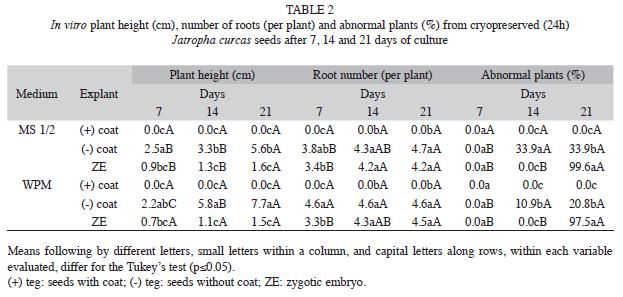
<body><![CDATA[demonstrating a need for larger studies to improve the sterilization     method (<a href="/img/revistas/rbt/v60n1/a35t1.gif">Table 1</a>).</span></font><br      style="font-family: verdana;">     <font size="2"></font><br style="font-family: verdana;">     <font size="2"><span style="font-family: verdana;">Seeds without coat     germinated on     WPM resulted in higher growth of the seedlings, with an average height     of 7.7cm after 21 days of in vitro growth. However, seeds in the same     conditions, germinated on &frac12; MS medium, showed lower growth,     presenting&nbsp; an average height of 5.6cm after 21 days. In relation     ]]></body>
<body><![CDATA[to the number of roots formed after 21 days of seedling growth, no     significant differences were observed between the types of explants     used or between the culture media tested (<a      href="/img/revistas/rbt/v60n1/a35t2.gif">Table 2</a>).</span></font><br      style="font-family: verdana;">     <font size="2"></font><br style="font-family: verdana;">     <font size="2"><span style="font-family: verdana;">A relatively high     level was     observed for the formation of abnormal seedlings, with </span><span      style="font-family: verdana;">atrophied cotyledonary leaves, low     ]]></body>
<body><![CDATA[vigor and delayed root development (<a      href="/img/revistas/rbt/v60n1/a35i1.jpg">Fig. 1</a>). Seeds cultured     in WPM and     &frac12; MS medium after coat removal formed on average 20.8<span      style="font-style: italic;">%</span> and     33.9<span style="font-style: italic;">%</span>, of abnormal seedlings     respectively. For zygotic embryos, the     percentage of abnormal seedlings reached up to 99.6<span      style="font-style: italic;">%</span> (<a      href="/img/revistas/rbt/v60n1/a35t2.gif">Table 2</a>).     ]]></body>
<body><![CDATA[However, with the exception of seedlings originating from zygotic     embryos which did not revert the characteristics of abnormality, all     the seedlings of the other treatments, germinated from seeds returned     to normal development after acclimatization.</span></font><br      style="font-family: verdana;">     <font size="2"></font><br style="font-family: verdana;">     <font size="2"><span style="font-family: verdana;">The initial moisture     content of     cryopreserved seeds was 9.8<span style="font-style: italic;">%</span>     with germination values </span><span style="font-family: verdana;">of     ]]></body>
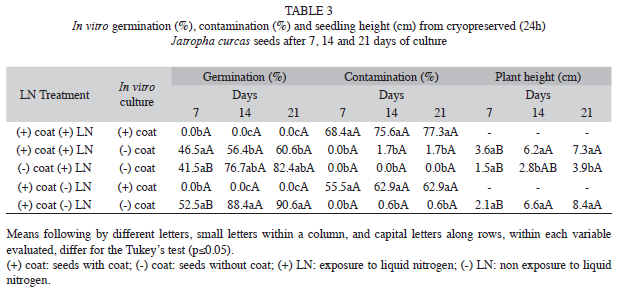
<body><![CDATA[82.4<span style="font-style: italic;">%</span> in the treatment where     the     seeds were stored and germinated without coat (<a      href="/img/revistas/rbt/v60n1/a35t3.gif">Table 3</a>). Seeds cultured     in vitro with coat did not germinate, and there were no significant     differences between these and the control (-LN). However, seeds placed     to germinate after removal of the coat (control) presented germination     around 91<span style="font-style: italic;">%</span>. In these plants,     after 21 days of germination the     occurrence of 10<span style="font-style: italic;">%</span> of abnormal     ]]></body>
<body><![CDATA[plants was observed, with low vigor,     atrophied cotyledonary leaves and delayed root development. The     percentage of contaminated seeds submitted or not to cryogenic     conditions were 77.3<span style="font-style: italic;">%</span> and 62.9<span      style="font-style: italic;">%</span>, respectively for those in which     the     coat was left intact at the moment of germination, showing that the     sterilization for seeds with coat was not efficient. On the other hand,     it was observed that the percentage of contaminated seeds immersed or     not in liquid nitrogen, after removal of the coat, was </span><span     ]]></body>
<body><![CDATA[ style="font-family: verdana;">less than 2<span      style="font-style: italic;">%</span> (<a      href="/img/revistas/rbt/v60n1/a35t3.gif">Table 3</a>).</span></font><br      style="font-family: verdana;">     <font size="2"></font><br style="font-family: verdana;">     <font size="2"><span style="font-family: verdana;">Seeds cryopreserved     with coat and     then cultured in vitro without coat, presented around 60<span      style="font-style: italic;">%</span> germination     after 21 days of in vitro culture. This is significantly lower than     ]]></body>
<body><![CDATA[that observed for the control treatment and for seeds cryopreserved     without the coat (82<span style="font-style: italic;">%</span>, no     statistical difference in relation to the     control treatment). However, as described previously, contamination was     77.3<span style="font-style: italic;">%</span> in the seeds cultivated     with coat, reaffirming the results for     the control treatment, a factor which was eliminated with the removal     of the coat at the moment of germination in vitro.</span></font><br      style="font-family: verdana;">     <font size="2"></font><br style="font-family: verdana;">     ]]></body>
<body><![CDATA[<font size="2"><span style="font-family: verdana;">In relation to the     height of the     seedlings, the seeds exposed to liquid nitrogen with coat and     germinated in vitro without coat presented vigorous seedlings, with an     average height of 7.3 cm at the end of the 21 days of in vitro culture,     and did not differ statistically in relation to the control (<a      href="/img/revistas/rbt/v60n1/a35t3.gif">Table 3</a>).     However, in the seeds submitted to liquid nitrogen without coat, even     though these presented high levels of germination, reduced vigor was     observed, and in this case the plants presented an average height of     ]]></body>
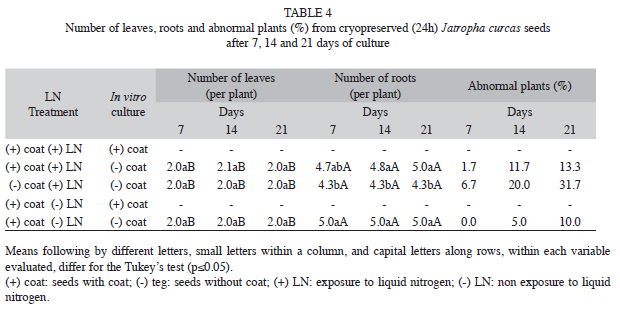
<body><![CDATA[3.9cm (<a href="/img/revistas/rbt/v60n1/a35t3.gif">Table 3</a>). Such     plants produced also a lower number of roots     (<a href="/img/revistas/rbt/v60n1/a35t4.gif">Table 4</a>). As for the     number of leaves, no significant differences were     observed between the treatments, with around two leaves per plant after     21 days of cultivation. All the abnormal plants from zygotic embryo and     from seeds exposed without coat, when acclimatized, were unable to     withstand the acclimatization and died, while those with normal     germination and development or those exposed to LN with tegument and     germinated without coat survived in 100<span style="font-style: italic;">%</span>     ]]></body>
<body><![CDATA[in the greenhouse. Such plants     demonstrated phenotypically normal growth after two months of     acclimatization (<a href="/img/revistas/rbt/v60n1/a35i1.jpg">Fig. 1</a>),     although freezing the seeds of <span style="font-style: italic;">J.     curcas</span>     without the coat resulted in a significant increase in abnormal plants     morphologically (31.7<span style="font-style: italic;">%</span>)(<a      href="/img/revistas/rbt/v60n1/a35t4.gif">Table     4</a>).</span></font><br style="font-family: verdana;">     <font size="2"></font><br style="font-family: verdana;">     ]]></body>
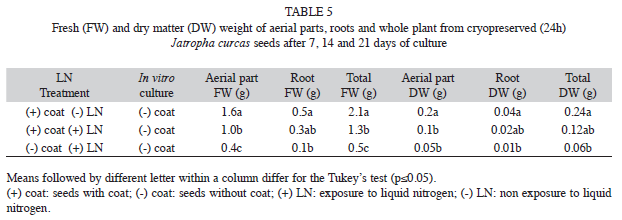
<body><![CDATA[<font size="2"><span style="font-family: verdana;">In general, seeds     exposed to liquid     nitrogen present a lower accumulation of fresh and dry mass,     particularly those exposed without coat (<a      href="/img/revistas/rbt/v60n1/a35t5.gif">Table 5</a>). Thus, seeds     with     coat submitted to liquid nitrogen and cultivated without coat in     culture medium resulted in seedlings with a fresh and dry weight which     was lower than that of the control treatment, on average 1.3g and     0.12g, respectively. However, the fresh and dry weight of the root did     ]]></body>
<body><![CDATA[not differ significantly from the control. The seedlings regenerated     from the seeds exposed to the liquid nitrogen without coat presented     lower vigor than the other treatments. However, the dry and fresh     weight of the root did not differ significantly from the cryopreserved     seeds with coat, presenting on average 0.1g and 0.01g respectively.</span></font><br      style="font-family: verdana;">     <font size="2"></font><br      style="font-family: verdana; font-weight: bold;">     <font style="font-weight: bold;" size="3"><span      style="font-family: verdana;">Discussion</span></font><br     ]]></body>
<body><![CDATA[ style="font-family: verdana;">     <font size="2"></font><br style="font-family: verdana;">     <font size="2"><span style="font-family: verdana;">Plant genetic     resources or     germplasm describes the total genetic diversity of cultivated </span><span      style="font-family: verdana;">species and their wild relatives     (Ford-Lloyd <span style="font-style: italic;">&amp;</span> Jackson     1991), and conservation of germplasm is the     most fundamental aspect of biological conservation. Plant germplasm can     be derived from a variety of sources, which will in turn determine the     ]]></body>
<body><![CDATA[method of its conservation. Seed storage is the most common method used     to conserve plant germplasm because of the convenience and relatively     low costs involved. This strategy, however, cannot be applied to all     plant species as the post-harvest behaviour of their seeds, which     determines the most suitable method of conservation, differs.</span></font><br      style="font-family: verdana;">     <font size="2"></font><br style="font-family: verdana;">     <font size="2"><span style="font-family: verdana;">Cryopreservation of     plant materials     in the form of whole seeds, excised embryos, reproductive parts and     ]]></body>
<body><![CDATA[vegetative tissues is gaining momentum as a method for the conservation     of germplasm. Cryopreservation refers to preservation at -196&deg;C,     the temperature of liquid nitrogen (LN). The basic concept of LN     preservation is that, at this temperature, all metabolic processes in     seeds are essentially reduced. Consequently, all sources of seed     deterioration that are metabolically related are greatly reduced or     stopped, thus providing &#8216;indefinite&#8217; preservation. Storage in LN could     prevent or significantly reduce such viability loss (Camillo <span      style="font-style: italic;">et al.     </span>2009). Thus, the result would be the improved maintenance of     ]]></body>
<body><![CDATA[valuable     genetic resources.     <br>     <br>     Given the variety and specific nature of factors     affecting recovery after cryopreservation, specific <span      style="font-style: italic;">in vitro</span> conditions     need to be optimized before cryopreservation can be attempted. Thus,     the optimum culture medium for <span style="font-style: italic;">in     vitro</span> regeneration must also be     ]]></body>
<body><![CDATA[ascertained. </span></font><font size="2"><span      style="font-family: verdana;">In this work, the initial moisture     content of cryopreserved seeds was 9.8<span style="font-style: italic;">%</span>     with germination values of     82.4<span style="font-style: italic;">%</span> in the treatment where     the seeds were stored and germinated     without coat. Seeds germinated without coat into MS and WPM media did     not presented significant differences on the germination percentage and     just for zygotic embryo the germination was significantly higher in the     &frac12; MS medium than </span><span style="font-family: verdana;">in     ]]></body>
<body><![CDATA[the WPM medium, despite abnormal     germination reached between 97<span style="font-style: italic;">%</span>     to 99<span style="font-style: italic;">%</span> of zygotic embryo in     culture,     independently of media. It is interesting to note that MS&nbsp; medium     has been successfully used in the in vitro culture of various tropical     woody plant species, such as <span style="font-style: italic;">Caryocar     brasiliense</span> Camb. (Landa <span style="font-style: italic;">et     al.</span>     2000), <span style="font-style: italic;">Lychnophora pinaster</span>     ]]></body>
<body><![CDATA[Mart. (Souza <span style="font-style: italic;">et al.</span> 2003) and     <span style="font-style: italic;">Byrsonima     intermedia</span> A. Juss. (Nogueira <span style="font-style: italic;">et     al.</span> 2004). Experiments with mature,     immature and dry seeds of <span style="font-style: italic;">J. curcas</span>     also revealed that MS medium was     efficient to sustain germination and continuous growth of plants under<span      style="font-style: italic;">     in vitro</span> conditions (Nunes <span style="font-style: italic;">et     al.</span> 2008). On the other hand, seeds     ]]></body>
<body><![CDATA[cultured <span style="font-style: italic;">in vitro </span>with coat     did not germinate, and there were no     significant differences between these and the control (-LN). These     results can probably be attributed to the presence of dormancy in the     seeds, as observed by A&ntilde;ez <span style="font-style: italic;">et     al.</span> (2005) who studied the     germination behavior of seeds of <span style="font-style: italic;">J.     elliptica</span>, and observed that these     seeds present </span><span style="font-family: verdana;">physical     dormancy caused by the     ]]></body>
<body><![CDATA[impermeability of the coat, requiring a scarification treatment. It is     particularly important to observe also that the occurrence of     contamination was 77<span style="font-style: italic;">%</span> in the     seeds cultivated with coat, reaffirming     the results for the control treatment, a factor which was eliminated     with the removal of the coat at the moment of germination in vitro.</span></font><br      style="font-family: verdana;">     <font size="2"></font><br style="font-family: verdana;">     <font size="2"><span style="font-family: verdana;">However, for     successful     ]]></body>
<body><![CDATA[cryopreservation, it is necessary to avoid lethal intracellular     freezing, which occur during rapid cooling in LN. In the present study,     it was interesting to note that as well as the seeds cryopreserved with     coat when seeds were cryopreserved without coat there was germination,     but seedling presented reduced vigor, and in this case the plants     presented an average height and number of roots per plant lower than     those cryopreserved with coat. According to Normah <span      style="font-style: italic;">et al. </span>(1994) this     decline in plant growth and number of roots was probably due to     dormancy induced during dry storage of the seeds on embryo axis, as     ]]></body>
<body><![CDATA[observed with hazelnut (<span style="font-style: italic;">Corylus     avellana</span>), besides a reduction in     metabolism caused by exposure of the plant materials to subzero     temperatures (Ellis<span style="font-style: italic;"> &amp;</span>     Roberts 1981, Hor <span style="font-style: italic;">et al.</span>     2005). Furthermore,     seeds without coat directly frozen in liquid nitrogen resulted in a     significant increase in abnormal plants. This fact can be attributed to     injury in the seed tissues, caused by exposure to extreme temperatures.</span></font><br      style="font-family: verdana;">     ]]></body>
<body><![CDATA[<font size="2"></font><br style="font-family: verdana;">     <font size="2"><span style="font-family: verdana;">These results     confirm the     importance of cryopreserving seeds of <span style="font-style: italic;">J.     curcas</span> with the coat </span><span style="font-family: verdana;">intact.     Almeida <span style="font-style: italic;">et al. </span>(2002)     reports that seeds with high oil content, due to their chemical     composition, are more susceptible to injury and physical damage caused     by the exposure to low temperatures. According to Crane <span      style="font-style: italic;">et al. </span>(2003)     ]]></body>
<body><![CDATA[and Volk <span style="font-style: italic;">et al.</span> (2006), low     temperatures crystallize lipids during seed     storage and water interactions with crystallized storage lipids can be     lethal to seeds. Thus, the seed coat maintenance </span><span      style="font-family: verdana;">could prevent this physic-chemical     reaction preserving the viability of the seeds, although the reason why     water contacting crystallized triacylglycerols is lethal to seeds </span><span      style="font-family: verdana;">is not known. </span></font><br      style="font-family: verdana;">     <font size="2"></font><br style="font-family: verdana;">     ]]></body>
<body><![CDATA[<font size="2"><span style="font-family: verdana;">This study confirmed     that <span style="font-style: italic;">J. Curcas</span>     is an orthodox seed and whole seeds can be cryopreserved under certain     conditions. To our knowledge this is the first report of     cryopreservation of seeds of <span style="font-style: italic;">J.     curcas</span>, which can contribute to the     development of an efficient method for long-term conservation of     genetic resources of this species. The procedure described for seedling     recovery of cryopreserved seeds of <span style="font-style: italic;">Jatropha     curcas</span> is relatively simple     ]]></body>
<body><![CDATA[and reliable whereby cryopreserved seeds germinated and seedlings     developed into normal and healthy plants. Although this investigation     has been a screening test to establish if <span      style="font-style: italic;">J. curcas</span> seeds are tolerant     to liquid nitrogen when exposure is for a short time, the results     obtained indicate that these seeds can withstand LN exposure without     detrimental effects and cryopreservation would be another option to     their germplasm conservation. Although under <span      style="font-style: italic;">in vitro</span> condition the </span></font><font      size="2"><span style="font-family: verdana;">germination percentages     ]]></body>
<body><![CDATA[are high     when seeds are deprived of coat, the presence of coat prior to LN     exposure was essential to allow proper germination of cryopreserved     seeds. In the present study, with the exception of seedlings     originating from zygotic embryos which did not revert the     characteristics of abnormality, all the seedlings of the other     treatments returned to normal development after acclimatization. The     application of this protocol for seedling&nbsp;recovery to other <span      style="font-style: italic;">Jatropha</span> species and accessions     is currently under investigation.</span></font><br     ]]></body>
<body><![CDATA[ style="font-family: verdana;">     <font size="2"></font><br style="font-family: verdana;">     <font style="font-weight: bold;" size="3"><span      style="font-family: verdana;">Acknowledgments</span></font><br      style="font-family: verdana;">     <font size="2"></font><br style="font-family: verdana;">     <font size="2"><span style="font-family: verdana;">The authors thank     the Conselho     Nacional de Desenvolvimento Cient&iacute;fico e Tecnol&oacute;gico     (CNPq), Bras&iacute;lia, DF, Brazil, for financial support and     ]]></body>
<body><![CDATA[fellowships, and Embrapa Agroenergia, Bras&iacute;lia, DF, Brazil, for     providing the seeds for the experiments.</span></font><br      style="font-family: verdana;">     <font size="2"></font><br style="font-family: verdana;">     <font size="2"><span style="font-family: verdana;"></span></font></div>     <hr      style="width: 100%; height: 2px; margin-left: 0px; margin-right: 0px;">     <!-- ref --><div style="text-align: justify;"><font style="font-weight: bold;"  size="3"><span style="font-family: verdana;">References</span></font><br  style="font-family: verdana;"> <font size="2"></font><br style="font-family: verdana;"> <font size="2"><span style="font-family: verdana;">Almeida, F.A.C., A.M. Morais, J.M.F.C. Carvalho <span style="font-style: italic;">&amp;</span> J.P.G. Gouveia. 2002. Crioconserva&ccedil;&atilde;o de sementes de mamona das variedades nordestina e pernambucana. </span><span style="font-family: verdana;">Rev. Bras. Eng. Agr. Amb. 6: 295-302.    &nbsp;&nbsp;&nbsp;&nbsp;&nbsp;&nbsp;&nbsp;&nbsp;[&#160;<a href="javascript:void(0);" onclick="javascript: window.open('/scielo.php?script=sci_nlinks&ref=1432808&pid=S0034-7744201200010003500001&lng=','','width=640,height=500,resizable=yes,scrollbars=1,menubar=yes,');">Links</a>&#160;]<!-- end-ref --><!-- ref --></span></font><br style="font-family: verdana;"> <font size="2"></font><br style="font-family: verdana;"> <font size="2"><span style="font-family: verdana;">A&ntilde;ez, L.M.M., M.F.B. Coelho, M.C.F. Albuquerque <span style="font-style: italic;">&amp;</span> J.L.D. Dombroski. 2005. Caracteriza&ccedil;&atilde;o e morfolog&iacute;a dos frutos, das sementes e do desenvolvimento das pl&acirc;ntulas de <span  style="font-style: italic;">Jatrpha elliptica</span> Mull. Arg. (Euphorbiacea). Rev. Bras. Bot. 28: 563-568.    &nbsp;&nbsp;&nbsp;&nbsp;&nbsp;&nbsp;&nbsp;&nbsp;[&#160;<a href="javascript:void(0);" onclick="javascript: window.open('/scielo.php?script=sci_nlinks&ref=1432809&pid=S0034-7744201200010003500002&lng=','','width=640,height=500,resizable=yes,scrollbars=1,menubar=yes,');">Links</a>&#160;]<!-- end-ref --><!-- ref --></span></font><br  style="font-family: verdana;"> <font size="2"></font><br style="font-family: verdana;"> <font size="2"><span style="font-family: verdana;">Camillo, J., Z.G. Luis <span style="font-style: italic;">&amp;</span> J.E. Scherwinski-Pereira. 2009. Toler&acirc;ncia de sementes de dendezeiro &agrave; criopreserva&ccedil;&atilde;o. Pesq. Agropec. Bras. 44: 211-215.    &nbsp;&nbsp;&nbsp;&nbsp;&nbsp;&nbsp;&nbsp;&nbsp;[&#160;<a href="javascript:void(0);" onclick="javascript: window.open('/scielo.php?script=sci_nlinks&ref=1432810&pid=S0034-7744201200010003500003&lng=','','width=640,height=500,resizable=yes,scrollbars=1,menubar=yes,');">Links</a>&#160;]<!-- end-ref --><!-- ref --></span></font><br style="font-family: verdana;"> <font size="2"></font><br style="font-family: verdana;"> <font size="2"><span style="font-family: verdana;">Carvalho, C.R., W.R. Clarindo, M.M. Praca, F.S. Araujo <span style="font-style: italic;">&amp;</span> N. Carels. 2008. Genome size, base composition and karyotype of <span style="font-style: italic;">Jatropha curcas</span> L., an important biofuel plant. Plant Sci. 174: 613-617.    &nbsp;&nbsp;&nbsp;&nbsp;&nbsp;&nbsp;&nbsp;&nbsp;[&#160;<a href="javascript:void(0);" onclick="javascript: window.open('/scielo.php?script=sci_nlinks&ref=1432811&pid=S0034-7744201200010003500004&lng=','','width=640,height=500,resizable=yes,scrollbars=1,menubar=yes,');">Links</a>&#160;]<!-- end-ref --><!-- ref --></span></font><br style="font-family: verdana;"> <font size="2"></font><br style="font-family: verdana;"> <font size="2"><span style="font-family: verdana;">Chmielarz, P. 2009a. Cryopreservation of dormant European ash (<span  style="font-style: italic;">Fraxinus excelsior</span>) orthodox seeds. Tree Phys. 29: 1279-1285.    &nbsp;&nbsp;&nbsp;&nbsp;&nbsp;&nbsp;&nbsp;&nbsp;[&#160;<a href="javascript:void(0);" onclick="javascript: window.open('/scielo.php?script=sci_nlinks&ref=1432812&pid=S0034-7744201200010003500005&lng=','','width=640,height=500,resizable=yes,scrollbars=1,menubar=yes,');">Links</a>&#160;]<!-- end-ref --><!-- ref --></span></font><br  style="font-family: verdana;"> <font size="2"></font><br style="font-family: verdana;"> <font size="2"><span style="font-family: verdana;">Chmielarz, P. 2009b. Cryopreservation of dormant orthodox seed of forest trees: mazzard cherry (<span style="font-style: italic;">Prunus avium</span> L.). Ann. For. Sci. 66: 405.    &nbsp;&nbsp;&nbsp;&nbsp;&nbsp;&nbsp;&nbsp;&nbsp;[&#160;<a href="javascript:void(0);" onclick="javascript: window.open('/scielo.php?script=sci_nlinks&ref=1432813&pid=S0034-7744201200010003500006&lng=','','width=640,height=500,resizable=yes,scrollbars=1,menubar=yes,');">Links</a>&#160;]<!-- end-ref --><!-- ref --></span></font><br style="font-family: verdana;"> <font size="2"></font><br style="font-family: verdana;"> <font size="2"><span style="font-family: verdana;">Crane, J., A.L. Miller, J.W. Van Roekel <span style="font-style: italic;">&amp;</span> C. Walters. 2003. Triacylglycerols determine the unusual storage physiology of <span style="font-style: italic;">Cuphea</span> seed. Planta 217: 699-708.    &nbsp;&nbsp;&nbsp;&nbsp;&nbsp;&nbsp;&nbsp;&nbsp;[&#160;<a href="javascript:void(0);" onclick="javascript: window.open('/scielo.php?script=sci_nlinks&ref=1432814&pid=S0034-7744201200010003500007&lng=','','width=640,height=500,resizable=yes,scrollbars=1,menubar=yes,');">Links</a>&#160;]<!-- end-ref --><!-- ref --></span></font><br  style="font-family: verdana;"> <font size="2"></font><br style="font-family: verdana;"> <font size="2"><span style="font-family: verdana;">Deore, A.C. <span  style="font-style: italic;">&amp;</span> T.S. Johnson. 2008. High-frequency plant regeneration from leaf-disc cultures of <span style="font-style: italic;">Jatropha curcas</span> L.: an important biodiesel plant. Plant Biotechnol. Rep. 2: 7-11.    &nbsp;&nbsp;&nbsp;&nbsp;&nbsp;&nbsp;&nbsp;&nbsp;[&#160;<a href="javascript:void(0);" onclick="javascript: window.open('/scielo.php?script=sci_nlinks&ref=1432815&pid=S0034-7744201200010003500008&lng=','','width=640,height=500,resizable=yes,scrollbars=1,menubar=yes,');">Links</a>&#160;]<!-- end-ref --><!-- ref --></span></font><br style="font-family: verdana;"> <font size="2"></font><br style="font-family: verdana;"> <font size="2"><span style="font-family: verdana;">Ellis, R.H. <span  style="font-style: italic;">&amp;</span> E.H. Roberts. 1981. The quantification of ageing and survival in orthodox seeds. Seed Sci. Technol. 9: 373-409.    &nbsp;&nbsp;&nbsp;&nbsp;&nbsp;&nbsp;&nbsp;&nbsp;[&#160;<a href="javascript:void(0);" onclick="javascript: window.open('/scielo.php?script=sci_nlinks&ref=1432816&pid=S0034-7744201200010003500009&lng=','','width=640,height=500,resizable=yes,scrollbars=1,menubar=yes,');">Links</a>&#160;]<!-- end-ref --><!-- ref --></span></font><br style="font-family: verdana;"> <font size="2"></font><br style="font-family: verdana;"> <font size="2"><span style="font-family: verdana;">Engelmann, F. 1991. <span  style="font-style: italic;">In vitro</span> conservation of tropical plant germplasm-a review. Euphytica 57: 227-243.    &nbsp;&nbsp;&nbsp;&nbsp;&nbsp;&nbsp;&nbsp;&nbsp;[&#160;<a href="javascript:void(0);" onclick="javascript: window.open('/scielo.php?script=sci_nlinks&ref=1432817&pid=S0034-7744201200010003500010&lng=','','width=640,height=500,resizable=yes,scrollbars=1,menubar=yes,');">Links</a>&#160;]<!-- end-ref --><!-- ref --></span></font><br style="font-family: verdana;"> <font size="2"></font><br style="font-family: verdana;"> <font size="2"><span style="font-family: verdana;">Engelmann, F. 2004. Plant cryopreservation: Progress and prospects. In vitro Cell. Dev. B. 40: 427-433.    &nbsp;&nbsp;&nbsp;&nbsp;&nbsp;&nbsp;&nbsp;&nbsp;[&#160;<a href="javascript:void(0);" onclick="javascript: window.open('/scielo.php?script=sci_nlinks&ref=1432818&pid=S0034-7744201200010003500011&lng=','','width=640,height=500,resizable=yes,scrollbars=1,menubar=yes,');">Links</a>&#160;]<!-- end-ref --><!-- ref --></span></font><br style="font-family: verdana;"> <font size="2"></font><br style="font-family: verdana;"> <font size="2"><span style="font-family: verdana;">Ford-Lloyd, B.V. <span  style="font-style: italic;">&amp;</span> M.T. Jackson. 1991. Biotechnology and methods of conservation of plant genetic resources. J. Biotechnol. 17: 247-256.    &nbsp;&nbsp;&nbsp;&nbsp;&nbsp;&nbsp;&nbsp;&nbsp;[&#160;<a href="javascript:void(0);" onclick="javascript: window.open('/scielo.php?script=sci_nlinks&ref=1432819&pid=S0034-7744201200010003500012&lng=','','width=640,height=500,resizable=yes,scrollbars=1,menubar=yes,');">Links</a>&#160;]<!-- end-ref --><!-- ref --></span></font><br  style="font-family: verdana;"> <font size="2"></font><br style="font-family: verdana;"> <font size="2"><span style="font-family: verdana;">Gubitz, G.M., M. Mittelbach <span style="font-style: italic;">&amp;</span> M. Trabi. 1999. Exploitation of the tropical oil seed plant <span  style="font-style: italic;">Jatropha curcas</span> L. Bio. Technol. 67: 73-82.    &nbsp;&nbsp;&nbsp;&nbsp;&nbsp;&nbsp;&nbsp;&nbsp;[&#160;<a href="javascript:void(0);" onclick="javascript: window.open('/scielo.php?script=sci_nlinks&ref=1432820&pid=S0034-7744201200010003500013&lng=','','width=640,height=500,resizable=yes,scrollbars=1,menubar=yes,');">Links</a>&#160;]<!-- end-ref --><!-- ref --></span></font><br  style="font-family: verdana;"> <font size="2"></font><br style="font-family: verdana;"> <font size="2"><span style="font-family: verdana;">Hor, Y.L., Y.J. Kim, A. Ugap, N. Chabrillange, U.R. Sinniah, F. Engelmann <span  style="font-style: italic;">&amp;</span> S. Dussert. 2005. Optimal hydration status for cryopreservation of intermediate oily seeds: citrus as a case study. Ann. Bot. 95: 1153-1161.    &nbsp;&nbsp;&nbsp;&nbsp;&nbsp;&nbsp;&nbsp;&nbsp;[&#160;<a href="javascript:void(0);" onclick="javascript: window.open('/scielo.php?script=sci_nlinks&ref=1432821&pid=S0034-7744201200010003500014&lng=','','width=640,height=500,resizable=yes,scrollbars=1,menubar=yes,');">Links</a>&#160;]<!-- end-ref --><!-- ref --></span></font><br  style="font-family: verdana;"> <font size="2"></font><br style="font-family: verdana;"> <font size="2"><span style="font-family: verdana;">Landa, F.S.L., R. Paiva, P.D.O. Paiva <span style="font-style: italic;">&amp;</span> J.S.S. Bueno- Filho. 2000. Indu&ccedil;&atilde;o <span style="font-style: italic;">in vitro</span> de calos em explantes foliares de pequizeiro (<span  style="font-style: italic;">Caryocar brasiliense</span> Camb.). Ci&ecirc;nc. Agro. 24: 56-63.    &nbsp;&nbsp;&nbsp;&nbsp;&nbsp;&nbsp;&nbsp;&nbsp;[&#160;<a href="javascript:void(0);" onclick="javascript: window.open('/scielo.php?script=sci_nlinks&ref=1432822&pid=S0034-7744201200010003500015&lng=','','width=640,height=500,resizable=yes,scrollbars=1,menubar=yes,');">Links</a>&#160;]<!-- end-ref --><!-- ref --></span></font><br  style="font-family: verdana;"> <font size="2"></font><br style="font-family: verdana;"> <font size="2"><span style="font-family: verdana;">Lloyd, G. <span  style="font-style: italic;">&amp;</span> B. McCown. 1980. Commercially-feasible micropropagation of mountain laurel <span  style="font-style: italic;">Kalmia latifolia</span> by use of shoot-tip culture. Proc. Int. Plant Prop. Soc. 30: 421-427.    &nbsp;&nbsp;&nbsp;&nbsp;&nbsp;&nbsp;&nbsp;&nbsp;[&#160;<a href="javascript:void(0);" onclick="javascript: window.open('/scielo.php?script=sci_nlinks&ref=1432823&pid=S0034-7744201200010003500016&lng=','','width=640,height=500,resizable=yes,scrollbars=1,menubar=yes,');">Links</a>&#160;]<!-- end-ref --><!-- ref --></span></font><br style="font-family: verdana;"> <font size="2"></font><br style="font-family: verdana;"> <font size="2"><span style="font-family: verdana;">Murashige, T. <span  style="font-style: italic;">&amp;</span> F. Skoog. 1962. A revised medium for rapid growth and bioessays with tobacco tissue cultures. Physiol. Plant 15: 473-497.    &nbsp;&nbsp;&nbsp;&nbsp;&nbsp;&nbsp;&nbsp;&nbsp;[&#160;<a href="javascript:void(0);" onclick="javascript: window.open('/scielo.php?script=sci_nlinks&ref=1432824&pid=S0034-7744201200010003500017&lng=','','width=640,height=500,resizable=yes,scrollbars=1,menubar=yes,');">Links</a>&#160;]<!-- end-ref --><!-- ref --></span></font><br  style="font-family: verdana;"> <font size="2"></font><br style="font-family: verdana;"> <font size="2"><span style="font-family: verdana;">Nogueira, R.C., R. Paiva, A.H. Castro, C.V. Vieira, L.C. Abbade <span style="font-style: italic;">&amp;</span> A.A. Alvarenga. 2004. Germina&ccedil;&atilde;o <span style="font-style: italic;">in vitro</span> de murici-pequeno (<span style="font-style: italic;">Byrsonima intermedia</span> A. Juss.). Ci&ecirc;nc. Agro. 28: 1053-1059.    &nbsp;&nbsp;&nbsp;&nbsp;&nbsp;&nbsp;&nbsp;&nbsp;[&#160;<a href="javascript:void(0);" onclick="javascript: window.open('/scielo.php?script=sci_nlinks&ref=1432825&pid=S0034-7744201200010003500018&lng=','','width=640,height=500,resizable=yes,scrollbars=1,menubar=yes,');">Links</a>&#160;]<!-- end-ref --><!-- ref --></span></font><br  style="font-family: verdana;"> <font size="2"></font><br style="font-family: verdana;"> <font size="2"><span style="font-family: verdana;">Normah, M.N., B.M. Reed <span style="font-style: italic;">&amp;</span> X.L. Yu. 1994. Seed storage and cryoexposure behaviour in hazelnut (<span  style="font-style: italic;">Corylus avellana</span> L. cv. Barcelona). Cryo-Letters 15: 315-322.    &nbsp;&nbsp;&nbsp;&nbsp;&nbsp;&nbsp;&nbsp;&nbsp;[&#160;<a href="javascript:void(0);" onclick="javascript: window.open('/scielo.php?script=sci_nlinks&ref=1432826&pid=S0034-7744201200010003500019&lng=','','width=640,height=500,resizable=yes,scrollbars=1,menubar=yes,');">Links</a>&#160;]<!-- end-ref --><!-- ref --></span></font><br  style="font-family: verdana;"> <font size="2"></font><br style="font-family: verdana;"> <font size="2"><span style="font-family: verdana;">Nunes, C.F., M. Pasqual, D.N. Santos, T.N. Cust&oacute;dio <span style="font-style: italic;">&amp;</span> A.G. Ara&uacute;jo. 2008. Diferentes suplementos no cultivo<span style="font-style: italic;"> in vitro</span> de embri&otilde;es de pinh&atilde;o-manso. Pesq. Agropec. Bras. 43: 9-14.    &nbsp;&nbsp;&nbsp;&nbsp;&nbsp;&nbsp;&nbsp;&nbsp;[&#160;<a href="javascript:void(0);" onclick="javascript: window.open('/scielo.php?script=sci_nlinks&ref=1432827&pid=S0034-7744201200010003500020&lng=','','width=640,height=500,resizable=yes,scrollbars=1,menubar=yes,');">Links</a>&#160;]<!-- end-ref --><!-- ref --></span></font><br  style="font-family: verdana;"> <font size="2"></font><br style="font-family: verdana;"> <font size="2"><span style="font-family: verdana;">Openshaw, K. 2000. A review of <span style="font-style: italic;">Jatropha curcas</span>: an oil palm plant of unfulfilled promise. Biomass Bioenerg. 19: 1-15.    &nbsp;&nbsp;&nbsp;&nbsp;&nbsp;&nbsp;&nbsp;&nbsp;[&#160;<a href="javascript:void(0);" onclick="javascript: window.open('/scielo.php?script=sci_nlinks&ref=1432828&pid=S0034-7744201200010003500021&lng=','','width=640,height=500,resizable=yes,scrollbars=1,menubar=yes,');">Links</a>&#160;]<!-- end-ref --><!-- ref --></span></font><br style="font-family: verdana;"> <font size="2"></font><br style="font-family: verdana;"> <font size="2"><span style="font-family: verdana;">Souza, A.V., J.E.B.P. Pinto, S.K.V. Bertolucci, R.M. Correa <span style="font-style: italic;">&amp;</span> E.M. Castro. 2003. Germina&ccedil;&atilde;o de embri&otilde;es e multiplica&ccedil;&atilde;o <span style="font-style: italic;">in vitro</span> de <span style="font-style: italic;">Lychnophora pinaster</span> Mart. Ci&ecirc;nc. Agro. 26: 1532-1538.    &nbsp;&nbsp;&nbsp;&nbsp;&nbsp;&nbsp;&nbsp;&nbsp;[&#160;<a href="javascript:void(0);" onclick="javascript: window.open('/scielo.php?script=sci_nlinks&ref=1432829&pid=S0034-7744201200010003500022&lng=','','width=640,height=500,resizable=yes,scrollbars=1,menubar=yes,');">Links</a>&#160;]<!-- end-ref --><!-- ref --></span></font><br  style="font-family: verdana;"> <font size="2"></font><br style="font-family: verdana;"> <font size="2"><span style="font-family: verdana;">Swarup, R. 2004. Biotechnological interventions to improve <span style="font-style: italic;">Jatropha</span> seeds and oil quality. SAARC Oil <span style="font-style: italic;">&amp;</span> Fats Today 8: 39-41.    &nbsp;&nbsp;&nbsp;&nbsp;&nbsp;&nbsp;&nbsp;&nbsp;[&#160;<a href="javascript:void(0);" onclick="javascript: window.open('/scielo.php?script=sci_nlinks&ref=1432830&pid=S0034-7744201200010003500023&lng=','','width=640,height=500,resizable=yes,scrollbars=1,menubar=yes,');">Links</a>&#160;]<!-- end-ref --><!-- ref --></span></font><br  style="font-family: verdana;"> <font size="2"></font><br style="font-family: verdana;"> <font size="2"><span style="font-family: verdana;">Volk, G.M., J. Crane, A.M. Caspersen, L.M. Hill, C. Gardner <span style="font-style: italic;">&amp;</span> C. Walters. 2006. Massive cellular disruption occurs during early imbibitions of <span  style="font-style: italic;">Cuphea</span> seeds containing crystallized triacylglycerols. Planta 224: 1415-1426.    &nbsp;&nbsp;&nbsp;&nbsp;&nbsp;&nbsp;&nbsp;&nbsp;[&#160;<a href="javascript:void(0);" onclick="javascript: window.open('/scielo.php?script=sci_nlinks&ref=1432831&pid=S0034-7744201200010003500024&lng=','','width=640,height=500,resizable=yes,scrollbars=1,menubar=yes,');">Links</a>&#160;]<!-- end-ref --><!-- ref --></span></font><br  style="font-family: verdana;"> <font size="2"></font><br style="font-family: verdana;"> <font size="2"><span style="font-family: verdana;">Walters, C., L. Wheeler <span style="font-style: italic;">&amp;</span> P.C. Stanwood. 2004. Longevity of cryogenically stored seeds. Cryobiology 48: 229-244.    &nbsp;&nbsp;&nbsp;&nbsp;&nbsp;&nbsp;&nbsp;&nbsp;[&#160;<a href="javascript:void(0);" onclick="javascript: window.open('/scielo.php?script=sci_nlinks&ref=1432832&pid=S0034-7744201200010003500025&lng=','','width=640,height=500,resizable=yes,scrollbars=1,menubar=yes,');">Links</a>&#160;]<!-- end-ref --><br>     <br> <a name="Correspondencia1"></a>*Correspondencia a:</span></font><font  size="2"> <span style="font-family: verdana;">Rafael de C. Silva: </span></font><font  size="2"><span style="font-family: verdana;">Post-Graduate Program in Biotechnology, Federal University of Amazonas, 69077-000 Manaus, AM, Brazil; <a href="mailto:carvalho_fael@yahoo.com.br">carvalho_fael@yahoo.com.br</a></span></font><br  style="font-family: verdana;"> <font size="2"><span style="font-family: verdana;">Julc&eacute;ia Camillo: </span></font><font size="2"><span  style="font-family: verdana;">Post-Graduate Program in Agronomy, University of Bras&iacute;lia, 70910-900 Bras&iacute;lia, DF, Brazil; <a href="mailto:julceia@gmail.com">julceia@gmail.com</a> </span></font><br  style="font-family: verdana;"> <font size="2"><span style="font-family: verdana;">Jonny E. Scherwinski-Pereira: </span></font><font size="2"><span  style="font-family: verdana;">Embrapa Genetic Resources and Biotechnology, Plant Tissue Culture Laboratory, P.O. Box 02372, Bras&iacute;lia, DF, Brazil; <a href="mailto:jonny@cenargen.embrapa.br">jonny@cenargen.embrapa.br</a>    <br> </span></font><br style="font-family: verdana;"> <font size="2"><span style="font-family: verdana;"><a name="1"></a><a  href="#4">1</a>. Post-Graduate Program in Biotechnology, Federal University of Amazonas, 69077-000 Manaus, AM, Brazil; <a href="mailto:carvalho_fael@yahoo.com.br">carvalho_fael@yahoo.com.br</a></span></font><br  style="font-family: verdana;"> <font size="2"><span style="font-family: verdana;"><a name="2"></a><a  href="#5">2</a>. Post-Graduate Program in Agronomy, University of Bras&iacute;lia, 70910-900 Bras&iacute;lia, DF, Brazil; <a href="mailto:julceia@gmail.com">julceia@gmail.com</a> </span></font><br  style="font-family: verdana;"> <font size="2"><span style="font-family: verdana;"><a name="3"></a><a  href="#6">3</a>. Embrapa Genetic Resources and Biotechnology, Plant Tissue Culture Laboratory, P.O. Box 02372, Bras&iacute;lia, DF, Brazil; <a href="mailto:jonny@cenargen.embrapa.br">jonny@cenargen.embrapa.br</a></span></font><br  style="font-family: verdana;"> <font size="2"><span style="font-family: verdana;"></span></font></div> <hr  style="width: 100%; height: 2px; margin-left: 0px; margin-right: 0px;">     <div style="text-align: center;"><font size="2"><span  style="font-family: verdana;">Received 25-X-2010. Corrected 10-V-2011. Accepted 09-VI-2011.</span></font><br  style="font-family: verdana;"> </div> <font size="2"></font>      ]]></body><back>
<ref-list>
<ref id="B1">
<nlm-citation citation-type="journal">
<person-group person-group-type="author">
<name>
<surname><![CDATA[Almeida]]></surname>
<given-names><![CDATA[F.A.C.]]></given-names>
</name>
<name>
<surname><![CDATA[Morais]]></surname>
<given-names><![CDATA[A.M.]]></given-names>
</name>
<name>
<surname><![CDATA[Carvalho]]></surname>
<given-names><![CDATA[J.M.F.C.]]></given-names>
</name>
<name>
<surname><![CDATA[Gouveia]]></surname>
<given-names><![CDATA[J.P.G.]]></given-names>
</name>
</person-group>
<article-title xml:lang="pt"><![CDATA[Crioconservação de sementes de mamona das variedades nordestina e pernambucana]]></article-title>
<source><![CDATA[Rev. Bras. Eng. Agr. Amb.]]></source>
<year>2002</year>
<volume>6</volume>
<page-range>295-302</page-range></nlm-citation>
</ref>
<ref id="B2">
<nlm-citation citation-type="journal">
<person-group person-group-type="author">
<name>
<surname><![CDATA[Añez]]></surname>
<given-names><![CDATA[L.M.M.]]></given-names>
</name>
<name>
<surname><![CDATA[Coelho]]></surname>
<given-names><![CDATA[M.F.B.]]></given-names>
</name>
<name>
<surname><![CDATA[Albuquerque]]></surname>
<given-names><![CDATA[M.C.F.]]></given-names>
</name>
<name>
<surname><![CDATA[Dombroski]]></surname>
<given-names><![CDATA[J.L.D.]]></given-names>
</name>
</person-group>
<article-title xml:lang="pt"><![CDATA[Caracterização e morfología dos frutos, das sementes e do desenvolvimento das plântulas de Jatrpha elliptica Mull. Arg. (Euphorbiacea)]]></article-title>
<source><![CDATA[Rev. Bras. Bot.]]></source>
<year>2005</year>
<volume>28</volume>
<page-range>563-568</page-range></nlm-citation>
</ref>
<ref id="B3">
<nlm-citation citation-type="journal">
<person-group person-group-type="author">
<name>
<surname><![CDATA[Camillo]]></surname>
<given-names><![CDATA[J]]></given-names>
</name>
<name>
<surname><![CDATA[Luis]]></surname>
<given-names><![CDATA[Z.G]]></given-names>
</name>
<name>
<surname><![CDATA[Scherwinski-Pereira]]></surname>
<given-names><![CDATA[J.E]]></given-names>
</name>
</person-group>
<article-title xml:lang="pt"><![CDATA[Tolerância de sementes de dendezeiro à criopreservação]]></article-title>
<source><![CDATA[Pesq. Agropec. Bras]]></source>
<year>2009</year>
<volume>44</volume>
<page-range>211-215</page-range></nlm-citation>
</ref>
<ref id="B4">
<nlm-citation citation-type="journal">
<person-group person-group-type="author">
<name>
<surname><![CDATA[Carvalho]]></surname>
<given-names><![CDATA[C.R.]]></given-names>
</name>
<name>
<surname><![CDATA[Clarindo]]></surname>
<given-names><![CDATA[W.R.]]></given-names>
</name>
<name>
<surname><![CDATA[Praca]]></surname>
<given-names><![CDATA[M.M.]]></given-names>
</name>
<name>
<surname><![CDATA[Araujo]]></surname>
<given-names><![CDATA[F.S.]]></given-names>
</name>
<name>
<surname><![CDATA[Carels]]></surname>
<given-names><![CDATA[N.]]></given-names>
</name>
</person-group>
<article-title xml:lang="en"><![CDATA[Genome size, base composition and karyotype of Jatropha curcas L., an important biofuel plant]]></article-title>
<source><![CDATA[Sci.]]></source>
<year>2008</year>
<volume>174</volume>
<page-range>613-617</page-range></nlm-citation>
</ref>
<ref id="B5">
<nlm-citation citation-type="journal">
<person-group person-group-type="author">
<name>
<surname><![CDATA[Chmielarz]]></surname>
<given-names><![CDATA[P.]]></given-names>
</name>
</person-group>
<article-title xml:lang="en"><![CDATA[Cryopreservation of dormant European ash (Fraxinus excelsior) orthodox seeds]]></article-title>
<source><![CDATA[Tree Phys]]></source>
<year>2009</year>
<volume>29</volume>
<page-range>1279-1285</page-range></nlm-citation>
</ref>
<ref id="B6">
<nlm-citation citation-type="journal">
<person-group person-group-type="author">
<name>
<surname><![CDATA[Chmielarz]]></surname>
<given-names><![CDATA[P.]]></given-names>
</name>
</person-group>
<article-title xml:lang="en"><![CDATA[Cryopreservation of dormant orthodox seed of forest trees: mazzard cherry (Prunus avium L.)]]></article-title>
<source><![CDATA[Ann. For. Sci.]]></source>
<year>2009</year>
<volume>66</volume>
<page-range>405</page-range></nlm-citation>
</ref>
<ref id="B7">
<nlm-citation citation-type="journal">
<person-group person-group-type="author">
<name>
<surname><![CDATA[Crane]]></surname>
<given-names><![CDATA[J.]]></given-names>
</name>
<name>
<surname><![CDATA[Miller]]></surname>
<given-names><![CDATA[A.L.]]></given-names>
</name>
<name>
<surname><![CDATA[Van Roekel]]></surname>
<given-names><![CDATA[J.W.]]></given-names>
</name>
<name>
<surname><![CDATA[Walters]]></surname>
<given-names><![CDATA[C.]]></given-names>
</name>
</person-group>
<article-title xml:lang="en"><![CDATA[Triacylglycerols determine the unusual storage physiology of Cuphea seed]]></article-title>
<source><![CDATA[Planta]]></source>
<year>2003</year>
<volume>217</volume>
<page-range>699-708</page-range></nlm-citation>
</ref>
<ref id="B8">
<nlm-citation citation-type="journal">
<person-group person-group-type="author">
<name>
<surname><![CDATA[Deore]]></surname>
<given-names><![CDATA[A.C.]]></given-names>
</name>
<name>
<surname><![CDATA[Johnson]]></surname>
<given-names><![CDATA[T.S.]]></given-names>
</name>
</person-group>
<article-title xml:lang="en"><![CDATA[High-frequency plant regeneration from leaf-disc cultures of Jatropha curcas L: an important biodiesel plant]]></article-title>
<source><![CDATA[Plant Biotechnol. Rep.]]></source>
<year>2008</year>
<volume>2</volume>
<page-range>7-11</page-range></nlm-citation>
</ref>
<ref id="B9">
<nlm-citation citation-type="journal">
<person-group person-group-type="author">
<name>
<surname><![CDATA[Ellis]]></surname>
<given-names><![CDATA[R.H.]]></given-names>
</name>
<name>
<surname><![CDATA[Roberts]]></surname>
<given-names><![CDATA[E.H.]]></given-names>
</name>
</person-group>
<article-title xml:lang="en"><![CDATA[The quantification of ageing and survival in orthodox seeds]]></article-title>
<source><![CDATA[Seed Sci. Technol.]]></source>
<year>1981</year>
<volume>9</volume>
<page-range>373-409</page-range></nlm-citation>
</ref>
<ref id="B10">
<nlm-citation citation-type="journal">
<person-group person-group-type="author">
<name>
<surname><![CDATA[Engelmann]]></surname>
<given-names><![CDATA[F.]]></given-names>
</name>
</person-group>
<article-title xml:lang="en"><![CDATA[In vitro conservation of tropical plant germplasm-a review]]></article-title>
<source><![CDATA[Euphytica]]></source>
<year>1991</year>
<volume>57</volume>
<page-range>227-243</page-range></nlm-citation>
</ref>
<ref id="B11">
<nlm-citation citation-type="journal">
<person-group person-group-type="author">
<name>
<surname><![CDATA[Engelmann]]></surname>
<given-names><![CDATA[F.]]></given-names>
</name>
</person-group>
<article-title xml:lang="en"><![CDATA[Plant cryopreservation: Progress and prospects]]></article-title>
<source><![CDATA[In vitro Cell. Dev. B.]]></source>
<year>2004</year>
<volume>40</volume>
<page-range>427-433</page-range></nlm-citation>
</ref>
<ref id="B12">
<nlm-citation citation-type="journal">
<person-group person-group-type="author">
<name>
<surname><![CDATA[Ford-Lloyd]]></surname>
<given-names><![CDATA[B.V.]]></given-names>
</name>
<name>
<surname><![CDATA[Jackson]]></surname>
<given-names><![CDATA[M.T.]]></given-names>
</name>
</person-group>
<article-title xml:lang="en"><![CDATA[Biotechnology and methods of conservation of plant genetic resources]]></article-title>
<source><![CDATA[J. Biotechnol.]]></source>
<year>1991</year>
<volume>17</volume>
<page-range>247-256</page-range></nlm-citation>
</ref>
<ref id="B13">
<nlm-citation citation-type="journal">
<person-group person-group-type="author">
<name>
<surname><![CDATA[Gubitz]]></surname>
<given-names><![CDATA[G.M]]></given-names>
</name>
<name>
<surname><![CDATA[Mittelbach]]></surname>
<given-names><![CDATA[M.]]></given-names>
</name>
<name>
<surname><![CDATA[Trabi]]></surname>
<given-names><![CDATA[M.]]></given-names>
</name>
</person-group>
<article-title xml:lang="en"><![CDATA[Exploitation of the tropical oil seed plant Jatropha curcas L.]]></article-title>
<source><![CDATA[Bio. Technol.]]></source>
<year>1999</year>
<volume>67</volume>
<page-range>73-82</page-range></nlm-citation>
</ref>
<ref id="B14">
<nlm-citation citation-type="journal">
<person-group person-group-type="author">
<name>
<surname><![CDATA[Hor]]></surname>
<given-names><![CDATA[Y.L.]]></given-names>
</name>
<name>
<surname><![CDATA[Kim]]></surname>
<given-names><![CDATA[Y.J.]]></given-names>
</name>
<name>
<surname><![CDATA[Ugap]]></surname>
<given-names><![CDATA[A.]]></given-names>
</name>
<name>
<surname><![CDATA[Chabrillange]]></surname>
<given-names><![CDATA[N.]]></given-names>
</name>
<name>
<surname><![CDATA[Sinniah]]></surname>
<given-names><![CDATA[U.R.]]></given-names>
</name>
<name>
<surname><![CDATA[Engelmann]]></surname>
<given-names><![CDATA[F.]]></given-names>
</name>
<name>
<surname><![CDATA[Dussert]]></surname>
<given-names><![CDATA[S.]]></given-names>
</name>
</person-group>
<article-title xml:lang="en"><![CDATA[Optimal hydration status for cryopreservation of intermediate oily seeds: citrus as a case study]]></article-title>
<source><![CDATA[Ann. Bot.]]></source>
<year>2005</year>
<volume>95</volume>
<page-range>1153-1161</page-range></nlm-citation>
</ref>
<ref id="B15">
<nlm-citation citation-type="journal">
<person-group person-group-type="author">
<name>
<surname><![CDATA[Landa]]></surname>
<given-names><![CDATA[F.S.L.]]></given-names>
</name>
<name>
<surname><![CDATA[Paiva]]></surname>
<given-names><![CDATA[R.]]></given-names>
</name>
<name>
<surname><![CDATA[Paiva]]></surname>
<given-names><![CDATA[P.D.O.]]></given-names>
</name>
<name>
<surname><![CDATA[Bueno- Filho]]></surname>
<given-names><![CDATA[J.S.S.]]></given-names>
</name>
</person-group>
<article-title xml:lang="pt"><![CDATA[Indução in vitro de calos em explantes foliares de pequizeiro (Caryocar brasiliense Camb.)]]></article-title>
<source><![CDATA[Ciênc. Agro.]]></source>
<year>2000</year>
<volume>24</volume>
<page-range>56-63</page-range></nlm-citation>
</ref>
<ref id="B16">
<nlm-citation citation-type="journal">
<person-group person-group-type="author">
<name>
<surname><![CDATA[Lloyd]]></surname>
<given-names><![CDATA[G.]]></given-names>
</name>
<name>
<surname><![CDATA[McCown]]></surname>
<given-names><![CDATA[B.]]></given-names>
</name>
</person-group>
<article-title xml:lang="en"><![CDATA[Commercially-feasible micropropagation of mountain laurel Kalmia latifolia by use of shoot-tip culture]]></article-title>
<source><![CDATA[Proc. Int. Plant Prop. Soc.]]></source>
<year>1980</year>
<volume>30</volume>
<page-range>421-427</page-range></nlm-citation>
</ref>
<ref id="B17">
<nlm-citation citation-type="journal">
<person-group person-group-type="author">
<name>
<surname><![CDATA[Murashige]]></surname>
<given-names><![CDATA[T.]]></given-names>
</name>
<name>
<surname><![CDATA[Skoog]]></surname>
<given-names><![CDATA[F.]]></given-names>
</name>
</person-group>
<article-title xml:lang="en"><![CDATA[A revised medium for rapid growth and bioessays with tobacco tissue cultures]]></article-title>
<source><![CDATA[Physiol. Plant]]></source>
<year>1962</year>
<volume>15</volume>
<page-range>473-497</page-range></nlm-citation>
</ref>
<ref id="B18">
<nlm-citation citation-type="journal">
<person-group person-group-type="author">
<name>
<surname><![CDATA[Nogueira]]></surname>
<given-names><![CDATA[R.C.]]></given-names>
</name>
<name>
<surname><![CDATA[Paiva]]></surname>
<given-names><![CDATA[R.]]></given-names>
</name>
<name>
<surname><![CDATA[Castro]]></surname>
<given-names><![CDATA[A.H.]]></given-names>
</name>
<name>
<surname><![CDATA[Vieira]]></surname>
<given-names><![CDATA[C.V.]]></given-names>
</name>
<name>
<surname><![CDATA[Abbade]]></surname>
<given-names><![CDATA[L.C.]]></given-names>
</name>
<name>
<surname><![CDATA[Alvarenga]]></surname>
<given-names><![CDATA[A.A.]]></given-names>
</name>
</person-group>
<article-title xml:lang="pt"><![CDATA[Germinação in vitro de murici-pequeno (Byrsonima intermedia A. Juss.)]]></article-title>
<source><![CDATA[Ciênc. Agro.]]></source>
<year>2004</year>
<volume>28</volume>
<page-range>1053-1059</page-range></nlm-citation>
</ref>
<ref id="B19">
<nlm-citation citation-type="journal">
<person-group person-group-type="author">
<name>
<surname><![CDATA[Normah]]></surname>
<given-names><![CDATA[M.N]]></given-names>
</name>
<name>
<surname><![CDATA[Reed]]></surname>
<given-names><![CDATA[B.M.]]></given-names>
</name>
<name>
<surname><![CDATA[Yu]]></surname>
<given-names><![CDATA[X.L.]]></given-names>
</name>
</person-group>
<article-title xml:lang="en"><![CDATA[Seed storage and cryoexposure behaviour in hazelnut (Corylus avellana L. cv. Barcelona)]]></article-title>
<source><![CDATA[Cryo-Letters]]></source>
<year>1994</year>
<volume>15</volume>
<page-range>315-322</page-range></nlm-citation>
</ref>
<ref id="B20">
<nlm-citation citation-type="journal">
<person-group person-group-type="author">
<name>
<surname><![CDATA[Nunes]]></surname>
<given-names><![CDATA[C.F.]]></given-names>
</name>
<name>
<surname><![CDATA[Pasqual]]></surname>
<given-names><![CDATA[M.]]></given-names>
</name>
<name>
<surname><![CDATA[Santos]]></surname>
<given-names><![CDATA[D.N.]]></given-names>
</name>
<name>
<surname><![CDATA[Custódio]]></surname>
<given-names><![CDATA[T.N.]]></given-names>
</name>
<name>
<surname><![CDATA[Araújo]]></surname>
<given-names><![CDATA[A.G.]]></given-names>
</name>
</person-group>
<article-title xml:lang="pt"><![CDATA[Diferentes suplementos no cultivo in vitro de embriões de pinhão-manso]]></article-title>
<source><![CDATA[Pesq. Agropec. Bras.]]></source>
<year>2008</year>
<volume>43</volume>
<page-range>9-14</page-range></nlm-citation>
</ref>
<ref id="B21">
<nlm-citation citation-type="journal">
<person-group person-group-type="author">
<name>
<surname><![CDATA[Openshaw]]></surname>
<given-names><![CDATA[K.]]></given-names>
</name>
</person-group>
<article-title xml:lang="en"><![CDATA[A review of Jatropha curcas: an oil palm plant of unfulfilled promise]]></article-title>
<source><![CDATA[Biomass Bioenerg.]]></source>
<year>2000</year>
<volume>19</volume>
<page-range>1-15</page-range></nlm-citation>
</ref>
<ref id="B22">
<nlm-citation citation-type="journal">
<person-group person-group-type="author">
<name>
<surname><![CDATA[Souza]]></surname>
<given-names><![CDATA[A.V.]]></given-names>
</name>
<name>
<surname><![CDATA[Pinto]]></surname>
<given-names><![CDATA[J.E.B.P.]]></given-names>
</name>
<name>
<surname><![CDATA[Bertolucci]]></surname>
<given-names><![CDATA[S.K.V.]]></given-names>
</name>
<name>
<surname><![CDATA[Correa]]></surname>
<given-names><![CDATA[R.M.]]></given-names>
</name>
<name>
<surname><![CDATA[Castro]]></surname>
<given-names><![CDATA[E.M.]]></given-names>
</name>
</person-group>
<article-title xml:lang="pt"><![CDATA[Germinação de embriões e multiplicação in vitro de Lychnophora pinaster]]></article-title>
<source><![CDATA[Mart. Ciênc. Agro.]]></source>
<year>2003</year>
<volume>26</volume>
<page-range>1532-1538</page-range></nlm-citation>
</ref>
<ref id="B23">
<nlm-citation citation-type="journal">
<person-group person-group-type="author">
<name>
<surname><![CDATA[Swarup]]></surname>
<given-names><![CDATA[R.]]></given-names>
</name>
</person-group>
<article-title xml:lang="en"><![CDATA[Biotechnological interventions to improve Jatropha seeds and oil quality]]></article-title>
<source><![CDATA[SAARC Oil & Fats Today]]></source>
<year>2004</year>
<volume>8</volume>
<page-range>39-41</page-range></nlm-citation>
</ref>
<ref id="B24">
<nlm-citation citation-type="journal">
<person-group person-group-type="author">
<name>
<surname><![CDATA[Volk]]></surname>
<given-names><![CDATA[G.M.]]></given-names>
</name>
<name>
<surname><![CDATA[Crane]]></surname>
<given-names><![CDATA[J.]]></given-names>
</name>
<name>
<surname><![CDATA[Caspersen]]></surname>
<given-names><![CDATA[A.M.]]></given-names>
</name>
<name>
<surname><![CDATA[Hill]]></surname>
<given-names><![CDATA[L.M.]]></given-names>
</name>
<name>
<surname><![CDATA[Gardner]]></surname>
<given-names><![CDATA[C.]]></given-names>
</name>
<name>
<surname><![CDATA[Walters]]></surname>
<given-names><![CDATA[C.]]></given-names>
</name>
</person-group>
<article-title xml:lang="en"><![CDATA[Massive cellular disruption occurs during early imbibitions of Cuphea seeds containing crystallized triacylglycerols]]></article-title>
<source><![CDATA[Planta]]></source>
<year>2006</year>
<volume>224</volume>
<page-range>1415-1426</page-range></nlm-citation>
</ref>
<ref id="B25">
<nlm-citation citation-type="journal">
<person-group person-group-type="author">
<name>
<surname><![CDATA[Walters]]></surname>
<given-names><![CDATA[C.]]></given-names>
</name>
<name>
<surname><![CDATA[Wheeler]]></surname>
<given-names><![CDATA[L.]]></given-names>
</name>
<name>
<surname><![CDATA[Stanwood]]></surname>
<given-names><![CDATA[P.C.]]></given-names>
</name>
</person-group>
<article-title xml:lang="en"><![CDATA[Longevity of cryogenically stored seeds]]></article-title>
<source><![CDATA[Cryobiology]]></source>
<year>2004</year>
<volume>48</volume>
<page-range>229-244</page-range></nlm-citation>
</ref>
</ref-list>
</back>
</article>