<?xml version="1.0" encoding="ISO-8859-1"?><article xmlns:mml="http://www.w3.org/1998/Math/MathML" xmlns:xlink="http://www.w3.org/1999/xlink" xmlns:xsi="http://www.w3.org/2001/XMLSchema-instance">
<front>
<journal-meta>
<journal-id>0034-7744</journal-id>
<journal-title><![CDATA[Revista de Biología Tropical]]></journal-title>
<abbrev-journal-title><![CDATA[Rev. biol. trop]]></abbrev-journal-title>
<issn>0034-7744</issn>
<publisher>
<publisher-name><![CDATA[Universidad de Costa Rica]]></publisher-name>
</publisher>
</journal-meta>
<article-meta>
<article-id>S0034-77442012000100034</article-id>
<title-group>
<article-title xml:lang="en"><![CDATA[Preliminary inventory of mammals from Yurubí National Park, Yaracuy, Venezuela with some comments on their natural history]]></article-title>
</title-group>
<contrib-group>
<contrib contrib-type="author">
<name>
<surname><![CDATA[García]]></surname>
<given-names><![CDATA[Franger J.]]></given-names>
</name>
<xref ref-type="aff" rid="A01"/>
</contrib>
<contrib contrib-type="author">
<name>
<surname><![CDATA[Delgado-Jaramillo]]></surname>
<given-names><![CDATA[Mariana]]></given-names>
</name>
<xref ref-type="aff" rid="A02"/>
</contrib>
<contrib contrib-type="author">
<name>
<surname><![CDATA[Machado]]></surname>
<given-names><![CDATA[Marjorie]]></given-names>
</name>
<xref ref-type="aff" rid="A01"/>
</contrib>
<contrib contrib-type="author">
<name>
<surname><![CDATA[Aular]]></surname>
<given-names><![CDATA[Luis]]></given-names>
</name>
<xref ref-type="aff" rid="A02"/>
</contrib>
</contrib-group>
<aff id="A01">
<institution><![CDATA[,Universidad de Carabobo Facultad Experimental de Ciencias y Tecnología (FACYT) Departamento de Biología]]></institution>
<addr-line><![CDATA[ ]]></addr-line>
</aff>
<aff id="A02">
<institution><![CDATA[,Grupo de Exploraciones Científicas Minas de Aroa  ]]></institution>
<addr-line><![CDATA[ ]]></addr-line>
</aff>
<pub-date pub-type="pub">
<day>00</day>
<month>03</month>
<year>2012</year>
</pub-date>
<pub-date pub-type="epub">
<day>00</day>
<month>03</month>
<year>2012</year>
</pub-date>
<volume>60</volume>
<numero>1</numero>
<fpage>459</fpage>
<lpage>472</lpage>
<copyright-statement/>
<copyright-year/>
<self-uri xlink:href="http://www.scielo.sa.cr/scielo.php?script=sci_arttext&amp;pid=S0034-77442012000100034&amp;lng=en&amp;nrm=iso"></self-uri><self-uri xlink:href="http://www.scielo.sa.cr/scielo.php?script=sci_abstract&amp;pid=S0034-77442012000100034&amp;lng=en&amp;nrm=iso"></self-uri><self-uri xlink:href="http://www.scielo.sa.cr/scielo.php?script=sci_pdf&amp;pid=S0034-77442012000100034&amp;lng=en&amp;nrm=iso"></self-uri><abstract abstract-type="short" xml:lang="en"><p><![CDATA[In Venezuela, mammals represent an important group of wildlife with high anthropogenic pressures that threaten their permanence. Focused on the need to generate baseline information that allows us to contribute to document and conserve the richness of local wildlife, we conducted a mammalogical inventory in Yurubí National Park, located in Yaracuy State in Venezuela. We carried out fieldworks in three selected vegetation types: an evergreen forest at 197m, a semi-deciduous forest ranging between 100-230m, and a cloud forest at 1 446m. We used Victor, Sherman, Havahart and pitfall traps for the capture of small non-volant mammals and mist nets for bats. In addition, we carried out interviews with local residents and direct-indirect observations for medium-large sized mammals. At least 79 species inhabit the area, representing 28% of the species recorded for the North side of the country. Chiroptera (39 spp.), Carnivora (13 spp.) and Rodentia (9 spp.) were the orders with the highest richness, as expected for the Neotropics. The evergreen forest had the greatest species richness (n=68), with a sampling effort of 128 net-hours, 32 bucket-days, 16 hours of observations, and three persons interviewed, followed by cloud forest (n=45) with 324 net-hours, 790 traps-night, 77 bucket-days, 10 hours of observations, and one person interviewed. The lowest richness value was in the semi-deciduous forest (n=41), with 591 traps-night, 15 net-hours, 10 hours of observations and three persons interviewed. Data and observations obtained in this inventory (e.g., endemism, species known as &#8220;surrogate species&#8221; threatened in Venezuela) give an important role at the Yurubí National Park in the maintenance and conservation of local ecosystems and wildlife, threatened by human pressures in the Cordillera de la Costa.]]></p></abstract>
<abstract abstract-type="short" xml:lang="es"><p><![CDATA[En Venezuela, los mamíferos representan un importante grupo de la fauna con altas presiones antropogénicas que amenazan su permanencia. Enfocados en la necesidad de generar información de línea base que nos permita contribuir con la documentación y conservación de la riqueza de la fauna local, realizamos un inventario de mamíferos en el Parque Nacional Yurubí, localizado en el estado Yaracuy, Venezuela. Llevamos a cabo trabajos de campo en tres tipos de vegetación seleccionados: un bosque siempreverde a 197m., un bosque semideciduo entre 100-230m y un bosque nublado a 1 446m. Utilizamos trampas Victor, Sherman, Havahart y un sistema de trampa de caída para la captura de pequeños mamíferos no voladores y mallas de neblina para murciélagos. Adicionalmente, entrevistamos a los pobladores locales para el registro de mamíferos de porte mediano a grande junto con observaciones ocasionales directas e indirectas. Al menos 79 especies están presentes en el área de estudio, representando el 28% de la fauna de mamíferos registrada para el norte del país. Chiroptera (39 spp.), Carnivora (13 spp.) y Rodentia (9 spp.) fueron los órdenes con las mayores riquezas taxonómicas, coincidiendo con los resultados esperados en el Neotrópico. El bosque siempreverde obtuvo la mayor riqueza de especies (n=68), con un esfuerzo de muestreo de 128 horas-malla, 32 baldes-día,16 horas de observaciones y tres personas entrevistadas, seguida por el bosque nublado (n=45) con 324 horas-malla, 790 trampas-noche, 77 baldes-día, 10 horas de observaciones y una persona entrevistada. El valor más bajo de la riqueza fue en el bosque semideciduo (n=41), con 591 trampas-noche, 15 horas-malla, 10 horas de observaciones y tres personas entrevistadas. Los datos y observaciones obtenidos aquí (e.g., endemismo, especies conocidas como &#8220;especies sucedáneas&#8221; amenazadas en Venezuela), le confieren al Parque Nacional Yurubí un papel importante en la conservación y mantenimiento de los ecosistemas y fauna local, actualmente amenazados por presiones humanas locales en la Cordillera de la Costa.]]></p></abstract>
<kwd-group>
<kwd lng="en"><![CDATA[inventory]]></kwd>
<kwd lng="en"><![CDATA[mammals]]></kwd>
<kwd lng="en"><![CDATA[Sierra de Aroa]]></kwd>
<kwd lng="en"><![CDATA[Venezuela]]></kwd>
<kwd lng="en"><![CDATA[Yurubí National Park]]></kwd>
<kwd lng="es"><![CDATA[inventarios]]></kwd>
<kwd lng="es"><![CDATA[mamíferos]]></kwd>
<kwd lng="es"><![CDATA[Parque Nacional Yurubí]]></kwd>
<kwd lng="es"><![CDATA[Sierra de Aroa]]></kwd>
<kwd lng="es"><![CDATA[Venezuela]]></kwd>
</kwd-group>
</article-meta>
</front><body><![CDATA[ <div style="text-align: justify;">     <div style="text-align: justify;">     <div style="text-align: center;"><font style="font-weight: bold;"  size="4"><span style="font-family: verdana;">Preliminary inventory of mammals from Yurub&iacute; National Park, Yaracuy, Venezuela with some comments on their natural history</span></font><br style="font-family: verdana;"> </div> <br style="font-family: verdana;">     <div style="text-align: center;"><font size="2"><span  style="font-family: verdana;">Franger J. Garc&iacute;a<sup><a href="#1">1</a><a name="3"></a>*, <a href="#2">2</a><a  name="4"></a>*</sup>, Mariana Delgado-Jaramillo<sup><a href="#1">1</a>, <a href="#2">2</a></sup>, Marjorie Machado<a href="#1"><sup>1</sup></a> &amp; Luis Aular<a href="#2"><sup>2</sup></a></span></font><br  style="font-family: verdana;"> </div> <font size="2"><span style="font-family: verdana;"><a  href="mailto:guacharocuy@hotmail.com"></a>    <br> <a name="Correspondencia2"></a>*<a href="#Correspondencia1">Direcci&oacute;n para correspondencia</a>    <br> </span></font><font style="font-weight: bold;" size="3"><span  style="font-family: verdana;"></span></font> <hr style="width: 100%; height: 2px;"><font style="font-weight: bold;"  size="3"><span style="font-family: verdana;">    <br> Abstract    <br> <br style="font-family: verdana;"> </span></font><font size="2"><span style="font-family: verdana;">In Venezuela, mammals represent an important group of wildlife with high anthropogenic pressures that threaten their permanence. Focused on the need to generate baseline information that allows us to contribute to document and conserve the richness of local wildlife, we conducted a mammalogical inventory in Yurub&iacute; National Park, located in Yaracuy State in Venezuela. We carried out fieldworks in three selected vegetation types: an evergreen forest at 197m, a semi-deciduous forest ranging between 100-230m, and a cloud forest at 1 446m. We used Victor, Sherman, Havahart and pitfall traps for the capture of small non-volant mammals and mist nets for bats. In addition, we carried out interviews with local residents and direct-indirect observations for medium-large sized mammals. At least 79 species inhabit the area, representing 28% of the species recorded for the North side of the country. Chiroptera (39 spp.), Carnivora (13 spp.) and Rodentia (9 spp.) were the orders with the highest richness, as expected for the Neotropics. The evergreen forest had the greatest species richness (n=68), with a sampling effort of 128 net-hours, 32 bucket-days, 16 hours of observations, and three persons interviewed, followed by cloud forest (n=45) with 324 net-hours, 790 traps-night, 77 bucket-days, 10 hours of observations, and one person interviewed. The lowest richness value was in the semi-deciduous forest (n=41), with 591 traps-night, 15 net-hours, 10 hours of observations and three persons interviewed. Data and observations obtained in this inventory (e.g., endemism, species known as &#8220;surrogate species&#8221; threatened in Venezuela) give an important role at the Yurub&iacute; National Park in the maintenance and conservation of local ecosystems and</span></font><font  size="2"><span style="font-family: verdana;"> wildlife, threatened by human pressures in the Cordillera de la Costa. </span></font><br  style="font-family: verdana;"> <font size="2"></font><br style="font-family: verdana;"> <font size="2"><span style="font-family: verdana;"><span  style="font-weight: bold;">Key words:</span> inventory, mammals, Sierra de Aroa, Venezuela, Yurub&iacute; National Park.</span></font><br  style="font-family: verdana;"> <font size="2"></font><br style="font-family: verdana;"> <font style="font-weight: bold;" size="3"><span  style="font-family: verdana;">Resumen</span></font><br  style="font-family: verdana;"> <font size="2"></font><br style="font-family: verdana;"> <font size="2"><span style="font-family: verdana;">En Venezuela, los mam&iacute;feros representan un importante grupo de la fauna con altas presiones antropog&eacute;nicas que amenazan su permanencia. Enfocados en la necesidad de generar informaci&oacute;n de l&iacute;nea base que nos permita contribuir con la documentaci&oacute;n y conservaci&oacute;n de la riqueza de la fauna local, realizamos un inventario de mam&iacute;feros en el Parque Nacional Yurub&iacute;, localizado en el estado Yaracuy, Venezuela. Llevamos a cabo trabajos de campo en tres tipos de vegetaci&oacute;n seleccionados: un bosque siempreverde a 197m., un bosque semideciduo entre 100-230m y un bosque nublado a 1 446m. Utilizamos trampas Victor, Sherman, Havahart y un sistema de trampa de ca&iacute;da para la captura de peque&ntilde;os mam&iacute;feros no voladores y mallas de neblina para murci&eacute;lagos. Adicionalmente, entrevistamos a los pobladores locales para el registro de mam&iacute;feros de porte mediano a grande junto con observaciones ocasionales directas e indirectas. Al menos 79 especies est&aacute;n presentes en el &aacute;rea de estudio, representando el 28% de la fauna de mam&iacute;feros registrada para el norte del pa&iacute;s. Chiroptera (39 spp.), Carnivora (13 spp.) y Rodentia (9 spp.) fueron los &oacute;rdenes con las mayores riquezas taxon&oacute;micas, coincidiendo con los resultados esperados en el Neotr&oacute;pico. El bosque siempreverde obtuvo la mayor riqueza de especies (n=68), con un esfuerzo de muestreo de 128 horas-malla, 32 baldes-d&iacute;a,16 horas de observaciones&nbsp; y tres personas entrevistadas, seguida por el bosque nublado (n=45) con 324 horas-malla, 790 trampas-noche, 77 baldes-d&iacute;a, 10 horas de observaciones y una persona</span></font><font size="2"><span  style="font-family: verdana;"> entrevistada. El valor m&aacute;s bajo de la riqueza fue en el bosque semideciduo (n=41), con 591 trampas-noche, 15 horas-malla, 10 horas de observaciones y tres personas</span></font><font  size="2"><span style="font-family: verdana;"> entrevistadas. Los datos y observaciones obtenidos aqu&iacute; (e.g., endemismo, especies conocidas como &#8220;especies suced&aacute;neas&#8221; amenazadas en Venezuela), le confieren al Parque Nacional Yurub&iacute; un papel importante en la conservaci&oacute;n y mantenimiento de los ecosistemas y fauna local, actualmente amenazados por presiones humanas locales en la Cordillera de la Costa.</span></font><br style="font-family: verdana;"> <font size="2"></font><br style="font-family: verdana;"> <font size="2"><span style="font-family: verdana;"><span  style="font-weight: bold;">Palabras claves:</span> inventarios, mam&iacute;feros, Parque Nacional Yurub&iacute;, Sierra de Aroa, Venezuela.</span></font><br style="font-family: verdana;"> <font size="2"></font><font size="2"><span style="font-family: verdana;"></span></font> <hr style="width: 100%; height: 2px;">    <br>     <font size="2"><span style="font-family: verdana;">In Venezuela,     ]]></body>
<body><![CDATA[mammals represent the     second richest group of terrestrial vertebrates,</span></font><font      size="2"><span style="font-family: verdana;"> after birds (Hilty <span      style="font-style: italic;">et al.</span> 2003,     Ochoa &amp; Aguilera 2003). Linares (1998) documented 327 species     included in 12 orders and 42 families. Later, Ochoa &amp; Aguilera     (2003) reported 351 species in 13 orders and 43 families and this     number has increased in recent years thanks to taxonomic contributions     and new descriptions (<span style="font-style: italic;">e.g.</span>,     Anderson 2003, Lew &amp;     ]]></body>
<body><![CDATA[P&eacute;rez-Hern&aacute;ndez 2004, S&aacute;nchez <span      style="font-style: italic;">et al.</span> 2005, Lew <span      style="font-style: italic;">et     al.</span> 2006, Weskler <span style="font-style: italic;">et al.</span>     2006, Molinari 2007, Guti&eacute;rrez &amp;     Molinari 2008). The current checklist based on Wilson &amp; Reeder     (2005) and supported with additional publications (<span      style="font-style: italic;">e.g.</span>, Gardner 2008,     D&aacute;valos &amp; Corthals 2008, Guti&eacute;rrez &amp; Molinari     2008, Ochoa <span style="font-style: italic;">et al.</span> 2008,     ]]></body>
<body><![CDATA[Anderson &amp; Guti&eacute;rrez 2009)     increases the number to 383 species into 14 orders and 47 families with     25 endemic species in six orders: Didelphimorphia, Carnivora,     Lagomorpha, Soricomorpha, Chiroptera, Artiodactyla and Rodentia     (Linares 1998, Ochoa &amp; Aguilera 2003, Wilson &amp; Reeder 2005, Lew     <span style="font-style: italic;">et al.</span> 2006, Molinari 2007,     Gardner 2008, Guti&eacute;rrez</span></font><br      style="font-family: verdana;">     <font size="2"><span style="font-family: verdana;">&amp; Molinari 2008,     Anderson &amp;     ]]></body>
<body><![CDATA[Guti&eacute;rrez 2009, Helgen <span style="font-style: italic;">et al.</span>     2009).</span></font><br style="font-family: verdana;">     <font size="2"></font><br style="font-family: verdana;">     <font size="2"><span style="font-family: verdana;">Currently, Venezuela     has 43     National Parks of which 23 have mammalogical records (Handley 1976,     Valdez <span style="font-style: italic;">et al.</span> 1984, Ochoa     1986, Gardner 1988, Guerrero <span style="font-style: italic;">et al.</span>     1989,     Fern&aacute;ndez-Badillo &amp; Ulloa 1990, Ochoa &amp; Gorzula 1992,     ]]></body>
<body><![CDATA[Ojasti <span style="font-style: italic;">et al.</span> 1992, Ochoa <span      style="font-style: italic;">et al.</span></span></font><font size="2"><span      style="font-family: verdana;"> 1993, 1995, 2000, 2005, Bisbal     1995, 1998, 2008, Soriano <span style="font-style: italic;">et al.</span>     1990, 1999, Linares &amp; Rivas 2003,     MARN 2003, 2005, Rivas &amp; Salcedo 2005, Lew <span      style="font-style: italic;">et al.</span> 2009).</span></font><br      style="font-family: verdana;">     <font size="2"></font><br style="font-family: verdana;">     <font size="2"><span style="font-family: verdana;">Regarding the     ]]></body>
<body><![CDATA[Yurub&iacute;     National Park, there is no inventory linked with mammals, and the only     mammalogical survey close to the study area was the expedition between     1965-1968 by the Smithsonian Venezuelan Project (Handley 1976), in the     locality called &#8220;Minas de Aroa&#8221; in the Sierra de Aroa, where the     Yurub&iacute; National Park is located. Much of the surface of the     Sierra de Aroa is fragmented by farming, and perhaps the only area that     has not been affected is the Yurub&iacute; National Park, due to its     status of protected area (Lentino &amp; Esclasans 2005).</span></font><br      style="font-family: verdana;">     ]]></body>
<body><![CDATA[<font size="2"></font><br style="font-family: verdana;">     <font size="2"><span style="font-family: verdana;">Taxonomic studies of     other     vertebrates in localities of the Sierra de Aroa and in the     Yurub&iacute; National Park have resulted in descriptions of new     endemic species: a highland forest frog (<span      style="font-style: italic;">Dendropsophus yaracuyanus</span>     Mijares-Urrutia &amp; Rivero 2000); a caecilian (<span      style="font-style: italic;">Caecilia flavopuntacta     </span>Roze &amp; Solano 1963), and 10 fishes (Rodr&iacute;guez-Olarte <span     ]]></body>
<body><![CDATA[ style="font-style: italic;">et al.</span>     2005). For Yurub&iacute; vegetation, there is endemism reported in some     plant species in families<span style="font-style: italic;"> Rubiaceae</span>:     Hoffmania aroensis, <span style="font-style: italic;">H. stenocarpa     </span>and <span style="font-style: italic;">Piperaceae: Piperomia     croizatiana</span> (Delascio 1977).</span></font><br      style="font-family: verdana;">     <font size="2"></font><br style="font-family: verdana;">     <font size="2"><span style="font-family: verdana;">Because there is a     lack of     ]]></body>
<body><![CDATA[mammalogical information in Yurub&iacute; National Park, added to</span></font><font      size="2"><span style="font-family: verdana;"> anthropogenic pressures     that     threaten the permanence of species that inhabit the mountain regions in     Cordillera de la Costa (Ochoa <span style="font-style: italic;">et al.</span>     1995, Rodr&iacute;guez &amp; Rojas     1998), here, we present the preliminary results of an inventory focused     on the need to generate baseline information as an effort to contribute     with some information and to stimulate the conservation of local     wildlife.</span></font><br style="font-family: verdana;">     ]]></body>
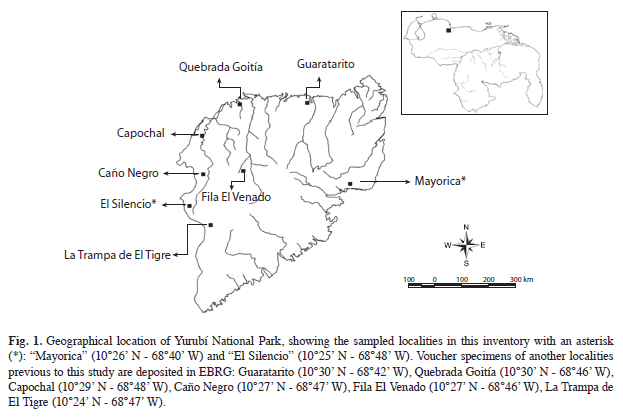
<body><![CDATA[<font size="2"></font><br style="font-family: verdana;">     <font style="font-weight: bold;" size="3"><span      style="font-family: verdana;">Materials and methods</span></font><br      style="font-family: verdana;">     <font size="2"></font><br style="font-family: verdana;">     <font size="2"><span style="font-family: verdana;">Study Area: The     Yurub&iacute;     National Park is located in the Sierra de Aroa, Yaracuy State,</span></font><font      size="2"><span style="font-family: verdana;"> Venezuela (<a      href="/img/revistas/rbt/v60n1/a34i1.jpg">Fig. 1</a>). It     ]]></body>
<body><![CDATA[has a     surface of 23 670ha (Lentino &amp; Esclasans 2005) and an altitudinal     range between 100-1 940m. The climate is seasonal and macrothermic,     with an average annual precipitation between 800-1 500mm and a bimodal     temporal distribution with a rainy season in July-August and other in     November- December (Alvarado 2008). The annual average temperature is     between 10-26.5&ordm;C.</span></font><br style="font-family: verdana;">     <font size="2"></font><br style="font-family: verdana;">     <font size="2"><span style="font-family: verdana;">Data acquisition:     The first step of     ]]></body>
<body><![CDATA[this survey was the collection of all information on</span></font><font      size="2"><span style="font-family: verdana;"> mammals from specimens     deposited in     national institutions (museums and universities) and literature review.     The second step consisted of three field expeditions, beginning on     August 29- September 6 2008, for the locality called &#8220;Mayorica&#8221;     (10&deg;26&#8217; N - 68&deg;40&#8217; W; 100-230m), and we then carried out two     expeditions on February 6-14 2009 and May 16-21 2009, in the locality     &#8220;El Silencio&#8221; (10&deg;25&#8217; N - 68&deg;48&#8217; W; 1 446m). The fieldwork     consisted of seven days for &#8220;Mayorica&#8221; and six days for &#8220;El Silencio&#8221;,     ]]></body>
<body><![CDATA[with nights with limited moonlight.</span></font><br      style="font-family: verdana;">     <font size="2"></font><br style="font-family: verdana;">     <font size="2"><span style="font-family: verdana;">We selected three     vegetation types     in Yurub&iacute; National Park: an evergreen forest at 197m, located in     &#8220;Mayorica&#8221;. The understory was open with the families Palmae (<span      style="font-style: italic;">e.g.</span>,<span      style="font-style: italic;">     Geonoma sp.,</span> <span style="font-style: italic;">Euterpe     ]]></body>
<body><![CDATA[longiptiolata </span>and <span style="font-style: italic;">Chamaedorea     </span>sp.),     M<span style="font-style: italic;">elastomataceae, Piperaceae </span>and     <span style="font-style: italic;">Rubiaceae</span>, being the most     observed in     the lower stratum. In watercourses, we noted Heliconiaceae (<span      style="font-style: italic;">e.g.</span>,     <span style="font-style: italic;">Heliconia psittacorum </span>and <span      style="font-style: italic;">H. bihai</span>), Acanthaceae, Poaceae<span      style="font-style: italic;"> </span>(<span style="font-style: italic;">e.g.</span>,     ]]></body>
<body><![CDATA[Olyra     sp.), Arecaceae and Haemodoraceae (<span style="font-style: italic;">e.g.,     Xiphidium caeruleum</span>). Trees     included Ficus spp. (Moraceae), <span style="font-style: italic;">Gyranthera     caribensis</span> (Malvaceae),     <span style="font-style: italic;">Pachira aquatica</span>     (Bombacaceae), <span style="font-style: italic;">Clusia sp</span>.     (Guttiferae), <span style="font-style: italic;">Lecythis     ollari</span> (Lecythidaceae),<span style="font-style: italic;"> Inga sp</span>.     (Leguminosae), <span style="font-style: italic;">Ocotea sp</span>.     ]]></body>
<body><![CDATA[(Lauraceae)     and <span style="font-style: italic;">Brownea grandiceps</span>     (Fabaceae) among others. Epiphytism was     represented by Bromeliaceae (<span style="font-style: italic;">e.g.</span>,     <span style="font-style: italic;">Guzmania</span>), Orchidaceae (<span      style="font-style: italic;">e.g.,     Epidendrum and Eulophidium</span>) and Araceae (<span      style="font-style: italic;">e.g.</span>, <span      style="font-style: italic;">Philodendron</span>).</span></font><br      style="font-family: verdana;">     ]]></body>
<body><![CDATA[<font size="2"></font><br style="font-family: verdana;">     <font size="2"><span style="font-family: verdana;">We selected within     this same     locality a strip of semi-deciduous forest ranging 100-213m, and here,     trees belonging to the following genera: <span      style="font-style: italic;">Bursera</span> (Burseraceae), <span      style="font-style: italic;">Hura     </span>(Euphorbiaceae), <span style="font-style: italic;">Ceiba</span>     (Bombacaceae), <span style="font-style: italic;">Cedrela </span>(Meliaceae),     <span style="font-style: italic;">Ceroxilum     ]]></body>
<body><![CDATA[</span>(Arecaceae), <span style="font-style: italic;">Tabebuia</span>     (Bignoniaceae) and <span style="font-style: italic;">Spondias</span>     (Anacardiaceae) were     the best represented; in addition Leguminosae, Araceae, Selagineceae,     abundant lianas and epiphytes in the lower stratum.</span></font><br      style="font-family: verdana;">     <font size="2"></font><br style="font-family: verdana;">     <font size="2"><span style="font-family: verdana;">The last site chosen     was a cloud     forest at 1 446m in &#8220;El Silencio&#8221;. The following plant</span></font><font     ]]></body>
<body><![CDATA[ size="2"><span style="font-family: verdana;"> genera were the most     common in this     locality: <span style="font-style: italic;">Persea, Clusia, Guarea,     Sapium, Lecythis, Calatea, Ficus,     Podocarpus, Brosimum, Gustavia, Gyranthera, Oliganthes, Catoblastus,     Guzmania, Cecropia </span>and <span style="font-style: italic;">Cyathea</span>     belonging to the families Lauraceae,     Guttiferae, Meliaceae, Euphorbiaceae, Lecythidaceae, Marantaceae,     Moraceae, Podocarpaceae, Arecaceae, Malvaceae, Asteraceae,     Bromeliaceae, Urticaceae and Cyatheaceae.</span></font><br     ]]></body>
<body><![CDATA[ style="font-family: verdana;">     <font size="2"></font><br style="font-family: verdana;">     <font size="2"><span style="font-family: verdana;">Capture of small     non-volant     mammals: We set four types of traps following of Ochoa <span      style="font-style: italic;">et al.</span> (2008)     recommendations.</span></font><br style="font-family: verdana;">     <font size="2"></font><br style="font-family: verdana;">     <font size="2"><span style="font-family: verdana;">1) Victor traps,     were placed on the     ]]></body>
<body><![CDATA[ground and heights ranging from 1-2m for the capture of taxa using the     ground (terrestrial) and the middle stratum (arboreal). 2) Sherman live     traps, were placed on the ground level to capture terrestrial taxa. 3)     Havahart live traps were placed on the ground to capture terrestrial     taxa and 4) a pitfall-trap system to capture of terrestrial and     semi-arboreal taxa. All traps, except the pitfall-trap system, were     baited daily with some of the following baits: 1) a mixture of oats,     sardines, oil and vanilla extract). 2) ripe plantain (<span      style="font-style: italic;">Musa sp</span>.) and 3)     food for birds (canary seed). These traps were placed at approximately     ]]></body>
<body><![CDATA[20m intervals along existing trails, and the pitfall-trap system was     placed at ground level and it was spaced 5m apart every plastic buckets     with a fence in a linear series. Total traps (Victor, Sherman and     Havahart), used were 80 and the total sampling effort was 1 382     trap-nights and 109 bucket-days.</span></font><br      style="font-family: verdana;">     <font size="2"></font><br style="font-family: verdana;">     <font size="2"><span style="font-family: verdana;">Capture of bats: The     procedure     followed Ochoa <span style="font-style: italic;">et al.</span> (2008).     ]]></body>
<body><![CDATA[We set three mist nets of 9m and three     mist nets of 12m in different forest strata (understory and     mid-canopy). Mist nets were activated from 18:00-22:00 hours and in     some occasions from 04:00-06:00 hours in order to cover two major peaks     of activity. In addition to we carried out occasional searches of     shelters in the daytime (<span style="font-style: italic;">e.g.</span>,     caves, crevices, foliage, hollows in     trees and logs, etc.). The total sampling effort was 323 net-hours.</span></font><br      style="font-family: verdana;">     <font size="2"></font><br style="font-family: verdana;">     ]]></body>
<body><![CDATA[<font size="2"><span style="font-family: verdana;">Medium-large sized     mammals: To     record medium-large sized mammals (<span style="font-style: italic;">e.g.</span>,     Carnivora, Artiodactyla,     Perissodactyla and Rodentia), we used a field guide to interview local     residents together with our direct and indirect sightings (<span      style="font-style: italic;">e.g.</span>,     tracks, vocalizations and scats). We interviewed seven persons and we     carried out 36 hours of observations.</span></font><br      style="font-family: verdana;">     ]]></body>
<body><![CDATA[<font size="2"></font><br style="font-family: verdana;">     <font size="2"><span style="font-family: verdana;">Identifications     followed Wilson     &amp; Reeder (2005) and Gardner (2008) for most species,</span></font><font      size="2"><span style="font-family: verdana;"> Weksler <span      style="font-style: italic;">et al.</span> (2006) for     Oryzomyini, Larsen <span style="font-style: italic;">et al.</span>     (2007) for large-sized Artibeus, Lim <span style="font-style: italic;">et     al.</span>     (2008) for small-sized Artibeus and Voss &amp; Jansa (2009) for     ]]></body>
<body><![CDATA[didelphid marsupials. We followed guidelines approved by Gannon <span      style="font-style: italic;">et al.</span>     (2007), for animals captured in the field. Voucher specimens were fixed     in 10% formalin and preserved in 70% ethanol, and are deposited at the     Museo de la Estaci&oacute;n Biol&oacute;gica de Rancho Grande     (EBRG-Maracay) and Museo de Zoolog&iacute;a (MZUC), Departamento de     Biolog&iacute;a, Facultad Experimental de Ciencias y Tecnolog&iacute;a     FACYT, Universidad de Carabobo, Valencia, Carabobo State, Venezuela.</span></font><br      style="font-family: verdana;">     <font size="2"></font><br style="font-family: verdana;">     ]]></body>
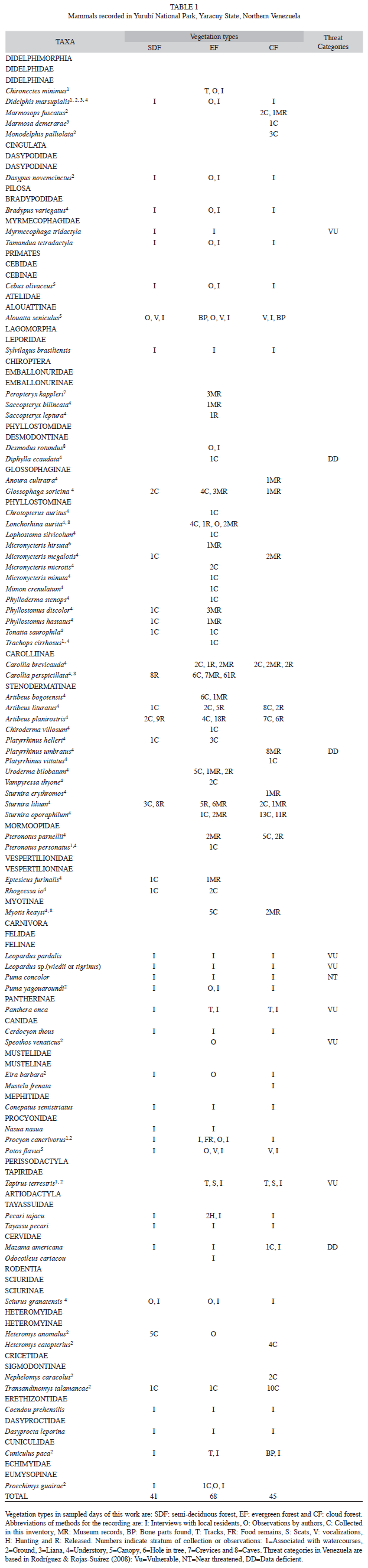
<body><![CDATA[<font style="font-weight: bold;" size="3"><span      style="font-family: verdana;">Results</span></font><br      style="font-family: verdana;">     <font size="2"></font><br style="font-family: verdana;">     <font size="2"><span style="font-family: verdana;">At least 79 species,     representing     10 orders inhabit in the study area (<a      href="/img/revistas/rbt/v60n1/a34t1.gif">Table 1</a>). Of these, 73%     (n=58)     represent new records in Yurub&iacute; National Park. Chiroptera     ]]></body>
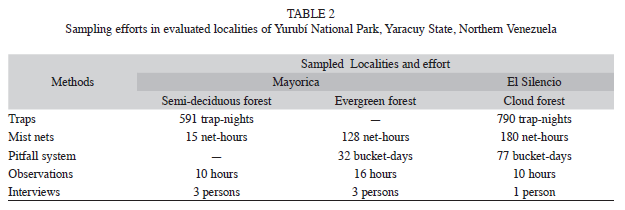
<body><![CDATA[(39&nbsp; pp.), Carnivora (13 spp.) and Rodentia (9 spp.) were the     orders with the highes t taxonomic richness. Among the vegetation types     sampled (<a href="/img/revistas/rbt/v60n1/a34t1.gif">Table 1</a>), the     evergreen forest (n=67), had the highest     richness, followed by the cloud forest (n=45), and finally by the     semi-deciduous forest (n=41). Sampling efforts in every inventoried     locality are shown in <a href="/img/revistas/rbt/v60n1/a34t2.gif">Table     2</a>.</span></font><br style="font-family: verdana;">     <font size="2"></font><br style="font-family: verdana;">     <font size="2"><span style="font-family: verdana;">Species accumulation     ]]></body>
<body><![CDATA[curves for     taxa inventoried with traps (Didelphimorphia: family Didelphidae and     Rodentia: families Sciuridae, Heteromyidae, Cricetidae and Echimyidae)     and mist nets (Chiroptera) at different locations did not reach     saturation (<a href="/img/revistas/rbt/v60n1/a34i2.jpg">Fig. 2</a>).</span></font><font      size="2"><span style="font-family: verdana;"> For Chiroptera, results     indicated a     high richness concentrated in Phyllostomidae (74.36%), Emballonuridae     (7.69%) and Mormoopidae (5.13%) (<a      href="/img/revistas/rbt/v60n1/a34t1.gif">Table 1</a>). Noteworthy</span></font><font     ]]></body>
<body><![CDATA[ size="2"><span style="font-family: verdana;"> records of foliage     gleaning bats     (<span style="font-style: italic;">e.g., Micronycteris hirsuta, M.     megalotis, M. microtis,</span></span></font><font      style="font-style: italic;" size="2"><span      style="font-family: verdana;"> M. minuta, Lonchorhina aurita,     Mimon crenulatum, Tonatia saurophila </span></font><font size="2"><span      style="font-family: verdana;">and </span></font><font      style="font-style: italic;" size="2"><span      style="font-family: verdana;">Lophostoma</span></font><font size="2"><span     ]]></body>
<body><![CDATA[ style="font-family: verdana;"><span style="font-style: italic;">     silvicolum</span>) were obtained in this     study (<a href="/img/revistas/rbt/v60n1/a34t1.gif">Table 1</a>). There     were no representatives of Molossidae     (free-tailed bats), Natalidae (funnel-eared bats) and Thyropteridae     (disk-winged bats), documented in other localities of the Sierra de     Aroa and Cordillera de la Costa.</span></font><br      style="font-family: verdana;">     <font size="2"></font><br style="font-family: verdana;">     <font size="2"><span style="font-family: verdana;">Rodents captured (<span     ]]></body>
<body><![CDATA[ style="font-style: italic;">Transandinomys     talamancae, Heteromys anomalus, H. catopterius,</span></span></font><font      size="2"><span style="font-family: verdana;"><span      style="font-style: italic;"> Nephelomys caracolus </span>and <span      style="font-style: italic;">Proechimys     guairae</span>) represented important records for the</span></font><font      size="2"><span style="font-family: verdana;"> mammalian fauna from     Yurub&iacute;     National Park. Of these, the latter three species were endemics endemic     for the Cordillera de la Costa and Sierra de San Luis and Proechimys     ]]></body>
<body><![CDATA[guairae endemics for five bioregions in Northern Venezuela).</span></font><br      style="font-family: verdana;">     <font size="2"></font><br style="font-family: verdana;">     <font size="2"><span style="font-family: verdana;">Marsupials     documented were     <span style="font-style: italic;">Didelphis marsupialis, Marmosa     demererae, Marmosops fuscatus,     Chironectes minimus </span>and <span style="font-style: italic;">Monodelphis     palliolata</span> (<a href="/img/revistas/rbt/v60n1/a34t1.gif">Table 1</a>).     The first     ]]></body>
<body><![CDATA[three taxa with semi-arboreal habits; <span style="font-style: italic;">Chironectes</span>,     a terrestrial     species associated with watercourses and <span      style="font-style: italic;">Monodelphis</span>, fully     terrestrial. All these were captured and observed in primary habitats     in Yurub&iacute; National Park.</span></font><br      style="font-family: verdana;">     <font size="2"></font><br style="font-family: verdana;">     <font size="2"><span style="font-family: verdana;">We recorded 10     species assigned in     ]]></body>
<body><![CDATA[some threat category for the country (<a      href="/img/revistas/rbt/v60n1/a34t1.gif">Table 1</a>).</span></font><font      size="2"><span style="font-family: verdana;"> This number includes six     species     &#8220;Vulnerable&#8221;, one &#8220;Near threatened&#8221; and three with</span></font><font      size="2"><span style="font-family: verdana;"> &#8220;Data deficient&#8221;. It is     interesting     to mention those mammals, such as monkeys (<span      style="font-style: italic;">e.g., Alouatta seniculus and     Cebus olivaceus</span>), carnivores (<span style="font-style: italic;">e.g.,     ]]></body>
<body><![CDATA[Conepatus semistriatus, Cerdocyon     thous, Potos flavus and Procyon cancrivorus</span>) and the tapir (<span      style="font-style: italic;">Tapirus     terrestris</span>), were apparently common, according to the interviews     and     occasional records in the study area. Another situation occurs for the     paca (<span style="font-style: italic;">Cuniculus paca</span>),     peccaries (<span style="font-style: italic;">Tayassu pecari and Pecari     tajacu</span>),     agouti (<span style="font-style: italic;">Dasyprocta leporina</span>),     ]]></body>
<body><![CDATA[deer (<span style="font-style: italic;">Mazama americana and Odocoileus     cariacou</span>), cats (<span style="font-style: italic;">Panthera     onca, Puma concolor</span>) and rabbits (<span      style="font-style: italic;">Sylvilagus     brasiliensis</span>), which are the mainly hunted mammals, according to     local     residents. From the total of mammals listed, 15 taxa have their     restricted distributions in Northern Venezuela: <span      style="font-style: italic;">Marmosops fuscatus,     Monodelphis palliolata, Diphylla ecaudata, Anoura cultrata, Lonchorhina     ]]></body>
<body><![CDATA[aurita, Sturnira erythromos, S. oporaphilum, Myotis keaysi, Conepatus     semistriatus, Sciurus granatensis, Heteromys anomalus, H. catopterius     Nephelomys caracolus, Transandinomys talamancae </span>and <span      style="font-style: italic;">Proechimys guairae.</span></span></font><br      style="font-family: verdana;">     <font size="2"></font><br style="font-family: verdana;">     <font style="font-weight: bold;" size="3"><span      style="font-family: verdana;">Discussion</span></font><br      style="font-family: verdana;">     <font size="2"></font><br style="font-family: verdana;">     ]]></body>
<body><![CDATA[<font size="2"><span style="font-family: verdana;">Records obtained     here provide new     data for the Sierra de Aroa (Handley 1976) and update the list of     mammals from Yurub&iacute; National Park. The documentation of these     species represents 28% of 278 reported mammals in Northern Venezuela     (Wilson &amp; Reeder 2005).</span></font><br      style="font-family: verdana;">     <font size="2"></font><br style="font-family: verdana;">     <font size="2"><span style="font-family: verdana;">With respect to     medium-large sized     ]]></body>
<body><![CDATA[mammals of hunting interest such as peccaries (<span      style="font-style: italic;">Pecari tajacu and     Tayassu pecari</span>), paca (<span style="font-style: italic;">Cuniculus     paca</span>), agouti (<span style="font-style: italic;">Dasyprocta     leporina</span>)     and deer (<span style="font-style: italic;">Mazama americana and     Odocoileus cariacou</span>) among others, their     use as food can be considered as occasional, but it can be transformed     if the daily use by local residents results successful in their hunting     activities. They hunt very often, but this activity does not represent     ]]></body>
<body><![CDATA[their basic sustenance. Apparently, only <span      style="font-style: italic;">Mazama</span></span></font><font size="2"><span      style="font-family: verdana;"><span style="font-style: italic;">     americana</span>, a large-sized mammal     evaluated in &#8220;Data deficient&#8221; for Venezuela (Rodr&iacute;guez &amp;     Rojas 2008), was used in Yurub&iacute; National Park as food by local     residents; the rest of mediumlarge sized mammals recorded in this     study, and threatened in other localities of the country (Ochoa <span      style="font-style: italic;">et al.</span>     1995, Ochoa 2000), were apparently not hunted here.</span></font><br     ]]></body>
<body><![CDATA[ style="font-family: verdana;">     <font size="2"></font><br style="font-family: verdana;">     <font size="2"><span style="font-family: verdana;">Of carnivores     defined in Venezuela     within some threat category (Rodr&iacute;guez &amp; Rojas 2008), <span      style="font-style: italic;">Puma     concolor </span>(Near threatened), <span style="font-style: italic;">Panthera     onca, Leopardus pardalis </span>and     <span style="font-style: italic;">Leopardus sp.</span> (Vulnerable)     would be species mostly affected in the     ]]></body>
<body><![CDATA[study area, because to the fear of local residents with these cats. It     is important to mention the definition of &#8220;surrogate species&#8221; for some     taxa recorded in Yurub&iacute; National Park: <span      style="font-style: italic;">Panthera onca</span> is defined     as &#8220;umbrella species&#8221; and <span style="font-style: italic;">Puma     concolor</span> as &#8220;flagship species&#8221;. These     species are used in ecosystem conservation programs in the Neotropics     (Isasi 2011); however, in an occasional encounter with these cats in     the study area, they can be hunted without any importance of their     conservation status.</span></font><font size="2"><span     ]]></body>
<body><![CDATA[ style="font-family: verdana;"> Another taxon considered &#8220;flagship     species&#8221; in Yurub&iacute; National Park was the tapir (<span      style="font-style: italic;">Tapirus     terrestris</span>); this large-sized mammal apparently was not hunted     in the     study area according to interviews with local residents.</span></font><br      style="font-family: verdana;">     <font size="2"></font><br style="font-family: verdana;">     <font size="2"><span style="font-family: verdana;">According to     surveys, the following     ]]></body>
<body><![CDATA[taxa were considered common in the forest and</span></font><font      size="2"><span style="font-family: verdana;"> they were not used for     any purpose:     <span style="font-style: italic;">Didelphis marsupialis, Tamandua     tetradactyla, Alouatta seniculus, Cebus     olivaceus, Procyon cancrivorus, Conepatus semistriatus</span> and</span></font><font      style="font-style: italic;" size="2"><span      style="font-family: verdana;"> Potos flavus.</span></font><br      style="font-family: verdana;">     <font size="2"></font><br style="font-family: verdana;">     ]]></body>
<body><![CDATA[<font size="2"><span style="font-family: verdana;">Small mammals showed     a high number     of species and families for bats (Phyllostomidae, Emballonuridae and     Mormoopidae), marsupials (Didelphidae) and rodents (Sciuridae,     Heteromyidae, Cricetidae and Echimyidae), very close to values found in     other localities of the Northern side of the country (Handley 1976,     Ochoa <span style="font-style: italic;">et al.</span> 1995).</span></font><br      style="font-family: verdana;">     <font size="2"></font><br style="font-family: verdana;">     <font size="2"><span style="font-family: verdana;">There are few     ]]></body>
<body><![CDATA[records for     <span style="font-style: italic;">Transandinomys&nbsp; talamancae</span>     in the Sierra de Aroa (which Handley     1976, assigned to the <span style="font-style: italic;">Oryzomys</span>     &#8220;capito&#8221; complex), and this rodent     together with <span style="font-style: italic;">Sciurus granatensis,     Heteromys anomalus, H. catopterius,     Nephelomys caracolus and Proechimys guairae</span> were the only     representatives of families Sciuridae, Heteromyidae, Cricetidae and     Echimyidae in the evaluated vegetation types. Some researchers regarded     ]]></body>
<body><![CDATA[<span style="font-style: italic;">Heteromys anomalus</span>, as one of     the most common terrestrial</span></font><font size="2"><span      style="font-family: verdana;"> rodent of forests in Northern     Venezuela from sea level to over 2 000m (Handley 1976, Valdez <span      style="font-style: italic;">et al.</span>     1984), but a recent taxonomic study (Anderson &amp; Guti&eacute;rrez     2009), has confirmed a new species (<span style="font-style: italic;">Heteromys     catopterius</span>), from     populations previously ascribed to the <span      style="font-style: italic;">anomalus complex.</span></span></font><br     ]]></body>
<body><![CDATA[ style="font-family: verdana;">     <font size="2"></font><br style="font-family: verdana;">     <font size="2"><span style="font-family: verdana;">This new species was     found between     1 500-1 940m (Anderson &amp; Guti&eacute;rrez 2009). This record in     Sierra de Aroa, represents the first one for this rodent, and a     substantial range extension to the West occurring from the West of the     Depresi&oacute;n de Yaracuy, it is likely disjunctive from known     records to the East.</span></font><br style="font-family: verdana;">     <font size="2"></font><br style="font-family: verdana;">     ]]></body>
<body><![CDATA[<font size="2"><span style="font-family: verdana;">It is noteworthy to     mention the     importance of <span style="font-style: italic;">Proechimys guairae,     Heteromys catopterius and Nephelomys     caracolus</span> as endemic species to Northern Venezuela (Musser &amp;     Carleton 2005, Anderson &amp; Guti&eacute;rrez 2009). In the present,     these rodents have not been evaluated in threat categories defined in     the country (Rodr&iacute;guez &amp; Rojas 2008).</span></font><br      style="font-family: verdana;">     <font size="2"></font><br style="font-family: verdana;">     ]]></body>
<body><![CDATA[<font size="2"><span style="font-family: verdana;">Phyllostomid bats     such as <span style="font-style: italic;">Carollia     perspicillata, Artibeus planirostris </span>and <span      style="font-style: italic;">Sturnira lilium</span></span></font><font      size="2"><span style="font-family: verdana;"> were the most common and     with     higher capture frequencies, in agreement with other records in primary     forests in Venezuela (Handley 1976, Ochoa <span      style="font-style: italic;">et al.</span> 1995, Ochoa 2000).     They commonly represent the dominant fraction in the understory of     ]]></body>
<body><![CDATA[Neotropical forests (Ochoa <span style="font-style: italic;">et al.</span>     1995, 2005), partly because of their     very general food requirements (<span style="font-style: italic;">e.g.</span>,     these bats consume fruits of     understory and canopy plants like <span style="font-style: italic;">Piper</span>     spp., <span style="font-style: italic;">Ficus</span> spp., <span      style="font-style: italic;">Cecropia</span> spp.     and <span style="font-style: italic;">Solanum</span> spp., Ochoa     2000); furthermore, there is no overlap in     items consumed (<span style="font-style: italic;">Carollia</span> is     ]]></body>
<body><![CDATA[specialized in<span style="font-style: italic;"> Piper, Artibeus</span>     in <span style="font-style: italic;">Ficus</span> and     <span style="font-style: italic;">Cecropia</span> and <span      style="font-style: italic;">Sturnira</span> in <span      style="font-style: italic;">Solanum</span>, Ochoa 2000, Thies &amp;     Kalko 2004);     there is no overlap in flight patterns during the search of food     (flights in understory for <span style="font-style: italic;">Carollia</span>     spp. And <span style="font-style: italic;">Sturnira</span> spp., and     understory and canopy for <span style="font-style: italic;">Artibeus</span>     ]]></body>
<body><![CDATA[spp., Soriano 2000); echolocation is     less developed, making them easier to catch with mist nets, and another     argument is related with capabilities to inhabit highly disturbed     environments, as well as those in a pristine condition (Ochoa 2000).</span></font><br      style="font-family: verdana;">     <font size="2"></font><br style="font-family: verdana;">     <font size="2"><span style="font-family: verdana;">Particularly in the     evergreen     forest, which had a primary condition, we observed forest</span></font><font      size="2"><span style="font-family: verdana;"> <span     ]]></body>
<body><![CDATA[ style="font-style: italic;">Piper</span> species in the understory,     consumed mainly by<span style="font-style: italic;"> Carollia</span>     spp. (Thies &amp; Kalko 2004), as well as     the typical species of Ficus spp., which provide fruits throughout the     year. Some bats captured in this inventory were considered strict     frugivores (<span style="font-style: italic;">e.g.</span>, Artibeus     spp., Carollia spp., and Sturnira spp.),     using these resources as items of their diet (Kalko <span      style="font-style: italic;">et al.</span> 1996, Thies     &amp; Kalko 2004).</span></font><br style="font-family: verdana;">     ]]></body>
<body><![CDATA[<font size="2"></font><br style="font-family: verdana;">     <font size="2"><span style="font-family: verdana;">An interesting     record is the     presence in the study area of 13 of the 20 species in the Cordillera de     la Costa (Linares 1998) of bats belonging to the subfamily     Phyllostominae. Bats captured in Yurub&iacute; National Park of this     subfamily are considered rare and have low relative abundances (Ochoa     2000); their feeding strategies include insectivorous (<span      style="font-style: italic;">e.g.</span>,     <span style="font-style: italic;">Lonchorhina aurita, Lophostoma     ]]></body>
<body><![CDATA[silvicolum </span>and <span style="font-style: italic;">Mimon     crenulatum</span>), fruits     consumers as an additional component to their diet of insects (<span      style="font-style: italic;">e.g.</span>,     <span style="font-style: italic;">Micronycteris spp., </span>and <span      style="font-style: italic;">Tonatia saurophila</span>), pollen and     nectar     consumers (<span style="font-style: italic;">e.g.</span>, <span      style="font-style: italic;">Phyllostomus discolor </span>and <span      style="font-style: italic;">P. hastatus)</span> and small     ]]></body>
<body><![CDATA[vertebrate consumers (<span style="font-style: italic;">e.g.</span>, <span      style="font-style: italic;">Chrotopterus auritus </span>and <span      style="font-style: italic;">Trachops     cirrhosus</span>).</span></font><br style="font-family: verdana;">     <font size="2"></font><br style="font-family: verdana;">     <font size="2"><span style="font-family: verdana;">In addition to their     ecological     preferences, which make their capture difficult (because</span></font><font      size="2"><span style="font-family: verdana;"> these bats habit in     primary forests     ]]></body>
<body><![CDATA[and use a variety of habitats with different availability of food and     shelter resources), they seem to be sensitive elements not tolerant to     high disturbances in forests (Fenton <span style="font-style: italic;">et     al.</span> 1992, Ochoa 2000).</span></font><br      style="font-family: verdana;">     <font size="2"></font><br style="font-family: verdana;">     <font size="2"><span style="font-family: verdana;">Another support of     the primary     condition of the vegetation inventoried was the absence of individuals     of the common vampire (<span style="font-style: italic;">Desmodus     ]]></body>
<body><![CDATA[rotundus</span>) in sampled days. This vampire     consumes only blood, with preference for the cattle, and often is     considered a &#8220;damaging species&#8221; in localities with great disturbances     (Fern&aacute;ndez-Badillo &amp; Ulloa 1990). Although we did not     captured Desmodus rotundus in the study area, local residents recognize     it because sometimes their domestic animals suffer bite injuries.</span></font><br      style="font-family: verdana;">     <font size="2"></font><br style="font-family: verdana;">     <font size="2"><span style="font-family: verdana;">Similarly, the     capture of another     ]]></body>
<body><![CDATA[vampire, <span style="font-style: italic;">Diphylla ecaudata</span>,     collected in the evergreen forest at 197m,     indicates the primary condition of environments. This species unlike     <span style="font-style: italic;">Desmodus rotundus</span>, has been     recorded mostly at elevations above 800m,     in pristine forests in Venezuela (Handley 1976) and specializes in the     consumption of vertebrate blood, with preferences for the avian one     (Greenhall <span style="font-style: italic;">et al.</span> 1984) from     species that live in forested     environments, making it a rare species to collect in disturbed areas.</span></font><br     ]]></body>
<body><![CDATA[ style="font-family: verdana;">     <font size="2"></font><br style="font-family: verdana;">     <font size="2"><span style="font-family: verdana;">The mammals of     Yurub&iacute;     National Park are an important component of the biodiversity</span></font><font      size="2"><span style="font-family: verdana;"> of forests in the     Cordillera de la     Costa. Data and observations obtained in this inventory (<span      style="font-style: italic;">e.g.</span>,     endemism, mammals known as &#8220;surrogate species&#8221; threatened in Venezuela)     ]]></body>
<body><![CDATA[give an important role at the Yurub&iacute; National Park, for the     maintenance and conservation of ecosystems and local wildlife,     threatened by human pressures of present times.</span></font><br      style="font-family: verdana;">     <font size="2"></font><br style="font-family: verdana;">     <font style="font-weight: bold;" size="3"><span      style="font-family: verdana;">Acknowledgments</span></font><br      style="font-family: verdana;">     <font size="2"></font><br style="font-family: verdana;">     <font size="2"><span style="font-family: verdana;">Authors wish to     ]]></body>
<body><![CDATA[thank the staff of     the Museo de la Estaci&oacute;n Biol&oacute;gica de Rancho (Francisco     Bisbal and Javier S&aacute;nchez), for allowing us to review the     material deposited at the museum and supported us in fieldworks     (equipment loans); Hylda Siliet, Edward Camargo, Ivan D&iacute;az, and     Vicente Colmenares for all logistical support of lodging at both     locations; the Departamento de Biolog&iacute;a, Universidad de     Carabobo, especially H&eacute;ctor Silva, Antonio P&eacute;rez,     Guillermo Fl&oacute;rez, Jorge Gim&eacute;nez &#8224;, Karen L&oacute;pez,     and Yoiber Mujica for their fieldwork supports, and Carlos Varela for     ]]></body>
<body><![CDATA[his help in some identifications of botanical taxa, Robert Anderson for     his suggestions and the Instituto Nacional de Parques INPARQUES-Yaracuy.</span></font><br      style="font-family: verdana;">     <font size="2"></font><font style="font-weight: bold;" size="3"><span      style="font-family: verdana;"></span></font>     <hr style="width: 100%; height: 2px;">    <!-- ref --><br> <font style="font-weight: bold;" size="3"><span  style="font-family: verdana;">References</span></font><br  style="font-family: verdana;"> <font size="2"></font><br style="font-family: verdana;"> <font size="2"><span style="font-family: verdana;">Alvarado, H. 2008. Aspectos estructurales y flor&iacute;sticos de cuatro bosques ribere&ntilde;os de la cuenca del R&iacute;o Aroa, estado Yaracuy, Venezuela. Acta Bot. Venez. 31: 273-290.    &nbsp;&nbsp;&nbsp;&nbsp;&nbsp;&nbsp;&nbsp;&nbsp;[&#160;<a href="javascript:void(0);" onclick="javascript: window.open('/scielo.php?script=sci_nlinks&ref=1435923&pid=S0034-7744201200010003400001&lng=','','width=640,height=500,resizable=yes,scrollbars=1,menubar=yes,');">Links</a>&#160;]<!-- end-ref --><!-- ref --></span></font><br style="font-family: verdana;"> <font size="2"></font><br style="font-family: verdana;"> <font size="2"><span style="font-family: verdana;">Anderson, R.P. 2003. Taxonomy, distribution and natural history of the genus <span  style="font-style: italic;">Heteromys </span>(Rodentia: Heteromyidae) in Western Venezuela, with the description of a dwarf species from the Pen&iacute;nsula de Paraguan&aacute;. Am. Mus. Novit. 3396: 1-43.    &nbsp;&nbsp;&nbsp;&nbsp;&nbsp;&nbsp;&nbsp;&nbsp;[&#160;<a href="javascript:void(0);" onclick="javascript: window.open('/scielo.php?script=sci_nlinks&ref=1435924&pid=S0034-7744201200010003400002&lng=','','width=640,height=500,resizable=yes,scrollbars=1,menubar=yes,');">Links</a>&#160;]<!-- end-ref --><!-- ref --></span></font><br style="font-family: verdana;"> <font size="2"></font><br style="font-family: verdana;"> <font size="2"><span style="font-family: verdana;">Anderson, R.P. &amp; E.E. Guti&eacute;rrez. 2009. Taxonomy, distribution, and natural history of the genus<span style="font-style: italic;"> Heteromys</span> (Rodentia: Heteromyidae) in Central and Eastern Venezuela, with the description of a new species from the Cordillera de la Costa, p. 33-93. In R. Voss &amp; M. Carleton (eds.). Systematic Mammalogy: Contributions in Honor of Guy G. Musser. Bull. Am. Mus. Nat. Hist. EEUU.    &nbsp;&nbsp;&nbsp;&nbsp;&nbsp;&nbsp;&nbsp;&nbsp;[&#160;<a href="javascript:void(0);" onclick="javascript: window.open('/scielo.php?script=sci_nlinks&ref=1435925&pid=S0034-7744201200010003400003&lng=','','width=640,height=500,resizable=yes,scrollbars=1,menubar=yes,');">Links</a>&#160;]<!-- end-ref --><!-- ref --></span></font><br style="font-family: verdana;"> <font size="2"></font><br style="font-family: verdana;"> <font size="2"><span style="font-family: verdana;">Bisbal, F.J. 1995. Mam&iacute;feros de la regi&oacute;n pantanosa de los estados Monagas y Sucre, Venezuela. Acta Cient. Venez. 46: 288-293.    &nbsp;&nbsp;&nbsp;&nbsp;&nbsp;&nbsp;&nbsp;&nbsp;[&#160;<a href="javascript:void(0);" onclick="javascript: window.open('/scielo.php?script=sci_nlinks&ref=1435926&pid=S0034-7744201200010003400004&lng=','','width=640,height=500,resizable=yes,scrollbars=1,menubar=yes,');">Links</a>&#160;]<!-- end-ref --><!-- ref --></span></font><br  style="font-family: verdana;"> <font size="2"></font><br style="font-family: verdana;"> <font size="2"><span style="font-family: verdana;">Bisbal, F.J. 1998. Mam&iacute;feros de la Pen&iacute;nsula de Par&iacute;a, estado Sucre, Venezuela y sus relaciones biogeogr&aacute;ficas. Interciencia 23: 176-181.    &nbsp;&nbsp;&nbsp;&nbsp;&nbsp;&nbsp;&nbsp;&nbsp;[&#160;<a href="javascript:void(0);" onclick="javascript: window.open('/scielo.php?script=sci_nlinks&ref=1435927&pid=S0034-7744201200010003400005&lng=','','width=640,height=500,resizable=yes,scrollbars=1,menubar=yes,');">Links</a>&#160;]<!-- end-ref --><!-- ref --></span></font><br  style="font-family: verdana;"> <font size="2"></font><br style="font-family: verdana;"> <font size="2"><span style="font-family: verdana;">Bisbal, F.J. 2008. Los vertebrados terrestres de las Dependencias Federales de Venezuela. Interciencia 33: 103-111.    &nbsp;&nbsp;&nbsp;&nbsp;&nbsp;&nbsp;&nbsp;&nbsp;[&#160;<a href="javascript:void(0);" onclick="javascript: window.open('/scielo.php?script=sci_nlinks&ref=1435928&pid=S0034-7744201200010003400006&lng=','','width=640,height=500,resizable=yes,scrollbars=1,menubar=yes,');">Links</a>&#160;]<!-- end-ref --><!-- ref --></span></font><br style="font-family: verdana;"> <font size="2"></font><br style="font-family: verdana;"> <font size="2"><span style="font-family: verdana;">D&aacute;valos, L.M. &amp; A. Corthals. 2008. A new species of Lonchophylla (Chiroptera: Phyllostomidae) from the Eastern Andes of Northwestern South America. Am. Mus. Novit. 3635: 1-16.    &nbsp;&nbsp;&nbsp;&nbsp;&nbsp;&nbsp;&nbsp;&nbsp;[&#160;<a href="javascript:void(0);" onclick="javascript: window.open('/scielo.php?script=sci_nlinks&ref=1435929&pid=S0034-7744201200010003400007&lng=','','width=640,height=500,resizable=yes,scrollbars=1,menubar=yes,');">Links</a>&#160;]<!-- end-ref --><!-- ref --></span></font><br  style="font-family: verdana;"> <font size="2"></font><br style="font-family: verdana;"> <font size="2"><span style="font-family: verdana;">Delascio, C. 1977. Notas sobre la flora del Yurub&iacute;, Estado Yaracuy, Venezuela. Mem. Soc. Cienc. Nat. 37: 266-281.    &nbsp;&nbsp;&nbsp;&nbsp;&nbsp;&nbsp;&nbsp;&nbsp;[&#160;<a href="javascript:void(0);" onclick="javascript: window.open('/scielo.php?script=sci_nlinks&ref=1435930&pid=S0034-7744201200010003400008&lng=','','width=640,height=500,resizable=yes,scrollbars=1,menubar=yes,');">Links</a>&#160;]<!-- end-ref --><!-- ref --></span></font><br style="font-family: verdana;"> <font size="2"></font><br style="font-family: verdana;"> <font size="2"><span style="font-family: verdana;">Fenton, M.B., L. Acharya, L. Audet, M.B.C. Hickey, C. Merriman, M.K. Obrist, D.M. Syme &amp; B. Adkins. 1992. Phyllostomid bats (Chiroptera: Phyllostomidae) as indicators of habitat disruption in the Neotropics. Biotropica 24: 440-446.    &nbsp;&nbsp;&nbsp;&nbsp;&nbsp;&nbsp;&nbsp;&nbsp;[&#160;<a href="javascript:void(0);" onclick="javascript: window.open('/scielo.php?script=sci_nlinks&ref=1435931&pid=S0034-7744201200010003400009&lng=','','width=640,height=500,resizable=yes,scrollbars=1,menubar=yes,');">Links</a>&#160;]<!-- end-ref --><!-- ref --></span></font><br  style="font-family: verdana;"> <font size="2"></font><br style="font-family: verdana;"> <font size="2"><span style="font-family: verdana;">Fern&aacute;ndez-Badillo, A. &amp; G. Ulloa. 1990. Fauna del Parque Nacional Henri Pittier, Venezuela: Composici&oacute;n y diversidad de la mastofauna. Acta Cient. Venez. 41: 50-63.    &nbsp;&nbsp;&nbsp;&nbsp;&nbsp;&nbsp;&nbsp;&nbsp;[&#160;<a href="javascript:void(0);" onclick="javascript: window.open('/scielo.php?script=sci_nlinks&ref=1435932&pid=S0034-7744201200010003400010&lng=','','width=640,height=500,resizable=yes,scrollbars=1,menubar=yes,');">Links</a>&#160;]<!-- end-ref --><!-- ref --></span></font><br style="font-family: verdana;"> <font size="2"><span style="font-family: verdana;">Gannon, W.L., R.S. Sikes &amp; the Animal Care and Use Commite of the American Society of Mammalogist. 2007. Guidelines of the American Society of Mammalogists for the use of wild mammals in research. J. Mammal. 88: 809-823.    &nbsp;&nbsp;&nbsp;&nbsp;&nbsp;&nbsp;&nbsp;&nbsp;[&#160;<a href="javascript:void(0);" onclick="javascript: window.open('/scielo.php?script=sci_nlinks&ref=1435933&pid=S0034-7744201200010003400011&lng=','','width=640,height=500,resizable=yes,scrollbars=1,menubar=yes,');">Links</a>&#160;]<!-- end-ref --><!-- ref --></span></font><br  style="font-family: verdana;"> <font size="2"></font><br style="font-family: verdana;"> <font size="2"><span style="font-family: verdana;">Gardner, A.L. 1988. The mammals of Parque Nacional Serran&iacute;a de la Neblina, Territorio Federal Amazonas, Venezuela, p. 695-765. In C. Brewer-Carias (ed.). Cerro La Neblina: Resultados de la expedici&oacute;n 1983- 1987. SUCAE, Caracas, Venezuela.    &nbsp;&nbsp;&nbsp;&nbsp;&nbsp;&nbsp;&nbsp;&nbsp;[&#160;<a href="javascript:void(0);" onclick="javascript: window.open('/scielo.php?script=sci_nlinks&ref=1435934&pid=S0034-7744201200010003400012&lng=','','width=640,height=500,resizable=yes,scrollbars=1,menubar=yes,');">Links</a>&#160;]<!-- end-ref --><!-- ref --></span></font><br style="font-family: verdana;"> <font size="2"></font><br style="font-family: verdana;"> <font size="2"><span style="font-family: verdana;">Gardner, A.L. 2008. Mammals of South America, Volume 1: marsupials, xenarthrans, shrews and bats. The University of Chicago, Chicago, EEUU.    &nbsp;&nbsp;&nbsp;&nbsp;&nbsp;&nbsp;&nbsp;&nbsp;[&#160;<a href="javascript:void(0);" onclick="javascript: window.open('/scielo.php?script=sci_nlinks&ref=1435935&pid=S0034-7744201200010003400013&lng=','','width=640,height=500,resizable=yes,scrollbars=1,menubar=yes,');">Links</a>&#160;]<!-- end-ref --><!-- ref --> </span></font><br  style="font-family: verdana;"> <font size="2"></font><br style="font-family: verdana;"> <font size="2"><span style="font-family: verdana;">Greenhall, A.M., U. Schmitdt &amp; G. Joermann. 1984. Diphylla ecaudata. Mamm. Species 227: 1-3.    &nbsp;&nbsp;&nbsp;&nbsp;&nbsp;&nbsp;&nbsp;&nbsp;[&#160;<a href="javascript:void(0);" onclick="javascript: window.open('/scielo.php?script=sci_nlinks&ref=1435936&pid=S0034-7744201200010003400014&lng=','','width=640,height=500,resizable=yes,scrollbars=1,menubar=yes,');">Links</a>&#160;]<!-- end-ref --><!-- ref --></span></font><br  style="font-family: verdana;"> <font size="2"></font><br style="font-family: verdana;"> <font size="2"><span style="font-family: verdana;">Guerrero, R., R. Hoogesteijn &amp; P.J. Soriano. 1989. Lista preliminar de los mam&iacute;feros del Cerro Marahuaca, T. F. Amazonas, Venezuela. Acta Terramaris 1: 71-77.    &nbsp;&nbsp;&nbsp;&nbsp;&nbsp;&nbsp;&nbsp;&nbsp;[&#160;<a href="javascript:void(0);" onclick="javascript: window.open('/scielo.php?script=sci_nlinks&ref=1435937&pid=S0034-7744201200010003400015&lng=','','width=640,height=500,resizable=yes,scrollbars=1,menubar=yes,');">Links</a>&#160;]<!-- end-ref --><!-- ref --></span></font><br  style="font-family: verdana;"> <font size="2"></font><br style="font-family: verdana;"> <font size="2"><span style="font-family: verdana;">Guti&eacute;rrez, E.E. &amp; J. Molinari. 2008. Morfometrics and taxonomy of bats of the genus <span style="font-style: italic;">Pteronotus</span> (Subgenus Phyllodia) in Venezuela. J. Mammal. 89: 292-305.    &nbsp;&nbsp;&nbsp;&nbsp;&nbsp;&nbsp;&nbsp;&nbsp;[&#160;<a href="javascript:void(0);" onclick="javascript: window.open('/scielo.php?script=sci_nlinks&ref=1435938&pid=S0034-7744201200010003400016&lng=','','width=640,height=500,resizable=yes,scrollbars=1,menubar=yes,');">Links</a>&#160;]<!-- end-ref --><!-- ref --></span></font><br  style="font-family: verdana;"> <font size="2"></font><br style="font-family: verdana;"> <font size="2"><span style="font-family: verdana;">Handley, C.O., Jr. 1976. Mammals of the Smithsonian Venezuelan Project. Brigham Young Univ. Sci. Bull. Biol. Ser. 20: 1-91.    &nbsp;&nbsp;&nbsp;&nbsp;&nbsp;&nbsp;&nbsp;&nbsp;[&#160;<a href="javascript:void(0);" onclick="javascript: window.open('/scielo.php?script=sci_nlinks&ref=1435939&pid=S0034-7744201200010003400017&lng=','','width=640,height=500,resizable=yes,scrollbars=1,menubar=yes,');">Links</a>&#160;]<!-- end-ref --><!-- ref --></span></font><br style="font-family: verdana;"> <font size="2"></font><br style="font-family: verdana;"> <font size="2"><span style="font-family: verdana;">Hilty, S.L., J. Gwynne &amp; G. Tudor. 2003. Birds of Venezuela. Princeton University, Princeton, EEUU.    &nbsp;&nbsp;&nbsp;&nbsp;&nbsp;&nbsp;&nbsp;&nbsp;[&#160;<a href="javascript:void(0);" onclick="javascript: window.open('/scielo.php?script=sci_nlinks&ref=1435940&pid=S0034-7744201200010003400018&lng=','','width=640,height=500,resizable=yes,scrollbars=1,menubar=yes,');">Links</a>&#160;]<!-- end-ref --><!-- ref --></span></font><br  style="font-family: verdana;"> <font size="2"></font><br style="font-family: verdana;"> <font size="2"><span style="font-family: verdana;">Helgen, K.M., R. Kays, L.E. Helgen, M.T.N. Tsuchiya- Jerep, C. Miguel-Pinto, K.P. Koepfli, E. Eizirk &amp; J.E. Maldonado. 2009. Taxonomic boundaries and geophraphic distributions revealed by an integrative systematic overview of the mountain coatis <span style="font-style: italic;">Nasuella</span> (Carnivora: Procyonidae). Small Carn. Conserv. 41: 65-74.    &nbsp;&nbsp;&nbsp;&nbsp;&nbsp;&nbsp;&nbsp;&nbsp;[&#160;<a href="javascript:void(0);" onclick="javascript: window.open('/scielo.php?script=sci_nlinks&ref=1435941&pid=S0034-7744201200010003400019&lng=','','width=640,height=500,resizable=yes,scrollbars=1,menubar=yes,');">Links</a>&#160;]<!-- end-ref --><!-- ref --></span></font><br style="font-family: verdana;"> <font size="2"></font><br style="font-family: verdana;"> <font size="2"><span style="font-family: verdana;">Kalko, E.K.V., E.A. Herre &amp; C.O. Handley. 1996. Relation of fig fruit characteristics to fruit-eating bats in the new and old world tropics. J. Biogeogr. 23: 565-576.    &nbsp;&nbsp;&nbsp;&nbsp;&nbsp;&nbsp;&nbsp;&nbsp;[&#160;<a href="javascript:void(0);" onclick="javascript: window.open('/scielo.php?script=sci_nlinks&ref=1435942&pid=S0034-7744201200010003400020&lng=','','width=640,height=500,resizable=yes,scrollbars=1,menubar=yes,');">Links</a>&#160;]<!-- end-ref --><!-- ref --></span></font><br style="font-family: verdana;"> <font size="2"></font><br style="font-family: verdana;"> <font size="2"><span style="font-family: verdana;">Isasi-Catal&aacute;, E. 2011. Los conceptos de especies indicadoras, paraguas, banderas y claves: su uso y abuso en ecolog&iacute;a de la conservaci&oacute;n. Interciencia 36: 31-38.    &nbsp;&nbsp;&nbsp;&nbsp;&nbsp;&nbsp;&nbsp;&nbsp;[&#160;<a href="javascript:void(0);" onclick="javascript: window.open('/scielo.php?script=sci_nlinks&ref=1435943&pid=S0034-7744201200010003400021&lng=','','width=640,height=500,resizable=yes,scrollbars=1,menubar=yes,');">Links</a>&#160;]<!-- end-ref --><!-- ref --></span></font><br style="font-family: verdana;"> <font size="2"></font><br style="font-family: verdana;"> <font size="2"><span style="font-family: verdana;">Larsen, P.A., S.R. Hoofer, M.C. Bozeman, S.C. Pedersen, H.H. Genoways, C.J. Phillips, D.E. Pumo &amp; R.J. Baker. 2007. Phyllogenetics and phylogeography of the <span  style="font-style: italic;">Artibeus jamaicensis</span> complex based on cytochrome- b DNA sequences. J. Mammal. 88: 712-727.    &nbsp;&nbsp;&nbsp;&nbsp;&nbsp;&nbsp;&nbsp;&nbsp;[&#160;<a href="javascript:void(0);" onclick="javascript: window.open('/scielo.php?script=sci_nlinks&ref=1435944&pid=S0034-7744201200010003400022&lng=','','width=640,height=500,resizable=yes,scrollbars=1,menubar=yes,');">Links</a>&#160;]<!-- end-ref --><!-- ref --></span></font><br style="font-family: verdana;"> <font size="2"></font><br style="font-family: verdana;"> <font size="2"><span style="font-family: verdana;">Lentino, M. &amp; D. Esclasans. 2005. &Aacute;reas importantes para la conservaci&oacute;n de las aves en Venezuela, p. 621-730, In K. Boylan &amp; A. Estrada (eds.). BirdLife International. &Aacute;reas importantes para la conservaci&oacute;n de las aves en los Andes Tropicales: sitios prioritarios para la conservaci&oacute;n de la biodiversidad. Quito, Ecuador.    &nbsp;&nbsp;&nbsp;&nbsp;&nbsp;&nbsp;&nbsp;&nbsp;[&#160;<a href="javascript:void(0);" onclick="javascript: window.open('/scielo.php?script=sci_nlinks&ref=1435945&pid=S0034-7744201200010003400023&lng=','','width=640,height=500,resizable=yes,scrollbars=1,menubar=yes,');">Links</a>&#160;]<!-- end-ref --><!-- ref --> </span></font><br style="font-family: verdana;"> <font size="2"></font><br style="font-family: verdana;"> <font size="2"><span style="font-family: verdana;">Lew, D. &amp; R. P&eacute;rez-Hern&aacute;ndez. 2004. Una nueva especie del g&eacute;nero<span style="font-style: italic;"> Monodelphis</span> (Didelphimorphia: Didelphidae) de la Sierra de Lema, Venezuela. Mem. Soc. Cienc. Nat. 159-160: 6-25.    &nbsp;&nbsp;&nbsp;&nbsp;&nbsp;&nbsp;&nbsp;&nbsp;[&#160;<a href="javascript:void(0);" onclick="javascript: window.open('/scielo.php?script=sci_nlinks&ref=1435946&pid=S0034-7744201200010003400024&lng=','','width=640,height=500,resizable=yes,scrollbars=1,menubar=yes,');">Links</a>&#160;]<!-- end-ref --><!-- ref --></span></font><br  style="font-family: verdana;"> <font size="2"></font><br style="font-family: verdana;"> <font size="2"><span style="font-family: verdana;">Lew, D., R. P&eacute;rez-Hern&aacute;ndez &amp; J. Ventura 2006. Two new species of <span style="font-style: italic;">Philander</span> (Didelphimorphia: Didelphidae) from Northern of South America. J. Mammal. 87: 224-237.    &nbsp;&nbsp;&nbsp;&nbsp;&nbsp;&nbsp;&nbsp;&nbsp;[&#160;<a href="javascript:void(0);" onclick="javascript: window.open('/scielo.php?script=sci_nlinks&ref=1435947&pid=S0034-7744201200010003400025&lng=','','width=640,height=500,resizable=yes,scrollbars=1,menubar=yes,');">Links</a>&#160;]<!-- end-ref --><!-- ref --></span></font><br  style="font-family: verdana;"> <font size="2"></font><br style="font-family: verdana;"> <font size="2"><span style="font-family: verdana;">Lew, D., B.A. Rivas, H. Rojas &amp; A. Ferrer. 2009. Capitulo 6 Mam&iacute;feros del Parque Nacional Canaima, p. 153-179. In J.C. Senaris, D. Lew &amp; C. Lasso (eds.). Biodiversidad del Parque Nacional Canaima: bases t&eacute;cnicas para la conservaci&oacute;n de la Guayana&nbsp; venezolana. Fundaci&oacute;n La Salle de Ciencias Naturales and The Nature Conservancy, Caracas, Venezuela.    &nbsp;&nbsp;&nbsp;&nbsp;&nbsp;&nbsp;&nbsp;&nbsp;[&#160;<a href="javascript:void(0);" onclick="javascript: window.open('/scielo.php?script=sci_nlinks&ref=1435948&pid=S0034-7744201200010003400026&lng=','','width=640,height=500,resizable=yes,scrollbars=1,menubar=yes,');">Links</a>&#160;]<!-- end-ref --><!-- ref --></span></font><br style="font-family: verdana;"> <font size="2"></font><br style="font-family: verdana;"> <font size="2"><span style="font-family: verdana;">Lim, B.K., M.D. Engstrom, J.L. Patton &amp; J.W. Bickham. 2008. Systematic review of small fruit-eating bats (Artibeus) from the Guianas and a re-evaluation of A. glaucus bogotensis. Acta Chiropterol. 10: 243-256.    &nbsp;&nbsp;&nbsp;&nbsp;&nbsp;&nbsp;&nbsp;&nbsp;[&#160;<a href="javascript:void(0);" onclick="javascript: window.open('/scielo.php?script=sci_nlinks&ref=1435949&pid=S0034-7744201200010003400027&lng=','','width=640,height=500,resizable=yes,scrollbars=1,menubar=yes,');">Links</a>&#160;]<!-- end-ref --><br>     <!-- ref --><br> Linares, O.J. 1998. Mam&iacute;feros de Venezuela. Sociedad Conservacionista AUDOBON de Venezuela, Caracas, Venezuela.    &nbsp;&nbsp;&nbsp;&nbsp;&nbsp;&nbsp;&nbsp;&nbsp;[&#160;<a href="javascript:void(0);" onclick="javascript: window.open('/scielo.php?script=sci_nlinks&ref=1435951&pid=S0034-7744201200010003400028&lng=','','width=640,height=500,resizable=yes,scrollbars=1,menubar=yes,');">Links</a>&#160;]<!-- end-ref --><!-- ref --></span></font><br  style="font-family: verdana;"> <font size="2"></font><br style="font-family: verdana;"> <font size="2"><span style="font-family: verdana;">Linares, O.J. &amp; B.A. Rivas. 2003. Mam&iacute;feros del Sistema Deltaico (Delta del Orinoco-Golfo de Par&iacute;a), Venezuela. Mem. Soc. Cienc. Nat. 159: 185-262.    &nbsp;&nbsp;&nbsp;&nbsp;&nbsp;&nbsp;&nbsp;&nbsp;[&#160;<a href="javascript:void(0);" onclick="javascript: window.open('/scielo.php?script=sci_nlinks&ref=1435952&pid=S0034-7744201200010003400029&lng=','','width=640,height=500,resizable=yes,scrollbars=1,menubar=yes,');">Links</a>&#160;]<!-- end-ref --><!-- ref --></span></font><br  style="font-family: verdana;"> <font size="2"></font><br style="font-family: verdana;"> <font size="2"><span style="font-family: verdana;">MARN. 2003. Inventario preliminar de fauna silvestre del Parque Nacional Juan Cris&oacute;stomo Falc&oacute;n, Sierra de San Luis, estado Falc&oacute;n. Serie Informes T&eacute;cnicos ONBD/IT/420, Maracay, Venezuela.    &nbsp;&nbsp;&nbsp;&nbsp;&nbsp;&nbsp;&nbsp;&nbsp;[&#160;<a href="javascript:void(0);" onclick="javascript: window.open('/scielo.php?script=sci_nlinks&ref=1435953&pid=S0034-7744201200010003400030&lng=','','width=640,height=500,resizable=yes,scrollbars=1,menubar=yes,');">Links</a>&#160;]<!-- end-ref --><!-- ref --></span></font><br  style="font-family: verdana;"> <font size="2"></font><br style="font-family: verdana;"> <font size="2"><span style="font-family: verdana;">MARN. 2005. Inventario preliminar de la fauna del Parque Nacional Dinira: estados Lara, Portuguesa y Trujillo, sector norte. Serie Informes T&eacute;cnicos ONDB/IT/423, Maracay, Venezuela.    &nbsp;&nbsp;&nbsp;&nbsp;&nbsp;&nbsp;&nbsp;&nbsp;[&#160;<a href="javascript:void(0);" onclick="javascript: window.open('/scielo.php?script=sci_nlinks&ref=1435954&pid=S0034-7744201200010003400031&lng=','','width=640,height=500,resizable=yes,scrollbars=1,menubar=yes,');">Links</a>&#160;]<!-- end-ref --><!-- ref --></span></font><br style="font-family: verdana;"> <font size="2"></font><br style="font-family: verdana;"> <font size="2"><span style="font-family: verdana;">Mijares-Urrutia, A. &amp; R. Rivero. 2000. A new treefrog from the Sierra de Aroa, Northern Venezuela. J. Herpetol. 34: 80-84.    &nbsp;&nbsp;&nbsp;&nbsp;&nbsp;&nbsp;&nbsp;&nbsp;[&#160;<a href="javascript:void(0);" onclick="javascript: window.open('/scielo.php?script=sci_nlinks&ref=1435955&pid=S0034-7744201200010003400032&lng=','','width=640,height=500,resizable=yes,scrollbars=1,menubar=yes,');">Links</a>&#160;]<!-- end-ref --><!-- ref --></span></font><br  style="font-family: verdana;"> <font size="2"></font><br style="font-family: verdana;"> <font size="2"><span style="font-family: verdana;">Molinari, J. 2007. Variaci&oacute;n geogr&aacute;fica en los venados de cola blanca (<span  style="font-style: italic;">Cervidae</span>, Odocoileus), de Venezuela, on &eacute;nfasis en O. <span style="font-style: italic;">margaritae</span>, la especie enana de la isla de Margarita. Mem. Soc. Cienc. Nat. 167: 29-72.    &nbsp;&nbsp;&nbsp;&nbsp;&nbsp;&nbsp;&nbsp;&nbsp;[&#160;<a href="javascript:void(0);" onclick="javascript: window.open('/scielo.php?script=sci_nlinks&ref=1435956&pid=S0034-7744201200010003400033&lng=','','width=640,height=500,resizable=yes,scrollbars=1,menubar=yes,');">Links</a>&#160;]<!-- end-ref --><!-- ref --></span></font><br  style="font-family: verdana;"> <font size="2"></font><br style="font-family: verdana;"> <font size="2"><span style="font-family: verdana;">Musser, G.G. &amp; M.D. Carleton. 2005. Superfamily Muroidea, p. 1086-1186. In D.E. Wilson &amp; D.M. Reeder (eds.). Mammals species of the world: a taxonomic and geographic reference. Volume 2. The Johns Hopkins University, Baltimore, EEUU.    &nbsp;&nbsp;&nbsp;&nbsp;&nbsp;&nbsp;&nbsp;&nbsp;[&#160;<a href="javascript:void(0);" onclick="javascript: window.open('/scielo.php?script=sci_nlinks&ref=1435957&pid=S0034-7744201200010003400034&lng=','','width=640,height=500,resizable=yes,scrollbars=1,menubar=yes,');">Links</a>&#160;]<!-- end-ref --><!-- ref --></span></font><br  style="font-family: verdana;"> <font size="2"></font><br style="font-family: verdana;"> <font size="2"><span style="font-family: verdana;">Ochoa, G.J. 1986. Inventario preliminar de la mastofauna del tramo occidental de la Cordillera de la Costa. Informe T&eacute;cnico. MARN-DGSIIA, Maracay, Venezuela.    &nbsp;&nbsp;&nbsp;&nbsp;&nbsp;&nbsp;&nbsp;&nbsp;[&#160;<a href="javascript:void(0);" onclick="javascript: window.open('/scielo.php?script=sci_nlinks&ref=1435958&pid=S0034-7744201200010003400035&lng=','','width=640,height=500,resizable=yes,scrollbars=1,menubar=yes,');">Links</a>&#160;]<!-- end-ref --><!-- ref --></span></font><br  style="font-family: verdana;"> <font size="2"></font><br style="font-family: verdana;"> <font size="2"><span style="font-family: verdana;">Ochoa, G.J. &amp; S. Gorzula. 1992. Los Mam&iacute;feros del Macizo del Chimant&aacute; con algunos comentarios sobre las comunidades de las cumbres tepuyanas, p. 295-302.</span></font><font  size="2"><span style="font-family: verdana;"> In O. Huber (ed.). Chimant&aacute;, Escudo de Guayana, Venezuela: un ensayo ecol&oacute;gico. Caracas, Venezuela.    &nbsp;&nbsp;&nbsp;&nbsp;&nbsp;&nbsp;&nbsp;&nbsp;[&#160;<a href="javascript:void(0);" onclick="javascript: window.open('/scielo.php?script=sci_nlinks&ref=1435959&pid=S0034-7744201200010003400036&lng=','','width=640,height=500,resizable=yes,scrollbars=1,menubar=yes,');">Links</a>&#160;]<!-- end-ref --><br>     <!-- ref --><br> Ochoa, G.J., C. Molina &amp; S. Giner. 1993. Inventario y estudio comunitario de los mam&iacute;feros del Parque Nacional Canaima con una lista de las especies registradas para la Guayana venezolana. Acta Cient. Venez. 44: 245-262.    &nbsp;&nbsp;&nbsp;&nbsp;&nbsp;&nbsp;&nbsp;&nbsp;[&#160;<a href="javascript:void(0);" onclick="javascript: window.open('/scielo.php?script=sci_nlinks&ref=1435961&pid=S0034-7744201200010003400037&lng=','','width=640,height=500,resizable=yes,scrollbars=1,menubar=yes,');">Links</a>&#160;]<!-- end-ref --><!-- ref --></span></font><br  style="font-family: verdana;"> <font size="2"></font><br style="font-family: verdana;"> <font size="2"><span style="font-family: verdana;">Ochoa, G.J., M. Aguilera &amp; P.J. Soriano. 1995. Los mam&iacute;feros del Parque Nacional Guatopo (Venezuela): Lista actualizada y estudio comunitario. Acta Cient. Venez. 46: 174-187.    &nbsp;&nbsp;&nbsp;&nbsp;&nbsp;&nbsp;&nbsp;&nbsp;[&#160;<a href="javascript:void(0);" onclick="javascript: window.open('/scielo.php?script=sci_nlinks&ref=1435962&pid=S0034-7744201200010003400038&lng=','','width=640,height=500,resizable=yes,scrollbars=1,menubar=yes,');">Links</a>&#160;]<!-- end-ref --><!-- ref --></span></font><br style="font-family: verdana;"> <font size="2"></font><br style="font-family: verdana;"> <font size="2"><span style="font-family: verdana;">Ochoa, G.J. 2000. Efectos de la extracci&oacute;n de maderas sobre la diversidad de mam&iacute;feros peque&ntilde;os en bosques de tierras bajas de la Guayana venezolana. Biotropica 32: 146-164.    &nbsp;&nbsp;&nbsp;&nbsp;&nbsp;&nbsp;&nbsp;&nbsp;[&#160;<a href="javascript:void(0);" onclick="javascript: window.open('/scielo.php?script=sci_nlinks&ref=1435963&pid=S0034-7744201200010003400039&lng=','','width=640,height=500,resizable=yes,scrollbars=1,menubar=yes,');">Links</a>&#160;]<!-- end-ref --><!-- ref --></span></font><br style="font-family: verdana;"> <font size="2"></font><br style="font-family: verdana;"> <font size="2"><span style="font-family: verdana;">Ochoa, G.J., M. O&#8217;Farell &amp; B. Miller. 2000. Contribution of acoustic methods to the study of insectivorous bat diversity in protected areas from Northern Venezuela. Acta Chiropterol. 2: 171-183.    &nbsp;&nbsp;&nbsp;&nbsp;&nbsp;&nbsp;&nbsp;&nbsp;[&#160;<a href="javascript:void(0);" onclick="javascript: window.open('/scielo.php?script=sci_nlinks&ref=1435964&pid=S0034-7744201200010003400040&lng=','','width=640,height=500,resizable=yes,scrollbars=1,menubar=yes,');">Links</a>&#160;]<!-- end-ref --><!-- ref --></span></font><br  style="font-family: verdana;"> <font size="2"></font><br style="font-family: verdana;"> <font size="2"><span style="font-family: verdana;">Ochoa, G.J. &amp; M. Aguilera. 2003. Mam&iacute;feros, p. 650- 672. In M. Aguilera, A. Az&oacute;car &amp; E.G. Jim&eacute;nez (eds.). Biodiversidad en Venezuela. Fundaci&oacute;n Polar, Ministerio de Ciencia y Tecnolog&iacute;a, Fondo Nacional de Ciencia, Tecnolog&iacute;a e Innovaci&oacute;n (FONACIT), Caracas, Venezuela.    &nbsp;&nbsp;&nbsp;&nbsp;&nbsp;&nbsp;&nbsp;&nbsp;[&#160;<a href="javascript:void(0);" onclick="javascript: window.open('/scielo.php?script=sci_nlinks&ref=1435965&pid=S0034-7744201200010003400041&lng=','','width=640,height=500,resizable=yes,scrollbars=1,menubar=yes,');">Links</a>&#160;]<!-- end-ref --><!-- ref --></span></font><br  style="font-family: verdana;"> <font size="2"></font><br style="font-family: verdana;"> <font size="2"><span style="font-family: verdana;">Ochoa, G.J., M. Bevilacqua &amp; F. Garc&iacute;a. 2005. Evaluaci&oacute;n ecol&oacute;gica r&aacute;pida de las comunidades de mam&iacute;feros en cinco localidades del Delta del Orinoco, Venezuela. Interciencia 30: 466-475.    &nbsp;&nbsp;&nbsp;&nbsp;&nbsp;&nbsp;&nbsp;&nbsp;[&#160;<a href="javascript:void(0);" onclick="javascript: window.open('/scielo.php?script=sci_nlinks&ref=1435966&pid=S0034-7744201200010003400042&lng=','','width=640,height=500,resizable=yes,scrollbars=1,menubar=yes,');">Links</a>&#160;]<!-- end-ref --><!-- ref --></span></font><br  style="font-family: verdana;"> <font size="2"></font><br style="font-family: verdana;"> <font size="2"><span style="font-family: verdana;">Ochoa, G.J., F. Garc&iacute;a, S. Caura &amp; J. S&aacute;nchez. 2008. Mam&iacute;feros de la cuenca del R&iacute;o Caura, Venezuela: Listado taxon&oacute;mico y distribuci&oacute;n conocida. Mem. Soc. Cienc. Nat. 170: 5-80.    &nbsp;&nbsp;&nbsp;&nbsp;&nbsp;&nbsp;&nbsp;&nbsp;[&#160;<a href="javascript:void(0);" onclick="javascript: window.open('/scielo.php?script=sci_nlinks&ref=1435967&pid=S0034-7744201200010003400043&lng=','','width=640,height=500,resizable=yes,scrollbars=1,menubar=yes,');">Links</a>&#160;]<!-- end-ref --><!-- ref --></span></font><br  style="font-family: verdana;"> <font size="2"></font><br style="font-family: verdana;"> <font size="2"><span style="font-family: verdana;">Ojasti, J., R. Guerrero &amp; O. Hern&aacute;ndez. 1992. Mam&iacute;feros de la expedici&oacute;n Tapirapec&oacute;, estado Amazonas, Venezuela. Acta Biol. Venez. 14: 27-40.    &nbsp;&nbsp;&nbsp;&nbsp;&nbsp;&nbsp;&nbsp;&nbsp;[&#160;<a href="javascript:void(0);" onclick="javascript: window.open('/scielo.php?script=sci_nlinks&ref=1435968&pid=S0034-7744201200010003400044&lng=','','width=640,height=500,resizable=yes,scrollbars=1,menubar=yes,');">Links</a>&#160;]<!-- end-ref --><!-- ref --></span></font><br style="font-family: verdana;"> <font size="2"></font><br style="font-family: verdana;"> <font size="2"><span style="font-family: verdana;">Rivas, B.A. &amp; M.A. Salcedo. 2005. Lista actualizada de los mam&iacute;feros del Parque Nacional El &Aacute;vila, Venezuela. Mem. Soc. Cienc. Nat. 164: 29-56.    &nbsp;&nbsp;&nbsp;&nbsp;&nbsp;&nbsp;&nbsp;&nbsp;[&#160;<a href="javascript:void(0);" onclick="javascript: window.open('/scielo.php?script=sci_nlinks&ref=1435969&pid=S0034-7744201200010003400045&lng=','','width=640,height=500,resizable=yes,scrollbars=1,menubar=yes,');">Links</a>&#160;]<!-- end-ref --><!-- ref --></span></font><br  style="font-family: verdana;"> <font size="2"></font><br style="font-family: verdana;"> <font size="2"><span style="font-family: verdana;">Rodr&iacute;guez, J. &amp; F. Rojas-Su&aacute;rez. 1998. Las &aacute;reas protegidas estrictas y la conservaci&oacute;n de la fauna venezolana amenazada. Acta Cient. Venez. 49: 173-178.    &nbsp;&nbsp;&nbsp;&nbsp;&nbsp;&nbsp;&nbsp;&nbsp;[&#160;<a href="javascript:void(0);" onclick="javascript: window.open('/scielo.php?script=sci_nlinks&ref=1435970&pid=S0034-7744201200010003400046&lng=','','width=640,height=500,resizable=yes,scrollbars=1,menubar=yes,');">Links</a>&#160;]<!-- end-ref --><!-- ref --> </span></font><br style="font-family: verdana;"> <font size="2"></font><br style="font-family: verdana;"> <font size="2"><span style="font-family: verdana;">Rodr&iacute;guez, J. &amp; F. Rojas-Su&aacute;rez. 2008. Libro rojo de la fauna venezolana. Provita and Shell of Venezuela, Caracas, Venezuela.    &nbsp;&nbsp;&nbsp;&nbsp;&nbsp;&nbsp;&nbsp;&nbsp;[&#160;<a href="javascript:void(0);" onclick="javascript: window.open('/scielo.php?script=sci_nlinks&ref=1435971&pid=S0034-7744201200010003400047&lng=','','width=640,height=500,resizable=yes,scrollbars=1,menubar=yes,');">Links</a>&#160;]<!-- end-ref --><!-- ref --></span></font><br  style="font-family: verdana;"> <font size="2"></font><br style="font-family: verdana;"> <font size="2"><span style="font-family: verdana;">Rodr&iacute;guez-Olarte, D., A. Amaro, J. Coronel &amp; D. Taphorn. 2005. Los peces del R&iacute;o Aroa, cuenca del Caribe, Venezuela. Mem. Soc. Cienc. Nat. 164: 101-127.    &nbsp;&nbsp;&nbsp;&nbsp;&nbsp;&nbsp;&nbsp;&nbsp;[&#160;<a href="javascript:void(0);" onclick="javascript: window.open('/scielo.php?script=sci_nlinks&ref=1435972&pid=S0034-7744201200010003400048&lng=','','width=640,height=500,resizable=yes,scrollbars=1,menubar=yes,');">Links</a>&#160;]<!-- end-ref --><!-- ref --></span></font><br  style="font-family: verdana;"> <font size="2"></font><br style="font-family: verdana;"> <font size="2"><span style="font-family: verdana;">Roze, A. &amp; H. Solano. 1963. Resumen de la Familia Caecilidae (Amphibia: Gymnophiona) de Venezuela. Acta Biol. Venez. 3: 287-300.    &nbsp;&nbsp;&nbsp;&nbsp;&nbsp;&nbsp;&nbsp;&nbsp;[&#160;<a href="javascript:void(0);" onclick="javascript: window.open('/scielo.php?script=sci_nlinks&ref=1435973&pid=S0034-7744201200010003400049&lng=','','width=640,height=500,resizable=yes,scrollbars=1,menubar=yes,');">Links</a>&#160;]<!-- end-ref --><!-- ref --></span></font><br  style="font-family: verdana;"> <font size="2"></font><br style="font-family: verdana;"> <font size="2"><span style="font-family: verdana;">S&aacute;nchez-Hern&aacute;ndez, C., M.L. Romero-Almaraz &amp; G.D. Schnell. 2005. New species of Sturnira (Chiroptera: Phyllostomidae) from Northern South America. J. Mammal. 86: 866-872.    &nbsp;&nbsp;&nbsp;&nbsp;&nbsp;&nbsp;&nbsp;&nbsp;[&#160;<a href="javascript:void(0);" onclick="javascript: window.open('/scielo.php?script=sci_nlinks&ref=1435974&pid=S0034-7744201200010003400050&lng=','','width=640,height=500,resizable=yes,scrollbars=1,menubar=yes,');">Links</a>&#160;]<!-- end-ref --><!-- ref --></span></font><br style="font-family: verdana;"> <font size="2"></font><br style="font-family: verdana;"> <font size="2"><span style="font-family: verdana;">Soriano, P.J., A. Utrera &amp; M. Sosa. 1990. Inventario preliminar de los mam&iacute;feros del Parque Nacional General Cruz Carrillo (Guaramacal), estado Trujillo, Venezuela. Biollania 7: 83-99.    &nbsp;&nbsp;&nbsp;&nbsp;&nbsp;&nbsp;&nbsp;&nbsp;[&#160;<a href="javascript:void(0);" onclick="javascript: window.open('/scielo.php?script=sci_nlinks&ref=1435975&pid=S0034-7744201200010003400051&lng=','','width=640,height=500,resizable=yes,scrollbars=1,menubar=yes,');">Links</a>&#160;]<!-- end-ref --><!-- ref --></span></font><br  style="font-family: verdana;"> <font size="2"></font><br style="font-family: verdana;"> <font size="2"><span style="font-family: verdana;">Soriano, P.J., A. D&iacute;az de Pascual, G.J. Ochoa &amp; M. Aguilera. 1999. Biogeographic analysis of the mammals communities in the venezuelan Andes. Interciencia 24: 17-25.    &nbsp;&nbsp;&nbsp;&nbsp;&nbsp;&nbsp;&nbsp;&nbsp;[&#160;<a href="javascript:void(0);" onclick="javascript: window.open('/scielo.php?script=sci_nlinks&ref=1435976&pid=S0034-7744201200010003400052&lng=','','width=640,height=500,resizable=yes,scrollbars=1,menubar=yes,');">Links</a>&#160;]<!-- end-ref --><!-- ref --></span></font><br  style="font-family: verdana;"> <font size="2"></font><br style="font-family: verdana;"> <font size="2"><span style="font-family: verdana;">Soriano, P.J. 2000. Functional structure of bat communities in tropical rainforest and Andean cloud forest. Ecotropicos 13: 1-20.    &nbsp;&nbsp;&nbsp;&nbsp;&nbsp;&nbsp;&nbsp;&nbsp;[&#160;<a href="javascript:void(0);" onclick="javascript: window.open('/scielo.php?script=sci_nlinks&ref=1435977&pid=S0034-7744201200010003400053&lng=','','width=640,height=500,resizable=yes,scrollbars=1,menubar=yes,');">Links</a>&#160;]<!-- end-ref -->&nbsp;     <br>     <!-- ref --><br> </span></font><font size="2"><span style="font-family: verdana;">Thies, W. &amp; E.K.V. Kalko. 2004. Phenology of Neotropical pepper plants (Piperaceae) and their association with main dispersers, two short-tailed fruit bats, Carollia perspicillata and C. castanea (Phyllostomidae).&nbsp; Oikos 104: 362-376.    &nbsp;&nbsp;&nbsp;&nbsp;&nbsp;&nbsp;&nbsp;&nbsp;[&#160;<a href="javascript:void(0);" onclick="javascript: window.open('/scielo.php?script=sci_nlinks&ref=1435980&pid=S0034-7744201200010003400054&lng=','','width=640,height=500,resizable=yes,scrollbars=1,menubar=yes,');">Links</a>&#160;]<!-- end-ref --><!-- ref --></span></font><br style="font-family: verdana;"> <font size="2"></font><br style="font-family: verdana;"> <font size="2"><span style="font-family: verdana;">Valdez, J., J. Silva &amp; J. Ojasti. 1984. Contribuci&oacute;n a la biolog&iacute;a del rat&oacute;n mochilero (Heteromys anomalus) (Rodentia: Heteromyidae). Acta Cient. Venez. 36: 191-198.    &nbsp;&nbsp;&nbsp;&nbsp;&nbsp;&nbsp;&nbsp;&nbsp;[&#160;<a href="javascript:void(0);" onclick="javascript: window.open('/scielo.php?script=sci_nlinks&ref=1435981&pid=S0034-7744201200010003400055&lng=','','width=640,height=500,resizable=yes,scrollbars=1,menubar=yes,');">Links</a>&#160;]<!-- end-ref --><!-- ref --></span></font><br style="font-family: verdana;"> <font size="2"></font><br style="font-family: verdana;"> <font size="2"><span style="font-family: verdana;">Voss, R.S. &amp; S.A. Jansa. 2009. Phylogenetic relationship and classification of didelphid marsupials, an extant radiation of new world metatherian mammals. Bull. Am. Mus. Nat. Hist. 322: 1-177.    &nbsp;&nbsp;&nbsp;&nbsp;&nbsp;&nbsp;&nbsp;&nbsp;[&#160;<a href="javascript:void(0);" onclick="javascript: window.open('/scielo.php?script=sci_nlinks&ref=1435982&pid=S0034-7744201200010003400056&lng=','','width=640,height=500,resizable=yes,scrollbars=1,menubar=yes,');">Links</a>&#160;]<!-- end-ref --><!-- ref --></span></font><br style="font-family: verdana;"> <font size="2"></font><br style="font-family: verdana;"> <font size="2"><span style="font-family: verdana;">Weskler, M., A.R. Percequillo &amp; R.S. Voss. 2006. Ten newgenera of oryzomine rodents (Cricetidae: Sigmodontinae). Am. Mus. Novit. 3537: 1-29.    &nbsp;&nbsp;&nbsp;&nbsp;&nbsp;&nbsp;&nbsp;&nbsp;[&#160;<a href="javascript:void(0);" onclick="javascript: window.open('/scielo.php?script=sci_nlinks&ref=1435983&pid=S0034-7744201200010003400057&lng=','','width=640,height=500,resizable=yes,scrollbars=1,menubar=yes,');">Links</a>&#160;]<!-- end-ref --><!-- ref --></span></font><br  style="font-family: verdana;"> <font size="2"></font><br style="font-family: verdana;"> <font size="2"><span style="font-family: verdana;">Wilson, D.E. &amp; D.M. Reeder. 2005. Mammals species of the world: a taxonomic and geographic reference. Vol. 1 and 2. The Hopkins University, Baltimore, EEUU.    &nbsp;&nbsp;&nbsp;&nbsp;&nbsp;&nbsp;&nbsp;&nbsp;[&#160;<a href="javascript:void(0);" onclick="javascript: window.open('/scielo.php?script=sci_nlinks&ref=1435984&pid=S0034-7744201200010003400058&lng=','','width=640,height=500,resizable=yes,scrollbars=1,menubar=yes,');">Links</a>&#160;]<!-- end-ref --><br>     <br> <a name="Correspondencia1"></a><a href="#Correspondencia2">*</a>Correspondencia:    ]]></body>
<body><![CDATA[<br> </span></font><font size="2"><span style="font-family: verdana;">Franger J. Garc&iacute;a: </span></font><font size="2"><span  style="font-family: verdana;">Departamento de Biolog&iacute;a, Facultad Experimental de Ciencias y Tecnolog&iacute;a (FACYT), Universidad de Carabobo; </span></font><font size="2"><span  style="font-family: verdana;"><a href="mailto:cormura@yahoo.com">cormura@yahoo.com</a>,</span></font><font  size="2"><span style="font-family: verdana;">. </span></font><font  size="2"><span style="font-family: verdana;">Grupo de Exploraciones Cient&iacute;ficas Minas de Aroa, Yaracuy (GECMA-Yaracuy).</span></font>    <br> <font size="2"><span style="font-family: verdana;">Mariana Delgado-Jaramillo: </span></font><font size="2"><span  style="font-family: verdana;">Departamento de Biolog&iacute;a, Facultad Experimental de Ciencias y Tecnolog&iacute;a (FACYT), Universidad de Carabobo; </span></font><font size="2"><span  style="font-family: verdana;"><a  href="mailto:marianadelgado13@yahoo.es">marianadelgado13@yahoo.es</a></span></font><font  size="2"><span style="font-family: verdana;"> </span></font><font  size="2"><span style="font-family: verdana;">Grupo de Exploraciones Cient&iacute;ficas Minas de Aroa, Yaracuy (GECMA-Yaracuy).</span></font>    <br> <font size="2"><span style="font-family: verdana;">Marjorie Machado: </span></font><font  size="2"><span style="font-family: verdana;">Departamento de Biolog&iacute;a, Facultad Experimental de Ciencias y Tecnolog&iacute;a (FACYT), Universidad de Carabobo; </span></font><font size="2"><span  style="font-family: verdana;"></span></font><a  href="mailto:mmachado3@uc.edu.ve"><font size="2"><span  style="font-family: verdana;"></span></font></a><font size="2"><a  href="mailto:mmachado3@uc.edu.ve">mmachado3@uc.edu.ve</a></font>    <br> <font size="2"><span style="font-family: verdana;">Luis Aular: </span></font><font  size="2"><span style="font-family: verdana;">Grupo de Exploraciones Cient&iacute;ficas Minas de Aroa, Yaracuy (GECMA-Yaracuy);</span></font><font  size="2"><span style="font-family: verdana;"><a  href="mailto:guacharocuy@hotmail.com">guacharocuy@hotmail.com</a>    <br> </span></font><br style="font-family: verdana;"> <font size="2"><span style="font-family: verdana;"><a name="1"></a><a  href="#3">1</a>. Departamento de Biolog&iacute;a, Facultad Experimental de Ciencias y Tecnolog&iacute;a (FACYT), Universidad de Carabobo; <a href="mailto:cormura@yahoo.com">cormura@yahoo.com</a>, <a href="mailto:marianadelgado13@yahoo.es">marianadelgado13@yahoo.es</a>, <a href="mailto:mmachado3@uc.edu.ve">mmachado3@uc.edu.ve</a></span></font><br  style="font-family: verdana;"> <font size="2"><span style="font-family: verdana;"><a name="2"></a><a  href="#4">2</a>. Grupo de Exploraciones Cient&iacute;ficas Minas de Aroa, Yaracuy (GECMA-Yaracuy); <a href="mailto:guacharocuy@hotmail.com">guacharocuy@hotmail.com</a></span></font>    <br>     <div style="text-align: center; font-weight: bold;"><font size="2"><span  style="font-family: verdana;"></span></font> <hr style="width: 100%; height: 2px;"><font size="2"><span  style="font-family: verdana;">Received 22-IX-2010. Corrected 20-V-2011. Accepted 21-VI-2011.</span></font>    <br> </div> </div> </div> <font size="2"></font>      ]]></body><back>
<ref-list>
<ref id="B1">
<nlm-citation citation-type="journal">
<person-group person-group-type="author">
<name>
<surname><![CDATA[Alvarado]]></surname>
<given-names><![CDATA[H]]></given-names>
</name>
</person-group>
<article-title xml:lang="es"><![CDATA[Aspectos estructurales y florísticos de cuatro bosques ribereños de la cuenca del Río Aroa, estado Yaracuy, Venezuela]]></article-title>
<source><![CDATA[Acta Bot. Venez]]></source>
<year>2008</year>
<volume>31</volume>
<page-range>273-290</page-range></nlm-citation>
</ref>
<ref id="B2">
<nlm-citation citation-type="journal">
<person-group person-group-type="author">
<name>
<surname><![CDATA[Anderson]]></surname>
<given-names><![CDATA[R.P]]></given-names>
</name>
</person-group>
<article-title xml:lang="en"><![CDATA[Taxonomy, distribution and natural history of the genus Heteromys (Rodentia: Heteromyidae) in Western Venezuela, with the description of a dwarf species from the Península de Paraguaná]]></article-title>
<source><![CDATA[Am. Mus. Novit]]></source>
<year>2003</year>
<volume>3396</volume>
<page-range>1-43</page-range></nlm-citation>
</ref>
<ref id="B3">
<nlm-citation citation-type="">
<person-group person-group-type="author">
<name>
<surname><![CDATA[Anderson]]></surname>
<given-names><![CDATA[R.P]]></given-names>
</name>
<name>
<surname><![CDATA[Gutiérrez]]></surname>
<given-names><![CDATA[E.E]]></given-names>
</name>
</person-group>
<article-title xml:lang="en"><![CDATA[Taxonomy, distribution, and natural history of the genus Heteromys (Rodentia: Heteromyidae) in Central and Eastern Venezuela, with the description of a new species from the Cordillera de la Costa]]></article-title>
<person-group person-group-type="editor">
<name>
<surname><![CDATA[Voss]]></surname>
<given-names><![CDATA[R]]></given-names>
</name>
<name>
<surname><![CDATA[Carleton]]></surname>
<given-names><![CDATA[M]]></given-names>
</name>
</person-group>
<source><![CDATA[Systematic Mammalogy: Contributions in Honor of Guy G. Musser]]></source>
<year>2009</year>
<page-range>33-93</page-range></nlm-citation>
</ref>
<ref id="B4">
<nlm-citation citation-type="journal">
<person-group person-group-type="author">
<name>
<surname><![CDATA[Bisbal]]></surname>
<given-names><![CDATA[F.J]]></given-names>
</name>
</person-group>
<article-title xml:lang="es"><![CDATA[Mamíferos de la región pantanosa de los estados Monagas y Sucre, Venezuela]]></article-title>
<source><![CDATA[Acta Cient. Venez]]></source>
<year>1995</year>
<volume>46</volume>
<page-range>288-293</page-range></nlm-citation>
</ref>
<ref id="B5">
<nlm-citation citation-type="journal">
<person-group person-group-type="author">
<name>
<surname><![CDATA[Bisbal]]></surname>
<given-names><![CDATA[F.J]]></given-names>
</name>
</person-group>
<article-title xml:lang="es"><![CDATA[Mamíferos de la Península de Paría, estado Sucre, Venezuela y sus relaciones biogeográficas]]></article-title>
<source><![CDATA[Interciencia]]></source>
<year>1998</year>
<volume>23</volume>
<page-range>176-181</page-range></nlm-citation>
</ref>
<ref id="B6">
<nlm-citation citation-type="journal">
<person-group person-group-type="author">
<name>
<surname><![CDATA[Bisbal]]></surname>
<given-names><![CDATA[F.J]]></given-names>
</name>
</person-group>
<article-title xml:lang="es"><![CDATA[Los vertebrados terrestres de las Dependencias Federales de Venezuela]]></article-title>
<source><![CDATA[Interciencia]]></source>
<year>2008</year>
<volume>33</volume>
<page-range>103-111</page-range></nlm-citation>
</ref>
<ref id="B7">
<nlm-citation citation-type="journal">
<person-group person-group-type="author">
<name>
<surname><![CDATA[Dávalos]]></surname>
<given-names><![CDATA[L.M]]></given-names>
</name>
<name>
<surname><![CDATA[Corthals]]></surname>
<given-names><![CDATA[A]]></given-names>
</name>
</person-group>
<article-title xml:lang="en"><![CDATA[A new species of Lonchophylla (Chiroptera: Phyllostomidae) from the Eastern Andes of Northwestern South America]]></article-title>
<source><![CDATA[Am. Mus. Novit]]></source>
<year>2008</year>
<volume>3635</volume>
<page-range>1-16</page-range></nlm-citation>
</ref>
<ref id="B8">
<nlm-citation citation-type="journal">
<person-group person-group-type="author">
<name>
<surname><![CDATA[Delascio]]></surname>
<given-names><![CDATA[C]]></given-names>
</name>
</person-group>
<article-title xml:lang="es"><![CDATA[Notas sobre la flora del Yurubí, Estado Yaracuy, Venezuela]]></article-title>
<source><![CDATA[Mem. Soc. Cienc. Nat]]></source>
<year>1977</year>
<volume>37</volume>
<page-range>266-281</page-range></nlm-citation>
</ref>
<ref id="B9">
<nlm-citation citation-type="journal">
<person-group person-group-type="author">
<name>
<surname><![CDATA[Fenton]]></surname>
<given-names><![CDATA[M.B]]></given-names>
</name>
<name>
<surname><![CDATA[Acharya]]></surname>
<given-names><![CDATA[L]]></given-names>
</name>
<name>
<surname><![CDATA[Audet]]></surname>
<given-names><![CDATA[L]]></given-names>
</name>
<name>
<surname><![CDATA[Hickey]]></surname>
<given-names><![CDATA[M.B.C]]></given-names>
</name>
<name>
<surname><![CDATA[Merriman]]></surname>
<given-names><![CDATA[C]]></given-names>
</name>
<name>
<surname><![CDATA[Obrist]]></surname>
<given-names><![CDATA[M.K]]></given-names>
</name>
<name>
<surname><![CDATA[Syme]]></surname>
<given-names><![CDATA[D.M]]></given-names>
</name>
<name>
<surname><![CDATA[Adkins]]></surname>
<given-names><![CDATA[B]]></given-names>
</name>
</person-group>
<article-title xml:lang="en"><![CDATA[Phyllostomid bats (Chiroptera: Phyllostomidae) as indicators of habitat disruption in the Neotropics]]></article-title>
<source><![CDATA[Biotropica]]></source>
<year>1992</year>
<volume>24</volume>
<page-range>440-446</page-range></nlm-citation>
</ref>
<ref id="B10">
<nlm-citation citation-type="journal">
<person-group person-group-type="author">
<name>
<surname><![CDATA[Fernández-Badillo]]></surname>
<given-names><![CDATA[A]]></given-names>
</name>
<name>
<surname><![CDATA[Ulloa]]></surname>
<given-names><![CDATA[G]]></given-names>
</name>
</person-group>
<article-title xml:lang="es"><![CDATA[Fauna del Parque Nacional Henri Pittier, Venezuela: Composición y diversidad de la mastofauna]]></article-title>
<source><![CDATA[Acta Cient. Venez]]></source>
<year>1990</year>
<volume>41</volume>
<page-range>50-63</page-range></nlm-citation>
</ref>
<ref id="B11">
<nlm-citation citation-type="journal">
<person-group person-group-type="author">
<name>
<surname><![CDATA[Gannon]]></surname>
<given-names><![CDATA[W.L]]></given-names>
</name>
<name>
<surname><![CDATA[Sikes]]></surname>
<given-names><![CDATA[R.S]]></given-names>
</name>
</person-group>
<collab>the Animal Care and Use Commite of the American Society of Mammalogist</collab>
<article-title xml:lang="en"><![CDATA[Guidelines of the American Society of Mammalogists for the use of wild mammals in research]]></article-title>
<source><![CDATA[J. Mammal]]></source>
<year>2007</year>
<volume>88</volume>
<page-range>809-823</page-range></nlm-citation>
</ref>
<ref id="B12">
<nlm-citation citation-type="book">
<person-group person-group-type="author">
<name>
<surname><![CDATA[Gardner]]></surname>
<given-names><![CDATA[A.L]]></given-names>
</name>
</person-group>
<article-title xml:lang="en"><![CDATA[The mammals of Parque Nacional Serranía de la Neblina, Territorio Federal Amazonas, Venezuela]]></article-title>
<person-group person-group-type="editor">
<name>
<surname><![CDATA[Brewer-Carias]]></surname>
<given-names><![CDATA[C]]></given-names>
</name>
</person-group>
<source><![CDATA[Cerro La Neblina: Resultados de la expedición 1983- 1987]]></source>
<year>1988</year>
<page-range>695-765</page-range><publisher-loc><![CDATA[Caracas ]]></publisher-loc>
<publisher-name><![CDATA[SUCAE]]></publisher-name>
</nlm-citation>
</ref>
<ref id="B13">
<nlm-citation citation-type="book">
<person-group person-group-type="author">
<name>
<surname><![CDATA[Gardner]]></surname>
<given-names><![CDATA[A.L]]></given-names>
</name>
</person-group>
<source><![CDATA[Mammals of South America, Volume 1: marsupials, xenarthrans, shrews and bats]]></source>
<year>2008</year>
<publisher-loc><![CDATA[Chicago ]]></publisher-loc>
<publisher-name><![CDATA[The University of Chicago]]></publisher-name>
</nlm-citation>
</ref>
<ref id="B14">
<nlm-citation citation-type="journal">
<person-group person-group-type="author">
<name>
<surname><![CDATA[Greenhall]]></surname>
<given-names><![CDATA[A.M]]></given-names>
</name>
<name>
<surname><![CDATA[Schmitdt]]></surname>
<given-names><![CDATA[U]]></given-names>
</name>
<name>
<surname><![CDATA[Joermann]]></surname>
<given-names><![CDATA[G]]></given-names>
</name>
</person-group>
<article-title xml:lang="en"><![CDATA[Diphylla ecaudata]]></article-title>
<source><![CDATA[Mamm. Species]]></source>
<year>1984</year>
<volume>227</volume>
<page-range>1-3</page-range></nlm-citation>
</ref>
<ref id="B15">
<nlm-citation citation-type="journal">
<person-group person-group-type="author">
<name>
<surname><![CDATA[Guerrero]]></surname>
<given-names><![CDATA[R]]></given-names>
</name>
<name>
<surname><![CDATA[Hoogesteijn]]></surname>
<given-names><![CDATA[R]]></given-names>
</name>
<name>
<surname><![CDATA[Soriano]]></surname>
<given-names><![CDATA[P.J]]></given-names>
</name>
</person-group>
<article-title xml:lang="es"><![CDATA[Lista preliminar de los mamíferos del Cerro Marahuaca, T. F. Amazonas, Venezuela]]></article-title>
<source><![CDATA[Acta Terramaris]]></source>
<year>1989</year>
<volume>1</volume>
<page-range>71-77</page-range></nlm-citation>
</ref>
<ref id="B16">
<nlm-citation citation-type="journal">
<person-group person-group-type="author">
<name>
<surname><![CDATA[Gutiérrez]]></surname>
<given-names><![CDATA[E.E]]></given-names>
</name>
<name>
<surname><![CDATA[Molinari]]></surname>
<given-names><![CDATA[J]]></given-names>
</name>
</person-group>
<article-title xml:lang="en"><![CDATA[Morfometrics and taxonomy of bats of the genus Pteronotus (Subgenus Phyllodia) in Venezuela]]></article-title>
<source><![CDATA[J. Mammal]]></source>
<year>2008</year>
<volume>89</volume>
<page-range>292-305</page-range></nlm-citation>
</ref>
<ref id="B17">
<nlm-citation citation-type="journal">
<person-group person-group-type="author">
<name>
<surname><![CDATA[Handley]]></surname>
<given-names><![CDATA[C.O., Jr]]></given-names>
</name>
</person-group>
<article-title xml:lang="en"><![CDATA[Mammals of the Smithsonian Venezuelan Project]]></article-title>
<source><![CDATA[Brigham Young Univ. Sci. Bull. Biol. Ser]]></source>
<year>1976</year>
<volume>20</volume>
<page-range>1-91</page-range></nlm-citation>
</ref>
<ref id="B18">
<nlm-citation citation-type="book">
<person-group person-group-type="author">
<name>
<surname><![CDATA[Hilty]]></surname>
<given-names><![CDATA[S.L]]></given-names>
</name>
<name>
<surname><![CDATA[Gwynne]]></surname>
<given-names><![CDATA[J]]></given-names>
</name>
<name>
<surname><![CDATA[Tudor]]></surname>
<given-names><![CDATA[G]]></given-names>
</name>
</person-group>
<source><![CDATA[Birds of Venezuela]]></source>
<year>2003</year>
<publisher-loc><![CDATA[Princeton ]]></publisher-loc>
<publisher-name><![CDATA[Princeton University]]></publisher-name>
</nlm-citation>
</ref>
<ref id="B19">
<nlm-citation citation-type="journal">
<person-group person-group-type="author">
<name>
<surname><![CDATA[Helgen]]></surname>
<given-names><![CDATA[K.M]]></given-names>
</name>
<name>
<surname><![CDATA[Kays]]></surname>
<given-names><![CDATA[R]]></given-names>
</name>
<name>
<surname><![CDATA[Helgen]]></surname>
<given-names><![CDATA[L.E]]></given-names>
</name>
<name>
<surname><![CDATA[Tsuchiya-Jerep]]></surname>
<given-names><![CDATA[M.T.N]]></given-names>
</name>
<name>
<surname><![CDATA[Miguel-Pinto]]></surname>
<given-names><![CDATA[C]]></given-names>
</name>
<name>
<surname><![CDATA[Koepfli]]></surname>
<given-names><![CDATA[K.P]]></given-names>
</name>
<name>
<surname><![CDATA[Eizirk]]></surname>
<given-names><![CDATA[E]]></given-names>
</name>
<name>
<surname><![CDATA[Maldonado]]></surname>
<given-names><![CDATA[J.E]]></given-names>
</name>
</person-group>
<article-title xml:lang="en"><![CDATA[Taxonomic boundaries and geophraphic distributions revealed by an integrative systematic overview of the mountain coatis Nasuella (Carnivora: Procyonidae)]]></article-title>
<source><![CDATA[Small Carn. Conserv]]></source>
<year>2009</year>
<volume>41</volume>
<page-range>65-74</page-range></nlm-citation>
</ref>
<ref id="B20">
<nlm-citation citation-type="journal">
<person-group person-group-type="author">
<name>
<surname><![CDATA[Kalko]]></surname>
<given-names><![CDATA[E.K.V]]></given-names>
</name>
<name>
<surname><![CDATA[Herre]]></surname>
<given-names><![CDATA[E.A]]></given-names>
</name>
<name>
<surname><![CDATA[Handley]]></surname>
<given-names><![CDATA[C.O]]></given-names>
</name>
</person-group>
<article-title xml:lang="en"><![CDATA[Relation of fig fruit characteristics to fruit-eating bats in the new and old world tropics]]></article-title>
<source><![CDATA[J. Biogeogr]]></source>
<year>1996</year>
<volume>23</volume>
<page-range>565-576</page-range></nlm-citation>
</ref>
<ref id="B21">
<nlm-citation citation-type="journal">
<person-group person-group-type="author">
<name>
<surname><![CDATA[Isasi-Catalá]]></surname>
<given-names><![CDATA[E]]></given-names>
</name>
</person-group>
<article-title xml:lang="es"><![CDATA[Los conceptos de especies indicadoras, paraguas, banderas y claves: su uso y abuso en ecología de la conservación]]></article-title>
<source><![CDATA[Interciencia]]></source>
<year>2011</year>
<volume>36</volume>
<page-range>31-38</page-range></nlm-citation>
</ref>
<ref id="B22">
<nlm-citation citation-type="journal">
<person-group person-group-type="author">
<name>
<surname><![CDATA[Larsen]]></surname>
<given-names><![CDATA[P.A]]></given-names>
</name>
<name>
<surname><![CDATA[Hoofer]]></surname>
<given-names><![CDATA[S.R]]></given-names>
</name>
<name>
<surname><![CDATA[Bozeman]]></surname>
<given-names><![CDATA[M.C]]></given-names>
</name>
<name>
<surname><![CDATA[Pedersen]]></surname>
<given-names><![CDATA[S.C]]></given-names>
</name>
<name>
<surname><![CDATA[Genoways]]></surname>
<given-names><![CDATA[H.H]]></given-names>
</name>
<name>
<surname><![CDATA[Phillips]]></surname>
<given-names><![CDATA[C.J]]></given-names>
</name>
<name>
<surname><![CDATA[Pumo]]></surname>
<given-names><![CDATA[D.E]]></given-names>
</name>
<name>
<surname><![CDATA[Baker]]></surname>
<given-names><![CDATA[R.J]]></given-names>
</name>
</person-group>
<article-title xml:lang="en"><![CDATA[Phyllogenetics and phylogeography of the Artibeus jamaicensis complex based on cytochrome- b DNA sequences]]></article-title>
<source><![CDATA[J. Mammal]]></source>
<year>2007</year>
<volume>88</volume>
<page-range>712-727</page-range></nlm-citation>
</ref>
<ref id="B23">
<nlm-citation citation-type="">
<person-group person-group-type="author">
<name>
<surname><![CDATA[Lentino]]></surname>
<given-names><![CDATA[M]]></given-names>
</name>
<name>
<surname><![CDATA[Esclasans]]></surname>
<given-names><![CDATA[D]]></given-names>
</name>
</person-group>
<article-title xml:lang="es"><![CDATA[Áreas importantes para la conservación de las aves en Venezuela]]></article-title>
<person-group person-group-type="editor">
<name>
<surname><![CDATA[Boylan]]></surname>
<given-names><![CDATA[K]]></given-names>
</name>
<name>
<surname><![CDATA[Estrada]]></surname>
<given-names><![CDATA[A]]></given-names>
</name>
</person-group>
<source><![CDATA[BirdLife International: Áreas importantes para la conservación de las aves en los Andes Tropicales: sitios prioritarios para la conservación de la biodiversidad]]></source>
<year>2005</year>
<page-range>621-730</page-range><publisher-loc><![CDATA[Quito ]]></publisher-loc>
</nlm-citation>
</ref>
<ref id="B24">
<nlm-citation citation-type="journal">
<person-group person-group-type="author">
<name>
<surname><![CDATA[Lew]]></surname>
<given-names><![CDATA[D]]></given-names>
</name>
<name>
<surname><![CDATA[Pérez-Hernández]]></surname>
<given-names><![CDATA[R]]></given-names>
</name>
</person-group>
<article-title xml:lang="es"><![CDATA[Una nueva especie del género Monodelphis (Didelphimorphia: Didelphidae) de la Sierra de Lema, Venezuela]]></article-title>
<source><![CDATA[Mem. Soc. Cienc. Nat]]></source>
<year>2004</year>
<volume>159-160</volume>
<page-range>6-25</page-range></nlm-citation>
</ref>
<ref id="B25">
<nlm-citation citation-type="journal">
<person-group person-group-type="author">
<name>
<surname><![CDATA[Lew]]></surname>
<given-names><![CDATA[D]]></given-names>
</name>
<name>
<surname><![CDATA[Pérez-Hernández]]></surname>
<given-names><![CDATA[R]]></given-names>
</name>
<name>
<surname><![CDATA[Ventura]]></surname>
</name>
</person-group>
<article-title xml:lang="en"><![CDATA[Two new species of Philander (Didelphimorphia: Didelphidae) from Northern of South America]]></article-title>
<source><![CDATA[J. Mammal]]></source>
<year>2006</year>
<volume>87</volume>
<page-range>224-237</page-range></nlm-citation>
</ref>
<ref id="B26">
<nlm-citation citation-type="book">
<person-group person-group-type="author">
<name>
<surname><![CDATA[Lew]]></surname>
<given-names><![CDATA[D]]></given-names>
</name>
<name>
<surname><![CDATA[Rivas]]></surname>
<given-names><![CDATA[B.A]]></given-names>
</name>
<name>
<surname><![CDATA[Rojas]]></surname>
<given-names><![CDATA[H]]></given-names>
</name>
<name>
<surname><![CDATA[Ferrer]]></surname>
<given-names><![CDATA[A]]></given-names>
</name>
</person-group>
<article-title xml:lang="es"><![CDATA[Capitulo 6 Mamíferos del Parque Nacional Canaima]]></article-title>
<person-group person-group-type="editor">
<name>
<surname><![CDATA[Senaris]]></surname>
<given-names><![CDATA[J.C]]></given-names>
</name>
<name>
<surname><![CDATA[Lew]]></surname>
<given-names><![CDATA[D]]></given-names>
</name>
<name>
<surname><![CDATA[Lasso]]></surname>
<given-names><![CDATA[C]]></given-names>
</name>
</person-group>
<source><![CDATA[Biodiversidad del Parque Nacional Canaima: bases técnicas para la conservación de la Guayana venezolana]]></source>
<year>2009</year>
<page-range>153-179</page-range><publisher-loc><![CDATA[Caracas ]]></publisher-loc>
<publisher-name><![CDATA[Fundación La Salle de Ciencias Naturales and The Nature Conservancy]]></publisher-name>
</nlm-citation>
</ref>
<ref id="B27">
<nlm-citation citation-type="journal">
<person-group person-group-type="author">
<name>
<surname><![CDATA[Lim]]></surname>
<given-names><![CDATA[B.K]]></given-names>
</name>
<name>
<surname><![CDATA[Engstrom]]></surname>
<given-names><![CDATA[M.D]]></given-names>
</name>
<name>
<surname><![CDATA[Patton]]></surname>
<given-names><![CDATA[J.L]]></given-names>
</name>
<name>
<surname><![CDATA[Bickham]]></surname>
<given-names><![CDATA[J.W]]></given-names>
</name>
</person-group>
<article-title xml:lang="en"><![CDATA[Systematic review of small fruit-eating bats (Artibeus) from the Guianas and a re-evaluation of A. glaucus bogotensis]]></article-title>
<source><![CDATA[Acta Chiropterol]]></source>
<year>2008</year>
<volume>10</volume>
<page-range>243-256</page-range></nlm-citation>
</ref>
<ref id="B28">
<nlm-citation citation-type="book">
<person-group person-group-type="author">
<name>
<surname><![CDATA[Linares]]></surname>
<given-names><![CDATA[O.J]]></given-names>
</name>
</person-group>
<source><![CDATA[Mamíferos de Venezuela]]></source>
<year>1998</year>
<publisher-loc><![CDATA[Caracas ]]></publisher-loc>
<publisher-name><![CDATA[Sociedad Conservacionista AUDOBON de Venezuela]]></publisher-name>
</nlm-citation>
</ref>
<ref id="B29">
<nlm-citation citation-type="journal">
<person-group person-group-type="author">
<name>
<surname><![CDATA[Linares]]></surname>
<given-names><![CDATA[O.J]]></given-names>
</name>
<name>
<surname><![CDATA[Rivas]]></surname>
<given-names><![CDATA[B.A]]></given-names>
</name>
</person-group>
<article-title xml:lang="es"><![CDATA[Mamíferos del Sistema Deltaico (Delta del Orinoco-Golfo de Paría), Venezuela]]></article-title>
<source><![CDATA[Mem. Soc. Cienc. Nat]]></source>
<year>2003</year>
<volume>159</volume>
<page-range>185-262</page-range></nlm-citation>
</ref>
<ref id="B30">
<nlm-citation citation-type="">
<collab>MARN</collab>
<source><![CDATA[Inventario preliminar de fauna silvestre del Parque Nacional Juan Crisóstomo Falcón, Sierra de San Luis, estado Falcón]]></source>
<year>2003</year>
<publisher-loc><![CDATA[Maracay ]]></publisher-loc>
</nlm-citation>
</ref>
<ref id="B31">
<nlm-citation citation-type="">
<collab>MARN</collab>
<source><![CDATA[Inventario preliminar de la fauna del Parque Nacional Dinira: estados Lara, Portuguesa y Trujillo, sector norte]]></source>
<year>2005</year>
<publisher-loc><![CDATA[Maracay ]]></publisher-loc>
</nlm-citation>
</ref>
<ref id="B32">
<nlm-citation citation-type="journal">
<person-group person-group-type="author">
<name>
<surname><![CDATA[Mijares-Urrutia]]></surname>
<given-names><![CDATA[A]]></given-names>
</name>
<name>
<surname><![CDATA[Rivero]]></surname>
<given-names><![CDATA[R]]></given-names>
</name>
</person-group>
<article-title xml:lang="en"><![CDATA[A new treefrog from the Sierra de Aroa, Northern Venezuela]]></article-title>
<source><![CDATA[J. Herpetol]]></source>
<year>2000</year>
<volume>34</volume>
<page-range>80-84</page-range></nlm-citation>
</ref>
<ref id="B33">
<nlm-citation citation-type="journal">
<person-group person-group-type="author">
<name>
<surname><![CDATA[Molinari]]></surname>
<given-names><![CDATA[J]]></given-names>
</name>
</person-group>
<article-title xml:lang="es"><![CDATA[Variación geográfica en los venados de cola blanca (Cervidae, Odocoileus), de Venezuela, on énfasis en O. margaritae, la especie enana de la isla de Margarita]]></article-title>
<source><![CDATA[Mem. Soc. Cienc. Nat]]></source>
<year>2007</year>
<volume>167</volume>
<numero>29-72</numero>
<issue>29-72</issue>
</nlm-citation>
</ref>
<ref id="B34">
<nlm-citation citation-type="book">
<person-group person-group-type="author">
<name>
<surname><![CDATA[Musser]]></surname>
<given-names><![CDATA[G.G]]></given-names>
</name>
<name>
<surname><![CDATA[Carleton]]></surname>
<given-names><![CDATA[M.D]]></given-names>
</name>
</person-group>
<article-title xml:lang="en"><![CDATA[Superfamily Muroidea]]></article-title>
<person-group person-group-type="editor">
<name>
<surname><![CDATA[Wilson]]></surname>
<given-names><![CDATA[D.E]]></given-names>
</name>
<name>
<surname><![CDATA[Reeder]]></surname>
<given-names><![CDATA[D.M]]></given-names>
</name>
</person-group>
<source><![CDATA[Mammals species of the worl: a taxonomic and geographic reference]]></source>
<year>2005</year>
<volume>2</volume>
<page-range>1086-1186</page-range><publisher-loc><![CDATA[Baltimore ]]></publisher-loc>
<publisher-name><![CDATA[The Johns Hopkins University]]></publisher-name>
</nlm-citation>
</ref>
<ref id="B35">
<nlm-citation citation-type="book">
<person-group person-group-type="author">
<name>
<surname><![CDATA[Ochoa]]></surname>
<given-names><![CDATA[G.J]]></given-names>
</name>
</person-group>
<source><![CDATA[Inventario preliminar de la mastofauna del tramo occidental de la Cordillera de la Costa: Informe Técnico]]></source>
<year>1986</year>
<publisher-loc><![CDATA[Maracay ]]></publisher-loc>
<publisher-name><![CDATA[MARN-DGSIIA]]></publisher-name>
</nlm-citation>
</ref>
<ref id="B36">
<nlm-citation citation-type="">
<person-group person-group-type="author">
<name>
<surname><![CDATA[Ochoa]]></surname>
<given-names><![CDATA[G.J]]></given-names>
</name>
<name>
<surname><![CDATA[Gorzula]]></surname>
<given-names><![CDATA[S]]></given-names>
</name>
</person-group>
<source><![CDATA[Los Mamíferos del Macizo del Chimantá con algunos comentarios sobre las comunidades de las cumbres tepuyanas]]></source>
<year>1992</year>
<page-range>295-302</page-range><publisher-loc><![CDATA[Caracas ]]></publisher-loc>
</nlm-citation>
</ref>
<ref id="B37">
<nlm-citation citation-type="journal">
<person-group person-group-type="author">
<name>
<surname><![CDATA[Ochoa]]></surname>
<given-names><![CDATA[G.J]]></given-names>
</name>
<name>
<surname><![CDATA[Molina]]></surname>
<given-names><![CDATA[C]]></given-names>
</name>
<name>
<surname><![CDATA[Giner]]></surname>
<given-names><![CDATA[S]]></given-names>
</name>
</person-group>
<article-title xml:lang="es"><![CDATA[Inventario y estudio comunitario de los mamíferos del Parque Nacional Canaima con una lista de las especies registradas para la Guayana venezolana]]></article-title>
<source><![CDATA[Acta Cient. Venez]]></source>
<year>1993</year>
<volume>44</volume>
<page-range>245-262</page-range></nlm-citation>
</ref>
<ref id="B38">
<nlm-citation citation-type="journal">
<person-group person-group-type="author">
<name>
<surname><![CDATA[Ochoa]]></surname>
<given-names><![CDATA[G.J]]></given-names>
</name>
<name>
<surname><![CDATA[Aguilera]]></surname>
<given-names><![CDATA[M]]></given-names>
</name>
<name>
<surname><![CDATA[Soriano]]></surname>
<given-names><![CDATA[P.J]]></given-names>
</name>
</person-group>
<article-title xml:lang="es"><![CDATA[Los mamíferos del Parque Nacional Guatopo (Venezuela):: Lista actualizada y estudio comunitario]]></article-title>
<source><![CDATA[Acta Cient. Venez]]></source>
<year>1995</year>
<volume>46</volume>
<page-range>174-187</page-range></nlm-citation>
</ref>
<ref id="B39">
<nlm-citation citation-type="journal">
<person-group person-group-type="author">
<name>
<surname><![CDATA[Ochoa]]></surname>
<given-names><![CDATA[G.J]]></given-names>
</name>
</person-group>
<article-title xml:lang="es"><![CDATA[Efectos de la extracción de maderas sobre la diversidad de mamíferos pequeños en bosques de tierras bajas de la Guayana venezolana]]></article-title>
<source><![CDATA[Biotropica]]></source>
<year>2000</year>
<volume>32</volume>
<page-range>146-164</page-range></nlm-citation>
</ref>
<ref id="B40">
<nlm-citation citation-type="journal">
<person-group person-group-type="author">
<name>
<surname><![CDATA[Ochoa]]></surname>
<given-names><![CDATA[G.J]]></given-names>
</name>
<name>
<surname><![CDATA[O&#8217;Farell]]></surname>
<given-names><![CDATA[M]]></given-names>
</name>
<name>
<surname><![CDATA[Miller]]></surname>
<given-names><![CDATA[B]]></given-names>
</name>
</person-group>
<article-title xml:lang="en"><![CDATA[Contribution of acoustic methods to the study of insectivorous bat diversity in protected areas from Northern Venezuela]]></article-title>
<source><![CDATA[Acta Chiropterol]]></source>
<year>2000</year>
<volume>2</volume>
<page-range>171-183</page-range></nlm-citation>
</ref>
<ref id="B41">
<nlm-citation citation-type="book">
<person-group person-group-type="author">
<name>
<surname><![CDATA[Ochoa]]></surname>
<given-names><![CDATA[G.J]]></given-names>
</name>
<name>
<surname><![CDATA[Aguilera]]></surname>
<given-names><![CDATA[M]]></given-names>
</name>
</person-group>
<article-title xml:lang="es"><![CDATA[Mamíferos]]></article-title>
<person-group person-group-type="editor">
<name>
<surname><![CDATA[Aguilera]]></surname>
<given-names><![CDATA[M]]></given-names>
</name>
<name>
<surname><![CDATA[Azócar]]></surname>
<given-names><![CDATA[A]]></given-names>
</name>
<name>
<surname><![CDATA[Jiménez]]></surname>
<given-names><![CDATA[E.G]]></given-names>
</name>
</person-group>
<source><![CDATA[Biodiversidad en Venezuela]]></source>
<year>2003</year>
<page-range>650- 672</page-range><publisher-loc><![CDATA[Caracas ]]></publisher-loc>
<publisher-name><![CDATA[Fundación Polar, Ministerio de Ciencia y Tecnología, Fondo Nacional de Ciencia, Tecnología e Innovación (FONACIT)]]></publisher-name>
</nlm-citation>
</ref>
<ref id="B42">
<nlm-citation citation-type="journal">
<person-group person-group-type="author">
<name>
<surname><![CDATA[Ochoa]]></surname>
<given-names><![CDATA[G.J]]></given-names>
</name>
<name>
<surname><![CDATA[Bevilacqua]]></surname>
<given-names><![CDATA[M]]></given-names>
</name>
<name>
<surname><![CDATA[García]]></surname>
<given-names><![CDATA[F]]></given-names>
</name>
</person-group>
<article-title xml:lang="es"><![CDATA[Evaluación ecológica rápida de las comunidades de mamíferos en cinco localidades del Delta del Orinoco, Venezuela]]></article-title>
<source><![CDATA[Interciencia]]></source>
<year>2005</year>
<volume>30</volume>
<page-range>466-475</page-range></nlm-citation>
</ref>
<ref id="B43">
<nlm-citation citation-type="journal">
<person-group person-group-type="author">
<name>
<surname><![CDATA[Ochoa]]></surname>
<given-names><![CDATA[G.J]]></given-names>
</name>
<name>
<surname><![CDATA[García]]></surname>
<given-names><![CDATA[F]]></given-names>
</name>
<name>
<surname><![CDATA[Caura]]></surname>
<given-names><![CDATA[S]]></given-names>
</name>
<name>
<surname><![CDATA[Sánchez]]></surname>
<given-names><![CDATA[J]]></given-names>
</name>
</person-group>
<article-title xml:lang="es"><![CDATA[Mamíferos de la cuenca del Río Caura, Venezuela: Listado taxonómico y distribución conocida]]></article-title>
<source><![CDATA[Mem. Soc. Cienc. Nat]]></source>
<year>2008</year>
<volume>170</volume>
<page-range>5-80</page-range></nlm-citation>
</ref>
<ref id="B44">
<nlm-citation citation-type="journal">
<person-group person-group-type="author">
<name>
<surname><![CDATA[Ojasti]]></surname>
<given-names><![CDATA[J]]></given-names>
</name>
<name>
<surname><![CDATA[Guerrero]]></surname>
<given-names><![CDATA[R]]></given-names>
</name>
<name>
<surname><![CDATA[Hernández]]></surname>
<given-names><![CDATA[O]]></given-names>
</name>
</person-group>
<article-title xml:lang="es"><![CDATA[Mamíferos de la expedición Tapirapecó, estado Amazonas, Venezuela]]></article-title>
<source><![CDATA[Acta Biol. Venez]]></source>
<year>1992</year>
<volume>14</volume>
<page-range>27-40</page-range></nlm-citation>
</ref>
<ref id="B45">
<nlm-citation citation-type="journal">
<person-group person-group-type="author">
<name>
<surname><![CDATA[Rivas]]></surname>
<given-names><![CDATA[B.A]]></given-names>
</name>
<name>
<surname><![CDATA[Salcedo]]></surname>
<given-names><![CDATA[M.A]]></given-names>
</name>
</person-group>
<article-title xml:lang="es"><![CDATA[Lista actualizada de los mamíferos del Parque Nacional El Ávila, Venezuela]]></article-title>
<source><![CDATA[Mem. Soc. Cienc. Nat]]></source>
<year>2005</year>
<volume>164</volume>
<page-range>29-56</page-range></nlm-citation>
</ref>
<ref id="B46">
<nlm-citation citation-type="journal">
<person-group person-group-type="author">
<name>
<surname><![CDATA[Rodríguez]]></surname>
<given-names><![CDATA[J]]></given-names>
</name>
<name>
<surname><![CDATA[Rojas-Suárez]]></surname>
<given-names><![CDATA[F]]></given-names>
</name>
</person-group>
<article-title xml:lang="es"><![CDATA[Las áreas protegidas estrictas y la conservación de la fauna venezolana amenazada]]></article-title>
<source><![CDATA[Acta Cient. Venez]]></source>
<year>1998</year>
<volume>49</volume>
<page-range>173-178</page-range></nlm-citation>
</ref>
<ref id="B47">
<nlm-citation citation-type="book">
<person-group person-group-type="author">
<name>
<surname><![CDATA[Rodríguez]]></surname>
<given-names><![CDATA[J]]></given-names>
</name>
<name>
<surname><![CDATA[Rojas-Suárez]]></surname>
<given-names><![CDATA[F]]></given-names>
</name>
</person-group>
<source><![CDATA[Libro rojo de la fauna venezolana]]></source>
<year>2008</year>
<publisher-loc><![CDATA[Caracas ]]></publisher-loc>
<publisher-name><![CDATA[Provita and Shell of Venezuela]]></publisher-name>
</nlm-citation>
</ref>
<ref id="B48">
<nlm-citation citation-type="journal">
<person-group person-group-type="author">
<name>
<surname><![CDATA[Rodríguez-Olarte]]></surname>
<given-names><![CDATA[D]]></given-names>
</name>
<name>
<surname><![CDATA[Amaro]]></surname>
<given-names><![CDATA[A]]></given-names>
</name>
<name>
<surname><![CDATA[Coronel]]></surname>
<given-names><![CDATA[J]]></given-names>
</name>
<name>
<surname><![CDATA[Taphorn]]></surname>
<given-names><![CDATA[D]]></given-names>
</name>
</person-group>
<article-title xml:lang="es"><![CDATA[Los peces del Río Aroa, cuenca del Caribe, Venezuela]]></article-title>
<source><![CDATA[Mem. Soc. Cienc. Nat]]></source>
<year>2005</year>
<volume>164</volume>
<page-range>101-127</page-range></nlm-citation>
</ref>
<ref id="B49">
<nlm-citation citation-type="journal">
<person-group person-group-type="author">
<name>
<surname><![CDATA[Roze]]></surname>
<given-names><![CDATA[A]]></given-names>
</name>
<name>
<surname><![CDATA[Solano]]></surname>
<given-names><![CDATA[H]]></given-names>
</name>
</person-group>
<article-title xml:lang="es"><![CDATA[Resumen de la Familia Caecilidae (Amphibia: Gymnophiona) de Venezuela]]></article-title>
<source><![CDATA[Acta Biol. Venez]]></source>
<year>1963</year>
<volume>3</volume>
<page-range>287-300</page-range></nlm-citation>
</ref>
<ref id="B50">
<nlm-citation citation-type="journal">
<person-group person-group-type="author">
<name>
<surname><![CDATA[Sánchez-Hernández]]></surname>
<given-names><![CDATA[C]]></given-names>
</name>
<name>
<surname><![CDATA[Romero-Almaraz]]></surname>
<given-names><![CDATA[M.L]]></given-names>
</name>
<name>
<surname><![CDATA[Schnell]]></surname>
<given-names><![CDATA[G.D]]></given-names>
</name>
</person-group>
<article-title xml:lang="en"><![CDATA[New species of Sturnira (Chiroptera: Phyllostomidae) from Northern South America]]></article-title>
<source><![CDATA[J. Mammal]]></source>
<year>2005</year>
<volume>86</volume>
<page-range>866-872</page-range></nlm-citation>
</ref>
<ref id="B51">
<nlm-citation citation-type="journal">
<person-group person-group-type="author">
<name>
<surname><![CDATA[Soriano]]></surname>
<given-names><![CDATA[P.J]]></given-names>
</name>
<name>
<surname><![CDATA[Utrera]]></surname>
<given-names><![CDATA[A]]></given-names>
</name>
<name>
<surname><![CDATA[Sosa]]></surname>
<given-names><![CDATA[M]]></given-names>
</name>
</person-group>
<article-title xml:lang="es"><![CDATA[Inventario preliminar de los mamíferos del Parque Nacional General Cruz Carrillo (Guaramacal), estado Trujillo, Venezuela]]></article-title>
<source><![CDATA[Biollania]]></source>
<year>1990</year>
<volume>7</volume>
<page-range>83-99</page-range></nlm-citation>
</ref>
<ref id="B52">
<nlm-citation citation-type="journal">
<person-group person-group-type="author">
<name>
<surname><![CDATA[Soriano]]></surname>
<given-names><![CDATA[P.J]]></given-names>
</name>
<name>
<surname><![CDATA[Díaz de Pascual]]></surname>
<given-names><![CDATA[A]]></given-names>
</name>
<name>
<surname><![CDATA[Ochoa]]></surname>
<given-names><![CDATA[G.J]]></given-names>
</name>
<name>
<surname><![CDATA[Aguilera]]></surname>
<given-names><![CDATA[M]]></given-names>
</name>
</person-group>
<article-title xml:lang="en"><![CDATA[Biogeographic analysis of the mammals communities in the venezuelan Andes]]></article-title>
<source><![CDATA[Interciencia]]></source>
<year>1999</year>
<volume>24</volume>
<page-range>17-25</page-range></nlm-citation>
</ref>
<ref id="B53">
<nlm-citation citation-type="journal">
<person-group person-group-type="author">
<name>
<surname><![CDATA[Soriano]]></surname>
<given-names><![CDATA[P.J]]></given-names>
</name>
</person-group>
<article-title xml:lang="en"><![CDATA[Functional structure of bat communities in tropical rainforest and Andean cloud forest]]></article-title>
<source><![CDATA[Ecotropicos]]></source>
<year>2000</year>
<volume>13</volume>
<page-range>1-20</page-range></nlm-citation>
</ref>
<ref id="B54">
<nlm-citation citation-type="journal">
<person-group person-group-type="author">
<name>
<surname><![CDATA[Thies]]></surname>
<given-names><![CDATA[W]]></given-names>
</name>
<name>
<surname><![CDATA[Kalko]]></surname>
<given-names><![CDATA[E.K.V]]></given-names>
</name>
</person-group>
<article-title xml:lang="en"><![CDATA[Phenology of Neotropical pepper plants (Piperaceae) and their association with main dispersers, two short-tailed fruit bats, Carollia perspicillata and C. castanea (Phyllostomidae)]]></article-title>
<source><![CDATA[Oikos]]></source>
<year>2004</year>
<volume>104</volume>
<page-range>362-376</page-range></nlm-citation>
</ref>
<ref id="B55">
<nlm-citation citation-type="journal">
<person-group person-group-type="author">
<name>
<surname><![CDATA[Valdez]]></surname>
<given-names><![CDATA[J]]></given-names>
</name>
<name>
<surname><![CDATA[Silva]]></surname>
<given-names><![CDATA[J]]></given-names>
</name>
<name>
<surname><![CDATA[Ojasti]]></surname>
<given-names><![CDATA[J]]></given-names>
</name>
</person-group>
<article-title xml:lang="es"><![CDATA[Contribución a la biología del ratón mochilero (Heteromys anomalus) (Rodentia: Heteromyidae)]]></article-title>
<source><![CDATA[Acta Cient. Venez]]></source>
<year>1984</year>
<volume>36</volume>
<page-range>191-198</page-range></nlm-citation>
</ref>
<ref id="B56">
<nlm-citation citation-type="journal">
<person-group person-group-type="author">
<name>
<surname><![CDATA[Voss]]></surname>
<given-names><![CDATA[R.S]]></given-names>
</name>
<name>
<surname><![CDATA[Jansa]]></surname>
<given-names><![CDATA[S.A]]></given-names>
</name>
</person-group>
<article-title xml:lang="en"><![CDATA[Phylogenetic relationship and classification of didelphid marsupials, an extant radiation of new world metatherian mammals]]></article-title>
<source><![CDATA[Bull. Am. Mus. Nat. Hist]]></source>
<year>2009</year>
<volume>322</volume>
<page-range>1-177</page-range></nlm-citation>
</ref>
<ref id="B57">
<nlm-citation citation-type="journal">
<person-group person-group-type="author">
<name>
<surname><![CDATA[Weskler]]></surname>
<given-names><![CDATA[M]]></given-names>
</name>
<name>
<surname><![CDATA[Percequillo]]></surname>
<given-names><![CDATA[A.R]]></given-names>
</name>
<name>
<surname><![CDATA[Voss]]></surname>
<given-names><![CDATA[R.S]]></given-names>
</name>
</person-group>
<article-title xml:lang="en"><![CDATA[Ten newgenera of oryzomine rodents (Cricetidae: Sigmodontinae)]]></article-title>
<source><![CDATA[Am. Mus. Novit]]></source>
<year>2006</year>
<volume>3537</volume>
<page-range>1-29</page-range></nlm-citation>
</ref>
<ref id="B58">
<nlm-citation citation-type="book">
<person-group person-group-type="author">
<name>
<surname><![CDATA[Wilson]]></surname>
<given-names><![CDATA[D.E]]></given-names>
</name>
<name>
<surname><![CDATA[Reeder]]></surname>
<given-names><![CDATA[D.M]]></given-names>
</name>
</person-group>
<source><![CDATA[Mammals species of the world: a taxonomic and geographic reference]]></source>
<year>2005</year>
<volume>Vol. 1 and 2</volume>
<publisher-loc><![CDATA[Baltimore ]]></publisher-loc>
<publisher-name><![CDATA[The Hopkins University]]></publisher-name>
</nlm-citation>
</ref>
</ref-list>
</back>
</article>