<?xml version="1.0" encoding="ISO-8859-1"?><article xmlns:mml="http://www.w3.org/1998/Math/MathML" xmlns:xlink="http://www.w3.org/1999/xlink" xmlns:xsi="http://www.w3.org/2001/XMLSchema-instance">
<front>
<journal-meta>
<journal-id>0034-7744</journal-id>
<journal-title><![CDATA[Revista de Biología Tropical]]></journal-title>
<abbrev-journal-title><![CDATA[Rev. biol. trop]]></abbrev-journal-title>
<issn>0034-7744</issn>
<publisher>
<publisher-name><![CDATA[Universidad de Costa Rica]]></publisher-name>
</publisher>
</journal-meta>
<article-meta>
<article-id>S0034-77442012000100031</article-id>
<title-group>
<article-title xml:lang="es"><![CDATA[Variabilidad genética de poblaciones en cautiverio de Crocodylus moreletii (Crocodylia: Crocodylidae) mediante el uso de marcadores microsatelitales]]></article-title>
<article-title xml:lang="en"><![CDATA[Genetic variability in captive populations of Crocodylus moreletii (Crocodylia: Crocodylidae) using microsatellites markers]]></article-title>
</title-group>
<contrib-group>
<contrib contrib-type="author">
<name>
<surname><![CDATA[Serna-Lagunes]]></surname>
<given-names><![CDATA[Ricardo]]></given-names>
</name>
<xref ref-type="aff" rid="A01"/>
</contrib>
<contrib contrib-type="author">
<name>
<surname><![CDATA[González]]></surname>
<given-names><![CDATA[Dolores]]></given-names>
</name>
<xref ref-type="aff" rid="A02"/>
</contrib>
<contrib contrib-type="author">
<name>
<surname><![CDATA[Díaz-Rivera]]></surname>
<given-names><![CDATA[Pablo]]></given-names>
</name>
<xref ref-type="aff" rid="A01"/>
</contrib>
</contrib-group>
<aff id="A01">
<institution><![CDATA[,Colegio de Postgraduados Campus Veracruz ]]></institution>
<addr-line><![CDATA[ Veracruz]]></addr-line>
<country>México</country>
</aff>
<aff id="A02">
<institution><![CDATA[,Instituto de Ecología Laboratorio de Sistemática Molecular ]]></institution>
<addr-line><![CDATA[Xalapa Veracruz]]></addr-line>
<country>México</country>
</aff>
<pub-date pub-type="pub">
<day>00</day>
<month>03</month>
<year>2012</year>
</pub-date>
<pub-date pub-type="epub">
<day>00</day>
<month>03</month>
<year>2012</year>
</pub-date>
<volume>60</volume>
<numero>1</numero>
<fpage>425</fpage>
<lpage>436</lpage>
<copyright-statement/>
<copyright-year/>
<self-uri xlink:href="http://www.scielo.sa.cr/scielo.php?script=sci_arttext&amp;pid=S0034-77442012000100031&amp;lng=en&amp;nrm=iso"></self-uri><self-uri xlink:href="http://www.scielo.sa.cr/scielo.php?script=sci_abstract&amp;pid=S0034-77442012000100031&amp;lng=en&amp;nrm=iso"></self-uri><self-uri xlink:href="http://www.scielo.sa.cr/scielo.php?script=sci_pdf&amp;pid=S0034-77442012000100031&amp;lng=en&amp;nrm=iso"></self-uri><abstract abstract-type="short" xml:lang="en"><p><![CDATA[Genetic variability in captive populations of Crocodylus moreletii (Crocodylia: Crocodylidae) using microsatellites markers. Crocodylus moreletii, an extinction threatened species, represents an emblem for tropical ecosystems in Mexico. Surprisingly, there is a lack of information about their genetic constitution, which should be evaluated for a proper management ex situ and for making decisions on the release of crocodiles into natural habitats. The aim of this study was to characterize and compare the genetic variability of four populations of C. moreletii (two wild versus two born ex situ). Through PCR were amplified seven microsatellite polymorphic loci, however a heterozygote deficit, diminished by the presence of null alleles, was found in the populations (average H O=0.02). The AMOVA indicated that the highest proportion of genetic variability is within populations, and a limited genetic differentiation among populations (average F ST=0.03), probably due to high inbreeding index (average F IS=0.97). When comparing the genetic variability between and within other crocodilian species, we found that in C. moreletii is well below those reported. We concluded that the limited genetic variability in ex situ born populations is probably due to a founder effect derived from the social structure of their progenitors, and by the bottleneck effect, inferred by the limited effective population size, that historically characterizes their natural distribution in wild populations.]]></p></abstract>
<abstract abstract-type="short" xml:lang="es"><p><![CDATA[Crocodylus moreletii representa un emblema para los ecosistemas tropicales de México pero actualmente está amenazada por extinción. Sorprendentemente, hay una falta de información de su constitución genética, que debe ser evaluada para un manejo apropiado ex situ y para toma de decisiones en la liberación de cocodrilos a su hábitat natural. El objetivo del estudio fue caracterizar y comparar la variabilidad genética de cuatro grupos poblacionales de C. moreletii (dos silvestres y dos nacidas ex situ). Mediante PCR se amplificaron siete loci de microsatélites polimórficos, sin embargo se encontró déficit de heterocigotos en las poblaciones (promedio H O=0.02) mermado por la presencia de alelos nulos. El AMOVA indicó que la mayor proporción de variabilidad genética se encuentra dentro de las poblaciones y una limitada diferenciación genética entre poblaciones (promedio F ST =0.03), probablemente debida al alto índice de endogamia (promedio F IS=0.97). Al comparar la variabilidad genética inter e intra especies de cocodrilianos, encontramos que en C. moreletii está muy por debajo de los reportados. Se concluye que la limitada variabilidad genética de las poblaciones nacidas ex situ probablemente se debe al efecto fundador derivado de la estructura social de sus progenitores, y de las poblaciones silvestres, por el efecto cuello de botella, inferido por el limitado tamaño efectivo de población que presentó históricamente en su distribución natural.]]></p></abstract>
<kwd-group>
<kwd lng="en"><![CDATA[endogamous crocodile]]></kwd>
<kwd lng="en"><![CDATA[homozygous crocodile]]></kwd>
<kwd lng="en"><![CDATA[nit of Management for Conservation of the Wild]]></kwd>
<kwd lng="es"><![CDATA[cocodrilos endogámicos]]></kwd>
<kwd lng="es"><![CDATA[cocodrilos homocigóticos]]></kwd>
<kwd lng="es"><![CDATA[Unidad de Manejo para la Conservación de la Vida Silvestre]]></kwd>
<kwd lng="es"><![CDATA[Conservación ex situ]]></kwd>
<kwd lng="es"><![CDATA[Cocodrilo de Pantano]]></kwd>
<kwd lng="es"><![CDATA[México]]></kwd>
</kwd-group>
</article-meta>
</front><body><![CDATA[ <div style="text-align: justify;">     <div style="text-align: justify;">     <div style="text-align: center;"><font style="font-weight: bold;"  size="4"><span style="font-family: verdana;">Variabilidad gen&eacute;tica de poblaciones en cautiverio de Crocodylus moreletii (Crocodylia: Crocodylidae) mediante el uso de marcadores microsatelitales</span></font><br  style="font-family: verdana;"> </div> <br style="font-family: verdana;">     <div style="text-align: center;"><font size="2"><span  style="font-family: verdana;">Ricardo Serna-Lagunes<sup><a href="#1">1</a><a  name="3"></a>*</sup>, Dolores Gonz&aacute;lez<sup><a href="#2">2</a><a name="4"></a>* </sup>&amp; Pablo D&iacute;az-Rivera<a href="#1"><sup>1</sup></a></span></font><br  style="font-family: verdana;"> </div> <font size="2"><span style="font-family: verdana;">    <br> <a name="Correspondencia2"></a>*<a href="#Correspondencia1">Direcci&oacute;n para correspondencia</a><br style="font-family: verdana;"> </span></font><font style="font-weight: bold;" size="3"><span  style="font-family: verdana;"></span></font> <hr style="width: 100%; height: 2px;"><font style="font-weight: bold;"  size="3"><span style="font-family: verdana;">    <br> Abstract</span></font><br style="font-family: verdana;"> <font size="2"></font><br  style="font-family: verdana; font-weight: bold;"> <font size="2"><span style="font-family: verdana;"><span  style="font-weight: bold;">Genetic variability in captive populations of </span><span style="font-style: italic;">Crocodylus moreletii</span><span style="font-weight: bold;"> (Crocodylia: Crocodylidae) using microsatellites markers.</span> <span style="font-style: italic;">Crocodylus moreletii</span>, an extinction threatened species, represents an emblem for tropical ecosystems in Mexico. Surprisingly, there is a lack of information about their genetic constitution, which should be evaluated for a proper management ex situ and for making decisions on the release of crocodiles into natural habitats. The aim of this study was to characterize and compare the genetic variability of four populations of C. moreletii (two wild versus two born <span style="font-style: italic;">ex situ</span>). Through PCR were amplified seven microsatellite polymorphic loci, however a heterozygote deficit, diminished by the presence of null alleles, was found in</span></font><font  size="2"><span style="font-family: verdana;"> the populations (average H<sub>O</sub>=0.02). The AMOVA indicated that the highest proportion of genetic variability is within populations, and a limited genetic differentiation among populations (average F<sub>ST</sub>=0.03), probably due to high inbreeding index (average F<sub>IS</sub>=0.97). When comparing the genetic variability between and within other crocodilian species, we found that in C. moreletii is well below those reported. We concluded that the limited genetic variability in <span style="font-style: italic;">ex situ</span> born populations is probably due to a founder effect derived from the social structure of their progenitors, and by the bottleneck effect, inferred by the limited effective population size, that historically</span></font><br style="font-family: verdana;"> <font size="2"><span style="font-family: verdana;">characterizes their natural distribution in wild populations. </span></font><br  style="font-family: verdana;"> <font size="2"></font><br style="font-family: verdana;"> <font size="2"><span style="font-family: verdana;"><span  style="font-weight: bold;">Key words:</span> endogamous crocodile, homozygous crocodile, Unit of Management for Conservation of the Wild</span></font><br  style="font-family: verdana;"> <font size="2"></font><br style="font-family: verdana;"> <font size="2"></font><br style="font-family: verdana;"> <font style="font-weight: bold;" size="3"><span  style="font-family: verdana;">Resumen</span></font><br  style="font-family: verdana;"> <font size="2"></font><br style="font-family: verdana;"> <font size="2"><span style="font-family: verdana;"><span  style="font-style: italic;">Crocodylus moreletii</span> representa un emblema para los ecosistemas tropicales de M&eacute;xico pero actualmente est&aacute; amenazada por extinci&oacute;n. Sorprendentemente, hay una falta de informaci&oacute;n de su constituci&oacute;n gen&eacute;tica, que debe ser evaluada para un manejo apropiado <span style="font-style: italic;">ex situ</span> y para toma de decisiones en la liberaci&oacute;n de cocodrilos a su h&aacute;bitat</span></font><font  size="2"><span style="font-family: verdana;"> natural. El objetivo del estudio fue caracterizar y comparar la variabilidad gen&eacute;tica de cuatro grupos poblacionales de <span style="font-style: italic;">C. moreletii </span>(dos silvestres y dos nacidas <span style="font-style: italic;">ex situ</span>). Mediante PCR se amplificaron siete loci de microsat&eacute;lites polim&oacute;rficos, sin embargo se encontr&oacute; d&eacute;ficit de heterocigotos en las poblaciones (promedio H<sub>O</sub>=0.02) mermado por la presencia de alelos nulos. El AMOVA indic&oacute; que la mayor proporci&oacute;n de variabilidad gen&eacute;tica se encuentra dentro de las poblaciones y una limitada diferenciaci&oacute;n gen&eacute;tica entre poblaciones (promedio F<sub>ST</sub> =0.03), probablemente debida al alto &iacute;ndice de endogamia (promedio F<sub>IS</sub>=0.97). Al comparar la variabilidad gen&eacute;tica inter e intra especies de cocodrilianos, encontramos que en <span style="font-style: italic;">C. moreletii </span>est&aacute; muy por debajo de los reportados. Se concluye que la limitada variabilidad gen&eacute;tica de las poblaciones nacidas <span style="font-style: italic;">ex situ</span> probablemente se debe al efecto fundador derivado de la estructura social de sus progenitores, y de las poblaciones silvestres, por el efecto cuello de botella, inferido por el limitado tama&ntilde;o efectivo de poblaci&oacute;n que present&oacute; hist&oacute;ricamente en su distribuci&oacute;n natural.</span></font><br  style="font-family: verdana;"> <font size="2"></font><br style="font-family: verdana;"> <font size="2"><span style="font-family: verdana;"><span  style="font-weight: bold;">Palabras clave:</span> cocodrilos endog&aacute;micos, cocodrilos homocig&oacute;ticos, Unidad de Manejo para la Conservaci&oacute;n de la Vida Silvestre, Conservaci&oacute;n <span style="font-style: italic;">ex situ</span>, Cocodrilo de Pantano, M&eacute;xico.</span></font><br style="font-family: verdana;"> <font size="2"><span style="font-family: verdana;"></span></font> <hr style="width: 100%; height: 2px;"><font size="2"><span  style="font-family: verdana;">    <br>     Life, <span style="font-style: italic;">ex situ</span> conservation,     Morelet&#8217;s crocodile, Mexico. Los efectos de las actividades     antropog&eacute;nicas han impactado de manera negativa a la     ]]></body>
<body><![CDATA[mayor&iacute;a de los cocodrilianos (lagartos, caimanes y cocodrilos).     Esto se ha reflejado en cambios en la estructura y din&aacute;mica     poblacional, e incluso en la extinci&oacute;n de algunas de sus     poblaciones (Ross 1998). Consecuentemente, doce especies de     cocodrilianos est&aacute;n incluidas en alguna categor&iacute;a de     amenaza en la lista roja de la Uni&oacute;n Internacional para la     Conservaci&oacute;n</span></font><font size="2"><span      style="font-family: verdana;"> de la Naturaleza (IUCN 2010). Ante     tal situaci&oacute;n, se han seguido dos estrategias directas de     conservaci&oacute;n. Por un lado, su protecci&oacute;n se regula     ]]></body>
<body><![CDATA[legalmente por los decretos de veda y a trav&eacute;s de     pr&aacute;cticas de mejoramiento y protecci&oacute;n de sus     h&aacute;bitats declar&aacute;ndolos como zonas protegidas. Y por el     otro, se ha optado por la conservaci&oacute;n de estas especies a     partir de su aprovechamiento <span style="font-style: italic;">ex situ</span>     (Luxmoore 1992). Esta     &uacute;ltima estrategia es con la finalidad <span      style="font-style: italic;">a posteriori</span> de recuperar     poblaciones silvestres a trav&eacute;s de la liberaci&oacute;n de     cocodrilos (Huchzermeyer 2003). Una de las prioridades en estos</span></font><font     ]]></body>
<body><![CDATA[ size="2"><span style="font-family: verdana;"> sistemas de crianza es     la     conservaci&oacute;n de la variabilidad gen&eacute;tica, ya que es     necesario que las cr&iacute;as nacidas <span      style="font-style: italic;">ex situ</span> puedan resistir y     adaptarse a las presiones ambientales del h&aacute;bitat en el que son     liberadas (FitzSimmons <span style="font-style: italic;">et al.</span>     2002).</span></font><br style="font-family: verdana;">     <font size="2"></font><br style="font-family: verdana;">     <font size="2"><span style="font-family: verdana;">Actualmente, se han     ]]></body>
<body><![CDATA[utilizado los     marcadores moleculares para caracterizar el estado de la variabilidad     gen&eacute;tica de los cocodrilianos con fines de conservaci&oacute;n     (Glenn 2002, Forstner &amp; Forstner 2002). Por ejemplo, AFLPs     (Amplified Fragment Length Polymorphisms) en<span      style="font-style: italic;"> Alligator sinensis </span>(Yang     <span style="font-style: italic;">et al.</span> 2006) y RAPD (Random     Amplification of Polymorphic DNA) en <span style="font-style: italic;">A.     sinensis</span> (Wu <span style="font-style: italic;">et al.</span>     2002), <span style="font-style: italic;">Caiman latirostri</span>s     ]]></body>
<body><![CDATA[(Amavet <span style="font-style: italic;">et al.</span> 2007) y     <span style="font-style: italic;">Crocodylus acutus </span>(Porras <span      style="font-style: italic;">et al.</span> 2008). Adem&aacute;s se han     empleado     los marcadores de microsat&eacute;lites (STR: Short Tandem Repeats;     Tautz <span style="font-style: italic;">et al.</span> 1986), y se ha</span></font><font      size="2"><span style="font-family: verdana;"> determinado que     &eacute;stos han     detectado mejor el polimorfismo en lagartos (Davis <span      style="font-style: italic;">et al.</span> 2000),     ]]></body>
<body><![CDATA[caimanes (Zucoloto et al. 2002, Zucoloto <span      style="font-style: italic;">et al.</span> 2006) y cocodrilos     (FitzSimmons <span style="font-style: italic;">et al.</span> 2000).</span></font><br      style="font-family: verdana;">     <font size="2"></font><br style="font-family: verdana;">     <font size="2"><span style="font-family: verdana;">Las acciones     enfocadas a la     conservaci&oacute;n&nbsp; mediante el aprovechamiento regulado de los     cocodrilianos <span style="font-style: italic;">ex situ</span> se     realiza principalmente en sistemas de     ]]></body>
<body><![CDATA[producci&oacute;n, en cautiverio y/o en granjas comerciales     (Huchzermeyer 2003). Sin embargo, una de las problem&aacute;ticas     concurrentes en estos esquemas de aprovechamiento es la     alteraci&oacute;n de su variabilidad gen&eacute;tica. En ciertos casos     se ha demostrado mediante marcadores</span></font><font size="2"><span      style="font-family: verdana;"> moleculares que poblaciones de<span      style="font-style: italic;"> A.     sinensis </span>en cautiverio presentan bajos niveles de variabilidad     gen&eacute;tica (Wu <span style="font-style: italic;">et al.</span>     2002, Wang <span style="font-style: italic;">et al.</span> 2006), al     ]]></body>
<body><![CDATA[igual que     poblaciones de C. niloticus manejadas en granjas comerciales (Flint <span      style="font-style: italic;">et     al.</span> 2000, Bishop <span style="font-style: italic;">et al.</span>     2009). En este contexto, la informaci&oacute;n     sobre la variabilidad gen&eacute;tica de cocodrilos bajo los diferentes     esquemas de aprovechamiento <span style="font-style: italic;">ex situ</span>     ser&iacute;a complementaria para     tomar decisiones que lleven a liberar individuos gen&eacute;ticamente     viables en su h&aacute;bitat natural (Yang <span     ]]></body>
<body><![CDATA[ style="font-style: italic;">et al.</span> 2006), y de esa     forma, recuperar las poblaciones donde hist&oacute;ricamente</span></font><font      size="2"><span style="font-family: verdana;"> se distribu&iacute;an e     implementar     estrategias que preserven la variabilidad gen&eacute;tica en las     poblaciones en cautiverio (FitzSimmons <span      style="font-style: italic;">et al.</span> 2002).</span></font><br      style="font-family: verdana;">     <font size="2"></font><br style="font-family: verdana;">     <font size="2"><span style="font-family: verdana;">Por muchos     ]]></body>
<body><![CDATA[a&ntilde;os, algunas     poblaciones silvestres del Cocodrilo de Pantano (<span      style="font-style: italic;">Crocodylus moreletii</span>)     distribuidas en las tierras bajas del Caribe Mexicano, fueron diezmadas     por la caza ilegal y la p&eacute;rdida de su h&aacute;bitat     (&Aacute;lvarez del Toro &amp; Sigler 2001), lo que llev&oacute; a     catalogarla en amenazada por riesgo de extinci&oacute;n y dependiente     de conservaci&oacute;n (IUCN 2010). Ante ello, autoridades     gubernamentales de M&eacute;xico legislaron para su protecci&oacute;n     especial (DOF 2001), lo que ha favorecido su recuperaci&oacute;n     ]]></body>
<body><![CDATA[poblacional en vida libre (Dom&iacute;nguez-Laso 2006). Esto     permiti&oacute; sugerir su transferencia del Ap&eacute;ndice I al II de     la Convenci&oacute;n sobre el Comercio Internacional de Especies     Amenazadas de Fauna y Flora Silvestre para su utilizaci&oacute;n     sostenible mediante rancheo en M&eacute;xico (CITES 2008). Asimismo, el     aprovechamiento reglamentado de <span style="font-style: italic;">C.     moreletii ex situ</span> es mediante     esquemas de producci&oacute;n denominados Unidad de Manejo para la     Conservaci&oacute;n de la Vida Silvestre (UMA) (INE 2000), donde uno de     los objetivo es la conservaci&oacute;n y liberaci&oacute;n de     ]]></body>
<body><![CDATA[individuos a su h&aacute;bitat natural (Casas 2002).</span></font><br      style="font-family: verdana;">     <font size="2"></font><br style="font-family: verdana;">     <font size="2"><span style="font-family: verdana;">En <span      style="font-style: italic;">C. moreletii </span>a&uacute;n no se     logrado la liberaci&oacute;n de individuos al medio. Hasta ahora, no     existen estudios que analicen la variabilidad gen&eacute;tica de las     poblaciones cautivas en las</span></font><font size="2"><span      style="font-family: verdana;"> UMAs establecidas en M&eacute;xico,     incluyendo la UMA donde se realiz&oacute; este estudio. Esta</span></font><font     ]]></body>
<body><![CDATA[ size="2"><span style="font-family: verdana;"> informaci&oacute;n es     importante     para valorar el acervo gen&eacute;tico de los cocodrilos que se     pretendan liberar y que debe ser similar al que se encuentra en las     poblaciones naturales. Dicha informaci&oacute;n tambi&eacute;n se puede     utilizar para la planeaci&oacute;n de acciones que garanticen mantener     y/o incrementar la variabilidad gen&eacute;tica de las poblaciones. Por     estas razones, el objetivo del presente estudio fue caracterizar y     comparar la variabilidad gen&eacute;tica de cuatro grupos poblacionales     de C. moreletii, dos que fueron extra&iacute;dos de su h&aacute;bitat     ]]></body>
<body><![CDATA[silvestre con dos que nacieron <span style="font-style: italic;">ex     situ</span>, y que se encuentran actualmente     bajo las mismas condiciones de cautiverio en una UMA establecida en     Veracruz, M&eacute;xico.</span></font><br style="font-family: verdana;">     <font size="2"></font><br style="font-family: verdana;">     <font style="font-weight: bold;" size="3"><span      style="font-family: verdana;">Materiales y m&eacute;todos</span></font><br      style="font-family: verdana;">     <font size="2"></font><br style="font-family: verdana;">     <font size="2"><span style="font-family: verdana;"><span     ]]></body>
<body><![CDATA[ style="font-weight: bold;">Caracter&iacute;sticas de las     poblaciones estudiadas</span>: En la UMA Cacahuatal (INE/CITES/</span></font><font      size="2"><span style="font-family: verdana;">DFYFS-CRIN-0069-SIN/99),     que se     encuentra ubicada en la localidad Jos&eacute; Ingenieros,</span></font><font      size="2"><span style="font-family: verdana;"> municipio de La Antigua,     Veracruz,     M&eacute;xico (19&deg;22&#8217;19&#8221; N - 96&deg;22&#8217;19&#8221; W), se mantienen</span></font><font      size="2"><span style="font-family: verdana;"> reclutadas cuatro     poblaciones de <span style="font-style: italic;">C.     ]]></body>
<body><![CDATA[moreletii </span>de diferente procedencia, cuyos individuos     est&aacute;n     marcados con placas interdigitales con el n&uacute;mero clave de la     poblaci&oacute;n de origen. La primera y segunda poblaci&oacute;n     est&aacute;n conformadas por individuos capturados en su h&aacute;bitat     silvestre en los municipios de Tezonapa y Guti&eacute;rrez Zamora,     ambas del estado de Veracruz. La tercera y cuarta poblaci&oacute;n     est&aacute;n constituidas por individuos F<sub>1</sub> para     explotaci&oacute;n     comercial, que nacieron y se criaron en UMAs establecidas en el     ]]></body>
<body><![CDATA[municipio de Puerto Vallarta, Jalisco y Villa Ju&aacute;rez, Sinaloa, y     que posteriormente fueron enviados a la UMA Cacahuatal. Los     progenitores de estos &uacute;ltimos grupos poblacionales fueron     extra&iacute;dos de su distribuci&oacute;n natural (en los estados del     Golfo de M&eacute;xico y la Pen&iacute;nsula de Yucat&aacute;n), para     establecer los n&uacute;cleos reproductivos en las UMAs de Puerto     Vallarta, Jalisco y Villa Ju&aacute;rez, Sinaloa; sin embargo, se     desconocen las localidades de origen. Los nombres de las poblaciones de     <span style="font-style: italic;">C. moreletii </span>se asignaron     acorde a su origen de nacencia o &aacute;rea     ]]></body>
<body><![CDATA[de procedencia.</span></font><br style="font-family: verdana;">     <font size="2"></font><br      style="font-family: verdana; font-weight: bold;">     <font size="2"><span style="font-family: verdana;"><span      style="font-weight: bold;">Material biol&oacute;gico:</span> Del     total poblacional manejado en la UMA Cacahuatal (N=800), se eligieron y     capturaron a diez ejemplares adultos de cada poblaci&oacute;n (n=40;     5%). A cada uno se le extrajeron aproximadamente 1.5mL de sangre del     seno post-craneal (justo por detr&aacute;s de la cabeza), con un equipo     Vacutainer&reg; con EDTA como anticoagulante, siguiendo las     ]]></body>
<body><![CDATA[indicaciones para el tratamiento de las muestras hem&aacute;ticas     descrito en McVay <span style="font-style: italic;">et al.</span>     (2008).</span></font><br style="font-family: verdana;">     <font size="2"></font><br style="font-family: verdana;">     <font size="2"><span style="font-family: verdana;"><span      style="font-weight: bold;">Aislamiento y purificaci&oacute;n     de ADN y amplificaci&oacute;n de microsat&eacute;lites:</span> Antes de     aislar     el ADN de las muestras sangu&iacute;neas, todas se digirieron con     proteinasa K a una</span></font><font size="2"><span     ]]></body>
<body><![CDATA[ style="font-family: verdana;"> concentraci&oacute;n final de     0.5mg/mL. El ADN de 18 muestras se aisl&oacute; y purific&oacute; con     DNeasy Tissue Kit (Qiagen) siguiendo las instrucciones del fabricante.     De las restantes 22 muestras, el ADN se aisl&oacute; a partir de 0.6mL     de buffer de extracci&oacute;n CTAB 2% acorde con el protocolo descrito     por Gonz&aacute;lez &amp; Vovides (2002), y se purific&oacute; con     columnas de Sephadex.</span></font><br style="font-family: verdana;">     <font size="2"></font><br style="font-family: verdana;">     <font size="2"><span style="font-family: verdana;">El ADN de los     ejemplares fue     ]]></body>
<body><![CDATA[caracterizado genot&iacute;picamente con siete loci de     microsat&eacute;lites (C<span style="font-style: italic;">j</span>16, C<span      style="font-style: italic;">j</span>18, C<span      style="font-style: italic;">j</span>20, C<span      style="font-style: italic;">j</span>35, C<span      style="font-style: italic;">j</span>119, C<span      style="font-style: italic;">j</span>128 y C<span      style="font-style: italic;">j</span>131)     desarrollados para el g&eacute;nero <span style="font-style: italic;">Crocodylus</span>     (FitzSimmons <span style="font-style: italic;">et al.</span>     ]]></body>
<body><![CDATA[2000), mediante reacci&oacute;n en cadena de la polimerasa (PCR). La     amplificaci&oacute;n se llev&oacute; a cabo en un volumen final de 20&#956;L     con las siguientes condiciones: 10mM de buffer Tris-HCl, 50mM KCl,     1.5mM MgCl<sub>2</sub> y 0.1% Triton X-100, 1.0mM de cada     oligonucle&oacute;tido,     250&#956;M de cada dNTP, 10-15ng de ADN y 2U de polimerasa Taq (Apex Gene     choice). El termociclador (Labnet International Inc.) se     program&oacute; seg&uacute;n los par&aacute;metros propuestos para     estos loci por Dever &amp; Densmore (2001).</span></font><br      style="font-family: verdana;">     ]]></body>
<body><![CDATA[<font size="2"></font><br style="font-family: verdana;">     <font size="2"><span style="font-family: verdana;">Electroforesis en     gel de     acrilamida, visualizaci&oacute;n y registro de alelos: Los productos de     PCR se corrieron en geles de acrilamida al 6%, preparados y     te&ntilde;idos siguiendo el procedimiento descrito por Benbouza <span      style="font-style: italic;">et al.</span>     (2006). La electroforesis se llev&oacute; a cabo por 3h a 1 680V, 60mA     y 80W en una c&aacute;mara vertical para electroforesis (Thermo     Scientific Owl P10DS Dual Gel System) con buffer TBE 1X (10mM Trizma,     ]]></body>
<body><![CDATA[8.9mM &aacute;cido b&oacute;rico y 2mM Na<sub>2</sub> EDTA). Previo a     la     electroforesis, el ADN se desnaturaliz&oacute; 2min a 92&ordm;C. Entre     cada diez muestras, se coloc&oacute; un marcador de peso molecular     (ladder) de 100pb (Promega). Despu&eacute;s de la electroforesis los     geles se ti&ntilde;eron con nitrato de plata. La imagen del gel se     captur&oacute; con una c&aacute;mara Kodak Digital Science&reg;. Para     conocer el tama&ntilde;o de los alelos (en pares de bases; pb), se     utiliz&oacute; el software 1D Image Analysis Software (versi&oacute;n     3.0), tomando como referencia el tama&ntilde;o de los fragmentos del     ]]></body>
<body><![CDATA[ladder.</span></font><br style="font-family: verdana;">     <font size="2"></font><br style="font-family: verdana;">     <font size="2"><span style="font-family: verdana;">En Excel&reg; se     determin&oacute;     el tama&ntilde;o m&iacute;nimo y m&aacute;ximo de los alelos en pb para     cada locus. Con el complemento MICROSATELLITE TOOLKIT para Excel&reg;     se calcul&oacute; el contenido de informaci&oacute;n polim&oacute;rfica     (PIC) por loci. Se us&oacute; el software POPGENE (v1.32, Yeh <span      style="font-style: italic;">et al.</span>     1999), para calcular el n&uacute;mero de alelos observados (na) y     ]]></body>
<body><![CDATA[n&uacute;mero efectivo de alelos (ne) (Kimura &amp; Crow 1964),     heterocigosidad observada (H<sub>O</sub>) y esperada (H<sub>E</sub>) y     los     estad&iacute;sticos F (F<sub>IS</sub> y F<sub>ST</sub>) (Nei 1987). Las     frecuencias     al&eacute;licas se obtuvieron con el software FSTAT (v2.9.3, Goudet     2001) y con MICROCHECKER (v2.2.3, Oosterhout <span      style="font-style: italic;">et al.</span> 2004) se calcularon     las frecuencias de los alelos nulos. Con el software ARLEQUIN (v3.0,     Excoffier <span style="font-style: italic;">et al.</span> 2005), se     ]]></body>
<body><![CDATA[determin&oacute; el n&uacute;mero de loci     polim&oacute;rficos, porcentaje de polimorfismo y la diversidad     al&eacute;lica total por poblaci&oacute;n (Nei</span></font><font      size="2"><span style="font-family: verdana;"> 1987). Con este mismo     software se     aplic&oacute; la prueba exacta de Fisher para el desequilibrio de     ligamiento entre todos los posibles pares de loci (Slatkin &amp;     Excoffier 1996), y para confirmar la presencia de alelos nulos, se     aplic&oacute; la prueba de equilibrio de Hardy-Weinberg. Con este     programa tambi&eacute;n se evalu&oacute; la estructura gen&eacute;tica     ]]></body>
<body><![CDATA[de las poblaciones aplicando un an&aacute;lisis de varianza molecular     (AMOVA) locus por locus (basado en 1 023 permutaciones aleatorias), el     cual analiza las frecuencias al&eacute;licas por locus, infiriendo     jer&aacute;rquicamente la partici&oacute;n de la variabilidad     gen&eacute;tica a nivel intra e inter poblacional; adem&aacute;s     determina los locus que detectan la mayor proporci&oacute;n de     variabilidad gen&eacute;tica. El AMOVA se aplic&oacute; contrastando     poblaci&oacute;n por poblaci&oacute;n, y se obtuvo el F<sub>ST</sub>     con sus     respectivas pruebas de significancia (&#945;&lt;0.05), con los cuales se     ]]></body>
<body><![CDATA[infiri&oacute; la estructuraci&oacute;n gen&eacute;tica de las     poblaciones (Excoffier <span style="font-style: italic;">et al.</span>     1992). Los componentes de variabilidad     gen&eacute;tica de las poblaciones bajo estudio se determinaron     asumiendo equilibro Hardy-Weinberg.</span></font><br      style="font-family: verdana;">     <font size="2"></font><br style="font-family: verdana;">     <font style="font-weight: bold;" size="3"><span      style="font-family: verdana;">Resultados</span></font><br      style="font-family: verdana;">     ]]></body>
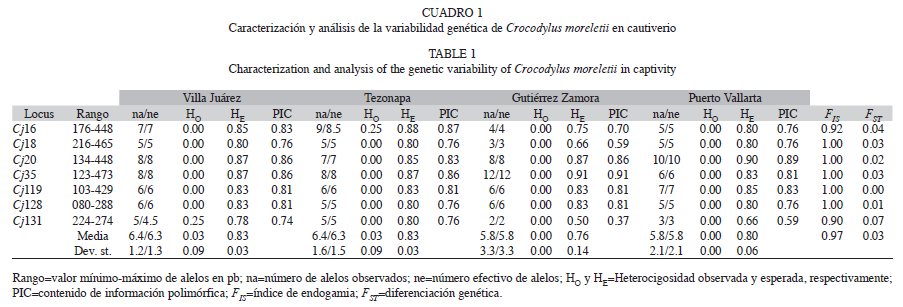
<body><![CDATA[<font size="2"></font><br style="font-family: verdana;">     <font size="2"><span style="font-family: verdana;">El porcentaje de     polimorfismo de     los siete loci de microsat&eacute;lites fue del 100%. Los&nbsp; valores     del PIC fueron superiores a 0.5, lo que indica que son altamente     variables, con excepci&oacute;n del locus C<span      style="font-style: italic;">j</span>131 en la poblaci&oacute;n     de Guti&eacute;rrez Zamora que obtuvo un valor de 0.37 (<a      href="/img/revistas/rbt/v60n1/a31t1.gif">Cuadro 1</a>). El     tama&ntilde;o m&iacute;nimo y m&aacute;ximo en pb de alelos se     ]]></body>
<body><![CDATA[present&oacute; en los loci C<span style="font-style: italic;">j</span>128     (80pb) y C<span style="font-style: italic;">j</span>35 (473pb),     respectivamente. La poblaci&oacute;n de Guti&eacute;rrez Zamora fue la     que present&oacute; el menor (2 alelos en el locus Cj131) y mayor     n&uacute;mero de alelos (12 alelos en el locus C<span      style="font-style: italic;">j</span>35) (<a      href="/img/revistas/rbt/v60n1/a31t1.gif">Cuadro 1</a>). Las     poblaciones de Villa Ju&aacute;rez, Sin., y Tezonapa, Ver., presentaron     el mismo valor promedio de alelos (6.4), que result&oacute; superior a     las otras dos poblaciones que tuvieron un promedio de 5.8 alelos     ]]></body>
<body><![CDATA[(<a href="/img/revistas/rbt/v60n1/a31t1.gif">Cuadro 1</a>). En cada     grupo poblacional, se obtuvieron valores similares     en el n&uacute;mero observado de alelos y n&uacute;mero efectivo de     alelos (<a href="/img/revistas/rbt/v60n1/a31t1.gif">Cuadro 1</a>), lo     cual indica un posible efecto fundador. Respecto     al an&aacute;lisis de la diversidad al&eacute;lica total, las     poblaciones de Villa Ju&aacute;rez, Sin., y Tezonapa, Ver., presentaron     un total de 84 y 82 alelos, respectivamente, mientras que las     poblaciones de Guti&eacute;rrez Zamora, Ver., y Puerto Vallarta, Jal.,     presentaron una diversidad al&eacute;lica total de 78 alelos cada una.     ]]></body>
<body><![CDATA[La poblaci&oacute;n de Puerto Vallarta, Jal., present&oacute; las     frecuencias al&eacute;licas m&aacute;s bajas (locus C<span      style="font-style: italic;">j</span>35) y las     m&aacute;s altas (locus C<span style="font-style: italic;">j</span>18)     (<a href="/img/revistas/rbt/v60n1/a31i1.jpg">Fig. 1</a>). Todos los     loci presentaron     alelos nulos, los cuales tuvieron una frecuencia alta (<a      href="/img/revistas/rbt/v60n1/a31i1.jpg">Fig.     1</a>).&nbsp;&nbsp; &nbsp;</span></font><br      style="font-family: verdana;">     ]]></body>
<body><![CDATA[<font size="2"></font><br style="font-family: verdana;">     <font size="2"><span style="font-family: verdana;">La heterocigosis     observada (H<sub>O</sub>) fue     muy baja con respecto a la esperada (H<sub>E</sub>),&nbsp; indicando un     d&eacute;ficit de heterocigotos en todas las poblaciones (<a      href="/img/revistas/rbt/v60n1/a31t1.gif">Cuadro 1</a>).     S&oacute;lo se detectaron heterocigotos en las poblaciones de Villa     Ju&aacute;rez, Sin., y Tezonapa, Ver., en los loci C<span      style="font-style: italic;">j</span>131 y C<span      style="font-style: italic;">j</span>16 (<a     ]]></body>
<body><![CDATA[ href="/img/revistas/rbt/v60n1/a31t1.gif">Cuadro     1</a>). La prueba de desequilibrio de ligamiento gen&eacute;tico     result&oacute; no significativa para ninguno de los loci (valores de     Chi-cuadrado, p=1.000 en la mayor&iacute;a de los casos). Esta prueba     se realiz&oacute; para determinar si la frecuencia de un locus puede     influir en el otro. En este sentido, de las 84 comparaciones para todos     los pares de loci (21 comparaciones por pares en cada     poblaci&oacute;n), indicaron que la frecuencia entre loci no se     encuentran ligadas. Seg&uacute;n la prueba de equilibrio de     Hardy-Weinberg, todos los valores de H<sub>O</sub> fueron     ]]></body>
<body><![CDATA[significativamente     menores (p&lt;0.05) respecto a los valores de la H<sub>E</sub> para     todos los     loci, lo que confirma la presencia de alelos nulos, resultado que     conlleva a obtener altos niveles de endogamia en cada locus, con un     valor promedio del F<sub>IS</sub> de 0.9, contribuyendo     simult&aacute;neamente a     una reducida diferenciaci&oacute;n interpoblacional (F<sub>ST</sub>=0.03     promedio)     (<a href="/img/revistas/rbt/v60n1/a31t1.gif">Cuadro 1</a>).</span></font><br     ]]></body>
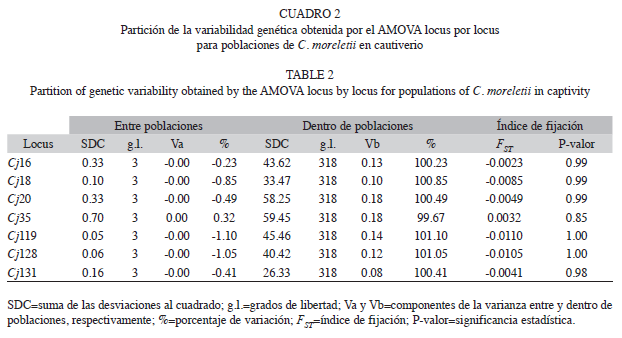
<body><![CDATA[ style="font-family: verdana;">     <font size="2"></font><br style="font-family: verdana;">     <font size="2"><span style="font-family: verdana;">Los resultados del     AMOVA locus por     locus indicaron que la mayor variabilidad gen&eacute;tica ocurre a     nivel intrapoblacional (valores iguales al 100% en la mayor&iacute;a de     los loci). Es decir, la fracci&oacute;n de la variabilidad     gen&eacute;tica es explicada dentro de cada poblaci&oacute;n y     s&oacute;lo el locus C<span style="font-style: italic;">j</span>35     detect&oacute; que existe un 0.32% de     ]]></body>
<body><![CDATA[variabilidad gen&eacute;tica entre poblaciones (<a      href="/img/revistas/rbt/v60n1/a31t2.gif">Cuadro 2</a>). Un dato     interesante que arroj&oacute; el AMOVA es la obtenci&oacute;n de     valores negativos para los componentes de varianza y el porcentaje de     variabilidad gen&eacute;tica entre las poblaciones (exceptuando el     locus C<span style="font-style: italic;">j</span>35), lo que indica la     ausencia de una estructuraci&oacute;n     gen&eacute;tica entre las poblaciones (<a      href="/img/revistas/rbt/v60n1/a31t2.gif">Cuadro 2</a>). Los valores     del F<sub>ST</sub>     ]]></body>
<body><![CDATA[que se obtuvieron a partir del AMOVA fueron&nbsp; negativos y no     significativos (p&gt;0.05), lo que confirma la limitada     diferenciaci&oacute;n gen&eacute;tica entre las subpoblaciones (<a      href="/img/revistas/rbt/v60n1/a31t2.gif">Cuadro     2</a>).</span></font><br style="font-family: verdana;">     <font size="2"></font><br style="font-family: verdana;">     <font style="font-weight: bold;" size="3"><span      style="font-family: verdana;">Discusi&oacute;n</span></font><br      style="font-family: verdana;">     <font size="2"></font><br style="font-family: verdana;">     ]]></body>
<body><![CDATA[<font size="2"><span style="font-family: verdana;">Se encontr&oacute;     que las     estimaciones del tama&ntilde;o m&iacute;nimo-m&aacute;ximo de alelos     as&iacute; como el n&uacute;mero de alelos por locus fueron     superiores&nbsp; a lo reportado por Dever &amp; Densmore (2001), Dever     <span style="font-style: italic;">et al.</span> (2002), y McVay <span      style="font-style: italic;">et al.</span> (2008), para poblaciones de     la misma     especie en vida silvestre distribuidas en Belice. Estas discrepancias     pueden ser debidas al alto polimorfismo que proveen las regiones de     ]]></body>
<body><![CDATA[microsat&eacute;lites, particularmente en vertebrados, ya que son     regiones conservadas con altas tasas de mutaci&oacute;n (Moore <span      style="font-style: italic;">et al.</span>     1991). En este contexto, las evaluaciones de la variabilidad     gen&eacute;tica en Crocodylus (Fitz- Simmons <span      style="font-style: italic;">et al.</span> 2000), han     demostrado que el polimorfismo se debe a inserciones/deleciones de     nucle&oacute;tidos en las regiones microsat&eacute;lites (Tauz 1989,     Strassmann <span style="font-style: italic;">et al.</span> 1996),     generando altas tasas de mutaci&oacute;n y     ]]></body>
<body><![CDATA[alelos m&uacute;ltiples (Queller&nbsp; </span></font><font size="2"><span      style="font-family: verdana;"><span style="font-style: italic;">et al.</span>     1993). La diversidad y las     frecuencias al&eacute;licas fueron similares a lo reportado para C.     rhombifer y C. acutus, posiblemente por la presencia de alelos nulos     (Weaver <span style="font-style: italic;">et al.</span> 2008).</span></font><br      style="font-family: verdana;">     <font size="2"></font><br style="font-family: verdana;">     <font size="2"><span style="font-family: verdana;">En todos los loci,     el valor de la     ]]></body>
<body><![CDATA[H<sub>O</sub> fue menor a la H<sub>E</sub>, lo que indica un marcado     d&eacute;ficit de     heterocigocidad; de hecho, la mayor&iacute;a de los valores de la H<sub>O</sub>     son iguales a cero,</span></font><font size="2"><span      style="font-family: verdana;"> lo que pone en manifiesto la     inexistencia de heterocigosidad en todas las poblaciones. Esta baja     variabilidad gen&eacute;tica puede deberse a la presencia de alelos     nulos, los cuales se presentan con cierta frecuencia en     microsat&eacute;lites y se ha sugerido que &eacute;stos&nbsp; pudieran     mermar los valores de heterocigocidad (Brookfield 1996), por tanto los     ]]></body>
<body><![CDATA[individuos son catalogados como homocigotos (Aranguren-M&eacute;ndez <span      style="font-style: italic;">et     al.</span> 2005). Por un lado, esto pudo surgir bas&aacute;ndose en que     los     individuos de las poblaciones de Puerto</span></font><font size="2"><span      style="font-family: verdana;"> Vallarta, Jal., y Villa     Ju&aacute;rez, Sin., (que nacieron <span style="font-style: italic;">ex     situ</span> y son generaci&oacute;n F<sub>1</sub>),     pueden descender de un solo macho dominante, pero tambi&eacute;n es     probable que durante los eventos reproductivos ocurridos en cautiverio     ]]></body>
<body><![CDATA[en las UMAs de procedencia, el cruzamiento se haya dado entre     cocodrilos emparentados; esto tambi&eacute;n sucede en</span></font><font      size="2"><span style="font-family: verdana;"> granjas de C. niloticus,     donde los     apareamientos entre los individuos reproductivos no es al azar,     contribuyendo a disminuir sus niveles de variabilidad gen&eacute;tica     (Jurgens <span style="font-style: italic;">et al.</span> 1994). En el     caso de las poblaciones de procedencia     silvestre (Guti&eacute;rrez Zamora y Tezonapa, Ver.), que tampoco     presentaron variabilidad gen&eacute;tica, puede ser reflejo del estado     ]]></body>
<body><![CDATA[natural de la variabilidad gen&eacute;tica de las poblaciones donde     proceden. Esto puede atribuirse a la inestabilidad en la estructura     demogr&aacute;fica que presentaron las poblaciones de <span      style="font-style: italic;">C. moreletii     </span>distribuidas en M&eacute;xico (Casas 1995), lo que pudo haber     conducido     a mantener un limitado tama&ntilde;o efectivo de poblaci&oacute;n     (efecto cuello de botella) o un peque&ntilde;o grupo de individuos     reproductivos (efecto fundador) (Bishop <span      style="font-style: italic;">et al.</span> 2009). Esto     ]]></body>
<body><![CDATA[&uacute;ltimo se confirma cuando se contrastan los valores del     n&uacute;mero de alelos observados con el n&uacute;mero de alelos     efectivos, ya que esto pone de manifiesto que estas poblaciones     presentan una reducci&oacute;n de variabilidad gen&eacute;tica por un     posible efecto fundador; sin embargo, se requieren hacer estudios con     ejemplares de varias generaciones para corroborar esta hip&oacute;tesis.</span></font><br      style="font-family: verdana;">     <font size="2"></font><br style="font-family: verdana;">     <font size="2"><span style="font-family: verdana;">Al comparar los     valores de     ]]></body>
<body><![CDATA[heterocigosidad observada (promedio H<sub>O</sub>=0.02) para las&nbsp;     cuatro     poblaciones bajo estudio encontramos que son inferiores a los     reportados para otras poblaciones de <span style="font-style: italic;">C.     moreletii </span>distribuidas en     Belice estudiadas por Dever &amp; Densmore (2001) y Dever <span      style="font-style: italic;">et al.</span> (2002)     (promedio H<sub>O</sub>=0.49 en ambos estudios), lo que pone en     manifiesto una     reducci&oacute;n en los niveles de variabilidad gen&eacute;tica,     ]]></body>
<body><![CDATA[atribuidos principalmente por depresi&oacute;n&nbsp; endog&aacute;mica     en las poblaciones extra&iacute;das del</span></font><font size="2"><span      style="font-family: verdana;"> medio silvestre. A nivel     interespec&iacute;fico, nuestros resultados son similares a lo     reportado para C. niloticus en cautiverio (promedio H<sub>O</sub>=0.00)     a partir     de un estudio de prote&iacute;nas que muestra la ausencia de     variabilidad gen&eacute;tica debido al efecto fundador ocurrido en     cautiverio (Flint <span style="font-style: italic;">et al.</span>     2000). Es preocupante que las poblaciones de     ]]></body>
<body><![CDATA[procedencia silvestre tambi&eacute;n presenten una limitada     variabilidad gen&eacute;tica. En cocodrilos, los niveles de     variabilidad gen&eacute;tica est&aacute;n determinados por su entorno     (Gartside <span style="font-style: italic;">et al.</span> 1977), como     respuesta a los factores ambientales     (Adams <span style="font-style: italic;">et al.</span> 1980). En este     sentido, las concurrentes presiones al     h&aacute;bitat y los consecuentes impactos sobre la din&aacute;mica     poblacional de <span style="font-style: italic;">C. moreletii </span>distribuidas     en el territorio mexicano,     ]]></body>
<body><![CDATA[puede ser una de las causas de la disminuci&oacute;n de su variabilidad     gen&eacute;tica. <span style="font-style: italic;">C. moreletii </span>es     una especie sujeta a protecci&oacute;n     especial en M&eacute;xico y amenazada a nivel internacional, por lo que     se debe generar un control m&aacute;s estricto para conservar su     variabilidad gen&eacute;tica. La suma de esfuerzos en la     conservaci&oacute;n de sus h&aacute;bitats donde la prioridad sea la     conservaci&oacute;n de los corredores biol&oacute;gicos para fomentar     la migraci&oacute;n entre las poblaciones de estos cocodrilos, puede     ser una de las acciones para preservar, y en su caso incrementar la     ]]></body>
<body><![CDATA[variabilidad gen&eacute;tica de esta especie emblem&aacute;tica de los     ecosistemas tropicales de M&eacute;xico.</span></font><br      style="font-family: verdana;">     <font size="2"></font><br style="font-family: verdana;">     <font size="2"><span style="font-family: verdana;">Tanto los eventos     reproductivos     ocurridos en cautiverio como los cambios demogr&aacute;ficos por el que     transcurrieron las poblaciones en vida silvestre reflejan el     d&eacute;ficit de heterocigotos, lo cual quiere decir que las     poblaciones bajo estudio son endog&aacute;micas, consistente con lo     ]]></body>
<body><![CDATA[determinado por el F<sub>IS</sub>, que est&aacute; influenciado por     tener alelos     comunes entre los individuos, que generalmente implica que son     id&eacute;nticos</span></font><font size="2"><span      style="font-family: verdana;"> por descendencia (Raybould <span      style="font-style: italic;">et al.</span>     2002). La endogamia no siempre representa una desventaja para las     especies de cocodrilianos, sino que puede considerarse como una     adaptaci&oacute;n &oacute;ptima al responder a las presiones del medio     (Gartside <span style="font-style: italic;">et al.</span> 1977). Sin     ]]></body>
<body><![CDATA[embargo, se considera que la endogamia y la     limitada variabilidad gen&eacute;tica est&aacute; jugando un papel     determinante al relacionar estos par&aacute;metros gen&eacute;ticos con     las diferenciaciones en ciertos caracteres morfol&oacute;gicos y las     bajas tasas de crecimiento corporal que se han observado en estos     grupos poblacionales (Serna-Lagunes <span style="font-style: italic;">et     al.</span> 2010). Esto representa una     problem&aacute;tica en la UMA Cacahuatal ya que impacta de manera     negativa en los ingresos econ&oacute;micos debido a la obtenci&oacute;n     de pieles de menor calidad y consecuentemente mantener a los individuos     ]]></body>
<body><![CDATA[por un mayor tiempo hasta alcanzar la talla comercial (Serna-Lagunes     2010).</span></font><br style="font-family: verdana;">     <font size="2"></font><br style="font-family: verdana;">     <font size="2"><span style="font-family: verdana;">El AMOVA     indic&oacute; que la mayor     proporci&oacute;n de la variabilidad gen&eacute;tica se present&oacute;     dentro de cada poblaci&oacute;n. Por tanto, gran parte de la     variaci&oacute;n gen&eacute;tica fue aportada por la divergencia de los     alelos dentro de cada subpoblaci&oacute;n y no se detect&oacute; una     estructuraci&oacute;n gen&eacute;tica entre las poblaciones. El     ]]></body>
<body><![CDATA[presentar alelos id&eacute;nticos se debe a que las poblaciones de <span      style="font-style: italic;">C.     moreletii </span>fueron extra&iacute;das del rango de     distribuci&oacute;n     natural, donde hist&oacute;ricamente ten&iacute;an una     distribuci&oacute;n m&aacute;s o menos contin&uacute;a (&Aacute;lvarez     del Toro &amp; Sigler 2001), y posiblemente hubo flujo gen&eacute;tico,     y los alelos desde entonces, as&iacute;</span></font><font size="2"><span      style="font-family: verdana;"> se han mantenido, y tienden a     obtener una baja diferenciaci&oacute;n entre poblaciones formando un     ]]></body>
<body><![CDATA[grupo homog&eacute;neo (Weir 1996).</span></font><br      style="font-family: verdana;">     <font size="2"></font><br style="font-family: verdana;">     <font size="2"><span style="font-family: verdana;">Una de las     implicaciones inmediatas     para el manejo gen&eacute;tico de <span style="font-style: italic;">C.     moreletii </span>es continuar realizando     estudios de caracterizaci&oacute;n gen&eacute;tica de poblaciones     silvestres y de las que se encuentran en las diferentes UMAs, con la     finalidad de identificar individuos gen&eacute;ticamente diferentes y     ]]></body>
<body><![CDATA[con mayor variabilidad gen&eacute;tica para seleccionarlos y generar un     nuevo n&uacute;cleo reproductivo en la UMA Cacahuatal; estos cocodrilos     pueden ser transportados para que puedan copular con las hembras     (tambi&eacute;n caracterizadas gen&eacute;ticamente) de otras UMAs.     Inclusive tambi&eacute;n se puede pensar en inseminaci&oacute;n</span></font><font      size="2"><span style="font-family: verdana;"> artificial, aunque esta     t&eacute;cnica reproductiva a&uacute;n se encuentra en proceso de     desarrolloimplementaci&oacute;n- validaci&oacute;n para cocodrilos.     Dado que los problemas gen&eacute;ticos derivados de endogamia     minimizan los procesos b&aacute;sicos de adaptaci&oacute;n local de las     ]]></body>
<body><![CDATA[especies, por ahora no puede recomendarse un programa de     liberaci&oacute;n del n&uacute;cleo de individuos de la UMA Cacahuatal     a su h&aacute;bitat silvestre. La liberaci&oacute;n solo se     podr&aacute; realizar hasta que se tenga una proporci&oacute;n similar     de variabilidad gen&eacute;tica como la que se ha reportado para otras     poblaciones como las de Belice (H<sub>O</sub>=0.49), o tomar</span></font><font      size="2"><span style="font-family: verdana;"> como referencia los     niveles de     variabilidad gen&eacute;tica que se reporten en estudios posteriores     con poblaciones de <span style="font-style: italic;">C. moreletii </span>distribuidas     ]]></body>
<body><![CDATA[en M&eacute;xico pero que     se encuentren en un rango de H<sub>O</sub> entre 0.3 a 0.5. Como en la     mayor&iacute;a de las UMAs se obtiene p&iacute;e de cr&iacute;a     extra&iacute;das de poblaciones silvestres, se puede sugerir que previo     a la formaci&oacute;n de sus n&uacute;cleos reproductivos se realicen     estudios siguiendo los m&eacute;todos utilizados en este trabajo y solo     considerar aquellos individuos gen&eacute;ticamente diferentes para la     reproducci&oacute;n, lo que podr&iacute;a&nbsp; llevar a la     disminuci&oacute;n de la homocigosis en sus descendientes. Estudios     futuros deben proporcionar informaci&oacute;n sobre el tama&ntilde;o     ]]></body>
<body><![CDATA[efectivo de poblaci&oacute;n y el tama&ntilde;o m&iacute;nimo viable     que se requiere para conservar la variabilidad gen&eacute;tica de     poblaciones de <span style="font-style: italic;">C. moreletii </span>en     cautiverio con la finalidad de prevenir     el detrimento gen&eacute;tico por endogamia. Esto podr&iacute;a     preservar la</span></font><font size="2"><span      style="font-family: verdana;"> variabilidad gen&eacute;tica de los     cocodrilos durante ciertos periodos de tiempo generacional y as&iacute;     tener bases m&aacute;s s&oacute;lidas para generar un plan de     liberaci&oacute;n de cocodrilos a su h&aacute;bitat para garantizar su     ]]></body>
<body><![CDATA[adaptaci&oacute;n y sobrevivencia.</span></font><br      style="font-family: verdana;">     <font size="2"></font><br style="font-family: verdana;">     <font size="2"><span style="font-family: verdana;">Se puede concluir     que la limitada     variabilidad gen&eacute;tica de las poblaciones de <span      style="font-style: italic;">C. moreletii </span>que     nacieron en las UMAs (Villa Ju&aacute;rez, Sin. y Puerto Vallarta,     Jal.), se debi&oacute; a un inadecuado manejo reproductivo en estos     sistemas de crianza, permitiendo el apareamiento de un limitado grupo     ]]></body>
<body><![CDATA[de reproductores o de un solo macho dominante. En el caso de las     poblaciones extra&iacute;das de su h&aacute;bitat silvestre (Tezonapa y     Guti&eacute;rrez Zamora, Veracruz), su limitada variabilidad     gen&eacute;tica se present&oacute; por el reducido tama&ntilde;o     efectivo de la poblaci&oacute;n, inferido principalmente por la     variaci&oacute;n en la din&aacute;mica</span></font><font size="2"><span      style="font-family: verdana;"> demogr&aacute;fica que,     hist&oacute;ricamente han tenido las poblaciones. A nivel inter e     intraespec&iacute;fico, los par&aacute;metros de variabilidad     gen&eacute;tica fueron menores a los reportados para la misma especie y     ]]></body>
<body><![CDATA[para otros cocodrilos, por lo que se deben considerar medidas     espec&iacute;ficas que conserven&nbsp; y/o incrementen la variabilidad     gen&eacute;tica en las poblaciones bajo estudio. La mayor     proporci&oacute;n de la variabilidad gen&eacute;tica se present&oacute;     a nivel intrapoblacional y no presentaron diferenciaci&oacute;n ni     subdivisi&oacute;n gen&eacute;tica, posiblemente por el alto flujo     gen&eacute;tico que hist&oacute;ricamente present&oacute; <span      style="font-style: italic;">C. moreletii     </span>en su distribuci&oacute;n natural y la fijaci&oacute;n de alelos     se     ]]></body>
<body><![CDATA[mantuvo desde entonces.</span></font><font size="2"><span      style="font-family: verdana;"> Finalmente, el n&uacute;mero de     loci analizados reflej&oacute; el estado actual de la variabilidad     gen&eacute;tica del grupo poblacional en estudio; por tanto se puede     ampliar el an&aacute;lisis aumentando el n&uacute;mero de individuos     caracterizados junto con la inclusi&oacute;n de otras poblaciones, a     fin de llegar a conclusiones m&aacute;s precisas para generar un plan     de recuperaci&oacute;n de las poblaciones de <span      style="font-style: italic;">C. moreletii </span>en las     localidades donde fueron extintas.</span></font><br     ]]></body>
<body><![CDATA[ style="font-family: verdana;">     <font size="2"></font><br style="font-family: verdana;">     <font style="font-weight: bold;" size="3"><span      style="font-family: verdana;">Agradecimientos</span></font><br      style="font-family: verdana;">     <font size="2"></font><br style="font-family: verdana;">     <font size="2"><span style="font-family: verdana;">A la Secretaria de     Medio Ambiente y     Recursos Naturales (SEMARNAT) por brindar el permiso especial de     colecta SGPA/ DGVS/07875. A la UMA Cacahuatal por los apoyos brindados     ]]></body>
<body><![CDATA[para realizar el presente estudio. A la L&iacute;nea Prioritaria de     Investigaci&oacute;n 11 y al Campus Veracruz, filiales del Colegio de     Postgraduados, as&iacute; como al Laboratorio de</span></font><font      size="2"><span style="font-family: verdana;"> Sistem&aacute;tica     Molecular del     Instituto de Ecolog&iacute;a, A. C. por sus respectivos financiamientos.</span></font><br      style="font-family: verdana;">     <font size="2"></font><font style="font-weight: bold;" size="3"><span      style="font-family: verdana;"></span></font>     <hr style="width: 100%; height: 2px;">    ]]></body>
<body><![CDATA[<!-- ref --><br> <font style="font-weight: bold;" size="3"><span  style="font-family: verdana;">Referencias</span></font><br  style="font-family: verdana;"> <font size="2"></font><br style="font-family: verdana;"> <font size="2"><span style="font-family: verdana;">Adams, S.E., M.H. Smith &amp; R. Baccus. 1980. Biochemical variation in the American alligator (Alligator mississipiensis). Herpetologica 36: 289-296.    &nbsp;&nbsp;&nbsp;&nbsp;&nbsp;&nbsp;&nbsp;&nbsp;[&#160;<a href="javascript:void(0);" onclick="javascript: window.open('/scielo.php?script=sci_nlinks&ref=1429668&pid=S0034-7744201200010003100001&lng=','','width=640,height=500,resizable=yes,scrollbars=1,menubar=yes,');">Links</a>&#160;]<!-- end-ref --><!-- ref --></span></font><br  style="font-family: verdana;"> <font size="2"></font><br style="font-family: verdana;"> <font size="2"><span style="font-family: verdana;">&Aacute;lvarez del Toro, M. &amp; L. Sigler. 2001. Los Crocodylia de M&eacute;xico. Instituto Mexicano de Recursos Naturales y Procuradur&iacute;a Federal de Protecci&oacute;n al Ambiente. Distrito Federal, M&eacute;xico.    &nbsp;&nbsp;&nbsp;&nbsp;&nbsp;&nbsp;&nbsp;&nbsp;[&#160;<a href="javascript:void(0);" onclick="javascript: window.open('/scielo.php?script=sci_nlinks&ref=1429669&pid=S0034-7744201200010003100002&lng=','','width=640,height=500,resizable=yes,scrollbars=1,menubar=yes,');">Links</a>&#160;]<!-- end-ref --><!-- ref --></span></font><br  style="font-family: verdana;"> <font size="2"></font><br style="font-family: verdana;"> <font size="2"><span style="font-family: verdana;">Amavet, P.S., L.E. Rosso, M.R. Markariani &amp; A. Larriera. 2007. Analysis of the population structure of Broad- Snouted Caiman (Caiman latirostris) in Santa Fe, Argentina, using the RAPD technique. J. Herpetol. 41: 294-300.    &nbsp;&nbsp;&nbsp;&nbsp;&nbsp;&nbsp;&nbsp;&nbsp;[&#160;<a href="javascript:void(0);" onclick="javascript: window.open('/scielo.php?script=sci_nlinks&ref=1429670&pid=S0034-7744201200010003100003&lng=','','width=640,height=500,resizable=yes,scrollbars=1,menubar=yes,');">Links</a>&#160;]<!-- end-ref --><!-- ref --></span></font><br  style="font-family: verdana;"> <font size="2"></font><br style="font-family: verdana;"> <font size="2"><span style="font-family: verdana;">Arangueren-M&eacute;ndez, J.A., R. Rom&aacute;n-Bravo, W. Isea, Y. Villasmil &amp; J. Jordana. 2005. Los microsat&eacute;lites (STR&#8217;s), marcadores moleculares de ADN por excelencia para programas de conservaci&oacute;n: una revisi&oacute;n. Arch. Latinoam. Prod. Anim. 13: 1-6.    &nbsp;&nbsp;&nbsp;&nbsp;&nbsp;&nbsp;&nbsp;&nbsp;[&#160;<a href="javascript:void(0);" onclick="javascript: window.open('/scielo.php?script=sci_nlinks&ref=1429671&pid=S0034-7744201200010003100004&lng=','','width=640,height=500,resizable=yes,scrollbars=1,menubar=yes,');">Links</a>&#160;]<!-- end-ref --><!-- ref --></span></font><br  style="font-family: verdana;"> <font size="2"></font><br style="font-family: verdana;"> <font size="2"><span style="font-family: verdana;">Benbouza, H., J. Jean-Marie, B. Jean-Pierre &amp; M. Guy. 2006. Optimization of a reliable, fast, cheap and sensitive silver staining method to detect SSR markers in polyacrylamide gels. Biotechnol., Agron., Soc. Environ. 10: 77-81.    &nbsp;&nbsp;&nbsp;&nbsp;&nbsp;&nbsp;&nbsp;&nbsp;[&#160;<a href="javascript:void(0);" onclick="javascript: window.open('/scielo.php?script=sci_nlinks&ref=1429672&pid=S0034-7744201200010003100005&lng=','','width=640,height=500,resizable=yes,scrollbars=1,menubar=yes,');">Links</a>&#160;]<!-- end-ref --><!-- ref --></span></font><br  style="font-family: verdana;"> <font size="2"></font><br style="font-family: verdana;"> <font size="2"><span style="font-family: verdana;">Bishop, M.J., A.J. Leslie, S.L. Bourquin &amp; C.O&#8217;Ryan. 2009. Reduced effective population size in an overexploited population of the Nile crocodile (Crocodylus niloticus). Biol. Conserv. 142: 2335-2341.    &nbsp;&nbsp;&nbsp;&nbsp;&nbsp;&nbsp;&nbsp;&nbsp;[&#160;<a href="javascript:void(0);" onclick="javascript: window.open('/scielo.php?script=sci_nlinks&ref=1429673&pid=S0034-7744201200010003100006&lng=','','width=640,height=500,resizable=yes,scrollbars=1,menubar=yes,');">Links</a>&#160;]<!-- end-ref --><!-- ref --></span></font><br  style="font-family: verdana;"> <font size="2"></font><br style="font-family: verdana;"> <font size="2"><span style="font-family: verdana;">Brookfield, J.F.Y. 1996. A simple new method for estimating null allele frequency from heterozygote deficiency. Mol. Ecol. 5: 453-455.    &nbsp;&nbsp;&nbsp;&nbsp;&nbsp;&nbsp;&nbsp;&nbsp;[&#160;<a href="javascript:void(0);" onclick="javascript: window.open('/scielo.php?script=sci_nlinks&ref=1429674&pid=S0034-7744201200010003100007&lng=','','width=640,height=500,resizable=yes,scrollbars=1,menubar=yes,');">Links</a>&#160;]<!-- end-ref --><!-- ref --></span></font><br  style="font-family: verdana;"> <font size="2"></font><br style="font-family: verdana;"> <font size="2"><span style="font-family: verdana;">Casas, A.G. 1995. Los cocodrilos de M&eacute;xico como recurso natural. Presente, pasado y futuro. Rev. Soc. Mex. Hist. Nat. 46: 153-162.    &nbsp;&nbsp;&nbsp;&nbsp;&nbsp;&nbsp;&nbsp;&nbsp;[&#160;<a href="javascript:void(0);" onclick="javascript: window.open('/scielo.php?script=sci_nlinks&ref=1429675&pid=S0034-7744201200010003100008&lng=','','width=640,height=500,resizable=yes,scrollbars=1,menubar=yes,');">Links</a>&#160;]<!-- end-ref --><!-- ref --></span></font><br  style="font-family: verdana;"> <font size="2"></font><br style="font-family: verdana;"> <font size="2"><span style="font-family: verdana;">Casas, A.G. 2002. Hacia la conservaci&oacute;n y manejo sustentable del lagarto o cocodrilo de pantano (<span style="font-style: italic;">Crocodylus moreletii</span>) en M&eacute;xico, p. 27-45. In L.M. Verdade &amp; A. Larriera (eds.). La conservaci&oacute;n y el manejo de caimanes y cocodrilos de Am&eacute;rica Latina. CN Editoria, Piracicaba, Sao Paulo, Brasil.    &nbsp;&nbsp;&nbsp;&nbsp;&nbsp;&nbsp;&nbsp;&nbsp;[&#160;<a href="javascript:void(0);" onclick="javascript: window.open('/scielo.php?script=sci_nlinks&ref=1429676&pid=S0034-7744201200010003100009&lng=','','width=640,height=500,resizable=yes,scrollbars=1,menubar=yes,');">Links</a>&#160;]<!-- end-ref --><!-- ref --></span></font><br  style="font-family: verdana;"> <font size="2"></font><br style="font-family: verdana;"> <font size="2"><span style="font-family: verdana;">Convenci&oacute;n Internacional del Comercio y Tr&aacute;fico de Especies Amenazadas de Flora y Fauna (CITES). 2008. Propuesta para transferir la poblaci&oacute;n mexicana <span style="font-style: italic;">Crocodylus moreletii</span> del Ap&eacute;ndice I al Ap&eacute;ndice II. Acuerdo 23, Documento 18, Ginebra, Suiza.    &nbsp;&nbsp;&nbsp;&nbsp;&nbsp;&nbsp;&nbsp;&nbsp;[&#160;<a href="javascript:void(0);" onclick="javascript: window.open('/scielo.php?script=sci_nlinks&ref=1429677&pid=S0034-7744201200010003100010&lng=','','width=640,height=500,resizable=yes,scrollbars=1,menubar=yes,');">Links</a>&#160;]<!-- end-ref --><!-- ref --></span></font><br  style="font-family: verdana;"> <font size="2"></font><br style="font-family: verdana;"> <font size="2"><span style="font-family: verdana;">Davis, L.M., T.C. Glenn, R.M. Elsey, I.L. Brisbin Jr., W.E. Rhodes, H.C. Dessauer &amp; R.H. Sawyer. 2000. Genetic structure of six populations of American alligators: a microsatellite analysis, p. 38-50. In G.C. Grigg, F. Seebacher &amp; C.E. Franklin (eds.). Crocodilian biology and evolution. Surrey Beatty and Sons, Chipping Norton, Australia.    &nbsp;&nbsp;&nbsp;&nbsp;&nbsp;&nbsp;&nbsp;&nbsp;[&#160;<a href="javascript:void(0);" onclick="javascript: window.open('/scielo.php?script=sci_nlinks&ref=1429678&pid=S0034-7744201200010003100011&lng=','','width=640,height=500,resizable=yes,scrollbars=1,menubar=yes,');">Links</a>&#160;]<!-- end-ref --><!-- ref --></span></font><br  style="font-family: verdana;"> <font size="2"></font><br style="font-family: verdana;"> <font size="2"><span style="font-family: verdana;">Dever, J.A. &amp; D. Densmore. 2001. Microsatellites in Morelet&#8217;s Crocodile (<span  style="font-style: italic;">Crocodylus moreletii</span>) and their utility in addressing crocodilian population genetics questions. J. Herpetol. 35: 541-544.    &nbsp;&nbsp;&nbsp;&nbsp;&nbsp;&nbsp;&nbsp;&nbsp;[&#160;<a href="javascript:void(0);" onclick="javascript: window.open('/scielo.php?script=sci_nlinks&ref=1429679&pid=S0034-7744201200010003100012&lng=','','width=640,height=500,resizable=yes,scrollbars=1,menubar=yes,');">Links</a>&#160;]<!-- end-ref --><!-- ref --> </span></font><br  style="font-family: verdana;"> <font size="2"></font><br style="font-family: verdana;"> <font size="2"><span style="font-family: verdana;">Dever, J.A., R.E. Stratus, T.R. Rainwater, S.T. McMurry &amp; L.D. Densmore. 2002. Genetic diversity, population subdivision and gene flow in Morelet&#8217;s Crocodile (<span  style="font-style: italic;">Crocodylus moreletii</span>) from Belize, Central America.&nbsp; Copeia 4: 1078-1091.    &nbsp;&nbsp;&nbsp;&nbsp;&nbsp;&nbsp;&nbsp;&nbsp;[&#160;<a href="javascript:void(0);" onclick="javascript: window.open('/scielo.php?script=sci_nlinks&ref=1429680&pid=S0034-7744201200010003100013&lng=','','width=640,height=500,resizable=yes,scrollbars=1,menubar=yes,');">Links</a>&#160;]<!-- end-ref --><!-- ref --></span></font><br style="font-family: verdana;"> <font size="2"></font><br style="font-family: verdana;"> <font size="2"><span style="font-family: verdana;">Diario Oficial de la Federaci&oacute;n (DOF). 2001. Norma Oficial Mexicana NOM-059-ECOL-2001, Protecci&oacute;n Ambiental-especies nativas de M&eacute;xico de Flora y Fauna silvestre, tres categor&iacute;as de riesgo y especificaciones para su inclusi&oacute;n, exclusi&oacute;n o cambio- Lista de Especies en riesgo. Diario Oficial de la Federaci&oacute;n, Distrito Federal, M&eacute;xico.    &nbsp;&nbsp;&nbsp;&nbsp;&nbsp;&nbsp;&nbsp;&nbsp;[&#160;<a href="javascript:void(0);" onclick="javascript: window.open('/scielo.php?script=sci_nlinks&ref=1429681&pid=S0034-7744201200010003100014&lng=','','width=640,height=500,resizable=yes,scrollbars=1,menubar=yes,');">Links</a>&#160;]<!-- end-ref --><!-- ref --></span></font><br  style="font-family: verdana;"> <font size="2"></font><br style="font-family: verdana;"> <font size="2"><span style="font-family: verdana;">Dom&iacute;nguez-Laso, J. 2006. Determinaci&oacute;n del estado actual de las poblaciones silvestres del cocodrilo de pantano (<span style="font-style: italic;">Crocodylus moreletii</span>) en M&eacute;xico y evaluaci&oacute;n de su estatus en la CITES. Informe final SNIB-CONABIO proyecto No. CS009. Instituto de Historia Natural y Ecolog&iacute;a, Distrito Federal, M&eacute;xico.    &nbsp;&nbsp;&nbsp;&nbsp;&nbsp;&nbsp;&nbsp;&nbsp;[&#160;<a href="javascript:void(0);" onclick="javascript: window.open('/scielo.php?script=sci_nlinks&ref=1429682&pid=S0034-7744201200010003100015&lng=','','width=640,height=500,resizable=yes,scrollbars=1,menubar=yes,');">Links</a>&#160;]<!-- end-ref --><!-- ref --></span></font><br  style="font-family: verdana;"> <font size="2"></font><br style="font-family: verdana;"> <font size="2"><span style="font-family: verdana;">Excoffier, L., G. Laval &amp; S. Schneider. 2005. Arlequin ver. 3.0: An integrated software package for population genetics data analysis. Evol. Bioinf. Online 1: 47-50.    &nbsp;&nbsp;&nbsp;&nbsp;&nbsp;&nbsp;&nbsp;&nbsp;[&#160;<a href="javascript:void(0);" onclick="javascript: window.open('/scielo.php?script=sci_nlinks&ref=1429683&pid=S0034-7744201200010003100016&lng=','','width=640,height=500,resizable=yes,scrollbars=1,menubar=yes,');">Links</a>&#160;]<!-- end-ref --><!-- ref --> </span></font><br  style="font-family: verdana;"> <font size="2"></font><br style="font-family: verdana;"> <font size="2"><span style="font-family: verdana;">Excoffier, L., P. Smouse &amp; J. Quattro. 1992. Analysis of molecular variance inferred from metric distances among DNA haplotypes: application to human mitochondrial DNA restriction data. Genetics 131: 479-491.    &nbsp;&nbsp;&nbsp;&nbsp;&nbsp;&nbsp;&nbsp;&nbsp;[&#160;<a href="javascript:void(0);" onclick="javascript: window.open('/scielo.php?script=sci_nlinks&ref=1429684&pid=S0034-7744201200010003100017&lng=','','width=640,height=500,resizable=yes,scrollbars=1,menubar=yes,');">Links</a>&#160;]<!-- end-ref --><!-- ref --></span></font><br  style="font-family: verdana;"> <font size="2"></font><br style="font-family: verdana;"> <font size="2"><span style="font-family: verdana;">FitzSimmons, N., J.C. Buchan, P.V. Lam, G. Polet, T.T. Hung, N.Q. Thang &amp; J. Gratten. 2002. Identification of purebred Crocodylus siamensis for reintroduction in Vietnam. J. Exp. Zool. 294: 373-381.    &nbsp;&nbsp;&nbsp;&nbsp;&nbsp;&nbsp;&nbsp;&nbsp;[&#160;<a href="javascript:void(0);" onclick="javascript: window.open('/scielo.php?script=sci_nlinks&ref=1429685&pid=S0034-7744201200010003100018&lng=','','width=640,height=500,resizable=yes,scrollbars=1,menubar=yes,');">Links</a>&#160;]<!-- end-ref --><!-- ref --></span></font><br  style="font-family: verdana;"> <font size="2"></font><br style="font-family: verdana;"> <font size="2"><span style="font-family: verdana;">FitzSimmons, N., S. Tanksley, M.R. Forstner, E.E. Louis, R. Daglish, J. Gratten &amp; S. Davis. 2000. Microsatellite markers for Crocodylus: new genetic tools for population genetics, mating system studies and forensics, p. 51-57. In G.C. Grigg, F. Seebacher &amp; C.E. Franklin (eds.). Crocodilian biology and evolution.    &nbsp;&nbsp;&nbsp;&nbsp;&nbsp;&nbsp;&nbsp;&nbsp;[&#160;<a href="javascript:void(0);" onclick="javascript: window.open('/scielo.php?script=sci_nlinks&ref=1429686&pid=S0034-7744201200010003100019&lng=','','width=640,height=500,resizable=yes,scrollbars=1,menubar=yes,');">Links</a>&#160;]<!-- end-ref --><!-- ref --></span></font><br style="font-family: verdana;"> <font size="2"></font><br style="font-family: verdana;"> <font size="2"><span style="font-family: verdana;">Surrey Beatty &amp; Sons, Chipping Norton, Australia. Forstner, M. &amp; J.M. Forstner. 2002. Aplicaciones del DNA en la conservaci&oacute;n de los cocodrilianos, p. 99-117. In L.M. Verdade &amp; A. Larriera (eds.). La conservaci&oacute;n y el manejo de caimanes y cocodrilos de Am&eacute;rica Latina. CN Editoria, Piracicaba, Sao Paulo, Brasil.    &nbsp;&nbsp;&nbsp;&nbsp;&nbsp;&nbsp;&nbsp;&nbsp;[&#160;<a href="javascript:void(0);" onclick="javascript: window.open('/scielo.php?script=sci_nlinks&ref=1429687&pid=S0034-7744201200010003100020&lng=','','width=640,height=500,resizable=yes,scrollbars=1,menubar=yes,');">Links</a>&#160;]<!-- end-ref --><!-- ref --></span></font><br  style="font-family: verdana;"> <font size="2"></font><br style="font-family: verdana;"> <font size="2"><span style="font-family: verdana;">Flint, N.S., F.H. Van Der Bank &amp; J.P. Grobler. 2000. A lack of genetic variation in commercially bred Nile crocodiles (Crocodylus niloticus) in the north-west province of South Africa. Water SA 26: 105-110.    &nbsp;&nbsp;&nbsp;&nbsp;&nbsp;&nbsp;&nbsp;&nbsp;[&#160;<a href="javascript:void(0);" onclick="javascript: window.open('/scielo.php?script=sci_nlinks&ref=1429688&pid=S0034-7744201200010003100021&lng=','','width=640,height=500,resizable=yes,scrollbars=1,menubar=yes,');">Links</a>&#160;]<!-- end-ref --><!-- ref --> </span></font><br  style="font-family: verdana;"> <font size="2"></font><br style="font-family: verdana;"> <font size="2"><span style="font-family: verdana;">Gartside, D.F., H.C. Dessauer &amp; T. Joanen. 1977. Genic homozygosity in an ancient reptile Alligator mississippiensis. Biochem. Genet. 15: 655-664.    &nbsp;&nbsp;&nbsp;&nbsp;&nbsp;&nbsp;&nbsp;&nbsp;[&#160;<a href="javascript:void(0);" onclick="javascript: window.open('/scielo.php?script=sci_nlinks&ref=1429689&pid=S0034-7744201200010003100022&lng=','','width=640,height=500,resizable=yes,scrollbars=1,menubar=yes,');">Links</a>&#160;]<!-- end-ref --><!-- ref --></span></font><br  style="font-family: verdana;"> <font size="2"></font><br style="font-family: verdana;"> <font size="2"><span style="font-family: verdana;">Gonz&aacute;lez, D. &amp; A.P. Vovides. 2002. Low intralineage divergence in Ceratozamia (Zamiaceae) detected with nuclear ribosomal DNA ITS and chloroplast DNA trnL-F non-coding region. Syst. Bot. 27: 654-661.    &nbsp;&nbsp;&nbsp;&nbsp;&nbsp;&nbsp;&nbsp;&nbsp;[&#160;<a href="javascript:void(0);" onclick="javascript: window.open('/scielo.php?script=sci_nlinks&ref=1429690&pid=S0034-7744201200010003100023&lng=','','width=640,height=500,resizable=yes,scrollbars=1,menubar=yes,');">Links</a>&#160;]<!-- end-ref --><!-- ref --> </span></font><br  style="font-family: verdana;"> <font size="2"></font><br style="font-family: verdana;"> <font size="2"><span style="font-family: verdana;">Goudet, J. 2001. FSTAT: a program to estimate and test gene diversities and fixation indices. Institute of Ecology, Biology Building, Universit&eacute; of Lausanne, Suiza.    &nbsp;&nbsp;&nbsp;&nbsp;&nbsp;&nbsp;&nbsp;&nbsp;[&#160;<a href="javascript:void(0);" onclick="javascript: window.open('/scielo.php?script=sci_nlinks&ref=1429691&pid=S0034-7744201200010003100024&lng=','','width=640,height=500,resizable=yes,scrollbars=1,menubar=yes,');">Links</a>&#160;]<!-- end-ref --><!-- ref --></span></font><br  style="font-family: verdana;"> <font size="2"></font><br style="font-family: verdana;"> <font size="2"><span style="font-family: verdana;">Glenn, T.C. 2002. DNA tools and resources for crocodilian research, p. 211. In Crocodiles, Proceedings of the 16th Working Meeting of the Crocodile Specialist Group of the Species Survival Commission of IUCN and the World Conservation Union (eds.). Gland, Suiza.    &nbsp;&nbsp;&nbsp;&nbsp;&nbsp;&nbsp;&nbsp;&nbsp;[&#160;<a href="javascript:void(0);" onclick="javascript: window.open('/scielo.php?script=sci_nlinks&ref=1429692&pid=S0034-7744201200010003100025&lng=','','width=640,height=500,resizable=yes,scrollbars=1,menubar=yes,');">Links</a>&#160;]<!-- end-ref --><!-- ref --></span></font><br style="font-family: verdana;"> <font size="2"></font><br style="font-family: verdana;"> <font size="2"><span style="font-family: verdana;">Huchzermeyer, F.W. 2003. Crocodiles: Biology, husbandry and diseases. CABI, Wallingford, Oxfordshire, Reino Unido.    &nbsp;&nbsp;&nbsp;&nbsp;&nbsp;&nbsp;&nbsp;&nbsp;[&#160;<a href="javascript:void(0);" onclick="javascript: window.open('/scielo.php?script=sci_nlinks&ref=1429693&pid=S0034-7744201200010003100026&lng=','','width=640,height=500,resizable=yes,scrollbars=1,menubar=yes,');">Links</a>&#160;]<!-- end-ref --><!-- ref --></span></font><br style="font-family: verdana;"> <font size="2"></font><br style="font-family: verdana;"> <font size="2"><span style="font-family: verdana;">INE. 2000. Proyecto para la conservaci&oacute;n, manejo y aprovechamiento sustentable de los Crocodylia de M&eacute;xico (COMACROM). Instituto Nacional de Ecolog&iacute;a y Secretaria de Marina y Recursos Naturales, Distrito Federal, M&eacute;xico.    &nbsp;&nbsp;&nbsp;&nbsp;&nbsp;&nbsp;&nbsp;&nbsp;[&#160;<a href="javascript:void(0);" onclick="javascript: window.open('/scielo.php?script=sci_nlinks&ref=1429694&pid=S0034-7744201200010003100027&lng=','','width=640,height=500,resizable=yes,scrollbars=1,menubar=yes,');">Links</a>&#160;]<!-- end-ref --><!-- ref --></span></font><br style="font-family: verdana;"> <font size="2"></font><br style="font-family: verdana;"> <font size="2"><span style="font-family: verdana;">IUCN, 2010. Red List of Threatened Species, Version 2010.2. International Union for Conservation of Nature and Natural Resources (Consultado: 17 Agosto 2010, http://www.iucnredlist.org).    &nbsp;&nbsp;&nbsp;&nbsp;&nbsp;&nbsp;&nbsp;&nbsp;[&#160;<a href="javascript:void(0);" onclick="javascript: window.open('/scielo.php?script=sci_nlinks&ref=1429695&pid=S0034-7744201200010003100028&lng=','','width=640,height=500,resizable=yes,scrollbars=1,menubar=yes,');">Links</a>&#160;]<!-- end-ref --><!-- ref --></span></font><br  style="font-family: verdana;"> <font size="2"></font><br style="font-family: verdana;"> <font size="2"><span style="font-family: verdana;">Jurgens, A., J. Kruger &amp; F.H. Van Der Bank. 1994. Allozyme variation in the Nile crocodile (Crocodylus niloticus) form Southern Africa, p. 72-76. In Crocodiles, Proceedings of the 12th Working Meeting of the Crocodile Specialist Group IUCN and the World Conservation Union (eds.). Gland, Suiza.    &nbsp;&nbsp;&nbsp;&nbsp;&nbsp;&nbsp;&nbsp;&nbsp;[&#160;<a href="javascript:void(0);" onclick="javascript: window.open('/scielo.php?script=sci_nlinks&ref=1429696&pid=S0034-7744201200010003100029&lng=','','width=640,height=500,resizable=yes,scrollbars=1,menubar=yes,');">Links</a>&#160;]<!-- end-ref --><!-- ref --></span></font><br  style="font-family: verdana;"> <font size="2"></font><br style="font-family: verdana;"> <font size="2"><span style="font-family: verdana;">Kimura, M. &amp; J.F. Crow. 1964. The number of alleles that can be maintained in a finite population. Genetics 49: 725-38.    &nbsp;&nbsp;&nbsp;&nbsp;&nbsp;&nbsp;&nbsp;&nbsp;[&#160;<a href="javascript:void(0);" onclick="javascript: window.open('/scielo.php?script=sci_nlinks&ref=1429697&pid=S0034-7744201200010003100030&lng=','','width=640,height=500,resizable=yes,scrollbars=1,menubar=yes,');">Links</a>&#160;]<!-- end-ref --><!-- ref --></span></font><br style="font-family: verdana;"> <font size="2"></font><br style="font-family: verdana;"> <font size="2"><span style="font-family: verdana;">Luxmoore, R.A. 1992. Directory of Crocodilian farming operations. IUCN, Gland, Suiza and Cambrigde, Reino Unido.    &nbsp;&nbsp;&nbsp;&nbsp;&nbsp;&nbsp;&nbsp;&nbsp;[&#160;<a href="javascript:void(0);" onclick="javascript: window.open('/scielo.php?script=sci_nlinks&ref=1429698&pid=S0034-7744201200010003100031&lng=','','width=640,height=500,resizable=yes,scrollbars=1,menubar=yes,');">Links</a>&#160;]<!-- end-ref --><!-- ref --></span></font><br style="font-family: verdana;"> <font size="2"></font><br style="font-family: verdana;"> <font size="2"><span style="font-family: verdana;">Moore, S.S., L.L. Sargeant, T.J. King, J.S. Mattick, M. Georges &amp; J.S. Hetzel. 1991. The conservation of dinucleotide microsatellites among mammalian genomes allows the use of heterologous PCR primer pairs in closely related species. Genomics 10: 654-660.    &nbsp;&nbsp;&nbsp;&nbsp;&nbsp;&nbsp;&nbsp;&nbsp;[&#160;<a href="javascript:void(0);" onclick="javascript: window.open('/scielo.php?script=sci_nlinks&ref=1429699&pid=S0034-7744201200010003100032&lng=','','width=640,height=500,resizable=yes,scrollbars=1,menubar=yes,');">Links</a>&#160;]<!-- end-ref --><!-- ref --></span></font><br  style="font-family: verdana;"> <font size="2"></font><br style="font-family: verdana;"> <font size="2"><span style="font-family: verdana;">McVay, J.D., D. Rodriguez, T.R. Rainwater, J.A. Dever, S.G. Platt, S.T. McMurry, M.R.J. Forstner &amp; L.D. Densmore. 2008. Evidence of multiple paternity in Morelet&#8217;s crocodile (<span style="font-style: italic;">Crocodylus moreletii</span>) in Belize, CA, inferred from microsatellite markers. J. Exp. Zool., Part A. 10: 643-648.    &nbsp;&nbsp;&nbsp;&nbsp;&nbsp;&nbsp;&nbsp;&nbsp;[&#160;<a href="javascript:void(0);" onclick="javascript: window.open('/scielo.php?script=sci_nlinks&ref=1429700&pid=S0034-7744201200010003100033&lng=','','width=640,height=500,resizable=yes,scrollbars=1,menubar=yes,');">Links</a>&#160;]<!-- end-ref --><!-- ref --></span></font><br  style="font-family: verdana;"> <font size="2"></font><br style="font-family: verdana;"> <font size="2"><span style="font-family: verdana;">Nei, M. 1987. Molecular evolutionary genetics. Columbia University Press, Nueva York, EEUU.    &nbsp;&nbsp;&nbsp;&nbsp;&nbsp;&nbsp;&nbsp;&nbsp;[&#160;<a href="javascript:void(0);" onclick="javascript: window.open('/scielo.php?script=sci_nlinks&ref=1429701&pid=S0034-7744201200010003100034&lng=','','width=640,height=500,resizable=yes,scrollbars=1,menubar=yes,');">Links</a>&#160;]<!-- end-ref --><!-- ref --></span></font><br  style="font-family: verdana;"> <font size="2"></font><br style="font-family: verdana;"> <font size="2"><span style="font-family: verdana;">Oosterhout, C., W.F. Hutchinson, D.P.M. Wills &amp; P. Shipley. 2004. MICRO-CHECKER: software for identifying and correcting genotyping errors in microsatellite data. Mol. Ecol. Notes 2004: 535-538.    &nbsp;&nbsp;&nbsp;&nbsp;&nbsp;&nbsp;&nbsp;&nbsp;[&#160;<a href="javascript:void(0);" onclick="javascript: window.open('/scielo.php?script=sci_nlinks&ref=1429702&pid=S0034-7744201200010003100035&lng=','','width=640,height=500,resizable=yes,scrollbars=1,menubar=yes,');">Links</a>&#160;]<!-- end-ref --><!-- ref --> </span></font><br  style="font-family: verdana;"> <font size="2"></font><br style="font-family: verdana;"> <font size="2"><span style="font-family: verdana;">Porras, M.L.P., J.R.M. Bola&ntilde;os &amp; B.R. Brarr. 2008. Variaci&oacute;n gen&eacute;tica y flujo de genes entre poblaciones de Crocodylus acutus (Crocodylia: Crocodylidae) en tres r&iacute;os del pac&iacute;fico central, Costa Rica. Rev. Biol. Trop. 56: 1471-1480.    &nbsp;&nbsp;&nbsp;&nbsp;&nbsp;&nbsp;&nbsp;&nbsp;[&#160;<a href="javascript:void(0);" onclick="javascript: window.open('/scielo.php?script=sci_nlinks&ref=1429703&pid=S0034-7744201200010003100036&lng=','','width=640,height=500,resizable=yes,scrollbars=1,menubar=yes,');">Links</a>&#160;]<!-- end-ref --><!-- ref --></span></font><br  style="font-family: verdana;"> <font size="2"></font><br style="font-family: verdana;"> <font size="2"><span style="font-family: verdana;">Queller, D.C., J.C. Strassmann &amp; C.R. Hughes. 1993. Microsatellies and kinship. Trends Ecol. Evol. 8: 285-288.    &nbsp;&nbsp;&nbsp;&nbsp;&nbsp;&nbsp;&nbsp;&nbsp;[&#160;<a href="javascript:void(0);" onclick="javascript: window.open('/scielo.php?script=sci_nlinks&ref=1429704&pid=S0034-7744201200010003100037&lng=','','width=640,height=500,resizable=yes,scrollbars=1,menubar=yes,');">Links</a>&#160;]<!-- end-ref --><!-- ref --></span></font><br style="font-family: verdana;"> <font size="2"></font><br style="font-family: verdana;"> <font size="2"><span style="font-family: verdana;">Raybould, A.F., R.T. Clarke, J.M. Bond, R.E. Welters &amp; C.J. Gliddon. 2002. Inferring patterns of dispersal from allele frequency data, p. 89-108. In J.M. Bullok, R. Kenward &amp; R. Haills (eds.). Dispersal ecology. Blackwell Science, Oxford, Reino Unido.    &nbsp;&nbsp;&nbsp;&nbsp;&nbsp;&nbsp;&nbsp;&nbsp;[&#160;<a href="javascript:void(0);" onclick="javascript: window.open('/scielo.php?script=sci_nlinks&ref=1429705&pid=S0034-7744201200010003100038&lng=','','width=640,height=500,resizable=yes,scrollbars=1,menubar=yes,');">Links</a>&#160;]<!-- end-ref --><!-- ref --></span></font><br style="font-family: verdana;"> <font size="2"></font><br style="font-family: verdana;"> <font size="2"><span style="font-family: verdana;">Ross, J.P. 1998. Crocodiles: Status Survey and Conservation Action Plan. Crocodile Specialist Group, the World Conservation Union, Gland, Suiza.    &nbsp;&nbsp;&nbsp;&nbsp;&nbsp;&nbsp;&nbsp;&nbsp;[&#160;<a href="javascript:void(0);" onclick="javascript: window.open('/scielo.php?script=sci_nlinks&ref=1429706&pid=S0034-7744201200010003100039&lng=','','width=640,height=500,resizable=yes,scrollbars=1,menubar=yes,');">Links</a>&#160;]<!-- end-ref --><!-- ref --> </span></font><br  style="font-family: verdana;"> <font size="2"></font><br style="font-family: verdana;"> <font size="2"><span style="font-family: verdana;">Serna-Lagunes, R. 2010. Historia de vida y gen&eacute;tica cuantitativa de cuatro poblaciones del cocodrilo de pantano (<span style="font-style: italic;">Crocodylus moreletii</span>) bajo condiciones de cautiverio en el tr&oacute;pico mexicano. Tesis de Maestr&iacute;a, Colegio de Postgraduados, Estado de M&eacute;xico, M&eacute;xico.    &nbsp;&nbsp;&nbsp;&nbsp;&nbsp;&nbsp;&nbsp;&nbsp;[&#160;<a href="javascript:void(0);" onclick="javascript: window.open('/scielo.php?script=sci_nlinks&ref=1429707&pid=S0034-7744201200010003100040&lng=','','width=640,height=500,resizable=yes,scrollbars=1,menubar=yes,');">Links</a>&#160;]<!-- end-ref --><!-- ref --></span></font><br  style="font-family: verdana;"> <font size="2"></font><br style="font-family: verdana;"> <font size="2"><span style="font-family: verdana;">Serna-Lagunes, R., J.J. Z&uacute;&ntilde;iga-Vega, P. D&iacute;az-Rivera, F. Clemente-S&aacute;nchez, A. P&eacute;rez-V&aacute;zquez &amp; J.L. Reta- Mendiola. 2010. Variabilidad morfol&oacute;gica y crecimiento corporal de cuatro poblaciones de Crocodylusmoreletii en cautiverio. Rev. Mex. Biodivers. 81: 713-719.    &nbsp;&nbsp;&nbsp;&nbsp;&nbsp;&nbsp;&nbsp;&nbsp;[&#160;<a href="javascript:void(0);" onclick="javascript: window.open('/scielo.php?script=sci_nlinks&ref=1429708&pid=S0034-7744201200010003100041&lng=','','width=640,height=500,resizable=yes,scrollbars=1,menubar=yes,');">Links</a>&#160;]<!-- end-ref --><!-- ref --></span></font><br  style="font-family: verdana;"> <font size="2"></font><br style="font-family: verdana;"> <font size="2"><span style="font-family: verdana;">Slatkin, M. &amp; L. Excoffier. 1996. Testing for linkage disequilibrium in genotypic data using the Expectation- Maximization algorithm. Heredity 76: 377-383.    &nbsp;&nbsp;&nbsp;&nbsp;&nbsp;&nbsp;&nbsp;&nbsp;[&#160;<a href="javascript:void(0);" onclick="javascript: window.open('/scielo.php?script=sci_nlinks&ref=1429709&pid=S0034-7744201200010003100042&lng=','','width=640,height=500,resizable=yes,scrollbars=1,menubar=yes,');">Links</a>&#160;]<!-- end-ref --><!-- ref --></span></font><br  style="font-family: verdana;"> <font size="2"></font><br style="font-family: verdana;"> <font size="2"><span style="font-family: verdana;">Strassmann, J.E., C.R. Solis, J.M. Peters &amp; D.C. Queller. 1996. Strategies for finding and using highly polymorphic DNA microsatellite loci for studies of genetic relatedness and pedigrees, p. 163-180. In J.D. Ferraris &amp; S.R. Palumbi (eds.). Molecular Zoology:&nbsp; </span></font><font size="2"><span  style="font-family: verdana;">Advances, Strategies and Protocols. Wiley-Liss Inc., Nueva York, EEUU.    &nbsp;&nbsp;&nbsp;&nbsp;&nbsp;&nbsp;&nbsp;&nbsp;[&#160;<a href="javascript:void(0);" onclick="javascript: window.open('/scielo.php?script=sci_nlinks&ref=1429710&pid=S0034-7744201200010003100043&lng=','','width=640,height=500,resizable=yes,scrollbars=1,menubar=yes,');">Links</a>&#160;]<!-- end-ref --><!-- ref --></span></font><br  style="font-family: verdana;"> <font size="2"></font><br style="font-family: verdana;"> <font size="2"><span style="font-family: verdana;">Tautz, D., M. Trick &amp; D.A. Dover. 1986. Cryptic simplicity in DNA is a major source of genetic variation. Nature 322: 652-656.    &nbsp;&nbsp;&nbsp;&nbsp;&nbsp;&nbsp;&nbsp;&nbsp;[&#160;<a href="javascript:void(0);" onclick="javascript: window.open('/scielo.php?script=sci_nlinks&ref=1429711&pid=S0034-7744201200010003100044&lng=','','width=640,height=500,resizable=yes,scrollbars=1,menubar=yes,');">Links</a>&#160;]<!-- end-ref --><!-- ref --></span></font><br  style="font-family: verdana;"> <font size="2"></font><br style="font-family: verdana;"> <font size="2"><span style="font-family: verdana;">Tautz, D. 1989. Hypervariability of simple sequences as a general source for polymorphic DNA markers. Nucleic Acids Res. 16: 6463-6471.    &nbsp;&nbsp;&nbsp;&nbsp;&nbsp;&nbsp;&nbsp;&nbsp;[&#160;<a href="javascript:void(0);" onclick="javascript: window.open('/scielo.php?script=sci_nlinks&ref=1429712&pid=S0034-7744201200010003100045&lng=','','width=640,height=500,resizable=yes,scrollbars=1,menubar=yes,');">Links</a>&#160;]<!-- end-ref --><!-- ref --></span></font><br  style="font-family: verdana;"> <font size="2"></font><br style="font-family: verdana;"> <font size="2"><span style="font-family: verdana;">Wang, Y.Q., W.Q. Zhu, L. Huang, K.Y. Zhou &amp; R.P. Wang. 2006. Genetic diversity of Chinese alligator (Alligator sinensis) revealed by AFLP analysis: An implication on the management of captive conservation. Biodivers. Conserv. 15: 2945-2955.    &nbsp;&nbsp;&nbsp;&nbsp;&nbsp;&nbsp;&nbsp;&nbsp;[&#160;<a href="javascript:void(0);" onclick="javascript: window.open('/scielo.php?script=sci_nlinks&ref=1429713&pid=S0034-7744201200010003100046&lng=','','width=640,height=500,resizable=yes,scrollbars=1,menubar=yes,');">Links</a>&#160;]<!-- end-ref --><!-- ref --></span></font><br  style="font-family: verdana;"> <font size="2"></font><br style="font-family: verdana;"> <font size="2"><span style="font-family: verdana;">Weaver, J.P., D. Rodr&iacute;guez, M. Venegas-Anaya, J.R.&nbsp; Cede&ntilde;o-V&aacute;zquez, M.R.J. Forstner &amp; L.D. Densmore III. 2008. Genetic characterization of captive Cuban crocodiles (Crocodylus rhombifer) and evidence of hybridization with the American crocodile (Crocodylus acutus). J. Exp. Zool., Part A. 10: 649-660.    &nbsp;&nbsp;&nbsp;&nbsp;&nbsp;&nbsp;&nbsp;&nbsp;[&#160;<a href="javascript:void(0);" onclick="javascript: window.open('/scielo.php?script=sci_nlinks&ref=1429714&pid=S0034-7744201200010003100047&lng=','','width=640,height=500,resizable=yes,scrollbars=1,menubar=yes,');">Links</a>&#160;]<!-- end-ref --><!-- ref --></span></font><br  style="font-family: verdana;"> <font size="2"></font><br style="font-family: verdana;"> <font size="2"><span style="font-family: verdana;">Weir, B.S. 1996. Genetic data analysis II. Methods for discrete population genetic data. Sinauer Associates, Inc. Publishers, Sunderland, Massachusetts, EEUU.    &nbsp;&nbsp;&nbsp;&nbsp;&nbsp;&nbsp;&nbsp;&nbsp;[&#160;<a href="javascript:void(0);" onclick="javascript: window.open('/scielo.php?script=sci_nlinks&ref=1429715&pid=S0034-7744201200010003100048&lng=','','width=640,height=500,resizable=yes,scrollbars=1,menubar=yes,');">Links</a>&#160;]<!-- end-ref --><!-- ref --> Wu, X., Y. Wang, K. Zhou, W. Zhu, J. Nie, C. Wang &amp; W. Xie. 2002. Genetic variation in captive population of Chinese alligator, Alligator sinensis, revealed by random amplified polymorphic DNA (RAPD). Biol. Conserv. 106: 435-441.    &nbsp;&nbsp;&nbsp;&nbsp;&nbsp;&nbsp;&nbsp;&nbsp;[&#160;<a href="javascript:void(0);" onclick="javascript: window.open('/scielo.php?script=sci_nlinks&ref=1429716&pid=S0034-7744201200010003100049&lng=','','width=640,height=500,resizable=yes,scrollbars=1,menubar=yes,');">Links</a>&#160;]<!-- end-ref --><!-- ref --></span></font><br style="font-family: verdana;"> <font size="2"></font><br style="font-family: verdana;"> <font size="2"><span style="font-family: verdana;">Yang, P., X. Wu, Y. Wang, Z. Jiang, C. Gu &amp; C. Wang. 2006. AFLP Analysis of genetic variation on captivebred Chinese alligators: an application to select individuals for release. Zoo Biol. 6: 479-490.    &nbsp;&nbsp;&nbsp;&nbsp;&nbsp;&nbsp;&nbsp;&nbsp;[&#160;<a href="javascript:void(0);" onclick="javascript: window.open('/scielo.php?script=sci_nlinks&ref=1429717&pid=S0034-7744201200010003100050&lng=','','width=640,height=500,resizable=yes,scrollbars=1,menubar=yes,');">Links</a>&#160;]<!-- end-ref --><!-- ref --></span></font><br  style="font-family: verdana;"> <font size="2"></font><br style="font-family: verdana;"> <font size="2"><span style="font-family: verdana;">Yeh, F.C., R.C. Yang &amp; T. Boyle. 1999. POPGENE version 1.32: Microsoft Windows -based freeware for population genetic analysis, quick user guide. University of Alberta, Center for International Forestry Research, Canada.    &nbsp;&nbsp;&nbsp;&nbsp;&nbsp;&nbsp;&nbsp;&nbsp;[&#160;<a href="javascript:void(0);" onclick="javascript: window.open('/scielo.php?script=sci_nlinks&ref=1429718&pid=S0034-7744201200010003100051&lng=','','width=640,height=500,resizable=yes,scrollbars=1,menubar=yes,');">Links</a>&#160;]<!-- end-ref --><!-- ref --></span></font><br  style="font-family: verdana;"> <font size="2"></font><br style="font-family: verdana;"> <font size="2"><span style="font-family: verdana;">Zucoloto, R.B., L.M. Verdade &amp; L.L. Coutinho. 2002. Microsatellite DNA library for Caiman latirostris. J. Exp. Zool., Part B. 294: 346-351.    &nbsp;&nbsp;&nbsp;&nbsp;&nbsp;&nbsp;&nbsp;&nbsp;[&#160;<a href="javascript:void(0);" onclick="javascript: window.open('/scielo.php?script=sci_nlinks&ref=1429719&pid=S0034-7744201200010003100052&lng=','','width=640,height=500,resizable=yes,scrollbars=1,menubar=yes,');">Links</a>&#160;]<!-- end-ref --><!-- ref --> </span></font><br  style="font-family: verdana;"> <font size="2"></font><br style="font-family: verdana;"> <font size="2"><span style="font-family: verdana;">Zucoloto, R.B., P.M.V. Schimidt, L.M. Verdade &amp; L.L. Coutinho. 2006. Cross-species microsatellite amplification in South American Caimans (Caiman spp. and Paleosuchus palpebrosus). Genet. Mol. Biol. 29: 75-78.    &nbsp;&nbsp;&nbsp;&nbsp;&nbsp;&nbsp;&nbsp;&nbsp;[&#160;<a href="javascript:void(0);" onclick="javascript: window.open('/scielo.php?script=sci_nlinks&ref=1429720&pid=S0034-7744201200010003100053&lng=','','width=640,height=500,resizable=yes,scrollbars=1,menubar=yes,');">Links</a>&#160;]<!-- end-ref --><br>     <br> <a name="Correspondencia1"></a><a href="#Correspondencia2">*</a>Correspondencia:    <br> </span></font><font size="2"><span style="font-family: verdana;">Ricardo Serna-Lagunes: </span></font><font size="2"><span  style="font-family: verdana;">Campus Veracruz, Colegio de Postgraduados, km. 88.5 Carretera Federal Xalapa-Veracruz, Tepetates, Municipio de Manlio F. Altamirano, C.P. 91700, Apartado Postal 421, Veracruz, M&eacute;xico;<a href="mailto:%20rserna@colpos.mx"> rserna@colpos.mx</a></span></font>    <br> <font size="2"><span style="font-family: verdana;">Dolores Gonz&aacute;lez: </span></font><font size="2"><span  style="font-family: verdana;">Laboratorio de Sistem&aacute;tica Molecular. Instituto de Ecolog&iacute;a, A.C., Carretera antigua a Coatepec N.&ordm; 351, El Haya, Xalapa, C.P. 91070, Apartado Postal 63, Veracruz, M&eacute;xico; <a href="mailto:dolores.gonzalez@inecol.edu.mx">dolores.gonzalez@inecol.edu.mx</a></span></font>    <br> <font size="2"><span style="font-family: verdana;">Pablo D&iacute;az-Rivera: </span></font><font size="2"><span  style="font-family: verdana;">Campus Veracruz, Colegio de Postgraduados, km. 88.5 Carretera Federal Xalapa-Veracruz, Tepetates, Municipio de Manlio F. Altamirano, C.P. 91700, Apartado Postal 421, Veracruz, M&eacute;xico; <a href="mailto:pablod@colpos.mx">pablod@colpos.mx</a></span></font><br  style="font-family: verdana;"> <font size="2"> </font><font size="2"><span style="font-family: verdana;"></span></font><font  size="2"><span style="font-family: verdana;"></span></font>    <br> <font size="2"><span style="font-family: verdana;"><a name="1"></a><a  href="#3">1</a>. Campus Veracruz, Colegio de Postgraduados, km. 88.5 Carretera Federal Xalapa-Veracruz, Tepetates, Municipio de Manlio F. Altamirano, C.P. 91700, Apartado Postal 421, Veracruz, M&eacute;xico; <a href="mailto:rserna@colpos.mx">rserna@colpos.mx</a>, <a href="mailto:pablod@colpos.mx">pablod@colpos.mx</a></span></font><br  style="font-family: verdana;"> <font size="2"><span style="font-family: verdana;"><a name="2"></a><a  href="#4">2</a>. Laboratorio de Sistem&aacute;tica Molecular. Instituto de Ecolog&iacute;a, A.C., Carretera antigua a Coatepec N.&ordm; 351, El Haya, Xalapa, C.P. 91070, Apartado Postal 63, Veracruz, M&eacute;xico; <a href="mailto:dolores.gonzalez@inecol.edu.mx">dolores.gonzalez@inecol.edu.mx</a></span></font><br  style="font-family: verdana;"> <font size="2"></font><font style="font-weight: bold;" size="2"><span  style="font-family: verdana;"></span></font> <hr style="width: 100%; height: 2px;">     <div style="text-align: center;"><font size="2"><span  style="font-family: verdana;">Recibido 02-III-2011. Corregido 20-IV-2011. Aceptado 30-V-2011.</span></font><br  style="font-family: verdana;"> </div>     ]]></body>
<body><![CDATA[<div style="text-align: center;"><font size="2"> </font></div> </div> </div> <font size="2"></font>      ]]></body><back>
<ref-list>
<ref id="B1">
<nlm-citation citation-type="journal">
<person-group person-group-type="author">
<name>
<surname><![CDATA[Adams]]></surname>
<given-names><![CDATA[S.E]]></given-names>
</name>
<name>
<surname><![CDATA[Smith]]></surname>
<given-names><![CDATA[M.H]]></given-names>
</name>
<name>
<surname><![CDATA[Baccus]]></surname>
<given-names><![CDATA[R]]></given-names>
</name>
</person-group>
<article-title xml:lang="en"><![CDATA[Biochemical variation in the American alligator (Alligator mississipiensis)]]></article-title>
<source><![CDATA[Herpetologica]]></source>
<year>1980</year>
<volume>36</volume>
<page-range>289-296</page-range></nlm-citation>
</ref>
<ref id="B2">
<nlm-citation citation-type="book">
<person-group person-group-type="author">
<name>
<surname><![CDATA[Álvarez del Toro]]></surname>
<given-names><![CDATA[M]]></given-names>
</name>
<name>
<surname><![CDATA[Sigler]]></surname>
<given-names><![CDATA[L]]></given-names>
</name>
</person-group>
<source><![CDATA[Los Crocodylia de México]]></source>
<year>2001</year>
<publisher-loc><![CDATA[Distrito Federal ]]></publisher-loc>
<publisher-name><![CDATA[Instituto Mexicano de Recursos Naturales y Procuraduría Federal de Protección al Ambiente]]></publisher-name>
</nlm-citation>
</ref>
<ref id="B3">
<nlm-citation citation-type="journal">
<person-group person-group-type="author">
<name>
<surname><![CDATA[Amavet]]></surname>
<given-names><![CDATA[P.S]]></given-names>
</name>
<name>
<surname><![CDATA[Rosso]]></surname>
<given-names><![CDATA[L.E]]></given-names>
</name>
<name>
<surname><![CDATA[Markariani]]></surname>
<given-names><![CDATA[M.R]]></given-names>
</name>
<name>
<surname><![CDATA[Larriera]]></surname>
<given-names><![CDATA[A]]></given-names>
</name>
</person-group>
<article-title xml:lang="en"><![CDATA[Analysis of the population structure of Broad- Snouted Caiman (Caiman latirostris) in Santa Fe, Argentina, using the RAPD technique]]></article-title>
<source><![CDATA[J. Herpetol]]></source>
<year>2007</year>
<volume>41</volume>
<page-range>294-300</page-range></nlm-citation>
</ref>
<ref id="B4">
<nlm-citation citation-type="journal">
<person-group person-group-type="author">
<name>
<surname><![CDATA[Arangueren-Méndez]]></surname>
<given-names><![CDATA[J.A]]></given-names>
</name>
<name>
<surname><![CDATA[Román-Bravo]]></surname>
<given-names><![CDATA[R]]></given-names>
</name>
<name>
<surname><![CDATA[Isea]]></surname>
<given-names><![CDATA[W]]></given-names>
</name>
<name>
<surname><![CDATA[Villasmil]]></surname>
<given-names><![CDATA[Y]]></given-names>
</name>
<name>
<surname><![CDATA[Jordana]]></surname>
<given-names><![CDATA[J]]></given-names>
</name>
</person-group>
<article-title xml:lang="es"><![CDATA[Los microsatélites (STR&#8217;s), marcadores moleculares de ADN por excelencia para programas de conservación: una revisión]]></article-title>
<source><![CDATA[Arch. Latinoam. Prod. Anim]]></source>
<year>2005</year>
<volume>13</volume>
<page-range>1-6</page-range></nlm-citation>
</ref>
<ref id="B5">
<nlm-citation citation-type="journal">
<person-group person-group-type="author">
<name>
<surname><![CDATA[Benbouza]]></surname>
<given-names><![CDATA[H]]></given-names>
</name>
<name>
<surname><![CDATA[Jean-Marie]]></surname>
<given-names><![CDATA[J]]></given-names>
</name>
<name>
<surname><![CDATA[Jean-Pierre]]></surname>
<given-names><![CDATA[B]]></given-names>
</name>
<name>
<surname><![CDATA[Guy]]></surname>
<given-names><![CDATA[M]]></given-names>
</name>
</person-group>
<article-title xml:lang="en"><![CDATA[Optimization of a reliable, fast, cheap and sensitive silver staining method to detect SSR markers in polyacrylamide gels]]></article-title>
<source><![CDATA[Biotechnol., Agron., Soc. Environ]]></source>
<year>2006</year>
<volume>10</volume>
<page-range>77-81</page-range></nlm-citation>
</ref>
<ref id="B6">
<nlm-citation citation-type="journal">
<person-group person-group-type="author">
<name>
<surname><![CDATA[Bishop]]></surname>
<given-names><![CDATA[M.J]]></given-names>
</name>
<name>
<surname><![CDATA[Leslie]]></surname>
<given-names><![CDATA[A.J]]></given-names>
</name>
<name>
<surname><![CDATA[Bourquin]]></surname>
<given-names><![CDATA[S.L]]></given-names>
</name>
<name>
<surname><![CDATA[O&#8217;Ryan]]></surname>
<given-names><![CDATA[C]]></given-names>
</name>
</person-group>
<article-title xml:lang="en"><![CDATA[Reduced effective population size in an overexploited population of the Nile crocodile (Crocodylus niloticus)]]></article-title>
<source><![CDATA[Biol. Conserv]]></source>
<year>2009</year>
<volume>142</volume>
<page-range>2335-2341</page-range></nlm-citation>
</ref>
<ref id="B7">
<nlm-citation citation-type="journal">
<person-group person-group-type="author">
<name>
<surname><![CDATA[Brookfield]]></surname>
<given-names><![CDATA[J.F.Y]]></given-names>
</name>
</person-group>
<article-title xml:lang="en"><![CDATA[A simple new method for estimating null allele frequency from heterozygote deficiency]]></article-title>
<source><![CDATA[Mol. Ecol]]></source>
<year>1996</year>
<volume>5</volume>
<page-range>453-455</page-range></nlm-citation>
</ref>
<ref id="B8">
<nlm-citation citation-type="journal">
<person-group person-group-type="author">
<name>
<surname><![CDATA[Casas]]></surname>
<given-names><![CDATA[A.G]]></given-names>
</name>
</person-group>
<article-title xml:lang="es"><![CDATA[Los cocodrilos de México como recurso natural: Presente, pasado y futuro]]></article-title>
<source><![CDATA[Rev. Soc. Mex. Hist. Nat]]></source>
<year>1995</year>
<volume>46</volume>
<page-range>153-162</page-range></nlm-citation>
</ref>
<ref id="B9">
<nlm-citation citation-type="book">
<person-group person-group-type="author">
<name>
<surname><![CDATA[Casas]]></surname>
<given-names><![CDATA[A.G]]></given-names>
</name>
</person-group>
<article-title xml:lang="es"><![CDATA[Hacia la conservación y manejo sustentable del lagarto o cocodrilo de pantano (Crocodylus moreletii) en México]]></article-title>
<person-group person-group-type="editor">
<name>
<surname><![CDATA[Verdade]]></surname>
<given-names><![CDATA[L.M]]></given-names>
</name>
<name>
<surname><![CDATA[Larriera]]></surname>
<given-names><![CDATA[A]]></given-names>
</name>
</person-group>
<source><![CDATA[La conservación y el manejo de caimanes y cocodrilos de América Latina]]></source>
<year>2002</year>
<page-range>27-45</page-range><publisher-loc><![CDATA[Piracicaba^eSao Paulo Sao Paulo]]></publisher-loc>
<publisher-name><![CDATA[CN Editoria]]></publisher-name>
</nlm-citation>
</ref>
<ref id="B10">
<nlm-citation citation-type="">
<collab>Convención Internacional del Comercio y Tráfico de Especies Amenazadas de Flora y Fauna (CITES)</collab>
<source><![CDATA[Propuesta para transferir la población mexicana Crocodylus moreletii del Apéndice I al Apéndice II]]></source>
<year>2008</year>
<publisher-loc><![CDATA[Ginebra ]]></publisher-loc>
</nlm-citation>
</ref>
<ref id="B11">
<nlm-citation citation-type="book">
<person-group person-group-type="author">
<name>
<surname><![CDATA[Davis]]></surname>
<given-names><![CDATA[L.M]]></given-names>
</name>
<name>
<surname><![CDATA[Glenn]]></surname>
<given-names><![CDATA[T.C]]></given-names>
</name>
<name>
<surname><![CDATA[Elsey]]></surname>
<given-names><![CDATA[R.M]]></given-names>
</name>
<name>
<surname><![CDATA[Brisbin Jr]]></surname>
<given-names><![CDATA[I.L]]></given-names>
</name>
<name>
<surname><![CDATA[Rhodes]]></surname>
<given-names><![CDATA[W.E]]></given-names>
</name>
<name>
<surname><![CDATA[Dessauer]]></surname>
<given-names><![CDATA[H.C]]></given-names>
</name>
<name>
<surname><![CDATA[Sawyer]]></surname>
<given-names><![CDATA[R.H]]></given-names>
</name>
</person-group>
<article-title xml:lang="en"><![CDATA[Genetic structure of six populations of American alligators: a microsatellite analysis]]></article-title>
<person-group person-group-type="editor">
<name>
<surname><![CDATA[Grigg]]></surname>
<given-names><![CDATA[G.C]]></given-names>
</name>
<name>
<surname><![CDATA[Seebacher]]></surname>
<given-names><![CDATA[F]]></given-names>
</name>
<name>
<surname><![CDATA[Franklin]]></surname>
<given-names><![CDATA[C.E]]></given-names>
</name>
</person-group>
<source><![CDATA[Crocodilian biology and evolution]]></source>
<year>2000</year>
<page-range>38-50</page-range><publisher-loc><![CDATA[Chipping Norton ]]></publisher-loc>
<publisher-name><![CDATA[Surrey Beatty and Sons]]></publisher-name>
</nlm-citation>
</ref>
<ref id="B12">
<nlm-citation citation-type="journal">
<person-group person-group-type="author">
<name>
<surname><![CDATA[Dever]]></surname>
<given-names><![CDATA[J.A]]></given-names>
</name>
<name>
<surname><![CDATA[Densmore]]></surname>
<given-names><![CDATA[D]]></given-names>
</name>
</person-group>
<article-title xml:lang="en"><![CDATA[Microsatellites in Morelet&#8217;s Crocodile (Crocodylus moreletii) and their utility in addressing crocodilian population genetics questions]]></article-title>
<source><![CDATA[J. Herpetol]]></source>
<year>2001</year>
<volume>35</volume>
<page-range>541-544</page-range></nlm-citation>
</ref>
<ref id="B13">
<nlm-citation citation-type="journal">
<person-group person-group-type="author">
<name>
<surname><![CDATA[Dever]]></surname>
<given-names><![CDATA[J.A]]></given-names>
</name>
<name>
<surname><![CDATA[Stratus]]></surname>
<given-names><![CDATA[R.E]]></given-names>
</name>
<name>
<surname><![CDATA[Rainwater]]></surname>
<given-names><![CDATA[T.R]]></given-names>
</name>
<name>
<surname><![CDATA[McMurry]]></surname>
<given-names><![CDATA[S.T]]></given-names>
</name>
<name>
<surname><![CDATA[Densmore]]></surname>
<given-names><![CDATA[L.D]]></given-names>
</name>
</person-group>
<article-title xml:lang="en"><![CDATA[Genetic diversity, population subdivision and gene flow in Morelet&#8217;s Crocodile (Crocodylus moreletii) from Belize, Central America]]></article-title>
<source><![CDATA[Copeia]]></source>
<year>2002</year>
<volume>4</volume>
<page-range>1078-1091</page-range></nlm-citation>
</ref>
<ref id="B14">
<nlm-citation citation-type="book">
<collab>Diario Oficial de la Federación (DOF)</collab>
<source><![CDATA[Norma Oficial Mexicana NOM-059-ECOL-2001, Protección Ambiental-especies nativas de México de Flora y Fauna silvestre, tres categorías de riesgo y especificaciones para su inclusión, exclusión o cambio- Lista de Especies en riesgo]]></source>
<year>2001</year>
<publisher-loc><![CDATA[^eDistrito Federal Distrito Federal]]></publisher-loc>
<publisher-name><![CDATA[Diario Oficial de la Federación]]></publisher-name>
</nlm-citation>
</ref>
<ref id="B15">
<nlm-citation citation-type="book">
<person-group person-group-type="author">
<name>
<surname><![CDATA[Domínguez-Laso]]></surname>
<given-names><![CDATA[J]]></given-names>
</name>
</person-group>
<source><![CDATA[Determinación del estado actual de las poblaciones silvestres del cocodrilo de pantano (Crocodylus moreletii) en México y evaluación de su estatus en la CITES: Informe final SNIB-CONABIO proyecto No. CS009]]></source>
<year>2006</year>
<publisher-loc><![CDATA[^eDistrito Federal Distrito Federal]]></publisher-loc>
<publisher-name><![CDATA[Instituto de Historia Natural y Ecología]]></publisher-name>
</nlm-citation>
</ref>
<ref id="B16">
<nlm-citation citation-type="journal">
<person-group person-group-type="author">
<name>
<surname><![CDATA[Excoffier]]></surname>
<given-names><![CDATA[L]]></given-names>
</name>
<name>
<surname><![CDATA[Laval]]></surname>
<given-names><![CDATA[G]]></given-names>
</name>
<name>
<surname><![CDATA[Schneider]]></surname>
<given-names><![CDATA[S]]></given-names>
</name>
</person-group>
<article-title xml:lang="en"><![CDATA[Arlequin ver. 3.0: An integrated software package for population genetics data analysis]]></article-title>
<source><![CDATA[Evol. Bioinf. Online]]></source>
<year>2005</year>
<volume>1</volume>
<page-range>47-50</page-range></nlm-citation>
</ref>
<ref id="B17">
<nlm-citation citation-type="journal">
<person-group person-group-type="author">
<name>
<surname><![CDATA[Excoffier]]></surname>
<given-names><![CDATA[L]]></given-names>
</name>
<name>
<surname><![CDATA[Smouse]]></surname>
<given-names><![CDATA[P]]></given-names>
</name>
<name>
<surname><![CDATA[Quattro]]></surname>
<given-names><![CDATA[J]]></given-names>
</name>
</person-group>
<article-title xml:lang="en"><![CDATA[Analysis of molecular variance inferred from metric distances among DNA haplotypes: application to human mitochondrial DNA restriction data]]></article-title>
<source><![CDATA[Genetics]]></source>
<year>1992</year>
<volume>131</volume>
<page-range>479-491</page-range></nlm-citation>
</ref>
<ref id="B18">
<nlm-citation citation-type="journal">
<person-group person-group-type="author">
<name>
<surname><![CDATA[FitzSimmons]]></surname>
<given-names><![CDATA[N]]></given-names>
</name>
<name>
<surname><![CDATA[Buchan]]></surname>
<given-names><![CDATA[J.C]]></given-names>
</name>
<name>
<surname><![CDATA[Lam]]></surname>
<given-names><![CDATA[P.V]]></given-names>
</name>
<name>
<surname><![CDATA[Polet]]></surname>
<given-names><![CDATA[G]]></given-names>
</name>
<name>
<surname><![CDATA[Hung]]></surname>
<given-names><![CDATA[T.T]]></given-names>
</name>
<name>
<surname><![CDATA[Thang]]></surname>
<given-names><![CDATA[N.Q]]></given-names>
</name>
<name>
<surname><![CDATA[Gratten]]></surname>
<given-names><![CDATA[J]]></given-names>
</name>
</person-group>
<article-title xml:lang="en"><![CDATA[Identification of purebred Crocodylus siamensis for reintroduction in Vietnam]]></article-title>
<source><![CDATA[J. Exp. Zool]]></source>
<year>2002</year>
<volume>294</volume>
<page-range>373-381</page-range></nlm-citation>
</ref>
<ref id="B19">
<nlm-citation citation-type="">
<person-group person-group-type="author">
<name>
<surname><![CDATA[FitzSimmons]]></surname>
<given-names><![CDATA[N., S]]></given-names>
</name>
<name>
<surname><![CDATA[Tanksley]]></surname>
<given-names><![CDATA[M.R]]></given-names>
</name>
<name>
<surname><![CDATA[Forstner]]></surname>
<given-names><![CDATA[E.E]]></given-names>
</name>
<name>
<surname><![CDATA[Louis]]></surname>
<given-names><![CDATA[R]]></given-names>
</name>
<name>
<surname><![CDATA[Daglish]]></surname>
<given-names><![CDATA[J]]></given-names>
</name>
<name>
<surname><![CDATA[Gratten]]></surname>
</name>
<name>
<surname><![CDATA[Davis]]></surname>
<given-names><![CDATA[S]]></given-names>
</name>
</person-group>
<source><![CDATA[Microsatellite markers for Crocodylus: new genetic tools for population genetics, mating system studies and forensics]]></source>
<year>2000</year>
<page-range>51-57</page-range></nlm-citation>
</ref>
<ref id="B20">
<nlm-citation citation-type="book">
<person-group person-group-type="author">
<name>
<surname><![CDATA[Forstner]]></surname>
<given-names><![CDATA[M]]></given-names>
</name>
<name>
<surname><![CDATA[Forstner]]></surname>
<given-names><![CDATA[J.M]]></given-names>
</name>
</person-group>
<article-title xml:lang="es"><![CDATA[Aplicaciones del DNA en la conservación de los cocodrilianos]]></article-title>
<person-group person-group-type="editor">
<name>
<surname><![CDATA[Verdade]]></surname>
<given-names><![CDATA[L.M]]></given-names>
</name>
<name>
<surname><![CDATA[Larriera]]></surname>
<given-names><![CDATA[A]]></given-names>
</name>
</person-group>
<source><![CDATA[La conservación y el manejo de caimanes y cocodrilos de América Latina]]></source>
<year>2002</year>
<page-range>99-117</page-range><publisher-loc><![CDATA[Piracicaba^eSao Paulo Sao Paulo]]></publisher-loc>
<publisher-name><![CDATA[CN Editoria]]></publisher-name>
</nlm-citation>
</ref>
<ref id="B21">
<nlm-citation citation-type="journal">
<person-group person-group-type="author">
<name>
<surname><![CDATA[Flint]]></surname>
<given-names><![CDATA[N.S]]></given-names>
</name>
<name>
<surname><![CDATA[Van Der Bank]]></surname>
<given-names><![CDATA[F.H]]></given-names>
</name>
<name>
<surname><![CDATA[Grobler]]></surname>
<given-names><![CDATA[J.P]]></given-names>
</name>
</person-group>
<article-title xml:lang="en"><![CDATA[A lack of genetic variation in commercially bred Nile crocodiles (Crocodylus niloticus) in the north-west province of South Africa]]></article-title>
<source><![CDATA[Water SA]]></source>
<year>2000</year>
<volume>26</volume>
<page-range>105-110</page-range></nlm-citation>
</ref>
<ref id="B22">
<nlm-citation citation-type="journal">
<person-group person-group-type="author">
<name>
<surname><![CDATA[Gartside]]></surname>
<given-names><![CDATA[D.F]]></given-names>
</name>
<name>
<surname><![CDATA[Dessauer]]></surname>
<given-names><![CDATA[H.C]]></given-names>
</name>
<name>
<surname><![CDATA[Joanen]]></surname>
<given-names><![CDATA[T]]></given-names>
</name>
</person-group>
<article-title xml:lang="en"><![CDATA[Genic homozygosity in an ancient reptile Alligator mississippiensis]]></article-title>
<source><![CDATA[Biochem. Genet]]></source>
<year>1977</year>
<volume>15</volume>
<page-range>655-664</page-range></nlm-citation>
</ref>
<ref id="B23">
<nlm-citation citation-type="journal">
<person-group person-group-type="author">
<name>
<surname><![CDATA[González]]></surname>
<given-names><![CDATA[D]]></given-names>
</name>
<name>
<surname><![CDATA[Vovides]]></surname>
<given-names><![CDATA[A.P]]></given-names>
</name>
</person-group>
<article-title xml:lang="en"><![CDATA[Low intralineage divergence in Ceratozamia (Zamiaceae) detected with nuclear ribosomal DNA ITS and chloroplast DNA trnL-F non-coding region]]></article-title>
<source><![CDATA[Syst. Bot]]></source>
<year>2002</year>
<volume>27</volume>
<page-range>654-661</page-range></nlm-citation>
</ref>
<ref id="B24">
<nlm-citation citation-type="book">
<person-group person-group-type="author">
<name>
<surname><![CDATA[Goudet]]></surname>
<given-names><![CDATA[J]]></given-names>
</name>
</person-group>
<source><![CDATA[FSTAT: a program to estimate and test gene diversities and fixation indices]]></source>
<year>2001</year>
<publisher-name><![CDATA[Institute of EcologyBiology BuildingUniversité of Lausanne]]></publisher-name>
</nlm-citation>
</ref>
<ref id="B25">
<nlm-citation citation-type="book">
<person-group person-group-type="author">
<name>
<surname><![CDATA[Glenn]]></surname>
<given-names><![CDATA[T.C]]></given-names>
</name>
</person-group>
<article-title xml:lang="en"><![CDATA[DNA tools and resources for crocodilian research]]></article-title>
<collab>Proceedings of the 16th Working Meeting of the Crocodile Specialist Group of the Species Survival Commission of IUCN and the World Conservation Union</collab>
<source><![CDATA[Crocodiles]]></source>
<year>2002</year>
<page-range>211</page-range><publisher-name><![CDATA[Gland]]></publisher-name>
</nlm-citation>
</ref>
<ref id="B26">
<nlm-citation citation-type="book">
<person-group person-group-type="author">
<name>
<surname><![CDATA[Huchzermeyer]]></surname>
<given-names><![CDATA[F.W]]></given-names>
</name>
</person-group>
<source><![CDATA[Crocodiles: Biology, husbandry and diseases]]></source>
<year>2003</year>
<publisher-loc><![CDATA[Wallingford^eOxfordshire Oxfordshire]]></publisher-loc>
<publisher-name><![CDATA[CABI]]></publisher-name>
</nlm-citation>
</ref>
<ref id="B27">
<nlm-citation citation-type="book">
<collab>INE</collab>
<source><![CDATA[Proyecto para la conservación, manejo y aprovechamiento sustentable de los Crocodylia de México (COMACROM).]]></source>
<year>2000</year>
<publisher-loc><![CDATA[^eDistrito Federal Distrito Federal]]></publisher-loc>
<publisher-name><![CDATA[Instituto Nacional de Ecología y Secretaria de Marina y Recursos Naturales]]></publisher-name>
</nlm-citation>
</ref>
<ref id="B28">
<nlm-citation citation-type="book">
<collab>IUCN</collab>
<source><![CDATA[Red List of Threatened Species, Version 2010.2]]></source>
<year>2010</year>
<publisher-name><![CDATA[International Union for Conservation of Nature and Natural Resources]]></publisher-name>
</nlm-citation>
</ref>
<ref id="B29">
<nlm-citation citation-type="">
<person-group person-group-type="author">
<name>
<surname><![CDATA[Jurgens]]></surname>
<given-names><![CDATA[A]]></given-names>
</name>
<name>
<surname><![CDATA[Kruger]]></surname>
<given-names><![CDATA[J]]></given-names>
</name>
<name>
<surname><![CDATA[Van Der Bank]]></surname>
<given-names><![CDATA[F.H]]></given-names>
</name>
</person-group>
<article-title xml:lang="en"><![CDATA[Allozyme variation in the Nile crocodile (Crocodylus niloticus) form Southern Africa]]></article-title>
<collab>Crocodiles, Proceedings of the 12th Working Meeting of the Crocodile Specialist Group IUCN and the World Conservation Union</collab>
<source><![CDATA[]]></source>
<year>1994</year>
<page-range>72-76</page-range><publisher-loc><![CDATA[Gland ]]></publisher-loc>
</nlm-citation>
</ref>
<ref id="B30">
<nlm-citation citation-type="journal">
<person-group person-group-type="author">
<name>
<surname><![CDATA[Kimura]]></surname>
<given-names><![CDATA[M]]></given-names>
</name>
<name>
<surname><![CDATA[Crow]]></surname>
<given-names><![CDATA[J.F]]></given-names>
</name>
</person-group>
<article-title xml:lang="en"><![CDATA[The number of alleles that can be maintained in a finite population]]></article-title>
<source><![CDATA[Genetics]]></source>
<year>1964</year>
<volume>49</volume>
<page-range>725-38</page-range></nlm-citation>
</ref>
<ref id="B31">
<nlm-citation citation-type="book">
<person-group person-group-type="author">
<name>
<surname><![CDATA[Luxmoore]]></surname>
<given-names><![CDATA[R.A]]></given-names>
</name>
</person-group>
<source><![CDATA[Directory of Crocodilian farming operations]]></source>
<year>1992</year>
<publisher-loc><![CDATA[Gland^eSuiza and Cambrigde Suiza and Cambrigde]]></publisher-loc>
<publisher-name><![CDATA[IUCN]]></publisher-name>
</nlm-citation>
</ref>
<ref id="B32">
<nlm-citation citation-type="journal">
<person-group person-group-type="author">
<name>
<surname><![CDATA[Moore]]></surname>
<given-names><![CDATA[S.S]]></given-names>
</name>
<name>
<surname><![CDATA[Sargeant]]></surname>
<given-names><![CDATA[L.L]]></given-names>
</name>
<name>
<surname><![CDATA[King]]></surname>
<given-names><![CDATA[T.J]]></given-names>
</name>
<name>
<surname><![CDATA[Mattick]]></surname>
<given-names><![CDATA[J.S]]></given-names>
</name>
<name>
<surname><![CDATA[Georges]]></surname>
<given-names><![CDATA[M]]></given-names>
</name>
<name>
<surname><![CDATA[Hetzel]]></surname>
<given-names><![CDATA[J.S]]></given-names>
</name>
</person-group>
<article-title xml:lang="en"><![CDATA[The conservation of dinucleotide microsatellites among mammalian genomes allows the use of heterologous PCR primer pairs in closely related species]]></article-title>
<source><![CDATA[Genomics]]></source>
<year>1991</year>
<volume>10</volume>
<page-range>654-660</page-range></nlm-citation>
</ref>
<ref id="B33">
<nlm-citation citation-type="journal">
<person-group person-group-type="author">
<name>
<surname><![CDATA[McVay]]></surname>
<given-names><![CDATA[J.D]]></given-names>
</name>
<name>
<surname><![CDATA[Rodriguez]]></surname>
<given-names><![CDATA[D]]></given-names>
</name>
<name>
<surname><![CDATA[Rainwater]]></surname>
<given-names><![CDATA[T.R]]></given-names>
</name>
<name>
<surname><![CDATA[Dever]]></surname>
<given-names><![CDATA[J.A]]></given-names>
</name>
<name>
<surname><![CDATA[Platt]]></surname>
<given-names><![CDATA[S.G]]></given-names>
</name>
<name>
<surname><![CDATA[McMurry]]></surname>
<given-names><![CDATA[S.T]]></given-names>
</name>
<name>
<surname><![CDATA[Forstner]]></surname>
<given-names><![CDATA[M.R.J]]></given-names>
</name>
<name>
<surname><![CDATA[Densmore]]></surname>
<given-names><![CDATA[L.D]]></given-names>
</name>
</person-group>
<article-title xml:lang="en"><![CDATA[Evidence of multiple paternity in Morelet&#8217;s crocodile (Crocodylus moreletii) in Belize, CA, inferred from microsatellite markers]]></article-title>
<source><![CDATA[J. Exp. Zool., Part A]]></source>
<year>2008</year>
<volume>10</volume>
<page-range>643-648</page-range></nlm-citation>
</ref>
<ref id="B34">
<nlm-citation citation-type="book">
<person-group person-group-type="author">
<name>
<surname><![CDATA[Nei]]></surname>
<given-names><![CDATA[M]]></given-names>
</name>
</person-group>
<source><![CDATA[Molecular evolutionary genetics]]></source>
<year>1987</year>
<publisher-loc><![CDATA[Nueva York ]]></publisher-loc>
<publisher-name><![CDATA[Columbia University Press]]></publisher-name>
</nlm-citation>
</ref>
<ref id="B35">
<nlm-citation citation-type="journal">
<person-group person-group-type="author">
<name>
<surname><![CDATA[Oosterhout]]></surname>
<given-names><![CDATA[C]]></given-names>
</name>
<name>
<surname><![CDATA[Hutchinson]]></surname>
<given-names><![CDATA[W.F]]></given-names>
</name>
<name>
<surname><![CDATA[Wills]]></surname>
<given-names><![CDATA[D.P.M]]></given-names>
</name>
<name>
<surname><![CDATA[Shipley]]></surname>
<given-names><![CDATA[P]]></given-names>
</name>
</person-group>
<article-title xml:lang="en"><![CDATA[MICRO-CHECKER: software for identifying and correcting genotyping errors in microsatellite data]]></article-title>
<source><![CDATA[Mol. Ecol. Notes]]></source>
<year>2004</year>
<volume>2004</volume>
<page-range>535-538</page-range></nlm-citation>
</ref>
<ref id="B36">
<nlm-citation citation-type="journal">
<person-group person-group-type="author">
<name>
<surname><![CDATA[Porras]]></surname>
<given-names><![CDATA[M.L.P]]></given-names>
</name>
<name>
<surname><![CDATA[Bolaños]]></surname>
<given-names><![CDATA[J.R.M]]></given-names>
</name>
<name>
<surname><![CDATA[Brarr]]></surname>
<given-names><![CDATA[B.R]]></given-names>
</name>
</person-group>
<article-title xml:lang="es"><![CDATA[Variación genética y flujo de genes entre poblaciones de Crocodylus acutus (Crocodylia: Crocodylidae) en tres ríos del pacífico central, Costa Rica]]></article-title>
<source><![CDATA[Rev. Biol. Trop]]></source>
<year>2008</year>
<volume>56</volume>
<page-range>1471-1480</page-range></nlm-citation>
</ref>
<ref id="B37">
<nlm-citation citation-type="journal">
<person-group person-group-type="author">
<name>
<surname><![CDATA[Queller]]></surname>
<given-names><![CDATA[D.C]]></given-names>
</name>
<name>
<surname><![CDATA[Strassmann]]></surname>
<given-names><![CDATA[J.C]]></given-names>
</name>
<name>
<surname><![CDATA[Hughes]]></surname>
<given-names><![CDATA[C.R]]></given-names>
</name>
</person-group>
<article-title xml:lang="en"><![CDATA[Microsatellies and kinship]]></article-title>
<source><![CDATA[Trends Ecol. Evol]]></source>
<year>1993</year>
<volume>8</volume>
<page-range>285-288</page-range></nlm-citation>
</ref>
<ref id="B38">
<nlm-citation citation-type="book">
<person-group person-group-type="author">
<name>
<surname><![CDATA[Raybould]]></surname>
<given-names><![CDATA[A.F]]></given-names>
</name>
<name>
<surname><![CDATA[Clarke]]></surname>
<given-names><![CDATA[R.T]]></given-names>
</name>
<name>
<surname><![CDATA[Bond]]></surname>
<given-names><![CDATA[J.M]]></given-names>
</name>
<name>
<surname><![CDATA[Welters]]></surname>
<given-names><![CDATA[R.E]]></given-names>
</name>
<name>
<surname><![CDATA[Gliddon]]></surname>
<given-names><![CDATA[C.J]]></given-names>
</name>
</person-group>
<article-title xml:lang="en"><![CDATA[Inferring patterns of dispersal from allele frequency data]]></article-title>
<person-group person-group-type="editor">
<name>
<surname><![CDATA[Bullok]]></surname>
<given-names><![CDATA[J.M]]></given-names>
</name>
<name>
<surname><![CDATA[Kenward]]></surname>
<given-names><![CDATA[R]]></given-names>
</name>
<name>
<surname><![CDATA[Haills]]></surname>
<given-names><![CDATA[R]]></given-names>
</name>
</person-group>
<source><![CDATA[Dispersal ecology]]></source>
<year>2002</year>
<page-range>89-108</page-range><publisher-loc><![CDATA[Oxford ]]></publisher-loc>
<publisher-name><![CDATA[Blackwell Science]]></publisher-name>
</nlm-citation>
</ref>
<ref id="B39">
<nlm-citation citation-type="book">
<person-group person-group-type="author">
<name>
<surname><![CDATA[Ross]]></surname>
<given-names><![CDATA[J.P]]></given-names>
</name>
</person-group>
<source><![CDATA[Crocodiles: Status Survey and Conservation Action Plan.]]></source>
<year>1998</year>
<publisher-loc><![CDATA[Gland ]]></publisher-loc>
<publisher-name><![CDATA[Crocodile Specialist Group, the World Conservation Union]]></publisher-name>
</nlm-citation>
</ref>
<ref id="B40">
<nlm-citation citation-type="">
<person-group person-group-type="author">
<name>
<surname><![CDATA[Serna-Lagunes]]></surname>
<given-names><![CDATA[R]]></given-names>
</name>
</person-group>
<source><![CDATA[Historia de vida y genética cuantitativa de cuatro poblaciones del cocodrilo de pantano (Crocodylus moreletii) bajo condiciones de cautiverio en el trópico mexicano]]></source>
<year>2010</year>
</nlm-citation>
</ref>
<ref id="B41">
<nlm-citation citation-type="journal">
<person-group person-group-type="author">
<name>
<surname><![CDATA[Serna-Lagunes]]></surname>
<given-names><![CDATA[R]]></given-names>
</name>
<name>
<surname><![CDATA[Zúñiga-Vega]]></surname>
<given-names><![CDATA[J.J]]></given-names>
</name>
<name>
<surname><![CDATA[Díaz-Rivera]]></surname>
<given-names><![CDATA[P]]></given-names>
</name>
<name>
<surname><![CDATA[Clemente-Sánchez]]></surname>
<given-names><![CDATA[F]]></given-names>
</name>
<name>
<surname><![CDATA[Pérez-Vázquez]]></surname>
<given-names><![CDATA[A]]></given-names>
</name>
<name>
<surname><![CDATA[Reta-Mendiola]]></surname>
<given-names><![CDATA[J.L]]></given-names>
</name>
</person-group>
<article-title xml:lang="es"><![CDATA[Variabilidad morfológica y crecimiento corporal de cuatro poblaciones de Crocodylusmoreletii en cautiverio]]></article-title>
<source><![CDATA[Rev. Mex. Biodivers]]></source>
<year>2010</year>
<volume>81</volume>
<page-range>713-719</page-range></nlm-citation>
</ref>
<ref id="B42">
<nlm-citation citation-type="journal">
<person-group person-group-type="author">
<name>
<surname><![CDATA[Slatkin]]></surname>
<given-names><![CDATA[M]]></given-names>
</name>
<name>
<surname><![CDATA[Excoffier]]></surname>
<given-names><![CDATA[L]]></given-names>
</name>
</person-group>
<article-title xml:lang="en"><![CDATA[Testing for linkage disequilibrium in genotypic data using the Expectation- Maximization algorithm]]></article-title>
<source><![CDATA[Heredity]]></source>
<year>1996</year>
<volume>76</volume>
<page-range>377-383</page-range></nlm-citation>
</ref>
<ref id="B43">
<nlm-citation citation-type="book">
<person-group person-group-type="author">
<name>
<surname><![CDATA[Strassmann]]></surname>
<given-names><![CDATA[J.E]]></given-names>
</name>
<name>
<surname><![CDATA[Solis]]></surname>
<given-names><![CDATA[C.R]]></given-names>
</name>
<name>
<surname><![CDATA[Peters]]></surname>
<given-names><![CDATA[J.M]]></given-names>
</name>
<name>
<surname><![CDATA[Queller]]></surname>
<given-names><![CDATA[D.C]]></given-names>
</name>
</person-group>
<article-title xml:lang="en"><![CDATA[Strategies for finding and using highly polymorphic DNA microsatellite loci for studies of genetic relatedness and pedigrees]]></article-title>
<person-group person-group-type="editor">
<name>
<surname><![CDATA[Ferraris]]></surname>
<given-names><![CDATA[J.D]]></given-names>
</name>
<name>
<surname><![CDATA[Palumbi]]></surname>
<given-names><![CDATA[S.R]]></given-names>
</name>
</person-group>
<source><![CDATA[Molecular Zoology: Advances, Strategies and Protocols]]></source>
<year>1996</year>
<page-range>163-180</page-range><publisher-loc><![CDATA[Nueva York ]]></publisher-loc>
<publisher-name><![CDATA[Wiley-Liss Inc]]></publisher-name>
</nlm-citation>
</ref>
<ref id="B44">
<nlm-citation citation-type="journal">
<person-group person-group-type="author">
<name>
<surname><![CDATA[Tautz]]></surname>
<given-names><![CDATA[D]]></given-names>
</name>
<name>
<surname><![CDATA[Trick]]></surname>
<given-names><![CDATA[M]]></given-names>
</name>
<name>
<surname><![CDATA[Dover]]></surname>
<given-names><![CDATA[D.A]]></given-names>
</name>
</person-group>
<article-title xml:lang="en"><![CDATA[Cryptic simplicity in DNA is a major source of genetic variation]]></article-title>
<source><![CDATA[Nature]]></source>
<year>1986</year>
<volume>322</volume>
<page-range>652-656</page-range></nlm-citation>
</ref>
<ref id="B45">
<nlm-citation citation-type="journal">
<person-group person-group-type="author">
<name>
<surname><![CDATA[Tautz]]></surname>
<given-names><![CDATA[D]]></given-names>
</name>
</person-group>
<article-title xml:lang="en"><![CDATA[Hypervariability of simple sequences as a general source for polymorphic DNA markers]]></article-title>
<source><![CDATA[Nucleic Acids Res]]></source>
<year>1989</year>
<volume>16</volume>
<page-range>6463-6471</page-range></nlm-citation>
</ref>
<ref id="B46">
<nlm-citation citation-type="journal">
<person-group person-group-type="author">
<name>
<surname><![CDATA[Wang]]></surname>
<given-names><![CDATA[Y.Q]]></given-names>
</name>
<name>
<surname><![CDATA[Zhu]]></surname>
<given-names><![CDATA[W.Q]]></given-names>
</name>
<name>
<surname><![CDATA[Huang]]></surname>
<given-names><![CDATA[L]]></given-names>
</name>
<name>
<surname><![CDATA[Zhou]]></surname>
<given-names><![CDATA[K.Y]]></given-names>
</name>
<name>
<surname><![CDATA[Wang]]></surname>
<given-names><![CDATA[R.P]]></given-names>
</name>
</person-group>
<article-title xml:lang="en"><![CDATA[Genetic diversity of Chinese alligator (Alligator sinensis) revealed by AFLP analysis: An implication on the management of captive conservation]]></article-title>
<source><![CDATA[Biodivers. Conserv]]></source>
<year>2006</year>
<volume>15</volume>
<page-range>2945-2955</page-range></nlm-citation>
</ref>
<ref id="B47">
<nlm-citation citation-type="journal">
<person-group person-group-type="author">
<name>
<surname><![CDATA[Weaver]]></surname>
<given-names><![CDATA[J.P]]></given-names>
</name>
<name>
<surname><![CDATA[Rodríguez]]></surname>
<given-names><![CDATA[D]]></given-names>
</name>
<name>
<surname><![CDATA[Venegas-Anaya]]></surname>
<given-names><![CDATA[M]]></given-names>
</name>
<name>
<surname><![CDATA[Cedeño-Vázquez]]></surname>
<given-names><![CDATA[J.R]]></given-names>
</name>
<name>
<surname><![CDATA[Forstner]]></surname>
<given-names><![CDATA[M.R.J]]></given-names>
</name>
<name>
<surname><![CDATA[Densmore III]]></surname>
<given-names><![CDATA[L.D]]></given-names>
</name>
</person-group>
<article-title xml:lang="en"><![CDATA[Genetic characterization of captive Cuban crocodiles (Crocodylus rhombifer) and evidence of hybridization with the American crocodile (Crocodylus acutus)]]></article-title>
<source><![CDATA[J. Exp. Zool., Part A]]></source>
<year>2008</year>
<volume>10</volume>
<page-range>649-660</page-range></nlm-citation>
</ref>
<ref id="B48">
<nlm-citation citation-type="book">
<person-group person-group-type="author">
<name>
<surname><![CDATA[Weir]]></surname>
<given-names><![CDATA[B.S]]></given-names>
</name>
</person-group>
<source><![CDATA[Genetic data analysis II: Methods for discrete population genetic data]]></source>
<year>1996</year>
<publisher-loc><![CDATA[Sunderland^eMassachusetts Massachusetts]]></publisher-loc>
<publisher-name><![CDATA[Sinauer Associates, Inc. Publishers]]></publisher-name>
</nlm-citation>
</ref>
<ref id="B49">
<nlm-citation citation-type="journal">
<person-group person-group-type="author">
<name>
<surname><![CDATA[Wu]]></surname>
<given-names><![CDATA[X]]></given-names>
</name>
<name>
<surname><![CDATA[Wang]]></surname>
<given-names><![CDATA[Y]]></given-names>
</name>
<name>
<surname><![CDATA[Zhou]]></surname>
<given-names><![CDATA[K]]></given-names>
</name>
<name>
<surname><![CDATA[Zhu]]></surname>
<given-names><![CDATA[W]]></given-names>
</name>
<name>
<surname><![CDATA[Nie]]></surname>
<given-names><![CDATA[J]]></given-names>
</name>
<name>
<surname><![CDATA[Wang]]></surname>
<given-names><![CDATA[C]]></given-names>
</name>
<name>
<surname><![CDATA[Xie]]></surname>
<given-names><![CDATA[W]]></given-names>
</name>
</person-group>
<article-title xml:lang="en"><![CDATA[Genetic variation in captive population of Chinese alligator, Alligator sinensis, revealed by random amplified polymorphic DNA (RAPD)]]></article-title>
<source><![CDATA[Biol. Conserv]]></source>
<year>2002</year>
<volume>106</volume>
<page-range>435-441</page-range></nlm-citation>
</ref>
<ref id="B50">
<nlm-citation citation-type="journal">
<person-group person-group-type="author">
<name>
<surname><![CDATA[Yang]]></surname>
<given-names><![CDATA[P]]></given-names>
</name>
<name>
<surname><![CDATA[Wu]]></surname>
<given-names><![CDATA[X]]></given-names>
</name>
<name>
<surname><![CDATA[Wang]]></surname>
<given-names><![CDATA[Y]]></given-names>
</name>
<name>
<surname><![CDATA[Jiang]]></surname>
<given-names><![CDATA[Z]]></given-names>
</name>
<name>
<surname><![CDATA[Gu]]></surname>
<given-names><![CDATA[C]]></given-names>
</name>
<name>
<surname><![CDATA[Wang]]></surname>
<given-names><![CDATA[C]]></given-names>
</name>
</person-group>
<article-title xml:lang="en"><![CDATA[AFLP Analysis of genetic variation on captivebred Chinese alligators: an application to select individuals for release]]></article-title>
<source><![CDATA[Zoo Biol]]></source>
<year>2006</year>
<volume>6</volume>
<page-range>479-490</page-range></nlm-citation>
</ref>
<ref id="B51">
<nlm-citation citation-type="book">
<person-group person-group-type="author">
<name>
<surname><![CDATA[Yeh]]></surname>
<given-names><![CDATA[F.C]]></given-names>
</name>
<name>
<surname><![CDATA[Yang]]></surname>
<given-names><![CDATA[R.C]]></given-names>
</name>
<name>
<surname><![CDATA[Boyle]]></surname>
<given-names><![CDATA[T]]></given-names>
</name>
</person-group>
<source><![CDATA[POPGENE version 1.32: Microsoft Windows -based freeware for population genetic analysis, quick user guide]]></source>
<year>1999</year>
<publisher-name><![CDATA[University of AlbertaCenter for International Forestry Research]]></publisher-name>
</nlm-citation>
</ref>
<ref id="B52">
<nlm-citation citation-type="journal">
<person-group person-group-type="author">
<name>
<surname><![CDATA[Zucoloto]]></surname>
<given-names><![CDATA[R.B]]></given-names>
</name>
<name>
<surname><![CDATA[Verdade]]></surname>
<given-names><![CDATA[L.M]]></given-names>
</name>
<name>
<surname><![CDATA[Coutinho]]></surname>
<given-names><![CDATA[L.L]]></given-names>
</name>
</person-group>
<article-title xml:lang="en"><![CDATA[Microsatellite DNA library for Caiman latirostris]]></article-title>
<source><![CDATA[J. Exp. Zool]]></source>
<year>2002</year>
<volume>Part B. 294</volume>
<page-range>346-351</page-range></nlm-citation>
</ref>
<ref id="B53">
<nlm-citation citation-type="journal">
<person-group person-group-type="author">
<name>
<surname><![CDATA[Zucoloto]]></surname>
<given-names><![CDATA[R.]]></given-names>
</name>
<name>
<surname><![CDATA[Schimidt]]></surname>
<given-names><![CDATA[P.M.V]]></given-names>
</name>
<name>
<surname><![CDATA[Verdade]]></surname>
<given-names><![CDATA[L.M]]></given-names>
</name>
<name>
<surname><![CDATA[Coutinho]]></surname>
<given-names><![CDATA[L.L]]></given-names>
</name>
</person-group>
<article-title xml:lang="en"><![CDATA[Cross-species microsatellite amplification in South American Caimans (Caiman spp. and Paleosuchus palpebrosus)]]></article-title>
<source><![CDATA[Genet. Mol. Biol]]></source>
<year>2006</year>
<volume>29</volume>
<page-range>75-78</page-range></nlm-citation>
</ref>
</ref-list>
</back>
</article>