<?xml version="1.0" encoding="ISO-8859-1"?><article xmlns:mml="http://www.w3.org/1998/Math/MathML" xmlns:xlink="http://www.w3.org/1999/xlink" xmlns:xsi="http://www.w3.org/2001/XMLSchema-instance">
<front>
<journal-meta>
<journal-id>0034-7744</journal-id>
<journal-title><![CDATA[Revista de Biología Tropical]]></journal-title>
<abbrev-journal-title><![CDATA[Rev. biol. trop]]></abbrev-journal-title>
<issn>0034-7744</issn>
<publisher>
<publisher-name><![CDATA[Universidad de Costa Rica]]></publisher-name>
</publisher>
</journal-meta>
<article-meta>
<article-id>S0034-77442012000100029</article-id>
<title-group>
<article-title xml:lang="es"><![CDATA[Cambio estacional en la coloración dorsal de la lagartija Aspidoscelis costata costata (Squamata: Teiidae)]]></article-title>
<article-title xml:lang="en"><![CDATA[Seasonal changes in the dorsal coloration in the lizard Aspidoscelis costata costata (Squamata: Teiidae)]]></article-title>
</title-group>
<contrib-group>
<contrib contrib-type="author">
<name>
<surname><![CDATA[Hernández-Gallegos]]></surname>
<given-names><![CDATA[Oswaldo]]></given-names>
</name>
<xref ref-type="aff" rid="A01"/>
</contrib>
<contrib contrib-type="author">
<name>
<surname><![CDATA[Domínguez-Vega]]></surname>
<given-names><![CDATA[Hublester]]></given-names>
</name>
<xref ref-type="aff" rid="A01"/>
</contrib>
</contrib-group>
<aff id="A01">
<institution><![CDATA[,Universidad Autónoma del Estado de México Facultad de Ciencias Centro de Investigación en Recursos Bióticos]]></institution>
<addr-line><![CDATA[ Estado de México]]></addr-line>
<country>México</country>
</aff>
<pub-date pub-type="pub">
<day>00</day>
<month>03</month>
<year>2012</year>
</pub-date>
<pub-date pub-type="epub">
<day>00</day>
<month>03</month>
<year>2012</year>
</pub-date>
<volume>60</volume>
<numero>1</numero>
<fpage>405</fpage>
<lpage>412</lpage>
<copyright-statement/>
<copyright-year/>
<self-uri xlink:href="http://www.scielo.sa.cr/scielo.php?script=sci_arttext&amp;pid=S0034-77442012000100029&amp;lng=en&amp;nrm=iso"></self-uri><self-uri xlink:href="http://www.scielo.sa.cr/scielo.php?script=sci_abstract&amp;pid=S0034-77442012000100029&amp;lng=en&amp;nrm=iso"></self-uri><self-uri xlink:href="http://www.scielo.sa.cr/scielo.php?script=sci_pdf&amp;pid=S0034-77442012000100029&amp;lng=en&amp;nrm=iso"></self-uri><abstract abstract-type="short" xml:lang="en"><p><![CDATA[Seasonal changes in the dorsal coloration in the lizard Aspidoscelis costata costata (Squamata: Teiidae). Color and color patterns in animals are important characteristics that bring protection, by dampening the ability of predators that depend on their sight to detect their preys. In lizards, the dorsal coloration plays a key role in communication of intraspecific signals such as social cues. In this study, we evaluated the seasonal changes in the dorsal coloration of the wide foraging lizard A. costata costata, in Tonatico, State of Mexico, Mexico. The seasonal evaluation included: the rainy season from mid June to mid September (can also include the end of May to early October); and the dry season for the rest of the year. The dorsal coloration of A. costata costata and their microhabitats were evaluated by contrasting the color pattern with an identification guide and the control colors of Pantone®, during 11 samplings carried out from February-October 2007. Individual lizard analysis recorded snout-vent length, sex and stage (juveniles and adults). Besides, all animals were marked by toe-clipping, allowing to distinguish dorsal coloration between seasons, sex and stage. A total of 95 lizards were analyzed (53 and 42 for the dry and rainy seasons respectively). We found that the dorsal coloration in A. costata costata varies seasonally and with microhabitats: during the dry season individuals show a brown coloration whereas during the rainy season becomes greener, as the background dominant vegetation color. The results of the present study suggest that: 1) the variation in dorsal coloration in A. costata costata plays an important role in the survival (by cryptic camouflage) of this widely foraging species; 2) the changes in the dorsal coloration of A. costata costata are individually expressed traits, since the coloration of the same lizard is either brown or green depending on the season; and 3) the cryptic functions of the dorsal coloration in widely foraging species have been largely underestimated. We discuss the possible influence of the changes in coloration in an habitat that changes drastically between both dry and rainy seasons.]]></p></abstract>
<abstract abstract-type="short" xml:lang="es"><p><![CDATA[En lagartijas la coloración corporal es importanteen la comunicación así como en la protección contra los depredadores. Con el uso de una guía Pantone®, se analizó el cambio estacional en la coloración dorsal y los microhábitats de Aspidoscelis costata costata, una lagartija de amplio forrajeo que habita un ambiente (en el Estado de México, México) que cambia drásticamente de apariencia entre sequía y lluvias. Se analizó la dependencia de la coloración dorsal de acuerdo a la estación, sexo y estadio de desarrollo. Los resultados indican que la lagartija A. costata costata presenta una coloración dorsal similar al sustrato en cada estación: parda en sequía y principalmente verde en lluvias. Este estudio sugiere: 1) Que la variación en coloración dorsal con funciones crípticas, como la registrada en A. costata costata, puede resultar importante en la supervivencia de especies de amplio forrajeo; 2) Que el cambio en la coloración dorsal en A. costata costata es a nivel individual, ya que un individuo presente en ambas estaciones manifiesta una coloración dorsal parda en la estación de sequía y una coloración dorsal verde en la estación de lluvias y 3) Que la coloración dorsal, con funciones crípticas, está subestimada en especies de amplio forrajeo.]]></p></abstract>
<kwd-group>
<kwd lng="en"><![CDATA[Squamata]]></kwd>
<kwd lng="en"><![CDATA[Teiidae]]></kwd>
<kwd lng="en"><![CDATA[Aspidoscelis costata costata]]></kwd>
<kwd lng="en"><![CDATA[reptilian coloration]]></kwd>
<kwd lng="es"><![CDATA[Squamata]]></kwd>
<kwd lng="es"><![CDATA[Teiidae]]></kwd>
<kwd lng="es"><![CDATA[Aspidoscelis costata costata]]></kwd>
<kwd lng="es"><![CDATA[coloración en reptiles]]></kwd>
</kwd-group>
</article-meta>
</front><body><![CDATA[ <div style="text-align: justify;">     <div style="text-align: justify;">     <div style="text-align: center;"><font style="font-weight: bold;"  size="4"><span style="font-family: verdana;">Cambio estacional en la coloraci&oacute;n dorsal de la lagartija Aspidoscelis costata costata (Squamata: Teiidae)</span></font><br style="font-family: verdana;"> </div> <br style="font-family: verdana;">     <div style="text-align: center;"><font size="2"><span  style="font-family: verdana;">Oswaldo Hern&aacute;ndez-Gallegos<sup><a href="#1">1</a><a name="2"></a>*</sup> &amp; Hublester Dom&iacute;nguez-Vega<a href="#1"><sup>1</sup></a></span></font><br  style="font-family: verdana;"> </div> <font size="2"><span style="font-family: verdana;">    <br> <a name="Correspondencia2"></a>*<a href="#Correspondencia1">Direcci&oacute;n para correspondencia</a></span></font><br style="font-family: verdana;"> <font style="font-weight: bold;" size="3"><span  style="font-family: verdana;"></span></font> <hr style="width: 100%; height: 2px;"><font style="font-weight: bold;"  size="3"><span style="font-family: verdana;">    <br> Abstract</span></font><br style="font-family: verdana;"> <font size="2"></font><br  style="font-family: verdana; font-weight: bold;"> <font size="2"><span style="font-family: verdana;"><span  style="font-weight: bold;">Seasonal changes in the dorsal coloration in the lizard</span> <span style="font-style: italic;">Aspidoscelis costata costata</span> (<span style="font-weight: bold;">Squamata: Teiidae</span>). Color and color patterns in animals are important characteristics that bring protection, by dampening the ability of predators that depend on their sight to detect their preys. In lizards, the dorsal coloration plays a key role in communication of intraspecific signals such as social cues. In this study, we evaluated the seasonal changes in the dorsal coloration of the wide foraging lizard <span style="font-style: italic;">A. costata costata,</span> in Tonatico, State of Mexico, Mexico. The seasonal evaluation included: the rainy season from mid June to mid September (can also include the end of May to early October); and the dry season for the rest of the year. The dorsal coloration of <span  style="font-style: italic;">A. costata costata</span> and their microhabitats were evaluated by contrasting the color pattern with an identification guide and the control colors of Pantone&reg;, during 11 samplings carried out from February-October 2007. Individual lizard analysis recorded snout-vent length, sex and stage (juveniles and adults). Besides, all animals were marked by toe-clipping, allowing to distinguish dorsal coloration between seasons, sex and stage. A total of 95 lizards were analyzed (53 and 42 for the dry and rainy seasons respectively). We found that the dorsal coloration in <span style="font-style: italic;">A. costata costata</span> varies seasonally and with microhabitats: during the dry season individuals show a brown coloration whereas during the rainy season becomes greener, as the background dominant vegetation color. The results of the present study suggest that: 1) the variation in dorsal coloration in<span  style="font-style: italic;"> A. costata costata </span>plays an important role in the survival (by cryptic camouflage) of this widely foraging species; 2) the changes in the dorsal coloration of <span style="font-style: italic;">A. costata costata</span> are individually expressed traits, since the coloration of the same lizard is either brown or green depending on the season; and 3) the cryptic functions of the dorsal coloration in widely foraging species have been largely underestimated. We discuss the possible influence of the changes in coloration in an habitat that changes drastically between both dry and rainy seasons. </span></font><br  style="font-family: verdana;"> <font size="2"></font><br style="font-family: verdana;"> <font size="2"><span style="font-family: verdana;"><span  style="font-weight: bold;">Key words: </span>Squamata, Teiidae, <span style="font-style: italic;">Aspidoscelis costata costata</span>, reptilian coloration.</span></font><br style="font-family: verdana;"> <font size="2"></font><br style="font-family: verdana;"> <font style="font-weight: bold;" size="3"><span  style="font-family: verdana;">Resumen</span></font><br  style="font-family: verdana;"> <font size="2"></font><br style="font-family: verdana;"> <font size="2"><span style="font-family: verdana;">En lagartijas la coloraci&oacute;n corporal es importanteen la comunicaci&oacute;n as&iacute; como en la protecci&oacute;n contra los depredadores. Con el uso de una gu&iacute;a Pantone&reg;, se analiz&oacute; el cambio estacional en la coloraci&oacute;n dorsal y los microh&aacute;bitats de <span  style="font-style: italic;">Aspidoscelis costata costata</span>, una lagartija de amplio forrajeo que habita un ambiente (en el Estado de M&eacute;xico, M&eacute;xico) que cambia dr&aacute;sticamente de apariencia entre sequ&iacute;a y lluvias. Se analiz&oacute; la dependencia de la coloraci&oacute;n dorsal de acuerdo a la estaci&oacute;n, sexo y estadio de desarrollo. Los resultados indican que la lagartija<span style="font-style: italic;"> A. costata costata </span>presenta una coloraci&oacute;n dorsal similar al sustrato en cada estaci&oacute;n: parda en sequ&iacute;a y principalmente verde en lluvias. Este estudio sugiere: 1) Que la variaci&oacute;n en coloraci&oacute;n dorsal con funciones cr&iacute;pticas, como la registrada en<span  style="font-style: italic;"> A. costata costata</span>, puede resultar importante en la supervivencia de especies de amplio forrajeo; 2) Que el cambio en la coloraci&oacute;n dorsal en <span  style="font-style: italic;">A. costata costata </span>es a nivel individual, ya que un individuo presente en ambas estaciones manifiesta una coloraci&oacute;n dorsal parda en la estaci&oacute;n de sequ&iacute;a y una coloraci&oacute;n dorsal verde en la estaci&oacute;n de lluvias y 3) Que la coloraci&oacute;n dorsal, con funciones cr&iacute;pticas, est&aacute; subestimada en especies de amplio forrajeo.</span></font><br style="font-family: verdana;"> <font size="2"></font><br style="font-family: verdana;"> <font size="2"><span style="font-family: verdana;"><span  style="font-weight: bold;">Palabras clave:</span> Squamata, Teiidae, <span style="font-style: italic;">Aspidoscelis costata costata</span>, coloraci&oacute;n en reptiles.</span></font><br  style="font-family: verdana;"> <font size="2"><span style="font-family: verdana;"></span></font> <hr style="width: 100%; height: 2px;"><font size="2"><span  style="font-family: verdana;">    <br>     La intensa depredaci&oacute;n en     lagartijas ha promovido una amplia diversidad de mecanismos para     contrarrestar sus efectos. La cripsis y la coloraci&oacute;n disruptiva     ]]></body>
<body><![CDATA[constituyen dos de los mecanismos principales que disminuyen el riesgo     de detecci&oacute;n. En la cripsis, los colores del cuerpo de un animal     coinciden con partes aleatorias del sustrato, dificultando el     reconocimiento entre un individuo y su ambiente (Zug <span      style="font-style: italic;">et al.</span> 2001,     Cuthill </span></font><font size="2"><span      style="font-family: verdana;"><span style="font-style: italic;">et al.</span>     </span></font><font size="2"><span style="font-family: verdana;"> 2005,     Merilaita &amp; Lind 2005). Este mecanismo     aparentemente est&aacute; influenciado por la selecci&oacute;n natural     ]]></body>
<body><![CDATA[y constituye la primera l&iacute;nea de defensa debido a su bajo costo     energ&eacute;tico (Pough </span></font><font size="2"><span      style="font-family: verdana;"><span style="font-style: italic;">et al.</span>     </span></font><font size="2"><span style="font-family: verdana;">1998,     Zug </span></font><font size="2"><span style="font-family: verdana;"><span      style="font-style: italic;">et al.</span> </span></font><font size="2"><span      style="font-family: verdana;">2001, Mart&iacute;n     2002, Pianka &amp; Vitt 2003, Stuart-Fox </span></font><font size="2"><span      style="font-family: verdana;"><span style="font-style: italic;">et al.</span>     </span></font><font size="2"><span style="font-family: verdana;">2004).     ]]></body>
<body><![CDATA[En la     coloraci&oacute;n disruptiva, colores contrastantes en la periferia del     animal, interrumpen su l&iacute;nea exterior dificultando el     reconocimiento de su forma (Zug</span></font><font size="2"><span      style="font-family: verdana;"><span style="font-style: italic;"> et al.</span>     </span></font><font size="2"><span style="font-family: verdana;"> 2001,     Cuthill </span></font><font size="2"><span      style="font-family: verdana;"><span style="font-style: italic;">et al.</span>     </span></font><font size="2"><span style="font-family: verdana;"> 2005,     Merilaita &amp; Lind 2005).</span></font><br     ]]></body>
<body><![CDATA[ style="font-family: verdana;">     <font size="2"></font><br style="font-family: verdana;">     <font size="2"><span style="font-family: verdana;">El cambio de color     es una respuesta     flexible, que ha recibido relativamente escasa atenci&oacute;n por la     dificultad que presenta para cuantificarse. Sin embargo, &eacute;ste     puede ser un mecanismo particularmente efectivo, ya que permite a los     animales alterar su apariencia en respuesta a condiciones ambientales     cambiantes (Cooper &amp; Greenberg 1992, Stuart-Fox </span></font><font      size="2"><span style="font-family: verdana;"><span     ]]></body>
<body><![CDATA[ style="font-style: italic;">et al.</span> </span></font><font size="2"><span      style="font-family: verdana;"> 2006) o por     la influencia de depredadores potenciales (Macedonia </span></font><font      size="2"><span style="font-family: verdana;"><span      style="font-style: italic;">et al.</span> </span></font><font size="2"><span      style="font-family: verdana;">2000,     Cooper &amp; Greenberg 1992). Adem&aacute;s, existen otras funciones de     la coloraci&oacute;n en los reptiles adem&aacute;s de la cripsis, como     la comunicaci&oacute;n intrasexual</span></font><font size="2"><span      style="font-family: verdana;"> (Mart&iacute;n &amp; Forsman 1998,     ]]></body>
<body><![CDATA[Arag&oacute;n 2001) e intersexual (Gal&aacute;n 2000), as&iacute; como     funciones</span></font><font size="2"><span      style="font-family: verdana;"> relacionadas con el estadio de     desarrollo (Creer 2005). Por otra parte, el tipo de forrajeo empleado     por un animal, tambi&eacute;n est&aacute; relacionado con sus presas y     sus depredadores (Huey &amp; Pianka 1981). Las lagartijas del     g&eacute;nero <span style="font-style: italic;">Aspidoscelis </span>est&aacute;n     clasificadas como especies de     amplio forrajeo. Esto indica que los individuos buscan activamente a     sus presas y cuentan con huidas r&aacute;pidas como principal mecanismo     ]]></body>
<body><![CDATA[de protecci&oacute;n contra sus depredadores (Schall &amp; Pianka 1980,     Wright &amp; Vitt 1993).</span></font><br style="font-family: verdana;">     <font size="2"></font><br style="font-family: verdana;">     <font size="2"><span style="font-family: verdana;">El an&aacute;lisis     de los patrones     de coloraci&oacute;n dorsal en el g&eacute;nero <span      style="font-style: italic;">Aspidoscelis</span> se     utiliz&oacute; inicialmente para resolver problemas taxon&oacute;micos     (Duellman &amp; Zweifel 1962, Zweifel 1965, Taylor &amp; Caraveo 2003),     y recientemente se han registrado aspectos ecol&oacute;gicos (Rosenblum     ]]></body>
<body><![CDATA[2005). La funci&oacute;n de cripsis que desempe&ntilde;a la     coloraci&oacute;n dorsal en el g&eacute;nero <span      style="font-style: italic;">Aspidoscelis</span>, no ha sido     analizada a fondo debido probablemente a su modo de forrajeo. Sin     embargo, aun cuando probablemente la cripsis no sea el principal     mecanismo de protecci&oacute;n, puede ser una forma de maximizar su     supervivencia al reducir el riesgo de detecci&oacute;n o disminuir los     gastos de energ&iacute;a necesarios al realizar huidas r&aacute;pidas.     En el presente estudio se analiz&oacute; el cambio estacional en la     coloraci&oacute;n dorsal y en la coloraci&oacute;n de los     ]]></body>
<body><![CDATA[microambientes de Aspidoscelis costata costata Cope 1878.</span></font><br      style="font-family: verdana;">     <font size="2"></font><br style="font-family: verdana;">     <font style="font-weight: bold;" size="3"><span      style="font-family: verdana;">Materiales y M&eacute;todos</span></font><br      style="font-family: verdana;">     <font size="2"></font><br style="font-family: verdana;">     <font size="2"><span style="font-family: verdana;"><span      style="font-weight: bold;">&Aacute;rea de estudio:</span> La zona de     estudio se encuentra en el kil&oacute;metro diez de la carretera</span></font><font     ]]></body>
<body><![CDATA[ size="2"><span style="font-family: verdana;"> 55 (18&deg;45&#8217; N -     99&deg;37&#8217; O),     en la localidad llamada El Zapote dentro del municipio de Tonatico,     Estado de M&eacute;xico, M&eacute;xico, a una altitud entre 1 500 y 1     600m. El clima es semic&aacute;lido h&uacute;medo. La &eacute;poca     lluviosa se presenta de mediados de junio a mediados de septiembre, con     variaci&oacute;n interanual que va de final de mayo a inicio de     octubre. Durante el estudio, las estaciones de sequ&iacute;a y de     lluvia se separaron por la primera lluvia abundante que se     present&oacute; el 21 de mayo 2007 (ver adelante los muestreos     ]]></body>
<body><![CDATA[realizados). La vegetaci&oacute;n es selva baja caducifolia con     vegetaci&oacute;n secundaria arbustiva y &aacute;reas agr&iacute;colas     de temporal (V&aacute;zquez 1999).</span></font><br      style="font-family: verdana;">     <font size="2"></font><br style="font-family: verdana;">     <font size="2"><span style="font-family: verdana;"><span      style="font-weight: bold;">Muestreos e informaci&oacute;n     registrada: </span>De febrero-octubre 2007 se realizaron 11 muestreos     de dos     d&iacute;as cada uno: I y II en febrero, III y IV en marzo, V y VI en     ]]></body>
<body><![CDATA[abril, VII y VIII en mayo, IX en junio, X en agosto y XI en octubre.     Durante cada muestreo se recorri&oacute; un &aacute;rea total de 10     000m2; las lagartijas encontradas fueron capturadas con una malla de     alambre y se marcaron por ectomizaci&oacute;n de falanges. De cada     lagartija se registraron los siguientes datos: longitud hocico-cloaca     (LHC), sexo (por la presencia de escamas post-cloacales agrandadas en     los machos, seg&uacute;n Ashton 2003), estadio de desarrollo     (cr&iacute;as 29-45mm de LHC, hembras j&oacute;venes 46-67mm de LHC,     machos j&oacute;venes 46-75mm de LHC, hembras adultas 68-110mm de LHC y     machos adultos 76-128mm de LHC, seg&uacute;n     ]]></body>
<body><![CDATA[Hern&aacute;ndez-Hern&aacute;ndez 2010), coloraci&oacute;n dorsal y     coloraci&oacute;n del sustrato donde se encontr&oacute; la lagartija.     Despu&eacute;s de tomar los datos, las lagartijas fueron liberadas en     el mismo sitio de captura.</span></font><br      style="font-family: verdana;">     <font size="2"></font><br style="font-family: verdana;">     <font size="2"><span style="font-family: verdana;"><span      style="font-weight: bold;">Asignaci&oacute;n de la     coloraci&oacute;n dorsal y coloraci&oacute;n del sustrato:</span> Con     base en     ]]></body>
<body><![CDATA[el m&eacute;todo descrito por Gal&aacute;n (2000), se asign&oacute; la     coloraci&oacute;n dorsal y la coloraci&oacute;n del sustrato de acuerdo     con la gu&iacute;a de control de identificaci&oacute;n de color     Pantone&reg; 2005. Las mediciones de color fueron realizadas con el     mismo &aacute;ngulo de observaci&oacute;n (90&ordm;) y a la sombra,     para disminuir la heterogeneidad de las condiciones de luminosidad.     Cada lagartija se tom&oacute; en la mano, junto con la gu&iacute;a de     identificaci&oacute;n de colores,&nbsp; perpendicular al observador al     nivel de la cintura a una distancia de 30cm, para que el</span></font><br      style="font-family: verdana;">     ]]></body>
<body><![CDATA[<font size="2"><span style="font-family: verdana;">observador pudiera     apreciar la     mayor parte de la superficie dorsal de la lagartija y se     registr&oacute; el color de la gu&iacute;a Pantone&reg; que     coincid&iacute;a con la parte dorsal de la lagartija.</span></font><br      style="font-family: verdana;">     <font size="2"></font><br style="font-family: verdana;">     <font size="2"><span style="font-family: verdana;">Se consider&oacute;     como el     sustrato a la cubierta vegetal (viva o muerta) existente sobre el     ]]></body>
<body><![CDATA[suelo. Para la valoraci&oacute;n de la coloraci&oacute;n del sustrato,     se utiliz&oacute; el sitio donde la lagartija fue observada y se     midi&oacute; a una distancia de 30cm. Para tener las mismas condiciones     de iluminaci&oacute;n entre los distintos sitios y con las lagartijas,     se coloc&oacute; un objeto para crear una sombra sobre el sitio a     medir, en los lugares en los que esto fue necesario. Para registrar la     coloraci&oacute;n se coloc&oacute; la gu&iacute;a junto al sustrato y     se asign&oacute; el</span></font><font size="2"><span      style="font-family: verdana;"> color que coincidiera. Todas las     valoraciones fueron hechas por la misma persona.</span></font><br     ]]></body>
<body><![CDATA[ style="font-family: verdana;">     <font size="2"></font><br style="font-family: verdana;">     <font size="2"><span style="font-family: verdana;">Los datos de     coloraci&oacute;n     dorsal, se analizaron con una prueba de X<sup>2</sup>, para identificar     la     dependencia-independencia de la coloraci&oacute;n de las lagartijas     (todas las categor&iacute;as de color identificadas) respecto a las     estaciones, el sexo y el estadio de desarrollo. La dependencia de la     coloraci&oacute;n del sustrato y la estaci&oacute;n se analiz&oacute;     ]]></body>
<body><![CDATA[con una prueba de X<sup>2</sup> por estaci&oacute;n. Algunas lagartijas     fueron     observadas en sitios en los cuales el sustrato estaba desprovisto de     vegetaci&oacute;n. Estos datos no se incluyeron en los an&aacute;lisis,     pero se calcul&oacute; la probabilidad de presencia de las lagartijas     en los microh&aacute;bitats de ese tipo, mediante una divisi&oacute;n     del total de lagartijas capturadas entre la frecuencia de</span></font><br      style="font-family: verdana;">     <font size="2"><span style="font-family: verdana;">observaci&oacute;n     en este tipo de     ]]></body>
<body><![CDATA[sustratos.</span></font><br style="font-family: verdana;">     <font size="2"></font><br style="font-family: verdana;">     <font style="font-weight: bold;" size="3"><span      style="font-family: verdana;">Resultados</span></font><br      style="font-family: verdana;">     <font size="2"></font><br style="font-family: verdana;">     <font size="2"><span style="font-family: verdana;">Durante los 11     muestreos realizados     (siete en sequ&iacute;a y cuatro en lluvias) se capturaron 117     lagartijas (64 en sequ&iacute;a y 53 en lluvias). Cabe se&ntilde;alar     ]]></body>
<body><![CDATA[que solo se utilizaron 95 de ellas (53 en sequ&iacute;a y 42 en     lluvias) debido a que no se consideraron las recapturas (n=19, 11 en     sequ&iacute;a y ocho en lluvias) para tener datos independientes y las     cr&iacute;as por ser una muestra peque&ntilde;a (n=3 capturadas). Es     importante se&ntilde;alar que las recapturas permitieron valorar el     cambio de coloraci&oacute;n en el mismo individuo a trav&eacute;s del     tiempo.</span></font><br style="font-family: verdana;">     <font size="2"></font><br style="font-family: verdana;">     <font size="2"><span style="font-family: verdana;">Los resultados     indicaron dos grupos     ]]></body>
<body><![CDATA[principales de individuos de acuerdo a su coloraci&oacute;n dorsal que     se les asignaron valores en t&eacute;rminos de la gu&iacute;a     Pantone&reg;: individuos pardos (463 C-466 C) e individuos verdes (362     C-364 C, 368 C, 377 C y 378 C). Tambi&eacute;n se observaron cambios de     tonalidad dentro de ambas categor&iacute;as. Estos cambios de tonalidad     forman otras&nbsp; dos subcategor&iacute;as: pardo claro (450 C-457 C)     y verde claro (383 C y 374 C).</span></font><br      style="font-family: verdana;">     <font size="2"></font><br style="font-family: verdana;">     <font size="2"><span style="font-family: verdana;"><span     ]]></body>
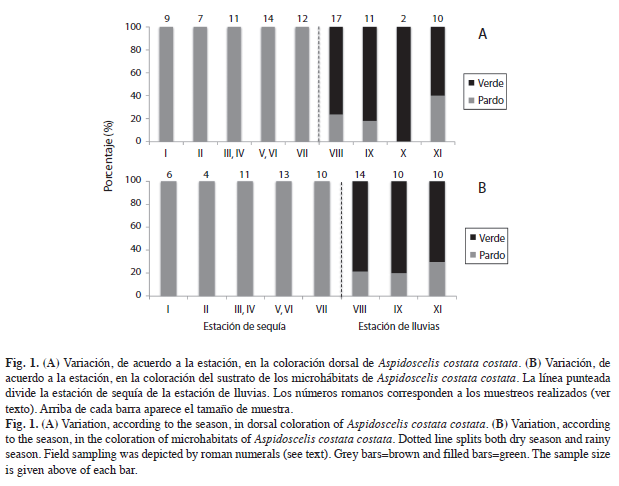
<body><![CDATA[ style="font-weight: bold;">Variaci&oacute;n estacional en la     coloraci&oacute;n dorsal</span>: Los an&aacute;lisis revelaron que la     coloraci&oacute;n dorsal de las lagartijas es dependiente de la     estaci&oacute;n (X<sup>2</sup> =144.61, gl=1, p=6.02X10<sup>-15</sup>).     Las lagartijas que se     encontraron en la estaci&oacute;n de sequ&iacute;a presentaron una     coloraci&oacute;n dorsal parda, mientras que las capturadas en la     &eacute;poca lluviosa presentaron, en su mayor&iacute;a, una     coloraci&oacute;n dorsal verde (<a      href="/img/revistas/rbt/v60n1/a29i1.jpg">Fig. 1A</a>). Los colores</span></font><font     ]]></body>
<body><![CDATA[ size="2"><span style="font-family: verdana;"> claros se encontraron en     el periodo     final de la estaci&oacute;n de sequ&iacute;a (pardo claro) y al     principio de la estaci&oacute;n lluviosa (verde claro), as&iacute; como     al finalizar la estaci&oacute;n lluviosa.</span></font><br      style="font-family: verdana;">     <font size="2"></font><br style="font-family: verdana;">     <font size="2"><span style="font-family: verdana;">De la misma forma     que la     coloraci&oacute;n dorsal de los individuos, la coloraci&oacute;n del     ]]></body>
<body><![CDATA[sustrato depende de la estaci&oacute;n (X<sup>2</sup>=40.96, gl=1,     p=1.20X10<sup>-12</sup>).     El sustrato presente en la estaci&oacute;n de sequ&iacute;a fue de     color pardo, mientras que el de la estaci&oacute;n lluviosa fue     predominantemente de color verde (<a      href="/img/revistas/rbt/v60n1/a29i1.jpg">Fig. 1B</a>). Con base en los     resultados     del cambio estacional de la coloraci&oacute;n en las lagartijas y el     sustrato, se infiere que las lagartijas presentan una coloraci&oacute;n     dorsal que coincide con el sustrato en el que se encuentran en las dos     ]]></body>
<body><![CDATA[estaciones. Se encontr&oacute; que durante la estaci&oacute;n de     sequ&iacute;a un 83.6% de los&nbsp; individuos capturados se     encontraron en un sustrato de color semejante al de su     coloraci&oacute;n dorsal y para la estaci&oacute;n de lluvias el     porcentaje fue de 79.5%.</span></font><br style="font-family: verdana;">     <font size="2"></font><br style="font-family: verdana;">     <font size="2"><span style="font-family: verdana;">Se obtuvieron cuatro     recapturas de     lagartijas en diferente estaci&oacute;n, de las cuales el 100%     cambiaron su color dorsal de pardo a verde. Con lo que se     ]]></body>
<body><![CDATA[comprob&oacute; que un mismo individuo cambia su color dorsal por uno     que coincide con el del sustrato.</span></font><br      style="font-family: verdana;">     <font size="2"></font><br style="font-family: verdana;">     <font size="2"><span style="font-family: verdana;"><span      style="font-weight: bold;">Variaci&oacute;n en la     coloraci&oacute;n dorsal de acuerdo al sexo: </span>Al considerar     hembras     (n=44) y machos (n=51) de ambas estaciones se encontr&oacute;     dependencia de la coloraci&oacute;n dorsal con respecto al sexo de las     ]]></body>
<body><![CDATA[lagartijas (X<sup>2</sup>=7.19, gl=1, p=0.02). Las hembras mostraron     una tendencia     a presentar un color dorsal verde. Sin embargo, por estaci&oacute;n los     an&aacute;lisis indicaron que no hay dependencia de la     coloraci&oacute;n dorsal con respecto al sexo para la estaci&oacute;n     lluviosa (X<sup>2</sup>=2.78, gl=1, p=0.19), ni para la estaci&oacute;n     de     sequ&iacute;a (donde todos los individuos presentaron una     coloraci&oacute;n dorsal parda).</span></font><br      style="font-family: verdana;">     ]]></body>
<body><![CDATA[<font size="2"></font><br style="font-family: verdana;">     <font size="2"><span style="font-family: verdana;"><span      style="font-weight: bold;">Variaci&oacute;n en la     coloraci&oacute;n dorsal de acuerdo al estadio de desarrollo:</span> De     manera     similar, al considerar j&oacute;venes (n=36) y adultos (n=59) de ambas     estaciones se encontr&oacute; que la coloraci&oacute;n dorsal depende     del estadio de desarrollo (X<sup>2</sup>=7.5, gl=1, p=0.02). Los     j&oacute;venes     tienden a ser de color pardo. Sin embargo, al considerar los datos por     ]]></body>
<body><![CDATA[estaci&oacute;n se encontr&oacute; que durante la estaci&oacute;n de     sequ&iacute;a todos los individuos, adultos y j&oacute;venes,     presentaron una coloraci&oacute;n dorsal parda y durante la     estaci&oacute;n&nbsp; lluviosa se recolectaron s&oacute;lo individuos     adultos cuya coloraci&oacute;n dorsal fue, en su mayor&iacute;a, verde     (76%).</span></font><br style="font-family: verdana;">     <font size="2"></font><br style="font-family: verdana;">     <font style="font-weight: bold;" size="3"><span      style="font-family: verdana;">Discusi&oacute;n</span></font><br      style="font-family: verdana;">     ]]></body>
<body><![CDATA[<font size="2"></font><br style="font-family: verdana;">     <font size="2"><span style="font-family: verdana;"><span      style="font-weight: bold;">Variaci&oacute;n estacional en la     coloraci&oacute;n dorsal</span>: Las lagartijas del g&eacute;nero <span      style="font-style: italic;">Aspidoscelis     </span>est&aacute;n reconocidas como forrajeras activas por lo que, en     lugar     de la cripsis, cuentan con la&nbsp; huida r&aacute;pida como principal     t&aacute;ctica de escape de sus depredadores (Schall &amp; Pianka 1980,     Wright &amp; Vitt 1993). Sin embargo, el cambio de coloraci&oacute;n     ]]></body>
<body><![CDATA[dorsal de <span style="font-style: italic;">A. costata costata</span>     sugiere que la cripsis puede ser     importante a&uacute;n en especies de amplio forrajeo.</span></font><br      style="font-family: verdana;">     <font size="2"></font><br style="font-family: verdana;">     <font size="2"><span style="font-family: verdana;">La regi&oacute;n     dorsal de las     lagartijas es una zona expuesta a la vista de depredadores (i. e.,     Masticophis en el caso de <span style="font-style: italic;">A. costata     costata</span>,     ]]></body>
<body><![CDATA[Hern&aacute;ndez-Gallegos, com. pers.). De acuerdo a Stuart-Fox <span      style="font-style: italic;">et al.</span>     (2004, 2006), la coloraci&oacute;n de la regi&oacute;n dorsal puede     estar influenciada por la selecci&oacute;n natural y por tanto ofrecer     protecci&oacute;n contra la detecci&oacute;n de los depredadores. Una     lagartija de amplio forrajeo debe moverse constantemente en busca de     recursos (Schall &amp; Pianka 1980, Wright &amp; Vitt 1993); por ello     una huida r&aacute;pida en combinaci&oacute;n con una apariencia     cr&iacute;ptica en <span style="font-style: italic;">A. costata costata</span>,     podr&iacute;a ser m&aacute;s     ]]></body>
<body><![CDATA[ventajosa ante especies de amplio forrajeo que com&uacute;nmente     depredan Aspidoscelis como Masticophis (Camper &amp; Dixon 2000,     Colston et al. 2010). Con ello se evitan huidas que revelan     ubicaci&oacute;n, que requieren energ&iacute;a y que afectan la     temperatura corporal de los individuos (Pough <span      style="font-style: italic;">et al. </span>1998,     Mart&iacute;n 2002). Resultar&iacute;a importante conocer si la     coloraci&oacute;n dorsal cr&iacute;ptica de <span      style="font-style: italic;">A. costata costata</span> puede     conferir alguna ventaja ante sus presas, como ort&oacute;pteros,     ]]></body>
<body><![CDATA[is&oacute;pteros, cole&oacute;pteros (larvas y adultos) y larvas de     lepid&oacute;pteros (Mu&ntilde;oz- Manzano 2010).</span></font><br      style="font-family: verdana;">     <font size="2"></font><br style="font-family: verdana;">     <font size="2"><span style="font-family: verdana;">En Tonatico el 21 de     mayo 2007     (a&ntilde;o del estudio) marc&oacute; el inicio de la estaci&oacute;n     de lluvias y una semana antes y una semana despu&eacute;s se realizaron     muestreos. La evidencia de campo indica claramente que el inicio de la     estaci&oacute;n lluviosa coincide con el cambio en la coloraci&oacute;n     ]]></body>
<body><![CDATA[de microambientes y coloraci&oacute;n dorsal de <span      style="font-style: italic;">A. costata costata.</span> El     100% de las lagartijas en la semana previa al 21 de mayo presentaron     una coloraci&oacute;n dorsal parda, mientras que en la semana posterior     solo el 20% conservaba dicha coloraci&oacute;n. Este hecho sugiere que:     1) existe una fuerte presi&oacute;n sobre la coloraci&oacute;n dorsal     cr&iacute;ptica de <span style="font-style: italic;">A. costata costata</span>,     en especial durante la     &eacute;poca de sequ&iacute;a</span></font><font size="2"><span      style="font-family: verdana;"> donde existe una menor cobertura     ]]></body>
<body><![CDATA[vegetal y 2) los cambios en la coloraci&oacute;n dorsal y en la     coloraci&oacute;n de los microambientes toman relativamente poco     tiempo. De acuerdo a las estrategia&nbsp; de maximizaci&oacute;n de la     cripsis (Merilaita et al. 1999), Tonatico presenta un grado muy elevado     de heterogeneidad visual marcado por las estaciones de sequ&iacute;a y     lluvia. Aparentemente, <span style="font-style: italic;">A. costata     costata </span>modifica su apariencia para     adoptar dos coloraciones que coinciden en alto grado con la     coloraci&oacute;n del ambiente lo que le permite tener actividad en     ambientes visualmente muy diferentes sin disminuir su grado de cripsis.</span></font><br     ]]></body>
<body><![CDATA[ style="font-family: verdana;">     <font size="2"></font><br style="font-family: verdana;">     <font size="2"><span style="font-family: verdana;">Un aspecto adicional     del cambio     estacional en la coloraci&oacute;n dorsal de<span      style="font-style: italic;"> A. costata costata </span>es que     sucede a nivel individual, ya que cuando un individuo sobrevive entre     estaciones manifiesta ambas coloraciones. Prueba de ello fueron cuatro     recapturas que cambiaron su coloraci&oacute;n dorsal de pardo a verde     entre las estaciones de sequ&iacute;a y lluvia, respectivamente. El     ]]></body>
<body><![CDATA[cambio de coloraci&oacute;n dorsal es un mecanismo flexible que puede     ser particularmente efectivo porque puede permitir a los animales     alterar su apariencia en respuesta a condiciones ambientales cambiantes     (Stuart-Fox <span style="font-style: italic;">et al.</span> 2006).</span></font><br      style="font-family: verdana;">     <font size="2"></font><br style="font-family: verdana;">     <font size="2"><span style="font-family: verdana;"><span      style="font-weight: bold;">Variaci&oacute;n en la     coloraci&oacute;n dorsal de acuerdo al sexo:</span> Los machos de <span      style="font-style: italic;">A. costata     ]]></body>
<body><![CDATA[costata</span> tendieron a presentar una coloraci&oacute;n dorsal parda     (76.5%     de los individuos), mientras que las hembras no presentan tendencia     hacia alguna coloraci&oacute;n. La dependencia de la coloraci&oacute;n     dorsal respecto al sexo parece deberse a una diferencia en la cantidad     de individuos capturados por estaci&oacute;n. Los machos se capturaron     m&aacute;s frecuentemente en la estaci&oacute;n en la que se presenta     la coloraci&oacute;n parda, mientras que el n&uacute;mero de las     hembras capturadas entre estaciones es similar. Lo anterior,     provoc&oacute; un sesgo hacia machos pardos. Los resultados sugieren     ]]></body>
<body><![CDATA[que dentro de cada estaci&oacute;n, la coloraci&oacute;n dorsal y su     variaci&oacute;n en <span style="font-style: italic;">A. costata     costata</span> no se relacionan con un     dimorfismo sexual como el que existe en LHC, peso y proporciones     corporales (Aguilar-Moreno <span style="font-style: italic;">et al.</span>     2010). Lo anterior difiere de lo     registrado en otras lagartijas donde el color est&aacute; relacionado     con el sexo de los individuos en aspectos de reproducci&oacute;n     (Gal&aacute;n 2000) y sociales (Mart&iacute;n &amp; Forsman 1998,     Arag&oacute;n 2001) y es posiblemente regulado por niveles hormonales     ]]></body>
<body><![CDATA[(Taylor &amp; Hadley 1970, Cooper &amp; Greenberg 1992,&nbsp; Calisi     &amp; Hews 2007). De acuerdo al ciclo reproductivo de <span      style="font-style: italic;">A. costata     costata</span> hembras gestantes est&aacute;n presentes durante ambas     estaciones (Hern&aacute;ndez-Hern&aacute;ndez 2010), por lo que una     coloraci&oacute;n dorsal cr&iacute;ptica puede promover una ventaja     adicional para presentar el mayor tama&ntilde;o de nidada y un elevado     esfuerzo reproductor (P&eacute;rez-Almaz&aacute;n 2007, 2010).</span></font><br      style="font-family: verdana;">     <font size="2"></font><br style="font-family: verdana;">     ]]></body>
<body><![CDATA[<font size="2"><span style="font-family: verdana;"><span      style="font-weight: bold;">Variaci&oacute;n en la     coloraci&oacute;n dorsal de acuerdo al estadio de desarrollo:</span> No     se     registr&oacute; dependencia de la coloraci&oacute;n dorsal de acuerdo     al estadio de desarrollo al analizar cada estaci&oacute;n por separado.     Sin embargo, al considerar ambas estaciones existe dependencia de la     coloraci&oacute;n dorsal respecto al estadio. Ya que los individuos     j&oacute;venes se encuentran en mayor n&uacute;mero durante la     estaci&oacute;n de sequ&iacute;a, esto promueve un sesgo hacia una     ]]></body>
<body><![CDATA[coloraci&oacute;n parda en ellos con respecto a los adultos. Cabe     recordar que la coloraci&oacute;n dorsal de los individuos coincide con     el sustrato en el que se encuentran. Por ello, la dependencia de la     coloraci&oacute;n dorsal con respecto al estadio est&aacute;     relacionada con: 1) la cantidad de individuos presentes en cada     estaci&oacute;n (Rubio-Blanco 2007, 2010), que depende de la     din&aacute;mica del ciclo reproductor de <span      style="font-style: italic;">A. costata costata</span>     (Hern&aacute;ndez-Hern&aacute;ndez 2010), y 2) la forma de agrupar los     datos en los an&aacute;lisis (al igual que en el caso de la     ]]></body>
<body><![CDATA[coloraci&oacute;n&nbsp; dorsal con respecto al sexo de los individuos).     En conclusi&oacute;n, el cambio en la coloraci&oacute;n dorsal no se     relaciona con un cambio ontogen&eacute;tico en los individuos de <span      style="font-style: italic;">A.     costata costata</span> como sucede en otros reptiles (Creer 2005,     Wilson <span style="font-style: italic;">et     al.</span> 2007). La sustituci&oacute;n de las l&iacute;neas por puntos     y     barras en la regi&oacute;n dorsal y la adquisici&oacute;n de     coloraci&oacute;n ventral y gular son cambios ontogen&eacute;ticos     ]]></body>
<body><![CDATA[registrados en los individuos de <span style="font-style: italic;">A.     costata costata</span>     (Hern&aacute;ndez-Gallegos, en prep.), hecho que ha sido registrado en     diferentes especies del g&eacute;nero <span style="font-style: italic;">Aspidoscelis     </span>(Duellman &amp;     Zweifel 1962).</span></font><br style="font-family: verdana;">     <font size="2"></font><br style="font-family: verdana;">     <font size="2"><span style="font-family: verdana;">Finalmente, la     coloraci&oacute;n     dorsal de <span style="font-style: italic;">A. costata costata </span>tiene     ]]></body>
<body><![CDATA[funciones cr&iacute;pticas y se     relaciona con la coloraci&oacute;n del sustrato en cada     estaci&oacute;n: parda en sequ&iacute;a y principalmente verde en     lluvias, y no se relaciona con el sexo o estadio de los individuos. Es     importante realizar estudios (<span style="font-style: italic;">i. e</span>.,     ultraestructurales,     fisiol&oacute;gicos, ecol&oacute;gicos, experimentales) que     permitan conocer los factores proximales responsables del cambio     de coloraci&oacute;n dorsal en los individuos de <span      style="font-style: italic;">A. costata costata.</span></span></font><br     ]]></body>
<body><![CDATA[ style="font-family: verdana; font-style: italic;">     <font style="font-style: italic;" size="2"></font><br      style="font-family: verdana;">     <font style="font-weight: bold;" size="3"><span      style="font-family: verdana;">Agradecimientos</span></font><br      style="font-family: verdana;">     <font size="2"></font><br style="font-family: verdana;">     <font size="2"><span style="font-family: verdana;">A los proyectos     UAEM&eacute;x     2295/2006, 2620/2008, 3042/2011 por el apoyo financiero para Oswaldo     ]]></body>
<body><![CDATA[Hern&aacute;ndez-Gallegos. A C. P&eacute;rez, V. Mundo, T. Rubio, M.     Aguilar, G. Granados, S. Bola&ntilde;os, A. L&oacute;pez y Y.     G&oacute;mez por su ayuda en el campo. A L. Ruiz y K. Gribbins por su     ayuda con la traducci&oacute;n del abstract. A los revisores y al     cuerpo editorial de la revista por sus sugerencias que mejoraron     sustancialmente el trabajo. A Fernando Ordorica por permitir la     realizaci&oacute;n de este trabajo.</span></font><br      style="font-family: verdana;">     <font size="2"></font><font style="font-weight: bold;" size="3"><span      style="font-family: verdana;"></span></font>     ]]></body>
<body><![CDATA[<hr style="width: 100%; height: 2px;">    <!-- ref --><br> <font style="font-weight: bold;" size="3"><span  style="font-family: verdana;">Referencias</span></font><br  style="font-family: verdana;"> <font size="2"></font><br style="font-family: verdana;"> <font size="2"><span style="font-family: verdana;">Aguilar-Moreno, M., F.J. Rodr&iacute;guez-Romero, A. Arag&oacute;n- Mart&iacute;nez, J.A. Mu&ntilde;oz-Manzano, G. Granados-Gonz&aacute;lez &amp; O. Hern&aacute;ndez-Gallegos. 2010. Dimorfismo sexual de <span  style="font-style: italic;">Aspidoscelis costata costata</span> (Squamata: Teiidae) en el sur del Estado de M&eacute;xico, M&eacute;xico. Rev. Chil. Hist. Nat. 83: 585-592.    &nbsp;&nbsp;&nbsp;&nbsp;&nbsp;&nbsp;&nbsp;&nbsp;[&#160;<a href="javascript:void(0);" onclick="javascript: window.open('/scielo.php?script=sci_nlinks&ref=1437198&pid=S0034-7744201200010002900001&lng=','','width=640,height=500,resizable=yes,scrollbars=1,menubar=yes,');">Links</a>&#160;]<!-- end-ref --><!-- ref --></span></font><br  style="font-family: verdana;"> <font size="2"></font><br style="font-family: verdana;"> <font size="2"><span style="font-family: verdana;">Arag&oacute;n, P. 2001. Mecanismos para reducir los costes de los encuentros agresivos en los machos de la lagartija serrana (<span style="font-style: italic;">Lacerta monticola</span>). Tesis de Doctorado, Universidad Complutense, Madrid, Espa&ntilde;a.    &nbsp;&nbsp;&nbsp;&nbsp;&nbsp;&nbsp;&nbsp;&nbsp;[&#160;<a href="javascript:void(0);" onclick="javascript: window.open('/scielo.php?script=sci_nlinks&ref=1437199&pid=S0034-7744201200010002900002&lng=','','width=640,height=500,resizable=yes,scrollbars=1,menubar=yes,');">Links</a>&#160;]<!-- end-ref --><!-- ref --></span></font><br  style="font-family: verdana;"> <font size="2"></font><br style="font-family: verdana;"> <font size="2"><span style="font-family: verdana;">Ashton, K. 2003. Sexing Cnemidophorus lizards using a postanal scale character. Herp. Rev. 34: 109-111.    &nbsp;&nbsp;&nbsp;&nbsp;&nbsp;&nbsp;&nbsp;&nbsp;[&#160;<a href="javascript:void(0);" onclick="javascript: window.open('/scielo.php?script=sci_nlinks&ref=1437200&pid=S0034-7744201200010002900003&lng=','','width=640,height=500,resizable=yes,scrollbars=1,menubar=yes,');">Links</a>&#160;]<!-- end-ref --><!-- ref --></span></font><br style="font-family: verdana;"> <font size="2"></font><br style="font-family: verdana;"> <font size="2"><span style="font-family: verdana;">Calisi, R.M. &amp; D.K. Hews. 2007. Steroid correlates of multiple color traits in the spiny lizard, <span style="font-style: italic;">Sceloporus pyrocephalus</span>. J. Comp. Physiol. B 177: 641-654.    &nbsp;&nbsp;&nbsp;&nbsp;&nbsp;&nbsp;&nbsp;&nbsp;[&#160;<a href="javascript:void(0);" onclick="javascript: window.open('/scielo.php?script=sci_nlinks&ref=1437201&pid=S0034-7744201200010002900004&lng=','','width=640,height=500,resizable=yes,scrollbars=1,menubar=yes,');">Links</a>&#160;]<!-- end-ref --><!-- ref --></span></font><br  style="font-family: verdana;"> <font size="2"></font><br style="font-family: verdana;"> <font size="2"><span style="font-family: verdana;">Camper, J.D. &amp; J.R. Dixon. 2000. Food habits of striped whipsnake, <span  style="font-style: italic;">Masticophis</span>&nbsp; Serpentes: Colubridae). Texas J. Sci. 52: 83-92.    &nbsp;&nbsp;&nbsp;&nbsp;&nbsp;&nbsp;&nbsp;&nbsp;[&#160;<a href="javascript:void(0);" onclick="javascript: window.open('/scielo.php?script=sci_nlinks&ref=1437202&pid=S0034-7744201200010002900005&lng=','','width=640,height=500,resizable=yes,scrollbars=1,menubar=yes,');">Links</a>&#160;]<!-- end-ref --><!-- ref --></span></font><br  style="font-family: verdana;"> <font size="2"></font><br style="font-family: verdana;"> <font size="2"><span style="font-family: verdana;">Colston, T.J., G.C. Costa &amp; L.J. Vitt. 2010. Snake diets and deep history hypothesis. Biol. J. Linn. Soc. 101: 476-486.    &nbsp;&nbsp;&nbsp;&nbsp;&nbsp;&nbsp;&nbsp;&nbsp;[&#160;<a href="javascript:void(0);" onclick="javascript: window.open('/scielo.php?script=sci_nlinks&ref=1437203&pid=S0034-7744201200010002900006&lng=','','width=640,height=500,resizable=yes,scrollbars=1,menubar=yes,');">Links</a>&#160;]<!-- end-ref --><!-- ref --></span></font><br style="font-family: verdana;"> <font size="2"></font><br style="font-family: verdana;"> <font size="2"><span style="font-family: verdana;">Cooper, W.E. &amp; N. Greenberg. 1992. Reptilian coloration and behavior, p. 298-423. <span  style="font-style: italic;">In </span>C. Gans &amp; D. Crews (eds.). Hormones, Brain and Behavior. Universidad de Chicago, Chicago, EEUU.    &nbsp;&nbsp;&nbsp;&nbsp;&nbsp;&nbsp;&nbsp;&nbsp;[&#160;<a href="javascript:void(0);" onclick="javascript: window.open('/scielo.php?script=sci_nlinks&ref=1437204&pid=S0034-7744201200010002900007&lng=','','width=640,height=500,resizable=yes,scrollbars=1,menubar=yes,');">Links</a>&#160;]<!-- end-ref --><!-- ref --></span></font><br style="font-family: verdana;"> <font size="2"></font><br style="font-family: verdana;"> <font size="2"><span style="font-family: verdana;">Creer, D.A. 2005. Correlations between ontogenetic change in color pattern and antipredator behavoir in the racer, <span style="font-style: italic;">Coluber constrictor.</span> Ethology 111: 287-300.    &nbsp;&nbsp;&nbsp;&nbsp;&nbsp;&nbsp;&nbsp;&nbsp;[&#160;<a href="javascript:void(0);" onclick="javascript: window.open('/scielo.php?script=sci_nlinks&ref=1437205&pid=S0034-7744201200010002900008&lng=','','width=640,height=500,resizable=yes,scrollbars=1,menubar=yes,');">Links</a>&#160;]<!-- end-ref --><!-- ref --></span></font><br style="font-family: verdana;"> <font size="2"></font><br style="font-family: verdana;"> <font size="2"><span style="font-family: verdana;">Cuthill, I.C., M. Stevens, J. Sheppard, T. Maddocks, C.A. P&aacute;rraga &amp; T.S. Troscianko. 2005. Disruptive coloration and background pattern matching. Nature 434: 72-74.    &nbsp;&nbsp;&nbsp;&nbsp;&nbsp;&nbsp;&nbsp;&nbsp;[&#160;<a href="javascript:void(0);" onclick="javascript: window.open('/scielo.php?script=sci_nlinks&ref=1437206&pid=S0034-7744201200010002900009&lng=','','width=640,height=500,resizable=yes,scrollbars=1,menubar=yes,');">Links</a>&#160;]<!-- end-ref --><!-- ref --></span></font><br style="font-family: verdana;"> <font size="2"></font><br style="font-family: verdana;"> <font size="2"><span style="font-family: verdana;">Duellman, W.E. &amp; R.G. Zweifel. 1962. A synopsis of the lizards of the <span  style="font-style: italic;">sexlineatus </span>group (genus <span style="font-style: italic;">Cnemidophorus</span>). Bull. Amer. Mus. Nat. Hist. 123: 155-210.    &nbsp;&nbsp;&nbsp;&nbsp;&nbsp;&nbsp;&nbsp;&nbsp;[&#160;<a href="javascript:void(0);" onclick="javascript: window.open('/scielo.php?script=sci_nlinks&ref=1437207&pid=S0034-7744201200010002900010&lng=','','width=640,height=500,resizable=yes,scrollbars=1,menubar=yes,');">Links</a>&#160;]<!-- end-ref --><!-- ref --></span></font><br  style="font-family: verdana;"> <font size="2"></font><br style="font-family: verdana;"> <font size="2"><span style="font-family: verdana;">Gal&aacute;n, P. 2000. Females that imitate males: dorsal coloration varies with reproductive stage in female <span style="font-style: italic;">Podarcis bocagei </span>(Lacertidae). Copeia 2000: 819-825.    &nbsp;&nbsp;&nbsp;&nbsp;&nbsp;&nbsp;&nbsp;&nbsp;[&#160;<a href="javascript:void(0);" onclick="javascript: window.open('/scielo.php?script=sci_nlinks&ref=1437208&pid=S0034-7744201200010002900011&lng=','','width=640,height=500,resizable=yes,scrollbars=1,menubar=yes,');">Links</a>&#160;]<!-- end-ref --><!-- ref --></span></font><br style="font-family: verdana;"> <font size="2"></font><br style="font-family: verdana;"> <font size="2"><span style="font-family: verdana;">Hern&aacute;ndez-Hern&aacute;ndez, L.E. 2010. Ciclo reproductor de <span style="font-style: italic;">Aspidoscelis costata costata</span> (Squamata: Teiidae) en Tonatico, Estado de M&eacute;xico. Tesis de Licenciatura, Universidad Aut&oacute;noma del Estado de M&eacute;xico, M&eacute;xico.    &nbsp;&nbsp;&nbsp;&nbsp;&nbsp;&nbsp;&nbsp;&nbsp;[&#160;<a href="javascript:void(0);" onclick="javascript: window.open('/scielo.php?script=sci_nlinks&ref=1437209&pid=S0034-7744201200010002900012&lng=','','width=640,height=500,resizable=yes,scrollbars=1,menubar=yes,');">Links</a>&#160;]<!-- end-ref --><!-- ref --></span></font><br  style="font-family: verdana;"> <font size="2"></font><br style="font-family: verdana;"> <font size="2"><span style="font-family: verdana;">Huey, R.B. &amp; E.R. Pianka. 1981. Ecological consequences of foraging mode. Ecology 62: 991-999.    &nbsp;&nbsp;&nbsp;&nbsp;&nbsp;&nbsp;&nbsp;&nbsp;[&#160;<a href="javascript:void(0);" onclick="javascript: window.open('/scielo.php?script=sci_nlinks&ref=1437210&pid=S0034-7744201200010002900013&lng=','','width=640,height=500,resizable=yes,scrollbars=1,menubar=yes,');">Links</a>&#160;]<!-- end-ref --><!-- ref --></span></font><br  style="font-family: verdana;"> <font size="2"></font><br style="font-family: verdana;"> <font size="2"><span style="font-family: verdana;">Macedonia, J.M., S. James, L.W. Wittle &amp; D.L. Clark. 2000. Skin pigments and coloration in the Jamaican radiation of anolis lizards. J. Herpetol. 34: 99-109.    &nbsp;&nbsp;&nbsp;&nbsp;&nbsp;&nbsp;&nbsp;&nbsp;[&#160;<a href="javascript:void(0);" onclick="javascript: window.open('/scielo.php?script=sci_nlinks&ref=1437211&pid=S0034-7744201200010002900014&lng=','','width=640,height=500,resizable=yes,scrollbars=1,menubar=yes,');">Links</a>&#160;]<!-- end-ref --><!-- ref --></span></font><br  style="font-family: verdana;"> <font size="2"></font><br style="font-family: verdana;"> <font size="2"><span style="font-family: verdana;">Mart&iacute;n, J. &amp; A. Forsman. 1998. Social costs and development of nupcial coloration in male <span style="font-style: italic;">Psamodromus algirus</span> lizards: an experiment. Behav. Ecol. 10: 396-400.    &nbsp;&nbsp;&nbsp;&nbsp;&nbsp;&nbsp;&nbsp;&nbsp;[&#160;<a href="javascript:void(0);" onclick="javascript: window.open('/scielo.php?script=sci_nlinks&ref=1437212&pid=S0034-7744201200010002900015&lng=','','width=640,height=500,resizable=yes,scrollbars=1,menubar=yes,');">Links</a>&#160;]<!-- end-ref --><!-- ref --></span></font><br  style="font-family: verdana;"> <font size="2"></font><br style="font-family: verdana;"> <font size="2"><span style="font-family: verdana;">Mart&iacute;n, J. 2002. Evoluci&oacute;n de estrategias antidepredatorias en reptiles, p. 471-478. <span style="font-style: italic;">In</span> M. Soler (ed.). Evoluci&oacute;n: La Base de la Biolog&iacute;a. Proyecto Sur, Granada, Espa&ntilde;a.    &nbsp;&nbsp;&nbsp;&nbsp;&nbsp;&nbsp;&nbsp;&nbsp;[&#160;<a href="javascript:void(0);" onclick="javascript: window.open('/scielo.php?script=sci_nlinks&ref=1437213&pid=S0034-7744201200010002900016&lng=','','width=640,height=500,resizable=yes,scrollbars=1,menubar=yes,');">Links</a>&#160;]<!-- end-ref --><!-- ref --></span></font><br  style="font-family: verdana;"> <font size="2"></font><br style="font-family: verdana;"> <font size="2"><span style="font-family: verdana;">Merilaita, S., J. Toumi &amp; V. Jormalainen. 1999. Optimization of cryptic coloration in heterogeneous habitats. Biol. J. Linn. Soc. 67: 151-161.    &nbsp;&nbsp;&nbsp;&nbsp;&nbsp;&nbsp;&nbsp;&nbsp;[&#160;<a href="javascript:void(0);" onclick="javascript: window.open('/scielo.php?script=sci_nlinks&ref=1437214&pid=S0034-7744201200010002900017&lng=','','width=640,height=500,resizable=yes,scrollbars=1,menubar=yes,');">Links</a>&#160;]<!-- end-ref --><!-- ref --><br> <br style="font-family: verdana;"> </span></font><font size="2"><span style="font-family: verdana;">Merilaita, S. &amp; J. Lind. 2005. Background-matching and disruptive coloration, and the evolution of cryptic coloration. Proc. R. Soc. B 272: 665-670.    &nbsp;&nbsp;&nbsp;&nbsp;&nbsp;&nbsp;&nbsp;&nbsp;[&#160;<a href="javascript:void(0);" onclick="javascript: window.open('/scielo.php?script=sci_nlinks&ref=1437215&pid=S0034-7744201200010002900018&lng=','','width=640,height=500,resizable=yes,scrollbars=1,menubar=yes,');">Links</a>&#160;]<!-- end-ref --><!-- ref --></span></font><br  style="font-family: verdana;"> <font size="2"></font><br style="font-family: verdana;"> <font size="2"><span style="font-family: verdana;">Mu&ntilde;oz-Manzano, J.A . 2010. Dieta de <span style="font-style: italic;">Aspidoscelis costata costata</span> (Squamata: Teiidae) en el sur del Estado de M&eacute;xico. Tesis de Licenciatura, Universidad Aut&oacute;noma del Estado de M&eacute;xico, M&eacute;xico.    &nbsp;&nbsp;&nbsp;&nbsp;&nbsp;&nbsp;&nbsp;&nbsp;[&#160;<a href="javascript:void(0);" onclick="javascript: window.open('/scielo.php?script=sci_nlinks&ref=1437216&pid=S0034-7744201200010002900019&lng=','','width=640,height=500,resizable=yes,scrollbars=1,menubar=yes,');">Links</a>&#160;]<!-- end-ref --><!-- ref --></span></font><br  style="font-family: verdana;"> <font size="2"></font><br style="font-family: verdana;"> <font size="2"><span style="font-family: verdana;">Pantone 2005-2006. Formula guides solid coated and uncoated. Nueva Jersey, EEUU.    &nbsp;&nbsp;&nbsp;&nbsp;&nbsp;&nbsp;&nbsp;&nbsp;[&#160;<a href="javascript:void(0);" onclick="javascript: window.open('/scielo.php?script=sci_nlinks&ref=1437217&pid=S0034-7744201200010002900020&lng=','','width=640,height=500,resizable=yes,scrollbars=1,menubar=yes,');">Links</a>&#160;]<!-- end-ref --><!-- ref --></span></font><br  style="font-family: verdana;"> <font size="2"></font><br style="font-family: verdana;"> <font size="2"><span style="font-family: verdana;">P&eacute;rez-Almaz&aacute;n, C. 2007. Algunas caracter&iacute;sticas de historia de vida y su relaci&oacute;n con la altitud en <span style="font-style: italic;">A. c. costata.</span> Tesis de Licenciatura, Universidad Aut&oacute;noma del Estado de M&eacute;xico, M&eacute;xico.    &nbsp;&nbsp;&nbsp;&nbsp;&nbsp;&nbsp;&nbsp;&nbsp;[&#160;<a href="javascript:void(0);" onclick="javascript: window.open('/scielo.php?script=sci_nlinks&ref=1437218&pid=S0034-7744201200010002900021&lng=','','width=640,height=500,resizable=yes,scrollbars=1,menubar=yes,');">Links</a>&#160;]<!-- end-ref --><!-- ref --></span></font><br  style="font-family: verdana;"> <font size="2"></font><br style="font-family: verdana;"> <font size="2"><span style="font-family: verdana;">P&eacute;rez-Almaz&aacute;n, C. 2010. &Eacute;xito de eclosi&oacute;n en <span  style="font-style: italic;">Aspidoscelis costata costata</span> (Squamata: Teiidae). Tesis de Maestr&iacute;a, Universidad Aut&oacute;noma del Estado de M&eacute;xico, M&eacute;xico.    &nbsp;&nbsp;&nbsp;&nbsp;&nbsp;&nbsp;&nbsp;&nbsp;[&#160;<a href="javascript:void(0);" onclick="javascript: window.open('/scielo.php?script=sci_nlinks&ref=1437219&pid=S0034-7744201200010002900022&lng=','','width=640,height=500,resizable=yes,scrollbars=1,menubar=yes,');">Links</a>&#160;]<!-- end-ref --><!-- ref --></span></font><br  style="font-family: verdana;"> <font size="2"></font><br style="font-family: verdana;"> <font size="2"><span style="font-family: verdana;">Pianka, E.R. &amp; L.J. Vitt. 2003. Lizards, Windows to the Evolution of Diversity. Universidad de California, California, EEUU.    &nbsp;&nbsp;&nbsp;&nbsp;&nbsp;&nbsp;&nbsp;&nbsp;[&#160;<a href="javascript:void(0);" onclick="javascript: window.open('/scielo.php?script=sci_nlinks&ref=1437220&pid=S0034-7744201200010002900023&lng=','','width=640,height=500,resizable=yes,scrollbars=1,menubar=yes,');">Links</a>&#160;]<!-- end-ref --><!-- ref --></span></font><br  style="font-family: verdana;"> <font size="2"></font><br style="font-family: verdana;"> <font size="2"><span style="font-family: verdana;">Pough, F.H., R.M. Andrews, J.E. Cadle, M.C. Crump, A.H. Savitsky &amp; K.D. Wells. 1998. Herpetology. Prentice Hall, Nueva Jersey, EEUU.    &nbsp;&nbsp;&nbsp;&nbsp;&nbsp;&nbsp;&nbsp;&nbsp;[&#160;<a href="javascript:void(0);" onclick="javascript: window.open('/scielo.php?script=sci_nlinks&ref=1437221&pid=S0034-7744201200010002900024&lng=','','width=640,height=500,resizable=yes,scrollbars=1,menubar=yes,');">Links</a>&#160;]<!-- end-ref --><!-- ref --></span></font><br  style="font-family: verdana;"> <font size="2"></font><br style="font-family: verdana;"> <font size="2"><span style="font-family: verdana;">Rosenblum, E.B. 2005. The role of phenotypic plasticity in color variation of Tularosa Basin lizards. Copeia 2005: 586-596.    &nbsp;&nbsp;&nbsp;&nbsp;&nbsp;&nbsp;&nbsp;&nbsp;[&#160;<a href="javascript:void(0);" onclick="javascript: window.open('/scielo.php?script=sci_nlinks&ref=1437222&pid=S0034-7744201200010002900025&lng=','','width=640,height=500,resizable=yes,scrollbars=1,menubar=yes,');">Links</a>&#160;]<!-- end-ref --><!-- ref --></span></font><br style="font-family: verdana;"> <font size="2"></font><br style="font-family: verdana;"> <font size="2"><span style="font-family: verdana;">Rubio-Blanco, T. 2007. Sobrevivencia, crecimiento y termorregulaci&oacute;n de <span  style="font-style: italic;">Aspidoscelis costata</span> en Tonatico, Estado de M&eacute;xico. Tesis de Licenciatura, Universidad Aut&oacute;noma del Estado de M&eacute;xico, M&eacute;xico.    &nbsp;&nbsp;&nbsp;&nbsp;&nbsp;&nbsp;&nbsp;&nbsp;[&#160;<a href="javascript:void(0);" onclick="javascript: window.open('/scielo.php?script=sci_nlinks&ref=1437223&pid=S0034-7744201200010002900026&lng=','','width=640,height=500,resizable=yes,scrollbars=1,menubar=yes,');">Links</a>&#160;]<!-- end-ref --><!-- ref --></span></font><br  style="font-family: verdana;"> <font size="2"></font><br style="font-family: verdana;"> <font size="2"><span style="font-family: verdana;">Rubio-Blanco, T. 2010. Termorregulaci&oacute;n y actividad en la lagartija <span  style="font-style: italic;">Aspidoscelis costata costata</span> (Squamata: Teiidae). Tesis de Maestr&iacute;a, Universidad Aut&oacute;noma del Estado de M&eacute;xico, M&eacute;xico.    &nbsp;&nbsp;&nbsp;&nbsp;&nbsp;&nbsp;&nbsp;&nbsp;[&#160;<a href="javascript:void(0);" onclick="javascript: window.open('/scielo.php?script=sci_nlinks&ref=1437224&pid=S0034-7744201200010002900027&lng=','','width=640,height=500,resizable=yes,scrollbars=1,menubar=yes,');">Links</a>&#160;]<!-- end-ref --><!-- ref --></span></font><br  style="font-family: verdana;"> <font size="2"></font><br style="font-family: verdana;"> <font size="2"><span style="font-family: verdana;">Schall, J.J. &amp; E.R. Pianka. 1980. Evolution of scape behavior diversity. Amer. Nat. 115: 551-566.    &nbsp;&nbsp;&nbsp;&nbsp;&nbsp;&nbsp;&nbsp;&nbsp;[&#160;<a href="javascript:void(0);" onclick="javascript: window.open('/scielo.php?script=sci_nlinks&ref=1437225&pid=S0034-7744201200010002900028&lng=','','width=640,height=500,resizable=yes,scrollbars=1,menubar=yes,');">Links</a>&#160;]<!-- end-ref --><!-- ref --></span></font><br  style="font-family: verdana;"> <font size="2"></font><br style="font-family: verdana;"> <font size="2"><span style="font-family: verdana;">Stuart-Fox, D., A. Moussalli, G.R. Johnston &amp; I.P.F. Owens. 2004. Evolution of color variation in dragon lizards: quantitative tests of the role of crypsis and local adaptation. Evolution 58: 1549-1559.    &nbsp;&nbsp;&nbsp;&nbsp;&nbsp;&nbsp;&nbsp;&nbsp;[&#160;<a href="javascript:void(0);" onclick="javascript: window.open('/scielo.php?script=sci_nlinks&ref=1437226&pid=S0034-7744201200010002900029&lng=','','width=640,height=500,resizable=yes,scrollbars=1,menubar=yes,');">Links</a>&#160;]<!-- end-ref --><!-- ref --></span></font><br  style="font-family: verdana;"> <font size="2"></font><br style="font-family: verdana;"> <font size="2"><span style="font-family: verdana;">Stuart-Fox, D., M.J. Whiting &amp; A. Moussalli. 2006. Camouflage and colour change: antipredator responses to bird and snake predators across multiple populations in a dwarf chameleon. Biol. J. Linn. Soc. 88: 437-446.    &nbsp;&nbsp;&nbsp;&nbsp;&nbsp;&nbsp;&nbsp;&nbsp;[&#160;<a href="javascript:void(0);" onclick="javascript: window.open('/scielo.php?script=sci_nlinks&ref=1437227&pid=S0034-7744201200010002900030&lng=','','width=640,height=500,resizable=yes,scrollbars=1,menubar=yes,');">Links</a>&#160;]<!-- end-ref --><!-- ref --></span></font><br  style="font-family: verdana;"> <font size="2"></font><br style="font-family: verdana;"> <font size="2"><span style="font-family: verdana;">Taylor, J.D. &amp; M.E. Hadley. 1970. Chromatophores and color change in the lizard, <span  style="font-style: italic;">Anolis carolinensis.</span> Z. Zellforsch 104: 282-294.    &nbsp;&nbsp;&nbsp;&nbsp;&nbsp;&nbsp;&nbsp;&nbsp;[&#160;<a href="javascript:void(0);" onclick="javascript: window.open('/scielo.php?script=sci_nlinks&ref=1437228&pid=S0034-7744201200010002900031&lng=','','width=640,height=500,resizable=yes,scrollbars=1,menubar=yes,');">Links</a>&#160;]<!-- end-ref --><!-- ref --></span></font><br  style="font-family: verdana;"> <font size="2"></font><br style="font-family: verdana;"> <font size="2"><span style="font-family: verdana;">Taylor, H.L. &amp; Y. Caraveo. 2003. Comparison of life history characteristics among syntopic assemblages of parthenogenetic species: two color pattern classes of <span style="font-style: italic;">Aspidoscelis tesselata, A. exanguis, A. flagellicauda,</span> and three color pattern classes of <span style="font-style: italic;">A. sonorae</span> (Squamata: Teiidae). Southwest. Nat. 48: 685-692.    &nbsp;&nbsp;&nbsp;&nbsp;&nbsp;&nbsp;&nbsp;&nbsp;[&#160;<a href="javascript:void(0);" onclick="javascript: window.open('/scielo.php?script=sci_nlinks&ref=1437229&pid=S0034-7744201200010002900032&lng=','','width=640,height=500,resizable=yes,scrollbars=1,menubar=yes,');">Links</a>&#160;]<!-- end-ref --><!-- ref --></span></font><br style="font-family: verdana;"> <font size="2"></font><br style="font-family: verdana;"> <font size="2"><span style="font-family: verdana;">V&aacute;zquez, I.P.O. 1999. Tonatico, Monograf&iacute;a Municipal. Instituto Mexiquense de Cultura, Estado de M&eacute;xico, M&eacute;xico.    &nbsp;&nbsp;&nbsp;&nbsp;&nbsp;&nbsp;&nbsp;&nbsp;[&#160;<a href="javascript:void(0);" onclick="javascript: window.open('/scielo.php?script=sci_nlinks&ref=1437230&pid=S0034-7744201200010002900033&lng=','','width=640,height=500,resizable=yes,scrollbars=1,menubar=yes,');">Links</a>&#160;]<!-- end-ref --><!-- ref --></span></font><br  style="font-family: verdana;"> <font size="2"></font><br style="font-family: verdana;"> <font size="2"><span style="font-family: verdana;">Wilson, D., R. Heinsohn &amp; J.A. Endler. 2007. The adaptive significance of ontogenetic color change in a tropical python. Biol. Lett. 3: 40-43.    &nbsp;&nbsp;&nbsp;&nbsp;&nbsp;&nbsp;&nbsp;&nbsp;[&#160;<a href="javascript:void(0);" onclick="javascript: window.open('/scielo.php?script=sci_nlinks&ref=1437231&pid=S0034-7744201200010002900034&lng=','','width=640,height=500,resizable=yes,scrollbars=1,menubar=yes,');">Links</a>&#160;]<!-- end-ref --><!-- ref --></span></font><br  style="font-family: verdana;"> <font size="2"></font><br style="font-family: verdana;"> <font size="2"><span style="font-family: verdana;">Wright, J.W. &amp; L.J. Vitt. 1993. Biology of Whiptail Lizards (Genus <span style="font-style: italic;">Cnemidophorus</span>). Museo de Historia Natural de Oklahoma, Norman, Oklahoma, EEUU.    &nbsp;&nbsp;&nbsp;&nbsp;&nbsp;&nbsp;&nbsp;&nbsp;[&#160;<a href="javascript:void(0);" onclick="javascript: window.open('/scielo.php?script=sci_nlinks&ref=1437232&pid=S0034-7744201200010002900035&lng=','','width=640,height=500,resizable=yes,scrollbars=1,menubar=yes,');">Links</a>&#160;]<!-- end-ref --><!-- ref --></span></font><br  style="font-family: verdana;"> <font size="2"></font><br style="font-family: verdana;"> <font size="2"><span style="font-family: verdana;">Zug, G.R., L.J. Vitt &amp; J.P. Caldwell. 2001. Herpetology (An Introductory Biology of Amphibians and Reptiles). Academic, San Diego, California, EEUU.    &nbsp;&nbsp;&nbsp;&nbsp;&nbsp;&nbsp;&nbsp;&nbsp;[&#160;<a href="javascript:void(0);" onclick="javascript: window.open('/scielo.php?script=sci_nlinks&ref=1437233&pid=S0034-7744201200010002900036&lng=','','width=640,height=500,resizable=yes,scrollbars=1,menubar=yes,');">Links</a>&#160;]<!-- end-ref --><!-- ref --></span></font><br  style="font-family: verdana;"> <font size="2"></font><br style="font-family: verdana;"> <font size="2"><span style="font-family: verdana;">Zweifel, R.G. 1965. Variation in and distribution of the unisexual lizard, <span  style="font-style: italic;">Cnemidophorus tesselatus</span>. Am. Mus. Novit. 2235: 1-50.    &nbsp;&nbsp;&nbsp;&nbsp;&nbsp;&nbsp;&nbsp;&nbsp;[&#160;<a href="javascript:void(0);" onclick="javascript: window.open('/scielo.php?script=sci_nlinks&ref=1437234&pid=S0034-7744201200010002900037&lng=','','width=640,height=500,resizable=yes,scrollbars=1,menubar=yes,');">Links</a>&#160;]<!-- end-ref --><br>     <br> <a name="Correspondencia1"></a><a href="#Correspondencia2">*</a>Correspondencia:    ]]></body>
<body><![CDATA[<br> </span></font><font size="2"><span style="font-family: verdana;">Oswaldo Hern&aacute;ndez-Gallegos: </span></font><font size="2"><span  style="font-family: verdana;">Centro de Investigaci&oacute;n en Recursos Bi&oacute;ticos, Facultad de Ciencias, Universidad Aut&oacute;noma del Estado de M&eacute;xico, Instituto Literario 100, Toluca Centro, Estado de M&eacute;xico, M&eacute;xico, C. P. 50000; <a href="mailto:ohg@uaemex.mx">ohg@uaemex.mx</a></span></font>    <br> <font size="2"><span style="font-family: verdana;">Hublester Dom&iacute;nguez-Vega: </span></font><font size="2"><span  style="font-family: verdana;">Centro de Investigaci&oacute;n en Recursos Bi&oacute;ticos, Facultad de Ciencias, Universidad Aut&oacute;noma del Estado de M&eacute;xico, Instituto Literario 100, Toluca Centro, Estado de M&eacute;xico, M&eacute;xico, C. P. 50000;<a href="mailto:hdvar83@yahoo.com.mx">hdvar83@yahoo.com.mx</a>    <br>     <br> </span></font><font size="2"><span style="font-family: verdana;"><a  name="1"></a><a href="#2">1</a>Centro de Investigaci&oacute;n en Recursos Bi&oacute;ticos, Facultad de Ciencias, Universidad Aut&oacute;noma del Estado de M&eacute;xico, Instituto Literario 100, Toluca Centro, Estado de M&eacute;xico, M&eacute;xico, C. P. 50000; <a href="mailto:ohg@uaemex.mx">ohg@uaemex.mx</a>, <a  href="mailto:hdvar83@yahoo.com.mx">hdvar83@yahoo.com.mx</a></span></font><font  size="2"><span style="font-family: verdana;"></span></font><br  style="font-family: verdana;">     <div style="text-align: center;"><font style="font-weight: bold;"  size="2"><span style="font-family: verdana;"></span></font> <hr style="width: 100%; height: 2px;"><font style="font-weight: bold;"  size="2"><span style="font-family: verdana;">Recibido 04-II-2011. Corregido 08-VI-2011. Aceptado 07-VII-2011.</span></font><br  style="font-family: verdana;"> </div> </div> <font size="2"></font></div> <font size="2"></font>      ]]></body><back>
<ref-list>
<ref id="B1">
<nlm-citation citation-type="journal">
<person-group person-group-type="author">
<name>
<surname><![CDATA[Aguilar-Moreno]]></surname>
<given-names><![CDATA[M]]></given-names>
</name>
<name>
<surname><![CDATA[Rodríguez-Romero]]></surname>
<given-names><![CDATA[F.J]]></given-names>
</name>
<name>
<surname><![CDATA[Aragón- Martínez]]></surname>
<given-names><![CDATA[A]]></given-names>
</name>
<name>
<surname><![CDATA[Muñoz-Manzano]]></surname>
<given-names><![CDATA[J.A]]></given-names>
</name>
<name>
<surname><![CDATA[Granados-González]]></surname>
<given-names><![CDATA[G]]></given-names>
</name>
<name>
<surname><![CDATA[Hernández-Gallegos]]></surname>
<given-names><![CDATA[O]]></given-names>
</name>
</person-group>
<article-title xml:lang="es"><![CDATA[Dimorfismo sexual de Aspidoscelis costata costata (Squamata: Teiidae) en el sur del Estado de México, México]]></article-title>
<source><![CDATA[Rev. Chil. Hist. Nat]]></source>
<year>2010</year>
<volume>83</volume>
<page-range>585-592</page-range></nlm-citation>
</ref>
<ref id="B2">
<nlm-citation citation-type="">
<person-group person-group-type="author">
<name>
<surname><![CDATA[Aragón]]></surname>
<given-names><![CDATA[P]]></given-names>
</name>
</person-group>
<source><![CDATA[Mecanismos para reducir los costes de los encuentros agresivos en los machos de la lagartija serrana (Lacerta monticola).]]></source>
<year>2001</year>
</nlm-citation>
</ref>
<ref id="B3">
<nlm-citation citation-type="journal">
<person-group person-group-type="author">
<name>
<surname><![CDATA[Ashton]]></surname>
<given-names><![CDATA[K]]></given-names>
</name>
</person-group>
<article-title xml:lang="en"><![CDATA[Sexing Cnemidophorus lizards using a postanal scale character]]></article-title>
<source><![CDATA[Herp. Rev]]></source>
<year>2003</year>
<volume>34</volume>
<page-range>109-111</page-range></nlm-citation>
</ref>
<ref id="B4">
<nlm-citation citation-type="journal">
<person-group person-group-type="author">
<name>
<surname><![CDATA[Calisi]]></surname>
<given-names><![CDATA[R.M]]></given-names>
</name>
<name>
<surname><![CDATA[Hews]]></surname>
<given-names><![CDATA[D.K]]></given-names>
</name>
</person-group>
<article-title xml:lang="en"><![CDATA[Steroid correlates of multiple color traits in the spiny lizard, Sceloporus pyrocephalus]]></article-title>
<source><![CDATA[J. Comp. Physiol. B]]></source>
<year>2007</year>
<volume>177</volume>
<page-range>641-654</page-range></nlm-citation>
</ref>
<ref id="B5">
<nlm-citation citation-type="journal">
<person-group person-group-type="author">
<name>
<surname><![CDATA[Camper]]></surname>
<given-names><![CDATA[J.D]]></given-names>
</name>
<name>
<surname><![CDATA[Dixon]]></surname>
<given-names><![CDATA[J.R]]></given-names>
</name>
</person-group>
<article-title xml:lang="en"><![CDATA[Food habits of striped whipsnake, Masticophis Serpentes: Colubridae)]]></article-title>
<source><![CDATA[Texas J. Sci]]></source>
<year>2000</year>
<volume>52</volume>
<page-range>83-92</page-range></nlm-citation>
</ref>
<ref id="B6">
<nlm-citation citation-type="journal">
<person-group person-group-type="author">
<name>
<surname><![CDATA[Colston]]></surname>
<given-names><![CDATA[T.J]]></given-names>
</name>
<name>
<surname><![CDATA[Costa]]></surname>
<given-names><![CDATA[G.C]]></given-names>
</name>
<name>
<surname><![CDATA[Vitt]]></surname>
<given-names><![CDATA[L.J]]></given-names>
</name>
</person-group>
<article-title xml:lang="en"><![CDATA[Snake diets and deep history hypothesis]]></article-title>
<source><![CDATA[Biol. J. Linn. Soc]]></source>
<year>2010</year>
<volume>101</volume>
<page-range>476-486</page-range></nlm-citation>
</ref>
<ref id="B7">
<nlm-citation citation-type="book">
<person-group person-group-type="author">
<name>
<surname><![CDATA[Cooper]]></surname>
<given-names><![CDATA[W.E]]></given-names>
</name>
<name>
<surname><![CDATA[Greenberg]]></surname>
<given-names><![CDATA[N]]></given-names>
</name>
</person-group>
<article-title xml:lang="en"><![CDATA[Reptilian coloration and behavior]]></article-title>
<person-group person-group-type="editor">
<name>
<surname><![CDATA[Gans]]></surname>
<given-names><![CDATA[C]]></given-names>
</name>
<name>
<surname><![CDATA[Crews]]></surname>
<given-names><![CDATA[D]]></given-names>
</name>
</person-group>
<source><![CDATA[Hormones, Brain and Behavior]]></source>
<year>1992</year>
<page-range>298-423</page-range><publisher-loc><![CDATA[Chicago ]]></publisher-loc>
<publisher-name><![CDATA[Universidad de Chicago]]></publisher-name>
</nlm-citation>
</ref>
<ref id="B8">
<nlm-citation citation-type="journal">
<person-group person-group-type="author">
<name>
<surname><![CDATA[Creer]]></surname>
<given-names><![CDATA[D.A]]></given-names>
</name>
</person-group>
<article-title xml:lang="en"><![CDATA[Correlations between ontogenetic change in color pattern and antipredator behavoir in the racer, Coluber constrictor]]></article-title>
<source><![CDATA[Ethology]]></source>
<year>2005</year>
<volume>111</volume>
<page-range>287-300</page-range></nlm-citation>
</ref>
<ref id="B9">
<nlm-citation citation-type="journal">
<person-group person-group-type="author">
<name>
<surname><![CDATA[Cuthill]]></surname>
<given-names><![CDATA[I.C.]]></given-names>
</name>
<name>
<surname><![CDATA[Stevens]]></surname>
<given-names><![CDATA[M.]]></given-names>
</name>
<name>
<surname><![CDATA[Sheppard]]></surname>
<given-names><![CDATA[J.]]></given-names>
</name>
<name>
<surname><![CDATA[Maddocks]]></surname>
<given-names><![CDATA[T.]]></given-names>
</name>
<name>
<surname><![CDATA[Párraga]]></surname>
<given-names><![CDATA[C.A.]]></given-names>
</name>
<name>
<surname><![CDATA[Troscianko]]></surname>
<given-names><![CDATA[T.S.]]></given-names>
</name>
</person-group>
<article-title xml:lang="en"><![CDATA[Disruptive coloration and background pattern matching]]></article-title>
<source><![CDATA[Nature]]></source>
<year>2005</year>
<volume>434</volume>
<page-range>72-74</page-range></nlm-citation>
</ref>
<ref id="B10">
<nlm-citation citation-type="journal">
<person-group person-group-type="author">
<name>
<surname><![CDATA[Duellman]]></surname>
<given-names><![CDATA[W.E.]]></given-names>
</name>
<name>
<surname><![CDATA[Zweifel]]></surname>
<given-names><![CDATA[R.G.]]></given-names>
</name>
</person-group>
<article-title xml:lang="en"><![CDATA[A synopsis of the lizards of the sexlineatus group (genus Cnemidophorus)]]></article-title>
<source><![CDATA[Bull. Amer. Mus. Nat. Hist.]]></source>
<year>1962</year>
<volume>123</volume>
<page-range>155-210</page-range></nlm-citation>
</ref>
<ref id="B11">
<nlm-citation citation-type="journal">
<person-group person-group-type="author">
<name>
<surname><![CDATA[Galán]]></surname>
<given-names><![CDATA[P.]]></given-names>
</name>
</person-group>
<article-title xml:lang="en"><![CDATA[Females that imitate males: dorsal coloration varies with reproductive stage in female Podarcis bocagei (Lacertidae)]]></article-title>
<source><![CDATA[Copeia]]></source>
<year>2000</year>
<volume>2000</volume>
<page-range>819-825</page-range></nlm-citation>
</ref>
<ref id="B12">
<nlm-citation citation-type="">
<person-group person-group-type="author">
<name>
<surname><![CDATA[Hernández-Hernández]]></surname>
<given-names><![CDATA[L.E.]]></given-names>
</name>
</person-group>
<source><![CDATA[Ciclo reproductor de Aspidoscelis costata costata (Squamata: Teiidae) en Tonatico, Estado de México]]></source>
<year>2010</year>
</nlm-citation>
</ref>
<ref id="B13">
<nlm-citation citation-type="journal">
<person-group person-group-type="author">
<name>
<surname><![CDATA[Huey]]></surname>
<given-names><![CDATA[R.B.]]></given-names>
</name>
<name>
<surname><![CDATA[Pianka]]></surname>
<given-names><![CDATA[E.R.]]></given-names>
</name>
</person-group>
<article-title xml:lang="en"><![CDATA[Ecological consequences of foraging mode]]></article-title>
<source><![CDATA[Ecology]]></source>
<year>1981</year>
<volume>62</volume>
<page-range>991-999</page-range></nlm-citation>
</ref>
<ref id="B14">
<nlm-citation citation-type="journal">
<person-group person-group-type="author">
<name>
<surname><![CDATA[Macedonia]]></surname>
<given-names><![CDATA[J.M.]]></given-names>
</name>
<name>
<surname><![CDATA[James]]></surname>
<given-names><![CDATA[S.]]></given-names>
</name>
<name>
<surname><![CDATA[Wittle]]></surname>
<given-names><![CDATA[L.W.]]></given-names>
</name>
<name>
<surname><![CDATA[Clark]]></surname>
<given-names><![CDATA[D.L.]]></given-names>
</name>
</person-group>
<article-title xml:lang="en"><![CDATA[Skin pigments and coloration in the Jamaican radiation of anolis lizards]]></article-title>
<source><![CDATA[J. Herpetol.]]></source>
<year>2000</year>
<volume>34</volume>
<page-range>99-109</page-range></nlm-citation>
</ref>
<ref id="B15">
<nlm-citation citation-type="journal">
<person-group person-group-type="author">
<name>
<surname><![CDATA[Martín]]></surname>
<given-names><![CDATA[J.]]></given-names>
</name>
<name>
<surname><![CDATA[Forsman]]></surname>
<given-names><![CDATA[A.]]></given-names>
</name>
</person-group>
<article-title xml:lang="en"><![CDATA[Social costs and development of nupcial coloration in male Psamodromus algirus lizards: an experiment]]></article-title>
<source><![CDATA[Behav. Ecol.]]></source>
<year>1998</year>
<volume>10</volume>
<page-range>396-400</page-range></nlm-citation>
</ref>
<ref id="B16">
<nlm-citation citation-type="book">
<person-group person-group-type="author">
<name>
<surname><![CDATA[Martín]]></surname>
<given-names><![CDATA[J.]]></given-names>
</name>
</person-group>
<article-title xml:lang="es"><![CDATA[Evolución de estrategias antidepredatorias en reptiles]]></article-title>
<person-group person-group-type="editor">
<name>
<surname><![CDATA[Soler]]></surname>
<given-names><![CDATA[M.]]></given-names>
</name>
</person-group>
<source><![CDATA[Evolución: La Base de la Biología]]></source>
<year>2002</year>
<page-range>471-478</page-range><publisher-loc><![CDATA[^eGranada Granada]]></publisher-loc>
<publisher-name><![CDATA[Proyecto Sur]]></publisher-name>
</nlm-citation>
</ref>
<ref id="B17">
<nlm-citation citation-type="journal">
<person-group person-group-type="author">
<name>
<surname><![CDATA[Merilaita]]></surname>
<given-names><![CDATA[S.]]></given-names>
</name>
<name>
<surname><![CDATA[Toumi]]></surname>
<given-names><![CDATA[J.]]></given-names>
</name>
<name>
<surname><![CDATA[Jormalainen]]></surname>
<given-names><![CDATA[V.]]></given-names>
</name>
</person-group>
<article-title xml:lang="en"><![CDATA[Optimization of cryptic coloration in heterogeneous habitats]]></article-title>
<source><![CDATA[Biol. J. Linn. Soc.]]></source>
<year>1999</year>
<volume>67</volume>
<page-range>151-161</page-range></nlm-citation>
</ref>
<ref id="B18">
<nlm-citation citation-type="journal">
<person-group person-group-type="author">
<name>
<surname><![CDATA[Merilaita]]></surname>
<given-names><![CDATA[S.]]></given-names>
</name>
<name>
<surname><![CDATA[Lind]]></surname>
<given-names><![CDATA[J.]]></given-names>
</name>
</person-group>
<article-title xml:lang="en"><![CDATA[Background-matching and disruptive coloration, and the evolution of cryptic coloration]]></article-title>
<source><![CDATA[Proc. R. Soc. B]]></source>
<year>2005</year>
<volume>272</volume>
<page-range>665-670</page-range></nlm-citation>
</ref>
<ref id="B19">
<nlm-citation citation-type="">
<person-group person-group-type="author">
<name>
<surname><![CDATA[Muñoz-Manzano]]></surname>
<given-names><![CDATA[J.A .]]></given-names>
</name>
</person-group>
<source><![CDATA[Dieta de Aspidoscelis costata costata (Squamata: Teiidae) en el sur del Estado de México]]></source>
<year>2010</year>
</nlm-citation>
</ref>
<ref id="B20">
<nlm-citation citation-type="">
<collab>Pantone</collab>
<source><![CDATA[Formula guides solid coated and uncoated]]></source>
<year>2005</year>
<month>-2</month>
<day>00</day>
<publisher-loc><![CDATA[^eNueva Jersey Nueva Jersey]]></publisher-loc>
</nlm-citation>
</ref>
<ref id="B21">
<nlm-citation citation-type="">
<person-group person-group-type="author">
<name>
<surname><![CDATA[Pérez-Almazán]]></surname>
<given-names><![CDATA[C.]]></given-names>
</name>
</person-group>
<source><![CDATA[Algunas características de historia de vida y su relación con la altitud en A. c. costata]]></source>
<year>2007</year>
</nlm-citation>
</ref>
<ref id="B22">
<nlm-citation citation-type="">
<person-group person-group-type="author">
<name>
<surname><![CDATA[Pérez-Almazán]]></surname>
<given-names><![CDATA[C.]]></given-names>
</name>
</person-group>
<source><![CDATA[Éxito de eclosión en Aspidoscelis costata costata (Squamata: Teiidae)]]></source>
<year>2010</year>
</nlm-citation>
</ref>
<ref id="B23">
<nlm-citation citation-type="book">
<person-group person-group-type="author">
<name>
<surname><![CDATA[Pianka]]></surname>
<given-names><![CDATA[E.R.]]></given-names>
</name>
<name>
<surname><![CDATA[Vitt]]></surname>
<given-names><![CDATA[L.J.]]></given-names>
</name>
</person-group>
<source><![CDATA[Lizards, Windows to the Evolution of Diversity]]></source>
<year>2003</year>
<publisher-loc><![CDATA[^eCalifornia California]]></publisher-loc>
<publisher-name><![CDATA[Universidad de California]]></publisher-name>
</nlm-citation>
</ref>
<ref id="B24">
<nlm-citation citation-type="book">
<person-group person-group-type="author">
<name>
<surname><![CDATA[Pough]]></surname>
<given-names><![CDATA[F.H.]]></given-names>
</name>
<name>
<surname><![CDATA[Andrews]]></surname>
<given-names><![CDATA[R.M.]]></given-names>
</name>
<name>
<surname><![CDATA[Cadle]]></surname>
<given-names><![CDATA[J.E.]]></given-names>
</name>
<name>
<surname><![CDATA[Crump]]></surname>
<given-names><![CDATA[M.C.]]></given-names>
</name>
<name>
<surname><![CDATA[Savitsky]]></surname>
<given-names><![CDATA[A.H.]]></given-names>
</name>
<name>
<surname><![CDATA[Wells]]></surname>
<given-names><![CDATA[K.D.]]></given-names>
</name>
</person-group>
<source><![CDATA[Herpetology]]></source>
<year>1998</year>
<publisher-loc><![CDATA[^eNueva Jersey Nueva Jersey]]></publisher-loc>
<publisher-name><![CDATA[Prentice Hall]]></publisher-name>
</nlm-citation>
</ref>
<ref id="B25">
<nlm-citation citation-type="journal">
<person-group person-group-type="author">
<name>
<surname><![CDATA[Rosenblum]]></surname>
<given-names><![CDATA[E.B.]]></given-names>
</name>
</person-group>
<article-title xml:lang="en"><![CDATA[The role of phenotypic plasticity in color variation of Tularosa Basin lizards]]></article-title>
<source><![CDATA[Copeia]]></source>
<year>2005</year>
<volume>2005</volume>
<page-range>586-596</page-range></nlm-citation>
</ref>
<ref id="B26">
<nlm-citation citation-type="">
<person-group person-group-type="author">
<name>
<surname><![CDATA[Rubio-Blanco]]></surname>
<given-names><![CDATA[T.]]></given-names>
</name>
</person-group>
<source><![CDATA[Sobrevivencia, crecimiento y termorregulación de Aspidoscelis costata en Tonatico, Estado de México]]></source>
<year>2007</year>
</nlm-citation>
</ref>
<ref id="B27">
<nlm-citation citation-type="">
<person-group person-group-type="author">
<name>
<surname><![CDATA[Rubio-Blanco]]></surname>
<given-names><![CDATA[T.]]></given-names>
</name>
</person-group>
<source><![CDATA[Termorregulación y actividad en la lagartija Aspidoscelis costata costata (Squamata: Teiidae)]]></source>
<year>2010</year>
</nlm-citation>
</ref>
<ref id="B28">
<nlm-citation citation-type="journal">
<person-group person-group-type="author">
<name>
<surname><![CDATA[Schall]]></surname>
<given-names><![CDATA[J.J.]]></given-names>
</name>
<name>
<surname><![CDATA[Pianka]]></surname>
<given-names><![CDATA[E.R.]]></given-names>
</name>
</person-group>
<article-title xml:lang="en"><![CDATA[Evolution of scape behavior diversity]]></article-title>
<source><![CDATA[Amer. Nat.]]></source>
<year>1980</year>
<volume>115</volume>
<page-range>551-566</page-range></nlm-citation>
</ref>
<ref id="B29">
<nlm-citation citation-type="journal">
<person-group person-group-type="author">
<name>
<surname><![CDATA[Stuart-Fox]]></surname>
<given-names><![CDATA[D.]]></given-names>
</name>
<name>
<surname><![CDATA[Moussalli]]></surname>
<given-names><![CDATA[A.]]></given-names>
</name>
<name>
<surname><![CDATA[Johnston]]></surname>
<given-names><![CDATA[G.R.]]></given-names>
</name>
<name>
<surname><![CDATA[Owens]]></surname>
<given-names><![CDATA[I.P.F.]]></given-names>
</name>
</person-group>
<article-title xml:lang="en"><![CDATA[Evolution of color variation in dragon lizards: quantitative tests of the role of crypsis and local adaptation]]></article-title>
<source><![CDATA[Evolution]]></source>
<year>2004</year>
<volume>58</volume>
<page-range>1549-1559</page-range></nlm-citation>
</ref>
<ref id="B30">
<nlm-citation citation-type="journal">
<person-group person-group-type="author">
<name>
<surname><![CDATA[Stuart-Fox]]></surname>
<given-names><![CDATA[D.]]></given-names>
</name>
<name>
<surname><![CDATA[Whiting]]></surname>
<given-names><![CDATA[M.J.]]></given-names>
</name>
<name>
<surname><![CDATA[Moussalli]]></surname>
<given-names><![CDATA[A.]]></given-names>
</name>
</person-group>
<article-title xml:lang="en"><![CDATA[Camouflage and colour change: antipredator responses to bird and snake predators across multiple populations in a dwarf chameleon]]></article-title>
<source><![CDATA[Biol. J. Linn. Soc.]]></source>
<year>2006</year>
<volume>88</volume>
<page-range>437-446</page-range></nlm-citation>
</ref>
<ref id="B31">
<nlm-citation citation-type="journal">
<person-group person-group-type="author">
<name>
<surname><![CDATA[Taylor]]></surname>
<given-names><![CDATA[J.D.]]></given-names>
</name>
<name>
<surname><![CDATA[Hadley]]></surname>
<given-names><![CDATA[M.E.]]></given-names>
</name>
</person-group>
<article-title xml:lang="en"><![CDATA[Chromatophores and color change in the lizard, Anolis carolinensis]]></article-title>
<source><![CDATA[Z. Zellforsch]]></source>
<year>1970</year>
<volume>104</volume>
<page-range>282-294</page-range></nlm-citation>
</ref>
<ref id="B32">
<nlm-citation citation-type="journal">
<person-group person-group-type="author">
<name>
<surname><![CDATA[Taylor]]></surname>
<given-names><![CDATA[H.L.]]></given-names>
</name>
<name>
<surname><![CDATA[Caraveo]]></surname>
<given-names><![CDATA[Y.]]></given-names>
</name>
</person-group>
<article-title xml:lang="en"><![CDATA[Comparison of life history characteristics among syntopic assemblages of parthenogenetic species: two color pattern classes of Aspidoscelis tesselata, A. exanguis, A. flagellicauda, and three color pattern classes of A. sonorae (Squamata: Teiidae)]]></article-title>
<source><![CDATA[Southwest. Nat.]]></source>
<year>2003</year>
<volume>48</volume>
<page-range>685-692</page-range></nlm-citation>
</ref>
<ref id="B33">
<nlm-citation citation-type="book">
<person-group person-group-type="author">
<name>
<surname><![CDATA[Vázquez]]></surname>
<given-names><![CDATA[I.P.O.]]></given-names>
</name>
</person-group>
<source><![CDATA[Tonatico, Monografía Municipal]]></source>
<year>1999</year>
<publisher-loc><![CDATA[^eEstado de México Estado de México]]></publisher-loc>
<publisher-name><![CDATA[Instituto Mexiquense de Cultura]]></publisher-name>
</nlm-citation>
</ref>
<ref id="B34">
<nlm-citation citation-type="journal">
<person-group person-group-type="author">
<name>
<surname><![CDATA[Wilson]]></surname>
<given-names><![CDATA[D.]]></given-names>
</name>
<name>
<surname><![CDATA[Heinsohn]]></surname>
<given-names><![CDATA[R.]]></given-names>
</name>
<name>
<surname><![CDATA[Endler]]></surname>
<given-names><![CDATA[J.A.]]></given-names>
</name>
</person-group>
<article-title xml:lang="en"><![CDATA[The adaptive significance of ontogenetic color change in a tropical python]]></article-title>
<source><![CDATA[Biol. Lett.]]></source>
<year>2007</year>
<volume>3</volume>
<page-range>40-43</page-range></nlm-citation>
</ref>
<ref id="B35">
<nlm-citation citation-type="book">
<person-group person-group-type="author">
<name>
<surname><![CDATA[Wright]]></surname>
<given-names><![CDATA[J.W.]]></given-names>
</name>
<name>
<surname><![CDATA[Vitt]]></surname>
<given-names><![CDATA[L.J.]]></given-names>
</name>
</person-group>
<source><![CDATA[Biology of Whiptail Lizards (Genus Cnemidophorus)]]></source>
<year>1993</year>
<publisher-loc><![CDATA[Norman^eOklahoma Oklahoma]]></publisher-loc>
<publisher-name><![CDATA[Museo de Historia Natural de Oklahoma]]></publisher-name>
</nlm-citation>
</ref>
<ref id="B36">
<nlm-citation citation-type="book">
<person-group person-group-type="author">
<name>
<surname><![CDATA[Zug]]></surname>
<given-names><![CDATA[G.R.]]></given-names>
</name>
<name>
<surname><![CDATA[Vitt]]></surname>
<given-names><![CDATA[L.J.]]></given-names>
</name>
<name>
<surname><![CDATA[Caldwell]]></surname>
<given-names><![CDATA[J.P.]]></given-names>
</name>
</person-group>
<source><![CDATA[Herpetology (An Introductory Biology of Amphibians and Reptiles)]]></source>
<year>2001</year>
<publisher-loc><![CDATA[San Diego^eCalifornia California]]></publisher-loc>
<publisher-name><![CDATA[Academic]]></publisher-name>
</nlm-citation>
</ref>
<ref id="B37">
<nlm-citation citation-type="journal">
<person-group person-group-type="author">
<name>
<surname><![CDATA[Zweifel]]></surname>
<given-names><![CDATA[R.G.]]></given-names>
</name>
</person-group>
<article-title xml:lang="en"><![CDATA[Variation in and distribution of the unisexual lizard, Cnemidophorus tesselatus]]></article-title>
<source><![CDATA[Am. Mus. Novit.]]></source>
<year>1965</year>
<volume>2235</volume>
<page-range>1-50</page-range></nlm-citation>
</ref>
</ref-list>
</back>
</article>