<?xml version="1.0" encoding="ISO-8859-1"?><article xmlns:mml="http://www.w3.org/1998/Math/MathML" xmlns:xlink="http://www.w3.org/1999/xlink" xmlns:xsi="http://www.w3.org/2001/XMLSchema-instance">
<front>
<journal-meta>
<journal-id>0034-7744</journal-id>
<journal-title><![CDATA[Revista de Biología Tropical]]></journal-title>
<abbrev-journal-title><![CDATA[Rev. biol. trop]]></abbrev-journal-title>
<issn>0034-7744</issn>
<publisher>
<publisher-name><![CDATA[Universidad de Costa Rica]]></publisher-name>
</publisher>
</journal-meta>
<article-meta>
<article-id>S0034-77442012000100026</article-id>
<title-group>
<article-title xml:lang="en"><![CDATA[Embryonic and larval development of Eugerres mexicanus (Perciformes: Gerreidae) in Tenosique: Tabasco, Mexico]]></article-title>
</title-group>
<contrib-group>
<contrib contrib-type="author">
<name>
<surname><![CDATA[Hernández]]></surname>
<given-names><![CDATA[Raúl E]]></given-names>
</name>
<xref ref-type="aff" rid="A01"/>
</contrib>
<contrib contrib-type="author">
<name>
<surname><![CDATA[Perera]]></surname>
<given-names><![CDATA[Martha A.]]></given-names>
</name>
<xref ref-type="aff" rid="A01"/>
</contrib>
<contrib contrib-type="author">
<name>
<surname><![CDATA[Castillo]]></surname>
<given-names><![CDATA[Alfonso]]></given-names>
</name>
<xref ref-type="aff" rid="A01"/>
</contrib>
<contrib contrib-type="author">
<name>
<surname><![CDATA[Luna H]]></surname>
<given-names><![CDATA[Emiliano]]></given-names>
</name>
<xref ref-type="aff" rid="A01"/>
</contrib>
<contrib contrib-type="author">
<name>
<surname><![CDATA[de la Cruz]]></surname>
<given-names><![CDATA[José A.]]></given-names>
</name>
<xref ref-type="aff" rid="A01"/>
</contrib>
<contrib contrib-type="author">
<name>
<surname><![CDATA[Gómez]]></surname>
<given-names><![CDATA[Luis M.]]></given-names>
</name>
<xref ref-type="aff" rid="A02"/>
</contrib>
<contrib contrib-type="author">
<name>
<surname><![CDATA[Valdez Zenil]]></surname>
<given-names><![CDATA[José]]></given-names>
</name>
<xref ref-type="aff" rid="A03"/>
</contrib>
</contrib-group>
<aff id="A01">
<institution><![CDATA[,Universidad Juárez Autónoma de Tabasco División Académica Multidisciplinaria de los Ríos Ingeniería en Acuacultura]]></institution>
<addr-line><![CDATA[ Tabasco]]></addr-line>
<country>México</country>
</aff>
<aff id="A02">
<institution><![CDATA[,, Universidad Juárez Autónoma de Tabasco División Académica de Ciencias Agropecuarias ]]></institution>
<addr-line><![CDATA[ Tabasco]]></addr-line>
</aff>
<aff id="A03">
<institution><![CDATA[,Universidad Veracruzana Facultad de Biología de Ciencias Biológicas y Agropecuarias ]]></institution>
<addr-line><![CDATA[Tuxpan Veracruz]]></addr-line>
</aff>
<pub-date pub-type="pub">
<day>00</day>
<month>03</month>
<year>2012</year>
</pub-date>
<pub-date pub-type="epub">
<day>00</day>
<month>03</month>
<year>2012</year>
</pub-date>
<volume>60</volume>
<numero>1</numero>
<fpage>369</fpage>
<lpage>379</lpage>
<copyright-statement/>
<copyright-year/>
<self-uri xlink:href="http://www.scielo.sa.cr/scielo.php?script=sci_arttext&amp;pid=S0034-77442012000100026&amp;lng=en&amp;nrm=iso"></self-uri><self-uri xlink:href="http://www.scielo.sa.cr/scielo.php?script=sci_abstract&amp;pid=S0034-77442012000100026&amp;lng=en&amp;nrm=iso"></self-uri><self-uri xlink:href="http://www.scielo.sa.cr/scielo.php?script=sci_pdf&amp;pid=S0034-77442012000100026&amp;lng=en&amp;nrm=iso"></self-uri><abstract abstract-type="short" xml:lang="en"><p><![CDATA[Most studies on Eugerres mexicanus mainly consider biogeographic and systematic aspects and rarely address reproductive characteristics, which are useful for fishery population management plans. This study aimed at evaluating the ontogeny of E. mexicanus, based on 30 embryos and 30 larvae sampled by induced spawning of breeders, taken in February 2009 from the Usumacinta River in Tenosique, Tabasco, Mexico. All descriptions of the embryonic development were based on morphometric and meristic data and followed standard methods. Eggs, recovered at the gastrula stage, had an average diameter of 1.17mm (SD=0.08). The bud stage appeared during the first three hours of development, in which the posterior side was adhered to the vitellus; Kupffer´s vesicle was visible. Yolk-sac larvae hatched 18 hours after fertilization, exhibiting a light brown color and an average total length of 2.94mm (SD=0.70); the preflexion stage was reached eight days after hatching, with a total average length of 4.67mm (SD=0.50) and a total notochord length of 4.45mm (SD=0.50). The flexion stage was reached on the 16th day, with an average total length of 6.66mm (SD=1.53), while postflexion was reached on the 24th day, with 10.33mm (SD=1.45). The pre-juvenile stage was reached on the 33rd day, with a total length of 14.30mm (SD=0.93), showing IX spines and 10 rays and III spines and eight rays in the dorsal and anal fins, respectively. The juvenile stage was reached by the 45th day, with an average length of 28.16mm (SD=1.93) and average weight of 4.75g (SD=1.49). Prejuveniles showed an initial pigmentation with dark colored dots in the superior and inferior jaw and dispersed on the head, while juveniles presented the same pigmentation pattern, decreasing towards the margin of the caudal peduncle. In conclusion, the embryonic developmental stages of E. mexicanus were typical for the Gerreidae group. However, their morphometric characters were slightly different since the diameter and size of the drop of oil were bigger than those reported for marine species. In addition, regarding pigmentation, the yolk-sac larvae of E. mexicanus were olive and yellow on the margin of the notochord, which differs from those reported for other species. This is the first recorded report on the reproductive biology and early life development of this species.]]></p></abstract>
<abstract abstract-type="short" xml:lang="es"><p><![CDATA[La ontogenia se basó en 30 embriones y 30 larvas, obtenidos mediante la inducción del desove de reproductores provenientes de la ribera del río Usumacinta en Tenosique, Tabasco, México, recolectados en febrero de 2009. La descripción se fundamentó en el registro morfométrico y merístico. Los huevos fueron recuperados en estado de gástrula y presentaron un diámetro de promedio de 1.17mm (SD=0.08). Durante las primeras tres horas de desarrollo embrionario, se presentó la etapa de capullo, en la que se observó la región caudal adherida al vitelo, apreciándose la vesícula de Kupffer. Las larvas con saco eclosionaron a las 18 horas pos-fertilización, fueron de color marrón claro con un promedio de 2.94mm; (SD=0.70) de longitud total y alcanzaron la preflexión a los ocho días post-eclosión con una longitud total promedio de 4.67mm; (SD=0.50) y una longitud total del notocordio de 4.45; (SD=0.50). A los 16 días de la eclosión alcanzaron la flexión, con un promedio de 6.66mm; (SD=1.53) de longitud total. La postflexión se presentó a los 24 días con 10.33mm; (SD=1.45). Al llegar a los 33 días, se presentó la fase prejuvenil y llegaron a medir 14.30; (SD=0.93) de longitud total, presentando IX espinas y 10 radios en la aleta dorsal y III y ocho en la aleta anal. Los juveniles midieron 28.16; (SD=1.93) de longitud a los 45 días, con un peso promedio de 4.75g; (SD=1.49). Los prejuveniles presentaron una pigmentación inicial en la mandíbula superior e inferior con tintes oscuros en forma de puntos y de manera dispersa sobre la cabeza. En los juveniles se observó el mismo patrón de pigmentación, disminuyendo hacia el margen del pedúnculo caudal. Las características descriptivas de la etapa de desarrollo embrionario de E. mexicanus son típicas del período de desarrollo de los peces de la familia Gerreidae, en particular en el caso de las especies E. brasilianus y E. lineatus que habitan en ambientes marinos. Sin embargo, sus caracteres morfométricos son diferentes con respecto al diámetro y el tamaño de los huevos y de la gota de aceite, ya que en E. mexicanus son más grandes que los de las especies marinas y son similares a los de los peces de agua dulce. Con respecto a la pigmentación, la larva con saco de E. mexicanus presenta un olor olivo y amarillo sobre el margen del notocordio, lo cual difiere a lo reportado para E. lineatus,ya que en esta muestra un grupo de melanóforos entre los miomeros nueve al 13 como principal característica, y para Diapturus peruvianus por presentar tres manchas en el margen dorsal de los intestinos desde la inserción de la aleta pectoral hasta el ano. Los resultados de este estudio son los primeros registrados para esta especie y han generado información sobre aspectos de su biología reproductiva y el desarrollo de la vida temprana.]]></p></abstract>
<kwd-group>
<kwd lng="en"><![CDATA[reproduction]]></kwd>
<kwd lng="en"><![CDATA[induction]]></kwd>
<kwd lng="en"><![CDATA[embryo]]></kwd>
<kwd lng="en"><![CDATA[larva]]></kwd>
<kwd lng="en"><![CDATA[Eugerres mexicanus]]></kwd>
<kwd lng="en"><![CDATA[Tabasco]]></kwd>
<kwd lng="es"><![CDATA[reproducción]]></kwd>
<kwd lng="es"><![CDATA[inducción]]></kwd>
<kwd lng="es"><![CDATA[embrión]]></kwd>
<kwd lng="es"><![CDATA[larva]]></kwd>
<kwd lng="es"><![CDATA[Eugerres mexicanus]]></kwd>
<kwd lng="es"><![CDATA[Tabasco]]></kwd>
</kwd-group>
</article-meta>
</front><body><![CDATA[ <div style="text-align: justify;">     <div style="text-align: justify;">     <div style="text-align: center;"><font style="font-weight: bold;"  size="4"><span style="font-family: verdana;">Embryonic and larval development of Eugerres mexicanus (Perciformes: Gerreidae) in Tenosique, Tabasco, Mexico</span></font><br style="font-family: verdana;"> </div> <br style="font-family: verdana;">     <div style="text-align: center;"><font size="2"><span  style="font-family: verdana;">Ra&uacute;l E. Hern&aacute;ndez<sup><a href="#1">1</a><a name="4"></a>*</sup>, Martha A. Perera</span></font><a href="#1"><font size="2"><span  style="font-family: verdana;"><sup>1</sup></span></font></a><font  size="2"><span style="font-family: verdana;">, Alfonso Castillo</span></font><a  href="#1"><font size="2"><span style="font-family: verdana;"><sup>1</sup></span></font></a><font  size="2"><span style="font-family: verdana;"> , Emiliano Luna H</span></font><font  size="2"><span style="font-family: verdana;"></span></font><font  size="2"><span style="font-family: verdana;"></span></font><a href="#1"><font  size="2"><span style="font-family: verdana;"><sup>1</sup></span></font></a><font  size="2"><span style="font-family: verdana;">,Jos&eacute; A. de la Cruz</span></font><font size="2"><span  style="font-family: verdana;"></span></font><font size="2"><span  style="font-family: verdana;"></span></font><font size="2"><span  style="font-family: verdana;"></span></font><font size="2"><span  style="font-family: verdana;"></span></font><a href="#1"><font size="2"><span  style="font-family: verdana;"><sup>1</sup></span></font></a><font  size="2"><span style="font-family: verdana;">, Luis M. G&oacute;mez<sup><a  href="#2">2</a><a name="5"></a>*</sup> &amp; Jos&eacute; Valdez Zenil<sup><a href="#3">3</a><a name="6"></a>*</sup></span></font><br  style="font-family: verdana;"> </div> <font size="2"><span style="font-family: verdana;">    <br> <a name="Correspondencia2"></a>*<a href="#Correspondencia1">Direcci&oacute;n para correspondencia</a><br style="font-family: verdana;"> </span></font><font style="font-weight: bold;" size="3"><span  style="font-family: verdana;"></span></font> <hr style="width: 100%; height: 2px;"><font style="font-weight: bold;"  size="3"><span style="font-family: verdana;">    <br>     Abstract</span></font><br style="font-family: verdana;">     <font size="2"></font><br style="font-family: verdana;">     <font size="2"><span style="font-family: verdana;">Most studies on <span      style="font-style: italic;">Eugerres mexicanus</span>     ]]></body>
<body><![CDATA[mainly consider biogeographic and systematic aspects and rarely address     reproductive characteristics, which are useful for fishery population     management plans. This study aimed at evaluating the ontogeny of <span      style="font-style: italic;">E.     mexicanus</span>, based on 30 embryos and 30 larvae sampled by induced     spawning of breeders, taken in February 2009 from the Usumacinta River     in Tenosique, Tabasco, Mexico. All descriptions of the embryonic     development were based on morphometric and meristic data and followed     standard methods. Eggs, recovered at the gastrula stage, had an average     diameter of 1.17mm (SD=0.08). The bud stage appeared during the first     ]]></body>
<body><![CDATA[three hours of development, in which the posterior side was adhered to     the vitellus; Kupffer&acute;s vesicle was visible. Yolk-sac larvae     hatched 18 hours after fertilization, exhibiting a light brown color     and an average total length of 2.94mm (SD=0.70); the preflexion stage     was reached eight days after hatching, with a total average length of     4.67mm (SD=0.50) and a total notochord length of 4.45mm (SD=0.50). The     flexion stage was reached on the 16th day, with an average total&nbsp;     length of 6.66mm (SD=1.53), while postflexion was reached on the 24th     day, with 10.33mm (SD=1.45). The pre-juvenile stage was reached on the     33rd day, with a total length of 14.30mm (SD=0.93), showing IX spines     ]]></body>
<body><![CDATA[and 10 rays and III spines and eight rays in the dorsal and anal fins,     respectively. The juvenile stage was reached by the 45th day, with an     average length of 28.16mm (SD=1.93) and average weight of 4.75g     (SD=1.49). Prejuveniles showed an initial pigmentation with dark     colored dots in the superior and inferior jaw and dispersed on the     head, while juveniles presented the same pigmentation pattern,     decreasing towards the margin of the caudal peduncle. In conclusion,     the embryonic developmental stages of <span style="font-style: italic;">E.     mexicanus</span> were typical for the     Gerreidae group. However, their morphometric characters were slightly     ]]></body>
<body><![CDATA[different since the diameter and size of the drop of oil were bigger     than those reported for marine species. In addition, regarding     pigmentation, the yolk-sac larvae of<span style="font-style: italic;">     E. mexicanus</span> were olive and yellow     on the margin of the notochord, which differs from those reported for     other species. This is the first recorded report on the reproductive     biology and early life development of this species. </span></font><br      style="font-family: verdana;">     <font size="2"></font><br style="font-family: verdana;">     <font size="2"><span style="font-family: verdana;"><span     ]]></body>
<body><![CDATA[ style="font-weight: bold;">Key words:</span> reproduction, induction,     embryo, larva, Eugerres mexicanus, Tabasco.</span></font><br      style="font-family: verdana;">     <font size="2"></font><br style="font-family: verdana;">     <font style="font-weight: bold;" size="3"><span      style="font-family: verdana;">Resumen</span></font><br      style="font-family: verdana;">     <font size="2"></font><br style="font-family: verdana;">     <font size="2"><span style="font-family: verdana;">La ontogenia se     bas&oacute; en 30     ]]></body>
<body><![CDATA[embriones y 30 larvas, obtenidos mediante la inducci&oacute;n del&nbsp;     desove de reproductores provenientes de la ribera del r&iacute;o     Usumacinta en Tenosique, Tabasco, M&eacute;xico, recolectados en     febrero de 2009. La descripci&oacute;n se fundament&oacute; en el     registro morfom&eacute;trico y mer&iacute;stico. Los huevos fueron     recuperados en estado de g&aacute;strula y presentaron un     di&aacute;metro de promedio de 1.17mm (SD=0.08). Durante las primeras     tres horas de desarrollo embrionario, se present&oacute; la etapa de     capullo, en la que se observ&oacute; la regi&oacute;n caudal adherida     al vitelo, apreci&aacute;ndose la ves&iacute;cula de Kupffer. Las     ]]></body>
<body><![CDATA[larvas con saco eclosionaron a las 18 horas pos-fertilizaci&oacute;n,     fueron de color marr&oacute;n claro con un promedio de 2.94mm;     (SD=0.70) de longitud total y alcanzaron la preflexi&oacute;n a los     ocho d&iacute;as post-eclosi&oacute;n con una longitud total promedio     de 4.67mm; (SD=0.50) y una longitud total del notocordio de 4.45;     (SD=0.50). A los 16 d&iacute;as de la eclosi&oacute;n alcanzaron la     flexi&oacute;n, con un promedio de 6.66mm; (SD=1.53) de longitud total.     La postflexi&oacute;n se present&oacute; a los 24 d&iacute;as con     10.33mm; (SD=1.45). Al llegar a los 33 d&iacute;as, se present&oacute;     la fase prejuvenil y llegaron a medir 14.30; (SD=0.93) de longitud     ]]></body>
<body><![CDATA[total, presentando IX espinas y 10 radios en la aleta dorsal y III y     ocho en la&nbsp;&nbsp; aleta anal. Los juveniles midieron 28.16;     (SD=1.93) de longitud a los 45 d&iacute;as, con un peso promedio de     4.75g; (SD=1.49). Los prejuveniles presentaron una     pigmentaci&oacute;n&nbsp; inicial en la mand&iacute;bula superior e     inferior con tintes oscuros en forma de puntos y de manera dispersa     sobre la cabeza. En los juveniles se observ&oacute; el mismo     patr&oacute;n de pigmentaci&oacute;n, disminuyendo hacia el margen del     ped&uacute;nculo caudal. Las caracter&iacute;sticas descriptivas de la     etapa de desarrollo embrionario de <span style="font-style: italic;">E.     ]]></body>
<body><![CDATA[mexicanus</span> son t&iacute;picas del     per&iacute;odo de desarrollo de los peces de la familia Gerreidae, en     particular en el caso de las especies <span style="font-style: italic;">E.     brasilianus</span> y <span style="font-style: italic;">E. lineatus</span>     que     habitan en ambientes marinos. Sin embargo, sus caracteres     morfom&eacute;tricos son diferentes con respecto al di&aacute;metro y     el tama&ntilde;o de los huevos y de la gota de aceite, ya que en <span      style="font-style: italic;">E.     mexicanus </span>son m&aacute;s grandes que los de las especies     ]]></body>
<body><![CDATA[marinas y son     similares a los de los peces de agua dulce. Con </span></font><font      size="2"><span style="font-family: verdana;">respecto a la     pigmentaci&oacute;n,     la larva con saco de <span style="font-style: italic;">E. mexicanus</span>     presenta un olor olivo y amarillo     sobre el margen del notocordio, lo cual difiere a lo reportado para <span      style="font-style: italic;">E.     lineatus</span>,</span></font><font size="2"><span      style="font-family: verdana;">ya que en esta muestra un grupo de     ]]></body>
<body><![CDATA[melan&oacute;foros entre los miomeros nueve al 13 como principal     caracter&iacute;stica, y para Diapturus peruvianus por presentar tres     manchas en&nbsp; el margen dorsal de los intestinos desde la     inserci&oacute;n de la aleta pectoral hasta el ano. Los resultados de     este estudio son los primeros registrados para esta especie y han     generado informaci&oacute;n sobre aspectos de su biolog&iacute;a     reproductiva y el desarrollo de la vida temprana.</span></font><br      style="font-family: verdana;">     <font size="2"></font><br style="font-family: verdana;">     <font size="2"><span style="font-family: verdana;"><span     ]]></body>
<body><![CDATA[ style="font-weight: bold;">Palabras clave:</span>     reproducci&oacute;n, inducci&oacute;n, embri&oacute;n, larva, Eugerres     mexicanus, Tabasco.</span></font><br style="font-family: verdana;">     <font size="2"><span style="font-family: verdana;"></span></font>     <hr style="width: 100%; height: 2px;"><font size="2"><span      style="font-family: verdana;">    <br>     Although Gerreidae are mostly     marine fish, they are frequently found in estuaries, particularly near     mangroves, and occasionally in continental environments (Castro<span     ]]></body>
<body><![CDATA[ style="font-style: italic;"> et al.</span>     1999). At least one species, <span style="font-style: italic;">Eugerres     mexicanus</span>, is confined to the     freshwater environments of Southeastern Mexico and Northern Guatemala     (Gonz&aacute;lez 2005, Miller <span style="font-style: italic;">et al.</span>     2005, Gonz&aacute;lez &amp;     Rodiles 2007, Gonz&aacute;lez <span style="font-style: italic;">et al.</span>     2007). Commonly known as White     Mojarra, it is distributed throughout the Atlantic watershed of     Southern Mexico in the Coatzacoalcos and Usumacinta river basins and in     ]]></body>
<body><![CDATA[Northern Guatemala (Gilmore <span style="font-style: italic;">et al.</span>     2002). It is a tropical freshwater     demersal species found in neotropical ecosystems (Deckert &amp;     Greenfield 1987) and caught in the Usumacinta River, especially in the     municipality of Tenosique in Tabasco, Mexico, where it is an important     food source sold as a fresh or frozen product. Its body is relatively     high, with a slightly high convex pre-dorsal profile, ascending softly     up to the first dorsal spine. Its dorsal fin has a concave posterior     profile. It also has a wide inter-orbital space, a groove or maxillary     process without scales, an oval central depression, and big eyes. Its     ]]></body>
<body><![CDATA[mouth, terminal or sub-terminal, is relatively big and very     protractile, with thick lips. Its body is ventrally depressed towards     the belly. Substantial morphologic variations have been observed among     populations and among&nbsp; the main areas of distribution in the     Grijalva and Usumacinta rivers (Gonz&aacute;lez 2005).</span></font><br      style="font-family: verdana;">     <font size="2"></font><br style="font-family: verdana;">     <font size="2"><span style="font-family: verdana;">Studies on E.     mexicanus have     focused on systematic and biogeographic aspects (Gonz&aacute;lez 2005),     ]]></body>
<body><![CDATA[its meristic and morphometric characters, and its taxonomy (Deckert</span></font><font      size="2"><span style="font-family: verdana;"> &amp; Greenfield 1987,     Gilmore<span style="font-style: italic;"> et     al. </span>2002). However, few studies have been carried out on the     reproduction of the species from the genus Eugerres, in contrast with     the number of studies on <span style="font-style: italic;">E. lineatus</span>     and <span style="font-style: italic;">E. brasilianus</span>, as well     as on     Diapterus peruvianus (&Aacute;lvarez <span style="font-style: italic;">et     al.</span> 1996, Jim&eacute;nez et al.     ]]></body>
<body><![CDATA[2003, Ort&iacute;z <span style="font-style: italic;">et al</span>.     2008). The embryonic and larval development     of several species of this genus is unknown. Considering the fishery     and ecological importance of <span style="font-style: italic;">E.     mexicanus</span>, this study was designed to     describe its embryonic and larval development, in order to increase     knowledge about the species and provide useful data for future research.</span></font><br      style="font-family: verdana;">     <font size="2"></font><br style="font-family: verdana;">     <font style="font-weight: bold;" size="3"><span     ]]></body>
<body><![CDATA[ style="font-family: verdana;">Materials and methods</span></font><br      style="font-family: verdana;">     <font size="2"></font><br style="font-family: verdana;">     <font size="2"><span style="font-family: verdana;"><span      style="font-weight: bold;">Study site:</span> This study was carried     out in February 2009 at the Recreo locality (17&deg;28&#8217;52&#8217;&#8217; N and     91&deg;25&#8217;17&#8217;&#8217; W) on the Usumacinta River. Five females and two males     of the species <span style="font-style: italic;">E. mexicanus</span>     were collected with a seine net with a mesh     size of 1x1cm, 50m long and 3m wide. The specimens were transported to     ]]></body>
<body><![CDATA[the laboratory located in the Divisi&oacute;n Acad&eacute;mica     Multidisciplinaria de los R&iacute;os, Universidad&nbsp; Ju&aacute;rez     Aut&oacute;noma de Tabasco, Tenosique, Tabasco, Mexico, in containers     with 60L of water, aeration and 4mL of Nuetraestres anti-stress per     liter of water to decrease the effect of stress.</span></font><br      style="font-family: verdana;">     <font size="2"></font><br style="font-family: verdana;">     <font size="2"><span style="font-family: verdana;">All specimens were     measured, and     weighed on a Torrey digital scale (capacity 0.4 to 20 000g). Pasteur     ]]></body>
<body><![CDATA[pipettes were used for cannulation to confirm the sexual maturity of     the specimens. Oocytes in the final stage of vitellogenesis measuring     an average of 0.90mm (SD=0.05, n=26) in females and motile sperm in     males were observed using a Labomed CXRIII compound microscope. The     average number of eggs for females was 27 300.</span></font><br      style="font-family: verdana;">     <font size="2"></font><br style="font-family: verdana;">     <font size="2"><span style="font-family: verdana;"><span      style="font-weight: bold;">Spawning induction:</span> Spawning was     induced with human chorionic gonadotropin hormone (CGH) Pregnyl using 5     ]]></body>
<body><![CDATA[000UI. All five females and two males weighting an average of 133.2g     and 85g, respectively, received 50UI/100g/fish. Two ratios were     established: female and male at 2:1 and 3:1 to produce spawning. The     organisms were placed in 2 000L water containers, where natural nests     were simulated with raffia thread. Aeration was provided constantly by     an aerator. The water was circulated by a pump with a potency of 1Hp     and filtered with a sand filter.</span></font><br      style="font-family: verdana;">     <font size="2"></font><br      style="font-family: verdana; font-weight: bold;">     ]]></body>
<body><![CDATA[<font size="2"><span style="font-family: verdana;"><span      style="font-weight: bold;">Parameter records: </span>Spawning was     carried out maintaining an average temperature of 30.5&deg;C; (SD=1.9),     an electric conductivity of 0.29&#956;S (SD=0.40); pH at 8.1 (SD=0.10);     dissolved oxygen at 6.8m/L (SD=4.8), total chlorine at 0.15mg/L     (SD=0.30); nitrite at 0.70mg/L (SD=0.40) and nitrate at 0.0mg/L. During     the incubation stage, parameters were maintained at 28.6&deg;C (3.1);     0.55&#956;S (0.10); 8.2 (0.10); 2.7mg/L (4.8); 0.10 mg/L (0.00), without     nitrite and nitrate. At larval stage, parameters were at 27.1&deg;C     (1.90): 0.55&#956;S (0.10); 7.9 (1.2); 5.30mg/L (2.1); 0.05mg/L (0.01),     ]]></body>
<body><![CDATA[without nitrogen compounds.</span></font><br      style="font-family: verdana;">     <font size="2"></font><br      style="font-family: verdana; font-weight: bold;">     <font size="2"><span style="font-family: verdana;"><span      style="font-weight: bold;">Measurement of embryos and larvae:     </span>A total of 30 eggs with embryos and 30 larvae were extracted     every     three hours. They were observed with a Motic BA300 binocular     microscope, photographed with a Digitan Moticam 2 300 digital camera,     ]]></body>
<body><![CDATA[and measured using Motic Images Plus software (2.0ML, 3.0 mega pixels).     The recording of the embryonic and larval development: preflexion,     flexion, postflexion and juveniles, was based on the criteria described     in Hardy (1978). Other measurements included the length and width of     the mouth, eye, orbital circle, and orbital fossa, and the length of     the head, pre-anal and post-anal lengths, and length to the fork. The     meristic characters of the fins included width of the dorsal, anal and     pectoral fins, as well as the</span></font><font size="2"><span      style="font-family: verdana;"> number of spines and rays on the     fins during the larval development (Rosas <span     ]]></body>
<body><![CDATA[ style="font-style: italic;">et al.</span> 2008).</span></font><br      style="font-family: verdana;">     <font size="2"></font><br style="font-family: verdana;">     <font style="font-weight: bold;" size="3"><span      style="font-family: verdana;">Results</span></font><br      style="font-family: verdana;">     <font size="2"></font><br style="font-family: verdana;">     <font size="2"><span style="font-family: verdana;">The specimens     collected in the wild     presented viable sexual products. Females presented oocytes in the     ]]></body>
<body><![CDATA[vitellogenesis stage with an average diameter of 0.90mm (SD=0.05) and     males presented spermatic fluid with mobile sperm. The female: male     ratio proposed in this study produced a 100% spawning and an egg     fertility index of 90-95%. Survival during the larval development was     0.02%.</span></font><br style="font-family: verdana;">     <font size="2"></font><br style="font-family: verdana;">     <font size="2"><span style="font-family: verdana;"><span      style="font-weight: bold;">Embryonic development: </span>Fertilized     eggs were recovered in the gastrula stage with an average diameter of     1.17mm (SD=0.08). They were adhered to the substrate and presented a     ]]></body>
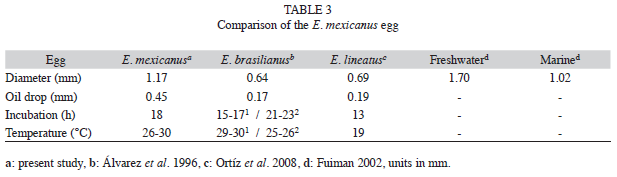
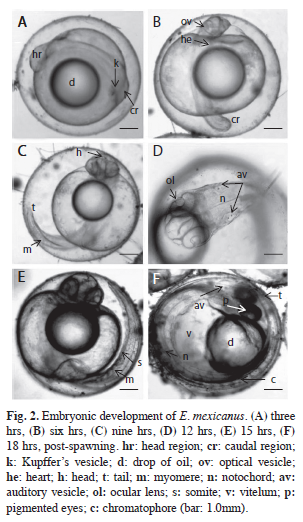
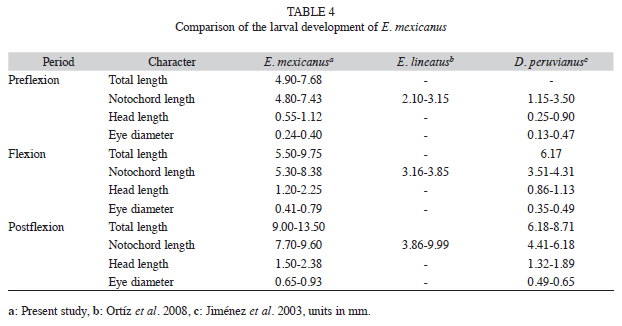
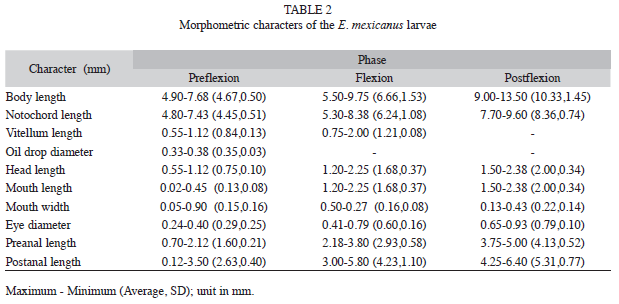
<body><![CDATA[big drop of oil (<a href="/img/revistas/rbt/v60n1/a26i1.jpg">Fig. 1</a>,     <a href="/img/revistas/rbt/v60n1/a26t1.gif">Table 1</a> and <a      href="/img/revistas/rbt/v60n1/a26t3.gif">3</a>).    <br> </span></font><br style="font-family: verdana;">     <div style="text-align: center;">     <div style="text-align: justify;"><font size="2"><span  style="font-family: verdana;">On the first day following fertilization, the early embryo stage was observed three hours post-gastrula, with an average diameter of 1.19 (0.04). The caudal region was adhered to the vitellus, where Kupffer&acute;s vesicle was visible, and the cephalic region had an ovoid projection (<a  href="/img/revistas/rbt/v60n1/a26i2.jpg">Fig. 2A</a>, <a href="/img/revistas/rbt/v60n1/a26t1.gif">Table 1</a>). The free tail stage occurred six hours after fertilization, and the developing optical vesicles could be observed in the head&nbsp; and the heart. The heart presented contractions that generated beats (<a href="/img/revistas/rbt/v60n1/a26i2.jpg">Fig. 2B</a>, <a  href="/img/revistas/rbt/v60n1/a26t1.gif">Table 1</a>). After nine hours, the embryo increased in size, mainly around the caudal region, with the myomeres or segments of the developed muscles becoming visible (<a  href="/img/revistas/rbt/v60n1/a26i2.jpg">Fig. 2C</a>, <a  href="/img/revistas/rbt/v60n1/a26t1.gif">Table 1</a>). Twelve hours post-fertilization, the embryo exhibited vibrating movements in the caudal region, where vesicles or ear plaques appeared, and a developed notochord could also be observed (<a  href="/img/revistas/rbt/v60n1/a26i2.jpg">Fig. 2D</a>, <a  href="/img/revistas/rbt/v60n1/a26t1.gif">Table 1</a>).</span></font>    <br> <font size="2"><span style="font-family: verdana;"></span></font></div> <font size="2"><span style="font-family: verdana;"></span></font><font  size="2"><span style="font-family: verdana;">    <br> <br style="font-family: verdana;"> </span></font></div> <font size="2"><span style="font-family: verdana;">Fifteen hours post-fertilization, the embryo occupied 90% of the egg space, and the somites or primitive segmentation could be seen (<a href="/img/revistas/rbt/v60n1/a26i2.jpg">Fig. 2E</a>, <a href="/img/revistas/rbt/v60n1/a26t1.gif">Table 1</a>). The final stage of the embryonic development was reached after 18 hours, and 100% of the vitelline space was occupied. Also visible were the chromatophores, or pigment cells responsible for the skin color of the embryo, along the dorsal and caudal regions of the body. The chorion membrane was broken by the frequent vibrating movements, and hatching began (<a  href="/img/revistas/rbt/v60n1/a26i2.jpg">Fig. 2F</a>, <a  href="/img/revistas/rbt/v60n1/a26t1.gif">Table 1</a>).</span></font><br  style="font-family: verdana; font-weight: bold;"> <font style="font-weight: bold;" size="2"></font><br  style="font-family: verdana; font-weight: bold;"> <font size="2"><span style="font-family: verdana;"><span  style="font-weight: bold;">Recently hatched larvae</span>: The posthatching yolk-sac larvae were light brown in color, had an average total length of 2.94mm (SD=0.7) and a width of 0.79 (0.10). The notochord had an average length of 2.74mm (0.80). They showed a longitudinally oval vitellum with an average length of 0.98mm (0.20) and a width of 0.59 (0.20). An average big drop of oil could be seen, measuring 0.49mm (0.10) long and 0.49 (0.10) wide (<a  href="/img/revistas/rbt/v60n1/a26i3.jpg">Fig. 3</a>). The larvae on day one, specifically eight hours post-hatching, had an average total length of 4.02mm (0.26) and a width of 0.79 (0.07). The head and the notochord were 0.56mm (0.05) and 3.85mm (0.24) long, respectively. The vitellum had an average length of 0.99mm (0.12) and width of 0.61 (0.09), and was in the process of re-absorption. The drop of oil measured an average of 0.48mm (0.09) long and 0.47 (0.08) wide. On the second day (hour 20) a pair of ear plaques could be seen in the cephalic region, together with dark pigmented spots or melanophores on the body, and the mouth was open. The completely pigmented eyes of the larvae were an</span></font><font size="2"><span  style="font-family: verdana;"> average of 0.24mm (0.02) long and 0.22 (0.01) wide. The orbital circle was an average of 0.26mm (0.02) long and 0.31 (0.38) wide, and the average orbital fossa was 0.29mm (0.18) long and 0.28 (0.01) wide. The larvae had an average pre-anal length of 1.44mm (0.23) and a post-anal length of 2.00mm (0.28) (<a  href="/img/revistas/rbt/v60n1/a26t4.gif">Table 4</a>).    <br> </span></font>     <div style="text-align: center;"><font size="2"><span  style="font-family: verdana;"></span></font><br  style="font-family: verdana;"> <font size="2"><span style="font-family: verdana;"></span></font></div> <font size="2"><span style="font-family: verdana;"><span  style="font-weight: bold;">Preflexion: </span>This stage was reached eight days post-hatching and presented an average larvae length of 4.67mm (SD=0.50) and width of 0.70 (0.11). Morphologic characters are shown in <a href="/img/revistas/rbt/v60n1/a26t2.gif">Table 2</a>. Upon reaching hour 182, larvae exhibited a developing digestive tract ending at the anal orifice and a yolk-sack in process of re-absorption. Over the caudal region and posterior to the anus were 15 spots or melanophores. At hour 289 post-hatching, the head was free of the yolk-sack and the optical vesicles were completely pigmented. Pelvic fins were an average of 0.27mm (0.03) long and 0.27 (0.06) wide, while pectoral fins were an average of 0.35mm&nbsp; (0.01) long and 0.27 (0.05) wide (<a href="/img/revistas/rbt/v60n1/a26i3.jpg">Fig. </a><a  href="/img/revistas/rbt/v60n1/a26i3.jpg">3</a>).</span></font><br  style="font-family: verdana;"> <font size="2"></font><br style="font-family: verdana;"> <font size="2"><span style="font-family: verdana;"><span  style="font-weight: bold;">Flexion: </span>This developmental stage started 16 days (372 hours) post-hatching, when flexion of the notochord was observed in the region of the caudal fin of the embryo. A swim bladder could also be seen over the intestinal region and the intestine showed food in the process of decomposition. The primordium of the dorsal fin and a rudimentary anal fin could also be seen, together with small developing rays (<a  href="/img/revistas/rbt/v60n1/a26i3.jpg">Fig. 3</a>, <a  href="/img/revistas/rbt/v60n1/a26t2.gif">Table 2</a>).</span></font><br  style="font-family: verdana;"> <font size="2"></font><br style="font-family: verdana;"> <font size="2"><span style="font-family: verdana;"><span  style="font-weight: bold;">Postflexion:</span> Larvae reached this stage 24 days post-hatching, with an average total length of 10.33mm (SD=1.45) and a total width of 1.73 (0.51) (<a  href="/img/revistas/rbt/v60n1/a26t2.gif">Table 2 </a>and<a  href="/img/revistas/rbt/v60n1/a26t4.gif"> 4</a>). After</span></font><font  size="2"><span style="font-family: verdana;">metamorphosis, the caudal fin was observed to be forked, with 17 fin rays, each with six segments. The length of the larvae to the fork varied 9.17 (0.44). At hour 578 post-hatching, the larvae presented small canine teeth on the maxilla and mandible in the mouth, measuring an average of 0.35mm (0.09) long and 0.03 (0.01) wide (Fig. 3). The complementary morphometric characters are shown in <a href="/img/revistas/rbt/v60n1/a26t2.gif">Table 2</a>. Likewise, these larvae presented totally formed dorsal, anal, pelvic and caudal fins. By hour 692 post-hatching, the dorsal fin measured an average of 2.0mm (0.40) long and 0.62 (0.13) wide and presented IX spines: the first smaller than the others measuring an average of 0.25 (0.22), the second 0.32 (0.16), the third 0.37 (0.20), the fourth 0.31 (0.24), and the fifth 0.18 (0.13), with 10 rays. The anal fin was an average of 1.99mm (0.35) long and 0.47 (0.16) wide and presented III spines, the first small with an average length of 0.55mm (0.35) and the second one with an average length of 0.34mm (0.11) long. Eight rays were also observed measuring an average of 1.08mm (0.60) long. The pectoral and pelvic (n=5) fins were 0.35mm and 0.50mm long, respectively (<a  href="/img/revistas/rbt/v60n1/a26i3.jpg">Fig. 3</a>, <a  href="/img/revistas/rbt/v60n1/a26t5.gif">Table </a><a  href="/img/revistas/rbt/v60n1/a26t5.gif">5</a>).    ]]></body>
<body><![CDATA[<br>     <br style="font-family: verdana;">     </span></font><br style="font-family: verdana;">     <font size="2"><span style="font-family: verdana;"><span      style="font-weight: bold;">Prejuveniles</span>: This phase started 33     days (792 hours) post-hatching, with an average total length of 14.3mm     (SD=0.93) and a width of 3.12 (0.21). The mouth-fork length was 12.83mm     (0.76). The dorsal fin measured 1.28mm long and 0.08mm wide and     presented IX spines and 10 rays. The first spine measured an average of     0.30mm (SD=0.04) long, the second 1.23mm (0.09), the third 1.40mm     ]]></body>
<body><![CDATA[(0.62), the fourth 1.42mm (0.14), the fifth 1.15mm (0.09) and the sixth     0.88mm (0.12). It was not possible to measure the other spines. Upon     reaching hour 845, the anal fin was an average of 0.08 (0.00) wide,     with III spines and&nbsp; eight rays. The first spine measured an     average of 0.27 (0.02), the second 1.06 (0.08) and the third 1.40     (0.16). The pectoral fins measured 1.32mm (0.26) in length and 0.94     (0.08) in width. The pelvic fins (n=3) were an average of 1.42 (0.08)     long and 0.47 (0.20) wide. At the end of this phase, prejuveniles had a     length of 18mm to the fork and a total length of 20mm </span></font><font      size="2"><span style="font-family: verdana;">(<a     ]]></body>
<body><![CDATA[ href="/img/revistas/rbt/v60n1/a26i3.jpg">Fig. 3</a>, <a      href="/img/revistas/rbt/v60n1/a26t5.gif">Table </a><a      href="file:///img/revistas/rbt/v60n1/a26t5.gif">5</a>).</span></font><br      style="font-family: verdana;">     <font size="2"></font><br style="font-family: verdana;">     <font size="2"><span style="font-family: verdana;"><span      style="font-weight: bold;">Juveniles: </span>This stage occurred 45     days (1 080 hours) post-hatching with an average total length of     28.16mm (SD=1.93, n=5), a width of 30.1 (36.8, 5.0) and an average     weight of 4.75g (SD=1.49, n=5) (<a     ]]></body>
<body><![CDATA[ href="/img/revistas/rbt/v60n1/a26t5.gif">Table 5</a>).</span></font><br      style="font-family: verdana;">     <font size="2"></font><br style="font-family: verdana;">     <font size="2"><span style="font-family: verdana;"><span      style="font-weight: bold;">Pigmentation:</span> The exceptional     pigmentation during the larval with sack stage and before preflexion     showed two lines of olive and yellow colors in the margin of the     notochord. Dark pigmentation was noticed on the body, the posterior     side of the head and on the base of the pectoral fin. Five post-anal     melanophores were also displayed on myomere five and six. During     ]]></body>
<body><![CDATA[pre-flexion and before flexion, anal melanophores increased from 13 to     16, starting on the second postanal myomere and ending before reaching     the tail. Eyes were completly pigmented with a silver-plated coloration.</span></font><br      style="font-family: verdana;">     <font size="2"></font><br style="font-family: verdana;">     <font size="2"><span style="font-family: verdana;">During flexion,     pigmentation had a     notorious silver color in the intestine. The myomere</span></font><font      size="2"><span style="font-family: verdana;">had a beige coloration     going from     ]]></body>
<body><![CDATA[the posterior cephalic region to the beginning of the tail. During the     transition between this stage and the postflexion stage, the larva     showed dark pigment and yellowish spots in this same region, while the     silver plated coloration remained in the intestines. A total of 10     melanophores were observed on the base of the caudal fin. Prejuveniles     presented an initial pigmentation with dark spots on their maxilla and     jaw and dispersed on the head. In the medium and posterior parts of the     operculum three dark pigments were observed. On the dorsal fin     pigmentation went from the base of the first and second spine to the     margin while on the rays pigmentation went towards the vertex and     ]]></body>
<body><![CDATA[continued until the beginning of the caudal peduncle. Ten separated     colors were observed towards the base of the anal fin. Pigmentation at     the beginning of the caudal peduncle merged, fading before the     beginning of the tail, where the base and the margins of the radii were     pigmented. Fins</span></font><font size="2"><span      style="font-family: verdana;">turned to a brownish olive color     with black margins. The lateral line of the body had yellowish     pigmentation from the later part of the operculum to the caudal     peduncle, which is a characteristic trait of the species     (Gonz&aacute;lez 2005). In juveniles the same pigmentation pattern     ]]></body>
<body><![CDATA[remained on the head and on the dorsal and anal fins, fading in the     caudal peduncle.</span></font><br style="font-family: verdana;">     <font size="2"></font><br style="font-family: verdana;">     <font style="font-weight: bold;" size="3"><span      style="font-family: verdana;">Discussion</span></font><br      style="font-family: verdana;">     <font size="2"></font><br style="font-family: verdana;">     <font size="2"><span style="font-family: verdana;">The descriptive     characteristics of     the embryonic stage of E. mexicanus are typical of this developmental     ]]></body>
<body><![CDATA[period for fish of the Gerreidae family, particularly the species <span      style="font-style: italic;">E.     brasilianus</span> and <span style="font-style: italic;">E. lineatus</span>     that inhabit marine environments     (&Aacute;lvarez <span style="font-style: italic;">et al.</span> 1996,     Ort&iacute;z et al. 2008). However, their     morphometric characters are different with respect to the diameter and     size of the oil drop, as <span style="font-style: italic;">E.     mexicanus </span>eggs are bigger than those of     marine species, being similar to those of freshwater fish (Fuiman 2002).</span></font><br     ]]></body>
<body><![CDATA[ style="font-family: verdana;">     <font size="2"></font><br style="font-family: verdana;">     <font size="2"><span style="font-family: verdana;">The incubation     period in hours is     similar to that of marine species of the genus <span      style="font-style: italic;">Eugerres </span>and the     incubation temperature is also similar to that reported for <span      style="font-style: italic;">E.     brasilianus</span>, but greater than the one recorded during the     incubation     ]]></body>
<body><![CDATA[period for <span style="font-style: italic;">E. lineatus</span>.     Regarding the recently hatched larvae, <span      style="font-style: italic;">E.     mexicanus </span>were bigger (average length of 2.94mm) than <span      style="font-style: italic;">E. brasilianus</span>     (average length of 1.43mm). This may be observed through the average     length of the vitelline sack of <span style="font-style: italic;">E.     mexicanus </span>and <span style="font-style: italic;">E. brasilianus</span>     measuring 0.98mm and 0.70mm, respectively, and the notochord length of     <span style="font-style: italic;">E. lineatus</span> (1.05mm) in     ]]></body>
<body><![CDATA[relation to the larvae of <span style="font-style: italic;">E.     mexicanus</span> (2.74mm)     (&Aacute;lvarez <span style="font-style: italic;">et al</span>. 1996,     Ort&iacute;z <span style="font-style: italic;">et al.</span> 2008).</span></font><br      style="font-family: verdana;">     <font size="2"></font><br style="font-family: verdana;">     <font size="2"><span style="font-family: verdana;">Following the     classification of     pre-flexion, flexion and post-flexion established to determine the     development of larvae, the <span style="font-style: italic;">E.     ]]></body>
<body><![CDATA[mexicanus</span> larvae were bigger than the la     rvae of the species <span style="font-style: italic;">E. brasilianus </span>and<span      style="font-style: italic;"> E. lineatus</span> of the same genus     and the marine larvae of D. peruvianus (&Aacute;lvarez et al. 1996,     Jim&eacute;nez <span style="font-style: italic;">et al.</span> 2003,     Ort&iacute;z <span style="font-style: italic;">et al.</span> 2008).</span></font><br      style="font-family: verdana;">     <font size="2"></font><br style="font-family: verdana;">     <font size="2"><span style="font-family: verdana;">It must be noted     that Fuiman (2002)     ]]></body>
<body><![CDATA[stated that the larvae of marine species are&nbsp;&nbsp;&nbsp; smaller     in length than freshwater larvae, with averages of 2.87mm and 5.40mm.<span      style="font-style: italic;">     E. mexicanus</span> prejuveniles of E. mexicanus measured 13.25mm to     15.00mm     in length, similar to <span style="font-style: italic;">D. peruvianus</span>     (8.72 to 15.00mm) and <span style="font-style: italic;">E. lineatus</span>     prejuveniles (13.00mm to 18.00mm). On the other hand, E. mexicanus     juveniles were bigger in length (28.16mm) than that recorded for <span      style="font-style: italic;">E.     ]]></body>
<body><![CDATA[lineatus</span> (17.30mm) and<span style="font-style: italic;"> D.     peruvianus </span>(17.00mm to 24.00mm)     (Jim&eacute;nez <span style="font-style: italic;">et al. </span>2003,     Ort&iacute;z <span style="font-style: italic;">et al.</span> 2008)     (Table 5). With     respect to the meristic characters, the fins of <span      style="font-style: italic;">E. lineatus</span> and <span      style="font-style: italic;">D.     peruvianus</span> presented a different number of spines and rays     during the     ]]></body>
<body><![CDATA[larval phase. Finally, the juvenile phase presented spines and rays     characteristic of <span style="font-style: italic;">E. mexicanus</span>,     as described by Deckert &amp;     Greenfield (1987) and Gonz&aacute;lez (2005).</span></font><br      style="font-family: verdana;">     <font size="2"></font><br style="font-family: verdana;">     <font size="2"><span style="font-family: verdana;">Regarding     pigmentation, the colors     of the larva with sack for Eugerres mexicanus were</span></font><font      size="2"><span style="font-family: verdana;">olive and yellow on the     ]]></body>
<body><![CDATA[margin of     the notochord. This differs from pigmentation reported for <span      style="font-style: italic;">E. lineatus</span>     since in this sample there is a group of melanophores between myomere 9     to 13 as the main characteristic, and for Diapturus peruvianus because     of the three spots displayed in the dorsal margin of the intestines     from the insertion of the pectoral fin to the anus (Jim&eacute;nez <span      style="font-style: italic;">et     al. </span>2003, Ort&iacute;z<span style="font-style: italic;"> et al.</span>     2008). E. mexicanus larvae during flexion     ]]></body>
<body><![CDATA[followed the same pattern of coloration as the eleuthero embryo;     however, during pre-flexion larvae contrasted with <span      style="font-style: italic;">E. lineatus</span>, since     the latter continues with a similar pigmentation during pre-flexion and     flexion, in which only the first melanophores are accentuated.     Nevertheless, although<span style="font-style: italic;"> E. mexicanus </span>shows     similar post-anal spots from     13 to 16 as <span style="font-style: italic;">D. peruvianus</span>, it     differs in that one or two of those spots     are where the caudal fin will be (Jim&eacute;nez <span     ]]></body>
<body><![CDATA[ style="font-style: italic;">et al. </span>2003,     Ort&iacute;z <span style="font-style: italic;">et al. </span>2008).</span></font><br      style="font-family: verdana;">     <font size="2"></font><br style="font-family: verdana;">     <font size="2"><span style="font-family: verdana;">Three spots were     observed in the     caps, and dark spots remained in the margin of the dorsal fin, which     differs from <span style="font-style: italic;">E. peruvianus</span>     since in <span style="font-style: italic;">E. mexicanus</span> two     groups of four</span></font><font size="2"><span     ]]></body>
<body><![CDATA[ style="font-family: verdana;">opercular pigments are present and     there is little pigmentation toward the corners of the dorsal fin while     in <span style="font-style: italic;">D. peruvianus</span> fins turn     yellow and the body line is covered with     silver flakes (Jim&eacute;nez<span style="font-style: italic;"> et al. </span>2003,     Ort&iacute;z <span style="font-style: italic;">et al.</span> 2008).     In <span style="font-style: italic;">E. mexicanus </span>prejuveniles     brown pigmentation was observed in the     cephalic region, the dark margins of the dorsal and anal fins, and the     base of the tail, while pigmentation was yellow in the lateral line.     ]]></body>
<body><![CDATA[Pigmentation in the mouth, specifically the maxilla and the jaw, is     intensified towards the juvenile stage. Three pigments were observed in     the operculum. The dark spots remain in the margin of the dorsal fin,     which differs from <span style="font-style: italic;">E. peruvianus </span>since     in <span style="font-style: italic;">E. mexicanus</span> two groups of     four operculum pigments are present and there is little pigmentation     towards the vertices of the dorsal fin, while in <span      style="font-style: italic;">D. peruvianus </span>fins     turn yellow and the line of the body is covered with silver flakes     (Jim&eacute;nez <span style="font-style: italic;">et al.</span> 2003,     ]]></body>
<body><![CDATA[Ort&iacute;z<span style="font-style: italic;"> et al.</span> 2008).</span></font><br      style="font-family: verdana;">     <font size="2"></font><br style="font-family: verdana;">     <font size="2"><span style="font-family: verdana;">Physicochemical     parameters played     an important role during white mojarra&nbsp; reproduction, as was the     case of temperature that was favorable during the spawning and hatching     stages. However, it varied from 25.6 to 28.4&deg;C during the larval     stage, which may have contributed to the high mortality recorded during     this stage (99%). &Aacute;lvarez <span style="font-style: italic;">et     ]]></body>
<body><![CDATA[al.</span> (1996) stated that a     temperature of 20&deg;C increased mortality in the case of<span      style="font-style: italic;"> E.     brasilianus</span> and also recorded a pH of 7.5 to 8.2 and values of     dissolved oxygen of 5.5 to 7.1mg/L, similar to the pH and dissolved     oxygen values required for <span style="font-style: italic;">E.     mexicanus</span> of 7.5 to 8.4 and 3.8 to     6.7mg/L,&nbsp; respectively. The nitrogen compounds recorded in the     present study showed low levels and were considered non-toxic for the     fish. Conductivity was low and varied from 0.51 to 0.56&#956;S/cm. The     ]]></body>
<body><![CDATA[foregoing allowed for the conclusion that, in general, there was no     organic pollution during the reproduction, spawning, and embryonic and     larval development, as Arredondo &amp; Palafox (1998) mentioned for     fish culture in controlled aquacultural systems. Food provided was     assumed to be the cause for the recorded mortality, as it was based     solely on microscopic green algae of the genus Crucigenia sp.,     collected from artificial tanks. &Aacute;lvarez <span      style="font-style: italic;">et al.</span> (1996) provided     the green alga <span style="font-style: italic;">Nannochloropsis     oculata</span> to <span style="font-style: italic;">E. brasilianus </span>larvae     ]]></body>
<body><![CDATA[at the     beginning of their feeding, and later switched to <span      style="font-style: italic;">Artemia </span>sp. nauplii     and copepods, obtaining a 50% survival.</span></font><br      style="font-family: verdana;">     <font size="2"></font><br      style="font-family: verdana; font-style: italic;">     <font size="2"><span style="font-family: verdana;"><span      style="font-style: italic;">Eugerres mexicanus</span> specimens     spawned after a single dose of 50UI/100g/fish of human chorionic     ]]></body>
<body><![CDATA[gonadotropin hormone. In contrast, studies carried out in Tunas de     Zaza, Cuba, on the induced reproduction of <span      style="font-style: italic;">E. brasilianus </span>used     6-10UI/g/fish distributed over two and three doses (&Aacute;lvarez <span      style="font-style: italic;">et     al.</span> 1996). In other cases, doses of 3.4-6.3 UI/g/fish were     applied to     females of Lutjanus griseus (Cabrera <span style="font-style: italic;">et     al.</span> 1997), and three doses of     hormones were used at concentrations of 3.00, 1.00 and 0.5UI/g/fish for     ]]></body>
<body><![CDATA[females and of 1.50, 0.50 and 0.25UI/g/fish for males of <span      style="font-style: italic;">Haemulon     bonarinense </span>(Cuartas <span style="font-style: italic;">et al.</span>     2003), with the doses of 0.50 (females) and     0.25 (males) producing the most viable sexual products. Only the 0.50     dose presented similar results to those obtained for <span      style="font-style: italic;">E. mexicanus</span>.     &Aacute;lvarez &amp; Hern&aacute;ndez (2001) determined that a period     of 10 hours for spawning is relatively short in the case of tropical     species, and related this to the short physiological action of the     ]]></body>
<body><![CDATA[hormones at high environmental temperatures. However, in this study,     spawning occurred 48 hours after injection, at temperatures of     29-31&deg;C, indicating that spawning depends on the physiological     characteristics of each species in relation to the temperature of the     water. Successful egg fertilization (90-95%) in this study is similar     to that recorded for <span style="font-style: italic;">E. brasilianus,</span>     which equaled to an average 87%     success rate (range=60-100%) (&Aacute;lvarez <span      style="font-style: italic;">et al</span>. 1996). Records of     other fish species include Lutjanus griseus with 36% and 86% with the     ]]></body>
<body><![CDATA[use of GCH (Cabrera <span style="font-style: italic;">et al. </span>1997)     and<span style="font-style: italic;"> Haemulon donariense</span> with     90%     (Cuartas <span style="font-style: italic;">et al.</span> 2003). Other     authors used the synthetic analogue of the     luteinizing hormone releasing hormone (LHRHA) and obtained 85% for     <span style="font-style: italic;">Orthopristis</span> ruber (Mata <span      style="font-style: italic;">et al.</span> 2004) and 90% for <span      style="font-style: italic;">Centropomus     parallelus (</span>&Aacute;lvarez e<span style="font-style: italic;">t     ]]></body>
<body><![CDATA[al. </span>2002).</span></font><br style="font-family: verdana;">     <font size="2"></font><br style="font-family: verdana;">     <font size="2"><span style="font-family: verdana;">The results of this     study are the     first recorded for this species and generated information     on several aspects of its reproductive biology and early life     development. These results have also made it possible to establish a     technique for manipulation in captivity, which may be adopted for     aquaculture development of this species.</span></font><br      style="font-family: verdana;">     ]]></body>
<body><![CDATA[<font size="2"></font><br style="font-family: verdana;">     <font style="font-weight: bold;" size="3"><span      style="font-family: verdana;">Acknowledgments</span></font><br      style="font-family: verdana;">     <font size="2"></font><br style="font-family: verdana;">     <font size="2"><span style="font-family: verdana;">The authors     acknowledge the CONACYT     Fund and the government of the State of Tabasco for financing study     TAB-2007-C09-73534.</span></font><br style="font-family: verdana;">     <font style="font-weight: bold;" size="3"><span     ]]></body>
<body><![CDATA[ style="font-family: verdana;"></span></font>     <hr style="width: 100%; height: 2px;"><font style="font-weight: bold;"      size="3"><span style="font-family: verdana;">    <!-- ref --><br> References</span></font><br style="font-family: verdana;"> <font size="2"></font><br style="font-family: verdana;"> <font size="2"><span style="font-family: verdana;">&Aacute;lvarez, L.L, L.P. S&aacute;nchez, O.G.H. Molej&oacute;n &amp; E.T. G&oacute;mez. 1996. Mass production of striped patio <span style="font-style: italic;">Eugerres brasilianus</span> juveniles in Cuba. J. World Aquac. Soc. 27: 347-352.    &nbsp;&nbsp;&nbsp;&nbsp;&nbsp;&nbsp;&nbsp;&nbsp;[&#160;<a href="javascript:void(0);" onclick="javascript: window.open('/scielo.php?script=sci_nlinks&ref=1432721&pid=S0034-7744201200010002600001&lng=','','width=640,height=500,resizable=yes,scrollbars=1,menubar=yes,');">Links</a>&#160;]<!-- end-ref --><!-- ref --></span></font><br  style="font-family: verdana;"> <font size="2"></font><br style="font-family: verdana;"> <font size="2"><span style="font-family: verdana;">&Aacute;lvarez, L.L. &amp; O.G.M. Hern&aacute;ndez. 2001. Producci&oacute;n de juveniles de peces estuarinos para un centro en Am&eacute;rica Latina y el Caribe: dise&ntilde;o, operaci&oacute;n y tecnolog&iacute;as. The World Acuaculture Society, Baton Rouge, Lousiana, USA.    &nbsp;&nbsp;&nbsp;&nbsp;&nbsp;&nbsp;&nbsp;&nbsp;[&#160;<a href="javascript:void(0);" onclick="javascript: window.open('/scielo.php?script=sci_nlinks&ref=1432722&pid=S0034-7744201200010002600002&lng=','','width=640,height=500,resizable=yes,scrollbars=1,menubar=yes,');">Links</a>&#160;]<!-- end-ref --><!-- ref --></span></font><br  style="font-family: verdana;"> <font size="2"></font><br style="font-family: verdana;"> <font size="2"><span style="font-family: verdana;">&Aacute;lvarez, L.L., V.R. Cerqueira &amp; M. dos-Reis. 2002. Desarrollo embrionario y primeros estadios larvales del robalo chucumite, <span  style="font-style: italic;">Centropomus parallelus poey</span> (Pisces, Centropomidae) con inter&eacute;s para su cultivo. Hydrobiology 12: 89-100.    &nbsp;&nbsp;&nbsp;&nbsp;&nbsp;&nbsp;&nbsp;&nbsp;[&#160;<a href="javascript:void(0);" onclick="javascript: window.open('/scielo.php?script=sci_nlinks&ref=1432723&pid=S0034-7744201200010002600003&lng=','','width=640,height=500,resizable=yes,scrollbars=1,menubar=yes,');">Links</a>&#160;]<!-- end-ref --><!-- ref --></span></font><br style="font-family: verdana;"> <font size="2"></font><br style="font-family: verdana;"> <font size="2"><span style="font-family: verdana;">Arredondo, F. &amp; P. Palafox. 1998. Calidad del agua en acuicultura. AGT editor, Mexico D.F., Mexico.    &nbsp;&nbsp;&nbsp;&nbsp;&nbsp;&nbsp;&nbsp;&nbsp;[&#160;<a href="javascript:void(0);" onclick="javascript: window.open('/scielo.php?script=sci_nlinks&ref=1432724&pid=S0034-7744201200010002600004&lng=','','width=640,height=500,resizable=yes,scrollbars=1,menubar=yes,');">Links</a>&#160;]<!-- end-ref --><!-- ref --></span></font><br  style="font-family: verdana;"> <font size="2"></font><br style="font-family: verdana;"> <font size="2"><span style="font-family: verdana;">Cabrera, B.T., J.C. Rosas &amp; J. Mill&aacute;n O. 1997. Reproducci&oacute;n y desarrollo larvario del pargo dient&oacute;n (<span style="font-style: italic;">Lutjanus griseus </span>L. 1758) (Pisces: Lutjanidae) cultivado en cautiverio. J. Sci. 33: 239-245.    &nbsp;&nbsp;&nbsp;&nbsp;&nbsp;&nbsp;&nbsp;&nbsp;[&#160;<a href="javascript:void(0);" onclick="javascript: window.open('/scielo.php?script=sci_nlinks&ref=1432725&pid=S0034-7744201200010002600005&lng=','','width=640,height=500,resizable=yes,scrollbars=1,menubar=yes,');">Links</a>&#160;]<!-- end-ref --><!-- ref --></span></font><br  style="font-family: verdana;"> <font size="2"></font><br style="font-family: verdana;"> <font size="2"><span style="font-family: verdana;">Castro, A.J.L., H.P. Hern&aacute;ndez &amp; J.J.S. Schmitter. 1999. Ictiofauna Estuarino-Lagunar y Vicaria de M&eacute;xico. Limusa-Noriega, Mexico.    &nbsp;&nbsp;&nbsp;&nbsp;&nbsp;&nbsp;&nbsp;&nbsp;[&#160;<a href="javascript:void(0);" onclick="javascript: window.open('/scielo.php?script=sci_nlinks&ref=1432726&pid=S0034-7744201200010002600006&lng=','','width=640,height=500,resizable=yes,scrollbars=1,menubar=yes,');">Links</a>&#160;]<!-- end-ref --><!-- ref --></span></font><br  style="font-family: verdana;"> <font size="2"></font><br style="font-family: verdana;"> <font size="2"><span style="font-family: verdana;">Cuartas, A., J. Rosas, A. Vel&aacute;squez &amp; T. Cabrera. 2003. Inducci&oacute;n al desove, desarrollo embrionario y larval de corocoro rayado <span  style="font-style: italic;">Haemulon bonariense </span>Cuvier, 1830 (Pisces: Haemulidae). Rev. Biol. Mar. Ocean. 38: 27-37.    &nbsp;&nbsp;&nbsp;&nbsp;&nbsp;&nbsp;&nbsp;&nbsp;[&#160;<a href="javascript:void(0);" onclick="javascript: window.open('/scielo.php?script=sci_nlinks&ref=1432727&pid=S0034-7744201200010002600007&lng=','','width=640,height=500,resizable=yes,scrollbars=1,menubar=yes,');">Links</a>&#160;]<!-- end-ref --><!-- ref --></span></font><br style="font-family: verdana;"> <font size="2"></font><br style="font-family: verdana;"> <font size="2"><span style="font-family: verdana;">Deckert, G.D. &amp; D.W. Greenfield. 1987. A Review of the Western Atlantic Species of the Genera <span style="font-style: italic;">Diapterus &amp; Eugerres </span>(Pisces: Gerreidae). Copeia 1987: 182-194.    &nbsp;&nbsp;&nbsp;&nbsp;&nbsp;&nbsp;&nbsp;&nbsp;[&#160;<a href="javascript:void(0);" onclick="javascript: window.open('/scielo.php?script=sci_nlinks&ref=1432728&pid=S0034-7744201200010002600008&lng=','','width=640,height=500,resizable=yes,scrollbars=1,menubar=yes,');">Links</a>&#160;]<!-- end-ref --><!-- ref --></span></font><br style="font-family: verdana;"> <font size="2"></font><br style="font-family: verdana;"> <font size="2"><span style="font-family: verdana;">Fuiman, L.A. 2002. Special considerations of fish eggs and larvae, p. 337. In L.A. Fuiman &amp; R.G. Werner (eds.). Fishery Science Unique Contributions of Earth Life Stages Blackwell, Oxford, England.    &nbsp;&nbsp;&nbsp;&nbsp;&nbsp;&nbsp;&nbsp;&nbsp;[&#160;<a href="javascript:void(0);" onclick="javascript: window.open('/scielo.php?script=sci_nlinks&ref=1432729&pid=S0034-7744201200010002600009&lng=','','width=640,height=500,resizable=yes,scrollbars=1,menubar=yes,');">Links</a>&#160;]<!-- end-ref --><!-- ref --></span></font><br  style="font-family: verdana;"> <font size="2"></font><br style="font-family: verdana;"> <font size="2"><span style="font-family: verdana;">Gilmore, R.G., Jr. V. Beach &amp; D.W. Greenfield. 2002. Gerreidae. The living marine resource of the Western Central Atlantic. Vol. 3: Bony Fishes, Part 2 (Opistognathidae to Molidae), sea turtles and marine mammals.    &nbsp;&nbsp;&nbsp;&nbsp;&nbsp;&nbsp;&nbsp;&nbsp;[&#160;<a href="javascript:void(0);" onclick="javascript: window.open('/scielo.php?script=sci_nlinks&ref=1432730&pid=S0034-7744201200010002600010&lng=','','width=640,height=500,resizable=yes,scrollbars=1,menubar=yes,');">Links</a>&#160;]<!-- end-ref --><!-- ref --></span></font><br  style="font-family: verdana;"> <font size="2"></font><br style="font-family: verdana;"> <font size="2"><span style="font-family: verdana;">Gonz&aacute;lez, A.A.F. 2005. Estudio Sistem&aacute;tico y Biogeogr&aacute;fico del g&eacute;nero <span style="font-style: italic;">Eugerres (</span>Perciformes: Gerreidae). Tesis de Doctorado, CICIMAR, La Paz, Baja California Sur, Mexico.    &nbsp;&nbsp;&nbsp;&nbsp;&nbsp;&nbsp;&nbsp;&nbsp;[&#160;<a href="javascript:void(0);" onclick="javascript: window.open('/scielo.php?script=sci_nlinks&ref=1432731&pid=S0034-7744201200010002600011&lng=','','width=640,height=500,resizable=yes,scrollbars=1,menubar=yes,');">Links</a>&#160;]<!-- end-ref --><!-- ref --></span></font><br  style="font-family: verdana;"> <font size="2"></font><br style="font-family: verdana;"> <font size="2"><span style="font-family: verdana;">Gonz&aacute;lez, A.A.F. &amp; R.H. Rodiles. 2007. Sobre el estatus taxon&oacute;mico de la mojarra blanca<span  style="font-style: italic;"> E</span></span></font><font  style="font-style: italic;" size="2"><span  style="font-family: verdana;"></span></font><font size="2"><span  style="font-family: verdana;"><span style="font-style: italic;">ugerres mexicanus </span>(Steindachner, 1863). Mesoamericana 11: 52-53.    &nbsp;&nbsp;&nbsp;&nbsp;&nbsp;&nbsp;&nbsp;&nbsp;[&#160;<a href="javascript:void(0);" onclick="javascript: window.open('/scielo.php?script=sci_nlinks&ref=1432732&pid=S0034-7744201200010002600012&lng=','','width=640,height=500,resizable=yes,scrollbars=1,menubar=yes,');">Links</a>&#160;]<!-- end-ref --><!-- ref --></span></font><br  style="font-family: verdana;"> <font size="2"></font><br style="font-family: verdana;"> <font size="2"><span style="font-family: verdana;">Gonz&aacute;lez, A.A.F., J. de la Cruz-Ag&uuml;ero &amp; J.L. Castro- Aguirre. 2007. A review of the marine Western Atlantic species of the genus <span  style="font-style: italic;">Eugerres</span> (Perciformes: Gerreidae). Bull. Mar. Sci. 80: 109-124.    &nbsp;&nbsp;&nbsp;&nbsp;&nbsp;&nbsp;&nbsp;&nbsp;[&#160;<a href="javascript:void(0);" onclick="javascript: window.open('/scielo.php?script=sci_nlinks&ref=1432733&pid=S0034-7744201200010002600013&lng=','','width=640,height=500,resizable=yes,scrollbars=1,menubar=yes,');">Links</a>&#160;]<!-- end-ref --><!-- ref --></span></font><br  style="font-family: verdana;"> <font size="2"></font><br style="font-family: verdana;"> <font size="2"><span style="font-family: verdana;">Hardy, J.D. Jr. 1978. Development of fishes of the Mid- Atlantic Bight: An Atlas of egg, larval and juvenile stages. Volume II. Anguillidae through Syngnathidae.&nbsp; U.S. Fish and Wildlife Service, Biological Services Program, FWS/OBS-78/12.    &nbsp;&nbsp;&nbsp;&nbsp;&nbsp;&nbsp;&nbsp;&nbsp;[&#160;<a href="javascript:void(0);" onclick="javascript: window.open('/scielo.php?script=sci_nlinks&ref=1432734&pid=S0034-7744201200010002600014&lng=','','width=640,height=500,resizable=yes,scrollbars=1,menubar=yes,');">Links</a>&#160;]<!-- end-ref --><!-- ref --></span></font><br style="font-family: verdana;"> <font size="2"></font><br style="font-family: verdana;"> <font size="2"><span style="font-family: verdana;">Jim&eacute;nez, R.S.P.A., E.G. Navarro &amp; R.J.S. Mart&iacute;nez. 2003. Larval, pre-juvenile and juvenile development of <span style="font-style: italic;">Diapterus peruvianus </span>(Perciformes: Gerreidae). Rev. Biol. Trop. 51: 479-488.    &nbsp;&nbsp;&nbsp;&nbsp;&nbsp;&nbsp;&nbsp;&nbsp;[&#160;<a href="javascript:void(0);" onclick="javascript: window.open('/scielo.php?script=sci_nlinks&ref=1432735&pid=S0034-7744201200010002600015&lng=','','width=640,height=500,resizable=yes,scrollbars=1,menubar=yes,');">Links</a>&#160;]<!-- end-ref --><!-- ref --></span></font><br  style="font-family: verdana;"> <font size="2"></font><br style="font-family: verdana;"> <font size="2"><span style="font-family: verdana;">Mata, E., J. Rosas, A. Vel&aacute;squez &amp; T. Cabrera. 2004. Inducci&oacute;n hormonal al desove y descripci&oacute;n larval del corocoro Orthopristis ruder Cuvier (Pisces: Haemulidae). Rev. Biol. Mar. Ocean. 39: 21-29.    &nbsp;&nbsp;&nbsp;&nbsp;&nbsp;&nbsp;&nbsp;&nbsp;[&#160;<a href="javascript:void(0);" onclick="javascript: window.open('/scielo.php?script=sci_nlinks&ref=1432736&pid=S0034-7744201200010002600016&lng=','','width=640,height=500,resizable=yes,scrollbars=1,menubar=yes,');">Links</a>&#160;]<!-- end-ref --><!-- ref --></span></font><br  style="font-family: verdana;"> <font size="2"><span style="font-family: verdana;">&nbsp;</span></font><br  style="font-family: verdana;"> <font size="2"><span style="font-family: verdana;">Miller, R.R., W.L. Minckley &amp; S.M. Norris. 2005. Freshwater fishes of Mexico. The University of Chicago, Chicago, USA.    &nbsp;&nbsp;&nbsp;&nbsp;&nbsp;&nbsp;&nbsp;&nbsp;[&#160;<a href="javascript:void(0);" onclick="javascript: window.open('/scielo.php?script=sci_nlinks&ref=1432737&pid=S0034-7744201200010002600017&lng=','','width=640,height=500,resizable=yes,scrollbars=1,menubar=yes,');">Links</a>&#160;]<!-- end-ref --><!-- ref --></span></font><br style="font-family: verdana;"> <font size="2"></font><br style="font-family: verdana;"> <font size="2"><span style="font-family: verdana;">Ort&iacute;z, G., J.L. Castro-Aguirre, E.F.F. Balart &amp; N.A. Pliego. 2008. Description of early ontogeny and osteological development of streaked mojarra <span style="font-style: italic;">Eugerres lineatus </span>(Teleostei: Percoidei:Gerreidae). Zootaxa 1911: 1-30.    &nbsp;&nbsp;&nbsp;&nbsp;&nbsp;&nbsp;&nbsp;&nbsp;[&#160;<a href="javascript:void(0);" onclick="javascript: window.open('/scielo.php?script=sci_nlinks&ref=1432738&pid=S0034-7744201200010002600018&lng=','','width=640,height=500,resizable=yes,scrollbars=1,menubar=yes,');">Links</a>&#160;]<!-- end-ref --><!-- ref --></span></font><br  style="font-family: verdana;"> <font size="2"></font><br style="font-family: verdana;"> <font size="2"><span style="font-family: verdana;">Rosas, J., E. Mata, A. Vel&aacute;squez &amp; T. Cabrera. 2008. Desarrollo embrionario-larval del pez tropical <span style="font-style: italic;">Hemirhamphus brasiliensis</span> (Beloniformes: Hemirhamphidae) a partir de huevos recolectados.    &nbsp;&nbsp;&nbsp;&nbsp;&nbsp;&nbsp;&nbsp;&nbsp;[&#160;<a href="javascript:void(0);" onclick="javascript: window.open('/scielo.php?script=sci_nlinks&ref=1432739&pid=S0034-7744201200010002600019&lng=','','width=640,height=500,resizable=yes,scrollbars=1,menubar=yes,');">Links</a>&#160;]<!-- end-ref --><br>     <br> <a name="Correspondencia1"></a><a href="#Correspondencia2">*</a>Correspondencia:<br  style="font-family: verdana;"> </span></font><font size="2"> <span style="font-family: verdana;">Ra&uacute;l E. Hern&aacute;ndez: </span></font><font  size="2"><span style="font-family: verdana;">Ingenier&iacute;a en Acuacultura, Divisi&oacute;n Acad&eacute;mica Multidisciplinaria de los R&iacute;os, Universidad Ju&aacute;rez Aut&oacute;noma de Tabasco, km 1 carretera Tenosique-Estapilla, Tenosique, Tabasco, M&eacute;xico. CP 86901;<a href="mailto:%20raul.hernandez@ujat.mx"> raul.hernandez@ujat.mx</a></span></font><font  size="2"><span style="font-family: verdana;">    <br> Martha A. Perera: </span></font><font size="2"><span  style="font-family: verdana;">Ingenier&iacute;a en Acuacultura, Divisi&oacute;n Acad&eacute;mica Multidisciplinaria de los R&iacute;os, Universidad Ju&aacute;rez Aut&oacute;noma de Tabasco, km 1 carretera Tenosique-Estapilla, Tenosique, Tabasco, M&eacute;xico. CP 86901.</span></font><font size="2"><span style="font-family: verdana;">    <br> Alfonso Castillo</span></font><font size="2"><span  style="font-family: verdana;">: </span></font><font size="2"><span  style="font-family: verdana;">Ingenier&iacute;a en Acuacultura, Divisi&oacute;n Acad&eacute;mica Multidisciplinaria de los R&iacute;os, Universidad Ju&aacute;rez Aut&oacute;noma de Tabasco, km 1 carretera Tenosique-Estapilla, Tenosique, Tabasco, M&eacute;xico. CP 86901.</span></font><font size="2"><span style="font-family: verdana;">    <br> Emiliano Luna H:</span></font><font size="2"><span  style="font-family: verdana;">Ingenier&iacute;a en Acuacultura, Divisi&oacute;n Acad&eacute;mica Multidisciplinaria de los R&iacute;os, Universidad Ju&aacute;rez Aut&oacute;noma de Tabasco, km 1 carretera Tenosique-Estapilla, Tenosique, Tabasco, M&eacute;xico. CP 86901.</span></font><font size="2"><span style="font-family: verdana;">    <br> Jos&eacute; A. de la Cruz:</span></font><font size="2"><span  style="font-family: verdana;">Ingenier&iacute;a en Acuacultura, Divisi&oacute;n Acad&eacute;mica Multidisciplinaria de los R&iacute;os, Universidad Ju&aacute;rez Aut&oacute;noma de Tabasco, km 1 carretera Tenosique-Estapilla, Tenosique, Tabasco, M&eacute;xico. CP 86901.</span></font><font size="2"><span style="font-family: verdana;"></span></font><font  size="2"><span style="font-family: verdana;">    <br> Luis M. G&oacute;mez: </span></font><font size="2"><span  style="font-family: verdana;"> Divisi&oacute;n Acad&eacute;mica de Ciencias Agropecuarias, Universidad Ju&aacute;rez Aut&oacute;noma de Tabasco; <a href="mailto:luisgomezdd@gmail.com.mx">luisgomezdd@gmail.com.mx</a></span></font><font  size="2"><span style="font-family: verdana;">    <br> Jos&eacute; Valdez Zenil: </span></font><font size="2"><span  style="font-family: verdana;">Facultad de Biolog&iacute;a de Ciencias Biol&oacute;gicas y Agropecuarias, Universidad Veracruzana, carretera Tuxpan-Tampico, Tuxpan, Veracruz; <a  href="mailto:josevaldezz@yahoo.com.mx">josevaldezz@yahoo.com.mx</a>    ]]></body>
<body><![CDATA[<br> </span></font><br style="font-family: verdana;"> <font size="2"><span style="font-family: verdana;"><a name="1"></a><a  href="#4">1</a>. Ingenier&iacute;a en Acuacultura, Divisi&oacute;n Acad&eacute;mica Multidisciplinaria de los R&iacute;os, Universidad Ju&aacute;rez Aut&oacute;noma de Tabasco, km 1 carretera Tenosique-Estapilla, Tenosique, Tabasco, M&eacute;xico. CP 86901; <a href="mailto:raul.hernandez@ujat.mx">raul.hernandez@ujat.mx</a></span></font><br  style="font-family: verdana;"> <font size="2"><span style="font-family: verdana;"><a name="2"></a><a  href="#5">2</a>. Divisi&oacute;n Acad&eacute;mica de Ciencias Agropecuarias, Universidad Ju&aacute;rez Aut&oacute;noma de Tabasco; <a href="mailto:luisgomezdd@gmail.com.mx">luisgomezdd@gmail.com.mx</a></span></font><br  style="font-family: verdana;"> <font size="2"><span style="font-family: verdana;"><a name="3"></a><a  href="#6">3</a>. Facultad de Biolog&iacute;a de Ciencias Biol&oacute;gicas y Agropecuarias, Universidad Veracruzana, carretera Tuxpan-Tampico, Tuxpan, Veracruz; <a  href="mailto:josevaldezz@yahoo.com.mx">josevaldezz@yahoo.com.mx</a></span></font><br  style="font-family: verdana;"> <font size="2"><span style="font-family: verdana;"></span></font>     <div style="text-align: center;"><font style="font-weight: bold;"  size="2"><span style="font-family: verdana;"></span></font> <hr style="width: 100%; height: 2px;"><font style="font-weight: bold;"  size="2"><span style="font-family: verdana;">Received 25-X-2010. Corrected 09-VII-2011. Accepted 09-VIII-2011.</span></font><br  style="font-family: verdana;"> </div> </div>     <div style="text-align: center;"><font size="2"></font></div> </div> <font size="2"></font>      ]]></body><back>
<ref-list>
<ref id="B1">
<nlm-citation citation-type="journal">
<person-group person-group-type="author">
<name>
<surname><![CDATA[Álvarez]]></surname>
<given-names><![CDATA[L.L]]></given-names>
</name>
<name>
<surname><![CDATA[Sánchez]]></surname>
<given-names><![CDATA[L.P.]]></given-names>
</name>
<name>
<surname><![CDATA[Molejón]]></surname>
<given-names><![CDATA[.G.H.]]></given-names>
</name>
<name>
<surname><![CDATA[Gómez]]></surname>
<given-names><![CDATA[E.T.]]></given-names>
</name>
</person-group>
<article-title xml:lang="en"><![CDATA[Mass production of striped patio Eugerres brasilianus juveniles in Cuba]]></article-title>
<source><![CDATA[J. World Aquac. Soc.]]></source>
<year>1996</year>
<volume>27</volume>
<page-range>347-352</page-range></nlm-citation>
</ref>
<ref id="B2">
<nlm-citation citation-type="book">
<person-group person-group-type="author">
<name>
<surname><![CDATA[Álvarez]]></surname>
<given-names><![CDATA[L.L.]]></given-names>
</name>
<name>
<surname><![CDATA[Hernández]]></surname>
<given-names><![CDATA[O.G.M.]]></given-names>
</name>
</person-group>
<source><![CDATA[Producción de juveniles de peces estuarinos para un centro en América Latina y el Caribe: diseño, operación y tecnologías.]]></source>
<year>2001</year>
<publisher-loc><![CDATA[^eLousiana Lousiana]]></publisher-loc>
<publisher-name><![CDATA[The World Acuaculture SocietyBaton Rouge]]></publisher-name>
</nlm-citation>
</ref>
<ref id="B3">
<nlm-citation citation-type="journal">
<person-group person-group-type="author">
<name>
<surname><![CDATA[Álvarez]]></surname>
<given-names><![CDATA[L.L.]]></given-names>
</name>
<name>
<surname><![CDATA[Cerqueira]]></surname>
<given-names><![CDATA[V.R.]]></given-names>
</name>
<name>
<surname><![CDATA[dos-Reis]]></surname>
<given-names><![CDATA[M.]]></given-names>
</name>
</person-group>
<article-title xml:lang="es"><![CDATA[Desarrollo embrionario y primeros estadios larvales del robalo chucumite, Centropomus parallelus poey (Pisces, Centropomidae) con interés para su cultivo]]></article-title>
<source><![CDATA[Hydrobiology]]></source>
<year>2002</year>
<volume>12</volume>
<page-range>89-100</page-range></nlm-citation>
</ref>
<ref id="B4">
<nlm-citation citation-type="">
<person-group person-group-type="author">
<name>
<surname><![CDATA[Arredondo]]></surname>
<given-names><![CDATA[F]]></given-names>
</name>
<name>
<surname><![CDATA[Palafox]]></surname>
<given-names><![CDATA[P]]></given-names>
</name>
</person-group>
<collab>AGT</collab>
<source><![CDATA[Calidad del agua en acuicultura]]></source>
<year>1998</year>
<publisher-loc><![CDATA[^eMexico D.F. Mexico D.F.]]></publisher-loc>
</nlm-citation>
</ref>
<ref id="B5">
<nlm-citation citation-type="journal">
<person-group person-group-type="author">
<name>
<surname><![CDATA[Cabrera]]></surname>
<given-names><![CDATA[B.T.]]></given-names>
</name>
<name>
<surname><![CDATA[Rosas]]></surname>
<given-names><![CDATA[J.C.]]></given-names>
</name>
<name>
<surname><![CDATA[Millán O]]></surname>
<given-names><![CDATA[J.]]></given-names>
</name>
</person-group>
<article-title xml:lang="es"><![CDATA[Reproducción y desarrollo larvario del pargo dientón (Lutjanus griseus L. 1758) (Pisces: Lutjanidae) cultivado en cautiverio]]></article-title>
<source><![CDATA[J. Sci.]]></source>
<year>1997</year>
<volume>33</volume>
<page-range>239-245</page-range></nlm-citation>
</ref>
<ref id="B6">
<nlm-citation citation-type="book">
<person-group person-group-type="author">
<name>
<surname><![CDATA[Castro]]></surname>
<given-names><![CDATA[A.J.L.]]></given-names>
</name>
<name>
<surname><![CDATA[Hernández]]></surname>
<given-names><![CDATA[H.P.]]></given-names>
</name>
<name>
<surname><![CDATA[Schmitter]]></surname>
<given-names><![CDATA[J.J.S.]]></given-names>
</name>
</person-group>
<source><![CDATA[Ictiofauna Estuarino-Lagunar y Vicaria de México]]></source>
<year>1999</year>
<publisher-name><![CDATA[Limusa-Noriega]]></publisher-name>
</nlm-citation>
</ref>
<ref id="B7">
<nlm-citation citation-type="journal">
<person-group person-group-type="author">
<name>
<surname><![CDATA[Cuartas]]></surname>
<given-names><![CDATA[A.]]></given-names>
</name>
<name>
<surname><![CDATA[Rosas]]></surname>
<given-names><![CDATA[J.]]></given-names>
</name>
<name>
<surname><![CDATA[Velásquez]]></surname>
<given-names><![CDATA[A.]]></given-names>
</name>
<name>
<surname><![CDATA[Cabrera]]></surname>
<given-names><![CDATA[T.]]></given-names>
</name>
</person-group>
<article-title xml:lang="es"><![CDATA[Inducción al desove, desarrollo embrionario y larval de corocoro rayado Haemulon bonariense Cuvier, 1830 (Pisces: Haemulidae)]]></article-title>
<source><![CDATA[Rev. Biol. Mar. Ocean.]]></source>
<year>2003</year>
<volume>38</volume>
<page-range>27-37</page-range></nlm-citation>
</ref>
<ref id="B8">
<nlm-citation citation-type="journal">
<person-group person-group-type="author">
<name>
<surname><![CDATA[Deckert]]></surname>
<given-names><![CDATA[G.D.]]></given-names>
</name>
<name>
<surname><![CDATA[Greenfield]]></surname>
<given-names><![CDATA[D.W.]]></given-names>
</name>
</person-group>
<article-title xml:lang="es"><![CDATA[A Review of the Western Atlantic Species of the Genera Diapterus & Eugerres (Pisces: Gerreidae)]]></article-title>
<source><![CDATA[Copeia]]></source>
<year>1987</year>
<volume>1987</volume>
<page-range>182-194</page-range></nlm-citation>
</ref>
<ref id="B9">
<nlm-citation citation-type="">
<person-group person-group-type="author">
<name>
<surname><![CDATA[Fuiman]]></surname>
<given-names><![CDATA[L.A.]]></given-names>
</name>
</person-group>
<article-title xml:lang="en"><![CDATA[Special considerations of fish eggs and larvae]]></article-title>
<person-group person-group-type="editor">
<name>
<surname><![CDATA[Fuiman]]></surname>
<given-names><![CDATA[L.A.]]></given-names>
</name>
<name>
<surname><![CDATA[Werner]]></surname>
<given-names><![CDATA[R.G.]]></given-names>
</name>
</person-group>
<source><![CDATA[Fishery Science Unique Contributions of Earth Life Stages Blackwell]]></source>
<year>2002</year>
<page-range>337</page-range><publisher-loc><![CDATA[^eOxford Oxford]]></publisher-loc>
</nlm-citation>
</ref>
<ref id="B10">
<nlm-citation citation-type="">
<person-group person-group-type="author">
<name>
<surname><![CDATA[Gilmore]]></surname>
<given-names><![CDATA[R.G.]]></given-names>
</name>
<name>
<surname><![CDATA[Beach]]></surname>
<given-names><![CDATA[Jr. V.]]></given-names>
</name>
<name>
<surname><![CDATA[Greenfield]]></surname>
<given-names><![CDATA[D.W.]]></given-names>
</name>
</person-group>
<source><![CDATA[Gerreidae: The living marine resource of the Western Central Atlantic. Vol. 3: Bony Fishes, Part 2 (Opistognathidae to Molidae), sea turtles and marine mammals]]></source>
<year>2002</year>
</nlm-citation>
</ref>
<ref id="B11">
<nlm-citation citation-type="">
<person-group person-group-type="author">
<name>
<surname><![CDATA[González]]></surname>
<given-names><![CDATA[A.A.F.]]></given-names>
</name>
</person-group>
<source><![CDATA[Estudio Sistemático y Biogeográfico del género Eugerres (Perciformes: Gerreidae)]]></source>
<year>2005</year>
</nlm-citation>
</ref>
<ref id="B12">
<nlm-citation citation-type="journal">
<person-group person-group-type="author">
<name>
<surname><![CDATA[González]]></surname>
<given-names><![CDATA[A.A.F.]]></given-names>
</name>
<name>
<surname><![CDATA[Rodiles]]></surname>
<given-names><![CDATA[R.H.]]></given-names>
</name>
</person-group>
<article-title xml:lang="es"><![CDATA[Sobre el estatus taxonómico de la mojarra blanca Eugerres mexicanus (Steindachner, 1863)]]></article-title>
<source><![CDATA[Mesoamericana]]></source>
<year>2007</year>
<volume>11</volume>
<page-range>52-53</page-range></nlm-citation>
</ref>
<ref id="B13">
<nlm-citation citation-type="journal">
<person-group person-group-type="author">
<name>
<surname><![CDATA[González]]></surname>
<given-names><![CDATA[A.A.F.]]></given-names>
</name>
<name>
<surname><![CDATA[de la Cruz-Agüero]]></surname>
<given-names><![CDATA[J.]]></given-names>
</name>
<name>
<surname><![CDATA[Castro- Aguirre]]></surname>
<given-names><![CDATA[J.L.]]></given-names>
</name>
</person-group>
<article-title xml:lang="en"><![CDATA[A review of the marine Western Atlantic species of the genus Eugerres (Perciformes: Gerreidae)]]></article-title>
<source><![CDATA[Bull. Mar. Sci.]]></source>
<year>2007</year>
<volume>80</volume>
<page-range>109-124</page-range></nlm-citation>
</ref>
<ref id="B14">
<nlm-citation citation-type="book">
<person-group person-group-type="author">
<name>
<surname><![CDATA[Hardy]]></surname>
<given-names><![CDATA[J.D. Jr.]]></given-names>
</name>
</person-group>
<source><![CDATA[Development of fishes of the Mid- Atlantic Bight: An Atlas of egg, larval and juvenile stages]]></source>
<year>1978</year>
<volume>II</volume>
<publisher-name><![CDATA[U.S. Fish and Wildlife ServiceBiological Services Program, FWS/OBS-78/12]]></publisher-name>
</nlm-citation>
</ref>
<ref id="B15">
<nlm-citation citation-type="journal">
<person-group person-group-type="author">
<name>
<surname><![CDATA[Jiménez]]></surname>
<given-names><![CDATA[R.S.P.A.]]></given-names>
</name>
<name>
<surname><![CDATA[Navarro]]></surname>
<given-names><![CDATA[E.G.]]></given-names>
</name>
<name>
<surname><![CDATA[Martínez]]></surname>
<given-names><![CDATA[R.J.S.]]></given-names>
</name>
</person-group>
<article-title xml:lang="en"><![CDATA[Larval, pre-juvenile and juvenile development of Diapterus peruvianus (Perciformes: Gerreidae)]]></article-title>
<source><![CDATA[Rev. Biol. Trop.]]></source>
<year>2003</year>
<volume>51</volume>
<page-range>479-488</page-range></nlm-citation>
</ref>
<ref id="B16">
<nlm-citation citation-type="journal">
<person-group person-group-type="author">
<name>
<surname><![CDATA[Mata]]></surname>
<given-names><![CDATA[E]]></given-names>
</name>
<name>
<surname><![CDATA[Rosas]]></surname>
<given-names><![CDATA[J]]></given-names>
</name>
<name>
<surname><![CDATA[Velásquez]]></surname>
<given-names><![CDATA[A]]></given-names>
</name>
<name>
<surname><![CDATA[Cabrera]]></surname>
<given-names><![CDATA[T]]></given-names>
</name>
</person-group>
<article-title xml:lang="en"><![CDATA[Inducción hormonal al desove y descripción larval del corocoro Orthopristis ruder Cuvier (Pisces: Haemulidae)]]></article-title>
<source><![CDATA[Rev. Biol. Mar. Ocean]]></source>
<year>2004</year>
<volume>39</volume>
<page-range>21-29</page-range></nlm-citation>
</ref>
<ref id="B17">
<nlm-citation citation-type="book">
<person-group person-group-type="author">
<name>
<surname><![CDATA[Miller]]></surname>
<given-names><![CDATA[R.R.]]></given-names>
</name>
<name>
<surname><![CDATA[Minckley]]></surname>
<given-names><![CDATA[W.L.]]></given-names>
</name>
<name>
<surname><![CDATA[Norris]]></surname>
<given-names><![CDATA[S.M.]]></given-names>
</name>
</person-group>
<source><![CDATA[Freshwater fishes of Mexico]]></source>
<year>2005</year>
<publisher-loc><![CDATA[^eChicago Chicago]]></publisher-loc>
<publisher-name><![CDATA[The University of Chicago]]></publisher-name>
</nlm-citation>
</ref>
<ref id="B18">
<nlm-citation citation-type="journal">
<person-group person-group-type="author">
<name>
<surname><![CDATA[Ortíz]]></surname>
<given-names><![CDATA[G.]]></given-names>
</name>
<name>
<surname><![CDATA[Castro-Aguirre]]></surname>
<given-names><![CDATA[J.L.]]></given-names>
</name>
<name>
<surname><![CDATA[Balart]]></surname>
<given-names><![CDATA[E.F.F.]]></given-names>
</name>
<name>
<surname><![CDATA[Pliego]]></surname>
<given-names><![CDATA[N.A.]]></given-names>
</name>
</person-group>
<article-title xml:lang="en"><![CDATA[Description of early ontogeny and osteological development of streaked mojarra Eugerres lineatus (Teleostei: Percoidei:Gerreidae)]]></article-title>
<source><![CDATA[Zootaxa]]></source>
<year>2008</year>
<volume>1911</volume>
<page-range>1-30</page-range></nlm-citation>
</ref>
<ref id="B19">
<nlm-citation citation-type="">
<person-group person-group-type="author">
<name>
<surname><![CDATA[Rosas]]></surname>
<given-names><![CDATA[J.]]></given-names>
</name>
<name>
<surname><![CDATA[Mata]]></surname>
<given-names><![CDATA[E.]]></given-names>
</name>
<name>
<surname><![CDATA[Velásquez]]></surname>
<given-names><![CDATA[A.]]></given-names>
</name>
<name>
<surname><![CDATA[Cabrera]]></surname>
<given-names><![CDATA[T.]]></given-names>
</name>
</person-group>
<source><![CDATA[Desarrollo embrionario-larval del pez tropical Hemirhamphus brasiliensis (Beloniformes: Hemirhamphidae) a partir de huevos recolectados]]></source>
<year>2008</year>
</nlm-citation>
</ref>
</ref-list>
</back>
</article>