<?xml version="1.0" encoding="ISO-8859-1"?><article xmlns:mml="http://www.w3.org/1998/Math/MathML" xmlns:xlink="http://www.w3.org/1999/xlink" xmlns:xsi="http://www.w3.org/2001/XMLSchema-instance">
<front>
<journal-meta>
<journal-id>0034-7744</journal-id>
<journal-title><![CDATA[Revista de Biología Tropical]]></journal-title>
<abbrev-journal-title><![CDATA[Rev. biol. trop]]></abbrev-journal-title>
<issn>0034-7744</issn>
<publisher>
<publisher-name><![CDATA[Universidad de Costa Rica]]></publisher-name>
</publisher>
</journal-meta>
<article-meta>
<article-id>S0034-77442012000100024</article-id>
<title-group>
<article-title xml:lang="es"><![CDATA[Composición taxonómica y aspectos zoogeográficos de peces de profundidad (90-540m) del Golfo de California, México]]></article-title>
<article-title xml:lang="en"><![CDATA[Taxonomic composition and zoogeographical aspects of deep sea fishes (90-540m) from the Gulf of California, Mexico]]></article-title>
</title-group>
<contrib-group>
<contrib contrib-type="author">
<name>
<surname><![CDATA[López-Martínez]]></surname>
<given-names><![CDATA[Juana]]></given-names>
</name>
</contrib>
<contrib contrib-type="author">
<name>
<surname><![CDATA[Acevedo-Cervantes]]></surname>
<given-names><![CDATA[Alejandro]]></given-names>
</name>
</contrib>
<contrib contrib-type="author">
<name>
<surname><![CDATA[Herrera-Valdivia]]></surname>
<given-names><![CDATA[Eloisa]]></given-names>
</name>
</contrib>
<contrib contrib-type="author">
<name>
<surname><![CDATA[Rodríguez-Romero]]></surname>
<given-names><![CDATA[Jesús]]></given-names>
</name>
</contrib>
<contrib contrib-type="author">
<name>
<surname><![CDATA[Palacios-Salgado]]></surname>
<given-names><![CDATA[Deivis S.]]></given-names>
</name>
</contrib>
</contrib-group>
<aff id="A01">
<institution><![CDATA[,Centro de Investigaciones Biológicas del Noroeste S.C.  ]]></institution>
<addr-line><![CDATA[Guaymas Sonora]]></addr-line>
<country>México</country>
</aff>
<aff id="A02">
<institution><![CDATA[,Instituto Tecnológico de Guaymas  ]]></institution>
<addr-line><![CDATA[Guaymas Sonora]]></addr-line>
<country>México</country>
</aff>
<pub-date pub-type="pub">
<day>00</day>
<month>03</month>
<year>2012</year>
</pub-date>
<pub-date pub-type="epub">
<day>00</day>
<month>03</month>
<year>2012</year>
</pub-date>
<volume>60</volume>
<numero>1</numero>
<fpage>347</fpage>
<lpage>360</lpage>
<copyright-statement/>
<copyright-year/>
<self-uri xlink:href="http://www.scielo.sa.cr/scielo.php?script=sci_arttext&amp;pid=S0034-77442012000100024&amp;lng=en&amp;nrm=iso"></self-uri><self-uri xlink:href="http://www.scielo.sa.cr/scielo.php?script=sci_abstract&amp;pid=S0034-77442012000100024&amp;lng=en&amp;nrm=iso"></self-uri><self-uri xlink:href="http://www.scielo.sa.cr/scielo.php?script=sci_pdf&amp;pid=S0034-77442012000100024&amp;lng=en&amp;nrm=iso"></self-uri><abstract abstract-type="short" xml:lang="en"><p><![CDATA[Taxonomic composition and zoogeographical aspects of deep sea fishes (90-540m) from the Gulf of California, Mexico. The Gulf of California has a high variety of ecosystems that allow different services and the fishery resources play a prominent role in its ecology, evolution and economics. Fish coastal species have been previously reported for most coastal areas, especially those species that are subject to fishing, however, little is known on the species from deep sea zones, due to sampling cifficulties. We studied the deep sea fishes collected with trawl nets during three research surveys in the Gulf of California, Mexico in 2004-2005. We provide a systematic checklist and some notes on biogeographical aspects. For this, 74 fishing hauls were done, and a total of 9 898 fishes were captured, belonging to two classes, 15 orders, 35 families, 53 genera and 70 species. The best represented families in number of species were: Paralichthyidae (eight), Serranidae (six), and Scorpaenidae and Triglidae with five species each one. The typical families from deep waters were: Ophidiidae, Moridae, Lophiidae, Scorpaenidae, Triglidae, Paralichthydae, Pleuronectidae and Cynoglossidae. Size range varied from 13cm for the Splinose searobin (Bellator xenisma) to 234cm in the Pacific Cutlassfish (Trichiurus nitens). The biogeographical affinity showed that species with affinity to the East Tropical Pacific (ETP) dominated, followed by species from San Diego-Panamic, San Diego-Panamic-Peruvian-Chilean and Oregonian-Cortes provinces, respectively. A biogeographic overlap was found in the fauna, which reflects the Gulf of California&#8217;s geographical position, with distribution limits of species from temperate, tropical and warm-temperature transition affinities, divisions that characterize the Gulf of California. Taxonomic status of fish with a focus on composition, location, characterization and zoogeography are fundamental to any subject of biodiversity and fisheries management actions.]]></p></abstract>
<abstract abstract-type="short" xml:lang="es"><p><![CDATA[El Golfo de California tiene una alta variedad de ecosistemas que permiten obtener diferentes servicios y los peces juegan un papel prominente en la ecología, evolución y economía de este. De los peces, las especies costeras han sido reportadas previamente para la mayoría de las zonas litorales, especialmente aquellas especies que son sujetas a explotación pesquera, sin embargo, poco se conoce de las especies que habitan en zonas marinas profundas, debido a lo difícil de su muestreo. Se presenta el listado sistemático y la afinidad biogeográfica de los peces recolectados en tres cruceros de investigación en el Golfo de California con red de arrastre. Se efectuaron 74 lances exploratorios y se capturó un total de 9 898 peces, integrados por dos clases, 15 órdenes, 35 familias, 53 géneros y 70 especies. Las familias mejor representadas en número de especies son: Paralichthyidae (ocho especies), Serranidae (seis), Scorpaenidae y Triglidae (cinco cada una). Las familias típicas de aguas profundas son: Ophidiidae, Moridae, Lophiidae, Scorpaenidae, Triglidae, Paralichthydae, Pleuronectidae y Cynoglossidae. El intervalo de tallas encontrado varió de 13cm en la vaca doble hocico (Bellator xenisma) a 234cm en el sable del Pacífico Trichurus nitens. La afinidad biogeográfica muestra que dominaron las especies de afinidad al Pacífico Oriental Tropical (POT), seguidos por las especies de las provincias de San Diego-Panámica; San Diego-Panámica-peruano-chilena y provincias Oregoniana-de Cortés respectivamente. Se encontró un traslape biogeográfico de la fauna, la cual es reflejo de la posición geográfica del Golfo de California en los límites de distribución de los elementos en donde se manifiestan especies de afinidades templadas, tropicales y de transición templado-cálido, divisiones que caracterizan al Golfo de California. Los estatus taxonómicos en peces con un enfoque de composición, ubicación, caracterización y zoogeografía son fundamentales para desarrollar cualquier tema de biodiversidad y manejo pesquero]]></p></abstract>
<kwd-group>
<kwd lng="en"><![CDATA[biogeography]]></kwd>
<kwd lng="en"><![CDATA[systematic checklist]]></kwd>
<kwd lng="en"><![CDATA[deep fishes]]></kwd>
<kwd lng="en"><![CDATA[Gulf of California]]></kwd>
<kwd lng="es"><![CDATA[Golfo de California]]></kwd>
<kwd lng="es"><![CDATA[México]]></kwd>
<kwd lng="es"><![CDATA[peces de profundidad]]></kwd>
<kwd lng="es"><![CDATA[biogeografía]]></kwd>
<kwd lng="es"><![CDATA[listado sistemático]]></kwd>
</kwd-group>
</article-meta>
</front><body><![CDATA[ <div style="text-align: justify;">     <div style="text-align: center;"><font style="font-weight: bold;"  size="4"><span style="font-family: verdana;">Composici&oacute;n taxon&oacute;mica y aspectos zoogeogr&aacute;ficos de peces de profundidad (90-540m) del Golfo de California, M&eacute;xico</span></font><br  style="font-family: verdana;"> </div> <br style="font-family: verdana;">     <div style="text-align: center;"><font size="2"><span  style="font-family: verdana;">Juana L&oacute;pez-Mart&iacute;nez<sup><a href="#1">1</a><a name="3"></a>*</sup>, Alejandro Acevedo-Cervantes<sup><a href="#2">2</a><a name="4"></a>*</sup>, Eloisa Herrera-Valdivia<a href="#1"><sup>1</sup></a>, Jes&uacute;s Rodr&iacute;guez-Romero<a href="#1"><sup>1</sup></a> &amp; Deivis S. Palacios-Salgado<a href="#1"><sup>1</sup></a></span></font><br  style="font-family: verdana;"> </div> <font size="2"><span style="font-family: verdana;"><a  href="mailto:deivis23@yahoo.com"></a>    <br>     <a name="Correspondencia2"></a>*<a href="#Correspondenicia1">Direcci&oacute;n     para correspondencia</a></span></font><br style="font-family: verdana;">     <font style="font-weight: bold;" size="3"><span      style="font-family: verdana;"></span></font>     <hr style="width: 100%; height: 2px;"><font style="font-weight: bold;"      size="3"><span style="font-family: verdana;">Abstract</span></font><br     ]]></body>
<body><![CDATA[ style="font-family: verdana;">     <font size="2"></font><br style="font-family: verdana;">     <font size="2"><span style="font-family: verdana;"><span      style="font-weight: bold;">Taxonomic composition and     zoogeographical aspects of deep sea fishes (90-540m) from the Gulf of     California, Mexico</span>. The Gulf of California has a high variety of     ecosystems that allow different services and the fishery resources play     a prominent role in its ecology, evolution and economics. Fish coastal     species have been previously reported for most coastal areas,     especially those species that are subject to fishing, however, little     ]]></body>
<body><![CDATA[is known on the species from deep sea zones, due to sampling     cifficulties. We studied the deep sea fishes collected with trawl nets     during three research surveys in the Gulf of California, Mexico in     2004-2005. We provide a systematic checklist and some notes on     biogeographical aspects. For this, 74 fishing hauls were done, and a     total of 9 898 fishes were captured, belonging to two classes, 15     orders, 35 families, 53 genera and 70 species. The best represented     families in number of species were: Paralichthyidae (eight), Serranidae     (six), and Scorpaenidae and Triglidae with five species each one. The     typical families from deep waters were: </span></font><font size="2"><span     ]]></body>
<body><![CDATA[ style="font-family: verdana;">Ophidiidae, Moridae, Lophiidae,     Scorpaenidae, Triglidae, Paralichthydae, Pleuronectidae and     Cynoglossidae. Size range varied from 13cm for the Splinose searobin     (<span style="font-style: italic;">Bellator xenisma</span>) to 234cm in     the Pacific Cutlassfish (<span style="font-style: italic;">Trichiurus     nitens</span>). The biogeographical affinity showed that species with     affinity     to the East Tropical Pacific </span></font><font size="2"><span      style="font-family: verdana;">(ETP) dominated, followed by     species from San Diego-Panamic, San Diego-Panamic-Peruvian-Chilean and     ]]></body>
<body><![CDATA[Oregonian-Cortes provinces, respectively. A biogeographic overlap was     found in the fauna, which reflects the Gulf of California&#8217;s     geographical position, with distribution limits of species from     temperate, tropical and warm-temperature transition affinities,     divisions that characterize the Gulf of California. Taxonomic status of     fish with a focus on composition, location, characterization and     zoogeography are fundamental to any subject of biodiversity and     fisheries management actions. </span></font><br      style="font-family: verdana;">     <font size="2"></font><br style="font-family: verdana;">     ]]></body>
<body><![CDATA[<font size="2"><span style="font-family: verdana;"><span      style="font-weight: bold;">Key words:</span> biogeography, systematic     checklist, deep fishes, Gulf of California.</span></font><br      style="font-family: verdana;">     <font size="2"></font><br style="font-family: verdana;">     <font style="font-weight: bold;" size="3"><span      style="font-family: verdana;">Resumen</span></font><br      style="font-family: verdana;">     <font size="2"></font><br style="font-family: verdana;">     <font size="2"><span style="font-family: verdana;">El Golfo de     ]]></body>
<body><![CDATA[California tiene una     alta variedad de ecosistemas que permiten obtener diferentes servicios     y los peces juegan un papel prominente en la ecolog&iacute;a,     evoluci&oacute;n </span></font><font size="2"><span      style="font-family: verdana;">y econom&iacute;a de este. De los     peces, las especies costeras han sido reportadas previamente para la     mayor&iacute;a de las zonas litorales, especialmente aquellas especies     que son sujetas a explotaci&oacute;n pesquera, sin embargo, poco se     conoce de las especies que habitan en zonas marinas profundas, debido a     lo dif&iacute;cil de su muestreo. Se presenta el listado     ]]></body>
<body><![CDATA[sistem&aacute;tico y la afinidad biogeogr&aacute;fica de los peces     recolectados en </span></font><font size="2"><span      style="font-family: verdana;">tres cruceros de     investigaci&oacute;n en el Golfo de California con red de arrastre. Se     efectuaron 74 lances exploratorios y se captur&oacute; un total de 9     898 peces, integrados por dos clases, 15 &oacute;rdenes, 35 familias,     53 g&eacute;neros y 70 especies. Las familias mejor representadas en     n&uacute;mero de especies son: Paralichthyidae (ocho especies),     Serranidae (seis), Scorpaenidae y Triglidae (cinco cada una). Las     familias t&iacute;picas de aguas profundas son: Ophidiidae, Moridae,     ]]></body>
<body><![CDATA[Lophiidae, Scorpaenidae, Triglidae, Paralichthydae, Pleuronectidae y     Cynoglossidae. El intervalo de tallas encontrado vari&oacute; </span></font><font      size="2"><span style="font-family: verdana;">de 13cm en la vaca doble     hocico     (<span style="font-style: italic;">Bellator xenisma</span>) a 234cm en     el sable del Pac&iacute;fico <span style="font-style: italic;">Trichurus     nitens</span>. La afinidad biogeogr&aacute;fica muestra que dominaron     las     especies de afinidad al Pac&iacute;fico Oriental Tropical (POT),     seguidos por las especies de las provincias de San     ]]></body>
<body><![CDATA[Diego-Pan&aacute;mica; San Diego-Pan&aacute;mica-peruano-chilena y     provincias Oregoniana-de Cort&eacute;s respectivamente. Se     encontr&oacute; un&nbsp; traslape biogeogr&aacute;fico de la fauna, la     cual es reflejo de la posici&oacute;n geogr&aacute;fica del Golfo de     California en los l&iacute;mites </span></font><font size="2"><span      style="font-family: verdana;">de distribuci&oacute;n de los     elementos en donde se manifiestan especies de afinidades templadas,     tropicales y de transici&oacute;n templado-c&aacute;lido, divisiones     que caracterizan al Golfo de California. Los estatus taxon&oacute;micos     en peces con un enfoque de composici&oacute;n, ubicaci&oacute;n,     ]]></body>
<body><![CDATA[caracterizaci&oacute;n y zoogeograf&iacute;a son fundamentales para     desarrollar cualquier tema de biodiversidad y manejo pesquero.</span></font><br      style="font-family: verdana;">     <font size="2"></font><br style="font-family: verdana;">     <font size="2"><span style="font-family: verdana;"><span      style="font-weight: bold;">Palabras clave:</span> Golfo de     California, M&eacute;xico, peces de profundidad, biogeograf&iacute;a,     listado sistem&aacute;tico.</span></font><br      style="font-family: verdana;">     <font size="2"></font><br style="font-family: verdana;">     ]]></body>
<body><![CDATA[<font size="2"><span style="font-family: verdana;"></span></font>     <hr style="width: 100%; height: 2px;"><font size="2"><span      style="font-family: verdana;">El Golfo de California es un mar     marginal con caracter&iacute;sticas especiales que le permiten </span></font><font      size="2"><span style="font-family: verdana;">tener una amplia gama de     ecosistemas que dan como resultado una amplia variedad ecol&oacute;gica     de fauna y flora marina, donde los peces resaltan ampliamente por su     gran biodiversidad (P&eacute;rez-Espa&ntilde;a <span      style="font-style: italic;">et al. </span>1996, Thomson <span      style="font-style: italic;">et     ]]></body>
<body><![CDATA[al. </span>2000). Los estudios realizados en &eacute;ste golfo son     extensos     (Ch&aacute;vez <span style="font-style: italic;">&amp;</span>     Arvizu-Mart&iacute;nez 1972, Ch&aacute;vez 1986,     Thomson <span style="font-style: italic;">&amp;</span> Mckibbin 1978,     Amezcua-Linares 1985, P&eacute;rez-Mellado     <span style="font-style: italic;">&amp;</span> Findley 1985, Van Der     Heiden 1985, Rodr&iacute;guez-Romero 1992,     1994, 2008, P&eacute;rez-Espa&ntilde;a <span      style="font-style: italic;">et al. </span>1996,     ]]></body>
<body><![CDATA[Rodr&iacute;guez-Romero <span style="font-style: italic;">et al.</span>     1998, Thomson<span style="font-style: italic;"> et al.</span> 2000).     Los listados     sistem&aacute;ticos han representado una herramienta necesaria para la     investigaci&oacute;n de los ecosistemas (Rodr&iacute;guez- Romero 1992,     1994, 2008, Abitia-C&aacute;rdenas <span style="font-style: italic;">et     al. </span>1994, De la Cruz-Ag&uuml;ero<span      style="font-style: italic;">     et al. </span>1994, Castro- Aguirre <span style="font-style: italic;">et     al.</span> 1995, Galv&aacute;n-Maga&ntilde;a     ]]></body>
<body><![CDATA[<span style="font-style: italic;">et al.</span> 1996, 2000,     Moncayo-Estrada <span style="font-style: italic;">et al.</span> 2006),     ya que son el punto de     partida de cualquier estudio comparativo en dos per&iacute;odos de     tiempo.</span></font><br style="font-family: verdana;">     <font size="2"></font><br style="font-family: verdana;">     <font size="2"><span style="font-family: verdana;">La mayor&iacute;a de     los estudios     ictiofaun&iacute;sticos efectuados en el Golfo de California han </span></font><font      size="2"><span style="font-family: verdana;">sido realizados en     ]]></body>
<body><![CDATA[ecosistemas     costeros, especialmente en sistemas estuarino-lagunares y, apoyados     principalmente de recolectas o de las capturas de la pesca comercial,     quedando de lado los peces que no son accesibles a la pesca. Son     escasos los trabajos de peces de profundidad, aun en el &aacute;mbito     internacional (Arana <span style="font-style: italic;">et al.</span>     2002, Powell <span style="font-style: italic;">et al.</span> 2003,     Guti&eacute;rrez-Garc&iacute;a 2004, Reyes 2007) y en particular en el     Golfo de California existen los trabajos efectuados por Garman (1899),     Goode <span style="font-style: italic;">&amp;</span> Bean (1895), Grey     ]]></body>
<body><![CDATA[(1956), Brewer (1973), Castro-Aguirre     (1991) y otros, donde se hace una revisi&oacute;n de los registros de     peces de profundidades mayores de los 90m.</span></font><br      style="font-family: verdana;">     <font size="2"><span style="font-family: verdana;">&nbsp;</span></font><br      style="font-family: verdana;">     <font size="2"><span style="font-family: verdana;">La estructura de las     comunidades de     peces de profundidad es compleja, seg&uacute;n Acevedo- Cervantes <span      style="font-style: italic;">et     ]]></body>
<body><![CDATA[al.</span> (2009), puede estar formada por especies tanto de     &aacute;mbito     costero como de la zona profunda del talud continental formando     ecotonos. A nivel mundial, algunas comunidades de peces demersales de     aguas profundas son objeto de pesca comercial (Koslow <span      style="font-style: italic;">et al.</span> 2001,     Gordon <span style="font-style: italic;">et al.</span> 2003) y en     muchos casos el conocimiento cient&iacute;fico     sobre ellas es escaso, se requiriere informaci&oacute;n a nivel de     ecosistema y biolog&iacute;a poblacional, con la finalidad de llegar a     ]]></body>
<body><![CDATA[un manejo sustentable de estos recursos (Koslow <span      style="font-style: italic;">et al.</span> 2001, Gordon <span      style="font-style: italic;">et     al.</span> 2003, Fossen <span style="font-style: italic;">et al.</span>     2008).</span></font><br style="font-family: verdana;">     <font size="2"></font><br style="font-family: verdana;">     <font size="2"><span style="font-family: verdana;">Existe controversia     sobre el grado     de diversidad en ambientes marinos profundos, </span></font><font      size="2"><span style="font-family: verdana;">algunos autores han     ]]></body>
<body><![CDATA[planteado una     alta diversidad (Castro-Aguirre <span style="font-style: italic;">&amp;</span>     Balart 1996, Grassle 1989, Grant     2000) y se sugieren diversos mecanismos para explicarla, tales como el     efecto de la interacci&oacute;n de competencia y depredaci&oacute;n     (Grant 2000). Igualmente se ha propuesto que existe una clara     diferencia entre la fauna de la plataforma continental y del talud     continental y que las variables que influyen en el cambio de las     comunidades de peces de profundidad son dif&iacute;ciles de establecer,     aludiendo gradientes de factores como nivel de luz, sustrato y     ]]></body>
<body><![CDATA[sedimentos, as&iacute; como temperatura, ox&iacute;geno disuelto y     salinidad (Powell <span style="font-style: italic;">et al.</span>     2003, Fujita <span style="font-style: italic;">et al.</span> 1995,     Acevedo-Cervantes <span style="font-style: italic;">et     al.</span> 2009).</span></font><br style="font-family: verdana;">     <font size="2"></font><br style="font-family: verdana;">     <font size="2"><span style="font-family: verdana;">El objetivo de esta     investigaci&oacute;n es incrementar el conocimiento de la biodiversidad     </span></font><font size="2"><span style="font-family: verdana;">&iacute;ctica,     a partir de la     ]]></body>
<body><![CDATA[composici&oacute;n taxon&oacute;mica, aspectos ecol&oacute;gicos y     zoogeogr&aacute;ficos de los peces del Golfo de California que habitan     en profundidades entre 90-540m, debido a que esta informaci&oacute;n es     relevante en el contexto ecol&oacute;gico, pesquero y de     conservaci&oacute;n y/o manejo, as&iacute; mismo, como punto de     comparaci&oacute;n para investigaciones posteriores.</span></font><br      style="font-family: verdana;">     <font size="2"></font><br style="font-family: verdana;">     <font style="font-weight: bold;" size="3"><span      style="font-family: verdana;">Materiales y m&eacute;todos</span></font><br     ]]></body>
<body><![CDATA[ style="font-family: verdana;">     <font size="2"></font><br style="font-family: verdana;">     <font size="2"><span style="font-family: verdana;">Las muestras se     obtuvieron de tres     cruceros exploratorios realizados a bordo del buque </span></font><font      size="2"><span style="font-family: verdana;">de investigaci&oacute;n     BIP XII     durante septiembre 2004, y febrero y mayo 2005. Los lances se     efectuaron siguiendo un muestreo sistem&aacute;tico en la costa     oriental del Golfo de California desde el sur de Puerto Pe&ntilde;asco     ]]></body>
<body><![CDATA[Sonora, hasta Topolobampo en Sinaloa (<a      href="/img/revistas/rbt/v60n1/a24i1.jpg">Fig. 1</a>),     cada lance se     efectu&oacute; con una duraci&oacute;n de una hora de arrastre     efectivo. El equipo de pesca utilizado fue una red de arrastre de fondo     construida con material de polietileno trenzado de abertura de malla de     una pulgada, de tama&ntilde;o de 38/34m y per&iacute;metro de la boca     en pa&ntilde;o estirado de 68m, con una relinga superior de 38m. </span></font><font      size="2"><span style="font-family: verdana;">La red oper&oacute; por     popa a     ]]></body>
<body><![CDATA[profundidades entre 90 y 540m, a una velocidad de 5.5km/h. La captura     una vez subida a bordo fue vaciada en la cubierta del barco, y de cada     lance se tom&oacute; una muestra de 20kg al azar, y se conserv&oacute;     en congelaci&oacute;n hasta su posterior identificaci&oacute;n en el     laboratorio.</span></font>    <br>     <div style="text-align: center;"><font size="2">    <br>     <span style="font-family: verdana;"></span></font><font size="2"><span      style="font-family: verdana;"></span></font></div>     ]]></body>
<body><![CDATA[<font size="2"><span style="font-family: verdana;">De la muestra     obtenida, los peces     fueron separados e identificados hasta especie a trav&eacute;s de las     claves de Jordan <span style="font-style: italic;">&amp;</span>     Evermann (1896-1900), Meek <span style="font-style: italic;">&amp;</span>     Hildebrand     (1923-1928), Miller <span style="font-style: italic;">&amp;</span> Lea     (1972), Eschmeyer <span style="font-style: italic;">et al. </span>(1983),     Fischer&nbsp; <span style="font-style: italic;">et al.</span> (1995) y     Robertson <span style="font-style: italic;">&amp;</span> Allen (2002).     ]]></body>
<body><![CDATA[Para&nbsp;     algunos grupos se utiliz&oacute; bibliograf&iacute;a especializada,     Castro-Aguirre<span style="font-style: italic;"> &amp;</span>     Espinosa-P&eacute;rez (1996) para rayas,     Espinosa-P&eacute;rez <span style="font-style: italic;">et al.</span>     (2004) para tiburones, McPhail (1958) para     la familia Sciaenidae, Ginsburg (1958) para Pleuronectiformes,     Rosenblatt <span style="font-style: italic;">&amp;</span> Johnson     (1974) para <span style="font-style: italic;">Diplectrum</span>,     Walter <span style="font-style: italic;">&amp;</span>     ]]></body>
<body><![CDATA[Rosenblatt (1988) para <span style="font-style: italic;">Porichthys</span>,     Orr <span style="font-style: italic;">et al.</span> (2000) y Compagno     (1984)     para tiburones. Ejemplares de referencia fueron fijados con     formaldeh&iacute;do al 10<span style="font-style: italic;">%</span> y     posteriormente preservados en alcohol     et&iacute;lico al 70<span style="font-style: italic;">%</span>. Este     material se encuentra en el laboratorio </span></font><font size="2"><span      style="font-family: verdana;">de pesquer&iacute;as de la Unidad     Guaymas del Centro de Investigaciones Biol&oacute;gicas del </span></font><font     ]]></body>
<body><![CDATA[ size="2"><span style="font-family: verdana;">Noroeste, S.C. para ser     incorporado     a la Colecci&oacute;n Ictiol&oacute;gica del Centro. De cada ejemplar     se tom&oacute; la longitud total y est&aacute;ndar mediante un     icti&oacute;metro de 1mm de precisi&oacute;n; el peso mediante una     balanza de 0.1g de precisi&oacute;n.</span></font><br      style="font-family: verdana;">     <font size="2"></font><br style="font-family: verdana;">     <font size="2"><span style="font-family: verdana;">Con la finalidad de     ubicar afinidad     ]]></body>
<body><![CDATA[biogeogr&aacute;fica y nivel tr&oacute;fico de cada especie, </span></font><font      size="2"><span style="font-family: verdana;">se efectu&oacute; una     revisi&oacute;n exhaustiva de bases de datos especializados en peces,     tales como FISHBASE, ITIS, Discover Life, as&iacute; como las claves de     Robertson <span style="font-style: italic;">&amp;</span> Allen (2002).     El an&aacute;lisis de afinidad     zoogeogr&aacute;fica fue determinada de acuerdo con el esquema     b&aacute;sico de Briggs (1974, 1995), con modificaciones de Boschi     (2000), Galv&aacute;n <span style="font-style: italic;">et al.</span>     (2000), Hastings (2000), Robertson <span style="font-style: italic;">&amp;</span>     ]]></body>
<body><![CDATA[Allen (2002), Robertson <span style="font-style: italic;">et al.</span>     (2004) y Horn <span style="font-style: italic;">et al.</span> (2006)     considerando     las siguientes divisiones: PA: Provincia Aleutiana de Isla Nunivak en     la Pen&iacute;nsula de Alaska a Puget Sound en Washington, &eacute;sta     es una provincia </span></font><font size="2"><span      style="font-family: verdana;">de aguas templado-fr&iacute;as; PO:     Provincia Oregoniana se extiende de Puget Sound a Punta     Concepci&oacute;n en California, la porci&oacute;n sur es considerada     una zona de transici&oacute;n entre esta provincia y la de San Diego;     ]]></body>
<body><![CDATA[PS: Provincia de San Diego de Punta Concepci&oacute;n a Bah&iacute;a     Magdalena en el sur de Baja California, corresponde a aguas     templado-c&aacute;lidas; PC: Provincia de Cort&eacute;s     (sinuscaliforniana) incluye la parte sur de Bah&iacute;a Magdalena, y     el Golfo de California entero; PM: Provincia Mexicana incluye la </span></font><font      size="2"><span style="font-family: verdana;">costa de M&eacute;xico     desde     Mazatl&aacute;n, Sinaloa, hasta el Istmo de Tehuantepec, Oaxaca; PP:     Provincia Pan&aacute;mica se extiende hacia el sur desde El Salvador     hasta alrededor de Cabo Blanco, en la parte norte del Per&uacute;; POT:     ]]></body>
<body><![CDATA[Incluye especies de amplia distribuci&oacute;n en el Pac&iacute;fico     Oriental Tropical, esta regi&oacute;n incluye la costa oeste del     continente americano entre 25&deg;N en la parte sur de Bah&iacute;a     Magdalena, hasta los 5&deg;S en Cabo Blanco parte norte de Per&uacute;;     CT: Circumtropicales son las especies &iacute;cticas de amplia     distribuci&oacute;n </span></font><font size="2"><span      style="font-family: verdana;">en los mares tropicales del mundo.</span></font><br      style="font-family: verdana;">     <font size="2"></font><br style="font-family: verdana;">     <font size="2"><span style="font-family: verdana;">El arreglo     ]]></body>
<body><![CDATA[sistem&aacute;tico se     realiz&oacute; siguiendo los criterios de Nelson (2006). El arreglo </span></font><font      size="2"><span style="font-family: verdana;">de los g&eacute;neros y     sus     respectivas especies se presentan en orden alfab&eacute;tico. Los     nombres comunes fueron tomados de Robertson <span      style="font-style: italic;">&amp;</span> Allen (2002), Nelson     <span style="font-style: italic;">et al.</span> (2004), Love <span      style="font-style: italic;">et al.</span> (2005), Rodr&iacute;guez     Romero <span style="font-style: italic;">et al. </span>2008.     ]]></body>
<body><![CDATA[Se presenta el nivel tr&oacute;fico, afinidad biogeogr&aacute;fica y     las tallas m&aacute;ximas conocidas para las especies.</span></font><br      style="font-family: verdana;">     <font size="2"></font><br style="font-family: verdana;">     <font size="2"><span style="font-family: verdana;">Las especies     registradas en cada     una de las &aacute;reas, se clasificaron en cinco grupos de </span></font><font      size="2"><span style="font-family: verdana;">tallas siguiendo la     propuesta     general presentada por Roger <span style="font-style: italic;">&amp;</span>     ]]></body>
<body><![CDATA[Ellis (2000), con modificaciones de     Gristina et al. (2006). Considerando: <span style="font-weight: bold;">I.</span>     Peque&ntilde;os     tele&oacute;steos (longitud total m&aacute;xima &lt;29.9cm); <span      style="font-weight: bold;">II.</span>     Tele&oacute;steos medianos (longitud total m&aacute;xima &#8805;30&#8804;49.9cm);     <span style="font-weight: bold;">III.</span> Grandes tele&oacute;steos     (longitud total m&aacute;xima &#8805;50cm);     <span style="font-weight: bold;">IV.</span> Especies peque&ntilde;as de     elasmobranquios (longitud total     ]]></body>
<body><![CDATA[m&aacute;xima &#8804;105cm); y V. Especies grandes de elasmobranquios     (longitud total m&aacute;xima &#8805;105.1cm).</span></font><br      style="font-family: verdana;">     <font size="2"></font><br style="font-family: verdana;">     <font style="font-weight: bold;" size="3"><span      style="font-family: verdana;">Resultados</span></font><br      style="font-family: verdana;">     <font size="2"></font><br style="font-family: verdana;">     <font size="2"><span style="font-family: verdana;">Se efectuaron un     total de 74 lances     ]]></body>
<body><![CDATA[prospectivos de 1h de duraci&oacute;n a diferentes profundidades (11 en     septiembre 2004, 30 en febrero y 31 en mayo 2005). La     composici&oacute;n espec&iacute;fica obtenida durante los cruceros de     prospecci&oacute;n se conform&oacute; por un total de 9 898 peces,     integrada por dos clases, 15 &oacute;rdenes, 35 familias, 53     g&eacute;neros y 70 especies. El orden Perciformes fue el m&aacute;s     diverso con 13 familias, 19 g&eacute;neros </span></font><font size="2"><span      style="font-family: verdana;">y 22 especies. Las familias mejor     representadas en n&uacute;mero de especies fueron: Paralichthyidae con     ocho, Serranidae con seis, Scorpaenidae y Triglidae con cinco especies     ]]></body>
<body><![CDATA[cada una (<a href="/img/revistas/rbt/v60n1/a24t1.gif">Cuadro 1</a>). En     el crucero de septiembre del 2004 se     registraron 33 especies, en el crucero de febrero 47 especies y en el     de mayo del 2006 se registraron 49. De las 70 especies registradas 14     presentaron las mayores abundancias en los </span></font><font size="2"><span      style="font-family: verdana;">cruceros realizados; de esas 14     especies destacan por su abundancia relativa y persistencia en los tres     cruceros, <span style="font-style: italic;">Argentina sialis</span>     (fue abundante en los cruceros de septiembre     y mayo), <span style="font-style: italic;">Caelorinchus scaphopsis</span>     ]]></body>
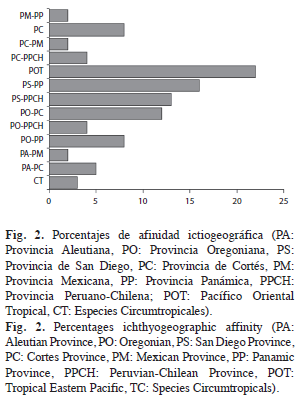
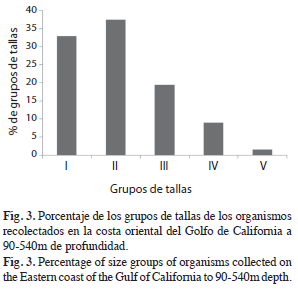
<body><![CDATA[(fue abundante en septiembre y mayo) y     <span style="font-style: italic;">Cherublemma emmelas</span>     (result&oacute; abundante en febrero y mayo)     (<a href="/img/revistas/rbt/v60n1/a24t2.gif">Cuadro 2</a>). Estas     especies son t&iacute;picos habitantes de la zona     profunda dentro del Golfo de California.    <br> </span></font><br style="font-family: verdana;"> <font size="2"><span style="font-family: verdana;">La afinidad biogeogr&aacute;fica muestra que dominaron las especies del Pac&iacute;fico Oriental Tropical (POT), seguidos de las especies de las provincias de San Diego-Pan&aacute;mica; San </span></font><font size="2"><span  style="font-family: verdana;">Diego-Pan&aacute;mica-peruano chilena y provincias Oregoniana-de Cort&eacute;s respectivamente (<a  href="#fig_2">Fig. 2</a>).     <br>     <br> </span></font>     <div style="text-align: center;"><font size="2"><a name="fig_2"></a><img  alt="" src="/img/revistas/rbt/v60n1/a24i2.jpg"  style="width: 302px; height: 401px;"><span  style="font-family: verdana;"></span></font><br  style="font-family: verdana;"> <font size="2"><span style="font-family: verdana;"></span></font></div> <br style="font-family: verdana;"> <font size="2"><span style="font-family: verdana;">Se encontr&oacute; que los peces de profundidad recolectados fueron de tallas peque&ntilde;as, del </span></font><font  size="2"><span style="font-family: verdana;">grupo I y II, acumulando 70% del total, los grupos est&aacute;n compuestos por peces de las familias Ophidiidae, Moridea, Lophidae, Scorpaenidae, Triglidae, Paralichthydae, Pleuronectidae y Cynoglossidae (<a href="#fig_3">Fig. 3</a>).    ]]></body>
<body><![CDATA[<br>     <br>     <br> </span></font>     <div style="text-align: center;"><font size="2"><a name="fig_3"></a><img      alt="" src="/img/revistas/rbt/v60n1/a24i3.jpg"      style="width: 298px; height: 290px;"><span      style="font-family: verdana;"></span></font><br      style="font-family: verdana;">     <font size="2"><span style="font-family: verdana;"></span></font></div>     <br style="font-family: verdana;">     ]]></body>
<body><![CDATA[<font style="font-weight: bold;" size="3"><span      style="font-family: verdana;">Discusi&oacute;n</span></font><br      style="font-family: verdana;">     <font size="2"></font><br style="font-family: verdana;">     <font size="2"><span style="font-family: verdana;">La especies     registradas en esta     regi&oacute;n oriental del Golfo de California, corresponde a </span></font><font      size="2"><span style="font-family: verdana;">especies de ecosistemas     de escasa     exploraci&oacute;n que aborda profundidades de hasta 700m,     ]]></body>
<body><![CDATA[proporcionando informaci&oacute;n comparativa con los trabajos previos     sobre la ictiofauna de profundidades m&aacute;s all&aacute; de los 90m.     De las 70 especies registradas, 14 presentaron las mayores abundancias     en los cruceros realizados, destacando <span      style="font-style: italic;">Argentina sialis, Caelorinchus     scaphopsis</span> y<span style="font-style: italic;"> Cherublemma     emmelas</span>. El n&uacute;mero de especies     vari&oacute; dependiendo de la estaci&oacute;n del a&ntilde;o, 33 en     septiembre (verano), 47 en febrero (invierno) y 49 en mayo (primavera).     Cabe resaltar que en donde se detect&oacute; mayor variaci&oacute;n con     ]]></body>
<body><![CDATA[tendencias m&aacute;s bajas en el n&uacute;mero de especies fue en el     periodo c&aacute;lido de septiembre, evento contrario a lo registrado     en otras regiones demersales de M&eacute;xico, como la costa occidental     de Baja California, la cual se distingue por un mayor predominio de     especies de afinidad tropical proveniente del Golfo de California     (Rodr&iacute;guez-Romero <span style="font-style: italic;">et al.</span>     2009).</span></font><br style="font-family: verdana;">     <font size="2"></font><br style="font-family: verdana;">     <font size="2"><span style="font-family: verdana;">Las especies propias     de     ]]></body>
<body><![CDATA[&aacute;reas profundas capturadas en este estudio son la quimera </span></font><font      size="2"><span style="font-family: verdana;">manchada <span      style="font-style: italic;">Hydrolagus colliei</span>, el     pejegato marr&oacute;n <span style="font-style: italic;">Apristurus     bruneus</span>, el pejegato pimienta <span style="font-style: italic;">Galeus     piperatus</span>, el congrio de cabeza corta <span      style="font-style: italic;">Bathycongrus macrurus</span>, el morido     cabeza grande <span style="font-style: italic;">Laemonema verecundum</span>,     el carbonero de fango <span style="font-style: italic;">Physiculus     nematopus</span>, el carbonero peruano <span     ]]></body>
<body><![CDATA[ style="font-style: italic;">Physiculus talarae</span>, el rocote     boquinegra <span style="font-style: italic;">Sebastes sinensis</span>,     el rocote ojo espinoso <span style="font-style: italic;">Sebastes     spinorbis     </span>y el chancharro espinoso <span style="font-style: italic;">Sebastolobus     altivelis</span>, el resto de los     miembros&nbsp; de la comunidad forman parte de las capturadas     habituales de los barcos camaroneros, hecho por dem&aacute;s     interesante, ya que muestra fracciones de las poblaciones no afectadas     por los arrastres de pesca, lo que necesariamente debe tener un impacto     ]]></body>
<body><![CDATA[positivo en la preservaci&oacute;n de dichas especies.</span></font><br      style="font-family: verdana;">     <font size="2"></font><br style="font-family: verdana;">     <font size="2"><span style="font-family: verdana;">La mayor&iacute;a de     los peces     demersales registrados son especies eurit&eacute;rmicas de amplia </span></font><font      size="2"><span style="font-family: verdana;">distribuci&oacute;n en el     Pac&iacute;fico Oriental Tropical. Las especies end&eacute;micas del     Golfo de California registradas son el rocote ojo espinoso <span      style="font-style: italic;">Sebastes     ]]></body>
<body><![CDATA[spinorbis</span>, el pejegato pimienta <span      style="font-style: italic;">G. piperatus</span>, el rocote boquinegra <span      style="font-style: italic;">S.     sinensis</span>, el chano norte&ntilde;o <span      style="font-style: italic;">Micropogonias megalops</span> y el     lenguado     escondido <span style="font-style: italic;">Citharichthys gordae</span>.</span></font><br      style="font-family: verdana;">     <font size="2"></font><br style="font-family: verdana;">     <font size="2"><span style="font-family: verdana;">El dominio de     ]]></body>
<body><![CDATA[especies con amplia     distribuci&oacute;n en la regi&oacute;n (POT), es el reflejo de     interacci&oacute;n de las masas de agua que conforman la cuenca del     Golfo de California, que presenta una clara estratificaci&oacute;n,     misma que est&aacute; determinada por la temperatura y la salinidad,     dichas especies est&aacute;n distribuidas en diferentes escalas de     profundidad (Lavin <span style="font-style: italic;">et al.</span>     1997). Se present&oacute; un total de ocho     divisiones zoogeogr&aacute;ficas, que marcan un cambio importante en la     asociaci&oacute;n de las especies de sur a norte. Al norte </span></font><font     ]]></body>
<body><![CDATA[ size="2"><span style="font-family: verdana;">resaltan las especies de     afinidad     templada; mientras que en el sur sobresalen las especies t&iacute;picas     del POT como la vaca angelita (<span style="font-style: italic;">Bellator     loxias</span>), el sapo de luto     (<span style="font-style: italic;">Porichthys analis</span>), el     lenguado frent&oacute;n (<span style="font-style: italic;">Citharichthys     platophrys</span>), el lenguado playero (<span      style="font-style: italic;">Syacium latifrons</span>), el lenguado     zapatilla (<span style="font-style: italic;">Etropus peruvianus</span>),     ]]></body>
<body><![CDATA[la corvina picuda <span style="font-style: italic;">Cynoscion     phoxocephalus</span> y otras. Aspectos similares en estas tendencias     fueron     documentados por Horn <span style="font-style: italic;">et al.</span>     (2006) y Rodr&iacute;guez Romero <span style="font-style: italic;">et     al.</span>     (2009). Cabe resaltar, </span></font><font size="2"><span      style="font-family: verdana;">que 17 especies fueron permanentes     y el resto presentaron cambios estacionales, resaltando por su     abundancia la argentina del Pac&iacute;fico (<span     ]]></body>
<body><![CDATA[ style="font-style: italic;">Argentina sialis</span>), el     morido cabeza grande (<span style="font-style: italic;">L. verecundum</span>),     la brotula negra (<span style="font-style: italic;">C. emmelas</span>),     el     congriperla cornuda (<span style="font-style: italic;">Lepophidium     proratees</span>) y la merluza (<span style="font-style: italic;">Merluccius     productus</span>).</span></font><br style="font-family: verdana;">     <font size="2"></font><br style="font-family: verdana;">     <font size="2"><span style="font-family: verdana;">El traslape     biogeogr&aacute;fico de     ]]></body>
<body><![CDATA[la fauna es un reflejo de la posici&oacute;n geogr&aacute;fica del     Golfo de </span></font><font size="2"><span      style="font-family: verdana;">California, considerada una zona     transicional templado-tropical, en donde se manifiestan especies de     afinidades templadas, tropicales y de transici&oacute;n     templado-c&aacute;lido. Las divisiones que caracterizan al Golfo de     California (regi&oacute;n Norte, Centro y Sur) y los eventos de     corrientes, mareas, turbulencias, surgencias y remolinos que se     desarrollan en ella, crean una vigorosa circulaci&oacute;n, esta     circulaci&oacute;n interact&uacute;a con la profundidad para crear un     ]]></body>
<body><![CDATA[espectro de energ&iacute;a cin&eacute;tica con periodos bien definidos </span></font><font      size="2"><span style="font-family: verdana;">(Badan-Dangon et al.     1985,     L&oacute;pez-Mart&iacute;nez&nbsp; 2000), creando eventos de alto     dinamismo de la fauna y flora marina, donde los peces aprovechan     diversos recursos o eventos para establecerse en zonas de alta     productividad biol&oacute;gica, desde zonas someras a profundas     (Rodr&iacute;guez Romero <span style="font-style: italic;">et al. </span>1998).</span></font><br      style="font-family: verdana;">     <font size="2"></font><br style="font-family: verdana;">     ]]></body>
<body><![CDATA[<font size="2"><span style="font-family: verdana;">Por otra parte, las     tallas de los     peces recolectados muestran que la mayor&iacute;a de los </span></font><font      size="2"><span style="font-family: verdana;">organismos son de     tama&ntilde;os     peque&ntilde;os, probablemente debido a la manera en que trabaj&oacute;     la red de pesca (a baja velocidad de arrastre), hecho que pudo permitir     una potencial evasi&oacute;n de los organismos de tallas mayores. </span></font><font      size="2"><span style="font-family: verdana;">Se sabe que la     composici&oacute;n     ]]></body>
<body><![CDATA[de las tallas de la captura depende de la velocidad, la abertura&nbsp;     de la malla y la selectividad de la red (L&oacute;pez-Mart&iacute;nez     2000).</span></font><br style="font-family: verdana;">     <font size="2"></font><br style="font-family: verdana;">     <font size="2"><span style="font-family: verdana;">Los estatus     taxon&oacute;micos en     peces con un enfoque de composici&oacute;n, ubicaci&oacute;n,     caracterizaci&oacute;n y zoogeograf&iacute;a son fundamentales para     desarrollar cualquier tema de biodiversidad y manejo pesquero     (Aguilar-Palomino <span style="font-style: italic;">et al. </span>1996;     ]]></body>
<body><![CDATA[Rodr&iacute;guez-Romero <span style="font-style: italic;">et al.</span>     2008).     Este estudio aporta informaci&oacute;n al conocimiento de la fauna     &iacute;ctica demersal de zonas profundas (90 a 540m) de la     regi&oacute;n oriental del Golfo de California.</span></font><br      style="font-family: verdana;">     <font size="2"></font><br style="font-family: verdana;">     <font style="font-weight: bold;" size="3"><span      style="font-family: verdana;">Agradecimientos</span></font><br      style="font-family: verdana;">     ]]></body>
<body><![CDATA[<font size="2"></font><br style="font-family: verdana;">     <font size="2"><span style="font-family: verdana;">Estos resultados se     derivan del     proyecto SAGARPA-CONACYT 2003-002 No. de </span><span      style="font-family: verdana;">registro: 024. Se agradece al     Centro de Investigaciones Biol&oacute;gicas su apoyo a trav&eacute;s     del proyecto EP0.12 y a la CONAPESCA la autorizaci&oacute;n del Permiso     de pesca de fomento No. DGOPA/230804. Se agradece al Laboratorio de     pesquer&iacute;as, especialmente a Rufino Morales Azpeitia y Gabriel     Rivera Vel&aacute;squez, se agradece a Xicothencatl Galicia su apoyo     ]]></body>
<body><![CDATA[log&iacute;stico.</span></font><br style="font-family: verdana;">     <font size="2"></font><br style="font-family: verdana;">     <font size="2"><span style="font-family: verdana; font-weight: bold;"></span></font>     <hr style="width: 100%; height: 2px;"><font size="3"><span      style="font-family: verdana; font-weight: bold;">Referencias</span></font><br      style="font-family: verdana;">     <font size="2"></font><br style="font-family: verdana;">     <font size="2"><span style="font-family: verdana;">Abitia     C&aacute;rdenas, L., R.J.     Rodr&iacute;guez, M.F. Galv&aacute;n, A.J. De la Cruz <span     ]]></body>
<body><![CDATA[ style="font-style: italic;">&amp;</span> R.H.     Ch&aacute;vez. 1994. Lista sistem&aacute;tica de la ictiofauna de     Bah&iacute;a de La Paz, Baja California Sur, M&eacute;xico. Cien. Mar.     <!-- ref -->20: 159-181.    &nbsp;&nbsp;&nbsp;&nbsp;&nbsp;&nbsp;&nbsp;&nbsp;[&#160;<a href="javascript:void(0);" onclick="javascript: window.open('/scielo.php?script=sci_nlinks&ref=1426401&pid=S0034-7744201200010002400001&lng=','','width=640,height=500,resizable=yes,scrollbars=1,menubar=yes,');">Links</a>&#160;]<!-- end-ref --><!-- ref --></span></font><br style="font-family: verdana;"> <font size="2"></font><br style="font-family: verdana;"> <font size="2"><span style="font-family: verdana;">Acevedo Cervantes, A., J. L&oacute;pez Mart&iacute;nez, E. Herrera Valdivia <span  style="font-style: italic;">&amp;</span> J. Rodr&iacute;guez-Romero. 2009. An&aacute;lisis de la abundancia, dominancia y diversidad de la comunidad de peces demersales de profundidad de 90 a 540 metros en el Golfo de California, M&eacute;xico. </span></font><font size="2"><span  style="font-family: verdana;">Interciencia 34: 660-665.    &nbsp;&nbsp;&nbsp;&nbsp;&nbsp;&nbsp;&nbsp;&nbsp;[&#160;<a href="javascript:void(0);" onclick="javascript: window.open('/scielo.php?script=sci_nlinks&ref=1426402&pid=S0034-7744201200010002400002&lng=','','width=640,height=500,resizable=yes,scrollbars=1,menubar=yes,');">Links</a>&#160;]<!-- end-ref --><!-- ref --></span></font><br  style="font-family: verdana;"> <font size="2"></font><br style="font-family: verdana;"> <font size="2"><span style="font-family: verdana;">Aguilar-Palomino, B., J. Mariscal-Romero, G. Gonz&aacute;lez- Sans&oacute;n <span  style="font-style: italic;">&amp;</span> L.E. Rodr&iacute;guez-Ibarra. 1996. Ictiofauna demersal de fondos blandos de la plataforma continental de Jalisco y Colima, M&eacute;xico, en la primavera de 1995. Cien. Mar. 22: 469-481.    &nbsp;&nbsp;&nbsp;&nbsp;&nbsp;&nbsp;&nbsp;&nbsp;[&#160;<a href="javascript:void(0);" onclick="javascript: window.open('/scielo.php?script=sci_nlinks&ref=1426403&pid=S0034-7744201200010002400003&lng=','','width=640,height=500,resizable=yes,scrollbars=1,menubar=yes,');">Links</a>&#160;]<!-- end-ref --><!-- ref --></span></font><br  style="font-family: verdana;"> <font size="2"></font><br style="font-family: verdana;"> <font size="2"><span style="font-family: verdana;">Amezcua-Linares, F. 1985. Recursos potenciales de peces capturados con redes camaroneras en la costa del Pac&iacute;fico de M&eacute;xico, p. 34-94. <span  style="font-style: italic;">In</span> A. Ya&ntilde;ez-Arancibia (comp.). Recursos potenciales de M&eacute;xico: la pesca acompa&ntilde;ante del camar&oacute;n. Programa Universitario de Alimentos, Instituto del Mar y Limnolog&iacute;a, Instituto Nacional de la Pesca, UNAM, M&eacute;xico.    &nbsp;&nbsp;&nbsp;&nbsp;&nbsp;&nbsp;&nbsp;&nbsp;[&#160;<a href="javascript:void(0);" onclick="javascript: window.open('/scielo.php?script=sci_nlinks&ref=1426404&pid=S0034-7744201200010002400004&lng=','','width=640,height=500,resizable=yes,scrollbars=1,menubar=yes,');">Links</a>&#160;]<!-- end-ref --><!-- ref --></span></font><br  style="font-family: verdana;"> <font size="2"></font><br style="font-family: verdana;"> <font size="2"><span style="font-family: verdana;">Arana, P.E., M. Barrios, J. Moraga, A. Mujica <span style="font-style: italic;">&amp;</span> R. Alarc&oacute;n. 2002. Evaluaci&oacute;n directa del camar&oacute;n nailon entre la II y VIII regiones, 1999. Informe Final. FIP. 99-08 Universidad Cat&oacute;lica del Norte, Coquimbo, Chile.    &nbsp;&nbsp;&nbsp;&nbsp;&nbsp;&nbsp;&nbsp;&nbsp;[&#160;<a href="javascript:void(0);" onclick="javascript: window.open('/scielo.php?script=sci_nlinks&ref=1426405&pid=S0034-7744201200010002400005&lng=','','width=640,height=500,resizable=yes,scrollbars=1,menubar=yes,');">Links</a>&#160;]<!-- end-ref --><!-- ref --></span></font><br  style="font-family: verdana;"> <font size="2"></font><br style="font-family: verdana;"> <font size="2"><span style="font-family: verdana;">Badan-Dangon, A., D.J. Koblinsk <span style="font-style: italic;">&amp;</span> T. Baumgartner. 1985. Spring and summer in the Gulf of California: observation on surface thermal patterns. Oceanol. Acta 8: 13-22.    &nbsp;&nbsp;&nbsp;&nbsp;&nbsp;&nbsp;&nbsp;&nbsp;[&#160;<a href="javascript:void(0);" onclick="javascript: window.open('/scielo.php?script=sci_nlinks&ref=1426406&pid=S0034-7744201200010002400006&lng=','','width=640,height=500,resizable=yes,scrollbars=1,menubar=yes,');">Links</a>&#160;]<!-- end-ref --><!-- ref --></span></font><br style="font-family: verdana;"> <font size="2"></font><br style="font-family: verdana;"> <font size="2"><span style="font-family: verdana;">Boschi, E.E. 2000. Species of decapod crustaceans and their distribution in the American marine zoogeographic provinces. Rev. Inv. y Des. Pesq. 13:7-136.    &nbsp;&nbsp;&nbsp;&nbsp;&nbsp;&nbsp;&nbsp;&nbsp;[&#160;<a href="javascript:void(0);" onclick="javascript: window.open('/scielo.php?script=sci_nlinks&ref=1426407&pid=S0034-7744201200010002400007&lng=','','width=640,height=500,resizable=yes,scrollbars=1,menubar=yes,');">Links</a>&#160;]<!-- end-ref --><!-- ref --></span></font><br  style="font-family: verdana;"> <font size="2"></font><br style="font-family: verdana;"> <font size="2"><span style="font-family: verdana;">Brewer, G.D. 1973. Midwater fishes from the Gulf of California and the adjacent Tropical Pacific. Los Angeles County Natural History Museum, Contrib. Sci., 242: 1-47.    &nbsp;&nbsp;&nbsp;&nbsp;&nbsp;&nbsp;&nbsp;&nbsp;[&#160;<a href="javascript:void(0);" onclick="javascript: window.open('/scielo.php?script=sci_nlinks&ref=1426408&pid=S0034-7744201200010002400008&lng=','','width=640,height=500,resizable=yes,scrollbars=1,menubar=yes,');">Links</a>&#160;]<!-- end-ref --><!-- ref --></span></font><br  style="font-family: verdana;"> <font size="2"></font><br style="font-family: verdana;"> <font size="2"><span style="font-family: verdana;">Briggs, J.C. 1974. Marine zoogeography. McGraw-Hill, Nueva York, EEUU.    &nbsp;&nbsp;&nbsp;&nbsp;&nbsp;&nbsp;&nbsp;&nbsp;[&#160;<a href="javascript:void(0);" onclick="javascript: window.open('/scielo.php?script=sci_nlinks&ref=1426409&pid=S0034-7744201200010002400009&lng=','','width=640,height=500,resizable=yes,scrollbars=1,menubar=yes,');">Links</a>&#160;]<!-- end-ref --><!-- ref --></span></font><br  style="font-family: verdana;"> <font size="2"></font><br style="font-family: verdana;"> <font size="2"><span style="font-family: verdana;">Briggs, J.C. 1995. Global biogeography. Elsevier, Amsterdam, Pa&iacute;ses Bajos.    &nbsp;&nbsp;&nbsp;&nbsp;&nbsp;&nbsp;&nbsp;&nbsp;[&#160;<a href="javascript:void(0);" onclick="javascript: window.open('/scielo.php?script=sci_nlinks&ref=1426410&pid=S0034-7744201200010002400010&lng=','','width=640,height=500,resizable=yes,scrollbars=1,menubar=yes,');">Links</a>&#160;]<!-- end-ref --><!-- ref --></span></font><br  style="font-family: verdana;"> <font size="2"></font><br style="font-family: verdana;"> <font size="2"><span style="font-family: verdana;">Castro-Aguirre, J.L. <span style="font-style: italic;">&amp;</span> E.F. Balart. 1996. Contribuci&oacute;n al conocimiento del origen y las relaciones de la ictiofauna de aguas profundas del Golfo de California, M&eacute;xico. Hidrobiol&oacute;gica 6: 67-76.    &nbsp;&nbsp;&nbsp;&nbsp;&nbsp;&nbsp;&nbsp;&nbsp;[&#160;<a href="javascript:void(0);" onclick="javascript: window.open('/scielo.php?script=sci_nlinks&ref=1426411&pid=S0034-7744201200010002400011&lng=','','width=640,height=500,resizable=yes,scrollbars=1,menubar=yes,');">Links</a>&#160;]<!-- end-ref --><!-- ref --></span></font><br  style="font-family: verdana;"> <font size="2"></font><br style="font-family: verdana;"> <font size="2"><span style="font-family: verdana;">Castro-Aguirre, J.L. <span style="font-style: italic;">&amp;</span> H. Espinosa P&eacute;rez. 1996. Listados faun&iacute;sticos de M&eacute;xico. VII. Cat&aacute;logo sistem&aacute;tico de las rayas y especies afines de M&eacute;xico (Chondrichthyes: Elasmobranchii: Rajiformes: Batoideiomorpha). Instituto de Biolog&iacute;a, UNAM. M&eacute;xico D.F., M&eacute;xico.    &nbsp;&nbsp;&nbsp;&nbsp;&nbsp;&nbsp;&nbsp;&nbsp;[&#160;<a href="javascript:void(0);" onclick="javascript: window.open('/scielo.php?script=sci_nlinks&ref=1426412&pid=S0034-7744201200010002400012&lng=','','width=640,height=500,resizable=yes,scrollbars=1,menubar=yes,');">Links</a>&#160;]<!-- end-ref --><!-- ref --></span></font><br  style="font-family: verdana;"> <font size="2"></font><br style="font-family: verdana;"> <font size="2"><span style="font-family: verdana;">Castro-Aguirre, J.L. 1991. Nuevos registros de peces mesopel&aacute;gicos y bent&oacute;nicos en el Golfo de California, M&eacute;xico. An. Esc. Nal. Cienc. Biol. M&eacute;x. 35: 71-89.    &nbsp;&nbsp;&nbsp;&nbsp;&nbsp;&nbsp;&nbsp;&nbsp;[&#160;<a href="javascript:void(0);" onclick="javascript: window.open('/scielo.php?script=sci_nlinks&ref=1426413&pid=S0034-7744201200010002400013&lng=','','width=640,height=500,resizable=yes,scrollbars=1,menubar=yes,');">Links</a>&#160;]<!-- end-ref --><!-- ref --></span></font><br style="font-family: verdana;"> <font size="2"></font><br style="font-family: verdana;"> <font size="2"><span style="font-family: verdana;">Castro-Aguirre, J.L., E.F. Balart<span style="font-style: italic;"> &amp;</span> J. Arvizu Mart&iacute;nez. 1995. Contribuci&oacute;n al conocimiento del origen y distribuci&oacute;n de la ictiofauna del Golfo de California, M&eacute;xico. Hirobiol&oacute;gica 5: 57-78.    &nbsp;&nbsp;&nbsp;&nbsp;&nbsp;&nbsp;&nbsp;&nbsp;[&#160;<a href="javascript:void(0);" onclick="javascript: window.open('/scielo.php?script=sci_nlinks&ref=1426414&pid=S0034-7744201200010002400014&lng=','','width=640,height=500,resizable=yes,scrollbars=1,menubar=yes,');">Links</a>&#160;]<!-- end-ref --><!-- ref --></span></font><br  style="font-family: verdana;"> <font size="2"></font><br style="font-family: verdana;"> <font size="2"><span style="font-family: verdana;">Compagno, L.J.V. 1984. Species Catalogue. Sharks of the World. An annotated and illustrated catalogue of sharks species known to date. Part. 2. Carcharhiniformes. </span></font><font  size="2"><span style="font-family: verdana;">FAO Fish. Synop. 4: 251-655.    &nbsp;&nbsp;&nbsp;&nbsp;&nbsp;&nbsp;&nbsp;&nbsp;[&#160;<a href="javascript:void(0);" onclick="javascript: window.open('/scielo.php?script=sci_nlinks&ref=1426415&pid=S0034-7744201200010002400015&lng=','','width=640,height=500,resizable=yes,scrollbars=1,menubar=yes,');">Links</a>&#160;]<!-- end-ref --><!-- ref --></span></font><br style="font-family: verdana;"> <font size="2"></font><br style="font-family: verdana;"> <font size="2"><span style="font-family: verdana;">Ch&aacute;vez, H. <span  style="font-style: italic;">&amp;</span> J. Arvizu-Mart&iacute;nez. 1972. Estudio de los recursos pesqueros demersales del Golfo de California, 1968-1969. III. Fauna de acompa&ntilde;amiento de camar&oacute;n (peces finos y basura). <span  style="font-style: italic;">In</span> J. Carranza (ed.). Mem. VI Congr. Nal. Oceanogr. M&eacute;xico, 1969: 361-378.    &nbsp;&nbsp;&nbsp;&nbsp;&nbsp;&nbsp;&nbsp;&nbsp;[&#160;<a href="javascript:void(0);" onclick="javascript: window.open('/scielo.php?script=sci_nlinks&ref=1426416&pid=S0034-7744201200010002400016&lng=','','width=640,height=500,resizable=yes,scrollbars=1,menubar=yes,');">Links</a>&#160;]<!-- end-ref --><!-- ref --></span></font><br style="font-family: verdana;"> <font size="2"></font><br style="font-family: verdana;"> <font size="2"><span style="font-family: verdana;">Ch&aacute;vez, H. 1986. Bibliograf&iacute;a de los peces del Golfo de California. Inv. Mar. CICIMAR, num. esp. 1: 1-267.    &nbsp;&nbsp;&nbsp;&nbsp;&nbsp;&nbsp;&nbsp;&nbsp;[&#160;<a href="javascript:void(0);" onclick="javascript: window.open('/scielo.php?script=sci_nlinks&ref=1426417&pid=S0034-7744201200010002400017&lng=','','width=640,height=500,resizable=yes,scrollbars=1,menubar=yes,');">Links</a>&#160;]<!-- end-ref --><!-- ref --></span></font><br  style="font-family: verdana;"> <font size="2"></font><br style="font-family: verdana;"> <font size="2"><span style="font-family: verdana;">De La Cruz-Ag&uuml;ero, J., F.M. Galv&aacute;n, A.C. Abitia, J.R. Rodr&iacute;guez <span  style="font-style: italic;">&amp;</span> F.J. Guti&eacute;rrez. 1994. Lista sistem&aacute;tica de los peces marinos de Bah&iacute;a Magdalena, Baja California Sur, M&eacute;xico. Cien. Mar. 20: 17-31.    &nbsp;&nbsp;&nbsp;&nbsp;&nbsp;&nbsp;&nbsp;&nbsp;[&#160;<a href="javascript:void(0);" onclick="javascript: window.open('/scielo.php?script=sci_nlinks&ref=1426418&pid=S0034-7744201200010002400018&lng=','','width=640,height=500,resizable=yes,scrollbars=1,menubar=yes,');">Links</a>&#160;]<!-- end-ref --><!-- ref --></span></font><br style="font-family: verdana;"> <font size="2"></font><br style="font-family: verdana;"> <font size="2"><span style="font-family: verdana;">Eschmeyer, W.N., E.S. Herald <span style="font-style: italic;">&amp;</span> H. Hammann. 1983. A field guide to the Pacific coast fishes of North America. Hougthon Mifflin, Boston, EEUU.    &nbsp;&nbsp;&nbsp;&nbsp;&nbsp;&nbsp;&nbsp;&nbsp;[&#160;<a href="javascript:void(0);" onclick="javascript: window.open('/scielo.php?script=sci_nlinks&ref=1426419&pid=S0034-7744201200010002400019&lng=','','width=640,height=500,resizable=yes,scrollbars=1,menubar=yes,');">Links</a>&#160;]<!-- end-ref --><!-- ref --></span></font><br  style="font-family: verdana;"> <font size="2"></font><br style="font-family: verdana;"> <font size="2"><span style="font-family: verdana;">Espinosa-P&eacute;rez, H., J.L. Castro-Aguirre <span style="font-style: italic;">&amp;</span> L. Huidobro Campos. 2004. Listados faun&iacute;sticos de M&eacute;xico. IX. Cat&aacute;logo sistem&aacute;tico de tiburones (Elasmobranchii: Selachimorpha). Instituto de Biolog&iacute;a UNAM. D.F.,&nbsp; M&eacute;xico.    &nbsp;&nbsp;&nbsp;&nbsp;&nbsp;&nbsp;&nbsp;&nbsp;[&#160;<a href="javascript:void(0);" onclick="javascript: window.open('/scielo.php?script=sci_nlinks&ref=1426420&pid=S0034-7744201200010002400020&lng=','','width=640,height=500,resizable=yes,scrollbars=1,menubar=yes,');">Links</a>&#160;]<!-- end-ref --><!-- ref --></span></font><br  style="font-family: verdana;"> <font size="2"></font><br style="font-family: verdana;"> <font size="2"><span style="font-family: verdana;">Fischer, W., F. Krupp, W. Schneider, C. Sommer, K.E. Carpenter <span style="font-style: italic;">&amp;</span> V.H. Niem (eds.). 1995. Gu&iacute;a FAO para la identificaci&oacute;n de especies para los fines de pesca. Pac&iacute;fico Centro-Oriental. FAO. Roma.    &nbsp;&nbsp;&nbsp;&nbsp;&nbsp;&nbsp;&nbsp;&nbsp;[&#160;<a href="javascript:void(0);" onclick="javascript: window.open('/scielo.php?script=sci_nlinks&ref=1426421&pid=S0034-7744201200010002400021&lng=','','width=640,height=500,resizable=yes,scrollbars=1,menubar=yes,');">Links</a>&#160;]<!-- end-ref --><!-- ref --></span></font><br  style="font-family: verdana;"> <font size="2"></font><br style="font-family: verdana;"> <font size="2"><span style="font-family: verdana;">Fossen, I., C.F. Cotton, O.A. Bergstad <span style="font-style: italic;">&amp;</span> J.E. Dyb. 2008. Species composition and distribution patterns of fishes captured by long-lines on the mid-Atlantic ridge. Deep sea Res. II 55: 203-217.    &nbsp;&nbsp;&nbsp;&nbsp;&nbsp;&nbsp;&nbsp;&nbsp;[&#160;<a href="javascript:void(0);" onclick="javascript: window.open('/scielo.php?script=sci_nlinks&ref=1426422&pid=S0034-7744201200010002400022&lng=','','width=640,height=500,resizable=yes,scrollbars=1,menubar=yes,');">Links</a>&#160;]<!-- end-ref --><!-- ref --></span></font><br  style="font-family: verdana;"> <font size="2"></font><br style="font-family: verdana;"> <font size="2"><span style="font-family: verdana;">Fujita, T., T. Inada <span style="font-style: italic;">&amp;</span> Y. Ishito. 1995. Depth gradient structure of the demersal fish community on the continental shelf and upper slope off Sendai Bay, Japan. Mar. Ecol. Prog. Ser. 118: 13-23.    &nbsp;&nbsp;&nbsp;&nbsp;&nbsp;&nbsp;&nbsp;&nbsp;[&#160;<a href="javascript:void(0);" onclick="javascript: window.open('/scielo.php?script=sci_nlinks&ref=1426423&pid=S0034-7744201200010002400023&lng=','','width=640,height=500,resizable=yes,scrollbars=1,menubar=yes,');">Links</a>&#160;]<!-- end-ref --><!-- ref --></span></font><br  style="font-family: verdana;"> <font size="2"></font><br style="font-family: verdana;"> <font size="2"><span style="font-family: verdana;">Galv&aacute;n-Maga&ntilde;a, F., L.A. Abitia-C&aacute;rdenas, J. Rodr&iacute;guez- Romero, H. P&eacute;rez-Espa&ntilde;a <span style="font-style: italic;">&amp;</span> H. Ch&aacute;vez-Ramos. 1996. Lista sistem&aacute;tica de los peces de isla Cerralvo, Baja California Sur, M&eacute;xico. Cien. Mar. 22: 295-311.    &nbsp;&nbsp;&nbsp;&nbsp;&nbsp;&nbsp;&nbsp;&nbsp;[&#160;<a href="javascript:void(0);" onclick="javascript: window.open('/scielo.php?script=sci_nlinks&ref=1426424&pid=S0034-7744201200010002400024&lng=','','width=640,height=500,resizable=yes,scrollbars=1,menubar=yes,');">Links</a>&#160;]<!-- end-ref --><!-- ref --></span></font><br  style="font-family: verdana;"> <font size="2"></font><br style="font-family: verdana;"> <font size="2"><span style="font-family: verdana;">Galv&aacute;n-Maga&ntilde;a, F., S.F.J. Guti&eacute;rrez, C.L.A. Abitia <span  style="font-style: italic;">&amp;</span> J.R. Rodr&iacute;guez. 2000. The distribution and affinities of the shore fishes of the Baja California Sur Lagoons. <span style="font-style: italic;">In</span> M. Manuwar, S.G. Lawrence, I.F. Manuwar <span style="font-style: italic;">&amp;</span> D.F. Malley (eds.). Aquatic Ecosystems of M&eacute;xico: Status &amp; Scoop. Ecovision world monograph series. Backhunys, Holanda.    &nbsp;&nbsp;&nbsp;&nbsp;&nbsp;&nbsp;&nbsp;&nbsp;[&#160;<a href="javascript:void(0);" onclick="javascript: window.open('/scielo.php?script=sci_nlinks&ref=1426425&pid=S0034-7744201200010002400025&lng=','','width=640,height=500,resizable=yes,scrollbars=1,menubar=yes,');">Links</a>&#160;]<!-- end-ref --><!-- ref --></span></font><br  style="font-family: verdana;"> <font size="2"></font><br style="font-family: verdana;"> <font size="2"><span style="font-family: verdana;">Garman, S. 1899. Reports on an exploration off the west coast of Mexico, Central America, South America, and off the Galapagos Islands, in charge of Alexander Agassiz, by the U.S. Fish Commission steamer &#8220;Albatross&#8221; during 1891, Lieut. Commander Z. L. Tanner, U.S.N. commanding. XXVI Pt. 26. The fishes Mem. Mus. Comp. Zool. 24.    &nbsp;&nbsp;&nbsp;&nbsp;&nbsp;&nbsp;&nbsp;&nbsp;[&#160;<a href="javascript:void(0);" onclick="javascript: window.open('/scielo.php?script=sci_nlinks&ref=1426426&pid=S0034-7744201200010002400026&lng=','','width=640,height=500,resizable=yes,scrollbars=1,menubar=yes,');">Links</a>&#160;]<!-- end-ref --><!-- ref --></span></font><br style="font-family: verdana;"> <font size="2"></font><br style="font-family: verdana;"> <font size="2"><span style="font-family: verdana;">Ginsburg, I. 1958. Flounders of the genus <span style="font-style: italic;">Paralichthys </span>and related genera in american waters. U.S. Fish. Wildl. Serv., Fish. Bull. 52: 267-351.    &nbsp;&nbsp;&nbsp;&nbsp;&nbsp;&nbsp;&nbsp;&nbsp;[&#160;<a href="javascript:void(0);" onclick="javascript: window.open('/scielo.php?script=sci_nlinks&ref=1426427&pid=S0034-7744201200010002400027&lng=','','width=640,height=500,resizable=yes,scrollbars=1,menubar=yes,');">Links</a>&#160;]<!-- end-ref --><!-- ref --></span></font><br  style="font-family: verdana;"> <font size="2"></font><br style="font-family: verdana;"> <font size="2"><span style="font-family: verdana;">Goode, G.B. <span  style="font-style: italic;">&amp;</span> T.H. Bean. 1895. Oceanic ichthyology: deep-sea and pelagic fishes of the world. Smithsonian Institution.    &nbsp;&nbsp;&nbsp;&nbsp;&nbsp;&nbsp;&nbsp;&nbsp;[&#160;<a href="javascript:void(0);" onclick="javascript: window.open('/scielo.php?script=sci_nlinks&ref=1426428&pid=S0034-7744201200010002400028&lng=','','width=640,height=500,resizable=yes,scrollbars=1,menubar=yes,');">Links</a>&#160;]<!-- end-ref --><!-- ref --></span></font><br style="font-family: verdana;"> <font size="2"></font><br style="font-family: verdana;"> <font size="2"><span style="font-family: verdana;">Gordon, J.D.M., A.O. Bergstad, I. Figueiredo <span style="font-style: italic;">&amp;</span> G. Menezes. 2003. Deep water fisheries of the Northeast Atlantic: I. Description and current Trends. J. Northw. Atl. Fish. Sci. 31: 137-150.    &nbsp;&nbsp;&nbsp;&nbsp;&nbsp;&nbsp;&nbsp;&nbsp;[&#160;<a href="javascript:void(0);" onclick="javascript: window.open('/scielo.php?script=sci_nlinks&ref=1426429&pid=S0034-7744201200010002400029&lng=','','width=640,height=500,resizable=yes,scrollbars=1,menubar=yes,');">Links</a>&#160;]<!-- end-ref --><!-- ref --></span></font><br style="font-family: verdana;"> <font size="2"></font><br style="font-family: verdana;"> <font size="2"><span style="font-family: verdana;">Grant, A. 2000. Deep sea diversity: Overlooked messages from shallow waters sediments. Mar. Ecol. 21: 97-112.    &nbsp;&nbsp;&nbsp;&nbsp;&nbsp;&nbsp;&nbsp;&nbsp;[&#160;<a href="javascript:void(0);" onclick="javascript: window.open('/scielo.php?script=sci_nlinks&ref=1426430&pid=S0034-7744201200010002400030&lng=','','width=640,height=500,resizable=yes,scrollbars=1,menubar=yes,');">Links</a>&#160;]<!-- end-ref --></span></font><br style="font-family: verdana;"> <font size="2"><span style="font-family: verdana;"></span></font>    <!-- ref --><br> <font size="2"><span style="font-family: verdana;">Grassle, J.F. 1989. Species diversity in deep-sea communities. Trends Ecol. Evol. 4: 12-15.    &nbsp;&nbsp;&nbsp;&nbsp;&nbsp;&nbsp;&nbsp;&nbsp;[&#160;<a href="javascript:void(0);" onclick="javascript: window.open('/scielo.php?script=sci_nlinks&ref=1426432&pid=S0034-7744201200010002400031&lng=','','width=640,height=500,resizable=yes,scrollbars=1,menubar=yes,');">Links</a>&#160;]<!-- end-ref --><!-- ref --></span></font><br  style="font-family: verdana;"> <font size="2"></font><br style="font-family: verdana;"> <font size="2"><span style="font-family: verdana;">Grey, M. 1956. The distribution of fishes found below a deep of 2000 meters. Zoology 36: 75-337.    &nbsp;&nbsp;&nbsp;&nbsp;&nbsp;&nbsp;&nbsp;&nbsp;[&#160;<a href="javascript:void(0);" onclick="javascript: window.open('/scielo.php?script=sci_nlinks&ref=1426433&pid=S0034-7744201200010002400032&lng=','','width=640,height=500,resizable=yes,scrollbars=1,menubar=yes,');">Links</a>&#160;]<!-- end-ref --><!-- ref --></span></font><br  style="font-family: verdana;"> <font size="2"></font><br style="font-family: verdana;"> <font size="2"><span style="font-family: verdana;">Gristina, M., T. Bahri, F. Fiorentino <span style="font-style: italic;">&amp;</span> G. Garafalo. 2006. Comparison of demersal fish assemblages in three areas of the Straight of Sicily under different trawling pressure. Fish. Res. 81: 60-71.    &nbsp;&nbsp;&nbsp;&nbsp;&nbsp;&nbsp;&nbsp;&nbsp;[&#160;<a href="javascript:void(0);" onclick="javascript: window.open('/scielo.php?script=sci_nlinks&ref=1426434&pid=S0034-7744201200010002400033&lng=','','width=640,height=500,resizable=yes,scrollbars=1,menubar=yes,');">Links</a>&#160;]<!-- end-ref --><!-- ref --></span></font><br  style="font-family: verdana;"> <font size="2"></font><br style="font-family: verdana;"> <font size="2"><span style="font-family: verdana;">Hastings, P.A. 2000. Biogeography of the tropical eastern Pacific: distribution and phylogeny of chaenopsid fishes. Zool. J. Lin. Soc. 128: 319-335.    &nbsp;&nbsp;&nbsp;&nbsp;&nbsp;&nbsp;&nbsp;&nbsp;[&#160;<a href="javascript:void(0);" onclick="javascript: window.open('/scielo.php?script=sci_nlinks&ref=1426435&pid=S0034-7744201200010002400034&lng=','','width=640,height=500,resizable=yes,scrollbars=1,menubar=yes,');">Links</a>&#160;]<!-- end-ref --><!-- ref --></span></font><br  style="font-family: verdana;"> <font size="2"></font><br style="font-family: verdana;"> <font size="2"><span style="font-family: verdana;">Horn, M.H., L.G. Allen <span style="font-style: italic;">&amp;</span> R.N. Lea. 2006. Biogeography.&nbsp; <span style="font-style: italic;">In</span> L.G. Allen, D.J. Pondella <span style="font-style: italic;">&amp;</span> M.H. Horn (eds.). The ecology of marine fishes: California and adjacent waters. University of California, Berkeley, EEUU.    &nbsp;&nbsp;&nbsp;&nbsp;&nbsp;&nbsp;&nbsp;&nbsp;[&#160;<a href="javascript:void(0);" onclick="javascript: window.open('/scielo.php?script=sci_nlinks&ref=1426436&pid=S0034-7744201200010002400035&lng=','','width=640,height=500,resizable=yes,scrollbars=1,menubar=yes,');">Links</a>&#160;]<!-- end-ref --><br>     ]]></body>
<body><![CDATA[<!-- ref --><br> Jordan, D.S. <span style="font-style: italic;">&amp;</span> B.W. Evermann. 1896-1900. The fishes of North and Middle America. Bull. Natl. Mus. 47: 1-3313.    &nbsp;&nbsp;&nbsp;&nbsp;&nbsp;&nbsp;&nbsp;&nbsp;[&#160;<a href="javascript:void(0);" onclick="javascript: window.open('/scielo.php?script=sci_nlinks&ref=1426438&pid=S0034-7744201200010002400036&lng=','','width=640,height=500,resizable=yes,scrollbars=1,menubar=yes,');">Links</a>&#160;]<!-- end-ref --><!-- ref --></span></font><br style="font-family: verdana;"> <font size="2"></font><br style="font-family: verdana;"> <font size="2"><span style="font-family: verdana;">Koslow, J.A., K. Gowlett-Holmes, J.K. Lowry, T. O&#8217;Hara, G.C.B. Poore <span style="font-style: italic;">&amp;</span> A. Williams. 2001. Seamount benthic macrofauna off southern Tasmania: community structure </span><span  style="font-family: verdana;">and impacts of trawling. Mar. Ecol. Progr. 213: 111-125.    &nbsp;&nbsp;&nbsp;&nbsp;&nbsp;&nbsp;&nbsp;&nbsp;[&#160;<a href="javascript:void(0);" onclick="javascript: window.open('/scielo.php?script=sci_nlinks&ref=1426439&pid=S0034-7744201200010002400037&lng=','','width=640,height=500,resizable=yes,scrollbars=1,menubar=yes,');">Links</a>&#160;]<!-- end-ref --><!-- ref --></span></font><br style="font-family: verdana;"> <font size="2"></font><br style="font-family: verdana;"> <font size="2"><span style="font-family: verdana;">L&oacute;pez Mart&iacute;nez, J. 2000. Din&aacute;mica de la pesquer&iacute;a de camar&oacute;n caf&eacute; (<span style="font-style: italic;">Penaeus californiensis</span>) en el litoral sonorense y su relaci&oacute;n con algunos par&aacute;metros oc&eacute;ano-atmosf&eacute;ricos. Tesis de Doctorado, Centro Interdisciplinario de Ciencias Marinas, La Paz, Baja California Sur, M&eacute;xico.    &nbsp;&nbsp;&nbsp;&nbsp;&nbsp;&nbsp;&nbsp;&nbsp;[&#160;<a href="javascript:void(0);" onclick="javascript: window.open('/scielo.php?script=sci_nlinks&ref=1426440&pid=S0034-7744201200010002400038&lng=','','width=640,height=500,resizable=yes,scrollbars=1,menubar=yes,');">Links</a>&#160;]<!-- end-ref --><!-- ref --></span></font><br style="font-family: verdana;"> <font size="2"></font><br style="font-family: verdana;"> <font size="2"><span style="font-family: verdana;">Love, M.S., C.W. Mecklenburg, T.A. Mecklenburg <span style="font-style: italic;">&amp;</span> L.K. Thorsteinson. 2005. Resource Inventory of Marine and Estuarine Fishes of the West Coast and Alaska: A Checklist of North Pacific and Arctic Ocean Species from Baja California to the Alaska-Yukon Border. U. S. Department of the Interior, U. S. Geological Survey, Biological Resources Division, Seattle, Washington, EEUU.    &nbsp;&nbsp;&nbsp;&nbsp;&nbsp;&nbsp;&nbsp;&nbsp;[&#160;<a href="javascript:void(0);" onclick="javascript: window.open('/scielo.php?script=sci_nlinks&ref=1426441&pid=S0034-7744201200010002400039&lng=','','width=640,height=500,resizable=yes,scrollbars=1,menubar=yes,');">Links</a>&#160;]<!-- end-ref --><!-- ref --></span></font><br  style="font-family: verdana;"> <font size="2"></font><br style="font-family: verdana;"> <font size="2"><span style="font-family: verdana;">McPhail, J.D. 1958. Key to the croakers (Sciaenidae) of the eastern Pacific. Univ. Brit. Columbia, Inst. Fish., Mus. Contrib. 2: 1-20.    &nbsp;&nbsp;&nbsp;&nbsp;&nbsp;&nbsp;&nbsp;&nbsp;[&#160;<a href="javascript:void(0);" onclick="javascript: window.open('/scielo.php?script=sci_nlinks&ref=1426442&pid=S0034-7744201200010002400040&lng=','','width=640,height=500,resizable=yes,scrollbars=1,menubar=yes,');">Links</a>&#160;]<!-- end-ref --><!-- ref --></span></font><br  style="font-family: verdana;"> <font size="2"></font><br style="font-family: verdana;"> <font size="2"><span style="font-family: verdana;">Meek, S.E. <span  style="font-style: italic;">;</span> S.F. Hildebrand. 1923-1928. The marine fishes of Panama. Publ. Field. Mus. Nat. Hist., Zool. Ser. 15: 1-1045.    &nbsp;&nbsp;&nbsp;&nbsp;&nbsp;&nbsp;&nbsp;&nbsp;[&#160;<a href="javascript:void(0);" onclick="javascript: window.open('/scielo.php?script=sci_nlinks&ref=1426443&pid=S0034-7744201200010002400041&lng=','','width=640,height=500,resizable=yes,scrollbars=1,menubar=yes,');">Links</a>&#160;]<!-- end-ref --><!-- ref --></span></font><br style="font-family: verdana;"> <font size="2"></font><br style="font-family: verdana;"> <font size="2"><span style="font-family: verdana;">Miller, D.J. <span  style="font-style: italic;">&amp;</span> R.N. Lea. 1972. Guide to the coastal marine fishes of California. Fish Bulletin 157.    &nbsp;&nbsp;&nbsp;&nbsp;&nbsp;&nbsp;&nbsp;&nbsp;[&#160;<a href="javascript:void(0);" onclick="javascript: window.open('/scielo.php?script=sci_nlinks&ref=1426444&pid=S0034-7744201200010002400042&lng=','','width=640,height=500,resizable=yes,scrollbars=1,menubar=yes,');">Links</a>&#160;]<!-- end-ref --><!-- ref --> </span></font><br  style="font-family: verdana;"> <font size="2"></font><br style="font-family: verdana;"> <font size="2"><span style="font-family: verdana;">Moncayo-Estrada, R., J. Castro-Aguirre <span style="font-style: italic;">&amp;</span> J. De La Cruz- Ag&uuml;ero. 2006. Lista sistem&aacute;tica de la ictiofauna de Bah&iacute;a de Banderas, M&eacute;xico. Rev. Mex. Biol. 77: 67-80.    &nbsp;&nbsp;&nbsp;&nbsp;&nbsp;&nbsp;&nbsp;&nbsp;[&#160;<a href="javascript:void(0);" onclick="javascript: window.open('/scielo.php?script=sci_nlinks&ref=1426445&pid=S0034-7744201200010002400043&lng=','','width=640,height=500,resizable=yes,scrollbars=1,menubar=yes,');">Links</a>&#160;]<!-- end-ref --><!-- ref --></span></font><br  style="font-family: verdana;"> <font size="2"></font><br style="font-family: verdana;"> <font size="2"><span style="font-family: verdana;">Nelson, J.S., E.J.Crossman, H. Espinosa-Perez, L.T. Findley, C.R. Gilbert, R.N. Lea <span  style="font-style: italic;">&amp;</span> J.D. Williams. 2004. Common and scientific names of fishes from the United States, Canada, and Mexico. American Fisheries Society, Special Publication 29, Bethesda, Maryland.    &nbsp;&nbsp;&nbsp;&nbsp;&nbsp;&nbsp;&nbsp;&nbsp;[&#160;<a href="javascript:void(0);" onclick="javascript: window.open('/scielo.php?script=sci_nlinks&ref=1426446&pid=S0034-7744201200010002400044&lng=','','width=640,height=500,resizable=yes,scrollbars=1,menubar=yes,');">Links</a>&#160;]<!-- end-ref --><!-- ref --></span></font><br  style="font-family: verdana;"> <font size="2"></font><br style="font-family: verdana;"> <font size="2"><span style="font-family: verdana;">Nelson, J.S. 2006. Fishes of the world. Wiley, Hoboken, Nueva Jersey, EEUU.    &nbsp;&nbsp;&nbsp;&nbsp;&nbsp;&nbsp;&nbsp;&nbsp;[&#160;<a href="javascript:void(0);" onclick="javascript: window.open('/scielo.php?script=sci_nlinks&ref=1426447&pid=S0034-7744201200010002400045&lng=','','width=640,height=500,resizable=yes,scrollbars=1,menubar=yes,');">Links</a>&#160;]<!-- end-ref --><!-- ref --></span></font><br  style="font-family: verdana;"> <font size="2"></font><br style="font-family: verdana;"> <font size="2"><span style="font-family: verdana;">Orr, J.W., M.A. Brown <span style="font-style: italic;">&amp;</span> D.C. Baker. 2000. Guide to rockfishes (<span style="font-style: italic;">Scorpaenidae</span>) of the genera <span style="font-style: italic;">Sebastes, Sebastolobus,</span> and <span style="font-style: italic;">Adelosebastes</span> of the Northeast Pacific Ocean. NOAA Tech. Mem. NMFS-AFSC-117.    &nbsp;&nbsp;&nbsp;&nbsp;&nbsp;&nbsp;&nbsp;&nbsp;[&#160;<a href="javascript:void(0);" onclick="javascript: window.open('/scielo.php?script=sci_nlinks&ref=1426448&pid=S0034-7744201200010002400046&lng=','','width=640,height=500,resizable=yes,scrollbars=1,menubar=yes,');">Links</a>&#160;]<!-- end-ref --><!-- ref --></span></font><br style="font-family: verdana;"> <font size="2"></font><br style="font-family: verdana;"> <font size="2"><span style="font-family: verdana;">P&eacute;rez-Espa&ntilde;a, H., F. Galv&aacute;n-Maga&ntilde;a <span style="font-style: italic;">&amp;</span> A. Abitia-C&aacute;rdenas. 1996. Variaciones temporales y espaciales en la estructura de la comunidad de peces de arrecifes rocosos del suroeste del Golfo de California, M&eacute;xico. Cien. Mar. 22: 273-294.    &nbsp;&nbsp;&nbsp;&nbsp;&nbsp;&nbsp;&nbsp;&nbsp;[&#160;<a href="javascript:void(0);" onclick="javascript: window.open('/scielo.php?script=sci_nlinks&ref=1426449&pid=S0034-7744201200010002400047&lng=','','width=640,height=500,resizable=yes,scrollbars=1,menubar=yes,');">Links</a>&#160;]<!-- end-ref --><!-- ref --></span></font><br  style="font-family: verdana;"> <font size="2"></font><br style="font-family: verdana;"> <font size="2"><span style="font-family: verdana;">P&eacute;rez-Mellado, J. <span style="font-style: italic;">&amp;</span> L.T. Findley. 1985. Evaluaci&oacute;n de la fauna acompa&ntilde;ante del camar&oacute;n comercial capturado en las costas de Sonora y norte de Sinaloa, p. 85-200. </span><span style="font-family: verdana;"><span  style="font-style: italic;">In</span> A. Ya&ntilde;ez-Arancibia (ed.). Recursos Pesqueros potenciales de M&eacute;xico: la pesca acompa&ntilde;ante del camar&oacute;n. Programa Universitario de Alimentos, Instituto del Mar y Limnolog&iacute;a, Instituto Nacional de la Pesca, UNAM, M&eacute;xico.    &nbsp;&nbsp;&nbsp;&nbsp;&nbsp;&nbsp;&nbsp;&nbsp;[&#160;<a href="javascript:void(0);" onclick="javascript: window.open('/scielo.php?script=sci_nlinks&ref=1426450&pid=S0034-7744201200010002400048&lng=','','width=640,height=500,resizable=yes,scrollbars=1,menubar=yes,');">Links</a>&#160;]<!-- end-ref --><!-- ref --></span></font><br  style="font-family: verdana;"> <font size="2"></font><br style="font-family: verdana;"> <font size="2"><span style="font-family: verdana;">Powell, S.M., R.L. Haendrich <span style="font-style: italic;">&amp;</span> J.D. McEachran. 2003. The deep demersal fish fauna of the Northern Gulf of Mexico. J. Northw. Atl. Fish. Sci. 31: 19-33.    &nbsp;&nbsp;&nbsp;&nbsp;&nbsp;&nbsp;&nbsp;&nbsp;[&#160;<a href="javascript:void(0);" onclick="javascript: window.open('/scielo.php?script=sci_nlinks&ref=1426451&pid=S0034-7744201200010002400049&lng=','','width=640,height=500,resizable=yes,scrollbars=1,menubar=yes,');">Links</a>&#160;]<!-- end-ref --><!-- ref --></span></font><br  style="font-family: verdana;"> <font size="2"></font><br style="font-family: verdana;"> <font size="2"><span style="font-family: verdana;">Reyes, P.R. 2007. Peces abisales de la &#8220;Triple Uni&oacute;n&#8221;, lugar de contacto de las placas Ant&aacute;rtica, Sudamericana y Nazca (archipielago patag&oacute;nico noroccidental). Biol. Mar. y Oceanogr. 42: 37-47.    &nbsp;&nbsp;&nbsp;&nbsp;&nbsp;&nbsp;&nbsp;&nbsp;[&#160;<a href="javascript:void(0);" onclick="javascript: window.open('/scielo.php?script=sci_nlinks&ref=1426452&pid=S0034-7744201200010002400050&lng=','','width=640,height=500,resizable=yes,scrollbars=1,menubar=yes,');">Links</a>&#160;]<!-- end-ref --><!-- ref --></span></font><br  style="font-family: verdana;"> <font size="2"></font><br style="font-family: verdana;"> <font size="2"><span style="font-family: verdana;">Robertson, D.R. <span  style="font-style: italic;">&amp;</span> G.R. Allen. 2002. Shore fishes of the Tropical Eastern Pacific: an Information System. CD-ROM. Smithsonian Tropical Research Institute, Balboa, Panama.    &nbsp;&nbsp;&nbsp;&nbsp;&nbsp;&nbsp;&nbsp;&nbsp;[&#160;<a href="javascript:void(0);" onclick="javascript: window.open('/scielo.php?script=sci_nlinks&ref=1426453&pid=S0034-7744201200010002400051&lng=','','width=640,height=500,resizable=yes,scrollbars=1,menubar=yes,');">Links</a>&#160;]<!-- end-ref --><!-- ref --></span></font><br  style="font-family: verdana;"> <font size="2"></font><br style="font-family: verdana;"> <font size="2"><span style="font-family: verdana;">Robertson, D.R., J.S. Grove <span style="font-style: italic;">&amp;</span> J.S. McCosker. 2004. Tropical transpacific shore fishes. Pac. Sci. 58: 507-565.    &nbsp;&nbsp;&nbsp;&nbsp;&nbsp;&nbsp;&nbsp;&nbsp;[&#160;<a href="javascript:void(0);" onclick="javascript: window.open('/scielo.php?script=sci_nlinks&ref=1426454&pid=S0034-7744201200010002400052&lng=','','width=640,height=500,resizable=yes,scrollbars=1,menubar=yes,');">Links</a>&#160;]<!-- end-ref --><!-- ref --> </span></font><br style="font-family: verdana;"> <font size="2"></font><br style="font-family: verdana;"> <font size="2"><span style="font-family: verdana;">Rodr&iacute;guez-Romero, J., L.A. Abitia-C&aacute;rdenas, F. Galv&aacute;n- Maga&ntilde;a &amp; H. Ch&aacute;vez-Ramos. 1994. Composici&oacute;n, abundancia y riqueza espec&iacute;fica de la ictiofauna de Bah&iacute;a Concepci&oacute;n, Baja California Sur, M&eacute;xico. Cien. Mar. 20: 321-350.    &nbsp;&nbsp;&nbsp;&nbsp;&nbsp;&nbsp;&nbsp;&nbsp;[&#160;<a href="javascript:void(0);" onclick="javascript: window.open('/scielo.php?script=sci_nlinks&ref=1426455&pid=S0034-7744201200010002400053&lng=','','width=640,height=500,resizable=yes,scrollbars=1,menubar=yes,');">Links</a>&#160;]<!-- end-ref --><!-- ref --></span></font><br  style="font-family: verdana;"> <font size="2"></font><br style="font-family: verdana;"> <font size="2"><span style="font-family: verdana;">Rodr&iacute;guez-Romero, J. 1992. Composici&oacute;n, abundancia y riqueza espec&iacute;fica de peces de fondos blandos en Bah&iacute;a Concepci&oacute;n, Baja California Sur, M&eacute;xico durante el per&iacute;odo Febrero-Septiembre de 1989. Tesis de Maestr&iacute;a, Centro Interdisciplinario de Ciencias </span><span  style="font-family: verdana;">Marinas del Instituto Polit&eacute;cnico Nacional (CICIMAR- IPN), La Paz, Baja California Sur, M&eacute;xico.    &nbsp;&nbsp;&nbsp;&nbsp;&nbsp;&nbsp;&nbsp;&nbsp;[&#160;<a href="javascript:void(0);" onclick="javascript: window.open('/scielo.php?script=sci_nlinks&ref=1426456&pid=S0034-7744201200010002400054&lng=','','width=640,height=500,resizable=yes,scrollbars=1,menubar=yes,');">Links</a>&#160;]<!-- end-ref --><!-- ref --></span></font><br style="font-family: verdana;"> <font size="2"></font><br style="font-family: verdana;"> <font size="2"><span style="font-family: verdana;">Rodr&iacute;guez-Romero, J., L.A. Abitia-C&aacute;rdenas, F. Galv&aacute;n-Maga&ntilde;a, F.J. Guti&eacute;rrez-S&aacute;nchez, B. Aguilar-Palomino <span  style="font-style: italic;">&amp;</span> J. Arvizu-Mart&iacute;nez. 1998. Ecology of fish communities from the soft bottoms of Bahia Concepci&oacute;n, M&eacute;xico. Arch. Fish. Mar. Res. 46: 61-76.    &nbsp;&nbsp;&nbsp;&nbsp;&nbsp;&nbsp;&nbsp;&nbsp;[&#160;<a href="javascript:void(0);" onclick="javascript: window.open('/scielo.php?script=sci_nlinks&ref=1426457&pid=S0034-7744201200010002400055&lng=','','width=640,height=500,resizable=yes,scrollbars=1,menubar=yes,');">Links</a>&#160;]<!-- end-ref --><!-- ref --></span></font><br style="font-family: verdana;"> <font size="2"></font><br style="font-family: verdana;"> <font size="2"><span style="font-family: verdana;">Rodr&iacute;guez Romero, J., S. Hern&aacute;ndez V&aacute;zquez <span style="font-style: italic;">&amp;</span> J. L&oacute;pez Mart&iacute;nez. 2009. Desarrollo potencial de peces desaprovechados. Ciencia y Desarrollo 35: 45-51.    &nbsp;&nbsp;&nbsp;&nbsp;&nbsp;&nbsp;&nbsp;&nbsp;[&#160;<a href="javascript:void(0);" onclick="javascript: window.open('/scielo.php?script=sci_nlinks&ref=1426458&pid=S0034-7744201200010002400056&lng=','','width=640,height=500,resizable=yes,scrollbars=1,menubar=yes,');">Links</a>&#160;]<!-- end-ref --><!-- ref --></span></font><br style="font-family: verdana;"> <font size="2"></font><br style="font-family: verdana;"> <font size="2"><span style="font-family: verdana;">Rodr&iacute;guez-Romero, J., D.S. Palacios-Salgado, J. L&oacute;pez-Mart&iacute;nez, S. Hern&aacute;ndez-V&aacute;zquez <span style="font-style: italic;">&amp;</span> G. Ponce-D&iacute;az. 2008. Composici&oacute;n taxon&oacute;mica y relaciones zoogeogr&aacute;ficas </span><span style="font-family: verdana;">de los peces demersales de la costa occidental de Baja California Sur, M&eacute;xico. Rev. Biol. Trop. 56: 1765-1783.    &nbsp;&nbsp;&nbsp;&nbsp;&nbsp;&nbsp;&nbsp;&nbsp;[&#160;<a href="javascript:void(0);" onclick="javascript: window.open('/scielo.php?script=sci_nlinks&ref=1426459&pid=S0034-7744201200010002400057&lng=','','width=640,height=500,resizable=yes,scrollbars=1,menubar=yes,');">Links</a>&#160;]<!-- end-ref --><!-- ref --></span></font><br style="font-family: verdana;"> <font size="2"></font><br style="font-family: verdana;"> <font size="2"><span style="font-family: verdana;">Rogers, S.I. <span  style="font-style: italic;">&amp;</span> J. Ellis. 2000. Changes in the demersal fish assemblages of British coastal waters during the 20th century. ICES J. Mar. Sci. 57: 866-881.    &nbsp;&nbsp;&nbsp;&nbsp;&nbsp;&nbsp;&nbsp;&nbsp;[&#160;<a href="javascript:void(0);" onclick="javascript: window.open('/scielo.php?script=sci_nlinks&ref=1426460&pid=S0034-7744201200010002400058&lng=','','width=640,height=500,resizable=yes,scrollbars=1,menubar=yes,');">Links</a>&#160;]<!-- end-ref --><!-- ref --></span></font><br  style="font-family: verdana;"> <font size="2"></font><br style="font-family: verdana;"> <font size="2"><span style="font-family: verdana;">Rosenblatt, R.H. <span  style="font-style: italic;">&amp;</span> G.D. Johnson. 1974. Two new species of sea basses of the genus <span  style="font-style: italic;">Diplectrum</span>, with a key to the Pacific species. Cal. Fish Game 60: 178-191.    &nbsp;&nbsp;&nbsp;&nbsp;&nbsp;&nbsp;&nbsp;&nbsp;[&#160;<a href="javascript:void(0);" onclick="javascript: window.open('/scielo.php?script=sci_nlinks&ref=1426461&pid=S0034-7744201200010002400059&lng=','','width=640,height=500,resizable=yes,scrollbars=1,menubar=yes,');">Links</a>&#160;]<!-- end-ref --><!-- ref --></span></font><br  style="font-family: verdana;"> <font size="2"></font><br style="font-family: verdana;"> <font size="2"><span style="font-family: verdana;">Thomson, D.A. <span  style="font-style: italic;">&amp;</span> N. Mckibbin. 1978. Peces del Golfo de California. Centro de Investigaciones Cient&iacute;ficas y Tecnol&oacute;gicas. Universidad de Sonora M&eacute;xico, Hermosillo,</span></font><br  style="font-family: verdana;"> <font size="2"><span style="font-family: verdana;">Sonora, M&eacute;xico.    &nbsp;&nbsp;&nbsp;&nbsp;&nbsp;&nbsp;&nbsp;&nbsp;[&#160;<a href="javascript:void(0);" onclick="javascript: window.open('/scielo.php?script=sci_nlinks&ref=1426462&pid=S0034-7744201200010002400060&lng=','','width=640,height=500,resizable=yes,scrollbars=1,menubar=yes,');">Links</a>&#160;]<!-- end-ref --><!-- ref --></span></font><br style="font-family: verdana;"> <font size="2"></font><br style="font-family: verdana;"> <font size="2"><span style="font-family: verdana;">Thomson, D.A., L.T. Findley <span style="font-style: italic;">&amp;</span> A.N. Kerstitch. 2000. Reef fishes of the Sea of Cortez. University of Texas, Austin, EEUU.    &nbsp;&nbsp;&nbsp;&nbsp;&nbsp;&nbsp;&nbsp;&nbsp;[&#160;<a href="javascript:void(0);" onclick="javascript: window.open('/scielo.php?script=sci_nlinks&ref=1426463&pid=S0034-7744201200010002400061&lng=','','width=640,height=500,resizable=yes,scrollbars=1,menubar=yes,');">Links</a>&#160;]<!-- end-ref --><!-- ref --></span></font><br style="font-family: verdana;"> <font size="2"></font><br style="font-family: verdana;"> <font size="2"><span style="font-family: verdana;">Van Der Heiden, A. 1985. Taxonom&iacute;a, biolog&iacute;a y evaluaci&oacute;n de la ictiofauna demersal del Golfo de California, p. 149-200. <span  style="font-style: italic;">In</span> A. Ya&ntilde;ez-Arancibia (ed.). Recursos Pesqueros potenciales de M&eacute;xico: la pesca acompa&ntilde;ante del camar&oacute;n. Programa Universitario de Alimentos, Instituto del Mar y Limnolog&iacute;a, Instituto Nacional de la Pesca, UNAM, M&eacute;xico.    &nbsp;&nbsp;&nbsp;&nbsp;&nbsp;&nbsp;&nbsp;&nbsp;[&#160;<a href="javascript:void(0);" onclick="javascript: window.open('/scielo.php?script=sci_nlinks&ref=1426464&pid=S0034-7744201200010002400062&lng=','','width=640,height=500,resizable=yes,scrollbars=1,menubar=yes,');">Links</a>&#160;]<!-- end-ref --><!-- ref --></span></font><br  style="font-family: verdana;"> <font size="2"></font><br style="font-family: verdana;"> <font size="2"><span style="font-family: verdana;">Walter, H.J. <span  style="font-style: italic;">&amp;</span> R.H. Rosenblatt. 1988. Pacific toadfishes of the genus <span style="font-style: italic;">Porichthys</span>&nbsp; (Batrachoididae) with description of three new species. Copeia: 887-904.    &nbsp;&nbsp;&nbsp;&nbsp;&nbsp;&nbsp;&nbsp;&nbsp;[&#160;<a href="javascript:void(0);" onclick="javascript: window.open('/scielo.php?script=sci_nlinks&ref=1426465&pid=S0034-7744201200010002400063&lng=','','width=640,height=500,resizable=yes,scrollbars=1,menubar=yes,');">Links</a>&#160;]<!-- end-ref --></span></font>    <br> <font size="2"><span style="font-family: verdana;"></span></font>    ]]></body>
<body><![CDATA[<br> <font size="2"><span style="font-family: verdana;"><a  name="Correspondenicia1"></a><a href="#Correspondencia2">*</a>Correspondencia a: </span></font><font size="2"> <span style="font-family: verdana;">Juana L&oacute;pez-Mart&iacute;nez, Eloisa Herrera-Valdivia, Jes&uacute;s Rodr&iacute;guez-Romero <span  style="font-style: italic;">&amp;</span> Deivis S. Palacios-Salgado: </span></font><font size="2"><span  style="font-family: verdana;">Centro de Investigaciones Biol&oacute;gicas del Noroeste S.C. Km. 2.35 Carretera a Las Tinajas, S/N Colonia Tinajas, Guaymas, Sonora, M&eacute;xico C. P. 85460; </span></font><font  size="2"><span style="font-family: verdana;"><a  href="mailto:jlopez04@cibnor.mx">jlopez04@cibnor.mx</a>, <a  href="mailto:eloisa04@cibnor.mx">eloisa04@cibnor.mx</a>, <a  href="mailto:jrodri04@cibnor.mx">jrodri04@cibnor.mx</a>, <a href="mailto:deivis23@yahoo.com">deivis23@yahoo.com</a></span></font><br  style="font-family: verdana;"> <font size="2"><span style="font-family: verdana;">Alejandro Acevedo-Cervantes: </span></font><font size="2"><span  style="font-family: verdana;">Instituto Tecnol&oacute;gico de Guaymas, Km cuatro Carretera al Varadero s/n, Las Playitas Guaymas Sonora, M&eacute;xico; </span></font><font size="2"><span  style="font-family: verdana;"><a href="mailto:deivis23@yahoo.com">aleacevedo@yahoo.com</a>    <br>     <br> </span></font><font size="2"><span style="font-family: verdana;"><a  name="1"></a><a href="#3">1</a>. Centro de Investigaciones Biol&oacute;gicas del Noroeste S.C. Km. 2.35 Carretera a Las Tinajas, S/N Colonia Tinajas, Guaymas, Sonora, M&eacute;xico C. P. 85460; <a href="mailto:jlopez04@cibnor.mx">jlopez04@cibnor.mx</a>, <a  href="mailto:eloisa04@cibnor.mx">eloisa04@cibnor.mx</a>, <a  href="mailto:jrodri04@cibnor.mx">jrodri04@cibnor.mx</a>, <a href="mailto:deivis23@yahoo.com">deivis23@yahoo.com</a></span></font><br  style="font-family: verdana;"> <font size="2"><span style="font-family: verdana;"><a name="2"></a><a  href="#4">2</a>. Instituto Tecnol&oacute;gico de Guaymas, Km cuatro Carretera al Varadero s/n, Las Playitas Guaymas Sonora, M&eacute;xico; <a href="mailto:deivis23@yahoo.com">aleacevedo@yahoo.com</a></span></font><br  style="font-family: verdana;"> <font size="2"><span style="font-family: verdana;"></span></font></div> <hr  style="width: 100%; height: 2px; margin-left: 0px; margin-right: 0px;">     <div style="text-align: justify;">     <div style="text-align: center;"><font size="2"><span  style="font-family: verdana;">Recibido 26-I-2011. Corregido 09-VI-2011. Aceptado 07-VII- 2011.</span></font></div> <font size="2"></font></div>      ]]></body><back>
<ref-list>
<ref id="B1">
<nlm-citation citation-type="journal">
<person-group person-group-type="author">
<name>
<surname><![CDATA[Abitia Cárdenas]]></surname>
<given-names><![CDATA[L]]></given-names>
</name>
<name>
<surname><![CDATA[Rodríguez]]></surname>
<given-names><![CDATA[R.J]]></given-names>
</name>
<name>
<surname><![CDATA[Galván]]></surname>
<given-names><![CDATA[M.F]]></given-names>
</name>
<name>
<surname><![CDATA[De la Cruz]]></surname>
<given-names><![CDATA[A.J]]></given-names>
</name>
<name>
<surname><![CDATA[Chávez]]></surname>
<given-names><![CDATA[R.H.]]></given-names>
</name>
</person-group>
<article-title xml:lang="es"><![CDATA[Lista sistemática de la ictiofauna de Bahía de La Paz, Baja California Sur, México.]]></article-title>
<source><![CDATA[Cien. Mar]]></source>
<year>1994</year>
<volume>20</volume>
<page-range>159-181</page-range></nlm-citation>
</ref>
<ref id="B2">
<nlm-citation citation-type="journal">
<person-group person-group-type="author">
<name>
<surname><![CDATA[Acevedo Cervantes]]></surname>
<given-names><![CDATA[A]]></given-names>
</name>
<name>
<surname><![CDATA[López Martínez]]></surname>
<given-names><![CDATA[J]]></given-names>
</name>
<name>
<surname><![CDATA[Herrera Valdivia]]></surname>
<given-names><![CDATA[E]]></given-names>
</name>
<name>
<surname><![CDATA[Rodríguez-Romero]]></surname>
<given-names><![CDATA[J]]></given-names>
</name>
</person-group>
<article-title xml:lang="es"><![CDATA[Análisis de la abundancia, dominancia y diversidad de la comunidad de peces demersales de profundidad de 90 a 540 metros en el Golfo de California, México]]></article-title>
<source><![CDATA[Interciencia]]></source>
<year>2009</year>
<volume>34</volume>
<page-range>660-665</page-range></nlm-citation>
</ref>
<ref id="B3">
<nlm-citation citation-type="journal">
<person-group person-group-type="author">
<name>
<surname><![CDATA[Aguilar-Palomino]]></surname>
<given-names><![CDATA[B]]></given-names>
</name>
<name>
<surname><![CDATA[Mariscal-Romero]]></surname>
<given-names><![CDATA[J]]></given-names>
</name>
<name>
<surname><![CDATA[González- Sansón]]></surname>
<given-names><![CDATA[G]]></given-names>
</name>
<name>
<surname><![CDATA[Rodríguez-Ibarra]]></surname>
<given-names><![CDATA[L.E]]></given-names>
</name>
</person-group>
<article-title xml:lang="es"><![CDATA[Ictiofauna demersal de fondos blandos de la plataforma continental de Jalisco y Colima, México, en la primavera de 1995]]></article-title>
<source><![CDATA[Cien. Mar.]]></source>
<year>1996</year>
<volume>22</volume>
<page-range>469-481</page-range></nlm-citation>
</ref>
<ref id="B4">
<nlm-citation citation-type="book">
<person-group person-group-type="author">
<name>
<surname><![CDATA[Amezcua-Linares]]></surname>
<given-names><![CDATA[F]]></given-names>
</name>
</person-group>
<article-title xml:lang="es"><![CDATA[Recursos potenciales de peces capturados con redes camaroneras en la costa del Pacífico de México]]></article-title>
<person-group person-group-type="editor">
<name>
<surname><![CDATA[Yañez-Arancibia]]></surname>
<given-names><![CDATA[A]]></given-names>
</name>
</person-group>
<source><![CDATA[Recursos potenciales de México: la pesca acompañante del camarón. Programa Universitario de Alimentos]]></source>
<year>1985</year>
<page-range>34-94</page-range><publisher-name><![CDATA[Instituto del Mar y LimnologíaInstituto Nacional de la PescaUNAM]]></publisher-name>
</nlm-citation>
</ref>
<ref id="B5">
<nlm-citation citation-type="book">
<person-group person-group-type="author">
<name>
<surname><![CDATA[Arana]]></surname>
<given-names><![CDATA[P.E]]></given-names>
</name>
<name>
<surname><![CDATA[Barrios]]></surname>
<given-names><![CDATA[M]]></given-names>
</name>
<name>
<surname><![CDATA[Moraga]]></surname>
<given-names><![CDATA[J]]></given-names>
</name>
<name>
<surname><![CDATA[Mujica]]></surname>
<given-names><![CDATA[A]]></given-names>
</name>
<name>
<surname><![CDATA[Alarcón]]></surname>
<given-names><![CDATA[R]]></given-names>
</name>
</person-group>
<source><![CDATA[Evaluación directa del camarón nailon entre la II y VIII regiones, 1999]]></source>
<year>2002</year>
<publisher-loc><![CDATA[Coquimbo ]]></publisher-loc>
<publisher-name><![CDATA[Universidad Católica del Norte]]></publisher-name>
</nlm-citation>
</ref>
<ref id="B6">
<nlm-citation citation-type="journal">
<person-group person-group-type="author">
<name>
<surname><![CDATA[Badan-Dangon]]></surname>
<given-names><![CDATA[A]]></given-names>
</name>
<name>
<surname><![CDATA[Koblinsk]]></surname>
<given-names><![CDATA[D.J]]></given-names>
</name>
<name>
<surname><![CDATA[Baumgartner]]></surname>
<given-names><![CDATA[T]]></given-names>
</name>
</person-group>
<article-title xml:lang="en"><![CDATA[Spring and summer in the Gulf of California: observation on surface thermal patterns]]></article-title>
<source><![CDATA[Oceanol.]]></source>
<year>1985</year>
<volume>Acta 8</volume>
<page-range>13-22</page-range></nlm-citation>
</ref>
<ref id="B7">
<nlm-citation citation-type="journal">
<person-group person-group-type="author">
<name>
<surname><![CDATA[Boschi]]></surname>
<given-names><![CDATA[E.E]]></given-names>
</name>
</person-group>
<article-title xml:lang="en"><![CDATA[Species of decapod crustaceans and their distribution in the American marine zoogeographic provinces]]></article-title>
<source><![CDATA[Rev. Inv. y Des. Pesq]]></source>
<year>2000</year>
<volume>13</volume>
<page-range>7-136</page-range></nlm-citation>
</ref>
<ref id="B8">
<nlm-citation citation-type="journal">
<person-group person-group-type="author">
<name>
<surname><![CDATA[Brewer]]></surname>
<given-names><![CDATA[G.D]]></given-names>
</name>
</person-group>
<article-title xml:lang="en"><![CDATA[Midwater fishes from the Gulf of California and the adjacent Tropical Pacific]]></article-title>
<source><![CDATA[Los Angeles County Natural History Museum, Contrib. Sci]]></source>
<year>1973</year>
<volume>242</volume>
<page-range>1-47</page-range></nlm-citation>
</ref>
<ref id="B9">
<nlm-citation citation-type="book">
<person-group person-group-type="author">
<name>
<surname><![CDATA[Briggs]]></surname>
<given-names><![CDATA[J.C]]></given-names>
</name>
</person-group>
<source><![CDATA[Marine zoogeography]]></source>
<year>1974</year>
<publisher-loc><![CDATA[^eNueva York Nueva York]]></publisher-loc>
<publisher-name><![CDATA[McGraw-Hill]]></publisher-name>
</nlm-citation>
</ref>
<ref id="B10">
<nlm-citation citation-type="book">
<person-group person-group-type="author">
<name>
<surname><![CDATA[Briggs]]></surname>
<given-names><![CDATA[J.C]]></given-names>
</name>
</person-group>
<source><![CDATA[Global biogeography]]></source>
<year>1995</year>
<publisher-loc><![CDATA[^eAmsterdam Amsterdam]]></publisher-loc>
<publisher-name><![CDATA[Elsevier]]></publisher-name>
</nlm-citation>
</ref>
<ref id="B11">
<nlm-citation citation-type="journal">
<person-group person-group-type="author">
<name>
<surname><![CDATA[Castro-Aguirre]]></surname>
<given-names><![CDATA[J.L]]></given-names>
</name>
<name>
<surname><![CDATA[Balart]]></surname>
<given-names><![CDATA[E.F]]></given-names>
</name>
</person-group>
<article-title xml:lang="es"><![CDATA[Contribución al conocimiento del origen y las relaciones de la ictiofauna de aguas profundas del Golfo de California, México]]></article-title>
<source><![CDATA[Hidrobiológica]]></source>
<year>1996</year>
<volume>6</volume>
<page-range>67-76</page-range></nlm-citation>
</ref>
<ref id="B12">
<nlm-citation citation-type="book">
<person-group person-group-type="author">
<name>
<surname><![CDATA[Castro-Aguirre]]></surname>
<given-names><![CDATA[J.L.]]></given-names>
</name>
<name>
<surname><![CDATA[Espinosa Pérez]]></surname>
<given-names><![CDATA[H.]]></given-names>
</name>
</person-group>
<source><![CDATA[Listados faunísticos de México: VII. Catálogo sistemático de las rayas y especies afines de México (Chondrichthyes: Elasmobranchii: Rajiformes: Batoideiomorpha)]]></source>
<year>1996</year>
<publisher-loc><![CDATA[^eMéxico D.F México D.F]]></publisher-loc>
<publisher-name><![CDATA[Instituto de Biología, UNAM]]></publisher-name>
</nlm-citation>
</ref>
<ref id="B13">
<nlm-citation citation-type="journal">
<person-group person-group-type="author">
<name>
<surname><![CDATA[Castro-Aguirre]]></surname>
<given-names><![CDATA[J.L]]></given-names>
</name>
</person-group>
<article-title xml:lang="es"><![CDATA[Nuevos registros de peces mesopelágicos y bentónicos en el Golfo de California, México]]></article-title>
<source><![CDATA[An. Esc. Nal. Cienc. Biol. Méx]]></source>
<year>1991</year>
<volume>35</volume>
<page-range>71-89</page-range></nlm-citation>
</ref>
<ref id="B14">
<nlm-citation citation-type="journal">
<person-group person-group-type="author">
<name>
<surname><![CDATA[Castro-Aguirre]]></surname>
<given-names><![CDATA[J.L]]></given-names>
</name>
<name>
<surname><![CDATA[Balart]]></surname>
<given-names><![CDATA[E.F]]></given-names>
</name>
<name>
<surname><![CDATA[Arvizu Martínez]]></surname>
<given-names><![CDATA[J.]]></given-names>
</name>
</person-group>
<article-title xml:lang="es"><![CDATA[Contribución al conocimiento del origen y distribución de la ictiofauna del Golfo de California, México]]></article-title>
<source><![CDATA[Hirobiológica]]></source>
<year>1995</year>
<volume>5</volume>
<page-range>57-78</page-range></nlm-citation>
</ref>
<ref id="B15">
<nlm-citation citation-type="journal">
<person-group person-group-type="author">
<name>
<surname><![CDATA[Compagno]]></surname>
<given-names><![CDATA[L.J.V]]></given-names>
</name>
</person-group>
<source><![CDATA[Fish. SynopCarcharhiniformes]]></source>
<year>1984</year>
<volume>Part. 2</volume><volume>4</volume>
<page-range>251-655</page-range><publisher-name><![CDATA[FAO]]></publisher-name>
</nlm-citation>
</ref>
<ref id="B16">
<nlm-citation citation-type="confpro">
<person-group person-group-type="author">
<name>
<surname><![CDATA[Chávez]]></surname>
<given-names><![CDATA[H]]></given-names>
</name>
<name>
<surname><![CDATA[Arvizu-Martínez]]></surname>
<given-names><![CDATA[J.]]></given-names>
</name>
</person-group>
<article-title xml:lang="es"><![CDATA[Estudio de los recursos pesqueros demersales del Golfo de California, 1968-1969: III. Fauna de acompañamiento de camarón (peces finos y basura)]]></article-title>
<person-group person-group-type="editor">
<name>
<surname><![CDATA[Carranza]]></surname>
<given-names><![CDATA[J]]></given-names>
</name>
</person-group>
<source><![CDATA[]]></source>
<year>1972</year>
<conf-name><![CDATA[VI Congr. Nal. Oceanogr]]></conf-name>
<conf-date>1969</conf-date>
<conf-loc> </conf-loc>
<page-range>361-378</page-range></nlm-citation>
</ref>
<ref id="B17">
<nlm-citation citation-type="journal">
<person-group person-group-type="author">
<name>
<surname><![CDATA[Chávez]]></surname>
<given-names><![CDATA[H]]></given-names>
</name>
</person-group>
<article-title xml:lang="es"><![CDATA[Bibliografía de los peces del Golfo de California]]></article-title>
<source><![CDATA[Inv. Mar. CICIMAR]]></source>
<year>1986</year>
<volume>1</volume>
<numero>num. esp.</numero>
<issue>num. esp.</issue>
<page-range>1-267</page-range></nlm-citation>
</ref>
<ref id="B18">
<nlm-citation citation-type="journal">
<person-group person-group-type="author">
<name>
<surname><![CDATA[De La Cruz-Agüero]]></surname>
<given-names><![CDATA[J]]></given-names>
</name>
<name>
<surname><![CDATA[Galván]]></surname>
<given-names><![CDATA[F.M]]></given-names>
</name>
<name>
<surname><![CDATA[Abitia]]></surname>
<given-names><![CDATA[A.C]]></given-names>
</name>
<name>
<surname><![CDATA[Rodríguez]]></surname>
<given-names><![CDATA[J.R]]></given-names>
</name>
<name>
<surname><![CDATA[Gutiérrez]]></surname>
<given-names><![CDATA[F.J]]></given-names>
</name>
</person-group>
<article-title xml:lang="es"><![CDATA[Lista sistemática de los peces marinos de Bahía Magdalena, Baja California Sur, México]]></article-title>
<source><![CDATA[Cien. Mar]]></source>
<year>1994</year>
<volume>20</volume>
<page-range>17-31</page-range></nlm-citation>
</ref>
<ref id="B19">
<nlm-citation citation-type="book">
<person-group person-group-type="author">
<name>
<surname><![CDATA[Eschmeyer]]></surname>
<given-names><![CDATA[W.N]]></given-names>
</name>
<name>
<surname><![CDATA[Herald]]></surname>
<given-names><![CDATA[E.S]]></given-names>
</name>
</person-group>
<source><![CDATA[A field guide to the Pacific coast fishes of North America]]></source>
<year>1983</year>
<publisher-loc><![CDATA[Boston ]]></publisher-loc>
<publisher-name><![CDATA[Hougthon Mifflin]]></publisher-name>
</nlm-citation>
</ref>
<ref id="B20">
<nlm-citation citation-type="book">
<person-group person-group-type="author">
<name>
<surname><![CDATA[Espinosa-Pérez]]></surname>
<given-names><![CDATA[H]]></given-names>
</name>
<name>
<surname><![CDATA[Castro-Aguirre]]></surname>
<given-names><![CDATA[J.L]]></given-names>
</name>
<name>
<surname><![CDATA[Huidobro Campos]]></surname>
<given-names><![CDATA[L]]></given-names>
</name>
</person-group>
<source><![CDATA[Listados faunísticos de México: IX. Catálogo sistemático de tiburones (Elasmobranchii: Selachimorpha)]]></source>
<year>2004</year>
<publisher-loc><![CDATA[^eD.F D.F]]></publisher-loc>
<publisher-name><![CDATA[Instituto de BiologíaUNAM]]></publisher-name>
</nlm-citation>
</ref>
<ref id="B21">
<nlm-citation citation-type="book">
<person-group person-group-type="author">
<name>
<surname><![CDATA[Fischer]]></surname>
<given-names><![CDATA[W]]></given-names>
</name>
<name>
<surname><![CDATA[Krupp]]></surname>
<given-names><![CDATA[F]]></given-names>
</name>
<name>
<surname><![CDATA[Schneider]]></surname>
<given-names><![CDATA[W]]></given-names>
</name>
<name>
<surname><![CDATA[Sommer]]></surname>
<given-names><![CDATA[C]]></given-names>
</name>
<name>
<surname><![CDATA[Carpenter]]></surname>
<given-names><![CDATA[K.E.]]></given-names>
</name>
<name>
<surname><![CDATA[Niem]]></surname>
<given-names><![CDATA[V.H]]></given-names>
</name>
</person-group>
<source><![CDATA[Guía FAO para la identificación de especies para los fines de pesca: Pacífico Centro-Oriental]]></source>
<year>1995</year>
<publisher-loc><![CDATA[^eRoma Roma]]></publisher-loc>
<publisher-name><![CDATA[FAO]]></publisher-name>
</nlm-citation>
</ref>
<ref id="B22">
<nlm-citation citation-type="journal">
<person-group person-group-type="author">
<name>
<surname><![CDATA[Fossen]]></surname>
<given-names><![CDATA[I]]></given-names>
</name>
<name>
<surname><![CDATA[Cotton]]></surname>
<given-names><![CDATA[C.F]]></given-names>
</name>
<name>
<surname><![CDATA[Bergstad]]></surname>
<given-names><![CDATA[O.A]]></given-names>
</name>
<name>
<surname><![CDATA[Dyb]]></surname>
<given-names><![CDATA[J.E]]></given-names>
</name>
</person-group>
<article-title xml:lang="en"><![CDATA[Species composition and distribution patterns of fishes captured by long-lines on the mid-Atlantic ridge]]></article-title>
<source><![CDATA[Deep sea Res.]]></source>
<year>2008</year>
<volume>II</volume>
<numero>55</numero>
<issue>55</issue>
<page-range>203-217</page-range></nlm-citation>
</ref>
<ref id="B23">
<nlm-citation citation-type="journal">
<person-group person-group-type="author">
<name>
<surname><![CDATA[Fujita]]></surname>
<given-names><![CDATA[T]]></given-names>
</name>
<name>
<surname><![CDATA[Inada]]></surname>
<given-names><![CDATA[T]]></given-names>
</name>
<name>
<surname><![CDATA[Ishito]]></surname>
<given-names><![CDATA[Y.]]></given-names>
</name>
</person-group>
<article-title xml:lang="en"><![CDATA[Depth gradient structure of the demersal fish community on the continental shelf and upper slope off Sendai Bay, Japan]]></article-title>
<source><![CDATA[Mar. Ecol. Prog. Ser]]></source>
<year>1995</year>
<volume>118</volume>
<page-range>13-23</page-range></nlm-citation>
</ref>
<ref id="B24">
<nlm-citation citation-type="journal">
<person-group person-group-type="author">
<name>
<surname><![CDATA[Galván-Magaña]]></surname>
<given-names><![CDATA[F]]></given-names>
</name>
<name>
<surname><![CDATA[Abitia-Cárdenas]]></surname>
<given-names><![CDATA[L.A.]]></given-names>
</name>
<name>
<surname><![CDATA[Rodríguez- Romero]]></surname>
<given-names><![CDATA[J]]></given-names>
</name>
<name>
<surname><![CDATA[Pérez-España]]></surname>
<given-names><![CDATA[H]]></given-names>
</name>
<name>
<surname><![CDATA[Chávez-Ramos]]></surname>
<given-names><![CDATA[H]]></given-names>
</name>
</person-group>
<article-title xml:lang="es"><![CDATA[Lista sistemática de los peces de isla Cerralvo, Baja California Sur, México]]></article-title>
<source><![CDATA[Cien. Mar]]></source>
<year>1996</year>
<volume>22</volume>
<page-range>295-311</page-range></nlm-citation>
</ref>
<ref id="B25">
<nlm-citation citation-type="">
<person-group person-group-type="author">
<name>
<surname><![CDATA[Galván-Magaña]]></surname>
<given-names><![CDATA[F]]></given-names>
</name>
<name>
<surname><![CDATA[Gutiérrez]]></surname>
<given-names><![CDATA[S.F.J]]></given-names>
</name>
<name>
<surname><![CDATA[Abitia]]></surname>
<given-names><![CDATA[C.L.A]]></given-names>
</name>
<name>
<surname><![CDATA[Rodríguez]]></surname>
<given-names><![CDATA[J.R]]></given-names>
</name>
</person-group>
<article-title xml:lang="en"><![CDATA[The distribution and affinities of the shore fishes of the Baja California Sur Lagoons]]></article-title>
<person-group person-group-type="editor">
<name>
<surname><![CDATA[Manuwar]]></surname>
<given-names><![CDATA[M]]></given-names>
</name>
<name>
<surname><![CDATA[Lawrence]]></surname>
<given-names><![CDATA[S.G]]></given-names>
</name>
<name>
<surname><![CDATA[Manuwar]]></surname>
<given-names><![CDATA[I.F]]></given-names>
</name>
<name>
<surname><![CDATA[Malley]]></surname>
<given-names><![CDATA[D.F]]></given-names>
</name>
</person-group>
<source><![CDATA[Aquatic Ecosystems of México: Status & Scoop]]></source>
<year>2000</year>
<publisher-loc><![CDATA[^eBackhunys Backhunys]]></publisher-loc>
</nlm-citation>
</ref>
<ref id="B26">
<nlm-citation citation-type="">
<person-group person-group-type="author">
<name>
<surname><![CDATA[Garman]]></surname>
<given-names><![CDATA[S]]></given-names>
</name>
</person-group>
<source><![CDATA[Reports on an exploration off the west coast of Mexico, Central America, South America, and off the Galapagos Islands, in charge of Alexander Agassiz, by the U.S. Fish Commission steamer &#8220;Albatross&#8221; during 1891, Lieut. Commander Z. L. Tanner, U.S.N. commanding]]></source>
<year>1899</year>
<volume>24</volume>
</nlm-citation>
</ref>
<ref id="B27">
<nlm-citation citation-type="journal">
<person-group person-group-type="author">
<name>
<surname><![CDATA[Ginsburg]]></surname>
<given-names><![CDATA[I]]></given-names>
</name>
</person-group>
<article-title xml:lang="en"><![CDATA[Flounders of the genus Paralichthys and related genera in american waters]]></article-title>
<source><![CDATA[U.S. Fish. Wildl. Serv., Fish. Bull]]></source>
<year>1958</year>
<volume>52</volume>
<page-range>267-351</page-range></nlm-citation>
</ref>
<ref id="B28">
<nlm-citation citation-type="book">
<person-group person-group-type="author">
<name>
<surname><![CDATA[Goode]]></surname>
<given-names><![CDATA[G.B]]></given-names>
</name>
<name>
<surname><![CDATA[Bean]]></surname>
<given-names><![CDATA[T.H]]></given-names>
</name>
</person-group>
<source><![CDATA[Oceanic ichthyology: deep-sea and pelagic fishes of the world]]></source>
<year>1895</year>
<publisher-name><![CDATA[Smithsonian Institution]]></publisher-name>
</nlm-citation>
</ref>
<ref id="B29">
<nlm-citation citation-type="journal">
<person-group person-group-type="author">
<name>
<surname><![CDATA[Gordon]]></surname>
<given-names><![CDATA[J.D.M]]></given-names>
</name>
<name>
<surname><![CDATA[Bergstad]]></surname>
<given-names><![CDATA[A.O]]></given-names>
</name>
<name>
<surname><![CDATA[Figueiredo]]></surname>
<given-names><![CDATA[I]]></given-names>
</name>
<name>
<surname><![CDATA[Menezes]]></surname>
<given-names><![CDATA[G]]></given-names>
</name>
</person-group>
<article-title xml:lang="en"><![CDATA[Deep water fisheries of the Northeast Atlantic: I. Description and current Trends]]></article-title>
<source><![CDATA[J. Northw. Atl. Fish. Sci.]]></source>
<year>2003</year>
<volume>31</volume>
<page-range>137-150</page-range></nlm-citation>
</ref>
<ref id="B30">
<nlm-citation citation-type="journal">
<person-group person-group-type="author">
<name>
<surname><![CDATA[Grant]]></surname>
<given-names><![CDATA[A]]></given-names>
</name>
</person-group>
<article-title xml:lang="en"><![CDATA[Deep sea diversity: Overlooked messages from shallow waters sediments]]></article-title>
<source><![CDATA[Mar. Ecol]]></source>
<year>2000</year>
<volume>21</volume>
<page-range>97-112</page-range></nlm-citation>
</ref>
<ref id="B31">
<nlm-citation citation-type="journal">
<person-group person-group-type="author">
<name>
<surname><![CDATA[Grassle]]></surname>
<given-names><![CDATA[J.F]]></given-names>
</name>
</person-group>
<article-title xml:lang="en"><![CDATA[Species diversity in deep-sea communities]]></article-title>
<source><![CDATA[Trends Ecol. Evol.]]></source>
<year>1989</year>
<volume>4</volume>
<page-range>12-15</page-range></nlm-citation>
</ref>
<ref id="B32">
<nlm-citation citation-type="journal">
<person-group person-group-type="author">
<name>
<surname><![CDATA[Grey]]></surname>
<given-names><![CDATA[M]]></given-names>
</name>
</person-group>
<article-title xml:lang="en"><![CDATA[The distribution of fishes found below a deep of 2000 meters]]></article-title>
<source><![CDATA[Zoology]]></source>
<year>1956</year>
<volume>36</volume>
<page-range>75-337</page-range></nlm-citation>
</ref>
<ref id="B33">
<nlm-citation citation-type="journal">
<person-group person-group-type="author">
<name>
<surname><![CDATA[Gristina]]></surname>
<given-names><![CDATA[M]]></given-names>
</name>
<name>
<surname><![CDATA[Bahri]]></surname>
<given-names><![CDATA[T]]></given-names>
</name>
<name>
<surname><![CDATA[Fiorentino]]></surname>
<given-names><![CDATA[F]]></given-names>
</name>
<name>
<surname><![CDATA[Garafalo]]></surname>
<given-names><![CDATA[G]]></given-names>
</name>
</person-group>
<article-title xml:lang="en"><![CDATA[Comparison of demersal fish assemblages in three areas of the Straight of Sicily under different trawling pressure]]></article-title>
<source><![CDATA[Fish. Res]]></source>
<year>2006</year>
<volume>81</volume>
<page-range>60-71</page-range></nlm-citation>
</ref>
<ref id="B34">
<nlm-citation citation-type="journal">
<person-group person-group-type="author">
<name>
<surname><![CDATA[Hastings]]></surname>
<given-names><![CDATA[P.A]]></given-names>
</name>
</person-group>
<article-title xml:lang="en"><![CDATA[Biogeography of the tropical eastern Pacific: distribution and phylogeny of chaenopsid fishes]]></article-title>
<source><![CDATA[Zool. J. Lin. Soc]]></source>
<year>2000</year>
<volume>128</volume>
<page-range>319-335</page-range></nlm-citation>
</ref>
<ref id="B35">
<nlm-citation citation-type="book">
<person-group person-group-type="author">
<name>
<surname><![CDATA[Horn]]></surname>
<given-names><![CDATA[M.H]]></given-names>
</name>
<name>
<surname><![CDATA[Allen]]></surname>
<given-names><![CDATA[L.G]]></given-names>
</name>
<name>
<surname><![CDATA[Lea]]></surname>
<given-names><![CDATA[R.N.]]></given-names>
</name>
</person-group>
<article-title xml:lang="en"><![CDATA[Biogeography]]></article-title>
<person-group person-group-type="editor">
<name>
<surname><![CDATA[Allen]]></surname>
<given-names><![CDATA[L.G]]></given-names>
</name>
<name>
<surname><![CDATA[Pondella]]></surname>
<given-names><![CDATA[D.J]]></given-names>
</name>
<name>
<surname><![CDATA[Horn]]></surname>
<given-names><![CDATA[M.H]]></given-names>
</name>
</person-group>
<source><![CDATA[The ecology of marine fishes: California and adjacent waters.]]></source>
<year>2006</year>
<publisher-loc><![CDATA[Berkeley ]]></publisher-loc>
<publisher-name><![CDATA[University of California]]></publisher-name>
</nlm-citation>
</ref>
<ref id="B36">
<nlm-citation citation-type="journal">
<person-group person-group-type="author">
<name>
<surname><![CDATA[Jordan]]></surname>
<given-names><![CDATA[D.S]]></given-names>
</name>
<name>
<surname><![CDATA[Evermann]]></surname>
<given-names><![CDATA[B.W]]></given-names>
</name>
</person-group>
<article-title xml:lang="en"><![CDATA[The fishes of North and Middle America]]></article-title>
<source><![CDATA[Bull. Natl. Mus]]></source>
<year>1896</year>
<month>-1</month>
<day>90</day>
<volume>47</volume>
<page-range>1-3313</page-range></nlm-citation>
</ref>
<ref id="B37">
<nlm-citation citation-type="journal">
<person-group person-group-type="author">
<name>
<surname><![CDATA[Koslow]]></surname>
<given-names><![CDATA[J.A]]></given-names>
</name>
<name>
<surname><![CDATA[Gowlett-Holmes]]></surname>
<given-names><![CDATA[K]]></given-names>
</name>
<name>
<surname><![CDATA[Lowry]]></surname>
<given-names><![CDATA[J.K]]></given-names>
</name>
<name>
<surname><![CDATA[O&#8217;Hara]]></surname>
<given-names><![CDATA[T]]></given-names>
</name>
<name>
<surname><![CDATA[Poore]]></surname>
<given-names><![CDATA[G.C.B]]></given-names>
</name>
<name>
<surname><![CDATA[Williams]]></surname>
<given-names><![CDATA[A]]></given-names>
</name>
</person-group>
<article-title xml:lang="en"><![CDATA[Seamount benthic macrofauna off southern Tasmania: community structure and impacts of trawling]]></article-title>
<source><![CDATA[Mar. Ecol. Progr]]></source>
<year>2001</year>
<volume>213</volume>
<page-range>111-125</page-range></nlm-citation>
</ref>
<ref id="B38">
<nlm-citation citation-type="">
<person-group person-group-type="author">
<name>
<surname><![CDATA[López Martínez]]></surname>
<given-names><![CDATA[J]]></given-names>
</name>
</person-group>
<source><![CDATA[de la pesquería de camarón café (Penaeus californiensis) en el litoral sonorense y su relación con algunos parámetros océano-atmosféricos.]]></source>
<year>2000</year>
</nlm-citation>
</ref>
<ref id="B39">
<nlm-citation citation-type="book">
<person-group person-group-type="author">
<name>
<surname><![CDATA[Love]]></surname>
<given-names><![CDATA[M.S]]></given-names>
</name>
<name>
<surname><![CDATA[Mecklenburg]]></surname>
<given-names><![CDATA[C.W]]></given-names>
</name>
<name>
<surname><![CDATA[Mecklenburg]]></surname>
<given-names><![CDATA[T.A]]></given-names>
</name>
<name>
<surname><![CDATA[Thorsteinson]]></surname>
<given-names><![CDATA[L.K]]></given-names>
</name>
</person-group>
<source><![CDATA[Resource Inventory of Marine and Estuarine Fishes of the West Coast and Alaska: A Checklist of North Pacific and Arctic Ocean Species from Baja California to the Alaska-Yukon Border]]></source>
<year>2005</year>
<publisher-loc><![CDATA[Seattle^eWashington Washington]]></publisher-loc>
<publisher-name><![CDATA[U. S. Department of the InteriorU. S. Geological SurveyBiological Resources Division]]></publisher-name>
</nlm-citation>
</ref>
<ref id="B40">
<nlm-citation citation-type="journal">
<person-group person-group-type="author">
<name>
<surname><![CDATA[McPhail]]></surname>
<given-names><![CDATA[J.D]]></given-names>
</name>
</person-group>
<article-title xml:lang="en"><![CDATA[Key to the croakers (Sciaenidae) of the eastern Pacific]]></article-title>
<source><![CDATA[Univ. Brit. Columbia, Inst. Fish., Mus. Contrib]]></source>
<year>1958</year>
<volume>2</volume>
<page-range>1-20</page-range></nlm-citation>
</ref>
<ref id="B41">
<nlm-citation citation-type="journal">
<person-group person-group-type="author">
<name>
<surname><![CDATA[Meek]]></surname>
<given-names><![CDATA[S.E]]></given-names>
</name>
<name>
<surname><![CDATA[Hildebrand]]></surname>
<given-names><![CDATA[S.F]]></given-names>
</name>
</person-group>
<article-title xml:lang="en"><![CDATA[The marine fishes of Panama]]></article-title>
<source><![CDATA[Publ. Field. Mus. Nat. Hist., Zool. Ser]]></source>
<year>1923</year>
<month>-1</month>
<day>92</day>
<volume>15</volume>
<page-range>1-1045</page-range></nlm-citation>
</ref>
<ref id="B42">
<nlm-citation citation-type="journal">
<person-group person-group-type="author">
<name>
<surname><![CDATA[Miller]]></surname>
<given-names><![CDATA[D.J.]]></given-names>
</name>
<name>
<surname><![CDATA[Lea]]></surname>
<given-names><![CDATA[R.N]]></given-names>
</name>
</person-group>
<article-title xml:lang="en"><![CDATA[Guide to the coastal marine fishes of California]]></article-title>
<source><![CDATA[Fish Bulletin]]></source>
<year>1972</year>
<numero>157</numero>
<issue>157</issue>
</nlm-citation>
</ref>
<ref id="B43">
<nlm-citation citation-type="journal">
<person-group person-group-type="author">
<name>
<surname><![CDATA[Moncayo-Estrada]]></surname>
<given-names><![CDATA[R]]></given-names>
</name>
<name>
<surname><![CDATA[Castro-Aguirre]]></surname>
<given-names><![CDATA[J]]></given-names>
</name>
<name>
<surname><![CDATA[De La Cruz- Agüero]]></surname>
<given-names><![CDATA[J]]></given-names>
</name>
</person-group>
<article-title xml:lang="es"><![CDATA[Lista sistemática de la ictiofauna de Bahía de Banderas, México]]></article-title>
<source><![CDATA[Rev. Mex. Biol]]></source>
<year>2006</year>
<volume>77</volume>
<page-range>67-80</page-range></nlm-citation>
</ref>
<ref id="B44">
<nlm-citation citation-type="book">
<person-group person-group-type="author">
<name>
<surname><![CDATA[Nelson]]></surname>
<given-names><![CDATA[J.S]]></given-names>
</name>
<name>
<surname><![CDATA[Crossman]]></surname>
<given-names><![CDATA[E.J]]></given-names>
</name>
<name>
<surname><![CDATA[Espinosa-Perez]]></surname>
<given-names><![CDATA[H]]></given-names>
</name>
<name>
<surname><![CDATA[Findley]]></surname>
<given-names><![CDATA[L.T]]></given-names>
</name>
<name>
<surname><![CDATA[Gilbert]]></surname>
<given-names><![CDATA[C.R]]></given-names>
</name>
<name>
<surname><![CDATA[Lea]]></surname>
<given-names><![CDATA[R.N]]></given-names>
</name>
<name>
<surname><![CDATA[Williams]]></surname>
<given-names><![CDATA[J.D]]></given-names>
</name>
</person-group>
<source><![CDATA[Common and scientific names of fishes from the United States, Canada, and Mexico.]]></source>
<year>2004</year>
<volume>29</volume>
<publisher-loc><![CDATA[Bethesda^eMaryland Maryland]]></publisher-loc>
<publisher-name><![CDATA[American Fisheries Society]]></publisher-name>
</nlm-citation>
</ref>
<ref id="B45">
<nlm-citation citation-type="book">
<person-group person-group-type="author">
<name>
<surname><![CDATA[Nelson]]></surname>
<given-names><![CDATA[J.S]]></given-names>
</name>
</person-group>
<source><![CDATA[Fishes of the world]]></source>
<year>2006</year>
<publisher-loc><![CDATA[Hoboken^eNueva Jersey Nueva Jersey]]></publisher-loc>
<publisher-name><![CDATA[Wiley]]></publisher-name>
</nlm-citation>
</ref>
<ref id="B46">
<nlm-citation citation-type="">
<person-group person-group-type="author">
<name>
<surname><![CDATA[Orr]]></surname>
<given-names><![CDATA[J.W]]></given-names>
</name>
<name>
<surname><![CDATA[Brown]]></surname>
<given-names><![CDATA[M.A]]></given-names>
</name>
<name>
<surname><![CDATA[Baker]]></surname>
<given-names><![CDATA[D.C.]]></given-names>
</name>
</person-group>
<source><![CDATA[Guide to rockfishes (Scorpaenidae) of the genera Sebastes, Sebastolobus, and Adelosebastes of the Northeast Pacific Ocean]]></source>
<year>2000</year>
<volume>NMFS-AFSC-117</volume>
</nlm-citation>
</ref>
<ref id="B47">
<nlm-citation citation-type="journal">
<person-group person-group-type="author">
<name>
<surname><![CDATA[Pérez-España]]></surname>
<given-names><![CDATA[H]]></given-names>
</name>
<name>
<surname><![CDATA[Galván-Magaña]]></surname>
<given-names><![CDATA[F.]]></given-names>
</name>
<name>
<surname><![CDATA[Abitia-Cárdenas]]></surname>
<given-names><![CDATA[A.]]></given-names>
</name>
</person-group>
<article-title xml:lang="es"><![CDATA[Variaciones temporales y espaciales en la estructura de la comunidad de peces de arrecifes rocosos del suroeste del Golfo de California, México]]></article-title>
<source><![CDATA[Cien. Mar]]></source>
<year>1996</year>
<volume>22</volume>
<page-range>273-294</page-range></nlm-citation>
</ref>
<ref id="B48">
<nlm-citation citation-type="book">
<person-group person-group-type="author">
<name>
<surname><![CDATA[Pérez-Mellado]]></surname>
<given-names><![CDATA[J]]></given-names>
</name>
<name>
<surname><![CDATA[Findley]]></surname>
<given-names><![CDATA[L.T]]></given-names>
</name>
</person-group>
<article-title xml:lang="es"><![CDATA[Evaluación de la fauna acompañante del camarón comercial capturado en las costas de Sonora y norte de Sinaloa]]></article-title>
<person-group person-group-type="editor">
<name>
<surname><![CDATA[Yañez-Arancibia]]></surname>
<given-names><![CDATA[A.]]></given-names>
</name>
</person-group>
<source><![CDATA[Recursos Pesqueros potenciales de México: la pesca acompañante del camarón.]]></source>
<year>1985</year>
<page-range>85-200</page-range><publisher-name><![CDATA[Programa Universitario de AlimentosInstituto del Mar y LimnologíaInstituto Nacional de la PescaUNAM]]></publisher-name>
</nlm-citation>
</ref>
<ref id="B49">
<nlm-citation citation-type="journal">
<person-group person-group-type="author">
<name>
<surname><![CDATA[Powell]]></surname>
<given-names><![CDATA[S.M]]></given-names>
</name>
<name>
<surname><![CDATA[Haendrich]]></surname>
<given-names><![CDATA[R.L]]></given-names>
</name>
<name>
<surname><![CDATA[McEachran]]></surname>
<given-names><![CDATA[J.D]]></given-names>
</name>
</person-group>
<article-title xml:lang="en"><![CDATA[The deep demersal fish fauna of the Northern Gulf of Mexico]]></article-title>
<source><![CDATA[J. Northw. Atl. Fish. Sci]]></source>
<year>2003</year>
<volume>31</volume>
<page-range>19-33</page-range></nlm-citation>
</ref>
<ref id="B50">
<nlm-citation citation-type="journal">
<person-group person-group-type="author">
<name>
<surname><![CDATA[Reyes]]></surname>
<given-names><![CDATA[P.R]]></given-names>
</name>
</person-group>
<article-title xml:lang="es"><![CDATA[Peces abisales de la &#8220;Triple Unión&#8221;, lugar de contacto de las placas Antártica, Sudamericana y Nazca (archipielago patagónico noroccidental)]]></article-title>
<source><![CDATA[Biol. Mar. y Oceanogr]]></source>
<year>2007</year>
<volume>42</volume>
<page-range>37-47</page-range></nlm-citation>
</ref>
<ref id="B51">
<nlm-citation citation-type="book">
<person-group person-group-type="author">
<name>
<surname><![CDATA[Robertson]]></surname>
<given-names><![CDATA[D.R]]></given-names>
</name>
<name>
<surname><![CDATA[Allen]]></surname>
<given-names><![CDATA[G.R]]></given-names>
</name>
</person-group>
<source><![CDATA[Shore fishes of the Tropical Eastern Pacific: an Information System]]></source>
<year>2002</year>
<publisher-loc><![CDATA[Balboa ]]></publisher-loc>
<publisher-name><![CDATA[Smithsonian Tropical Research Institute]]></publisher-name>
</nlm-citation>
</ref>
<ref id="B52">
<nlm-citation citation-type="journal">
<person-group person-group-type="author">
<name>
<surname><![CDATA[Robertson]]></surname>
<given-names><![CDATA[D.R]]></given-names>
</name>
<name>
<surname><![CDATA[Grove]]></surname>
<given-names><![CDATA[J.S]]></given-names>
</name>
<name>
<surname><![CDATA[McCosker]]></surname>
<given-names><![CDATA[J.S]]></given-names>
</name>
</person-group>
<article-title xml:lang="en"><![CDATA[Tropical transpacific shore fishes]]></article-title>
<source><![CDATA[Pac. Sci]]></source>
<year>2004</year>
<volume>58</volume>
<page-range>507-565</page-range></nlm-citation>
</ref>
<ref id="B53">
<nlm-citation citation-type="journal">
<person-group person-group-type="author">
<name>
<surname><![CDATA[Rodríguez-Romero]]></surname>
<given-names><![CDATA[J]]></given-names>
</name>
<name>
<surname><![CDATA[Abitia-Cárdenas]]></surname>
<given-names><![CDATA[L.A]]></given-names>
</name>
<name>
<surname><![CDATA[Galván- Magaña]]></surname>
<given-names><![CDATA[F]]></given-names>
</name>
<name>
<surname><![CDATA[Chávez-Ramos]]></surname>
<given-names><![CDATA[H]]></given-names>
</name>
</person-group>
<article-title xml:lang="es"><![CDATA[Composición, abundancia y riqueza específica de la ictiofauna de Bahía Concepción, Baja California Sur, México]]></article-title>
<source><![CDATA[Cien. Mar]]></source>
<year>1994</year>
<volume>20</volume>
<page-range>321-350</page-range></nlm-citation>
</ref>
<ref id="B54">
<nlm-citation citation-type="">
<person-group person-group-type="author">
<name>
<surname><![CDATA[Rodríguez-Romero]]></surname>
<given-names><![CDATA[J]]></given-names>
</name>
</person-group>
<source><![CDATA[Composición, abundancia y riqueza específica de peces de fondos blandos en Bahía Concepción, Baja California Sur, México durante el período Febrero-Septiembre de 1989]]></source>
<year>1992</year>
</nlm-citation>
</ref>
<ref id="B55">
<nlm-citation citation-type="journal">
<person-group person-group-type="author">
<name>
<surname><![CDATA[Rodríguez-Romero]]></surname>
<given-names><![CDATA[J]]></given-names>
</name>
<name>
<surname><![CDATA[Abitia-Cárdenas]]></surname>
<given-names><![CDATA[L.A]]></given-names>
</name>
<name>
<surname><![CDATA[Galván-Magaña]]></surname>
<given-names><![CDATA[F]]></given-names>
</name>
<name>
<surname><![CDATA[Gutiérrez-Sánchez]]></surname>
<given-names><![CDATA[F.J]]></given-names>
</name>
<name>
<surname><![CDATA[Aguilar-Palomino]]></surname>
<given-names><![CDATA[B]]></given-names>
</name>
<name>
<surname><![CDATA[Arvizu-Martínez]]></surname>
<given-names><![CDATA[J]]></given-names>
</name>
</person-group>
<article-title xml:lang="en"><![CDATA[Ecology of fish communities from the soft bottoms of Bahia Concepción, México]]></article-title>
<source><![CDATA[Arch. Fish. Mar. Res]]></source>
<year>1998</year>
<volume>46</volume>
<page-range>61-76</page-range></nlm-citation>
</ref>
<ref id="B56">
<nlm-citation citation-type="journal">
<person-group person-group-type="author">
<name>
<surname><![CDATA[Rodríguez Romero]]></surname>
<given-names><![CDATA[J]]></given-names>
</name>
<name>
<surname><![CDATA[Hernández Vázquez]]></surname>
<given-names><![CDATA[S]]></given-names>
</name>
<name>
<surname><![CDATA[López Martínez]]></surname>
<given-names><![CDATA[J]]></given-names>
</name>
</person-group>
<article-title xml:lang="es"><![CDATA[Desarrollo potencial de peces desaprovechados]]></article-title>
<source><![CDATA[Ciencia y Desarrollo]]></source>
<year>2009</year>
<volume>35</volume>
<page-range>45-51</page-range></nlm-citation>
</ref>
<ref id="B57">
<nlm-citation citation-type="journal">
<person-group person-group-type="author">
<name>
<surname><![CDATA[Rodríguez-Romero]]></surname>
<given-names><![CDATA[J]]></given-names>
</name>
<name>
<surname><![CDATA[Palacios-Salgado]]></surname>
<given-names><![CDATA[D.S]]></given-names>
</name>
<name>
<surname><![CDATA[López-Martínez]]></surname>
<given-names><![CDATA[J]]></given-names>
</name>
<name>
<surname><![CDATA[Hernández-Vázquez]]></surname>
<given-names><![CDATA[S]]></given-names>
</name>
<name>
<surname><![CDATA[Ponce-Díaz]]></surname>
<given-names><![CDATA[G]]></given-names>
</name>
</person-group>
<article-title xml:lang="es"><![CDATA[Composición taxonómica y relaciones zoogeográficas de los peces demersales de la costa occidental de Baja California Sur, México]]></article-title>
<source><![CDATA[Rev. Biol. Trop]]></source>
<year>2008</year>
<volume>56</volume>
<page-range>1765-1783</page-range></nlm-citation>
</ref>
<ref id="B58">
<nlm-citation citation-type="journal">
<person-group person-group-type="author">
<name>
<surname><![CDATA[Rogers]]></surname>
<given-names><![CDATA[S.I]]></given-names>
</name>
<name>
<surname><![CDATA[Ellis]]></surname>
<given-names><![CDATA[J]]></given-names>
</name>
</person-group>
<article-title xml:lang="en"><![CDATA[Changes in the demersal fish assemblages of British coastal waters during the 20th century]]></article-title>
<source><![CDATA[ICES J. Mar. Sci]]></source>
<year>2000</year>
<volume>57</volume>
<page-range>866-881</page-range></nlm-citation>
</ref>
<ref id="B59">
<nlm-citation citation-type="journal">
<person-group person-group-type="author">
<name>
<surname><![CDATA[Rosenblatt]]></surname>
<given-names><![CDATA[R.H]]></given-names>
</name>
<name>
<surname><![CDATA[Johnson]]></surname>
<given-names><![CDATA[G.D]]></given-names>
</name>
</person-group>
<article-title xml:lang="en"><![CDATA[Two new species of sea basses of the genus Diplectrum, with a key to the Pacific species]]></article-title>
<source><![CDATA[Cal. Fish Game]]></source>
<year>1974</year>
<volume>60</volume>
<page-range>178-191</page-range></nlm-citation>
</ref>
<ref id="B60">
<nlm-citation citation-type="book">
<person-group person-group-type="author">
<name>
<surname><![CDATA[Thomson]]></surname>
<given-names><![CDATA[D.A]]></given-names>
</name>
<name>
<surname><![CDATA[Mckibbin]]></surname>
<given-names><![CDATA[N]]></given-names>
</name>
</person-group>
<source><![CDATA[Peces del Golfo de California.]]></source>
<year>1978</year>
<publisher-loc><![CDATA[Hermosillo^eSonora Sonora]]></publisher-loc>
<publisher-name><![CDATA[Centro de Investigaciones Científicas y TecnológicasUniversidad de Sonora México]]></publisher-name>
</nlm-citation>
</ref>
<ref id="B61">
<nlm-citation citation-type="book">
<person-group person-group-type="author">
<name>
<surname><![CDATA[Thomson]]></surname>
<given-names><![CDATA[D.A]]></given-names>
</name>
<name>
<surname><![CDATA[Findley]]></surname>
<given-names><![CDATA[L.T]]></given-names>
</name>
<name>
<surname><![CDATA[Kerstitch]]></surname>
<given-names><![CDATA[A.N]]></given-names>
</name>
</person-group>
<source><![CDATA[Reef fishes of the Sea of Cortez]]></source>
<year>2000</year>
<publisher-loc><![CDATA[Austin ]]></publisher-loc>
<publisher-name><![CDATA[University of Texas]]></publisher-name>
</nlm-citation>
</ref>
<ref id="B62">
<nlm-citation citation-type="book">
<person-group person-group-type="author">
<name>
<surname><![CDATA[Van Der Heiden]]></surname>
<given-names><![CDATA[A]]></given-names>
</name>
</person-group>
<article-title xml:lang="es"><![CDATA[Taxonomía, biología y evaluación de la ictiofauna demersal del Golfo de California]]></article-title>
<person-group person-group-type="editor">
<name>
<surname><![CDATA[Yañez-Arancibia]]></surname>
<given-names><![CDATA[A]]></given-names>
</name>
</person-group>
<source><![CDATA[Recursos Pesqueros potenciales de México: la pesca acompañante del camarón]]></source>
<year>1985</year>
<page-range>149-200</page-range><publisher-name><![CDATA[Programa Universitario de AlimentosInstituto del Mar y LimnologíaInstituto Nacional de la PescaUNAM]]></publisher-name>
</nlm-citation>
</ref>
<ref id="B63">
<nlm-citation citation-type="journal">
<person-group person-group-type="author">
<name>
<surname><![CDATA[Walter]]></surname>
<given-names><![CDATA[H.J]]></given-names>
</name>
<name>
<surname><![CDATA[Rosenblatt]]></surname>
<given-names><![CDATA[R.H]]></given-names>
</name>
</person-group>
<article-title xml:lang="en"><![CDATA[Pacific toadfishes of the genus Porichthys (Batrachoididae) with description of three new species]]></article-title>
<source><![CDATA[Copeia]]></source>
<year>1988</year>
<page-range>887-904</page-range></nlm-citation>
</ref>
</ref-list>
</back>
</article>