<?xml version="1.0" encoding="ISO-8859-1"?><article xmlns:mml="http://www.w3.org/1998/Math/MathML" xmlns:xlink="http://www.w3.org/1999/xlink" xmlns:xsi="http://www.w3.org/2001/XMLSchema-instance">
<front>
<journal-meta>
<journal-id>0034-7744</journal-id>
<journal-title><![CDATA[Revista de Biología Tropical]]></journal-title>
<abbrev-journal-title><![CDATA[Rev. biol. trop]]></abbrev-journal-title>
<issn>0034-7744</issn>
<publisher>
<publisher-name><![CDATA[Universidad de Costa Rica]]></publisher-name>
</publisher>
</journal-meta>
<article-meta>
<article-id>S0034-77442012000100023</article-id>
<title-group>
<article-title xml:lang="en"><![CDATA[Effect of ivermectin on the survival and fecundity of Euoniticellus intermedius (Coleoptera: Scarabaeidae)]]></article-title>
</title-group>
<contrib-group>
<contrib contrib-type="author">
<name>
<surname><![CDATA[Cruz Rosales]]></surname>
<given-names><![CDATA[Magdalena]]></given-names>
</name>
<xref ref-type="aff" rid="A01"/>
</contrib>
<contrib contrib-type="author">
<name>
<surname><![CDATA[Martínez M]]></surname>
<given-names><![CDATA[Imelda]]></given-names>
</name>
<xref ref-type="aff" rid="A01"/>
</contrib>
<contrib contrib-type="author">
<name>
<surname><![CDATA[López-Collado]]></surname>
<given-names><![CDATA[José]]></given-names>
</name>
<xref ref-type="aff" rid="A02"/>
</contrib>
<contrib contrib-type="author">
<name>
<surname><![CDATA[Vargas-Mendoza]]></surname>
<given-names><![CDATA[Mónica]]></given-names>
</name>
<xref ref-type="aff" rid="A02"/>
</contrib>
<contrib contrib-type="author">
<name>
<surname><![CDATA[González-Hernández]]></surname>
<given-names><![CDATA[Héctor]]></given-names>
</name>
<xref ref-type="aff" rid="A03"/>
</contrib>
<contrib contrib-type="author">
<name>
<surname><![CDATA[Fajersson]]></surname>
<given-names><![CDATA[Pernilla]]></given-names>
</name>
<xref ref-type="aff" rid="A02"/>
</contrib>
</contrib-group>
<aff id="A01">
<institution><![CDATA[,Red de Ecoetología, Instituto de Ecología  ]]></institution>
<addr-line><![CDATA[ Veracruz]]></addr-line>
<country>México</country>
</aff>
<aff id="A02">
<institution><![CDATA[,Colegio de Postgraduados Campus Veracruz  ]]></institution>
<addr-line><![CDATA[ Veracruz]]></addr-line>
<country>México</country>
</aff>
<aff id="A03">
<institution><![CDATA[,Colegio de Postgraduados Campus Montecillo  ]]></institution>
<addr-line><![CDATA[ Estado de México]]></addr-line>
<country>México</country>
</aff>
<pub-date pub-type="pub">
<day>00</day>
<month>03</month>
<year>2012</year>
</pub-date>
<pub-date pub-type="epub">
<day>00</day>
<month>03</month>
<year>2012</year>
</pub-date>
<volume>60</volume>
<numero>1</numero>
<fpage>333</fpage>
<lpage>345</lpage>
<copyright-statement/>
<copyright-year/>
<self-uri xlink:href="http://www.scielo.sa.cr/scielo.php?script=sci_arttext&amp;pid=S0034-77442012000100023&amp;lng=en&amp;nrm=iso"></self-uri><self-uri xlink:href="http://www.scielo.sa.cr/scielo.php?script=sci_abstract&amp;pid=S0034-77442012000100023&amp;lng=en&amp;nrm=iso"></self-uri><self-uri xlink:href="http://www.scielo.sa.cr/scielo.php?script=sci_pdf&amp;pid=S0034-77442012000100023&amp;lng=en&amp;nrm=iso"></self-uri><abstract abstract-type="short" xml:lang="en"><p><![CDATA[The State of Veracruz in Mexico is one of the main cattle producers, and uses several veterinary products for disease and parasite control. For parasite control, ivermectin is one of the most frequently used substances. Nevertheless, even though previous research conducted in other countries has found that this product has negative effects on beneficial coprophagous fauna, no studies have descry ibed its effects on coprophagous insects at a local scale in Veracruz, Mexico. This study evaluated Euoniticellus intermedius survival, fecundity, fertility and preimaginal development under laboratory conditions when ivermectin was added to cattle dung at three different concentrations. The design included two controls (spiked dung), and the following product concentrations: 0.01, 1.0 and 100ppm, which were homogenized with wet cattle dung. 20 female-male E. intermedius couples between five and 15 days old were used and kept at 27°C, 70% RH, and 12h light for 10 days. The survival of all specimens, the fertility of 20 females and the gonadal maturity of 17 males were verified. The larval development in 162 pieces of brood-mass was examined, and a total of 974 larvae developed and reached adulthood. The highest ivermectin concentration was toxic at 1.0ppm dose, the survival of adults was reduced to almost the half, and at 100ppm, total mortality was observed. The effects on specimen reproductive systems showed that the ovary was not affected, that the testicle size increased, and that the fecundity and weight of brood-masses were reduced. Pre-imaginal development increased 0.5 times at 0.01ppm concentration, and the width of the cephalic capsule in third instar larvae diminished. The prolonging of development time may cause a phase lag in the field activity cycle, this lag may reduce the number of E. intermedius individuals and the efficiency of the environmental services that they provide.]]></p></abstract>
<abstract abstract-type="short" xml:lang="es"><p><![CDATA[El estado de Veracruz en México, es uno de los principales productores de ganado vacuno en México, asimismo utiliza diversas medicinas veterinarias para el control de enfermedades y parásitos. La ivermectina es una de las substancias más utilizadas para el control de parásitos. Sin embargo, se sabe por estudios hechos en otros países, que esta substancia tiene efectos negativos sobre la fauna coprófaga benéfica como los escarabajos del estiércol, pero no se han estudiado sus efectos sobre la fauna coprófaga de Veracruz o de México. Este estudio se realizó en condiciones de laboratorio, en donde se utilizó el estiércol vacuno a tres diferentes concentraciones de ivermectina para determinar su efecto sobre la supervivencia, fecundidad, fertilidad y desarrollo preimaginal de Euoniticellus intermedius. Por lo tanto, las tres concentraciones que se emplearon fueron: 0.01, 1.0 y 100ppm de ivermectina homogeneizada en estiércol vacuno fresco y dos testigos. Además, se utilizaron 20 parejas hembramacho por tratamiento, entre cinco y 15 días de edad y mantenidos por 10 días a 27°C, 70% HR y 12hr luz. Se determinó la supervivencia de todos, la fertilidad en 20 hembras y el estado de madurez gonádica en 17 machos. Se determinó el desarrollo preimaginal en 162 masas-nido y 974 se dejaron continuar el desarrollo hasta la emergencia de los adultos. La ivermectina es tóxica a mayor concentración. La supervivencia de adultos se redujo casi a la mitad a dosis de 1.0ppm y fue nula a 100ppm. El ovario no fue afectado. Los testículos incrementaron de tamaño. La fecundidad y el peso de las masas-nido se redujeron. El desarrollo preimaginal se incrementó 0.5 veces a concentración 0.01ppm y las larvas del tercer estadio redujeron el ancho de la cápsula cefálica. El alargamiento del tiempo de desarrollo puede causar desfase de su ciclo de actividad en campo, lo que podría reducir su número y la eficiencia de los servicios ambientales que proporcionan.]]></p></abstract>
<kwd-group>
<kwd lng="en"><![CDATA[dung beetles]]></kwd>
<kwd lng="en"><![CDATA[toxicity]]></kwd>
<kwd lng="en"><![CDATA[brood-mass]]></kwd>
<kwd lng="en"><![CDATA[pre-imaginal development]]></kwd>
<kwd lng="es"><![CDATA[escarabajos coprófagos]]></kwd>
<kwd lng="es"><![CDATA[toxicidad]]></kwd>
<kwd lng="es"><![CDATA[masasnido]]></kwd>
<kwd lng="es"><![CDATA[desarrollo preimaginal]]></kwd>
</kwd-group>
</article-meta>
</front><body><![CDATA[ <div style="text-align: justify;">     <div style="text-align: center;"><font size="4"><span  style="font-family: verdana; font-weight: bold;">Effect of ivermectin on the survival and fecundity of </span><span style="font-family: verdana;"><span  style="font-style: italic;">Euoniticellus intermedius</span> <span  style="font-weight: bold;">(Coleoptera: Scarabaeidae)</span></span></font><br style="font-family: verdana;"> </div> <br style="font-family: verdana;">     <div style="text-align: center;"><font size="2"><span  style="font-family: verdana;">Magdalena Cruz Rosales<sup><a href="#1">1</a><a name="4"></a>*</sup>, Imelda Mart&iacute;nez M.<a href="#1"><sup>1</sup></a>, Jos&eacute; L&oacute;pez-Collado<sup><a href="#2">2</a><a name="5"></a>*</sup>, M&oacute;nica Vargas-Mendoza<a href="#2"><sup>2</sup></a>, H&eacute;ctor Gonz&aacute;lez-Hern&aacute;ndez<sup><a href="#3">3</a><a name="6"></a>*</sup> &amp; Pernilla Fajersson<a href="#2"><sup>2</sup></a></span></font><br  style="font-family: verdana;"> </div> <font size="2"><span style="font-family: verdana;"><a  href="mailto:hgzzhdz@colpos.mx"></a></span></font>    <br> <font size="2"><span style="font-family: verdana;"><a  name="Correspondencia2"></a>*<a href="#Correspondencia1">Direcci&oacute;n para correspondencia</a></span></font><br style="font-family: verdana;"> <font size="2"><span style="font-family: verdana;"></span></font></div> <hr  style="width: 100%; height: 2px; margin-left: 0px; margin-right: 0px;">     <div style="text-align: justify;"><font size="3"><span  style="font-family: verdana; font-weight: bold;">Abstract</span></font><br  style="font-family: verdana;"> <font size="2"></font><br style="font-family: verdana;"> <font size="2"><span style="font-family: verdana;">The State of Veracruz in Mexico is one of the main cattle producers, and uses several veterinary products for disease and parasite control. For parasite control, ivermectin is one of the most frequently used substances. Nevertheless, even though previous research conducted in other countries has found that this product has negative effects on beneficial coprophagous fauna, no studies have descry ibed its effects on coprophagous insects at a local scale in Veracruz, Mexico. This study evaluated <span  style="font-style: italic;">Euoniticellus intermedius</span> survival, fecundity, fertility and preimaginal development under laboratory conditions when ivermectin was added to cattle dung at three different concentrations. The design included two controls (spiked dung), and the following product concentrations: 0.01, 1.0 and 100ppm, which were homogenized with wet cattle dung. 20 female-male <span  style="font-style: italic;">E. intermedius</span> couples between five and 15 days old were used and kept at 27&deg;C, 70% RH, and 12h light for 10 days. The survival of all specimens, the fertility of 20 females and the gonadal maturity of 17 males were verified. The larval development in 162 pieces of brood-mass was examined, and a total of 974 larvae developed and reached adulthood. The highest ivermectin concentration was toxic at 1.0ppm dose, the survival of adults was reduced to almost the half, and at 100ppm, total mortality was observed. The effects on specimen reproductive systems showed that the ovary was not affected, that the testicle size increased, and that the fecundity and weight of brood-masses were reduced. Pre-imaginal development increased 0.5 times at 0.01ppm concentration, and the </span></font><font size="2"><span  style="font-family: verdana;">width of the cephalic capsule in third instar larvae diminished. The prolonging of development time may cause a phase lag in the field activity cycle, this lag may reduce the number of <span style="font-style: italic;">E. intermedius</span> individuals and the efficiency of the environmental services that they provide. </span></font><br  style="font-family: verdana;"> <font size="2"></font><br style="font-family: verdana;"> <font size="2"><span style="font-family: verdana;"><span  style="font-weight: bold;">Key words: </span>dung beetles, toxicity, brood-mass, pre-imaginal development.</span></font><br  style="font-family: verdana;"> <font size="2"></font><br style="font-family: verdana;"> <font size="3"><span style="font-family: verdana; font-weight: bold;">Resumen</span></font><br  style="font-family: verdana;"> <font size="2"></font><br style="font-family: verdana;"> <font size="2"><span style="font-family: verdana;">El estado de Veracruz en M&eacute;xico, es uno de los principales productores de ganado vacuno en M&eacute;xico, asimismo utiliza diversas medicinas veterinarias para el control de enfermedades y par&aacute;sitos. La ivermectina es una de las substancias m&aacute;s utilizadas para el control de par&aacute;sitos. Sin embargo, se sabe por estudios hechos en otros pa&iacute;ses, que esta substancia tiene efectos negativos sobre la fauna copr&oacute;faga ben&eacute;fica como los escarabajos del esti&eacute;rcol, pero no se han estudiado sus efectos sobre la fauna copr&oacute;faga de Veracruz o de M&eacute;xico. Este estudio se realiz&oacute; en condiciones de laboratorio, en donde se utiliz&oacute; el esti&eacute;rcol vacuno a tres diferentes concentraciones de ivermectina para determinar su efecto sobre la supervivencia, fecundidad, fertilidad y desarrollo preimaginal de <span style="font-style: italic;">Euoniticellus intermedius</span>. Por lo tanto, las tres&nbsp; concentraciones que se emplearon fueron: 0.01, 1.0 y 100ppm de ivermectina homogeneizada en esti&eacute;rcol vacuno fresco y dos testigos. Adem&aacute;s, se utilizaron 20 parejas hembramacho por tratamiento, entre cinco y 15 d&iacute;as de edad y mantenidos por 10 d&iacute;as a 27&deg;C, 70% HR y 12hr luz. Se determin&oacute; la supervivencia de todos, la fertilidad en 20 hembras y el estado de madurez gon&aacute;dica en 17 machos. Se determin&oacute; el desarrollo preimaginal en 162 masas-nido y 974 se dejaron continuar el desarrollo hasta la emergencia de los adultos. La ivermectina es t&oacute;xica a mayor concentraci&oacute;n. La supervivencia de adultos se redujo casi a la mitad a dosis de 1.0ppm y fue nula a 100ppm. El ovario no fue afectado. Los test&iacute;culos incrementaron de tama&ntilde;o. La fecundidad y el peso de las masas-nido se redujeron. El desarrollo preimaginal se increment&oacute; 0.5 veces a concentraci&oacute;n 0.01ppm y las larvas del tercer estadio redujeron el ancho de la c&aacute;psula cef&aacute;lica. El alargamiento del tiempo de desarrollo puede causar desfase de su ciclo de actividad en&nbsp; campo, lo que podr&iacute;a reducir su n&uacute;mero y la eficiencia de los servicios ambientales que proporcionan.</span></font><br  style="font-family: verdana;"> <font size="2"></font><br style="font-family: verdana;"> <font size="2"><span style="font-family: verdana;"><span  style="font-weight: bold;">Palabras clave: </span>escarabajos copr&oacute;fagos, toxicidad, masasnido, desarrollo preimaginal</span></font><br  style="font-family: verdana;"> <font size="2"></font><br style="font-family: verdana;"> <font size="2"><span style="font-family: verdana;"></span></font></div> <hr  style="width: 100%; height: 2px; margin-left: 0px; margin-right: 0px;">     <div style="text-align: justify;"><font size="2"><span      style="font-family: verdana;">Dung beetles perform an important     ecological activity within cattle pastureland </span></font><font      size="2"><span style="font-family: verdana;">(Nichols <span      style="font-style: italic;">et al.</span> 2008), because they     ]]></body>
<body><![CDATA[bury cattle dung to nest and feed on, and in this way, they prevent the     proliferation of flies and some cattle parasites while returning     nutrients to the soil (Edwards <span style="font-style: italic;">&amp;</span>     Aschenborn 1987, Chirico <span style="font-style: italic;">et al.</span>     2003).</span></font><br style="font-family: verdana;">     <font size="2"></font><br style="font-family: verdana;">     <font size="2"><span style="font-family: verdana;">The coprophagous     beetle fauna is     highly diverse in Mexican cattle pasturelands (Halffter <span      style="font-style: italic;">et al. </span>1992,     ]]></body>
<body><![CDATA[Mart&iacute;n-Piera <span style="font-style: italic;">&amp;</span>     Lobo 1993). In Veracruz and in other 14     Mexican states, the non-native species include <span      style="font-style: italic;">Euoniticellus     intermedius</span> (Reiche) and <span style="font-style: italic;">Digitonthophagus     gazella</span> (Fabricius), which,     because of their great adaptation capacity, have dispersed from Texas     into mexican territory (Montes de Oca <span style="font-style: italic;">&amp;</span>     Halffter 1998). These     exotic species, originating in Africa, were introduced to the USA in     ]]></body>
<body><![CDATA[1972 with the purpose of controlling flies and excess cattle dung     (Fincher <span style="font-style: italic;">et al.</span> 1983, Fincher     1986).</span></font><br style="font-family: verdana;">     <font size="2"></font><br style="font-family: verdana;">     <font size="2"><span style="font-family: verdana;">Veracruz is the     principal cattle     producing state in Mexico, with a population of almost </span></font><font      size="2"><span style="font-family: verdana;">4.5 million (Gobierno de     Veracruz     2009), 93<span style="font-style: italic;">%</span> of which are     ]]></body>
<body><![CDATA[regularly rid of parasites (INEGI 2007).     Parasiticides may alter common cattle pasture fauna (Mart&iacute;nez <span      style="font-style: italic;">et     al.</span> 2000, Mart&iacute;nez <span style="font-style: italic;">&amp;</span>     Lumaret 2006). One of the main problems     is caused by veterinary medicines such as Ivermectin, a macrocyclic     lactone often used as parasiticide for cattle (Boxall <span      style="font-style: italic;">et al.</span> 2004).</span></font><br      style="font-family: verdana;">     <font size="2"></font><br style="font-family: verdana;">     ]]></body>
<body><![CDATA[<font size="2"><span style="font-family: verdana;">The residues of     Ivermectin are     released in dung, from where they contaminate the environment and     affect other innocuous soil fauna like dung beetles (Lumaret <span      style="font-style: italic;">&amp;</span>     Errouissi 2002, Floate <span style="font-style: italic;">et al.</span>     2005). The presence of ivermectin in dung     may change the attraction of beetles toward the dung, which may alter     the feeding and reproduction of the beetles (Holter <span      style="font-style: italic;">et al.</span> 1993,     ]]></body>
<body><![CDATA[Kr&uuml;ger <span style="font-style: italic;">et al.</span> 1998 a,     Kr&uuml;ger <span style="font-style: italic;">et al.</span> 1998b,     Errouissi &amp;     Lumaret 2010). Furthermore, the maturation process of the adults may be     retarded (Sommer <span style="font-style: italic;">et al. </span>1993,     Kr&uuml;ger <span style="font-style: italic;">&amp;</span> Scholtz     1997, Wardhaugh     <span style="font-style: italic;">et al. </span>2001). Consequently, </span></font><font      size="2"><span style="font-family: verdana;">the biological cycles and     the     ]]></body>
<body><![CDATA[services fulfilled by dung beetles within grazing land </span></font><font      size="2"><span style="font-family: verdana;">may change, thus     affecting the     productivity of this agroecosystem (Fincher 1981, Davis <span      style="font-style: italic;">et al.</span> 2004,     Losey <span style="font-style: italic;">&amp;</span> Vaughan 2006).</span></font><br      style="font-family: verdana;">     <font size="2"></font><br style="font-family: verdana;">     <font size="2"><span style="font-family: verdana;"><span      style="font-style: italic;">Euoniticellus intermedius</span> is one of     ]]></body>
<body><![CDATA[the most abundant dung beetle species in the tropical pastureland in     Veracruz (Montes de Oca <span style="font-style: italic;">&amp;</span>     Halffter 1998, Carolina Flota pers.     comm.). This beetle is a diurnal, digger species, preferring open     pastureland and cattle dung, especially dung deposited between 24h and     36h earlier. For reproduction, the females dig galleries in the soil     beneath the dung. In every gallery, various brood-masses are made, each     of which is formed of dung, buried, compacted, and hollowed out by the     female for depositing an egg into, which afterward is covered with more     </span></font><font size="2"><span style="font-family: verdana;">dung.     ]]></body>
<body><![CDATA[The time of larval     development varies according to temperature, but at 27.8&deg;C, the new     adult emerges after 34.5 days. The females lay their first egg after     four days, and on average, they deposit 2.3 eggs daily (Blume 1984).</span></font><br      style="font-family: verdana;">     <font size="2"></font><br style="font-family: verdana;">     <font size="2"><span style="font-family: verdana;">Ivermectin toxicity     tests have been     made on <span style="font-style: italic;">E. intermedius</span> using     its residues in the dung of animals     ]]></body>
<body><![CDATA[treated subcutaneously at a dose of 0.2mg/kg (Kr&uuml;ger <span      style="font-style: italic;">&amp; </span>Scholtz     1997). The toxicity of ivermectin and deltamethrin has also been     detected in <span style="font-style: italic;">E. fulvus</span>     (Wardhaugh <span style="font-style: italic;">et al. </span>1998,     Wardhaugh <span style="font-style: italic;">et al. </span>2001).     In addition to its toxicity, it has been observed that under field     conditions, the presence of ivermectin may also change the diversity of     dung insect communities (Kr&uuml;ger <span style="font-style: italic;">&amp;</span>     Scholtz 1998 a, Kr&uuml;ger     ]]></body>
<body><![CDATA[<span style="font-style: italic;">&amp;</span> Scholtz 1998 b).</span></font><br      style="font-family: verdana;">     <font size="2"></font><br style="font-family: verdana;">     <font size="2"><span style="font-family: verdana;">Toxicity studies on     veterinary     substances like ivermectin, and their effects on the </span></font><font      size="2"><span style="font-family: verdana;">environment and     non-target fauna     has been developed for years, mainly in the USA and the European Union     (Boxall <span style="font-style: italic;">et al.</span> 2004, VICH     ]]></body>
<body><![CDATA[2004, Knacker <span style="font-style: italic;">et al.</span> 2005),     but little     research has been done in Mexico; therefore, it was necessary to study     these effects to document the consequences of using these substances on     dung beetle fauna.</span></font><br style="font-family: verdana;">     <font size="2"></font><br style="font-family: verdana;">     <font size="2"><span style="font-family: verdana;">The objective of the     present study     was to evaluate the effect of ivermectin on the survival and fecundity     of <span style="font-style: italic;">E. intermedius</span> adults and     ]]></body>
<body><![CDATA[on survival and development from the egg     to adulthood.</span></font><br style="font-family: verdana;">     <font size="2"></font><br style="font-family: verdana;">     <font size="3"><span style="font-family: verdana; font-weight: bold;">Materials     and methods</span></font><br style="font-family: verdana;">     <font size="2"></font><br style="font-family: verdana;">     <font size="2"><span style="font-family: verdana;">Although recently     standardized     tests have been developed to evaluate the toxicity of veterinary     substances like ivermectin (Lumaret <span style="font-style: italic;">et     ]]></body>
<body><![CDATA[al.</span> 2007, R&ouml;mbke <span style="font-style: italic;">et al.</span>     2007, R&ouml;mbke <span style="font-style: italic;">et al.</span>     2009, OECD 2009), these tests have not yet     been carried out in Mexico; thus, we chose to employ a laboratory test     proposed by Wardhaugh (2002). This test is based on using a non-treated     control and treatments with various dilutions of the substance to be     tested, which was diluted with acetone to obtain the concentration </span></font><font      size="2"><span style="font-family: verdana;">needed (spiked dung).     Because a     solvent substance was utilized, another control was </span></font><font     ]]></body>
<body><![CDATA[ size="2"><span style="font-family: verdana;">established for this     substance     (solvent control). The treatment took 10 days with three changes of     fresh dung for renewing the dose that was to be tested. For the     application of this protocol, a considerable number of <span      style="font-style: italic;">E. intermedius</span>     adults of known age are required, beginning with the breeding of     individuals collected in the field.     <br>     <br> Species and site of collection: To establish a breed of <span style="font-style: italic;">Euoniticellus intermedius</span>, adult individuals were collected at the &#8220;San Roman&#8221; ranch located in La Laguna in the municipality of Medellin de Bravo, Veracruz, Mexico (18&deg;58&#8217;19.37&#8217;&#8217; N - 96&deg;04&#8217;51.43&#8217;&#8217; W, 37masl).</span></font> <font size="2"><span  style="font-family: verdana;">Four collections were made over four days between June-July 2009. In every collection, at least 30 dung pats, distributed on the pasture, were revised manually. Dung pats were one or two days old and were naturally deposited by cattle. 132 adults were obtained and taken to the insectary of the Instituto de Ecolog&iacute;a A.C. in Xalapa.</span></font><br  style="font-family: verdana;"> <font size="2"></font><br style="font-family: verdana;"> <font size="2"><span style="font-family: verdana;">Rearing under laboratory conditions: 43 vertical terraria were prepared, consisting </span></font><font  size="2"><span style="font-family: verdana;">of rectangular, transparent plastic boxes of 11&times;16&times;5cm with small holes in the top wall for air interchange. In each terrarium, 700g of humid, sifted soil, two females, and one male were placed in the box with 50g of fresh cattle dung for feed. The terraria were kept in an insectary under controlled environmental conditions of 27&deg;C&plusmn;2&deg;C, 70% relative humidity and a photoperiod of 14h of light.</span></font><br  style="font-family: verdana;"> <font size="2"></font><br style="font-family: verdana;"> <font size="2"><span style="font-family: verdana;">Each terrarium was revised weekly to change the food and identify the initiation date </span></font><font  size="2"><span style="font-family: verdana;">of the brood-mass, which appeared adhered to the terrarium walls. 20 days after establishment of the terraria, a plastic trap can of approximately 50mL was placed at its top, filled with soil to half its volume, and the other half was filled with fresh dung (Blume &amp; Aga 1975) to remove the parents and leave the brood-mass alone in the terrarium. Subsequently, from 30 days after establishment of the terraria, they were examined every three days to obtain the recently emerged adults that had entered </span></font><font  size="2"><span style="font-family: verdana;">the trap. These newly emerged individuals were placed in different terraria according </span></font><font  size="2"><span style="font-family: verdana;">to their sex and age. After every revision of the traps, the dung supply was renewed. </span></font><font  size="2"><span style="font-family: verdana;">This procedure was repeated until there were no more emergences.</span></font><br  style="font-family: verdana;"> <font size="2"></font><br style="font-family: verdana;"> <font size="2"><span style="font-family: verdana;">Bioassays: To establish the experimental treatments, we followed the protocol proposed by Wardhaugh (2002) for DOTTS (Dung Organism Toxicity Testing Standardization Group) with modifications.</span></font><br style="font-family: verdana;"> <font size="2"></font><br style="font-family: verdana;"> <font size="2"><span style="font-family: verdana;">A commercial ivermectin solution at 1<span style="font-style: italic;">%</span> was used (&#8220;Iverfull&#8221; injectable solution of </span></font><font size="2"><span  style="font-family: verdana;">1<span style="font-style: italic;">%</span> ivermectin, Aranda Laboratories, SAGARPA Reg.Q-0449-170). Starting from this concentration, three experimental solutions were prepared, besides the two controls. Each solution was prepared in 50mL of acetone to get concentrations of 0.01, 1.0 and 100ppm of ivermectin. Acetone allows for the dilution of the commercial ivermectin solution because of its oily nature, and its volatility prevents the adding of more water to the dung.</span></font><br  style="font-family: verdana;"> <font size="2"></font><br style="font-family: verdana;"> <font size="2"><span style="font-family: verdana;">Each ivermectin solution was thoroughly mixed for at least five minutes to ensure even </span></font><font  size="2"><span style="font-family: verdana;">distribution in 5kg of wet dung from cows not recently treated with a parasiticide. Final concentrations of ivermectin were 0.01, 1.0, and 100mg/kg of wet dung (low, medium and high concentration, respectively). Two controls, CS and CF, were established, the first with 5kg of dung + 50mL of acetone, whereas the second control of 5kg dung remained free of substances. </span></font><font  size="2"><span style="font-family: verdana;">Dung with ivermectin and the two controls were left exposed to the air at least 30min to eliminate the solvent. After venting, the dung pats were divided into subsamples of 1kg,&nbsp; hermetically sealed and frozen until their use.     ]]></body>
<body><![CDATA[<br>     <br>     The     experimental units consisted of terraria made of rectangular,     transparent plastic boxes of 7&times;14&times;3.5cm placed in a     vertical position and with ventilation holes at the top part filled     with 400g of humid, sifted soil from the collection site, free of     agricultural chemicals. A pair of <span style="font-style: italic;">E.     intermedius</span> (female and male     chosen at random) was installed in each terrarium, with </span></font><font     ]]></body>
<body><![CDATA[ size="2"><span style="font-family: verdana;">ages varying from 5-15     days.</span></font><br style="font-family: verdana;">     <font size="2"></font><br style="font-family: verdana;">     <font size="2"><span style="font-family: verdana;">The treatments with     ivermectin     separately received 50g of dung at different ivermectin </span></font><font      size="2"><span style="font-family: verdana;">concentrations. Those of     the CS     control received 50g of dung with the solvent, and those of the CF     control received 50g dung free of substances. 20 terraria per treatment     ]]></body>
<body><![CDATA[were utilized.</span></font><br style="font-family: verdana;">     <font size="2"></font><br style="font-family: verdana;">     <font size="2"><span style="font-family: verdana;">The terraria of each     of the five     treatments were examined every three days to remove the non-utilized     dung and to place 50g of fresh, previously defrosted dung in the box     corresponding to every treatment. After the 10 days of observation, all     the boxes were opened; the surviving adults were counted as well as the     number and weight of the elaborated brood-mass.</span></font><br      style="font-family: verdana;">     ]]></body>
<body><![CDATA[<font size="2"></font><br style="font-family: verdana;">     <font size="2"><span style="font-family: verdana;">Three to seven     adults of the     surviving individuals per treatment were dissected to </span></font><font      size="2"><span style="font-family: verdana;">extract their     reproductive systems     (according to Mart&iacute;nez&#8217;s [2002] techniques) to observe and     compare their gonadal maturity and their accessory glands.</span></font><br      style="font-family: verdana;">     <font size="2"></font><br style="font-family: verdana;">     ]]></body>
<body><![CDATA[<font size="2"><span style="font-family: verdana;">The data collected     included the     weight and number of brood-masses, the fecundity of the females, the     mortality of the offspring, and the development time from egg to adult.     </span></font><font size="2"><span style="font-family: verdana;">Fecundity     was defined as the number     of broodmasses produced by the females during the first 10 days period.     To check the viability of the brood-masses after opening all the     terraria, a sample of 10-50 brood-masses obtained, from each treatment     was randomly taken. The selected brood-mass samples were opened to     ]]></body>
<body><![CDATA[define the stage of development they had reached: egg or larva of the     first, second, or third instar, as </span></font><font size="2"><span      style="font-family: verdana;">well as the size of the cephalic     capsules of the larvae, according to the method by Hernandez-Martinez     <span style="font-style: italic;">&amp;</span> Martinez (2003).</span></font><br      style="font-family: verdana;">     <font size="2"></font><br style="font-family: verdana;">     <font size="2"><span style="font-family: verdana;">To determine the     time of     development, the remaining brood-masses of every treatment were put in     ]]></body>
<body><![CDATA[independent terraria until the emergence of adults. Emerged individuals     were checked every three days. The development time to the adult stage     was determined for each treatment. The emerged adults were grouped     according to age and sex and fed with dung free of any veterinary     medicine. The longevity of beetles was compared according to the     initial larval treatments.</span></font><br      style="font-family: verdana;">     <font size="2"></font><br style="font-family: verdana;">     <font size="2"><span style="font-family: verdana;">The results were     analyzed with the     ]]></body>
<body><![CDATA[SAS program (SAS Institute Inc. 2004). The survival of adults was     evaluated with a logistic regression model (LOGISTIC procedure), which     utilizes the chi-squared (&#967;<sup>2</sup>) statistic to compare the     effect by     treatment and sex.</span></font><br style="font-family: verdana;">     <font size="2"></font><br style="font-family: verdana;">     <font size="2"><span style="font-family: verdana;">Variations of the     ovary in     surviving females were determined by the number of oocytes </span></font><font      size="2"><span style="font-family: verdana;">present per ovariole, and     ]]></body>
<body><![CDATA[by the     size of the basal oocyte, by means of a general linear </span></font><font      size="2"><span style="font-family: verdana;">model (GLM procedure)     analysis. The     number of oocytes was analyzed following the linear Log model with     Poisson&#8217;s distribution (GENMOD procedure).</span></font><br      style="font-family: verdana;">     <font size="2"></font><br style="font-family: verdana;">     <font size="2"><span style="font-family: verdana;">The presence of     bodies of     ]]></body>
<body><![CDATA[resorption in the ovary was compared by means of the logistic     regression model, using the chi-squared (&#967;<sup>2</sup>) statistic. The     variations     of testis volume and of accessory gland reservoirs of the surviving     males were examined with an analysis of variance by way of unequal     repetitions (GLM procedure). A fecundity analysis was conducted by the     number and mean weight of the brood-mass elaborated in treatments.</span></font><br      style="font-family: verdana;">     <font size="2"></font><br style="font-family: verdana;">     <font size="2"><span style="font-family: verdana;">The number of     ]]></body>
<body><![CDATA[brood-masses was     analyzed according to a linear Log model with Poisson&#8217;s distribution     (GENMOD procedure). Broodmass weight was compared using analysis of     variance through unequal repetitions (GLM procedure). The viability of     brood-masses at 10 days was studied based on a two-way contingency     table of the observed and expected frequencies for each larval stage     and for each treatment. The association between ivermectin treatment     and the stage was established with the chi-squared (&#967;<sup>2</sup>)     statistic at a     confidence level of 95<span style="font-style: italic;">%</span>. The     ]]></body>
<body><![CDATA[variation of cephalic capsule </span></font><font size="2"><span      style="font-family: verdana;">size per larval stage among     treatments was examined with an analysis of variance by way of unequal     repetitions (GLM procedure).</span></font><br      style="font-family: verdana;">     <font size="2"></font><br style="font-family: verdana;">     <font size="2"><span style="font-family: verdana;">In all the analyses,     a confidence     interval of 95% was maintained, and cases of significant difference     (p&lt;0.05) were subsequently compared by contrasts. The time from     ]]></body>
<body><![CDATA[hatching to the adult stage of the new generation was compared by     survival curves (LIFETEST procedure) according to the frequency of     daily emergence and the period required for their development in each     treatment. Curves were compared by </span></font><font size="2"><span      style="font-family: verdana;">a log-rank test with a significance     level of p&lt;0.05; the same test was applied to compare the survival     of the new adults (Zar 1999). For better interpretation of the results,     the survival data were presented in a graph as its complement; in other     words, the accumulated values of adult emergence were depicted.</span></font><br      style="font-family: verdana;">     ]]></body>
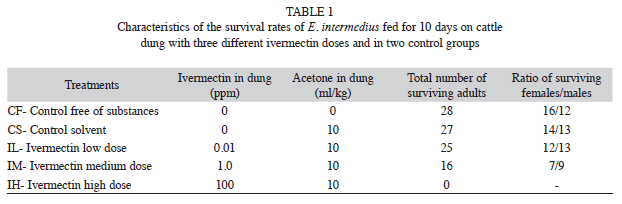
<body><![CDATA[<font size="2"></font><br style="font-family: verdana;">     <font size="3"><span style="font-family: verdana; font-weight: bold;">Results</span></font><br      style="font-family: verdana;">     <font size="2"></font><br style="font-family: verdana;">     <font size="2"><span style="font-family: verdana;">Ivermectin     treatments significantly     affected the survival of adults exposed for 10 days </span></font><font      size="2"><span style="font-family: verdana;">(<a      href="/img/revistas/rbt/v60n1/a23t1.gif">Table 1</a>) (&#967;<sup>2</sup>=8.98,     d.f.=3,     ]]></body>
<body><![CDATA[p&lt;0.05) without significant difference with respect to the sex of     adults (&#967;<sup>2</sup>=0.11, d.f.=1, p=0.739). The survival of adults in     the     solvent control (CS), and in the control (CF) was 70 and 67.5%,     respectively, without significant difference (&#967;<sup>2</sup>=0.058,     d.f.=1,     p=0.809).</span></font><br style="font-family: verdana;">     <font size="2"></font><br style="font-family: verdana;">     <font size="2"><span style="font-family: verdana;">The survival of     adults fed with     ]]></body>
<body><![CDATA[dung containing the lower concentration of ivermectin </span></font><font      size="2"><span style="font-family: verdana;">(IL) was 62.5%, and did     not     significantly differ from that of the control groups (&#967;<sup>2</sup>=0.469,     d.f.=1,     p=0.493). At the medium concentration of ivermectin (IM), the survival     of adults was 40%, significantly different from the survival of adults     at low concentration (&#967;<sup>2</sup>=3.98, d.f.=1, p=0.046), and adults     of the     control groups (&#967;<sup>2</sup>=8.78, p=0.003). The highest lethal effect     ]]></body>
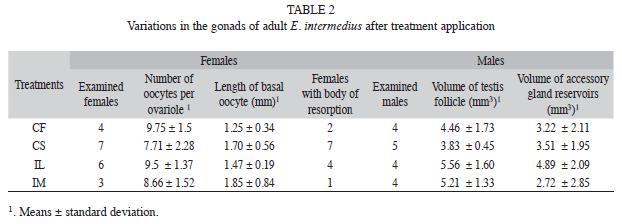
<body><![CDATA[was     observed among adults exposed to dung containing the highest     concentration of ivermectin (IH) (all adults died in a short time).</span></font><br      style="font-family: verdana;">     <font size="2"></font><br style="font-family: verdana;">     <font size="2"><span style="font-family: verdana;">The females surveyed     after     treatment with ivermectin and those of the control groups did not show     a significant difference in the number of oocytes present per ovariole     (F<sub>3.16</sub>=1.54, p=0.24), either by the size of basal oocytes (F<sub>3.16</sub>=1.14,     ]]></body>
<body><![CDATA[p=0.36) or by the presence of an extra-ovarian resorption body     (&#967;<sup>2</sup>=5.43, d.f=3, p=0.14) (<a      href="/img/revistas/rbt/v60n1/a23t2.gif">Table 2</a>).</span></font><br      style="font-family: verdana;">     <font size="2"></font><br style="font-family: verdana;">     <font size="2"><span style="font-family: verdana;">In males, however,     significant     differences in the follicle size of the testicles were observed     (F<sub>3.30</sub>=302, p=0.045) (<a      href="/img/revistas/rbt/v60n1/a23t2.gif">Table 2</a>). No significant     ]]></body>
<body><![CDATA[difference     was obtained     in their volume between the two control groups (F<sub>1.30</sub>=1.02,     p=0.32) or     between the two groups exposed to ivermectin (F<sub>1.30</sub>=0.27,     p=0.609).     However, controls and treated groups differed significantly from each     other (F<sub>1.30</sub>=7.3, p=0.011).</span></font> <font size="2"><span      style="font-family: verdana;">As for the size of accessory     glands, reservoirs of the male reproductive system did not show     ]]></body>
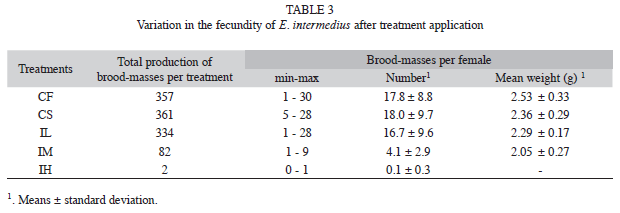
<body><![CDATA[considerable difference between controls and treated groups     (F<sub>3.20</sub>=0.63, p=0.6).</span></font><br      style="font-family: verdana;">     <font size="2"></font><br style="font-family: verdana;">     <font size="2"><span style="font-family: verdana;">Female fecundity     depended on     treatments (F<sub>4.67</sub>=14.65, p&lt;0.001) (Table 3). The     amount&nbsp; of     brood-masses produced by females of the two controls did not present     significant differences (F<sub>1.67</sub>=1.35, p=0.24). Similarly, no     ]]></body>
<body><![CDATA[significant     difference was obtained between the controls and females of the IL     treatment (F<sub>1.67</sub>=0.31, p=0.58), contrary to the significant     differences     obtained by IM treatment compared with controls (F<sub>1.67</sub>=34.45,     p&lt;0.001) and with IH treatment (F<sub>1.67</sub>=21.81, p&lt;0.001),     respectively. </span></font><font size="2"><span      style="font-family: verdana;">The fecundity of the females with     IH was lower than that found in the other treatments, both with     controls (F<sub>1.67</sub>=26.6, p&lt;0.001) and with IL (F<sub>1.67</sub>=23.16,     ]]></body>
<body><![CDATA[p&lt;0.001)     or IM treatment (F<sub>1.67</sub>=6.7, p=0.01).</span></font><br      style="font-family: verdana;">     <font size="2"></font><br style="font-family: verdana;">     <font size="2"><span style="font-family: verdana;">Brood-mass mean     weight also showed     a significant difference among treatments </span></font><font size="2"><span      style="font-family: verdana;">(F<sub>3.62</sub>=9.74, p&lt;0.001)     (<a href="/img/revistas/rbt/v60n1/a23t3.gif">Table 3</a>).     No significant difference was observed between CF </span></font><font     ]]></body>
<body><![CDATA[ size="2"><span style="font-family: verdana;">and CS (F<sub>1.62</sub>=4.07,     p=0.048) or     between the CF and IL treatments (F<sub>1.62</sub>=1.95, p=0.167). The     difference     was significant between the CF and IM treatments (F<sub>1.62</sub>=10.64,     p&lt;0.01); similarly, the difference between the CS and IL treatments     (F<sub>1.62</sub>=11.65, p&lt;0.01) as well as the CS and IM treatments     (F<sub>1.62</sub>=27.2, p&lt;0.001) was significant. Finally, there was     no     significant difference between the IL and IM treatments (F<sub>1.62</sub>=3.65,     ]]></body>
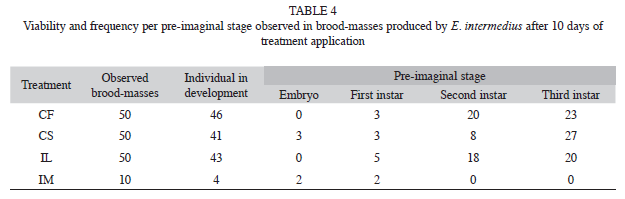
<body><![CDATA[p=0.06).</span></font><br style="font-family: verdana;">     <font size="2"></font><br style="font-family: verdana;">     <font size="2"><span style="font-family: verdana;">Ten days after     initiating the     treatment, within brood-masses, variations were obtained </span></font><font      size="2"><span style="font-family: verdana;">among the different     pre-imaginal     stages according to the treatments (&#967;<sup>2</sup>=44.9, d.f.=9, </span></font><font      size="2"><span style="font-family: verdana;">p&lt;0.001) (<a      href="/img/revistas/rbt/v60n1/a23t4.gif">Table 4</a>). In     ]]></body>
<body><![CDATA[the     control groups and in the IL treatment, the larval mortality was low,     and the proportions of the first, second and third instars were     similar. In the IM treatment, the larval viability was low (four larvae     out of ten hatched and attained only the first instar). In the IH     treatment, only two brood-masses were obtained, but no eggs hatched.</span></font><br      style="font-family: verdana;">     <font size="2"></font><br style="font-family: verdana;">     <font size="2"><span style="font-family: verdana;">In the cephalic     capsules of the     ]]></body>
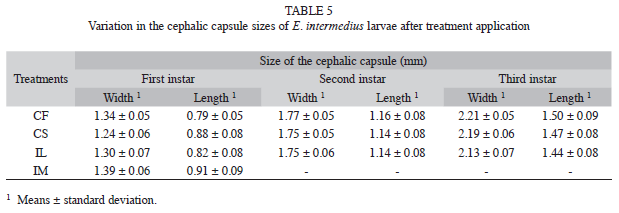
<body><![CDATA[larvae of the first instar, there were no significant </span></font><font      size="2"><span style="font-family: verdana;">differences, nor were     there     significant differences in length (F<sub>3,9</sub>=1.29, p=0.334) or in     </span></font><font size="2"><span style="font-family: verdana;">width     (F<sub>3,9</sub>=2.20, p=0.157) (<a      href="/img/revistas/rbt/v60n1/a23t5.gif">Table     5</a>). In the second instar, there were no significant differences for     length (F<sub>2,43</sub>=0.147, p=0.862) or width (F<sub>2,43</sub>=0.314,     p=0.732). The     ]]></body>
<body><![CDATA[third instar did not show significant differences in length     (F<sub>2,67</sub>=2.59, p=0.082); it did, however, show significant     differences in     width (F<sub>2,67</sub>=7.55, p&lt;0.001). The larvae of this instar,     having     received the IL treatment, presented the least width of cephalic     capsules.</span></font><br style="font-family: verdana;">     <font size="2"></font><br style="font-family: verdana;">     <font size="2"><span style="font-family: verdana;">In IL treatment, the     emergence of     ]]></body>
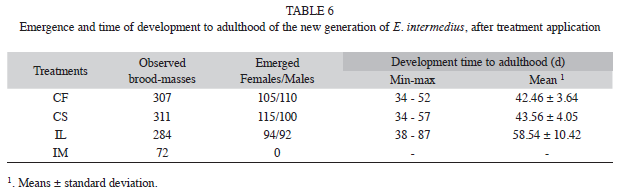
<body><![CDATA[adults reached 65.5% compared with the control </span></font><font      size="2"><span style="font-family: verdana;">groups, which had 70%     emergence     (<a href="/img/revistas/rbt/v60n1/a23t6.gif">Table 6</a>). The     difference between the two controls and the treated     groups was significant (&#967;<sup>2</sup>=48, d.f.=2, p&lt;0.001), unlike     the     difference in sexual proportion (&#967;<sup>2</sup>=0.95, d.f.=2, p=0.62).     The     differences were significant between the controls and the IL treatment     ]]></body>
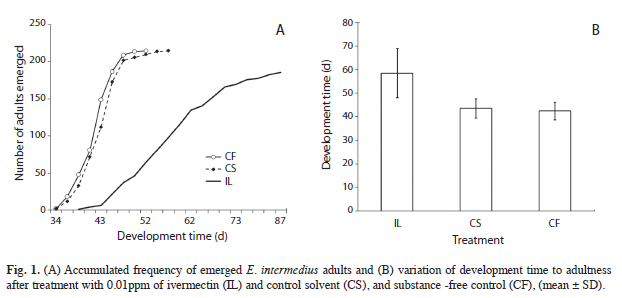
<body><![CDATA[as well in the development time from egg to adult and in the survival     rate of individuals (&#967;<sup>2</sup>=388, d.f.=2, p&lt;0.001) (<a      href="/img/revistas/rbt/v60n1/a23i1.jpg">Fig. 1</a>).</span></font><br      style="font-family: verdana;">     <font size="2"></font><br style="font-family: verdana;">     <font size="2"><span style="font-family: verdana;">Within the control     groups, low but     significant differences were observed in the survival </span></font><font      size="2"><span style="font-family: verdana;">curves of adults (&#967;<sup>2</sup>=10.45,     d.f.=1,     ]]></body>
<body><![CDATA[p&lt;0.05) even though development times were similar. However, in the     IL treatment, the mean development time into an adult of the new     generation was 1.1 to 1.6 times longer than that observed in the     control groups.</span></font><br style="font-family: verdana;">     <font size="2"></font><br style="font-family: verdana;">     <font size="2"><span style="font-family: verdana;">The survival rates     of adults that     emerged from controls and the IL treatment were similar (&#967;<sup>2</sup>=0.63,     d.f.=2, p=0.72). The generation obtained from larvae of the IL     treatment had a life span of 18.13 days (DE=5.55, n=123); this value     ]]></body>
<body><![CDATA[was similar to those obtained for the chemical- free control group     (18.12 days, DE=5.52, n=208), and the solvent control group (17.6 days,     DE=5.82, n=202). The state of sexual maturity of the emerged adults was     not defined, but in some cases, the females made broodmasses whose     viabilities were not verified.</span></font><br      style="font-family: verdana;">     <font size="2"></font><br      style="font-family: verdana; font-weight: bold;">     <font size="3"><span style="font-family: verdana; font-weight: bold;">Discussion</span></font><br      style="font-family: verdana;">     ]]></body>
<body><![CDATA[<font size="2"></font><br style="font-family: verdana;">     <font size="2"><span style="font-family: verdana;">The low     concentration (0.01ppm) of     ivermectin was not lethal for adults nor did it </span></font><font      size="2"><span style="font-family: verdana;">affect their fertility     and     fecundity. The larvae survived and emerged, but their time of     development increased. The medium concentration (1.0ppm) was lethal for     more than half of the adults and reduced their fecundity. None of the     larvae emerged. Finally, the high concentration (100ppm) was lethal for     ]]></body>
<body><![CDATA[all adults, and oviposition was not performed.</span></font><br      style="font-family: verdana;">     <font size="2"></font><br style="font-family: verdana;">     <font size="2"><span style="font-family: verdana;">The effects of     reduction in     survival and fecundity in <span style="font-style: italic;">E.     intermedius</span> treated with ivermectin-spiked dung were observed in     the same species, but using another     methodology (Kr&uuml;ger <span style="font-style: italic;">&amp;</span>     Scholtz 1997). This effect was also     ]]></body>
<body><![CDATA[observed in <span style="font-style: italic;">Copris hispanus,     Digitonthophagus gazella, Euoniticellus     fulvus, Aphodius</span> <span style="font-style: italic;">ater </span>and     <span style="font-style: italic;">A. rufipes</span> that had been fed     on the dung of     animals recently treated with 0.2mg/ kg of injectable ivermectin     (Wardhaugh <span style="font-style: italic;">&amp;</span>     Rodriguez-Menendez 1988, Sommer <span style="font-style: italic;">et     al.</span> 1993, Wardhaugh     <span style="font-style: italic;">et al. </span>1993, O&#8217;Hea <span     ]]></body>
<body><![CDATA[ style="font-style: italic;">et al. </span>2010). On the contrary, <span      style="font-style: italic;">Caccobius jessoensis     </span>and <span style="font-style: italic;">Liatongus minutus</span>     increase their fecundity in response to the     action of ivermectin (Iwasa <span style="font-style: italic;">et al. </span>2005,     Iwasa <span style="font-style: italic;">et al.</span> 2007).</span></font><br      style="font-family: verdana;">     <font size="2"></font><br style="font-family: verdana;">     <font size="2"><span style="font-family: verdana;">In the third instar     larvae of <span style="font-style: italic;">E.     ]]></body>
<body><![CDATA[intermedius</span>, the concentration of 0.01ppm of ivermectin </span></font><font      size="2"><span style="font-family: verdana;">reduced cephalic capsule     width,     which could be related to a reduced feeding capacity. In <span      style="font-style: italic;">D. gazella     </span>larvae exposed to ivermectin in the dung of animals after     treatment,     anatomical alterations in head structures were observed and were     related with a reduced feeding capacity (Sommer <span      style="font-style: italic;">et al.</span> 1993). These     ]]></body>
<body><![CDATA[anatomical changes in the head may have occurred in <span      style="font-style: italic;">E. intermedius</span> but     were not studied.</span></font><br style="font-family: verdana;">     <font size="2"></font><br style="font-family: verdana;">     <font size="2"><span style="font-family: verdana;">The ivermectin at     0.01ppm     concentration was only sublethal for <span style="font-style: italic;">E.     intermedius</span> larvae,</span></font><font size="2"><span      style="font-family: verdana;"> but it increased their development     time by 50<span style="font-style: italic;">%</span>, these results     ]]></body>
<body><![CDATA[show that the larvae represent the most     unstable phase of the life cycle. Kr&uuml;ger and Scholtz (1997)     perceived that in this same species, the development took two and a     half times longer in specimens exposed to dung samples from day one and     14 after the treatment of cattle with ivermectin; but these authors did     not determine the exact concentration utilized for each day of     treatment, and therefore, comparisons cannot be made.</span></font><br      style="font-family: verdana;">     <font size="2"></font><br style="font-family: verdana;">     <font size="2"><span style="font-family: verdana;">Several studies have     ]]></body>
<body><![CDATA[demonstrated     the ecotoxicity effect of ivermectin on coprophagous&nbsp; fauna     (Wardhaugh <span style="font-style: italic;">&amp;</span>     Rodriguez-Menendez 1988, Wardhaugh <span style="font-style: italic;">et     al.</span> 1993,     Wardhaugh <span style="font-style: italic;">et&nbsp; al.</span> 2001,     Lumaret <span style="font-style: italic;">&amp;</span> Errouissi,     2002, Floate <span style="font-style: italic;">et     al.</span> 2005). In some of these cases (Errouissi <span      style="font-style: italic;">et al.</span> 2001, Hempel <span     ]]></body>
<body><![CDATA[ style="font-style: italic;">et al.</span>     2006, Lumaret <span style="font-style: italic;">et al.</span> 2007),     we even know the effective concentration     levels (EC), that may cause an adverse response or the concentration     considered lethal&nbsp; (LC) for the species. More analyses with higher     concentrations between 0.01 and 0.1ppm of ivermectin in dung are needed     to establish the effective or lethal concentrations for larvae and     adults of <span style="font-style: italic;">E. intermedius</span>.</span></font><br      style="font-family: verdana;">     <font size="2"></font><br style="font-family: verdana;">     ]]></body>
<body><![CDATA[<font size="2"><span style="font-family: verdana;">Recently,     R&ouml;mbke <span style="font-style: italic;">et al. </span>(2010)     showed that the determined ivermectin concentration </span></font><font      size="2"><span style="font-family: verdana;">in dung, obtained between     days two     to seven after treatment, varied from 0.05 to 0.11mg/kg of fresh weight     (approximately 80% moisture in the dung); the equivalent values varied     between 0.31 to 0.81mg/kg dung dry weight. This&nbsp; variation between     the ivermectin concentrationin fresh and dry dung had an increment of     six to seven times; therefore, the authors recommended that care be     ]]></body>
<body><![CDATA[taken in interpreting the results </span></font><font size="2"><span      style="font-family: verdana;">when dealing with ivermectin     concentrations in samples of dung fresh or dry weight. In this study,     though utilizing the method of dung spiked with ivermectin, the     concentration of 0.01ppm was much lower than the minimum concentration     in fresh dung determined by R&ouml;mbke <span      style="font-style: italic;">et al.</span> (2010). The     concentration of 1.0ppm was close to the maximum of 1mg/kg ivermectin     in dung dry weight determined by Sommer <span      style="font-style: italic;">et al.</span> (1992) and R&ouml;mbke     ]]></body>
<body><![CDATA[<span style="font-style: italic;">et al.</span> 2010). The     concentration of 100ppm was beyond that found in the     dung of subcutaneously or topically treated animals.</span></font><br      style="font-family: verdana;">     <font size="2"></font><br style="font-family: verdana;">     <font size="2"><span style="font-family: verdana;">According to the     preliminary     results obtained from <span style="font-style: italic;">E. intermedius</span>,     the most adequate </span></font><font size="2"><span      style="font-family: verdana;">concentration interval of     ]]></body>
<body><![CDATA[ivermectin must vary from 0.01 to 0.1ppm in fresh dung. More analyses     with concentrations between 0.01 and 1.0ppm are necessary to establish     the effective or lethal concentrations for <span      style="font-style: italic;">E. intermedius </span>larvae. In     addition, more studies with other parasiticides and other species of     dung beetles should be performed to determine their effects.     <br>     <br>     The change     in development time of beetles such as <span     ]]></body>
<body><![CDATA[ style="font-style: italic;">E. intermedius</span>, in addition to     the time lag at the moment of emergence of the new </span></font><font      size="2"><span style="font-family: verdana;">adults in the field, may     alter the     abundance and diversity of dung beetle fauna common in cattle pastures     (Kr&uuml;ger <span style="font-style: italic;">&amp;</span> Scholtz     1998a, Kr&uuml;ger <span style="font-style: italic;">&amp;</span>     Scholtz 1998b,     O&#8217;Hea <span style="font-style: italic;">et al.</span> 2010,     R&ouml;mbke <span style="font-style: italic;">et al.</span> 2010). The     ]]></body>
<body><![CDATA[changes in     abundance&nbsp; of an ecologically important species on cattle     pastureland could also affect the productivity&nbsp; and health of     grasslands, as observed in other countries (Edwards <span      style="font-style: italic;">&amp;</span> Aschernborn     1987, Doube <span style="font-style: italic;">et al.</span> 1988,     Hutton <span style="font-style: italic;">&amp;</span> Giller 2003,     Davis <span style="font-style: italic;">et al.</span> 2004,     Louzada <span style="font-style: italic;">&amp;</span> Carvalho-Silva     2009).</span></font><br style="font-family: verdana;">     ]]></body>
<body><![CDATA[<font size="2"></font><br style="font-family: verdana;">     <font size="2"><span style="font-family: verdana;">In <span      style="font-style: italic;">E. intermedius</span>, the impact on     larval development is most important. Some theoretical models     predicting the impact of ivermectin according to the frequency and dose     of application indicate that the highest negative effect on dung beetle     communities becomes evident when applications to cattle are frequent     and coincide with the emergence of new generations. According to these     models, the continuous and long-term use of ivermectin reduces the     population of dung beetles (Sherrat <span style="font-style: italic;">et     ]]></body>
<body><![CDATA[al.</span> 1998, Wardhaugh <span style="font-style: italic;">et al.</span>     1998,     Wardhaugh <span style="font-style: italic;">et al. </span>2001).</span></font><br      style="font-family: verdana;">     <font size="2"></font><br style="font-family: verdana;">     <font size="2"><span style="font-family: verdana;">Because of the     aforementioned     results, the knowledge of the biology of dung beetles is </span></font><font      size="2"><span style="font-family: verdana;">fundamental, but     environmental     ]]></body>
<body><![CDATA[health in cattle raising zones is also important. In Rancho &#8220;San     Rom&aacute;n&#8221; (La Laguna, Veracruz), ivermectin is subcutaneously     applied to the cattle at a concentration of 0.2mg/kg twice a year     (Florencio Portillo R., pers. com.). However, on other farms in the     State of Veracruz, ivermectin application is known to vary from 2-4     times a year (Mart&iacute;nez <span style="font-style: italic;">&amp;</span>     Cruz 2009); therefore, its presence     in dung can be quite variable throughout the year.</span></font><br      style="font-family: verdana;">     <font size="2"></font><br style="font-family: verdana;">     ]]></body>
<body><![CDATA[<font size="2"><span style="font-family: verdana;">Ivermectin has been     utilized by the     cattle farmers of Veracruz for more than 20 years </span></font><font      size="2"><span style="font-family: verdana;">(Mart&iacute;nez <span      style="font-style: italic;">&amp;</span> Cruz 2009)     without any regulation on its consumption and application; therefore,     the prognostication of ecotoxicological effects on coprophagous fauna     is of serious concern.</span></font><br style="font-family: verdana;">     <font size="2"></font><br style="font-family: verdana;">     <font size="2"><span style="font-family: verdana;">The State of     ]]></body>
<body><![CDATA[Veracruz, as one of     the main cattle producers in the country (Gobierno de </span></font><font      size="2"><span style="font-family: verdana;">Veracruz 2009), consumes     large     amounts of ivermectin, which could also be the case in other states of     Mexico (Martinez <span style="font-style: italic;">&amp;</span> Cruz     2009). In Mexico, few studies reflect the     problem of contamination originating from veterinary substances,     parasiticides among them (Mart&iacute;nez <span      style="font-style: italic;">et al.</span> 2000, Lumaret <span     ]]></body>
<body><![CDATA[ style="font-style: italic;">&amp;</span>     Mart&iacute;nez 2005, Mart&iacute;nez <span style="font-style: italic;">&amp;</span>     Lumaret 2006,     Mart&iacute;nez<span style="font-style: italic;"> &amp;</span> Cruz     2009). This paper is the first in this     country dealing with the effect of ivermectin. It is necessary to carry     out more toxicity tests of this parasiticide in other species and to     study the abundance and diversity of dung beetle species in cattle     raising areas.</span></font><br style="font-family: verdana;">     <font size="2"></font><br style="font-family: verdana;">     ]]></body>
<body><![CDATA[<font size="2"><span style="font-family: verdana;">It is recommended     that cattle     farmers apply parasiticide on dates subsequent to the </span></font><font      size="2"><span style="font-family: verdana;">emergence of the new     generations.     Likewise, the life cycle of the most common parasites in the cattle     drove and their levels of parasitization should be known before     applying any parasiticide. These practices would reduce the     parasiticide impact on other beneficial fauna in cattle pasturelands     and the associated economic losses to cattle farmers (Fincher 1981,     ]]></body>
<body><![CDATA[Losey <span style="font-style: italic;">&amp;</span> Vaughan 2006).</span></font><br      style="font-family: verdana;">     <font size="2"></font><br style="font-family: verdana;">     <font size="2"><span style="font-family: verdana;">Likewise, in Mexico,     the use and     sale of this type of substance should be regulated as in other     countries, such as those of the European Union, Japan, and the U.S.A.     (VICH 2004, Knacker <span style="font-style: italic;">et al. </span>2005,     OECD 2009).</span></font><br style="font-family: verdana;">     <font size="2"></font><br     ]]></body>
<body><![CDATA[ style="font-family: verdana; font-weight: bold;">     <font size="3"><span style="font-family: verdana; font-weight: bold;">Acknowledgments</span></font><br      style="font-family: verdana;">     <font size="2"></font><br style="font-family: verdana;">     <font size="2"><span style="font-family: verdana;">This study was     carried out with the     support of the Instituto de Ecolog&iacute;a A.C. and the </span></font><font      size="2"><span style="font-family: verdana;">Colegio de Postgraduados,     Campus     Veracruz. The authors thank Florencio Portillo Ram&oacute;n and     ]]></body>
<body><![CDATA[Servando Gonz&aacute;lez C&oacute;rdova of Rancho &#8220;San Ram&oacute;n&#8221;     for facilitating the field work, and Ver&oacute;nica Rosales,     Al&iacute;n Malpica, Mar&iacute;a Eugenia Rivas, Teresa Su&aacute;rez     and Mercedes Garc&iacute;a for their support during field and     laboratory work; further thanks to Carmen Huerta, Lucrecia Arellano and     Vinicio Sosa for their valuable commentaries. The first author is     thankful for the funding from the &#8220;Proyectos de Investigaci&oacute;n de     Tesis 2009&#8221; awarded by Colegio de Postgraduados. We thank three     anonymous reviewers for valuable comments on the manuscript.</span></font><br      style="font-family: verdana;">     ]]></body>
<body><![CDATA[<font size="2"></font><br style="font-family: verdana;">     <font size="2"><span style="font-family: verdana; font-weight: bold;"></span></font></div>     <hr      style="width: 100%; height: 2px; margin-left: 0px; margin-right: 0px;">     <!-- ref --><div style="text-align: justify;"><font size="3"><span  style="font-family: verdana; font-weight: bold;">References</span></font><br  style="font-family: verdana;"> <font size="2"></font><br style="font-family: verdana;"> <font size="2"><span style="font-family: verdana;">Blume, R.R. 1984. <span  style="font-style: italic;">Euoniticellus intermedius</span> (Coleoptera: Scarabaeidae): Description of adults and immature and biology of adults. Environ. Entomol. 13: 1064-1068.    &nbsp;&nbsp;&nbsp;&nbsp;&nbsp;&nbsp;&nbsp;&nbsp;[&#160;<a href="javascript:void(0);" onclick="javascript: window.open('/scielo.php?script=sci_nlinks&ref=1431028&pid=S0034-7744201200010002300001&lng=','','width=640,height=500,resizable=yes,scrollbars=1,menubar=yes,');">Links</a>&#160;]<!-- end-ref --><!-- ref --></span></font><br  style="font-family: verdana;"> <font size="2"></font><br style="font-family: verdana;"> <font size="2"><span style="font-family: verdana;">Blume, R.R. <span  style="font-style: italic;">&amp;</span> A. Aga. 1975. <span style="font-style: italic;">Onthophagus gazella</span>: Mass rearing and laboratory biology. Environ. Entomol. 4: 735-736.    &nbsp;&nbsp;&nbsp;&nbsp;&nbsp;&nbsp;&nbsp;&nbsp;[&#160;<a href="javascript:void(0);" onclick="javascript: window.open('/scielo.php?script=sci_nlinks&ref=1431029&pid=S0034-7744201200010002300002&lng=','','width=640,height=500,resizable=yes,scrollbars=1,menubar=yes,');">Links</a>&#160;]<!-- end-ref --><!-- ref --></span></font><br style="font-family: verdana;"> <font size="2"></font><br style="font-family: verdana;"> <font size="2"><span style="font-family: verdana;">Boxall, A.B.A., L.A. Fogg, P.A. Blackwell, P. Kay, E.J. Pemberton <span style="font-style: italic;">&amp;</span> A. Croxford. 2004. Veterinary medicines in the environment. Rev. Environ. Contam. Toxicol. 180: 1-91.    &nbsp;&nbsp;&nbsp;&nbsp;&nbsp;&nbsp;&nbsp;&nbsp;[&#160;<a href="javascript:void(0);" onclick="javascript: window.open('/scielo.php?script=sci_nlinks&ref=1431030&pid=S0034-7744201200010002300003&lng=','','width=640,height=500,resizable=yes,scrollbars=1,menubar=yes,');">Links</a>&#160;]<!-- end-ref --><!-- ref --></span></font><br  style="font-family: verdana;"> <font size="2"></font><br style="font-family: verdana;"> <font size="2"><span style="font-family: verdana;">Chirico, J., S. Wiktelius <span style="font-style: italic;">&amp;</span> P.J. Waller. 2003. Dung beetle activity and development of trichostrongylid eggs into infective larvae in cattle faeces. Vet. Parasitol. 118: 157-1163.    &nbsp;&nbsp;&nbsp;&nbsp;&nbsp;&nbsp;&nbsp;&nbsp;[&#160;<a href="javascript:void(0);" onclick="javascript: window.open('/scielo.php?script=sci_nlinks&ref=1431031&pid=S0034-7744201200010002300004&lng=','','width=640,height=500,resizable=yes,scrollbars=1,menubar=yes,');">Links</a>&#160;]<!-- end-ref --><!-- ref --></span></font><br style="font-family: verdana;"> <font size="2"></font><br style="font-family: verdana;"> <font size="2"><span style="font-family: verdana;">Davis, A.L.V., C.H. Scholtz, P.W. Dooley, N. Bham <span style="font-style: italic;">&amp;</span> U. Kryger. 2004. Scarabaeine dung beetles as indicators of biodiversity, habitat transformation and pest control chemicals in agro-ecosystems. S. Afr. J. Sci. 100: 415-424.    &nbsp;&nbsp;&nbsp;&nbsp;&nbsp;&nbsp;&nbsp;&nbsp;[&#160;<a href="javascript:void(0);" onclick="javascript: window.open('/scielo.php?script=sci_nlinks&ref=1431032&pid=S0034-7744201200010002300005&lng=','','width=640,height=500,resizable=yes,scrollbars=1,menubar=yes,');">Links</a>&#160;]<!-- end-ref --><!-- ref --></span></font><br  style="font-family: verdana;"> <font size="2"></font><br style="font-family: verdana;"> <font size="2"><span style="font-family: verdana;">Doube, B.M., A. Macqueen <span style="font-style: italic;">&amp;</span> H.A. Fay. 1988. Effects of dung fauna on survival and size of buffalo flies (<span style="font-style: italic;">Haematobia</span> spp.) breeding in the field in South Africa and Australia. J. Appl. Ecol. 25: 523-536.    &nbsp;&nbsp;&nbsp;&nbsp;&nbsp;&nbsp;&nbsp;&nbsp;[&#160;<a href="javascript:void(0);" onclick="javascript: window.open('/scielo.php?script=sci_nlinks&ref=1431033&pid=S0034-7744201200010002300006&lng=','','width=640,height=500,resizable=yes,scrollbars=1,menubar=yes,');">Links</a>&#160;]<!-- end-ref --><!-- ref --></span></font><br  style="font-family: verdana;"> <font size="2"></font><br style="font-family: verdana;"> <font size="2"><span style="font-family: verdana;">Edwards, P.B. <span  style="font-style: italic;">&amp;</span> H.H. Aschernborn. 1987. Patterns of the nesting and dung burial in <span  style="font-style: italic;">Onitis </span>dung beetles: implications for pasture productivity and fly control. J. Appl. Ecol. 24: 837-851.    &nbsp;&nbsp;&nbsp;&nbsp;&nbsp;&nbsp;&nbsp;&nbsp;[&#160;<a href="javascript:void(0);" onclick="javascript: window.open('/scielo.php?script=sci_nlinks&ref=1431034&pid=S0034-7744201200010002300007&lng=','','width=640,height=500,resizable=yes,scrollbars=1,menubar=yes,');">Links</a>&#160;]<!-- end-ref --><!-- ref --></span></font><br style="font-family: verdana;"> <font size="2"></font><br style="font-family: verdana;"> <font size="2"><span style="font-family: verdana;">Errouissi, F., M. Alvinerie, P. Galtier, D. Kerboeuf <span style="font-style: italic;">&amp;</span> J.P. Lumaret. 2001. The negative effects of the residues of ivermectin in cattle dung using a sustained-release bolus on <span style="font-style: italic;">Aphodius constans</span> (Duft.) (Coleoptera: Aphodiidae). Vet. Res. 32: 421-427.    &nbsp;&nbsp;&nbsp;&nbsp;&nbsp;&nbsp;&nbsp;&nbsp;[&#160;<a href="javascript:void(0);" onclick="javascript: window.open('/scielo.php?script=sci_nlinks&ref=1431035&pid=S0034-7744201200010002300008&lng=','','width=640,height=500,resizable=yes,scrollbars=1,menubar=yes,');">Links</a>&#160;]<!-- end-ref --><!-- ref --></span></font><br style="font-family: verdana;"> <font size="2"></font><br style="font-family: verdana;"> <font size="2"><span style="font-family: verdana;">Errouissi, F. <span  style="font-style: italic;">&amp;</span> J.P. Lumaret. 2010. Field effects of faecal residues from ivermectin slow-release boluses on the attractiveness of cattle dung to dung beetles. Med. Vet. Entomol. 24: 433-440.    &nbsp;&nbsp;&nbsp;&nbsp;&nbsp;&nbsp;&nbsp;&nbsp;[&#160;<a href="javascript:void(0);" onclick="javascript: window.open('/scielo.php?script=sci_nlinks&ref=1431036&pid=S0034-7744201200010002300009&lng=','','width=640,height=500,resizable=yes,scrollbars=1,menubar=yes,');">Links</a>&#160;]<!-- end-ref --><!-- ref --></span></font><br style="font-family: verdana;"> <font size="2"></font><br style="font-family: verdana;"> <font size="2"><span style="font-family: verdana;">Fincher, G.T. 1981. The potential value of dung beetles in pasture ecosystems. J. Ga. Entomol. Soc. 16: 316-333.    &nbsp;&nbsp;&nbsp;&nbsp;&nbsp;&nbsp;&nbsp;&nbsp;[&#160;<a href="javascript:void(0);" onclick="javascript: window.open('/scielo.php?script=sci_nlinks&ref=1431037&pid=S0034-7744201200010002300010&lng=','','width=640,height=500,resizable=yes,scrollbars=1,menubar=yes,');">Links</a>&#160;]<!-- end-ref --><!-- ref --></span></font><br style="font-family: verdana;"> <font size="2"></font><br style="font-family: verdana;"> <font size="2"><span style="font-family: verdana;">Fincher, G.T. 1986. Importation, colonization, and release of dung-burying scarabs. Biological control of muscoid flies. Misc. Publ. Entomol. Soc. Am. 62: 69-76.    &nbsp;&nbsp;&nbsp;&nbsp;&nbsp;&nbsp;&nbsp;&nbsp;[&#160;<a href="javascript:void(0);" onclick="javascript: window.open('/scielo.php?script=sci_nlinks&ref=1431038&pid=S0034-7744201200010002300011&lng=','','width=640,height=500,resizable=yes,scrollbars=1,menubar=yes,');">Links</a>&#160;]<!-- end-ref --><!-- ref --></span></font><br  style="font-family: verdana;"> <font size="2"></font><br style="font-family: verdana;"> <font size="2"><span style="font-family: verdana;">Fincher, G.T., T.B. Stewart, J.S. Hunter III. 1983. The 1981 distribution of <span  style="font-style: italic;">Onthophagus gazella</span> Fabricius from releases in Texas and <span style="font-style: italic;">Onthophagus taurus</span> Schreber from an unknown release in Florida (Coleoptera: Scarabaeidae). Coleopts. Bull. 37: 159-163.    &nbsp;&nbsp;&nbsp;&nbsp;&nbsp;&nbsp;&nbsp;&nbsp;[&#160;<a href="javascript:void(0);" onclick="javascript: window.open('/scielo.php?script=sci_nlinks&ref=1431039&pid=S0034-7744201200010002300012&lng=','','width=640,height=500,resizable=yes,scrollbars=1,menubar=yes,');">Links</a>&#160;]<!-- end-ref --><!-- ref --></span></font><br style="font-family: verdana;"> <font size="2"></font><br style="font-family: verdana;"> <font size="2"><span style="font-family: verdana;">Floate, K.D., K.G. Wardhaugh, A.B.A. Boxall <span style="font-style: italic;">&amp;</span> T.N. Sherrat. 2005. Fecal residues of veterinary parasiticides: nontarget effects in the pasture environment. Annu. Rev. Entomol. 50: 153-179.    &nbsp;&nbsp;&nbsp;&nbsp;&nbsp;&nbsp;&nbsp;&nbsp;[&#160;<a href="javascript:void(0);" onclick="javascript: window.open('/scielo.php?script=sci_nlinks&ref=1431040&pid=S0034-7744201200010002300013&lng=','','width=640,height=500,resizable=yes,scrollbars=1,menubar=yes,');">Links</a>&#160;]<!-- end-ref --><!-- ref --></span></font><br style="font-family: verdana;"> <font size="2"></font><br style="font-family: verdana;"> <font size="2"><span style="font-family: verdana;">Gobierno de Veracruz. 2009. Anexo Estad&iacute;stico. Desarrollo Agropecuario. Quinto informe de Gobierno.</span></font><font  size="2"><span style="font-family: verdana;"> Gobierno del estado de Veracruz., Xalapa, Veracruz, M&eacute;xico. (Downloaded: March 19, 2010, <a href="http://portal.veracruz.gob.mx">http://portal.veracruz.gob.mx</a>).    &nbsp;&nbsp;&nbsp;&nbsp;&nbsp;&nbsp;&nbsp;&nbsp;[&#160;<a href="javascript:void(0);" onclick="javascript: window.open('/scielo.php?script=sci_nlinks&ref=1431041&pid=S0034-7744201200010002300014&lng=','','width=640,height=500,resizable=yes,scrollbars=1,menubar=yes,');">Links</a>&#160;]<!-- end-ref --><!-- ref --></span></font><br  style="font-family: verdana;"> <font size="2"></font><br style="font-family: verdana;"> <font size="2"><span style="font-family: verdana;">Halffter, G., M.E. Favila <span style="font-style: italic;">&amp;</span> V. Halffter. 1992. A comparative study of the structure of the scarab guild in Mexican tropical rain forests and derived ecosystems. Folia Entomol. Mexic. 84: 131-156.    &nbsp;&nbsp;&nbsp;&nbsp;&nbsp;&nbsp;&nbsp;&nbsp;[&#160;<a href="javascript:void(0);" onclick="javascript: window.open('/scielo.php?script=sci_nlinks&ref=1431042&pid=S0034-7744201200010002300015&lng=','','width=640,height=500,resizable=yes,scrollbars=1,menubar=yes,');">Links</a>&#160;]<!-- end-ref --><!-- ref --></span></font><br  style="font-family: verdana;"> <font size="2"></font><br style="font-family: verdana;"> <font size="2"><span style="font-family: verdana;">Hempel, H., A. Scheffczyk, H.J. Schallna&szlig;, J.P. Lumaret, M. Alvinerie <span  style="font-style: italic;">&amp;</span> J. R&ouml;mbke. 2006. Toxicity of four veterinary parasiticides on larvae of dung beetle <span style="font-style: italic;">Aphodius constans</span> in the laboratory. Environ. Toxicol. Chem. 25: 3155-3163.    &nbsp;&nbsp;&nbsp;&nbsp;&nbsp;&nbsp;&nbsp;&nbsp;[&#160;<a href="javascript:void(0);" onclick="javascript: window.open('/scielo.php?script=sci_nlinks&ref=1431043&pid=S0034-7744201200010002300016&lng=','','width=640,height=500,resizable=yes,scrollbars=1,menubar=yes,');">Links</a>&#160;]<!-- end-ref --><!-- ref --></span></font><br style="font-family: verdana;"> <font size="2"></font><br style="font-family: verdana;"> <font size="2"><span style="font-family: verdana;">Hern&aacute;ndez-Mart&iacute;nez, G. <span style="font-style: italic;">&amp;</span> I. Mart&iacute;nez. 2003. Desarrollo larval de Canthon cyanellus cyanellus LeConte 1859 (Coleoptera: Scarabaeidae). Acta Zoolog. Mexic. 89: 185-200.    &nbsp;&nbsp;&nbsp;&nbsp;&nbsp;&nbsp;&nbsp;&nbsp;[&#160;<a href="javascript:void(0);" onclick="javascript: window.open('/scielo.php?script=sci_nlinks&ref=1431044&pid=S0034-7744201200010002300017&lng=','','width=640,height=500,resizable=yes,scrollbars=1,menubar=yes,');">Links</a>&#160;]<!-- end-ref --><!-- ref --></span></font><br  style="font-family: verdana;"> <font size="2"></font><br style="font-family: verdana;"> <font size="2"><span style="font-family: verdana;">Holter, P., C. Sommer <span style="font-style: italic;">&amp;</span> J. Gronvold. 1993. Attractiveness of dung from ivermectin-treated cattle to Danish and afrotropical scarabaeid dung beetles. Vet. Parasitol. 48: 159-169.    &nbsp;&nbsp;&nbsp;&nbsp;&nbsp;&nbsp;&nbsp;&nbsp;[&#160;<a href="javascript:void(0);" onclick="javascript: window.open('/scielo.php?script=sci_nlinks&ref=1431045&pid=S0034-7744201200010002300018&lng=','','width=640,height=500,resizable=yes,scrollbars=1,menubar=yes,');">Links</a>&#160;]<!-- end-ref --><!-- ref --></span></font><br style="font-family: verdana;"> <font size="2"></font><br style="font-family: verdana;"> <font size="2"><span style="font-family: verdana;">Hutton, S.A. <span  style="font-style: italic;">&amp;</span> P.S. Giller. 2003. The effects of the intensification of agriculture on northern temperate dung beetle communities. J. Appl. Ecol. 40: 994-1007.    &nbsp;&nbsp;&nbsp;&nbsp;&nbsp;&nbsp;&nbsp;&nbsp;[&#160;<a href="javascript:void(0);" onclick="javascript: window.open('/scielo.php?script=sci_nlinks&ref=1431046&pid=S0034-7744201200010002300019&lng=','','width=640,height=500,resizable=yes,scrollbars=1,menubar=yes,');">Links</a>&#160;]<!-- end-ref --><!-- ref --></span></font><br  style="font-family: verdana;"> <font size="2"></font><br style="font-family: verdana;"> <font size="2"><span style="font-family: verdana;">INEGI. 2007. Censo Agropecuario, VIII Censo Agr&iacute;cola Ganadero y Forestal. Cuadros 37 y 38. Instituto Nacional de Estad&iacute;stica Geograf&iacute;a e Inform&aacute;tica, Aguascalientes, Aguascalientes, M&eacute;xico. (Downloaded: April 16, 2009, <a href="http://www.inegi.gob.mx">http://www.inegi.gob.mx</a>).    &nbsp;&nbsp;&nbsp;&nbsp;&nbsp;&nbsp;&nbsp;&nbsp;[&#160;<a href="javascript:void(0);" onclick="javascript: window.open('/scielo.php?script=sci_nlinks&ref=1431047&pid=S0034-7744201200010002300020&lng=','','width=640,height=500,resizable=yes,scrollbars=1,menubar=yes,');">Links</a>&#160;]<!-- end-ref --><!-- ref --></span></font><br  style="font-family: verdana;"> <font size="2"></font><br style="font-family: verdana;"> <font size="2"><span style="font-family: verdana;">Iwasa, M., T. Maruo, M. Ueda <span style="font-style: italic;">&amp;</span> N. Yamashita. 2007. Adverse effects of ivermectin on the dung beetles, <span style="font-style: italic;">Caccobius jessoensis</span> Harold, and rare species, <span style="font-style: italic;">Copris ochus</span> Motschulsky and <span style="font-style: italic;">Copris acutidens</span> Motschulsky (Coleoptera: Scarabaeidae), in Japan. Bull. Entomol. Res. 97: 619-625.    &nbsp;&nbsp;&nbsp;&nbsp;&nbsp;&nbsp;&nbsp;&nbsp;[&#160;<a href="javascript:void(0);" onclick="javascript: window.open('/scielo.php?script=sci_nlinks&ref=1431048&pid=S0034-7744201200010002300021&lng=','','width=640,height=500,resizable=yes,scrollbars=1,menubar=yes,');">Links</a>&#160;]<!-- end-ref --><!-- ref --></span></font><br  style="font-family: verdana;"> <font size="2"></font><br style="font-family: verdana;"> <font size="2"><span style="font-family: verdana;">Iwasa, M., T. Nakamura, K. Fukaki <span style="font-style: italic;">&amp;</span> N. Yamashita. 2005. Nontarget effects of ivermectin on coprophagous insects in Japan. Environ. Entomol. 34: 1485-1492.    &nbsp;&nbsp;&nbsp;&nbsp;&nbsp;&nbsp;&nbsp;&nbsp;[&#160;<a href="javascript:void(0);" onclick="javascript: window.open('/scielo.php?script=sci_nlinks&ref=1431049&pid=S0034-7744201200010002300022&lng=','','width=640,height=500,resizable=yes,scrollbars=1,menubar=yes,');">Links</a>&#160;]<!-- end-ref --><!-- ref --> </span></font><br  style="font-family: verdana;"> <font size="2"></font><br style="font-family: verdana;"> <font size="2"><span style="font-family: verdana;">Knacker, T., K. Duis, T. Ternes, K. Fenner, B. Escher, H. Schmitt, J. R&ouml;mbke, J. Garric, T. Hutchinson <span style="font-style: italic;">&amp;</span> A.B.A. Boxall. 2005. The EU-project ERAPharm. Incentives for the further development of guidance documents? Environ. Sci. Pollut. Res. 12: 62-65.    &nbsp;&nbsp;&nbsp;&nbsp;&nbsp;&nbsp;&nbsp;&nbsp;[&#160;<a href="javascript:void(0);" onclick="javascript: window.open('/scielo.php?script=sci_nlinks&ref=1431050&pid=S0034-7744201200010002300023&lng=','','width=640,height=500,resizable=yes,scrollbars=1,menubar=yes,');">Links</a>&#160;]<!-- end-ref --><!-- ref --></span></font><br style="font-family: verdana;"> <font size="2"><span style="font-family: verdana;">&nbsp;</span></font><br  style="font-family: verdana;"> <font size="2"><span style="font-family: verdana;">Kr&uuml;ger, K. <span  style="font-style: italic;">&amp;</span> C.H. Scholtz. 1997. Lethal and sublethal effect of ivermectin on the dung-breeding beetles <span style="font-style: italic;">Euoniticellus intermedius</span> (Reiche) and <span style="font-style: italic;">Onitis alexis</span> Klug (Coleoptera: Scarabaeidae). Agr. Ecosyst. Environ. 61: 123-131.    &nbsp;&nbsp;&nbsp;&nbsp;&nbsp;&nbsp;&nbsp;&nbsp;[&#160;<a href="javascript:void(0);" onclick="javascript: window.open('/scielo.php?script=sci_nlinks&ref=1431051&pid=S0034-7744201200010002300024&lng=','','width=640,height=500,resizable=yes,scrollbars=1,menubar=yes,');">Links</a>&#160;]<!-- end-ref --><!-- ref --></span></font><br  style="font-family: verdana;"> <font size="2"></font><br style="font-family: verdana;"> <font size="2"><span style="font-family: verdana;">Kr&uuml;ger, K. <span  style="font-style: italic;">&amp;</span> C.H. Scholtz. 1998 a. Changes in structure of dung insect communities after ivermectin usage in a grassland ecosystem. I. Impact of ivermectin under drought conditions. Acta Oecol. 19: 425-438.    &nbsp;&nbsp;&nbsp;&nbsp;&nbsp;&nbsp;&nbsp;&nbsp;[&#160;<a href="javascript:void(0);" onclick="javascript: window.open('/scielo.php?script=sci_nlinks&ref=1431052&pid=S0034-7744201200010002300025&lng=','','width=640,height=500,resizable=yes,scrollbars=1,menubar=yes,');">Links</a>&#160;]<!-- end-ref --><!-- ref --></span></font><br  style="font-family: verdana;"> <font size="2"></font><br style="font-family: verdana;"> <font size="2"><span style="font-family: verdana;">Kr&uuml;ger, K. <span  style="font-style: italic;">&amp; </span>C.H. Scholtz. 1998 b. Changes in structure of dung insect communities after ivermectin usage in a grassland ecosystem. II. Impact of ivermectin under high-rainfall conditions. Acta Oecol. 19: 439-451.    &nbsp;&nbsp;&nbsp;&nbsp;&nbsp;&nbsp;&nbsp;&nbsp;[&#160;<a href="javascript:void(0);" onclick="javascript: window.open('/scielo.php?script=sci_nlinks&ref=1431053&pid=S0034-7744201200010002300026&lng=','','width=640,height=500,resizable=yes,scrollbars=1,menubar=yes,');">Links</a>&#160;]<!-- end-ref --><!-- ref --></span></font><br  style="font-family: verdana;"> <font size="2"></font><br style="font-family: verdana;"> <font size="2"><span style="font-family: verdana;">Losey, J.E. &amp; M. Vaughan. 2006. The economic value of ecological services provided by insects. BioScience 56: 311-323.    &nbsp;&nbsp;&nbsp;&nbsp;&nbsp;&nbsp;&nbsp;&nbsp;[&#160;<a href="javascript:void(0);" onclick="javascript: window.open('/scielo.php?script=sci_nlinks&ref=1431054&pid=S0034-7744201200010002300027&lng=','','width=640,height=500,resizable=yes,scrollbars=1,menubar=yes,');">Links</a>&#160;]<!-- end-ref --><!-- ref --></span></font><br style="font-family: verdana;"> <font size="2"></font><br style="font-family: verdana;"> <font size="2"><span style="font-family: verdana;">Louzada, J.N.C. <span  style="font-style: italic;">&amp;</span> P.R. Carvalho-Silva. 2009. Utilisation of introduced Brazilian pastures ecosytems by native dung beetles: diversity patterns and resource use. Insect Conserv. Diver. 2: 45-52.    &nbsp;&nbsp;&nbsp;&nbsp;&nbsp;&nbsp;&nbsp;&nbsp;[&#160;<a href="javascript:void(0);" onclick="javascript: window.open('/scielo.php?script=sci_nlinks&ref=1431055&pid=S0034-7744201200010002300028&lng=','','width=640,height=500,resizable=yes,scrollbars=1,menubar=yes,');">Links</a>&#160;]<!-- end-ref --><!-- ref --></span></font><br  style="font-family: verdana;"> <font size="2"></font><br style="font-family: verdana;"> <font size="2"><span style="font-family: verdana;">Lumaret, J.P., M. Alvinerie, H. Hempel, H.J. Schallna&szlig;, D. Claret <span  style="font-style: italic;">&amp;</span> J. R&ouml;mbke. 2007. New screening test to predict the potential impact of ivermectin-contaminated cattle dung on dung beetles. Vet. Res. 38: 15-24.    &nbsp;&nbsp;&nbsp;&nbsp;&nbsp;&nbsp;&nbsp;&nbsp;[&#160;<a href="javascript:void(0);" onclick="javascript: window.open('/scielo.php?script=sci_nlinks&ref=1431056&pid=S0034-7744201200010002300029&lng=','','width=640,height=500,resizable=yes,scrollbars=1,menubar=yes,');">Links</a>&#160;]<!-- end-ref --><!-- ref --></span></font><br style="font-family: verdana;"> <font size="2"></font><br style="font-family: verdana;"> <font size="2"><span style="font-family: verdana;">Lumaret, J.P. <span  style="font-style: italic;">&amp;</span> F. Errouissi. 2002. Use of anthelmintics in herbivores and evaluation of risks for the non target fauna of pastures. Vet. Res. 33: 547-562.    &nbsp;&nbsp;&nbsp;&nbsp;&nbsp;&nbsp;&nbsp;&nbsp;[&#160;<a href="javascript:void(0);" onclick="javascript: window.open('/scielo.php?script=sci_nlinks&ref=1431057&pid=S0034-7744201200010002300030&lng=','','width=640,height=500,resizable=yes,scrollbars=1,menubar=yes,');">Links</a>&#160;]<!-- end-ref --><!-- ref --></span></font><br  style="font-family: verdana;"> <font size="2"></font><br style="font-family: verdana;"> <font size="2"><span style="font-family: verdana;">Lumaret, J.P. <span  style="font-style: italic;">&amp;</span> I. Mart&iacute;nez. 2005. El impacto de productos veterinarios sobre insectos copr&oacute;fagos: consecuencias sobre la degradaci&oacute;n del esti&eacute;rcol en pastizales. Acta Zoolog. Mexic. 21:137-148.    &nbsp;&nbsp;&nbsp;&nbsp;&nbsp;&nbsp;&nbsp;&nbsp;[&#160;<a href="javascript:void(0);" onclick="javascript: window.open('/scielo.php?script=sci_nlinks&ref=1431058&pid=S0034-7744201200010002300031&lng=','','width=640,height=500,resizable=yes,scrollbars=1,menubar=yes,');">Links</a>&#160;]<!-- end-ref --><!-- ref --></span></font><br  style="font-family: verdana;"> <font size="2"></font><br style="font-family: verdana;"> <font size="2"><span style="font-family: verdana;">Mart&iacute;n-Piera, F. <span style="font-style: italic;">&amp;</span> J.M. Lobo. 1993. Altitudinal distribution patterns of copro-necrophage Scarabaeoidea (Coleoptera) in Veracruz, Mexico. Coleopts. Bull. 47: 321-334.    &nbsp;&nbsp;&nbsp;&nbsp;&nbsp;&nbsp;&nbsp;&nbsp;[&#160;<a href="javascript:void(0);" onclick="javascript: window.open('/scielo.php?script=sci_nlinks&ref=1431059&pid=S0034-7744201200010002300032&lng=','','width=640,height=500,resizable=yes,scrollbars=1,menubar=yes,');">Links</a>&#160;]<!-- end-ref --><!-- ref --></span></font><br style="font-family: verdana;"> <font size="2"></font><br style="font-family: verdana;"> <font size="2"><span style="font-family: verdana;">Mart&iacute;nez, M.I. 2002. T&eacute;cnicas b&aacute;sicas de anatom&iacute;a microsc&oacute;pica y de morfometr&iacute;a para estudiar los insectos. Bol. SEA 30: 187-195.    &nbsp;&nbsp;&nbsp;&nbsp;&nbsp;&nbsp;&nbsp;&nbsp;[&#160;<a href="javascript:void(0);" onclick="javascript: window.open('/scielo.php?script=sci_nlinks&ref=1431060&pid=S0034-7744201200010002300033&lng=','','width=640,height=500,resizable=yes,scrollbars=1,menubar=yes,');">Links</a>&#160;]<!-- end-ref --><!-- ref --></span></font><br  style="font-family: verdana;"> <font size="2"></font><br style="font-family: verdana;"> <font size="2"><span style="font-family: verdana;">Mart&iacute;nez, M.I. <span style="font-style: italic;">&amp; </span>R.M. Cruz. 2009. El uso de qu&iacute;micos veterinarios y agr&iacute;colas en la zona ganadera de Xico, Centro de Veracruz, M&eacute;xico y el posible impacto ambiental. Acta Zoolog. Mexic. 25: 673-681.    &nbsp;&nbsp;&nbsp;&nbsp;&nbsp;&nbsp;&nbsp;&nbsp;[&#160;<a href="javascript:void(0);" onclick="javascript: window.open('/scielo.php?script=sci_nlinks&ref=1431061&pid=S0034-7744201200010002300034&lng=','','width=640,height=500,resizable=yes,scrollbars=1,menubar=yes,');">Links</a>&#160;]<!-- end-ref --><!-- ref --></span></font><br  style="font-family: verdana;"> <font size="2"></font><br style="font-family: verdana;"> <font size="2"><span style="font-family: verdana;">Mart&iacute;nez, M.I., R.M. Cruz <span style="font-style: italic;">&amp;</span> J.P. Lumaret. 2000. Efecto del diferente manejo de los pastizales y del ganado sobre los escarabajos copr&oacute;fagos <span  style="font-style: italic;">Ataenius apicali</span>s Hinton </span></font><font size="2"><span style="font-family: verdana;">y <span style="font-style: italic;">Ataenius sculptor</span> Harold (Scarabaeidae: Aphodiinae: Eupariini). Acta Zoolog. Mexic. 80: 185-186.    &nbsp;&nbsp;&nbsp;&nbsp;&nbsp;&nbsp;&nbsp;&nbsp;[&#160;<a href="javascript:void(0);" onclick="javascript: window.open('/scielo.php?script=sci_nlinks&ref=1431062&pid=S0034-7744201200010002300035&lng=','','width=640,height=500,resizable=yes,scrollbars=1,menubar=yes,');">Links</a>&#160;]<!-- end-ref --><!-- ref --></span></font><br  style="font-family: verdana;"> <font size="2"></font><br style="font-family: verdana;"> <font size="2"><span style="font-family: verdana;">Mart&iacute;nez, M.I. <span style="font-style: italic;">&amp;</span> J.P. Lumaret. 2006. Las pr&aacute;cticas agropecuarias y sus consecuencias en la entomofauna y el entorno ambiental. Folia Entomol. Mexic. 45: 57-68.    &nbsp;&nbsp;&nbsp;&nbsp;&nbsp;&nbsp;&nbsp;&nbsp;[&#160;<a href="javascript:void(0);" onclick="javascript: window.open('/scielo.php?script=sci_nlinks&ref=1431063&pid=S0034-7744201200010002300036&lng=','','width=640,height=500,resizable=yes,scrollbars=1,menubar=yes,');">Links</a>&#160;]<!-- end-ref --><!-- ref --></span></font><br style="font-family: verdana;"> <font size="2"></font><br style="font-family: verdana;"> <font size="2"><span style="font-family: verdana;">Montes de Oca, E. <span  style="font-style: italic;">&amp;</span> G. Halffter. 1998. Invasion of Mexico by two dung beetles previously introduced into the United States. Stud. Neotrop. Fauna E. 33: 37-45.    &nbsp;&nbsp;&nbsp;&nbsp;&nbsp;&nbsp;&nbsp;&nbsp;[&#160;<a href="javascript:void(0);" onclick="javascript: window.open('/scielo.php?script=sci_nlinks&ref=1431064&pid=S0034-7744201200010002300037&lng=','','width=640,height=500,resizable=yes,scrollbars=1,menubar=yes,');">Links</a>&#160;]<!-- end-ref --><!-- ref --></span></font><br  style="font-family: verdana;"> <font size="2"></font><br style="font-family: verdana;"> <font size="2"><span style="font-family: verdana;">Nichols, E., S. Spector, J. Louzada, T. Laesen, S. Amezquita <span style="font-style: italic;">&amp;</span> M.E. Favila. 2008. Ecological functions and ecosystem services provided by Scarabaeinae dung beetles. Biol. Conservat. 141: 1461-1474.    &nbsp;&nbsp;&nbsp;&nbsp;&nbsp;&nbsp;&nbsp;&nbsp;[&#160;<a href="javascript:void(0);" onclick="javascript: window.open('/scielo.php?script=sci_nlinks&ref=1431065&pid=S0034-7744201200010002300038&lng=','','width=640,height=500,resizable=yes,scrollbars=1,menubar=yes,');">Links</a>&#160;]<!-- end-ref --><!-- ref --></span></font><br  style="font-family: verdana;"> <font size="2"></font><br style="font-family: verdana;"> <font size="2"><span style="font-family: verdana;">OECD. 2009. Guidance document on the determination of the toxicity of a test chemical to the dung beetle <span style="font-style: italic;">Aphodius constans</span>. Organisation for Economic Co-Operation and Development, Environmental Health and Safety Publications, Series </span></font><font  size="2"><span style="font-family: verdana;">on Testing and Assessment (Draft). Paris, France. (Downloaded: July 25, 2010, http://www.oecd.org/dataoecd/42/47/44052479.pdf).    &nbsp;&nbsp;&nbsp;&nbsp;&nbsp;&nbsp;&nbsp;&nbsp;[&#160;<a href="javascript:void(0);" onclick="javascript: window.open('/scielo.php?script=sci_nlinks&ref=1431066&pid=S0034-7744201200010002300039&lng=','','width=640,height=500,resizable=yes,scrollbars=1,menubar=yes,');">Links</a>&#160;]<!-- end-ref --><!-- ref --></span></font><br  style="font-family: verdana;"> <font size="2"></font><br style="font-family: verdana;"> <font size="2"><span style="font-family: verdana;">O&#8217;Hea, N.M., L. Kirwan, P.S. Giller <span style="font-style: italic;">&amp;</span> J.A. Finn. 2010. Lethal and sub-lethal effects of ivermectin on north temperate dung beetles, <span style="font-style: italic;">Aphodius ater </span>and <span style="font-style: italic;">Aphodius rufipes</span> (Coleoptera: Scarabaeidae). Insect Conserv. Diver. 3: 24-33.    &nbsp;&nbsp;&nbsp;&nbsp;&nbsp;&nbsp;&nbsp;&nbsp;[&#160;<a href="javascript:void(0);" onclick="javascript: window.open('/scielo.php?script=sci_nlinks&ref=1431067&pid=S0034-7744201200010002300040&lng=','','width=640,height=500,resizable=yes,scrollbars=1,menubar=yes,');">Links</a>&#160;]<!-- end-ref --><!-- ref --></span></font><br  style="font-family: verdana;"> <font size="2"></font><br style="font-family: verdana;"> <font size="2"><span style="font-family: verdana;">R&ouml;mbke, J., A. Coors, A.A. Fern&aacute;ndez, B. F&ouml;rster, C. Fern&aacute;ndez, J. Jensen, J.P. Lumaret, M.A.P. Cots <span style="font-style: italic;">&amp;</span> M. Liebig. 2010. Effects of the parasiticide ivermectin on the structure and function of dung and soil invertebrate communities in the field (Madrid, Spain). Appl. Soil Ecol. 45: 284-292.    &nbsp;&nbsp;&nbsp;&nbsp;&nbsp;&nbsp;&nbsp;&nbsp;[&#160;<a href="javascript:void(0);" onclick="javascript: window.open('/scielo.php?script=sci_nlinks&ref=1431068&pid=S0034-7744201200010002300041&lng=','','width=640,height=500,resizable=yes,scrollbars=1,menubar=yes,');">Links</a>&#160;]<!-- end-ref --><!-- ref --></span></font><br  style="font-family: verdana;"> <font size="2"></font><br style="font-family: verdana;"> <font size="2"><span style="font-family: verdana;">R&ouml;mbke, J., K.D. Floate, R. Jochmann, M.A. Sch&auml;fer, N. Puniamoorthy, S. Kn&auml;be, J. Lehmhus, B. Rosenkranz, A. Scheffczyk, T. Schmidt, A. Sharples <span  style="font-style: italic;">&amp;</span> W.U.&nbsp; Blanckenhorn. 2009. Lethal and sublethal toxic effects of a test chemical (Ivermectin) on the yellow&nbsp; dung fly (<span  style="font-style: italic;">Scathophaga stercoraria</span>) based on a standardized international ring test. Environ. Toxicol. Chem. 28: 2117-2124.    &nbsp;&nbsp;&nbsp;&nbsp;&nbsp;&nbsp;&nbsp;&nbsp;[&#160;<a href="javascript:void(0);" onclick="javascript: window.open('/scielo.php?script=sci_nlinks&ref=1431069&pid=S0034-7744201200010002300042&lng=','','width=640,height=500,resizable=yes,scrollbars=1,menubar=yes,');">Links</a>&#160;]<!-- end-ref --><!-- ref --></span></font><br  style="font-family: verdana;"> <font size="2"></font><br style="font-family: verdana;"> <font size="2"><span style="font-family: verdana;">R&ouml;mbke, J., H. Hempel, A. Scheffczyk, H.J. Schallna&szlig;, M. Alvinerie <span  style="font-style: italic;">&amp;</span> J.P. Lumaret. 2007. Environmental risk assessment of veterinary pharmaceuticals: development </span></font><font size="2"><span  style="font-family: verdana;">of a standard laboratory test with the dung beetle <span style="font-style: italic;">Aphodius constans</span>. Chemosphere 70: 57-64.    &nbsp;&nbsp;&nbsp;&nbsp;&nbsp;&nbsp;&nbsp;&nbsp;[&#160;<a href="javascript:void(0);" onclick="javascript: window.open('/scielo.php?script=sci_nlinks&ref=1431070&pid=S0034-7744201200010002300043&lng=','','width=640,height=500,resizable=yes,scrollbars=1,menubar=yes,');">Links</a>&#160;]<!-- end-ref --><!-- ref --></span></font><br style="font-family: verdana;"> <font size="2"></font><br style="font-family: verdana;"> <font size="2"><span style="font-family: verdana;">SAS Institute. 2004. SAS/STAT&reg; 9.1 User&#8217;s Guide. SAS Institute, Cary, North Carolina, USA.    &nbsp;&nbsp;&nbsp;&nbsp;&nbsp;&nbsp;&nbsp;&nbsp;[&#160;<a href="javascript:void(0);" onclick="javascript: window.open('/scielo.php?script=sci_nlinks&ref=1431071&pid=S0034-7744201200010002300044&lng=','','width=640,height=500,resizable=yes,scrollbars=1,menubar=yes,');">Links</a>&#160;]<!-- end-ref --><!-- ref --></span></font><br  style="font-family: verdana;"> <font size="2"></font><br style="font-family: verdana;"> <font size="2"><span style="font-family: verdana;">Sherratt, T.N., A.D. Macdougall, S.D. Wratten <span style="font-style: italic;">&amp;</span> A.B. Forbes. 1998. Models to assist the evaluation of impact of avermectins on dung insect populations. Ecol. Model. 110: 165-173.    &nbsp;&nbsp;&nbsp;&nbsp;&nbsp;&nbsp;&nbsp;&nbsp;[&#160;<a href="javascript:void(0);" onclick="javascript: window.open('/scielo.php?script=sci_nlinks&ref=1431072&pid=S0034-7744201200010002300045&lng=','','width=640,height=500,resizable=yes,scrollbars=1,menubar=yes,');">Links</a>&#160;]<!-- end-ref --><!-- ref --></span></font><br style="font-family: verdana;"> <font size="2"></font><br style="font-family: verdana;"> <font size="2"><span style="font-family: verdana;">Sommer, C., J. Gr&oslash;nvold, P. Holter <span style="font-style: italic;">&amp;</span> P. Nansen. 1993. Effects of ivermectin on two afrotropical dung beetles, <span style="font-style: italic;">Onthophagus gazella</span> and <span style="font-style: italic;">Diastellopalpus quinquedens</span> (Coleoptera: Scarabaeidae). Vet. Parasitol. 48: 171-179.    &nbsp;&nbsp;&nbsp;&nbsp;&nbsp;&nbsp;&nbsp;&nbsp;[&#160;<a href="javascript:void(0);" onclick="javascript: window.open('/scielo.php?script=sci_nlinks&ref=1431073&pid=S0034-7744201200010002300046&lng=','','width=640,height=500,resizable=yes,scrollbars=1,menubar=yes,');">Links</a>&#160;]<!-- end-ref --><!-- ref --></span></font><br  style="font-family: verdana;"> <font size="2"></font><br style="font-family: verdana;"> <font size="2"><span style="font-family: verdana;">Sommer, C., B. Steffansen, B. Overgaard Nielsen, J. Gr&oslash;nvold, K.M. Vagn Jensen, J. Br&oslash;chner Jespersen, J. Springborg <span  style="font-style: italic;">&amp;</span> P. Nansen. 1992. Ivermectin excreted in cattle dung after subcutaneous injection or pour-on treatment: concentration and impact on dung fauna. Bull. Entomol. Res. 82: 257-264.    &nbsp;&nbsp;&nbsp;&nbsp;&nbsp;&nbsp;&nbsp;&nbsp;[&#160;<a href="javascript:void(0);" onclick="javascript: window.open('/scielo.php?script=sci_nlinks&ref=1431074&pid=S0034-7744201200010002300047&lng=','','width=640,height=500,resizable=yes,scrollbars=1,menubar=yes,');">Links</a>&#160;]<!-- end-ref --><!-- ref --></span></font><br  style="font-family: verdana;"> <font size="2"></font><br style="font-family: verdana;"> <font size="2"><span style="font-family: verdana;">VICH. 2004. Environmental impact assessment for veterinary medicinal products - Phase II. Guidance. VICH GL 38. International Cooperation on Harmonisation of Technical Requirements for Registration of Veterinary Medicinal Products, Brussels, Belgium. (Downloaded: March 30, 2010, <a href="http://www.vichsec.org/pdf/10_2004/GL38_st7.pdf">http://www.vichsec.org/pdf/10_2004/GL38_st7.pdf</a>).    &nbsp;&nbsp;&nbsp;&nbsp;&nbsp;&nbsp;&nbsp;&nbsp;[&#160;<a href="javascript:void(0);" onclick="javascript: window.open('/scielo.php?script=sci_nlinks&ref=1431075&pid=S0034-7744201200010002300048&lng=','','width=640,height=500,resizable=yes,scrollbars=1,menubar=yes,');">Links</a>&#160;]<!-- end-ref --><!-- ref --></span></font><br  style="font-family: verdana;"> <font size="2"></font><br style="font-family: verdana;"> <font size="2"><span style="font-family: verdana;">Wardhaugh, K.G. 2002. Working paper on protocol for rearing and testing <span style="font-style: italic;">Onthophagus taurus</span> and/or <span style="font-style: italic;">Euoniticellus fulvus</span> - for comment, discussion and revision. CSIRO Entomology, Camberra, Australia. (Downloaded: May 30, 2009, <a  href="http://www.dottsgroup.org/publications/Dungbeetle-Protocol-Wardhaugh-2002.pdf">http://www.dottsgroup.org/publications/Dungbeetle-Protocol-Wardhaugh-2002.pdf</a>).    &nbsp;&nbsp;&nbsp;&nbsp;&nbsp;&nbsp;&nbsp;&nbsp;[&#160;<a href="javascript:void(0);" onclick="javascript: window.open('/scielo.php?script=sci_nlinks&ref=1431076&pid=S0034-7744201200010002300049&lng=','','width=640,height=500,resizable=yes,scrollbars=1,menubar=yes,');">Links</a>&#160;]<!-- end-ref --><!-- ref --></span></font><br  style="font-family: verdana;"> <font size="2"></font><br style="font-family: verdana;"> <font size="2"><span style="font-family: verdana;">Wardhaugh, K.G., P. Holter <span style="font-style: italic;">&amp;</span> B. Longstaff. 2001. The development and survival of three species of coprophagous insect after feeding on faeces of sheep treated with controlled-release formulations of ivermectin or albendazole. Aust. Vet. J. 79: 125-132.    &nbsp;&nbsp;&nbsp;&nbsp;&nbsp;&nbsp;&nbsp;&nbsp;[&#160;<a href="javascript:void(0);" onclick="javascript: window.open('/scielo.php?script=sci_nlinks&ref=1431077&pid=S0034-7744201200010002300050&lng=','','width=640,height=500,resizable=yes,scrollbars=1,menubar=yes,');">Links</a>&#160;]<!-- end-ref --><!-- ref --></span></font><br style="font-family: verdana;"> <font size="2"></font><br style="font-family: verdana;"> <font size="2"><span style="font-family: verdana;">Wardhaugh, K.G., B.C. Longstaff <span style="font-style: italic;">&amp;</span> M.J. Lacey. 1998. Effects of residues of deltamethrin in cattle faeces on the development and survival of three species of </span></font><font  size="2"><span style="font-family: verdana;">dung-breeding insect. Aust. Vet. J. 76: 273-280.    &nbsp;&nbsp;&nbsp;&nbsp;&nbsp;&nbsp;&nbsp;&nbsp;[&#160;<a href="javascript:void(0);" onclick="javascript: window.open('/scielo.php?script=sci_nlinks&ref=1431078&pid=S0034-7744201200010002300051&lng=','','width=640,height=500,resizable=yes,scrollbars=1,menubar=yes,');">Links</a>&#160;]<!-- end-ref --><!-- ref --></span></font><br style="font-family: verdana;"> <font size="2"></font><br style="font-family: verdana;"> <font size="2"><span style="font-family: verdana;">Wardhaugh, K.G., R.J. Mahon, A. Axelsen, M.W. Rowland <span style="font-style: italic;">&amp;</span> W. Wanjura. 1993. Effects of ivermectin residues in sheep dung on the development and survival of the bushfly, <span style="font-style: italic;">Musca vetustissima</span> Walker and a scarabaeine dung beetle, <span style="font-style: italic;">Euoniticellus fulvus</span> Goeze.&nbsp; Vet. Parasitol. 48: 139-157.    &nbsp;&nbsp;&nbsp;&nbsp;&nbsp;&nbsp;&nbsp;&nbsp;[&#160;<a href="javascript:void(0);" onclick="javascript: window.open('/scielo.php?script=sci_nlinks&ref=1431079&pid=S0034-7744201200010002300052&lng=','','width=640,height=500,resizable=yes,scrollbars=1,menubar=yes,');">Links</a>&#160;]<!-- end-ref --><!-- ref --></span></font><br  style="font-family: verdana;"> <font size="2"></font><br style="font-family: verdana;"> <font size="2"><span style="font-family: verdana;">Wardhaugh, K.G. &amp; H. Rodriguez-Menendez. 1988. The effects of the antiparasitic drug, ivermectin, on the development and survival of the dung-breeding fly, <span style="font-style: italic;">Orthelia cornicina</span> (F.) and the scarabaeine dung beetles, <span style="font-style: italic;">Copris hispanus</span> L., <span style="font-style: italic;">Bubas bubalus</span> (Oliver) and <span style="font-style: italic;">Onitis belial</span> F. J. Appl. Entomol. 106: 381-389.    &nbsp;&nbsp;&nbsp;&nbsp;&nbsp;&nbsp;&nbsp;&nbsp;[&#160;<a href="javascript:void(0);" onclick="javascript: window.open('/scielo.php?script=sci_nlinks&ref=1431080&pid=S0034-7744201200010002300053&lng=','','width=640,height=500,resizable=yes,scrollbars=1,menubar=yes,');">Links</a>&#160;]<!-- end-ref --><!-- ref --></span></font><br style="font-family: verdana;"> <font size="2"></font><br style="font-family: verdana;"> <font size="2"><span style="font-family: verdana;">Zar, J.H. 1999. Biostatistical Analysis. Prentice Hall, Upper Saddle River, New Jersey, USA.    &nbsp;&nbsp;&nbsp;&nbsp;&nbsp;&nbsp;&nbsp;&nbsp;[&#160;<a href="javascript:void(0);" onclick="javascript: window.open('/scielo.php?script=sci_nlinks&ref=1431081&pid=S0034-7744201200010002300054&lng=','','width=640,height=500,resizable=yes,scrollbars=1,menubar=yes,');">Links</a>&#160;]<!-- end-ref --></span></font>    <br> <font size="2"><span style="font-family: verdana;"></span></font>    ]]></body>
<body><![CDATA[<br> <font size="2"><span style="font-family: verdana;"><a  name="Correspondencia1"></a><a href="#Correspondencia2">*</a>Correspondencia a: </span></font><font size="2"> <span style="font-family: verdana;">Magdalena Cruz Rosales <span  style="font-style: italic;">&amp;</span> Imelda Mart&iacute;nez M.: </span></font><font size="2"><span  style="font-family: verdana;">Red de Ecoetolog&iacute;a, Instituto de Ecolog&iacute;a, A.C. Carretera a Coatepec 351, El Haya, Xalapa 91070, Veracruz, M&eacute;xico; <a  href="mailto:magda.cruz@inecol.edu.mx">magda.cruz@inecol.edu.mx</a>, <a href="mailto:imelda.martinez@inecol.edu.mx">imelda.martinez@inecol.edu.mx</a></span></font><br  style="font-family: verdana;"> <font size="2"><span style="font-family: verdana;">Jos&eacute; L&oacute;pez-Collado, M&oacute;nica Vargas-Mendoza&nbsp; <span style="font-style: italic;">&amp;</span> Pernilla Fajersson: </span></font><font size="2"><span  style="font-family: verdana;">Colegio de Postgraduados Campus Veracruz. Carretera Federal Xalapa-Veracruz Km 88.5 predio Tepetates, 91690, Veracruz M&eacute;xico; <a href="mailto:jlopez@colpos.mx">jlopez@colpos.mx</a>, <a href="mailto:mvargas@colpos.mx">mvargas@colpos.mx</a>, <a href="mailto:pernillafajerson@hotmail.com">pernillafajerson@hotmail.com</a></span></font><br  style="font-family: verdana;"> <font size="2"><span style="font-family: verdana;">H&eacute;ctor Gonz&aacute;lez-Hern&aacute;ndez: </span></font><font size="2"><span  style="font-family: verdana;">Colegio de Postgraduados Campus Montecillo. Carretera M&eacute;xico-Texcoco Km 36.5 Montecillo 56230 Estado de M&eacute;xico, M&eacute;xico; <a  href="mailto:hgzzhdz@colpos.mx">hgzzhdz@colpos.mx</a>    <br>     <br> </span></font><font size="2"><span style="font-family: verdana;"><a  name="1"></a><a href="#4">1</a>. Red de Ecoetolog&iacute;a, Instituto de Ecolog&iacute;a, A.C. Carretera a Coatepec 351, El Haya, Xalapa 91070, Veracruz, M&eacute;xico; <a  href="mailto:magda.cruz@inecol.edu.mx">magda.cruz@inecol.edu.mx</a>, <a href="maiolto:imelda.martinez@inecol.edu.mx">imelda.martinez@inecol.edu.mx</a></span></font><br  style="font-family: verdana;"> <font size="2"><span style="font-family: verdana;"><a name="2"></a><a  href="#5">2</a>. Colegio de Postgraduados Campus Veracruz. Carretera Federal Xalapa-Veracruz Km 88.5 predio Tepetates, 91690, Veracruz M&eacute;xico; <a href="mailto:jlopez@colpos.mx">jlopez@colpos.mx</a>, <a href="mailto:mvargas@colpos.mx">mvargas@colpos.mx</a>, <a href="mailto:pernillafajerson@hotmail.com">pernillafajerson@hotmail.com</a></span></font><br  style="font-family: verdana;"> <font size="2"><span style="font-family: verdana;"><a name="3"></a><a  href="#6">3</a>. Colegio de Postgraduados Campus Montecillo. Carretera M&eacute;xico-Texcoco Km 36.5 Montecillo 56230 Estado de M&eacute;xico, M&eacute;xico; <a  href="mailto:hgzzhdz@colpos.mx">hgzzhdz@colpos.mx</a></span></font><br  style="font-family: verdana;"> <font size="2"><span style="font-family: verdana;"></span></font></div> <hr  style="width: 100%; height: 2px; margin-left: 0px; margin-right: 0px;">     <div style="text-align: center;"><font size="2"><span  style="font-family: verdana;">Received 16-XII-2010. Corrected 20-V-2011. Accepted 21-VI-2011.</span></font><br  style="font-family: verdana;"> </div> <font size="2"></font>      ]]></body><back>
<ref-list>
<ref id="B1">
<nlm-citation citation-type="journal">
<person-group person-group-type="author">
<name>
<surname><![CDATA[Blume]]></surname>
<given-names><![CDATA[R.R]]></given-names>
</name>
</person-group>
<article-title xml:lang="en"><![CDATA[Euoniticellus intermedius (Coleoptera: Scarabaeidae): Description of adults and immature and biology of adults]]></article-title>
<source><![CDATA[Environ. Entomol]]></source>
<year>1984</year>
<volume>13</volume>
<page-range>1064-1068</page-range></nlm-citation>
</ref>
<ref id="B2">
<nlm-citation citation-type="journal">
<person-group person-group-type="author">
<name>
<surname><![CDATA[Blume]]></surname>
<given-names><![CDATA[R.R]]></given-names>
</name>
<name>
<surname><![CDATA[Aga]]></surname>
<given-names><![CDATA[A]]></given-names>
</name>
</person-group>
<article-title xml:lang="en"><![CDATA[Onthophagus gazella: Mass rearing and laboratory biology]]></article-title>
<source><![CDATA[Environ. Entomol]]></source>
<year>1975</year>
<volume>4</volume>
<page-range>735-736</page-range></nlm-citation>
</ref>
<ref id="B3">
<nlm-citation citation-type="journal">
<person-group person-group-type="author">
<name>
<surname><![CDATA[Boxall]]></surname>
<given-names><![CDATA[A.B.A]]></given-names>
</name>
<name>
<surname><![CDATA[Fogg]]></surname>
<given-names><![CDATA[L.A]]></given-names>
</name>
<name>
<surname><![CDATA[Blackwell]]></surname>
<given-names><![CDATA[P.A]]></given-names>
</name>
<name>
<surname><![CDATA[Kay]]></surname>
<given-names><![CDATA[P]]></given-names>
</name>
<name>
<surname><![CDATA[Pemberton]]></surname>
<given-names><![CDATA[E.J]]></given-names>
</name>
<name>
<surname><![CDATA[Croxford]]></surname>
<given-names><![CDATA[A]]></given-names>
</name>
</person-group>
<article-title xml:lang="en"><![CDATA[Veterinary medicines in the environment]]></article-title>
<source><![CDATA[Rev. Environ. Contam. Toxicol]]></source>
<year>2004</year>
<volume>180</volume>
<page-range>1-91</page-range></nlm-citation>
</ref>
<ref id="B4">
<nlm-citation citation-type="journal">
<person-group person-group-type="author">
<name>
<surname><![CDATA[Chirico]]></surname>
<given-names><![CDATA[J]]></given-names>
</name>
<name>
<surname><![CDATA[Wiktelius]]></surname>
<given-names><![CDATA[S]]></given-names>
</name>
<name>
<surname><![CDATA[Waller]]></surname>
<given-names><![CDATA[P.J]]></given-names>
</name>
</person-group>
<article-title xml:lang="en"><![CDATA[Dung beetle activity and development of trichostrongylid eggs into infective larvae in cattle faeces]]></article-title>
<source><![CDATA[Vet. Parasitol]]></source>
<year>2003</year>
<volume>118</volume>
<page-range>157-1163</page-range></nlm-citation>
</ref>
<ref id="B5">
<nlm-citation citation-type="journal">
<person-group person-group-type="author">
<name>
<surname><![CDATA[Davis]]></surname>
<given-names><![CDATA[A.L.V]]></given-names>
</name>
<name>
<surname><![CDATA[Scholtz]]></surname>
<given-names><![CDATA[C.H]]></given-names>
</name>
<name>
<surname><![CDATA[Dooley]]></surname>
<given-names><![CDATA[P.W]]></given-names>
</name>
<name>
<surname><![CDATA[Bham]]></surname>
<given-names><![CDATA[N]]></given-names>
</name>
<name>
<surname><![CDATA[Kryger]]></surname>
<given-names><![CDATA[U]]></given-names>
</name>
</person-group>
<article-title xml:lang="en"><![CDATA[Scarabaeine dung beetles as indicators of biodiversity, habitat transformation and pest control chemicals in agro-ecosystems]]></article-title>
<source><![CDATA[S. Afr. J. Sci]]></source>
<year>2004</year>
<volume>100</volume>
<page-range>415-424</page-range></nlm-citation>
</ref>
<ref id="B6">
<nlm-citation citation-type="journal">
<person-group person-group-type="author">
<name>
<surname><![CDATA[Doube]]></surname>
<given-names><![CDATA[B.M]]></given-names>
</name>
<name>
<surname><![CDATA[Macqueen]]></surname>
<given-names><![CDATA[A]]></given-names>
</name>
<name>
<surname><![CDATA[Fay]]></surname>
<given-names><![CDATA[H.A]]></given-names>
</name>
</person-group>
<article-title xml:lang="en"><![CDATA[Effects of dung fauna on survival and size of buffalo flies (Haematobia spp.) breeding in the field in South Africa and Australia]]></article-title>
<source><![CDATA[J. Appl. Ecol]]></source>
<year>1988</year>
<volume>25</volume>
<page-range>523-536</page-range></nlm-citation>
</ref>
<ref id="B7">
<nlm-citation citation-type="journal">
<person-group person-group-type="author">
<name>
<surname><![CDATA[Edwards]]></surname>
<given-names><![CDATA[P.B]]></given-names>
</name>
<name>
<surname><![CDATA[Aschernborn]]></surname>
<given-names><![CDATA[H.H]]></given-names>
</name>
</person-group>
<article-title xml:lang="en"><![CDATA[Patterns of the nesting and dung burial in Onitis dung beetles: implications for pasture productivity and fly control]]></article-title>
<source><![CDATA[J. Appl. Ecol]]></source>
<year>1987</year>
<volume>24</volume>
<page-range>837-851</page-range></nlm-citation>
</ref>
<ref id="B8">
<nlm-citation citation-type="journal">
<person-group person-group-type="author">
<name>
<surname><![CDATA[Errouissi]]></surname>
<given-names><![CDATA[F]]></given-names>
</name>
<name>
<surname><![CDATA[Alvinerie]]></surname>
<given-names><![CDATA[M]]></given-names>
</name>
<name>
<surname><![CDATA[Galtier]]></surname>
<given-names><![CDATA[P]]></given-names>
</name>
<name>
<surname><![CDATA[Kerboeuf]]></surname>
<given-names><![CDATA[D]]></given-names>
</name>
<name>
<surname><![CDATA[Lumaret]]></surname>
<given-names><![CDATA[J.P]]></given-names>
</name>
</person-group>
<article-title xml:lang="en"><![CDATA[The negative effects of the residues of ivermectin in cattle dung using a sustained-release bolus on Aphodius constans (Duft.) (Coleoptera: Aphodiidae)]]></article-title>
<source><![CDATA[Vet. Res]]></source>
<year>2001</year>
<volume>32</volume>
<page-range>421-427</page-range></nlm-citation>
</ref>
<ref id="B9">
<nlm-citation citation-type="journal">
<person-group person-group-type="author">
<name>
<surname><![CDATA[Errouissi]]></surname>
<given-names><![CDATA[F]]></given-names>
</name>
<name>
<surname><![CDATA[Lumaret]]></surname>
<given-names><![CDATA[J.P]]></given-names>
</name>
</person-group>
<article-title xml:lang="en"><![CDATA[Field effects of faecal residues from ivermectin slow-release boluses on the attractiveness of cattle dung to dung beetles]]></article-title>
<source><![CDATA[Med. Vet. Entomol]]></source>
<year>2010</year>
<volume>24</volume>
<page-range>433-440</page-range></nlm-citation>
</ref>
<ref id="B10">
<nlm-citation citation-type="journal">
<person-group person-group-type="author">
<name>
<surname><![CDATA[Fincher]]></surname>
<given-names><![CDATA[G.T]]></given-names>
</name>
</person-group>
<article-title xml:lang="en"><![CDATA[The potential value of dung beetles in pasture ecosystems]]></article-title>
<source><![CDATA[J. Ga. Entomol. Soc]]></source>
<year>1981</year>
<volume>16</volume>
<page-range>316-333</page-range></nlm-citation>
</ref>
<ref id="B11">
<nlm-citation citation-type="journal">
<person-group person-group-type="author">
<name>
<surname><![CDATA[Fincher]]></surname>
<given-names><![CDATA[G.T]]></given-names>
</name>
</person-group>
<article-title xml:lang="en"><![CDATA[Importation, colonization, and release of dung-burying scarabs: Biological control of muscoid flies]]></article-title>
<source><![CDATA[Misc. Publ. Entomol. Soc. Am]]></source>
<year>1986</year>
<volume>62</volume>
<page-range>69-76</page-range></nlm-citation>
</ref>
<ref id="B12">
<nlm-citation citation-type="journal">
<person-group person-group-type="author">
<name>
<surname><![CDATA[Fincher]]></surname>
<given-names><![CDATA[G.T]]></given-names>
</name>
<name>
<surname><![CDATA[Stewart]]></surname>
<given-names><![CDATA[T.B]]></given-names>
</name>
<name>
<surname><![CDATA[Hunter III]]></surname>
<given-names><![CDATA[J.S]]></given-names>
</name>
</person-group>
<article-title xml:lang="en"><![CDATA[The 1981 distribution of Onthophagus gazella Fabricius from releases in Texas and Onthophagus taurus Schreber from an unknown release in Florida (Coleoptera: Scarabaeidae)]]></article-title>
<source><![CDATA[Coleopts. Bull]]></source>
<year>1983</year>
<volume>37</volume>
<page-range>159-163</page-range></nlm-citation>
</ref>
<ref id="B13">
<nlm-citation citation-type="journal">
<person-group person-group-type="author">
<name>
<surname><![CDATA[Floate]]></surname>
<given-names><![CDATA[K.D]]></given-names>
</name>
<name>
<surname><![CDATA[Wardhaugh]]></surname>
<given-names><![CDATA[K.G]]></given-names>
</name>
<name>
<surname><![CDATA[Boxall]]></surname>
<given-names><![CDATA[A.B.A]]></given-names>
</name>
<name>
<surname><![CDATA[Sherrat]]></surname>
<given-names><![CDATA[T.N]]></given-names>
</name>
</person-group>
<article-title xml:lang="en"><![CDATA[Fecal residues of veterinary parasiticides: nontarget effects in the pasture environment]]></article-title>
<source><![CDATA[Annu. Rev. Entomol]]></source>
<year>2005</year>
<volume>50</volume>
<page-range>153-179</page-range></nlm-citation>
</ref>
<ref id="B14">
<nlm-citation citation-type="book">
<collab>Gobierno de Veracruz</collab>
<source><![CDATA[Anexo Estadístico: Desarrollo Agropecuario. Quinto informe de Gobierno]]></source>
<year>2009</year>
<publisher-loc><![CDATA[Xalapa^eVeracruz Veracruz]]></publisher-loc>
<publisher-name><![CDATA[Gobierno del estado de Veracruz]]></publisher-name>
</nlm-citation>
</ref>
<ref id="B15">
<nlm-citation citation-type="journal">
<person-group person-group-type="author">
<name>
<surname><![CDATA[Halffter]]></surname>
<given-names><![CDATA[G]]></given-names>
</name>
<name>
<surname><![CDATA[Favila]]></surname>
<given-names><![CDATA[M.E]]></given-names>
</name>
<name>
<surname><![CDATA[Halffter]]></surname>
<given-names><![CDATA[V]]></given-names>
</name>
</person-group>
<article-title xml:lang="en"><![CDATA[A comparative study of the structure of the scarab guild in Mexican tropical rain forests and derived ecosystems]]></article-title>
<source><![CDATA[Folia Entomol. Mexic]]></source>
<year>1992</year>
<volume>84</volume>
<page-range>131-156</page-range></nlm-citation>
</ref>
<ref id="B16">
<nlm-citation citation-type="journal">
<person-group person-group-type="author">
<name>
<surname><![CDATA[Hempel]]></surname>
<given-names><![CDATA[H]]></given-names>
</name>
<name>
<surname><![CDATA[Scheffczyk]]></surname>
<given-names><![CDATA[A]]></given-names>
</name>
<name>
<surname><![CDATA[Schallnaß]]></surname>
<given-names><![CDATA[H.J]]></given-names>
</name>
<name>
<surname><![CDATA[Lumaret]]></surname>
<given-names><![CDATA[J.P]]></given-names>
</name>
<name>
<surname><![CDATA[Alvinerie]]></surname>
<given-names><![CDATA[M]]></given-names>
</name>
<name>
<surname><![CDATA[Römbke]]></surname>
<given-names><![CDATA[J]]></given-names>
</name>
</person-group>
<article-title xml:lang="en"><![CDATA[Toxicity of four veterinary parasiticides on larvae of dung beetle Aphodius constans in the laboratory]]></article-title>
<source><![CDATA[Environ. Toxicol. Chem]]></source>
<year>2006</year>
<volume>25</volume>
<page-range>3155-3163</page-range></nlm-citation>
</ref>
<ref id="B17">
<nlm-citation citation-type="journal">
<person-group person-group-type="author">
<name>
<surname><![CDATA[Hernández-Martínez]]></surname>
<given-names><![CDATA[G]]></given-names>
</name>
<name>
<surname><![CDATA[Martínez]]></surname>
<given-names><![CDATA[I]]></given-names>
</name>
</person-group>
<article-title xml:lang="es"><![CDATA[Desarrollo larval de Canthon cyanellus cyanellus LeConte 1859 (Coleoptera: Scarabaeidae)]]></article-title>
<source><![CDATA[Acta Zoolog. Mexic]]></source>
<year>2003</year>
<volume>89</volume>
<page-range>185-200</page-range></nlm-citation>
</ref>
<ref id="B18">
<nlm-citation citation-type="journal">
<person-group person-group-type="author">
<name>
<surname><![CDATA[Holter]]></surname>
<given-names><![CDATA[P]]></given-names>
</name>
<name>
<surname><![CDATA[Sommer]]></surname>
<given-names><![CDATA[C]]></given-names>
</name>
<name>
<surname><![CDATA[Gronvold]]></surname>
<given-names><![CDATA[J]]></given-names>
</name>
</person-group>
<article-title xml:lang="en"><![CDATA[Attractiveness of dung from ivermectin-treated cattle to Danish and afrotropical scarabaeid dung beetles]]></article-title>
<source><![CDATA[Vet. Parasitol]]></source>
<year>1993</year>
<volume>48</volume>
<page-range>159-169</page-range></nlm-citation>
</ref>
<ref id="B19">
<nlm-citation citation-type="journal">
<person-group person-group-type="author">
<name>
<surname><![CDATA[Hutton]]></surname>
<given-names><![CDATA[S.A]]></given-names>
</name>
<name>
<surname><![CDATA[Giller]]></surname>
<given-names><![CDATA[P.S]]></given-names>
</name>
</person-group>
<article-title xml:lang="en"><![CDATA[The effects of the intensification of agriculture on northern temperate dung beetle communities]]></article-title>
<source><![CDATA[J. Appl. Ecol]]></source>
<year>2003</year>
<volume>40</volume>
<page-range>994-1007</page-range></nlm-citation>
</ref>
<ref id="B20">
<nlm-citation citation-type="book">
<collab>INEGI</collab>
<source><![CDATA[Censo Agropecuario, VIII Censo Agrícola Ganadero y Forestal: Cuadros 37 y 38]]></source>
<year>2007</year>
<publisher-loc><![CDATA[Aguascalientes^eAguascalientes Aguascalientes]]></publisher-loc>
<publisher-name><![CDATA[Instituto Nacional de Estadística Geografía e Informática]]></publisher-name>
</nlm-citation>
</ref>
<ref id="B21">
<nlm-citation citation-type="journal">
<person-group person-group-type="author">
<name>
<surname><![CDATA[Iwasa]]></surname>
<given-names><![CDATA[M]]></given-names>
</name>
<name>
<surname><![CDATA[Maruo]]></surname>
<given-names><![CDATA[T]]></given-names>
</name>
<name>
<surname><![CDATA[Ueda]]></surname>
<given-names><![CDATA[M]]></given-names>
</name>
<name>
<surname><![CDATA[Yamashita]]></surname>
<given-names><![CDATA[N]]></given-names>
</name>
</person-group>
<article-title xml:lang="en"><![CDATA[Adverse effects of ivermectin on the dung beetles, Caccobius jessoensis Harold, and rare species, Copris ochus Motschulsky and Copris acutidens Motschulsky (Coleoptera: Scarabaeidae), in Japan]]></article-title>
<source><![CDATA[Bull. Entomol. Res]]></source>
<year>2007</year>
<volume>97</volume>
<page-range>619-625</page-range></nlm-citation>
</ref>
<ref id="B22">
<nlm-citation citation-type="journal">
<person-group person-group-type="author">
<name>
<surname><![CDATA[M]]></surname>
<given-names><![CDATA[Iwasa]]></given-names>
</name>
<name>
<surname><![CDATA[Nakamura]]></surname>
<given-names><![CDATA[T]]></given-names>
</name>
<name>
<surname><![CDATA[Fukaki]]></surname>
<given-names><![CDATA[K]]></given-names>
</name>
<name>
<surname><![CDATA[Yamashita]]></surname>
<given-names><![CDATA[N]]></given-names>
</name>
</person-group>
<article-title xml:lang="en"><![CDATA[Nontarget effects of ivermectin on coprophagous insects in Japan]]></article-title>
<source><![CDATA[Environ. Entomol]]></source>
<year>2005</year>
<volume>34</volume>
<page-range>1485-1492</page-range></nlm-citation>
</ref>
<ref id="B23">
<nlm-citation citation-type="journal">
<person-group person-group-type="author">
<name>
<surname><![CDATA[Knacker]]></surname>
<given-names><![CDATA[T]]></given-names>
</name>
<name>
<surname><![CDATA[Duis]]></surname>
<given-names><![CDATA[K]]></given-names>
</name>
<name>
<surname><![CDATA[Ternes]]></surname>
<given-names><![CDATA[T]]></given-names>
</name>
<name>
<surname><![CDATA[Fenner]]></surname>
<given-names><![CDATA[K]]></given-names>
</name>
<name>
<surname><![CDATA[Escher]]></surname>
<given-names><![CDATA[B]]></given-names>
</name>
<name>
<surname><![CDATA[Schmitt]]></surname>
<given-names><![CDATA[H]]></given-names>
</name>
<name>
<surname><![CDATA[Römbke]]></surname>
<given-names><![CDATA[J]]></given-names>
</name>
<name>
<surname><![CDATA[Garric]]></surname>
<given-names><![CDATA[J]]></given-names>
</name>
<name>
<surname><![CDATA[Hutchinson]]></surname>
<given-names><![CDATA[T]]></given-names>
</name>
<name>
<surname><![CDATA[Boxall]]></surname>
<given-names><![CDATA[A.B.A]]></given-names>
</name>
</person-group>
<article-title xml:lang="en"><![CDATA[The EU-project ERAPharm: Incentives for the further development of guidance documents?]]></article-title>
<source><![CDATA[Environ. Sci. Pollut. Res]]></source>
<year>2005</year>
<volume>12</volume>
<page-range>62-65</page-range></nlm-citation>
</ref>
<ref id="B24">
<nlm-citation citation-type="journal">
<person-group person-group-type="author">
<name>
<surname><![CDATA[Krüger]]></surname>
<given-names><![CDATA[K]]></given-names>
</name>
<name>
<surname><![CDATA[Scholtz]]></surname>
<given-names><![CDATA[C.H]]></given-names>
</name>
</person-group>
<article-title xml:lang="en"><![CDATA[Lethal and sublethal effect of ivermectin on the dung-breeding beetles Euoniticellus intermedius (Reiche) and Onitis alexis Klug (Coleoptera: Scarabaeidae)]]></article-title>
<source><![CDATA[Agr. Ecosyst. Environ]]></source>
<year>1997</year>
<volume>61</volume>
<page-range>123-131</page-range></nlm-citation>
</ref>
<ref id="B25">
<nlm-citation citation-type="journal">
<person-group person-group-type="author">
<name>
<surname><![CDATA[Krüger]]></surname>
<given-names><![CDATA[K]]></given-names>
</name>
<name>
<surname><![CDATA[Scholtz]]></surname>
<given-names><![CDATA[C.H]]></given-names>
</name>
</person-group>
<article-title xml:lang="en"><![CDATA[Changes in structure of dung insect communities after ivermectin usage in a grassland ecosystem: I. Impact of ivermectin under drought conditions]]></article-title>
<source><![CDATA[Acta Oecol]]></source>
<year>1998</year>
<volume>19</volume>
<page-range>425-438</page-range></nlm-citation>
</ref>
<ref id="B26">
<nlm-citation citation-type="journal">
<person-group person-group-type="author">
<name>
<surname><![CDATA[Krüger]]></surname>
<given-names><![CDATA[K]]></given-names>
</name>
<name>
<surname><![CDATA[Scholtz]]></surname>
<given-names><![CDATA[C.H]]></given-names>
</name>
</person-group>
<article-title xml:lang="en"><![CDATA[Changes in structure of dung insect communities after ivermectin usage in a grassland ecosystem: II. Impact of ivermectin under high-rainfall conditions]]></article-title>
<source><![CDATA[Acta Oecol]]></source>
<year>1998</year>
<volume>19</volume>
<page-range>439-451</page-range></nlm-citation>
</ref>
<ref id="B27">
<nlm-citation citation-type="journal">
<person-group person-group-type="author">
<name>
<surname><![CDATA[Losey]]></surname>
<given-names><![CDATA[J.E]]></given-names>
</name>
<name>
<surname><![CDATA[Vaughan]]></surname>
<given-names><![CDATA[M]]></given-names>
</name>
</person-group>
<article-title xml:lang="en"><![CDATA[The economic value of ecological services provided by insects]]></article-title>
<source><![CDATA[BioScience]]></source>
<year>2006</year>
<volume>56</volume>
<page-range>311-323</page-range></nlm-citation>
</ref>
<ref id="B28">
<nlm-citation citation-type="journal">
<person-group person-group-type="author">
<name>
<surname><![CDATA[Louzada]]></surname>
<given-names><![CDATA[J.N.C]]></given-names>
</name>
<name>
<surname><![CDATA[Carvalho-Silva]]></surname>
<given-names><![CDATA[P.R]]></given-names>
</name>
</person-group>
<article-title xml:lang="en"><![CDATA[Utilisation of introduced Brazilian pastures ecosytems by native dung beetles: diversity patterns and resource use]]></article-title>
<source><![CDATA[Insect Conserv. Diver]]></source>
<year>2009</year>
<volume>2</volume>
<page-range>45-52</page-range></nlm-citation>
</ref>
<ref id="B29">
<nlm-citation citation-type="journal">
<person-group person-group-type="author">
<name>
<surname><![CDATA[Lumaret]]></surname>
<given-names><![CDATA[J.P]]></given-names>
</name>
<name>
<surname><![CDATA[Alvinerie]]></surname>
<given-names><![CDATA[M]]></given-names>
</name>
<name>
<surname><![CDATA[Hempel]]></surname>
<given-names><![CDATA[H]]></given-names>
</name>
<name>
<surname><![CDATA[Schallnaß]]></surname>
<given-names><![CDATA[H.J]]></given-names>
</name>
<name>
<surname><![CDATA[Claret]]></surname>
<given-names><![CDATA[D]]></given-names>
</name>
<name>
<surname><![CDATA[Römbke]]></surname>
<given-names><![CDATA[J]]></given-names>
</name>
</person-group>
<article-title xml:lang="en"><![CDATA[New screening test to predict the potential impact of ivermectin-contaminated cattle dung on dung beetles]]></article-title>
<source><![CDATA[Vet. Res]]></source>
<year>2007</year>
<volume>38</volume>
<page-range>15-24</page-range></nlm-citation>
</ref>
<ref id="B30">
<nlm-citation citation-type="journal">
<person-group person-group-type="author">
<name>
<surname><![CDATA[Lumaret]]></surname>
<given-names><![CDATA[J.P]]></given-names>
</name>
<name>
<surname><![CDATA[Errouissi]]></surname>
<given-names><![CDATA[F]]></given-names>
</name>
</person-group>
<article-title xml:lang="en"><![CDATA[Use of anthelmintics in herbivores and evaluation of risks for the non target fauna of pastures]]></article-title>
<source><![CDATA[Vet. Res]]></source>
<year>2002</year>
<volume>33</volume>
<page-range>547-562</page-range></nlm-citation>
</ref>
<ref id="B31">
<nlm-citation citation-type="journal">
<person-group person-group-type="author">
<name>
<surname><![CDATA[Lumaret]]></surname>
<given-names><![CDATA[J.P]]></given-names>
</name>
<name>
<surname><![CDATA[Martínez]]></surname>
<given-names><![CDATA[I]]></given-names>
</name>
</person-group>
<article-title xml:lang="es"><![CDATA[El impacto de productos veterinarios sobre insectos coprófagos: consecuencias sobre la degradación del estiércol en pastizales]]></article-title>
<source><![CDATA[Acta Zoolog. Mexic]]></source>
<year>2005</year>
<volume>21</volume>
<page-range>137-148</page-range></nlm-citation>
</ref>
<ref id="B32">
<nlm-citation citation-type="journal">
<person-group person-group-type="author">
<name>
<surname><![CDATA[Martín-Piera]]></surname>
<given-names><![CDATA[F]]></given-names>
</name>
<name>
<surname><![CDATA[Lobo]]></surname>
<given-names><![CDATA[J.M]]></given-names>
</name>
</person-group>
<article-title xml:lang="en"><![CDATA[Altitudinal distribution patterns of copro-necrophage Scarabaeoidea (Coleoptera) in Veracruz, Mexico]]></article-title>
<source><![CDATA[Coleopts. Bull]]></source>
<year>1993</year>
<volume>47</volume>
<page-range>321-334</page-range></nlm-citation>
</ref>
<ref id="B33">
<nlm-citation citation-type="journal">
<person-group person-group-type="author">
<name>
<surname><![CDATA[Martínez]]></surname>
<given-names><![CDATA[M.I]]></given-names>
</name>
</person-group>
<article-title xml:lang="es"><![CDATA[Técnicas básicas de anatomía microscópica y de morfometría para estudiar los insectos]]></article-title>
<source><![CDATA[Bol. SEA]]></source>
<year>2002</year>
<volume>30</volume>
<page-range>187-195</page-range></nlm-citation>
</ref>
<ref id="B34">
<nlm-citation citation-type="journal">
<person-group person-group-type="author">
<name>
<surname><![CDATA[Martínez]]></surname>
<given-names><![CDATA[M.I]]></given-names>
</name>
<name>
<surname><![CDATA[Cruz]]></surname>
<given-names><![CDATA[R.M]]></given-names>
</name>
</person-group>
<article-title xml:lang="es"><![CDATA[El uso de químicos veterinarios y agrícolas en la zona ganadera de Xico, Centro de Veracruz, México y el posible impacto ambiental]]></article-title>
<source><![CDATA[Acta Zoolog. Mexic]]></source>
<year>2009</year>
<volume>25</volume>
<page-range>673-681</page-range></nlm-citation>
</ref>
<ref id="B35">
<nlm-citation citation-type="journal">
<person-group person-group-type="author">
<name>
<surname><![CDATA[Martínez]]></surname>
<given-names><![CDATA[M.I]]></given-names>
</name>
<name>
<surname><![CDATA[Cruz]]></surname>
<given-names><![CDATA[R.M]]></given-names>
</name>
<name>
<surname><![CDATA[Lumaret]]></surname>
<given-names><![CDATA[J.P]]></given-names>
</name>
</person-group>
<article-title xml:lang="es"><![CDATA[Efecto del diferente manejo de los pastizales y del ganado sobre los escarabajos coprófagos Ataenius apicalis Hinton y Ataenius sculptor Harold (Scarabaeidae: Aphodiinae: Eupariini)]]></article-title>
<source><![CDATA[Acta Zoolog. Mexic]]></source>
<year>2000</year>
<volume>80</volume>
<page-range>185-186</page-range></nlm-citation>
</ref>
<ref id="B36">
<nlm-citation citation-type="journal">
<person-group person-group-type="author">
<name>
<surname><![CDATA[Martínez]]></surname>
<given-names><![CDATA[M.I]]></given-names>
</name>
<name>
<surname><![CDATA[Lumaret]]></surname>
<given-names><![CDATA[J.P]]></given-names>
</name>
</person-group>
<article-title xml:lang="es"><![CDATA[Las prácticas agropecuarias y sus consecuencias en la entomofauna y el entorno ambiental]]></article-title>
<source><![CDATA[Folia Entomol. Mexic]]></source>
<year>2006</year>
<volume>45</volume>
<page-range>57-68</page-range></nlm-citation>
</ref>
<ref id="B37">
<nlm-citation citation-type="journal">
<person-group person-group-type="author">
<name>
<surname><![CDATA[Montes de Oca]]></surname>
<given-names><![CDATA[E]]></given-names>
</name>
<name>
<surname><![CDATA[Halffter]]></surname>
<given-names><![CDATA[G]]></given-names>
</name>
</person-group>
<article-title xml:lang="en"><![CDATA[Invasion of Mexico by two dung beetles previously introduced into the United States]]></article-title>
<source><![CDATA[Stud. Neotrop. Fauna E]]></source>
<year>1998</year>
<volume>33</volume>
<page-range>37-45</page-range></nlm-citation>
</ref>
<ref id="B38">
<nlm-citation citation-type="journal">
<person-group person-group-type="author">
<name>
<surname><![CDATA[Nichols]]></surname>
<given-names><![CDATA[E]]></given-names>
</name>
<name>
<surname><![CDATA[Spector]]></surname>
<given-names><![CDATA[S]]></given-names>
</name>
<name>
<surname><![CDATA[Louzada]]></surname>
<given-names><![CDATA[J]]></given-names>
</name>
<name>
<surname><![CDATA[Laesen]]></surname>
<given-names><![CDATA[T]]></given-names>
</name>
<name>
<surname><![CDATA[Amezquita]]></surname>
<given-names><![CDATA[S]]></given-names>
</name>
<name>
<surname><![CDATA[Favila]]></surname>
<given-names><![CDATA[M.E]]></given-names>
</name>
</person-group>
<article-title xml:lang="en"><![CDATA[Ecological functions and ecosystem services provided by Scarabaeinae dung beetles]]></article-title>
<source><![CDATA[Biol. Conservat]]></source>
<year>2008</year>
<volume>141</volume>
<page-range>1461-1474</page-range></nlm-citation>
</ref>
<ref id="B39">
<nlm-citation citation-type="book">
<collab>OECD</collab>
<source><![CDATA[Guidance document on the determination of the toxicity of a test chemical to the dung beetle Aphodius constans]]></source>
<year>2009</year>
<publisher-loc><![CDATA[Paris ]]></publisher-loc>
<publisher-name><![CDATA[Organisation for Economic Co-Operation and Development, Environmental Health and Safety Publications, Series on Testing and Assessment (Draft)]]></publisher-name>
</nlm-citation>
</ref>
<ref id="B40">
<nlm-citation citation-type="journal">
<person-group person-group-type="author">
<name>
<surname><![CDATA[O&#8217;Hea]]></surname>
<given-names><![CDATA[N.M]]></given-names>
</name>
<name>
<surname><![CDATA[Kirwan]]></surname>
<given-names><![CDATA[L]]></given-names>
</name>
<name>
<surname><![CDATA[Giller]]></surname>
<given-names><![CDATA[P.S]]></given-names>
</name>
<name>
<surname><![CDATA[Finn]]></surname>
<given-names><![CDATA[J.A]]></given-names>
</name>
</person-group>
<article-title xml:lang="en"><![CDATA[Lethal and sub-lethal effects of ivermectin on north temperate dung beetles, Aphodius ater and Aphodius rufipes (Coleoptera: Scarabaeidae)]]></article-title>
<source><![CDATA[Insect Conserv. Diver]]></source>
<year>2010</year>
<volume>3</volume>
<page-range>24-33</page-range></nlm-citation>
</ref>
<ref id="B41">
<nlm-citation citation-type="journal">
<person-group person-group-type="author">
<name>
<surname><![CDATA[Römbke]]></surname>
<given-names><![CDATA[J]]></given-names>
</name>
<name>
<surname><![CDATA[Coors]]></surname>
<given-names><![CDATA[A]]></given-names>
</name>
<name>
<surname><![CDATA[Fernández]]></surname>
<given-names><![CDATA[A.A]]></given-names>
</name>
<name>
<surname><![CDATA[Förster]]></surname>
<given-names><![CDATA[B]]></given-names>
</name>
<name>
<surname><![CDATA[Fernández]]></surname>
<given-names><![CDATA[C]]></given-names>
</name>
<name>
<surname><![CDATA[Jensen]]></surname>
<given-names><![CDATA[J]]></given-names>
</name>
<name>
<surname><![CDATA[Lumaret]]></surname>
<given-names><![CDATA[J.P]]></given-names>
</name>
<name>
<surname><![CDATA[Cots]]></surname>
<given-names><![CDATA[M.A.P]]></given-names>
</name>
<name>
<surname><![CDATA[Liebig]]></surname>
<given-names><![CDATA[M]]></given-names>
</name>
</person-group>
<article-title xml:lang="en"><![CDATA[Effects of the parasiticide ivermectin on the structure and function of dung and soil invertebrate communities in the field (Madrid, Spain)]]></article-title>
<source><![CDATA[Appl. Soil Ecol]]></source>
<year>2010</year>
<volume>45</volume>
<page-range>284-292</page-range></nlm-citation>
</ref>
<ref id="B42">
<nlm-citation citation-type="journal">
<person-group person-group-type="author">
<name>
<surname><![CDATA[Römbke]]></surname>
<given-names><![CDATA[J]]></given-names>
</name>
<name>
<surname><![CDATA[Floate]]></surname>
<given-names><![CDATA[K.D]]></given-names>
</name>
<name>
<surname><![CDATA[Jochmann]]></surname>
<given-names><![CDATA[R]]></given-names>
</name>
<name>
<surname><![CDATA[Schäfer]]></surname>
<given-names><![CDATA[M.A]]></given-names>
</name>
<name>
<surname><![CDATA[Puniamoorthy]]></surname>
<given-names><![CDATA[N]]></given-names>
</name>
<name>
<surname><![CDATA[Knäbe]]></surname>
<given-names><![CDATA[S]]></given-names>
</name>
<name>
<surname><![CDATA[Lehmhus]]></surname>
<given-names><![CDATA[J]]></given-names>
</name>
<name>
<surname><![CDATA[Rosenkranz]]></surname>
<given-names><![CDATA[B]]></given-names>
</name>
<name>
<surname><![CDATA[Scheffczyk]]></surname>
<given-names><![CDATA[A]]></given-names>
</name>
<name>
<surname><![CDATA[Schmidt]]></surname>
<given-names><![CDATA[T]]></given-names>
</name>
<name>
<surname><![CDATA[Sharples]]></surname>
<given-names><![CDATA[A]]></given-names>
</name>
<name>
<surname><![CDATA[Blanckenhorn]]></surname>
<given-names><![CDATA[W.U]]></given-names>
</name>
</person-group>
<article-title xml:lang="en"><![CDATA[Lethal and sublethal toxic effects of a test chemical (Ivermectin) on the yellow dung fly (Scathophaga stercoraria) based on a standardized international ring test]]></article-title>
<source><![CDATA[Environ. Toxicol. Chem]]></source>
<year>2009</year>
<volume>28</volume>
<page-range>2117-2124</page-range></nlm-citation>
</ref>
<ref id="B43">
<nlm-citation citation-type="journal">
<person-group person-group-type="author">
<name>
<surname><![CDATA[Römbke]]></surname>
<given-names><![CDATA[J]]></given-names>
</name>
<name>
<surname><![CDATA[Hempel]]></surname>
<given-names><![CDATA[H]]></given-names>
</name>
<name>
<surname><![CDATA[Scheffczyk]]></surname>
<given-names><![CDATA[A]]></given-names>
</name>
<name>
<surname><![CDATA[Schallnaß]]></surname>
<given-names><![CDATA[H.J]]></given-names>
</name>
<name>
<surname><![CDATA[Alvinerie]]></surname>
<given-names><![CDATA[M]]></given-names>
</name>
<name>
<surname><![CDATA[Lumaret]]></surname>
<given-names><![CDATA[J.P]]></given-names>
</name>
</person-group>
<article-title xml:lang="en"><![CDATA[Environmental risk assessment of veterinary pharmaceuticals:: development of a standard laboratory test with the dung beetle Aphodius constans]]></article-title>
<source><![CDATA[Chemosphere]]></source>
<year>2007</year>
<volume>70</volume>
<page-range>57-64</page-range></nlm-citation>
</ref>
<ref id="B44">
<nlm-citation citation-type="book">
<collab>SAS Institute</collab>
<source><![CDATA[SAS/STAT® 9.1 User&#8217;s Guide]]></source>
<year>2004</year>
<publisher-loc><![CDATA[Cary^eNorth Carolina North Carolina]]></publisher-loc>
<publisher-name><![CDATA[SAS Institute]]></publisher-name>
</nlm-citation>
</ref>
<ref id="B45">
<nlm-citation citation-type="journal">
<person-group person-group-type="author">
<name>
<surname><![CDATA[Sherratt]]></surname>
<given-names><![CDATA[T.N]]></given-names>
</name>
<name>
<surname><![CDATA[Macdougall]]></surname>
<given-names><![CDATA[A.D]]></given-names>
</name>
<name>
<surname><![CDATA[Wratten]]></surname>
<given-names><![CDATA[S.D]]></given-names>
</name>
<name>
<surname><![CDATA[Forbes]]></surname>
<given-names><![CDATA[A.B]]></given-names>
</name>
</person-group>
<article-title xml:lang="en"><![CDATA[Models to assist the evaluation of impact of avermectins on dung insect populations]]></article-title>
<source><![CDATA[Ecol. Model]]></source>
<year>1998</year>
<volume>110</volume>
<page-range>165-173</page-range></nlm-citation>
</ref>
<ref id="B46">
<nlm-citation citation-type="journal">
<person-group person-group-type="author">
<name>
<surname><![CDATA[Sommer]]></surname>
<given-names><![CDATA[C]]></given-names>
</name>
<name>
<surname><![CDATA[Grønvold]]></surname>
<given-names><![CDATA[J]]></given-names>
</name>
<name>
<surname><![CDATA[Holter]]></surname>
<given-names><![CDATA[P]]></given-names>
</name>
<name>
<surname><![CDATA[Nansen]]></surname>
<given-names><![CDATA[P]]></given-names>
</name>
</person-group>
<article-title xml:lang="en"><![CDATA[Effects of ivermectin on two afrotropical dung beetles, Onthophagus gazella and Diastellopalpus quinquedens (Coleoptera: Scarabaeidae)]]></article-title>
<source><![CDATA[Vet. Parasitol]]></source>
<year>1993</year>
<volume>48</volume>
<page-range>171-179</page-range></nlm-citation>
</ref>
<ref id="B47">
<nlm-citation citation-type="journal">
<person-group person-group-type="author">
<name>
<surname><![CDATA[Sommer]]></surname>
<given-names><![CDATA[C]]></given-names>
</name>
<name>
<surname><![CDATA[Steffansen]]></surname>
<given-names><![CDATA[B]]></given-names>
</name>
<name>
<surname><![CDATA[Overgaard Nielsen]]></surname>
<given-names><![CDATA[B]]></given-names>
</name>
<name>
<surname><![CDATA[Grønvold]]></surname>
<given-names><![CDATA[J]]></given-names>
</name>
<name>
<surname><![CDATA[Vagn Jensen]]></surname>
<given-names><![CDATA[K.M]]></given-names>
</name>
<name>
<surname><![CDATA[Brøchner Jespersen]]></surname>
<given-names><![CDATA[J]]></given-names>
</name>
<name>
<surname><![CDATA[Springborg]]></surname>
<given-names><![CDATA[J]]></given-names>
</name>
<name>
<surname><![CDATA[Nansen]]></surname>
<given-names><![CDATA[P]]></given-names>
</name>
</person-group>
<article-title xml:lang="en"><![CDATA[Ivermectin excreted in cattle dung after subcutaneous injection or pour-on treatment: concentration and impact on dung fauna]]></article-title>
<source><![CDATA[Bull. Entomol. Res]]></source>
<year>1992</year>
<volume>82</volume>
<page-range>257-264</page-range></nlm-citation>
</ref>
<ref id="B48">
<nlm-citation citation-type="book">
<collab>VICH</collab>
<source><![CDATA[Environmental impact assessment for veterinary medicinal products - Phase II: Guidance. VICH GL 38]]></source>
<year>2004</year>
<publisher-loc><![CDATA[Brussels ]]></publisher-loc>
<publisher-name><![CDATA[International Cooperation on Harmonisation of Technical Requirements for Registration of Veterinary Medicinal Products]]></publisher-name>
</nlm-citation>
</ref>
<ref id="B49">
<nlm-citation citation-type="book">
<person-group person-group-type="author">
<name>
<surname><![CDATA[Wardhaugh]]></surname>
<given-names><![CDATA[K.G]]></given-names>
</name>
</person-group>
<source><![CDATA[Working paper on protocol for rearing and testing Onthophagus taurus and/or Euoniticellus fulvus - for comment, discussion and revision]]></source>
<year>2002</year>
<publisher-loc><![CDATA[Camberra ]]></publisher-loc>
<publisher-name><![CDATA[CSIRO Entomology]]></publisher-name>
</nlm-citation>
</ref>
<ref id="B50">
<nlm-citation citation-type="journal">
<person-group person-group-type="author">
<name>
<surname><![CDATA[Wardhaugh]]></surname>
<given-names><![CDATA[K.G]]></given-names>
</name>
<name>
<surname><![CDATA[Holter]]></surname>
<given-names><![CDATA[P]]></given-names>
</name>
<name>
<surname><![CDATA[Longstaff]]></surname>
<given-names><![CDATA[B]]></given-names>
</name>
</person-group>
<article-title xml:lang="en"><![CDATA[The development and survival of three species of coprophagous insect after feeding on faeces of sheep treated with controlled-release formulations of ivermectin or albendazole]]></article-title>
<source><![CDATA[Aust. Vet. J]]></source>
<year>2001</year>
<volume>79</volume>
<page-range>125-132</page-range></nlm-citation>
</ref>
<ref id="B51">
<nlm-citation citation-type="journal">
<person-group person-group-type="author">
<name>
<surname><![CDATA[Wardhaugh]]></surname>
<given-names><![CDATA[K.G]]></given-names>
</name>
<name>
<surname><![CDATA[Longstaff]]></surname>
<given-names><![CDATA[B.C]]></given-names>
</name>
<name>
<surname><![CDATA[Lacey]]></surname>
<given-names><![CDATA[M.J]]></given-names>
</name>
</person-group>
<article-title xml:lang="en"><![CDATA[Effects of residues of deltamethrin in cattle faeces on the development and survival of three species of dung-breeding insect]]></article-title>
<source><![CDATA[Aust. Vet. J]]></source>
<year>1998</year>
<volume>76</volume>
<page-range>273-280</page-range></nlm-citation>
</ref>
<ref id="B52">
<nlm-citation citation-type="journal">
<person-group person-group-type="author">
<name>
<surname><![CDATA[Wardhaugh]]></surname>
<given-names><![CDATA[K.G]]></given-names>
</name>
<name>
<surname><![CDATA[Mahon]]></surname>
<given-names><![CDATA[R.J]]></given-names>
</name>
<name>
<surname><![CDATA[Axelsen]]></surname>
<given-names><![CDATA[A]]></given-names>
</name>
<name>
<surname><![CDATA[Rowland]]></surname>
<given-names><![CDATA[M.W]]></given-names>
</name>
<name>
<surname><![CDATA[Wanjura]]></surname>
<given-names><![CDATA[W]]></given-names>
</name>
</person-group>
<article-title xml:lang="en"><![CDATA[Effects of ivermectin residues in sheep dung on the development and survival of the bushfly, Musca vetustissima Walker and a scarabaeine dung beetle, Euoniticellus fulvus Goeze]]></article-title>
<source><![CDATA[Vet. Parasitol]]></source>
<year>1993</year>
<volume>48</volume>
<page-range>139-157</page-range></nlm-citation>
</ref>
<ref id="B53">
<nlm-citation citation-type="journal">
<person-group person-group-type="author">
<name>
<surname><![CDATA[Wardhaugh]]></surname>
<given-names><![CDATA[K.G]]></given-names>
</name>
<name>
<surname><![CDATA[Rodriguez-Menendez]]></surname>
<given-names><![CDATA[H]]></given-names>
</name>
</person-group>
<article-title xml:lang="en"><![CDATA[The effects of the antiparasitic drug, ivermectin, on the development and survival of the dung-breeding fly, Orthelia cornicina (F.) and the scarabaeine dung beetles, Copris hispanus L., Bubas bubalus (Oliver) and Onitis belial F]]></article-title>
<source><![CDATA[J. Appl. Entomol]]></source>
<year>1988</year>
<volume>106</volume>
<page-range>381-389</page-range></nlm-citation>
</ref>
<ref id="B54">
<nlm-citation citation-type="book">
<person-group person-group-type="author">
<name>
<surname><![CDATA[Zar]]></surname>
<given-names><![CDATA[J.H]]></given-names>
</name>
</person-group>
<source><![CDATA[Biostatistical Analysis]]></source>
<year>1999</year>
<publisher-loc><![CDATA[Upper Saddle River^eNew Jersey New Jersey]]></publisher-loc>
<publisher-name><![CDATA[Prentice Hall]]></publisher-name>
</nlm-citation>
</ref>
</ref-list>
</back>
</article>