<?xml version="1.0" encoding="ISO-8859-1"?><article xmlns:mml="http://www.w3.org/1998/Math/MathML" xmlns:xlink="http://www.w3.org/1999/xlink" xmlns:xsi="http://www.w3.org/2001/XMLSchema-instance">
<front>
<journal-meta>
<journal-id>0034-7744</journal-id>
<journal-title><![CDATA[Revista de Biología Tropical]]></journal-title>
<abbrev-journal-title><![CDATA[Rev. biol. trop]]></abbrev-journal-title>
<issn>0034-7744</issn>
<publisher>
<publisher-name><![CDATA[Universidad de Costa Rica]]></publisher-name>
</publisher>
</journal-meta>
<article-meta>
<article-id>S0034-77442012000100019</article-id>
<title-group>
<article-title xml:lang="en"><![CDATA[Diversity and distribution of aquatic insects in Southern Brazil wetlands: implications for biodiversity conservation in a Neotropical region]]></article-title>
</title-group>
<contrib-group>
<contrib contrib-type="author">
<name>
<surname><![CDATA[Maltchik]]></surname>
<given-names><![CDATA[Leonardo]]></given-names>
</name>
<xref ref-type="aff" rid="A01"/>
</contrib>
<contrib contrib-type="author">
<name>
<surname><![CDATA[Schmidt Dalzochiov]]></surname>
<given-names><![CDATA[Marina]]></given-names>
</name>
<xref ref-type="aff" rid="A01"/>
</contrib>
<contrib contrib-type="author">
<name>
<surname><![CDATA[Stenert]]></surname>
<given-names><![CDATA[Cristina]]></given-names>
</name>
<xref ref-type="aff" rid="A01"/>
</contrib>
<contrib contrib-type="author">
<name>
<surname><![CDATA[Rolon]]></surname>
<given-names><![CDATA[Ana Silvia]]></given-names>
</name>
<xref ref-type="aff" rid="A01"/>
</contrib>
</contrib-group>
<aff id="A01">
<institution><![CDATA[,Laboratory of Ecology and Conservation of Aquatic Ecosystems  ]]></institution>
<addr-line><![CDATA[ São Leopoldo]]></addr-line>
<country>Brazil</country>
</aff>
<pub-date pub-type="pub">
<day>00</day>
<month>03</month>
<year>2012</year>
</pub-date>
<pub-date pub-type="epub">
<day>00</day>
<month>03</month>
<year>2012</year>
</pub-date>
<volume>60</volume>
<numero>1</numero>
<fpage>273</fpage>
<lpage>289</lpage>
<copyright-statement/>
<copyright-year/>
<self-uri xlink:href="http://www.scielo.sa.cr/scielo.php?script=sci_arttext&amp;pid=S0034-77442012000100019&amp;lng=en&amp;nrm=iso"></self-uri><self-uri xlink:href="http://www.scielo.sa.cr/scielo.php?script=sci_abstract&amp;pid=S0034-77442012000100019&amp;lng=en&amp;nrm=iso"></self-uri><self-uri xlink:href="http://www.scielo.sa.cr/scielo.php?script=sci_pdf&amp;pid=S0034-77442012000100019&amp;lng=en&amp;nrm=iso"></self-uri><abstract abstract-type="short" xml:lang="en"><p><![CDATA[The selection of priority areas is an enormous challenge for biodiversity conservation. Some biogeographic methods have been used to identify the priority areas to conservation, and panbiogeography is one of them. This study aimed at the utilization of panbiogeographic tools, to identify the distribution patterns of aquatic insect genera, in wetland systems of an extensive area in the Neotropical region (~280 000km²), and to compare the distribution of the biogeographic units identified by the aquatic insects, with the conservation units of Southern Brazil. We analyzed the distribution pattern of 82 genera distributed in four orders of aquatic insects (Diptera, Odonata, Ephemeroptera and Trichoptera) in Southern Brazil wetlands. Therefore, 32 biogeographic nodes corresponded to the priority areas for conservation of the aquatic insect diversity. Among this total, 13 were located in the Atlantic Rainforest, 16 in the Pampa and three amongst both biomes. The distribution of nodes showed that only 15% of the dispersion centers of insects were inserted in conservation units. The four priority areas pointed by node cluster criterion must be considered in further inclusions of areas for biodiversity conservation in Southern Brazil wetlands, since such areas present species from differrent ancestral biota. The inclusion of such areas into the conservation units would be a strong way to conserve the aquatic biodiversity in this region.]]></p></abstract>
<abstract abstract-type="short" xml:lang="es"><p><![CDATA[La selección de áreas prioritarias es un enorme desafío para la conservación de la biodiversidad. Métodos biogeográficos se han utilizado para identificar áreas prioritarias para la conservación, como la panbiogeografía. Este estudio tuvo como objetivo el empleo de herramientas panbiogeográficas, para identificar los patrones de distribución de los géneros de insectos acuáticos, en los sistemas de humedales de una extensa área de la región Neotropical (~280 000km²), y así comparar la distribución de las unidades biogeográficas identificadas por los insectos acuáticos, con las unidades de conservación del sur de Brasil. Asimismo, se analizaron los patrones de distribución de los 82 géneros de cuatro órdenes de insectos acuáticos (Diptera, Odonata, Ephemeroptera y Trichoptera) en los humedales del sur de Brasil. Ahora bien, 32 nodos biogeográficos correspondieron a las áreas prioritarias para la conservación de la diversidad de insectos acuáticos. Dentro de este total, 13 se encontraban en el Bosque Atlántico, 16 en la Pampa y tres entre los dos biomas. La distribución de nodos mostró que sólo el 15% de los centros de dispersión de los insectos fueron insertados en las unidades de conservación. Las cuatro áreas prioritarias señaladas por criterio de nodo de clúster debe ser considerado en las inclusiones de los diferentes ámbitos para la conservación de la biodiversidad en los humedales del sur de Brasil, debido a que en esas zonas se presentan las 13 especies de la biota ancestrales diferentes. La inclusión de dichas áreas en las unidades de conservación sería una estrategia eficaz para conservar la biodiversidad acuática en la región.]]></p></abstract>
<kwd-group>
<kwd lng="en"><![CDATA[panbiogeography]]></kwd>
<kwd lng="en"><![CDATA[track analysis]]></kwd>
<kwd lng="en"><![CDATA[priorities areas]]></kwd>
<kwd lng="en"><![CDATA[biome]]></kwd>
<kwd lng="en"><![CDATA[aquatic invertebrates]]></kwd>
<kwd lng="es"><![CDATA[Panbiogeografía]]></kwd>
<kwd lng="es"><![CDATA[análisis de trazos]]></kwd>
<kwd lng="es"><![CDATA[áreas prioritarias]]></kwd>
<kwd lng="es"><![CDATA[bioma]]></kwd>
<kwd lng="es"><![CDATA[invertebrados acuáticos]]></kwd>
</kwd-group>
</article-meta>
</front><body><![CDATA[ <div style="text-align: justify;">     <div style="text-align: center;"><font style="font-weight: bold;"  size="4"><span style="font-family: verdana;">Diversity and distribution of aquatic insects in Southern Brazil wetlands: implications for biodiversity conservation in a Neotropical region</span></font><br  style="font-family: verdana;"> </div> <br style="font-family: verdana;">     <div style="text-align: center;"><font size="2"><span  style="font-family: verdana;">Leonardo Maltchik<sup><a  href="#Afiliacion1">1</a><a name="Afiliacion2"></a>*</sup>, Marina Schmidt Dalzochiov</span></font><a href="#Afiliacion1"><font size="2"><span  style="font-family: verdana;"><sup>1</sup></span></font><font size="2"><span  style="font-family: verdana;"></span></font></a><font size="2"><span  style="font-family: verdana;">, Cristina Stenert</span></font><a  href="#Afiliacion1"><font size="2"><span style="font-family: verdana;"><sup>1</sup></span></font></a><font  size="2"><span style="font-family: verdana;"> &amp; Ana Silvia Rolon</span></font><a  href="#Afiliacion1"><font size="2"><span style="font-family: verdana;"><sup>1</sup></span></font></a><br  style="font-family: verdana;"> </div> <font size="2"><span style="font-family: verdana;">    <br> <a name="Correspondencia2"></a>*<a href="#Correspondencia1">Direcci&oacute;n para correspondencia</a><br style="font-family: verdana;"> </span></font><font style="font-weight: bold;" size="3"><span  style="font-family: verdana;"></span></font> <hr style="width: 100%; height: 2px;"><font style="font-weight: bold;"  size="3"><span style="font-family: verdana;">    <br> Abstract</span></font><br style="font-family: verdana;"> <font size="2"></font><br style="font-family: verdana;"> <font size="2"><span style="font-family: verdana;">The selection of priority areas is an enormous challenge for biodiversity conservation. Some biogeographic methods have been used to identify the priority areas to conservation, and panbiogeography is one of them. This study aimed at the utilization of panbiogeographic tools, to identify the distribution patterns of aquatic insect genera, in wetland systems of an extensive area in the Neotropical region (~280 000km<sup>2</sup>), and to compare the distribution of the biogeographic units identified by the aquatic insects, with the conservation units of Southern Brazil. We analyzed the distribution pattern of 82 genera distributed in four orders of aquatic insects (Diptera, Odonata, Ephemeroptera and Trichoptera) in Southern Brazil wetlands. Therefore, 32 biogeographic nodes corresponded to the priority areas for conservation of the aquatic insect diversity. Among this total, 13 were located in the Atlantic Rainforest, 16 in the Pampa and three amongst both biomes. The distribution of nodes showed that only 15% of the dispersion centers of insects were inserted in conservation units. The four priority areas pointed by node cluster criterion must be considered in further inclusions of areas for biodiversity conservation in Southern Brazil wetlands, since such areas present species from differrent ancestral biota. The inclusion of such areas into the conservation units would be a strong way to conserve the aquatic biodiversity in this region. </span></font><br  style="font-family: verdana;"> <font size="2"></font><br style="font-family: verdana;"> <font size="2"><span style="font-family: verdana;"><span  style="font-weight: bold;">Key words:</span> panbiogeography, track analysis, priorities areas, biome, aquatic invertebrates.</span></font><br  style="font-family: verdana;"> <font size="2"></font><br style="font-family: verdana;"> <font style="font-weight: bold;" size="3"><span  style="font-family: verdana;">Resumen</span></font><br  style="font-family: verdana;"> <font size="2"></font><br style="font-family: verdana;"> <font size="2"><span style="font-family: verdana;">La selecci&oacute;n de &aacute;reas prioritarias es un enorme desaf&iacute;o para la conservaci&oacute;n de la biodiversidad. M&eacute;todos biogeogr&aacute;ficos se han utilizado para identificar &aacute;reas prioritarias para la conservaci&oacute;n, como la panbiogeograf&iacute;a. Este estudio tuvo como objetivo el empleo de herramientas&nbsp; panbiogeogr&aacute;ficas, para identificar los patrones de distribuci&oacute;n de los g&eacute;neros de insectos acu&aacute;ticos, en los sistemas de humedales de una extensa &aacute;rea de la regi&oacute;n Neotropical (~280 000km</span></font><font  size="2"><span style="font-family: verdana;"><sup>2</sup></span></font><font  size="2"><span style="font-family: verdana;">), y as&iacute; comparar la distribuci&oacute;n de las unidades biogeogr&aacute;ficas identificadas por los insectos acu&aacute;ticos, con las unidades de conservaci&oacute;n del sur de Brasil. Asimismo, se analizaron los patrones de distribuci&oacute;n de los 82 g&eacute;neros de cuatro &oacute;rdenes de insectos acu&aacute;ticos (Diptera, Odonata, Ephemeroptera y Trichoptera) en los humedales del sur de Brasil. Ahora bien, 32 nodos biogeogr&aacute;ficos correspondieron a las &aacute;reas prioritarias para la conservaci&oacute;n de la diversidad de insectos acu&aacute;ticos. Dentro de este total, 13 se encontraban en el Bosque Atl&aacute;ntico, 16 en la Pampa y tres entre los dos biomas. La distribuci&oacute;n de nodos mostr&oacute; que s&oacute;lo el 15% de los centros de dispersi&oacute;n de los insectos fueron insertados en las unidades de conservaci&oacute;n. Las cuatro &aacute;reas prioritarias se&ntilde;aladas por criterio de nodo de cl&uacute;ster debe ser considerado en las inclusiones de los diferentes &aacute;mbitos para la conservaci&oacute;n de la biodiversidad en los humedales del sur de Brasil, debido a que en esas zonas se presentan las 13 especies de la biota ancestrales diferentes. La inclusi&oacute;n de dichas &aacute;reas en las unidades de conservaci&oacute;n ser&iacute;a una estrategia eficaz para conservar la biodiversidad acu&aacute;tica en la regi&oacute;n.</span></font><br  style="font-family: verdana;"> <font size="2"></font><br style="font-family: verdana;"> <font size="2"><span style="font-family: verdana;"><span  style="font-weight: bold;">Palabras clave:</span> Panbiogeograf&iacute;a, an&aacute;lisis de trazos, &aacute;reas prioritarias, bioma, invertebrados acu&aacute;ticos.</span></font><br  style="font-family: verdana;"> <font size="2"><span style="font-family: verdana;"></span></font> <hr style="width: 100%; height: 2px;"><font size="2"><span  style="font-family: verdana;">    <br>     The selection of priority areas is     a huge challenge for biodiversity conservation (Sarkar &amp; Margules     2002). Systematic methods for identifying biodiversity priority areas     require good data on the distribution and abundance patterns of the     ]]></body>
<body><![CDATA[species richness, diversity and composition (Margules <span      style="font-style: italic;">et al.</span> 2002).     Some phylogenetic and biogeographic methods are used for identifying     the priority areas for conservation.</span></font><br      style="font-family: verdana;">     <font size="2"></font><br style="font-family: verdana;">     <font size="2"><span style="font-family: verdana;">Among the     biogeographic methods,     the panbiogeography identifies, through the recognition of generalized     and biogeographic tracks, the centers of origin and the biota evolution     ]]></body>
<body><![CDATA[patterns and distribution of the species (Craw </span></font><font      size="2"><span style="font-family: verdana;"><span      style="font-style: italic;">et al.</span></span></font><font size="2"><span      style="font-family: verdana;"> 1999). The areas     selected by panbiogeographic criteria are interesting for the     conservation (Morrone 1999) as they represent the true biodiversity<span      style="font-style: italic;">     hotspots</span> (Crisci </span></font><font size="2"><span      style="font-family: verdana;"><span style="font-style: italic;">et al.</span></span></font><font      size="2"><span style="font-family: verdana;"> 2003).</span></font><br     ]]></body>
<body><![CDATA[ style="font-family: verdana;">     <font size="2"></font><br style="font-family: verdana;">     <font size="2"><span style="font-family: verdana;">Biogeographic data     for prioritizing     the selection of areas for conservation has been used in several     countries of South America (Morrone &amp; Lopretto 1994, Menu-Marque </span></font><font      size="2"><span style="font-family: verdana;"><span      style="font-style: italic;">et al.</span></span></font><font size="2"><span      style="font-family: verdana;">. 2000, Contreras-Medina &amp;     Eliosa-Le&oacute;n 2001,     ]]></body>
<body><![CDATA[Franco-Rosselli 2001, Morrone 2001, Morrone 2003, Roig-Ju&ntilde;ent </span></font><font      size="2"><span style="font-family: verdana;"><span      style="font-style: italic;">et al.</span></span></font><font size="2"><span      style="font-family: verdana;">. 2003), including Brazil     (Franco-Rosselli &amp; Berg 1997, Carvalho </span></font><font size="2"><span      style="font-family: verdana;"><span style="font-style: italic;">et al.</span></span></font><font      size="2"><span style="font-family: verdana;">. 2003, Lowenberg-Neto     &amp; Carvalho 2004, Morrone 2004, Morrone </span></font><font size="2"><span      style="font-family: verdana;"><span style="font-style: italic;">et al.</span></span></font><font      size="2"><span style="font-family: verdana;"> 2004, Prevedello &amp;     ]]></body>
<body><![CDATA[Carvalho 2006). These works were carried     out for different group of organisms such as coleopterans in the Andes     (Morrone 1999), plants and birds in&nbsp; exico (Luna-Vega </span></font><font      size="2"><span style="font-family: verdana;"><span      style="font-style: italic;">et al.</span></span></font><font size="2"><span      style="font-family: verdana;">. 2000,     Mondrag&oacute;n &amp; Morrone 2004), and gymnosperms in the world     (Contreras-Medina </span></font><font size="2"><span      style="font-family: verdana;"><span style="font-style: italic;">et al.</span></span></font><font      size="2"><span style="font-family: verdana;"> 1999, 2001a,b) being     ]]></body>
<body><![CDATA[carried mainly in     terrestrial ecosystems.</span></font><br style="font-family: verdana;">     <font size="2"></font><br style="font-family: verdana;">     <font size="2"><span style="font-family: verdana;">In wetlands,     panbiogeographic     methods have been little used for selecting the areas for biodiversity     conservation. In such ecosystems, other models, e.g. the species-area</span></font><font      size="2"><span style="font-family: verdana;">relationship, have been     used more     in wetland conservation planning and management (Gibbs 2000), including     ]]></body>
<body><![CDATA[Brazil (Guadagnin &amp; Maltchik 2007, Stenert </span></font><font      size="2"><span style="font-family: verdana;"><span      style="font-style: italic;">et al.</span></span></font><font size="2"><span      style="font-family: verdana;"> 2007, 2008, Rolon </span></font><font      size="2"><span style="font-family: verdana;"><span      style="font-style: italic;">et al.</span></span></font><font size="2"><span      style="font-family: verdana;"> 2008). The hydroperiod and habitat     heterogeneity also have been     used as criteria for conservation of wetland communities (Collinson </span></font><font      size="2"><span style="font-family: verdana;"><span     ]]></body>
<body><![CDATA[ style="font-style: italic;">et al.</span></span></font><font size="2"><span      style="font-family: verdana;"> 1995, Snodgrass </span></font><font      size="2"><span style="font-family: verdana;"><span      style="font-style: italic;">et al.</span></span></font><font size="2"><span      style="font-family: verdana;"> 2000, Babbitt 2005, Van Geest </span></font><font      size="2"><span style="font-family: verdana;"><span      style="font-style: italic;">et al.</span></span></font><font size="2"><span      style="font-family: verdana;"> 2005).</span></font><br      style="font-family: verdana;">     <font size="2"></font><br style="font-family: verdana;">     ]]></body>
<body><![CDATA[<font size="2"><span style="font-family: verdana;">The search for     ecologic criteria     for the selection of priority wetlands is important, since these     ecosystems are amongst the most affected and degraded ecological     systems. Almost half of the wetlands in the world disappeared in the     last century (Shine &amp; Klemm 1999). In Southern Brazil, conservative     data indicate that 90% of the wetlands have disappeared. Maltchik     (2003) consider that approximately 72% of the remaining wetlands are     smaller than 1km2. This pattern is a consequence of a severe habitat     fragmentation due to agricultural expansion, especially rice     ]]></body>
<body><![CDATA[plantations (Gomes &amp; Magalh&atilde;es 2004). Such information is     extremely worrisome, since less than 2% of the&nbsp; surface land in     Southern Brazil is protected by conservation areas (MMA 2006).</span></font><br      style="font-family: verdana;">     <font size="2"></font><br style="font-family: verdana;">     <font size="2"><span style="font-family: verdana;">Southern Brazil is     in an extensive     area of Neotropical region (~280 000km</span></font><font size="2"><span      style="font-family: verdana;"><sup>2</sup></span></font><font size="2"><span      style="font-family: verdana;">), represented by two large     ]]></body>
<body><![CDATA[biomes of high biodiversity, endemism, and high anthropic impact: the     Atlantic Rainforest and the Pampa (Tabarelli et al. 2005, MMA 2008).     The Atlantic Rainforest has lost approximately 95% of its coverage in     Southern Brazil; only 0.37% of area is protected within 19 conservation     units (SEMA 2010). The Pampa is restricted to Southern Brazil and     occupies nearly 63% of this area (IBGE 2004). Approximately half of the     natural area was converted into agricultural and livestock areas. The     protected area of this biome corresponds to 1.45% of Southern Brazil     and is distributed along 14 conservation units (SEMA 2010). This study     aimed at the utilization of panbiogeographic tools to identify the     ]]></body>
<body><![CDATA[distribution patterns of the aquatic insect genera in wetland systems     of an extensive area of Neotropical region (~280 000km</span></font><font      size="2"><span style="font-family: verdana;"><sup>2</sup></span></font><font      size="2"><span style="font-family: verdana;">). The specific     aims of this study were to: (1) recognize the common patterns     (generalized tracks) of distributions of the aquatic insects in     Southern Brazil wetlands; (2) recognize the centers of origin of     aquatic insects (biogeographic nodes) in Southern</span></font><font      size="2"><span style="font-family: verdana;"> Brazil; (3) compare the     distribution of the biogeographic units identified by the aquatic</span></font><font     ]]></body>
<body><![CDATA[ size="2"><span style="font-family: verdana;"> insects with the     conservation units     of Southern Brazil and (4) propose the prioritization of areas for     aquatic insects conservation in the Neotropical region.</span></font><br      style="font-family: verdana;">     <font size="2"></font><br style="font-family: verdana;">     <font size="2"><span style="font-family: verdana;">This survey was     developed in a     large number of wetland systems, ranging a wide gradient of altitude     and latitude. Aquatic insects are an important trophic level in wetland     ]]></body>
<body><![CDATA[systems, since they provide food for several wildlife species, such as     fish and waterfowl. Furthermore, the insects are especially important     for researchers who attempt to answer biogeographic questions and to     understand global distributional patterns (Morrone 2006). In Southern     Brazil wetlands, 70% of the macroinvertebrate composition was     represented by aquatic insects (Stenert </span></font><font size="2"><span      style="font-family: verdana;"><span style="font-style: italic;">et al.</span></span></font><font      size="2"><span style="font-family: verdana;"> 2004).</span></font><br      style="font-family: verdana;">     <font size="2"></font><br style="font-family: verdana;">     ]]></body>
<body><![CDATA[<font style="font-weight: bold;" size="3"><span      style="font-family: verdana;">Materials and methods</span></font><br      style="font-family: verdana;">     <font size="2"></font><br style="font-family: verdana;">     <font size="2"><span style="font-family: verdana;"><span      style="font-weight: bold;">Study area: </span>The     state of Rio Grande     do Sul (RS) is located in Southern Brazil (27&ordm;04&#8217; - 33&ordm;45&#8217;S -     49&ordm;42&#8217; - 57&ordm;38&#8217; W), has an area of 282 184km</span></font><font      size="2"><span style="font-family: verdana;"></span></font><font     ]]></body>
<body><![CDATA[ size="2"><span style="font-family: verdana;"><sup>2</sup></span></font><font      size="2"><span style="font-family: verdana;"> and presents     Humid Subtropical Mid-Latitude Climate. The annual precipitation varies     between 1 200 and 1 800mm, and it is relatively well distributed along     the year without the existence of a dry period (Cfclimate     classification of K&ouml;pen). The mean temperature varies between 15oC     and 18oC, with minimum temperature bellow 10oC in the winter and     maximum temperature above 32oC in the summer (RADAMBRASIL 1986).</span></font><br      style="font-family: verdana;">     <font size="2"></font><br style="font-family: verdana;">     ]]></body>
<body><![CDATA[<font size="2"><span style="font-family: verdana;">The state of Rio     Grande do Sul has     approximately 3 441 wetlands, presenting a total flood area of     approximately 30 332km</span></font><font size="2"><span      style="font-family: verdana;"></span></font><font size="2"><span      style="font-family: verdana;"></span></font><font size="2"><span      style="font-family: verdana;"><sup>2</sup></span></font><font size="2"><span      style="font-family: verdana;"> (Maltchik 2003). For this study, a     total of 146     wetlands (<a href="/img/revistas/rbt/v60n1/a19i1.jpg">Fig. 1</a>) were     ]]></body>
<body><![CDATA[selected in Southern Brazil based on three     criteria: (1) area smaller than 10ha to ensure a representative measure     of the total richness and composition of each wetland, (2) presence of     macrophytes, since the aquatic vegetation is a wetland indicator (Tiner     1999) and (3) fairly even distribution of the wetlands across Southern     Brazil to cover an extensive area of the Neotropical region and a wide     altitudinal and climatic gradient. Among all wetlands, 99 were sampled     at Pampa (with maximum altitude of 270m) and 47 were sampled at the     Atlantic Rainforest (altitudes between 90 and 990m). Each wetland was     sampled once from March-October 2002, always during the period with     ]]></body>
<body><![CDATA[surface water. The wetland area was measured in the field, and the     wetland location and altitude were determined using a GPS receiver     (model GPS III Plus, Garmin).</span></font>    <br>     <div style="text-align: center;"><br style="font-family: verdana;"> </div> <font size="2"><span style="font-family: verdana;"><span  style="font-weight: bold;">Aquatic insect sampling:</span> Aquatic insect collections were carried using a kick net (D-shaped, 30cm in width, 400mm-opening mesh). Sampling was limited to the littoral zone of wetlands (water depths of less than 50cm), kicking up the substrate and then sweeping above the disturbed area to capture dislodged or escaping aquatic insects (Rosenberg et al. 1997). The sampling effort was the same for all wetlands, represented by 25 sweeps of 1m over several habitats of the littoral zone (detritus, rooted macrophytes and other dominant vegetation).</span></font><br  style="font-family: verdana;"> <font size="2"><span style="font-family: verdana;">Sweeps were pooled into one sample per wetland (3.5-l plastic bucket) and preserved in situ with 10% formaldehyde.</span></font><br style="font-family: verdana;"> <font size="2"></font><br style="font-family: verdana;"> <font size="2"><span style="font-family: verdana;">In laboratory, each sample was washed through a 400mm sieve, being the leaves, the stems, and other debris removed. The remaining material was preserved with 80% ethanol. Aquatic insects were separated and identified up to genus level under 7X magnification, according to Lopretto &amp; Tell (1995), Trivinho- Strixino &amp; Strixino (1995), Merritt &amp; Cummins (1996), Fern&aacute;ndez &amp; Dom&iacute;nguez (2001) and the aid of specialists.</span></font><br style="font-family: verdana;"> <font size="2"></font><br style="font-family: verdana;"> <font size="2"><span style="font-family: verdana;">The data regarding the distribution of the genera of aquatic insects from four orders were considered for the analysis: Diptera (Chironomidae), Ephemeroptera, Odonata and Trichoptera. The criterion used for selecting the genera was the presence of more than one wetland in Southern Brazil.</span></font><br  style="font-family: verdana;"> <font size="2"></font><br style="font-family: verdana;"> <font size="2"><span style="font-family: verdana;">The panbiogeographic approach basically consists of plotting distributions of different taxon on maps, connecting their separate localities with lines called individual tracks (<a href="/img/revistas/rbt/v60n1/a19i2.jpg">Fig. 2A</a>). When different individual tracks are superposed, the resulting summary lines are considered generalized tracks, which indicate the pre-existence of ancestral biotic components that were fragmented in the past due to tectonic and/or climatic changes. When two or more generalized tracks converge in a given area, they determine a node, which represents a complex area where different ancestral geological and biotic components interrelate in time and space (Morrone &amp; Crisci 1995). </span></font><br style="font-family: verdana;">     <br>     <font size="2"><span style="font-family: verdana;">The analysis of the     generalized     tracks and biogeographic nodes was carried individually for each order     and for all orders together. First, individual tracks were built for     ]]></body>
<body><![CDATA[each genus by plotting their localities of occurrence on maps and     connecting them through the criterion of minimal distance. The     generalized tracks were determined from the areas of superposition of     the individual tracks, according to the methodology of Luna-Vega et al.     (2000). Posteriorly, the biogeographic nodes were marked at the points     of intersection or points of proximity of two or more generalized     tracks. The identified biogeographic nodes were ranked through the     quantification of the number of generalized tracks that supported them,     therefore forming a set of ranked areas according to their importance     as center of biodiversity. The resulting map was submitted to a cluster     ]]></body>
<body><![CDATA[based on the distance, where the nodes close to 55km were united to     detect priority areas. The map was also superposed and compared with     the map of conservation units in Southern Brazil. Individual and     generalized tracks were drawn using the geoprocessing software GPS     Track Maker&reg;.</span></font><br style="font-family: verdana;">     <br style="font-family: verdana;">     <font size="2"><span style="font-family: verdana;">Since each wetland     was sampled once     from March-October (eight months), the&nbsp;&nbsp; influence of the     sampling period (seasonal element) on the insect distribution patterns     ]]></body>
<body><![CDATA[was analyzed to identify if tracks, and therefore nodes, reflect true     biogeographic patterns rather than sampling seasonality. Partial mantel     correlation tests (using the Pearson correlation method) were used to     verify the effect of spatial structure (measured as geographic     distance) and the effect of sampling period (measured as distance in     months) on the faunal similarity. Three distance matrices were     constructed: A) Faunal distance matrix based on genera presence and     absence (dependent variable); B) Geographic distance matrix based on     latitude and longitude coordinates (predictor variable) and C) Time     distance between samples, based on months in which each wetland was     ]]></body>
<body><![CDATA[sampled once (predictor variable). While the faunal matrix was     constructed using Jaccard distance, the geographic and time matrices     were&nbsp; constructed using Euclidean distance. The partial mantel     test uses partial correlation (faunal x geographic distances)     conditioned by the time distance. If the partial mantel test did not     indicate a spatial structure on fauna composition, a simple mantel     correlation test was used to verify the effect of sampling period on     faunal similarity. Mantel correlation tests were analyzed for aquatic     insects (Odonata +Ephemeroptera+Trichoptera+Chironomidae) and for each     invertebrate group separately. The analyses were performed using R     ]]></body>
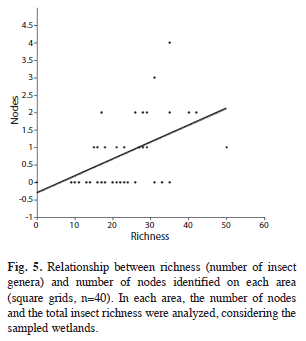
<body><![CDATA[statistical program version 2.9.0 (R Development Core Team 2009).     Wetlands without taxon occurrence were removed from the analysis. The     significance of correlations was tested by permutations (9 999     permutations). Moreover, to verify if the biogeographic nodes simply     represented the richest areas a simple linear regression was applied     between the number of nodes and the number of insect genera collected     on each area, which corresponded to square grids of 1x1 degree. In each     square grid, the number of nodes and the total insect&nbsp; richness     were analyzed, considering the sampled wetlands in each area.</span></font><br      style="font-family: verdana;">     ]]></body>
<body><![CDATA[<font size="2"></font><br style="font-family: verdana;">     <font style="font-weight: bold;" size="3"><span      style="font-family: verdana;">Results</span></font><br      style="font-family: verdana;">     <font size="2"></font><br style="font-family: verdana;">     <font size="2"><span style="font-family: verdana;"><span      style="font-weight: bold;">Insect distribution:</span> The data     regarding the distribution in Southern Brazil wetlands revealed 82     genera -37 of Chironomidae (Diptera), 29 of Odonata, eight of     Ephemeroptera and eight of Trichoptera from 13 families. Based on the     ]]></body>
<body><![CDATA[82 genera analyzed, 63 individual tracks were obtained with at least     two wetlands recorded for each genus. The generalized tracks were     created from 46 genera of aquatic insects (<a      href="/img/revistas/rbt/v60n1/a19t1.gif">Table 1</a>).<br      style="font-family: verdana;">     </span></font><br style="font-family: verdana;">     <font size="2"><span style="font-family: verdana;">The genera of     Chironomidae     (Diptera) defined <span style="font-style: italic;">17</span>     generalized tracks and <span style="font-style: italic;">11</span>     ]]></body>
<body><![CDATA[biogeographic nodes in     Southern Brazil wetlands (five nodes in the Pampa and five nodes in the     Atlantic Rainforest) (<a href="/img/revistas/rbt/v60n1/a19i2.jpg">Fig.     2B</a>). The most important generalized tracks     were g and o, created from six and five individual tracks,     respectively. The track g is located in both biomes, whereas the track     o is located in the Pampa (<a href="/img/revistas/rbt/v60n1/a19i2.jpg">Fig.     2B</a>). The most important nodes were <span      style="font-style: italic;">6</span>     and <span style="font-style: italic;">11</span> -both supported by     ]]></body>
<body><![CDATA[three generalized tracks. The node <span style="font-style: italic;">6</span>     -located     in the Pampa- was defined by the tracks <span      style="font-style: italic;">g, n</span>, and <span      style="font-style: italic;">o</span>, and the node <span      style="font-style: italic;">11</span>     -located in the Atlantic Rainforest- was represented by the tracks <span      style="font-style: italic;">c, e</span>     and <span style="font-style: italic;">g</span> (<a      href="/img/revistas/rbt/v60n1/a19t2.gif">Table 2</a>, <a     ]]></body>
<body><![CDATA[ href="/img/revistas/rbt/v60n1/a19i2.jpg">Fig. 2B</a>).</span></font><br      style="font-family: verdana;">     <font size="2"></font><br style="font-family: verdana;">     <font size="2"><span style="font-family: verdana;">The genera     Ephemeroptera defined     three generalized tracks and three biogeographic nodes in Southern     Brazil wetlands (<a href="/img/revistas/rbt/v60n1/a19i3.jpg">Fig. 2C</a>).     The generalized track <span style="font-style: italic;">c</span> was     defined by three     individual tracks of the genera <span style="font-style: italic;">Americabaetis,     ]]></body>
<body><![CDATA[Cloedes,</span> and<span style="font-style: italic;"> Caenis</span>.     The     other two generalized tracks -<span style="font-style: italic;">a</span>     and <span style="font-style: italic;">b</span>- were presented by two     individual     tracks each (<a href="/img/revistas/rbt/v60n1/a19i3.jpg">Fig. 2C</a>).     The generalized tracks <span style="font-style: italic;">a</span> and <span      style="font-style: italic;">c</span> are located in     the Pampa; the track <span style="font-style: italic;">b</span> is     located in the transition of both biomes. The     ]]></body>
<body><![CDATA[biogeographic nodes were represented by two generalized tracks each,     and they are located in the Pampa (<a      href="/img/revistas/rbt/v60n1/a19t2.gif">Table 2</a>, <a      href="/img/revistas/rbt/v60n1/a19i3.jpg">Fig. 2C</a>). The genera of     Odonata identified 12 generalized tracks and nine biogeographic     nodesseven</span></font><font size="2"><span      style="font-family: verdana;"> nodes in the Atlantic Rainforest     and two in the Pampa (<a href="/img/revistas/rbt/v60n1/a19i3.jpg">Fig.     2D</a>). The most important generalized tracks     were h (represented by seven individual tracks), and f (represented by     ]]></body>
<body><![CDATA[eight individual tracks) (<a href="/img/revistas/rbt/v60n1/a19t2.gif">Table     2</a>). The track h was defined by the     genera <span style="font-style: italic;">Coryphaeschna, Acanthagrion,     Cyanallagma, Homeoura, Oxyagrion,     Micrathyria, </span>and <span style="font-style: italic;">Tramea</span>,     and was mainly associated with the biome     Atlantic Rainforest. The track <span style="font-style: italic;">f </span>was     represented by <span style="font-style: italic;">Cyanallagma,     Homeoura, Leptobasis, Oxyagrion, Lestes, Micrathyria, Tramea, </span>and     <span style="font-style: italic;">Telebasis</span>, and was located in     ]]></body>
<body><![CDATA[both biomes. The most important     biogeographic node was l located in the Atlantic Rainforest (<a      href="/img/revistas/rbt/v60n1/a19t2.gif">Table 2</a>,     <a href="/img/revistas/rbt/v60n1/a19i3.jpg">Fig. 2D</a>). The genera of     Trichoptera defined only one generalized track,     but no biogeographic node (<a href="/img/revistas/rbt/v60n1/a19t2.gif">Table     2</a>, <a href="/img/revistas/rbt/v60n1/a19i4.jpg">Fig. 2E</a>). The     track identified by     the genera <span style="font-style: italic;">Oecetis</span> and <span      style="font-style: italic;">Oxyethira</span> link both biomes.    ]]></body>
<body><![CDATA[<br> <br style="font-family: verdana;"> </span></font> <font size="2"><span style="font-family: verdana;">The superposition of all 63 individual tracks defined <span style="font-style: italic;">16</span> generalized tracks and seven biogeographic nodes represented by different orders of aquatic insects (<a  href="/img/revistas/rbt/v60n1/a19t2.gif">Table 2</a>, <a  href="/img/revistas/rbt/v60n1/a19i4.jpg">Fig. 2F</a>). The generalized track h was defined by eight genera of <span style="font-style: italic;">Chironomidae, Odonata, Ephemeroptera, </span>and <span style="font-style: italic;">Trichoptera</span>. Other important generalized tracks were <span style="font-style: italic;">c, f,</span> and <span style="font-style: italic;">n</span> -all represented by seven individual tracks each (<a href="/img/revistas/rbt/v60n1/a19i4.jpg">Fig. 2F</a>). The most important biogeographic nodes defined by three generalized tracks, at least, were: <span  style="font-style: italic;">one</span>, represented by the generalized tracks <span style="font-style: italic;">i, p</span>, and <span style="font-style: italic;">o</span> and all located in the Atlantic Rainforest; <span style="font-style: italic;">two</span>, represented by the generalized tracks <span style="font-style: italic;">f, g, i, </span>and <span style="font-style: italic;">m</span> and all located in the Atlantic Rainforest; and five, represented by the generalized tracks <span style="font-style: italic;">c, e</span>, and <span style="font-style: italic;">j</span> and all located in the Pampa (<a href="/img/revistas/rbt/v60n1/a19t3.gif">Table 3</a>, <a  href="/img/revistas/rbt/v60n1/a19i4.jpg">Fig. 2F</a>). The other four biogeographic nodes were located in the Pampa (<a href="/img/revistas/rbt/v60n1/a19i2.jpg">Fig. 2F</a>).</span></font><br style="font-family: verdana;"> <font size="2"></font><br style="font-family: verdana;"> <font size="2"><span style="font-family: verdana;"><span  style="font-weight: bold;">Implications for conservation</span>: All generalized tracks and biogeographic nodes identified in Southern Brazil wetlands were superposed in a summary map (<a  href="/img/revistas/rbt/v60n1/a19i5.jpg">Fig. 3A</a>). Therefore, 32 biogeographic nodes corresponded to the priority areas for conservation of the aquatic insect diversity in Southern Brazil wetlands. Among this total, 13 were located in the Atlantic Rainforest, 16 in the Pampa, and three amongst both biomes (<a  href="/img/revistas/rbt/v60n1/a19i5.jpg">Fig. 3A</a>). According to the node cluster criterion, the priority regions for conservation were the following: (a) Site one (~9 000km&sup2;), located in the Western region in the Pampas, presenting two main areas that totalize ten nodes; (b) Site two (~1 000km&sup2;), located in the South-eastern region, in the Pampa and represented by the three nodes; (c) Site three (~7 000km&sup2;), located in the Eastern region, in the Atlantic Rainforest, and represented by four nodes; and (d) Site four (~6 000km&sup2;), located in the central region, in the Atlantic Rainforest and presented by three nodes (<a  href="/img/revistas/rbt/v60n1/a19i5.jpg">Fig. 3B</a>).</span></font><br  style="font-family: verdana;"> <font size="2"></font><br style="font-family: verdana;"> <font size="2"><span style="font-family: verdana;">The comparison between the distribution of the biogeographic nodes and the&nbsp; distribution of the conservation units in Southern Brazil, showed that several priority areas for the conservation of the diversity in aquatic insects are found outside the conservation units (<a  href="/img/revistas/rbt/v60n1/a19i6.jpg">Fig. 4</a>). Only five out of 32 biogeographic nodes (approximately 15%) were partially within the conservation units (three nodes in the Pampa, one node in the Atlantic Rainforest, and one node between both biomes). The corresponding areas to the other biogeographic nodes were not inserted in the conservation units (<a href="/img/revistas/rbt/v60n1/a19i6.jpg">Fig. 4</a>). All genera composition matrix was correlated with geographic distance matrix</span></font><font size="2"><span  style="font-family: verdana;"> (r=0.118, p=0.001). When we analyzed each invertebrate group separately, Trichoptera and Chironomidae genera were correlated with geographic distance matrix (r=0.094, p=0.016 and r=0.072, p=0.001, respectively). Odonata and Ephemeroptera genera were not correlated with geographic distance matrix (r=0.037, p=0.138 and r=0.057, p=0.085, respectively), nor with sampling seasonality matrix (r=0.025, p=0.201 and r=0.015, p=0.34, respectively). These results showed that the distribution patterns of aquatic insects genera in Southern Brazil wetlands were not influenced by the sampling period.</span></font><br style="font-family: verdana;"> <br style="font-family: verdana;"> <font size="2"><span style="font-family: verdana;">On the other hand, the number of nodes was loosely correlated with the number of genera collected in the studied wetlands (R&sup2;=0.267, F1,40=13.862, p&lt;0.001). In this sense, the number of nodes cannot be highly predicted by insect richness because the major portion of variation in the number of nodes was not explained by insect richness, given that many areas fall far from the regression line (coefficient of determination of only 0.267) (<a href="#Figura">Fig. 5</a>).    <br> <br style="font-family: verdana;"> </span></font>     <div style="text-align: center;"><a name="Figura"></a><img alt=""      src="/img/revistas/rbt/v60n1/a19i7.jpg"      style="width: 306px; height: 341px;"><br style="font-family: verdana;">     </div>     <font style="font-weight: bold;" size="3"><span      style="font-family: verdana;">Discussion</span></font><br      style="font-family: verdana;">     <font size="2"></font><br style="font-family: verdana;">     ]]></body>
<body><![CDATA[<font size="2"><span style="font-family: verdana;"><span      style="font-weight: bold;">Insect distribution: </span>Congruences of     biogeographic patterns of the phylogenetically related groups may be     more associated to a common natural history than to independent     dispersion events. Independent dispersion events occur as a reaction     from each group to different environmental conditions (Gullan &amp;     Cranston 2008). The coinciding patterns of individual tracks of genera     analyzed (<span style="font-style: italic;">e.g</span>. generalized     track) indicated a narrow relationship     between biota and studied region history. In this sense, we can infer     ]]></body>
<body><![CDATA[that the current distribution patterns of the aquatic insects in     Southern Brazil wetlands are determined mainly by vicariant events, and     not by uncorrelated individual dispersions. However, we do not exclude     the possibility that individual dispersal events have occurred, but     after vicariant events.</span></font><br style="font-family: verdana;">     <font size="2"></font><br style="font-family: verdana;">     <font size="2"><span style="font-family: verdana;">The faunal     similarity observed was     not influenced by the sampling period, but by the&nbsp; natural history     of aquatic insects. Since the studied groups present ephemeral adults     ]]></body>
<body><![CDATA[and immature stages associated to aquatic habitats, dispersions of long     distance are less likely to explain the observed convergences. Odonata,     Ephemeroptera, Chironomidae, Plecoptera, Trichoptera present overlapped     distributions in the Southern Hemisphere even in low taxonomic levels     (genus, species) (Gullan &amp; Cranston 2008). The current geographic     distribution of aquatic insects suggests that their direct ancestors     already inhabited the Gondwana supercontinent and were subject to     vicariant events, such as the formation of continents (Gullan &amp;     Cranston 2008). In this sense, the tracks and, therefore, the observed     nodes reflected the biogeographic patterns related to the spatial     ]]></body>
<body><![CDATA[structure of the biota rather than to sampling seasonality.</span></font><br      style="font-family: verdana;">     <font size="2"></font><br style="font-family: verdana;">     <font size="2"><span style="font-family: verdana;">The distribution     patterns found     varied between the studied biomes. Most of the tracks and nodes found     for different orders of aquatic insects were within the Pampa,     excepting for Odonata. For Chironomidae, ten out of 17 generalized     tracks were located in the Pampa. According Ferrington (2008),     intermittent and ephemeral aquatic ecosystems, like Brazilian lowlands,     ]]></body>
<body><![CDATA[are habitats where chironomids have wide geographic distribution and     this relation is closely related to the patterns of&nbsp; transantartic     diversification and vicariance (Brundin 1966). The same distribution     pattern was observed for Ephemeroptera, which concentrated almost its     tracks in the Pampa. According to Barber- James et al. (2008), mayflies     are considered historically as insects of very low-dispersal ability in     oceans and mountains -dispersal barriers. Therefore, the present     distribution was explained only by vicariance, radiation, and     extinction events and it was a reflection of geological events (Edmunds     1972, 1975). The region delimitated by the tracks of Ephemeroptera     ]]></body>
<body><![CDATA[presented the lowest altitudes registered in Southern Brazil-what     explains the coinciding pattern of distribution of its genera.</span></font><br      style="font-family: verdana;">     <font size="2"></font><br style="font-family: verdana;">     <font size="2"><span style="font-family: verdana;">Most of tracks of     the Odonata     genera were distributed in higher altitude of the Atlantic Rainforest.     According to Kalkman<span style="font-style: italic;"> et al. </span>(2008),     significant regions of the Odonata     diversification include the regions with higher altitude, such as the     ]]></body>
<body><![CDATA[Mexican Plateau, Chiapas to Honduras highlands, Costa Rica-Panama     highlands, Northern and Southern Andes, Eastern Andean foothills,     Tepuis of the Guyana Shield, Guyana lowlands, Atlantic Forests of     Brazil and River Paran&aacute; basin. The occurrence of few tracks of     Odonata in the Pampa was due to the wide distribution of two relatively     recent Odonata families (Coenagrionidae and Libellulidae) (Rehn 2003).     Almost all ubiquitous</span></font><font size="2"><span      style="font-family: verdana;"> Odonata species observed belong to     these two families, occurring in lentic water habitats of savannas,     such as the wetlands in the Pampa. The occurrence of two families of     ]]></body>
<body><![CDATA[Trichoptera (Leptoceridae and Hydroptilidae) was expected in Southern     Brazil. According to Eskov <span style="font-style: italic;">et al.</span>     (2004), these families were found in     the extratropical, warm temperate latitudes of Laurasia (England and     Siberia), and they dispersed in the Early Cretaceous across other     landmasses including Gondwana (Brazil). A limited dispersal ability of     both families of Trichoptera reflects the current distribution     restriction of the genera found in Southern Brazil wetlands, since such     order of aquatic insects was presented by a unique generalized track     and by no biogeographic node at the region studied.</span></font><br     ]]></body>
<body><![CDATA[ style="font-family: verdana;">     <font size="2"></font><br style="font-family: verdana;">     <font size="2"><span style="font-family: verdana;">Despite the     peculiarities in the     distribution of each group, the general patterns of distribution of     aquatic insects in Southern Brazil wetlands are related to the     formation of the Atlantic Rainforest and the Pampa. The three most     important biogeographic nodes supported by many generalized tracks,     reflect a huge vicariant event at the studied region and represent     large areas of aquatic biodiversity. The two largest nodes present in     ]]></body>
<body><![CDATA[the Atlantic Rainforest are represented, mainly, by groups of wide     distribution and greater diversification in higher altitude     environments. Thus, the great biogeographic node present in the Pampa     was represented by groups of aquatic insects</span></font><font size="2"><span      style="font-family: verdana;"> distributed in areas located at     lower altitudes and with restricted dispersal ability such as     Ephemeroptera and Trichoptera. Such relation shows the importance of     the landscape on the diversity and distribution of aquatic insects at     the Neotropical region.</span></font><br style="font-family: verdana;">     <font size="2"></font><br style="font-family: verdana;">     ]]></body>
<body><![CDATA[<font size="2"><span style="font-family: verdana;"><span      style="font-weight: bold;">Implications for conservation</span>: The     biogeographic nodes guide historically the generalized regional tracks     (Craw </span></font><font size="2"><span style="font-family: verdana;"><span      style="font-style: italic;">et al.</span> </span></font><font size="2"><span      style="font-family: verdana;">1999), since the patterns of     distribution of the biota are     influenced by the events that occur in each region. Such centers     reflect indirectly the long-term maintenance of the biodiversity and     spatial structure of the biota. They also include areas of high     ]]></body>
<body><![CDATA[biogeographic diversity, since they are formed by samples of taxon and     patterns of different origins, qualifying them as priority areas for     conservation (Morrone 1999, Prevedello &amp; Carvalho 2006). Most of     conservational actions taken today ignore the contributions offered by     the historical and evolutionary studies. Some authors argue that more     concrete decisions would be madden if information regarding the     evolution of the areas and species could be incorporated into the     conservation policies (Low&euml;nberg-Neto &amp; Carvalho 2004). In our     study, areas with a higher number of nodes were not necessarily the     richest localities since residuals of the regression analysis indicated     ]]></body>
<body><![CDATA[that panbiogeographic analysis can provide additional information on     simple insect richness, and can be still considered as useful in     conservation biogeography.</span></font><br      style="font-family: verdana;">     <font size="2"></font><br style="font-family: verdana;">     <font size="2"><span style="font-family: verdana;">Our results showed     that the     conservation unit system in Southern Brazil do not&nbsp; contemplate     several priority areas for the historical and biogeographic     conservation of wetland aquatic insects. Several areas important for     ]]></body>
<body><![CDATA[the conservation of the aquatic insects are unprotected and under     strong anthropic pressure. The current occupation of these priority     areas for conservation is related to silvicuture expansion and     urbanization (sites two and three, respectively), and livestock and     agriculture (sites one and four). Only 18 wetlands are under protection     in conservation units in Southern </span></font><font size="2"><span      style="font-family: verdana;">Brazil (Carvalho &amp;     Oz&oacute;rio 2007). The priority areas pointed by node cluster     criterion must be considered in further inclusions of areas for     biodiversity conservation in Southern Brazil wetlands, since such areas     ]]></body>
<body><![CDATA[presents species from different ancestral biota. The inclusion of such     areas into the conservation units would be a strong way to conserve the     aquatic biodiversity in this region. Furthermore, our results show that     the panbiogeography is an important tool to identify priority areas for     the conservation of the aquatic biodiversity in Neotropical region     (Morrone &amp; Espinosa 1998).</span></font><br      style="font-family: verdana;">     <font size="2"></font><br style="font-family: verdana;">     <font style="font-weight: bold;" size="3"><span      style="font-family: verdana;">Acknowledgments</span></font><br     ]]></body>
<body><![CDATA[ style="font-family: verdana;">     <font size="2"></font><br style="font-family: verdana;">     <font size="2"><span style="font-family: verdana;">This research was     supported by     funds from Universidade do Vale do Rio dos Sinos &#8211; NISINOS     (02.00.023/00-0), and Conselho Nacional de Desenvolvimento     Cient&iacute;fico e Tecnol&oacute;gico -CNPq (52370695.2). Leonardo     Maltchik holds a Brazilian Research Council -CNPq Research Productivity     grant. We declare that the data collection complied with the Brazilian     current laws.<br style="font-family: verdana;">     ]]></body>
<body><![CDATA[</span></font><font style="font-weight: bold;" size="3"><span      style="font-family: verdana;"></span></font>     <hr style="width: 100%; height: 2px;"><font style="font-weight: bold;"      size="3"><span style="font-family: verdana;">    <!-- ref --><br> References</span></font><br style="font-family: verdana;"> <font size="2"></font><br style="font-family: verdana;"> <font size="2"><span style="font-family: verdana;">Babbitt, K.J. 2005. The relative importance of wetland size and hydroperiod for&nbsp; amphibians in Southern New Hampshire. Wetl. Ecol. Manag. 13: 269-279.    &nbsp;&nbsp;&nbsp;&nbsp;&nbsp;&nbsp;&nbsp;&nbsp;[&#160;<a href="javascript:void(0);" onclick="javascript: window.open('/scielo.php?script=sci_nlinks&ref=1423269&pid=S0034-7744201200010001900001&lng=','','width=640,height=500,resizable=yes,scrollbars=1,menubar=yes,');">Links</a>&#160;]<!-- end-ref --><!-- ref --></span></font><br  style="font-family: verdana;"> <font size="2"></font><br style="font-family: verdana;"> <font size="2"><span style="font-family: verdana;">Barber-James, H.M., J. Gattolliat, M. Sartori &amp; M.D. Hubbard. 2008. Global diversity of mayflies (Ephemeroptera, Insecta) in freshwater. Hydrobiologia 595: 339-350.    &nbsp;&nbsp;&nbsp;&nbsp;&nbsp;&nbsp;&nbsp;&nbsp;[&#160;<a href="javascript:void(0);" onclick="javascript: window.open('/scielo.php?script=sci_nlinks&ref=1423270&pid=S0034-7744201200010001900002&lng=','','width=640,height=500,resizable=yes,scrollbars=1,menubar=yes,');">Links</a>&#160;]<!-- end-ref --><!-- ref --></span></font><br  style="font-family: verdana;"> <font size="2"></font><br style="font-family: verdana;"> <font size="2"><span style="font-family: verdana;">Brundin, L. 1966. Transantarctic relationships and their significance, as evidenced by chironomid midges with a monograph of the subfamilies Podonominae and Aphroteniinae and the austral Heptagyiae. K. Svenska Vetenskapsakad. Handl. 11: 1-472.    &nbsp;&nbsp;&nbsp;&nbsp;&nbsp;&nbsp;&nbsp;&nbsp;[&#160;<a href="javascript:void(0);" onclick="javascript: window.open('/scielo.php?script=sci_nlinks&ref=1423271&pid=S0034-7744201200010001900003&lng=','','width=640,height=500,resizable=yes,scrollbars=1,menubar=yes,');">Links</a>&#160;]<!-- end-ref --><!-- ref --></span></font><br  style="font-family: verdana;"> <font size="2"></font><br style="font-family: verdana;"> <font size="2"><span style="font-family: verdana;">Carvalho, A.B.P. &amp; C.P. Oz&oacute;rio. 2007. Avalia&ccedil;&atilde;o sobre os banhados do Rio Grande do Sul, Brasil. Rev. Cienc. Amb. 1: 83-95.    &nbsp;&nbsp;&nbsp;&nbsp;&nbsp;&nbsp;&nbsp;&nbsp;[&#160;<a href="javascript:void(0);" onclick="javascript: window.open('/scielo.php?script=sci_nlinks&ref=1423272&pid=S0034-7744201200010001900004&lng=','','width=640,height=500,resizable=yes,scrollbars=1,menubar=yes,');">Links</a>&#160;]<!-- end-ref --><!-- ref --></span></font><br  style="font-family: verdana;"> <font size="2"></font><br style="font-family: verdana;"> <font size="2"><span style="font-family: verdana;">Carvalho, C.J.B., M. Bortolanza, M.C.C. Silva &amp; E.D.G. Soares. 2003. Distributional patterns of the Neotropical Muscidae (Diptera), p. 263-274. <span  style="font-style: italic;">In</span> J.J. Morrone &amp; J. Llorente (eds.). Una perspectiva latinoamericana de la biogeograf&iacute;a. Las Prensas de Ciencia, Facultad de Ciencias, UNAM, Ciudad de M&eacute;xico, M&eacute;xico.    &nbsp;&nbsp;&nbsp;&nbsp;&nbsp;&nbsp;&nbsp;&nbsp;[&#160;<a href="javascript:void(0);" onclick="javascript: window.open('/scielo.php?script=sci_nlinks&ref=1423273&pid=S0034-7744201200010001900005&lng=','','width=640,height=500,resizable=yes,scrollbars=1,menubar=yes,');">Links</a>&#160;]<!-- end-ref --><!-- ref --></span></font><br  style="font-family: verdana;"> <font size="2"></font><br style="font-family: verdana;"> <font size="2"><span style="font-family: verdana;">Collinson, N.H., J. Biggs, A. Corfield, M.J. Hodson, D. Walker, M. Whitfield &amp; P.J. Williams. 1995. Temporary and permanent ponds: an assessment of the effects of drying out on the conservation value of aquatic macroinvertebrate communities. Biol.&nbsp; Conserv. 74: 125-133.    &nbsp;&nbsp;&nbsp;&nbsp;&nbsp;&nbsp;&nbsp;&nbsp;[&#160;<a href="javascript:void(0);" onclick="javascript: window.open('/scielo.php?script=sci_nlinks&ref=1423274&pid=S0034-7744201200010001900006&lng=','','width=640,height=500,resizable=yes,scrollbars=1,menubar=yes,');">Links</a>&#160;]<!-- end-ref --><!-- ref --></span></font><br  style="font-family: verdana;"> <font size="2"></font><br style="font-family: verdana;"> <font size="2"><span style="font-family: verdana;">Contreras-Medina, R., I. Luna-Vega &amp; J.J. Morrone. 1999. Biogeographic analysis of the genera of Cycadales and Coniferales (Gymnospermae): a panbiogeographic approach. Biogeographica 75: 163-176.    &nbsp;&nbsp;&nbsp;&nbsp;&nbsp;&nbsp;&nbsp;&nbsp;[&#160;<a href="javascript:void(0);" onclick="javascript: window.open('/scielo.php?script=sci_nlinks&ref=1423275&pid=S0034-7744201200010001900007&lng=','','width=640,height=500,resizable=yes,scrollbars=1,menubar=yes,');">Links</a>&#160;]<!-- end-ref --><!-- ref --></span></font><br  style="font-family: verdana;"> <font size="2"></font><br style="font-family: verdana;"> <font size="2"><span style="font-family: verdana;">Contreras-Medina, R. &amp; H. Eliosa-Le&oacute;n. 2001. Una visi&oacute;n panbiogeogr&aacute;fico preliminary de M&eacute;xico, p. 197-211. In J. Llorente &amp; J.J. Morrone (eds.). Introducci&oacute;n a la biogeograf&iacute;a en latinoam&eacute;rica: teor&iacute;as, conceptos, m&eacute;todos y aplicaciones. Las Prensas de Ciencias, Facultad de Ciencias, UNAM, Ciudad de M&eacute;xico, M&eacute;xico.    &nbsp;&nbsp;&nbsp;&nbsp;&nbsp;&nbsp;&nbsp;&nbsp;[&#160;<a href="javascript:void(0);" onclick="javascript: window.open('/scielo.php?script=sci_nlinks&ref=1423276&pid=S0034-7744201200010001900008&lng=','','width=640,height=500,resizable=yes,scrollbars=1,menubar=yes,');">Links</a>&#160;]<!-- end-ref --><!-- ref --></span></font><br  style="font-family: verdana;"> <font size="2"></font><br style="font-family: verdana;"> <font size="2"><span style="font-family: verdana;">Contreras-Medina, R., I. Luna-Vega &amp; O. Alcantara. 2001a. Las gimnospermas de los bosques mes&oacute;filos demonta&ntilde;a de la Huasteca Hidalguense, M&eacute;xico. Bol. Soc. Bot. Mex. 68: 69-81.    &nbsp;&nbsp;&nbsp;&nbsp;&nbsp;&nbsp;&nbsp;&nbsp;[&#160;<a href="javascript:void(0);" onclick="javascript: window.open('/scielo.php?script=sci_nlinks&ref=1423277&pid=S0034-7744201200010001900009&lng=','','width=640,height=500,resizable=yes,scrollbars=1,menubar=yes,');">Links</a>&#160;]<!-- end-ref --><!-- ref --></span></font><br  style="font-family: verdana;"> <font size="2"></font><br style="font-family: verdana;"> <font size="2"><span style="font-family: verdana;">Contreras-Medina, R., J.J. Morrone &amp; I. Luna-Vega. 2001b. Biogeographic methods identify gymnosperm biodiversity hotspots. Naturwissenschaften 88: 427-430.    &nbsp;&nbsp;&nbsp;&nbsp;&nbsp;&nbsp;&nbsp;&nbsp;[&#160;<a href="javascript:void(0);" onclick="javascript: window.open('/scielo.php?script=sci_nlinks&ref=1423278&pid=S0034-7744201200010001900010&lng=','','width=640,height=500,resizable=yes,scrollbars=1,menubar=yes,');">Links</a>&#160;]<!-- end-ref --><!-- ref --> </span></font><br  style="font-family: verdana;"> <font size="2"></font><br style="font-family: verdana;"> <font size="2"><span style="font-family: verdana;">Craw, R.C., J.R. Grehan &amp; M.J. Heads. 1999. Panbiogeography; tracking the history of life. Oxford University, New York, USA.    &nbsp;&nbsp;&nbsp;&nbsp;&nbsp;&nbsp;&nbsp;&nbsp;[&#160;<a href="javascript:void(0);" onclick="javascript: window.open('/scielo.php?script=sci_nlinks&ref=1423279&pid=S0034-7744201200010001900011&lng=','','width=640,height=500,resizable=yes,scrollbars=1,menubar=yes,');">Links</a>&#160;]<!-- end-ref --><!-- ref --></span></font><br  style="font-family: verdana;"> <font size="2"></font><br style="font-family: verdana;"> <font size="2"><span style="font-family: verdana;">Crisci, J.C., L. Katinas &amp; P. Posadas. 2003. Historical biogeography; an introduction.&nbsp; Harvard University, Cambridge, Massachusetts, USA.    &nbsp;&nbsp;&nbsp;&nbsp;&nbsp;&nbsp;&nbsp;&nbsp;[&#160;<a href="javascript:void(0);" onclick="javascript: window.open('/scielo.php?script=sci_nlinks&ref=1423280&pid=S0034-7744201200010001900012&lng=','','width=640,height=500,resizable=yes,scrollbars=1,menubar=yes,');">Links</a>&#160;]<!-- end-ref --><!-- ref --></span></font><br  style="font-family: verdana;"> <font size="2"></font><br style="font-family: verdana;"> <font size="2"><span style="font-family: verdana;">Edmunds, G.F. 1972. Biogeography and evolution of Ephemeroptera. Ann. Rev. Entom. 17: 21-42.    &nbsp;&nbsp;&nbsp;&nbsp;&nbsp;&nbsp;&nbsp;&nbsp;[&#160;<a href="javascript:void(0);" onclick="javascript: window.open('/scielo.php?script=sci_nlinks&ref=1423281&pid=S0034-7744201200010001900013&lng=','','width=640,height=500,resizable=yes,scrollbars=1,menubar=yes,');">Links</a>&#160;]<!-- end-ref --><!-- ref --></span></font><br  style="font-family: verdana;"> <font size="2"></font><br style="font-family: verdana;"> <font size="2"><span style="font-family: verdana;">Edmunds, G.F. 1975. Phylogenetic biogeography of mayflies. Ann. Mo. Bot. Gard. 62: 251-263.    &nbsp;&nbsp;&nbsp;&nbsp;&nbsp;&nbsp;&nbsp;&nbsp;[&#160;<a href="javascript:void(0);" onclick="javascript: window.open('/scielo.php?script=sci_nlinks&ref=1423282&pid=S0034-7744201200010001900014&lng=','','width=640,height=500,resizable=yes,scrollbars=1,menubar=yes,');">Links</a>&#160;]<!-- end-ref --></span></font><br  style="font-family: verdana;"> <font size="2"><span style="font-family: verdana;">    <!-- ref --><br> Eskov, K.Y., V.D. Ivanov, I.D. Sukatsheva &amp; A. Wells. 2004. Geographic history of the family Hydroptilidae (Trichoptera). II Vserossiyskiy simpozium po amfibioticheskim i vodnym nasekomym, Voronezh, Russia.    &nbsp;&nbsp;&nbsp;&nbsp;&nbsp;&nbsp;&nbsp;&nbsp;[&#160;<a href="javascript:void(0);" onclick="javascript: window.open('/scielo.php?script=sci_nlinks&ref=1423284&pid=S0034-7744201200010001900015&lng=','','width=640,height=500,resizable=yes,scrollbars=1,menubar=yes,');">Links</a>&#160;]<!-- end-ref --><!-- ref --></span></font><br  style="font-family: verdana;"> <font size="2"></font><br style="font-family: verdana;"> <font size="2"><span style="font-family: verdana;">Fern&aacute;ndez, H.R. &amp; E. Dom&iacute;nguez. 2001. Gu&iacute;a para la determinaci&oacute;n de los artr&oacute;podos bent&oacute;nicos sudamericanos. Universidad Nacional de Tucum&aacute;n, Tucum&aacute;n, Argentina.    &nbsp;&nbsp;&nbsp;&nbsp;&nbsp;&nbsp;&nbsp;&nbsp;[&#160;<a href="javascript:void(0);" onclick="javascript: window.open('/scielo.php?script=sci_nlinks&ref=1423285&pid=S0034-7744201200010001900016&lng=','','width=640,height=500,resizable=yes,scrollbars=1,menubar=yes,');">Links</a>&#160;]<!-- end-ref --><!-- ref --></span></font><br  style="font-family: verdana;"> <font size="2"></font><br style="font-family: verdana;"> <font size="2"><span style="font-family: verdana;">Ferrington, L.C. 2008. Global diversity of non-biting midges (Chironomidae; Insecta-Diptera) in freshwater. Hydrobiologia 595: 447-455.    &nbsp;&nbsp;&nbsp;&nbsp;&nbsp;&nbsp;&nbsp;&nbsp;[&#160;<a href="javascript:void(0);" onclick="javascript: window.open('/scielo.php?script=sci_nlinks&ref=1423286&pid=S0034-7744201200010001900017&lng=','','width=640,height=500,resizable=yes,scrollbars=1,menubar=yes,');">Links</a>&#160;]<!-- end-ref --><!-- ref --></span></font><br  style="font-family: verdana;"> <font size="2"></font><br style="font-family: verdana;"> <font size="2"><span style="font-family: verdana;">Franco-Rosselli, P. &amp; C.C. Berg. 1997. Distributional patterns of<span style="font-style: italic;"> Cecropia</span> (Cecropiaceae): a panbiogeographic analysis. Caldasia 19: 285-296.    &nbsp;&nbsp;&nbsp;&nbsp;&nbsp;&nbsp;&nbsp;&nbsp;[&#160;<a href="javascript:void(0);" onclick="javascript: window.open('/scielo.php?script=sci_nlinks&ref=1423287&pid=S0034-7744201200010001900018&lng=','','width=640,height=500,resizable=yes,scrollbars=1,menubar=yes,');">Links</a>&#160;]<!-- end-ref --><!-- ref --></span></font><br  style="font-family: verdana;"> <font size="2"></font><br style="font-family: verdana;"> <font size="2"><span style="font-family: verdana;">Franco-Rosselli, P. 2001. Est&uacute;dios panbiogeogr&aacute;ficos em Col&ocirc;mbia, p. 221-224. <span style="font-style: italic;">In</span> J. Llorente &amp; J.J. Morrone (eds.). Introducci&oacute;n a la biogeograf&iacute;a en latinoam&eacute;rica: teor&iacute;as, conceptos, m&eacute;todos y aplicaciones. Las Prensas de Ciencias, Facultad de Ciencias, UNAM, Ciudad de M&eacute;xico, M&eacute;xico.    &nbsp;&nbsp;&nbsp;&nbsp;&nbsp;&nbsp;&nbsp;&nbsp;[&#160;<a href="javascript:void(0);" onclick="javascript: window.open('/scielo.php?script=sci_nlinks&ref=1423288&pid=S0034-7744201200010001900019&lng=','','width=640,height=500,resizable=yes,scrollbars=1,menubar=yes,');">Links</a>&#160;]<!-- end-ref --><!-- ref --></span></font><br  style="font-family: verdana;"> <font size="2"></font><br style="font-family: verdana;"> <font size="2"><span style="font-family: verdana;">Gibbs, J.P. 2000. Wetland loss and biodiversity conservation. Conserv. Biol. 14: 314-317.    &nbsp;&nbsp;&nbsp;&nbsp;&nbsp;&nbsp;&nbsp;&nbsp;[&#160;<a href="javascript:void(0);" onclick="javascript: window.open('/scielo.php?script=sci_nlinks&ref=1423289&pid=S0034-7744201200010001900020&lng=','','width=640,height=500,resizable=yes,scrollbars=1,menubar=yes,');">Links</a>&#160;]<!-- end-ref --><!-- ref --></span></font><br  style="font-family: verdana;"> <font size="2"></font><br style="font-family: verdana;"> <font size="2"><span style="font-family: verdana;">Gomes, A.D.S. &amp; A.M.D. Magalh&atilde;es Jr. 2004. Arroz irrigado no Sul do Brasil (Irrigated rice in Southern Brazil). Embrapa, Pelotas, Rio Grande do Sul, Brasil.    &nbsp;&nbsp;&nbsp;&nbsp;&nbsp;&nbsp;&nbsp;&nbsp;[&#160;<a href="javascript:void(0);" onclick="javascript: window.open('/scielo.php?script=sci_nlinks&ref=1423290&pid=S0034-7744201200010001900021&lng=','','width=640,height=500,resizable=yes,scrollbars=1,menubar=yes,');">Links</a>&#160;]<!-- end-ref --><!-- ref --> Guadagnin, D. &amp; L. Maltchik. 2007. Habitat and landscape factors associated with Neotropical waterbird&nbsp; occurrence and richness in wetland fragments. Biodivers. Conserv. 16: 1231-1244.    &nbsp;&nbsp;&nbsp;&nbsp;&nbsp;&nbsp;&nbsp;&nbsp;[&#160;<a href="javascript:void(0);" onclick="javascript: window.open('/scielo.php?script=sci_nlinks&ref=1423291&pid=S0034-7744201200010001900022&lng=','','width=640,height=500,resizable=yes,scrollbars=1,menubar=yes,');">Links</a>&#160;]<!-- end-ref --><!-- ref --></span></font><br  style="font-family: verdana;"> <font size="2"></font><br style="font-family: verdana;"> <font size="2"><span style="font-family: verdana;">Gullan, P.J. &amp; P.S. Cranston. 2008. Os insetos: um resumo de entomologia. Roca, S&atilde;o Paulo, Brasil.    &nbsp;&nbsp;&nbsp;&nbsp;&nbsp;&nbsp;&nbsp;&nbsp;[&#160;<a href="javascript:void(0);" onclick="javascript: window.open('/scielo.php?script=sci_nlinks&ref=1423292&pid=S0034-7744201200010001900023&lng=','','width=640,height=500,resizable=yes,scrollbars=1,menubar=yes,');">Links</a>&#160;]<!-- end-ref --><br>     <!-- ref --><br> IBGE - Instituto Brasileiro de Geografia e Estat&iacute;stica. 2004. Nota t&eacute;cnica do mapa de biomas do Brasil. Bras&iacute;lia, Distrito Federal, Brasil. (Downloaded: December 15, 2010, <a href="www.ibge.gov.br/%20home/%20geociencias/default_prod.shtm#MAPAS">www.ibge.gov.br/ home/ geociencias/default_prod.shtm#MAPAS</a>).    &nbsp;&nbsp;&nbsp;&nbsp;&nbsp;&nbsp;&nbsp;&nbsp;[&#160;<a href="javascript:void(0);" onclick="javascript: window.open('/scielo.php?script=sci_nlinks&ref=1423294&pid=S0034-7744201200010001900024&lng=','','width=640,height=500,resizable=yes,scrollbars=1,menubar=yes,');">Links</a>&#160;]<!-- end-ref --><!-- ref --></span></font><br  style="font-family: verdana;"> <font size="2"></font><br style="font-family: verdana;"> <font size="2"><span style="font-family: verdana;">Kalkman, V.J., V. Clausnitzer, K.D.B. Dijkstra, A.G. Orr, D.R. Paulson &amp; J. Van Tol. 2008. Global diversity of dragonflies (Odonata) in freshwater. Hydrobiologia 595: 351-363.    &nbsp;&nbsp;&nbsp;&nbsp;&nbsp;&nbsp;&nbsp;&nbsp;[&#160;<a href="javascript:void(0);" onclick="javascript: window.open('/scielo.php?script=sci_nlinks&ref=1423295&pid=S0034-7744201200010001900025&lng=','','width=640,height=500,resizable=yes,scrollbars=1,menubar=yes,');">Links</a>&#160;]<!-- end-ref --><!-- ref --></span></font><br style="font-family: verdana;"> <font size="2"></font><br style="font-family: verdana;"> <font size="2"><span style="font-family: verdana;">Lopretto, E.C. &amp; G. Tell. 1995. Ecosistemas de aguas continentales: metodolog&iacute;as para su estudio. Ediciones Sur, La Plata, Buenos Aires, Argentina.    &nbsp;&nbsp;&nbsp;&nbsp;&nbsp;&nbsp;&nbsp;&nbsp;[&#160;<a href="javascript:void(0);" onclick="javascript: window.open('/scielo.php?script=sci_nlinks&ref=1423296&pid=S0034-7744201200010001900026&lng=','','width=640,height=500,resizable=yes,scrollbars=1,menubar=yes,');">Links</a>&#160;]<!-- end-ref --><!-- ref --></span></font><br  style="font-family: verdana;"> <font size="2"></font><br style="font-family: verdana;"> <font size="2"><span style="font-family: verdana;">L&ouml;wenberg-Neto, P. &amp; C.J.B. Carvalho. 2004. An&aacute;lise parcimoniosa de endemicidade (PAE) na delimita&ccedil;&atilde;o de &aacute;reas de endemismos: infer&ecirc;ncias para conserva&ccedil;&atilde;o da biodiversidade. Nat. Conserv. 2: 58-65.    &nbsp;&nbsp;&nbsp;&nbsp;&nbsp;&nbsp;&nbsp;&nbsp;[&#160;<a href="javascript:void(0);" onclick="javascript: window.open('/scielo.php?script=sci_nlinks&ref=1423297&pid=S0034-7744201200010001900027&lng=','','width=640,height=500,resizable=yes,scrollbars=1,menubar=yes,');">Links</a>&#160;]<!-- end-ref --><!-- ref --></span></font><br style="font-family: verdana;"> <font size="2"></font><br style="font-family: verdana;"> <font size="2"><span style="font-family: verdana;">Luna-Vega, I., A.O. Alc&aacute;ntara, J.J. Morrone &amp; D. Espinosa. 2000. Track analysis and conservation priorities in the cloud forests of Hidalgo (Mexico). Divers. Distrib. 6: 137-143.    &nbsp;&nbsp;&nbsp;&nbsp;&nbsp;&nbsp;&nbsp;&nbsp;[&#160;<a href="javascript:void(0);" onclick="javascript: window.open('/scielo.php?script=sci_nlinks&ref=1423298&pid=S0034-7744201200010001900028&lng=','','width=640,height=500,resizable=yes,scrollbars=1,menubar=yes,');">Links</a>&#160;]<!-- end-ref --><!-- ref --></span></font><br  style="font-family: verdana;"> <font size="2"></font><br style="font-family: verdana;"> <font size="2"><span style="font-family: verdana;">Maltchik, L. 2003. Three new wetlands inventories in Brazil. Interciencia 28: 421-423.    &nbsp;&nbsp;&nbsp;&nbsp;&nbsp;&nbsp;&nbsp;&nbsp;[&#160;<a href="javascript:void(0);" onclick="javascript: window.open('/scielo.php?script=sci_nlinks&ref=1423299&pid=S0034-7744201200010001900029&lng=','','width=640,height=500,resizable=yes,scrollbars=1,menubar=yes,');">Links</a>&#160;]<!-- end-ref --><!-- ref --></span></font><br  style="font-family: verdana;"> <font size="2"></font><br style="font-family: verdana;"> <font size="2"><span style="font-family: verdana;">Margules, C.R., R.L. Pressey &amp; P.H. Williams. 2002. Representing biodiversity: data and procedures for identifying priority areas for conservation. J. Biosciences 27: 309-326.    &nbsp;&nbsp;&nbsp;&nbsp;&nbsp;&nbsp;&nbsp;&nbsp;[&#160;<a href="javascript:void(0);" onclick="javascript: window.open('/scielo.php?script=sci_nlinks&ref=1423300&pid=S0034-7744201200010001900030&lng=','','width=640,height=500,resizable=yes,scrollbars=1,menubar=yes,');">Links</a>&#160;]<!-- end-ref --><!-- ref --></span></font><br  style="font-family: verdana;"> <font size="2"></font><br style="font-family: verdana;"> <font size="2"><span style="font-family: verdana;">Menu-Marque, S., J.J. Morrone &amp; C.L. Mitrovich. 2000. Distributional patterns of the South American species of <span style="font-style: italic;">Boeckella </span>(Copepoda: Centropagidae): a track analysis. J. Crustacean Biol. 20: 262-272.    &nbsp;&nbsp;&nbsp;&nbsp;&nbsp;&nbsp;&nbsp;&nbsp;[&#160;<a href="javascript:void(0);" onclick="javascript: window.open('/scielo.php?script=sci_nlinks&ref=1423301&pid=S0034-7744201200010001900031&lng=','','width=640,height=500,resizable=yes,scrollbars=1,menubar=yes,');">Links</a>&#160;]<!-- end-ref --><!-- ref --></span></font><br  style="font-family: verdana;"> <font size="2"></font><br style="font-family: verdana;"> <font size="2"><span style="font-family: verdana;">Merritt, R.W. &amp; K.W. Cummins. 1996. An introduction to the aquatic insects of North&nbsp; America. Kendall/Hunt, Dubuque, Iowa, USA.    &nbsp;&nbsp;&nbsp;&nbsp;&nbsp;&nbsp;&nbsp;&nbsp;[&#160;<a href="javascript:void(0);" onclick="javascript: window.open('/scielo.php?script=sci_nlinks&ref=1423302&pid=S0034-7744201200010001900032&lng=','','width=640,height=500,resizable=yes,scrollbars=1,menubar=yes,');">Links</a>&#160;]<!-- end-ref --><!-- ref --></span></font><br  style="font-family: verdana;"> <font size="2"></font><br style="font-family: verdana;"> <font size="2"><span style="font-family: verdana;">MMA - Minist&eacute;rio do Meio Ambiente. 2006. Third national report to the convention on biological diversity. Minist&eacute;rio do Meio Ambiente, Bras&iacute;lia, Distrito Federal, Brasil.    &nbsp;&nbsp;&nbsp;&nbsp;&nbsp;&nbsp;&nbsp;&nbsp;[&#160;<a href="javascript:void(0);" onclick="javascript: window.open('/scielo.php?script=sci_nlinks&ref=1423303&pid=S0034-7744201200010001900033&lng=','','width=640,height=500,resizable=yes,scrollbars=1,menubar=yes,');">Links</a>&#160;]<!-- end-ref --><!-- ref --></span></font><br style="font-family: verdana;"> <font size="2"></font><br style="font-family: verdana;"> <font size="2"><span style="font-family: verdana;">MMA - Minist&eacute;rio do Meio Ambiente. 2008. &Aacute;reas priorit&aacute;rias para conserva&ccedil;&atilde;o, uso sustent&aacute;vel e reparti&ccedil;&atilde;o de benef&iacute;cios da biodiversidade brasileira. Minist&eacute;rio do Meio Ambiente, Bras&iacute;lia, Distrito Federal, Brasil.    &nbsp;&nbsp;&nbsp;&nbsp;&nbsp;&nbsp;&nbsp;&nbsp;[&#160;<a href="javascript:void(0);" onclick="javascript: window.open('/scielo.php?script=sci_nlinks&ref=1423304&pid=S0034-7744201200010001900034&lng=','','width=640,height=500,resizable=yes,scrollbars=1,menubar=yes,');">Links</a>&#160;]<!-- end-ref --><!-- ref --></span></font><br style="font-family: verdana;"> <font size="2"></font><br style="font-family: verdana;"> <font size="2"><span style="font-family: verdana;">Mondrag&oacute;n, E.A. &amp; J.J. Morrone. 2004. Propuesta de &aacute;reas para la conservaci&oacute;n de aves de M&eacute;xico, empleando herramientas panbiogeogr&aacute;ficas e &iacute;ndices de&nbsp; complementariedad. Interciencia 29: 112-120.    &nbsp;&nbsp;&nbsp;&nbsp;&nbsp;&nbsp;&nbsp;&nbsp;[&#160;<a href="javascript:void(0);" onclick="javascript: window.open('/scielo.php?script=sci_nlinks&ref=1423305&pid=S0034-7744201200010001900035&lng=','','width=640,height=500,resizable=yes,scrollbars=1,menubar=yes,');">Links</a>&#160;]<!-- end-ref --><!-- ref --></span></font><br  style="font-family: verdana;"> <font size="2"></font><br style="font-family: verdana;"> <font size="2"><span style="font-family: verdana;">Morrone, J.J. &amp; E.C. Lopretto. 1994. Distributional patterns of freshwater Decapoda (Crustacea: Malocostraca) in Southern America: a panbiogeographic approach. J. Biogeogr. 21: 97-109.    &nbsp;&nbsp;&nbsp;&nbsp;&nbsp;&nbsp;&nbsp;&nbsp;[&#160;<a href="javascript:void(0);" onclick="javascript: window.open('/scielo.php?script=sci_nlinks&ref=1423306&pid=S0034-7744201200010001900036&lng=','','width=640,height=500,resizable=yes,scrollbars=1,menubar=yes,');">Links</a>&#160;]<!-- end-ref --><!-- ref --></span></font><br style="font-family: verdana;"> <font size="2"></font><br style="font-family: verdana;"> <font size="2"><span style="font-family: verdana;">Morrone, J.J. &amp; J.V. Crisci. 1995. Historical biogeography: introduction to methods. Ann. Rev. Ecol. Syst. 26: 373-401.    &nbsp;&nbsp;&nbsp;&nbsp;&nbsp;&nbsp;&nbsp;&nbsp;[&#160;<a href="javascript:void(0);" onclick="javascript: window.open('/scielo.php?script=sci_nlinks&ref=1423307&pid=S0034-7744201200010001900037&lng=','','width=640,height=500,resizable=yes,scrollbars=1,menubar=yes,');">Links</a>&#160;]<!-- end-ref --><!-- ref --></span></font><br style="font-family: verdana;"> <font size="2"></font><br style="font-family: verdana;"> <font size="2"><span style="font-family: verdana;">Morrone, J.J. &amp; D. Espinosa. 1998. La relevancia de los atlas biogeogr&aacute;ficos para la conservaci&oacute;n de la biodiversidad mexicana. Ciencia 49: 12-16.    &nbsp;&nbsp;&nbsp;&nbsp;&nbsp;&nbsp;&nbsp;&nbsp;[&#160;<a href="javascript:void(0);" onclick="javascript: window.open('/scielo.php?script=sci_nlinks&ref=1423308&pid=S0034-7744201200010001900038&lng=','','width=640,height=500,resizable=yes,scrollbars=1,menubar=yes,');">Links</a>&#160;]<!-- end-ref --><!-- ref --></span></font><br  style="font-family: verdana;"> <font size="2"></font><br style="font-family: verdana;"> <font size="2"><span style="font-family: verdana;">Morrone, J.J. 1999. How can biogeography and cladistics interact for the selection of areas for biodiversity conservation? A view from Andean weevils (Coleoptera: Curculionidae). Biogeographica 75: 89-96.    &nbsp;&nbsp;&nbsp;&nbsp;&nbsp;&nbsp;&nbsp;&nbsp;[&#160;<a href="javascript:void(0);" onclick="javascript: window.open('/scielo.php?script=sci_nlinks&ref=1423309&pid=S0034-7744201200010001900039&lng=','','width=640,height=500,resizable=yes,scrollbars=1,menubar=yes,');">Links</a>&#160;]<!-- end-ref --><!-- ref --></span></font><br  style="font-family: verdana;"> <font size="2"></font><br style="font-family: verdana;"> <font size="2"><span style="font-family: verdana;">Morrone, J.J. 2001. Biogeografia de Am&eacute;rica Latina y el Caribe. M &amp; T - Manuales &amp; Tesis SEA, Aragon, Zaragoza, Spain.    &nbsp;&nbsp;&nbsp;&nbsp;&nbsp;&nbsp;&nbsp;&nbsp;[&#160;<a href="javascript:void(0);" onclick="javascript: window.open('/scielo.php?script=sci_nlinks&ref=1423310&pid=S0034-7744201200010001900040&lng=','','width=640,height=500,resizable=yes,scrollbars=1,menubar=yes,');">Links</a>&#160;]<!-- end-ref --><!-- ref --></span></font><br  style="font-family: verdana;"> <font size="2"></font><br style="font-family: verdana;"> <font size="2"><span style="font-family: verdana;">Morrone, J.J. 2003. Homolog&iacute;a biogeogr&aacute;fica primaria de la familia Trichodactylidae (Crustacea: Decapoda), p. 241-245. In J.J. Morrone &amp; J. Llorente (eds.). Una perspectiva latinoamericana de la biogeograf&iacute;a. Las Prensas de Ciencia, Facultad de Ciencias, Universidad Nacional Aut&oacute;noma de M&eacute;xico (UNAM), Ciudad de M&eacute;xico, M&eacute;xico.    &nbsp;&nbsp;&nbsp;&nbsp;&nbsp;&nbsp;&nbsp;&nbsp;[&#160;<a href="javascript:void(0);" onclick="javascript: window.open('/scielo.php?script=sci_nlinks&ref=1423311&pid=S0034-7744201200010001900041&lng=','','width=640,height=500,resizable=yes,scrollbars=1,menubar=yes,');">Links</a>&#160;]<!-- end-ref --><!-- ref --></span></font><br  style="font-family: verdana;"> <font size="2"></font><br style="font-family: verdana;"> <font size="2"><span style="font-family: verdana;">Morrone, J.J. 2004. Panbiogeograf&iacute;a, componentes bi&oacute;ticos y zonas de transici&oacute;n. Rev. Bras. Entomol. 48: 149-162.    &nbsp;&nbsp;&nbsp;&nbsp;&nbsp;&nbsp;&nbsp;&nbsp;[&#160;<a href="javascript:void(0);" onclick="javascript: window.open('/scielo.php?script=sci_nlinks&ref=1423312&pid=S0034-7744201200010001900042&lng=','','width=640,height=500,resizable=yes,scrollbars=1,menubar=yes,');">Links</a>&#160;]<!-- end-ref --><!-- ref --></span></font><br  style="font-family: verdana;"> <font size="2"></font><br style="font-family: verdana;"> <font size="2"><span style="font-family: verdana;">Morrone, J.J., S.A. Mazzucconi &amp; A.O. Bachmann. 2004. Distributional patterns of Chacoan water bugs (Heteroptera: Belostomatidae, Corixidae, Micronectidae and Gerridae). Hydrobiologia 523: 159-173.    &nbsp;&nbsp;&nbsp;&nbsp;&nbsp;&nbsp;&nbsp;&nbsp;[&#160;<a href="javascript:void(0);" onclick="javascript: window.open('/scielo.php?script=sci_nlinks&ref=1423313&pid=S0034-7744201200010001900043&lng=','','width=640,height=500,resizable=yes,scrollbars=1,menubar=yes,');">Links</a>&#160;]<!-- end-ref --><!-- ref --></span></font><br  style="font-family: verdana;"> <font size="2"></font><br style="font-family: verdana;"> <font size="2"><span style="font-family: verdana;">Morrone, J.J. 2006. Biogeographic areas and transition zones of Latin America and the caribbean islands, based on panbiogeographic and cladistic analyses of the entomofauna. Ann. Rev. Entomol. 51: 467-494.    &nbsp;&nbsp;&nbsp;&nbsp;&nbsp;&nbsp;&nbsp;&nbsp;[&#160;<a href="javascript:void(0);" onclick="javascript: window.open('/scielo.php?script=sci_nlinks&ref=1423314&pid=S0034-7744201200010001900044&lng=','','width=640,height=500,resizable=yes,scrollbars=1,menubar=yes,');">Links</a>&#160;]<!-- end-ref --><!-- ref --></span></font><br  style="font-family: verdana;"> <font size="2"></font><br style="font-family: verdana;"> <font size="2"><span style="font-family: verdana;">Prevedello, J.A. &amp; C.J.B. Carvalho. 2006. Conserva&ccedil;&atilde;o do Cerrado brasileiro: o m&eacute;todo pan-biogeogr&aacute;fico como ferramenta para a sele&ccedil;&atilde;o de &aacute;reas priorit&aacute;rias. J. Nat. Conserv. 4: 39-57.    &nbsp;&nbsp;&nbsp;&nbsp;&nbsp;&nbsp;&nbsp;&nbsp;[&#160;<a href="javascript:void(0);" onclick="javascript: window.open('/scielo.php?script=sci_nlinks&ref=1423315&pid=S0034-7744201200010001900045&lng=','','width=640,height=500,resizable=yes,scrollbars=1,menubar=yes,');">Links</a>&#160;]<!-- end-ref --><!-- ref --></span></font><br style="font-family: verdana;"> <font size="2"></font><br style="font-family: verdana;"> <font size="2"><span style="font-family: verdana;">R Development Core Team. 2009. R: A language and environment for statistical computing. R Foundation for Statistical Computing, Vienna, Austria. (Downloaded: December 08, 2010, <a href="www.r-project.org">www.r-project.org</a>).    &nbsp;&nbsp;&nbsp;&nbsp;&nbsp;&nbsp;&nbsp;&nbsp;[&#160;<a href="javascript:void(0);" onclick="javascript: window.open('/scielo.php?script=sci_nlinks&ref=1423316&pid=S0034-7744201200010001900046&lng=','','width=640,height=500,resizable=yes,scrollbars=1,menubar=yes,');">Links</a>&#160;]<!-- end-ref --><!-- ref --></span></font><br  style="font-family: verdana;"> <font size="2"></font><br style="font-family: verdana;"> <font size="2"><span style="font-family: verdana;">RADAMBRASIL. 1986. Levantamento de recursos naturais. Instituto Brasileiro de Geografia e Estat&iacute;stica - IBGE, Rio de Janeiro, Brasil.    &nbsp;&nbsp;&nbsp;&nbsp;&nbsp;&nbsp;&nbsp;&nbsp;[&#160;<a href="javascript:void(0);" onclick="javascript: window.open('/scielo.php?script=sci_nlinks&ref=1423317&pid=S0034-7744201200010001900047&lng=','','width=640,height=500,resizable=yes,scrollbars=1,menubar=yes,');">Links</a>&#160;]<!-- end-ref --><!-- ref --></span></font><br  style="font-family: verdana;"> <font size="2"></font><br style="font-family: verdana;"> <font size="2"><span style="font-family: verdana;">Rehn, A.C. 2003. Phylogenetic analysis of higher-level relationships of Odonata. Syst. Entom. 28: 181-239.    &nbsp;&nbsp;&nbsp;&nbsp;&nbsp;&nbsp;&nbsp;&nbsp;[&#160;<a href="javascript:void(0);" onclick="javascript: window.open('/scielo.php?script=sci_nlinks&ref=1423318&pid=S0034-7744201200010001900048&lng=','','width=640,height=500,resizable=yes,scrollbars=1,menubar=yes,');">Links</a>&#160;]<!-- end-ref --><!-- ref --></span></font><br style="font-family: verdana;"> <font size="2"></font><br style="font-family: verdana;"> <font size="2"><span style="font-family: verdana;">Roig-Ju&ntilde;ent, S., G.E. Flores &amp; C. Mattoni. 2003. Considerations biogeogr&aacute;ficas de la Precordillera (Argentina), con base en artr&oacute;podos ep&iacute;geos, p. 275-288. In J.J. Morrone &amp; J. Llorente (eds.). Una perspectiva latinoamericana de la biogeograf&iacute;a. Las Prensas de Ciencia, Facultad de Ciencias, Universidad Nacional Aut&oacute;noma de M&eacute;xico (UNAM), Ciudad de M&eacute;xico, M&eacute;xico.    &nbsp;&nbsp;&nbsp;&nbsp;&nbsp;&nbsp;&nbsp;&nbsp;[&#160;<a href="javascript:void(0);" onclick="javascript: window.open('/scielo.php?script=sci_nlinks&ref=1423319&pid=S0034-7744201200010001900049&lng=','','width=640,height=500,resizable=yes,scrollbars=1,menubar=yes,');">Links</a>&#160;]<!-- end-ref --><!-- ref --></span></font><br  style="font-family: verdana;"> <font size="2"></font><br style="font-family: verdana;"> <font size="2"><span style="font-family: verdana;">Rolon, A.S., T. Lacerda, L. Maltchik &amp; D.L. Guadagnin. 2008. The influence of area, habitat and water chemistry on richness and composition of macrophyte assemblages in Southern Brazil wetlands. J. Veg. Sci. 19: 221-228.    &nbsp;&nbsp;&nbsp;&nbsp;&nbsp;&nbsp;&nbsp;&nbsp;[&#160;<a href="javascript:void(0);" onclick="javascript: window.open('/scielo.php?script=sci_nlinks&ref=1423320&pid=S0034-7744201200010001900050&lng=','','width=640,height=500,resizable=yes,scrollbars=1,menubar=yes,');">Links</a>&#160;]<!-- end-ref --><!-- ref --></span></font><br  style="font-family: verdana;"> <font size="2"></font><br style="font-family: verdana;"> <font size="2"><span style="font-family: verdana;">Rosenberg, D.M., I.J. Davies, D.G. Cobb &amp; A.P. Wiens. 1997. Ecological monitoring and assessment network (EMAN &#8211; Environment Canada) - Protocols for measuring biodiversity: Benthic macroinvertebrates in freshwaters. Department of Fisheries &amp; Oceans, Freshwater Institute, Winnipeg, Manitoba, Canada.    &nbsp;&nbsp;&nbsp;&nbsp;&nbsp;&nbsp;&nbsp;&nbsp;[&#160;<a href="javascript:void(0);" onclick="javascript: window.open('/scielo.php?script=sci_nlinks&ref=1423321&pid=S0034-7744201200010001900051&lng=','','width=640,height=500,resizable=yes,scrollbars=1,menubar=yes,');">Links</a>&#160;]<!-- end-ref --><!-- ref --></span></font><br style="font-family: verdana;"> <font size="2"></font><br style="font-family: verdana;"> <font size="2"><span style="font-family: verdana;">Sarkar, S. &amp; C. Margules. 2002. Operationalizing biodiversity for conservation planning. J. Biosciences 27: 299-308.    &nbsp;&nbsp;&nbsp;&nbsp;&nbsp;&nbsp;&nbsp;&nbsp;[&#160;<a href="javascript:void(0);" onclick="javascript: window.open('/scielo.php?script=sci_nlinks&ref=1423322&pid=S0034-7744201200010001900052&lng=','','width=640,height=500,resizable=yes,scrollbars=1,menubar=yes,');">Links</a>&#160;]<!-- end-ref --><!-- ref --></span></font><br style="font-family: verdana;"> <font size="2"></font><br style="font-family: verdana;"> <font size="2"><span style="font-family: verdana;">SEMA - Secretaria Estadual do Meio Ambiente. 2010. Unidades de conserva&ccedil;&atilde;o. Porto Alegre, Rio Grande do Sul, Brazil. (Downloaded: December 08, 2010, www.sema.rs.gov.br/sema/html/ bio.htm).    &nbsp;&nbsp;&nbsp;&nbsp;&nbsp;&nbsp;&nbsp;&nbsp;[&#160;<a href="javascript:void(0);" onclick="javascript: window.open('/scielo.php?script=sci_nlinks&ref=1423323&pid=S0034-7744201200010001900053&lng=','','width=640,height=500,resizable=yes,scrollbars=1,menubar=yes,');">Links</a>&#160;]<!-- end-ref --><!-- ref --></span></font><br  style="font-family: verdana;"> <font size="2"></font><br style="font-family: verdana;"> <font size="2"><span style="font-family: verdana;">Shine, C. &amp; C. Klemm. 1999. Wetlands, water and the law: using law to advance wetland conservation and wise use. IUCN, Gland, Switzerland.    &nbsp;&nbsp;&nbsp;&nbsp;&nbsp;&nbsp;&nbsp;&nbsp;[&#160;<a href="javascript:void(0);" onclick="javascript: window.open('/scielo.php?script=sci_nlinks&ref=1423324&pid=S0034-7744201200010001900054&lng=','','width=640,height=500,resizable=yes,scrollbars=1,menubar=yes,');">Links</a>&#160;]<!-- end-ref --><!-- ref --></span></font><br  style="font-family: verdana;"> <font size="2"></font><br style="font-family: verdana;"> <font size="2"><span style="font-family: verdana;">Snodgrass, J.W., M.J. Komoroski, A.L. Bryan Jr. &amp; J. Burger. 2000. Relationship among isolated wetland size, hydroperiod, and amphibian species richness: implications for wetland regulations. Conserv. Biol. 14: 414-419.    &nbsp;&nbsp;&nbsp;&nbsp;&nbsp;&nbsp;&nbsp;&nbsp;[&#160;<a href="javascript:void(0);" onclick="javascript: window.open('/scielo.php?script=sci_nlinks&ref=1423325&pid=S0034-7744201200010001900055&lng=','','width=640,height=500,resizable=yes,scrollbars=1,menubar=yes,');">Links</a>&#160;]<!-- end-ref --><!-- ref --></span></font><br  style="font-family: verdana;"> <font size="2"></font><br style="font-family: verdana;"> <font size="2"><span style="font-family: verdana;">Stenert, C., E.M. Santos &amp; L. Maltchik. 2004. Levantamento da diversidade de macroinvertebrados em &aacute;reas &uacute;midas do Rio Grande do Sul (Brasil). Acta Biol. Leopold. 26: 225-240.    &nbsp;&nbsp;&nbsp;&nbsp;&nbsp;&nbsp;&nbsp;&nbsp;[&#160;<a href="javascript:void(0);" onclick="javascript: window.open('/scielo.php?script=sci_nlinks&ref=1423326&pid=S0034-7744201200010001900056&lng=','','width=640,height=500,resizable=yes,scrollbars=1,menubar=yes,');">Links</a>&#160;]<!-- end-ref --><!-- ref --></span></font><br style="font-family: verdana;"> <font size="2"></font><br style="font-family: verdana;"> <font size="2"><span style="font-family: verdana;">Stenert, C. &amp; L. Maltchik. 2007. Influence of area, altitude and hydroperiod on macroinvertebrate communities in Southern Brazil wetlands. Mar. Freshwater Res. 58: 993-1001.    &nbsp;&nbsp;&nbsp;&nbsp;&nbsp;&nbsp;&nbsp;&nbsp;[&#160;<a href="javascript:void(0);" onclick="javascript: window.open('/scielo.php?script=sci_nlinks&ref=1423327&pid=S0034-7744201200010001900057&lng=','','width=640,height=500,resizable=yes,scrollbars=1,menubar=yes,');">Links</a>&#160;]<!-- end-ref --><!-- ref --></span></font><br style="font-family: verdana;"> <font size="2"></font><br style="font-family: verdana;"> <font size="2"><span style="font-family: verdana;">Stenert, C., R.C. Bacca, C.C. Mostardeiro &amp; L. Maltchik. 2008. Environmental predictors of macroinvertebrates communities in coastal wetlands of Southern Brazil. Mar. Freshwater Res. 59: 540-548.    &nbsp;&nbsp;&nbsp;&nbsp;&nbsp;&nbsp;&nbsp;&nbsp;[&#160;<a href="javascript:void(0);" onclick="javascript: window.open('/scielo.php?script=sci_nlinks&ref=1423328&pid=S0034-7744201200010001900058&lng=','','width=640,height=500,resizable=yes,scrollbars=1,menubar=yes,');">Links</a>&#160;]<!-- end-ref --><!-- ref --></span></font><br  style="font-family: verdana;"> <font size="2"></font><br style="font-family: verdana;"> <font size="2"><span style="font-family: verdana;">Tabarelli, M., L.P. Pinto, J.M.C. Silva, M.M. Hirota &amp; L.C. Bed&ecirc;. 2005. Desafios e oportunidades para a conserva&ccedil;&atilde;o da biodiversidade na Mata Atl&acirc;ntica brasileira. Megadiversidade 1: 132-138.    &nbsp;&nbsp;&nbsp;&nbsp;&nbsp;&nbsp;&nbsp;&nbsp;[&#160;<a href="javascript:void(0);" onclick="javascript: window.open('/scielo.php?script=sci_nlinks&ref=1423329&pid=S0034-7744201200010001900059&lng=','','width=640,height=500,resizable=yes,scrollbars=1,menubar=yes,');">Links</a>&#160;]<!-- end-ref --><br>     <!-- ref --><br> Tiner, R.W. 1999. Wetland indicators. Lewis, New York, USA.    &nbsp;&nbsp;&nbsp;&nbsp;&nbsp;&nbsp;&nbsp;&nbsp;[&#160;<a href="javascript:void(0);" onclick="javascript: window.open('/scielo.php?script=sci_nlinks&ref=1423331&pid=S0034-7744201200010001900060&lng=','','width=640,height=500,resizable=yes,scrollbars=1,menubar=yes,');">Links</a>&#160;]<!-- end-ref --><!-- ref --></span></font><br  style="font-family: verdana;"> <font size="2"></font><br style="font-family: verdana;"> <font size="2"><span style="font-family: verdana;">Trivinho-Strixino, S. &amp; G. Strixino. 1995. Larvas de Chironomidae (Diptera) do Estado de S&atilde;o Paulo. Guia de Identifica&ccedil;&atilde;o e Diagnose dos G&ecirc;neros. Universidade Federal de S&atilde;o Carlos, S&atilde;o Carlos, S&atilde;o Paulo, Brasil.    &nbsp;&nbsp;&nbsp;&nbsp;&nbsp;&nbsp;&nbsp;&nbsp;[&#160;<a href="javascript:void(0);" onclick="javascript: window.open('/scielo.php?script=sci_nlinks&ref=1423332&pid=S0034-7744201200010001900061&lng=','','width=640,height=500,resizable=yes,scrollbars=1,menubar=yes,');">Links</a>&#160;]<!-- end-ref --><!-- ref --></span></font><br  style="font-family: verdana;"> <font size="2"></font><br style="font-family: verdana;"> <font size="2"><span style="font-family: verdana;">Van Geest, G.J., H. Wolters, F.C.J.M. Roosen, H. Coops, R.M.M. Roijackers, A.D. Buijse &amp; M. Scheffer. 2005. Water-level fluctuations affect macrophyte richness in floodplain lakes. Hydrobiologia 539: 239-248.    &nbsp;&nbsp;&nbsp;&nbsp;&nbsp;&nbsp;&nbsp;&nbsp;[&#160;<a href="javascript:void(0);" onclick="javascript: window.open('/scielo.php?script=sci_nlinks&ref=1423333&pid=S0034-7744201200010001900062&lng=','','width=640,height=500,resizable=yes,scrollbars=1,menubar=yes,');">Links</a>&#160;]<!-- end-ref --><br>     ]]></body>
<body><![CDATA[<br> <a name="Correspondencia1"></a><a href="#Correspondencia2">*</a>Correspondencia:    <br> </span></font><font size="2"><span style="font-family: verdana;">Leonardo Maltchik: </span></font><font size="2"><span  style="font-family: verdana;">Laboratory of Ecology and Conservation of Aquatic Ecosystems, Av. Unisinos, 950 CEP 93.022-000, UNISINOS, S&atilde;o Leopoldo, RS, Brazil; UNISINOS, S&atilde;o Leopoldo, Brazil; </span></font><font size="2"><span  style="font-family: verdana;"><a href="mailto:maltchik@unisinos.br">maltchik@unisinos.br</a></span></font>    <br> <font size="2"><span style="font-family: verdana;">Marina Schmidt Dalzochiov: </span></font><font size="2"><span  style="font-family: verdana;">Laboratory of Ecology and Conservation of Aquatic Ecosystems, Av. Unisinos, 950 CEP 93.022-000, UNISINOS, S&atilde;o Leopoldo, RS, Brazil; UNISINOS, S&atilde;o Leopoldo, Brazil;&nbsp;</span></font><font size="2"><span  style="font-family: verdana;"> <a  href="mailto:mahsdalzochio@gmail.com">mahsdalzochio@gmail.com</a></span></font><font  size="2"><span style="font-family: verdana;"><sup>    <br> </sup></span></font><font size="2"><span style="font-family: verdana;">Cristina Stenert: </span></font><font size="2"><span  style="font-family: verdana;">Laboratory of Ecology and Conservation of Aquatic Ecosystems, Av. Unisinos, 950 CEP 93.022-000, UNISINOS, S&atilde;o Leopoldo, RS, Brazil; UNISINOS, S&atilde;o Leopoldo, Brazil;&nbsp; </span></font><font size="2"><span  style="font-family: verdana;"><a href="mailto:cstenert@unisinos.br">cstenert@unisinos.br</a></span></font><font  size="2"><span style="font-family: verdana;"><sup>    <br> </sup></span></font><font size="2"><span style="font-family: verdana;">Ana Silvia Rolon: </span></font><font size="2"><span  style="font-family: verdana;">Laboratory of Ecology and Conservation of Aquatic Ecosystems, Av. Unisinos, 950 CEP 93.022-000, UNISINOS, S&atilde;o Leopoldo, RS, Brazil; UNISINOS, S&atilde;o Leopoldo, Brazil;&nbsp;</span></font><font size="2"><span  style="font-family: verdana;"><a href="mailto:asrolon@gmail.com">asrolon@gmail.com</a>    <br>     <br> </span></font><font size="2"><span style="font-family: verdana;"><a  name="Afiliacion1"></a><a href="#Afiliacion2">1</a></span></font><font  size="2"><span style="font-family: verdana;">. Laboratory of Ecology and Conservation of Aquatic Ecosystems, Av. Unisinos, 950 CEP 93.022-000, UNISINOS, S&atilde;o Leopoldo, RS, Brazil; UNISINOS, S&atilde;o Leopoldo, Brazil; <a href="mailto:maltchik@unisinos.br">maltchik@unisinos.br</a>, <a href="mailto:mahsdalzochio@gmail.com">mahsdalzochio@gmail.com</a>, <a href="mailto:cstenert@unisinos.br">cstenert@unisinos.br</a>, <a  href="mailto:asrolon@gmail.com">asrolon@gmail.com</a>. </span></font><br  style="font-family: verdana;">     <div style="text-align: center;"><font style="font-weight: bold;"  size="2"><span style="font-family: verdana;"></span></font> <hr style="width: 100%; height: 2px;"><font style="font-weight: bold;"  size="2"><span style="font-family: verdana;">Received 22-III-2011. Corrected 30-VI-2011. Accepted 28-VII-2011.</span> </font></div> </div>      ]]></body><back>
<ref-list>
<ref id="B1">
<nlm-citation citation-type="journal">
<person-group person-group-type="author">
<name>
<surname><![CDATA[Babbitt]]></surname>
<given-names><![CDATA[K.J.]]></given-names>
</name>
</person-group>
<article-title xml:lang="en"><![CDATA[The relative importance of wetland size and hydroperiod for amphibians in Southern New Hampshire]]></article-title>
<source><![CDATA[Wetl. Ecol. Manag]]></source>
<year>2005</year>
<volume>13</volume>
<page-range>269-279</page-range></nlm-citation>
</ref>
<ref id="B2">
<nlm-citation citation-type="journal">
<person-group person-group-type="author">
<name>
<surname><![CDATA[Barber-James]]></surname>
<given-names><![CDATA[H.M]]></given-names>
</name>
<name>
<surname><![CDATA[Gattolliat]]></surname>
<given-names><![CDATA[J]]></given-names>
</name>
<name>
<surname><![CDATA[Sartori]]></surname>
<given-names><![CDATA[M.]]></given-names>
</name>
<name>
<surname><![CDATA[Hubbard]]></surname>
<given-names><![CDATA[M.D.]]></given-names>
</name>
</person-group>
<article-title xml:lang="en"><![CDATA[Global diversity of mayflies (Ephemeroptera, Insecta) in freshwater]]></article-title>
<source><![CDATA[Hydrobiologia]]></source>
<year>2008</year>
<volume>595</volume>
<page-range>339-350</page-range></nlm-citation>
</ref>
<ref id="B3">
<nlm-citation citation-type="journal">
<person-group person-group-type="author">
<name>
<surname><![CDATA[Brundin]]></surname>
<given-names><![CDATA[L]]></given-names>
</name>
</person-group>
<article-title xml:lang="en"><![CDATA[Transantarctic relationships and their significance, as evidenced by chironomid midges with a monograph of the subfamilies Podonominae and Aphroteniinae and the austral Heptagyiae]]></article-title>
<source><![CDATA[K. Svenska Vetenskapsakad. Handl]]></source>
<year>1966</year>
<volume>11</volume>
<page-range>1-472</page-range></nlm-citation>
</ref>
<ref id="B4">
<nlm-citation citation-type="journal">
<person-group person-group-type="author">
<name>
<surname><![CDATA[Carvalho]]></surname>
<given-names><![CDATA[A.B.P.]]></given-names>
</name>
<name>
<surname><![CDATA[Ozório]]></surname>
<given-names><![CDATA[C.P]]></given-names>
</name>
</person-group>
<article-title xml:lang="pt"><![CDATA[Avaliação sobre os banhados do Rio Grande do Sul, Brasil.]]></article-title>
<source><![CDATA[Rev. Cienc. Amb]]></source>
<year>2007</year>
<volume>1</volume>
<page-range>83-95</page-range></nlm-citation>
</ref>
<ref id="B5">
<nlm-citation citation-type="book">
<person-group person-group-type="author">
<name>
<surname><![CDATA[Carvalho]]></surname>
<given-names><![CDATA[C.J.B]]></given-names>
</name>
<name>
<surname><![CDATA[Bortolanza]]></surname>
<given-names><![CDATA[M]]></given-names>
</name>
<name>
<surname><![CDATA[Silva]]></surname>
<given-names><![CDATA[M.C.C.]]></given-names>
</name>
<name>
<surname><![CDATA[Soares]]></surname>
<given-names><![CDATA[E.D.G]]></given-names>
</name>
</person-group>
<article-title xml:lang="en"><![CDATA[Distributional patterns of the Neotropical Muscidae (Diptera)]]></article-title>
<person-group person-group-type="editor">
<name>
<surname><![CDATA[Morrone]]></surname>
<given-names><![CDATA[J.J.]]></given-names>
</name>
<name>
<surname><![CDATA[Llorente]]></surname>
<given-names><![CDATA[J]]></given-names>
</name>
</person-group>
<source><![CDATA[Una perspectiva latinoamericana de la biogeografía]]></source>
<year>2003</year>
<page-range>263-274</page-range><publisher-loc><![CDATA[^eCiudad de México Ciudad de México]]></publisher-loc>
<publisher-name><![CDATA[Las Prensas de CienciaFacultad de CienciasUNAM]]></publisher-name>
</nlm-citation>
</ref>
<ref id="B6">
<nlm-citation citation-type="journal">
<person-group person-group-type="author">
<name>
<surname><![CDATA[Collinson]]></surname>
<given-names><![CDATA[N.H]]></given-names>
</name>
<name>
<surname><![CDATA[Biggs]]></surname>
<given-names><![CDATA[J]]></given-names>
</name>
<name>
<surname><![CDATA[Corfield]]></surname>
<given-names><![CDATA[A]]></given-names>
</name>
<name>
<surname><![CDATA[Hodson]]></surname>
<given-names><![CDATA[M.J]]></given-names>
</name>
<name>
<surname><![CDATA[Walker]]></surname>
<given-names><![CDATA[D]]></given-names>
</name>
<name>
<surname><![CDATA[Whitfield]]></surname>
<given-names><![CDATA[M]]></given-names>
</name>
<name>
<surname><![CDATA[Williams]]></surname>
<given-names><![CDATA[P.J]]></given-names>
</name>
</person-group>
<article-title xml:lang="en"><![CDATA[Temporary and permanent ponds: an assessment of the effects of drying out on the conservation value of aquatic macroinvertebrate communities]]></article-title>
<source><![CDATA[Biol. Conserv.]]></source>
<year>1995</year>
<volume>74</volume>
<page-range>125-133</page-range></nlm-citation>
</ref>
<ref id="B7">
<nlm-citation citation-type="journal">
<person-group person-group-type="author">
<name>
<surname><![CDATA[Contreras-Medina]]></surname>
<given-names><![CDATA[R.]]></given-names>
</name>
<name>
<surname><![CDATA[Luna-Vega]]></surname>
<given-names><![CDATA[I]]></given-names>
</name>
<name>
<surname><![CDATA[Morrone]]></surname>
<given-names><![CDATA[J.J]]></given-names>
</name>
</person-group>
<article-title xml:lang="en"><![CDATA[Biogeographic analysis of the genera of Cycadales and Coniferales (Gymnospermae): a panbiogeographic approach]]></article-title>
<source><![CDATA[Biogeographica]]></source>
<year>1999</year>
<volume>75</volume>
<page-range>163-176</page-range></nlm-citation>
</ref>
<ref id="B8">
<nlm-citation citation-type="book">
<person-group person-group-type="author">
<name>
<surname><![CDATA[Contreras-Medina]]></surname>
<given-names><![CDATA[R]]></given-names>
</name>
<name>
<surname><![CDATA[Eliosa-León]]></surname>
<given-names><![CDATA[H]]></given-names>
</name>
</person-group>
<article-title xml:lang="es"><![CDATA[Una visión panbiogeográfico preliminary de México]]></article-title>
<person-group person-group-type="editor">
<name>
<surname><![CDATA[Llorente]]></surname>
<given-names><![CDATA[J]]></given-names>
</name>
<name>
<surname><![CDATA[Morrone]]></surname>
<given-names><![CDATA[J.J]]></given-names>
</name>
</person-group>
<source><![CDATA[Introducción a la biogeografía en latinoamérica: teorías, conceptos, métodos y aplicaciones]]></source>
<year>2001</year>
<page-range>197-211</page-range><publisher-loc><![CDATA[^eCiudad de México Ciudad de México]]></publisher-loc>
<publisher-name><![CDATA[Las Prensas de CienciasFacultad de CienciasUNAM]]></publisher-name>
</nlm-citation>
</ref>
<ref id="B9">
<nlm-citation citation-type="journal">
<person-group person-group-type="author">
<name>
<surname><![CDATA[Contreras-Medina]]></surname>
<given-names><![CDATA[R]]></given-names>
</name>
<name>
<surname><![CDATA[Luna-Vega]]></surname>
<given-names><![CDATA[I]]></given-names>
</name>
<name>
<surname><![CDATA[Alcantara]]></surname>
<given-names><![CDATA[O]]></given-names>
</name>
</person-group>
<article-title xml:lang="es"><![CDATA[Las gimnospermas de los bosques mesófilos demontaña de la Huasteca Hidalguense, México]]></article-title>
<source><![CDATA[Bol. Soc. Bot. Mex]]></source>
<year>2001</year>
<month>a</month>
<volume>68</volume>
<page-range>69-81</page-range></nlm-citation>
</ref>
<ref id="B10">
<nlm-citation citation-type="journal">
<person-group person-group-type="author">
<name>
<surname><![CDATA[Contreras-Medina]]></surname>
<given-names><![CDATA[R]]></given-names>
</name>
<name>
<surname><![CDATA[Morrone]]></surname>
<given-names><![CDATA[J.J]]></given-names>
</name>
<name>
<surname><![CDATA[Luna-Vega]]></surname>
<given-names><![CDATA[I]]></given-names>
</name>
</person-group>
<article-title xml:lang="en"><![CDATA[Biogeographic methods identify gymnosperm biodiversity hotspots]]></article-title>
<source><![CDATA[Naturwissenschaften]]></source>
<year>2001</year>
<month>b</month>
<volume>88</volume>
<page-range>427-430</page-range></nlm-citation>
</ref>
<ref id="B11">
<nlm-citation citation-type="book">
<person-group person-group-type="author">
<name>
<surname><![CDATA[Craw]]></surname>
<given-names><![CDATA[R.C.]]></given-names>
</name>
<name>
<surname><![CDATA[Grehan]]></surname>
<given-names><![CDATA[J.R]]></given-names>
</name>
<name>
<surname><![CDATA[Heads]]></surname>
<given-names><![CDATA[M.J]]></given-names>
</name>
</person-group>
<source><![CDATA[Panbiogeography: tracking the history of life]]></source>
<year>1999</year>
<publisher-loc><![CDATA[^eNew York New York]]></publisher-loc>
<publisher-name><![CDATA[Oxford University]]></publisher-name>
</nlm-citation>
</ref>
<ref id="B12">
<nlm-citation citation-type="book">
<person-group person-group-type="author">
<name>
<surname><![CDATA[Crisci]]></surname>
<given-names><![CDATA[J.C]]></given-names>
</name>
<name>
<surname><![CDATA[Katinas]]></surname>
<given-names><![CDATA[L]]></given-names>
</name>
<name>
<surname><![CDATA[Posadas]]></surname>
<given-names><![CDATA[P]]></given-names>
</name>
</person-group>
<source><![CDATA[Historical biogeography: an introduction]]></source>
<year>2003</year>
<publisher-loc><![CDATA[Cambridge^eMassachusetts Massachusetts]]></publisher-loc>
<publisher-name><![CDATA[Harvard University]]></publisher-name>
</nlm-citation>
</ref>
<ref id="B13">
<nlm-citation citation-type="journal">
<person-group person-group-type="author">
<name>
<surname><![CDATA[Edmunds]]></surname>
<given-names><![CDATA[G.F]]></given-names>
</name>
</person-group>
<article-title xml:lang="en"><![CDATA[Biogeography and evolution of Ephemeroptera]]></article-title>
<source><![CDATA[Ann. Rev. Entom.]]></source>
<year>1972</year>
<volume>17</volume>
<page-range>21-42</page-range></nlm-citation>
</ref>
<ref id="B14">
<nlm-citation citation-type="journal">
<person-group person-group-type="author">
<name>
<surname><![CDATA[Edmunds]]></surname>
<given-names><![CDATA[G.F]]></given-names>
</name>
</person-group>
<article-title xml:lang="en"><![CDATA[Phylogenetic biogeography of mayflies]]></article-title>
<source><![CDATA[Ann. Mo. Bot. Gard]]></source>
<year>1975</year>
<volume>62</volume>
<page-range>251-263</page-range></nlm-citation>
</ref>
<ref id="B15">
<nlm-citation citation-type="confpro">
<person-group person-group-type="author">
<name>
<surname><![CDATA[Eskov]]></surname>
<given-names><![CDATA[K.Y]]></given-names>
</name>
<name>
<surname><![CDATA[Ivanov]]></surname>
<given-names><![CDATA[V.D]]></given-names>
</name>
<name>
<surname><![CDATA[Sukatsheva]]></surname>
<given-names><![CDATA[I.D.]]></given-names>
</name>
<name>
<surname><![CDATA[Wells]]></surname>
<given-names><![CDATA[A]]></given-names>
</name>
</person-group>
<source><![CDATA[Geographic history of the family Hydroptilidae (Trichoptera)]]></source>
<year>2004</year>
<conf-name><![CDATA[II Vserossiyskiy simpozium po amfibioticheskim i vodnym nasekomym]]></conf-name>
<conf-loc>Voronezh Voronezh</conf-loc>
</nlm-citation>
</ref>
<ref id="B16">
<nlm-citation citation-type="book">
<person-group person-group-type="author">
<name>
<surname><![CDATA[Fernández]]></surname>
<given-names><![CDATA[H.R]]></given-names>
</name>
<name>
<surname><![CDATA[Domínguez]]></surname>
<given-names><![CDATA[E]]></given-names>
</name>
</person-group>
<source><![CDATA[Guía para la determinación de los artrópodos bentónicos sudamericanos]]></source>
<year>2001</year>
<publisher-loc><![CDATA[^eTucumán Tucumán]]></publisher-loc>
<publisher-name><![CDATA[Universidad Nacional de Tucumán]]></publisher-name>
</nlm-citation>
</ref>
<ref id="B17">
<nlm-citation citation-type="journal">
<person-group person-group-type="author">
<name>
<surname><![CDATA[Ferrington]]></surname>
<given-names><![CDATA[L.C]]></given-names>
</name>
</person-group>
<article-title xml:lang="en"><![CDATA[Global diversity of non-biting midges (Chironomidae; Insecta-Diptera) in freshwater]]></article-title>
<source><![CDATA[Hydrobiologia]]></source>
<year>2008</year>
<volume>595</volume>
<page-range>447-455</page-range></nlm-citation>
</ref>
<ref id="B18">
<nlm-citation citation-type="journal">
<person-group person-group-type="author">
<name>
<surname><![CDATA[Franco-Rosselli]]></surname>
<given-names><![CDATA[P]]></given-names>
</name>
<name>
<surname><![CDATA[Berg]]></surname>
<given-names><![CDATA[C.C]]></given-names>
</name>
</person-group>
<article-title xml:lang="en"><![CDATA[Distributional patterns of Cecropia (Cecropiaceae): a panbiogeographic analysis]]></article-title>
<source><![CDATA[Caldasia]]></source>
<year>1997</year>
<volume>19</volume>
<page-range>285-296</page-range></nlm-citation>
</ref>
<ref id="B19">
<nlm-citation citation-type="book">
<person-group person-group-type="author">
<name>
<surname><![CDATA[Franco-Rosselli]]></surname>
<given-names><![CDATA[P]]></given-names>
</name>
</person-group>
<article-title xml:lang="pt"><![CDATA[Estúdios panbiogeográficos em Colômbia]]></article-title>
<person-group person-group-type="editor">
<name>
<surname><![CDATA[Llorente]]></surname>
<given-names><![CDATA[J]]></given-names>
</name>
<name>
<surname><![CDATA[Morrone]]></surname>
<given-names><![CDATA[J.J.]]></given-names>
</name>
</person-group>
<source><![CDATA[Introducción a la biogeografía en latinoamérica: teorías, conceptos, métodos y aplicaciones]]></source>
<year>2001</year>
<page-range>221-224</page-range><publisher-loc><![CDATA[^eCiudad de México Ciudad de México]]></publisher-loc>
<publisher-name><![CDATA[Las Prensas de CienciasFacultad de CienciasUNAM]]></publisher-name>
</nlm-citation>
</ref>
<ref id="B20">
<nlm-citation citation-type="journal">
<person-group person-group-type="author">
<name>
<surname><![CDATA[Gibbs]]></surname>
<given-names><![CDATA[J.P]]></given-names>
</name>
</person-group>
<article-title xml:lang="en"><![CDATA[Wetland loss and biodiversity conservation]]></article-title>
<source><![CDATA[Conserv. Biol]]></source>
<year>2000</year>
<volume>14</volume>
<page-range>314-317</page-range></nlm-citation>
</ref>
<ref id="B21">
<nlm-citation citation-type="">
<person-group person-group-type="author">
<name>
<surname><![CDATA[Gomes]]></surname>
<given-names><![CDATA[A.D.S.]]></given-names>
</name>
<name>
<surname><![CDATA[Magalhães Jr]]></surname>
<given-names><![CDATA[A.M.D]]></given-names>
</name>
</person-group>
<source><![CDATA[Arroz irrigado no Sul do Brasil (Irrigated rice in Southern Brazil).]]></source>
<year>2004</year>
<publisher-loc><![CDATA[Embrapa^eRio Grande do SulPelotas Rio Grande do Sul]]></publisher-loc>
</nlm-citation>
</ref>
<ref id="B22">
<nlm-citation citation-type="journal">
<person-group person-group-type="author">
<name>
<surname><![CDATA[Guadagnin]]></surname>
<given-names><![CDATA[D]]></given-names>
</name>
<name>
<surname><![CDATA[Maltchik]]></surname>
<given-names><![CDATA[L]]></given-names>
</name>
</person-group>
<article-title xml:lang="pt"><![CDATA[Habitat and landscape factors associated with Neotropical waterbird occurrence and richness in wetland fragments]]></article-title>
<source><![CDATA[Biodivers. Conserv]]></source>
<year>2007</year>
<volume>16</volume>
<page-range>1231-1244</page-range></nlm-citation>
</ref>
<ref id="B23">
<nlm-citation citation-type="">
<person-group person-group-type="author">
<name>
<surname><![CDATA[Gullan]]></surname>
<given-names><![CDATA[P.J]]></given-names>
</name>
<name>
<surname><![CDATA[Cranston]]></surname>
<given-names><![CDATA[P.S]]></given-names>
</name>
</person-group>
<source><![CDATA[Os insetos: um resumo de entomologia]]></source>
<year>2008</year>
<publisher-loc><![CDATA[Roca^eSão Paulo São Paulo]]></publisher-loc>
</nlm-citation>
</ref>
<ref id="B24">
<nlm-citation citation-type="">
<collab>IBGE - Instituto Brasileiro de Geografia e Estatística</collab>
<source><![CDATA[Nota técnica do mapa de biomas do Brasil]]></source>
<year>2004</year>
<publisher-loc><![CDATA[Brasília^eDistrito Federal Distrito Federal]]></publisher-loc>
</nlm-citation>
</ref>
<ref id="B25">
<nlm-citation citation-type="journal">
<person-group person-group-type="author">
<name>
<surname><![CDATA[Kalkman]]></surname>
<given-names><![CDATA[V.J]]></given-names>
</name>
<name>
<surname><![CDATA[Clausnitzer]]></surname>
<given-names><![CDATA[V]]></given-names>
</name>
<name>
<surname><![CDATA[Dijkstra]]></surname>
<given-names><![CDATA[K.D.B]]></given-names>
</name>
<name>
<surname><![CDATA[Orr]]></surname>
<given-names><![CDATA[A.G]]></given-names>
</name>
<name>
<surname><![CDATA[Paulson]]></surname>
<given-names><![CDATA[D.R]]></given-names>
</name>
<name>
<surname><![CDATA[Van Tol]]></surname>
<given-names><![CDATA[J.]]></given-names>
</name>
</person-group>
<article-title xml:lang="en"><![CDATA[Global diversity of dragonflies (Odonata) in freshwater]]></article-title>
<source><![CDATA[Hydrobiologia]]></source>
<year>2008</year>
<volume>595</volume>
<page-range>351-363</page-range></nlm-citation>
</ref>
<ref id="B26">
<nlm-citation citation-type="book">
<person-group person-group-type="author">
<name>
<surname><![CDATA[Lopretto]]></surname>
<given-names><![CDATA[E.C]]></given-names>
</name>
<name>
<surname><![CDATA[Tell]]></surname>
<given-names><![CDATA[G]]></given-names>
</name>
</person-group>
<source><![CDATA[Ecosistemas de aguas continentales: metodologías para su estudio]]></source>
<year>1995</year>
<publisher-loc><![CDATA[La Plata^eBuenos Aires Buenos Aires]]></publisher-loc>
<publisher-name><![CDATA[Ediciones Sur]]></publisher-name>
</nlm-citation>
</ref>
<ref id="B27">
<nlm-citation citation-type="journal">
<person-group person-group-type="author">
<name>
<surname><![CDATA[Löwenberg-Neto]]></surname>
<given-names><![CDATA[P]]></given-names>
</name>
<name>
<surname><![CDATA[Carvalho]]></surname>
<given-names><![CDATA[C.J.B]]></given-names>
</name>
</person-group>
<article-title xml:lang="pt"><![CDATA[Análise parcimoniosa de endemicidade (PAE) na delimitação de áreas de endemismos: inferências para conservação da biodiversidade]]></article-title>
<source><![CDATA[Nat. Conserv]]></source>
<year>2004</year>
<volume>2</volume>
<page-range>58-65</page-range></nlm-citation>
</ref>
<ref id="B28">
<nlm-citation citation-type="journal">
<person-group person-group-type="author">
<name>
<surname><![CDATA[Luna-Vega]]></surname>
<given-names><![CDATA[I]]></given-names>
</name>
<name>
<surname><![CDATA[Alcántara]]></surname>
<given-names><![CDATA[A.O]]></given-names>
</name>
<name>
<surname><![CDATA[Morrone]]></surname>
<given-names><![CDATA[J.J]]></given-names>
</name>
<name>
<surname><![CDATA[Espinosa]]></surname>
<given-names><![CDATA[D]]></given-names>
</name>
</person-group>
<article-title xml:lang="en"><![CDATA[Track analysis and conservation priorities in the cloud forests of Hidalgo (Mexico).]]></article-title>
<source><![CDATA[Divers. Distrib.]]></source>
<year>2000</year>
<volume>6</volume>
<page-range>137-143</page-range></nlm-citation>
</ref>
<ref id="B29">
<nlm-citation citation-type="journal">
<person-group person-group-type="author">
<name>
<surname><![CDATA[Maltchik]]></surname>
<given-names><![CDATA[L]]></given-names>
</name>
</person-group>
<article-title xml:lang="en"><![CDATA[Three new wetlands inventories in Brazil]]></article-title>
<source><![CDATA[Interciencia]]></source>
<year>2003</year>
<volume>28</volume>
<page-range>421-423</page-range></nlm-citation>
</ref>
<ref id="B30">
<nlm-citation citation-type="journal">
<person-group person-group-type="author">
<name>
<surname><![CDATA[Margules]]></surname>
<given-names><![CDATA[C.R]]></given-names>
</name>
<name>
<surname><![CDATA[Pressey]]></surname>
<given-names><![CDATA[R.L]]></given-names>
</name>
<name>
<surname><![CDATA[Williams]]></surname>
<given-names><![CDATA[P.H]]></given-names>
</name>
</person-group>
<article-title xml:lang="en"><![CDATA[Representing biodiversity: data and procedures for identifying priority areas for conservation]]></article-title>
<source><![CDATA[J. Biosciences]]></source>
<year>2002</year>
<volume>27</volume>
<page-range>309-326</page-range></nlm-citation>
</ref>
<ref id="B31">
<nlm-citation citation-type="journal">
<person-group person-group-type="author">
<name>
<surname><![CDATA[Menu-Marque]]></surname>
<given-names><![CDATA[S]]></given-names>
</name>
<name>
<surname><![CDATA[Morrone]]></surname>
<given-names><![CDATA[J.J]]></given-names>
</name>
<name>
<surname><![CDATA[Mitrovich]]></surname>
<given-names><![CDATA[C.L]]></given-names>
</name>
</person-group>
<article-title xml:lang="en"><![CDATA[Distributional patterns of the South American species of Boeckella (Copepoda: Centropagidae): a track analysis]]></article-title>
<source><![CDATA[J. Crustacean Biol.]]></source>
<year>2000</year>
<volume>20</volume>
<page-range>262-272</page-range></nlm-citation>
</ref>
<ref id="B32">
<nlm-citation citation-type="book">
<person-group person-group-type="author">
<name>
<surname><![CDATA[Merritt]]></surname>
<given-names><![CDATA[R.W]]></given-names>
</name>
<name>
<surname><![CDATA[Cummins]]></surname>
<given-names><![CDATA[K.W]]></given-names>
</name>
</person-group>
<source><![CDATA[An introduction to the aquatic insects of North America]]></source>
<year>1996</year>
<publisher-loc><![CDATA[Dubuque^eIowa Iowa]]></publisher-loc>
<publisher-name><![CDATA[Kendall/Hunt]]></publisher-name>
</nlm-citation>
</ref>
<ref id="B33">
<nlm-citation citation-type="book">
<collab>Ministério do Meio Ambiente</collab>
<source><![CDATA[Third national report to the convention on biological diversity]]></source>
<year>2006</year>
<publisher-loc><![CDATA[Brasília^eDistrito Federal Distrito Federal]]></publisher-loc>
<publisher-name><![CDATA[Ministério do Meio Ambiente]]></publisher-name>
</nlm-citation>
</ref>
<ref id="B34">
<nlm-citation citation-type="book">
<collab>Ministério do Meio Ambiente</collab>
<source><![CDATA[Áreas prioritárias para conservação, uso sustentável e repartição de benefícios da biodiversidade brasileira]]></source>
<year>2008</year>
<publisher-loc><![CDATA[Brasília^eDistrito Federal Distrito Federal]]></publisher-loc>
<publisher-name><![CDATA[Ministério do Meio Ambiente]]></publisher-name>
</nlm-citation>
</ref>
<ref id="B35">
<nlm-citation citation-type="journal">
<person-group person-group-type="author">
<name>
<surname><![CDATA[Mondragón]]></surname>
<given-names><![CDATA[E.A]]></given-names>
</name>
<name>
<surname><![CDATA[Morrone]]></surname>
<given-names><![CDATA[J.J]]></given-names>
</name>
</person-group>
<article-title xml:lang="es"><![CDATA[Propuesta de áreas para la conservación de aves de México, empleando herramientas panbiogeográficas e índices de complementariedad]]></article-title>
<source><![CDATA[Interciencia]]></source>
<year>2004</year>
<volume>29</volume>
<page-range>112-120</page-range></nlm-citation>
</ref>
<ref id="B36">
<nlm-citation citation-type="journal">
<person-group person-group-type="author">
<name>
<surname><![CDATA[Morrone]]></surname>
<given-names><![CDATA[J.J]]></given-names>
</name>
<name>
<surname><![CDATA[Lopretto]]></surname>
<given-names><![CDATA[E.C]]></given-names>
</name>
</person-group>
<article-title xml:lang="en"><![CDATA[Distributional patterns of freshwater Decapoda (Crustacea: Malocostraca) in Southern America: a panbiogeographic approach]]></article-title>
<source><![CDATA[J. Biogeogr.]]></source>
<year>1994</year>
<volume>21</volume>
<page-range>97-109</page-range></nlm-citation>
</ref>
<ref id="B37">
<nlm-citation citation-type="journal">
<person-group person-group-type="author">
<name>
<surname><![CDATA[Morrone]]></surname>
<given-names><![CDATA[J.J]]></given-names>
</name>
<name>
<surname><![CDATA[Crisci]]></surname>
<given-names><![CDATA[J.V]]></given-names>
</name>
</person-group>
<article-title xml:lang="en"><![CDATA[Historical biogeography: introduction to methods]]></article-title>
<source><![CDATA[Ann. Rev. Ecol. Syst]]></source>
<year>1995</year>
<volume>26</volume>
<page-range>373-401</page-range></nlm-citation>
</ref>
<ref id="B38">
<nlm-citation citation-type="journal">
<person-group person-group-type="author">
<name>
<surname><![CDATA[Morrone]]></surname>
<given-names><![CDATA[J.J]]></given-names>
</name>
<name>
<surname><![CDATA[Espinosa]]></surname>
<given-names><![CDATA[D]]></given-names>
</name>
</person-group>
<article-title xml:lang="es"><![CDATA[La relevancia de los atlas biogeográficos para la conservación de la biodiversidad mexicana]]></article-title>
<source><![CDATA[Ciencia]]></source>
<year>1998</year>
<volume>49</volume>
<page-range>12-16</page-range></nlm-citation>
</ref>
<ref id="B39">
<nlm-citation citation-type="journal">
<person-group person-group-type="author">
<name>
<surname><![CDATA[Morrone]]></surname>
<given-names><![CDATA[J.J]]></given-names>
</name>
</person-group>
<article-title xml:lang="en"><![CDATA[How can biogeography and cladistics interact for the selection of areas for biodiversity conservation?: A view from Andean weevils (Coleoptera: Curculionidae)]]></article-title>
<source><![CDATA[Biogeographica]]></source>
<year>1999</year>
<volume>75</volume>
<page-range>89-96</page-range></nlm-citation>
</ref>
<ref id="B40">
<nlm-citation citation-type="book">
<person-group person-group-type="author">
<name>
<surname><![CDATA[Morrone]]></surname>
<given-names><![CDATA[J.J]]></given-names>
</name>
</person-group>
<source><![CDATA[Biogeografia de América Latina y el Caribe]]></source>
<year>2001</year>
<publisher-loc><![CDATA[Aragon ]]></publisher-loc>
<publisher-name><![CDATA[M & T - Manuales & Tesis SEA]]></publisher-name>
</nlm-citation>
</ref>
<ref id="B41">
<nlm-citation citation-type="">
<person-group person-group-type="author">
<name>
<surname><![CDATA[Morrone]]></surname>
<given-names><![CDATA[J.J]]></given-names>
</name>
</person-group>
<article-title xml:lang="es"><![CDATA[Homología biogeográfica primaria de la familia Trichodactylidae (Crustacea: Decapoda)]]></article-title>
<person-group person-group-type="editor">
<name>
<surname><![CDATA[Morrone]]></surname>
<given-names><![CDATA[J.J]]></given-names>
</name>
<name>
<surname><![CDATA[Llorente]]></surname>
<given-names><![CDATA[J]]></given-names>
</name>
</person-group>
<source><![CDATA[]]></source>
<year>2003</year>
<page-range>241-245</page-range></nlm-citation>
</ref>
<ref id="B42">
<nlm-citation citation-type="journal">
<person-group person-group-type="author">
<name>
<surname><![CDATA[Morrone]]></surname>
<given-names><![CDATA[J.J]]></given-names>
</name>
</person-group>
<article-title xml:lang="es"><![CDATA[Panbiogeografía, componentes bióticos y zonas de transición]]></article-title>
<source><![CDATA[Rev. Bras. Entomol]]></source>
<year>2004</year>
<volume>48</volume>
<page-range>149-162</page-range></nlm-citation>
</ref>
<ref id="B43">
<nlm-citation citation-type="journal">
<person-group person-group-type="author">
<name>
<surname><![CDATA[Morrone]]></surname>
<given-names><![CDATA[J.J.,]]></given-names>
</name>
<name>
<surname><![CDATA[Mazzucconi]]></surname>
<given-names><![CDATA[S.A.]]></given-names>
</name>
<name>
<surname><![CDATA[Bachmann]]></surname>
<given-names><![CDATA[A.O]]></given-names>
</name>
</person-group>
<article-title xml:lang="en"><![CDATA[Distributional patterns of Chacoan water bugs (Heteroptera: Belostomatidae, Corixidae, Micronectidae and Gerridae).]]></article-title>
<source><![CDATA[Hydrobiologia]]></source>
<year>2004</year>
<volume>523</volume>
<page-range>159-173</page-range></nlm-citation>
</ref>
<ref id="B44">
<nlm-citation citation-type="journal">
<person-group person-group-type="author">
<name>
<surname><![CDATA[Morrone]]></surname>
<given-names><![CDATA[J.J]]></given-names>
</name>
</person-group>
<article-title xml:lang="en"><![CDATA[Biogeographic areas and transition zones of Latin America and the caribbean islands, based on panbiogeographic and cladistic analyses of the entomofauna]]></article-title>
<source><![CDATA[Ann. Rev. Entomol.]]></source>
<year>2006</year>
<volume>51</volume>
<page-range>467-494</page-range></nlm-citation>
</ref>
<ref id="B45">
<nlm-citation citation-type="journal">
<person-group person-group-type="author">
<name>
<surname><![CDATA[Prevedello]]></surname>
<given-names><![CDATA[J.A]]></given-names>
</name>
<name>
<surname><![CDATA[Carvalho]]></surname>
<given-names><![CDATA[C.J.B]]></given-names>
</name>
</person-group>
<article-title xml:lang="pt"><![CDATA[Conservação do Cerrado brasileiro: o método pan-biogeográfico como ferramenta para a seleção de áreas prioritárias]]></article-title>
<source><![CDATA[J. Nat. Conserv.]]></source>
<year>2006</year>
<volume>4</volume>
<page-range>39-57</page-range></nlm-citation>
</ref>
<ref id="B46">
<nlm-citation citation-type="book">
<collab>R Development Core Team</collab>
<source><![CDATA[R: A language and environment for statistical computing]]></source>
<year>2009</year>
<publisher-loc><![CDATA[^eVienna Vienna]]></publisher-loc>
<publisher-name><![CDATA[R Foundation for Statistical Computing]]></publisher-name>
</nlm-citation>
</ref>
<ref id="B47">
<nlm-citation citation-type="book">
<collab>RADAMBRASIL</collab>
<source><![CDATA[Levantamento de recursos naturais]]></source>
<year>1986</year>
<publisher-loc><![CDATA[^eRio de Janeiro Rio de Janeiro]]></publisher-loc>
<publisher-name><![CDATA[Instituto Brasileiro de Geografia e Estatística - IBGE]]></publisher-name>
</nlm-citation>
</ref>
<ref id="B48">
<nlm-citation citation-type="journal">
<person-group person-group-type="author">
<name>
<surname><![CDATA[Rehn]]></surname>
<given-names><![CDATA[A.C]]></given-names>
</name>
</person-group>
<article-title xml:lang="en"><![CDATA[Phylogenetic analysis of higher-level relationships of Odonata]]></article-title>
<source><![CDATA[Syst. Entom.]]></source>
<year>2003</year>
<volume>28</volume>
<page-range>181-239</page-range></nlm-citation>
</ref>
<ref id="B49">
<nlm-citation citation-type="book">
<person-group person-group-type="author">
<name>
<surname><![CDATA[Roig-Juñent]]></surname>
<given-names><![CDATA[S]]></given-names>
</name>
<name>
<surname><![CDATA[Flores]]></surname>
<given-names><![CDATA[G.E]]></given-names>
</name>
<name>
<surname><![CDATA[Mattoni]]></surname>
<given-names><![CDATA[C]]></given-names>
</name>
</person-group>
<article-title xml:lang="es"><![CDATA[Considerations biogeográficas de la Precordillera (Argentina), con base en artrópodos epígeos]]></article-title>
<person-group person-group-type="editor">
<name>
<surname><![CDATA[Morrone]]></surname>
<given-names><![CDATA[J.J]]></given-names>
</name>
<name>
<surname><![CDATA[Llorente]]></surname>
<given-names><![CDATA[J.]]></given-names>
</name>
</person-group>
<source><![CDATA[Una perspectiva latinoamericana de la biogeografía]]></source>
<year>2003</year>
<page-range>275-288</page-range><publisher-loc><![CDATA[^eCiudad de México Ciudad de México]]></publisher-loc>
<publisher-name><![CDATA[Las Prensas de CienciaFacultad de CienciasUniversidad Nacional Autónoma de México (UNAM)]]></publisher-name>
</nlm-citation>
</ref>
<ref id="B50">
<nlm-citation citation-type="journal">
<person-group person-group-type="author">
<name>
<surname><![CDATA[Rolon]]></surname>
<given-names><![CDATA[A.S]]></given-names>
</name>
<name>
<surname><![CDATA[Lacerda]]></surname>
<given-names><![CDATA[T]]></given-names>
</name>
<name>
<surname><![CDATA[Maltchik]]></surname>
<given-names><![CDATA[L]]></given-names>
</name>
<name>
<surname><![CDATA[Guadagnin]]></surname>
<given-names><![CDATA[D.L]]></given-names>
</name>
</person-group>
<article-title xml:lang="en"><![CDATA[The influence of area, habitat and water chemistry on richness and composition of macrophyte assemblages in Southern Brazil wetlands]]></article-title>
<source><![CDATA[J. Veg. Sci.]]></source>
<year>2008</year>
<volume>19</volume>
<page-range>221-228</page-range></nlm-citation>
</ref>
<ref id="B51">
<nlm-citation citation-type="book">
<person-group person-group-type="author">
<name>
<surname><![CDATA[Rosenberg]]></surname>
<given-names><![CDATA[D.M]]></given-names>
</name>
<name>
<surname><![CDATA[Davies]]></surname>
<given-names><![CDATA[I.J.]]></given-names>
</name>
<name>
<surname><![CDATA[Cobb]]></surname>
<given-names><![CDATA[D.G]]></given-names>
</name>
<name>
<surname><![CDATA[Wiens]]></surname>
<given-names><![CDATA[A.P]]></given-names>
</name>
</person-group>
<source><![CDATA[Ecological monitoring and assessment network (EMAN - Environment Canada) - Protocols for measuring biodiversity: Benthic macroinvertebrates in freshwaters]]></source>
<year>1997</year>
<publisher-loc><![CDATA[Winnipeg^eManitoba Manitoba]]></publisher-loc>
<publisher-name><![CDATA[Department of Fisheries & OceansFreshwater Institute]]></publisher-name>
</nlm-citation>
</ref>
<ref id="B52">
<nlm-citation citation-type="journal">
<person-group person-group-type="author">
<name>
<surname><![CDATA[Sarkar]]></surname>
<given-names><![CDATA[S]]></given-names>
</name>
<name>
<surname><![CDATA[Margules]]></surname>
<given-names><![CDATA[C.]]></given-names>
</name>
</person-group>
<article-title xml:lang="en"><![CDATA[Operationalizing biodiversity for conservation planning]]></article-title>
<source><![CDATA[J. Biosciences]]></source>
<year>2002</year>
<volume>27</volume>
<page-range>299-308</page-range></nlm-citation>
</ref>
<ref id="B53">
<nlm-citation citation-type="">
<collab>Secretaria Estadual do Meio Ambiente</collab>
<source><![CDATA[Unidades de conservação]]></source>
<year>2010</year>
<publisher-loc><![CDATA[Porto Alegre^eRio Grande do Sul Rio Grande do Sul]]></publisher-loc>
</nlm-citation>
</ref>
<ref id="B54">
<nlm-citation citation-type="book">
<person-group person-group-type="author">
<name>
<surname><![CDATA[Shine]]></surname>
<given-names><![CDATA[C]]></given-names>
</name>
<name>
<surname><![CDATA[Klemm]]></surname>
<given-names><![CDATA[C]]></given-names>
</name>
</person-group>
<source><![CDATA[Wetlands, water and the law: using law to advance wetland conservation and wise use]]></source>
<year>1999</year>
<publisher-loc><![CDATA[^eGland Gland]]></publisher-loc>
<publisher-name><![CDATA[IUCN]]></publisher-name>
</nlm-citation>
</ref>
<ref id="B55">
<nlm-citation citation-type="journal">
<person-group person-group-type="author">
<name>
<surname><![CDATA[Snodgrass]]></surname>
<given-names><![CDATA[J.W]]></given-names>
</name>
<name>
<surname><![CDATA[Komoroski]]></surname>
<given-names><![CDATA[M.J]]></given-names>
</name>
<name>
<surname><![CDATA[Bryan Jr]]></surname>
<given-names><![CDATA[A.L]]></given-names>
</name>
<name>
<surname><![CDATA[Burger]]></surname>
<given-names><![CDATA[J]]></given-names>
</name>
</person-group>
<article-title xml:lang="en"><![CDATA[Relationship among isolated wetland size, hydroperiod, and amphibian species richness: implications for wetland regulations]]></article-title>
<source><![CDATA[Conserv. Biol.]]></source>
<year>2000</year>
<volume>14</volume>
<page-range>414-419</page-range></nlm-citation>
</ref>
<ref id="B56">
<nlm-citation citation-type="journal">
<person-group person-group-type="author">
<name>
<surname><![CDATA[Stenert]]></surname>
<given-names><![CDATA[C]]></given-names>
</name>
<name>
<surname><![CDATA[Santos]]></surname>
<given-names><![CDATA[E.M]]></given-names>
</name>
<name>
<surname><![CDATA[Maltchik]]></surname>
<given-names><![CDATA[L]]></given-names>
</name>
</person-group>
<article-title xml:lang="pt"><![CDATA[Levantamento da diversidade de macroinvertebrados em áreas úmidas do Rio Grande do Sul (Brasil).]]></article-title>
<source><![CDATA[Acta Biol. Leopold]]></source>
<year>2004</year>
<volume>26</volume>
<page-range>225-240</page-range></nlm-citation>
</ref>
<ref id="B57">
<nlm-citation citation-type="journal">
<person-group person-group-type="author">
<name>
<surname><![CDATA[Stenert]]></surname>
<given-names><![CDATA[C]]></given-names>
</name>
<name>
<surname><![CDATA[Maltchik]]></surname>
<given-names><![CDATA[L]]></given-names>
</name>
</person-group>
<article-title xml:lang="en"><![CDATA[Influence of area, altitude and hydroperiod on macroinvertebrate communities in Southern Brazil wetlands]]></article-title>
<source><![CDATA[Mar. Freshwater Res.]]></source>
<year>2007</year>
<volume>58</volume>
<page-range>993-1001</page-range></nlm-citation>
</ref>
<ref id="B58">
<nlm-citation citation-type="journal">
<person-group person-group-type="author">
<name>
<surname><![CDATA[Stenert]]></surname>
<given-names><![CDATA[C]]></given-names>
</name>
<name>
<surname><![CDATA[Bacca]]></surname>
<given-names><![CDATA[R.C]]></given-names>
</name>
<name>
<surname><![CDATA[Mostardeiro]]></surname>
<given-names><![CDATA[C.C.]]></given-names>
</name>
<name>
<surname><![CDATA[Maltchik]]></surname>
<given-names><![CDATA[L]]></given-names>
</name>
</person-group>
<article-title xml:lang="en"><![CDATA[Environmental predictors of macroinvertebrates communities in coastal wetlands of Southern Brazil]]></article-title>
<source><![CDATA[Mar. Freshwater Res]]></source>
<year>2008</year>
<volume>59</volume>
<page-range>540-548</page-range></nlm-citation>
</ref>
<ref id="B59">
<nlm-citation citation-type="journal">
<person-group person-group-type="author">
<name>
<surname><![CDATA[Tabarelli]]></surname>
<given-names><![CDATA[M]]></given-names>
</name>
<name>
<surname><![CDATA[Pinto]]></surname>
<given-names><![CDATA[L.P]]></given-names>
</name>
<name>
<surname><![CDATA[Silva]]></surname>
<given-names><![CDATA[J.M.C.]]></given-names>
</name>
<name>
<surname><![CDATA[Hirota]]></surname>
<given-names><![CDATA[M.M]]></given-names>
</name>
<name>
<surname><![CDATA[Bedê]]></surname>
<given-names><![CDATA[L.C]]></given-names>
</name>
</person-group>
<article-title xml:lang="pt"><![CDATA[Desafios e oportunidades para a conservação da biodiversidade na Mata Atlântica brasileira]]></article-title>
<source><![CDATA[Megadiversidade]]></source>
<year>2005</year>
<volume>1</volume>
<page-range>132-138</page-range></nlm-citation>
</ref>
<ref id="B60">
<nlm-citation citation-type="">
<person-group person-group-type="author">
<name>
<surname><![CDATA[Tiner]]></surname>
<given-names><![CDATA[R.W]]></given-names>
</name>
</person-group>
<source><![CDATA[Wetland indicators]]></source>
<year>1999</year>
<publisher-loc><![CDATA[Lewis^eNew York New York]]></publisher-loc>
</nlm-citation>
</ref>
<ref id="B61">
<nlm-citation citation-type="book">
<person-group person-group-type="author">
<name>
<surname><![CDATA[Trivinho-Strixino]]></surname>
<given-names><![CDATA[S]]></given-names>
</name>
<name>
<surname><![CDATA[Strixino]]></surname>
<given-names><![CDATA[G]]></given-names>
</name>
</person-group>
<source><![CDATA[Larvas de Chironomidae (Diptera) do Estado de São Paulo: Guia de Identificação e Diagnose dos Gêneros]]></source>
<year>1995</year>
<publisher-loc><![CDATA[São Carlos^eSão Paulo São Paulo]]></publisher-loc>
<publisher-name><![CDATA[Universidade Federal de São Carlos]]></publisher-name>
</nlm-citation>
</ref>
<ref id="B62">
<nlm-citation citation-type="journal">
<person-group person-group-type="author">
<name>
<surname><![CDATA[Van Geest]]></surname>
<given-names><![CDATA[G.J]]></given-names>
</name>
<name>
<surname><![CDATA[Wolters]]></surname>
<given-names><![CDATA[H]]></given-names>
</name>
<name>
<surname><![CDATA[Roosen]]></surname>
<given-names><![CDATA[F.C.J.M]]></given-names>
</name>
<name>
<surname><![CDATA[Coops]]></surname>
<given-names><![CDATA[H]]></given-names>
</name>
<name>
<surname><![CDATA[Roijackers]]></surname>
<given-names><![CDATA[R.M.M]]></given-names>
</name>
<name>
<surname><![CDATA[Buijse]]></surname>
<given-names><![CDATA[A.D]]></given-names>
</name>
<name>
<surname><![CDATA[Scheffer]]></surname>
<given-names><![CDATA[M]]></given-names>
</name>
</person-group>
<article-title xml:lang="en"><![CDATA[Water-level fluctuations affect macrophyte richness in floodplain lakes]]></article-title>
<source><![CDATA[Hydrobiologia]]></source>
<year>2005</year>
<volume>539</volume>
<page-range>239-248</page-range></nlm-citation>
</ref>
</ref-list>
</back>
</article>