<?xml version="1.0" encoding="ISO-8859-1"?><article xmlns:mml="http://www.w3.org/1998/Math/MathML" xmlns:xlink="http://www.w3.org/1999/xlink" xmlns:xsi="http://www.w3.org/2001/XMLSchema-instance">
<front>
<journal-meta>
<journal-id>0034-7744</journal-id>
<journal-title><![CDATA[Revista de Biología Tropical]]></journal-title>
<abbrev-journal-title><![CDATA[Rev. biol. trop]]></abbrev-journal-title>
<issn>0034-7744</issn>
<publisher>
<publisher-name><![CDATA[Universidad de Costa Rica]]></publisher-name>
</publisher>
</journal-meta>
<article-meta>
<article-id>S0034-77442012000100017</article-id>
<title-group>
<article-title xml:lang="en"><![CDATA[Vitellogenin levels in hemolymph, ovary and hepatopancreas of the freshwater crayfish Cherax quadricarinatus (Decapoda: Parastacidae) during the reproductive cycle]]></article-title>
</title-group>
<contrib-group>
<contrib contrib-type="author">
<name>
<surname><![CDATA[Ferré]]></surname>
<given-names><![CDATA[Lilian E.]]></given-names>
</name>
<xref ref-type="aff" rid="A01"/>
</contrib>
<contrib contrib-type="author">
<name>
<surname><![CDATA[Medesani]]></surname>
<given-names><![CDATA[Daniel A.]]></given-names>
</name>
<xref ref-type="aff" rid="A01"/>
</contrib>
<contrib contrib-type="author">
<name>
<surname><![CDATA[García]]></surname>
<given-names><![CDATA[C. Fernando]]></given-names>
</name>
<xref ref-type="aff" rid="A02"/>
</contrib>
<contrib contrib-type="author">
<name>
<surname><![CDATA[Grodzielski]]></surname>
<given-names><![CDATA[Matías]]></given-names>
</name>
<xref ref-type="aff" rid="A01"/>
</contrib>
<contrib contrib-type="author">
<name>
<surname><![CDATA[Rodríguez]]></surname>
<given-names><![CDATA[Enrique M.]]></given-names>
</name>
<xref ref-type="aff" rid="A01"/>
</contrib>
</contrib-group>
<aff id="A01">
<institution><![CDATA[,University of Buenos Aires Dept. of Biodiversity and Experimental Biology, DBBE-FCEyN ]]></institution>
<addr-line><![CDATA[ Buenos Aires]]></addr-line>
<country>Argentina</country>
</aff>
<aff id="A02">
<institution><![CDATA[,Instituto de Investigaciones Bioquímicas de La Plata (INIBIOLP)  ]]></institution>
<addr-line><![CDATA[ La Plata]]></addr-line>
<country>Argentina</country>
</aff>
<pub-date pub-type="pub">
<day>00</day>
<month>03</month>
<year>2012</year>
</pub-date>
<pub-date pub-type="epub">
<day>00</day>
<month>03</month>
<year>2012</year>
</pub-date>
<volume>60</volume>
<numero>1</numero>
<fpage>253</fpage>
<lpage>261</lpage>
<copyright-statement/>
<copyright-year/>
<self-uri xlink:href="http://www.scielo.sa.cr/scielo.php?script=sci_arttext&amp;pid=S0034-77442012000100017&amp;lng=en&amp;nrm=iso"></self-uri><self-uri xlink:href="http://www.scielo.sa.cr/scielo.php?script=sci_abstract&amp;pid=S0034-77442012000100017&amp;lng=en&amp;nrm=iso"></self-uri><self-uri xlink:href="http://www.scielo.sa.cr/scielo.php?script=sci_pdf&amp;pid=S0034-77442012000100017&amp;lng=en&amp;nrm=iso"></self-uri><abstract abstract-type="short" xml:lang="en"><p><![CDATA[The freshwater crayfish Cherax quadricarinatus is a tropical species of great interest for aquaculture. Vitellogenin (Vg), a lipoprotein precursor of the vitellum accumulated in spawned eggs, can be synthesized in the ovary and/or hepatopancreas of most crustaceans, being the hemolymph the way for transporting Vg throughout the reproductive cycle. Concentration of Vg in hemolymph, ovary and hepatopancreas of Cherax quadricarinatus adult females was measured by means of ELISA, specifically developed after purifying the native Vg. Measurements were made at four periods of the reproductive cycle: pre-reproductive, mid-reproductive, late reproductive and post-reproductive. Besides, both hepatosomatic (HSI) and gonadosomatic (GSI) indexes were determined in each period. Significant variations in Vg levels were detected in both hemolymph and hepatopancreas, being the highest values observed during the mid-reproductive period. Besides, such variations were positively correlated to the HSI. A positive correlation between Vg levels in hepatopancreas and ovary was also seen. These results support previous evidences about the central role of the hepatopancreas as a site of Vg synthesis in the studied species, together with the relevancy of hemolymph for transporting Vg from the hepatopancreas to the ovary. For aquaculture purposes, Vg monitoring in hemolymph could be used as a non-injurious method, to check the reproductive activity of C. quadricarinatus females.]]></p></abstract>
<abstract abstract-type="short" xml:lang="es"><p><![CDATA[La langosta de agua dulce Cherax quadricarinatus es una especie tropical de gran interés para la acuicultura. Se midió la concentración de vitelogenina (Vg) en hemolinfa, ovario y hepatopáncreas de hembras adultas de esta especie, por medio de ELISA. Las mediciones fueron hechas en los cuatro períodos del ciclo reproductivo: pre-reproductivo, reproductivo medio, reproductivo tardío y post-reproductivo. Se detectaron variaciones significativas en los niveles de Vg tanto en hemolinfa como en hepatopáncreas, se observó el mayor valor durante el período reproductivo medio. Además, tales variaciones se correlacionaron positivamente con el índice hepatosomático. Se observó además una correlación positiva de los niveles de Vg entre hepatopáncreas y ovario. Estos resultados apoyan evidencias previas sobre el papel central del hepatopáncreas como sitio de síntesis de Vg, en esta especie, y también enfatizan la importancia de la hemolinfa para el transporte de la Vg del hepatopáncreas al ovario. Para propósitos de acuicultura, la medición de Vg en hemolinfa podría ser utilizada como un método no lesivo, con el fin de constatar la actividad reproductiva de hembras de C. quadricarinatus.]]></p></abstract>
<kwd-group>
<kwd lng="en"><![CDATA[crustaceans]]></kwd>
<kwd lng="en"><![CDATA[reproduction]]></kwd>
<kwd lng="en"><![CDATA[energy allocation]]></kwd>
<kwd lng="en"><![CDATA[vitellogenin]]></kwd>
<kwd lng="en"><![CDATA[reproductive cycle]]></kwd>
<kwd lng="es"><![CDATA[crustáceos]]></kwd>
<kwd lng="es"><![CDATA[reproducción]]></kwd>
<kwd lng="es"><![CDATA[inversión energética]]></kwd>
<kwd lng="es"><![CDATA[vitelogenina]]></kwd>
<kwd lng="es"><![CDATA[ciclo reproductivo]]></kwd>
</kwd-group>
</article-meta>
</front><body><![CDATA[ <div style="text-align: justify;">     <div style="text-align: center;"><font size="4"><span  style="font-family: verdana; font-weight: bold;">Vitellogenin levels in hemolymph, ovary and hepatopancreas of the freshwater crayfish </span><span  style="font-family: verdana;"><span style="font-style: italic;">Cherax quadricarinatus</span></span><span  style="font-family: verdana; font-weight: bold;"> (Decapoda: Parastacidae) during the reproductive cycle</span></font><br  style="font-family: verdana; font-weight: bold;"> </div> <br style="font-family: verdana;">     <div style="text-align: center;"><font size="2"><span  style="font-family: verdana;">Lilian E. Ferr&eacute;<sup><a href="#Afiliacion1">1</a><a name="Afiliacion3"></a>*</sup>, Daniel A. Medesani<a href="#Afiliacion1"><sup>1</sup></a>, C. Fernando Garc&iacute;a<sup><a href="#Afiliacion2">2</a><a name="Afiliacion4"></a>*</sup>, Mat&iacute;as Grodzielski<a href="#Afiliacion1"><sup>1</sup></a> <span  style="font-style: italic;">&amp;</span> Enrique M. Rodr&iacute;guez<a href="#Afiliacion1"><sup>1</sup></a></span></font><br  style="font-family: verdana;"> </div> <font size="2"><span style="font-family: verdana;">    <br> <a name="Correspondencia2"></a>*<a href="#Correspondencia1">Direcci&oacute;n para correspondencia</a></span></font><br style="font-family: verdana;"> <font size="2"><span style="font-family: verdana; font-weight: bold;"></span></font></div> <hr  style="width: 100%; height: 2px; margin-left: 0px; margin-right: 0px;">     <div style="text-align: justify;"><font size="3"><span  style="font-family: verdana; font-weight: bold;">Abstract</span></font><br  style="font-family: verdana;"> <font size="2"></font><br style="font-family: verdana;"> <font size="2"><span style="font-family: verdana;">The freshwater crayfish <span style="font-style: italic;">Cherax quadricarinatus</span> is a tropical species of great interest for aquaculture. Vitellogenin (Vg), a lipoprotein precursor of the vitellum accumulated in spawned eggs, can be synthesized in the ovary and/or hepatopancreas of most crustaceans, being the hemolymph the way for transporting Vg throughout the reproductive cycle. Concentration of Vg in hemolymph, ovary and hepatopancreas of <span  style="font-style: italic;">Cherax quadricarinatus</span> adult females was measured by means of ELISA, specifically developed after purifying the native Vg. Measurements were made at four periods of the reproductive cycle: pre-reproductive, mid-reproductive, late reproductive and post-reproductive. Besides, both hepatosomatic (HSI) and gonadosomatic (GSI) indexes were determined in each period. Significant variations in Vg levels&nbsp; were detected in both hemolymph and hepatopancreas, being the highest values observed during the mid-reproductive period. Besides, such variations were positively correlated to the HSI. A positive correlation between Vg levels in hepatopancreas and ovary was also seen. These results support previous evidences about the central role of the hepatopancreas as a site of Vg synthesis in the studied species, together with the relevancy of hemolymph for transporting Vg from the hepatopancreas to the ovary. For aquaculture purposes, Vg monitoring in hemolymph could be used as a non-injurious method, to check the reproductive activity of <span  style="font-style: italic;">C. quadricarinatus</span> females. </span></font><br  style="font-family: verdana;"> <font size="2"></font><br  style="font-family: verdana; font-weight: bold;"> <font size="2"><span style="font-family: verdana;"><span  style="font-weight: bold;">Keywords: </span>crustaceans, reproduction, energy allocation, vitellogenin, reproductive cycle.</span></font><br  style="font-family: verdana;"> <font size="2"></font><br style="font-family: verdana;"> <font size="3"><span style="font-family: verdana; font-weight: bold;">Resumen</span></font><br  style="font-family: verdana;"> <font size="2"></font><br style="font-family: verdana;"> <font size="2"><span style="font-family: verdana;">La langosta de agua dulce <span style="font-style: italic;">Cherax quadricarinatus</span> es una especie tropical de gran inter&eacute;s para la acuicultura. Se midi&oacute; la concentraci&oacute;n de vitelogenina (Vg) en hemolinfa, ovario y hepatop&aacute;ncreas de hembras adultas de esta especie, por medio de ELISA. Las mediciones fueron hechas en los cuatro per&iacute;odos del ciclo reproductivo: pre-reproductivo, reproductivo medio, reproductivo tard&iacute;o y post-reproductivo. Se detectaron variaciones significativas en los niveles de Vg tanto en hemolinfa como en hepatop&aacute;ncreas, se observ&oacute; el mayor valor durante el per&iacute;odo reproductivo medio. Adem&aacute;s, tales variaciones se correlacionaron positivamente con el &iacute;ndice hepatosom&aacute;tico. Se observ&oacute; adem&aacute;s una correlaci&oacute;n positiva de los niveles de Vg entre hepatop&aacute;ncreas y ovario. Estos resultados apoyan evidencias previas sobre el&nbsp; papel central del hepatop&aacute;ncreas como sitio de s&iacute;ntesis de Vg, en esta especie, y tambi&eacute;n enfatizan la importancia de la hemolinfa para el transporte de la Vg del hepatop&aacute;ncreas al ovario. Para prop&oacute;sitos de acuicultura, la medici&oacute;n de Vg en hemolinfa podr&iacute;a ser utilizada como un m&eacute;todo no lesivo, con el fin de constatar la actividad reproductiva de hembras de <span style="font-style: italic;">C. quadricarinatus</span>.</span></font><br style="font-family: verdana;"> <font size="2"></font><br style="font-family: verdana;"> <font size="2"><span style="font-family: verdana;"><span  style="font-weight: bold;">Palabras clave:</span> crust&aacute;ceos, reproducci&oacute;n, inversi&oacute;n energ&eacute;tica, vitelogenina, ciclo reproductivo.</span></font><br style="font-family: verdana;"> <font size="2"></font><br style="font-family: verdana;"> <font size="2"><span style="font-family: verdana;"></span></font></div> <hr  style="width: 100%; height: 2px; margin-left: 0px; margin-right: 0px;">     <div style="text-align: justify;"><font size="2"><span  style="font-family: verdana;">Vitellogenesis is a key process in the reproduction of decapod crustaceans. Vitellogenin (Vg) is a complex lipoprotein acting as a precursor of the vitellins used by embryos to build their tissues throughout the egg incubation period (Harrison 1990, Soroka <span style="font-style: italic;">et al.</span> 2000, Tsukimura 2001, Abdu <span style="font-style: italic;">et al.</span> 2002). During the primary or endogenous vitellogenesis, Vg is only synthesized by the oocytes, while during the secondary or exogenous vitellogenesis, although endogenous synthesis by oocytes continues, Vg synthesis mainly occurs in cells other than oocytes, to be later up taken by them (Meusy 1980, Charmantier <span style="font-style: italic;">et al.</span> 1997). Vg synthesized in extraovarian sites is transported to oocytes by hemolymph (Yehezkel <span  style="font-style: italic;">et al.</span> 2000, Tahara <span  style="font-style: italic;">et al.</span> 2005).</span></font><br style="font-family: verdana;"> <font size="2"></font><br style="font-family: verdana;"> <font size="2"><span style="font-family: verdana;">The freshwater crayfish <span style="font-style: italic;">Cherax quadricarinatus</span> (von Martens 1868) is a tropical and subtropical species widely used in aquaculture. In tropical regions, a continuous spawning throughout the year has been reported, but in subtropical climates a reproductive cycle can be recognized (Barki <span  style="font-style: italic;">et al.</span> 1997), comprising three basic periods: pre-reproductive (late June-late September), reproductive (late September- late March) and post-reproductive (late March-late June). Spawning mainly occurs during the reproductive period, usually being the post-reproductive a quiescent period, returning to the ovarian maturation during the pre-reproductive one (Jones <span style="font-style: italic;">&amp;</span> Ruscoe 1996, Barki <span style="font-style: italic;">et al.</span> 1997).</span></font><br style="font-family: verdana;"> <font size="2"></font><br style="font-family: verdana;"> <font size="2"><span style="font-family: verdana;">Determination of the relative ovarian growth (gonadosomatic index), is a methodology commonly used for evaluating the ovarian growth as a final point of an experimental assay. However, since vitellogenin circulating levels have shown to be correlated to the reproductive condition of several crustaceans (Tahara <span style="font-style: italic;">et al.</span> 2005, Ibarra <span  style="font-style: italic;">et al.</span> 2009), their detection and quantification could be an useful tool for monitoring the reproductive state of <span  style="font-style: italic;">C. quadricarinatus</span> females, during their entire reproductive cycle. The advantage of using this kind of non-injurious technique in aquaculture programs is evident.</span></font><br style="font-family: verdana;"> <font size="2"></font><br style="font-family: verdana;"> <font size="2"><span style="font-family: verdana;">The ELISA (enzyme-linked immunosorbent assay) technique is considered as a sensitive and precise method to quantify lipoprotein compounds, such as vitellins or vitellogenin (Specker &amp; Anderson 1994). Vitellogenin levels have been previously measured in several crustacean species, either in hemolymph or other tissues (Lee <span style="font-style: italic;">&amp;</span> Chang 1997, Pateraki <span style="font-style: italic;">&amp;</span> Stratakis 2000, Tsukimura 2001, Vazquez Boucard <span  style="font-style: italic;">et al.</span> 2002, Chen <span  style="font-style: italic;">et al.</span> 2004, Tahara&nbsp; <span style="font-style: italic;">et al. </span>2005, Garc&iacute;a <span style="font-style: italic;">et al.</span> 2006, Santhoshi <span style="font-style: italic;">et al.</span> 2009, Ibarra <span style="font-style: italic;">et al.</span> 2009). In mature females of <span style="font-style: italic;">C. quadricariantus</span>, both the ovary and hepatopancreas have been reported as the main sites for vitellogenin synthesis (Serrano Pinto <span  style="font-style: italic;">et al.</span> 2003, 2004, 2005). Besides, the presence of vitellogenin in hemolymph has been associated to the secondary vitellogenesis that takes place in the ovary (Yehezkel <span style="font-style: italic;">et al.</span> 2000, Abdu <span style="font-style: italic;">et al. </span>2002). Vitellogenin levels have been previously quantified in <span style="font-style: italic;">C. quadricariantus</span> by ELISA, at the onset of secondary vitellogenesis (Sagi <span  style="font-style: italic;">et al.</span> 1999). However, no monitoring of Vg hemolymphatic levels throughout the reproductive cycle of this species has been done.     <br>     <br>     The current study was aimed at     determining the vitellogenin levels in hemolymph, ovary and     ]]></body>
<body><![CDATA[hepatopancreas of <span style="font-style: italic;">C. quadricarinatus</span>     at the different periods of its     reproductive cycle, by means of the ELISA technique.</span></font><br      style="font-family: verdana;">     <font size="2"></font><br style="font-family: verdana;">     <font size="3"><span style="font-family: verdana; font-weight: bold;">Materials     and methods</span></font><br style="font-family: verdana;">     <font size="2"></font><br style="font-family: verdana;">     <font size="2"><span style="font-family: verdana;">Adult females of<span      style="font-style: italic;"> C. quadricarinatus</span>     ]]></body>
<body><![CDATA[(overall mean weight=43.67&plusmn;11.8g, N=38) were obtained during     2009 from a local dealer (Pinzas Rojas S.R.L, Tucum&aacute;n,     Argentina). Once in the laboratory, the animals were maintained for one     week in a glass aquarium (40x60cm glass bottom, 15L capacity), at a     density of five females per aquarium, each one filled with     dechlorinated tap water (hardness: 80mg/L as CaCO<sub>3</sub>     equivalents), under     constant aeration. A temperature corresponding to the mean value for     each considered period of the reproductive cycle, as well as a natural     photoperiod, was maintained. Animals were daily fed ad <span     ]]></body>
<body><![CDATA[ style="font-style: italic;">libitum</span> with a     commercial pellet (Tetra<sup>R</sup>) having 32% protein, and leaves of     <span style="font-style: italic;">Elodea     canadiensis</span>.</span></font><br style="font-family: verdana;">     <font size="2"></font><br style="font-family: verdana;">     <font size="2"><span style="font-family: verdana;">After this     acclimation period to     laboratory conditions, females were weighed and a sample of hemolymph     (100&#956;L) was withdrawn from the base of the fifth pair of pereiopods, by     means a 1mL syringe, provided with a 25G needle. Hemolymph samples were     ]]></body>
<body><![CDATA[then transferred to Eppendorf tubes containing 15&#956;L of potassium     oxalate 10% and protease inhibitors (PMSF 0.01M) in a 3:1 proportion     (v/v), to be finally freeze at -70&ordm;C until analysis by ELISA.     Females were then cold-anaesthetized and sacrificed, both ovary and     hepatopancreas were carefully dissected, and both gonadosomatic index     (GSI) and hepatosomatic index (HSI) were finally calculated as (weight     of gonad or hepatopancreas/body weight)x100. Both tissues were     subsequently cut in small fragments (0.1 to 0.2g), which were     homogenized in sodium phosphate buffer (50mM, pH=7.4, with 2&#956;L/mL of     protease inhibitor), in a 1:3 (w/v) ratio. Each homogenate was then     ]]></body>
<body><![CDATA[centrifuged at 10 000g for 20min, at 4&ordm;C. Supernatants were     further ultra-centrifuged (100 000g for 50min, at 4&ordm;C); the     resulting supernatants were separated in Eppendorf tubes and freeze     until -70&ordm;C until analysis by ELISA.</span></font><br      style="font-family: verdana;">     <font size="2"></font><br style="font-family: verdana;">     <font style="font-weight: bold;" size="2"><span      style="font-family: verdana;">Biological samples were taken at     the following periods of the reproductive cycle:</span></font><br      style="font-family: verdana;">     ]]></body>
<body><![CDATA[<font size="2"></font><br style="font-family: verdana;">     <font size="2"><span style="font-family: verdana;">Pre-reproductive:     July 16 (N=10)</span></font><br style="font-family: verdana;">     <font size="2"></font><br style="font-family: verdana;">     <font size="2"><span style="font-family: verdana;">Mid-reproductive:     December 9 (N=8)</span></font><br style="font-family: verdana;">     <font size="2"></font><br style="font-family: verdana;">     <font size="2"><span style="font-family: verdana;">Late-reproductive:     February 10     (N=10)</span></font><br style="font-family: verdana;">     ]]></body>
<body><![CDATA[<font size="2"></font><br style="font-family: verdana;">     <font size="2"><span style="font-family: verdana;">Post-reproductive:     June 2 (N=10)</span></font><br style="font-family: verdana;">     <font size="2"></font><br style="font-family: verdana;">     <font size="2"><span style="font-family: verdana;"><span      style="font-weight: bold;">Vitellogenin (Vg) purification     process:</span> Isolation and purification of Vg was made from&nbsp;     three     females of <span style="font-style: italic;">C. quadricarinatus</span>     having GSI values higher than two, i.e.,     ]]></body>
<body><![CDATA[with completely mature ovaries, according to Abdu <span      style="font-style: italic;">et al. </span>(2002). The     procedure followed that described by Garc&iacute;a <span      style="font-style: italic;">et al.</span> (2008) for     <span style="font-style: italic;">Macrobrachium borellii</span>.     Briefly, ovaries from three females were pooled     and homogeneized in PBS 20mM, pH=7.4, containing protease inhibitor     (PMSF) at 2&#956;L/mL. Homogenate was then centrifuged at 10 000g for 20min,     and the supernatant was further centrifuged at 100 000g for 60min.     Aliquots of cytosol were overlayered on NaBr (density 1.26g/mL)     ]]></body>
<body><![CDATA[containing 0.01<span style="font-style: italic;">%</span> sodium azide,     to be finally centrifuged in a vertical     gradient, by means of a Beckman L8 70M centrifuge provided with a SW60     Ti rotor, at 178 000g and 10&ordm;C for 24h. A saline solution of&nbsp;     the same density to that of samples was centrifuged in parallel to     determine relative densities, and check the correct gradient formation.     The total volume of the tubes was fractionated from top into 0.2mL     aliquots, and the protein content of each fraction was monitored     spectrophotometrically at 280nm. The protein peak containing the     lipoproteins was separated as a whole fraction, measuring the total     ]]></body>
<body><![CDATA[protein content by the method of Lowry <span      style="font-style: italic;">et al.</span> (1951). All samples were     frozen at -70&ordm;C until analysis. </span></font><br      style="font-family: verdana;">     <font size="2"></font><br style="font-family: verdana;">     <font size="2"><span style="font-family: verdana;"><span      style="font-weight: bold;">Gel electrophoresis:</span><span      style="font-style: italic;"> </span>Lipoprotein     was analyzed by native PAGE using a gradient of 4-23<span      style="font-style: italic;">%</span> acrylamide     ]]></body>
<body><![CDATA[(Laemmli 1970), and stained with Coomasie Brilliant Blue R-250 (Sigma     Chemical Co., St. Louis, MO).</span></font><br      style="font-family: verdana;">     <font size="2"></font><br style="font-family: verdana;">     <font size="2"><span style="font-family: verdana;"><span      style="font-weight: bold;">Procedure to obtain antibody     against native Vg and Enzymelinked immunosorbent assay (ELISA)     development:</span> A primary antibody against Vg was obtained by     inoculating     rabbits with purified Vg, according to previous studies (Dreon <span     ]]></body>
<body><![CDATA[ style="font-style: italic;">et al.</span>     2003, Garc&iacute;a <span style="font-style: italic;">et al.</span>     2008). Anti IgG from rabbit, conjugated with     Bio-Rad Lab. Peroxidase, was used as the secondary antibody. Purified     Vg in a 1/500 dilution was used to prepare the standard (0 to 300ng).     15&#956;L of either the standard or sample were placed, in triplicate, in a     96-wells plate (Nunc-Immunoplate Polisorp). Samples were previously     diluted in coating buffer (15Mm sodium carbonate, 35mM sodium     bicarbonate, pH=9.6). Both primary and secondary antibodies were     diluted (1/500) in PBS - 0.05% Tween - 6<span     ]]></body>
<body><![CDATA[ style="font-style: italic;">%</span> powder milk. Absorbance was     measured in all wells at 415nm, by using an ELISA-plates reader     (Bio-Rad Lab., Model 680). ABTS [2-2&#8217;-azino-di-(3-ethylbenzthiazoline     sulfonic acid)] was used as chromogen.</span></font><br      style="font-family: verdana;">     <font size="2"></font><br style="font-family: verdana;">     <font size="2"><span style="font-family: verdana;">GSI, HSI and Vg     concentration     (&#956;g/g), both in ovary and hepatopancreas, were analyzed by means of a     one way ANOVA (considering period as factor), followed by the Tuckey     ]]></body>
<body><![CDATA[test to compare mean values by pairs (Sokal <span      style="font-style: italic;">&amp;</span> Rohlf 1981).     Correlation between variables was also estimated, testing the     significance of each correlation made (Sokal <span      style="font-style: italic;">&amp;</span> Rohlf 1981). A 5<span      style="font-style: italic;">%</span>     confidence level was considered.</span></font><br      style="font-family: verdana;">     <font size="2"></font><br style="font-family: verdana;">     <font size="3"><span style="font-family: verdana; font-weight: bold;">Results</span></font><br     ]]></body>
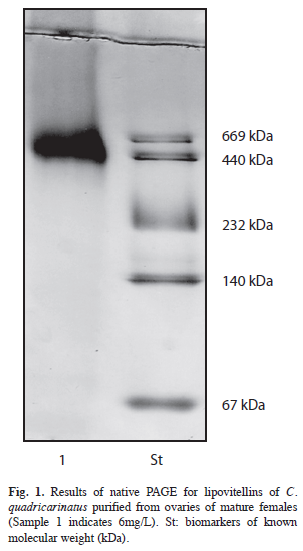
<body><![CDATA[ style="font-family: verdana;">     <font size="2"></font><br style="font-family: verdana;">     <font size="2"><span style="font-family: verdana;"><a      href="/img/revistas/rbt/v60n1/a17i1.jpg">Figure     1</a> shows the     result obtained     by electrophoretic analysis of lipoprotein purified from mature ovaries     of <span style="font-style: italic;">C. quadricarinatus</span> under     native conditions. Electrophoretic mobility     revealed a protein band of around 500kDa.     ]]></body>
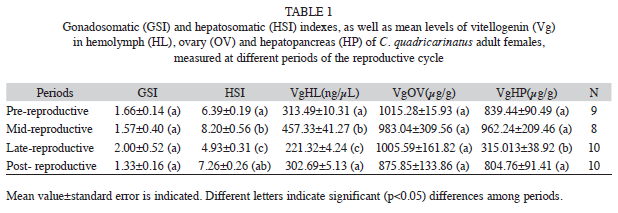
<body><![CDATA[<br> </span></font><font size="2"><span style="font-family: verdana;">    <br>     <a href="/img/revistas/rbt/v60n1/a17t1.gif">Table 1</a> shows the mean     values     of both GSI and HSI, together with the Vg concentration in hemolymph,     ovary and hepatopancreas, for each period of the reproductive cycle of     <span style="font-style: italic;">C. quadricarinatus </span>adult     females. No significant differences     (p&gt;0.05) were seen among periods, for either GSI or ovarian Vg     level. On the contrary, HSI values showed significant differences     ]]></body>
<body><![CDATA[(p&lt;0.05) comparing the pre-reproductive period to either the mid or     late reproductive period; significant differences (p&lt;0.01) in HIS     were also noted between mid and late reproductive periods, and between     this later period and the post-reproductive one. Hepatopancreatic Vg     showed a significant (p&lt;0.05) lower level at the late reproductive     period, with respect to the remaining periods. The lowest hemolymphatic     Vg levels were also observed during the late reproductive period,     compared to any other period (p&lt;0.01).</span></font><br      style="font-family: verdana;">     <font size="2"></font><br style="font-family: verdana;">     ]]></body>
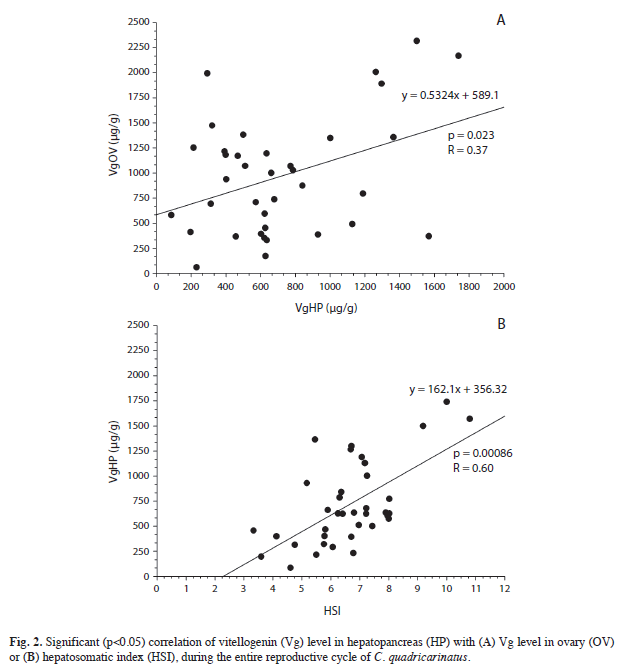
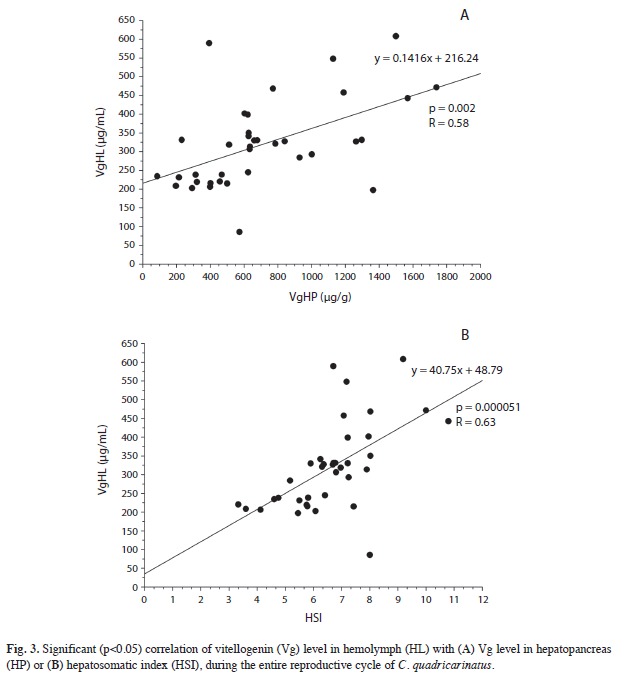
<body><![CDATA[<font size="2"><span style="font-family: verdana;">The result of the     correlation made     by pairs of variables throughout the entire reproductive cycle is shown     in <a href="/img/revistas/rbt/v60n1/a17i2.jpg">Figures 2</a> and <a      href="/img/revistas/rbt/v60n1/a17i3.jpg">3</a>. As Vg level increases     in hepatopancreas, an     increasing Vg level was also observed in ovary (p&lt;0.05, <a      href="/img/revistas/rbt/v60n1/a17i2.jpg">Fig. 2A</a>). On     the other hand, a positive correlation (p&lt;0.01) between     hepatopancreatic Vg and HSI was observed (<a     ]]></body>
<body><![CDATA[ href="/img/revistas/rbt/v60n1/a17i2.jpg">Fig. 2B</a>). <a      href="/img/revistas/rbt/v60n1/a17i3.jpg">Figures 3A</a> and <a      href="/img/revistas/rbt/v60n1/a17i3.jpg">3B</a>     show how the circulating levels of Vg positively correlate (p&lt;0.01)     to either Vg hepatopancreatic level or HSI.</span></font><br      style="font-family: verdana;">     <font size="2"></font><br style="font-family: verdana;">     <font size="3"><span style="font-family: verdana; font-weight: bold;">Discussion</span></font><br      style="font-family: verdana;">     <font size="2"></font><br style="font-family: verdana;">     ]]></body>
<body><![CDATA[<font size="2"><span style="font-family: verdana;">Purification of     lipoproteins from     <span style="font-style: italic;">C. quadricarinatus</span> mature     ovaries showed to be successful, i.e., a     discrete band with a molecular weight near 500kDa was obtained. This     band closely corresponds to one of the main vitellin forms identified     in mature ovaries of <span style="font-style: italic;">C.     quadricarinatus</span> by Serrano Pinto <span      style="font-style: italic;">et al.</span> (2003).     A vitellogenin with a molecular weight by the 440kDa was observed for     ]]></body>
<body><![CDATA[the vitellogenin purified from <span style="font-style: italic;">M.     borellii </span>(Garc&iacute;a <span style="font-style: italic;">et     al.</span> 2006).     Crustacean vitellin molecular mass has been reported as ranging from     near 320 to 630kDA, for a wide list of species (Tsukimura 2001).</span></font><br      style="font-family: verdana;">     <font size="2"></font><br style="font-family: verdana;">     <font size="2"><span style="font-family: verdana;">Lipoproteins     associated to the     vitellogenesis process (i.e., vitellogenin and vitellins) have been     ]]></body>
<body><![CDATA[identified and characterized in several crustacean species, and they     were used as a tool for studying the reproductive biology of such     species (Quackenbush 1994, Oberd&ouml;rster <span      style="font-style: italic;">et al.</span> 2000, Pateraki <span      style="font-style: italic;">&amp;</span>     Stratakis 2000, Okumura 2004, Chen <span style="font-style: italic;">et     al.</span> 2004, Garc&iacute;a <span style="font-style: italic;">et al.</span>     2006, 2008). In several decapod crustaceans used in aquaculture, Vg     circulating levels have been quantified. In some species of decapod     crustaceans no correlation between hemolymphatic Vg levels and ovarian     ]]></body>
<body><![CDATA[development was observed (Lee <span style="font-style: italic;">&amp;</span>     Chang 1997). However, in most cases     a good correlation between Vg circulating levels and ovarian growth was     seen in females of reproductive age (Tsukimura 2001, Tahara <span      style="font-style: italic;">et al.</span>     2005, Ibarra <span style="font-style: italic;">et al.</span> 2009,     Santhoshi <span style="font-style: italic;">et al.</span> 2009),     although Vg     circulating levels decreases in some extent towards the final ovarian     maturation, i.e, just before the oviposition takes place (Tsukimura     ]]></body>
<body><![CDATA[2001, Tahara <span style="font-style: italic;">et al.</span> 2005).</span></font><br      style="font-family: verdana;">     <font size="2"></font><br style="font-family: verdana;">     <font size="2"><span style="font-family: verdana;">Vitellins of <span      style="font-style: italic;">C. quadricarinatus</span>     have been previously purified and characterized in ovary and eggs of     mature females (Serrano Pinto <span style="font-style: italic;">et al.     </span>2003), while both the     hepatopancreas and the ovary have been characterized as the main sites     of vitellogenin synthesis for the same species (Serrano Pinto <span     ]]></body>
<body><![CDATA[ style="font-style: italic;">et al.     </span>2004, 2005). Abdu <span style="font-style: italic;">et al.</span>     (2002) have cloned the complete vitellogenin     cDNA of <span style="font-style: italic;">C. quadricarinatus</span>,     while Yehezkel <span style="font-style: italic;">et al.</span> (2000)     have     identified specific lipoproteins in the hemolymph of this species,     associated to the onset of secondary vitellogenesis. An ELISA for     detecting both vitellogenin and vitellins has been previously developed     by Sagi et al. (1999), specifically for <span     ]]></body>
<body><![CDATA[ style="font-style: italic;">C. quadricarinatus</span>. However, no     previous information about Vg fluctuations during the entire     reproductive cycle is available for this species.</span></font><br      style="font-family: verdana;">     <font size="2"></font><br style="font-family: verdana;">     <font size="2"><span style="font-family: verdana;">Results of the     current study     represent a first report, in the studied species, of the annual     variation of Vg levels in hemolymph, ovary and hepatopancreas, and     their correlation to both GSI and HSI. Significant variations were     ]]></body>
<body><![CDATA[detected in both hemolymphatic and hepatopancreatic Vg levels, which     were highest during the mid-reproductive period. Besides, such     variations were positively correlated to the HSI, during the entire     cycle. The increment of Vg concentration in hepatopancreas would be     responsible for an enhanced HSI. On the other hand, a higher synthesis     of Vg in hepatopancreas would be causing an increase in the Vg     circulating level, stressing the relevance of hemolymph as a     transporting way for extraovarian Vg, from its site of synthesis to the     ovary. Although differences in both Vg ovarian levels (in terms of     &#956;g/g) and GSI could not be detected throughout the reproductive cycle,     ]]></body>
<body><![CDATA[the significant positive correlation found in Vg levels between ovary     and hepatopancreas was in accordance with the expected higher uptake of     Vg by the former tissue, as increases the production by the later.</span></font><br      style="font-family: verdana;">     <font size="2"></font><br style="font-family: verdana;">     <font size="2"><span style="font-family: verdana;">As mentioned before,     the role of     the hepatopancreas as the extraovarian site of vitellogenin has been     previously verified for <span style="font-style: italic;">C.     quadricarinatus</span> (Serrano Pinto <span style="font-style: italic;">et     ]]></body>
<body><![CDATA[al.</span> 2005).     This hepatopancreatic function has been also reported for other     crustaceans (Quackenbush 1994, Lee <span style="font-style: italic;">&amp;</span>     Chang 1997), although in the     case of the shrimp <span style="font-style: italic;">Fenneropenaeus     indicus</span>, a reduced contribution of     the hepatopancreas to the ovarian growth was suggested (Vazquez Boucard     <span style="font-style: italic;">et al.</span> 2002). According to     Serrano Pinto <span style="font-style: italic;">et al.</span> (2003,     2005), the ovary     ]]></body>
<body><![CDATA[of <span style="font-style: italic;">C. quadricarinatus</span> could     be playing a relevant role in Vg production     only in first-maturation females, but not in previously spawners, whose     hepatopancreas would be the main site of Vg production. Since the     minimum size at maturity for <span style="font-style: italic;">C.     quadricarinatus</span> was reported as 15g     (Vazquez <span style="font-style: italic;">&amp;</span> L&oacute;pez     Greco 2007), females used in the current     study (averaging 44g) were probably multiparous, i.e., they have had     previous spawning. Therefore, the changes observed in&nbsp; their Vg     ]]></body>
<body><![CDATA[hepatopancreatic and hemolymphatic levels would be in accordance with     the central role of the hepatopancreas as a site of Vg synthesis,     suggested by Serrano Pinto <span style="font-style: italic;">et al</span>.     (2003, 2005) for this kind of females.</span></font><br      style="font-family: verdana;">     <font size="2"></font><br style="font-family: verdana;">     <font size="2"><span style="font-family: verdana;">Finally, the ELISA     technique     developed during the current study has shown to be a sensitive and     useful method to detect, through a practical and non-injurious method,     ]]></body>
<body><![CDATA[the degree of reproductive development at which females of the studied     species can be found at different period of the reproductive cycle. In     fact, hemolymphatic level of Vg has been previously used as biomarker     for estimating the reproductive activity of crustaceans (Vazquez     Boucard <span style="font-style: italic;">et al.</span> 2002, Tahara <span      style="font-style: italic;">et al.</span> 2005). Vg circulating level     could be     also taken as biomarker to evaluate the effect of different diets,     hormones and neuroregulators, among other factors, to the reproductive     success, in order to optimize the culture of this species.</span></font><br     ]]></body>
<body><![CDATA[ style="font-family: verdana;">     <font size="2"></font><br style="font-family: verdana;">     <font size="3"><span style="font-family: verdana; font-weight: bold;">Acknowledgments</span></font><br      style="font-family: verdana;">     <font size="2"></font><br style="font-family: verdana;">     <font size="2"><span style="font-family: verdana;">Authors wish to help     the financial     support given by grants from both the University of Buenos Aires UBACYT     program (X241) and the Argentine National Council of Scientific and     Technical Research (CONICET, PIP 2010- 2012, code 100884).</span></font><br     ]]></body>
<body><![CDATA[ style="font-family: verdana;">     <font size="2"></font><br style="font-family: verdana;">     <font size="2"><span style="font-family: verdana;"></span></font></div>     <hr      style="width: 100%; height: 2px; margin-left: 0px; margin-right: 0px;">     <!-- ref --><div style="text-align: justify;"><font size="3"><span  style="font-family: verdana; font-weight: bold;">References</span></font><br  style="font-family: verdana;"> <font size="2"></font><br style="font-family: verdana;"> <font size="2"><span style="font-family: verdana;">Abdu, V., C. Davis, I. Khalaila <span style="font-style: italic;">&amp;</span> A. Sagi. 2002. The vitellogenin cDNA of <span style="font-style: italic;">Cherax quadricarinatus</span> encodes a lipoprotein with calcium binding ability and its expression is induced following the removal of the androgenic gland in a sexually plastic system. Gen. Comp. Endocrinol. 127: 263-272.    &nbsp;&nbsp;&nbsp;&nbsp;&nbsp;&nbsp;&nbsp;&nbsp;[&#160;<a href="javascript:void(0);" onclick="javascript: window.open('/scielo.php?script=sci_nlinks&ref=1432166&pid=S0034-7744201200010001700001&lng=','','width=640,height=500,resizable=yes,scrollbars=1,menubar=yes,');">Links</a>&#160;]<!-- end-ref --><!-- ref --></span></font><br  style="font-family: verdana;"> <font size="2"></font><br style="font-family: verdana;"> <font size="2"><span style="font-family: verdana;">Barki, A., T. Levi, G. Hulata <span style="font-style: italic;">&amp;</span> I. Karplus. 1997. Annual cycle of spawning and molting in the red-claw crayfish, <span style="font-style: italic;">Cherax quadricarinatus</span>, under laboratory conditions. Aquaculture 157: 239-249.    &nbsp;&nbsp;&nbsp;&nbsp;&nbsp;&nbsp;&nbsp;&nbsp;[&#160;<a href="javascript:void(0);" onclick="javascript: window.open('/scielo.php?script=sci_nlinks&ref=1432167&pid=S0034-7744201200010001700002&lng=','','width=640,height=500,resizable=yes,scrollbars=1,menubar=yes,');">Links</a>&#160;]<!-- end-ref --><!-- ref --></span></font><br style="font-family: verdana;"> <font size="2"></font><br style="font-family: verdana;"> <font size="2"><span style="font-family: verdana;">Charmantier, G., M. Charmantier-Daures <span style="font-style: italic;">&amp;</span> F. Van Herp. 1997. Hormonal regulation of growth and reproduction in crustaceans, p. 109-161. <span  style="font-style: italic;">In</span> M. Fingerman, R. Nagabhushanam <span style="font-style: italic;">&amp;</span> M.F. Thompson (eds.). Recent advances in marine biotechnology, vol. I. Science, Enfield, New Hampshire, USA.    &nbsp;&nbsp;&nbsp;&nbsp;&nbsp;&nbsp;&nbsp;&nbsp;[&#160;<a href="javascript:void(0);" onclick="javascript: window.open('/scielo.php?script=sci_nlinks&ref=1432168&pid=S0034-7744201200010001700003&lng=','','width=640,height=500,resizable=yes,scrollbars=1,menubar=yes,');">Links</a>&#160;]<!-- end-ref --><!-- ref --></span></font><br  style="font-family: verdana;"> <font size="2"></font><br style="font-family: verdana;"> <font size="2"><span style="font-family: verdana;">Chen, L., H. Jiang, Z. Zhou, K. Li <span style="font-style: italic;">&amp;</span> G.Y. Deng. 2004. Purification of vitellin from the ovary of Chinese mitten-hended crab (<span style="font-style: italic;">Eriocheir sinensis</span>) and development of an antivitellin ELISA. J. Comp. Physiol. B. Biochem. Syst. Environ. Physiol. 138: 305-311.    &nbsp;&nbsp;&nbsp;&nbsp;&nbsp;&nbsp;&nbsp;&nbsp;[&#160;<a href="javascript:void(0);" onclick="javascript: window.open('/scielo.php?script=sci_nlinks&ref=1432169&pid=S0034-7744201200010001700004&lng=','','width=640,height=500,resizable=yes,scrollbars=1,menubar=yes,');">Links</a>&#160;]<!-- end-ref --><!-- ref --></span></font><br style="font-family: verdana;"> <font size="2"></font><br style="font-family: verdana;"> <font size="2"><span style="font-family: verdana;">Dreon, M.S., H. Heras <span style="font-style: italic;">&amp;</span> R.J. Pollero. 2003. Metabolism of ovorubin, the major egg lipoprotein from the apple snail. Mol. Cell. Biochem. 243: 9-14.    &nbsp;&nbsp;&nbsp;&nbsp;&nbsp;&nbsp;&nbsp;&nbsp;[&#160;<a href="javascript:void(0);" onclick="javascript: window.open('/scielo.php?script=sci_nlinks&ref=1432170&pid=S0034-7744201200010001700005&lng=','','width=640,height=500,resizable=yes,scrollbars=1,menubar=yes,');">Links</a>&#160;]<!-- end-ref --><!-- ref --> </span></font><br  style="font-family: verdana;"> <font size="2"></font><br style="font-family: verdana;"> <font size="2"><span style="font-family: verdana;">Garc&iacute;a, C.F., M. Cunningham, J.L. Soluages, H.A. Garda <span style="font-style: italic;">&amp;</span> R. Pollero. 2006. Structural characterization of the lipovitellin from de shrimp <span  style="font-style: italic;">Macrobrachium borellii</span>. J. Comp. Physiol. B. Biochem. Syst. Environ. Physiol. 145: 365-370.    &nbsp;&nbsp;&nbsp;&nbsp;&nbsp;&nbsp;&nbsp;&nbsp;[&#160;<a href="javascript:void(0);" onclick="javascript: window.open('/scielo.php?script=sci_nlinks&ref=1432171&pid=S0034-7744201200010001700006&lng=','','width=640,height=500,resizable=yes,scrollbars=1,menubar=yes,');">Links</a>&#160;]<!-- end-ref --><!-- ref --></span></font><br style="font-family: verdana;"> <font size="2"></font><br style="font-family: verdana;"> <font size="2"><span style="font-family: verdana;">Garc&iacute;a, F., M.L. Cunningham, H. Garda <span style="font-style: italic;">&amp;</span> H. Heras. 2008. Embryo lipoproteins and yolk lipovitellin consumption during embryogenesis in <span  style="font-style: italic;">Macrobrachium borellii</span> (Crustacea: Palaemonidae). J. Comp. Physiol. B. Biochem. Syst. Environ. Physiol. 151: 317-322.    &nbsp;&nbsp;&nbsp;&nbsp;&nbsp;&nbsp;&nbsp;&nbsp;[&#160;<a href="javascript:void(0);" onclick="javascript: window.open('/scielo.php?script=sci_nlinks&ref=1432172&pid=S0034-7744201200010001700007&lng=','','width=640,height=500,resizable=yes,scrollbars=1,menubar=yes,');">Links</a>&#160;]<!-- end-ref --><!-- ref --></span></font><br style="font-family: verdana;"> <font size="2"></font><br style="font-family: verdana;"> <font size="2"><span style="font-family: verdana;">Harrison, K.I. 1990. The role of nutrition in maturation, reproduction and embryonic development of decapod crustaceans: a review. J. Shellfish Res. 9: 1-28.    &nbsp;&nbsp;&nbsp;&nbsp;&nbsp;&nbsp;&nbsp;&nbsp;[&#160;<a href="javascript:void(0);" onclick="javascript: window.open('/scielo.php?script=sci_nlinks&ref=1432173&pid=S0034-7744201200010001700008&lng=','','width=640,height=500,resizable=yes,scrollbars=1,menubar=yes,');">Links</a>&#160;]<!-- end-ref --><!-- ref --> </span></font><br  style="font-family: verdana;"> <font size="2"></font><br style="font-family: verdana;"> <font size="2"><span style="font-family: verdana;">Jones, C.M. <span  style="font-style: italic;">&amp;</span> I. Ruscoe. 1996. Production technology for Redclaw Crayfish (<span  style="font-style: italic;">Cherax quadricarinatus</span>). Final Report FRDC Project 92/119. Fisheries Research and Development Corporation, Camberra, Australia.    &nbsp;&nbsp;&nbsp;&nbsp;&nbsp;&nbsp;&nbsp;&nbsp;[&#160;<a href="javascript:void(0);" onclick="javascript: window.open('/scielo.php?script=sci_nlinks&ref=1432174&pid=S0034-7744201200010001700009&lng=','','width=640,height=500,resizable=yes,scrollbars=1,menubar=yes,');">Links</a>&#160;]<!-- end-ref --><!-- ref --></span></font><br  style="font-family: verdana;"> <font size="2"></font><br style="font-family: verdana;"> <font size="2"><span style="font-family: verdana;">Ibarra, A.M., T.R. Famula <span style="font-style: italic;">&amp;</span> F.G. Arcos. 2009. Heritability of vitellogenin in hemolymph, a pre-spawing selectable trait in <span style="font-style: italic;">Penaeus (Litopenaeus) vannamei</span>, has a large genetic correlation with ovary maturity measured as oocytes mean diameter. Aquaculture 297: 64-69.    &nbsp;&nbsp;&nbsp;&nbsp;&nbsp;&nbsp;&nbsp;&nbsp;[&#160;<a href="javascript:void(0);" onclick="javascript: window.open('/scielo.php?script=sci_nlinks&ref=1432175&pid=S0034-7744201200010001700010&lng=','','width=640,height=500,resizable=yes,scrollbars=1,menubar=yes,');">Links</a>&#160;]<!-- end-ref --><!-- ref --></span></font><br  style="font-family: verdana;"> <font size="2"></font><br style="font-family: verdana;"> <font size="2"><span style="font-family: verdana;">Laemmli, U.K. 1970. Cleavage of structural proteins during the assembly of the head of bacteriophage T4. Nature 227: 680-885.    &nbsp;&nbsp;&nbsp;&nbsp;&nbsp;&nbsp;&nbsp;&nbsp;[&#160;<a href="javascript:void(0);" onclick="javascript: window.open('/scielo.php?script=sci_nlinks&ref=1432176&pid=S0034-7744201200010001700011&lng=','','width=640,height=500,resizable=yes,scrollbars=1,menubar=yes,');">Links</a>&#160;]<!-- end-ref --><!-- ref --></span></font><br style="font-family: verdana;"> <font size="2"></font><br style="font-family: verdana;"> <font size="2"><span style="font-family: verdana;">Lee, F.Y. <span  style="font-style: italic;">&amp;</span> C.F. Chang. 1997. The concentrations of vitellogenin (vitellin) and protein in hemolymph, ovary and hepatopancreas in different ovarian stages of the freshwater prawn <span style="font-style: italic;">Macrobrachium rosenbergii</span>. Comp. Biochem. Physiol. Mol. Integr. Physiol. 117: 433-439.    &nbsp;&nbsp;&nbsp;&nbsp;&nbsp;&nbsp;&nbsp;&nbsp;[&#160;<a href="javascript:void(0);" onclick="javascript: window.open('/scielo.php?script=sci_nlinks&ref=1432177&pid=S0034-7744201200010001700012&lng=','','width=640,height=500,resizable=yes,scrollbars=1,menubar=yes,');">Links</a>&#160;]<!-- end-ref --><!-- ref --></span></font><br style="font-family: verdana;"> <font size="2"></font><br style="font-family: verdana;"> <font size="2"><span style="font-family: verdana;">Lowry, O.H., N.J. Rosebrough, A.L. Farr <span style="font-style: italic;">&amp;</span> R.J. Randall. 1951. Protein measurement with the Folin phenol reagenit. J. Biol. Chem. 193: 265-275.    &nbsp;&nbsp;&nbsp;&nbsp;&nbsp;&nbsp;&nbsp;&nbsp;[&#160;<a href="javascript:void(0);" onclick="javascript: window.open('/scielo.php?script=sci_nlinks&ref=1432178&pid=S0034-7744201200010001700013&lng=','','width=640,height=500,resizable=yes,scrollbars=1,menubar=yes,');">Links</a>&#160;]<!-- end-ref --><br>     <!-- ref --><br> Meusy, J.J. 1980. Vitellogenin, the extra ovarian precursor of the protein yolk en Crustacea: a review. Reprod. Nutr. Dev. 20: 1-21.    &nbsp;&nbsp;&nbsp;&nbsp;&nbsp;&nbsp;&nbsp;&nbsp;[&#160;<a href="javascript:void(0);" onclick="javascript: window.open('/scielo.php?script=sci_nlinks&ref=1432180&pid=S0034-7744201200010001700014&lng=','','width=640,height=500,resizable=yes,scrollbars=1,menubar=yes,');">Links</a>&#160;]<!-- end-ref --><!-- ref --></span></font><br  style="font-family: verdana;"> <font size="2"></font><br style="font-family: verdana;"> <font size="2"><span style="font-family: verdana;">Oberd&ouml;rster, E., C.D. Rice <span style="font-style: italic;">&amp;</span> L.K. Irwin. 2000. Purification of vitellin from grass shrimp <span style="font-style: italic;">Palaemonetes pugio</span> generation of monoclonal antibodies, and validation for the detection of lipovitellin in crustacean. Comp. Biochem. Physiol. C. Pharmacol. Toxicol. Endocrinol. 127: 199-207.    &nbsp;&nbsp;&nbsp;&nbsp;&nbsp;&nbsp;&nbsp;&nbsp;[&#160;<a href="javascript:void(0);" onclick="javascript: window.open('/scielo.php?script=sci_nlinks&ref=1432181&pid=S0034-7744201200010001700015&lng=','','width=640,height=500,resizable=yes,scrollbars=1,menubar=yes,');">Links</a>&#160;]<!-- end-ref --><!-- ref --></span></font><br  style="font-family: verdana;"> <font size="2"></font><br style="font-family: verdana;"> <font size="2"><span style="font-family: verdana;">Okumura, T. 2004. Perspectives on hormonal manipulation of shrimp reproduction. JARQ 38: 49-54.    &nbsp;&nbsp;&nbsp;&nbsp;&nbsp;&nbsp;&nbsp;&nbsp;[&#160;<a href="javascript:void(0);" onclick="javascript: window.open('/scielo.php?script=sci_nlinks&ref=1432182&pid=S0034-7744201200010001700016&lng=','','width=640,height=500,resizable=yes,scrollbars=1,menubar=yes,');">Links</a>&#160;]<!-- end-ref --><!-- ref --> </span></font><br  style="font-family: verdana;"> <font size="2"></font><br style="font-family: verdana;"> <font size="2"><span style="font-family: verdana;">Pateraki, L. <span  style="font-style: italic;">&amp;</span> E. Stratakis. 2000. Synthesis and organization of vitellogenin and vitellin molecules from the land crab <span style="font-style: italic;">Potamon potamios</span>. J. Comp. Physiol. B. Biochem. Syst. Environ. Physiol. 125: 53-61.    &nbsp;&nbsp;&nbsp;&nbsp;&nbsp;&nbsp;&nbsp;&nbsp;[&#160;<a href="javascript:void(0);" onclick="javascript: window.open('/scielo.php?script=sci_nlinks&ref=1432183&pid=S0034-7744201200010001700017&lng=','','width=640,height=500,resizable=yes,scrollbars=1,menubar=yes,');">Links</a>&#160;]<!-- end-ref --><!-- ref --></span></font><br  style="font-family: verdana;"> <font size="2"></font><br style="font-family: verdana;"> <font size="2"><span style="font-family: verdana;">Quackenbush, L.S. 1994. Lobster reproduction: a review. Crustaceana 67: 82-94.    &nbsp;&nbsp;&nbsp;&nbsp;&nbsp;&nbsp;&nbsp;&nbsp;[&#160;<a href="javascript:void(0);" onclick="javascript: window.open('/scielo.php?script=sci_nlinks&ref=1432184&pid=S0034-7744201200010001700018&lng=','','width=640,height=500,resizable=yes,scrollbars=1,menubar=yes,');">Links</a>&#160;]<!-- end-ref --><!-- ref --></span></font><br  style="font-family: verdana;"> <font size="2"></font><br style="font-family: verdana;"> <font size="2"><span style="font-family: verdana;">Sagi, A., I. Khalaila, U. Abdu, R. Shoukrum <span style="font-style: italic;">&amp;</span> S. Weil. 1999. A new established ELISA showing the effect of the androgenic gland on secondary &#8211;vitellogenic- specific protein in the hemolymph of the crayfish <span  style="font-style: italic;">Cherax quadricarinatus</span>. Gen. Comp. Endocrinol. 115: 37-45.    &nbsp;&nbsp;&nbsp;&nbsp;&nbsp;&nbsp;&nbsp;&nbsp;[&#160;<a href="javascript:void(0);" onclick="javascript: window.open('/scielo.php?script=sci_nlinks&ref=1432185&pid=S0034-7744201200010001700019&lng=','','width=640,height=500,resizable=yes,scrollbars=1,menubar=yes,');">Links</a>&#160;]<!-- end-ref --><!-- ref --></span></font><br  style="font-family: verdana;"> <font size="2"></font><br style="font-family: verdana;"> <font size="2"><span style="font-family: verdana;">Santoshi, S., V. Sugumar <span style="font-style: italic;">&amp;</span> N. Munuswamy. 2009. Serotonergic stimulation of ovarian maturation and hemolymph vitellogenin in the Indian white shrimp, <span  style="font-style: italic;">Fenneropenaeus indicus</span>. Aquaculture 291: 192-199.    &nbsp;&nbsp;&nbsp;&nbsp;&nbsp;&nbsp;&nbsp;&nbsp;[&#160;<a href="javascript:void(0);" onclick="javascript: window.open('/scielo.php?script=sci_nlinks&ref=1432186&pid=S0034-7744201200010001700020&lng=','','width=640,height=500,resizable=yes,scrollbars=1,menubar=yes,');">Links</a>&#160;]<!-- end-ref --><!-- ref --> </span></font><br  style="font-family: verdana;"> <font size="2"></font><br style="font-family: verdana;"> <font size="2"><span style="font-family: verdana;">Serrano-Pinto, V., C. Vazquez-Boucard <span style="font-style: italic;">&amp;</span> H. Villareal-Colmenares. 2003. Yolk proteins during ovary and egg development of mature female freshwater crayfish (<span style="font-style: italic;">Cherax quadricarinatus</span>). Comp. Biochem.&nbsp; Physiol. Mol. Integr. Physiol. 134: 33-43.    &nbsp;&nbsp;&nbsp;&nbsp;&nbsp;&nbsp;&nbsp;&nbsp;[&#160;<a href="javascript:void(0);" onclick="javascript: window.open('/scielo.php?script=sci_nlinks&ref=1432187&pid=S0034-7744201200010001700021&lng=','','width=640,height=500,resizable=yes,scrollbars=1,menubar=yes,');">Links</a>&#160;]<!-- end-ref --><!-- ref --></span></font><br style="font-family: verdana;"> <font size="2"></font><br style="font-family: verdana;"> <font size="2"><span style="font-family: verdana;">Serrano-Pinto, V., I. Landais, M.H. Ogliastro, M. Gutierrez Ayala, H. Mej&iacute;a Ru&iacute;z, H. Villareal Colmenares, A. Garc&iacute;a Gasca <span  style="font-style: italic;">&amp;</span> C. Vazquez Boucard. 2004. Vitellogenin mRNA during secondary vitellogenic at first maturation females. Mol. Reprod. Dev. 69: 17-21.    &nbsp;&nbsp;&nbsp;&nbsp;&nbsp;&nbsp;&nbsp;&nbsp;[&#160;<a href="javascript:void(0);" onclick="javascript: window.open('/scielo.php?script=sci_nlinks&ref=1432188&pid=S0034-7744201200010001700022&lng=','','width=640,height=500,resizable=yes,scrollbars=1,menubar=yes,');">Links</a>&#160;]<!-- end-ref --><!-- ref --></span></font><br  style="font-family: verdana;"> <font size="2"></font><br style="font-family: verdana;"> <font size="2"><span style="font-family: verdana;">Serrano-Pinto, V., M.G. Carrisoza-Valenzuela <span style="font-style: italic;">&amp;</span> M. Ram&iacute;rez- Orozco. 2005. Determination site of vitellogenin synthesis in freshwater crayfish <span style="font-style: italic;">Cherax quadricarinatus</span> at different maturation stages females. Investigaciones Marinas 33: 195-200.    &nbsp;&nbsp;&nbsp;&nbsp;&nbsp;&nbsp;&nbsp;&nbsp;[&#160;<a href="javascript:void(0);" onclick="javascript: window.open('/scielo.php?script=sci_nlinks&ref=1432189&pid=S0034-7744201200010001700023&lng=','','width=640,height=500,resizable=yes,scrollbars=1,menubar=yes,');">Links</a>&#160;]<!-- end-ref --><!-- ref --></span></font><br  style="font-family: verdana;"> <font size="2"></font><br style="font-family: verdana;"> <font size="2"><span style="font-family: verdana;">Sokal, R.R. <span  style="font-style: italic;">&amp;</span> F.J. Rohlf. 1981. Biometry. Freeman, New York, USA.    &nbsp;&nbsp;&nbsp;&nbsp;&nbsp;&nbsp;&nbsp;&nbsp;[&#160;<a href="javascript:void(0);" onclick="javascript: window.open('/scielo.php?script=sci_nlinks&ref=1432190&pid=S0034-7744201200010001700024&lng=','','width=640,height=500,resizable=yes,scrollbars=1,menubar=yes,');">Links</a>&#160;]<!-- end-ref --><!-- ref --></span></font><br  style="font-family: verdana;"> <font size="2"></font><br style="font-family: verdana;"> <font size="2"><span style="font-family: verdana;">Soroka, Y., A. Sagi, I. Khalaila, U. Abdu <span style="font-style: italic;">&amp;</span> Y. Milner. 2000. Changes in protein kinase C during vitellogenesis in the crayfish <span style="font-style: italic;">Cherax quadricarinatus</span>, possible activation by methyl farnesoate. Gen. Comp. Endocrinol. 118: 200-208.    &nbsp;&nbsp;&nbsp;&nbsp;&nbsp;&nbsp;&nbsp;&nbsp;[&#160;<a href="javascript:void(0);" onclick="javascript: window.open('/scielo.php?script=sci_nlinks&ref=1432191&pid=S0034-7744201200010001700025&lng=','','width=640,height=500,resizable=yes,scrollbars=1,menubar=yes,');">Links</a>&#160;]<!-- end-ref --><!-- ref --></span></font><br  style="font-family: verdana;"> <font size="2"></font><br style="font-family: verdana;"> <font size="2"><span style="font-family: verdana;">Specker, J.L. <span  style="font-style: italic;">&amp;</span> T.R. Anderson. 1994. Developing and ELISA for a model protein-vitellogenin, p. 567- 578. <span style="font-style: italic;">In</span> P. Hochachka <span  style="font-style: italic;">&amp;</span> T. Mommsen (eds.). Biochemistry and molecular biology of fishes, vol. 3. The Netherlands: Elsevier Science B.V. Amsterdam, Netherlands.    &nbsp;&nbsp;&nbsp;&nbsp;&nbsp;&nbsp;&nbsp;&nbsp;[&#160;<a href="javascript:void(0);" onclick="javascript: window.open('/scielo.php?script=sci_nlinks&ref=1432192&pid=S0034-7744201200010001700026&lng=','','width=640,height=500,resizable=yes,scrollbars=1,menubar=yes,');">Links</a>&#160;]<!-- end-ref --><!-- ref --></span></font><br  style="font-family: verdana;"> <font size="2"></font><br style="font-family: verdana;"> <font size="2"><span style="font-family: verdana;">Tahara, D., K. Suitoh <span style="font-style: italic;">&amp;</span> H Hattori. 2005. Hemolymph vitellogenin levels during final maturation and postspawing in the female kuruma prawn <span  style="font-style: italic;">Marsupenaeus japonicus</span>. Aquaculture 245: 311-319.    &nbsp;&nbsp;&nbsp;&nbsp;&nbsp;&nbsp;&nbsp;&nbsp;[&#160;<a href="javascript:void(0);" onclick="javascript: window.open('/scielo.php?script=sci_nlinks&ref=1432193&pid=S0034-7744201200010001700027&lng=','','width=640,height=500,resizable=yes,scrollbars=1,menubar=yes,');">Links</a>&#160;]<!-- end-ref --><!-- ref --></span></font><br style="font-family: verdana;"> <font size="2"></font><br style="font-family: verdana;"> <font size="2"><span style="font-family: verdana;">Tsukimura, B. 2001. Crustacean Vitellogenesis: its role in oocyte development. Am. Zool. 41: 465-475.    &nbsp;&nbsp;&nbsp;&nbsp;&nbsp;&nbsp;&nbsp;&nbsp;[&#160;<a href="javascript:void(0);" onclick="javascript: window.open('/scielo.php?script=sci_nlinks&ref=1432194&pid=S0034-7744201200010001700028&lng=','','width=640,height=500,resizable=yes,scrollbars=1,menubar=yes,');">Links</a>&#160;]<!-- end-ref --><!-- ref --></span></font><br  style="font-family: verdana;"> <font size="2"></font><br style="font-family: verdana;"> <font size="2"><span style="font-family: verdana;">Vazquez, F.J. <span  style="font-style: italic;">&amp;</span> L.S. L&oacute;pez Greco. 2007. Diferenciaci&oacute;n sexual en la langosta de agua dulce <span style="font-style: italic;">Cherax quadricarinatus</span> (Decapoda, Parastacidae). Rev. Biol. Trop. 55: 33-38.    &nbsp;&nbsp;&nbsp;&nbsp;&nbsp;&nbsp;&nbsp;&nbsp;[&#160;<a href="javascript:void(0);" onclick="javascript: window.open('/scielo.php?script=sci_nlinks&ref=1432195&pid=S0034-7744201200010001700029&lng=','','width=640,height=500,resizable=yes,scrollbars=1,menubar=yes,');">Links</a>&#160;]<!-- end-ref --><!-- ref --></span></font><br style="font-family: verdana;"> <font size="2"></font><br style="font-family: verdana;"> <font size="2"><span style="font-family: verdana;">Vazquez Boucard, C.G., P. Levy, H.J. Ceccaldi <span style="font-style: italic;">&amp;</span> C.H. Brogren. 2002. Development changes in concentrations of vitellin, vitellogenin and lipids in hemolymph, hepatopancreas and ovaries from different ovarian stages of indian white prawn <span style="font-style: italic;">Fenneropenaeus indicus</span>. J. Exp. Mar. Biol. Ecol. 281: 63-75.    &nbsp;&nbsp;&nbsp;&nbsp;&nbsp;&nbsp;&nbsp;&nbsp;[&#160;<a href="javascript:void(0);" onclick="javascript: window.open('/scielo.php?script=sci_nlinks&ref=1432196&pid=S0034-7744201200010001700030&lng=','','width=640,height=500,resizable=yes,scrollbars=1,menubar=yes,');">Links</a>&#160;]<!-- end-ref --><!-- ref --></span></font><br  style="font-family: verdana;"> <font size="2"></font><br style="font-family: verdana;"> <font size="2"><span style="font-family: verdana;">Yehezkel, G., R. Chayoth, U. Abdu, I. Khalaila <span style="font-style: italic;">&amp;</span> A.&nbsp; Sagi. 2000. High-density lipoprotein associated with secondary vitellogenesis in the hemolymph of the crayfish <span style="font-style: italic;">Cherax quadricarinatus</span>. J. Comp. Physiol. B. Biochem. Syst. Environ. Physiol. 127: 411-421.    &nbsp;&nbsp;&nbsp;&nbsp;&nbsp;&nbsp;&nbsp;&nbsp;[&#160;<a href="javascript:void(0);" onclick="javascript: window.open('/scielo.php?script=sci_nlinks&ref=1432197&pid=S0034-7744201200010001700031&lng=','','width=640,height=500,resizable=yes,scrollbars=1,menubar=yes,');">Links</a>&#160;]<!-- end-ref --></span></font><br  style="font-family: verdana;"> <font size="2"></font>    <br>     <br> <font size="2"><span style="font-family: verdana;"><a  name="Correspondencia1"></a><a href="#Correspondencia2">*</a>Correspondencia a: </span></font><font size="2"> <span style="font-family: verdana;">Lilian E. Ferr&eacute;, Daniel A. Medesani, Mat&iacute;as Grodzielski &amp; Enrique M. Rodr&iacute;guez: </span></font><font size="2"><span  style="font-family: verdana;">Dept. of Biodiversity and Experimental Biology, DBBE-FCEyN, University of Buenos Aires, Argentina. Ciudad Universitaria, Pab. II, Intendente Guiraldes 2620, C1428EHA Buenos Aires, Argentina; </span></font><font size="2"><span  style="font-family: verdana;"><a href="mailto:ferredoxina@yahoo.com.ar">ferredoxina@yahoo.com.ar</a>, <a href="mailto:medesani@bg.fcen.uba.ar">medesani@bg.fcen.uba.ar</a>, <a  href="mailto:mgrodzi@gmail.com">mgrodzi@gmail.com</a>, <a  href="mailto:enrique@bg.fcen.uba.ar">enrique@bg.fcen.uba.ar</a></span></font><br  style="font-family: verdana;"> <font size="2"><span style="font-family: verdana;">C. Fernando Garc&iacute;a: </span></font><font size="2"><span  style="font-family: verdana;">Instituto de Investigaciones Bioqu&iacute;micas de La Plata (INIBIOLP), CONICET-UNLP, 60 and 120 St., 1900 La Plata, Argentina; </span></font><font size="2"><span  style="font-family: verdana;"><a  href="mailto:cfgarcia1123@yahoo.com.ar">cfgarcia1123@yahoo.com.ar</a></span></font><font  size="2"><span style="font-family: verdana;">     ]]></body>
<body><![CDATA[<br>     <br> </span></font><font size="2"><span style="font-family: verdana;"><a  name="Afiliacion1"></a><a href="#Afiliacion3">1</a>. Dept. of Biodiversity and Experimental Biology, DBBE-FCEyN, University of Buenos Aires, Argentina. Ciudad Universitaria, Pab. II, Intendente Guiraldes 2620, C1428EHA Buenos Aires, Argentina; <a  href="mailto:ferredoxina@yahoo.com.ar">ferredoxina@yahoo.com.ar</a>, <a href="mailto:medesani@bg.fcen.uba.ar">medesani@bg.fcen.uba.ar</a>, <a  href="mailto:mgrodzi@gmail.com">mgrodzi@gmail.com</a>, <a  href="mailto:enrique@bg.fcen.uba.ar">enrique@bg.fcen.uba.ar</a></span></font><br  style="font-family: verdana;"> <font size="2"><span style="font-family: verdana;"><a name="Afiliacion2"></a><a  href="#Afiliacion4">2</a>. Instituto de Investigaciones Bioqu&iacute;micas de La Plata (INIBIOLP), CONICET-UNLP, 60 and 120 St., 1900 La Plata, Argentina; <a  href="mailto:cfgarcia1123@yahoo.com.ar">cfgarcia1123@yahoo.com.ar</a> </span></font>    <br> <font size="2"><span style="font-family: verdana;"></span></font></div> <hr  style="width: 100%; height: 2px; margin-left: 0px; margin-right: 0px;">     <div style="text-align: center;"><font size="2"><span  style="font-family: verdana;">Received 18-II-2011. Corrected 10-V-2011. Accepted 13-VI-2011.</span></font>    <br> </div>      ]]></body><back>
<ref-list>
<ref id="B1">
<nlm-citation citation-type="journal">
<person-group person-group-type="author">
<name>
<surname><![CDATA[Abdu]]></surname>
<given-names><![CDATA[V]]></given-names>
</name>
<name>
<surname><![CDATA[Davis]]></surname>
<given-names><![CDATA[C.]]></given-names>
</name>
<name>
<surname><![CDATA[Khalaila]]></surname>
<given-names><![CDATA[I.]]></given-names>
</name>
<name>
<surname><![CDATA[Sagi]]></surname>
<given-names><![CDATA[A.]]></given-names>
</name>
</person-group>
<article-title xml:lang="en"><![CDATA[The vitellogenin cDNA of Cherax quadricarinatus encodes a lipoprotein with calcium binding ability and its expression is induced following the removal of the androgenic gland in a sexually plastic system]]></article-title>
<source><![CDATA[Gen. Comp. Endocrinol]]></source>
<year>2002</year>
<volume>127</volume>
<page-range>263-272</page-range></nlm-citation>
</ref>
<ref id="B2">
<nlm-citation citation-type="journal">
<person-group person-group-type="author">
<name>
<surname><![CDATA[Barki]]></surname>
<given-names><![CDATA[A.]]></given-names>
</name>
<name>
<surname><![CDATA[Levi]]></surname>
<given-names><![CDATA[T.]]></given-names>
</name>
<name>
<surname><![CDATA[Hulata]]></surname>
<given-names><![CDATA[G.]]></given-names>
</name>
<name>
<surname><![CDATA[Karplus]]></surname>
<given-names><![CDATA[I.]]></given-names>
</name>
</person-group>
<article-title xml:lang="en"><![CDATA[Annual cycle of spawning and molting in the red-claw crayfish, Cherax quadricarinatus, under laboratory conditions]]></article-title>
<source><![CDATA[Aquaculture]]></source>
<year>1997</year>
<volume>157</volume>
<page-range>239-249</page-range></nlm-citation>
</ref>
<ref id="B3">
<nlm-citation citation-type="book">
<person-group person-group-type="author">
<name>
<surname><![CDATA[Charmantier]]></surname>
<given-names><![CDATA[G.]]></given-names>
</name>
<name>
<surname><![CDATA[Charmantier-Daures]]></surname>
<given-names><![CDATA[M.]]></given-names>
</name>
<name>
<surname><![CDATA[Van Herp]]></surname>
<given-names><![CDATA[F.]]></given-names>
</name>
</person-group>
<article-title xml:lang="en"><![CDATA[Hormonal regulation of growth and reproduction in crustaceans]]></article-title>
<person-group person-group-type="editor">
<name>
<surname><![CDATA[Fingerman]]></surname>
<given-names><![CDATA[M.]]></given-names>
</name>
<name>
<surname><![CDATA[Nagabhushanam]]></surname>
<given-names><![CDATA[R.]]></given-names>
</name>
<name>
<surname><![CDATA[Thompson]]></surname>
<given-names><![CDATA[M.F.]]></given-names>
</name>
</person-group>
<source><![CDATA[Recent advances in marine biotechnology]]></source>
<year>1997</year>
<volume>I</volume>
<page-range>109-161</page-range><publisher-loc><![CDATA[^eNew Hampshire New Hampshire]]></publisher-loc>
<publisher-name><![CDATA[Science, Enfield]]></publisher-name>
</nlm-citation>
</ref>
<ref id="B4">
<nlm-citation citation-type="journal">
<person-group person-group-type="author">
<name>
<surname><![CDATA[Chen]]></surname>
<given-names><![CDATA[L.]]></given-names>
</name>
<name>
<surname><![CDATA[Jiang]]></surname>
<given-names><![CDATA[H.]]></given-names>
</name>
<name>
<surname><![CDATA[Zhou]]></surname>
<given-names><![CDATA[Z.]]></given-names>
</name>
<name>
<surname><![CDATA[Li]]></surname>
<given-names><![CDATA[K.]]></given-names>
</name>
<name>
<surname><![CDATA[Deng]]></surname>
<given-names><![CDATA[G.Y.]]></given-names>
</name>
</person-group>
<article-title xml:lang="en"><![CDATA[Purification of vitellin from the ovary of Chinese mitten-hended crab (Eriocheir sinensis) and development of an antivitellin ELISA]]></article-title>
<source><![CDATA[J. Comp. Physiol. B. Biochem. Syst. Environ. Physiol.]]></source>
<year>2004</year>
<volume>138</volume>
<page-range>305-311</page-range></nlm-citation>
</ref>
<ref id="B5">
<nlm-citation citation-type="journal">
<person-group person-group-type="author">
<name>
<surname><![CDATA[Dreon]]></surname>
<given-names><![CDATA[M.S.]]></given-names>
</name>
<name>
<surname><![CDATA[Heras]]></surname>
<given-names><![CDATA[H.]]></given-names>
</name>
<name>
<surname><![CDATA[Pollero]]></surname>
<given-names><![CDATA[R.J.]]></given-names>
</name>
</person-group>
<article-title xml:lang="en"><![CDATA[Metabolism of ovorubin, the major egg lipoprotein from the apple snail]]></article-title>
<source><![CDATA[Mol. Cell. Biochem.]]></source>
<year>2003</year>
<volume>243</volume>
<page-range>9-14</page-range></nlm-citation>
</ref>
<ref id="B6">
<nlm-citation citation-type="journal">
<person-group person-group-type="author">
<name>
<surname><![CDATA[García]]></surname>
<given-names><![CDATA[C.F.]]></given-names>
</name>
<name>
<surname><![CDATA[Cunningham]]></surname>
<given-names><![CDATA[M.]]></given-names>
</name>
<name>
<surname><![CDATA[Soluages]]></surname>
<given-names><![CDATA[J.L.]]></given-names>
</name>
<name>
<surname><![CDATA[Garda]]></surname>
<given-names><![CDATA[H.A.]]></given-names>
</name>
<name>
<surname><![CDATA[Pollero]]></surname>
<given-names><![CDATA[R.]]></given-names>
</name>
</person-group>
<article-title xml:lang="en"><![CDATA[Structural characterization of the lipovitellin from de shrimp Macrobrachium borellii]]></article-title>
<source><![CDATA[J. Comp. Physiol. B. Biochem. Syst. Environ. Physiol.]]></source>
<year>2006</year>
<volume>145</volume>
<page-range>365-370</page-range></nlm-citation>
</ref>
<ref id="B7">
<nlm-citation citation-type="journal">
<person-group person-group-type="author">
<name>
<surname><![CDATA[García]]></surname>
<given-names><![CDATA[F]]></given-names>
</name>
<name>
<surname><![CDATA[Cunningham]]></surname>
<given-names><![CDATA[M.L.]]></given-names>
</name>
<name>
<surname><![CDATA[Garda]]></surname>
<given-names><![CDATA[H.]]></given-names>
</name>
<name>
<surname><![CDATA[Heras]]></surname>
<given-names><![CDATA[H.]]></given-names>
</name>
</person-group>
<article-title xml:lang="en"><![CDATA[Embryo lipoproteins and yolk lipovitellin consumption during embryogenesis in Macrobrachium borellii (Crustacea: Palaemonidae)]]></article-title>
<source><![CDATA[J. Comp. Physiol. B. Biochem. Syst. Environ. Physiol.]]></source>
<year>2008</year>
<volume>151</volume>
<page-range>317-322</page-range></nlm-citation>
</ref>
<ref id="B8">
<nlm-citation citation-type="journal">
<person-group person-group-type="author">
<name>
<surname><![CDATA[Harrison]]></surname>
<given-names><![CDATA[K.I.]]></given-names>
</name>
</person-group>
<article-title xml:lang="en"><![CDATA[The role of nutrition in maturation, reproduction and embryonic development of decapod crustaceans: a review]]></article-title>
<source><![CDATA[J. Shellfish Res.]]></source>
<year>1990</year>
<volume>9</volume>
<page-range>1-28</page-range></nlm-citation>
</ref>
<ref id="B9">
<nlm-citation citation-type="book">
<person-group person-group-type="author">
<name>
<surname><![CDATA[Jones]]></surname>
<given-names><![CDATA[C.M.]]></given-names>
</name>
<name>
<surname><![CDATA[Ruscoe]]></surname>
<given-names><![CDATA[I.]]></given-names>
</name>
</person-group>
<source><![CDATA[Production technology for Redclaw Crayfish (Cherax quadricarinatus).: Final Report FRDC Project 92/119]]></source>
<year>1996</year>
<publisher-loc><![CDATA[^eCamberra Camberra]]></publisher-loc>
<publisher-name><![CDATA[Fisheries Research and Development Corporation]]></publisher-name>
</nlm-citation>
</ref>
<ref id="B10">
<nlm-citation citation-type="journal">
<person-group person-group-type="author">
<name>
<surname><![CDATA[Ibarra]]></surname>
<given-names><![CDATA[A.M.]]></given-names>
</name>
<name>
<surname><![CDATA[Famula]]></surname>
<given-names><![CDATA[T.R.]]></given-names>
</name>
<name>
<surname><![CDATA[Arcos]]></surname>
<given-names><![CDATA[F.G.]]></given-names>
</name>
</person-group>
<article-title xml:lang="en"><![CDATA[Heritability of vitellogenin in hemolymph, a pre-spawing selectable trait in Penaeus (Litopenaeus) vannamei, has a large genetic correlation with ovary maturity measured as oocytes mean diameter]]></article-title>
<source><![CDATA[Aquaculture]]></source>
<year>2009</year>
<volume>297</volume>
<page-range>64-69</page-range></nlm-citation>
</ref>
<ref id="B11">
<nlm-citation citation-type="journal">
<person-group person-group-type="author">
<name>
<surname><![CDATA[Laemmli]]></surname>
<given-names><![CDATA[U.K.]]></given-names>
</name>
</person-group>
<article-title xml:lang="en"><![CDATA[Cleavage of structural proteins during the assembly of the head of bacteriophage T4]]></article-title>
<source><![CDATA[Nature]]></source>
<year>1970</year>
<volume>227</volume>
<page-range>680-885</page-range></nlm-citation>
</ref>
<ref id="B12">
<nlm-citation citation-type="journal">
<person-group person-group-type="author">
<name>
<surname><![CDATA[Lee]]></surname>
<given-names><![CDATA[F.Y.]]></given-names>
</name>
<name>
<surname><![CDATA[Chang]]></surname>
<given-names><![CDATA[C.F.]]></given-names>
</name>
</person-group>
<article-title xml:lang="en"><![CDATA[The concentrations of vitellogenin (vitellin) and protein in hemolymph, ovary and hepatopancreas in different ovarian stages of the freshwater prawn Macrobrachium rosenbergii]]></article-title>
<source><![CDATA[Comp. Biochem. Physiol. Mol. Integr. Physiol.]]></source>
<year>1997</year>
<volume>117</volume>
<page-range>433-439</page-range></nlm-citation>
</ref>
<ref id="B13">
<nlm-citation citation-type="journal">
<person-group person-group-type="author">
<name>
<surname><![CDATA[Lowry]]></surname>
<given-names><![CDATA[O.H]]></given-names>
</name>
<name>
<surname><![CDATA[Rosebrough]]></surname>
<given-names><![CDATA[N.J.]]></given-names>
</name>
<name>
<surname><![CDATA[Farr]]></surname>
<given-names><![CDATA[A.L.]]></given-names>
</name>
<name>
<surname><![CDATA[Randall]]></surname>
<given-names><![CDATA[R.J.]]></given-names>
</name>
</person-group>
<article-title xml:lang="en"><![CDATA[Protein measurement with the Folin phenol reagenit]]></article-title>
<source><![CDATA[J. Biol. Chem]]></source>
<year>1951</year>
<volume>193</volume>
<page-range>265-275</page-range></nlm-citation>
</ref>
<ref id="B14">
<nlm-citation citation-type="journal">
<person-group person-group-type="author">
<name>
<surname><![CDATA[Meusy]]></surname>
<given-names><![CDATA[J.J.]]></given-names>
</name>
</person-group>
<article-title xml:lang="en"><![CDATA[Vitellogenin, the extra ovarian precursor of the protein yolk en Crustacea: a review]]></article-title>
<source><![CDATA[Reprod. Nutr. Dev.]]></source>
<year>1980</year>
<volume>20</volume>
<page-range>1-21</page-range></nlm-citation>
</ref>
<ref id="B15">
<nlm-citation citation-type="journal">
<person-group person-group-type="author">
<name>
<surname><![CDATA[Oberdörster]]></surname>
<given-names><![CDATA[E.]]></given-names>
</name>
<name>
<surname><![CDATA[Rice]]></surname>
<given-names><![CDATA[C.D.]]></given-names>
</name>
<name>
<surname><![CDATA[Irwin]]></surname>
<given-names><![CDATA[L.K.]]></given-names>
</name>
</person-group>
<article-title xml:lang="en"><![CDATA[Purification of vitellin from grass shrimp Palaemonetes pugio generation of monoclonal antibodies, and validation for the detection of lipovitellin in crustacean.]]></article-title>
<source><![CDATA[Comp. Biochem. Physiol. C. Pharmacol. Toxicol. Endocrinol.]]></source>
<year>2000</year>
<volume>127</volume>
<page-range>199-207</page-range></nlm-citation>
</ref>
<ref id="B16">
<nlm-citation citation-type="journal">
<person-group person-group-type="author">
<name>
<surname><![CDATA[Okumura]]></surname>
<given-names><![CDATA[T.]]></given-names>
</name>
</person-group>
<article-title xml:lang="en"><![CDATA[Perspectives on hormonal manipulation of shrimp reproduction]]></article-title>
<source><![CDATA[JARQ]]></source>
<year>2004</year>
<volume>38</volume>
<page-range>49-54</page-range></nlm-citation>
</ref>
<ref id="B17">
<nlm-citation citation-type="journal">
<person-group person-group-type="author">
<name>
<surname><![CDATA[Pateraki]]></surname>
<given-names><![CDATA[L.]]></given-names>
</name>
<name>
<surname><![CDATA[Stratakis]]></surname>
<given-names><![CDATA[E.]]></given-names>
</name>
</person-group>
<article-title xml:lang="en"><![CDATA[Synthesis and organization of vitellogenin and vitellin molecules from the land crab Potamon potamios]]></article-title>
<source><![CDATA[J. Comp. Physiol. B. Biochem. Syst. Environ. Physiol.]]></source>
<year>2000</year>
<volume>125</volume>
<page-range>53-61</page-range></nlm-citation>
</ref>
<ref id="B18">
<nlm-citation citation-type="journal">
<person-group person-group-type="author">
<name>
<surname><![CDATA[Quackenbush]]></surname>
<given-names><![CDATA[L.S.]]></given-names>
</name>
</person-group>
<article-title xml:lang="en"><![CDATA[Lobster reproduction: a review]]></article-title>
<source><![CDATA[Crustaceana]]></source>
<year>1994</year>
<volume>67</volume>
<page-range>82-94</page-range></nlm-citation>
</ref>
<ref id="B19">
<nlm-citation citation-type="journal">
<person-group person-group-type="author">
<name>
<surname><![CDATA[Sagi]]></surname>
<given-names><![CDATA[A.]]></given-names>
</name>
<name>
<surname><![CDATA[Khalaila]]></surname>
<given-names><![CDATA[I.]]></given-names>
</name>
<name>
<surname><![CDATA[Abdu]]></surname>
<given-names><![CDATA[U.]]></given-names>
</name>
<name>
<surname><![CDATA[Shoukrum]]></surname>
<given-names><![CDATA[R.]]></given-names>
</name>
<name>
<surname><![CDATA[Weil]]></surname>
<given-names><![CDATA[S.]]></given-names>
</name>
</person-group>
<article-title xml:lang="en"><![CDATA[A new established ELISA showing the effect of the androgenic gland on secondary -vitellogenic- specific protein in the hemolymph of the crayfish Cherax quadricarinatus]]></article-title>
<source><![CDATA[Gen. Comp. Endocrinol.]]></source>
<year>1999</year>
<volume>115</volume>
</nlm-citation>
</ref>
<ref id="B20">
<nlm-citation citation-type="journal">
<person-group person-group-type="author">
<name>
<surname><![CDATA[Santoshi]]></surname>
<given-names><![CDATA[S.]]></given-names>
</name>
<name>
<surname><![CDATA[Sugumar]]></surname>
<given-names><![CDATA[V.]]></given-names>
</name>
<name>
<surname><![CDATA[Munuswamy]]></surname>
<given-names><![CDATA[N.]]></given-names>
</name>
</person-group>
<article-title xml:lang="en"><![CDATA[Serotonergic stimulation of ovarian maturation and hemolymph vitellogenin in the Indian white shrimp, Fenneropenaeus indicus]]></article-title>
<source><![CDATA[Aquaculture]]></source>
<year>2009</year>
<volume>291</volume>
<page-range>192-199</page-range></nlm-citation>
</ref>
<ref id="B21">
<nlm-citation citation-type="journal">
<person-group person-group-type="author">
<name>
<surname><![CDATA[Serrano-Pinto]]></surname>
<given-names><![CDATA[V.]]></given-names>
</name>
<name>
<surname><![CDATA[Vazquez-Boucard]]></surname>
<given-names><![CDATA[C.]]></given-names>
</name>
<name>
<surname><![CDATA[Villareal-Colmenares]]></surname>
<given-names><![CDATA[H.]]></given-names>
</name>
</person-group>
<article-title xml:lang="en"><![CDATA[Yolk proteins during ovary and egg development of mature female freshwater crayfish (Cherax quadricarinatus)]]></article-title>
<source><![CDATA[Comp. Biochem. Physiol. Mol. Integr. Physiol.]]></source>
<year>2003</year>
<volume>134</volume>
<page-range>33-43</page-range></nlm-citation>
</ref>
<ref id="B22">
<nlm-citation citation-type="journal">
<person-group person-group-type="author">
<name>
<surname><![CDATA[Serrano-Pinto]]></surname>
<given-names><![CDATA[V.]]></given-names>
</name>
<name>
<surname><![CDATA[Landais]]></surname>
<given-names><![CDATA[I.]]></given-names>
</name>
<name>
<surname><![CDATA[Ogliastro]]></surname>
<given-names><![CDATA[M.H.]]></given-names>
</name>
<name>
<surname><![CDATA[Gutierrez Ayala]]></surname>
<given-names><![CDATA[M.]]></given-names>
</name>
<name>
<surname><![CDATA[Mejía Ruíz]]></surname>
<given-names><![CDATA[H.]]></given-names>
</name>
<name>
<surname><![CDATA[Villareal Colmenares]]></surname>
<given-names><![CDATA[H.]]></given-names>
</name>
<name>
<surname><![CDATA[García Gasca]]></surname>
<given-names><![CDATA[A.]]></given-names>
</name>
<name>
<surname><![CDATA[Vazquez Boucard]]></surname>
<given-names><![CDATA[C.]]></given-names>
</name>
</person-group>
<article-title xml:lang="en"><![CDATA[Vitellogenin mRNA during secondary vitellogenic at first maturation females]]></article-title>
<source><![CDATA[Mol. Reprod. Dev.]]></source>
<year>2004</year>
<volume>69</volume>
<page-range>17-21</page-range></nlm-citation>
</ref>
<ref id="B23">
<nlm-citation citation-type="journal">
<person-group person-group-type="author">
<name>
<surname><![CDATA[Serrano-Pinto]]></surname>
<given-names><![CDATA[V.]]></given-names>
</name>
<name>
<surname><![CDATA[Carrisoza-Valenzuela]]></surname>
<given-names><![CDATA[M.G.]]></given-names>
</name>
<name>
<surname><![CDATA[Ramírez- Orozco]]></surname>
<given-names><![CDATA[M.]]></given-names>
</name>
</person-group>
<article-title xml:lang="en"><![CDATA[Determination site of vitellogenin synthesis in freshwater crayfish Cherax quadricarinatus at different maturation stages females]]></article-title>
<source><![CDATA[Investigaciones Marinas]]></source>
<year>2005</year>
<volume>33</volume>
<page-range>195-200</page-range></nlm-citation>
</ref>
<ref id="B24">
<nlm-citation citation-type="book">
<person-group person-group-type="author">
<name>
<surname><![CDATA[Sokal]]></surname>
<given-names><![CDATA[R.R.]]></given-names>
</name>
<name>
<surname><![CDATA[Rohlf]]></surname>
<given-names><![CDATA[F.J.]]></given-names>
</name>
</person-group>
<source><![CDATA[Biometry]]></source>
<year>1981</year>
<publisher-loc><![CDATA[^eNew York New York]]></publisher-loc>
<publisher-name><![CDATA[Freeman]]></publisher-name>
</nlm-citation>
</ref>
<ref id="B25">
<nlm-citation citation-type="journal">
<person-group person-group-type="author">
<name>
<surname><![CDATA[Soroka]]></surname>
<given-names><![CDATA[Y.]]></given-names>
</name>
<name>
<surname><![CDATA[Sagi]]></surname>
<given-names><![CDATA[A.]]></given-names>
</name>
<name>
<surname><![CDATA[Khalaila]]></surname>
<given-names><![CDATA[I.]]></given-names>
</name>
<name>
<surname><![CDATA[Abdu]]></surname>
<given-names><![CDATA[U.]]></given-names>
</name>
<name>
<surname><![CDATA[Milner]]></surname>
<given-names><![CDATA[Y.]]></given-names>
</name>
</person-group>
<article-title xml:lang="en"><![CDATA[Changes in protein kinase C during vitellogenesis in the crayfish Cherax quadricarinatus, possible activation by methyl farnesoate]]></article-title>
<source><![CDATA[Gen. Comp. Endocrinol.]]></source>
<year>2000</year>
<volume>118</volume>
<page-range>200-208</page-range></nlm-citation>
</ref>
<ref id="B26">
<nlm-citation citation-type="book">
<person-group person-group-type="author">
<name>
<surname><![CDATA[Specker]]></surname>
<given-names><![CDATA[J.L.]]></given-names>
</name>
<name>
<surname><![CDATA[Anderson]]></surname>
<given-names><![CDATA[T.R.]]></given-names>
</name>
</person-group>
<article-title xml:lang="en"><![CDATA[Developing and ELISA for a model protein-vitellogenin]]></article-title>
<person-group person-group-type="editor">
<name>
<surname><![CDATA[Hochachka]]></surname>
<given-names><![CDATA[P]]></given-names>
</name>
<name>
<surname><![CDATA[Mommsen]]></surname>
<given-names><![CDATA[T]]></given-names>
</name>
</person-group>
<source><![CDATA[Biochemistry and molecular biology of fishes, vol. 3]]></source>
<year>1994</year>
<page-range>567- 578</page-range><publisher-name><![CDATA[The Netherlands: Elsevier Science B.V. Amsterdam]]></publisher-name>
</nlm-citation>
</ref>
<ref id="B27">
<nlm-citation citation-type="journal">
<person-group person-group-type="author">
<name>
<surname><![CDATA[Tahara]]></surname>
<given-names><![CDATA[D]]></given-names>
</name>
<name>
<surname><![CDATA[Suitoh]]></surname>
<given-names><![CDATA[K]]></given-names>
</name>
<name>
<surname><![CDATA[Hattori]]></surname>
<given-names><![CDATA[H]]></given-names>
</name>
</person-group>
<article-title xml:lang="en"><![CDATA[Hemolymph vitellogenin levels during final maturation and postspawing in the female kuruma prawn Marsupenaeus japonicus]]></article-title>
<source><![CDATA[Aquaculture]]></source>
<year>2005</year>
<volume>245</volume>
<page-range>311-319</page-range></nlm-citation>
</ref>
<ref id="B28">
<nlm-citation citation-type="journal">
<person-group person-group-type="author">
<name>
<surname><![CDATA[Tsukimura]]></surname>
<given-names><![CDATA[B.]]></given-names>
</name>
</person-group>
<article-title xml:lang="en"><![CDATA[Crustacean Vitellogenesis: its role in oocyte development]]></article-title>
<source><![CDATA[Am. Zool.]]></source>
<year>2001</year>
<volume>41</volume>
<page-range>465-475</page-range></nlm-citation>
</ref>
<ref id="B29">
<nlm-citation citation-type="journal">
<person-group person-group-type="author">
<name>
<surname><![CDATA[Vazquez]]></surname>
<given-names><![CDATA[F.J.]]></given-names>
</name>
<name>
<surname><![CDATA[López Greco]]></surname>
<given-names><![CDATA[L.S.]]></given-names>
</name>
</person-group>
<article-title xml:lang="es"><![CDATA[Diferenciación sexual en la langosta de agua dulce Cherax quadricarinatus (Decapoda, Parastacidae)]]></article-title>
<source><![CDATA[Rev. Biol. Trop.]]></source>
<year>2007</year>
<volume>55</volume>
<page-range>33-38</page-range></nlm-citation>
</ref>
<ref id="B30">
<nlm-citation citation-type="journal">
<person-group person-group-type="author">
<name>
<surname><![CDATA[Vazquez Boucard]]></surname>
<given-names><![CDATA[C.G.]]></given-names>
</name>
<name>
<surname><![CDATA[Levy]]></surname>
<given-names><![CDATA[P.]]></given-names>
</name>
<name>
<surname><![CDATA[Ceccaldi]]></surname>
<given-names><![CDATA[H.J.]]></given-names>
</name>
<name>
<surname><![CDATA[Brogren]]></surname>
<given-names><![CDATA[C.H.]]></given-names>
</name>
</person-group>
<article-title xml:lang="en"><![CDATA[Development changes in concentrations of vitellin, vitellogenin and lipids in hemolymph, hepatopancreas and ovaries from different ovarian stages of indian white prawn Fenneropenaeus indicus]]></article-title>
<source><![CDATA[J. Exp. Mar. Biol. Ecol.]]></source>
<year>2002</year>
<volume>281</volume>
<page-range>63-75</page-range></nlm-citation>
</ref>
<ref id="B31">
<nlm-citation citation-type="journal">
<person-group person-group-type="author">
<name>
<surname><![CDATA[Yehezkel]]></surname>
<given-names><![CDATA[G.]]></given-names>
</name>
<name>
<surname><![CDATA[Chayoth]]></surname>
<given-names><![CDATA[R.]]></given-names>
</name>
<name>
<surname><![CDATA[Abdu]]></surname>
<given-names><![CDATA[U.]]></given-names>
</name>
<name>
<surname><![CDATA[Khalaila]]></surname>
<given-names><![CDATA[I.]]></given-names>
</name>
<name>
<surname><![CDATA[Sagi]]></surname>
<given-names><![CDATA[A.]]></given-names>
</name>
</person-group>
<article-title xml:lang="en"><![CDATA[High-density lipoprotein associated with secondary vitellogenesis in the hemolymph of the crayfish Cherax quadricarinatus]]></article-title>
<source><![CDATA[J. Comp. Physiol. B. Biochem. Syst. Environ. Physiol.]]></source>
<year>2000</year>
<volume>127</volume>
<page-range>411-421</page-range></nlm-citation>
</ref>
</ref-list>
</back>
</article>