<?xml version="1.0" encoding="ISO-8859-1"?><article xmlns:mml="http://www.w3.org/1998/Math/MathML" xmlns:xlink="http://www.w3.org/1999/xlink" xmlns:xsi="http://www.w3.org/2001/XMLSchema-instance">
<front>
<journal-meta>
<journal-id>0034-7744</journal-id>
<journal-title><![CDATA[Revista de Biología Tropical]]></journal-title>
<abbrev-journal-title><![CDATA[Rev. biol. trop]]></abbrev-journal-title>
<issn>0034-7744</issn>
<publisher>
<publisher-name><![CDATA[Universidad de Costa Rica]]></publisher-name>
</publisher>
</journal-meta>
<article-meta>
<article-id>S0034-77442012000100009</article-id>
<title-group>
<article-title xml:lang="en"><![CDATA[Costa Rica&#8217;s Marine Protected Areas: status and perspectives]]></article-title>
</title-group>
<contrib-group>
<contrib contrib-type="author">
<name>
<surname><![CDATA[Alvarado]]></surname>
<given-names><![CDATA[Juan José]]></given-names>
</name>
</contrib>
<contrib contrib-type="author">
<name>
<surname><![CDATA[Cortés]]></surname>
<given-names><![CDATA[Jorge]]></given-names>
</name>
</contrib>
<contrib contrib-type="author">
<name>
<surname><![CDATA[Esquivel]]></surname>
<given-names><![CDATA[María Fernanda]]></given-names>
</name>
</contrib>
<contrib contrib-type="author">
<name>
<surname><![CDATA[Salas]]></surname>
<given-names><![CDATA[Eva]]></given-names>
</name>
</contrib>
</contrib-group>
<aff id="A01">
<institution><![CDATA[,Universidad de Costa Rica Centro de Investigación en Ciencias del Mar y Limnología (CIMAR) ]]></institution>
<addr-line><![CDATA[San Pedro San José]]></addr-line>
<country>Costa Rica</country>
</aff>
<aff id="A02">
<institution><![CDATA[,Universidad Autónoma de Baja California Su Posgrado en Ciencias Marinas y Costeras ]]></institution>
<addr-line><![CDATA[ La Paz]]></addr-line>
<country>México</country>
</aff>
<aff id="A03">
<institution><![CDATA[,Universidad de Costa Rica Escuela de Biología ]]></institution>
<addr-line><![CDATA[ ]]></addr-line>
</aff>
<aff id="A04">
<institution><![CDATA[,Asesores Legales del Istmo  ]]></institution>
<addr-line><![CDATA[ ]]></addr-line>
</aff>
<aff id="A05">
<institution><![CDATA[,Fundación MarViva  ]]></institution>
<addr-line><![CDATA[ ]]></addr-line>
</aff>
<pub-date pub-type="pub">
<day>00</day>
<month>03</month>
<year>2012</year>
</pub-date>
<pub-date pub-type="epub">
<day>00</day>
<month>03</month>
<year>2012</year>
</pub-date>
<volume>60</volume>
<numero>1</numero>
<fpage>129</fpage>
<lpage>142</lpage>
<copyright-statement/>
<copyright-year/>
<self-uri xlink:href="http://www.scielo.sa.cr/scielo.php?script=sci_arttext&amp;pid=S0034-77442012000100009&amp;lng=en&amp;nrm=iso"></self-uri><self-uri xlink:href="http://www.scielo.sa.cr/scielo.php?script=sci_abstract&amp;pid=S0034-77442012000100009&amp;lng=en&amp;nrm=iso"></self-uri><self-uri xlink:href="http://www.scielo.sa.cr/scielo.php?script=sci_pdf&amp;pid=S0034-77442012000100009&amp;lng=en&amp;nrm=iso"></self-uri><abstract abstract-type="short" xml:lang="en"><p><![CDATA[With 51 100km2 of terrestrial area and 589 000km² of national waters, Costa Rica is considered one of the countries with the greatest biodiversity. It has approximately 3.5% of the world marine species. In the last four decades, Costa Rica has done a considerable effort to create a representative system of Protected Areas (PA), mainly terrestrial. We present an assessment of the current situation of the Marine Protected Areas (MPA) in Costa Rica, through an historical analysis, and an evaluation of their distribution, coverage and management categories. Costa Rica has 166 protected areas covering 50% of the coastline; of these 20 are MPAs, classified as National Parks (90.6%), National Wildlife Refuges (6.6%), Wetlands (1.5%), Biological Reserves (1%), and one Absolute Natural Reserve (0.3%). According to IUCN criteria, 93.7% correspond to category II, 5% to IV and 1.3% to I. The marine protected surface is 5 296.5km², corresponding to 17.5% of the territorial waters and 0.9% of the Exclusive Economic Zone. The median distance between MPAs is 22.4km in the Pacific and 32.9km along the Caribbean. The median size is close to 54km². The main threats to MPAs are the lack of coordination between governmental agencies, limited economic resources, restricted patrolling and control, poor watershed management, and rampant coastal alteration.]]></p></abstract>
<abstract abstract-type="short" xml:lang="es"><p><![CDATA[Con 51 100km2 de área terrestre y 589 000km² de aguas jurisdiccionales, Costa Rica es considerado uno de los países con mayor biodiversidad. Posee aproximadamente 3.5% de las especies marinas del mundo. En las últimas cuatro décadas, Costa Rica ha dedicado un esfuerzo significativo para la creación de Áreas Protegidas (AP), principalmente terrestres. Aquí presentamos un diagnóstico de la situación actual de las Áreas Marinas Protegidas (AMP) en Costa Rica, a través de un análisis histórico, su distribución, cobertura y categorías de manejo. Costa Rica posee 166 áreas protegidas que cubren 50% de la línea de costa, de las cuales 20 son AMP clasificadas como Parque Nacionales (90.6%), Refugios de Vida Silvestre (6.6%), humedales (1.5%), Reservas Biológicas (1%) y una Reserva Natural Absoluta (0.3%). De acuerdo a los criterios de la UICN, 93.7% corresponden a la categoría II, 5% a la IV y 1.3% a la I. El área marina protegida es de 5 296.5km², correspondiendo al 17.5% de las aguas territoriales y al 0.9% de la Zona Económica Exclusiva. La distancia promedio entre AMP es de 22.4km en el Pacífico y 32.9km en el Caribe. El tamaño medio está cercano a los 54km². Las amenazas principales son la falta de coordinación entre agencias gubernamentales, recursos económicos limitados, control y patrullaje restringido, pobre manejo de cuencas y una acelerada alteración costera.]]></p></abstract>
<kwd-group>
<kwd lng="en"><![CDATA[management categories]]></kwd>
<kwd lng="en"><![CDATA[Exclusive Economic Zone]]></kwd>
<kwd lng="en"><![CDATA[marine conservation]]></kwd>
<kwd lng="en"><![CDATA[marine protected area]]></kwd>
<kwd lng="en"><![CDATA[size]]></kwd>
<kwd lng="en"><![CDATA[distance]]></kwd>
<kwd lng="es"><![CDATA[categoría de manejo]]></kwd>
<kwd lng="es"><![CDATA[Zona Económica Exclusiva]]></kwd>
<kwd lng="es"><![CDATA[conservación marina]]></kwd>
<kwd lng="es"><![CDATA[tamaño]]></kwd>
<kwd lng="es"><![CDATA[distancia]]></kwd>
</kwd-group>
</article-meta>
</front><body><![CDATA[ <div style="text-align: justify;">     <div style="text-align: justify;">     <div style="text-align: center;"><font style="font-weight: bold;"  size="4"><span style="font-family: verdana;">Costa Rica&#8217;s Marine Protected Areas: status and perspectives</span></font><br  style="font-family: verdana;"> </div> <br style="font-family: verdana;">     <div style="text-align: center;"><font size="2"><span  style="font-family: verdana;">Juan Jos&eacute; Alvarado<sup><a href="#Afiliacion1">1</a><a name="Afiliacion6"></a>*,<a  href="#Afiliacion2">2</a><a name="Afiliacion7"></a>*,</sup> Jorge Cort&eacute;s<sup>1,<a href="#Afiliacion3">3</a><a name="Afiliacion8"></a>*</sup>, Mar&iacute;a Fernanda Esquivel<sup><a href="#Afiliacion4">4</a><a  name="Afiliacion9"></a>*</sup> &amp; Eva Salas<sup><a href="#Afiliacion5">5</a><a name="Afiliacion10"></a>*</sup></span></font><br  style="font-family: verdana;"> </div> <font size="2"><span style="font-family: verdana;">    <br>     <a name="Correspondencia2"></a>*<a href="#Correspondencia1">Direcci&oacute;n     para correspondencia</a><br style="font-family: verdana;">     </span></font><font style="font-weight: bold;" size="3"><span      style="font-family: verdana;"></span></font>     <hr style="width: 100%; height: 2px;"><font style="font-weight: bold;"     ]]></body>
<body><![CDATA[ size="3"><span style="font-family: verdana;">Abstract</span></font><br      style="font-family: verdana;">     <br style="font-family: verdana;">     <font size="2"><span style="font-family: verdana;">With 51 100km2 of     terrestrial area     and 589 000km</span></font><font size="2"><span      style="font-family: verdana;"><sup>2</sup></span></font><font size="2"><span      style="font-family: verdana;"> of national waters, Costa Rica is     considered one of the     countries with the greatest biodiversity. It has approximately 3.5% of     ]]></body>
<body><![CDATA[the world marine species. In&nbsp; the last four decades, Costa Rica     has done a considerable effort to create a representative system of     Protected Areas (PA), mainly terrestrial. We present an assessment of     the current situation of the Marine Protected Areas (MPA) in Costa     Rica, through an historical analysis, and an evaluation of their     distribution, coverage and management categories. Costa Rica has 166     protected areas covering 50% of the coastline; of these 20 are MPAs,     classified as National Parks (90.6%), National Wildlife Refuges (6.6%),     Wetlands (1.5%), Biological Reserves (1%), and one Absolute Natural     Reserve (0.3%). According to IUCN criteria, 93.7% correspond to     ]]></body>
<body><![CDATA[category II, 5% to IV and 1.3% to I. The marine protected surface is 5     296.5km</span></font><font size="2"><span style="font-family: verdana;"><sup>2</sup></span></font><font      size="2"><span style="font-family: verdana;">, corresponding to 17.5%     of the territorial waters and 0.9% of     the Exclusive Economic Zone. The median distance between MPAs is 22.4km     in the Pacific and 32.9km along the Caribbean. The median size is close     to 54km</span></font><font size="2"><span style="font-family: verdana;"><sup>2</sup></span></font><font      size="2"><span style="font-family: verdana;">. The main threats to     MPAs are the lack of coordination between     governmental agencies, limited economic resources, restricted     ]]></body>
<body><![CDATA[patrolling and control, poor watershed management, and rampant coastal     alteration. </span></font><br style="font-family: verdana;">     <br style="font-family: verdana;">     <font size="2"><span style="font-family: verdana;"><span      style="font-weight: bold;">Key words:</span> management categories,     Exclusive Economic Zone, marine conservation, marine protected area,     size, distance.</span></font><br style="font-family: verdana;">     <br style="font-family: verdana;">     <font style="font-weight: bold;" size="3"><span      style="font-family: verdana;">Resumen</span></font><br     ]]></body>
<body><![CDATA[ style="font-family: verdana;">     <br style="font-family: verdana;">     <font size="2"><span style="font-family: verdana;">Con 51 100km2 de     &aacute;rea     terrestre y 589 000km</span></font><font size="2"><span      style="font-family: verdana;"><sup>2</sup></span></font><font size="2"><span      style="font-family: verdana;"> de aguas jurisdiccionales, Costa Rica     es     considerado uno de los pa&iacute;ses con mayor biodiversidad. Posee     aproximadamente 3.5% de las especies marinas del mundo. En las     ]]></body>
<body><![CDATA[&uacute;ltimas cuatro d&eacute;cadas, Costa Rica ha dedicado un     esfuerzo significativo para la creaci&oacute;n de &Aacute;reas     Protegidas (AP), principalmente terrestres. Aqu&iacute; presentamos un     diagn&oacute;stico de la situaci&oacute;n actual de las &Aacute;reas     Marinas Protegidas (AMP) en Costa Rica, a trav&eacute;s de un     an&aacute;lisis hist&oacute;rico, su distribuci&oacute;n, cobertura y     categor&iacute;as de manejo. Costa Rica posee 166 &aacute;reas     protegidas que cubren 50% de la l&iacute;nea de costa, de las cuales 20     son AMP clasificadas como Parque Nacionales (90.6%), Refugios de Vida     Silvestre (6.6%), humedales (1.5%), Reservas Biol&oacute;gicas (1%) y     ]]></body>
<body><![CDATA[una Reserva Natural Absoluta (0.3%). De acuerdo a los criterios de la     UICN, 93.7% corresponden a la categor&iacute;a II, 5% a la IV y 1.3% a     la I. El &aacute;rea marina protegida es de 5 296.5km</span></font><font      size="2"><span style="font-family: verdana;"><sup>2</sup></span></font><font      size="2"><span style="font-family: verdana;">, correspondiendo     al 17.5% de las aguas territoriales y al 0.9% de la Zona     Econ&oacute;mica Exclusiva. La distancia promedio entre AMP es de     22.4km en el Pac&iacute;fico y 32.9km en el Caribe. El tama&ntilde;o     medio est&aacute; cercano a los 54km</span></font><font size="2"><span      style="font-family: verdana;"><sup>2</sup></span></font><font size="2"><span     ]]></body>
<body><![CDATA[ style="font-family: verdana;">. Las amenazas principales son la     falta de coordinaci&oacute;n entre agencias gubernamentales, recursos     econ&oacute;micos limitados, control y patrullaje restringido, pobre     manejo de cuencas y una acelerada alteraci&oacute;n costera.</span></font><br      style="font-family: verdana;">     <br style="font-family: verdana;">     <font size="2"><span style="font-family: verdana;"><span      style="font-weight: bold;">Palabras clave: </span>categor&iacute;a de     manejo, Zona Econ&oacute;mica Exclusiva, conservaci&oacute;n marina,     tama&ntilde;o, distancia.</span></font><br style="font-family: verdana;">     ]]></body>
<body><![CDATA[<br style="font-family: verdana;">     <font size="2"><span style="font-family: verdana;"></span></font>     <hr style="width: 100%; height: 2px;"><font size="2"><span      style="font-family: verdana;">Marine Protected Areas (MPA) are     patches in the marine environment managed for the conservation of     biodiversity, fisheries resources, and for research and management,     generating recreational, economic, aesthetic and educational benefits     (Hoyt 2005, Edgar <span style="font-style: italic;">et al.</span>     2007). The objective of MPAs is to assure the     permanence of the whole marine biodiversity spectrum, from genetic     ]]></body>
<body><![CDATA[variability to populations, from species to the complete function of     ecosystems, thereby providing goods and services for future generations     (Lubchenco <span style="font-style: italic;">et al.</span> 2003).</span></font><br      style="font-family: verdana;">     <br style="font-family: verdana;">     <font size="2"><span style="font-family: verdana;">In Costa Rica, as in     some other     countries, the conservation efforts of terrestrial ecosystems have been     greater than those directed to marine and coastal ecosystems. In 2006,     Costa Rica had a total of 166 Protected Areas (PA), representing 8     ]]></body>
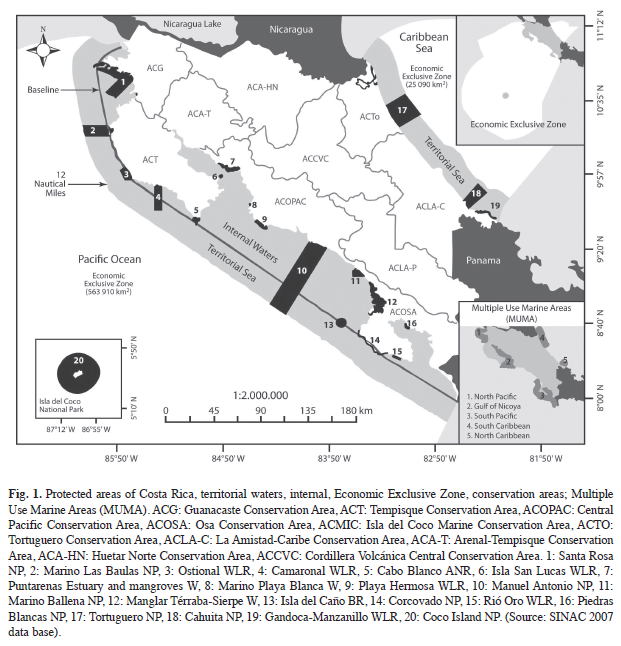
<body><![CDATA[404.48km</span></font><font size="2"><span style="font-family: verdana;"><sup>2</sup></span></font><font      size="2"><span style="font-family: verdana;"> (22.61%) of the     continental and marine surface (including the     internal waters and the Costa Rican territorial sea). The internal     waters and the territorial sea (up to 12 nautical miles (nm) from the     coast) covers 30 308km<sup>2</sup> (<a      href="/img/revistas/rbt/v60n1/a09i1.jpg">Fig. 1</a>). In 2006, a total     of 5     008.69km</span></font><font size="2"><span style="font-family: verdana;"><sup>2</sup></span></font><font      size="2"><span style="font-family: verdana;"> were     ]]></body>
<body><![CDATA[protected (16.53%) (GASP 2006). However, many of those protected areas     were established as extensions of terrestrial PA, based on only few     criteria and baseline technical studies.</span></font><br      style="font-family: verdana;">     <br style="font-family: verdana;">     <font size="2"><span style="font-family: verdana;">With only 51 100km</span></font><font      size="2"><span style="font-family: verdana;"><sup>2</sup></span></font><font      size="2"><span style="font-family: verdana;"> of terrestrial     surface (0.03% of the world) and 589 000km</span></font><font size="2"><span      style="font-family: verdana;"><sup>2</sup></span></font><font size="2"><span     ]]></body>
<body><![CDATA[ style="font-family: verdana;"> of national waters, Costa     Rica is considered one of the 20 most biodiverse countries. Its     geographical location between North and South America with coastlines     along the two largest oceans, and an irregular topography that has     resulted in a huge variety of microclimates, are some of the reasons     for its natural richness, both in species as well as in ecosystems     (Obando-Acu&ntilde;a 2002). So far 91 000 terrestrial species have been     reported for Costa Rica, representing 4.5% of the known species of the     world (Obando-Acu&ntilde;a 2002).</span></font><br      style="font-family: verdana;">     ]]></body>
<body><![CDATA[<br style="font-family: verdana;">     <font size="2"><span style="font-family: verdana;">Due to its tropical     location     surrounded by two oceans and possession of an oceanic island, Costa     Rica also has a high marine richness. This particular location between     two water masses (Pacific and Caribbean), which were separated about     three million years ago (Coates <span style="font-style: italic;">et     al.</span> 1992), with contrasting     oceanographic conditions on either side of the Panamic isthmus (D&#8217;Croz     &amp; Robertson 1997, Jackson &amp; D&#8217;Croz 1997), has resulted in a     ]]></body>
<body><![CDATA[flora and fauna with different characteristics on each side, including     numerous geminate (sibling) species (Knowlton 1993, Werhtmann <span      style="font-style: italic;">et al</span>.     2009). The heterogeneous Pacific coast is 1 160km</span></font><font      size="2"><span style="font-family: verdana;"> long and includes a     series of     gulfs, bays, rocky shores, beaches, and islands, among other     geomorphological features; while the Caribbean coast is shorter (212km)     and less complex, with extensive sandy beaches in the North, and     carbonate platforms with coral reef to the South (Cort&eacute;s &amp;     ]]></body>
<body><![CDATA[Jim&eacute;nez 2003a, b, Cort&eacute;s 2007, Cort&eacute;s &amp;     Wehrtmann 2009).&nbsp;&nbsp; &nbsp;</span></font><br      style="font-family: verdana;">     <br style="font-family: verdana;">     <font size="2"><span style="font-family: verdana;">Approximately 6 700     marine species     have been reported from Costa Rica (3.5% of marine species reported     globally), of which 90 are endemic, the majority from Coco Island     (Cort&eacute;s &amp; Wehrtmann 2009, J.&nbsp; Cort&eacute;s 2010, pers     comm.). The Pacific coast has 4 700 species, while the Caribbean has     ]]></body>
<body><![CDATA[approximately 2 300. However, taking into consideration the continental     shelf area, the Caribbean coast has a higher diversity per km2.     Compared to other countries in the region, Costa Rica is fourth in     absolute number of marine species reported (Wehrtmann <span      style="font-style: italic;">et al.</span> 2009).     Taking into consideration the caveat that most countries in Latin     America have incomplete assessments of their marine biodiversity,     Wehrtmann <span style="font-style: italic;">et al.</span> (2009)     analyzed the number of species per kilometer of     coastline, placing Costa Rica in the first place, and in second place     ]]></body>
<body><![CDATA[by km2 of continental shelf (Wehrtmann <span      style="font-style: italic;">et al. </span>2009). Furthermore, Costa     Rica posses a great variety of marine ecosystems, coral reefs,     mangroves, mudflats, rocky shores, sandy beaches, cliffs, seagrasses, a     tropical fjord (Golfo Dulce), a seasonal upwelling area, an oceanic     thermal dome, an oceanic trench more than 4 000m deep, a submarine     mountain range (Coco Ridge), many coastal islands and one oceanic     island (Coco Island) (Nielsen-Mu&ntilde;oz &amp; Quesada-Alp&iacute;zar     2006, Cort&eacute;s 2007, Cort&eacute;s &amp; Werhtmann 2009), and cold     seeps (Bohrmann <span style="font-style: italic;">et al. </span>2002).     ]]></body>
<body><![CDATA[For these reasons, it is important that     Costa Rica sets up an efficient and representative marine protected     network to conserve this richness.</span></font><br      style="font-family: verdana;">     <br style="font-family: verdana;">     <font size="2"><span style="font-family: verdana;">The objective of     this paper is to     present a diagnosis of the current situation of the marine protected     areas of Costa Rica, for which we used the 2007 database (the most     recent) from the National System of Conservation Areas (SINAC). We     ]]></body>
<body><![CDATA[present a historical analysis of the different laws or executive     decrees that created the MPAs (information taken from the official     governmental newspaper of the Republic of Costa Rica, <span      style="font-style: italic;">&#8220;La Gaceta&#8221;</span>, and     the web page from the Costa Rican Attorney General&acute;s Office,     <a href="http://www.pgr.go.cr">http://www.pgr.go.cr</a>), their     distribution, area, management categories,     distance between MPAs (linear distance between the borders of each MPA     along the coast), and an analysis of their present legal situation and     threats. The goal of this review is to highlight the improvement of     ]]></body>
<body><![CDATA[marine conservation over 50 years in Costa Rica, to establish a     baseline for future research, located all disperse information and to     allow a better understanding for a national and international audience     of MPAs progress in a developing country.</span></font><br      style="font-family: verdana;">     <br style="font-family: verdana;">     <font style="font-weight: bold;" size="3"><span      style="font-family: verdana;">History</span></font><br      style="font-family: verdana;">     <br style="font-family: verdana;">     ]]></body>
<body><![CDATA[<font size="2"><span style="font-family: verdana;">The first protected     area (PA) with     a coastal zone established in Costa Rica was Cabo Blanco Absolute     Nature Reserve, on the Nicoya Peninsula, in 1963. However, its marine     protected area was not established until 1982. Santa Rosa National Park     (NP), created in 1971, had to wait until 1987 to include a marine area,     when by executive decree the Murcielago Islands and the sea up to a     distance of 6km from the shore were included in the protected area.     During the 1970&#8217;s seven PAs adjacent to marine environments were     established; among those Cahuita National Park (NP), Coco Island NP and     ]]></body>
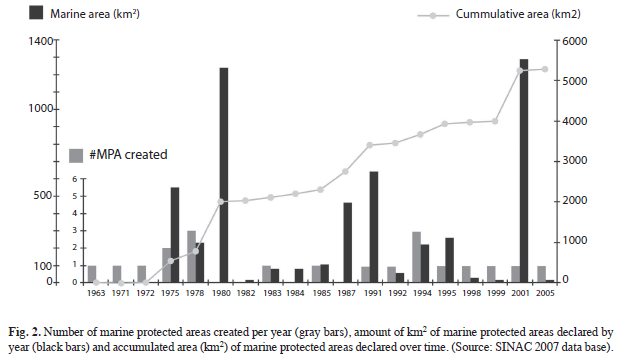
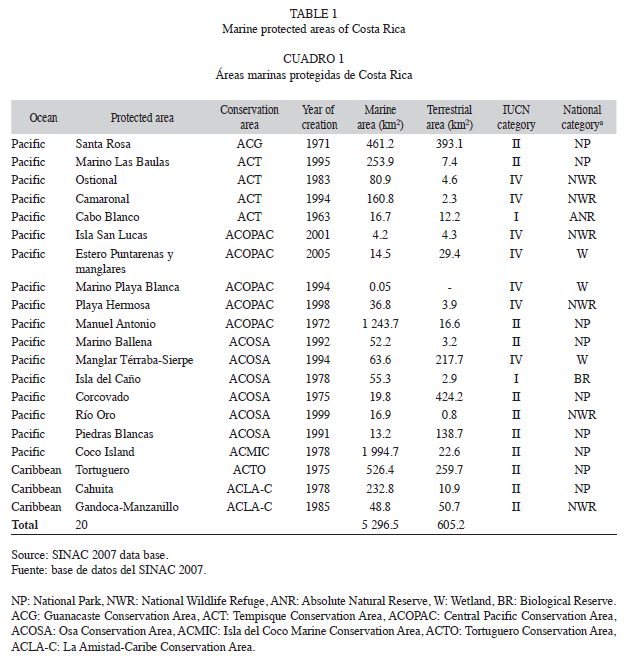
<body><![CDATA[Ca&ntilde;o Island Biological Reserve (BR) (<a      href="/img/revistas/rbt/v60n1/a09t1.gif">Table 1</a>, <a      href="/img/revistas/rbt/v60n1/a09i1.jpg">Fig. 1</a>, <a      href="/img/revistas/rbt/v60n1/a09i2.jpg">2</a>). It is     worth to notice that Coco Island and Ca&ntilde;o Island initially did     not include a marine area. The 1980&#8217;s was the decade when fewer MPAs     were declared (just two), while in the 1990&#8217;s the total number     increased to eight MPAs. During this last period, two Marine National     Parks were declared, Marino Ballena and Marino Las Baulas. Also, during     these two decades marine areas were included in protected areas, or     ]]></body>
<body><![CDATA[expanded. Since 2000, three MPAs have been declared (Table 1, Fig. 2).     It is important to note that during this process many of the MPAs were     intentionally declared as World Heritage Area by UNESCO (e.g., Coco     Island in 1997) or RAMSAR sites.</span></font><br      style="font-family: verdana;">     <br style="font-family: verdana;">     <font size="2"><span style="font-family: verdana;">In terms of MPA     establishment, the     1980&#8217;s was the decade with the highest conservation efforts; with 1     985.1km</span></font><font size="2"><span style="font-family: verdana;"><sup>2</sup></span></font><font     ]]></body>
<body><![CDATA[ size="2"><span style="font-family: verdana;"> (37% of the Costa Rica     total MPA created, <a href="/img/revistas/rbt/v60n1/a09i2.jpg">Fig. 2</a>)     created     through establishment of MAPs and expansions of six PAs, including the     creation of Manuel Antonio and expansion of Cabo Blanco NP, and the     Gandoca-Manzanillo and Ostional NWR. Also, Coco Island NP was expanded     into marine waters for the first time, to 5km offshore (78.5km2), as     well as a second marine expansion of Ca&ntilde;o Island, with 3km     around the island. One of the most interesting cases is Manuel Antonio     National Park, because the size of the park increased due to a     ]]></body>
<body><![CDATA[re-interpretation of the establishment decree, in which the park     extended its marine area 12 nautical miles from the coastal baseline.     This park is located in Costa Rica&#8217;s Central&nbsp; Pacific, in an area     between two peninsulas and where an imaginary line (coastal baseline)     between the peninsulas determines an area of internal waters. Now, the     12nm are measured from Manuel Antonio NP to this imaginary line, rather     than the real coast line in mainland (as was interpreted before),     resulting in a much larger marine area (<a      href="/img/revistas/rbt/v60n1/a09i1.jpg">Fig. 1</a>).</span></font><br      style="font-family: verdana;">     ]]></body>
<body><![CDATA[<br style="font-family: verdana;">     <font size="2"><span style="font-family: verdana;">During the decades     of 1990 and     2000, 1 226.4 and 1 306.7km</span></font><font size="2"><span      style="font-family: verdana;"><sup>2</sup></span></font><font size="2"><span      style="font-family: verdana;"> respectively, were protected, compared     to     just 779km</span></font><font size="2"><span      style="font-family: verdana;"><sup>2</sup></span></font><font size="2"><span      style="font-family: verdana;"> (<a     ]]></body>
<body><![CDATA[ href="/img/revistas/rbt/v60n1/a09i2.jpg">Fig. 2</a>). In the case of     Coco Island     NP, the expansion     continued in 1991 with 629km</span></font><font size="2"><span      style="font-family: verdana;"><sup>2</sup></span></font><font size="2"><span      style="font-family: verdana;">, until its last expansion in 2001 with     1     287km</span></font><font size="2"><span style="font-family: verdana;"><sup>2</sup></span></font><font      size="2"><span style="font-family: verdana;">. As with most protected     areas worldwide, MPAs declared by Costa     ]]></body>
<body><![CDATA[Rica were initially largely &#8220;paper parks&#8221;, and some of them still are.     The situation to the early 1970s, when the terrestrial National Park     System was established but protection mechanisms and implementation of     management plans were yet to be achieved.</span></font><br      style="font-family: verdana;">     <br style="font-family: verdana;">     <font style="font-weight: bold;" size="3"><span      style="font-family: verdana;">Current situation</span></font><br      style="font-family: verdana;">     <br style="font-family: verdana;">     ]]></body>
<body><![CDATA[<font size="2"><span style="font-family: verdana;">The National System     of Conservation     Areas (SINAC) is a decentralized body of the Ministry of Environment,     Energy and Telecommunications (MINAET), integrated by 11 conservation     areas with 166 Protected Areas&nbsp; (PAs) (<a      href="/img/revistas/rbt/v60n1/a09i1.jpg">Fig. 1</a>), of which 59     border     or contain a marine area, and three are exclusively marine protected     areas (Marino Ballena Marine and Marino Las Baulas national parks and     Playa Blanca National Wetland) (Mora <span style="font-style: italic;">et     ]]></body>
<body><![CDATA[al.</span> 2006). Of those 59 PAs with     marine elements, only 20 have marine areas protected. The other 39     correspond mostly with National Wildlife Refuges that protect small     islands, due to their value as seabird nesting areas, but only their     insular territory is protected. These 59 PAs protect more than 50% of     the coastline of Costa Rica, 56% (119km) on the Caribbean coast and 51%     (592km) on the Pacific side. Most of MPAs in the country are under the     National Park management category (90.6%), 6.6% in National Wildlife     Refuge, 1.5% in Wetlands, 1% in Biological Reserves and one Absolute     Nature Reserve (0.3%). With respect to the International Union for     ]]></body>
<body><![CDATA[Conservation of Nature (IUCN) management categories, 93.7% correspond     to category II (National Park), 5% to IV (Habitat and species     management area) and only 1.3% to I (Strict Natural Reserve). The     marine protected extension of Costa Rica is 5 296.5km2, which     represents 28.7% of the total protected surface of the country (18     433.25km</span></font><font size="2"><span style="font-family: verdana;"><sup>2</sup></span></font><font      size="2"><span style="font-family: verdana;">), corresponding to 17.5%     of its national waters, but only     0.9% of its Exclusive Economic Zone (EEZ=589 000km</span></font><font      size="2"><span style="font-family: verdana;"><sup>2</sup></span></font><font     ]]></body>
<body><![CDATA[ size="2"><span style="font-family: verdana;">).</span></font><br      style="font-family: verdana;">     <br style="font-family: verdana;">     <font size="2"><span style="font-family: verdana;">When comparing our     data with those     presented by Chape <span style="font-style: italic;">et al.</span>     (2005) for Central America (17 327km</span></font><font size="2"><span      style="font-family: verdana;"><sup>2</sup></span></font><font size="2"><span      style="font-family: verdana;"> total     marine protected area), Costa Rica has 30.6% of the total, while at a     ]]></body>
<body><![CDATA[global level (1 893 609km</span></font><font size="2"><span      style="font-family: verdana;"><sup>2</sup></span></font><font size="2"><span      style="font-family: verdana;"> total marine protected area) the MPA     area of     Costa Rica represents just 0.3%. Guarderas <span      style="font-style: italic;">et al.</span> (2008) indicated that     in Latin America and the Caribbean there are some 700 MPAs, covering     about 300 000km</span></font><font size="2"><span      style="font-family: verdana;"><sup>2</sup></span></font><font size="2"><span      style="font-family: verdana;">. In this sense, Costa Rica contributes     ]]></body>
<body><![CDATA[with only 2.9%     of&nbsp; the total number of MPAs and 1.8% of total area, respectively.     According to PISCO (2007), all MPAs in Latin America and the Caribbean     cover on average an area less than 0.1% of their EEZ, with Costa Rica     above that average, but still &lt;1%.</span></font><br      style="font-family: verdana;">     <br style="font-family: verdana;">     <font size="2"><span style="font-family: verdana;">Costa Rican MPAs     vary in size by     eight orders of magnitude (<a href="/img/revistas/rbt/v60n1/a09i3.jpg">Fig.     ]]></body>
<body><![CDATA[3a</a>). The average size is 264.82km</span></font><font size="2"><span      style="font-family: verdana;"><sup>2</sup></span></font><font size="2"><span      style="font-family: verdana;">     including Coco Island NP and 173.78km</span></font><font size="2"><span      style="font-family: verdana;"><sup>2</sup></span></font><font size="2"><span      style="font-family: verdana;"> without it. However, the     majority of MPAs are between 10-20km2 (five MPAs) and 51-100km</span></font><font      size="2"><span style="font-family: verdana;"><sup>2</sup></span></font><font      size="2"><span style="font-family: verdana;"> (four     MPAs), with a median of 53.75km</span></font><font size="2"><span     ]]></body>
<body><![CDATA[ style="font-family: verdana;"><sup>2</sup></span></font><font size="2"><span      style="font-family: verdana;">. The largest MPA is Coco Island with 1     994.69km2 while the smallest is Marino Playa Blanca National Wetland     with 0.05km</span></font><font size="2"><span      style="font-family: verdana;"><sup>2</sup></span></font><font size="2"><span      style="font-family: verdana;"> (<a      href="/img/revistas/rbt/v60n1/a09t1.gif">Table 1</a>). The mean     distance between     MPAs on the Pacific     side is 22.4km (excluding Coco Island NP) and 32.9km on the Caribbean.     ]]></body>
<body><![CDATA[Along the Pacific coast, the majority of MPAs (seven) are located     between 11 and 30km from each other (Fig. 3b). Distances are smaller in     the Caribbean.</span></font><br style="font-family: verdana;">     <br style="font-family: verdana;">     <font size="2"><span style="font-family: verdana;">Shanks et al. (2003)     defined a     series of criteria to establish the size and distance between MPAs     according to the dispersion patterns of marine organisms. Based on     those analyses they determined that a MPA should be designed to cover     enough area to assure the settlement of short-range dispersion species     ]]></body>
<body><![CDATA[and they must be spaced within a distance that is sufficient to allow     the settlement of long-range distance propagules in adjacent MPAs. They     recommend that an MPA should have at least a diameter of 4-6km to     assure the settlement of short-range species, and should be spaced     between 10 to 20km from each other to capture long distance propagules     (Shanks <span style="font-style: italic;">et al.</span> 2003). Halpern     (2003) studied the impact of MPAs with     respect to size, biomass, and diversity of 89 organisms worldwide     (including Manuel Antonio NP in</span></font><font size="2"><span      style="font-family: verdana;"> Costa Rica). He found that MPAs     ]]></body>
<body><![CDATA[have an average area of 44.1km</span></font><font size="2"><span      style="font-family: verdana;"><sup>2</sup></span></font><font size="2"><span      style="font-family: verdana;">, although half of the reserves were     between one and 10km</span></font><font size="2"><span      style="font-family: verdana;"><sup>2</sup></span></font><font size="2"><span      style="font-family: verdana;"> and the median reserve size was 4km</span></font><font      size="2"><span style="font-family: verdana;"><sup>2</sup></span></font><font      size="2"><span style="font-family: verdana;">.</span></font><br      style="font-family: verdana;">     <br style="font-family: verdana;">     ]]></body>
<body><![CDATA[<font size="2"><span style="font-family: verdana;">In this regard, it     is important to     highlight that MPAs in Costa Rica are located 22.4km from each other,     and have a median size close to 54km</span></font><font size="2"><span      style="font-family: verdana;"><sup>2</sup></span></font><font size="2"><span      style="font-family: verdana;">. When we compared these values     with those presented by Halpern (2003) and proposed by Shanks <span      style="font-style: italic;">et al</span>.     (2003), Costa Rica is above average with good conditions for an     incipient network of MPAs that would allow exchange between     ]]></body>
<body><![CDATA[populations. However, this is an assumption based on a global analysis,     and does not take into account the flow between one MPA and others.     Local anthropogenic, biological and physical barriers may exist, that     greatly reduce such connectivity. In Latin America and the Caribbean     more than 50% of MPAs are small, covering less than 6km</span></font><font      size="2"><span style="font-family: verdana;"><sup>2</sup></span></font><font      size="2"><span style="font-family: verdana;"> (PISCO 2007).</span></font><br      style="font-family: verdana;">     <br style="font-family: verdana;">     <font style="font-weight: bold;" size="3"><span     ]]></body>
<body><![CDATA[ style="font-family: verdana;">Legal issues</span></font><br      style="font-family: verdana;">     <br style="font-family: verdana;">     <font size="2"><span style="font-family: verdana;">In Costa Rica, the     official     definition of a MPA is given by Kelleher (1999) as follows: &#8220;any area     of intertidal or subtidal terrain, together with its overlying water     and associated flora and fauna, and historical and</span></font><font      size="2"><span style="font-family: verdana;"> cultural features, which     has been     ]]></body>
<body><![CDATA[reserved by law or other effective means to protect part or all of the     enclosed environment&#8221; (Art. 1 Decree N&ordm; 35369, 2009). PAs are     defined by article 58 in Costa Rica&#8217;s&nbsp; Biodiversity Law as     &#8220;geographically delimited areas, composed by land, wetlands and     portions of the ocean. They are declared as such since they represent     particularly valuable ecosystems, and threatened species, areas for     recovery and reproduction, and other values, and because of their     cultural and historical significance. These areas will be dedicated to     the conservation and protection of biodiversity, water and soils,     cultural values, and ecosystems services in general&#8221;.</span></font><br     ]]></body>
<body><![CDATA[ style="font-family: verdana;">     <br style="font-family: verdana;">     <font size="2"><span style="font-family: verdana;">Costa Rica has nine     management     categories that are used to classify PAs according to their initial     objectives, following IUCN&#8217;s framework (Dudley 2008). Before 2008,     there were seven management categories that put high priority on     terrestrial conservation, ignoring marine conservation, with exceptions     of those protected areas that included marine zones under management     categories like National Parks, Biological Reserves and National     ]]></body>
<body><![CDATA[Wildlife Refuges (Mora <span style="font-style: italic;">et al</span>.     2006). Each of these three categories     have particular limitations, like absolute prohibitions of commercial     and sport fishing, geographic restrictions (6m at low tide for     wetlands), and scope of conservation and management objectives for     land-based wildlife but not marine or insular species and ecosystems.     Other categories are less restrictive but oriented towards terrestrial     goals. </span></font><br style="font-family: verdana;">     <br style="font-family: verdana;">     <font size="2"><span style="font-family: verdana;">In 2008, two     ]]></body>
<body><![CDATA[additional management     categories, entirely marine, were established: Marine Reserves and     Marine Management Areas (Executive Decrees 34433, 35369). Marine     Reserves are defined as coastal-marine and/or oceanic areas that ensure     the maintenance, integrity and viability of natural ecosystems as a     priority, benefiting the communities through a sustainable use of the     resources, characterized by its low impact according to technical     criteria. Marine Management Areas are defined as marine, coastal and/or     oceanic areas where several activities take place in order to guarantee     the protection and&nbsp; maintenance of the marine biodiversity on the     ]]></body>
<body><![CDATA[long term. These two categories shall pursue to benefit the communities     (dependant on the use of resources), and for education, scientific     research and monitoring.</span></font><br style="font-family: verdana;">     <br style="font-family: verdana;">     <font size="2"><span style="font-family: verdana;">Despite that some     international     instruments have been ratified by Costa Rica, such as the United     Nations Convention on the Law of the Sea, that provides rights and     duties at State level in its national waters, until now there is no     legal framework governing marine species and resources in Costa Rica&#8217;s     ]]></body>
<body><![CDATA[seas, lands and seabeds, that includes conservation and sustainable use     perspectives rather than just a resource production perspective.</span></font><br      style="font-family: verdana;">     <br style="font-family: verdana;">     <font size="2"><span style="font-family: verdana;">The Wildlife Law     regulates     continental and insular wildlife but fails to cover marine wildlife. On     the other hand, Costa Rica&#8217;s fisheries law, enacted in 2005, includes     measures and sanctions for fish conservation. However, this law focuses     mainly on the promotion and regulations of fisheries and aquacultural     ]]></body>
<body><![CDATA[activities in their different phases through the final marketing and     sustainable use of aquatic species, but does not address conservation.</span></font><br      style="font-family: verdana;">     <br style="font-family: verdana;">     <font size="2"><span style="font-family: verdana;">In 1995, the     Government created a     category called &#8220;Marine Multiple Use Area&#8221;. This category has been     erroneously conceived as a management category, since in practice its     purpose is to combine a marine protected area and a buffer or influence     zone within a single unit. Regarding the different management types and     ]]></body>
<body><![CDATA[different activities to be regulated, several authorities are     responsible for regulating such activities including the Ministries of     Environment, Security, and Agriculture as well as the Coast Guard.</span></font><br      style="font-family: verdana;">     <br style="font-family: verdana;">     <font size="2"><span style="font-family: verdana;">Since Marine     Multiple Use Areas     have not yet been implemented, some modifications to their legal     framework have been proposed with the objective to clarify objectives     and scope. The real goal with creation and implementation of Marine     ]]></body>
<body><![CDATA[Multiple Use Areas is to achieve coordination among the relevant     authorities and stakeholders, so that adequate enforcement of     regulations for each of these areas contributes to their optimal     management. Unfortunately, such levels of coordination have not yet     been established.</span></font><br style="font-family: verdana;">     <br style="font-family: verdana;">     <font size="2"><span style="font-family: verdana;">More recently, on     April 2008,     Costa&nbsp; Rica&#8217;s Institute for Fisheries and Aquaculture&nbsp;     (INCOPESCA) created a category called the &#8220;Marine Area for Responsible     ]]></body>
<body><![CDATA[Fisheries&#8221; that is intended to become a zoning instrument regulating     fishing activities within an area. Their creation will depend upon the     biological, fisheries or socio-cultural features that require     enforcement of specific regulations for guaranteeing the sustainable     use of fish in the long term, as well as their use, conservation and     management, with the help of local communities and institutions.</span></font><br      style="font-family: verdana;">     <br style="font-family: verdana;">     <font size="2"><span style="font-family: verdana;">The Marine Areas for     Responsible     ]]></body>
<body><![CDATA[Fisheries differ from MPAs in goals and objectives. MPAs deal with a     numerous aspects related to fisheries, however, they regulate several     other activities that include conservation, tourism, environmental     education, navigation and research. Even though creation of Marine     Areas for Responsible Fisheries is very recent and only one has been     formally declared to date (Palito de Chira, on the Pacific coast), many     local communities are interested in promoting the creation of such     areas where fishing activities occur.</span></font><br      style="font-family: verdana;">     <br style="font-family: verdana;">     ]]></body>
<body><![CDATA[<font style="font-weight: bold;" size="3"><span      style="font-family: verdana;">Threats</span></font><br      style="font-family: verdana;">     <br style="font-family: verdana;">     <font style="font-weight: bold;" size="3"><span      style="font-family: verdana;">Institutional threats</span></font><br      style="font-family: verdana;">     <br style="font-family: verdana;">     <font size="2"><span style="font-family: verdana;">The lack of     coordination between     ]]></body>
<body><![CDATA[governmental agencies, especially SINAC/MINAET and INCOPESCA, and lack     of adequate mechanisms for stakeholder participation to improve     governance of MPAs, are the&nbsp; main institutional threats. SINAC is     divided into wildlife, forestry, and protected areas on the land, but     there is no analogous framework for marine wildlife, fisheries and     MPAs. Marine conservation is managed through SINAC, while marine     wildlife work is shared between SINAC and INCOPESCA, and fisheries by     INCOPESCA only.</span></font><br style="font-family: verdana;">     <br style="font-family: verdana;">     <font size="2"><span style="font-family: verdana;">No single MPA     ]]></body>
<body><![CDATA[possesses enough     personnel to implement a management plan in an&nbsp; ideal scenario,     and only a few can execute a minimum plan. The economic situation of     most MPAs is difficult, since budgets are just enough to achieve basic     operation activities, such as cooking and buying gasoline, among     others. Additionally, fees collected go to a government central     account, from which money is reallocated between all protected areas     across the country. Therefore, MPAs that attract a lot of funds, are     not able to provide quality services to the users that pay for those     services. </span></font><br style="font-family: verdana;">     ]]></body>
<body><![CDATA[<br style="font-family: verdana;">     <font size="2"><span style="font-family: verdana;">Currently, no     specific training is     provided for marine park rangers, and no economic incentive exits to     attract people with a strong marine background. Sporadic training     initiatives, which include legal aspects, marine operations, patrolling     and environmental impact assessments, have occurred in specific MPAs     (e.g. Coco Island and Marino Las Baulas NP). Other MPAs, such as     Cahuita, Marino Ballena and Santa Rosa NP, have hired local fishermen     or marine tourism operators, with experience in marine operations, but     ]]></body>
<body><![CDATA[not much experience in marine management or legal issues. Most MPAs     have park rangers that have been</span></font><br      style="font-family: verdana;">     <font size="2"><span style="font-family: verdana;">transferred from     land parks to the     marine area, with experience in the marine environment frequently     totally lacking. Thus, park rangers and park managers need to receive     adequate training in marine management and marine operations. For a     number of MPAs with mainly terrestrial objectives (for example,     Corcovado, Manuel Antonio and Piedras Blancas NP), efforts and funding     ]]></body>
<body><![CDATA[for the marine area are rare or nonexistent.</span></font><br      style="font-family: verdana;">     <br style="font-family: verdana;">     <font size="2"><span style="font-family: verdana;">Half of the current     MPAs have at     least one patrolling boat in good conditions, or can conduct at least     some kind of patrol activities, either alone or with support of     additional boats or funding from NGOs. The remaining MPAs do not     possess a boat, have a boat in bad&nbsp; condition, or cannot perform     adequate patrolling activities due to lack of fuel or personnel among     ]]></body>
<body><![CDATA[others.</span></font><br style="font-family: verdana;">     <br style="font-family: verdana;">     <font size="2"><span style="font-family: verdana;">In terms of     biological resources     monitoring, there are numerous but isolated efforts developed by     government agencies, universities, NGOs and volunteers to monitor coral     reefs, fish populations, whales and dolphins and turtle nesting sites.     An integrated monitoring program, designed to test whether conservation     and management goals are being achieved, is currently lacking. Such a     monitoring program should include an evaluation of biological     ]]></body>
<body><![CDATA[resources, especially those related to the conservation goals in each     MPA, and an evaluation of management activities being undertaken.</span></font><br      style="font-family: verdana;">     <br style="font-family: verdana;">     <font style="font-weight: bold;" size="3"><span      style="font-family: verdana;">Legal gaps</span></font><br      style="font-family: verdana;">     <br style="font-family: verdana;">     <font size="2"><span style="font-family: verdana;">The boundaries of     many MPAs are     ]]></body>
<body><![CDATA[poorly defined (especially wetlands down to 6m depth), boundary     delimitation is ambiguous (Manuel Antonio NP case), or limits are     difficult to understand in the sea, such as at Cabo Blanco (where 1km     of marine protected area border the coastline but the coastline is     extremely irregular). Boundary coordinates or very clear limits are     needed in some case to allow easy interpretation by both users and park     rangers.</span></font><br style="font-family: verdana;">     <br style="font-family: verdana;">     <font size="2"><span style="font-family: verdana;">Only 54% of MPAs     have a public use     ]]></body>
<body><![CDATA[plan, and only 27% MPAs have an official management plan. Fortunately,     36% of MPAs have an elaborated management plan and in other is in     process of formalization. One major problem is that sometimes the     process takes so long that the management plan, conceived for a     five-year planning period, becomes out of date and results no longer     useful. Zoning is another important strategy for diminishing user-user     conflicts and user-nature conflicts. Currently, 50% of MPAs have a     zoning plan. A specific marine zoning methodology for management plans     does not yet exist, resulting in unrealistic zoning in the marine area     in some MPAs where the ocean is often considered a homogeneous area.     ]]></body>
<body><![CDATA[For example in Cabo Blanco, the marine area is considered a single     zone. The most successful zoning plans have included participation of     the users of the marine park. A protocol defining important aspects to     consider when defining marine zones is surely needed to guide MPA     managers (Salas et al. in prep., E. Salas 2009, pers. comm.).</span></font><br      style="font-family: verdana;">     <br style="font-family: verdana;">     <font size="2"><span style="font-family: verdana;">Current legal     frameworks allow     changes to the limits of a PA, a process used by some stakeholders to     ]]></body>
<body><![CDATA[reduce marine areas in exchange of terrestrial areas for infrastructure     development, threatening marine ecosystems through barriers to land-sea     connectivity. This sort of trade is being discussed in     Gandoca-Manzanillo and San Lucas NWR. Powerful economic interests,     especially ocean front real-estate developers, </span></font><font      size="2"><span style="font-family: verdana;">can also exert     considerable     pressure to change categories to a lower protection level. Finally, the     formalization processes for management plans and regulations are still     extremely slow.     ]]></body>
<body><![CDATA[<br>     <br>     <!-- big --><span style="font-weight: bold;">Environmental issues</span><!-- /big --></span></font><br      style="font-family: verdana;">     <br style="font-family: verdana;">     <font size="2"><span style="font-family: verdana;">Environmental     threats can be     divided into human induced and naturally driven, though this division     is not clear at times. Among the natural disturbances affecting the     marine environments of Costa Rica the most significant have been. (i)     ]]></body>
<body><![CDATA[the warming events that occur during El Ni&ntilde;o-Southern     Oscillation (ENSO) periods, impacts on coral reefs of both coasts     (Cort&eacute;s et al. 1984, Jim&eacute;nez et al. 2001, Guzm&aacute;n     &amp; Cort&eacute;s 2007), followed by (ii) coastal uplift on the     Caribbean coast due to an earthquake (Cort&eacute;s <span      style="font-style: italic;">et al.</span> 1992), and     (iii) changes in relative sea levels due to climate change along the     Pacific coast (Lizano 1997). Other natural disturbances that have     affected coastal ecosystems include harmful phytoplankton blooms that     killed shallow water corals (Guzm&aacute;n <span     ]]></body>
<body><![CDATA[ style="font-style: italic;">et al.</span> 1990, C.     Jim&eacute;nez 2008, pers. comm.), strong surge that uprooted     seagrasses (Cort&eacute;s 2001), and massive death of the Caribbean     black sea urchin Diadema antillarum (Alvarado <span      style="font-style: italic;">et al.</span> 2004).</span></font><br      style="font-family: verdana;">     <br style="font-family: verdana;">     <font size="2"><span style="font-family: verdana;">Human activities in     coastal and     marine environments of Costa Rica are having a significant impact on     ]]></body>
<body><![CDATA[organisms, environments and ecological processes. Solid and fecal     wastes, oil, agrochemicals, PCB&#8217;s and heavy metals are the main     pollutants (Acu&ntilde;a <span style="font-style: italic;">et al.</span>     1998, 2004, Rojas <span style="font-style: italic;">et al</span>.     1998,     Spongberg &amp; Davis 1998, Garc&iacute;a-C&eacute;spedes et al. 2004,     Spongberg 2004a, b, c, Garc&iacute;a et al. 2006). The main impact on     coral reefs in the country is terrigenous sedimentation due to     deforestation, coastal alteration for infrastructure (main road     construction and tourism developments), and inappropriate agricultural     ]]></body>
<body><![CDATA[practices (Cort&eacute;s &amp;</span></font><font size="2"><span      style="font-family: verdana;"> Risk 1985, Cort&eacute;s 1990,     Cort&eacute;s &amp; Jim&eacute;nez 2003a, b, Alvarado <span      style="font-style: italic;">et al.</span> 2004,     2009). Other&nbsp; sources of anthropogenic impacts on coastal regions     are extraction of marine organisms for sale to tourists, fisheries     over-exploitation, and marine mammals disturbance by inappropriate     touristic activities.</span></font><br style="font-family: verdana;">     <br style="font-family: verdana;">     <font style="font-weight: bold;" size="3"><span     ]]></body>
<body><![CDATA[ style="font-family: verdana;">Current initiatives</span></font><br      style="font-family: verdana;">     <br style="font-family: verdana;">     <font size="2"><span style="font-family: verdana;">The need to increase     conservation     and management of the marine and coastal resources of Costa Rica is     clearly evident, not only for the protection of sensitive environments,     critical habitats or vulnerable species, but also to sustain and offer     economic services to coastal populations. Based on those arguments, the     government of Costa Rica launched a campaign in 2005 to assess the     ]]></body>
<body><![CDATA[viability of protection of 25% of the EEZ (Executive decree     31832-&nbsp; MINAE). The objective of such a proposal was to assure     resilience of regional marine biodiversity and to fulfill international     commitments assumed by the country at the 5<sup>th</sup> IUCN World     Parks Congress     (Mora <span style="font-style: italic;">et al</span>. 2006) and     Convention on Biological Diversity (CBD), which     mandated at CoP7 the conservation of 10% of each of the world&#8217;s     eco-regions (<a href="http://www.cbd.int/marine">http://www.cbd.int/marine</a>).</span></font><br      style="font-family: verdana;">     ]]></body>
<body><![CDATA[<br style="font-family: verdana;">     <font size="2"><span style="font-family: verdana;">In 1995-1996, Costa     Rica completed     an initial analysis of conservation needs for proper maintenance of     biodiversity (known as GRUAS I). The GRUAS I project and technical     proposals for land management, aimed to assure the conservation of at     least 90% of Costa Rica&#8217;s biodiversity (Garc&iacute;a 1997), using     vegetation macrotypes as indicators (G&oacute;mez &amp; Herrera 1986).     However, this proposal left out several vegetation macrotypes, plus all     marine and freshwater environments (SINAC 2007a).</span></font><br     ]]></body>
<body><![CDATA[ style="font-family: verdana;">     <br style="font-family: verdana;">     <font size="2"><span style="font-family: verdana;">Ten years after this     proposal, the     analysis was redone (GRUAS II), this time including all terrestrial,     freshwater and marine environments, enabling a better integration of     biodiversity conservation in Costa Rica. GRUAS II identified gaps in     conservation, or critical sites that are not adequately represented on     the current network of protected areas (SINAC 2007a, b). The following     gaps were identified: 2 833.3km</span></font><font size="2"><span     ]]></body>
<body><![CDATA[ style="font-family: verdana;"><sup>2</sup></span></font><font size="2"><span      style="font-family: verdana;"></span></font><font size="2"><span      style="font-family: verdana;"> of the terrestrial ecosystems, 44     lakes and reservoirs, 1 223km</span></font><font size="2"><span      style="font-family: verdana;"><sup>2</sup></span></font><font size="2"><span      style="font-family: verdana;"> of river systems and their watershed     (SINAC 2007a, b), and approximately 19 076km</span></font><font size="2"><span      style="font-family: verdana;"><sup>2</sup></span></font><font size="2"><span      style="font-family: verdana;"></span></font><font size="2"><span      style="font-family: verdana;"> of marine and coastal     ]]></body>
<body><![CDATA[ecosystems (1 323km</span></font><font size="2"><span      style="font-family: verdana;"><sup>2</sup></span></font><font size="2"><span      style="font-family: verdana;"></span></font><font size="2"><span      style="font-family: verdana;"> on the Caribbean coast and 17 753km</span></font><font      size="2"><span style="font-family: verdana;"><sup>2</sup></span></font><font      size="2"><span style="font-family: verdana;"></span></font><font      size="2"><span style="font-family: verdana;"> on the     Pacific coast) (SINAC 2009, Alvarado <span style="font-style: italic;">et     al.</span> 2011).</span></font><br style="font-family: verdana;">     <br style="font-family: verdana;">     ]]></body>
<body><![CDATA[<font size="2"><span style="font-family: verdana;">The     Inter-Institutional Commission     of the Exclusive Economic Zone of Costa Rica was&nbsp; created in 2004.     Among other tasks, this Commission led analysis of the viability of     conserving 25% of the EEZ and&nbsp; elaboration of a National Marine     Strategy (NMS). This Commission is constituted by the ministries of     Environment (MINAET), Transportation (MOPT), the Costa Rican Fisheries     and Aquaculture Institute (INCOPESCA), the National Coast Guard     Service, the Costa Rican Tourism Institute (ICT), the University of     Costa Rica (UCR), the National University (UNA) and four NGOs (The     ]]></body>
<body><![CDATA[Nature Conservancy, Conservation International, Asociaci&oacute;n     Marviva, Programa de Restauraci&oacute;n de Tortugas Marinas). The NMS     is an initiative established in the 2006-2010 National Development Plan     of the Government. </span></font><br style="font-family: verdana;">     <br style="font-family: verdana;">     <font size="2"><span style="font-family: verdana;">The mission of the     NMS is to     promote the conservation and sustainable management of the coastal and     marine resources of Costa Rica, by means of integrated management led     by the government and promoting involvement of the rest of society     ]]></body>
<body><![CDATA[(CIZEE 2008).</span></font><br style="font-family: verdana;">     <br style="font-family: verdana;">     <font style="font-weight: bold;" size="3"><span      style="font-family: verdana;">Conclusions</span></font><br      style="font-family: verdana;">     <br style="font-family: verdana;">     <font size="2"><span style="font-family: verdana;">In the last 50 years     of     conservation, Costa Rica has done much to protect its environment.     Thanks to those initiatives, the country possesses arguably the best     ]]></body>
<body><![CDATA[MPA network, in terms of representation, in the entire region.     Conservation started inland, with inclusion of marine areas occurring     little by little, but without a good understanding of what was being     protected in most cases. With the relatively strict protection of     coastal areas now achieved, most marine resources should not suffer     from overexploitation and exist through the long term.</span></font><br      style="font-family: verdana;">     <br style="font-family: verdana;">     <font size="2"><span style="font-family: verdana;">The gradual     degradation of the     ]]></body>
<body><![CDATA[coasts, in addition to overfishing and other extractive activities     outside MPAs, has caused a great current pressure on resources inside     MPAs. This has resulted in serious conflicts with inhabitants living     adjacent to MPAs, and among the authorities that administrate     fisheries. Exacerbating this problem is that many of the current MPAs     were created without any real consultation to nearby communities. This     has resulted in a latent resentment against the administration     authorities.</span></font><br style="font-family: verdana;">     <br style="font-family: verdana;">     <font size="2"><span style="font-family: verdana;">The presence of     ]]></body>
<body><![CDATA[no-take MPAs has     been fundamental to long-term maintenance of the high biodiversity that     Costa Rica possesses. However, this model should be complemented with     the creation of new protected areas that may allow regulated     recreational and extractive activities. In view of these needs the two     new categories (Marine Reserve and Marine Management Areas) arise in     response to a more balanced model. In fact, all coastal and marine     areas should be regulated. Nevertheless, for both models of management     (take and no-take) to work well, it is urgent to improve institutional     coordination, improve personnel training, provide greater economic     ]]></body>
<body><![CDATA[resources and trained personnel to MPAs, and to regulate activities in     nearby watersheds. Following 50 years of conservation practice, Costa     Rica is still learning how to do it better. Recent increases in     research and in regional cooperation (e.g. Marine Conservation Seascape     of the Eastern Tropical Pacific) are new ways to take care and maintain     a healthy network of marine protected areas.</span></font><br      style="font-family: verdana;">     <br style="font-family: verdana;">     <font style="font-weight: bold;" size="3"><span      style="font-family: verdana;">Acknowledgments</span></font><br     ]]></body>
<body><![CDATA[ style="font-family: verdana;">     <br style="font-family: verdana;">     <font size="2"><span style="font-family: verdana;">We would like to     thank E. Arias for     facilitating the GIS data base of the current system of Protected Areas     of Costa Rica, R. Mora for his help on the elaboration on the map and     corrections on the original data base, and M. Chavez for the     elaboration of the figures. JJAB thanks CONICIT, MICIT and CONACYT; JC     appreciates the support of the Universidad de Costa Rica and ES that of     MarViva. We appreciate the comments made by M. Kappelle, A. Morales and     ]]></body>
<body><![CDATA[two anonymous reviewers that improved this paper.</span></font><br      style="font-family: verdana;">     <br style="font-family: verdana;">     <font style="font-weight: bold;" size="3"><span      style="font-family: verdana;"></span></font>     <hr style="width: 100%; height: 2px;"><font style="font-weight: bold;"      size="3"><span style="font-family: verdana;">References</span></font><br      style="font-family: verdana;">     <br style="font-family: verdana;">     <font size="2"><span style="font-family: verdana;">Acu&ntilde;a, J.A.,     ]]></body>
<body><![CDATA[V.     Garc&iacute;a &amp; J. Mondrag&oacute;n. 1998. Comparaci&oacute;n de     algunos aspectos f&iacute;sico-qu&iacute;micos y calidad sanitaria del     <!-- ref -->Estero de Puntarenas, Costa Rica. Rev. Biol. Trop. 46: 1-10.    &nbsp;&nbsp;&nbsp;&nbsp;&nbsp;&nbsp;&nbsp;&nbsp;[&#160;<a href="javascript:void(0);" onclick="javascript: window.open('/scielo.php?script=sci_nlinks&ref=1435623&pid=S0034-7744201200010000900001&lng=','','width=640,height=500,resizable=yes,scrollbars=1,menubar=yes,');">Links</a>&#160;]<!-- end-ref --><!-- ref --></span></font><br  style="font-family: verdana;"> <br style="font-family: verdana;"> <font size="2"><span style="font-family: verdana;">Acu&ntilde;a-Gonz&aacute;lez, J., J.A. Vargas-Zamora, E. G&oacute;mez-Ram&iacute;rez &amp; J. Garc&iacute;a-C&eacute;spedes. 2004. Hidrocarburos de petr&oacute;leo, disueltos y dispersos, en cuatro ambientes costeros de Costa Rica. Rev. Biol. Trop. 52: 43-50.    &nbsp;&nbsp;&nbsp;&nbsp;&nbsp;&nbsp;&nbsp;&nbsp;[&#160;<a href="javascript:void(0);" onclick="javascript: window.open('/scielo.php?script=sci_nlinks&ref=1435624&pid=S0034-7744201200010000900002&lng=','','width=640,height=500,resizable=yes,scrollbars=1,menubar=yes,');">Links</a>&#160;]<!-- end-ref --><!-- ref --></span></font><br style="font-family: verdana;"> <br style="font-family: verdana;"> <font size="2"><span style="font-family: verdana;">Alvarado, J.J., J. Cort&eacute;s &amp; E. Salas. 2004. Population densities of Diadema antillarum Philippi at Cahuita National Park (1977-2003), Costa Rica. Caribb. J. Sci. 40: 257-259.    &nbsp;&nbsp;&nbsp;&nbsp;&nbsp;&nbsp;&nbsp;&nbsp;[&#160;<a href="javascript:void(0);" onclick="javascript: window.open('/scielo.php?script=sci_nlinks&ref=1435625&pid=S0034-7744201200010000900003&lng=','','width=640,height=500,resizable=yes,scrollbars=1,menubar=yes,');">Links</a>&#160;]<!-- end-ref --><!-- ref --></span></font><br style="font-family: verdana;"> <br style="font-family: verdana;"> <font size="2"><span style="font-family: verdana;">Alvarado, J.J., J. Cortes &amp; C. Fern&aacute;ndez. 2009. Water quality conditions on coral reefs at the Marino Ballena National Park, Pacific Costa Rica. Bull. Mar. Sci. 84: 137-152.    &nbsp;&nbsp;&nbsp;&nbsp;&nbsp;&nbsp;&nbsp;&nbsp;[&#160;<a href="javascript:void(0);" onclick="javascript: window.open('/scielo.php?script=sci_nlinks&ref=1435626&pid=S0034-7744201200010000900004&lng=','','width=640,height=500,resizable=yes,scrollbars=1,menubar=yes,');">Links</a>&#160;]<!-- end-ref --><!-- ref --></span></font><br style="font-family: verdana;"> <br style="font-family: verdana;"> <font size="2"><span style="font-family: verdana;">Alvarado, J.J., B. Herrera, L. Corrales, J. Asch &amp; P. Paaby. 2011. Identificaci&oacute;n de las prioridades de conservaci&oacute;n de la biodiversidad marina y costera en Costa Rica. Rev. Biol. Trop. 59: 829-842.    &nbsp;&nbsp;&nbsp;&nbsp;&nbsp;&nbsp;&nbsp;&nbsp;[&#160;<a href="javascript:void(0);" onclick="javascript: window.open('/scielo.php?script=sci_nlinks&ref=1435627&pid=S0034-7744201200010000900005&lng=','','width=640,height=500,resizable=yes,scrollbars=1,menubar=yes,');">Links</a>&#160;]<!-- end-ref --><!-- ref --></span></font><br  style="font-family: verdana;"> <br style="font-family: verdana;"> <font size="2"><span style="font-family: verdana;">Bohrmann, G., K. Heeschen, C. Jung, W. Weinrebe, B. Baranov, B. Cailleau, R. Heath, V. Huhnerbach, M. Hort, D. Masson &amp; I. Trummer. 2002. Widespread fluid expulsion along the seafloor of the Costa Rica convergent margin. Terra Nova 14: 69-79.    &nbsp;&nbsp;&nbsp;&nbsp;&nbsp;&nbsp;&nbsp;&nbsp;[&#160;<a href="javascript:void(0);" onclick="javascript: window.open('/scielo.php?script=sci_nlinks&ref=1435628&pid=S0034-7744201200010000900006&lng=','','width=640,height=500,resizable=yes,scrollbars=1,menubar=yes,');">Links</a>&#160;]<!-- end-ref --><!-- ref --></span></font><br  style="font-family: verdana;"> <br style="font-family: verdana;"> <font size="2"><span style="font-family: verdana;">Chape, S., J. Harrison, M. Spalding &amp; I. Lysenko. 2005. Measuring the extent and effectiveness of protected areas as an indicator for meeting global biodiversity targets. Phil. Trans. R. Soc. B. 360: 443-455.    &nbsp;&nbsp;&nbsp;&nbsp;&nbsp;&nbsp;&nbsp;&nbsp;[&#160;<a href="javascript:void(0);" onclick="javascript: window.open('/scielo.php?script=sci_nlinks&ref=1435629&pid=S0034-7744201200010000900007&lng=','','width=640,height=500,resizable=yes,scrollbars=1,menubar=yes,');">Links</a>&#160;]<!-- end-ref --><!-- ref --> </span></font><br  style="font-family: verdana;"> <br style="font-family: verdana;"> <font size="2"><span style="font-family: verdana;">Coates, A.G., J.B.C. Jackson, L.S. Collins, T.M. Cronin, H.J. Dowset, L.M. Bybell, P. Jung &amp; J.A. Obando. 1992. Closure of the Isthmus of Panama: the nearshore marine records of Costa Rica and western Panama. Geol. Soc. Am. Bull. 104: 814-828.    &nbsp;&nbsp;&nbsp;&nbsp;&nbsp;&nbsp;&nbsp;&nbsp;[&#160;<a href="javascript:void(0);" onclick="javascript: window.open('/scielo.php?script=sci_nlinks&ref=1435630&pid=S0034-7744201200010000900008&lng=','','width=640,height=500,resizable=yes,scrollbars=1,menubar=yes,');">Links</a>&#160;]<!-- end-ref --><!-- ref --></span></font><br style="font-family: verdana;"> <br style="font-family: verdana;"> <font size="2"><span style="font-family: verdana;">Cort&eacute;s, J. 1990. The coral reefs of Golfo Dulce, Costa Rica: distribution and community structure. Atoll Res. Bull. 344: 1-37.    &nbsp;&nbsp;&nbsp;&nbsp;&nbsp;&nbsp;&nbsp;&nbsp;[&#160;<a href="javascript:void(0);" onclick="javascript: window.open('/scielo.php?script=sci_nlinks&ref=1435631&pid=S0034-7744201200010000900009&lng=','','width=640,height=500,resizable=yes,scrollbars=1,menubar=yes,');">Links</a>&#160;]<!-- end-ref --><!-- ref --></span></font><br  style="font-family: verdana;"> <br style="font-family: verdana;"> <font size="2"><span style="font-family: verdana;">Cort&eacute;s, J. 2001. Requiem for an eastern Pacific seagrass bed, Bah&iacute;a Culebra, Costa Rica. Rev. Biol. Trop. 49: 273-278.    &nbsp;&nbsp;&nbsp;&nbsp;&nbsp;&nbsp;&nbsp;&nbsp;[&#160;<a href="javascript:void(0);" onclick="javascript: window.open('/scielo.php?script=sci_nlinks&ref=1435632&pid=S0034-7744201200010000900010&lng=','','width=640,height=500,resizable=yes,scrollbars=1,menubar=yes,');">Links</a>&#160;]<!-- end-ref --><!-- ref --></span></font><br style="font-family: verdana;"> <br style="font-family: verdana;"> <font size="2"><span style="font-family: verdana;">Cort&eacute;s, J. 2007. Coastal morphology and coral reefs, p. 185-200. In J. Bundschuh &amp; G.E. Alvarado (eds.). Central America: geology, resources, and hazards Vol. 1. Taylor &amp; Francis, United Kingdom.    &nbsp;&nbsp;&nbsp;&nbsp;&nbsp;&nbsp;&nbsp;&nbsp;[&#160;<a href="javascript:void(0);" onclick="javascript: window.open('/scielo.php?script=sci_nlinks&ref=1435633&pid=S0034-7744201200010000900011&lng=','','width=640,height=500,resizable=yes,scrollbars=1,menubar=yes,');">Links</a>&#160;]<!-- end-ref --><!-- ref --></span></font><br  style="font-family: verdana;"> <br style="font-family: verdana;"> <font size="2"><span style="font-family: verdana;">Cort&eacute;s, J. &amp; C. Jim&eacute;nez. 2003a. Past, present and future of the coral reefs of the Caribbean coast of Costa Rica, p. 223-239. In J. Cort&eacute;s (ed.). Latin American coral reefs. Elsevier, Amsterdam, The Netherlands.    &nbsp;&nbsp;&nbsp;&nbsp;&nbsp;&nbsp;&nbsp;&nbsp;[&#160;<a href="javascript:void(0);" onclick="javascript: window.open('/scielo.php?script=sci_nlinks&ref=1435634&pid=S0034-7744201200010000900012&lng=','','width=640,height=500,resizable=yes,scrollbars=1,menubar=yes,');">Links</a>&#160;]<!-- end-ref --><!-- ref --></span></font><br  style="font-family: verdana;"> <br style="font-family: verdana;"> <font size="2"><span style="font-family: verdana;">Cort&eacute;s, J. &amp; C. Jim&eacute;nez. 2003b. Corals and coral reefs of the Pacific of Costa Rica: history, research and status, p. 361-385. In J. Cort&eacute;s (ed.). Latin American coral reefs. Elsevier, Amsterdam, The Netherlands.    &nbsp;&nbsp;&nbsp;&nbsp;&nbsp;&nbsp;&nbsp;&nbsp;[&#160;<a href="javascript:void(0);" onclick="javascript: window.open('/scielo.php?script=sci_nlinks&ref=1435635&pid=S0034-7744201200010000900013&lng=','','width=640,height=500,resizable=yes,scrollbars=1,menubar=yes,');">Links</a>&#160;]<!-- end-ref --><!-- ref --></span></font><br  style="font-family: verdana;"> <br style="font-family: verdana;"> <font size="2"><span style="font-family: verdana;">Cort&eacute;s, J. &amp; M.J. Risk. 1985. A reef under siltation stress: Cahuita, Costa Rica. Bull. Mar. Sci. 36: 339-356.    &nbsp;&nbsp;&nbsp;&nbsp;&nbsp;&nbsp;&nbsp;&nbsp;[&#160;<a href="javascript:void(0);" onclick="javascript: window.open('/scielo.php?script=sci_nlinks&ref=1435636&pid=S0034-7744201200010000900014&lng=','','width=640,height=500,resizable=yes,scrollbars=1,menubar=yes,');">Links</a>&#160;]<!-- end-ref --><!-- ref --> </span></font><br style="font-family: verdana;"> <br style="font-family: verdana;"> <font size="2"><span style="font-family: verdana;">Cort&eacute;s, J. &amp; I.S. Wehrtmann. 2009. Diversity of marine habitats of the Caribbean and Pacific of Costa Rica, p. 1-45. In I.S. Wehrtmann &amp; J. Cort&eacute;s (eds.). Marine biodiversity of Costa Rica, Central America. Monographiae Biologicae 86. Springer, Berlin, Germany.    &nbsp;&nbsp;&nbsp;&nbsp;&nbsp;&nbsp;&nbsp;&nbsp;[&#160;<a href="javascript:void(0);" onclick="javascript: window.open('/scielo.php?script=sci_nlinks&ref=1435637&pid=S0034-7744201200010000900015&lng=','','width=640,height=500,resizable=yes,scrollbars=1,menubar=yes,');">Links</a>&#160;]<!-- end-ref --><!-- ref --></span></font><br  style="font-family: verdana;"> <br style="font-family: verdana;"> <font size="2"><span style="font-family: verdana;">Cort&eacute;s, J., M.M. Murillo, H.M. Guzm&aacute;n &amp; J. Acu&ntilde;a. 1984. P&eacute;rdida de zooxantelas y muerte de corales y otros organismos arrecifales en el Caribe y Pac&iacute;fico de Costa Rica. Rev. Biol. Trop. 32: 227-232.    &nbsp;&nbsp;&nbsp;&nbsp;&nbsp;&nbsp;&nbsp;&nbsp;[&#160;<a href="javascript:void(0);" onclick="javascript: window.open('/scielo.php?script=sci_nlinks&ref=1435638&pid=S0034-7744201200010000900016&lng=','','width=640,height=500,resizable=yes,scrollbars=1,menubar=yes,');">Links</a>&#160;]<!-- end-ref --><!-- ref --></span></font><br  style="font-family: verdana;"> <br style="font-family: verdana;"> <font size="2"><span style="font-family: verdana;">Cort&eacute;s, J., R. Soto, C. Jim&eacute;nez &amp; A. Astorga. 1992. Earthquake associated mortality of intertidal and coral reef organisms. Proc. 7th Int. Coral Reef Sym.1: 235-240.    &nbsp;&nbsp;&nbsp;&nbsp;&nbsp;&nbsp;&nbsp;&nbsp;[&#160;<a href="javascript:void(0);" onclick="javascript: window.open('/scielo.php?script=sci_nlinks&ref=1435639&pid=S0034-7744201200010000900017&lng=','','width=640,height=500,resizable=yes,scrollbars=1,menubar=yes,');">Links</a>&#160;]<!-- end-ref --><!-- ref --></span></font><br style="font-family: verdana;"> <br style="font-family: verdana;"> <font size="2"><span style="font-family: verdana;">CIZEE (Comisi&oacute;n Interinstitucional de la Zona Econ&oacute;mica). 2008. Estrategia nacional para la gesti&oacute;n integral de los recursos marinos y costeros de Costa Rica. Comisi&oacute;n Interinstitucional de la Zona Econ&oacute;mica </span></font><font size="2"><span  style="font-family: verdana;">Exclusiva de Costa Rica, San Jos&eacute;, Costa Rica.    &nbsp;&nbsp;&nbsp;&nbsp;&nbsp;&nbsp;&nbsp;&nbsp;[&#160;<a href="javascript:void(0);" onclick="javascript: window.open('/scielo.php?script=sci_nlinks&ref=1435640&pid=S0034-7744201200010000900018&lng=','','width=640,height=500,resizable=yes,scrollbars=1,menubar=yes,');">Links</a>&#160;]<!-- end-ref --><!-- ref --></span></font><br style="font-family: verdana;"> <br style="font-family: verdana;"> <font size="2"><span style="font-family: verdana;">D&#8217;Croz, L. &amp; D.R. Robertson. 1997. Coastal oceanographic conditions affecting coral reefs on both sides of the Isthmus of Panama. Proc. 8th Int. Coral Reef Sym. 2: 2053-2058.    &nbsp;&nbsp;&nbsp;&nbsp;&nbsp;&nbsp;&nbsp;&nbsp;[&#160;<a href="javascript:void(0);" onclick="javascript: window.open('/scielo.php?script=sci_nlinks&ref=1435641&pid=S0034-7744201200010000900019&lng=','','width=640,height=500,resizable=yes,scrollbars=1,menubar=yes,');">Links</a>&#160;]<!-- end-ref --><!-- ref --></span></font><br style="font-family: verdana;"> <br style="font-family: verdana;"> <font size="2"><span style="font-family: verdana;">Dudley, N. 2008. Guidelines for applying protected area management categories. IUCN, Gland, Switzerland.    &nbsp;&nbsp;&nbsp;&nbsp;&nbsp;&nbsp;&nbsp;&nbsp;[&#160;<a href="javascript:void(0);" onclick="javascript: window.open('/scielo.php?script=sci_nlinks&ref=1435642&pid=S0034-7744201200010000900020&lng=','','width=640,height=500,resizable=yes,scrollbars=1,menubar=yes,');">Links</a>&#160;]<!-- end-ref --><br>     <!-- ref --><br> Edgar, G.F., G.R. Russ &amp; R.C. Babcock. 2007. Marine protected areas, p. 533-555. In S.D. Connell &amp; B.M. Gillanders (eds.). Marine Ecology. Oxford University, Melbourne, Australia.    &nbsp;&nbsp;&nbsp;&nbsp;&nbsp;&nbsp;&nbsp;&nbsp;[&#160;<a href="javascript:void(0);" onclick="javascript: window.open('/scielo.php?script=sci_nlinks&ref=1435644&pid=S0034-7744201200010000900021&lng=','','width=640,height=500,resizable=yes,scrollbars=1,menubar=yes,');">Links</a>&#160;]<!-- end-ref --><!-- ref --></span></font><br  style="font-family: verdana;"> <br style="font-family: verdana;"> <font size="2"><span style="font-family: verdana;">Garc&iacute;a, R. 1997. Biolog&iacute;a de la conservaci&oacute;n y &aacute;reas silvestres protegidas: situaci&oacute;n actual y perspectivas en Costa Rica. Editorial INBio, Heredia, Costa Rica.    &nbsp;&nbsp;&nbsp;&nbsp;&nbsp;&nbsp;&nbsp;&nbsp;[&#160;<a href="javascript:void(0);" onclick="javascript: window.open('/scielo.php?script=sci_nlinks&ref=1435645&pid=S0034-7744201200010000900022&lng=','','width=640,height=500,resizable=yes,scrollbars=1,menubar=yes,');">Links</a>&#160;]<!-- end-ref --><br>     <!-- ref --><br> Garc&iacute;a, V., J. Acu&ntilde;a-Gonz&aacute;lez, J.A. Vargas-Zamora &amp; J. Garc&iacute;a-C&eacute;spedes. 2006. Calidad bacteriol&oacute;gica y desechos s&oacute;lidos en cinco ambientes costeros de Costa Rica. Rev. Biol. Trop. 54: 35-48.    &nbsp;&nbsp;&nbsp;&nbsp;&nbsp;&nbsp;&nbsp;&nbsp;[&#160;<a href="javascript:void(0);" onclick="javascript: window.open('/scielo.php?script=sci_nlinks&ref=1435647&pid=S0034-7744201200010000900023&lng=','','width=640,height=500,resizable=yes,scrollbars=1,menubar=yes,');">Links</a>&#160;]<!-- end-ref --><!-- ref --></span></font><br style="font-family: verdana;"> <br style="font-family: verdana;"> <font size="2"><span style="font-family: verdana;">Garc&iacute;a-C&eacute;spedes, J., J.A. Acu&ntilde;a-Gonz&aacute;lez &amp; J.A. Vargas- Zamora. 2004. Metales traza en sedimentos de cuatro ambientes costeros de Costa Rica. Rev. Biol. Trop. 52: 51-60.    &nbsp;&nbsp;&nbsp;&nbsp;&nbsp;&nbsp;&nbsp;&nbsp;[&#160;<a href="javascript:void(0);" onclick="javascript: window.open('/scielo.php?script=sci_nlinks&ref=1435648&pid=S0034-7744201200010000900024&lng=','','width=640,height=500,resizable=yes,scrollbars=1,menubar=yes,');">Links</a>&#160;]<!-- end-ref --><!-- ref --></span></font><br  style="font-family: verdana;"> <br style="font-family: verdana;"> <font size="2"><span style="font-family: verdana;">GASP (Gerencia de &Aacute;reas Silvestres Protegidas). 2006. Informe nacional sobre el sistema de &aacute;reas silvestres protegidas de Costa Rica. SINAC, MINAE, San Jos&eacute;, Costa Rica.    &nbsp;&nbsp;&nbsp;&nbsp;&nbsp;&nbsp;&nbsp;&nbsp;[&#160;<a href="javascript:void(0);" onclick="javascript: window.open('/scielo.php?script=sci_nlinks&ref=1435649&pid=S0034-7744201200010000900025&lng=','','width=640,height=500,resizable=yes,scrollbars=1,menubar=yes,');">Links</a>&#160;]<!-- end-ref --><!-- ref --></span></font><br style="font-family: verdana;"> <br style="font-family: verdana;"> <font size="2"><span style="font-family: verdana;">G&oacute;mez, L.D. &amp; W. Herrera. 1986. Vegetaci&oacute;n y clima de Costa Rica. EUNED, San Jos&eacute;, Costa Rica.    &nbsp;&nbsp;&nbsp;&nbsp;&nbsp;&nbsp;&nbsp;&nbsp;[&#160;<a href="javascript:void(0);" onclick="javascript: window.open('/scielo.php?script=sci_nlinks&ref=1435650&pid=S0034-7744201200010000900026&lng=','','width=640,height=500,resizable=yes,scrollbars=1,menubar=yes,');">Links</a>&#160;]<!-- end-ref --><!-- ref --></span></font><br style="font-family: verdana;"> <br style="font-family: verdana;"> <font size="2"><span style="font-family: verdana;">Guarderas, A.P., S.D. Hacker &amp; J. Lubchenco. 2008. Current status of marine protected areas in Latin America and the Caribbean. Conservat. Biol. 22: 1630-1640.    &nbsp;&nbsp;&nbsp;&nbsp;&nbsp;&nbsp;&nbsp;&nbsp;[&#160;<a href="javascript:void(0);" onclick="javascript: window.open('/scielo.php?script=sci_nlinks&ref=1435651&pid=S0034-7744201200010000900027&lng=','','width=640,height=500,resizable=yes,scrollbars=1,menubar=yes,');">Links</a>&#160;]<!-- end-ref --><!-- ref --></span></font><br  style="font-family: verdana;"> <br style="font-family: verdana;"> <font size="2"><span style="font-family: verdana;">Guzm&aacute;n, H.M. &amp; J. Cort&eacute;s. 2007. Reef recovery 20-yr after the 1982-83 El Ni&ntilde;o massive mortality. Mar. Biol. 151: 401-411.    &nbsp;&nbsp;&nbsp;&nbsp;&nbsp;&nbsp;&nbsp;&nbsp;[&#160;<a href="javascript:void(0);" onclick="javascript: window.open('/scielo.php?script=sci_nlinks&ref=1435652&pid=S0034-7744201200010000900028&lng=','','width=640,height=500,resizable=yes,scrollbars=1,menubar=yes,');">Links</a>&#160;]<!-- end-ref --><!-- ref --></span></font><br  style="font-family: verdana;"> <br style="font-family: verdana;"> <font size="2"><span style="font-family: verdana;">Guzm&aacute;n, H.M., J. Cort&eacute;s, P.W. Glynn &amp; R.H. Richmond. 1990. Coral mortality associated with dynoflagellate blooms in the eastern Pacific (Costa Rica and Panama). Mar. Ecol. Prog. Ser. 60: 299-303.    &nbsp;&nbsp;&nbsp;&nbsp;&nbsp;&nbsp;&nbsp;&nbsp;[&#160;<a href="javascript:void(0);" onclick="javascript: window.open('/scielo.php?script=sci_nlinks&ref=1435653&pid=S0034-7744201200010000900029&lng=','','width=640,height=500,resizable=yes,scrollbars=1,menubar=yes,');">Links</a>&#160;]<!-- end-ref --><!-- ref --></span></font><br  style="font-family: verdana;"> <br style="font-family: verdana;"> <font size="2"><span style="font-family: verdana;">Halpern, B.S. 2003. The impact of marine reserves: do reserves work and does reserve sizes matter? Ecol. Appl. 13: S117-S137.    &nbsp;&nbsp;&nbsp;&nbsp;&nbsp;&nbsp;&nbsp;&nbsp;[&#160;<a href="javascript:void(0);" onclick="javascript: window.open('/scielo.php?script=sci_nlinks&ref=1435654&pid=S0034-7744201200010000900030&lng=','','width=640,height=500,resizable=yes,scrollbars=1,menubar=yes,');">Links</a>&#160;]<!-- end-ref --><!-- ref --></span></font><br style="font-family: verdana;"> <br style="font-family: verdana;"> <font size="2"><span style="font-family: verdana;">Hoyt, E. 2005. Marine protected areas for whales, dolphins and porpoises: A world handbook for cetacean habitat conservation. Earthscan, London, United Kingdom.    &nbsp;&nbsp;&nbsp;&nbsp;&nbsp;&nbsp;&nbsp;&nbsp;[&#160;<a href="javascript:void(0);" onclick="javascript: window.open('/scielo.php?script=sci_nlinks&ref=1435655&pid=S0034-7744201200010000900031&lng=','','width=640,height=500,resizable=yes,scrollbars=1,menubar=yes,');">Links</a>&#160;]<!-- end-ref --><br>     <!-- ref --><br> Jackson, J.B.C. &amp; L. D&#8217;Croz. 1997. The ocean divided, p. 38-70. In A.G. Coates (ed.). Central America: a cultural and natural history. Yale University, New Haven, USA.    &nbsp;&nbsp;&nbsp;&nbsp;&nbsp;&nbsp;&nbsp;&nbsp;[&#160;<a href="javascript:void(0);" onclick="javascript: window.open('/scielo.php?script=sci_nlinks&ref=1435657&pid=S0034-7744201200010000900032&lng=','','width=640,height=500,resizable=yes,scrollbars=1,menubar=yes,');">Links</a>&#160;]<!-- end-ref --><!-- ref --></span></font><br  style="font-family: verdana;"> <br style="font-family: verdana;"> <font size="2"><span style="font-family: verdana;">Jim&eacute;nez, C., J. Cort&eacute;s, A. Le&oacute;n &amp; E. Ruiz. 2001. Coral bleaching and mortality associated with El Ni&ntilde;o 1997/98 event in an upwelling environment in the eastern Pacific (Gulf of Papagayo, Costa Rica). Bull. Mar. Sci. 69: 151-169.    &nbsp;&nbsp;&nbsp;&nbsp;&nbsp;&nbsp;&nbsp;&nbsp;[&#160;<a href="javascript:void(0);" onclick="javascript: window.open('/scielo.php?script=sci_nlinks&ref=1435658&pid=S0034-7744201200010000900033&lng=','','width=640,height=500,resizable=yes,scrollbars=1,menubar=yes,');">Links</a>&#160;]<!-- end-ref --><br>     ]]></body>
<body><![CDATA[<!-- ref --><br> SINAC (Sistema Nacional de &Aacute;reas de Conservaci&oacute;n). 2009. GRUAS II: Propuesta de ordenamiento territorial para la conservaci&oacute;n de la biodiversidad en Costa Rica. Vol. IIII. An&aacute;lisis de vac&iacute;os en la representatividad e integridad de la biodiversidad de los sistemas </span></font><font  size="2"><span style="font-family: verdana;">marinos y costeros. San Jos&eacute;, Costa Rica.    &nbsp;&nbsp;&nbsp;&nbsp;&nbsp;&nbsp;&nbsp;&nbsp;[&#160;<a href="javascript:void(0);" onclick="javascript: window.open('/scielo.php?script=sci_nlinks&ref=1435660&pid=S0034-7744201200010000900034&lng=','','width=640,height=500,resizable=yes,scrollbars=1,menubar=yes,');">Links</a>&#160;]<!-- end-ref --><!-- ref --></span></font><br style="font-family: verdana;"> <br style="font-family: verdana;"> <font size="2"><span style="font-family: verdana;">Spongberg, A.L. 2004a. PCB Contamination in surface sediments in the coastal waters of Costa Rica. Rev. Biol. Trop. 52 1-10.    &nbsp;&nbsp;&nbsp;&nbsp;&nbsp;&nbsp;&nbsp;&nbsp;[&#160;<a href="javascript:void(0);" onclick="javascript: window.open('/scielo.php?script=sci_nlinks&ref=1435661&pid=S0034-7744201200010000900035&lng=','','width=640,height=500,resizable=yes,scrollbars=1,menubar=yes,');">Links</a>&#160;]<!-- end-ref --><!-- ref --></span></font><br style="font-family: verdana;"> <br style="font-family: verdana;"> <font size="2"><span style="font-family: verdana;">Spongberg, A.L. 2004b. PCB concentrations in sediments from the Gulf of Nicoya estuary, Pacific coast of Costa Rica. Rev. Biol. Trop. 52: 11-22</span></font>    &nbsp;&nbsp;&nbsp;&nbsp;&nbsp;&nbsp;&nbsp;&nbsp;[&#160;<a href="javascript:void(0);" onclick="javascript: window.open('/scielo.php?script=sci_nlinks&ref=1435662&pid=S0034-7744201200010000900036&lng=','','width=640,height=500,resizable=yes,scrollbars=1,menubar=yes,');">Links</a>&#160;]<!-- end-ref --><!-- ref --><br> <br style="font-family: verdana;"> <font size="2"><span style="font-family: verdana;"> Spongberg, A.L. 2004c. PCB contamination in marine sediments from Golfo Dulce, Pacific coast of Costa Rica. Rev. Biol. Trop. 52: 23-32.    &nbsp;&nbsp;&nbsp;&nbsp;&nbsp;&nbsp;&nbsp;&nbsp;[&#160;<a href="javascript:void(0);" onclick="javascript: window.open('/scielo.php?script=sci_nlinks&ref=1435663&pid=S0034-7744201200010000900037&lng=','','width=640,height=500,resizable=yes,scrollbars=1,menubar=yes,');">Links</a>&#160;]<!-- end-ref --><!-- ref --></span></font><br  style="font-family: verdana;"> <br style="font-family: verdana;"> <font size="2"><span style="font-family: verdana;">Spongberg, A. &amp; P. Davis. 1998. Organochlorinated pesticide contaminants in Golfo Dulce, Costa Rica. Rev. Biol. Trop. 46: 111-124.    &nbsp;&nbsp;&nbsp;&nbsp;&nbsp;&nbsp;&nbsp;&nbsp;[&#160;<a href="javascript:void(0);" onclick="javascript: window.open('/scielo.php?script=sci_nlinks&ref=1435664&pid=S0034-7744201200010000900038&lng=','','width=640,height=500,resizable=yes,scrollbars=1,menubar=yes,');">Links</a>&#160;]<!-- end-ref --><!-- ref --></span></font><br  style="font-family: verdana;"> <br style="font-family: verdana;"> <font size="2"><span style="font-family: verdana;">Wehrtmann, I.S., J. Cort&eacute;s ; S. Echeverr&iacute;a-S&aacute;enz. 2009. Marine biodiversity of Costa Rica: perspectives and conclusions, p. 521-533. In I.S. Wehrtmann ; J. Cort&eacute;s (eds.). Marine biodiversity of Costa Rica, Central America. Monographiae Biologicae 86. Springer, Berlin, Germany.    &nbsp;&nbsp;&nbsp;&nbsp;&nbsp;&nbsp;&nbsp;&nbsp;[&#160;<a href="javascript:void(0);" onclick="javascript: window.open('/scielo.php?script=sci_nlinks&ref=1435665&pid=S0034-7744201200010000900039&lng=','','width=640,height=500,resizable=yes,scrollbars=1,menubar=yes,');">Links</a>&#160;]<!-- end-ref --></span></font><br  style="font-family: verdana;"> <br style="font-family: verdana;"> <font size="2"><span style="font-family: verdana;">Nota</span></font><br  style="font-family: verdana;"> <font size="2"><span style="font-family: verdana;">Durante la edici&oacute;n final de esta investigaci&oacute;n para su publicaci&oacute;n, el Gobierno de Costa Rica decret&oacute; (N&ordm; 36452-MINAET; 3 marzo 2011) la creaci&oacute;n del &Aacute;rea Marina de Manejo Montes Submarinos. Esta &aacute;rea marina protegida est&aacute; compuesta por 9 640 km2, y se localiza en el Oc&eacute;ano Pac&iacute;fico entre las coordenadas 6&deg;08&#8217;N-87&deg;00&#8217;W,5&deg;44&#8217;N-86&deg;26&#8217;W, 4&deg;47&#8217;N-87&deg;17&#8217;W y 4&deg;58&#8217;N-88&deg;00&#8217;W. La administraci&oacute;n de la misma est&aacute; bajo el &Aacute;rea de Conservaci&oacute;n Marina Isla del Coco (ACMIC), ya que rodea el actual Parque Nacional Isla del Coco (PNIC). Entre otras razones, es creada para ayudar en la regulaci&oacute;n de la actividad pesquera que se da alrededor del PNIC, un &aacute;rea marina protegida de gran importancia en el Corredor de Conservaci&oacute;n Marina del Pac&iacute;fico Oriental.</span></font><br  style="font-family: verdana;"> <br style="font-family: verdana;"> <font size="2"><span style="font-family: verdana;">Note: During the final edition of this paper, the Government of Costa Rica decreted (N&ordm; 36452-MINAET; 3 March 2011) the creation of the Marine Management Area Submarine Mounts. This marine protected area is 9 640 km2, and is located in the Pacific Ocean between the coordinates 6&deg;08&#8217;N-87&deg;00&#8217;W,5&deg;44&#8217;N-86&deg;26&#8217;W, 4&deg;47&#8217;N-87&deg;17&#8217;W y 4&deg;58&#8217;N-88&deg;00&#8217;W. Its administration is under the Isla de Coco Marine Conservation Area, since it surrounds the current Isla del Coco National Park. Among other reasons, the creation of this area intends to serve as a buffer to regulate fishing activity around Isla del Coco National Park, a very important marine protected area in the Eastern Pacific Marine Conservation Corridor.</span></font>    <br> <br style="font-family: verdana;"> <font size="2"> <span style="font-family: verdana;"><a name="Correspondencia1"></a><a  href="#Correspondencia2">*</a>Correspondencia:    <br> Juan Jos&eacute; Alvarado:</span></font><font size="2"><span  style="font-family: verdana;">Centro de Investigaci&oacute;n en Ciencias del Mar y Limnolog&iacute;a (CIMAR), Universidad de Costa Rica, San Pedro, 11501-2060 San Jos&eacute;, Costa Rica; <a href="mailto:juanalva76@yahoo.com">juanalva76@yahoo.com</a></span></font><font  size="2"><span style="font-family: verdana;">. Posgrado en Ciencias Marinas y Costeras, Universidad Aut&oacute;noma de Baja California Sur, La Paz, M&eacute;xico.</span></font>    <br> <font size="2"><span style="font-family: verdana;">Jorge Cort&eacute;s: </span></font><font size="2"><span  style="font-family: verdana;">Centro de Investigaci&oacute;n en Ciencias del Mar y Limnolog&iacute;a (CIMAR), Universidad de Costa Rica, San Pedro, 11501-2060 San Jos&eacute;, Costa Rica; <a href="mailto:jorge.cortes@ucr.ac.cr.">jorge.cortes@ucr.ac.cr.</a> </span></font><font  size="2"><span style="font-family: verdana;">Escuela de Biolog&iacute;a, Universidad de Costa Rica.</span></font>    ]]></body>
<body><![CDATA[<br> <font size="2"><span style="font-family: verdana;">Mar&iacute;a Fernanda Esquivel: </span></font><font size="2"><span  style="font-family: verdana;">Asesores Legales del Istmo, San Jos&eacute;, Costa Rica; <a href="mailto:mesquivel@leyescostarica.com">mesquivel@leyescostarica.com</a></span></font><font  size="2"><span style="font-family: verdana;">    <br> Eva Salas: </span></font><font size="2"><span  style="font-family: verdana;">Fundaci&oacute;n MarViva, 020-651 Santa Ana; <a href="mailto:esalas.e@gmail.com">esalas.e@gmail.com</a>    <br> </span></font><br style="font-family: verdana;"> <font size="2"><span style="font-family: verdana;"><a name="Afiliacion1"></a><a  href="#Afiliacion6">1</a>. Centro de Investigaci&oacute;n en Ciencias del Mar y Limnolog&iacute;a (CIMAR), Universidad de Costa Rica, San Pedro, 11501-2060 San Jos&eacute;, Costa Rica; <a href="mailto:juanalva76@yahoo.com">juanalva76@yahoo.com, </a><a  href="mailto:jorge.cortes@ucr.ac.cr">jorge.cortes@ucr.ac.cr</a></span></font><br  style="font-family: verdana;"> <font size="2"><span style="font-family: verdana;"><a name="Afiliacion2"></a><a  href="#Afiliacion7">2</a>. Posgrado en Ciencias Marinas y Costeras, Universidad Aut&oacute;noma de Baja California Sur, La Paz, M&eacute;xico.</span></font><br style="font-family: verdana;"> <font size="2"><span style="font-family: verdana;"><a name="Afiliacion3"></a><a  href="#Afiliacion8">3</a>. Escuela de Biolog&iacute;a, Universidad de Costa Rica.</span></font><br  style="font-family: verdana;"> <font size="2"><span style="font-family: verdana;"><a name="Afiliacion4"></a><a  href="#Afiliacion9">4</a>. Asesores Legales del Istmo, San Jos&eacute;, Costa Rica; <a href="mailto:mesquivel@leyescostarica.com">mesquivel@leyescostarica.com</a></span></font><br  style="font-family: verdana;"> <font size="2"><span style="font-family: verdana;"><a name="Afiliacion5"></a><a  href="#Afiliacion10">5</a>. Fundaci&oacute;n MarViva, 020-651 Santa Ana; <a href="mailto:esalas.e@gmail.com">esalas.e@gmail.com</a></span></font><font  size="2"><span style="font-family: verdana;"></span></font><font  size="2"><span style="font-family: verdana;"></span></font><br  style="font-family: verdana;">     <div style="text-align: center;"><font style="font-weight: bold;"  size="2"><span style="font-family: verdana;"></span></font> <hr style="width: 100%; height: 2px;"><font size="2"><span  style="font-family: verdana;">Received 20-I -2011. Corrected 16-IV-2011. Accepted 18-V-2011.</span></font>    <br> </div> </div> </div>      ]]></body><back>
<ref-list>
<ref id="B1">
<nlm-citation citation-type="journal">
<person-group person-group-type="author">
<name>
<surname><![CDATA[Acuña]]></surname>
<given-names><![CDATA[J.A]]></given-names>
</name>
<name>
<surname><![CDATA[García]]></surname>
<given-names><![CDATA[V]]></given-names>
</name>
<name>
<surname><![CDATA[Mondragón]]></surname>
<given-names><![CDATA[J]]></given-names>
</name>
</person-group>
<article-title xml:lang="es"><![CDATA[Comparación de algunos aspectos físico-químicos y calidad sanitaria del Estero de Puntarenas, Costa Rica]]></article-title>
<source><![CDATA[Rev. Biol. Trop]]></source>
<year>1998</year>
<volume>46</volume>
<page-range>1-10</page-range></nlm-citation>
</ref>
<ref id="B2">
<nlm-citation citation-type="journal">
<person-group person-group-type="author">
<name>
<surname><![CDATA[Acuña-González]]></surname>
<given-names><![CDATA[J]]></given-names>
</name>
<name>
<surname><![CDATA[Vargas-Zamora]]></surname>
<given-names><![CDATA[J.A]]></given-names>
</name>
<name>
<surname><![CDATA[Gómez-Ramírez]]></surname>
<given-names><![CDATA[E]]></given-names>
</name>
<name>
<surname><![CDATA[García-Céspedes]]></surname>
<given-names><![CDATA[J]]></given-names>
</name>
</person-group>
<article-title xml:lang="es"><![CDATA[Hidrocarburos de petróleo, disueltos y dispersos, en cuatro ambientes costeros de Costa Rica.]]></article-title>
<source><![CDATA[Rev. Biol. Trop]]></source>
<year>2004</year>
<volume>52</volume>
<page-range>43-50</page-range></nlm-citation>
</ref>
<ref id="B3">
<nlm-citation citation-type="journal">
<person-group person-group-type="author">
<name>
<surname><![CDATA[Alvarado]]></surname>
<given-names><![CDATA[J.J]]></given-names>
</name>
<name>
<surname><![CDATA[Cortés]]></surname>
<given-names><![CDATA[J]]></given-names>
</name>
<name>
<surname><![CDATA[Salas]]></surname>
<given-names><![CDATA[E]]></given-names>
</name>
</person-group>
<article-title xml:lang="en"><![CDATA[Population densities of Diadema antillarum Philippi at Cahuita National Park (1977-2003), Costa Rica]]></article-title>
<source><![CDATA[Caribb. J. Sci]]></source>
<year>2004</year>
<volume>40</volume>
<page-range>257-259</page-range></nlm-citation>
</ref>
<ref id="B4">
<nlm-citation citation-type="journal">
<person-group person-group-type="author">
<name>
<surname><![CDATA[Alvarado]]></surname>
<given-names><![CDATA[J.J]]></given-names>
</name>
<name>
<surname><![CDATA[Cortes]]></surname>
<given-names><![CDATA[J]]></given-names>
</name>
<name>
<surname><![CDATA[Fernández]]></surname>
<given-names><![CDATA[C]]></given-names>
</name>
</person-group>
<article-title xml:lang="en"><![CDATA[Water quality conditions on coral reefs at the Marino Ballena National Park, Pacific Costa Rica]]></article-title>
<source><![CDATA[Bull. Mar. Sci]]></source>
<year>2009</year>
<volume>84</volume>
<page-range>137-152</page-range></nlm-citation>
</ref>
<ref id="B5">
<nlm-citation citation-type="journal">
<person-group person-group-type="author">
<name>
<surname><![CDATA[Alvarado]]></surname>
<given-names><![CDATA[J.J]]></given-names>
</name>
<name>
<surname><![CDATA[Herrera]]></surname>
<given-names><![CDATA[B]]></given-names>
</name>
<name>
<surname><![CDATA[Corrales]]></surname>
<given-names><![CDATA[L]]></given-names>
</name>
<name>
<surname><![CDATA[Asch]]></surname>
<given-names><![CDATA[J]]></given-names>
</name>
<name>
<surname><![CDATA[Paaby]]></surname>
<given-names><![CDATA[P]]></given-names>
</name>
</person-group>
<article-title xml:lang="es"><![CDATA[Identificación de las prioridades de conservación de la biodiversidad marina y costera en Costa Rica.]]></article-title>
<source><![CDATA[Rev. Biol. Trop]]></source>
<year>2011</year>
<volume>59</volume>
<page-range>829-842</page-range></nlm-citation>
</ref>
<ref id="B6">
<nlm-citation citation-type="journal">
<person-group person-group-type="author">
<name>
<surname><![CDATA[Bohrmann]]></surname>
<given-names><![CDATA[G]]></given-names>
</name>
<name>
<surname><![CDATA[Heeschen]]></surname>
<given-names><![CDATA[K]]></given-names>
</name>
<name>
<surname><![CDATA[Jung]]></surname>
<given-names><![CDATA[C]]></given-names>
</name>
<name>
<surname><![CDATA[Weinrebe]]></surname>
<given-names><![CDATA[W]]></given-names>
</name>
<name>
<surname><![CDATA[Baranov]]></surname>
<given-names><![CDATA[B]]></given-names>
</name>
<name>
<surname><![CDATA[Cailleau]]></surname>
<given-names><![CDATA[B]]></given-names>
</name>
<name>
<surname><![CDATA[Heath]]></surname>
<given-names><![CDATA[R]]></given-names>
</name>
<name>
<surname><![CDATA[Huhnerbach]]></surname>
<given-names><![CDATA[V]]></given-names>
</name>
<name>
<surname><![CDATA[Hort]]></surname>
<given-names><![CDATA[M]]></given-names>
</name>
<name>
<surname><![CDATA[Masson]]></surname>
<given-names><![CDATA[D]]></given-names>
</name>
<name>
<surname><![CDATA[Trummer]]></surname>
<given-names><![CDATA[I]]></given-names>
</name>
</person-group>
<article-title xml:lang="en"><![CDATA[Widespread fluid expulsion along the seafloor of the Costa Rica convergent margin]]></article-title>
<source><![CDATA[Terra Nova]]></source>
<year>2002</year>
<volume>14</volume>
<page-range>69-79</page-range></nlm-citation>
</ref>
<ref id="B7">
<nlm-citation citation-type="journal">
<person-group person-group-type="author">
<name>
<surname><![CDATA[Chape]]></surname>
<given-names><![CDATA[S]]></given-names>
</name>
<name>
<surname><![CDATA[Harrison]]></surname>
<given-names><![CDATA[J]]></given-names>
</name>
<name>
<surname><![CDATA[Spalding]]></surname>
<given-names><![CDATA[M]]></given-names>
</name>
<name>
<surname><![CDATA[Lysenko]]></surname>
<given-names><![CDATA[I]]></given-names>
</name>
</person-group>
<article-title xml:lang="en"><![CDATA[Measuring the extent and effectiveness of protected areas as an indicator for meeting global biodiversity targets]]></article-title>
<source><![CDATA[Phil. Trans. R. Soc. B]]></source>
<year>2005</year>
<volume>360</volume>
<page-range>443-455</page-range></nlm-citation>
</ref>
<ref id="B8">
<nlm-citation citation-type="journal">
<person-group person-group-type="author">
<name>
<surname><![CDATA[Coates]]></surname>
<given-names><![CDATA[A.G]]></given-names>
</name>
<name>
<surname><![CDATA[Jackson]]></surname>
<given-names><![CDATA[J.B.C]]></given-names>
</name>
<name>
<surname><![CDATA[Collins]]></surname>
<given-names><![CDATA[L.S]]></given-names>
</name>
<name>
<surname><![CDATA[Cronin]]></surname>
<given-names><![CDATA[T.M]]></given-names>
</name>
<name>
<surname><![CDATA[Dowset]]></surname>
<given-names><![CDATA[H.J]]></given-names>
</name>
<name>
<surname><![CDATA[Bybell]]></surname>
<given-names><![CDATA[L.M]]></given-names>
</name>
<name>
<surname><![CDATA[Jung]]></surname>
<given-names><![CDATA[P]]></given-names>
</name>
<name>
<surname><![CDATA[Obando]]></surname>
<given-names><![CDATA[J.A]]></given-names>
</name>
</person-group>
<article-title xml:lang="en"><![CDATA[Closure of the Isthmus of Panama: the nearshore marine records of Costa Rica and western Panama.]]></article-title>
<source><![CDATA[Geol. Soc. Am. Bull.]]></source>
<year>1992</year>
<volume>104</volume>
<page-range>814-828</page-range></nlm-citation>
</ref>
<ref id="B9">
<nlm-citation citation-type="journal">
<person-group person-group-type="author">
<name>
<surname><![CDATA[Cortés]]></surname>
<given-names><![CDATA[J]]></given-names>
</name>
</person-group>
<article-title xml:lang="en"><![CDATA[The coral reefs of Golfo Dulce, Costa Rica: distribution and community structure]]></article-title>
<source><![CDATA[Atoll Res. Bull]]></source>
<year>1990</year>
<volume>344</volume>
<page-range>1-37</page-range></nlm-citation>
</ref>
<ref id="B10">
<nlm-citation citation-type="journal">
<person-group person-group-type="author">
<name>
<surname><![CDATA[Cortés]]></surname>
<given-names><![CDATA[J]]></given-names>
</name>
</person-group>
<article-title xml:lang="en"><![CDATA[Requiem for an eastern Pacific seagrass bed, Bahía Culebra, Costa Rica]]></article-title>
<source><![CDATA[Rev. Biol. Trop]]></source>
<year>2001</year>
<volume>49</volume>
<page-range>273-278</page-range></nlm-citation>
</ref>
<ref id="B11">
<nlm-citation citation-type="book">
<person-group person-group-type="author">
<name>
<surname><![CDATA[Cortés]]></surname>
<given-names><![CDATA[J]]></given-names>
</name>
</person-group>
<article-title xml:lang="en"><![CDATA[Coastal morphology and coral reefs]]></article-title>
<person-group person-group-type="editor">
<name>
<surname><![CDATA[Bundschuh]]></surname>
<given-names><![CDATA[J]]></given-names>
</name>
<name>
<surname><![CDATA[Alvarado]]></surname>
<given-names><![CDATA[G.E]]></given-names>
</name>
</person-group>
<source><![CDATA[Central America: geology, resources, and hazards]]></source>
<year>2007</year>
<volume>1</volume>
<page-range>185-200</page-range><publisher-name><![CDATA[Taylor & Francis]]></publisher-name>
</nlm-citation>
</ref>
<ref id="B12">
<nlm-citation citation-type="book">
<person-group person-group-type="author">
<name>
<surname><![CDATA[Cortés]]></surname>
<given-names><![CDATA[J]]></given-names>
</name>
<name>
<surname><![CDATA[Jiménez]]></surname>
<given-names><![CDATA[C]]></given-names>
</name>
</person-group>
<article-title xml:lang="en"><![CDATA[Past, present and future of the coral reefs of the Caribbean coast of Costa Rica]]></article-title>
<person-group person-group-type="editor">
<name>
<surname><![CDATA[Cortés]]></surname>
<given-names><![CDATA[J]]></given-names>
</name>
</person-group>
<source><![CDATA[Latin American coral reefs]]></source>
<year>2003</year>
<month>a</month>
<page-range>223-239</page-range><publisher-loc><![CDATA[^eAmsterdam Amsterdam]]></publisher-loc>
<publisher-name><![CDATA[Elsevier]]></publisher-name>
</nlm-citation>
</ref>
<ref id="B13">
<nlm-citation citation-type="book">
<person-group person-group-type="author">
<name>
<surname><![CDATA[Cortés]]></surname>
<given-names><![CDATA[J]]></given-names>
</name>
<name>
<surname><![CDATA[Jiménez]]></surname>
<given-names><![CDATA[C]]></given-names>
</name>
</person-group>
<article-title xml:lang="en"><![CDATA[Corals and coral reefs of the Pacific of Costa Rica: history, research and status]]></article-title>
<person-group person-group-type="editor">
<name>
<surname><![CDATA[Cortés]]></surname>
<given-names><![CDATA[J]]></given-names>
</name>
</person-group>
<source><![CDATA[Latin American coral reefs]]></source>
<year>2003</year>
<month>b</month>
<page-range>361-385.</page-range><publisher-loc><![CDATA[^eAmsterdam Amsterdam]]></publisher-loc>
<publisher-name><![CDATA[Elsevier]]></publisher-name>
</nlm-citation>
</ref>
<ref id="B14">
<nlm-citation citation-type="journal">
<person-group person-group-type="author">
<name>
<surname><![CDATA[Cortés]]></surname>
<given-names><![CDATA[J]]></given-names>
</name>
<name>
<surname><![CDATA[Risk]]></surname>
<given-names><![CDATA[M.J]]></given-names>
</name>
</person-group>
<article-title xml:lang="en"><![CDATA[A reef under siltation stress: Cahuita, Costa Rica]]></article-title>
<source><![CDATA[Bull. Mar. Sci]]></source>
<year>1985</year>
<volume>36</volume>
<page-range>339-356</page-range></nlm-citation>
</ref>
<ref id="B15">
<nlm-citation citation-type="journal">
<person-group person-group-type="author">
<name>
<surname><![CDATA[Cortés]]></surname>
<given-names><![CDATA[J]]></given-names>
</name>
<name>
<surname><![CDATA[Wehrtmann]]></surname>
<given-names><![CDATA[I.S]]></given-names>
</name>
</person-group>
<article-title xml:lang="en"><![CDATA[Diversity of marine habitats of the Caribbean and Pacific of Costa Rica]]></article-title>
<person-group person-group-type="editor">
<name>
<surname><![CDATA[Wehrtmann]]></surname>
<given-names><![CDATA[I.S]]></given-names>
</name>
<name>
<surname><![CDATA[Cortés]]></surname>
<given-names><![CDATA[J.]]></given-names>
</name>
</person-group>
<source><![CDATA[Monographiae BiologicaeMarine biodiversity of Costa Rica, Central America]]></source>
<year>2009</year>
<volume>86</volume>
<page-range>1-45</page-range><publisher-loc><![CDATA[Berlin ]]></publisher-loc>
<publisher-name><![CDATA[Springer]]></publisher-name>
</nlm-citation>
</ref>
<ref id="B16">
<nlm-citation citation-type="journal">
<person-group person-group-type="author">
<name>
<surname><![CDATA[Cortés]]></surname>
<given-names><![CDATA[J]]></given-names>
</name>
<name>
<surname><![CDATA[Murillo]]></surname>
<given-names><![CDATA[M.M]]></given-names>
</name>
<name>
<surname><![CDATA[Guzmán]]></surname>
<given-names><![CDATA[H.M]]></given-names>
</name>
<name>
<surname><![CDATA[Acuña]]></surname>
<given-names><![CDATA[J]]></given-names>
</name>
</person-group>
<article-title xml:lang="es"><![CDATA[Pérdida de zooxantelas y muerte de corales y otros organismos arrecifales en el Caribe y Pacífico de Costa Rica]]></article-title>
<source><![CDATA[Rev. Biol. Trop]]></source>
<year>1984</year>
<volume>32</volume>
<page-range>227-232</page-range></nlm-citation>
</ref>
<ref id="B17">
<nlm-citation citation-type="confpro">
<person-group person-group-type="author">
<name>
<surname><![CDATA[Cortés]]></surname>
<given-names><![CDATA[J]]></given-names>
</name>
<name>
<surname><![CDATA[Soto]]></surname>
<given-names><![CDATA[R]]></given-names>
</name>
<name>
<surname><![CDATA[Jiménez]]></surname>
<given-names><![CDATA[C]]></given-names>
</name>
<name>
<surname><![CDATA[Astorga]]></surname>
<given-names><![CDATA[A]]></given-names>
</name>
</person-group>
<source><![CDATA[Earthquake associated mortality of intertidal and coral reef organisms]]></source>
<year>1992</year>
<volume>1</volume>
<conf-name><![CDATA[ Proc. 7th Int. Coral Reef Sym]]></conf-name>
<conf-loc> </conf-loc>
<page-range>235-240</page-range></nlm-citation>
</ref>
<ref id="B18">
<nlm-citation citation-type="book">
<collab>CIZEE (Comisión Interinstitucional de la Zona Económica)</collab>
<source><![CDATA[Estrategia nacional para la gestión integral de los recursos marinos y costeros de Costa Rica]]></source>
<year>2008</year>
<publisher-loc><![CDATA[^eSan José San José]]></publisher-loc>
<publisher-name><![CDATA[Comisión Interinstitucional de la Zona Económica Exclusiva de Costa Rica]]></publisher-name>
</nlm-citation>
</ref>
<ref id="B19">
<nlm-citation citation-type="confpro">
<person-group person-group-type="author">
<name>
<surname><![CDATA[D&#8217;Croz]]></surname>
<given-names><![CDATA[L]]></given-names>
</name>
<name>
<surname><![CDATA[Robertson]]></surname>
<given-names><![CDATA[D.R]]></given-names>
</name>
</person-group>
<source><![CDATA[Coastal oceanographic conditions affecting coral reefs on both sides of the Isthmus of Panama]]></source>
<year>1997</year>
<volume>2</volume>
<conf-name><![CDATA[ Proc. 8th Int. Coral Reef Sym]]></conf-name>
<conf-loc> </conf-loc>
<page-range>2053-2058</page-range></nlm-citation>
</ref>
<ref id="B20">
<nlm-citation citation-type="book">
<person-group person-group-type="author">
<name>
<surname><![CDATA[Dudley]]></surname>
<given-names><![CDATA[N]]></given-names>
</name>
</person-group>
<source><![CDATA[Guidelines for applying protected area management categories]]></source>
<year>2008</year>
<publisher-loc><![CDATA[^eGland Gland]]></publisher-loc>
<publisher-name><![CDATA[IUCN]]></publisher-name>
</nlm-citation>
</ref>
<ref id="B21">
<nlm-citation citation-type="book">
<person-group person-group-type="author">
<name>
<surname><![CDATA[Edgar]]></surname>
<given-names><![CDATA[G.F]]></given-names>
</name>
<name>
<surname><![CDATA[Russ]]></surname>
<given-names><![CDATA[G.R]]></given-names>
</name>
<name>
<surname><![CDATA[Babcock]]></surname>
<given-names><![CDATA[R.C]]></given-names>
</name>
</person-group>
<article-title xml:lang="en"><![CDATA[Marine protected areas]]></article-title>
<person-group person-group-type="editor">
<name>
<surname><![CDATA[Connell]]></surname>
<given-names><![CDATA[S.D]]></given-names>
</name>
<name>
<surname><![CDATA[Gillanders]]></surname>
<given-names><![CDATA[B.M]]></given-names>
</name>
</person-group>
<source><![CDATA[Marine Ecology]]></source>
<year>2007</year>
<page-range>533-555</page-range><publisher-loc><![CDATA[^eMelbourne Melbourne]]></publisher-loc>
<publisher-name><![CDATA[Oxford University]]></publisher-name>
</nlm-citation>
</ref>
<ref id="B22">
<nlm-citation citation-type="book">
<person-group person-group-type="author">
<name>
<surname><![CDATA[García]]></surname>
<given-names><![CDATA[R]]></given-names>
</name>
</person-group>
<source><![CDATA[Biología de la conservación y áreas silvestres protegidas: situación actual y perspectivas en Costa Rica]]></source>
<year>1997</year>
<publisher-loc><![CDATA[^eHeredia Heredia]]></publisher-loc>
<publisher-name><![CDATA[Editorial INBio]]></publisher-name>
</nlm-citation>
</ref>
<ref id="B23">
<nlm-citation citation-type="journal">
<person-group person-group-type="author">
<name>
<surname><![CDATA[García]]></surname>
<given-names><![CDATA[V]]></given-names>
</name>
<name>
<surname><![CDATA[Acuña-González]]></surname>
<given-names><![CDATA[J]]></given-names>
</name>
<name>
<surname><![CDATA[Vargas-Zamora]]></surname>
<given-names><![CDATA[J.A]]></given-names>
</name>
<name>
<surname><![CDATA[García-Céspedes]]></surname>
<given-names><![CDATA[J]]></given-names>
</name>
</person-group>
<article-title xml:lang="es"><![CDATA[Calidad bacteriológica y desechos sólidos en cinco ambientes costeros de Costa Rica]]></article-title>
<source><![CDATA[Rev. Biol. Trop]]></source>
<year>2006</year>
<volume>54</volume>
<page-range>35-48</page-range></nlm-citation>
</ref>
<ref id="B24">
<nlm-citation citation-type="journal">
<person-group person-group-type="author">
<name>
<surname><![CDATA[García-Céspedes]]></surname>
<given-names><![CDATA[J]]></given-names>
</name>
<name>
<surname><![CDATA[Acuña-González]]></surname>
<given-names><![CDATA[J.A]]></given-names>
</name>
<name>
<surname><![CDATA[Vargas- Zamora]]></surname>
<given-names><![CDATA[J.A]]></given-names>
</name>
</person-group>
<article-title xml:lang="es"><![CDATA[Metales traza en sedimentos de cuatro ambientes costeros de Costa Rica]]></article-title>
<source><![CDATA[Rev. Biol. Trop]]></source>
<year>2004</year>
<volume>52</volume>
<page-range>51-60</page-range></nlm-citation>
</ref>
<ref id="B25">
<nlm-citation citation-type="book">
<collab>Gerencia de Áreas Silvestres Protegidas</collab>
<source><![CDATA[Informe nacional sobre el sistema de áreas silvestres protegidas de Costa Rica]]></source>
<year>2006</year>
<publisher-loc><![CDATA[^eSan José San José]]></publisher-loc>
<publisher-name><![CDATA[SINACMINAE]]></publisher-name>
</nlm-citation>
</ref>
<ref id="B26">
<nlm-citation citation-type="book">
<person-group person-group-type="author">
<name>
<surname><![CDATA[Gómez]]></surname>
<given-names><![CDATA[L.D]]></given-names>
</name>
<name>
<surname><![CDATA[Herrera]]></surname>
<given-names><![CDATA[W]]></given-names>
</name>
</person-group>
<source><![CDATA[Vegetación y clima de Costa Rica]]></source>
<year>1986</year>
<publisher-loc><![CDATA[^eSan José San José]]></publisher-loc>
<publisher-name><![CDATA[EUNED]]></publisher-name>
</nlm-citation>
</ref>
<ref id="B27">
<nlm-citation citation-type="journal">
<person-group person-group-type="author">
<name>
<surname><![CDATA[Guarderas]]></surname>
<given-names><![CDATA[A.P]]></given-names>
</name>
<name>
<surname><![CDATA[Hacker]]></surname>
<given-names><![CDATA[S.D]]></given-names>
</name>
<name>
<surname><![CDATA[Lubchenco]]></surname>
<given-names><![CDATA[J]]></given-names>
</name>
</person-group>
<article-title xml:lang="en"><![CDATA[Current status of marine protected areas in Latin America and the Caribbean]]></article-title>
<source><![CDATA[Conservat. Biol]]></source>
<year>2008</year>
<volume>22</volume>
<page-range>1630-1640</page-range></nlm-citation>
</ref>
<ref id="B28">
<nlm-citation citation-type="journal">
<person-group person-group-type="author">
<name>
<surname><![CDATA[Guzmán]]></surname>
<given-names><![CDATA[H.M]]></given-names>
</name>
<name>
<surname><![CDATA[Cortés]]></surname>
<given-names><![CDATA[J]]></given-names>
</name>
</person-group>
<article-title xml:lang="en"><![CDATA[Reef recovery 20-yr after the 1982-83 El Niño massive mortality]]></article-title>
<source><![CDATA[Mar. Biol.]]></source>
<year>2007</year>
<volume>151</volume>
<page-range>401-411</page-range></nlm-citation>
</ref>
<ref id="B29">
<nlm-citation citation-type="journal">
<person-group person-group-type="author">
<name>
<surname><![CDATA[Guzmán]]></surname>
<given-names><![CDATA[H.M]]></given-names>
</name>
<name>
<surname><![CDATA[Cortés]]></surname>
<given-names><![CDATA[J]]></given-names>
</name>
<name>
<surname><![CDATA[Glynn]]></surname>
<given-names><![CDATA[P.W]]></given-names>
</name>
<name>
<surname><![CDATA[Richmond]]></surname>
<given-names><![CDATA[R. H]]></given-names>
</name>
</person-group>
<article-title xml:lang="en"><![CDATA[Coral mortality associated with dynoflagellate blooms in the eastern Pacific (Costa Rica and Panama).]]></article-title>
<source><![CDATA[Mar. Ecol. Prog. Ser]]></source>
<year>1990</year>
<volume>60</volume>
<page-range>299-303</page-range></nlm-citation>
</ref>
<ref id="B30">
<nlm-citation citation-type="journal">
<person-group person-group-type="author">
<name>
<surname><![CDATA[Halpern]]></surname>
<given-names><![CDATA[B.S]]></given-names>
</name>
</person-group>
<article-title xml:lang="en"><![CDATA[The impact of marine reserves: do reserves work and does reserve sizes matter?.]]></article-title>
<source><![CDATA[Ecol. Appl.]]></source>
<year>2003</year>
<volume>13</volume>
<page-range>S117-S137</page-range></nlm-citation>
</ref>
<ref id="B31">
<nlm-citation citation-type="book">
<person-group person-group-type="author">
<name>
<surname><![CDATA[Hoyt]]></surname>
<given-names><![CDATA[E]]></given-names>
</name>
</person-group>
<source><![CDATA[Marine protected areas for whales, dolphins and porpoises: A world handbook for cetacean habitat conservation]]></source>
<year>2005</year>
<publisher-loc><![CDATA[^eLondon London]]></publisher-loc>
<publisher-name><![CDATA[Earthscan]]></publisher-name>
</nlm-citation>
</ref>
<ref id="B32">
<nlm-citation citation-type="book">
<person-group person-group-type="author">
<name>
<surname><![CDATA[Jackson]]></surname>
<given-names><![CDATA[J.B.C]]></given-names>
</name>
<name>
<surname><![CDATA[D&#8217;Croz]]></surname>
<given-names><![CDATA[L]]></given-names>
</name>
</person-group>
<article-title xml:lang="en"><![CDATA[The ocean divided]]></article-title>
<person-group person-group-type="editor">
<name>
<surname><![CDATA[Coates]]></surname>
<given-names><![CDATA[A.G]]></given-names>
</name>
</person-group>
<source><![CDATA[Central America: a cultural and natural history]]></source>
<year>1997</year>
<page-range>38-70</page-range><publisher-loc><![CDATA[^eNew Haven New Haven]]></publisher-loc>
<publisher-name><![CDATA[Yale University]]></publisher-name>
</nlm-citation>
</ref>
<ref id="B33">
<nlm-citation citation-type="journal">
<person-group person-group-type="author">
<name>
<surname><![CDATA[Jiménez]]></surname>
<given-names><![CDATA[C.]]></given-names>
</name>
<name>
<surname><![CDATA[Cortés]]></surname>
<given-names><![CDATA[J.]]></given-names>
</name>
<name>
<surname><![CDATA[León]]></surname>
<given-names><![CDATA[A.]]></given-names>
</name>
<name>
<surname><![CDATA[Ruiz]]></surname>
<given-names><![CDATA[E.]]></given-names>
</name>
</person-group>
<article-title xml:lang="en"><![CDATA[Coral bleaching and mortality associated with El Niño 1997/98 event in an upwelling environment in the eastern Pacific (Gulf of Papagayo, Costa Rica)]]></article-title>
<source><![CDATA[Bull. Mar. Sci.]]></source>
<year>2001</year>
<volume>69</volume>
<page-range>151-169</page-range></nlm-citation>
</ref>
<ref id="B34">
<nlm-citation citation-type="">
<collab>Sistema Nacional de Áreas de Conservación</collab>
<source><![CDATA[GRUAS II: Propuesta de ordenamiento territorial para la conservación de la biodiversidad en Costa Rica]]></source>
<year>2009</year>
<volume>IIII</volume>
<publisher-loc><![CDATA[^eSan José San José]]></publisher-loc>
</nlm-citation>
</ref>
<ref id="B35">
<nlm-citation citation-type="journal">
<person-group person-group-type="author">
<name>
<surname><![CDATA[Spongberg]]></surname>
<given-names><![CDATA[A.L]]></given-names>
</name>
</person-group>
<article-title xml:lang="en"><![CDATA[PCB Contamination in surface sediments in the coastal waters of Costa Rica]]></article-title>
<source><![CDATA[Rev. Biol. Trop.]]></source>
<year>2004</year>
<month>a</month>
<volume>52</volume>
<page-range>1-10</page-range></nlm-citation>
</ref>
<ref id="B36">
<nlm-citation citation-type="journal">
<person-group person-group-type="author">
<name>
<surname><![CDATA[Spongberg]]></surname>
<given-names><![CDATA[A.L]]></given-names>
</name>
</person-group>
<article-title xml:lang="en"><![CDATA[PCB concentrations in sediments from the Gulf of Nicoya estuary, Pacific coast of Costa Rica]]></article-title>
<source><![CDATA[Rev. Biol. Trop]]></source>
<year>2004</year>
<month>b</month>
<volume>52</volume>
<page-range>11-22</page-range></nlm-citation>
</ref>
<ref id="B37">
<nlm-citation citation-type="journal">
<person-group person-group-type="author">
<name>
<surname><![CDATA[Spongberg]]></surname>
<given-names><![CDATA[A.L]]></given-names>
</name>
</person-group>
<article-title xml:lang="en"><![CDATA[PCB contamination in marine sediments from Golfo Dulce, Pacific coast of Costa Rica]]></article-title>
<source><![CDATA[Rev. Biol. Trop.]]></source>
<year>2004</year>
<month>c</month>
<volume>52</volume>
<page-range>23-32</page-range></nlm-citation>
</ref>
<ref id="B38">
<nlm-citation citation-type="journal">
<person-group person-group-type="author">
<name>
<surname><![CDATA[Spongberg]]></surname>
<given-names><![CDATA[A]]></given-names>
</name>
<name>
<surname><![CDATA[Davis]]></surname>
<given-names><![CDATA[P]]></given-names>
</name>
</person-group>
<article-title xml:lang="en"><![CDATA[Organochlorinated pesticide contaminants in Golfo Dulce, Costa Rica]]></article-title>
<source><![CDATA[Rev. Biol. Trop.]]></source>
<year>1998</year>
<volume>46</volume>
<page-range>111-124</page-range></nlm-citation>
</ref>
<ref id="B39">
<nlm-citation citation-type="journal">
<person-group person-group-type="author">
<name>
<surname><![CDATA[Wehrtmann]]></surname>
<given-names><![CDATA[I.S]]></given-names>
</name>
<name>
<surname><![CDATA[Cortés]]></surname>
<given-names><![CDATA[J]]></given-names>
</name>
<name>
<surname><![CDATA[Echeverría-Sáenz]]></surname>
<given-names><![CDATA[S]]></given-names>
</name>
</person-group>
<article-title xml:lang="en"><![CDATA[Marine biodiversity of Costa Rica: perspectives and conclusions]]></article-title>
<person-group person-group-type="editor">
<name>
<surname><![CDATA[Wehrtmann]]></surname>
<given-names><![CDATA[I.S.]]></given-names>
</name>
<name>
<surname><![CDATA[Cortés]]></surname>
<given-names><![CDATA[J.]]></given-names>
</name>
</person-group>
<source><![CDATA[Monographiae BiologicaeMarine biodiversity of Costa Rica, Central America]]></source>
<year>2009</year>
<volume>86</volume>
<page-range>521-533</page-range><publisher-loc><![CDATA[Berlin ]]></publisher-loc>
<publisher-name><![CDATA[Springer]]></publisher-name>
</nlm-citation>
</ref>
</ref-list>
</back>
</article>