<?xml version="1.0" encoding="ISO-8859-1"?><article xmlns:mml="http://www.w3.org/1998/Math/MathML" xmlns:xlink="http://www.w3.org/1999/xlink" xmlns:xsi="http://www.w3.org/2001/XMLSchema-instance">
<front>
<journal-meta>
<journal-id>0034-7744</journal-id>
<journal-title><![CDATA[Revista de Biología Tropical]]></journal-title>
<abbrev-journal-title><![CDATA[Rev. biol. trop]]></abbrev-journal-title>
<issn>0034-7744</issn>
<publisher>
<publisher-name><![CDATA[Universidad de Costa Rica]]></publisher-name>
</publisher>
</journal-meta>
<article-meta>
<article-id>S0034-77442012000100006</article-id>
<title-group>
<article-title xml:lang="en"><![CDATA[Prosopis laevigata and Mimosa biuncifera (Leguminosae), jointly influence plant diversity and soil fertility of a Mexican semiarid ecosystem]]></article-title>
</title-group>
<contrib-group>
<contrib contrib-type="author">
<name>
<surname><![CDATA[García-Sánchez]]></surname>
<given-names><![CDATA[Rosalva]]></given-names>
</name>
<xref ref-type="aff" rid="A01"/>
</contrib>
<contrib contrib-type="author">
<name>
<surname><![CDATA[Camargo-Ricalde]]></surname>
<given-names><![CDATA[Sara Lucía]]></given-names>
</name>
<xref ref-type="aff" rid="A03"/>
</contrib>
<contrib contrib-type="author">
<name>
<surname><![CDATA[García-Moya]]></surname>
<given-names><![CDATA[Edmundo]]></given-names>
</name>
<xref ref-type="aff" rid="A01"/>
</contrib>
<contrib contrib-type="author">
<name>
<surname><![CDATA[Luna-Cavazos]]></surname>
<given-names><![CDATA[Mario]]></given-names>
</name>
<xref ref-type="aff" rid="A01"/>
</contrib>
<contrib contrib-type="author">
<name>
<surname><![CDATA[Romero-Manzanares]]></surname>
<given-names><![CDATA[Angélica]]></given-names>
</name>
<xref ref-type="aff" rid="A01"/>
</contrib>
<contrib contrib-type="author">
<name>
<surname><![CDATA[Manuel Montaño]]></surname>
<given-names><![CDATA[Noé]]></given-names>
</name>
<xref ref-type="aff" rid="A03"/>
</contrib>
</contrib-group>
<aff id="A01">
<institution><![CDATA[,Colegio de Postgraduados Posgrado en Botánica ]]></institution>
<addr-line><![CDATA[Montecillo, Texcoco Estado de México]]></addr-line>
<country>México</country>
</aff>
<aff id="A02">
<institution><![CDATA[,Universidad Nacional Autónoma de México Facultad de Estudios Superiores Zaragoza Unidad de Investigación en Ecología Vegetal]]></institution>
<addr-line><![CDATA[ D.F]]></addr-line>
<country>México</country>
</aff>
<aff id="A03">
<institution><![CDATA[,Universidad Autónoma Metropolitana , División de Ciencias Biológicas y de la Salud Departamento de Biología]]></institution>
<addr-line><![CDATA[ D.F]]></addr-line>
<country>México</country>
</aff>
<pub-date pub-type="pub">
<day>00</day>
<month>03</month>
<year>2012</year>
</pub-date>
<pub-date pub-type="epub">
<day>00</day>
<month>03</month>
<year>2012</year>
</pub-date>
<volume>60</volume>
<numero>1</numero>
<fpage>87</fpage>
<lpage>103</lpage>
<copyright-statement/>
<copyright-year/>
<self-uri xlink:href="http://www.scielo.sa.cr/scielo.php?script=sci_arttext&amp;pid=S0034-77442012000100006&amp;lng=en&amp;nrm=iso"></self-uri><self-uri xlink:href="http://www.scielo.sa.cr/scielo.php?script=sci_abstract&amp;pid=S0034-77442012000100006&amp;lng=en&amp;nrm=iso"></self-uri><self-uri xlink:href="http://www.scielo.sa.cr/scielo.php?script=sci_pdf&amp;pid=S0034-77442012000100006&amp;lng=en&amp;nrm=iso"></self-uri><abstract abstract-type="short" xml:lang="en"><p><![CDATA[Prosopis laevigata and Mimosa biuncifera are frequently found in arid and semiarid shrublands, but scarce information is available about their influence on plant community structure and soil fertility. We compared plant community structure, diversity and soil nutrients of three semiarid shrubland sites located in Mezquital Valley, Mexico. These sites differ in their dominant species: Site 1 (Bingu) P. laevigata, Site 2 (González) M. biuncifera, and Site 3 (Rincón) with the presence of both legumes. The results showed that the plant community with P. laevigata and M. biuncifera (Site 3) had more cover, taller plants and higher plant diversity than sites with only one legume (Site 1 and Site 2). Soil organic matter (SOM), soil organic carbon (SOC), total nitrogen (TN), phosphorus-Olsen (P) and C mineralization were higher in the soil under the canopy of both legumes than in bare soil. In contrast, soil cation concentrations were lower under the canopy of P. laevigata, but not for M. biuncifera. In addition, the density of arbuscular mycorrhizal fungi spores was higher within the soil under the canopy of M. biuncifera than in the soil under the canopy of P. laevigata. Thus, resource islands (RI) created by P. laevigata increased the amounts of SOC, TN and P when compared with the RI of M. biuncifera. This study provided evidences about the importance of species identity in order to expand the niche availability for the establishment of other plants, and highlights that P. laevigata and M. biuncifera jointly influencing plant colonization within semiarid ecosystems]]></p></abstract>
<abstract abstract-type="short" xml:lang="es"><p><![CDATA[Prosopis laevigata y Mimosa biuncifera coexisten en los matorrales semiáridos; sin embargo, se desconoce su influencia sobre la diversidad de la comunidad vegetal y el suelo. Este estudio evaluó el efecto de P. laevigata y M. biuncifera sobre la estructura, diversidad vegetal y nutrimentos del suelo, en tres matorrales del Valle del Mezquital, México. Los sitios difieren en la especie dominante: Sitio 1, P. laevigata; Sitio 2, M. biuncifera y Sitio 3, ambas leguminosas. En cada sitio se recolectó suelo, tanto abajo y fuera del dosel de las leguminosas, además, se realizaron transectos para medir e identificar las plantas arbóreas y arbustivas, se calculó el índice de valor de importancia y la diversidad del matorral. Asimismo, se registró mayor riqueza y diversidad en el Sitio 3 (ICE 29 spp. y H&#8217; 2.7), en comparación con el Sitio 1 (24 spp. y 2.4) y Sitio 2 (26 spp. y 2.1). La materia orgánica y el carbono orgánico del suelo, así como el N total, el P-Olsen y la mineralización de C fueron mayores en el suelo bajo dosel de ambas leguminosas. La abundancia de esporas de hongos micorrizógenos arbusculares fue favorecida por M. biunficera. La influencia de P. laevigata para crear islas más ricas en recursos fue mayor que en M. biunficera, lo anterior sugiere que cada leguminosa modifica de una forma diferente el microambiente, sin embargo, juntas aumentan la disponibilidad de nichos para el establecimiento de otras especies, lo queayuda a comprender el papel de P. laevigata y M. biuncifera sobre la colonización vegetal en ecosistemas semiáridos]]></p></abstract>
<kwd-group>
<kwd lng="en"><![CDATA[Mezquital Valley]]></kwd>
<kwd lng="en"><![CDATA[mesquite]]></kwd>
<kwd lng="en"><![CDATA[Mimosoideae]]></kwd>
<kwd lng="en"><![CDATA[plant diversity]]></kwd>
<kwd lng="en"><![CDATA[semiarid shrublands]]></kwd>
<kwd lng="en"><![CDATA[soil nutrients]]></kwd>
<kwd lng="es"><![CDATA[diversidad vegetal]]></kwd>
<kwd lng="es"><![CDATA[matorrales semiáridos]]></kwd>
<kwd lng="es"><![CDATA[mezquite]]></kwd>
<kwd lng="es"><![CDATA[Mimosoidae]]></kwd>
<kwd lng="es"><![CDATA[nutrimentos]]></kwd>
<kwd lng="es"><![CDATA[Valle del Mezquita]]></kwd>
</kwd-group>
</article-meta>
</front><body><![CDATA[ <div style="text-align: justify;">     <div style="text-align: center;"></div>     <div style="text-align: justify;">     <div style="text-align: center;"><font size="4"><span  style="font-family: verdana;"><span style="font-style: italic;">Prosopis laevigata</span></span></font><font style="font-weight: bold;" size="4"><span  style="font-family: verdana;"> and </span></font><font size="4"><span  style="font-family: verdana;"><span style="font-style: italic;">Mimosa biuncifera</span></span></font><font style="font-weight: bold;" size="4"><span  style="font-family: verdana;"> (Leguminosae), jointly influence plant diversity and soil fertility of a Mexican semiarid ecosystem</span></font><br  style="font-family: verdana;"> </div> <br style="font-family: verdana; font-style: italic;">     <div style="text-align: center;"><font size="2"><span  style="font-family: verdana;">Rosalva Garc&iacute;a-S&aacute;nchez<sup><a href="#Afiliacion1">1</a><a  name="Afiliacion4"></a>*,<a href="#Afiliacion2">2</a><a  name="Afiliacion5"></a>*</sup>, Sara Luc&iacute;a Camargo-Ricalde<sup><a href="#Afiliacion3">3</a><a name="Afiliacion6"></a>*</sup>, Edmundo Garc&iacute;a-Moya<a href="#Afiliacion1"><sup>1</sup></a>, Mario Luna-Cavazos<a href="#Afiliacion1"><sup>1</sup></a>, Ang&eacute;lica Romero-Manzanares<a href="#Afiliacion1"><sup>1</sup></a> &amp; No&eacute; Manuel Monta&ntilde;o<a href="#Afiliacion3"><sup>3</sup></a></span></font><br  style="font-family: verdana;"> </div>     <br> <font size="2"><span style="font-family: verdana;"></span></font><font  size="2"><span style="font-family: verdana;"><a name="Correspondencia2"></a>*<a  href="#Correspondencia1">Direcci&oacute;n para correspondencia</a></span></font><span  style="font-size: 11pt; line-height: 115%; font-family: &quot;Calibri&quot;,&quot;sans-serif&quot;;"></span><br  style="font-family: verdana;"> <font style="font-weight: bold;" size="3"><span  style="font-family: verdana;"></span></font> <hr style="width: 100%; height: 2px;"><font style="font-weight: bold;"  size="3"><span style="font-family: verdana;">Abstract    <br>     <br style="font-family: verdana;">     </span></font><font size="2"><span style="font-family: verdana;"><span      style="font-style: italic;">Prosopis laevigata</span> and <span     ]]></body>
<body><![CDATA[ style="font-style: italic;">Mimosa     biuncifera</span> are frequently found in arid and semiarid shrublands,     but     scarce information is available about their influence on plant     community structure and soil fertility. We compared plant community     structure, diversity and soil nutrients of three semiarid shrubland     sites located in Mezquital Valley, Mexico. These sites differ in their     dominant species: Site 1 (Bingu) <span style="font-style: italic;">P.     laevigata</span>, Site 2 (Gonz&aacute;lez<span      style="font-style: italic;">)     ]]></body>
<body><![CDATA[M. biuncifera</span>, and Site 3 (Rinc&oacute;n) with the presence of     both     legumes. The results showed that the plant community with P. laevigata     and M. biuncifera (Site 3) had more cover, taller plants and higher     plant diversity than sites with only one legume (Site 1 and Site 2).     Soil organic matter (SOM), soil organic carbon (SOC), total nitrogen     (TN), phosphorus-Olsen (P) and C mineralization were higher in the soil     under the canopy of both legumes than in bare soil. In contrast, soil     cation concentrations were lower under the canopy of <span      style="font-style: italic;">P. laevigata</span>, but     ]]></body>
<body><![CDATA[not for <span style="font-style: italic;">M. biuncifera.</span> In     addition, the density of arbuscular     mycorrhizal fungi spores was higher within the soil under the canopy of     <span style="font-style: italic;">M. biuncifera</span> than in the soil     under the canopy of <span style="font-style: italic;">P. laevigata</span>.     Thus,     resource islands (RI) created by P. laevigata increased the amounts of     SOC, TN and P when compared with the RI of M. biuncifera. This study     provided evidences about the importance of species identity in order to     expand the niche availability for the establishment of other plants,     ]]></body>
<body><![CDATA[and highlights that <span style="font-style: italic;">P. laevigata</span>     and <span style="font-style: italic;">M. biuncifera</span> jointly     influencing     plant colonization within semiarid ecosystems. </span></font><br      style="font-family: verdana;">     <font size="2"></font><br style="font-family: verdana;">     <font size="2"><span style="font-family: verdana;"><span      style="font-weight: bold;">Key words:</span> Mezquital Valley,     mesquite, Mimosoideae, plant diversity, semiarid shrublands, soil     nutrients.</span></font><br style="font-family: verdana;">     ]]></body>
<body><![CDATA[<font size="2"></font><br style="font-family: verdana;">     <font style="font-weight: bold;" size="3"><span      style="font-family: verdana;">Resumen</span></font><br      style="font-family: verdana;">     <font size="2"></font><br style="font-family: verdana;">     <font size="2"><span style="font-family: verdana;"><span      style="font-style: italic;">Prosopis laevigata </span>y <span      style="font-style: italic;">Mimosa     biuncifera</span> coexisten en los matorrales semi&aacute;ridos; sin     embargo,     ]]></body>
<body><![CDATA[se desconoce su influencia sobre la diversidad de la comunidad vegetal     y el suelo. Este estudio evalu&oacute; el efecto de <span      style="font-style: italic;">P. laevigata </span>y<span      style="font-style: italic;"> M.     biuncifera</span> sobre la estructura, diversidad vegetal y nutrimentos     del     suelo, en tres matorrales del Valle del Mezquital, M&eacute;xico. Los     sitios difieren en la especie dominante: Sitio 1, <span      style="font-style: italic;">P. laevigata</span>; Sitio     2, <span style="font-style: italic;">M. biuncifera</span> y Sitio 3,     ]]></body>
<body><![CDATA[ambas leguminosas. En cada sitio se     recolect&oacute; suelo, tanto abajo y fuera del dosel de las     leguminosas, adem&aacute;s, se realizaron transectos para medir e     identificar las plantas arb&oacute;reas y arbustivas, se calcul&oacute;     el &iacute;ndice de valor de importancia y la diversidad del matorral.     Asimismo, se registr&oacute; mayor riqueza y diversidad en el Sitio 3     (ICE 29 spp. y H&#8217; 2.7), en comparaci&oacute;n con el Sitio 1 (24 spp. y     2.4) y Sitio 2 (26 spp. y 2.1). La materia org&aacute;nica y el carbono     org&aacute;nico del suelo, as&iacute; como el N total, el P-Olsen y la     mineralizaci&oacute;n de C fueron mayores en el suelo bajo dosel de     ]]></body>
<body><![CDATA[ambas leguminosas. La abundancia de esporas de hongos     micorriz&oacute;genos arbusculares fue favorecida por <span      style="font-style: italic;">M. biunficera</span>. La     influencia de <span style="font-style: italic;">P. laevigata</span>     para crear islas m&aacute;s ricas en     recursos fue mayor que en <span style="font-style: italic;">M.     biunficera</span>, lo anterior sugiere que cada     leguminosa modifica de una forma diferente el microambiente, sin     embargo, juntas aumentan la disponibilidad de nichos para el     establecimiento de otras especies, lo que</span></font><font size="2"><span     ]]></body>
<body><![CDATA[ style="font-family: verdana;">ayuda a comprender el papel de <span      style="font-style: italic;">P.     laevigata </span>y<span style="font-style: italic;"> M. biuncifera</span>     sobre la colonizaci&oacute;n vegetal en     ecosistemas semi&aacute;ridos.</span></font><br      style="font-family: verdana;">     <font size="2"></font><br style="font-family: verdana;">     <font size="2"><span style="font-family: verdana;"><span      style="font-weight: bold;">Palabras clave</span>: diversidad vegetal,     matorrales semi&aacute;ridos, mezquite, Mimosoidae, nutrimentos, Valle     ]]></body>
<body><![CDATA[del Mezquital.</span></font><br style="font-family: verdana;">     <font size="2"></font><br style="font-family: verdana;">     <font size="2"><span style="font-family: verdana;"></span></font>     <hr style="width: 100%; height: 2px;"><font size="2"><span      style="font-family: verdana;">Identity, richness and interactions     among plant species affect the structure of any plant community and     soil fertility, since species always differ in some of their functional     traits (Chapin et al. 2002). Plants compete for water and nutrients, at     the same time, they protect one another from extreme climates and     provide additional resources by the incorporation of fresh litter for     ]]></body>
<body><![CDATA[microbial activity, creating fertility islands (Garc&iacute;a-Moya     &amp; McKell 1970), or resource islands underneath their canopy     (Reynolds <span style="font-style: italic;">et al.</span> 1999), which     favors the establishment of plant     communities (Perroni- Ventura <span style="font-style: italic;">et al.</span>     2006, L&oacute;pez &amp;     Ortu&ntilde;o 2008). Keystone species are critical for these processes,     because they have strongly influence on seed banks and seedling     recruitment, even becoming the habitat of microorganisms, birds,     rodents, and insects, whose role is critical for processes such as     ]]></body>
<body><![CDATA[decomposition, spread, pollination, and plant establishment (Valiente-     Banuet &amp; Ezcurra 1991, Camargo-Ricalde &amp; Dhillion 2003, Wright <span      style="font-style: italic;">et al.</span> 2006). These species     frequently increase soil limiting resources     and offer environmental conditions (<span style="font-style: italic;">i.e</span>.     higher humidity and lower soil     temperature) for the growth of other plants under their canopies,     favoring plant community diversity. However, these effects may vary     among species and could be dependent on the ecological contexts     (Maestre <span style="font-style: italic;">et al.</span> 2003, Cortina     ]]></body>
<body><![CDATA[&amp; Maestre 2005).</span></font><br style="font-family: verdana;">     <font size="2"></font><br style="font-family: verdana;">     <font size="2"><span style="font-family: verdana;">Vegetation patterns     in arid and     semiarid ecosystems are distributed in mosaics, which may start through     keystone plants that are able to modify the microenvironment (Aguiar     &amp; Sala 1999), as occurs with <span style="font-style: italic;">Acacia     schaffneri</span> (S. Watson) FJ Herm.     (Yeaton &amp; Romero- Manzanares 1986). <span      style="font-style: italic;">Prosopis </span>and <span     ]]></body>
<body><![CDATA[ style="font-style: italic;">Mimosa</span> may become     as keystone species in semiarid environments. Several studies have     reported a nursing effect underneath the canopy of <span      style="font-style: italic;">Prosopis articulata</span>     S. Wats. (Carrillo-Garc&iacute;a <span style="font-style: italic;">et     al.</span> 1999), <span style="font-style: italic;">P. laevigata </span>(Humb.     et     Bonpl.) ex Willd (Cruz-Rodr&iacute;guez <span      style="font-style: italic;">et al. </span>1997,     Fr&iacute;as-Hern&aacute;ndez <span style="font-style: italic;">et al</span>.     ]]></body>
<body><![CDATA[1999, Perroni-Ventura et al. 2006)     and <span style="font-style: italic;">M. luisana</span> Brandegee     (Valiente-Banuet &amp; Ezcurra 1991),     recording a higher plant diversity under their canopies than in open     areas. In addition, other studies have shown a major accumulation of     soil organic matter and nutrients under the canopy of P. laevigata     (Reyes-Reyes et al. 2002, Monta&ntilde;o <span      style="font-style: italic;">et al.</span> 2006), <span      style="font-style: italic;">P. juliflora</span>     (Tiedemann &amp; Klemmedson 1973, Herrera- Arreola <span     ]]></body>
<body><![CDATA[ style="font-style: italic;">et al.</span> 2007), <span      style="font-style: italic;">Mimosa     biuncifera </span>Benth (Herrera-Arreola et al. 2007), <span      style="font-style: italic;">M. monancistra</span> Benth.     (Flores et al. 2007), <span style="font-style: italic;">M. lacerata </span>Rose,<span      style="font-style: italic;"> M. luisana </span>and <span      style="font-style: italic;">M. texana </span>(A.     Gray) var. <span style="font-style: italic;">Filipes</span> (Britton     &amp; Rose) Barneby (Camargo-Ricalde <span style="font-style: italic;">et     al.</span>     ]]></body>
<body><![CDATA[2002, Camargo-Ricalde <span style="font-style: italic;">et al.</span>     2010a). These species improve fertility     and create resource islands, due to that modify of the     micro-environmental conditions and function as reservoirs of soil     nutrients, fungi spores and</span></font><font size="2"><span      style="font-family: verdana;">microorganisms under their canopies     (Reynolds et al. 1999, Camargo-Ricalde &amp; Dhillion 2003,     Gonz&aacute;lez-Ruiz <span style="font-style: italic;">et al.</span>     2008). For instance, arbuscular mycorrhizal     fungi are critical to plant establishment, because they improve water     ]]></body>
<body><![CDATA[and nutrients status of the host plant growing in arid regions     (Tarafdar &amp; Panwar 2008, Camargo-Ricalde <span      style="font-style: italic;">et al</span>. 2010b). Even so,     the effect of <span style="font-style: italic;">Prosopis </span>and <span      style="font-style: italic;">Mimosa</span> species has been documented     for each     single species, without elucidating the interactions that could take     place among them and with other plant species within the plant     community. This point is critical to understand how different legume     species could affect soil resources distribution and the surrounding     ]]></body>
<body><![CDATA[plant community.</span></font><br style="font-family: verdana;">     <font size="2"></font><br style="font-family: verdana;">     <font size="2"><span style="font-family: verdana;">As a result of     landscape     fragmentation, <span style="font-style: italic;">Prosopis laevigata </span>and     <span style="font-style: italic;">Mimosa biuncifera</span> can be found     together or separated forming patches within plant communities in     Mezquital Valley, central Mexico. These patches offer an excellent     opportunity to examine how both legumes contribute to plant diversity     and soil fertility in semiarid shrublands. Therefore, the aim of this     ]]></body>
<body><![CDATA[study was to explore how the jointly influence</span></font><font      size="2"><span style="font-family: verdana;">of <span      style="font-style: italic;">P. laevigata </span>and <span      style="font-style: italic;">M. biuncifera</span>,     can be related to: 1) the community plant structure where they     occurred, 2) trees and shrubs diversity, and 3) soil properties, in a     semiarid ecosystem located in the Mezquital Valley, Hidalgo state,     Mexico. </span></font><br style="font-family: verdana;">     <font size="2"></font><br style="font-family: verdana;">     <font style="font-weight: bold;" size="3"><span     ]]></body>
<body><![CDATA[ style="font-family: verdana;">Materials and Methods</span></font><br      style="font-family: verdana;">     <font size="2"></font><br style="font-family: verdana;">     <font size="2"><span style="font-family: verdana;"><span      style="font-weight: bold;">Study area:</span> The study area is     located in the Mezquital Valley, Hidalgo state, M&eacute;xico. Mean     annual temperature is 24&deg;C and mean annual rainfall is 550mm, is     strongly seasonal, with seven dry months, and a rainy season occurring     from June to October (INEGI 1987). There are two main types of soils,     Pellic Vertisols and Rendzic Leptosol (FAO-WRB 2006), both derived from     ]]></body>
<body><![CDATA[sedimentary marine rocks; pH varies from 7.5-8.2 (Gonzalez-Quintero     1968). The vegetation type is a semiarid shrubland (&#8220;matorral     xer&oacute;filo&#8221;) (Rzedowski 1978), where P<span      style="font-style: italic;">. laevigata </span>and <span      style="font-style: italic;">M.     biuncifera</span> are either dominant or co-dominant within their     communities.     Both species have a high value silvopasture for local people; they use     them as a source of wood for fuel and construction, shadow and fodder     for livestock, and as living fences (Galindo &amp; Garc&iacute;a-Moya     ]]></body>
<body><![CDATA[1986, Camargo-Ricalde <span style="font-style: italic;">et al.</span>     2001).</span></font><br style="font-family: verdana;">     <font size="2"></font><br style="font-family: verdana;">     <font size="2"><span style="font-family: verdana;"><span      style="font-weight: bold;">Site selection and experimental     design:</span> Three study sites located in the Mezquital Valley were     chosen     in relation to the presence of <span style="font-style: italic;">P.     laevigata </span>and <span style="font-style: italic;">M. biuncifera</span>     (Leguminosae- Mimosoideae). The three sites have a Rendzic Leptosol     ]]></body>
<body><![CDATA[soil type, and similar vegetation type, but differ in dominant plant     species. Site 1 was located near Bingu town (20&deg;36&#8217;50&#8217;&#8217;-     20&deg;36&#8217;56&#8217;&#8217; N and 99&deg;06&#8217;55.5&#8217;&#8217;-99&deg;07&#8217;05&#8217;&#8217; W), where <span      style="font-style: italic;">P.     laevigata</span> is the dominant species. Site 2 was located in the     vicinity     of Gonz&aacute;lez town (20&deg;24&#8217;30&#8217;&#8217;-20&deg;24&#8217;35&#8217;&#8217; N and     98&deg;58&#8217;03&#8217;&#8217;-98&deg;58&#8217;11&#8217;&#8217; W), where <span      style="font-style: italic;">M. biuncifera</span> is the dominant     species. Site 3 was close to Rinc&oacute;n town     ]]></body>
<body><![CDATA[(20&deg;16&#8217;16&#8217;&#8217;-20&deg;16&#8217;20&#8217;&#8217; N and 98&deg;54&#8217;34&#8217;&#8217;-98&deg;54&#8217;46&#8217;&#8217; W),     where both legumes are co-dominant species. We contrasted these sites     to elucidate a possible relation between both <span      style="font-style: italic;">P. laevigata </span>and <span      style="font-style: italic;">M.     biuncifera</span> on plant community and soil properties.</span></font><br      style="font-family: verdana;">     <font size="2"></font><br style="font-family: verdana;">     <font size="2"><span style="font-family: verdana;"><span      style="font-weight: bold;">Vegetation sampling and variables:</span>     ]]></body>
<body><![CDATA[Eight transects of 10x20m (1 600</span></font><font size="2"><span      style="font-family: verdana;">m<sup>2</sup></span></font><font size="2"><span      style="font-family: verdana;">) were established per site,     transects were set 25m apart from each other. All shrubs and trees were     collected for identification; voucher specimens were deposited at the     FEZA herbarium. The data from all transects was used to calculate     absolute and relative density (ind./ha), canopy cover (m<sup>2</sup>/ha),     plant     frequency, and the importance</span></font><br      style="font-family: verdana;">     ]]></body>
<body><![CDATA[<font size="2"><span style="font-family: verdana;">value (IV) per     species (Brower     &amp; Zar 1990). The species richness and shared species among sites     were also measured. In order to describe the structural attributes of     <span style="font-style: italic;">P. laevigata </span>and <span      style="font-style: italic;">M. biuncifera</span>, density of both     plant species were also     estimated; though only eight plants per species were selected randomly     per site, were measured for plant height, cover, as well as distance     between plants for each species.</span></font><br     ]]></body>
<body><![CDATA[ style="font-family: verdana;">     <font size="2"></font><br style="font-family: verdana;">     <font size="2"><span style="font-family: verdana;">The species richness     was assessed     as the number of plant species observed per site (Sobs), and to     approach the true species richness, two non-parametric estimators     provided by the EstimateS program (Colwell 2009) were applied for the     three study sites. The estimators of species richness were     incidence-based coverage (ICE) and Chao 2 based on the incidence     (presence/absence) of species. Species diversity was estimated by the     ]]></body>
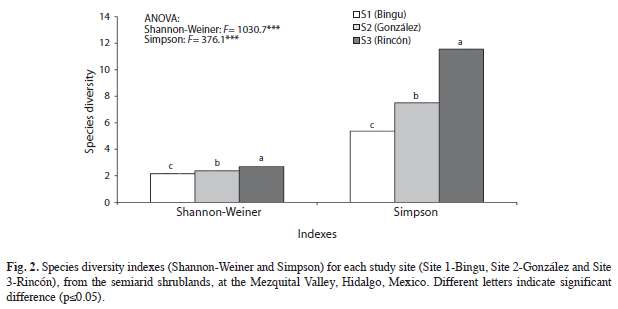
<body><![CDATA[Shannon-Weiner (rare species) and Simpson (dominant species) indexes,     and by the cumulative number of species, as a function of the     cumulative number of plants (rarefaction curves), which were estimated     using EstimateS; in order to examine the floristic similarity among the     study sites, the Jaccard similarity index (JI) was calculated, based on     species presence/absence data, where JI=1 in cases of complete     similarity between pairs of sites, and 0% if the sites have no species     in common (Magurran 2004).</span></font><br      style="font-family: verdana;">     <font size="2"></font><br style="font-family: verdana;">     ]]></body>
<body><![CDATA[<font size="2"><span style="font-family: verdana;"><span      style="font-weight: bold;">Soil sampling and analysis</span>: Soil     samples were collected under the canopy (UC) of eight plants of similar     size of both P. laevigata and M. biuncifera per site; each plant was     considered as a replicate and a distance of at least 15m among plants     was established. Soil samples, from the surface to a depth of 15cm,     were collected during the dry season, May 2006, where most of the root     biomass and soil organic matter were concentrated (Monta&ntilde;o <span      style="font-style: italic;">et     al</span>. 2006, Pav&oacute;n 2007). The soil samples were collected     ]]></body>
<body><![CDATA[from the     middle of the canopy of each plant, while, other soil samples were     collected from eight open areas without vegetation (OA), located     outside the canopy of <span style="font-style: italic;">P. laevigata </span>or<span      style="font-style: italic;"> M. biuncifera.</span> A total of 64 soil     samples were collected, stored in black plastic bags and refrigerated     at 4&deg;C until laboratory analysis.</span></font><br      style="font-family: verdana;">     <font size="2"></font><br style="font-family: verdana;">     <font size="2"><span style="font-family: verdana;">Soil samples were     ]]></body>
<body><![CDATA[air dried and     sieved (2mm) previous to analysis. Bulk density was determined with the     test tube method (Jury et al. 1991). Soil pH was measured in a     soil:distilled water suspension (1:2 w/v) with a pH meter equipped with     a glass electrode. The electrical conductivity (CE) was measured in a     1:5 soil-water suspension, using a conductivity cell (NOM 2000).     Texture was estimated by the Bouyocus hydrometer method as described by     Gee &amp; Bauder (1986). SOM was quantified by the Walkley-Black     procedure, and soil organic carbon (SOC) was estimated as of SOM by     assuming that it contains 58% of total organic carbon (Nelson &amp;     ]]></body>
<body><![CDATA[Sommers 1996). Soil TN was determined after an acid digestion by a     semi-micro-Kjeldahl method followed by a colorimetrical analysis     (Bremmer &amp; Mulvaney 1982). Available phosphorus (PO4) was measured     using the methodology described by Olsen et al. (1954). Exchangeable     calcium (Ca, &#955;=422.7nm), magnesium (Mg, &#955;=285.2nm) and potassium (K,     &#955;=766.5nm) were extracted</span></font><br style="font-family: verdana;">     <font size="2"><span style="font-family: verdana;">using 1N ammonium     acetate (NOM     2000), and then measured using an Atomic Absorption Spectrophotometer     (Varian Spectrum-A).</span></font><br style="font-family: verdana;">     ]]></body>
<body><![CDATA[<font size="2"></font><br style="font-family: verdana;">     <font size="2"><span style="font-family: verdana;">The carbon     mineralization (CO<sub>2</sub>) was     measured after five days of aerobic incubations at 28&deg;C; each     sub-sample was periodically wetted with deionized water to reach field     water holding capacity. The CO</span></font><font size="2"><span      style="font-family: verdana;"><sub>2</sub></span></font><font size="2"><span      style="font-family: verdana;"> evolved was collected in 0.5N NaOH     traps. Carbonates were precipitated by adding 1N KCl</span></font><font      size="2"><span style="font-family: verdana;"><sub>2</sub></span></font><font     ]]></body>
<body><![CDATA[ size="2"><span style="font-family: verdana;"> and then titrated     with 0.5N HCl using phenolphtaleine as indicator (Robertson et al.     1999). The spores of arbuscular mycorrhizal fungal were extracted from     100g of dry soil using a wet-sieving and density gradient procedure,     with a modification of sucrose-centrifugation technique (Daniels &amp;     Skipper 1982). The intact spores, with filled cytoplasm, were counted     under a dissecting microscope at 5X. Spore density was expressed as the     spore number per 100g of soil. All values were expressed on a     dry-weight basis unless otherwise stated.</span></font><br      style="font-family: verdana;">     ]]></body>
<body><![CDATA[<font size="2"></font><br style="font-family: verdana;">     <font size="2"><span style="font-family: verdana;">A one-way ANOVA was     used to examine     differences among sites in relation to vegetation variables. Soil     variables were analyzed using a randomized nested ANOVA, where the     factors were the species (<span style="font-style: italic;">P.     laevigata </span>and <span style="font-style: italic;">M. biuncifera</span>)     and the     microenvironments (under the canopy of the legumes, and open area)     nested within the sites (Site one-Bingu, Site 2-Gonz&aacute;lez and     ]]></body>
<body><![CDATA[Site 3-Rinc&oacute;n). In all the cases, when the ANOVA indicated a     significant factor, means were compared with a Tukey <span      style="font-style: italic;">post-hoc</span> test.     Normality test was examined for all data, and when a normal     distribution and homogeneity of variance were not found, the data were     log-transformed to meet ANOVA assumptions (Sokal &amp; Rohlf 1995), but     reported in their original scale of measurement. All statistical     analyses were performed with Statistica 6 software (StatSoft 2000), and     in all cases p&#8804;0.05 was taken to be significant. A Canonical     Correspondence Analysis (CCA) was used to search differences in the     ]]></body>
<body><![CDATA[floristic composition patterns among sites, legume species and     microenvironments. In this analysis, a data matrix containing the IV     for each plant species, per eight sites was related with a second     matrix based on seven soil variables per site. The soil variables used     in the CCA were only those without an auto-correlation. Soil variables     were onward selected employing the Monte Carlo permutation test, and     this analysis was performed in PC-ORD software (ter Braak 1990, McCune     &amp; Mefford 1999).</span></font><br style="font-family: verdana;">     <font size="2"></font><br style="font-family: verdana;">     <font style="font-weight: bold;" size="3"><span     ]]></body>
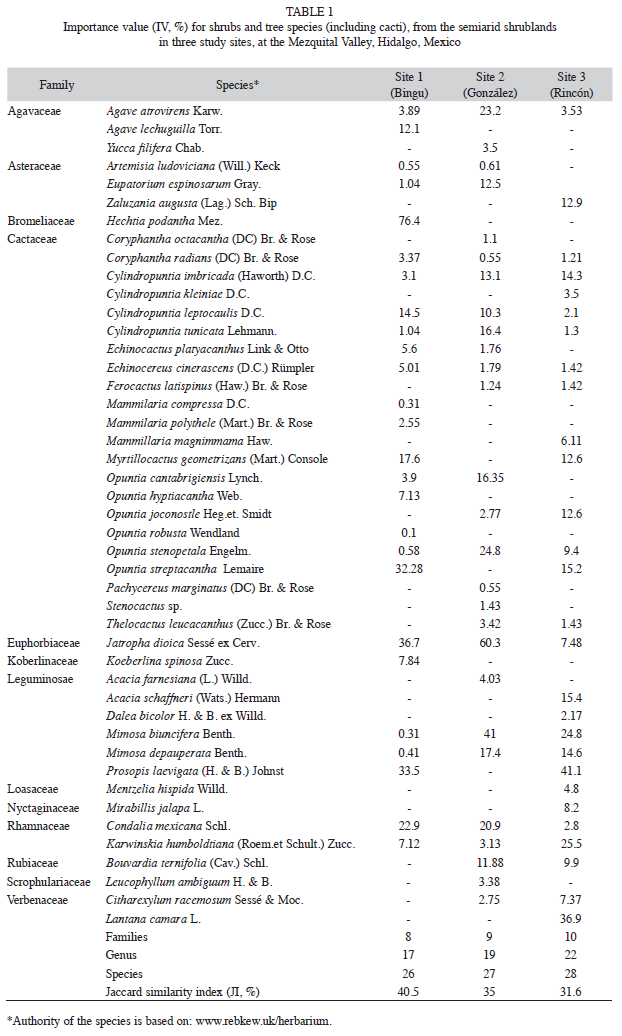
<body><![CDATA[ style="font-family: verdana;">Results</span></font><br      style="font-family: verdana;">     <font size="2"></font><br style="font-family: verdana;">     <font size="2"><span style="font-family: verdana;"><span      style="font-weight: bold;">Vegetation structure:</span> A total of 45     shrub and tree species belonging to 31 genera and 13 families were     recorded in all three sites (<a href="/img/revistas/rbt/v60n1/a06t1.gif">Table     1</a>).     Cactaceae and Leguminosae were     the best represented. Both plant families represented 65.4% of the     ]]></body>
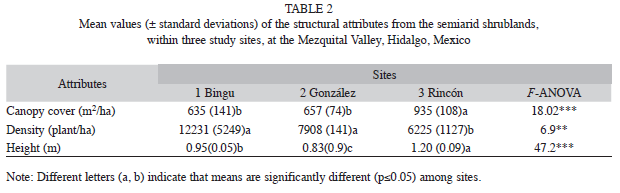
<body><![CDATA[total of species collected in Site 1, 55% in Site 2, and 64.3% in Site     3. Cactaceae had the greatest species richness, and Loasaceae (Site 3)     and Scruphulariaceae (Site 2) had the lowest species richness; hence,     they got a very low IV (&#8804;5%) compared to other plant families in the     three sites, which also differed from 31% to 40% in similarity of plant     species (<a href="/img/revistas/rbt/v60n1/a06t1.gif">Table 1</a>). Site     3 had 1.4 times more canopy cover and plant     height than the other two sites. In contrast, density was higher in     Site 1 and Site 2 than in Site 3 (<a      href="/img/revistas/rbt/v60n1/a06t2.gif">Table 2</a>). <span     ]]></body>
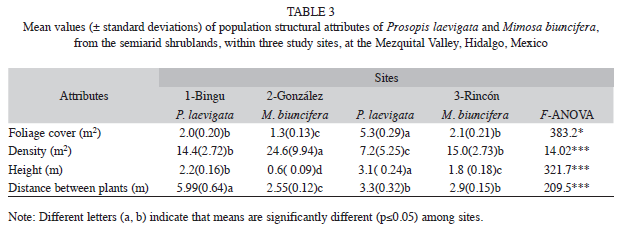
<body><![CDATA[ style="font-style: italic;">Prosopis laevigata</span> and <span      style="font-style: italic;">M.     biuncifera</span> showed differences in their structural attributes.     For     instance, both legumes had bigger cover and height, but lower density     when both coexist (<a href="/img/revistas/rbt/v60n1/a06t3.gif">Table 3</a>).    <br>     <br style="font-family: verdana;">     </span></font>     <font size="2"><span style="font-family: verdana;"><span     ]]></body>
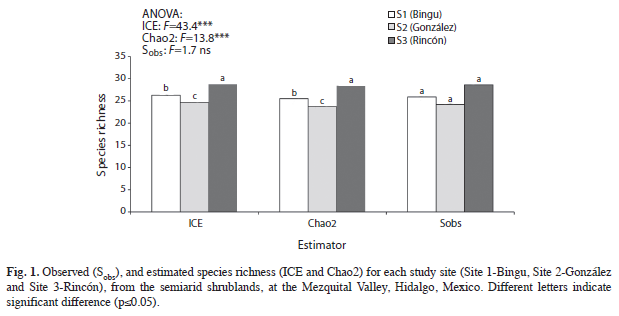
<body><![CDATA[ style="font-weight: bold;">Species richness and diversity: </span>The     nonparametric estimators (ICE and Chao2) indicated significant     statistical differences (p&#8804;0.05) in species richness among sites; but     no significant differences were pointed out in Sobs (<a      href="/img/revistas/rbt/v60n1/a06i1.jpg">Fig. 1</a>). Site 2     showed lower richness and diversity of species that Site 1; while Site     3 had the highest diversity of species (<a      href="/img/revistas/rbt/v60n1/a06i2.jpg">Fig. 2</a>) and, the     rarefaction     curves are showed in <a href="/img/revistas/rbt/v60n1/a06i3.jpg">figure     ]]></body>
<body><![CDATA[3.</a></span></font><br style="font-family: verdana;">     <font size="2"></font><br style="font-family: verdana;">     <font size="2"><span style="font-family: verdana;"><span      style="font-weight: bold;">Influence of P. </span><span      style="font-style: italic;">laevigata</span><span      style="font-weight: bold;"> and M.     </span><span style="font-style: italic;">biuncifera</span><span      style="font-weight: bold;"> on soil properties: </span>In Site 3, the     soil under the canopy of     <span style="font-style: italic;">M. biuncifera</span> showed the     ]]></body>
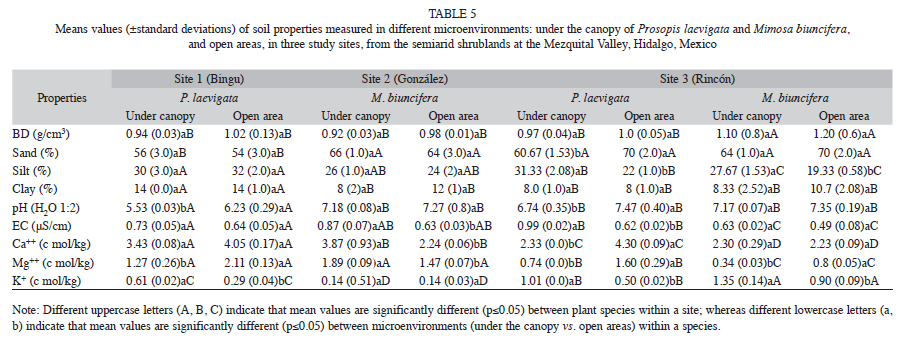
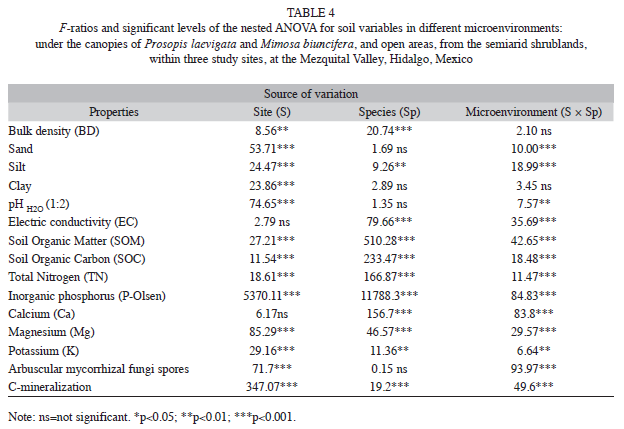
<body><![CDATA[highest bulk density, lower sand and higher     silt content than in open areas (Tables <a      href="/img/revistas/rbt/v60n1/a06t4.gif">4</a> and <a      href="/img/revistas/rbt/v60n1/a06t5.gif">5</a>). The most common soil     textural class was sandy loam. Soil pH varied among sites and     microenvironments; though it did not vary between species, tending from     neutral to slightly alkaline except in Site 1 (<a      href="/img/revistas/rbt/v60n1/a06t5.gif">Table 5</a>). Soil pH under     the canopy of <span style="font-style: italic;">P. laevigata</span>     was more acid than in open areas in sites 1     ]]></body>
<body><![CDATA[and 3; however, it was not affected by <span      style="font-style: italic;">M. biuncifera</span> (<a      href="/img/revistas/rbt/v60n1/a06t4.gif">Table 4</a>). In     sites 1 and 2, the EC of the soil under the canopy of P. laevigata was     lower than the soil under the canopy of M. biuncifera; in contrast, in     Site 3 the soil under the canopy of P. laevigata had the highest EC     when compared to <span style="font-style: italic;">M. biuncifera</span>     </span></font><font size="2"><span style="font-family: verdana;">(Tables     <a href="/img/revistas/rbt/v60n1/a06t4.gif">4</a> and <a      href="/img/revistas/rbt/v60n1/a06t5.gif">5</a>).</span></font><br     ]]></body>
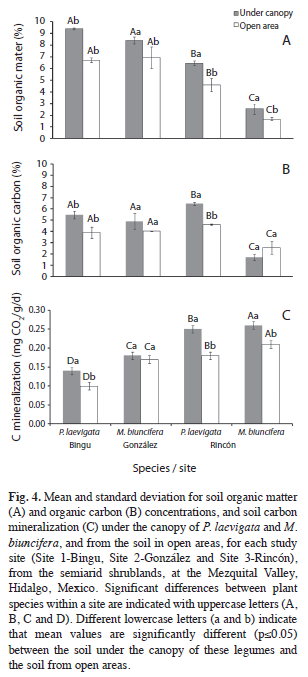
<body><![CDATA[ style="font-family: verdana;">     <font size="2"></font><br style="font-family: verdana;">     <font size="2"><span style="font-family: verdana;">Soil organic matter     (SOM) and soil     organic carbon (SOC) showed similar patterns among sites and species     (</span></font><font size="2"><span style="font-family: verdana;"><a      href="/img/revistas/rbt/v60n1/a06t5.gif">Table 5</a></span></font><font      size="2"><span style="font-family: verdana;">, <a      href="/img/revistas/rbt/v60n1/a06i4.jpg">Fig. 4A and 4B</a>).     Thus, sites 1 and 2 had higher SOM and SOC     ]]></body>
<body><![CDATA[concentrations than Site 3. Particularly in Site 3, SOM and SOC under     the canopy of <span style="font-style: italic;">P. laevigata</span>     were higher than the soil under the canopy     of M. biuncifera. In the three study sites, SOM concentrations were     higher under the canopy of both legumes than in open areas. In     contrast, SOC concentrations were higher under the canopy of <span      style="font-style: italic;">P.     laevigata</span> than in open areas, but this was not found for M.     biuncifera     (<a href="/img/revistas/rbt/v60n1/a06i4.jpg">Fig. 4B</a>). In     ]]></body>
<body><![CDATA[Site 3, P. laevigata had higher soil N concentration than     the soil under the canopy of <span style="font-style: italic;">M.     biuncifera</span>; however, when these legumes     occur in different sites, <span style="font-style: italic;">P.     laevigata </span>had lower N concentration than     <span style="font-style: italic;">M. biuncifera.</span> In addition, in     Site 3, soil N concentration was higher     under the canopy of P. laevigata than in open areas (</span></font><font      size="2"><span style="font-family: verdana;"><a      href="/img/revistas/rbt/v60n1/a06t5.gif">Table 5</a></span></font><font     ]]></body>
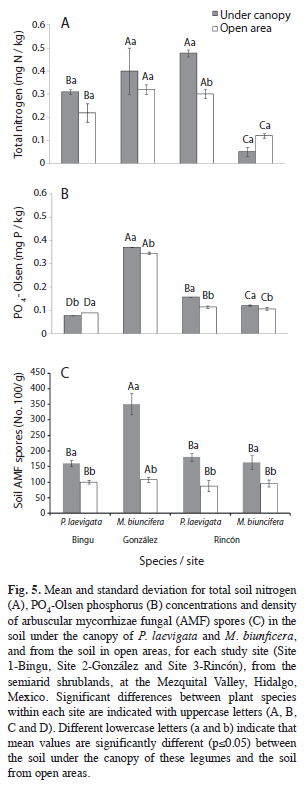
<body><![CDATA[ size="2"><span style="font-family: verdana;">, <a      href="/img/revistas/rbt/v60n1/a06i5.jpg">Fig. 5A</a>).     Soil available P was higher in Site 2 than in the other two sites. The     soil under the canopy of <span style="font-style: italic;">P.     laevigata </span>and<span style="font-style: italic;"> M. biuncifera</span>     had     higher available P than the soil in open areas, with the exception of     P. laevigata in Site 1 (</span></font><font size="2"><span      style="font-family: verdana;"><a      href="/img/revistas/rbt/v60n1/a06t5.gif">Table 5</a></span></font><font     ]]></body>
<body><![CDATA[ size="2"><span style="font-family: verdana;">, <a      href="/img/revistas/rbt/v60n1/a06i5.jpg">Fig. 5B</a>).</span></font><br      style="font-family: verdana;">     <font size="2"></font><br style="font-family: verdana;">     <font size="2"><span style="font-family: verdana;">Soil Ca and Mg     concentrations were     higher in Sites 1 and 2; P. laevigata had higher concentrations of both     cations under its canopy than <span style="font-style: italic;">M.     biuncifera</span>. Soil Ca and Mg     concentrations were lower under the canopy of P. laevigata than in open     ]]></body>
<body><![CDATA[areas; on the contrary, the concentration of these soil cations was     higher under the canopy of <span style="font-style: italic;">M.     biuncifera</span> than in open areas (<a      href="/img/revistas/rbt/v60n1/a06t4.gif">Tables 4</a>     and <a href="/img/revistas/rbt/v60n1/a06t5.gif">5</a>). Soil K     concentration was higher under the canopy of both     legumes than in open areas in the three study sites (</span></font><font      size="2"><span style="font-family: verdana;"><a      href="/img/revistas/rbt/v60n1/a06t4.gif">Tables 4</a>     and <a href="/img/revistas/rbt/v60n1/a06t5.gif">5</a>).</span></font><br     ]]></body>
<body><![CDATA[ style="font-family: verdana;">     <font size="2"></font><br      style="font-family: verdana; font-weight: bold;">     <font size="2"><span style="font-family: verdana;"><span      style="font-weight: bold;">Influence of </span><span      style="font-weight: bold;">P</span><span style="font-style: italic;">.     laevigata </span><span style="font-weight: bold;">and M</span><span      style="font-style: italic;">.     biuncifera </span><span style="font-weight: bold;">on soil biological     activity:</span> Site 3 registered the highest C     ]]></body>
<body><![CDATA[mineralization. The soil under the canopy of <span      style="font-style: italic;">P. laevigata</span> had lower C     mineralization than the soil under the canopy of <span      style="font-style: italic;">M. biuncifera.</span> Soil C     mineralization under the canopy of <span style="font-style: italic;">P.     laevigata</span> and<span style="font-style: italic;"> M. biuncifera</span>     was     higher than in open areas, with exception of <span      style="font-style: italic;">M. biuncifera</span> in Site 2     (</span></font><font size="2"><span style="font-family: verdana;"><a     ]]></body>
<body><![CDATA[ href="/img/revistas/rbt/v60n1/a06t4.gif">Tables 4</a>     </span></font><font size="2"><span style="font-family: verdana;">, <a      href="/img/revistas/rbt/v60n1/a06i4.jpg">Fig. 4</a>). The     abundance of arbuscular mycorrhizal (AM) fungal     spores was higher in Site 2. There was a higher abundance of AM fungal     spores in the soil under the canopy of both legumes in the three sites     than in open areas; though in Site 2, <span style="font-style: italic;">M.     biuncifera</span> had three times     more spores in the soil under its canopy than in open areas (</span></font><font      size="2"><span style="font-family: verdana;"></span></font><font     ]]></body>
<body><![CDATA[ size="2"><span style="font-family: verdana;"><a      href="/img/revistas/rbt/v60n1/a06t4.gif">Table 4</a>,&nbsp;</span></font><font      size="2"><span style="font-family: verdana;">     <a href="/img/revistas/rbt/v60n1/a06i5.jpg">Fig. 5</a>).</span></font><br      style="font-family: verdana;">     <font size="2"></font><br      style="font-family: verdana; font-weight: bold;">     <font size="2"><span style="font-family: verdana;"><span      style="font-weight: bold;">Relation among plant community,     soil properties and the presence of legumes:</span> CCA canonical axes     ]]></body>
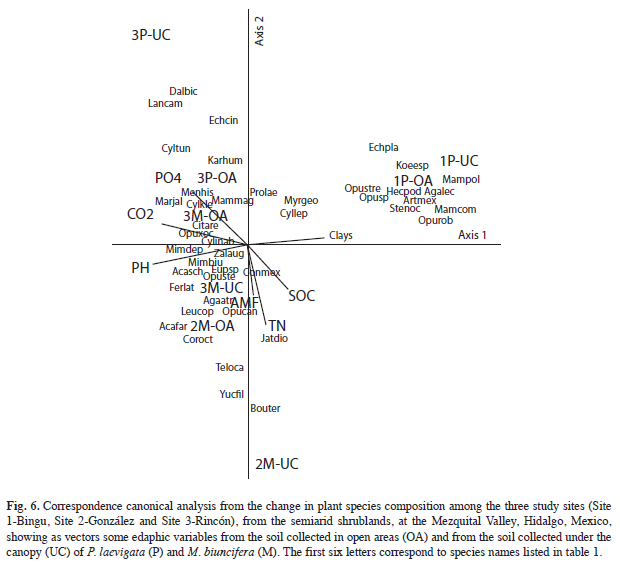
<body><![CDATA[together accounted for 75% of the variation in the data, with 29, 24     and 22% respectively. The first axis was positively correlated with     clays (0.70) and negatively with pH (-0.92) and CO2 (-0.85). This     indicates that Site 1 was different from sites 2 and 3. The first one     is characterized by <span style="font-style: italic;">Hechtia podantha</span>,     <span style="font-style: italic;">Agave lechuguilla</span>, <span      style="font-style: italic;">Mammilaria     compresa </span>and <span style="font-style: italic;">M. polytele,</span>     while the other two sites are characterized     by <span style="font-style: italic;">Mimosa depauperata</span>, <span     ]]></body>
<body><![CDATA[ style="font-style: italic;">Opuntia joconostle</span>, <span      style="font-style: italic;">Cylindropuntia kleiniae, M.     biuncifera </span>and <span style="font-style: italic;">Coryphantha     radians.</span> The second axis was correlated with     TN (-0.76), PO4 (0.42) and AM fungal spores (-043), and separated Sites     1 and 3 where <span style="font-style: italic;">P. laevigata</span>     occurs, from Site 2 where <span style="font-style: italic;">M.     biuncifera</span> is     alone; while open areas were more closely related among them (<a      href="/img/revistas/rbt/v60n1/a06i6.jpg">Fig. 6</a>).</span></font><br     ]]></body>
<body><![CDATA[ style="font-family: verdana;">     <font size="2"></font><br style="font-family: verdana;">     <font style="font-weight: bold;" size="3"><span      style="font-family: verdana;">Discussion</span></font><br      style="font-family: verdana;">     <font size="2"></font><br style="font-family: verdana;">     <font size="2"><span style="font-family: verdana;">The overall results     showed that the     presence of both, <span style="font-style: italic;">P. laevigata </span>and     <span style="font-style: italic;">M. biuncifera</span> within the plant     ]]></body>
<body><![CDATA[community of Site 3 improve the plant structure-diversity due to a     complementary effect, compared to the other two sites where the legumes     occurred separately. Both legume species may directly increase the     colonization of associated perennial plants by sheltering them from     high temperatures, and by providing a richer microenvironment in     resources than in the other two sites. Higher species richness has been     reported under the canopy of <span style="font-style: italic;">P.     laevigata</span> in semiarid shrublands in     Northern Guanajuato state (Cruz-Rodr&iacute;guez <span      style="font-style: italic;">et al.</span> 1997) and in     ]]></body>
<body><![CDATA[the Tehuac&aacute;n-Cuicatl&aacute;n Valley, Puebla, Mexico     (Perroni-Ventura et al. 2006), as well as in other desert ecosystems     where Prosopis species occur (Carrillo-Garc&iacute;a <span      style="font-style: italic;">et al</span>. 1999,     G&oacute;mez-Aparicio <span style="font-style: italic;">et al.</span>     2005, L&oacute;pez &amp;     Ortu&ntilde;o&nbsp; 2008). Likewise, some Mimosa species act as nurse     plants for cacti species (Valiente-Banuet &amp; Ezcurra 1991,     Reyes-Olivas <span style="font-style: italic;">et al.</span> 2002) and     perennial plants such as Jatropha dioica     ]]></body>
<body><![CDATA[(Yeaton &amp; Romero-Manzanares 1986). Our results suggest that, within     the Mezquital Valley, <span style="font-style: italic;">P. laevigata</span>     and <span style="font-style: italic;">M. biuncifera</span> may     increase plant     diversity because they may act jointly as focal plants for seeds     arrival, the subsequent seedling&nbsp; establishment and the survival     of adult plants. This agrees with the hypothesis proposed by Aguiar     &amp; Sala (1999), which states that, the spaces around and underneath     woody species may be progressively colonized by associated plants until     a patch of vegetation is built.</span></font><br     ]]></body>
<body><![CDATA[ style="font-family: verdana;">     <font size="2"></font><br style="font-family: verdana;">     <font size="2"><span style="font-family: verdana;">Influence of <span      style="font-style: italic;">P. laevigata </span>and <span      style="font-style: italic;">M.     biuncifera</span> on the plant community structure and on the soil     properties     under their canopies also takes place when both legumes are growing in     different sites, although, it is less effective, presumably due to the     fact that there is not any complementary influence of both legumes     ]]></body>
<body><![CDATA[(Brooker <span style="font-style: italic;">et al</span>. 2008). <span      style="font-style: italic;">P. laevigata</span> is a deciduous species     that     deposits certain amounts of organic matter in the soil, which probably     is used by opportunistic plant species, reducing the establishment of     non-opportunistic ones. In Site 1, <span style="font-style: italic;">H.     podantha</span> and <span style="font-style: italic;">J. dioica</span>     had 33% of     IV within this plant community. These two species have a high capacity     of vegetative propagation; which allows a quick capture of resources.     ]]></body>
<body><![CDATA[In Site 2, M. biuncifera also favors the establishment of <span      style="font-style: italic;">J. dioica</span>;     both plant species are able to spread after disturbance, to colonize     greatly eroded soils and to tolerate low soil nutrient levels (Yeaton     &amp; Romero-Manzanares 1986, Luna-Su&aacute;rez <span      style="font-style: italic;">et al</span>. 2000); such     attributes are traits that make both species to be more successful than     other plants. We suggest that the combination of these biological     attributes associated to these plants may explain the low species     diversity reported in the sites 1and 2, with different focal legumes.</span></font><br     ]]></body>
<body><![CDATA[ style="font-family: verdana;">     <font size="2"></font><br style="font-family: verdana;">     <font size="2"><span style="font-family: verdana;">In Site 3, the     resources islands     produced by<span style="font-style: italic;"> P. laevigata</span> and <span      style="font-style: italic;">M. biunficera</span> possibly create a     broader     range of available niches for other plant species as suggested by     Diamond &amp; Case (1986), Tilman (2004), Cortina &amp; Maestre (2005).     This agrees with other studies (Maestre &amp; Cortina 2005, Brooker <span     ]]></body>
<body><![CDATA[ style="font-style: italic;">et     al. </span>2008) showing that the soils with more available resources     favor     the establishment of a greater number of plant species. For instance,     in a Mexican semiarid ecosystem, Perroni-Ventura <span      style="font-style: italic;">et al.</span> (2006) found     that plant richness is related to those nutrients linked to the     dynamics of organic matter incorporated by <span      style="font-style: italic;">P. laevigata</span>. We propose     that in Site 3 the coexistence of both legumes promote a positive     ]]></body>
<body><![CDATA[feedback on soil fertility, which is reflected on characteristics of     plant community. <span style="font-style: italic;">Prosopis laevigata</span>     and <span style="font-style: italic;">M. biuncifera</span> lead to     more     favorable conditions for plant growth under their canopies and around,     due to resource enrichment, resulting presumably of root and litter     deposition (Pav&oacute;n <span style="font-style: italic;">et al.</span>     2005, Perroni-Ventura <span style="font-style: italic;">et al.&nbsp;</span>     2006, Flores <span style="font-style: italic;">et al.</span> 2007,     Camargo-Ricalde<span style="font-style: italic;"> et al.</span> 2010a).</span></font><br     ]]></body>
<body><![CDATA[ style="font-family: verdana;">     <font size="2"></font><br style="font-family: verdana;">     <font size="2"><span style="font-family: verdana;">The opposite     situation occurs in     open areas, due to the almost null presence of plants, which usually     are small with little cover, and to higher loss of organic material     caused by wind and water erosion. This observation agrees with Reynolds     <span style="font-style: italic;">et al.</span> (1999), who mentioned     that, in arid and semiarid ecosystems, the     spatial distribution of soil resources is linked to plant canopy cover.     ]]></body>
<body><![CDATA[Consequently, more canopy cover, bigger plant size, higher plant     richness and diversity, and a closer plant to plant distance, might     create microenvironments with higher soil organic matter and nutrients,     and more soil microorganisms (Herman <span style="font-style: italic;">et&nbsp;     al.</span> 1995, Reynolds et al.     1999, Maestre &amp; Cortina 2005, Monta&ntilde;o et al. 2006,     Gonz&aacute;lez-Ruiz <span style="font-style: italic;">et al.</span>     2008).</span></font><br style="font-family: verdana;">     <font size="2"></font><br style="font-family: verdana;">     <font size="2"><span style="font-family: verdana;">The generation of a     ]]></body>
<body><![CDATA[milder     microenvironment as in Rinc&oacute;n (Site 3), rich in organic matter     and soil nutrients, promotes the microbial activity within the site     having-as a consequence- a decrease in SOM due to a greater C     mineralization. However, C mineralization varied in relation to the     identity of the focal legume. For instance,<span      style="font-style: italic;"> P. laevigata</span> produces     higher quantity and quality of litter than <span      style="font-style: italic;">M. biuncifera</span>, which     explains why C mineralization was higher under the canopy of <span     ]]></body>
<body><![CDATA[ style="font-style: italic;">P.     laevigata</span> than in open areas within the three study sites.     Herrera-Arreola <span style="font-style: italic;">et al</span>. (2007)     support our findings, they reported that     the leaves of <span style="font-style: italic;">M. biuncifera </span>have     lower N concentration and higher     lignin and polyphenol content than the leaves of <span      style="font-style: italic;">P. juliflora</span>, and by     Reyes-Reyes <span style="font-style: italic;">et al</span>. (2003),     who also found that an input of <span style="font-style: italic;">P.     ]]></body>
<body><![CDATA[laevigata</span>     leaves into the soil increases two times the C mineralization in     relation to <span style="font-style: italic;">M. biuncifera</span>     leaves input. In addition, <span style="font-style: italic;">P.     laevigata</span> and     <span style="font-style: italic;">M. biuncifera</span>, establish a     symbiotic relationship with N-fixing     Rhizobium bacteria, thus increasing the N content of their litter     (Fr&iacute;as-Hern&aacute;ndez <span style="font-style: italic;">et al.</span>     1999, Pav&oacute;n <span style="font-style: italic;">et al</span>.     ]]></body>
<body><![CDATA[2005,     Gonz&aacute;lez-Ruiz <span style="font-style: italic;">et al.</span>     2008). Nevertheless, both species have a     differential impact on soil N; a higher quantity and quality of litter     may explain the accumulation of N in the soil under the canopy of <span      style="font-style: italic;">P.     laevigata</span> than that reported in open areas or in the soil under     the     canopy of M. biuncifera, even when both species are coexisting in the     same place (Site 3). Additionally, <span style="font-style: italic;">P.     ]]></body>
<body><![CDATA[laevigata </span>probably has a     mechanism that depleted soil Ca and Mg concentration, which is absent     or not so efficient in<span style="font-style: italic;"> M. biuncifera </span>(Camargo-Ricalde     <span style="font-style: italic;">et al. </span>2010a). A     possible mechanism may be attributed to both legumes, which differ in     their production of organic acids and accumulation of organic residues     under their canopies decreasing soil pH (Finzi <span      style="font-style: italic;">et al.</span> 1998). Other     studies have also documented this trend in the soils under the canopy     of <span style="font-style: italic;">P. laevigata</span> and <span     ]]></body>
<body><![CDATA[ style="font-style: italic;">M. monancistra</span> than in open areas     (Fr&iacute;as-Hern&aacute;ndez <span style="font-style: italic;">et al.</span>     1999, Monta&ntilde;o <span style="font-style: italic;">et al</span>.     2006,     Flores <span style="font-style: italic;">et al.</span> 2007).     Altogether, these&nbsp; facts suggest that <span      style="font-style: italic;">P.     laevigata </span>have a higher impact on soil nutrients than <span      style="font-style: italic;">M. biunficera</span>     within the Mezquital Valley.</span></font><br     ]]></body>
<body><![CDATA[ style="font-family: verdana;">     <font size="2"></font><br style="font-family: verdana;">     <font size="2"><span style="font-family: verdana;">The highest plant     diversity and     biological activity in Site 3, apparently decreased soil <span      style="font-style: italic;">P     availability</span>; it is possible that the overall of plants within     the     community could have used the soil inorganic P to supply their     nutrimental demands. A lower abundance of AM fungal spores in sites 1     ]]></body>
<body><![CDATA[and 3 than in Site 2, suggests that these fungi might be establishing     an active association with the plants, which depleted soil available P     pool. AM fungi may be advantageous to desert plants, when P is     practically insoluble, and its diffusion in the soil is further     decreased by low soil moisture (Tarafdar &amp; Panwar 2008).     Furthermore, P availability&nbsp; under the canopy of both legumes may     also be favored by a low soil Ca and Mg concentration, and a slightly     acid pH, which agrees with a higher AM fungal spore abundance in the     soil under the canopies of both legumes (Camargo-Ricalde <span      style="font-style: italic;">et al.</span> 2010b).     ]]></body>
<body><![CDATA[Smith &amp; Read (2008) indicate that the plant-root colonization by AM     fungi decreases when P availability is high in the soil, increasing AM     fungal spore production.</span></font><br style="font-family: verdana;">     <font size="2"></font><br style="font-family: verdana;">     <font size="2"><span style="font-family: verdana;">Within the three     study sites, both     legumes mainly modify the soil properties linked to biological     processes. This argument is supported by the Canonical Correspondence     Analysis that pointed out that SOC, CO<sub>2</sub>-respiration, soil     pH, AM fungal     ]]></body>
<body><![CDATA[spores, total N and available P were correlated with the actual     distribution of the plant species in the neighborhoods of both legumes,     which increase soil resources, influencing the structure these plant     communities, by favoring diverse niches for seeds or plant and AM     fungal propagules.</span></font><br style="font-family: verdana;">     <font size="2"></font><br style="font-family: verdana;">     <font size="2"><span style="font-family: verdana;">In conclusion, this     study provides     evidences that may help to understand the role of <span      style="font-style: italic;">P. laevigata</span> and <span     ]]></body>
<body><![CDATA[ style="font-style: italic;">M.     biuncifera</span> on plant colonization within semiarid ecosystems.     Both     legumes jointly modify soil resources; this fact could be reflected in     the high plant diversity within the semiarid shrublands at the     Mezquital Valley. However, further studies are needed to test this     hypothesis and to evaluate in more detail the vegetation dynamics as a     function of scrubs patches. The influence of <span      style="font-style: italic;">P. laevigata</span> to create     resources islands was higher than the one showed <span     ]]></body>
<body><![CDATA[ style="font-style: italic;">M. biuncifera,</span>     generating broader niche availability for the establishment of other     plants. The conservation of both legumes may be used for biodiversity     and soil conservation programs, accelerating plant succession processes     within this semiarid ecosystem.</span></font><br      style="font-family: verdana;">     <font size="2"></font><br style="font-family: verdana;">     <font style="font-weight: bold;" size="3"><span      style="font-family: verdana;">Acknowledgments</span></font><br      style="font-family: verdana;">     ]]></body>
<body><![CDATA[<font size="2"></font><br style="font-family: verdana;">     <font size="2"><span style="font-family: verdana;">We thank Mariano     Garc&iacute;a     D&iacute;az, Gabriela de Jes&uacute;s Espino Ortega, Luis Emilio de la     Cruz L&oacute;pez, Susana Adriana Monta&ntilde;o-Arias, Jazm&iacute;n     Gonz&aacute;lez Rivera, Israel Castro L&oacute;pez and Gilberto Platas     for their help in the field-work. We would like to thank Eduardo Chimal     S&aacute;nchez for his technical support in the laboratory. This     research was supported by the Programa de Apoyo a Proyectos de     Investigaci&oacute;n e Innovaci&oacute;n Tecnol&oacute;gica     ]]></body>
<body><![CDATA[(IN-216610), Direcci&oacute;n General de Asuntos del Personal     Acad&eacute;mico, Universidad Nacional Aut&oacute;noma de M&eacute;xico     (UNAM). This paper was part of R. Garc&iacute;a- S&aacute;nchez     doctoral thesis, Posgrado en Bot&aacute;nica, Colegio de Postgraduados,     Campus Montecillo.</span></font><br style="font-family: verdana;">     <font size="2"></font><br style="font-family: verdana;">     <font style="font-weight: bold;" size="3"><span      style="font-family: verdana;"></span></font>     <hr style="width: 100%; height: 2px;"><font style="font-weight: bold;"      size="3"><span style="font-family: verdana;">References</span></font><br     ]]></body>
<body><![CDATA[ style="font-family: verdana;">     <font size="2"></font><br style="font-family: verdana;">     <font size="2"><span style="font-family: verdana;">Aguilar, M.R. &amp;     O.E. Sala.     1999. Patch structure dynamics and implications for the functioning of     <!-- ref -->arid ecosystems. Tree 14: 273-277.    &nbsp;&nbsp;&nbsp;&nbsp;&nbsp;&nbsp;&nbsp;&nbsp;[&#160;<a href="javascript:void(0);" onclick="javascript: window.open('/scielo.php?script=sci_nlinks&ref=1423567&pid=S0034-7744201200010000600001&lng=','','width=640,height=500,resizable=yes,scrollbars=1,menubar=yes,');">Links</a>&#160;]<!-- end-ref --><!-- ref --></span></font><br  style="font-family: verdana;"> <font size="2"></font><br style="font-family: verdana;"> <font size="2"><span style="font-family: verdana;">Bremmer, J.M. &amp; C.S. Mulvaney. 1982. Total nitrogen, p. 595-624. In A.L. Page, R.H. Miller &amp; D.R. Keeney (eds.). Methods of soil analysis. Part 2. Amer. Soc. Agron. Madison, Wisconsin, USA.    &nbsp;&nbsp;&nbsp;&nbsp;&nbsp;&nbsp;&nbsp;&nbsp;[&#160;<a href="javascript:void(0);" onclick="javascript: window.open('/scielo.php?script=sci_nlinks&ref=1423568&pid=S0034-7744201200010000600002&lng=','','width=640,height=500,resizable=yes,scrollbars=1,menubar=yes,');">Links</a>&#160;]<!-- end-ref --><!-- ref --></span></font><br style="font-family: verdana;"> <font size="2"></font><br style="font-family: verdana;"> <font size="2"><span style="font-family: verdana;">Brooker, R.W., F.T. Maestre, R.M. Callaway, Ch. L. Lortie, L.A. Cavieres, G. Kunstler, P. Liancourt, K. Tielb&ouml;rger, J.M.J. Travis, F. Anthelme, C. Armas, L. Coll, E. Corcket, S. Delzon, E. Forey, Z. Kikvidze, J. Olofsson, F. Pugnaire, C.L. Quiroz, P. Saccone, K. Schiffers, M. Seifan, B. Touzard &amp; R. Michalet. 2008. Facilitation in plant communities: the past, the present and the future. J. Ecol. 96: 18-34.    &nbsp;&nbsp;&nbsp;&nbsp;&nbsp;&nbsp;&nbsp;&nbsp;[&#160;<a href="javascript:void(0);" onclick="javascript: window.open('/scielo.php?script=sci_nlinks&ref=1423569&pid=S0034-7744201200010000600003&lng=','','width=640,height=500,resizable=yes,scrollbars=1,menubar=yes,');">Links</a>&#160;]<!-- end-ref --><!-- ref --> </span></font><br  style="font-family: verdana;"> <font size="2"></font><br style="font-family: verdana;"> <font size="2"><span style="font-family: verdana;">Brower, J.E. &amp; J.H. Zar. 1990. Field and laboratory methods for general ecology. Brown, Iowa, USA.    &nbsp;&nbsp;&nbsp;&nbsp;&nbsp;&nbsp;&nbsp;&nbsp;[&#160;<a href="javascript:void(0);" onclick="javascript: window.open('/scielo.php?script=sci_nlinks&ref=1423570&pid=S0034-7744201200010000600004&lng=','','width=640,height=500,resizable=yes,scrollbars=1,menubar=yes,');">Links</a>&#160;]<!-- end-ref --><br>     ]]></body>
<body><![CDATA[<!-- ref --><br> Camargo-Ricalde, S.L. &amp; S.S. Dhillion. 2003. Endemic Mimosa species can serve as mycorrhizal &#8220;resource islands&#8221; within semiarid communities of the Tehuac&aacute;n-Cuicatl&aacute;n Valley, Mexico. Mycorrhiza 13: 129-136.    &nbsp;&nbsp;&nbsp;&nbsp;&nbsp;&nbsp;&nbsp;&nbsp;[&#160;<a href="javascript:void(0);" onclick="javascript: window.open('/scielo.php?script=sci_nlinks&ref=1423572&pid=S0034-7744201200010000600005&lng=','','width=640,height=500,resizable=yes,scrollbars=1,menubar=yes,');">Links</a>&#160;]<!-- end-ref --><!-- ref --></span></font><br style="font-family: verdana;"> <font size="2"></font><br style="font-family: verdana;"> <font size="2"><span style="font-family: verdana;">Camargo-Ricalde, S.L., S.S. Dhillion &amp; R. Grether. 2002. Community structure of endemic <span  style="font-style: italic;">Mimosa</span> species and environmental heterogeneity in a semiarid Mexican Valley. J. Veg. Sci. 13: 697-704.    &nbsp;&nbsp;&nbsp;&nbsp;&nbsp;&nbsp;&nbsp;&nbsp;[&#160;<a href="javascript:void(0);" onclick="javascript: window.open('/scielo.php?script=sci_nlinks&ref=1423573&pid=S0034-7744201200010000600006&lng=','','width=640,height=500,resizable=yes,scrollbars=1,menubar=yes,');">Links</a>&#160;]<!-- end-ref --><!-- ref --></span></font><br style="font-family: verdana;"> <font size="2"></font><br style="font-family: verdana;"> <font size="2"><span style="font-family: verdana;">Camargo-Ricalde, S.L., I. Reyes-Jaramillo &amp; N.M. Monta&ntilde;o. 2010a. Forestry insularity effect of four<span style="font-style: italic;"> Mimosa</span> L. species (Leguminosae-Mimosoideae) on soil nutrients of a Mexican semiarid ecosystem. Agrof. Syst. 80: 385-397.    &nbsp;&nbsp;&nbsp;&nbsp;&nbsp;&nbsp;&nbsp;&nbsp;[&#160;<a href="javascript:void(0);" onclick="javascript: window.open('/scielo.php?script=sci_nlinks&ref=1423574&pid=S0034-7744201200010000600007&lng=','','width=640,height=500,resizable=yes,scrollbars=1,menubar=yes,');">Links</a>&#160;]<!-- end-ref --><!-- ref --></span></font><br  style="font-family: verdana;"> <font size="2"></font><br style="font-family: verdana;"> <font size="2"><span style="font-family: verdana;">Camargo-Ricalde, S.L., N.M. Monta&ntilde;o, I. Reyes-Jaramillo, C. Jim&eacute;nez-Gonz&aacute;lez &amp; S.S. Dhillion. 2010b. Effect of mycorrhizae on seedlings of six endemic <span style="font-style: italic;">Mimosa</span> L. species (Leguminosae-Mimosoideae) from the</span></font><br  style="font-family: verdana;"> <font size="2"><span style="font-family: verdana;">semi-arid Tehuac&aacute;n-Cuicatl&aacute;n Valley, Mexico. Tress Strc. Func. 24: 67-78.    &nbsp;&nbsp;&nbsp;&nbsp;&nbsp;&nbsp;&nbsp;&nbsp;[&#160;<a href="javascript:void(0);" onclick="javascript: window.open('/scielo.php?script=sci_nlinks&ref=1423575&pid=S0034-7744201200010000600008&lng=','','width=640,height=500,resizable=yes,scrollbars=1,menubar=yes,');">Links</a>&#160;]<!-- end-ref --><!-- ref --></span></font><br style="font-family: verdana;"> <font size="2"></font><br style="font-family: verdana;"> <font size="2"><span style="font-family: verdana;">Camargo-Ricalde, S.L., R. Grether, A. Mart&iacute;nez-Bernal, V. Garc&iacute;a-Garc&iacute;a &amp; S. Barrios-del- Rosal. 2001. Especies &uacute;tiles del g&eacute;nero <span style="font-style: italic;">Mimosa</span> (Fabaceae-Mimosoideae) en M&eacute;xico. Bol. Soc. Bot. M&eacute;x. 68: 33-44.    &nbsp;&nbsp;&nbsp;&nbsp;&nbsp;&nbsp;&nbsp;&nbsp;[&#160;<a href="javascript:void(0);" onclick="javascript: window.open('/scielo.php?script=sci_nlinks&ref=1423576&pid=S0034-7744201200010000600009&lng=','','width=640,height=500,resizable=yes,scrollbars=1,menubar=yes,');">Links</a>&#160;]<!-- end-ref --><!-- ref --></span></font><br style="font-family: verdana;"> <font size="2"></font><br style="font-family: verdana;"> <font size="2"><span style="font-family: verdana;">Carrillo-Garc&iacute;a, A., J.L. Le&oacute;n, Y. Bashan &amp; G.J. Bethlenfalvay. 1999. Nurse plants mycorrhizae and plant establishment in disturbed area of the Sonoran desert restoration. Ecol. Res. 4: 321-335.    &nbsp;&nbsp;&nbsp;&nbsp;&nbsp;&nbsp;&nbsp;&nbsp;[&#160;<a href="javascript:void(0);" onclick="javascript: window.open('/scielo.php?script=sci_nlinks&ref=1423577&pid=S0034-7744201200010000600010&lng=','','width=640,height=500,resizable=yes,scrollbars=1,menubar=yes,');">Links</a>&#160;]<!-- end-ref --><!-- ref --> </span></font><br  style="font-family: verdana;"> <font size="2"></font><br style="font-family: verdana;"> <font size="2"><span style="font-family: verdana;">Chapin, F.S. III, P.A. Matson &amp; H.A. Mooney. 2002. Principles of terrestrial ecosystem ecology. Springer, New York, New York, USA.    &nbsp;&nbsp;&nbsp;&nbsp;&nbsp;&nbsp;&nbsp;&nbsp;[&#160;<a href="javascript:void(0);" onclick="javascript: window.open('/scielo.php?script=sci_nlinks&ref=1423578&pid=S0034-7744201200010000600011&lng=','','width=640,height=500,resizable=yes,scrollbars=1,menubar=yes,');">Links</a>&#160;]<!-- end-ref --><!-- ref --></span></font><br  style="font-family: verdana;"> <font size="2"></font><br style="font-family: verdana;"> <font size="2"><span style="font-family: verdana;">Colwell, R.K. 2009. EstimateS V6 01b1. Statistical estimation of species richness and shared species richness and shared species from samples. User Guide and Application. Connecticut, USA.    &nbsp;&nbsp;&nbsp;&nbsp;&nbsp;&nbsp;&nbsp;&nbsp;[&#160;<a href="javascript:void(0);" onclick="javascript: window.open('/scielo.php?script=sci_nlinks&ref=1423579&pid=S0034-7744201200010000600012&lng=','','width=640,height=500,resizable=yes,scrollbars=1,menubar=yes,');">Links</a>&#160;]<!-- end-ref --><!-- ref --></span></font><br style="font-family: verdana;"> <font size="2"></font><br style="font-family: verdana;"> <font size="2"><span style="font-family: verdana;">Cortina, J. &amp; T.F. Maestre. 2005. Plants effects on soil in dry lands implications for community dynamics and ecosystem restoration, p 84-118. <span  style="font-style: italic;">In</span> D. Binkley &amp; O. Menyailo (eds.). Tree species effects on soils: Implications for Global Change NATO Science Series.</span></font><font size="2"><span  style="font-family: verdana;"> Kluwer Academic, Dordrecht, The Netherland.    &nbsp;&nbsp;&nbsp;&nbsp;&nbsp;&nbsp;&nbsp;&nbsp;[&#160;<a href="javascript:void(0);" onclick="javascript: window.open('/scielo.php?script=sci_nlinks&ref=1423580&pid=S0034-7744201200010000600013&lng=','','width=640,height=500,resizable=yes,scrollbars=1,menubar=yes,');">Links</a>&#160;]<!-- end-ref --><br>     ]]></body>
<body><![CDATA[<!-- ref --><br> Cruz-Rodr&iacute;guez, J.A., E. Garc&iacute;a-Moya, J.T. Fr&iacute;as-Hern&aacute;ndez, G. Montesinos &amp; J.L. Flores. 1997. Influencia de los mezquites en la composici&oacute;n y cobertura de la vegetaci&oacute;n herb&aacute;cea de un agostadero semi&aacute;rido del Norte de Guanajuato. Bol. Soc. Bot. M&eacute;x. 61: 21-30.    &nbsp;&nbsp;&nbsp;&nbsp;&nbsp;&nbsp;&nbsp;&nbsp;[&#160;<a href="javascript:void(0);" onclick="javascript: window.open('/scielo.php?script=sci_nlinks&ref=1423582&pid=S0034-7744201200010000600014&lng=','','width=640,height=500,resizable=yes,scrollbars=1,menubar=yes,');">Links</a>&#160;]<!-- end-ref --><!-- ref --></span></font><br  style="font-family: verdana;"> <font size="2"></font><br style="font-family: verdana;"> <font size="2"><span style="font-family: verdana;">Daniels, N. &amp; H. Skipper. 1982. Methods for the recovery and quantitative estimation of propagules from soil, p. 29-35. <span style="font-style: italic;">In</span> Methods and principles of mycorrhizal research. American Phytopathology Society, Washington, D.C., USA.    &nbsp;&nbsp;&nbsp;&nbsp;&nbsp;&nbsp;&nbsp;&nbsp;[&#160;<a href="javascript:void(0);" onclick="javascript: window.open('/scielo.php?script=sci_nlinks&ref=1423583&pid=S0034-7744201200010000600015&lng=','','width=640,height=500,resizable=yes,scrollbars=1,menubar=yes,');">Links</a>&#160;]<!-- end-ref --><!-- ref --></span></font><br  style="font-family: verdana;"> <font size="2"></font><br style="font-family: verdana;"> <font size="2"><span style="font-family: verdana;">Diamond, J. &amp; T.J. Case. 1986. Community Ecology. Harper &amp; Row, New York, USA.    &nbsp;&nbsp;&nbsp;&nbsp;&nbsp;&nbsp;&nbsp;&nbsp;[&#160;<a href="javascript:void(0);" onclick="javascript: window.open('/scielo.php?script=sci_nlinks&ref=1423584&pid=S0034-7744201200010000600016&lng=','','width=640,height=500,resizable=yes,scrollbars=1,menubar=yes,');">Links</a>&#160;]<!-- end-ref --><!-- ref --></span></font><br  style="font-family: verdana;"> <font size="2"></font><br style="font-family: verdana;"> <font size="2"><span style="font-family: verdana;">FAO (Food and Agriculture Organization). 2006. Word reference base for soil resources (WRB). World Soil Resources Reports 103 Rome, Italy.    &nbsp;&nbsp;&nbsp;&nbsp;&nbsp;&nbsp;&nbsp;&nbsp;[&#160;<a href="javascript:void(0);" onclick="javascript: window.open('/scielo.php?script=sci_nlinks&ref=1423585&pid=S0034-7744201200010000600017&lng=','','width=640,height=500,resizable=yes,scrollbars=1,menubar=yes,');">Links</a>&#160;]<!-- end-ref --><!-- ref --></span></font><br  style="font-family: verdana;"> <font size="2"></font><br style="font-family: verdana;"> <font size="2"><span style="font-family: verdana;">Finzi, A.C., C.D. Canham &amp; N.V. Breemen. 1998. Canopy tree-soil interactions within temperate forest: species effects on pH and cations. Ecol. Appl. 8: 447-454.    &nbsp;&nbsp;&nbsp;&nbsp;&nbsp;&nbsp;&nbsp;&nbsp;[&#160;<a href="javascript:void(0);" onclick="javascript: window.open('/scielo.php?script=sci_nlinks&ref=1423586&pid=S0034-7744201200010000600018&lng=','','width=640,height=500,resizable=yes,scrollbars=1,menubar=yes,');">Links</a>&#160;]<!-- end-ref --><!-- ref --> </span></font><br  style="font-family: verdana;"> <font size="2"></font><br style="font-family: verdana;"> <font size="2"><span style="font-family: verdana;">Flores, E., J. Fr&iacute;as, P. Jurado, V. Olalde, J.D. Figueroa, A. Valdivia &amp; E. Garc&iacute;a-Moya. 2007. Efecto del gatu&ntilde;o sobre la fertilidad del suelo y la biomasa herb&aacute;cea en pastizales del centro de M&eacute;xico. Terra Lat. 25:</span></font><br  style="font-family: verdana;"> <font size="2"><span style="font-family: verdana;">311-319.    &nbsp;&nbsp;&nbsp;&nbsp;&nbsp;&nbsp;&nbsp;&nbsp;[&#160;<a href="javascript:void(0);" onclick="javascript: window.open('/scielo.php?script=sci_nlinks&ref=1423587&pid=S0034-7744201200010000600019&lng=','','width=640,height=500,resizable=yes,scrollbars=1,menubar=yes,');">Links</a>&#160;]<!-- end-ref --><!-- ref --> </span></font><br  style="font-family: verdana;"> <font size="2"></font><br style="font-family: verdana;"> <font size="2"><span style="font-family: verdana;">Fr&iacute;as-Hern&aacute;ndez, J.T., L.L. Aguilar, V.P. Olalde, J.A. Balderas, L.G. Guti&eacute;rrez, J.J. Alvarado, J. Castro, H. Vargas, A. Albores &amp; L. Dendooven. 1999. C and N soil characteristics in a semiarid highlands of Central</span></font><font  size="2"><span style="font-family: verdana;"> Mexico as affected by mesquite trees (<span style="font-style: italic;">Prosopis laevigata</span>). Arid Soil Res. Rehab. 13: 305-312.    &nbsp;&nbsp;&nbsp;&nbsp;&nbsp;&nbsp;&nbsp;&nbsp;[&#160;<a href="javascript:void(0);" onclick="javascript: window.open('/scielo.php?script=sci_nlinks&ref=1423588&pid=S0034-7744201200010000600020&lng=','','width=640,height=500,resizable=yes,scrollbars=1,menubar=yes,');">Links</a>&#160;]<!-- end-ref --><!-- ref --></span></font><br  style="font-family: verdana;"> <font size="2"></font><br style="font-family: verdana;"> <font size="2"><span style="font-family: verdana;">Galindo, A.S. &amp; E. Garc&iacute;a-Moya. 1986. The uses of mesquite (<span  style="font-style: italic;">Prosopis spp.</span>) in the highlands of San Luis Potosi, Mexico. For. Ecol. Manag. 16: 49-56.    &nbsp;&nbsp;&nbsp;&nbsp;&nbsp;&nbsp;&nbsp;&nbsp;[&#160;<a href="javascript:void(0);" onclick="javascript: window.open('/scielo.php?script=sci_nlinks&ref=1423589&pid=S0034-7744201200010000600021&lng=','','width=640,height=500,resizable=yes,scrollbars=1,menubar=yes,');">Links</a>&#160;]<!-- end-ref --><!-- ref --> </span></font><br  style="font-family: verdana;"> <font size="2"></font><br style="font-family: verdana;"> <font size="2"><span style="font-family: verdana;">Garc&iacute;a-Moya, E. &amp; C.M. McKell. 1970. Contribution to the nitrogen economy of a desert-wash plant community. Ecology 51: 81-88.    &nbsp;&nbsp;&nbsp;&nbsp;&nbsp;&nbsp;&nbsp;&nbsp;[&#160;<a href="javascript:void(0);" onclick="javascript: window.open('/scielo.php?script=sci_nlinks&ref=1423590&pid=S0034-7744201200010000600022&lng=','','width=640,height=500,resizable=yes,scrollbars=1,menubar=yes,');">Links</a>&#160;]<!-- end-ref --><!-- ref --></span></font><br  style="font-family: verdana;"> <font size="2"></font><br style="font-family: verdana;"> <font size="2"><span style="font-family: verdana;">Gee, G.W. &amp; J.W. Bauder. 1986. Particle size analysis, p. 383-411. <span style="font-style: italic;">In</span> A. Klute (ed.). Methods of soil analysis Vol I Physical and mineralogical methods. Amer. Soc. Agron. Madison, Wisconsin, USA.    &nbsp;&nbsp;&nbsp;&nbsp;&nbsp;&nbsp;&nbsp;&nbsp;[&#160;<a href="javascript:void(0);" onclick="javascript: window.open('/scielo.php?script=sci_nlinks&ref=1423591&pid=S0034-7744201200010000600023&lng=','','width=640,height=500,resizable=yes,scrollbars=1,menubar=yes,');">Links</a>&#160;]<!-- end-ref --><!-- ref --></span></font><br style="font-family: verdana;"> <font size="2"></font><br style="font-family: verdana;"> <font size="2"><span style="font-family: verdana;">G&oacute;mez-Aparicio, L., J.M. G&oacute;mez, R. Zamora &amp; J.L. Boettinger. 2005. Canopy vs soil effects of shrubs facilitating tree seedlings in Mediterranean montane ecosystems. J. Veg. Sci. 16: 191-198.    &nbsp;&nbsp;&nbsp;&nbsp;&nbsp;&nbsp;&nbsp;&nbsp;[&#160;<a href="javascript:void(0);" onclick="javascript: window.open('/scielo.php?script=sci_nlinks&ref=1423592&pid=S0034-7744201200010000600024&lng=','','width=640,height=500,resizable=yes,scrollbars=1,menubar=yes,');">Links</a>&#160;]<!-- end-ref --><!-- ref --> </span></font><br  style="font-family: verdana;"> <font size="2"></font><br style="font-family: verdana;"> <font size="2"><span style="font-family: verdana;">Gonz&aacute;lez-Quintero, L. 1968. Tipos de vegetaci&oacute;n del Valle del Mezquital, Hidalgo. Departamento de Prehistoria, Instituto Nacional de Antropolog&iacute;a e Historia, M&eacute;xico.    &nbsp;&nbsp;&nbsp;&nbsp;&nbsp;&nbsp;&nbsp;&nbsp;[&#160;<a href="javascript:void(0);" onclick="javascript: window.open('/scielo.php?script=sci_nlinks&ref=1423593&pid=S0034-7744201200010000600025&lng=','','width=640,height=500,resizable=yes,scrollbars=1,menubar=yes,');">Links</a>&#160;]<!-- end-ref --><!-- ref --></span></font><br  style="font-family: verdana;"> <font size="2"></font><br style="font-family: verdana;"> <font size="2"><span style="font-family: verdana;">Gonz&aacute;lez-Ruiz, T., Z.S. Rodr&iacute;guez &amp; R. Ferrera-Cerrato. 2008. Fertility islands around <span style="font-style: italic;">Prosopis laevigata</span> and <span style="font-style: italic;">Pachycereus hollianus</span> in the drylands of Zapotitl&aacute;n Salinas, M&eacute;xico. J. Arid Environ. 72: 1202-1212.    &nbsp;&nbsp;&nbsp;&nbsp;&nbsp;&nbsp;&nbsp;&nbsp;[&#160;<a href="javascript:void(0);" onclick="javascript: window.open('/scielo.php?script=sci_nlinks&ref=1423594&pid=S0034-7744201200010000600026&lng=','','width=640,height=500,resizable=yes,scrollbars=1,menubar=yes,');">Links</a>&#160;]<!-- end-ref --><!-- ref --></span></font><br style="font-family: verdana;"> <font size="2"></font><br style="font-family: verdana;"> <font size="2"><span style="font-family: verdana;">Herman, R.P., K. Provencio, J. Herrera-Matos &amp; R. Torrez. 1995. Resource islands predicts the distribution of heterotrophic bacteria in Chihuahuan desert soils. Appl. Environ. Microb. 61: 816-1821.    &nbsp;&nbsp;&nbsp;&nbsp;&nbsp;&nbsp;&nbsp;&nbsp;[&#160;<a href="javascript:void(0);" onclick="javascript: window.open('/scielo.php?script=sci_nlinks&ref=1423595&pid=S0034-7744201200010000600027&lng=','','width=640,height=500,resizable=yes,scrollbars=1,menubar=yes,');">Links</a>&#160;]<!-- end-ref --><!-- ref --> </span></font><br  style="font-family: verdana;"> <font size="2"></font><br style="font-family: verdana;"> <font size="2"><span style="font-family: verdana;">Herrera-Arreola, G., Y. Herrera, B.G. Reyes-Reyes &amp; L. Dendooven. 2007. Mesquite (<span  style="font-style: italic;">Prosopis juliflora </span>(Sw) DC), huisache (<span style="font-style: italic;">Acacia farnesiana</span> (L) Willd.) and catclaw (<span  style="font-style: italic;">Mimosa biuncifera</span> Benth.) and their effect</span></font><font size="2"><span  style="font-family: verdana;"> on dynamics of carbon and nitrogen in soils of the semi-arid highlands of Durango Mexico. J. Arid Environ. 69: 583-598.    &nbsp;&nbsp;&nbsp;&nbsp;&nbsp;&nbsp;&nbsp;&nbsp;[&#160;<a href="javascript:void(0);" onclick="javascript: window.open('/scielo.php?script=sci_nlinks&ref=1423596&pid=S0034-7744201200010000600028&lng=','','width=640,height=500,resizable=yes,scrollbars=1,menubar=yes,');">Links</a>&#160;]<!-- end-ref --><!-- ref --></span></font><br style="font-family: verdana;"> <font size="2"></font><br style="font-family: verdana;"> <font size="2"><span style="font-family: verdana;">INEGI (Instituto Nacional de Estad&iacute;stica Geograf&iacute;a e Inform&aacute;tica). 1987. Carta clim&aacute;tica Hoja Pachuca del estado de Hidalgo. Escala 1:250 000. Aguascalientes, Aguascalientes, M&eacute;xico.    &nbsp;&nbsp;&nbsp;&nbsp;&nbsp;&nbsp;&nbsp;&nbsp;[&#160;<a href="javascript:void(0);" onclick="javascript: window.open('/scielo.php?script=sci_nlinks&ref=1423597&pid=S0034-7744201200010000600029&lng=','','width=640,height=500,resizable=yes,scrollbars=1,menubar=yes,');">Links</a>&#160;]<!-- end-ref --><!-- ref --></span></font><br  style="font-family: verdana;"> <font size="2"></font><br style="font-family: verdana;"> <font size="2"><span style="font-family: verdana;">Jury, W.A., W.R. Gardner &amp; W.H. Gardner. 1991. Soil Physics. John Willey &amp; Sons, New York, USA.    &nbsp;&nbsp;&nbsp;&nbsp;&nbsp;&nbsp;&nbsp;&nbsp;[&#160;<a href="javascript:void(0);" onclick="javascript: window.open('/scielo.php?script=sci_nlinks&ref=1423598&pid=S0034-7744201200010000600030&lng=','','width=640,height=500,resizable=yes,scrollbars=1,menubar=yes,');">Links</a>&#160;]<!-- end-ref --><!-- ref --></span></font><br  style="font-family: verdana;"> <font size="2"></font><br style="font-family: verdana;"> <font size="2"><span style="font-family: verdana;">L&oacute;pez, R.P. &amp; T. Ortu&ntilde;o. 2008. La influencia de los arbustos sobre la diversidad y abundancia de plantas herb&aacute;ceas de la Prepuna a diferentes escalas espaciales. Ecol. Aus. 18: 119-131.    &nbsp;&nbsp;&nbsp;&nbsp;&nbsp;&nbsp;&nbsp;&nbsp;[&#160;<a href="javascript:void(0);" onclick="javascript: window.open('/scielo.php?script=sci_nlinks&ref=1423599&pid=S0034-7744201200010000600031&lng=','','width=640,height=500,resizable=yes,scrollbars=1,menubar=yes,');">Links</a>&#160;]<!-- end-ref --><!-- ref --></span></font><br  style="font-family: verdana;"> <font size="2"></font><br style="font-family: verdana;"> <font size="2"><span style="font-family: verdana;">Luna-Su&aacute;rez, S., J.T. Fr&iacute;as-Hern&aacute;ndez, V. Olalde-Portugal &amp; L. Dendooven. 2000. Catclaw (<span style="font-style: italic;">Mimosa biuncifera</span>): a pest or means to restore soil fertility in heavily erodes soil from the fertility in heavily eroded soil from the central highlands of Mexico? Biol. Fert. Soils 32: 109-113.    &nbsp;&nbsp;&nbsp;&nbsp;&nbsp;&nbsp;&nbsp;&nbsp;[&#160;<a href="javascript:void(0);" onclick="javascript: window.open('/scielo.php?script=sci_nlinks&ref=1423600&pid=S0034-7744201200010000600032&lng=','','width=640,height=500,resizable=yes,scrollbars=1,menubar=yes,');">Links</a>&#160;]<!-- end-ref --><!-- ref --></span></font><br style="font-family: verdana;"> <font size="2"></font><br style="font-family: verdana;"> <font size="2"><span style="font-family: verdana;">Maestre, F.T., S. Bautista &amp; J. Cortina. 2003. Positive, negative, and net effects in grass-shrub interactions in Mediterranean semiarid grasslands. J. Ecol. 12: 3186-3197.    &nbsp;&nbsp;&nbsp;&nbsp;&nbsp;&nbsp;&nbsp;&nbsp;[&#160;<a href="javascript:void(0);" onclick="javascript: window.open('/scielo.php?script=sci_nlinks&ref=1423601&pid=S0034-7744201200010000600033&lng=','','width=640,height=500,resizable=yes,scrollbars=1,menubar=yes,');">Links</a>&#160;]<!-- end-ref --><!-- ref --></span></font><br style="font-family: verdana;"> <font size="2"></font><br style="font-family: verdana;"> <font size="2"><span style="font-family: verdana;">Maestre, F.T &amp; J. Cortina. 2005. Remnant shrubs in Mediterranean semi-arid steppes: effects of shrub size, abiotic factors and species identity on understory richness and occurrence. Act. Oecol. 27: 161-169.    &nbsp;&nbsp;&nbsp;&nbsp;&nbsp;&nbsp;&nbsp;&nbsp;[&#160;<a href="javascript:void(0);" onclick="javascript: window.open('/scielo.php?script=sci_nlinks&ref=1423602&pid=S0034-7744201200010000600034&lng=','','width=640,height=500,resizable=yes,scrollbars=1,menubar=yes,');">Links</a>&#160;]<!-- end-ref --><!-- ref --></span></font><br  style="font-family: verdana;"> <font size="2"></font><br style="font-family: verdana;"> <font size="2"><span style="font-family: verdana;">Magurran, A.E. 2004. Measuring biological diversity. Blackwell Sci, Victoria, United Kingdom.    &nbsp;&nbsp;&nbsp;&nbsp;&nbsp;&nbsp;&nbsp;&nbsp;[&#160;<a href="javascript:void(0);" onclick="javascript: window.open('/scielo.php?script=sci_nlinks&ref=1423603&pid=S0034-7744201200010000600035&lng=','','width=640,height=500,resizable=yes,scrollbars=1,menubar=yes,');">Links</a>&#160;]<!-- end-ref --><br>     <!-- ref --><br> McCune, B. &amp; M.J. Mefford. 1999. PC-ORD. Multivariate analysis of ecological data, version 4. MjM software design. Gleneden Beach, Oregon, USA.    &nbsp;&nbsp;&nbsp;&nbsp;&nbsp;&nbsp;&nbsp;&nbsp;[&#160;<a href="javascript:void(0);" onclick="javascript: window.open('/scielo.php?script=sci_nlinks&ref=1423605&pid=S0034-7744201200010000600036&lng=','','width=640,height=500,resizable=yes,scrollbars=1,menubar=yes,');">Links</a>&#160;]<!-- end-ref --><!-- ref --></span></font><br style="font-family: verdana;"> <font size="2"></font><br style="font-family: verdana;"> <font size="2"><span style="font-family: verdana;">Monta&ntilde;o, N.M., R. Garc&iacute;a-S&aacute;nchez, G. Ochoa de la Rosa &amp; A. Monroy-Ata. 2006. Relaci&oacute;n entre la vegetaci&oacute;n arbustiva, el mezquite y el suelo de un ecosistema semi&aacute;rido en M&eacute;xico. Terra Lat. 24: 193-205.    &nbsp;&nbsp;&nbsp;&nbsp;&nbsp;&nbsp;&nbsp;&nbsp;[&#160;<a href="javascript:void(0);" onclick="javascript: window.open('/scielo.php?script=sci_nlinks&ref=1423606&pid=S0034-7744201200010000600037&lng=','','width=640,height=500,resizable=yes,scrollbars=1,menubar=yes,');">Links</a>&#160;]<!-- end-ref --><!-- ref --></span></font><br style="font-family: verdana;"> <font size="2"></font><br style="font-family: verdana;"> <font size="2"><span style="font-family: verdana;">Nelson, D. &amp; L. Sommers. 1996. Total carbon, organic carbon, and organic matter, p. 961-1010.<span  style="font-style: italic;"> In</span> A. Miller &amp; D. Keeney (eds.). Methods of soil analysis. Part II. Amer. Soc. Agron. Madison USA.    &nbsp;&nbsp;&nbsp;&nbsp;&nbsp;&nbsp;&nbsp;&nbsp;[&#160;<a href="javascript:void(0);" onclick="javascript: window.open('/scielo.php?script=sci_nlinks&ref=1423607&pid=S0034-7744201200010000600038&lng=','','width=640,height=500,resizable=yes,scrollbars=1,menubar=yes,');">Links</a>&#160;]<!-- end-ref --><!-- ref --></span></font><br style="font-family: verdana;"> <font size="2"></font><br style="font-family: verdana;"> <font size="2"><span style="font-family: verdana;">NOM. 2000. Norma Oficial Mexicana NOM-021-RECNAT- 2000. Establece las especificaciones de fertilidad, salinidad y clasificaci&oacute;n de suelos. Estudio, muestreo y an&aacute;lisis. Norlex internacional, Edici&oacute;n electr&oacute;nica de leyes, M&eacute;xico.    &nbsp;&nbsp;&nbsp;&nbsp;&nbsp;&nbsp;&nbsp;&nbsp;[&#160;<a href="javascript:void(0);" onclick="javascript: window.open('/scielo.php?script=sci_nlinks&ref=1423608&pid=S0034-7744201200010000600039&lng=','','width=640,height=500,resizable=yes,scrollbars=1,menubar=yes,');">Links</a>&#160;]<!-- end-ref --><!-- ref --></span></font><br  style="font-family: verdana;"> <font size="2"></font><br style="font-family: verdana;"> <font size="2"><span style="font-family: verdana;">Olsen, S.R., C.V. Cole, F.S. Watanabe &amp; L.A. Dean. 1954. Estimation of available phosphorus in soil by extraction with sodium bicarbonate. USDA. Circ. 939 U.S. Washington, D.C., USA.    &nbsp;&nbsp;&nbsp;&nbsp;&nbsp;&nbsp;&nbsp;&nbsp;[&#160;<a href="javascript:void(0);" onclick="javascript: window.open('/scielo.php?script=sci_nlinks&ref=1423609&pid=S0034-7744201200010000600040&lng=','','width=640,height=500,resizable=yes,scrollbars=1,menubar=yes,');">Links</a>&#160;]<!-- end-ref --><!-- ref --></span></font><br style="font-family: verdana;"> <font size="2"></font><br style="font-family: verdana;"> <font size="2"><span style="font-family: verdana;">Pav&oacute;n, N.P. 2007. Fine root biomass and production in a semiarid Mexican shrubland. The Southwestern Nat. 52: 116-167.    &nbsp;&nbsp;&nbsp;&nbsp;&nbsp;&nbsp;&nbsp;&nbsp;[&#160;<a href="javascript:void(0);" onclick="javascript: window.open('/scielo.php?script=sci_nlinks&ref=1423610&pid=S0034-7744201200010000600041&lng=','','width=640,height=500,resizable=yes,scrollbars=1,menubar=yes,');">Links</a>&#160;]<!-- end-ref --><!-- ref --></span></font><br  style="font-family: verdana;"> <font size="2"></font><br style="font-family: verdana;"> <font size="2"><span style="font-family: verdana;">Pav&oacute;n, N.P., O. Briones &amp; J. Flores-Rivas. 2005. Litterfall production and nitrogen content in an intertropical semi-arid Mexican scrub. J. Arid Environ. 60: 1-13.    &nbsp;&nbsp;&nbsp;&nbsp;&nbsp;&nbsp;&nbsp;&nbsp;[&#160;<a href="javascript:void(0);" onclick="javascript: window.open('/scielo.php?script=sci_nlinks&ref=1423611&pid=S0034-7744201200010000600042&lng=','','width=640,height=500,resizable=yes,scrollbars=1,menubar=yes,');">Links</a>&#160;]<!-- end-ref --><!-- ref --> </span></font><br style="font-family: verdana;"> <font size="2"></font><br style="font-family: verdana;"> <font size="2"><span style="font-family: verdana;">Perroni-Ventura, Y., C. Monta&ntilde;a &amp; F. Garc&iacute;a-Oliva. 2006. Relationship between soil nutrient availability and plant species richness in a tropical semi-arid environment. J. Veg. Sci. 17: 719-728.    &nbsp;&nbsp;&nbsp;&nbsp;&nbsp;&nbsp;&nbsp;&nbsp;[&#160;<a href="javascript:void(0);" onclick="javascript: window.open('/scielo.php?script=sci_nlinks&ref=1423612&pid=S0034-7744201200010000600043&lng=','','width=640,height=500,resizable=yes,scrollbars=1,menubar=yes,');">Links</a>&#160;]<!-- end-ref --><!-- ref --></span></font><br  style="font-family: verdana;"> <font size="2"></font><br style="font-family: verdana;"> <font size="2"><span style="font-family: verdana;">Reyes-Olivas, A., E. Garc&iacute;a-Moya &amp; L. L&oacute;pez-Mata. 2002. Cacti-shrub interactions in the coastal desert of northern Sinaloa, Mexico. J. Arid Environ. 52: 431-445.    &nbsp;&nbsp;&nbsp;&nbsp;&nbsp;&nbsp;&nbsp;&nbsp;[&#160;<a href="javascript:void(0);" onclick="javascript: window.open('/scielo.php?script=sci_nlinks&ref=1423613&pid=S0034-7744201200010000600044&lng=','','width=640,height=500,resizable=yes,scrollbars=1,menubar=yes,');">Links</a>&#160;]<!-- end-ref --><!-- ref --></span></font><br style="font-family: verdana;"> <font size="2"></font><br style="font-family: verdana;"> <font size="2"><span style="font-family: verdana;">Reyes-Reyes, G., L. Bar&oacute;n-Ocampo, I. Cuali-&Aacute;lvarez, J.T. Fr&iacute;as-Hern&aacute;ndez, V. Olalde-Portugal, L. Varela &amp; L. Dendooven. 2002. C and N dynamics in soil from the central higlands of Mexico as affected by mesquite (<span style="font-style: italic;">Prosopis spp</span>.) and huizache (<span style="font-style: italic;">Acacia tortuosa</span>): a laboratory investigation. Appl. Soil Ecol. 19: 27-34.    &nbsp;&nbsp;&nbsp;&nbsp;&nbsp;&nbsp;&nbsp;&nbsp;[&#160;<a href="javascript:void(0);" onclick="javascript: window.open('/scielo.php?script=sci_nlinks&ref=1423614&pid=S0034-7744201200010000600045&lng=','','width=640,height=500,resizable=yes,scrollbars=1,menubar=yes,');">Links</a>&#160;]<!-- end-ref --><!-- ref --></span></font><br style="font-family: verdana;"> <font size="2"></font><br style="font-family: verdana;"> <font size="2"><span style="font-family: verdana;">Reyes-Reyes, G.B., E. Zamora-Villafranco, M.L. Reyes- Reyes, J.T. Fr&iacute;as-Hern&aacute;ndez, V. Olalde-Portugal &amp; L. Dendooven. 2003. Decomposition of leaves of huizache (<span  style="font-style: italic;">Acacia tortuosa</span>) and mesquite (<span style="font-style: italic;">Prosopis</span></span></font><font  size="2"><span style="font-family: verdana;"><span  style="font-style: italic;"> spp</span>) in soil of the highlands of Mexico. Plant Soil 256: 359-370.    &nbsp;&nbsp;&nbsp;&nbsp;&nbsp;&nbsp;&nbsp;&nbsp;[&#160;<a href="javascript:void(0);" onclick="javascript: window.open('/scielo.php?script=sci_nlinks&ref=1423615&pid=S0034-7744201200010000600046&lng=','','width=640,height=500,resizable=yes,scrollbars=1,menubar=yes,');">Links</a>&#160;]<!-- end-ref --><!-- ref --></span></font><br  style="font-family: verdana;"> <font size="2"></font><br style="font-family: verdana;"> <font size="2"><span style="font-family: verdana;">Reynolds, J.F., R.A. Virginia, P.R. Kemp, A.G. de Soyza &amp; D.C. Tremmel. 1999. Impact of drought on desert shrubs: effects of seasonality and degree of resource islands development. Ecol. Monog. 69: 69-106.    &nbsp;&nbsp;&nbsp;&nbsp;&nbsp;&nbsp;&nbsp;&nbsp;[&#160;<a href="javascript:void(0);" onclick="javascript: window.open('/scielo.php?script=sci_nlinks&ref=1423616&pid=S0034-7744201200010000600047&lng=','','width=640,height=500,resizable=yes,scrollbars=1,menubar=yes,');">Links</a>&#160;]<!-- end-ref --><!-- ref --></span></font><br  style="font-family: verdana;"> <font size="2"></font><br style="font-family: verdana;"> <font size="2"><span style="font-family: verdana;">Robertson, P.G., D.C. Coleman, C.S. Bledsoe &amp; P. Sollins. 1999. Standard soil methods for long-term ecological research (LTER). Oxford University, New York, USA.    &nbsp;&nbsp;&nbsp;&nbsp;&nbsp;&nbsp;&nbsp;&nbsp;[&#160;<a href="javascript:void(0);" onclick="javascript: window.open('/scielo.php?script=sci_nlinks&ref=1423617&pid=S0034-7744201200010000600048&lng=','','width=640,height=500,resizable=yes,scrollbars=1,menubar=yes,');">Links</a>&#160;]<!-- end-ref --><br>     <!-- ref --><br> Rzedowski, J. 1978. Vegetaci&oacute;n de M&eacute;xico. Limusa, M&eacute;xico D.F., M&eacute;xico.    &nbsp;&nbsp;&nbsp;&nbsp;&nbsp;&nbsp;&nbsp;&nbsp;[&#160;<a href="javascript:void(0);" onclick="javascript: window.open('/scielo.php?script=sci_nlinks&ref=1423619&pid=S0034-7744201200010000600049&lng=','','width=640,height=500,resizable=yes,scrollbars=1,menubar=yes,');">Links</a>&#160;]<!-- end-ref --><!-- ref --></span></font><br  style="font-family: verdana;"> <font size="2"></font><br style="font-family: verdana;"> <font size="2"><span style="font-family: verdana;">Smith, S.E. &amp; D.I. Read. 2008. Mycorrhizal symbiosis. Academy, San Diego, USA.    &nbsp;&nbsp;&nbsp;&nbsp;&nbsp;&nbsp;&nbsp;&nbsp;[&#160;<a href="javascript:void(0);" onclick="javascript: window.open('/scielo.php?script=sci_nlinks&ref=1423620&pid=S0034-7744201200010000600050&lng=','','width=640,height=500,resizable=yes,scrollbars=1,menubar=yes,');">Links</a>&#160;]<!-- end-ref --><!-- ref --></span></font><br  style="font-family: verdana;"> <font size="2"></font><br style="font-family: verdana;"> <font size="2"><span style="font-family: verdana;">Sokal, R. &amp; F. Rohlf. 1995. Biometry. Freeman, San Francisco, California, USA.    &nbsp;&nbsp;&nbsp;&nbsp;&nbsp;&nbsp;&nbsp;&nbsp;[&#160;<a href="javascript:void(0);" onclick="javascript: window.open('/scielo.php?script=sci_nlinks&ref=1423621&pid=S0034-7744201200010000600051&lng=','','width=640,height=500,resizable=yes,scrollbars=1,menubar=yes,');">Links</a>&#160;]<!-- end-ref --><!-- ref --></span></font><br  style="font-family: verdana;"> <font size="2"></font><br style="font-family: verdana;"> <font size="2"><span style="font-family: verdana;">StatSoft, INC. 2000. Statistica for Windows vers. 6. Tulsa. Oklahoma, Tulsa, USA.    &nbsp;&nbsp;&nbsp;&nbsp;&nbsp;&nbsp;&nbsp;&nbsp;[&#160;<a href="javascript:void(0);" onclick="javascript: window.open('/scielo.php?script=sci_nlinks&ref=1423622&pid=S0034-7744201200010000600052&lng=','','width=640,height=500,resizable=yes,scrollbars=1,menubar=yes,');">Links</a>&#160;]<!-- end-ref --><!-- ref --></span></font><br  style="font-family: verdana;"> <font size="2"></font><br style="font-family: verdana;"> <font size="2"><span style="font-family: verdana;">Tarafdar, J.C. &amp; J. Panwar. 2008. Role of arbuscular mycorrhizae in P nutrition of plants under arid and semiarid environments, p. 41-53. <span  style="font-style: italic;">In</span> N.M. Monta&ntilde;o, S.L. Camargo-Ricalde, R. Garc&iacute;a-S&aacute;nchez &amp; A. Monroy- Ata (eds.). Arbuscular mycorrhizae in arid and semiarid ecosystems. Mundi-Prensa, INE-SEMARNAT, UAM-Iztapalapa, FES-Zaragoza UNAM, M&eacute;xico D.F., M&eacute;xico.    &nbsp;&nbsp;&nbsp;&nbsp;&nbsp;&nbsp;&nbsp;&nbsp;[&#160;<a href="javascript:void(0);" onclick="javascript: window.open('/scielo.php?script=sci_nlinks&ref=1423623&pid=S0034-7744201200010000600053&lng=','','width=640,height=500,resizable=yes,scrollbars=1,menubar=yes,');">Links</a>&#160;]<!-- end-ref --><!-- ref --></span></font><br  style="font-family: verdana;"> <font size="2"></font><br style="font-family: verdana;"> <font size="2"><span style="font-family: verdana;">ter Braak, C.J.F. 1990. Update notes for CANOCO program version 3.10. Agricultural Mathematics Group, Wageningen, USA.    &nbsp;&nbsp;&nbsp;&nbsp;&nbsp;&nbsp;&nbsp;&nbsp;[&#160;<a href="javascript:void(0);" onclick="javascript: window.open('/scielo.php?script=sci_nlinks&ref=1423624&pid=S0034-7744201200010000600054&lng=','','width=640,height=500,resizable=yes,scrollbars=1,menubar=yes,');">Links</a>&#160;]<!-- end-ref --><!-- ref --></span></font><br style="font-family: verdana;"> <font size="2"></font><br style="font-family: verdana;"> <font size="2"><span style="font-family: verdana;">Tiedemann, A.R. &amp; J.O. Klemmedson. 1973. Effect of Mesquite on Physical and Chemical Properties of the Soil. J. Rang. Manag. 26: 27-29.    &nbsp;&nbsp;&nbsp;&nbsp;&nbsp;&nbsp;&nbsp;&nbsp;[&#160;<a href="javascript:void(0);" onclick="javascript: window.open('/scielo.php?script=sci_nlinks&ref=1423625&pid=S0034-7744201200010000600055&lng=','','width=640,height=500,resizable=yes,scrollbars=1,menubar=yes,');">Links</a>&#160;]<!-- end-ref --><!-- ref --></span></font><br  style="font-family: verdana;"> <font size="2"></font><br style="font-family: verdana;"> <font size="2"><span style="font-family: verdana;">Tilman, D. 2004. Niches tradeoffs, neutrality, and community structure: A stochastic theory of resource competition, invasion, and community assembly. PNAS 30: 10854-10861.    &nbsp;&nbsp;&nbsp;&nbsp;&nbsp;&nbsp;&nbsp;&nbsp;[&#160;<a href="javascript:void(0);" onclick="javascript: window.open('/scielo.php?script=sci_nlinks&ref=1423626&pid=S0034-7744201200010000600056&lng=','','width=640,height=500,resizable=yes,scrollbars=1,menubar=yes,');">Links</a>&#160;]<!-- end-ref --><!-- ref --></span></font><br  style="font-family: verdana;"> <font size="2"></font><br style="font-family: verdana;"> <font size="2"><span style="font-family: verdana;">Valiente-Banuet, A. &amp; E. Ezcurra. 1991. Shade as a cause of the association between the cactus Neobuxbaumia tetetzo and the nurse plant <span  style="font-style: italic;">Mimosa luisiana</span> in the Tehuac&aacute;n Valley. M&eacute;xico. J. Ecol. 79: 961-971.    &nbsp;&nbsp;&nbsp;&nbsp;&nbsp;&nbsp;&nbsp;&nbsp;[&#160;<a href="javascript:void(0);" onclick="javascript: window.open('/scielo.php?script=sci_nlinks&ref=1423627&pid=S0034-7744201200010000600057&lng=','','width=640,height=500,resizable=yes,scrollbars=1,menubar=yes,');">Links</a>&#160;]<!-- end-ref --><!-- ref --></span></font><br  style="font-family: verdana;"> <font size="2"></font><br style="font-family: verdana;"> <font size="2"><span style="font-family: verdana;">Wright, J.P., C.G. Jones, B. Boeken &amp; M. Shachak. 2006. Predictability of ecosystems engineering effects on species richness across environmental variability and spatial scales. J. Ecol. 94: 815-824.    &nbsp;&nbsp;&nbsp;&nbsp;&nbsp;&nbsp;&nbsp;&nbsp;[&#160;<a href="javascript:void(0);" onclick="javascript: window.open('/scielo.php?script=sci_nlinks&ref=1423628&pid=S0034-7744201200010000600058&lng=','','width=640,height=500,resizable=yes,scrollbars=1,menubar=yes,');">Links</a>&#160;]<!-- end-ref --><!-- ref --></span></font><br  style="font-family: verdana;"> <font size="2"></font><br style="font-family: verdana;"> <font size="2"><span style="font-family: verdana;">Yeaton, R.I. &amp; A. Romero-Manzanares. 1986. Organization of vegetation mosaics in the <span style="font-style: italic;">Acacia shaffneri-Opuntia</span> streptacantha association, southern Chihuahuan Desert, Mexico. J. Ecol. 74: 211-217.    &nbsp;&nbsp;&nbsp;&nbsp;&nbsp;&nbsp;&nbsp;&nbsp;[&#160;<a href="javascript:void(0);" onclick="javascript: window.open('/scielo.php?script=sci_nlinks&ref=1423629&pid=S0034-7744201200010000600059&lng=','','width=640,height=500,resizable=yes,scrollbars=1,menubar=yes,');">Links</a>&#160;]<!-- end-ref --><br>     <br> </span></font><font size="2"><span style="font-family: verdana;"><a  name="Correspondencia1"></a><a href="#Correspondencia2">*</a>Correspondencia:     ]]></body>
<body><![CDATA[<br> Rosalva Garc&iacute;a-S&aacute;nchez: </span></font><font size="2"><span  style="font-family: verdana;">Posgrado en Bot&aacute;nica, Colegio de Postgraduados, C.P. 56230. Montecillo, Texcoco, Estado de M&eacute;xico, M&eacute;xico; <a href="mailto:rosalbagarcia@colpos.mx">rosalbagarcia@colpos.mx</a>. </span></font><font size="2"><span style="font-family: verdana;"></span></font><font  size="2"><span style="font-family: verdana;">Unidad de Investigaci&oacute;n en Ecolog&iacute;a Vegetal, Facultad de Estudios Superiores Zaragoza (FES Zaragoza), Universidad Nacional Aut&oacute;noma de M&eacute;xico. AP. 09230, D.F., M&eacute;xico.</span></font><font size="2"><span  style="font-family: verdana;">    <br> Sara Luc&iacute;a Camargo-Ricalde: </span></font><font size="2"><span  style="font-family: verdana;">Departamento de Biolog&iacute;a, Divisi&oacute;n de Ciencias Biol&oacute;gicas y de la Salud, Universidad Aut&oacute;noma Metropolitana, Unidad Iztapalapa. AP. 55-535. D.F., M&eacute;xico; <a href="mailto:slcr@xanum.uam.mx">slcr@xanum.uam.mx</a>.</span></font><font  size="2"><span style="font-family: verdana;">    <br> Edmundo Garc&iacute;a-Moya:&nbsp;</span></font><font size="2"><span  style="font-family: verdana;">Posgrado en Bot&aacute;nica, Colegio de Postgraduados, C.P. 56230. Montecillo, Texcoco, Estado de M&eacute;xico, M&eacute;xico</span></font><font size="2"><span  style="font-family: verdana;">; </span></font><font size="2"><span  style="font-family: verdana;"><a href="mailto:edmundo@colpos.mx">edmundo@colpos.mx</a>.    <br> </span></font><font size="2"><span style="font-family: verdana;">Mario Luna-Cavazos:</span></font><font size="2"><span  style="font-family: verdana;">Posgrado en Bot&aacute;nica, Colegio de Postgraduados, C.P. 56230. Montecillo, Texcoco, Estado de M&eacute;xico, M&eacute;xico</span></font><font size="2"><span  style="font-family: verdana;">; </span></font><a  href="mailto:mluna@colpos.mx"><font size="2"><span  style="font-family: verdana;">mluna@colpos.mx</span></font></a><font  size="2"><span style="font-family: verdana;">.</span></font><font  size="2"><span style="font-family: verdana;">    <br> Ang&eacute;lica Romero-Manzanares:</span></font><font size="2"><span  style="font-family: verdana;">Posgrado en Bot&aacute;nica, Colegio de Postgraduados, C.P. 56230. Montecillo, Texcoco, Estado de M&eacute;xico, M&eacute;xico; <a href="mailto:dahly@colpos.mx">dahly@colpos.mx</a>    <br> </span></font><font size="2"><span style="font-family: verdana;">No&eacute; Manuel Monta&ntilde;o: </span></font><font size="2"><span  style="font-family: verdana;">Departamento de Biolog&iacute;a, Divisi&oacute;n de Ciencias Biol&oacute;gicas y de la Salud, Universidad Aut&oacute;noma Metropolitana, Unidad Iztapalapa. AP. 55-535. D.F., M&eacute;xico; <a href="mailto:nmma@xanum.uam.mx">nmma@xanum.uam.mx</a>    <br>     <br> </span></font><font size="2"><span style="font-family: verdana;"><a  name="Afiliacion1"></a><a href="#Afiliacion4">1</a>. Posgrado en Bot&aacute;nica, Colegio de Postgraduados, C.P. 56230. Montecillo, Texcoco, Estado de M&eacute;xico, M&eacute;xico; <a href="mailto:rosalbagarcia@colpos.mx">rosalbagarcia@colpos.mx</a>, <a href="mailto:edmundo@colpos.mx">edmundo@colpos.mx</a>, <a  href="mailto:mluna@colpos.mx,">mluna@colpos.mx, </a>dahly@colpos.mx</span></font><br style="font-family: verdana;"> <font size="2"><span style="font-family: verdana;"><a name="Afiliacion2"></a><a  href="#Afiliacion5">2</a>. Unidad de Investigaci&oacute;n en Ecolog&iacute;a Vegetal, Facultad de Estudios Superiores Zaragoza (FES Zaragoza), Universidad Nacional Aut&oacute;noma de M&eacute;xico. AP. 09230, D.F., M&eacute;xico.</span></font><br  style="font-family: verdana;"> <font size="2"><span style="font-family: verdana;"><a name="Afiliacion3"></a><a  href="#Afiliacion6">3</a>. Departamento de Biolog&iacute;a, Divisi&oacute;n de Ciencias Biol&oacute;gicas y de la Salud, Universidad Aut&oacute;noma Metropolitana, Unidad Iztapalapa. AP. 55-535. D.F., M&eacute;xico; <a href="mailto:slcr@xanum.uam.mx">slcr@xanum.uam.mx</a>, <a href="mailto:nmma@xanum.uam.mx">nmma@xanum.uam.mx</a></span></font><font  size="2"><span style="font-family: verdana;"></span></font><br  style="font-family: verdana;">     <div style="text-align: center;"><font style="font-weight: bold;"  size="2"><span style="font-family: verdana;"></span></font> <hr style="width: 100%; height: 2px;"><font style="font-weight: bold;"  size="2"><span style="font-family: verdana;">Received 10-III-2011. Corrected 10-VIII-2011. Accepted 13-IX-2011.</span></font>    <br> </div> </div> </div> <font size="2"></font>     ]]></body>
<body><![CDATA[ ]]></body><back>
<ref-list>
<ref id="B1">
<nlm-citation citation-type="journal">
<person-group person-group-type="author">
<name>
<surname><![CDATA[Aguilar]]></surname>
<given-names><![CDATA[M.R]]></given-names>
</name>
<name>
<surname><![CDATA[Sala]]></surname>
<given-names><![CDATA[O.E]]></given-names>
</name>
</person-group>
<article-title xml:lang="en"><![CDATA[Patch structure dynamics and implications for the functioning of arid ecosystems]]></article-title>
<source><![CDATA[Tree]]></source>
<year>1999</year>
<volume>14</volume>
<page-range>273-277</page-range></nlm-citation>
</ref>
<ref id="B2">
<nlm-citation citation-type="book">
<person-group person-group-type="author">
<name>
<surname><![CDATA[Bremmer]]></surname>
<given-names><![CDATA[J.M]]></given-names>
</name>
<name>
<surname><![CDATA[Mulvaney]]></surname>
<given-names><![CDATA[C.S]]></given-names>
</name>
</person-group>
<article-title xml:lang="en"><![CDATA[Total nitrogen]]></article-title>
<person-group person-group-type="editor">
<name>
<surname><![CDATA[Page]]></surname>
<given-names><![CDATA[A.L]]></given-names>
</name>
<name>
<surname><![CDATA[Miller]]></surname>
<given-names><![CDATA[R.H]]></given-names>
</name>
<name>
<surname><![CDATA[Keeney]]></surname>
<given-names><![CDATA[D.R]]></given-names>
</name>
</person-group>
<source><![CDATA[Methods of soil analysis: Part 2]]></source>
<year>1982</year>
<page-range>595-624</page-range><publisher-loc><![CDATA[Madison^eWisconsin Wisconsin]]></publisher-loc>
<publisher-name><![CDATA[Amer. Soc. Agron]]></publisher-name>
</nlm-citation>
</ref>
<ref id="B3">
<nlm-citation citation-type="journal">
<person-group person-group-type="author">
<name>
<surname><![CDATA[Brooker]]></surname>
<given-names><![CDATA[R.W]]></given-names>
</name>
<name>
<surname><![CDATA[Maestre]]></surname>
<given-names><![CDATA[F.T]]></given-names>
</name>
<name>
<surname><![CDATA[Callaway]]></surname>
<given-names><![CDATA[R.M]]></given-names>
</name>
<name>
<surname><![CDATA[Lortie]]></surname>
<given-names><![CDATA[Ch. L]]></given-names>
</name>
<name>
<surname><![CDATA[Cavieres]]></surname>
<given-names><![CDATA[L.A]]></given-names>
</name>
<name>
<surname><![CDATA[Kunstler]]></surname>
<given-names><![CDATA[G]]></given-names>
</name>
<name>
<surname><![CDATA[Liancourt]]></surname>
<given-names><![CDATA[P]]></given-names>
</name>
<name>
<surname><![CDATA[Tielbörger]]></surname>
<given-names><![CDATA[K]]></given-names>
</name>
<name>
<surname><![CDATA[Travis]]></surname>
<given-names><![CDATA[J.M.J]]></given-names>
</name>
<name>
<surname><![CDATA[Anthelme]]></surname>
<given-names><![CDATA[F]]></given-names>
</name>
<name>
<surname><![CDATA[Armas]]></surname>
<given-names><![CDATA[C]]></given-names>
</name>
<name>
<surname><![CDATA[Coll]]></surname>
<given-names><![CDATA[L]]></given-names>
</name>
<name>
<surname><![CDATA[Corcket]]></surname>
<given-names><![CDATA[E]]></given-names>
</name>
<name>
<surname><![CDATA[Delzon]]></surname>
<given-names><![CDATA[S]]></given-names>
</name>
<name>
<surname><![CDATA[Forey]]></surname>
<given-names><![CDATA[E]]></given-names>
</name>
<name>
<surname><![CDATA[Kikvidze]]></surname>
<given-names><![CDATA[Z]]></given-names>
</name>
<name>
<surname><![CDATA[Olofsson]]></surname>
<given-names><![CDATA[J]]></given-names>
</name>
<name>
<surname><![CDATA[Pugnaire]]></surname>
<given-names><![CDATA[F]]></given-names>
</name>
<name>
<surname><![CDATA[Quiroz]]></surname>
<given-names><![CDATA[C.L]]></given-names>
</name>
<name>
<surname><![CDATA[Saccone]]></surname>
<given-names><![CDATA[P]]></given-names>
</name>
<name>
<surname><![CDATA[Schiffers]]></surname>
<given-names><![CDATA[K]]></given-names>
</name>
<name>
<surname><![CDATA[Seifan]]></surname>
<given-names><![CDATA[M]]></given-names>
</name>
<name>
<surname><![CDATA[Touzard]]></surname>
<given-names><![CDATA[B]]></given-names>
</name>
<name>
<surname><![CDATA[Michalet]]></surname>
<given-names><![CDATA[R]]></given-names>
</name>
</person-group>
<article-title xml:lang="en"><![CDATA[Facilitation in plant communities:: the past, the present and the future]]></article-title>
<source><![CDATA[J. Ecol]]></source>
<year>2008</year>
<volume>96</volume>
<page-range>18-34</page-range></nlm-citation>
</ref>
<ref id="B4">
<nlm-citation citation-type="book">
<person-group person-group-type="author">
<name>
<surname><![CDATA[Brower]]></surname>
<given-names><![CDATA[J.E]]></given-names>
</name>
<name>
<surname><![CDATA[Zar]]></surname>
<given-names><![CDATA[J.H]]></given-names>
</name>
</person-group>
<source><![CDATA[Field and laboratory methods for general ecology]]></source>
<year>1990</year>
<publisher-loc><![CDATA[^eIowa Iowa]]></publisher-loc>
<publisher-name><![CDATA[Brown]]></publisher-name>
</nlm-citation>
</ref>
<ref id="B5">
<nlm-citation citation-type="journal">
<person-group person-group-type="author">
<name>
<surname><![CDATA[Camargo-Ricalde]]></surname>
<given-names><![CDATA[S.L]]></given-names>
</name>
<name>
<surname><![CDATA[Dhillion]]></surname>
<given-names><![CDATA[S.S]]></given-names>
</name>
</person-group>
<article-title xml:lang="en"><![CDATA[Endemic Mimosa species can serve as mycorrhizal &#8220;resource islands&#8221; within semiarid communities of the Tehuacán-Cuicatlán Valley, Mexico]]></article-title>
<source><![CDATA[Mycorrhiza]]></source>
<year>2003</year>
<volume>13</volume>
<page-range>129-136</page-range></nlm-citation>
</ref>
<ref id="B6">
<nlm-citation citation-type="journal">
<person-group person-group-type="author">
<name>
<surname><![CDATA[Camargo-Ricalde]]></surname>
<given-names><![CDATA[S.L]]></given-names>
</name>
<name>
<surname><![CDATA[Dhillion]]></surname>
<given-names><![CDATA[S.S]]></given-names>
</name>
<name>
<surname><![CDATA[Grether]]></surname>
<given-names><![CDATA[R]]></given-names>
</name>
</person-group>
<article-title xml:lang="en"><![CDATA[Community structure of endemic Mimosa species and environmental heterogeneity in a semiarid Mexican Valley]]></article-title>
<source><![CDATA[J. Veg. Sci]]></source>
<year>2002</year>
<volume>13</volume>
<page-range>697-704</page-range></nlm-citation>
</ref>
<ref id="B7">
<nlm-citation citation-type="journal">
<person-group person-group-type="author">
<name>
<surname><![CDATA[Camargo-Ricalde]]></surname>
<given-names><![CDATA[S.L]]></given-names>
</name>
<name>
<surname><![CDATA[Reyes-Jaramillo]]></surname>
<given-names><![CDATA[I]]></given-names>
</name>
<name>
<surname><![CDATA[Montaño]]></surname>
<given-names><![CDATA[N.M]]></given-names>
</name>
</person-group>
<article-title xml:lang="en"><![CDATA[Forestry insularity effect of four Mimosa L. species (Leguminosae-Mimosoideae) on soil nutrients of a Mexican semiarid ecosystem]]></article-title>
<source><![CDATA[Agrof. Syst]]></source>
<year>2010</year>
<volume>80</volume>
<page-range>385-397</page-range></nlm-citation>
</ref>
<ref id="B8">
<nlm-citation citation-type="journal">
<person-group person-group-type="author">
<name>
<surname><![CDATA[Camargo-Ricalde]]></surname>
<given-names><![CDATA[S.L]]></given-names>
</name>
<name>
<surname><![CDATA[Montaño]]></surname>
<given-names><![CDATA[N.M]]></given-names>
</name>
<name>
<surname><![CDATA[Reyes-Jaramillo]]></surname>
<given-names><![CDATA[I]]></given-names>
</name>
<name>
<surname><![CDATA[Jiménez-González]]></surname>
<given-names><![CDATA[C]]></given-names>
</name>
<name>
<surname><![CDATA[Dhillion]]></surname>
<given-names><![CDATA[S.S]]></given-names>
</name>
</person-group>
<article-title xml:lang="en"><![CDATA[Effect of mycorrhizae on seedlings of six endemic Mimosa L. species (Leguminosae-Mimosoideae) from the semi-arid Tehuacán-Cuicatlán Valley, Mexico]]></article-title>
<source><![CDATA[Tress Strc. Func]]></source>
<year>2010</year>
<volume>24</volume>
<page-range>67-78</page-range></nlm-citation>
</ref>
<ref id="B9">
<nlm-citation citation-type="journal">
<person-group person-group-type="author">
<name>
<surname><![CDATA[Camargo-Ricalde]]></surname>
<given-names><![CDATA[S.L]]></given-names>
</name>
<name>
<surname><![CDATA[Grether]]></surname>
<given-names><![CDATA[R]]></given-names>
</name>
<name>
<surname><![CDATA[Martínez-Bernal]]></surname>
<given-names><![CDATA[A]]></given-names>
</name>
<name>
<surname><![CDATA[García-García]]></surname>
<given-names><![CDATA[V]]></given-names>
</name>
<name>
<surname><![CDATA[Barrios-del- Rosal]]></surname>
<given-names><![CDATA[S]]></given-names>
</name>
</person-group>
<article-title xml:lang="es"><![CDATA[Especies útiles del género Mimosa (Fabaceae-Mimosoideae) en México]]></article-title>
<source><![CDATA[Bol. Soc. Bot. Méx]]></source>
<year>2001</year>
<volume>68</volume>
<page-range>33-44</page-range></nlm-citation>
</ref>
<ref id="B10">
<nlm-citation citation-type="journal">
<person-group person-group-type="author">
<name>
<surname><![CDATA[Carrillo-García]]></surname>
<given-names><![CDATA[A]]></given-names>
</name>
<name>
<surname><![CDATA[León]]></surname>
<given-names><![CDATA[J.L]]></given-names>
</name>
<name>
<surname><![CDATA[Bashan]]></surname>
<given-names><![CDATA[Y]]></given-names>
</name>
<name>
<surname><![CDATA[Bethlenfalvay]]></surname>
<given-names><![CDATA[G.J]]></given-names>
</name>
</person-group>
<article-title xml:lang="en"><![CDATA[Nurse plants mycorrhizae and plant establishment in disturbed area of the Sonoran desert restoration]]></article-title>
<source><![CDATA[Ecol. Res]]></source>
<year>1999</year>
<page-range>321-335</page-range></nlm-citation>
</ref>
<ref id="B11">
<nlm-citation citation-type="book">
<person-group person-group-type="author">
<name>
<surname><![CDATA[Chapin]]></surname>
<given-names><![CDATA[F.S. III]]></given-names>
</name>
<name>
<surname><![CDATA[Matson]]></surname>
<given-names><![CDATA[P.A]]></given-names>
</name>
<name>
<surname><![CDATA[Mooney]]></surname>
<given-names><![CDATA[H.A]]></given-names>
</name>
</person-group>
<source><![CDATA[Principles of terrestrial ecosystem ecology.]]></source>
<year>2002</year>
<publisher-loc><![CDATA[New York^eNew York New York]]></publisher-loc>
<publisher-name><![CDATA[Springer]]></publisher-name>
</nlm-citation>
</ref>
<ref id="B12">
<nlm-citation citation-type="">
<person-group person-group-type="author">
<name>
<surname><![CDATA[Colwell]]></surname>
<given-names><![CDATA[R.K]]></given-names>
</name>
</person-group>
<source><![CDATA[EstimateS V6 01b1: Statistical estimation of species richness and shared species richness and shared species from samples. User Guide and Application]]></source>
<year>2009</year>
<publisher-loc><![CDATA[^eConnecticut Connecticut]]></publisher-loc>
</nlm-citation>
</ref>
<ref id="B13">
<nlm-citation citation-type="book">
<person-group person-group-type="author">
<name>
<surname><![CDATA[Cortina]]></surname>
<given-names><![CDATA[J]]></given-names>
</name>
<name>
<surname><![CDATA[Maestre]]></surname>
<given-names><![CDATA[T.F]]></given-names>
</name>
</person-group>
<article-title xml:lang="en"><![CDATA[Plants effects on soil in dry lands implications for community dynamics and ecosystem restoration]]></article-title>
<person-group person-group-type="editor">
<name>
<surname><![CDATA[Binkley]]></surname>
<given-names><![CDATA[D]]></given-names>
</name>
<name>
<surname><![CDATA[Menyailo]]></surname>
<given-names><![CDATA[O]]></given-names>
</name>
</person-group>
<source><![CDATA[Tree species effects on soils: Implications for Global Change NATO Science Series]]></source>
<year>2005</year>
<page-range>84-118</page-range><publisher-loc><![CDATA[Dordrecht ]]></publisher-loc>
<publisher-name><![CDATA[Academic]]></publisher-name>
</nlm-citation>
</ref>
<ref id="B14">
<nlm-citation citation-type="journal">
<person-group person-group-type="author">
<name>
<surname><![CDATA[Cruz-Rodríguez]]></surname>
<given-names><![CDATA[J.A]]></given-names>
</name>
<name>
<surname><![CDATA[García-Moya]]></surname>
<given-names><![CDATA[E]]></given-names>
</name>
<name>
<surname><![CDATA[Frías-Hernández]]></surname>
<given-names><![CDATA[J.T]]></given-names>
</name>
<name>
<surname><![CDATA[Montesinos]]></surname>
<given-names><![CDATA[G]]></given-names>
</name>
<name>
<surname><![CDATA[Flores]]></surname>
<given-names><![CDATA[J.L]]></given-names>
</name>
</person-group>
<article-title xml:lang="es"><![CDATA[Influencia de los mezquites en la composición y cobertura de la vegetación herbácea de un agostadero semiárido del Norte de Guanajuato]]></article-title>
<source><![CDATA[Bol. Soc. Bot. Méx]]></source>
<year>1997</year>
<volume>61</volume>
<page-range>21-30</page-range></nlm-citation>
</ref>
<ref id="B15">
<nlm-citation citation-type="book">
<person-group person-group-type="author">
<name>
<surname><![CDATA[Daniels]]></surname>
<given-names><![CDATA[N]]></given-names>
</name>
<name>
<surname><![CDATA[Skipper]]></surname>
<given-names><![CDATA[H]]></given-names>
</name>
</person-group>
<article-title xml:lang="en"><![CDATA[Methods for the recovery and quantitative estimation of propagules from soil]]></article-title>
<source><![CDATA[Methods and principles of mycorrhizal research]]></source>
<year>1982</year>
<page-range>29-35</page-range><publisher-loc><![CDATA[Washington, D.C ]]></publisher-loc>
<publisher-name><![CDATA[American Phytopathology Society]]></publisher-name>
</nlm-citation>
</ref>
<ref id="B16">
<nlm-citation citation-type="book">
<person-group person-group-type="author">
<name>
<surname><![CDATA[Diamond]]></surname>
<given-names><![CDATA[J]]></given-names>
</name>
<name>
<surname><![CDATA[Case]]></surname>
<given-names><![CDATA[T.J]]></given-names>
</name>
</person-group>
<source><![CDATA[Community Ecology]]></source>
<year>1986</year>
<publisher-loc><![CDATA[New York ]]></publisher-loc>
<publisher-name><![CDATA[Harper & Row]]></publisher-name>
</nlm-citation>
</ref>
<ref id="B17">
<nlm-citation citation-type="">
<collab>FAO (Food and Agriculture Organization)</collab>
<source><![CDATA[Word reference base for soil resources (WRB).]]></source>
<year>2006</year>
<volume>103</volume>
<publisher-loc><![CDATA[Rome ]]></publisher-loc>
</nlm-citation>
</ref>
<ref id="B18">
<nlm-citation citation-type="journal">
<person-group person-group-type="author">
<name>
<surname><![CDATA[Finzi]]></surname>
<given-names><![CDATA[A.C]]></given-names>
</name>
<name>
<surname><![CDATA[Canham]]></surname>
<given-names><![CDATA[C.D]]></given-names>
</name>
<name>
<surname><![CDATA[Breemen]]></surname>
<given-names><![CDATA[N.V]]></given-names>
</name>
</person-group>
<article-title xml:lang="en"><![CDATA[Canopy tree-soil interactions within temperate forest: species effects on pH and cations]]></article-title>
<source><![CDATA[Ecol. Appl]]></source>
<year>1998</year>
<volume>8</volume>
<page-range>447-454</page-range></nlm-citation>
</ref>
<ref id="B19">
<nlm-citation citation-type="journal">
<person-group person-group-type="author">
<name>
<surname><![CDATA[Flores]]></surname>
<given-names><![CDATA[E]]></given-names>
</name>
<name>
<surname><![CDATA[Frías]]></surname>
<given-names><![CDATA[J]]></given-names>
</name>
<name>
<surname><![CDATA[Jurado]]></surname>
<given-names><![CDATA[P]]></given-names>
</name>
<name>
<surname><![CDATA[Olalde]]></surname>
<given-names><![CDATA[V]]></given-names>
</name>
<name>
<surname><![CDATA[Figueroa]]></surname>
<given-names><![CDATA[J.D]]></given-names>
</name>
<name>
<surname><![CDATA[Valdivia]]></surname>
<given-names><![CDATA[A]]></given-names>
</name>
<name>
<surname><![CDATA[García-Moya]]></surname>
<given-names><![CDATA[E]]></given-names>
</name>
</person-group>
<article-title xml:lang="es"><![CDATA[Efecto del gatuño sobre la fertilidad del suelo y la biomasa herbácea en pastizales del centro de México]]></article-title>
<source><![CDATA[Terra Lat]]></source>
<year>2007</year>
<volume>25</volume>
<page-range>311-319</page-range></nlm-citation>
</ref>
<ref id="B20">
<nlm-citation citation-type="journal">
<person-group person-group-type="author">
<name>
<surname><![CDATA[Frías-Hernández]]></surname>
<given-names><![CDATA[J.T]]></given-names>
</name>
<name>
<surname><![CDATA[Aguilar]]></surname>
<given-names><![CDATA[L.L]]></given-names>
</name>
<name>
<surname><![CDATA[Olalde]]></surname>
<given-names><![CDATA[V.P]]></given-names>
</name>
<name>
<surname><![CDATA[Balderas]]></surname>
<given-names><![CDATA[J.A]]></given-names>
</name>
<name>
<surname><![CDATA[Gutiérrez]]></surname>
<given-names><![CDATA[L.G]]></given-names>
</name>
<name>
<surname><![CDATA[Alvarado]]></surname>
<given-names><![CDATA[J.J]]></given-names>
</name>
<name>
<surname><![CDATA[Castro]]></surname>
<given-names><![CDATA[J]]></given-names>
</name>
<name>
<surname><![CDATA[Vargas]]></surname>
<given-names><![CDATA[H]]></given-names>
</name>
<name>
<surname><![CDATA[Albores]]></surname>
<given-names><![CDATA[A]]></given-names>
</name>
<name>
<surname><![CDATA[Dendooven]]></surname>
<given-names><![CDATA[L]]></given-names>
</name>
</person-group>
<article-title xml:lang="en"><![CDATA[C and N soil characteristics in a semiarid highlands of Central Mexico as affected by mesquite trees (Prosopis laevigata)]]></article-title>
<source><![CDATA[Arid Soil Res. Rehab]]></source>
<year>1999</year>
<volume>13</volume>
<page-range>305-312</page-range></nlm-citation>
</ref>
<ref id="B21">
<nlm-citation citation-type="journal">
<person-group person-group-type="author">
<name>
<surname><![CDATA[Galindo]]></surname>
<given-names><![CDATA[A.S]]></given-names>
</name>
<name>
<surname><![CDATA[García-Moya]]></surname>
<given-names><![CDATA[E]]></given-names>
</name>
</person-group>
<article-title xml:lang="en"><![CDATA[The uses of mesquite (Prosopis spp.) in the highlands of San Luis Potosi, Mexico]]></article-title>
<source><![CDATA[For. Ecol. Manag]]></source>
<year>1986</year>
<volume>16</volume>
<page-range>49-56</page-range></nlm-citation>
</ref>
<ref id="B22">
<nlm-citation citation-type="journal">
<person-group person-group-type="author">
<name>
<surname><![CDATA[García-Moya]]></surname>
<given-names><![CDATA[E]]></given-names>
</name>
<name>
<surname><![CDATA[McKell]]></surname>
<given-names><![CDATA[C.M]]></given-names>
</name>
</person-group>
<article-title xml:lang="en"><![CDATA[Contribution to the nitrogen economy of a desert-wash plant community]]></article-title>
<source><![CDATA[Ecology]]></source>
<year>1970</year>
<volume>51</volume>
<page-range>81-88</page-range></nlm-citation>
</ref>
<ref id="B23">
<nlm-citation citation-type="book">
<person-group person-group-type="author">
<name>
<surname><![CDATA[Gee]]></surname>
<given-names><![CDATA[G.W]]></given-names>
</name>
<name>
<surname><![CDATA[Bauder]]></surname>
<given-names><![CDATA[J.W]]></given-names>
</name>
</person-group>
<article-title xml:lang="en"><![CDATA[Particle size analysis]]></article-title>
<person-group person-group-type="editor">
<name>
<surname><![CDATA[Klute]]></surname>
<given-names><![CDATA[A]]></given-names>
</name>
</person-group>
<source><![CDATA[Methods of soil analysis Vol I Physical and mineralogical methods]]></source>
<year>1986</year>
<page-range>383-411</page-range><publisher-loc><![CDATA[Madison^eWisconsin Wisconsin]]></publisher-loc>
<publisher-name><![CDATA[Amer. Soc. Agron]]></publisher-name>
</nlm-citation>
</ref>
<ref id="B24">
<nlm-citation citation-type="journal">
<person-group person-group-type="author">
<name>
<surname><![CDATA[Gómez-Aparicio]]></surname>
<given-names><![CDATA[L]]></given-names>
</name>
<name>
<surname><![CDATA[Gómez]]></surname>
<given-names><![CDATA[J.M]]></given-names>
</name>
<name>
<surname><![CDATA[Zamora]]></surname>
<given-names><![CDATA[R]]></given-names>
</name>
<name>
<surname><![CDATA[Boettinger]]></surname>
<given-names><![CDATA[J.L]]></given-names>
</name>
</person-group>
<article-title xml:lang="en"><![CDATA[Canopy vs soil effects of shrubs facilitating tree seedlings in Mediterranean montane ecosystems]]></article-title>
<source><![CDATA[J. Veg. Sci]]></source>
<year>2005</year>
<volume>16</volume>
<page-range>191-198</page-range></nlm-citation>
</ref>
<ref id="B25">
<nlm-citation citation-type="book">
<person-group person-group-type="author">
<name>
<surname><![CDATA[González-Quintero]]></surname>
<given-names><![CDATA[L]]></given-names>
</name>
</person-group>
<source><![CDATA[Tipos de vegetación del Valle del Mezquital, Hidalgo]]></source>
<year>1968</year>
<publisher-name><![CDATA[Departamento de PrehistoriaInstituto Nacional de Antropología e Historia]]></publisher-name>
</nlm-citation>
</ref>
<ref id="B26">
<nlm-citation citation-type="journal">
<person-group person-group-type="author">
<name>
<surname><![CDATA[González-Ruiz]]></surname>
<given-names><![CDATA[T]]></given-names>
</name>
<name>
<surname><![CDATA[Rodríguez]]></surname>
<given-names><![CDATA[Z.S]]></given-names>
</name>
<name>
<surname><![CDATA[Ferrera-Cerrato]]></surname>
<given-names><![CDATA[R]]></given-names>
</name>
</person-group>
<article-title xml:lang="en"><![CDATA[Fertility islands around Prosopis laevigata and Pachycereus hollianus in the drylands of Zapotitlán Salinas, México]]></article-title>
<source><![CDATA[J. Arid Environ]]></source>
<year>2008</year>
<volume>72</volume>
<page-range>1202-1212</page-range></nlm-citation>
</ref>
<ref id="B27">
<nlm-citation citation-type="journal">
<person-group person-group-type="author">
<name>
<surname><![CDATA[Herman]]></surname>
<given-names><![CDATA[R.P]]></given-names>
</name>
<name>
<surname><![CDATA[Provencio]]></surname>
<given-names><![CDATA[K]]></given-names>
</name>
<name>
<surname><![CDATA[Herrera-Matos]]></surname>
<given-names><![CDATA[J]]></given-names>
</name>
<name>
<surname><![CDATA[Torrez]]></surname>
<given-names><![CDATA[R]]></given-names>
</name>
</person-group>
<article-title xml:lang="en"><![CDATA[Resource islands predicts the distribution of heterotrophic bacteria in Chihuahuan desert soils]]></article-title>
<source><![CDATA[Appl. Environ. Microb]]></source>
<year>1995</year>
<volume>61</volume>
<page-range>816-1821</page-range></nlm-citation>
</ref>
<ref id="B28">
<nlm-citation citation-type="journal">
<person-group person-group-type="author">
<name>
<surname><![CDATA[Herrera-Arreola]]></surname>
<given-names><![CDATA[G]]></given-names>
</name>
<name>
<surname><![CDATA[Herrera]]></surname>
<given-names><![CDATA[Y]]></given-names>
</name>
<name>
<surname><![CDATA[Reyes-Reyes]]></surname>
<given-names><![CDATA[B.G]]></given-names>
</name>
<name>
<surname><![CDATA[Dendooven]]></surname>
<given-names><![CDATA[L]]></given-names>
</name>
</person-group>
<article-title xml:lang="en"><![CDATA[Mesquite (Prosopis juliflora (Sw) DC), huisache (Acacia farnesiana (L) Willd.) and catclaw (Mimosa biuncifera Benth.) and their effect on dynamics of carbon and nitrogen in soils of the semi-arid highlands of Durango Mexico]]></article-title>
<source><![CDATA[J. Arid Environ]]></source>
<year>2007</year>
<volume>69</volume>
<page-range>583-598</page-range></nlm-citation>
</ref>
<ref id="B29">
<nlm-citation citation-type="">
<collab>INEGI (Instituto Nacional de Estadística Geografía e Informática)</collab>
<source><![CDATA[Carta climática Hoja Pachuca del estado de Hidalgo: Escala 1:250 000]]></source>
<year>1987</year>
<publisher-loc><![CDATA[Aguascalientes^eAguascalientes Aguascalientes]]></publisher-loc>
</nlm-citation>
</ref>
<ref id="B30">
<nlm-citation citation-type="book">
<person-group person-group-type="author">
<name>
<surname><![CDATA[Jury]]></surname>
<given-names><![CDATA[W.A]]></given-names>
</name>
<name>
<surname><![CDATA[Gardner]]></surname>
<given-names><![CDATA[W.R]]></given-names>
</name>
<name>
<surname><![CDATA[Gardner]]></surname>
<given-names><![CDATA[W.H]]></given-names>
</name>
</person-group>
<source><![CDATA[Soil Physics]]></source>
<year>1991</year>
<publisher-loc><![CDATA[New York ]]></publisher-loc>
<publisher-name><![CDATA[John Willey & Sons]]></publisher-name>
</nlm-citation>
</ref>
<ref id="B31">
<nlm-citation citation-type="journal">
<person-group person-group-type="author">
<name>
<surname><![CDATA[López]]></surname>
<given-names><![CDATA[R.P]]></given-names>
</name>
<name>
<surname><![CDATA[Ortuño]]></surname>
<given-names><![CDATA[T]]></given-names>
</name>
</person-group>
<article-title xml:lang="es"><![CDATA[La influencia de los arbustos sobre la diversidad y abundancia de plantas herbáceas de la Prepuna a diferentes escalas espaciales]]></article-title>
<source><![CDATA[Ecol. Aus]]></source>
<year>2008</year>
<volume>18</volume>
<page-range>119-131</page-range></nlm-citation>
</ref>
<ref id="B32">
<nlm-citation citation-type="journal">
<person-group person-group-type="author">
<name>
<surname><![CDATA[Luna-Suárez]]></surname>
<given-names><![CDATA[S]]></given-names>
</name>
<name>
<surname><![CDATA[Frías-Hernández]]></surname>
<given-names><![CDATA[J.T]]></given-names>
</name>
<name>
<surname><![CDATA[Olalde-Portugal]]></surname>
<given-names><![CDATA[V]]></given-names>
</name>
<name>
<surname><![CDATA[Dendooven]]></surname>
<given-names><![CDATA[L]]></given-names>
</name>
</person-group>
<article-title xml:lang="en"><![CDATA[Catclaw (Mimosa biuncifera):: a pest or means to restore soil fertility in heavily erodes soil from the fertility in heavily eroded soil from the central highlands of Mexico?]]></article-title>
<source><![CDATA[Biol. Fert. Soils]]></source>
<year>2000</year>
<volume>32</volume>
<page-range>109-113</page-range></nlm-citation>
</ref>
<ref id="B33">
<nlm-citation citation-type="journal">
<person-group person-group-type="author">
<name>
<surname><![CDATA[Maestre]]></surname>
<given-names><![CDATA[F.T]]></given-names>
</name>
<name>
<surname><![CDATA[Bautista]]></surname>
<given-names><![CDATA[S]]></given-names>
</name>
<name>
<surname><![CDATA[Cortina]]></surname>
<given-names><![CDATA[J]]></given-names>
</name>
</person-group>
<article-title xml:lang="en"><![CDATA[Positive, negative, and net effects in grass-shrub interactions in Mediterranean semiarid grasslands]]></article-title>
<source><![CDATA[J. Ecol]]></source>
<year>2003</year>
<volume>12</volume>
<page-range>3186-3197</page-range></nlm-citation>
</ref>
<ref id="B34">
<nlm-citation citation-type="journal">
<person-group person-group-type="author">
<name>
<surname><![CDATA[Maestre]]></surname>
<given-names><![CDATA[F.T]]></given-names>
</name>
<name>
<surname><![CDATA[Cortina]]></surname>
<given-names><![CDATA[J]]></given-names>
</name>
</person-group>
<article-title xml:lang="en"><![CDATA[Remnant shrubs in Mediterranean semi-arid steppes: effects of shrub size, abiotic factors and species identity on understory richness and occurrence]]></article-title>
<source><![CDATA[Act. Oecol]]></source>
<year>2005</year>
<volume>27</volume>
<page-range>161-169</page-range></nlm-citation>
</ref>
<ref id="B35">
<nlm-citation citation-type="book">
<person-group person-group-type="author">
<name>
<surname><![CDATA[Magurran]]></surname>
<given-names><![CDATA[A.E]]></given-names>
</name>
</person-group>
<source><![CDATA[Measuring biological diversity]]></source>
<year>2004</year>
<publisher-loc><![CDATA[Victoria ]]></publisher-loc>
<publisher-name><![CDATA[Blackwell Sci]]></publisher-name>
</nlm-citation>
</ref>
<ref id="B36">
<nlm-citation citation-type="book">
<person-group person-group-type="author">
<name>
<surname><![CDATA[McCune]]></surname>
<given-names><![CDATA[B]]></given-names>
</name>
<name>
<surname><![CDATA[Mefford]]></surname>
<given-names><![CDATA[M.J]]></given-names>
</name>
</person-group>
<source><![CDATA[PC-ORD: Multivariate analysis of ecological data, version 4]]></source>
<year>1999</year>
<publisher-loc><![CDATA[Gleneden Beach^eOregon Oregon]]></publisher-loc>
<publisher-name><![CDATA[MjM software design]]></publisher-name>
</nlm-citation>
</ref>
<ref id="B37">
<nlm-citation citation-type="journal">
<person-group person-group-type="author">
<name>
<surname><![CDATA[Montaño]]></surname>
<given-names><![CDATA[N.M]]></given-names>
</name>
<name>
<surname><![CDATA[García-Sánchez]]></surname>
<given-names><![CDATA[R]]></given-names>
</name>
<name>
<surname><![CDATA[Ochoa de la Rosa]]></surname>
<given-names><![CDATA[G]]></given-names>
</name>
<name>
<surname><![CDATA[Monroy-Ata]]></surname>
<given-names><![CDATA[A]]></given-names>
</name>
</person-group>
<article-title xml:lang="es"><![CDATA[Relación entre la vegetación arbustiva, el mezquite y el suelo de un ecosistema semiárido en México]]></article-title>
<source><![CDATA[Terra Lat]]></source>
<year>2006</year>
<volume>24</volume>
<page-range>193-205</page-range></nlm-citation>
</ref>
<ref id="B38">
<nlm-citation citation-type="book">
<person-group person-group-type="author">
<name>
<surname><![CDATA[Nelson]]></surname>
<given-names><![CDATA[D]]></given-names>
</name>
<name>
<surname><![CDATA[Sommers]]></surname>
<given-names><![CDATA[L]]></given-names>
</name>
</person-group>
<article-title xml:lang="en"><![CDATA[Total carbon, organic carbon, and organic matter]]></article-title>
<person-group person-group-type="editor">
<name>
<surname><![CDATA[Miller]]></surname>
<given-names><![CDATA[A]]></given-names>
</name>
<name>
<surname><![CDATA[Keeney]]></surname>
<given-names><![CDATA[D]]></given-names>
</name>
</person-group>
<source><![CDATA[Methods of soil analysis: Part II]]></source>
<year>1996</year>
<page-range>961-1010</page-range><publisher-loc><![CDATA[Madison ]]></publisher-loc>
<publisher-name><![CDATA[Amer. Soc. Agron]]></publisher-name>
</nlm-citation>
</ref>
<ref id="B39">
<nlm-citation citation-type="book">
<collab>NOM</collab>
<source><![CDATA[Norma Oficial Mexicana NOM-021-RECNAT- 2000: Establece las especificaciones de fertilidad, salinidad y clasificación de suelos. Estudio, muestreo y análisis]]></source>
<year>2000</year>
<publisher-name><![CDATA[Norlex internacional]]></publisher-name>
</nlm-citation>
</ref>
<ref id="B40">
<nlm-citation citation-type="book">
<person-group person-group-type="author">
<name>
<surname><![CDATA[Olsen]]></surname>
<given-names><![CDATA[S.R]]></given-names>
</name>
<name>
<surname><![CDATA[Cole]]></surname>
<given-names><![CDATA[C.V]]></given-names>
</name>
<name>
<surname><![CDATA[Watanabe]]></surname>
<given-names><![CDATA[F.S]]></given-names>
</name>
<name>
<surname><![CDATA[Dean]]></surname>
<given-names><![CDATA[L.A]]></given-names>
</name>
</person-group>
<source><![CDATA[Estimation of available phosphorus in soil by extraction with sodium bicarbonate.]]></source>
<year>1954</year>
<volume>939</volume>
<publisher-loc><![CDATA[Washington, D.C ]]></publisher-loc>
<publisher-name><![CDATA[U.S]]></publisher-name>
</nlm-citation>
</ref>
<ref id="B41">
<nlm-citation citation-type="journal">
<person-group person-group-type="author">
<name>
<surname><![CDATA[Pavón]]></surname>
<given-names><![CDATA[N.P]]></given-names>
</name>
</person-group>
<article-title xml:lang="en"><![CDATA[Fine root biomass and production in a semiarid Mexican shrubland]]></article-title>
<source><![CDATA[The Southwestern Nat]]></source>
<year>2007</year>
<volume>52</volume>
<page-range>116-167</page-range></nlm-citation>
</ref>
<ref id="B42">
<nlm-citation citation-type="journal">
<person-group person-group-type="author">
<name>
<surname><![CDATA[Pavón]]></surname>
<given-names><![CDATA[N.P]]></given-names>
</name>
<name>
<surname><![CDATA[Briones]]></surname>
<given-names><![CDATA[O]]></given-names>
</name>
<name>
<surname><![CDATA[Flores-Rivas]]></surname>
<given-names><![CDATA[J]]></given-names>
</name>
</person-group>
<article-title xml:lang="en"><![CDATA[Litterfall production and nitrogen content in an intertropical semi-arid Mexican scrub]]></article-title>
<source><![CDATA[J. Arid Environ]]></source>
<year>2005</year>
<volume>60</volume>
<page-range>1-13</page-range></nlm-citation>
</ref>
<ref id="B43">
<nlm-citation citation-type="journal">
<person-group person-group-type="author">
<name>
<surname><![CDATA[Perroni-Ventura]]></surname>
<given-names><![CDATA[Y]]></given-names>
</name>
<name>
<surname><![CDATA[Montaña]]></surname>
<given-names><![CDATA[C]]></given-names>
</name>
<name>
<surname><![CDATA[García-Oliva]]></surname>
<given-names><![CDATA[F]]></given-names>
</name>
</person-group>
<article-title xml:lang="en"><![CDATA[Relationship between soil nutrient availability and plant species richness in a tropical semi-arid environment]]></article-title>
<source><![CDATA[J. Veg. Sci]]></source>
<year>2006</year>
<volume>17</volume>
<page-range>719-728</page-range></nlm-citation>
</ref>
<ref id="B44">
<nlm-citation citation-type="journal">
<person-group person-group-type="author">
<name>
<surname><![CDATA[Reyes-Olivas]]></surname>
<given-names><![CDATA[A]]></given-names>
</name>
<name>
<surname><![CDATA[García-Moya]]></surname>
<given-names><![CDATA[E]]></given-names>
</name>
<name>
<surname><![CDATA[López-Mata]]></surname>
<given-names><![CDATA[L]]></given-names>
</name>
</person-group>
<article-title xml:lang="en"><![CDATA[Cacti-shrub interactions in the coastal desert of northern Sinaloa, Mexico]]></article-title>
<source><![CDATA[J. Arid Environ]]></source>
<year>2002</year>
<volume>52</volume>
<page-range>431-445</page-range></nlm-citation>
</ref>
<ref id="B45">
<nlm-citation citation-type="journal">
<person-group person-group-type="author">
<name>
<surname><![CDATA[Reyes-Reyes]]></surname>
<given-names><![CDATA[G]]></given-names>
</name>
<name>
<surname><![CDATA[Barón-Ocampo]]></surname>
<given-names><![CDATA[L]]></given-names>
</name>
<name>
<surname><![CDATA[Cuali-Álvarez]]></surname>
<given-names><![CDATA[I]]></given-names>
</name>
<name>
<surname><![CDATA[Frías-Hernández]]></surname>
<given-names><![CDATA[J.T]]></given-names>
</name>
<name>
<surname><![CDATA[Olalde-Portugal]]></surname>
<given-names><![CDATA[V]]></given-names>
</name>
<name>
<surname><![CDATA[Varela]]></surname>
<given-names><![CDATA[L]]></given-names>
</name>
<name>
<surname><![CDATA[Dendooven]]></surname>
<given-names><![CDATA[L]]></given-names>
</name>
</person-group>
<article-title xml:lang="en"><![CDATA[C and N dynamics in soil from the central higlands of Mexico as affected by mesquite (Prosopis spp.) and huizache (Acacia tortuosa):: a laboratory investigation]]></article-title>
<source><![CDATA[Appl. Soil Ecol]]></source>
<year>2002</year>
<volume>19</volume>
<page-range>27-34</page-range></nlm-citation>
</ref>
<ref id="B46">
<nlm-citation citation-type="journal">
<person-group person-group-type="author">
<name>
<surname><![CDATA[Reyes-Reyes]]></surname>
<given-names><![CDATA[G.B]]></given-names>
</name>
<name>
<surname><![CDATA[Zamora-Villafranco]]></surname>
<given-names><![CDATA[E]]></given-names>
</name>
<name>
<surname><![CDATA[Reyes-Reyes]]></surname>
<given-names><![CDATA[M.L]]></given-names>
</name>
<name>
<surname><![CDATA[Frías-Hernández]]></surname>
<given-names><![CDATA[J.T]]></given-names>
</name>
<name>
<surname><![CDATA[Olalde-Portugal]]></surname>
<given-names><![CDATA[V]]></given-names>
</name>
<name>
<surname><![CDATA[Dendooven]]></surname>
<given-names><![CDATA[L]]></given-names>
</name>
</person-group>
<article-title xml:lang="en"><![CDATA[Decomposition of leaves of huizache (Acacia tortuosa) and mesquite (Prosopis spp) in soil of the highlands of Mexico]]></article-title>
<source><![CDATA[Plant Soil]]></source>
<year>2003</year>
<volume>256</volume>
<page-range>359-370</page-range></nlm-citation>
</ref>
<ref id="B47">
<nlm-citation citation-type="journal">
<person-group person-group-type="author">
<name>
<surname><![CDATA[Reynolds]]></surname>
<given-names><![CDATA[J.F]]></given-names>
</name>
<name>
<surname><![CDATA[Virginia]]></surname>
<given-names><![CDATA[R.A]]></given-names>
</name>
<name>
<surname><![CDATA[Kemp]]></surname>
<given-names><![CDATA[P.R]]></given-names>
</name>
<name>
<surname><![CDATA[de Soyza]]></surname>
<given-names><![CDATA[A.G]]></given-names>
</name>
<name>
<surname><![CDATA[Tremmel]]></surname>
<given-names><![CDATA[D.C]]></given-names>
</name>
</person-group>
<article-title xml:lang="en"><![CDATA[Impact of drought on desert shrubs: effects of seasonality and degree of resource islands development]]></article-title>
<source><![CDATA[Ecol. Monog]]></source>
<year>1999</year>
<volume>69</volume>
<page-range>69-106</page-range></nlm-citation>
</ref>
<ref id="B48">
<nlm-citation citation-type="book">
<person-group person-group-type="author">
<name>
<surname><![CDATA[Robertson]]></surname>
<given-names><![CDATA[P.G]]></given-names>
</name>
<name>
<surname><![CDATA[Coleman]]></surname>
<given-names><![CDATA[D.C]]></given-names>
</name>
<name>
<surname><![CDATA[Bledsoe]]></surname>
<given-names><![CDATA[C.S]]></given-names>
</name>
<name>
<surname><![CDATA[Sollins]]></surname>
<given-names><![CDATA[P]]></given-names>
</name>
</person-group>
<source><![CDATA[Standard soil methods for long-term ecological research (LTER)]]></source>
<year>1999</year>
<publisher-loc><![CDATA[New York ]]></publisher-loc>
<publisher-name><![CDATA[Oxford University]]></publisher-name>
</nlm-citation>
</ref>
<ref id="B49">
<nlm-citation citation-type="book">
<person-group person-group-type="author">
<name>
<surname><![CDATA[Rzedowski]]></surname>
<given-names><![CDATA[J]]></given-names>
</name>
</person-group>
<source><![CDATA[Vegetación de México]]></source>
<year>1978</year>
<publisher-loc><![CDATA[México D.F ]]></publisher-loc>
<publisher-name><![CDATA[Limusa]]></publisher-name>
</nlm-citation>
</ref>
<ref id="B50">
<nlm-citation citation-type="book">
<person-group person-group-type="author">
<name>
<surname><![CDATA[Smith]]></surname>
<given-names><![CDATA[S.E]]></given-names>
</name>
<name>
<surname><![CDATA[Read]]></surname>
<given-names><![CDATA[D.I]]></given-names>
</name>
</person-group>
<source><![CDATA[Mycorrhizal symbiosis]]></source>
<year>2008</year>
<publisher-loc><![CDATA[San Diego ]]></publisher-loc>
<publisher-name><![CDATA[Academy]]></publisher-name>
</nlm-citation>
</ref>
<ref id="B51">
<nlm-citation citation-type="book">
<person-group person-group-type="author">
<name>
<surname><![CDATA[Sokal]]></surname>
<given-names><![CDATA[R]]></given-names>
</name>
<name>
<surname><![CDATA[Rohlf]]></surname>
<given-names><![CDATA[F]]></given-names>
</name>
</person-group>
<source><![CDATA[Biometry]]></source>
<year>1995</year>
<publisher-loc><![CDATA[San Francisco^eCalifornia California]]></publisher-loc>
<publisher-name><![CDATA[Freeman]]></publisher-name>
</nlm-citation>
</ref>
<ref id="B52">
<nlm-citation citation-type="">
<collab>StatSoft, INC</collab>
<source><![CDATA[Statistica for Windows vers. 6. Tulsa]]></source>
<year>2000</year>
<publisher-loc><![CDATA[Oklahoma^eTulsa Tulsa]]></publisher-loc>
</nlm-citation>
</ref>
<ref id="B53">
<nlm-citation citation-type="book">
<person-group person-group-type="author">
<name>
<surname><![CDATA[Tarafdar]]></surname>
<given-names><![CDATA[J.C]]></given-names>
</name>
<name>
<surname><![CDATA[Panwar]]></surname>
<given-names><![CDATA[J]]></given-names>
</name>
</person-group>
<article-title xml:lang="en"><![CDATA[Role of arbuscular mycorrhizae in P nutrition of plants under arid and semiarid environments]]></article-title>
<person-group person-group-type="editor">
<name>
<surname><![CDATA[Montaño]]></surname>
<given-names><![CDATA[N.M]]></given-names>
</name>
<name>
<surname><![CDATA[Camargo-Ricalde]]></surname>
<given-names><![CDATA[S.L]]></given-names>
</name>
<name>
<surname><![CDATA[García-Sánchez]]></surname>
<given-names><![CDATA[R]]></given-names>
</name>
<name>
<surname><![CDATA[Monroy-Ata]]></surname>
<given-names><![CDATA[A]]></given-names>
</name>
</person-group>
<source><![CDATA[Arbuscular mycorrhizae in arid and semiarid ecosystems]]></source>
<year>2008</year>
<page-range>41-53</page-range><publisher-loc><![CDATA[México D.F ]]></publisher-loc>
<publisher-name><![CDATA[Mundi-PrensaINE-SEMARNATUAM-IztapalapaFES-Zaragoza UNAM]]></publisher-name>
</nlm-citation>
</ref>
<ref id="B54">
<nlm-citation citation-type="book">
<person-group person-group-type="author">
<name>
<surname><![CDATA[ter Braak]]></surname>
<given-names><![CDATA[C.J.F]]></given-names>
</name>
</person-group>
<source><![CDATA[Update notes for CANOCO program version 3.10]]></source>
<year>1990</year>
<publisher-loc><![CDATA[Wageningen ]]></publisher-loc>
<publisher-name><![CDATA[Agricultural Mathematics Group]]></publisher-name>
</nlm-citation>
</ref>
<ref id="B55">
<nlm-citation citation-type="journal">
<person-group person-group-type="author">
<name>
<surname><![CDATA[Tiedemann]]></surname>
<given-names><![CDATA[A.R]]></given-names>
</name>
<name>
<surname><![CDATA[Klemmedson]]></surname>
<given-names><![CDATA[J.O]]></given-names>
</name>
</person-group>
<article-title xml:lang="en"><![CDATA[Effect of Mesquite on Physical and Chemical Properties of the Soil]]></article-title>
<source><![CDATA[J. Rang. Manag]]></source>
<year>1973</year>
<volume>26</volume>
<page-range>27-29</page-range></nlm-citation>
</ref>
<ref id="B56">
<nlm-citation citation-type="journal">
<person-group person-group-type="author">
<name>
<surname><![CDATA[Tilman]]></surname>
<given-names><![CDATA[D]]></given-names>
</name>
</person-group>
<article-title xml:lang="en"><![CDATA[Niches tradeoffs, neutrality, and community structure: A stochastic theory of resource competition, invasion, and community assembly]]></article-title>
<source><![CDATA[PNAS]]></source>
<year>2004</year>
<volume>30</volume>
<page-range>10854-10861</page-range></nlm-citation>
</ref>
<ref id="B57">
<nlm-citation citation-type="journal">
<person-group person-group-type="author">
<name>
<surname><![CDATA[Valiente-Banuet]]></surname>
<given-names><![CDATA[A]]></given-names>
</name>
<name>
<surname><![CDATA[Ezcurra]]></surname>
<given-names><![CDATA[E]]></given-names>
</name>
</person-group>
<article-title xml:lang="en"><![CDATA[Shade as a cause of the association between the cactus Neobuxbaumia tetetzo and the nurse plant Mimosa luisiana in the Tehuacán Valley: México]]></article-title>
<source><![CDATA[J. Ecol]]></source>
<year>1991</year>
<volume>79</volume>
<page-range>961-971</page-range></nlm-citation>
</ref>
<ref id="B58">
<nlm-citation citation-type="journal">
<person-group person-group-type="author">
<name>
<surname><![CDATA[Wright]]></surname>
<given-names><![CDATA[J.P]]></given-names>
</name>
<name>
<surname><![CDATA[Jones]]></surname>
<given-names><![CDATA[C.G]]></given-names>
</name>
<name>
<surname><![CDATA[Boeken]]></surname>
<given-names><![CDATA[B]]></given-names>
</name>
<name>
<surname><![CDATA[Shachak]]></surname>
<given-names><![CDATA[M]]></given-names>
</name>
</person-group>
<article-title xml:lang="en"><![CDATA[Predictability of ecosystems engineering effects on species richness across environmental variability and spatial scales]]></article-title>
<source><![CDATA[J. Ecol]]></source>
<year>2006</year>
<volume>94</volume>
<page-range>815-824</page-range></nlm-citation>
</ref>
<ref id="B59">
<nlm-citation citation-type="journal">
<person-group person-group-type="author">
<name>
<surname><![CDATA[Yeaton]]></surname>
<given-names><![CDATA[R.I]]></given-names>
</name>
<name>
<surname><![CDATA[Romero-Manzanares]]></surname>
<given-names><![CDATA[A]]></given-names>
</name>
</person-group>
<article-title xml:lang="en"><![CDATA[Organization of vegetation mosaics in the Acacia shaffneri-Opuntia streptacantha association, southern Chihuahuan Desert, Mexico]]></article-title>
<source><![CDATA[J. Ecol]]></source>
<year>1986</year>
<volume>74</volume>
<page-range>211-217</page-range></nlm-citation>
</ref>
</ref-list>
</back>
</article>