<?xml version="1.0" encoding="ISO-8859-1"?><article xmlns:mml="http://www.w3.org/1998/Math/MathML" xmlns:xlink="http://www.w3.org/1999/xlink" xmlns:xsi="http://www.w3.org/2001/XMLSchema-instance">
<front>
<journal-meta>
<journal-id>0034-7744</journal-id>
<journal-title><![CDATA[Revista de Biología Tropical]]></journal-title>
<abbrev-journal-title><![CDATA[Rev. biol. trop]]></abbrev-journal-title>
<issn>0034-7744</issn>
<publisher>
<publisher-name><![CDATA[Universidad de Costa Rica]]></publisher-name>
</publisher>
</journal-meta>
<article-meta>
<article-id>S0034-77442012000100001</article-id>
<title-group>
<article-title xml:lang="en"><![CDATA[Genetic diversity and structure of wild populations of the tropical dry forest tree Jacaratia Mexicana (Brassicales: Caricaceae) at a local scale in Mexico]]></article-title>
</title-group>
<contrib-group>
<contrib contrib-type="author">
<name>
<surname><![CDATA[Arias]]></surname>
<given-names><![CDATA[Dulce M.]]></given-names>
</name>
<xref ref-type="aff" rid="A01"/>
</contrib>
<contrib contrib-type="author">
<name>
<surname><![CDATA[Albarrán-Lara]]></surname>
<given-names><![CDATA[Ana L.]]></given-names>
</name>
<xref ref-type="aff" rid="A02"/>
</contrib>
<contrib contrib-type="author">
<name>
<surname><![CDATA[González-Rodríguez]]></surname>
<given-names><![CDATA[Antonio]]></given-names>
</name>
<xref ref-type="aff" rid="A02"/>
</contrib>
<contrib contrib-type="author">
<name>
<surname><![CDATA[Peñaloza-Ramírez]]></surname>
<given-names><![CDATA[Juan]]></given-names>
</name>
<xref ref-type="aff" rid="A02"/>
</contrib>
<contrib contrib-type="author">
<name>
<surname><![CDATA[Dorado]]></surname>
<given-names><![CDATA[Oscar]]></given-names>
</name>
<xref ref-type="aff" rid="A01"/>
</contrib>
<contrib contrib-type="author">
<name>
<surname><![CDATA[Leyva]]></surname>
<given-names><![CDATA[Esaú]]></given-names>
</name>
<xref ref-type="aff" rid="A01"/>
</contrib>
</contrib-group>
<aff id="A01">
<institution><![CDATA[,Universidad Autónoma del Estado de Morelos . Centro de Educación Ambiental e Investigación Sierra de Huautla (CEAMISH) ]]></institution>
<addr-line><![CDATA[ Morelos]]></addr-line>
<country>México</country>
</aff>
<aff id="A02">
<institution><![CDATA[,Universidad Nacional Autónoma de México (UNAM) Centro de Investigaciones en Ecosistemas (CIEco) ]]></institution>
<addr-line><![CDATA[ Michoacán]]></addr-line>
<country>México</country>
</aff>
<pub-date pub-type="pub">
<day>00</day>
<month>03</month>
<year>2012</year>
</pub-date>
<pub-date pub-type="epub">
<day>00</day>
<month>03</month>
<year>2012</year>
</pub-date>
<volume>60</volume>
<numero>1</numero>
<fpage>01</fpage>
<lpage>10</lpage>
<copyright-statement/>
<copyright-year/>
<self-uri xlink:href="http://www.scielo.sa.cr/scielo.php?script=sci_arttext&amp;pid=S0034-77442012000100001&amp;lng=en&amp;nrm=iso"></self-uri><self-uri xlink:href="http://www.scielo.sa.cr/scielo.php?script=sci_abstract&amp;pid=S0034-77442012000100001&amp;lng=en&amp;nrm=iso"></self-uri><self-uri xlink:href="http://www.scielo.sa.cr/scielo.php?script=sci_pdf&amp;pid=S0034-77442012000100001&amp;lng=en&amp;nrm=iso"></self-uri><abstract abstract-type="short" xml:lang="en"><p><![CDATA[The tropical dry forest is a greatly endangered ecosystem, from which Jacaratia mexicana is a native tree. With the aim to assess the levels of genetic variation and population structure, four wild populations of J. mexicana were studied in the Sierra de Huautla Biosphere Reserve, Morelos, Mexico. For this, DNA was extracted from 159 individuals and were amplified with six random primers using the Random Amplified Polymorphic DNA (RAPD). A total of 54 bands were obtained, of which 50 (92.6%) were polymorphic. The total genetic diversity found within the four populations was 0.451 when estimated by Shannon&#8217;s index. An AMOVA analysis showed that 84% of the total genetic variation was found within populations and 16% was among populations. The UPGMA dendrogram showed that all individuals from one of the populations (Huaxtla) formed one distinct genetic group, while the rest of the individuals did not cluster according to population. A Mantel test did not show an association between genetic and geographical distances among populations (r=0.893, p=0.20). A Bayesian cluster analysis performed with STRUCTURE, showed that the most probable number of genetic groups in the data was four (K=4), and confirmed the distinctness of Huaxtla population. Our results showed that important genetic differentiation among populations can occur even at this small geographic scale and this has to be considered in conservation actions for this genetic resource.]]></p></abstract>
<abstract abstract-type="short" xml:lang="es"><p><![CDATA[Jacaratia mexicana es un árbol nativo del bosque tropical seco, que es considerado el tipo de vegetación en mayor riesgo de desaparecer completamente. Se utilizaron polimorfismos de ADN amplificados al azar (RAPD, Random Amplified Polymorphic DNA), para evaluar los niveles de variación y estructura genética en cuatro poblaciones silvestres de J. mexicana en la Reserva de la Biósfera Sierra de Huautla (Morelos, México). Se amplificó el ADN de 159 individuos utilizando seis oligonucleótidos (&#8220;primers&#8221;) aleatorios. Se obtuvieron en total 54 bandas, de las cuales 50 (92.6%) fueron polimórficas. La diversidad genética total que se encontró en las cuatro poblaciones de J. mexicana fue de 0.451 de acuerdo con el índice de Shannon. Un análisis de varianza molecular (AMOVA) mostró que el 84% de la variación genética total se encuentra dentro de las poblaciones y el 16% entre las poblaciones. Un dendrograma construido mediante el algoritmo UPGMA mostró que los individuos de una población (Huaxtla) formaron un grupo, mientras que el resto de los individuos no se agruparon de acuerdo a su población de origen. Una prueba de Mantel no mostró una asociación entre las distancias genéticas y geográficas entre las poblaciones (r=0.893, p=0.20). Un análisis de agrupamiento Bayesiano realizado mediante STRUCTURE mostró que el número más probable de grupos genéticos es cuatro (K=4) y confirmó la diferenciación de la población Huaxtla. Nuestros resultados muestran que una considerable diferenciación genética entre poblaciones puede existir incluso a esta escala geográfica, lo cual es de interés para la conservación de este recurso genético.]]></p></abstract>
<kwd-group>
<kwd lng="en"><![CDATA[Jacaratia mexicana]]></kwd>
<kwd lng="en"><![CDATA[Caricaceae]]></kwd>
<kwd lng="en"><![CDATA[genetic diversity]]></kwd>
<kwd lng="en"><![CDATA[population structure]]></kwd>
<kwd lng="en"><![CDATA[Bayesian methods]]></kwd>
<kwd lng="en"><![CDATA[RAPDs]]></kwd>
<kwd lng="es"><![CDATA[Jacaratia mexicana]]></kwd>
<kwd lng="es"><![CDATA[Caricaceae]]></kwd>
<kwd lng="es"><![CDATA[diversidad genética]]></kwd>
<kwd lng="es"><![CDATA[estructura poblacional]]></kwd>
<kwd lng="es"><![CDATA[métodos Bayesianos]]></kwd>
<kwd lng="es"><![CDATA[RAPDs]]></kwd>
<kwd lng="es"><![CDATA[Reserva de la Biósfera Sierra de Huautla]]></kwd>
</kwd-group>
</article-meta>
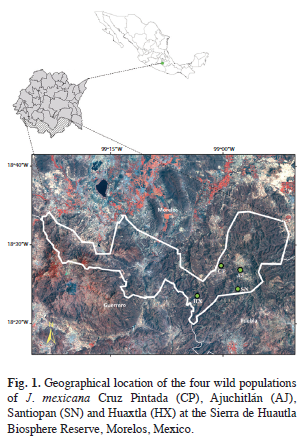
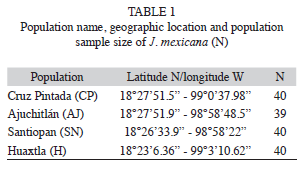
</front><body><![CDATA[ <div style="text-align: justify;">     <div style="text-align: center;"><font style="font-weight: bold;"  size="4"><span style="font-family: verdana;">Genetic diversity and structure of wild populations of the tropical dry forest tree <span style="font-style: italic;">Jacaratia Mexicana</span> (Brassicales: Caricaceae) at a local scale in Mexico</span></font><br style="font-family: verdana;"> </div> <br style="font-family: verdana;">     <div style="text-align: center;"><font size="2"><span  style="font-family: verdana;">Dulce M. Arias<sup><a href="#Afiliacion1">1</a><a  name="Afiliacion3"></a>*</sup>, Ana L. Albarr&aacute;n-Lara<sup><a href="#Afiliacion2">2</a><a  name="Afiliacion4"></a>*</sup>, Antonio Gonz&aacute;lez-Rodr&iacute;guez<a href="#Afiliacion2"><sup>2</sup></a>, Juan Pe&ntilde;aloza-Ram&iacute;rez<a href="#Afiliacion2"><sup>2</sup></a>, Oscar Dorado<a href="#Afiliacion1"><sup>1</sup></a> &amp; Esa&uacute; Leyva<a href="#Afiliacion1"><sup>1</sup></a></span></font><br  style="font-family: verdana;"> </div> <font size="2"><span style="font-family: verdana;">    <br> <a name="Correspondencia2"></a>*<a href="#Correspondencia1">Direcci&oacute;n para correspondencia</a><br style="font-family: verdana;"> </span></font><font size="2"><span style="font-family: verdana;"></span></font></div> <hr  style="width: 100%; height: 2px; margin-left: 0px; margin-right: 0px;">     <div style="text-align: justify;"><font style="font-weight: bold;"  size="3"><span style="font-family: verdana;">Abstract</span></font><br  style="font-family: verdana;"> <font size="2"><span style="font-family: verdana;">&nbsp;</span></font><br  style="font-family: verdana;"> <font size="2"><span style="font-family: verdana;">The tropical dry forest is a greatly endangered ecosystem, from which <span style="font-style: italic;">Jacaratia mexicana</span> is a native tree. With the aim to assess the levels of genetic variation and population structure, four wild populations of <span style="font-style: italic;">J. mexicana</span> were studied in the Sierra de Huautla Biosphere Reserve, Morelos, Mexico. For this, DNA was extracted from 159 individuals and were amplified with six random primers using the Random Amplified Polymorphic DNA (RAPD). A total of 54 bands were obtained, of which 50 (92.6%) were polymorphic. The total genetic diversity found within the four populations was 0.451 when estimated by Shannon&#8217;s index. An AMOVA analysis showed that 84% of the total genetic variation was found within populations and 16% was among populations. The UPGMA dendrogram showed that all individuals from one of the populations (Huaxtla) formed one distinct genetic group, while the rest of the individuals did not cluster according to population. A Mantel test did not show an association between genetic and geographical distances among populations (r=0.893, p=0.20). A Bayesian cluster analysis performed with STRUCTURE, showed that the most probable number of genetic groups in the data was four (<span style="font-style: italic;">K</span>=4), and confirmed the distinctness of Huaxtla population. Our results showed that important genetic differentiation among populations can occur even at this small geographic scale and this has to be considered in conservation actions for this genetic resource. </span></font><br style="font-family: verdana;"> <font size="2"></font><br style="font-family: verdana;"> <font size="2"><span style="font-family: verdana;"><span  style="font-weight: bold;">Key words:</span> <span  style="font-style: italic;">Jacaratia mexicana</span>, Caricaceae, genetic diversity, population structure, Bayesian methods, RAPDs. </span></font><br  style="font-family: verdana;"> <font size="2"></font><br style="font-family: verdana;"> <font style="font-weight: bold;" size="3"><span  style="font-family: verdana;">Resumen</span></font><br  style="font-family: verdana;"> <font size="2"></font><br style="font-family: verdana;"> <font size="2"><span style="font-family: verdana;"><span  style="font-style: italic;">Jacaratia mexicana</span> es un &aacute;rbol nativo del bosque tropical seco, que es considerado el tipo de vegetaci&oacute;n en mayor riesgo de desaparecer completamente. Se utilizaron polimorfismos de ADN amplificados al azar (RAPD, Random Amplified Polymorphic DNA), para evaluar los niveles de variaci&oacute;n y estructura gen&eacute;tica en cuatro poblaciones silvestres de <span style="font-style: italic;">J. mexicana</span> en la Reserva de la Bi&oacute;sfera Sierra de Huautla (Morelos, M&eacute;xico). Se amplific&oacute; el ADN de 159 individuos utilizando seis oligonucle&oacute;tidos (&#8220;primers&#8221;) aleatorios. Se obtuvieron en total 54 bandas, de las cuales 50 (92.6%) fueron polim&oacute;rficas. La diversidad gen&eacute;tica total que se encontr&oacute; en las cuatro poblaciones de <span style="font-style: italic;">J. mexicana</span> fue de 0.451 de acuerdo con el &iacute;ndice de Shannon. Un an&aacute;lisis de varianza molecular (AMOVA) mostr&oacute; que el 84% de la variaci&oacute;n gen&eacute;tica total se encuentra dentro de las poblaciones y el 16% entre las poblaciones. Un dendrograma construido mediante el algoritmo UPGMA mostr&oacute; que los individuos de una poblaci&oacute;n (Huaxtla) formaron un grupo, mientras que el resto de los individuos no se agruparon de acuerdo a su poblaci&oacute;n de origen. Una prueba de Mantel no mostr&oacute; una asociaci&oacute;n entre las distancias gen&eacute;ticas y geogr&aacute;ficas entre las poblaciones (r=0.893, p=0.20). Un an&aacute;lisis de agrupamiento Bayesiano realizado mediante STRUCTURE mostr&oacute; que el n&uacute;mero m&aacute;s probable de grupos gen&eacute;ticos es cuatro (<span style="font-style: italic;">K</span>=4) y confirm&oacute; la diferenciaci&oacute;n de la poblaci&oacute;n Huaxtla. Nuestros resultados muestran que una considerable diferenciaci&oacute;n gen&eacute;tica entre poblaciones puede existir incluso a esta escala geogr&aacute;fica, lo cual es de inter&eacute;s para la conservaci&oacute;n de este recurso gen&eacute;tico.</span></font><br  style="font-family: verdana;"> <font size="2"></font><br style="font-family: verdana;"> <font size="2"><span style="font-family: verdana;"><span  style="font-weight: bold;">Palabras clave:</span> <span  style="font-style: italic;">Jacaratia mexicana</span>, Caricaceae, diversidad gen&eacute;tica, estructura poblacional, m&eacute;todos Bayesianos, RAPDs, Reserva de la Bi&oacute;sfera Sierra de Huautla.</span></font><br  style="font-family: verdana;"> <font size="2"></font><br style="font-family: verdana;"> <font size="2"><span style="font-family: verdana;"></span></font></div> <hr  style="width: 100%; height: 2px; margin-left: 0px; margin-right: 0px;">     <div style="text-align: justify;"><font size="2"><span  style="font-family: verdana;">Information on the levels and geographic distribution of population genetic variation within species is fundamental to define efficient conservation strategies (Palacios &amp; Gonz&aacute;lez-Candelas 1997, Fergunson <span style="font-style: italic;">et al.</span> 1998, Maki &amp; Horie 1999). Genetic variability confers a species the ability to respond to possible environmental changes, providing a higher capacity to evolve and survive in the long-term (Ayala &amp; Kinger 1980, Dobzhansky <span  style="font-style: italic;">et al.</span> 1993, Griffiths <span style="font-style: italic;">et al.</span> 2000). The genetic variation and the change in allele frequencies from one population to another constitute the genetic structure of populations (Wright 1978). This genetic structure is affected not only by evolutionary events (e.g. recombination, mutation, gene flow, genetic drift, inbreeding and natural selection) but also by various ecological factors, such as effective population size, reproductive system, fertility, life history traits, pollination syndromes, and seed dispersal rate in the case of plants (Hamrick <span  style="font-style: italic;">et al.</span> 1979, Hamrick &amp; Godt 1989). All these ecological and evolutionary factors are needed to understand the structure of genetic variation over time and space (Hamrick <span  style="font-style: italic;">et al.</span> 1979, Hamrick &amp; Godt 1989, Schierenbeck <span style="font-style: italic;">et al</span>. 1997).</span></font><br style="font-family: verdana;"> <font size="2"></font><br style="font-family: verdana;"> <font size="2"><span style="font-family: verdana;"><span  style="font-style: italic;">Jacaratia mexicana</span> A D.C. (Caricaceae), commonly named &#8220;bonete&#8221; is a long-lived native tree of tropical dry forests in Mexico, considered the type of vegetation in greater danger of disappearing totally (Janzen 1988) mainly due to land use change (Sala et al. 2000). <span  style="font-style: italic;">J. mexicana</span> has a neotropical distribution that extends in Mexico through the Southern region of the Sierra Madre Occidental, the Trans-Mexican Volcanic Belt, and the Sierra Madre del Sur (Rzedowski &amp; Equihua 1987). It is also found in Nicaragua and El Salvador in Central America (Cronquist 1981). It is a dioecious species (Moreno 1980, Bullock 2002), with biotic pollination that depends on visual and scent mimicry (Bawa 1980). Female flowers lack reward for pollinators but their scent is similar to the male flowers, which produce a little nectar with a high content of amino acids. Nocturnal moths (Sphingidae) have been observed visiting both male and female flowers (Bullock 2002). A recent study on the morphological variation of the flowers of <span  style="font-style: italic;">J. mexicana</span> showed that female plants produce only pistillate flowers, while male plants are sexually variable and can bear three different types of flowers: staminate, pistillate and perfect (Aguirre et al. 2009). This pattern of sexual variation raises interesting evolutionary, ecological and genetic questions about the evolution of sexual expression in this species and in the Caricaceae family (Aguirre <span  style="font-style: italic;">et al.</span> 2009). The fruits of <span style="font-style: italic;">J. mexicana</span> are fleshy, and mature during the dry season, and the seeds are dispersed by birds, bats and coatis (Valenzuela &amp; Ceballos 2000, Bullock 2002). The uses of <span  style="font-style: italic;">J. mexicana</span> date from the pre-Hispanic time (Briones 2002). Fruit and seeds are used for food (Guizar &amp; S&aacute;nchez 1991). Moreover, antiparasitic properties are attributed to this plant (Niembro 1986), and a proteolytic enzyme called &#8220;mexicain&#8221;, analogous to papain, is also present in the flesh of the fruits (Moreno 1980). For all these reasons <span  style="font-style: italic;">J. mexicana</span> is cultivated sometimes in dry tropical zones (Rzedoswki &amp; Equihua 1987), and several important questions regarding possible processes of domestication have been recently pointed out. </span></font><br  style="font-family: verdana;"> <font size="2"></font><br style="font-family: verdana;"> <font size="2"><span style="font-family: verdana;">A recent phylogeographic study of wild and cultivated accessions of <span style="font-style: italic;">J. mexicana</span> in Mexico, using chloroplast and nuclear sequences, revealed that haplotype and nucleotide diversity are significantly higher in wild populations than in cultivated ones. The reduction in genetic diversity suggests that artificial selection (mainly on fruit traits) and possible population bottlenecks during the domestication process resulted in a progressive loss of genetic diversity (Arias <span  style="font-style: italic;">et al.</span> 2010). However, there is no information regarding the diversity and genetic structure of <span style="font-style: italic;">J. mexicana</span> natural populations, despite its importance as a model system of plant evolution, and its economic value as food and as a potential source of pharmaceutical products. This knowledge would be very useful to understand processes involved in the evolution and ecology of populations of the species, and could contribute to optimize the use of this genetic resource. In this study, we analyzed the level and distribution of genetic variation within and between four populations of <span style="font-style: italic;">J. mexicana</span> at a local scale in the Sierra de Huautla Biosphere Reserve, Morelos, Mexico.</span></font><br  style="font-family: verdana;"> <font size="2"></font><br style="font-family: verdana;"> <font style="font-weight: bold;" size="3"><span  style="font-family: verdana;">Material and Methods</span></font><br  style="font-family: verdana;">     <div style="text-align: center;"><br style="font-family: verdana;"> </div> <font size="2"><span style="font-family: verdana;"><span  style="font-weight: bold;">Study site:</span> The Sierra de Huautla Biosphere Reserve (REBIOSH) is located in the central region of Mexico, Southern Morelos State. The reserve belongs to the province of the Balsas River Basin, in which the predominant vegetation is tropical dry forest and grassland (Rzedowski 1978, Morrone 2005). The tropical dry forests of Mexico have a large number of endemic plant taxa, especially at the species level, which are concentrated in the Balsas Basin, the Yucatan Peninsula and Northwestern Mexico (Rzedowski 1991). Throughout the country, many rural human populations are situated in this type of vegetation (Arias <span style="font-style: italic;">et al</span>. 2002). The inhabitants of these communities use a great variety of species for&nbsp; medicinal, edible, ornamental and religious purposes (Maldonado 1997). The REBIOSH faces problems of deforestation, mainly due to land use change. The economy of rural populations living in the reserve was based on mining until 1991, when this activity was abandoned, which resulted in the opening of new areas for agriculture and generated habitat fragmentation (Dorado<span  style="font-style: italic;"> et al</span>. 2005).</span></font><br  style="font-family: verdana;"> <font size="2"></font><br style="font-family: verdana;"> <font size="2"><span style="font-family: verdana;"><span  style="font-weight: bold;">Sample collections and DNA extraction:</span> A total of 159 individuals from four natural populations of <span style="font-style: italic;">J. mexicana</span> were sampled in the Sierra de Huautla Biosphere Reserve during the rainy season in July-August 2003. The four populations were Cruz Pintada (CP), Ajuchitl&aacute;n (AJ), Santiopan (SN) and Huaxtla (HX) and their geographical location and sample size are provided in <a href="#tab_1">table 1</a> and <a  href="#fig_1">figure 1</a>. From each individual, five young leaves were collected (from mature trees) and were placed in sealed plastic bags and stored at -80&deg;C in the laboratory for further DNA extraction.     <br>     <br> </span></font>     <div style="text-align: center;"><font size="2"><a name="tab_1"></a><img  alt="" src="/img/revistas/rbt/v60n1/a01t1.gif"  style="width: 307px; height: 169px;">    ]]></body>
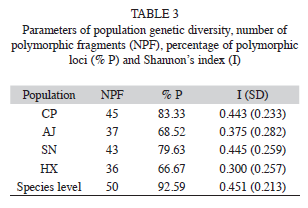
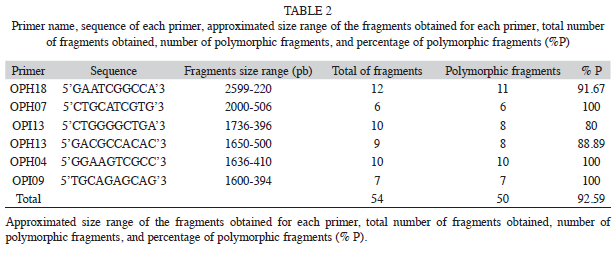
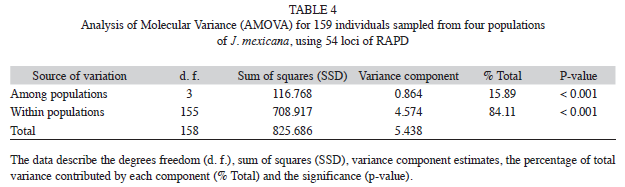
<body><![CDATA[<br>     <br> <a name="fig_1"></a><img alt="" src="/img/revistas/rbt/v60n1/a01i1.jpg"  style="width: 307px; height: 442px;"><span  style="font-family: verdana;"></span></font><br  style="font-family: verdana;"> <font size="2"><span style="font-family: verdana;"></span></font></div> <br style="font-family: verdana;"> <font size="2"><span style="font-family: verdana;">Genomic DNA was extracted from approximately 100mg of leaf tissue using a modification of the cetyltrimethylammonium bromide (CTAB) with an additional phenol-chloroformisoamylalcohol (25:24:1) cleaning step (Lefort &amp; Douglas 1999). Once genomic DNA was obtained, it was quantified with a spectrophotometer (GENEQUANT pro.), and the DNA from each individual was diluted and standardized to a final concentration of 25ng/<span style="font-style: italic;">&#956;</span>L.</span></font><br  style="font-family: verdana;"> <font size="2"></font><br style="font-family: verdana;"> <font size="2"><span style="font-family: verdana;"><span  style="font-weight: bold;">Primer selection and RAPD analysis:</span> Polymerase chain reactions (PCR) were carried out in 25<span style="font-style: italic;">&#956;</span>L mixes containing 25ng of template DNA, 0.2mM of each dNTP, 1X Taq polymerase PCR buffer, 1.5mM MgCl<sub>2</sub>, 1 unit of Taq polymerase (Gibco/Invitrogene, San Diego, California, USA) and 0.2<span  style="font-style: italic;">&#956;</span>M of a&nbsp; single 10-mer primer. Each reaction was overlaid with two drops of mineral oil to prevent evaporation. Amplifications were performed in a PTC-100TM (MJ Research, Inc. Waterton, Massachusetts, USA) thermal cycler with a program consisting of 45 cycles, each at 94&deg;C for 2min, annealing at 36&deg;C for 2min, and extension at 72&deg;C for 2min. A final extension at 72&deg;C for 7min was included. Amplification products were separated electrophoretically on 1.4% agarose gels with 1X TBE buffer at 200V for 2hrs and visualized by ethidium bromide fluorescence. Gels were photographed and further edited using a Genegenius program (Syngene, Cambridge, UK) and printed photographs were produced with a Syngene Digital Graphic Printer Up-D890 Sony. Molecular size of the RAPD bands was estimated using a 123- bp ladder as reference (Gibco/Invitrogene, San Diego California, USA).     <br>     <br> </span></font><font size="2"><span style="font-family: verdana;"></span></font><font  size="2"><span style="font-family: verdana;">In total, 280 10-mer random primers from Operon Technologies Inc., from Kit A (OPA) to N (OPN), were surveyed for consistency and repeatability. Six primers (OPH-04, OPH-07, OPH-13, OPH-18, OPI-09, and OPI-13) that produced consistent and reproducible RAPD bands were chosen for this study. </span></font><br style="font-family: verdana;"> <font size="2"></font><br style="font-family: verdana;"> <font size="2"><span style="font-family: verdana;">The interpretation of RAPD data assumes that RAPD fragments with the same weight (in the gel) represent the same locus (Fritsch &amp; Rieseberg 1996). Absence of a marker within a population, although present in others, was assumed to indicate that all individuals of the population were homozygous for the &#8220;null&#8221; allele, rather than representing the loss of a locus (Liu 1998). RAPD fragments were scored as present (1) or absent (0) and these data were used to create a matrix of RAPD phenotypes. Genetic diversity levels within each population were assessed by calculating the percentage of polymorphic loci (<span style="font-style: italic;">P</span>) and Shannon&#8217;s information index (<span style="font-style: italic;">I</span>) using POPGENE ver. 1.31 (Yeh <span style="font-style: italic;">et al.</span> 1999).</span></font><br  style="font-family: verdana;"> <font size="2"></font><br style="font-family: verdana;"> <font size="2"><span style="font-family: verdana;">The partitioning of genetic variation among and within populations was investigated with an analysis of molecular variance (AMOVA; Excoffier <span style="font-style: italic;">et al.</span> 1992) using the Arlequin ver. 3.0 software (Excoffier <span style="font-style: italic;">et al.</span> 2005). The significances of the different variance components were estimated from distributions generated from 10 000 random permutations. We also estimated pairwise population differentiation using Slatkin&#8217;s linearized F<sub>ST</sub> (Slatkin 1995) and the absolute number of migrants (M)&nbsp; between populations using Arlequin ver. 3.0 software (Excoffier <span style="font-style: italic;">et al.</span> 2005). A Mantel test using Arlequin ver. 3.0 (Excoffier <span style="font-style: italic;">et al.</span> 2005) was performed to evaluate the correlation between the matrices of genetic and geographical distances among populations.</span></font><br style="font-family: verdana;"> <font size="2"></font><br style="font-family: verdana;"> <font size="2"><span style="font-family: verdana;">The genetic relationship among individuals was assessed using a binary data matrix of 47 fragments. The selection of the fragments was based on their presence at a percentage greater than or equal to 75% in at least one population, the autopomorphic or bands present in only one individual were left out of the analysis because they do not provide relevant information for the clustering analysis. Each of the 159 individuals employed in this analysis was considered as an OTU, in order to observe genetic relationships regardless of population of origin. Genetic distances among individuals were calculated according to Nei &amp; Li (1979). This distances were then used to depict relationships of genetic similarity among individuals with the unweighted pair group method with arithmetic averages (UPGMA) dendrogram, constructed using the PAUP program (Swofford 2002).</span></font><br  style="font-family: verdana;"> <font size="2"></font><br style="font-family: verdana;"> <font size="2"><span style="font-family: verdana;">We further assessed the genetic structure of populations using the Bayesian clustering approach implemented in the software STRUCTURE version 2.3.1 (Pritchard <span style="font-style: italic;">et al.</span> 2000). The data matrix was set up as specified in the program instructions for dominant markers. All 159 individuals from the four populations were analyzed jointly, without prior population information, under the admixture model with correlated allele frequencies. Even though the admixture model was not directly developed for dominant markers, STRUCTURE is expected to produce unbiased results with this kind of data, particularly when information is available for many loci (Pritchard <span style="font-style: italic;">et al. </span>2000). We ran <span style="font-style: italic;">K</span> values (number of potential genetic clusters) from 1 to 10, with 10 independent runs for each <span style="font-style: italic;">K</span>. The length of the burn-in was 500 000 steps followed by 10<sup>6</sup> iterations. The K value with the highest posterior probability was identified in this way, and also by using the &#916;<span style="font-style: italic;">K</span> statistics, which quantifies the second order rate of change of the likelihood function with respect to <span style="font-style: italic;">K</span> (Evanno <span style="font-style: italic;">et al.</span> 2005).</span></font><br  style="font-family: verdana;"> <font size="2"></font><br style="font-family: verdana;"> <font style="font-weight: bold;" size="3"><span  style="font-family: verdana;">Results</span></font><br  style="font-family: verdana;"> <font size="2"></font><br style="font-family: verdana;"> <font size="2"><span style="font-family: verdana;">The six primers chosen for this study consistently amplified a total of 54 fragments that ranged in size from 220 to 2 599bp, with an average of nine fragments per primer (<a  href="/img/revistas/rbt/v60n1/a01t2.gif">Table 2</a>). Four of them (7.41%) were present in all individuals and 50 (92.59%) markers were polymorphic (<a href="/img/revistas/rbt/v60n1/a01t2.gif">Table 2</a>). The percentage of Approximated size range of the fragments obtained for each primer, total number of fragments obtained, number of polymorphic fragments, and percentage of polymorphic fragments (% P). polymorphic fragments per population ranged from 83.3% (in population CP) to 66.7% (HX). Shanon&#8217;s index (<span style="font-style: italic;">I</span>) values are shown in the <a href="#tab_3">table 3</a>. The SN population showed the highest value (<span  style="font-style: italic;">I</span>=0.44), while population HX showed the lowest value (<span style="font-style: italic;">I</span>=0.30). At the species level the value was<span style="font-style: italic;"> I</span>=0.45 (<a href="#tab_3">Table 3</a>).    <br>     <br>     <br> </span></font>     <div style="text-align: center;"><font size="2"><a name="tab_3"></a><img  alt="" src="/img/revistas/rbt/v60n1/a01t3.gif"  style="width: 308px; height: 208px;">    <br> <span style="font-family: verdana;"></span></font>    <br> <font size="2"><span style="font-family: verdana;"></span></font></div> <font size="2"><span style="font-family: verdana;">    ]]></body>
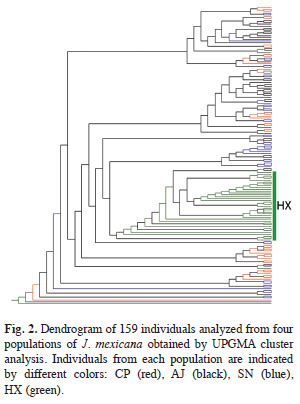
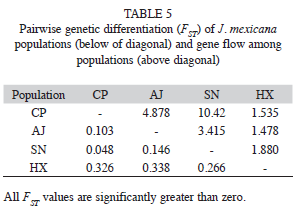
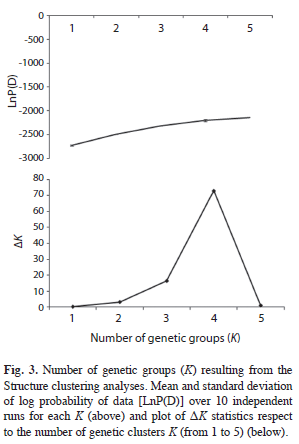
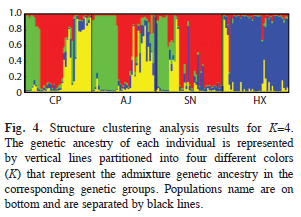
<body><![CDATA[<br> </span></font><font size="2"><span style="font-family: verdana;">The AMOVA analysis showed that 15.89% (p&lt;0.001) of the total genetic variation was among populations and 84.11% (p&lt;0.001) was within populations (<a href="/img/revistas/rbt/v60n1/a01t4.gif">Table 4</a>). The matrix of pairwise linearized <span style="font-style: italic;">F<sub>ST</sub></span> values, and gene flow values, are shown in <a href="#tab_5">table 5</a>. The highest genetic differentiation was between populations AJ and HX (<span  style="font-style: italic;">F<sub>ST</sub></span>=0.34), the lowest differentiation was between populations CP and SN (<span  style="font-style: italic;">F<sub>ST</sub></span>=0.05). Accordingly, the absolute number of migrants (M=<span style="font-style: italic;">Nm</span>) among populations ranged from M=10.42 to M=1.48, with the highest gene flow between CP and SN, and the lowest gene flow between AJ and HX (Table 5). The UPGMA dendrogram depicting the genetic relationships among individuals is shown infigure 2. Almost all individuals belonging to the HX population formed a defined cluster, while the other 119 individuals belonging to CP, AJ and SN did not group according to population of origin (<a href="#fig_2">Fig. 2</a>). The correlation between genetic and geographical distances among populations was positive but not significant (Mantel&#8217;s test, r=0.853, p=0.20).     <br>     <br> </span></font>     <div style="text-align: center;"><font size="2"><a name="fig_2"></a><img  alt="" src="/img/revistas/rbt/v60n1/a01i2.jpg"  style="width: 300px; height: 404px;">    <br>     <br>     <br> <a name="tab_5"></a><img alt="" src="/img/revistas/rbt/v60n1/a01t5.gif"  style="width: 302px; height: 212px;"><span  style="font-family: verdana;"></span></font>    <br> <font size="2"><span style="font-family: verdana;"></span></font></div> <font size="2"><span style="font-family: verdana;">    <br> </span></font><font size="2"><span style="font-family: verdana;">The results of the STRUCTURE analysis showed that the estimated &#8216;log probability of the data&#8217; increase sharply from <span style="font-style: italic;">K</span>=1 [LnP(D)=- 2 720.1] to <span  style="font-style: italic;">K</span>=4 [LnP(D)=-2 195.2] (Fig. 3). The values of &#916;<span style="font-style: italic;">K</span> indicated that <span  style="font-style: italic;">K</span>=4 (<a href="#fig_3">Fig. 3</a>) is the most likely number of genetic groups for <span style="font-style: italic;">J. mexicana</span> (<a  href="#fig_4">Fig. 4</a>).    <br>     ]]></body>
<body><![CDATA[<br> </span></font>     <div style="text-align: center;"><font size="2"><a name="fig_3"></a><img  alt="" src="/img/revistas/rbt/v60n1/a01i3.jpg"  style="width: 299px; height: 444px;">    <br>     <br>     <br>     <a name="fig_4"></a><img alt="" src="/img/revistas/rbt/v60n1/a01i4.jpg"      style="width: 301px; height: 217px;"><span      style="font-family: verdana;"></span></font><br      style="font-family: verdana;">     <font size="2"><span style="font-family: verdana;"></span></font></div>     ]]></body>
<body><![CDATA[<br style="font-family: verdana;">     <font style="font-weight: bold;" size="3"><span      style="font-family: verdana;">Discussion</span></font><br      style="font-family: verdana;">     <font size="2"></font><br style="font-family: verdana;">     <font size="2"><span style="font-family: verdana;">In this study, RAPD     markers were     used&nbsp; to evaluate levels of     genetic variation and structure within and among populations of <span      style="font-style: italic;">J.     ]]></body>
<body><![CDATA[mexicana</span> at the Biosphere Reserve of Sierra de Huautla, Morelos,     Mexico. The data showed that populations CP, AJ and SN have     comparatively higher levels of genetic diversity in comparison to the     HX population. These results can be explained by the large demographic     sizes of these populations (pers. obs.), and their geographic     proximity, which may be facilitating gene flow, and in turn reducing     inbreeding, fixation of alleles and genetic drift. In contrast, the HX     population is characterized by a low density of trees and it is also     the spatially more isolated, situated     at an average linear distance of 10.79km from the other three     ]]></body>
<body><![CDATA[populations. This spatial separation could increase inbreeding and     genetic drift.</span></font><br style="font-family: verdana;">     <font size="2"></font><br style="font-family: verdana;">     <font size="2"><span style="font-family: verdana;"><span      style="font-style: italic;">J. mexicana</span> is a long-lived     dioecious tree (Moreno 1980, Bullock 2002)     mainly pollinated by nocturnal moths (Sphingidae) (Bawa 1980). These     traits favor outcrossing and probably contribute to the maintenance of     high levels of gene diversity (Hamrick <span      style="font-style: italic;">et al.</span> 1979, Hamrick &amp; Godt     ]]></body>
<body><![CDATA[1989, Schierenbeck <span style="font-style: italic;">et al. </span>1997).     The comparison of our data with     similar studies using dominant markers showed that <span      style="font-style: italic;">J. mexicana</span> has on     average higher levels of genetic diversity than <span      style="font-style: italic;">Plathymenia reticulate</span>     (P=70.8%, I=0.396), an outcrossing, long-lived tropical tree of the     Brazilian Cerrado, a kind of vegetation with a dry season that occurs     for fivesix months, like in the tropical dry forest (Lacerda <span      style="font-style: italic;">et al.</span>     ]]></body>
<body><![CDATA[2001); <span style="font-style: italic;">Neolitsea sericea</span>     (P=50.5%, I=0.257) a woody, long-lived,     perennial, outcrossing and insect pollinated plant (Wang et al. 2005);     the temperate tree pollinated by insects and with fleshy fruits     dispersed by animals <span style="font-style: italic;">Prunus mahaleb</span>     (P=52.1%, h=0.141; Jordano &amp;     Godoy 2000); and its congener <span style="font-style: italic;">Prunus     pseudocerasus</span> (P=84%, h=0.224,     I=0.348), an insect-pollinated, perennial species with a long history     of cultivation (Li <span style="font-style: italic;">et al.</span>     ]]></body>
<body><![CDATA[2009); and <span style="font-style: italic;">Jacaranda decurrens</span>     (P=69.2% and     46.34% with RAPD and AFLP, respectively) (Bertoni <span      style="font-style: italic;">et al.</span> 2010). In     contrast, <span style="font-style: italic;">J. mexicana</span> shows     lower levels of genetic diversity compared     to <span style="font-style: italic;">Sesamum indicum</span> (P=83%,     h=0.34, I=0.513), an ancient oil crop     cultivated throughout South East Asia that grows in tropical as well as     in temperate climates (Pham <span style="font-style: italic;">et al.</span>     ]]></body>
<body><![CDATA[2009). The genetic variation levels     of <span style="font-style: italic;">J. mexicana</span> were similar     to those encountered in woody plants with     long life cycles, wide distribution, crosspollination and biotic     dispersal (Wang <span style="font-style: italic;">et al.</span> 2005,     Li <span style="font-style: italic;">et al. </span>2009).</span></font><br      style="font-family: verdana;">     <font size="2"></font><br style="font-family: verdana;">     <font size="2"><span style="font-family: verdana;">The genetic     structure of <span style="font-style: italic;">J.     ]]></body>
<body><![CDATA[mexicana</span> populations reveled significant     genetic subdivision among populations (&#934;<sub><span      style="font-style: italic;">ST</span></sub>=0.16, P&lt;0.001). Based     on     Wright&#8217;s interpretations of <span style="font-style: italic;">F<sub>ST</sub></span>     values (Wright 1978), <span style="font-style: italic;">J. mexicana</span>     populations at the REBIOSH were moderately differentiated. Similar     results have been reported for several tropical trees that have high     levels of genetic diversity and low or moderate levels of genetic     differentiation even in populations that were located several     ]]></body>
<body><![CDATA[kilometers away (Lacerda <span style="font-style: italic;">et al.</span>     2001, Nason 2002). These patterns were     explained by the close evolutionary and ecological relationships     between tropical tree species and the animals that act as pollinators     and seed dispersers (Nason 2002). Seed dispersal patterns can     contribute to the partitioning of genetic variation within and among     populations (Hamrick <span style="font-style: italic;">et al.</span>     1993). Species with limited seed dispersal     are likely to have genetic structure, while plant species with wide     seed dispersal should have less spatial genetic structure. When     ]]></body>
<body><![CDATA[dispersal is performed by animals (endozoochorous), plant species tend     to have high levels of within-population genetic variation in     comparison to species with other seeddispersal syndromes (Hamrick <span      style="font-style: italic;">et     al.</span> 1993, Jordano &amp; Godoy 2000). In this context, the fruit     characteristics of <span style="font-style: italic;">J. mexicana</span>     should promote the movement of seeds,     favoring some extent of gene flow. This is due to the presence of     fleshy fruits that seem to fit the syndrome of dispersion by bats; and     on the basis of the pulp color (intense orange), it can be suggested     ]]></body>
<body><![CDATA[that these fruits are attractive to birds and coati (Valenzuela &amp;     Ceballos 2000, Bullock 2002) Valenzuela &amp; Ceballos (2000) reported     that coati consume fruits of <span style="font-style: italic;">J.     mexicana</span> commonly named bonete, which     represent the 47% of the diet of these mammals during the time of     drought in the tropical dry forests of Chamela-Cuixmala. Coati form     herds of approximately 23 individuals, are nomadic and can move daily     an average of 3.9km during the dry period of the year, so, they     disperse the seeds in all directions facilitating germoplasm movement.</span></font><br      style="font-family: verdana;">     ]]></body>
<body><![CDATA[<font size="2"></font><br style="font-family: verdana;">     <font size="2"><span style="font-family: verdana;">The genetic     relationship among the     159 analyzed individuals of <span style="font-style: italic;">J.     mexicana</span> were represented in a dendrogram showing a clear     genetic     differentiation of HX individuals respect to the others 119 individuals     of CP, AJ and SN. A possible explanation could be that CP, AJ and SN     populations are geographically proximate (pairwise distances vary from     2 to 4.63km) and have large population sizes (pers. obs.). These     ]]></body>
<body><![CDATA[factors could be favoring interpopulation genetic interchange through     pollen and seed dispersal. In contrast, HX individuals were the most     genetically differentiated and geographically distant (separated on     average 10.79km of linear distant from the other populations). In     addition to geographical distance, some orographic and ecological     factors could be contributing to the isolation of this population. Some     patches of secondary vegetation were situated between this population     and the other three, which may limit the movement of seed dispersers.     Also, the HX population was located on a slope with chalky soil, what     results in a dry microhabitat with low humidity, that could affect the     ]]></body>
<body><![CDATA[flowering phenology of the trees, generating ecological isolation     despite the considerable dispersal capability of pollinators. Also,     this population was characterized by a low density of <span      style="font-style: italic;">J. mexicana</span> trees     and there was little evidence of recruitment (per. obs). These suggests     that even though seeds could be moved to this site by dispersers, the     probability of germination and successful establishment is low, thus     resulting in lower levels of realized gene flow.</span></font><br      style="font-family: verdana;">     <font size="2"></font><br style="font-family: verdana;">     ]]></body>
<body><![CDATA[<font size="2"><span style="font-family: verdana;">The results of the     Bayesian     clustering analysis of genetic structure     showed that the populations analyzed of <span      style="font-style: italic;">J. mexicana</span> from the REBIOSH,     best fit four genetic groups (<span style="font-style: italic;">K</span>=4).     This analysis also recognized the     genetic distinctness of population HX, which was almost completely     constituted by a single genetic group found in low proportion in the     other three populations. These, in turn, appeared to have heterogeneous     ]]></body>
<body><![CDATA[proportions from the other three genetic groups, probably highlighting     groups of individuals that are genealogically related. This result is     largely congruent with the relationships depicted in the UPGMA     dendrogram.</span></font><br style="font-family: verdana;">     <font size="2"></font><br style="font-family: verdana;">     <font size="2"><span style="font-family: verdana;">The use of     molecular-genetic     markers as RAPD allowed us to determine     the genetic structure of <span style="font-style: italic;">J. mexicana</span>,     and provided an opportunity to     ]]></body>
<body><![CDATA[infer indirectly gene flow and relationships among individuals at a     local geographical scale. Our results emphasize the potential genetic     heterogeneity of some tropical dry forest tree populations even at     small geographical scales, which should be considered when designing     conservation or management programs. Particularly, the translocation of     individuals with reforestation purposes should take into account the     local genetic composition of populations, even if these are in     geographic proximity. Overall, this work contributes to the scientific     knowledge of biological conservation areas, which have been considered     as reservoirs of genetic diversity and evolutionary processes of     ]]></body>
<body><![CDATA[wildlife.</span></font><br style="font-family: verdana;">     <font size="2"></font><br style="font-family: verdana;">     <font style="font-weight: bold;" size="3"><span      style="font-family: verdana;">Acknowledgments</span></font><br      style="font-family: verdana;">     <font size="2"></font><br style="font-family: verdana;">     <font size="2"><span style="font-family: verdana;">The authors thank to     David Salinas,     Rolando Ram&iacute;rez, Valentino     Sorani and Karla T. Rojas for technical support. We thank Omar Chassin     ]]></body>
<body><![CDATA[and one anonymous reviewers for their comments and suggestions.</span></font><br      style="font-family: verdana;">     <font size="2"></font><br style="font-family: verdana;">     <font size="2"><span style="font-family: verdana;"></span></font></div>     <hr      style="width: 100%; height: 2px; margin-left: 0px; margin-right: 0px;">     <!-- ref --><div style="text-align: justify;"><font style="font-weight: bold;"  size="3"><span style="font-family: verdana;">References</span></font><br  style="font-family: verdana;"> <font size="2"></font><br style="font-family: verdana;"> <font size="2"><span style="font-family: verdana;">Aguirre, A., M. Vallejo-Mar&iacute;n, E.M. Piedra-Malag&oacute;n, R. Cruz-Ortega <span style="font-style: italic;">&amp;</span> R. Dirzo. 2009. Morphological variation in the flowers of <span style="font-style: italic;">Jacaratia mexicana</span> A. DC. (Caricaceae), a subdioecious tree. Plant Biol. 11: 417-424.    &nbsp;&nbsp;&nbsp;&nbsp;&nbsp;&nbsp;&nbsp;&nbsp;[&#160;<a href="javascript:void(0);" onclick="javascript: window.open('/scielo.php?script=sci_nlinks&ref=1420163&pid=S0034-7744201200010000100001&lng=','','width=640,height=500,resizable=yes,scrollbars=1,menubar=yes,');">Links</a>&#160;]<!-- end-ref --><!-- ref --></span></font><br style="font-family: verdana;"> <font size="2"></font><br style="font-family: verdana;"> <font size="2"><span style="font-family: verdana;">Arias, D., O. Dorado <span style="font-style: italic;">&amp;</span> B. Maldonado. 2002. Biodiversidad e importancia de la selva baja caducifolia: la reserva de la biosfera Sierra de Huautla. Biodiversitas 45: 7-12.    &nbsp;&nbsp;&nbsp;&nbsp;&nbsp;&nbsp;&nbsp;&nbsp;[&#160;<a href="javascript:void(0);" onclick="javascript: window.open('/scielo.php?script=sci_nlinks&ref=1420164&pid=S0034-7744201200010000100002&lng=','','width=640,height=500,resizable=yes,scrollbars=1,menubar=yes,');">Links</a>&#160;]<!-- end-ref --><!-- ref --></span></font><br  style="font-family: verdana;"> <font size="2"></font><br style="font-family: verdana;"> <font size="2"><span style="font-family: verdana;">Arias, D., J. Pe&ntilde;aloza-Ram&iacute;rez, O. Dorado, P. Cuevas-Reyes, E. Leyva, A.L. Albarr&aacute;n-Lara <span  style="font-style: italic;">&amp;</span> G. Rangel-Altamirano. 2010. Phylogeographic patterns and possible incipient domestication of <span style="font-style: italic;">Jacaratia Mexicana</span> A DC. (Caricaeae) in Mexico. Genet. Resour. Crop Evol. 57: 1227-1238.    &nbsp;&nbsp;&nbsp;&nbsp;&nbsp;&nbsp;&nbsp;&nbsp;[&#160;<a href="javascript:void(0);" onclick="javascript: window.open('/scielo.php?script=sci_nlinks&ref=1420165&pid=S0034-7744201200010000100003&lng=','','width=640,height=500,resizable=yes,scrollbars=1,menubar=yes,');">Links</a>&#160;]<!-- end-ref --><!-- ref --></span></font><br  style="font-family: verdana;"> <font size="2"></font><br style="font-family: verdana;"> <font size="2"><span style="font-family: verdana;">Ayala, F.J. <span  style="font-style: italic;">&amp;</span> J.A. Kinger. 1980. Modern genetics. The Benjamin/Cummings, California, USA.    &nbsp;&nbsp;&nbsp;&nbsp;&nbsp;&nbsp;&nbsp;&nbsp;[&#160;<a href="javascript:void(0);" onclick="javascript: window.open('/scielo.php?script=sci_nlinks&ref=1420166&pid=S0034-7744201200010000100004&lng=','','width=640,height=500,resizable=yes,scrollbars=1,menubar=yes,');">Links</a>&#160;]<!-- end-ref --><br>     <!-- ref --><br> Bawa, K.S. 1980. Outcrossing and the incidence of dioecism in island floras. Am. Nat. 199: 866-871.    &nbsp;&nbsp;&nbsp;&nbsp;&nbsp;&nbsp;&nbsp;&nbsp;[&#160;<a href="javascript:void(0);" onclick="javascript: window.open('/scielo.php?script=sci_nlinks&ref=1420168&pid=S0034-7744201200010000100005&lng=','','width=640,height=500,resizable=yes,scrollbars=1,menubar=yes,');">Links</a>&#160;]<!-- end-ref --><!-- ref --></span></font><br  style="font-family: verdana;"> <font size="2"></font><br style="font-family: verdana;"> <font size="2"><span style="font-family: verdana;">Bertoni, B.W., M.P.C. Telles, M.G. Malosso, S.C.Z. Torres, J.O. Pereira, M.V. Lourenco, S.C. Franca <span style="font-style: italic;">&amp;</span> A.M.S. Pereira. 2010. Genetic diversity in natural populations of <span style="font-style: italic;">Jacaranda decurrens</span> Cham. Determined using RAPD and AFLP markers. Genet. Mol. Biol. 33: 532-538.    &nbsp;&nbsp;&nbsp;&nbsp;&nbsp;&nbsp;&nbsp;&nbsp;[&#160;<a href="javascript:void(0);" onclick="javascript: window.open('/scielo.php?script=sci_nlinks&ref=1420169&pid=S0034-7744201200010000100006&lng=','','width=640,height=500,resizable=yes,scrollbars=1,menubar=yes,');">Links</a>&#160;]<!-- end-ref --><!-- ref --></span></font><br  style="font-family: verdana;"> <font size="2"></font><br style="font-family: verdana;"> <font size="2"><span style="font-family: verdana;">Briones, M.R. 2002. Timbiriche y Cuaguayote: Plantas milenarias en extinci&oacute;n. Hypatia 17: 1-3.    &nbsp;&nbsp;&nbsp;&nbsp;&nbsp;&nbsp;&nbsp;&nbsp;[&#160;<a href="javascript:void(0);" onclick="javascript: window.open('/scielo.php?script=sci_nlinks&ref=1420170&pid=S0034-7744201200010000100007&lng=','','width=640,height=500,resizable=yes,scrollbars=1,menubar=yes,');">Links</a>&#160;]<!-- end-ref --><!-- ref --></span></font><br  style="font-family: verdana;"> <font size="2"></font><br style="font-family: verdana;"> <font size="2"><span style="font-family: verdana;">Bullock, S. 2002. <span  style="font-style: italic;">Jacaratia mexicana</span> A. DC. (Caricaceae): bonete, p. 155-157. <span style="font-style: italic;">In</span> F.A. Noguera, R.J.H. Vega, A.A.N. Garc&iacute;a <span style="font-style: italic;">&amp;</span> A.M. Quesada. Historia Natural de Chamela. Instituto de Biolog&iacute;a-UNAM, M&eacute;xico D.F., M&eacute;xico.    &nbsp;&nbsp;&nbsp;&nbsp;&nbsp;&nbsp;&nbsp;&nbsp;[&#160;<a href="javascript:void(0);" onclick="javascript: window.open('/scielo.php?script=sci_nlinks&ref=1420171&pid=S0034-7744201200010000100008&lng=','','width=640,height=500,resizable=yes,scrollbars=1,menubar=yes,');">Links</a>&#160;]<!-- end-ref --><!-- ref --></span></font><br  style="font-family: verdana;"> <font size="2"></font><br style="font-family: verdana;"> <font size="2"><span style="font-family: verdana;">Cronquist, A. 1981. An integrated system of classification of flowering plants. Columbia University, New York, USA.    &nbsp;&nbsp;&nbsp;&nbsp;&nbsp;&nbsp;&nbsp;&nbsp;[&#160;<a href="javascript:void(0);" onclick="javascript: window.open('/scielo.php?script=sci_nlinks&ref=1420172&pid=S0034-7744201200010000100009&lng=','','width=640,height=500,resizable=yes,scrollbars=1,menubar=yes,');">Links</a>&#160;]<!-- end-ref --><!-- ref --> </span></font><br  style="font-family: verdana;"> <font size="2"></font><br style="font-family: verdana;"> <font size="2"><span style="font-family: verdana;">Dobzhansky, T., F.J. Ayala, G.L. Stebbins <span style="font-style: italic;">&amp;</span> J.W. Valentine. 1993. Evolution. Omega, Barcelona, Spain.    &nbsp;&nbsp;&nbsp;&nbsp;&nbsp;&nbsp;&nbsp;&nbsp;[&#160;<a href="javascript:void(0);" onclick="javascript: window.open('/scielo.php?script=sci_nlinks&ref=1420173&pid=S0034-7744201200010000100010&lng=','','width=640,height=500,resizable=yes,scrollbars=1,menubar=yes,');">Links</a>&#160;]<!-- end-ref --><!-- ref --> </span></font><br  style="font-family: verdana;"> <font size="2"></font><br style="font-family: verdana;"> <font size="2"><span style="font-family: verdana;">Dorado, O., B. Maldonado, D.M. Arias, V. Sorani, R. Ram&iacute;rez, E. Leyva <span style="font-style: italic;">&amp;</span> D. Valenzuela. 2005. Programa de Conservaci&oacute;n y Manejo Reserva de la biosfera Sierra de Huautla. CONANP, M&eacute;xico.    &nbsp;&nbsp;&nbsp;&nbsp;&nbsp;&nbsp;&nbsp;&nbsp;[&#160;<a href="javascript:void(0);" onclick="javascript: window.open('/scielo.php?script=sci_nlinks&ref=1420174&pid=S0034-7744201200010000100011&lng=','','width=640,height=500,resizable=yes,scrollbars=1,menubar=yes,');">Links</a>&#160;]<!-- end-ref --><!-- ref --> </span></font><br style="font-family: verdana;"> <font size="2"></font><br style="font-family: verdana;"> <font size="2"><span style="font-family: verdana;">Evanno, G., S. Regnaut <span style="font-style: italic;">&amp;</span> J. Goudet. 2005. Detecting the number of clusters of individuals using software STRUCTURE: a simulation study. Mol. Ecol. 14: 2611-2620.    &nbsp;&nbsp;&nbsp;&nbsp;&nbsp;&nbsp;&nbsp;&nbsp;[&#160;<a href="javascript:void(0);" onclick="javascript: window.open('/scielo.php?script=sci_nlinks&ref=1420175&pid=S0034-7744201200010000100012&lng=','','width=640,height=500,resizable=yes,scrollbars=1,menubar=yes,');">Links</a>&#160;]<!-- end-ref --><!-- ref --></span></font><br style="font-family: verdana;"> <font size="2"></font><br style="font-family: verdana;"> <font size="2"><span style="font-family: verdana;">Excoffier, L., P.E. Smouse <span style="font-style: italic;">&amp;</span> J.M. Quattro. 1992. Analysis of molecular variance inferred from metric distances among DNA haplotypes: application to human mitochondrial DNA restriction data. Genetics 131: 479-491.    &nbsp;&nbsp;&nbsp;&nbsp;&nbsp;&nbsp;&nbsp;&nbsp;[&#160;<a href="javascript:void(0);" onclick="javascript: window.open('/scielo.php?script=sci_nlinks&ref=1420176&pid=S0034-7744201200010000100013&lng=','','width=640,height=500,resizable=yes,scrollbars=1,menubar=yes,');">Links</a>&#160;]<!-- end-ref --><!-- ref --></span></font><br style="font-family: verdana;"> <font size="2"></font><br style="font-family: verdana;"> <font size="2"><span style="font-family: verdana;">Excoffier, L., G. Laval <span style="font-style: italic;">&amp;</span> S. Schneider. 2005. Arlequin ver. 3.0: an integrated software package for population genetics data analysis. EBO 1: 47-50.    &nbsp;&nbsp;&nbsp;&nbsp;&nbsp;&nbsp;&nbsp;&nbsp;[&#160;<a href="javascript:void(0);" onclick="javascript: window.open('/scielo.php?script=sci_nlinks&ref=1420177&pid=S0034-7744201200010000100014&lng=','','width=640,height=500,resizable=yes,scrollbars=1,menubar=yes,');">Links</a>&#160;]<!-- end-ref --><!-- ref --></span></font><br style="font-family: verdana;"> <font size="2"></font><br style="font-family: verdana;"> <font size="2"><span style="font-family: verdana;">Fergunson, M.E., B.V. Ford-Lloyd, L.D. Robertson, N. Maxted <span style="font-style: italic;">&amp;</span> H.J. Newbury. 1998. Mapping the geographical distribution of genetic variation in the genus Lens for the enhanced conservation of plant genetic diversity. Mol. Ecol. 7: 1743-1755.    &nbsp;&nbsp;&nbsp;&nbsp;&nbsp;&nbsp;&nbsp;&nbsp;[&#160;<a href="javascript:void(0);" onclick="javascript: window.open('/scielo.php?script=sci_nlinks&ref=1420178&pid=S0034-7744201200010000100015&lng=','','width=640,height=500,resizable=yes,scrollbars=1,menubar=yes,');">Links</a>&#160;]<!-- end-ref --><!-- ref --></span></font><br  style="font-family: verdana;"> <font size="2"></font><br style="font-family: verdana;"> <font size="2"><span style="font-family: verdana;">Fritsch, P. <span  style="font-style: italic;">&amp;</span> L.H. Rieseberg. 1996. The use of Random Amplified Polymorphic DNA (RAPD) in conservation genetics, p 54-73.<span  style="font-style: italic;"> In</span> T.B. Smith <span style="font-style: italic;">&amp;</span> R.K. Wayne. Molecular genetic approaches in conservation. Oxford University, New York, USA.    &nbsp;&nbsp;&nbsp;&nbsp;&nbsp;&nbsp;&nbsp;&nbsp;[&#160;<a href="javascript:void(0);" onclick="javascript: window.open('/scielo.php?script=sci_nlinks&ref=1420179&pid=S0034-7744201200010000100016&lng=','','width=640,height=500,resizable=yes,scrollbars=1,menubar=yes,');">Links</a>&#160;]<!-- end-ref --><!-- ref --></span></font><br  style="font-family: verdana;"> <font size="2"></font><br style="font-family: verdana;"> <font size="2"><span style="font-family: verdana;">Griffiths, A.J.F., J.H. Miller, D.T. Suzuki, R.C. Lewontin <span style="font-style: italic;">&amp;</span> W.M. Gelbart. 2000. An introduction to genetic analysis. WH Freeman and Company, New York. USA.    &nbsp;&nbsp;&nbsp;&nbsp;&nbsp;&nbsp;&nbsp;&nbsp;[&#160;<a href="javascript:void(0);" onclick="javascript: window.open('/scielo.php?script=sci_nlinks&ref=1420180&pid=S0034-7744201200010000100017&lng=','','width=640,height=500,resizable=yes,scrollbars=1,menubar=yes,');">Links</a>&#160;]<!-- end-ref --><!-- ref --></span></font><br style="font-family: verdana;"> <font size="2"></font><br style="font-family: verdana;"> <font size="2"><span style="font-family: verdana;">Guizar, N. <span  style="font-style: italic;">&amp;</span> V. S&aacute;nchez. 1991. Principales &aacute;rboles del alto Balsas. Universidad de Chapingo. M&eacute;xico D.F., M&eacute;xico.    &nbsp;&nbsp;&nbsp;&nbsp;&nbsp;&nbsp;&nbsp;&nbsp;[&#160;<a href="javascript:void(0);" onclick="javascript: window.open('/scielo.php?script=sci_nlinks&ref=1420181&pid=S0034-7744201200010000100018&lng=','','width=640,height=500,resizable=yes,scrollbars=1,menubar=yes,');">Links</a>&#160;]<!-- end-ref --><!-- ref --></span></font><br style="font-family: verdana;"> <font size="2"></font><br style="font-family: verdana;"> <font size="2"><span style="font-family: verdana;">Hamrick, J.L., Y.B. Linhart <span style="font-style: italic;">&amp;</span> J.B. Mitton. 1979. Relationships between life history characteristics and electrophoretically detectable genetic variation in plants. Ann. Rev. Ecol. Syst. 10: 173-200.    &nbsp;&nbsp;&nbsp;&nbsp;&nbsp;&nbsp;&nbsp;&nbsp;[&#160;<a href="javascript:void(0);" onclick="javascript: window.open('/scielo.php?script=sci_nlinks&ref=1420182&pid=S0034-7744201200010000100019&lng=','','width=640,height=500,resizable=yes,scrollbars=1,menubar=yes,');">Links</a>&#160;]<!-- end-ref --><!-- ref --></span></font><br  style="font-family: verdana;"> <font size="2"></font><br style="font-family: verdana;"> <font size="2"><span style="font-family: verdana;">Hamrick, J.L. <span  style="font-style: italic;">&amp;</span> M.J. Godt. 1989. Allozyme diversity in plant species, p 43-63. <span style="font-style: italic;">In</span> A.H.D. Brown, M.T. Clegg, A.L. Kahler <span style="font-style: italic;">&amp;</span> B.S. Weir. Plant population genetics, breeding and germplasm resources. Sinauer, Sunderland, Massachusetts, USA.    &nbsp;&nbsp;&nbsp;&nbsp;&nbsp;&nbsp;&nbsp;&nbsp;[&#160;<a href="javascript:void(0);" onclick="javascript: window.open('/scielo.php?script=sci_nlinks&ref=1420183&pid=S0034-7744201200010000100020&lng=','','width=640,height=500,resizable=yes,scrollbars=1,menubar=yes,');">Links</a>&#160;]<!-- end-ref --><!-- ref --></span></font><br  style="font-family: verdana;"> <font size="2"></font><br style="font-family: verdana;"> <font size="2"><span style="font-family: verdana;">Hamrick, J.L., D.A. Murawski <span style="font-style: italic;">&amp;</span> J.D. Nason. 1993. The influence of seed dispersal mechanisms on the genetic structure of tropical tree populations. Vegetatio 108: 281-297.    &nbsp;&nbsp;&nbsp;&nbsp;&nbsp;&nbsp;&nbsp;&nbsp;[&#160;<a href="javascript:void(0);" onclick="javascript: window.open('/scielo.php?script=sci_nlinks&ref=1420184&pid=S0034-7744201200010000100021&lng=','','width=640,height=500,resizable=yes,scrollbars=1,menubar=yes,');">Links</a>&#160;]<!-- end-ref --><!-- ref --></span></font><br  style="font-family: verdana;"> <font size="2"></font><br style="font-family: verdana;"> <font size="2"><span style="font-family: verdana;">Janzen, D.H. 1988. Tropical dry forests: The most endangered major tropical ecosystem, p. 130-137. <span style="font-style: italic;">In</span> E.O. Wilson. Biodiversity. Natural Academy, Washington, USA.    &nbsp;&nbsp;&nbsp;&nbsp;&nbsp;&nbsp;&nbsp;&nbsp;[&#160;<a href="javascript:void(0);" onclick="javascript: window.open('/scielo.php?script=sci_nlinks&ref=1420185&pid=S0034-7744201200010000100022&lng=','','width=640,height=500,resizable=yes,scrollbars=1,menubar=yes,');">Links</a>&#160;]<!-- end-ref --><!-- ref --></span></font><br style="font-family: verdana;"> <font size="2"></font><br style="font-family: verdana;"> <font size="2"><span style="font-family: verdana;">Jordano, P. <span  style="font-style: italic;">&amp;</span> J.A. Godoy. 2000. RAPD variation and population genetic structure in<span style="font-style: italic;"> Prunus mahaleb</span> (Rosaceae), an animal-dispersed tree. Mol. Ecol. 9: 1293-1305.    &nbsp;&nbsp;&nbsp;&nbsp;&nbsp;&nbsp;&nbsp;&nbsp;[&#160;<a href="javascript:void(0);" onclick="javascript: window.open('/scielo.php?script=sci_nlinks&ref=1420186&pid=S0034-7744201200010000100023&lng=','','width=640,height=500,resizable=yes,scrollbars=1,menubar=yes,');">Links</a>&#160;]<!-- end-ref --><!-- ref --></span></font><br  style="font-family: verdana;"> <font size="2"></font><br style="font-family: verdana;"> <font size="2"><span style="font-family: verdana;">Lacerda, D.R., M.D.P. Acedo, J.P. Lemos Filho <span style="font-style: italic;">&amp;</span> M.B. Lovato. 2001. Genetic diversity and structure of natural populations of <span  style="font-style: italic;">Plathymenia reticulata</span> (Mimosoideae), a tropical tree from the Brazilian Cerrado. Mol. Ecol. 10: 1143-1152.    &nbsp;&nbsp;&nbsp;&nbsp;&nbsp;&nbsp;&nbsp;&nbsp;[&#160;<a href="javascript:void(0);" onclick="javascript: window.open('/scielo.php?script=sci_nlinks&ref=1420187&pid=S0034-7744201200010000100024&lng=','','width=640,height=500,resizable=yes,scrollbars=1,menubar=yes,');">Links</a>&#160;]<!-- end-ref --><!-- ref --></span></font><br style="font-family: verdana;"> <font size="2"></font><br style="font-family: verdana;"> <font size="2"><span style="font-family: verdana;">Lefort, F., G.C. Douglas. 1999. An efficient micro-method of DNA isolation from mature leaves of four hardwood tree species <span  style="font-style: italic;">Acer, Fraxinus, Prunus</span> and <span style="font-style: italic;">Quercus</span>. Ann. Forest Sci. 56: 259-263.    &nbsp;&nbsp;&nbsp;&nbsp;&nbsp;&nbsp;&nbsp;&nbsp;[&#160;<a href="javascript:void(0);" onclick="javascript: window.open('/scielo.php?script=sci_nlinks&ref=1420188&pid=S0034-7744201200010000100025&lng=','','width=640,height=500,resizable=yes,scrollbars=1,menubar=yes,');">Links</a>&#160;]<!-- end-ref --><!-- ref --></span></font><br  style="font-family: verdana;"> <font size="2"></font><br style="font-family: verdana;"> <font size="2"><span style="font-family: verdana;">Li, M.M., Y.L. Cai, Z.Q. Qian <span style="font-style: italic;">&amp;</span> G.F. Zhao. 2009. Genetic diversity and differentiation in Chinese sour cherry <span  style="font-style: italic;">Prunus pseudocerasus</span> Lindl., and its implications for conservation. Genet. Resour. Crop Evol. 56: 455-464.    &nbsp;&nbsp;&nbsp;&nbsp;&nbsp;&nbsp;&nbsp;&nbsp;[&#160;<a href="javascript:void(0);" onclick="javascript: window.open('/scielo.php?script=sci_nlinks&ref=1420189&pid=S0034-7744201200010000100026&lng=','','width=640,height=500,resizable=yes,scrollbars=1,menubar=yes,');">Links</a>&#160;]<!-- end-ref --><!-- ref --></span></font><br style="font-family: verdana;"> <font size="2"></font><br style="font-family: verdana;"> <font size="2"><span style="font-family: verdana;">Liu, B.H. 1998. Statistical genomics: linkage, mapping and QTL analysis. CRC Science, New York, USA.    &nbsp;&nbsp;&nbsp;&nbsp;&nbsp;&nbsp;&nbsp;&nbsp;[&#160;<a href="javascript:void(0);" onclick="javascript: window.open('/scielo.php?script=sci_nlinks&ref=1420190&pid=S0034-7744201200010000100027&lng=','','width=640,height=500,resizable=yes,scrollbars=1,menubar=yes,');">Links</a>&#160;]<!-- end-ref --><!-- ref --></span></font><br  style="font-family: verdana;"> <font size="2"></font><br style="font-family: verdana;"> <font size="2"><span style="font-family: verdana;">Maki, M. <span  style="font-style: italic;">&amp;</span> S. Horie. 1999. Random amplified polymorphic DNA (RAPD) markers reveal less genetic variation in the endangered plant <span  style="font-style: italic;">Cerastium fischerianum var. molle</span> than in the widespread conspecific <span  style="font-style: italic;">C. fischerianum var. fischerianum</span> (Caryophyllaceae). Mol. Ecol. 8: 145-150.    &nbsp;&nbsp;&nbsp;&nbsp;&nbsp;&nbsp;&nbsp;&nbsp;[&#160;<a href="javascript:void(0);" onclick="javascript: window.open('/scielo.php?script=sci_nlinks&ref=1420191&pid=S0034-7744201200010000100028&lng=','','width=640,height=500,resizable=yes,scrollbars=1,menubar=yes,');">Links</a>&#160;]<!-- end-ref --><!-- ref --></span></font><br style="font-family: verdana;"> <font size="2"></font><br style="font-family: verdana;"> <font size="2"><span style="font-family: verdana;">Maldonado, A.B. 1997. Aprovechamiento de los recursos flor&iacute;sticos de la Sierra de Huautla, Morelos, M&eacute;xico. Master Thesis, Universidad Nacional Aut&oacute;noma de M&eacute;xico, M&eacute;xico.    &nbsp;&nbsp;&nbsp;&nbsp;&nbsp;&nbsp;&nbsp;&nbsp;[&#160;<a href="javascript:void(0);" onclick="javascript: window.open('/scielo.php?script=sci_nlinks&ref=1420192&pid=S0034-7744201200010000100029&lng=','','width=640,height=500,resizable=yes,scrollbars=1,menubar=yes,');">Links</a>&#160;]<!-- end-ref --><!-- ref --></span></font><br style="font-family: verdana;"> <font size="2"></font><br style="font-family: verdana;"> <font size="2"><span style="font-family: verdana;">Moreno, N.P. 1980. Flora de Veracruz: Cariacaceae. Instituto Nacional de Investigaciones sobre Recursos Bi&oacute;ticos, Xalapa, Veracruz, M&eacute;xico.    &nbsp;&nbsp;&nbsp;&nbsp;&nbsp;&nbsp;&nbsp;&nbsp;[&#160;<a href="javascript:void(0);" onclick="javascript: window.open('/scielo.php?script=sci_nlinks&ref=1420193&pid=S0034-7744201200010000100030&lng=','','width=640,height=500,resizable=yes,scrollbars=1,menubar=yes,');">Links</a>&#160;]<!-- end-ref --><!-- ref --></span></font><br style="font-family: verdana;"> <font size="2"></font><br style="font-family: verdana;"> <font size="2"><span style="font-family: verdana;">Morrone, J.J. 2005. Hacia la s&iacute;ntesis biogeogr&aacute;fica de M&eacute;xico. Rev. Mex. Biodivers. 76: 207-252.    &nbsp;&nbsp;&nbsp;&nbsp;&nbsp;&nbsp;&nbsp;&nbsp;[&#160;<a href="javascript:void(0);" onclick="javascript: window.open('/scielo.php?script=sci_nlinks&ref=1420194&pid=S0034-7744201200010000100031&lng=','','width=640,height=500,resizable=yes,scrollbars=1,menubar=yes,');">Links</a>&#160;]<!-- end-ref --><!-- ref --></span></font><br  style="font-family: verdana;"> <font size="2"></font><br style="font-family: verdana;"> <font size="2"><span style="font-family: verdana;">Nason, J.D. 2002. La estructura gen&eacute;tica de las poblaciones de &aacute;rboles, p 299-330. <span style="font-style: italic;">In</span> M.R. Guariguata &amp; G.H. </span></font><font size="2"><span  style="font-family: verdana;">Kattan. Ecolog&iacute;a y conservaci&oacute;n de Bosques Neotropicales. Libro Universitario Regional, Cartago, Costa Rica.    &nbsp;&nbsp;&nbsp;&nbsp;&nbsp;&nbsp;&nbsp;&nbsp;[&#160;<a href="javascript:void(0);" onclick="javascript: window.open('/scielo.php?script=sci_nlinks&ref=1420195&pid=S0034-7744201200010000100032&lng=','','width=640,height=500,resizable=yes,scrollbars=1,menubar=yes,');">Links</a>&#160;]<!-- end-ref --><!-- ref --></span></font><br  style="font-family: verdana;"> <font size="2"></font><br style="font-family: verdana;"> <font size="2"><span style="font-family: verdana;">Nei, M. <span  style="font-style: italic;">&amp;</span> W.H. Li. 1979. Mathematical model for studying genetic variation in terms of restriction endonucleases. Proc. Natl. Acad. Sci. USA 76: 5269-5273.    &nbsp;&nbsp;&nbsp;&nbsp;&nbsp;&nbsp;&nbsp;&nbsp;[&#160;<a href="javascript:void(0);" onclick="javascript: window.open('/scielo.php?script=sci_nlinks&ref=1420196&pid=S0034-7744201200010000100033&lng=','','width=640,height=500,resizable=yes,scrollbars=1,menubar=yes,');">Links</a>&#160;]<!-- end-ref --><!-- ref --></span></font><br style="font-family: verdana;"> <font size="2"></font><br style="font-family: verdana;"> <font size="2"><span style="font-family: verdana;">Niembro, R. 1986. &Aacute;rboles y arbustos de M&eacute;xico. Limusa, M&eacute;xico D.F., M&eacute;xico.    &nbsp;&nbsp;&nbsp;&nbsp;&nbsp;&nbsp;&nbsp;&nbsp;[&#160;<a href="javascript:void(0);" onclick="javascript: window.open('/scielo.php?script=sci_nlinks&ref=1420197&pid=S0034-7744201200010000100034&lng=','','width=640,height=500,resizable=yes,scrollbars=1,menubar=yes,');">Links</a>&#160;]<!-- end-ref --><!-- ref --></span></font><br  style="font-family: verdana;"> <font size="2"></font><br style="font-family: verdana;"> <font size="2"><span style="font-family: verdana;">Palacios, C. <span  style="font-style: italic;">&amp;</span> F. Gonz&aacute;lez-Candelas. 1997. Lack of genetic variability in the rare and endangered <span  style="font-style: italic;">Limonium cavanillesii</span> (Plumbaginaceae) using RAPD markers. Mol. Ecol. 6: 671-675.    &nbsp;&nbsp;&nbsp;&nbsp;&nbsp;&nbsp;&nbsp;&nbsp;[&#160;<a href="javascript:void(0);" onclick="javascript: window.open('/scielo.php?script=sci_nlinks&ref=1420198&pid=S0034-7744201200010000100035&lng=','','width=640,height=500,resizable=yes,scrollbars=1,menubar=yes,');">Links</a>&#160;]<!-- end-ref --><!-- ref --> </span></font><br  style="font-family: verdana;"> <font size="2"></font><br style="font-family: verdana;"> <font size="2"><span style="font-family: verdana;">Pham, T.D., T.M. Bui, G. Werlemark, T.C. Bui, A. Merker <span style="font-style: italic;">&amp;</span> A.S. Carlsson. 2009. A study of genetic diversity of sesame (<span  style="font-style: italic;">Sesamum indicum</span> L.) in Vietnam and Cambodia estimated by RAPD markers. Genet. Resour. Crop Evol. 56: 679-690.    &nbsp;&nbsp;&nbsp;&nbsp;&nbsp;&nbsp;&nbsp;&nbsp;[&#160;<a href="javascript:void(0);" onclick="javascript: window.open('/scielo.php?script=sci_nlinks&ref=1420199&pid=S0034-7744201200010000100036&lng=','','width=640,height=500,resizable=yes,scrollbars=1,menubar=yes,');">Links</a>&#160;]<!-- end-ref --><!-- ref --></span></font><br style="font-family: verdana;"> <font size="2"></font><br style="font-family: verdana;"> <font size="2"><span style="font-family: verdana;">Pritchard, J.K., M. Stephens, P. Donnelly. 2000. Inference of population structure using multilocus genotypes data. Genetics 155: 945-959.    &nbsp;&nbsp;&nbsp;&nbsp;&nbsp;&nbsp;&nbsp;&nbsp;[&#160;<a href="javascript:void(0);" onclick="javascript: window.open('/scielo.php?script=sci_nlinks&ref=1420200&pid=S0034-7744201200010000100037&lng=','','width=640,height=500,resizable=yes,scrollbars=1,menubar=yes,');">Links</a>&#160;]<!-- end-ref --><!-- ref --></span></font><br style="font-family: verdana;"> <font size="2"></font><br style="font-family: verdana;"> <font size="2"><span style="font-family: verdana;">Rzedowski, J. 1978. Vegetaci&oacute;n de M&eacute;xico. Limusa, M&eacute;xico, D.F., M&eacute;xico.    &nbsp;&nbsp;&nbsp;&nbsp;&nbsp;&nbsp;&nbsp;&nbsp;[&#160;<a href="javascript:void(0);" onclick="javascript: window.open('/scielo.php?script=sci_nlinks&ref=1420201&pid=S0034-7744201200010000100038&lng=','','width=640,height=500,resizable=yes,scrollbars=1,menubar=yes,');">Links</a>&#160;]<!-- end-ref --><!-- ref --></span></font><br  style="font-family: verdana;"> <font size="2"></font><br style="font-family: verdana;"> <font size="2"><span style="font-family: verdana;">Rzedowski, J. <span  style="font-style: italic;">&amp;</span> M. Equihua. 1987. Colecci&oacute;n atlas cultural: flora. Secretar&iacute;a de Educaci&oacute;n P&uacute;blica, Instituto Nacional de Antropolog&iacute;a e Historia. Planeta, M&eacute;xico D.F., M&eacute;xico.    &nbsp;&nbsp;&nbsp;&nbsp;&nbsp;&nbsp;&nbsp;&nbsp;[&#160;<a href="javascript:void(0);" onclick="javascript: window.open('/scielo.php?script=sci_nlinks&ref=1420202&pid=S0034-7744201200010000100039&lng=','','width=640,height=500,resizable=yes,scrollbars=1,menubar=yes,');">Links</a>&#160;]<!-- end-ref --><!-- ref --></span></font><br style="font-family: verdana;"> <font size="2"></font><br style="font-family: verdana;"> <font size="2"><span style="font-family: verdana;">Rzedowski, J. 1991. Diversidad y or&iacute;genes de la flora fanerog&aacute;mica de M&eacute;xico. Acta Bot. Mex. 14: 3-21.    &nbsp;&nbsp;&nbsp;&nbsp;&nbsp;&nbsp;&nbsp;&nbsp;[&#160;<a href="javascript:void(0);" onclick="javascript: window.open('/scielo.php?script=sci_nlinks&ref=1420203&pid=S0034-7744201200010000100040&lng=','','width=640,height=500,resizable=yes,scrollbars=1,menubar=yes,');">Links</a>&#160;]<!-- end-ref --><!-- ref --></span></font><br  style="font-family: verdana;"> <font size="2"></font><br style="font-family: verdana;"> <font size="2"><span style="font-family: verdana;">Sala, O.E., F. Stuart, F. Chapin III, J.J. Armesto, E. Berlow, J. Bloomfield, R. Dirzo, E. Huber-Sanwald, L.F. Huenneke, R.B. Jackson, A. Kinzig, R. Leemans, D.M. Lodge, H.A. Mooney, M. Oesterheld, N.L. Poff, M.T. Sykes, B.H. Walker, M. Walker <span style="font-style: italic;">&amp;</span> D.H. Wall. Global biodiversity scenarios for the year 2100. Science 287: 1770-1774.    &nbsp;&nbsp;&nbsp;&nbsp;&nbsp;&nbsp;&nbsp;&nbsp;[&#160;<a href="javascript:void(0);" onclick="javascript: window.open('/scielo.php?script=sci_nlinks&ref=1420204&pid=S0034-7744201200010000100041&lng=','','width=640,height=500,resizable=yes,scrollbars=1,menubar=yes,');">Links</a>&#160;]<!-- end-ref --><!-- ref --></span></font><br  style="font-family: verdana;"> <font size="2"></font><br style="font-family: verdana;"> <font size="2"><span style="font-family: verdana;">Schierenbeck, K.A., M. Skupski, D. Lieberman<span style="font-style: italic;"> &amp;</span> M. Liberman. 1997. Population structure and genetic diversity in four tropical tree species in Costa Rica. Mol. Ecol. 6: 137-144.    &nbsp;&nbsp;&nbsp;&nbsp;&nbsp;&nbsp;&nbsp;&nbsp;[&#160;<a href="javascript:void(0);" onclick="javascript: window.open('/scielo.php?script=sci_nlinks&ref=1420205&pid=S0034-7744201200010000100042&lng=','','width=640,height=500,resizable=yes,scrollbars=1,menubar=yes,');">Links</a>&#160;]<!-- end-ref --><!-- ref --></span></font><br  style="font-family: verdana;"> <font size="2"></font><br style="font-family: verdana;"> <font size="2"><span style="font-family: verdana;">Slatkin, M. 1995. A measure of population subdivision base on microsatellites allele frequencies. Genetics 139: 467-462.    &nbsp;&nbsp;&nbsp;&nbsp;&nbsp;&nbsp;&nbsp;&nbsp;[&#160;<a href="javascript:void(0);" onclick="javascript: window.open('/scielo.php?script=sci_nlinks&ref=1420206&pid=S0034-7744201200010000100043&lng=','','width=640,height=500,resizable=yes,scrollbars=1,menubar=yes,');">Links</a>&#160;]<!-- end-ref --><!-- ref --></span></font><br  style="font-family: verdana;"> <font size="2"></font><br style="font-family: verdana;"> <font size="2"><span style="font-family: verdana;">Swofford, D.L. 2002. PAUP: Phylogenetic Analysis Using Parsimony (and other methods), version 4. Sinauer Associates, Sunderland Massachusetts, USA.    &nbsp;&nbsp;&nbsp;&nbsp;&nbsp;&nbsp;&nbsp;&nbsp;[&#160;<a href="javascript:void(0);" onclick="javascript: window.open('/scielo.php?script=sci_nlinks&ref=1420207&pid=S0034-7744201200010000100044&lng=','','width=640,height=500,resizable=yes,scrollbars=1,menubar=yes,');">Links</a>&#160;]<!-- end-ref --><!-- ref --> </span></font><br style="font-family: verdana;"> <font size="2"></font><br style="font-family: verdana;"> <font size="2"><span style="font-family: verdana;">Valenzuela, D. <span  style="font-style: italic;">&amp;</span> G. Ceballos. 2000. Habitat selection, home range, and activity of the white-nosed coati (<span style="font-style: italic;">Nasua narica</span>) in a Mexican tropical dry forest. J. Mammal. 81: 810-819.    &nbsp;&nbsp;&nbsp;&nbsp;&nbsp;&nbsp;&nbsp;&nbsp;[&#160;<a href="javascript:void(0);" onclick="javascript: window.open('/scielo.php?script=sci_nlinks&ref=1420208&pid=S0034-7744201200010000100045&lng=','','width=640,height=500,resizable=yes,scrollbars=1,menubar=yes,');">Links</a>&#160;]<!-- end-ref --><!-- ref --></span></font><br  style="font-family: verdana;"> <font size="2"></font><br style="font-family: verdana;"> <font size="2"><span style="font-family: verdana;">Wang, Z.S., S.Q. An, H. Liu, X. Leng, J.W. Zheng <span style="font-style: italic;">&amp;</span> Y.H. Liu. 2005. Genetic structure of the endangered plant <span  style="font-style: italic;">Neolitsea sericea</span> (Lauraceae) from the Zhoushan Archipelago using RAPD markers. Ann. Bot. 95: 305-313.    &nbsp;&nbsp;&nbsp;&nbsp;&nbsp;&nbsp;&nbsp;&nbsp;[&#160;<a href="javascript:void(0);" onclick="javascript: window.open('/scielo.php?script=sci_nlinks&ref=1420209&pid=S0034-7744201200010000100046&lng=','','width=640,height=500,resizable=yes,scrollbars=1,menubar=yes,');">Links</a>&#160;]<!-- end-ref --><!-- ref --></span></font><br  style="font-family: verdana;"> <font size="2"></font><br style="font-family: verdana;"> <font size="2"><span style="font-family: verdana;">Wright, S. 1978. Evolution and the genetics of populations: Vol 4. Variability within andamong natural populations. University of Chicago, Chicago, USA.    &nbsp;&nbsp;&nbsp;&nbsp;&nbsp;&nbsp;&nbsp;&nbsp;[&#160;<a href="javascript:void(0);" onclick="javascript: window.open('/scielo.php?script=sci_nlinks&ref=1420210&pid=S0034-7744201200010000100047&lng=','','width=640,height=500,resizable=yes,scrollbars=1,menubar=yes,');">Links</a>&#160;]<!-- end-ref --><!-- ref --></span></font><br style="font-family: verdana;"> <font size="2"></font><br style="font-family: verdana;"> <font size="2"><span style="font-family: verdana;">Yeh, F.C., R.C. Yang, T. Boyle. 1999. POPGENE Version 1.31. Microsoft window-based freeware for population genetic analysis. University of Alberta and Centre for International Forestry Research.    &nbsp;&nbsp;&nbsp;&nbsp;&nbsp;&nbsp;&nbsp;&nbsp;[&#160;<a href="javascript:void(0);" onclick="javascript: window.open('/scielo.php?script=sci_nlinks&ref=1420211&pid=S0034-7744201200010000100048&lng=','','width=640,height=500,resizable=yes,scrollbars=1,menubar=yes,');">Links</a>&#160;]<!-- end-ref --> </span></font>    <br>     <br>     <br> <font size="2"><span style="font-family: verdana;"><a  name="Correspondencia1"></a><a href="#Correspondencia2">*</a>Correspondencia a:</span></font><font size="2"> <span style="font-family: verdana;">Dulce M. Arias, Oscar Dorado <span  style="font-style: italic;">&amp;</span> Esa&uacute; Leyva; </span></font><font  size="2"><span style="font-family: verdana;">Centro de Educaci&oacute;n Ambiental e Investigaci&oacute;n Sierra de Huautla (CEAMISH), Universidad Aut&oacute;noma del Estado de Morelos, Av. Universidad 1001, Col. Chamilpa, Cuernavaca, 62210, Morelos, M&eacute;xico; <a href="mailto:dulce@uaem.mx">dulce@uaem.mx</a>, <a href="mailto:esau@uaem.mx">esau@uaem.mx</a> , <a  href="mailto:odorado@uaem.mx">odorado@uaem.mx </a>    <br> <br style="font-family: verdana;"> </span></font><font size="2"><span style="font-family: verdana;">Ana L. Albarr&aacute;n-Lara, Antonio Gonz&aacute;lez-Rodr&iacute;guez <span style="font-style: italic;">&amp;</span> Juan Pe&ntilde;aloza-Ram&iacute;rez; </span></font><font size="2"><span  style="font-family: verdana;">Centro de Investigaciones en Ecosistemas (CIEco), Universidad Nacional Aut&oacute;noma de M&eacute;xico (UNAM), Antigua Carretera a P&aacute;tzcuaro No. 8701, Col. Ex Hacienda de San Jos&eacute; de la Huerta, Morelia, 58190, Michoac&aacute;n, M&eacute;xico; <a href="mailto:aalbarran@oikos.unam.mx">aalbarran@oikos.unam.mx</a> , <a  href="mailto:agrodrig@oikos.unam.mx">agrodrig@oikos.unam.mx</a>, <a href="mailto:jpenaloza@oikos.unam.mx">jpenaloza@oikos.unam.mx </a></span></font><a  href="mailto:jpenaloza@oikos.unam.mx"><br style="font-family: verdana;"> </a>     ]]></body>
<body><![CDATA[<br> <font size="2"><span style="font-family: verdana;"><a name="Afiliacion1"></a><a  href="#Afiliacion3">1</a>. Centro de Educaci&oacute;n Ambiental e Investigaci&oacute;n Sierra de Huautla (CEAMISH), Universidad Aut&oacute;noma del Estado de Morelos, Av. Universidad 1001, Col. Chamilpa, Cuernavaca, 62210, Morelos, M&eacute;xico; <a href="mailto:dulce@uaem.mx">dulce@uaem.mx</a>, <a href="mailto.esau@uaem.mx">esau@uaem.mx</a> , <a  href="mailto:odorado@uaem.mx">odorado@uaem.mx </a></span></font><br  style="font-family: verdana;"> <font size="2"><span style="font-family: verdana;"><a name="Afiliacion2"></a><a  href="#Afiliacion4">2</a>. Centro de Investigaciones en Ecosistemas (CIEco), Universidad Nacional Aut&oacute;noma de M&eacute;xico (UNAM), Antigua Carretera a P&aacute;tzcuaro No. 8701, Col. Ex Hacienda de San Jos&eacute; de la Huerta, Morelia, 58190, Michoac&aacute;n, M&eacute;xico; <a href="mailto:aalbarran@oikos.unam.mx">aalbarran@oikos.unam.mx</a> , <a  href="mailto:aalbarran@oikos.unam.mx">agrodrig@oikos.unam.mx</a>, <a href="mailto:aalbarran@oikos.unam.mx">jpenaloza@oikos.unam.mx </a></span></font><br  style="font-family: verdana;"> <font size="2"><span style="font-family: verdana;"></span></font></div> <hr  style="width: 100%; height: 2px; margin-left: 0px; margin-right: 0px;">     <div style="text-align: center;"><font size="2"><span  style="font-family: verdana;">Received 14-XII-2010. Corrected 13-V-2011. Accepted 16-VI-2011.</span></font><br  style="font-family: verdana;"> </div> <font size="2"></font>      ]]></body><back>
<ref-list>
<ref id="B1">
<nlm-citation citation-type="journal">
<person-group person-group-type="author">
<name>
<surname><![CDATA[Vallejo-Marín]]></surname>
<given-names><![CDATA[M]]></given-names>
</name>
<name>
<surname><![CDATA[Piedra-Malagón]]></surname>
<given-names><![CDATA[E.M]]></given-names>
</name>
<name>
<surname><![CDATA[Cruz-Ortega]]></surname>
<given-names><![CDATA[R]]></given-names>
</name>
<name>
<surname><![CDATA[Dirzo]]></surname>
<given-names><![CDATA[R]]></given-names>
</name>
</person-group>
<article-title xml:lang="en"><![CDATA[Morphological variation in the flowers of Jacaratia mexicana A. DC. (Caricaceae), a subdioecious tree]]></article-title>
<source><![CDATA[Plant Biol]]></source>
<year>2009</year>
<volume>11</volume>
<page-range>417-424</page-range></nlm-citation>
</ref>
<ref id="B2">
<nlm-citation citation-type="journal">
<person-group person-group-type="author">
<name>
<surname><![CDATA[Arias]]></surname>
<given-names><![CDATA[D]]></given-names>
</name>
<name>
<surname><![CDATA[Dorado]]></surname>
<given-names><![CDATA[O]]></given-names>
</name>
<name>
<surname><![CDATA[Maldonado]]></surname>
<given-names><![CDATA[B]]></given-names>
</name>
</person-group>
<article-title xml:lang="es"><![CDATA[Biodiversidad e importancia de la selva baja caducifolia: la reserva de la biosfera Sierra de Huautla]]></article-title>
<source><![CDATA[Biodiversitas]]></source>
<year>2002</year>
<volume>45</volume>
<page-range>7-12</page-range></nlm-citation>
</ref>
<ref id="B3">
<nlm-citation citation-type="journal">
<person-group person-group-type="author">
<name>
<surname><![CDATA[Arias]]></surname>
<given-names><![CDATA[D]]></given-names>
</name>
<name>
<surname><![CDATA[Peñaloza-Ramírez]]></surname>
<given-names><![CDATA[J]]></given-names>
</name>
<name>
<surname><![CDATA[Dorado]]></surname>
<given-names><![CDATA[O]]></given-names>
</name>
<name>
<surname><![CDATA[Cuevas-Reyes]]></surname>
<given-names><![CDATA[P]]></given-names>
</name>
<name>
<surname><![CDATA[Leyva]]></surname>
<given-names><![CDATA[E]]></given-names>
</name>
<name>
<surname><![CDATA[Albarrán-Lara]]></surname>
<given-names><![CDATA[A.L]]></given-names>
</name>
<name>
<surname><![CDATA[Rangel-Altamirano]]></surname>
<given-names><![CDATA[G]]></given-names>
</name>
</person-group>
<article-title xml:lang="en"><![CDATA[Phylogeographic patterns and possible incipient domestication of Jacaratia Mexicana A DC. (Caricaeae) in Mexico]]></article-title>
<source><![CDATA[Genet. Resour. Crop Evol]]></source>
<year>2010</year>
<volume>57</volume>
<page-range>1227-1238</page-range></nlm-citation>
</ref>
<ref id="B4">
<nlm-citation citation-type="book">
<person-group person-group-type="author">
<name>
<surname><![CDATA[Ayala]]></surname>
<given-names><![CDATA[F.J]]></given-names>
</name>
<name>
<surname><![CDATA[Kinger]]></surname>
<given-names><![CDATA[J.A]]></given-names>
</name>
</person-group>
<source><![CDATA[Modern genetics]]></source>
<year>1980</year>
<publisher-loc><![CDATA[^eCalifornia California]]></publisher-loc>
<publisher-name><![CDATA[The Benjamin/Cummings]]></publisher-name>
</nlm-citation>
</ref>
<ref id="B5">
<nlm-citation citation-type="journal">
<person-group person-group-type="author">
<name>
<surname><![CDATA[Bawa]]></surname>
<given-names><![CDATA[K.S]]></given-names>
</name>
</person-group>
<article-title xml:lang="en"><![CDATA[Outcrossing and the incidence of dioecism in island floras]]></article-title>
<source><![CDATA[Am. Nat]]></source>
<year>1980</year>
<volume>199</volume>
<page-range>866-871</page-range></nlm-citation>
</ref>
<ref id="B6">
<nlm-citation citation-type="journal">
<person-group person-group-type="author">
<name>
<surname><![CDATA[Bertoni]]></surname>
<given-names><![CDATA[B.W]]></given-names>
</name>
<name>
<surname><![CDATA[Telles]]></surname>
<given-names><![CDATA[M.P.C]]></given-names>
</name>
<name>
<surname><![CDATA[Malosso]]></surname>
<given-names><![CDATA[M.G]]></given-names>
</name>
<name>
<surname><![CDATA[Torres]]></surname>
<given-names><![CDATA[S.C.Z]]></given-names>
</name>
<name>
<surname><![CDATA[Pereira]]></surname>
<given-names><![CDATA[J.O]]></given-names>
</name>
<name>
<surname><![CDATA[Lourenco]]></surname>
<given-names><![CDATA[M.V]]></given-names>
</name>
<name>
<surname><![CDATA[Franca]]></surname>
<given-names><![CDATA[S.C]]></given-names>
</name>
<name>
<surname><![CDATA[Pereira]]></surname>
<given-names><![CDATA[A.M.S]]></given-names>
</name>
</person-group>
<article-title xml:lang="en"><![CDATA[Genetic diversity in natural populations of Jacaranda decurrens Cham.: Determined using RAPD and AFLP markers]]></article-title>
<source><![CDATA[Genet. Mol. Biol]]></source>
<year>2010</year>
<volume>33</volume>
<page-range>532-538</page-range></nlm-citation>
</ref>
<ref id="B7">
<nlm-citation citation-type="journal">
<person-group person-group-type="author">
<name>
<surname><![CDATA[Briones]]></surname>
<given-names><![CDATA[M.R]]></given-names>
</name>
</person-group>
<article-title xml:lang="es"><![CDATA[Timbiriche y Cuaguayote: Plantas milenarias en extinción]]></article-title>
<source><![CDATA[Hypatia]]></source>
<year>2002</year>
<volume>17</volume>
<page-range>1-3</page-range></nlm-citation>
</ref>
<ref id="B8">
<nlm-citation citation-type="book">
<person-group person-group-type="author">
<name>
<surname><![CDATA[Bullock]]></surname>
<given-names><![CDATA[S]]></given-names>
</name>
</person-group>
<article-title xml:lang="es"><![CDATA[Jacaratia mexicana A. DC. (Caricaceae): bonete]]></article-title>
<person-group person-group-type="editor">
<name>
<surname><![CDATA[Noguera]]></surname>
<given-names><![CDATA[F.A]]></given-names>
</name>
<name>
<surname><![CDATA[Vega]]></surname>
<given-names><![CDATA[R.J.H]]></given-names>
</name>
<name>
<surname><![CDATA[García]]></surname>
<given-names><![CDATA[A.A.N]]></given-names>
</name>
<name>
<surname><![CDATA[Quesada]]></surname>
<given-names><![CDATA[A.M]]></given-names>
</name>
</person-group>
<source><![CDATA[Historia Natural de Chamela]]></source>
<year>2002</year>
<page-range>155-157</page-range><publisher-loc><![CDATA[^eMéxico D.F México D.F]]></publisher-loc>
<publisher-name><![CDATA[Instituto de Biología-UNAM]]></publisher-name>
</nlm-citation>
</ref>
<ref id="B9">
<nlm-citation citation-type="book">
<person-group person-group-type="author">
<name>
<surname><![CDATA[Cronquist]]></surname>
<given-names><![CDATA[A]]></given-names>
</name>
</person-group>
<source><![CDATA[An integrated system of classification of flowering plants]]></source>
<year>1981</year>
<publisher-loc><![CDATA[^eNew York New York]]></publisher-loc>
<publisher-name><![CDATA[Columbia University]]></publisher-name>
</nlm-citation>
</ref>
<ref id="B10">
<nlm-citation citation-type="book">
<person-group person-group-type="author">
<name>
<surname><![CDATA[Dobzhansky]]></surname>
<given-names><![CDATA[T]]></given-names>
</name>
<name>
<surname><![CDATA[Ayala]]></surname>
<given-names><![CDATA[F.J]]></given-names>
</name>
<name>
<surname><![CDATA[Stebbins]]></surname>
<given-names><![CDATA[G.L]]></given-names>
</name>
<name>
<surname><![CDATA[Valentine]]></surname>
<given-names><![CDATA[J.W]]></given-names>
</name>
</person-group>
<source><![CDATA[Evolution]]></source>
<year>1993</year>
<publisher-loc><![CDATA[Barcelona ]]></publisher-loc>
<publisher-name><![CDATA[Omega]]></publisher-name>
</nlm-citation>
</ref>
<ref id="B11">
<nlm-citation citation-type="book">
<person-group person-group-type="author">
<name>
<surname><![CDATA[Dorado]]></surname>
<given-names><![CDATA[O]]></given-names>
</name>
<name>
<surname><![CDATA[Maldonado]]></surname>
<given-names><![CDATA[B]]></given-names>
</name>
<name>
<surname><![CDATA[Arias]]></surname>
<given-names><![CDATA[D.M]]></given-names>
</name>
<name>
<surname><![CDATA[Sorani]]></surname>
<given-names><![CDATA[V]]></given-names>
</name>
<name>
<surname><![CDATA[Ramírez]]></surname>
<given-names><![CDATA[R]]></given-names>
</name>
<name>
<surname><![CDATA[Leyva]]></surname>
<given-names><![CDATA[E]]></given-names>
</name>
<name>
<surname><![CDATA[Valenzuela]]></surname>
<given-names><![CDATA[D]]></given-names>
</name>
</person-group>
<source><![CDATA[de Conservación y Manejo Reserva de la biosfera Sierra de Huautla]]></source>
<year>2005</year>
<publisher-name><![CDATA[CONANP]]></publisher-name>
</nlm-citation>
</ref>
<ref id="B12">
<nlm-citation citation-type="journal">
<person-group person-group-type="author">
<name>
<surname><![CDATA[Evanno]]></surname>
<given-names><![CDATA[G]]></given-names>
</name>
<name>
<surname><![CDATA[Regnaut]]></surname>
<given-names><![CDATA[S]]></given-names>
</name>
<name>
<surname><![CDATA[Goudet]]></surname>
<given-names><![CDATA[J]]></given-names>
</name>
</person-group>
<article-title xml:lang="en"><![CDATA[Detecting the number of clusters of individuals using software STRUCTURE: a simulation study]]></article-title>
<source><![CDATA[Mol. Ecol]]></source>
<year>2005</year>
<volume>14</volume>
<page-range>2611-2620</page-range></nlm-citation>
</ref>
<ref id="B13">
<nlm-citation citation-type="journal">
<person-group person-group-type="author">
<name>
<surname><![CDATA[Excoffier]]></surname>
<given-names><![CDATA[L]]></given-names>
</name>
<name>
<surname><![CDATA[Smouse]]></surname>
<given-names><![CDATA[P.E]]></given-names>
</name>
<name>
<surname><![CDATA[Quattro]]></surname>
<given-names><![CDATA[J.M]]></given-names>
</name>
</person-group>
<article-title xml:lang="en"><![CDATA[Analysis of molecular variance inferred from metric distances among DNA haplotypes: application to human mitochondrial DNA restriction data]]></article-title>
<source><![CDATA[Genetics]]></source>
<year>1992</year>
<volume>131</volume>
<page-range>479-491</page-range></nlm-citation>
</ref>
<ref id="B14">
<nlm-citation citation-type="journal">
<person-group person-group-type="author">
<name>
<surname><![CDATA[Excoffier]]></surname>
<given-names><![CDATA[L]]></given-names>
</name>
<name>
<surname><![CDATA[Laval]]></surname>
<given-names><![CDATA[G]]></given-names>
</name>
<name>
<surname><![CDATA[Schneider]]></surname>
<given-names><![CDATA[S]]></given-names>
</name>
</person-group>
<article-title xml:lang="en"><![CDATA[Arlequin ver. 3.0: an integrated software package for population genetics data analysis]]></article-title>
<source><![CDATA[EBO]]></source>
<year>2005</year>
<volume>1</volume>
<page-range>47-50</page-range></nlm-citation>
</ref>
<ref id="B15">
<nlm-citation citation-type="journal">
<person-group person-group-type="author">
<name>
<surname><![CDATA[Fergunson]]></surname>
<given-names><![CDATA[M.E]]></given-names>
</name>
<name>
<surname><![CDATA[Ford-Lloyd]]></surname>
<given-names><![CDATA[B.V]]></given-names>
</name>
<name>
<surname><![CDATA[Robertson]]></surname>
<given-names><![CDATA[L.D]]></given-names>
</name>
<name>
<surname><![CDATA[Maxted]]></surname>
<given-names><![CDATA[N]]></given-names>
</name>
<name>
<surname><![CDATA[Newbury]]></surname>
<given-names><![CDATA[H.J]]></given-names>
</name>
</person-group>
<article-title xml:lang="en"><![CDATA[Mapping the geographical distribution of genetic variation in the genus Lens for the enhanced conservation of plant genetic diversity]]></article-title>
<source><![CDATA[Mol. Ecol]]></source>
<year>1998</year>
<volume>7</volume>
<page-range>1743-1755</page-range></nlm-citation>
</ref>
<ref id="B16">
<nlm-citation citation-type="book">
<person-group person-group-type="author">
<name>
<surname><![CDATA[Fritsch]]></surname>
<given-names><![CDATA[P]]></given-names>
</name>
<name>
<surname><![CDATA[Rieseberg]]></surname>
<given-names><![CDATA[L.H]]></given-names>
</name>
</person-group>
<article-title xml:lang="en"><![CDATA[The use of Random Amplified Polymorphic DNA (RAPD) in conservation genetics]]></article-title>
<person-group person-group-type="editor">
<name>
<surname><![CDATA[Smith]]></surname>
<given-names><![CDATA[T.B]]></given-names>
</name>
<name>
<surname><![CDATA[Wayne]]></surname>
<given-names><![CDATA[R.K]]></given-names>
</name>
</person-group>
<source><![CDATA[Molecular genetic approaches in conservation]]></source>
<year>1996</year>
<page-range>54-73</page-range><publisher-loc><![CDATA[^eNew York New York]]></publisher-loc>
<publisher-name><![CDATA[Oxford University]]></publisher-name>
</nlm-citation>
</ref>
<ref id="B17">
<nlm-citation citation-type="book">
<person-group person-group-type="author">
<name>
<surname><![CDATA[Griffiths]]></surname>
<given-names><![CDATA[A.J.F]]></given-names>
</name>
<name>
<surname><![CDATA[Miller]]></surname>
<given-names><![CDATA[J.H]]></given-names>
</name>
<name>
<surname><![CDATA[Suzuki]]></surname>
<given-names><![CDATA[D.T]]></given-names>
</name>
<name>
<surname><![CDATA[Lewontin]]></surname>
<given-names><![CDATA[R.C]]></given-names>
</name>
<name>
<surname><![CDATA[Gelbart]]></surname>
<given-names><![CDATA[W.M]]></given-names>
</name>
</person-group>
<source><![CDATA[An introduction to genetic analysis]]></source>
<year>2000</year>
<publisher-loc><![CDATA[^eNew York New York]]></publisher-loc>
<publisher-name><![CDATA[WH Freeman and Company]]></publisher-name>
</nlm-citation>
</ref>
<ref id="B18">
<nlm-citation citation-type="book">
<person-group person-group-type="author">
<name>
<surname><![CDATA[Guizar]]></surname>
<given-names><![CDATA[N]]></given-names>
</name>
<name>
<surname><![CDATA[Sánchez]]></surname>
<given-names><![CDATA[V]]></given-names>
</name>
</person-group>
<source><![CDATA[Principales árboles del alto Balsas]]></source>
<year>1991</year>
<publisher-loc><![CDATA[^eMéxico D.F México D.F]]></publisher-loc>
<publisher-name><![CDATA[Universidad de Chapingo]]></publisher-name>
</nlm-citation>
</ref>
<ref id="B19">
<nlm-citation citation-type="journal">
<person-group person-group-type="author">
<name>
<surname><![CDATA[Hamrick]]></surname>
<given-names><![CDATA[J.L]]></given-names>
</name>
<name>
<surname><![CDATA[Linhart]]></surname>
<given-names><![CDATA[Y.B]]></given-names>
</name>
<name>
<surname><![CDATA[Mitton]]></surname>
<given-names><![CDATA[J.B]]></given-names>
</name>
</person-group>
<article-title xml:lang="en"><![CDATA[Relationships between life history characteristics and electrophoretically detectable genetic variation in plants]]></article-title>
<source><![CDATA[Ann. Rev. Ecol. Syst]]></source>
<year>1979</year>
<volume>10</volume>
<page-range>173-200</page-range></nlm-citation>
</ref>
<ref id="B20">
<nlm-citation citation-type="book">
<person-group person-group-type="author">
<name>
<surname><![CDATA[Hamrick]]></surname>
<given-names><![CDATA[J.L]]></given-names>
</name>
<name>
<surname><![CDATA[Godt]]></surname>
<given-names><![CDATA[M.J]]></given-names>
</name>
</person-group>
<article-title xml:lang="en"><![CDATA[Allozyme diversity in plant species]]></article-title>
<person-group person-group-type="editor">
<name>
<surname><![CDATA[Brown]]></surname>
<given-names><![CDATA[A.H.D]]></given-names>
</name>
<name>
<surname><![CDATA[Clegg]]></surname>
<given-names><![CDATA[M.T]]></given-names>
</name>
<name>
<surname><![CDATA[Kahler]]></surname>
<given-names><![CDATA[A.L]]></given-names>
</name>
<name>
<surname><![CDATA[Weir]]></surname>
<given-names><![CDATA[B.S]]></given-names>
</name>
</person-group>
<source><![CDATA[Plant population genetics, breeding and germplasm resources]]></source>
<year>1989</year>
<page-range>43-63</page-range><publisher-loc><![CDATA[Sunderland^eMassachusetts Massachusetts]]></publisher-loc>
<publisher-name><![CDATA[Sinauer]]></publisher-name>
</nlm-citation>
</ref>
<ref id="B21">
<nlm-citation citation-type="journal">
<person-group person-group-type="author">
<name>
<surname><![CDATA[Hamrick]]></surname>
<given-names><![CDATA[J.L]]></given-names>
</name>
<name>
<surname><![CDATA[Murawski]]></surname>
<given-names><![CDATA[D.A]]></given-names>
</name>
<name>
<surname><![CDATA[Nason]]></surname>
<given-names><![CDATA[J.D]]></given-names>
</name>
</person-group>
<article-title xml:lang="en"><![CDATA[The influence of seed dispersal mechanisms on the genetic structure of tropical tree populations]]></article-title>
<source><![CDATA[Vegetatio]]></source>
<year>1993</year>
<volume>108</volume>
<page-range>281-297</page-range></nlm-citation>
</ref>
<ref id="B22">
<nlm-citation citation-type="book">
<person-group person-group-type="author">
<name>
<surname><![CDATA[Janzen]]></surname>
<given-names><![CDATA[D.H]]></given-names>
</name>
</person-group>
<article-title xml:lang="en"><![CDATA[Tropical dry forests: The most endangered major tropical ecosystem]]></article-title>
<person-group person-group-type="editor">
<name>
<surname><![CDATA[Wilson]]></surname>
<given-names><![CDATA[E.O]]></given-names>
</name>
</person-group>
<source><![CDATA[Biodiversity]]></source>
<year>1988</year>
<page-range>130-137</page-range><publisher-loc><![CDATA[^eWashington Washington]]></publisher-loc>
<publisher-name><![CDATA[Natural Academy]]></publisher-name>
</nlm-citation>
</ref>
<ref id="B23">
<nlm-citation citation-type="journal">
<person-group person-group-type="author">
<name>
<surname><![CDATA[Jordano]]></surname>
<given-names><![CDATA[P]]></given-names>
</name>
<name>
<surname><![CDATA[Godoy]]></surname>
<given-names><![CDATA[J.A]]></given-names>
</name>
</person-group>
<article-title xml:lang="en"><![CDATA[RAPD variation and population genetic structure in Prunus mahaleb (Rosaceae), an animal-dispersed tree]]></article-title>
<source><![CDATA[Mol. Ecol]]></source>
<year>2000</year>
<volume>9</volume>
<page-range>1293-1305</page-range></nlm-citation>
</ref>
<ref id="B24">
<nlm-citation citation-type="journal">
<person-group person-group-type="author">
<name>
<surname><![CDATA[Lacerda]]></surname>
<given-names><![CDATA[D.R]]></given-names>
</name>
<name>
<surname><![CDATA[Acedo]]></surname>
<given-names><![CDATA[M.D.P]]></given-names>
</name>
<name>
<surname><![CDATA[Lemos Filho]]></surname>
<given-names><![CDATA[J.P]]></given-names>
</name>
<name>
<surname><![CDATA[Lovato]]></surname>
<given-names><![CDATA[M.B]]></given-names>
</name>
</person-group>
<article-title xml:lang="en"><![CDATA[Genetic diversity and structure of natural populations of Plathymenia reticulata (Mimosoideae), a tropical tree from the Brazilian Cerrado]]></article-title>
<source><![CDATA[Mol. Ecol]]></source>
<year>2001</year>
<volume>10</volume>
<page-range>1143-1152</page-range></nlm-citation>
</ref>
<ref id="B25">
<nlm-citation citation-type="journal">
<person-group person-group-type="author">
<name>
<surname><![CDATA[Lefort]]></surname>
<given-names><![CDATA[F]]></given-names>
</name>
<name>
<surname><![CDATA[Douglas]]></surname>
<given-names><![CDATA[G.C]]></given-names>
</name>
</person-group>
<article-title xml:lang="en"><![CDATA[An efficient micro-method of DNA isolation from mature leaves of four hardwood tree species Acer, Fraxinus, Prunus and Quercus]]></article-title>
<source><![CDATA[Ann. Forest Sci]]></source>
<year>1999</year>
<volume>56</volume>
<page-range>259-263</page-range></nlm-citation>
</ref>
<ref id="B26">
<nlm-citation citation-type="journal">
<person-group person-group-type="author">
<name>
<surname><![CDATA[Li]]></surname>
<given-names><![CDATA[M.M]]></given-names>
</name>
<name>
<surname><![CDATA[Cai]]></surname>
<given-names><![CDATA[Y.L]]></given-names>
</name>
<name>
<surname><![CDATA[Qian]]></surname>
<given-names><![CDATA[Z.Q]]></given-names>
</name>
<name>
<surname><![CDATA[Zhao]]></surname>
<given-names><![CDATA[G.F]]></given-names>
</name>
</person-group>
<article-title xml:lang="en"><![CDATA[Genetic diversity and differentiation in Chinese sour cherry Prunus pseudocerasus Lindl., and its implications for conservation]]></article-title>
<source><![CDATA[Genet. Resour. Crop Evol]]></source>
<year>2009</year>
<volume>56</volume>
<page-range>455-464</page-range></nlm-citation>
</ref>
<ref id="B27">
<nlm-citation citation-type="book">
<person-group person-group-type="author">
<name>
<surname><![CDATA[Liu]]></surname>
<given-names><![CDATA[B.H]]></given-names>
</name>
</person-group>
<source><![CDATA[Statistical genomics: linkage, mapping and QTL analysis]]></source>
<year>1998</year>
<publisher-loc><![CDATA[^eNew York New York]]></publisher-loc>
<publisher-name><![CDATA[CRC Science]]></publisher-name>
</nlm-citation>
</ref>
<ref id="B28">
<nlm-citation citation-type="journal">
<person-group person-group-type="author">
<name>
<surname><![CDATA[Maki]]></surname>
<given-names><![CDATA[M]]></given-names>
</name>
<name>
<surname><![CDATA[Horie]]></surname>
<given-names><![CDATA[S]]></given-names>
</name>
</person-group>
<article-title xml:lang="en"><![CDATA[Random amplified polymorphic DNA (RAPD) markers reveal less genetic variation in the endangered plant Cerastium fischerianum var. molle than in the widespread conspecific C. fischerianum var. fischerianum (Caryophyllaceae)]]></article-title>
<source><![CDATA[Mol. Ecol]]></source>
<year>1999</year>
<volume>8</volume>
<page-range>145-150</page-range></nlm-citation>
</ref>
<ref id="B29">
<nlm-citation citation-type="">
<person-group person-group-type="author">
<name>
<surname><![CDATA[Maldonado]]></surname>
<given-names><![CDATA[A.B]]></given-names>
</name>
</person-group>
<source><![CDATA[Aprovechamiento de los recursos florísticos de la Sierra de Huautla, Morelos, México]]></source>
<year>1997</year>
</nlm-citation>
</ref>
<ref id="B30">
<nlm-citation citation-type="book">
<person-group person-group-type="author">
<name>
<surname><![CDATA[Moreno]]></surname>
<given-names><![CDATA[N.P]]></given-names>
</name>
</person-group>
<source><![CDATA[Flora de Veracruz: Cariacaceae]]></source>
<year>1980</year>
<publisher-loc><![CDATA[Xalapa^eVeracruz Veracruz]]></publisher-loc>
<publisher-name><![CDATA[Instituto Nacional de Investigaciones sobre Recursos Bióticos]]></publisher-name>
</nlm-citation>
</ref>
<ref id="B31">
<nlm-citation citation-type="journal">
<person-group person-group-type="author">
<name>
<surname><![CDATA[Morrone]]></surname>
<given-names><![CDATA[J.J]]></given-names>
</name>
</person-group>
<article-title xml:lang="es"><![CDATA[Hacia la síntesis biogeográfica de México]]></article-title>
<source><![CDATA[Rev. Mex. Biodivers]]></source>
<year>2005</year>
<volume>76</volume>
<page-range>207-252</page-range></nlm-citation>
</ref>
<ref id="B32">
<nlm-citation citation-type="">
<person-group person-group-type="author">
<name>
<surname><![CDATA[Nason]]></surname>
<given-names><![CDATA[J.D]]></given-names>
</name>
</person-group>
<article-title xml:lang="es"><![CDATA[La estructura genética de las poblaciones de árboles]]></article-title>
<person-group person-group-type="editor">
<name>
<surname><![CDATA[Guariguata]]></surname>
<given-names><![CDATA[M.R]]></given-names>
</name>
<name>
<surname><![CDATA[Kattan]]></surname>
<given-names><![CDATA[G.H]]></given-names>
</name>
</person-group>
<source><![CDATA[Ecología y conservación de Bosques Neotropicales]]></source>
<year>2002</year>
<page-range>299-330</page-range><publisher-loc><![CDATA[Cartago ]]></publisher-loc>
</nlm-citation>
</ref>
<ref id="B33">
<nlm-citation citation-type="journal">
<person-group person-group-type="author">
<name>
<surname><![CDATA[Nei]]></surname>
<given-names><![CDATA[M]]></given-names>
</name>
<name>
<surname><![CDATA[Li]]></surname>
<given-names><![CDATA[W.H]]></given-names>
</name>
</person-group>
<article-title xml:lang="en"><![CDATA[Mathematical model for studying genetic variation in terms of restriction endonucleases]]></article-title>
<source><![CDATA[Proc. Natl. Acad. Sci. USA]]></source>
<year>1979</year>
<volume>76</volume>
<page-range>5269-5273</page-range></nlm-citation>
</ref>
<ref id="B34">
<nlm-citation citation-type="book">
<person-group person-group-type="author">
<name>
<surname><![CDATA[Niembro]]></surname>
<given-names><![CDATA[R]]></given-names>
</name>
</person-group>
<source><![CDATA[Árboles y arbustos de México]]></source>
<year>1986</year>
<publisher-loc><![CDATA[México D.F., ]]></publisher-loc>
<publisher-name><![CDATA[Limusa]]></publisher-name>
</nlm-citation>
</ref>
<ref id="B35">
<nlm-citation citation-type="journal">
<person-group person-group-type="author">
<name>
<surname><![CDATA[Palacios]]></surname>
<given-names><![CDATA[C]]></given-names>
</name>
<name>
<surname><![CDATA[González-Candelas]]></surname>
<given-names><![CDATA[F]]></given-names>
</name>
</person-group>
<article-title xml:lang="en"><![CDATA[Lack of genetic variability in the rare and endangered Limonium cavanillesii (Plumbaginaceae) using RAPD markers]]></article-title>
<source><![CDATA[Mol. Ecol]]></source>
<year>1997</year>
<volume>6</volume>
<page-range>671-675</page-range></nlm-citation>
</ref>
<ref id="B36">
<nlm-citation citation-type="journal">
<person-group person-group-type="author">
<name>
<surname><![CDATA[Pham]]></surname>
<given-names><![CDATA[T.D]]></given-names>
</name>
<name>
<surname><![CDATA[Bui]]></surname>
<given-names><![CDATA[T.M]]></given-names>
</name>
<name>
<surname><![CDATA[Werlemark]]></surname>
<given-names><![CDATA[G]]></given-names>
</name>
<name>
<surname><![CDATA[Bui]]></surname>
<given-names><![CDATA[T.C]]></given-names>
</name>
<name>
<surname><![CDATA[Merker]]></surname>
<given-names><![CDATA[A]]></given-names>
</name>
<name>
<surname><![CDATA[Carlsson]]></surname>
<given-names><![CDATA[A.S]]></given-names>
</name>
</person-group>
<article-title xml:lang="en"><![CDATA[A study of genetic diversity of sesame (Sesamum indicum L.) in Vietnam and Cambodia estimated by RAPD markers]]></article-title>
<source><![CDATA[Genet. Resour. Crop Evol]]></source>
<year>2009</year>
<volume>56</volume>
<page-range>679-690</page-range></nlm-citation>
</ref>
<ref id="B37">
<nlm-citation citation-type="journal">
<person-group person-group-type="author">
<name>
<surname><![CDATA[Pritchard]]></surname>
<given-names><![CDATA[J.K]]></given-names>
</name>
<name>
<surname><![CDATA[Stephens]]></surname>
<given-names><![CDATA[M]]></given-names>
</name>
<name>
<surname><![CDATA[Donnelly]]></surname>
<given-names><![CDATA[P]]></given-names>
</name>
</person-group>
<article-title xml:lang="en"><![CDATA[Inference of population structure using multilocus genotypes data]]></article-title>
<source><![CDATA[Genetics]]></source>
<year>2000</year>
<volume>155</volume>
<page-range>945-959</page-range></nlm-citation>
</ref>
<ref id="B38">
<nlm-citation citation-type="book">
<person-group person-group-type="author">
<name>
<surname><![CDATA[Rzedowski]]></surname>
<given-names><![CDATA[J]]></given-names>
</name>
</person-group>
<source><![CDATA[Vegetación de México]]></source>
<year>1978</year>
<publisher-loc><![CDATA[México, D.F ]]></publisher-loc>
<publisher-name><![CDATA[Limusa]]></publisher-name>
</nlm-citation>
</ref>
<ref id="B39">
<nlm-citation citation-type="book">
<person-group person-group-type="author">
<name>
<surname><![CDATA[Rzedowski]]></surname>
<given-names><![CDATA[J]]></given-names>
</name>
<name>
<surname><![CDATA[Equihua]]></surname>
<given-names><![CDATA[M]]></given-names>
</name>
</person-group>
<source><![CDATA[Colección atlas cultural: flora]]></source>
<year>1987</year>
<publisher-loc><![CDATA[México D.F ]]></publisher-loc>
<publisher-name><![CDATA[Secretaría de Educación PúblicaInstituto Nacional de Antropología e HistoriaPlaneta]]></publisher-name>
</nlm-citation>
</ref>
<ref id="B40">
<nlm-citation citation-type="journal">
<person-group person-group-type="author">
<name>
<surname><![CDATA[Rzedowski]]></surname>
<given-names><![CDATA[J]]></given-names>
</name>
</person-group>
<article-title xml:lang="es"><![CDATA[Diversidad y orígenes de la flora fanerogámica de México]]></article-title>
<source><![CDATA[Acta Bot. Mex]]></source>
<year>1991</year>
<volume>14</volume>
<page-range>3-21</page-range></nlm-citation>
</ref>
<ref id="B41">
<nlm-citation citation-type="journal">
<person-group person-group-type="author">
<name>
<surname><![CDATA[Sala]]></surname>
<given-names><![CDATA[O.E]]></given-names>
</name>
<name>
<surname><![CDATA[Stuart]]></surname>
<given-names><![CDATA[F]]></given-names>
</name>
<name>
<surname><![CDATA[Chapin III]]></surname>
<given-names><![CDATA[F]]></given-names>
</name>
<name>
<surname><![CDATA[Armesto]]></surname>
<given-names><![CDATA[J.J]]></given-names>
</name>
<name>
<surname><![CDATA[Berlow]]></surname>
<given-names><![CDATA[E]]></given-names>
</name>
<name>
<surname><![CDATA[Bloomfield]]></surname>
<given-names><![CDATA[J]]></given-names>
</name>
<name>
<surname><![CDATA[Dirzo]]></surname>
<given-names><![CDATA[R]]></given-names>
</name>
<name>
<surname><![CDATA[Huber-Sanwald]]></surname>
<given-names><![CDATA[E]]></given-names>
</name>
<name>
<surname><![CDATA[Huenneke]]></surname>
<given-names><![CDATA[L.F]]></given-names>
</name>
<name>
<surname><![CDATA[Jackson]]></surname>
<given-names><![CDATA[R.B]]></given-names>
</name>
<name>
<surname><![CDATA[Kinzig]]></surname>
<given-names><![CDATA[A]]></given-names>
</name>
<name>
<surname><![CDATA[Leemans]]></surname>
<given-names><![CDATA[R]]></given-names>
</name>
<name>
<surname><![CDATA[Lodge]]></surname>
<given-names><![CDATA[D.M]]></given-names>
</name>
<name>
<surname><![CDATA[Mooney]]></surname>
<given-names><![CDATA[H.A]]></given-names>
</name>
<name>
<surname><![CDATA[Oesterheld]]></surname>
<given-names><![CDATA[M]]></given-names>
</name>
<name>
<surname><![CDATA[Poff]]></surname>
<given-names><![CDATA[N.L]]></given-names>
</name>
<name>
<surname><![CDATA[Sykes]]></surname>
<given-names><![CDATA[M.T]]></given-names>
</name>
<name>
<surname><![CDATA[Walker]]></surname>
<given-names><![CDATA[B.H]]></given-names>
</name>
<name>
<surname><![CDATA[Walker]]></surname>
<given-names><![CDATA[M]]></given-names>
</name>
<name>
<surname><![CDATA[Wall]]></surname>
<given-names><![CDATA[D.H]]></given-names>
</name>
</person-group>
<article-title xml:lang="en"><![CDATA[Global biodiversity scenarios for the year 2100]]></article-title>
<source><![CDATA[Science]]></source>
<year></year>
<volume>287</volume>
<page-range>1770-1774</page-range></nlm-citation>
</ref>
<ref id="B42">
<nlm-citation citation-type="journal">
<person-group person-group-type="author">
<name>
<surname><![CDATA[Schierenbeck]]></surname>
<given-names><![CDATA[K.A]]></given-names>
</name>
<name>
<surname><![CDATA[Skupski]]></surname>
<given-names><![CDATA[M]]></given-names>
</name>
<name>
<surname><![CDATA[Lieberman]]></surname>
<given-names><![CDATA[D]]></given-names>
</name>
<name>
<surname><![CDATA[Liberman]]></surname>
<given-names><![CDATA[M]]></given-names>
</name>
</person-group>
<article-title xml:lang="en"><![CDATA[Population structure and genetic diversity in four tropical tree species in Costa Rica]]></article-title>
<source><![CDATA[Mol. Ecol]]></source>
<year>1997</year>
<volume>6</volume>
<page-range>137-144</page-range></nlm-citation>
</ref>
<ref id="B43">
<nlm-citation citation-type="journal">
<person-group person-group-type="author">
<name>
<surname><![CDATA[Slatkin]]></surname>
<given-names><![CDATA[M]]></given-names>
</name>
</person-group>
<article-title xml:lang="en"><![CDATA[A measure of population subdivision base on microsatellites allele frequencies]]></article-title>
<source><![CDATA[Genetics]]></source>
<year>1995</year>
<volume>139</volume>
<page-range>467-462</page-range></nlm-citation>
</ref>
<ref id="B44">
<nlm-citation citation-type="book">
<person-group person-group-type="author">
<name>
<surname><![CDATA[Swofford]]></surname>
<given-names><![CDATA[D.L]]></given-names>
</name>
</person-group>
<source><![CDATA[PAUP: Phylogenetic Analysis Using Parsimony (and other methods), version 4]]></source>
<year>2002</year>
<publisher-loc><![CDATA[Sunderland^eMassachusetts Massachusetts]]></publisher-loc>
<publisher-name><![CDATA[Sinauer Associates]]></publisher-name>
</nlm-citation>
</ref>
<ref id="B45">
<nlm-citation citation-type="journal">
<person-group person-group-type="author">
<name>
<surname><![CDATA[Valenzuela]]></surname>
<given-names><![CDATA[D]]></given-names>
</name>
<name>
<surname><![CDATA[Ceballos]]></surname>
<given-names><![CDATA[G]]></given-names>
</name>
</person-group>
<article-title xml:lang="en"><![CDATA[Habitat selection, home range, and activity of the white-nosed coati (Nasua narica) in a Mexican tropical dry forest]]></article-title>
<source><![CDATA[J. Mammal]]></source>
<year>2000</year>
<volume>81</volume>
<page-range>810-819</page-range></nlm-citation>
</ref>
<ref id="B46">
<nlm-citation citation-type="journal">
<person-group person-group-type="author">
<name>
<surname><![CDATA[Wang]]></surname>
<given-names><![CDATA[Z.S]]></given-names>
</name>
<name>
<surname><![CDATA[An]]></surname>
<given-names><![CDATA[S.Q]]></given-names>
</name>
<name>
<surname><![CDATA[Liu]]></surname>
<given-names><![CDATA[H]]></given-names>
</name>
<name>
<surname><![CDATA[Leng]]></surname>
<given-names><![CDATA[X]]></given-names>
</name>
<name>
<surname><![CDATA[Zheng]]></surname>
<given-names><![CDATA[J.W]]></given-names>
</name>
<name>
<surname><![CDATA[Liu]]></surname>
<given-names><![CDATA[Y.H]]></given-names>
</name>
</person-group>
<article-title xml:lang="en"><![CDATA[Genetic structure of the endangered plant Neolitsea sericea (Lauraceae) from the Zhoushan Archipelago using RAPD markers]]></article-title>
<source><![CDATA[Ann. Bot]]></source>
<year>2005</year>
<volume>95</volume>
<page-range>305-313</page-range></nlm-citation>
</ref>
<ref id="B47">
<nlm-citation citation-type="book">
<person-group person-group-type="author">
<name>
<surname><![CDATA[Wright]]></surname>
<given-names><![CDATA[S]]></given-names>
</name>
</person-group>
<source><![CDATA[Evolution and the genetics of populations: Vol 4. Variability within andamong natural populations.]]></source>
<year>1978</year>
<publisher-loc><![CDATA[^eChicago Chicago]]></publisher-loc>
<publisher-name><![CDATA[University of Chicago]]></publisher-name>
</nlm-citation>
</ref>
<ref id="B48">
<nlm-citation citation-type="book">
<person-group person-group-type="author">
<name>
<surname><![CDATA[Yeh]]></surname>
<given-names><![CDATA[F.C]]></given-names>
</name>
<name>
<surname><![CDATA[Yang]]></surname>
<given-names><![CDATA[R.C]]></given-names>
</name>
<name>
<surname><![CDATA[Boyle]]></surname>
</name>
</person-group>
<source><![CDATA[POPGENE Version 1.31: Microsoft window-based freeware for population genetic analysis]]></source>
<year>1999</year>
<publisher-name><![CDATA[University of Alberta and Centre for International Forestry Research]]></publisher-name>
</nlm-citation>
</ref>
</ref-list>
</back>
</article>