<?xml version="1.0" encoding="ISO-8859-1"?><article xmlns:mml="http://www.w3.org/1998/Math/MathML" xmlns:xlink="http://www.w3.org/1999/xlink" xmlns:xsi="http://www.w3.org/2001/XMLSchema-instance">
<front>
<journal-meta>
<journal-id>0034-7744</journal-id>
<journal-title><![CDATA[Revista de Biología Tropical]]></journal-title>
<abbrev-journal-title><![CDATA[Rev. biol. trop]]></abbrev-journal-title>
<issn>0034-7744</issn>
<publisher>
<publisher-name><![CDATA[Universidad de Costa Rica]]></publisher-name>
</publisher>
</journal-meta>
<article-meta>
<article-id>S0034-77442011000400039</article-id>
<title-group>
<article-title xml:lang="en"><![CDATA[Seed germination and seedling growth of two Pseudobombax species (Malvaceae) with contrasting habitats from Brazilian Cerrado]]></article-title>
</title-group>
<contrib-group>
<contrib contrib-type="author">
<name>
<surname><![CDATA[Mendes-Rodrigues]]></surname>
<given-names><![CDATA[Clesnan]]></given-names>
</name>
</contrib>
<contrib contrib-type="author">
<name>
<surname><![CDATA[Oliveira]]></surname>
<given-names><![CDATA[Paulo Eugênio]]></given-names>
</name>
</contrib>
<contrib contrib-type="author">
<name>
<surname><![CDATA[Ranal]]></surname>
<given-names><![CDATA[Marli Aparecida]]></given-names>
</name>
</contrib>
</contrib-group>
<aff id="A01">
<institution><![CDATA[,Universidade Federal de Uberlândia Instituto de Biologia Programa de Pós-graduação em Ecologia e Conservação de Recursos Naturais]]></institution>
<addr-line><![CDATA[ ]]></addr-line>
</aff>
<pub-date pub-type="pub">
<day>00</day>
<month>12</month>
<year>2011</year>
</pub-date>
<pub-date pub-type="epub">
<day>00</day>
<month>12</month>
<year>2011</year>
</pub-date>
<volume>59</volume>
<numero>4</numero>
<fpage>1915</fpage>
<lpage>1925</lpage>
<copyright-statement/>
<copyright-year/>
<self-uri xlink:href="http://www.scielo.sa.cr/scielo.php?script=sci_arttext&amp;pid=S0034-77442011000400039&amp;lng=en&amp;nrm=iso"></self-uri><self-uri xlink:href="http://www.scielo.sa.cr/scielo.php?script=sci_abstract&amp;pid=S0034-77442011000400039&amp;lng=en&amp;nrm=iso"></self-uri><self-uri xlink:href="http://www.scielo.sa.cr/scielo.php?script=sci_pdf&amp;pid=S0034-77442011000400039&amp;lng=en&amp;nrm=iso"></self-uri><abstract abstract-type="short" xml:lang="en"><p><![CDATA[Pseudobombax tomentosum and P. longiflorum are common trees in the Cerrado region, but the former species is more common in forest edges while the later is present in open cerrado areas. This work aimed to investigate differences in seed germination and seedling growth in these species, from seed collected from Cerrado areas in Central Brazil. For this, a seed germination experiment was designed and included four replicates with 25 seeds per species; seeds were randomly distributed in the germination chamber. To evaluate initial seedling growth, seedlings height was measured up to 67 days after seedling emergence; besides, some of these seedlings were grown for biomass evaluation during nine months. Results showed that seeds of the two species had the same germinability (near 100%) and mean germination time (ca. 12 days). However, P. longiflorum showed a more spread seed germination through time, with higher values of coefficient of variation in germination time and uncertainty index; and lower values of synchronization than P. tomentosum. The two species showed basically the same growth pattern, but lower values for height of apical meristem, diameter of underground structures (mostly roots), dry mass of shoots, underground structure and total mass of seedlings in P. tomentosum were obtained, compared to P. longiflorum. Both species allocated more dry mass to underground structures in detriment of shoot. This probably allows resprouting behavior which prevents hydric stress and detrimental fire action typical of the open Cerrado areas. Rev. Biol. Trop. 59 (4): 1915-1925. Epub 2011 December 01.]]></p></abstract>
<abstract abstract-type="short" xml:lang="es"><p><![CDATA[Pseudobombax tomentosum y P. longiflorum son árboles comunes en la región del Cerrado, pero la primera especie es más común en los bordes del bosque mientras que el segundo está presente en áreas abiertas del cerrado. Este trabajo tuvo como objetivo investigar las diferencias en la germinación de las semillas y el crecimiento de ambas especies. Los individuos fueron recolectados en áreas del Cerrado, la región de savanas neotropicales en el centro de Brasil. Fueron utilizados para cada especie cuatro repeticiones con 25 semillas cada una para el experimento de germinación, distribuidas al azar en la cámara de germinación a 25ºC. Las plántulas fueron evaluadas en cuanto al crecimiento inicial hasta 67 días después de la emergencia de la plántula. Algunas plantas se mantuvieron para la evaluación de la biomasa durante nueve meses, y luego se mideron para evaluar diferencias en el crecimiento y distribución de masas entre especies. Ambas presentaron la misma capacidad germinativa (cerca de 100%) y tiempo medio de germinación (alrededor de 12 días). Sin embargo, P. longiflorum presentó una germinación más dispersa en el tiempo, con valores más altos de coeficiente de variación de tiempo de germinación y el índice de incertidumbre, y valores más bajos de la sincronización que P. tomentosum. Las dos especies demostraron básicamente el mismo patrón de crecimiento, pero P. tomentosum presentó valores más pequeños en la altura del meristemo apical, diámetro de las estructuras subterráneas (sobre todo las raíces), masa seca de la estructura aérea, estructura subterránea y plántulas en comparación con P. longiflorum. Ambas especies asimilaron más masa seca en las estructuras subterráneas en detrimento de las aéreas. Esto probablemente permite una conducta de rebrote que evita el estrés hídrico y la acción perjudicial de incendios típicos de las zonas del cerrado abierto.]]></p></abstract>
<kwd-group>
<kwd lng="en"><![CDATA[Cerrado]]></kwd>
<kwd lng="en"><![CDATA[seed germination measurements]]></kwd>
<kwd lng="en"><![CDATA[Neotropical savannas]]></kwd>
<kwd lng="en"><![CDATA[plant growth]]></kwd>
<kwd lng="en"><![CDATA[seedling growth]]></kwd>
<kwd lng="en"><![CDATA[Pseudobombax longiflorum]]></kwd>
<kwd lng="en"><![CDATA[Pseudobombax tomentosum]]></kwd>
<kwd lng="es"><![CDATA[Bombacoideae]]></kwd>
<kwd lng="es"><![CDATA[Cerrado]]></kwd>
<kwd lng="es"><![CDATA[germinación de semillas]]></kwd>
<kwd lng="es"><![CDATA[savanas neotropicales]]></kwd>
<kwd lng="es"><![CDATA[crecimiento de las plantas]]></kwd>
<kwd lng="es"><![CDATA[Pseudobombax tomentosum]]></kwd>
<kwd lng="es"><![CDATA[Pseudobombax longiflorum]]></kwd>
</kwd-group>
</article-meta>
</front><body><![CDATA[  <b><font face="Verdana" size="4"> </font></b>     <p align="center"><b><font face="Verdana" size="4">Seed germination and seedling growth of two </font></b><font face="Verdana" size="4"><i>Pseudobombax </i><b>species (Malvaceae) with contrasting habitats from Brazilian Cerrado    <br> </b></font></p> <b><font size="2"> </font></b><font face="Verdana" size="2">     <p align="justify">Clesnan Mendes-Rodrigues, Paulo Eug&ecirc;nio Oliveira &amp; Marli Aparecida Ranal</p>     <p>Programa de P&oacute;s-gradua&ccedil;&atilde;o em Ecologia e Conserva&ccedil;&atilde;o de Recursos Naturais, Instituto de Biologia, Universidade Federal de Uberl&acirc;ndia, Caixa Postal 593, 38400-902 Uberl&acirc;ndia, Minas Gerais, Brazil; <font><font  face="Verdana" size="2"><a href="mailto:clesnan@hotmail.com">clesnan@hotmail.com</a>, <a href="mailto:bpoliveira@ufu.br">bpoliveira@ufu.br</a>, <a  href="mailto:ranal@ufu.br">ranal@ufu.br</a></font></font></p>     <p><a href="#Correspondencia">Direcci&oacute;n de correspondencia</a>    <br> </p> </font><font size="2"> </font> <hr style="width: 100%; height: 2px;"><b><font face="Verdana" size="3">     <p align="justify">Abstract </p> </font><font size="2"> </font></b>     <p align="justify"><i><font face="Verdana" size="2">Pseudobombax tomentosum </font></i><font face="Verdana" size="2">and <i>P. longiflorum </i>are common trees in the Cerrado region, but the former species is more common in forest edges while the later is present in open cerrado areas. This work aimed to investigate differences in seed germination and seedling growth in these species, from seed collected from Cerrado areas in Central Brazil. For this, a seed germination experiment was designed and included four replicates with 25 seeds per species; seeds were randomly distributed in the germination chamber. To evaluate initial seedling growth, seedlings height was measured up to 67 days after seedling emergence; besides, some of these seedlings were grown for biomass evaluation during nine months. Results showed that seeds of the two species had the same germinability (near 100%) and mean germination time (ca. 12 days). However, <i>P. longiflorum </i>showed a more spread seed germination through time, with higher values of coefficient of variation in germination time and uncertainty index; and lower values of synchronization than <i>P. tomentosum</i>. The two species showed basically the same growth pattern, but lower values for height of apical meristem, diameter of underground structures (mostly roots), dry mass of shoots, underground structure and total mass of seedlings in <i>P. tomentosum </i>were obtained, compared to <i>P. longiflorum</i>. Both species allocated more dry mass to underground structures in detriment of shoot. This probably allows resprouting behavior which prevents hydric stress and detrimental fire action typical of the open Cerrado areas. Rev. Biol. Trop. 59 (4): 1915-1925. Epub 2011 December 01.</font></p>     <p align="justify"><font face="Verdana" size="2"><b>Key words: </b>Cerrado, seed germination measurements, Neotropical savannas, plant growth, seedling growth, <i>Pseudobombax longiflorum</i>, <i>Pseudobombax tomentosum.</i></font></p> <font size="2"> </font><b><font face="Verdana" size="3">     ]]></body>
<body><![CDATA[<p align="justify">Resumen</p> </font></b><font size="2"> </font>     <p align="justify"><i><font face="Verdana" size="2">Pseudobombax tomentosum </font></i><font face="Verdana" size="2">y <i>P. longiflorum </i>son &aacute;rboles comunes en la regi&oacute;n del Cerrado, pero la primera especie es m&aacute;s com&uacute;n en los bordes del bosque mientras que el segundo est&aacute; presente en &aacute;reas abiertas del cerrado. Este trabajo tuvo como objetivo investigar las diferencias en la germinaci&oacute;n de las semillas y el crecimiento de ambas especies. Los individuos fueron recolectados en &aacute;reas del Cerrado, la regi&oacute;n de savanas neotropicales en el centro de Brasil. Fueron utilizados para cada especie cuatro repeticiones con 25 semillas cada una para el experimento de germinaci&oacute;n, distribuidas al azar en la c&aacute;mara de germinaci&oacute;n a 25&ordm;C. Las pl&aacute;ntulas fueron evaluadas en cuanto al crecimiento inicial hasta 67 d&iacute;as despu&eacute;s de la emergencia de la pl&aacute;ntula. Algunas plantas se mantuvieron para la evaluaci&oacute;n de la biomasa durante nueve meses, y luego se mideron para evaluar diferencias en el crecimiento y distribuci&oacute;n de masas entre especies. Ambas presentaron la misma capacidad germinativa (cerca de 100%) y tiempo medio de germinaci&oacute;n (alrededor de 12 d&iacute;as). Sin embargo, <i>P. longiflorum </i>present&oacute; una germinaci&oacute;n m&aacute;s dispersa en el tiempo, con valores m&aacute;s altos de coeficiente de variaci&oacute;n de tiempo de germinaci&oacute;n y el &iacute;ndice de incertidumbre, y valores m&aacute;s bajos de la sincronizaci&oacute;n que <i>P. tomentosum. </i>Las dos especies demostraron b&aacute;sicamente el mismo patr&oacute;n de crecimiento, pero <i>P. tomentosum </i>present&oacute; valores m&aacute;s peque&ntilde;os en la altura del meristemo apical, di&aacute;metro de las estructuras subterr&aacute;neas (sobre todo las ra&iacute;ces), masa seca de la estructura a&eacute;rea, estructura subterr&aacute;nea y pl&aacute;ntulas en comparaci&oacute;n con <i>P. longiflorum</i>. Ambas especies asimilaron m&aacute;s masa seca en las estructuras subterr&aacute;neas en detrimento de las a&eacute;reas. Esto probablemente permite una conducta de rebrote que evita el estr&eacute;s h&iacute;drico y la acci&oacute;n perjudicial de incendios t&iacute;picos de las zonas del cerrado abierto.</font></p>     <p align="justify"><font face="Verdana" size="2"><b>Palabras clave: </b>Bombacoideae, Cerrado, germinaci&oacute;n de semillas, savanas neotropicales, crecimiento de las plantas, <i>Pseudobombax tomentosum</i>, <i>Pseudobombax longiflorum.</i></font></p> <font size="2"> </font> <hr style="width: 100%; height: 2px;"><font face="Verdana" size="2">     <p align="justify">    <br> Seed germination patterns differ in the same family, genus and even for the same species (Baskin &amp; Baskin 1998). Inside the Bombacaceae, now the subfamily Bombacoideae, Malvaceae <i>sensu lato </i>(APG 2003), there are species with dormant and non-dormant seeds (Vazquez-Yanes 1974, Joly &amp; Crawford 1983, Danthu <i>et al. </i>1995), but information about seed germination patterns is not available yet for most taxa of this group.</p>     <p align="justify">Germination within the large Neotropical genus <i>Pseudobombax </i>is still poorly studied and the few published works are restricted to the germinability assessment, and sometimes to the speed of the process, based on the first and the last seed germinated in experimental conditions (Souza &amp; V&aacute;lio 2001, Souza-Silva <i>et al. 2</i>001, Zamith &amp; Scarano 2004, Wittmann <i>et al. </i>2007, Lopes <i>et al. </i>2008). Other studies for the family focused on the ratio between dry mass of roots and shoots or on seedling growing under different light and soil conditions, without records for <i>Pseudobombax </i>(Moreira &amp; Klink 2000, Scalon <i>et al. 2</i>003).</p>     <p align="justify">Among the species of Bombacoideae from cerrado, <i>P. longiflorum </i>and <i>P. tomentosum </i>are species that occur in open fire-prone plant formations, but also at the edge or inside gallery, deciduous and mesophyllous forests (Gribel 1988, Silva &amp; Scariot 2004). <i>P. longiflorum </i>is much more common in open savanna formations and has hanging bat pollinated flowers (Coelho &amp; Marinho Filho 2002). <i>P. tomentosum </i>is much more common in forest habitats where its sturdy flowers depend on non-flying mammals passing from crown to crown for pollination (Gribel 1988). Except from the differences in habitat, the species are similar in relation to the distribution, phenology and seed dispersion period (Lorenzi 1992, Silva J&uacute;nior <i>et al. 2</i>005). The absence of exclusive habitats between the two species reflect the presence of physiognomic gradients and transitions among savanna and forest areas in the Cerrado Biome (Ribeiro &amp; Walter 1998). The water stress and the occurrence of seasonal fire in the Cerrado biome select species with ability to resprout after these events, leading to the allocation of available resources to the roots or other underground structures in detriment of the shoots in open formation species while forest species show allocation to aerial parts in detriment of the roots (Hoffmann &amp; Franco 2003). Inside mesophyllous forest and gallery forest formations, light is the limiting factor but habitat shows less oscillations in water regime and temperature, favoring fast and synchronized seed germination whenever gaps or leaf fall cycles improve seedling survival chances as discussed by Garwood (1983). Meanwhile, in the savanna habitats, the limiting factors are water and nutrients, and seed germination spread in time, and even dormancy, may favor seedling survival (Moreira &amp; Klink 2000, Hoffmann &amp; Franco 2003, Oliveira 2008, Vieira <i>et al. </i>2008).</p>     <p align="justify">In this context, vicariant species as the ones studied here provide the opportunity to see how habitat specialization would be reflected in germination and seedling growth (Hoffmann &amp; Franco 2003). The objective of this paper was to test, on the one hand, if seed germination of <i>P. longiflorum </i>would be more asynchronous and seedling mass allocated predominantly in the underground structures, favoring seedling survival in the open savanna areas. On the other hand, for <i>P. tomentosum</i>, typical of forest formation with less water stress, with an expected more synchronized germination process and seedlings would have more mass allocated to the stems, favoring light absorption and continuous growth.</p> </font><font size="3"> </font><b><font face="Verdana" size="3">     <p align="justify">Material and methods</p> </font><font size="2"> </font></b>     <p align="justify"><b><font face="Verdana" size="2">Studied species: </font></b><font  face="Verdana" size="2"><i>Pseudobombax longiflorum </i>(Mart. &amp; Zucc.) Robyns (Bombacoideae, Malvaceae) is found in most Cerrado areas. It is fairly common in Minas Gerais and down to the North of Paran&aacute; State. It is a deciduous tree, which occurs sparsely in open Cerrado areas (Lorenzi 1992). Flowering occurs from July to November and fruits mature during the next dry season, from July to November (Silva J&uacute;nior <i>et al. </i>2005). <i>P. tomentosum </i>(Mart. &amp; Zucc.) Robyns (Bombacoideae, Malvaceae) is usually a larger tree, found in Cerrad&atilde;o (dense cerrado with almost closed woodland) and Cerrado (closed vegetation dominated by trees and shrubs with herbaceous vegetation between them), but mainly in the edges and sometimes inside mesophyllous and gallery forests. It occurs in most Cerrado region down to Southern areas of S&atilde;o Paulo and Mato Grosso do Sul. It flowers from July to August and the fruits mature from August to October. It is a deciduous and heliophyllous plant, also appearing less frequently in open vegetation, usually on sandy or humic clay soils, but also on better drained oxisoils common in the Cerrado region (Lorenzi 1992, P.E. Oliveira, pers. observ.). The voucher specimens can be found in <i>Herbarium Uberlandense</i>.</font></p>     ]]></body>
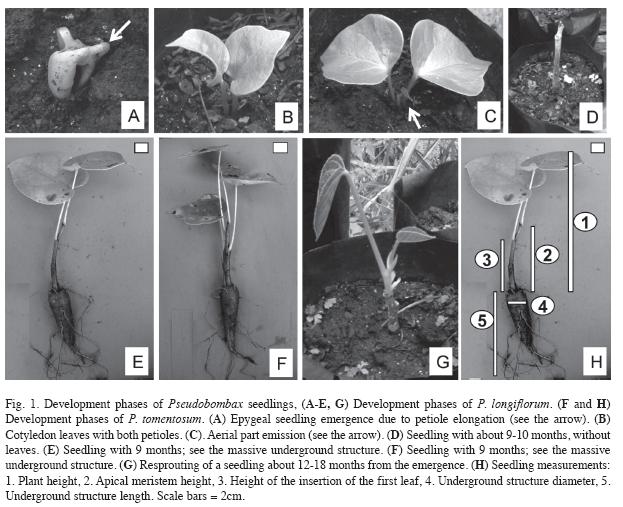
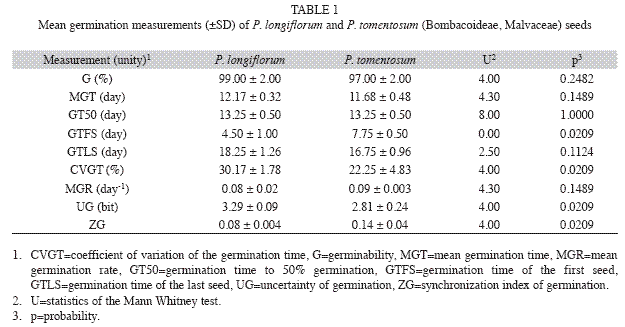
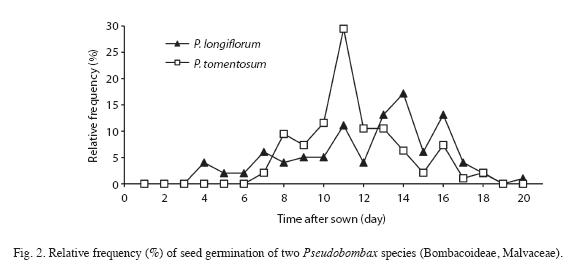
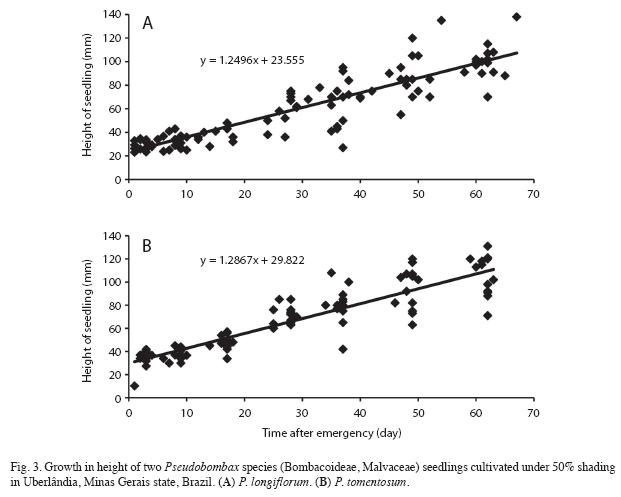
<body><![CDATA[<p align="justify"><font face="Verdana" size="2"><b>Studied area: </b>About 200 seeds of both species were collected in the Cerrado areas, Neotropical savannas region in Central Brazil (<i>sensu </i>Ribeiro &amp; Walter 1998). The seeds of <i>P. tomentosum </i>were collected in forest areas, near to Uberl&acirc;ndia city, Minas Gerais state (19&ordm;07&#8217; W - 48&ordm;22&#8217; S) and the seeds of <i>P. longiflorum </i>were collected in adjacent open pasture and areas along the BR050 highway (17&ordm;06&#8217; W - 47&ordm;45&#8217; S), between Uberl&acirc;ndia and Bras&iacute;lia. Germination and seedling growth experiments were carried out at the Campus of the Federal University of Uberl&acirc;ndia. The region climate is characterized as Aw according to the K&ouml;ppen scale (K&ouml;ppen 1948), tropical humid climate with a dry winter (April to September) and rainy summer (October to March) (Rosa <i>et al. </i>1991).</font></p> <b><font size="2"> </font></b>     <p align="justify"><b><font face="Verdana" size="2">Seed germination: </font></b><font  face="Verdana" size="2">Mature fruits of both species were collected in September and October 2003. The fruits were collected directly from the trees and placed to dry at room temperature in order to facilitate the extraction of the seeds. Seeds were stored in paper bags at room temperature (between 25 and 30&deg;C), in a dry chamber containing silica gel with humidity indicator, and kept until the installation of the experiment, 30 days later. The seeds were sown on fine vermiculite (expansion volume of 0.1m3), inside transparent germination boxes, moistened as necessary with distilled water. Boxes were kept in a germination chamber (Seedburo Company, model MDG2000) under continuous light (mean=11.90, SD=6.52</font><font face="Verdana" size="2">&#956;</font><font  face="Verdana" size="2">mol/ m2/s of photosynthetically active radiation), at 25&ordm;C. The experimental units were randomly distributed in the germination chamber, four replicates for each species with 25 seeds per replicate. The seed sample size was somewhat limited as a consequence of the high level of predation of fruits and seeds during the collection year. Although seed samples used for the experiments were rather small, the data was still sufficient for consistent statistical tests.</font></p>     <p align="justify"><font face="Verdana" size="2">The number of germinated seeds was observed daily and protrusion of the radicle or any part of the embryo was used as germination criterion. Germinability (G), represented by the percentage of germination in the experimental conditions (Labouriau 1983), mean germination time (MGT) ( <i>, </i>Labouriau 1970), germination time to 50% germination (GT50), germination time of the first germinated seed (GTFS), germination time of the last germinated seed (GTLS), coefficient of variation of the germination time (CVGT) (CVt, Ranal &amp; Santana 2006), mean germination rate (MGR) (, Labouriau 1970), uncertainty of germination (UG) (U, Labouriau &amp; Valadares 1976) and synchronization index of germination (ZG) (Z, Ranal &amp; Santana 2006 adapted from Primack 1980) were used to describe the germination process. Further details on mathematical expressions, authorship, intermediate calculus, the sense and the applications of these germination measurements can be found in Ranal &amp; Santana (2006) and Ranal <i>et al. </i>(2009). All germinated seeds were checked for the presence of more than one embryo per seed, known as polyembryony and common in Bombacoideae (Mendes-Rodrigues <i>et al. </i>2005).</font></p>     <p align="justify"><font face="Verdana" size="2"><b>Seedling morphology and height: </b>Seeds germinated in laboratory conditions were transplanted to black plastic bags (30cm high per 13cm diameter), filled with previously sieved open Cerrado oxisol. Seedlings were kept in a greenhouse covered with black plastic net with 50% shading and moistened when necessary. Starting from emergence date, periodic measurements of the maximum height of each plant, considered from ground to the apex of the last leaf were carried out (<a  href="/img/revistas/rbt/v59n4/a39i1.jpg">Fig. 1 H-1</a>). The data were adjusted to a linear regression model, as a function of the days from emergence. Some 20 <i>P. longiflorum </i>seedlings were evaluated up to 67 days after emergence and 15 <i>P. tomentosum </i>seedlings up to 63 days after emergence, when initial growth appeared to stabilize (seedlings showed no further increment in height). The seedling functional morphology was classified based on Miquel (1987). These seedlings were kept for nine months under the same conditions to asses a biomass allocation evaluation, as described below.</font></p>     <p align="justify"><font face="Verdana" size="2"><b>Biomass allocation: </b>Seedlings for biomass evaluation were analyzed nine months after sowing, before foliar abscission started. Seven plants of each species were removed from the soil and analyzed for the leaf number per plant, length of the shoot (considered from the soil to the apex of the last leaf) (<a href="/img/revistas/rbt/v59n4/a39i1.jpg">Fig. 1 H-1</a>), height of the apical meristem (from soil to the apical meristem) (<a  href="/img/revistas/rbt/v59n4/a39i1.jpg">Fig. 1 H-2</a>), height of insertion of the first leaf from soil (<a  href="/img/revistas/rbt/v59n4/a39i1.jpg">Fig. 1 H-3</a>), diameter at the shoot base, the largest diameter of the underground structure (<a  href="/img/revistas/rbt/v59n4/a39i1.jpg">Fig. 1 H-4</a>) and the length of the underground structure (<a  href="/img/revistas/rbt/v59n4/a39i1.jpg">Fig. 1 H-5</a>). The seedlings were divided into aerial (stems and leaves) and underground parts (mostly roots), and dried to constant mass at 70&ordm;C (eight days). The dry mass ratio between underground and aerial parts and between underground and total seedling dry mass were calculated (Hunt 1990). Non-quantitative observations continued up to 18 months after sowing.</font></p>     <p align="justify"><font face="Verdana" size="2">Germination measurements and seedling biometry data were evaluated for normality with the Shapiro-Wilk test. Data with normal distribution were compared using Student&#8217;s <i>t</i>-test (all seedling biometry measurements, except underground structure length) and data without normal distribution were compared by Mann-Whitney test (all germination measurements, plus underground structure length). The relative frequency of seed germination was compared between species using the Kolmogorov-Smirnov test. The seedling height collected during the first 70 days was adjusted to a simple linear regression model as a function of the time from emergence and the significance of the model tested with ANOVA. The slope and intercept of the linear regression were compared between species using Student&#8217;s <i>t</i>-test. For all the statistical analysis 0.05 of significance was adopted and procedures were based on Sokal &amp; Rolf (1995).</font></p>     <p align="justify"><b><font face="Verdana" size="3">Results</font></b></p> <font size="2"> </font>     <p align="justify"><b><font face="Verdana" size="2">Seed germination: </font></b><font  face="Verdana" size="2">Seeds of <i>P. longiflorum </i>and <i>P. tomentosum </i>did not present significant differences in germinability, mean germination time and mean germination rate (<a  href="/img/revistas/rbt/v59n4/a39t1.gif">Table 1</a>). On the other hand, seeds of <i>P. tomentosum </i>presented greater homogeneity (lower value of CVGT) and higher synchrony of germination (lower value of UG and higher value of ZG) than <i>P. longiflorum</i>. The first germination was registered for <i>P. longiflorum </i>four days after the beginning of the experiment and the last germination occurred after 20 days. For <i>P. tomentosum </i>germination started after seven days and continued up to the 18th day after sowing (<a  href="/img/revistas/rbt/v59n4/a39i2.jpg">Fig. 2</a>). The distribution of the relative frequency of germination differs between species (D=0.1980, p&lt;0.05) and demonstrated that in <i>P. longiflorum</i>, this process was more spread out through time, with some peaks of germination in days 11, 13, 14 and 16, while in <i>P. tomentosum, </i>germination was less spread out in time and a strong germination peak occurred at the 11<sup>th</sup> day after sowing (<a  href="/img/revistas/rbt/v59n4/a39i2.jpg">Fig. 2</a>). After 20 days, the remaining seeds were already degenerating and no further germination occurred. The two species presented only one embryo per seed and no polyembryony was recorded.    <br> </font></p>     <p align="justify"><font face="Verdana" size="2"><b>Seedling morphology and height: </b>The seedlings of both species presented photosynthetically active cotyledons exposed above ground (<a  href="/img/revistas/rbt/v59n4/a39i1.jpg">Fig. 1 A-C</a>) and were classified as phanero-epigeal-foliaceous (PEF <i>sensu </i>Miquel 1987). In classical PEF type the cotyledons are suspended from the ground by elongation of hypocotyl, while in these two species of <i>Pseudobombax </i>the elongation is caused by elongation of cotyledon petiole (<a  href="/img/revistas/rbt/v59n4/a39i1.jpg">Fig. 1 A</a>). Although cotyledons are hold above ground, their fixation point remains below ground (<a href="/img/revistas/rbt/v59n4/a39i1.jpg">Fig. 1 A-C</a>). The seedling height of both species was well adjusted to a simple linear regression model (r2=0.8091, F1,105=445.02, p&lt;0.0001 for <i>P. longiflorum </i>and r2=0.8087, F1,105=393.21, p&lt;0.0001 for <i>P. tomentosum</i>) (<a href="/img/revistas/rbt/v59n4/a39i3.jpg">Fig. 3A, 3B</a>). The two species showed no significant differences between the slopes of the equation (t=0.136, d.f.=198, p&gt;0.05), nor between intercepts (t=0.832, d.f.=199, p&gt;0.05), presenting basically the same pattern of continuous growth during the first 70 days.</font></p>     ]]></body>
<body><![CDATA[<p align="justify"><font face="Verdana" size="2"><b>Biomass allocation of dry mass: </b>Both species presented an underground structure (mostly roots) which represented about 80% of the total mass of seedlings (<a href="/img/revistas/rbt/v59n4/a39i1.jpg">Fig. 1 E-F</a>). Among the analyzed characteristics, the height of the apical meristem, diameter and the dry mass of underground structure, shoot and whole seedling dry mass were statistically higher in P. longiflorum in comparison with P. tomentosum (<a  href="/img/revistas/rbt/v59n4/a39t2.gif">Table 2</a>). For the other characteristics there were no significant differences. Both species cessed growth between 10 and 12 months, followed by leaf loss and resprout after the cool dry period (<a  href="/img/revistas/rbt/v59n4/a39i1.jpg">Fig. 1 D-G</a>).</font></p> <b><font face="Verdana" size="3">     <p align="justify">Discussion</p> </font></b><font size="2"> </font>     <div style="text-align: justify;"><font face="Verdana" size="2">Both species of <i>Pseudobombax </i>presented high germinability and similar growth patterns, but there were some differences in germination time and synchrony, which may be associated to their preferential habitat. The high germinability of the seeds of both <i>Pseudobombax </i>studied species is similar to the one observed in other Bombacoideae (Melo <i>et al. </i>1979, Sousa-Silva <i>et al. </i>2001, Scalon <i>et al. </i>2003, Zamith &amp; Scarano 2004, Fanti &amp; Perez 2005, Maia <i>et al. </i>2005, Wittmann <i>et al. </i>2007, Lopes <i>et al. 2</i>008, Zamora-Cornelio <i>et al. </i>2010), and contrast with lower germinability recorded for other species of <i>Pseudobombax </i>(S&aacute;nchez &amp; Zepeda 2004, Sautu <i>et al. </i>2006). This also indicates the absence of marked dormancy in <i>Pseudobombax</i>, although species with mechanical dormancy occur in Bombacoideae (Danthu <i>et al. </i>1995, Barbosa <i>et al. 2</i>004, Pinto <i>et al. 2</i>004).</font></div> <font face="Verdana" size="2">     <p align="justify">The germination process of both species was relatively slower; with mean germination times higher than the 5.1 to 7.1 days recorded for other Bombacoideae (Souza &amp; V&aacute;lio 2001, Ranal <i>et al. </i>2010), but was similar to seedling emergence times described for the group (Mendes-Rodrigues <i>et al. </i>2005). The germination time to 50% of germination (GT50) was also higher than the 5 to 7 days recorded for other species in the group (Maia <i>et al. </i>2005, Zamora-Cornelio <i>et al. </i>2010).</p>     <p align="justify">The duration of germination process was distributed along 4.50 to 18.25 days in the studied species (Germination time of the first seed-GTFS and of the last seed-GTLS), which is inside the ample variation recorded for species in the group, which ranged from 3 (Zamora-Cornelio <i>et al. </i>2010) to 19 days (Sautu <i>et al. </i>2006) to GTFS and from 6 (Zamora-Cornelio <i>et al. </i>2010) to 284 days (Sautu <i>et al. </i>2006) to GTLS.</p>     <p align="justify">The gradual germination process for both studied species of <i>Pseudobombax </i>can be considered a type of relative dormancy (<i>sensu </i>Labouriau 1983). It is not a mechanical dormancy as observed for <i>Ochroma pyramidale </i>(Cav. ex Lam.) Urb. (Zamora-Cornelio <i>et al. </i>2010), but it results in a germination process spread through time in opposition to a single germination peak observed in e.g. <i>Ceiba speciosa </i>(A.St.-Hil., A.Juss. &amp; Cambess.) Ravenna (Ranal <i>et al. </i>2010). This strategy of spreading the germination through time is present in other species occurring in the Cerrado region (Carvalho <i>et al. </i>2005, Pereira <i>et al. </i>2009, Ranal <i>et al. </i>2010, Mendes-Rodrigues <i>et al. 2</i>010).</p> </font><i><font size="2"> </font></i>     <p align="justify"><i><font face="Verdana" size="2">P. tomentosum </font></i><font  face="Verdana" size="2">showed significantly higher synchronization of germination than that observed for <i>P. longiflorum </i>seeds. The more asynchronous and heterogeneous germination observed for <i>P. longiflorum </i>seeds would increase survival ability at the beginning of the rains, which may vary in intensity and frequency in the Cerrado region (Oliveira 2008).</font></p>     <p align="justify"><font face="Verdana" size="2">The seedlings of the two species of <i>Pseudobombax </i>differed from others species within the subfamily as <i>Bombacopsis glabra </i>(Pasq.) A. Robyns (Baker 1960) and <i>Eriotheca pubescens </i>Schott &amp; Endl. (Mendes-Rodrigues <i>et al. </i>2005) which are polyembrionic. The functional morphology type of seedlings of <i>P. longiflorum </i>and <i>P. tomentosum </i>differed from <i>P. ellipticum </i>(Kunth) Dugand and <i>P. munguba </i>(Mart. &amp; Zucc.) Dugand, which present the cotyledons suspended by hypocotyl elongation (S&aacute;nchez &amp; Zepeda 2004, Maia <i>et al. </i>2005), a pattern commonly observed in classical PEF type (Ressel <i>et al. </i>2004).</font></p>     <p align="justify"><font face="Verdana" size="2"><i>P. longiflorum </i>and <i>P. tomentosum </i>presented similar growth pattern during the first 70 days. This trend of linear initial growth has been also observed for other Bombacoideae such as <i>Ceiba pentandra </i>(L.) Gaertn. (Pedroso &amp; Varela 1995) and <i>B. glabra </i>(Scalon <i>et al. </i>2003). The leaf fall and resprout after the cooler part of the dry season were not previously recorded for <i>Pseudobombax</i>, but this brevideciduous leafing behavior is common among seedlings of other Cerrado species (Oliveira &amp; Silva 1993, Oliveira 2008).</font></p>     <p align="justify"><font face="Verdana" size="2">Larger seedlings observed in <i>P. longiflorum </i>in relation to <i>P. tomentosum </i>could also be viewed as a way to increase chances of survival, since open Cerrado plants have a limited growing season (Oliveira 2008). Nevertheless, both species presented seasonal growth and dry matter allocation ratios similar to other Cerrado trees (Oliveira &amp; Silva 1993, Moreira &amp; Klink 2000). Despite their difference in predominant habitat, the two species of <i>Pseudobombax </i>allocated most dry mass to underground structures in detriment of the shoots. This root biased allocation would allow greater resistance to water and temperature stress during the dry period in open Cerrado plant formations, but would hinder competition and growth in forest environments (Hoffmann &amp; Franco 2003, Vieira <i>et al. </i>2008). The preferential investment to underground structures has been also recorded for other species from open Cerrado formations (Moreira &amp; Klink 2000, Hoffmann &amp; Franco 2003), including some species of Bombacoideae (Moreira &amp; Klink 2000, Ronquim <i>et al. 2</i>003, Ressel <i>et al. 2</i>004). But even for vicariant pairs of species restricted to either the savanna or forest, the physiological and developmental features were not easy to contrast (Hoffmann &amp; Franco 2003). It is important to notice here that the differences in seedling size may be a result of a better adjustment of <i>P. longiflorum </i>seeds to the Cerrado soil used in the experiment.</font></p>     ]]></body>
<body><![CDATA[<p align="justify"><font face="Verdana" size="2">Although the two <i>Pseudobombax </i>species differ in synchrony of germination and in some aspects of growth pattern, those differences are not clearcut and may be explained by the distribution overlap between species. New and more refined experiments will be necessary to see whether these differences, despite being significant, would really favour habitat specialization in the studied species.</font></p> <b><font face="Verdana" size="3">     <p align="justify">Acknowledgments</p> </font></b><font size="2"> </font><font face="Verdana" size="2">     <p align="justify">Thanks to Conselho Nacional de Desenvolvimento Cient&iacute;fico e Tecnol&oacute;gico &#8211; CNPq, and Funda&ccedil;&atilde;o de Amparo &agrave; Pesquisa do Estado de Minas Gerais &#8211; FAPEMIG for the research grant to the first author and the Denise Garcia de Santana for help in some of the statistical analysis. To Glauco Machado and Felipe Wanderley Amorim for the reading of the first versions of the manuscript and to Francielle Paulina de Ara&uacute;jo for the revision of the resumen. The results are part of the MSc. dissertation of the first author in the Post- Graduate Program of Ecology and Conservation of Natural Resources &#8211; Universidade Federal de Uberl&acirc;ndia.</p> </font> <hr style="width: 100%; height: 2px;"><b><font face="Verdana" size="3">     <p align="justify">References</p> </font></b><font size="2"> </font><font face="Verdana" size="2">     <!-- ref --><p align="justify">APG. 2003. An update of the Angiosperm Phylogeny Group classification for the orders and families of flowering plants: APG II. Bot. J. Linn. Soc. 141: 399-436.    &nbsp;&nbsp;&nbsp;&nbsp;&nbsp;&nbsp;&nbsp;&nbsp;[&#160;<a href="javascript:void(0);" onclick="javascript: window.open('/scielo.php?script=sci_nlinks&ref=1754400&pid=S0034-7744201100040003900001&lng=','','width=640,height=500,resizable=yes,scrollbars=1,menubar=yes,');">Links</a>&#160;]<!-- end-ref --> </p>     <!-- ref --><p align="justify">Baker, H.G. 1960. Apomixis and polyembryony in <i>Pachira oleaginea </i>(Bombacaceae). Amer. J. Bot. 47: 296-302.    &nbsp;&nbsp;&nbsp;&nbsp;&nbsp;&nbsp;&nbsp;&nbsp;[&#160;<a href="javascript:void(0);" onclick="javascript: window.open('/scielo.php?script=sci_nlinks&ref=1754402&pid=S0034-7744201100040003900002&lng=','','width=640,height=500,resizable=yes,scrollbars=1,menubar=yes,');">Links</a>&#160;]<!-- end-ref --></p>     <!-- ref --><p align="justify">Barbosa, A.P., P.T.B. Sampaio, M.A.A. Campos, V.P. Varela, C.Q.B. Gon&ccedil;alves &amp; S. Iida. 2004. Alternative technology for breaking dormancy of balsa wood (<i>Ochroma lagopus </i>Sw., Bombacaceae) seeds. Acta Amazonica 34: 107-110 (also available on-line: <a href="www.scielo.br/pdf/aa/v34n1/v34n1a13.pdf">www.scielo.br/pdf/aa/v34n1/v34n1a13.pdf</a>).    &nbsp;&nbsp;&nbsp;&nbsp;&nbsp;&nbsp;&nbsp;&nbsp;[&#160;<a href="javascript:void(0);" onclick="javascript: window.open('/scielo.php?script=sci_nlinks&ref=1754404&pid=S0034-7744201100040003900003&lng=','','width=640,height=500,resizable=yes,scrollbars=1,menubar=yes,');">Links</a>&#160;]<!-- end-ref --></p>     ]]></body>
<body><![CDATA[<!-- ref --><p align="justify">Baskin, C.C. &amp; J.M. Baskin. 1998. Seeds: ecology, biogeography, and evolution of dormancy and germination. Academic, San Diego, California, USA.    &nbsp;&nbsp;&nbsp;&nbsp;&nbsp;&nbsp;&nbsp;&nbsp;[&#160;<a href="javascript:void(0);" onclick="javascript: window.open('/scielo.php?script=sci_nlinks&ref=1754406&pid=S0034-7744201100040003900004&lng=','','width=640,height=500,resizable=yes,scrollbars=1,menubar=yes,');">Links</a>&#160;]<!-- end-ref --></p>     <!-- ref --><p align="justify">Carvalho, M.P., D.G. Santana &amp; M.A. Ranal. 2005. <i>Anacardium humile </i>A. St.-Hil. (Anacardiaceae) seedling emergence evaluated by means of small samples. Rev. Bras. Bot. 28: 627-633 (also available on-line: <a  href="www.scielo.br/pdf/rbb/v28n3/29011.pdf">www.scielo.br/pdf/rbb/v28n3/29011.pdf</a>).    &nbsp;&nbsp;&nbsp;&nbsp;&nbsp;&nbsp;&nbsp;&nbsp;[&#160;<a href="javascript:void(0);" onclick="javascript: window.open('/scielo.php?script=sci_nlinks&ref=1754408&pid=S0034-7744201100040003900005&lng=','','width=640,height=500,resizable=yes,scrollbars=1,menubar=yes,');">Links</a>&#160;]<!-- end-ref --></p>     <!-- ref --><p align="justify">Coelho, D.C. &amp; J. Marinho Filho. 2002. Diet and activity of <i>Lonchophylla dekeyseri </i>(Lonchophyllinae, Phyllostomidae) in the Federal District, Brazil. Mammalia 66: 319-330.    &nbsp;&nbsp;&nbsp;&nbsp;&nbsp;&nbsp;&nbsp;&nbsp;[&#160;<a href="javascript:void(0);" onclick="javascript: window.open('/scielo.php?script=sci_nlinks&ref=1754410&pid=S0034-7744201100040003900006&lng=','','width=640,height=500,resizable=yes,scrollbars=1,menubar=yes,');">Links</a>&#160;]<!-- end-ref --></p>     <!-- ref --><p align="justify">Danthu, P., J. Roussel, A. Gaye &amp; E.H.E. Mazzoudi. 1995. Baobab (<i>Adansonia digitada </i>L.) seed pretreatments for germination improvement. Seed Sci. Technol. 23: 469-475.    &nbsp;&nbsp;&nbsp;&nbsp;&nbsp;&nbsp;&nbsp;&nbsp;[&#160;<a href="javascript:void(0);" onclick="javascript: window.open('/scielo.php?script=sci_nlinks&ref=1754412&pid=S0034-7744201100040003900007&lng=','','width=640,height=500,resizable=yes,scrollbars=1,menubar=yes,');">Links</a>&#160;]<!-- end-ref --></p>     <!-- ref --><p align="justify">Fanti, S.C. &amp; S. Perez. 2005. Effects of accelerating aging on the seed vigor of <i>Chorisia speciosa </i>St. Hil. - Bombacaceae. R. &Aacute;rvore 29: 345-352 (also available on-line: <a href="http://www.scielo.br/pdf/rarv/v29n3/a01v29n3.pdf">http://www.scielo.br/pdf/rarv/v29n3/a01v29n3.pdf</a>).    &nbsp;&nbsp;&nbsp;&nbsp;&nbsp;&nbsp;&nbsp;&nbsp;[&#160;<a href="javascript:void(0);" onclick="javascript: window.open('/scielo.php?script=sci_nlinks&ref=1754414&pid=S0034-7744201100040003900008&lng=','','width=640,height=500,resizable=yes,scrollbars=1,menubar=yes,');">Links</a>&#160;]<!-- end-ref --></p>     ]]></body>
<body><![CDATA[<!-- ref --><p align="justify">Garwood, N.C. 1983. Seed germination in a seasonal tropical forest in Panama: A community study. Ecol. Monogr. 53: 159-181.    &nbsp;&nbsp;&nbsp;&nbsp;&nbsp;&nbsp;&nbsp;&nbsp;[&#160;<a href="javascript:void(0);" onclick="javascript: window.open('/scielo.php?script=sci_nlinks&ref=1754416&pid=S0034-7744201100040003900009&lng=','','width=640,height=500,resizable=yes,scrollbars=1,menubar=yes,');">Links</a>&#160;]<!-- end-ref --></p>     <!-- ref --><p align="justify">Gribel, R. 1988. Visitis of <i>Caluromys lanatus </i>(Didelphidae) to flowers of <i>Pseudobombax tometosum </i>(Bombacaceae): A probable case of pollination by marsupials in Central Brazil. Biotropica 20: 344-347.    &nbsp;&nbsp;&nbsp;&nbsp;&nbsp;&nbsp;&nbsp;&nbsp;[&#160;<a href="javascript:void(0);" onclick="javascript: window.open('/scielo.php?script=sci_nlinks&ref=1754418&pid=S0034-7744201100040003900010&lng=','','width=640,height=500,resizable=yes,scrollbars=1,menubar=yes,');">Links</a>&#160;]<!-- end-ref --></p>     <!-- ref --><p align="justify">Hoffmann, W.A. &amp; A.C. Franco. 2003. Comparative growth analysis of tropical forest and savanna woody plants using phylogenetically independent contrasts. J. Eco. 91: 475-484.    &nbsp;&nbsp;&nbsp;&nbsp;&nbsp;&nbsp;&nbsp;&nbsp;[&#160;<a href="javascript:void(0);" onclick="javascript: window.open('/scielo.php?script=sci_nlinks&ref=1754420&pid=S0034-7744201100040003900011&lng=','','width=640,height=500,resizable=yes,scrollbars=1,menubar=yes,');">Links</a>&#160;]<!-- end-ref --></p>     <!-- ref --><p align="justify">Hunt, R. 1990. Basic growth analysis: Plant growth analysis for beginners. Unwin Hyman, London, United Kingdom.    &nbsp;&nbsp;&nbsp;&nbsp;&nbsp;&nbsp;&nbsp;&nbsp;[&#160;<a href="javascript:void(0);" onclick="javascript: window.open('/scielo.php?script=sci_nlinks&ref=1754422&pid=S0034-7744201100040003900012&lng=','','width=640,height=500,resizable=yes,scrollbars=1,menubar=yes,');">Links</a>&#160;]<!-- end-ref --></p>     <!-- ref --><p align="justify">Joly, C.A. &amp; R.M.M. Crawford. 1983. Germination and some aspects of the metabolism of <i>Chorisia speciosa </i>St. Hill. seeds under anoxia. Rev. Bras. Bot. 6: 85-90.    &nbsp;&nbsp;&nbsp;&nbsp;&nbsp;&nbsp;&nbsp;&nbsp;[&#160;<a href="javascript:void(0);" onclick="javascript: window.open('/scielo.php?script=sci_nlinks&ref=1754424&pid=S0034-7744201100040003900013&lng=','','width=640,height=500,resizable=yes,scrollbars=1,menubar=yes,');">Links</a>&#160;]<!-- end-ref --></p>     ]]></body>
<body><![CDATA[<!-- ref --><p align="justify">K&ouml;ppen, W. 1948. Climatolog&iacute;a: con un estudio de los climas de la Tierra. Fondo de Cultura Econ&oacute;mica, M&eacute;xico D.F., M&eacute;xico.    &nbsp;&nbsp;&nbsp;&nbsp;&nbsp;&nbsp;&nbsp;&nbsp;[&#160;<a href="javascript:void(0);" onclick="javascript: window.open('/scielo.php?script=sci_nlinks&ref=1754426&pid=S0034-7744201100040003900014&lng=','','width=640,height=500,resizable=yes,scrollbars=1,menubar=yes,');">Links</a>&#160;]<!-- end-ref --></p>     <!-- ref --><p align="justify">Labouriau, L.G. 1970. On the physiology of seed germination in <i>Vicia graminea </i>Sm - I. An. Acad. Bras. Cienc. 42: 235-262.    &nbsp;&nbsp;&nbsp;&nbsp;&nbsp;&nbsp;&nbsp;&nbsp;[&#160;<a href="javascript:void(0);" onclick="javascript: window.open('/scielo.php?script=sci_nlinks&ref=1754428&pid=S0034-7744201100040003900015&lng=','','width=640,height=500,resizable=yes,scrollbars=1,menubar=yes,');">Links</a>&#160;]<!-- end-ref --></p>     <!-- ref --><p align="justify">Labouriau, L.G. 1983. A germina&ccedil;&atilde;o das sementes. Organiza&ccedil;&atilde;o dos Estados Americanos. Programa Regional de Desenvolvimento Cient&iacute;fico e T&eacute;cnologico. S&eacute;rie de Biologia. Monografia 24, Washington, Washington, USA.    &nbsp;&nbsp;&nbsp;&nbsp;&nbsp;&nbsp;&nbsp;&nbsp;[&#160;<a href="javascript:void(0);" onclick="javascript: window.open('/scielo.php?script=sci_nlinks&ref=1754430&pid=S0034-7744201100040003900016&lng=','','width=640,height=500,resizable=yes,scrollbars=1,menubar=yes,');">Links</a>&#160;]<!-- end-ref --></p>     <!-- ref --><p align="justify">Labouriau, L.G. &amp; M.E.B. Valadares. 1976. On the germination of seeds of <i>Calotropis procera </i>(Ait.) Ait.f. An. Acad. Bras. Cienc. 48: 263-284.    &nbsp;&nbsp;&nbsp;&nbsp;&nbsp;&nbsp;&nbsp;&nbsp;[&#160;<a href="javascript:void(0);" onclick="javascript: window.open('/scielo.php?script=sci_nlinks&ref=1754432&pid=S0034-7744201100040003900017&lng=','','width=640,height=500,resizable=yes,scrollbars=1,menubar=yes,');">Links</a>&#160;]<!-- end-ref --></p>     <!-- ref --><p align="justify">Lopes, J.C., M.T. Matheus, N.B. Corr&ecirc;a &amp; D.P. Silva. 2008. Germina&ccedil;&atilde;o de sementes de embiru&ccedil;u (<i>Pseudobombax grandiflorum </i>(Cav.) A. Robyns) em diferentes est&aacute;dios de matura&ccedil;&atilde;o e substratos. Floresta 38: 331-337 (also available on-line: <a  href="ojs.c3sl.ufpr.br/ojs2/index.php/floresta/article/viewFile/11628/8162">ojs.c3sl.ufpr.br/ojs2/index.php/floresta/article/viewFile/11628/8162</a>).    &nbsp;&nbsp;&nbsp;&nbsp;&nbsp;&nbsp;&nbsp;&nbsp;[&#160;<a href="javascript:void(0);" onclick="javascript: window.open('/scielo.php?script=sci_nlinks&ref=1754434&pid=S0034-7744201100040003900018&lng=','','width=640,height=500,resizable=yes,scrollbars=1,menubar=yes,');">Links</a>&#160;]<!-- end-ref --></p>     ]]></body>
<body><![CDATA[<!-- ref --><p align="justify">Lorenzi, H. 1992. &Aacute;rvores brasileiras: manual de identifica&ccedil;&atilde;o e cultivo de plantas arb&oacute;reas nativas do Brasil. Plantarum, Nova Odessa, S&atilde;o Paulo, Brasil.    &nbsp;&nbsp;&nbsp;&nbsp;&nbsp;&nbsp;&nbsp;&nbsp;[&#160;<a href="javascript:void(0);" onclick="javascript: window.open('/scielo.php?script=sci_nlinks&ref=1754436&pid=S0034-7744201100040003900019&lng=','','width=640,height=500,resizable=yes,scrollbars=1,menubar=yes,');">Links</a>&#160;]<!-- end-ref --></p> </font><font size="2"> </font><font face="Verdana" size="2">     <!-- ref --><p align="justify">Maia, L.A., S. Maia &amp; P. Parolin. 2005. Seedling morphology of non-pioneer trees in Central Amazonian v&aacute;rzea floodplain forests. Ecotropica 11: 1-8 (also available on-line: <a  href="www.gtoe.de/public_html/publications/pdf/11%201/Maia,%20Maia%20&amp;%20Parolin,%202005.pdf">www.gtoe.de/public_html/publications/pdf/11%201/Maia,%20Maia%20&amp;%20Parolin,%202005.pdf</a>).    &nbsp;&nbsp;&nbsp;&nbsp;&nbsp;&nbsp;&nbsp;&nbsp;[&#160;<a href="javascript:void(0);" onclick="javascript: window.open('/scielo.php?script=sci_nlinks&ref=1754438&pid=S0034-7744201100040003900020&lng=','','width=640,height=500,resizable=yes,scrollbars=1,menubar=yes,');">Links</a>&#160;]<!-- end-ref --></p>     <!-- ref --><p align="justify">Melo, J.T., J.F. Ribeiro &amp; V.L.G.F. Lima. 1979. Germina&ccedil;&atilde;o de sementes de algumas esp&eacute;cies arb&oacute;reas nativas do Cerrado. Rev. Bras. Sem. 1: 9-12 (also available on-line: <a  href="www.abrates.org.br/revista/artigos/1979/v1n2/artigo01.pdf">www.abrates.org.br/revista/artigos/1979/v1n2/artigo01.pdf</a>).    &nbsp;&nbsp;&nbsp;&nbsp;&nbsp;&nbsp;&nbsp;&nbsp;[&#160;<a href="javascript:void(0);" onclick="javascript: window.open('/scielo.php?script=sci_nlinks&ref=1754440&pid=S0034-7744201100040003900021&lng=','','width=640,height=500,resizable=yes,scrollbars=1,menubar=yes,');">Links</a>&#160;]<!-- end-ref --></p>     <!-- ref --><p align="justify">Mendes-Rodrigues, C., R. Carmo-Oliveira, S. Talavera, M. Arista, P.L. Ortiz &amp; P.E. Oliveira. 2005. Polyembryony and apomixis in <i>Eriotheca pubescens </i>(Malvaceae - Bombacoideae). Plant Biol. 7: 533-540.    &nbsp;&nbsp;&nbsp;&nbsp;&nbsp;&nbsp;&nbsp;&nbsp;[&#160;<a href="javascript:void(0);" onclick="javascript: window.open('/scielo.php?script=sci_nlinks&ref=1754442&pid=S0034-7744201100040003900022&lng=','','width=640,height=500,resizable=yes,scrollbars=1,menubar=yes,');">Links</a>&#160;]<!-- end-ref --></p>     <!-- ref --><p align="justify">Mendes-Rodrigues, C., F.P. de Ara&uacute;jo, C. Barbosa-Souza, V. Barbosa-Souza, M.A. Ranal, D.G. de Santana &amp; P.E. Oliveira. 2010. Multiple dormancy and maternal effect on <i>Miconia ferruginata </i>DC. (Melastomataceae) seed germination, Serra de Caldas Novas, Goi&aacute;s, Brazil. Rev. Bras. Bot. 33: 93-105 (also available on-line: <a href="www.scielo.br/pdf/rbb/v33n1/09.pdf">www.scielo.br/pdf/rbb/v33n1/09.pdf</a>).    &nbsp;&nbsp;&nbsp;&nbsp;&nbsp;&nbsp;&nbsp;&nbsp;[&#160;<a href="javascript:void(0);" onclick="javascript: window.open('/scielo.php?script=sci_nlinks&ref=1754444&pid=S0034-7744201100040003900023&lng=','','width=640,height=500,resizable=yes,scrollbars=1,menubar=yes,');">Links</a>&#160;]<!-- end-ref --></p>     ]]></body>
<body><![CDATA[<!-- ref --><p align="justify">Miquel, S. 1987. Morphologie fonctionnele de plantules d&#8217;esp&egrave;ces foresti&egrave;res du Gabon. Bull. Mus. Hist. Nat. 9: 101-121.    &nbsp;&nbsp;&nbsp;&nbsp;&nbsp;&nbsp;&nbsp;&nbsp;[&#160;<a href="javascript:void(0);" onclick="javascript: window.open('/scielo.php?script=sci_nlinks&ref=1754446&pid=S0034-7744201100040003900024&lng=','','width=640,height=500,resizable=yes,scrollbars=1,menubar=yes,');">Links</a>&#160;]<!-- end-ref --></p>     <!-- ref --><p align="justify">Moreira, A.G. &amp; C.A. Klink. 2000. Biomass allocation and growth of tree seedlings from two contrasting Brazilian savannas. Ecotropicos 13: 43-51.    &nbsp;&nbsp;&nbsp;&nbsp;&nbsp;&nbsp;&nbsp;&nbsp;[&#160;<a href="javascript:void(0);" onclick="javascript: window.open('/scielo.php?script=sci_nlinks&ref=1754448&pid=S0034-7744201100040003900025&lng=','','width=640,height=500,resizable=yes,scrollbars=1,menubar=yes,');">Links</a>&#160;]<!-- end-ref --></p>     <!-- ref --><p align="justify">Oliveira, P.E.A.M. 2008. Fenologia e biologia reprodutiva de esp&eacute;cies de Cerrado, p. 273-290. <i>In </i>S.M. Sano, S.P. de Almeida &amp; J.F. Ribeiro (eds.). Cerrado: ecologia e flora. Embrapa Informa&ccedil;&atilde;o Tecnol&oacute;gica, Bras&iacute;lia, Brasil.    &nbsp;&nbsp;&nbsp;&nbsp;&nbsp;&nbsp;&nbsp;&nbsp;[&#160;<a href="javascript:void(0);" onclick="javascript: window.open('/scielo.php?script=sci_nlinks&ref=1754450&pid=S0034-7744201100040003900026&lng=','','width=640,height=500,resizable=yes,scrollbars=1,menubar=yes,');">Links</a>&#160;]<!-- end-ref --></p>     <!-- ref --><p align="justify">Oliveira, P.E.A.M. &amp; J.C.S. Silva. 1993. Reproductive biology of two species of <i>Kielmeyera </i>(Guttiferae) in the Cerrados of Central Brazil. J. Trop. Ecol. 9: 67.    &nbsp;&nbsp;&nbsp;&nbsp;&nbsp;&nbsp;&nbsp;&nbsp;[&#160;<a href="javascript:void(0);" onclick="javascript: window.open('/scielo.php?script=sci_nlinks&ref=1754452&pid=S0034-7744201100040003900027&lng=','','width=640,height=500,resizable=yes,scrollbars=1,menubar=yes,');">Links</a>&#160;]<!-- end-ref --></p>     <!-- ref --><p align="justify">Pedroso, S.G. &amp; V.P. Varela. 1995. Efeito do sombreamento no crescimento de mudas de suma&uacute;ma (<i>Ceiba pentandra </i>(L.) Gaertn). Rev. Bras. Sem. 17: 47-51 (also available on-line: <a  href="www.abrates.org.br/revista/artigos/1995/v17n1/artigo09.pdf">www.abrates.org.br/revista/artigos/1995/v17n1/artigo09.pdf</a>).    &nbsp;&nbsp;&nbsp;&nbsp;&nbsp;&nbsp;&nbsp;&nbsp;[&#160;<a href="javascript:void(0);" onclick="javascript: window.open('/scielo.php?script=sci_nlinks&ref=1754454&pid=S0034-7744201100040003900028&lng=','','width=640,height=500,resizable=yes,scrollbars=1,menubar=yes,');">Links</a>&#160;]<!-- end-ref --></p>     ]]></body>
<body><![CDATA[<!-- ref --><p align="justify">Pereira, R.S., D.G. Santana &amp; M.A. Ranal. 2009. Emerg&ecirc;ncia de pl&acirc;ntulas oriundas de sementes rec&eacute;mcolhidas e armazenadas de <i>Copaifera langsdorffii </i>Desf. (Caesalpinioideae), Tri&acirc;ngulo Mineiro, Brasil. R. &Aacute;rvore 33: 643-652 (also available on-line: <a  href="www.scielo.br/pdf/rarv/v33n4/v33n4a07.pdf">www.scielo.br/pdf/rarv/v33n4/v33n4a07.pdf</a>).    &nbsp;&nbsp;&nbsp;&nbsp;&nbsp;&nbsp;&nbsp;&nbsp;[&#160;<a href="javascript:void(0);" onclick="javascript: window.open('/scielo.php?script=sci_nlinks&ref=1754456&pid=S0034-7744201100040003900029&lng=','','width=640,height=500,resizable=yes,scrollbars=1,menubar=yes,');">Links</a>&#160;]<!-- end-ref --></p>     <!-- ref --><p align="justify">Pinto, A.M., M.T. Inoue &amp; A.C. Nogueira. 2004. Conservation and vigour of balsawood seeds (<i>Ochroma pyramidale</i>). Acta Amazonica 34: 233-236 (also available on-line: <a  href="www.scielo.br/pdf/aa/v34n2/v34n2a10.pdf">www.scielo.br/pdf/aa/v34n2/v34n2a10.pdf</a>).    &nbsp;&nbsp;&nbsp;&nbsp;&nbsp;&nbsp;&nbsp;&nbsp;[&#160;<a href="javascript:void(0);" onclick="javascript: window.open('/scielo.php?script=sci_nlinks&ref=1754458&pid=S0034-7744201100040003900030&lng=','','width=640,height=500,resizable=yes,scrollbars=1,menubar=yes,');">Links</a>&#160;]<!-- end-ref --></p>     <!-- ref --><p align="justify">Primack, R.B. 1980. Variation in the phenology of naturalpopulations of montane shrubs in New-Zealand. J. Ecol. 68: 849-862.    &nbsp;&nbsp;&nbsp;&nbsp;&nbsp;&nbsp;&nbsp;&nbsp;[&#160;<a href="javascript:void(0);" onclick="javascript: window.open('/scielo.php?script=sci_nlinks&ref=1754460&pid=S0034-7744201100040003900031&lng=','','width=640,height=500,resizable=yes,scrollbars=1,menubar=yes,');">Links</a>&#160;]<!-- end-ref --></p>     <!-- ref --><p align="justify">Ranal, M.A. &amp; D.G. Santana. 2006. How and why to measure the germination process? Rev. Bras. Bot. 29: 1-11 (also available on-line: www.scielo.br/pdf/rbb/v29n1/a02v29n1.pdf ).    &nbsp;&nbsp;&nbsp;&nbsp;&nbsp;&nbsp;&nbsp;&nbsp;[&#160;<a href="javascript:void(0);" onclick="javascript: window.open('/scielo.php?script=sci_nlinks&ref=1754462&pid=S0034-7744201100040003900032&lng=','','width=640,height=500,resizable=yes,scrollbars=1,menubar=yes,');">Links</a>&#160;]<!-- end-ref --></p>     <!-- ref --><p align="justify">Ranal, M.A., D.G. Santana, W.R. Ferreira &amp; C. Mendes-Rodrigues. 2009. Calculating germination measurements and organizing spreadsheets. Rev. Bras. Bot. 32: 849-855 (also available on line: <a href="www.scielo.br/pdf/rbb/v32n4/a22v32n4.pdf">www.scielo.br/pdf/rbb/v32n4/a22v32n4.pdf</a>).    &nbsp;&nbsp;&nbsp;&nbsp;&nbsp;&nbsp;&nbsp;&nbsp;[&#160;<a href="javascript:void(0);" onclick="javascript: window.open('/scielo.php?script=sci_nlinks&ref=1754464&pid=S0034-7744201100040003900033&lng=','','width=640,height=500,resizable=yes,scrollbars=1,menubar=yes,');">Links</a>&#160;]<!-- end-ref --></p>     ]]></body>
<body><![CDATA[<!-- ref --><p align="justify">Ranal, M.A., D.G. Santana &amp; I. Schiavini. 2010. Are there germination patterns for cerrado species?, p. 106-159. <i>In </i>K. Del-Claro, P.S. Oliveira, V. Rico-Gray, A.A.A. Barbosa, A. Bonet, F.R. Scarno, F.J.M. Garz&oacute;n, M.V. Sampaio, M.R. Morris, N. Ramirez, O. Mar&ccedil;al J&uacute;nior, R.H.F. Macedo, R.J. Marquis, L. Coelho, R.P. Martins, S.C. Rodrigues &amp; U. Luttge (eds.). Encyclopedia of life support systems. Tropical biology and conservation management, savannah ecosystems, UNESCO/EOLSS. Encyclopedia of life support systems, Oxford, England (also available on line: www.eolss.net).    &nbsp;&nbsp;&nbsp;&nbsp;&nbsp;&nbsp;&nbsp;&nbsp;[&#160;<a href="javascript:void(0);" onclick="javascript: window.open('/scielo.php?script=sci_nlinks&ref=1754466&pid=S0034-7744201100040003900034&lng=','','width=640,height=500,resizable=yes,scrollbars=1,menubar=yes,');">Links</a>&#160;]<!-- end-ref --></p>     <!-- ref --><p align="justify">Ressel, K., F.A.G. Guilherme, I. Schiavini &amp; P.E. Oliveira. 2004. Functional morphology and ecology of tree species seedlings of the Ecological Station of Panga, Uberl&acirc;ndia, Minas Gerais. Rev. Bras. Bot. 27: 311-323 (also available on-line: <a  href="www.scielo.br/pdf/rbb/v27n2/v27n2a10.pdf">www.scielo.br/pdf/rbb/v27n2/v27n2a10.pdf</a>).    &nbsp;&nbsp;&nbsp;&nbsp;&nbsp;&nbsp;&nbsp;&nbsp;[&#160;<a href="javascript:void(0);" onclick="javascript: window.open('/scielo.php?script=sci_nlinks&ref=1754468&pid=S0034-7744201100040003900035&lng=','','width=640,height=500,resizable=yes,scrollbars=1,menubar=yes,');">Links</a>&#160;]<!-- end-ref --></p>     <!-- ref --><p align="justify">Ribeiro, J.F. &amp; B.M.T. Walter. 1998. Fitofisionomias do bioma cerrado, p. 89-166. <i>In </i>S.M. Sano &amp; S.P. Almeida (eds.). Cerrado: ambiente e flora. Embrapa Planaltina, Bras&iacute;lia, Bras&iacute;lia, Brasil.    &nbsp;&nbsp;&nbsp;&nbsp;&nbsp;&nbsp;&nbsp;&nbsp;[&#160;<a href="javascript:void(0);" onclick="javascript: window.open('/scielo.php?script=sci_nlinks&ref=1754470&pid=S0034-7744201100040003900036&lng=','','width=640,height=500,resizable=yes,scrollbars=1,menubar=yes,');">Links</a>&#160;]<!-- end-ref --></p>     <!-- ref --><p align="justify">Ronquim, C.C., C.H.B.A. Prado &amp; N.F. Paula. 2003. Growth and photosynthetic capacity in two woody species of cerrado vegetation under different radiation availability. Braz. Arch. Biol. Technol. 46: 243-252.    &nbsp;&nbsp;&nbsp;&nbsp;&nbsp;&nbsp;&nbsp;&nbsp;[&#160;<a href="javascript:void(0);" onclick="javascript: window.open('/scielo.php?script=sci_nlinks&ref=1754472&pid=S0034-7744201100040003900037&lng=','','width=640,height=500,resizable=yes,scrollbars=1,menubar=yes,');">Links</a>&#160;]<!-- end-ref --></p>     <!-- ref --><p align="justify">Rosa, R., S.C. Lima &amp; W.L. Assun&ccedil;&atilde;o. 1991. Abordagem preliminar das condi&ccedil;&otilde;es clim&aacute;ticas de Uberl&acirc;ndia, MG. Soc. Nat. 3: 91-108.    &nbsp;&nbsp;&nbsp;&nbsp;&nbsp;&nbsp;&nbsp;&nbsp;[&#160;<a href="javascript:void(0);" onclick="javascript: window.open('/scielo.php?script=sci_nlinks&ref=1754474&pid=S0034-7744201100040003900038&lng=','','width=640,height=500,resizable=yes,scrollbars=1,menubar=yes,');">Links</a>&#160;]<!-- end-ref --></p>     ]]></body>
<body><![CDATA[<!-- ref --><p align="justify">S&aacute;nchez, O.S. &amp; C.H. Zepeda. 2004. Estudio morfol&oacute;gico de pl&aacute;ntulas de la familia Bombacaceae en Quintana Roo, M&eacute;xico. Foresta Veracruzana 6: 1-6 (also available on-line: <a  href="redalyc.uaemex.mx/redalyc/src/inicio/ArtPdfRed.jsp?iCve=49760201">redalyc.uaemex.mx/redalyc/src/inicio/ArtPdfRed.jsp?iCve=49760201</a>).    &nbsp;&nbsp;&nbsp;&nbsp;&nbsp;&nbsp;&nbsp;&nbsp;[&#160;<a href="javascript:void(0);" onclick="javascript: window.open('/scielo.php?script=sci_nlinks&ref=1754476&pid=S0034-7744201100040003900039&lng=','','width=640,height=500,resizable=yes,scrollbars=1,menubar=yes,');">Links</a>&#160;]<!-- end-ref --></p>     <!-- ref --><p align="justify">Sautu, A., J.M. Baskin, C.C. Baskin &amp; R. Condit. 2006. Studies on the seed biology of 100 native species of trees in a seasonal moist tropical forest, Panama, Central America. For. Ecol. Manag. 234: 245-263.    &nbsp;&nbsp;&nbsp;&nbsp;&nbsp;&nbsp;&nbsp;&nbsp;[&#160;<a href="javascript:void(0);" onclick="javascript: window.open('/scielo.php?script=sci_nlinks&ref=1754478&pid=S0034-7744201100040003900040&lng=','','width=640,height=500,resizable=yes,scrollbars=1,menubar=yes,');">Links</a>&#160;]<!-- end-ref --></p>     <!-- ref --><p align="justify">Scalon, S.P.Q., R.M. Mussury, M.R. Rigoni &amp; H.S. Filho. 2003. Initial growth of <i>Bombacopsis glabra </i>(Pasq.) A. Robyns seedlings under shading conditions. R. &Aacute;rvore 27: 753-758 (also available on-line: <a href="www.scielo.br/pdf/rarv/v27n6/a01v27n6.pdf">www.scielo.br/pdf/rarv/v27n6/a01v27n6.pdf</a>).    &nbsp;&nbsp;&nbsp;&nbsp;&nbsp;&nbsp;&nbsp;&nbsp;[&#160;<a href="javascript:void(0);" onclick="javascript: window.open('/scielo.php?script=sci_nlinks&ref=1754480&pid=S0034-7744201100040003900041&lng=','','width=640,height=500,resizable=yes,scrollbars=1,menubar=yes,');">Links</a>&#160;]<!-- end-ref --></p>     <!-- ref --><p align="justify">Silva J&uacute;nior, M.C., G.C. Santos, P.E. Nogueira, C.B.R. Munhoz &amp; A.E. Ramos. 2005. 100 &Aacute;rvores do Cerrado: guia de campo. Rede de Sementes do Cerrado, Bras&iacute;lia, Bras&iacute;lia, Brasil.    &nbsp;&nbsp;&nbsp;&nbsp;&nbsp;&nbsp;&nbsp;&nbsp;[&#160;<a href="javascript:void(0);" onclick="javascript: window.open('/scielo.php?script=sci_nlinks&ref=1754482&pid=S0034-7744201100040003900042&lng=','','width=640,height=500,resizable=yes,scrollbars=1,menubar=yes,');">Links</a>&#160;]<!-- end-ref --></p>     <!-- ref --><p align="justify">Silva, L.A. &amp; A. Scariot. 2004. Arboreal community of a seasonal deciduous forest on limestone outcrop in S&atilde;o Domingos-Goi&aacute;s, Parana river Basin, Brazil. R. &Aacute;rvore 28: 61-67 (also available on-line: <a href="www.scielo.br/pdf/rarv/v28n1/a08v28n1.pdf">www.scielo.br/pdf/rarv/v28n1/a08v28n1.pdf</a>).    &nbsp;&nbsp;&nbsp;&nbsp;&nbsp;&nbsp;&nbsp;&nbsp;[&#160;<a href="javascript:void(0);" onclick="javascript: window.open('/scielo.php?script=sci_nlinks&ref=1754484&pid=S0034-7744201100040003900043&lng=','','width=640,height=500,resizable=yes,scrollbars=1,menubar=yes,');">Links</a>&#160;]<!-- end-ref --></p>     ]]></body>
<body><![CDATA[<!-- ref --><p align="justify">Sokal, R.R. &amp; F.J. Rohlf. 1995. Biometry the principles and practice of statistics in biological research. Freeman, New York, USA.    &nbsp;&nbsp;&nbsp;&nbsp;&nbsp;&nbsp;&nbsp;&nbsp;[&#160;<a href="javascript:void(0);" onclick="javascript: window.open('/scielo.php?script=sci_nlinks&ref=1754486&pid=S0034-7744201100040003900044&lng=','','width=640,height=500,resizable=yes,scrollbars=1,menubar=yes,');">Links</a>&#160;]<!-- end-ref --></p>     <!-- ref --><p align="justify">Souza, R.P. &amp; I.F.M. V&aacute;lio. 2001. Seed size, seed germination, and seedling survival of Brazilian tropical tree species differing in successional status. Biotropica 33: 447-457.    &nbsp;&nbsp;&nbsp;&nbsp;&nbsp;&nbsp;&nbsp;&nbsp;[&#160;<a href="javascript:void(0);" onclick="javascript: window.open('/scielo.php?script=sci_nlinks&ref=1754488&pid=S0034-7744201100040003900045&lng=','','width=640,height=500,resizable=yes,scrollbars=1,menubar=yes,');">Links</a>&#160;]<!-- end-ref --></p>     <!-- ref --><p align="justify">Souza-Silva, J.C., J.F. Ribeiro, C.E.L. Fonseca &amp; N.B. Antunes. 2001. Germina&ccedil;&atilde;o de sementes e emergencia de pl&acirc;ntulas de esp&eacute;cies arb&oacute;reas e arbustivas que ocorrem em Matas de Galeria, p. 379-422. <i>In </i>J.F. Ribeiro, C.E.L. Fonseca &amp; J.C. Sousa-Silva (eds.). Cerrado: caracteriza&ccedil;&atilde;o e recupera&ccedil;&atilde;o de Matas de Galeria. Embrapa Cerrados, Bras&iacute;lia, Bras&iacute;lia, Brasil.    &nbsp;&nbsp;&nbsp;&nbsp;&nbsp;&nbsp;&nbsp;&nbsp;[&#160;<a href="javascript:void(0);" onclick="javascript: window.open('/scielo.php?script=sci_nlinks&ref=1754490&pid=S0034-7744201100040003900046&lng=','','width=640,height=500,resizable=yes,scrollbars=1,menubar=yes,');">Links</a>&#160;]<!-- end-ref --></p> </font><font size="2"> </font><font face="Verdana" size="2">     <!-- ref --><p align="justify">Vazquez-Yanes, C. 1974. Studies on the germination of seeds of <i>Ochroma lagopus </i>Swartz. Turrialba 21: 176-179.    &nbsp;&nbsp;&nbsp;&nbsp;&nbsp;&nbsp;&nbsp;&nbsp;[&#160;<a href="javascript:void(0);" onclick="javascript: window.open('/scielo.php?script=sci_nlinks&ref=1754492&pid=S0034-7744201100040003900047&lng=','','width=640,height=500,resizable=yes,scrollbars=1,menubar=yes,');">Links</a>&#160;]<!-- end-ref --></p> </font><font size="2"> </font><font face="Verdana" size="2">     <!-- ref --><p align="justify">Vieira, D.L.M., V.V. de Lima, A.C. Sevilha &amp; A. Scariot. 2008. Consequences of dry-season seed dispersal on seedling establishment of dry forest trees: Should we store seeds until the rains? Forest Ecol. Manag. 256: 471-481.    &nbsp;&nbsp;&nbsp;&nbsp;&nbsp;&nbsp;&nbsp;&nbsp;[&#160;<a href="javascript:void(0);" onclick="javascript: window.open('/scielo.php?script=sci_nlinks&ref=1754494&pid=S0034-7744201100040003900048&lng=','','width=640,height=500,resizable=yes,scrollbars=1,menubar=yes,');">Links</a>&#160;]<!-- end-ref --></p>     ]]></body>
<body><![CDATA[<!-- ref --><p align="justify">Zamith, L.R. &amp; F.R. Scarano. 2004. Seedling production of Restinga species of Rio de Janeiro municipality, RJ, Brazil. Acta Bot. Bras. 18: 161-176 (also available on-line: <a  href="www.scielo.br/pdf/abb/v18n1/v18n1a14.pdf">www.scielo.br/pdf/abb/v18n1/v18n1a14.pdf</a>).    &nbsp;&nbsp;&nbsp;&nbsp;&nbsp;&nbsp;&nbsp;&nbsp;[&#160;<a href="javascript:void(0);" onclick="javascript: window.open('/scielo.php?script=sci_nlinks&ref=1754496&pid=S0034-7744201100040003900049&lng=','','width=640,height=500,resizable=yes,scrollbars=1,menubar=yes,');">Links</a>&#160;]<!-- end-ref --></p>     <!-- ref --><p align="justify">Zamora-Cornelio, L.F., S. Ochoa-Gaona, G.V. Sim&oacute;n, J.C. Albores &amp; B.H.J. de Jong. 2010. Germinaci&oacute;n de semillas y clave para la identificaci&oacute;n de pl&aacute;ntulas de seis especies arb&oacute;reas nativas de humedales del sureste de M&eacute;xico. Rev. Biol. Trop. 58: 717-732 (also available on-line: <a  href="www.ots.ac.cr/tropiweb/attachments/volumes/vol58-2/15-Zamora-Germinacion.pdf">www.ots.ac.cr/tropiweb/attachments/volumes/vol58-2/15-Zamora-Germinacion.pdf</a>).    &nbsp;&nbsp;&nbsp;&nbsp;&nbsp;&nbsp;&nbsp;&nbsp;[&#160;<a href="javascript:void(0);" onclick="javascript: window.open('/scielo.php?script=sci_nlinks&ref=1754498&pid=S0034-7744201100040003900050&lng=','','width=640,height=500,resizable=yes,scrollbars=1,menubar=yes,');">Links</a>&#160;]<!-- end-ref --></p>     <!-- ref --><p align="justify">Wittmann, A., M.T.F. Piedade, P. Parolin &amp; F. Wittmann. 2007. Germination in four low-v&aacute;rzea tree species of Central Amazonia. Aquat. Bot. 86: 197-203.    &nbsp;&nbsp;&nbsp;&nbsp;&nbsp;&nbsp;&nbsp;&nbsp;[&#160;<a href="javascript:void(0);" onclick="javascript: window.open('/scielo.php?script=sci_nlinks&ref=1754500&pid=S0034-7744201100040003900051&lng=','','width=640,height=500,resizable=yes,scrollbars=1,menubar=yes,');">Links</a>&#160;]<!-- end-ref --><br> </p>     <br>     <br> <a name="Correspondencia"></a>Correspondencia a: </font><font><font  face="Verdana" size="2">Clesnan Mendes-Rodrigues, Paulo Eug&ecirc;nio Oliveira &amp; Marli Aparecida Ranal. </font></font><font><font  face="Verdana" size="2">Programa de P&oacute;s-gradua&ccedil;&atilde;o em Ecologia e Conserva&ccedil;&atilde;o de Recursos Naturais, Instituto de Biologia, Universidade Federal de Uberl&acirc;ndia, Caixa Postal 593, 38400-902 Uberl&acirc;ndia, Minas Gerais, Brazil; <a href="mailto:clesnan@hotmail.com">clesnan@hotmail.com</a>, <a href="mailto:bpoliveira@ufu.br">bpoliveira@ufu.br</a>, <a  href="mailto:ranal@ufu.br">ranal@ufu.br</a></font></font><font size="2"> </font> <hr style="width: 100%; height: 2px;"><font face="Verdana" size="2">     <p align="center">Received 22-X1-2010. Corrected 07-IV-2011. Accepted 09-V-2011.</p> </font>      ]]></body><back>
<ref-list>
<ref id="B1">
<nlm-citation citation-type="journal">
<collab>APG</collab>
<article-title xml:lang="en"><![CDATA[An update of the Angiosperm Phylogeny Group classification for the orders and families of flowering plants: APG II]]></article-title>
<source><![CDATA[Bot. J. Linn. Soc]]></source>
<year>2003</year>
<volume>141</volume>
<page-range>399-436</page-range></nlm-citation>
</ref>
<ref id="B2">
<nlm-citation citation-type="journal">
<person-group person-group-type="author">
<name>
<surname><![CDATA[Baker]]></surname>
<given-names><![CDATA[H.G]]></given-names>
</name>
</person-group>
<article-title xml:lang="en"><![CDATA[Apomixis and polyembryony in Pachira oleaginea (Bombacaceae)]]></article-title>
<source><![CDATA[Amer. J. Bot]]></source>
<year>1960</year>
<volume>47</volume>
<page-range>296-302</page-range></nlm-citation>
</ref>
<ref id="B3">
<nlm-citation citation-type="journal">
<person-group person-group-type="author">
<name>
<surname><![CDATA[Barbosa]]></surname>
<given-names><![CDATA[A.P]]></given-names>
</name>
<name>
<surname><![CDATA[Sampaio]]></surname>
<given-names><![CDATA[P.T.B]]></given-names>
</name>
<name>
<surname><![CDATA[Campos]]></surname>
<given-names><![CDATA[M.A.A]]></given-names>
</name>
<name>
<surname><![CDATA[Varela]]></surname>
<given-names><![CDATA[V.P]]></given-names>
</name>
<name>
<surname><![CDATA[Gonçalves]]></surname>
<given-names><![CDATA[C.Q.B]]></given-names>
</name>
<name>
<surname><![CDATA[Iida]]></surname>
<given-names><![CDATA[S]]></given-names>
</name>
</person-group>
<article-title xml:lang="en"><![CDATA[Alternative technology for breaking dormancy of balsa wood (Ochroma lagopus Sw., Bombacaceae) seeds]]></article-title>
<source><![CDATA[Acta Amazonica]]></source>
<year>2004</year>
<volume>34</volume>
<page-range>107-110</page-range></nlm-citation>
</ref>
<ref id="B4">
<nlm-citation citation-type="book">
<person-group person-group-type="author">
<name>
<surname><![CDATA[Baskin]]></surname>
<given-names><![CDATA[C.C]]></given-names>
</name>
<name>
<surname><![CDATA[Baskin]]></surname>
<given-names><![CDATA[J.M]]></given-names>
</name>
</person-group>
<source><![CDATA[Seeds: ecology, biogeography, and evolution of dormancy and germination]]></source>
<year>1998</year>
<publisher-loc><![CDATA[San Diego^eCalifornia California]]></publisher-loc>
<publisher-name><![CDATA[Academic]]></publisher-name>
</nlm-citation>
</ref>
<ref id="B5">
<nlm-citation citation-type="journal">
<person-group person-group-type="author">
<name>
<surname><![CDATA[Carvalho]]></surname>
<given-names><![CDATA[M.P]]></given-names>
</name>
<name>
<surname><![CDATA[Santana]]></surname>
<given-names><![CDATA[D.G]]></given-names>
</name>
<name>
<surname><![CDATA[Ranal]]></surname>
<given-names><![CDATA[M.A]]></given-names>
</name>
</person-group>
<article-title xml:lang="en"><![CDATA[Anacardium humile A. St.-Hil. (Anacardiaceae) seedling emergence evaluated by means of small samples]]></article-title>
<source><![CDATA[Rev. Bras. Bot]]></source>
<year>2005</year>
<volume>28</volume>
<page-range>627-633</page-range></nlm-citation>
</ref>
<ref id="B6">
<nlm-citation citation-type="journal">
<person-group person-group-type="author">
<name>
<surname><![CDATA[Coelho]]></surname>
<given-names><![CDATA[D.C]]></given-names>
</name>
<name>
<surname><![CDATA[Marinho Filho]]></surname>
<given-names><![CDATA[J]]></given-names>
</name>
</person-group>
<article-title xml:lang="en"><![CDATA[Diet and activity of Lonchophylla dekeyseri (Lonchophyllinae, Phyllostomidae) in the Federal District, Brazil]]></article-title>
<source><![CDATA[Mammalia]]></source>
<year>2002</year>
<volume>66</volume>
<page-range>319-330</page-range></nlm-citation>
</ref>
<ref id="B7">
<nlm-citation citation-type="journal">
<person-group person-group-type="author">
<name>
<surname><![CDATA[Danthu]]></surname>
<given-names><![CDATA[P]]></given-names>
</name>
<name>
<surname><![CDATA[Roussel]]></surname>
<given-names><![CDATA[J]]></given-names>
</name>
<name>
<surname><![CDATA[Gaye]]></surname>
<given-names><![CDATA[A]]></given-names>
</name>
<name>
<surname><![CDATA[Mazzoudi]]></surname>
<given-names><![CDATA[E.H.E]]></given-names>
</name>
</person-group>
<article-title xml:lang="en"><![CDATA[Baobab (Adansonia digitada L.) seed pretreatments for germination improvement]]></article-title>
<source><![CDATA[Seed Sci. Technol]]></source>
<year>1995</year>
<volume>23</volume>
<page-range>469-475</page-range></nlm-citation>
</ref>
<ref id="B8">
<nlm-citation citation-type="journal">
<person-group person-group-type="author">
<name>
<surname><![CDATA[Fanti]]></surname>
<given-names><![CDATA[S.C]]></given-names>
</name>
<name>
<surname><![CDATA[Perez]]></surname>
<given-names><![CDATA[S]]></given-names>
</name>
</person-group>
<article-title xml:lang="en"><![CDATA[Effects of accelerating aging on the seed vigor of Chorisia speciosa St. Hil. - Bombacaceae]]></article-title>
<source><![CDATA[R. Árvore]]></source>
<year>2005</year>
<volume>29</volume>
<page-range>345-352</page-range></nlm-citation>
</ref>
<ref id="B9">
<nlm-citation citation-type="journal">
<person-group person-group-type="author">
<name>
<surname><![CDATA[Garwood]]></surname>
<given-names><![CDATA[N.C]]></given-names>
</name>
</person-group>
<article-title xml:lang="en"><![CDATA[Seed germination in a seasonal tropical forest in Panama: A community study]]></article-title>
<source><![CDATA[Ecol. Monogr]]></source>
<year>1983</year>
<volume>53</volume>
<page-range>159-181</page-range></nlm-citation>
</ref>
<ref id="B10">
<nlm-citation citation-type="journal">
<person-group person-group-type="author">
<name>
<surname><![CDATA[Gribel]]></surname>
<given-names><![CDATA[R]]></given-names>
</name>
</person-group>
<article-title xml:lang="en"><![CDATA[Visitis of Caluromys lanatus (Didelphidae) to flowers of Pseudobombax tometosum (Bombacaceae): A probable case of pollination by marsupials in Central Brazil]]></article-title>
<source><![CDATA[Biotropica]]></source>
<year>1988</year>
<volume>20</volume>
<page-range>344-347</page-range></nlm-citation>
</ref>
<ref id="B11">
<nlm-citation citation-type="journal">
<person-group person-group-type="author">
<name>
<surname><![CDATA[Hoffmann]]></surname>
<given-names><![CDATA[W.A]]></given-names>
</name>
<name>
<surname><![CDATA[Franco]]></surname>
<given-names><![CDATA[A.C]]></given-names>
</name>
</person-group>
<article-title xml:lang="en"><![CDATA[Comparative growth analysis of tropical forest and savanna woody plants using phylogenetically independent contrasts]]></article-title>
<source><![CDATA[J. Eco]]></source>
<year>2003</year>
<volume>91</volume>
<page-range>475-484</page-range></nlm-citation>
</ref>
<ref id="B12">
<nlm-citation citation-type="book">
<person-group person-group-type="author">
<name>
<surname><![CDATA[Hunt]]></surname>
<given-names><![CDATA[R]]></given-names>
</name>
</person-group>
<source><![CDATA[Basic growth analysis: Plant growth analysis for beginners]]></source>
<year>1990</year>
<publisher-loc><![CDATA[London ]]></publisher-loc>
<publisher-name><![CDATA[Unwin Hyman]]></publisher-name>
</nlm-citation>
</ref>
<ref id="B13">
<nlm-citation citation-type="journal">
<person-group person-group-type="author">
<name>
<surname><![CDATA[Joly]]></surname>
<given-names><![CDATA[C.A]]></given-names>
</name>
<name>
<surname><![CDATA[Crawford]]></surname>
<given-names><![CDATA[R.M.M]]></given-names>
</name>
</person-group>
<article-title xml:lang="en"><![CDATA[Germination and some aspects of the metabolism of Chorisia speciosa St. Hill. seeds under anoxia]]></article-title>
<source><![CDATA[Rev. Bras. Bot]]></source>
<year>1983</year>
<volume>6</volume>
<page-range>85-90</page-range></nlm-citation>
</ref>
<ref id="B14">
<nlm-citation citation-type="book">
<person-group person-group-type="author">
<name>
<surname><![CDATA[Köppen]]></surname>
<given-names><![CDATA[W]]></given-names>
</name>
</person-group>
<source><![CDATA[Climatología: con un estudio de los climas de la Tierra]]></source>
<year>1948</year>
<publisher-loc><![CDATA[^eMéxico D.F México D.F]]></publisher-loc>
<publisher-name><![CDATA[Fondo de Cultura Económica]]></publisher-name>
</nlm-citation>
</ref>
<ref id="B15">
<nlm-citation citation-type="journal">
<person-group person-group-type="author">
<name>
<surname><![CDATA[Labouriau]]></surname>
<given-names><![CDATA[L.G]]></given-names>
</name>
</person-group>
<article-title xml:lang="en"><![CDATA[On the physiology of seed germination in Vicia graminea Sm - I]]></article-title>
<source><![CDATA[An. Acad. Bras. Cienc]]></source>
<year>1970</year>
<volume>42</volume>
<page-range>235-262</page-range></nlm-citation>
</ref>
<ref id="B16">
<nlm-citation citation-type="book">
<person-group person-group-type="author">
<name>
<surname><![CDATA[Labouriau]]></surname>
<given-names><![CDATA[L.G]]></given-names>
</name>
</person-group>
<source><![CDATA[A germinação das sementes]]></source>
<year>1983</year>
<volume>24</volume>
<publisher-loc><![CDATA[^eWashington Washington]]></publisher-loc>
<publisher-name><![CDATA[Organização dos Estados Americanos. Programa Regional de Desenvolvimento Científico e Técnologico]]></publisher-name>
</nlm-citation>
</ref>
<ref id="B17">
<nlm-citation citation-type="journal">
<person-group person-group-type="author">
<name>
<surname><![CDATA[Labouriau]]></surname>
<given-names><![CDATA[L.G]]></given-names>
</name>
<name>
<surname><![CDATA[Valadares]]></surname>
<given-names><![CDATA[M.E.B]]></given-names>
</name>
</person-group>
<article-title xml:lang="en"><![CDATA[On the germination of seeds of Calotropis procera (Ait.) Ait.f]]></article-title>
<source><![CDATA[An. Acad. Bras. Cienc]]></source>
<year>1976</year>
<volume>48</volume>
<page-range>263-284</page-range></nlm-citation>
</ref>
<ref id="B18">
<nlm-citation citation-type="journal">
<person-group person-group-type="author">
<name>
<surname><![CDATA[Lopes]]></surname>
<given-names><![CDATA[J.C]]></given-names>
</name>
<name>
<surname><![CDATA[Matheus]]></surname>
<given-names><![CDATA[M.T]]></given-names>
</name>
<name>
<surname><![CDATA[Corrêa]]></surname>
<given-names><![CDATA[N.B]]></given-names>
</name>
<name>
<surname><![CDATA[Silva]]></surname>
<given-names><![CDATA[D.P]]></given-names>
</name>
</person-group>
<article-title xml:lang="pt"><![CDATA[Germinação de sementes de embiruçu (Pseudobombax grandiflorum (Cav.) A. Robyns) em diferentes estádios de maturação e substratos]]></article-title>
<source><![CDATA[Floresta]]></source>
<year>2008</year>
<volume>38</volume>
<page-range>331-337</page-range></nlm-citation>
</ref>
<ref id="B19">
<nlm-citation citation-type="book">
<person-group person-group-type="author">
<name>
<surname><![CDATA[Lorenzi]]></surname>
<given-names><![CDATA[H]]></given-names>
</name>
</person-group>
<source><![CDATA[Árvores brasileiras: manual de identificação e cultivo de plantas arbóreas nativas do Brasil]]></source>
<year>1992</year>
<publisher-loc><![CDATA[Nova Odessa^eSão Paulo São Paulo]]></publisher-loc>
<publisher-name><![CDATA[Plantarum]]></publisher-name>
</nlm-citation>
</ref>
<ref id="B20">
<nlm-citation citation-type="journal">
<person-group person-group-type="author">
<name>
<surname><![CDATA[Maia]]></surname>
<given-names><![CDATA[L.A]]></given-names>
</name>
<name>
<surname><![CDATA[Maia]]></surname>
<given-names><![CDATA[S]]></given-names>
</name>
<name>
<surname><![CDATA[Parolin]]></surname>
<given-names><![CDATA[P]]></given-names>
</name>
</person-group>
<source><![CDATA[Ecotropica]]></source>
<year>2005</year>
<volume>11</volume>
<page-range>1-8</page-range></nlm-citation>
</ref>
<ref id="B21">
<nlm-citation citation-type="journal">
<person-group person-group-type="author">
<name>
<surname><![CDATA[Melo]]></surname>
<given-names><![CDATA[J.T]]></given-names>
</name>
<name>
<surname><![CDATA[Ribeiro]]></surname>
<given-names><![CDATA[J.F]]></given-names>
</name>
<name>
<surname><![CDATA[Lima]]></surname>
<given-names><![CDATA[V.L.G.F]]></given-names>
</name>
</person-group>
<article-title xml:lang="pt"><![CDATA[Germinação de sementes de algumas espécies arbóreas nativas do Cerrado]]></article-title>
<source><![CDATA[Rev. Bras. Sem]]></source>
<year>1979</year>
<volume>1</volume>
<page-range>9-12</page-range></nlm-citation>
</ref>
<ref id="B22">
<nlm-citation citation-type="journal">
<person-group person-group-type="author">
<name>
<surname><![CDATA[Mendes-Rodrigues]]></surname>
<given-names><![CDATA[C]]></given-names>
</name>
<name>
<surname><![CDATA[Carmo-Oliveira]]></surname>
<given-names><![CDATA[R]]></given-names>
</name>
<name>
<surname><![CDATA[Talavera]]></surname>
<given-names><![CDATA[S]]></given-names>
</name>
<name>
<surname><![CDATA[Arista]]></surname>
<given-names><![CDATA[M]]></given-names>
</name>
<name>
<surname><![CDATA[Ortiz]]></surname>
<given-names><![CDATA[P.L]]></given-names>
</name>
<name>
<surname><![CDATA[Oliveira]]></surname>
<given-names><![CDATA[P.E]]></given-names>
</name>
</person-group>
<article-title xml:lang="en"><![CDATA[Polyembryony and apomixis in Eriotheca pubescens (Malvaceae - Bombacoideae)]]></article-title>
<source><![CDATA[Plant Biol]]></source>
<year>2005</year>
<volume>7</volume>
<page-range>533-540</page-range></nlm-citation>
</ref>
<ref id="B23">
<nlm-citation citation-type="journal">
<person-group person-group-type="author">
<name>
<surname><![CDATA[Mendes-Rodrigues]]></surname>
<given-names><![CDATA[C]]></given-names>
</name>
<name>
<surname><![CDATA[de Araújo]]></surname>
<given-names><![CDATA[F.P]]></given-names>
</name>
<name>
<surname><![CDATA[Barbosa-Souza]]></surname>
<given-names><![CDATA[C]]></given-names>
</name>
<name>
<surname><![CDATA[Barbosa-Souza]]></surname>
<given-names><![CDATA[V]]></given-names>
</name>
<name>
<surname><![CDATA[Ranal]]></surname>
<given-names><![CDATA[M.A]]></given-names>
</name>
<name>
<surname><![CDATA[de Santana]]></surname>
<given-names><![CDATA[D.G]]></given-names>
</name>
<name>
<surname><![CDATA[Oliveira]]></surname>
<given-names><![CDATA[P.E]]></given-names>
</name>
</person-group>
<article-title xml:lang="en"><![CDATA[Multiple dormancy and maternal effect on Miconia ferruginata DC. (Melastomataceae) seed germination, Serra de Caldas Novas, Goiás, Brazil]]></article-title>
<source><![CDATA[Rev. Bras. Bot]]></source>
<year>2010</year>
<volume>33</volume>
<page-range>93-105</page-range><page-range>www.scielo.br/pdf/rbb/v33n1/09.pdf</page-range></nlm-citation>
</ref>
<ref id="B24">
<nlm-citation citation-type="journal">
<person-group person-group-type="author">
<name>
<surname><![CDATA[Miquel]]></surname>
<given-names><![CDATA[S]]></given-names>
</name>
</person-group>
<article-title xml:lang="pt"><![CDATA[Morphologie fonctionnele de plantules d’espèces forestières du Gabon]]></article-title>
<source><![CDATA[Bull. Mus. Hist. Nat]]></source>
<year>1987</year>
<volume>9</volume>
<page-range>101-121</page-range></nlm-citation>
</ref>
<ref id="B25">
<nlm-citation citation-type="journal">
<person-group person-group-type="author">
<name>
<surname><![CDATA[Moreira]]></surname>
<given-names><![CDATA[A.G]]></given-names>
</name>
<name>
<surname><![CDATA[Klink]]></surname>
<given-names><![CDATA[C.A]]></given-names>
</name>
</person-group>
<article-title xml:lang="en"><![CDATA[Biomass allocation and growth of tree seedlings from two contrasting Brazilian savannas]]></article-title>
<source><![CDATA[Ecotropicos]]></source>
<year>2000</year>
<volume>13</volume>
<page-range>43-51</page-range></nlm-citation>
</ref>
<ref id="B26">
<nlm-citation citation-type="book">
<person-group person-group-type="author">
<name>
<surname><![CDATA[Oliveira]]></surname>
<given-names><![CDATA[P.E.A.M]]></given-names>
</name>
</person-group>
<article-title xml:lang="pt"><![CDATA[Fenologia e biologia reprodutiva de espécies de Cerrado]]></article-title>
<person-group person-group-type="editor">
<name>
<surname><![CDATA[Sano]]></surname>
<given-names><![CDATA[S.M]]></given-names>
</name>
<name>
<surname><![CDATA[de Almeida]]></surname>
<given-names><![CDATA[S.P]]></given-names>
</name>
<name>
<surname><![CDATA[Ribeiro]]></surname>
<given-names><![CDATA[J.F]]></given-names>
</name>
</person-group>
<source><![CDATA[Cerrado: ecologia e flora]]></source>
<year>2008</year>
<page-range>273-290</page-range><publisher-loc><![CDATA[Brasília ]]></publisher-loc>
<publisher-name><![CDATA[Embrapa Informação Tecnológica]]></publisher-name>
</nlm-citation>
</ref>
<ref id="B27">
<nlm-citation citation-type="journal">
<person-group person-group-type="author">
<name>
<surname><![CDATA[Oliveira]]></surname>
<given-names><![CDATA[P.E.A.M]]></given-names>
</name>
<name>
<surname><![CDATA[Silva]]></surname>
<given-names><![CDATA[J.C.S]]></given-names>
</name>
</person-group>
<article-title xml:lang="en"><![CDATA[Reproductive biology of two species of Kielmeyera (Guttiferae) in the Cerrados of Central Brazil]]></article-title>
<source><![CDATA[J. Trop. Ecol]]></source>
<year>1993</year>
<volume>9</volume>
<page-range>67</page-range></nlm-citation>
</ref>
<ref id="B28">
<nlm-citation citation-type="journal">
<person-group person-group-type="author">
<name>
<surname><![CDATA[Pedroso]]></surname>
<given-names><![CDATA[S.G]]></given-names>
</name>
<name>
<surname><![CDATA[Varela]]></surname>
<given-names><![CDATA[V.P]]></given-names>
</name>
</person-group>
<article-title xml:lang="pt"><![CDATA[Efeito do sombreamento no crescimento de mudas de sumaúma (Ceiba pentandra (L.) Gaertn)]]></article-title>
<source><![CDATA[Rev. Bras. Sem]]></source>
<year>1995</year>
<volume>17</volume>
<page-range>47-51</page-range></nlm-citation>
</ref>
<ref id="B29">
<nlm-citation citation-type="journal">
<person-group person-group-type="author">
<name>
<surname><![CDATA[Pereira]]></surname>
<given-names><![CDATA[R.S]]></given-names>
</name>
<name>
<surname><![CDATA[Santana]]></surname>
<given-names><![CDATA[D.G]]></given-names>
</name>
<name>
<surname><![CDATA[Ranal]]></surname>
<given-names><![CDATA[M.A]]></given-names>
</name>
</person-group>
<article-title xml:lang="pt"><![CDATA[Emergência de plântulas oriundas de sementes recémcolhidas e armazenadas de Copaifera langsdorffii Desf. (Caesalpinioideae), Triângulo Mineiro, Brasil]]></article-title>
<source><![CDATA[R. Árvore]]></source>
<year>2009</year>
<volume>33</volume>
<page-range>643-652</page-range></nlm-citation>
</ref>
<ref id="B30">
<nlm-citation citation-type="journal">
<person-group person-group-type="author">
<name>
<surname><![CDATA[Pinto]]></surname>
<given-names><![CDATA[A.M]]></given-names>
</name>
<name>
<surname><![CDATA[Inoue]]></surname>
<given-names><![CDATA[M.T]]></given-names>
</name>
<name>
<surname><![CDATA[Nogueira]]></surname>
<given-names><![CDATA[A.C]]></given-names>
</name>
</person-group>
<article-title xml:lang="en"><![CDATA[Conservation and vigour of balsawood seeds (Ochroma pyramidale)]]></article-title>
<source><![CDATA[Acta Amazonica]]></source>
<year>2004</year>
<volume>34</volume>
<page-range>233-236</page-range></nlm-citation>
</ref>
<ref id="B31">
<nlm-citation citation-type="journal">
<person-group person-group-type="author">
<name>
<surname><![CDATA[Primack]]></surname>
<given-names><![CDATA[R.B]]></given-names>
</name>
</person-group>
<article-title xml:lang="en"><![CDATA[Variation in the phenology of naturalpopulations of montane shrubs in New-Zealand]]></article-title>
<source><![CDATA[J. Ecol]]></source>
<year>1980</year>
<volume>68</volume>
<page-range>849-862</page-range></nlm-citation>
</ref>
<ref id="B32">
<nlm-citation citation-type="journal">
<person-group person-group-type="author">
<name>
<surname><![CDATA[Ranal]]></surname>
<given-names><![CDATA[M.A]]></given-names>
</name>
<name>
<surname><![CDATA[Santana]]></surname>
<given-names><![CDATA[D.G]]></given-names>
</name>
</person-group>
<article-title xml:lang="en"><![CDATA[How and why to measure the germination process]]></article-title>
<source><![CDATA[Rev. Bras. Bot]]></source>
<year>2006</year>
<volume>29</volume>
<page-range>1-11</page-range></nlm-citation>
</ref>
<ref id="B33">
<nlm-citation citation-type="journal">
<person-group person-group-type="author">
<name>
<surname><![CDATA[Ranal]]></surname>
<given-names><![CDATA[M.A]]></given-names>
</name>
<name>
<surname><![CDATA[Santana]]></surname>
<given-names><![CDATA[D.G]]></given-names>
</name>
<name>
<surname><![CDATA[Ferreira]]></surname>
<given-names><![CDATA[W.R]]></given-names>
</name>
<name>
<surname><![CDATA[Mendes-Rodrigues]]></surname>
<given-names><![CDATA[C]]></given-names>
</name>
</person-group>
<article-title xml:lang="en"><![CDATA[Calculating germination measurements and organizing spreadsheets]]></article-title>
<source><![CDATA[Rev. Bras. Bot]]></source>
<year>2009</year>
<volume>32</volume>
<page-range>849-855</page-range></nlm-citation>
</ref>
<ref id="B34">
<nlm-citation citation-type="book">
<person-group person-group-type="author">
<name>
<surname><![CDATA[Ranal]]></surname>
<given-names><![CDATA[M.A]]></given-names>
</name>
<name>
<surname><![CDATA[Santana]]></surname>
<given-names><![CDATA[D.G]]></given-names>
</name>
<name>
<surname><![CDATA[Schiavini]]></surname>
<given-names><![CDATA[I]]></given-names>
</name>
</person-group>
<article-title xml:lang="en"><![CDATA[Are there germination patterns for cerrado species]]></article-title>
<person-group person-group-type="editor">
<name>
<surname><![CDATA[Del-Claro]]></surname>
<given-names><![CDATA[K]]></given-names>
</name>
<name>
<surname><![CDATA[Oliveira]]></surname>
<given-names><![CDATA[P.S]]></given-names>
</name>
<name>
<surname><![CDATA[Rico-Gray]]></surname>
<given-names><![CDATA[V]]></given-names>
</name>
<name>
<surname><![CDATA[Barbosa]]></surname>
<given-names><![CDATA[A.A.A]]></given-names>
</name>
<name>
<surname><![CDATA[Bonet]]></surname>
<given-names><![CDATA[A]]></given-names>
</name>
<name>
<surname><![CDATA[Scarno]]></surname>
<given-names><![CDATA[F.R]]></given-names>
</name>
<name>
<surname><![CDATA[Garzón]]></surname>
<given-names><![CDATA[F.J.M]]></given-names>
</name>
<name>
<surname><![CDATA[Sampaio]]></surname>
<given-names><![CDATA[M.V]]></given-names>
</name>
<name>
<surname><![CDATA[Morris]]></surname>
<given-names><![CDATA[M.R]]></given-names>
</name>
<name>
<surname><![CDATA[Ramirez]]></surname>
<given-names><![CDATA[N]]></given-names>
</name>
<name>
<surname><![CDATA[Marçal Júnior]]></surname>
<given-names><![CDATA[O]]></given-names>
</name>
<name>
<surname><![CDATA[Macedo]]></surname>
<given-names><![CDATA[R.H.F]]></given-names>
</name>
<name>
<surname><![CDATA[Marquis]]></surname>
<given-names><![CDATA[R.J]]></given-names>
</name>
<name>
<surname><![CDATA[Coelho]]></surname>
<given-names><![CDATA[L]]></given-names>
</name>
<name>
<surname><![CDATA[Martins]]></surname>
<given-names><![CDATA[R.P]]></given-names>
</name>
<name>
<surname><![CDATA[Rodrigues]]></surname>
<given-names><![CDATA[S.C]]></given-names>
</name>
<name>
<surname><![CDATA[Luttge]]></surname>
<given-names><![CDATA[U]]></given-names>
</name>
</person-group>
<source><![CDATA[Encyclopedia of life support systems. Tropical biology and conservation management, savannah ecosystems]]></source>
<year>2010</year>
<page-range>106-159</page-range><publisher-loc><![CDATA[Oxford ]]></publisher-loc>
<publisher-name><![CDATA[UNESCO/EOLSS]]></publisher-name>
</nlm-citation>
</ref>
<ref id="B35">
<nlm-citation citation-type="journal">
<person-group person-group-type="author">
<name>
<surname><![CDATA[Ressel]]></surname>
<given-names><![CDATA[K]]></given-names>
</name>
<name>
<surname><![CDATA[Guilherme]]></surname>
<given-names><![CDATA[F.A.G]]></given-names>
</name>
<name>
<surname><![CDATA[Schiavini]]></surname>
<given-names><![CDATA[I]]></given-names>
</name>
<name>
<surname><![CDATA[Oliveira]]></surname>
<given-names><![CDATA[P.E]]></given-names>
</name>
</person-group>
<article-title xml:lang="en"><![CDATA[Functional morphology and ecology of tree species seedlings of the Ecological Station of Panga, Uberlândia, Minas Gerais]]></article-title>
<source><![CDATA[Rev. Bras. Bot]]></source>
<year>2004</year>
<volume>27</volume>
<page-range>311-323</page-range></nlm-citation>
</ref>
<ref id="B36">
<nlm-citation citation-type="book">
<person-group person-group-type="author">
<name>
<surname><![CDATA[Ribeiro]]></surname>
<given-names><![CDATA[J.F]]></given-names>
</name>
<name>
<surname><![CDATA[Walter]]></surname>
<given-names><![CDATA[B.M.T]]></given-names>
</name>
</person-group>
<article-title xml:lang="pt"><![CDATA[Fitofisionomias do bioma cerrado]]></article-title>
<person-group person-group-type="editor">
<name>
<surname><![CDATA[Sano]]></surname>
<given-names><![CDATA[S.M]]></given-names>
</name>
<name>
<surname><![CDATA[Almeida]]></surname>
<given-names><![CDATA[S.P]]></given-names>
</name>
</person-group>
<source><![CDATA[Cerrado: ambiente e flora]]></source>
<year>1998</year>
<page-range>89-166</page-range><publisher-loc><![CDATA[Brasília ]]></publisher-loc>
<publisher-name><![CDATA[Embrapa Planaltina]]></publisher-name>
</nlm-citation>
</ref>
<ref id="B37">
<nlm-citation citation-type="journal">
<person-group person-group-type="author">
<name>
<surname><![CDATA[Ronquim]]></surname>
<given-names><![CDATA[C.C]]></given-names>
</name>
<name>
<surname><![CDATA[Prado]]></surname>
<given-names><![CDATA[C.H.B.A]]></given-names>
</name>
<name>
<surname><![CDATA[Paula]]></surname>
<given-names><![CDATA[N.F]]></given-names>
</name>
</person-group>
<article-title xml:lang="en"><![CDATA[Growth and photosynthetic capacity in two woody species of cerrado vegetation under different radiation availability]]></article-title>
<source><![CDATA[Braz. Arch. Biol. Technol]]></source>
<year>2003</year>
<volume>46</volume>
<page-range>243-252</page-range></nlm-citation>
</ref>
<ref id="B38">
<nlm-citation citation-type="journal">
<person-group person-group-type="author">
<name>
<surname><![CDATA[Rosa]]></surname>
<given-names><![CDATA[R]]></given-names>
</name>
<name>
<surname><![CDATA[Lima]]></surname>
<given-names><![CDATA[S.C]]></given-names>
</name>
<name>
<surname><![CDATA[Assunção]]></surname>
<given-names><![CDATA[W.L]]></given-names>
</name>
</person-group>
<article-title xml:lang="pt"><![CDATA[Abordagem preliminar das condições climáticas de Uberlândia, MG]]></article-title>
<source><![CDATA[Soc. Nat]]></source>
<year>1991</year>
<volume>3</volume>
<page-range>91-108</page-range></nlm-citation>
</ref>
<ref id="B39">
<nlm-citation citation-type="journal">
<person-group person-group-type="author">
<name>
<surname><![CDATA[Sánchez]]></surname>
<given-names><![CDATA[O.S]]></given-names>
</name>
<name>
<surname><![CDATA[Zepeda]]></surname>
<given-names><![CDATA[C.H]]></given-names>
</name>
</person-group>
<article-title xml:lang="es"><![CDATA[Estudio morfológico de plántulas de la familia Bombacaceae en Quintana Roo, México]]></article-title>
<source><![CDATA[Foresta Veracruzana]]></source>
<year>2004</year>
<volume>6</volume>
<page-range>1-6</page-range></nlm-citation>
</ref>
<ref id="B40">
<nlm-citation citation-type="journal">
<person-group person-group-type="author">
<name>
<surname><![CDATA[Sautu]]></surname>
<given-names><![CDATA[A]]></given-names>
</name>
<name>
<surname><![CDATA[Baskin]]></surname>
<given-names><![CDATA[J.M]]></given-names>
</name>
<name>
<surname><![CDATA[Baskin]]></surname>
<given-names><![CDATA[C.C]]></given-names>
</name>
<name>
<surname><![CDATA[Condit]]></surname>
<given-names><![CDATA[R]]></given-names>
</name>
</person-group>
<article-title xml:lang="en"><![CDATA[Studies on the seed biology of 100 native species of trees in a seasonal moist tropical forest, Panama, Central America]]></article-title>
<source><![CDATA[For. Ecol. Manag]]></source>
<year>2006</year>
<volume>234</volume>
<page-range>245-263</page-range></nlm-citation>
</ref>
<ref id="B41">
<nlm-citation citation-type="journal">
<person-group person-group-type="author">
<name>
<surname><![CDATA[Scalon]]></surname>
<given-names><![CDATA[S.P.Q]]></given-names>
</name>
<name>
<surname><![CDATA[Mussury]]></surname>
<given-names><![CDATA[R.M]]></given-names>
</name>
<name>
<surname><![CDATA[Rigoni]]></surname>
<given-names><![CDATA[M.R]]></given-names>
</name>
<name>
<surname><![CDATA[Filho]]></surname>
<given-names><![CDATA[H.S]]></given-names>
</name>
</person-group>
<article-title xml:lang="en"><![CDATA[Initial growth of Bombacopsis glabra (Pasq.) A. Robyns seedlings under shading conditions]]></article-title>
<source><![CDATA[R. Árvore]]></source>
<year>2003</year>
<volume>27</volume>
<page-range>753-758</page-range></nlm-citation>
</ref>
<ref id="B42">
<nlm-citation citation-type="book">
<person-group person-group-type="author">
<name>
<surname><![CDATA[Silva Júnior]]></surname>
<given-names><![CDATA[M.C]]></given-names>
</name>
<name>
<surname><![CDATA[Santos]]></surname>
<given-names><![CDATA[G.C]]></given-names>
</name>
<name>
<surname><![CDATA[Nogueira]]></surname>
<given-names><![CDATA[P.E]]></given-names>
</name>
<name>
<surname><![CDATA[Munhoz]]></surname>
<given-names><![CDATA[C.B.R]]></given-names>
</name>
<name>
<surname><![CDATA[Ramos]]></surname>
<given-names><![CDATA[A.E]]></given-names>
</name>
</person-group>
<source><![CDATA[100 Árvores do Cerrado: guia de campo]]></source>
<year>2005</year>
<publisher-loc><![CDATA[Brasília ]]></publisher-loc>
<publisher-name><![CDATA[Rede de Sementes do Cerrado]]></publisher-name>
</nlm-citation>
</ref>
<ref id="B43">
<nlm-citation citation-type="journal">
<person-group person-group-type="author">
<name>
<surname><![CDATA[Silva]]></surname>
<given-names><![CDATA[L.A]]></given-names>
</name>
<name>
<surname><![CDATA[Scariot]]></surname>
<given-names><![CDATA[A]]></given-names>
</name>
</person-group>
<article-title xml:lang="en"><![CDATA[Arboreal community of a seasonal deciduous forest on limestone outcrop in São Domingos-Goiás, Parana river Basin, Brazil]]></article-title>
<source><![CDATA[R. Árvore]]></source>
<year>2004</year>
<volume>28</volume>
<page-range>61-67</page-range></nlm-citation>
</ref>
<ref id="B44">
<nlm-citation citation-type="book">
<person-group person-group-type="author">
<name>
<surname><![CDATA[Sokal]]></surname>
<given-names><![CDATA[R.R]]></given-names>
</name>
<name>
<surname><![CDATA[Rohlf]]></surname>
<given-names><![CDATA[F.J]]></given-names>
</name>
</person-group>
<source><![CDATA[Biometry the principles and practice of statistics in biological research]]></source>
<year>1995</year>
<publisher-loc><![CDATA[^eNew York New York]]></publisher-loc>
<publisher-name><![CDATA[Freeman]]></publisher-name>
</nlm-citation>
</ref>
<ref id="B45">
<nlm-citation citation-type="journal">
<person-group person-group-type="author">
<name>
<surname><![CDATA[Souza]]></surname>
<given-names><![CDATA[R.P]]></given-names>
</name>
<name>
<surname><![CDATA[Válio]]></surname>
<given-names><![CDATA[I.F.M]]></given-names>
</name>
</person-group>
<article-title xml:lang="en"><![CDATA[Seed size, seed germination, and seedling survival of Brazilian tropical tree species differing in successional status]]></article-title>
<source><![CDATA[Biotropica]]></source>
<year>2001</year>
<volume>33</volume>
<page-range>447-457</page-range></nlm-citation>
</ref>
<ref id="B46">
<nlm-citation citation-type="book">
<person-group person-group-type="author">
<name>
<surname><![CDATA[Souza-Silva]]></surname>
<given-names><![CDATA[J.C]]></given-names>
</name>
<name>
<surname><![CDATA[Ribeiro]]></surname>
<given-names><![CDATA[J.F]]></given-names>
</name>
<name>
<surname><![CDATA[Fonseca]]></surname>
<given-names><![CDATA[C.E.L]]></given-names>
</name>
<name>
<surname><![CDATA[Antunes]]></surname>
<given-names><![CDATA[N.B]]></given-names>
</name>
</person-group>
<article-title xml:lang="pt"><![CDATA[Germinação de sementes e emergencia de plântulas de espécies arbóreas e arbustivas que ocorrem em Matas de Galeria]]></article-title>
<person-group person-group-type="editor">
<name>
<surname><![CDATA[Ribeiro]]></surname>
<given-names><![CDATA[J.F]]></given-names>
</name>
<name>
<surname><![CDATA[Fonseca]]></surname>
<given-names><![CDATA[C.E.L]]></given-names>
</name>
<name>
<surname><![CDATA[Sousa-Silva]]></surname>
<given-names><![CDATA[J.C]]></given-names>
</name>
</person-group>
<source><![CDATA[Cerrado: caracterização e recuperação de Matas de Galeria]]></source>
<year>2001</year>
<page-range>379-422</page-range><publisher-loc><![CDATA[Brasília ]]></publisher-loc>
<publisher-name><![CDATA[Embrapa Cerrados]]></publisher-name>
</nlm-citation>
</ref>
<ref id="B47">
<nlm-citation citation-type="journal">
<person-group person-group-type="author">
<name>
<surname><![CDATA[Vazquez-Yanes]]></surname>
<given-names><![CDATA[C]]></given-names>
</name>
</person-group>
<article-title xml:lang="en"><![CDATA[Studies on the germination of seeds of Ochroma lagopus Swartz]]></article-title>
<source><![CDATA[Turrialba]]></source>
<year>1974</year>
<volume>21</volume>
<page-range>176-179</page-range></nlm-citation>
</ref>
<ref id="B48">
<nlm-citation citation-type="journal">
<person-group person-group-type="author">
<name>
<surname><![CDATA[Vieira]]></surname>
<given-names><![CDATA[D.L.M]]></given-names>
</name>
<name>
<surname><![CDATA[de Lima]]></surname>
<given-names><![CDATA[V.V]]></given-names>
</name>
<name>
<surname><![CDATA[Sevilha]]></surname>
<given-names><![CDATA[A.C]]></given-names>
</name>
<name>
<surname><![CDATA[Scariot]]></surname>
<given-names><![CDATA[A]]></given-names>
</name>
</person-group>
<article-title xml:lang="en"><![CDATA[Consequences of dry-season seed dispersal on seedling establishment of dry forest trees: Should we store seeds until the rains]]></article-title>
<source><![CDATA[Forest Ecol. Manag]]></source>
<year>2008</year>
<volume>256</volume>
<page-range>471-481</page-range></nlm-citation>
</ref>
<ref id="B49">
<nlm-citation citation-type="journal">
<person-group person-group-type="author">
<name>
<surname><![CDATA[Zamith]]></surname>
<given-names><![CDATA[L.R]]></given-names>
</name>
<name>
<surname><![CDATA[Scarano]]></surname>
<given-names><![CDATA[F.R]]></given-names>
</name>
</person-group>
<article-title xml:lang="en"><![CDATA[Seedling production of Restinga species of Rio de Janeiro municipality, RJ, Brazil]]></article-title>
<source><![CDATA[Acta Bot. Bras]]></source>
<year>2004</year>
<volume>18</volume>
<page-range>161-176</page-range></nlm-citation>
</ref>
<ref id="B50">
<nlm-citation citation-type="journal">
<person-group person-group-type="author">
<name>
<surname><![CDATA[Zamora-Cornelio]]></surname>
<given-names><![CDATA[L.F]]></given-names>
</name>
<name>
<surname><![CDATA[Ochoa-Gaona]]></surname>
<given-names><![CDATA[S]]></given-names>
</name>
<name>
<surname><![CDATA[Simón]]></surname>
<given-names><![CDATA[G.V]]></given-names>
</name>
<name>
<surname><![CDATA[Albores]]></surname>
<given-names><![CDATA[J.C]]></given-names>
</name>
<name>
<surname><![CDATA[de Jong]]></surname>
<given-names><![CDATA[B.H.J]]></given-names>
</name>
</person-group>
<article-title xml:lang="es"><![CDATA[Germinación de semillas y clave para la identificación de plántulas de seis especies arbóreas nativas de humedales del sureste de México]]></article-title>
<source><![CDATA[Rev. Biol. Trop]]></source>
<year>2010</year>
<volume>58</volume>
<page-range>717-732</page-range></nlm-citation>
</ref>
<ref id="B51">
<nlm-citation citation-type="journal">
<person-group person-group-type="author">
<name>
<surname><![CDATA[Wittmann]]></surname>
<given-names><![CDATA[A]]></given-names>
</name>
<name>
<surname><![CDATA[Piedade]]></surname>
<given-names><![CDATA[M.T.F]]></given-names>
</name>
<name>
<surname><![CDATA[Parolin]]></surname>
<given-names><![CDATA[P]]></given-names>
</name>
<name>
<surname><![CDATA[Wittmann]]></surname>
<given-names><![CDATA[F]]></given-names>
</name>
</person-group>
<article-title xml:lang="en"><![CDATA[Germination in four low-várzea tree species of Central Amazonia]]></article-title>
<source><![CDATA[Aquat. Bot]]></source>
<year>2007</year>
<volume>86</volume>
<page-range>197-203</page-range></nlm-citation>
</ref>
</ref-list>
</back>
</article>