<?xml version="1.0" encoding="ISO-8859-1"?><article xmlns:mml="http://www.w3.org/1998/Math/MathML" xmlns:xlink="http://www.w3.org/1999/xlink" xmlns:xsi="http://www.w3.org/2001/XMLSchema-instance">
<front>
<journal-meta>
<journal-id>0034-7744</journal-id>
<journal-title><![CDATA[Revista de Biología Tropical]]></journal-title>
<abbrev-journal-title><![CDATA[Rev. biol. trop]]></abbrev-journal-title>
<issn>0034-7744</issn>
<publisher>
<publisher-name><![CDATA[Universidad de Costa Rica]]></publisher-name>
</publisher>
</journal-meta>
<article-meta>
<article-id>S0034-77442011000400019</article-id>
<title-group>
<article-title xml:lang="en"><![CDATA[A new fish species of Roeboides from Panamá (Characiformes: Characidae)]]></article-title>
</title-group>
<contrib-group>
<contrib contrib-type="author">
<name>
<surname><![CDATA[S. de Lucena]]></surname>
<given-names><![CDATA[Carlos Alberto]]></given-names>
</name>
<xref ref-type="aff" rid="A01"/>
</contrib>
</contrib-group>
<aff id="A01">
<institution><![CDATA[,Laboratório de Ictiologia  ]]></institution>
<addr-line><![CDATA[Porto Alegre, RS ]]></addr-line>
<country>Brazil</country>
</aff>
<pub-date pub-type="pub">
<day>00</day>
<month>12</month>
<year>2011</year>
</pub-date>
<pub-date pub-type="epub">
<day>00</day>
<month>12</month>
<year>2011</year>
</pub-date>
<volume>59</volume>
<numero>4</numero>
<fpage>1663</fpage>
<lpage>1667</lpage>
<copyright-statement/>
<copyright-year/>
<self-uri xlink:href="http://www.scielo.sa.cr/scielo.php?script=sci_arttext&amp;pid=S0034-77442011000400019&amp;lng=en&amp;nrm=iso"></self-uri><self-uri xlink:href="http://www.scielo.sa.cr/scielo.php?script=sci_abstract&amp;pid=S0034-77442011000400019&amp;lng=en&amp;nrm=iso"></self-uri><self-uri xlink:href="http://www.scielo.sa.cr/scielo.php?script=sci_pdf&amp;pid=S0034-77442011000400019&amp;lng=en&amp;nrm=iso"></self-uri><abstract abstract-type="short" xml:lang="en"><p><![CDATA[A freshwater fish Roeboides loftini n.sp. is described from the Río Coclé del Norte drainage of the Atlantic versant of Panamá. The new species differs from other species of the Roeboides guatemalensis-group by the number of perforated scales on the lateral line (83-100), body depth (31.8-36.1%), predorsal distance (49.1-51.9%) and the shape of the humeral spot. Rev. Biol. Trop. 59 (4): 1663-1667. Epub 2011 December 01]]></p></abstract>
<abstract abstract-type="short" xml:lang="es"><p><![CDATA[Roeboides loftini n.sp., se describe en la desembocadura del río Coclé del Norte en la Vertiente Atlántica de Panamá. La nueva especie se diferencia de otras especies del grupo del Roeboides guatemalensis, por el número de escamas perforadas en la línea lateral (83-100), la profundidad del cuerpo (31.8-36.1%), distancia predorsal (49.1- 51.9%) y la forma de la mancha humeral]]></p></abstract>
<kwd-group>
<kwd lng="en"><![CDATA[distribution]]></kwd>
<kwd lng="en"><![CDATA[freshwater fish]]></kwd>
<kwd lng="en"><![CDATA[Río Coclé del Norte]]></kwd>
<kwd lng="en"><![CDATA[Atlantic versant]]></kwd>
<kwd lng="es"><![CDATA[distribución]]></kwd>
<kwd lng="es"><![CDATA[peces de agua dulce]]></kwd>
<kwd lng="es"><![CDATA[Río Coclé del Norte]]></kwd>
<kwd lng="es"><![CDATA[vertiente del Atlántico]]></kwd>
</kwd-group>
</article-meta>
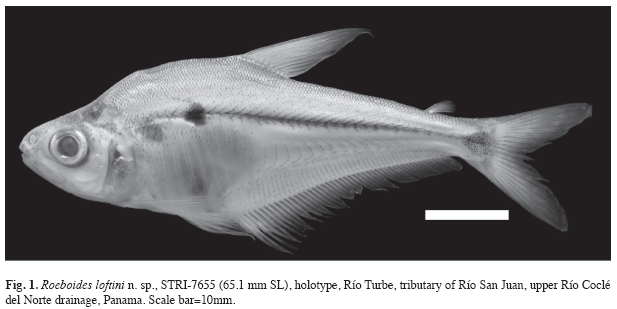
</front><body><![CDATA[ <p align="center"><b><font face="Verdana" size="4">A new fish species of </font></b><font face="Verdana" size="4"><i>Roeboides </i><b>from Panam&aacute; (Characiformes: Characidae)</b></font></p> <b><font size="2"> </font></b>     <p align="justify"><font face="Verdana" size="2">Carlos Alberto S. de Lucena</font></p>     <p align="justify"><font face="Verdana" size="2">Laborat&oacute;rio de Ictiologia, Museu de Ci&ecirc;ncias e Tecnologia da PUCRS. Av. Ipiranga 6681, 90619-900, Porto Alegre, RS, Brazil; </font><font face="Verdana"  size="2"><a href="mailto:lucena@pucrs.br">lucena@pucrs.br</a>    <br> </font></p>     <p align="justify"><font face="Verdana" size="2"><a  href="#Correspondencia">Direcci&oacute;n de correspondencia</a>    <br> </font></p> <font size="2"> </font> <hr style="width: 100%; height: 2px;">     <p align="justify"><b><font face="Verdana" size="3">Abstract</font></b></p>     <p align="justify"><b><font face="Verdana" size="2"> </font></b><font  face="Verdana" size="2">A freshwater fish <i>Roeboides loftini </i>n.sp. is described from the R&iacute;o Cocl&eacute; del Norte drainage of the Atlantic versant of Panam&aacute;. The new species differs from other species of the <i>Roeboides guatemalensis</i>-group by the number of perforated scales on the lateral line (83-100), body depth (31.8-36.1%), predorsal distance (49.1-51.9%) and the shape of the humeral spot. Rev. Biol. Trop. 59 (4): 1663-1667. Epub 2011 December 01.</font></p>     <p align="justify"><font face="Verdana" size="2"><b>Key words: </b>distribution, freshwater fish, R&iacute;o Cocl&eacute; del Norte, Atlantic versant.</font></p> <font face="Verdana" size="3"><b>     <p align="justify">Resumen</p> </b></font><font size="2"> </font>     ]]></body>
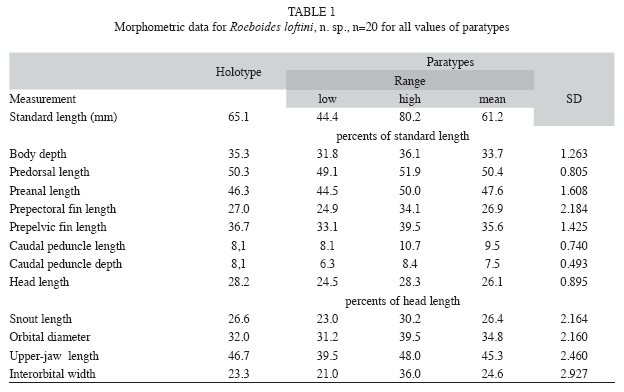
<body><![CDATA[<p align="justify"><i><font face="Verdana" size="2">Roeboides loftini </font></i><font  face="Verdana" size="2">n.sp., se describe en la desembocadura del r&iacute;o Cocl&eacute; del Norte en la Vertiente Atl&aacute;ntica de Panam&aacute;. La nueva especie se diferencia de otras especies del grupo del <i>Roeboides guatemalensis</i>, por el n&uacute;mero de escamas perforadas en la l&iacute;nea lateral (83-100), la profundidad del cuerpo (31.8-36.1%), distancia predorsal (49.1- 51.9%) y la forma de la mancha humeral.</font></p>     <p align="justify"><font face="Verdana" size="2"><b>Palabras clave: </b>distribuci&oacute;n, peces de agua dulce, R&iacute;o Cocl&eacute; del Norte, vertiente del Atl&aacute;ntico.</font></p> <hr style="width: 100%; height: 2px;">     <p align="justify"><font face="Verdana" size="2">The genus <i>Roeboides </i>G&uuml;nther, 1864 comprises a monophyletic assemblage of 16 valid species occurring in Central and South America. Six Central American species (<i>R. dayi </i>Steindachner, 1878, <i>R. guatemalensis </i>G&uuml;nther, 1864, <i>R. occidentalis </i>Meek &amp; Hildebrand, 1916, <i>R. bouchellei </i>Fowler, 1923, <i>R. ilsea </i>Bussing, 1985, &amp; <i>R. carti </i>(Lucena 2000) along with <i>R. dientonito </i>Schultz, 1944 from Lago Maracaibo, the R&iacute;o Orinoco drainage and rivers of Northwestern Guyana, compose the <i>R. guatemalensis</i>-group (Lucena 2007).</font></p>     <p align="justify"><font face="Verdana" size="2">Among the synapomorphies that support the <i>Roeboides guatemalensis</i>-group are: the presence of infraorbitals 4 and 5, the presence of cusps on the teeth of the inner tooth series of the premaxilla; the absence of D4 teeth of the dentary (Lucena 1998); a long, slender projection on the lower posterior margin of <i>cleithrum </i>slightly surpassing the first pectoral-fin ray, and a humeral spot located posterior to the vertical through the middle of the pectoral fin (Lucena submitted).</font></p>     <p align="justify"><font face="Verdana" size="2">Lucena (2000) examined a few young specimens in poor condition from the R&iacute;o Cocl&eacute; del Norte drainage (R&iacute;o Tambo) and identified them as <i>Roeboides </i>sp. He pointed out some differences between these specimens and specimens belonging to other species of <i>Roeboides </i>in Central America. The analysis of new samples from that drainage allowed the recognition of a new species of <i>Roeboides</i>, which is described herein.</font></p> <b><font size="2"> </font><font face="Verdana" size="3">     <p align="justify">Material and methods</p> </font></b><font size="2"> </font><font face="Verdana" size="2">     <p align="justify">Specimens were collected by Jorge Garcia, Universidad de Panam&aacute; and were deposited at the Museu de Ci&ecirc;ncias e Tecnologia da Pontif&iacute;cia Universidade Cat&oacute;lica do Rio Grande do Sul, Porto Alegre, Brazil (MCP) and the Smithsonian Tropical Research Institute, Panama (STRI). Counts and measurements were taken as described by Fink &amp; Weitzman (1974). A cleared and stained (c&amp;s) specimen was prepared according to the method of Taylor &amp; Van Dyke (1985). Vertebral counts included the four vertebrae of the Weberian apparatus and the terminal vertebral <i>centrum </i>was counted as a single element. Measurements are given as percentages of standard length (SL). In the Description, the values of the holotype are cited between brackets and n indicates the number of specimens. The comparative material is cited in Lucena (2000).</p> </font><font face="Verdana" size="3"><b>     <p align="justify">Results</p> </b></font><font size="2"> </font><b><i><font face="Verdana" size="2">Roeboides loftini</font></i></b><font  face="Verdana" size="2">, new species </font><font face="Verdana"  size="2"><a href="/img/revistas/rbt/v59n4/a19i1.jpg">Fig. 1</a>; <a  href="/img/revistas/rbt/v59n4/a19t1.gif">Table 1</a></font>&nbsp; <font  face="Verdana" size="2"><i>Roeboides </i>sp. Lucena 2000:51 </font><font face="Verdana" size="2">(short diagnosis).</font>     <p align="justify"><font face="Verdana" size="2"><b>Holotype: </b>STRI-7655 (65.1mm SL), R&iacute;o Turbe, tributary of R&iacute;o San Juan, upper R&iacute;o Cocl&eacute; del Norte drainage, Panam&aacute;, 08&ordm; 47&#8217;05&#8217;&#8217; N - 80&ordm; 38&#8217;10&#8217;&#8217; W, 2009, Jorge Garcia.</font></p>     <p align="justify"><font face="Verdana" size="2"><b>Paratypes: </b>STRI-7656 (3, 44.4-64.6mm SL), same locality as holotype; STRI-7657 (14, 39.7-80.2mm SL, 1 c&amp;s specimen, 65.0mm SL), R&iacute;o Turbe, tributary of R&iacute;o San Juan, upper R&iacute;o Cocl&eacute; del Norte drainage, Panam&aacute;. 08&ordm;47&#8217;09&#8217;&#8217; N - 80&ordm; 37&#8217;55&#8217;&#8217; W, MCP 45775 (3, 57.7-75.1mm SL), same locality as STRI-7657. </font></p>     ]]></body>
<body><![CDATA[<p align="justify"><font face="Verdana" size="2"><b>Non-types: </b>STRI 400 (9, 35.0-65.1mm SL), R&iacute;o Tambo, R&iacute;o Cocl&eacute; del Norte drainage,</font><font face="Verdana" size="2"> Panam&aacute; (Lucena, 2000).</font></p>     <p align="justify"><font face="Verdana" size="2"> </font></p>     <p align="justify"><font face="Verdana" size="2"><b>Diagnosis</b>: <i>Roeboides loftini </i>is a member of the <i>R</i>. <i>guatemalensis</i>-group. It differs from <i>R</i>. <i>occidentalis</i>, <i>R. dayi</i>, and <i>R. dientonito </i>by the number of lateral line scales (83-100 vs. 51-80), from <i>R. dayi </i>and <i>R. dientonito </i>by the number of scale rows above the lateral line (20-22 vs. 10-18) and around the caudal peduncle (27-30 vs. 17-24), and from <i>R. dientonito </i>by the number of scale rows below the lateral line (20-24 vs. 17-21). <i>Roeboides loftini </i>differs from <i>R. ilsea</i>, a species with a high number of lateral line scales (84-93), by the lower body depth (31.8-36.1%, mean=33.7% vs. 36.9-41.8%, mean=38.8%) and shorter predorsal distance (49.1-51.9%, mean=50.4% vs. 51.4-55.9%, mean=52.9%). <i>Roeboides loftini </i>differs from other Central American species, <i>R. bouchellei</i>, <i>R. guatemalensis </i>and <i>R. carti </i>in the shape of the humeral spot. <i>Roeboides bouchellei </i>exhibits a small, sometimes inconspicuous, slightly vertically elongate humeral spot, extending over 3 or 4 horizontal rows of scales and 2 or 3 vertical rows, whereas <i>R</i>. <i>loftini </i>exhibits a conspicuous, slightly rounded humeral spot extending over 5-7 horizontal rows of scales and 5-8 vertical rows. In addition, <i>R. loftini </i>has a tenuous, short extension on the anterodorsal portion of the humeral spot (<a href="/img/revistas/rbt/v59n4/a19i1.jpg">Fig. 1</a>) which is absent in <i>R. bouchellei</i>. The humeral spot of <i>R. carti </i>reaches or surpasses the vertical through the origin of the anal fin and, in adults, extends posteriorly to the vertical through the origin of the dorsal fin (Lucena 2000). <i>Roeboides guatemalensis </i>has a large, anteriorly sometimes bifurcate, black stripe, extending between the vertical through the middle of the pelvic fin and the vertical near the posterior <i>terminus </i>of the base of the dorsal fin (Lucena 2000). <i>Roeboides loftini </i>differs from <i>R. carti </i>and <i>R. guatemalensis </i>by its rounded humeral spot located far from the verticals through the origins of the dorsal and anal fins (5-8 and 3-5 vertical series of scales, respectively).</font></p>     <p align="justify"><font face="Verdana" size="2"><b>Description: </b><a  href="/img/revistas/rbt/v59n4/a19t1.gif">Table 1</a> presents the morphometric data for the holotype and 20 paratypes. Predorsal profile elevated and convex from base of supraoccipital process to dorsal fin origin; posteroventrally sloped along dorsal-fin base and straight from <i>terminus </i>of dorsal fin base to caudal peduncle. Ventral profile convex from lower lip to anal fin origin; straight along anal fin base. Mouth subterminal with lower jaw slightly shorter than upper jaw. Snout profile convex from dorsal view. Maxilla expanded anteroposteriorly, extending posteriorly to vertical through middle of orbit or slightly beyond that point. Premaxilla with two large mamilliform teeth projecting anteriorly from each side of upper jaw at margin of lip. Rows of teeth irregular. Outer row with 4 to 6 conical teeth, rarely with side cusps. Inner row with 3 to 5 mamilliform-like teeth with two small lateral cusps. Maxilla with 9-14 teeth; first five to seven conic with one or two mamilliform teeth displaced towards lateral surface of bone and followed by conic or mamilliform-like teeth along ventral border of bone. Dentary with one large mamilliform teeth projecting anterolaterally and laterally (Lucena, 1998). Two anteriormost dentary tooth larger, mamilliform, weakly tricuspid and followed by two or three smaller conic and one mamilliform-like tricuspid teeth and then 9-14 smaller conic teeth posteriorly curved lingually.</font></p>     <p align="justify"><font face="Verdana" size="2">Gill-rakers long, upper limb with five to seven rakers (n=20, mode=6) [6], lower limb with nine or ten rakers (n=20, mode=9) [9].</font></p>     <p align="justify"><font face="Verdana" size="2">Dorsal fin rays i+9 (n=20). Fin origin situated approximately slightly beyond vertical through origin of anal fin. Anal fin rays iv-v, 45-50 (n=20, mode=47) [46]. Males with one or two small, retrorse bony hooks per segment on first to seventh or eighth segmented rays. Pectoral fin rays i+12-14 (n=19, mode=13) [12]. Tip of longest ray falling slightly short of, or reaching, anal fin origin. Pelvic fin rays i,7 (n=20). Longest pelvic ray extending beyond anal fin origin. Males with one bony hook per segment present from first to seventh segmented anal fin rays. Caudal fin forked with 19 principal rays (n=20).</font></p>     <p align="justify"><font face="Verdana" size="2">Lateral line scales 83-100 (n=20, mode=88/89) [85]. Scale rows above lateral line 20-22 (n=20, mode=20) [21]; scale rows below lateral line 20-24 (n=19, mode=22) [22]; scale rows around caudal peduncle 25-30 (n=10, mode=29/30) [20]. Precaudal vertebrae 15; caudal vetrabrae 23; total vertebrae 38 (n=1 c&amp;s specimen).</font></p>     <p align="justify"><font face="Verdana" size="2"><b>Color in alcohol: </b>Ground color yellowishtan. Dorsal portions of head and body densely pigmented dark brown. Conspicuous dark lateral band extending between margin of opercle and caudal fin base. Expanded posteriorly into large spot on caudal peduncle. Slightly dusky lateral band situated anterior of humeral spot. Most specimens with chromatophores concentrated along the myosepta within lateral band resulting in chevron-shaped marks. Conspicuous black humeral spot distinctly separated from verticals through origins of dorsal and anal fins by 5-8 and 3-5 rows of scales, respectively. Humeral spot in well-preserved specimens shows faint dorsal, anteriorly-oriented extension. Fins, especially dorsal and anal fins, dusky.</font></p>     <p align="justify"><font face="Verdana" size="2"><b>Color in life: </b>Overall coloration silvery or yellowish. Tip of snout black. Dark midlateral stripe sometimes inconspicuous and hidden by silvery lateral band. Dark humeral spot conspicuous. Caudal peduncle spot dark diffuse. Caudal fin yellow. Tip of caudal-fin rays clear. Other fins slightly yellowish.</font></p>     <p align="justify"><font face="Verdana" size="2"><b>Etymology: </b>The specific epithet, <i>loftini</i>, is a patronym in honor of Dr. Horace Loftin in recognition of his contributions to our knowledge of the distribution of the freshwater fishes of Panam&aacute;.</font></p>     ]]></body>
<body><![CDATA[<p align="justify"><font face="Verdana" size="2"><b>Distribution: </b>The species is known only from the R&iacute;o Cocl&eacute; del Norte drainage, an Atlantic versant drainage of Northwestern Panam&aacute;.</font></p> <font face="Verdana" size="3"><b>     <p align="justify">Discussion</p> </b></font><font size="2"> </font>     <p align="justify"><i><font face="Verdana" size="2">Roeboides loftini </font></i><font  face="Verdana" size="2">has an incomplete infraorbital series. One of the synapomorphies of the <i>R. guatemalensis</i>-group is a complete infraorbital series with the presence of the fourth and fifth infraorbitals (Lucena submitted). The condition present in <i>R. loftini </i>may be parsimoniously considered an autapomorphy.</font></p>     <p align="justify"><font face="Verdana" size="2">In addition to <i>R. loftini</i>, five species of <i>Roeboides </i>occur in Panam&aacute;, all showing disjunct distributions: <i>R. dayi</i>, <i>R. guatemalensis</i>, and <i>R. carti </i>from the Atlantic versant, and <i>R. occidentalis </i>and <i>R. bouchellei</i>, from the Pacific versant<b>. </b>Along the Atlantic versant of Panam&aacute;, the R&iacute;o Cocl&eacute; del Norte drainage represents the westernmost occurrence of <i>Roeboides</i>. <i>R. bouchellei</i>, another species that may occur in the Atlantic drainages of Central America, has its distribution from R&iacute;o Matina, Costa Rica (Bussing 2002) to the R&iacute;o Negro drainage (or R&iacute;o Sico Tinto), Honduras (Matamoros <i>et al. </i>2009). This apparent gap in the Atlantic versant distribution of Panam&aacute; may be due to the lack of collections in that area. <i>Roeboides </i>is absent along the Atlantic coast of Central America</font><font face="Verdana" size="2"> North from R&iacute;o Negro, Honduras.</font></p> <font face="Verdana" size="3"><b>     <p align="justify">Acknowledgments</p> </b></font><font size="2"> </font><font face="Verdana" size="2">     <p align="justify">I am grateful to the following: Jorge Garc&iacute;a, Universidad del Panam&aacute;, for sending the specimens that served as the basis of the description of the new species; Rigoberto Gonz&aacute;les G., for his help in sending specimens since 1999 and for the suggestion of the specific epithet; Oris Sanjur and Gisela Reina of STRI, for cataloging the type series. Fernando Jerep provided the photo of the holotype.</p> </font> <hr style="width: 100%; height: 2px;"><font face="Verdana" size="3"><b>     <p align="justify">References</p> </b></font><font size="2"> </font><font face="Verdana" size="2">     <!-- ref --><p align="justify">Bussing, W.A. 2002. Peces de las aguas continentales de Costa Rica. Universidad de Costa Rica, San Pedro, Costa Rica.    &nbsp;&nbsp;&nbsp;&nbsp;&nbsp;&nbsp;&nbsp;&nbsp;[&#160;<a href="javascript:void(0);" onclick="javascript: window.open('/scielo.php?script=sci_nlinks&ref=1752408&pid=S0034-7744201100040001900001&lng=','','width=640,height=500,resizable=yes,scrollbars=1,menubar=yes,');">Links</a>&#160;]<!-- end-ref --></p>     <!-- ref --><p align="justify">Fink, W.L &amp; S.H. Weitzman. 1974. The so-called Cheirodontin fishes of Central America with descriptions of two new species (Pisces: Characidae). Smithson. Contrib. Zool. 172: 1-46.    &nbsp;&nbsp;&nbsp;&nbsp;&nbsp;&nbsp;&nbsp;&nbsp;[&#160;<a href="javascript:void(0);" onclick="javascript: window.open('/scielo.php?script=sci_nlinks&ref=1752410&pid=S0034-7744201100040001900002&lng=','','width=640,height=500,resizable=yes,scrollbars=1,menubar=yes,');">Links</a>&#160;]<!-- end-ref --></p>     <!-- ref --><p align="justify">Lucena, C.A.S. 1998. Rela&ccedil;&otilde;es filogen&eacute;ticas e defini&ccedil;&atilde;o do g&ecirc;nero <i>Roeboides </i>G&uuml;nther (Ostariophysi: Characiformes: Characidae). Comun. Mus. Ci&ecirc;nc. Tecnol. PUCRS 11: 19-59.    &nbsp;&nbsp;&nbsp;&nbsp;&nbsp;&nbsp;&nbsp;&nbsp;[&#160;<a href="javascript:void(0);" onclick="javascript: window.open('/scielo.php?script=sci_nlinks&ref=1752412&pid=S0034-7744201100040001900003&lng=','','width=640,height=500,resizable=yes,scrollbars=1,menubar=yes,');">Links</a>&#160;]<!-- end-ref --></p>     <!-- ref --><p align="justify">Lucena, C.A.S. 2000. Revis&atilde;o taxon&ocirc;mica e filogenia das esp&eacute;cies transandinas do g&ecirc;nero <i>Roeboides </i>G&uuml;nther (Teleostei: Ostariophysi: Characiformes). Comun. Mus. Ci&ecirc;nc. Tecnol. PUCRS 13: 3-63.    &nbsp;&nbsp;&nbsp;&nbsp;&nbsp;&nbsp;&nbsp;&nbsp;[&#160;<a href="javascript:void(0);" onclick="javascript: window.open('/scielo.php?script=sci_nlinks&ref=1752414&pid=S0034-7744201100040001900004&lng=','','width=640,height=500,resizable=yes,scrollbars=1,menubar=yes,');">Links</a>&#160;]<!-- end-ref --></p>     <!-- ref --><p align="justify">Lucena, C.A.S. 2007. Revis&atilde;o taxon&ocirc;mica das esp&eacute;cies do g&ecirc;nero <i>Roeboides </i>grupo- <i>affins </i>(Ostariophysi, Characiformes, Characidae). Iheringia 97: 117-136.    &nbsp;&nbsp;&nbsp;&nbsp;&nbsp;&nbsp;&nbsp;&nbsp;[&#160;<a href="javascript:void(0);" onclick="javascript: window.open('/scielo.php?script=sci_nlinks&ref=1752416&pid=S0034-7744201100040001900005&lng=','','width=640,height=500,resizable=yes,scrollbars=1,menubar=yes,');">Links</a>&#160;]<!-- end-ref --></p>     <!-- ref --><p align="justify">Matamoros, W.A., J.F. Schaefer &amp; B.R. Kreiser. 2009. Annotated checklist of the freshwater fishes of continental and insular Honduras. Zootaxa 2307: 1-38.    &nbsp;&nbsp;&nbsp;&nbsp;&nbsp;&nbsp;&nbsp;&nbsp;[&#160;<a href="javascript:void(0);" onclick="javascript: window.open('/scielo.php?script=sci_nlinks&ref=1752418&pid=S0034-7744201100040001900006&lng=','','width=640,height=500,resizable=yes,scrollbars=1,menubar=yes,');">Links</a>&#160;]<!-- end-ref --></p>     <!-- ref --><p align="justify">Taylor, W.R. &amp; G.C. Van Dyke. 1985. Revised procedures for staining and clearing small fishes and other vertebrates for bone and cartilage study. Cybium 9: 107-119.    &nbsp;&nbsp;&nbsp;&nbsp;&nbsp;&nbsp;&nbsp;&nbsp;[&#160;<a href="javascript:void(0);" onclick="javascript: window.open('/scielo.php?script=sci_nlinks&ref=1752420&pid=S0034-7744201100040001900007&lng=','','width=640,height=500,resizable=yes,scrollbars=1,menubar=yes,');">Links</a>&#160;]<!-- end-ref --><br> </p>     <p align="justify">    <br> </p> <a name="Correspondencia"></a>Correspondencia a: <font face="Verdana"  size="2">Carlos Alberto S. de Lucena.&nbsp;</font></font><font face="Verdana" size="2">Laborat&oacute;rio de Ictiologia, Museu de Ci&ecirc;ncias e Tecnologia da PUCRS. Av. Ipiranga 6681, 90619-900, Porto Alegre, RS, Brazil; </font><a  href="mailto:lucena@pucrs.br"><font face="Verdana" size="2">lucena@pucrs.br</font></a><font  face="Verdana" size="2"> </font> <hr style="width: 100%; height: 2px;"><font face="Verdana" size="2">     <p align="center">Received 25-X-2010. Corrected 18-IV-2011. Accepted 20-V-2011.</p> </font> <font size="2"></font>      ]]></body><back>
<ref-list>
<ref id="B1">
<nlm-citation citation-type="book">
<person-group person-group-type="author">
<name>
<surname><![CDATA[Bussing]]></surname>
<given-names><![CDATA[W.A]]></given-names>
</name>
</person-group>
<source><![CDATA[Peces de las aguas continentales de Costa Rica]]></source>
<year>2002</year>
<publisher-loc><![CDATA[San Pedro ]]></publisher-loc>
<publisher-name><![CDATA[Universidad de Costa Rica]]></publisher-name>
</nlm-citation>
</ref>
<ref id="B2">
<nlm-citation citation-type="journal">
<person-group person-group-type="author">
<name>
<surname><![CDATA[Fink]]></surname>
<given-names><![CDATA[W.L]]></given-names>
</name>
<name>
<surname><![CDATA[Weitzman]]></surname>
<given-names><![CDATA[S.H]]></given-names>
</name>
</person-group>
<article-title xml:lang="en"><![CDATA[The so-called Cheirodontin fishes of Central America with descriptions of two new species (Pisces: Characidae)]]></article-title>
<source><![CDATA[Smithson. Contrib. Zool]]></source>
<year>1974</year>
<volume>172</volume>
<page-range>1-46</page-range></nlm-citation>
</ref>
<ref id="B3">
<nlm-citation citation-type="journal">
<person-group person-group-type="author">
<name>
<surname><![CDATA[Lucena]]></surname>
<given-names><![CDATA[C.A.S]]></given-names>
</name>
</person-group>
<article-title xml:lang="en"><![CDATA[Relações filogenéticas e definição do gênero Roeboides Günther (Ostariophysi: Characiformes: Characidae)]]></article-title>
<source><![CDATA[Comun. Mus. Ciênc. Tecnol]]></source>
<year>1998</year>
<volume>11</volume>
<page-range>19-59</page-range><publisher-name><![CDATA[PUCRS]]></publisher-name>
</nlm-citation>
</ref>
<ref id="B4">
<nlm-citation citation-type="journal">
<person-group person-group-type="author">
<name>
<surname><![CDATA[Lucena]]></surname>
<given-names><![CDATA[C.A.S]]></given-names>
</name>
</person-group>
<article-title xml:lang="en"><![CDATA[Revisão taxonômica e filogenia das espécies transandinas do gênero Roeboides Günther (Teleostei: Ostariophysi: Characiformes)]]></article-title>
<source><![CDATA[Comun. Mus. Ciênc. Tecnol]]></source>
<year>2000</year>
<volume>13</volume>
<page-range>3-63</page-range><publisher-name><![CDATA[PUCRS]]></publisher-name>
</nlm-citation>
</ref>
<ref id="B5">
<nlm-citation citation-type="">
<person-group person-group-type="author">
<name>
<surname><![CDATA[Lucena]]></surname>
<given-names><![CDATA[C.A.S]]></given-names>
</name>
</person-group>
<article-title xml:lang="en"><![CDATA[Revisão taxonômica das espécies do gênero Roeboides grupo- affins (Ostariophysi, Characiformes, Characidae)]]></article-title>
<source><![CDATA[]]></source>
<year>2007</year>
<volume>97</volume>
<page-range>117-136</page-range></nlm-citation>
</ref>
<ref id="B6">
<nlm-citation citation-type="">
<person-group person-group-type="author">
<name>
<surname><![CDATA[Matamoros]]></surname>
<given-names><![CDATA[W.A]]></given-names>
</name>
<name>
<surname><![CDATA[Schaefer]]></surname>
<given-names><![CDATA[J.F]]></given-names>
</name>
<name>
<surname><![CDATA[Kreiser]]></surname>
<given-names><![CDATA[B.R]]></given-names>
</name>
</person-group>
<article-title xml:lang="en"><![CDATA[Annotated checklist of the freshwater fishes of continental and insular Honduras]]></article-title>
<source><![CDATA[]]></source>
<year>2009</year>
<volume>2307</volume>
<page-range>1-38</page-range></nlm-citation>
</ref>
<ref id="B7">
<nlm-citation citation-type="">
<person-group person-group-type="author">
<name>
<surname><![CDATA[Taylor]]></surname>
<given-names><![CDATA[W.R]]></given-names>
</name>
<name>
<surname><![CDATA[Van Dyke]]></surname>
<given-names><![CDATA[G.C]]></given-names>
</name>
</person-group>
<article-title xml:lang="en"><![CDATA[Revised procedures for staining and clearing small fishes and other vertebrates for bone and cartilage study]]></article-title>
<source><![CDATA[]]></source>
<year>1985</year>
<volume>9</volume>
<page-range>107-119</page-range></nlm-citation>
</ref>
</ref-list>
</back>
</article>