<?xml version="1.0" encoding="ISO-8859-1"?><article xmlns:mml="http://www.w3.org/1998/Math/MathML" xmlns:xlink="http://www.w3.org/1999/xlink" xmlns:xsi="http://www.w3.org/2001/XMLSchema-instance">
<front>
<journal-meta>
<journal-id>0034-7744</journal-id>
<journal-title><![CDATA[Revista de Biología Tropical]]></journal-title>
<abbrev-journal-title><![CDATA[Rev. biol. trop]]></abbrev-journal-title>
<issn>0034-7744</issn>
<publisher>
<publisher-name><![CDATA[Universidad de Costa Rica]]></publisher-name>
</publisher>
</journal-meta>
<article-meta>
<article-id>S0034-77442011000400016</article-id>
<title-group>
<article-title xml:lang="en"><![CDATA[Five new species of the genus Sphelodon (Hymenoptera: Ichneumonidae) from Brazil with a key to the Neotropical species]]></article-title>
</title-group>
<contrib-group>
<contrib contrib-type="author">
<name>
<surname><![CDATA[Herrera]]></surname>
<given-names><![CDATA[Andrés]]></given-names>
</name>
<xref ref-type="aff" rid="A01"/>
</contrib>
<contrib contrib-type="author">
<name>
<surname><![CDATA[Penteado-Dias]]></surname>
<given-names><![CDATA[Angélica]]></given-names>
</name>
<xref ref-type="aff" rid="A01"/>
</contrib>
</contrib-group>
<aff id="A01">
<institution><![CDATA[,Universidade Federal de São Carlos Departamento de Ecologia e Biologia Evolutiva ]]></institution>
<addr-line><![CDATA[São Carlos SP]]></addr-line>
<country>Brasil</country>
</aff>
<pub-date pub-type="pub">
<day>00</day>
<month>12</month>
<year>2011</year>
</pub-date>
<pub-date pub-type="epub">
<day>00</day>
<month>12</month>
<year>2011</year>
</pub-date>
<volume>59</volume>
<numero>4</numero>
<fpage>1621</fpage>
<lpage>1635</lpage>
<copyright-statement/>
<copyright-year/>
<self-uri xlink:href="http://www.scielo.sa.cr/scielo.php?script=sci_arttext&amp;pid=S0034-77442011000400016&amp;lng=en&amp;nrm=iso"></self-uri><self-uri xlink:href="http://www.scielo.sa.cr/scielo.php?script=sci_abstract&amp;pid=S0034-77442011000400016&amp;lng=en&amp;nrm=iso"></self-uri><self-uri xlink:href="http://www.scielo.sa.cr/scielo.php?script=sci_pdf&amp;pid=S0034-77442011000400016&amp;lng=en&amp;nrm=iso"></self-uri><abstract abstract-type="short" xml:lang="en"><p><![CDATA[The parasitoid wasp family Ichneumonidae currently includes approximately 37 subfamilies worldwide. Banchinae subfamily is a cosmopolitan group with three tribes: Atrophini, Banchini and Glyptini, this last characterized with oblique grooves on tergites II-IV, a dorsal subapical notch on the ovipositor, and a median apical impression in the subgenital plate. From the latter tribe, the genus Sphelodon, with eight species reported, can be recognized for the presence of a prominent basolateral tooth in the first abdominal tergite. Significant previous comprehensive studies for that group have been done in Costa Rica by local and international experts, but it is highly probable that many species remain undescribed in the region; before this survey, only one species (S. annulicornis) was registered from Brazil. The material reviewed in this study was obtained from main entomological collections of Southeast and South Brazil, from localities corresponding to 17 of the 27 States of the country, although most of the specimens (70.3%) were collected in São Paulo State. Approximately 3 000 specimens of the subfamily have been examined, 29 belonging to Sphelodon. The description format in this work broadly follows previous works; the species were illustrated through SEM in low vacuum mode (without uncoated the specimens). Here five new species of the genus Sphelodon are described and illustrated, one of these (S. brunicornis), differs from the rest of the species by lacking a median band in the flagellum. An identification key to the Neotropical species is provided. Rev. Biol. Trop. 59 (4): 1621-1635. Epub 2011 December 01.]]></p></abstract>
<abstract abstract-type="short" xml:lang="es"><p><![CDATA[La familia de avispas parasitoides Ichneumonidae incluye aproximadamente 37 subfamilias a nivel mundial, una de ellas, Banchinae es un grupo cosmopolita con tres tribos: Atrophini, Banchini y Glyptini: los miembros de esta tribu presentan surcos oblicuos en los tergitos II-IV, una muesca dorsal sub-apical en el ovipositor y una impresión media apical en la placa subgenital; este grupo incluye los géneros Levibasis, Teleutaea, Glypta, Zaglyptomorpha y Sphelodon en la región Neotropical. El género mencionado anteriormente se diferencia de los demás por la presencia de un diente baso-lateral en el primer tergito abdominal, y cuenta con 8 especies descritas, sin embargo como Costa Rica es el único país de la región donde se ha realizado un levantamiento riguroso de este grupo, es muy probable que muchas especies no hayan sido descritas todavía. De este género, sólo existe una especie registrada para Brasil (S. annulicornis). Este trabajo se basó principalmente en material obtenido en calidad de préstamo de las colecciones entomológicas más reconocidas del Sur y del Sudeste de Brasil, provenientes de localidades correspondientes a 17 de los 27 estados que existen en este país, aunque la mayoría de ejemplares (70.3 %) fueron recolectados en el estado de São Paulo. Aproximadamente 3 000 ejemplares de la subfamilia fueron examinados, 29 pertenecientes al género de la tribu Glyptini Sphelodon. El formato de descripción de las especies es básicamente el mismo expuesto por Gauld et al. (2002); las microfotografías que ilustran los detalles de las especies nuevas se realizaron en un microscopio electrónico de barrido (SEM), en el modo de bajo vacío (los ejemplares no fueron recubiertos). Se describen e ilustran cinco especies nuevas del género Sphelodon, una de ellas, S. Brunicornis, se distingue de las otras especies descritas del género porque no presenta un anillo medio en el flagelo. Se propone una clave de identificación para las especies neotropicales.]]></p></abstract>
<kwd-group>
<kwd lng="en"><![CDATA[Glyptini]]></kwd>
<kwd lng="en"><![CDATA[identification key]]></kwd>
<kwd lng="en"><![CDATA[South America]]></kwd>
<kwd lng="en"><![CDATA[taxonomy]]></kwd>
<kwd lng="en"><![CDATA[wasps]]></kwd>
<kwd lng="es"><![CDATA[avispas]]></kwd>
<kwd lng="es"><![CDATA[clave de identificación]]></kwd>
<kwd lng="es"><![CDATA[Glyptini]]></kwd>
<kwd lng="es"><![CDATA[Suramérica]]></kwd>
<kwd lng="es"><![CDATA[taxonomía]]></kwd>
</kwd-group>
</article-meta>
</front><body><![CDATA[ <div style="text-align: center;"><b><font face="Verdana" size="4">Five new species of the genus </font></b><font face="Verdana" size="4"><i>Sphelodon </i><b>(Hymenoptera: Ichneumonidae) from Brazil with a key to the Neotropical species</b></font></div> <b><font size="2"> </font></b>     <p align="justify"><font face="Verdana" size="2">Andr&eacute;s Herrera &amp; Ang&eacute;lica Penteado-Dias</font></p>     <p align="justify"><font face="Verdana" size="2">Departamento de Ecologia e Biologia Evolutiva, Universidade Federal de S&atilde;o Carlos, Rod. Washington Lu&iacute;s, km 235, CEP 13565-905, S&atilde;o Carlos, SP, Brasil; <a href="mailto:andresfhf@gmail.com">andresfhf@gmail.com</a>, </font><font  face="Verdana" size="2"><a href="mailto:angelica@ufscar.br">angelica@ufscar.br</a>    <br> </font></p>     <p align="justify"><font face="Verdana" size="2"><a  href="#Correspondencia">Direcci&oacute;n de correspondencia</a>    <br> </font></p> <font size="2"> </font> <hr style="width: 100%; height: 2px;">     <p align="justify"><b><font face="Verdana" size="3">Abstract</font></b></p>     <p align="justify"><font face="Verdana" size="2">The parasitoid wasp family Ichneumonidae currently includes approximately 37 subfamilies worldwide. Banchinae subfamily is a cosmopolitan group with three tribes: Atrophini, Banchini and Glyptini, this last characterized with oblique grooves on tergites II-IV, a dorsal subapical notch on the ovipositor, and a median apical impression in the subgenital plate. From the latter tribe, the genus <i>Sphelodon</i>, with eight species reported, can be recognized for the presence of a prominent basolateral tooth in the first abdominal tergite. Significant previous comprehensive studies for that group have been done in Costa Rica by local and international experts, but it is highly probable that many species remain undescribed in the region; before this survey, only one species (<i>S. annulicornis</i>) was registered from Brazil. The material reviewed in this study was obtained from main entomological collections of Southeast and South Brazil, from localities corresponding to 17 of the 27 States of the country, although most of the specimens (70.3%) were collected in S&atilde;o Paulo State. Approximately 3 000 specimens of the subfamily have been examined, 29 belonging to <i>Sphelodon</i>. The description format in this work broadly follows previous works; the species were illustrated through SEM in low vacuum mode (without uncoated the specimens). Here five new species of the genus <i>Sphelodon </i>are described and illustrated, one of these (<i>S. brunicornis</i>), differs from the rest of the species by lacking a median band in the <i>flagellum</i>. An identification key to the Neotropical species is provided. Rev. Biol. Trop. 59 (4): 1621-1635. Epub 2011 December 01.</font></p>     <p align="justify"><font face="Verdana" size="2"><b>Key words: </b>Glyptini, identification key, South America, taxonomy, wasps. </font></p> <font face="Verdana" size="3"><b>     <p align="justify">Resumen</p> </b></font><font size="2"> </font>     ]]></body>
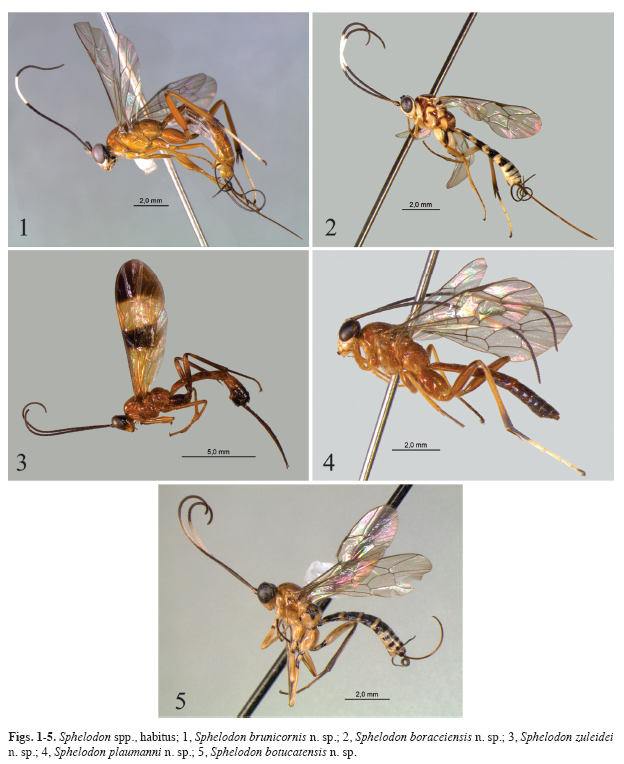
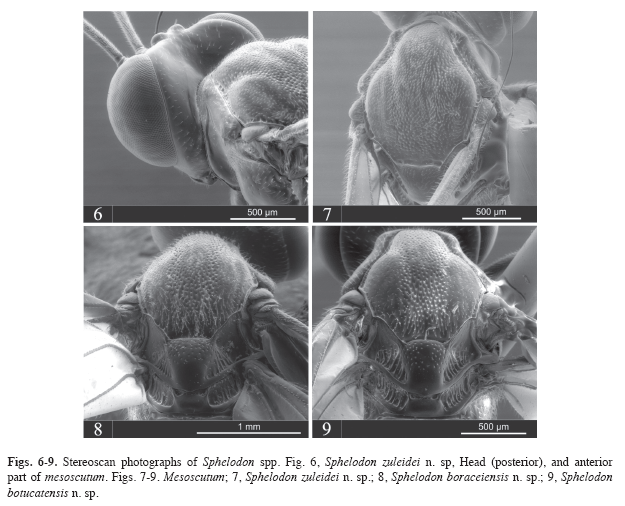
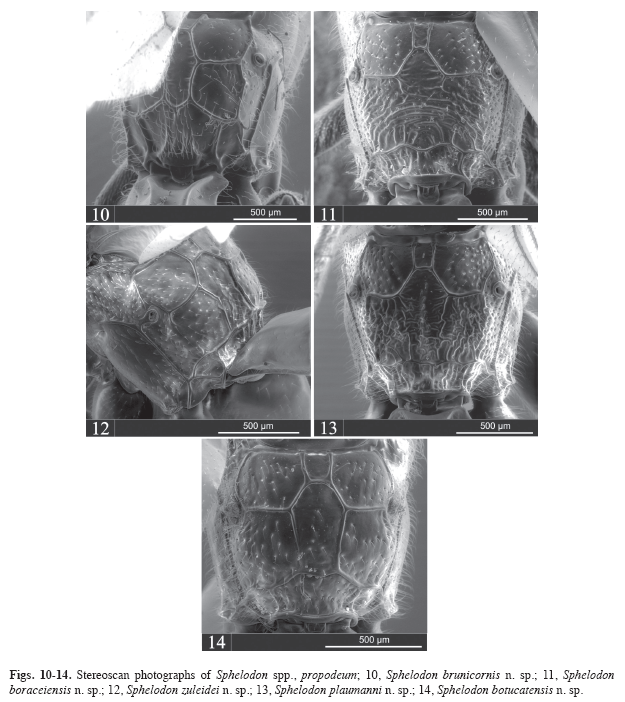
<body><![CDATA[<p align="justify"><font face="Verdana" size="2">La familia de avispas parasitoides Ichneumonidae incluye aproximadamente 37 subfamilias a nivel mundial, una de ellas, Banchinae es un grupo cosmopolita con tres tribos: Atrophini, Banchini y Glyptini: los miembros de esta tribu presentan surcos oblicuos en los tergitos II-IV, una muesca dorsal sub-apical en el ovipositor y una impresi&oacute;n media apical en la placa subgenital; este grupo incluye los g&eacute;neros <i>Levibasis</i>, <i>Teleutaea, Glypta</i>, <i>Zaglyptomorpha </i>y <i>Sphelodon </i>en la regi&oacute;n Neotropical. El g&eacute;nero mencionado anteriormente se diferencia de los dem&aacute;s por la presencia de un diente baso-lateral en el primer tergito abdominal, y cuenta con 8 especies descritas, sin embargo como Costa Rica es el &uacute;nico pa&iacute;s de la regi&oacute;n donde se ha realizado un levantamiento riguroso de este grupo, es muy probable que muchas especies no hayan sido descritas todav&iacute;a. De este g&eacute;nero, s&oacute;lo existe una especie registrada para Brasil (<i>S. annulicornis</i>). Este trabajo se bas&oacute; principalmente en material obtenido en calidad de pr&eacute;stamo de las colecciones entomol&oacute;gicas m&aacute;s reconocidas del Sur y del Sudeste de Brasil, provenientes de localidades correspondientes a 17 de los 27 estados que existen en este pa&iacute;s, aunque la mayor&iacute;a de ejemplares (70.3 %) fueron recolectados en el estado de S&atilde;o Paulo. Aproximadamente 3 000 ejemplares de la subfamilia fueron examinados, 29 pertenecientes al g&eacute;nero de la tribu Glyptini <i>Sphelodon</i>. El formato de descripci&oacute;n de las especies es b&aacute;sicamente el mismo expuesto por Gauld <i>et al. </i>(2002); las microfotograf&iacute;as que ilustran los detalles de las especies nuevas se realizaron en un microscopio electr&oacute;nico de barrido (SEM), en el modo de bajo vac&iacute;o (los ejemplares no fueron recubiertos). Se describen e ilustran cinco especies nuevas del g&eacute;nero <i>Sphelodon</i>, una de ellas, <i>S. Brunicornis</i>, se distingue de las otras especies descritas del g&eacute;nero porque no presenta un anillo medio en el flagelo. Se propone una clave de identificaci&oacute;n para las especies neotropicales.</font></p>     <p align="justify"><font face="Verdana" size="2"><b>Palabras clave: </b>avispas, clave de identificaci&oacute;n, Glyptini, Suram&eacute;rica, taxonom&iacute;a</font></p> <hr style="width: 100%; height: 2px;">     <div style="text-align: justify;"><font face="Verdana" size="2">    <br> The Banchinae is a cosmopolitan group of Ichneumonidae characterized by having along, apically notched ovipositor, a <i>propodeum </i>without or with only a few carinae, a tergite I with spiracles located around or before the centre (except in the genus <i>Lissocaulus</i>) and frequently, the anterior part of the submetapleural carina expanded into a broad lobe (Gauld <i>et al</i>. 2002). This subfamily comprises three tribes: Atrophini, Banchini and Glyptini; the latter can be certainly distinguished from the two other tribes of Banchinae by the possession of oblique grooves on tergites II-IV. Such a sculpture (at least one similar) can also be found in all members of the subfamily Lycorininae and in some few of Pimplinae (Gauld <i>et al</i>. 2002), and for that reason it is not completely reliable to recognize any ichneumonid as a Glyptini. Nevertheless, both lycorinines and pimplines lack a dorsal subapical notch on the ovipositor and a median apical impression in the subgenital plate (founded in all members of Glyptini) (Gauld <i>et al</i>. 2002). The tribe Glyptini comprises twelve genera worldwide and five genera in the Neotropical region: <i>Levibasis </i>Townes from Peru, <i>Teleutaea </i>F&ouml;rster with a single Neotropical species from Mexico, <i>Glypta </i>Gravenhorst with species registered in the Neotropics from Mexico, Costa Rica, Uruguay and Argentina, <i>Zaglyptomorpha </i>Viereck a genus restricted to the New World and <i>Sphelodon </i>Townes from North America, Mexico, Costa Rica, Panama, Venezuela and Brazil (Yu &amp; Horstmann 1998, Gauld <i>et al</i>. 2002, Yu <i>et al</i>. 2005). Most of <i>Sphelodon </i>species have a <i>flagellum </i>with a median whitish band, but this is also present in <i>Levibasis </i>(Townes, 1970). They usually lack both carinae in <i>frons </i>and vein 3<i>rs-m </i>in fore wing. Nevertheless, the main diagnostic feature of <i>Sphelodon </i>is its first abdominal tergite with a prominent basolateral tooth, giving this genus its name (i.e. <i>sphelas</i>= pedicel, plus <i>odons</i>= tooth); that tooth is absent in other Glyptini. The genus <i>Sphelodon </i>Townes, 1966 currently includes, eight New World species (Yu &amp; Horstmann 1998, Yu <i>et al</i>. 2005); three of them are exclusively Nearctic: <i>S. beameri </i>Dasch, 1988, <i>S. concolor </i>Dasch, 1988, and <i>S. nomene </i>(Davis, 1988); four have a Neotropical distribution: <i>S. guanacastensis </i>Godoy &amp; Gauld 2002, <i>S. ugaldei </i>Godoy &amp; Gauld 2002, <i>S. wardae </i>Godoy &amp; Gauld 2002, which are so far only known from Costa Rica, and <i>S. annulicornis </i>(Morley, 1914), which is the only species of this genus previously recorded from Brazil, but it is also known from Mexico (Townes &amp; Townes 1966, Ruiz <i>et al</i>. 2002) and Costa Rica, suggesting that it is likely distributed throughout the Neotropical region (Gauld <i>et al</i>. 2002). The remaining species, <i>S. phoxopteridis </i>(Weed, 1888), is found in both the Nearctic and Neotropical regions (Dasch 1988, Yu &amp; Horstmann 1998, Gauld <i>et al</i>. 2002, Ruiz <i>et al</i>. 2002, Yu <i>et al</i>. 2005, Ruiz 2010). The only host records for any species of the genus <i>Sphelodon </i>are from the Nearctic region, where the known hosts include the lepidopterous families Oecophoridae, Pyralidae and Tortricidae (Dasch 1988, Gauld <i>et al</i>. 2002, Ruiz 2010). Here five new species of <i>Sphelodon </i>are described from Brazil and a key provided.</font></div> <font face="Verdana" size="3"><b>     <p align="justify">Material and methods</p> </b></font>     <p align="justify"><font face="Verdana" size="2">The material analyzed was obtained from the main entomological collections of Southeastern and Southern Brazil: Departamento de Ecologia e Biologia Evolutiva, Universidade Federal de S&atilde;o Carlos, S&atilde;o Carlos, SP, Brasil (DCBU), Universidade Federal de Paran&aacute; (UFPR), Museu de Zoologia Universidade de S&atilde;o Paulo (MZUSP), Universidade Federal de Esp&iacute;rito Santo (UFES), Universidade Federal de Rio de Janeiro (UFRJ), Cole&ccedil;&atilde;o Entomol&oacute;gica Instituto Oswaldo Cruz (CEIOC), and from the Project Biota Noroeste UNESP S&atilde;o Jos&eacute; de Rio Preto (UNESP-SJRP). More than 3 000 specimens of the subfamily Banchinae were reviewed, 29 corresponding to the genus <i>Sphelodon</i>.</font></p>     <div style="text-align: justify;"><font face="Verdana" size="2">The nomenclature treatment, morphological terminology and taxonomic characters used here follow Gauld (1991) and Gauld <i>et al</i>. (2002). The new species treated in this study were compared with the descriptions included in Gauld <i>et al</i>. (2002), through comparison with the original descriptions or with several images of some Holotypes. Data from Morley (1914), Dasch (1988) and Gauld <i>et al</i>. (2002) have been used here to produce the key for the Neotropical <i>Sphelodon </i>species. The main striking characteristics of each described species were illustrated through a SEM (FEI Quanta 250) in low vacuum mode; with this technique the specimens do not require to be uncoated. Digital photographs were taken in stereomicroscope with Leica Software. Some images (photographs and drawings) extracted from Gauld <i>et al. </i>(2002) are used here with permission of the authors to integrate the key for the neotropical species of <i>Sphelodon </i>with the suitable acknowledgements.</font></div>     <p align="justify"><font face="Verdana" size="3"><b><i>Sphelodon boraceiensis </i>Herrera n</b>. <b>sp. </b></font><font  face="Verdana" size="2">(<a href="/img/revistas/rbt/v59n4/a16i1.jpg">Figs. 1</a>, <a href="/img/revistas/rbt/v59n4/a16i2.jpg">8</a>, <a  href="/img/revistas/rbt/v59n4/a16i3.jpg">11</a>, <a  href="/img/revistas/rbt/v59n4/a16i4.jpg">16</a>, <a  href="/img/revistas/rbt/v59n4/a16i5.jpg">21</a>)</font></p>     <p align="justify"><font face="Verdana" size="2"></font></p>     <p align="justify"><font face="Verdana" size="2"><b>Diagnosis: </b>This species differs from <i>S. annulicornis </i>in its propodeal characteristics (with an enclosed area superomedia in <i>S. annulicornis </i>and without an enclosed area superomedia in <i>S. boraceiensis </i>n. sp. (<a href="/img/revistas/rbt/v59n4/a16i3.jpg">Fig. 11</a>)) and in the color pattern (e.g. <i>propodeum </i>pale yellow anteriorly with a transverse black band in <i>S. annulicornis </i>and orange in <i>S. boraceiensis</i>). It differs from <i>S. wardae </i>in the <i>pronotum </i>(in dorsal view with upper end of epomia forming a distinct tubercle in <i>S. wardae</i>, not tuberculate in <i>S. boraceiensis</i>) and also in its propodeal characteristics (with an enclosed area superomedia in <i>S. wardae</i>). It differs from <i>S. guanacastensis </i>in the <i>mesopleuron </i>which has some sparse setiferous punctures in <i>S. boraceiensis</i>, whilst <i>S. guanacastensis </i>has a closely and coarsely punctate <i>mesopleuron. </i>It differs from <i>S. phoxopteridis </i>in the color pattern (e.g. metasoma mostly black with transverse pale yellow bands in <i>S. phoxopteridis</i>, and orange in <i>S. boraceiensis</i>) and in lacking an occipital carina, while in <i>S. phoxopteridis </i>the lower end of the occipital carina is present. It differs from <i>S. ugaldei </i>in color pattern (e.g. gena and vertex yellow in <i>S. ugaldei </i>and black in <i>S. boraceiensis</i>). It differs from <i>S. plaumanni </i>n. sp. in the color pattern (e.g. face white with a black spot in <i>S. boraceiensis </i>and dull yellow in <i>S. plaumanni</i>), and in several aspects (e.g. terguites I and II with somewhat sinuous oblique grooves, and posterior margin of area <i>basalis </i>concave in <i>S. boraceiensis </i>and <i>S. plaumanni </i>with rather straight oblique grooves and a posterior part of area <i>basalis </i>sort of straight, nor convex, nor concave). This species differs from the nearctic species <i>S. beameri </i>in its color pattern (mostly orange in <i>S. boraceiensis</i>, mostly rufous in <i>S. beameri</i>, with a white band between flagellomeres 12 and 21 in <i>S. boraceiensis</i>, with a pale yellow band on flagellar segments 13-18 in <i>S. beameri</i>). It differs from the nearctic species <i>S. concolor </i>in number of flagellomeres (44 in S. <i>boraceiensis</i>, 37 in <i>S. concolor</i>) and in the color pattern (e.g. flagellar segments 14-15 weak pale in the latter species). It differs from the nearctic species <i>S. nomene </i>in propodeal characteristics (without an enclosed area superomedia in <i>S. boraceiensis </i>and with an enclosed one in <i>S. nomene</i>).</font></p>     ]]></body>
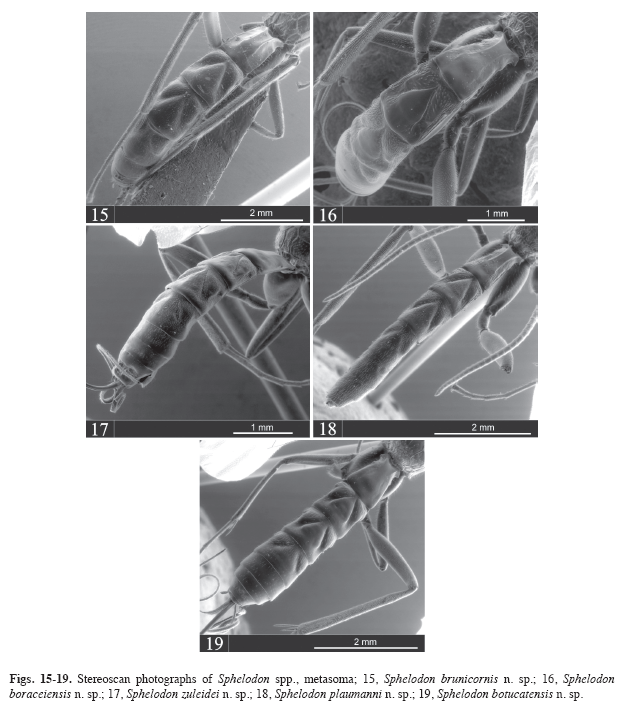
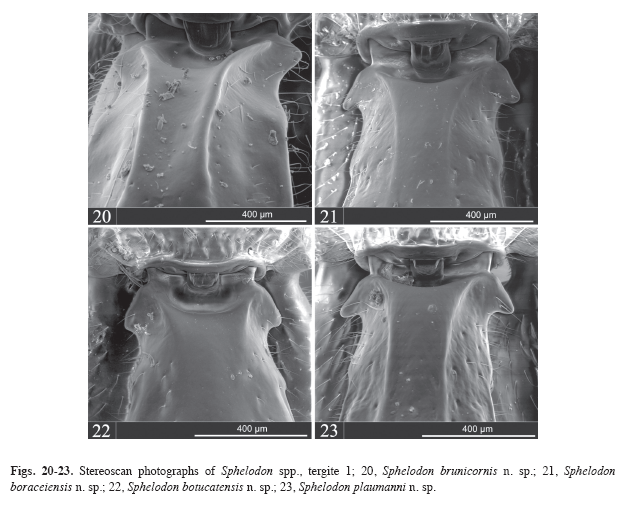
<body><![CDATA[<p align="justify"><font face="Verdana" size="2"><b>Holotype: Female: </b>Fore wing length 7.6mm; hind wing length 5.3mm. Clypeus 1.3x as broad as long; lower face with a weak median swelling; malar space 0.8x as long as </font><font face="Verdana" size="2">basal mandibular width; <i>frons </i>flat and smooth; occipital carina absent; head in dorsal view with gena very strongly constricted behind eyes, flat. Antenna with 44 flagellomeres. <i>Pronotum </i>long, slightly swollen above upper end of epomia, epomia itself long and very strong, <i>mesoscutum </i>centrally rather finely and sparsely punctate with hairs, laterally weakly punctulate with setae; notauli present but weak and shallow; <i>mesopleuron </i>with sparse fine setiferous punctures; epicnemial carina rather straight, not reaching anterior margin of <i>mesopleuron </i>and exceeding level of lower corner of <i>pronotum</i>; sternal part of mesothorax 1.2x as long as mid coxa. <i>Metapleuron </i>uniformly punctate with hairs, and with a weak to strong stria at posterior margin of submetapleural carina. Pleural carina complete (<a  href="/img/revistas/rbt/v59n4/a16i3.jpg">Fig. 11</a>); <i>propodeum </i>with posterior transverse carina complete, strong and sinuous, anterior transverse carina complete and strong, lateral and lateromedian longitudinal carinae present from anterior margin to spiracle level, then with small vestiges (<a href="/img/revistas/rbt/v59n4/a16i3.jpg">Fig. 11</a>). Fore tibia with spur normally developed, 2.3x as long as breadth of tibia; mid tibia without conspicuous denticles on outer surface, and with spurs nearly equal, longer 1.2x length of shorter. Fore wing with abscissa of <i>Cu</i>1 between 1<i>m-cu </i>and <i>Cu</i>1a 2.0x as long as <i>Cu</i>1b<i>; </i>hind wing with length of abscissa of <i>Cu</i>1 between <i>M </i>and <i>cu-a </i>0.6x as long as combined lengths of this vein and <i>cu-a</i>. Metasoma (<a href="/img/revistas/rbt/v59n4/a16i4.jpg">Fig. 16</a>) with tergite I smooth, with lateromedian longitudinal carinae weak, present on anterior 0.2; tergite I in lateral view with spiracle positioned anterior to centre, about 0.3 of way along, base with sharp lateral tooth, with margin pointing down (<a href="/img/revistas/rbt/v59n4/a16i5.jpg">Fig. 21</a>); tergite II 1.1 as long as posteriorly broad, with oblique grooves strongly impressed, with central triangular area smooth, lateral area smooth with some pubescence; tergites II-IV similar though latter with oblique grooves very weak, almost vestigial. Ovipositor of moderate length, 1.6x as long as hind tibia.</font></p>     <p align="justify"><font face="Verdana" size="2"><b>Coloration: </b>Head with face mostly white with medium longitudinal brown spot; clypeus white, mandibles white with apex light brown; antenna ventrally with margin of scape and pedicel white, flagellomeres black with flagellomeres 12-21 white, flagellomeres 11 and 22 light brown. Gena, <i>frons </i>black, vertex with two yellow spots parallel to posterior ocelli and very close to eyes; labial and maxilar palps yellow. Mesosoma mostly orange, <i>mesoscutum </i>with two ferruginous spots (submedial one bigger than posterior one); <i>propleuron</i>, <i>mesopleuron </i>and <i>metapleuron </i>light orange. Wings hyaline with pterostigma brown. Fore legs light orange with <i>tarsus </i>infuscate, mid legs orange, with <i>tarsus </i>light brown, hind legs with coxa, trochanter and <i>trochantellus </i>orange, with tibia orange, with apex ferrugineous; <i>tarsus </i>mostly white, with tarsomere 1 ferruginous at base, tarsomere 5 mostly ferruginous. Metasoma orange, with triangular area of tergites II-IV orange ferruginous. Ovipositor orange; ovipositor sheaths dark brown, with apex brown.</font></p>     <p align="justify"><font face="Verdana" size="2"><b>Variation: </b>Two female from the same locality have a dark orange mesosoma, and a dark brown metasoma; besides these, one of those two female (29.IV-21.V.2008) has the flagellomeres 13-21 white; the other female (28. VI-02.VI. 2008) has the flagellomeres 12-20 white, posterior transverse carina less sinuous, tergite I with tooth present but rather truncated, pointing to the side.</font></p>     <p align="justify"><font face="Verdana" size="2"><b>Holotype: </b>Female BRASIL, SP, Sales&oacute;polis, Reserva Biol&oacute;gica Borac&eacute;ia 23&deg;39&#8217; S 45&deg;53.9&#8217; W. Trilha dos Pil&otilde;es, PT.6 19-22. VI.2002 Bandejas Amarelas APAguiar &amp; ACCMacedo coll. BIOTA-FAPESP (MZUSP). </font></p>     <p align="justify"><font face="Verdana" size="2"><b>Paratypes. </b>2 Females BRASIL, SP, Sales&oacute;polis, Reserva Biol&oacute;gica Borac&eacute;ia 45 W 53.9&#8217;, 23 S 39. Trilha dos Pil&otilde;es, PT.4 (MZUSP). 19-22.VI.2002 Bandejas Amarelas APAguiar &amp; ACCMacedo coll. BIOTA-FAPESP. 45 W 53&#8217;51.4", 23 S 39&#8217; 03.6". Trilha dos Pil&otilde;es, PT.3 9-15.I.2003 Malaise 863m ACCMacedo &amp; JSFreitas coll. BIOTA-FAPESP (MZUSP).</font></p>     <p align="justify"><font face="Verdana" size="2"><b>Etymology: </b>The specific name refers to the type-locality, the Borac&eacute;ia Natural Reserve, located in the city of Sales&oacute;polis, SP, Brazil.</font></p>     <p align="justify"><font face="Verdana" size="3"><b><i>Sphelodon botucatensis </i>Herrera n. sp. </b></font><font face="Verdana"  size="2">(<a href="/img/revistas/rbt/v59n4/a16i1.jpg">Figs. 2</a>, <a  href="/img/revistas/rbt/v59n4/a16i2.jpg">9</a>, <a  href="/img/revistas/rbt/v59n4/a16i3.jpg">14</a>, <a  href="/img/revistas/rbt/v59n4/a16i4.jpg">19</a>, <a  href="/img/revistas/rbt/v59n4/a16i5.jpg">22</a>)</font></p>     <p align="justify"><font face="Verdana" size="2"></font></p>     <p align="justify"><font face="Verdana" size="2"><b>Diagnosis: </b>This species resembles <i>S. annulicornis</i>, <i>S. brunicornis </i>n. sp. and <i>S. wardae </i>in having a completely delineated area superomedia (<a href="/img/revistas/rbt/v59n4/a16i3.jpg">Fig. 14</a>). It differs from <i>S. annulicornis </i>in the number of flagellomeres and color pattern (39-40 flagellomeres in <i>S. annulicornis</i>, 43 in <i>S. botucatensis </i>n. sp.), from <i>S. brunicornis </i>n. sp. in the color of the <i>flagellum</i>. It differs from <i>S. wardae </i>in the color pattern and in epomia characteristics (in dorsal view with upper end of epomia forming a distinct tubercle in <i>S. wardae</i>, not tuberculate in <i>S. botucatensis</i>). This species differs from <i>S. boraceiensis</i>, <i>S. phoxopteridis </i>and <i>S. ugaldei </i>clearly in the color pattern and in propodeal characteristics (without an enclosed area superomedia in these species), and from <i>S. guanacastensis </i>in <i>propodeum </i>and <i>mesopleuron </i>characteristics (the current species has a closely and coarsely punctate <i>mesopleuron</i>). It differs from the species <i>S. beameri </i>and <i>S. concolor </i>in propodeal characteristics (without an enclosed area superomedia in these nearctic species and with a enclosed one in <i>S. botucatensis</i>) </font><font  face="Verdana" size="2">and from <i>S. nomene </i>(also neartic) in the color pattern (e.g. metasoma black ferruginous with transverse yellow bands in <i>S. botucatensis</i>, and mostly tawny-rufous in <i>S. nomene</i>)<i>.</i></font></p>     <p align="justify"><font face="Verdana" size="2"><b>Female: </b>Fore wing length 6.1mm; hind wing length 3.5mm. Clypeus 1.3x as broad as long; lower face very weakly convex, smooth; malar space 0.8x as long as basal mandibular width; <i>frons </i>flat and smooth; occipital carina more or less entirely absent, with short vestige laterally; head in dorsal view with gena rounded behind eyes. Antenna with 43 flagellomeres. <i>Pronotum </i>long, not swollen above epomia, epomia itself strong but short, not reaching upper margin of <i>pronotum</i>; <i>mesoscutum </i>punctulate with setae, laterally with punctures finer and weaker; notauli present, but weak and shallow; <i>mesopleuron </i>mostly punctulate with setae; epicnemial carina rather sinuous, reaching anterior margin of <i>mesopleuron</i>, exceeding level of lower corner of <i>pronotum</i>; sternal part of mesothorax 1.3x as long as mid coxa. <i>Metapleuron </i>punctulate with setae, with transverse carina at posterior margin of submetapleural carina. Pleural carina complete and strong (<a href="/img/revistas/rbt/v59n4/a16i3.jpg">Fig. 14</a>); <i>propodeum </i>with dorsal carinae almost complete, delineating enclosed area superomedia; lateral longitudinal carina present on anterior margin until anterior transverse carina; posterior transverse carina sinuous, forming an "<i>M</i></font><font size="2">"</font><font  face="Verdana" size="2"> shape (<a  href="/img/revistas/rbt/v59n4/a16i3.jpg">Fig. 14</a>). Fore tibia with spur normally developed, 1.4x as long as breadth of tibia; mid tibia without conspicuous denticles on outer surface, with spurs nearly equal, longer 1.1x length of shorter. Fore wing with abscissa of <i>Cu</i>1 between 1<i>m-cu </i>and <i>Cu</i>1a 1.5x as long as <i>Cu</i>1b; hind wing with length of abscissa of <i>Cu</i>1 between <i>M </i>and <i>cu-a </i>0.4x as long as combined lengths of this vein and <i>cu-a</i>. Metasoma (<a href="/img/revistas/rbt/v59n4/a16i4.jpg">Fig. 19</a>) with tergite I smooth with some setiferous punctures, with lateromedian longitudinal carinae very weak, in dorsal view present on anterior 0.2; tergite I in lateral view, with spiracle positioned anterior to centre, about 0.3 of way along; base with rather truncated lateral tooth, margin pointing laterally (<a href="/img/revistas/rbt/v59n4/a16i5.jpg">Fig. 22</a>); tergite II 1.0 as long as posteriorly broad, with oblique grooves strongly impressed, with central triangular area smooth, lateral area similar but with some isolated setae; tergites II-IV similar though latter with oblique grooves weaker, with some setae specially in lateral area. Ovipositor of moderate length, 1.9x as long as hind tibia.</font></p>     ]]></body>
<body><![CDATA[<p align="justify"><font face="Verdana" size="2"><b>Coloration: </b>Head: face light yellow with central longitudinal brown spot, clypeus and mandible light yellow, apex of mandibles ferruginous, labial and maxilar palps light yellow; <i>frons</i>, vertex and occiput centrally brown ferruginous, light yellow laterally; ocelli brown ferruginous; gena mostly light yellow. Eyes dark brown. Antenna, scape brown with margin yellow, pedicel yellow. First flagellomere brown, flagellomeres 2-8 dark brown, flagellomere 9 mostly dark brown, flagellomeres 10-18 white, flagellomere 19 mostly white, flagellomeres 20+ dark brown. Mesosoma: <i>mesoscutum </i>red, <i>scutellum </i>yellow, <i>dorsellum </i>yellow; <i>pronotum </i>mostly red with dorsal and ventral margins yellow; <i>mesopleuron </i>yellow centrally, red <i>epicnemium</i>, dorsal margin and posterior margin; <i>metapleuron </i>mostly yellow, subalar prominence and tegula yellow. Wings hyaline, pterostigma brown. <i>Propodeum </i>mostly red with yellow spots in area dentipara. Fore legs: coxa, trochanter, <i>trochantellus </i>light yellow; femur tibia and <i>tarsus </i>orange; mid legs: coxa, trochanter light yellow, <i>trochantellus </i>mostly light yellow with marginal brown ferruginous spot; femur and tibia orange; <i>tarsus </i>brown; hind legs coxa yellow with inner and outer ferruginous spots, basal half of trochanter ferruginous, rest yellow: <i>trochantellus </i>with apex ferruginous: femur with inner side orange, outer side dark orange; tibia brown with base and apex ferrugineous; <i>tarsus </i>mostly white; tarsomere 1 with base ferruginous, tarsomere 5 ferruginous. Metasoma with tergite I black ferruginous with anterior and posterior margins yellow; tergites II-II black ferruginous with anterior corners and posterior margins yellow; tergite IV mostly black ferruginous, rest light yellow; tergite V light yellow, basal half ferruginous; tergites VIVI light yellow with anterior margin with black ferruginous strip on anterior margins. Ovipositor orange, ovipositor sheaths dark brown.</font></p>     <p align="justify"><font face="Verdana" size="2"><b>Holotype: </b>Female BRASIL, S&Atilde;O PAULO, Botucatu, 48 W 26&#8217;41", 22 S 53&#8217;07", VI, 1986, 804m, H.C.Almeida col. (UFPR).</font></p>     <p align="justify"><font face="Verdana" size="2"><b>Etymology: </b>The name of this species refers to the city of Botucatu (SP, Brazil), the type-locality.</font></p>     <p align="justify"><font face="Verdana" size="3"><b><i>Sphelodon brunicornis </i>Herrera n. sp. </b></font><font face="Verdana"  size="2">(<a href="/img/revistas/rbt/v59n4/a16i1.jpg">Figs. 3</a>, <a  href="/img/revistas/rbt/v59n4/a16i3.jpg">10</a>, <a  href="/img/revistas/rbt/v59n4/a16i4.jpg">15</a>, <a  href="/img/revistas/rbt/v59n4/a16i5.jpg">20</a>)</font></p>     <p align="justify"><font face="Verdana" size="2"></font></p>     <p align="justify"><font face="Verdana" size="2"><b>Diagnosis: </b>This species differs from the other described species of the genus as the antennal <i>flagellum </i>lacks a median white band.</font></p>     <p align="justify"><font face="Verdana" size="2"><b>Female: </b>Fore wing length 9.1mm; hind wing length 6.5mm. Clypeus 1.5x as broad as long; lower face flat and smooth; malar space 0.7x as long as basal mandibular width; <i>frons </i>flat and smooth; occipital carina dorsally centrally interrumpted, its lower end reaching hypostomal carina before mandibular base; head in dorsal view with gena very strongly constricted behind eyes, flat. <i>Pronotum </i>long, not swollen above epomia, the epomia itself strong but short, not reaching upper margin of <i>pronotum</i>; <i>mesoscutum </i>centrally rather finely and sparsely punctate with hairs, laterally weakly punctulate with setae; notauli quite strongly impressed anteriorly; <i>mesopleuron </i>polished with some sparse punctures; epicnemial carina dorsally sinuous, not reaching anterior margin of <i>mesopleuron </i>and exceeding level of lower corner of <i>pronotum</i>; sternal part of mesothorax 1.4x as long as mid coxa. <i>Metapleuron </i>uniformly finely and sparsely punctate, with a transverse stria at the anterior margin of the submetapleural carina, and a strong carina from posterior margin of submetapleural carina and apical margin of <i>metapleuron</i>. Pleural carina complete and strong (<a  href="/img/revistas/rbt/v59n4/a16i3.jpg">Fig. 10</a>); <i>propodeum </i>with carinae complete and strong, delineating elongate enclosed area superomedia (<a href="/img/revistas/rbt/v59n4/a16i3.jpg">Fig. 10</a>). Fore tibia with spur normally developed, 2.2x as long as breadth of tibia; mid tibia without conspicuous denticles on outer surface and with spurs nearly equal, the longer 1.2x length of shorter. Fore wing with abscissa of <i>Cu</i>1 between 1<i>m-cu </i>and <i>Cu</i>1a 1.7x as long as <i>Cu</i>1b; hind wing with length of abscissa of <i>Cu</i>1 between <i>M </i>and <i>cu-a </i>0.8x as long as combined lengths of this vein and <i>cu-a</i>. Metasoma (<a  href="/img/revistas/rbt/v59n4/a16i4.jpg">Fig. 15</a> with tergite I smooth, with lateromedian longitudinal carinae quite strong, present on anterior 0.6; tergite I in lateral view, with spiracle positioned anterior to centre, about 0.3 of way along, base with a rather rounded lateral tooth, margin pointing laterally (<a  href="/img/revistas/rbt/v59n4/a16i5.jpg">Fig. 20</a>); tergite II 1.0 as long as posteriorly broad, with oblique grooves strongly impressed, with central triangular and lateral areas smooth and with some fine and sparse pubescence; tergites II-IV similar though the latter with the oblique grooves very weak, almost vestigial. Ovipositor of moderate length, 1.7x as long as hind tibia.</font></p>     <p align="justify"><font face="Verdana" size="2"><b>Coloration: </b>Head mostly black. Lower face partly yellow, clypeus and mandible yellow. Apex of mandibles ferruginous. Gena posteriorly ferruginous, anteriorly surrounding area of eye dark orange. Labial and maxilar palps orange. Antenna brown, pedicel orange on dorsal margin. Mesosoma orange. Fore wing with two brown bands, one near the middle, the other at the posterior margin; pterostigma yellow; hind wing infuscate (hyaline yellow). Fore and mid legs orange, hind legs with coxa, trochanter, <i>trochantellus </i>and base of femur dark orange, tibia and <i>tarsus </i>light brown. Metasoma mostly orange, with tergites V+ ferruginous. Ovipositor orange, ovipositor sheaths black.</font></p>     <p align="justify"><font face="Verdana" size="2"><b>Holotype: </b>Female BRASIL, PA, Canind&eacute;, Rio Gurup&iacute;. IV 1963 Malkin &amp; Pinheiros col. (UFPR). Specimen condition: antenna incomplete (left antenna with 25 flagellomeres, right antenna with 37 flagellomeres).</font></p>     <p align="justify"><font face="Verdana" size="2"><b>Etymology: </b>The specific name refers to the characteristic color of the antennae.</font></p>     ]]></body>
<body><![CDATA[<p align="justify"><font face="Verdana" size="2"><b>Comments: </b>All currently described species of <i>Sphelodon </i>have a <i>flagellum </i>with a median whitish band. Although the holotype lacks some flagellomeres in both antenna, there are enough present to be certain that there is no whitish band; this is because in the rest of the described species of <i>Sphelodon </i>the white or yellow band is centrally located (i.e. from flagellomeres 3 (the lowest) to 21 (the uppermost)).</font></p>     <p align="justify"><font face="Verdana" size="3"><b><i>Sphelodon plaumanni </i>Herrera n. sp. </b></font><font face="Verdana" size="2">(<a  href="/img/revistas/rbt/v59n4/a16i1.jpg">Figs. 4</a>, <a  href="/img/revistas/rbt/v59n4/a16i3.jpg">13</a>, <a  href="/img/revistas/rbt/v59n4/a16i4.jpg">18</a>, <a  href="/img/revistas/rbt/v59n4/a16i5.jpg">23</a>)</font></p>     <p align="justify"><font face="Verdana" size="2"></font></p>     <p align="justify"><font face="Verdana" size="2"><b>Diagnosis: </b>This species resembles <i>S. boraceiensis</i>, <i>S. guanacastensis</i>, <i>S. phoxopteridis </i>and <i>S. ugaldei </i>in not having a delineated area superomedia (<a href="/img/revistas/rbt/v59n4/a16i3.jpg">Fig. 13</a>). It differs from <i>S. guanacastensis </i>in characteristics of the <i>mesopleuron</i>; the latter species has a closely and coarsely punctate <i>mesopleuron</i>. That of <i>S. plaumanni </i>is rather smooth. It differs from <i>S. phoxopteridis </i>in that in this species the lower end of the occipital carina is distinct, while in <i>S. plaumanni </i> it is absent. It differs from <i>S. ugaldei </i>in the number of flagellomeres (39-40 in <i>S. ugaldei</i>, 45 in <i>S. plaumanni</i>) and in the color pattern (e.g. gena and vertex pale yellow in <i>S. ugaldei</i>, and black in <i>S. plaumanni</i>). It differs from <i>S. boraceiensis </i>in the color pattern (e.g. scape and gena mainly yellow in <i>S. plaumanni </i>and scape and gena mostly black in <i>S. boraceiensis</i>) and in others features (e.g. terguite I with lateral longitudinal striae at posterior margin and lateromedian longitudinal carina, after transverse posterior carina, very weak and some straight in <i>S. plaumanni </i>and terguite I smooth at posterior margin and lateromedian longitudinal carina, after transverse posterior carina, strong and sinuous in <i>S. boraceiensis</i>). It differs from <i>S. annulicornis</i>, <i>S. botucatensis </i>and <i>S. brunicornis</i>, in the color pattern and propodeal characteristics (with a completely delineated area superomedia in these species). It differs from <i>S. wardae </i>in <i>propodeum </i>and epomia characteristics (in dorsal view with upper end of epomia forming a distinct tubercle in <i>S. wardae</i>, not tuberculate in <i>S. plaumanni</i>). This species differs from the species <i>S. beameri </i>and <i>S. concolor </i>in the color pattern (e.g. mostly orange and flagellomeres 13-22 white in <i>S. plaumanni </i>and mostly rufous and flagellomeres 13-18 pale yellow in <i>S. beameri</i>; flagellomeres 14-15 weak pale in <i>S. concolor</i>). It differs from <i>S. nomene </i>in propodeal characteristics (without an enclosed area superomedia in the neotropical species and with an enclosed the nearctic one)<i>.</i></font></p>     <p align="justify"><font face="Verdana" size="2"><b>Male: </b>Fore wing length 6.7mm; hind wing length 4.7mm. Clypeus 1.5x as broad as long; lower face with weak median swelling; malar space 0.7x as long as basal mandibular width; <i>frons </i>flat and smooth; occipital carina absent; head in dorsal view with gena rounded behind eyes. Antenna with 45 flagellomeres. <i>Pronotum </i>long, not swollen above epomia, epomia itself strong and long but not reaching upper margin of <i>pronotum</i>; <i>mesoscutum </i>uniformly punctulate with setae; notauli weakly impressed anteriorly; <i>mesopleuron </i>with setiferous punctures at ventral and anterior margins; epicnemial carina weakly impressed, somewhat sinuous at dorsal margin, not reaching the anterior margin of <i>mesopleuron </i>and exceeding level of lower corner of <i>pronotum</i>; sternal part of mesothorax 1.4x as long as mid coxa. <i>Metapleuron </i>punctulate with setae and with transverse stria at posterior margin of submetapleural carina. Pleural carina complete (<a href="/img/revistas/rbt/v59n4/a16i3.jpg">Fig. 13</a>; <i>propodeum </i>with posterior transverse and anterior transverse carinae present, lateral longitudinal carina present anteriorly until spiracle level, lateromedian longitudinal carina present anteriorly until joining anterior transverse carina (<a  href="/img/revistas/rbt/v59n4/a16i3.jpg">Fig. 13</a>). Fore tibia with spur normally developed, 2.9x as long as breadth of tibia; mid tibia without conspicuous denticles on outer surface, and with spurs nearly equal, longer 1.1x length of shorter. Fore wing with abscissa of <i>Cu</i>1 between 1<i>m-cu </i>and <i>Cu</i>1a 2.0x as long as <i>Cu</i>1b; hind wing with length of abscissa of <i>Cu</i>1 between <i>M </i>and <i>cu-a </i>0.6x as long as combined lengths of this vein and <i>cu-a</i>. Metasoma (<a href="/img/revistas/rbt/v59n4/a16i4.jpg">Fig. 18</a>) with tergite I smooth with some small setiferous punctures, with lateromedian longitudinal carinae very weak, in dorsal view with vestiges present until 0.83 of length; tergite I in lateral view with spiracle positioned anterior to centre, about 0.3 of way along, base with a sharp lateral tooth, apex pointing down (<a  href="/img/revistas/rbt/v59n4/a16i5.jpg">Fig. 23</a>); tergite II 1.2 as long as posteriorly broad, with oblique grooves strongly impressed, with some few sparse setiferous punctures in central triangular and lateral areas; tergites II-IV similar though the latter with the oblique grooves weak and with more setiferous punctures than tergite II.</font></p>     <p align="justify"><font face="Verdana" size="2"><b>Coloration: </b>Head: Face and clypeus dull yellow with apex brown ferruginous, vertex brown ferruginous, with two yellow spots parallel to ocelli close to eyes, ocelli dark orange, <i>frons </i>mostly brown ferruginous with two lateral strips close to eyes, eyes brown with black spots; scape and pedicel ventrally yellow, dorsally yellow infuscate. Flagellomere 1 brown, outer side with orange strip; flagellomeres 2-12 brown, flagellomere 13 mostly yellow; flagellomeres 14-22 yellow; flagellomeres 23+ brown. Gena dorsally ferruginous brown, ventrally yellow. Maxillary and labial palps orange. Mesosoma orange; <i>propleuron</i>, <i>mesopleuron </i>and <i>metapleuron </i>light orange. Wings hyaline with pterostigma brown. Fore legs orange, mid legs orange with <i>tarsus </i>brown; hind legs, coxa, trochanter, <i>trochantellus</i>, femur orange, tibia mostly orange with apex ferruginous, <i>tarsus </i>mostly yellow, tarsomere 1 with basal half ferruginous, tarsomere 5 ferruginous. Metasoma with tergites I-II dark orange, tergites IV+ ferruginous.</font></p>     <p align="justify"><font face="Verdana" size="2"><b>Holotype: </b>Male. BRASIL: Santa Catarina, Nova Teut&ocirc;nia, 52 W 25&#8217;5127", 27 S 09&#8217;49", IX/1967 F. Plaumann leg. (UFPR).</font></p>     <p align="justify"><font face="Verdana" size="2"><b>Etymology: </b>This species is named in honour of F. Plaumann, who collected the one known specimen. </font></p>     <p align="justify"><font face="Verdana" size="3"><b><i>Sphelodon zuleidei </i>Herrera n. sp.</b></font><font face="Verdana" size="2"> (<a  href="/img/revistas/rbt/v59n4/a16i1.jpg">Figs. 5</a>, <a  href="/img/revistas/rbt/v59n4/a16i2.jpg">6</a>, <a  href="/img/revistas/rbt/v59n4/a16i2.jpg">7</a>, <a  href="/img/revistas/rbt/v59n4/a16i3.jpg">12</a>, <a  href="/img/revistas/rbt/v59n4/a16i4.jpg">17</a>)</font></p>     <p align="justify"><font face="Verdana" size="2"></font></p>     ]]></body>
<body><![CDATA[<p align="justify"><font face="Verdana" size="2"><b>Diagnosis: </b>This species differs from <i>S. boraceiensis</i>, <i>S. plaumanni</i>, <i>S. guanacastensis</i>, <i>S. phoxopteridis</i>, and <i>S. ugaldei </i>in propodeal characteristics. In these species the area superomedia is not delineated. Also, if compared with <i>S. guanacastensis </i>it differs in <i>mesopleuron </i>characteristics. It resembles <i>S. annulicornis</i>, <i>S. brunicornis</i>, <i>S. botucatensis </i>and <i>S. wardae </i>in having a completely delineated area superomedia (<a  href="/img/revistas/rbt/v59n4/a16i3.jpg">Fig. 12</a>) but this species differs from <i>S. annulicornis </i>and <i>S. botucatensis </i>in the color pattern (e.g. <i>mesoscutum </i>black in <i>S. annulicornis </i>and orange in <i>S. zuleidei </i>n. sp., <i>propodeum </i>mostly half red and half yellow in <i>S. botucatensis </i>and almost half black ferruginous in <i>S. zuleidei</i>); it differs from <i>S. wardae </i>in the color pattern and epomia characteristics (in dorsal view with upper end of epomia forming a distinct tubercle in <i>S. wardae</i>, not tuberculate in <i>S. zuleidei</i>), and from <i>S. brunicornis </i>in having a median white ban d on the <i>flagellum </i>(<a  href="/img/revistas/rbt/v59n4/a16i1.jpg">Fig. 5</a>). This species differs from the species <i>S. beameri </i>and <i>S. concolor </i>in propodeal characteristics (with an enclosed area superomedia in the neotropical species and without an enclosed in the nearctic ones)<i>. </i>It differs from <i>S. nomene </i>in the color pattern (e.g. metasoma black with transverse yellow bands and flagellomeres 9-20 white in <i>S. zuleidei </i>and metasoma mostly tawny-rufous and flagellomeres 11 or 12-17 pale yellow in <i>S. nomene</i>)<i>.</i></font></p>     <div style="text-align: justify;"><font face="Verdana" size="2"><b>Female: </b>Fore wing length 5.6mm; hind wing length 4.0mm. Clypeus 1.4x as broad as long; lower face very weak convex and smooth; malar space 1.0x as long as basal mandibular width; <i>frons </i>weakly concave and smooth; occipital carina absent (<a  href="/img/revistas/rbt/v59n4/a16i2.jpg">Fig. 6</a>); head in dorsal view with gena rounded behind eyes. Antenna with 44 flagellomeres. <i>Pronotum </i>long, not swollen above epomia, epomia itself strong and long, but not reaching upper margin of <i>pronotum</i>; <i>mesoscutum </i>punctulate with setae, laterally with punctures finer and weaker; notauli quite strongly impressed anteriorly; <i>mesopleuron </i>mostly smooth, with some setiferous punctures specially at anterior margin; epicnemial carina rather straight, not reaching anterior margin of <i>mesopleuron </i>and exceeding the level of lower corner of <i>pronotum</i>; sternal part of mesothorax 1.5x as long as mid coxa. <i>Metapleuron </i>with some sparse, fine punctures with setae and with carina from posterior margin of submetapleural carina to apical margin of <i>metapleuron</i>. Pleural carina complete; <i>propodeum </i>with dorsal carinae more or less complete, delineating enclosed area superomedia; lateral longitudinal carina incomplete (only present anteriorly until spiracle level). Fore tibia with spur normally developed, 1.8x as long as breadth of tibia; mid tibia without conspicuous denticles on outer surface, purs nearly equal, longer 1.2x length of shorter. Fore wing with abscissa of <i>Cu</i>1 between 1<i>m-cu </i>and <i>Cu</i>1a 1.1x as long as <i>Cu</i>1b; hind wing with length of abscissa of <i>Cu</i>1 between <i>M </i>and <i>cu-a </i>0.6x as long as combined lengths of this vein and <i>cu-a</i>. Metasoma (<a  href="/img/revistas/rbt/v59n4/a16i4.jpg">Fig. 17</a>) with tergite I smooth, with lateromedian longitudinal carinae weak, present on anterior 0.3, tergite I in lateral view with spiracle positioned anterior to centre, about 0.3 of way along, base with sharp lateral tooth, margin pointing laterally; tergite II 0.9 as long as posteriorly broad, with oblique grooves strongly impressed, with central triangular area smooth and lateral area with some fine sparse punctures, tergite II with oblique grooves strongly impressed, with triangular area with some fine punctures, and lateral area with setiferous punctures strongly all over impressed; tergite IV with oblique grooves weaker, with fine setiferous punctures all over. Ovipositor of moderate length, 1.6x as long as hind tibia.</font></div>     <div style="text-align: justify;">    <br> <font face="Verdana" size="2"><b>Coloration: </b>Head: face orange ochre, clypeus orange ochre, mandibles orange ochre with apex red ferrugineous, labial and maxilar palps yellow ochre; vertex and <i>frons </i>black centrally, with margins ochre; occiput black; ocelli brown; gena dorsally black, ventrally ochre; scape ventrally brown with margin yellow pedicel ventrally yellow; flagellomeres 1-8 dark brown, flagellomere 9 mostly light brown, flagellomeres 10-20 light brown, flagellomeres 21+ dark brown. Mesosoma, <i>mesoscutum </i>orange, <i>scutellum </i>and <i>dorsellum </i>light orange; <i>pronotum </i>mostly orange with ventral margin yellow; <i>mesopleuron </i>mostly yellow, dorsally orange; <i>metapleuron </i>yellow, with mid anterior black spot. Wings hyaline with pterostigma dark brown and apex of fore wings with weak brown spot. <i>Propodeum </i>ferrugineous, area <i>petiolaris</i>, area posteroexterna, most of area dentipara and area superomedia yellow, area externa mostly orange. Fore legs with coxa, trochanter light orange, <i>trochantellus </i>mostly orange with apical brown spot, femur orange with a basal brown spot, tibia and <i>tarsus </i>orange; mid legs, coxa light orange, trochanter light orange with two basal brown spots, <i>trochantellus </i>mostly brown, femur orange with a basal brown spot, tibia orange, <i>tarsus </i>brown; hind legs with coxa light orange with big black spot at outer side, small dorsal black spot at inner side; trochanter yellow with dark brown spot basally, <i>trochantellus </i>mostly brown, femur mostly orange with basal black spot and longitudinal brown strip at outer side; tibia mostly brown ferruginous with yellow strip at anterior side, tibial spur brown ferruginous, <i>tarsus </i>mostly brown, tarsomere 1 with distal half yellow ochre. Metasoma with tergite I black, anteriorly and posteriorly yellow; tergite II-IV mostly black, with posterior yellow strip; tergite V-VI with first half black, last half yellow, tergite VI yellow, first half ferruginous; tergite VI ferruginous. Ovipositor orange. Ovipositor sheath dark brown.</font></div>     <p align="justify"><font face="Verdana" size="2"><b>Holotype: </b>Female, BRASIL, RJ, Teres&oacute;polis, Parque Nacional Serra dos Org&atilde;os 42 W 56&#8217;, 22 S 26&#8217; Armadilha Malaise 43 31.X-05. XI.2004 ALBG Peronti e equipe col. (UFES)</font></p>     <p align="justify"><font face="Verdana" size="2"><b>Etymology: </b>This species is named in honour of our colleague Zuleide Ramiro. </font></p> <font face="Verdana" size="3"><b>     <p align="justify">Acknowledgments</p> </b></font> <font face="Verdana" size="2">     <p align="justify">The authors acknowledge the financial assistance of CNPq (Conselho Nacional de Desenvolvimento Cient&iacute;fico e Tecnol&oacute;gico), FAPESP (Funda&ccedil;&atilde;o de Amparo &agrave; Pesquisa do Estado de S&atilde;o Paulo, Programa Biota) and HYMPAR/SUDESTE (INCT-Instituto Nacional dos Hymenoptera Parasit&oacute;ides da Regi&atilde;o Sudeste Brasileira). We are indebted to Dr. David Wahl (American Entomological Institute) and Dr. Carolina Godoy for giving us permission to use some images extracted from the book: "The Ichneumonidae of Costa Rica 4" in this paper. Also, special thanks to Luciana Bueno dos Reis Fernandes for taking and editing the photos and improving the text, Dr. Gavin Broad and Dr. Dmitry Dmitriev for imaging the <i>Sphelodon </i>holotypes from the British Museum of Natural History collection and Illinois Natural History Survey respectively, and to the three reviewers who decidedly helped to improve this article.</p> </font> <hr style="width: 100%; height: 2px;"><font face="Verdana" size="3"><b>     <p align="justify">References</p> </b></font><font size="2"> </font><font face="Verdana" size="2">     <!-- ref --><p align="justify">Dasch, C.E. 1988. Ichneumon-flies of America north of Mexico 9. Tribe Glyptini. Mem. Am. Ent. Inst. 43: 1-644.    &nbsp;&nbsp;&nbsp;&nbsp;&nbsp;&nbsp;&nbsp;&nbsp;[&#160;<a href="javascript:void(0);" onclick="javascript: window.open('/scielo.php?script=sci_nlinks&ref=1747582&pid=S0034-7744201100040001600001&lng=','','width=640,height=500,resizable=yes,scrollbars=1,menubar=yes,');">Links</a>&#160;]<!-- end-ref --></p>     <!-- ref --><p align="justify">Gauld, I.D. 1991. The Ichneumonidae of Costa Rica 1. Mem. Am. Ent. Inst. 47: 1-589.    &nbsp;&nbsp;&nbsp;&nbsp;&nbsp;&nbsp;&nbsp;&nbsp;[&#160;<a href="javascript:void(0);" onclick="javascript: window.open('/scielo.php?script=sci_nlinks&ref=1747584&pid=S0034-7744201100040001600002&lng=','','width=640,height=500,resizable=yes,scrollbars=1,menubar=yes,');">Links</a>&#160;]<!-- end-ref --></p>     <!-- ref --><p align="justify">Gauld, I.D., C. Godoy, R. Sithole &amp; G.J. Ugalde. 2002. The Ichneumonidae of Costa Rica 4. Mem. Am. Ent. Inst. 66: 1-768.    &nbsp;&nbsp;&nbsp;&nbsp;&nbsp;&nbsp;&nbsp;&nbsp;[&#160;<a href="javascript:void(0);" onclick="javascript: window.open('/scielo.php?script=sci_nlinks&ref=1747586&pid=S0034-7744201100040001600003&lng=','','width=640,height=500,resizable=yes,scrollbars=1,menubar=yes,');">Links</a>&#160;]<!-- end-ref --></p>     <!-- ref --><p align="justify">Morley, C. 1914. A revision of the Ichneumonidae based on the collection in the British Museum (Natural History) Part II: Tribes Pimplides and Bassides. British Museum, London, England.    &nbsp;&nbsp;&nbsp;&nbsp;&nbsp;&nbsp;&nbsp;&nbsp;[&#160;<a href="javascript:void(0);" onclick="javascript: window.open('/scielo.php?script=sci_nlinks&ref=1747588&pid=S0034-7744201100040001600004&lng=','','width=640,height=500,resizable=yes,scrollbars=1,menubar=yes,');">Links</a>&#160;]<!-- end-ref --></p>     <!-- ref --><p align="justify">Ruiz, C.E. 2010. Ichneumonidae (Hymenoptera) del Estado de Tamaulipas, Mexico. Serie Avispas paras&iacute;ticas de plagas y otros insectos. No. 6. Editorial Planea, M&eacute;xico.    &nbsp;&nbsp;&nbsp;&nbsp;&nbsp;&nbsp;&nbsp;&nbsp;[&#160;<a href="javascript:void(0);" onclick="javascript: window.open('/scielo.php?script=sci_nlinks&ref=1747590&pid=S0034-7744201100040001600005&lng=','','width=640,height=500,resizable=yes,scrollbars=1,menubar=yes,');">Links</a>&#160;]<!-- end-ref --></p>     <!-- ref --><p align="justify">Ruiz, C.E., D.R. Kasparyan &amp; J.M.A. Coronado. 2002. Ichneumonidae, p. 631-646. <i>In </i>J. Llorente &amp; J.J. Morrone (eds.). Biodiversidad, taxonom&iacute;a y biogeograf&iacute;a de artr&oacute;podos de M&eacute;xico, Vol. II. UNAMCONABIO, M&eacute;xico.    &nbsp;&nbsp;&nbsp;&nbsp;&nbsp;&nbsp;&nbsp;&nbsp;[&#160;<a href="javascript:void(0);" onclick="javascript: window.open('/scielo.php?script=sci_nlinks&ref=1747592&pid=S0034-7744201100040001600006&lng=','','width=640,height=500,resizable=yes,scrollbars=1,menubar=yes,');">Links</a>&#160;]<!-- end-ref --></p>     <!-- ref --><p align="justify">Townes, H. 1970. Genera of Ichneumonidae 3. Mem. Am. Ent. Inst. 13: 1-307.    &nbsp;&nbsp;&nbsp;&nbsp;&nbsp;&nbsp;&nbsp;&nbsp;[&#160;<a href="javascript:void(0);" onclick="javascript: window.open('/scielo.php?script=sci_nlinks&ref=1747594&pid=S0034-7744201100040001600007&lng=','','width=640,height=500,resizable=yes,scrollbars=1,menubar=yes,');">Links</a>&#160;]<!-- end-ref --></p>     <!-- ref --><p align="justify">Townes, H. &amp; M. Townes. 1966. A catalogue and reclassification of Neotropic Ichneumonidae. Mem. Am. Ent. Inst. 8: 1-367.    &nbsp;&nbsp;&nbsp;&nbsp;&nbsp;&nbsp;&nbsp;&nbsp;[&#160;<a href="javascript:void(0);" onclick="javascript: window.open('/scielo.php?script=sci_nlinks&ref=1747596&pid=S0034-7744201100040001600008&lng=','','width=640,height=500,resizable=yes,scrollbars=1,menubar=yes,');">Links</a>&#160;]<!-- end-ref --></p>     <!-- ref --><p align="justify">Yu, D. &amp; K. Horstmann. 1998. A catalogue of world Ichneumonidae (Hymenoptera). Mem. Am. Ent. Inst. 58: 1-1558.    &nbsp;&nbsp;&nbsp;&nbsp;&nbsp;&nbsp;&nbsp;&nbsp;[&#160;<a href="javascript:void(0);" onclick="javascript: window.open('/scielo.php?script=sci_nlinks&ref=1747598&pid=S0034-7744201100040001600009&lng=','','width=640,height=500,resizable=yes,scrollbars=1,menubar=yes,');">Links</a>&#160;]<!-- end-ref --></p>     <!-- ref --><p align="justify">Yu, D.S., C. Van Achterberg &amp; K. Horstmann. 2005. World Ichneumonoidea 2004, taxonomy, biology, morphology and distribution. CD/DVD, Taxapad, Vancouver, Canada.    &nbsp;&nbsp;&nbsp;&nbsp;&nbsp;&nbsp;&nbsp;&nbsp;[&#160;<a href="javascript:void(0);" onclick="javascript: window.open('/scielo.php?script=sci_nlinks&ref=1747600&pid=S0034-7744201100040001600010&lng=','','width=640,height=500,resizable=yes,scrollbars=1,menubar=yes,');">Links</a>&#160;]<!-- end-ref --><br> </p>     <br>     ]]></body>
<body><![CDATA[<br> <a name="Correspondencia"></a>Correspondencia a: <font face="Verdana"  size="2">Andr&eacute;s Herrera &amp; Ang&eacute;lica Penteado-Dias.&nbsp;</font></font><font face="Verdana" size="2">Departamento de Ecologia e Biologia Evolutiva, Universidade Federal de S&atilde;o Carlos, Rod. Washington Lu&iacute;s, km 235, CEP 13565-905, S&atilde;o Carlos, SP, Brasil; <a href="mailto:andresfhf@gmail.com">andresfhf@gmail.com</a>, </font><font  face="Verdana" size="2"><a href="mailto:angelica@ufscar.br">angelica@ufscar.br</a>    <br> </font> <font face="Verdana" size="2"> </font> <hr style="width: 100%; height: 2px;"><font face="Verdana" size="2">     <p align="center">Received 17-VIII-2010. Corrected 14-IV-2011. Accepted 10-V-2011.</p> </font>      ]]></body><back>
<ref-list>
<ref id="B1">
<nlm-citation citation-type="journal">
<person-group person-group-type="author">
<name>
<surname><![CDATA[Dasch]]></surname>
<given-names><![CDATA[C.E]]></given-names>
</name>
</person-group>
<article-title xml:lang="en"><![CDATA[Ichneumon-flies of America north of Mexico 9. Tribe Glyptini]]></article-title>
<source><![CDATA[Mem. Am. Ent. Inst]]></source>
<year>1988</year>
<volume>43</volume>
<page-range>1-644</page-range></nlm-citation>
</ref>
<ref id="B2">
<nlm-citation citation-type="journal">
<person-group person-group-type="author">
<name>
<surname><![CDATA[Gauld]]></surname>
<given-names><![CDATA[I.D]]></given-names>
</name>
</person-group>
<article-title xml:lang="en"><![CDATA[The Ichneumonidae of Costa Rica 1]]></article-title>
<source><![CDATA[Mem. Am. Ent. Inst]]></source>
<year>1991</year>
<volume>47</volume>
<page-range>1-589</page-range></nlm-citation>
</ref>
<ref id="B3">
<nlm-citation citation-type="journal">
<person-group person-group-type="author">
<name>
<surname><![CDATA[Gauld]]></surname>
<given-names><![CDATA[I.D]]></given-names>
</name>
<name>
<surname><![CDATA[Godoy]]></surname>
<given-names><![CDATA[C]]></given-names>
</name>
<name>
<surname><![CDATA[Sithole]]></surname>
<given-names><![CDATA[R]]></given-names>
</name>
<name>
<surname><![CDATA[Ugalde]]></surname>
<given-names><![CDATA[G.J]]></given-names>
</name>
</person-group>
<article-title xml:lang="en"><![CDATA[The Ichneumonidae of Costa Rica 4]]></article-title>
<source><![CDATA[Mem. Am. Ent. Inst]]></source>
<year>2002</year>
<volume>66</volume>
<page-range>1-768</page-range></nlm-citation>
</ref>
<ref id="B4">
<nlm-citation citation-type="book">
<person-group person-group-type="author">
<name>
<surname><![CDATA[Morley]]></surname>
<given-names><![CDATA[C]]></given-names>
</name>
</person-group>
<source><![CDATA[A revision of the Ichneumonidae based on the collection in the British Museum (Natural History) Part II: Tribes Pimplides and Bassides]]></source>
<year>1914</year>
<publisher-loc><![CDATA[London ]]></publisher-loc>
<publisher-name><![CDATA[British Museum]]></publisher-name>
</nlm-citation>
</ref>
<ref id="B5">
<nlm-citation citation-type="book">
<person-group person-group-type="author">
<name>
<surname><![CDATA[Ruiz]]></surname>
<given-names><![CDATA[C.E]]></given-names>
</name>
</person-group>
<source><![CDATA[Ichneumonidae (Hymenoptera) del Estado de Tamaulipas, Mexico]]></source>
<year>2010</year>
<volume>6</volume>
<publisher-name><![CDATA[Planea]]></publisher-name>
</nlm-citation>
</ref>
<ref id="B6">
<nlm-citation citation-type="book">
<person-group person-group-type="author">
<name>
<surname><![CDATA[Ruiz]]></surname>
<given-names><![CDATA[C.E]]></given-names>
</name>
<name>
<surname><![CDATA[Kasparyan]]></surname>
<given-names><![CDATA[D.R]]></given-names>
</name>
<name>
<surname><![CDATA[Coronado]]></surname>
<given-names><![CDATA[J.M.A]]></given-names>
</name>
</person-group>
<article-title xml:lang="es"><![CDATA[Ichneumonidae]]></article-title>
<person-group person-group-type="editor">
<name>
<surname><![CDATA[Llorente]]></surname>
<given-names><![CDATA[J]]></given-names>
</name>
<name>
<surname><![CDATA[Morrone]]></surname>
<given-names><![CDATA[J.J]]></given-names>
</name>
</person-group>
<source><![CDATA[Biodiversidad, taxonomía y biogeografía de artrópodos de México]]></source>
<year>2002</year>
<volume>II</volume>
<page-range>631-646</page-range><publisher-name><![CDATA[UNAMCONABIO]]></publisher-name>
</nlm-citation>
</ref>
<ref id="B7">
<nlm-citation citation-type="journal">
<person-group person-group-type="author">
<name>
<surname><![CDATA[Townes]]></surname>
<given-names><![CDATA[H]]></given-names>
</name>
</person-group>
<article-title xml:lang="en"><![CDATA[Genera of Ichneumonidae 3]]></article-title>
<source><![CDATA[Mem. Am. Ent. Inst]]></source>
<year>1970</year>
<volume>13</volume>
<page-range>1-307</page-range></nlm-citation>
</ref>
<ref id="B8">
<nlm-citation citation-type="journal">
<person-group person-group-type="author">
<name>
<surname><![CDATA[Townes]]></surname>
<given-names><![CDATA[H]]></given-names>
</name>
<name>
<surname><![CDATA[Townes]]></surname>
<given-names><![CDATA[M]]></given-names>
</name>
</person-group>
<article-title xml:lang="en"><![CDATA[A catalogue and reclassification of Neotropic Ichneumonidae]]></article-title>
<source><![CDATA[Mem. Am. Ent. Inst]]></source>
<year>1966</year>
<volume>8</volume>
<page-range>1-367</page-range></nlm-citation>
</ref>
<ref id="B9">
<nlm-citation citation-type="journal">
<person-group person-group-type="author">
<name>
<surname><![CDATA[Yu]]></surname>
<given-names><![CDATA[D]]></given-names>
</name>
<name>
<surname><![CDATA[Horstmann]]></surname>
<given-names><![CDATA[K]]></given-names>
</name>
</person-group>
<article-title xml:lang="en"><![CDATA[A catalogue of world Ichneumonidae (Hymenoptera)]]></article-title>
<source><![CDATA[Mem. Am. Ent. Inst]]></source>
<year>1998</year>
<volume>58</volume>
<page-range>1-1558</page-range></nlm-citation>
</ref>
<ref id="B10">
<nlm-citation citation-type="book">
<person-group person-group-type="author">
<name>
<surname><![CDATA[Yu]]></surname>
<given-names><![CDATA[D.S]]></given-names>
</name>
<name>
<surname><![CDATA[Van Achterberg]]></surname>
<given-names><![CDATA[C]]></given-names>
</name>
<name>
<surname><![CDATA[Horstmann]]></surname>
<given-names><![CDATA[K]]></given-names>
</name>
</person-group>
<source><![CDATA[World Ichneumonoidea 2004, taxonomy, biology, morphology and distribution]]></source>
<year>2005</year>
<publisher-loc><![CDATA[Vancouver ]]></publisher-loc>
<publisher-name><![CDATA[Taxapad]]></publisher-name>
</nlm-citation>
</ref>
</ref-list>
</back>
</article>