<?xml version="1.0" encoding="ISO-8859-1"?><article xmlns:mml="http://www.w3.org/1998/Math/MathML" xmlns:xlink="http://www.w3.org/1999/xlink" xmlns:xsi="http://www.w3.org/2001/XMLSchema-instance">
<front>
<journal-meta>
<journal-id>0034-7744</journal-id>
<journal-title><![CDATA[Revista de Biología Tropical]]></journal-title>
<abbrev-journal-title><![CDATA[Rev. biol. trop]]></abbrev-journal-title>
<issn>0034-7744</issn>
<publisher>
<publisher-name><![CDATA[Universidad de Costa Rica]]></publisher-name>
</publisher>
</journal-meta>
<article-meta>
<article-id>S0034-77442011000400010</article-id>
<title-group>
<article-title xml:lang="en"><![CDATA[Oligoneuria macabaiba sp. nov. (Insecta: Ephemeroptera) from Brazil]]></article-title>
</title-group>
<contrib-group>
<contrib contrib-type="author">
<name>
<surname><![CDATA[Gonçalves]]></surname>
<given-names><![CDATA[Inês C]]></given-names>
</name>
<xref ref-type="aff" rid="A01"/>
</contrib>
<contrib contrib-type="author">
<name>
<surname><![CDATA[Da-Silva]]></surname>
<given-names><![CDATA[Elidiomar R]]></given-names>
</name>
<xref ref-type="aff" rid="A02"/>
</contrib>
<contrib contrib-type="author">
<name>
<surname><![CDATA[Nessimian]]></surname>
<given-names><![CDATA[Jorge L]]></given-names>
</name>
<xref ref-type="aff" rid="A03"/>
</contrib>
</contrib-group>
<aff id="A01">
<institution><![CDATA[,Universidade Federal do Rio de Janeiro Instituto de Biologia Departamento de Zoologia]]></institution>
<addr-line><![CDATA[Rio de Janeiro RJ]]></addr-line>
<country>Brazil</country>
</aff>
<aff id="A02">
<institution><![CDATA[,Universidade Federal do Rio de Janeiro Instituto de Biociências Departamento de Zoologia]]></institution>
<addr-line><![CDATA[Rio de Janeiro RJ]]></addr-line>
<country>Brasil</country>
</aff>
<aff id="A03">
<institution><![CDATA[,Universidade Federal do Rio de Janeiro Instituto de Biologia Departamento de Zoologia]]></institution>
<addr-line><![CDATA[Rio de Janeiro RJ]]></addr-line>
<country>Brazil</country>
</aff>
<pub-date pub-type="pub">
<day>00</day>
<month>12</month>
<year>2011</year>
</pub-date>
<pub-date pub-type="epub">
<day>00</day>
<month>12</month>
<year>2011</year>
</pub-date>
<volume>59</volume>
<numero>4</numero>
<fpage>1553</fpage>
<lpage>1557</lpage>
<copyright-statement/>
<copyright-year/>
<self-uri xlink:href="http://www.scielo.sa.cr/scielo.php?script=sci_arttext&amp;pid=S0034-77442011000400010&amp;lng=en&amp;nrm=iso"></self-uri><self-uri xlink:href="http://www.scielo.sa.cr/scielo.php?script=sci_abstract&amp;pid=S0034-77442011000400010&amp;lng=en&amp;nrm=iso"></self-uri><self-uri xlink:href="http://www.scielo.sa.cr/scielo.php?script=sci_pdf&amp;pid=S0034-77442011000400010&amp;lng=en&amp;nrm=iso"></self-uri><abstract abstract-type="short" xml:lang="en"><p><![CDATA[The former monotypic genus Oligoneuria Pictet was known solely by a female subimago of the type-species Oligoneuria anomala Pictet. A new species of the genus Oligoneuria from the Atlantic rainforest of Macaé, Rio de Janeiro is described. The description was based in males and females imagos of Oligoneuria macabaiba sp. nov. caught with light traps. This species presents similar wing venation, abdominal posterolateral spines, as well as a membranous extension on anterior portion of the head as seen in the genus. Based on features of the new species, the genus is herein redefined. The species represents the first record of the genus from Southeastern Brazil. Rev. Biol. Trop. 59 (4): 1553-1557. Epub 2011 December 01.]]></p></abstract>
<abstract abstract-type="short" xml:lang="es"><p><![CDATA[En la Floresta Atlántica de Macaé, Rio de Janeiro, se describe una nueva especie del género Oligoneuria. La descripción fue basada en imagos machos y hembras de Oligoneuria macabaiba sp. nov. recolectados con trampas de luz. Estas especies presentan alas con venación y espinas abdominales posterolaterales similares al género, así como la expansión membranosa en la región anterior de la cabeza propia de Oligoneuria. Basado en las características de la nueva especie, el género es redefinido. La especie representa el primer registro del género para el Sudeste del Brasil.]]></p></abstract>
<kwd-group>
<kwd lng="en"><![CDATA[Neotropics]]></kwd>
<kwd lng="en"><![CDATA[new record]]></kwd>
<kwd lng="en"><![CDATA[new species]]></kwd>
<kwd lng="en"><![CDATA[Oligoneuriidae]]></kwd>
<kwd lng="en"><![CDATA[South America]]></kwd>
<kwd lng="en"><![CDATA[taxonomy]]></kwd>
<kwd lng="es"><![CDATA[Neotrópicos]]></kwd>
<kwd lng="es"><![CDATA[nuevo registro]]></kwd>
<kwd lng="es"><![CDATA[nueva especie]]></kwd>
<kwd lng="es"><![CDATA[Oligoneuriidae]]></kwd>
<kwd lng="es"><![CDATA[América del Sur]]></kwd>
<kwd lng="es"><![CDATA[taxonomía]]></kwd>
</kwd-group>
</article-meta>
</front><body><![CDATA[ <p align="center"><font size="+1"><i><font face="Verdana">Oligoneuria macabaiba </font></i></font><font face="Verdana" size="+1"><b>sp. nov. (Insecta: Ephemeroptera) from Brazil    <br> </b></font></p> <font face="Verdana" size="2">In&ecirc;s C. Gon&ccedil;alves<a  href="#autor1"><sup>1</sup></a>, Elidiomar R. Da-Silva<a href="#autor2"><sup>2</sup></a> &amp; Jorge L. Nessimian<a href="#autor3"><sup>3</sup></a></font>     <p align="justify"><font face="Verdana" size="2"><a name="autor1"></a>1. Universidade Federal do Rio de Janeiro, Instituto de Biologia, Departamento de Zoologia, Laborat&oacute;rio de Entomologia. Avenida Brigadeiro Trompowski, s/n, bloco A, sala 107, Ilha do Fund&atilde;o, Rio de Janeiro, RJ, Brazil. CEP 21941-971, C. Postal 68044; <a href="mailto:inescg.bio@gmail.com">inescg.bio@gmail.com</a></font><font  face="Verdana" size="2">    <br> <a name="autor2"></a>2. Universidade Federal do Estado do Rio de Janeiro, Instituto de Bioci&ecirc;ncias,Departamento de Zoologia, Laborat&oacute;rio de Insetos Aqu&aacute;ticos. Av. Pasteur, 458, 4o andar, Urca, Rio de Janeiro, RJ, Brasil CEP 22290-240; <a href="mailto:elidiomar@pq.cnpq.br">elidiomar@pq.cnpq.br</a></font>     <br> <font face="Verdana" size="2"><a name="autor3"></a>3. Universidade Federal do Rio de Janeiro, Instituto de Biologia, Departamento de Zoologia, Laborat&oacute;rio de Entomologia. Avenida Brigadeiro Trompowski, s/n, bloco A, sala 107, Ilha do Fund&atilde;o, Rio de Janeiro, RJ, Brazil. CEP 21941-971, C. Postal 68044; <a href="mailto:nessimia@acd.ufrj.br">nessimia@acd.ufrj.br</a></font></p>     <p align="justify"><font face="Verdana" size="2"><a  href="#correspondencia">Direcci&oacute;n para correspondencia</a>    <br> </font></p> <font size="2"> </font> <hr style="width: 100%; height: 2px;">     <p align="justify"><b><font face="Verdana" size="3">Abstract</font></b></p>     <p style="text-align: justify;"><font face="Verdana" size="2">The former monotypic genus <i>Oligoneuria </i>Pictet was known solely by a female subimago of the type-species <i>Oligoneuria anomala </i>Pictet. A new species of the genus <i>Oligoneuria </i>from the Atlantic rainforest of Maca&eacute;, Rio de Janeiro is described. The description was based in males and females imagos of <i>Oligoneuria macabaiba </i>sp. nov. caught with light traps. This species presents similar wing venation, abdominal posterolateral spines, as well as a membranous extension on anterior portion of the head as seen in the genus. Based on features of the new species, the genus is herein redefined. The species represents the first record of the genus from Southeastern Brazil. Rev. Biol. Trop. 59 (4): 1553-1557. Epub 2011 December 01.</font></p>     <p style="text-align: justify;"><font face="Verdana" size="2"><b>Key words: </b>Neotropics, new record, new species, Oligoneuriidae, South America, taxonomy.</font></p> <font face="Verdana" size="3"><b>     ]]></body>
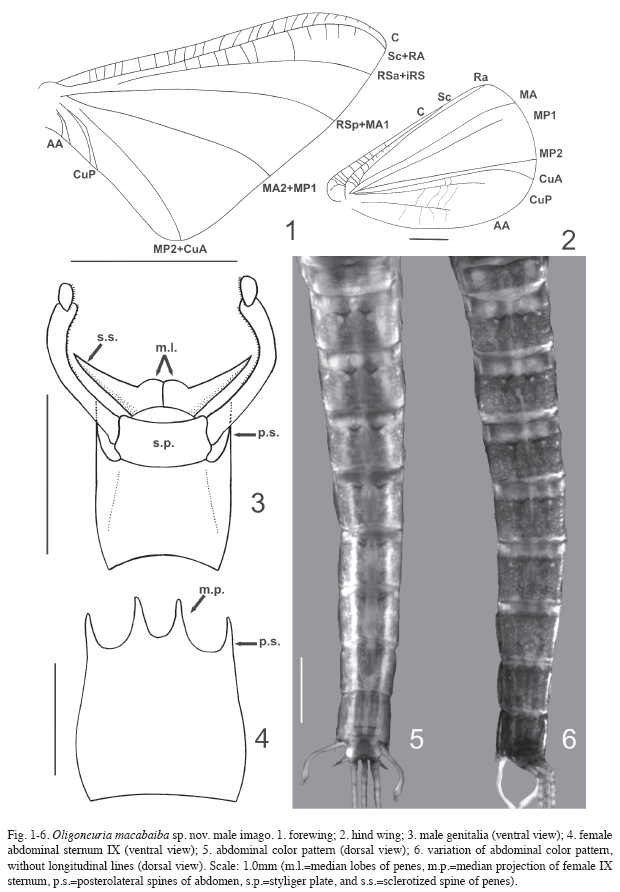
<body><![CDATA[<p align="justify">Resumen</p> </b></font><font size="2"> </font>     <p style="text-align: justify;"><font face="Verdana" size="2">En la Floresta Atl&aacute;ntica de Maca&eacute;, Rio de Janeiro, se describe una nueva especie del g&eacute;nero <i>Oligoneuria</i>. La descripci&oacute;n fue basada en imagos machos y hembras de <i>Oligoneuria macabaiba </i>sp. nov. recolectados con trampas de luz. Estas especies presentan alas con venaci&oacute;n y espinas abdominales posterolaterales similares al g&eacute;nero, as&iacute; como la expansi&oacute;n membranosa en la regi&oacute;n anterior de la cabeza propia de <i>Oligoneuria</i>. Basado en las caracter&iacute;sticas de la nueva especie, el g&eacute;nero es redefinido. La especie representa el primer registro del g&eacute;nero para el Sudeste del Brasil.</font></p>     <p style="text-align: justify;"><font face="Verdana" size="2"><b>Palabras clave: </b>Neotr&oacute;picos, nuevo registro, nueva especie, Oligoneuriidae, Am&eacute;rica del Sur, taxonom&iacute;a.</font></p> <hr  style="width: 100%; height: 2px; margin-left: 0px; margin-right: 0px;"> <font face="Verdana" size="2">     <p align="justify">The former monotypic genus <i>Oligoneuria </i>Pictet was known solely by a female subimago of the type-species <i>Oligoneuria anomala </i>Pictet. The genus was recently placed as a senior synonym of <i>Oligoneurioides </i>Demoulin by Kluge (2007) and is now composed by three species: <i>O. anomala, O. amazonica </i>(Demoulin) and <i>O. itayana </i>Kluge. All of these species occur in the Amazonian Rainforest, two with records from Brazil (<i>O. anomala </i>and <i>O. amazonica</i>). Analyzing wing venation of <i>O. itayana </i>in nymphal protopteron and imagos, Kluge (2007) observed that wing venation of nymphs is much more complete than that seen on winged stages, thus attesting that loss of veins in the winged stages is not of phylogenetic significance, and cannot be used to separate both genera.</p> </font>     <div style="text-align: justify;"><font face="Verdana" size="2">A new species of <i>Oligoneuria </i>from Brazil is herein described based on male and female imagos from the Atlantic Rainforest. Despite several attempts, no nymph was found on </font><font><font  face="Verdana" size="2">collecting sites but adult&#8217;s characteristics are enough to place specimens on this genus.</font></font><font  face="Verdana" size="2">     <p align="justify">The new species possess the distinctive membranous extension on front of the head and wing venation similar to that of <i>Oligoneuria</i>, but rather different male genitalia. Diagnosis of <i>Oligoneuria </i>is, therefore, altered to comprise this difference. The new species represents the first record of the genus from Southeastern Brazil.</p> </font></div> <font face="Verdana" size="3"><b>     <p align="justify">Material and methods</p> </b></font><font size="2"> </font>     <div style="text-align: justify;"><font face="Verdana" size="2">Imagos from both sexes where caught on light traps in the municipality of Maca&eacute;, Rio de Janeiro State. Specimens were preserved in 80% ethanol. Males and females were collected on same swarm. Searching was made in the Maca&eacute; river, but after several attempts nymphs were not found. Interpretation of wing veins was based on Kluge (2004, 2007). Type material is deposited at Cole&ccedil;&atilde;o Entolom&oacute;gica Professor Jos&eacute; Alfredo Pinheiro Dutra (DZRJ) &#8211; Departamento de Zoologia, Universidade Federal do Rio de Janeiro (UFRJ). Drawings were made under a stereoscopic microscope with camera lucida. Collecting sites were marked with a GPS using the <i>datum </i>WGS84. </font></div> <font face="Verdana" size="3"><b>     <p align="justify">Results</p> </b></font><font size="2"> </font>     <p style="text-align: justify;"><b><i><font face="Verdana" size="2">Oligoneuria macabaiba </font></i><font face="Verdana" size="2">sp. nov. Diagnosis: </font></b><font face="Verdana" size="2"><i>Oligoneuria macabaiba </i>sp. nov. can be recognized by the following combination of characteristics: (1) hind wings with CuA curved apically; (2) faintly marked cross veins basal to CuA of hind wing; (3) posterolateral spines on abdominal segment II not well developed, restricted to a small projection; (4) male styliger plate almost rectangular, without well developed posterolateral projections; (5) male genitalia with two divergent sclerotized spines, directed posterolaterally, and a median membranous area, divided into two lobes (as in <a  href="/img/revistas/rbt/v59n4/a10i1.jpg">figure 3</a>).</font></p>     ]]></body>
<body><![CDATA[<p style="text-align: justify;"><font face="Verdana" size="2"><b>Male Imago </b>(Holotype): Length: body 14.0mm; fore wing 10.5mm; hind wing 5.7mm. </font></p>     <p style="text-align: justify;"><font face="Verdana" size="2"><b><i>Head: </i></b>Area between eyes and ocelli whitish suffused with gray. Margins of head black. Head ventrally covered by a membranous black extension. Eyes black. Ocelli white surrounded by black ring at base. Base of antennae whitish; scape whitish possessing incomplete wide blackish ring; pedicel and flagellum brownish.</font></p>     <p style="text-align: justify;"><font face="Verdana" size="2"><b><i>Thorax: </i></b>Pronotum whitish; meso and metanota yellowish; terga with scattered brownish stains. Membranous filaments of mesonotum short. Prosternum whitish; meso and metasterna yellowish; sterna with scattered brownish stains.</font></p>     <p style="text-align: justify;"><font face="Verdana" size="2"><b><i>Wings: </i></b>Membrane of wings translucent whitish; bearing several microtrichia. Fore wings with cross veins ranging from base to apex of C and Sc area and from base to almost apex of R1 and R3 area (<a  href="/img/revistas/rbt/v59n4/a10i1.jpg">Fig. 1</a>). Hind wings with cross veins basally on C and Sc area and R1 and R3 area. Vein CuA curved apically; faint cross veins present basal to CuA of hind wing (<a href="/img/revistas/rbt/v59n4/a10i1.jpg">Fig. 2</a>).    <br> </font></p>     <div style="text-align: justify;"><font face="Verdana" size="2"><b><i>Legs: </i></b>Forelegs whitish, femora with two brownish longitudinal stripes; tibiae and first two segments of tarsi shaded with brown. Forelegs with three tarsal segments, first two segments same in length, third longer, more than twice the length of first two tarsomeres. Remaining legs with yellowish femora, possessing a brown wide basal band and a narrow apical band; tibiae and last tarsomere of each leg whitish; tibiae with basal mark and inner margin brownish. Mid and hind tarsi with four segments, first and last tarsomeres more than twice as long as second and third tarsomeres together. Tarsal claws blunt.</font>     <br>     <br> <font face="Verdana" size="2"><b><i>Abdomen: </i></b>Posterolateral spines present on segments II-IX; only a small projection on segment II; spines more developed on remaining segments. All spines flexible ("twisted" according to Salles <i>et al. </i>2007), except those on tergum IX. Terga reddish brown. Terga with median fainted longitudinal line, light colored (<a href="/img/revistas/rbt/v59n4/a10i1.jpg">Fig. 4</a>). Sterna whitish, shaded with reddish brown.</font></div>     <p style="text-align: justify;"><font face="Verdana" size="2"><b><i>Genitalia: </i></b>Styliger plate straight, not projected. Segment I of forceps with inner margin possessing several short setae on apical half. Penes divided into two membranous lobes, each possessing a posterolaterally directed spine on outer margin (<a  href="/img/revistas/rbt/v59n4/a10i1.jpg">Fig. 3</a>). Caudal filaments whitish with brown annulations, subequal in length, with row of long setae on junctions.</font></p>     <p style="text-align: justify;"><font face="Verdana" size="2"><b><i>Variations: </i></b>Length: body 13.0mm-14.6mm; forewing 10.0mm-10.8mm; hind wing 5.4-5.7mm. Some specimens showed abdomen completely shaded with reddish brown; terga and sterna suffused with reddish brown, without longitudinal lines (<a href="/img/revistas/rbt/v59n4/a10i1.jpg">Fig. 4-6</a>).</font></p>     ]]></body>
<body><![CDATA[<p style="text-align: justify;"><font face="Verdana" size="2"><b>Female Imago: </b>Length: body 16.0mm; forewing 14.0mm; hind wing 6.9mm. Similar to males. Legs atrophied; tibiae and tarsi thin and twisted. Posterior margin of sternum IX medially projected, deeply cleft (<a  href="/img/revistas/rbt/v59n4/a10i1.jpg">Fig. 3</a>). Caudal filaments brown, becoming whitish toward apex.</font></p>     <p style="text-align: justify;"><font face="Verdana" size="2"><b><i>Variations: </i></b>Length: body 16.0mm-18.7mm; fore wing 13.6mm-15.0mm; hind wing 6.9mm-8.0mm.</font></p>     <p style="text-align: justify;"><font face="Verdana" size="2"><b>Type-material: Brazil, Rio de Janeiro: </b>Maca&eacute;, Rio Maca&eacute; (22o17&#8217;42.9" S - 41o52&#8217;48.0" W), 16.iv.2009, Gon&ccedil;alves I.C., Jardim G.A., Santos A.P.M., Alecrim V.P. &amp; Ferreira-Jr N. <i>leg</i>. One male imago (holotype; DZRJ629); same data, seven male imagos and five female imagos (DZRJ630); same data, two male imagos (DZRJ631); same data, one female imago (DZRJ632); Maca&eacute;, Rio S&atilde;o Pedro (22o16&#8217;37.7" S - 41o52&#8217;22.8" W), 15.iv.2009, Gon&ccedil;alves I.C., Jardim G.A., Santos A.P.M., Alecrim V.P. &amp; Ferreira-Jr N. <i>leg</i>. two female imagos (DZRJ627); Maca&eacute;, Cachoeiros de Maca&eacute;, Rio Maca&eacute;, (22o25&#8217;49.5" S - 41o18&#8217;06.0" W), 05.iv.2009, Gon&ccedil;alves I.C., Jardim G.A., Sampaio B.H.L., Alecrim V.P., Dumas L.L. &amp; Nessimian J.L. <i>leg</i>. six female imagos (DZRJ628).</font></p>     <p style="text-align: justify;"><font face="Verdana" size="2"><b>Etymology: </b>the name "<i>macabaiba</i></font><font size="2">"</font><font  face="Verdana" size="2"> is an allusion to the macaba&iacute;ba palm tree, whose fruit is called "maca-&ecirc;" a Tupi word that gave origin to the name Maca&eacute;, municipality where this species is found.</font></p>     <p style="text-align: justify;"><font face="Verdana" size="2"><b>Biology: </b>Imagos were found to fly mainly between six p.m. and seven p.m., before eight p.m. the swarm were over.</font></p> <font face="Verdana" size="3"><b>     <p align="justify">Discussion</p> </b></font>     <p style="text-align: justify;"><font face="Verdana" size="2">According to Kluge (2007), presence or absence of certain veins cannot be considered a distinguishing generic character since such differences exist on adults only. <i>Oligoneuria macabaiba </i>sp. nov. has no cross veins behind RSa+iRS nor has IMP but in the hind wing several faint cross veins can be seen after CuA, corroborating Kluge&#8217;s observations. Such feature appears to be species-specific since absence of IMP and cross veins after RSa+iRS was noticed on all specimens of <i>O. macabaiba </i>and <i>O. itayana </i>(according to Kluge, 2007). A phylogenetic revision of the genus is in preparation and will aid definition of the relations within the genus (F.F. Salles, pers. comm.).</font></p>     <p style="text-align: justify;"><font face="Verdana" size="2">Posterolateral spines on abdominal terga are described as "twisted" by Salles <i>et al. </i>(2007) and "crumpled" by Kluge (2007), but our specimens did not necessarily presented twisted or crumpled spines. In fact, the spines were found to be quite flexible, appearing twisted or not according to the individual. For this reason, we preferred to use the term "flexible" to better describe these spines. In <i>O. macabaiba </i>sp. nov., posterolateral spines of segment II are represented by small projections but the spines on other segments are even longer than those in <i>O. amazonica </i>whereas in <i>O. itayana </i>a sexual dimorphism is described, with females having smaller spines than males (Kluge 2007). </font></p>     <p style="text-align: justify;"><font face="Verdana" size="2"><i>O. macabaiba </i>sp. nov. differs from other species of the genus by a distinctive characteristic: the pair of processes between forceps insertions. Such projections are present in <i>O. itayana</i>, <i>O. amazonica </i>and <i>Oligoneuria</i>/ f5=g6 sp.O5 draw by Kluge (2004) but are completely absent on <i>O. macabaiba. </i>In that sense, generic diagnosis should be expanded to comprise this trait.</font></p>     <p style="text-align: justify;"><font face="Verdana" size="2">Female sternum IX extends midposteriorly with a deep cleft, as seems to be common for the genus. In <i>O. macabaiba </i>sp. nov. and <i>O. itayana </i>these projections, as well as the abdominal posterolateral spines, appear to be longer than in <i>O. amazonica</i>. Male genitalia is distinctly different, with lack of projections on styliger plate and penes spines strongly divergent, oriented posterolaterally and broadly separated by two membranous lobes.</font></p> <font face="Verdana" size="3"><b>     ]]></body>
<body><![CDATA[<p align="justify">Acknowledgments</p> </b></font>     <div style="text-align: left;">     <div style="text-align: justify;"><font face="Verdana" size="2">     <p align="justify">We are thankful to members of Laborat&oacute;rio de Entomologia at Universidade Federal do Rio de Janeiro (UFRJ) from help on field trips and to the anonymous reviewers, for the valuable suggestions on the manuscript. This study was partially funded by CNPq and FAPERJ.</p> </font></div> </div> <font face="Verdana" size="2"> </font> <hr style="width: 100%; height: 2px;"><font face="Verdana" size="3"><b>     <p align="justify">References</p> </b></font><font size="2"> </font><font face="Verdana" size="2">     <!-- ref --><p align="justify">Kluge, N. 2004. The phylogenetic system of Ephemeroptera. Kluwer Academic, Dordrecht, Netherlands.    &nbsp;&nbsp;&nbsp;&nbsp;&nbsp;&nbsp;&nbsp;&nbsp;[&#160;<a href="javascript:void(0);" onclick="javascript: window.open('/scielo.php?script=sci_nlinks&ref=1750758&pid=S0034-7744201100040001000001&lng=','','width=640,height=500,resizable=yes,scrollbars=1,menubar=yes,');">Links</a>&#160;]<!-- end-ref --></p>     <!-- ref --><p align="justify">Kluge, N. 2007. <i>Oligoneuria itayana </i>sp. n. (Ephemeroptera: Oligoneuriidae) - a new mayfly species from Peruvian Amazonia. Russ. Entomol. J. 16: 127-137.    &nbsp;&nbsp;&nbsp;&nbsp;&nbsp;&nbsp;&nbsp;&nbsp;[&#160;<a href="javascript:void(0);" onclick="javascript: window.open('/scielo.php?script=sci_nlinks&ref=1750760&pid=S0034-7744201100040001000002&lng=','','width=640,height=500,resizable=yes,scrollbars=1,menubar=yes,');">Links</a>&#160;]<!-- end-ref --></p>     <!-- ref --><p align="justify">Salles, F.F., M.S. Baptista, E.R. Da-Silva, N. Hamada &amp; J.E. Serr&atilde;o. 2007. Redescription of the adults and description of the larvae and eggs of <i>Oligoneurioides amazonicus </i>Demoulin (Ephemeroptera: Oligoneuriidae). Aquat. Insect. 29: 139-149.    &nbsp;&nbsp;&nbsp;&nbsp;&nbsp;&nbsp;&nbsp;&nbsp;[&#160;<a href="javascript:void(0);" onclick="javascript: window.open('/scielo.php?script=sci_nlinks&ref=1750762&pid=S0034-7744201100040001000003&lng=','','width=640,height=500,resizable=yes,scrollbars=1,menubar=yes,');">Links</a>&#160;]<!-- end-ref --><br> </p>     <p align="justify">    <br> </p> <a name="correspondencia"></a>Correspondencia a: <font face="Verdana"  size="2">In&ecirc;s C. Gon&ccedil;alves. </font></font><font  face="Verdana" size="2">Universidade Federal do Rio de Janeiro, Instituto de Biologia, Departamento de Zoologia, Laborat&oacute;rio de Entomologia. Avenida Brigadeiro Trompowski, s/n, bloco A, sala 107, Ilha do Fund&atilde;o, Rio de Janeiro, RJ, Brazil. CEP 21941-971, C. Postal 68044; <a href="mailto:inescg.bio@gmail.com">inescg.bio@gmail.com</a></font>    <br> <font face="Verdana" size="2"><font face="Verdana" size="2">Elidiomar R. Da-Silva. </font></font><font face="Verdana" size="2">Universidade Federal do Estado do Rio de Janeiro, Instituto de Bioci&ecirc;ncias, Departamento de Zoologia, Laborat&oacute;rio de Insetos Aqu&aacute;ticos. Av. Pasteur, 458, 4o andar, Urca, Rio de Janeiro, RJ, Brasil CEP 22290-240; <a href="mailto:elidiomar@pq.cnpq.br">elidiomar@pq.cnpq.br</a></font>    <br> <font face="Verdana" size="2"><font face="Verdana" size="2">Jorge L. Nessimian. </font></font><font face="Verdana" size="2">Universidade Federal do Rio de Janeiro, Instituto de Biologia, Departamento de Zoologia, Laborat&oacute;rio de Entomologia. Avenida Brigadeiro Trompowski, s/n, bloco A, sala 107, Ilha do Fund&atilde;o, Rio de Janeiro, RJ, Brazil. CEP 21941-971, C. Postal 68044; </font><a  href="mailto:nessimia@acd.ufrj.br"><font face="Verdana" size="2">nessimia@acd.ufrj.br</font></a><font  face="Verdana" size="2">&nbsp;</font><font face="Verdana" size="2"> </font> <hr style="width: 100%; height: 2px;"><font face="Verdana" size="2">     <p align="center">Received 12-X-2010. Corrected 20-II-2011. Accepted 24-III-2011.</p> </font><font size="2"> </font>      ]]></body><back>
<ref-list>
<ref id="B1">
<nlm-citation citation-type="book">
<person-group person-group-type="author">
<name>
<surname><![CDATA[Kluge]]></surname>
<given-names><![CDATA[N]]></given-names>
</name>
</person-group>
<source><![CDATA[The phylogenetic system of Ephemeroptera]]></source>
<year>2004</year>
<publisher-loc><![CDATA[Dordrecht ]]></publisher-loc>
<publisher-name><![CDATA[Kluwer Academic]]></publisher-name>
</nlm-citation>
</ref>
<ref id="B2">
<nlm-citation citation-type="journal">
<person-group person-group-type="author">
<name>
<surname><![CDATA[Kluge]]></surname>
<given-names><![CDATA[N]]></given-names>
</name>
</person-group>
<article-title xml:lang="en"><![CDATA[Oligoneuria itayana sp. n. (Ephemeroptera: Oligoneuriidae) - a new mayfly species from Peruvian Amazonia]]></article-title>
<source><![CDATA[Russ. Entomol. J]]></source>
<year>2007</year>
<volume>16</volume>
<page-range>127-137</page-range></nlm-citation>
</ref>
<ref id="B3">
<nlm-citation citation-type="journal">
<person-group person-group-type="author">
<name>
<surname><![CDATA[Salles]]></surname>
<given-names><![CDATA[F.F]]></given-names>
</name>
<name>
<surname><![CDATA[Baptista]]></surname>
<given-names><![CDATA[M.S]]></given-names>
</name>
<name>
<surname><![CDATA[Da-Silva]]></surname>
<given-names><![CDATA[E.R]]></given-names>
</name>
<name>
<surname><![CDATA[Hamada]]></surname>
<given-names><![CDATA[N]]></given-names>
</name>
<name>
<surname><![CDATA[Serrão]]></surname>
<given-names><![CDATA[J.E]]></given-names>
</name>
</person-group>
<article-title xml:lang="en"><![CDATA[Redescription of the adults and description of the larvae and eggs of Oligoneurioides amazonicus Demoulin (Ephemeroptera: Oligoneuriidae)]]></article-title>
<source><![CDATA[Aquat. Insect]]></source>
<year>2007</year>
<volume>29</volume>
<page-range>139-149</page-range></nlm-citation>
</ref>
</ref-list>
</back>
</article>