<?xml version="1.0" encoding="ISO-8859-1"?><article xmlns:mml="http://www.w3.org/1998/Math/MathML" xmlns:xlink="http://www.w3.org/1999/xlink" xmlns:xsi="http://www.w3.org/2001/XMLSchema-instance">
<front>
<journal-meta>
<journal-id>0034-7744</journal-id>
<journal-title><![CDATA[Revista de Biología Tropical]]></journal-title>
<abbrev-journal-title><![CDATA[Rev. biol. trop]]></abbrev-journal-title>
<issn>0034-7744</issn>
<publisher>
<publisher-name><![CDATA[Universidad de Costa Rica]]></publisher-name>
</publisher>
</journal-meta>
<article-meta>
<article-id>S0034-77442011000300038</article-id>
<title-group>
<article-title xml:lang="en"><![CDATA[Insect herbivores associated with Baccharis dracunculifolia (Asteraceae): responses of gall-forming and free-feeding insects to latitudinal variation]]></article-title>
</title-group>
<contrib-group>
<contrib contrib-type="author">
<name>
<surname><![CDATA[Fagundes]]></surname>
<given-names><![CDATA[Marcílio]]></given-names>
</name>
<xref ref-type="aff" rid="A01"/>
</contrib>
<contrib contrib-type="author">
<name>
<surname><![CDATA[Wilson Fernandes]]></surname>
<given-names><![CDATA[G]]></given-names>
</name>
<xref ref-type="aff" rid="A02"/>
</contrib>
</contrib-group>
<aff id="A01">
<institution><![CDATA[,Universidade Estadual de Montes Claros Laboratório de Biologia da Conservação DBG/ CCBS ]]></institution>
<addr-line><![CDATA[Montes Claros MG]]></addr-line>
<country>Brazil</country>
</aff>
<aff id="A02">
<institution><![CDATA[,Universidade Federal de Minas Gerais Laboratório de Biologia da Conservação DBG/ CCBS Ecologia Evolutiva & Biodiversidade/DBG/ICB]]></institution>
<addr-line><![CDATA[Belo Horizonte MG]]></addr-line>
<country>Brazil</country>
</aff>
<pub-date pub-type="pub">
<day>00</day>
<month>09</month>
<year>2011</year>
</pub-date>
<pub-date pub-type="epub">
<day>00</day>
<month>09</month>
<year>2011</year>
</pub-date>
<volume>59</volume>
<numero>3</numero>
<fpage>1419</fpage>
<lpage>1432</lpage>
<copyright-statement/>
<copyright-year/>
<self-uri xlink:href="http://www.scielo.sa.cr/scielo.php?script=sci_arttext&amp;pid=S0034-77442011000300038&amp;lng=en&amp;nrm=iso"></self-uri><self-uri xlink:href="http://www.scielo.sa.cr/scielo.php?script=sci_abstract&amp;pid=S0034-77442011000300038&amp;lng=en&amp;nrm=iso"></self-uri><self-uri xlink:href="http://www.scielo.sa.cr/scielo.php?script=sci_pdf&amp;pid=S0034-77442011000300038&amp;lng=en&amp;nrm=iso"></self-uri><abstract abstract-type="short" xml:lang="en"><p><![CDATA[The spatial heterogeneity hypothesis has been invoked to explain the increase in species diversity from the poles to the tropics: the tropics may be more diverse because they contain more habitats and microhabitats. In this paper, the spatial heterogeneity hypothesis prediction was tested by evaluating the variation in richness of two guilds of insect herbivores (gall-formers and free-feeders) associated with Baccharis dracunculifolia (Asteraceae) along a latitudinal variation in Brazil. The seventeen populations of B. dracunculifolia selected for insect herbivores sampling were within structurally similar habitats, along the N-S distributional limit of the host plant, near the Brazilian sea coast. Thirty shrubs were surveyed in each host plant population. A total of 8 201 galls and 864 free-feeding insect herbivores belonging to 28 families and 88 species were sampled. The majority of the insects found on B. dracunculifolia were restricted to a specific site rather than having ageographic distribution mirroring that of the host plant. Species richness of free-feeding insects was not affected by latitudinal variation corroborating the spatial heterogeneity hypothesis. Species richness of gall-forming insects was positively correlated with latitude, probably because galling insect associated with Baccharris genus radiated in Southern Brazil. Other diversity indices and evenness estimated for both gall-forming and free feeding insect herbivores, did not change with latitude, suggesting a general structure for different assemblages of herbivores associated with the host plant B. dracunculifolia. Thus it is probable that, insect fauna sample in each site resulted of large scale events, as speciation, migration and coevolution, while at local level, the population of these insects is regulated by ecological forces which operate in the system. Rev. Biol. Trop. 59 (3): 1419-1432. Epub 2011 September 01.]]></p></abstract>
<abstract abstract-type="short" xml:lang="es"><p><![CDATA[La hipótesis de heterogeneidad espacial se ha utilizado para explicar el aumento en la diversidad de especies desde los polos a los trópicos: los trópicos pueden ser más diversos ya que están conformados por una mayor cantidad de hábitats y micro-hábitats. En este estudio, la hipótesis de heterogeneidad espacial se puso a prueba evaluando la variación en la riqueza de dos gremios de insectos herbívoros (formadores de agallas y de alimentación libre) asociados con B. dracunculifolia (Asteracea) a lo largo de un gradiente latitudinal en Brasil. Las diecisiete poblaciones de B. dracunculifolia seleccionadas para el muestreo de insectos herbívoros estaban en hábitats con una estructura similar, a lo largo del límite Norte-Sur de distribución de la planta hospedera, cerca de la costa brasileña. De cada población de planta hospedera, se muestrearon treinta arbustos y se obtuvo un total de 8 201 agallas y 864 insectos de alimentación libre pertenecientes a 28 familias y 88 especies. La mayoría de los insectos que se encontraron en B. dracunculifolia estaban restringidos a un sitio específico en lugar de tener una distribución geográfica similar a la de la planta hospedera. La riqueza de especies de insectos de alimentación libre no se vió afectada por el gradiente latitudinal, por lo que se corroboró la hipótesis de heterogeneidad espacial. Mientras que la riqueza de especies de insectos formadores de agallas se correlacionó positivamente con la latitud, probablemente debido a que los insectos asociados al género Baccharis se extendieron hacia el sur de Brasil. Otros índices de diversidad y equidad estimados no variaron con la latitud para ninguno de los dos grupos de insectos herbívoros evaluados, lo que sugirie una estructura general para diferentes conjuntos de herbívoros asociados con la planta hospedera B. dracunculifolia. Por lo tanto, es probable que, la muestra de insectos en cada sitio sea resultado de eventos a gran escala, como la especiación, migración y coevolución; mientras que a nivel local la población de estos insectos está regulada por fuerzas ecológicas que operan dentro del sistema.]]></p></abstract>
<kwd-group>
<kwd lng="en"><![CDATA[community organization]]></kwd>
<kwd lng="en"><![CDATA[latitudinal diversity gradient]]></kwd>
<kwd lng="en"><![CDATA[spatial heterogeneity hypothesis]]></kwd>
<kwd lng="en"><![CDATA[species diversity]]></kwd>
<kwd lng="es"><![CDATA[organización de comunidades]]></kwd>
<kwd lng="es"><![CDATA[gradiente latitudinal de diversidad]]></kwd>
<kwd lng="es"><![CDATA[hipótesis de heterogeneidad espacial]]></kwd>
<kwd lng="es"><![CDATA[diversidad de especies]]></kwd>
</kwd-group>
</article-meta>
</front><body><![CDATA[ <div style="text-align: center;"><font size="4"><span  style="font-family: verdana; font-weight: bold;">Insect herbivores associated with <span style="font-style: italic;">Baccharis dracunculifolia </span>(Asteraceae): responses of gall-forming and free-feeding insects to latitudinal variation</span></font><br  style="font-family: verdana;"> </div> <font size="2"><br style="font-family: verdana;"> </font>     <div style="text-align: left;"><font size="2"><span  style="font-family: verdana;">Marc&iacute;lio Fagundes<a href="#aut1"><sup>1</sup></a> &amp; G. Wilson Fernandes<a href="#aut2"><sup>2</sup></a></span></font><br  style="font-family: verdana;"> <br style="font-family: verdana;"> <font size="2"><span style="font-family: verdana;"><a name="aut1"></a>1. Laborat&oacute;rio de Biologia da Conserva&ccedil;&atilde;o DBG/ CCBS, Universidade Estadual de Montes Claros, Montes Claros, MG, Brazil, 39401-089; <a href="mailto:marcilio.fagundes@gmail.com">marcilio.fagundes@gmail.com</a></span></font>    <br> <font size="2"><span style="font-family: verdana;"><a name="aut2"></a>2. Ecologia Evolutiva &amp; Biodiversidade/DBG/ICB/Universidade Federal de Minas Gerais, Belo Horizonte, MG, Brazil; <a href="mailto:gwfernandes@gmail.com">gwfernandes@gmail.com</a>     <br>     <br> <a href="#correspondencia">Direcci&oacute;n para correspondencia</a>:</span></font> </div> <font size="2"></font>     <div style="text-align: justify;"><font size="3"><span      style="font-family: verdana; font-weight: bold;"></span></font>     <hr style="width: 100%; height: 2px;"><font size="3"><span      style="font-family: verdana; font-weight: bold;">Abstract</span></font><br      style="font-family: verdana;">     ]]></body>
<body><![CDATA[<br style="font-family: verdana;">     <font size="2"><span style="font-family: verdana;">The spatial     heterogeneity     hypothesis has been invoked to explain the increase in species     diversity from the poles to the tropics: the tropics may be more     diverse because they contain more habitats and microhabitats. In this     paper, the spatial heterogeneity hypothesis prediction was tested by     evaluating the variation in richness of two guilds of insect herbivores     (gall-formers and free-feeders) associated with <span      style="font-style: italic;">Baccharis     ]]></body>
<body><![CDATA[dracunculifolia</span> (Asteraceae) along a latitudinal variation in     Brazil.     The seventeen populations of <span style="font-style: italic;">B.     dracunculifolia</span> selected for insect     herbivores sampling were within structurally similar habitats, along     the N-S distributional limit of the host plant, near the Brazilian sea     coast. Thirty shrubs were surveyed in each host plant population. A     total of 8 201 galls and 864 free-feeding insect herbivores belonging     to 28 families and 88 species were sampled. The majority of the insects     found on <span style="font-style: italic;">B. dracunculifolia </span>were     ]]></body>
<body><![CDATA[restricted to a specific site rather     than having ageographic distribution mirroring that of the host plant.     Species richness of free-feeding insects was not affected by     latitudinal variation corroborating the spatial heterogeneity     hypothesis. Species richness of gall-forming insects was positively     correlated with latitude, probably because galling insect associated     with<span style="font-style: italic;"> Baccharris</span> genus radiated     in Southern Brazil. Other diversity     indices and evenness estimated for both gall-forming and free feeding     insect herbivores, did not change with latitude, suggesting a general     ]]></body>
<body><![CDATA[structure for different assemblages of herbivores associated with the     host plant <span style="font-style: italic;">B. dracunculifolia</span>.     Thus it is probable that, insect fauna     sample in each site resulted of large scale events, as speciation,     migration and coevolution, while at local level, the population of     these insects is regulated by ecological forces which operate in the     system. Rev. Biol. Trop. 59 (3): 1419-1432. Epub 2011 September 01.</span></font><br      style="font-family: verdana;">     <br style="font-family: verdana;">     <font size="2"><span style="font-family: verdana;"><span     ]]></body>
<body><![CDATA[ style="font-weight: bold;">Key words:</span> community     organization,     latitudinal diversity gradient, spatial heterogeneity hypothesis,     species diversity. </span></font><br style="font-family: verdana;">     <br style="font-family: verdana;">     <font style="font-weight: bold;" size="3"><span      style="font-family: verdana;">Resumen</span></font><br      style="font-family: verdana; font-weight: bold;">     <br style="font-family: verdana;">     <font size="2"><span style="font-family: verdana;">La hip&oacute;tesis     ]]></body>
<body><![CDATA[de     heterogeneidad espacial se ha utilizado para explicar el aumento en la     diversidad de especies desde los polos a los tr&oacute;picos: los     tr&oacute;picos pueden ser m&aacute;s diversos ya que est&aacute;n     conformados por una mayor cantidad de h&aacute;bitats y     micro-h&aacute;bitats. En este estudio, la hip&oacute;tesis de     heterogeneidad espacial se puso a prueba evaluando la variaci&oacute;n     en la riqueza de dos gremios de insectos herb&iacute;voros (formadores     de agallas y de alimentaci&oacute;n libre) asociados con<span      style="font-style: italic;"> B.     ]]></body>
<body><![CDATA[dracunculifolia</span> (Asteracea) a lo largo de un gradiente     latitudinal en     Brasil. Las diecisiete poblaciones </span></font><font size="2"><span      style="font-family: verdana;">de <span style="font-style: italic;">B.     dracunculifolia</span> seleccionadas     para el muestreo de insectos herb&iacute;voros estaban en     h&aacute;bitats con una estructura similar, a lo largo del     l&iacute;mite Norte-Sur de distribuci&oacute;n de </span></font><font      size="2"><span style="font-family: verdana;">la planta hospedera,     cerca de la     ]]></body>
<body><![CDATA[costa brasile&ntilde;a. De cada poblaci&oacute;n de planta hospedera,     se muestrearon treinta arbustos y se obtuvo un total de 8 201 agallas y     864 insectos de alimentaci&oacute;n libre pertenecientes a 28 familias     y 88 especies. La mayor&iacute;a de los insectos que se encontraron en     <span style="font-style: italic;">B. dracunculifolia</span> estaban     restringidos a un sitio espec&iacute;fico en     lugar de tener una distribuci&oacute;n geogr&aacute;fica similar a la     de la planta hospedera. La riqueza de especies de insectos de     alimentaci&oacute;n libre no se vi&oacute; afectada por el gradiente     latitudinal, por lo que se corrobor&oacute; la hip&oacute;tesis de     ]]></body>
<body><![CDATA[heterogeneidad espacial. Mientras que la riqueza de especies de     insectos formadores de agallas se correlacion&oacute; positivamente con     la latitud, probablemente debido a que los insectos asociados al     g&eacute;nero<span style="font-style: italic;"> Baccharis</span> se     extendieron hacia el sur de Brasil. Otros     &iacute;ndices de diversidad y equidad estimados no variaron con la     latitud para ninguno de los dos grupos de insectos herb&iacute;voros     evaluados, lo que sugirie una estructura general para diferentes     conjuntos de herb&iacute;voros asociados con la planta hospedera<span      style="font-style: italic;"> B.     ]]></body>
<body><![CDATA[dracunculifolia</span>. Por lo tanto, es probable que, la muestra de     insectos     en cada sitio sea resultado de eventos a gran escala, como la     especiaci&oacute;n, migraci&oacute;n y coevoluci&oacute;n; mientras que     a nivel local la poblaci&oacute;n de estos insectos est&aacute;     regulada por fuerzas ecol&oacute;gicas que operan dentro del sistema. </span></font><br      style="font-family: verdana;">     <br style="font-family: verdana; font-weight: bold;">     <font size="2"><span style="font-family: verdana;"><span      style="font-weight: bold;">Palabras clave:</span>     ]]></body>
<body><![CDATA[organizaci&oacute;n     de comunidades, gradiente latitudinal de diversidad, hip&oacute;tesis     de heterogeneidad espacial, diversidad de especies. </span></font><br      style="font-family: verdana;">     <font size="2"><span style="font-family: verdana;"></span></font>     <hr style="width: 100%; height: 2px;"><font size="2"><span      style="font-family: verdana;">Latitudinal     variations in species     diversity are among the most conspicuous and universal patterns in     community ecology (Pianka 1966). According Willig<span     ]]></body>
<body><![CDATA[ style="font-style: italic;"> et al</span>. (2003), just     with notable exceptions, the pattern of higher diversity at low     latitudes holds true regardless of the biota&#8217;s taxonomic affiliation     (e.g., mammals, fishes, arthropods and plants), geographic context     (e.g., all continents and oceans) or time domain (recent and 70 Mya).     Explanations for higher (Buckley <span style="font-style: italic;">et     al</span>. 2010) or habitat heterogeneity     (Whitehouse <span style="font-style: italic;">et al</span>. 2009) to     explain the increase of diversity towards     the tropics. </span></font><br style="font-family: verdana;">     ]]></body>
<body><![CDATA[<br style="font-family: verdana;">     <font size="2"><span style="font-family: verdana;">In this paper the     focus is on the     spatial heterogeneity hypothesis, and the study objects are different     insect herbivore guilds associated with a single host plant. On the     local scale, the spatial heterogeneity hypothesis suggests that the     tropics are more diverse because they contain more microhabitats     (Pianka 1966). On a regional scale, this hypothesis has been proposed     to explain the increase of species diversity from the poles to the     tropics: the tropics are more diverse because they contain more     ]]></body>
<body><![CDATA[habitats and microhabitats (Dawidowitz &amp; Rosenzweigh 1998). This     greater number of habitats and microhabitats allows taxa to partition     the environment more finely, and more species to co-exist in the     tropics (Pianka 1966). A positive relationship between habitat     complexity and species diversity has been shown in a variety of     environments and for a large number of taxa (Otte 1976, Terborgh 1992,     Gaston &amp; Williams 1996, Ribeiro <span style="font-style: italic;">et     al</span>. 1998, Thomaz <span style="font-style: italic;">et al</span>.     2008).     On the other hand, as a corollary, the spatial heterogeneity hypothesis     ]]></body>
<body><![CDATA[also implies that, within structurally uniform environments, species     diversity should not change along a latitudinal gradient. </span></font><br      style="font-family: verdana;">     <br style="font-family: verdana;">     <font size="2"><span style="font-family: verdana;">The most species     alive are tropical     arthropods associated with plants (Price <span      style="font-style: italic;">et al</span>. 1995). Herbivorous     arthropods maintain many important ecosystem processes and form     sizeable parts of terrestrial food webs (Lewinsohn &amp; Roslin 2008).     ]]></body>
<body><![CDATA[In fact, in terms of biomass, insects in tropical forests constitute     several tons per hectare compared to a few kilograms per hectare for     birds and mammals. Moreover, insects in the tropics munch through an     estimated 680 kg/ha.y of leaves compared to 100 to 300 kg/ha.y of     leaves by vertebrates (Dajoz 2000). Herbivorous insects are composed of     various feeding guilds (e.g. free-feeding and galling insects), with     different specialization levels on their host plant and habitat     (Koricheva<span style="font-style: italic;"> et. al.</span> 1998,     Novotny &amp; Basset 2005). In fact,     comparatively to free-feeding insects, galling insects generally are     ]]></body>
<body><![CDATA[considered more specialized herbivores (Frenzel &amp; Brandl 1998).     Thus, it is probable that, when the insect fauna associated with single     host plant is analyzed, free-feeding insects (generally with more     oligophagous feeding habit) are more dependent on habitat     characteristics, while galling insects respond more finely to specific     host plant attributes (Koricheva <span style="font-style: italic;">et     al</span>. 1998, Golden &amp; Crist 1999).</span></font><br      style="font-family: verdana;">     <br style="font-family: verdana;">     <font size="2"><span style="font-family: verdana;">Despite the high     ]]></body>
<body><![CDATA[diversity of     insect herbivores in the tropics, few studies have adequately addressed     the influence of historical and biogeographical processes on species     richness patterns of tropical insect herbivores (Price <span      style="font-style: italic;">et al</span>. 1995,     Ribeiro <span style="font-style: italic;">et al</span>. 1998, Majer <span      style="font-style: italic;">et al</span>. 2001). Moreover, many insect     taxa as     aphids (Dixon <span style="font-style: italic;">et al</span>. 1987),     Ichneumonidae (Sime &amp; Brower 1998) and     ]]></body>
<body><![CDATA[gall-forming insects (Fernandes &amp; Price 1988) do not fit the     general pattern of increasing species richness with decreasing     latitude. Evolutionary explanations to these latitudinal diversity     anomalies have focused on either variation in rates of diversification     or the amount of time available </span></font><font size="2"><span      style="font-family: verdana;">for speciation     within a region     (Buckley <span style="font-style: italic;">et al</span>. 2010). While     some studies include herbivores from     several insect orders, studies of more than one guild on the same hosts     ]]></body>
<body><![CDATA[are lacking from tropical regions (Novotny &amp; Basset 2005). In this     study the prediction of spatial heterogeneity hypothesis was tested by     evaluating the variation in diversity of two guilds of insect     herbivores (galling and free-feeding) along the distributional limits     of the host plant, near the Brazilian sea coast. The data were     collected within homogeneous habitat and the arthropod sampled was     associated with the host plant <span style="font-style: italic;">Baccharis     dracunculifolia. </span></span></font><br style="font-family: verdana;">     <br style="font-family: verdana;">     <font style="font-weight: bold;" size="3"><span     ]]></body>
<body><![CDATA[ style="font-family: verdana;">Materials and methods</span></font><br      style="font-family: verdana;">     <br style="font-family: verdana;">     <font size="2"><span style="font-family: verdana;"><span      style="font-weight: bold;">Study system:</span> The     Asteraceae     comprises approximately 1 110 genera and 25 000 species. The genus     <span style="font-style: italic;">Baccharis</span> belongs to the     subtribe Baccharidinae, which is restricted to     the American Continent (Barroso 1976). The Baccharidinae probably     ]]></body>
<body><![CDATA[appeared during Middle Miocene (Boldt 1989) when South American and     African continents were totally separated by the Atlantic Ocean (Cox     &amp; Moore 1993), justifying its natural occurrence just in the     American continent. <span style="font-style: italic;">Baccharis</span>     is the largest genus of Baccharidinae     (approximately 400 species) and most species are found in the South and     Southeast regions of Brazil, suggesting that this region represent the     center of the genus origin (Jarvis <span style="font-style: italic;">et     al</span>. 1991). <span style="font-style: italic;">B. dracunculifolia</span>     (alecrim vassourinha) is a widespread, perennial and woody dioecious     ]]></body>
<body><![CDATA[shrub, 2-3m high, which occurs in Southern and Southeastern Brazil,     Argentina, Uruguay, Paraguay and Bolivia (Esp&iacute;rito-Santo <span      style="font-style: italic;">et al</span>.     2003, Fagundes <span style="font-style: italic;">et al</span>. 2005).     It grows in open and disturbed habitats,     especially along highways and in abandoned pastures. Because it is an     evergreen plant, its leaves and branches are important food resources     for a variety of insect herbivores, especially coleopterans,     heteropterans, hemipterans and orthopterans (Fagundes <span      style="font-style: italic;">et al</span>. 2005).     ]]></body>
<body><![CDATA[Furthermore, the shrub <span style="font-style: italic;">B.     dracunculifolia</span> also supports the largest     known fauna of galling insects (17 species) in the Neotropics     (Fernandes <span style="font-style: italic;">et al</span>. 1996). The     degree of habitat disturbance did not     influence the richness of galls associated with the host plant<span      style="font-style: italic;"> B.     dracunculifolia</span> (Juli&atilde;o <span style="font-style: italic;">et     al</span>. 2005).</span></font><br style="font-family: verdana;">     <br style="font-family: verdana; font-weight: bold;">     ]]></body>
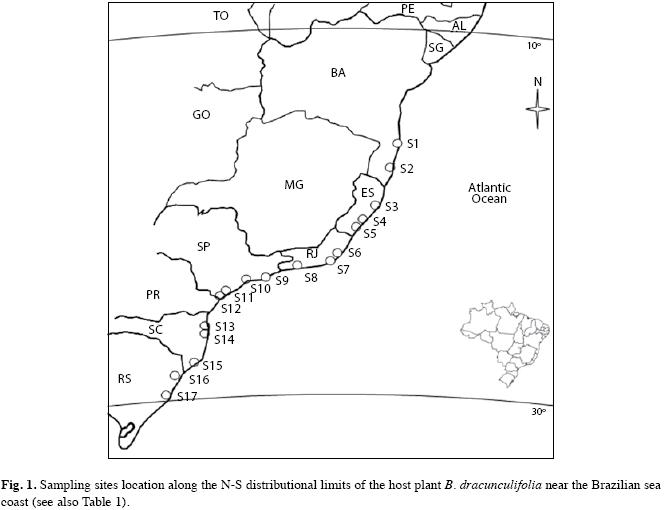
<body><![CDATA[<font size="2"><span style="font-family: verdana;"><span      style="font-weight: bold;">Study areas: </span>The <span      style="font-style: italic;">B.     dracunculifolia</span>     shrubs selected for insect samples belonged to seventeen populations     located along the Brazilian sea coast, from the Southern to the </span></font><font      size="2"><span style="font-family: verdana;">Northern     distributional limit of     the host plant inside Brazil. All plant populations occurred in     disturbed environments along highways, within 500m of the seashore and     ]]></body>
<body><![CDATA[were similar in phenology, size and density. The climate of all the     seventeen sample points is broadly influenced by Atlantic Ocean air     mass. However, from Northern S&atilde;o Paulo State through Rio de     Janeiro, Esp&iacute;rito Santo and Bahia States the climate is moist     tropical (Af according K&ouml;ppen classification). In contrast, from     Southern S&atilde;o Paulo State through Parana, Santa Catarina e Rio     Grande do Sul States the climate is classified as subtropical (Cfa     according K&ouml;ppen classification). All selected host plant     populations were located at similar altitude (06-130m) and were grown     on typical seashore sand soil with high levels of moisture and salinity     ]]></body>
<body><![CDATA[(<a href="/img/revistas/rbt/v59n3/a38t1.gif">Table 1</a>, <a      href="/img/revistas/rbt/v59n3/a38i1.jpg">Fig. 1</a>). The surrounding     vegetation ranged from 0.3 to 2.0m     height and was comprised by grasses and other invasive species     belonging principally to the Asteraceae, Convolvulaceae, Malvaceae,     Melastomataceae and Solanaceae botanical families. At each host plant     population, thirty B. dracunculifolia shrubs were selected to take     herbivores samples. The shrubs selected for this were young,     non-flowering or fruiting plants with 1.5-2.0m high and stem diameters     &lt;15cm. </span></font><br style="font-family: verdana;">     ]]></body>
<body><![CDATA[<br style="font-family: verdana; font-weight: bold;">     <font size="2"><span style="font-family: verdana;"><span      style="font-weight: bold;">Herbivore samples:</span>     Herbivore     insects associated with <span style="font-style: italic;">B.     dracunculifolia</span> were censused by direct     sampling on the host plant. Thus, each shrub was inspected during ten     minutes and all free-feeding herbivore insects and galls observed were     handling collected. The herbivores were sampled during the summer     season (October of 2001 through January of 2002) in order to minimize     ]]></body>
<body><![CDATA[the possible effects of climate variation in insect population     dynamics. All galling and free feeding herbivore insect samples were     taken to the Laborat&oacute;rio de Biologia da     conserva&ccedil;&atilde;o at Universidade Estadual de Montes Claros     (Unimontes) where they were assigned into morphospecies and identified.     We fail to test the insect ability to feed on <span      style="font-style: italic;">B. dracunculifolia</span>.     Therefore, potentially transient insect herbivores could have been     included in data collection and analysis.</span></font><br      style="font-family: verdana;">     ]]></body>
<body><![CDATA[<br style="font-family: verdana;">     <font size="2"><span style="font-family: verdana;">The effects of     latitudinal     variation on the two guilds of insect herbivores were tested </span></font><font      size="2"><span style="font-family: verdana;">using simple linear     regressions.     For each guild, linear regression analyses were performed using     latitudinal variation as the independent variable and the Hill&#8217;s number     of diversity (N0, N1 and N2) or evenness as dependent variable. The     Hill&#8217;s number of diversity N0, N1 and N2 represent, respectively, the     ]]></body>
<body><![CDATA[total number of species (richness), number of abundant species, and     number of very abundant species within </span></font><font size="2"><span      style="font-family: verdana;">a species     assemblage. Thus, the     unity of Hill&#8217;s numbers is species, making easy data interpretation and     comparisons with other results. The number of abundant species (N1)     represent the exponential function of Shannon&#8217;s index (N1=e<sup>H&#8217;</sup>),     while     the number of very abundant species (N2) is the inverse of Simpson&#8217;s     index (N2=1/S). In addition, evenness was determined by the ratio of     ]]></body>
<body><![CDATA[very abundant species (N2) to abundant species (N1), known as the     modified Hill&#8217;s ratio. See Ludwig &amp; Reynolds (1998) for a detailed     description of this diversity index and evenness.</span></font><br      style="font-family: verdana;">     <br style="font-family: verdana; font-weight: bold;">     <font style="font-weight: bold;" size="3"><span      style="font-family: verdana;">Results</span></font><br      style="font-family: verdana;">     <br style="font-family: verdana; font-weight: bold;">     <font size="2"><span style="font-family: verdana;"><span     ]]></body>
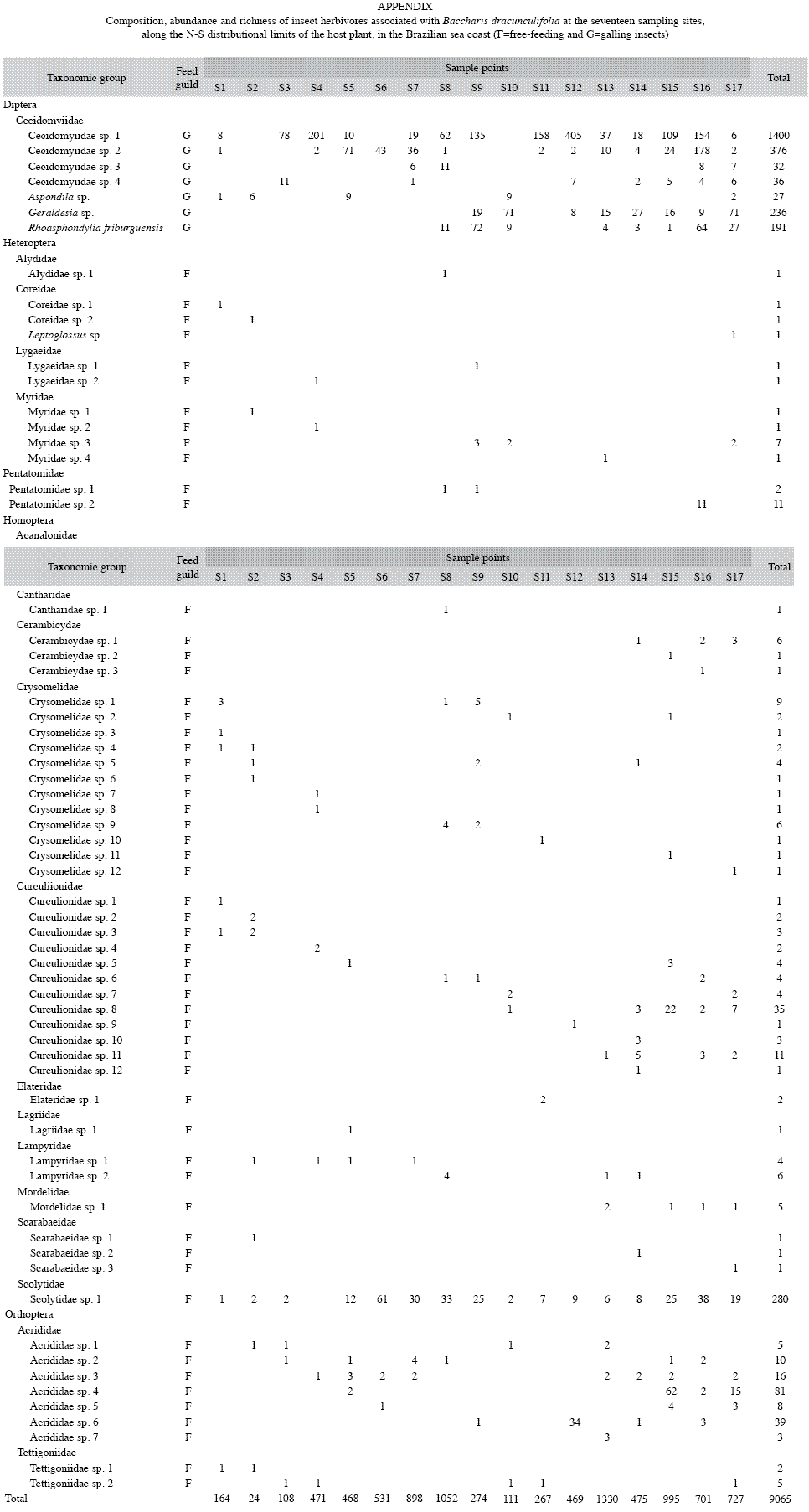
<body><![CDATA[ style="font-weight: bold;">General patterns:</span> A     total of 8 201     galls and 864 free-feeding insect herbivores were </span></font><font      size="2"><span style="font-family: verdana;">collected from <span      style="font-style: italic;">B.     dracunculifolia</span>     at the seventeen sample points. The fauna of herbivorous insects     associated with<span style="font-style: italic;"> B. dracunculifolia </span>was     composed by 88 species from 28     families. The insect families with more species were Chrysomelidae (12     ]]></body>
<body><![CDATA[species), Curculionidae (12 species), Acrididae (7 species) and     Cecidomyiidae (7 species). In general, free-feeding herbivore abundance     and frequency were low, but an </span></font><font size="2"><span      style="font-family: verdana;">unidentified species     of Scolytidae     deserve further studies due to their high abundance and frequency in     the samples. This species was commonly observed feeding on meristems     and new leaves of host plant (<a      href="/img/revistas/rbt/v59n3/a38ap1.gif">Appendix</a>).</span></font><br      style="font-family: verdana;">     ]]></body>
<body><![CDATA[<br style="font-family: verdana;">     <font size="2"><span style="font-family: verdana;">The guild of     free-feeding insects     represented 90.99% of total insect herbivore species </span></font><font      size="2"><span style="font-family: verdana;">associated with <span      style="font-style: italic;">B.     dracunculifolia</span>,     while gall-forming contributed with 9.01% of the sampled species. On     the other hand, gallforming insects represented the most abundant     feeding guild (90.48%), whereas free-feeding insects represented just     ]]></body>
<body><![CDATA[9.52% of total herbivore insect abundance. In general, the richness of     insects per sample site (local richness) was low (mean=14.47, range:     09-23) when compared to total richness (regional richness=88),     indicating high species substitution among sample sites. This observed     pattern was due mainly to free-feeding, rather than gall-forming     insects (<a href="/img/revistas/rbt/v59n3/a38ap1.gif">Appendix</a>).</span></font><br      style="font-family: verdana;">     <br style="font-family: verdana; font-weight: bold;">     <font size="2"><span style="font-family: verdana;"><span      style="font-weight: bold;">Latitudinal gradient     ]]></body>
<body><![CDATA[hypothesis:     </span>The number of gall-inducing insect species associated with <span      style="font-style: italic;">B.     dracunculifolia</span> decreased significantly towards the North, low     latitude, limit of the host plant distribution (F=31.563, p=0.007,     r<sup>2</sup>=67.78). However, the number of abundant species (F=1.469,     p=0.245,     r<sup>2</sup>=9.49), very abundant species (F=2.289, p=0.152, r<sup>2</sup>=14.05)     and     evenness (F=0.234, p=0.636, r<sup>2</sup>=1.642) did not vary     ]]></body>
<body><![CDATA[significantly along     the latitudinal gradient (<a href="/img/revistas/rbt/v59n3/a38i2.jpg">Fig.     2</a>).     When free-feeding insect herbivores     were analyzed, none of the measures of species diversity (specie     richness: </span></font><font size="2"><span      style="font-family: verdana;">F=1.988, p=0.179,     r<sup>2</sup>=11.70; number     of abundant species: F=0.372, p=0.551, r<sup>2</sup>=2.42; number of     very abundant     ]]></body>
<body><![CDATA[species: F=0.005, p=0.944, r<sup>2</sup>=0.34 and evenness: F=0.234,     p=0.636,     r<sup>2</sup>=1.64) were significantly related to variations in     latitude (<a href="/img/revistas/rbt/v59n3/a38i3.jpg">Fig. 3</a>).     </span></font><br style="font-family: verdana;">     <br style="font-family: verdana;">     <font style="font-weight: bold;" size="3"><span      style="font-family: verdana;">Discussion</span></font><br      style="font-family: verdana;">     <br style="font-family: verdana;">     ]]></body>
<body><![CDATA[<font size="2"><span style="font-family: verdana;">The number of     gall-inducing insect     species associated with <span style="font-style: italic;">Baccharis     dracunculifolia</span> decreased towards the     equator. The observed result did not fit the more common pattern of     increasing species diversity as latitude decreases (Willig<span      style="font-style: italic;"> et al</span>. 2003,     Lewinsohn &amp; Roslin 2008). Factors such as geographic distribution,     center of origin, taxonomic isolation and local diversity of the host     plants have been used to justify the absence of correlation between     ]]></body>
<body><![CDATA[species diversity of other insect herbivores and latitudinal variations     (Cornell 1985, Leather 1986, Lewinsohn &amp; Roslin 2008). We argue </span></font><font      size="2"><span style="font-family: verdana;">that our results are     related to the     evolutionary history of the host plant and the highly specialized     feeding habit of gall-inducing insects. The genus <span      style="font-style: italic;">Baccharis </span>is more     species-rich in the Southern region of Brazil, that probably     corresponds to the genus origin center (Jarvis<span      style="font-style: italic;"> et al</span>. 1991). Moreover,     ]]></body>
<body><![CDATA[given the narrow host plant requirements of gall-inducing insects, it     would be expected that exchange of gall-inducing insect species between     closely related plant species would be easier than exchange between     more distantly related plant species (Lawton &amp; Schroder 1977,     Leather 1986). Thus, it is possible that the galling insect associated     with <span style="font-style: italic;">Baccharis</span> genus radiated     into the Southern region of Brazil,     justifying the decrease of galling insect richness towards the North,     limit of host plant observed in this study.</span></font><br      style="font-family: verdana;">     ]]></body>
<body><![CDATA[<br style="font-family: verdana;">     <font size="2"><span style="font-family: verdana;">Species&#8217; ranges may     be constrained     by both climatic tolerances and barriers to dispersal (e.g. mountains     and rivers). In the former case, species can disperse to a new habitat     but fail to become established, whereas in the latter case species     might never have opportunity to reach the new habitat even though they     have attributes needed to persist there (Buckley<span      style="font-style: italic;"> et al</span>. 2010). In this     study, physical barriers are uncommon among the sample sites, but the     ]]></body>
<body><![CDATA[temperature results higher in Northern regions. Thereby, climatic     intolerances should represent a constraint to some galling species     establishment in the extreme Northern limit of host plant which would     generate the observed pattern of high gall richness in the Southern     region. In fact, recent studies indicate that climatic specialization     and retention of climatic tolerances </span></font><font size="2"><span      style="font-family: verdana;">over time (niche     conservatism     hypothesis) might drive species distributions in space </span></font><font      size="2"><span style="font-family: verdana;">(Buckley <span     ]]></body>
<body><![CDATA[ style="font-style: italic;">et al</span>.     2010, Kozak &amp;     Wiens 2010). However, adequate experimental design is need to test the     effectiveness of niche conservatism to determine the regional     distribution of galling species associated with <span      style="font-style: italic;">B. dracunculifolia</span>. </span></font><br      style="font-family: verdana;">     <br style="font-family: verdana;">     <font size="2"><span style="font-family: verdana;">The variation in     latitude did not     ]]></body>
<body><![CDATA[influence the richness of free-feeding insect herbivores </span></font><font      size="2"><span style="font-family: verdana;">associated with <span      style="font-style: italic;">B.     dracunculifolia</span>.     This result supports the spatial heterogeneity hypothesis prediction     because species richness should not change within structurally similar     habitats along a latitudinal gradient. However, Dawidowitz &amp;     Rosenzweigh (1998) present four examples (ants, grasshopper, scorpions     and mammals) where diversity trends within single biome types change     along the latitudinal variation. In contrast, no significant     ]]></body>
<body><![CDATA[correlations were found between the proportion of mining species and     latitude (Sinclair &amp; Hughes 2008). The authors argument that leaf     mining is a widespread type of insect herbivory whose distribution     patterns are more likely to be influenced by biotic than abiotic     factors. Similarly, Andrew &amp; Hughes (2005) found no consistent     North to South (tropical to temperate) change in arthropod community     structure associated with <span style="font-style: italic;">Acacia</span>     trees in Eastern Australia. The     findings suggest that different mechanisms operate for different taxa     and that it is not wise to generalize the effects of latitude on     ]]></body>
<body><![CDATA[species diversity across taxa.</span></font><br      style="font-family: verdana;">     <br style="font-family: verdana;">     <font size="2"><span style="font-family: verdana;">Despite of different     patterns of     species richness observed for gall-inducing and free feeding insects,     neither the diversity indices represented by Hill&#8217;s number N1 and N2 or     </span></font><font size="2"><span style="font-family: verdana;">evenness     of these     two guilds were     ]]></body>
<body><![CDATA[related to latitudinal variation. These patterns suggest that even     though species composition and richness can vary among habitats, there     is a general structure to the herbivore community associated with <span      style="font-style: italic;">B.     dracunculifolia</span> (Fagundes <span style="font-style: italic;">et     al</span>. 1996, Andrew &amp; Hughes 2005). In     fact, there are strong evidences that bottom-up (Faria &amp; Fernandes     2001, Esp&iacute;rito-Santo &amp; Fernandes </span></font><font      size="2"><span style="font-family: verdana;">2002) and top-down     (Fagundes <span style="font-style: italic;">et al</span>.     ]]></body>
<body><![CDATA[2005) forces operating in the system can influence the relative     abundance of insect herbivores on <span style="font-style: italic;">B.     dracunculifolia</span> and regulate     diversity at the local level. </span></font><br      style="font-family: verdana;">     <br style="font-family: verdana;">     <font size="2"><span style="font-family: verdana;">The majority of     tropical insect     herbivores are relatively rare (Price <span style="font-style: italic;">et     al</span>. 1995). Generally, just a     ]]></body>
<body><![CDATA[few groups of insect herbivores with specialized feeding habits, such     as some macrolepidoptera (Price<span style="font-style: italic;"> et al</span>.     1995), Homoptera (Dansa &amp;     Rocha 1992) and galling insects (Fernandes <span      style="font-style: italic;">et al</span>. 1996), can be found     predictably and at high densities on specific host plants in tropical     regions. However, the composition of herbivorous families observed in     this study corroborates the general insect composition patterns     described in other tropical areas. Usually, Chrysomelidae and     Curculionidae are folivores recurrently important components of     ]]></body>
<body><![CDATA[free-feeding insect communities (Kitching <span      style="font-style: italic;">et al</span>. 1997, Basset 2001,     Neves <span style="font-style: italic;">et al</span>. 2010), while     Cecidomyiidae is dominant among the galling     insects (Carneiro<span style="font-style: italic;"> et al</span>.     2009). </span></font><br style="font-family: verdana;">     <br style="font-family: verdana;">     <font size="2"><span style="font-family: verdana;">The general pattern     of low density     and frequency, specially observed in free-feeding insect guild,     ]]></body>
<body><![CDATA[probably may be related to high plant diversity and the more     polyphagous feeding habits of these insects in the tropics (Strong <span      style="font-style: italic;">et     al</span>. 1984, Lawton 1991, Lewinsohn &amp; Roslin 2008). The     majority of     insect herbivores, especially free-feeding insects found associated     with <span style="font-style: italic;">B. dracunculifolia</span>,     showed low population density and frequency.     Low density could be associated with generalist habits of herbivores     permitting migration to a variety of host plants, while low species     ]]></body>
<body><![CDATA[frequency indicates high variation in insect fauna between sample     sites. In fact, the majority of the insects </span></font><font      size="2"><span style="font-family: verdana;">found on <span      style="font-style: italic;">B.     dracunculifolia</span> were     restricted to a specific site rather than having a geographic     distribution mirroring that of the host plant. </span></font><br      style="font-family: verdana;">     <br style="font-family: verdana;">     <font size="2"><span style="font-family: verdana;">The variation in     ]]></body>
<body><![CDATA[insect fauna among     habitats is determined by their host specificity, interactions with     natural enemies and their ability to follow host plant species in space     </span></font><font size="2"><span style="font-family: verdana;">and     time and across     different     environments (Novotny 2009). Thus, it is probable that local events,     such as biological interactions, regulate the population dynamics of     herbivores associated with<span style="font-style: italic;"> B.     dracunculifolia</span>. In contrast, the insect     ]]></body>
<body><![CDATA[fauna collected at each sample site represent just a portion of the     local pool of insect herbivores capable of colonizing <span      style="font-style: italic;">B.     dracunculifolia</span>. Thereby, the insect fauna sample from each     site,     resulted of large scale events, as speciation, migration and     coevolution, while at local level, the population of these insects is     regulated by ecological forces which operate in the system.     Understanding the core of the relative role of ecological and     evolutionary processes will be essential to predict general community     ]]></body>
<body><![CDATA[structure, and advance in new </span></font><font size="2"><span      style="font-family: verdana;">strategies for     insect conservation     (Perry<span style="font-style: italic;"> et al</span>. 1998, Lawes<span      style="font-style: italic;"> et al</span>. 2000).</span></font><br      style="font-family: verdana;">     <br style="font-family: verdana;">     <font style="font-weight: bold;" size="3"><span      style="font-family: verdana;">Acknowledgments</span></font><br      style="font-family: verdana;">     ]]></body>
<body><![CDATA[<br style="font-family: verdana;">     <font size="2"><span style="font-family: verdana;">We thank B.G.     Madeira, P.W. Price     and T.M. Lewinsohn for insightful comments on earlier drafts of the     manuscript, and two other anonymous referees who made valuable     contributions to this paper. Financial support by the Fapemig (the     Minas Gerais Research Foundation) and CNPq (the National Research     Council of Brazil).</span></font><br style="font-family: verdana;">     <font style="font-weight: bold;" size="3"><span      style="font-family: verdana;"></span></font>     ]]></body>
<body><![CDATA[<hr style="width: 100%; height: 2px;"><font style="font-weight: bold;"      size="3"><span style="font-family: verdana;">References</span></font><br      style="font-family: verdana;">     <br style="font-family: verdana;">     <font size="2"><span style="font-family: verdana;">Andrew, N.R. &amp;     L. Hughes. 2005.     Arthropod community structure along a latitudinal gradient:     implications for future impacts of climate change. Aust. Ecol. 30:     <!-- ref -->281-287.    &nbsp;&nbsp;&nbsp;&nbsp;&nbsp;&nbsp;&nbsp;&nbsp;[&#160;<a href="javascript:void(0);" onclick="javascript: window.open('/scielo.php?script=sci_nlinks&ref=1737950&pid=S0034-7744201100030003800001&lng=','','width=640,height=500,resizable=yes,scrollbars=1,menubar=yes,');">Links</a>&#160;]<!-- end-ref --><!-- ref --></span></font><br style="font-family: verdana;"> <br style="font-family: verdana;"> <font size="2"><span style="font-family: verdana;">Barroso, G.M. 1976. Compositae &#8211; Subtribo Baccharidinae Hoffmann: estudo das esp&eacute;cies ocorrentes no Brasil. Rodrigu&eacute;sia 28: 3-273.    &nbsp;&nbsp;&nbsp;&nbsp;&nbsp;&nbsp;&nbsp;&nbsp;[&#160;<a href="javascript:void(0);" onclick="javascript: window.open('/scielo.php?script=sci_nlinks&ref=1737951&pid=S0034-7744201100030003800002&lng=','','width=640,height=500,resizable=yes,scrollbars=1,menubar=yes,');">Links</a>&#160;]<!-- end-ref --><!-- ref --></span></font><br  style="font-family: verdana;"> <br style="font-family: verdana;"> <font size="2"><span style="font-family: verdana;">Basset, Y. 2001. Invertebrates in the canopy of tropical rain forests: How much do we really know? Plant Ecol. 153: 87-107.    &nbsp;&nbsp;&nbsp;&nbsp;&nbsp;&nbsp;&nbsp;&nbsp;[&#160;<a href="javascript:void(0);" onclick="javascript: window.open('/scielo.php?script=sci_nlinks&ref=1737952&pid=S0034-7744201100030003800003&lng=','','width=640,height=500,resizable=yes,scrollbars=1,menubar=yes,');">Links</a>&#160;]<!-- end-ref --><!-- ref --></span></font><br style="font-family: verdana;"> <br style="font-family: verdana;"> <font size="2"><span style="font-family: verdana;">Boldt, P.E. 1989.<span  style="font-style: italic;"> Baccharis</span> (Asteraceae): a review of its taxonomy, phytochemistry, ecology, economic status, natural enemies and potential for its biological control in the Unites States. USDA, Agricultural Research Service Grassland, Temple, Texas, USA.    &nbsp;&nbsp;&nbsp;&nbsp;&nbsp;&nbsp;&nbsp;&nbsp;[&#160;<a href="javascript:void(0);" onclick="javascript: window.open('/scielo.php?script=sci_nlinks&ref=1737953&pid=S0034-7744201100030003800004&lng=','','width=640,height=500,resizable=yes,scrollbars=1,menubar=yes,');">Links</a>&#160;]<!-- end-ref --><!-- ref --></span></font><br  style="font-family: verdana;"> <br style="font-family: verdana;"> <font size="2"><span style="font-family: verdana;">Buckley, L.B., T.J. Davies, D.D. Ackerly, N.J.B. Kraft, S.P. Harrison, B.L. Anacker, H.V. Cornell, E.I. Damschen, J. Grytnes, B.A. Hawkins, C.M. McCain, P.R. Stephens &amp; J.J. Wiens. 2010. Phylogeny, niche conservatism and the latitudinal diversity gradient in mammals. Proc. Roy. Soc. Lond. B. Biol Sci. 277: 2131-2138.    &nbsp;&nbsp;&nbsp;&nbsp;&nbsp;&nbsp;&nbsp;&nbsp;[&#160;<a href="javascript:void(0);" onclick="javascript: window.open('/scielo.php?script=sci_nlinks&ref=1737954&pid=S0034-7744201100030003800005&lng=','','width=640,height=500,resizable=yes,scrollbars=1,menubar=yes,');">Links</a>&#160;]<!-- end-ref --><!-- ref --></span></font><br style="font-family: verdana;"> <br style="font-family: verdana;"> <font size="2"><span style="font-family: verdana;">Carneiro, M.A.A., R.A.X. Borges, A.P.A. Ara&uacute;jo &amp; G.W. Fernandes. 2009. Insetos indutores de galhas da por&ccedil;&atilde;o sul da Cadeia do Espinha&ccedil;o, Minas Gerais, Brasil. Rev. Bras. Entomol. 53: 570-592.    &nbsp;&nbsp;&nbsp;&nbsp;&nbsp;&nbsp;&nbsp;&nbsp;[&#160;<a href="javascript:void(0);" onclick="javascript: window.open('/scielo.php?script=sci_nlinks&ref=1737955&pid=S0034-7744201100030003800006&lng=','','width=640,height=500,resizable=yes,scrollbars=1,menubar=yes,');">Links</a>&#160;]<!-- end-ref --><!-- ref --></span></font><br  style="font-family: verdana;"> <br style="font-family: verdana;"> <font size="2"><span style="font-family: verdana;">Cornell, H.V. 1985. Local and regional richness of Cynipine gall wasps on California oaks. Ecology 66: 1247-60.    &nbsp;&nbsp;&nbsp;&nbsp;&nbsp;&nbsp;&nbsp;&nbsp;[&#160;<a href="javascript:void(0);" onclick="javascript: window.open('/scielo.php?script=sci_nlinks&ref=1737956&pid=S0034-7744201100030003800007&lng=','','width=640,height=500,resizable=yes,scrollbars=1,menubar=yes,');">Links</a>&#160;]<!-- end-ref --><!-- ref --></span></font><br style="font-family: verdana;"> <br style="font-family: verdana;"> <font size="2"><span style="font-family: verdana;">Cox, C.B. &amp; P.D. Moore. 1993. Biogeography: an ecological and evolutionary approach. Blackwell, Berlin, Germany.    &nbsp;&nbsp;&nbsp;&nbsp;&nbsp;&nbsp;&nbsp;&nbsp;[&#160;<a href="javascript:void(0);" onclick="javascript: window.open('/scielo.php?script=sci_nlinks&ref=1737957&pid=S0034-7744201100030003800008&lng=','','width=640,height=500,resizable=yes,scrollbars=1,menubar=yes,');">Links</a>&#160;]<!-- end-ref --><!-- ref --></span></font><br style="font-family: verdana;"> <br style="font-family: verdana;"> <font size="2"><span style="font-family: verdana;">Dajoz, R. 2000. Insects and Forests: The role and diversity of insects in the forest environment. Lavoisier, Paris, France.    &nbsp;&nbsp;&nbsp;&nbsp;&nbsp;&nbsp;&nbsp;&nbsp;[&#160;<a href="javascript:void(0);" onclick="javascript: window.open('/scielo.php?script=sci_nlinks&ref=1737958&pid=S0034-7744201100030003800009&lng=','','width=640,height=500,resizable=yes,scrollbars=1,menubar=yes,');">Links</a>&#160;]<!-- end-ref --><!-- ref --></span></font><br style="font-family: verdana;"> <br style="font-family: verdana;"> <font size="2"><span style="font-family: verdana;">Dansa, C.V.A. &amp; C.F.D. Rocha. 1992. An ant-membracidplant interaction in a cerrado area of Brazil. J. Trop. Ecol. 8: 339-348.    &nbsp;&nbsp;&nbsp;&nbsp;&nbsp;&nbsp;&nbsp;&nbsp;[&#160;<a href="javascript:void(0);" onclick="javascript: window.open('/scielo.php?script=sci_nlinks&ref=1737959&pid=S0034-7744201100030003800010&lng=','','width=640,height=500,resizable=yes,scrollbars=1,menubar=yes,');">Links</a>&#160;]<!-- end-ref --><!-- ref --></span></font><br style="font-family: verdana;"> <br style="font-family: verdana;"> <font size="2"><span style="font-family: verdana;">Davidowitz, G. &amp; M.L. Rosenzweig. 1998. The latitudinal gradient of species diversity among North American grasshoppers (Acrididae) within a single habitat: a test of the spatial heterogeneity hypothesis. J. Biogeogr. 25: 553-560.    &nbsp;&nbsp;&nbsp;&nbsp;&nbsp;&nbsp;&nbsp;&nbsp;[&#160;<a href="javascript:void(0);" onclick="javascript: window.open('/scielo.php?script=sci_nlinks&ref=1737960&pid=S0034-7744201100030003800011&lng=','','width=640,height=500,resizable=yes,scrollbars=1,menubar=yes,');">Links</a>&#160;]<!-- end-ref --><!-- ref --></span></font><br  style="font-family: verdana;"> <br style="font-family: verdana;"> <font size="2"><span style="font-family: verdana;">Dixon, A.F.G., P. Kindlman, J. Leps &amp; J. Holman. 1987. Why there are so few species of aphids, especially in the tropics. Am. Nat. 129: 580-592.    &nbsp;&nbsp;&nbsp;&nbsp;&nbsp;&nbsp;&nbsp;&nbsp;[&#160;<a href="javascript:void(0);" onclick="javascript: window.open('/scielo.php?script=sci_nlinks&ref=1737961&pid=S0034-7744201100030003800012&lng=','','width=640,height=500,resizable=yes,scrollbars=1,menubar=yes,');">Links</a>&#160;]<!-- end-ref --><!-- ref --></span></font><br  style="font-family: verdana;"> <br style="font-family: verdana;"> <font size="2"><span style="font-family: verdana;">Esp&iacute;rito-Santo, M.M. &amp; G.W. Fernandes. 2002. Host plant effects on the development and survivorship of the galling insect Neopelma <span  style="font-style: italic;">baccharidis</span> (Homoptera: Psyllidae). Austral Ecol. 27: 249-57.    &nbsp;&nbsp;&nbsp;&nbsp;&nbsp;&nbsp;&nbsp;&nbsp;[&#160;<a href="javascript:void(0);" onclick="javascript: window.open('/scielo.php?script=sci_nlinks&ref=1737962&pid=S0034-7744201100030003800013&lng=','','width=640,height=500,resizable=yes,scrollbars=1,menubar=yes,');">Links</a>&#160;]<!-- end-ref --><!-- ref --></span></font><br  style="font-family: verdana;"> <br style="font-family: verdana;"> <font size="2"><span style="font-family: verdana;">Esp&iacute;rito-Santo, M.M., B.G. Madeira, F.S. Neves, M.L. Faria, M. Fagundes &amp; G.W. Fernandes. 2003. Sexual differences in reproductive phenology and their consequences to the demography of<span style="font-style: italic;"> Baccharis dracunculifolia</span> (Asteraceae), a dioecious tropical shrub. Ann.Bot. 91: 13-19.    &nbsp;&nbsp;&nbsp;&nbsp;&nbsp;&nbsp;&nbsp;&nbsp;[&#160;<a href="javascript:void(0);" onclick="javascript: window.open('/scielo.php?script=sci_nlinks&ref=1737963&pid=S0034-7744201100030003800014&lng=','','width=640,height=500,resizable=yes,scrollbars=1,menubar=yes,');">Links</a>&#160;]<!-- end-ref --><!-- ref --></span></font><br  style="font-family: verdana;"> <br style="font-family: verdana;"> <font size="2"><span style="font-family: verdana;">Fagundes, M., F.S. Neves &amp; G.W. Fernandes. 2005. Direct and indirect interactions involving ants, insect herbivores and parasitoids on the host plant <span  style="font-style: italic;">Baccharis dracunculifolia</span> (Asteraceae). Ecol. Entomol. 30: 18-25.    &nbsp;&nbsp;&nbsp;&nbsp;&nbsp;&nbsp;&nbsp;&nbsp;[&#160;<a href="javascript:void(0);" onclick="javascript: window.open('/scielo.php?script=sci_nlinks&ref=1737964&pid=S0034-7744201100030003800015&lng=','','width=640,height=500,resizable=yes,scrollbars=1,menubar=yes,');">Links</a>&#160;]<!-- end-ref --><!-- ref --></span></font><br  style="font-family: verdana;"> <br style="font-family: verdana;"> <font size="2"><span style="font-family: verdana;">Fagundes, M., J.C. Zanuncio, F.S. Lopes &amp; P. Marco Jr. 1996. Comunidades de lepid&oacute;pteros noturnos desfolhadores de eucalipto em tr&ecirc;s regi&otilde;es do cerrado de Minas Gerais. Rev. Bras. Zool. 13: 763-71.    &nbsp;&nbsp;&nbsp;&nbsp;&nbsp;&nbsp;&nbsp;&nbsp;[&#160;<a href="javascript:void(0);" onclick="javascript: window.open('/scielo.php?script=sci_nlinks&ref=1737965&pid=S0034-7744201100030003800016&lng=','','width=640,height=500,resizable=yes,scrollbars=1,menubar=yes,');">Links</a>&#160;]<!-- end-ref --><!-- ref --></span></font><br  style="font-family: verdana;"> <br style="font-family: verdana;"> <font size="2"><span style="font-family: verdana;">Faria, M.L. &amp; G.W. Fernandes. 2001. Vigour of a dioecious shrub and attack by a galling herbivore. Ecol. Entomol. 26: 37-45.    &nbsp;&nbsp;&nbsp;&nbsp;&nbsp;&nbsp;&nbsp;&nbsp;[&#160;<a href="javascript:void(0);" onclick="javascript: window.open('/scielo.php?script=sci_nlinks&ref=1737966&pid=S0034-7744201100030003800017&lng=','','width=640,height=500,resizable=yes,scrollbars=1,menubar=yes,');">Links</a>&#160;]<!-- end-ref --><!-- ref --></span></font><br style="font-family: verdana;"> <br style="font-family: verdana;"> <font size="2"><span style="font-family: verdana;">Fernandes, G.W. &amp; P.W. Price. 1988. Biogeographical gradients in galling species richness: tests of hypotheses. Oecologia 76: 161-167.    &nbsp;&nbsp;&nbsp;&nbsp;&nbsp;&nbsp;&nbsp;&nbsp;[&#160;<a href="javascript:void(0);" onclick="javascript: window.open('/scielo.php?script=sci_nlinks&ref=1737967&pid=S0034-7744201100030003800018&lng=','','width=640,height=500,resizable=yes,scrollbars=1,menubar=yes,');">Links</a>&#160;]<!-- end-ref --><!-- ref --></span></font><br  style="font-family: verdana;"> <br style="font-family: verdana;"> <font size="2"><span style="font-family: verdana;">Fernandes, G.W., M.A.A. Carneiro, A.C.F. Lara, L.R. Allain, G.I. Andrade, G. Juli&atilde;o, T.R. Reis &amp; I.M. Silva. 1996. Galling insects on neotropical species of<span  style="font-style: italic;"> Baccharis</span> (Asteraceae). Trop. Zool. 9: 315-32.    &nbsp;&nbsp;&nbsp;&nbsp;&nbsp;&nbsp;&nbsp;&nbsp;[&#160;<a href="javascript:void(0);" onclick="javascript: window.open('/scielo.php?script=sci_nlinks&ref=1737968&pid=S0034-7744201100030003800019&lng=','','width=640,height=500,resizable=yes,scrollbars=1,menubar=yes,');">Links</a>&#160;]<!-- end-ref --><!-- ref --></span></font><br  style="font-family: verdana;"> <br style="font-family: verdana;"> <font size="2"><span style="font-family: verdana;">Frenzel, M. &amp; R. Brandl. 1998. Diversity and composition of phytophagous insect guilds on Brassicaceae. Oecologia 113: 391-399.    &nbsp;&nbsp;&nbsp;&nbsp;&nbsp;&nbsp;&nbsp;&nbsp;[&#160;<a href="javascript:void(0);" onclick="javascript: window.open('/scielo.php?script=sci_nlinks&ref=1737969&pid=S0034-7744201100030003800020&lng=','','width=640,height=500,resizable=yes,scrollbars=1,menubar=yes,');">Links</a>&#160;]<!-- end-ref --><!-- ref --></span></font><br  style="font-family: verdana;"> <br style="font-family: verdana;"> <font size="2"><span style="font-family: verdana;">Gaston, K.J. &amp; P.H. Williams. 1996. Spatial patterns in taxonomic diversity, p. 202-229. <span  style="font-style: italic;">In</span> K.J. Gaston (ed.). Biodiversity: biology of numbers and differences. Blackwell Science, London, England.    &nbsp;&nbsp;&nbsp;&nbsp;&nbsp;&nbsp;&nbsp;&nbsp;[&#160;<a href="javascript:void(0);" onclick="javascript: window.open('/scielo.php?script=sci_nlinks&ref=1737970&pid=S0034-7744201100030003800021&lng=','','width=640,height=500,resizable=yes,scrollbars=1,menubar=yes,');">Links</a>&#160;]<!-- end-ref --><!-- ref --> </span></font><br  style="font-family: verdana;"> <br style="font-family: verdana;"> <font size="2"><span style="font-family: verdana;">Golden, D.M. &amp; T.O. Crist. 1999. Experimental effects of habitat fragmentation on old-field canopy insects: community, guild and species responses. Oecologia 118: 371-380.    &nbsp;&nbsp;&nbsp;&nbsp;&nbsp;&nbsp;&nbsp;&nbsp;[&#160;<a href="javascript:void(0);" onclick="javascript: window.open('/scielo.php?script=sci_nlinks&ref=1737971&pid=S0034-7744201100030003800022&lng=','','width=640,height=500,resizable=yes,scrollbars=1,menubar=yes,');">Links</a>&#160;]<!-- end-ref --><!-- ref --></span></font><br  style="font-family: verdana;"> <br style="font-family: verdana;"> <font size="2"><span style="font-family: verdana;">Hillebrand, H. 2004. On the generality of the latitudinal diversity gradient. Am. Nat. 163: 192-211.    &nbsp;&nbsp;&nbsp;&nbsp;&nbsp;&nbsp;&nbsp;&nbsp;[&#160;<a href="javascript:void(0);" onclick="javascript: window.open('/scielo.php?script=sci_nlinks&ref=1737972&pid=S0034-7744201100030003800023&lng=','','width=640,height=500,resizable=yes,scrollbars=1,menubar=yes,');">Links</a>&#160;]<!-- end-ref --><!-- ref --> </span></font><br style="font-family: verdana;"> <br style="font-family: verdana;"> <font size="2"><span style="font-family: verdana;">Jarvis, B.B., N. Mokhtari-Rejali, E.P. Schenkel, C.S. Barros &amp; N.I. Matzenbacher. 1991. Tricothecene mycotoxins from Brazilian <span style="font-style: italic;">Baccharis </span>species. Phytochemistry 30: 789-797.    &nbsp;&nbsp;&nbsp;&nbsp;&nbsp;&nbsp;&nbsp;&nbsp;[&#160;<a href="javascript:void(0);" onclick="javascript: window.open('/scielo.php?script=sci_nlinks&ref=1737973&pid=S0034-7744201100030003800024&lng=','','width=640,height=500,resizable=yes,scrollbars=1,menubar=yes,');">Links</a>&#160;]<!-- end-ref --><!-- ref --></span></font><br  style="font-family: verdana;"> <br style="font-family: verdana;"> <font size="2"><span style="font-family: verdana;">Juli&atilde;o, G.R., G.W. Fernandes, D. Negreiros, L. Bed&ecirc; &amp; R.C. Ara&uacute;jo. 2005. Insetos galhadores associados a duas esp&eacute;cies de plantas invasoras de &aacute;reas urbanas e</span></font><br  style="font-family: verdana;"> <font size="2"><span style="font-family: verdana;">peri-urbanas. Rev. Bras. Entomol. 49: 97-106.    &nbsp;&nbsp;&nbsp;&nbsp;&nbsp;&nbsp;&nbsp;&nbsp;[&#160;<a href="javascript:void(0);" onclick="javascript: window.open('/scielo.php?script=sci_nlinks&ref=1737974&pid=S0034-7744201100030003800025&lng=','','width=640,height=500,resizable=yes,scrollbars=1,menubar=yes,');">Links</a>&#160;]<!-- end-ref --><!-- ref --> </span></font><br style="font-family: verdana;"> <br style="font-family: verdana;"> <font size="2"><span style="font-family: verdana;">Kitching, R.L., H. Mitchell, G. Morse &amp; G. Thebaud. 1997. Determinants of species richness in assemblages of canopy arthropods in rainforests, p. 131-150. <span  style="font-style: italic;">In</span> N.E. Stork, J. Adis &amp; R.K. Didham (eds.). Canopy Arthropods. Chapman &amp; Hall, London, United Kingdom.    &nbsp;&nbsp;&nbsp;&nbsp;&nbsp;&nbsp;&nbsp;&nbsp;[&#160;<a href="javascript:void(0);" onclick="javascript: window.open('/scielo.php?script=sci_nlinks&ref=1737975&pid=S0034-7744201100030003800026&lng=','','width=640,height=500,resizable=yes,scrollbars=1,menubar=yes,');">Links</a>&#160;]<!-- end-ref --><!-- ref --></span></font><br  style="font-family: verdana;"> <br style="font-family: verdana;"> <font size="2"><span style="font-family: verdana;">Koricheva, J., S. Larsson &amp; E. Haukioja. 1998. Insect performance on experimentally stressed woody plants: a meta-analysis. Annu. Rev. Entomol. 43: 195-216.    &nbsp;&nbsp;&nbsp;&nbsp;&nbsp;&nbsp;&nbsp;&nbsp;[&#160;<a href="javascript:void(0);" onclick="javascript: window.open('/scielo.php?script=sci_nlinks&ref=1737976&pid=S0034-7744201100030003800027&lng=','','width=640,height=500,resizable=yes,scrollbars=1,menubar=yes,');">Links</a>&#160;]<!-- end-ref --><!-- ref --></span></font><br  style="font-family: verdana;"> <br style="font-family: verdana;"> <font size="2"><span style="font-family: verdana;">Kozak, K.H. &amp; J.J. Wiens. 2010. Niche conservatism drives elevational diversity patterns in Appalachian salamanders. Am. Nat. 176: 40-54.    &nbsp;&nbsp;&nbsp;&nbsp;&nbsp;&nbsp;&nbsp;&nbsp;[&#160;<a href="javascript:void(0);" onclick="javascript: window.open('/scielo.php?script=sci_nlinks&ref=1737977&pid=S0034-7744201100030003800028&lng=','','width=640,height=500,resizable=yes,scrollbars=1,menubar=yes,');">Links</a>&#160;]<!-- end-ref --><!-- ref --></span></font><br  style="font-family: verdana;"> <br style="font-family: verdana;"> <font size="2"><span style="font-family: verdana;">Lawes, M.J., H.T. Eeley &amp; S.E. Piper. 2000. The relationship between local and regional diversity of indigenous forest fauna in KwaZulu-Natal Province, South Africa. Biodivers. Conserv. 9: 683-705.    &nbsp;&nbsp;&nbsp;&nbsp;&nbsp;&nbsp;&nbsp;&nbsp;[&#160;<a href="javascript:void(0);" onclick="javascript: window.open('/scielo.php?script=sci_nlinks&ref=1737978&pid=S0034-7744201100030003800029&lng=','','width=640,height=500,resizable=yes,scrollbars=1,menubar=yes,');">Links</a>&#160;]<!-- end-ref --><!-- ref --></span></font><br  style="font-family: verdana;"> <br style="font-family: verdana;"> <font size="2"><span style="font-family: verdana;">Lawton, J.H. &amp; D. Schroder. 1977. Effects of plant type, size of geographical range and taxonomic isolation on number of insect species associated with British plants. Nature 265: 137-140.    &nbsp;&nbsp;&nbsp;&nbsp;&nbsp;&nbsp;&nbsp;&nbsp;[&#160;<a href="javascript:void(0);" onclick="javascript: window.open('/scielo.php?script=sci_nlinks&ref=1737979&pid=S0034-7744201100030003800030&lng=','','width=640,height=500,resizable=yes,scrollbars=1,menubar=yes,');">Links</a>&#160;]<!-- end-ref --><!-- ref --></span></font><br style="font-family: verdana;"> <br style="font-family: verdana;"> <font size="2"><span style="font-family: verdana;">Lawton, J.H. 1991. Species richness, population abundances, and body sizes in insect communities: tropical versus temperate comparisons, p. 71-89. <span  style="font-style: italic;">In </span>P.W. Price, T.M. Lewinsohn, G.W. Fernandes &amp; W.W. Benson (eds.). Plant-animal interactions: evolutionary ecology in tropical and temperate regions. Jonh Wiley and Sons, New York, New York, USA.    &nbsp;&nbsp;&nbsp;&nbsp;&nbsp;&nbsp;&nbsp;&nbsp;[&#160;<a href="javascript:void(0);" onclick="javascript: window.open('/scielo.php?script=sci_nlinks&ref=1737980&pid=S0034-7744201100030003800031&lng=','','width=640,height=500,resizable=yes,scrollbars=1,menubar=yes,');">Links</a>&#160;]<!-- end-ref --><!-- ref --></span></font><br  style="font-family: verdana;"> <br style="font-family: verdana;"> <font size="2"><span style="font-family: verdana;">Leather, S.R. 1986. Insect species richness of the British Rosaceae: the importance of host range, plant architecture, age of establishment, taxonomic isolation and specie-area relationships. J. Anim. Ecol. 55: 841-860.    &nbsp;&nbsp;&nbsp;&nbsp;&nbsp;&nbsp;&nbsp;&nbsp;[&#160;<a href="javascript:void(0);" onclick="javascript: window.open('/scielo.php?script=sci_nlinks&ref=1737981&pid=S0034-7744201100030003800032&lng=','','width=640,height=500,resizable=yes,scrollbars=1,menubar=yes,');">Links</a>&#160;]<!-- end-ref --><!-- ref --></span></font><br  style="font-family: verdana;"> <br style="font-family: verdana;"> <font size="2"><span style="font-family: verdana;">Lewinsohn, T.M. &amp; T. Roslin. 2008. Four ways towards tropical herbivore megadiversity. Ecol. Lett. 11:398-416.    &nbsp;&nbsp;&nbsp;&nbsp;&nbsp;&nbsp;&nbsp;&nbsp;[&#160;<a href="javascript:void(0);" onclick="javascript: window.open('/scielo.php?script=sci_nlinks&ref=1737982&pid=S0034-7744201100030003800033&lng=','','width=640,height=500,resizable=yes,scrollbars=1,menubar=yes,');">Links</a>&#160;]<!-- end-ref --><!-- ref --></span></font><br style="font-family: verdana;"> <br style="font-family: verdana;"> <font size="2"><span style="font-family: verdana;">Ludwig, J.A. &amp; J.F. Reynolds. 1988. Statistical ecology: a primer on methods and computing. John Wiley and Sons, New York, New York, USA.    &nbsp;&nbsp;&nbsp;&nbsp;&nbsp;&nbsp;&nbsp;&nbsp;[&#160;<a href="javascript:void(0);" onclick="javascript: window.open('/scielo.php?script=sci_nlinks&ref=1737983&pid=S0034-7744201100030003800034&lng=','','width=640,height=500,resizable=yes,scrollbars=1,menubar=yes,');">Links</a>&#160;]<!-- end-ref --><!-- ref --> </span></font><br  style="font-family: verdana;"> <br style="font-family: verdana;"> <font size="2"><span style="font-family: verdana;">Majer, J.D., R.L. Kitching, B.E. Heterick, K. Hurley &amp; K.E.C. Brennan. 2001. North-South patterns within arboreal ant assemblages from rain forest in eastern Australia. Biotropica 33: 643-661.    &nbsp;&nbsp;&nbsp;&nbsp;&nbsp;&nbsp;&nbsp;&nbsp;[&#160;<a href="javascript:void(0);" onclick="javascript: window.open('/scielo.php?script=sci_nlinks&ref=1737984&pid=S0034-7744201100030003800035&lng=','','width=640,height=500,resizable=yes,scrollbars=1,menubar=yes,');">Links</a>&#160;]<!-- end-ref --><!-- ref --></span></font><br style="font-family: verdana;"> <br style="font-family: verdana;"> <font size="2"><span style="font-family: verdana;">Neves, F.S., L.S. Ara&uacute;jo, M. Fagundes, M.M. Esp&iacute;rito-Santo, G.W. Fernandes, G.A. S&aacute;nchez-Azofeifa &amp; M. Quesada. 2010. Canopy herbivory and insect herbivore diversity in a dry forest-savana transition in Brazil. Biotropica 42: 112-118.    &nbsp;&nbsp;&nbsp;&nbsp;&nbsp;&nbsp;&nbsp;&nbsp;[&#160;<a href="javascript:void(0);" onclick="javascript: window.open('/scielo.php?script=sci_nlinks&ref=1737985&pid=S0034-7744201100030003800036&lng=','','width=640,height=500,resizable=yes,scrollbars=1,menubar=yes,');">Links</a>&#160;]<!-- end-ref --><!-- ref --></span></font><br style="font-family: verdana;"> <br style="font-family: verdana;"> <font size="2"><span style="font-family: verdana;">Novotny, V. &amp; Y. Basset. 2005. Host specificity of insect herbivores in tropical forests. Proc. Roy. Soc. Lond. B. Biol Sci. 272: 1083-1090.    &nbsp;&nbsp;&nbsp;&nbsp;&nbsp;&nbsp;&nbsp;&nbsp;[&#160;<a href="javascript:void(0);" onclick="javascript: window.open('/scielo.php?script=sci_nlinks&ref=1737986&pid=S0034-7744201100030003800037&lng=','','width=640,height=500,resizable=yes,scrollbars=1,menubar=yes,');">Links</a>&#160;]<!-- end-ref --><!-- ref --></span></font><br  style="font-family: verdana;"> <br style="font-family: verdana;"> <font size="2"><span style="font-family: verdana;">Novotny, V. 2009. Beta diversity of plant-insect food webs in tropical forest: a conceptual framework. Insect Conserv. Biodiv. 2: 5-9.    &nbsp;&nbsp;&nbsp;&nbsp;&nbsp;&nbsp;&nbsp;&nbsp;[&#160;<a href="javascript:void(0);" onclick="javascript: window.open('/scielo.php?script=sci_nlinks&ref=1737987&pid=S0034-7744201100030003800038&lng=','','width=640,height=500,resizable=yes,scrollbars=1,menubar=yes,');">Links</a>&#160;]<!-- end-ref --><!-- ref --></span></font><br  style="font-family: verdana;"> <br style="font-family: verdana;"> <font size="2"><span style="font-family: verdana;">Otte, D. 1976. Species richness patterns of new world desert grasshoppers in relation to plant diversity. J. Biogeogr. 3: 197-209.    &nbsp;&nbsp;&nbsp;&nbsp;&nbsp;&nbsp;&nbsp;&nbsp;[&#160;<a href="javascript:void(0);" onclick="javascript: window.open('/scielo.php?script=sci_nlinks&ref=1737988&pid=S0034-7744201100030003800039&lng=','','width=640,height=500,resizable=yes,scrollbars=1,menubar=yes,');">Links</a>&#160;]<!-- end-ref --><!-- ref --></span></font><br  style="font-family: verdana;"> <br style="font-family: verdana;"> <font size="2"><span style="font-family: verdana;">Perry, G., G.H. Rodda, T.H. Fritts &amp; T.R. Sharp. 1998. The lizard fauna of Guam&#8217;s fringing islets: island Biogeography, phylogenetic history, and conservation implications. Global Ecol. Biogeogr. 7: 353-365.    &nbsp;&nbsp;&nbsp;&nbsp;&nbsp;&nbsp;&nbsp;&nbsp;[&#160;<a href="javascript:void(0);" onclick="javascript: window.open('/scielo.php?script=sci_nlinks&ref=1737989&pid=S0034-7744201100030003800040&lng=','','width=640,height=500,resizable=yes,scrollbars=1,menubar=yes,');">Links</a>&#160;]<!-- end-ref --><!-- ref --></span></font><br  style="font-family: verdana;"> <br style="font-family: verdana;"> <font size="2"><span style="font-family: verdana;">Pianka, E.R. 1966. Latitudinal gradients in species diversity: a review of concepts. Am. Nat. 100: 33-46.    &nbsp;&nbsp;&nbsp;&nbsp;&nbsp;&nbsp;&nbsp;&nbsp;[&#160;<a href="javascript:void(0);" onclick="javascript: window.open('/scielo.php?script=sci_nlinks&ref=1737990&pid=S0034-7744201100030003800041&lng=','','width=640,height=500,resizable=yes,scrollbars=1,menubar=yes,');">Links</a>&#160;]<!-- end-ref --><!-- ref --> </span></font><br style="font-family: verdana;"> <br style="font-family: verdana;"> <font size="2"><span style="font-family: verdana;">Price, P.W., I.R. Diniz, H.C. Moraes &amp; E.S.A. Marques. 1995. The abundance of insect herbivore species in the tropics: the high local richness of rare species. Biotropica 27: 468-478.    &nbsp;&nbsp;&nbsp;&nbsp;&nbsp;&nbsp;&nbsp;&nbsp;[&#160;<a href="javascript:void(0);" onclick="javascript: window.open('/scielo.php?script=sci_nlinks&ref=1737991&pid=S0034-7744201100030003800042&lng=','','width=640,height=500,resizable=yes,scrollbars=1,menubar=yes,');">Links</a>&#160;]<!-- end-ref --><!-- ref --></span></font><br style="font-family: verdana;"> <br style="font-family: verdana;"> <font size="2"><span style="font-family: verdana;">Ribeiro, S.P., M.A.A. Carneiro &amp; G.W. Fernandes. 1998. Free-feeding insect herbivores along environmental gradients in Serra do Cip&oacute;: basis for a management plan. J. Insect. Conservat. 2: 107-118.    &nbsp;&nbsp;&nbsp;&nbsp;&nbsp;&nbsp;&nbsp;&nbsp;[&#160;<a href="javascript:void(0);" onclick="javascript: window.open('/scielo.php?script=sci_nlinks&ref=1737992&pid=S0034-7744201100030003800043&lng=','','width=640,height=500,resizable=yes,scrollbars=1,menubar=yes,');">Links</a>&#160;]<!-- end-ref --><!-- ref --></span></font><br  style="font-family: verdana;"> <br style="font-family: verdana;"> <font size="2"><span style="font-family: verdana;">Rohde, K. 1998. Latitudinal gradients in species diversity. Area matters, but so much? Oikos 82: 184-90.    &nbsp;&nbsp;&nbsp;&nbsp;&nbsp;&nbsp;&nbsp;&nbsp;[&#160;<a href="javascript:void(0);" onclick="javascript: window.open('/scielo.php?script=sci_nlinks&ref=1737993&pid=S0034-7744201100030003800044&lng=','','width=640,height=500,resizable=yes,scrollbars=1,menubar=yes,');">Links</a>&#160;]<!-- end-ref --><!-- ref --></span></font><br style="font-family: verdana;"> <br style="font-family: verdana;"> <font size="2"><span style="font-family: verdana;">Shepherd, U.L. 1998. A comparison of species diversity and morphological diversity across the North American latitudinal gradient. J. Biogeogr. 25: 19-29.    &nbsp;&nbsp;&nbsp;&nbsp;&nbsp;&nbsp;&nbsp;&nbsp;[&#160;<a href="javascript:void(0);" onclick="javascript: window.open('/scielo.php?script=sci_nlinks&ref=1737994&pid=S0034-7744201100030003800045&lng=','','width=640,height=500,resizable=yes,scrollbars=1,menubar=yes,');">Links</a>&#160;]<!-- end-ref --><!-- ref --></span></font><br  style="font-family: verdana;"> <br style="font-family: verdana;"> <font size="2"><span style="font-family: verdana;">Sime, K.R. &amp; A.V.Z. Brower. 1998. Explaining the latitudinal gradient anomaly in ichneumonid species richness: evidence from butterflies. J. Anim. Ecol. 67: 387-99.    &nbsp;&nbsp;&nbsp;&nbsp;&nbsp;&nbsp;&nbsp;&nbsp;[&#160;<a href="javascript:void(0);" onclick="javascript: window.open('/scielo.php?script=sci_nlinks&ref=1737995&pid=S0034-7744201100030003800046&lng=','','width=640,height=500,resizable=yes,scrollbars=1,menubar=yes,');">Links</a>&#160;]<!-- end-ref --><!-- ref --></span></font><br  style="font-family: verdana;"> <br style="font-family: verdana;"> <font size="2"><span style="font-family: verdana;">Sinclair, R.J. &amp; L. Hughes. 2008. Incidence of leaf mining in different vegetation types across rainfall, canopy cover and latitudinal gradients. Aust. Ecol. 33: 353-360.    &nbsp;&nbsp;&nbsp;&nbsp;&nbsp;&nbsp;&nbsp;&nbsp;[&#160;<a href="javascript:void(0);" onclick="javascript: window.open('/scielo.php?script=sci_nlinks&ref=1737996&pid=S0034-7744201100030003800047&lng=','','width=640,height=500,resizable=yes,scrollbars=1,menubar=yes,');">Links</a>&#160;]<!-- end-ref --><!-- ref --></span></font><br style="font-family: verdana;"> <br style="font-family: verdana;"> <font size="2"><span style="font-family: verdana;">Strong, D.R., J.H. Lawton &amp; T.R.E. Southwood. 1984. Insect on Plants: Community Patterns and Mechanisms. Blackwell, London, England.    &nbsp;&nbsp;&nbsp;&nbsp;&nbsp;&nbsp;&nbsp;&nbsp;[&#160;<a href="javascript:void(0);" onclick="javascript: window.open('/scielo.php?script=sci_nlinks&ref=1737997&pid=S0034-7744201100030003800048&lng=','','width=640,height=500,resizable=yes,scrollbars=1,menubar=yes,');">Links</a>&#160;]<!-- end-ref --><!-- ref --> </span></font><br  style="font-family: verdana;"> <br style="font-family: verdana;"> <font size="2"><span style="font-family: verdana;">Terborgh, J. 1992. Diversity and the Tropical Rain Forest. Scientific American Library, New York, New York, USA.    &nbsp;&nbsp;&nbsp;&nbsp;&nbsp;&nbsp;&nbsp;&nbsp;[&#160;<a href="javascript:void(0);" onclick="javascript: window.open('/scielo.php?script=sci_nlinks&ref=1737998&pid=S0034-7744201100030003800049&lng=','','width=640,height=500,resizable=yes,scrollbars=1,menubar=yes,');">Links</a>&#160;]<!-- end-ref --><!-- ref --></span></font><br style="font-family: verdana;"> <br style="font-family: verdana;"> <font size="2"><span style="font-family: verdana;">Thomaz, S.M., D. Dibble, L.R. Evangelista, J. Higuti &amp; L.M. Bini. 2008. Influence of aquatic macrophyte habitat complexity on invertebrate abundance and richness in tropical lagoons. Freshwat. Biol. 53: 358-367.    &nbsp;&nbsp;&nbsp;&nbsp;&nbsp;&nbsp;&nbsp;&nbsp;[&#160;<a href="javascript:void(0);" onclick="javascript: window.open('/scielo.php?script=sci_nlinks&ref=1737999&pid=S0034-7744201100030003800050&lng=','','width=640,height=500,resizable=yes,scrollbars=1,menubar=yes,');">Links</a>&#160;]<!-- end-ref --><!-- ref --></span></font><br  style="font-family: verdana;"> <br style="font-family: verdana;"> <font size="2"><span style="font-family: verdana;">Willig, M.R., D.M. Kaufman &amp; R.D. Stevens. 2003. Latitudinal gradient of biodiversity: patterns, process, scale, and synthesis. Annu. Rev. Ecol. Syst. 34: 273-309.    &nbsp;&nbsp;&nbsp;&nbsp;&nbsp;&nbsp;&nbsp;&nbsp;[&#160;<a href="javascript:void(0);" onclick="javascript: window.open('/scielo.php?script=sci_nlinks&ref=1738000&pid=S0034-7744201100030003800051&lng=','','width=640,height=500,resizable=yes,scrollbars=1,menubar=yes,');">Links</a>&#160;]<!-- end-ref --><!-- ref --></span></font><br  style="font-family: verdana;"> <br style="font-family: verdana;"> <font size="2"><span style="font-family: verdana;">Whitehouse, M.E.A., S. Fardwick, B.C.G. Scholz, A.J. Annells, P.R. Grundy &amp; S. Harden. 2009. Evidence of a latitudinal gradient in spider diversity in Australian cotton. Aust. Ecol. 34: 10-23.    &nbsp;&nbsp;&nbsp;&nbsp;&nbsp;&nbsp;&nbsp;&nbsp;[&#160;<a href="javascript:void(0);" onclick="javascript: window.open('/scielo.php?script=sci_nlinks&ref=1738001&pid=S0034-7744201100030003800052&lng=','','width=640,height=500,resizable=yes,scrollbars=1,menubar=yes,');">Links</a>&#160;]<!-- end-ref --><br>     <br> <a name="correspondencia"></a>Correspondencia a: </span></font><font  size="2"><span style="font-family: verdana;">Marc&iacute;lio Fagundes. </span></font><font size="2"><span style="font-family: verdana;">Laborat&oacute;rio de Biologia da Conserva&ccedil;&atilde;o DBG/ CCBS, Universidade Estadual de Montes Claros, Montes Claros, MG, Brazil, 39401-089; <a href="mailto:marcilio.fagundes@gmail.com">marcilio.fagundes@gmail.com</a></span></font>    <br> <font size="2"><span style="font-family: verdana;">G. Wilson Fernandes.&nbsp;</span></font><font size="2"><span  style="font-family: verdana;"></span></font><font size="2"><span  style="font-family: verdana;">Ecologia Evolutiva &amp; Biodiversidade/DBG/ICB/Universidade Federal de Minas Gerais, Belo Horizonte, MG, Brazil; <a href="mailto:gwfernandes@gmail.com">gwfernandes@gmail.com</a></span></font><span  style="font-family: verdana;"></span>     <div style="text-align: center;"><font size="2"></font> <hr style="width: 100%; height: 2px;"><font size="2"><span  style="font-family: verdana;">Received 21-VII-2010. Corrected 07-I-2011. Accepted 08-II-2011.</span></font> </div> </div>      ]]></body><back>
<ref-list>
<ref id="B1">
<nlm-citation citation-type="journal">
<person-group person-group-type="author">
<name>
<surname><![CDATA[Andrew]]></surname>
<given-names><![CDATA[N.R]]></given-names>
</name>
<name>
<surname><![CDATA[Hughes]]></surname>
<given-names><![CDATA[L]]></given-names>
</name>
</person-group>
<article-title xml:lang="en"><![CDATA[Arthropod community structure along a latitudinal gradient: implications for future impacts of climate change]]></article-title>
<source><![CDATA[Aust. Ecol]]></source>
<year>2005</year>
<volume>30</volume>
<page-range>281-287</page-range></nlm-citation>
</ref>
<ref id="B2">
<nlm-citation citation-type="journal">
<person-group person-group-type="author">
<name>
<surname><![CDATA[Barroso]]></surname>
<given-names><![CDATA[G.M]]></given-names>
</name>
</person-group>
<article-title xml:lang="pt"><![CDATA[Compositae - Subtribo Baccharidinae Hoffmann: estudo das espécies ocorrentes no Brasil]]></article-title>
<source><![CDATA[Rodriguésia]]></source>
<year>1976</year>
<volume>28</volume>
<page-range>3-273</page-range></nlm-citation>
</ref>
<ref id="B3">
<nlm-citation citation-type="journal">
<person-group person-group-type="author">
<name>
<surname><![CDATA[Basset]]></surname>
<given-names><![CDATA[Y]]></given-names>
</name>
</person-group>
<article-title xml:lang="en"><![CDATA[Invertebrates in the canopy of tropical rain forests: How much do we really know]]></article-title>
<source><![CDATA[Plant Ecol]]></source>
<year>2001</year>
<volume>153</volume>
<page-range>87-107</page-range></nlm-citation>
</ref>
<ref id="B4">
<nlm-citation citation-type="book">
<person-group person-group-type="author">
<name>
<surname><![CDATA[Boldt]]></surname>
<given-names><![CDATA[P.E]]></given-names>
</name>
</person-group>
<source><![CDATA[Baccharis (Asteraceae): a review of its taxonomy, phytochemistry, ecology, economic status, natural enemies and potential for its biological control in the Unites States]]></source>
<year>1989</year>
<publisher-loc><![CDATA[Temple^eTexas Texas]]></publisher-loc>
<publisher-name><![CDATA[USDA, Agricultural Research Service Grassland]]></publisher-name>
</nlm-citation>
</ref>
<ref id="B5">
<nlm-citation citation-type="journal">
<person-group person-group-type="author">
<name>
<surname><![CDATA[Buckley]]></surname>
<given-names><![CDATA[L.B]]></given-names>
</name>
<name>
<surname><![CDATA[Davies]]></surname>
<given-names><![CDATA[T.J]]></given-names>
</name>
<name>
<surname><![CDATA[Ackerly]]></surname>
<given-names><![CDATA[D.D]]></given-names>
</name>
<name>
<surname><![CDATA[Kraft]]></surname>
<given-names><![CDATA[N.J.B]]></given-names>
</name>
<name>
<surname><![CDATA[Harrison]]></surname>
<given-names><![CDATA[S.P]]></given-names>
</name>
<name>
<surname><![CDATA[Anacker]]></surname>
<given-names><![CDATA[B.L]]></given-names>
</name>
<name>
<surname><![CDATA[Cornell]]></surname>
<given-names><![CDATA[H.V]]></given-names>
</name>
<name>
<surname><![CDATA[Damschen]]></surname>
<given-names><![CDATA[E.I]]></given-names>
</name>
<name>
<surname><![CDATA[Grytnes]]></surname>
<given-names><![CDATA[J]]></given-names>
</name>
<name>
<surname><![CDATA[Hawkins]]></surname>
<given-names><![CDATA[B.A]]></given-names>
</name>
<name>
<surname><![CDATA[McCain]]></surname>
<given-names><![CDATA[C.M]]></given-names>
</name>
<name>
<surname><![CDATA[Stephens]]></surname>
<given-names><![CDATA[P.R]]></given-names>
</name>
<name>
<surname><![CDATA[Wiens]]></surname>
<given-names><![CDATA[J.J]]></given-names>
</name>
</person-group>
<article-title xml:lang="en"><![CDATA[Phylogeny, niche conservatism and the latitudinal diversity gradient in mammals]]></article-title>
<source><![CDATA[Proc. Roy. Soc. Lond. B. Biol Sci]]></source>
<year>2010</year>
<volume>277</volume>
<page-range>2131-2138</page-range></nlm-citation>
</ref>
<ref id="B6">
<nlm-citation citation-type="journal">
<person-group person-group-type="author">
<name>
<surname><![CDATA[Carneiro]]></surname>
<given-names><![CDATA[M.A.A]]></given-names>
</name>
<name>
<surname><![CDATA[Borges]]></surname>
<given-names><![CDATA[R.A.X]]></given-names>
</name>
<name>
<surname><![CDATA[Araújo]]></surname>
<given-names><![CDATA[A.P.A]]></given-names>
</name>
<name>
<surname><![CDATA[Fernandes]]></surname>
<given-names><![CDATA[G.W]]></given-names>
</name>
</person-group>
<article-title xml:lang="pt"><![CDATA[Insetos indutores de galhas da porção sul da Cadeia do Espinhaço, Minas Gerais, Brasil]]></article-title>
<source><![CDATA[Rev. Bras. Entomol]]></source>
<year>2009</year>
<volume>53</volume>
<page-range>570-592</page-range></nlm-citation>
</ref>
<ref id="B7">
<nlm-citation citation-type="journal">
<person-group person-group-type="author">
<name>
<surname><![CDATA[Cornell]]></surname>
<given-names><![CDATA[H.V]]></given-names>
</name>
</person-group>
<article-title xml:lang="en"><![CDATA[Local and regional richness of Cynipine gall wasps on California oaks]]></article-title>
<source><![CDATA[Ecology]]></source>
<year>1985</year>
<volume>66</volume>
<page-range>1247-60</page-range></nlm-citation>
</ref>
<ref id="B8">
<nlm-citation citation-type="book">
<person-group person-group-type="author">
<name>
<surname><![CDATA[Cox]]></surname>
<given-names><![CDATA[C.B]]></given-names>
</name>
<name>
<surname><![CDATA[Moore]]></surname>
<given-names><![CDATA[P.D]]></given-names>
</name>
</person-group>
<source><![CDATA[Biogeography: an ecological and evolutionary approach]]></source>
<year>1993</year>
<publisher-loc><![CDATA[Berlin ]]></publisher-loc>
<publisher-name><![CDATA[Blackwell]]></publisher-name>
</nlm-citation>
</ref>
<ref id="B9">
<nlm-citation citation-type="">
<person-group person-group-type="author">
<name>
<surname><![CDATA[Dajoz]]></surname>
<given-names><![CDATA[R]]></given-names>
</name>
</person-group>
<source><![CDATA[Insects and Forests: The role and diversity of insects in the forest environment]]></source>
<year>2000</year>
<publisher-loc><![CDATA[Paris ]]></publisher-loc>
</nlm-citation>
</ref>
<ref id="B10">
<nlm-citation citation-type="journal">
<person-group person-group-type="author">
<name>
<surname><![CDATA[Dansa]]></surname>
<given-names><![CDATA[C.V.A]]></given-names>
</name>
<name>
<surname><![CDATA[Rocha]]></surname>
<given-names><![CDATA[C.F.D]]></given-names>
</name>
</person-group>
<article-title xml:lang="en"><![CDATA[An ant-membracidplant interaction in a cerrado area of Brazil]]></article-title>
<source><![CDATA[J. Trop. Ecol]]></source>
<year>1992</year>
<volume>8</volume>
<page-range>339-348</page-range></nlm-citation>
</ref>
<ref id="B11">
<nlm-citation citation-type="journal">
<person-group person-group-type="author">
<name>
<surname><![CDATA[Davidowitz]]></surname>
<given-names><![CDATA[G]]></given-names>
</name>
<name>
<surname><![CDATA[Rosenzweig]]></surname>
<given-names><![CDATA[M.L]]></given-names>
</name>
</person-group>
<article-title xml:lang="en"><![CDATA[The latitudinal gradient of species diversity among North American grasshoppers (Acrididae) within a single habitat: a test of the spatial heterogeneity hypothesis]]></article-title>
<source><![CDATA[J. Biogeogr]]></source>
<year>1998</year>
<volume>25</volume>
<page-range>553-560</page-range></nlm-citation>
</ref>
<ref id="B12">
<nlm-citation citation-type="journal">
<person-group person-group-type="author">
<name>
<surname><![CDATA[Dixon]]></surname>
<given-names><![CDATA[A.F.G]]></given-names>
</name>
<name>
<surname><![CDATA[Kindlman]]></surname>
<given-names><![CDATA[P]]></given-names>
</name>
<name>
<surname><![CDATA[Leps]]></surname>
<given-names><![CDATA[J]]></given-names>
</name>
<name>
<surname><![CDATA[Holman]]></surname>
<given-names><![CDATA[J]]></given-names>
</name>
</person-group>
<article-title xml:lang="en"><![CDATA[Why there are so few species of aphids, especially in the tropics]]></article-title>
<source><![CDATA[Am. Nat]]></source>
<year>1987</year>
<volume>129</volume>
<page-range>580-592</page-range></nlm-citation>
</ref>
<ref id="B13">
<nlm-citation citation-type="journal">
<person-group person-group-type="author">
<name>
<surname><![CDATA[Espírito-Santo]]></surname>
<given-names><![CDATA[M. M]]></given-names>
</name>
<name>
<surname><![CDATA[Fernandes]]></surname>
<given-names><![CDATA[G.W]]></given-names>
</name>
</person-group>
<article-title xml:lang="en"><![CDATA[Host plant effects on the development and survivorship of the galling insect Neopelma baccharidis (Homoptera: Psyllidae)]]></article-title>
<source><![CDATA[Austral Ecol]]></source>
<year>2002</year>
<volume>27</volume>
<page-range>249-57</page-range></nlm-citation>
</ref>
<ref id="B14">
<nlm-citation citation-type="journal">
<person-group person-group-type="author">
<name>
<surname><![CDATA[Espírito-Santo]]></surname>
<given-names><![CDATA[M.M]]></given-names>
</name>
<name>
<surname><![CDATA[Madeira]]></surname>
<given-names><![CDATA[B.G]]></given-names>
</name>
<name>
<surname><![CDATA[Neves]]></surname>
<given-names><![CDATA[F.S]]></given-names>
</name>
<name>
<surname><![CDATA[Faria]]></surname>
<given-names><![CDATA[M.L]]></given-names>
</name>
<name>
<surname><![CDATA[Fagundes]]></surname>
<given-names><![CDATA[M]]></given-names>
</name>
<name>
<surname><![CDATA[Fernandes]]></surname>
<given-names><![CDATA[G.W]]></given-names>
</name>
</person-group>
<article-title xml:lang="en"><![CDATA[Sexual differences in reproductive phenology and their consequences to the demography of Baccharis dracunculifolia (Asteraceae), a dioecious tropical shrub]]></article-title>
<source><![CDATA[Ann.Bot]]></source>
<year>2003</year>
<volume>91</volume>
<page-range>13-19</page-range></nlm-citation>
</ref>
<ref id="B15">
<nlm-citation citation-type="journal">
<person-group person-group-type="author">
<name>
<surname><![CDATA[Fagundes]]></surname>
<given-names><![CDATA[M]]></given-names>
</name>
<name>
<surname><![CDATA[Neves]]></surname>
<given-names><![CDATA[F.S]]></given-names>
</name>
<name>
<surname><![CDATA[Fernandes]]></surname>
<given-names><![CDATA[G.W]]></given-names>
</name>
</person-group>
<article-title xml:lang="en"><![CDATA[Direct and indirect interactions involving ants, insect herbivores and parasitoids on the host plant Baccharis dracunculifolia (Asteraceae)]]></article-title>
<source><![CDATA[Ecol. Entomol]]></source>
<year>2005</year>
<volume>30</volume>
<page-range>18-25</page-range></nlm-citation>
</ref>
<ref id="B16">
<nlm-citation citation-type="journal">
<person-group person-group-type="author">
<name>
<surname><![CDATA[Fagundes]]></surname>
<given-names><![CDATA[M]]></given-names>
</name>
<name>
<surname><![CDATA[Zanuncio]]></surname>
<given-names><![CDATA[J.C]]></given-names>
</name>
<name>
<surname><![CDATA[Lopes]]></surname>
<given-names><![CDATA[F.S]]></given-names>
</name>
<name>
<surname><![CDATA[Marco Jr]]></surname>
<given-names><![CDATA[P]]></given-names>
</name>
</person-group>
<article-title xml:lang="pt"><![CDATA[Comunidades de lepidópteros noturnos desfolhadores de eucalipto em três regiões do cerrado de Minas Gerais]]></article-title>
<source><![CDATA[Rev. Bras. Zool]]></source>
<year>1996</year>
<volume>13</volume>
<page-range>763-71</page-range></nlm-citation>
</ref>
<ref id="B17">
<nlm-citation citation-type="journal">
<person-group person-group-type="author">
<name>
<surname><![CDATA[Faria]]></surname>
<given-names><![CDATA[M.L]]></given-names>
</name>
<name>
<surname><![CDATA[Fernandes]]></surname>
<given-names><![CDATA[G.W]]></given-names>
</name>
</person-group>
<article-title xml:lang="en"><![CDATA[Vigour of a dioecious shrub and attack by a galling herbivore]]></article-title>
<source><![CDATA[Ecol. Entomol]]></source>
<year>2001</year>
<volume>26</volume>
<page-range>37-45</page-range></nlm-citation>
</ref>
<ref id="B18">
<nlm-citation citation-type="journal">
<person-group person-group-type="author">
<name>
<surname><![CDATA[Fernandes]]></surname>
<given-names><![CDATA[G.W]]></given-names>
</name>
<name>
<surname><![CDATA[Price]]></surname>
<given-names><![CDATA[P.W]]></given-names>
</name>
</person-group>
<article-title xml:lang="en"><![CDATA[Biogeographical gradients in galling species richness: tests of hypotheses]]></article-title>
<source><![CDATA[Oecologia]]></source>
<year>1988</year>
<volume>76</volume>
<page-range>161-167</page-range></nlm-citation>
</ref>
<ref id="B19">
<nlm-citation citation-type="journal">
<person-group person-group-type="author">
<name>
<surname><![CDATA[Fernandes]]></surname>
<given-names><![CDATA[G.W]]></given-names>
</name>
<name>
<surname><![CDATA[Carneiro]]></surname>
<given-names><![CDATA[M.A.A]]></given-names>
</name>
<name>
<surname><![CDATA[Lara]]></surname>
<given-names><![CDATA[A.C.F]]></given-names>
</name>
<name>
<surname><![CDATA[Allain]]></surname>
<given-names><![CDATA[L.R]]></given-names>
</name>
<name>
<surname><![CDATA[Andrade]]></surname>
<given-names><![CDATA[G.I]]></given-names>
</name>
<name>
<surname><![CDATA[Julião]]></surname>
<given-names><![CDATA[G]]></given-names>
</name>
<name>
<surname><![CDATA[Reis]]></surname>
<given-names><![CDATA[T.R]]></given-names>
</name>
<name>
<surname><![CDATA[Silva]]></surname>
<given-names><![CDATA[I.M]]></given-names>
</name>
</person-group>
<article-title xml:lang="en"><![CDATA[Galling insects on neotropical species of Baccharis (Asteraceae)]]></article-title>
<source><![CDATA[Trop. Zool]]></source>
<year>1996</year>
<volume>9</volume>
<page-range>315-32</page-range></nlm-citation>
</ref>
<ref id="B20">
<nlm-citation citation-type="journal">
<person-group person-group-type="author">
<name>
<surname><![CDATA[Frenzel]]></surname>
<given-names><![CDATA[M]]></given-names>
</name>
<name>
<surname><![CDATA[Brandl]]></surname>
<given-names><![CDATA[R]]></given-names>
</name>
</person-group>
<article-title xml:lang="en"><![CDATA[Diversity and composition of phytophagous insect guilds on Brassicaceae]]></article-title>
<source><![CDATA[Oecologia]]></source>
<year>1998</year>
<volume>113</volume>
<page-range>391-399</page-range></nlm-citation>
</ref>
<ref id="B21">
<nlm-citation citation-type="book">
<person-group person-group-type="author">
<name>
<surname><![CDATA[Gaston]]></surname>
<given-names><![CDATA[K.J]]></given-names>
</name>
<name>
<surname><![CDATA[Williams]]></surname>
<given-names><![CDATA[P.H]]></given-names>
</name>
</person-group>
<article-title xml:lang="en"><![CDATA[Spatial patterns in taxonomic diversity]]></article-title>
<person-group person-group-type="editor">
<name>
<surname><![CDATA[Gaston]]></surname>
<given-names><![CDATA[K.J]]></given-names>
</name>
</person-group>
<source><![CDATA[Biodiversity: biology of numbers and differences]]></source>
<year>1996</year>
<page-range>202-229</page-range><publisher-loc><![CDATA[London ]]></publisher-loc>
<publisher-name><![CDATA[Blackwell Science]]></publisher-name>
</nlm-citation>
</ref>
<ref id="B22">
<nlm-citation citation-type="journal">
<person-group person-group-type="author">
<name>
<surname><![CDATA[Golden]]></surname>
<given-names><![CDATA[D.M]]></given-names>
</name>
<name>
<surname><![CDATA[Crist]]></surname>
<given-names><![CDATA[T.O]]></given-names>
</name>
</person-group>
<article-title xml:lang="en"><![CDATA[Experimental effects of habitat fragmentation on old-field canopy insects: community, guild and species responses]]></article-title>
<source><![CDATA[Oecologia]]></source>
<year>1999</year>
<volume>118</volume>
<page-range>371-380</page-range></nlm-citation>
</ref>
<ref id="B23">
<nlm-citation citation-type="journal">
<person-group person-group-type="author">
<name>
<surname><![CDATA[Hillebrand]]></surname>
<given-names><![CDATA[H]]></given-names>
</name>
</person-group>
<article-title xml:lang="en"><![CDATA[On the generality of the latitudinal diversity gradient]]></article-title>
<source><![CDATA[Am. Nat]]></source>
<year>2004</year>
<volume>163</volume>
<page-range>192-211</page-range></nlm-citation>
</ref>
<ref id="B24">
<nlm-citation citation-type="journal">
<person-group person-group-type="author">
<name>
<surname><![CDATA[Jarvis]]></surname>
<given-names><![CDATA[B.B]]></given-names>
</name>
<name>
<surname><![CDATA[Mokhtari-Rejali]]></surname>
<given-names><![CDATA[N]]></given-names>
</name>
<name>
<surname><![CDATA[Schenkel]]></surname>
<given-names><![CDATA[E.P]]></given-names>
</name>
<name>
<surname><![CDATA[Barros]]></surname>
<given-names><![CDATA[C.S]]></given-names>
</name>
<name>
<surname><![CDATA[Matzenbacher]]></surname>
<given-names><![CDATA[N.I]]></given-names>
</name>
</person-group>
<article-title xml:lang="en"><![CDATA[Tricothecene mycotoxins from Brazilian Baccharis species]]></article-title>
<source><![CDATA[Phytochemistry]]></source>
<year>1991</year>
<volume>30</volume>
<page-range>789-797</page-range></nlm-citation>
</ref>
<ref id="B25">
<nlm-citation citation-type="journal">
<person-group person-group-type="author">
<name>
<surname><![CDATA[Julião]]></surname>
<given-names><![CDATA[G.R]]></given-names>
</name>
<name>
<surname><![CDATA[Fernandes]]></surname>
<given-names><![CDATA[G.W]]></given-names>
</name>
<name>
<surname><![CDATA[Negreiros]]></surname>
<given-names><![CDATA[D]]></given-names>
</name>
<name>
<surname><![CDATA[Bedê]]></surname>
<given-names><![CDATA[L]]></given-names>
</name>
<name>
<surname><![CDATA[Araújo]]></surname>
<given-names><![CDATA[R.C]]></given-names>
</name>
</person-group>
<article-title xml:lang="pt"><![CDATA[Insetos galhadores associados a duas espécies de plantas invasoras de áreas urbanas e peri-urbanas]]></article-title>
<source><![CDATA[Rev. Bras. Entomol]]></source>
<year>2005</year>
<volume>49</volume>
<page-range>97-106</page-range></nlm-citation>
</ref>
<ref id="B26">
<nlm-citation citation-type="book">
<person-group person-group-type="author">
<name>
<surname><![CDATA[Kitching]]></surname>
<given-names><![CDATA[R.L]]></given-names>
</name>
<name>
<surname><![CDATA[Mitchell]]></surname>
<given-names><![CDATA[H]]></given-names>
</name>
<name>
<surname><![CDATA[Morse]]></surname>
<given-names><![CDATA[G]]></given-names>
</name>
<name>
<surname><![CDATA[Thebaud]]></surname>
<given-names><![CDATA[G]]></given-names>
</name>
</person-group>
<article-title xml:lang="en"><![CDATA[Determinants of species richness in assemblages of canopy arthropods in rainforests]]></article-title>
<person-group person-group-type="editor">
<name>
<surname><![CDATA[Stork]]></surname>
<given-names><![CDATA[N.E]]></given-names>
</name>
<name>
<surname><![CDATA[Adis]]></surname>
<given-names><![CDATA[J]]></given-names>
</name>
<name>
<surname><![CDATA[Didham]]></surname>
<given-names><![CDATA[R.K]]></given-names>
</name>
</person-group>
<source><![CDATA[Canopy Arthropods]]></source>
<year>1997</year>
<page-range>131-150</page-range><publisher-loc><![CDATA[London ]]></publisher-loc>
<publisher-name><![CDATA[Chapman & Hall]]></publisher-name>
</nlm-citation>
</ref>
<ref id="B27">
<nlm-citation citation-type="journal">
<person-group person-group-type="author">
<name>
<surname><![CDATA[Koricheva]]></surname>
<given-names><![CDATA[J]]></given-names>
</name>
<name>
<surname><![CDATA[Larsson]]></surname>
<given-names><![CDATA[S]]></given-names>
</name>
<name>
<surname><![CDATA[Haukioja]]></surname>
<given-names><![CDATA[E]]></given-names>
</name>
</person-group>
<article-title xml:lang="en"><![CDATA[Insect performance on experimentally stressed woody plants: a meta-analysis]]></article-title>
<source><![CDATA[Annu. Rev. Entomol]]></source>
<year>1998</year>
<volume>43</volume>
<page-range>195-216</page-range></nlm-citation>
</ref>
<ref id="B28">
<nlm-citation citation-type="journal">
<person-group person-group-type="author">
<name>
<surname><![CDATA[Kozak]]></surname>
<given-names><![CDATA[K.H]]></given-names>
</name>
<name>
<surname><![CDATA[Wiens]]></surname>
<given-names><![CDATA[J.J]]></given-names>
</name>
</person-group>
<article-title xml:lang="en"><![CDATA[Niche conservatism drives elevational diversity patterns in Appalachian salamanders]]></article-title>
<source><![CDATA[Am. Nat]]></source>
<year>2010</year>
<volume>176</volume>
<page-range>40-54</page-range></nlm-citation>
</ref>
<ref id="B29">
<nlm-citation citation-type="journal">
<person-group person-group-type="author">
<name>
<surname><![CDATA[Lawes]]></surname>
<given-names><![CDATA[M.J]]></given-names>
</name>
<name>
<surname><![CDATA[Eeley]]></surname>
<given-names><![CDATA[H.T]]></given-names>
</name>
<name>
<surname><![CDATA[Piper]]></surname>
<given-names><![CDATA[S.E]]></given-names>
</name>
</person-group>
<article-title xml:lang="en"><![CDATA[The relationship between local and regional diversity of indigenous forest fauna in KwaZulu-Natal Province, South Africa]]></article-title>
<source><![CDATA[Biodivers. Conserv]]></source>
<year>2000</year>
<volume>9</volume>
<page-range>683-705</page-range></nlm-citation>
</ref>
<ref id="B30">
<nlm-citation citation-type="journal">
<person-group person-group-type="author">
<name>
<surname><![CDATA[Lawton]]></surname>
<given-names><![CDATA[J.H]]></given-names>
</name>
<name>
<surname><![CDATA[Schroder]]></surname>
<given-names><![CDATA[D]]></given-names>
</name>
</person-group>
<article-title xml:lang="en"><![CDATA[Effects of plant type, size of geographical range and taxonomic isolation on number of insect species associated with British plants]]></article-title>
<source><![CDATA[Nature]]></source>
<year>1977</year>
<volume>265</volume>
<page-range>137-140</page-range></nlm-citation>
</ref>
<ref id="B31">
<nlm-citation citation-type="book">
<person-group person-group-type="author">
<name>
<surname><![CDATA[Lawton]]></surname>
<given-names><![CDATA[J.H]]></given-names>
</name>
</person-group>
<article-title xml:lang="en"><![CDATA[Species richness, population abundances, and body sizes in insect communities: tropical versus temperate comparisons]]></article-title>
<person-group person-group-type="editor">
<name>
<surname><![CDATA[Price]]></surname>
<given-names><![CDATA[P.W]]></given-names>
</name>
<name>
<surname><![CDATA[Lewinsohn]]></surname>
<given-names><![CDATA[T.M]]></given-names>
</name>
<name>
<surname><![CDATA[Fernandes]]></surname>
<given-names><![CDATA[G.W]]></given-names>
</name>
<name>
<surname><![CDATA[Benson]]></surname>
<given-names><![CDATA[W.W]]></given-names>
</name>
</person-group>
<source><![CDATA[Plant-animal interactions: evolutionary ecology in tropical and temperate regions]]></source>
<year>1991</year>
<page-range>71-89</page-range><publisher-loc><![CDATA[^eNew York New York]]></publisher-loc>
<publisher-name><![CDATA[Jonh Wiley and Sons]]></publisher-name>
</nlm-citation>
</ref>
<ref id="B32">
<nlm-citation citation-type="journal">
<person-group person-group-type="author">
<name>
<surname><![CDATA[Leather]]></surname>
<given-names><![CDATA[S.R]]></given-names>
</name>
</person-group>
<article-title xml:lang="en"><![CDATA[Insect species richness of the British Rosaceae: the importance of host range, plant architecture, age of establishment, taxonomic isolation and specie-area relationships]]></article-title>
<source><![CDATA[J. Anim. Ecol]]></source>
<year>1986</year>
<volume>55</volume>
<page-range>841-860</page-range></nlm-citation>
</ref>
<ref id="B33">
<nlm-citation citation-type="journal">
<person-group person-group-type="author">
<name>
<surname><![CDATA[Lewinsohn]]></surname>
<given-names><![CDATA[T.M]]></given-names>
</name>
<name>
<surname><![CDATA[Roslin]]></surname>
<given-names><![CDATA[T]]></given-names>
</name>
</person-group>
<article-title xml:lang="en"><![CDATA[Four ways towards tropical herbivore megadiversity]]></article-title>
<source><![CDATA[Ecol. Lett]]></source>
<year>2008</year>
<volume>11</volume>
<page-range>398-416</page-range></nlm-citation>
</ref>
<ref id="B34">
<nlm-citation citation-type="book">
<person-group person-group-type="author">
<name>
<surname><![CDATA[Ludwig]]></surname>
<given-names><![CDATA[J.A]]></given-names>
</name>
<name>
<surname><![CDATA[Reynolds]]></surname>
<given-names><![CDATA[J.F]]></given-names>
</name>
</person-group>
<source><![CDATA[Statistical ecology: a primer on methods and computing]]></source>
<year>1988</year>
<publisher-loc><![CDATA[^eNew York New York]]></publisher-loc>
<publisher-name><![CDATA[John Wiley and Sons]]></publisher-name>
</nlm-citation>
</ref>
<ref id="B35">
<nlm-citation citation-type="journal">
<person-group person-group-type="author">
<name>
<surname><![CDATA[Majer]]></surname>
<given-names><![CDATA[J.D]]></given-names>
</name>
<name>
<surname><![CDATA[Kitching]]></surname>
<given-names><![CDATA[R.L]]></given-names>
</name>
<name>
<surname><![CDATA[Heterick]]></surname>
<given-names><![CDATA[B.E]]></given-names>
</name>
<name>
<surname><![CDATA[Hurley]]></surname>
<given-names><![CDATA[K]]></given-names>
</name>
<name>
<surname><![CDATA[Brennan]]></surname>
<given-names><![CDATA[K.E.C]]></given-names>
</name>
</person-group>
<article-title xml:lang="en"><![CDATA[North-South patterns within arboreal ant assemblages from rain forest in eastern Australia]]></article-title>
<source><![CDATA[Biotropica]]></source>
<year>2001</year>
<volume>33</volume>
<page-range>643-661</page-range></nlm-citation>
</ref>
<ref id="B36">
<nlm-citation citation-type="journal">
<person-group person-group-type="author">
<name>
<surname><![CDATA[Neves]]></surname>
<given-names><![CDATA[F.S]]></given-names>
</name>
<name>
<surname><![CDATA[Araújo]]></surname>
<given-names><![CDATA[L.S]]></given-names>
</name>
<name>
<surname><![CDATA[Fagundes]]></surname>
<given-names><![CDATA[M]]></given-names>
</name>
<name>
<surname><![CDATA[Espírito-Santo]]></surname>
<given-names><![CDATA[M.M]]></given-names>
</name>
<name>
<surname><![CDATA[Fernandes]]></surname>
<given-names><![CDATA[G.W]]></given-names>
</name>
<name>
<surname><![CDATA[Sánchez-Azofeifa]]></surname>
<given-names><![CDATA[G.A]]></given-names>
</name>
<name>
<surname><![CDATA[Quesada]]></surname>
<given-names><![CDATA[M]]></given-names>
</name>
</person-group>
<article-title xml:lang="en"><![CDATA[Canopy herbivory and insect herbivore diversity in a dry forest-savana transition in Brazil]]></article-title>
<source><![CDATA[Biotropica]]></source>
<year>2010</year>
<volume>42</volume>
<page-range>112-118</page-range></nlm-citation>
</ref>
<ref id="B37">
<nlm-citation citation-type="journal">
<person-group person-group-type="author">
<name>
<surname><![CDATA[Novotny]]></surname>
<given-names><![CDATA[V]]></given-names>
</name>
<name>
<surname><![CDATA[Basset]]></surname>
<given-names><![CDATA[Y]]></given-names>
</name>
</person-group>
<article-title xml:lang="en"><![CDATA[Host specificity of insect herbivores in tropical forests]]></article-title>
<source><![CDATA[Proc. Roy. Soc. Lond. B. Biol Sci]]></source>
<year>2005</year>
<volume>272</volume>
<page-range>1083-1090</page-range></nlm-citation>
</ref>
<ref id="B38">
<nlm-citation citation-type="journal">
<person-group person-group-type="author">
<name>
<surname><![CDATA[Novotny]]></surname>
<given-names><![CDATA[V]]></given-names>
</name>
</person-group>
<article-title xml:lang="en"><![CDATA[Beta diversity of plant-insect food webs in tropical forest: a conceptual framework]]></article-title>
<source><![CDATA[Insect Conserv. Biodiv]]></source>
<year>2009</year>
<volume>2</volume>
<page-range>5-9</page-range></nlm-citation>
</ref>
<ref id="B39">
<nlm-citation citation-type="journal">
<person-group person-group-type="author">
<name>
<surname><![CDATA[Otte]]></surname>
<given-names><![CDATA[D]]></given-names>
</name>
</person-group>
<article-title xml:lang="en"><![CDATA[Species richness patterns of new world desert grasshoppers in relation to plant diversity]]></article-title>
<source><![CDATA[J. Biogeogr]]></source>
<year>1976</year>
<volume>3</volume>
<page-range>197-209</page-range></nlm-citation>
</ref>
<ref id="B40">
<nlm-citation citation-type="journal">
<person-group person-group-type="author">
<name>
<surname><![CDATA[Perry]]></surname>
<given-names><![CDATA[G]]></given-names>
</name>
<name>
<surname><![CDATA[Rodda]]></surname>
<given-names><![CDATA[G.H]]></given-names>
</name>
<name>
<surname><![CDATA[Fritts]]></surname>
<given-names><![CDATA[T.H]]></given-names>
</name>
<name>
<surname><![CDATA[Sharp]]></surname>
<given-names><![CDATA[T.R]]></given-names>
</name>
</person-group>
<article-title xml:lang="en"><![CDATA[The lizard fauna of Guam&#8217;s fringing islets: island Biogeography, phylogenetic history, and conservation implications]]></article-title>
<source><![CDATA[Global Ecol. Biogeogr]]></source>
<year>1998</year>
<volume>7</volume>
<page-range>353-365</page-range></nlm-citation>
</ref>
<ref id="B41">
<nlm-citation citation-type="journal">
<person-group person-group-type="author">
<name>
<surname><![CDATA[Pianka]]></surname>
<given-names><![CDATA[E.R]]></given-names>
</name>
</person-group>
<article-title xml:lang="en"><![CDATA[Latitudinal gradients in species diversity: a review of concepts]]></article-title>
<source><![CDATA[Am. Nat]]></source>
<year>1966</year>
<volume>100</volume>
<page-range>33-46</page-range></nlm-citation>
</ref>
<ref id="B42">
<nlm-citation citation-type="journal">
<person-group person-group-type="author">
<name>
<surname><![CDATA[Price]]></surname>
<given-names><![CDATA[P.W]]></given-names>
</name>
<name>
<surname><![CDATA[Diniz]]></surname>
<given-names><![CDATA[I.R]]></given-names>
</name>
<name>
<surname><![CDATA[Moraes]]></surname>
<given-names><![CDATA[H.C]]></given-names>
</name>
<name>
<surname><![CDATA[Marques]]></surname>
<given-names><![CDATA[E.S.A]]></given-names>
</name>
</person-group>
<article-title xml:lang="en"><![CDATA[The abundance of insect herbivore species in the tropics: the high local richness of rare species]]></article-title>
<source><![CDATA[Biotropica]]></source>
<year>1995</year>
<volume>27</volume>
<page-range>468-478</page-range></nlm-citation>
</ref>
<ref id="B43">
<nlm-citation citation-type="journal">
<person-group person-group-type="author">
<name>
<surname><![CDATA[Ribeiro]]></surname>
<given-names><![CDATA[S.P]]></given-names>
</name>
<name>
<surname><![CDATA[Carneiro]]></surname>
<given-names><![CDATA[M.A.A]]></given-names>
</name>
<name>
<surname><![CDATA[Fernandes]]></surname>
<given-names><![CDATA[G.W]]></given-names>
</name>
</person-group>
<article-title xml:lang="en"><![CDATA[Free-feeding insect herbivores along environmental gradients in Serra do Cipó: basis for a management plan]]></article-title>
<source><![CDATA[J. Insect. Conservat]]></source>
<year>1998</year>
<volume>2</volume>
<page-range>107-118</page-range></nlm-citation>
</ref>
<ref id="B44">
<nlm-citation citation-type="journal">
<person-group person-group-type="author">
<name>
<surname><![CDATA[Rohde]]></surname>
<given-names><![CDATA[K]]></given-names>
</name>
</person-group>
<article-title xml:lang="en"><![CDATA[Latitudinal gradients in species diversity: Area matters, but so much]]></article-title>
<source><![CDATA[Oikos]]></source>
<year>1998</year>
<volume>82</volume>
<page-range>184-90</page-range></nlm-citation>
</ref>
<ref id="B45">
<nlm-citation citation-type="journal">
<person-group person-group-type="author">
<name>
<surname><![CDATA[Shepherd]]></surname>
<given-names><![CDATA[U.L]]></given-names>
</name>
</person-group>
<article-title xml:lang="en"><![CDATA[A comparison of species diversity and morphological diversity across the North American latitudinal gradient]]></article-title>
<source><![CDATA[J. Biogeogr]]></source>
<year>1998</year>
<volume>25</volume>
<page-range>19-29</page-range></nlm-citation>
</ref>
<ref id="B46">
<nlm-citation citation-type="journal">
<person-group person-group-type="author">
<name>
<surname><![CDATA[Sime]]></surname>
<given-names><![CDATA[K.R]]></given-names>
</name>
<name>
<surname><![CDATA[Brower]]></surname>
<given-names><![CDATA[A.V.Z]]></given-names>
</name>
</person-group>
<article-title xml:lang="en"><![CDATA[Explaining the latitudinal gradient anomaly in ichneumonid species richness: evidence from butterflies]]></article-title>
<source><![CDATA[J. Anim. Ecol]]></source>
<year>1998</year>
<volume>67</volume>
<page-range>387-99</page-range></nlm-citation>
</ref>
<ref id="B47">
<nlm-citation citation-type="journal">
<person-group person-group-type="author">
<name>
<surname><![CDATA[Sinclair]]></surname>
<given-names><![CDATA[R.J]]></given-names>
</name>
<name>
<surname><![CDATA[Hughes]]></surname>
<given-names><![CDATA[L]]></given-names>
</name>
</person-group>
<article-title xml:lang="en"><![CDATA[Incidence of leaf mining in different vegetation types across rainfall, canopy cover and latitudinal gradients]]></article-title>
<source><![CDATA[Aust. Ecol]]></source>
<year>2008</year>
<volume>33</volume>
<page-range>353-360</page-range></nlm-citation>
</ref>
<ref id="B48">
<nlm-citation citation-type="book">
<person-group person-group-type="author">
<name>
<surname><![CDATA[Strong]]></surname>
<given-names><![CDATA[D.R]]></given-names>
</name>
<name>
<surname><![CDATA[Lawton]]></surname>
<given-names><![CDATA[J.H]]></given-names>
</name>
<name>
<surname><![CDATA[Southwood]]></surname>
<given-names><![CDATA[T.R.E]]></given-names>
</name>
</person-group>
<source><![CDATA[Insect on Plants: Community Patterns and Mechanisms]]></source>
<year>1984</year>
<publisher-loc><![CDATA[London ]]></publisher-loc>
<publisher-name><![CDATA[Blackwell]]></publisher-name>
</nlm-citation>
</ref>
<ref id="B49">
<nlm-citation citation-type="book">
<person-group person-group-type="author">
<name>
<surname><![CDATA[Terborgh]]></surname>
<given-names><![CDATA[J]]></given-names>
</name>
</person-group>
<source><![CDATA[Diversity and the Tropical Rain Forest]]></source>
<year>1992</year>
<publisher-loc><![CDATA[^eNew York New York]]></publisher-loc>
<publisher-name><![CDATA[Scientific American Library]]></publisher-name>
</nlm-citation>
</ref>
<ref id="B50">
<nlm-citation citation-type="journal">
<person-group person-group-type="author">
<name>
<surname><![CDATA[Thomaz]]></surname>
<given-names><![CDATA[S.M]]></given-names>
</name>
<name>
<surname><![CDATA[Dibble]]></surname>
<given-names><![CDATA[D]]></given-names>
</name>
<name>
<surname><![CDATA[Evangelista]]></surname>
<given-names><![CDATA[L.R]]></given-names>
</name>
<name>
<surname><![CDATA[Higuti]]></surname>
<given-names><![CDATA[J]]></given-names>
</name>
<name>
<surname><![CDATA[Bini]]></surname>
<given-names><![CDATA[L.M]]></given-names>
</name>
</person-group>
<article-title xml:lang="en"><![CDATA[Influence of aquatic macrophyte habitat complexity on invertebrate abundance and richness in tropical lagoons]]></article-title>
<source><![CDATA[Freshwat. Biol]]></source>
<year>2008</year>
<volume>53</volume>
<page-range>358-367</page-range></nlm-citation>
</ref>
<ref id="B51">
<nlm-citation citation-type="journal">
<person-group person-group-type="author">
<name>
<surname><![CDATA[Willig]]></surname>
<given-names><![CDATA[M.R]]></given-names>
</name>
<name>
<surname><![CDATA[Kaufman]]></surname>
<given-names><![CDATA[D.M]]></given-names>
</name>
<name>
<surname><![CDATA[Stevens]]></surname>
<given-names><![CDATA[R.D]]></given-names>
</name>
</person-group>
<article-title xml:lang="en"><![CDATA[Latitudinal gradient of biodiversity: patterns, process, scale, and synthesis]]></article-title>
<source><![CDATA[Annu. Rev. Ecol. Syst]]></source>
<year>2003</year>
<volume>34</volume>
<page-range>273-309</page-range></nlm-citation>
</ref>
<ref id="B52">
<nlm-citation citation-type="journal">
<person-group person-group-type="author">
<name>
<surname><![CDATA[Whitehouse]]></surname>
<given-names><![CDATA[M.E.A]]></given-names>
</name>
<name>
<surname><![CDATA[Fardwick]]></surname>
<given-names><![CDATA[S]]></given-names>
</name>
<name>
<surname><![CDATA[Scholz]]></surname>
<given-names><![CDATA[B.C.G]]></given-names>
</name>
<name>
<surname><![CDATA[Annells]]></surname>
<given-names><![CDATA[A.J]]></given-names>
</name>
<name>
<surname><![CDATA[Grundy]]></surname>
<given-names><![CDATA[P.R]]></given-names>
</name>
<name>
<surname><![CDATA[Harden]]></surname>
<given-names><![CDATA[S]]></given-names>
</name>
</person-group>
<article-title xml:lang="en"><![CDATA[Evidence of a latitudinal gradient in spider diversity in Australian cotton]]></article-title>
<source><![CDATA[Aust. Ecol]]></source>
<year>2009</year>
<volume>34</volume>
<page-range>10-23</page-range></nlm-citation>
</ref>
</ref-list>
</back>
</article>