<?xml version="1.0" encoding="ISO-8859-1"?><article xmlns:mml="http://www.w3.org/1998/Math/MathML" xmlns:xlink="http://www.w3.org/1999/xlink" xmlns:xsi="http://www.w3.org/2001/XMLSchema-instance">
<front>
<journal-meta>
<journal-id>0034-7744</journal-id>
<journal-title><![CDATA[Revista de Biología Tropical]]></journal-title>
<abbrev-journal-title><![CDATA[Rev. biol. trop]]></abbrev-journal-title>
<issn>0034-7744</issn>
<publisher>
<publisher-name><![CDATA[Universidad de Costa Rica]]></publisher-name>
</publisher>
</journal-meta>
<article-meta>
<article-id>S0034-77442011000300035</article-id>
<title-group>
<article-title xml:lang="en"><![CDATA[Structure of mixed ombrophyllous forests with Araucaria angustifolia (Araucariaceae) under external stress in Southern Brazil]]></article-title>
</title-group>
<contrib-group>
<contrib contrib-type="author">
<name>
<surname><![CDATA[Vibrans]]></surname>
<given-names><![CDATA[Alexander C]]></given-names>
</name>
<xref ref-type="aff" rid="A01"/>
</contrib>
<contrib contrib-type="author">
<name>
<surname><![CDATA[Sevegnani]]></surname>
<given-names><![CDATA[Lúcia]]></given-names>
</name>
<xref ref-type="aff" rid="A01"/>
</contrib>
<contrib contrib-type="author">
<name>
<surname><![CDATA[Uhlmann]]></surname>
<given-names><![CDATA[Alexandre]]></given-names>
</name>
<xref ref-type="aff" rid="A02"/>
</contrib>
<contrib contrib-type="author">
<name>
<surname><![CDATA[Schorn]]></surname>
<given-names><![CDATA[Lauri A]]></given-names>
</name>
<xref ref-type="aff" rid="A01"/>
</contrib>
<contrib contrib-type="author">
<name>
<surname><![CDATA[Sobral]]></surname>
<given-names><![CDATA[Marcos G]]></given-names>
</name>
<xref ref-type="aff" rid="A03"/>
</contrib>
<contrib contrib-type="author">
<name>
<surname><![CDATA[de Gasper]]></surname>
<given-names><![CDATA[André L]]></given-names>
</name>
<xref ref-type="aff" rid="A01"/>
</contrib>
<contrib contrib-type="author">
<name>
<surname><![CDATA[Lingner]]></surname>
<given-names><![CDATA[Débora V]]></given-names>
</name>
<xref ref-type="aff" rid="A01"/>
</contrib>
<contrib contrib-type="author">
<name>
<surname><![CDATA[Brogni]]></surname>
<given-names><![CDATA[Eduardo]]></given-names>
</name>
<xref ref-type="aff" rid="A01"/>
</contrib>
<contrib contrib-type="author">
<name>
<surname><![CDATA[Klemz]]></surname>
<given-names><![CDATA[Guilherme]]></given-names>
</name>
<xref ref-type="aff" rid="A01"/>
</contrib>
<contrib contrib-type="author">
<name>
<surname><![CDATA[Godoy]]></surname>
<given-names><![CDATA[Marcela B]]></given-names>
</name>
<xref ref-type="aff" rid="A01"/>
</contrib>
<contrib contrib-type="author">
<name>
<surname><![CDATA[Verdi]]></surname>
<given-names><![CDATA[Marcio]]></given-names>
</name>
<xref ref-type="aff" rid="A01"/>
</contrib>
</contrib-group>
<aff id="A01">
<institution><![CDATA[,Universidade Regional de Blumenau  ]]></institution>
<addr-line><![CDATA[Blumenau SC]]></addr-line>
<country>Brazil</country>
</aff>
<aff id="A02">
<institution><![CDATA[,Embrapa Florestas  ]]></institution>
<addr-line><![CDATA[Colombo PR]]></addr-line>
<country>Brazil</country>
</aff>
<aff id="A03">
<institution><![CDATA[,Universidade Federal de São João Del-Rei  ]]></institution>
<addr-line><![CDATA[São João Del-Rei MG]]></addr-line>
<country>Brazil</country>
</aff>
<pub-date pub-type="pub">
<day>00</day>
<month>09</month>
<year>2011</year>
</pub-date>
<pub-date pub-type="epub">
<day>00</day>
<month>09</month>
<year>2011</year>
</pub-date>
<volume>59</volume>
<numero>3</numero>
<fpage>1371</fpage>
<lpage>1387</lpage>
<copyright-statement/>
<copyright-year/>
<self-uri xlink:href="http://www.scielo.sa.cr/scielo.php?script=sci_arttext&amp;pid=S0034-77442011000300035&amp;lng=en&amp;nrm=iso"></self-uri><self-uri xlink:href="http://www.scielo.sa.cr/scielo.php?script=sci_abstract&amp;pid=S0034-77442011000300035&amp;lng=en&amp;nrm=iso"></self-uri><self-uri xlink:href="http://www.scielo.sa.cr/scielo.php?script=sci_pdf&amp;pid=S0034-77442011000300035&amp;lng=en&amp;nrm=iso"></self-uri><abstract abstract-type="short" xml:lang="en"><p><![CDATA[This study is part of the Floristic and Forest inventory of Santa Catarina, conceived to evaluate forest resources, species composition and structure of forest remnants, providing information to update forest conservation and land use policy in Southern Brazilian State of Santa Catarina (95 000km²). In accordance to the Brazilian National Forest inventory (IFN-BR), the inventory applies systematic sampling, with 440 clusters containing four crosswise 1 000m² plots (20x50m) each, located on a 10x10km grid overlaid to land use map based on classification of SPOT-4 images from 2005. Within the sample units, all woody individuals of the main stratum (DBH&#8805;10cm) are measured and collected (fertile and sterile), if not undoubtedly identified in field. Regeneration stratum (height&gt;1.50m; DBH<10cm) is registered in 100m² in each sample unit. Floristic sampling includes collection of all fertile trees, shrubs and herbs within the sample unit and in its surroundings. This study performs analysis based on 92 clusters measured in 2008 within an area of 32 320km² of mixed ombrophyllous forests with Araucaria angustifolia located at the state&#8217;s high plateau (500m to 1 560m above sea level at 26º00&#8217;-28º30&#8217; S and 49º13&#8217;-51º23&#8217; W). Mean density (DBH&#8805;10cm) is 578 individuals/ha (ranging from 85/ha to 1 310/ha), mean species richness in measured remnants is 35 (8 to 62), Shannon and Wiener diversity index (H&#8217;) varies between 1.05 and 3.48. Despite high total species diversity (364 Magnoliophyta, five Coniferophyta and one tree fern) and relatively high mean basal area (25.75m²/ha, varying from 3.87 to 68.85m²/ ha), the overwhelming majority of forest fragments are considered highly impacted and impoverished, mostly by logging, burning and extensive cattle farming, turning necessary more efficient protection measures. Basal area was considered an appropriate indicator for stand quality and conservation status. Rev. Biol. Trop. 59 (3): 1371-1387. Epub 2011 September 01.]]></p></abstract>
<abstract abstract-type="short" xml:lang="es"><p><![CDATA[Este estudio es parte del inventario Florístico Forestal de Santa Catarina, realizado para evaluar los recursos forestales, la composición de especies y la estructura de remanentes de bosque, y proporciona información para actualizar la conservación de los bosques y políticas de uso de la tierra en el estado brasileño de Santa Catarina (95 000km²). El inventario se aplica al muestreo sistemático, de 440 conglomerados en cuatro parcelas de 1 000m² cada una, situados en una red de 10x10km. Dentro de las parcelas, todos los individuos leñosos (DAP&#8805;10cm) fueron medidos. El estrato de regeneración (altura&gt;1.50m, DAP<10cm) se registra en 100m² en cada conglomerado. Este estudio realiza un análisis de 92 conglomerados medidos en 2008 dentro de un área de 32 320km² de bosques ombrófilos mixtos con Araucaria angustifolia ubicados en el altiplano del estado. La densidad media (DAP&#8805;10cm) es de 578 individuos/ha (desde 85/ha hasta 1 310/ha), la media de la riqueza de especies en los remanentes es de 35 (8-62), la diversidad (H&#8217;) de Shannon y Wiener varía entre 1.05 y 3.48. A pesar de la alta diversidad total de especies (364 Magnoliophyta, cinco Coniferophyta y un helecho arborescente) y el alto promedio del área basal (25.75m²/ha, variando de 3.87 a 68.85m²/ha), la mayoría de los fragmentos de bosque se consideran altamente impactados por la tala, quema y ganadería extensiva, por lo tanto es necesario más medidas eficaces de protección.]]></p></abstract>
<kwd-group>
<kwd lng="en"><![CDATA[regional forest inventory]]></kwd>
<kwd lng="en"><![CDATA[Araucaria angustifolia]]></kwd>
<kwd lng="en"><![CDATA[forest structure]]></kwd>
<kwd lng="en"><![CDATA[human impacts on forests]]></kwd>
<kwd lng="es"><![CDATA[inventario forestal regional]]></kwd>
<kwd lng="es"><![CDATA[Araucaria angustifolia]]></kwd>
<kwd lng="es"><![CDATA[estructura forestal]]></kwd>
<kwd lng="es"><![CDATA[impactos antrópicos en florestas]]></kwd>
</kwd-group>
</article-meta>
</front><body><![CDATA[ <div style="text-align: center;"><font size="4"><span  style="font-family: verdana; font-weight: bold;">Structure of mixed ombrophyllous forests with <span style="font-style: italic;">Araucaria angustifolia </span>(Araucariaceae) under external stress in Southern Brazil</span></font><br style="font-family: verdana;"> </div> <font size="2"><br style="font-family: verdana;"> </font>     <div style="text-align: left;"><font size="2"><span  style="font-family: verdana;">Alexander C. Vibrans<a href="#aut1"><sup>1</sup></a>, L&uacute;cia Sevegnani<a href="#aut1"><sup>1</sup></a>, Alexandre Uhlmann<a  href="#aut2"><sup>2</sup></a>, Lauri A. Schorn<a href="#aut1"><sup>1</sup></a>, Marcos G. Sobral<a href="#aut3"><sup>3</sup></a>, Andr&eacute; L. de Gasper<a href="#aut1"><sup>1</sup></a>, D&eacute;bora V. Lingner<a href="#aut1"><sup>1</sup></a>, Eduardo Brogni<a href="#aut1"><sup>1</sup></a>, Guilherme Klemz<a href="#aut1"><sup>1</sup></a>, Marcela B. Godoy<a  href="#aut1"><sup>1</sup></a> &amp; Marcio Verdi<a href="#aut1"><sup>1</sup></a></span></font><br  style="font-family: verdana;"> <br style="font-family: verdana;"> <font size="2"><span style="font-family: verdana;"><a name="aut1"></a>1. Universidade Regional de Blumenau, Rua S&atilde;o Paulo, 3250, 89030-000 Blumenau - SC, Brazil; <a href="mailto:acv@furb.br">acv@furb.br</a>, <a  href="mailto:lschorn@furb.br">lschorn@furb.br</a>, <a  href="mailto:sevegn@furb.br">sevegn@furb.br</a></span></font><br  style="font-family: verdana;"> <font size="2"><span style="font-family: verdana;"><a name="aut2"></a>2. Embrapa Florestas, Estrada da Ribeira, km 111, 83411-000 - Colombo, PR - Brazil; <a href="mailto:alexandre@cnpf.embrapa.br">alexandre@cnpf.embrapa.br</a></span></font><br  style="font-family: verdana;"> <font size="2"><span style="font-family: verdana;"><a name="aut3"></a>3. Universidade Federal de S&atilde;o Jo&atilde;o Del-Rei, Pra&ccedil;a Frei Orlando, 170, 36307-352, S&atilde;o Jo&atilde;o Del-Rei - MG, Brazil;<a href="mailto:marcos_sobral@hotmail.com">marcos_sobral@hotmail.com</a>    <br>     <br> <a href="#correspondencia">Direcci&oacute;n para correpondencia</a></span></font></div> <font size="2"><span style="font-family: verdana; font-weight: bold;"></span></font> <hr style="width: 100%; height: 2px;"><font size="2"><font size="3"><span  style="font-family: verdana; font-weight: bold;">Abstract</span></font></font><br  style="font-family: verdana;"> <br style="font-family: verdana;">     <div style="text-align: justify;"><font size="2"><span  style="font-family: verdana;">This study is part of the Floristic and Forest inventory of Santa Catarina, conceived to evaluate forest resources, species composition and structure of forest remnants, providing information to update forest conservation and land use policy in Southern Brazilian State of Santa Catarina (95 000km&sup2;). In accordance to the Brazilian National Forest inventory (IFN-BR), the inventory applies systematic sampling, with 440 clusters containing four crosswise 1 000m&sup2; plots (20x50m) each, located on a 10x10km grid overlaid to land use map based on classification of SPOT-4 images from 2005. Within the sample units, all woody individuals of the main <span style="font-style: italic;">stratum</span> (DBH&#8805;10cm) are measured and collected (fertile and sterile), if not undoubtedly identified in field. Regeneration <span  style="font-style: italic;">stratum</span> (height&gt;1.50m; DBH&lt;10cm) is registered in 100m&sup2; in each sample unit. Floristic sampling includes collection of all fertile trees, shrubs and herbs within the sample unit and in its surroundings. This study performs analysis based on 92 clusters measured in 2008 within an area of 32 320km&sup2; of mixed ombrophyllous forests with <span style="font-style: italic;">Araucaria angustifolia </span>located at the state&#8217;s high plateau (500m to 1 560m above sea level at 26&ordm;00&#8217;-28&ordm;30&#8217; S and 49&ordm;13&#8217;-51&ordm;23&#8217; W). Mean density (DBH&#8805;10cm) is 578 individuals/ha (ranging from 85/ha to 1 310/ha), mean species richness in measured remnants is 35 (8 to 62), Shannon and Wiener diversity index (H&#8217;) varies between 1.05 and 3.48. Despite high total species diversity (364 Magnoliophyta, five </span></font><font size="2"><span  style="font-family: verdana;">Coniferophyta and one tree fern) and relatively high mean basal area (25.75m&sup2;/ha, varying from 3.87 to 68.85m&sup2;/ ha), the overwhelming majority of forest fragments are considered highly impacted and impoverished, mostly by logging, burning and extensive cattle farming, turning necessary more efficient protection measures. Basal </span></font><font size="2"><span  style="font-family: verdana;">area was considered an appropriate indicator for stand quality and conservation status. Rev. Biol. Trop. 59 (3): 1371-1387. Epub 2011 September 01. </span></font><br  style="font-family: verdana;"> </div> <br style="font-family: verdana;"> <font size="2"><span style="font-family: verdana;"><span  style="font-weight: bold;">Key words:</span> regional forest inventory, <span style="font-style: italic;">Araucaria angustifolia</span>, forest structure, human impacts on forests.</span></font><br style="font-family: verdana;"> <font size="2"><span style="font-family: verdana;"></span></font>     <div style="text-align: justify;"></div>     <br>     <div style="text-align: justify;"> <font size="2"><font size="3"><span  style="font-family: verdana; font-weight: bold;">Resumen</span></font></font><br  style="font-family: verdana;"> <br style="font-family: verdana;"> <font size="2"><span style="font-family: verdana;">Este estudio es parte del inventario Flor&iacute;stico Forestal de Santa Catarina, realizado para evaluar los recursos forestales, la composici&oacute;n de especies y la estructura de remanentes de bosque, y proporciona informaci&oacute;n para actualizar la conservaci&oacute;n de los bosques y pol&iacute;ticas de uso de la tierra en el estado brasile&ntilde;o de Santa Catarina (95 000km&sup2;). El inventario se aplica al muestreo sistem&aacute;tico, de 440 conglomerados en cuatro parcelas de 1 000m&sup2; cada una, situados en una red de 10x10km. Dentro de las parcelas, todos los individuos le&ntilde;osos (DAP&#8805;10cm) fueron medidos. El estrato de regeneraci&oacute;n (altura&gt;1.50m, DAP&lt;10cm) se registra en 100m&sup2; en cada conglomerado. Este estudio realiza un an&aacute;lisis de 92 conglomerados medidos en 2008 dentro de un &aacute;rea de 32 320km&sup2; de bosques ombr&oacute;filos mixtos con <span style="font-style: italic;">Araucaria angustifolia</span> ubicados en el altiplano del estado. La densidad media (DAP&#8805;10cm) es de 578 individuos/ha (desde 85/ha hasta 1 310/ha), la media de la riqueza de especies en los remanentes es de 35 (8-62), la diversidad (H&#8217;) de Shannon y Wiener var&iacute;a entre 1.05 y 3.48. A pesar de la alta diversidad total de especies (364 Magnoliophyta, cinco Coniferophyta y un helecho arborescente) y el alto promedio del &aacute;rea basal (25.75m&sup2;/ha, variando de 3.87 a 68.85m&sup2;/ha), la mayor&iacute;a de los fragmentos de bosque se consideran altamente impactados por la tala, quema y ganader&iacute;a extensiva, por lo tanto es necesario m&aacute;s medidas eficaces de protecci&oacute;n. </span></font><br style="font-family: verdana;"> <font size="2"><span style="font-family: verdana;"><span  style="font-weight: bold;">    <br> Palabras clave:</span> inventario forestal regional, <span style="font-style: italic;">Araucaria angustifolia</span>, estructura forestal, impactos antr&oacute;picos en florestas.</span></font>    <br> <font size="2"><span style="font-family: verdana;"></span></font> <hr style="width: 100%; height: 2px;"><font size="2"><span  style="font-family: verdana;">Subtropical native forests have suffered drastic reduction in Southern Brazil during the last hundred years and continue under serious pressure (Metzger 2009). Within this scenario, the Santa Catarina State with a total area of 95 000km&sup2; shows a relatively high native forest cover of about 22.4% (SOS Mata Atl&acirc;ntica 2010), besides agriculture and extensive cattle farming and approximately 500 000ha of forest plantations, mostly of <span  style="font-style: italic;">Pinus</span> spp., equivalent to 5% of its territory. Native forests are not homogeneously distributed in the state&#8217;s three main phytogeographic regions (Klein 1978, 1979, Veloso<span style="font-style: italic;"> et al.</span> 1991), but remnants are concentrated in the region of the coastal range covered by dense Atlantic rain forests. Mixed ombrophyllous forests (MOF) with <span  style="font-style: italic;">Araucaria angustifolia</span> (Bertol.) Kuntze are one of the most threatened forest formations in Brazil, resting only 12.6% of its original extension (Ribeiro<span style="font-style: italic;"> et al</span>. 2009) and only 7% within Santa Catarina State. The term mixed ombrophyllous forest is used to describe a type of forest vegetation characterized by elements of both the </span></font><font  size="2"><span style="font-family: verdana;">tropical (afro-brazilian) and temperate (australanthartic-andinean) flora (Veloso <span  style="font-style: italic;">et al</span>. 1991, Leite 2002), under a humid subtropical climate without a dry season. This forest type is also known as <span style="font-style: italic;">Araucaria</span> forest, due to the physiognomic dominance of <span style="font-style: italic;">A. angustifolia</span>, occurring at elevations above 800m.a.s.l. and from latitudes 20&ordm;S to 29&ordm;S. Although<span  style="font-style: italic;"> A. angustifolia</span> is the physiognomic dominant species, it is in general accompanied, by species as <span style="font-style: italic;">Podocarpus lambertii </span>Klotzsch ex Endl., <span style="font-style: italic;">Drymis brasiliensis </span>Miers, <span style="font-style: italic;">Ocotea porosa </span>(Nees &amp; Mart.) Barroso, <span style="font-style: italic;">Schinus terebinthifolius</span> Raddi, <span style="font-style: italic;">Ocotea pulchella</span> (Nees &amp; Mart.) Mez and <span style="font-style: italic;">Ilex paraguariensis</span> A.St.-Hil. (Veloso <span style="font-style: italic;">et al</span>. 1991). in open areas are frequently found light-demanding tree species like <span  style="font-style: italic;">Piptocarpha angustifolia</span> Dus&eacute;n ex Malme, <span  style="font-style: italic;">Mimosa scabrella</span> Benth.,<span  style="font-style: italic;"> Vernonanthura discolor </span>(Spreng.) H.Rob. and <span  style="font-style: italic;">Ocotea puberula </span>(Rich.) Nees, according to Klein &amp; Hatschbach (1970/71). Despite of numerous studies about MOF in the Southern states of Paran&aacute; and Rio Grande do Sul (reviewed by Figueiredo Filho <span  style="font-style: italic;">et al</span>. 2006), knowledge about these forests in Santa Catarina is based on few works (Klein 1960, 1990, Negrelle &amp; Silva 1992, Formento<span  style="font-style: italic;"> et al</span>. 2004, Lingner <span  style="font-style: italic;">et al</span>. 2007). </span></font><br style="font-family: verdana;">     ]]></body>
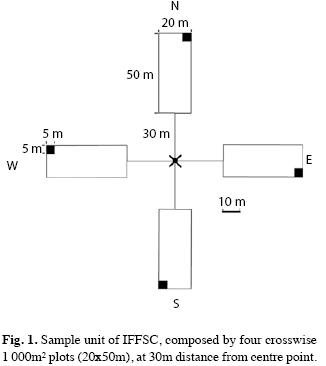
<body><![CDATA[<br> <font size="2"><span style="font-family: verdana;">The Floristic and Forest inventory of Santa Catarina (IFFSC) is an initiative of the local </span></font><font  size="2"><span style="font-family: verdana;">government, realized between 2007 and 2010 in order to evaluate the conservation <span  style="font-style: italic;">status</span> of forest cover and to support the formulation of forest conservation and land use policy (Vibrans <span style="font-style: italic;">et al</span>. 2008). Focused on endangered tree species in a highly fragmented forest cover under permanent pressure by agriculture and forest plantations, the inventory is composed by five components: (1) integration of the state&#8217;s four herbaria collections, (2) field inventory <span style="font-style: italic;">strictu sensu</span>, (3) assessment of genetic structure of endangered tree populations, (4) analysis of socio-economic importance of forest resources and (5) on-line geo-referenced database to be accessed by decision makers and the public. The Santa Catarina inventory applies a systematic sampling with 440 clusters located on a 10x10km grid, in accordance to the Brazilian National Forest inventory (IFNBR) to be started in 2010.</span></font><br  style="font-family: verdana;">     <br> <font size="2"><span style="font-family: verdana;">The purpose of this study is to analyze the structure of MOF in the state of Santa Catarina, in Southern Brazil, relating it to human impacts and threats to which it is exposed. </span></font><br style="font-family: verdana;"> <br style="font-family: verdana; font-weight: bold;"> <font style="font-weight: bold;" size="3"><span  style="font-family: verdana;">Materials and methods</span></font><br  style="font-family: verdana;"> <br style="font-family: verdana;"> <font size="2"><span style="font-family: verdana;">The present work consists of a preliminary evaluation of field data collected between 2007 and 2008 in the first stage of IFFSC, realized in mixed ombrophyllous forests with <span style="font-style: italic;">A. angustifolia</span>. The study performed analysis of woody species based on 92 clusters containing four crosswise 1 000m&sup2; plots (20x50m), within an area of approximately 32 320km&sup2; at the state&#8217;s high plateau at 500m to 1 560m above sea level, located at 26&ordm;00&#8217;-28&ordm;30&#8217; S - 49&ordm;13&#8217;-51&ordm;23&#8217; W. The 10x10km sampling grid was overlaid to land use map based on unsupervised classification of multispectral SPOT-4 images from 2005 with forest and non-forest classes to determine cluster location at forest areas. No isolation distance was established from the forest border, since the grid location coordinates were strictly obeyed. While 87 of the analyzed clusters are located on the regular grid, five clusters (n&ordm; 2 001 to 4 000) were located arbitrarily, within the studied area, in areas of public domain that suffered no logging activities for at least 40 years, in order to obtain data from what are supposed to be forests under better conservation conditions. </span></font><br  style="font-family: verdana;"> <br style="font-family: verdana;"> <font size="2"><span style="font-family: verdana;">Within the sample units (<a href="#fig1">Fig. 1</a>) all woody individuals of the main stratum with diameter at breast height (DBH&#8805;10cm) were measured and collected (fertile and sterile), if not undoubtedly identified in field (Vibrans <span  style="font-style: italic;">et al</span>. 2010). Regeneration<span  style="font-style: italic;"> stratum</span> (height&gt;1.50m; DBH&lt;10cm) was registered in 100m&sup2; in each sample unit, including regrowth of tree species and understory shrubs. Variables measured in main<span style="font-style: italic;"> stratum</span> were DBH, height, stem quality, tree sanity and crown length, while in regeneration <span  style="font-style: italic;">stratum </span>only density and height of plants. Floristic sampling included collection of fertile trees, shrubs, herbs and epiphytes within the sample unit and in its surroundings. All measured sites were submitted to a detailed physiognomic description by the field crew, including description of disturbing factors and any type of human impact within and in the sampled forest surroundings. A number of 1 809 voucher specimen collected during execution of this study were deposited at herbarium </span></font><font size="2"><span  style="font-family: verdana;">FURB under reference number 6 828 to 20 684 (not consecutive).    <br>     <br> </span></font>     <div style="text-align: center;"><font size="2"><span  style="font-family: verdana;"><a name="fig1"></a><img alt=""  src="/img/revistas/rbt/v59n3/a35i1.jpg"  style="width: 326px; height: 366px;"></span></font>    <br> <font size="2"><span style="font-family: verdana;"></span></font></div> <font size="2"><span style="font-family: verdana;"><br  style="font-family: verdana;"> </span></font><br style="font-family: verdana;"> <font size="2"><span style="font-family: verdana;">Floristic and structural indices were calculated according to Mueller-Dombois &amp; Ellenberg (1974). Sampled forest fragments, that we also call remnants, were classified into three groups, using basal area, species composition, successional stage and conservation status as indicators, described as follows:</span></font><br  style="font-family: verdana;"> <br style="font-family: verdana;"> <font size="2"><span style="font-family: verdana;"><span  style="font-weight: bold;">&#8226; Group 1:</span> Vegetation characterized by highly degraded, mostly open arboreous vegetation in early successional stage, due to intensive exploitation or clear cutting, </span></font><font  size="2"><span style="font-family: verdana;">invasion of pioneer tree and shrub species; sometimes with sparse tree cover, presence of silvopastoral systems, canopy cover less than 50%.    <br> <br style="font-family: verdana;"> </span></font><font size="2"><span style="font-family: verdana;"><span  style="font-weight: bold;">&#8226; Group 2:</span> Vegetation in intermediate successional stage, after intensive logging and exploitation of <span style="font-style: italic;">Ilex paraguariensis</span> and extensive cattle farming; vegetation predominantly arboreous, in variable conservation status, creating mosaic of vegetation types, evidence of recent and historic timber exploitation, frequent presence of pasture.    <br>     <br style="font-family: verdana;">     </span></font><font size="2"><span style="font-family: verdana;">&#8226;<span     ]]></body>
<body><![CDATA[ style="font-weight: bold;"> Group 3:</span>     Vegetation in advanced     successional stage, with species composition near to original, but     diameter structure and structural parameters yet fare from primary     forests; vegetation with low human influence, absence of pasture and     recent logging, wide diameter amplitude. </span></font><br      style="font-family: verdana;">     <br style="font-family: verdana; font-weight: bold;">     <font style="font-weight: bold;" size="3"><span      style="font-family: verdana;">Results</span></font><br     ]]></body>
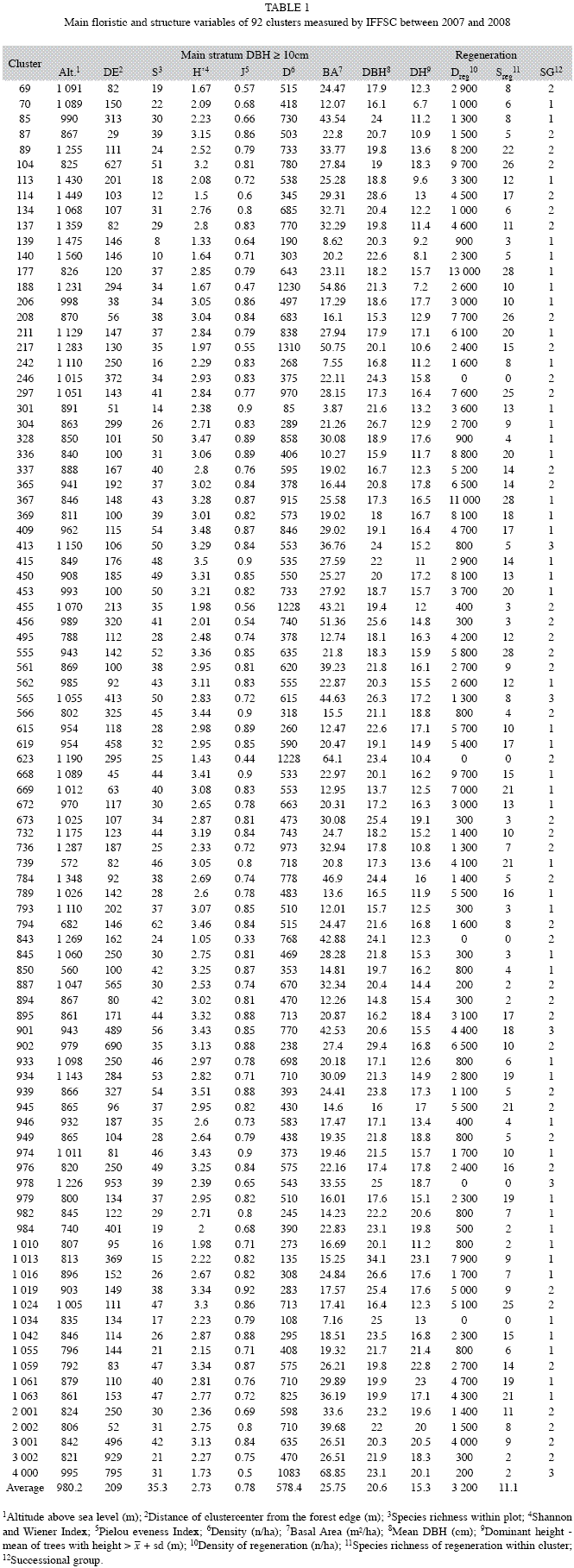
<body><![CDATA[ style="font-family: verdana;">     <br style="font-family: verdana;">     <font size="2"><span style="font-family: verdana;">The main floristic     and structure     variables including successional group are shown for </span></font><font      size="2"><span style="font-family: verdana;">each cluster in     <a href="/img/revistas/rbt/v59n3/a35t1.gif">Table 1</a>, separately     for the main <span style="font-style: italic;">stratum</span>     (DBH&#8805;10cm) and regeneration <span style="font-style: italic;">stratum</span>     (all plants     ]]></body>
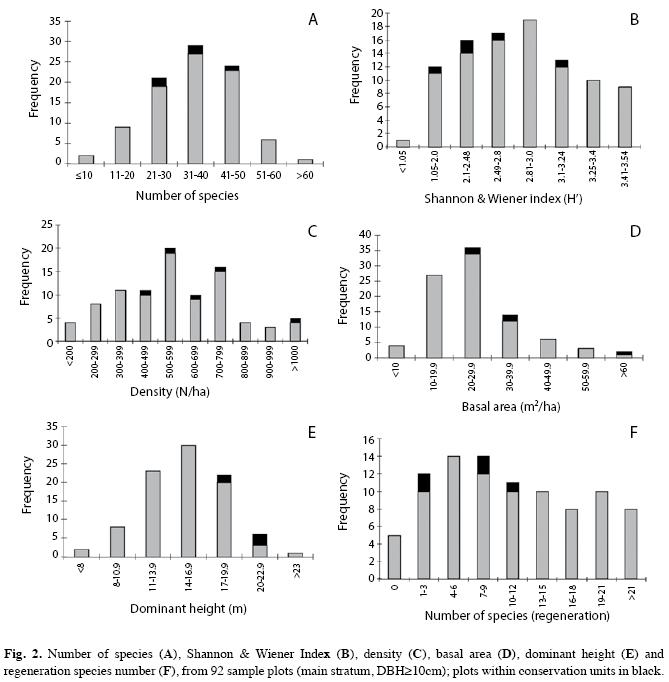
<body><![CDATA[with total height &gt;1.50m and DBH&lt;10cm). </span></font><br      style="font-family: verdana;">     <br style="font-family: verdana;">     <font size="2"><span style="font-family: verdana;">The distribution     of     stand variables     within the set of 92 examined remnants is shown in <a      href="/img/revistas/rbt/v59n3/a35i2.jpg">Fig. 2</a>. While     species richness, diversity, density and dominant height were nearly     normally distributed, basal area and richness of regeneration species     ]]></body>
<body><![CDATA[distributions seemed to tend leftwards. Shannon and Wiener index and     density showed intermediate values in most of the remnants, although it     is not possible to establish direct relationship between conservation     status and diversity or density, for high values of both can occur in     unperturbed as well as in perturbed forests.</span></font><br      style="font-family: verdana;">     <br style="font-family: verdana;">     <font size="2"><span style="font-family: verdana;">Considering     vegetation physiognomy,     species composition and conservation status, 46 </span></font><font     ]]></body>
<body><![CDATA[ size="2"><span style="font-family: verdana;">(50% of total)     remnants were     classified as belonging to Group 1, 41 (45%) belonged </span></font><font      size="2"><span style="font-family: verdana;">to Group 2 and only     five remnants     (5%) to Group 3. </span></font><br style="font-family: verdana;">     <br style="font-family: verdana;">     <font size="2"><span style="font-family: verdana;">Classification of     sampled remnants     into the three successional groups (<a     ]]></body>
<body><![CDATA[ href="/img/revistas/rbt/v59n3/a35t2.gif">Table 2</a>) showed that     basal     area     (ANOVA, &#945;&lt;0.01) and density (ANOVA, &#945;&lt;0.05) were significantly     different between groups. Furthermore analyzing basal area, Group 1 and     2 differed more significantly (Student, &#945;&lt;0.01) than Group 2 and 3     (Student, &#945;&lt;0.05). Considering density, only Group 1 and 2 showed     significant difference (Student, &#945;&lt;0.05). Yet neither DBH, nor     dominant height or species richness, showed significant difference     between successional groups. This indicatesthat basal area can be     ]]></body>
<body><![CDATA[considered the most appropriate indicator of stand quality and     conservation status in the observed universe within MOF.</span></font><br      style="font-family: verdana;">     <br style="font-family: verdana;">     <font size="2"><span style="font-family: verdana;">Remnants located     in     public areas,     supposed to be forests under better conservation conditions, did not     have highest values of floristic and structure variables; they showed </span></font><font      size="2"><span style="font-family: verdana;">higher values of     ]]></body>
<body><![CDATA[basal area and     dominant height than the average, but surprisingly lower species     richness (not diversity) in the main <span style="font-style: italic;">stratum</span>     and in the regeneration<span style="font-style: italic;">     stratum</span> (<a href="/img/revistas/rbt/v59n3/a35i2.jpg">Fig. 2</a>),     possibly due to ancient exploitation and     degradation.     Even in the site considered most closely to primary conditions (cluster     n&ordm; 4 000), richness and diversity were quite lower than expected;     this can mean that species richness is not automatically correlated to     ]]></body>
<body><![CDATA[conservation status, besides the possible restriction that the applied     sampling method was not appropriate and could have failed recording the     existing plant diversity. On the other hand, due to the hegemony of     <span style="font-style: italic;">Dicksonia sellowiana</span> Hook     (61.4% of relative density) and <span style="font-style: italic;">A.     angustifolia </span>(52% of relative dominance), this particular     community     (cluster n&ordm; 4 000) could represent a monodominant forest, due to     special site conditions. In this case ideal site conditions for one or     two species can be adverse or even exclusive for a lot of other species     ]]></body>
<body><![CDATA[and reduce richness and diversity values.</span></font><br      style="font-family: verdana;">     <br style="font-family: verdana;">     <font size="2"><span style="font-family: verdana;"><span      style="font-weight: bold;">Species richness and     diversity:</span> A     total of 342 tree and shrub species and 28 morphospecies were detected     in the sampled areas (five Coniferophyta, one tree fern, 364     Magnoliophyta), belonging to 66 families. There were 310 species in the     main <span style="font-style: italic;">stratum</span> (113 of them     ]]></body>
<body><![CDATA[exclusives in this<span style="font-style: italic;"> stratum</span>)     and 260 in the     regeneration <span style="font-style: italic;">stratum</span> (59     exclusives); the families with major richness     were Myrtaceae, Asteraceae, Lauraceae, Fabaceae, Solanaceae, Rubiaceae,     Euphorbiaceae and Melastomataceae. The species richness reflected the     great range of forest sites and environmental conditions within MOF in     Santa Catarina. </span></font><br style="font-family: verdana;">     <br style="font-family: verdana;">     <font size="2"><span style="font-family: verdana;">The mean species     ]]></body>
<body><![CDATA[richness in     measured remnants was 35 (ranging from eight up to 62 tree species).     Shannon and Wiener diversity index (H&acute;) varied between 1.05 and     3.48. Although beta and gamma diversity was high, the results showed     that the individual fragments have low species richness (alfa     diversity). </span></font><br style="font-family: verdana;">     <br style="font-family: verdana;">     <font size="2"><span style="font-family: verdana;">Only 13 species     were     present in     ]]></body>
<body><![CDATA[more than 50% of sampled clusters (main <span      style="font-style: italic;">stratum</span>, in decrescent order of     frequency): <span style="font-style: italic;">A. angustifolia</span>, <span      style="font-style: italic;">Prunus myrtifolia</span> (L.) Urb, <span      style="font-style: italic;">Clethra scabra</span>     Pers., <span style="font-style: italic;">Vernonanthura discolor</span>,     <span style="font-style: italic;">D. sellowiana</span>, <span      style="font-style: italic;">Myrsine coriacea</span> (Sw.) R.     Br. ex Roem. &amp; Schult., <span style="font-style: italic;">Matayba     elaeagnoides</span> Radlk., <span style="font-style: italic;">Ocotea     ]]></body>
<body><![CDATA[puberula</span>, <span style="font-style: italic;">Ilex paraguariensis</span>,     <span style="font-style: italic;">Casearia decandra</span> Jacq., <span      style="font-style: italic;">Sapium     glandulosum</span> (L.) Morong,<span style="font-style: italic;">     Zanthoxylum rhoifolium</span> Lam.,<span style="font-style: italic;">     Ocotea pulchella</span>;     all them can be considered generalists and secondary species with wide     range of environmental conditions. In contrast, a high number of     species (178 equivalent to 57% of total species number) were present in     less than six clusters.</span></font><br style="font-family: verdana;">     ]]></body>
<body><![CDATA[<br style="font-family: verdana;">     <font size="2"><span style="font-family: verdana;">The high number of     rare species     corroborates this assumption, showing 74 species occurring in only one     cluster, and 120 species occurring in up to two clusters. Among these     species, 44 occurred with only one specimen and 72 species were sampled     with only two specimens. </span></font><br      style="font-family: verdana;">     <br style="font-family: verdana;">     <font size="2"><span style="font-family: verdana;">Among them were     ]]></body>
<body><![CDATA[found naturally     rare species, like <span style="font-style: italic;">Myrcia rupicola</span>     D. Legrand, <span style="font-style: italic;">Myrceugenia alpigena</span>     (DC.) Landrum; yet also species highly impacted by exploitation like     <span style="font-style: italic;">Ocotea odorifera</span> (Vell.)     Rohwer and <span style="font-style: italic;">Ocotea porosa</span> and     indirectly     impacted by pasture burning close to forest remnants like <span      style="font-style: italic;">Myrceugenia     venosa</span> D. Legrand, certainly contributed to increase the number     ]]></body>
<body><![CDATA[of rare     species. </span></font><br style="font-family: verdana;">     <br style="font-family: verdana;">     <font size="2"><span style="font-family: verdana;">The floristic     survey     within and     around the clusters resulted in an important increase of registered     plant diversity. There were found another (exclusive) 378 species     belonging to 84 families. The Lycophyta and Monilophyta groups were     represented by 99 species (terricole and epiphyte) and the     ]]></body>
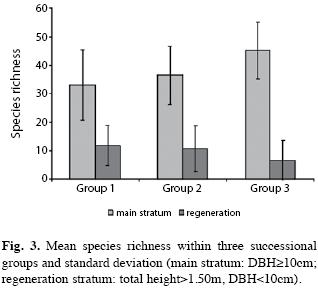
<body><![CDATA[Magnoliophyta group by 279 species, being 65 trees and shrubs species     undetected by the inventory, 33 lianas, 35 epiphytes, 145 terricole     herbs and one parasite.</span></font><br style="font-family: verdana;">     <br style="font-family: verdana;">     <font size="2"><span style="font-family: verdana;">Species richness     within the three     successional groups showed increasing pattern from group one to group     three in the main<span style="font-style: italic;"> stratum</span> and     decrease in the regeneration <span style="font-style: italic;">stratum</span>     (<a href="#fig3">Fig. 3</a>).    ]]></body>
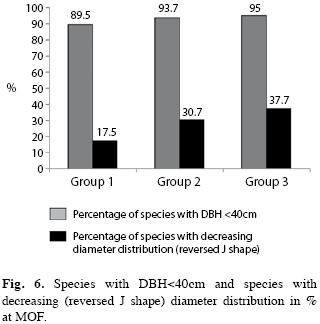
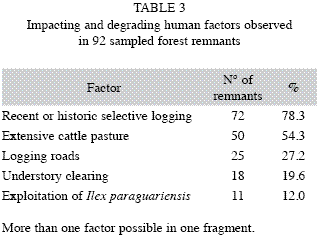
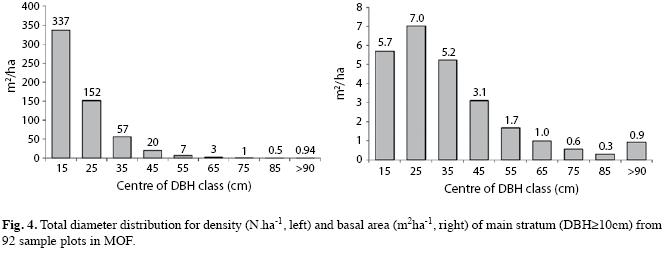
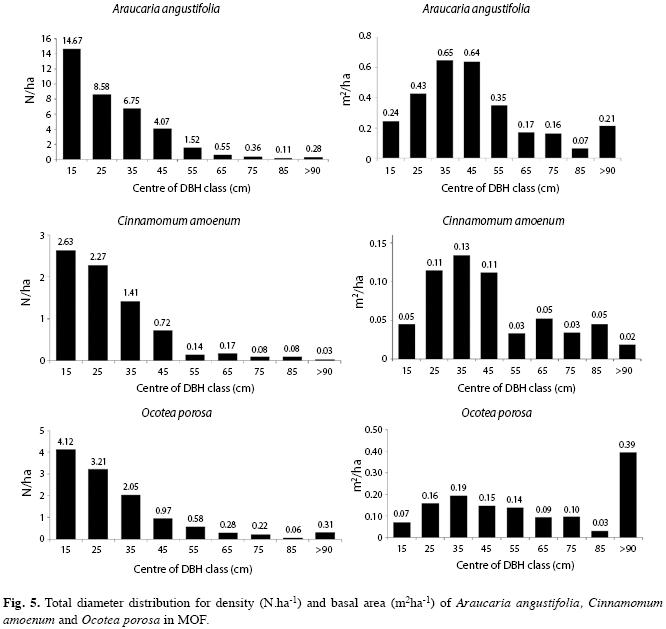
<body><![CDATA[<br>     <br> </span></font>     <div style="text-align: center;"><font size="2"><span  style="font-family: verdana;"><a name="fig3"></a><img alt=""  src="/img/revistas/rbt/v59n3/a35i3.jpg"  style="width: 318px; height: 288px;">    <br> <br style="font-family: verdana;"> </span></font><font size="2"><span style="font-family: verdana;"></span></font></div> <br style="font-family: verdana;"> <font size="2"><span style="font-family: verdana;"><span  style="font-weight: bold;">Species composition and forest structure:</span> Mean density of trees with DBH&#8805;10cm </span></font><font  size="2"><span style="font-family: verdana;">was 578 individuals/ha (ranging from 85/ha to 1 310/ha, sd=248); medium basal area was 25.75m&sup2;/ha (3.87 to 68.85m&sup2;/ha, sd=12.06), dominant height 15.3m (6.7m to 23.1m, sd=3.44). </span></font><br style="font-family: verdana;"> <br style="font-family: verdana;"> <font size="2"><span style="font-family: verdana;">Considering importance Values (IV), calculated for the whole set of 92 clusters, there </span></font><font  size="2"><span style="font-family: verdana;">were 25 species with IV&#8805;1% (8.0% of total number of species). This relatively restricted group of species represents 67.8% of all trees, 73.5% of total basal area and 60.6% of the total importance value. Collected data showed a relatively small group of species of high importance within horizontal structure in the MOF.</span></font><br style="font-family: verdana;"> <br style="font-family: verdana;"> <font size="2"><span style="font-family: verdana;">Within these species occurred, in decrescent order, <span style="font-style: italic;">D. sellowiana</span>, <span style="font-style: italic;">A. angustifolia,</span> <span  style="font-style: italic;">C. scabra</span>, <span  style="font-style: italic;">Lithraea brasiliensis</span> Marchand, <span style="font-style: italic;">O. porosa</span>, <span style="font-style: italic;">M. elaeagnoides</span>, <span style="font-style: italic;">P. myrtifolia</span>, <span  style="font-style: italic;">O. puberula</span>, <span style="font-style: italic;">O. pulchella</span> and <span style="font-style: italic;">I. paraguariensis</span>. Two of them, <span style="font-style: italic;">D. sellowiana</span> and <span style="font-style: italic;">A. angustifolia</span>, are endangered and red list species (MMA, 2008).</span></font><br style="font-family: verdana;"> <br style="font-family: verdana;"> <font size="2"><span style="font-family: verdana;">Structure analysis by successional group showed that:</span></font><br style="font-family: verdana;"> <br style="font-family: verdana;"> <font size="2"><span style="font-family: verdana;">&#8226; <span  style="font-weight: bold;">In group one dominated</span>: (highest IV, in decrescent order) <span style="font-style: italic;">D. sellowiana</span>, <span style="font-style: italic;">A. angustifolia</span>, <span style="font-style: italic;">O. porosa</span>, <span  style="font-style: italic;">I. paraguariensis</span>, <span style="font-style: italic;">Nectandra megapotamica</span> (Spreng.) Mez, </span></font><font size="2"><span  style="font-family: verdana;"><span style="font-style: italic;">C. decandra</span>, <span style="font-style: italic;">M. elaeagnoides</span>, <span style="font-style: italic;">Allophylus guaraniticus</span> (A. St.-Hil.) Radlk., <span style="font-style: italic;">Myrcia hatschbachii</span> D. Legrand;</span></font>    <br> <font size="2"><span style="font-family: verdana;"></span></font><br  style="font-family: verdana;"> <font size="2"><span style="font-family: verdana;"></span></font><font  size="2"><span style="font-family: verdana;">&#8226;<span  style="font-weight: bold;"> In group two dominated: </span><span style="font-style: italic;">D. sellowiana</span>,<span style="font-style: italic;">A. angustifolia</span>, <span style="font-style: italic;">L. brasiliensis</span>, <span  style="font-style: italic;">P. lambertii</span>, </span></font><font  size="2"><span style="font-family: verdana;"><span  style="font-style: italic;">O. pulchella</span>, <span  style="font-style: italic;">M. elaeagnoides</span>, <span style="font-style: italic;">C. scabra</span>, <span style="font-style: italic;">O. porosa</span>, <span  style="font-style: italic;">I. paraguariensis</span>;</span></font>    <br> <br style="font-family: verdana;"> <font size="2"><span style="font-family: verdana;">&#8226;<span  style="font-weight: bold;"> In group three dominated</span>: <span style="font-style: italic;">D. sellowiana</span>, <span style="font-style: italic;">A. angustifolia</span>, <span style="font-style: italic;">L. brasiliensis</span>, <span  style="font-style: italic;">P. lambertii</span>,<span  style="font-style: italic;"> O. pulchella</span>, <span style="font-style: italic;">M. elaeagnoides</span>, <span style="font-style: italic;">C. scabra</span>, <span  style="font-style: italic;">Sebastiania commersoniana</span> (Baill.) L. B. Sm. &amp; Downs, <span style="font-style: italic;">O. porosa</span>, <span style="font-style: italic;">I. paraguariensis</span>.</span></font><br  style="font-family: verdana;"> <br style="font-family: verdana;"> <font size="2"><span style="font-family: verdana;">Density showed increasing mean values from group one to three (515/633/713 ind./</span></font><font  size="2"><span style="font-family: verdana;">ha), the same tendency is observed for basal area (21.1/28.45/45.26m<sup>2</sup>/ha) and mean species richness (33/36/45 species/cluster), while regeneration richness (12/11/7 species/cluster) and density (3 528/2 884/1 340 ind./ha) were decreasing. In this context it has to be mentioned that edge effect could have influenced species composition and structure of analyzed forests, overlapping or masking the described </span></font><font  size="2"><span style="font-family: verdana;">succession processes. Than basal area (&#945;&lt;0.01) and dominant height (&#945;&lt;0.05) were positively correlated (Pearson) to edge distance (<a  href="/img/revistas/rbt/v59n3/a35t1.gif">Table 1</a>), while richness of regeneration stratum (&#945;&lt;0.05) was inversely correlated and the other structural variables did not show any relationship to the edge distance.</span></font><br  style="font-family: verdana;"> <br style="font-family: verdana; font-weight: bold;"> <font size="2"><span style="font-family: verdana;"><span  style="font-weight: bold;">Diameter distribution:</span> Diameter distribution ranged from 10cm to 165cm, with major concentration of trees (84.21% of total number) in lower diameter classes (<a  href="/img/revistas/rbt/v59n3/a35i4.jpg">Fig. 4</a>). Besides tree size distribution in tropical forests is to be expected like reversed J shape, small number of big trees was quite astonishing. In the classes &#8804;30cm were found 84.4% of total number of trees, in classes &#8804;40cm, 94.2% and &#8804;50cm, 97.7%. Therefore the overwhelming majority of sampled trees belonged to regrowth and to lower or intermediate diameter classes, probably due to intensive exploitation and successional stage of forest remnants. </span></font><br  style="font-family: verdana;"> <br style="font-family: verdana;"> <font size="2"><span style="font-family: verdana;">Between all the tree species, only 10 (2.7%) showed diameters greater than 100cm: <span  style="font-style: italic;">A. angustifolia</span>, <span  style="font-style: italic;">Cedrela fissilis</span> Vell., <span style="font-style: italic;">Cinnamomum amoenum</span> (Mez) Kosterm., <span style="font-style: italic;">Ficus cestrifolia</span> Schott ex Spreng.,<span style="font-style: italic;"> Ilex brevicuspis</span> Reissek, <span style="font-style: italic;">Luehea divaricata </span>Mart., <span style="font-style: italic;">Nectandra lanceolata </span>Nees, <span  style="font-style: italic;">Ocotea porosa</span>, <span  style="font-style: italic;">Ocotea pulchella</span> and <span  style="font-style: italic;">Sloanea monosperma</span> Vell. All of them, despite <span  style="font-style: italic;">F. cestrifolia</span>, were found with decreasing diameter distribution (reversed J shape), showing stability of there populations within MOF (<a  href="/img/revistas/rbt/v59n3/a35i5.jpg">Fig. 5</a>). </span></font><br style="font-family: verdana;"> <br style="font-family: verdana;"> <font size="2"><span style="font-family: verdana;">On the other hand, 67.9 % of all species only occurred in lower diameter classes (&lt;40cm). Within these species, the following ones had major density values (&gt;50 specimen/ha) and can be considered typical components of early and intermediate successional stages of MOF in Santa Catarina: <span  style="font-style: italic;">A. guaraniticus</span>, <span style="font-style: italic;">Cupania vernalis</span> Cambess., <span style="font-style: italic;">Ilex dumosa</span> Reissek, J<span style="font-style: italic;">acaranda puberula</span> Cham., <span style="font-style: italic;">S. terebinthifolius</span>, <span style="font-style: italic;">Symplocos uniflora</span> (Pohl) Benth., <span style="font-style: italic;">Z. rhoifolium</span>, <span  style="font-style: italic;">Myrcia splendens</span> (Sw.) DC., <span  style="font-style: italic;">Inga lentiscifolia</span> Benth., <span style="font-style: italic;">Lonchocarpus campestris</span> Mart. ex Benth.,<span style="font-style: italic;"> Inga vera </span>Willd., <span  style="font-style: italic;">Schinus lentiscifolius</span> Marchand and <span style="font-style: italic;">Drimys angustifolia</span> Miers. </span></font><br  style="font-family: verdana;"> <br style="font-family: verdana;"> <font size="2"><span style="font-family: verdana;">The number of species present only in the lower diameter classes are shown in <a href="#fig6">Fig. 6</a>. </span></font><font size="2"><span style="font-family: verdana;">Their number was relatively stable in the three successional groups, meanwhile number of late successional or climax species with decreasing diameter distribution was increasing accordingly to the successional stage of vegetation. This means that an increasing number of species reached stable population levels in later successional stages of the analyzed forest vegetation.    <br> <br style="font-family: verdana;"> </span></font>     <div style="text-align: center;"><a name="fig6"></a><img alt=""  src="/img/revistas/rbt/v59n3/a35i6.jpg"  style="width: 320px; height: 324px;">    <br> </div>     <br> <br style="font-family: verdana;"> <font size="2"><span style="font-family: verdana;"><span  style="font-weight: bold;">Regeneration: </span>in the regeneration were found an average of 3 200 individuals/ha (sd=2 890), belonging to 260 species and morphospecies, 59 of them were exclusive of this <span style="font-style: italic;">stratum</span> and were not sampled in the main <span style="font-style: italic;">stratum</span>. Absolute density of species was ranging from one to 120 individuals/ha, relative density varied from 0.03 to 3.5%, considering the whole data set of 92 clusters. Only 14 species (7.7%) were found with density major than 50 individuals/ha (in decrescent order): <span style="font-style: italic;">Myrcia oblongata</span> DC, <span style="font-style: italic;">Sebastiana brasiliensis</span> Spreng., <span style="font-style: italic;">Solanum sanctaecatharinae</span> Dunal, <span style="font-style: italic;">C. vernalis</span>,<span style="font-style: italic;"> C. decandra</span>, <span style="font-style: italic;">Acca sellowiana</span> (O. Berg) Burret,<span style="font-style: italic;"> Solanum variabile</span> Mart.,<span style="font-style: italic;"> Grazielia serrata </span>(Spreng.) R.M. King &amp; H. Rob., <span  style="font-style: italic;">Gymnanthes concolor</span> (Spreng.) M&uuml;ll. Arg., <span  style="font-style: italic;">M. elaeagnoides</span>, <span  style="font-style: italic;">S. commersoniana</span>, <span style="font-style: italic;">A. angustifolia</span>, <span  style="font-style: italic;">V. discolor </span>and <span  style="font-style: italic;">I. paraguariensis</span>. The cited species summarized 30.8% of total density. </span></font><br  style="font-family: verdana;"> <br style="font-family: verdana;"> <font size="2"><span style="font-family: verdana;">Considering species frequency, maximum absolute frequency was 20 (23%) and only a small group of 28 (10.8%) species were present in at least 10% of the sampled clusters, meanwhile 183 species (or 70%) had been detected in less than 5% of the sampled forests; 97 species were found in a unique cluster. Within the most frequent and representative species were </span></font><font  size="2"><span style="font-family: verdana;"><span  style="font-style: italic;">C. decandra, A. angustifolia, C. vernalis, I. paraguariensis, M. elaeagnoides, S. commersoniana</span>, <span  style="font-style: italic;">Styrax leprosus </span>Hook. &amp; Arn. and <span style="font-style: italic;">D. brasiliensis</span>, but only some of these were also frequently founded in the main stratum. This means that MOF has diverse species compositions due to great variability of site conditions within the total area. </span></font><br  style="font-family: verdana;"> <br style="font-family: verdana;"> <font size="2"><span style="font-family: verdana;">Data analysis of successional groups resulted in the following species compositions (most frequent species):</span></font><br style="font-family: verdana;"> <br style="font-family: verdana;"> <font size="2"><span style="font-family: verdana;"><span  style="font-weight: bold;">&#8226; Group 1:</span> <span  style="font-style: italic;">M. oblongata, G. serrata, C. decandra, Myrciaria tenella</span> (DC.) O. Berg, <span  style="font-style: italic;">S. commersoniana, M. elaeagnoides, A. sellowiana</span>, <span  style="font-style: italic;">I. paraguariensis</span> and <span style="font-style: italic;">Annona sylvatica</span> (A. St.-Hil.) Mart.</span></font>    ]]></body>
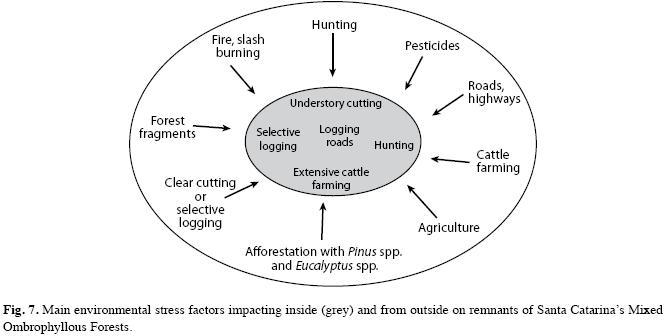
<body><![CDATA[<br> <font size="2"><span style="font-family: verdana;"></span></font><br  style="font-family: verdana;"> <font size="2"><span style="font-family: verdana;"></span></font><font  size="2"><span style="font-family: verdana;"><span  style="font-weight: bold;">&#8226; Group 2:</span> <span  style="font-style: italic;">Eugenia verticillata</span> (Vell.) Angely, <span style="font-style: italic;">M. hatschbachii, Sloanea guianensis </span>(Aubl.) Benth., <span style="font-style: italic;">Cordiera concolor</span> (Cham.) Kuntze, <span style="font-style: italic;">Strychnos brasiliensis</span> (Spreng.) Mart., <span style="font-style: italic;">Coussarea contracta</span> (Walp.) M&uuml;ll. Arg., <span style="font-style: italic;">Mollinedia clavigera </span>Tul., <span style="font-style: italic;">Sorocea bonplandii </span>(Baill.) W. C. Burger, Lanj. &amp; Wess. Boer, <span style="font-style: italic;">Banara parviflora</span> (A. Gray) Benth. and<span style="font-style: italic;"> C. vernalis</span>; </span></font>    <br> <font size="2"><span style="font-family: verdana;"></span></font><br  style="font-family: verdana; font-weight: bold;"> <font size="2"><span style="font-family: verdana;"><span  style="font-weight: bold;">&#8226; Group 3: </span><span  style="font-style: italic;">Myrsine gardneriana</span> A. DC., C. scabra, Cinnamodendron dinisii Schwacke, Myrceugenia myrcioides (Cambess.) O. Berg, A. guaraniticus, Rudgea jasminoides (Cham.) M&uuml;ll. Arg., C. vernalis and D. sellowiana. </span></font><br  style="font-family: verdana;"> <br style="font-family: verdana;"> <font size="2"><span style="font-family: verdana;">The results showed that the most frequent species in the regeneration were different from the most important of the main <span style="font-style: italic;">stratum</span>. For group 1 and 2 as initial and intermediate stage vegetation types, these differences can be explained by the process of natural succession dynamic, which led to subsequent alteration of the dominant species pool and permanent substitution of early succession species by late succession components. On the other hand, in group 3 was expected that leading species of main<span  style="font-style: italic;"> stratum</span> would be well represented also in regeneration <span  style="font-style: italic;">stratum</span>; their absence in regeneration can be explained either by deficit of fruit producing by or by weak conditions for late succession species in the understory, mostly due to manual clearing of understory vegetation and extensive cattle pasture, which is still a local practice to provide survival of cattle in wintertime when grasslands outside of forests does not offer sustain for the animals. It also had to be considered that part of the species of the regeneration <span style="font-style: italic;">stratum</span> are understory specialists and absent in the upper story and </span></font><font size="2"><span  style="font-family: verdana;">therefore are not &#8220;regenerating&#8221; species. </span></font><br style="font-family: verdana;"> <br style="font-family: verdana; font-weight: bold;"> <font size="2"><span style="font-family: verdana;"><span  style="font-weight: bold;">Conservation status and human impacts:</span> Detailed site description revealed evidences of impacting and stress factors inside forests and in the surroundings (<a href="#t3">Table 3</a>). Main pressure factors identified inside forests were selective logging, of more or less intensity, mostly not recent, but always without any silvicultural criteria and extensive cattle pasture (present in 51% of all fragments), damaging the understory and regeneration through grazing and trampling; these activities were often driven by vectors like (desirable and sustainable) non-destructive exploitation of leaves and branches of <span style="font-style: italic;">I. paraguariensis</span> (mate tea). invasion of herbs, climbers and bamboo species (<span style="font-style: italic;">Merostachys</span> spp. and <span style="font-style: italic;">Chusquea </span>spp.) were consequences of excessively opened forest ecosystems.    <br> <br style="font-family: verdana;"> </span></font>     <div style="text-align: center;"><a name="t3"></a><img alt=""  src="/img/revistas/rbt/v59n3/a35t3.gif"  style="width: 322px; height: 238px;">    <br> </div>     <br> <br style="font-family: verdana;"> <font size="2"><span style="font-family: verdana;">In the forest surroundings most frequently detected land uses were cattle farming, afforestation with fast growing exotic species and agriculture (soybean, corn and wheat crops), as seen by the attractiveness of alternative land-use systems that increases pressure on forest lands. Native vegetation in good conservation status was rarely found. in the studied forest sites, grazing and cattle trampling may have caused differential mortality of herbs and woody seedling. The occasional penetrations of fire also may have caused significant changes in vegetation structure and composition at the edge affected area that penetrates, at least, up to 50m inside the forest. in the public areas were detected vestiges from hunters and exploitation of <span style="font-style: italic;">I. paraguariensis</span>, but they did not suffer directly from logging, cattle pasture, understory clearing or burning, but indirectly from these impacts present in the surrounding areas. The ensemble of the main factors pressuring on forest remnants in Santa Catarina&#8217;s MOF are depictured in <a  href="/img/revistas/rbt/v59n3/a35i7.jpg">Fig. 7</a>.    <br>     <br style="font-family: verdana;">     </span></font><font style="font-weight: bold;" size="3"><span      style="font-family: verdana;">Discussion</span></font><br     ]]></body>
<body><![CDATA[ style="font-family: verdana;">     <br style="font-family: verdana;">     <font size="2"><span style="font-family: verdana;">Despite of high     total number of     species founded, species richness found by this study </span></font><font      size="2"><span style="font-family: verdana;">in most of the     sampled forest     remnants was considered low, comparing to data collected by Longhi <span      style="font-style: italic;">et     al</span>. (2006), who found 75, 96 and 110 tree species in three well     ]]></body>
<body><![CDATA[conserved MOF sites at S&atilde;o Francisco de Paula, in the state of     Rio Grande do Sul. Considering the same sampling criteria (DBH&#8805;10cm),     Formento <span style="font-style: italic;">et al</span>. (2004)     registered 70 tree species and Figueiredo Filho     <span style="font-style: italic;">et al</span>. (2006) 108 tree species     in primary remnants of MOF in Santa     Catarina and Paran&aacute; state. The overwhelming majority of forest     fragments of this study were highly impacted and impoverished, in     process of progressive succession (regeneration) after exploitation     near to clear cutting or in regressive succession due to repeated and     ]]></body>
<body><![CDATA[constant, historic or recent, intensive human impact. Shannon and     Wiener index (H&#8217;) showed similar average values in all the three groups     (with huge standard deviation within the groups), despite of     differences of species composition and ecological category of species     in these groups. Murphy &amp; Lugo (1986) observed that, besides the     influences of pedoclimatic conditions, diversity of secondary forests     depends on the type of previous use. Thus intense cropping or pasture,     with short regrowth periods and frequent use of fire, as </span></font><font      size="2"><span style="font-family: verdana;">mentioned by Lugo     (1990) and     ]]></body>
<body><![CDATA[Lamprecht (1989), leads to degradation of the original </span></font><font      size="2"><span style="font-family: verdana;">ecosystem, lagging     or irreversibly     obstructing the successional process. in the case of MOF, also intense     and repeated selective logging without clearcutting apparently led to     heavily degraded forest sites.</span></font><br      style="font-family: verdana;">     <br style="font-family: verdana;">     <font size="2"><span style="font-family: verdana;">The high number of     rare species     ]]></body>
<body><![CDATA[(120 species occurring in only two clusters, 72 species </span></font><font      size="2"><span style="font-family: verdana;">with only two     specimens) is not     unusual in tropical forests, since their high &#945;-diversity is directly     related to the presence of rare species (Connel <span      style="font-style: italic;">et a</span>l. 1984,     Lepsch-Cunha, 1996). As pointed out by Cavallari Neto (2004), these     species have evolved to be rare because their genetic flows are     compatible with their rarity. Most of them colonize small gaps, have     temporary seedlings, and show characteristics that are related with     ]]></body>
<body><![CDATA[Janzen hypothesis. Some of them may be dependent of resource pulses     linked to stochastic disturbance, as has been discussed in Tilman &amp;     Paccala (1993). in the studied area it seemed evident that besides the     naturally rare species like <span style="font-style: italic;">Myrcia     rupicola</span>, <span style="font-style: italic;">Myrceugenia alpigena</span>     (DC.)     Landrum (Legrand &amp; Klein 1969, 1970, Klein 1990), many others like     <span style="font-style: italic;">Ocotea odorifera</span> and <span      style="font-style: italic;">O. porosa</span> have turned rare and     threatened by     ]]></body>
<body><![CDATA[anthropogenic stress factors as. On the other hand, also the wide     spread of the sampled territory and his environmental gradients could     have influenced the results (Longhi 1997). </span></font><br      style="font-family: verdana;">     <br style="font-family: verdana;">     <font size="2"><span style="font-family: verdana;">It is notable that     <span style="font-style: italic;">D. sellowiana</span>     was the predominant species in the understory, and can </span></font><font      size="2"><span style="font-family: verdana;">be considered the     most important     ]]></body>
<body><![CDATA[component of MOF in Santa Catarina, due to his elevated density,     showing that this species seems to be in regeneration process within     the remnants of MOF. it&#8217;s high importance Value (IV) in all     successional groups, may be related to the fact that in eight clusters     the communities were dominated by this species, forming monodominant     forests, sensu Connell &amp; Lowman (1989), with more than 50% of all     upper story individuals and basal area. The overwhelming presence of     this species generally occurred in areas with wet or even soggy soils     in valleys and plains, but also on slopes. These soil conditions can     lead to monodominant tree species </span></font><font size="2"><span     ]]></body>
<body><![CDATA[ style="font-family: verdana;">compositions, as     observed by Peters     <span style="font-style: italic;">et al</span>. (1989), Steege (1994)     and Arieira &amp; Cunha </span></font><font size="2"><span      style="font-family: verdana;">(2006). Due to their     high density     many of these species in monodominant forests constitute important     economic resources (Peters <span style="font-style: italic;">et a</span>l.     1989, Marimon &amp; Felfili 2000),     like<span style="font-style: italic;"> D. sellowiana</span> in Santa     ]]></body>
<body><![CDATA[Catarina, which was intensively exploited     during the twentieth century (Reitz<span style="font-style: italic;">     et al</span>. 1978, Windisch 2002).</span></font><br      style="font-family: verdana;">     <br style="font-family: verdana;">     <font size="2"><span style="font-family: verdana;">At the same time,<span      style="font-style: italic;"> A.     angustifolia</span>     as the second most important species, seems to be </span></font><font      size="2"><span style="font-family: verdana;">benefited by many     ]]></body>
<body><![CDATA[degraded and open     forest stands, that permitted her regrowth as a long living pioneer     species.</span></font><br style="font-family: verdana;">     <br style="font-family: verdana;">     <font size="2"><span style="font-family: verdana;">Increase of     species     richness within     the three successional groups showed from group </span></font><font      size="2"><span style="font-family: verdana;">1 to group 3 in the     main <span style="font-style: italic;">stratum</span>     ]]></body>
<body><![CDATA[(<a href="#fig3">Fig. 3</a>) is a tendency expected and consistent with     current theory of     ecosystem development and plant succession (Odum 1983), which supposes     increasing richness, diversity and complexity of plant communities     along the succession process. On the other hand, decreasing species     richness in the regeneration <span style="font-style: italic;">stratum</span>,     also depicted in <a href="#fig3">Fig. 3</a>, has been     explained by Lamprecht (1989); according to this author, the decrease     of understory species richness during the succession process, caused by     disappearance of light-demanding pioneers and also many ephemeral gap     ]]></body>
<body><![CDATA[opportunist species, can be larger than the migration of new     shade-tolerant species in areas with more homogenized light conditions     in later successional stage.</span></font><br      style="font-family: verdana;">     <br style="font-family: verdana;">     <font size="2"><span style="font-family: verdana;">Considering tree     size distribution,     most of the sampled trees belonged to lower or intermediate diameter     classes and big trees are very rare. Species present in higher diameter     classes were found with decreasing diameter distribution (reversed J     ]]></body>
<body><![CDATA[shape). This diameter frequency distribution has been observed     frequently in tropical forests, also in brazilian stands (Felfilli     &amp; Silva-Junior 1988, Oliveira-Filho <span      style="font-style: italic;">et al</span>. 1994, Felfilli 1997);     yet diameter distribution of species, varies as a function of their     environmental and successional context and of their populations&#8217;     spatial pattern (Felfilli 1997, Marimon &amp; Felfilli 2000). Some     authors like Lieberman &amp; Lieberman (1987) and Condit </span></font><font      size="2"><span style="font-family: verdana;"><span      style="font-style: italic;">et al.</span> (1993)     ]]></body>
<body><![CDATA[singled out the great     range of increase rates between tropical tree species, specially     between understory species, due to the heterogeneity of light     conditions. </span></font><br style="font-family: verdana;">     <br style="font-family: verdana;">     <font size="2"><span style="font-family: verdana;">Comparison between     main <span style="font-style: italic;">stratum</span> and     regeneration <span style="font-style: italic;">stratum</span> turned     evident that pools </span></font><font size="2"><span      style="font-family: verdana;">of dominant species     ]]></body>
<body><![CDATA[are different,     in part due to succession processes in course after and during the     action of degradation factors. While it can be expected that the     species composition of both strata would be more or less approximate,     it is worth noting what was reported by Guariguata &amp; Ostertag     (2001), who argue that the succession processes are strongly dependent     on site characteristics, as well as on earlier land use. The same     authors comment that the more intensive human impacts become, the     potential for forest regeneration from seed bank decreases, making     regeneration dependent on the inflow of new seeds, both from     ]]></body>
<body><![CDATA[autochtonous and allochthonous sources. However, not all species will     have life story characteristics that will favor their establishment,     and it is likely that, in the case of this study, the autochtonous     species do not possess characteristics that allow their easy     regeneration. This means that although the characteristics of plant     communities, such as the density and basal areas, are relatively     predictable, the floristic composition along a chronological sequence     is practically impossible to be predicted (Guariguata &amp; Ostertag     2001, Chazdon <span style="font-style: italic;">et al</span>. 2007,     Letcher &amp; Chazdon 2009) and therefore     ]]></body>
<body><![CDATA[the described differences in the composition, could be expected. </span></font><br      style="font-family: verdana;">     <br style="font-family: verdana;">     <font size="2"><span style="font-family: verdana;">Regeneration of     upper story species     is yet affected by clearing of understory vegetation through pasture     and burning practices in agriculture land around the forests. The     action of livestock in MOF in Santa Catarina has been described by     Sampaio &amp; Guarino (2007), who appointed to the processes of     simplifying forest ecosystems and loss of biodiversity, benefitting     ]]></body>
<body><![CDATA[pioneer species. Also apparently well conserved forests revealed in     many cases extremely simplified structure with only young, small and     not reproducing trees, lack of regeneration, impoverished understory </span></font><font      size="2"><span style="font-family: verdana;">and forest floor     vegetation,     inducing regressive succession and leading to &#8220;empty forests&#8221;, as cited     by Redford (1992) and Richards (1996). Besides their extreme     impoverishment, &#8216;empty forests&#8217; are frequently considered &#8216;closed     forests&#8217; by remote sensing monitoring, error caused by lack of detailed     knowledge of relations between biophysical vegetation variables from     ]]></body>
<body><![CDATA[field survey and data collected by remote sensing techniques. </span></font><br      style="font-family: verdana;">     <br style="font-family: verdana;">     <font size="2"><span style="font-family: verdana;">On the other hand,     in tropical     forests some species show intense regeneration while others are rarely     fruiting or their seedlings hardly succeed to establish, as observed by     Whitmore (1998). The simultaneous occurrence of species typical to     different successional stages has been frequently observed in tropical     forests (Budowski 1965), yet the more frequent and prevailing species     ]]></body>
<body><![CDATA[can serve to define their successional stage. Meanwhile the total     absence of seedlings of red list species (MMA, 2008) <span      style="font-style: italic;">O. porosa     </span>(Lauraceae) drew attention, once it was the main commercial     timber     species in Santa Catarina and composes the group of formerly frequent     and dominant species that were actually turned rare by excessive and     inordinate exploitation.</span></font><br style="font-family: verdana;">     <br style="font-family: verdana;">     <font size="2"><span style="font-family: verdana;">Considering     ]]></body>
<body><![CDATA[results     of species     composition, forest structure data and field evidences, </span></font><font      size="2"><span style="font-family: verdana;">only five percent of     fragments     showed characteristics similar to primary forests, while 49% could be     considered under medium impact and 47% under high external impact,     mostly in secondary succession. Only six percent of sampled forests     have got well conserved vicinity with favorable conditions towards     conservation. Therefore Santa Catarina&#8217;s MOF must be considered     ]]></body>
<body><![CDATA[threatened by isolation and internal impoverishment and structural     simplification, due to over-logging and due to the presence of     livestock inside the understory; these types of threatens seams to be     performed mostly by small land owners. Lack of seed trees and seedlings     of late succession and commercial tree species like<span      style="font-style: italic;"> O. porosa</span> completes     the &#8216;tableau&#8217; of empty forest remnants, often identified as closed     forests by remote sensing surveys.</span></font><font size="2"><span      style="font-family: verdana;">External pressures     exercised on     ]]></body>
<body><![CDATA[forests by other land-uses like agriculture, cattle farming and     afforestation with rapid growing species appear to be related to major     land owners and private firms. For rare and endangered species, reduced     area and isolation of forests stand for additional threaten leading to     loss of genetic diversity by bottle-neck effects (Tarazi <span      style="font-style: italic;">et al</span>. 2010).     Floristic surveys should be included in large scale inventories in     order to increase databases and to recognize patterns of spatial     distribution of rarer species.</span></font><br      style="font-family: verdana;">     ]]></body>
<body><![CDATA[<br style="font-family: verdana;">     <font size="2"><span style="font-family: verdana;">Effective measures     have to be     submitted to decision makers, including financial compensation of     forest owners, mostly small farmers, for their conservations efforts     (maintaining forests and keeping livestock out of woodlands) and for     providing environmental services like carbon stocking in vegetation and     soil, so as water and soil protection. Besides educational measures and     stimulatory actions towards conservation and sustainable use of forest     resources, more efficient direct surveillance and protection has to be     ]]></body>
<body><![CDATA[realized in order to combat or at least reduce illegal clear-cutting </span></font><font      size="2"><span style="font-family: verdana;">and timber logging.     Finally,     research has to focus on developing conservation indices and ecological     indicators in order to define successful conservation strategies and     priority areas within the mixed ombrophyllous forests. </span></font><br      style="font-family: verdana;">     <br style="font-family: verdana; font-weight: bold;">     <font style="font-weight: bold;" size="3"><span      style="font-family: verdana;">Acknowledgments</span></font><br     ]]></body>
<body><![CDATA[ style="font-family: verdana;">     <br style="font-family: verdana;">     <font size="2"><span style="font-family: verdana;">The authors are     grateful to     Funda&ccedil;&atilde;o de Apoio &agrave; Pesquisa Cient&iacute;fica e     Tecnol&oacute;gica de Santa Catarina (FAPESC) for supporting the IFFSC     and to the anonymous reviewers for the comments on this manuscript.</span></font><br      style="font-family: verdana;">     <span style="font-family: verdana;"></span></div>     <font style="font-weight: bold;" size="3"></font>     ]]></body>
<body><![CDATA[<hr style="width: 100%; height: 2px;"><font style="font-weight: bold;"      size="3"><span style="font-family: verdana;">References</span></font><br      style="font-family: verdana;">     <br style="font-family: verdana;">     <font size="2"><span style="font-family: verdana;">Arieira, J. &amp;     C.N. Cunha. 2006.     Fitossociologia de uma floresta inund&aacute;vel monodominante de     <span style="font-style: italic;">Vochysia divergens</span> Pohl     (Vochysiaceae), no Pantanal Norte, MT, Brasil.     <!-- ref -->Acta Bot. Bras 20: 569-580.    &nbsp;&nbsp;&nbsp;&nbsp;&nbsp;&nbsp;&nbsp;&nbsp;[&#160;<a href="javascript:void(0);" onclick="javascript: window.open('/scielo.php?script=sci_nlinks&ref=1743420&pid=S0034-7744201100030003500001&lng=','','width=640,height=500,resizable=yes,scrollbars=1,menubar=yes,');">Links</a>&#160;]<!-- end-ref --><!-- ref --></span></font><br  style="font-family: verdana;"> <br style="font-family: verdana;"> <font size="2"><span style="font-family: verdana;">Budowski, G. 1965. Distribution of tropical american rain forest species in the light of successional processes. Turrialba 15: 40-42.    &nbsp;&nbsp;&nbsp;&nbsp;&nbsp;&nbsp;&nbsp;&nbsp;[&#160;<a href="javascript:void(0);" onclick="javascript: window.open('/scielo.php?script=sci_nlinks&ref=1743421&pid=S0034-7744201100030003500002&lng=','','width=640,height=500,resizable=yes,scrollbars=1,menubar=yes,');">Links</a>&#160;]<!-- end-ref --><!-- ref --></span></font><br  style="font-family: verdana;"> <br style="font-family: verdana;"> <font size="2"><span style="font-family: verdana;">Cavallari Neto, M. 2004. Efeito do manejo na diversidade gen&eacute;tica de popula&ccedil;&otilde;es naturais de <span style="font-style: italic;">Tabebuia cassinoides</span> LAM (DC), por marcadores isoenzim&aacute;ticos. Master Thesis, Universidade de S&atilde;o Paulo, Piracicaba, S&atilde;o Paulo, Brazil.    &nbsp;&nbsp;&nbsp;&nbsp;&nbsp;&nbsp;&nbsp;&nbsp;[&#160;<a href="javascript:void(0);" onclick="javascript: window.open('/scielo.php?script=sci_nlinks&ref=1743422&pid=S0034-7744201100030003500003&lng=','','width=640,height=500,resizable=yes,scrollbars=1,menubar=yes,');">Links</a>&#160;]<!-- end-ref --><!-- ref --></span></font><br  style="font-family: verdana;"> <br style="font-family: verdana;"> <font size="2"><span style="font-family: verdana;">Chazdon, R.L., S.G. Letcher, M. van Breugel, M. Mart&iacute;nez-Ramos, F. Bongers &amp; B. Finegan. 2007. Rates of change in tree communities of secundary Neotropical Forests following major disturbances. Phil. Trans. R. Soc. B. 362: 273-289.    &nbsp;&nbsp;&nbsp;&nbsp;&nbsp;&nbsp;&nbsp;&nbsp;[&#160;<a href="javascript:void(0);" onclick="javascript: window.open('/scielo.php?script=sci_nlinks&ref=1743423&pid=S0034-7744201100030003500004&lng=','','width=640,height=500,resizable=yes,scrollbars=1,menubar=yes,');">Links</a>&#160;]<!-- end-ref --><!-- ref --></span></font><br  style="font-family: verdana;"> <br style="font-family: verdana;"> <font size="2"><span style="font-family: verdana;">Condit, R., S.P. Hubbel &amp; R.B. Foster. 1993. Identifying fast-growing native trees from the Neotropics using data from a large, permanent census plot. Forest. Ecol. Manag. 62: 123-143.    &nbsp;&nbsp;&nbsp;&nbsp;&nbsp;&nbsp;&nbsp;&nbsp;[&#160;<a href="javascript:void(0);" onclick="javascript: window.open('/scielo.php?script=sci_nlinks&ref=1743424&pid=S0034-7744201100030003500005&lng=','','width=640,height=500,resizable=yes,scrollbars=1,menubar=yes,');">Links</a>&#160;]<!-- end-ref --><!-- ref --></span></font><br style="font-family: verdana;"> <br style="font-family: verdana;"> <font size="2"><span style="font-family: verdana;">Connell, J.H., J.G. Tracey &amp; L.J. Webb. 1984. Compensatory recruitment, growth and mortality as factors maintaining rain forest tree diversity. Ecol. Monograph. 54: 141-164.    &nbsp;&nbsp;&nbsp;&nbsp;&nbsp;&nbsp;&nbsp;&nbsp;[&#160;<a href="javascript:void(0);" onclick="javascript: window.open('/scielo.php?script=sci_nlinks&ref=1743425&pid=S0034-7744201100030003500006&lng=','','width=640,height=500,resizable=yes,scrollbars=1,menubar=yes,');">Links</a>&#160;]<!-- end-ref --><!-- ref --></span></font><br style="font-family: verdana;"> <br style="font-family: verdana;"> <font size="2"><span style="font-family: verdana;">Connell, J.H. &amp; M.D. Lowman. 1989. Low-diversity tropical rain forests: some possible mechanisms for their existence. Am. Naturalist 134: 88-119.    &nbsp;&nbsp;&nbsp;&nbsp;&nbsp;&nbsp;&nbsp;&nbsp;[&#160;<a href="javascript:void(0);" onclick="javascript: window.open('/scielo.php?script=sci_nlinks&ref=1743426&pid=S0034-7744201100030003500007&lng=','','width=640,height=500,resizable=yes,scrollbars=1,menubar=yes,');">Links</a>&#160;]<!-- end-ref --><!-- ref --></span></font><br  style="font-family: verdana;"> <br style="font-family: verdana;"> <font size="2"><span style="font-family: verdana;">Felfilli, J.M. 1997. Diameter and height distributions in a gallery forest tree community and some of its main species in central Brazil over a six-year period (1985- 1991). Rev. Bras. Bot. 20: 155-162.    &nbsp;&nbsp;&nbsp;&nbsp;&nbsp;&nbsp;&nbsp;&nbsp;[&#160;<a href="javascript:void(0);" onclick="javascript: window.open('/scielo.php?script=sci_nlinks&ref=1743427&pid=S0034-7744201100030003500008&lng=','','width=640,height=500,resizable=yes,scrollbars=1,menubar=yes,');">Links</a>&#160;]<!-- end-ref --><!-- ref --></span></font><br  style="font-family: verdana;"> <br style="font-family: verdana;"> <font size="2"><span style="font-family: verdana;">Felfilli, J.M. &amp; M.C. Silva-Junior. 1988. Distribui&ccedil;&atilde;o de di&acirc;metros numa faixa de cerrado na Fazenda &Aacute;gua Limpa (FAL) em Bras&iacute;lia-DF. Acta Bot. Bras. 2: 85-104.    &nbsp;&nbsp;&nbsp;&nbsp;&nbsp;&nbsp;&nbsp;&nbsp;[&#160;<a href="javascript:void(0);" onclick="javascript: window.open('/scielo.php?script=sci_nlinks&ref=1743428&pid=S0034-7744201100030003500009&lng=','','width=640,height=500,resizable=yes,scrollbars=1,menubar=yes,');">Links</a>&#160;]<!-- end-ref --><!-- ref --></span></font><br  style="font-family: verdana;"> <br style="font-family: verdana;"> <font size="2"><span style="font-family: verdana;">Figueiredo Filho, A., A.N. Dias &amp; L.F. Watzlawick. 2006. Invent&aacute;rio das florestas naturais na Floresta Nacional de irati, Estado do Paran&aacute;. Unicentro, irati, Paran&aacute;, Brazil.    &nbsp;&nbsp;&nbsp;&nbsp;&nbsp;&nbsp;&nbsp;&nbsp;[&#160;<a href="javascript:void(0);" onclick="javascript: window.open('/scielo.php?script=sci_nlinks&ref=1743429&pid=S0034-7744201100030003500010&lng=','','width=640,height=500,resizable=yes,scrollbars=1,menubar=yes,');">Links</a>&#160;]<!-- end-ref --><!-- ref --></span></font><br  style="font-family: verdana;"> <br style="font-family: verdana;"> <font size="2"><span style="font-family: verdana;">Formento, S., L.A. Schorn &amp; R.A. Ramos. 2004. Din&acirc;mica estrutural arb&oacute;rea de uma Floresta Ombr&oacute;fila Mista em Campo Belo do Sul, SC. Cerne 10: 196-212.    &nbsp;&nbsp;&nbsp;&nbsp;&nbsp;&nbsp;&nbsp;&nbsp;[&#160;<a href="javascript:void(0);" onclick="javascript: window.open('/scielo.php?script=sci_nlinks&ref=1743430&pid=S0034-7744201100030003500011&lng=','','width=640,height=500,resizable=yes,scrollbars=1,menubar=yes,');">Links</a>&#160;]<!-- end-ref --><!-- ref --></span></font><br style="font-family: verdana;"> <br style="font-family: verdana;"> <font size="2"><span style="font-family: verdana;">Guariguata, M.R. &amp; R. Ostertag. 2001. Neotropical secondary forest succession: changes in structural and functional characteristics. Forest Ecol. Manag. 148: 185-206.    &nbsp;&nbsp;&nbsp;&nbsp;&nbsp;&nbsp;&nbsp;&nbsp;[&#160;<a href="javascript:void(0);" onclick="javascript: window.open('/scielo.php?script=sci_nlinks&ref=1743431&pid=S0034-7744201100030003500012&lng=','','width=640,height=500,resizable=yes,scrollbars=1,menubar=yes,');">Links</a>&#160;]<!-- end-ref --><!-- ref --></span></font><br  style="font-family: verdana;"> <br style="font-family: verdana;"> <font size="2"><span style="font-family: verdana;">Klein, R.M. 1960. O aspecto din&acirc;mico do pinheiro brasileiro. Sellowia 12: 9-16.    &nbsp;&nbsp;&nbsp;&nbsp;&nbsp;&nbsp;&nbsp;&nbsp;[&#160;<a href="javascript:void(0);" onclick="javascript: window.open('/scielo.php?script=sci_nlinks&ref=1743432&pid=S0034-7744201100030003500013&lng=','','width=640,height=500,resizable=yes,scrollbars=1,menubar=yes,');">Links</a>&#160;]<!-- end-ref --><!-- ref --></span></font><br  style="font-family: verdana;"> <br style="font-family: verdana;"> <font size="2"><span style="font-family: verdana;">Klein, R.M. 1978. Mapa fitogeogr&aacute;fico de Santa Catarina. Herb&aacute;rio Barbosa Rodrigues, itaja&iacute;, Santa Catarina, Brazil.    &nbsp;&nbsp;&nbsp;&nbsp;&nbsp;&nbsp;&nbsp;&nbsp;[&#160;<a href="javascript:void(0);" onclick="javascript: window.open('/scielo.php?script=sci_nlinks&ref=1743433&pid=S0034-7744201100030003500014&lng=','','width=640,height=500,resizable=yes,scrollbars=1,menubar=yes,');">Links</a>&#160;]<!-- end-ref --><!-- ref --> </span></font><br  style="font-family: verdana;"> <br style="font-family: verdana;"> <font size="2"><span style="font-family: verdana;">Klein, R.M. 1979. Ecologia da flora e vegeta&ccedil;&atilde;o do vale do itaja&iacute;. Sellowia 31: 1-189.    &nbsp;&nbsp;&nbsp;&nbsp;&nbsp;&nbsp;&nbsp;&nbsp;[&#160;<a href="javascript:void(0);" onclick="javascript: window.open('/scielo.php?script=sci_nlinks&ref=1743434&pid=S0034-7744201100030003500015&lng=','','width=640,height=500,resizable=yes,scrollbars=1,menubar=yes,');">Links</a>&#160;]<!-- end-ref --><!-- ref --></span></font><br  style="font-family: verdana;"> <br style="font-family: verdana;"> <font size="2"><span style="font-family: verdana;">Klein, R.M. 1990. Esp&eacute;cies raras ou amea&ccedil;adas de extin&ccedil;&atilde;o, Estado de Santa Catarina. iBGE, Rio de Janeiro, Brazil.    &nbsp;&nbsp;&nbsp;&nbsp;&nbsp;&nbsp;&nbsp;&nbsp;[&#160;<a href="javascript:void(0);" onclick="javascript: window.open('/scielo.php?script=sci_nlinks&ref=1743435&pid=S0034-7744201100030003500016&lng=','','width=640,height=500,resizable=yes,scrollbars=1,menubar=yes,');">Links</a>&#160;]<!-- end-ref --><!-- ref --></span></font><br  style="font-family: verdana;"> <br style="font-family: verdana;"> <font size="2"><span style="font-family: verdana;">Klein, R.M. &amp; G.G. Hatschbach. 1970/71. Fitofisionomia e notas complementares sobre o mapa fitogeogr&aacute;fico de Quero-Quero (Paran&aacute;). Bol. Par. de Geoci&ecirc;ncias 28/29: 159-188.    &nbsp;&nbsp;&nbsp;&nbsp;&nbsp;&nbsp;&nbsp;&nbsp;[&#160;<a href="javascript:void(0);" onclick="javascript: window.open('/scielo.php?script=sci_nlinks&ref=1743436&pid=S0034-7744201100030003500017&lng=','','width=640,height=500,resizable=yes,scrollbars=1,menubar=yes,');">Links</a>&#160;]<!-- end-ref --><!-- ref --></span></font><br  style="font-family: verdana;"> <br style="font-family: verdana;"> <font size="2"><span style="font-family: verdana;">Lamprecht, H. 1989. Silviculture in the Tropics. Deutsche Gesellschaft f&uuml;r Technische Zusammenarbeit (GTZ) GmbH, Eschborn, Germany.    &nbsp;&nbsp;&nbsp;&nbsp;&nbsp;&nbsp;&nbsp;&nbsp;[&#160;<a href="javascript:void(0);" onclick="javascript: window.open('/scielo.php?script=sci_nlinks&ref=1743437&pid=S0034-7744201100030003500018&lng=','','width=640,height=500,resizable=yes,scrollbars=1,menubar=yes,');">Links</a>&#160;]<!-- end-ref --><!-- ref --></span></font><br  style="font-family: verdana;"> <br style="font-family: verdana;"> <font size="2"><span style="font-family: verdana;">Legrand, C.D. &amp; R.M. Klein. 1969. Mirt&aacute;ceas &#8211; <span style="font-style: italic;">Myrcia</span>. Flora ilustrada Catarinense. Herbario Barbosa Rodrigues, itaja&iacute;, Santa Catarina, Brazil.    &nbsp;&nbsp;&nbsp;&nbsp;&nbsp;&nbsp;&nbsp;&nbsp;[&#160;<a href="javascript:void(0);" onclick="javascript: window.open('/scielo.php?script=sci_nlinks&ref=1743438&pid=S0034-7744201100030003500019&lng=','','width=640,height=500,resizable=yes,scrollbars=1,menubar=yes,');">Links</a>&#160;]<!-- end-ref --><!-- ref --></span></font><br  style="font-family: verdana;"> <br style="font-family: verdana;"> <font size="2"><span style="font-family: verdana;">Legrand, C.D. &amp; R.M. Klein. 1970. Mirt&aacute;ceas &#8211; <span style="font-style: italic;">Myrceugenia</span>. Flora ilustrada Catarinense. Herbario Barbosa Rodrigues, itaja&iacute;, Santa Catarina, Brazil.    &nbsp;&nbsp;&nbsp;&nbsp;&nbsp;&nbsp;&nbsp;&nbsp;[&#160;<a href="javascript:void(0);" onclick="javascript: window.open('/scielo.php?script=sci_nlinks&ref=1743439&pid=S0034-7744201100030003500020&lng=','','width=640,height=500,resizable=yes,scrollbars=1,menubar=yes,');">Links</a>&#160;]<!-- end-ref --><!-- ref --></span></font><br  style="font-family: verdana;"> <br style="font-family: verdana;"> <font size="2"><span style="font-family: verdana;">Leite, P.F. 2002. Contribui&ccedil;&atilde;o ao conhecimento fitoecol&oacute;gico do Sul do Brasil. Ci&ecirc;ncia e Ambiente 24: 51-73.    &nbsp;&nbsp;&nbsp;&nbsp;&nbsp;&nbsp;&nbsp;&nbsp;[&#160;<a href="javascript:void(0);" onclick="javascript: window.open('/scielo.php?script=sci_nlinks&ref=1743440&pid=S0034-7744201100030003500021&lng=','','width=640,height=500,resizable=yes,scrollbars=1,menubar=yes,');">Links</a>&#160;]<!-- end-ref --><!-- ref --><br> <br style="font-family: verdana;"> </span></font><font size="2"><span style="font-family: verdana;">Lepsch-Cunha, N. 1996. Variabilidade Gen&eacute;tica intrapopulacional de Duas Esp&eacute;cies de Baixa Densidade na Amaz&ocirc;nia Central: Couratari multiflora (J.E. Smith) Eyma e Couratari guianensis Aublet. Master Thesis, Universidade de S&atilde;o Paulo (ESALQ), Piracicaba, S&atilde;o Paulo, Brazil.    &nbsp;&nbsp;&nbsp;&nbsp;&nbsp;&nbsp;&nbsp;&nbsp;[&#160;<a href="javascript:void(0);" onclick="javascript: window.open('/scielo.php?script=sci_nlinks&ref=1743441&pid=S0034-7744201100030003500022&lng=','','width=640,height=500,resizable=yes,scrollbars=1,menubar=yes,');">Links</a>&#160;]<!-- end-ref --><!-- ref --></span></font><br style="font-family: verdana;"> <br style="font-family: verdana;"> <font size="2"><span style="font-family: verdana;">Letcher, S.G. &amp; R.L. Chazdon. 2009. Rapid recovery of biomass, species richness, and secies composition in a forest chronosequence in northeastern Costa Rica. Biotropica 41: 608-617.    &nbsp;&nbsp;&nbsp;&nbsp;&nbsp;&nbsp;&nbsp;&nbsp;[&#160;<a href="javascript:void(0);" onclick="javascript: window.open('/scielo.php?script=sci_nlinks&ref=1743442&pid=S0034-7744201100030003500023&lng=','','width=640,height=500,resizable=yes,scrollbars=1,menubar=yes,');">Links</a>&#160;]<!-- end-ref --><!-- ref --></span></font><br style="font-family: verdana;"> <br style="font-family: verdana;"> <font size="2"><span style="font-family: verdana;">Lieberman, D. &amp; M. Lieberman. 1987. Forest tree growth and dynamics at La Selva, Costa Rica (1969-1982). J. Trop. Ecol. 3: 347-358.    &nbsp;&nbsp;&nbsp;&nbsp;&nbsp;&nbsp;&nbsp;&nbsp;[&#160;<a href="javascript:void(0);" onclick="javascript: window.open('/scielo.php?script=sci_nlinks&ref=1743443&pid=S0034-7744201100030003500024&lng=','','width=640,height=500,resizable=yes,scrollbars=1,menubar=yes,');">Links</a>&#160;]<!-- end-ref --><!-- ref --></span></font><br  style="font-family: verdana;"> <br style="font-family: verdana;"> <font size="2"><span style="font-family: verdana;">Lingner D.V., Y.M.M. Oliveira, N.C. Rosot &amp; F.L. Dlugosz. 2007. Caracteriza&ccedil;&atilde;o da estrutura e da din&aacute;mica de um remanescente de Floresta com Arauc&aacute;ria no Planalto Catarinense. Pesq. Flor. Bras. 55: 55-66.    &nbsp;&nbsp;&nbsp;&nbsp;&nbsp;&nbsp;&nbsp;&nbsp;[&#160;<a href="javascript:void(0);" onclick="javascript: window.open('/scielo.php?script=sci_nlinks&ref=1743444&pid=S0034-7744201100030003500025&lng=','','width=640,height=500,resizable=yes,scrollbars=1,menubar=yes,');">Links</a>&#160;]<!-- end-ref --><!-- ref --></span></font><br  style="font-family: verdana;"> <br style="font-family: verdana;"> <font size="2"><span style="font-family: verdana;">Longhi, S.J. 1997. Agrupamento e an&aacute;lise fitossociol&oacute;gica de comunidades florestais na sub-bacia hidrogr&aacute;fica do rio Passo Fundo-RS. Ph.D. Thesis, Universidade Federal do Paran&aacute;, Curitiba, Paran&aacute;, Brazil.    &nbsp;&nbsp;&nbsp;&nbsp;&nbsp;&nbsp;&nbsp;&nbsp;[&#160;<a href="javascript:void(0);" onclick="javascript: window.open('/scielo.php?script=sci_nlinks&ref=1743445&pid=S0034-7744201100030003500026&lng=','','width=640,height=500,resizable=yes,scrollbars=1,menubar=yes,');">Links</a>&#160;]<!-- end-ref --><!-- ref --></span></font><br  style="font-family: verdana;"> <br style="font-family: verdana;"> <font size="2"><span style="font-family: verdana;">Longhi, S.J., D.A. Brena, J.F. Gomes, I.S. Narvaes, G. Berger &amp; A.J. Soligo. 2006. Classification and characterization of stages of succession in mixed rainy forests remains in S&atilde;o Francisco de Paula&#8217;s National Forest (FLONA), RS, Brazil. Ci&ecirc;nc. Flor. 16: 113-125.    &nbsp;&nbsp;&nbsp;&nbsp;&nbsp;&nbsp;&nbsp;&nbsp;[&#160;<a href="javascript:void(0);" onclick="javascript: window.open('/scielo.php?script=sci_nlinks&ref=1743446&pid=S0034-7744201100030003500027&lng=','','width=640,height=500,resizable=yes,scrollbars=1,menubar=yes,');">Links</a>&#160;]<!-- end-ref --><!-- ref --></span></font><br  style="font-family: verdana;"> <br style="font-family: verdana;"> <font size="2"><span style="font-family: verdana;">Lugo, A. E. 1990. Tropical secondary forests. J. Ecol. 6: 1-32.    &nbsp;&nbsp;&nbsp;&nbsp;&nbsp;&nbsp;&nbsp;&nbsp;[&#160;<a href="javascript:void(0);" onclick="javascript: window.open('/scielo.php?script=sci_nlinks&ref=1743447&pid=S0034-7744201100030003500028&lng=','','width=640,height=500,resizable=yes,scrollbars=1,menubar=yes,');">Links</a>&#160;]<!-- end-ref --><!-- ref --></span></font><br  style="font-family: verdana;"> <br style="font-family: verdana;"> <font size="2"><span style="font-family: verdana;">Marimon, B.S. &amp; J.M. Felfilli. 2000. Distribui&ccedil;&atilde;o de di&aacute;metros e alturas na floresta monodominante de Brosimum rubescens Taub. na Reserva ind&iacute;gena Are&otilde;es, &Aacute;gua Boa-MT, Brasil. Rev. &Aacute;rvore 24: 143-150.    &nbsp;&nbsp;&nbsp;&nbsp;&nbsp;&nbsp;&nbsp;&nbsp;[&#160;<a href="javascript:void(0);" onclick="javascript: window.open('/scielo.php?script=sci_nlinks&ref=1743448&pid=S0034-7744201100030003500029&lng=','','width=640,height=500,resizable=yes,scrollbars=1,menubar=yes,');">Links</a>&#160;]<!-- end-ref --><!-- ref --></span></font><br  style="font-family: verdana;"> <br style="font-family: verdana;"> <font size="2"><span style="font-family: verdana;">Metzger, J.P. 2009. Conservation issues in the Brazilian Atlantic Forest. Biol. Cons. 142: 1138-1140.    &nbsp;&nbsp;&nbsp;&nbsp;&nbsp;&nbsp;&nbsp;&nbsp;[&#160;<a href="javascript:void(0);" onclick="javascript: window.open('/scielo.php?script=sci_nlinks&ref=1743449&pid=S0034-7744201100030003500030&lng=','','width=640,height=500,resizable=yes,scrollbars=1,menubar=yes,');">Links</a>&#160;]<!-- end-ref --><!-- ref --> </span></font><br  style="font-family: verdana;"> <br style="font-family: verdana;"> <font size="2"><span style="font-family: verdana;">MMA (Minist&eacute;rio do Meio Ambiente). 2008. Lista oficial de esp&eacute;cies da flora brasileira amea&ccedil;ada de extin&ccedil;&atilde;o. Di&aacute;rio Oficial da Uni&atilde;o de 24 de setembro de 2008.    &nbsp;&nbsp;&nbsp;&nbsp;&nbsp;&nbsp;&nbsp;&nbsp;[&#160;<a href="javascript:void(0);" onclick="javascript: window.open('/scielo.php?script=sci_nlinks&ref=1743450&pid=S0034-7744201100030003500031&lng=','','width=640,height=500,resizable=yes,scrollbars=1,menubar=yes,');">Links</a>&#160;]<!-- end-ref --><!-- ref --></span></font><br  style="font-family: verdana;"> <br style="font-family: verdana;"> <font size="2"><span style="font-family: verdana;">Mueller-Dombois, D. &amp; H. Ellenberg. 1974. Aims and methods of vegetation ecology. Wiley, New York, New York, USA.    &nbsp;&nbsp;&nbsp;&nbsp;&nbsp;&nbsp;&nbsp;&nbsp;[&#160;<a href="javascript:void(0);" onclick="javascript: window.open('/scielo.php?script=sci_nlinks&ref=1743451&pid=S0034-7744201100030003500032&lng=','','width=640,height=500,resizable=yes,scrollbars=1,menubar=yes,');">Links</a>&#160;]<!-- end-ref --><!-- ref --></span></font><br style="font-family: verdana;"> <br style="font-family: verdana;"> <font size="2"><span style="font-family: verdana;">Murphy, P.G. &amp; A.E. Lugo. 1986. Ecology of tropical dry forest. Ann. Rev. Ecol. Syst. 17: 67-88.    &nbsp;&nbsp;&nbsp;&nbsp;&nbsp;&nbsp;&nbsp;&nbsp;[&#160;<a href="javascript:void(0);" onclick="javascript: window.open('/scielo.php?script=sci_nlinks&ref=1743452&pid=S0034-7744201100030003500033&lng=','','width=640,height=500,resizable=yes,scrollbars=1,menubar=yes,');">Links</a>&#160;]<!-- end-ref --><!-- ref --> </span></font><br  style="font-family: verdana;"> <br style="font-family: verdana;"> <font size="2"><span style="font-family: verdana;">Negrelle, R.A.B. &amp; F.C. Silva. 1992. Fitossociologia de um trecho de floresta com <span  style="font-style: italic;">Araucaria angustifolia</span> (Bert.) O. Ktze. no munic&iacute;pio de Ca&ccedil;ador-SC, Bol. Pesq. Flor. 24/25: 37-54.    &nbsp;&nbsp;&nbsp;&nbsp;&nbsp;&nbsp;&nbsp;&nbsp;[&#160;<a href="javascript:void(0);" onclick="javascript: window.open('/scielo.php?script=sci_nlinks&ref=1743453&pid=S0034-7744201100030003500034&lng=','','width=640,height=500,resizable=yes,scrollbars=1,menubar=yes,');">Links</a>&#160;]<!-- end-ref --><!-- ref --></span></font><br  style="font-family: verdana;"> <br style="font-family: verdana;"> <font size="2"><span style="font-family: verdana;">Odum, E.P. 1983. Ecologia. Guanabara, Rio de Janeiro, Brazil.    &nbsp;&nbsp;&nbsp;&nbsp;&nbsp;&nbsp;&nbsp;&nbsp;[&#160;<a href="javascript:void(0);" onclick="javascript: window.open('/scielo.php?script=sci_nlinks&ref=1743454&pid=S0034-7744201100030003500035&lng=','','width=640,height=500,resizable=yes,scrollbars=1,menubar=yes,');">Links</a>&#160;]<!-- end-ref --><!-- ref --></span></font><br  style="font-family: verdana;"> <br style="font-family: verdana;"> <font size="2"><span style="font-family: verdana;">Oliveira-Filho, A.T., J.R.S. Scolforo &amp; J.M. Mello. 1994. Composi&ccedil;&atilde;o flor&iacute;stica e estrutura comunit&aacute;ria de um remanescente de floresta semidec&iacute;dua Montana em Lavras, MG. Rev. Bras. Bot. 17: 167-182.    &nbsp;&nbsp;&nbsp;&nbsp;&nbsp;&nbsp;&nbsp;&nbsp;[&#160;<a href="javascript:void(0);" onclick="javascript: window.open('/scielo.php?script=sci_nlinks&ref=1743455&pid=S0034-7744201100030003500036&lng=','','width=640,height=500,resizable=yes,scrollbars=1,menubar=yes,');">Links</a>&#160;]<!-- end-ref --><!-- ref --></span></font><br style="font-family: verdana;"> <br style="font-family: verdana;"> <font size="2"><span style="font-family: verdana;">Peters, C.M., M.J. Balick, F. Kahn &amp; A.B. Anderson. 1989. Oligarchic forests of economic plants in Amazonia: utilization and conservation of an important tropical </span></font><font  size="2"><span style="font-family: verdana;">resource. Conserv. Biol. 3: 341- 349.    &nbsp;&nbsp;&nbsp;&nbsp;&nbsp;&nbsp;&nbsp;&nbsp;[&#160;<a href="javascript:void(0);" onclick="javascript: window.open('/scielo.php?script=sci_nlinks&ref=1743456&pid=S0034-7744201100030003500037&lng=','','width=640,height=500,resizable=yes,scrollbars=1,menubar=yes,');">Links</a>&#160;]<!-- end-ref --><!-- ref --></span></font><br style="font-family: verdana;"> <br style="font-family: verdana;"> <font size="2"><span style="font-family: verdana;">Redford, K.H. 1992. The empty forest. BioScience 42:412-422.    &nbsp;&nbsp;&nbsp;&nbsp;&nbsp;&nbsp;&nbsp;&nbsp;[&#160;<a href="javascript:void(0);" onclick="javascript: window.open('/scielo.php?script=sci_nlinks&ref=1743457&pid=S0034-7744201100030003500038&lng=','','width=640,height=500,resizable=yes,scrollbars=1,menubar=yes,');">Links</a>&#160;]<!-- end-ref --><!-- ref --></span></font><br  style="font-family: verdana;"> <br style="font-family: verdana;"> <font size="2"><span style="font-family: verdana;">Reitz, R., R.M. Klein &amp; A. Reis. 1978. Projeto Madeira de Santa Catarina. Sellowia 28-30: 11-320.    &nbsp;&nbsp;&nbsp;&nbsp;&nbsp;&nbsp;&nbsp;&nbsp;[&#160;<a href="javascript:void(0);" onclick="javascript: window.open('/scielo.php?script=sci_nlinks&ref=1743458&pid=S0034-7744201100030003500039&lng=','','width=640,height=500,resizable=yes,scrollbars=1,menubar=yes,');">Links</a>&#160;]<!-- end-ref --><!-- ref --></span></font><br  style="font-family: verdana;"> <br style="font-family: verdana;"> <font size="2"><span style="font-family: verdana;">Ribeiro, M.C., J.P. Metzger, A.C. Martensen, F.J. Ponzoni &amp; M.M. Hirota. 2009. How much is left, and how is the remaining forest distributed? implications for conservation. Biol. Cons. 142: 1141-1153.    &nbsp;&nbsp;&nbsp;&nbsp;&nbsp;&nbsp;&nbsp;&nbsp;[&#160;<a href="javascript:void(0);" onclick="javascript: window.open('/scielo.php?script=sci_nlinks&ref=1743459&pid=S0034-7744201100030003500040&lng=','','width=640,height=500,resizable=yes,scrollbars=1,menubar=yes,');">Links</a>&#160;]<!-- end-ref --><!-- ref --></span></font><br  style="font-family: verdana;"> <br style="font-family: verdana;"> <font size="2"><span style="font-family: verdana;">Richards, P.W. 1996. The tropical rain forest. Cambridge University, Cambrige, United Kingdom.    &nbsp;&nbsp;&nbsp;&nbsp;&nbsp;&nbsp;&nbsp;&nbsp;[&#160;<a href="javascript:void(0);" onclick="javascript: window.open('/scielo.php?script=sci_nlinks&ref=1743460&pid=S0034-7744201100030003500041&lng=','','width=640,height=500,resizable=yes,scrollbars=1,menubar=yes,');">Links</a>&#160;]<!-- end-ref --><br>     <!-- ref --><br> Sampaio, M.B. &amp; E.S.G. Guarino. 2007. Efeitos do pastoreio na estrutura populacional de plantas em fragmentos de Floresta Ombr&oacute;fila Mista. Rev. &Aacute;rvore 31: 1035-46.    &nbsp;&nbsp;&nbsp;&nbsp;&nbsp;&nbsp;&nbsp;&nbsp;[&#160;<a href="javascript:void(0);" onclick="javascript: window.open('/scielo.php?script=sci_nlinks&ref=1743462&pid=S0034-7744201100030003500042&lng=','','width=640,height=500,resizable=yes,scrollbars=1,menubar=yes,');">Links</a>&#160;]<!-- end-ref --><!-- ref --></span></font><br  style="font-family: verdana;"> <br style="font-family: verdana;"> <font size="2"><span style="font-family: verdana;">SOS Mata Atl&acirc;ntica, Instituto Nacional de Pesquisas Espaciais. 2010. Atlas dos remanescentes florestais da mata Atl&acirc;ntica, per&iacute;odo 2008-2010. (Downloaded: February 24, 2011, <a href="www.sosmatatlantica.org.br">www.sosmatatlantica.org.br</a>).    &nbsp;&nbsp;&nbsp;&nbsp;&nbsp;&nbsp;&nbsp;&nbsp;[&#160;<a href="javascript:void(0);" onclick="javascript: window.open('/scielo.php?script=sci_nlinks&ref=1743463&pid=S0034-7744201100030003500043&lng=','','width=640,height=500,resizable=yes,scrollbars=1,menubar=yes,');">Links</a>&#160;]<!-- end-ref --><!-- ref --></span></font><br  style="font-family: verdana;"> <br style="font-family: verdana;"> <font size="2"><span style="font-family: verdana;">Steege, H. 1994. Flooding and drought tolerance in seeds and seedlings of two <span  style="font-style: italic;">Mora</span> species segregated along a soil hydrological gradient in the tropical rain forest of Guyana. Oecologia 100: 356-367.    &nbsp;&nbsp;&nbsp;&nbsp;&nbsp;&nbsp;&nbsp;&nbsp;[&#160;<a href="javascript:void(0);" onclick="javascript: window.open('/scielo.php?script=sci_nlinks&ref=1743464&pid=S0034-7744201100030003500044&lng=','','width=640,height=500,resizable=yes,scrollbars=1,menubar=yes,');">Links</a>&#160;]<!-- end-ref --><!-- ref --></span></font><br  style="font-family: verdana;"> <br style="font-family: verdana;"> <font size="2"><span style="font-family: verdana;">Tarazi, R., A. Mantovani &amp; M.S. dos Reis. 2010. Fine-scale spatial genetic structure and allozymic diversity in natural populations of <span style="font-style: italic;">Ocotea catharinensis</span> Mez. (Lauraceae). Conservat. Genet. 11: 965-976.    &nbsp;&nbsp;&nbsp;&nbsp;&nbsp;&nbsp;&nbsp;&nbsp;[&#160;<a href="javascript:void(0);" onclick="javascript: window.open('/scielo.php?script=sci_nlinks&ref=1743465&pid=S0034-7744201100030003500045&lng=','','width=640,height=500,resizable=yes,scrollbars=1,menubar=yes,');">Links</a>&#160;]<!-- end-ref --><!-- ref --></span></font><br  style="font-family: verdana;"> <br style="font-family: verdana;"> <font size="2"><span style="font-family: verdana;">Tilman, D. &amp; S. Pacala. 1993. The maintenance of species richness in plant communities, p. 13-25. <span  style="font-style: italic;">In</span> R.E. Ricklefs &amp; D. Schluter (eds.). Species diversity in ecological communities: historical and geographical perspectives. University of Chicago, Chicago, USA.    &nbsp;&nbsp;&nbsp;&nbsp;&nbsp;&nbsp;&nbsp;&nbsp;[&#160;<a href="javascript:void(0);" onclick="javascript: window.open('/scielo.php?script=sci_nlinks&ref=1743466&pid=S0034-7744201100030003500046&lng=','','width=640,height=500,resizable=yes,scrollbars=1,menubar=yes,');">Links</a>&#160;]<!-- end-ref --><!-- ref --></span></font><br style="font-family: verdana;"> <br style="font-family: verdana;"> <font size="2"><span style="font-family: verdana;">Veloso, H.P., A.L.R. Rangel Filho &amp; J.C.A. Lima. 1991. Classifica&ccedil;&atilde;o da vegeta&ccedil;&atilde;o brasileira, adaptada a um sistema universal. IBGE, Rio de Janeiro, Brazil.    &nbsp;&nbsp;&nbsp;&nbsp;&nbsp;&nbsp;&nbsp;&nbsp;[&#160;<a href="javascript:void(0);" onclick="javascript: window.open('/scielo.php?script=sci_nlinks&ref=1743467&pid=S0034-7744201100030003500047&lng=','','width=640,height=500,resizable=yes,scrollbars=1,menubar=yes,');">Links</a>&#160;]<!-- end-ref --> </span></font>    <!-- ref --><br> <br style="font-family: verdana;"> <font size="2"><span style="font-family: verdana;">Vibrans, A.C., A. Uhlmann, L. Sevegnani, M. Marcolin, N. Nakajima, C.R. Grippa, E. Brogni &amp; M.B. Godoy.2008. Data ordination of mixed rain forest structure based on information of Floristic Forest inventory of Santa Catarina State, Southern Brazil: results of a pilot survey. Ci&ecirc;nc. Flor. 18: 511-523.    &nbsp;&nbsp;&nbsp;&nbsp;&nbsp;&nbsp;&nbsp;&nbsp;[&#160;<a href="javascript:void(0);" onclick="javascript: window.open('/scielo.php?script=sci_nlinks&ref=1743469&pid=S0034-7744201100030003500048&lng=','','width=640,height=500,resizable=yes,scrollbars=1,menubar=yes,');">Links</a>&#160;]<!-- end-ref --><!-- ref --></span></font><br style="font-family: verdana;"> <br style="font-family: verdana;"> <font size="2"><span style="font-family: verdana;">Vibrans, A.C., L. Sevegnani, D.V. Lingner, A.L. Gasper &amp; S. Sabbagh. 2010. The Floristic and Forest inventory of Santa Catarina State (IFFSC): methodological and operational aspects. Braz. J. For. Res. 30: 291-302.    &nbsp;&nbsp;&nbsp;&nbsp;&nbsp;&nbsp;&nbsp;&nbsp;[&#160;<a href="javascript:void(0);" onclick="javascript: window.open('/scielo.php?script=sci_nlinks&ref=1743470&pid=S0034-7744201100030003500049&lng=','','width=640,height=500,resizable=yes,scrollbars=1,menubar=yes,');">Links</a>&#160;]<!-- end-ref --><!-- ref --></span></font><br  style="font-family: verdana;"> <br style="font-family: verdana;"> <font size="2"><span style="font-family: verdana;">Whitmore, T.C. 1998. An introduction to tropical rain forests. Oxford University, Oxford, United Kingdom.    &nbsp;&nbsp;&nbsp;&nbsp;&nbsp;&nbsp;&nbsp;&nbsp;[&#160;<a href="javascript:void(0);" onclick="javascript: window.open('/scielo.php?script=sci_nlinks&ref=1743471&pid=S0034-7744201100030003500050&lng=','','width=640,height=500,resizable=yes,scrollbars=1,menubar=yes,');">Links</a>&#160;]<!-- end-ref --><!-- ref --> </span></font><br style="font-family: verdana;"> <br style="font-family: verdana;"> <font size="2"><span style="font-family: verdana;">Windisch, P.G. 2002. Pterid&oacute;fitas do Brasil: diversidade decrescente, p.196-198. In E.L. Araujo, A.N. Moura, E.V.S.B. Sampaio, L.M.S. Gestinari &amp; J.M.T. Carneiro (eds.). Biodiversidade, conserva&ccedil;&atilde;o e uso sustent&aacute;vel da flora do Brasil. Univ. Fed. Rur. de </span></font><font  size="2"><span style="font-family: verdana;">Pernambuco &amp; Soc. Bot. do Brasil, Recife, Pernambuco, Brazil.    &nbsp;&nbsp;&nbsp;&nbsp;&nbsp;&nbsp;&nbsp;&nbsp;[&#160;<a href="javascript:void(0);" onclick="javascript: window.open('/scielo.php?script=sci_nlinks&ref=1743472&pid=S0034-7744201100030003500051&lng=','','width=640,height=500,resizable=yes,scrollbars=1,menubar=yes,');">Links</a>&#160;]<!-- end-ref --><br>     <br> <a name="correspondencia"></a>    <br> Correspondencia a: </span></font><font size="2"><span  style="font-family: verdana;">Alexander C. Vibrans, L&uacute;cia Sevegnani, </span></font><font size="2"><span  style="font-family: verdana;">Andr&eacute; L. de Gasper, </span></font><font  size="2"><span style="font-family: verdana;">D&eacute;bora V. Lingner, Eduardo Brogni, Guilherme Klemz, Marcela B. Godoy, </span></font><font size="2"><span  style="font-family: verdana;">Lauri A. Schorn</span></font><font  size="2"><span style="font-family: verdana;"> &amp; Marcio Verdi. </span></font><font size="2"><span style="font-family: verdana;">Universidade Regional de Blumenau, Rua S&atilde;o Paulo, 3250, 89030-000 Blumenau - SC, Brazil; <a href="mailto:acv@furb.br">acv@furb.br</a>, <a  href="mailto:lschorn@furb.br">lschorn@furb.br</a>, <a  href="mailto:sevegn@furb.br">sevegn@furb.br</a>    <br> </span></font><font size="2"><span style="font-family: verdana;"></span></font><font  size="2"><span style="font-family: verdana;">Alexandre Uhlmann. </span></font><font  size="2"><span style="font-family: verdana;">Embrapa Florestas, Estrada da Ribeira, km 111, 83411-000 - Colombo, PR - Brazil; <a href="mailto:alexandre@cnpf.embrapa.br">alexandre@cnpf.embrapa.br</a></span></font><font  size="2"><span style="font-family: verdana;">    <br> Marcos G. Sobral</span></font><font size="2"><span  style="font-family: verdana;"></span></font><font size="2"><span  style="font-family: verdana;"></span></font><font size="2"><span  style="font-family: verdana;">. Universidade Federal de S&atilde;o Jo&atilde;o Del-Rei, Pra&ccedil;a Frei Orlando, 170, 36307-352, S&atilde;o Jo&atilde;o Del-Rei - MG, Brazil;<a href="mailto:marcos_sobral@hotmail.com">marcos_sobral@hotmail.com</a></span></font> <hr style="width: 100%; height: 2px;">     <div style="text-align: center;"><font size="2"><span  style="font-family: verdana;">Received 03-VIII-2010. Corrected 02-II-2011. Accepted 01-III-2011.</span></font></div>      ]]></body><back>
<ref-list>
<ref id="B1">
<nlm-citation citation-type="journal">
<person-group person-group-type="author">
<name>
<surname><![CDATA[Arieira]]></surname>
<given-names><![CDATA[J]]></given-names>
</name>
<name>
<surname><![CDATA[Cunha]]></surname>
<given-names><![CDATA[C.N]]></given-names>
</name>
</person-group>
<article-title xml:lang="pt"><![CDATA[Fitossociologia de uma floresta inundável monodominante de Vochysia divergens Pohl (Vochysiaceae), no Pantanal Norte, MT, Brasil]]></article-title>
<source><![CDATA[Acta Bot. Bras]]></source>
<year>2006</year>
<volume>20</volume>
<page-range>569-580</page-range></nlm-citation>
</ref>
<ref id="B2">
<nlm-citation citation-type="journal">
<person-group person-group-type="author">
<name>
<surname><![CDATA[Budowski]]></surname>
<given-names><![CDATA[G]]></given-names>
</name>
</person-group>
<article-title xml:lang="en"><![CDATA[Distribution of tropical american rain forest species in the light of successional processes]]></article-title>
<source><![CDATA[Turrialba]]></source>
<year>1965</year>
<volume>15</volume>
<page-range>40-42</page-range></nlm-citation>
</ref>
<ref id="B3">
<nlm-citation citation-type="">
<person-group person-group-type="author">
<name>
<surname><![CDATA[Cavallari Neto]]></surname>
<given-names><![CDATA[M]]></given-names>
</name>
</person-group>
<source><![CDATA[Efeito do manejo na diversidade genética de populações naturais de Tabebuia cassinoides LAM (DC), por marcadores isoenzimáticos]]></source>
<year>2004</year>
</nlm-citation>
</ref>
<ref id="B4">
<nlm-citation citation-type="journal">
<person-group person-group-type="author">
<name>
<surname><![CDATA[Chazdon]]></surname>
<given-names><![CDATA[R.L]]></given-names>
</name>
<name>
<surname><![CDATA[Letcher]]></surname>
<given-names><![CDATA[S.G]]></given-names>
</name>
<name>
<surname><![CDATA[van Breugel]]></surname>
<given-names><![CDATA[M]]></given-names>
</name>
<name>
<surname><![CDATA[Martínez-Ramos]]></surname>
<given-names><![CDATA[M]]></given-names>
</name>
<name>
<surname><![CDATA[Bongers]]></surname>
<given-names><![CDATA[F]]></given-names>
</name>
<name>
<surname><![CDATA[Finegan]]></surname>
<given-names><![CDATA[B]]></given-names>
</name>
</person-group>
<article-title xml:lang="en"><![CDATA[Rates of change in tree communities of secundary Neotropical Forests following major disturbances]]></article-title>
<source><![CDATA[Phil. Trans. R. Soc. B]]></source>
<year>2007</year>
<volume>362</volume>
<page-range>273-289</page-range></nlm-citation>
</ref>
<ref id="B5">
<nlm-citation citation-type="journal">
<person-group person-group-type="author">
<name>
<surname><![CDATA[Condit]]></surname>
<given-names><![CDATA[R]]></given-names>
</name>
<name>
<surname><![CDATA[Hubbel]]></surname>
<given-names><![CDATA[S.P]]></given-names>
</name>
<name>
<surname><![CDATA[Foster]]></surname>
<given-names><![CDATA[R.B]]></given-names>
</name>
</person-group>
<article-title xml:lang="en"><![CDATA[Identifying fast-growing native trees from the Neotropics using data from a large, permanent census plot]]></article-title>
<source><![CDATA[Forest. Ecol. Manag]]></source>
<year>1993</year>
<volume>62</volume>
<page-range>123-143</page-range></nlm-citation>
</ref>
<ref id="B6">
<nlm-citation citation-type="journal">
<person-group person-group-type="author">
<name>
<surname><![CDATA[Connell]]></surname>
<given-names><![CDATA[J.H]]></given-names>
</name>
<name>
<surname><![CDATA[Tracey]]></surname>
<given-names><![CDATA[J.G]]></given-names>
</name>
<name>
<surname><![CDATA[Webb]]></surname>
<given-names><![CDATA[L.J]]></given-names>
</name>
</person-group>
<article-title xml:lang="en"><![CDATA[Compensatory recruitment, growth and mortality as factors maintaining rain forest tree diversity]]></article-title>
<source><![CDATA[Ecol. Monograph]]></source>
<year>1984</year>
<volume>54</volume>
<page-range>141-164</page-range></nlm-citation>
</ref>
<ref id="B7">
<nlm-citation citation-type="journal">
<person-group person-group-type="author">
<name>
<surname><![CDATA[Connell]]></surname>
<given-names><![CDATA[J.H]]></given-names>
</name>
<name>
<surname><![CDATA[Lowman]]></surname>
<given-names><![CDATA[M.D]]></given-names>
</name>
</person-group>
<article-title xml:lang="en"><![CDATA[Low-diversity tropical rain forests: some possible mechanisms for their existence]]></article-title>
<source><![CDATA[Am. Naturalist]]></source>
<year>1989</year>
<volume>134</volume>
<page-range>88-119</page-range></nlm-citation>
</ref>
<ref id="B8">
<nlm-citation citation-type="journal">
<person-group person-group-type="author">
<name>
<surname><![CDATA[Felfilli]]></surname>
<given-names><![CDATA[J.M]]></given-names>
</name>
</person-group>
<article-title xml:lang="en"><![CDATA[Diameter and height distributions in a gallery forest tree community and some of its main species in central Brazil over a six-year period (1985- 1991)]]></article-title>
<source><![CDATA[Rev. Bras. Bot]]></source>
<year>1997</year>
<volume>20</volume>
<page-range>155-162</page-range></nlm-citation>
</ref>
<ref id="B9">
<nlm-citation citation-type="journal">
<person-group person-group-type="author">
<name>
<surname><![CDATA[Felfilli]]></surname>
<given-names><![CDATA[J.M]]></given-names>
</name>
<name>
<surname><![CDATA[Silva-Junior]]></surname>
<given-names><![CDATA[M.C]]></given-names>
</name>
</person-group>
<article-title xml:lang="pt"><![CDATA[Distribuição de diâmetros numa faixa de cerrado na Fazenda Água Limpa (FAL) em Brasília-DF]]></article-title>
<source><![CDATA[Acta Bot. Bras]]></source>
<year>1988</year>
<volume>2</volume>
<page-range>85-104</page-range></nlm-citation>
</ref>
<ref id="B10">
<nlm-citation citation-type="book">
<person-group person-group-type="author">
<name>
<surname><![CDATA[Figueiredo Filho]]></surname>
<given-names><![CDATA[A]]></given-names>
</name>
<name>
<surname><![CDATA[Dias]]></surname>
<given-names><![CDATA[A.N]]></given-names>
</name>
<name>
<surname><![CDATA[Watzlawick]]></surname>
<given-names><![CDATA[L.F]]></given-names>
</name>
</person-group>
<source><![CDATA[Inventário das florestas naturais na Floresta Nacional de irati, Estado do Paraná]]></source>
<year>2006</year>
<publisher-loc><![CDATA[Irati^eParaná Paraná]]></publisher-loc>
<publisher-name><![CDATA[Unicentro]]></publisher-name>
</nlm-citation>
</ref>
<ref id="B11">
<nlm-citation citation-type="journal">
<person-group person-group-type="author">
<name>
<surname><![CDATA[Formento]]></surname>
<given-names><![CDATA[S]]></given-names>
</name>
<name>
<surname><![CDATA[Schorn]]></surname>
<given-names><![CDATA[L.A]]></given-names>
</name>
<name>
<surname><![CDATA[Ramos]]></surname>
<given-names><![CDATA[R.A]]></given-names>
</name>
</person-group>
<article-title xml:lang="pt"><![CDATA[Dinâmica estrutural arbórea de uma Floresta Ombrófila Mista em Campo Belo do Sul, SC]]></article-title>
<source><![CDATA[Cerne]]></source>
<year>2004</year>
<volume>10</volume>
<page-range>196-212</page-range></nlm-citation>
</ref>
<ref id="B12">
<nlm-citation citation-type="journal">
<person-group person-group-type="author">
<name>
<surname><![CDATA[Guariguata]]></surname>
<given-names><![CDATA[M.R]]></given-names>
</name>
<name>
<surname><![CDATA[Ostertag]]></surname>
<given-names><![CDATA[R]]></given-names>
</name>
</person-group>
<article-title xml:lang="en"><![CDATA[Neotropical secondary forest succession: changes in structural and functional characteristics]]></article-title>
<source><![CDATA[Forest Ecol. Manag]]></source>
<year>2001</year>
<volume>148</volume>
<page-range>185-206</page-range></nlm-citation>
</ref>
<ref id="B13">
<nlm-citation citation-type="journal">
<person-group person-group-type="author">
<name>
<surname><![CDATA[Klein]]></surname>
<given-names><![CDATA[R.M]]></given-names>
</name>
</person-group>
<article-title xml:lang="pt"><![CDATA[O aspecto dinâmico do pinheiro brasileiro]]></article-title>
<source><![CDATA[Sellowia]]></source>
<year>1960</year>
<volume>12</volume>
<page-range>9-16</page-range></nlm-citation>
</ref>
<ref id="B14">
<nlm-citation citation-type="book">
<person-group person-group-type="author">
<name>
<surname><![CDATA[Klein]]></surname>
<given-names><![CDATA[R.M]]></given-names>
</name>
</person-group>
<source><![CDATA[Mapa fitogeográfico de Santa Catarina]]></source>
<year>1978</year>
<publisher-loc><![CDATA[Itajaí^eSanta Catarina Santa Catarina]]></publisher-loc>
<publisher-name><![CDATA[Herbário Barbosa Rodrigues]]></publisher-name>
</nlm-citation>
</ref>
<ref id="B15">
<nlm-citation citation-type="journal">
<person-group person-group-type="author">
<name>
<surname><![CDATA[Klein]]></surname>
<given-names><![CDATA[R.M]]></given-names>
</name>
</person-group>
<article-title xml:lang="pt"><![CDATA[Ecologia da flora e vegetação do vale do Itajaí]]></article-title>
<source><![CDATA[Sellowia]]></source>
<year>1979</year>
<volume>31</volume>
<page-range>1-189</page-range></nlm-citation>
</ref>
<ref id="B16">
<nlm-citation citation-type="book">
<person-group person-group-type="author">
<name>
<surname><![CDATA[Klein]]></surname>
<given-names><![CDATA[R.M]]></given-names>
</name>
</person-group>
<source><![CDATA[Espécies raras ou ameaçadas de extinção, Estado de Santa Catarina]]></source>
<year>1990</year>
<publisher-loc><![CDATA[Rio de Janeiro ]]></publisher-loc>
<publisher-name><![CDATA[IBGE]]></publisher-name>
</nlm-citation>
</ref>
<ref id="B17">
<nlm-citation citation-type="journal">
<person-group person-group-type="author">
<name>
<surname><![CDATA[Klein]]></surname>
<given-names><![CDATA[R.M]]></given-names>
</name>
<name>
<surname><![CDATA[Hatschbach]]></surname>
<given-names><![CDATA[G.G]]></given-names>
</name>
</person-group>
<article-title xml:lang="pt"><![CDATA[Fitofisionomia e notas complementares sobre o mapa fitogeográfico de Quero-Quero (Paraná)]]></article-title>
<source><![CDATA[Bol. Par. de Geociências]]></source>
<year>1970</year>
<month>/7</month>
<day>1</day>
<volume>28/29</volume>
<page-range>159-188</page-range></nlm-citation>
</ref>
<ref id="B18">
<nlm-citation citation-type="book">
<person-group person-group-type="author">
<name>
<surname><![CDATA[Lamprecht]]></surname>
<given-names><![CDATA[H]]></given-names>
</name>
</person-group>
<source><![CDATA[Silviculture in the Tropics]]></source>
<year>1989</year>
<publisher-loc><![CDATA[Eschborn ]]></publisher-loc>
<publisher-name><![CDATA[Deutsche Gesellschaft für Technische Zusammenarbeit (GTZ) GmbH]]></publisher-name>
</nlm-citation>
</ref>
<ref id="B19">
<nlm-citation citation-type="book">
<person-group person-group-type="author">
<name>
<surname><![CDATA[Legrand]]></surname>
<given-names><![CDATA[C.D]]></given-names>
</name>
<name>
<surname><![CDATA[Klein]]></surname>
<given-names><![CDATA[R.M]]></given-names>
</name>
</person-group>
<source><![CDATA[Mirtáceas - Myrcia: Flora ilustrada Catarinense]]></source>
<year>1969</year>
<publisher-loc><![CDATA[Itajaí^eSanta Catarina Santa Catarina]]></publisher-loc>
<publisher-name><![CDATA[Herbario Barbosa Rodrigues]]></publisher-name>
</nlm-citation>
</ref>
<ref id="B20">
<nlm-citation citation-type="book">
<person-group person-group-type="author">
<name>
<surname><![CDATA[Legrand]]></surname>
<given-names><![CDATA[C.D]]></given-names>
</name>
<name>
<surname><![CDATA[Klein]]></surname>
<given-names><![CDATA[R.M]]></given-names>
</name>
</person-group>
<source><![CDATA[Mirtáceas - Myrceugenia. Flora ilustrada Catarinense]]></source>
<year>1970</year>
<publisher-loc><![CDATA[Itajaí^eSanta Catarina Santa Catarina]]></publisher-loc>
<publisher-name><![CDATA[Herbario Barbosa Rodrigues]]></publisher-name>
</nlm-citation>
</ref>
<ref id="B21">
<nlm-citation citation-type="journal">
<person-group person-group-type="author">
<name>
<surname><![CDATA[Leite]]></surname>
<given-names><![CDATA[P.F]]></given-names>
</name>
</person-group>
<article-title xml:lang="pt"><![CDATA[Contribuição ao conhecimento fitoecológico do Sul do Brasil]]></article-title>
<source><![CDATA[Ciência e Ambiente]]></source>
<year>2002</year>
<volume>24</volume>
<page-range>51-73</page-range></nlm-citation>
</ref>
<ref id="B22">
<nlm-citation citation-type="">
<person-group person-group-type="author">
<name>
<surname><![CDATA[Lepsch-Cunha]]></surname>
<given-names><![CDATA[N]]></given-names>
</name>
</person-group>
<source><![CDATA[Variabilidade Genética intrapopulacional de Duas Espécies de Baixa Densidade na Amazônia Central: Couratari multiflora (J.E. Smith) Eyma e Couratari guianensis Aublet]]></source>
<year>1996</year>
</nlm-citation>
</ref>
<ref id="B23">
<nlm-citation citation-type="journal">
<person-group person-group-type="author">
<name>
<surname><![CDATA[Letcher]]></surname>
<given-names><![CDATA[S.G]]></given-names>
</name>
<name>
<surname><![CDATA[Chazdon]]></surname>
<given-names><![CDATA[R.L]]></given-names>
</name>
</person-group>
<article-title xml:lang="en"><![CDATA[Rapid recovery of biomass, species richness, and secies composition in a forest chronosequence in northeastern Costa Rica]]></article-title>
<source><![CDATA[Biotropica]]></source>
<year>2009</year>
<volume>41</volume>
<page-range>608-617</page-range></nlm-citation>
</ref>
<ref id="B24">
<nlm-citation citation-type="journal">
<person-group person-group-type="author">
<name>
<surname><![CDATA[Lieberman]]></surname>
<given-names><![CDATA[D]]></given-names>
</name>
<name>
<surname><![CDATA[Lieberman]]></surname>
<given-names><![CDATA[M]]></given-names>
</name>
</person-group>
<article-title xml:lang="en"><![CDATA[Forest tree growth and dynamics at La Selva, Costa Rica (1969-1982)]]></article-title>
<source><![CDATA[J. Trop. Ecol]]></source>
<year>1987</year>
<volume>3</volume>
<page-range>347-358</page-range></nlm-citation>
</ref>
<ref id="B25">
<nlm-citation citation-type="journal">
<person-group person-group-type="author">
<name>
<surname><![CDATA[Lingner]]></surname>
<given-names><![CDATA[D.V]]></given-names>
</name>
<name>
<surname><![CDATA[Oliveira]]></surname>
<given-names><![CDATA[Y.M.M]]></given-names>
</name>
<name>
<surname><![CDATA[Rosot]]></surname>
<given-names><![CDATA[N.C]]></given-names>
</name>
<name>
<surname><![CDATA[Dlugosz]]></surname>
<given-names><![CDATA[F.L]]></given-names>
</name>
</person-group>
<article-title xml:lang="pt"><![CDATA[Caracterização da estrutura e da dinámica de um remanescente de Floresta com Araucária no Planalto Catarinense]]></article-title>
<source><![CDATA[Pesq. Flor. Bras]]></source>
<year>2007</year>
<volume>55</volume>
<page-range>55-66</page-range></nlm-citation>
</ref>
<ref id="B26">
<nlm-citation citation-type="">
<person-group person-group-type="author">
<name>
<surname><![CDATA[Longhi]]></surname>
<given-names><![CDATA[S.J]]></given-names>
</name>
</person-group>
<source><![CDATA[Agrupamento e análise fitossociológica de comunidades florestais na sub-bacia hidrográfica do rio Passo Fundo-RS]]></source>
<year>1997</year>
</nlm-citation>
</ref>
<ref id="B27">
<nlm-citation citation-type="journal">
<person-group person-group-type="author">
<name>
<surname><![CDATA[Longhi]]></surname>
<given-names><![CDATA[S.J]]></given-names>
</name>
<name>
<surname><![CDATA[Brena]]></surname>
<given-names><![CDATA[D.A]]></given-names>
</name>
<name>
<surname><![CDATA[Gomes]]></surname>
<given-names><![CDATA[J.F]]></given-names>
</name>
<name>
<surname><![CDATA[Narvaes]]></surname>
<given-names><![CDATA[I.S]]></given-names>
</name>
<name>
<surname><![CDATA[Berger]]></surname>
<given-names><![CDATA[G]]></given-names>
</name>
<name>
<surname><![CDATA[Soligo]]></surname>
<given-names><![CDATA[A.J]]></given-names>
</name>
</person-group>
<article-title xml:lang="en"><![CDATA[Classification and characterization of stages of succession in mixed rainy forests remains in São Francisco de Paula&#8217;s National Forest (FLONA), RS, Brazil]]></article-title>
<source><![CDATA[Ciênc. Flor]]></source>
<year>2006</year>
<volume>16</volume>
<page-range>113-125</page-range></nlm-citation>
</ref>
<ref id="B28">
<nlm-citation citation-type="journal">
<person-group person-group-type="author">
<name>
<surname><![CDATA[Lugo]]></surname>
<given-names><![CDATA[A. E]]></given-names>
</name>
</person-group>
<article-title xml:lang="en"><![CDATA[Tropical secondary forests]]></article-title>
<source><![CDATA[J. Ecol]]></source>
<year>1990</year>
<volume>6</volume>
<page-range>1-32</page-range></nlm-citation>
</ref>
<ref id="B29">
<nlm-citation citation-type="journal">
<person-group person-group-type="author">
<name>
<surname><![CDATA[Marimon]]></surname>
<given-names><![CDATA[B.S]]></given-names>
</name>
<name>
<surname><![CDATA[Felfilli]]></surname>
<given-names><![CDATA[J.M]]></given-names>
</name>
</person-group>
<article-title xml:lang="pt"><![CDATA[Distribuição de diámetros e alturas na floresta monodominante de Brosimum rubescens Taub. na Reserva indígena Areões, Água Boa-MT, Brasil]]></article-title>
<source><![CDATA[Rev. Árvore]]></source>
<year>2000</year>
<volume>24</volume>
<page-range>143-150</page-range></nlm-citation>
</ref>
<ref id="B30">
<nlm-citation citation-type="journal">
<person-group person-group-type="author">
<name>
<surname><![CDATA[Metzger]]></surname>
<given-names><![CDATA[J.P]]></given-names>
</name>
</person-group>
<article-title xml:lang="en"><![CDATA[Conservation issues in the Brazilian Atlantic Forest]]></article-title>
<source><![CDATA[Biol. Cons]]></source>
<year>2009</year>
<volume>142</volume>
<page-range>1138-1140</page-range></nlm-citation>
</ref>
<ref id="B31">
<nlm-citation citation-type="journal">
<collab>MMA (Ministério do Meio Ambiente)</collab>
<article-title xml:lang="pt"><![CDATA[Lista oficial de espécies da flora brasileira ameaçada de extinção]]></article-title>
<source><![CDATA[Diário Oficial da União]]></source>
<year>2008</year>
<month>24</month>
<day> d</day>
</nlm-citation>
</ref>
<ref id="B32">
<nlm-citation citation-type="book">
<person-group person-group-type="author">
<name>
<surname><![CDATA[Mueller-Dombois]]></surname>
<given-names><![CDATA[D]]></given-names>
</name>
<name>
<surname><![CDATA[Ellenberg]]></surname>
<given-names><![CDATA[H]]></given-names>
</name>
</person-group>
<source><![CDATA[Aims and methods of vegetation ecology]]></source>
<year>1974</year>
<publisher-loc><![CDATA[^eNew York New York]]></publisher-loc>
<publisher-name><![CDATA[Wiley]]></publisher-name>
</nlm-citation>
</ref>
<ref id="B33">
<nlm-citation citation-type="journal">
<person-group person-group-type="author">
<name>
<surname><![CDATA[Murphy]]></surname>
<given-names><![CDATA[P.G]]></given-names>
</name>
<name>
<surname><![CDATA[Lugo]]></surname>
<given-names><![CDATA[A.E]]></given-names>
</name>
</person-group>
<article-title xml:lang="en"><![CDATA[Ecology of tropical dry forest]]></article-title>
<source><![CDATA[Ann. Rev. Ecol. Syst]]></source>
<year>1986</year>
<volume>17</volume>
<page-range>67-88</page-range></nlm-citation>
</ref>
<ref id="B34">
<nlm-citation citation-type="journal">
<person-group person-group-type="author">
<name>
<surname><![CDATA[Negrelle]]></surname>
<given-names><![CDATA[R.A.B]]></given-names>
</name>
<name>
<surname><![CDATA[Silva]]></surname>
<given-names><![CDATA[F.C]]></given-names>
</name>
</person-group>
<article-title xml:lang="pt"><![CDATA[Fitossociologia de um trecho de floresta com Araucaria angustifolia (Bert.) O. Ktze. no município de Caçador-SC, Bol]]></article-title>
<source><![CDATA[Pesq. Flor]]></source>
<year>1992</year>
<volume>24/25</volume>
<page-range>37-54</page-range></nlm-citation>
</ref>
<ref id="B35">
<nlm-citation citation-type="">
<person-group person-group-type="author">
<name>
<surname><![CDATA[Odum]]></surname>
<given-names><![CDATA[E.P]]></given-names>
</name>
</person-group>
<source><![CDATA[Ecologia]]></source>
<year>1983</year>
<publisher-loc><![CDATA[Guanabara^eRio de Janeiro Rio de Janeiro]]></publisher-loc>
</nlm-citation>
</ref>
<ref id="B36">
<nlm-citation citation-type="journal">
<person-group person-group-type="author">
<name>
<surname><![CDATA[Oliveira-Filho]]></surname>
<given-names><![CDATA[A.T]]></given-names>
</name>
<name>
<surname><![CDATA[Scolforo]]></surname>
<given-names><![CDATA[J.R.S]]></given-names>
</name>
<name>
<surname><![CDATA[Mello]]></surname>
<given-names><![CDATA[J.M]]></given-names>
</name>
</person-group>
<article-title xml:lang="pt"><![CDATA[Composição florística e estrutura comunitária de um remanescente de floresta semidecídua Montana em Lavras, MG]]></article-title>
<source><![CDATA[Rev. Bras. Bot]]></source>
<year>1994</year>
<volume>17</volume>
<page-range>167-182</page-range></nlm-citation>
</ref>
<ref id="B37">
<nlm-citation citation-type="journal">
<person-group person-group-type="author">
<name>
<surname><![CDATA[Peters]]></surname>
<given-names><![CDATA[C.M]]></given-names>
</name>
<name>
<surname><![CDATA[Balick]]></surname>
<given-names><![CDATA[M.J]]></given-names>
</name>
<name>
<surname><![CDATA[Kahn]]></surname>
<given-names><![CDATA[F]]></given-names>
</name>
<name>
<surname><![CDATA[Anderson]]></surname>
<given-names><![CDATA[A.B]]></given-names>
</name>
</person-group>
<article-title xml:lang="en"><![CDATA[Oligarchic forests of economic plants in Amazonia: utilization and conservation of an important tropical resource]]></article-title>
<source><![CDATA[Conserv. Biol]]></source>
<year>1989</year>
<volume>3</volume>
<page-range>341- 349</page-range></nlm-citation>
</ref>
<ref id="B38">
<nlm-citation citation-type="journal">
<person-group person-group-type="author">
<name>
<surname><![CDATA[Redford]]></surname>
<given-names><![CDATA[K.H]]></given-names>
</name>
</person-group>
<article-title xml:lang="en"><![CDATA[The empty forest]]></article-title>
<source><![CDATA[BioScience]]></source>
<year>1992</year>
<volume>42</volume>
<page-range>412-422</page-range></nlm-citation>
</ref>
<ref id="B39">
<nlm-citation citation-type="journal">
<person-group person-group-type="author">
<name>
<surname><![CDATA[Reitz]]></surname>
<given-names><![CDATA[R]]></given-names>
</name>
<name>
<surname><![CDATA[Klein]]></surname>
<given-names><![CDATA[R.M]]></given-names>
</name>
<name>
<surname><![CDATA[Reis]]></surname>
<given-names><![CDATA[A]]></given-names>
</name>
</person-group>
<article-title xml:lang="pt"><![CDATA[Projeto Madeira de Santa Catarina]]></article-title>
<source><![CDATA[Sellowia]]></source>
<year>1978</year>
<volume>28-30</volume>
<page-range>11-320</page-range></nlm-citation>
</ref>
<ref id="B40">
<nlm-citation citation-type="journal">
<person-group person-group-type="author">
<name>
<surname><![CDATA[Ribeiro]]></surname>
<given-names><![CDATA[M.C]]></given-names>
</name>
<name>
<surname><![CDATA[Metzger]]></surname>
<given-names><![CDATA[J.P]]></given-names>
</name>
<name>
<surname><![CDATA[Martensen]]></surname>
<given-names><![CDATA[A.C]]></given-names>
</name>
<name>
<surname><![CDATA[Ponzoni]]></surname>
<given-names><![CDATA[F.J]]></given-names>
</name>
<name>
<surname><![CDATA[Hirota]]></surname>
<given-names><![CDATA[M.M]]></given-names>
</name>
</person-group>
<article-title xml:lang="en"><![CDATA[How much is left, and how is the remaining forest distributed? implications for conservation]]></article-title>
<source><![CDATA[Biol. Cons]]></source>
<year>2009</year>
<volume>142</volume>
<page-range>1141-1153</page-range></nlm-citation>
</ref>
<ref id="B41">
<nlm-citation citation-type="book">
<person-group person-group-type="author">
<name>
<surname><![CDATA[Richards]]></surname>
<given-names><![CDATA[P.W]]></given-names>
</name>
</person-group>
<source><![CDATA[The tropical rain forest]]></source>
<year>1996</year>
<publisher-loc><![CDATA[Cambrige ]]></publisher-loc>
<publisher-name><![CDATA[Cambridge University]]></publisher-name>
</nlm-citation>
</ref>
<ref id="B42">
<nlm-citation citation-type="journal">
<person-group person-group-type="author">
<name>
<surname><![CDATA[Sampaio]]></surname>
<given-names><![CDATA[M.B]]></given-names>
</name>
<name>
<surname><![CDATA[Guarino]]></surname>
<given-names><![CDATA[E.S.G]]></given-names>
</name>
</person-group>
<article-title xml:lang="pt"><![CDATA[Efeitos do pastoreio na estrutura populacional de plantas em fragmentos de Floresta Ombrófila Mista]]></article-title>
<source><![CDATA[Rev. Árvore]]></source>
<year>2007</year>
<volume>31</volume>
<page-range>1035-46</page-range></nlm-citation>
</ref>
<ref id="B43">
<nlm-citation citation-type="">
<collab>Instituto Nacional de Pesquisas Espaciais</collab>
<source><![CDATA[Atlas dos remanescentes florestais da mata Atlântica, período 2008-2010]]></source>
<year>2010</year>
</nlm-citation>
</ref>
<ref id="B44">
<nlm-citation citation-type="journal">
<person-group person-group-type="author">
<name>
<surname><![CDATA[Steege]]></surname>
<given-names><![CDATA[H]]></given-names>
</name>
</person-group>
<article-title xml:lang="en"><![CDATA[Flooding and drought tolerance in seeds and seedlings of two Mora species segregated along a soil hydrological gradient in the tropical rain forest of Guyana]]></article-title>
<source><![CDATA[Oecologia]]></source>
<year>1994</year>
<volume>100</volume>
<page-range>356-367</page-range></nlm-citation>
</ref>
<ref id="B45">
<nlm-citation citation-type="journal">
<person-group person-group-type="author">
<name>
<surname><![CDATA[Tarazi]]></surname>
<given-names><![CDATA[R]]></given-names>
</name>
<name>
<surname><![CDATA[Mantovani]]></surname>
<given-names><![CDATA[A]]></given-names>
</name>
<name>
<surname><![CDATA[dos Reis]]></surname>
<given-names><![CDATA[M.S]]></given-names>
</name>
</person-group>
<article-title xml:lang="en"><![CDATA[Fine-scale spatial genetic structure and allozymic diversity in natural populations of Ocotea catharinensis Mez. (Lauraceae)]]></article-title>
<source><![CDATA[Conservat. Genet]]></source>
<year>2010</year>
<volume>11</volume>
<page-range>965-976</page-range></nlm-citation>
</ref>
<ref id="B46">
<nlm-citation citation-type="book">
<person-group person-group-type="author">
<name>
<surname><![CDATA[Tilman]]></surname>
<given-names><![CDATA[D]]></given-names>
</name>
<name>
<surname><![CDATA[Pacala]]></surname>
<given-names><![CDATA[S]]></given-names>
</name>
</person-group>
<article-title xml:lang="en"><![CDATA[The maintenance of species richness in plant communities]]></article-title>
<person-group person-group-type="editor">
<name>
<surname><![CDATA[Ricklefs]]></surname>
<given-names><![CDATA[R.E]]></given-names>
</name>
<name>
<surname><![CDATA[Schluter]]></surname>
<given-names><![CDATA[D]]></given-names>
</name>
</person-group>
<source><![CDATA[Species diversity in ecological communities: historical and geographical perspectives]]></source>
<year>1993</year>
<page-range>13-25</page-range><publisher-loc><![CDATA[Chicago ]]></publisher-loc>
<publisher-name><![CDATA[University of Chicago]]></publisher-name>
</nlm-citation>
</ref>
<ref id="B47">
<nlm-citation citation-type="book">
<person-group person-group-type="author">
<name>
<surname><![CDATA[Veloso]]></surname>
<given-names><![CDATA[H.P]]></given-names>
</name>
<name>
<surname><![CDATA[Rangel Filho]]></surname>
<given-names><![CDATA[A.L.R]]></given-names>
</name>
<name>
<surname><![CDATA[Lima]]></surname>
<given-names><![CDATA[J.C.A]]></given-names>
</name>
</person-group>
<source><![CDATA[Classificação da vegetação brasileira, adaptada a um sistema universal]]></source>
<year>1991</year>
<publisher-loc><![CDATA[^eRio de Janeiro Rio de Janeiro]]></publisher-loc>
<publisher-name><![CDATA[IBGE]]></publisher-name>
</nlm-citation>
</ref>
<ref id="B48">
<nlm-citation citation-type="journal">
<person-group person-group-type="author">
<name>
<surname><![CDATA[Vibrans]]></surname>
<given-names><![CDATA[A.C]]></given-names>
</name>
<name>
<surname><![CDATA[Uhlmann]]></surname>
<given-names><![CDATA[A]]></given-names>
</name>
<name>
<surname><![CDATA[Sevegnani]]></surname>
<given-names><![CDATA[L]]></given-names>
</name>
<name>
<surname><![CDATA[Marcolin]]></surname>
<given-names><![CDATA[M]]></given-names>
</name>
<name>
<surname><![CDATA[Nakajima]]></surname>
<given-names><![CDATA[N]]></given-names>
</name>
<name>
<surname><![CDATA[Grippa]]></surname>
<given-names><![CDATA[C.R]]></given-names>
</name>
<name>
<surname><![CDATA[Brogni]]></surname>
<given-names><![CDATA[E]]></given-names>
</name>
<name>
<surname><![CDATA[Godoy]]></surname>
<given-names><![CDATA[M.B]]></given-names>
</name>
</person-group>
<article-title xml:lang="en"><![CDATA[Data ordination of mixed rain forest structure based on information of Floristic Forest inventory of Santa Catarina State, Southern Brazil: results of a pilot survey]]></article-title>
<source><![CDATA[Ciênc. Flor]]></source>
<year>2008</year>
<volume>18</volume>
<page-range>511-523</page-range></nlm-citation>
</ref>
<ref id="B49">
<nlm-citation citation-type="journal">
<person-group person-group-type="author">
<name>
<surname><![CDATA[Vibrans]]></surname>
<given-names><![CDATA[A.C]]></given-names>
</name>
<name>
<surname><![CDATA[Sevegnani]]></surname>
<given-names><![CDATA[L]]></given-names>
</name>
<name>
<surname><![CDATA[Lingner]]></surname>
<given-names><![CDATA[D.V]]></given-names>
</name>
<name>
<surname><![CDATA[Gasper]]></surname>
<given-names><![CDATA[A.L]]></given-names>
</name>
<name>
<surname><![CDATA[Sabbagh]]></surname>
<given-names><![CDATA[S]]></given-names>
</name>
</person-group>
<article-title xml:lang="en"><![CDATA[The Floristic and Forest inventory of Santa Catarina State (IFFSC): methodological and operational aspects]]></article-title>
<source><![CDATA[Braz. J. For. Res]]></source>
<year>2010</year>
<volume>30</volume>
<page-range>291-302</page-range></nlm-citation>
</ref>
<ref id="B50">
<nlm-citation citation-type="book">
<person-group person-group-type="author">
<name>
<surname><![CDATA[Whitmore]]></surname>
<given-names><![CDATA[T.C]]></given-names>
</name>
</person-group>
<source><![CDATA[An introduction to tropical rain forests]]></source>
<year>1998</year>
<publisher-loc><![CDATA[Oxford ]]></publisher-loc>
<publisher-name><![CDATA[Oxford University]]></publisher-name>
</nlm-citation>
</ref>
<ref id="B51">
<nlm-citation citation-type="book">
<person-group person-group-type="author">
<name>
<surname><![CDATA[Windisch]]></surname>
<given-names><![CDATA[P.G]]></given-names>
</name>
</person-group>
<article-title xml:lang="pt"><![CDATA[Pteridófitas do Brasil: diversidade decrescente]]></article-title>
<person-group person-group-type="editor">
<name>
<surname><![CDATA[Araujo]]></surname>
<given-names><![CDATA[E.L]]></given-names>
</name>
<name>
<surname><![CDATA[Moura]]></surname>
<given-names><![CDATA[A.N]]></given-names>
</name>
<name>
<surname><![CDATA[Sampaio]]></surname>
<given-names><![CDATA[E.V.S.B]]></given-names>
</name>
<name>
<surname><![CDATA[Gestinari]]></surname>
<given-names><![CDATA[L.M.S]]></given-names>
</name>
<name>
<surname><![CDATA[Carneiro]]></surname>
<given-names><![CDATA[J.M.T]]></given-names>
</name>
</person-group>
<source><![CDATA[Biodiversidade, conservação e uso sustentável da flora do Brasil]]></source>
<year>2002</year>
<page-range>196-198</page-range><publisher-loc><![CDATA[Recife^ePernambuco Pernambuco]]></publisher-loc>
<publisher-name><![CDATA[Univ. Fed. Rur. de Pernambuco & Soc. Bot. do Brasil]]></publisher-name>
</nlm-citation>
</ref>
</ref-list>
</back>
</article>