<?xml version="1.0" encoding="ISO-8859-1"?><article xmlns:mml="http://www.w3.org/1998/Math/MathML" xmlns:xlink="http://www.w3.org/1999/xlink" xmlns:xsi="http://www.w3.org/2001/XMLSchema-instance">
<front>
<journal-meta>
<journal-id>0034-7744</journal-id>
<journal-title><![CDATA[Revista de Biología Tropical]]></journal-title>
<abbrev-journal-title><![CDATA[Rev. biol. trop]]></abbrev-journal-title>
<issn>0034-7744</issn>
<publisher>
<publisher-name><![CDATA[Universidad de Costa Rica]]></publisher-name>
</publisher>
</journal-meta>
<article-meta>
<article-id>S0034-77442011000300028</article-id>
<title-group>
<article-title xml:lang="en"><![CDATA[Population density of Sotalia guianensis (Cetacea: Delphinidae) in the Cananéia region, Southeastern Brazil]]></article-title>
</title-group>
<contrib-group>
<contrib contrib-type="author">
<name>
<surname><![CDATA[Havukainen]]></surname>
<given-names><![CDATA[Liisa]]></given-names>
</name>
<xref ref-type="aff" rid="A02"/>
</contrib>
<contrib contrib-type="author">
<name>
<surname><![CDATA[de Araujo Monteiro Filho]]></surname>
<given-names><![CDATA[Emygdio Leite]]></given-names>
</name>
<xref ref-type="aff" rid="A03"/>
</contrib>
<contrib contrib-type="author">
<name>
<surname><![CDATA[de Fatima Filla]]></surname>
<given-names><![CDATA[Gislaine]]></given-names>
</name>
<xref ref-type="aff" rid="A01"/>
</contrib>
</contrib-group>
<aff id="A01">
<institution><![CDATA[,Instituto de Pesquisas Cananéia  ]]></institution>
<addr-line><![CDATA[São Paulo ]]></addr-line>
<country>Brazil</country>
</aff>
<aff id="A02">
<institution><![CDATA[,Universidade de Mogi das Cruzes  ]]></institution>
<addr-line><![CDATA[São Paulo ]]></addr-line>
<country>Brazil</country>
</aff>
<aff id="A03">
<institution><![CDATA[,Universidade Federal do Paraná Setor de Ciências Biológicas Departamento de Zoologia]]></institution>
<addr-line><![CDATA[Curitiba Paraná]]></addr-line>
<country>Brazil</country>
</aff>
<pub-date pub-type="pub">
<day>00</day>
<month>09</month>
<year>2011</year>
</pub-date>
<pub-date pub-type="epub">
<day>00</day>
<month>09</month>
<year>2011</year>
</pub-date>
<volume>59</volume>
<numero>3</numero>
<fpage>1275</fpage>
<lpage>1284</lpage>
<copyright-statement/>
<copyright-year/>
<self-uri xlink:href="http://www.scielo.sa.cr/scielo.php?script=sci_arttext&amp;pid=S0034-77442011000300028&amp;lng=en&amp;nrm=iso"></self-uri><self-uri xlink:href="http://www.scielo.sa.cr/scielo.php?script=sci_abstract&amp;pid=S0034-77442011000300028&amp;lng=en&amp;nrm=iso"></self-uri><self-uri xlink:href="http://www.scielo.sa.cr/scielo.php?script=sci_pdf&amp;pid=S0034-77442011000300028&amp;lng=en&amp;nrm=iso"></self-uri><abstract abstract-type="short" xml:lang="en"><p><![CDATA[Population density in cetaceans can be estimated through photo-identification, mark-recapture, land-based observations and visual estimative. We the aim to contribute with conservation strategies, we used line transects (distance method) to estimate the population density of the river dolphin, S. guianensis, in the estuarine region of Cananéia, Southeastern Brazil. The study, developed from May 2003 until April 2004, during dry and rainy seasons and different times of the day, included a sampling area divided into three sectors according to their proximity to the open sea: Sector I (the closest to the open sea); Sector II (with a large flow of fresh water and a salient declivity); and Sector III (with a large flow of fresh water and non salient declivity). Onboard random sampling was carried out in all three sectors, and dolphins seen from the bow to 90° on both port and starboard sides, were registered along with their position and distance from the boat. The total density found was 12.41ind/km² (CV=25.53%) with an average of 2.2 individuals per group for both periods of the day, morning and afternoon. Densities also varied between dry and rainy seasons, being lower in the first with 5.77ind/km² (CV=27.87%) than in the second 20.28ind/km² (CV=31.95%), respectively. Regarding the three sectors, a non-causal heterogeneous distribution was found: Sector I was the most populated (D=33.10ind/km², CV=13.34%), followed by Sector II (D=7.8ind/km², CV=21.07%) and Sector III (D=3.04ind/km², CV=34.04%). The aforementioned area, due to its proximity to the open sea, has the highest salinity level and therefore has the greatest chance of holding most of the marine fish schools which can be cornered by dolphins on high declivity areas during fishing activities. This suggests that food availability may be the most important factor on the river dolphin&#8217;s distribution in the estuary. Similar studies will contribute to a better understanding of these populations and are essential for future conservation strategies. Rev. Biol. Trop. 59 (3): 1275-1284. Epub 2011 September 01.]]></p></abstract>
<abstract abstract-type="short" xml:lang="es"><p><![CDATA[El delfín estuarino S. guianensis, habita en aguas tropicales costeras y estuarinas. A pesar de su amplia distribución no se conoce suficiente, por lo tanto, recientemente se han intensificado sus estudios poblacionales. Transectos de línea (Método Distancia) fueron utilizados para estimar la densidad de población de S. guianensis en la Bahía Trapandé, región de estuario de Cananéia, Sudeste de Brasil. El muestreo aleatorio se realizó en tres sectores de la bahía desde mayo 2003 hasta abril 2004. La densidad total fue de 12.41ind/km2. Considerando los tres sectores de forma individual, se observó una distribución heterogénea no ocasional: Sector I (más cerca del mar abierto) D=33.10ind/km2; Sector II (que recibe un gran flujo de agua dulce, con un declive más destacado) D=7.80ind/km2; Sector III (que recibe un gran flujo de agua dulce, sin declives salientes) D=3.04ind/km2. Las condiciones ambientales como la estación de lluvias y la estacionalidad diaria, también se observaron en esta bahía. Los resultados mostraron un uso heterogéneo de la zona por los delfines]]></p></abstract>
<kwd-group>
<kwd lng="en"><![CDATA[population density]]></kwd>
<kwd lng="en"><![CDATA[line transects]]></kwd>
<kwd lng="en"><![CDATA[dolphins]]></kwd>
<kwd lng="en"><![CDATA[Cananéia estuary]]></kwd>
<kwd lng="en"><![CDATA[conservation]]></kwd>
<kwd lng="es"><![CDATA[densidad de población]]></kwd>
<kwd lng="es"><![CDATA[transectos en línea]]></kwd>
<kwd lng="es"><![CDATA[delfines]]></kwd>
<kwd lng="es"><![CDATA[estuario Cananéia]]></kwd>
<kwd lng="es"><![CDATA[conservación]]></kwd>
</kwd-group>
</article-meta>
</front><body><![CDATA[ <div style="text-align: justify;">     <div style="text-align: center;"><font size="4"><span  style="font-family: verdana; font-weight: bold;">Population density of<span  style="font-style: italic;"> Sotalia guianensis</span> (Cetacea: Delphinidae) in the Canan&eacute;ia region, Southeastern Brazil</span></font><br style="font-family: verdana;"> </div>     <div style="text-align: left;"><br style="font-family: verdana;"> </div>     <div style="text-align: left;"><font size="2"><span  style="font-family: verdana;">Liisa Havukainen<sup><a href="#aut1">1</a>,<a  href="#aut2">2</a></sup>, Emygdio Leite de Araujo Monteiro Filho<sup><a href="#aut1">1</a>,<a href="#aut3">3</a></sup> &amp; Gislaine de Fatima Filla<a href="#aut1"><sup>1</sup></a></span></font><br  style="font-family: verdana;"> <br style="font-family: verdana;"> <font size="2"><span style="font-family: verdana;"><a name="aut1"></a>1. Instituto de Pesquisas Canan&eacute;ia, IPeC, R. Trist&atilde;o Lobo 199, CEP 11990-000, Canan&eacute;ia, S&atilde;o Paulo, Brazil; <a  href="www.ipecpesquisas.org.br">www.ipecpesquisas.org.br</a>, <a href="mailto:gica_filla@yahoo.com.br">gica_filla@yahoo.com.br</a></span></font><br  style="font-family: verdana;"> <font size="2"><span style="font-family: verdana;"><a name="aut2"></a>2. Universidade de Mogi das Cruzes, UMC, Av. Dr. C&acirc;ndido Xavier de Almeida Souza 200, CEP 08780-210, Mogi das Cruzes, S&atilde;o Paulo, Brazil; <a  href="mailto:liisabio@yahoo.com.br">liisabio@yahoo.com.br</a></span></font><br  style="font-family: verdana;"> <font size="2"><span style="font-family: verdana;"><a name="aut3"></a>3. Departamento de Zoologia, Universidade Federal do Paran&aacute;, UFPR, Setor de Ci&ecirc;ncias Biol&oacute;gicas, Departamento de Zoologia, Caixa Postal 19020, CEP 81531-980, Curitiba, Paran&aacute;, Brazil; <a  href="mailto:elamf@ufpr.br">elamf@ufpr.br</a>     <br> <a href="#correspondencia">    <br>     Direcci&oacute;n para correspondencia</a> </span></font><font      style="font-weight: bold;" size="3"><span style="font-family: verdana;"></span></font></div>     <hr style="width: 100%; height: 2px;"><font style="font-weight: bold;"      size="3"><span style="font-family: verdana;">Abstract</span></font><br     ]]></body>
<body><![CDATA[ style="font-family: verdana;">     <br style="font-family: verdana;">     <font size="2"><span style="font-family: verdana;">Population density     in cetaceans can     be estimated through photo-identification, mark-recapture, land-based     observations and visual estimative. We the aim to contribute with     conservation strategies, we used line transects (distance method) to     estimate the population density of the river dolphin, <span      style="font-style: italic;">S. guianensis</span>, in     the estuarine region of Canan&eacute;ia, Southeastern Brazil. The     ]]></body>
<body><![CDATA[study, developed from May 2003 until April 2004, during dry and rainy     seasons and different times of the day, included a sampling area     divided into three sectors according to their proximity to the open     sea: Sector I (the closest to the open sea); Sector II (with a large     flow of fresh water and a salient declivity); and Sector III (with a     large flow of fresh water and non salient declivity). Onboard random     sampling was carried out in all three sectors, and dolphins seen from     the bow to 90&deg; on both port and starboard sides, were registered     along with their position and distance from the boat. The total density     found was 12.41ind/km&sup2; (CV=25.53%) with an average of 2.2     ]]></body>
<body><![CDATA[individuals per group for both periods of the day, morning and     afternoon. Densities also varied between dry and rainy seasons, being     lower in the first with 5.77ind/km&sup2; (CV=27.87%) than in the second     20.28ind/km&sup2; (CV=31.95%), respectively. Regarding the three     sectors, a non-causal heterogeneous distribution was found: Sector I     was the most populated (D=33.10ind/km&sup2;, CV=13.34%), followed by     Sector II (D=7.8ind/km&sup2;, CV=21.07%) and Sector III     (D=3.04ind/km&sup2;, CV=34.04%). The aforementioned area, due to its     proximity to the open sea, has the highest salinity level and therefore     has the greatest chance of holding most of the marine fish schools     ]]></body>
<body><![CDATA[which can be cornered by dolphins on high declivity areas during     fishing activities. This suggests that food availability may be the     most important factor on the river dolphin&#8217;s distribution in the     estuary. Similar studies will contribute to a better understanding of     these populations and are essential for future conservation strategies.     Rev. Biol. Trop. 59 (3): 1275-1284. Epub 2011 September 01.</span></font><br      style="font-family: verdana;">     <br style="font-family: verdana;">     <font size="2"><span style="font-family: verdana;"><span      style="font-weight: bold;">Key words:</span>     ]]></body>
<body><![CDATA[population density, line     transects, dolphins, Canan&eacute;ia estuary, conservation.</span></font><br      style="font-family: verdana;">     <br style="font-family: verdana;">     <font style="font-weight: bold;" size="3"><span      style="font-family: verdana;">Resumen </span></font><br      style="font-family: verdana;">     <br style="font-family: verdana;">     <font size="2"><span style="font-family: verdana;">El delf&iacute;n     estuarino <span style="font-style: italic;">S.     ]]></body>
<body><![CDATA[guianensis</span>, habita en aguas tropicales costeras y estuarinas. A     pesar     de su amplia distribuci&oacute;n no se conoce suficiente, por lo tanto,     recientemente se han intensificado sus estudios poblacionales.     Transectos de l&iacute;nea (M&eacute;todo Distancia) fueron utilizados     para estimar la densidad de poblaci&oacute;n de <span      style="font-style: italic;">S. guianensis</span> en la     Bah&iacute;a Trapand&eacute;, regi&oacute;n de estuario de     Canan&eacute;ia, Sudeste de Brasil. El muestreo aleatorio se     realiz&oacute; en tres sectores de la bah&iacute;a desde mayo 2003     ]]></body>
<body><![CDATA[hasta abril 2004. La densidad total fue de 12.41ind/km2. Considerando     los tres sectores de forma individual, se observ&oacute; una     distribuci&oacute;n heterog&eacute;nea no ocasional: Sector I     (m&aacute;s cerca del mar abierto) D=33.10ind/km2; Sector II (que     recibe un gran flujo de agua dulce, con un declive m&aacute;s     destacado) D=7.80ind/km2; Sector III (que recibe un gran flujo de agua     dulce, sin declives salientes) D=3.04ind/km2. Las condiciones     ambientales como la estaci&oacute;n de lluvias y la estacionalidad     diaria, tambi&eacute;n se observaron en esta bah&iacute;a. Los     resultados mostraron un uso heterog&eacute;neo de la zona por los     ]]></body>
<body><![CDATA[delfines. </span></font><br style="font-family: verdana;">     <br style="font-family: verdana;">     <font size="2"><span style="font-family: verdana;"><span      style="font-weight: bold;">Palabras clave:</span>     densidad de     poblaci&oacute;n, transectos en l&iacute;nea, delfines, estuario     Canan&eacute;ia, conservaci&oacute;n. </span></font><br      style="font-family: verdana;">     <font size="2"><span style="font-family: verdana;"></span></font>     <hr style="width: 100%; height: 2px;"><font size="2"><span     ]]></body>
<body><![CDATA[ style="font-family: verdana;">The estuarine     dolphin, <span style="font-style: italic;">S.     guianensis</span>, inhabits tropical coastal and estuarine waters     (Carvalho     1963). In the Western Atlantic Ocean the species can be found as far     South as off the coast of Florian&oacute;polis in Southern Brazil to as     far north as Honduras. Despite its large distribution, in 2001 the     genus <span style="font-style: italic;">Sotalia</span>, which also     includes the species <span style="font-style: italic;">Sotalia     fluviatilis</span>, was     ]]></body>
<body><![CDATA[classified as insufficiently known by the Action Plan for Aquatic     Mammals of Brazil (IBAMA 2001) and cetacean population surveys have     been intensified recently (Bonin<span style="font-style: italic;"> et al</span>.     2008).</span></font><br style="font-family: verdana;">     <br style="font-family: verdana;">     <font size="2"><span style="font-family: verdana;">Several methods have     been used to     estimate cetacean population densities. These methods include     mark-recapture, land-based observations and quadrat and transect     sampling (Odum 1988, Bonin <span style="font-style: italic;">et al</span>.     ]]></body>
<body><![CDATA[2008). In order to avoid     overestimations, large areas are normally divided into sub-areas and     studied with similar sampling efforts and methods (Eberhardt <span      style="font-style: italic;">et al</span>.     1979, Gaskin 1982, Bonin <span style="font-style: italic;">et al</span>.     2008). When using a transect method,     the sampling is made randomly, and it also considers weather and ocean     (fluvial) conditions, as well as the level of experience from the     observer and the species behavior (Gaskin 1982, Bonin <span      style="font-style: italic;">et al</span>. 2008).</span></font><br     ]]></body>
<body><![CDATA[ style="font-family: verdana;">     <br style="font-family: verdana;">     <font size="2"><span style="font-family: verdana;">Previous studies on     cetacean     population densities have given important preliminary information from     Brazilian areas: these included the species of <span      style="font-style: italic;">Tursiops truncatus</span>,     commonly known as the bottlenose dolphin (Leatherwood 1979, Barham<span      style="font-style: italic;"> et     al.</span> 1980, Barco <span style="font-style: italic;">et al</span>.     ]]></body>
<body><![CDATA[1999), the river dolphin, <span style="font-style: italic;">S.     fluviatilis</span> and the     pink river dolphin, <span style="font-style: italic;">Inia geoffrensis</span>     (Magnusson <span style="font-style: italic;">et al.</span> 1980, Vidal     <span style="font-style: italic;">et     al</span>. 1997).</span></font><br style="font-family: verdana;">     <br style="font-family: verdana;">     <font size="2"><span style="font-family: verdana;">Along with distance     methods, aerial     surveys have also been carried out to estimate the population density     ]]></body>
<body><![CDATA[of three different dolphins species (<span style="font-style: italic;">Stenella     attenuata, Stenella     longirostris</span> and <span style="font-style: italic;">Delphinus     delphis</span>) during feeding activities off the     Mexican and Central American coasts (Smith 1981). Aerial surveys have     also been used in previous studies to analyze the movement of cetaceans     off California coast (Forney &amp; Barlow 1998) and population density     of humpback whales, <span style="font-style: italic;">Megaptera     novaeangliae</span>, off the Brazilian coast     between 2002 and 2005 (Andriolo<span style="font-style: italic;"> et al</span>.     ]]></body>
<body><![CDATA[2010).</span></font><br style="font-family: verdana;">     <br style="font-family: verdana;">     <font size="2"><span style="font-family: verdana;">For the estuarine     dolphin, <span style="font-style: italic;">S.     guianensis</span>, four population density estimations are currently     known.     Edwards &amp; Schnell (2001) studied the species in the Northern limit     of&nbsp; </span></font><font size="2"><span      style="font-family: verdana;">its distribution in     the Cayos     ]]></body>
<body><![CDATA[Miskito Reserve, off the Atlantic coast of Nicaragua. By using     strips-transects methods they found an average of 0.6ind/km&sup2;, with     an overall abundance of 49 individuals. The remaining three studies     were carried out in Brazilian waters. Flatch <span      style="font-style: italic;">et al</span>. (2008a) found a     population density of 2.79ind/km&sup2; in Sepetiba Bay, state of Rio de     Janeiro. Geise <span style="font-style: italic;">et al</span>. (1991)     found a population density of     5.1ind/km&sup2; in the Guanabara Bay, also in the state of Rio de     Janeiro. Geise et al. (1999) also conducted a study at the     ]]></body>
<body><![CDATA[Canan&eacute;ia region, state of S&atilde;o Paulo, and found a     population density of 3.38ind/km&sup2;.</span></font><br      style="font-family: verdana;">     <br style="font-family: verdana;">     <font size="2"><span style="font-family: verdana;">This study aimed to     estimate the     current population density of the top predator <span      style="font-style: italic;">S. guianensis</span> in the     Brazilian Canan&eacute;ia region, to support and strengthen     conservation efforts, since any disturbance may reflect in     ]]></body>
<body><![CDATA[environmental changes in its distribution area. </span></font><br      style="font-family: verdana;">     <br style="font-family: verdana; font-weight: bold;">     <font style="font-weight: bold;" size="3"><span      style="font-family: verdana;">Material and Methods</span></font><br      style="font-family: verdana;">     <br style="font-family: verdana;">     <font size="2"><span style="font-family: verdana;"><span      style="font-weight: bold;">Studied Area: </span>The     study area in     ]]></body>
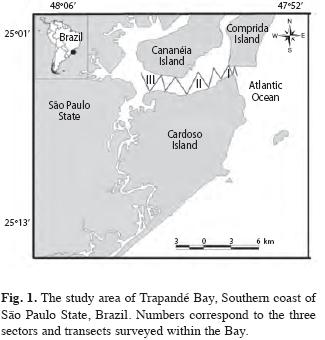
<body><![CDATA[Canan&eacute;ia Estuary Complex (<a href="#fig1">Fig. 1</a>) is located     in the South     S&atilde;o Paulo state (24&ordm;59&#8217;-25&ordm;04&#8217; S and     47&ordm;54&#8217;-47&ordm;56&#8217; W). The region has three islands. Cardoso     Island is located within Trapand&eacute; Bay plus Canan&eacute;ia and     Comprida Islands which are separated by a River Channel     (Schaeffer-Novelli<span style="font-style: italic;"> et al</span>.     1990).    <br> <br style="font-family: verdana;"> </span></font>     <div style="text-align: center;"><a name="fig1"></a><img alt=""  src="/img/revistas/rbt/v59n3/a28i1.jpg"  style="width: 325px; height: 340px;">    ]]></body>
<body><![CDATA[<br> </div>     <br>     <br style="font-family: verdana;">     <font size="2"><span style="font-family: verdana;">The vegetation of     all these islands     consists of a large mangrove swamp with three species of mangrove: the     white mangrove, <span style="font-style: italic;">Laguncularia racemosa</span>,     the black mangrove, <span style="font-style: italic;">Avicennia     schaueriana</span> and the red mangrove, <span      style="font-style: italic;">Rhizophora</span> <span     ]]></body>
<body><![CDATA[ style="font-style: italic;">mangle</span>. According to     Schaeffer-Novelli <span style="font-style: italic;">et al</span>.     (1990) this lagoon estuary system is one of     the best preserved ecosystems in the Brazilian coast, being legally     protected as a State and Federal Environmental Protected Area. Lagoon     watercourses that make up the coastal Canan&eacute;ia system tend to be     silted, creating shallows or sandbars (Cunha-Lignon 2005).</span></font><br      style="font-family: verdana;">     <br style="font-family: verdana; font-weight: bold;">     <font size="2"><span style="font-family: verdana;"><span     ]]></body>
<body><![CDATA[ style="font-weight: bold;">Sampling methods:     </span>Sampling efforts     were carried out once a month for ten months </span></font><font      size="2"><span style="font-family: verdana;">from May 2003 to     April 2004. The     area was divided into three sectors according to their proximity to     open sea: Sector I has the greatest influence from the ocean and makes     up the area of the Canan&eacute;ia Estuary mouth, between Cardoso and     Canan&eacute;ia Islands; Sector II is an intermediate region between     the three islands and a large flow of fresh water, and a salient     ]]></body>
<body><![CDATA[declivity; while Sector III was the furthest region upstream, with the     largest flow of fresh water and least salinity. Four transects were     established in each Sector I and II, while five transects were     established in Sector III (<a href="#fig1">Fig. 1</a>).</span></font><br      style="font-family: verdana;">     <br style="font-family: verdana;">     <font size="2"><span style="font-family: verdana;">In each sector,     transect lines of     approximately the same length were used in order to </span></font><font      size="2"><span style="font-family: verdana;">cover the entire     ]]></body>
<body><![CDATA[studied area.     Transect lines were randomly established and did not take into account     previous knowledge of where the animals were most likely to be seen.     The total area of each sector and the length of each transect was     calculated with a GPS. Transects were disposed in a zig-zag formation     (<a href="#fig1">Fig. 1</a>) and all thirteen transects were covered     each day during all     ten days of sampling, meaning that each transect was covered ten times.     The order in which transects were covered was randomly chosen (by     lottery methods). Due to the short sighting time and the small body     ]]></body>
<body><![CDATA[size of the species, training with the researcher in charge of data     collection was carried out prior to sampling. The training sought to     standardize radial-distances; during the training a telemeter was used     to estimate steady objects. In order to calculate the angle of the     dolphins to the bow, a 30cm radius protractor with an arrow was used.</span></font><br      style="font-family: verdana;">     <br style="font-family: verdana;">     <font size="2"><span style="font-family: verdana;">During sampling,     dolphins were     detected with the naked-eye. The Distance method was used and all     ]]></body>
<body><![CDATA[animals at both sides of the boat within less than 90 degrees to the </span></font><font      size="2"><span style="font-family: verdana;">bow were registered     with their     distance and angle in relation to the transect (Eberhardt <span      style="font-style: italic;">et al</span>. 1979,     Buckland <span style="font-style: italic;">et al</span>. 1993, 2001,     Bonin <span style="font-style: italic;">et al</span>. 2008).     Radial-distances were     visually estimated exclusively by the same researcher, a methods     previously carried out by Smith (1981), Gaskin <span     ]]></body>
<body><![CDATA[ style="font-style: italic;">et al</span>. (1985) for other     species of small cetaceans and Geise <span style="font-style: italic;">et     al</span>. (1999) for the estuarine     dolphin. </span></font><br style="font-family: verdana;">     <br style="font-family: verdana;">     <font size="2"><span style="font-family: verdana;">The boat was always     driven by the     same pilot, and maintained a low, steady speed (five knots) in order to     confer a greater reliability to the data (Leatherwood 1979, Gaskin     1982, Bonin <span style="font-style: italic;">et al</span>. 2008). The     ]]></body>
<body><![CDATA[use of a whaler type boat, 10m long with     inboard motors (diesel engine) was important due to its low impact on     the dolphins since the noise made by outboard motors (gas engines) can     interfere with the communication sounds made by dolphins and may scare     them away (Rezende 2008). </span></font><br      style="font-family: verdana;">     <br style="font-family: verdana;">     <font size="2"><span style="font-family: verdana;">During field work,     the four     premises of the Distance method were followed: (1) all animals on the     ]]></body>
<body><![CDATA[transect must be observed; (2) all animals must be detected at their     initial position, before any movement reaction to the observer; (3) all     distances (radial distances and angles) must be measured correctly and     (4) detections must be independent events (Buckland<span      style="font-style: italic;"> et al</span>. 1993, 2001,     2004, Cullen <span style="font-style: italic;">et al</span>. 2004,     Bonin <span style="font-style: italic;">et al</span>. 2008).</span></font><br      style="font-family: verdana;">     <br style="font-family: verdana;">     <font size="2"><span style="font-family: verdana;">The overall data was     ]]></body>
<body><![CDATA[analyzed with     the software &#8220;Distance 3.5 version six&#8221; (Thomas <span      style="font-style: italic;">et al</span>. 1998). At first,     three potential functions of detection were considered: uniform,     half-normal and hazard-rate, together with various adjustments. Other     variables such as season, methods (with or without binoculars),     Beaufort sea scale, observer and models were added to the analysis and     compared with the likelihood-ratio tests and Akaike Information     Criteria (AIC), and those that adjusted better to each group of data     were used (Thomas <span style="font-style: italic;">et al</span>.     ]]></body>
<body><![CDATA[1998). Analyses were carried out globally and     by sector. Analysis for different seasons and periods of the day were     also carried out but, in order to summarize the results, only the     probability detection curve for global data is presented in this study.     </span></font><br style="font-family: verdana;">     <br style="font-family: verdana;">     <font size="2"><span style="font-family: verdana;">In order to     eliminate outliers we     truncated the distributions of perpendicular ranges at 600m (Buckland     <span style="font-style: italic;">et al</span>. 2001). This measure     ]]></body>
<body><![CDATA[resulted in the exclusion of 6% of all     observations. </span></font><br style="font-family: verdana;">     <br style="font-family: verdana;">     <font size="2"><span style="font-family: verdana;">Abundance was     calculated with the     Horvitz-Thompson estimator, as described in Marques &amp; Buckland     (2003).</span></font><br style="font-family: verdana;">     <br style="font-family: verdana;">     <font size="2"><span style="font-family: verdana;">Being the present     study done with     ]]></body>
<body><![CDATA[aquatic mammals, the probability of seeing them on </span></font><font      size="2"><span style="font-family: verdana;">transect line (g<sub>(0)</sub>)     may not be     100% certain. In order to minimize this potential underestimation it     was assumed that (g<sub>(0)</sub> ) was equal to one, because <span      style="font-style: italic;">S. guianensis</span>     emerges at short intervals to breathe, which exposes them during     sampling periods. Moreover, the area is an estuary, small and     protected, which makes it easier to detect the animals.</span></font><br      style="font-family: verdana;">     ]]></body>
<body><![CDATA[<br style="font-family: verdana;">     <font size="2"><span style="font-family: verdana;"><span      style="font-weight: bold;">Seasonality:</span> The     present study     estimates the dolphin&#8217;s population density for the entire year and also     the relative density for rainy and dry seasons. The dry season is     considered to be from April to September with a pluvial index of     125mm/month in average. The rainy seasons is considered to be from     October to March, when the pluvial index rises to 212mm/month (CIIA-GRO     2008). </span></font><br style="font-family: verdana;">     ]]></body>
<body><![CDATA[<br style="font-family: verdana; font-weight: bold;">     <font size="2"><span style="font-family: verdana;"><span      style="font-weight: bold;">Periods of the day:</span>     The authors     also calculated the density related to different periods of the day:     the morning (between 06:00h and 11:59h) and afternoon (from 12:00h to     18:30h). All the analyses were done separately for each sector of the     bay.     <br>     <br style="font-family: verdana;">     ]]></body>
<body><![CDATA[</span></font><font size="2"><span style="font-family: verdana;"><span      style="font-weight: bold;">Groups:</span>     The present     study used the     same classification for &#8220;groups&#8221; as the one adopted by Monteiro-Filho     (2000). According to this author, one or two adults in the company of a     calf is considered to be a family (whether related or not); this type     of group is the most common in the region. Groups of more than four     individuals who meet for a certain purpose (displacement, cooperative     feeding, among other) are considered to be schools. Isolated     ]]></body>
<body><![CDATA[individuals can also be observed in the region, but those are likely to     soon join others and form one of the social groups described above.</span></font><br      style="font-family: verdana;">     <br style="font-family: verdana;">     <font style="font-weight: bold;" size="3"><span      style="font-family: verdana;">Results</span></font><br      style="font-family: verdana; font-weight: bold;">     <br style="font-family: verdana;">     <font size="2"><span style="font-family: verdana;">Between May 2003 and     April 2004,     ]]></body>
<body><![CDATA[540km were sampled at a constant speed of five knots in good sea     conditions (Beaufort scale 0-2). On board sampling over transects     totaled 54 hours and other 102 hours of field work were carried out. A     total of 908 individuals were recorded in 461 different groups. </span></font><br      style="font-family: verdana;">     <br style="font-family: verdana;">     <font size="2"><span style="font-family: verdana;"><span      style="font-weight: bold;">Population density:</span>     The total     density of individuals found in the Canan&eacute;ia region was     ]]></body>
<body><![CDATA[12.41ind/km<sup>2</sup> (CV=25.53%). Density of groups in the studied     area was     5.77groups/km<sup>2</sup> (CV=25.31%) while the abundance for the     entire study     area were 195 individuals (CV=25.53%). The number of individuals per     square kilometer varied between sectors: Sec-tor I D=33.1ind/km<sup>2</sup>     (CV=13.34%); Sector II D=7.8ind/km<sup>2</sup> (CV=21.97%) and Sector     III     D=3.04ind/km<sup>2</sup> (CV=34.04%).</span></font><br      style="font-family: verdana;">     ]]></body>
<body><![CDATA[<br style="font-family: verdana;">     <font size="2"><span style="font-family: verdana;">The Half Normal     model with Cosine     adjustments was used as an estimator. According to the premise of the     method, the probability of detection becomes lower as perpendicular     distance from the track line increases and makes it possible to     graphically represent the possibility of detection for the whole     sampled region as showed in <a href="/img/revistas/rbt/v59n3/a28i2.jpg">Fig.     2</a>.</span></font><br style="font-family: verdana;">     <br style="font-family: verdana;">     ]]></body>
<body><![CDATA[<font size="2"><span style="font-family: verdana;"><span      style="font-weight: bold;">Seasonality:</span> During     the dry season     253 groups were registered with a total of 474 individuals. Density of     individual was 5.77ind/km<sup>2</sup> (CV=27.87%) while the density of     groups was     2.94groups/km<sup>2 </sup>(CV=27.46%). Total abundance found for the     dry season     was 91 individuals (CV=27.87%). During the rainy season 208 groups were     registered with a total of 434 individuals. Density of individuals     ]]></body>
<body><![CDATA[increased to 20.28ind/km<sup>2</sup> (CV=31.95%) as well as the density     of groups,     which rose to 8.84groups/km<sup>2</sup> (CV=31.57%). Total abundance     for the rainy     season was also greater, totalizing 319 individuals (CV=31.95%).     Densities for each season and sectors are shown in <a      href="/img/revistas/rbt/v59n3/a28t1.gif">Table 1</a>. Again the     estimator Half Normal/Cosine was used.</span></font><br      style="font-family: verdana;">     <br style="font-family: verdana;">     ]]></body>
<body><![CDATA[<font size="2"><span style="font-family: verdana;"><span      style="font-weight: bold;">Periods of the day:     </span>Density varied     between different periods of the day. During the morning 156 groups     were registered with a total of 297 individuals. Density of individuals     was equal to 7.29ind/km<sup>2</sup> (CV=29.63%) while the density of     groups was     3.29groups/km<sup>2 </sup>(CV=28.88%). Total abundance during the     morning was 115     individuals (CV=29.63%). During the afternoon 305 groups were     ]]></body>
<body><![CDATA[registered with a total of 611 individuals. Density of individuals was     13.83ind/km<sup>2</sup> (CV=30.19%), density of groups 6.57 groups/km<sup>2</sup>     (CV=29.92%)     and the total abundance was 217 individuals (CV=30.19%).</span></font><br      style="font-family: verdana;">     <br style="font-family: verdana;">     <font size="2"><span style="font-family: verdana;">As shown in <a      href="/img/revistas/rbt/v59n3/a28t2.gif">Table 2</a>,     the dolphins     occupation of the studied area was uneven at different times of the     ]]></body>
<body><![CDATA[day. Density was greater in Sector I during the morning hours while in     it was greater in Sector II during the afternoon. The estimator that     best suited morning analyses was the Half-normal/Hermite while the     Uniform/Cosine was used for analyses of data collected during the     afternoon.</span></font><br style="font-family: verdana;">     <br style="font-family: verdana;">     <font size="2"><span style="font-family: verdana;"><span      style="font-weight: bold;">Groups:</span> The average     size of the     groups was 2.2ind/group. The animals were most likely to be seen alone,     ]]></body>
<body><![CDATA[in pairs or a trio. However, groups composed of more than four </span></font><font      size="2"><span style="font-family: verdana;">individuals were     also recorded. The     largest group registered was formed by 12 indivi</span></font><font      size="2"><span style="font-family: verdana;">duals. The average     number of     individuals per group differed between each sector (Sector I had an     average of 2.1ind/group; Sector II 2.4ind/group; and Sector III     2.1ind/group) and between the two seasons (the dry season had     1.9ind/group while the rainy season had 2.4ind/group). The number of     ]]></body>
<body><![CDATA[individuals per group was equal for different periods of the day     (2.2ind/group).</span></font><br style="font-family: verdana;">     <br style="font-family: verdana;">     <font style="font-weight: bold;" size="3"><span      style="font-family: verdana;">Discussion</span></font><br      style="font-family: verdana;">     <br style="font-family: verdana;">     <font size="2"><span style="font-family: verdana;">Most of the     estuarine dolphins     sampled in the Canan&eacute;ia region of Southeastern Brazil were found     ]]></body>
<body><![CDATA[in small groups, with an average size of 2.2ind/group. Similar group     sizes have been reported by other authors in similar studies. Geise<span      style="font-style: italic;"> et     al</span>. (1999) found that in the same area groups were commonly of     two and     five individuals, specifically. Pairs made up 30% of the total groups.     Monteiro-Filho (2000) states that families are the most common group     type found. The Canan&eacute;ia region represents an area of high     density of the estuarine dolphin, being one of the places in Brazil     where the dolphins are most likely to be seen. In Guanabara Bay (state     ]]></body>
<body><![CDATA[of Rio de Janeiro) the average group size was 2ind/km&sup2; (Geise     1991). Azevedo<span style="font-style: italic;"> et al</span>. (2005)     reported group sizes varying from one to     40 individuals and commonly found in group sizes ranging from two to 20     individuals. Average group sizes reported in ParatyBay and Sepetiba Bay     (state of Rio de Janeiro) were 32.4 individuals (Lodi 2003) and 30.2     individuals (Flach <span style="font-style: italic;">et al</span>.     2008b) respectively. According to     Ara&uacute;jo &amp; Azevedo (2001), those bays share the same fish     assemblages that form large schools and make them distinct from other     ]]></body>
<body><![CDATA[estuaries and bays. This may explain the differences regarding group     sizes. </span></font><br style="font-family: verdana;">     <br style="font-family: verdana;">     <font size="2"><span style="font-family: verdana;">In the South of     Brazil, Filla &amp;     Monteiro-Filho (2009) found an average group size of 2.13ind/km&sup2;     and 2.9ind/km&sup2; in the Guaratuba and Paranagu&aacute; Bays (state     of Paran&aacute;), respectively. Also in the Paranagu&aacute; Bay,     Santos <span style="font-style: italic;">et al</span>. (2010)     registered group sizes ranging from two to 90     ]]></body>
<body><![CDATA[individuals. In the Ba&iacute;a Norte (state of Santa Catarina) the     average size found was much larger: 29ind/km&sup2; (Daura-Jorge <span      style="font-style: italic;">et al</span>.     2005). </span></font><br style="font-family: verdana;">     <br style="font-family: verdana;">     <font size="2"><span style="font-family: verdana;">In Nicaragua,     Edwards &amp; Schnell     (2001) registered group sizes ranging from two to 15 individuals.     According to those authors, the group sizes varied with activity     patterns. The average size group documented was 3ind/km&sup2;. </span></font><br     ]]></body>
<body><![CDATA[ style="font-family: verdana;">     <br style="font-family: verdana;">     <font size="2"><span style="font-family: verdana;">All these studies     were done in     protected regions with shallow bays, little current and wave action and     a low predation rate. </span></font><br style="font-family: verdana;">     <br style="font-family: verdana;">     <font size="2"><span style="font-family: verdana;">Lodi &amp; Hetzel     (1998) documented     exceptional group sizes in the Ilha Grande Bay (state of Rio de     ]]></body>
<body><![CDATA[Janeiro). The authors registered group sizes that ranged from three to     450 individuals, representing the greatest association ever recorded     for the species. </span></font><br style="font-family: verdana;">     <br style="font-family: verdana;">     <font size="2"><span style="font-family: verdana;">The results found in     Canan&eacute;ia regarding population density can be considered high     when compared to other studies carried out with the same species (Geise     <span style="font-style: italic;">et al</span>. 1999, </span></font><font      size="2"><span style="font-family: verdana;">Edwards &amp;     Schnell 2001, Flach     ]]></body>
<body><![CDATA[<span style="font-style: italic;">et al</span>. 2008a). This could be a     result of the premise adopted in the     study that the closer the animals are to transects, the greater the     estimated density. On the other hand, this could also prove that the     extrapolation of data for an area may lead to overestimations. This     second possibility was evident when analyses were done separately for     each sampled sector because the results indicated that the animals used     the studied area heterogeneously, with a much larger use of certain     localities in detriment of other. This uneven use can be explained by     heterogeneity found in the environment itself and that the dimension of     ]]></body>
<body><![CDATA[area and movements within such area are determined by the mosaic     distribution of available resources, especially food resources (Defran<span      style="font-style: italic;">     et al</span>. 1999, Oliveira <span style="font-style: italic;">et al</span>.     2008).</span></font><br style="font-family: verdana;">     <br style="font-family: verdana;">     <font size="2"><span style="font-family: verdana;">Sector I was the one     most used by     the dolphins. In this sector, salinity is greater than in the others     sectors and is considered to be constant throughout the year. This     ]]></body>
<body><![CDATA[means that there is the possibility of a higher concentration of marine     fish species, one of their main food items (see Oliveira <span      style="font-style: italic;">et al</span>. 2008),     which would explain the permanence of the dolphins in this area,     including during the night (Atem &amp; Monteiro-Filho 2006). Moreover,     this region has salient and steep sloping beaches, which are used by     the dolphins as part of their fishing strategy. The dolphins corral the     fish against the steep walls, reducing their escape route and thus     disorganizing the school (Monteiro-Filho 2008). In the study carried     out in Nicaragua, estuarine dolphin densities were also more common in     ]]></body>
<body><![CDATA[coastal areas, followed by areas where the sea meets lagoons and     finally by the lagoons with much lower salinity (Edwards &amp; Schnell     2001). Flach <span style="font-style: italic;">et al</span>. (2008a)     also observed more sightings and a higher     encounter rate with estuarine dolphin at the entrance of Sepetiba Bay,     in comparison to its interior. Additionally, Sector I has areas of     steep sloping beaches: a topography that facilitates the dolphins     feeding strategies as it reduces prey escape routes (Monteiro-Filho     2008), as aforementioned. Heterogeneity found on thebottom of     distribution areas has also been considered to be a key determinant in     ]]></body>
<body><![CDATA[the habitat of delphinids (Hui 1979) as it provides benthic prey     habitat and enhances prey aggregation and thus attracts dolphins.     Considering that the species carries out feeding activities during the     day and night, it is possible that periods of greater density are     related to the prey dynamics according to the tide movements. If this     is true, there may be a second peak of high density occurring during     the night (Atem &amp; Monteiro-Filho 2006). Unfortunately, sampling is     still not possible in the absence of light. </span></font><br      style="font-family: verdana;">     <br style="font-family: verdana;">     ]]></body>
<body><![CDATA[<font size="2"><span style="font-family: verdana;">The population     density of the same     region found in the present study was greater during the rainy season,     as published by Geise <span style="font-style: italic;">et al</span>.     (1999). Similar results were also found in     Paraty Bay (Lodi &amp; Hetzel 1998, Lodi 2003). Santos <span      style="font-style: italic;">et al</span>. (2010)     report that the largest groups of <span style="font-style: italic;">S.     guianensis</span> in the protected areas     of Paranagu&aacute; Estuarine Complex (state of Paran&aacute;) occurred     ]]></body>
<body><![CDATA[due to the local topography, lower predation risk, seasonal     distribution and prey abundance. The seasonal variance may be related     to changes in the abundance and distribution of the prey, which appears     to be strongly influenced by the seasons (Lodi 2003). This is also     related to the peak of calf births (Rosas &amp; Monteiro-Filho 2002). </span></font><br      style="font-family: verdana;">     <br style="font-family: verdana;">     <font size="2"><span style="font-family: verdana;">Differences     regarding the period of     the day were also noted in this study. In general, the dolphins density     ]]></body>
<body><![CDATA[was much greater during the afternoon, as previously registered by     Geise <span style="font-style: italic;">et al</span>. (1999). Sectors     also proved density differences. More     individuals were found in Sector I and II during the morning, as     opposed to what was found in Sector III, which had a greater density     during the afternoon. A logical explanation is the dolphins movement     between sectors.</span></font><br style="font-family: verdana;">     <br style="font-family: verdana;">     <font size="2"><span style="font-family: verdana;">Finally, the present     study provides     ]]></body>
<body><![CDATA[evidence that estuarine dolphins use the Canan&eacute;ia region     heterogeneously, having a major use in certain localities within the     area. Regardless of this variation, the estuary has the highest dolphin     density for this species and highlights the need for conservation     strategies to protect this southeastern Brazilian bay.</span></font><br      style="font-family: verdana;">     <br style="font-family: verdana;">     <font style="font-weight: bold;" size="3"><span      style="font-family: verdana;">Acknowledgments</span></font><br      style="font-family: verdana; font-weight: bold;">     ]]></body>
<body><![CDATA[<br style="font-family: verdana;">     <font size="2"><span style="font-family: verdana;">We specially thank     the boatman,     Clovis Ribeiro Xavier J&uacute;nior. Also the Instituto de Pesquisas     Canan&eacute;ia (IPeC) and the Universidade de Mogi das Cruzes (UMC),     Roberto Fusco Costa, Luciana Leite; and financial support from the     Conselho Nacional de Desenvolvimento Cient&iacute;fico e     Tecnol&oacute;gico (CNPq).</span></font><br      style="font-family: verdana;">     <font style="font-weight: bold;" size="3"><span     ]]></body>
<body><![CDATA[ style="font-family: verdana;"></span></font>     <hr style="width: 100%; height: 2px;"><font style="font-weight: bold;"      size="3"><span style="font-family: verdana;">References </span></font><br      style="font-family: verdana; font-weight: bold;">     <br style="font-family: verdana;">     <font size="2"><span style="font-family: verdana;">Andriolo, A., P.G.     Kinas, M.H.     Engel, C.C.A. Martins &amp; A.M. Rufino. 2010. Humpback whales within     the brasilian breeding ground: distribuition and population size     <!-- ref -->estimate. Endang. Spec. Res. 11: 233-243.    &nbsp;&nbsp;&nbsp;&nbsp;&nbsp;&nbsp;&nbsp;&nbsp;[&#160;<a href="javascript:void(0);" onclick="javascript: window.open('/scielo.php?script=sci_nlinks&ref=1742826&pid=S0034-7744201100030002800001&lng=','','width=640,height=500,resizable=yes,scrollbars=1,menubar=yes,');">Links</a>&#160;]<!-- end-ref --><!-- ref --></span></font><br  style="font-family: verdana;"> <br style="font-family: verdana;"> <font size="2"><span style="font-family: verdana;">Ara&uacute;jo, F.G. &amp; M.C.C. De Azevedo. 2001. Assemblages of Southeast-South Brazilian coastal systems based on distribution of fishes. Est. Coast. Shelf Sci. 52: 729-38.    &nbsp;&nbsp;&nbsp;&nbsp;&nbsp;&nbsp;&nbsp;&nbsp;[&#160;<a href="javascript:void(0);" onclick="javascript: window.open('/scielo.php?script=sci_nlinks&ref=1742827&pid=S0034-7744201100030002800002&lng=','','width=640,height=500,resizable=yes,scrollbars=1,menubar=yes,');">Links</a>&#160;]<!-- end-ref --><!-- ref --></span></font><br  style="font-family: verdana;"> <br style="font-family: verdana;"> <font size="2"><span style="font-family: verdana;">Atem, A.C.G. &amp; E.L.A. Monteiro-Filho. 2006. Nocturnal Activity of the Estuarine Dolphin (<span style="font-style: italic;">Sotalia guianensis</span>) (Cetacea, Delphinidae) in the Region of Canan&eacute;ia, S&atilde;o Paulo State, Brazil. Aqua. Mamm. 32: 236-241.    &nbsp;&nbsp;&nbsp;&nbsp;&nbsp;&nbsp;&nbsp;&nbsp;[&#160;<a href="javascript:void(0);" onclick="javascript: window.open('/scielo.php?script=sci_nlinks&ref=1742828&pid=S0034-7744201100030002800003&lng=','','width=640,height=500,resizable=yes,scrollbars=1,menubar=yes,');">Links</a>&#160;]<!-- end-ref --><!-- ref --></span></font><br style="font-family: verdana;"> <br style="font-family: verdana;"> <font size="2"><span style="font-family: verdana;">Azevedo, A.F., S.C. Viana, A.M. Oliveira &amp; M.V. Sluys. 2005. Group characteristics of marine tucuxis (<span style="font-style: italic;">Sotalia fluviatilis</span>) (Cetacea: Delphinidae) in Guanabara Bay, southeastern Brazil. J. Mar. Biol. Ass. U.K. 85: 209-212.    &nbsp;&nbsp;&nbsp;&nbsp;&nbsp;&nbsp;&nbsp;&nbsp;[&#160;<a href="javascript:void(0);" onclick="javascript: window.open('/scielo.php?script=sci_nlinks&ref=1742829&pid=S0034-7744201100030002800004&lng=','','width=640,height=500,resizable=yes,scrollbars=1,menubar=yes,');">Links</a>&#160;]<!-- end-ref --><!-- ref --></span></font><br  style="font-family: verdana;"> <br style="font-family: verdana;"> <font size="2"><span style="font-family: verdana;">Barco, S.G., W.M. Swingle, W.A. Mclellan, R.N. Harris &amp; D.A. Pabst. 1999. Local abundance and distribution of bottlenose dolphin (<span style="font-style: italic;">Tursiops truncatus</span>) in the nearshore waters of Virginia Beach, Virginia. Mar. Mamm. Sci. 15: 394-408.    &nbsp;&nbsp;&nbsp;&nbsp;&nbsp;&nbsp;&nbsp;&nbsp;[&#160;<a href="javascript:void(0);" onclick="javascript: window.open('/scielo.php?script=sci_nlinks&ref=1742830&pid=S0034-7744201100030002800005&lng=','','width=640,height=500,resizable=yes,scrollbars=1,menubar=yes,');">Links</a>&#160;]<!-- end-ref --><!-- ref --></span></font><br style="font-family: verdana;"> <br style="font-family: verdana;"> <font size="2"><span style="font-family: verdana;">Barham, E.G., C.J. Sweenecy, S. Leatherwood, R.K. Beegs &amp; C.L. Barham. 1980. Aerial census of the bottlenose dolphin, <span style="font-style: italic;">Tursiops truncatus</span>, in a region of the Texas coast. Fish. Bull. 77: 585-595.    &nbsp;&nbsp;&nbsp;&nbsp;&nbsp;&nbsp;&nbsp;&nbsp;[&#160;<a href="javascript:void(0);" onclick="javascript: window.open('/scielo.php?script=sci_nlinks&ref=1742831&pid=S0034-7744201100030002800006&lng=','','width=640,height=500,resizable=yes,scrollbars=1,menubar=yes,');">Links</a>&#160;]<!-- end-ref --><!-- ref --></span></font><br style="font-family: verdana;"> <br style="font-family: verdana;"> <font size="2"><span style="font-family: verdana;">Bonin, C.A., G.F. Filla, L.V. De Oliveira &amp; E.L.A. Monteiro-Filho. 2008. Densidade populacional: m&eacute;todos e implica&ccedil;&otilde;es, p. 177-192. <span  style="font-style: italic;">In</span> E.L.A. Monteiro-Filho &amp; K.D.A. Monteiro. Biologia, ecologia e conserva&ccedil;&atilde;o do boto-cinza. P&aacute;ginas &amp; Letras, S&atilde;o Paulo, S&atilde;o Paulo, Brasil.    &nbsp;&nbsp;&nbsp;&nbsp;&nbsp;&nbsp;&nbsp;&nbsp;[&#160;<a href="javascript:void(0);" onclick="javascript: window.open('/scielo.php?script=sci_nlinks&ref=1742832&pid=S0034-7744201100030002800007&lng=','','width=640,height=500,resizable=yes,scrollbars=1,menubar=yes,');">Links</a>&#160;]<!-- end-ref --><!-- ref --></span></font><br  style="font-family: verdana;"> <br style="font-family: verdana;"> <font size="2"><span style="font-family: verdana;">Buckland, S.T., D.R. Anderson, K.P. Burnham &amp; J.L. Laake. 1993. Distance Sampling&#8211; Estimating abundance of biological populations. Champman &amp; Hall, London, United Kingdom.    &nbsp;&nbsp;&nbsp;&nbsp;&nbsp;&nbsp;&nbsp;&nbsp;[&#160;<a href="javascript:void(0);" onclick="javascript: window.open('/scielo.php?script=sci_nlinks&ref=1742833&pid=S0034-7744201100030002800008&lng=','','width=640,height=500,resizable=yes,scrollbars=1,menubar=yes,');">Links</a>&#160;]<!-- end-ref --><!-- ref --> </span></font><br style="font-family: verdana;"> <br style="font-family: verdana;"> <font size="2"><span style="font-family: verdana;">Buckland, S.T., D.R. Anderson, K.P. Burnham, J.L. Laake, D.L. Borchers &amp; L. Thomas. 2001. Introduction to distance sampling. Oxford University, NewYork, New York, USA.    &nbsp;&nbsp;&nbsp;&nbsp;&nbsp;&nbsp;&nbsp;&nbsp;[&#160;<a href="javascript:void(0);" onclick="javascript: window.open('/scielo.php?script=sci_nlinks&ref=1742834&pid=S0034-7744201100030002800009&lng=','','width=640,height=500,resizable=yes,scrollbars=1,menubar=yes,');">Links</a>&#160;]<!-- end-ref --><!-- ref --></span></font><br  style="font-family: verdana;"> <br style="font-family: verdana;"> <font size="2"><span style="font-family: verdana;">Buckland, S.T., D.R. Anderson, K.P. Burnham, J.L. Laake, D.L. Borchers &amp; L. Thomas. 2004. Advanced distance sampling. Estimating abundance of biological populations. Oxford University, NewYork, New York, USA.    &nbsp;&nbsp;&nbsp;&nbsp;&nbsp;&nbsp;&nbsp;&nbsp;[&#160;<a href="javascript:void(0);" onclick="javascript: window.open('/scielo.php?script=sci_nlinks&ref=1742835&pid=S0034-7744201100030002800010&lng=','','width=640,height=500,resizable=yes,scrollbars=1,menubar=yes,');">Links</a>&#160;]<!-- end-ref --><!-- ref --></span></font><br  style="font-family: verdana;"> <br style="font-family: verdana;"> <font size="2"><span style="font-family: verdana;">Carvalho, C.T. 1963. Sobre um boto comum no litoral do Brasil (CETACEA, DELPHINIDAE), Rio de Janeiro. Ver. Bras. Biol. 23: 263-276.    &nbsp;&nbsp;&nbsp;&nbsp;&nbsp;&nbsp;&nbsp;&nbsp;[&#160;<a href="javascript:void(0);" onclick="javascript: window.open('/scielo.php?script=sci_nlinks&ref=1742836&pid=S0034-7744201100030002800011&lng=','','width=640,height=500,resizable=yes,scrollbars=1,menubar=yes,');">Links</a>&#160;]<!-- end-ref --><!-- ref --></span></font><br style="font-family: verdana;"> <br style="font-family: verdana;"> <font size="2"><span style="font-family: verdana;">CIIAGRO. 2008. Centro Integrado de Informa&ccedil;&otilde;es Agrometeorol&oacute;gicas. S&atilde;o Paulo, S&atilde;o Paulo, Brasil. (Downloaded: February 2008, www.ciiagro.sp.gov.br).    &nbsp;&nbsp;&nbsp;&nbsp;&nbsp;&nbsp;&nbsp;&nbsp;[&#160;<a href="javascript:void(0);" onclick="javascript: window.open('/scielo.php?script=sci_nlinks&ref=1742837&pid=S0034-7744201100030002800012&lng=','','width=640,height=500,resizable=yes,scrollbars=1,menubar=yes,');">Links</a>&#160;]<!-- end-ref --><!-- ref --></span></font><br style="font-family: verdana;"> <br style="font-family: verdana;"> <font size="2"><span style="font-family: verdana;">Cullen, L.J.R., R. Rudran &amp; C. Valladares-Padua. 2004. Transectos lineares na estimativa de densidade de mam&iacute;feros e aves de m&eacute;dio e grande porte, p. 169-179. <span style="font-style: italic;">In </span>L. Cullen &amp; R. Rudran. M&eacute;todos de estudos em biologia da conserva&ccedil;&atilde;o &amp; manejo da vida silvestre. Editora da Universidade do Paran&aacute;, Curitiba, Paran&aacute;, Brasil.    &nbsp;&nbsp;&nbsp;&nbsp;&nbsp;&nbsp;&nbsp;&nbsp;[&#160;<a href="javascript:void(0);" onclick="javascript: window.open('/scielo.php?script=sci_nlinks&ref=1742838&pid=S0034-7744201100030002800013&lng=','','width=640,height=500,resizable=yes,scrollbars=1,menubar=yes,');">Links</a>&#160;]<!-- end-ref --><!-- ref --></span></font><br  style="font-family: verdana;"> <br style="font-family: verdana;"> <font size="2"><span style="font-family: verdana;">Cunha-Lignon, M. 2005. Ecologia de manguezais: desenvolvimento espa&ccedil;o temporal no sistema costeiro Canan&eacute;ia-Iguape, S&atilde;o Paulo, Brasil. Ph.D. Thesis, Universidade de S&atilde;o Paulo&#8211; Instituto Oceanogr&aacute;fico, S&atilde;o Paulo, Brasil.    &nbsp;&nbsp;&nbsp;&nbsp;&nbsp;&nbsp;&nbsp;&nbsp;[&#160;<a href="javascript:void(0);" onclick="javascript: window.open('/scielo.php?script=sci_nlinks&ref=1742839&pid=S0034-7744201100030002800014&lng=','','width=640,height=500,resizable=yes,scrollbars=1,menubar=yes,');">Links</a>&#160;]<!-- end-ref --><!-- ref --></span></font><br style="font-family: verdana;"> <br style="font-family: verdana;"> <font size="2"><span style="font-family: verdana;">Daura-Jorge, F.G., L.L. Wedekin, V.Q. Piacentini &amp; P.C. Sim&otilde;es-Lopes. 2005. Seasonal and daily patterns of group size, cohesion and activity of the estuarine dolphin, <span style="font-style: italic;">Sotalia guianensis </span>(P.J. Van B&eacute;n&eacute;den, 1864) (Cetacea, Delphinidae) in southern Brazil. Rev. Bras. Zoo. 22: 1014-1021.    &nbsp;&nbsp;&nbsp;&nbsp;&nbsp;&nbsp;&nbsp;&nbsp;[&#160;<a href="javascript:void(0);" onclick="javascript: window.open('/scielo.php?script=sci_nlinks&ref=1742840&pid=S0034-7744201100030002800015&lng=','','width=640,height=500,resizable=yes,scrollbars=1,menubar=yes,');">Links</a>&#160;]<!-- end-ref --><!-- ref --></span></font><br style="font-family: verdana;"> <br style="font-family: verdana;"> <font size="2"><span style="font-family: verdana;">Defran, R.H., D.W. Weller, D.L. Kelly &amp; M.A. Espinosa. 1999. Range characteristics of pacific bottlenose dolphins (<span style="font-style: italic;">Tursiops truncatus</span>) in the Southern California Bight. Mar. Mamm. Sci. 15: 381-393.    &nbsp;&nbsp;&nbsp;&nbsp;&nbsp;&nbsp;&nbsp;&nbsp;[&#160;<a href="javascript:void(0);" onclick="javascript: window.open('/scielo.php?script=sci_nlinks&ref=1742841&pid=S0034-7744201100030002800016&lng=','','width=640,height=500,resizable=yes,scrollbars=1,menubar=yes,');">Links</a>&#160;]<!-- end-ref --><!-- ref --></span></font><br  style="font-family: verdana;"> <br style="font-family: verdana;"> <font size="2"><span style="font-family: verdana;">Eberhardt, L.L., D.G. Chapman &amp; J.R. Gilbert. 1979. A review of marine census methods. Wildl. Monogr. 63: 6-46.    &nbsp;&nbsp;&nbsp;&nbsp;&nbsp;&nbsp;&nbsp;&nbsp;[&#160;<a href="javascript:void(0);" onclick="javascript: window.open('/scielo.php?script=sci_nlinks&ref=1742842&pid=S0034-7744201100030002800017&lng=','','width=640,height=500,resizable=yes,scrollbars=1,menubar=yes,');">Links</a>&#160;]<!-- end-ref --><!-- ref --></span></font><br style="font-family: verdana;"> <br style="font-family: verdana;"> <font size="2"><span style="font-family: verdana;">Edwards, H.H. &amp; G.D. Schnell. 2001. Status and ecology of<span style="font-style: italic;"> Sotalia fluviatilis</span> in the Cayos Miskito Reserve, Nicaragua. Mar. Mamm. Sci. 17: 445-472.    &nbsp;&nbsp;&nbsp;&nbsp;&nbsp;&nbsp;&nbsp;&nbsp;[&#160;<a href="javascript:void(0);" onclick="javascript: window.open('/scielo.php?script=sci_nlinks&ref=1742843&pid=S0034-7744201100030002800018&lng=','','width=640,height=500,resizable=yes,scrollbars=1,menubar=yes,');">Links</a>&#160;]<!-- end-ref --><!-- ref --></span></font><br  style="font-family: verdana;"> <br style="font-family: verdana;"> <font size="2"><span style="font-family: verdana;">Filla, G.F &amp; E.L.A. Monteiro-Filho. 2009. Group structure of <span  style="font-style: italic;">Sotalia guianensis </span>in the bays on the coast of Paran&aacute; State, south of Brazil. J. Mar. Biol. Ass. 89: 985-993.    &nbsp;&nbsp;&nbsp;&nbsp;&nbsp;&nbsp;&nbsp;&nbsp;[&#160;<a href="javascript:void(0);" onclick="javascript: window.open('/scielo.php?script=sci_nlinks&ref=1742844&pid=S0034-7744201100030002800019&lng=','','width=640,height=500,resizable=yes,scrollbars=1,menubar=yes,');">Links</a>&#160;]<!-- end-ref --><!-- ref --></span></font><br style="font-family: verdana;"> <br style="font-family: verdana;"> <font size="2"><span style="font-family: verdana;">Flach, L., P.A. Flach &amp; A.G. Chiarello. 2008a. Density, abundance and distribution of the guiana dolphin, (<span style="font-style: italic;">Sotalia guianensis</span> van Ben&eacute;den, 1864) in Sepetiba Bay, Southeast Brazil. J. Cetacean Res. Manage. 10: 31-36.    &nbsp;&nbsp;&nbsp;&nbsp;&nbsp;&nbsp;&nbsp;&nbsp;[&#160;<a href="javascript:void(0);" onclick="javascript: window.open('/scielo.php?script=sci_nlinks&ref=1742845&pid=S0034-7744201100030002800020&lng=','','width=640,height=500,resizable=yes,scrollbars=1,menubar=yes,');">Links</a>&#160;]<!-- end-ref --><!-- ref --></span></font><br  style="font-family: verdana;"> <br style="font-family: verdana;"> <font size="2"><span style="font-family: verdana;">Flach, L., P.A. Flach &amp; A.G. Chiarello. 2008b. Aspects of behavioural ecology of the estuarine dolphin (<span style="font-style: italic;">Sotalia guianensis</span>) in Sepetiba Bay, southeast Brazil. Mar. Mamm. Sci. 24: 503-15.    &nbsp;&nbsp;&nbsp;&nbsp;&nbsp;&nbsp;&nbsp;&nbsp;[&#160;<a href="javascript:void(0);" onclick="javascript: window.open('/scielo.php?script=sci_nlinks&ref=1742846&pid=S0034-7744201100030002800021&lng=','','width=640,height=500,resizable=yes,scrollbars=1,menubar=yes,');">Links</a>&#160;]<!-- end-ref --><!-- ref --></span></font><br style="font-family: verdana;"> <br style="font-family: verdana;"> <font size="2"><span style="font-family: verdana;">Forney, K.A. &amp; J. Barlow. 1998. Seasonal patterns in the abundance and distribution of California cetaceans. Mar. Mamm. Sci. 14: 460-489.    &nbsp;&nbsp;&nbsp;&nbsp;&nbsp;&nbsp;&nbsp;&nbsp;[&#160;<a href="javascript:void(0);" onclick="javascript: window.open('/scielo.php?script=sci_nlinks&ref=1742847&pid=S0034-7744201100030002800022&lng=','','width=640,height=500,resizable=yes,scrollbars=1,menubar=yes,');">Links</a>&#160;]<!-- end-ref --><!-- ref --></span></font><br  style="font-family: verdana;"> <br style="font-family: verdana;"> <font size="2"><span style="font-family: verdana;">Gaskin, D.E. 1982. The Ecology of whales and dolphins. Heinemann, London, United Kingdom.    &nbsp;&nbsp;&nbsp;&nbsp;&nbsp;&nbsp;&nbsp;&nbsp;[&#160;<a href="javascript:void(0);" onclick="javascript: window.open('/scielo.php?script=sci_nlinks&ref=1742848&pid=S0034-7744201100030002800023&lng=','','width=640,height=500,resizable=yes,scrollbars=1,menubar=yes,');">Links</a>&#160;]<!-- end-ref --><!-- ref --></span></font><br  style="font-family: verdana;"> <br style="font-family: verdana;"> <font size="2"><span style="font-family: verdana;">Gaskin, D.E , A.J. Read, P.F. Watts &amp; G.J.D. Smith. 1985. Population dispersal, size, and interactions of harbour porpoises in the Bay of Fundy and Gulf of Maine. Can. Tech. Rep. Fish. Aquat. Sci. 1291: l-28.    &nbsp;&nbsp;&nbsp;&nbsp;&nbsp;&nbsp;&nbsp;&nbsp;[&#160;<a href="javascript:void(0);" onclick="javascript: window.open('/scielo.php?script=sci_nlinks&ref=1742849&pid=S0034-7744201100030002800024&lng=','','width=640,height=500,resizable=yes,scrollbars=1,menubar=yes,');">Links</a>&#160;]<!-- end-ref --><!-- ref --></span></font><br  style="font-family: verdana;"> <br style="font-family: verdana;"> <font size="2"><span style="font-family: verdana;">Geise, L. 1991.<span  style="font-style: italic;"> Sotalia guianensis </span>(Cetacea, Delphinidae) population in the Guanabara Bay, Rio de Janeiro, Brazil. Mammalia 55: 371-379.    &nbsp;&nbsp;&nbsp;&nbsp;&nbsp;&nbsp;&nbsp;&nbsp;[&#160;<a href="javascript:void(0);" onclick="javascript: window.open('/scielo.php?script=sci_nlinks&ref=1742850&pid=S0034-7744201100030002800025&lng=','','width=640,height=500,resizable=yes,scrollbars=1,menubar=yes,');">Links</a>&#160;]<!-- end-ref --><!-- ref --></span></font><br  style="font-family: verdana;"> <br style="font-family: verdana;"> <font size="2"><span style="font-family: verdana;">Geise, L., N. Gomes &amp; R. Cerqueira. 1999. Behaviour, habitat use and population size of <span  style="font-style: italic;">Sotalia fluviatilis</span> (Gervais, 1853) (Cetacea, Delphinidae) in the Canan&eacute;ia Estuary region, S&atilde;o Paulo, Brazil. Rev. Bras. Biol. 59: 183-194.    &nbsp;&nbsp;&nbsp;&nbsp;&nbsp;&nbsp;&nbsp;&nbsp;[&#160;<a href="javascript:void(0);" onclick="javascript: window.open('/scielo.php?script=sci_nlinks&ref=1742851&pid=S0034-7744201100030002800026&lng=','','width=640,height=500,resizable=yes,scrollbars=1,menubar=yes,');">Links</a>&#160;]<!-- end-ref --><!-- ref --></span></font><br style="font-family: verdana;"> <br style="font-family: verdana;"> <font size="2"><span style="font-family: verdana;">Hui, C. 1979. Undersea topography and distribution of dolphins of the genus <span  style="font-style: italic;">Delphinus</span> in the Southern California Bight. J. Mamm. 60: 521-527.    &nbsp;&nbsp;&nbsp;&nbsp;&nbsp;&nbsp;&nbsp;&nbsp;[&#160;<a href="javascript:void(0);" onclick="javascript: window.open('/scielo.php?script=sci_nlinks&ref=1742852&pid=S0034-7744201100030002800027&lng=','','width=640,height=500,resizable=yes,scrollbars=1,menubar=yes,');">Links</a>&#160;]<!-- end-ref --><!-- ref --></span></font><br  style="font-family: verdana;"> <br style="font-family: verdana;"> <font size="2"><span style="font-family: verdana;">IBAMA (Instituto Brasileiro de Meio Ambiente e dos Recursos Naturais Renov&aacute;veis). 2001. Mam&iacute;feros Aqu&aacute;ticos do Brasil: Plano de A&ccedil;&atilde;o. Bras&iacute;lia-DF, Goi&aacute;s, Brasil.    &nbsp;&nbsp;&nbsp;&nbsp;&nbsp;&nbsp;&nbsp;&nbsp;[&#160;<a href="javascript:void(0);" onclick="javascript: window.open('/scielo.php?script=sci_nlinks&ref=1742853&pid=S0034-7744201100030002800028&lng=','','width=640,height=500,resizable=yes,scrollbars=1,menubar=yes,');">Links</a>&#160;]<!-- end-ref --><!-- ref --></span></font><br  style="font-family: verdana;"> <br style="font-family: verdana;"> <font size="2"><span style="font-family: verdana;">Leatherwood, S. 1979. Aerial survey of the Bottlenose Dolphin,<span style="font-style: italic;"> Tursiops truncatus</span> and West Indian Manatee, Trichechus manatus, in the Indian and Banana rivers, Florida. Fish. Bull. 77: 48-59.    &nbsp;&nbsp;&nbsp;&nbsp;&nbsp;&nbsp;&nbsp;&nbsp;[&#160;<a href="javascript:void(0);" onclick="javascript: window.open('/scielo.php?script=sci_nlinks&ref=1742854&pid=S0034-7744201100030002800029&lng=','','width=640,height=500,resizable=yes,scrollbars=1,menubar=yes,');">Links</a>&#160;]<!-- end-ref --><!-- ref --></span></font><br style="font-family: verdana;"> <br style="font-family: verdana;"> <font size="2"><span style="font-family: verdana;">Lodi, L. 2003. Tamanho e composi&ccedil;&atilde;o de grupo dos botos-cinza, <span  style="font-style: italic;">Sotalia guianensis</span> (van B&eacute;n&eacute;den, 1864) (CETACEA, DELPHINIDAE), na Ba&iacute;a de Paraty, Rio de Janeiro, Brasil. Atl&acirc;ntica 25: 135-146.    &nbsp;&nbsp;&nbsp;&nbsp;&nbsp;&nbsp;&nbsp;&nbsp;[&#160;<a href="javascript:void(0);" onclick="javascript: window.open('/scielo.php?script=sci_nlinks&ref=1742855&pid=S0034-7744201100030002800030&lng=','','width=640,height=500,resizable=yes,scrollbars=1,menubar=yes,');">Links</a>&#160;]<!-- end-ref --><!-- ref --> </span></font><br style="font-family: verdana;"> <br style="font-family: verdana;"> <font size="2"><span style="font-family: verdana;">Lodi, L. &amp; B. Hetzel. 1998. Grandes agrega&ccedil;&otilde;es do botocinza (<span  style="font-style: italic;">Sotalia fluviatilis</span>) na Ba&iacute;a da Ilha Grande, Rio de Janeiro. Rev. Bioik. 12: 26-30.    &nbsp;&nbsp;&nbsp;&nbsp;&nbsp;&nbsp;&nbsp;&nbsp;[&#160;<a href="javascript:void(0);" onclick="javascript: window.open('/scielo.php?script=sci_nlinks&ref=1742856&pid=S0034-7744201100030002800031&lng=','','width=640,height=500,resizable=yes,scrollbars=1,menubar=yes,');">Links</a>&#160;]<!-- end-ref --><!-- ref --> </span></font><br  style="font-family: verdana;"> <br style="font-family: verdana;"> <font size="2"><span style="font-family: verdana;">Magnusson, W.E., R.C. Best &amp; V.M.F. Da Silva. 1980. Numbers and behaviour of Amazonian dolphins,<span  style="font-style: italic;"> Inia geoffrensis</span> and <span style="font-style: italic;">Sotalia fluviatilis fluviatilis</span>, in the Rio Solim&otilde;es, Brazil. Aqua. Mamm. 8: 27-31.    &nbsp;&nbsp;&nbsp;&nbsp;&nbsp;&nbsp;&nbsp;&nbsp;[&#160;<a href="javascript:void(0);" onclick="javascript: window.open('/scielo.php?script=sci_nlinks&ref=1742857&pid=S0034-7744201100030002800032&lng=','','width=640,height=500,resizable=yes,scrollbars=1,menubar=yes,');">Links</a>&#160;]<!-- end-ref --><!-- ref --></span></font><br  style="font-family: verdana;"> <br style="font-family: verdana;"> <font size="2"><span style="font-family: verdana;">Marques, F.F. &amp; S.T. Buckland. 2003. Incorporating covariates into standard line transect xanalyses. Biometrics 59: 924-35.    &nbsp;&nbsp;&nbsp;&nbsp;&nbsp;&nbsp;&nbsp;&nbsp;[&#160;<a href="javascript:void(0);" onclick="javascript: window.open('/scielo.php?script=sci_nlinks&ref=1742858&pid=S0034-7744201100030002800033&lng=','','width=640,height=500,resizable=yes,scrollbars=1,menubar=yes,');">Links</a>&#160;]<!-- end-ref --><!-- ref --></span></font><br style="font-family: verdana;"> <br style="font-family: verdana;"> <font size="2"><span style="font-family: verdana;">Monteiro-Filho, E.L.A. 2000. Group organization of the dolphin <span style="font-style: italic;">Sotalia fluviatilis guianensis</span> in an estuary of southeastern Brazil. Ci&ecirc;nc. Cult. J. Braz. Ass. Adv. Sci. 52: 97-101.    &nbsp;&nbsp;&nbsp;&nbsp;&nbsp;&nbsp;&nbsp;&nbsp;[&#160;<a href="javascript:void(0);" onclick="javascript: window.open('/scielo.php?script=sci_nlinks&ref=1742859&pid=S0034-7744201100030002800034&lng=','','width=640,height=500,resizable=yes,scrollbars=1,menubar=yes,');">Links</a>&#160;]<!-- end-ref --><!-- ref --></span></font><br style="font-family: verdana;"> <br style="font-family: verdana;"> <font size="2"><span style="font-family: verdana;">Monteiro-Filho, E.L.A. 2008. Comportamento de pesca, p. 78-89. <span style="font-style: italic;">In</span> E.L.A. Monteiro-Filho &amp; K.D.A. Monteiro. Biologia, ecologia e conserva&ccedil;&atilde;o do botocinza. P&aacute;ginas &amp; Letras, S&atilde;o Paulo, S&atilde;o Paulo, Brasil.    &nbsp;&nbsp;&nbsp;&nbsp;&nbsp;&nbsp;&nbsp;&nbsp;[&#160;<a href="javascript:void(0);" onclick="javascript: window.open('/scielo.php?script=sci_nlinks&ref=1742860&pid=S0034-7744201100030002800035&lng=','','width=640,height=500,resizable=yes,scrollbars=1,menubar=yes,');">Links</a>&#160;]<!-- end-ref --><!-- ref --> </span></font><br style="font-family: verdana;"> <br style="font-family: verdana;"> <font size="2"><span style="font-family: verdana;">Odum, E.P. 1988. Ecologia. Editora Guanabara, Rio de Janeiro, Rio de Janeiro, Brasil.    &nbsp;&nbsp;&nbsp;&nbsp;&nbsp;&nbsp;&nbsp;&nbsp;[&#160;<a href="javascript:void(0);" onclick="javascript: window.open('/scielo.php?script=sci_nlinks&ref=1742861&pid=S0034-7744201100030002800036&lng=','','width=640,height=500,resizable=yes,scrollbars=1,menubar=yes,');">Links</a>&#160;]<!-- end-ref --><!-- ref --></span></font><br  style="font-family: verdana;"> <br style="font-family: verdana;"> <font size="2"><span style="font-family: verdana;">Oliveira, M.R., F.C.W. Rosas, P.C. Pinheiro &amp; R.A. Santos 2008. Alimenta&ccedil;&atilde;o, p. 92-101. <span style="font-style: italic;">In</span> E.L.A. Monteiro-Filho &amp; K.D.A. Monteiro. Biologia, ecologia e conserva&ccedil;&atilde;o do boto-cinza. P&aacute;ginas &amp; Letras, S&atilde;o Paulo, S&atilde;o Paulo, Brasil.    &nbsp;&nbsp;&nbsp;&nbsp;&nbsp;&nbsp;&nbsp;&nbsp;[&#160;<a href="javascript:void(0);" onclick="javascript: window.open('/scielo.php?script=sci_nlinks&ref=1742862&pid=S0034-7744201100030002800037&lng=','','width=640,height=500,resizable=yes,scrollbars=1,menubar=yes,');">Links</a>&#160;]<!-- end-ref --><!-- ref --></span></font><br  style="font-family: verdana;"> <br style="font-family: verdana;"> <font size="2"><span style="font-family: verdana;">Rezende, F. 2008. Altera&ccedil;&otilde;es ac&uacute;stico-comportamentais, p. 165-176.<span  style="font-style: italic;"> In</span> E.L.A. Monteiro-Filho &amp; K.D.A. Monteiro. Biologia, ecologia e conserva&ccedil;&atilde;o do boto-cinza. P&aacute;ginas &amp; Letras, S&atilde;o Paulo, S&atilde;o Paulo, Brasil.    &nbsp;&nbsp;&nbsp;&nbsp;&nbsp;&nbsp;&nbsp;&nbsp;[&#160;<a href="javascript:void(0);" onclick="javascript: window.open('/scielo.php?script=sci_nlinks&ref=1742863&pid=S0034-7744201100030002800038&lng=','','width=640,height=500,resizable=yes,scrollbars=1,menubar=yes,');">Links</a>&#160;]<!-- end-ref --><!-- ref --></span></font><br  style="font-family: verdana;"> <br style="font-family: verdana;"> <font size="2"><span style="font-family: verdana;">Rosas, F.C.W. &amp; E.L.A. Monteiro-Filho. 2002. Reproduction of the estuarine dolphin (<span  style="font-style: italic;">Sotalia guianensis</span>) on the coast of Paran&aacute;, southern Brazil. J. Mamm. 83: 507-515.    &nbsp;&nbsp;&nbsp;&nbsp;&nbsp;&nbsp;&nbsp;&nbsp;[&#160;<a href="javascript:void(0);" onclick="javascript: window.open('/scielo.php?script=sci_nlinks&ref=1742864&pid=S0034-7744201100030002800039&lng=','','width=640,height=500,resizable=yes,scrollbars=1,menubar=yes,');">Links</a>&#160;]<!-- end-ref --><!-- ref --></span></font><br style="font-family: verdana;"> <br style="font-family: verdana;"> <font size="2"><span style="font-family: verdana;">Santos, M.C.O., J.E.F. Oshima, E.S. Pac&iacute;fico &amp; E. Silva. 2010. Group size and composition of Guiana dolphins (Sotalia guianensis) (Van B&eacute;n&eacute;den, 1864) in the Paranagu&aacute; Estuarine Complex, Brazil. Braz. J. Biol. 70: 11-120.    &nbsp;&nbsp;&nbsp;&nbsp;&nbsp;&nbsp;&nbsp;&nbsp;[&#160;<a href="javascript:void(0);" onclick="javascript: window.open('/scielo.php?script=sci_nlinks&ref=1742865&pid=S0034-7744201100030002800040&lng=','','width=640,height=500,resizable=yes,scrollbars=1,menubar=yes,');">Links</a>&#160;]<!-- end-ref --><!-- ref --></span></font><br style="font-family: verdana;"> <br style="font-family: verdana;"> <font size="2"><span style="font-family: verdana;">Schaeffer-Novelli, Y., H.S.L. Mesquita &amp; G. Cintr&oacute;n-Molero. 1990. Canan&eacute;ia lagoon estuarine system, S&atilde;o Paulo, Brazil. Estuaries 13: 193-203.    &nbsp;&nbsp;&nbsp;&nbsp;&nbsp;&nbsp;&nbsp;&nbsp;[&#160;<a href="javascript:void(0);" onclick="javascript: window.open('/scielo.php?script=sci_nlinks&ref=1742866&pid=S0034-7744201100030002800041&lng=','','width=640,height=500,resizable=yes,scrollbars=1,menubar=yes,');">Links</a>&#160;]<!-- end-ref --><!-- ref --></span></font><br  style="font-family: verdana;"> <br style="font-family: verdana;"> <font size="2"><span style="font-family: verdana;">Smith, T.D. 1981. Line transect for estimating density of porpoise schools. J. Wildt. Mngt. 45: 650-657.    &nbsp;&nbsp;&nbsp;&nbsp;&nbsp;&nbsp;&nbsp;&nbsp;[&#160;<a href="javascript:void(0);" onclick="javascript: window.open('/scielo.php?script=sci_nlinks&ref=1742867&pid=S0034-7744201100030002800042&lng=','','width=640,height=500,resizable=yes,scrollbars=1,menubar=yes,');">Links</a>&#160;]<!-- end-ref --><!-- ref --></span></font><br  style="font-family: verdana;"> <br style="font-family: verdana;"> <font size="2"><span style="font-family: verdana;">Thomas, L., J.L. Laake, J.F. Derry, S.T. Buckland, D.L. Borchers, D.R. Anderson, K.P. Burham, S. Strindberg, S.L. Hedley, M.L. Burt, F. Marques, J.H. Pollard &amp; R.M. Fewster. 1998. Distance 3.5 release 6. Research Unit for Wildlife Population Assessment University of St. Andrews, U.K. St. Andrews, United Kingdom. (Downloaded: January 2004, <a href="www.ruwpa.st-and.uk/distance/">www.ruwpa.st-and.uk/distance/</a>).    &nbsp;&nbsp;&nbsp;&nbsp;&nbsp;&nbsp;&nbsp;&nbsp;[&#160;<a href="javascript:void(0);" onclick="javascript: window.open('/scielo.php?script=sci_nlinks&ref=1742868&pid=S0034-7744201100030002800043&lng=','','width=640,height=500,resizable=yes,scrollbars=1,menubar=yes,');">Links</a>&#160;]<!-- end-ref --><!-- ref --></span></font><br  style="font-family: verdana;"> <br style="font-family: verdana;"> <font size="2"><span style="font-family: verdana;">Vidal, O., J. Barlow, L. Hurtago, J. Torre, P. Ced&oacute;n &amp; Z. Jeda. 1997. Distribution and abundance of the Amazon River dolphin (I<span  style="font-style: italic;">nia geoffrensis</span>) and tucuxi (<span style="font-style: italic;">Sotalia fluviatilis</span>) in the upper Amazon River. Mar. Mamm. Sci. 13: 427-445.    &nbsp;&nbsp;&nbsp;&nbsp;&nbsp;&nbsp;&nbsp;&nbsp;[&#160;<a href="javascript:void(0);" onclick="javascript: window.open('/scielo.php?script=sci_nlinks&ref=1742869&pid=S0034-7744201100030002800044&lng=','','width=640,height=500,resizable=yes,scrollbars=1,menubar=yes,');">Links</a>&#160;]<!-- end-ref --><br>     <br> <a name="correspondencia"></a>Correspondencia a: </span></font><font  size="2"><span style="font-family: verdana;">Liisa Havukainen. </span></font><font  size="2"><span style="font-family: verdana;">Instituto de Pesquisas Canan&eacute;ia, IPeC, R. Trist&atilde;o Lobo 199, CEP 11990-000, Canan&eacute;ia, S&atilde;o Paulo, Brazil; <a  href="www.ipecpesquisas.org.br">www.ipecpesquisas.org.br</a> / </span></font><font  size="2"><span style="font-family: verdana;">Universidade de Mogi das Cruzes, UMC, Av. Dr. C&acirc;ndido Xavier de Almeida Souza 200, CEP 08780-210, Mogi das Cruzes, S&atilde;o Paulo, Brazil; <a  href="mailto:liisabio@yahoo.com.br">liisabio@yahoo.com.br</a></span></font>    <br> <font size="2"><span style="font-family: verdana;">Emygdio Leite de Araujo Monteiro Filho. </span></font><font size="2"><span  style="font-family: verdana;">Instituto de Pesquisas Canan&eacute;ia, IPeC, R. Trist&atilde;o Lobo 199, CEP 11990-000, Canan&eacute;ia, S&atilde;o Paulo, Brazil; <a  href="www.ipecpesquisas.org.br">www.ipecpesquisas.org.br</a> / </span></font><font  size="2"><span style="font-family: verdana;"> Departamento de Zoologia, Universidade Federal do Paran&aacute;, UFPR, Setor de Ci&ecirc;ncias Biol&oacute;gicas, Departamento de Zoologia, Caixa Postal 19020, CEP 81531-980, Curitiba, Paran&aacute;, Brazil; <a  href="mailto:elamf@ufpr.br">elamf@ufpr.br</a></span></font>    <br> <font size="2"><span style="font-family: verdana;">Gislaine de Fatima Filla. </span></font><font size="2"><span style="font-family: verdana;">Instituto de Pesquisas Canan&eacute;ia, IPeC, R. Trist&atilde;o Lobo 199, CEP 11990-000, Canan&eacute;ia, S&atilde;o Paulo, Brazil; <a  href="www.ipecpesquisas.org.br">www.ipecpesquisas.org.br</a>, <a href="mailto:gica_filla@yahoo.com.br">gica_filla@yahoo.com.br</a></span></font><br  style="font-family: verdana;"> <font size="2"><span style="font-family: verdana;"></span></font><font  size="2"><span style="font-family: verdana;"></span></font>     <div style="text-align: center;"><font size="2"><span  style="font-family: verdana;"></span></font> <hr style="width: 100%; height: 2px;"><font size="2"><span  style="font-family: verdana;">Received 12-X-2010.&nbsp; Corrected 18-I-2011.&nbsp; Accepted 17-II-2011.</span></font><br  style="font-family: verdana;"> </div> </div>      ]]></body><back>
<ref-list>
<ref id="B1">
<nlm-citation citation-type="journal">
<person-group person-group-type="author">
<name>
<surname><![CDATA[Andriolo]]></surname>
<given-names><![CDATA[A]]></given-names>
</name>
<name>
<surname><![CDATA[Kinas]]></surname>
<given-names><![CDATA[P.G]]></given-names>
</name>
<name>
<surname><![CDATA[Engel]]></surname>
<given-names><![CDATA[M.H]]></given-names>
</name>
<name>
<surname><![CDATA[Martins]]></surname>
<given-names><![CDATA[C.C.A]]></given-names>
</name>
<name>
<surname><![CDATA[Rufino]]></surname>
<given-names><![CDATA[A.M]]></given-names>
</name>
</person-group>
<article-title xml:lang="en"><![CDATA[Humpback whales within the brasilian breeding ground: distribuition and population size estimate]]></article-title>
<source><![CDATA[Endang. Spec. Res]]></source>
<year>2010</year>
<volume>11</volume>
<page-range>233-243</page-range></nlm-citation>
</ref>
<ref id="B2">
<nlm-citation citation-type="journal">
<person-group person-group-type="author">
<name>
<surname><![CDATA[Araújo]]></surname>
<given-names><![CDATA[F.G]]></given-names>
</name>
<name>
<surname><![CDATA[De Azevedo]]></surname>
<given-names><![CDATA[M.C.C]]></given-names>
</name>
</person-group>
<article-title xml:lang="en"><![CDATA[Assemblages of Southeast-South Brazilian coastal systems based on distribution of fishes]]></article-title>
<source><![CDATA[Est. Coast. Shelf Sci]]></source>
<year>2001</year>
<volume>52</volume>
<page-range>729-38</page-range></nlm-citation>
</ref>
<ref id="B3">
<nlm-citation citation-type="journal">
<person-group person-group-type="author">
<name>
<surname><![CDATA[Atem]]></surname>
<given-names><![CDATA[A.C.G]]></given-names>
</name>
<name>
<surname><![CDATA[Monteiro-Filho]]></surname>
<given-names><![CDATA[E.L.A]]></given-names>
</name>
</person-group>
<article-title xml:lang="en"><![CDATA[Nocturnal Activity of the Estuarine Dolphin (Sotalia guianensis) (Cetacea, Delphinidae) in the Region of Cananéia, São Paulo State, Brazil]]></article-title>
<source><![CDATA[Aqua. Mamm]]></source>
<year>2006</year>
<volume>32</volume>
<page-range>236-241</page-range></nlm-citation>
</ref>
<ref id="B4">
<nlm-citation citation-type="journal">
<person-group person-group-type="author">
<name>
<surname><![CDATA[Azevedo]]></surname>
<given-names><![CDATA[A.F]]></given-names>
</name>
<name>
<surname><![CDATA[Viana]]></surname>
<given-names><![CDATA[S.C]]></given-names>
</name>
<name>
<surname><![CDATA[Oliveira]]></surname>
<given-names><![CDATA[A.M]]></given-names>
</name>
<name>
<surname><![CDATA[Sluys]]></surname>
<given-names><![CDATA[M.V]]></given-names>
</name>
</person-group>
<article-title xml:lang="en"><![CDATA[Group characteristics of marine tucuxis (Sotalia fluviatilis) (Cetacea: Delphinidae) in Guanabara Bay, southeastern Brazil]]></article-title>
<source><![CDATA[J. Mar. Biol. Ass. U.K]]></source>
<year>2005</year>
<volume>85</volume>
<page-range>209-212</page-range></nlm-citation>
</ref>
<ref id="B5">
<nlm-citation citation-type="journal">
<person-group person-group-type="author">
<name>
<surname><![CDATA[Barco]]></surname>
<given-names><![CDATA[S.G]]></given-names>
</name>
<name>
<surname><![CDATA[Swingle]]></surname>
<given-names><![CDATA[W.M]]></given-names>
</name>
<name>
<surname><![CDATA[Mclellan]]></surname>
<given-names><![CDATA[W.A]]></given-names>
</name>
<name>
<surname><![CDATA[Harris]]></surname>
<given-names><![CDATA[R.N]]></given-names>
</name>
<name>
<surname><![CDATA[Pabst]]></surname>
<given-names><![CDATA[D.A]]></given-names>
</name>
</person-group>
<article-title xml:lang="en"><![CDATA[Local abundance and distribution of bottlenose dolphin (Tursiops truncatus) in the nearshore waters of Virginia Beach, Virginia]]></article-title>
<source><![CDATA[Mar. Mamm. Sci]]></source>
<year>1999</year>
<volume>15</volume>
<page-range>394-408</page-range></nlm-citation>
</ref>
<ref id="B6">
<nlm-citation citation-type="journal">
<person-group person-group-type="author">
<name>
<surname><![CDATA[Barham]]></surname>
<given-names><![CDATA[E.G]]></given-names>
</name>
<name>
<surname><![CDATA[Sweenecy]]></surname>
<given-names><![CDATA[C.J]]></given-names>
</name>
<name>
<surname><![CDATA[Leatherwood]]></surname>
<given-names><![CDATA[S]]></given-names>
</name>
<name>
<surname><![CDATA[Beegs]]></surname>
<given-names><![CDATA[R.K]]></given-names>
</name>
<name>
<surname><![CDATA[Barham]]></surname>
<given-names><![CDATA[C.L]]></given-names>
</name>
</person-group>
<article-title xml:lang="en"><![CDATA[Aerial census of the bottlenose dolphin, Tursiops truncatus, in a region of the Texas coast]]></article-title>
<source><![CDATA[Fish. Bull]]></source>
<year>1980</year>
<volume>77</volume>
<page-range>585-595</page-range></nlm-citation>
</ref>
<ref id="B7">
<nlm-citation citation-type="book">
<person-group person-group-type="author">
<name>
<surname><![CDATA[Bonin]]></surname>
<given-names><![CDATA[C.A]]></given-names>
</name>
<name>
<surname><![CDATA[Filla]]></surname>
<given-names><![CDATA[G.F]]></given-names>
</name>
<name>
<surname><![CDATA[De Oliveira]]></surname>
<given-names><![CDATA[L.V]]></given-names>
</name>
<name>
<surname><![CDATA[Monteiro-Filho]]></surname>
<given-names><![CDATA[E.L.A]]></given-names>
</name>
</person-group>
<article-title xml:lang="pt"><![CDATA[Densidade populacional: métodos e implicações]]></article-title>
<person-group person-group-type="editor">
<name>
<surname><![CDATA[Monteiro-Filho]]></surname>
<given-names><![CDATA[E.L.A]]></given-names>
</name>
<name>
<surname><![CDATA[Monteiro]]></surname>
<given-names><![CDATA[K.D.A]]></given-names>
</name>
</person-group>
<source><![CDATA[Biologia, ecologia e conservação do boto-cinza]]></source>
<year>2008</year>
<page-range>177-192</page-range><publisher-loc><![CDATA[São Paulo^eSão Paulo São Paulo]]></publisher-loc>
<publisher-name><![CDATA[Páginas & Letras]]></publisher-name>
</nlm-citation>
</ref>
<ref id="B8">
<nlm-citation citation-type="book">
<person-group person-group-type="author">
<name>
<surname><![CDATA[Buckland]]></surname>
<given-names><![CDATA[S.T]]></given-names>
</name>
<name>
<surname><![CDATA[Anderson]]></surname>
<given-names><![CDATA[D.R]]></given-names>
</name>
<name>
<surname><![CDATA[Burnham]]></surname>
<given-names><![CDATA[K.P]]></given-names>
</name>
<name>
<surname><![CDATA[Laake]]></surname>
<given-names><![CDATA[J.L]]></given-names>
</name>
</person-group>
<source><![CDATA[Distance Sampling- Estimating abundance of biological populations]]></source>
<year>1993</year>
<publisher-loc><![CDATA[London ]]></publisher-loc>
<publisher-name><![CDATA[Champman & Hall]]></publisher-name>
</nlm-citation>
</ref>
<ref id="B9">
<nlm-citation citation-type="book">
<person-group person-group-type="author">
<name>
<surname><![CDATA[Buckland]]></surname>
<given-names><![CDATA[S.T]]></given-names>
</name>
<name>
<surname><![CDATA[Anderson]]></surname>
<given-names><![CDATA[D.R]]></given-names>
</name>
<name>
<surname><![CDATA[Burnham]]></surname>
<given-names><![CDATA[K.P]]></given-names>
</name>
<name>
<surname><![CDATA[Laake]]></surname>
<given-names><![CDATA[J.L]]></given-names>
</name>
<name>
<surname><![CDATA[Borchers]]></surname>
<given-names><![CDATA[D.L]]></given-names>
</name>
<name>
<surname><![CDATA[Thomas]]></surname>
<given-names><![CDATA[L]]></given-names>
</name>
</person-group>
<source><![CDATA[Introduction to distance sampling]]></source>
<year>2001</year>
<publisher-loc><![CDATA[New York^eNew York New York]]></publisher-loc>
<publisher-name><![CDATA[Oxford University]]></publisher-name>
</nlm-citation>
</ref>
<ref id="B10">
<nlm-citation citation-type="book">
<person-group person-group-type="author">
<name>
<surname><![CDATA[Buckland]]></surname>
<given-names><![CDATA[S.T]]></given-names>
</name>
<name>
<surname><![CDATA[Anderson]]></surname>
<given-names><![CDATA[D.R]]></given-names>
</name>
<name>
<surname><![CDATA[Burnham]]></surname>
<given-names><![CDATA[K.P]]></given-names>
</name>
<name>
<surname><![CDATA[Laake]]></surname>
<given-names><![CDATA[J.L]]></given-names>
</name>
<name>
<surname><![CDATA[Borchers]]></surname>
<given-names><![CDATA[D.L]]></given-names>
</name>
<name>
<surname><![CDATA[Thomas]]></surname>
<given-names><![CDATA[L]]></given-names>
</name>
</person-group>
<source><![CDATA[Advanced distance sampling. Estimating abundance of biological populations]]></source>
<year>2004</year>
<publisher-loc><![CDATA[New York^eNew York New York]]></publisher-loc>
<publisher-name><![CDATA[Oxford University]]></publisher-name>
</nlm-citation>
</ref>
<ref id="B11">
<nlm-citation citation-type="journal">
<person-group person-group-type="author">
<name>
<surname><![CDATA[Carvalho]]></surname>
<given-names><![CDATA[C.T]]></given-names>
</name>
</person-group>
<article-title xml:lang="pt"><![CDATA[Sobre um boto comum no litoral do Brasil (CETACEA, DELPHINIDAE), Rio de Janeiro]]></article-title>
<source><![CDATA[Ver. Bras. Biol]]></source>
<year>1963</year>
<volume>23</volume>
<page-range>263-276</page-range></nlm-citation>
</ref>
<ref id="B12">
<nlm-citation citation-type="">
<collab>CIIAGRO</collab>
<source><![CDATA[Centro Integrado de Informações Agrometeorológicas]]></source>
<year>2008</year>
<publisher-loc><![CDATA[São Paulo^eSão Paulo São Paulo]]></publisher-loc>
</nlm-citation>
</ref>
<ref id="B13">
<nlm-citation citation-type="book">
<person-group person-group-type="author">
<name>
<surname><![CDATA[Cullen]]></surname>
<given-names><![CDATA[L.J.R]]></given-names>
</name>
<name>
<surname><![CDATA[Rudran]]></surname>
<given-names><![CDATA[R]]></given-names>
</name>
<name>
<surname><![CDATA[Valladares-Padua]]></surname>
<given-names><![CDATA[C]]></given-names>
</name>
</person-group>
<article-title xml:lang="pt"><![CDATA[Transectos lineares na estimativa de densidade de mamíferos e aves de médio e grande porte]]></article-title>
<person-group person-group-type="editor">
<name>
<surname><![CDATA[Cullen]]></surname>
<given-names><![CDATA[L]]></given-names>
</name>
<name>
<surname><![CDATA[Rudran]]></surname>
<given-names><![CDATA[R]]></given-names>
</name>
</person-group>
<source><![CDATA[Métodos de estudos em biologia da conservação & manejo da vida silvestre]]></source>
<year>2004</year>
<page-range>169-179</page-range><publisher-loc><![CDATA[Curitiba^eParaná Paraná]]></publisher-loc>
<publisher-name><![CDATA[Editora da Universidade do Paraná]]></publisher-name>
</nlm-citation>
</ref>
<ref id="B14">
<nlm-citation citation-type="">
<person-group person-group-type="author">
<name>
<surname><![CDATA[Cunha-Lignon]]></surname>
<given-names><![CDATA[M]]></given-names>
</name>
</person-group>
<source><![CDATA[Ecologia de manguezais: desenvolvimento espaço temporal no sistema costeiro Cananéia-Iguape, São Paulo, Brasil]]></source>
<year>2005</year>
</nlm-citation>
</ref>
<ref id="B15">
<nlm-citation citation-type="journal">
<person-group person-group-type="author">
<name>
<surname><![CDATA[Daura-Jorge]]></surname>
<given-names><![CDATA[F.G]]></given-names>
</name>
<name>
<surname><![CDATA[Wedekin]]></surname>
<given-names><![CDATA[L.L]]></given-names>
</name>
<name>
<surname><![CDATA[Piacentini]]></surname>
<given-names><![CDATA[V.Q]]></given-names>
</name>
<name>
<surname><![CDATA[Simões-Lopes]]></surname>
<given-names><![CDATA[P.C]]></given-names>
</name>
</person-group>
<article-title xml:lang="en"><![CDATA[Seasonal and daily patterns of group size, cohesion and activity of the estuarine dolphin, Sotalia guianensis (P.J. Van Bénéden, 1864) (Cetacea, Delphinidae) in southern Brazil]]></article-title>
<source><![CDATA[Rev. Bras. Zoo]]></source>
<year>2005</year>
<volume>22</volume>
<page-range>1014-1021</page-range></nlm-citation>
</ref>
<ref id="B16">
<nlm-citation citation-type="journal">
<person-group person-group-type="author">
<name>
<surname><![CDATA[Defran]]></surname>
<given-names><![CDATA[R.H]]></given-names>
</name>
<name>
<surname><![CDATA[Weller]]></surname>
<given-names><![CDATA[D.W]]></given-names>
</name>
<name>
<surname><![CDATA[Kelly]]></surname>
<given-names><![CDATA[D.L]]></given-names>
</name>
<name>
<surname><![CDATA[Espinosa]]></surname>
<given-names><![CDATA[M.A]]></given-names>
</name>
</person-group>
<article-title xml:lang="en"><![CDATA[Range characteristics of pacific bottlenose dolphins (Tursiops truncatus) in the Southern California Bight]]></article-title>
<source><![CDATA[Mar. Mamm. Sci]]></source>
<year>1999</year>
<volume>15</volume>
<page-range>381-393</page-range></nlm-citation>
</ref>
<ref id="B17">
<nlm-citation citation-type="journal">
<person-group person-group-type="author">
<name>
<surname><![CDATA[Eberhardt]]></surname>
<given-names><![CDATA[L.L]]></given-names>
</name>
<name>
<surname><![CDATA[Chapman]]></surname>
<given-names><![CDATA[D.G]]></given-names>
</name>
<name>
<surname><![CDATA[Gilbert]]></surname>
<given-names><![CDATA[J.R]]></given-names>
</name>
</person-group>
<article-title xml:lang="en"><![CDATA[A review of marine census methods]]></article-title>
<source><![CDATA[Wildl. Monogr]]></source>
<year>1979</year>
<volume>63</volume>
<page-range>6-46</page-range></nlm-citation>
</ref>
<ref id="B18">
<nlm-citation citation-type="journal">
<person-group person-group-type="author">
<name>
<surname><![CDATA[Edwards]]></surname>
<given-names><![CDATA[H.H]]></given-names>
</name>
<name>
<surname><![CDATA[Schnell]]></surname>
<given-names><![CDATA[G.D]]></given-names>
</name>
</person-group>
<article-title xml:lang="en"><![CDATA[Status and ecology of Sotalia fluviatilis in the Cayos Miskito Reserve, Nicaragua]]></article-title>
<source><![CDATA[Mar. Mamm. Sci]]></source>
<year>2001</year>
<volume>17</volume>
<page-range>445-472</page-range></nlm-citation>
</ref>
<ref id="B19">
<nlm-citation citation-type="journal">
<person-group person-group-type="author">
<name>
<surname><![CDATA[Filla]]></surname>
<given-names><![CDATA[G.F]]></given-names>
</name>
<name>
<surname><![CDATA[Monteiro-Filho]]></surname>
<given-names><![CDATA[E.L.A]]></given-names>
</name>
</person-group>
<article-title xml:lang="en"><![CDATA[Group structure of Sotalia guianensis in the bays on the coast of Paraná State, south of Brazil]]></article-title>
<source><![CDATA[J. Mar. Biol. Ass]]></source>
<year>2009</year>
<volume>89</volume>
<page-range>985-993</page-range></nlm-citation>
</ref>
<ref id="B20">
<nlm-citation citation-type="journal">
<person-group person-group-type="author">
<name>
<surname><![CDATA[Flach]]></surname>
<given-names><![CDATA[L]]></given-names>
</name>
<name>
<surname><![CDATA[Flach]]></surname>
<given-names><![CDATA[P.A]]></given-names>
</name>
<name>
<surname><![CDATA[Chiarello]]></surname>
<given-names><![CDATA[A.G]]></given-names>
</name>
</person-group>
<article-title xml:lang="en"><![CDATA[Density, abundance and distribution of the guiana dolphin, (Sotalia guianensis van Benéden, 1864) in Sepetiba Bay, Southeast Brazil]]></article-title>
<source><![CDATA[J. Cetacean Res. Manage]]></source>
<year>2008</year>
<volume>10</volume>
<page-range>31-36</page-range></nlm-citation>
</ref>
<ref id="B21">
<nlm-citation citation-type="journal">
<person-group person-group-type="author">
<name>
<surname><![CDATA[Flach]]></surname>
<given-names><![CDATA[L]]></given-names>
</name>
<name>
<surname><![CDATA[Flach]]></surname>
<given-names><![CDATA[P.A]]></given-names>
</name>
<name>
<surname><![CDATA[Chiarello]]></surname>
<given-names><![CDATA[A.G]]></given-names>
</name>
</person-group>
<article-title xml:lang="en"><![CDATA[Aspects of behavioural ecology of the estuarine dolphin (Sotalia guianensis) in Sepetiba Bay, southeast Brazil]]></article-title>
<source><![CDATA[Mar. Mamm. Sci]]></source>
<year>2008</year>
<volume>24</volume>
<page-range>503-15</page-range></nlm-citation>
</ref>
<ref id="B22">
<nlm-citation citation-type="journal">
<person-group person-group-type="author">
<name>
<surname><![CDATA[Forney]]></surname>
<given-names><![CDATA[K.A]]></given-names>
</name>
<name>
<surname><![CDATA[Barlow]]></surname>
<given-names><![CDATA[J]]></given-names>
</name>
</person-group>
<article-title xml:lang="en"><![CDATA[Seasonal patterns in the abundance and distribution of California cetaceans]]></article-title>
<source><![CDATA[Mar. Mamm. Sci]]></source>
<year>1998</year>
<volume>14</volume>
<page-range>460-489</page-range></nlm-citation>
</ref>
<ref id="B23">
<nlm-citation citation-type="book">
<person-group person-group-type="author">
<name>
<surname><![CDATA[Gaskin]]></surname>
<given-names><![CDATA[D.E]]></given-names>
</name>
</person-group>
<source><![CDATA[Ecology of whales and dolphins]]></source>
<year>1982</year>
<publisher-loc><![CDATA[London ]]></publisher-loc>
<publisher-name><![CDATA[Heinemann]]></publisher-name>
</nlm-citation>
</ref>
<ref id="B24">
<nlm-citation citation-type="journal">
<person-group person-group-type="author">
<name>
<surname><![CDATA[Gaskin]]></surname>
<given-names><![CDATA[D.E]]></given-names>
</name>
<name>
<surname><![CDATA[Read]]></surname>
<given-names><![CDATA[A.J]]></given-names>
</name>
<name>
<surname><![CDATA[Watts]]></surname>
<given-names><![CDATA[P.F]]></given-names>
</name>
<name>
<surname><![CDATA[Smith]]></surname>
<given-names><![CDATA[G.J.D]]></given-names>
</name>
</person-group>
<article-title xml:lang="en"><![CDATA[Population dispersal, size, and interactions of harbour porpoises in the Bay of Fundy and Gulf of Maine]]></article-title>
<source><![CDATA[Can. Tech. Rep. Fish. Aquat. Sci]]></source>
<year>1985</year>
<volume>1291</volume>
<page-range>l-28</page-range></nlm-citation>
</ref>
<ref id="B25">
<nlm-citation citation-type="journal">
<person-group person-group-type="author">
<name>
<surname><![CDATA[Geise]]></surname>
<given-names><![CDATA[L]]></given-names>
</name>
</person-group>
<article-title xml:lang="en"><![CDATA[Sotalia guianensis (Cetacea, Delphinidae) population in the Guanabara Bay, Rio de Janeiro, Brazil]]></article-title>
<source><![CDATA[Mammalia]]></source>
<year>1991</year>
<volume>55</volume>
<page-range>371-379</page-range></nlm-citation>
</ref>
<ref id="B26">
<nlm-citation citation-type="journal">
<person-group person-group-type="author">
<name>
<surname><![CDATA[Geise]]></surname>
<given-names><![CDATA[L]]></given-names>
</name>
<name>
<surname><![CDATA[Gomes]]></surname>
<given-names><![CDATA[N]]></given-names>
</name>
<name>
<surname><![CDATA[Cerqueira]]></surname>
<given-names><![CDATA[R]]></given-names>
</name>
</person-group>
<article-title xml:lang="en"><![CDATA[Behaviour, habitat use and population size of Sotalia fluviatilis (Gervais, 1853) (Cetacea, Delphinidae) in the Cananéia Estuary region, São Paulo, Brazil]]></article-title>
<source><![CDATA[Rev. Bras. Biol]]></source>
<year>1999</year>
<volume>59</volume>
<page-range>183-194</page-range></nlm-citation>
</ref>
<ref id="B27">
<nlm-citation citation-type="journal">
<person-group person-group-type="author">
<name>
<surname><![CDATA[Hui]]></surname>
<given-names><![CDATA[C]]></given-names>
</name>
</person-group>
<article-title xml:lang="en"><![CDATA[Undersea topography and distribution of dolphins of the genus Delphinus in the Southern California]]></article-title>
<source><![CDATA[Bight. J. Mamm]]></source>
<year>1979</year>
<volume>60</volume>
<page-range>521-527</page-range></nlm-citation>
</ref>
<ref id="B28">
<nlm-citation citation-type="">
<collab>IBAMA (Instituto Brasileiro de Meio Ambiente e dos Recursos Naturais Renováveis)</collab>
<source><![CDATA[Mamíferos Aquáticos do Brasil: Plano de Ação]]></source>
<year>2001</year>
<publisher-loc><![CDATA[Goiás^eBrasília-DF Brasília-DF]]></publisher-loc>
</nlm-citation>
</ref>
<ref id="B29">
<nlm-citation citation-type="journal">
<person-group person-group-type="author">
<name>
<surname><![CDATA[Leatherwood]]></surname>
<given-names><![CDATA[S]]></given-names>
</name>
</person-group>
<article-title xml:lang="en"><![CDATA[Aerial survey of the Bottlenose Dolphin, Tursiops truncatus and West Indian Manatee, Trichechus manatus, in the Indian and Banana rivers, Florida]]></article-title>
<source><![CDATA[Fish. Bull]]></source>
<year>1979</year>
<volume>77</volume>
<page-range>48-59</page-range></nlm-citation>
</ref>
<ref id="B30">
<nlm-citation citation-type="journal">
<person-group person-group-type="author">
<name>
<surname><![CDATA[Lodi]]></surname>
<given-names><![CDATA[L]]></given-names>
</name>
</person-group>
<article-title xml:lang="pt"><![CDATA[Tamanho e composição de grupo dos botos-cinza, Sotalia guianensis (van Bénéden, 1864) (CETACEA, DELPHINIDAE), na Baía de Paraty, Rio de Janeiro, Brasil]]></article-title>
<source><![CDATA[Atlântica]]></source>
<year>2003</year>
<volume>25</volume>
<page-range>135-146</page-range></nlm-citation>
</ref>
<ref id="B31">
<nlm-citation citation-type="journal">
<person-group person-group-type="author">
<name>
<surname><![CDATA[Lodi]]></surname>
<given-names><![CDATA[L]]></given-names>
</name>
<name>
<surname><![CDATA[Hetzel]]></surname>
<given-names><![CDATA[B]]></given-names>
</name>
</person-group>
<article-title xml:lang="pt"><![CDATA[Grandes agregações do botocinza (Sotalia fluviatilis) na Baía da Ilha Grande, Rio de Janeiro]]></article-title>
<source><![CDATA[Rev. Bioik]]></source>
<year>1998</year>
<volume>12</volume>
<page-range>26-30</page-range></nlm-citation>
</ref>
<ref id="B32">
<nlm-citation citation-type="journal">
<person-group person-group-type="author">
<name>
<surname><![CDATA[Magnusson]]></surname>
<given-names><![CDATA[W.E]]></given-names>
</name>
<name>
<surname><![CDATA[Best]]></surname>
<given-names><![CDATA[R.C]]></given-names>
</name>
<name>
<surname><![CDATA[Da Silva]]></surname>
<given-names><![CDATA[V.M.F]]></given-names>
</name>
</person-group>
<article-title xml:lang="en"><![CDATA[Numbers and behaviour of Amazonian dolphins, Inia geoffrensis and Sotalia fluviatilis fluviatilis, in the Rio Solimões, Brazil]]></article-title>
<source><![CDATA[Aqua. Mamm]]></source>
<year>1980</year>
<volume>8</volume>
<page-range>27-31</page-range></nlm-citation>
</ref>
<ref id="B33">
<nlm-citation citation-type="journal">
<person-group person-group-type="author">
<name>
<surname><![CDATA[Marques]]></surname>
<given-names><![CDATA[F.F]]></given-names>
</name>
<name>
<surname><![CDATA[Buckland]]></surname>
<given-names><![CDATA[S.T]]></given-names>
</name>
</person-group>
<article-title xml:lang="en"><![CDATA[covariates into standard line transect xanalyses]]></article-title>
<source><![CDATA[Biometrics]]></source>
<year>2003</year>
<volume>59</volume>
<page-range>924-35</page-range></nlm-citation>
</ref>
<ref id="B34">
<nlm-citation citation-type="journal">
<person-group person-group-type="author">
<name>
<surname><![CDATA[Monteiro-Filho]]></surname>
<given-names><![CDATA[E.L.A]]></given-names>
</name>
</person-group>
<article-title xml:lang="en"><![CDATA[Group organization of the dolphin Sotalia fluviatilis guianensis in an estuary of southeastern Brazil]]></article-title>
<source><![CDATA[Ciênc. Cult. J. Braz. Ass. Adv. Sci]]></source>
<year>2000</year>
<volume>52</volume>
<page-range>97-101</page-range></nlm-citation>
</ref>
<ref id="B35">
<nlm-citation citation-type="book">
<person-group person-group-type="author">
<name>
<surname><![CDATA[Monteiro-Filho]]></surname>
<given-names><![CDATA[E.L.A]]></given-names>
</name>
</person-group>
<article-title xml:lang="pt"><![CDATA[Comportamento de pesca]]></article-title>
<person-group person-group-type="editor">
<name>
<surname><![CDATA[Monteiro-Filho]]></surname>
<given-names><![CDATA[E.L.A]]></given-names>
</name>
<name>
<surname><![CDATA[Monteiro]]></surname>
<given-names><![CDATA[K.D.A]]></given-names>
</name>
</person-group>
<source><![CDATA[Biologia, ecologia e conservação do botocinza]]></source>
<year>2008</year>
<page-range>78-89</page-range><publisher-loc><![CDATA[São Paulo^eSão Paulo São Paulo]]></publisher-loc>
<publisher-name><![CDATA[Páginas & Letras]]></publisher-name>
</nlm-citation>
</ref>
<ref id="B36">
<nlm-citation citation-type="book">
<person-group person-group-type="author">
<name>
<surname><![CDATA[Odum]]></surname>
<given-names><![CDATA[E.P]]></given-names>
</name>
</person-group>
<source><![CDATA[Ecologia]]></source>
<year>1988</year>
<publisher-loc><![CDATA[Rio de Janeiro^eRio de Janeiro Rio de Janeiro]]></publisher-loc>
<publisher-name><![CDATA[Editora Guanabara]]></publisher-name>
</nlm-citation>
</ref>
<ref id="B37">
<nlm-citation citation-type="book">
<person-group person-group-type="author">
<name>
<surname><![CDATA[Oliveira]]></surname>
<given-names><![CDATA[M.R]]></given-names>
</name>
<name>
<surname><![CDATA[Rosas]]></surname>
<given-names><![CDATA[F.C.W]]></given-names>
</name>
<name>
<surname><![CDATA[Pinheiro]]></surname>
<given-names><![CDATA[P.C]]></given-names>
</name>
<name>
<surname><![CDATA[Santos]]></surname>
<given-names><![CDATA[R.A]]></given-names>
</name>
</person-group>
<article-title xml:lang="pt"><![CDATA[Alimentação]]></article-title>
<person-group person-group-type="editor">
<name>
<surname><![CDATA[Monteiro-Filho]]></surname>
<given-names><![CDATA[E.L.A]]></given-names>
</name>
<name>
<surname><![CDATA[Monteiro]]></surname>
<given-names><![CDATA[K.D.A]]></given-names>
</name>
</person-group>
<source><![CDATA[Biologia, ecologia e conservação do boto-cinza]]></source>
<year>2008</year>
<page-range>92-101</page-range><publisher-loc><![CDATA[São Paulo^eSão Paulo São Paulo]]></publisher-loc>
<publisher-name><![CDATA[Páginas & Letras]]></publisher-name>
</nlm-citation>
</ref>
<ref id="B38">
<nlm-citation citation-type="book">
<person-group person-group-type="author">
<name>
<surname><![CDATA[Rezende]]></surname>
<given-names><![CDATA[F]]></given-names>
</name>
</person-group>
<article-title xml:lang="pt"><![CDATA[Alterações acústico-comportamentais]]></article-title>
<person-group person-group-type="editor">
<name>
<surname><![CDATA[Monteiro-Filho]]></surname>
<given-names><![CDATA[E.L.A]]></given-names>
</name>
<name>
<surname><![CDATA[Monteiro]]></surname>
<given-names><![CDATA[K.D.A]]></given-names>
</name>
</person-group>
<source><![CDATA[Biologia, ecologia e conservação do boto-cinza]]></source>
<year>2008</year>
<page-range>165-176</page-range><publisher-loc><![CDATA[São Paulo^eSão Paulo São Paulo]]></publisher-loc>
<publisher-name><![CDATA[Páginas & Letras]]></publisher-name>
</nlm-citation>
</ref>
<ref id="B39">
<nlm-citation citation-type="journal">
<person-group person-group-type="author">
<name>
<surname><![CDATA[Rosas]]></surname>
<given-names><![CDATA[F.C.W]]></given-names>
</name>
<name>
<surname><![CDATA[Monteiro-Filho]]></surname>
<given-names><![CDATA[E.L.A]]></given-names>
</name>
</person-group>
<article-title xml:lang="pt"><![CDATA[Reproduction of the estuarine dolphin (Sotalia guianensis) on the coast of Paraná, southern Brazil]]></article-title>
<source><![CDATA[J. Mamm]]></source>
<year>2002</year>
<volume>83</volume>
<page-range>507-515</page-range></nlm-citation>
</ref>
<ref id="B40">
<nlm-citation citation-type="journal">
<person-group person-group-type="author">
<name>
<surname><![CDATA[Santos]]></surname>
<given-names><![CDATA[M.C.O]]></given-names>
</name>
<name>
<surname><![CDATA[Oshima]]></surname>
<given-names><![CDATA[J.E.F]]></given-names>
</name>
<name>
<surname><![CDATA[Pacífico]]></surname>
<given-names><![CDATA[E.S]]></given-names>
</name>
<name>
<surname><![CDATA[Silva]]></surname>
<given-names><![CDATA[E]]></given-names>
</name>
</person-group>
<article-title xml:lang="en"><![CDATA[Group size and composition of Guiana dolphins (Sotalia guianensis) (Van Bénéden, 1864) in the Paranaguá Estuarine Complex, Brazil]]></article-title>
<source><![CDATA[Braz. J. Biol]]></source>
<year>2010</year>
<volume>70</volume>
<page-range>11-120</page-range></nlm-citation>
</ref>
<ref id="B41">
<nlm-citation citation-type="journal">
<person-group person-group-type="author">
<name>
<surname><![CDATA[Schaeffer-Novelli]]></surname>
<given-names><![CDATA[Y]]></given-names>
</name>
<name>
<surname><![CDATA[Mesquita]]></surname>
<given-names><![CDATA[H.S.L]]></given-names>
</name>
<name>
<surname><![CDATA[Cintrón-Molero]]></surname>
<given-names><![CDATA[G]]></given-names>
</name>
</person-group>
<article-title xml:lang="pt"><![CDATA[Cananéia lagoon estuarine system, São Paulo, Brazil]]></article-title>
<source><![CDATA[Estuaries]]></source>
<year>1990</year>
<volume>13</volume>
<page-range>193-203</page-range></nlm-citation>
</ref>
<ref id="B42">
<nlm-citation citation-type="journal">
<person-group person-group-type="author">
<name>
<surname><![CDATA[Smith]]></surname>
<given-names><![CDATA[T.D]]></given-names>
</name>
</person-group>
<article-title xml:lang="en"><![CDATA[Line transect for estimating density of porpoise schools]]></article-title>
<source><![CDATA[J. Wildt. Mngt]]></source>
<year>1981</year>
<volume>45</volume>
<page-range>650-657</page-range></nlm-citation>
</ref>
<ref id="B43">
<nlm-citation citation-type="book">
<person-group person-group-type="author">
<name>
<surname><![CDATA[Thomas]]></surname>
<given-names><![CDATA[L]]></given-names>
</name>
<name>
<surname><![CDATA[Laake]]></surname>
<given-names><![CDATA[J.L]]></given-names>
</name>
<name>
<surname><![CDATA[Derry]]></surname>
<given-names><![CDATA[J.F]]></given-names>
</name>
<name>
<surname><![CDATA[Buckland]]></surname>
<given-names><![CDATA[S.T]]></given-names>
</name>
<name>
<surname><![CDATA[Borchers]]></surname>
<given-names><![CDATA[D.L]]></given-names>
</name>
<name>
<surname><![CDATA[Anderson]]></surname>
<given-names><![CDATA[D.R]]></given-names>
</name>
<name>
<surname><![CDATA[Burham]]></surname>
<given-names><![CDATA[K.P]]></given-names>
</name>
<name>
<surname><![CDATA[Strindberg]]></surname>
<given-names><![CDATA[S]]></given-names>
</name>
<name>
<surname><![CDATA[Hedley]]></surname>
<given-names><![CDATA[S.L]]></given-names>
</name>
<name>
<surname><![CDATA[Burt]]></surname>
<given-names><![CDATA[M. L]]></given-names>
</name>
<name>
<surname><![CDATA[Marques]]></surname>
<given-names><![CDATA[F]]></given-names>
</name>
<name>
<surname><![CDATA[Pollard]]></surname>
<given-names><![CDATA[J.H]]></given-names>
</name>
<name>
<surname><![CDATA[Fewster]]></surname>
<given-names><![CDATA[R.M]]></given-names>
</name>
</person-group>
<source><![CDATA[Distance 3.5 release 6]]></source>
<year>1998</year>
<publisher-loc><![CDATA[St. Andrews ]]></publisher-loc>
<publisher-name><![CDATA[Research Unit for Wildlife Population Assessment University of St. Andrews, U.K]]></publisher-name>
</nlm-citation>
</ref>
<ref id="B44">
<nlm-citation citation-type="journal">
<person-group person-group-type="author">
<name>
<surname><![CDATA[Vidal]]></surname>
<given-names><![CDATA[O]]></given-names>
</name>
<name>
<surname><![CDATA[Barlow]]></surname>
<given-names><![CDATA[J]]></given-names>
</name>
<name>
<surname><![CDATA[Hurtago]]></surname>
<given-names><![CDATA[L]]></given-names>
</name>
<name>
<surname><![CDATA[Torre]]></surname>
<given-names><![CDATA[J]]></given-names>
</name>
<name>
<surname><![CDATA[Cedón]]></surname>
<given-names><![CDATA[P]]></given-names>
</name>
<name>
<surname><![CDATA[Jeda]]></surname>
<given-names><![CDATA[Z]]></given-names>
</name>
</person-group>
<article-title xml:lang="en"><![CDATA[Distribution and abundance of the Amazon River dolphin (Inia geoffrensis) and tucuxi (Sotalia fluviatilis) in the upper Amazon River]]></article-title>
<source><![CDATA[Mar. Mamm. Sci]]></source>
<year>1997</year>
<volume>13</volume>
<page-range>427-445</page-range></nlm-citation>
</ref>
</ref-list>
</back>
</article>