<?xml version="1.0" encoding="ISO-8859-1"?><article xmlns:mml="http://www.w3.org/1998/Math/MathML" xmlns:xlink="http://www.w3.org/1999/xlink" xmlns:xsi="http://www.w3.org/2001/XMLSchema-instance">
<front>
<journal-meta>
<journal-id>0034-7744</journal-id>
<journal-title><![CDATA[Revista de Biología Tropical]]></journal-title>
<abbrev-journal-title><![CDATA[Rev. biol. trop]]></abbrev-journal-title>
<issn>0034-7744</issn>
<publisher>
<publisher-name><![CDATA[Universidad de Costa Rica]]></publisher-name>
</publisher>
</journal-meta>
<article-meta>
<article-id>S0034-77442011000300025</article-id>
<title-group>
<article-title xml:lang="en"><![CDATA[Digestive tract morphology of the Neotropical piscivorous fish Cichla kelberi(Perciformes: Cichlidae) introduced into an oligotrophic Brazilian reservoir]]></article-title>
</title-group>
<contrib-group>
<contrib contrib-type="author">
<name>
<surname><![CDATA[Gonzalez Neves dos Santos]]></surname>
<given-names><![CDATA[Alejandra Filippo]]></given-names>
</name>
<xref ref-type="aff" rid="A01"/>
</contrib>
<contrib contrib-type="author">
<name>
<surname><![CDATA[Neves dos Santos]]></surname>
<given-names><![CDATA[Luciano]]></given-names>
</name>
<xref ref-type="aff" rid="A02"/>
</contrib>
<contrib contrib-type="author">
<name>
<surname><![CDATA[Gerson Araújo]]></surname>
<given-names><![CDATA[Francisco]]></given-names>
</name>
<xref ref-type="aff" rid="A03"/>
</contrib>
</contrib-group>
<aff id="A01">
<institution><![CDATA[,Universidade Federal Fluminense Departamento de Zootecnia e Desenvolvimento Agrossocioambiental Sustentável ]]></institution>
<addr-line><![CDATA[Niterói ]]></addr-line>
<country>Brasil</country>
</aff>
<aff id="A02">
<institution><![CDATA[,Universidade Federal do Estado do Rio de Janeiro Departamento de Ecologia e Recursos Marinhos ]]></institution>
<addr-line><![CDATA[Rio de Janeiro ]]></addr-line>
<country>Brasil</country>
</aff>
<aff id="A03">
<institution><![CDATA[,Universidade Federal Rural do Rio de Janeiro Departamento de Biologia ]]></institution>
<addr-line><![CDATA[ ]]></addr-line>
</aff>
<pub-date pub-type="pub">
<day>00</day>
<month>09</month>
<year>2011</year>
</pub-date>
<pub-date pub-type="epub">
<day>00</day>
<month>09</month>
<year>2011</year>
</pub-date>
<volume>59</volume>
<numero>3</numero>
<fpage>1245</fpage>
<lpage>1255</lpage>
<copyright-statement/>
<copyright-year/>
<self-uri xlink:href="http://www.scielo.sa.cr/scielo.php?script=sci_arttext&amp;pid=S0034-77442011000300025&amp;lng=en&amp;nrm=iso"></self-uri><self-uri xlink:href="http://www.scielo.sa.cr/scielo.php?script=sci_abstract&amp;pid=S0034-77442011000300025&amp;lng=en&amp;nrm=iso"></self-uri><self-uri xlink:href="http://www.scielo.sa.cr/scielo.php?script=sci_pdf&amp;pid=S0034-77442011000300025&amp;lng=en&amp;nrm=iso"></self-uri><abstract abstract-type="short" xml:lang="en"><p><![CDATA[Despite being one of the most well-known cichlid fish of importance to artisanal and sport fishing, and among the largest fishes in the Neotropics, data on digestive tract anatomy of peacock basses (Cichla spp.) are largely lacking, especially for non-native populations. in this paper, we describe for the first time the digestive tract morphology of Cichla kelberi, a voracious piscivore that was introduced in the 1950s into an oligotrophic and physically low-complex impoundment in Brazil. Peacock basses were collected between 1994 and 2002 in Lajes Reservoir, through gillnets (25 to 55mm mesh; 20-50x2m), seines (10x2.5m; 8.0mm mesh), cast nets and angling. All the fishes were kept on ice in the field and then transferred to the laboratory, where they were identified, measured, weighed and dissected for digestive tract analyses. The index of Relative importance-IRI was calculated for diet characterization while linear and non-linear regressions were performed to assess growth patterns of four morphological characters related to feeding (e.g. mouth width, mouth height, stomach length and intestine length) and the number of gill rakers during the C. kelberi ontogeny. Most digestive tract structures were directly related to the piscivorous diet of C. kelberi, indicating that peacock bass is a diurnal, bathypelagic and gape-size limited predator that feeds largely on shallow-water prey species within the littoral zone. Mouth width and height grew allometrically (b>1) with the size of peacock bass, broadening the size range in which prey can be eaten, but especially for predators smaller than ~400mm of total length. Differently, stomach and intestine lengths increased isometrically (b=1), which could constrain prey consumption for adult C. kelberi, especially those at advanced stages of gonadal maturation. The presence of longer-drawn, sharp and furcated gill rakers in C. kelberi may be related to increased prey retention in the resource-limited Lajes Reservoir, but further studies are necessary whether such features are randomly triggered by genetic or phenotypic anomalies, or effectively bring ecological advantages to the predator. In addition to contribute to improve the current biological knowledge on peacock basses, our results can be also useful to further comparisons on whether those morphological features related to feeding will change with transitions on prey consumption by C. kelberi and/or with the particular conditions of the invaded ecosystem. Rev. Biol. Trop. 59 (3): 1245-1255. Epub 2011 September 01.]]></p></abstract>
<abstract abstract-type="short" xml:lang="es"><p><![CDATA[A pesar de ser uno de los peces cíclidos más conocidos por su importancia para la pesca artesanal y deportiva, y entre los más grandes peces en el Neotrópico, los datos sobre la anatomía del tracto digestivo de los pavones (Cichla spp.) están bastante deficientes, especialmente para las poblaciones no nativas. En este trabajo se describe por primera vez la morfología del tracto digestivo de Cichla kelberi, un piscívoro voraz que se introdujo en la década de 1950 en un embalse oligotrófico y físicamente de baja complejidad en Brasil. Los pavones se recogieron entre 1994 y 2002 en el embalse Lajes, con redes de enmalle (25 a 55mm de malla, 20-50x2m), redes de cerco (10x2.5m, 8.0mm de malla), atarrayas y pesca. Todos los peces se mantuvieron en hielo en el campo y luego fueron trasladados al laboratorio, donde fueron identificados, medidos, pesados y disectados para el análisis del tracto digestivo. El Índice de importancia Relativa, el IIR se calculó para la caracterización de la dieta, mientras que las regresiones lineales y no lineales se realizaron para evaluar los patrones de crecimiento de cuatro caracteres morfológicos relacionados con la alimentación (por ejemplo: ancho de la boca, altura de la boca, longitud del estómago y longitud del intestino) y el número de branquiespinas en la ontogenia en C. kelberi. La mayoría de las estructuras del tracto digestivo estaban directamente relacionadas con la dieta de los piscívoros C. kelberi, lo que indica que el pavón es un depredador diurno, batipelágico y limitado por el tamaño de la boca abierta ya que se alimenta en gran medida de presas en aguas poco profundas de la zona litoral. El ancho de la boca y la altura tuvieron un crecimiento alométrico (b>1) con el tamaño de pavones, y se amplió el rango de tamaño en el que las presas se pueden ser comidas, pero sobre todo para los depredadores menores de ~400mm de longitud total. A diferencia, las longitudes del estómago y el intestino aumentaron isométricamente (b=1), lo que podría limitar el consumo de presas para adultos de C. kelberi, especialmente aquellos en etapas avanzadas de la maduración gonadal. La presencia de branquiespinas marcadas, agudas y furcadas en C. kelberi puede estar relacionada con un incremento en la retención de presas en los recursos limitados del embalse Lajes, pero son necesarios más estudios si tales características son desencadenadas al azar por anomalías genéticas o fenotípicas, o efectivamente son una ventaja ecológica para el depredador. Además de contribuir con el mejoramiento del conocimiento biológico actual en los pavones, nuestros resultados también pueden ser útiles para estudiar si las características morfológicas relacionadas con la alimentación van a cambiar con las transiciones en el consumo de presas por C. kelberi y/o con las condiciones particulares del ecosistema invadido.]]></p></abstract>
<kwd-group>
<kwd lng="en"><![CDATA[Cichlid]]></kwd>
<kwd lng="en"><![CDATA[peacock bass]]></kwd>
<kwd lng="en"><![CDATA[ecomorphology]]></kwd>
<kwd lng="en"><![CDATA[diet]]></kwd>
<kwd lng="en"><![CDATA[invasive species]]></kwd>
<kwd lng="en"><![CDATA[reservoir]]></kwd>
<kwd lng="es"><![CDATA[ciclidos]]></kwd>
<kwd lng="es"><![CDATA[pavón]]></kwd>
<kwd lng="es"><![CDATA[ecomorfología]]></kwd>
<kwd lng="es"><![CDATA[dieta]]></kwd>
<kwd lng="es"><![CDATA[especies invasivas]]></kwd>
<kwd lng="es"><![CDATA[embalses]]></kwd>
</kwd-group>
</article-meta>
</front><body><![CDATA[ <div style="text-align: justify;">     <div style="text-align: center;"><span  style="font-family: verdana; font-weight: bold;"><font size="4">Digestive tract morphology of the Neotropical piscivorous fish <span  style="font-style: italic;">Cichla kelberi</span>(Perciformes: Cichlidae) introduced into an oligotrophic Brazilian reservoir</font></span><br style="font-family: verdana;"> </div> <font size="2"><br style="font-family: verdana;"> </font>     <div style="text-align: left;"><font size="2"><span  style="font-family: verdana;">Alejandra Filippo Gonzalez Neves dos Santos<a href="#aut1"><sup>1</sup></a>, Luciano Neves dos Santos<a  href="#aut2"><sup>2</sup></a> </span></font><font size="2"><span  style="font-family: verdana;">&amp; Francisco Gerson Ara&uacute;jo<sup><a href="#aut3">3</a>    <br> <br style="font-family: verdana;"> </sup></span></font><font size="2"><span style="font-family: verdana;"><a  name="aut1"></a>1. Departamento de Zootecnia e Desenvolvimento Agrossocioambiental Sustent&aacute;vel, Universidade Federal Fluminense, Rua Vital Brasil, 64, Faculdade de Veterin&aacute;ria, Niter&oacute;i, Brasil; <a href="mailto:alejandrafilippo@hotmail.com">alejandrafilippo@hotmail.com</a> </span></font><br style="font-family: verdana;"> <font size="2"><span style="font-family: verdana;"><a name="aut2"></a>2. Departamento de Ecologia e Recursos Marinhos, Universidade Federal do Estado do Rio de Janeiro, Avenida Pasteur, 458, Rio de Janeiro, Brasil; <a  href="mailto:luciano.santos@unirio.br">luciano.santos@unirio.br</a></span></font><br  style="font-family: verdana;"> <font size="2"><span style="font-family: verdana;"><a name="aut3"></a>3. Departamento de Biologia, Universidade Federal Rural do Rio de Janeiro, Antiga BR 465, Km 47, Serop&eacute;dica, Brasil; <a href="mailto:gerson@ufrrj.br">gerson@ufrrj.br</a>     <br>     <br>     <a href="#correspondencia">Direcci&oacute;n para correspondencia</a><br      style="font-family: verdana;">     </span></font></div>     <font size="2"><span style="font-family: verdana;"></span></font>     ]]></body>
<body><![CDATA[<hr style="width: 100%; height: 2px;"><font size="2"><font size="3"><span      style="font-family: verdana; font-weight: bold;">Abstract</span></font><br      style="font-family: verdana;">     <br style="font-family: verdana;">     <span style="font-family: verdana;">Despite being one of the most     well-known cichlid fish of importance to artisanal and sport fishing,     and among the largest fishes in the Neotropics, data on digestive tract     anatomy of peacock basses (<span style="font-style: italic;">Cichla</span>     spp.) are largely lacking, especially     for non-native populations. in this paper, we describe for the first     ]]></body>
<body><![CDATA[time the digestive tract morphology of <span      style="font-style: italic;">Cichla kelberi</span>, a voracious     piscivore that was introduced in the 1950s into an oligotrophic and     physically low-complex impoundment in Brazil. Peacock basses were     collected between 1994 and 2002 in Lajes Reservoir, through gillnets     (25 to 55mm mesh; 20-50x2m), seines (10x2.5m; 8.0mm mesh), cast nets     and angling. All the fishes were kept on ice in the field and then     transferred to the laboratory, where they </span><span      style="font-family: verdana;">were identified, measured, weighed     and dissected for digestive tract analyses. The index of Relative     ]]></body>
<body><![CDATA[importance-<span style="font-style: italic;">IRI</span> was calculated     for diet characterization while linear     and non-linear regressions were performed to assess growth patterns of     four morphological characters related to feeding (e.g. mouth width,     mouth height, stomach </span><span style="font-family: verdana;">length     and intestine length) and     the number of gill rakers during the <span style="font-style: italic;">C.     kelberi</span> ontogeny. Most     digestive tract structures were directly related to the piscivorous     diet of <span style="font-style: italic;">C. kelberi</span>,     ]]></body>
<body><![CDATA[indicating that peacock bass is a diurnal,     bathypelagic and gape-size limited predator that feeds largely on     shallow-water prey species within the littoral zone. Mouth width and     height grew allometrically (b&gt;1) with the size of peacock bass,     broadening the size range in which prey can be eaten, but especially     for predators smaller than ~400mm of total length. Differently, stomach     and intestine lengths increased isometrically (b=1), which could     constrain prey consumption for adult <span style="font-style: italic;">C.     kelberi</span>, especially those at     advanced stages of gonadal maturation. The presence of longer-drawn,     ]]></body>
<body><![CDATA[sharp and furcated gill rakers in <span style="font-style: italic;">C.     kelberi </span>may be related to     increased prey retention in the resource-limited Lajes Reservoir, but     further studies are necessary whether such features are randomly     triggered by genetic or phenotypic anomalies, or effectively bring     ecological advantages to the predator. In addition to contribute to     improve the current biological knowledge on peacock basses, our results     can be also useful to further comparisons on whether those     morphological features related to feeding will change with transitions     on prey consumption by <span style="font-style: italic;">C. kelberi</span>     ]]></body>
<body><![CDATA[and/or with the particular conditions     of the invaded ecosystem. Rev. Biol. Trop. 59 (3): 1245-1255. Epub 2011     September 01.</span><br style="font-family: verdana;">     <br style="font-family: verdana;">     <span style="font-family: verdana;"><span style="font-weight: bold;">Key     words:</span> Cichlid, peacock bass,     ecomorphology, diet, invasive species, reservoir.</span><br      style="font-family: verdana;">     <br style="font-family: verdana;">     <font size="3"><span style="font-family: verdana; font-weight: bold;">Resumen     ]]></body>
<body><![CDATA[</span></font><br style="font-family: verdana;">     <br style="font-family: verdana;">     <span style="font-family: verdana;">A pesar de ser uno de los peces     c&iacute;clidos m&aacute;s conocidos por su importancia para la pesca     artesanal y deportiva, y entre los m&aacute;s grandes peces en el     Neotr&oacute;pico, los datos </span><span style="font-family: verdana;">sobre     la anatom&iacute;a del tracto     digestivo de los pavones (<span style="font-style: italic;">Cichla</span>     spp.) est&aacute;n bastante     deficientes, especialmente para las poblaciones no nativas. En este     ]]></body>
<body><![CDATA[trabajo se describe por primera vez la morfolog&iacute;a del tracto     digestivo de <span style="font-style: italic;">Cichla kelberi</span>,     un pisc&iacute;voro voraz que se introdujo     en la d&eacute;cada de 1950 en un embalse oligotr&oacute;fico y     f&iacute;sicamente de baja complejidad en Brasil. Los pavones se     recogieron entre 1994 y 2002 en el embalse Lajes, con redes de enmalle     (25 a 55mm de malla, 20-50x2m), redes de cerco (10x2.5m, 8.0mm de     malla), atarrayas y pesca. Todos los peces se mantuvieron en hielo en     el campo y luego fueron trasladados al laboratorio, donde fueron     identificados, </span><span style="font-family: verdana;">medidos,     ]]></body>
<body><![CDATA[pesados y disectados para     el an&aacute;lisis del tracto digestivo. El &Iacute;ndice de     importancia Relativa, el IIR se calcul&oacute; para la     caracterizaci&oacute;n de la dieta, mientras que las regresiones     lineales y no lineales se realizaron para evaluar los patrones de     crecimiento de cuatro caracteres morfol&oacute;gicos relacionados con     la alimentaci&oacute;n (por ejemplo: ancho de la boca, altura de la     boca, longitud del est&oacute;mago y longitud del intestino) y el     n&uacute;mero de branquiespinas en la ontogenia en <span      style="font-style: italic;">C. kelberi</span>. La     ]]></body>
<body><![CDATA[mayor&iacute;a de las estructuras del tracto digestivo estaban     directamente relacionadas con la dieta de los pisc&iacute;voros <span      style="font-style: italic;">C.     kelberi</span>, lo que indica que el pav&oacute;n es un depredador     diurno,     batipel&aacute;gico y limitado por el tama&ntilde;o de la boca abierta     ya que se alimenta en gran medida de presas en aguas poco profundas de     la zona litoral. El ancho de la boca y la altura tuvieron un     crecimiento alom&eacute;trico (b&gt;1) con el tama&ntilde;o de pavones,     y se ampli&oacute; el rango de tama&ntilde;o en el que las presas se     ]]></body>
<body><![CDATA[pueden ser comidas, pero sobre todo para los depredadores menores de     ~400mm de longitud total. A diferencia, las longitudes del     est&oacute;mago y el intestino aumentaron isom&eacute;tricamente (b=1),     lo que podr&iacute;a limitar el consumo de presas para adultos de <span      style="font-style: italic;">C.     kelberi</span>, especialmente aque</span><span      style="font-family: verdana;">llos en etapas avanzadas de la     maduraci&oacute;n gonadal. La presencia de branquiespinas marcadas,     agudas y furcadas en <span style="font-style: italic;">C. kelberi </span>puede     estar relacionada con un     ]]></body>
<body><![CDATA[incremento </span><span style="font-family: verdana;">en la     retenci&oacute;n de presas en     los recursos limitados del embalse Lajes, pero son necesarios     m&aacute;s estudios si tales caracter&iacute;sticas son desencadenadas     al azar por anomal&iacute;as gen&eacute;ticas o fenot&iacute;picas, o     efectivamente son una ventaja ecol&oacute;gica para el depredador.     Adem&aacute;s de contribuir con el mejoramiento del conocimiento     biol&oacute;gico actual en los pavones, nuestros resultados     tambi&eacute;n pueden ser &uacute;tiles para estudiar si las     caracter&iacute;sticas morfol&oacute;gicas relacionadas con la     ]]></body>
<body><![CDATA[alimentaci&oacute;n van a cambiar con las transiciones en el consumo de     presas por <span style="font-style: italic;">C. kelberi</span> y/o con     las condiciones particulares del     ecosistema invadido. </span><br style="font-family: verdana;">     <br style="font-family: verdana;">     <span style="font-family: verdana;"><span style="font-weight: bold;">Palabras     clave: </span>ciclidos,     pav&oacute;n, ecomorfolog&iacute;a, dieta, especies invasivas, embalses.</span><br      style="font-family: verdana;">     <span style="font-family: verdana;"></span></font>     ]]></body>
<body><![CDATA[<hr style="width: 100%; height: 2px;"><font size="2"><span      style="font-family: verdana;">Peacock basses (<span      style="font-style: italic;">Cichla</span> spp.) are     the major group of piscivorous cichlids in South America, which are     native of the Amazon, Tocantins and Orinoco river basins, and of the     smaller rivers draining the Guiana to the Atlantic Ocean (Kullander     &amp; Ferreira 2006). All <span style="font-style: italic;">Cichla</span>     species are large (&gt;500mm of total     lenght), visual-diurnal, and voracious predators, preying largely on     small fishes, but occasionally consuming shrimp and other aquatic     ]]></body>
<body><![CDATA[invertebrates when adults (Winemiller <span style="font-style: italic;">et     al</span>. 2001, Kullander </span><span style="font-family: verdana;">&amp;     Ferreira 2006). Although     peacock basses collectively inhabit a diversity of habitats ranging     from streams to large reservoirs, the universal requirement of all     <span style="font-style: italic;">Cichla</span> species appears to be     high water transparency, warm     temperatures, and access to lentic habitats for feeding and/or     reproduction (Winemiller <span style="font-style: italic;">et al</span>.     2001). Because of their great     ]]></body>
<body><![CDATA[popularity as sport fishes or to control undesirable forage fishes,     peacock basses are also intentionally introduced into many tropical and     subtropical freshwater systems around the world (e.g. Brazil, Hawaii,     Panama, Puerto Rico and Florida), sometimes to the detriment of native     fish populations (Zaret &amp; Paine 1973, Santos <span      style="font-style: italic;">et al</span>. 2001, Latini     &amp; Petrere Jr 2004).     <br>     <br> </span><span style="font-family: verdana;">Within the 15 peacock bass species currently recognized by systematists,<span style="font-style: italic;"> Cichla kelberi</span> (Kullander &amp; Ferreira 2006) deserves special attention since it was introduced into most Brazilian watersheds to enhance game and commercial fisheries or to control undesirable fishes (Santos <span style="font-style: italic;">et al</span>. 2008, Esp&iacute;nola <span style="font-style: italic;">et al</span>. 2009). Until this recent revision, <span  style="font-style: italic;">C. kelberi</span> was often misidentified as <span style="font-style: italic;">Cichla ocellaris</span> or <span style="font-style: italic;">Cichla monoculus</span>, two close congeners that are very similar in body shape and colouration. After that revision, most peacock bass introductions succeeded in Brazilian reservoirs appear to be of <span style="font-style: italic;">C. kelberi</span>. However, since this species shares many morphometric and meristic features with <span  style="font-style: italic;">C. monoculus</span>, <span style="font-style: italic;">Cichla pleiozon</span>a and even <span  style="font-style: italic;">C. ocellaris</span>, taxonomic confusion probably remains considerable for many non-native populations (Kullander &amp; </span><span  style="font-family: verdana;">Ferreira 2006).</span><br  style="font-family: verdana;"> <br style="font-family: verdana;"> <span style="font-family: verdana;">The anatomy of the digestive tract in fish is closely related to the diet and type of food </span><span  style="font-family: verdana;">consumed (Winemiller 1989, Wainwright &amp; Richard 1995). in addition, to help with the </span><span  style="font-family: verdana;">taxonomic differentiation of close related Neotropical species (Gra&ccedil;a &amp; Pavanelli 2007), provide risk assessment of invasive species on native fish assemblages (Hill <span style="font-style: italic;">et al</span>. 2004), or contribute to implement control measures for non-native populations (Bergmann &amp; Motta 2005, Garc&iacute;a-Berthou 2007), studies on feeding morphology can be also used to identify the length at which fish undergo life history thresholds and/or transitions (Kov&aacute;&#269; <span  style="font-style: italic;">et al</span>. 1999, Hellig <span  style="font-style: italic;">et al</span>. 2010). Recent studies have investigated the feeding biology of cichlids, particularly focusing on the trophic morphology of little-known species (Gordon &amp; Bills 1999, Cochran-Biederman &amp; Winemiller 2010, Hellig <span style="font-style: italic;">et al</span>. 2010) or the predation-related impacts of non-indigenous populations (Bergmann &amp; </span><span  style="font-family: verdana;">Motta 2005, Fugi <span  style="font-style: italic;">et al</span>. 2008). Surprisingly, studies on the digestive tract morphology of <span  style="font-style: italic;">Cichla</span> species are still lacking, despite their recognizable value as game fishes and their increasing importance as invaders in the tropics (Esp&iacute;nola <span style="font-style: italic;">et al</span>. 2009, Santos <span style="font-style: italic;">et al</span>. 2009). In this paper, the digestive tract morphology of <span style="font-style: italic;">C. kelberi</span>, a voracious piscivore that was introduced in the 1950s into Lajes Reservoir, an oligotrophic and physically low-complex impoundment in Brazil, is first described. In addition to the general hypothesis that morphological features are close related to diet and feeding habit of<span  style="font-style: italic;"> C. kelberi</span>, we expected that our study could contribute to improve the current biological knowledge on peacock basses and also to improve the biological knowledge </span><span  style="font-family: verdana;">on non-native<span  style="font-style: italic;"> C. kelberi </span>populations.</span><br style="font-family: verdana;"> <font size="3"><br style="font-family: verdana; font-weight: bold;"> <span style="font-family: verdana; font-weight: bold;">Materials and methods </span></font> <br style="font-family: verdana;"> <br style="font-family: verdana;"> <span style="font-family: verdana;"><span style="font-weight: bold;">Study area:</span> Lajes Reservoir (22&deg;42&#8217; N &#8211; 43&deg;53&#8217; W; 22|50&#8217; N &#8211; 44|05&#8217; W) is a 30km<sup>2</sup> impoundment, located 415m above mean sea level in Rio de Janeiro State, south-eastern Brazil. This reservoir was filled between 1905 and 1908 mainly for hydroelectric purposes, damming streams and diverting small rivers of the East Hydrographic Basin (Ara&uacute;jo &amp; Santos 2001). Lajes Reservoir is oligotrophic (i.e. &lt;20mgL<sup>-1</sup> total P; &lt;400mgL<sup>-1</sup> total N) and largely surrounded by well-preserved stretches of Atlantic Rainforest, but it has experienced recent trends of nutrient enrichment, due to increased anthropogenic activities (i.e. diffuse pollution) and high water retention time (286 days) (Santos <span  style="font-style: italic;">et al</span>. 2004, Guarino <span style="font-style: italic;">et al</span>. 2005). Because of vegetation removal prior to reservoir filling and wide water level fluctuations (i.e. up to 12m per year) from dam operation routine, Lajes Reservoir is structurally homogeneous, lacking aquatic macrophytes and other natural submerged structures (Santos <span style="font-style: italic;">et al</span>. 2008). The non-native peacock bass <span style="font-style: italic;">C. kelberi</span> was introduced into the reservoir at the 1950s to control forage fish overpopulation and improve local angling (Santos <span  style="font-style: italic;">et al</span>. 2001). Despite the probable adverse impacts on the indigenous fish species, legal management actions to protecting <span style="font-style: italic;">C. kelberi</span> (i.e. minimum capture size, spawning season protection and bag limits) already exists in Lajes Reservoir.    <br>     ]]></body>
<body><![CDATA[<br style="font-family: verdana;">     </span><span style="font-family: verdana;"><span      style="font-weight: bold;">Fish collection:</span> Peacock basses     were collected monthly from January to December in 1994 and 1996, from     April 1999 to March 2000 and from April 2001 to March 2002, through     gillnets (25 to 55mm mesh; 20-50x2m), seines (10x2.5m; 8.0mm mesh),     cast nets and angling. All fishes were kept on ice in the field and     then transferred to the laboratory, where they were identified     (Kullander &amp; Ferreira 2006), measured (total length - L<sub>T</sub>     to nearest     ]]></body>
<body><![CDATA[0.1mm), weighed (to the nearest 10<sup>-3</sup>g) and dissected for     digestive     tract analyses. Voucher specimens were preserved in 10% formalin and     later deposited in the ichthyological Collection at Laboratory of Fish     Ecology, Federal Rural University of Rio de Janeiro, UFRRJ, Brazil.</span><br      style="font-family: verdana;">     <br style="font-family: verdana;">     <span style="font-family: verdana;"><span style="font-weight: bold;">Morphological     measurements: </span>The     following morphological variables of <span style="font-style: italic;">C.     ]]></body>
<body><![CDATA[kelbe</span></span><span style="font-family: verdana;"><span      style="font-style: italic;">ri</span>, presumed to be related to     feeding (Keast &amp; Webb 1966, Piet 1998), were recorded: (1) total     length (L<sub>T</sub>); (2) mouth width (W<sub>M</sub>) - maximum width     of the gape with the     mouth fully opened; (3) mouth height (H<sub>M</sub>) - maximum height     of the gape     with the mouth fully opened; (4) stomach length (L<sub>S</sub>) -     distance between     anterior and posterior part of the stomach; (5) intestine length (L<sub>I</sub>),     ]]></body>
<body><![CDATA[distance between pylorus and anus, fully </span><span      style="font-family: verdana;">extended without stretching. The     total length and intestine length were measured at 1mm precision, and     the other variables to the nearest 0.01mm. Teeth were characterized     according to Lagler <span style="font-style: italic;">et al</span>.     (1977), and the shape and number (G<sub>N</sub>) of     gill rakers were recorded (Cochran-Biederman &amp; Winemiller 2010),     with furcated rakers having a common base being counted s a single     raker. The intestinal quotient (I<sub>Q</sub>) was calculated according     to Bertin     ]]></body>
<body><![CDATA[(1958), by dividing the intestine length (L<sub>I</sub>) per the total </span><span      style="font-family: verdana;">length of the predator (L<sub><sup>T</sup></sub>).</span><br      style="font-family: verdana;">     <br style="font-family: verdana;">     <span style="font-family: verdana;"><span style="font-weight: bold;">Diet     characterization:</span> Food items     were examined using a stereoscopic microscope and identified, counted,     weighed (to the nearest 10<sup>-5</sup>g) and measured (to the nearest     10<sup>-2</sup>mm).     The index of Relative importance-IRI (Pinkas <span     ]]></body>
<body><![CDATA[ style="font-style: italic;">et al</span>. 1971) was     calculated for diet characterization with percents by number (%N), by     weight (%W) and frequency of occurrence (%O), where: IRI=%Ox(%N+%W).     The percent IRI (%IRI) was calculated dividing the IRI values from each     food item by the sum of all IRI values and multiplying the result by     100. Fishes with empty stomachs were excluded from dietary analysis.</span><br      style="font-family: verdana;">     <br style="font-family: verdana;">     <span style="font-family: verdana;"><span style="font-weight: bold;">Data     analysis:</span> Linear regressions     ]]></body>
<body><![CDATA[were performed to assess growth patterns of the morphological     characters during the ontogeny of <span style="font-style: italic;">C.     kelberi</span>. The measurements of the     four morphological attributes (W<sub>M</sub>, H<sub>M</sub>, L<sub>S</sub>     and L<sub>I</sub>) and the number of     gill rakers (G<sub>N</sub>) were regressed against the<span      style="font-style: italic;"> C. kelberi </span>total length     (L<sub>T</sub>). All regressions were carried on log<sub>10</sub>-transformed     data (both     dependent and independent variables) in order to normalize the     ]]></body>
<body><![CDATA[residuals and to stabilise the variances (Levene&#8217;s test, p&gt;0.05). In     addition to reaching the assumptions for applying parametric tests, the     log<sub>10</sub> transformation also allowed the identification of the     allometric     relationships directly. The significance of the slope (b) obtained in     each regression was tested (Student t-test) in order to determine if     the morphological attributes showed isometric (b=1.0) or allometric     growth (b&#8800;1.0) in relation to the<span style="font-style: italic;"> C.     kelberi </span>length (Sokal &amp; Rohlf     1995).</span><br style="font-family: verdana;">     ]]></body>
<body><![CDATA[<br style="font-family: verdana;">     <span style="font-family: verdana;">Generalized Additive Models (GAMs)     were also fitted to raw (untransformed) data, whenever the null     hypothesis of isometric relationship was rejected, to appraise whether     the growth patterns of morphological characters would change during the     ontogeny of <span style="font-style: italic;">C. kelberi.</span>     Generalized additive models are anextension of     generalized linear models that do not assume a particular functional     relationship between the response variable and the predictor (Lep&#353;     &amp; &#352;milauer 2003). The model complexity of GAMs was chosen by the     ]]></body>
<body><![CDATA[stepwise selection procedure using the Akaike information criterion     (AIC), as available in CANOCO 4.5. AIC considers not only the goodness     of fit but also parsimony, penalizing very complex models (Burnham     &amp; Anderson 1998).</span><br style="font-family: verdana;">     <br style="font-family: verdana;">     <font size="3"><span style="font-family: verdana; font-weight: bold;">Results</span></font><br      style="font-family: verdana;">     <br style="font-family: verdana;">     <span style="font-family: verdana; font-weight: bold;">Feeding     morphology</span><br style="font-family: verdana;">     ]]></body>
<body><![CDATA[<br style="font-family: verdana;">     <span style="font-family: verdana;"><span style="font-weight: bold;">Mouth:     </span><span style="font-style: italic;">Cichla kelberi </span>has a     protrusible and prognathous mouth, with the lower jaw being more     prominent than the upper jaw. Mouth is wide, approaching to a full     circle in </span><span style="font-family: verdana;">shape, with width     ranging from 7.9%     to 17.7% (average of 13.7&plusmn;0.12SE.) and height from 7.2% to 17.4%     (average of 13.2&plusmn;0.12SE) of <span style="font-style: italic;">C.     kelberi </span>L<sub>T </sub>(n=154). Despite being     ]]></body>
<body><![CDATA[slightly greater than 1.0 (<a href="img/revistas/rbt/v59n3/a25t1.gif">Table     1</a>), the slopes (b) of W<sub>M</sub>     and H<sub>M</sub>     regressions differed significantly from that value (W<sub>M</sub>:t=2.66,     p&lt;0.01; W<sub>M</sub>:t=1.98, p&lt;0.05), indicating a positive     allometry for     both structures with <span style="font-style: italic;">C. kelberi </span>growth.     W<sub>M</sub> and H<sub>M</sub> variables were well     fitted to a linear function (<a href="img/revistas/rbt/v59n3/a25i1.jpg">Fig.     1A, B</a>), resulting in highly     ]]></body>
<body><![CDATA[significant values for R<sup>2 </sup>(<a      href="img/revistas/rbt/v59n3/a25t2.gif">Table 2</a>).</span><br      style="font-family: verdana;">     <br style="font-family: verdana;">     <span style="font-family: verdana;"><span style="font-weight: bold;">Teeth:</span>     <span style="font-style: italic;">Cichla kelberi </span>bear     numerous, short and pointed jaw teeth (cardiform), in both ascending     and descending processes of the premaxilla. The pharyngobranchial appa</span><span      style="font-family: verdana;">ratus is formed by two large     pharyngeal plates resembling a <span style="font-style: italic;">Y </span>at     ]]></body>
<body><![CDATA[the lower orobranchial and by two     opposing, comparatively small and elliptic plates at the upper     orobranchial.</span><br style="font-family: verdana;">     <span style="font-family: verdana; font-weight: bold;">&nbsp; </span><br      style="font-family: verdana; font-weight: bold;">     <span style="font-family: verdana;"><span style="font-weight: bold;">Gill     rakers:</span> Gill rakers are found     only on the first pair of branchial arches. Gill rakers </span><span      style="font-family: verdana;">are long (1-4mm for superior     branch; 3-15mm for inferior branch), broad, pointed, and also widely     ]]></body>
<body><![CDATA[spaced (0.2-3.4mm for upper branch and 0.4-4.1 for lower branch)     (n=99). There is a range of 15-24 gill rakers for the sum of upper and     lower branches, with 3-8 gill rakers for the upper branch and 11-16 for     the lower branch. The G<sub>N</sub> did not change during <span      style="font-style: italic;">C. kelberi </span>ontogeny     (b=0.04, p&gt;0.05, R<sup>2</sup>=0.01; <a      href="img/revistas/rbt/v59n3/a25t1.gif">Table 1</a>). There are     furcated     gill rakers     (bi or trifurcated), resembling small hooks, that were recorded as     ]]></body>
<body><![CDATA[subdivisions of the main raker in some individuals (<a      href="img/revistas/rbt/v59n3/a25i2.jpg">Fig. 2</a>). From a     total of 99 examined individuals, 7 had furcated rakers, with 4     occurring on upper branches of branchial arch (2 bifurcated and 2     trifurcated) and 3 on lower branches (all trifurcated). Aberrant rakers     were recorded in peacock basses ranging from 245 to 485mm L<sub>T</sub>.</span><br      style="font-family: verdana;">     <br style="font-family: verdana;">     <span style="font-family: verdana;"><span style="font-weight: bold;">Stomach     and intestine: </span>The stomach     ]]></body>
<body><![CDATA[is a well-developed and elastic structure, ranging from 22 to 137mm in     length for the examined population (n=179, <a      href="img/revistas/rbt/v59n3/a25t1.gif">Table 1</a>), which     corresponded     to 9.4-46.0% (average of 23.1&plusmn;0.46SE) of <span      style="font-style: italic;">C. kelberi</span> L<sub>T</sub>. it has a     gastric mucous membrane with several longitudinal inner pleats, but     lacking pyloric caeca. The intestine is a short and tubular structure     (n=219), which ranged from 78 to 430mm in length (<a      href="img/revistas/rbt/v59n3/a25t1.gif">Table 1</a>),     ]]></body>
<body><![CDATA[corresponding to an I<sub>Q</sub> of 0.38-1.12 (average of     0.71&plusmn;1.05SE).     The slope (b) did not significantly departure from 1.0 for L<sub>S</sub>     (t=1.28,     p&gt;0.05) and L<sub>I</sub> (t=1.26, p&gt;0.05), indicating these     structures     increased isometrically with <span style="font-style: italic;">C.     kelberi </span>L<sub>T</sub>. Except for G<sub>N</sub>, all linear     relationships were significant, however, the values of the     determination coefficient (R<sup>2</sup>) for L<sub>S</sub> and L<sub>I</sub>     ]]></body>
<body><![CDATA[(<a href="img/revistas/rbt/v59n3/a25t2.gif">Table 2</a>) were     comparatively lower than those found for W<sub>M</sub> and H<sub>M</sub>,     as a result of a     greater data scattering around the linear response for the former     variables (<a href="img/revistas/rbt/v59n3/a25i1.jpg">Fig. 1C, D</a>).</span><br      style="font-family: verdana;">     <br style="font-family: verdana;">     <span style="font-family: verdana;"><span style="font-weight: bold;">Allometric     relationships: </span>The     response curves (GAMs) revealed that the relationships of W<sub>M</sub>     ]]></body>
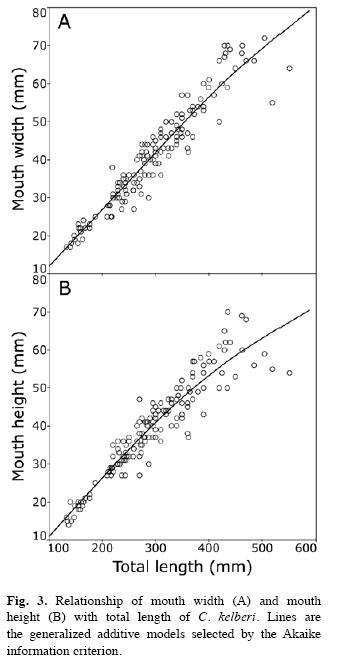
<body><![CDATA[and H<sub>M</sub>     with <span style="font-style: italic;">C. kelberi </span>L<sub>T</sub>     are best explained by a quadratic curve (<a href="#fig3">Fig. 3</a>). A     non-linear trend was found for W<sub>M</sub> (AIC; non-linear F<sub>1,153</sub>=8.49,     p=0.004) and H<sub>M</sub> (AIC, non-linear F<sub>1,154</sub>=23.92,     p&lt;0.001), indicating     that mouth proportions changed gradually with <span      style="font-style: italic;">C. kelberi </span>growth (e.g.     gradual allometry). The response curves also revealed that both W<sub>M</sub>     and     ]]></body>
<body><![CDATA[H<sub>M</sub> grow isometrically or even more rapidly than L<sub>T</sub>     for<span style="font-style: italic;"> C. kelberi</span>     smaller than 350-400mm, but not for larger individuals (<a href="#fig3">Fig.     3</a>).    <br>     <br> </span></font>     <div style="text-align: center;"><font size="2"><span      style="font-family: verdana;"><a name="fig3"></a><img alt=""      src="/img/revistas/rbt/v59n3/a25i3.jpg"      style="width: 343px; height: 659px;"></span></font><br     ]]></body>
<body><![CDATA[ style="font-family: verdana;">     <font size="2"><span style="font-family: verdana;"></span></font></div>     <font size="2"><br style="font-family: verdana;">     <span style="font-family: verdana; font-weight: bold;">Diet</span><br      style="font-family: verdana;">     <br style="font-family: verdana;">     <span style="font-family: verdana;">Of 254 stomachs examined, 119     (46.9%) had food contents, but only 44 (17.3%) con</span><span      style="font-family: verdana;">tained identified and quantified     items, with recognizable fishes being recorded in 35 stomachs (13.8%).     ]]></body>
<body><![CDATA[This high occurrence of empty stomachs was probably related to a high     gastric digestion together with low food consumption rate exhibited by     <span style="font-style: italic;">C. kelberi</span> in response to the     warm and oligotrophic conditions of Lajes     Reservoir. The diet consisted of 12 food items sorted into 5     categories: fishes, insects, fish eggs, crustaceans and plants (Table     2). Small fishes accounted for 87.4% IRI of overall diet, </span><span      style="font-family: verdana;">ranking in the following decreasing     order:<span style="font-style: italic;"> C. kelberi, Tilapia rendalli </span>(Boulenger     1897), <span style="font-style: italic;">Astyanax</span> spp.,     ]]></body>
<body><![CDATA[<span style="font-style: italic;">Oligosarcus hepsetus</span> (Cuvier     1829), <span style="font-style: italic;">Pimelodella eigenmanni</span>     (Boulenger     1891), <span style="font-style: italic;">Rhamdia quelen</span> (Quoy     &amp; Gaimard 1824) and <span style="font-style: italic;">Crenicichla     lacustris</span> (Castelnau 1855). Data on the two species of <span      style="font-style: italic;">Astyanax</span>     recorded for Lajes Reservoir (Ara&uacute;jo &amp; Santos 2001) -     <span style="font-style: italic;">Astyanax</span> cf. <span      style="font-style: italic;">bimaculatus </span>L. and <span     ]]></body>
<body><![CDATA[ style="font-style: italic;">Astyanax parahybae</span> Eigenmann, 1908     -     were pooled together because species recognition was often impossible.</span><br      style="font-family: verdana;">     <br style="font-family: verdana;">     <span style="font-family: verdana;">Cichlids were the major prey within     the fish category (80.1%IRI), and juveniles of <span      style="font-style: italic;">C. </span></span><span      style="font-family: verdana;"><span style="font-style: italic;">kelberi     </span>were the major prey fish     ]]></body>
<body><![CDATA[(54.2%IRI),indicating intense cannibalism.<span      style="font-style: italic;"> T. rendalli</span> was the second     most important item, while <span style="font-style: italic;">C.     lacustris</span> made a small contribution.     Characids accounted for 6.8%IRI, with <span style="font-style: italic;">Astyanax</span>     spp. being the most     important item of this group, whereas Heptapterids, especially <span      style="font-style: italic;">P.     eigenmanni</span>, contributed with only 0.5% for IIR. The remained     categories     ]]></body>
<body><![CDATA[amounted to 12.6% IRI, mainly nymphs and adults of Odonata (insects).     Gut analysis revealed only entire fishes in the <span      style="font-style: italic;">C. kelberi</span> stomachs and     that all prey had been reoriented after they were caught, to allow the     predator to swallow the head first and lying on their side.</span><br      style="font-family: verdana;">     <br style="font-family: verdana;">     <font size="3"><span style="font-family: verdana; font-weight: bold;">Discussion</span></font><br      style="font-family: verdana;">     <br style="font-family: verdana; font-style: italic;">     ]]></body>
<body><![CDATA[<span style="font-family: verdana;"><span style="font-style: italic;">Cichla     kelberi </span>was predominantly     piscivorous in Lajes Reservoir, agreeing well with the features of the     digestive tract structures. The orientation of the mouth is indicative     of the location of the prey relative to the predator (Gatz 1979) or to     the relative depth in the water-column at which feeding generally     occurs (Winemiller 1991). The mouth of <span      style="font-style: italic;">C. kelberi</span> is typical of fishes     that obtain food from the middle to upper layers of the water column or     in shallow littoral zones (Hugueny &amp; Pouilly 1999, Winemiller 2001,     ]]></body>
<body><![CDATA[Pouilly <span style="font-style: italic;">et al</span>. 2003).     Shallow-water littoral zone species (<span style="font-style: italic;">C.     kelberi,     T. rendalli</span>, <span style="font-style: italic;">C. lacustris</span>,     <span style="font-style: italic;">Astyanax</span> spp. and <span      style="font-style: italic;">O. hepsetus</span>) accounted for     87%IRI ofall food items and 99%IRI of prey fishes ingested by <span      style="font-style: italic;">C.     kelberi </span>in Lajes Reservoir, whereas benthic-deepwater fishes (<span      style="font-style: italic;">P.     ]]></body>
<body><![CDATA[eigenmanni </span>and <span style="font-style: italic;">R. quelen</span>)     accounted for only 0.5% and 1%IRI </span><span      style="font-family: verdana;">respectively. Williams <span      style="font-style: italic;">et al</span>.     (1998) reported a similar feeding habit for <span      style="font-style: italic;">Cichla orinocensis</span>     Humboldt, 1821 in Guri Reservoir, which foraged mostly in shallow,     structured habitats within littoral zone where <span      style="font-style: italic;">Crenicichla wallacii     </span>Regan, 1905, other cichlids, and the characid <span     ]]></body>
<body><![CDATA[ style="font-style: italic;">Hemigrammus micropterus</span>     Meek, 1907 were the dominant preys.</span><br      style="font-family: verdana;">     <br style="font-family: verdana;">     <span style="font-family: verdana;">The prognathous-protractile mouth     of <span style="font-style: italic;">C. kelberi </span>is related to     a mechanism of prey capture that uses a     flow of water generated by a rapid drop in buccal pressure created as     the buccal cavity rapidly expands (Wainwright <span      style="font-style: italic;">et al</span>. 2001).     ]]></body>
<body><![CDATA[Furthermore, the cardiform teeth (pre-maxillaries and pharyngeals) of     <span style="font-style: italic;">C. kelberi</span> are typical of     predatory species that swallow prey whole     with little evidence of mastication, the teeth functioning in prey     handling and preventing prey escape (Wootton 1999). Our results     indicated that<span style="font-style: italic;"> C. kelberi</span> is a     whole-fish swallower, agreeing with     previous assertions of Winemiller <span style="font-style: italic;">et     al</span>. (1997) and Jepsen <span style="font-style: italic;">et al</span>.     (1997) for three other <span style="font-style: italic;">Cichla</span>     ]]></body>
<body><![CDATA[species. Accord-ing to Gill (2003),     gape-size limited predators (such as <span style="font-style: italic;">C.     kelberi</span>) leads to a size range     of prey encompassing small prey at the lower limits of visual detection     or which are physically too small to be retained by gill rakers to     those at the upper limits, which are too large for the jaw apparatus.</span><br      style="font-family: verdana;">     <br style="font-family: verdana;">     <span style="font-family: verdana;">In <span      style="font-style: italic;">C. kelberi</span>, gill rakers were     ]]></body>
<body><![CDATA[found only at the first pair of arches, agreeing in number </span><span      style="font-family: verdana;">and shape with the general     descriptions of Kullander &amp; Ferreira (2006) for all species of the     genus <span style="font-style: italic;">Cichla</span>. According to     Lagler <span style="font-style: italic;">et al</span>. (1977), the     gill rakers of     piscivorous species are overall short, strong, sharp, and widely spaced     to avoid prey escaping or gill damaging. The gill rakers of <span      style="font-style: italic;">C. kelberi</span>     were, however, a rather longer-drawn and sharper than those found by     ]]></body>
<body><![CDATA[Liparelli (1999) for <span style="font-style: italic;">Cichla</span>     cf. <span style="font-style: italic;">ocellaris</span> (probably a     misidentification     of <span style="font-style: italic;">C. kelberi </span>or <span      style="font-style: italic;">Cichla piquiti</span>), which could     increase the     effectiveness of prey retention. Given the virtual lack of other     records in the literature, bi and trifurcated gill rakers are expected     to be not a common characteristic in piscivorous fish, but they     occurred in <span style="font-style: italic;">C. kelberi</span>.     ]]></body>
<body><![CDATA[Nevertheless, furcated rakers arising as small     hooks from the main raker are related to increased food intake by     planktivorous fishes (Lazzaro 1987). Bi and trifurcated rakers can not     be related to food filtration in the piscivorous <span      style="font-style: italic;">C. kelberi</span>, but they     might enhance the effectiveness of prey retention in the     resource-limited Lajes Reservoir or even help in the protection of gill     filaments. The high occurrence of empty stomachs indicates that <span      style="font-style: italic;">C.     kelberi</span> probably experiences some sort of food deprivation in     ]]></body>
<body><![CDATA[Lajes     Reservoir but further research are necessary to </span><span      style="font-family: verdana;">make clear whether morphological     differentiation in <span style="font-style: italic;">C. kelberi </span>rakers     are merely related to genetic or     phenotypic anomalies by chance or effectively bring ecological     advantages to the predator (e.g. improved prey retention or gill     protection). </span><br style="font-family: verdana;">     <br style="font-family: verdana;">     <span style="font-family: verdana;">Overall the morphology of the     ]]></body>
<body><![CDATA[stomach and intestine of<span style="font-style: italic;"> C. kelberi </span>(e.g.     the short diges</span><span style="font-family: verdana;">tive tract,     the muscular and     elastic stomach, and the short intestine) matched with general     descriptions for carnivorous fish. The size and distention of the     stomach are constrained by the space available in the abdominal cavity     of the predator (Gill 2003), which can strongly limit the size and the     quantity of prey ingested (Hahn <span style="font-style: italic;">et al</span>.     2000, Nilsson &amp;     Br&ouml;nmark 2000). Stomach size increased isometricaly in relation to<span     ]]></body>
<body><![CDATA[ style="font-style: italic;">     C. kelberi&#8217;</span>s body size, allowing the ingestion of larger prey     with     growth. However, the </span><span style="font-family: verdana;">stomach     size could be constraining     the ingestion of large prey for larger <span      style="font-style: italic;">C. kelberi</span>, since adult     individuals (ca. &gt;300mm L<sub>T</sub>), may have space restrictions     in the     abdominal cavity due to the increased gonadal volume during     ]]></body>
<body><![CDATA[reproductive period (Souza <span style="font-style: italic;">et al</span>.     2008, Gomiero<span style="font-style: italic;"> et al</span>. 2009).</span><br      style="font-family: verdana;">     <br style="font-family: verdana;">     <span style="font-family: verdana;">The length of the intestine is     associated with rates of food intake, and differences in intestine size     are related to alterations in the food absorption surface (Pouilly <span      style="font-style: italic;">et     al</span>. 2003). Overall the intestine is shorter in carnivores than     herbivore or omnivore species. The values of the intestinal quotient     ]]></body>
<body><![CDATA[(I<sub>Q</sub>), between 0.38 and 1.12 for <span      style="font-style: italic;">C. kelberi</span>, were similar to those     proposed by Bertin (1958) for carnivorous fish (0.2 to 2.5) and close     to those found by Pouilly <span style="font-style: italic;">et al</span>.     (2003) for neotropical piscivores     (0.93 to 1.23). Low values of I<sub>Q</sub> can occur because of the     existence of     traits, as pharyngeal teeth and/or strong digestive enzymes, which play     important roles in digestion. Basile-Martins <span      style="font-style: italic;">et al</span>. (1986) recorded an     ]]></body>
<body><![CDATA[increasingly carnivorous diet for <span style="font-style: italic;">Pimelodus     maculatus</span> Lacep&egrave;de,     1803 according to its ontogenetic development, which coincided with a     gradual decrease in I<sub>Q </sub>values. As the L<sub>I</sub> grew     isometrically with the L<sub>T</sub>     in <span style="font-style: italic;">C. kelberi</span>, I<sub>Q</sub>     values did not change through the ontogeny of the     predator, indicating that <span style="font-style: italic;">C. kelberi</span>     experienced negligible alterations     in diet composition during growth.</span><br     ]]></body>
<body><![CDATA[ style="font-family: verdana;">     <br style="font-family: verdana;">     <span style="font-family: verdana;">Our study is probably the first to     combine description of feeding patterns with regres</span><span      style="font-family: verdana;">sions models fitted to     morphological attributes to investigate the trophic morphology of <span      style="font-style: italic;">C.     kelberi</span>. Hill <span style="font-style: italic;">et al</span>.     (2004) and Hoeinghaus <span style="font-style: italic;">et al</span>.     (2006) modelled the     ]]></body>
<body><![CDATA[relationships of gape size (e.g. W<sub>M</sub> or H<sub>M</sub>) with     body length for other     peacock bass species, also examining their major implications on prey     consumption. However, these studies did not provide any information on     whether mouth proportions increased with body growth (e.g.     isometrically or allometrically) or if changes in those morphometric     characters were related to life history thresholds. Rather than     indicating that mouth proportions changed gradually with <span      style="font-style: italic;">C. kelberi</span>     growth, the non-linear relationships found for W<sub>M</sub> and H<sub>M</sub>     ]]></body>
<body><![CDATA[in our study,     argues on the need of further research to address whether such     morphometric changes would be coupled with transitions on prey     consumption. Nevertheless, if our findings would be further compared     with those from other native or introduced populations of <span      style="font-style: italic;">C. kelberi</span>,     they would be an interesting opportunity to test whether morphological     features related to feeding will change with the particular </span><span      style="font-family: verdana;">conditions of the ecosystem (i.e.     trophic status, limnological characteristics, habitat complexity and     ]]></body>
<body><![CDATA[the amount and quality of preys).</span><br      style="font-family: verdana;">     <br style="font-family: verdana;">     <font size="3"><span style="font-family: verdana; font-weight: bold;">Acknowledgments</span></font><br      style="font-family: verdana;">     <br style="font-family: verdana;">     <span style="font-family: verdana;">We were grateful to LiGHT Services     of Electricity S.A for logistic support. This work was partially funded     by Brazilian Agency for Research Development (CNPq), Brazilian Ministry     of Education Coordination for Personal Training (CAPES) and LIGHT     ]]></body>
<body><![CDATA[Services of Electricity S.A. This study is part of the Alejandra     Santos&#8217; M.Sc. dissertation (Graduate Course in Animal Biology, Federal     Rural University of Rio de Janeiro).</span><br      style="font-family: verdana;">     <font size="3"><span style="font-family: verdana; font-weight: bold;"></span></font></font>     <hr style="width: 100%; height: 2px;"><font size="2"><font size="3"><span      style="font-family: verdana; font-weight: bold;">References </span></font>     <br style="font-family: verdana;">     <br style="font-family: verdana;">     <span style="font-family: verdana;">Ara&uacute;jo, F.G. &amp; L.N.     ]]></body>
<body><![CDATA[Santos. 2001. Distribution and composition of fish assemblages in Lajes     <!-- ref -->Reservoir, Rio de Janeiro, Brazil. Rev. Bras. Biol. 61: 563-576.    &nbsp;&nbsp;&nbsp;&nbsp;&nbsp;&nbsp;&nbsp;&nbsp;[&#160;<a href="javascript:void(0);" onclick="javascript: window.open('/scielo.php?script=sci_nlinks&ref=1728493&pid=S0034-7744201100030002500001&lng=','','width=640,height=500,resizable=yes,scrollbars=1,menubar=yes,');">Links</a>&#160;]<!-- end-ref --><!-- ref --></span><br  style="font-family: verdana;"> <br style="font-family: verdana;"> <span style="font-family: verdana;">Basile-Martins, M.A., M.N. Cipoli &amp; H.M. Godinho. 1986. Alimenta&ccedil;&atilde;o do mandi, <span  style="font-style: italic;">Pimelodus maculatus</span> Lacepede, 1803, (Osteichthyes, Pimelodidae), de trechos dos rios Jaguari e Piracicaba, S&atilde;o Paulo - Brasil. Bol. inst. Pesca 13: 17-29.    &nbsp;&nbsp;&nbsp;&nbsp;&nbsp;&nbsp;&nbsp;&nbsp;[&#160;<a href="javascript:void(0);" onclick="javascript: window.open('/scielo.php?script=sci_nlinks&ref=1728494&pid=S0034-7744201100030002500002&lng=','','width=640,height=500,resizable=yes,scrollbars=1,menubar=yes,');">Links</a>&#160;]<!-- end-ref --><!-- ref --></span><br style="font-family: verdana;"> <br style="font-family: verdana;"> <span style="font-family: verdana;">Bergmann, G.T. &amp; P.J. Motta. 2005. Diet and morphology through ontogeny of the nonindigenous Mayan cichlid <span style="font-style: italic;">&#8216;Cichlasoma</span> (Nandopsis)&#8217; <span style="font-style: italic;">urophthalmus</span> (G&uuml;nther 1862) in southern Florida. Environ. Biol. Fish. 75: 205-211.    &nbsp;&nbsp;&nbsp;&nbsp;&nbsp;&nbsp;&nbsp;&nbsp;[&#160;<a href="javascript:void(0);" onclick="javascript: window.open('/scielo.php?script=sci_nlinks&ref=1728495&pid=S0034-7744201100030002500003&lng=','','width=640,height=500,resizable=yes,scrollbars=1,menubar=yes,');">Links</a>&#160;]<!-- end-ref --><!-- ref --></span><br  style="font-family: verdana;"> <br style="font-family: verdana;"> <span style="font-family: verdana;">Bertin, L. 1958. Trait&eacute; de Zoologie. Chapter 8, Appareil digestif. Masson, Paris.    &nbsp;&nbsp;&nbsp;&nbsp;&nbsp;&nbsp;&nbsp;&nbsp;[&#160;<a href="javascript:void(0);" onclick="javascript: window.open('/scielo.php?script=sci_nlinks&ref=1728496&pid=S0034-7744201100030002500004&lng=','','width=640,height=500,resizable=yes,scrollbars=1,menubar=yes,');">Links</a>&#160;]<!-- end-ref --><br>     <!-- ref --><br> Burnham, K.P. &amp; D.R. Anderson. 1998. Model selection and inference. Springer-Verlag, New York, New York, USA.    &nbsp;&nbsp;&nbsp;&nbsp;&nbsp;&nbsp;&nbsp;&nbsp;[&#160;<a href="javascript:void(0);" onclick="javascript: window.open('/scielo.php?script=sci_nlinks&ref=1728498&pid=S0034-7744201100030002500005&lng=','','width=640,height=500,resizable=yes,scrollbars=1,menubar=yes,');">Links</a>&#160;]<!-- end-ref --><!-- ref --></span><br  style="font-family: verdana;"> <br style="font-family: verdana;"> <span style="font-family: verdana;">Cochran-Biederman, J.L. &amp; K.O. Winemiller. 2010. Relationships among habitat, ecomorphology and diets of cichlids in the Bladen River, Belize. Environ. Biol. Fish. 88: 143-152.    &nbsp;&nbsp;&nbsp;&nbsp;&nbsp;&nbsp;&nbsp;&nbsp;[&#160;<a href="javascript:void(0);" onclick="javascript: window.open('/scielo.php?script=sci_nlinks&ref=1728499&pid=S0034-7744201100030002500006&lng=','','width=640,height=500,resizable=yes,scrollbars=1,menubar=yes,');">Links</a>&#160;]<!-- end-ref --><!-- ref --></span><br style="font-family: verdana;"> <br style="font-family: verdana;"> <span style="font-family: verdana;">Esp&iacute;nola, L.A., C.V. Minte-Vera &amp; H.F. J&uacute;lio-J&uacute;nior. 2009. Invasibility of reservoirs in the Paran&aacute; Basin, Brazil, to<span  style="font-style: italic;"> Cichla kelberi</span> Kullander and Ferreira. Biol. invasions 12: 1873-1888.    &nbsp;&nbsp;&nbsp;&nbsp;&nbsp;&nbsp;&nbsp;&nbsp;[&#160;<a href="javascript:void(0);" onclick="javascript: window.open('/scielo.php?script=sci_nlinks&ref=1728500&pid=S0034-7744201100030002500007&lng=','','width=640,height=500,resizable=yes,scrollbars=1,menubar=yes,');">Links</a>&#160;]<!-- end-ref --><!-- ref --></span><br  style="font-family: verdana;"> <br style="font-family: verdana;"> <span style="font-family: verdana;">Fugi, R., K.D.G. Luz-Agostinho &amp; A.A. Agostinho. 2008. Trophic interaction between an introduced (peacock bass) and a native (dogfish) piscivorous fish in a Neotropical impounded river. Hydrobiology 607: 143-150.    &nbsp;&nbsp;&nbsp;&nbsp;&nbsp;&nbsp;&nbsp;&nbsp;[&#160;<a href="javascript:void(0);" onclick="javascript: window.open('/scielo.php?script=sci_nlinks&ref=1728501&pid=S0034-7744201100030002500008&lng=','','width=640,height=500,resizable=yes,scrollbars=1,menubar=yes,');">Links</a>&#160;]<!-- end-ref --><!-- ref --></span><br  style="font-family: verdana;"> <br style="font-family: verdana;"> <span style="font-family: verdana;">Garc&iacute;a-Berthou, E. 2007. The characteristics of invasive fishes: what has been learned so far? J. Fish. Biol. 71: 1-23.    &nbsp;&nbsp;&nbsp;&nbsp;&nbsp;&nbsp;&nbsp;&nbsp;[&#160;<a href="javascript:void(0);" onclick="javascript: window.open('/scielo.php?script=sci_nlinks&ref=1728502&pid=S0034-7744201100030002500009&lng=','','width=640,height=500,resizable=yes,scrollbars=1,menubar=yes,');">Links</a>&#160;]<!-- end-ref --><!-- ref --></span><br style="font-family: verdana;"> <br style="font-family: verdana;"> <span style="font-family: verdana;">Gatz, A.J. 1979. Community organization in fishes as indicated by morphological features. Ecology 60: 711-718.    &nbsp;&nbsp;&nbsp;&nbsp;&nbsp;&nbsp;&nbsp;&nbsp;[&#160;<a href="javascript:void(0);" onclick="javascript: window.open('/scielo.php?script=sci_nlinks&ref=1728503&pid=S0034-7744201100030002500010&lng=','','width=640,height=500,resizable=yes,scrollbars=1,menubar=yes,');">Links</a>&#160;]<!-- end-ref --><!-- ref --></span><br style="font-family: verdana;"> <br style="font-family: verdana;"> <span style="font-family: verdana;">Gill, A.B. 2003. The dynamics of prey choice in fish: the importance of prey size and satiation. J. Fish. Biol. 63: 105-116.    &nbsp;&nbsp;&nbsp;&nbsp;&nbsp;&nbsp;&nbsp;&nbsp;[&#160;<a href="javascript:void(0);" onclick="javascript: window.open('/scielo.php?script=sci_nlinks&ref=1728504&pid=S0034-7744201100030002500011&lng=','','width=640,height=500,resizable=yes,scrollbars=1,menubar=yes,');">Links</a>&#160;]<!-- end-ref --><!-- ref --></span><br style="font-family: verdana;"> <br style="font-family: verdana;"> <span style="font-family: verdana;">Gomiero, L.M., G.A. Villares Junior &amp; F. Naous. 2009. Reproduction of <span style="font-style: italic;">Cichla kelberi</span> Kullander and Ferreira, 2006 introduced into an artificial lake in Southeastern Brazil. Braz. J. Biol. 69: 175-183.    &nbsp;&nbsp;&nbsp;&nbsp;&nbsp;&nbsp;&nbsp;&nbsp;[&#160;<a href="javascript:void(0);" onclick="javascript: window.open('/scielo.php?script=sci_nlinks&ref=1728505&pid=S0034-7744201100030002500012&lng=','','width=640,height=500,resizable=yes,scrollbars=1,menubar=yes,');">Links</a>&#160;]<!-- end-ref --><!-- ref --></span><br  style="font-family: verdana;"> <br style="font-family: verdana;"> <span style="font-family: verdana;">Gordon, A.K. &amp; I.R Bills. 1999. Aspects of the feeding and reproductive biology of the Lake Tanganyikan cichlid, <span style="font-style: italic;">Lamprologus ornatipinnis</span> (Pisces, Cichlidae). Environ. Biol. Fish. 55: 431-441.    &nbsp;&nbsp;&nbsp;&nbsp;&nbsp;&nbsp;&nbsp;&nbsp;[&#160;<a href="javascript:void(0);" onclick="javascript: window.open('/scielo.php?script=sci_nlinks&ref=1728506&pid=S0034-7744201100030002500013&lng=','','width=640,height=500,resizable=yes,scrollbars=1,menubar=yes,');">Links</a>&#160;]<!-- end-ref --><!-- ref --></span><br style="font-family: verdana;"> <br style="font-family: verdana;"> <span style="font-family: verdana;">Gra&ccedil;a, W.J. &amp; C.S. Pavanelli. 2007. Peixes da plan&iacute;cie de inunda&ccedil;&atilde;o do alto Rio Paran&aacute; e &aacute;reas adjacentes. EDUEM, Maring&aacute;, Paran&aacute;, Brazil.    &nbsp;&nbsp;&nbsp;&nbsp;&nbsp;&nbsp;&nbsp;&nbsp;[&#160;<a href="javascript:void(0);" onclick="javascript: window.open('/scielo.php?script=sci_nlinks&ref=1728507&pid=S0034-7744201100030002500014&lng=','','width=640,height=500,resizable=yes,scrollbars=1,menubar=yes,');">Links</a>&#160;]<!-- end-ref --><!-- ref --> </span><br  style="font-family: verdana;"> <br style="font-family: verdana;"> <span style="font-family: verdana;">Guarino, A.W.S., C.W.C. Branco, G.P. Diniz &amp; R. Rocha. 2005. Limnological characteristics of an old tropical reservoir (Ribeir&atilde;o das Lajes Reservoir, RJ, Brazil). Acta Limnol. Bras. 17: 129-141.    &nbsp;&nbsp;&nbsp;&nbsp;&nbsp;&nbsp;&nbsp;&nbsp;[&#160;<a href="javascript:void(0);" onclick="javascript: window.open('/scielo.php?script=sci_nlinks&ref=1728508&pid=S0034-7744201100030002500015&lng=','','width=640,height=500,resizable=yes,scrollbars=1,menubar=yes,');">Links</a>&#160;]<!-- end-ref --><!-- ref --></span><br style="font-family: verdana;"> <br style="font-family: verdana;"> <span style="font-family: verdana;">Hahn, N.S., R.L. Delariva &amp; V.E. Loureiro. 2000. Feeding of <span style="font-style: italic;">Acestrorhynchus lacustris</span> (Characidae): a postimpoundment studies on itaip&uacute; Reservoir, Upper Paran&aacute; River, PR. Braz. Arch. Biol. Tecnol. 43: 207-213.    &nbsp;&nbsp;&nbsp;&nbsp;&nbsp;&nbsp;&nbsp;&nbsp;[&#160;<a href="javascript:void(0);" onclick="javascript: window.open('/scielo.php?script=sci_nlinks&ref=1728509&pid=S0034-7744201100030002500016&lng=','','width=640,height=500,resizable=yes,scrollbars=1,menubar=yes,');">Links</a>&#160;]<!-- end-ref --><!-- ref --></span><br  style="font-family: verdana;"> <br style="font-family: verdana;"> <span style="font-family: verdana;">Hellig, C.J., M. Kerschbaumer, K.M. Sefc &amp; S. Koblm&uuml;ller. 2010. Allometric shape change of the lower pharyngeal jaw correlates with a dietary shift to piscivory in a cichlid fish. Naturwissenschaften 97: 663-672.    &nbsp;&nbsp;&nbsp;&nbsp;&nbsp;&nbsp;&nbsp;&nbsp;[&#160;<a href="javascript:void(0);" onclick="javascript: window.open('/scielo.php?script=sci_nlinks&ref=1728510&pid=S0034-7744201100030002500017&lng=','','width=640,height=500,resizable=yes,scrollbars=1,menubar=yes,');">Links</a>&#160;]<!-- end-ref --><!-- ref --></span><br  style="font-family: verdana;"> <br style="font-family: verdana;"> <span style="font-family: verdana;">Hill, J.E., L.G. Nico, C.E. Cichra &amp; C.R. Gilbert. 2004. Prey vulnerability to peacock cichlids and largemouth bass based on predator gape and prey body depth. Proc. Annu. Conf. Southeast Assoc. Fish. and Wildl. Agencies 58: 47-56.    &nbsp;&nbsp;&nbsp;&nbsp;&nbsp;&nbsp;&nbsp;&nbsp;[&#160;<a href="javascript:void(0);" onclick="javascript: window.open('/scielo.php?script=sci_nlinks&ref=1728511&pid=S0034-7744201100030002500018&lng=','','width=640,height=500,resizable=yes,scrollbars=1,menubar=yes,');">Links</a>&#160;]<!-- end-ref --><!-- ref --></span><br  style="font-family: verdana;"> <br style="font-family: verdana;"> <span style="font-family: verdana;">Hoeinghaus, D.J., K.O. Winemiller, C.A. Layman, D.A. Arrington &amp; D.B. Jepsen. 2006. Effects of seasonality and migratory prey on body condition of <span  style="font-style: italic;">Cichla</span> species in a tropical floodplain river. Ecol. Fresh. Fish. 15: 398-407.    &nbsp;&nbsp;&nbsp;&nbsp;&nbsp;&nbsp;&nbsp;&nbsp;[&#160;<a href="javascript:void(0);" onclick="javascript: window.open('/scielo.php?script=sci_nlinks&ref=1728512&pid=S0034-7744201100030002500019&lng=','','width=640,height=500,resizable=yes,scrollbars=1,menubar=yes,');">Links</a>&#160;]<!-- end-ref --><!-- ref --></span><br  style="font-family: verdana;"> <br style="font-family: verdana;"> <span style="font-family: verdana;">Hugueny, B. &amp; M. Pouilly. 1999. Morphological correlates of diet in an assemblage of West African freshwater fishes. J. Fish. Biol. 54: 1310-1325.    &nbsp;&nbsp;&nbsp;&nbsp;&nbsp;&nbsp;&nbsp;&nbsp;[&#160;<a href="javascript:void(0);" onclick="javascript: window.open('/scielo.php?script=sci_nlinks&ref=1728513&pid=S0034-7744201100030002500020&lng=','','width=640,height=500,resizable=yes,scrollbars=1,menubar=yes,');">Links</a>&#160;]<!-- end-ref --><!-- ref --></span><br  style="font-family: verdana;"> <br style="font-family: verdana;"> <span style="font-family: verdana;">Jepsen, D.B., K.O. Winemiller &amp; D.C. Taphorn. 1997. Temporal patterns of resource partitioning among <span style="font-style: italic;">Cichla</span> species in a Venezuelan blackwater river. J. Fish. Biol. 51: 1085-1108.    &nbsp;&nbsp;&nbsp;&nbsp;&nbsp;&nbsp;&nbsp;&nbsp;[&#160;<a href="javascript:void(0);" onclick="javascript: window.open('/scielo.php?script=sci_nlinks&ref=1728514&pid=S0034-7744201100030002500021&lng=','','width=640,height=500,resizable=yes,scrollbars=1,menubar=yes,');">Links</a>&#160;]<!-- end-ref --><!-- ref --></span><br style="font-family: verdana;"> <br style="font-family: verdana;"> <span style="font-family: verdana;">Keast, A. &amp; D. Webb. 1966. Mouth and body form relative to feeding ecology in the fish fauna of a small lake, Lake Opinicon, Ontario. J. Fish. Res. Board. Can. 23: 1845-1874.    &nbsp;&nbsp;&nbsp;&nbsp;&nbsp;&nbsp;&nbsp;&nbsp;[&#160;<a href="javascript:void(0);" onclick="javascript: window.open('/scielo.php?script=sci_nlinks&ref=1728515&pid=S0034-7744201100030002500022&lng=','','width=640,height=500,resizable=yes,scrollbars=1,menubar=yes,');">Links</a>&#160;]<!-- end-ref --><!-- ref --></span><br style="font-family: verdana;"> <br style="font-family: verdana;"> <span style="font-family: verdana;">Kov&aacute;&#269;, V., G.H. Copp &amp; M.P. Francis. 1999. Morphometry of the stone loach, <span  style="font-style: italic;">Barbatula barbatula:</span> do mensural characters reflect the species&#8217; life history thresholds? Environ. Biol. Fish. 56: 105-115.    &nbsp;&nbsp;&nbsp;&nbsp;&nbsp;&nbsp;&nbsp;&nbsp;[&#160;<a href="javascript:void(0);" onclick="javascript: window.open('/scielo.php?script=sci_nlinks&ref=1728516&pid=S0034-7744201100030002500023&lng=','','width=640,height=500,resizable=yes,scrollbars=1,menubar=yes,');">Links</a>&#160;]<!-- end-ref --><!-- ref --></span><br  style="font-family: verdana;"> <br style="font-family: verdana;"> <span style="font-family: verdana;">Kullander, S.O. &amp; E.J.G. Ferreira. 2006. A review of the South American cichlid genus <span  style="font-style: italic;">Cichla</span>, with descriptions of nine new species (Teleostei: Cichlidae) Ichthyol. Expl. Fresh. 17: 289-398.    &nbsp;&nbsp;&nbsp;&nbsp;&nbsp;&nbsp;&nbsp;&nbsp;[&#160;<a href="javascript:void(0);" onclick="javascript: window.open('/scielo.php?script=sci_nlinks&ref=1728517&pid=S0034-7744201100030002500024&lng=','','width=640,height=500,resizable=yes,scrollbars=1,menubar=yes,');">Links</a>&#160;]<!-- end-ref --><!-- ref --></span><br style="font-family: verdana;"> <br style="font-family: verdana;"> <span style="font-family: verdana;">Lagler, K.F., J.E. Bardach, R.R. Miller &amp; D.R.M. Passino. 1977. Ichthyology. Wiley &amp; Sons, New York, New York, USA.    &nbsp;&nbsp;&nbsp;&nbsp;&nbsp;&nbsp;&nbsp;&nbsp;[&#160;<a href="javascript:void(0);" onclick="javascript: window.open('/scielo.php?script=sci_nlinks&ref=1728518&pid=S0034-7744201100030002500025&lng=','','width=640,height=500,resizable=yes,scrollbars=1,menubar=yes,');">Links</a>&#160;]<!-- end-ref --><!-- ref --> </span><br style="font-family: verdana;"> <br style="font-family: verdana;"> <span style="font-family: verdana;">Latini, A.O. &amp; M. Petrere Jr. 2004. Reduction of a native fish fauna by alien species: an example from Brazilian freshwater tropical lakes. Fish. Man. Ecol. 11: 71-79.    &nbsp;&nbsp;&nbsp;&nbsp;&nbsp;&nbsp;&nbsp;&nbsp;[&#160;<a href="javascript:void(0);" onclick="javascript: window.open('/scielo.php?script=sci_nlinks&ref=1728519&pid=S0034-7744201100030002500026&lng=','','width=640,height=500,resizable=yes,scrollbars=1,menubar=yes,');">Links</a>&#160;]<!-- end-ref --><!-- ref --></span><br  style="font-family: verdana;"> <br style="font-family: verdana;"> <span style="font-family: verdana;">Lazzaro, X. 1987. A review of planktivorous fishes: their evolution, feeding, behaviours, selectivities and impacts. Hydrobiology 146: 97-167.    &nbsp;&nbsp;&nbsp;&nbsp;&nbsp;&nbsp;&nbsp;&nbsp;[&#160;<a href="javascript:void(0);" onclick="javascript: window.open('/scielo.php?script=sci_nlinks&ref=1728520&pid=S0034-7744201100030002500027&lng=','','width=640,height=500,resizable=yes,scrollbars=1,menubar=yes,');">Links</a>&#160;]<!-- end-ref --><!-- ref --></span><br  style="font-family: verdana;"> <br style="font-family: verdana;"> <span style="font-family: verdana;">Lep&#353;, J. &amp; P. &#352;milauer. 2003. Multivariate analysis of ecological data using CANOCO. Cambridge, Cambridge, United Kingdom.    &nbsp;&nbsp;&nbsp;&nbsp;&nbsp;&nbsp;&nbsp;&nbsp;[&#160;<a href="javascript:void(0);" onclick="javascript: window.open('/scielo.php?script=sci_nlinks&ref=1728521&pid=S0034-7744201100030002500028&lng=','','width=640,height=500,resizable=yes,scrollbars=1,menubar=yes,');">Links</a>&#160;]<!-- end-ref --><!-- ref --></span><br style="font-family: verdana;"> <br style="font-family: verdana;"> <span style="font-family: verdana;">Liparelli, T. 1999. Hist&oacute;ria natural do tucunar&eacute; <span style="font-style: italic;">Cichla</span> cf. <span style="font-style: italic;">ocellaris </span>(Teleostei, Cichlidae) no Rio Piquir&iacute;, Pantanal de Paiagu&aacute;s, Estado do Mato Grosso do Sul. Dissertation, Universidade Estadual Paulista, S&atilde;o Paulo, Brazil.    &nbsp;&nbsp;&nbsp;&nbsp;&nbsp;&nbsp;&nbsp;&nbsp;[&#160;<a href="javascript:void(0);" onclick="javascript: window.open('/scielo.php?script=sci_nlinks&ref=1728522&pid=S0034-7744201100030002500029&lng=','','width=640,height=500,resizable=yes,scrollbars=1,menubar=yes,');">Links</a>&#160;]<!-- end-ref --><!-- ref --></span><br style="font-family: verdana;"> <br style="font-family: verdana;"> <span style="font-family: verdana;">Nilsson, P.A. &amp; C. Br&ouml;nmark. 2000. Prey vulnerability to a gape-size limited predator: behavioural and morphological impacts on northern pike piscivory. Oikos 88: 539-546.    &nbsp;&nbsp;&nbsp;&nbsp;&nbsp;&nbsp;&nbsp;&nbsp;[&#160;<a href="javascript:void(0);" onclick="javascript: window.open('/scielo.php?script=sci_nlinks&ref=1728523&pid=S0034-7744201100030002500030&lng=','','width=640,height=500,resizable=yes,scrollbars=1,menubar=yes,');">Links</a>&#160;]<!-- end-ref --><!-- ref --></span><br style="font-family: verdana;"> <br style="font-family: verdana;"> <span style="font-family: verdana;">Piet, G.J. 1998. Ecomorphology of a size-structured tropical freshwater fish community. Environ. Biol. Fish.51: 67-86.    &nbsp;&nbsp;&nbsp;&nbsp;&nbsp;&nbsp;&nbsp;&nbsp;[&#160;<a href="javascript:void(0);" onclick="javascript: window.open('/scielo.php?script=sci_nlinks&ref=1728524&pid=S0034-7744201100030002500031&lng=','','width=640,height=500,resizable=yes,scrollbars=1,menubar=yes,');">Links</a>&#160;]<!-- end-ref --><!-- ref --></span><br style="font-family: verdana;"> <br style="font-family: verdana;"> <span style="font-family: verdana;">Pinkas, L., M.S. Oliphant, I.L.K. Iverson. 1971. Food habits of albacore, bluefin tuna, and bonito in California waters. Calif. Dept. Fish. Game Fish. Bull. 152: 1-105.    &nbsp;&nbsp;&nbsp;&nbsp;&nbsp;&nbsp;&nbsp;&nbsp;[&#160;<a href="javascript:void(0);" onclick="javascript: window.open('/scielo.php?script=sci_nlinks&ref=1728525&pid=S0034-7744201100030002500032&lng=','','width=640,height=500,resizable=yes,scrollbars=1,menubar=yes,');">Links</a>&#160;]<!-- end-ref --><!-- ref --> </span><br  style="font-family: verdana;"> <br style="font-family: verdana;"> <span style="font-family: verdana;">Pouilly, M., F. Lino, J.G. Bretenoux &amp; C. Rosales. 2003. Dietary morphological relationships in a fish assemblage of the Bolivian Amazonian floodplain. J. Fish. Biol. 62: 1137-1158.    &nbsp;&nbsp;&nbsp;&nbsp;&nbsp;&nbsp;&nbsp;&nbsp;[&#160;<a href="javascript:void(0);" onclick="javascript: window.open('/scielo.php?script=sci_nlinks&ref=1728526&pid=S0034-7744201100030002500033&lng=','','width=640,height=500,resizable=yes,scrollbars=1,menubar=yes,');">Links</a>&#160;]<!-- end-ref --><!-- ref --></span><br style="font-family: verdana;"> <br style="font-family: verdana;"> <span style="font-family: verdana;">Santos, A.F.G.N., L.N. Santos, F.G. Ara&uacute;jo. 2004. Water level influences on body condition of <span style="font-style: italic;">Geophagus brasiliensis</span> (Perciformes, Cichlidae) in a Brazilian oligotrophic reservoir. Neot. Ichthyol. 2: 151-156.    &nbsp;&nbsp;&nbsp;&nbsp;&nbsp;&nbsp;&nbsp;&nbsp;[&#160;<a href="javascript:void(0);" onclick="javascript: window.open('/scielo.php?script=sci_nlinks&ref=1728527&pid=S0034-7744201100030002500034&lng=','','width=640,height=500,resizable=yes,scrollbars=1,menubar=yes,');">Links</a>&#160;]<!-- end-ref --><!-- ref --></span><br  style="font-family: verdana;"> <br style="font-family: verdana;"> <span style="font-family: verdana;">Santos, A.F.G.N., L.N. Santos, E. Garc&iacute;a-Berthou &amp; C. Hayashi. 2009. Could native predators help to control invasive fishes? Microcosm experiments with the Neotropical characid <span style="font-style: italic;">Brycon orbignyanus</span>. Ecol. Fresh. Fish. 18: 491-499.    &nbsp;&nbsp;&nbsp;&nbsp;&nbsp;&nbsp;&nbsp;&nbsp;[&#160;<a href="javascript:void(0);" onclick="javascript: window.open('/scielo.php?script=sci_nlinks&ref=1728528&pid=S0034-7744201100030002500035&lng=','','width=640,height=500,resizable=yes,scrollbars=1,menubar=yes,');">Links</a>&#160;]<!-- end-ref --><!-- ref --></span><br  style="font-family: verdana;"> <br style="font-family: verdana;"> <span style="font-family: verdana;">Santos, L.N., A.F. Gonzalez &amp; F.G. Ara&uacute;jo. 2001. Dieta do tucunar&eacute;-amarelo <span  style="font-style: italic;">Cichla monoculus</span> (Bloch &amp; Schneider) (Osteichthyes, Cichlidae), no Reservat&oacute;rio de Lajes, Rio de Janeiro, Brasil. Rev. Bras. Zool. 18: 191-204.    &nbsp;&nbsp;&nbsp;&nbsp;&nbsp;&nbsp;&nbsp;&nbsp;[&#160;<a href="javascript:void(0);" onclick="javascript: window.open('/scielo.php?script=sci_nlinks&ref=1728529&pid=S0034-7744201100030002500036&lng=','','width=640,height=500,resizable=yes,scrollbars=1,menubar=yes,');">Links</a>&#160;]<!-- end-ref --><!-- ref --></span><br style="font-family: verdana;"> <br style="font-family: verdana;"> <span style="font-family: verdana;">Santos, L.N., F.G. Ara&uacute;jo &amp; D.S. Brotto. 2008. Artificial structures as tools for fish habitat rehabilitation in a Neotropical reservoir. Aquat. Cons. 18: 896-908.    &nbsp;&nbsp;&nbsp;&nbsp;&nbsp;&nbsp;&nbsp;&nbsp;[&#160;<a href="javascript:void(0);" onclick="javascript: window.open('/scielo.php?script=sci_nlinks&ref=1728530&pid=S0034-7744201100030002500037&lng=','','width=640,height=500,resizable=yes,scrollbars=1,menubar=yes,');">Links</a>&#160;]<!-- end-ref --><!-- ref --></span><br style="font-family: verdana;"> <br style="font-family: verdana;"> <span style="font-family: verdana;">Sokal, R.R. &amp; F.J. Rohlf. 1995. Biometry. W.H. Freeman &amp; Company, New York, USA.    &nbsp;&nbsp;&nbsp;&nbsp;&nbsp;&nbsp;&nbsp;&nbsp;[&#160;<a href="javascript:void(0);" onclick="javascript: window.open('/scielo.php?script=sci_nlinks&ref=1728531&pid=S0034-7744201100030002500038&lng=','','width=640,height=500,resizable=yes,scrollbars=1,menubar=yes,');">Links</a>&#160;]<!-- end-ref --><!-- ref --></span><br  style="font-family: verdana;"> <br style="font-family: verdana;"> <span style="font-family: verdana;">Souza, J.E., E.N. Fragoso-Moura, N. Fenerich-Verani, O. Rocha &amp; Jr. Verani. 2008. Population structure and reproductive biology of <span style="font-style: italic;">Cichla kelberi</span> (Perciformes, Cichlidae) in Lobo Reservoir, Brazil. Neot. Ichthyol. 6: 201-210.    &nbsp;&nbsp;&nbsp;&nbsp;&nbsp;&nbsp;&nbsp;&nbsp;[&#160;<a href="javascript:void(0);" onclick="javascript: window.open('/scielo.php?script=sci_nlinks&ref=1728532&pid=S0034-7744201100030002500039&lng=','','width=640,height=500,resizable=yes,scrollbars=1,menubar=yes,');">Links</a>&#160;]<!-- end-ref --><!-- ref --></span><br  style="font-family: verdana;"> <br style="font-family: verdana;"> <span style="font-family: verdana;">Wainwright, P.C. &amp; B.A. Richard. 1995. Predicting patterns of prey use from morphology with fishes. Environ. Biol. Fish. 44: 97-113.    &nbsp;&nbsp;&nbsp;&nbsp;&nbsp;&nbsp;&nbsp;&nbsp;[&#160;<a href="javascript:void(0);" onclick="javascript: window.open('/scielo.php?script=sci_nlinks&ref=1728533&pid=S0034-7744201100030002500040&lng=','','width=640,height=500,resizable=yes,scrollbars=1,menubar=yes,');">Links</a>&#160;]<!-- end-ref --><!-- ref --></span><br  style="font-family: verdana;"> <br style="font-family: verdana;"> <span style="font-family: verdana;">Wainwright, P.C., L.A. Ferry-Graham, T.B. Waltzek, A.M. Carroll, C.D. Hulsey &amp; Grubich Jr. 2001. Evaluating the use of ram and suction during prey capture by cichlid fishes. J. Exp. Biol. 204: 3039-3051.    &nbsp;&nbsp;&nbsp;&nbsp;&nbsp;&nbsp;&nbsp;&nbsp;[&#160;<a href="javascript:void(0);" onclick="javascript: window.open('/scielo.php?script=sci_nlinks&ref=1728534&pid=S0034-7744201100030002500041&lng=','','width=640,height=500,resizable=yes,scrollbars=1,menubar=yes,');">Links</a>&#160;]<!-- end-ref --><!-- ref --></span><br  style="font-family: verdana;"> <br style="font-family: verdana;"> <span style="font-family: verdana;">Williams, J.D., K.O. Winemiller, D.C. Taphorn &amp; L. Balbas. 1998. Ecology and status of piscivores in Guri, an oligotrophic tropical reservoir. North Am. J. Fish. Man. 18: 274-285.    &nbsp;&nbsp;&nbsp;&nbsp;&nbsp;&nbsp;&nbsp;&nbsp;[&#160;<a href="javascript:void(0);" onclick="javascript: window.open('/scielo.php?script=sci_nlinks&ref=1728535&pid=S0034-7744201100030002500042&lng=','','width=640,height=500,resizable=yes,scrollbars=1,menubar=yes,');">Links</a>&#160;]<!-- end-ref --><!-- ref --> </span><br style="font-family: verdana;"> <br style="font-family: verdana;"> <span style="font-family: verdana;">Winemiller, K.O. 1989. Ontogenetic diet shifts and resource partitioning among piscivorous fishes in the Venezuelan llanos. Environ. Biol. Fish. 26: 177-199.    &nbsp;&nbsp;&nbsp;&nbsp;&nbsp;&nbsp;&nbsp;&nbsp;[&#160;<a href="javascript:void(0);" onclick="javascript: window.open('/scielo.php?script=sci_nlinks&ref=1728536&pid=S0034-7744201100030002500043&lng=','','width=640,height=500,resizable=yes,scrollbars=1,menubar=yes,');">Links</a>&#160;]<!-- end-ref --><!-- ref --></span><br  style="font-family: verdana;"> <br style="font-family: verdana;"> <span style="font-family: verdana;">Winemiller, K.O. 1991. Ecomorphological diversification in lowland freshwater fish assemblages from five biotic regions. Ecol. Monog. 61: 343-365.    &nbsp;&nbsp;&nbsp;&nbsp;&nbsp;&nbsp;&nbsp;&nbsp;[&#160;<a href="javascript:void(0);" onclick="javascript: window.open('/scielo.php?script=sci_nlinks&ref=1728537&pid=S0034-7744201100030002500044&lng=','','width=640,height=500,resizable=yes,scrollbars=1,menubar=yes,');">Links</a>&#160;]<!-- end-ref --><!-- ref --></span><br  style="font-family: verdana;"> <br style="font-family: verdana;"> <span style="font-family: verdana;">Winemiller, K.O. 2001. Ecology of peacock cichlids (<span style="font-style: italic;">Cichla</span> spp.) in Venezuela. J. Aquar. Aquat. Sci. 9: 93-112.    &nbsp;&nbsp;&nbsp;&nbsp;&nbsp;&nbsp;&nbsp;&nbsp;[&#160;<a href="javascript:void(0);" onclick="javascript: window.open('/scielo.php?script=sci_nlinks&ref=1728538&pid=S0034-7744201100030002500045&lng=','','width=640,height=500,resizable=yes,scrollbars=1,menubar=yes,');">Links</a>&#160;]<!-- end-ref --><!-- ref --> </span><br style="font-family: verdana;"> <br style="font-family: verdana;"> <span style="font-family: verdana;">Winemiller, K.O., D.C. Taphorn, A.B. Duque. 1997. Ecology of <span style="font-style: italic;">Cichla</span> (Cichlidae) in two blackwater rivers of South Venezuela. Copeia 4: 690-696.    &nbsp;&nbsp;&nbsp;&nbsp;&nbsp;&nbsp;&nbsp;&nbsp;[&#160;<a href="javascript:void(0);" onclick="javascript: window.open('/scielo.php?script=sci_nlinks&ref=1728539&pid=S0034-7744201100030002500046&lng=','','width=640,height=500,resizable=yes,scrollbars=1,menubar=yes,');">Links</a>&#160;]<!-- end-ref --><!-- ref --></span><br  style="font-family: verdana;"> <br style="font-family: verdana;"> <span style="font-family: verdana;">Wootton, R.J. 1999. Ecology of teleost fishes. Kluwer Academic, Amsterdam, The Netherlands.    &nbsp;&nbsp;&nbsp;&nbsp;&nbsp;&nbsp;&nbsp;&nbsp;[&#160;<a href="javascript:void(0);" onclick="javascript: window.open('/scielo.php?script=sci_nlinks&ref=1728540&pid=S0034-7744201100030002500047&lng=','','width=640,height=500,resizable=yes,scrollbars=1,menubar=yes,');">Links</a>&#160;]<!-- end-ref --><!-- ref --> </span><br  style="font-family: verdana;"> <br style="font-family: verdana;"> <span style="font-family: verdana;">Zaret, T.M. &amp; R.T. Paine. 1973. Species introduction in a tropical lake. Science 182: 449-455.    &nbsp;&nbsp;&nbsp;&nbsp;&nbsp;&nbsp;&nbsp;&nbsp;[&#160;<a href="javascript:void(0);" onclick="javascript: window.open('/scielo.php?script=sci_nlinks&ref=1728541&pid=S0034-7744201100030002500048&lng=','','width=640,height=500,resizable=yes,scrollbars=1,menubar=yes,');">Links</a>&#160;]<!-- end-ref --><br>     <br> <a name="correspondencia"></a>Correspondencia a: </span></font><font  size="2"><span style="font-family: verdana;">Alejandra Filippo Gonzalez Neves dos Santos</span></font><font size="2"><span  style="font-family: verdana;">. Departamento de Zootecnia e Desenvolvimento Agrossocioambiental Sustent&aacute;vel, Universidade Federal Fluminense, Rua Vital Brasil, 64, Faculdade de Veterin&aacute;ria, Niter&oacute;i, Brasil; <a href="mailto:alejandrafilippo@hotmail.com">alejandrafilippo@hotmail.com</a> </span></font>    <br> <font size="2"><span style="font-family: verdana;">Luciano Neves dos Santos. </span></font><font size="2"><span  style="font-family: verdana;">Departamento de Ecologia e Recursos Marinhos, Universidade Federal do Estado do Rio de Janeiro, Avenida Pasteur, 458, Rio de Janeiro, Brasil; <a  href="mailto:luciano.santos@uniro.br">luciano.santos@uniro.br</a></span></font><font  size="2"><span style="font-family: verdana;">    <br> Francisco Gerson Ara&uacute;jo</span></font><font size="2"><span  style="font-family: verdana;"></span></font><font size="2"><span  style="font-family: verdana;"></span></font><font size="2"><span  style="font-family: verdana;">. Departamento de Biologia, Universidade Federal Rural do Rio de Janeiro, Antiga BR 465, Km 47, Serop&eacute;dica, Brasil; <a href="mailto:gerson@ufrrj.br">gerson@ufrrj.br </a></span></font><font size="2"><span style="font-family: verdana;"></span>    <br> </font>     <div style="text-align: center;"><font size="2"><span  style="font-family: verdana;"></span></font> <hr style="width: 100%; height: 2px;"><font size="2"><span  style="font-family: verdana;">Received 13-IX-2010.&nbsp;&nbsp; Corrected 06-I-2011.&nbsp;&nbsp; Accepted 03-II-2011.</span></font><br  style="font-family: verdana;"> </div> <font size="2"><br style="font-family: verdana;"> </font></div>      ]]></body><back>
<ref-list>
<ref id="B1">
<nlm-citation citation-type="journal">
<person-group person-group-type="author">
<name>
<surname><![CDATA[Araújo]]></surname>
<given-names><![CDATA[F.G]]></given-names>
</name>
<name>
<surname><![CDATA[Santos]]></surname>
<given-names><![CDATA[L.N]]></given-names>
</name>
</person-group>
<article-title xml:lang="en"><![CDATA[Distribution and composition of fish assemblages in Lajes Reservoir, Rio de Janeiro, Brazil]]></article-title>
<source><![CDATA[Rev. Bras. Biol]]></source>
<year>2001</year>
<volume>61</volume>
<page-range>563-576</page-range></nlm-citation>
</ref>
<ref id="B2">
<nlm-citation citation-type="journal">
<person-group person-group-type="author">
<name>
<surname><![CDATA[Basile-Martins]]></surname>
<given-names><![CDATA[M.A]]></given-names>
</name>
<name>
<surname><![CDATA[Cipoli]]></surname>
<given-names><![CDATA[M.N]]></given-names>
</name>
<name>
<surname><![CDATA[Godinho]]></surname>
<given-names><![CDATA[H.M]]></given-names>
</name>
</person-group>
<article-title xml:lang="pt"><![CDATA[Alimentação do mandi, Pimelodus maculatus Lacepede, 1803, (Osteichthyes, Pimelodidae), de trechos dos rios Jaguari e Piracicaba, São Paulo - Brasil]]></article-title>
<source><![CDATA[Bol. inst. Pesca]]></source>
<year>1986</year>
<volume>13</volume>
<page-range>17-29</page-range></nlm-citation>
</ref>
<ref id="B3">
<nlm-citation citation-type="journal">
<person-group person-group-type="author">
<name>
<surname><![CDATA[Bergmann]]></surname>
<given-names><![CDATA[G.T]]></given-names>
</name>
<name>
<surname><![CDATA[Motta]]></surname>
<given-names><![CDATA[P.J]]></given-names>
</name>
</person-group>
<article-title xml:lang="en"><![CDATA[Diet and morphology through ontogeny of the nonindigenous Mayan cichlid &#8216;Cichlasoma (Nandopsis)&#8217; urophthalmus (Günther 1862) in southern Florida]]></article-title>
<source><![CDATA[Environ. Biol. Fish]]></source>
<year>2005</year>
<volume>75</volume>
<page-range>205-211</page-range></nlm-citation>
</ref>
<ref id="B4">
<nlm-citation citation-type="book">
<person-group person-group-type="author">
<name>
<surname><![CDATA[Bertin]]></surname>
<given-names><![CDATA[L]]></given-names>
</name>
</person-group>
<source><![CDATA[Traité de Zoologie: Chapter 8, Appareil digestif]]></source>
<year>1958</year>
<publisher-loc><![CDATA[Paris ]]></publisher-loc>
<publisher-name><![CDATA[Masson]]></publisher-name>
</nlm-citation>
</ref>
<ref id="B5">
<nlm-citation citation-type="book">
<person-group person-group-type="author">
<name>
<surname><![CDATA[Burnham]]></surname>
<given-names><![CDATA[K.P]]></given-names>
</name>
<name>
<surname><![CDATA[Anderson]]></surname>
<given-names><![CDATA[D.R]]></given-names>
</name>
</person-group>
<source><![CDATA[Model selection and inference]]></source>
<year>1998</year>
<publisher-loc><![CDATA[New York^eNew York New York]]></publisher-loc>
<publisher-name><![CDATA[Springer-Verlag]]></publisher-name>
</nlm-citation>
</ref>
<ref id="B6">
<nlm-citation citation-type="journal">
<person-group person-group-type="author">
<name>
<surname><![CDATA[Cochran-Biederman]]></surname>
<given-names><![CDATA[J.L]]></given-names>
</name>
<name>
<surname><![CDATA[Winemiller]]></surname>
<given-names><![CDATA[K.O]]></given-names>
</name>
</person-group>
<article-title xml:lang="en"><![CDATA[Relationships among habitat, ecomorphology and diets of cichlids in the Bladen River, Belize]]></article-title>
<source><![CDATA[Environ. Biol. Fish]]></source>
<year>2010</year>
<volume>88</volume>
<page-range>143-152</page-range></nlm-citation>
</ref>
<ref id="B7">
<nlm-citation citation-type="journal">
<person-group person-group-type="author">
<name>
<surname><![CDATA[Espínola]]></surname>
<given-names><![CDATA[L.A]]></given-names>
</name>
<name>
<surname><![CDATA[Minte-Vera]]></surname>
<given-names><![CDATA[C.V]]></given-names>
</name>
<name>
<surname><![CDATA[Júlio-Júnior]]></surname>
<given-names><![CDATA[H.F]]></given-names>
</name>
</person-group>
<article-title xml:lang="en"><![CDATA[Invasibility of reservoirs in the Paraná Basin, Brazil, to Cichla kelberi Kullander and Ferreira]]></article-title>
<source><![CDATA[Biol. invasions]]></source>
<year>2009</year>
<volume>12</volume>
<page-range>1873-1888</page-range></nlm-citation>
</ref>
<ref id="B8">
<nlm-citation citation-type="journal">
<person-group person-group-type="author">
<name>
<surname><![CDATA[Fugi]]></surname>
<given-names><![CDATA[R]]></given-names>
</name>
<name>
<surname><![CDATA[Luz-Agostinho]]></surname>
<given-names><![CDATA[K.D.G]]></given-names>
</name>
<name>
<surname><![CDATA[Agostinho]]></surname>
<given-names><![CDATA[A.A]]></given-names>
</name>
</person-group>
<article-title xml:lang="en"><![CDATA[Trophic interaction between an introduced (peacock bass) and a native (dogfish) piscivorous fish in a Neotropical impounded river]]></article-title>
<source><![CDATA[Hydrobiology]]></source>
<year>2008</year>
<volume>607</volume>
<page-range>143-150</page-range></nlm-citation>
</ref>
<ref id="B9">
<nlm-citation citation-type="journal">
<person-group person-group-type="author">
<name>
<surname><![CDATA[García-Berthou]]></surname>
<given-names><![CDATA[E]]></given-names>
</name>
</person-group>
<article-title xml:lang="en"><![CDATA[The characteristics of invasive fishes: what has been learned so far?]]></article-title>
<source><![CDATA[J. Fish. Biol]]></source>
<year>2007</year>
<volume>71</volume>
<page-range>1-23</page-range></nlm-citation>
</ref>
<ref id="B10">
<nlm-citation citation-type="journal">
<person-group person-group-type="author">
<name>
<surname><![CDATA[Gatz]]></surname>
<given-names><![CDATA[A.J]]></given-names>
</name>
</person-group>
<article-title xml:lang="en"><![CDATA[Community organization in fishes as indicated by morphological features]]></article-title>
<source><![CDATA[Ecology]]></source>
<year>1979</year>
<volume>60</volume>
<page-range>711-718</page-range></nlm-citation>
</ref>
<ref id="B11">
<nlm-citation citation-type="journal">
<person-group person-group-type="author">
<name>
<surname><![CDATA[Gill]]></surname>
<given-names><![CDATA[A.B]]></given-names>
</name>
</person-group>
<article-title xml:lang="en"><![CDATA[The dynamics of prey choice in fish: the importance of prey size and satiation]]></article-title>
<source><![CDATA[J. Fish. Biol]]></source>
<year>2003</year>
<volume>63</volume>
<page-range>105-116</page-range></nlm-citation>
</ref>
<ref id="B12">
<nlm-citation citation-type="journal">
<person-group person-group-type="author">
<name>
<surname><![CDATA[Gomiero]]></surname>
<given-names><![CDATA[L.M]]></given-names>
</name>
<name>
<surname><![CDATA[Villares Junior]]></surname>
<given-names><![CDATA[G.A.]]></given-names>
</name>
<name>
<surname><![CDATA[Naous]]></surname>
<given-names><![CDATA[F]]></given-names>
</name>
</person-group>
<article-title xml:lang="en"><![CDATA[Reproduction of Cichla kelberi Kullander and Ferreira, 2006 introduced into an artificial lake in Southeastern Brazil]]></article-title>
<source><![CDATA[Braz. J. Biol]]></source>
<year>2009</year>
<volume>69</volume>
<page-range>175-183</page-range></nlm-citation>
</ref>
<ref id="B13">
<nlm-citation citation-type="journal">
<person-group person-group-type="author">
<name>
<surname><![CDATA[Gordon]]></surname>
<given-names><![CDATA[A.K]]></given-names>
</name>
<name>
<surname><![CDATA[Bills]]></surname>
<given-names><![CDATA[I.R]]></given-names>
</name>
</person-group>
<article-title xml:lang="en"><![CDATA[Aspects of the feeding and reproductive biology of the Lake Tanganyikan cichlid, Lamprologus ornatipinnis (Pisces, Cichlidae)]]></article-title>
<source><![CDATA[Environ. Biol. Fish]]></source>
<year>1999</year>
<volume>55</volume>
<page-range>431-441</page-range></nlm-citation>
</ref>
<ref id="B14">
<nlm-citation citation-type="book">
<person-group person-group-type="author">
<name>
<surname><![CDATA[Graça]]></surname>
<given-names><![CDATA[W.J]]></given-names>
</name>
<name>
<surname><![CDATA[Pavanelli]]></surname>
<given-names><![CDATA[C.S]]></given-names>
</name>
</person-group>
<source><![CDATA[Peixes da planície de inundação do alto Rio Paraná e áreas adjacentes]]></source>
<year>2007</year>
<publisher-loc><![CDATA[Maringá^eParaná Paraná]]></publisher-loc>
<publisher-name><![CDATA[EDUEM]]></publisher-name>
</nlm-citation>
</ref>
<ref id="B15">
<nlm-citation citation-type="journal">
<person-group person-group-type="author">
<name>
<surname><![CDATA[Guarino]]></surname>
<given-names><![CDATA[A.W.S]]></given-names>
</name>
<name>
<surname><![CDATA[Branco]]></surname>
<given-names><![CDATA[C.W.C.]]></given-names>
</name>
<name>
<surname><![CDATA[Diniz]]></surname>
<given-names><![CDATA[G.P]]></given-names>
</name>
<name>
<surname><![CDATA[Rocha]]></surname>
<given-names><![CDATA[R]]></given-names>
</name>
</person-group>
<article-title xml:lang="en"><![CDATA[Limnological characteristics of an old tropical reservoir (Ribeirão das Lajes Reservoir, RJ, Brazil)]]></article-title>
<source><![CDATA[Acta Limnol. Bras]]></source>
<year>2005</year>
<volume>17</volume>
<page-range>129-141</page-range></nlm-citation>
</ref>
<ref id="B16">
<nlm-citation citation-type="journal">
<person-group person-group-type="author">
<name>
<surname><![CDATA[Hahn]]></surname>
<given-names><![CDATA[N.S]]></given-names>
</name>
<name>
<surname><![CDATA[Delariva]]></surname>
<given-names><![CDATA[R.L]]></given-names>
</name>
<name>
<surname><![CDATA[Loureiro]]></surname>
<given-names><![CDATA[V.E]]></given-names>
</name>
</person-group>
<article-title xml:lang="en"><![CDATA[Feeding of Acestrorhynchus lacustris (Characidae): a postimpoundment studies on itaipú Reservoir, Upper Paraná River, PR. Braz]]></article-title>
<source><![CDATA[Arch. Biol. Tecnol]]></source>
<year>2000</year>
<volume>43</volume>
<page-range>207-213</page-range></nlm-citation>
</ref>
<ref id="B17">
<nlm-citation citation-type="journal">
<person-group person-group-type="author">
<name>
<surname><![CDATA[Hellig]]></surname>
<given-names><![CDATA[C.J]]></given-names>
</name>
<name>
<surname><![CDATA[Kerschbaumer]]></surname>
<given-names><![CDATA[M]]></given-names>
</name>
<name>
<surname><![CDATA[Sefc]]></surname>
<given-names><![CDATA[K.M]]></given-names>
</name>
<name>
<surname><![CDATA[Koblmüller]]></surname>
<given-names><![CDATA[S]]></given-names>
</name>
</person-group>
<article-title xml:lang="en"><![CDATA[Allometric shape change of the lower pharyngeal jaw correlates with a dietary shift to piscivory in a cichlid fish]]></article-title>
<source><![CDATA[Naturwissenschaften]]></source>
<year>2010</year>
<volume>97</volume>
<page-range>663-672</page-range></nlm-citation>
</ref>
<ref id="B18">
<nlm-citation citation-type="journal">
<person-group person-group-type="author">
<name>
<surname><![CDATA[Hill]]></surname>
<given-names><![CDATA[J.E]]></given-names>
</name>
<name>
<surname><![CDATA[Nico]]></surname>
<given-names><![CDATA[L.G]]></given-names>
</name>
<name>
<surname><![CDATA[Cichra]]></surname>
<given-names><![CDATA[C.E]]></given-names>
</name>
<name>
<surname><![CDATA[Gilbert]]></surname>
<given-names><![CDATA[C.R]]></given-names>
</name>
</person-group>
<article-title xml:lang="en"><![CDATA[Prey vulnerability to peacock cichlids and largemouth bass based on predator gape and prey body depth]]></article-title>
<source><![CDATA[Proc. Annu. Conf. Southeast Assoc. Fish. and Wildl. Agencies]]></source>
<year>2004</year>
<volume>58</volume>
<page-range>47-56</page-range></nlm-citation>
</ref>
<ref id="B19">
<nlm-citation citation-type="journal">
<person-group person-group-type="author">
<name>
<surname><![CDATA[Hoeinghaus]]></surname>
<given-names><![CDATA[D.J]]></given-names>
</name>
<name>
<surname><![CDATA[Winemiller]]></surname>
<given-names><![CDATA[K.O]]></given-names>
</name>
<name>
<surname><![CDATA[Layman]]></surname>
<given-names><![CDATA[C.A]]></given-names>
</name>
<name>
<surname><![CDATA[Arrington]]></surname>
<given-names><![CDATA[D.A]]></given-names>
</name>
<name>
<surname><![CDATA[Jepsen]]></surname>
<given-names><![CDATA[D.B]]></given-names>
</name>
</person-group>
<article-title xml:lang="en"><![CDATA[Effects of seasonality and migratory prey on body condition of Cichla species in a tropical floodplain river]]></article-title>
<source><![CDATA[Ecol. Fresh. Fish]]></source>
<year>2006</year>
<volume>15</volume>
<page-range>398-40</page-range></nlm-citation>
</ref>
<ref id="B20">
<nlm-citation citation-type="journal">
<person-group person-group-type="author">
<name>
<surname><![CDATA[Hugueny]]></surname>
<given-names><![CDATA[B]]></given-names>
</name>
<name>
<surname><![CDATA[Pouilly]]></surname>
<given-names><![CDATA[M]]></given-names>
</name>
</person-group>
<article-title xml:lang="en"><![CDATA[correlates of diet in an assemblage of West African freshwater fishes]]></article-title>
<source><![CDATA[J. Fish. Biol]]></source>
<year>1999</year>
<volume>54</volume>
<page-range>1310-1325</page-range></nlm-citation>
</ref>
<ref id="B21">
<nlm-citation citation-type="journal">
<person-group person-group-type="author">
<name>
<surname><![CDATA[Jepsen]]></surname>
<given-names><![CDATA[D.B]]></given-names>
</name>
<name>
<surname><![CDATA[Winemiller]]></surname>
<given-names><![CDATA[K.O]]></given-names>
</name>
<name>
<surname><![CDATA[Taphorn]]></surname>
<given-names><![CDATA[D.C]]></given-names>
</name>
</person-group>
<article-title xml:lang="en"><![CDATA[Temporal patterns of resource partitioning among Cichla species in a Venezuelan blackwater river]]></article-title>
<source><![CDATA[J. Fish. Biol]]></source>
<year>1997</year>
<volume>51</volume>
<page-range>1085-1108</page-range></nlm-citation>
</ref>
<ref id="B22">
<nlm-citation citation-type="journal">
<person-group person-group-type="author">
<name>
<surname><![CDATA[Keast]]></surname>
<given-names><![CDATA[A]]></given-names>
</name>
<name>
<surname><![CDATA[Webb]]></surname>
<given-names><![CDATA[D]]></given-names>
</name>
</person-group>
<article-title xml:lang="en"><![CDATA[Mouth and body form relative to feeding ecology in the fish fauna of a small lake, Lake Opinicon, Ontario]]></article-title>
<source><![CDATA[J. Fish. Res. Board. Can]]></source>
<year>1966</year>
<volume>23</volume>
<page-range>1845-1874</page-range></nlm-citation>
</ref>
<ref id="B23">
<nlm-citation citation-type="journal">
<person-group person-group-type="author">
<name>
<surname><![CDATA[Ková&#269;]]></surname>
<given-names><![CDATA[V]]></given-names>
</name>
<name>
<surname><![CDATA[Copp]]></surname>
<given-names><![CDATA[G.H]]></given-names>
</name>
<name>
<surname><![CDATA[Francis]]></surname>
<given-names><![CDATA[M.P]]></given-names>
</name>
</person-group>
<article-title xml:lang="en"><![CDATA[Morphometry of the stone loach, Barbatula barbatula: do mensural characters reflect the species&#8217; life history thresholds?]]></article-title>
<source><![CDATA[Environ. Biol. Fish]]></source>
<year>1999</year>
<volume>56</volume>
<page-range>105-115</page-range></nlm-citation>
</ref>
<ref id="B24">
<nlm-citation citation-type="journal">
<person-group person-group-type="author">
<name>
<surname><![CDATA[Kullander]]></surname>
<given-names><![CDATA[S.O]]></given-names>
</name>
<name>
<surname><![CDATA[Ferreira]]></surname>
<given-names><![CDATA[E.J.G]]></given-names>
</name>
</person-group>
<article-title xml:lang="en"><![CDATA[A review of the South American cichlid genus Cichla, with descriptions of nine new species (Teleostei: Cichlidae]]></article-title>
<source><![CDATA[Ichthyol. Expl. Fresh]]></source>
<year>2006</year>
<volume>17</volume>
<page-range>289-398</page-range></nlm-citation>
</ref>
<ref id="B25">
<nlm-citation citation-type="book">
<person-group person-group-type="author">
<name>
<surname><![CDATA[Lagler]]></surname>
<given-names><![CDATA[K.F]]></given-names>
</name>
<name>
<surname><![CDATA[Bardach]]></surname>
<given-names><![CDATA[J.E]]></given-names>
</name>
<name>
<surname><![CDATA[Miller]]></surname>
<given-names><![CDATA[R.R]]></given-names>
</name>
<name>
<surname><![CDATA[Passino]]></surname>
<given-names><![CDATA[D.R.M]]></given-names>
</name>
</person-group>
<source><![CDATA[Ichthyology]]></source>
<year>1977</year>
<publisher-loc><![CDATA[New York^eNew York New York]]></publisher-loc>
<publisher-name><![CDATA[Wiley & Sons]]></publisher-name>
</nlm-citation>
</ref>
<ref id="B26">
<nlm-citation citation-type="journal">
<person-group person-group-type="author">
<name>
<surname><![CDATA[Latini]]></surname>
<given-names><![CDATA[A.O]]></given-names>
</name>
<name>
<surname><![CDATA[Petrere Jr]]></surname>
<given-names><![CDATA[M]]></given-names>
</name>
</person-group>
<article-title xml:lang="en"><![CDATA[Reduction of a native fish fauna by alien species: an example from Brazilian freshwater tropical lakes]]></article-title>
<source><![CDATA[Fish. Man. Ecol]]></source>
<year>2004</year>
<volume>11</volume>
<page-range>71-79</page-range></nlm-citation>
</ref>
<ref id="B27">
<nlm-citation citation-type="journal">
<person-group person-group-type="author">
<name>
<surname><![CDATA[Lazzaro]]></surname>
<given-names><![CDATA[X]]></given-names>
</name>
</person-group>
<article-title xml:lang="en"><![CDATA[A review of planktivorous fishes: their evolution, feeding, behaviours, selectivities and impacts]]></article-title>
<source><![CDATA[Hydrobiology]]></source>
<year>1987</year>
<volume>146</volume>
<page-range>97-167</page-range></nlm-citation>
</ref>
<ref id="B28">
<nlm-citation citation-type="book">
<person-group person-group-type="author">
<name>
<surname><![CDATA[Lep&#353;]]></surname>
<given-names><![CDATA[J]]></given-names>
</name>
<name>
<surname><![CDATA[&#352;milauer]]></surname>
<given-names><![CDATA[P]]></given-names>
</name>
</person-group>
<source><![CDATA[Multivariate analysis of ecological data using CANOCO]]></source>
<year>2003</year>
<publisher-loc><![CDATA[Cambridge ]]></publisher-loc>
<publisher-name><![CDATA[Cambridge]]></publisher-name>
</nlm-citation>
</ref>
<ref id="B29">
<nlm-citation citation-type="">
<person-group person-group-type="author">
<name>
<surname><![CDATA[Liparelli]]></surname>
<given-names><![CDATA[T]]></given-names>
</name>
</person-group>
<source><![CDATA[História natural do tucunaré Cichla cf. ocellaris (Teleostei, Cichlidae) no Rio Piquirí, Pantanal de Paiaguás, Estado do Mato Grosso do Sul]]></source>
<year>1999</year>
</nlm-citation>
</ref>
<ref id="B30">
<nlm-citation citation-type="journal">
<person-group person-group-type="author">
<name>
<surname><![CDATA[Nilsson]]></surname>
<given-names><![CDATA[P.A]]></given-names>
</name>
<name>
<surname><![CDATA[Brönmark]]></surname>
<given-names><![CDATA[C]]></given-names>
</name>
</person-group>
<article-title xml:lang="en"><![CDATA[Prey vulnerability to a gape-size limited predator: behavioural and morphological impacts on northern pike piscivory]]></article-title>
<source><![CDATA[Oikos]]></source>
<year>2000</year>
<volume>88</volume>
<page-range>539-546</page-range></nlm-citation>
</ref>
<ref id="B31">
<nlm-citation citation-type="journal">
<person-group person-group-type="author">
<name>
<surname><![CDATA[Piet]]></surname>
<given-names><![CDATA[G.J]]></given-names>
</name>
</person-group>
<article-title xml:lang="en"><![CDATA[Ecomorphology of a size-structured tropical freshwater fish community]]></article-title>
<source><![CDATA[Environ. Biol. Fish]]></source>
<year>1998</year>
<volume>51</volume>
<page-range>67-86</page-range></nlm-citation>
</ref>
<ref id="B32">
<nlm-citation citation-type="journal">
<person-group person-group-type="author">
<name>
<surname><![CDATA[Pinkas]]></surname>
<given-names><![CDATA[L]]></given-names>
</name>
<name>
<surname><![CDATA[Oliphant]]></surname>
<given-names><![CDATA[M.S]]></given-names>
</name>
<name>
<surname><![CDATA[Iverson]]></surname>
<given-names><![CDATA[I.L.K]]></given-names>
</name>
</person-group>
<article-title xml:lang="en"><![CDATA[Food habits of albacore, bluefin tuna, and bonito in California waters]]></article-title>
<source><![CDATA[Calif. Dept. Fish. Game Fish. Bull]]></source>
<year>1971</year>
<volume>152</volume>
<page-range>1-105</page-range></nlm-citation>
</ref>
<ref id="B33">
<nlm-citation citation-type="journal">
<person-group person-group-type="author">
<name>
<surname><![CDATA[Pouilly]]></surname>
<given-names><![CDATA[M]]></given-names>
</name>
<name>
<surname><![CDATA[Lino]]></surname>
<given-names><![CDATA[F]]></given-names>
</name>
<name>
<surname><![CDATA[Bretenoux]]></surname>
<given-names><![CDATA[J.G]]></given-names>
</name>
<name>
<surname><![CDATA[Rosales]]></surname>
<given-names><![CDATA[C]]></given-names>
</name>
</person-group>
<article-title xml:lang="en"><![CDATA[Dietary morphological relationships in a fish assemblage of the Bolivian Amazonian floodplain]]></article-title>
<source><![CDATA[J. Fish. Biol]]></source>
<year>2003</year>
<volume>62</volume>
<page-range>1137-1158</page-range></nlm-citation>
</ref>
<ref id="B34">
<nlm-citation citation-type="journal">
<person-group person-group-type="author">
<name>
<surname><![CDATA[Santos]]></surname>
<given-names><![CDATA[A.F.G.N]]></given-names>
</name>
<name>
<surname><![CDATA[Santos]]></surname>
<given-names><![CDATA[L.N]]></given-names>
</name>
<name>
<surname><![CDATA[Araújo]]></surname>
<given-names><![CDATA[F.G]]></given-names>
</name>
</person-group>
<article-title xml:lang="en"><![CDATA[Water level influences on body condition of Geophagus brasiliensis (Perciformes, Cichlidae) in a Brazilian oligotrophic reservoir]]></article-title>
<source><![CDATA[Neot. Ichthyol]]></source>
<year>2004</year>
<volume>2</volume>
<page-range>151-156</page-range></nlm-citation>
</ref>
<ref id="B35">
<nlm-citation citation-type="journal">
<person-group person-group-type="author">
<name>
<surname><![CDATA[Santos]]></surname>
<given-names><![CDATA[A.F.G.N]]></given-names>
</name>
<name>
<surname><![CDATA[Santos]]></surname>
<given-names><![CDATA[L.N]]></given-names>
</name>
<name>
<surname><![CDATA[García-Berthou]]></surname>
<given-names><![CDATA[E.]]></given-names>
</name>
<name>
<surname><![CDATA[Hayashi]]></surname>
<given-names><![CDATA[C]]></given-names>
</name>
</person-group>
<article-title xml:lang="en"><![CDATA[Could native predators help to control invasive fishes? Microcosm experiments with the Neotropical characid Brycon orbignyanus]]></article-title>
<source><![CDATA[Ecol. Fresh. Fish]]></source>
<year>2009</year>
<volume>18</volume>
<page-range>491-499</page-range></nlm-citation>
</ref>
<ref id="B36">
<nlm-citation citation-type="journal">
<person-group person-group-type="author">
<name>
<surname><![CDATA[Santos]]></surname>
<given-names><![CDATA[L.N]]></given-names>
</name>
<name>
<surname><![CDATA[Gonzalez]]></surname>
<given-names><![CDATA[A.F]]></given-names>
</name>
<name>
<surname><![CDATA[Araújo]]></surname>
<given-names><![CDATA[F.G]]></given-names>
</name>
</person-group>
<article-title xml:lang="pt"><![CDATA[Dieta do tucunaré-amarelo Cichla monoculus (Bloch & Schneider) (Osteichthyes, Cichlidae), no Reservatório de Lajes, Rio de Janeiro, Brasil]]></article-title>
<source><![CDATA[Rev. Bras. Zool]]></source>
<year>2001</year>
<volume>18</volume>
<page-range>191-204</page-range></nlm-citation>
</ref>
<ref id="B37">
<nlm-citation citation-type="journal">
<person-group person-group-type="author">
<name>
<surname><![CDATA[Santos]]></surname>
<given-names><![CDATA[L.N]]></given-names>
</name>
<name>
<surname><![CDATA[Araújo]]></surname>
<given-names><![CDATA[F.G]]></given-names>
</name>
<name>
<surname><![CDATA[Brotto]]></surname>
<given-names><![CDATA[D.S]]></given-names>
</name>
</person-group>
<article-title xml:lang="en"><![CDATA[Artificial structures as tools for fish habitat rehabilitation in a Neotropical reservoir]]></article-title>
<source><![CDATA[Aquat. Cons]]></source>
<year>2008</year>
<volume>18</volume>
<page-range>896-908</page-range></nlm-citation>
</ref>
<ref id="B38">
<nlm-citation citation-type="book">
<person-group person-group-type="author">
<name>
<surname><![CDATA[Sokal]]></surname>
<given-names><![CDATA[R.R]]></given-names>
</name>
<name>
<surname><![CDATA[Rohlf]]></surname>
<given-names><![CDATA[F.J]]></given-names>
</name>
</person-group>
<source><![CDATA[Biometry]]></source>
<year>1995</year>
<publisher-loc><![CDATA[New York ]]></publisher-loc>
<publisher-name><![CDATA[W.H. Freeman & Company]]></publisher-name>
</nlm-citation>
</ref>
<ref id="B39">
<nlm-citation citation-type="journal">
<person-group person-group-type="author">
<name>
<surname><![CDATA[Souza]]></surname>
<given-names><![CDATA[J.E]]></given-names>
</name>
<name>
<surname><![CDATA[Fragoso-Moura]]></surname>
<given-names><![CDATA[E.N]]></given-names>
</name>
<name>
<surname><![CDATA[Fenerich-Verani]]></surname>
<given-names><![CDATA[N]]></given-names>
</name>
<name>
<surname><![CDATA[Rocha]]></surname>
<given-names><![CDATA[O]]></given-names>
</name>
<name>
<surname><![CDATA[Verani]]></surname>
<given-names><![CDATA[Jr]]></given-names>
</name>
</person-group>
<article-title xml:lang="en"><![CDATA[Population structure and reproductive biology of Cichla kelberi (Perciformes, Cichlidae) in Lobo Reservoir, Brazil]]></article-title>
<source><![CDATA[Neot. Ichthyol]]></source>
<year>2008</year>
<volume>6</volume>
<page-range>201-210</page-range></nlm-citation>
</ref>
<ref id="B40">
<nlm-citation citation-type="journal">
<person-group person-group-type="author">
<name>
<surname><![CDATA[Wainwright]]></surname>
<given-names><![CDATA[P.C]]></given-names>
</name>
<name>
<surname><![CDATA[Richard]]></surname>
<given-names><![CDATA[B.A]]></given-names>
</name>
</person-group>
<article-title xml:lang="en"><![CDATA[Predicting patterns of prey use from morphology with fishes]]></article-title>
<source><![CDATA[Environ. Biol. Fish]]></source>
<year>1995</year>
<volume>44</volume>
<page-range>97-113</page-range></nlm-citation>
</ref>
<ref id="B41">
<nlm-citation citation-type="journal">
<person-group person-group-type="author">
<name>
<surname><![CDATA[Wainwright]]></surname>
<given-names><![CDATA[P.C]]></given-names>
</name>
<name>
<surname><![CDATA[Ferry-Graham]]></surname>
<given-names><![CDATA[L.A]]></given-names>
</name>
<name>
<surname><![CDATA[Waltzek]]></surname>
<given-names><![CDATA[T.B]]></given-names>
</name>
<name>
<surname><![CDATA[Carroll]]></surname>
<given-names><![CDATA[A.M]]></given-names>
</name>
<name>
<surname><![CDATA[Hulsey]]></surname>
<given-names><![CDATA[C.D]]></given-names>
</name>
<name>
<surname><![CDATA[Grubich]]></surname>
<given-names><![CDATA[Jr]]></given-names>
</name>
</person-group>
<article-title xml:lang="en"><![CDATA[Evaluating the use of ram and suction during prey capture by cichlid fishes]]></article-title>
<source><![CDATA[J. Exp. Biol]]></source>
<year>2001</year>
<volume>204</volume>
<page-range>3039-3051</page-range></nlm-citation>
</ref>
<ref id="B42">
<nlm-citation citation-type="journal">
<person-group person-group-type="author">
<name>
<surname><![CDATA[Williams]]></surname>
<given-names><![CDATA[J.D]]></given-names>
</name>
<name>
<surname><![CDATA[Winemiller]]></surname>
<given-names><![CDATA[K.O]]></given-names>
</name>
<name>
<surname><![CDATA[Taphorn]]></surname>
<given-names><![CDATA[D.C]]></given-names>
</name>
<name>
<surname><![CDATA[Balbas]]></surname>
<given-names><![CDATA[L]]></given-names>
</name>
</person-group>
<article-title xml:lang="en"><![CDATA[Ecology and status of piscivores in Guri, an oligotrophic tropical reservoir]]></article-title>
<source><![CDATA[North Am. J. Fish. Man]]></source>
<year>1998</year>
<volume>18</volume>
<page-range>274-285</page-range></nlm-citation>
</ref>
<ref id="B43">
<nlm-citation citation-type="journal">
<person-group person-group-type="author">
<name>
<surname><![CDATA[Winemiller]]></surname>
<given-names><![CDATA[K.O]]></given-names>
</name>
</person-group>
<article-title xml:lang="en"><![CDATA[Ontogenetic diet shifts and resource partitioning among piscivorous fishes in the Venezuelan llanos]]></article-title>
<source><![CDATA[Environ. Biol. Fish]]></source>
<year>1989</year>
<volume>26</volume>
<page-range>177-199</page-range></nlm-citation>
</ref>
<ref id="B44">
<nlm-citation citation-type="journal">
<person-group person-group-type="author">
<name>
<surname><![CDATA[Winemiller]]></surname>
<given-names><![CDATA[K.O]]></given-names>
</name>
</person-group>
<article-title xml:lang="en"><![CDATA[Ecomorphological diversification in lowland freshwater fish assemblages from five biotic regions]]></article-title>
<source><![CDATA[Ecol. Monog.]]></source>
<year>1991</year>
<volume>61</volume>
<page-range>343-365</page-range></nlm-citation>
</ref>
<ref id="B45">
<nlm-citation citation-type="journal">
<person-group person-group-type="author">
<name>
<surname><![CDATA[Winemiller]]></surname>
<given-names><![CDATA[K.O]]></given-names>
</name>
</person-group>
<article-title xml:lang="en"><![CDATA[Ecology of peacock cichlids (Cichla spp.) in Venezuela]]></article-title>
<source><![CDATA[J. Aquar. Aquat. Sci]]></source>
<year>2001</year>
<volume>9</volume>
<page-range>93-112</page-range></nlm-citation>
</ref>
<ref id="B46">
<nlm-citation citation-type="journal">
<person-group person-group-type="author">
<name>
<surname><![CDATA[Winemiller]]></surname>
<given-names><![CDATA[K.O]]></given-names>
</name>
<name>
<surname><![CDATA[Taphorn]]></surname>
<given-names><![CDATA[D.C]]></given-names>
</name>
<name>
<surname><![CDATA[Duque]]></surname>
<given-names><![CDATA[A.B]]></given-names>
</name>
</person-group>
<article-title xml:lang="en"><![CDATA[Ecology of Cichla (Cichlidae) in two blackwater rivers of South Venezuela]]></article-title>
<source><![CDATA[Copeia]]></source>
<year>1997</year>
<volume>4</volume>
<page-range>690-696</page-range></nlm-citation>
</ref>
<ref id="B47">
<nlm-citation citation-type="book">
<person-group person-group-type="author">
<name>
<surname><![CDATA[Wootton]]></surname>
<given-names><![CDATA[R.J]]></given-names>
</name>
</person-group>
<source><![CDATA[Ecology of teleost fishes]]></source>
<year>1999</year>
<publisher-loc><![CDATA[Amsterdam ]]></publisher-loc>
<publisher-name><![CDATA[Kluwer Academic]]></publisher-name>
</nlm-citation>
</ref>
<ref id="B48">
<nlm-citation citation-type="journal">
<person-group person-group-type="author">
<name>
<surname><![CDATA[Zaret]]></surname>
<given-names><![CDATA[T.M]]></given-names>
</name>
<name>
<surname><![CDATA[Paine]]></surname>
<given-names><![CDATA[R.T]]></given-names>
</name>
</person-group>
<article-title xml:lang="en"><![CDATA[Species introduction in a tropical lake]]></article-title>
<source><![CDATA[Science]]></source>
<year>1973</year>
<volume>182</volume>
<page-range>449-455</page-range></nlm-citation>
</ref>
</ref-list>
</back>
</article>
