<?xml version="1.0" encoding="ISO-8859-1"?><article xmlns:mml="http://www.w3.org/1998/Math/MathML" xmlns:xlink="http://www.w3.org/1999/xlink" xmlns:xsi="http://www.w3.org/2001/XMLSchema-instance">
<front>
<journal-meta>
<journal-id>0034-7744</journal-id>
<journal-title><![CDATA[Revista de Biología Tropical]]></journal-title>
<abbrev-journal-title><![CDATA[Rev. biol. trop]]></abbrev-journal-title>
<issn>0034-7744</issn>
<publisher>
<publisher-name><![CDATA[Universidad de Costa Rica]]></publisher-name>
</publisher>
</journal-meta>
<article-meta>
<article-id>S0034-77442011000300017</article-id>
<title-group>
<article-title xml:lang="en"><![CDATA[Influence of Diadema antillarum populations (Echinodermata: Diadematidae) on algal community structure in Jardines de la Reina, Cuba]]></article-title>
</title-group>
<contrib-group>
<contrib contrib-type="author">
<name>
<surname><![CDATA[Blanco]]></surname>
<given-names><![CDATA[Félix Martín]]></given-names>
</name>
<xref ref-type="aff" rid="A01"/>
</contrib>
<contrib contrib-type="author">
<name>
<surname><![CDATA[Clero Alonso]]></surname>
<given-names><![CDATA[Lídice]]></given-names>
</name>
<xref ref-type="aff" rid="A01"/>
</contrib>
<contrib contrib-type="author">
<name>
<surname><![CDATA[González Sansón]]></surname>
<given-names><![CDATA[Gaspar]]></given-names>
</name>
<xref ref-type="aff" rid="A02"/>
</contrib>
<contrib contrib-type="author">
<name>
<surname><![CDATA[Pina Amargós]]></surname>
<given-names><![CDATA[Fabián]]></given-names>
</name>
<xref ref-type="aff" rid="A01"/>
</contrib>
</contrib-group>
<aff id="A01">
<institution><![CDATA[,Ministerio de Ciencia, Tecnología y Medio Ambiente Centro de Investigaciones de Ecosistemas Costeros ]]></institution>
<addr-line><![CDATA[Ciego de Ávila ]]></addr-line>
<country>Cuba</country>
</aff>
<aff id="A02">
<institution><![CDATA[,Universidad de la Habana Centro de Investigaciones Marinas ]]></institution>
<addr-line><![CDATA[Ciudad de La Habana ]]></addr-line>
<country>Cuba</country>
</aff>
<pub-date pub-type="pub">
<day>00</day>
<month>09</month>
<year>2011</year>
</pub-date>
<pub-date pub-type="epub">
<day>00</day>
<month>09</month>
<year>2011</year>
</pub-date>
<volume>59</volume>
<numero>3</numero>
<fpage>1149</fpage>
<lpage>1163</lpage>
<copyright-statement/>
<copyright-year/>
<self-uri xlink:href="http://www.scielo.sa.cr/scielo.php?script=sci_arttext&amp;pid=S0034-77442011000300017&amp;lng=en&amp;nrm=iso"></self-uri><self-uri xlink:href="http://www.scielo.sa.cr/scielo.php?script=sci_abstract&amp;pid=S0034-77442011000300017&amp;lng=en&amp;nrm=iso"></self-uri><self-uri xlink:href="http://www.scielo.sa.cr/scielo.php?script=sci_pdf&amp;pid=S0034-77442011000300017&amp;lng=en&amp;nrm=iso"></self-uri><abstract abstract-type="short" xml:lang="en"><p><![CDATA[The 1983-1984 mass mortality of Diadema antillarum produced severe damages on Caribbean reefs contributing to substantial changes in community structure that still persist. Despite the importance of Diadema grazing in structuring coral reefs, available information on current abundances and algal-urchin interactions in Cuba is scarce. We analyzed spatial variations in Diadema abundance and its influence on algal community structure in 22 reef sites in Jardines de la Reina, in June/2004 and April/2005. Urchins were counted in five 30x2m transects per site, and algal coverage was estimated in randomly located 0.25m side quadrats (15 per site). Abundances of Diadema were higher at reef crests (0.013-1.553 ind/m²), while reef slope populations showed values up to three orders of magnitude lower and were overgrown by macroalgae (up to 87%, local values). Algal community structure at reef slopes were dominated by macroalgae, especially Dictyota, Lobophora and Halimeda while the most abundant macroalgae at reef crests were Halimeda and Amphiroa. Urchin densities were negatively and positively correlated with mean coverage of macroalgae and crustose coralline algae, respectively, when analyzing data pooled across all sites, but not with data from separate habitats (specially reef crest), suggesting, along with historical fish biomass, that shallow reef community structure is being shaped by the synergistic action of other factors (e.g. fish grazing) rather than the influence of Diadema alone. However, we observed clear signs of Diadema grazing at reef crests and decreased macroalgal cover according to 2001 data, what suggest that grazing intensity at this habitat increased at the same time that Diadema recruitment began to be noticeable. Furthermore, the excessive abundance of macroalgae at reef slopes and the scarcity of crustose coralline algae seems to be due by the almost complete absence of D. antillarum at mid depth reefs, where local densities of this urchin were predominantly low. Rev. Biol. Trop. 59 (3): 1149-1163. Epub 2011 September 01.]]></p></abstract>
<abstract abstract-type="short" xml:lang="es"><p><![CDATA[A pesar de la importancia del forrageo de Diadema en la estructuración de los arrecifes de coral, la información disponible sobre la actual abundancia de algas y de las interacciones de erizos en Cuba es escasa. Por lo tanto, se analizan las variaciones espaciales en la abundancia de Diadema antillarum y su influencia sobre las algas en 22 arrecifes en Jardines de la Reina, en junio/2004 y abril/2005. Los erizos se muestrearon en recorridos de 30x2m (5/sitio) y las algas en cuadrículas de 0.25m de lado (15/sitio). Las densidades de Diadema fueron mayores en las crestas arrecifales (0.013-1.553ind/m²) mientras que las pendientes mostraron valores hasta tres ordenes de magnitud menor y presentaron un cubrimiento excesivo de macroalgas (hasta 87%), siendo las más abundantes Dictyota, Lobophora y Halimeda. Las densidades de erizos estuvieron correlacionadas negativa y positivamente con el cubrimiento de macroalgas y algas costrosas, respectivamente, en el análisis global, pero no en hábitats separados (especialmente en crestas), sugiriendo, conjuntamente con la biomasa histórica de peces, que la estructura de las comunidades en las crestas está determinada por la acción sinérgica de otros factores (herbivoría de peces) más que por la influencia de Diadema solo. No obstante, se observaron indicios del forrajeo de Diadema, y el cubrimiento de macroalgas disminuyó desde 2001, lo cual sugiere que la intensidad de la herbivoría aumentó al mismo tiempo que el reclutamiento de Diadema.]]></p></abstract>
<kwd-group>
<kwd lng="en"><![CDATA[Diadema antillarum]]></kwd>
<kwd lng="en"><![CDATA[algal community structure]]></kwd>
<kwd lng="en"><![CDATA[algal-urchin relationships]]></kwd>
<kwd lng="en"><![CDATA[hervibory]]></kwd>
<kwd lng="en"><![CDATA[Jardines de la Reina]]></kwd>
<kwd lng="en"><![CDATA[Cuba]]></kwd>
<kwd lng="es"><![CDATA[Diadema antillarum]]></kwd>
<kwd lng="es"><![CDATA[estructura de las comunidades de algas]]></kwd>
<kwd lng="es"><![CDATA[relaciones alga-erizo]]></kwd>
<kwd lng="es"><![CDATA[herbivoría]]></kwd>
<kwd lng="es"><![CDATA[Jardines de la Reina]]></kwd>
<kwd lng="es"><![CDATA[Cuba]]></kwd>
</kwd-group>
</article-meta>
</front><body><![CDATA[ <div style="text-align: justify;">     <div style="text-align: center; font-weight: bold;"><font size="4"><span  style="font-family: verdana;">Influence of <span  style="font-style: italic;">Diadema antillarum</span> populations (Echinodermata: Diadematidae) on algal community structure </span></font><font  size="4"><span style="font-family: verdana;">in Jardines de la Reina, Cuba</span></font><br style="font-family: verdana;"> </div> <br style="font-family: verdana;">     <div style="text-align: left;"><font size="2"><span  style="font-family: verdana;">F&eacute;lix Mart&iacute;n Blanco<a  href="#aut1"><sup>1</sup></a>, L&iacute;dice Clero Alonso<a href="#aut1"><sup>1</sup></a>, Gaspar Gonz&aacute;lez Sans&oacute;n<a href="#aut2"><sup>2</sup></a> &amp; Fabi&aacute;n Pina Amarg&oacute;s<a href="#aut1"><sup>1</sup></a></span></font><br  style="font-family: verdana;"> <br style="font-family: verdana;"> <font size="2"><span style="font-family: verdana;"><a name="aut1"></a>1. Centro de Investigaciones de Ecosistemas Costeros, Ministerio de Ciencia, Tecnolog&iacute;a y Medio Ambiente. Cayo Coco, Mor&oacute;n, Ciego de &Aacute;vila, CP 69400, Cuba; <a href="mailto:felix.martin79@gmail.com">felix.martin79@gmail.com</a>, <a href="mailto:fabian@ciec.fica.inf.cu">fabian@ciec.fica.inf.cu</a>, <a  href="mailto:lclero@yahoo.es">lclero@yahoo.es</a></span></font><br  style="font-family: verdana;"> <font size="2"><span style="font-family: verdana;"><a name="aut2"></a>2. Centro de Investigaciones Marinas, Universidad de la Habana. Calle 16, # 114 e/ 1ra y 3ra, Miramar, Playa, Ciudad de La Habana, CP. 11300, Cuba; <a href="mailto:gaspargonzalez2001@yahoo.es">gaspargonzalez2001@yahoo.es</a>    <br>     <br style="font-family: verdana;">     </span></font></div>     <a href="#correspondencia"><font size="2"><span      style="font-family: verdana;"> Direcci&oacute;n     para correspondencia</span></font></a><br style="font-family: verdana;">     <font style="font-weight: bold;" size="3"><span     ]]></body>
<body><![CDATA[ style="font-family: verdana;"></span></font>     <hr style="width: 100%; height: 2px;"><font style="font-weight: bold;"      size="3"><span style="font-family: verdana;">Abstract</span></font><br      style="font-family: verdana;">     <br style="font-family: verdana;">     <font size="2"><span style="font-family: verdana;">The 1983-1984 mass     mortality of     <span style="font-style: italic;">Diadema antillarum</span> produced     severe damages on Caribbean reefs     contributing to substantial changes in community structure that still     ]]></body>
<body><![CDATA[persist. Despite the importance of <span style="font-style: italic;">Diadema</span>     grazing in structuring coral     reefs, available information on current abundances and algal-urchin     interactions in Cuba is scarce. We analyzed spatial variations in     <span style="font-style: italic;">Diadema</span> abundance and its     influence on algal community structure in 22     reef sites in Jardines de la Reina, in June/2004 and April/2005.     Urchins were counted in five 30x2m transects per site, and algal     coverage was estimated in randomly located 0.25m side quadrats (15 per     site). Abundances of<span style="font-style: italic;"> Diadema</span>     ]]></body>
<body><![CDATA[were higher at reef crests (0.013-1.553     ind/m<sup>2</sup>), while reef slope populations showed values up to     three orders     of magnitude lower and were overgrown by macroalgae (up to 87%, local     values). Algal community structure at reef slopes were dominated by     macroalgae, especially <span style="font-style: italic;">Dictyota</span>,     <span style="font-style: italic;">Lobophora </span>and <span      style="font-style: italic;">Halimeda </span>while the most     abundant macroalgae at reef crests were<span style="font-style: italic;">     Halimeda</span> and <span style="font-style: italic;">Amphiroa</span>.     ]]></body>
<body><![CDATA[Urchin     densities were negatively and positively correlated with mean coverage     of macroalgae and crustose coralline algae, respectively, when     analyzing data pooled across all sites, but not with data from separate     habitats (specially reef crest), suggesting, along with historical fish     biomass, that shallow reef community structure is being shaped by the     synergistic action of other factors (e.g. fish grazing) rather than the     influence of <span style="font-style: italic;">Diadema </span>alone.     However, we observed clear signs of <span style="font-style: italic;">Diadema</span>     grazing at reef crests and decreased macroalgal cover according to 2001     ]]></body>
<body><![CDATA[data, what suggest that grazing intensity at this habitat increased at     the same time that <span style="font-style: italic;">Diadema</span>     recruitment began to be noticeable.     Furthermore, the excessive abundance of macroalgae at reef slopes and     the scarcity of crustose coralline algae seems to be due by the almost     complete absence of <span style="font-style: italic;">D. antillarum </span>at     mid depth reefs, where local     densities of this urchin were predominantly low. Rev. Biol. Trop. 59     (3): 1149-1163. Epub 2011 September 01.</span></font><br      style="font-family: verdana;">     ]]></body>
<body><![CDATA[<br style="font-family: verdana;">     <font size="2"><span style="font-family: verdana;"><span      style="font-weight: bold;">Key words:</span> <span      style="font-style: italic;">Diadema     antillarum</span>,     algal community structure, algal-urchin relationships, hervibory,     Jardines de la Reina, Cuba.</span></font><br      style="font-family: verdana;">     <br style="font-family: verdana;">     <font style="font-weight: bold;" size="3"><span     ]]></body>
<body><![CDATA[ style="font-family: verdana;">Resumen</span></font><br      style="font-family: verdana;">     <br style="font-family: verdana;">     <font size="2"><span style="font-family: verdana;">A pesar de la     importancia del     forrageo de <span style="font-style: italic;">Diadema</span> en la     estructuraci&oacute;n de los arrecifes de     coral, la informaci&oacute;n disponible sobre la actual abundancia de     algas y de las interacciones de erizos en Cuba es escasa. Por lo tanto,     se analizan las variaciones espaciales en la abundancia de <span     ]]></body>
<body><![CDATA[ style="font-style: italic;">Diadema     antillarum</span> y su influencia sobre las algas en 22 arrecifes en     Jardines     de la Reina, en junio/2004 y abril/2005. Los erizos se muestrearon en     recorridos de 30x2m (5/sitio) y las algas en cuadr&iacute;culas de     0.25m de lado (15/sitio). Las densidades de <span      style="font-style: italic;">Diadema </span>fueron mayores en     las crestas arrecifales (0.013-1.553ind/m<sup>2</sup>) mientras que las     pendientes     mostraron valores hasta tres ordenes de magnitud menor y presentaron un     ]]></body>
<body><![CDATA[cubrimiento excesivo de macroalgas (hasta 87%), siendo las m&aacute;s     abundantes <span style="font-style: italic;">Dictyota, Lobophora </span>y     <span style="font-style: italic;">Halimeda</span>. Las densidades de     erizos     estuvieron correlacionadas negativa y positivamente con el cubrimiento     de macroalgas y algas costrosas, respectivamente, en el an&aacute;lisis     global, pero no en h&aacute;bitats separados (especialmente en     crestas), sugiriendo, conjuntamente con la biomasa hist&oacute;rica de     peces, que la estructura de las comunidades en las crestas est&aacute;     determinada por la acci&oacute;n sin&eacute;rgica de otros factores     ]]></body>
<body><![CDATA[(herbivor&iacute;a de peces) m&aacute;s que por la influencia de     <span style="font-style: italic;">Diadema</span> solo. No obstante, se     observaron indicios del forrajeo de     <span style="font-style: italic;">Diadema,</span> y el cubrimiento de     macroalgas disminuy&oacute; desde 2001, lo     cual sugiere que la intensidad de la herbivor&iacute;a aument&oacute;     al mismo tiempo que el reclutamiento de <span      style="font-style: italic;">Diadema</span>.</span></font><br      style="font-family: verdana;">     <br style="font-family: verdana;">     ]]></body>
<body><![CDATA[<font size="2"><span style="font-family: verdana;"><span      style="font-weight: bold;">Palabras clave:     </span><span style="font-style: italic;">Diadema antillarum</span>,     estructura de las comunidades de algas, relaciones alga-erizo,     herbivor&iacute;a, Jardines de la Reina, Cuba.</span></font><br      style="font-family: verdana;">     <font size="2"><span style="font-family: verdana;"></span></font>     <hr style="width: 100%; height: 2px;"><font size="2"><span      style="font-family: verdana;">The 1983-1984 mass     mortality of     ]]></body>
<body><![CDATA[<span style="font-style: italic;">Diadema antillarum</span> Philippi,     1845 in the Caribbean produced significant     damages on many coral reefs of the region. Several reefs around the     wider Caribbean became rapidly overgrown by macroalgae after depletion     of this major herbivore (Hughes <span style="font-style: italic;">et al</span>.     1985, Liddell &amp; Ohlhorts     1986, De Ruyter van Steveninck &amp; Breeman 1987, Levitan 1988,     Carpenter 1990) and experienced substantial changes in </span></font><font      size="2"><span style="font-family: verdana;">benthic community     structure that     ]]></body>
<body><![CDATA[still persist (Hughes 1994, Hughes <span style="font-style: italic;">et     al</span>. 1999, Aronson &amp; Precht     2000, 2006, Edmunds &amp; Carpenter 2001, Knowlton 2001, Bellwood <span      style="font-style: italic;">et     al</span>. 2004, Carpenter &amp; Edmunds 2006, Mumby <span      style="font-style: italic;">et al</span>. 2006). The     increasingly decline of reef corals in the absence of<span      style="font-style: italic;"> D. antilllarum</span>     emphasize the impact of limited functional redundancy of Caribbean reef     ecosystems (Bellwood <span style="font-style: italic;">et al</span>.     ]]></body>
<body><![CDATA[2004) and demonstrate that Caribbean reefs     lost a key component of resilience at the time of <span      style="font-style: italic;">Diadema</span> die-off.     Accordingly, the recovery of <span style="font-style: italic;">D.     antillarum</span> populations across the     entire Caribbean during the last decade has been associated with     decrease macroalgal cover and enhanced coral cover and recruitment     (Aronson &amp; Precht 2000, Edmunds &amp; Carpenter 2001, Miller <span      style="font-style: italic;">et al</span>.     2003, Weil <span style="font-style: italic;">et al.</span> 2005,     ]]></body>
<body><![CDATA[Carpenter &amp; Edmunds 2006, Myhre &amp;     Acevedo-</span></font><font size="2"><span style="font-family: verdana;">Guti&eacute;rrez     2007) showing that     a phase reversal from macroalgal to coral dominance could be possible     if former levels of herbivory resume (Carpenter &amp; Edmunds 2006,     Mumby 2009).</span></font><br style="font-family: verdana;">     <br style="font-family: verdana;">     <font size="2"><span style="font-family: verdana;">Although there are     no historical     records about the status of<span style="font-style: italic;"> Diadema</span>     ]]></body>
<body><![CDATA[populations in Cuban reefs before     die-off (only one paper about methodological aspects was published,     Herrera-Moreno <span style="font-style: italic;">et al</span>. 1981),     and no scientific papers reported the     consequences of the mortality in coral reefs, today it is well     documented that several Cuban reefs are overgrown by macroalgae, which     are generally more abundant than corals at shallow and mid depth reefs     (Alcolado <span style="font-style: italic;">et al</span>. 2001,     Caballero &amp; Guardia 2003, Guardia <span style="font-style: italic;">et     al</span>.     ]]></body>
<body><![CDATA[2004a, b, 2006, Caballero <span style="font-style: italic;">et al</span>.     2006, Clero-Alonso <span style="font-style: italic;">et al</span>.     2006,     Pina-Amarg&oacute;s <span style="font-style: italic;">et al</span>.     2006). Fore reef habitats from Jardines de     la Reina represent a clear example of macroalgal dominated/coral     depauperate ecosystems; Pina-Amarg&oacute;s<span      style="font-style: italic;"> et al</span>. (2006) reported mean     cover of macroalgae of 32% and 58% at reef crests and reef slopes     respectively and &lt;20% of coral cover at both habitats.</span></font><br     ]]></body>
<body><![CDATA[ style="font-family: verdana;">     <br style="font-family: verdana;">     <font size="2"><span style="font-family: verdana;">In spite of the     importance of     <span style="font-style: italic;">Diadema</span> as a keystone species     in structuring coral reefs, available     information about population abundances and its influence on algal     community structure in Cuban reefs is scarce. The most complete data     come from surveys of the Atlantic and Gulf Rapid Reef Assessment     (AGRRA) carried out at 199 reef sites around the Cuban archipelago from     ]]></body>
<body><![CDATA[1999 to 2003 (Alcolado <span style="font-style: italic;">et al</span>.     unpublished data), but little is     discussed about algal-urchin interactions at surveyed reefs by the     authors, which reassessed South Western Cuban sites corresponding to     Los Canarreos Archipelago in 2007 (Alcolado <span      style="font-style: italic;">et al</span>. 2009) and only     focused on the impact of hurricanes and coral diseases affecting     studied reefs, neglecting the importance of algal-urchin interactions     and the impact of a long period of reduced herbivory (urchins and     fishes) despite an apparent recent recovery of <span     ]]></body>
<body><![CDATA[ style="font-style: italic;">Diadema</span> in some reefs,     as reported by the authors, and the enforcement of fish protection in     Canarreos Marine Reserve. In a broader study, Williams &amp; Polunin     (2001) analyzed relationships between algal cover and grazers at seven     locations across the Caribbean including two areas in Cuban Western     reefs, but their conclusions are limited to mid depth reefs (12-15m),     thus urchin grazing effects remain unclear in Cuban shallow reefs     though Caballero <span style="font-style: italic;">et al</span>.     (2009) contribution, in which benthic community     structure and urchin densities were studied closely at shallow and mid     ]]></body>
<body><![CDATA[depth reefs from the North coast of Havana.</span></font><br      style="font-family: verdana;">     <br style="font-family: verdana;">     <font size="2"><span style="font-family: verdana;">The present report     analyzes spatial     variations in population abundance of <span style="font-style: italic;">D.     antillarum</span> and its influence     on algal community structure by exploring algal-urchin relationships     (percent cover of algae <span style="font-style: italic;">vs</span>     densities of <span style="font-style: italic;">Diadema</span>) and     ]]></body>
<body><![CDATA[examining linked     patterns of abundance of algal functional groups at different spatial     scales within and adjacent to a Marine Reserve in Jardines de la Reina     Archipelago, Cuba. We therefore expected that densities of <span      style="font-style: italic;">D.     antillarum</span> would be negatively correlated with macroalgal cover     and     positively with algal turf and crustose coralline algae at fore reefs     habitats, considering that because of Jardines de la Reina is located     far from human settlements and two thirds of the archipelago constitute     ]]></body>
<body><![CDATA[a No-Take Marine Reserve with an effective protection, the study area     can be consider as a &#8220;quasi-pristine&#8221; zone where nutrient     concentrations and fish assemblages have been not affected by human     impacts, thus they are not responsible for macroalgal overgrowth. This     assumption is supported by the results of Pina-Amarg&oacute;s<span      style="font-style: italic;"> et al</span>.     (2006) who reported average fish biomass inside the Marine Reserve of     152g/m<sup>2</sup> at reef crests and 118g/m<sup>2</sup> at reef slopes     with local values of     220-380g/m<sup>2</sup> and 240-270g/m<sup>2</sup> respectively and     ]]></body>
<body><![CDATA[those reported by     Gonz&aacute;lez de Zayas <span style="font-style: italic;">et al</span>.     (2006) who pointed out that nutrient     concentrations were into conformity with oligotrophic water standards     reported for the Caribbean.</span></font><br      style="font-family: verdana;">     <br style="font-family: verdana;">     <font size="2"><span style="font-family: verdana;">Surveys were part of     a broader     research to evaluate the effectiveness of the Marine Reserve on reef     ]]></body>
<body><![CDATA[fish assemblages.</span></font><br style="font-family: verdana;">     <br style="font-family: verdana; font-weight: bold;">     <font style="font-weight: bold;" size="3"><span      style="font-family: verdana;">Materials and methods</span></font><br      style="font-family: verdana;">     <br style="font-family: verdana;">     <font size="2"><span style="font-family: verdana;"><span      style="font-weight: bold;">Study area:</span> The     Archipelago of     Jardines de la Reina is one of the four main groups of islands around     ]]></body>
<body><![CDATA[Cuba and the best conserved of all. Stretching approximately 360km, it     is formed by 661 keys, which are located in the South-central part of     the Cuban shelf between the Gulf of Ana Mar&iacute;a and the Gulf of     Guacanayabo (<a href="/img/revistas/rbt/v59n3/a17i1.jpg">Fig. 1</a>).     The archipelago has three groups of keys, the     most important one is that of &#8220;Las Doce Leguas&#8221; (The Twelve Leagues)     located in its Westernmost end. In 1996 two thirds of the archipelago     (about 950km<sup>2</sup>) were declared as Zone Under Special</span></font><font      size="2"><span style="font-family: verdana;"> Regime of Use and     Protection     ]]></body>
<body><![CDATA[(equivalent to the internationally known Marine Reserves, and so termed     in this paper) by the Ministry of Fisheries and currently are pending     approval as a National Park by the Cuban Government. This is the     largest of the Caribbean Marine Reserves and its coral reefs are among     the best preserved in the region (Appeldoorn &amp; Lindeman 2003).     Several patch reefs exist to the North of the keys while the most     important and well developed fringing reefs are found in the Southern     side where the most conspicuous are reefs crests (1-3m depth), with     large stands of dead Acropora palmata and some interspersed live     colonies comprising the main component of three dimmensional structure,     ]]></body>
<body><![CDATA[and reef </span></font><font size="2"><span      style="font-family: verdana;">slopes (12-15m the     shallow reef     slope and 20-30m the deep reef slope) with <span      style="font-style: italic;">Siderastrea siderea </span>and     <span style="font-style: italic;">Agaricia agaricites</span> as     dominant species of coral assemblages.</span></font><br      style="font-family: verdana;">     <br style="font-family: verdana;">     <font size="2"><span style="font-family: verdana;"><span     ]]></body>
<body><![CDATA[ style="font-weight: bold;">Survey methodology:     </span>Surveys were     conducted in the Southern fore reefs of Jardines de la Reina, in the     group of keys of &#8220;Las Doce Leguas&#8221;, in June 2004 and April 2005. Counts     of <span style="font-style: italic;">D. antillarum</span> were     performed at each sampling time in five 30x2m     transects located parallel to 10 reefs crests (specifically in the     front part) and 21 shallow reef slopes, all distributed along 22     sampling sites (<a href="/img/revistas/rbt/v59n3/a17i1.jpg">Fig. 1</a>;     see Mart&iacute;n-Blanco <span style="font-style: italic;">et al</span>.     ]]></body>
<body><![CDATA[2010 for GPS     references of sites).</span></font><br style="font-family: verdana;">     <br style="font-family: verdana;">     <font size="2"><span style="font-family: verdana;">Percent cover of     algae was     estimated in 0.25m side quadrats (n=15) which were randomly located at     the same sites and habitats surveyed for urchins densities. Algal     functional groups were categorized as macroalgae (fleshy, foliose and     filamentous algae with frond &gt;1cm tall plus <span      style="font-style: italic;">Halimeda</span> spp.), algal     ]]></body>
<body><![CDATA[turf (mixed species assemblages of filamentous algae with canopy height     &lt;1cm) and crustose coralline algae.</span></font><br      style="font-family: verdana;">     <br style="font-family: verdana;">     <font size="2"><span style="font-family: verdana;">Data collected from     sites were     grouped in pre-determined zones, three within the Marine Reserve and     two (Westward and Eastward) adjacent to the Marine Reserve (<a      href="/img/revistas/rbt/v59n3/a17i1.jpg">Fig. 1</a>).     The zone classifying criteria was based on the existing different     ]]></body>
<body><![CDATA[degrees of protection in the Marine Reserve regarding that protection     decreases from RC, RW, RE to NRW and NRE which show a higher human     activity. That information was obtained previously to </span></font><font      size="2"><span style="font-family: verdana;">the design of this     study, which is     part of a broader research (Pina-Amarg&oacute;s 2008) carried out to     evaluate the effectiveness of the Marine Reserve as mentioned in the     Introduction section. Densities of <span style="font-style: italic;">D.     antillarum</span> recorded from reef     crests were compared among zones at each sampling time using a one way     ]]></body>
<body><![CDATA[ANOVA and the Student-Newman-Keuls test for post-hoc comparisons.     Density data were transformed using the fourth root transformation as     suggested by the log-mean <span style="font-style: italic;">vs</span>     log-variance relationship (Taylor&#8217;s Law)     for conformity to the assumptions of normality and variance     homogeneity. No statistical analyses were performed with densities     recorded from reef slopes to prevent erroneous results caused by a high     proportion of zero values. Because of obvious differences in <span      style="font-style: italic;">Diadema</span>     densities between habitats, statistical comparison was unnecessary.</span></font><br     ]]></body>
<body><![CDATA[ style="font-family: verdana;">     <br style="font-family: verdana;">     <font size="2"><span style="font-family: verdana;">Percent cover of     each algal     functional groups was compared among zones and between habitats with a     two way balanced ANOVA (reef slope data from <span      style="font-weight: bold;">RE </span>and <span      style="font-weight: bold;">NRE </span>were not     included in the analysis because comparable reef crests do not exist in     shallow depths at corresponding sites from those zones) and the     ]]></body>
<body><![CDATA[Student-Newman-Keuls test for posthoc comparisons at each sampling     time. Data were transformed using the log<sub>10</sub>(x+1)     transformation for     conformity to statistical assumptions. An additional one way ANOVA     wasperformed with all zones included to compare </span></font><font      size="2"><span style="font-family: verdana;">macroalgal coverage     at reef slopes.     Pearson&#8217;s correlation coefficient was used to determine whether mean     coverage of algal functional groups were correlated with mean densities     of <span style="font-style: italic;">Diadema</span> at each sampling     ]]></body>
<body><![CDATA[time at two spatial scales (i.e. with data     pooled across all reef crest and reef slope sites and data from reef     crests and reef slopes by separate). All statistical analyses were     performed using STATISTICA 6.0.</span></font><br      style="font-family: verdana;">     <br style="font-family: verdana;">     <font style="font-weight: bold;" size="3"><span      style="font-family: verdana;">Results</span></font><br      style="font-family: verdana;">     <br style="font-family: verdana; font-weight: bold;">     ]]></body>
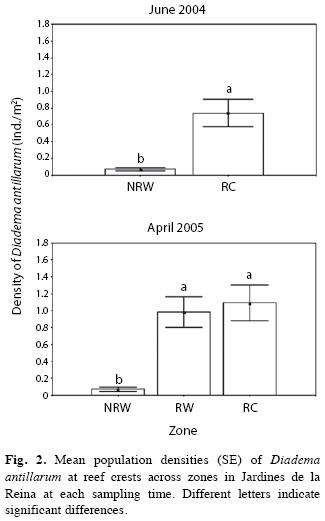
<body><![CDATA[<font size="2"><span style="font-family: verdana;"><span      style="font-weight: bold;">Urchin abundance:</span>     Abundances of<span style="font-style: italic;"> D.     antillarum</span> were highest at reef crests during the study. Mean     population densities were up to three orders of magnitude higher than     those recorded at reef slopes (local values up to 1.553ind/m<sup>2</sup>     at <span style="font-weight: bold;">LP </span>in     April 2005). Average densities of <span style="font-style: italic;">Diadema</span>     varied significantly among     zones at reef crests (F<sub>(1,28)</sub>=36.434, p&lt;0.01, in June     ]]></body>
<body><![CDATA[2004;     F<sub>(2,46)</sub>=36.522, p&lt;0.01, in April 2005; <a href="#fig2">Fig.     2</a>) and were     significantly higher within the Marine Reserve at each sampling time     (0.741ind/m<sup>2</sup> and 0.982ind/m<sup>2</sup> at<span      style="font-weight: bold;"> RC</span> in June 2004 and April 2005     respectively and 1.092ind/ m<sup>2</sup> at <span      style="font-weight: bold;">RW </span>in April 2005). Densities from     reef     slopes ranged from 0.010-0.070ind/m<sup>2</sup> in June 2004, while the     ]]></body>
<body><![CDATA[lowest     local value in April 2005 was 0.003ind/m<sup>2</sup> (see <a      href="/img/revistas/rbt/v59n3/a17t2.gif">Table 2</a> in     Mart&iacute;n-Blanco <span style="font-style: italic;">et al</span>.     2010 for detailed information on abundance     and distribution patterns). <span style="font-style: italic;">Diadema </span>was     </span></font><font size="2"><span style="font-family: verdana;">found     at only six of     nine sites     surveyed in June 2004 and absent at all in 42% of 19 sites surveyed in     ]]></body>
<body><![CDATA[April 2005. The maximum site level density (0.133ind/m<sup>2</sup>)     occurred in     April 2005, but there was only one site showing this value.    <br> </span></font>     <div style="text-align: center;"><font size="2"><span  style="font-family: verdana;"></span></font>    <br> <font size="2"><span style="font-family: verdana;"></span></font></div>     <div style="text-align: center;"><font size="2"><span  style="font-family: verdana;"><a name="fig2"></a><img alt=""  src="/img/revistas/rbt/v59n3/a17i2.jpg"  style="width: 325px; height: 521px;">    <br>     <br style="font-family: verdana;">     </span></font><font size="2"><span style="font-family: verdana;"></span></font></div>     ]]></body>
<body><![CDATA[<br style="font-family: verdana;">     <font size="2"><span style="font-family: verdana;"><span      style="font-weight: bold;">Community structure     and     algal-urchin relationships:</span> Algal community structure varied     significantly between habitats at each sampling time. Percent cover of     macroalgae was significantly higher at reef slopes, where densities of     <span style="font-style: italic;">D. antillarum</span> were zero or     near zero during the study (F<sub>(1,146)</sub>=200.14,     p&lt;0.01, in June 2004; F<sub>(1,201)</sub>=236.35, p&lt;0.01, in     ]]></body>
<body><![CDATA[April 2005;     <a href="/img/revistas/rbt/v59n3/a17i3.jpg">Fig. 3 A, B</a>). Mean     coverage of macroalgae at reef slopes was 44% in     June 2004 and 62% in April 2005, with local values up to 67% and 87%     respectively (<a href="/img/revistas/rbt/v59n3/a17t1.gif">Table 1</a>).     In contrast, the amount of substratum occupied     by macroalgae at reef crests averaged 10% at each sampling time (<a      href="/img/revistas/rbt/v59n3/a17t1.gif">Table     1</a>). Except by percent cover of macroalgae at <span      style="font-weight: bold;">NRW</span> zone </span></font><font     ]]></body>
<body><![CDATA[ size="2"><span style="font-family: verdana;">which was higher     than value from     <span style="font-weight: bold;">NRE</span> zone in June 2004 and     percent cover of macroalgae at <span style="font-weight: bold;">RW </span>zone     which     was higher than values from <span style="font-weight: bold;">NRW</span>     and <span style="font-weight: bold;">RE </span>zones in April 2005     when     comparing all zones at reef slopes (data not shown), no differences     were found with any of the two ANOVA tests in macroalgal cover among     ]]></body>
<body><![CDATA[zones during the study; the zone-habitat interaction was not     significant either. Abundances of algal turf differed between habitats     (F<sub>(1,146)</sub>=50.73, p&lt;0.01) and between zones (F<sub>(1,146)</sub>=62.82,     p&lt;0.01) in June 2004, being significantly higher at reef crests     (<a href="/img/revistas/rbt/v59n3/a17i3.jpg">Fig. 3 C</a>), pattern     that was held across zones but was stronger at <span      style="font-weight: bold;">NRW</span>     zone in June 2004, as demonstrated by the significant zone-habitat     interaction (F<sub>(1,146)</sub>=30.42, p&lt;0.01). The pattern of     higher coverage     ]]></body>
<body><![CDATA[of algal turf at reef crests held in April 2005 (F<sub>(1,201)</sub>=12.30,     p&lt;0.01; <a href="/img/revistas/rbt/v59n3/a17i3.jpg">Fig. 3 D</a>)     and showed a significant zone-habitat interaction     (F<sub>(2,201)</sub>=10.15, p&lt;0.01) but mean values did not varied     among zones.     Percent cover of </span></font><font size="2"><span      style="font-family: verdana;">crustose coralline     algae varied     between habitats at each sampling time (F<sub>(1,146)</sub>=373.61,     p&lt;0.01, in     ]]></body>
<body><![CDATA[June 2004; F<sub>(1,201)</sub>=274.59, p&lt;0.01, in April 2005) being     higher at     reef crests (<a href="/img/revistas/rbt/v59n3/a17i3.jpg">Fig. 3 E, F</a>).     Mean values differed among zones only in     June 2004 (F<sub>(1,146)</sub>=5.95, p&lt;0.05) and the zone-habitat     interaction     was not significant during the study. Algal community structure at reef     crests, where <span style="font-style: italic;">Diadema</span> was     more abundant, was dominated </span></font><font size="2"><span      style="font-family: verdana;">by crustose     ]]></body>
<body><![CDATA[coralline algae (mean     values of 30% in June 2004 and 46% in April 2005, <a      href="/img/revistas/rbt/v59n3/a17t1.gif">Table 1</a>) while     macroalgae occupied the major amount of substratum at reef slopes     during the study. Macroalgal cover at reef slopes was dominated by     <span style="font-style: italic;">Dictyota</span> sp., <span      style="font-style: italic;">Lobophora</span> sp. and <span      style="font-style: italic;">Halimeda</span> sp. at each sampling time     while the most abundant at reef crests were <span      style="font-style: italic;">Halimeda</span> sp. and <span     ]]></body>
<body><![CDATA[ style="font-style: italic;">Amphiroa</span>     sp. (<a href="/img/revistas/rbt/v59n3/a17t2.gif">Table 2</a>).</span></font><br      style="font-family: verdana;">     <br style="font-family: verdana;">     <font size="2"><span style="font-family: verdana;">Correlations between     percent cover     of algal functional groups and the abundance of <span      style="font-style: italic;">D. antillarum</span> indicated     a significant association among variables when analyzing data pooled     across all sites. Densities of <span style="font-style: italic;">D.     ]]></body>
<body><![CDATA[antillarum</span> were negatively and     positively correlated with mean coverage of macroalgae and crustose     coralline algae, respectively, during the study (<a      href="/img/revistas/rbt/v59n3/a17i4.jpg">Fig. 4 A, B, E, F</a>)     while mean coverage of algal turfs showed no significant pattern of     variation in relation to <span style="font-style: italic;">Diadema </span>abundances     at this spatial scale (<a href="/img/revistas/rbt/v59n3/a17i4.jpg">Fig.     4 C, D</a>). Partial correlations with data from reef crests and reef     slopes by separate yielded no significant relationships among algal     functional categories and <span style="font-style: italic;">Diadema</span>     ]]></body>
<body><![CDATA[densities in most cases (<a href="/img/revistas/rbt/v59n3/a17t3.gif">Table     3</a>). </span></font><font size="2"><span      style="font-family: verdana;">Only the percent     cover of crustose     coralline algae showed a significant positive relationship with the     abundance of <span style="font-style: italic;">Diadema</span> but     Pearson&#8217;s correlation coefficient was too low     (<a href="/img/revistas/rbt/v59n3/a17t3.gif">Table 3</a>).</span></font><br      style="font-family: verdana;">     <br style="font-family: verdana;">     ]]></body>
<body><![CDATA[<font style="font-weight: bold;" size="3"><span      style="font-family: verdana;">Discussion</span></font><br      style="font-family: verdana; font-weight: bold;">     <br style="font-family: verdana;">     <font size="2"><span style="font-family: verdana;">Surveys from shallow     and mid depth     reefs in Jardines de la Reina showed that patterns of abundance of <span      style="font-style: italic;">D.     antillarum</span> in the study zone are similar than those reported by     Alcolado <span style="font-style: italic;">et al</span>. (unpublished     ]]></body>
<body><![CDATA[data) around Cuba. Data collected from     reef slopes in Jardines de la Reina and those from other Cuban     locations indicate a country wide pattern of low population density at     mid depth reefs; whereas densities recorded at reef crests (this study)     are among the highest reported around the Cuban Archipelago     (Mart&iacute;n-Blanco <span style="font-style: italic;">et al.</span>     2010). The pattern of higher population     density inside the Marine Reserve at studied reefs contrasts with that     reported by Harborne<span style="font-style: italic;"> et al</span>.     (2009) in The Bahamas, where abundances of     ]]></body>
<body><![CDATA[<span style="font-style: italic;">Diadema</span> were higher outside     the Exuma Cays Land and Sea Park. Observed     differences in mean densities at reef crests in Jardines de la Reina     seem to be the result of local factors regulating recruitment processes     rather than those responsible for inadequate larval supply or     post-settlement mortality (see </span></font><font size="2"><span      style="font-family: verdana;">Mart&iacute;n-Blanco     <span style="font-style: italic;">et al</span>. 2010     for a detailed discussion on abundances and size structure of<span      style="font-style: italic;"> D.     ]]></body>
<body><![CDATA[antillarum</span> in the studied zone at both habitats).</span></font><br      style="font-family: verdana;">     <br style="font-family: verdana;">     <font size="2"><span style="font-family: verdana;">Our results     emphasize the     importance of <span style="font-style: italic;">Diadema</span> grazing     in top-down processes on reef ecosystems.     The associations between algal coverage and the abundance of <span      style="font-style: italic;">D.     antillarum</span> (negative in the case of macroalgae and positive in     ]]></body>
<body><![CDATA[the case     of crustose coralline algae) suggest that algal community structure in     Jardines de la Reina depends, in part, on the influence of<span      style="font-style: italic;"> Diadema</span> in     an overall scale. Although correlations do not prove causality, there     is some evidence that highlights the role of <span      style="font-style: italic;">Diadema</span> in the control of     macroalgae at surveyed reefs. Considering that the protection inside     the reserve has been enhanced through time and no major disturbances     have occurred in the area, thus fish assemblages and </span></font><font     ]]></body>
<body><![CDATA[ size="2"><span style="font-family: verdana;">nutrient     concentrations remain     unaltered, our data and those reported by Pina-Amarg&oacute;s <span      style="font-style: italic;">et al</span>.     (2006) are reliable enough to support our interpretations. However,     some manipulative experiments should be done to corroborate our     inference that <span style="font-style: italic;">Diadema</span> is, at     present, an important factor on     macroalgal cover at reef slopes.</span></font><br      style="font-family: verdana;">     ]]></body>
<body><![CDATA[<br style="font-family: verdana;">     <font size="2"><span style="font-family: verdana;">The excessive     abundance of     macroalgae at reef slopes seems to be due by the almost complete     absence of <span style="font-style: italic;">D. antillarum</span> at     mid depth reefs, where local densities of     this urchin were predominantly low (&lt;0.07ind/m<sup>2</sup> in 95% of     surveyed     reef slopes during the study). In addition, the higher dominance of     macroalgae (up to 87% cover) and the scarcity of crustose coralline     ]]></body>
<body><![CDATA[algae (&lt;4% cover as mean value) at this habitat suggest that grazing     intensity at reef slopes is under threshold levels required to maintain     the algal community in a cropped state. As pointed out by Szmant     (2002), when a reef has a high algal standing crop, it can be inferred     that in some point in time, the algal production has exceeded the     capacity of the heterotrophic community to consume it. In consequence,     the level of grazing needed to return to coral dominance would differ     dramatically </span></font><font size="2"><span      style="font-family: verdana;">from that needed to     maintain the     ]]></body>
<body><![CDATA[former coral dominated system (Mumby 2009). </span></font><br      style="font-family: verdana;">     <br style="font-family: verdana;">     <font size="2"><span style="font-family: verdana;">Considering values     of herbivorous     fish biomass (Acanthurids + Scarids) reported by Pina-Amarg&oacute;s <span      style="font-style: italic;">et     al</span>. (2002) in the studied zone (mean biomass=31.8g/m<sup>2</sup>     and maximum     biomass=56.7g/m<sup>2</sup>) and that dominant macroalgae from reef     ]]></body>
<body><![CDATA[slopes     (<span style="font-style: italic;">Dictyota, Lobophora</span> and <span      style="font-style: italic;">Halimeda</span>) are those readily     consumed by     <span style="font-style: italic;">Diadema</span> (reviewed in Szmant     2002) and less palatable to herbivorous     fishes (Hay 1997; Author&#8217;s pers. observ.), one likely explanation to     the lack of herbivory at mid depth reefs in Jardines de la Reina could     be the absence of <span style="font-style: italic;">D. antillarum </span>at     this habitat. Furthermore, since     ]]></body>
<body><![CDATA[macroalgal cover did not vary among zones (two way ANOVA results with     balanced data;<a href="/img/revistas/rbt/v59n3/a17i3.jpg"> Fig. 3 A, B</a>)     and results from the additional </span></font><font size="2"><span      style="font-family: verdana;">ANOvA, yielded no     differences in     macroalgal abundances among all zones (except by percent cover from <span      style="font-weight: bold;">RW</span>     zone which was significantly higher than those from <span      style="font-weight: bold;">NRW</span> and <span      style="font-weight: bold;">RE</span>)     ]]></body>
<body><![CDATA[potential higher abundances of herbivorous fish inside the Marine     Reserve (author&#8217;s pers. observ.) appear to make no difference in     macroalgal control inside and outside the Marine Reserve. Parrotfishes     and surgeonfishes appear to play a critical role in preventing phase     shifts to macroalgae but when presented with intact stands of     macroalgae, their ability to remove the algae may be limited (Bellwood     <span style="font-style: italic;">et al</span>. 2006). In contrast to     Mumby <span style="font-style: italic;">et al</span>. (2007)     observations about     trophic cascades resulting in reductions of macroalgal cover inside     ]]></body>
<body><![CDATA[Marine Reserves, </span></font><font size="2"><span      style="font-family: verdana;">positive effects     expected from     reserve-driven trophic interactions in Jardines de la Reina, via the     increase of fish grazing, are not strong enough to prevent macroalgal     overgrowth and enhance coral recruitment at mid depth reefs in the     largest of Caribbean Marine Reserves. Neither highly diverse fish     assemblages and mature food webs, nor the presence of abundant     herbivorous fish in Jardines de la Reina Marine Reserve appear to     increase resilience at surveyed reef slopes without suitable functional     ]]></body>
<body><![CDATA[redundancy in the absence of <span style="font-style: italic;">D.     antillarum</span> at the time of this study.</span></font><br      style="font-family: verdana;">     <br style="font-family: verdana;">     <font size="2"><span style="font-family: verdana;">Similar results have     been reported     from other Cuban reefs at the same depth; Guardia <span      style="font-style: italic;">et al</span>. (2004a)     recorded high percentages of macroalgae from diving sites in Maria La     Gorda, southwestern end of Cuba (&#8776;50% from spoor and grove and patch     ]]></body>
<body><![CDATA[reefs sites) and a high dominance of <span style="font-style: italic;">Dictyota</span>     and <span style="font-style: italic;">Lobophora</span> at all over     the reef; patterns that seem to be associated, as mentioned by the     authors, with the significant scarcity of <span      style="font-style: italic;">D. antillarum</span>. Present     results are also into conformity to that obtained by Williams &amp;     Polunin (2001) at several locations in the Caribbean, including two     locations from the Isle of Youth, Southwestern Cuba (a Marine Reserve     at Punta Franc&eacute;s and a non protected zone at Punta del Este). </span></font><font      size="2"><span style="font-family: verdana;">Their findings     ]]></body>
<body><![CDATA[indicate that, even     in locations where herbivorous fish are abundant (mean biomass=9.3g/m<sup>2</sup>)     there is an upper limit to the amount of substrate that can be grazed     with sufficient intensity for upright macroalgae to be excluded in the     absence of <span style="font-style: italic;">Diadema</span>;     suggesting that those reefs would previously have     been dependent on <span style="font-style: italic;">Diadema</span>     grazing. The fact that mean biomass of     herbivorous fish reported by Pina-Amarg&oacute;s <span      style="font-style: italic;">et al</span>. (2002) at the     ]]></body>
<body><![CDATA[studied zone in Jardines de la Reina was three times higher than     average biomass reported by Williams &amp; Polunin (2001) and that     coral reefs from Jardines de la Reina still show higher percentages of     macroalgae, suggest that the role of <span style="font-style: italic;">D.     antillarum</span> in the control of     macroalgae needs to be considered when analyzing algal community     structure in Jardines de la Reina coral reefs. Results from the North     coast of Havana (H.P. Caballero 2007, pers. comm.) reinforce this idea     since percent covers of macroalgae (24-67%) recorded from reef slopes,     where </span></font><font size="2"><span style="font-family: verdana;">abundances     ]]></body>
<body><![CDATA[of     <span style="font-style: italic;">Diadema</span> reach up to     0.63ind/ m<sup>2</sup> and fish assemblages are highly affected by     overfishing     (mean overall fish biomass=4g/ m<sup>2</sup> and mean herbivorous fish     biomass=1.7g/ m<sup>2</sup>; H.P. Caballero 2007, pers. comm.), are     comparatively     lower than those recorded in Jardines de la Reina at the same habitat     (29-87%; this study). In addition, algal species composition from the     North coast of Havana contrasts with that from Jardines de la Reina; as     ]]></body>
<body><![CDATA[Clero-Alonso 2007 (pers. comm.) the abundance of filamentous algae in     Havanan reefs, specially<span style="font-style: italic;"> Cladophora</span>     and <span style="font-style: italic;">Cladophoropsis</span>, is higher     than     that observed in Jardines de la Reina, where they are rare, what     illustrate different components of herbivory between locations and     highlights the higher intensity of <span style="font-style: italic;">Diadema</span>     grazing in the North coast     of Havana, where not only macroalgal species preferred by this urchin     are less abundant, but also the percent cover of the entire macroalgal     ]]></body>
<body><![CDATA[community. However, different biophysical conditions from northern     reefs (e.g. different wave exposure) should be considered for     generalizations regarding differential effects on algal communities     independently of urchin grazing.</span></font><br      style="font-family: verdana;">     <br style="font-family: verdana;">     <font size="2"><span style="font-family: verdana;">On the other hand,     partial     correlations with data recorded from reef crests and reef slopes by     separate, indicate no significant associations between algal coverage     ]]></body>
<body><![CDATA[and the abundance of <span style="font-style: italic;">D. antillarum</span>     at this spatial scale. Data from     reef crests suggest that algal community structure at this habitat is     being shaped by the synergistic action of other factors (e.g. fish     grazing) rather than the influence of <span style="font-style: italic;">Diadema     </span>grazing alone. If we     consider average biomass of herbivorous fish (86.6g/m<sup>2</sup>)     reported by     Pina-Amarg&oacute;s <span style="font-style: italic;">et al</span>.     (2002) from reef crests in Jardines de la     ]]></body>
<body><![CDATA[Reina and that abundances of upright macroalgae at this habitat are     naturally limited by physical factors (e.g. wave action), we cannot     discount the role of fish grazing as a key component of herbivory at     these sites. Certainly, in shallow reefs, where herbivorous fish are     more abundant, grazing by fishes alone can maintain the algal community     in a cropped state (Carpenter 1986, Lewis 1986, Bruggemann <span      style="font-style: italic;">et al</span>.     1994). Nevertheless, we observed </span></font><font size="2"><span      style="font-family: verdana;">clear signs of     <span style="font-style: italic;">Diadema</span> grazing at     ]]></body>
<body><![CDATA[shallow reefs (large patches of bare substrate around Diadema     aggregations and sparse macroalgal cover), where urchin abundances were     moderately high (up to 1.553ind/m<sup>2</sup>) and percent covers of     algae     preferred by Diadema were very low (&lt;6%). Additionally, current     abundances of macroalgae at reef crests in Jardines de la Reina     (&lt;10% cover) are comparatively lower than those reported by     Pina-Amarg&oacute;s <span style="font-style: italic;">et al</span>.     (2006) at the studied area (32% cover;     average values from data recorded in 2001), what suggests, together     ]]></body>
<body><![CDATA[with recent observations of new recruits of <span      style="font-style: italic;">A. palmata</span> (F.     Pina-Amarg&oacute;s 2010, pers. comm.), that grazing intensity have     increased at the same time that <span style="font-style: italic;">Diadema</span>     recruitment began to be     noticeable (&#8776;3-4 years before our surveys took place;     Mart&iacute;n-Blanco <span style="font-style: italic;">et al</span>.     2010).</span></font><br style="font-family: verdana;">     <br style="font-family: verdana;">     <font size="2"><span style="font-family: verdana;">Although our results     ]]></body>
<body><![CDATA[cannot explain     the relative importance of <span style="font-style: italic;">Diadema</span>     grazing and correlation evidence do     not prove a cause and effect hypothesis, the recovery of <span      style="font-style: italic;">D. antillarum</span>     across the Caribbean and its association with reduced macroalgal cover     and enhanced coral recruitment at shallow reefs (Miller <span      style="font-style: italic;">et al</span>. 2003,     Weil <span style="font-style: italic;">et al</span>. 2005, Carpenter     &amp; Edmunds 2006, Myhre &amp;     ]]></body>
<body><![CDATA[Acevedo-Guti&eacute;rrez 2007) along with prior experimental studies     (Ogden <span style="font-style: italic;">et al</span>. 1973, Sanmarco <span      style="font-style: italic;">et al</span>. 1974, Carpenter 1981, 1986,     Sanmarco 1980, 1982), support our hypothesis on the functional role of     <span style="font-style: italic;">D. antillarum</span> in mediating the     removal of macroalgae at surveyed reefs.     However, further experimental studies should be addressed to determine     the importance of <span style="font-style: italic;">Diadema</span>     grazing and fish grazing by separate in order     to improve our understanding about the structure and functioning of     ]]></body>
<body><![CDATA[these </span></font><font size="2"><span style="font-family: verdana;">ecosystems     in which     three     dimensional structure of coral assemblages still persists. Since     assemblages of reef fish and sea urchins are highly dependent on three     dimensional structure of reef habitats (Hixon &amp; Beets 1993, Aguilar     <span style="font-style: italic;">et al</span>. 1997,     Gonz&aacute;lez-Sans&oacute;n <span style="font-style: italic;">et al</span>.     1997, Friedlander     &amp; Parrish 1998, Jones <span style="font-style: italic;">et al</span>.     ]]></body>
<body><![CDATA[2004, Idjadi &amp; Edmunds 2006, Lee     2006) and fish/urchin grazing reduces macroalgal cover and promotes     coral recruitment which in turn can help to maintain three dimensional     structure (Aronson &amp; Precht 2000, Bellwood <span      style="font-style: italic;">et al</span>. 2004, Carpenter     &amp; Edmunds 2006, Mumby </span></font><font size="2"><span      style="font-family: verdana;">2006, 2009, Mumby <span      style="font-style: italic;">et     al</span>. 2006,     Mumby <span style="font-style: italic;">et al</span>. 2007), positive     ]]></body>
<body><![CDATA[feed backs resulting in coral community     recovery might be expected to occur in Jardines de la Reina as <span      style="font-style: italic;">Diadema</span>     populations continue to increase and the reserve gets older for     cascading interactions to be effective. Considering that conservation     driven processes contributing to coral reef ecosystems recovery may     take long periods of time to be effective (McClanahan 2000, Rodwell <span      style="font-style: italic;">et     al</span>. 2003, Russ &amp; Alcala 2004, McClanahan <span      style="font-style: italic;">et al</span>. 2005, 2007) and     ]]></body>
<body><![CDATA[that recovery of <span style="font-style: italic;">D. antillarum</span>     is still limited to shallow depths in     Jardines de la Reina, additional management actions such as restoration     programs should be implemented in favor of those reefs where urchin     populations are scarce and macroalgal occupied space limits coral     recruitment, specially at reef slopes.</span></font><br      style="font-family: verdana;">     <br style="font-family: verdana;">     <font style="font-weight: bold;" size="3"><span      style="font-family: verdana;">Acknowledgments</span></font><br     ]]></body>
<body><![CDATA[ style="font-family: verdana;">     <br style="font-family: verdana;">     <font size="2"><span style="font-family: verdana;">The authors are     thankful to the     staff of Azulmar for logistical support on Jardines de la Reina,     specially to Giuseppe Omegna (Pepe) its manager and Noel L&oacute;pez.     To WWF Canada for funding this research and to E. Sala, Director of the     Center for Marine Biodiversity and Conservation of the Scripps     Institution of Oceanography, for partial funding and logistics. We     thank the Ministry of Science, Technology and Environment for funds and     ]]></body>
<body><![CDATA[logistics, especially C. Pazos Alberdi, R. G&oacute;mez     Fern&aacute;ndez, A. Z&uacute;&ntilde;iga R&iacute;os. Infinite thanks     to CIEC&acute;s staff for supporting us in doing research on Jardines     de la Reina, specially to L. Hern&aacute;ndez Fern&aacute;ndez, A.     Zayas Fern&aacute;ndez, W. Acosta de la Red, A. Jim&eacute;nez del     Castillo, M. Lazarte Llanes. We </span></font><font size="2"><span      style="font-family: verdana;">also want to thanks     P.M. Alcolado,     H.P. Caballero, Y. Lezcano, for assistance in bibliography and especial     considerations.</span></font><br style="font-family: verdana;">     ]]></body>
<body><![CDATA[<br style="font-family: verdana;">     <font style="font-weight: bold;" size="3"><span      style="font-family: verdana;"></span></font>     <hr style="width: 100%; height: 2px;"><font style="font-weight: bold;"      size="3"><span style="font-family: verdana;">References</span></font><br      style="font-family: verdana;">     <br style="font-family: verdana;">     <font size="2"><span style="font-family: verdana;">Aguilar, C., G.     Gonz&aacute;lez-Sanas&oacute;n, J. Angulo &amp; C. Gonz&aacute;lez.     1997. Variaci&oacute;n espacial y temporal de la ictiofauna en un     ]]></body>
<body><![CDATA[arrecife de coral costero de la regi&oacute;n noroccidental de Cuba. I:     <!-- ref -->Abundancia total. Rev. Invest. Mar. 18: 223-232.    &nbsp;&nbsp;&nbsp;&nbsp;&nbsp;&nbsp;&nbsp;&nbsp;[&#160;<a href="javascript:void(0);" onclick="javascript: window.open('/scielo.php?script=sci_nlinks&ref=1732082&pid=S0034-7744201100030001700001&lng=','','width=640,height=500,resizable=yes,scrollbars=1,menubar=yes,');">Links</a>&#160;]<!-- end-ref --><!-- ref --></span></font><br  style="font-family: verdana;"> <br style="font-family: verdana;"> <font size="2"><span style="font-family: verdana;">Alcolado, P.M., R. Claro, B. Mart&iacute;nez-Daranas, G. Men&eacute;ndez-Mac&iacute;a, P. Garc&iacute;a-Parrado, K. Cantelar, M. Hern&aacute;ndez &amp; R. del valle. 2001. Evaluaci&oacute;n ecol&oacute;gica de los arrecifes coralinos del oeste de Cayo Largo del Sur, Cuba: 1998-1999. Bol. Invest. Mar. Costeras 30: 25-32.    &nbsp;&nbsp;&nbsp;&nbsp;&nbsp;&nbsp;&nbsp;&nbsp;[&#160;<a href="javascript:void(0);" onclick="javascript: window.open('/scielo.php?script=sci_nlinks&ref=1732083&pid=S0034-7744201100030001700002&lng=','','width=640,height=500,resizable=yes,scrollbars=1,menubar=yes,');">Links</a>&#160;]<!-- end-ref --><!-- ref --></span></font><br  style="font-family: verdana;"> <br style="font-family: verdana;"> <font size="2"><span style="font-family: verdana;">Alcolado, P.M., D. Hern&aacute;ndez-Mu&ntilde;oz, H.P. Caballero, L. Busutil, S. Perera &amp; G. Hidalgo. 2009. Efectos de un inusual per&iacute;odo de alta frecuencia de huracanes sobre el bentos de arrecifes coralinos. Rev. Cienc. Mar. Costeras 1: 73-94.    &nbsp;&nbsp;&nbsp;&nbsp;&nbsp;&nbsp;&nbsp;&nbsp;[&#160;<a href="javascript:void(0);" onclick="javascript: window.open('/scielo.php?script=sci_nlinks&ref=1732084&pid=S0034-7744201100030001700003&lng=','','width=640,height=500,resizable=yes,scrollbars=1,menubar=yes,');">Links</a>&#160;]<!-- end-ref --><!-- ref --></span></font><br  style="font-family: verdana;"> <br style="font-family: verdana;"> <font size="2"><span style="font-family: verdana;">Appeldoorn, R.C. &amp; K.C. Lindeman. 2003. A Caribbeanwide survey of marine reserves: spatial coverage and attributes of effectiveness. Gulf. Caribb. Res. 14: 139-154.    &nbsp;&nbsp;&nbsp;&nbsp;&nbsp;&nbsp;&nbsp;&nbsp;[&#160;<a href="javascript:void(0);" onclick="javascript: window.open('/scielo.php?script=sci_nlinks&ref=1732085&pid=S0034-7744201100030001700004&lng=','','width=640,height=500,resizable=yes,scrollbars=1,menubar=yes,');">Links</a>&#160;]<!-- end-ref --><!-- ref --></span></font><br style="font-family: verdana;"> <br style="font-family: verdana;"> <font size="2"><span style="font-family: verdana;">Aronson, R.B. &amp; W.F. Precht. 2000. Herbivory and algal dynamics on the coral reef at Discovery Bay, Jamaica. Limnol. Oceanogr. 45: 251-255.    &nbsp;&nbsp;&nbsp;&nbsp;&nbsp;&nbsp;&nbsp;&nbsp;[&#160;<a href="javascript:void(0);" onclick="javascript: window.open('/scielo.php?script=sci_nlinks&ref=1732086&pid=S0034-7744201100030001700005&lng=','','width=640,height=500,resizable=yes,scrollbars=1,menubar=yes,');">Links</a>&#160;]<!-- end-ref --><!-- ref --></span></font><br  style="font-family: verdana;"> <br style="font-family: verdana;"> <font size="2"><span style="font-family: verdana;">Aronson, R.B. &amp; W.F. Precht. 2006. Conservation, precaution, and Caribbean reefs. Coral Reefs 25: 441-450.    &nbsp;&nbsp;&nbsp;&nbsp;&nbsp;&nbsp;&nbsp;&nbsp;[&#160;<a href="javascript:void(0);" onclick="javascript: window.open('/scielo.php?script=sci_nlinks&ref=1732087&pid=S0034-7744201100030001700006&lng=','','width=640,height=500,resizable=yes,scrollbars=1,menubar=yes,');">Links</a>&#160;]<!-- end-ref --><!-- ref --> </span></font><br style="font-family: verdana;"> <br style="font-family: verdana;"> <font size="2"><span style="font-family: verdana;">Bellwood, D.R., T.P. Hughes, C. Folke &amp; M. Nystr&ouml;m. 2004. Confronting the coral reef crisis. Nature 429: 827-833.    &nbsp;&nbsp;&nbsp;&nbsp;&nbsp;&nbsp;&nbsp;&nbsp;[&#160;<a href="javascript:void(0);" onclick="javascript: window.open('/scielo.php?script=sci_nlinks&ref=1732088&pid=S0034-7744201100030001700007&lng=','','width=640,height=500,resizable=yes,scrollbars=1,menubar=yes,');">Links</a>&#160;]<!-- end-ref --><!-- ref --></span></font><br style="font-family: verdana;"> <br style="font-family: verdana;"> <font size="2"><span style="font-family: verdana;">Bellwood, D.R., T.P. Hughes &amp; A.S. Hoey. 2006. Sleeping functional group drives coral-reef recovery. Curr. Biol. 16: 2434-2439.    &nbsp;&nbsp;&nbsp;&nbsp;&nbsp;&nbsp;&nbsp;&nbsp;[&#160;<a href="javascript:void(0);" onclick="javascript: window.open('/scielo.php?script=sci_nlinks&ref=1732089&pid=S0034-7744201100030001700008&lng=','','width=640,height=500,resizable=yes,scrollbars=1,menubar=yes,');">Links</a>&#160;]<!-- end-ref --><!-- ref --></span></font><br  style="font-family: verdana;"> <br style="font-family: verdana;"> <font size="2"><span style="font-family: verdana;">Bruggemann, J.H., M.J.H. Vanoppen &amp; A.M. Breeman. 1994. Foraging by the stoplight parrotfish <span style="font-style: italic;">Sparisoma viride </span>I. Food selection in different socially determined habitats. Mar. Ecol. Prog. Ser. 106: 41-55.    &nbsp;&nbsp;&nbsp;&nbsp;&nbsp;&nbsp;&nbsp;&nbsp;[&#160;<a href="javascript:void(0);" onclick="javascript: window.open('/scielo.php?script=sci_nlinks&ref=1732090&pid=S0034-7744201100030001700009&lng=','','width=640,height=500,resizable=yes,scrollbars=1,menubar=yes,');">Links</a>&#160;]<!-- end-ref --><!-- ref --> </span></font><br  style="font-family: verdana;"> <br style="font-family: verdana;"> <font size="2"><span style="font-family: verdana;">Caballero, H.P. &amp; E. de la Guardia. 2003. Arrecifes de coral utilizados como zonas de colectas para exhibiciones en el Acuario Nacional de Cuba. I. Costa noroccidental de la Habana, Cuba. Rev. Invest. Mar. 24: 205-220.    &nbsp;&nbsp;&nbsp;&nbsp;&nbsp;&nbsp;&nbsp;&nbsp;[&#160;<a href="javascript:void(0);" onclick="javascript: window.open('/scielo.php?script=sci_nlinks&ref=1732091&pid=S0034-7744201100030001700010&lng=','','width=640,height=500,resizable=yes,scrollbars=1,menubar=yes,');">Links</a>&#160;]<!-- end-ref --><!-- ref --></span></font><br  style="font-family: verdana;"> <br style="font-family: verdana;"> <font size="2"><span style="font-family: verdana;">Caballero, H.P., D. Rosales &amp; A. Alcal&aacute;. 2006. Estudio diagn&oacute;stico del arrecife coralino del Rinc&oacute;n de Guanabo, Ciudad de la Habana, Cuba. I. Corales, esponjas y gorgon&aacute;ceos. Rev. Invest. Mar. 27: 49-59.    &nbsp;&nbsp;&nbsp;&nbsp;&nbsp;&nbsp;&nbsp;&nbsp;[&#160;<a href="javascript:void(0);" onclick="javascript: window.open('/scielo.php?script=sci_nlinks&ref=1732092&pid=S0034-7744201100030001700011&lng=','','width=640,height=500,resizable=yes,scrollbars=1,menubar=yes,');">Links</a>&#160;]<!-- end-ref --><!-- ref --></span></font><br  style="font-family: verdana;"> <br style="font-family: verdana;"> <font size="2"><span style="font-family: verdana;">Caballero, H.P., P.M. Alcolado &amp; A. Semidey. 2009. Condici&oacute;n de los arrecifes de coral frente a costas con asentamientos humanos y aportes terr&iacute;genos: el caso del litoral habanero, Cuba. Rev. Cienc. Mar. Costeras 1: 49-72.    &nbsp;&nbsp;&nbsp;&nbsp;&nbsp;&nbsp;&nbsp;&nbsp;[&#160;<a href="javascript:void(0);" onclick="javascript: window.open('/scielo.php?script=sci_nlinks&ref=1732093&pid=S0034-7744201100030001700012&lng=','','width=640,height=500,resizable=yes,scrollbars=1,menubar=yes,');">Links</a>&#160;]<!-- end-ref --><!-- ref --></span></font><br  style="font-family: verdana;"> <br style="font-family: verdana;"> <font size="2"><span style="font-family: verdana;">Carpenter, R.C. 1981. Grazing by <span style="font-style: italic;">Diadema antillarum</span> Philippi and its effects on the benthic algal community. J. Mar. Res. 39: 747-765.    &nbsp;&nbsp;&nbsp;&nbsp;&nbsp;&nbsp;&nbsp;&nbsp;[&#160;<a href="javascript:void(0);" onclick="javascript: window.open('/scielo.php?script=sci_nlinks&ref=1732094&pid=S0034-7744201100030001700013&lng=','','width=640,height=500,resizable=yes,scrollbars=1,menubar=yes,');">Links</a>&#160;]<!-- end-ref --><!-- ref --></span></font><br  style="font-family: verdana;"> <br style="font-family: verdana;"> <font size="2"><span style="font-family: verdana;">Carpenter, R.C. 1986. Partitioning herbivory and its effects on coral reef algal communities. Ecol. Monogr. 56: 345-36.    &nbsp;&nbsp;&nbsp;&nbsp;&nbsp;&nbsp;&nbsp;&nbsp;[&#160;<a href="javascript:void(0);" onclick="javascript: window.open('/scielo.php?script=sci_nlinks&ref=1732095&pid=S0034-7744201100030001700014&lng=','','width=640,height=500,resizable=yes,scrollbars=1,menubar=yes,');">Links</a>&#160;]<!-- end-ref --><!-- ref --></span></font><br style="font-family: verdana;"> <br style="font-family: verdana;"> <font size="2"><span style="font-family: verdana;">Carpenter, R.C. 1990. Mass mortality of <span style="font-style: italic;">Diadema antillarum </span>I. Long-term effects on sea urchin populationdynamics and coral reef algal communities. Mar. Biol. 104: 67-77.    &nbsp;&nbsp;&nbsp;&nbsp;&nbsp;&nbsp;&nbsp;&nbsp;[&#160;<a href="javascript:void(0);" onclick="javascript: window.open('/scielo.php?script=sci_nlinks&ref=1732096&pid=S0034-7744201100030001700015&lng=','','width=640,height=500,resizable=yes,scrollbars=1,menubar=yes,');">Links</a>&#160;]<!-- end-ref --><!-- ref --></span></font><br style="font-family: verdana;"> <br style="font-family: verdana;"> <font size="2"><span style="font-family: verdana;">Carpenter, R.C. &amp; P.J. Edmunds. 2006. Local and regional scale recovery of <span  style="font-style: italic;">Diadema</span> promotes recruitment of scleractinian corals. Ecol. Lett. 9: 271-280.    &nbsp;&nbsp;&nbsp;&nbsp;&nbsp;&nbsp;&nbsp;&nbsp;[&#160;<a href="javascript:void(0);" onclick="javascript: window.open('/scielo.php?script=sci_nlinks&ref=1732097&pid=S0034-7744201100030001700016&lng=','','width=640,height=500,resizable=yes,scrollbars=1,menubar=yes,');">Links</a>&#160;]<!-- end-ref --><!-- ref --></span></font><br  style="font-family: verdana;"> <font size="2"><span style="font-family: verdana;">&nbsp;</span></font><br  style="font-family: verdana;"> <font size="2"><span style="font-family: verdana;">Clero-Alonso, L., F. Pina-Amarg&oacute;s, L. Hern&aacute;ndez-Fren&aacute;ndez, F. Mart&iacute;n-Blanco, D. Z&uacute;&ntilde;iga-R&iacute;os, S. Cowling, A.K. Brady &amp; S. Caldwell. 2006. Biota acu&aacute;tica del norte de la provincia de Ciego de &Aacute;vila, p. 182-206. <span  style="font-style: italic;">In </span>F. Pina-Amarg&oacute;s (ed.). Ecosistemas costeros: biodiversidad y gesti&oacute;n de los recursos naturales. Compilaci&oacute;n por el Xv Aniversario del Centro de Investigaciones de Ecosistemas costeros (CIEC). CUJAE, Ciudad de la Habana, Cuba.    &nbsp;&nbsp;&nbsp;&nbsp;&nbsp;&nbsp;&nbsp;&nbsp;[&#160;<a href="javascript:void(0);" onclick="javascript: window.open('/scielo.php?script=sci_nlinks&ref=1732098&pid=S0034-7744201100030001700017&lng=','','width=640,height=500,resizable=yes,scrollbars=1,menubar=yes,');">Links</a>&#160;]<!-- end-ref --><!-- ref --></span></font><br  style="font-family: verdana;"> <br style="font-family: verdana;"> <font size="2"><span style="font-family: verdana;">De Ruyter van Steveninck, E.D. &amp; A.M. Breeman. 1987. Deep water populations of <span  style="font-style: italic;">Lobophora variegate</span> (Phaeophyceae) on the coral reef of Cura&ccedil;ao: influence of grazing and dispersal on distribution patterns. Mar. Ecol. Prog. Ser. 38: 241-250.    &nbsp;&nbsp;&nbsp;&nbsp;&nbsp;&nbsp;&nbsp;&nbsp;[&#160;<a href="javascript:void(0);" onclick="javascript: window.open('/scielo.php?script=sci_nlinks&ref=1732099&pid=S0034-7744201100030001700018&lng=','','width=640,height=500,resizable=yes,scrollbars=1,menubar=yes,');">Links</a>&#160;]<!-- end-ref --><!-- ref --></span></font><br style="font-family: verdana;"> <br style="font-family: verdana;"> <font size="2"><span style="font-family: verdana;">Edmunds, P.J. &amp; R.C. Carpenter. 2001. Recovery of<span style="font-style: italic;"> Diadema antillarum</span> reduces macroalgal cover and increases abundance of juvenile corals on a Caribbean reef. P. Natl. Acad. Sci. USA. 98: 5057-5071.    &nbsp;&nbsp;&nbsp;&nbsp;&nbsp;&nbsp;&nbsp;&nbsp;[&#160;<a href="javascript:void(0);" onclick="javascript: window.open('/scielo.php?script=sci_nlinks&ref=1732100&pid=S0034-7744201100030001700019&lng=','','width=640,height=500,resizable=yes,scrollbars=1,menubar=yes,');">Links</a>&#160;]<!-- end-ref --><!-- ref --></span></font><br  style="font-family: verdana;"> <br style="font-family: verdana;"> <font size="2"><span style="font-family: verdana;">Friedlander, A.M. &amp; J.D. Parrish. 1998. Habitat characteristics affecting fish assemblages on a Hawaiian coral reef. J. Exp. Mar. Biol. Ecol. 224: 1-30.    &nbsp;&nbsp;&nbsp;&nbsp;&nbsp;&nbsp;&nbsp;&nbsp;[&#160;<a href="javascript:void(0);" onclick="javascript: window.open('/scielo.php?script=sci_nlinks&ref=1732101&pid=S0034-7744201100030001700020&lng=','','width=640,height=500,resizable=yes,scrollbars=1,menubar=yes,');">Links</a>&#160;]<!-- end-ref --><!-- ref --></span></font><br  style="font-family: verdana;"> <font size="2"><span style="font-family: verdana;">&nbsp;</span></font><br  style="font-family: verdana;"> <font size="2"><span style="font-family: verdana;">Guardia, E., A.P. valdivia &amp; P. Gonz&aacute;lez-D&iacute;az. 2004a. Estructura de las comunidades bent&oacute;nicas en la zona de buceo de Mar&iacute;a La Gorda, Ensenada de Corrientes, Sureste de la Pen&iacute;nsula de Guanahacabibes, Cuba. Rev. Invest. Mar. 25: 103-111.    &nbsp;&nbsp;&nbsp;&nbsp;&nbsp;&nbsp;&nbsp;&nbsp;[&#160;<a href="javascript:void(0);" onclick="javascript: window.open('/scielo.php?script=sci_nlinks&ref=1732102&pid=S0034-7744201100030001700021&lng=','','width=640,height=500,resizable=yes,scrollbars=1,menubar=yes,');">Links</a>&#160;]<!-- end-ref --><!-- ref --></span></font><br  style="font-family: verdana;"> <br style="font-family: verdana;"> <font size="2"><span style="font-family: verdana;">Guardia, E., P. Gonz&aacute;lez-D&iacute;az &amp; S. Castellanos-Iglesias. 2004b. Estructura de la comunidad de grupos bent&oacute;nicos s&eacute;siles en la zona de buceo de Punta Franc&eacute;s, Cuba. Rev. Invest. Mar. 25: 81-90.    &nbsp;&nbsp;&nbsp;&nbsp;&nbsp;&nbsp;&nbsp;&nbsp;[&#160;<a href="javascript:void(0);" onclick="javascript: window.open('/scielo.php?script=sci_nlinks&ref=1732103&pid=S0034-7744201100030001700022&lng=','','width=640,height=500,resizable=yes,scrollbars=1,menubar=yes,');">Links</a>&#160;]<!-- end-ref --><!-- ref --></span></font><br style="font-family: verdana;"> <br style="font-family: verdana;"> <font size="2"><span style="font-family: verdana;">Guardia, E., P. Gonz&aacute;lez-D&iacute;az, A. valdivia &amp; O. Gonz&aacute;lez-Ontivero. 2006. Estructura y salud de la comunidad de corales en el arrecife de la zona de buceo de Cayo Levisa, Archipi&eacute;lago Los Colorados, Cuba. Rev. Invest. Mar. 27: 197-208.    &nbsp;&nbsp;&nbsp;&nbsp;&nbsp;&nbsp;&nbsp;&nbsp;[&#160;<a href="javascript:void(0);" onclick="javascript: window.open('/scielo.php?script=sci_nlinks&ref=1732104&pid=S0034-7744201100030001700023&lng=','','width=640,height=500,resizable=yes,scrollbars=1,menubar=yes,');">Links</a>&#160;]<!-- end-ref --><!-- ref --></span></font><br  style="font-family: verdana;"> <br style="font-family: verdana;"> <font size="2"><span style="font-family: verdana;">Gonz&aacute;lez-Sans&oacute;n, G., C. Aguilar, J. Angulo &amp; C. Gonz&aacute;lez. 1997. variaci&oacute;n espacial y estacional de la ictiofauna en un arrecife de coral costero de la region noroccidental de Cuba. II: Diverisdad. Rev. Invest. Mar. 18: 233-240.    &nbsp;&nbsp;&nbsp;&nbsp;&nbsp;&nbsp;&nbsp;&nbsp;[&#160;<a href="javascript:void(0);" onclick="javascript: window.open('/scielo.php?script=sci_nlinks&ref=1732105&pid=S0034-7744201100030001700024&lng=','','width=640,height=500,resizable=yes,scrollbars=1,menubar=yes,');">Links</a>&#160;]<!-- end-ref --><!-- ref --></span></font><br style="font-family: verdana;"> <br style="font-family: verdana;"> <font size="2"><span style="font-family: verdana;">Gonz&aacute;lez de Zayas, R., A. Z&uacute;&ntilde;iga-R&iacute;os, O. Camejo-Cardoso, L.M. Batista-Tamayo &amp; R. C&aacute;rdenas-Murillo. 2006. Atributos f&iacute;sicos del ecosistema Jardines de la Reina, p. 296-351. <span  style="font-style: italic;">In</span> F. Pina-Amarg&oacute;s (ed.). Ecosistemas costeros: biodiversidad y gesti&oacute;n de los recursos naturales. Compilaci&oacute;n por el XV Aniversario del Centro de Investigaciones de Ecosistemas Costeros (CIEC). CUJAE, Ciudad de la Habana, Cuba.    &nbsp;&nbsp;&nbsp;&nbsp;&nbsp;&nbsp;&nbsp;&nbsp;[&#160;<a href="javascript:void(0);" onclick="javascript: window.open('/scielo.php?script=sci_nlinks&ref=1732106&pid=S0034-7744201100030001700025&lng=','','width=640,height=500,resizable=yes,scrollbars=1,menubar=yes,');">Links</a>&#160;]<!-- end-ref --><!-- ref --></span></font><br  style="font-family: verdana;"> <br style="font-family: verdana;"> <font size="2"><span style="font-family: verdana;">Harborne, A.R., P.G. Renaud, E.H.M. Tyler &amp; P.J. Mumby. 2009. Reduced density of the herbivorous urchin <span style="font-style: italic;">Diadema antillarum </span>inside a Caribbean marine reserve linked to increased predation pressure by fishes. Coral Reefs 28: 783-791.    &nbsp;&nbsp;&nbsp;&nbsp;&nbsp;&nbsp;&nbsp;&nbsp;[&#160;<a href="javascript:void(0);" onclick="javascript: window.open('/scielo.php?script=sci_nlinks&ref=1732107&pid=S0034-7744201100030001700026&lng=','','width=640,height=500,resizable=yes,scrollbars=1,menubar=yes,');">Links</a>&#160;]<!-- end-ref --><!-- ref --></span></font><br  style="font-family: verdana;"> <br style="font-family: verdana;"> <font size="2"><span style="font-family: verdana;">Hay, M.E. 1997. The ecology and evolution of seaweedsherbivores interactions on coral reefs. Coral Reefs 16: 67-76.    &nbsp;&nbsp;&nbsp;&nbsp;&nbsp;&nbsp;&nbsp;&nbsp;[&#160;<a href="javascript:void(0);" onclick="javascript: window.open('/scielo.php?script=sci_nlinks&ref=1732108&pid=S0034-7744201100030001700027&lng=','','width=640,height=500,resizable=yes,scrollbars=1,menubar=yes,');">Links</a>&#160;]<!-- end-ref --><!-- ref --></span></font><br style="font-family: verdana;"> <br style="font-family: verdana;"> <font size="2"><span style="font-family: verdana;">Herrera-Moreno, A., E. vald&eacute;s-Mu&ntilde;oz &amp; D. Ibarz&aacute;bal. 1981. Evaluaci&oacute;n poblacional del erizo negro, <span  style="font-style: italic;">Diadema antillarum </span>Phillipi, mediante un dise&ntilde;o de muestreo aleatorio estratificado, y algunos aspectos de su biolog&iacute;a. Cienc. Biol. 6: 61-79.    &nbsp;&nbsp;&nbsp;&nbsp;&nbsp;&nbsp;&nbsp;&nbsp;[&#160;<a href="javascript:void(0);" onclick="javascript: window.open('/scielo.php?script=sci_nlinks&ref=1732109&pid=S0034-7744201100030001700028&lng=','','width=640,height=500,resizable=yes,scrollbars=1,menubar=yes,');">Links</a>&#160;]<!-- end-ref --><!-- ref --></span></font><br style="font-family: verdana;"> <br style="font-family: verdana;"> <font size="2"><span style="font-family: verdana;">Hixon, M.A. &amp; J.P. Beets. 1993. Predation, prey refuges, and the structure of coral-reef fish assemblages. Ecol. Monogr. 63: 77-101.    &nbsp;&nbsp;&nbsp;&nbsp;&nbsp;&nbsp;&nbsp;&nbsp;[&#160;<a href="javascript:void(0);" onclick="javascript: window.open('/scielo.php?script=sci_nlinks&ref=1732110&pid=S0034-7744201100030001700029&lng=','','width=640,height=500,resizable=yes,scrollbars=1,menubar=yes,');">Links</a>&#160;]<!-- end-ref --><!-- ref --></span></font><br  style="font-family: verdana;"> <br style="font-family: verdana;"> <font size="2"><span style="font-family: verdana;">Hughes, T.P. 1994. Catastrophes, phase shifts and largescale degradation of a Caribbean coral reef. Science 265: 1547-1551.    &nbsp;&nbsp;&nbsp;&nbsp;&nbsp;&nbsp;&nbsp;&nbsp;[&#160;<a href="javascript:void(0);" onclick="javascript: window.open('/scielo.php?script=sci_nlinks&ref=1732111&pid=S0034-7744201100030001700030&lng=','','width=640,height=500,resizable=yes,scrollbars=1,menubar=yes,');">Links</a>&#160;]<!-- end-ref --><!-- ref --></span></font><br style="font-family: verdana;"> <br style="font-family: verdana;"> <font size="2"><span style="font-family: verdana;">Hughes, T.P., B.D. Keller, J.B.C. Jackson &amp; M.J. Boyle. 1985. Mass mortality of the echinoid <span  style="font-style: italic;">Diadema antillarum</span> Philippi in Jamaica. Bull. Mar. Sci.</span></font><br  style="font-family: verdana;"> <font size="2"><span style="font-family: verdana;">36: 377-384.    &nbsp;&nbsp;&nbsp;&nbsp;&nbsp;&nbsp;&nbsp;&nbsp;[&#160;<a href="javascript:void(0);" onclick="javascript: window.open('/scielo.php?script=sci_nlinks&ref=1732112&pid=S0034-7744201100030001700031&lng=','','width=640,height=500,resizable=yes,scrollbars=1,menubar=yes,');">Links</a>&#160;]<!-- end-ref --><!-- ref --></span></font><br  style="font-family: verdana;"> <br style="font-family: verdana;"> <font size="2"><span style="font-family: verdana;">Hughes, T.P., A.M. Szmant, R. Steneck, R. Carpenter &amp; S. Miller. 1999. Algal blooms on coral reefs: What are the cause? Limnol. Oceanogr. 44: 1583-1586.    &nbsp;&nbsp;&nbsp;&nbsp;&nbsp;&nbsp;&nbsp;&nbsp;[&#160;<a href="javascript:void(0);" onclick="javascript: window.open('/scielo.php?script=sci_nlinks&ref=1732113&pid=S0034-7744201100030001700032&lng=','','width=640,height=500,resizable=yes,scrollbars=1,menubar=yes,');">Links</a>&#160;]<!-- end-ref --><!-- ref --></span></font><br  style="font-family: verdana;"> <br style="font-family: verdana;"> <font size="2"><span style="font-family: verdana;">Idjadi, J.A. &amp; P.J. Edmunds. 2006. Scleractinian corals as facilitators for other invertebrates on a Caribbean reef. Mar. Ecol. Prog. Ser. 319: 117-127.    &nbsp;&nbsp;&nbsp;&nbsp;&nbsp;&nbsp;&nbsp;&nbsp;[&#160;<a href="javascript:void(0);" onclick="javascript: window.open('/scielo.php?script=sci_nlinks&ref=1732114&pid=S0034-7744201100030001700033&lng=','','width=640,height=500,resizable=yes,scrollbars=1,menubar=yes,');">Links</a>&#160;]<!-- end-ref --><!-- ref --></span></font><br  style="font-family: verdana;"> <br style="font-family: verdana;"> <font size="2"><span style="font-family: verdana;">Jones, G.P., M.I. McCormick, M. Srinivasan &amp; J.v. Eagle. 2004. Coral decline threatens fish biodiversity in marine reserves. P. Natl. Acad. Sci. USA. 101: 8251-8253.    &nbsp;&nbsp;&nbsp;&nbsp;&nbsp;&nbsp;&nbsp;&nbsp;[&#160;<a href="javascript:void(0);" onclick="javascript: window.open('/scielo.php?script=sci_nlinks&ref=1732115&pid=S0034-7744201100030001700034&lng=','','width=640,height=500,resizable=yes,scrollbars=1,menubar=yes,');">Links</a>&#160;]<!-- end-ref --><!-- ref --></span></font><br style="font-family: verdana;"> <br style="font-family: verdana;"> <font size="2"><span style="font-family: verdana;">Knowlton, N. 2001. Sea urchin recovery from mass mortality: New hope for Caribbean coral reefs? P. Natl. Acad. Sci. USA. 98: 4822-4824.    &nbsp;&nbsp;&nbsp;&nbsp;&nbsp;&nbsp;&nbsp;&nbsp;[&#160;<a href="javascript:void(0);" onclick="javascript: window.open('/scielo.php?script=sci_nlinks&ref=1732116&pid=S0034-7744201100030001700035&lng=','','width=640,height=500,resizable=yes,scrollbars=1,menubar=yes,');">Links</a>&#160;]<!-- end-ref --><!-- ref --></span></font><br  style="font-family: verdana;"> <br style="font-family: verdana;"> <font size="2"><span style="font-family: verdana;">Lee, S.C. 2006. Habitat complexity and consumer-mediated positive feedbacks on a Caribbean coral reef. Oikos 112: 442-447.    &nbsp;&nbsp;&nbsp;&nbsp;&nbsp;&nbsp;&nbsp;&nbsp;[&#160;<a href="javascript:void(0);" onclick="javascript: window.open('/scielo.php?script=sci_nlinks&ref=1732117&pid=S0034-7744201100030001700036&lng=','','width=640,height=500,resizable=yes,scrollbars=1,menubar=yes,');">Links</a>&#160;]<!-- end-ref --><!-- ref --></span></font><br style="font-family: verdana;"> <br style="font-family: verdana;"> <font size="2"><span style="font-family: verdana;">Levitan, D.R. 1988. Algal-urchin biomass responses following the mass mortality of <span  style="font-style: italic;">Diadema antillarum</span> Philippi at St. John. J. Exp. Mar. Biol. Ecol.</span></font><br  style="font-family: verdana;"> <font size="2"><span style="font-family: verdana;">119: 167-178.    &nbsp;&nbsp;&nbsp;&nbsp;&nbsp;&nbsp;&nbsp;&nbsp;[&#160;<a href="javascript:void(0);" onclick="javascript: window.open('/scielo.php?script=sci_nlinks&ref=1732118&pid=S0034-7744201100030001700037&lng=','','width=640,height=500,resizable=yes,scrollbars=1,menubar=yes,');">Links</a>&#160;]<!-- end-ref --><!-- ref --></span></font><br  style="font-family: verdana;"> <br style="font-family: verdana;"> <font size="2"><span style="font-family: verdana;">Lewis, S.M. 1986. The role of herbivorous fishes in the organization of a Caribbean reef community. Ecol. Monogr. 56: 183-200.    &nbsp;&nbsp;&nbsp;&nbsp;&nbsp;&nbsp;&nbsp;&nbsp;[&#160;<a href="javascript:void(0);" onclick="javascript: window.open('/scielo.php?script=sci_nlinks&ref=1732119&pid=S0034-7744201100030001700038&lng=','','width=640,height=500,resizable=yes,scrollbars=1,menubar=yes,');">Links</a>&#160;]<!-- end-ref --><!-- ref --></span></font><br  style="font-family: verdana;"> <br style="font-family: verdana;"> <font size="2"><span style="font-family: verdana;">Liddell, W.D. &amp; S.L. Ohlhorst. 1986. Changes in benthic community composition following the mass mortality of <span style="font-style: italic;">Diadema at Jamaica. J. Exp. Mar. Biol. Ecol. 95: 271-278.    &nbsp;&nbsp;&nbsp;&nbsp;&nbsp;&nbsp;&nbsp;&nbsp;[&#160;<a href="javascript:void(0);" onclick="javascript: window.open('/scielo.php?script=sci_nlinks&ref=1732120&pid=S0034-7744201100030001700039&lng=','','width=640,height=500,resizable=yes,scrollbars=1,menubar=yes,');">Links</a>&#160;]<!-- end-ref --><!-- ref --></span></span></font><br  style="font-family: verdana;"> <br style="font-family: verdana;"> <font size="2"><span style="font-family: verdana;">Mart&iacute;n-Blanco, F., G. Gonz&aacute;lez-Sans&oacute;n, F. Pina-Amarg&oacute;s &amp; L. Clero-Alonso. 2010. Abundance, distribution and size structure of <span style="font-style: italic;">Diadema antillarum</span> (Echinodermata: Diadematidae) in South Eastern Cuban coral reefs. Rev. Biol. Trop. 58: 663-676.    &nbsp;&nbsp;&nbsp;&nbsp;&nbsp;&nbsp;&nbsp;&nbsp;[&#160;<a href="javascript:void(0);" onclick="javascript: window.open('/scielo.php?script=sci_nlinks&ref=1732121&pid=S0034-7744201100030001700040&lng=','','width=640,height=500,resizable=yes,scrollbars=1,menubar=yes,');">Links</a>&#160;]<!-- end-ref --><!-- ref --></span></font><br  style="font-family: verdana;"> <br style="font-family: verdana;"> <font size="2"><span style="font-family: verdana;">McClanahan, T.R. 2000. Recovery of the coral reef keystone predator,<span style="font-style: italic;"> Balistapus undulatus</span>, in East African marine parks. Biol. Conserv. 94: 191-198.    &nbsp;&nbsp;&nbsp;&nbsp;&nbsp;&nbsp;&nbsp;&nbsp;[&#160;<a href="javascript:void(0);" onclick="javascript: window.open('/scielo.php?script=sci_nlinks&ref=1732122&pid=S0034-7744201100030001700041&lng=','','width=640,height=500,resizable=yes,scrollbars=1,menubar=yes,');">Links</a>&#160;]<!-- end-ref --><!-- ref --></span></font><br  style="font-family: verdana;"> <br style="font-family: verdana;"> <font size="2"><span style="font-family: verdana;">McClanahan, T.R. &amp; N.A.J. Graham. 2005. Recovery trajectories of coral reef fish assemblages within Kenyan marine protected areas. Mar. Ecol. Prog. Ser. 294: 241-248.    &nbsp;&nbsp;&nbsp;&nbsp;&nbsp;&nbsp;&nbsp;&nbsp;[&#160;<a href="javascript:void(0);" onclick="javascript: window.open('/scielo.php?script=sci_nlinks&ref=1732123&pid=S0034-7744201100030001700042&lng=','','width=640,height=500,resizable=yes,scrollbars=1,menubar=yes,');">Links</a>&#160;]<!-- end-ref --><!-- ref --></span></font><br style="font-family: verdana;"> <br style="font-family: verdana;"> <font size="2"><span style="font-family: verdana;">McClanahan, T.R., N.A.J. Graham, J.M. Calnan &amp; M.A. MacNeil. 2007. Toward pristine biomass: Reef fish recovery in coral reef marine protected areas in Kenya. Ecol. Appl. 17: 1055-1067.    &nbsp;&nbsp;&nbsp;&nbsp;&nbsp;&nbsp;&nbsp;&nbsp;[&#160;<a href="javascript:void(0);" onclick="javascript: window.open('/scielo.php?script=sci_nlinks&ref=1732124&pid=S0034-7744201100030001700043&lng=','','width=640,height=500,resizable=yes,scrollbars=1,menubar=yes,');">Links</a>&#160;]<!-- end-ref --><!-- ref --></span></font><br style="font-family: verdana;"> <br style="font-family: verdana;"> <font size="2"><span style="font-family: verdana;">Miller, J.R., A.J. Adams, N.B. Ogden, J.C. Ogden &amp; J.P. Ebersole. 2003.<span  style="font-style: italic;"> Diadema antillarum </span>17 years after mass mortality: is recovery beginning on St. Croix? Coral Reefs 22: 181-187.    &nbsp;&nbsp;&nbsp;&nbsp;&nbsp;&nbsp;&nbsp;&nbsp;[&#160;<a href="javascript:void(0);" onclick="javascript: window.open('/scielo.php?script=sci_nlinks&ref=1732125&pid=S0034-7744201100030001700044&lng=','','width=640,height=500,resizable=yes,scrollbars=1,menubar=yes,');">Links</a>&#160;]<!-- end-ref --><!-- ref --></span></font><br style="font-family: verdana;"> <br style="font-family: verdana;"> <font size="2"><span style="font-family: verdana;">Mumby, P.J. 2006. The impact of exploiting grazers (Scaridae) on the dynamics of caribbean coral reefs. Ecol. Appl. 16: 747-769.    &nbsp;&nbsp;&nbsp;&nbsp;&nbsp;&nbsp;&nbsp;&nbsp;[&#160;<a href="javascript:void(0);" onclick="javascript: window.open('/scielo.php?script=sci_nlinks&ref=1732126&pid=S0034-7744201100030001700045&lng=','','width=640,height=500,resizable=yes,scrollbars=1,menubar=yes,');">Links</a>&#160;]<!-- end-ref --><!-- ref --></span></font><br style="font-family: verdana;"> <br style="font-family: verdana;"> <font size="2"><span style="font-family: verdana;">Mumby, P.J. 2009. Phase shifts and the stability of macroalgal communities on Caribbean coral reefs. Coral Reefs 28: 761-773.    &nbsp;&nbsp;&nbsp;&nbsp;&nbsp;&nbsp;&nbsp;&nbsp;[&#160;<a href="javascript:void(0);" onclick="javascript: window.open('/scielo.php?script=sci_nlinks&ref=1732127&pid=S0034-7744201100030001700046&lng=','','width=640,height=500,resizable=yes,scrollbars=1,menubar=yes,');">Links</a>&#160;]<!-- end-ref --><!-- ref --></span></font><br style="font-family: verdana;"> <br style="font-family: verdana;"> <font size="2"><span style="font-family: verdana;">Mumby, P.J., J.D. Hedley, K. Zychaluk, A.R. Harborne &amp; P.G. Blackwell. 2006. Revisiting the catastrophic dieoff of the urchin <span style="font-style: italic;">Diadema antillarum</span> on Caribbean coral reefs: Fresh insights on resilience from a simulation model. Ecol. Model. 196: 131-148.    &nbsp;&nbsp;&nbsp;&nbsp;&nbsp;&nbsp;&nbsp;&nbsp;[&#160;<a href="javascript:void(0);" onclick="javascript: window.open('/scielo.php?script=sci_nlinks&ref=1732128&pid=S0034-7744201100030001700047&lng=','','width=640,height=500,resizable=yes,scrollbars=1,menubar=yes,');">Links</a>&#160;]<!-- end-ref --><!-- ref --></span></font><br style="font-family: verdana;"> <br style="font-family: verdana;"> <font size="2"><span style="font-family: verdana;">Mumby, P.J., A.R. Harborne, J. Williams, C.v. Kappel, D.R. Brumbaugh, F. Micheli, K.E. Holmes, C.P. Dahlgren, C.B. Paris &amp; P.G. Blackwell. 2007. Trophic cascade facilitates coral recruitment in a marine reserve. P. Natl. Acad. Sci. USA. 104: 8362-8367.    &nbsp;&nbsp;&nbsp;&nbsp;&nbsp;&nbsp;&nbsp;&nbsp;[&#160;<a href="javascript:void(0);" onclick="javascript: window.open('/scielo.php?script=sci_nlinks&ref=1732129&pid=S0034-7744201100030001700048&lng=','','width=640,height=500,resizable=yes,scrollbars=1,menubar=yes,');">Links</a>&#160;]<!-- end-ref --><!-- ref --></span></font><br style="font-family: verdana;"> <br style="font-family: verdana;"> <font size="2"><span style="font-family: verdana;">Myhre, S. &amp; A. Acevedo-Guti&eacute;rrez. 2007. Recovery of sea urchin <span  style="font-style: italic;">Diadema antillarum </span>populations is correlated to increased coral and reduced macroalgal cover. Mar. Ecol. Prog. Ser. 329: 205-210.    &nbsp;&nbsp;&nbsp;&nbsp;&nbsp;&nbsp;&nbsp;&nbsp;[&#160;<a href="javascript:void(0);" onclick="javascript: window.open('/scielo.php?script=sci_nlinks&ref=1732130&pid=S0034-7744201100030001700049&lng=','','width=640,height=500,resizable=yes,scrollbars=1,menubar=yes,');">Links</a>&#160;]<!-- end-ref --><!-- ref --></span></font><br  style="font-family: verdana;"> <br style="font-family: verdana;"> <font size="2"><span style="font-family: verdana;">Ogden, J.C., R.A. Brown &amp; N. Salesky. 1973. Grazing by the echinoid <span  style="font-style: italic;">Diadema antillarum</span> Philippi: formation of halos around West Indian patch reefs. Science 182: 715-717.    &nbsp;&nbsp;&nbsp;&nbsp;&nbsp;&nbsp;&nbsp;&nbsp;[&#160;<a href="javascript:void(0);" onclick="javascript: window.open('/scielo.php?script=sci_nlinks&ref=1732131&pid=S0034-7744201100030001700050&lng=','','width=640,height=500,resizable=yes,scrollbars=1,menubar=yes,');">Links</a>&#160;]<!-- end-ref --><!-- ref --></span></font><br  style="font-family: verdana;"> <br style="font-family: verdana;"> <font size="2"><span style="font-family: verdana;">Pina-Amarg&oacute;s, F. 2008. Efectividad de la Reserva Marina de Jardines de la Reina en la conservaci&oacute;n de la ictiofauna. Tesis de Doctorado, Universidad de La Habana, Ciudad de la Habana, Cuba.    &nbsp;&nbsp;&nbsp;&nbsp;&nbsp;&nbsp;&nbsp;&nbsp;[&#160;<a href="javascript:void(0);" onclick="javascript: window.open('/scielo.php?script=sci_nlinks&ref=1732132&pid=S0034-7744201100030001700051&lng=','','width=640,height=500,resizable=yes,scrollbars=1,menubar=yes,');">Links</a>&#160;]<!-- end-ref --><!-- ref --></span></font><br  style="font-family: verdana;"> <br style="font-family: verdana;"> <font size="2"><span style="font-family: verdana;">Pina-Amarg&oacute;s, F., P.M. Alcolado, L. Hern&aacute;ndez-Fern&aacute;ndez, G. Gonz&aacute;lez-Sans&oacute;n, R. Gonz&aacute;lez de Zayas, L. Clero- Alonso, K. Cantelar-Ramos &amp; S. Gonz&aacute;lez-Ferrer. 2002. Estado de salud de los arrecifes coralinos de Jardines de la Reina. Resultado: Caracterizaci&oacute;n de los arrecifes coralinos de Jardines de la Reina, p. 1-20. <span style="font-style: italic;">In </span>F. Pina-Amarg&oacute;s (ed.). Caracterizaci&oacute;n y manejo de los ecosistemas marinos en el archipi&eacute;lago Jardines de la Reina (Informe Final de Proyecto). Centro de Investigaciones de Ecosistemas Costeros (CIEC), Cayo Coco, Ciego de &Aacute;vila, Cuba.    &nbsp;&nbsp;&nbsp;&nbsp;&nbsp;&nbsp;&nbsp;&nbsp;[&#160;<a href="javascript:void(0);" onclick="javascript: window.open('/scielo.php?script=sci_nlinks&ref=1732133&pid=S0034-7744201100030001700052&lng=','','width=640,height=500,resizable=yes,scrollbars=1,menubar=yes,');">Links</a>&#160;]<!-- end-ref --><!-- ref --></span></font><br  style="font-family: verdana;"> <br style="font-family: verdana;"> <font size="2"><span style="font-family: verdana;">Pina-Amarg&oacute;s, F., L. Clero-Alonso, F. Mart&iacute;n-Blanco, L. Hern&aacute;ndez-Fren&aacute;ndez, W. Acosta de la Red, L. Cabreja-&Aacute;vila, P.M. Alcolado, R.M. Claro, K.R. Cantelar, S.F. Gonz&aacute;lez &amp; J.P.G. Artiaga. 2006. Biota marina del ecosistema Jardines de la Reina, p. 396-449. <span style="font-style: italic;">In</span> F. Pina-Amarg&oacute;s (ed.). Ecosistemas costeros: biodiversidad y gesti&oacute;n de los recursos naturales. Compilaci&oacute;n por el XV Aniversario del Centro de Investigaciones de Ecosistemas Costeros (CIEC). CUJAE, Ciudad de la Habana, Cuba.    &nbsp;&nbsp;&nbsp;&nbsp;&nbsp;&nbsp;&nbsp;&nbsp;[&#160;<a href="javascript:void(0);" onclick="javascript: window.open('/scielo.php?script=sci_nlinks&ref=1732134&pid=S0034-7744201100030001700053&lng=','','width=640,height=500,resizable=yes,scrollbars=1,menubar=yes,');">Links</a>&#160;]<!-- end-ref --><!-- ref --></span></font><br style="font-family: verdana;"> <br style="font-family: verdana;"> <font size="2"><span style="font-family: verdana;">Rodwell, L.D., E.B. Barbier, C.M. Roberts &amp; T.R. McClanahan. 2003. The importance of habitat quality for marine reserve fishery linkages. Can. J. Fish. Aquat. Sci. 60: 171-181.    &nbsp;&nbsp;&nbsp;&nbsp;&nbsp;&nbsp;&nbsp;&nbsp;[&#160;<a href="javascript:void(0);" onclick="javascript: window.open('/scielo.php?script=sci_nlinks&ref=1732135&pid=S0034-7744201100030001700054&lng=','','width=640,height=500,resizable=yes,scrollbars=1,menubar=yes,');">Links</a>&#160;]<!-- end-ref --><!-- ref --></span></font><br style="font-family: verdana;"> <br style="font-family: verdana;"> <font size="2"><span style="font-family: verdana;">Russ, G.R. &amp; A.C. Alcala. 2004. Marine reserves: longterm protection is required for full recovery of predatory fish populations. Oecologia 138: 622-627.    &nbsp;&nbsp;&nbsp;&nbsp;&nbsp;&nbsp;&nbsp;&nbsp;[&#160;<a href="javascript:void(0);" onclick="javascript: window.open('/scielo.php?script=sci_nlinks&ref=1732136&pid=S0034-7744201100030001700055&lng=','','width=640,height=500,resizable=yes,scrollbars=1,menubar=yes,');">Links</a>&#160;]<!-- end-ref --><!-- ref --></span></font><br  style="font-family: verdana;"> <br style="font-family: verdana;"> <font size="2"><span style="font-family: verdana;">Sanmarco, P.W. 1980. Diadema and its relationship to coral spot mortality: grazing, competition and biological disturbance. J. Exp. Mar. Biol. Ecol. 45: 245-272.    &nbsp;&nbsp;&nbsp;&nbsp;&nbsp;&nbsp;&nbsp;&nbsp;[&#160;<a href="javascript:void(0);" onclick="javascript: window.open('/scielo.php?script=sci_nlinks&ref=1732137&pid=S0034-7744201100030001700056&lng=','','width=640,height=500,resizable=yes,scrollbars=1,menubar=yes,');">Links</a>&#160;]<!-- end-ref --><!-- ref --></span></font><br  style="font-family: verdana;"> <br style="font-family: verdana;"> <font size="2"><span style="font-family: verdana;">Sanmarco, P.W. 1982. Effects of grazing by <span style="font-style: italic;">Diadema antillarum</span> Philippi (Echinodermata: Echinoidea) on algal diversity and community structure. J. Exp. Mar. Biol. Ecol. 65: 83-105.    &nbsp;&nbsp;&nbsp;&nbsp;&nbsp;&nbsp;&nbsp;&nbsp;[&#160;<a href="javascript:void(0);" onclick="javascript: window.open('/scielo.php?script=sci_nlinks&ref=1732138&pid=S0034-7744201100030001700057&lng=','','width=640,height=500,resizable=yes,scrollbars=1,menubar=yes,');">Links</a>&#160;]<!-- end-ref --><!-- ref --></span></font><br style="font-family: verdana;"> <br style="font-family: verdana;"> <font size="2"><span style="font-family: verdana;">Sanmarco, P.W., J.S. Levinton &amp; J.C. Ogden. 1974. Grazing and control of coral reef community structure by <span style="font-style: italic;">Diadema antillarum</span> (Echinodermata: Echinoidea): a preliminary study. J. Mar. Res. 32: 47-53.    &nbsp;&nbsp;&nbsp;&nbsp;&nbsp;&nbsp;&nbsp;&nbsp;[&#160;<a href="javascript:void(0);" onclick="javascript: window.open('/scielo.php?script=sci_nlinks&ref=1732139&pid=S0034-7744201100030001700058&lng=','','width=640,height=500,resizable=yes,scrollbars=1,menubar=yes,');">Links</a>&#160;]<!-- end-ref --><!-- ref --></span></font><br style="font-family: verdana;"> <br style="font-family: verdana;"> <font size="2"><span style="font-family: verdana;">Szmant, A.M. 2002. Nutrient enrichment on coral reefs: Is it a major cause of coral reef decline? Estuaries 25: 743-766.    &nbsp;&nbsp;&nbsp;&nbsp;&nbsp;&nbsp;&nbsp;&nbsp;[&#160;<a href="javascript:void(0);" onclick="javascript: window.open('/scielo.php?script=sci_nlinks&ref=1732140&pid=S0034-7744201100030001700059&lng=','','width=640,height=500,resizable=yes,scrollbars=1,menubar=yes,');">Links</a>&#160;]<!-- end-ref --><!-- ref --></span></font><br style="font-family: verdana;"> <br style="font-family: verdana;"> <font size="2"><span style="font-family: verdana;">Weil, E., J.L. Torres &amp; M. Ashton. 2005. Population characteristics of the sea urchin <span  style="font-style: italic;">Diadema antillarum</span> in La Parguera, Puerto Rico, 17 years after the mass mortality event. Rev. Biol. Trop. 53: 219-231.    &nbsp;&nbsp;&nbsp;&nbsp;&nbsp;&nbsp;&nbsp;&nbsp;[&#160;<a href="javascript:void(0);" onclick="javascript: window.open('/scielo.php?script=sci_nlinks&ref=1732141&pid=S0034-7744201100030001700060&lng=','','width=640,height=500,resizable=yes,scrollbars=1,menubar=yes,');">Links</a>&#160;]<!-- end-ref --><!-- ref --></span></font><br  style="font-family: verdana;"> <br style="font-family: verdana;"> <font size="2"><span style="font-family: verdana;">Williams, I.D. &amp; N.v.C. Polunin. 2001. Large-scale associations between macroalgal cover and grazer biomass on mid-depth reefs in the Caribbean. Coral Reefs 19: 358-366.    &nbsp;&nbsp;&nbsp;&nbsp;&nbsp;&nbsp;&nbsp;&nbsp;[&#160;<a href="javascript:void(0);" onclick="javascript: window.open('/scielo.php?script=sci_nlinks&ref=1732142&pid=S0034-7744201100030001700061&lng=','','width=640,height=500,resizable=yes,scrollbars=1,menubar=yes,');">Links</a>&#160;]<!-- end-ref --><br> <br style="font-family: verdana;"> </span></font><font size="2"><span style="font-family: verdana;"><a  name="correspondencia"></a>Correspondencia a: </span></font><font size="2"><span style="font-family: verdana;">F&eacute;lix Mart&iacute;n Blanco, L&iacute;dice Clero Alonso, </span></font><font size="2"><span  style="font-family: verdana;">&amp; Fabi&aacute;n Pina Amarg&oacute;s. </span></font><font size="2"><span style="font-family: verdana;">Centro de Investigaciones de Ecosistemas Costeros, Ministerio de Ciencia, Tecnolog&iacute;a y Medio Ambiente. Cayo Coco, Mor&oacute;n, Ciego de &Aacute;vila, CP 69400, Cuba; <a href="mailto:felix.martin79@gmail.com">felix.martin79@gmail.com</a>, <a href="mailto:fabian@ciec.fica.inf.cu">fabian@ciec.fica.inf.cu</a>, <a  href="mailto:lclero@yahoo.es">lclero@yahoo.es</a></span></font>    <br> <font size="2"><span style="font-family: verdana;">Gaspar Gonz&aacute;lez Sans&oacute;n. </span></font><font size="2"><span  style="font-family: verdana;"> Centro de Investigaciones Marinas, Universidad de la Habana. Calle 16, # 114 e/ 1ra y 3ra, Miramar, Playa, Ciudad de La Habana, CP. 11300, Cuba; <a href="mailto:gaspargonzalez2001@yahoo.es">gaspargonzalez2001@yahoo.es</a></span></font><br  style="font-family: verdana;"> <font size="2"><span style="font-family: verdana;"></span></font><font  size="2"><span style="font-family: verdana;"></span></font><font  size="2"><span style="font-family: verdana;"></span></font> <hr style="width: 100%; height: 2px;">     <div style="text-align: center;"><font size="2"><span  style="font-family: verdana;">Received 10-VIII-2010. Corrected 09-I-2011. Accepted 08-II-2011.</span></font></div> </div>      ]]></body><back>
<ref-list>
<ref id="B1">
<nlm-citation citation-type="journal">
<person-group person-group-type="author">
<name>
<surname><![CDATA[Aguilar]]></surname>
<given-names><![CDATA[C]]></given-names>
</name>
<name>
<surname><![CDATA[González-Sanasón]]></surname>
<given-names><![CDATA[G]]></given-names>
</name>
<name>
<surname><![CDATA[Angulo]]></surname>
<given-names><![CDATA[J]]></given-names>
</name>
<name>
<surname><![CDATA[González]]></surname>
<given-names><![CDATA[C]]></given-names>
</name>
</person-group>
<article-title xml:lang="es"><![CDATA[Variación espacial y temporal de la ictiofauna en un arrecife de coral costero de la región noroccidental de Cuba. I: Abundancia total]]></article-title>
<source><![CDATA[Rev. Invest. Mar]]></source>
<year>1997</year>
<volume>18</volume>
<page-range>223-232</page-range></nlm-citation>
</ref>
<ref id="B2">
<nlm-citation citation-type="journal">
<person-group person-group-type="author">
<name>
<surname><![CDATA[Alcolado]]></surname>
<given-names><![CDATA[P.M]]></given-names>
</name>
<name>
<surname><![CDATA[Claro]]></surname>
<given-names><![CDATA[R]]></given-names>
</name>
<name>
<surname><![CDATA[Martínez-Daranas]]></surname>
<given-names><![CDATA[B]]></given-names>
</name>
<name>
<surname><![CDATA[Menéndez-Macía]]></surname>
<given-names><![CDATA[G]]></given-names>
</name>
<name>
<surname><![CDATA[García-Parrado]]></surname>
<given-names><![CDATA[P]]></given-names>
</name>
<name>
<surname><![CDATA[Cantelar]]></surname>
<given-names><![CDATA[K]]></given-names>
</name>
<name>
<surname><![CDATA[Hernández]]></surname>
<given-names><![CDATA[M]]></given-names>
</name>
<name>
<surname><![CDATA[del Valle]]></surname>
<given-names><![CDATA[R]]></given-names>
</name>
</person-group>
<article-title xml:lang="es"><![CDATA[Evaluación ecológica de los arrecifes coralinos del oeste de Cayo Largo del Sur, Cuba: 1998-1999]]></article-title>
<source><![CDATA[Bol. Invest. Mar. Costeras]]></source>
<year>2001</year>
<volume>30</volume>
<page-range>25-32</page-range></nlm-citation>
</ref>
<ref id="B3">
<nlm-citation citation-type="journal">
<person-group person-group-type="author">
<name>
<surname><![CDATA[Alcolado]]></surname>
<given-names><![CDATA[P.M]]></given-names>
</name>
<name>
<surname><![CDATA[Hernández-Muñoz]]></surname>
<given-names><![CDATA[D]]></given-names>
</name>
<name>
<surname><![CDATA[Caballero]]></surname>
<given-names><![CDATA[H.P]]></given-names>
</name>
<name>
<surname><![CDATA[Busutil]]></surname>
<given-names><![CDATA[L]]></given-names>
</name>
<name>
<surname><![CDATA[Perera]]></surname>
<given-names><![CDATA[S]]></given-names>
</name>
<name>
<surname><![CDATA[Hidalgo]]></surname>
<given-names><![CDATA[G]]></given-names>
</name>
</person-group>
<article-title xml:lang="es"><![CDATA[Efectos de un inusual período de alta frecuencia de huracanes sobre el bentos de arrecifes coralinos]]></article-title>
<source><![CDATA[Rev. Cienc. Mar. Costeras]]></source>
<year>2009</year>
<volume>1</volume>
<page-range>73-94</page-range></nlm-citation>
</ref>
<ref id="B4">
<nlm-citation citation-type="journal">
<person-group person-group-type="author">
<name>
<surname><![CDATA[Appeldoorn]]></surname>
<given-names><![CDATA[R.C]]></given-names>
</name>
<name>
<surname><![CDATA[Lindeman]]></surname>
<given-names><![CDATA[K.C]]></given-names>
</name>
</person-group>
<article-title xml:lang="en"><![CDATA[A Caribbeanwide survey of marine reserves: spatial coverage and attributes of effectiveness]]></article-title>
<source><![CDATA[Gulf. Caribb. Res]]></source>
<year>2003</year>
<volume>14</volume>
<page-range>139-154</page-range></nlm-citation>
</ref>
<ref id="B5">
<nlm-citation citation-type="journal">
<person-group person-group-type="author">
<name>
<surname><![CDATA[Aronson]]></surname>
<given-names><![CDATA[R.B]]></given-names>
</name>
<name>
<surname><![CDATA[Precht]]></surname>
<given-names><![CDATA[W.F]]></given-names>
</name>
</person-group>
<article-title xml:lang="en"><![CDATA[Herbivory and algal dynamics on the coral reef at Discovery Bay, Jamaica]]></article-title>
<source><![CDATA[Limnol. Oceanogr]]></source>
<year>2000</year>
<volume>45</volume>
<page-range>251-255</page-range></nlm-citation>
</ref>
<ref id="B6">
<nlm-citation citation-type="journal">
<person-group person-group-type="author">
<name>
<surname><![CDATA[Aronson]]></surname>
<given-names><![CDATA[R.B]]></given-names>
</name>
<name>
<surname><![CDATA[Precht]]></surname>
<given-names><![CDATA[W.F]]></given-names>
</name>
</person-group>
<article-title xml:lang="en"><![CDATA[Conservation, precaution, and Caribbean reefs]]></article-title>
<source><![CDATA[Coral Reefs]]></source>
<year>2006</year>
<volume>25</volume>
<page-range>441-450</page-range></nlm-citation>
</ref>
<ref id="B7">
<nlm-citation citation-type="journal">
<person-group person-group-type="author">
<name>
<surname><![CDATA[Bellwood]]></surname>
<given-names><![CDATA[D.R]]></given-names>
</name>
<name>
<surname><![CDATA[Hughes]]></surname>
<given-names><![CDATA[T.P.]]></given-names>
</name>
<name>
<surname><![CDATA[Folke]]></surname>
<given-names><![CDATA[C]]></given-names>
</name>
<name>
<surname><![CDATA[Nyström]]></surname>
<given-names><![CDATA[M]]></given-names>
</name>
</person-group>
<article-title xml:lang="en"><![CDATA[Confronting the coral reef crisis]]></article-title>
<source><![CDATA[Nature]]></source>
<year>2004</year>
<volume>429</volume>
<page-range>827-833</page-range></nlm-citation>
</ref>
<ref id="B8">
<nlm-citation citation-type="journal">
<person-group person-group-type="author">
<name>
<surname><![CDATA[Bellwood]]></surname>
<given-names><![CDATA[D.R]]></given-names>
</name>
<name>
<surname><![CDATA[Hughes]]></surname>
<given-names><![CDATA[T.P]]></given-names>
</name>
<name>
<surname><![CDATA[Hoey]]></surname>
<given-names><![CDATA[A.S]]></given-names>
</name>
</person-group>
<article-title xml:lang="en"><![CDATA[Sleeping functional group drives coral-reef recovery]]></article-title>
<source><![CDATA[Curr. Biol.]]></source>
<year>2006</year>
<volume>16</volume>
<page-range>2434-2439</page-range></nlm-citation>
</ref>
<ref id="B9">
<nlm-citation citation-type="journal">
<person-group person-group-type="author">
<name>
<surname><![CDATA[Bruggemann]]></surname>
<given-names><![CDATA[J.H]]></given-names>
</name>
<name>
<surname><![CDATA[Vanoppen]]></surname>
<given-names><![CDATA[M.J.H]]></given-names>
</name>
<name>
<surname><![CDATA[Breeman]]></surname>
<given-names><![CDATA[A.M]]></given-names>
</name>
</person-group>
<article-title xml:lang="en"><![CDATA[Foraging by the stoplight parrotfish Sparisoma viride I. Food selection in different socially determined habitats]]></article-title>
<source><![CDATA[Mar. Ecol. Prog. Ser]]></source>
<year>1994</year>
<volume>106</volume>
<page-range>41-55</page-range></nlm-citation>
</ref>
<ref id="B10">
<nlm-citation citation-type="journal">
<person-group person-group-type="author">
<name>
<surname><![CDATA[Caballero]]></surname>
<given-names><![CDATA[H.P]]></given-names>
</name>
<name>
<surname><![CDATA[de la Guardia]]></surname>
<given-names><![CDATA[E]]></given-names>
</name>
</person-group>
<article-title xml:lang="en"><![CDATA[Arrecifes de coral utilizados como zonas de colectas para exhibiciones en el Acuario Nacional de Cuba. I. Costa noroccidental de la Habana, Cuba]]></article-title>
<source><![CDATA[Rev. Invest. Mar]]></source>
<year>2003</year>
<volume>24</volume>
<page-range>205-220</page-range></nlm-citation>
</ref>
<ref id="B11">
<nlm-citation citation-type="journal">
<person-group person-group-type="author">
<name>
<surname><![CDATA[Caballero]]></surname>
<given-names><![CDATA[H.P]]></given-names>
</name>
<name>
<surname><![CDATA[Rosales]]></surname>
<given-names><![CDATA[D]]></given-names>
</name>
<name>
<surname><![CDATA[Alcalá]]></surname>
<given-names><![CDATA[A]]></given-names>
</name>
</person-group>
<article-title xml:lang="es"><![CDATA[Estudio diagnóstico del arrecife coralino del Rincón de Guanabo, Ciudad de la Habana, Cuba. I. Corales, esponjas y gorgonáceos]]></article-title>
<source><![CDATA[Rev. Invest. Mar.]]></source>
<year>2006</year>
<volume>27</volume>
<page-range>49-59</page-range></nlm-citation>
</ref>
<ref id="B12">
<nlm-citation citation-type="journal">
<person-group person-group-type="author">
<name>
<surname><![CDATA[Caballero]]></surname>
<given-names><![CDATA[H.P]]></given-names>
</name>
<name>
<surname><![CDATA[Alcolado]]></surname>
<given-names><![CDATA[P.M]]></given-names>
</name>
<name>
<surname><![CDATA[Semidey]]></surname>
<given-names><![CDATA[A]]></given-names>
</name>
</person-group>
<article-title xml:lang="es"><![CDATA[Condición de los arrecifes de coral frente a costas con asentamientos humanos y aportes terrígenos: el caso del litoral habanero, Cuba]]></article-title>
<source><![CDATA[Rev. Cienc. Mar. Costeras]]></source>
<year>2009</year>
<volume>1</volume>
<page-range>49-72</page-range></nlm-citation>
</ref>
<ref id="B13">
<nlm-citation citation-type="journal">
<person-group person-group-type="author">
<name>
<surname><![CDATA[Carpenter]]></surname>
<given-names><![CDATA[R.C]]></given-names>
</name>
</person-group>
<article-title xml:lang="en"><![CDATA[Grazing by Diadema antillarum Philippi and its effects on the benthic algal community]]></article-title>
<source><![CDATA[J. Mar. Res]]></source>
<year>1981</year>
<volume>39</volume>
<page-range>747-765</page-range></nlm-citation>
</ref>
<ref id="B14">
<nlm-citation citation-type="journal">
<person-group person-group-type="author">
<name>
<surname><![CDATA[Carpenter]]></surname>
<given-names><![CDATA[R.C]]></given-names>
</name>
</person-group>
<article-title xml:lang="en"><![CDATA[Partitioning herbivory and its effects on coral reef algal communities]]></article-title>
<source><![CDATA[Ecol. Monogr]]></source>
<year>1986</year>
<volume>56</volume>
<page-range>345-36</page-range></nlm-citation>
</ref>
<ref id="B15">
<nlm-citation citation-type="journal">
<person-group person-group-type="author">
<name>
<surname><![CDATA[Carpenter]]></surname>
<given-names><![CDATA[R.C]]></given-names>
</name>
</person-group>
<article-title xml:lang="en"><![CDATA[Mass mortality of Diadema antillarum I. Long-term effects on sea urchin populationdynamics and coral reef algal communities]]></article-title>
<source><![CDATA[Mar. Biol]]></source>
<year>1990</year>
<volume>104</volume>
<page-range>67-77</page-range></nlm-citation>
</ref>
<ref id="B16">
<nlm-citation citation-type="journal">
<person-group person-group-type="author">
<name>
<surname><![CDATA[Carpenter]]></surname>
<given-names><![CDATA[R.C]]></given-names>
</name>
<name>
<surname><![CDATA[Edmunds]]></surname>
<given-names><![CDATA[P.J]]></given-names>
</name>
</person-group>
<article-title xml:lang="en"><![CDATA[Local and regional scale recovery of Diadema promotes recruitment of scleractinian corals]]></article-title>
<source><![CDATA[Ecol. Lett.]]></source>
<year>2006</year>
<volume>9</volume>
<page-range>271-280</page-range></nlm-citation>
</ref>
<ref id="B17">
<nlm-citation citation-type="book">
<person-group person-group-type="author">
<name>
<surname><![CDATA[Clero-Alonso]]></surname>
<given-names><![CDATA[L]]></given-names>
</name>
<name>
<surname><![CDATA[Pina-Amargós]]></surname>
<given-names><![CDATA[F]]></given-names>
</name>
<name>
<surname><![CDATA[Hernández-Frenández]]></surname>
<given-names><![CDATA[L.]]></given-names>
</name>
<name>
<surname><![CDATA[Martín-Blanco]]></surname>
<given-names><![CDATA[F]]></given-names>
</name>
<name>
<surname><![CDATA[Zúñiga-Ríos]]></surname>
<given-names><![CDATA[D]]></given-names>
</name>
<name>
<surname><![CDATA[Cowling]]></surname>
<given-names><![CDATA[S]]></given-names>
</name>
<name>
<surname><![CDATA[Brady]]></surname>
<given-names><![CDATA[A.K]]></given-names>
</name>
<name>
<surname><![CDATA[Caldwell]]></surname>
<given-names><![CDATA[S]]></given-names>
</name>
</person-group>
<article-title xml:lang="en"><![CDATA[Biota acuática del norte de la provincia de Ciego de Ávila]]></article-title>
<person-group person-group-type="editor">
<name>
<surname><![CDATA[Pina-Amargós]]></surname>
<given-names><![CDATA[F]]></given-names>
</name>
</person-group>
<source><![CDATA[Ecosistemas costeros: y gestión de los recursos naturales]]></source>
<year>2006</year>
<page-range>182-206</page-range><publisher-loc><![CDATA[Ciudad de la Habana ]]></publisher-loc>
<publisher-name><![CDATA[CUJAE]]></publisher-name>
</nlm-citation>
</ref>
<ref id="B18">
<nlm-citation citation-type="journal">
<person-group person-group-type="author">
<name>
<surname><![CDATA[De Ruyter van Steveninck]]></surname>
<given-names><![CDATA[E.D]]></given-names>
</name>
<name>
<surname><![CDATA[Breeman]]></surname>
<given-names><![CDATA[A.M]]></given-names>
</name>
</person-group>
<article-title xml:lang="en"><![CDATA[Deep water populations of Lobophora variegate (Phaeophyceae) on the coral reef of Curaçao: influence of grazing and dispersal on distribution patterns]]></article-title>
<source><![CDATA[Mar. Ecol. Prog. Ser]]></source>
<year>1987</year>
<volume>38</volume>
<page-range>241-250</page-range></nlm-citation>
</ref>
<ref id="B19">
<nlm-citation citation-type="journal">
<person-group person-group-type="author">
<name>
<surname><![CDATA[Edmunds]]></surname>
<given-names><![CDATA[P.J]]></given-names>
</name>
<name>
<surname><![CDATA[Carpenter]]></surname>
<given-names><![CDATA[R.C]]></given-names>
</name>
</person-group>
<article-title xml:lang="en"><![CDATA[Recovery of Diadema antillarum reduces macroalgal cover and increases abundance of juvenile corals on a Caribbean reef]]></article-title>
<source><![CDATA[P. Natl. Acad. Sci. USA]]></source>
<year>2001</year>
<volume>98</volume>
<page-range>5057-5071</page-range></nlm-citation>
</ref>
<ref id="B20">
<nlm-citation citation-type="journal">
<person-group person-group-type="author">
<name>
<surname><![CDATA[Friedlander]]></surname>
<given-names><![CDATA[A.M]]></given-names>
</name>
<name>
<surname><![CDATA[Parrish]]></surname>
<given-names><![CDATA[J.D]]></given-names>
</name>
</person-group>
<article-title xml:lang="en"><![CDATA[Habitat characteristics affecting fish assemblages on a Hawaiian coral reef]]></article-title>
<source><![CDATA[J. Exp. Mar. Biol. Ecol]]></source>
<year>1998</year>
<volume>224</volume>
<page-range>1-30</page-range></nlm-citation>
</ref>
<ref id="B21">
<nlm-citation citation-type="journal">
<person-group person-group-type="author">
<name>
<surname><![CDATA[Guardia]]></surname>
<given-names><![CDATA[E]]></given-names>
</name>
<name>
<surname><![CDATA[Valdivia]]></surname>
<given-names><![CDATA[A.P]]></given-names>
</name>
<name>
<surname><![CDATA[González-Díaz]]></surname>
<given-names><![CDATA[P]]></given-names>
</name>
</person-group>
<article-title xml:lang="es"><![CDATA[Estructura de las comunidades bentónicas en la zona de buceo de María La Gorda, Ensenada de Corrientes, Sureste de la Península de Guanahacabibes, Cuba]]></article-title>
<source><![CDATA[Rev. Invest. Mar]]></source>
<year>2004</year>
<volume>25</volume>
<page-range>103-111</page-range></nlm-citation>
</ref>
<ref id="B22">
<nlm-citation citation-type="journal">
<person-group person-group-type="author">
<name>
<surname><![CDATA[Guardia]]></surname>
<given-names><![CDATA[E]]></given-names>
</name>
<name>
<surname><![CDATA[González-Díaz]]></surname>
<given-names><![CDATA[P]]></given-names>
</name>
<name>
<surname><![CDATA[Castellanos-Iglesias]]></surname>
<given-names><![CDATA[S]]></given-names>
</name>
</person-group>
<article-title xml:lang="es"><![CDATA[Estructura de la comunidad de grupos bentónicos sésiles en la zona de buceo de Punta Francés, Cuba]]></article-title>
<source><![CDATA[Rev. Invest. Mar]]></source>
<year>2004</year>
<volume>25</volume>
<page-range>81-90</page-range></nlm-citation>
</ref>
<ref id="B23">
<nlm-citation citation-type="journal">
<person-group person-group-type="author">
<name>
<surname><![CDATA[Guardia]]></surname>
<given-names><![CDATA[E]]></given-names>
</name>
<name>
<surname><![CDATA[González-Díaz]]></surname>
<given-names><![CDATA[P]]></given-names>
</name>
<name>
<surname><![CDATA[Valdivia]]></surname>
<given-names><![CDATA[A]]></given-names>
</name>
<name>
<surname><![CDATA[González-Ontivero]]></surname>
<given-names><![CDATA[O]]></given-names>
</name>
</person-group>
<article-title xml:lang="es"><![CDATA[Estructura y salud de la comunidad de corales en el arrecife de la zona de buceo de Cayo Levisa, Archipiélago Los Colorados, Cuba]]></article-title>
<source><![CDATA[Rev. Invest. Mar]]></source>
<year>2006</year>
<volume>27</volume>
<page-range>197-208</page-range></nlm-citation>
</ref>
<ref id="B24">
<nlm-citation citation-type="journal">
<person-group person-group-type="author">
<name>
<surname><![CDATA[González-Sansón]]></surname>
<given-names><![CDATA[G]]></given-names>
</name>
<name>
<surname><![CDATA[Aguilar]]></surname>
<given-names><![CDATA[C]]></given-names>
</name>
<name>
<surname><![CDATA[Angulo]]></surname>
<given-names><![CDATA[J]]></given-names>
</name>
<name>
<surname><![CDATA[González]]></surname>
<given-names><![CDATA[C]]></given-names>
</name>
</person-group>
<article-title xml:lang="es"><![CDATA[Variación espacial y estacional de la ictiofauna en un arrecife de coral costero de la region noroccidental de Cuba. II: Diverisdad]]></article-title>
<source><![CDATA[Rev. Invest. Mar]]></source>
<year>1997</year>
<volume>18</volume>
<page-range>233-240</page-range></nlm-citation>
</ref>
<ref id="B25">
<nlm-citation citation-type="book">
<person-group person-group-type="author">
<name>
<surname><![CDATA[González de Zayas]]></surname>
<given-names><![CDATA[R]]></given-names>
</name>
<name>
<surname><![CDATA[Zúñiga-Ríos]]></surname>
<given-names><![CDATA[A]]></given-names>
</name>
<name>
<surname><![CDATA[Camejo-Cardoso]]></surname>
<given-names><![CDATA[O]]></given-names>
</name>
<name>
<surname><![CDATA[Batista-Tamayo]]></surname>
<given-names><![CDATA[L.M]]></given-names>
</name>
<name>
<surname><![CDATA[Cárdenas-Murillo]]></surname>
<given-names><![CDATA[R]]></given-names>
</name>
</person-group>
<person-group person-group-type="editor">
<name>
<surname><![CDATA[Pina-Amargós]]></surname>
<given-names><![CDATA[F]]></given-names>
</name>
</person-group>
<source><![CDATA[Ecosistemas costeros: biodiversidad y gestión de los recursos naturales]]></source>
<year></year>
<publisher-loc><![CDATA[Ciudad de la Habana ]]></publisher-loc>
<publisher-name><![CDATA[CUJAE]]></publisher-name>
</nlm-citation>
</ref>
<ref id="B26">
<nlm-citation citation-type="journal">
<person-group person-group-type="author">
<name>
<surname><![CDATA[Harborne]]></surname>
<given-names><![CDATA[A.R]]></given-names>
</name>
<name>
<surname><![CDATA[Renaud]]></surname>
<given-names><![CDATA[P.G]]></given-names>
</name>
<name>
<surname><![CDATA[Tyler]]></surname>
<given-names><![CDATA[E.H.M]]></given-names>
</name>
<name>
<surname><![CDATA[Mumby]]></surname>
<given-names><![CDATA[P.J]]></given-names>
</name>
</person-group>
<article-title xml:lang="en"><![CDATA[Reduced density of the herbivorous urchin Diadema antillarum inside a Caribbean marine reserve linked to increased predation pressure by fishes]]></article-title>
<source><![CDATA[Coral Reefs]]></source>
<year>2009</year>
<volume>28</volume>
<page-range>783-791</page-range></nlm-citation>
</ref>
<ref id="B27">
<nlm-citation citation-type="journal">
<person-group person-group-type="author">
<name>
<surname><![CDATA[Hay]]></surname>
<given-names><![CDATA[M.E]]></given-names>
</name>
</person-group>
<article-title xml:lang="en"><![CDATA[The ecology and evolution of seaweedsherbivores interactions on coral reefs]]></article-title>
<source><![CDATA[Coral Reefs]]></source>
<year>1997</year>
<volume>16</volume>
<page-range>67-76</page-range></nlm-citation>
</ref>
<ref id="B28">
<nlm-citation citation-type="journal">
<person-group person-group-type="author">
<name>
<surname><![CDATA[Herrera-Moreno]]></surname>
<given-names><![CDATA[A]]></given-names>
</name>
<name>
<surname><![CDATA[Valdés-Muñoz]]></surname>
<given-names><![CDATA[E]]></given-names>
</name>
<name>
<surname><![CDATA[Ibarzábal]]></surname>
<given-names><![CDATA[D]]></given-names>
</name>
</person-group>
<article-title xml:lang="es"><![CDATA[Evaluación poblacional del erizo negro, Diadema antillarum Phillipi, mediante un diseño de muestreo aleatorio estratificado, y algunos aspectos de su biología]]></article-title>
<source><![CDATA[Cienc. Biol]]></source>
<year>1981</year>
<volume>6</volume>
<page-range>61-79</page-range></nlm-citation>
</ref>
<ref id="B29">
<nlm-citation citation-type="journal">
<person-group person-group-type="author">
<name>
<surname><![CDATA[Hixon]]></surname>
<given-names><![CDATA[M.A]]></given-names>
</name>
<name>
<surname><![CDATA[Beets]]></surname>
<given-names><![CDATA[J.P]]></given-names>
</name>
</person-group>
<article-title xml:lang="en"><![CDATA[Predation, prey refuges, and the structure of coral-reef fish assemblages]]></article-title>
<source><![CDATA[Ecol. Monogr.]]></source>
<year>1993</year>
<volume>63</volume>
<page-range>77-101</page-range></nlm-citation>
</ref>
<ref id="B30">
<nlm-citation citation-type="journal">
<person-group person-group-type="author">
<name>
<surname><![CDATA[Hughes]]></surname>
<given-names><![CDATA[T.P]]></given-names>
</name>
</person-group>
<article-title xml:lang="en"><![CDATA[Catastrophes, phase shifts and largescale degradation of a Caribbean coral reef]]></article-title>
<source><![CDATA[Science]]></source>
<year>1994</year>
<volume>265</volume>
<page-range>1547-1551</page-range></nlm-citation>
</ref>
<ref id="B31">
<nlm-citation citation-type="journal">
<person-group person-group-type="author">
<name>
<surname><![CDATA[Hughes]]></surname>
<given-names><![CDATA[T.P]]></given-names>
</name>
<name>
<surname><![CDATA[Keller]]></surname>
<given-names><![CDATA[B.D]]></given-names>
</name>
<name>
<surname><![CDATA[Jackson]]></surname>
<given-names><![CDATA[J.B.C]]></given-names>
</name>
<name>
<surname><![CDATA[Boyle]]></surname>
<given-names><![CDATA[M.J]]></given-names>
</name>
</person-group>
<article-title xml:lang="en"><![CDATA[Mass mortality of the echinoid Diadema antillarum Philippi in Jamaica]]></article-title>
<source><![CDATA[Bull. Mar. Sci.]]></source>
<year>1985</year>
<volume>36</volume>
<page-range>377-384</page-range></nlm-citation>
</ref>
<ref id="B32">
<nlm-citation citation-type="journal">
<person-group person-group-type="author">
<name>
<surname><![CDATA[Hughes]]></surname>
<given-names><![CDATA[T.P]]></given-names>
</name>
<name>
<surname><![CDATA[Szmant]]></surname>
<given-names><![CDATA[A.M]]></given-names>
</name>
<name>
<surname><![CDATA[Steneck]]></surname>
<given-names><![CDATA[R]]></given-names>
</name>
<name>
<surname><![CDATA[Carpenter]]></surname>
<given-names><![CDATA[R]]></given-names>
</name>
<name>
<surname><![CDATA[Miller]]></surname>
<given-names><![CDATA[S]]></given-names>
</name>
</person-group>
<article-title xml:lang="en"><![CDATA[Algal blooms on coral reefs: What are the cause?]]></article-title>
<source><![CDATA[Oceanogr]]></source>
<year>1999</year>
<volume>44</volume>
<page-range>1583-1586</page-range></nlm-citation>
</ref>
<ref id="B33">
<nlm-citation citation-type="journal">
<person-group person-group-type="author">
<name>
<surname><![CDATA[Idjadi]]></surname>
<given-names><![CDATA[J.A]]></given-names>
</name>
<name>
<surname><![CDATA[Edmunds]]></surname>
<given-names><![CDATA[P.J]]></given-names>
</name>
</person-group>
<article-title xml:lang="en"><![CDATA[Scleractinian corals as facilitators for other invertebrates on a Caribbean reef]]></article-title>
<source><![CDATA[Mar. Ecol. Prog. Ser]]></source>
<year>2006</year>
<volume>319</volume>
<page-range>117-127</page-range></nlm-citation>
</ref>
<ref id="B34">
<nlm-citation citation-type="journal">
<person-group person-group-type="author">
<name>
<surname><![CDATA[Jones]]></surname>
<given-names><![CDATA[G.P]]></given-names>
</name>
<name>
<surname><![CDATA[McCormick]]></surname>
<given-names><![CDATA[M.I]]></given-names>
</name>
<name>
<surname><![CDATA[Srinivasan]]></surname>
<given-names><![CDATA[M]]></given-names>
</name>
<name>
<surname><![CDATA[Eagle]]></surname>
<given-names><![CDATA[J.V]]></given-names>
</name>
</person-group>
<article-title xml:lang="en"><![CDATA[Coral decline threatens fish biodiversity in marine reserves]]></article-title>
<source><![CDATA[P. Natl. Acad. Sci. USA]]></source>
<year>2004</year>
<volume>101</volume>
<page-range>8251-8253</page-range></nlm-citation>
</ref>
<ref id="B35">
<nlm-citation citation-type="journal">
<person-group person-group-type="author">
<name>
<surname><![CDATA[Knowlton]]></surname>
<given-names><![CDATA[N]]></given-names>
</name>
</person-group>
<article-title xml:lang="en"><![CDATA[Sea urchin recovery from mass mortality: New hope for Caribbean coral reefs?]]></article-title>
<source><![CDATA[P. Natl. Acad. Sci. USA]]></source>
<year>2001</year>
<volume>98</volume>
<page-range>4822-4824</page-range></nlm-citation>
</ref>
<ref id="B36">
<nlm-citation citation-type="journal">
<person-group person-group-type="author">
<name>
<surname><![CDATA[Lee]]></surname>
<given-names><![CDATA[S.C]]></given-names>
</name>
</person-group>
<article-title xml:lang="en"><![CDATA[Habitat complexity and consumer-mediated positive feedbacks on a Caribbean coral reef]]></article-title>
<source><![CDATA[Oikos]]></source>
<year>2006</year>
<volume>112</volume>
<page-range>442-447</page-range></nlm-citation>
</ref>
<ref id="B37">
<nlm-citation citation-type="journal">
<person-group person-group-type="author">
<name>
<surname><![CDATA[Levitan]]></surname>
<given-names><![CDATA[D.R]]></given-names>
</name>
</person-group>
<article-title xml:lang="en"><![CDATA[Algal-urchin biomass responses following the mass mortality of Diadema antillarum Philippi at St. John]]></article-title>
<source><![CDATA[J. Exp. Mar. Biol. Ecol]]></source>
<year>1988</year>
<volume>119</volume>
<page-range>167-178</page-range></nlm-citation>
</ref>
<ref id="B38">
<nlm-citation citation-type="journal">
<person-group person-group-type="author">
<name>
<surname><![CDATA[Lewis]]></surname>
<given-names><![CDATA[S.M]]></given-names>
</name>
</person-group>
<article-title xml:lang="en"><![CDATA[role of herbivorous fishes in the organization of a Caribbean reef community]]></article-title>
<source><![CDATA[Ecol. Monogr]]></source>
<year>1986</year>
<volume>56</volume>
<page-range>183-200</page-range></nlm-citation>
</ref>
<ref id="B39">
<nlm-citation citation-type="journal">
<person-group person-group-type="author">
<name>
<surname><![CDATA[Liddell]]></surname>
<given-names><![CDATA[W.D]]></given-names>
</name>
<name>
<surname><![CDATA[Ohlhorst]]></surname>
<given-names><![CDATA[S.L]]></given-names>
</name>
</person-group>
<article-title xml:lang="en"><![CDATA[Changes in benthic community composition following the mass mortality of Diadema at Jamaica]]></article-title>
<source><![CDATA[J. Exp. Mar. Biol. Ecol]]></source>
<year>1986</year>
<volume>95</volume>
<page-range>271-278</page-range></nlm-citation>
</ref>
<ref id="B40">
<nlm-citation citation-type="journal">
<person-group person-group-type="author">
<name>
<surname><![CDATA[Martín-Blanco]]></surname>
<given-names><![CDATA[F]]></given-names>
</name>
<name>
<surname><![CDATA[González-Sansón]]></surname>
<given-names><![CDATA[G]]></given-names>
</name>
<name>
<surname><![CDATA[Pina-Amargós]]></surname>
<given-names><![CDATA[F]]></given-names>
</name>
<name>
<surname><![CDATA[Clero-Alonso]]></surname>
<given-names><![CDATA[L]]></given-names>
</name>
</person-group>
<article-title xml:lang="en"><![CDATA[, distribution and size structure of Diadema antillarum (Echinodermata: Diadematidae) in South Eastern Cuban coral reefs]]></article-title>
<source><![CDATA[Rev. Biol. Trop]]></source>
<year>2010</year>
<volume>58</volume>
<page-range>663-676</page-range></nlm-citation>
</ref>
<ref id="B41">
<nlm-citation citation-type="journal">
<person-group person-group-type="author">
<name>
<surname><![CDATA[McClanahan]]></surname>
<given-names><![CDATA[T.R]]></given-names>
</name>
</person-group>
<article-title xml:lang="en"><![CDATA[Recovery of the coral reef keystone predator, Balistapus undulatus, in East African marine parks]]></article-title>
<source><![CDATA[Biol. Conserv]]></source>
<year>2000</year>
<volume>94</volume>
<page-range>191-198</page-range></nlm-citation>
</ref>
<ref id="B42">
<nlm-citation citation-type="journal">
<person-group person-group-type="author">
<name>
<surname><![CDATA[McClanahan]]></surname>
<given-names><![CDATA[T.R]]></given-names>
</name>
<name>
<surname><![CDATA[Graham]]></surname>
<given-names><![CDATA[N.A.J]]></given-names>
</name>
</person-group>
<article-title xml:lang="en"><![CDATA[Recovery trajectories of coral reef fish assemblages within Kenyan marine protected areas]]></article-title>
<source><![CDATA[Mar. Ecol. Prog. Ser.]]></source>
<year>2005</year>
<volume>294</volume>
<page-range>241-248</page-range></nlm-citation>
</ref>
<ref id="B43">
<nlm-citation citation-type="journal">
<person-group person-group-type="author">
<name>
<surname><![CDATA[McClanahan]]></surname>
<given-names><![CDATA[T.R]]></given-names>
</name>
<name>
<surname><![CDATA[Graham]]></surname>
<given-names><![CDATA[N.A.J]]></given-names>
</name>
<name>
<surname><![CDATA[Calnan]]></surname>
<given-names><![CDATA[J.M]]></given-names>
</name>
<name>
<surname><![CDATA[MacNeil]]></surname>
<given-names><![CDATA[M.A]]></given-names>
</name>
</person-group>
<article-title xml:lang="en"><![CDATA[Toward pristine biomass: Reef fish recovery in coral reef marine protected areas in Kenya]]></article-title>
<source><![CDATA[Ecol. Appl]]></source>
<year>2007</year>
<volume>17</volume>
<page-range>1055-1067</page-range></nlm-citation>
</ref>
<ref id="B44">
<nlm-citation citation-type="journal">
<person-group person-group-type="author">
<name>
<surname><![CDATA[Miller]]></surname>
<given-names><![CDATA[J.R]]></given-names>
</name>
<name>
<surname><![CDATA[Adams]]></surname>
<given-names><![CDATA[A.J]]></given-names>
</name>
<name>
<surname><![CDATA[Ogden]]></surname>
<given-names><![CDATA[N.B]]></given-names>
</name>
<name>
<surname><![CDATA[Ogden]]></surname>
<given-names><![CDATA[J.C]]></given-names>
</name>
<name>
<surname><![CDATA[Ebersole]]></surname>
<given-names><![CDATA[J.P]]></given-names>
</name>
</person-group>
<article-title xml:lang="en"><![CDATA[Diadema antillarum 17 years after mass mortality: is recovery beginning on St. Croix]]></article-title>
<source><![CDATA[Coral Reefs]]></source>
<year>2003</year>
<volume>22</volume>
<page-range>181-187</page-range></nlm-citation>
</ref>
<ref id="B45">
<nlm-citation citation-type="journal">
<person-group person-group-type="author">
<name>
<surname><![CDATA[Mumby]]></surname>
<given-names><![CDATA[P.J]]></given-names>
</name>
</person-group>
<article-title xml:lang="en"><![CDATA[The impact of exploiting grazers (Scaridae) on the dynamics of caribbean coral reefs]]></article-title>
<source><![CDATA[Ecol. Appl]]></source>
<year>2006</year>
<volume>16</volume>
<page-range>747-769</page-range></nlm-citation>
</ref>
<ref id="B46">
<nlm-citation citation-type="journal">
<person-group person-group-type="author">
<name>
<surname><![CDATA[Mumby]]></surname>
<given-names><![CDATA[P.J]]></given-names>
</name>
</person-group>
<article-title xml:lang="en"><![CDATA[Phase shifts and the stability of macroalgal communities on Caribbean coral reefs]]></article-title>
<source><![CDATA[Coral Reefs]]></source>
<year>2009</year>
<volume>28</volume>
<page-range>761-773</page-range></nlm-citation>
</ref>
<ref id="B47">
<nlm-citation citation-type="journal">
<person-group person-group-type="author">
<name>
<surname><![CDATA[Mumby]]></surname>
<given-names><![CDATA[P.J]]></given-names>
</name>
<name>
<surname><![CDATA[Hedley]]></surname>
<given-names><![CDATA[J.D]]></given-names>
</name>
<name>
<surname><![CDATA[Zychaluk]]></surname>
<given-names><![CDATA[K]]></given-names>
</name>
<name>
<surname><![CDATA[Harborne]]></surname>
<given-names><![CDATA[A.R]]></given-names>
</name>
<name>
<surname><![CDATA[Blackwell]]></surname>
<given-names><![CDATA[P.G]]></given-names>
</name>
</person-group>
<article-title xml:lang="en"><![CDATA[Revisiting the catastrophic dieoff of the urchin Diadema antillarum on Caribbean coral reefs: Fresh insights on resilience from a simulation model]]></article-title>
<source><![CDATA[Ecol. Model]]></source>
<year>2006</year>
<volume>196</volume>
<page-range>131-148</page-range></nlm-citation>
</ref>
<ref id="B48">
<nlm-citation citation-type="journal">
<person-group person-group-type="author">
<name>
<surname><![CDATA[Mumby]]></surname>
<given-names><![CDATA[P.J]]></given-names>
</name>
<name>
<surname><![CDATA[Harborne]]></surname>
<given-names><![CDATA[A.R]]></given-names>
</name>
<name>
<surname><![CDATA[Williams]]></surname>
<given-names><![CDATA[J]]></given-names>
</name>
<name>
<surname><![CDATA[Kappel]]></surname>
<given-names><![CDATA[C.V]]></given-names>
</name>
<name>
<surname><![CDATA[Brumbaugh]]></surname>
<given-names><![CDATA[D.R]]></given-names>
</name>
<name>
<surname><![CDATA[Micheli]]></surname>
<given-names><![CDATA[F]]></given-names>
</name>
<name>
<surname><![CDATA[Holmes]]></surname>
<given-names><![CDATA[K.E]]></given-names>
</name>
<name>
<surname><![CDATA[Dahlgren]]></surname>
<given-names><![CDATA[C.P]]></given-names>
</name>
<name>
<surname><![CDATA[Paris]]></surname>
<given-names><![CDATA[C.B]]></given-names>
</name>
<name>
<surname><![CDATA[Blackwell]]></surname>
<given-names><![CDATA[P.G]]></given-names>
</name>
</person-group>
<article-title xml:lang="en"><![CDATA[Trophic cascade facilitates coral recruitment in a marine reserve]]></article-title>
<source><![CDATA[P. Natl. Acad. Sci. USA]]></source>
<year>2007</year>
<volume>104</volume>
<page-range>8362-8367</page-range></nlm-citation>
</ref>
<ref id="B49">
<nlm-citation citation-type="journal">
<person-group person-group-type="author">
<name>
<surname><![CDATA[Myhre]]></surname>
<given-names><![CDATA[S]]></given-names>
</name>
<name>
<surname><![CDATA[Acevedo-Gutiérrez]]></surname>
<given-names><![CDATA[A]]></given-names>
</name>
</person-group>
<article-title xml:lang="en"><![CDATA[Recovery of sea urchin Diadema antillarum populations is correlated to increased coral and reduced macroalgal cover]]></article-title>
<source><![CDATA[Mar. Ecol. Prog. Ser]]></source>
<year>2007</year>
<volume>329</volume>
<page-range>205-210</page-range></nlm-citation>
</ref>
<ref id="B50">
<nlm-citation citation-type="journal">
<person-group person-group-type="author">
<name>
<surname><![CDATA[Ogden]]></surname>
<given-names><![CDATA[J.C]]></given-names>
</name>
<name>
<surname><![CDATA[Brown]]></surname>
<given-names><![CDATA[R.A]]></given-names>
</name>
<name>
<surname><![CDATA[Salesky]]></surname>
<given-names><![CDATA[N]]></given-names>
</name>
</person-group>
<article-title xml:lang="en"><![CDATA[Grazing by the echinoid Diadema antillarum Philippi: formation of halos around West Indian patch reefs]]></article-title>
<source><![CDATA[Science]]></source>
<year>1973</year>
<volume>182</volume>
<page-range>715-717</page-range></nlm-citation>
</ref>
<ref id="B51">
<nlm-citation citation-type="">
<person-group person-group-type="author">
<name>
<surname><![CDATA[Pina-Amargós]]></surname>
<given-names><![CDATA[F]]></given-names>
</name>
</person-group>
<source><![CDATA[Efectividad de la Reserva Marina de Jardines de la Reina en la conservación de la ictiofauna]]></source>
<year>2008</year>
</nlm-citation>
</ref>
<ref id="B52">
<nlm-citation citation-type="book">
<person-group person-group-type="author">
<name>
<surname><![CDATA[Pina-Amargós]]></surname>
<given-names><![CDATA[F]]></given-names>
</name>
<name>
<surname><![CDATA[Alcolado]]></surname>
<given-names><![CDATA[P.M]]></given-names>
</name>
<name>
<surname><![CDATA[Hernández-Fernández]]></surname>
<given-names><![CDATA[L]]></given-names>
</name>
<name>
<surname><![CDATA[González-Sansón]]></surname>
<given-names><![CDATA[G]]></given-names>
</name>
<name>
<surname><![CDATA[González de Zayas]]></surname>
<given-names><![CDATA[R]]></given-names>
</name>
<name>
<surname><![CDATA[Clero- Alonso]]></surname>
<given-names><![CDATA[L]]></given-names>
</name>
<name>
<surname><![CDATA[Cantelar-Ramos]]></surname>
<given-names><![CDATA[K]]></given-names>
</name>
<name>
<surname><![CDATA[González-Ferrer]]></surname>
<given-names><![CDATA[S]]></given-names>
</name>
</person-group>
<article-title xml:lang="es"><![CDATA[Estado de salud de los arrecifes coralinos de Jardines de la Reina. Resultado: Caracterización de los arrecifes coralinos de Jardines de la Reina]]></article-title>
<person-group person-group-type="editor">
<name>
<surname><![CDATA[Pina-Amargós]]></surname>
<given-names><![CDATA[F]]></given-names>
</name>
</person-group>
<source><![CDATA[.). Caracterización y manejo de los ecosistemas marinos en el archipiélago Jardines de la Reina]]></source>
<year>2002</year>
<page-range>1-20</page-range><publisher-loc><![CDATA[Cayo Coco^eCiego de Ávila Ciego de Ávila]]></publisher-loc>
<publisher-name><![CDATA[Centro de Investigaciones de Ecosistemas Costeros (CIEC)]]></publisher-name>
</nlm-citation>
</ref>
<ref id="B53">
<nlm-citation citation-type="book">
<person-group person-group-type="author">
<name>
<surname><![CDATA[Pina-Amargós]]></surname>
<given-names><![CDATA[F]]></given-names>
</name>
<name>
<surname><![CDATA[Clero-Alonso]]></surname>
<given-names><![CDATA[L]]></given-names>
</name>
<name>
<surname><![CDATA[Martín-Blanco]]></surname>
<given-names><![CDATA[F]]></given-names>
</name>
<name>
<surname><![CDATA[Hernández-Frenández]]></surname>
<given-names><![CDATA[L.]]></given-names>
</name>
<name>
<surname><![CDATA[Acosta de la Red]]></surname>
<given-names><![CDATA[W]]></given-names>
</name>
<name>
<surname><![CDATA[Cabreja-Ávila]]></surname>
<given-names><![CDATA[L]]></given-names>
</name>
<name>
<surname><![CDATA[Alcolado]]></surname>
<given-names><![CDATA[P.M]]></given-names>
</name>
<name>
<surname><![CDATA[Claro]]></surname>
<given-names><![CDATA[R.M]]></given-names>
</name>
<name>
<surname><![CDATA[Cantelar]]></surname>
<given-names><![CDATA[K.R]]></given-names>
</name>
<name>
<surname><![CDATA[González]]></surname>
<given-names><![CDATA[S.F]]></given-names>
</name>
<name>
<surname><![CDATA[Artiaga]]></surname>
<given-names><![CDATA[J.P.G.]]></given-names>
</name>
</person-group>
<article-title xml:lang="es"><![CDATA[Biota marina del ecosistema Jardines de la Reina]]></article-title>
<person-group person-group-type="editor">
<name>
<surname><![CDATA[Pina-Amargós]]></surname>
<given-names><![CDATA[F]]></given-names>
</name>
</person-group>
<source><![CDATA[Ecosistemas costeros: biodiversidad y gestión de los recursos naturales]]></source>
<year>2006</year>
<page-range>396-449</page-range><publisher-loc><![CDATA[Ciudad de la Habana ]]></publisher-loc>
<publisher-name><![CDATA[CUJAE]]></publisher-name>
</nlm-citation>
</ref>
<ref id="B54">
<nlm-citation citation-type="journal">
<person-group person-group-type="author">
<name>
<surname><![CDATA[Rodwell]]></surname>
<given-names><![CDATA[L.D]]></given-names>
</name>
<name>
<surname><![CDATA[Barbier]]></surname>
<given-names><![CDATA[E.B]]></given-names>
</name>
<name>
<surname><![CDATA[Roberts]]></surname>
<given-names><![CDATA[C.M]]></given-names>
</name>
<name>
<surname><![CDATA[McClanahan]]></surname>
<given-names><![CDATA[T.R]]></given-names>
</name>
</person-group>
<article-title xml:lang="en"><![CDATA[The importance of habitat quality for marine reserve fishery linkages]]></article-title>
<source><![CDATA[Can. J. Fish. Aquat. Sci]]></source>
<year>2003</year>
<volume>60</volume>
<page-range>171-181</page-range></nlm-citation>
</ref>
<ref id="B55">
<nlm-citation citation-type="journal">
<person-group person-group-type="author">
<name>
<surname><![CDATA[Russ]]></surname>
<given-names><![CDATA[G.R]]></given-names>
</name>
<name>
<surname><![CDATA[Alcala]]></surname>
<given-names><![CDATA[A.C]]></given-names>
</name>
</person-group>
<article-title xml:lang="en"><![CDATA[Marine reserves: protection is required for full recovery of predatory fish populations]]></article-title>
<source><![CDATA[Oecologia]]></source>
<year>2004</year>
<volume>138</volume>
<page-range>622-627</page-range></nlm-citation>
</ref>
<ref id="B56">
<nlm-citation citation-type="journal">
<person-group person-group-type="author">
<name>
<surname><![CDATA[Sanmarco]]></surname>
<given-names><![CDATA[P.W]]></given-names>
</name>
</person-group>
<article-title xml:lang="en"><![CDATA[Diadema and its relationship to coral spot mortality: grazing, competition and biological disturbance]]></article-title>
<source><![CDATA[. Exp. Mar. Biol. Ecol]]></source>
<year>1980</year>
<volume>45</volume>
<page-range>245-272</page-range></nlm-citation>
</ref>
<ref id="B57">
<nlm-citation citation-type="journal">
<person-group person-group-type="author">
<name>
<surname><![CDATA[Sanmarco]]></surname>
<given-names><![CDATA[P.W]]></given-names>
</name>
</person-group>
<article-title xml:lang="en"><![CDATA[Effects of grazing by Diadema antillarum Philippi (Echinodermata: Echinoidea) on algal diversity and community structure]]></article-title>
<source><![CDATA[J. Exp. Mar. Biol. Ecol.]]></source>
<year>1982</year>
<volume>65</volume>
<page-range>83-105</page-range></nlm-citation>
</ref>
<ref id="B58">
<nlm-citation citation-type="journal">
<person-group person-group-type="author">
<name>
<surname><![CDATA[Sanmarco]]></surname>
<given-names><![CDATA[P.W]]></given-names>
</name>
<name>
<surname><![CDATA[Levinton]]></surname>
<given-names><![CDATA[J.S]]></given-names>
</name>
<name>
<surname><![CDATA[Ogden]]></surname>
<given-names><![CDATA[J.C]]></given-names>
</name>
</person-group>
<article-title xml:lang="en"><![CDATA[Grazing and control of coral reef community structure by Diadema antillarum (Echinodermata: Echinoidea): a preliminary study]]></article-title>
<source><![CDATA[J. Mar. Res]]></source>
<year>1974</year>
<volume>32</volume>
<page-range>47-53</page-range></nlm-citation>
</ref>
<ref id="B59">
<nlm-citation citation-type="journal">
<person-group person-group-type="author">
<name>
<surname><![CDATA[Szmant]]></surname>
<given-names><![CDATA[A.M]]></given-names>
</name>
</person-group>
<article-title xml:lang="en"><![CDATA[Nutrient enrichment on coral reefs: it a major cause of coral reef decline?]]></article-title>
<source><![CDATA[Estuaries]]></source>
<year>2002</year>
<volume>25</volume>
<numero>^s743-766</numero>
<issue>^s743-766</issue>
<supplement>743-766</supplement>
</nlm-citation>
</ref>
<ref id="B60">
<nlm-citation citation-type="journal">
<person-group person-group-type="author">
<name>
<surname><![CDATA[Weil]]></surname>
<given-names><![CDATA[E]]></given-names>
</name>
<name>
<surname><![CDATA[Torres]]></surname>
<given-names><![CDATA[J.L]]></given-names>
</name>
<name>
<surname><![CDATA[Ashton]]></surname>
<given-names><![CDATA[M]]></given-names>
</name>
</person-group>
<article-title xml:lang="en"><![CDATA[Population characteristics of the sea urchin Diadema antillarum in La Parguera, Puerto Rico, 17 years after the mass mortality event]]></article-title>
<source><![CDATA[Rev. Biol. Trop]]></source>
<year>2005</year>
<volume>53</volume>
<page-range>219-231</page-range></nlm-citation>
</ref>
<ref id="B61">
<nlm-citation citation-type="journal">
<person-group person-group-type="author">
<name>
<surname><![CDATA[Williams]]></surname>
<given-names><![CDATA[I.D]]></given-names>
</name>
<name>
<surname><![CDATA[Polunin]]></surname>
<given-names><![CDATA[N.V.C]]></given-names>
</name>
</person-group>
<article-title xml:lang="en"><![CDATA[Large-scale associations between macroalgal cover and grazer biomass on mid-depth reefs in the Caribbean]]></article-title>
<source><![CDATA[Coral Reefs]]></source>
<year>2001</year>
<volume>19</volume>
<page-range>358-366</page-range></nlm-citation>
</ref>
</ref-list>
</back>
</article>