<?xml version="1.0" encoding="ISO-8859-1"?><article xmlns:mml="http://www.w3.org/1998/Math/MathML" xmlns:xlink="http://www.w3.org/1999/xlink" xmlns:xsi="http://www.w3.org/2001/XMLSchema-instance">
<front>
<journal-meta>
<journal-id>0034-7744</journal-id>
<journal-title><![CDATA[Revista de Biología Tropical]]></journal-title>
<abbrev-journal-title><![CDATA[Rev. biol. trop]]></abbrev-journal-title>
<issn>0034-7744</issn>
<publisher>
<publisher-name><![CDATA[Universidad de Costa Rica]]></publisher-name>
</publisher>
</journal-meta>
<article-meta>
<article-id>S0034-77442011000300014</article-id>
<title-group>
<article-title xml:lang="en"><![CDATA[Geographical variation in the genetic diversity and composition of the endangered Queen Conch Strombus gigas (Mesogastropoda: Strombidae) from Yucatán, México]]></article-title>
</title-group>
<contrib-group>
<contrib contrib-type="author">
<name>
<surname><![CDATA[Pérez-Enriquez]]></surname>
<given-names><![CDATA[Ricardo]]></given-names>
</name>
<xref ref-type="aff" rid="A01"/>
</contrib>
<contrib contrib-type="author">
<name>
<surname><![CDATA[Garcia-Rodriguez]]></surname>
<given-names><![CDATA[Francisco Javier]]></given-names>
</name>
<xref ref-type="aff" rid="A02"/>
</contrib>
<contrib contrib-type="author">
<name>
<surname><![CDATA[Mendoza-Carrion]]></surname>
<given-names><![CDATA[Gabriela]]></given-names>
</name>
<xref ref-type="aff" rid="A01"/>
</contrib>
<contrib contrib-type="author">
<name>
<surname><![CDATA[Padilla]]></surname>
<given-names><![CDATA[Claudia]]></given-names>
</name>
<xref ref-type="aff" rid="A03"/>
</contrib>
</contrib-group>
<aff id="A01">
<institution><![CDATA[,Centro de Investigaciones Biológicas del Noroeste  ]]></institution>
<addr-line><![CDATA[La Paz ]]></addr-line>
<country>México</country>
</aff>
<aff id="A02">
<institution><![CDATA[,Centro Interdisciplinario de Ciencias Marinas-Instituto Politécnico Nacional  ]]></institution>
<addr-line><![CDATA[La Paz ]]></addr-line>
<country>México</country>
</aff>
<aff id="A03">
<institution><![CDATA[,Centro Regional de Investigación Pesquera Puerto Morelos del INAPESCA  ]]></institution>
<addr-line><![CDATA[Puerto Morelos Quintana Roo]]></addr-line>
<country>México</country>
</aff>
<pub-date pub-type="pub">
<day>00</day>
<month>09</month>
<year>2011</year>
</pub-date>
<pub-date pub-type="epub">
<day>00</day>
<month>09</month>
<year>2011</year>
</pub-date>
<volume>59</volume>
<numero>3</numero>
<fpage>1115</fpage>
<lpage>1126</lpage>
<copyright-statement/>
<copyright-year/>
<self-uri xlink:href="http://www.scielo.sa.cr/scielo.php?script=sci_arttext&amp;pid=S0034-77442011000300014&amp;lng=en&amp;nrm=iso"></self-uri><self-uri xlink:href="http://www.scielo.sa.cr/scielo.php?script=sci_abstract&amp;pid=S0034-77442011000300014&amp;lng=en&amp;nrm=iso"></self-uri><self-uri xlink:href="http://www.scielo.sa.cr/scielo.php?script=sci_pdf&amp;pid=S0034-77442011000300014&amp;lng=en&amp;nrm=iso"></self-uri><abstract abstract-type="short" xml:lang="en"><p><![CDATA[In Mexico and elsewhere in the Caribbean, the queen conch Strombus gigas is an endangered species. Understanding the genetic connectivity of their populations will support management strategies for long term conservation of the species. Genetic diversity and population differentiation was assessed from samples collected at Banco Chinchorro and Isla Cozumel in the Mexican Caribbean and at Arrecife Alacranes in the Gulf of Mexico. Samples were obtained from the commercial capture at Banco Chinchorro (n=50) and Isla Cozumel (n=40) on March 2004. On November 2004, a non-invasive method for the Arrecife Alacranes sampling was applied, taking the hemolymph of live animals (n=65) and releasing them to the wild. The mitochondrial DNA variation at two genes (COI and Cyt-b) was analyzed. Genetic diversity at the three locations ranged between 0.55-0.65 in COI and 0.87-0.94 in Cyt-b, showing no bottleneck evidences. A non-significant fixation index (F ST=0.019, p=0.161) and a Maximum Parsimony Network tree that did not show particular clades associated with any of the geographical locations, suggested a lack of statistically significant genetic differentiation among populations. Nevertheless, the cline patterns observed in both genetic diversity and haplotypic frequencies from Banco Chinchorro through Arrecife Alacranes, and the larger genetic distance between these locations from those between Isla Cozumel, Banco Chinchorro and Arrecife Alacranes, suggest the possibility of a pattern of isolation-by distance. The role of the main current systems over the potential genetic differences in S. gigas populations along the Mexican Caribbean, and the conservation management of S. gigas at these locations as discrete units is discussed. Rev. Biol. Trop. 59 (3): 1115-1126. Epub 2011 September 01.]]></p></abstract>
<abstract abstract-type="short" xml:lang="es"><p><![CDATA[El caracol rosado Strombus gigas es una especie amenzada en México y otros sitios del Caribe. Su conservación a largo plazo requiere la comprensión de la conectividad entre sus poblaciones. En este estudio se evaluó la diversidad y diferenciación genética de muestras recolectadas en tres sitios del Caribe y Golfo de México adyacentes a la Península de Yucatán. Las muestras se obtuvieron de la captura comercial en Banco Chinchorro (n=50) e Isla Cozumel (n=40) en marzo de 2004. En noviembre de 2004 se obtuvieron muestras de Arrecife Alacranes (n=65) de animales vivos, mediante un método no invasivo diseñado para la obtención de hemolinfa; los organismos muestreados se liberaron de vuelta al medio natural. Se analizó la diversidad genética de dos genes del ADN mitocondrial (COI y Cyt-b). La diversidad genética en las tres localidades varió entre 0.55 - 0.65 en COI y 0.87 - 0.94 en Cyt-b no indicando reducción por cuello de botella. Un índice de fijación no significativamente diferente de cero (F ST=0.019, p=0.161) y un árbol en Red de Máxima Parsimonia que no mostró clados particulares asociados con localidades específicas, sugiere que no hay diferencias genéticas significativas entre sitios. Sin embargo, los patrones clinales observados en la diversidad genética y en las frecuencias haplotípicas, así como la mayor distancia genética registrada entre las localidades más alejadas (Banco Chinchorro y Arrecife Alacranes) sugiere un posible un patrón de aislamiento por distancia. Se discute el papel de los sistemas de corrientes principales del Caribe mexicano sobre la posible diferenciación genética de S. gigas. Asimismo, se discute el manejo de las localidades estudiadas como unidades discretas.]]></p></abstract>
<kwd-group>
<kwd lng="en"><![CDATA[genetic structure]]></kwd>
<kwd lng="en"><![CDATA[Strombus gigas]]></kwd>
<kwd lng="en"><![CDATA[mitochondrial DNA]]></kwd>
<kwd lng="en"><![CDATA[isolation-by-distance]]></kwd>
<kwd lng="en"><![CDATA[Caribbean]]></kwd>
<kwd lng="en"><![CDATA[connectivity]]></kwd>
<kwd lng="es"><![CDATA[estructura genética]]></kwd>
<kwd lng="es"><![CDATA[Strombus gigas]]></kwd>
<kwd lng="es"><![CDATA[ADN mitocondrial]]></kwd>
<kwd lng="es"><![CDATA[aislamiento por distancia]]></kwd>
<kwd lng="es"><![CDATA[Mar Caribe]]></kwd>
<kwd lng="es"><![CDATA[conectividad]]></kwd>
</kwd-group>
</article-meta>
</front><body><![CDATA[ <div style="text-align: center;"><font style="font-weight: bold;"  size="4"><span style="font-family: verdana;">Geographical variation in the genetic diversity and composition of the endangered Queen Conch <span style="font-style: italic;">Strombus gigas</span> (Mesogastropoda: Strombidae) from Yucat&aacute;n, M&eacute;xico</span></font><br style="font-family: verdana;"> </div> <font size="2"><br style="font-family: verdana;"> </font>     <div style="text-align: left;"><font size="2"><span  style="font-family: verdana;">Ricardo P&eacute;rez-Enriquez<a  href="#aut1"><sup>1</sup></a>, Francisco Javier Garcia-Rodriguez<sup><a href="#aut1">1</a>,<a  href="#aut2">2</a></sup>, Gabriela Mendoza-Carrion<a href="#aut1"><sup>1</sup></a> &amp; Claudia Padilla<a href="#aut3"><sup>3</sup></a></span></font><br  style="font-family: verdana;"> <br style="font-family: verdana;">     <div style="text-align: left;"><font size="2"><span  style="font-family: verdana;"><a name="aut1"></a>1. Centro de Investigaciones Biol&oacute;gicas del Noroeste (CIBNOR), Mar Bermejo 195, Col. Playa Palo Santa Rita, La Paz, B.C.S. 23090, M&eacute;xico; <a  href="mailto:rperez@cibnor.mx">rperez@cibnor.mx</a></span></font><br  style="font-family: verdana;"> <font size="2"><span style="font-family: verdana;"><a name="aut2"></a>2. Present address: Centro Interdisciplinario de Ciencias Marinas-Instituto Polit&eacute;cnico Nacional (CICIMAR-IPN), Apdo. Postal 592, La Paz, B.C.S. 23090, M&eacute;xico; <a href="mailto:fjgarciar@ipn.mx">fjgarciar@ipn.mx</a></span></font><br  style="font-family: verdana;"> <font size="2"><span style="font-family: verdana;"><a name="aut3"></a>3. Centro Regional de Investigaci&oacute;n Pesquera Puerto Morelos del INAPESCA, Matamoros No. 7, Puerto Morelos, Quintana Roo, 77580, M&eacute;xico; <a href="mailto:claudiapadilla@prodigy.net.mx">claudiapadilla@prodigy.net.mx</a> </span></font></div> </div> <font style="font-weight: bold;" size="2">    <br> </font>     <div style="text-align: left;"><a href="#correspondencia"><font size="2"><span  style="font-family: verdana;">Direcci&oacute;n para correspondencia</span></font></a><br  style="font-family: verdana;"> </div> <span style="font-family: verdana;"></span>     <div style="text-align: justify;">     <hr style="width: 100%; height: 2px;"><font style="font-weight: bold;"      size="3"><span style="font-family: verdana;">Abstract</span></font><br      style="font-family: verdana;">     <br style="font-family: verdana;">     ]]></body>
<body><![CDATA[<font size="2"><span style="font-family: verdana;">In Mexico and     elsewhere in the     Caribbean, the queen conch <span style="font-style: italic;">Strombus     gigas</span> is an endangered species.     Understanding the genetic connectivity of their populations will     support management strategies for long term conservation of the     species. Genetic diversity and population differentiation was assessed     from samples collected at Banco Chinchorro and Isla Cozumel in the     Mexican Caribbean and at Arrecife Alacranes in the Gulf of Mexico.     Samples were obtained from the commercial capture at Banco Chinchorro     ]]></body>
<body><![CDATA[(n=50) and Isla Cozumel (n=40) on March 2004. On November 2004, a     non-invasive method for the Arrecife Alacranes sampling was applied,     taking the hemolymph of live animals (n=65) and releasing them to the     wild. The mitochondrial DNA variation at two genes (COI and Cyt-b) was     analyzed. Genetic diversity at the three locations ranged between     0.55-0.65 in COI and 0.87-0.94 in Cyt-b, showing no bottleneck     evidences. A non-significant fixation index (F<sub>ST</sub>=0.019,     p=0.161) and a     Maximum Parsimony Network tree that did not show particular clades     associated with any of the geographical locations, suggested a lack of     ]]></body>
<body><![CDATA[statistically significant genetic differentiation among populations.     Nevertheless, the cline patterns observed in both genetic diversity and     haplotypic frequencies from Banco Chinchorro through Arrecife     Alacranes, and the larger genetic distance between these locations from     those between Isla Cozumel, Banco Chinchorro and Arrecife Alacranes,     suggest the possibility of a pattern of isolation-by distance. The role     of the main current systems over the potential genetic differences in<span      style="font-style: italic;">     S. gigas</span> populations along the Mexican Caribbean, and the     conservation     ]]></body>
<body><![CDATA[management of <span style="font-style: italic;">S. gigas</span> at     these locations as discrete units is     discussed. Rev. Biol. Trop. 59 (3): 1115-1126. Epub 2011 September 01.</span></font><br      style="font-family: verdana;">     <br style="font-family: verdana;">     <font size="2"><span style="font-family: verdana;"><span      style="font-weight: bold;">Key words:</span> genetic     structure,<span style="font-style: italic;">     Strombus gigas</span>, mitochondrial DNA, isolation-by-distance,     Caribbean,     ]]></body>
<body><![CDATA[connectivity.</span></font><br style="font-family: verdana;">     <br style="font-family: verdana;">     <font style="font-weight: bold;" size="3"><span      style="font-family: verdana;">Resumen</span></font><br      style="font-family: verdana; font-weight: bold;">     <br style="font-family: verdana;">     <font size="2"><span style="font-family: verdana;">El caracol rosado     <span style="font-style: italic;">Strombus gigas</span> es     una especie amenzada en M&eacute;xico y otros sitios del Caribe. Su     conservaci&oacute;n a largo plazo requiere la comprensi&oacute;n de la     ]]></body>
<body><![CDATA[conectividad entre sus poblaciones. En este estudio se evalu&oacute; la     diversidad y diferenciaci&oacute;n gen&eacute;tica de muestras     recolectadas en tres sitios del Caribe y Golfo de M&eacute;xico     adyacentes a la Pen&iacute;nsula de Yucat&aacute;n. Las muestras se     obtuvieron de la captura comercial en Banco Chinchorro (n=50) e Isla     Cozumel (n=40) en marzo de 2004. En noviembre de 2004 se obtuvieron     muestras de Arrecife Alacranes (n=65) de animales vivos, mediante un     m&eacute;todo no invasivo dise&ntilde;ado para la obtenci&oacute;n de     hemolinfa; los organismos muestreados se liberaron de vuelta al medio     natural. Se analiz&oacute; la diversidad gen&eacute;tica de dos genes     ]]></body>
<body><![CDATA[del ADN mitocondrial (COI y Cyt-b). La diversidad gen&eacute;tica en     las tres localidades vari&oacute; entre 0.55 - 0.65 en COI y 0.87 -     0.94 en Cyt-b no indicando reducci&oacute;n por cuello de botella. Un     &iacute;ndice de fijaci&oacute;n no significativamente diferente de     cero (F<sub>ST</sub>=0.019, p=0.161) y un &aacute;rbol en Red de     M&aacute;xima     Parsimonia que no mostr&oacute; clados particulares asociados con     localidades espec&iacute;ficas, sugiere que no hay diferencias     gen&eacute;ticas significativas entre sitios. Sin embargo, los patrones     clinales observados en la diversidad gen&eacute;tica y en las     ]]></body>
<body><![CDATA[frecuencias haplot&iacute;picas, as&iacute; como la mayor distancia     gen&eacute;tica registrada entre las localidades m&aacute;s alejadas     (Banco Chinchorro y Arrecife Alacranes) sugiere un posible un     patr&oacute;n de aislamiento por distancia. Se discute el papel de los     sistemas de corrientes principales del Caribe mexicano sobre la posible     diferenciaci&oacute;n gen&eacute;tica de <span      style="font-style: italic;">S. gigas</span>. Asimismo, se discute     el manejo de las localidades estudiadas como unidades discretas.</span></font><br      style="font-family: verdana;">     <br style="font-family: verdana;">     ]]></body>
<body><![CDATA[<font size="2"><span style="font-family: verdana;"><span      style="font-weight: bold;">Palabras clave:</span>     estructura     gen&eacute;tica, <span style="font-style: italic;">Strombus gigas</span>,     ADN mitocondrial, aislamiento por     distancia, Mar Caribe, conectividad.</span></font><br      style="font-family: verdana;">     <font size="2"><span style="font-family: verdana;"></span></font>     <hr style="width: 100%; height: 2px;"><font size="2"><span      style="font-family: verdana;">The queen conch     ]]></body>
<body><![CDATA[<span style="font-style: italic;">Strombus gigas</span> has     been an important fishery resource for several countries along the     Caribbean Sea, but it is subjected to different threats (overfishing,     poaching, habitat destruction, pollution, etc.). The species is     recognized as endangered (CITES 1973) due to low population levels in     several parts of the Caribbean (Theile 2001), with specific surveys in     venezuela (Schweizer &amp; Posada 2006), the British virgin Islands     (Gore &amp; Llewellyn 2005) and in other countries as well (Theile     2005, Mateo &amp; Tejeda 2008, Oxenford <span      style="font-style: italic;">et al</span>. 2008). In other areas     ]]></body>
<body><![CDATA[such as Puerto Rico, poaching has also been pointed as a concern issue     (Hern&aacute;ndez 2008). In Mexico, where the production has decreased     from 321MT in 1999 to 151MT in 2008 (CONAPESCA 2010), a small,     quota-based commercial fishing occurs in the Marine Protected Areas of     Banco Chichorro, </span></font><font size="2"><span      style="font-family: verdana;">an atoll located in     the South side     of Quintana Roo State, and Isla Cozumel in the North side of the state     (Anonymous 2006). Nowadays, all queen conch fishing activity is     presently forbidden in the State of Yucat&aacute;n, including the     ]]></body>
<body><![CDATA[Marine Protected Area of Arrecife Alacranes (Anonymous 2006).</span></font><br      style="font-family: verdana;">     <br style="font-family: verdana;">     <font size="2"><span style="font-family: verdana;">The study of the     genetic structure     of benthic marine populations has become essential for proper     management strategies, since a population may have subpopulations with     distinct biological parameters (Ryman &amp; Utter 1987). Larval     dispersal among benthic species may be extensive, depending on the     species&#8217; life cycle and ocean dynamics. This may lead to genetic     ]]></body>
<body><![CDATA[homogenization within the species&#8217; range. Because this is not always     the case, understanding the connectivity between locations, especially     for species within Marine Protected Areas, is a management tool that is     extensively used for conservation goals (Perez-Ruzafa <span      style="font-style: italic;">et al</span>. 2006). To     avoid the introduction of unwanted genetic characters or reducing     wild&#8217;s genetic diversity, the information on population genetic     variations is important when stock enhancement programs are to be     designed (FAO 1993, </span></font><font size="2"><span      style="font-family: verdana;">Beaumont 2000, Bell     ]]></body>
<body><![CDATA[<span style="font-style: italic;">et al</span>. 2005).</span></font><br      style="font-family: verdana;">     <br style="font-family: verdana;">     <font size="2"><span style="font-family: verdana;">Some studies on     queen conch     population genetics based on allozymes have been carried out since the     80s and 90s, when Mitton <span style="font-style: italic;">et al</span>.     (1989) and Campton <span style="font-style: italic;">et al</span>.     (1992) found     that, even though a high gene flow was evident in locations within the     ]]></body>
<body><![CDATA[Caribbean, populations were not panmictic, since genetic differences     occurred between beds located near each other. Morales &amp;     L&oacute;pez (2003) observed low genetic differentiation at Andros     Island in the Bahamas. Morales (2004) suggested an extensive genetic     connectivity throughout the Caribbean. In the Mexican Caribbean, Tello-     Cetina <span style="font-style: italic;">et al</span>. (2005) found     some genetic differentiation among     populations.</span></font><br style="font-family: verdana;">     <br style="font-family: verdana;">     <font size="2"><span style="font-family: verdana;">Genetic studies with     ]]></body>
<body><![CDATA[other species     in the region near the Mexican coasts are scarce. Silberman <span      style="font-style: italic;">et al</span>.     (1994) showed broad gene flow in spiny lobster Panulirus argus     throughout the Caribbean, explained by this lobster&#8217;s long larval     period (~10 months), with extensive dispersal. Nevertheless, in an     analysis of reef fish based on mtDNA, Shulman &amp; Bermingham (1995)     showed that the extension of the larval phase was not essential in     defining genetic differentiation patterns.</span></font><br      style="font-family: verdana;">     ]]></body>
<body><![CDATA[<br style="font-family: verdana;">     <font size="2"><span style="font-family: verdana;">The use of different     genetic     markers is often desirable for a better understanding of gene flow. For     example, mitochondrial DNA (mtDNA) genes, such as cytochrome oxidase b     (cyt-b) and cytochrome oxidase subunit I (COI), give adequate     information about genetic structure of benthonic species in the     Caribbean (vollmer &amp; Palumbi 2007, D&iacute;az Ferguson <span      style="font-style: italic;">et al</span>.     2010) and in other regions as well (Santos 2006, Rus <span     ]]></body>
<body><![CDATA[ style="font-style: italic;">et al</span>. 2010). In     our study, we determined genetic diversity and composition of three     <span style="font-style: italic;">Strombus gigas</span> populations     from different Yucatan Peninsula coastal     areas, to assess potential gene flow among the three locations.</span></font><br      style="font-family: verdana;">     <br style="font-family: verdana;">     <font style="font-weight: bold;" size="3"><span      style="font-family: verdana;">Material and methods</span></font><br      style="font-family: verdana;">     ]]></body>
<body><![CDATA[<br style="font-family: verdana; font-weight: bold;">     <font size="2"><span style="font-family: verdana;"><span      style="font-weight: bold;">Sampling and DNA     extraction:</span>     Samples were obtained from three sites off the Yucatan Peninsula, two     in the Caribbean: Banco Chichorro (18&deg;34&#8217;10&#8221; N-87&deg;18&#8217;00&#8221; W) and     Isla Cozumel (20&deg;36&#8217;30&#8221; N-86&deg;50&#8217;05&#8221; W) and one in the Gulf of     Mexico: Arrecife Alacranes (22&deg;22&#8217;30&#8221; N-89&deg;39&#8217;00&#8221; W). Muscle     tissue samples of queen conch from Banco Chinchorro and Isla Cozumel     (n=50 and 40, respectively) were obtained from the commercial fishery     ]]></body>
<body><![CDATA[in March 2004. Conchs from Banco Chinchorro were obtained inside the     reef two km SE of Cayo Centro. Samples from Isla Cozumel were collected     near Punta Norte by fishermen equipped with SCUBA. Samples were     preserved in 95% ethanol.</span></font><br style="font-family: verdana;">     <br style="font-family: verdana;">     <font size="2"><span style="font-family: verdana;">Conchs from Arrecife     Alacranes     (n=65) were collected in November 2004 at three sites near Isla     P&eacute;rez by a free diver over 10&times;100m belt transects. Conchs     were put in plastic containers and were allowed to relax for ~30min.     ]]></body>
<body><![CDATA[Afterwards, the operculum of each specimen </span></font><font size="2"><span      style="font-family: verdana;">was manually pulled     open to expose     the hemolymph- irrigated region of the mantle (bluish area), for a     non-invasive sampling following </span></font><font size="2"><span      style="font-family: verdana;">Yanick &amp; Heath     (2000);     200-400<span style="font-style: italic;">&micro;</span>L of hemolymph     was extracted with a sterile 1-mL insulin     syringe. The samples were kept in microcentrifuge </span></font><font     ]]></body>
<body><![CDATA[ size="2"><span style="font-family: verdana;">tubes containing 1mL     95% ethanol.     All the conchs were returned to the area where they were collected.     Anesthetizing resulted non productive as a sampling procedure, since     specimens put in a 30ppm MS-222 bath for about 1h did not relax.</span></font><br      style="font-family: verdana;">     <br style="font-family: verdana;">     <font size="2"><span style="font-family: verdana;">The     ethanol-preserved samples     (tissue and hemolymph) were transported to the genetics laboratory at     ]]></body>
<body><![CDATA[CIBNOR, where they were kept at 4&deg;C until DNA extraction. DNA     extraction was performed following the protocol of Sweijd <span      style="font-style: italic;">et al</span>.     (1998). DNA concentration was verified by spectrophotometer (SmartSpect     3000, BIORAD) and adjusted to 70&#956;g/mL.</span></font><br      style="font-family: verdana;">     <br style="font-family: verdana; font-weight: bold;">     <font size="2"><span style="font-family: verdana;"><span      style="font-weight: bold;">PCR amplifications     of mtDNA genes     ]]></body>
<body><![CDATA[and sample analysis:</span> Two mtDNA genes were analyzed: cytochrome     oxidase     subunit I (COI) and cytochrome <span style="font-style: italic;">b </span>(Cyt-b).     COI was amplified using the     primers reported by Folmer <span style="font-style: italic;">et al</span>.     (1994). The PCR reactions were done     in volumes of 25<span style="font-style: italic;">&micro;</span>L     containing 70ng DNA, 0.2mM dNTPs, 2mM MgCl<sub>2</sub>,     0.48pmol each primer, <span style="font-style: italic;">Taq</span> PCR     Buffer 1&times;, and 0.05 units of <span style="font-style: italic;">Taq</span>     ]]></body>
<body><![CDATA[polymerase (Invitrogen). Amplification conditions were: initial     denaturation (94&deg;C, 2min), 35 cycles of denaturation (95&deg;C,     1min), annealing (57&deg;C, 1min), extension (72&deg;C, 2min) and a     final extension (72&deg;C, 5min). Products were run by electrophoresis     in 1% agarose gels stained with SybrGold (Invitrogen). The 750 base     pairs (bp) size bands obtained with COI of three individuals (one from     each location) were extracted from the gel using the Gel Extraction Kit     (QIAgen) and then sequenced (Macrogen, Korea).</span></font><br      style="font-family: verdana;">     <br style="font-family: verdana;">     ]]></body>
<body><![CDATA[<font size="2"><span style="font-family: verdana;">COI sequences were     aligned using     Chromas Pro v.1.2 software (Technelysium Pty Ltd) to localize     polymorphic sites. The COI region was used for an RFLP analysis by     selecting the restriction enzymes that recognized the polymorphic     sites, using the &#8220;NebCutter&#8221; program     (http://tools.neb.com/NEBcutter2/http://tools.neb.com/NEBcutter2/index.php).     The enzymes used for the analysis were: H<span      style="font-style: italic;">ae</span>III, H<span      style="font-style: italic;">pa</span>II and <span     ]]></body>
<body><![CDATA[ style="font-style: italic;">Bst</span>EII.     Digestion reactions were done in 6&micro;L volumes containing enzyme     buffer 1&times;, 0.3 units of restriction enzyme, and milliQ water.     Samples were incubated overnight at 37&deg;C or for 2h at 60&deg;C.     Digestion products were run by electrophoresis in 2% agarose gels     stained with SybrGold. Gels were made visible in a transilluminator     (Dark Reader&reg;, model DR88M, Clare Chemical) and digitally     photographed (Cybershot, Sony). Each banding pattern representing a     specific haplotype was given a capital letter. The combination of     haplotypes for each endonuclease formed a composite haplotype. The     ]]></body>
<body><![CDATA[Cyt-b region was first amplified with the primers reported for the     freshwater snail genus <span style="font-style: italic;">Potamopyrgus</span>     by Neiman &amp; Lively (2004),     Forward: 5&#8242;-TTCTTTATTAGGACTTTGTTTAGG; Reverse:     5&#8242;-TTTCACCGTCTCTGTTTAGCC, for which two bands were obtained. The 550-bp     band was purified from an agarose gel and sequenced (Macrogen, Korea).     A forward primer was designed using the Primer3 software (Rozen &amp;     Skaletsky 2000); this primer (Carac-Cyt-bF:     5&#8242;-GATTTTAACTGGTCTTTTTCTTGC) was coupled with the Neiman &amp; Lively     (2004) reverse primer; the amplification resulted in a single 480-bp     ]]></body>
<body><![CDATA[band. Amplification conditions for all the samples were the same as for     COI, with the exception of the annealing temperature which was set at     49&deg;C. All samples from the three locations were sequenced with the     reverse primer and the sequences were edited and aligned using     Chromas-Pro software. Useful sequences were obtained for 31 samples     from Arrecife Alacranes, 26 from Isla Cozumel and 23 from Banco     Chinchorro. Sequences of representative haplotypes were deposited in     the GenBank (Accession numbers HQ832643-HQ832670).</span></font><br      style="font-family: verdana;">     <br style="font-family: verdana;">     ]]></body>
<body><![CDATA[<font size="2"><span style="font-family: verdana;">Haplotypic diversity     (Hd) and     nucleotidic diversity (Nd) for the COI gene were calculated with the     Restriction Enzyme Analysis Package (REAP) (McElroy <span      style="font-style: italic;">et al</span>. 1992). For     Cyt-b, Hd and Nd were estimated using Arlequin ver. 3.0 (Excoffier <span      style="font-style: italic;">et     al</span>. 2005). The Nd/Hd proportion within each population was     estimated to     compare the time needed at each population to produce more divergent     ]]></body>
<body><![CDATA[haplotypes. For both genes, REAP was used to determine whether     haplotype heterogeneity among populations was significantly different,     using a chi-square test based on Monte Carlo simulations (Roff &amp;     Bentzen 1989). Population differentiation was also estimated by an     AMOvA using Arlequin ver. 3.0 (Excoffier <span      style="font-style: italic;">et al</span>. 2005). A minimum     spanning network based on Cyt-b sequences was constructed to review the     genealogical relationship among the different haplotypes as it is     implemented in the Network program 4.5.1.0. (available at     http://www.fluxus-engineering.com/network_terms.htm). Based on the     ]]></body>
<body><![CDATA[haplotype frequencies, a COI-RFLP genetic distance neighbor-joining     dendrogram was constructed with the Phylip software (Felsenstein 1993)     and illustrated with Treeview (Page 1996) to show the genetic relation     among locations. The statistical significance of the relation between     the genetic and geographic distances (isolation by distance) was     assessed using the IBD software (Bohonak 2002). The historical     demography patterns were estimated using the mismatch distributions of     Cyt-b sequences to compare historical trends occurred among the three     sites. Goodness-of-fit between the observed and expected distributions     under a sudden expansion model was tested using the sum of square     ]]></body>
<body><![CDATA[deviations (SSD) as implemented in Arlequin ver 3.0 (Excoffier <span      style="font-style: italic;">et al</span>.     2005). </span></font><br style="font-family: verdana;">     <br style="font-family: verdana;">     <font style="font-weight: bold;" size="3"><span      style="font-family: verdana;">Results</span></font><br      style="font-family: verdana;">     <br style="font-family: verdana;">     <font size="2"><span style="font-family: verdana;">Depending on the     genetic marker,     ]]></body>
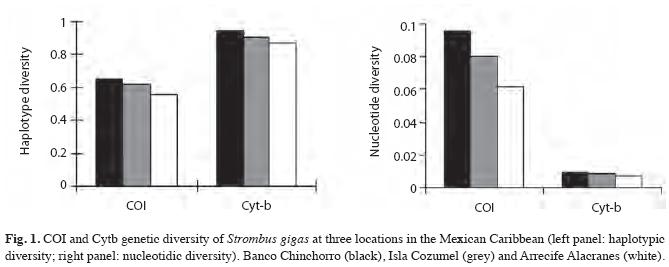
<body><![CDATA[the haplotypic diversity in the three locations showed medium     (0.55-0.65 in COI) to high (0.87-0.94 in Cyt-b) values. Both genetic     diversity indices (Hd and Nd) showed a decreasing pattern from Banco     Chinchorro to Arrecife Alacranes (<a href="#fig1">Fig. 1</a>). The     Nd/Hd proportion showed     the same decreasing pattern in both COI (Banco Chinchorro= 0.15, Isla     Cozumel =0.13 and Arrecife Alacranes=0.11) and Cyt-b (Banco Chinchorro=     0.0098, Isla Cozumel =0.0094 and Arrecife Alacranes=0.0078).    <br> <br style="font-family: verdana;"> </span></font>     <div style="text-align: center;"><a name="fig1"></a><img alt=""  src="/img/revistas/rbt/v59n3/a14i1.jpg"  style="width: 669px; height: 267px;">    ]]></body>
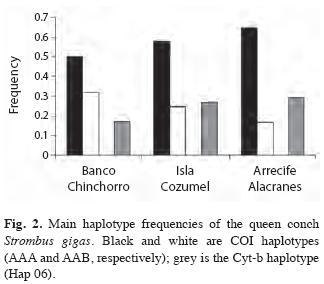
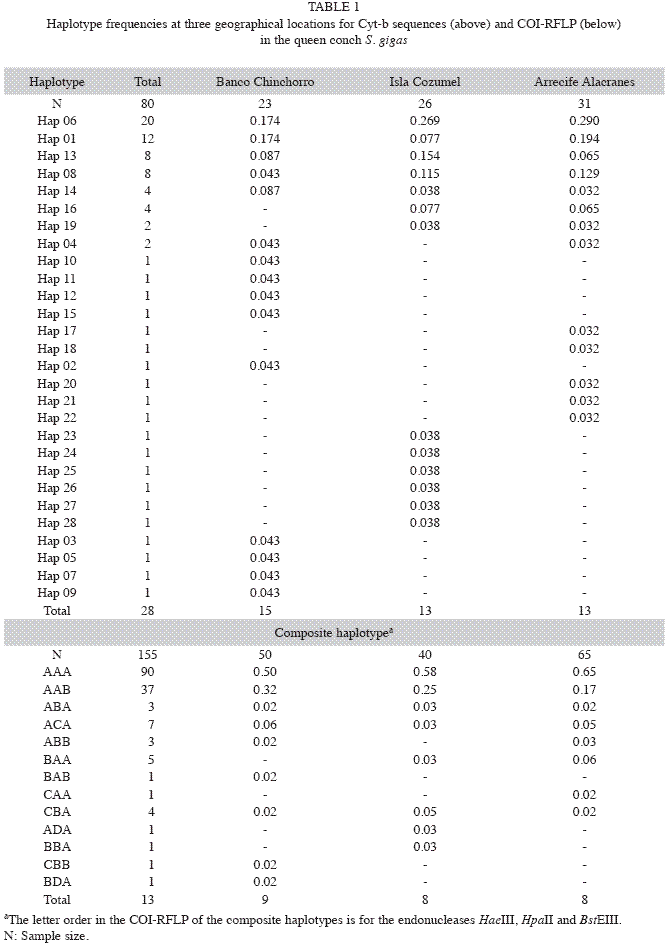
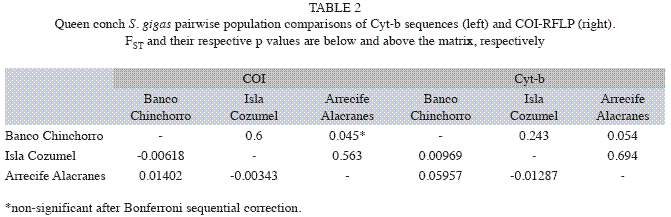
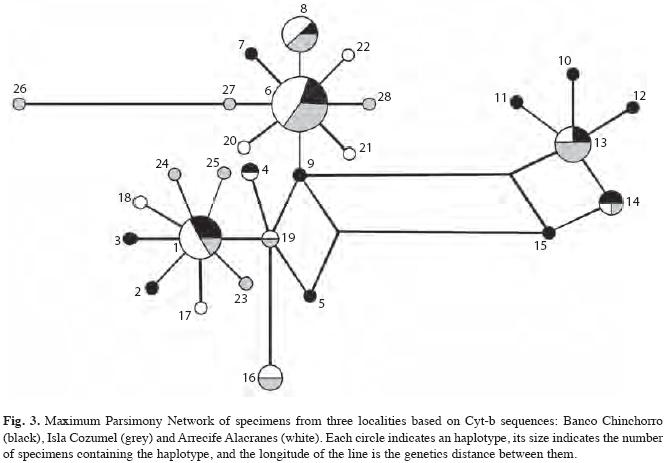
<body><![CDATA[<br> </div>     <br> <br style="font-family: verdana;"> <font size="2"><span style="font-family: verdana;">The COI-RFLP analysis, based on the digestions of H<span style="font-style: italic;">ae</span>III, H<span  style="font-style: italic;">pa</span>II, and <span  style="font-style: italic;">Bst</span>EII showed three, four and two haplotypes, respectively. A total of 13 composite haplotypes were formed, of which the dominant ones (AAA and AAB) were the same in the three locations (<a href="/img/revistas/rbt/v59n3/a14t1.gif">Table 1</a>). Cyt-b had at least ten polymorphic sites and 28 different sequences. The main haplotypes (Hap 06, Hap 01, Hap 13 and Hap 08) were also shared by the three locations (<a  href="/img/revistas/rbt/v59n3/a14t1.gif">Table 1</a>). Exclusive haplotypes were observed for Cyt-b and COI, but their frequencies were, in all cases, always less than 5% (<a  href="/img/revistas/rbt/v59n3/a14t1.gif">Table 1</a>).</span></font><br  style="font-family: verdana;"> <br style="font-family: verdana;"> <font size="2"><span style="font-family: verdana;">No statistically significant heterogeneity in the distribution of haplotypes among locations was revealed (COI:</span></font><span style="">&#967;</span><font size="2"><span  style="font-family: verdana;"><sup>2</sup>=23.79, p=0.49; Cyt-b:</span></font><span  style="">&#967;</span><font size="2"><span style="font-family: verdana;"><sup>2</sup>=51.5, p=0.734). The genetic divergence analyses (AMOVA) based on RFLP with COI (F<sub>ST</sub>=0.005, p=0.247) and Cyt-b sequences (F<sub>ST</sub>=0.019, p=0.161), did not show significant differences among locations indicating genetic homogeneity among them. Significant pairwise differences were neither observed (<a  href="/img/revistas/rbt/v59n3/a14t2.gif">Table 2</a>). Nevertheless, a marginal pairwise F<sub>ST</sub> between Banco Chinchorro and Arrecife Alacranes was found and the frequencies of the </span></font><font  size="2"><span style="font-family: verdana;">main haplotypes of both genes showed a slight increasing/decreasing cline pattern from Banco Chinchorro to Arrecife Alacranes (<a href="#fig2">Fig. 2</a>).    <br>     <br> </span></font>     <div style="text-align: center;"><font size="2"><span  style="font-family: verdana;"><a name="fig2"></a><img alt=""  src="/img/revistas/rbt/v59n3/a14i2.jpg"  style="width: 324px; height: 284px;"></span></font>    <br> <font size="2"><span style="font-family: verdana;"></span></font></div> <font size="2"><span style="font-family: verdana;">    <br> <br style="font-family: verdana;"> </span></font><br style="font-family: verdana;"> <font size="2"><span style="font-family: verdana;">The Cyt-b sequence alignment of 447-bp fragments resulted in a Maximum Parsimony Network tree in which individuals from the three locations shared clades (<a  href="/img/revistas/rbt/v59n3/a14i3.jpg">Fig. 3</a>) and thus there were no particular clades associated with any of the geographical locations. Nevertheless, the isolation by distance analysis showed a strong correlation between geographic and genetic distances (r<sup>2</sup>=0.87), a pattern also observed in the genetic distance, represented by the pairwise F<sub>ST</sub>, which shows Isla Cozumel intermediate between the other two locations (<a href="/img/revistas/rbt/v59n3/a14t2.gif">Table 2</a>).    <br> </span></font><br style="font-family: verdana;"> <font size="2"><span style="font-family: verdana;">The sudden expansion model fitted the mismatch distributions for the three sites (SSD=0.016, p=0.40 for Banco Chinchorro; SSD=0.011, p=0.41 for Isla Cozumel; SSD=0.014, p=0.48 for Arrecife Alacranes (<a href="#fig4">Fig. 4</a>), suggesting that the hypothesis of a sudden population expansion cannot not be rejected.    <br> <br style="font-family: verdana;"> </span></font>     <div style="text-align: center;"><a name="fig4"></a><img alt=""  src="/img/revistas/rbt/v59n3/a14i4.jpg"  style="width: 330px; height: 590px;">    ]]></body>
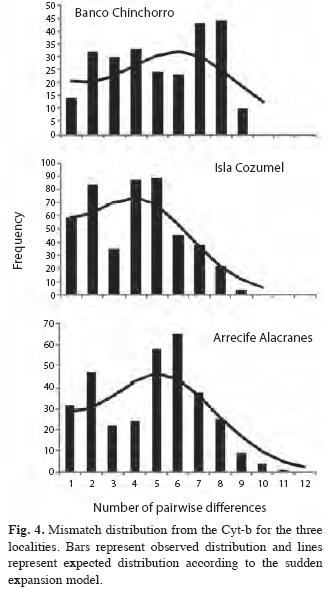
<body><![CDATA[<br> </div>     <br> <br style="font-family: verdana;"> <font style="font-weight: bold;" size="3"><span  style="font-family: verdana;">Discussion</span></font><br  style="font-family: verdana;"> <br style="font-family: verdana;"> <font size="2"><span style="font-family: verdana;"><span  style="font-weight: bold;">Genetic diversity:</span> In spite of the endangered status of the queen conch, the overall genetic diversity in the COI and Cyt-b genes varied from medium to high values, suggesting that <span style="font-style: italic;">S. gigas </span>has not reached genetically threatened levels, as would be expected if a serious bottleneck would had happened. Examples of decrease in genetic diversity after severe bottlenecks have been documented in the Northern Elephant Seal (Hoelzel<span  style="font-style: italic;"> et al</span>. 2002) and the Hungarian Meadow viper (&Uacute;jv&aacute;ri <span  style="font-style: italic;">et al</span>. 2002).</span></font><br  style="font-family: verdana;"> <br style="font-family: verdana;"> <font size="2"><span style="font-family: verdana;">The higher genetic diversity and Nd/Hd proportion found at Banco Chinchorro suggests that these locations have older and larger populations because more time is needed to produce more divergent haplotypes. This is supported by the analysis of the demographic history based on Cyt-b, in which Banco Chinchorro shows a right-shifted unimodal mismatch distribution that suggests that this location may be relatively older than the other sites (Rogers &amp; Harpending 1992). A less unimodal pattern in Banco Chinchorro may also indicate a historically more stable population than the other sites, presumably as a consequence of being less environmentally impacted. These results and the lack of evidence of a genetic bottleneck at Arrecife Alacranes, suggest that the slightly lower genetic diversity may be due to a historic lower population size, rather than an intensive overexploitation activity.</span></font><br  style="font-family: verdana;"> <br style="font-family: verdana;"> <font size="2"><span style="font-family: verdana;"><span  style="font-weight: bold;">Genetic differentiation</span>: While the lack of a significant genetic subdivision among the three locations suggests that gene flow is present, the cline from South to North in genetic diversity and haplotype frequencies; the marginal pairwise F<sub>ST</sub> between Banco Chinchorro and Arrecife Alacranes suggests that gene flow between these extreme positions might be somewhat reduced. Similar results were reported by Tello-Cetina <span style="font-style: italic;">et al</span>. (2005), who, based on allozymes, stated that the samples from Arrecife Alacranes were less related to sites in the Mexican Caribbean. Furthermore, the </span></font><font  size="2"><span style="font-family: verdana;">genetic distance dendrogram and the correlation between genetic and geographic distances suggest that queen conch population follows a pattern of raising genetic differences as the geographical distance increases, similar to the isolation-by-distance model (Wright 1943).</span></font><br  style="font-family: verdana;"> <br style="font-family: verdana;"> <font size="2"><span style="font-family: verdana;">An alternative explanation to the marginal F<sub>ST </sub>differences between Banco Chinchorro and Arrecife Alacranes comes from the mismatch distribution patterns, which suggest relatively distinct historical events. Thus, each location might have reappeared from isolation from low population sizes with some levels of recent gene flow between them.</span></font><br  style="font-family: verdana;"> <br style="font-family: verdana;"> <font size="2"><span style="font-family: verdana;">A South to North gene flow pattern is supported by the oceanographic data. Cetina <span  style="font-style: italic;">et al</span>. (2006) reported that the current runs Northeastward parallel to the coast, from Banco Chinchorro to Isla Cozumel. This current has its origin in Central America, from the Cayman Current that flows Eastwards, arriving close to the middle of Yucatan Peninsula. At Banco Chinchorro, there are reversal episodes on which the current flows Southward (Cetina <span  style="font-style: italic;">et al</span>. 2006). Therefore, it is probable that larval dispersal along the East coast of the Yucatan Peninsula would be from Banco Chinchorro to Isla Cozumel, rather than the opposite. After the Isla Cozumel, the current intensifies as it passes through the Yucatan Channel and forms two streams, one stream flowing toward Florida and the Atlantic, and the other flowing Westward into the Gulf of Mexico. While the first stream would be transporting larvae from Isla Cozumel to Florida, the second stream would be dispersing the larvae from Isla Cozumel to Arrecife Alacranes. Little transport would be expected in the opposite direction.</span></font><br  style="font-family: verdana;"> <br style="font-family: verdana;"> <font size="2"><span style="font-family: verdana;">However, if current direction varies in the first few meters of the water column, as it appears from surface current maps (Gyory <span style="font-style: italic;">et al</span>. 2010; <a href="/img/revistas/rbt/v59n3/a14i5.jpg">Fig. 5</a>), then larval vertical distribution could be having an enormous effect on the direction of the dispersal. Barile <span style="font-style: italic;">et al</span>. (1994) reported that at early stages, queen conch veliger larvae show positive phototaxis concentrating in the surface, but that more aged larvae (16-37 day) does not necessarily concentrates in the surface, and thus might be dispersed by deeper water currents. Therefore, these larvae might have a greater chance to be transported Northwards, but very weakly Eastwards (i.e. to Arrecife Alacranes).    <br> <br style="font-family: verdana;"> </span></font><font size="2"><span style="font-family: verdana;">Studies of reef species from the Caribbean Sea have also shown contrasting results. Vollmer &amp; Palumbi (2007) found a genetic population structure caused by limited larval dispersal in the staghorn coral <span  style="font-style: italic;">Acropora cervicornis</span>. Purcell <span  style="font-style: italic;">et al</span>. (2006) found that the gene flow pattern in two reef fish species (French grunt <span style="font-style: italic;">Haemulon flavolineatum</span> and bluehead wrasse <span style="font-style: italic;">Thalassoma bifasciatum</span>) was highly dependant on the planktonic larval stage duration. They found an isolation-by-distance genetic structure pattern in <span style="font-style: italic;">H. flavolineatum</span> (larval period ~15 days) and a lack of a genetic structure pattern in <span style="font-style: italic;">T. bifasciatum</span> (larval period ~45 days). In the trochid gastropod <span style="font-style: italic;">Cittarium</span> <span  style="font-style: italic;">pica</span> D&iacute;az-Ferguson <span  style="font-style: italic;">et al</span>. (2010) found that the </span></font><font size="2"><span  style="font-family: verdana;">patterns of genetic differentiation are associated with larger geographical scales, and a partial correspondence with other studies of connectivity based on larval dispersal and hydrodynamic models.</span></font><br  style="font-family: verdana;"> <br style="font-family: verdana;"> <font size="2"><span style="font-family: verdana;"><span  style="font-weight: bold;">Implications for management practices:</span> In those species in which gene flow is restricted by hundreds of kilometers, such as the Staghorn </span></font><font  size="2"><span style="font-family: verdana;">coral, long-distance dispersal of larvae cannot be relied as a practical conservation tool for population recovery; thus, local protective actions must be practiced (vollmer &amp; Palumbi 2007). This is also true like the French grunt, which shows an isolation-by-distance pattern. </span></font><br  style="font-family: verdana;"> <br style="font-family: verdana;"> <font size="2"><span style="font-family: verdana;">The lack of genetic structure of the queen conch along the Yucat&aacute;n coast suggests a management on a single panmictic population basis. However, based on the evidence of a weak cline in genetic diversity and haplotype frequencies, the process of self-sustaining in the sampled populations might be more important in the short term. From a study of dispersal and distribution of queen conch veliger larvae, Aldana-Aranda &amp; Perez-Perez (2007) suggested that most of the larvae is produced and retained within the Arrecife Alacranes, but some larvae is carried Northward. The status of Arrecife Alacranes as national park (http://www.conanp.gob.mx/sinap.html) in which primary production activities (i.e. fisheries) are not allowed should be maintained to promote auto-replenishment of the local population (Anonymous 1988).</span></font><br  style="font-family: verdana;"> <br style="font-family: verdana;"> <font size="2"><span style="font-family: verdana;">Isla Cozumel and the surrounding area, of high intensity tourism, would require additional actions to recover overexploited beds. Stock enhancement, either by releasing hatchery-reared larvae or by translocating juveniles or adults, has been proposed for this purpose. Delgado <span  style="font-style: italic;">et al.</span> (2004) suggested that translocation would be a more cost-effective strategy. In both cases, care is needed to avoid unwanted genetic effects (Bell <span  style="font-style: italic;">et al</span>. 2005). </span></font><br  style="font-family: verdana;"> <br style="font-family: verdana;"> <font size="2"><span style="font-family: verdana;">The case of Banco Chinchorro (http://www.conanp.gob.mx/sinap.html) as a biosphere reserve, and where controlled extraction activities are allowed (Anonymous 1988), would not have threats on its population genetic diversity, because this area seems to be a self-sustainable site that might receive larvae from other areas of the Caribbean.</span></font><br  style="font-family: verdana;"> <br style="font-family: verdana;"> <font size="2"><span style="font-family: verdana;">In all cases, close surveillance is needed to reduce illegal fishing that takes place in Mexico and other areas of the Caribbean (Theile 2005). Studies of dispersal and connectivity of queen conch larvae over short distances are also needed for a better understanding of recovering capacity in depleted areas.</span></font><br  style="font-family: verdana;"> <br style="font-family: verdana; font-weight: bold;"> <font style="font-weight: bold;" size="3"><span  style="font-family: verdana;">Acknowledgments</span></font><br  style="font-family: verdana;"> <br style="font-family: verdana;"> <font size="2"><span style="font-family: verdana;">The authors are grateful to Donaldo Mart&iacute;nez, Pedro Cadena, Keneth Cervera and Juan Carlos Espinoza (INAPESCA), the fishermen cooperatives &#8216;SCPP Pescadores de Banco Chinchorro&#8217;, and &#8216;SCPP Isla Cozumel&#8217;, the Banco Chinchorro Biosphere Reserve and the Mexican Army vessel &#8216;Progreso&#8217;. </span></font><font  size="2"><span style="font-family: verdana;">Samples were collected with permit DGOPA/8427/220904/4043 from CONAPESCA. This research was funded by a SAGARPA- CONACYT grant (no.2002-001-1530) to Claudia Padilla.</span></font><br  style="font-family: verdana;"> <br style="font-family: verdana; font-weight: bold;"> <font style="font-weight: bold;" size="3"><span  style="font-family: verdana;"></span></font> <hr style="width: 100%; height: 2px;">     <p><font style="font-weight: bold;" size="3"><span  style="font-family: verdana;">References</span></font></p>     <!-- ref --><p><font size="2"><span style="font-family: verdana;">Aldana-Aranda, D. &amp; M. Perez-Perez. 2007. Abundance and distribution of queen conch (<span  style="font-style: italic;">Strombus gigas</span>, Linne 1758) veligers of Alacranes Reef, Yucat&aacute;n, M&eacute;xico. J. Shellfish Res. 26: 59-63.    &nbsp;&nbsp;&nbsp;&nbsp;&nbsp;&nbsp;&nbsp;&nbsp;[&#160;<a href="javascript:void(0);" onclick="javascript: window.open('/scielo.php?script=sci_nlinks&ref=1720112&pid=S0034-7744201100030001400001&lng=','','width=640,height=500,resizable=yes,scrollbars=1,menubar=yes,');">Links</a>&#160;]<!-- end-ref --></span></font></p>     <!-- ref --><br> <font size="2"><span style="font-family: verdana;">Anonymous. 1988. Ley General del Equilibrio Ecol&oacute;gico y La Protecci&oacute;n al Ambiente. Secretaria del Medio Ambiente y Recursos Naturales, SEMARNAT. Diario Oficial de la Federaci&oacute;n, 28 de enero de 1988, M&eacute;xico.    &nbsp;&nbsp;&nbsp;&nbsp;&nbsp;&nbsp;&nbsp;&nbsp;[&#160;<a href="javascript:void(0);" onclick="javascript: window.open('/scielo.php?script=sci_nlinks&ref=1720114&pid=S0034-7744201100030001400002&lng=','','width=640,height=500,resizable=yes,scrollbars=1,menubar=yes,');">Links</a>&#160;]<!-- end-ref --></span></font> <br style="font-family: verdana;">     <!-- ref --><p><font size="2"><span style="font-family: verdana;">Anonymous. 2006. ACUERDO mediante el cual se aprueba la actualizaci&oacute;n de la Carta Nacional Pesquera. Diario Oficial de la Federaci&oacute;n, 25 de agosto de 2006, M&eacute;xico</span></font>&nbsp;&nbsp;&nbsp;&nbsp;&nbsp;&nbsp;&nbsp;&nbsp;[&#160;<a href="javascript:void(0);" onclick="javascript: window.open('/scielo.php?script=sci_nlinks&ref=1720116&pid=S0034-7744201100030001400003&lng=','','width=640,height=500,resizable=yes,scrollbars=1,menubar=yes,');">Links</a>&#160;]<!-- end-ref --><!-- ref --><br> <br style="font-family: verdana;"> <font size="2"><span style="font-family: verdana;">Barile, P.J., A.W. Stoner &amp; C.M. Young. 1994. Phototaxis and vertical migration of the queen conch (<span style="font-style: italic;">Strombus gigas</span> Linne) veliger larvae. J. Exp. Mar. Biol. Ecol. 183: 147-162.    &nbsp;&nbsp;&nbsp;&nbsp;&nbsp;&nbsp;&nbsp;&nbsp;[&#160;<a href="javascript:void(0);" onclick="javascript: window.open('/scielo.php?script=sci_nlinks&ref=1720117&pid=S0034-7744201100030001400004&lng=','','width=640,height=500,resizable=yes,scrollbars=1,menubar=yes,');">Links</a>&#160;]<!-- end-ref --></span></font>    <!-- ref --><br> <br style="font-family: verdana;"> <font size="2"><span style="font-family: verdana;">Beaumont, A. 2000. Genetic considerations in transfer and introductions of scallops. Aquaculture Int. 8: 493-512.    &nbsp;&nbsp;&nbsp;&nbsp;&nbsp;&nbsp;&nbsp;&nbsp;[&#160;<a href="javascript:void(0);" onclick="javascript: window.open('/scielo.php?script=sci_nlinks&ref=1720119&pid=S0034-7744201100030001400005&lng=','','width=640,height=500,resizable=yes,scrollbars=1,menubar=yes,');">Links</a>&#160;]<!-- end-ref --><!-- ref --></span></font><br style="font-family: verdana;"> <br style="font-family: verdana;"> <font size="2"><span style="font-family: verdana;">Bell, J.D., P.C. Rothlisberg, J.L. Munro, N.R. Loneragan, W.J. Nash, R.D. Ward &amp; N.L. Andrew. 2005. Restocking and stock enhancement of marine invertebrate fisheries. Advances in Marine Biology 49. Academic, California, USA.    &nbsp;&nbsp;&nbsp;&nbsp;&nbsp;&nbsp;&nbsp;&nbsp;[&#160;<a href="javascript:void(0);" onclick="javascript: window.open('/scielo.php?script=sci_nlinks&ref=1720120&pid=S0034-7744201100030001400006&lng=','','width=640,height=500,resizable=yes,scrollbars=1,menubar=yes,');">Links</a>&#160;]<!-- end-ref --><!-- ref --></span></font><br  style="font-family: verdana;"> <br style="font-family: verdana;"> <font size="2"><span style="font-family: verdana;">Bohonak, A.J. 2002. IBD (Isolation by Distance): a program for analyses of isolation by distance. J. Hered. 93: 153-154.    &nbsp;&nbsp;&nbsp;&nbsp;&nbsp;&nbsp;&nbsp;&nbsp;[&#160;<a href="javascript:void(0);" onclick="javascript: window.open('/scielo.php?script=sci_nlinks&ref=1720121&pid=S0034-7744201100030001400007&lng=','','width=640,height=500,resizable=yes,scrollbars=1,menubar=yes,');">Links</a>&#160;]<!-- end-ref --><!-- ref --></span></font><br style="font-family: verdana;"> <br style="font-family: verdana;"> <font size="2"><span style="font-family: verdana;">Campton, D.E., C.J. Berg Jr., L.M. Robinson &amp; R.A. Glazer. 1992. Genetic patchiness among populations of queen conch<span style="font-style: italic;"> Strombus gigas</span> in the Florida Keys and Bimini. Fish. Bull. 90: 250-259.    &nbsp;&nbsp;&nbsp;&nbsp;&nbsp;&nbsp;&nbsp;&nbsp;[&#160;<a href="javascript:void(0);" onclick="javascript: window.open('/scielo.php?script=sci_nlinks&ref=1720122&pid=S0034-7744201100030001400008&lng=','','width=640,height=500,resizable=yes,scrollbars=1,menubar=yes,');">Links</a>&#160;]<!-- end-ref --><!-- ref --> </span></font><br style="font-family: verdana;"> <br style="font-family: verdana;"> <font size="2"><span style="font-family: verdana;">Cetina, P., J. Candela, J. Sheinbaum, J. Ochoa &amp; A. Badan. 2006. Circulation along the Mexican Caribbean coast. J. Geophys. Res. 111 C08021: 1-19.    &nbsp;&nbsp;&nbsp;&nbsp;&nbsp;&nbsp;&nbsp;&nbsp;[&#160;<a href="javascript:void(0);" onclick="javascript: window.open('/scielo.php?script=sci_nlinks&ref=1720123&pid=S0034-7744201100030001400009&lng=','','width=640,height=500,resizable=yes,scrollbars=1,menubar=yes,');">Links</a>&#160;]<!-- end-ref --><!-- ref --></span></font><br  style="font-family: verdana;"> <br style="font-family: verdana;"> <font size="2"><span style="font-family: verdana;">CITES. 1973. Convention on International Trade in Endangered Species of Wild Fauna and Flora. Appendix II (valid from 1 July 2008). (Downloaded: November 25, 2010, <a href="www.cites.org/eng/app/E-Jul01.pdf">www.cites.org/eng/app/E-Jul01.pdf</a>).    &nbsp;&nbsp;&nbsp;&nbsp;&nbsp;&nbsp;&nbsp;&nbsp;[&#160;<a href="javascript:void(0);" onclick="javascript: window.open('/scielo.php?script=sci_nlinks&ref=1720124&pid=S0034-7744201100030001400010&lng=','','width=640,height=500,resizable=yes,scrollbars=1,menubar=yes,');">Links</a>&#160;]<!-- end-ref --><!-- ref --></span></font><br  style="font-family: verdana;"> <br style="font-family: verdana;"> <font size="2"><span style="font-family: verdana;">CONAPESCA. 2010. Anuario Estad&iacute;stico de Acuacultura y Pesca 2008. Comisi&oacute;n Nacional de Acuacultura y Pesca. Mazatl&aacute;n, Sinaloa, M&eacute;xico. (Downloaded: November 25, 2010, <a href="www.sagarpa.gob.mx/conapesca/planeacion/planeacionindx.htm">www.sagarpa.gob.mx/conapesca/planeacion/planeacionindx.htm</a>).    &nbsp;&nbsp;&nbsp;&nbsp;&nbsp;&nbsp;&nbsp;&nbsp;[&#160;<a href="javascript:void(0);" onclick="javascript: window.open('/scielo.php?script=sci_nlinks&ref=1720125&pid=S0034-7744201100030001400011&lng=','','width=640,height=500,resizable=yes,scrollbars=1,menubar=yes,');">Links</a>&#160;]<!-- end-ref --><!-- ref --></span></font><br  style="font-family: verdana;"> <br style="font-family: verdana;"> <font size="2"><span style="font-family: verdana;">Delgado, G.A., C.T. Bartels, R.A. Glazer, N.J. Brown-Peterson &amp; K.J. McCarthy. 2004. Translocation as a strategy to rehabilitate the queen conch (<span  style="font-style: italic;">Strombus gigas</span>) population in the Florida Keys. Fish. Bull. 102: 278-288.    &nbsp;&nbsp;&nbsp;&nbsp;&nbsp;&nbsp;&nbsp;&nbsp;[&#160;<a href="javascript:void(0);" onclick="javascript: window.open('/scielo.php?script=sci_nlinks&ref=1720126&pid=S0034-7744201100030001400012&lng=','','width=640,height=500,resizable=yes,scrollbars=1,menubar=yes,');">Links</a>&#160;]<!-- end-ref --><!-- ref --></span></font><br  style="font-family: verdana;"> <br style="font-family: verdana;"> <font size="2"><span style="font-family: verdana;">Diaz-Ferguson, E., R. Haney, J. Wares &amp; B. Silliman. 2010. Population genetics of a Trochid gastropod broadens picture of Caribbean Sea connectivity. PLos ONE 5: e12675.    &nbsp;&nbsp;&nbsp;&nbsp;&nbsp;&nbsp;&nbsp;&nbsp;[&#160;<a href="javascript:void(0);" onclick="javascript: window.open('/scielo.php?script=sci_nlinks&ref=1720127&pid=S0034-7744201100030001400013&lng=','','width=640,height=500,resizable=yes,scrollbars=1,menubar=yes,');">Links</a>&#160;]<!-- end-ref --><!-- ref --></span></font><br style="font-family: verdana;"> <br style="font-family: verdana;"> <font size="2"><span style="font-family: verdana;">Excoffier, L., G. Laval &amp; S. Schneider. 2005. Arlequin ver. 3.0: An integrated software package for population genetics data analysis. Evolutionary Bioinformatics Online 1: 47-50.    &nbsp;&nbsp;&nbsp;&nbsp;&nbsp;&nbsp;&nbsp;&nbsp;[&#160;<a href="javascript:void(0);" onclick="javascript: window.open('/scielo.php?script=sci_nlinks&ref=1720128&pid=S0034-7744201100030001400014&lng=','','width=640,height=500,resizable=yes,scrollbars=1,menubar=yes,');">Links</a>&#160;]<!-- end-ref --><!-- ref --></span></font><br style="font-family: verdana;"> <br style="font-family: verdana;"> <font size="2"><span style="font-family: verdana;">FAO. 1993. Report of the Expert Consultation on utilization and conservation of aquatic genetic resources. FAO Fish. Rep. 491: 1-58.    &nbsp;&nbsp;&nbsp;&nbsp;&nbsp;&nbsp;&nbsp;&nbsp;[&#160;<a href="javascript:void(0);" onclick="javascript: window.open('/scielo.php?script=sci_nlinks&ref=1720129&pid=S0034-7744201100030001400015&lng=','','width=640,height=500,resizable=yes,scrollbars=1,menubar=yes,');">Links</a>&#160;]<!-- end-ref --><!-- ref --></span></font><br  style="font-family: verdana;"> <br style="font-family: verdana;"> <font size="2"><span style="font-family: verdana;">Felsenstein, J. 1993. PHYLIP (Phylogeny Inference Package, version 3. 5), Department of Genetics, University of Washington, Seattle, Washington, USA.    &nbsp;&nbsp;&nbsp;&nbsp;&nbsp;&nbsp;&nbsp;&nbsp;[&#160;<a href="javascript:void(0);" onclick="javascript: window.open('/scielo.php?script=sci_nlinks&ref=1720130&pid=S0034-7744201100030001400016&lng=','','width=640,height=500,resizable=yes,scrollbars=1,menubar=yes,');">Links</a>&#160;]<!-- end-ref --><!-- ref --></span></font><br  style="font-family: verdana;"> <br style="font-family: verdana;"> <font size="2"><span style="font-family: verdana;">Folmer, O., M. Black, W. Hoeh, R. Lutz &amp; R. vriejenhoek. 1994. DNA primers for amplification of mitochondrial cytochrome c oxidase subunit I from diverse metazoan invertebrates. Mol. Mar. Biol. Biotechnol. 3: 294-299.    &nbsp;&nbsp;&nbsp;&nbsp;&nbsp;&nbsp;&nbsp;&nbsp;[&#160;<a href="javascript:void(0);" onclick="javascript: window.open('/scielo.php?script=sci_nlinks&ref=1720131&pid=S0034-7744201100030001400017&lng=','','width=640,height=500,resizable=yes,scrollbars=1,menubar=yes,');">Links</a>&#160;]<!-- end-ref --><!-- ref --></span></font><br  style="font-family: verdana;"> <br style="font-family: verdana;"> <font size="2"><span style="font-family: verdana;">Gore, S. &amp; A. Llewellyn. 2005. Distribution and abundance of <span style="font-style: italic;">Strombus gigas</span> in the British virgin Islands. Proc. Gulf Carib. Fish. Inst. 56: 697-704.    &nbsp;&nbsp;&nbsp;&nbsp;&nbsp;&nbsp;&nbsp;&nbsp;[&#160;<a href="javascript:void(0);" onclick="javascript: window.open('/scielo.php?script=sci_nlinks&ref=1720132&pid=S0034-7744201100030001400018&lng=','','width=640,height=500,resizable=yes,scrollbars=1,menubar=yes,');">Links</a>&#160;]<!-- end-ref --><!-- ref --></span></font><br  style="font-family: verdana;"> <br style="font-family: verdana;"> <font size="2"><span style="font-family: verdana;">Gyory, J., A.J. Mariano &amp; H.R. Edward. 2010. &#8220;The Mexican Current&#8221; (Downloaded: November 25, 2010, <a href="http://oceancurrents.rsmas.miami.edu/caribbean/mexican.html">http://oceancurrents.rsmas.miami.edu/caribbean/mexican.html</a>).    &nbsp;&nbsp;&nbsp;&nbsp;&nbsp;&nbsp;&nbsp;&nbsp;[&#160;<a href="javascript:void(0);" onclick="javascript: window.open('/scielo.php?script=sci_nlinks&ref=1720133&pid=S0034-7744201100030001400019&lng=','','width=640,height=500,resizable=yes,scrollbars=1,menubar=yes,');">Links</a>&#160;]<!-- end-ref --><!-- ref --></span></font><br  style="font-family: verdana;"> <br style="font-family: verdana;"> <font size="2"><span style="font-family: verdana;">Hernandez, E. 2008. Crime scene investigation of recent illegal shore-based recreational fishing activity on Queen Conch (<span style="font-style: italic;">Strombus gigas</span>) in Culebra Island, Puerto Rico. Proc. Gulf Carib. Fish. Inst. 60: 648.    &nbsp;&nbsp;&nbsp;&nbsp;&nbsp;&nbsp;&nbsp;&nbsp;[&#160;<a href="javascript:void(0);" onclick="javascript: window.open('/scielo.php?script=sci_nlinks&ref=1720134&pid=S0034-7744201100030001400020&lng=','','width=640,height=500,resizable=yes,scrollbars=1,menubar=yes,');">Links</a>&#160;]<!-- end-ref --><!-- ref --></span></font><br  style="font-family: verdana;"> <br style="font-family: verdana;"> <font size="2"><span style="font-family: verdana;">Hoelzel, A.R., R.C. Fleischer, C. Campagna, B.J. Le Boeuf &amp; G. Alvord. 2002. Impact of a population bottleneck on symmetry and genetic diversity in the northern elephant seal. J. Evol. Biol. 15: 567-575.    &nbsp;&nbsp;&nbsp;&nbsp;&nbsp;&nbsp;&nbsp;&nbsp;[&#160;<a href="javascript:void(0);" onclick="javascript: window.open('/scielo.php?script=sci_nlinks&ref=1720135&pid=S0034-7744201100030001400021&lng=','','width=640,height=500,resizable=yes,scrollbars=1,menubar=yes,');">Links</a>&#160;]<!-- end-ref --><!-- ref --></span></font><br  style="font-family: verdana;"> <br style="font-family: verdana;"> <font size="2"><span style="font-family: verdana;">Mateo, J. &amp; J.C. Tejeda. 2008. The queen conch, <span style="font-style: italic;">Strombus gigas</span>, resource in the Dominican Republic. Proc. Gulf Carib. Fish. Inst. 60: 519-524.    &nbsp;&nbsp;&nbsp;&nbsp;&nbsp;&nbsp;&nbsp;&nbsp;[&#160;<a href="javascript:void(0);" onclick="javascript: window.open('/scielo.php?script=sci_nlinks&ref=1720136&pid=S0034-7744201100030001400022&lng=','','width=640,height=500,resizable=yes,scrollbars=1,menubar=yes,');">Links</a>&#160;]<!-- end-ref --><!-- ref --></span></font><br  style="font-family: verdana;"> <br style="font-family: verdana;"> <font size="2"><span style="font-family: verdana;">McElroy, D., P. Moran, E. Bermingham &amp; I. Kornfield. 1992. REAP: an integrated environment for the manipulation and phylogenetic analysis of restriction data. J. Hered. 83: 157-158.    &nbsp;&nbsp;&nbsp;&nbsp;&nbsp;&nbsp;&nbsp;&nbsp;[&#160;<a href="javascript:void(0);" onclick="javascript: window.open('/scielo.php?script=sci_nlinks&ref=1720137&pid=S0034-7744201100030001400023&lng=','','width=640,height=500,resizable=yes,scrollbars=1,menubar=yes,');">Links</a>&#160;]<!-- end-ref --><!-- ref --></span></font><br style="font-family: verdana;"> <br style="font-family: verdana;"> <font size="2"><span style="font-family: verdana;">Mitton, J.B., C.J. Berg Jr &amp; K.S. Orr. 1989. Population structure, larval dispersal, and gene flow in the queen conch, <span style="font-style: italic;">Strombus gigas</span>, of the Caribbean. Biol. Bull. 177: 356-362.    &nbsp;&nbsp;&nbsp;&nbsp;&nbsp;&nbsp;&nbsp;&nbsp;[&#160;<a href="javascript:void(0);" onclick="javascript: window.open('/scielo.php?script=sci_nlinks&ref=1720138&pid=S0034-7744201100030001400024&lng=','','width=640,height=500,resizable=yes,scrollbars=1,menubar=yes,');">Links</a>&#160;]<!-- end-ref --><!-- ref --></span></font><br style="font-family: verdana;"> <br style="font-family: verdana;"> <font size="2"><span style="font-family: verdana;">Morales, F. 2004. Metapopulation structure of the queen conch, <span style="font-style: italic;">Strombus gigas</span> (Linne, 1758) throughout the Intra-Americas Sea. Diss. Abst. Int. Pt. B.-Sci. and Eng. 65: 597-598.    &nbsp;&nbsp;&nbsp;&nbsp;&nbsp;&nbsp;&nbsp;&nbsp;[&#160;<a href="javascript:void(0);" onclick="javascript: window.open('/scielo.php?script=sci_nlinks&ref=1720139&pid=S0034-7744201100030001400025&lng=','','width=640,height=500,resizable=yes,scrollbars=1,menubar=yes,');">Links</a>&#160;]<!-- end-ref --><!-- ref --></span></font><br style="font-family: verdana;"> <br style="font-family: verdana;"> <font size="2"><span style="font-family: verdana;">Morales, F.E. &amp; J. Lopez. 2003. An&aacute;lisis gen&eacute;tico del botuto Queen Conch (<span  style="font-style: italic;">Strombus gigas</span> Linne, 1758): resultados preliminares, p. 15-20. In D. Aldana-Aranda (ed.). El caracol <span style="font-style: italic;">Strombus gigas</span>: conocimiento integral para su manejo sustentable en el Caribe, CYTED, Programa Iberoamericano de Ciencia y Tecnolog&iacute;a para el Desarrollo, Yucat&aacute;n, M&eacute;xico.    &nbsp;&nbsp;&nbsp;&nbsp;&nbsp;&nbsp;&nbsp;&nbsp;[&#160;<a href="javascript:void(0);" onclick="javascript: window.open('/scielo.php?script=sci_nlinks&ref=1720140&pid=S0034-7744201100030001400026&lng=','','width=640,height=500,resizable=yes,scrollbars=1,menubar=yes,');">Links</a>&#160;]<!-- end-ref --><!-- ref --></span></font><br  style="font-family: verdana;"> <br style="font-family: verdana;"> <font size="2"><span style="font-family: verdana;">Neiman, M. &amp; C.M. Lively. 2004. Pleistocene glaciation is implicated in the phylogeographical structure of <span style="font-style: italic;">Potamopyrgus antipodarum</span>, a New Zealand snail. Mol. Ecol. 13: 3085-3098.    &nbsp;&nbsp;&nbsp;&nbsp;&nbsp;&nbsp;&nbsp;&nbsp;[&#160;<a href="javascript:void(0);" onclick="javascript: window.open('/scielo.php?script=sci_nlinks&ref=1720141&pid=S0034-7744201100030001400027&lng=','','width=640,height=500,resizable=yes,scrollbars=1,menubar=yes,');">Links</a>&#160;]<!-- end-ref --><!-- ref --></span></font><br style="font-family: verdana;"> <br style="font-family: verdana;"> <font size="2"><span style="font-family: verdana;">Oxenford, H.A., A. Fields, C. Taylor &amp; D. Catlyn. 2008. The little-known conch (<span  style="font-style: italic;">Strombus gigas</span>) fishery of Barbados. Proc. Gulf Carib. Fish. Inst. 60: 125-136.    &nbsp;&nbsp;&nbsp;&nbsp;&nbsp;&nbsp;&nbsp;&nbsp;[&#160;<a href="javascript:void(0);" onclick="javascript: window.open('/scielo.php?script=sci_nlinks&ref=1720142&pid=S0034-7744201100030001400028&lng=','','width=640,height=500,resizable=yes,scrollbars=1,menubar=yes,');">Links</a>&#160;]<!-- end-ref --><!-- ref --></span></font><br  style="font-family: verdana;"> <br style="font-family: verdana;"> <font size="2"><span style="font-family: verdana;">Page, R.D.M. 1996. TREEvIEW: An application to display phylogenetic trees on personal computers. Comp. Appl. Biosci. 12: 357-358.    &nbsp;&nbsp;&nbsp;&nbsp;&nbsp;&nbsp;&nbsp;&nbsp;[&#160;<a href="javascript:void(0);" onclick="javascript: window.open('/scielo.php?script=sci_nlinks&ref=1720143&pid=S0034-7744201100030001400029&lng=','','width=640,height=500,resizable=yes,scrollbars=1,menubar=yes,');">Links</a>&#160;]<!-- end-ref --><!-- ref --></span></font><br  style="font-family: verdana;"> <br style="font-family: verdana;"> <font size="2"><span style="font-family: verdana;">Perez-Ruzafa, A., M. Gonzalez-Wanguemert, P. Lenfant, C. Marcos &amp; J.A. Garc&iacute;a-Charton. 2006. Effects of fishing protection on the genetic structure of fish populations. Biol. Conserv. 129: 244-255.    &nbsp;&nbsp;&nbsp;&nbsp;&nbsp;&nbsp;&nbsp;&nbsp;[&#160;<a href="javascript:void(0);" onclick="javascript: window.open('/scielo.php?script=sci_nlinks&ref=1720144&pid=S0034-7744201100030001400030&lng=','','width=640,height=500,resizable=yes,scrollbars=1,menubar=yes,');">Links</a>&#160;]<!-- end-ref --><!-- ref --></span></font><br  style="font-family: verdana;"> <br style="font-family: verdana;"> <font size="2"><span style="font-family: verdana;">Purcell, J.F.H., R.K. Cowen, C.R. Hughes &amp; D.A. Williams. 2006. Weak genetic structure indicates strong dispersal limits: a tale of two coral reef fish. Proc. Royal Soc. B. 273: 1483-1490.    &nbsp;&nbsp;&nbsp;&nbsp;&nbsp;&nbsp;&nbsp;&nbsp;[&#160;<a href="javascript:void(0);" onclick="javascript: window.open('/scielo.php?script=sci_nlinks&ref=1720145&pid=S0034-7744201100030001400031&lng=','','width=640,height=500,resizable=yes,scrollbars=1,menubar=yes,');">Links</a>&#160;]<!-- end-ref --><!-- ref --></span></font><br style="font-family: verdana;"> <br style="font-family: verdana;"> <font size="2"><span style="font-family: verdana;">Roff, D.A. &amp; P. Bentzen. 1989. The statistical analysis of mitochondrial DNA polymorphisms: X<sup>2</sup> and the problem of small samples. Mol. Biol. Evol. 6: 539-545.    &nbsp;&nbsp;&nbsp;&nbsp;&nbsp;&nbsp;&nbsp;&nbsp;[&#160;<a href="javascript:void(0);" onclick="javascript: window.open('/scielo.php?script=sci_nlinks&ref=1720146&pid=S0034-7744201100030001400032&lng=','','width=640,height=500,resizable=yes,scrollbars=1,menubar=yes,');">Links</a>&#160;]<!-- end-ref --><!-- ref --></span></font><br  style="font-family: verdana;"> <font size="2"><span style="font-family: verdana;">&nbsp;</span></font><br  style="font-family: verdana;"> <font size="2"><span style="font-family: verdana;">Rogers, A.R. &amp; H. Harpending. 1992. Population growth makes waves in the distribution of pairwise genetic differences. Mol. Biol. Evol. 9: 552-569.    &nbsp;&nbsp;&nbsp;&nbsp;&nbsp;&nbsp;&nbsp;&nbsp;[&#160;<a href="javascript:void(0);" onclick="javascript: window.open('/scielo.php?script=sci_nlinks&ref=1720147&pid=S0034-7744201100030001400033&lng=','','width=640,height=500,resizable=yes,scrollbars=1,menubar=yes,');">Links</a>&#160;]<!-- end-ref --><!-- ref --></span></font><br  style="font-family: verdana;"> <br style="font-family: verdana;"> <font size="2"><span style="font-family: verdana;">Rozen, S. &amp; H. Skaletsky. 2000. Primer3 on the WWW for general users and for biologist programmers, p. 365- 386. In S. Krawetz &amp; S. Misener (eds.). Bioinformatics methods and protocols: methods in molecular biology. Humana, Totowa, New Jersey, USA.    &nbsp;&nbsp;&nbsp;&nbsp;&nbsp;&nbsp;&nbsp;&nbsp;[&#160;<a href="javascript:void(0);" onclick="javascript: window.open('/scielo.php?script=sci_nlinks&ref=1720148&pid=S0034-7744201100030001400034&lng=','','width=640,height=500,resizable=yes,scrollbars=1,menubar=yes,');">Links</a>&#160;]<!-- end-ref --><!-- ref --></span></font><br style="font-family: verdana;"> <br style="font-family: verdana;"> <font size="2"><span style="font-family: verdana;">Rus, A., S.R. Santos &amp; C. Muir. 2010. Genetic population structure of an anchialine shrimp, <span  style="font-style: italic;">Metabetaeus lohena</span> (Crustacea: Alpheidae), in the Hawaiian Islands. Rev. Biol. Trop. 58: 159-170.    &nbsp;&nbsp;&nbsp;&nbsp;&nbsp;&nbsp;&nbsp;&nbsp;[&#160;<a href="javascript:void(0);" onclick="javascript: window.open('/scielo.php?script=sci_nlinks&ref=1720149&pid=S0034-7744201100030001400035&lng=','','width=640,height=500,resizable=yes,scrollbars=1,menubar=yes,');">Links</a>&#160;]<!-- end-ref --><!-- ref --></span></font><br style="font-family: verdana;"> <br style="font-family: verdana;"> <font size="2"><span style="font-family: verdana;">Ryman, N. &amp; F. Utter. 1987. Population genetics and fishery management. University of Washington, Seattle, Washington, USA.    &nbsp;&nbsp;&nbsp;&nbsp;&nbsp;&nbsp;&nbsp;&nbsp;[&#160;<a href="javascript:void(0);" onclick="javascript: window.open('/scielo.php?script=sci_nlinks&ref=1720150&pid=S0034-7744201100030001400036&lng=','','width=640,height=500,resizable=yes,scrollbars=1,menubar=yes,');">Links</a>&#160;]<!-- end-ref --><!-- ref --></span></font><br style="font-family: verdana;"> <br style="font-family: verdana;"> <font size="2"><span style="font-family: verdana;">Santos, S.R. 2006. Patterns of genetic connectivity among anchialine habitats: a case study of the endemic Hawaiian shrimp <span style="font-style: italic;">Halocaridina rubra</span> on the island of Hawaii. Mol. Ecol. 15: 2699-2718.    &nbsp;&nbsp;&nbsp;&nbsp;&nbsp;&nbsp;&nbsp;&nbsp;[&#160;<a href="javascript:void(0);" onclick="javascript: window.open('/scielo.php?script=sci_nlinks&ref=1720151&pid=S0034-7744201100030001400037&lng=','','width=640,height=500,resizable=yes,scrollbars=1,menubar=yes,');">Links</a>&#160;]<!-- end-ref --><!-- ref --></span></font><br style="font-family: verdana;"> <br style="font-family: verdana;"> <font size="2"><span style="font-family: verdana;">Schweizer, D. &amp; J.M. Posada. 2006. Distribution, density, and abundance of the queen conch,<span  style="font-style: italic;"> Strombus gigas</span>, in Los Roques Archipielago National Park, venezuela. Bull. Mar. Sci. 79: 243-258.    &nbsp;&nbsp;&nbsp;&nbsp;&nbsp;&nbsp;&nbsp;&nbsp;[&#160;<a href="javascript:void(0);" onclick="javascript: window.open('/scielo.php?script=sci_nlinks&ref=1720152&pid=S0034-7744201100030001400038&lng=','','width=640,height=500,resizable=yes,scrollbars=1,menubar=yes,');">Links</a>&#160;]<!-- end-ref --><!-- ref --></span></font><br style="font-family: verdana;"> <br style="font-family: verdana;"> <font size="2"><span style="font-family: verdana;">Shulman, M. &amp; E. Bermingham. 1995. Early life histories, ocean currents, and the population genetics of Caribbean reef fishes. Evolution 49: 897-910.    &nbsp;&nbsp;&nbsp;&nbsp;&nbsp;&nbsp;&nbsp;&nbsp;[&#160;<a href="javascript:void(0);" onclick="javascript: window.open('/scielo.php?script=sci_nlinks&ref=1720153&pid=S0034-7744201100030001400039&lng=','','width=640,height=500,resizable=yes,scrollbars=1,menubar=yes,');">Links</a>&#160;]<!-- end-ref --><!-- ref --></span></font><br  style="font-family: verdana;"> <br style="font-family: verdana;"> <font size="2"><span style="font-family: verdana;">Silberman, J.D., S.K. Sarver &amp; P.J. Walsh. 1994. Mitochondrial DNA variation and population structure in the spiny lobster <span style="font-style: italic;">Panulirus argus</span>. Mar. Biol. 120: 601-608.    &nbsp;&nbsp;&nbsp;&nbsp;&nbsp;&nbsp;&nbsp;&nbsp;[&#160;<a href="javascript:void(0);" onclick="javascript: window.open('/scielo.php?script=sci_nlinks&ref=1720154&pid=S0034-7744201100030001400040&lng=','','width=640,height=500,resizable=yes,scrollbars=1,menubar=yes,');">Links</a>&#160;]<!-- end-ref --><!-- ref --></span></font><br style="font-family: verdana;"> <br style="font-family: verdana;"> <font size="2"><span style="font-family: verdana;">Sweijd, N.A., B.C.K. Bowie, A.L. Lopata, A.M. Marinaki, E.H. Harley &amp; P.A. Cook. 1998. A PCR technique for forensic, species-level identification of abalone tissue. J. Shellfish Res. 17: 889-895.    &nbsp;&nbsp;&nbsp;&nbsp;&nbsp;&nbsp;&nbsp;&nbsp;[&#160;<a href="javascript:void(0);" onclick="javascript: window.open('/scielo.php?script=sci_nlinks&ref=1720155&pid=S0034-7744201100030001400041&lng=','','width=640,height=500,resizable=yes,scrollbars=1,menubar=yes,');">Links</a>&#160;]<!-- end-ref --><!-- ref --></span></font><br  style="font-family: verdana;"> <br style="font-family: verdana;"> <font size="2"><span style="font-family: verdana;">Tello-Cetina, J.A., L.A. Rodr&iacute;guez-Gil &amp; F. Rodr&iacute;guez-Romero. 2005. Population genetics of the pink snail <span style="font-style: italic;">Strombus gigas </span>in the Yucatan Peninsula: Implications for its management and fishery. Cienc. Mar. 31: 379-386.    &nbsp;&nbsp;&nbsp;&nbsp;&nbsp;&nbsp;&nbsp;&nbsp;[&#160;<a href="javascript:void(0);" onclick="javascript: window.open('/scielo.php?script=sci_nlinks&ref=1720156&pid=S0034-7744201100030001400042&lng=','','width=640,height=500,resizable=yes,scrollbars=1,menubar=yes,');">Links</a>&#160;]<!-- end-ref --><!-- ref --></span></font><br  style="font-family: verdana;"> <br style="font-family: verdana;"> <font size="2"><span style="font-family: verdana;">Theile, S. 2001. Queen conch fisheries and their management in the Caribbean. TRAFFIC, Europe.    &nbsp;&nbsp;&nbsp;&nbsp;&nbsp;&nbsp;&nbsp;&nbsp;[&#160;<a href="javascript:void(0);" onclick="javascript: window.open('/scielo.php?script=sci_nlinks&ref=1720157&pid=S0034-7744201100030001400043&lng=','','width=640,height=500,resizable=yes,scrollbars=1,menubar=yes,');">Links</a>&#160;]<!-- end-ref --><!-- ref --></span></font><br  style="font-family: verdana;"> <br style="font-family: verdana;"> <font size="2"><span style="font-family: verdana;">Theile, S. 2005. Status of the queen conch <span style="font-style: italic;">Strombus gigas</span> stocks, management and trade in the Caribbean: A CITES review. Proc. Gulf Carib. Fish. Inst. 56: 675-695.    &nbsp;&nbsp;&nbsp;&nbsp;&nbsp;&nbsp;&nbsp;&nbsp;[&#160;<a href="javascript:void(0);" onclick="javascript: window.open('/scielo.php?script=sci_nlinks&ref=1720158&pid=S0034-7744201100030001400044&lng=','','width=640,height=500,resizable=yes,scrollbars=1,menubar=yes,');">Links</a>&#160;]<!-- end-ref --><!-- ref --></span></font><br  style="font-family: verdana;"> <br style="font-family: verdana;"> <font size="2"><span style="font-family: verdana;">&Uacute;jv&aacute;ri, B., T. Madsen, T. Kotenko, M. Olsson, R. Shine &amp; H. Wittzell. 2002. Low genetic diversity threatens imminent extinction for the Hungarian meadow viper. Biol. Cons. 105: 127-130.    &nbsp;&nbsp;&nbsp;&nbsp;&nbsp;&nbsp;&nbsp;&nbsp;[&#160;<a href="javascript:void(0);" onclick="javascript: window.open('/scielo.php?script=sci_nlinks&ref=1720159&pid=S0034-7744201100030001400045&lng=','','width=640,height=500,resizable=yes,scrollbars=1,menubar=yes,');">Links</a>&#160;]<!-- end-ref --><!-- ref --></span></font><br  style="font-family: verdana;"> <br style="font-family: verdana;"> <font size="2"><span style="font-family: verdana;">Vollmer, S.v. &amp; S.R. Palumbi. 2007. Restricted flow in the Caribbean staghorn coral <span  style="font-style: italic;">Acropora cervicornis</span>: Implications for recovery of endangered reefs. J. Hered. 98: 40-50.    &nbsp;&nbsp;&nbsp;&nbsp;&nbsp;&nbsp;&nbsp;&nbsp;[&#160;<a href="javascript:void(0);" onclick="javascript: window.open('/scielo.php?script=sci_nlinks&ref=1720160&pid=S0034-7744201100030001400046&lng=','','width=640,height=500,resizable=yes,scrollbars=1,menubar=yes,');">Links</a>&#160;]<!-- end-ref --><!-- ref --></span></font><br style="font-family: verdana;"> <br style="font-family: verdana;"> <font size="2"><span style="font-family: verdana;">Wright, S. 1943. Isolation by distance. Genetics 28: 114-138.    &nbsp;&nbsp;&nbsp;&nbsp;&nbsp;&nbsp;&nbsp;&nbsp;[&#160;<a href="javascript:void(0);" onclick="javascript: window.open('/scielo.php?script=sci_nlinks&ref=1720161&pid=S0034-7744201100030001400047&lng=','','width=640,height=500,resizable=yes,scrollbars=1,menubar=yes,');">Links</a>&#160;]<!-- end-ref --><!-- ref --></span></font><br  style="font-family: verdana;"> <br style="font-family: verdana;"> <font size="2"><span style="font-family: verdana;">Yanick, J.F. &amp; D.D. Heath 2000. Survival and growth of mussels subsequent to hemolymph sampling for DNA. J. Shellfish Res. 19: 991-993.    &nbsp;&nbsp;&nbsp;&nbsp;&nbsp;&nbsp;&nbsp;&nbsp;[&#160;<a href="javascript:void(0);" onclick="javascript: window.open('/scielo.php?script=sci_nlinks&ref=1720162&pid=S0034-7744201100030001400048&lng=','','width=640,height=500,resizable=yes,scrollbars=1,menubar=yes,');">Links</a>&#160;]<!-- end-ref --><br>     <br>     <br> <a name="correspondencia"></a>Correspondencia a: </span></font><font  size="2"><span style="font-family: verdana;">Ricardo P&eacute;rez-Enriquez &amp; </span></font><font size="2"><span  style="font-family: verdana;">Gabriela Mendoza-Carrion</span></font><font size="2"><span  style="font-family: verdana;">. </span></font><font size="2"><span  style="font-family: verdana;">Centro de Investigaciones Biol&oacute;gicas del Noroeste (CIBNOR), Mar Bermejo 195, Col. Playa Palo Santa Rita, La Paz, B.C.S. 23090, M&eacute;xico; <a  href="mailto:rperez@cibnor.mx">rperez@cibnor.mx</a></span></font>    <br> <font size="2"><span style="font-family: verdana;">Francisco Javier Garcia-Rodriguez. </span></font><font size="2"><span  style="font-family: verdana;">Centro de Investigaciones Biol&oacute;gicas del Noroeste (CIBNOR), Mar Bermejo 195, Col. Playa Palo Santa Rita, La Paz, B.C.S. 23090, M&eacute;xico</span></font><font  size="2"><span style="font-family: verdana;"> / </span></font><font  size="2"><span style="font-family: verdana;">Centro Interdisciplinario de Ciencias Marinas-Instituto Polit&eacute;cnico Nacional (CICIMAR-IPN), Apdo. Postal 592, La Paz, B.C.S. 23090, M&eacute;xico; <a href="mailto:fjgarciar@ipn.mx">fjgarciar@ipn.mx</a></span></font><font  size="2"><span style="font-family: verdana;">    <br> Claudia Padilla. </span></font><font size="2"><span  style="font-family: verdana;"></span></font><font size="2"><span  style="font-family: verdana;">Centro Regional de Investigaci&oacute;n Pesquera Puerto Morelos del INAPESCA, Matamoros No. 7, Puerto Morelos, Quintana Roo, 77580, M&eacute;xico; <a href="mailto:claudiapadilla@prodigy.net.mx">claudiapadilla@prodigy.net.mx</a> </span></font><span style="font-family: verdana;"></span>     ]]></body>
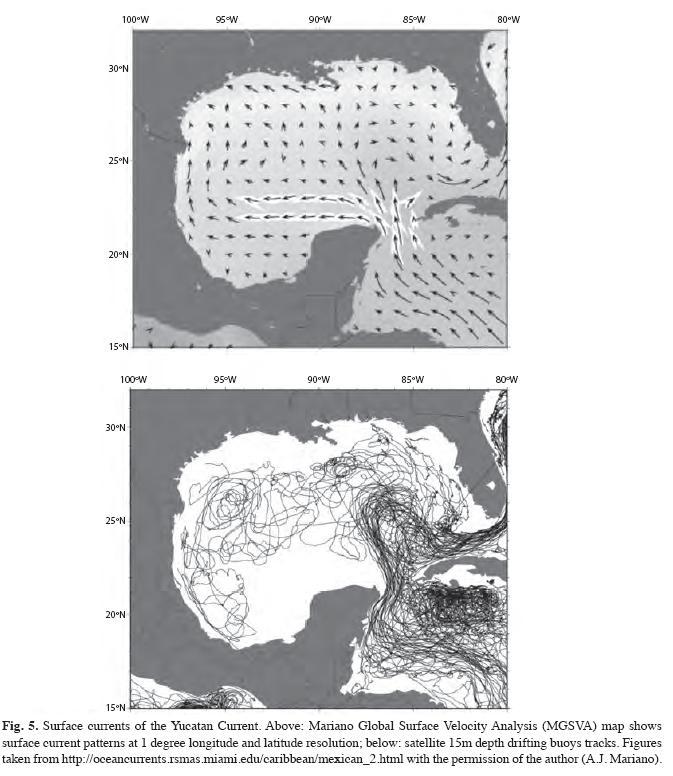
<body><![CDATA[<div style="text-align: center;"> <hr style="width: 100%; height: 2px;"><font size="2"><span  style="font-family: verdana;">Received 04-VI-2010. Corrected 05-I-2011. Accepted 04-II-2011.</span></font></div> </div>      ]]></body><back>
<ref-list>
<ref id="B1">
<nlm-citation citation-type="journal">
<person-group person-group-type="author">
<name>
<surname><![CDATA[Aldana-Aranda]]></surname>
<given-names><![CDATA[D]]></given-names>
</name>
<name>
<surname><![CDATA[Perez-Perez]]></surname>
<given-names><![CDATA[M]]></given-names>
</name>
</person-group>
<article-title xml:lang="en"><![CDATA[Abundance and distribution of queen conch (Strombus gigas, Linne 1758) veligers of Alacranes Reef, Yucatán, México]]></article-title>
<source><![CDATA[J. Shellfish Res]]></source>
<year>2007</year>
<volume>26</volume>
<page-range>59-63</page-range></nlm-citation>
</ref>
<ref id="B2">
<nlm-citation citation-type="book">
<person-group person-group-type="author">
<name>
</name>
<name>
</name>
</person-group>
<collab>Secretaria del Medio Ambiente y Recursos Naturales, SEMARNAT</collab>
<source><![CDATA[Ley General del Equilibrio Ecológico y La Protección al Ambiente]]></source>
<year>1988</year>
<publisher-name><![CDATA[Diario Oficial de la Federación]]></publisher-name>
</nlm-citation>
</ref>
<ref id="B3">
<nlm-citation citation-type="book">
<person-group person-group-type="author">
<name>
</name>
<name>
</name>
</person-group>
<source><![CDATA[ACUERDO mediante el cual se aprueba la actualización de la Carta Nacional Pesquera]]></source>
<year>2006</year>
<publisher-name><![CDATA[Diario Oficial de la Federación]]></publisher-name>
</nlm-citation>
</ref>
<ref id="B4">
<nlm-citation citation-type="journal">
<person-group person-group-type="author">
<name>
<surname><![CDATA[Barile]]></surname>
<given-names><![CDATA[P.J]]></given-names>
</name>
<name>
<surname><![CDATA[Stoner]]></surname>
<given-names><![CDATA[A.W]]></given-names>
</name>
<name>
<surname><![CDATA[Young]]></surname>
<given-names><![CDATA[C.M]]></given-names>
</name>
</person-group>
<article-title xml:lang="en"><![CDATA[Phototaxis and vertical migration of the queen conch (Strombus gigas Linne) veliger larvae]]></article-title>
<source><![CDATA[J. Exp. Mar. Biol. Ecol.]]></source>
<year>1994</year>
<volume>183</volume>
<page-range>147-162</page-range></nlm-citation>
</ref>
<ref id="B5">
<nlm-citation citation-type="journal">
<person-group person-group-type="author">
<name>
<surname><![CDATA[Beaumont]]></surname>
<given-names><![CDATA[A]]></given-names>
</name>
</person-group>
<article-title xml:lang="en"><![CDATA[Genetic considerations in transfer and introductions of scallops]]></article-title>
<source><![CDATA[Aquaculture Int]]></source>
<year>2000</year>
<volume>8</volume>
<page-range>493-512</page-range></nlm-citation>
</ref>
<ref id="B6">
<nlm-citation citation-type="journal">
<person-group person-group-type="author">
<name>
<surname><![CDATA[Bell]]></surname>
<given-names><![CDATA[J.D]]></given-names>
</name>
<name>
<surname><![CDATA[Rothlisberg]]></surname>
<given-names><![CDATA[P.C]]></given-names>
</name>
<name>
<surname><![CDATA[Munro]]></surname>
<given-names><![CDATA[J.L]]></given-names>
</name>
<name>
<surname><![CDATA[Loneragan]]></surname>
<given-names><![CDATA[N.R]]></given-names>
</name>
<name>
<surname><![CDATA[Nash]]></surname>
<given-names><![CDATA[W.J]]></given-names>
</name>
<name>
<surname><![CDATA[Ward]]></surname>
<given-names><![CDATA[R.D]]></given-names>
</name>
<name>
<surname><![CDATA[Andrew]]></surname>
<given-names><![CDATA[N.L]]></given-names>
</name>
</person-group>
<article-title xml:lang="en"><![CDATA[Restocking and stock enhancement of marine invertebrate fisheries]]></article-title>
<source><![CDATA[Advances in Marine Biology]]></source>
<year>2005</year>
<volume>49</volume>
<publisher-loc><![CDATA[California ]]></publisher-loc>
<publisher-name><![CDATA[Academic]]></publisher-name>
</nlm-citation>
</ref>
<ref id="B7">
<nlm-citation citation-type="journal">
<person-group person-group-type="author">
<name>
<surname><![CDATA[Bohonak]]></surname>
<given-names><![CDATA[A.J]]></given-names>
</name>
</person-group>
<article-title xml:lang="en"><![CDATA[IBD (Isolation by Distance): a program for analyses of isolation by distance]]></article-title>
<source><![CDATA[J. Hered]]></source>
<year>2002</year>
<volume>93</volume>
<page-range>153-154</page-range></nlm-citation>
</ref>
<ref id="B8">
<nlm-citation citation-type="journal">
<person-group person-group-type="author">
<name>
<surname><![CDATA[Campton]]></surname>
<given-names><![CDATA[D.E]]></given-names>
</name>
<name>
<surname><![CDATA[Berg Jr]]></surname>
<given-names><![CDATA[C.J]]></given-names>
</name>
<name>
<surname><![CDATA[Robinson]]></surname>
<given-names><![CDATA[L.M]]></given-names>
</name>
<name>
<surname><![CDATA[Glazer]]></surname>
<given-names><![CDATA[R.A]]></given-names>
</name>
</person-group>
<article-title xml:lang="en"><![CDATA[Genetic patchiness among populations of queen conch Strombus gigas in the Florida Keys and Bimini]]></article-title>
<source><![CDATA[Fish. Bull]]></source>
<year>1992</year>
<volume>90</volume>
<page-range>250-259</page-range></nlm-citation>
</ref>
<ref id="B9">
<nlm-citation citation-type="journal">
<person-group person-group-type="author">
<name>
<surname><![CDATA[Cetina]]></surname>
<given-names><![CDATA[P]]></given-names>
</name>
<name>
<surname><![CDATA[Candela]]></surname>
<given-names><![CDATA[J]]></given-names>
</name>
<name>
<surname><![CDATA[Sheinbaum]]></surname>
<given-names><![CDATA[J]]></given-names>
</name>
<name>
<surname><![CDATA[Ochoa]]></surname>
<given-names><![CDATA[J]]></given-names>
</name>
<name>
<surname><![CDATA[Badan]]></surname>
<given-names><![CDATA[A]]></given-names>
</name>
</person-group>
<article-title xml:lang="en"><![CDATA[Circulation along the Mexican Caribbean coast.]]></article-title>
<source><![CDATA[J. GeophysRes]]></source>
<year>2006</year>
<volume>111 C08021</volume>
<page-range>1-19</page-range></nlm-citation>
</ref>
<ref id="B10">
<nlm-citation citation-type="">
<collab>CITES</collab>
<source><![CDATA[Convention on International Trade in Endangered Species of Wild Fauna and Flora]]></source>
<year>1973</year>
</nlm-citation>
</ref>
<ref id="B11">
<nlm-citation citation-type="">
<collab>CONAPESCA</collab>
<source><![CDATA[Anuario Estadístico de Acuacultura y Pesca 2008. Comisión Nacional de Acuacultura y Pesca]]></source>
<year>2010</year>
<publisher-loc><![CDATA[Mazatlán^eSinaloa Sinaloa]]></publisher-loc>
</nlm-citation>
</ref>
<ref id="B12">
<nlm-citation citation-type="journal">
<person-group person-group-type="author">
<name>
<surname><![CDATA[Delgado]]></surname>
<given-names><![CDATA[G.A]]></given-names>
</name>
<name>
<surname><![CDATA[Bartels]]></surname>
<given-names><![CDATA[C.T]]></given-names>
</name>
<name>
<surname><![CDATA[Glazer]]></surname>
<given-names><![CDATA[R.A]]></given-names>
</name>
<name>
<surname><![CDATA[Brown-Peterson]]></surname>
<given-names><![CDATA[N.J]]></given-names>
</name>
<name>
<surname><![CDATA[McCarthy]]></surname>
<given-names><![CDATA[K.J]]></given-names>
</name>
</person-group>
<article-title xml:lang="en"><![CDATA[Translocation as a strategy to rehabilitate the queen conch (Strombus gigas) population in the Florida Keys]]></article-title>
<source><![CDATA[Fish. Bull]]></source>
<year>2004</year>
<volume>102</volume>
<page-range>278-288</page-range></nlm-citation>
</ref>
<ref id="B13">
<nlm-citation citation-type="journal">
<person-group person-group-type="author">
<name>
<surname><![CDATA[Diaz-Ferguson]]></surname>
<given-names><![CDATA[E]]></given-names>
</name>
<name>
<surname><![CDATA[Haney]]></surname>
<given-names><![CDATA[R]]></given-names>
</name>
<name>
<surname><![CDATA[Wares]]></surname>
<given-names><![CDATA[J]]></given-names>
</name>
<name>
<surname><![CDATA[Silliman]]></surname>
<given-names><![CDATA[B]]></given-names>
</name>
</person-group>
<article-title xml:lang="en"><![CDATA[Population genetics of a Trochid gastropod broadens picture of Caribbean Sea connectivity]]></article-title>
<source><![CDATA[PLos ONE]]></source>
<year>2010</year>
<volume>5</volume>
<page-range>e12675</page-range></nlm-citation>
</ref>
<ref id="B14">
<nlm-citation citation-type="journal">
<person-group person-group-type="author">
<name>
<surname><![CDATA[Excoffier]]></surname>
<given-names><![CDATA[L]]></given-names>
</name>
<name>
<surname><![CDATA[Laval]]></surname>
<given-names><![CDATA[G]]></given-names>
</name>
<name>
<surname><![CDATA[Schneider]]></surname>
<given-names><![CDATA[S]]></given-names>
</name>
</person-group>
<article-title xml:lang="en"><![CDATA[Arlequin ver. 3.0: An integrated software package for population genetics data analysis]]></article-title>
<source><![CDATA[Evolutionary Bioinformatics Online]]></source>
<year>2005</year>
<volume>1</volume>
<page-range>47-50</page-range></nlm-citation>
</ref>
<ref id="B15">
<nlm-citation citation-type="journal">
<collab>FAO</collab>
<article-title xml:lang="en"><![CDATA[Report of the Expert Consultation on utilization and conservation of aquatic genetic resources]]></article-title>
<source><![CDATA[FAO Fish. Rep]]></source>
<year>1993</year>
<volume>491</volume>
<page-range>1-58</page-range></nlm-citation>
</ref>
<ref id="B16">
<nlm-citation citation-type="book">
<person-group person-group-type="author">
<name>
<surname><![CDATA[Felsenstein]]></surname>
<given-names><![CDATA[J]]></given-names>
</name>
</person-group>
<source><![CDATA[PHYLIP (Phylogeny Inference Package, version 3. 5)]]></source>
<year>1993</year>
<publisher-loc><![CDATA[Seattle^eWashington Washington]]></publisher-loc>
<publisher-name><![CDATA[Department of Genetics, University of Washington]]></publisher-name>
</nlm-citation>
</ref>
<ref id="B17">
<nlm-citation citation-type="journal">
<person-group person-group-type="author">
<name>
<surname><![CDATA[Folmer]]></surname>
<given-names><![CDATA[O]]></given-names>
</name>
<name>
<surname><![CDATA[Black]]></surname>
<given-names><![CDATA[M]]></given-names>
</name>
<name>
<surname><![CDATA[Hoeh]]></surname>
<given-names><![CDATA[W]]></given-names>
</name>
<name>
<surname><![CDATA[Lutz]]></surname>
<given-names><![CDATA[R]]></given-names>
</name>
<name>
<surname><![CDATA[Vriejenhoek]]></surname>
<given-names><![CDATA[R]]></given-names>
</name>
</person-group>
<article-title xml:lang="en"><![CDATA[DNA primers for amplification of mitochondrial cytochrome c oxidase subunit I from diverse metazoan invertebrates]]></article-title>
<source><![CDATA[Mol. Mar. Biol. Biotechnol]]></source>
<year>1994</year>
<volume>3</volume>
<page-range>294-299</page-range></nlm-citation>
</ref>
<ref id="B18">
<nlm-citation citation-type="journal">
<person-group person-group-type="author">
<name>
<surname><![CDATA[Gore]]></surname>
<given-names><![CDATA[S]]></given-names>
</name>
<name>
<surname><![CDATA[Llewellyn]]></surname>
<given-names><![CDATA[A]]></given-names>
</name>
</person-group>
<article-title xml:lang="en"><![CDATA[Distribution and abundance of Strombus gigas in the British virgin Islands]]></article-title>
<source><![CDATA[Proc. Gulf Carib. Fish. Inst]]></source>
<year>2005</year>
<volume>56</volume>
<page-range>697-704</page-range></nlm-citation>
</ref>
<ref id="B19">
<nlm-citation citation-type="">
<person-group person-group-type="author">
<name>
<surname><![CDATA[Gyory]]></surname>
<given-names><![CDATA[J]]></given-names>
</name>
<name>
<surname><![CDATA[Mariano]]></surname>
<given-names><![CDATA[A.J]]></given-names>
</name>
<name>
<surname><![CDATA[Edward]]></surname>
<given-names><![CDATA[H.R]]></given-names>
</name>
</person-group>
<source><![CDATA[&#8220;The Mexican Current&#8221;]]></source>
<year>2010</year>
</nlm-citation>
</ref>
<ref id="B20">
<nlm-citation citation-type="journal">
<person-group person-group-type="author">
<name>
<surname><![CDATA[Hernandez]]></surname>
<given-names><![CDATA[E]]></given-names>
</name>
</person-group>
<article-title xml:lang="en"><![CDATA[Crime scene investigation of recent illegal shore-based recreational fishing activity on Queen Conch (Strombus gigas) in Culebra Island, Puerto Rico]]></article-title>
<source><![CDATA[Proc. Gulf Carib. Fish. Inst]]></source>
<year>2008</year>
<volume>60</volume>
<page-range>648</page-range></nlm-citation>
</ref>
<ref id="B21">
<nlm-citation citation-type="journal">
<person-group person-group-type="author">
<name>
<surname><![CDATA[Hoelzel]]></surname>
<given-names><![CDATA[A.R]]></given-names>
</name>
<name>
<surname><![CDATA[Fleischer]]></surname>
<given-names><![CDATA[R.C]]></given-names>
</name>
<name>
<surname><![CDATA[Campagna]]></surname>
<given-names><![CDATA[C]]></given-names>
</name>
<name>
<surname><![CDATA[Le Boeuf]]></surname>
<given-names><![CDATA[B.J.]]></given-names>
</name>
<name>
<surname><![CDATA[Alvord]]></surname>
<given-names><![CDATA[G]]></given-names>
</name>
</person-group>
<article-title xml:lang="en"><![CDATA[Impact of a population bottleneck on symmetry and genetic diversity in the northern elephant seal]]></article-title>
<source><![CDATA[J. Evol. Biol]]></source>
<year>2002</year>
<volume>15</volume>
<page-range>567-575</page-range></nlm-citation>
</ref>
<ref id="B22">
<nlm-citation citation-type="journal">
<person-group person-group-type="author">
<name>
<surname><![CDATA[Mateo]]></surname>
<given-names><![CDATA[J]]></given-names>
</name>
<name>
<surname><![CDATA[Tejeda]]></surname>
<given-names><![CDATA[J.C]]></given-names>
</name>
</person-group>
<article-title xml:lang="en"><![CDATA[The queen conch, Strombus gigas, resource in the Dominican Republic]]></article-title>
<source><![CDATA[Proc. Gulf Carib. Fish. Inst]]></source>
<year>2008</year>
<volume>60</volume>
<page-range>519-524</page-range></nlm-citation>
</ref>
<ref id="B23">
<nlm-citation citation-type="journal">
<person-group person-group-type="author">
<name>
<surname><![CDATA[McElroy]]></surname>
<given-names><![CDATA[D]]></given-names>
</name>
<name>
<surname><![CDATA[Moran]]></surname>
<given-names><![CDATA[P]]></given-names>
</name>
<name>
<surname><![CDATA[Bermingham]]></surname>
<given-names><![CDATA[E]]></given-names>
</name>
<name>
<surname><![CDATA[Kornfield]]></surname>
<given-names><![CDATA[I]]></given-names>
</name>
</person-group>
<article-title xml:lang="en"><![CDATA[REAP: an integrated environment for the manipulation and phylogenetic analysis of restriction data]]></article-title>
<source><![CDATA[J. Hered]]></source>
<year>1992</year>
<volume>83</volume>
<page-range>157-158</page-range></nlm-citation>
</ref>
<ref id="B24">
<nlm-citation citation-type="journal">
<person-group person-group-type="author">
<name>
<surname><![CDATA[Mitton]]></surname>
<given-names><![CDATA[J.B]]></given-names>
</name>
<name>
<surname><![CDATA[Berg Jr]]></surname>
<given-names><![CDATA[C.J]]></given-names>
</name>
<name>
<surname><![CDATA[Orr]]></surname>
<given-names><![CDATA[K.S]]></given-names>
</name>
</person-group>
<article-title xml:lang="en"><![CDATA[Population structure, larval dispersal, and gene flow in the queen conch, Strombus gigas, of the Caribbean]]></article-title>
<source><![CDATA[Biol. Bull]]></source>
<year>1989</year>
<volume>177</volume>
<page-range>356-362</page-range></nlm-citation>
</ref>
<ref id="B25">
<nlm-citation citation-type="journal">
<person-group person-group-type="author">
<name>
<surname><![CDATA[Morales]]></surname>
<given-names><![CDATA[F]]></given-names>
</name>
</person-group>
<article-title xml:lang="en"><![CDATA[Metapopulation structure of the queen conch, Strombus gigas (Linne, 1758) throughout the Intra-Americas Sea]]></article-title>
<source><![CDATA[Diss. Abst. Int. Pt. B.-Sci. and Eng]]></source>
<year>2004</year>
<volume>65</volume>
<page-range>597-598</page-range></nlm-citation>
</ref>
<ref id="B26">
<nlm-citation citation-type="book">
<person-group person-group-type="author">
<name>
<surname><![CDATA[Morales]]></surname>
<given-names><![CDATA[F.E]]></given-names>
</name>
<name>
<surname><![CDATA[Lopez]]></surname>
<given-names><![CDATA[J.]]></given-names>
</name>
</person-group>
<article-title xml:lang="es"><![CDATA[Análisis genético del botuto Queen Conch (Strombus gigas Linne, 1758): resultados preliminares]]></article-title>
<person-group person-group-type="editor">
<name>
<surname><![CDATA[Aldana-Aranda]]></surname>
<given-names><![CDATA[D]]></given-names>
</name>
</person-group>
<source><![CDATA[El caracol Strombus gigas: conocimiento integral para su manejo sustentable en el Caribe]]></source>
<year>2003</year>
<page-range>15-20</page-range><publisher-loc><![CDATA[Yucatán ]]></publisher-loc>
<publisher-name><![CDATA[CYTED, Programa Iberoamericano de Ciencia y Tecnología para el Desarrollo]]></publisher-name>
</nlm-citation>
</ref>
<ref id="B27">
<nlm-citation citation-type="journal">
<person-group person-group-type="author">
<name>
<surname><![CDATA[Neiman]]></surname>
<given-names><![CDATA[M]]></given-names>
</name>
<name>
<surname><![CDATA[Lively]]></surname>
<given-names><![CDATA[C.M]]></given-names>
</name>
</person-group>
<article-title xml:lang="en"><![CDATA[Pleistocene glaciation is implicated in the phylogeographical structure of Potamopyrgus antipodarum, a New Zealand snail]]></article-title>
<source><![CDATA[Mol. Ecol]]></source>
<year>2004</year>
<volume>13</volume>
<page-range>3085-3098</page-range></nlm-citation>
</ref>
<ref id="B28">
<nlm-citation citation-type="journal">
<person-group person-group-type="author">
<name>
<surname><![CDATA[Oxenford]]></surname>
<given-names><![CDATA[H.A]]></given-names>
</name>
<name>
<surname><![CDATA[Fields]]></surname>
<given-names><![CDATA[A]]></given-names>
</name>
<name>
<surname><![CDATA[Taylor]]></surname>
<given-names><![CDATA[C]]></given-names>
</name>
<name>
<surname><![CDATA[Catlyn]]></surname>
<given-names><![CDATA[D]]></given-names>
</name>
</person-group>
<article-title xml:lang="en"><![CDATA[The little-known conch (Strombus gigas) fishery of Barbados]]></article-title>
<source><![CDATA[Proc. Gulf Carib. Fish. Inst]]></source>
<year>2008</year>
<volume>60</volume>
<page-range>125-136</page-range></nlm-citation>
</ref>
<ref id="B29">
<nlm-citation citation-type="journal">
<person-group person-group-type="author">
<name>
<surname><![CDATA[Page]]></surname>
<given-names><![CDATA[R.D.M]]></given-names>
</name>
</person-group>
<article-title xml:lang="en"><![CDATA[TREEvIEW: An application to display phylogenetic trees on personal computers]]></article-title>
<source><![CDATA[Comp. Appl. Biosci]]></source>
<year>1996</year>
<volume>12</volume>
<page-range>357-358</page-range></nlm-citation>
</ref>
<ref id="B30">
<nlm-citation citation-type="journal">
<person-group person-group-type="author">
<name>
<surname><![CDATA[Perez-Ruzafa]]></surname>
<given-names><![CDATA[A]]></given-names>
</name>
<name>
<surname><![CDATA[Gonzalez-Wanguemert]]></surname>
<given-names><![CDATA[M]]></given-names>
</name>
<name>
<surname><![CDATA[Lenfant]]></surname>
<given-names><![CDATA[P]]></given-names>
</name>
<name>
<surname><![CDATA[Marcos]]></surname>
<given-names><![CDATA[C]]></given-names>
</name>
<name>
<surname><![CDATA[García-Charton]]></surname>
<given-names><![CDATA[J.A]]></given-names>
</name>
</person-group>
<article-title xml:lang="en"><![CDATA[Effects of fishing protection on the genetic structure of fish populations]]></article-title>
<source><![CDATA[Biol. Conserv]]></source>
<year>2006</year>
<volume>129</volume>
<page-range>244-255</page-range></nlm-citation>
</ref>
<ref id="B31">
<nlm-citation citation-type="journal">
<person-group person-group-type="author">
<name>
<surname><![CDATA[Purcell]]></surname>
<given-names><![CDATA[J.F.H]]></given-names>
</name>
<name>
<surname><![CDATA[Cowen]]></surname>
<given-names><![CDATA[R.K]]></given-names>
</name>
<name>
<surname><![CDATA[Hughes]]></surname>
<given-names><![CDATA[C.R]]></given-names>
</name>
<name>
<surname><![CDATA[Williams]]></surname>
<given-names><![CDATA[D.A]]></given-names>
</name>
</person-group>
<article-title xml:lang="en"><![CDATA[Weak genetic structure indicates strong dispersal limits: a tale of two coral reef fish]]></article-title>
<source><![CDATA[Proc. Royal Soc. B]]></source>
<year>2006</year>
<volume>273</volume>
<page-range>1483-1490</page-range></nlm-citation>
</ref>
<ref id="B32">
<nlm-citation citation-type="journal">
<person-group person-group-type="author">
<name>
<surname><![CDATA[Roff]]></surname>
<given-names><![CDATA[D.A]]></given-names>
</name>
<name>
<surname><![CDATA[Bentzen]]></surname>
<given-names><![CDATA[P]]></given-names>
</name>
</person-group>
<article-title xml:lang="en"><![CDATA[The statistical analysis of mitochondrial DNA polymorphisms: X² and the problem of small samples]]></article-title>
<source><![CDATA[Mol. Biol. Evol]]></source>
<year>1989</year>
<volume>6</volume>
<page-range>539-545</page-range></nlm-citation>
</ref>
<ref id="B33">
<nlm-citation citation-type="journal">
<person-group person-group-type="author">
<name>
<surname><![CDATA[Rogers]]></surname>
<given-names><![CDATA[A.R]]></given-names>
</name>
<name>
<surname><![CDATA[Harpending]]></surname>
<given-names><![CDATA[H]]></given-names>
</name>
</person-group>
<article-title xml:lang="en"><![CDATA[Population growth makes waves in the distribution of pairwise genetic differences]]></article-title>
<source><![CDATA[Mol. Biol. Evol]]></source>
<year>1992</year>
<volume>9</volume>
<page-range>552-569</page-range></nlm-citation>
</ref>
<ref id="B34">
<nlm-citation citation-type="book">
<person-group person-group-type="author">
<name>
<surname><![CDATA[Rozen]]></surname>
<given-names><![CDATA[S]]></given-names>
</name>
<name>
<surname><![CDATA[Skaletsky]]></surname>
<given-names><![CDATA[H]]></given-names>
</name>
</person-group>
<article-title xml:lang="en"><![CDATA[Primer3 on the WWW for general users and for biologist programmers]]></article-title>
<person-group person-group-type="editor">
<name>
<surname><![CDATA[Krawetz]]></surname>
<given-names><![CDATA[S]]></given-names>
</name>
<name>
<surname><![CDATA[Misener]]></surname>
<given-names><![CDATA[S]]></given-names>
</name>
</person-group>
<source><![CDATA[Bioinformatics methods and protocols: methods in molecular biology]]></source>
<year>2000</year>
<page-range>365- 386</page-range><publisher-loc><![CDATA[Totowa^eNew Jersey New Jersey]]></publisher-loc>
<publisher-name><![CDATA[Humana]]></publisher-name>
</nlm-citation>
</ref>
<ref id="B35">
<nlm-citation citation-type="journal">
<person-group person-group-type="author">
<name>
<surname><![CDATA[Rus]]></surname>
<given-names><![CDATA[A]]></given-names>
</name>
<name>
<surname><![CDATA[Santos]]></surname>
<given-names><![CDATA[S.R.]]></given-names>
</name>
<name>
<surname><![CDATA[Muir]]></surname>
<given-names><![CDATA[C]]></given-names>
</name>
</person-group>
<article-title xml:lang="en"><![CDATA[Genetic population structure of an anchialine shrimp, Metabetaeus lohena (Crustacea: Alpheidae), in the Hawaiian Islands]]></article-title>
<source><![CDATA[Rev. Biol. Trop]]></source>
<year>2010</year>
<volume>58</volume>
<page-range>159-170</page-range></nlm-citation>
</ref>
<ref id="B36">
<nlm-citation citation-type="book">
<person-group person-group-type="author">
<name>
<surname><![CDATA[Ryman]]></surname>
<given-names><![CDATA[N]]></given-names>
</name>
<name>
<surname><![CDATA[Utter]]></surname>
<given-names><![CDATA[F]]></given-names>
</name>
</person-group>
<source><![CDATA[Population genetics and fishery management]]></source>
<year>1987</year>
<publisher-loc><![CDATA[Seattle^eWashington Washington]]></publisher-loc>
<publisher-name><![CDATA[University of Washington]]></publisher-name>
</nlm-citation>
</ref>
<ref id="B37">
<nlm-citation citation-type="journal">
<person-group person-group-type="author">
<name>
<surname><![CDATA[Santos]]></surname>
<given-names><![CDATA[S.R]]></given-names>
</name>
</person-group>
<article-title xml:lang="en"><![CDATA[Patterns of genetic connectivity among anchialine habitats: a case study of the endemic Hawaiian shrimp Halocaridina rubra on the island of Hawaii]]></article-title>
<source><![CDATA[Mol. Ecol]]></source>
<year>2006</year>
<volume>15</volume>
<page-range>2699-2718</page-range></nlm-citation>
</ref>
<ref id="B38">
<nlm-citation citation-type="journal">
<person-group person-group-type="author">
<name>
<surname><![CDATA[Schweizer]]></surname>
<given-names><![CDATA[D]]></given-names>
</name>
<name>
<surname><![CDATA[Posada]]></surname>
<given-names><![CDATA[J.M]]></given-names>
</name>
</person-group>
<article-title xml:lang="en"><![CDATA[Distribution, density, and abundance of the queen conch, Strombus gigas, in Los Roques Archipielago National Park, Venezuela]]></article-title>
<source><![CDATA[Bull. Mar. Sci]]></source>
<year>2006</year>
<volume>79</volume>
<page-range>243-258</page-range></nlm-citation>
</ref>
<ref id="B39">
<nlm-citation citation-type="journal">
<person-group person-group-type="author">
<name>
<surname><![CDATA[Shulman]]></surname>
<given-names><![CDATA[M]]></given-names>
</name>
<name>
<surname><![CDATA[Bermingham]]></surname>
<given-names><![CDATA[E]]></given-names>
</name>
</person-group>
<article-title xml:lang="en"><![CDATA[Early life histories, ocean currents, and the population genetics of Caribbean reef fishes]]></article-title>
<source><![CDATA[Evolution]]></source>
<year>1995</year>
<volume>49</volume>
<page-range>897-910</page-range></nlm-citation>
</ref>
<ref id="B40">
<nlm-citation citation-type="journal">
<person-group person-group-type="author">
<name>
<surname><![CDATA[Silberman]]></surname>
<given-names><![CDATA[J.D]]></given-names>
</name>
<name>
<surname><![CDATA[Sarver]]></surname>
<given-names><![CDATA[S.K]]></given-names>
</name>
<name>
<surname><![CDATA[Walsh]]></surname>
<given-names><![CDATA[P.J]]></given-names>
</name>
</person-group>
<article-title xml:lang="en"><![CDATA[Mitochondrial DNA variation and population structure in the spiny lobster Panulirus argus]]></article-title>
<source><![CDATA[Mar. Biol]]></source>
<year>1994</year>
<volume>120</volume>
<page-range>601-608</page-range></nlm-citation>
</ref>
<ref id="B41">
<nlm-citation citation-type="journal">
<person-group person-group-type="author">
<name>
<surname><![CDATA[Sweijd]]></surname>
<given-names><![CDATA[N.A]]></given-names>
</name>
<name>
<surname><![CDATA[Bowie]]></surname>
<given-names><![CDATA[B.C.K]]></given-names>
</name>
<name>
<surname><![CDATA[Lopata]]></surname>
<given-names><![CDATA[A.L]]></given-names>
</name>
<name>
<surname><![CDATA[Marinaki]]></surname>
<given-names><![CDATA[A.M]]></given-names>
</name>
<name>
<surname><![CDATA[Harley]]></surname>
<given-names><![CDATA[E.H]]></given-names>
</name>
<name>
<surname><![CDATA[Cook]]></surname>
<given-names><![CDATA[P.A]]></given-names>
</name>
</person-group>
<article-title xml:lang="en"><![CDATA[A PCR technique for forensic, species-level identification of abalone tissue]]></article-title>
<source><![CDATA[J. Shellfish Res]]></source>
<year>1998</year>
<volume>17</volume>
<page-range>889-895</page-range></nlm-citation>
</ref>
<ref id="B42">
<nlm-citation citation-type="journal">
<person-group person-group-type="author">
<name>
<surname><![CDATA[Tello-Cetina]]></surname>
<given-names><![CDATA[J.A]]></given-names>
</name>
<name>
<surname><![CDATA[Rodríguez-Gil]]></surname>
<given-names><![CDATA[L.A]]></given-names>
</name>
<name>
<surname><![CDATA[Rodríguez-Romero]]></surname>
<given-names><![CDATA[F]]></given-names>
</name>
</person-group>
<article-title xml:lang="en"><![CDATA[Population genetics of the pink snail Strombus gigas in the Yucatan Peninsula: Implications for its management and fishery]]></article-title>
<source><![CDATA[Cienc. Mar]]></source>
<year>2005</year>
<volume>31</volume>
<page-range>379-386</page-range></nlm-citation>
</ref>
<ref id="B43">
<nlm-citation citation-type="book">
<person-group person-group-type="author">
<name>
<surname><![CDATA[Theile]]></surname>
<given-names><![CDATA[S]]></given-names>
</name>
</person-group>
<source><![CDATA[Queen conch fisheries and their management in the Caribbean]]></source>
<year>2001</year>
<publisher-name><![CDATA[TRAFFIC]]></publisher-name>
</nlm-citation>
</ref>
<ref id="B44">
<nlm-citation citation-type="journal">
<person-group person-group-type="author">
<name>
<surname><![CDATA[Theile]]></surname>
<given-names><![CDATA[S]]></given-names>
</name>
</person-group>
<article-title xml:lang="en"><![CDATA[Status of the queen conch Strombus gigas stocks, management and trade in the Caribbean: A CITES review]]></article-title>
<source><![CDATA[Proc. Gulf Carib. Fish. Inst]]></source>
<year>2005</year>
<volume>56</volume>
<page-range>675-695</page-range></nlm-citation>
</ref>
<ref id="B45">
<nlm-citation citation-type="journal">
<person-group person-group-type="author">
<name>
<surname><![CDATA[Újvári]]></surname>
<given-names><![CDATA[B]]></given-names>
</name>
<name>
<surname><![CDATA[Madsen]]></surname>
<given-names><![CDATA[T]]></given-names>
</name>
<name>
<surname><![CDATA[Kotenko]]></surname>
<given-names><![CDATA[T]]></given-names>
</name>
<name>
<surname><![CDATA[Olsson]]></surname>
<given-names><![CDATA[M]]></given-names>
</name>
<name>
<surname><![CDATA[Shine]]></surname>
<given-names><![CDATA[R]]></given-names>
</name>
<name>
<surname><![CDATA[Wittzel]]></surname>
<given-names><![CDATA[H]]></given-names>
</name>
</person-group>
<article-title xml:lang="en"><![CDATA[Low genetic diversity threatens imminent extinction for the Hungarian meadow viper]]></article-title>
<source><![CDATA[Biol. Cons]]></source>
<year>2002</year>
<volume>105</volume>
<page-range>127-130</page-range></nlm-citation>
</ref>
<ref id="B46">
<nlm-citation citation-type="journal">
<person-group person-group-type="author">
<name>
<surname><![CDATA[Vollmer]]></surname>
<given-names><![CDATA[S.V]]></given-names>
</name>
<name>
<surname><![CDATA[Palumbi]]></surname>
<given-names><![CDATA[S.R]]></given-names>
</name>
</person-group>
<article-title xml:lang="en"><![CDATA[Restricted flow in the Caribbean staghorn coral Acropora cervicornis: Implications for recovery of endangered reefs]]></article-title>
<source><![CDATA[J. Hered]]></source>
<year>2007</year>
<volume>98</volume>
<page-range>40-50</page-range></nlm-citation>
</ref>
<ref id="B47">
<nlm-citation citation-type="journal">
<person-group person-group-type="author">
<name>
<surname><![CDATA[Wright]]></surname>
<given-names><![CDATA[S]]></given-names>
</name>
</person-group>
<article-title xml:lang="en"><![CDATA[Isolation by distance]]></article-title>
<source><![CDATA[Genetics]]></source>
<year>1943</year>
<volume>28</volume>
<page-range>114-138</page-range></nlm-citation>
</ref>
<ref id="B48">
<nlm-citation citation-type="journal">
<person-group person-group-type="author">
<name>
<surname><![CDATA[Yanick]]></surname>
<given-names><![CDATA[J.F]]></given-names>
</name>
<name>
<surname><![CDATA[Heath]]></surname>
<given-names><![CDATA[D.D]]></given-names>
</name>
</person-group>
<article-title xml:lang="en"><![CDATA[Survival and growth of mussels subsequent to hemolymph sampling for DNA]]></article-title>
<source><![CDATA[J. Shellfish Res]]></source>
<year>2000</year>
<volume>19</volume>
<page-range>991-993</page-range></nlm-citation>
</ref>
</ref-list>
</back>
</article>