<?xml version="1.0" encoding="ISO-8859-1"?><article xmlns:mml="http://www.w3.org/1998/Math/MathML" xmlns:xlink="http://www.w3.org/1999/xlink" xmlns:xsi="http://www.w3.org/2001/XMLSchema-instance">
<front>
<journal-meta>
<journal-id>0034-7744</journal-id>
<journal-title><![CDATA[Revista de Biología Tropical]]></journal-title>
<abbrev-journal-title><![CDATA[Rev. biol. trop]]></abbrev-journal-title>
<issn>0034-7744</issn>
<publisher>
<publisher-name><![CDATA[Universidad de Costa Rica]]></publisher-name>
</publisher>
</journal-meta>
<article-meta>
<article-id>S0034-77442011000300013</article-id>
<title-group>
<article-title xml:lang="es"><![CDATA[Lepidochitona bullocki, una nueva especie de quitón (Polyplacophora: Ischnochitonidae) del Caribe colombiano]]></article-title>
</title-group>
<contrib-group>
<contrib contrib-type="author">
<name>
<surname><![CDATA[García-Ríos]]></surname>
<given-names><![CDATA[Cedar I.]]></given-names>
</name>
<xref ref-type="aff" rid="A01"/>
</contrib>
</contrib-group>
<aff id="A01">
<institution><![CDATA[,Universidad de Puerto Rico en Humacao Departamento de Biología ]]></institution>
<addr-line><![CDATA[Humacao ]]></addr-line>
<country>Puerto Rico</country>
</aff>
<pub-date pub-type="pub">
<day>00</day>
<month>09</month>
<year>2011</year>
</pub-date>
<pub-date pub-type="epub">
<day>00</day>
<month>09</month>
<year>2011</year>
</pub-date>
<volume>59</volume>
<numero>3</numero>
<fpage>1105</fpage>
<lpage>1114</lpage>
<copyright-statement/>
<copyright-year/>
<self-uri xlink:href="http://www.scielo.sa.cr/scielo.php?script=sci_arttext&amp;pid=S0034-77442011000300013&amp;lng=en&amp;nrm=iso"></self-uri><self-uri xlink:href="http://www.scielo.sa.cr/scielo.php?script=sci_abstract&amp;pid=S0034-77442011000300013&amp;lng=en&amp;nrm=iso"></self-uri><self-uri xlink:href="http://www.scielo.sa.cr/scielo.php?script=sci_pdf&amp;pid=S0034-77442011000300013&amp;lng=en&amp;nrm=iso"></self-uri><abstract abstract-type="short" xml:lang="en"><p><![CDATA[Lepidochitona bullocki, a new species of chiton (Polyplacophora: Ischnochitonidae) from the Colombian Caribbean. The genus Lepidochitona is one of the most diverse in the Southern Caribbean. In order to describe this new species, twenty specimens of L. bullocki sp. nov. were collected by hand on the rocky coast, from 0.25 to 1.5m depth, and a shore distance of 1 to 5m, between the Northern section of Rodadero beach and Puerto Luz, in Santa Marta, Colombia. The specimens were small, with maximum observed size of 7.3mm. This is the fourth species of the genus Lepidochitona described for the Caribbean. The previously known species were L. liozonis (Dall & Simpson 1901), L. rosea (Kaas 1972) and L. rufoi (García-Ríos 2010). L. bullocki differs from L. liozonis and L. rosea in having a rough tegmentum and color. It differs from L. rufoi in having longer and numerous hyaline spicules, bigger size and broader central radula tooth. Lepidochitona bullocki is the only Caribbean species of the genus frequently located on the illuminated side of rocks in the shallow sublitoral zone. Rev. Biol. Trop. 59 (3): 1105-1114. Epub 2011 September 01.]]></p></abstract>
<abstract abstract-type="short" xml:lang="es"><p><![CDATA[El género Lepidochitona (Gray 1821) se encuentra representado en el Caribe por tres especies: L. liozonis (Dall & Simpson 1901), L. rosea (Kaas 1972) y L. rufoi. Veinte ejemplares de L. bullocki sp. nov. Fueron recolectados en un recorrido a lo largo del litoral rocoso, entre el norte de la playa del Rodadero y Puerto Luz, en Santa Marta, Colombia. Los ejemplares son pequeños, hasta 7.3mm, fueron recolectados a mano, entre 0.25 y 1.5m de profundidad, a distancias entre 1 y 5m de la orilla. Esta es la cuarta especie del género que se describe para el Caribe. Las tres especies previamente descritas son L. liozonis (Dall & Simpson, 1901), L. rosea Kaas, 1972 y L. rufoi García-Ríos, 2010. L. bullocki se diferencia de L. liozonis y L. rosea por tener la superficie del tegumento irregular y de otros colores. La misma se distingue de L. rufoi por tener muchas espículas hialinas largas, mayor tamaño, dientes centrales de la rádula anchos. Es la única especie del género en el Caribe que se localiza con mayor frecuencia en la superficie iluminada de las rocas, en el sublitoral somero.]]></p></abstract>
<kwd-group>
<kwd lng="en"><![CDATA[Mollusca]]></kwd>
<kwd lng="en"><![CDATA[Polyplacophora]]></kwd>
<kwd lng="en"><![CDATA[Ischnochitonidae]]></kwd>
<kwd lng="en"><![CDATA[Lepidochitona]]></kwd>
<kwd lng="en"><![CDATA[Caribbean]]></kwd>
<kwd lng="en"><![CDATA[Colombia]]></kwd>
<kwd lng="en"><![CDATA[new species]]></kwd>
<kwd lng="es"><![CDATA[Mollusca]]></kwd>
<kwd lng="es"><![CDATA[Polyplacophora]]></kwd>
<kwd lng="es"><![CDATA[Ischnochitonidae]]></kwd>
<kwd lng="es"><![CDATA[Lepidochitona]]></kwd>
<kwd lng="es"><![CDATA[Caribe]]></kwd>
<kwd lng="es"><![CDATA[Colombia]]></kwd>
<kwd lng="es"><![CDATA[especie nueva]]></kwd>
</kwd-group>
</article-meta>
</front><body><![CDATA[ <div style="text-align: justify;">     <div style="text-align: center;"><font style="font-weight: bold;"  size="4"><span style="font-family: verdana;"><span  style="font-style: italic;">Lepidochitona bullocki</span>, una nueva especie de quit&oacute;n (Polyplacophora: Ischnochitonidae) del Caribe colombiano</span></font><br style="font-family: verdana;"> </div> <br style="font-family: verdana;">     <div style="text-align: left;"><font size="2"><span  style="font-family: verdana;">Cedar I. Garc&iacute;a-R&iacute;os</span></font><br style="font-family: verdana;"> <br style="font-family: verdana;"> <font size="2"><span style="font-family: verdana;">Departamento de Biolog&iacute;a, Universidad de Puerto Rico en Humacao, 100 Carr 908, Estaci&oacute;n Postal CUH, Humacao, Puerto Rico 00791; <a  href="mailto:cedar.uprh@gmail.com">cedar.uprh@gmail.com</a>    <br>     <br>     <a href="#correspondencia">Direcci&oacute;n para correspondencia</a></span></font><span      style="font-family: verdana;"></span></div>     <hr style="width: 100%; height: 2px;"><font style="font-weight: bold;"      size="3"><span style="font-family: verdana;">Abstract</span></font><br      style="font-family: verdana;">     ]]></body>
<body><![CDATA[<br style="font-family: verdana;">     <font size="2"><span style="font-family: verdana;"><span      style="font-weight: bold;">Lepidochitona     bullocki</span>, <span style="font-weight: bold;">a new     species of chiton (Polyplacophora: Ischnochitonidae) from the Colombian     Caribbean</span>. The genus <span style="font-style: italic;">Lepidochitona</span>     is one of the most diverse in the     Southern Caribbean. In order to describe this new species, twenty     specimens of<span style="font-style: italic;"> L. bullocki </span>sp.     nov. were collected by hand on the rocky     ]]></body>
<body><![CDATA[coast, from 0.25 to 1.5m depth, and a shore distance of 1 to 5m,     between the Northern section of Rodadero beach and Puerto Luz, in Santa     Marta, Colombia. The specimens were small, with maximum observed size     of 7.3mm. This is the fourth species of the genus <span      style="font-style: italic;">Lepidochitona</span>     described for the Caribbean. The previously known species were <span      style="font-style: italic;">L.     liozonis</span> (Dall &amp; Simpson 1901), <span      style="font-style: italic;">L. rosea </span>(Kaas 1972) and <span      style="font-style: italic;">L. rufoi</span>     ]]></body>
<body><![CDATA[(Garc&iacute;a-R&iacute;os 2010). <span style="font-style: italic;">L.     bullocki </span>differs from <span style="font-style: italic;">L.     liozonis</span>     and <span style="font-style: italic;">L. rosea</span> in having a rough<span      style="font-style: italic;"> tegmentum </span>and color. It differs     from <span style="font-style: italic;">L.     rufoi</span> in having longer and numerous hyaline spicules, bigger     size and     broader central radula tooth. <span style="font-style: italic;">Lepidochitona     bullocki</span> is the only     ]]></body>
<body><![CDATA[Caribbean species of the genus frequently located on the illuminated     side of rocks in the shallow sublitoral zone. Rev. Biol. Trop. 59 (3):     1105-1114. Epub 2011 September 01.</span></font><br      style="font-family: verdana;">     <br style="font-family: verdana;">     <font size="2"><span style="font-family: verdana;"><span      style="font-weight: bold;">Key words:</span> Mollusca,     Polyplacophora, Ischnochitonidae, <span style="font-style: italic;">Lepidochitona</span>,     Caribbean, Colombia,     new species.</span></font><br style="font-family: verdana;">     ]]></body>
<body><![CDATA[<br style="font-family: verdana; font-weight: bold;">     <font style="font-weight: bold;" size="3"><span      style="font-family: verdana;">Resumen</span></font><br      style="font-family: verdana;">     <br style="font-family: verdana;">     <font size="2"><span style="font-family: verdana;">El g&eacute;nero     <span style="font-style: italic;">Lepidochitona     </span>(Gray 1821) se encuentra representado en el Caribe por tres     especies:     <span style="font-style: italic;">L. liozonis</span> (Dall &amp;     ]]></body>
<body><![CDATA[Simpson 1901), <span style="font-style: italic;">L. rosea</span> (Kaas     1972) y <span style="font-style: italic;">L. rufoi</span>.     Veinte ejemplares de<span style="font-style: italic;"> L. bullocki</span>     sp. nov. Fueron recolectados en un     recorrido a lo largo del litoral rocoso, entre el norte de la playa del     Rodadero y Puerto Luz, en Santa Marta, Colombia. Los ejemplares son     peque&ntilde;os, hasta 7.3mm, fueron recolectados a mano, entre 0.25 y     1.5m de profundidad, a distancias entre 1 y 5m de la orilla. Esta es la     cuarta especie del g&eacute;nero que se describe para el Caribe. Las     tres especies previamente descritas son <span     ]]></body>
<body><![CDATA[ style="font-style: italic;">L. liozonis</span> (Dall &amp;     Simpson, 1901), <span style="font-style: italic;">L. rosea </span>Kaas,     1972 y<span style="font-style: italic;"> L. rufoi     </span>Garc&iacute;a-R&iacute;os, 2010. <span      style="font-style: italic;">L. bullocki</span> se diferencia de <span      style="font-style: italic;">L.     liozonis</span> y <span style="font-style: italic;">L. rosea</span>     por tener la superficie del tegumento irregular y     de otros colores. La misma se distingue de<span      style="text-decoration: underline;"> L. rufoi</span> por tener muchas     ]]></body>
<body><![CDATA[esp&iacute;culas hialinas largas, mayor tama&ntilde;o, dientes     centrales de la r&aacute;dula anchos. Es la &uacute;nica especie del     g&eacute;nero en el Caribe que se localiza con mayor frecuencia en la     superficie iluminada de las rocas, en el sublitoral somero.</span></font><br      style="font-family: verdana;">     <br style="font-family: verdana;">     <font size="2"><span style="font-family: verdana;"><span      style="font-weight: bold;">Palabras clave:     </span>Mollusca,     Polyplacophora, Ischnochitonidae,<span style="font-style: italic;">     ]]></body>
<body><![CDATA[Lepidochitona</span>, Caribe, Colombia,     especie nueva.</span></font><br style="font-family: verdana;">     <font size="2"><span style="font-family: verdana;"></span></font>     <hr style="width: 100%; height: 2px;"><font size="2"><span      style="font-family: verdana;">El g&eacute;nero<span      style="font-style: italic;">     Lepidochitona</span>     (Gray 1821) se encuentra representado en el Caribe por tres especies:     <span style="font-style: italic;">L. liozonis</span> (Dall &amp;     Simpson 1901), <span style="font-style: italic;">L. rosea</span> (Kaas     ]]></body>
<body><![CDATA[1972) y <span style="font-style: italic;">L. rufoi</span>     (Garc&iacute;a-R&iacute;os 2010). En los registros de los quitones     recuperados en dragados cerca de Isla Coche en Venezuela, (Bullock <span      style="font-style: italic;">et     al</span>.1994) mencionaron una especie de <span      style="font-style: italic;">Lepidochitona</span> peque&ntilde;a (5mm     longitud), con el tegumento granular. Ninguno de los dos lepidoquitones     descritos hasta ese entonces tienen el tegumento granuloso, por lo que     concluyeron que se trataba de una especie sin describir (Bullock<span      style="font-style: italic;"> et al</span>.     ]]></body>
<body><![CDATA[1994). En un trabajo relacionado, donde se incluyen las especies     presentes en aguas someras en Isla Margarita en Venezuela, Bullock     &amp; Franz (1994) mencionan y muestran fotograf&iacute;as de dos     especies de <span style="font-style: italic;">Lepidochitona</span> sin     describir, una de ellas con tegumento     granular, coloraci&oacute;n marr&oacute;n anaranjado, valvas muy     arqueadas y cuerpo alargado. La otra especie sin describir, mencionada     por Bullock &amp; Franz (1994), tiene el tegumento granular, es     policrom&aacute;tica y la encontraron en el &aacute;rea de embate del     oleaje, entre las algas que crecen sobre las rocas, donde     ]]></body>
<body><![CDATA[tambi&eacute;n se encontraban ejemplares de <span      style="font-style: italic;">Acanthochitona balesae</span>     (Abbott 1954). Estos autores reconocieron como diferentes a estos dos     ejemplares del mencionado en Bullock <span style="font-style: italic;">et.     al</span>. (1994). Los trabajos     citados dejan establecido que el g&eacute;nero <span      style="font-style: italic;">Lepidochitona </span>en el     Caribe es m&aacute;s diverso y que esa mayor diversidad est&aacute; en     el sur, donde los trabajos de inventario y descripci&oacute;n han sido     limitados (Gracia<span style="font-style: italic;"> et al</span>. 2005,     ]]></body>
<body><![CDATA[Lyons 1988).</span></font><br style="font-family: verdana;">     <br style="font-family: verdana;">     <font size="2"><span style="font-family: verdana;">Durante el mes de     octubre de 2009     se realiz&oacute; un reconocimiento de posibles estaciones de     recolecci&oacute;n en el litoral de Santa Marta, Colombia, para     ejecutar en el futuro un censo de quitones. El objetivo de este trabajo     es describir una especie nueva de lepidoquit&oacute;n que se     recolect&oacute; como parte de aquel ejercicio.</span></font><br      style="font-family: verdana;">     ]]></body>
<body><![CDATA[<br style="font-family: verdana;">     <font style="font-weight: bold;" size="3"><span      style="font-family: verdana;">Materiales y     m&eacute;todos</span></font><br      style="font-family: verdana; font-weight: bold;">     <br style="font-family: verdana;">     <font size="2"><span style="font-family: verdana;">Veinte ejemplares de     <span style="font-style: italic;">L. bullocki     </span>fueron recolectados en un recorrido a lo largo del litoral     rocoso,     ]]></body>
<body><![CDATA[entre el norte de la playa del Rodadero (11&deg;12&#8217;27.3&#8221; N,     74&deg;13&#8217;47.2&#8221; W) y el norte de Puerto Luz (11&deg;12&#8217;32.7&#8221; N,     74&deg;14&#8217;1.3&#8221; W), en Santa Marta, Colombia. En &eacute;ste se     examinaron las rocas sueltas, tanto la superficie expuesta como la     enterrada o en sombras, a una profundidad de 0.25 hasta 1.5m, y una     distancia de la orilla de 1 a 5m. La ubicaci&oacute;n geogr&aacute;fica     de los ejemplares recolectados se determin&oacute; mediante la lectura     de la latitud y longitud de un punto cercano al lugar de     recolecci&oacute;n, usando un GPS. Los quitones fueron relajados y     aplanados para su preservaci&oacute;n usando alcohol et&iacute;lico al     ]]></body>
<body><![CDATA[70%, diluido con agua destilada.</span></font><br      style="font-family: verdana;">     <br style="font-family: verdana;">     <font size="2"><span style="font-family: verdana;">Los organismos     preservados fueron     examinados, medidos y fotografiados utilizando un microscopio de     disecci&oacute;n Nikon SMZ1500 con un micr&oacute;metro en el ocular.     Los colores se describieron comparando los ejemplares preservados con     la gu&iacute;a de colores de Smithe (1975). Cuatro ejemplares fueron     desarticulados para su examen usando un microscopio electr&oacute;nico     ]]></body>
<body><![CDATA[de barrido (MEB). En estos cuatro se disolvi&oacute; el tejido blando     adherido a la r&aacute;dula, el cintur&oacute;n y las valvas con una     soluci&oacute;n caliente de KOH 2N (Bullock 1985). Algunas valvas que     presentaban costras sobre su superficie, fueron tratadas con     ultrasonido por uno o dos minutos. Las estructuras ya limpias se     lavaron con agua destilada y se almacenaron en etanol al 95%.</span></font><br      style="font-family: verdana;">     <br style="font-family: verdana;">     <font size="2"><span style="font-family: verdana;">Las estructuras     seleccionadas para     ]]></body>
<body><![CDATA[preparar las microfotograf&iacute;as, utilizando el MEB, se secaron al     aire y se fijaron en bases de aluminio usando un adhesivo de     carb&oacute;n. Estos ejemplares se cubrieron con una pel&iacute;cula de     oro usando un evaporador. La determinaci&oacute;n de la densidad de     estetos y las medidas de los elementos que recubren el cintur&oacute;n     se efectuaron seg&uacute;n el m&eacute;todo descrito por     Garc&iacute;a-R&iacute;os (2010).</span></font><br      style="font-family: verdana;">     <br style="font-family: verdana;">     <font size="2"><span style="font-family: verdana;">Los ejemplares tipo     ]]></body>
<body><![CDATA[fueron     depositados en el Museo de Zoolog&iacute;a Estatal de Munich     (Zoologische Staatssammlung Manchen, ZSM), Alemania y en la     Colecci&oacute;n Biol&oacute;gica de la Universidad de Puerto Rico en     Humacao (CBUPRH).</span></font><br style="font-family: verdana;">     <br style="font-family: verdana;">     <font size="2"><span style="font-family: verdana;"><span      style="font-weight: bold;">Sistem&aacute;tica:</span>     Seg&uacute;n la     clasificaci&oacute;n de Kaas &amp; Van Belle (1998):</span></font><br     ]]></body>
<body><![CDATA[ style="font-family: verdana;">     <br style="font-family: verdana;">     <font size="2"><span style="font-family: verdana;">Clase POLYPLACOPHORA     (Gray 1821)</span></font><br style="font-family: verdana;">     <font size="2"><span style="font-family: verdana;">Orden NEOLORICATA     (Bergenhayn 1955)</span></font><br style="font-family: verdana;">     <font size="2"><span style="font-family: verdana;">Suborden     ISCHNOCHITONINA     (Bergenhayn 930</span></font><br style="font-family: verdana;">     <font size="2"><span style="font-family: verdana;">Familia     ]]></body>
<body><![CDATA[ISCHNOCHITONIDAE (Dall 1889)</span></font><br      style="font-family: verdana;">     <font size="2"><span style="font-family: verdana;">Subfamilia     LEPIDOCHITONINAE     (Iredale 914)</span></font><br style="font-family: verdana;">     <font size="2"><span style="font-family: verdana;">G&eacute;nero<span      style="font-style: italic;">     Lepidochitona </span>(Gray     1821)</span></font><br style="font-family: verdana;">     <font size="2"><span style="font-family: verdana;">Subg&eacute;nero     ]]></body>
<body><![CDATA[<span style="font-style: italic;">Lepidochitona</span> s.s.</span></font><br      style="font-family: verdana;">     <br style="font-family: verdana;">     <font size="2"><span style="font-family: verdana;"><span      style="font-style: italic;">Lepidochitona (L.)     bullocki     </span>(Garc&iacute;a-R&iacute;os), sp. nov. (Fig.<span      style="color: rgb(255, 0, 0);"> <span style="color: rgb(0, 0, 0);"><a      href="#fig1">1</a>-<a href="#fig9">9</a></span></span>)</span></font><br      style="font-family: verdana;">     ]]></body>
<body><![CDATA[<br style="font-family: verdana;">     <font style="font-weight: bold;" size="2"><span      style="font-family: verdana;">Material examinado</span></font><br      style="font-family: verdana;">     <br style="font-family: verdana; font-style: italic;">     <font size="2"><span style="font-family: verdana;"><span      style="font-style: italic;">Holotipo: </span>ZSM Moll     20100542:     Ejemplar completo, aplanado, preservado en etanol, 5.5mm de longitud.     Colombia, Santa Marta, Rodadero (11&deg;12&#8217;25.98&#8221; N, 74&deg;13&#8217;48.65&#8221;     ]]></body>
<body><![CDATA[W), infralitoral somero, entre 0.25 y 1m profundidad, a 2m de la     orilla, sobre roca plana cubierta por algas y sedimentos finos,     recolectado por el autor el 12 de octubre de 2009. </span></font><br      style="font-family: verdana;">     <br style="font-family: verdana;">     <font size="2"><span style="font-family: verdana;"><span      style="font-style: italic;">Paratipos:</span> ZSM Moll     20100570:     Ejemplar completo, aplanado, preservado en etanol, 6.4mm de longitud,     Colombia, Santa Marta, Rodadero (11&deg;12&#8217;27.25&#8221; N, 74&deg;13&#8217;47.28&#8221;     ]]></body>
<body><![CDATA[W), infralitoral somero, entre 0.25 y 0.75m profundidad, entre 1 y 2m     de la orilla, sobre roca cubierta por algas y sedimentos, recolectado     por M. &Aacute;lvarez-Ruiz, L.S. Triana, S.A. Rodr&iacute;guez, P.C.     Tigreros y C.I. Garc&iacute;a-R&iacute;os, 8 octubre 2009. CBUPRH     #2768: Ejemplar completo, preservado en etanol, 6.5mm de longitud. La     misma localidad y h&aacute;bitat que el holotipo.<span      style="font-weight: bold;"> CBUPRH #2770</span>: 4.1mm     longitud </span></font><font size="2"><span      style="font-family: verdana;">(incluyendo el     cintur&oacute;n), la     ]]></body>
<body><![CDATA[misma localidad e informaci&oacute;n de recolecci&oacute;n que el     holotipo, desarticulado. <span style="font-weight: bold;">CBUPRH #2779</span>:     Ejemplar completo, preservado en     etanol, 5.5mm de longitud, la misma localidad, h&aacute;bitat e     informaci&oacute;n de recolecci&oacute;n que el ejemplar anterior.     <span style="font-weight: bold;">CBUPUR #2783</span>: Ejemplar     completo, preservado en etanol, 6.2mm de     longitud, Colombia, Santa Marta, Puerto Luz (11&deg;12&#8217;32.84&#8221; N,     74&deg;14&#8217;1.15&#8221; W), infralitoral somero, entre 0.5 y 1.5 m profundidad,     entre 3 a 4m de la orilla, bajo roca posada sobre fondo arenoso,     ]]></body>
<body><![CDATA[recolectado por M. &Aacute;lvarez-Ruiz y C.I.     Garc&iacute;a-R&iacute;os, 9 de octubre de 2009. <span      style="font-weight: bold;">CBUPRH #2785</span>: Ejemplar     completo, preservado en etanol, 7.3mm de longitud, Colombia, Santa     Marta, Puerto Luz (11&deg;12&#8217;29.84&#8221; N, 74&deg;13&#8217;54.47&#8221; W),     infralitoral somero, entre 0.3 y 1m profundidad, entre 3 y 5m de la     orilla, sobre roca posada sobre el </span></font><font size="2"><span      style="font-family: verdana;">fondo, cubiertas por     algas y     sedimentos, recolectado por M. &Aacute;lvarez-Ruiz, L.S. Triana, S.A.     ]]></body>
<body><![CDATA[Rodr&iacute;guez, P.C. Tigreros y C.I. Garc&iacute;a-R&iacute;os, 7 de     octubre de 2009. <span style="font-weight: bold;">CBUPRH #2787</span>:     6.9mm longitud (incluyendo el     cintur&oacute;n), la misma localidad e informaci&oacute;n del ejemplar     anterior, desarticulado. <span style="font-weight: bold;">CBUPRH #2794:</span>     Ejemplar parcialmente enrollado,     1.8mm de ancho valva IV, misma localidad e informaci&oacute;n que el     CBUPRH #2785, desarticulado. <span style="font-weight: bold;">CBUPRH     2797</span>: 5.6mm de longitud, misma     localidad e informaci&oacute;n que el CBUPRH #2785, desarticulado.</span></font><br     ]]></body>
<body><![CDATA[ style="font-family: verdana;">     <br style="font-family: verdana;">     <font style="font-weight: bold;" size="2"><span      style="font-family: verdana;">English description     of the new     taxon </span></font><br style="font-family: verdana;">     <br style="font-family: verdana;">     <font size="2"><span style="font-family: verdana;">Animal of small     size, holotype     5.5mm total length (<a href="#fig1">Fig. 1</a>), bigger paratype 7.3mm     ]]></body>
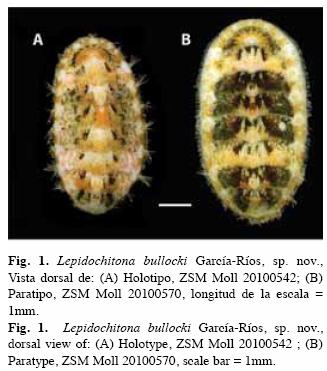
<body><![CDATA[(CBUPRH #2785).     Width of all types are approximately half of the length (average     proportion 54%, n=10). Dorsal elevation of plate IV is 0.34 (CBUPRH     #2787 and #2794); back rounded, not carinated; side slopes lightly     convex. Color and markings of<span style="font-style: italic;">     tegmentum </span>highly variable. Holotype is     orange and cream with dark brown marks in lateral area of intermediate     valves and exterior border of the cephalic valve. A pattern of small     greenish blue spots is present in both sides of the jugal area in the     intermediate and postmucronal area of the anal valve (<a href="#fig1">Fig.     ]]></body>
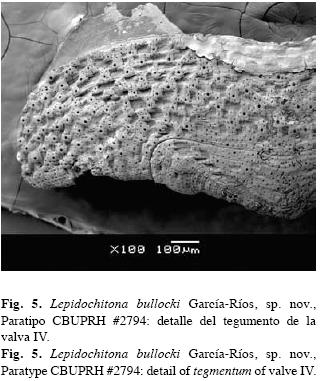
<body><![CDATA[1A</a>). The     paratype ZSM Moll 20100570 with majority of valves dark brown, with     cream and orange marks, the intermediate valves II and VI cream and     orange, with brown marks in both sides of the jugal area, the same zone     were all the intermediate valves have small greenish blue spots (<a      href="#fig1">Fig.     1B</a>). Other paratypes with the jugal area yellow and cream, with the     rest of the <span style="font-style: italic;">tegmentum</span>     speckled with brown, dark brown, cream, rose and     orange (CBUPRH #2783, <a href="#fig2">Fig. 2A</a>). Paratype CBUPRH     ]]></body>
<body><![CDATA[#2785 with brown     cephalic valve dotted with cream, other valves with white jugal area     (except in valve IV, that is orange), lateral areas rose, white with     brown marks (<a href="#fig2">Fig. 2B</a>). The paratypes CBUPRH #2787 (<a      href="#fig2">Fig. 2C</a>) and #2797     (<a href="#fig2">Fig. 2D</a>) orange, the first with clear and brown     marks, the other     uniformly colored, with some brown marks in valves III and VIII. In all     the paratypes it is possible to observe (at least in one valve) the     greenish blue spots previously mentioned. The girdle of all the     ]]></body>
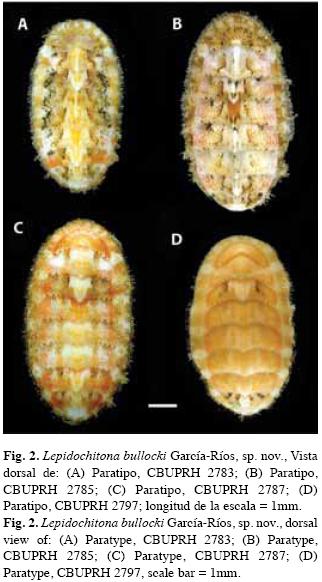
<body><![CDATA[specimens shows alternating cream and reddish brown patches (<a      href="#fig1">Fig. 1</a>,<a href="#fig2"> 2</a>).    <br>     <br>     <br> </span></font>     <div style="text-align: center;"><font size="2"><span  style="font-family: verdana;"><a name="fig1"></a><img alt=""  src="/img/revistas/rbt/v59n3/a13i1.jpg"  style="width: 327px; height: 371px;"></span></font><br  style="font-family: verdana;"> <font size="2"><span style="font-family: verdana;"></span></font></div>     <br>     <br>     <div style="text-align: center;"><a name="fig2"></a><img alt=""  src="/img/revistas/rbt/v59n3/a13i2.jpg"  style="width: 322px; height: 582px;">    <br> <br style="font-family: verdana;"> </div> <font size="2"><span style="font-family: verdana;">Anterior margin of head valve is semicircular (<a href="#fig3">Fig. 3A</a>). Intermediate valves rectangular, the posterior margin concave on both sides of the apex (<a href="#fig3">Fig. 3B</a>). Apex well defined in all the intermediate valves, more prominent in valve II and III. Lateral areas with poor definition, not raised, except in valve II. The anal valve is smaller than the head valve (<a href="#fig3">Fig. 3</a>). The <span style="font-style: italic;">tegmentum</span> of the anal valve is 2.5 times wider than long, with a semicircular posterior edge (approximately half circle); the anterior edge is straight.    ]]></body>
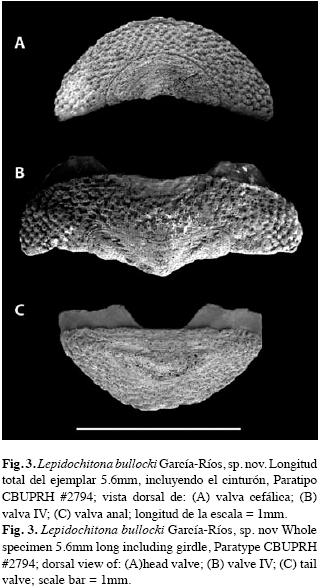
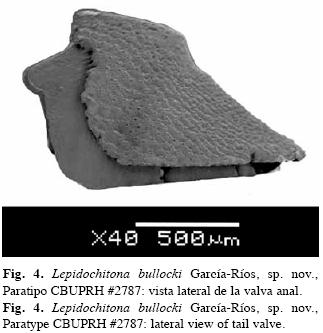
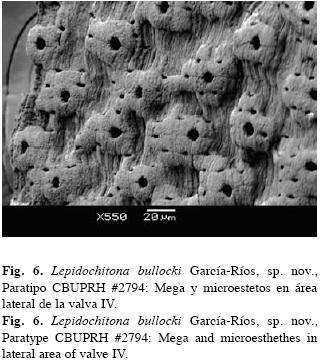
<body><![CDATA[<br>     <br> </span></font>     <div style="text-align: center;"><font size="2"><span  style="font-family: verdana;"><a name="fig3"></a><img alt=""  src="/img/revistas/rbt/v59n3/a13i3.jpg"  style="width: 321px; height: 588px;"></span></font>    <br> <font size="2"><span style="font-family: verdana;"></span></font></div> <font size="2"><span style="font-family: verdana;"><br  style="font-family: verdana;"> </span></font><br style="font-family: verdana;"> <font size="2"><span style="font-family: verdana;">Mucro is prominent, anterior, in the first third of the length. The post-mucronal slopes pronounced, initially 70&deg;, last portion 40&deg; (<a href="#fig4">Fig. 4</a>).    <br>     <br> </span></font>     <div style="text-align: center;"><font size="2"><span  style="font-family: verdana;"><a name="fig4"></a><img alt=""  src="/img/revistas/rbt/v59n3/a13i4.jpg"  style="width: 323px; height: 333px;"></span></font><br  style="font-family: verdana;"> <font size="2"><span style="font-family: verdana;"></span></font></div>     <br> <br style="font-family: verdana;"> <font size="2"><span style="font-family: verdana;">Tegmental surface irregular, with alternation of raised and depressed squarish zones; they become larger and irregular in the central area of the intermediate valves and premucronal area of the anal valve. In the lateral areas, where the pattern is more regular, the raised squares have sides of approximately 35&#956;m (<a href="#fig5">Fig. 5</a>). In the raised surface are the megaesthetes surrounded by three to seven microesthethes, other microesthethes located in the depressed surfaces (<a href="#fig6">Fig. 6</a>), with an average proportion of eight microesthethes by each megaesthete (n=4). All the esthetes are aligned. In the lateral zone of the valves the esthetes lines radiate from the apex toward the margins in contact with the belt. As they move away of the apex, some esthetes lines branch off, especially those that are near the lateral line. This maintains the esthetes density almost constant, </span></font><font size="2"><span  style="font-family: verdana;">between 3 400 and 4 800/mm&sup2; (CBUPR# #2770). In the central area of the intermediate valves the esthetes lines are arranged longitudinally, from the previous edge to the lateral line. In the cephalic valve the lines of esthetes radiate from the apex. In the anal shell the esthetes are longitudinally arranged in the antemucronal and radially in the postmucronal (<a  href="#fig4">Fig. 4</a>).    <br>     <br> </span></font>     ]]></body>
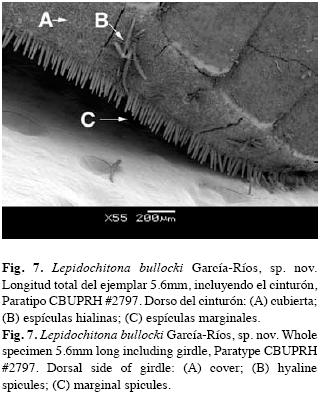
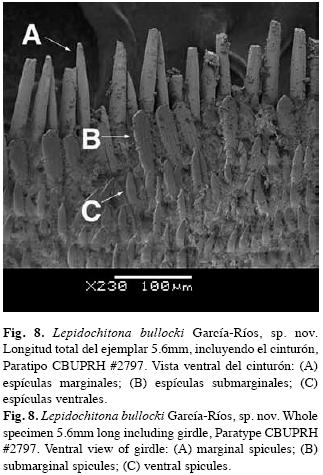
<body><![CDATA[<div style="text-align: center;"><font size="2"><span  style="font-family: verdana;"><a name="fig5"></a><img alt=""  src="/img/revistas/rbt/v59n3/a13i5.jpg"  style="width: 322px; height: 381px;">    <br>     <br>     <br> </span></font><font size="2"><span style="font-family: verdana;"></span></font></div>     <div style="text-align: center;"><font size="2"><span  style="font-family: verdana;"><a name="fig6"></a><img alt=""  src="/img/revistas/rbt/v59n3/a13i6.jpg"  style="width: 322px; height: 362px;"></span></font><br  style="font-family: verdana;"> <font size="2"><span style="font-family: verdana;"></span></font></div>     <br> <br style="font-family: verdana; font-style: italic;"> <font size="2"><span style="font-family: verdana;"><span  style="font-style: italic;">Articulamentum </span>is whitish translucent. The insertion plate short, with insertion slit formula 9/1/10 (n=3). Anal valve of paratype CBUPRH #2794, has 16 slits with the corresponding 16 slits rays. Apophyses are triangular in valve II, a little less in III, later valves most rectangular, with flattened edges. Apophyses well separated, jugal sinus is ample, approximately a third of the valve width (<a href="#fig3">Fig. 3</a>). The jugal sinus of the intermediate shells is concave, except in the shell II, which is convex. </span></font><br  style="font-family: verdana;"> <br style="font-family: verdana;"> <font size="2"><span style="font-family: verdana;">The dorsal surface of the girdle is covered with colored cylindrical corpuscles, (<a href="#fig7">Fig. 7A</a>). These corpuscles have 7-9<span style="font-style: italic;">&micro;</span>m of diameter and 24-35<span style="font-style: italic;">&micro;</span>m of length (CBUPRH# 2794). Twenty three (23) tufts of long hyaline spicules are distributed all around the girdle (<a href="#fig1">Fig. 1</a>, <a  href="#fig2">2</a>). Each side of the girdle has seven tufts aligned with the sutures of the valves (<a href="#fig7">Fig. 7B</a>). Another five are on the periphery of the cephalic valve and four near the anal valve. These tufts have an average of 10 spicules, transparent and curved, tightly united in the base. These hyaline spicules can reach 0.5mm, the anterior ones are shorter or broken. The outer margin of the girdle is surrounded by a row of transparent or amber colored spicules (<a href="#fig7">Fig. 7C</a>, <a href="#fig8">8A</a>). These marginal spicules measure 120-200<span style="font-style: italic;">&micro;</span>m of length and 15-20<span style="font-style: italic;">&micro;</span>m of diameter in the base. Girdle ventral surface with imbricate transparent spicules, with the pointed ends oriented towards the marginal spicules. These ventral spicules are bigger near the margin, with 50<span style="font-style: italic;">&micro;</span>m of length </span></font><font size="2"><span  style="font-family: verdana;">and 10<span style="font-style: italic;">&micro;</span>m of width in the base (<a href="#fig8">Fig. 8C</a>). The ones located near the palial channel measure 15<span style="font-style: italic;">&micro;</span>m of length. Between the ventral and the marginal spicules there is a row of submarginal scales, semirectangular, of 80<span  style="font-style: italic;">&micro;</span>m of length and 20<span style="font-style: italic;">&micro;</span>m of width (<a  href="#fig8">Fig. 8B</a>).    <br> <br style="font-family: verdana;"> </span></font>     <div style="text-align: center;"><a name="fig7"></a><img alt=""  src="/img/revistas/rbt/v59n3/a13i7.jpg"  style="width: 320px; height: 393px;">    <br>     <br>     ]]></body>
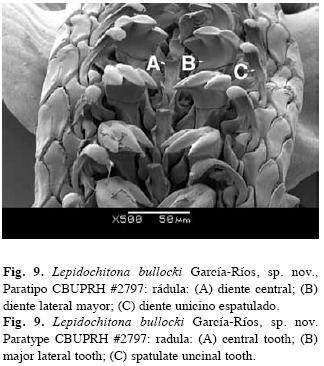
<body><![CDATA[<br> <a name="fig8"></a><img alt="" src="/img/revistas/rbt/v59n3/a13i8.jpg"  style="width: 323px; height: 475px;">    <br>     <br> <br style="font-family: verdana;"> </div> <font size="2"><span style="font-family: verdana;">Radulae measure one third of the specimen&#8217;s length, comprising between 26 to 31 rows of mature teeth and the major lateral teeth mineralized, another 8 to 11 rows of teeth in formation. Central tooth 15<span style="font-style: italic;">&micro;</span>m wide at anterior blade, bend near the edge (<a href="#fig9">Fig. 9A</a>). Major lateral teeth with tricuspid head, 30-35<span style="font-style: italic;">&micro;</span>m wide, the central denticle a little longer (<a href="#fig9">Fig. 9B</a>). The espatulate unicinal teeth with denticulated blade inwardly curved (<a  href="#fig9">Fig. 9C</a>).     <br> <br style="font-family: verdana;"> </span></font>     <div style="text-align: center;"><a name="fig9"></a><img alt=""  src="/img/revistas/rbt/v59n3/a13i9.jpg"  style="width: 324px; height: 366px;">    <br>     <br>     <br style="font-family: verdana;">     </div>     <font size="2"><span style="font-family: verdana;">There are 13 pairs     ]]></body>
<body><![CDATA[of gills in the     holotype, 11 to 12 in the paratypes. Gills merobranquial, increase of     size towards the later end (abanal).</span></font><br      style="font-family: verdana;">     <br style="font-family: verdana;">     <font style="font-weight: bold;" size="2"><span      style="font-family: verdana;">Descripci&oacute;n     de la especie</span></font><br style="font-family: verdana;">     <br style="font-family: verdana;">     <font size="2"><span style="font-family: verdana;">Animal     ]]></body>
<body><![CDATA[peque&ntilde;o, holotipo     mide 5.5mm de longitud total (<a href="#fig1">Fig. 1</a>), paratipo     mayor 7.3mm (CBUPRH     #2785). El ancho de todos los ejemplares tipo es un poco mayor que la     mitad de su longitud (proporci&oacute;n promedio=54%, n=10). La     elevaci&oacute;n dorsal de la valva IV es de 0.34 (ejemplares CBUPRH     #2787 y #2794); dorsalmente redondeada, sin quilla en la regi&oacute;n     del yugo, pendiente lateral ligeramente convexa. El tegumento muestra     colores variados en patrones diversos. El holotipo tiene color     anaranjado y crema con marcas marr&oacute;n oscuro en las &aacute;reas     ]]></body>
<body><![CDATA[laterales de las valvas intermedias y el borde exterior de la valva     cef&aacute;lica. Presenta un patr&oacute;n de puntos azul verdoso a     ambos lados del &aacute;rea yugal de las valvas intermedias y el     &aacute;rea post mucr&oacute;n de la valva anal (<a href="#fig1">Fig. 1A</a>).     El paratipo     ZSM Moll 20100570 tiene la mayor&iacute;a de las valvas color     marr&oacute;n oscuro, con marcas de colores crema y anaranjadas,     principalmente en los &aacute;pices, las valvas intermedias dos y seis     con dominancia de colores crema y anaranjado, con marcas marr&oacute;n.     En todas las valvas intermedias (<a href="#fig1">Fig. 1B</a>) se     ]]></body>
<body><![CDATA[observan peque&ntilde;os     puntos azul verdosos a ambos lados del &aacute;rea del yugo. Otros     paratipos con zona yugal amarilla y crema y el tegumento restante     variegado con marr&oacute;n claro, marr&oacute;n oscuro, crema, rosado     y anaranjado (CBUPRH #2783). Otro paratipo (CBUPRH #2785) con valva     cef&aacute;lica marr&oacute;n, punteada con crema y las dem&aacute;s     valvas con &aacute;rea yugal blanca (excepto en la valva cuatro que es     anaranjada) y las &aacute;reas laterales al &aacute;rea yugal, rosadas     y blancas con marcas marr&oacute;n. Los paratipos CBUPRH #2787 y 2797     con tonos m&aacute;s anaranjados, mostrando patrones de marcas claras y     ]]></body>
<body><![CDATA[marrones en el primero y una coloraci&oacute;n m&aacute;s enteriza en     &uacute;ltimo, con excepci&oacute;n de marcas marrones en las valvas     III y VIII. En todos los paratipos se pueden observar, por lo menos en     una de las valvas los puntos azul verdosos antes mencionados. El     cintur&oacute;n de todos los tipos est&aacute; coloreado con bandas     alternas de marr&oacute;n rojizo y crema (<a href="#fig1">Fig. 1</a>, <a      href="#fig2">2</a>).</span></font><br style="font-family: verdana;">     <font size="2"><span style="font-family: verdana;">&nbsp;</span></font><br      style="font-family: verdana;">     <font size="2"><span style="font-family: verdana;">Valva     ]]></body>
<body><![CDATA[cef&aacute;lica con el borde     anterior semicircular (<a href="#fig3">Fig. 3A</a>). Valvas intermedias     rectangulares, con     el margen posterior c&oacute;ncavo a ambos lados del &aacute;pice (<a      href="#fig3">Fig.     3B</a>). &Aacute;pice bien definido en todas las valvas intermedias,     m&aacute;s prominente en las valvas II y III. Las &aacute;reas     laterales no est&aacute;n bien definidas ni elevadas, excepto en la     valva II. Valva anal 7% m&aacute;s estrecha que la cef&aacute;lica     (<a href="#fig3">Fig. 3</a>) y presenta tegumento 2.5 veces m&aacute;s     ]]></body>
<body><![CDATA[ancho que largo,     as&iacute; como un borde posterior semicircular (aproximadamente medio     c&iacute;rculo) y el borde anterior recto. El mucr&oacute;n es     prominente, localizado </span></font><font size="2"><span      style="font-family: verdana;">anteriormente. La     pendiente     postmucronal pronunciada, inicialmente de 70&deg;, &uacute;ltima     porci&oacute;n de 40&deg; (<a href="#fig4">Fig. 4</a>).</span></font><br      style="font-family: verdana;">     <br style="font-family: verdana;">     ]]></body>
<body><![CDATA[<font size="2"><span style="font-family: verdana;">Superficie del     tegumento irregular,     con alternancia de zonas levantadas y deprimidas de formas     cuasicuadradas; que se hacen m&aacute;s grandes e irregulares en el     &aacute;rea central de las valvas intermedias y el &aacute;rea     premucronal de la valva anal. En las &aacute;reas laterales, donde el     patr&oacute;n es m&aacute;s regular, los cuadros levantados tienen     lados de aproximadamente 35&#956;m (<a href="#fig5">Fig. 5</a>). En la     superficie levantada se     encuentran los megaestetos rodeados por tres a siete microestetos,     ]]></body>
<body><![CDATA[otros microestetos se encuentran en la regi&oacute;n deprimida de la     superficie (<a href="#fig6">Fig. 6</a>). Se encontr&oacute; una     raz&oacute;n promedio de     ocho microestetos por cada megaesteto (n=4).Todos los estetos     est&aacute;n en arreglos lineales. En la zona lateral de las valvas las     l&iacute;neas de estetos radian del &aacute;pice a los m&aacute;rgenes     en contacto con el cintur&oacute;n. En la medida en que se alejan del     &aacute;pice, algunas l&iacute;neas de estetos bifurcan para dar origen     a otras, especialmente las que est&aacute;n cerca de la l&iacute;nea     lateral. Esto mantiene casi constante la densidad de estetos en toda la     ]]></body>
<body><![CDATA[superficie, que est&aacute; entre los 3 400 y los 4 800/mm&sup2;     (CBUPR# #2770). En el &aacute;rea central de las valvas intermedias las     l&iacute;neas de estetos est&aacute;n alineadas longitudinalmente,     desde el borde anterior hasta la l&iacute;nea lateral. En la valva     cef&aacute;lica las l&iacute;neas de estetos irradian del &aacute;pice.     En el &aacute;rea premucr&oacute;n de la valva anal los estetos tienen     arreglo longitudinal y radial en la postmucronal (<a href="#fig4">Fig. 4</a>).</span></font><br      style="font-family: verdana;">     <br style="font-family: verdana;">     <font size="2"><span style="font-family: verdana;">Articulamento     ]]></body>
<body><![CDATA[blanquecino, algo     transparente. Placa de inserci&oacute;n corta, con f&oacute;rmula de     hendiduras de inserci&oacute;n de 9/1/10 (n=3). La placa de     inserci&oacute;n de la valva anal del ejemplar CBUPRH #2794 tiene 16     hendiduras con sus correspondientes radios. Ap&oacute;fisis m&aacute;s     triangular y puntiagudo en la valva II, un poco menos en la III,     m&aacute;s rectangulares y con bordes m&aacute;s aplanados en las     valvas posteriores. Ap&oacute;fisis se encuentran bien separadas, dejan     un amplio seno del yugo de aproximadamente un tercio del ancho de la     valva (<a href="#fig3">Fig. 3</a>). Seno del yugo de las valvas     ]]></body>
<body><![CDATA[intermedias es     c&oacute;ncavo, excepto en la valva II, que es convexo.</span></font><br      style="font-family: verdana;">     <br style="font-family: verdana;">     <font size="2"><span style="font-family: verdana;">La superficie dorsal     del     cintur&oacute;n est&aacute; cubierta por corp&uacute;sculos     cil&iacute;ndricos coloreados (<a href="#fig7">Fig. 7A</a>). Estos     corp&uacute;sculos     tienen 7-9<span style="font-style: italic;">&micro;</span>m     ]]></body>
<body><![CDATA[di&aacute;metro y 24-35<span style="font-style: italic;">&micro;</span>m     de longitud (CBUPRH#     2794). Alrededor del cintur&oacute;n se distribuyen 23 mechones de     esp&iacute;culas hialinas (<a href="#fig1">Fig. 1</a>, <a href="#fig2">2</a>),     siete a cada lado, alineados con     las suturas de las valvas, a media distancia entre el tegumento y el     margen exterior del cintur&oacute;n (<a href="#fig7">Fig. 7B</a>).     Otros cinco en la     periferia de la valva cef&aacute;lica y alrededor de cuatro cercanos a     la valva anal. Estos mechones tienen en promedio 10 esp&iacute;culas     ]]></body>
<body><![CDATA[transparentes y curvas, unidas en la base. Estas esp&iacute;culas     hialinas pueden alcanzar los 0.5mm, las que est&aacute;n en los     mechones anteriores tienden a ser m&aacute;s cortas, o estar partidas.     El margen exterior del cintur&oacute;n est&aacute; rodeado de una fila     de esp&iacute;culas transparentes o con un tinte color &aacute;mbar     (<a href="#fig7">Fig. 7C</a>, <a href="#fig8">8A</a>). Estas     esp&iacute;culas marginales miden entre 120 y     200<span style="font-style: italic;">&micro;</span>m de longitud y de     15 a 20<span style="font-style: italic;">&micro;</span>m de     di&aacute;metro en la     ]]></body>
<body><![CDATA[base. En el lado ventral el cintur&oacute;n est&aacute; cubierto de     esp&iacute;culas transparentes, solapadas, con las puntas orientadas     hacia las esp&iacute;culas marginales. Las m&aacute;s cercanas al     margen son m&aacute;s grandes, con longitudes hasta los 50<span      style="font-style: italic;">&micro;</span>m y     unos 10<span style="font-style: italic;">&micro;</span>m de ancho en la     base (<a href="#fig8">Fig. 8C</a>), las localizadas cerca     del canal palial miden unos 15<span style="font-style: italic;">&micro;</span>m     de largo. Entre las     esp&iacute;culas ventrales y las marginales se encuentra una fila de     ]]></body>
<body><![CDATA[escamas submarginales, semirectangulares, de unos 80<span      style="font-style: italic;">&micro;</span>m de     longitud y 20<span style="font-style: italic;">&micro;</span>m de ancho     (<a href="#fig8">Fig. 8B</a>).</span></font><br      style="font-family: verdana;">     <font size="2"><span style="font-family: verdana;">&nbsp;</span></font><br      style="font-family: verdana;">     <font size="2"><span style="font-family: verdana;">La r&aacute;dula     extendida mide una     tercera parte de la longitud total del ejemplar. Tiene entre 26 a 31     ]]></body>
<body><![CDATA[filas de dientes formados con los dientes laterales mayores     mineralizados y otras ocho a 11 filas de dientes en formaci&oacute;n.     El diente central tiene 15<span style="font-style: italic;">&micro;</span>m     de ancho y un doblez cerca del filo     (<a href="#fig9">Fig 9A</a>). Diente lateral mayor tric&uacute;spide,     mide 30-35<span style="font-style: italic;">&micro;</span>m de     ancho, la c&uacute;spide central un poco m&aacute;s larga (<a      href="#fig9">Fig. 9B</a>).     Los dientes unicinos espatulados tienen su extremo distal curvo y     denticulado (<a href="#fig9">Fig. 9C</a>).</span></font><br     ]]></body>
<body><![CDATA[ style="font-family: verdana;">     <br style="font-family: verdana;">     <font size="2"><span style="font-family: verdana;">En el holotipo hay     13 pares de     branquias, mientras que en los paratipos hay de 11 a 12 pares. Las     branquias con arreglo merobranquial y aumentan de tama&ntilde;o hacia     el extremo posterior (abanal).</span></font><br      style="font-family: verdana;">     <br style="font-family: verdana; font-weight: bold;">     <font size="2"><span style="font-family: verdana;"><span     ]]></body>
<body><![CDATA[ style="font-weight: bold;">Etimolog&iacute;a:</span>     Esta especie     est&aacute; dedicada al Dr. Robert C. Bullock, autor de     m&uacute;ltiples monograf&iacute;as sobre la sistem&aacute;tica de los     quitones, con &eacute;nfasis en los quitones del Caribe. Es el primer     investigador en llamar la atenci&oacute;n sobre la presencia de otras     especies de lepidoquitones en el sur del Caribe, incluyendo, muy     probablemente, la que describimos aqu&iacute; en su nombre.</span></font><br      style="font-family: verdana;">     <br style="font-family: verdana;">     ]]></body>
<body><![CDATA[<font style="font-weight: bold;" size="3"><span      style="font-family: verdana;">Discusi&oacute;n</span></font><br      style="font-family: verdana; font-weight: bold;">     <br style="font-family: verdana;">     <font size="2"><span style="font-family: verdana;">Esta especie es     similar a las otras     en el g&eacute;nero <span style="font-style: italic;">Lepidochitona</span>     presentes en el Caribe, tanto en la     macromorfolog&iacute;a de las valvas, como en el arreglo de las     branquias y los elementos que recubren el cintur&oacute;n. La     ]]></body>
<body><![CDATA[caracter&iacute;stica externa distintiva de esta especie es la     presencia de densos mechones de largas esp&iacute;culas en el dorso del     cintur&oacute;n. Estas esp&iacute;culas no son ramificadas, como en el     subg&eacute;nero <span style="font-style: italic;">Dendrochiton</span>     Berry, 1911, que tiene     distribuci&oacute;n en la costa oeste de Norte Am&eacute;rica (Kaas     &amp; VanBelle 1985). La presencia de una sola hendidura a cada lado de     las valvas intermedias separa a esta especie de las del     subg&eacute;nero <span style="font-style: italic;">Spongioradsia     Pilsbry</span> 1894. La clasificaci&oacute;n de     ]]></body>
<body><![CDATA[<span style="font-style: italic;">L. bullocki</span> en el     subg&eacute;nero <span style="font-style: italic;">Lepidochitona</span>     se hace considerando     la afinidad morfol&oacute;gica y geogr&aacute;fica con las otras     especies del g&eacute;nero, a pesar de que sus esp&iacute;culas     hialinas no son reducidas, como se establece para el subg&eacute;nero     en Kaas &amp; VanBelle (1985). Esa diferencia menor no justifica la     propuesta de un nuevo subg&eacute;nero. </span></font><br      style="font-family: verdana;">     <br style="font-family: verdana; font-style: italic;">     ]]></body>
<body><![CDATA[<font size="2"><span style="font-family: verdana;"><span      style="font-style: italic;">Lepidochitona     bullocki</span> es una     especie policrom&aacute;tica. Existen ejemplares con coloraci&oacute;n     similar en otras especies del Caribe. Adem&aacute;s de la mayor     cantidad y longitud de los mechones de esp&iacute;culas en el     cintur&oacute;n, se puede distinguir a <span      style="font-style: italic;">L. bullocki</span> de <span      style="font-style: italic;">L. liozonis</span> por     la longitud de las esp&iacute;culas marginales. Estas esp&iacute;culas     ]]></body>
<body><![CDATA[son mayores de 100&#956;m en<span style="font-style: italic;"> L. bullocki</span>,     mientras que en <span style="font-style: italic;">L. liozonis </span>tienen     longitudes cercanas a los 40&#956;m (Garc&iacute;a-R&iacute;os 2003).     <span style="font-style: italic;">Lepidochitona rosea</span> tiene     esp&iacute;culas marginales de 130&#956;m, pero en     el dorso de su cintur&oacute;n se encuentran s&oacute;lo unas pocas     espinas curvas, de hasta 180&#956;m (Kaas 1972, Kaas &amp; VanBelle 1985).</span></font><br      style="font-family: verdana;">     <br style="font-family: verdana;">     <font size="2"><span style="font-family: verdana;">Las irregularidades     ]]></body>
<body><![CDATA[en la     superficie del tegumento de <span style="font-style: italic;">L.     bullocki</span> tambi&eacute;n la distingue de     <span style="font-style: italic;">L. liozonis</span> y de <span      style="font-style: italic;">L. rosea</span>, que tienen superficies     casi lisas     (Garc&iacute;a-R&iacute;os 2010, Bullock <span      style="font-style: italic;">et al</span>. 1994). <span      style="font-style: italic;">L. rufoi </span>tiene     la superficie de su tegumento microgranular, con gr&aacute;nulos     ]]></body>
<body><![CDATA[redondeados con un megaesteto solitario en el extremo m&aacute;s alto     del gr&aacute;nulo (Garc&iacute;a-R&iacute;os 2010). En contraste, la     escultura de la superficie del tegumento de <span      style="font-style: italic;">L. bullocki</span> es subcuadrada,     con un megaesteto acompa&ntilde;ado de varios microestetos en las     regiones elevadas (<a href="#fig6">Fig. 6</a>).</span></font><br      style="font-family: verdana;">     <br style="font-family: verdana;">     <font size="2"><span style="font-family: verdana;">El n&uacute;mero de     hendiduras en     ]]></body>
<body><![CDATA[la placa de inserci&oacute;n de las valvas ha dejado de usarse como un     criterio para discriminar especies (Eernise <span      style="font-style: italic;">et al</span>. 2007). Ferreira     (1985) advierte de la variabilidad de este n&uacute;mero al examinar     lotes de <span style="font-style: italic;">Choneplax lata</span>     (Guilding, 1829), encontrando de tres a cinco     en la valva cef&aacute;lica, una a ninguna en las intermedias y dos a     ninguna en la anal. De los cuatro paratipos desarticulados, tres tienen     10 hendiduras en la valva anal y uno tiene 16, confirm&aacute;ndose la     variabilidad de esta caracter&iacute;stica.</span></font><br     ]]></body>
<body><![CDATA[ style="font-family: verdana;">     <br style="font-family: verdana;">     <font size="2"><span style="font-family: verdana;">La r&aacute;dula de     <span style="font-style: italic;">L. bullocki     </span>(<a href="#fig9">Fig. 9</a>) difiere notablemente de la de <span      style="font-style: italic;">L. rufoi </span>en el ancho del diente     central, que es seis veces m&aacute;s ancho que el ilustrado para <span      style="font-style: italic;">L.     rufoi</span> (Garc&iacute;a-R&iacute;os 2010). El diente lateral mayor     de <span style="font-style: italic;">L.     ]]></body>
<body><![CDATA[liozonis</span> es tric&uacute;spide, con c&uacute;spides de longitudes     similares (Garc&iacute;a-R&iacute;os 2003, Kaas &amp; VanBelle 1985)     mientras que en <span style="font-style: italic;">L. bullocki</span>,     la c&uacute;spide central del diente es     m&aacute;s larga. Esa forma del diente lateral mayor es t&iacute;pica     en el g&eacute;nero, a juzgar por las ilustradas en Kaas &amp; VanBelle     (1985), donde 17 de las 20 ilustraciones de este diente en     lepidoquitones muestran la c&uacute;spide central m&aacute;s larga.</span></font><br      style="font-family: verdana;">     <br style="font-family: verdana;">     ]]></body>
<body><![CDATA[<font size="2"><span style="font-family: verdana;">La mayor&iacute;a de     los quitones     del sublitoral exhiben fototaxia negativa, encontr&aacute;ndose en la     parte sombreada de las rocas, muchas veces en el extremo enterrado. Los     ejemplares tipo de<span style="font-style: italic;"> L. bullocki</span>     fueron encontrados en la superficie de     las rocas expuestas a la luz, cubiertas por una alfombra de algas y los     sedimentos finos que se adhieren a los muc&iacute;lagos de las algas.     Este es un h&aacute;bitat muy dif&iacute;cil de examinar, si las rocas     no est&aacute;n sueltas. Cuando las rocas presentan en esa superficie     ]]></body>
<body><![CDATA[iluminada grietas o desniveles alargados, podemos encontrar ah&iacute;,     con mayor frecuencia que los lepidoquitones, a <span      style="font-style: italic;">Acanthochitona balesae</span>,     un quit&oacute;n peque&ntilde;o y vermiforme que se adapta a esos     refugios alargados. La especie <span style="font-style: italic;">Lepidochitona</span>     sp. B en Bullock &amp;     Franz (1994) y <span style="font-style: italic;">Lepidochitona</span>     sp. en Bullock <span style="font-style: italic;">et al</span>. (1994)     presenta     similitudes en coloraci&oacute;n, h&aacute;bitat y la asociaci&oacute;n     ]]></body>
<body><![CDATA[con<span style="font-style: italic;"> A. balesae</span>. Bullock &amp;     Franz (1994) mencionan que encontraron     los ejemplares en la zona donde rompe la ola. Esto podr&iacute;a     explicar la omisi&oacute;n de los mechones de largas esp&iacute;culas     hialinas, pues estas podr&iacute;an romperse en ambientes de mucha     energ&iacute;a. Los ejemplares tipos que usamos en esta     descripci&oacute;n fueron recolectados en litoral rocoso con oleaje de     baja energ&iacute;a.</span></font><br style="font-family: verdana;">     <br style="font-family: verdana;">     <font style="font-weight: bold;" size="3"><span     ]]></body>
<body><![CDATA[ style="font-family: verdana;">Agradecimientos</span></font><br      style="font-family: verdana;">     <br style="font-family: verdana;">     <font size="2"><span style="font-family: verdana;">Agradezco a Migdalia     &Aacute;lvarez     Ruiz de la Universidad de Puerto Rico en Ponce y a los colegas del     Programa de Biolog&iacute;a Marina de la Universidad de Bogot&aacute;,     Jorge Tadeo Lozano, Sede de Santa Marta, por su asistencia en el campo,     en especial a Paulo C. Tigreros, Lina S. Triana y Sim&oacute;n A.     Rodr&iacute;guez. Agradezco la informaci&oacute;n de posibles     ]]></body>
<body><![CDATA[estaciones de recolecci&oacute;n y el acceso a las primeras fotos y     espec&iacute;menes de esta especie a Mar&iacute;a F. Gracia y     N&eacute;stor E. Ardilla. Una licencia sab&aacute;tica otorgada por la     Universidad de Puerto Rico en Humacao me permiti&oacute; completar este     manuscrito. El microscopio electr&oacute;nico de barrido fue prestado     por el Programa Partnership for Research &amp; Education in Materials     (PREM) de la Universidad de Puerto Rico-Humacao (NSF-DMR-0934195).     Agradezco las cr&iacute;ticas y correcciones al manuscrito de Edgardo     A. R. Ortiz Corps, Edwin Traverso Avil&eacute;s, Ariel D&iacute;az     P&eacute;rez, Mar&iacute;a Ramos Santiago, Jos&eacute; O. Sotero Esteva     ]]></body>
<body><![CDATA[y cuatro revisores an&oacute;nimos.</span></font><br      style="font-family: verdana;">     <font style="font-weight: bold;" size="3"><span      style="font-family: verdana;"></span></font>     <hr style="width: 100%; height: 2px;"><font style="font-weight: bold;"      size="3"><span style="font-family: verdana;">Referencias</span></font><br      style="font-family: verdana; font-weight: bold;">     <br style="font-family: verdana;">     <font size="2"><span style="font-family: verdana;">Bullock, R.C. 1985.     The <span style="font-style: italic;">Stenoplax     ]]></body>
<body><![CDATA[limaciformis</span> (Sowerby 1832) species complex in the New World     (Mollusca:     <!-- ref -->Polyplacophora: Ischnochitonidae). The Veliger 27: 291-307.    &nbsp;&nbsp;&nbsp;&nbsp;&nbsp;&nbsp;&nbsp;&nbsp;[&#160;<a href="javascript:void(0);" onclick="javascript: window.open('/scielo.php?script=sci_nlinks&ref=1725053&pid=S0034-7744201100030001300001&lng=','','width=640,height=500,resizable=yes,scrollbars=1,menubar=yes,');">Links</a>&#160;]<!-- end-ref --><!-- ref --></span></font><br  style="font-family: verdana;"> <br style="font-family: verdana;"> <font size="2"><span style="font-family: verdana;">Bullock, R.C. &amp; C.J. Franz. 1994. A preliminary taxonomic survey of the chitons (Mollusca: Polyplacophora) of Isla Margarita. Nueva Esparta, Venezuela. Bolet&iacute;n Sociedad de Ciencias Naturales La Salle 54: 9-49.    &nbsp;&nbsp;&nbsp;&nbsp;&nbsp;&nbsp;&nbsp;&nbsp;[&#160;<a href="javascript:void(0);" onclick="javascript: window.open('/scielo.php?script=sci_nlinks&ref=1725054&pid=S0034-7744201100030001300002&lng=','','width=640,height=500,resizable=yes,scrollbars=1,menubar=yes,');">Links</a>&#160;]<!-- end-ref --><!-- ref --></span></font><br  style="font-family: verdana;"> <br style="font-family: verdana;"> <font size="2"><span style="font-family: verdana;">Bullock, R.C., C.J. Franz &amp; J. Buitrago. 1994. A report on a collection of chitons (Mollusca: Polyplacophora) dredged near Isla Coche, Nueva Esparta, Venezuela. Sociedad de Ciencias Naturales La Salle 54: 77-93.    &nbsp;&nbsp;&nbsp;&nbsp;&nbsp;&nbsp;&nbsp;&nbsp;[&#160;<a href="javascript:void(0);" onclick="javascript: window.open('/scielo.php?script=sci_nlinks&ref=1725055&pid=S0034-7744201100030001300003&lng=','','width=640,height=500,resizable=yes,scrollbars=1,menubar=yes,');">Links</a>&#160;]<!-- end-ref --><!-- ref --></span></font><br  style="font-family: verdana;"> <br style="font-family: verdana;"> <font size="2"><span style="font-family: verdana;">Eernisse, D.J., R.N. Clark &amp; A. Draeger. 2007. Polyplacophora, p. 701-713. <span  style="font-style: italic;">In</span> J.T. Carlton (ed.). Light and Smith Manual: The intertidal invertebrates of Central California to Oregon. University of California, Berkeley, California, EEUU.    &nbsp;&nbsp;&nbsp;&nbsp;&nbsp;&nbsp;&nbsp;&nbsp;[&#160;<a href="javascript:void(0);" onclick="javascript: window.open('/scielo.php?script=sci_nlinks&ref=1725056&pid=S0034-7744201100030001300004&lng=','','width=640,height=500,resizable=yes,scrollbars=1,menubar=yes,');">Links</a>&#160;]<!-- end-ref --><!-- ref --></span></font><br  style="font-family: verdana;"> <br style="font-family: verdana;"> <font size="2"><span style="font-family: verdana;">Ferreira, A.J. 1985. Chiton (Mollusca: Polyplacophora) fauna of Barbados, West Indies, with the description of a new species. Bull. Mar. Sci. 36: 189-219.    &nbsp;&nbsp;&nbsp;&nbsp;&nbsp;&nbsp;&nbsp;&nbsp;[&#160;<a href="javascript:void(0);" onclick="javascript: window.open('/scielo.php?script=sci_nlinks&ref=1725057&pid=S0034-7744201100030001300005&lng=','','width=640,height=500,resizable=yes,scrollbars=1,menubar=yes,');">Links</a>&#160;]<!-- end-ref --><!-- ref --> </span></font><br  style="font-family: verdana;"> <br style="font-family: verdana;"> <font size="2"><span style="font-family: verdana;">Garc&iacute;a-R&iacute;os, C.I. 2003. Los quitones de Puerto Rico. Isla Negra, San Juan, Puerto Rico.    &nbsp;&nbsp;&nbsp;&nbsp;&nbsp;&nbsp;&nbsp;&nbsp;[&#160;<a href="javascript:void(0);" onclick="javascript: window.open('/scielo.php?script=sci_nlinks&ref=1725058&pid=S0034-7744201100030001300006&lng=','','width=640,height=500,resizable=yes,scrollbars=1,menubar=yes,');">Links</a>&#160;]<!-- end-ref --><!-- ref --></span></font><br  style="font-family: verdana;"> <br style="font-family: verdana;"> <font size="2"><span style="font-family: verdana;">Garc&iacute;a-R&iacute;os, C.I. 2010. Nueva especie del quit&oacute;n <span style="font-style: italic;">Lepidochitona</span> (Polyplacophora: Ischnochitonidae) de Puerto Rico. Rev. Biol. Trop. 58: 635-644.    &nbsp;&nbsp;&nbsp;&nbsp;&nbsp;&nbsp;&nbsp;&nbsp;[&#160;<a href="javascript:void(0);" onclick="javascript: window.open('/scielo.php?script=sci_nlinks&ref=1725059&pid=S0034-7744201100030001300007&lng=','','width=640,height=500,resizable=yes,scrollbars=1,menubar=yes,');">Links</a>&#160;]<!-- end-ref --><!-- ref --></span></font><br  style="font-family: verdana;"> <br style="font-family: verdana;"> <font size="2"><span style="font-family: verdana;">Gracia A., J.M. D&iacute;az &amp; N.E. Ardila. 2005. Quitones (Mollusca: Polyplacophora) del Mar Caribe Colombiano. Biota Colombiana 6: 117-125.    &nbsp;&nbsp;&nbsp;&nbsp;&nbsp;&nbsp;&nbsp;&nbsp;[&#160;<a href="javascript:void(0);" onclick="javascript: window.open('/scielo.php?script=sci_nlinks&ref=1725060&pid=S0034-7744201100030001300008&lng=','','width=640,height=500,resizable=yes,scrollbars=1,menubar=yes,');">Links</a>&#160;]<!-- end-ref --><!-- ref --></span></font><br  style="font-family: verdana;"> <br style="font-family: verdana;"> <font size="2"><span style="font-family: verdana;">Lyons, W.G. 1988. A review of Caribbean Acanthochitonidae (Mollusca: Polyplacophora) with descriptions of six new species of Acanthochitona (Gray 1821). Am. Malac. Bull. 6: 79-114.    &nbsp;&nbsp;&nbsp;&nbsp;&nbsp;&nbsp;&nbsp;&nbsp;[&#160;<a href="javascript:void(0);" onclick="javascript: window.open('/scielo.php?script=sci_nlinks&ref=1725061&pid=S0034-7744201100030001300009&lng=','','width=640,height=500,resizable=yes,scrollbars=1,menubar=yes,');">Links</a>&#160;]<!-- end-ref --><!-- ref --></span></font><br style="font-family: verdana;"> <br style="font-family: verdana;"> <font size="2"><span style="font-family: verdana;">Kaas, P. 1972. Polyplacophora of the Caribbean region. Stud. Fauna Cura&ccedil;ao 41: 1-162.    &nbsp;&nbsp;&nbsp;&nbsp;&nbsp;&nbsp;&nbsp;&nbsp;[&#160;<a href="javascript:void(0);" onclick="javascript: window.open('/scielo.php?script=sci_nlinks&ref=1725062&pid=S0034-7744201100030001300010&lng=','','width=640,height=500,resizable=yes,scrollbars=1,menubar=yes,');">Links</a>&#160;]<!-- end-ref --><!-- ref --></span></font><br  style="font-family: verdana;"> <br style="font-family: verdana;"> <font size="2"><span style="font-family: verdana;">Kaas, P. &amp; R.A. Van Belle. 1985. Monograph of living chitons (Mollusca: Polyplacophora).Vol. 2. Suborder Ischnochitonina: Ischnochitonidae: Schizoplacinae, Callochitoninae and Lepidochitoninae. E.J. Brill, Leiden, Holanda.    &nbsp;&nbsp;&nbsp;&nbsp;&nbsp;&nbsp;&nbsp;&nbsp;[&#160;<a href="javascript:void(0);" onclick="javascript: window.open('/scielo.php?script=sci_nlinks&ref=1725063&pid=S0034-7744201100030001300011&lng=','','width=640,height=500,resizable=yes,scrollbars=1,menubar=yes,');">Links</a>&#160;]<!-- end-ref --><!-- ref --></span></font><br  style="font-family: verdana;"> <br style="font-family: verdana;"> <font size="2"><span style="font-family: verdana;">Kaas, P. &amp; R.A. Van Belle. 1998. Catalogue of living chitons (Mollusca: Polyplacophora). Backhuys, Leiden, Holanda.    &nbsp;&nbsp;&nbsp;&nbsp;&nbsp;&nbsp;&nbsp;&nbsp;[&#160;<a href="javascript:void(0);" onclick="javascript: window.open('/scielo.php?script=sci_nlinks&ref=1725064&pid=S0034-7744201100030001300012&lng=','','width=640,height=500,resizable=yes,scrollbars=1,menubar=yes,');">Links</a>&#160;]<!-- end-ref --><!-- ref --></span></font><br style="font-family: verdana;"> <br style="font-family: verdana;"> <font size="2"><span style="font-family: verdana;">Smithe, F.B. 1975. Naturalist&#8217;s color guide. The American Museum of Natural History, Nueva York, EEUU.    &nbsp;&nbsp;&nbsp;&nbsp;&nbsp;&nbsp;&nbsp;&nbsp;[&#160;<a href="javascript:void(0);" onclick="javascript: window.open('/scielo.php?script=sci_nlinks&ref=1725065&pid=S0034-7744201100030001300013&lng=','','width=640,height=500,resizable=yes,scrollbars=1,menubar=yes,');">Links</a>&#160;]<!-- end-ref --><br>     <br> <a name="correspondencia"></a>Correspondencia a: </span></font><font  size="2"><span style="font-family: verdana;">Cedar I. Garc&iacute;a-R&iacute;os. </span></font><font size="2"><span  style="font-family: verdana;">Departamento de Biolog&iacute;a, Universidad de Puerto Rico en Humacao, 100 Carr 908, Estaci&oacute;n Postal CUH, Humacao, Puerto Rico 00791; <a  href="mailto:cedar.uprh@gmail.com">cedar.uprh@gmail.com</a></span></font>     <div style="text-align: center;"><font size="2"><span  style="font-family: verdana;"></span></font> <hr style="width: 100%; height: 2px;"><font size="2"><span  style="font-family: verdana;">Recibido 13-IX-10. Corregido 25-II-2011. Aceptado 28-III-2011.</span></font><br  style="font-family: verdana;"> </div> <br style="font-family: verdana;"> </div>      ]]></body><back>
<ref-list>
<ref id="B1">
<nlm-citation citation-type="journal">
<person-group person-group-type="author">
<name>
<surname><![CDATA[Bullock]]></surname>
<given-names><![CDATA[R.C]]></given-names>
</name>
</person-group>
<article-title xml:lang="en"><![CDATA[The Stenoplax limaciformis (Sowerby 1832) species complex in the New World (Mollusca: Polyplacophora: Ischnochitonidae)]]></article-title>
<source><![CDATA[The Veliger]]></source>
<year>1985</year>
<volume>27</volume>
<page-range>291-307</page-range></nlm-citation>
</ref>
<ref id="B2">
<nlm-citation citation-type="journal">
<person-group person-group-type="author">
<name>
<surname><![CDATA[Bullock]]></surname>
<given-names><![CDATA[R.C]]></given-names>
</name>
<name>
<surname><![CDATA[Franz]]></surname>
<given-names><![CDATA[C.J]]></given-names>
</name>
</person-group>
<article-title xml:lang="en"><![CDATA[A preliminary taxonomic survey of the chitons (Mollusca: Polyplacophora) of Isla Margarita. Nueva Esparta, Venezuela]]></article-title>
<source><![CDATA[Boletín Sociedad de Ciencias Naturales La Salle]]></source>
<year>1994</year>
<volume>54</volume>
<page-range>9-49</page-range></nlm-citation>
</ref>
<ref id="B3">
<nlm-citation citation-type="journal">
<person-group person-group-type="author">
<name>
<surname><![CDATA[Bullock]]></surname>
<given-names><![CDATA[R.C]]></given-names>
</name>
<name>
<surname><![CDATA[Franz]]></surname>
<given-names><![CDATA[C.J]]></given-names>
</name>
<name>
<surname><![CDATA[Buitrago]]></surname>
<given-names><![CDATA[J]]></given-names>
</name>
</person-group>
<article-title xml:lang="en"><![CDATA[A report on a collection of chitons (Mollusca: Polyplacophora) dredged near Isla Coche, Nueva Esparta, Venezuela]]></article-title>
<source><![CDATA[Sociedad de Ciencias Naturales La Salle]]></source>
<year>1994</year>
<volume>54</volume>
<page-range>77-93</page-range></nlm-citation>
</ref>
<ref id="B4">
<nlm-citation citation-type="book">
<person-group person-group-type="author">
<name>
<surname><![CDATA[Eernisse]]></surname>
<given-names><![CDATA[D.J]]></given-names>
</name>
<name>
<surname><![CDATA[Clark]]></surname>
<given-names><![CDATA[R.N]]></given-names>
</name>
<name>
<surname><![CDATA[Draeger]]></surname>
<given-names><![CDATA[A]]></given-names>
</name>
</person-group>
<article-title xml:lang="en"><![CDATA[Polyplacophora]]></article-title>
<person-group person-group-type="editor">
<name>
<surname><![CDATA[Carlton]]></surname>
<given-names><![CDATA[J.T]]></given-names>
</name>
</person-group>
<source><![CDATA[Light and Smith Manual: The intertidal invertebrates of Central California to Oregon]]></source>
<year>2007</year>
<page-range>701-713</page-range><publisher-loc><![CDATA[Berkeley^eCalifornia California]]></publisher-loc>
<publisher-name><![CDATA[University of California]]></publisher-name>
</nlm-citation>
</ref>
<ref id="B5">
<nlm-citation citation-type="journal">
<person-group person-group-type="author">
<name>
<surname><![CDATA[Ferreira]]></surname>
<given-names><![CDATA[A.J]]></given-names>
</name>
</person-group>
<article-title xml:lang="en"><![CDATA[Chiton (Mollusca: Polyplacophora) fauna of Barbados, West Indies, with the description of a new species]]></article-title>
<source><![CDATA[Bull. Mar. Sci]]></source>
<year>1985</year>
<volume>36</volume>
<page-range>189-219</page-range></nlm-citation>
</ref>
<ref id="B6">
<nlm-citation citation-type="">
<person-group person-group-type="author">
<name>
<surname><![CDATA[García-Ríos]]></surname>
<given-names><![CDATA[C.I]]></given-names>
</name>
</person-group>
<source><![CDATA[Los quitones de Puerto Rico]]></source>
<year>2003</year>
<publisher-loc><![CDATA[Isla Negra^eSan Juan San Juan]]></publisher-loc>
</nlm-citation>
</ref>
<ref id="B7">
<nlm-citation citation-type="journal">
<person-group person-group-type="author">
<name>
<surname><![CDATA[García-Ríos]]></surname>
<given-names><![CDATA[C.I]]></given-names>
</name>
</person-group>
<article-title xml:lang="es"><![CDATA[Nueva especie del quitón Lepidochitona (Polyplacophora: Ischnochitonidae) de Puerto Rico]]></article-title>
<source><![CDATA[Rev. Biol. Trop]]></source>
<year>2010</year>
<volume>58</volume>
<page-range>635-644</page-range></nlm-citation>
</ref>
<ref id="B8">
<nlm-citation citation-type="journal">
<person-group person-group-type="author">
<name>
<surname><![CDATA[Gracia]]></surname>
<given-names><![CDATA[A]]></given-names>
</name>
<name>
<surname><![CDATA[Díaz]]></surname>
<given-names><![CDATA[J.M.]]></given-names>
</name>
<name>
<surname><![CDATA[Ardila]]></surname>
<given-names><![CDATA[N.E]]></given-names>
</name>
</person-group>
<article-title xml:lang="es"><![CDATA[Quitones (Mollusca: Polyplacophora) del Mar Caribe Colombiano]]></article-title>
<source><![CDATA[Biota Colombiana]]></source>
<year>2005</year>
<volume>6</volume>
<page-range>117-125</page-range></nlm-citation>
</ref>
<ref id="B9">
<nlm-citation citation-type="journal">
<person-group person-group-type="author">
<name>
<surname><![CDATA[Lyons]]></surname>
<given-names><![CDATA[W.G]]></given-names>
</name>
</person-group>
<article-title xml:lang="en"><![CDATA[A review of Caribbean Acanthochitonidae (Mollusca: Polyplacophora) with descriptions of six new species of Acanthochitona (Gray 1821)]]></article-title>
<source><![CDATA[Am. Malac. Bull]]></source>
<year>1988</year>
<volume>6</volume>
<page-range>79-114</page-range></nlm-citation>
</ref>
<ref id="B10">
<nlm-citation citation-type="journal">
<person-group person-group-type="author">
<name>
<surname><![CDATA[Kaas]]></surname>
<given-names><![CDATA[P]]></given-names>
</name>
</person-group>
<article-title xml:lang="en"><![CDATA[Polyplacophora of the Caribbean region]]></article-title>
<source><![CDATA[Stud. Fauna Curaçao]]></source>
<year>1972</year>
<volume>41</volume>
<page-range>1-162</page-range></nlm-citation>
</ref>
<ref id="B11">
<nlm-citation citation-type="book">
<person-group person-group-type="author">
<name>
<surname><![CDATA[Kaas]]></surname>
<given-names><![CDATA[P]]></given-names>
</name>
<name>
<surname><![CDATA[Van Belle]]></surname>
<given-names><![CDATA[R.A]]></given-names>
</name>
</person-group>
<source><![CDATA[Vol. 2. Suborder Ischnochitonina: Ischnochitonidae: Schizoplacinae, Callochitoninae and Lepidochitoninae]]></source>
<year>1985</year>
<publisher-loc><![CDATA[Leiden ]]></publisher-loc>
<publisher-name><![CDATA[E.J. Brill]]></publisher-name>
</nlm-citation>
</ref>
<ref id="B12">
<nlm-citation citation-type="">
<person-group person-group-type="author">
<name>
<surname><![CDATA[Kaas]]></surname>
<given-names><![CDATA[P]]></given-names>
</name>
<name>
<surname><![CDATA[Van Belle]]></surname>
<given-names><![CDATA[R.A]]></given-names>
</name>
</person-group>
<source><![CDATA[Catalogue of living chitons (Mollusca: Polyplacophora)]]></source>
<year>1998</year>
</nlm-citation>
</ref>
<ref id="B13">
<nlm-citation citation-type="book">
<person-group person-group-type="author">
<name>
<surname><![CDATA[Smithe]]></surname>
<given-names><![CDATA[F.B]]></given-names>
</name>
</person-group>
<source><![CDATA[Naturalist&#8217;s color guide]]></source>
<year>1975</year>
<publisher-loc><![CDATA[Nueva York ]]></publisher-loc>
<publisher-name><![CDATA[The American Museum of Natural History]]></publisher-name>
</nlm-citation>
</ref>
</ref-list>
</back>
</article>