<?xml version="1.0" encoding="ISO-8859-1"?><article xmlns:mml="http://www.w3.org/1998/Math/MathML" xmlns:xlink="http://www.w3.org/1999/xlink" xmlns:xsi="http://www.w3.org/2001/XMLSchema-instance">
<front>
<journal-meta>
<journal-id>0034-7744</journal-id>
<journal-title><![CDATA[Revista de Biología Tropical]]></journal-title>
<abbrev-journal-title><![CDATA[Rev. biol. trop]]></abbrev-journal-title>
<issn>0034-7744</issn>
<publisher>
<publisher-name><![CDATA[Universidad de Costa Rica]]></publisher-name>
</publisher>
</journal-meta>
<article-meta>
<article-id>S0034-77442011000300010</article-id>
<title-group>
<article-title xml:lang="en"><![CDATA[In vitro rescue of interspecific embryos from Elaeis guineensis x E. oleifera (Arecaceae)]]></article-title>
</title-group>
<contrib-group>
<contrib contrib-type="author">
<name>
<surname><![CDATA[da Silva Angelo]]></surname>
<given-names><![CDATA[Paula Cristina]]></given-names>
</name>
<xref ref-type="aff" rid="A01"/>
</contrib>
<contrib contrib-type="author">
<name>
<surname><![CDATA[Cardoso Moraes]]></surname>
<given-names><![CDATA[LarissaAlexandra]]></given-names>
</name>
<xref ref-type="aff" rid="A01"/>
</contrib>
<contrib contrib-type="author">
<name>
<surname><![CDATA[Lopes]]></surname>
<given-names><![CDATA[Ricardo]]></given-names>
</name>
<xref ref-type="aff" rid="A01"/>
</contrib>
<contrib contrib-type="author">
<name>
<surname><![CDATA[Reis Sousa]]></surname>
<given-names><![CDATA[Nelcimar]]></given-names>
</name>
<xref ref-type="aff" rid="A01"/>
</contrib>
<contrib contrib-type="author">
<name>
<surname><![CDATA[Vieira da Cunha]]></surname>
<given-names><![CDATA[Raimundo Nonato]]></given-names>
</name>
<xref ref-type="aff" rid="A01"/>
</contrib>
<contrib contrib-type="author">
<name>
<surname><![CDATA[Caetano Quisen]]></surname>
<given-names><![CDATA[Regina]]></given-names>
</name>
<xref ref-type="aff" rid="A01"/>
</contrib>
</contrib-group>
<aff id="A01">
<institution><![CDATA[,Embrapa Western Amazon  ]]></institution>
<addr-line><![CDATA[Manaus-AM ]]></addr-line>
<country>Brazil</country>
</aff>
<pub-date pub-type="pub">
<day>00</day>
<month>09</month>
<year>2011</year>
</pub-date>
<pub-date pub-type="epub">
<day>00</day>
<month>09</month>
<year>2011</year>
</pub-date>
<volume>59</volume>
<numero>3</numero>
<fpage>1081</fpage>
<lpage>1088</lpage>
<copyright-statement/>
<copyright-year/>
<self-uri xlink:href="http://www.scielo.sa.cr/scielo.php?script=sci_arttext&amp;pid=S0034-77442011000300010&amp;lng=en&amp;nrm=iso"></self-uri><self-uri xlink:href="http://www.scielo.sa.cr/scielo.php?script=sci_abstract&amp;pid=S0034-77442011000300010&amp;lng=en&amp;nrm=iso"></self-uri><self-uri xlink:href="http://www.scielo.sa.cr/scielo.php?script=sci_pdf&amp;pid=S0034-77442011000300010&amp;lng=en&amp;nrm=iso"></self-uri><abstract abstract-type="short" xml:lang="en"><p><![CDATA[The African oil palm (Elaeis guineensis) is the most effective oil producer in tons per hectare. Nevertheless, its increasing cultivation in Latin America is harmed by the &#8220;lethal yellowing&#8221;. Genetic resistance to this anomaly can be found in the germplasm of American oil palm or caiaué (E. oleifera), a native species from the Amazon rainforest. However, the procedures adopted to induce seeds of E. guineensis to germination frequently result mild for interespecific hybrids. Embryo in vitro cultivation can be a viable option. This work was aimed initially to test liquid MS medium supplemented with different glucose or sucrose concentrations for the in vitro cultivation of zygotic embryos from E. guineensis x E. oleifera controlled pollinations. Additionally we investigated different compost mixtures to acclimatize the regenerated hybrid plantlets. Concentrations of 10, 20 and 30g/L of both sugars were tested on flasks containing five mature zygotic embryos, with 15 repetitions per treatment in a total of 450 explants. The number of embryos displaying shoots and radicles at least 2mm in length per experimental unit was evaluated during phase one of in vitro cultivation. Plantlets displaying shoots and radicles were transferred to phase two of in vitro cultivation and subsequently to acclimatization, under 70% shading with manual water supply. The experiments of acclimatization were conducted with 130 plantlets randomly distributed in pure horticultural compost, 3:1 or 1:1 compost:sand mixtures and each plantlet was defined as an experimental unit. Data were submitted to ANOVA, t test and analyzes of correlation (p&#8804;0.05). Highest emergence rates were 97% for shoots and 73% for radicles, observed in MS medium supplemented with 20g/L (110mM) of glucose. This sugar in concentrations of 20 or 30g/L provided balanced shoot/root development, and this was considered one of the reasons for the higher frequency of plantlet establishment. The survival percentage was 55% after the first 43 days of acclimatization and by the fourth month, 66 plants developed simultaneously longer shoot and root systems in pure horticultural compost. in conclusion, radicle development was an impairment to plantlet establishment and was overcame under media with glucose above 110mM. Acclimatization could benefit from an extended period of in vitro development. Rev. Biol. Trop. 59 (3): 1081-1088. Epub 2011 September 01.]]></p></abstract>
<abstract abstract-type="short" xml:lang="es"><p><![CDATA[Elaeis guineensis es el productor de aceite más eficaz en toneladas por hectárea, su cultivo, cada vez mayor en América Latina, se ha visto perjudicado por el &#8220;amarilleamiento letal&#8221;. La resistencia genética a esta anomalía se puede encontrar en el germoplasma de la palma aceitera americana o caiaué (E. oleifera), una especie nativa de la selva amazónica. Sin embargo, los procedimientos adoptados para inducir la germinación de las semillas de E. guineensis frecuentemente produce resultados modestos para híbridos interespecíficos. El cultivo de embriones in vitro puede ser una opción viable. En este trabajo se probó el medio líquido MS complementado con diferentes concentraciones de glucosa o sacarosa en el cultivo in vitro de embriones cigóticos de E. guineensis x E. oleifera originados de polinización controlada. Además se investigaron diferentes mezclas de compost para aclimatar los híbridos regenerados. Las concentraciones de 10, 20 y 30 g/L de ambos azúcares se probaron en frascos que contenían cinco embriones cigóticos maduros, con 15 repeticiones por tratamiento y un total de 450 explantes. El número de embriones que muestran brotes y radículas de al menos 2mm de longitud por unidad experimental se evaluó durante la primera fase de cultivo in vitro. Las plántulas que mostraron brotes y radículas fueron trasladadas a la segunda fase de cultivo in vitro y, posteriormente, se aclimataron, por debajo de 70% de sombra con el suministro manual de agua. Los experimentos de aclimatación se llevaron a cabo con 130 plántulas distribuidas al azar en el compost hortícola puro, compost 3:1 o 1:1: mezclas de arena y cada plántula se definió como una unidad experimental. Los datos fueron sometidos a un análisis de varianza, prueba t y análisis de correlación (p&#8804;0.05). Las tasas más altas de emergencia fueron 97% y 73% para brotes y radículas respectivamente, en el medio MS complementado con 20g/L (110mM) de glucosa. Este azúcar en concentraciones de 20 o 30g/L permitió un desarrollo balanceado de brotes/desarrollo de raíces, que fue considerado como una de las razones de la alta frecuencia de establecimiento de las plántulas. El porcentaje de supervivencia fue de un 55% después de los primeros 43 días de aclimatación y por el cuarto mes, 66 plantas desarrollaron simultáneamente hojas largas y un sistema radical en el compost hortícola puro. En conclusión, el desarrollo radicular fue un impedimento para el establecimiento de plántulas y se superó en el medio con glucosa por encima de 110mM. La aclimatación podría beneficiarse con un largo período de desarrollo in vitro.]]></p></abstract>
<kwd-group>
<kwd lng="en"><![CDATA[Amazon flora]]></kwd>
<kwd lng="en"><![CDATA[palms]]></kwd>
<kwd lng="en"><![CDATA[oil plants]]></kwd>
<kwd lng="en"><![CDATA[dendê]]></kwd>
<kwd lng="en"><![CDATA[caiaué]]></kwd>
<kwd lng="en"><![CDATA[embryo culture]]></kwd>
<kwd lng="en"><![CDATA[plant breeding]]></kwd>
<kwd lng="es"><![CDATA[flora amazonica]]></kwd>
<kwd lng="es"><![CDATA[palmas]]></kwd>
<kwd lng="es"><![CDATA[aceite de palma]]></kwd>
<kwd lng="es"><![CDATA[cultivo de embriones]]></kwd>
<kwd lng="es"><![CDATA[cultivo de plantas]]></kwd>
</kwd-group>
</article-meta>
</front><body><![CDATA[ <div style="text-align: justify;">     <div style="text-align: center;"><font style="font-weight: bold;"  size="4"><span style="font-family: verdana;"><span  style="font-style: italic;">In vitro</span> rescue of interspecific embryos from</span></font><font  style="font-weight: bold; font-style: italic;" size="4"><span  style="font-family: verdana;"> Elaeis guineensis</span></font><font  style="font-weight: bold;" size="4"><span style="font-family: verdana;"> x <span style="font-style: italic;">E. oleifera</span> (Arecaceae)</span></font><br  style="font-family: verdana;"> </div> <br style="font-family: verdana;">     <div style="text-align: left;"><font size="2"><span  style="font-family: verdana;">Paula Cristina da Silva Angelo, Larissa Alexandra Cardoso Moraes, Ricardo Lopes, Nelcimar Reis Sousa, Raimundo Nonato Vieira da Cunha &amp; Regina Caetano Quisen</span></font><br  style="font-family: verdana;"> <br style="font-family: verdana;"> <font size="2"><span style="font-family: verdana;">Researchers at Embrapa Western Amazon, Rodovia AM 010, km 29, CP 319, CEP 69010-970, Manaus-AM, Brazil; <a  href="mailto:paula.angelo@cpaa.embrapa.br">paula.angelo@cpaa.embrapa.br</a>, <a href="mailto:larissa.moraes@cpaa.embrapa.br">larissa.moraes@cpaa.embrapa.br</a>, <a href="mailto:ricardo.lopes@cpaa.embrapa.br">ricardo.lopes@cpaa.embrapa.br</a>, <a href="mailto:nelcimar.sousa@cpaa.embrapa.br">nelcimar.sousa@cpaa.embrapa.br</a>, <a href="mailto:raimundo.cunha@cpaa.embrapa.br">raimundo.cunha@cpaa.embrapa.br</a>, <a href="mailto:regina.quisen@cpaa.embrapa.br">regina.quisen@cpaa.embrapa.br</a>    <br> <a href="#correspondencia">    <br>     Direcci&oacute;n para correspondencia</a></span></font><br      style="font-family: verdana;">     </div>     <font style="font-weight: bold;" size="3"><span      style="font-family: verdana;"></span></font>     ]]></body>
<body><![CDATA[<hr style="width: 100%; height: 2px;"><font style="font-weight: bold;"      size="3"><span style="font-family: verdana;">Abstract</span></font><br      style="font-family: verdana;">     <br style="font-family: verdana;">     <font size="2"><span style="font-family: verdana;">The African oil palm     (<span style="font-style: italic;">Elaeis     guineensis</span>) is the most effective oil     producer in tons per hectare. Nevertheless, its increasing cultivation     in Latin America is harmed by the &#8220;lethal yellowing&#8221;. Genetic     resistance to this anomaly can be found in the germplasm of American     ]]></body>
<body><![CDATA[oil palm or caiau&eacute; (<span style="font-style: italic;">E. oleifera</span>),     a native species from the     Amazon rainforest. However, the procedures adopted to induce seeds of     <span style="font-style: italic;">E. guineensis</span> to germination     frequently result mild for interespecific     hybrids. Embryo <span style="font-style: italic;">in vitro </span>cultivation     can be a viable option. This work     was aimed initially to test liquid MS <span style="font-style: italic;">medium     </span>supplemented with     different glucose or sucrose concentrations for the in vitro     ]]></body>
<body><![CDATA[cultivation of zygotic embryos from<span style="font-style: italic;">     E. guineensis</span> x <span style="font-style: italic;">E. oleifera</span>     controlled pollinations. Additionally we investigated different compost     mixtures to acclimatize the regenerated hybrid plantlets.     Concentrations of 10, 20 and 30g/L of both sugars were tested on flasks     containing five mature zygotic embryos, with 15 repetitions per     treatment in a total of 450 explants. The number of embryos displaying     shoots and radicles at least 2mm in length per experimental unit was     evaluated during phase one of <span style="font-style: italic;">in     vitro</span> cultivation. Plantlets     ]]></body>
<body><![CDATA[displaying shoots and radicles were transferred to phase two of in     vitro cultivation and subsequently to acclimatization, under 70%     shading with manual water supply. The experiments of acclimatization     were conducted with 130 plantlets randomly distributed in pure     horticultural compost, 3:1 or 1:1 compost:sand mixtures and each     plantlet was defined as an experimental unit. Data were submitted to     ANOVA, t test and analyzes of correlation (p&#8804;0.05). Highest emergence     rates were 97% for shoots and 73% for radicles, observed in MS <span      style="font-style: italic;">medium</span>     supplemented with 20g/L (110mM) of glucose. This sugar in     ]]></body>
<body><![CDATA[concentrations of 20 or 30g/L provided balanced shoot/root development,     and this was considered one of the reasons for the higher frequency of     plantlet establishment. The survival percentage was 55% after the first     43 days of acclimatization and by the fourth month, 66 plants developed     simultaneously longer shoot and root systems in pure horticultural     compost. in conclusion, radicle development was an impairment to     plantlet establishment and was overcame under <span      style="font-style: italic;">media</span> with glucose above     110mM. Acclimatization could benefit from an extended period of <span      style="font-style: italic;">in     ]]></body>
<body><![CDATA[vitro</span> development. Rev. Biol. Trop. 59 (3): 1081-1088. Epub 2011     September 01.</span></font><br style="font-family: verdana;">     <br style="font-family: verdana;">     <font size="2"><span style="font-family: verdana;"><span      style="font-weight: bold;">Key words:</span> Amazon     flora, palms, oil     plants, dend&ecirc;, caiau&eacute;,     embryo culture, plant breeding.</span></font><br      style="font-family: verdana;">     <br style="font-family: verdana;">     ]]></body>
<body><![CDATA[<font style="font-weight: bold;" size="3"><span      style="font-family: verdana;">Resumen</span></font><br      style="font-family: verdana; font-weight: bold;">     <br style="font-family: verdana;">     <font size="2"><span style="font-family: verdana;"><span      style="font-style: italic;">Elaeis guineensis</span> es     el productor     de aceite m&aacute;s eficaz en     toneladas por hect&aacute;rea, su cultivo, cada vez mayor en     Am&eacute;rica Latina, se ha visto perjudicado por el &#8220;amarilleamiento     ]]></body>
<body><![CDATA[letal&#8221;. La resistencia gen&eacute;tica a esta anomal&iacute;a se puede     encontrar en el germoplasma de la palma aceitera americana o     caiau&eacute; (<span style="font-style: italic;">E. oleifera</span>),     una especie nativa de la selva     amaz&oacute;nica. Sin embargo, los procedimientos adoptados para     inducir la germinaci&oacute;n de las semillas de <span      style="font-style: italic;">E. guineensis     </span>frecuentemente produce resultados modestos para h&iacute;bridos     interespec&iacute;ficos. El cultivo de embriones<span      style="font-style: italic;"> </span>in vitro puede ser una     ]]></body>
<body><![CDATA[opci&oacute;n viable. En este trabajo se prob&oacute; el medio     l&iacute;quido MS complementado con diferentes concentraciones de     glucosa o sacarosa en el cultivo in vitro de embriones cig&oacute;ticos     de <span style="font-style: italic;">E. guineensis</span> x <span      style="font-style: italic;">E. oleifera</span> originados de     polinizaci&oacute;n     controlada. Adem&aacute;s se investigaron diferentes mezclas de compost     para aclimatar los h&iacute;bridos regenerados. Las concentraciones de     10, 20 y 30 g/L de ambos az&uacute;cares se probaron en frascos que     conten&iacute;an cinco embriones cig&oacute;ticos maduros, con 15     ]]></body>
<body><![CDATA[repeticiones por tratamiento y un total de 450 explantes. El     n&uacute;mero de embriones que muestran brotes y rad&iacute;culas de al     menos 2mm de longitud por unidad experimental se evalu&oacute; durante     la primera fase de cultivo in vitro. Las pl&aacute;ntulas que mostraron     brotes y rad&iacute;culas fueron trasladadas a la segunda fase de     cultivo in vitro y, posteriormente, se aclimataron, por debajo de 70%     de sombra con el suministro manual de agua. Los experimentos de     aclimataci&oacute;n se llevaron a cabo con 130 pl&aacute;ntulas     distribuidas al azar en el compost hort&iacute;cola puro, compost 3:1 o     1:1: mezclas de arena y cada pl&aacute;ntula se defini&oacute; como una     ]]></body>
<body><![CDATA[unidad experimental. Los datos fueron sometidos a un an&aacute;lisis de     varianza, prueba t y an&aacute;lisis de correlaci&oacute;n (p&#8804;0.05).     Las tasas m&aacute;s altas de emergencia fueron 97% y 73% para brotes y     rad&iacute;culas respectivamente, en el medio MS complementado con     20g/L (110mM) de glucosa. Este az&uacute;car en concentraciones de 20 o     30g/L permiti&oacute; un desarrollo balanceado de brotes/desarrollo de     ra&iacute;ces, que fue considerado como una de las razones de la alta     frecuencia de establecimiento de las pl&aacute;ntulas. El porcentaje de     supervivencia fue de un 55% despu&eacute;s de los primeros 43     d&iacute;as de aclimataci&oacute;n y por el cuarto mes, 66 plantas     ]]></body>
<body><![CDATA[desarrollaron simult&aacute;neamente hojas largas y un sistema radical     en el compost hort&iacute;cola puro. En conclusi&oacute;n, el     desarrollo radicular fue un impedimento para el establecimiento de     pl&aacute;ntulas y se super&oacute; en el medio con glucosa por encima     de 110mM. La aclimataci&oacute;n podr&iacute;a beneficiarse con un     largo per&iacute;odo de desarrollo in vitro.</span></font><br      style="font-family: verdana;">     <br style="font-family: verdana;">     <font size="2"><span style="font-family: verdana;"><span      style="font-weight: bold;">Palabras clave:</span>     ]]></body>
<body><![CDATA[flora amazonica,     palmas, aceite de palma, cultivo de     embriones, cultivo de plantas.</span></font><br      style="font-family: verdana;">     <font size="2"><span style="font-family: verdana;"></span></font>     <hr style="width: 100%; height: 2px;"><font size="2"><span      style="font-family: verdana;">Currently, breeding     programs in     Latin America explore the interspecific     hybridization between the African (<span style="font-style: italic;">Elaeis     ]]></body>
<body><![CDATA[guineensis</span> Jacq.) and the     American oil palm or caiau&eacute; [<span style="font-style: italic;">E.     oleifera</span> (Kunth) Cort&eacute;s].     African oil palm is the cultivated oil plant that presents the highest     yields of palm oil, used for cosmetics (Fiorese 2008, Natura 2010),     food and biofuel and has social (Homma <span      style="font-style: italic;">et al.</span> 2000, Fiorese 2008) and     ecologic relevance (Veiga <span style="font-style: italic;">et al</span>.     2000). American oil palm has been     introduced into breeding programs as a source of resistance to the     ]]></body>
<body><![CDATA[&#8220;lethal yellowing&#8221;, an anomaly that destroyed thousands of acres of     Latin American plantations, and also due to its slower shoot growth     rate that allow exploitation for an extended period and to the     production of palm oil with higher content of unsaturated fatty acids     (Barcelos <span style="font-style: italic;">et al</span>. 2000, Lopes <span      style="font-style: italic;">et al</span>. 2008).</span></font><br      style="font-family: verdana;">     <br style="font-family: verdana;">     <font size="2"><span style="font-family: verdana;">However,     interspecific hybrid seeds     ]]></body>
<body><![CDATA[induced to germinate by heat and     imbibition (Nunes <span style="font-style: italic;">et al</span>.     1998) only gave rise to approximately 30%     plantlets on average (R.N.V. Cunha &amp; R. Lopes 2008, pers. comm.),     far below the 80% obtained for African oil palm seeds (Nunes <span      style="font-style: italic;">et al</span>.     1998), and slightly below the 50% observed for seeds of American oil     palm.</span></font><br style="font-family: verdana;">     <br style="font-family: verdana;">     <font size="2"><span style="font-family: verdana;"><span     ]]></body>
<body><![CDATA[ style="font-style: italic;">In vitro</span> cultivation     can be useful     in determining which would be the     appropriate conditions to facilitate the development of somatic embryos     in the future and in other applications too. This technology was used     to optimize germination of avocado genotypes inflicted by precocious     fruit abscission (S&aacute;nchez-Romero <span      style="font-style: italic;">et al</span>. 2007). Besides, immature     embryos from Hybiscus interspecific crosses that did not produce normal     fruits were recently rescued <span style="font-style: italic;">in     ]]></body>
<body><![CDATA[vitro </span>(van Laere <span style="font-style: italic;">et al</span>.     2007).</span></font><br style="font-family: verdana;">     <br style="font-family: verdana;">     <font size="2"><span style="font-family: verdana;">Specifically     concerning species     that have oil as the principal reserve     present in the seeds, plantlets of <span style="font-style: italic;">Arabidopsis     thaliana</span> were     established <span style="font-style: italic;">in vitro</span>     independently of the glyoxalate cycle as long as     ]]></body>
<body><![CDATA[exogenous sugars were provided (Eastmond <span      style="font-style: italic;">et al</span>. 2000). Sugar     concentrations from 30 up to 90mM were sufficient to promote the     germination of <span style="font-style: italic;">A. thaliana</span>     seeds in the presence of exogenous ABA, but     root elongation occurred only under higher sugar concentrations     (Finkelstein &amp; Lynch 2000, Finkelstein &amp; Gibson 2001). <span      style="font-style: italic;">In vitro</span>     culture of zygotic embryos was used to rescue hybrids from <span      style="font-style: italic;">Brassica     ]]></body>
<body><![CDATA[napus</span> x <span style="font-style: italic;">B. juncea</span> and     to improve the efficacy of interspecific     breeding, thus overcoming the abortion of hybrid embryos caused by the     differences in the number of chromosomes between the two species (Zhang     et al. 2003). <span style="font-style: italic;">In vitro</span>, <span      style="font-style: italic;">B. napus</span> isolated embryos absorbed     hexoses     faster than sucrose. The activities of hexokinases and sucrose synthase     increased <span style="font-style: italic;">in vitro</span> during     embryo development and sucrose synthase was     ]]></body>
<body><![CDATA[four fold more active than invertase (Hill <span      style="font-style: italic;">et al</span>. 2003). <span      style="font-style: italic;">In vitro</span>     cultivation of tenera immature embryos produced by crossing <span      style="font-style: italic;">E.     guineensis</span> types <span style="font-style: italic;">dura</span>     and<span style="font-style: italic;"> pisifera</span> was reported by     Aberlenc-Bertossi <span style="font-style: italic;">et     al</span>. (2003), although the rescue of interspecific hybrids from     intercrosses of <span style="font-style: italic;">E. guineensis</span>     ]]></body>
<body><![CDATA[and <span style="font-style: italic;">E. oleifera</span> has not been     evaluated.</span></font><br style="font-family: verdana;">     <br style="font-family: verdana;">     <font size="2"><span style="font-family: verdana;">The objectives of     the present work     were to evaluate sucrose and glucose     as carbon sources to rescue mature hybrid embryos produced by     controlled pollination of<span style="font-style: italic;"> E.     guineensis</span> x<span style="font-style: italic;"> E. oleifera </span>and     compost     ]]></body>
<body><![CDATA[mixtures for acclimatization of the hybrid plantlets obtained <span      style="font-style: italic;">in vitro</span>.</span></font><br      style="font-family: verdana;">     <br style="font-family: verdana;">     <font style="font-weight: bold;" size="3"><span      style="font-family: verdana;">Material and methods</span></font><br      style="font-family: verdana;">     <br style="font-family: verdana;">     <font size="2"><span style="font-family: verdana;"><span      style="font-weight: bold;">Plant material:</span>     ]]></body>
<body><![CDATA[Fruits were     produced by controlled pollinations of     selected <span style="font-style: italic;">Elaeis guineensis </span>plants     with pollen from selected plants of<span style="font-style: italic;">     E. oleifera</span>, in the Rio Urubu Experimental Station, Rio Preto da     Eva,     Amazonas, Brazil, 2&deg;35&#8217; S - 59&deg;28&#8217; W, at 200m in elevation.     Fruits from progenies labeled as CI1488 and CI1603 were collect 150     days after pollination and stored at 20&deg;C for 156 and 143 days,     respectively. After removal of fruit tissues, seeds were washed with     ]]></body>
<body><![CDATA[detergent, treated for 10min in 50% (v/v) commercial bleach (2-2.5%     active chlorine) and washed in distilled autoclaved water. Embryos were     immediately extracted by carefully sectioning the endosperm, taken to     an aseptic environment, immersed in 5% commercial bleach (2-2.5% active     chlorine) for 5min, washed three times in distilled autoclaved water     and inoculated in culture <span style="font-style: italic;">media</span>.</span></font><br      style="font-family: verdana;">     <br style="font-family: verdana;">     <font size="2"><span style="font-family: verdana;"><span      style="font-weight: bold;"><span style="font-style: italic;">In vitro</span>     ]]></body>
<body><![CDATA[cultivation:</span> Embryos from     progenies CI1603 and CI1488 were     cultivated over cellulose acetate membranes on liquid MS basal salts     and vitamins (Murashige &amp; Skoog 1962) supplemented with 10, 20 or     30g/L sucrose or 10, 20 or 30g/L glucose, under 26&plusmn;2&deg;C and     irradiated with 24&micro;mol/m<sup>2</sup>s of photosynthetically     active photons     for 16h photoperiods. The emergence of shoots and radicles with at     least 2mm in length was scored up to 50 days. Experiments were     conducted in a completely randomized design, with each experimental     ]]></body>
<body><![CDATA[unit defined as a flask with five embryos and 15 repetitions per     treatment, what made 450 mature embryos inoculated <span      style="font-style: italic;">in vitro</span>. Raw data     -consisting of the average number of embryos exhibiting emerged shoots     and radicles per experimental unit- were transformed to (x+0.5)<sup>1/2</sup>     for     ANOVA analyzes and the subsequent Tukey tests. These procedures     comprised phase one of <span style="font-style: italic;">in vitro</span>     cultivation (P1VC). Following P1VC,     plantlets that exhibited shoots and radicles were transferred to half     ]]></body>
<body><![CDATA[strength MS salts, supplemented with agar (8g/L), sucrose (30g/L) and     active charcoal (2.5g/L). Plantlets were maintained in this <span      style="font-style: italic;">medium</span> for     60 days, under the conditions of temperature and irradiation described     previously, until acclimatization. These procedures constituted phase     two of <span style="font-style: italic;">in vitro</span> cultivation     (P2VC).</span></font><br style="font-family: verdana;">     <br style="font-family: verdana; font-weight: bold;">     <font size="2"><span style="font-family: verdana;"><span      style="font-weight: bold;">Acclimatization:</span>     ]]></body>
<body><![CDATA[During <span style="font-style: italic;">ex vitro</span>     transfer, plantlets were evaluated and     randomly distributed in 200cm<sup>3</sup> plastic tubes with drainage     holes fitted     in square cages and filled with commercial horticultural compost     (constituted principally of milled wood) pure or mixed 3:1 or 1:1 with     sand. Plantlets in tubes were maintained under greenhouse conditions     with approximately 70% shading and manual water supplying and evaluated     43, 100 and 125 days after transfer. At transfer and in the final     evaluation, roots and leaves were counted along with the measurement of     ]]></body>
<body><![CDATA[the longest root and the longest leaf per plant. For intermediary     evaluations only the number of leaves and the length of the longest     leaf were recorded. Data from plantlets damaged during transfer were     excluded from further analyzes. Each plantlet constituted an     experimental unit and the experiments were conducted with 43/44     repetitions per treatment. ANOVA analysis for acclimatization was     performed from raw data (Kruskal-Wallis one way analysis of variance on     ranks) and the medians were compared by Dunn test. The Mann-Whitney     ranks sum test was applied to compare the medians of groups of data     recorded for different evaluation days. Spearman&#8217;s ranks order     ]]></body>
<body><![CDATA[correlation was used to test the correlation among groups of data. Data     from different evaluations were compared by the t-test. All the     statistical analyzes were performed with SigmaStat v. 2.0 (Fox <span      style="font-style: italic;">et al</span>.     1995).</span></font><br style="font-family: verdana;">     <br style="font-family: verdana;">     <font style="font-weight: bold;" size="3"><span      style="font-family: verdana;">Results</span></font><br      style="font-family: verdana;">     <br style="font-family: verdana;">     ]]></body>
<body><![CDATA[<font size="2"><span style="font-family: verdana;"><span      style="font-style: italic;">Elaeis guineensis</span> x     <span style="font-style: italic;">E. oleifera</span>     hybrid embryos displayed no significant     differences in average values observed for shoot emergence per     experimental unit under distinct glucose treatments (n=45, F=2.337,     p=0.115) but significantly higher averages (n=45, F=13.742, p&lt;0.001     and Tukey, p&lt;0.05) were observed for radicle emergence under glucose     20 (110mM) and 30g/L (165mM) (<a      href="/img/revistas/rbt/v59n3/a10t1.gif">Table 1</a>).</span></font><br     ]]></body>
<body><![CDATA[ style="font-family: verdana;">     <br style="font-family: verdana;">     <font size="2"><span style="font-family: verdana;">For cultivation in     sucrose-containing <span style="font-style: italic;">media</span> the     average values observed     for radicle (n=45, F=5.441, p=0.010) and shoot (n=45, F=21.899,     p&lt;0.001) emergence were highest for the highest concentration     tested. There was no significant difference between 30g/L (87mM) and     10g/L (29mM) for shoot emergence (Tukey, p&#8805;0.05), but radicle emergence     was significantly higher in 30g/L sucrose (<a     ]]></body>
<body><![CDATA[ href="/img/revistas/rbt/v59n3/a10t1.gif">Table 1</a>).</span></font><br      style="font-family: verdana;">     <br style="font-family: verdana;">     <font size="2"><span style="font-family: verdana;">It became evident     that germinating     oil palm interspecific embryos     exhibited higher shoot emergence frequencies in comparison to radicle     emergence, independently of the sugar source in the cultivation<span      style="font-style: italic;"> media</span>     (<a href="/img/revistas/rbt/v59n3/a10t1.gif">Table 1</a>). Although     ]]></body>
<body><![CDATA[radicle development had not been evaluated     quantitatively until the end of P2VC and transference to     acclimatization, it could be observed that it was the principal barrier     to plantlet establishment in P1VC. indeed from the results obtained     under glucose-containing <span style="font-style: italic;">media</span>,     it was noticed that alleviation of the     impairment in root elongation was achieved in 20g/L (110mM) or highest     concentration of this sugar. Shoot emergence was similarly frequent for     plantlets maintained in <span style="font-style: italic;">medium</span>     containing 10 (55mM), 20 (110mM) or     ]]></body>
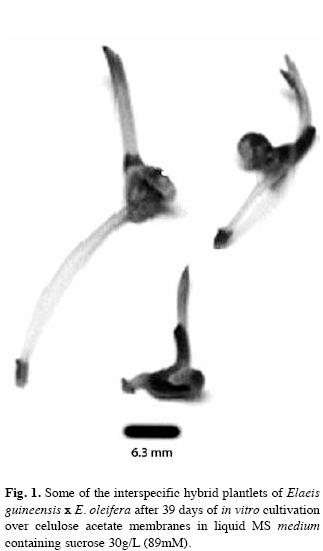
<body><![CDATA[30g/L (165mM) glucose, however during the 50 days of P1VC, the     percentage of plantlets displaying developed shoots and radicles     simultaneously was only significantly increased in <span      style="font-style: italic;">media</span> containing     20g/L (110mM) glucose or higher (<a      href="/img/revistas/rbt/v59n3/a10t1.gif">Table     1</a>). Accordingly, among sucrose     treatments, increase in the emergence of radicles with subsequent     development was observed almost exclusively for the highest     concentration (30g/L or 89mM, <a href="#fig1">Fig. 1</a>), despite it     ]]></body>
<body><![CDATA[has not been as high     as in glucose 20 and 30g/L (t-test, p&lt;0.05).    <br>     <br>     <br> </span></font>     <div style="text-align: center;"><a name="fig1"></a><img alt=""  src="/img/revistas/rbt/v59n3/a10i1.jpg"  style="width: 323px; height: 551px;">    <br>     </div>     <br style="font-family: verdana;">     <font size="2"><span style="font-family: verdana;">Most plantlets     ]]></body>
<body><![CDATA[germinating under 10     and 20g/L sucrose and 10g/L glucose     could not be forwarded to P2VC due to the observed staggered root     development. Consequently these three treatments were eliminated from     acclimatization experiments.</span></font><br      style="font-family: verdana;">     <br style="font-family: verdana;">     <font size="2"><span style="font-family: verdana;">From P1VC, 130     plantlets were     transferred to the greenhouse. Data     ]]></body>
<body><![CDATA[collect during <span style="font-style: italic;">ex vitro </span>transfer     revealed the absence of significant     influence of culture <span style="font-style: italic;">media</span>     used during P1VC (20 or 30g/L glucose or     30g/L sucrose) on the number of leaves per plant (n=130, H=0.0361,     p=0.982), on the lengths of the longest roots (n=118, H=0.719, p=0.698)     or on the longest leaves (n=130, H=1.171, p=0.425).</span></font><br      style="font-family: verdana;">     <br style="font-family: verdana;">     <font size="2"><span style="font-family: verdana;">At transfer, a     ]]></body>
<body><![CDATA[correlation between     the lengths of the longest leaf and     the longest root was significant (Spearman, n=118, r=0.330,     p&lt;0.001). Nevertheless, this inclusive result was highly influenced     by the values observed for plantlets cultivated in 20 or 30g/L glucose     during P1VC (Spearman, n=75, r=0.405, p&lt;0.001), since the     correlation between shoot and root lengths was not significant under     cultivation on 30g/L sucrose (Spearman, n=43 r=0.203, p=0.191). This     result is in agreement with the higher frequency of plantlets showing     radicle development in 20 or 30g/L glucose than in 30g/L sucrose along     ]]></body>
<body><![CDATA[P1VC (and <a href="/img/revistas/rbt/v59n3/a10t1.gif">Table 1</a>).</span></font><br      style="font-family: verdana;">     <br style="font-family: verdana;">     <font size="2"><span style="font-family: verdana;">Plants surviving up     to the second     evaluation under greenhouse     conditions 43 days after transfer corresponded to 55% (71 plants). This     result was similar to the 58.33% survival observed for coconut     plantlets (L&eacute;do <span style="font-style: italic;">et al</span>.     2007). From the total, 24 plants were     ]]></body>
<body><![CDATA[transferred to pure horticultural compost, 24 to 3:1 compost:sand and     23 to 1:1 compost:sand mixtures. Only five plants died after the second     evaluation.</span></font><br style="font-family: verdana;">     <br style="font-family: verdana;">     <font size="2"><span style="font-family: verdana;">Plantlets gained on     average     0.04cm/day in length of the longest leaf     during the first 43 days in the greenhouse. Subsequent progress was     significantly better (t-tests, p&lt;0.05) comparing data registered     upon <span style="font-style: italic;">ex vitro</span> transfer <span     ]]></body>
<body><![CDATA[ style="font-style: italic;">versus</span> subsequent evaluations. It     was observed     the increase in the number of leaves and the lengthening of the longest     leaf (<a href="/img/revistas/rbt/v59n3/a10t2.gif">Table 2</a>), with     gains of 0.123cm/day between the second and third     evaluations and 0.110cm/day from the third to the final evaluations     were observed. A correlation between the length of the longest leaf and     the number of leaves not observed at transfer was established by the     second evaluation (Spearman, n=71, r=0.778, p&lt;0.001) and persisted     through the experiment.</span></font><br style="font-family: verdana;">     ]]></body>
<body><![CDATA[<font size="2"><span style="font-family: verdana;">&nbsp;</span></font><br      style="font-family: verdana;">     <font size="2"><span style="font-family: verdana;">Distinct compost     mixtures had no     influence on shoot development until     the final evaluation, when the number of leaves was higher for pure     commercial compost (n=66, H=11.23, p=0.004). Root length followed a     similar pattern and was equally high in pure compost or 3:1     compost:sand mixture (n=66, H=7.66, p=0.022).</span></font><br      style="font-family: verdana;">     ]]></body>
<body><![CDATA[<br style="font-family: verdana; font-weight: bold;">     <font style="font-weight: bold;" size="3"><span      style="font-family: verdana;">Discussion</span></font><br      style="font-family: verdana;">     <br style="font-family: verdana;">     <font size="2"><span style="font-family: verdana;">The phase of reserve     (including     sucrose and proteins) accumulation ends     approximately 110 days after pollination, when the acquisition of     tolerance to desiccation is initiated, for seeds of <span     ]]></body>
<body><![CDATA[ style="font-style: italic;">Elaeis guineensis</span>     type <span style="font-style: italic;">tenera</span>. About 120 days     after pollination, water loss stops,     embryos preserve a water content slightly higher than the values     commonly observed for orthodox species and the seed remains dormant     until fruit abscission, which can last 60 additional days or for longer     periods (Aberlenc-Bertossi <span style="font-style: italic;">et al</span>.     2003). Besides sucrose accumulation,     abscisic acid (ABA) and late embryogenesis abundant (LEA) proteins are     possibly involved in this process and the acquired desiccation     ]]></body>
<body><![CDATA[tolerance is likely to be lost after germination (Aberlenc-Bertossi <span      style="font-style: italic;">et     al</span>. 2003). This process could be somewhat different for     interspecific     hybrids, since<span style="font-style: italic;"> E. oleifera </span>seeds     have relatively lower viability and     the combination of genomes from two species can produce novel     phenotypes for a massive number of traits. For instance, different     <span style="font-style: italic;">Arabidopsis landraces</span> or     ecotypes vary in their degree of seed dormancy     ]]></body>
<body><![CDATA[(Bentsink <span style="font-style: italic;">et al</span>. 2006).     Nevertheless, <span style="font-style: italic;">E.     guineensis</span> remains the most     suitable reference for the study of interspecific hybrids, and since     fruits were collect 150 days after pollination and stored, they were     considered to be dormant.</span></font><br style="font-family: verdana;">     <br style="font-family: verdana;">     <font size="2"><span style="font-family: verdana;">The hormone ABA can     accumulate in     roots of dormant species just after     ]]></body>
<body><![CDATA[emergence (Kende &amp; Zeevaart 1997), is involved in embryo dormancy     (Koornneef <span style="font-style: italic;">et al</span>. 2002) and     in the inhibition of invertase activity and     root elongation, which are complex signal transduction processes     orchestrated by sugars, water and light (Bewley 1997, Finkelstein &amp;     Gibson 2001). The impairment in root elongation is gradually supplanted     while the radicle becomes a photosynthate sink (Finkelstein &amp;     Gibson 2001), and this physiological mechanism is possibly coordinated     with the accumulation of sufficient sucrose in shoots. Embryos of <span      style="font-style: italic;">E.     ]]></body>
<body><![CDATA[guineensis</span> type <span style="font-style: italic;">tenera</span>     exposed to light display chlorophyll     accumulation in the haustorium due to chloroplast development, and     subsequent starch accumulation (Rab&eacute;chault &amp; Cas 1974). In     plants, <span style="font-style: italic;">haustorium</span> functions     to transfer reserves from the endosperm to     the germinating embryo (Carvalho 2000) and is not exposed to light. In     the present study, greening of <span style="font-style: italic;">haustoria</span>     was observed. Accumulation of     starch would also agree with the availability of hexoses in the shoots     ]]></body>
<body><![CDATA[while root invertases are inhibited by ABA. Efficient reserve     accumulation in the shoots and transfer to the radicles, among other     factors (as the presence of light during germination), would account     for the observation of highest frequencies of plantlets showing normal     root development in glucose 20 and 30g/L <span      style="font-style: italic;">media</span>, when compared to 10g/L     of the same sugar, and in the highest concentration of sucrose compared     to the lower concentrations tested (<a      href="/img/revistas/rbt/v59n3/a10t1.gif">Table 1</a>). The optimum     absorption     ]]></body>
<body><![CDATA[and metabolism of glucose in the shoots (Hill <span      style="font-style: italic;">et al</span>. 2003) would     compensate for a possible inhibition of root invertases following     emergence (Finkelstein &amp; Lynch 2000).</span></font><br      style="font-family: verdana;">     <br style="font-family: verdana;">     <font size="2"><span style="font-family: verdana;">During the first 43     days under     acclimatization process, hybrid     plantlets dying were presumably those with a higher number of leaves or     ]]></body>
<body><![CDATA[younger leaves, since no records of plants bearing four leaves at the     second evaluation were observed, despite plants at that stage were     observed at transfer. in the same period, a reduction in the average     length of the longest leaf was not observed (<a      href="/img/revistas/rbt/v59n3/a10t2.gif">Table 2</a>). Plantlets     bearing more leaves would lose higher contents of water due to the     higher number of stomata and thinner superficial wax layer     (Abdelouahhab &amp; Hughes 1995), thus demanding more absorption from     an insufficiently developed root system.</span></font><br      style="font-family: verdana;">     ]]></body>
<body><![CDATA[<br style="font-family: verdana;">     <font size="2"><span style="font-family: verdana;">To attain better     results in future     studies, embryos at different     maturation stages will be evaluated as reported for avocado     (Sanch&eacute;z- Romero <span style="font-style: italic;">et al</span>.     2007) and the effects of growth     regulators on germination will be tested (Aberlenc-Bertossi <span      style="font-style: italic;">et al</span>.     2003, L&eacute;do <span style="font-style: italic;">et al</span>.     ]]></body>
<body><![CDATA[2007). Despite the higher percentage of     plantlets obtained <span style="font-style: italic;">in vitro</span>     in comparison to the average number of     interspecific hybrid seeds germinating from progeny pools, the loss of     plantlets during acclimatization was of concern. This losses could be     reduced by a longer P2VC, by pruning of the roots and by the use of an     automated system to control the moisture in the greenhouse. Germination     rates and subsequent plantlet development may, in addition, be     influenced by embryo genotype, and therefore, different results may be     found in future experiments. </span></font><br     ]]></body>
<body><![CDATA[ style="font-family: verdana;">     <br style="font-family: verdana;">     <font size="2"><span style="font-family: verdana;">In conclusion,     interspecific     zygotic embryos of <span style="font-style: italic;">E. guineensis</span>     x <span style="font-style: italic;">E.     oleifera</span> succeeded in metabolize the glucose provided in the <span      style="font-style: italic;">media </span>for     <span style="font-style: italic;">in vitro</span> culture, and     displayed the highest frequencies of emerged and     ]]></body>
<body><![CDATA[developed roots when this sugar concentration reached 110mM or more (20     or 30g/L glucose). A balanced shoot/root development was observed only     for plantets rescued from these two treatments, by the end of P2VC and     transfer to acclimatization took place. From embryos cultivated in     20g/L glucose, 76% developed normal shoots and roots simultaneously at     the end of P1VC. The highest tested concentration of sucrose produced     the highest frequency of plantlets bearing developed shoots and     radicles. After four months in the greenhouse, plants grown solely in     horticulture compost displayed simultaneously higher number of leaves     and longer roots.</span></font><br style="font-family: verdana;">     ]]></body>
<body><![CDATA[<br style="font-family: verdana;">     <font style="font-weight: bold;" size="3"><span      style="font-family: verdana;">Acknowledgments</span></font><br      style="font-family: verdana;">     <br style="font-family: verdana;">     <font size="2"><span style="font-family: verdana;">To CNPq for     financial support, as     grant number 401078/04-3. To Rosimar     F. de Souza, Jeferson C. da Cruz and Hilma A. R. do Couto at Embrapa     Western Amazon Plant Biotechnology Laboratory for technical support. To     ]]></body>
<body><![CDATA[Nelson L. de Paula, Raimundo O. do Nascimento and Raimundo C. P. de     Moraes for carefully handling the embryos.</span></font><br      style="font-family: verdana;">     <font style="font-weight: bold;" size="3"><span      style="font-family: verdana;"></span></font>     <hr style="width: 100%; height: 2px;"><font style="font-weight: bold;"      size="3"><span style="font-family: verdana;">References</span></font><br      style="font-family: verdana;">     <br style="font-family: verdana;">     <font size="2"><span style="font-family: verdana;">Abdelouahhab, Z.     ]]></body>
<body><![CDATA[&amp; H. Hughes.     1995. <span style="font-style: italic;">In vitro </span>acclimatization     of     date palm (<span style="font-style: italic;">Phoenix dactylifera</span>     L.) plantlets: a quantitative comparison     of epicuticular leaf wax as a function of polyethylene glycol     <!-- ref -->treatment. Plant Cell Rep. 15: 111-114.    &nbsp;&nbsp;&nbsp;&nbsp;&nbsp;&nbsp;&nbsp;&nbsp;[&#160;<a href="javascript:void(0);" onclick="javascript: window.open('/scielo.php?script=sci_nlinks&ref=1723217&pid=S0034-7744201100030001000001&lng=','','width=640,height=500,resizable=yes,scrollbars=1,menubar=yes,');">Links</a>&#160;]<!-- end-ref --><!-- ref --></span></font><br  style="font-family: verdana;"> <br style="font-family: verdana;"> <font size="2"><span style="font-family: verdana;">Aberlenc-Bertossi, F., N. Chabrillange, F. Corbineau &amp; Y. Duval. 2003. Acquisition of desiccation tolerance in developing oil palm (<span style="font-style: italic;">Elaeis guineensis</span> Jacq.) embryos <span style="font-style: italic;">in planta</span> and <span  style="font-style: italic;">in vitro</span> in relation to sugar content. Seed Sci. Res. 13: 179-186.    &nbsp;&nbsp;&nbsp;&nbsp;&nbsp;&nbsp;&nbsp;&nbsp;[&#160;<a href="javascript:void(0);" onclick="javascript: window.open('/scielo.php?script=sci_nlinks&ref=1723218&pid=S0034-7744201100030001000002&lng=','','width=640,height=500,resizable=yes,scrollbars=1,menubar=yes,');">Links</a>&#160;]<!-- end-ref --><!-- ref --></span></font><br  style="font-family: verdana;"> <br style="font-family: verdana;"> <font size="2"><span style="font-family: verdana;">Barcelos, E., C.D.M. Nunes &amp; R.N.V. Cunha. 2000. Melhoramento gen&eacute;tico e produ&ccedil;&atilde;o de sementes comerciais de dendezeiro, p. 145-174. <span style="font-style: italic;">In</span> I.J.M. Vi&eacute;gas &amp; A.A. M&uuml;ller (eds.). A cultura do dendezeiro na Amaz&ocirc;nia brasileira. Embrapa Amaz&ocirc;nia Oriental/ Embrapa Amaz&ocirc;nia Ocidental, Bel&eacute;m, Par&aacute;, Brasil.    &nbsp;&nbsp;&nbsp;&nbsp;&nbsp;&nbsp;&nbsp;&nbsp;[&#160;<a href="javascript:void(0);" onclick="javascript: window.open('/scielo.php?script=sci_nlinks&ref=1723219&pid=S0034-7744201100030001000003&lng=','','width=640,height=500,resizable=yes,scrollbars=1,menubar=yes,');">Links</a>&#160;]<!-- end-ref --><!-- ref --></span></font><br  style="font-family: verdana;"> <br style="font-family: verdana;"> <font size="2"><span style="font-family: verdana;">Bentsink, L., J. Jowett, C.J. Hanhart &amp; M. Koornneef. 2006. Cloning of DOG1, a quantitative trait <span style="font-style: italic;">locus</span> controlling seed dormancy in <span style="font-style: italic;">Arabidopsis</span>. PNAS 103: 17042-17047.    &nbsp;&nbsp;&nbsp;&nbsp;&nbsp;&nbsp;&nbsp;&nbsp;[&#160;<a href="javascript:void(0);" onclick="javascript: window.open('/scielo.php?script=sci_nlinks&ref=1723220&pid=S0034-7744201100030001000004&lng=','','width=640,height=500,resizable=yes,scrollbars=1,menubar=yes,');">Links</a>&#160;]<!-- end-ref --><!-- ref --></span></font><br style="font-family: verdana;"> <br style="font-family: verdana;"> <font size="2"><span style="font-family: verdana;">Bewley, J.D. 1997. Seed germination and dormancy. Plant Cell 9: 1055-1066.    &nbsp;&nbsp;&nbsp;&nbsp;&nbsp;&nbsp;&nbsp;&nbsp;[&#160;<a href="javascript:void(0);" onclick="javascript: window.open('/scielo.php?script=sci_nlinks&ref=1723221&pid=S0034-7744201100030001000005&lng=','','width=640,height=500,resizable=yes,scrollbars=1,menubar=yes,');">Links</a>&#160;]<!-- end-ref --><!-- ref --></span></font><br style="font-family: verdana;"> <br style="font-family: verdana;"> <font size="2"><span style="font-family: verdana;">Carvalho, C.J.R. 2000. Ecofisiologia do dendezeiro <span style="font-style: italic;">Elaeis guineensis</span> JACQ), p. 89-124. <span style="font-style: italic;">In </span>i.J.M. Vi&eacute;gas &amp; A.A. M&uuml;ller (eds). A cultura do dendezeiro na Amaz&ocirc;nia brasileira. Embrapa Amaz&ocirc;nia Oriental/ Embrapa Amaz&ocirc;nia Ocidental, Bel&eacute;m, Par&aacute;, Brasil.    &nbsp;&nbsp;&nbsp;&nbsp;&nbsp;&nbsp;&nbsp;&nbsp;[&#160;<a href="javascript:void(0);" onclick="javascript: window.open('/scielo.php?script=sci_nlinks&ref=1723222&pid=S0034-7744201100030001000006&lng=','','width=640,height=500,resizable=yes,scrollbars=1,menubar=yes,');">Links</a>&#160;]<!-- end-ref --><!-- ref --></span></font><br  style="font-family: verdana;"> <br style="font-family: verdana;"> <font size="2"><span style="font-family: verdana;">Eastmond, P.J., V. Germain, P.R. Lange, J.H. Bryce, S.M. Smith &amp; I.A. Graham. 2000. Postgerminative growth and lipid catabolism in oilseeds lacking the glyoxalate cycle. PNAS 97: 5669-5674.    &nbsp;&nbsp;&nbsp;&nbsp;&nbsp;&nbsp;&nbsp;&nbsp;[&#160;<a href="javascript:void(0);" onclick="javascript: window.open('/scielo.php?script=sci_nlinks&ref=1723223&pid=S0034-7744201100030001000007&lng=','','width=640,height=500,resizable=yes,scrollbars=1,menubar=yes,');">Links</a>&#160;]<!-- end-ref --><!-- ref --></span></font><br  style="font-family: verdana;"> <br style="font-family: verdana;"> <font size="2"><span style="font-family: verdana;">Finkelstein, R.R. &amp; T.J. Lynch. 2000. Abscisic acid inhibition of radicle emergence but not seedling growth is suppressed by sugars. Plant Physiol. 122: 1179-1186.    &nbsp;&nbsp;&nbsp;&nbsp;&nbsp;&nbsp;&nbsp;&nbsp;[&#160;<a href="javascript:void(0);" onclick="javascript: window.open('/scielo.php?script=sci_nlinks&ref=1723224&pid=S0034-7744201100030001000008&lng=','','width=640,height=500,resizable=yes,scrollbars=1,menubar=yes,');">Links</a>&#160;]<!-- end-ref --><!-- ref --></span></font><br  style="font-family: verdana;"> <br style="font-family: verdana;"> <font size="2"><span style="font-family: verdana;">Finkelstein, R.R. &amp; S.I. Gibson. 2001. ABA and sugar interactions regulating development: cross-talk or voices in a crowd? Curr. Opin. Plant Biol. 5: 26-32.    &nbsp;&nbsp;&nbsp;&nbsp;&nbsp;&nbsp;&nbsp;&nbsp;[&#160;<a href="javascript:void(0);" onclick="javascript: window.open('/scielo.php?script=sci_nlinks&ref=1723225&pid=S0034-7744201100030001000009&lng=','','width=640,height=500,resizable=yes,scrollbars=1,menubar=yes,');">Links</a>&#160;]<!-- end-ref --></span></font><br style="font-family: verdana;"> <font size="2"><span style="font-family: verdana;">    <!-- ref --><br> Fiorese, C. 2008. Not&iacute;cias da Amaz&ocirc;nia. (Downloaded: March 1, 2010, <a  href="www.noticiasdaamazonia.com.br/2521-com-fabrica-no-para-natura-aposta-naindustria-sustentavel/">www.noticiasdaamazonia.com.br/2521-com-fabrica-no-para-natura-aposta-naindustria-sustentavel/</a>).    &nbsp;&nbsp;&nbsp;&nbsp;&nbsp;&nbsp;&nbsp;&nbsp;[&#160;<a href="javascript:void(0);" onclick="javascript: window.open('/scielo.php?script=sci_nlinks&ref=1723227&pid=S0034-7744201100030001000010&lng=','','width=640,height=500,resizable=yes,scrollbars=1,menubar=yes,');">Links</a>&#160;]<!-- end-ref --><!-- ref --></span></font><br  style="font-family: verdana;"> <br style="font-family: verdana;"> <font size="2"><span style="font-family: verdana;">Fox, E., K. Shotton &amp; C. Ulrich. 1995. SigmaStat Users Manual. Jandel Corporation, USA.    &nbsp;&nbsp;&nbsp;&nbsp;&nbsp;&nbsp;&nbsp;&nbsp;[&#160;<a href="javascript:void(0);" onclick="javascript: window.open('/scielo.php?script=sci_nlinks&ref=1723228&pid=S0034-7744201100030001000011&lng=','','width=640,height=500,resizable=yes,scrollbars=1,menubar=yes,');">Links</a>&#160;]<!-- end-ref --><!-- ref --></span></font><br style="font-family: verdana;"> <br style="font-family: verdana;"> <font size="2"><span style="font-family: verdana;">Hill, L.M., E.R. Morley-Smith &amp; S. Rawsthorne. 2003. Metabolism of sugars in the endosperm of developing seeds of oilseed rape. Plant Physiol. 131: 228-236.    &nbsp;&nbsp;&nbsp;&nbsp;&nbsp;&nbsp;&nbsp;&nbsp;[&#160;<a href="javascript:void(0);" onclick="javascript: window.open('/scielo.php?script=sci_nlinks&ref=1723229&pid=S0034-7744201100030001000012&lng=','','width=640,height=500,resizable=yes,scrollbars=1,menubar=yes,');">Links</a>&#160;]<!-- end-ref --><!-- ref --></span></font><br style="font-family: verdana;"> <br style="font-family: verdana;"> <font size="2"><span style="font-family: verdana;">Homma, O., J. Furlan J&uacute;nior, R.A. Carvalho &amp; C.A.P. Ferreira. 2000. Bases para uma pol&iacute;tica de desenvolvimento da cultura do dendezeiro na Amaz&ocirc;nia, p.11-30.<span  style="font-style: italic;"> In </span>I.J.M. Vi&eacute;gas &amp; A.A. M&uuml;ller (eds.). A cultura do dendezeiro na Amaz&ocirc;nia brasileira. EMBRAPA Amaz&ocirc;nia Oriental/Embrapa Amaz&ocirc;nia Ocidental, Bel&eacute;m, Par&aacute;, Brasil.    &nbsp;&nbsp;&nbsp;&nbsp;&nbsp;&nbsp;&nbsp;&nbsp;[&#160;<a href="javascript:void(0);" onclick="javascript: window.open('/scielo.php?script=sci_nlinks&ref=1723230&pid=S0034-7744201100030001000013&lng=','','width=640,height=500,resizable=yes,scrollbars=1,menubar=yes,');">Links</a>&#160;]<!-- end-ref --><!-- ref --></span></font><br  style="font-family: verdana;"> <br style="font-family: verdana;"> <font size="2"><span style="font-family: verdana;">Kende, H. &amp; J.A.D. Zeevart. 1997. The five classical plant hormones. Plant Cell 9: 1197-1210.    &nbsp;&nbsp;&nbsp;&nbsp;&nbsp;&nbsp;&nbsp;&nbsp;[&#160;<a href="javascript:void(0);" onclick="javascript: window.open('/scielo.php?script=sci_nlinks&ref=1723231&pid=S0034-7744201100030001000014&lng=','','width=640,height=500,resizable=yes,scrollbars=1,menubar=yes,');">Links</a>&#160;]<!-- end-ref --><!-- ref --></span></font><br  style="font-family: verdana;"> <br style="font-family: verdana;"> <font size="2"><span style="font-family: verdana;">Koornneef, M., L. Bentsink &amp; H. Hilhorst. 2002. Seed dormancy and germination. Curr. Opin. Plant Biol. 5: 33-36.    &nbsp;&nbsp;&nbsp;&nbsp;&nbsp;&nbsp;&nbsp;&nbsp;[&#160;<a href="javascript:void(0);" onclick="javascript: window.open('/scielo.php?script=sci_nlinks&ref=1723232&pid=S0034-7744201100030001000015&lng=','','width=640,height=500,resizable=yes,scrollbars=1,menubar=yes,');">Links</a>&#160;]<!-- end-ref --><!-- ref --></span></font><br  style="font-family: verdana;"> <br style="font-family: verdana;"> <font size="2"><span style="font-family: verdana;">L&eacute;do, A.S., K.K.P. Gomes, S.B.S.C. Barboza, G.S.S. Vieira, E.A. Tupinamb&aacute; &amp; W.M. Arag&atilde;o. 2007. Cultivo <span  style="font-style: italic;">in vitro</span> de embri&otilde;es zig&oacute;ticos e aclimata&ccedil;&atilde;o de pl&acirc;ntulas de coqueiro-an&atilde;o. PAB 42: 147-154.    &nbsp;&nbsp;&nbsp;&nbsp;&nbsp;&nbsp;&nbsp;&nbsp;[&#160;<a href="javascript:void(0);" onclick="javascript: window.open('/scielo.php?script=sci_nlinks&ref=1723233&pid=S0034-7744201100030001000016&lng=','','width=640,height=500,resizable=yes,scrollbars=1,menubar=yes,');">Links</a>&#160;]<!-- end-ref --><!-- ref --></span></font><br  style="font-family: verdana;"> <br style="font-family: verdana;"> <font size="2"><span style="font-family: verdana;">Lopes, R., R.N.V. Cunha, M.R.L. Rodrigues, P.C. Teixeira, R.N.C. Rocha &amp; W.A.A. Lima. 2008. Palm&aacute;ceas, p. 767-786. <span  style="font-style: italic;">In</span> A.C.S. Albuquerque, A.G. Silva (eds.). Agricultura tropical: quatro d&eacute;cadas de inova&ccedil;&otilde;es tecnol&oacute;gicas, institucionais e pol&iacute;ticas. v. 1. Embrapa informa&ccedil;&atilde;o Tecnol&oacute;gica, Bras&iacute;lia, DF, Brasil.    &nbsp;&nbsp;&nbsp;&nbsp;&nbsp;&nbsp;&nbsp;&nbsp;[&#160;<a href="javascript:void(0);" onclick="javascript: window.open('/scielo.php?script=sci_nlinks&ref=1723234&pid=S0034-7744201100030001000017&lng=','','width=640,height=500,resizable=yes,scrollbars=1,menubar=yes,');">Links</a>&#160;]<!-- end-ref --><!-- ref --> </span></font><br style="font-family: verdana;"> <br style="font-family: verdana;"> <font size="2"><span style="font-family: verdana;">Murashige, T. &amp; F. Skoog. 1962. A revised <span style="font-style: italic;">medium</span> for rapid growth and bioassays with tobacco tissue cultures. Physiol. Plant 15: 473-497.    &nbsp;&nbsp;&nbsp;&nbsp;&nbsp;&nbsp;&nbsp;&nbsp;[&#160;<a href="javascript:void(0);" onclick="javascript: window.open('/scielo.php?script=sci_nlinks&ref=1723235&pid=S0034-7744201100030001000018&lng=','','width=640,height=500,resizable=yes,scrollbars=1,menubar=yes,');">Links</a>&#160;]<!-- end-ref --><!-- ref --></span></font><br  style="font-family: verdana;"> <br style="font-family: verdana;"> <font size="2"><span style="font-family: verdana;">Natura. 2010. NaturaEkos. (Downloaded: March 1, 2010, <a href="www.naturaekos.com.br/pt/naturaekos/cadeia-sustentavel/">www.naturaekos.com.br/pt/naturaekos/cadeia-sustentavel/</a>).    &nbsp;&nbsp;&nbsp;&nbsp;&nbsp;&nbsp;&nbsp;&nbsp;[&#160;<a href="javascript:void(0);" onclick="javascript: window.open('/scielo.php?script=sci_nlinks&ref=1723236&pid=S0034-7744201100030001000019&lng=','','width=640,height=500,resizable=yes,scrollbars=1,menubar=yes,');">Links</a>&#160;]<!-- end-ref --><!-- ref --></span></font><br  style="font-family: verdana;"> <br style="font-family: verdana;"> <font size="2"><span style="font-family: verdana;">Nunes, C.D.M., D. Lima &amp; R.N.V. Cunha. 1998. Germina&ccedil;&atilde;o de sementes de dend&ecirc; (<span  style="font-style: italic;">Elaeis guineensis </span>Jacq.), utilizando o m&eacute;todo de calor seco. Instru&ccedil;&otilde;es T&eacute;cnicas, 12. Embrapa Amaz&ocirc;nia Ocidental, Manaus, Amazonas, Brasil.    &nbsp;&nbsp;&nbsp;&nbsp;&nbsp;&nbsp;&nbsp;&nbsp;[&#160;<a href="javascript:void(0);" onclick="javascript: window.open('/scielo.php?script=sci_nlinks&ref=1723237&pid=S0034-7744201100030001000020&lng=','','width=640,height=500,resizable=yes,scrollbars=1,menubar=yes,');">Links</a>&#160;]<!-- end-ref --><!-- ref --></span></font><br  style="font-family: verdana;"> <br style="font-family: verdana;"> <font size="2"><span style="font-family: verdana;">Rab&eacute;chault, H. &amp; S. Cas. 1974. Recherches sur la culture <span style="font-style: italic;">in vitro</span> des embryons de palmier &agrave; huile (<span  style="font-style: italic;">Elaeis guineensis</span> Jacq. var. dura Becc.). Oleagineux 29: 73-78.    &nbsp;&nbsp;&nbsp;&nbsp;&nbsp;&nbsp;&nbsp;&nbsp;[&#160;<a href="javascript:void(0);" onclick="javascript: window.open('/scielo.php?script=sci_nlinks&ref=1723238&pid=S0034-7744201100030001000021&lng=','','width=640,height=500,resizable=yes,scrollbars=1,menubar=yes,');">Links</a>&#160;]<!-- end-ref --><!-- ref --></span></font><br  style="font-family: verdana;"> <br style="font-family: verdana;"> <font size="2"><span style="font-family: verdana;">S&aacute;nchez-Romero, C., R. Per&aacute;n-Quesada, B. M&aacute;rquez-Mart&iacute;n, A. Barcel&oacute;-Mu&ntilde;oz &amp; F. Pliego-Alfaro. 2007. <span style="font-style: italic;">In vitro</span> rescue of immature avocado (<span style="font-style: italic;">Persea americana</span> Mill.) embryos. Sci. Hort. 111: 365-370.    &nbsp;&nbsp;&nbsp;&nbsp;&nbsp;&nbsp;&nbsp;&nbsp;[&#160;<a href="javascript:void(0);" onclick="javascript: window.open('/scielo.php?script=sci_nlinks&ref=1723239&pid=S0034-7744201100030001000022&lng=','','width=640,height=500,resizable=yes,scrollbars=1,menubar=yes,');">Links</a>&#160;]<!-- end-ref --><!-- ref --></span></font><br  style="font-family: verdana;"> <br style="font-family: verdana;"> <font size="2"><span style="font-family: verdana;">van Laere, K., J.M. van Huylenbroeck &amp; E. van Bockstaele. 2007. interspecific hybridization between <span style="font-style: italic;">Hibiscus syriacus</span>,<span style="font-style: italic;"> Hibiscus sinosyriacus</span> and <span style="font-style: italic;">Hibiscus paramutabilis</span>. Euphytica 155: 271-283.    &nbsp;&nbsp;&nbsp;&nbsp;&nbsp;&nbsp;&nbsp;&nbsp;[&#160;<a href="javascript:void(0);" onclick="javascript: window.open('/scielo.php?script=sci_nlinks&ref=1723240&pid=S0034-7744201100030001000023&lng=','','width=640,height=500,resizable=yes,scrollbars=1,menubar=yes,');">Links</a>&#160;]<!-- end-ref --><!-- ref --></span></font><br  style="font-family: verdana;"> <br style="font-family: verdana;"> <font size="2"><span style="font-family: verdana;">Veiga, A.S., L. Smit &amp; L.R.R. F&uacute;ria. 2000. Avalia&ccedil;&atilde;o do dendezeiro como op&ccedil;&atilde;o para o seq&uuml;estro de carbono na Amaz&ocirc;nia, p. 125-144. <span  style="font-style: italic;">In</span> I.J.M. Vi&eacute;gas &amp; A.A. M&uuml;ller (eds.). A cultura do dendezeiro na Amaz&ocirc;nia brasileira. Embrapa Amaz&ocirc;nia Oriental/Embrapa Amaz&ocirc;nia Ocidental, Bel&eacute;m, Par&aacute;, Brazil.    &nbsp;&nbsp;&nbsp;&nbsp;&nbsp;&nbsp;&nbsp;&nbsp;[&#160;<a href="javascript:void(0);" onclick="javascript: window.open('/scielo.php?script=sci_nlinks&ref=1723241&pid=S0034-7744201100030001000024&lng=','','width=640,height=500,resizable=yes,scrollbars=1,menubar=yes,');">Links</a>&#160;]<!-- end-ref --><!-- ref --></span></font><br  style="font-family: verdana;"> <br style="font-family: verdana;"> <font size="2"><span style="font-family: verdana;">Zhang, G.Q., W.J. Zhou, H.H. Gu, W.J. Song &amp; E.J.J. Momoh. 2003. Plant regeneration from the hybridization of <span  style="font-style: italic;">Brassica juncea </span>and <span  style="font-style: italic;">B. napus</span> through embryo culture. J. Agron. Crop. Sci. 189: 347-350.    &nbsp;&nbsp;&nbsp;&nbsp;&nbsp;&nbsp;&nbsp;&nbsp;[&#160;<a href="javascript:void(0);" onclick="javascript: window.open('/scielo.php?script=sci_nlinks&ref=1723242&pid=S0034-7744201100030001000025&lng=','','width=640,height=500,resizable=yes,scrollbars=1,menubar=yes,');">Links</a>&#160;]<!-- end-ref --> </span></font>    <br>     <br>     <div style="text-align: left;"><font size="2"><span  style="font-family: verdana;"><a name="correspondencia"></a>Correspondencia a: </span></font><font size="2"><span style="font-family: verdana;">Paula Cristina da Silva Angelo, Larissa Alexandra Cardoso Moraes, Ricardo Lopes, Nelcimar Reis Sousa, Raimundo Nonato Vieira da Cunha &amp; Regina Caetano Quisen. </span></font><font size="2"><span  style="font-family: verdana;">Embrapa Western Amazon, Rodovia AM 010, km 29, CP 319, CEP 69010-970, Manaus-AM, Brazil; <a  href="mailto:paula.angelo@cpaa.embrapa.br">paula.angelo@cpaa.embrapa.br</a>, <a href="mailto:larissa.moraes@cpaa.embrapa.br">larissa.moraes@cpaa.embrapa.br</a>, <a href="mailto:ricardo.lopes@cpaa.embrapa.br">ricardo.lopes@cpaa.embrapa.br</a>, <a href="mailto:nelcimar.sousa@cpaa.embrapa.br">nelcimar.sousa@cpaa.embrapa.br</a>, <a href="mailto:raimundo.cunha@cpaa.embrapa.br">raimundo.cunha@cpaa.embrapa.br</a>, <a href="mailto:regina.quisen@cpaa.embrapa.br">regina.quisen@cpaa.embrapa.br</a></span></font>    <br> </div>     <div style="text-align: center;"><font size="2"><span  style="font-family: verdana;"></span></font> <hr style="width: 100%; height: 2px;"><font size="2"><span  style="font-family: verdana;">Received 21-IX-2010. Corrected 10-XII-2010. Accepted 01-II-2011. </span></font></div> </div>      ]]></body><back>
<ref-list>
<ref id="B1">
<nlm-citation citation-type="journal">
<person-group person-group-type="author">
<name>
<surname><![CDATA[Abdelouahhab]]></surname>
<given-names><![CDATA[Z]]></given-names>
</name>
<name>
<surname><![CDATA[Hughes]]></surname>
<given-names><![CDATA[H]]></given-names>
</name>
</person-group>
<article-title xml:lang="en"><![CDATA[In vitro acclimatization of date palm (Phoenix dactylifera L.) plantlets: a quantitative comparison of epicuticular leaf wax as a function of polyethylene glycol treatment]]></article-title>
<source><![CDATA[Plant Cell Rep.]]></source>
<year>1995</year>
<volume>15</volume>
<page-range>111-114</page-range></nlm-citation>
</ref>
<ref id="B2">
<nlm-citation citation-type="journal">
<person-group person-group-type="author">
<name>
<surname><![CDATA[Aberlenc-Bertossi]]></surname>
<given-names><![CDATA[F]]></given-names>
</name>
<name>
<surname><![CDATA[Chabrillange]]></surname>
<given-names><![CDATA[N]]></given-names>
</name>
<name>
<surname><![CDATA[Corbineau]]></surname>
<given-names><![CDATA[F]]></given-names>
</name>
<name>
<surname><![CDATA[Duval]]></surname>
<given-names><![CDATA[Y]]></given-names>
</name>
</person-group>
<article-title xml:lang="en"><![CDATA[Acquisition of desiccation tolerance in developing oil palm (Elaeis guineensis Jacq.) embryos in planta and in vitro in relation to sugar content]]></article-title>
<source><![CDATA[Seed Sci. Res]]></source>
<year>2003</year>
<volume>13</volume>
<page-range>179-186</page-range></nlm-citation>
</ref>
<ref id="B3">
<nlm-citation citation-type="book">
<person-group person-group-type="author">
<name>
<surname><![CDATA[Barcelos]]></surname>
<given-names><![CDATA[E]]></given-names>
</name>
<name>
<surname><![CDATA[Nunes]]></surname>
<given-names><![CDATA[C.D.M]]></given-names>
</name>
<name>
<surname><![CDATA[Cunha]]></surname>
<given-names><![CDATA[R.N.V.]]></given-names>
</name>
</person-group>
<article-title xml:lang="pt"><![CDATA[Melhoramento genético e produção de sementes comerciais de dendezeiro]]></article-title>
<person-group person-group-type="editor">
<name>
<surname><![CDATA[Viégas]]></surname>
<given-names><![CDATA[I.J.M]]></given-names>
</name>
<name>
<surname><![CDATA[Müller]]></surname>
<given-names><![CDATA[A.A]]></given-names>
</name>
</person-group>
<source><![CDATA[A cultura do dendezeiro na Amazônia brasileira]]></source>
<year>2000</year>
<page-range>145-174</page-range><publisher-loc><![CDATA[Belém^ePará Pará]]></publisher-loc>
<publisher-name><![CDATA[Embrapa Amazônia Oriental/ Embrapa Amazônia Ocidental]]></publisher-name>
</nlm-citation>
</ref>
<ref id="B4">
<nlm-citation citation-type="journal">
<person-group person-group-type="author">
<name>
<surname><![CDATA[Bentsink]]></surname>
<given-names><![CDATA[L]]></given-names>
</name>
<name>
<surname><![CDATA[Jowett]]></surname>
<given-names><![CDATA[J]]></given-names>
</name>
<name>
<surname><![CDATA[Hanhart]]></surname>
<given-names><![CDATA[C.J]]></given-names>
</name>
<name>
<surname><![CDATA[Koornneef]]></surname>
<given-names><![CDATA[M]]></given-names>
</name>
</person-group>
<article-title xml:lang="en"><![CDATA[Cloning of DOG1, a quantitative trait locus controlling seed dormancy in Arabidopsis]]></article-title>
<source><![CDATA[PNAS]]></source>
<year>2006</year>
<volume>103</volume>
<page-range>17042-17047</page-range></nlm-citation>
</ref>
<ref id="B5">
<nlm-citation citation-type="journal">
<person-group person-group-type="author">
<name>
<surname><![CDATA[Bewley]]></surname>
<given-names><![CDATA[J.D]]></given-names>
</name>
</person-group>
<article-title xml:lang="en"><![CDATA[Seed germination and dormancy]]></article-title>
<source><![CDATA[Plant Cell]]></source>
<year>1997</year>
<volume>9</volume>
<page-range>1055-1066</page-range></nlm-citation>
</ref>
<ref id="B6">
<nlm-citation citation-type="book">
<person-group person-group-type="author">
<name>
<surname><![CDATA[Carvalho]]></surname>
<given-names><![CDATA[C.J.R]]></given-names>
</name>
</person-group>
<article-title xml:lang="en"><![CDATA[Ecofisiologia do dendezeiro Elaeis guineensis JACQ)]]></article-title>
<person-group person-group-type="editor">
<name>
<surname><![CDATA[Viégas]]></surname>
<given-names><![CDATA[I.J.M]]></given-names>
</name>
<name>
<surname><![CDATA[Müller]]></surname>
<given-names><![CDATA[A.A.]]></given-names>
</name>
</person-group>
<source><![CDATA[A cultura do dendezeiro na Amazônia brasileira]]></source>
<year>2000</year>
<page-range>89-124</page-range><publisher-loc><![CDATA[Belém^ePará Pará]]></publisher-loc>
<publisher-name><![CDATA[Embrapa Amazônia Oriental/ Embrapa Amazônia Ocidental]]></publisher-name>
</nlm-citation>
</ref>
<ref id="B7">
<nlm-citation citation-type="journal">
<person-group person-group-type="author">
<name>
<surname><![CDATA[Eastmond]]></surname>
<given-names><![CDATA[P.J]]></given-names>
</name>
<name>
<surname><![CDATA[Germain]]></surname>
<given-names><![CDATA[V]]></given-names>
</name>
<name>
<surname><![CDATA[Lange]]></surname>
<given-names><![CDATA[P.R]]></given-names>
</name>
<name>
<surname><![CDATA[Bryce]]></surname>
<given-names><![CDATA[J.H]]></given-names>
</name>
<name>
<surname><![CDATA[Smith]]></surname>
<given-names><![CDATA[S.M]]></given-names>
</name>
<name>
<surname><![CDATA[Graham]]></surname>
<given-names><![CDATA[I.A]]></given-names>
</name>
</person-group>
<article-title xml:lang="en"><![CDATA[Postgerminative growth and lipid catabolism in oilseeds lacking the glyoxalate cycle]]></article-title>
<source><![CDATA[PNAS]]></source>
<year>2000</year>
<volume>97</volume>
<page-range>5669-5674</page-range></nlm-citation>
</ref>
<ref id="B8">
<nlm-citation citation-type="journal">
<person-group person-group-type="author">
<name>
<surname><![CDATA[Finkelstein]]></surname>
<given-names><![CDATA[R.R]]></given-names>
</name>
<name>
<surname><![CDATA[Lynch]]></surname>
<given-names><![CDATA[T.J]]></given-names>
</name>
</person-group>
<article-title xml:lang="en"><![CDATA[Abscisic acid inhibition of radicle emergence but not seedling growth is suppressed by sugars]]></article-title>
<source><![CDATA[Plant Physiol]]></source>
<year>2000</year>
<volume>122</volume>
<page-range>1179-1186</page-range></nlm-citation>
</ref>
<ref id="B9">
<nlm-citation citation-type="journal">
<person-group person-group-type="author">
<name>
<surname><![CDATA[Finkelstein]]></surname>
<given-names><![CDATA[R.R]]></given-names>
</name>
<name>
<surname><![CDATA[Gibson]]></surname>
<given-names><![CDATA[S.I]]></given-names>
</name>
</person-group>
<article-title xml:lang="en"><![CDATA[ABA and sugar interactions regulating development: cross-talk or voices in a crowd?]]></article-title>
<source><![CDATA[Curr. Opin. Plant Biol]]></source>
<year>2001</year>
<volume>5</volume>
<page-range>26-32</page-range></nlm-citation>
</ref>
<ref id="B10">
<nlm-citation citation-type="">
<person-group person-group-type="author">
<name>
<surname><![CDATA[Fiorese]]></surname>
<given-names><![CDATA[C]]></given-names>
</name>
</person-group>
<source><![CDATA[Notícias da Amazônia]]></source>
<year>2008</year>
</nlm-citation>
</ref>
<ref id="B11">
<nlm-citation citation-type="book">
<person-group person-group-type="author">
<name>
<surname><![CDATA[Fox]]></surname>
<given-names><![CDATA[E]]></given-names>
</name>
<name>
<surname><![CDATA[Shotton]]></surname>
<given-names><![CDATA[K]]></given-names>
</name>
<name>
<surname><![CDATA[Ulrich]]></surname>
<given-names><![CDATA[C]]></given-names>
</name>
</person-group>
<source><![CDATA[SigmaStat Users Manual]]></source>
<year>1995</year>
<publisher-name><![CDATA[Jandel Corporation]]></publisher-name>
</nlm-citation>
</ref>
<ref id="B12">
<nlm-citation citation-type="journal">
<person-group person-group-type="author">
<name>
<surname><![CDATA[Hill]]></surname>
<given-names><![CDATA[L.M]]></given-names>
</name>
<name>
<surname><![CDATA[Morley-Smith]]></surname>
<given-names><![CDATA[E.R]]></given-names>
</name>
<name>
<surname><![CDATA[Rawsthorne]]></surname>
<given-names><![CDATA[S.]]></given-names>
</name>
</person-group>
<article-title xml:lang="en"><![CDATA[Metabolism of sugars in the endosperm of developing seeds of oilseed rape]]></article-title>
<source><![CDATA[Plant Physiol]]></source>
<year>2003</year>
<volume>131</volume>
<page-range>228-236</page-range></nlm-citation>
</ref>
<ref id="B13">
<nlm-citation citation-type="book">
<person-group person-group-type="author">
<name>
<surname><![CDATA[Homma]]></surname>
<given-names><![CDATA[O]]></given-names>
</name>
<name>
<surname><![CDATA[Furlan Júnior]]></surname>
<given-names><![CDATA[J]]></given-names>
</name>
<name>
<surname><![CDATA[Carvalho]]></surname>
<given-names><![CDATA[R.A.]]></given-names>
</name>
<name>
<surname><![CDATA[Ferreira]]></surname>
<given-names><![CDATA[C.A.P]]></given-names>
</name>
</person-group>
<article-title xml:lang="pt"><![CDATA[Bases para uma política de desenvolvimento da cultura do dendezeiro na Amazônia]]></article-title>
<person-group person-group-type="editor">
<name>
<surname><![CDATA[Viégas]]></surname>
<given-names><![CDATA[I.J.M]]></given-names>
</name>
<name>
<surname><![CDATA[Müller]]></surname>
<given-names><![CDATA[A.A]]></given-names>
</name>
</person-group>
<source><![CDATA[A cultura do dendezeiro na Amazônia brasileira]]></source>
<year>2000</year>
<page-range>11-30</page-range><publisher-loc><![CDATA[Belém^ePará Pará]]></publisher-loc>
<publisher-name><![CDATA[EMBRAPA Amazônia Oriental/Embrapa Amazônia Ocidental]]></publisher-name>
</nlm-citation>
</ref>
<ref id="B14">
<nlm-citation citation-type="journal">
<person-group person-group-type="author">
<name>
<surname><![CDATA[Kende]]></surname>
<given-names><![CDATA[H]]></given-names>
</name>
<name>
<surname><![CDATA[Zeevart]]></surname>
<given-names><![CDATA[J.A.D]]></given-names>
</name>
</person-group>
<article-title xml:lang="en"><![CDATA[The five classical plant hormones]]></article-title>
<source><![CDATA[Plant Cell]]></source>
<year>1997</year>
<volume>9</volume>
<page-range>1197-1210</page-range></nlm-citation>
</ref>
<ref id="B15">
<nlm-citation citation-type="journal">
<person-group person-group-type="author">
<name>
<surname><![CDATA[Koornneef]]></surname>
<given-names><![CDATA[M]]></given-names>
</name>
<name>
<surname><![CDATA[Bentsink]]></surname>
<given-names><![CDATA[L]]></given-names>
</name>
<name>
<surname><![CDATA[Hilhorst]]></surname>
<given-names><![CDATA[H]]></given-names>
</name>
</person-group>
<article-title xml:lang="en"><![CDATA[Seed dormancy and germination]]></article-title>
<source><![CDATA[Curr. Opin. Plant Biol]]></source>
<year>2002</year>
<volume>5</volume>
<page-range>33-36</page-range></nlm-citation>
</ref>
<ref id="B16">
<nlm-citation citation-type="journal">
<person-group person-group-type="author">
<name>
<surname><![CDATA[Lédo]]></surname>
<given-names><![CDATA[A.S]]></given-names>
</name>
<name>
<surname><![CDATA[Gomes]]></surname>
<given-names><![CDATA[K.K.P]]></given-names>
</name>
<name>
<surname><![CDATA[Barboza]]></surname>
<given-names><![CDATA[S.B.S.C]]></given-names>
</name>
<name>
<surname><![CDATA[Vieira]]></surname>
<given-names><![CDATA[G.S.S]]></given-names>
</name>
<name>
<surname><![CDATA[Tupinambá]]></surname>
<given-names><![CDATA[E.A]]></given-names>
</name>
<name>
<surname><![CDATA[Aragão]]></surname>
<given-names><![CDATA[W.M]]></given-names>
</name>
</person-group>
<article-title xml:lang="pt"><![CDATA[Cultivo in vitro de embriões zigóticos e aclimatação de plântulas de coqueiro-anão]]></article-title>
<source><![CDATA[PAB]]></source>
<year>2007</year>
<volume>42</volume>
<page-range>147-154</page-range></nlm-citation>
</ref>
<ref id="B17">
<nlm-citation citation-type="book">
<person-group person-group-type="author">
<name>
<surname><![CDATA[Lopes]]></surname>
<given-names><![CDATA[R]]></given-names>
</name>
<name>
<surname><![CDATA[Cunha]]></surname>
<given-names><![CDATA[R.N.V]]></given-names>
</name>
<name>
<surname><![CDATA[Rodrigues]]></surname>
<given-names><![CDATA[M.R.L]]></given-names>
</name>
<name>
<surname><![CDATA[Teixeira]]></surname>
<given-names><![CDATA[P.C]]></given-names>
</name>
<name>
<surname><![CDATA[Rocha]]></surname>
<given-names><![CDATA[R.N.C]]></given-names>
</name>
<name>
<surname><![CDATA[Lima]]></surname>
<given-names><![CDATA[W.A.A]]></given-names>
</name>
</person-group>
<article-title xml:lang="pt"><![CDATA[Palmáceas]]></article-title>
<person-group person-group-type="editor">
<name>
<surname><![CDATA[Albuquerque]]></surname>
<given-names><![CDATA[A.C.S]]></given-names>
</name>
<name>
<surname><![CDATA[Silva]]></surname>
<given-names><![CDATA[A.G]]></given-names>
</name>
</person-group>
<source><![CDATA[Agricultura tropical: quatro décadas de inovações tecnológicas, institucionais e políticas. v. 1]]></source>
<year>2008</year>
<page-range>767-786</page-range><publisher-loc><![CDATA[Brasília ]]></publisher-loc>
<publisher-name><![CDATA[Embrapa informação Tecnológica]]></publisher-name>
</nlm-citation>
</ref>
<ref id="B18">
<nlm-citation citation-type="journal">
<person-group person-group-type="author">
<name>
<surname><![CDATA[Murashige]]></surname>
<given-names><![CDATA[T]]></given-names>
</name>
<name>
<surname><![CDATA[Skoog]]></surname>
<given-names><![CDATA[F]]></given-names>
</name>
</person-group>
<article-title xml:lang="en"><![CDATA[A revised medium for rapid growth and bioassays with tobacco tissue cultures]]></article-title>
<source><![CDATA[Physiol. Plant]]></source>
<year>1962</year>
<volume>15</volume>
<page-range>473-497</page-range></nlm-citation>
</ref>
<ref id="B19">
<nlm-citation citation-type="">
<collab>Natura</collab>
<source><![CDATA[NaturaEkos]]></source>
<year>2010</year>
</nlm-citation>
</ref>
<ref id="B20">
<nlm-citation citation-type="book">
<person-group person-group-type="author">
<name>
<surname><![CDATA[Nunes]]></surname>
<given-names><![CDATA[C.D.M]]></given-names>
</name>
<name>
<surname><![CDATA[Lima]]></surname>
<given-names><![CDATA[D]]></given-names>
</name>
<name>
<surname><![CDATA[Cunha]]></surname>
<given-names><![CDATA[R.N.V]]></given-names>
</name>
</person-group>
<source><![CDATA[Germinação de sementes de dendê (Elaeis guineensis Jacq.), utilizando o método de calor seco: Instruções Técnicas, 12]]></source>
<year>1998</year>
<publisher-loc><![CDATA[Manaus, Amazonas ]]></publisher-loc>
<publisher-name><![CDATA[Embrapa Amazônia Ocidental]]></publisher-name>
</nlm-citation>
</ref>
<ref id="B21">
<nlm-citation citation-type="journal">
<person-group person-group-type="author">
<name>
<surname><![CDATA[Rabéchault]]></surname>
<given-names><![CDATA[H]]></given-names>
</name>
<name>
<surname><![CDATA[Cas]]></surname>
<given-names><![CDATA[S]]></given-names>
</name>
</person-group>
<article-title xml:lang="fr"><![CDATA[Recherches sur la culture in vitro des embryons de palmier à huile (Elaeis guineensis Jacq. var. dura Becc.)]]></article-title>
<source><![CDATA[Oleagineux]]></source>
<year>1974</year>
<volume>29</volume>
<page-range>73-78</page-range></nlm-citation>
</ref>
<ref id="B22">
<nlm-citation citation-type="journal">
<person-group person-group-type="author">
<name>
<surname><![CDATA[Sánchez-Romero]]></surname>
<given-names><![CDATA[C]]></given-names>
</name>
<name>
<surname><![CDATA[Perán-Quesada]]></surname>
<given-names><![CDATA[R]]></given-names>
</name>
<name>
<surname><![CDATA[Márquez-Martín]]></surname>
<given-names><![CDATA[B]]></given-names>
</name>
<name>
<surname><![CDATA[Barceló-Muñoz]]></surname>
<given-names><![CDATA[A.]]></given-names>
</name>
<name>
<surname><![CDATA[Pliego-Alfaro]]></surname>
<given-names><![CDATA[F]]></given-names>
</name>
</person-group>
<article-title xml:lang="en"><![CDATA[In vitro rescue of immature avocado (Persea americana Mill.) embryos]]></article-title>
<source><![CDATA[Sci. Hort]]></source>
<year>2007</year>
<volume>111</volume>
<page-range>365-370</page-range></nlm-citation>
</ref>
<ref id="B23">
<nlm-citation citation-type="journal">
<person-group person-group-type="author">
<name>
<surname><![CDATA[van Laere]]></surname>
<given-names><![CDATA[K]]></given-names>
</name>
<name>
<surname><![CDATA[van Huylenbroeck]]></surname>
<given-names><![CDATA[M]]></given-names>
</name>
<name>
<surname><![CDATA[van Bockstaele]]></surname>
<given-names><![CDATA[E]]></given-names>
</name>
</person-group>
<article-title xml:lang="en"><![CDATA[Interspecific hybridization between Hibiscus syriacus, Hibiscus sinosyriacus and Hibiscus paramutabilis]]></article-title>
<source><![CDATA[Euphytica]]></source>
<year>2007</year>
<volume>155</volume>
<page-range>271-283</page-range></nlm-citation>
</ref>
<ref id="B24">
<nlm-citation citation-type="book">
<person-group person-group-type="author">
<name>
<surname><![CDATA[Veiga]]></surname>
<given-names><![CDATA[A.S]]></given-names>
</name>
<name>
<surname><![CDATA[Smit]]></surname>
<given-names><![CDATA[L]]></given-names>
</name>
<name>
<surname><![CDATA[Fúria]]></surname>
<given-names><![CDATA[L.R.R]]></given-names>
</name>
</person-group>
<article-title xml:lang="pt"><![CDATA[Avaliação do dendezeiro como opção para o seqüestro de carbono na Amazônia]]></article-title>
<person-group person-group-type="editor">
<name>
<surname><![CDATA[Viégas]]></surname>
<given-names><![CDATA[I.J.M]]></given-names>
</name>
<name>
<surname><![CDATA[Müller]]></surname>
<given-names><![CDATA[A.A]]></given-names>
</name>
</person-group>
<source><![CDATA[A cultura do dendezeiro na Amazônia brasileira]]></source>
<year>2000</year>
<publisher-loc><![CDATA[Belém^ePará Pará]]></publisher-loc>
<publisher-name><![CDATA[Embrapa Amazônia Oriental/Embrapa Amazônia Ocidental]]></publisher-name>
</nlm-citation>
</ref>
<ref id="B25">
<nlm-citation citation-type="journal">
<person-group person-group-type="author">
<name>
<surname><![CDATA[Zhang]]></surname>
<given-names><![CDATA[G.Q]]></given-names>
</name>
<name>
<surname><![CDATA[Zhou]]></surname>
<given-names><![CDATA[W.J]]></given-names>
</name>
<name>
<surname><![CDATA[Gu]]></surname>
<given-names><![CDATA[H.H]]></given-names>
</name>
<name>
<surname><![CDATA[Song]]></surname>
<given-names><![CDATA[W.J]]></given-names>
</name>
<name>
<surname><![CDATA[Momoh]]></surname>
<given-names><![CDATA[E.J.J]]></given-names>
</name>
</person-group>
<article-title xml:lang="en"><![CDATA[Plant regeneration from the hybridization of Brassica juncea and B. napus through embryo culture]]></article-title>
<source><![CDATA[J. Agron. Crop. Sci]]></source>
<year>2003</year>
<volume>189</volume>
<page-range>347-350</page-range></nlm-citation>
</ref>
</ref-list>
</back>
</article>