<?xml version="1.0" encoding="ISO-8859-1"?><article xmlns:mml="http://www.w3.org/1998/Math/MathML" xmlns:xlink="http://www.w3.org/1999/xlink" xmlns:xsi="http://www.w3.org/2001/XMLSchema-instance">
<front>
<journal-meta>
<journal-id>0034-7744</journal-id>
<journal-title><![CDATA[Revista de Biología Tropical]]></journal-title>
<abbrev-journal-title><![CDATA[Rev. biol. trop]]></abbrev-journal-title>
<issn>0034-7744</issn>
<publisher>
<publisher-name><![CDATA[Universidad de Costa Rica]]></publisher-name>
</publisher>
</journal-meta>
<article-meta>
<article-id>S0034-77442011000300008</article-id>
<title-group>
<article-title xml:lang="en"><![CDATA[Germination and soil seed bank traits of Podocarpus angustifolius (Podocarpaceae): an endemic tree species from Cuban rain forests]]></article-title>
</title-group>
<contrib-group>
<contrib contrib-type="author">
<name>
<surname><![CDATA[Ferrandis]]></surname>
<given-names><![CDATA[Pablo]]></given-names>
</name>
<xref ref-type="aff" rid="A01"/>
</contrib>
<contrib contrib-type="author">
<name>
<surname><![CDATA[Bonilla]]></surname>
<given-names><![CDATA[Marta]]></given-names>
</name>
<xref ref-type="aff" rid="A02"/>
</contrib>
<contrib contrib-type="author">
<name>
<surname><![CDATA[Osorio]]></surname>
<given-names><![CDATA[Licet del Carmen]]></given-names>
</name>
<xref ref-type="aff" rid="A03"/>
</contrib>
</contrib-group>
<aff id="A01">
<institution><![CDATA[,Instituto Botánico de la Universidad de Castilla La Mancha , Jardín Botánico de Castilla-La Mancha Grupo de Biología de la Conservación de Plantas]]></institution>
<addr-line><![CDATA[Albacete ]]></addr-line>
<country>España</country>
</aff>
<aff id="A02">
<institution><![CDATA[,Universidad de Pinar del Río Facultad de Forestal y Agronomía ]]></institution>
<addr-line><![CDATA[Pinar del Río ]]></addr-line>
<country>Cuba</country>
</aff>
<aff id="A03">
<institution><![CDATA[,Estación Territorial de Protección de Plantas  ]]></institution>
<addr-line><![CDATA[Sancti Spiritus ]]></addr-line>
<country>Cuba</country>
</aff>
<pub-date pub-type="pub">
<day>00</day>
<month>09</month>
<year>2011</year>
</pub-date>
<pub-date pub-type="epub">
<day>00</day>
<month>09</month>
<year>2011</year>
</pub-date>
<volume>59</volume>
<numero>3</numero>
<fpage>1061</fpage>
<lpage>1069</lpage>
<copyright-statement/>
<copyright-year/>
<self-uri xlink:href="http://www.scielo.sa.cr/scielo.php?script=sci_arttext&amp;pid=S0034-77442011000300008&amp;lng=en&amp;nrm=iso"></self-uri><self-uri xlink:href="http://www.scielo.sa.cr/scielo.php?script=sci_abstract&amp;pid=S0034-77442011000300008&amp;lng=en&amp;nrm=iso"></self-uri><self-uri xlink:href="http://www.scielo.sa.cr/scielo.php?script=sci_pdf&amp;pid=S0034-77442011000300008&amp;lng=en&amp;nrm=iso"></self-uri><abstract abstract-type="short" xml:lang="en"><p><![CDATA[Podocarpus angustifolius is an endangered recalcitrant-seeded small tree, endemic to mountain rain forests in the central and Pinar del Río regions in Cuba. In this study, the germination patterns of P. angustifolius seeds were evaluated and the nature of the soil seed bank was determined. Using a weighted two-factor design, we analyzed the combined germination response to seed source (i.e. freshly matured seeds directly collected from trees versus seeds extracted from soil samples) and pretreatment (i.e. seed water-immersion for 48h at room temperature). Germination was delayed for four weeks (&#8776;30 days) in all cases, regardless of both factors analyzed. Moreover, nine additional days were necessary to achieve high germination values (in the case of fresh, pretreated seeds). These results overall may indicate the existence of a non-deep simple morphophysiological dormancy in P. angustifolius seeds. The water-immersion significantly enhanced seed germination, probably as a result of the hydration of recalcitrant seeds. Although germination of seeds extracted from soil samples was low, probably due to aging and pathogen effects throughout the time of burial, the study revealed the existence of a persistent soil seed bank (at least short-termed) of &#8776;42 viable seeds per m² in the upper 10cm of soil. Such a record is noteworthy since references to persistent soil seed banks in recalcitrant-seeded species are scarce in the literature. The population consequences derived from the formation of persistent soil seed banks in this endangered species are discussed. Rev. Biol. Trop. 59 (3): 1061-1069. Epub 2011 September 01.]]></p></abstract>
<abstract abstract-type="short" xml:lang="es"><p><![CDATA[Podocarpus angustifolius es un árbol endémico de los bosques lluviosos de la región de Pinar del Río y la parte central de Cuba, que se encuentra en peligro de extinción. En este estudio se evaluó la germinación de sus semillas y la naturaleza del banco de semillas del suelo. Específicamente, se analizó la respuesta germinativa de las semillas a dos factores: su procedencia (recolectadas directamente de los árboles versus extraídas de muestras de suelo) y el pretratamiento (inmersión en agua durante 48h a temperatura ambiente). La germinación no comenzó hasta las cuatro semanas (&#8776;30 días) en todos los casos. Además, fueron necesarios 9 días más para alcanzar un valor elevado de germinación (en el caso de semillas recolectadas del árbol con pretratamiento), lo que parece indicar la existencia de un letargo de tipo morfofisiológico simple no profundo. El pretratamiento incrementó significativamente la germinación, posiblemente por hidratación de las semillas recalcitrantes. El estudio demostró la existencia de un banco de semillas persistente en el suelo, al menos de corta duración de &#8776;42 semillas viables por m² en los 10 primeros cm del suelo. Dicho hallazgo es destacable, ya que los casos descritos en la literatura sobre bancos persistentes en especies con semillas recalcitrantes son escasos. Además, se discute la importancia que tiene para esta especie amenazada la existencia de un banco de semillas persistente.]]></p></abstract>
<kwd-group>
<kwd lng="en"><![CDATA[endangered plant species]]></kwd>
<kwd lng="en"><![CDATA[morphophysiological seed dormancy]]></kwd>
<kwd lng="en"><![CDATA[persistent soil seed bank]]></kwd>
<kwd lng="en"><![CDATA[pregerminative treatment]]></kwd>
<kwd lng="en"><![CDATA[recalcitrant seeds]]></kwd>
<kwd lng="es"><![CDATA[planta en peligro de extinción]]></kwd>
<kwd lng="es"><![CDATA[letargo morfofisiológico]]></kwd>
<kwd lng="es"><![CDATA[banco de semillas del suelo persistente]]></kwd>
<kwd lng="es"><![CDATA[tratamiento pregerminativo]]></kwd>
<kwd lng="es"><![CDATA[semillas recalcitrantes]]></kwd>
</kwd-group>
</article-meta>
</front><body><![CDATA[ <div style="text-align: justify;">     <div style="text-align: center;"><font style="font-weight: bold;"  size="4"><span style="font-family: verdana;">Germination and soil seed bank traits of <span style="font-style: italic;">Podocarpus angustifolius</span> (Podocarpaceae): an endemic tree species from Cuban rain forests</span></font><br  style="font-family: verdana;"> </div> <br style="font-family: verdana;">     <div style="text-align: left;"><font size="2"><span  style="font-family: verdana;">Pablo Ferrandis<a href="#aut1"><sup>1</sup></a>, Marta Bonilla<a href="#aut2"><sup>2</sup></a> &amp; Licet del Carmen Osorio<a href="#aut3"><sup>3</sup></a></span></font><br  style="font-family: verdana;"> <br style="font-family: verdana;"> <font size="2"><span style="font-family: verdana;"><a name="aut1"></a>1. Grupo de Biolog&iacute;a de la Conservaci&oacute;n de Plantas, Instituto Bot&aacute;nico de la Universidad de Castilla La Mancha, Jard&iacute;n </span></font><font size="2"><span  style="font-family: verdana;">Bot&aacute;nico de Castilla-La Mancha, Campus Universitario s/n, Albacete 02071, Espa&ntilde;a; <a href="mailto:pablo.ferrandis@uclm.es">pablo.ferrandis@uclm.es</a></span></font><br  style="font-family: verdana;"> <font size="2"><span style="font-family: verdana;"><a name="aut2"></a>2. Facultad de Forestal y Agronom&iacute;a, Universidad de Pinar del R&iacute;o, C/ Mart&iacute; 270 Final, Pinar del R&iacute;o, Cuba; </span></font><a  href="mailto:mbon@af.upr.edu.cu"><font size="2"><span  style="font-family: verdana;">mbon@af.upr.edu.cu</span></font></a><br  style="font-family: verdana;"> <font size="2"><span style="font-family: verdana;"><a name="aut3"></a>3. Estaci&oacute;n Territorial de Protecci&oacute;n de Plantas, Sancti Spiritus, Cuba. </span></font><br style="font-family: verdana;"> </div>     <br>     <a href="#correspondencia"><font size="2"><span      style="font-family: verdana;">Direcci&oacute;n     para correspondencia</span></font></a><br style="font-family: verdana;">     <font style="font-weight: bold;" size="3"><span      style="font-family: verdana;"></span></font>     <hr style="width: 100%; height: 2px;"><font style="font-weight: bold;"     ]]></body>
<body><![CDATA[ size="3"><span style="font-family: verdana;">Abstract</span></font><br      style="font-family: verdana;">     <br style="font-family: verdana;">     <font size="2"><span style="font-family: verdana;"><span      style="font-style: italic;">Podocarpus     angustifolius</span> is an     endangered recalcitrant-seeded small     tree, endemic to mountain rain forests in the central and Pinar del     R&iacute;o regions in Cuba. In this study, the germination patterns of     <span style="font-style: italic;">P. angustifolius</span> seeds were     ]]></body>
<body><![CDATA[evaluated and the nature of the soil seed     bank was determined. Using a weighted two-factor design, we analyzed     the combined germination response to seed source (i.e. freshly matured     seeds directly collected from trees <span style="font-style: italic;">versus</span>     seeds extracted from soil     samples) and pretreatment (i.e. seed water-immersion for 48h at room     temperature). Germination was delayed for four weeks (&#8776;30 days) in all     cases, regardless of both factors analyzed. Moreover, nine additional     days were necessary to achieve high germination values (in the case of     fresh, pretreated seeds). These results overall may indicate the     ]]></body>
<body><![CDATA[existence of a non-deep simple morphophysiological dormancy in<span      style="font-style: italic;"> P.     angustifolius</span> seeds. The water-immersion significantly enhanced     seed     germination, probably as a result of the hydration of recalcitrant     seeds. Although germination of seeds extracted from soil samples was     low, probably due to aging and pathogen effects throughout the time of     burial, the study revealed the existence of a persistent soil seed bank     (at least short-termed) of &#8776;42 viable seeds per m<sup>2</sup> in the     upper 10cm of     ]]></body>
<body><![CDATA[soil. Such a record is noteworthy since references to persistent soil     seed banks in recalcitrant-seeded species are scarce in the literature.     The population consequences derived from the formation of persistent     soil seed banks in this endangered species are discussed. Rev. Biol.     Trop. 59 (3): 1061-1069. Epub 2011 September 01.</span></font><br      style="font-family: verdana;">     <br style="font-family: verdana;">     <font size="2"><span style="font-family: verdana;"><span      style="font-weight: bold;">Key words:</span>     endangered plant     ]]></body>
<body><![CDATA[species, morphophysiological seed dormancy,     persistent soil seed bank, pregerminative treatment, recalcitrant seeds.</span></font><br      style="font-family: verdana;">     <br style="font-family: verdana;">     <font style="font-weight: bold;" size="3"><span      style="font-family: verdana;">Resumen</span></font><br      style="font-family: verdana;">     <br style="font-family: verdana;">     <font size="2"><span style="font-family: verdana;"><span      style="font-style: italic;">Podocarpus     ]]></body>
<body><![CDATA[angustifolius </span>es un     &aacute;rbol end&eacute;mico de los     bosques lluviosos de la regi&oacute;n de Pinar del R&iacute;o y la     parte central de Cuba, que se encuentra en peligro de extinci&oacute;n.     En este estudio se evalu&oacute; la germinaci&oacute;n de sus semillas     y la naturaleza del banco de semillas del suelo.     Espec&iacute;ficamente, se analiz&oacute; la respuesta germinativa de     las semillas a dos factores: su procedencia (recolectadas directamente     de los &aacute;rboles <span style="font-style: italic;">versus</span>     extra&iacute;das de muestras de suelo) y     ]]></body>
<body><![CDATA[el pretratamiento (inmersi&oacute;n en agua durante 48h a temperatura     ambiente). La germinaci&oacute;n no comenz&oacute; hasta las cuatro     semanas (&#8776;30 d&iacute;as) en todos los casos. Adem&aacute;s, fueron     necesarios 9 d&iacute;as m&aacute;s para alcanzar un valor elevado de     germinaci&oacute;n (en el caso de semillas recolectadas del     &aacute;rbol con pretratamiento), lo que parece indicar la existencia     de un letargo de tipo morfofisiol&oacute;gico simple no profundo. El     pretratamiento increment&oacute; significativamente la     germinaci&oacute;n, posiblemente por hidrataci&oacute;n de las semillas     recalcitrantes. El estudio demostr&oacute; la existencia de un banco de     ]]></body>
<body><![CDATA[semillas persistente en el suelo, al menos de corta duraci&oacute;n de     &#8776;42 semillas viables por m<sup>2</sup> en los 10 primeros cm del suelo.     Dicho     hallazgo es destacable, ya que los casos descritos en la literatura     sobre bancos persistentes en especies con semillas recalcitrantes son     escasos. Adem&aacute;s, se discute la importancia que tiene para esta     especie amenazada la existencia de un banco de semillas persistente.</span></font><br      style="font-family: verdana;">     <br style="font-family: verdana; font-weight: bold;">     <font size="2"><span style="font-family: verdana;"><span     ]]></body>
<body><![CDATA[ style="font-weight: bold;">Palabras clave:</span>     planta en peligro     de extinci&oacute;n, letargo     morfofisiol&oacute;gico, banco de semillas del suelo persistente,     tratamiento pregerminativo, semillas recalcitrantes.</span></font><br      style="font-family: verdana;">     <font size="2"><span style="font-family: verdana;"></span></font>     <hr style="width: 100%; height: 2px;"><font size="2"><span      style="font-family: verdana;">Seed germination and     seedling     ]]></body>
<body><![CDATA[establishment are the most vulnerable     phases in plants life cycles (Solbrig 1980), and information about them     is especially important in understanding the distribution of rare     plants. Schemske <span style="font-style: italic;">et al</span>.     (1994) stressed the importance of compiling     information on the stages in the reproductive cycle of endemic, rare,     and threatened plant species in order to enhance our understanding of     their scarcity, and to design efficient conservation measures. So,     basic information on dormancy and seed germination is very important     for the development of conservation strategies of plant species (Ikeda     ]]></body>
<body><![CDATA[&amp; Itoh 2001, Navarro &amp; Guitian 2003, Copete <span      style="font-style: italic;">et al</span>. 2005). </span></font><br      style="font-family: verdana;">     <br style="font-family: verdana;">     <font size="2"><span style="font-family: verdana;">In the soil, water     is the key     resource triggering the physiological     changes driving seed germination, but temperature and sometimes     light/dark conditions also can be important (Nikolaeva 1977, Baskin     &amp; Baskin 1998). Many trees in tropical forests produce recalcitrant     ]]></body>
<body><![CDATA[seeds with high water content (Chin <span style="font-style: italic;">et     al</span>. 1989), and if soil water     conditions are appropriate, these seeds tend to germinate rapidly after     being dispersed (Ng 1978). Typically, the radicle emerges in a few days     and germination is completed in a few weeks. Indeed, recalcitrant seeds     which fail to germinate usually lose viability promptly (Whitmore 1989,     Choinski 1990). However, seeds of some species are able to tolerate a     certain degree of drought in the soil (i.e. semi-recalcitrant or     minimally recalcitrant seeds). If water content of tissues is reduced,     seeds can enter a quiescent stage until humidity in the soil recovers     ]]></body>
<body><![CDATA[in the early rainy season (V&aacute;zquez <span      style="font-style: italic;">et al</span>. 1997).</span></font><br      style="font-family: verdana;">     <br style="font-family: verdana;">     <font size="2"><span style="font-family: verdana;">Innate physiological     factors and     environmental conditions in the     habitat determine the length that seeds remain viable in the soil prior     to germination, die by physiological processes, or suffer attack from     predators or pathogens (Schafer &amp; Chilcote 1969, Simpson <span     ]]></body>
<body><![CDATA[ style="font-style: italic;">et al</span>.     1989, Baskin &amp; Baskin 1998). The soil seed bank is formed after     viable seeds become buried in the soil and litter, or accumulate on the     ground surface (Simpson <span style="font-style: italic;">et al</span>.     1989). The number of seeds in the soil     strongly depends on factors such as history, diversity, and the     dynamics of the plant community covering the soil (Major &amp; Pyott     1966, Brown &amp; Oosterhuis 1981, Thompson 1992, V&aacute;zquez <span      style="font-style: italic;">et al</span>.     1997), and seeds are usually abundant in the soil under normal     ]]></body>
<body><![CDATA[conditions (Simpson <span style="font-style: italic;">et al</span>.     1989).</span></font><br style="font-family: verdana;">     <br style="font-family: verdana;">     <font size="2"><span style="font-family: verdana;">Soil seed banks of     individual     species vary significantly in length from     transient to persistent types. In a transient seed bank, all seeds     disappear from the soil before the next seed dispersal episode occurs,     so there will be no seed reserve in the soil for a period of time. In     the case of persistent seed banks, a significant fraction of seeds     ]]></body>
<body><![CDATA[remains viable in the soil until the next seed dispersal event, so a     plant population can always rely on a soil seed reserve (Thompson &amp;     Grime 1979, Thompson <span style="font-style: italic;">et al</span>.     1997). Consequently, the ecological     significance of soil seeds banks is transcendental since a persistent     seed bank can contribute decisively to the resilience of plant     populations (Baskin &amp; Baskin 1978), even though no seeds are     produced in a given year, and can even facilitate re-colonization after     a local extinction (Milberg 1994). Obviously, such a point becomes     particularly important in the case of threatened plant species.</span></font><br     ]]></body>
<body><![CDATA[ style="font-family: verdana;">     <br style="font-family: verdana;">     <font size="2"><span style="font-family: verdana;">The goals of the     present study were     to determine the nature of the soil     seed bank and germination responses of the endangered <span      style="font-style: italic;">Podocarpus     angustifolius</span> Griseb., a recalcitrantseeded tree endemic to     mountain     rain forests in the central and Pinar del R&iacute;o regions in Cuba.     ]]></body>
<body><![CDATA[We analyzed soil seed content and characterized key seed germination     patterns. The general aim of the study was to enhance our knowledge of     the reproductive traits of <span style="font-style: italic;">P.     angustifolius</span>, for which nearly no     information is currently available, in order to contribute more     effectively to its conservation.</span></font><br      style="font-family: verdana;">     <br style="font-family: verdana;">     <font style="font-weight: bold;" size="3"><span      style="font-family: verdana;">Material and methods</span></font><br     ]]></body>
<body><![CDATA[ style="font-family: verdana; font-weight: bold; font-style: italic;">     <br style="font-family: verdana;">     <font size="2"><span style="font-family: verdana;">Study area and     species: The study     was carried out in the Ecological     Reserve of Alturas de Banao, located in the Guamuhaya mountain range     (Sancti Spiritu municipality, central Cuba). The 6 159ha reserve is     managed by the State Department for Protection of Flora and Fauna in     Banao. The Reserve has a floral richness of over 1 200 species, of     which a fifth is endemic or belongs to a rare, threatened or endangered     ]]></body>
<body><![CDATA[category. vegetation forms highly contrasting communities in the     reserve: semideciduous forests forming vegetation complexes on     &#8220;mogotes&#8221; (hills of limestone with rounded, tower-like structure) and     rocky outcrops; evergreen forests and herbaceous vegetation on rocks     and fissures; and mountain rain forests, where <span      style="font-style: italic;">P. angustifolius</span> is     found. Mountain rain forests in Cuba range from 800 to 1 800m altitude,     where the annual rainfall varies from 1 700 to 3 000mm (Borhidi 1996).     The lowest temperatures in the reserve are reached in January and     February, when values range from 20.7&ordm; to 21.3&ordm;C. During July     ]]></body>
<body><![CDATA[and August, temperatures reach the highest values around 25&ordm;C. The     annual average air humidity is 82%, wind velocity 5.5km/h and the     photoperiod 7.5 h/day (CITMA 2003). Moderately deep, mountain     ferralitic soils are dominant in the area, accompanied by karstic     outcrops. In the mountain rain forest, a dense leaf-dominated litter     commonly accumulates on the ground. The litter retains water and, in     general, avoids highly variable humidity changes in the upper     centimeters of the soil.</span></font><br style="font-family: verdana;">     <br style="font-family: verdana;">     <font size="2"><span style="font-family: verdana;">Vegetation is     ]]></body>
<body><![CDATA[structured into two     welldifferentiated tree layers from     20-25m and 8-19m height, supporting a rich community of epiphytes.     Arborescent ferns are also abundant. The highest tree layer is     dominated by microand notofilous-leaf perennial species such as     <span style="font-style: italic;">Magnolia cubensis</span> Urb., <span      style="font-style: italic;">Laplacea angustifolia</span> Britt. et     Wils.,<span style="font-style: italic;"> Laplacea     wrightii Griseb, Cyrilla racemiflora</span> L., <span      style="font-style: italic;">Ocotea cuneata </span>(Griseb.) Urb.,     ]]></body>
<body><![CDATA[<span style="font-style: italic;">Ocotea floribunda</span> (Sw.) Mez,<span      style="font-style: italic;"> Ocotea leucoxylon </span>(Sw.) Mez and<span      style="font-style: italic;"> Myrsine     coriacea</span> (Sw.) R. Br. ex Roem. &amp; Schult. In the lowest tree     layer,     tree species such as <span style="font-style: italic;">Clusia     tetrastigma</span> vesque, <span style="font-style: italic;">Gomidesia     lindeniana</span>     Berg., <span style="font-style: italic;">Garrya fadyenii </span>Hook,     <span style="font-style: italic;">Miconia puntacta</span> (Desv) D.     ]]></body>
<body><![CDATA[Don, <span style="font-style: italic;">Alchornea     latifolia</span> Sw., <span style="font-style: italic;">Matayba     domingensis</span> (DC) Radlf., and an arborescent     fern,<span style="font-style: italic;"> Cyathea arborea </span>Smith.,     are dominant. Hygrophilous orchids and     Bromeliaceae plants mainly form the epiphyte community, and ferns are     of secondary importance. In the understory, terrestrial orchids and     Melastomataceae shrubs are abundant (Borhidi 1996).</span></font><br      style="font-family: verdana;">     <br style="font-family: verdana; font-style: italic;">     ]]></body>
<body><![CDATA[<font size="2"><span style="font-family: verdana;"><span      style="font-style: italic;">P. angustifolius</span>     belongs to the     botanical family of Podocarpaceae     (Coniferopsida). It is a small tree which reaches 8m in height and 30cm     of normal trunk diameter. Leaves are lineal-lanceolate, 4-5cm wide.     Microstrobili are arranged in clusters, whereas the ovules are     isolated. The fruit has a red fleshy peduncle holding one 5-6mm     diameter elliptic seed. Seeds are recalcitrant, a trait which is well     represented in Podocarpaceae (Fountain <span     ]]></body>
<body><![CDATA[ style="font-style: italic;">et al</span>. 1989, Schaefer 1990).     Fruit ripening occurs from January to March and seed dispersal occurs     around the middle to end of April.<span style="font-style: italic;"> P.     angustifolius</span> is endemic to     mountains in the Escambray and Pinar del R&iacute;o regions.     Populations have undergone a recent decline due to the abusive use of     <span style="font-style: italic;">P. angustifolius </span>wood for the     production of ornamental elements and     hardwood devices. Recently, <span style="font-style: italic;">P.     angustifolius </span>has been classified as is     ]]></body>
<body><![CDATA[in danger of extinction by the IUCN (2009), so national Cuban law has     protected it.</span></font><br style="font-family: verdana;">     <br style="font-family: verdana;">     <font size="2"><span style="font-family: verdana;"><span      style="font-weight: bold;">Plant nomenclature:</span>     Liogier (1962)</span></font><br style="font-family: verdana;">     <br style="font-family: verdana;">     <font size="2"><span style="font-family: verdana;"><span      style="font-weight: bold;">Soil seed bank</span>: We     selected a stand     ]]></body>
<body><![CDATA[in a well conserved mountain forest     in the Ecological Reserve of Alturas de Banao containing 16 <span      style="font-style: italic;">P.     angustifolius</span> adult individuals with apparently healthy     phenotype.     Distance between <span style="font-style: italic;">P. angustifolius</span>     tree crowns ranged from 2m to 50cm,     so branches from neighboring trees were interlaced in some cases. Eight     30cm x 30cm plots were placed at random in the stand. In early April     2007, just a few days before the beginning of <span     ]]></body>
<body><![CDATA[ style="font-style: italic;">P. angustifolius</span> seed     dispersal, plots were excavated at 10cm depth with a small garden spade     and collected individually in labeled polyethylene bags, forming each     one a soil sample.</span></font><br style="font-family: verdana;">     <br style="font-family: verdana;">     <font size="2"><span style="font-family: verdana;">In the laboratory,     healthy <span style="font-style: italic;">P.     angustifolius</span> seeds (intact seed coat,     dark color similar to that when ripened, and resistance to slight     pressure with tweezers) were extracted by washing soil samples on a     ]]></body>
<body><![CDATA[0.5mm-mesh sieve. When extracted, four 25-seed lots were prepared at     random. Seeds of each lot were placed on a distilled-water saturated     filter paper sheet in a white plastic rectangular tray (21.2cm x     12.2cm) and incubated in the laboratory over 2 months at 20-25&ordm;C,     which closely resembled temperature conditions in the natural habitat.     Filter paper was kept wet by periodic watering.</span></font><br      style="font-family: verdana;">     <br style="font-family: verdana;">     <font size="2"><span style="font-family: verdana;">Checks for     germination started five     ]]></body>
<body><![CDATA[days after the first watering.     Germinated seeds were counted and removed. Seeds were considered as     germinated when cotyledons emerged. The presence of fungi on seeds was     also registered.</span></font><br style="font-family: verdana;">     <br style="font-family: verdana;">     <font size="2"><span style="font-family: verdana;"><span      style="font-weight: bold;">Seeds directly     collected from     trees:</span> During April 2007, freshly ripened     seeds were collected directly from trees, using a ladder when     ]]></body>
<body><![CDATA[necessary. Seeds from different trees where combined forming a unique     seed lot. After storage for two days in the laboratory, seeds were     incubated following an identical protocol to that described for seeds     extracted from soil samples.</span></font><br      style="font-family: verdana;">     <br style="font-family: verdana;">     <font size="2"><span style="font-family: verdana;"><span      style="font-weight: bold;">Pretreatments of     seeds:</span> One hundred     seeds selected at random from both     ]]></body>
<body><![CDATA[samples extracted from the soil and those directly collected from trees     were submerged for 48h in distilled water at room temperature     (20-25&ordm;C). Immediately, they were incubated under identical     conditions as described above.</span></font><br      style="font-family: verdana;">     <br style="font-family: verdana;">     <font size="2"><span style="font-family: verdana;">To analyze the     germination response     of <span style="font-style: italic;">P. angustifolius </span>seeds, a     balanced factorial design including two factors was used. Factors and     ]]></body>
<body><![CDATA[levels were as follows. Seed source, with two levels: (i) seeds     extracted from soil samples and (ii) freshly ripened seeds directly     collected from trees. Pretreatment: (i) seed water immersion for 48h     and (ii) seeds non-submerged.</span></font><br      style="font-family: verdana;">     <br style="font-family: verdana;">     <font size="2"><span style="font-family: verdana;">The effects of both     factors were     evaluated on two dependent variables:     (i) final cumulative germination and (ii) rate of germination. The     ]]></body>
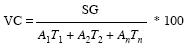
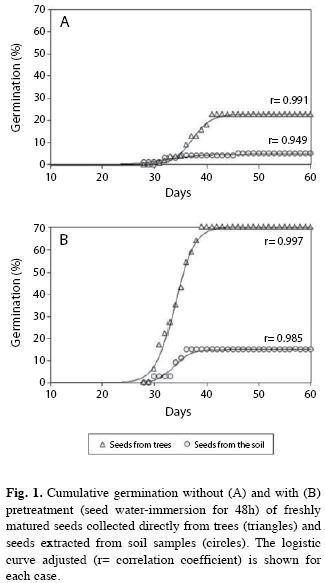
<body><![CDATA[latter was computed by the formula proposed by Hartmann &amp; Kester     (1966):    <br>     <br>     <br> </span></font>     <div style="text-align: center;"><font size="2"><span  style="font-family: verdana;"><img alt=""  src="/img/revistas/rbt/v59n3/a08ia.jpg"  style="width: 189px; height: 51px;"></span></font><br  style="font-family: verdana;"> </div> <br style="font-family: verdana;"> <font size="2"><span style="font-family: verdana;">where VC is the coefficient of germination rate; SG is the number of seeds germinated; A is the number of germinating seeds between two consecutive times; and T is the time elapsed between the beginning of the germination and the interval determined as the mean.</span></font><br  style="font-family: verdana;"> <br style="font-family: verdana;"> <font size="2"><span style="font-family: verdana;">Two-way ANOVAs were conducted with the statistical package SPSS v. 17 (2008). Prior to analysis, the value of germination (in percentage) was square-root arcsine transformed in order to improve the fit of data to the normal distribution. Significance of interactions was explored by contrasting confidence intervals. </span></font><br  style="font-family: verdana;"> <br style="font-family: verdana;"> <font size="2"><span style="font-family: verdana;">Data of cumulative seed germination were fitted to logistic-model curves with the program Curve Expert 1.3.</span></font><br  style="font-family: verdana;"> <br style="font-family: verdana;"> <font style="font-weight: bold;" size="3"><span  style="font-family: verdana;">Results</span></font><br  style="font-family: verdana;"> <br style="font-family: verdana;"> <font size="2"><span style="font-family: verdana;"><span  style="font-weight: bold;">Germination response of <span style="font-style: italic;">P. angustifolius </span>seeds: </span>Germination began about 4 weeks after incubation, both in seeds extracted from soil samples and those collected from trees, regardless of the pretreatment (<a  href="#fig1">Fig. 1</a>). Final cumulative germination was significantly affected by the two factors analyzed and their interaction (<a  href="/img/revistas/rbt/v59n3/a08t1.gif">Table 1</a>). Indeed, germination was higher in seeds collected from trees than in those from soil. Differences increased with the water-immersion seed pretreatment (<a  href="#fig1">Fig. 1</a>). So, the lowest germination percentage was recorded in seeds extracted from the soil samples that were not pretreated (5%;<a  href="#fig1"> Fig. 1A</a>), whereas the highest value was achieved by pretreated freshly matured seeds collected from trees (70%; <a href="#fig1">Fig. 1B</a>). In addition, seeds coming from the soil, which were not exposed to water-immersion, suffered the attack of fungus <span style="font-style: italic;">Rhizopus stolonifer</span> Ehrenb. (Ex Fr.) Lind, at the beginning of day 12 of incubation.    <br>     <br>     <br> </span></font>     <div style="text-align: center;"><font size="2"><span     ]]></body>
<body><![CDATA[ style="font-family: verdana;"><a name="fig1"></a><img alt=""      src="/img/revistas/rbt/v59n3/a08i1.jpg"      style="width: 325px; height: 583px;"></span></font><br      style="font-family: verdana;">     <font size="2"><span style="font-family: verdana;"></span></font></div>     <br style="font-family: verdana;">     <font size="2"><span style="font-family: verdana;">Germination rate was     significantly     affected by the pretreatment. Seed     water-immersion accelerated germination. In contrast, seed source (soil     ]]></body>
<body><![CDATA[<span style="font-style: italic;">versus</span> tree) was irrelevant     for germination rate, as no significant     interaction was detected (<a href="/img/revistas/rbt/v59n3/a08t1.gif">Table     1</a>). Maximum cumulative germination     (i.e., asymptote of the logisticmodel curve) without (<a href="#fig1">Fig.     1A</a>) and with     (<a href="#fig1">Fig. 1B</a>) the germination pretreatment was achieved     after 40 and 36-38     days, respectively.</span></font><br style="font-family: verdana;">     <br style="font-family: verdana;">     ]]></body>
<body><![CDATA[<font size="2"><span style="font-family: verdana;"><span      style="font-weight: bold;">Soil seed bank: </span>The     mean number of     <span style="font-style: italic;">P. angustifolius</span> seeds with     healthy     appearance that were extracted from soil samples was 25.50 (SE=1.67),     corresponding to a density (number of seeds per surface unit at a given     depth) of c.a. 283 seeds/m<sup>2</sup>. If such a value is corrected by     the     maximum percentage of germination recorded in the incubation of seeds     ]]></body>
<body><![CDATA[extracted from the soil (15% final cumulative germination in seeds     pretreated; <a href="#fig1">Fig. 1B</a>), then we can estimate a     viable seed reserve of     c.a. 42 seeds/m<sup>2</sup> in the upper 10cm of soil.</span></font><br      style="font-family: verdana;">     <br style="font-family: verdana;">     <font style="font-weight: bold;" size="3"><span      style="font-family: verdana;">Discussion</span></font><br      style="font-family: verdana;">     <br style="font-family: verdana;">     ]]></body>
<body><![CDATA[<font size="2"><span style="font-family: verdana;">Several findings in     the present     study strongly suggest that <span style="font-style: italic;">P.     angustifolius</span> seeds have non-deep, simple morphophysiological     dormancy,     according to the classification proposed by Baskin &amp; Baskin (1998).     Germination was delayed four weeks in all cases, regardless of seed     source (soil seed bank versus direct seed collection from trees) and     the pretreatment (water immersion versus non-immersion). Fors (1965)     previously detected the same length of delay in seed germination of     ]]></body>
<body><![CDATA[this species. Such a delay would be the result of the presence of a     lineal underdeveloped embryo in <span style="font-style: italic;">P.     angustifolius</span> seeds (Osorio &amp;     Bonilla pers. observ.), a seed trait broadly found among members of the     Podocarpaceae family (Baskin &amp; Baskin 1998). This rudimentary     embryo may need a period of 4 weeks to complete growth and reach the     degree of maturation enabling it to germinate (Nikolaeva 1969, Baskin     &amp; Baskin 1998). Moreover, the fact that seeds need nine additional     days to achieve a high value of germination after it is started may     suggest the existence of an additional physiological dormancy mechanism     ]]></body>
<body><![CDATA[in<span style="font-style: italic;"> P. angustifolius</span> (Baskin     &amp; Baskin 1998). Our findings are in     accordance &nbsp;</span></font><br style="font-family: verdana;">     <font size="2"><span style="font-family: verdana;">with those made by     Ng (1978) and Ng     &amp; Asri (1979), who described     the existence of morphological and morphophysiological dormancy in     seeds of other <span style="font-style: italic;">Podocarpus </span>species     inhabiting tropical forests in     Malaysia.</span></font><br style="font-family: verdana;">     ]]></body>
<body><![CDATA[<br style="font-family: verdana;">     <font size="2"><span style="font-family: verdana;">A noteworthy result     of the study     was the fact that seeds extracted from     the soil immediately before the next seed dispersal event showed     dormancy. Such a finding raises the following question: why did embryos     of seeds at least one year old not complete their growth yet? The     answer should be examined in the potential factor triggering the     embryonic development and thus responsible for overcoming morphological     dormancy. The only marked environmental difference to what seeds were     ]]></body>
<body><![CDATA[exposed in the laboratory with regard to the natural habitat concerned     light conditions. Actually, whereas temperature and substratum humidity     did not markedly change between the soil in the natural habitat and the     germination tests in the laboratory, light conditions were completely     different. In the natural habitat, <span style="font-style: italic;">P.     angustifolius</span> seeds should be in     an intensely shaded environment due to the dense canopy cover, whereas     in the laboratory, seeds were directly exposed to day light during     germination tests. In the literature, there are antecedents of direct     exposure to light as a promoting factor of embryo growth and the     ]]></body>
<body><![CDATA[subsequent break of morphophysiological dormancy (Jacobsen &amp;     Pressman 1979, Baskin &amp; Baskin 1990). If this explanation is     correct, this may be an efficient adaptive mechanism to detect small     gaps in the canopy where seeds can germinate offering real     possibilities of survival to young seedlings. Such an interpretation is     compatible with field records confirming the low recruitment of <span      style="font-style: italic;">P.     angustifolius</span> under plant cover when it is highly dense (Bonilla     pers.     observ.).</span></font><br style="font-family: verdana;">     ]]></body>
<body><![CDATA[<br style="font-family: verdana;">     <font size="2"><span style="font-family: verdana;">Other notable     results in the study     were the highly significant     promotion of final cumulative germination and the increase of     germination rate when seeds were submitted to a water-immersion     pretreatment for 48h, particularly in the case of seeds collected from     trees. Fors (1965) found a similar germination response. In some     recalcitrant seeds, it has been demonstrated that the embryo requires a     high level of hydration to germinate, a level superior to that in     ]]></body>
<body><![CDATA[embryo tissues at the moment of seed dispersal (Tompsett 1985). In that     case, abundant rainfall in the habitat is necessary to increase the     germination response (Baskin &amp; Baskin 1998). Similar germination     patterns have been registered in other recalcitrant-seeded species     (Matias <span style="font-style: italic;">et al.</span> 1973). It     could be possible that the water-immersion of     seeds prior to germination tests, conducted to quickly surpass the     critical level of hydration, accelerated germination once dormancy was     lost.</span></font><br style="font-family: verdana;">     <br style="font-family: verdana;">     ]]></body>
<body><![CDATA[<font size="2"><span style="font-family: verdana;">In spite of the     water-immersion     pretreatment, seeds extracted from soil     samples showed a much lower final cumulative germination than that     achieved by freshly matured seeds collected from trees (15% versus     70%). Such a difference could be explained by the loss of viability of     the former since they had been in the soil for at least one year. The     factors involved in this decay of seed viability would be the attack of     pathogens (indeed, a proliferation of fungus was detected during     germination tests on seeds extracted from the soil and not washed by     ]]></body>
<body><![CDATA[water immersion) and/or the death of the embryo by aging. However, it     was surprising that P. angustifolius, even although     recalcitrant-seeded, had a non-negligible amount of viable seeds in the     soil (c.a. 42/m<sup>2</sup>) in early April, just before the next seed     yield. This     finding implies that <span style="font-style: italic;">P. angustifolius</span>     is able to form persistent seed     banks, at least over the short-term (i.e. a fraction of seeds remain     viable in the soil between two consecutive seed dispersal episodes;     <span style="font-style: italic;">sensu </span>Thompson &amp; Grime     ]]></body>
<body><![CDATA[1979 and Thompson et al. 1997). Studies     detecting persistent seed banks in recalcitrant-seeded species are     scarce in the literature (Ng 1988, Baskin &amp; Baskin 1998).     Certainly, two general traits characterize recalcitrant seeds: fast     germination and short periods of viability (Ng 1978, Whitmore 1989,     Choinski 1990). Accordingly, it is generally assumed that recalcitrant     seeds do not live for long periods in the soil, although research under     natural conditions on this point is scarce (Baskin &amp; Baskin 1998).     The notable observation that <span style="font-style: italic;">P.     angustifolius</span> has the ability to form     ]]></body>
<body><![CDATA[persistent seed banks may be explained if their seeds are really     semi-recalcitrant or minimally recalcitrant, as demonstrated for seeds     of <span style="font-style: italic;">Podocarpus henkelii</span> Stapf     ex Dallim. &amp; A.B.Jacks. (Farrant <span style="font-style: italic;">et     al</span>. 1983); semi-recalcitrant conifer seeds which tolerate a     certain     degree of desiccation. Such a seed trait, along with the abundance of     rainfall in the natural habitat and the preservation of soil humidity     because of the dense canopy cover and the well-developed litter layer     (Bonilla pers. observ.), may allow some seeds to be hydrated over the     ]]></body>
<body><![CDATA[critical level of viability for the whole year.</span></font><br      style="font-family: verdana;">     <br style="font-family: verdana;">     <font size="2"><span style="font-family: verdana;">Consequences of the     formation of     persistent soil seed banks on the     plant population dynamics are important, particularly in the case of     threatened species, such as <span style="font-style: italic;">P.     angustifolius</span>. A persistent seed bank     can be crucial in ensuring the conservation of a species, since it     ]]></body>
<body><![CDATA[allows the re-establishment and maintenance of plant populations after     disturbances, although no external source of propagules occurs (Baskin     &amp; Baskin 1978). In fact, Thompson <span style="font-style: italic;">et     al. </span>(1997) suggested that     short-term persistent soil seed banks play an essential role in the     viability of populations, as Mart&iacute;nez-Duro <span      style="font-style: italic;">et al.</span> (2010)     empirically demonstrated for a critically endangered perennial plant     species.</span></font><br style="font-family: verdana;">     <br style="font-family: verdana;">     ]]></body>
<body><![CDATA[<font size="2"><span style="font-family: verdana;">In conclusion, <span      style="font-style: italic;">P.     angustifolius</span>     seems to have seeds with     morphophysiological dormancy, which may be overcome when they are     directly exposed to light. This may be interpreted as an adaptive     strategy to detect small gaps in the canopy where seedlings would have     a higher chance of survival and establishment. The promotion of     germination by water immersion of seeds induces us to consider a     stimulating effect by embryo hydration. In spite of having recalcitrant     ]]></body>
<body><![CDATA[seeds,<span style="font-style: italic;"> P. angustifolius</span> is     able to form persistent seed banks in the     soil, probably short-termed but essential for population viability of     this endangered plant species.</span></font><br      style="font-family: verdana;">     <br style="font-family: verdana;">     <font style="font-weight: bold;" size="3"><span      style="font-family: verdana;">Acknowledgments</span></font><br      style="font-family: verdana;">     <br style="font-family: verdana;">     ]]></body>
<body><![CDATA[<font size="2"><span style="font-family: verdana;">The authors     sincerely thank     Jos&eacute; M. Herranz and Alejandro     Santiago for their helpful comments on a draft version of the     manuscript, and three anonymous reviewers whose corrections/     suggestions substantially contributed to enhance the quality of the     manuscript. This study has been done in the context of the research     projects PEII10-0170-1830 (Consejer&iacute;a de Educaci&oacute;n y     Ciencia de la Junta de Comunidades de Castilla-La Mancha) and     Montes-CSD2008-00040 (Consolider-Ingenio 2010). Kathryn Walsh checked     ]]></body>
<body><![CDATA[the English.</span></font><br style="font-family: verdana;">     <font style="font-weight: bold;" size="3"><span      style="font-family: verdana;"></span></font>     <hr style="width: 100%; height: 2px;"><font style="font-weight: bold;"      size="3"><span style="font-family: verdana;">References</span></font><br      style="font-family: verdana;">     <br style="font-family: verdana;">     <font size="2"><span style="font-family: verdana;">Baskin, C.C. &amp;     J.M. Baskin.     1998. Seeds. Ecology, biogeography, and     ]]></body>
<body><![CDATA[evolution of dormancy and germination. Academic, San Diego, California,     <!-- ref -->USA.    &nbsp;&nbsp;&nbsp;&nbsp;&nbsp;&nbsp;&nbsp;&nbsp;[&#160;<a href="javascript:void(0);" onclick="javascript: window.open('/scielo.php?script=sci_nlinks&ref=1726175&pid=S0034-7744201100030000800001&lng=','','width=640,height=500,resizable=yes,scrollbars=1,menubar=yes,');">Links</a>&#160;]<!-- end-ref --><!-- ref --></span></font><br style="font-family: verdana;"> <br style="font-family: verdana;"> <font size="2"><span style="font-family: verdana;">Baskin, J.M. &amp; C.C. Baskin. 1978. The seed bank in a population of an endemic plant and its ecological significance. Biol. Conserv. 14: 125-130.    &nbsp;&nbsp;&nbsp;&nbsp;&nbsp;&nbsp;&nbsp;&nbsp;[&#160;<a href="javascript:void(0);" onclick="javascript: window.open('/scielo.php?script=sci_nlinks&ref=1726176&pid=S0034-7744201100030000800002&lng=','','width=640,height=500,resizable=yes,scrollbars=1,menubar=yes,');">Links</a>&#160;]<!-- end-ref --><!-- ref --> </span></font><br style="font-family: verdana;"> <br style="font-family: verdana;"> <font size="2"><span style="font-family: verdana;">Baskin, J.M. &amp; C.C. Baskin. 1990. Seed germination ecology of poison hemlock, <span style="font-style: italic;">Conium maculatum</span>. Can. J. Bot. 68: 2018-2024.    &nbsp;&nbsp;&nbsp;&nbsp;&nbsp;&nbsp;&nbsp;&nbsp;[&#160;<a href="javascript:void(0);" onclick="javascript: window.open('/scielo.php?script=sci_nlinks&ref=1726177&pid=S0034-7744201100030000800003&lng=','','width=640,height=500,resizable=yes,scrollbars=1,menubar=yes,');">Links</a>&#160;]<!-- end-ref --><!-- ref --></span></font><br  style="font-family: verdana;"> <br style="font-family: verdana;"> <font size="2"><span style="font-family: verdana;">Borhidi, A. 1996. Phytogeography and vegetation ecology of Cuba. Akademiai Kiado, Budapest, Hungry.    &nbsp;&nbsp;&nbsp;&nbsp;&nbsp;&nbsp;&nbsp;&nbsp;[&#160;<a href="javascript:void(0);" onclick="javascript: window.open('/scielo.php?script=sci_nlinks&ref=1726178&pid=S0034-7744201100030000800004&lng=','','width=640,height=500,resizable=yes,scrollbars=1,menubar=yes,');">Links</a>&#160;]<!-- end-ref --><!-- ref --></span></font><br  style="font-family: verdana;"> <br style="font-family: verdana;"> <font size="2"><span style="font-family: verdana;">Brown, A.H. &amp; L. Oosterhuis. 1981. The role of buried seed in coppicewoods. Biol. Conserv. 21: 19-38.    &nbsp;&nbsp;&nbsp;&nbsp;&nbsp;&nbsp;&nbsp;&nbsp;[&#160;<a href="javascript:void(0);" onclick="javascript: window.open('/scielo.php?script=sci_nlinks&ref=1726179&pid=S0034-7744201100030000800005&lng=','','width=640,height=500,resizable=yes,scrollbars=1,menubar=yes,');">Links</a>&#160;]<!-- end-ref --><!-- ref --></span></font><br  style="font-family: verdana;"> <br style="font-family: verdana;"> <font size="2"><span style="font-family: verdana;">Chin, H.F., B. Krishnapillay &amp; P.C. Stanwood. 1989. Seed moisture: recalcitrant vs. orthodox seeds. Crop Science Society of America, Special Publication 14: 15-22.    &nbsp;&nbsp;&nbsp;&nbsp;&nbsp;&nbsp;&nbsp;&nbsp;[&#160;<a href="javascript:void(0);" onclick="javascript: window.open('/scielo.php?script=sci_nlinks&ref=1726180&pid=S0034-7744201100030000800006&lng=','','width=640,height=500,resizable=yes,scrollbars=1,menubar=yes,');">Links</a>&#160;]<!-- end-ref --><!-- ref --></span></font><br  style="font-family: verdana;"> <br style="font-family: verdana;"> <font size="2"><span style="font-family: verdana;">Choinski, J.S. 1990. Aspects of viability and post-germinative growth in seeds of the tropical tree, <span style="font-style: italic;">Trichilia dregeana </span>Sonder. An. Bot. 66: 437-442.    &nbsp;&nbsp;&nbsp;&nbsp;&nbsp;&nbsp;&nbsp;&nbsp;[&#160;<a href="javascript:void(0);" onclick="javascript: window.open('/scielo.php?script=sci_nlinks&ref=1726181&pid=S0034-7744201100030000800007&lng=','','width=640,height=500,resizable=yes,scrollbars=1,menubar=yes,');">Links</a>&#160;]<!-- end-ref --><!-- ref --></span></font><br style="font-family: verdana;"> <br style="font-family: verdana;"> <font size="2"><span style="font-family: verdana;">Copete, M.A., J.M. Herranz &amp; P. Ferrandis. 2005. Seed dormancy and germination in threatened Iberian Coincya (Brassicaceae) taxa. &Eacute;coscience 12: 257-266.    &nbsp;&nbsp;&nbsp;&nbsp;&nbsp;&nbsp;&nbsp;&nbsp;[&#160;<a href="javascript:void(0);" onclick="javascript: window.open('/scielo.php?script=sci_nlinks&ref=1726182&pid=S0034-7744201100030000800008&lng=','','width=640,height=500,resizable=yes,scrollbars=1,menubar=yes,');">Links</a>&#160;]<!-- end-ref --><!-- ref --></span></font><br  style="font-family: verdana;"> <br style="font-family: verdana;"> <font size="2"><span style="font-family: verdana;">Farrant, J.M. &amp; P. Berjak. 1983. Recalcitrance in <span style="font-style: italic;">Podocarpus henkelii</span>. Proceedings of the Electron Microscopy Society of Southern Africa 13: 75-76.    &nbsp;&nbsp;&nbsp;&nbsp;&nbsp;&nbsp;&nbsp;&nbsp;[&#160;<a href="javascript:void(0);" onclick="javascript: window.open('/scielo.php?script=sci_nlinks&ref=1726183&pid=S0034-7744201100030000800009&lng=','','width=640,height=500,resizable=yes,scrollbars=1,menubar=yes,');">Links</a>&#160;]<!-- end-ref --><!-- ref --></span></font><br style="font-family: verdana;"> <br style="font-family: verdana;"> <font size="2"><span style="font-family: verdana;">Fors, A. 1965. Maderas Cubanas. INRA, La Habana, Cuba.    &nbsp;&nbsp;&nbsp;&nbsp;&nbsp;&nbsp;&nbsp;&nbsp;[&#160;<a href="javascript:void(0);" onclick="javascript: window.open('/scielo.php?script=sci_nlinks&ref=1726184&pid=S0034-7744201100030000800010&lng=','','width=640,height=500,resizable=yes,scrollbars=1,menubar=yes,');">Links</a>&#160;]<!-- end-ref --><!-- ref --> </span></font><br style="font-family: verdana;"> <br style="font-family: verdana;"> <font size="2"><span style="font-family: verdana;">Fountain, D.W., J.M. Holdsworth &amp; H.A. Outred. 1989. The dispersal unit of <span style="font-style: italic;">Dacrycarpus dacrydioides</span> (A. Rich.) de Laubenfels (Podopcarpaceae) and the significance of the fleshy receptacle. Bot. J. Lin. Soc. 99:197-207.    &nbsp;&nbsp;&nbsp;&nbsp;&nbsp;&nbsp;&nbsp;&nbsp;[&#160;<a href="javascript:void(0);" onclick="javascript: window.open('/scielo.php?script=sci_nlinks&ref=1726185&pid=S0034-7744201100030000800011&lng=','','width=640,height=500,resizable=yes,scrollbars=1,menubar=yes,');">Links</a>&#160;]<!-- end-ref --><!-- ref --></span></font><br style="font-family: verdana;"> <br style="font-family: verdana;"> <font size="2"><span style="font-family: verdana;">Hartmann, H.T. &amp; D. Kester. 1966. Propagaci&oacute;n de plantas. Principios y pr&aacute;cticas. Edici&oacute;n Revolucionaria, La Habana, Cuba.    &nbsp;&nbsp;&nbsp;&nbsp;&nbsp;&nbsp;&nbsp;&nbsp;[&#160;<a href="javascript:void(0);" onclick="javascript: window.open('/scielo.php?script=sci_nlinks&ref=1726186&pid=S0034-7744201100030000800012&lng=','','width=640,height=500,resizable=yes,scrollbars=1,menubar=yes,');">Links</a>&#160;]<!-- end-ref --><!-- ref --></span></font><br style="font-family: verdana;"> <br style="font-family: verdana;"> <font size="2"><span style="font-family: verdana;">Ikeda, H. &amp; K. Itoh. 2001. Germination and water dispersal of seeds from a threatened plant species <span style="font-style: italic;">Penthorum chinense</span>. Ecol. Res. 16: 99-106.    &nbsp;&nbsp;&nbsp;&nbsp;&nbsp;&nbsp;&nbsp;&nbsp;[&#160;<a href="javascript:void(0);" onclick="javascript: window.open('/scielo.php?script=sci_nlinks&ref=1726187&pid=S0034-7744201100030000800013&lng=','','width=640,height=500,resizable=yes,scrollbars=1,menubar=yes,');">Links</a>&#160;]<!-- end-ref --><!-- ref --></span></font><br style="font-family: verdana;"> <br style="font-family: verdana;"> <font size="2"><span style="font-family: verdana;">IUCN. 2009. Red list of threatened species. 2009.2 version. (www.iucnredlist.org).    &nbsp;&nbsp;&nbsp;&nbsp;&nbsp;&nbsp;&nbsp;&nbsp;[&#160;<a href="javascript:void(0);" onclick="javascript: window.open('/scielo.php?script=sci_nlinks&ref=1726188&pid=S0034-7744201100030000800014&lng=','','width=640,height=500,resizable=yes,scrollbars=1,menubar=yes,');">Links</a>&#160;]<!-- end-ref --><!-- ref --></span></font><br style="font-family: verdana;"> <br style="font-family: verdana;"> <font size="2"><span style="font-family: verdana;">Jacobsen, J.V. &amp; E. Pressman. 1979. A structural study of germination in celery (<span style="font-style: italic;">Apium graveolens</span> L.) seed with emphasis on endosperm breakdown. Planta 144: 241-248.    &nbsp;&nbsp;&nbsp;&nbsp;&nbsp;&nbsp;&nbsp;&nbsp;[&#160;<a href="javascript:void(0);" onclick="javascript: window.open('/scielo.php?script=sci_nlinks&ref=1726189&pid=S0034-7744201100030000800015&lng=','','width=640,height=500,resizable=yes,scrollbars=1,menubar=yes,');">Links</a>&#160;]<!-- end-ref --><!-- ref --></span></font><br  style="font-family: verdana;"> <br style="font-family: verdana;"> <font size="2"><span style="font-family: verdana;">Liogier, H.A. 1962. Flora de Cuba. Vol. I. Asoc. de Est. de Ciencias Biol&oacute;gicas, Cuba.    &nbsp;&nbsp;&nbsp;&nbsp;&nbsp;&nbsp;&nbsp;&nbsp;[&#160;<a href="javascript:void(0);" onclick="javascript: window.open('/scielo.php?script=sci_nlinks&ref=1726190&pid=S0034-7744201100030000800016&lng=','','width=640,height=500,resizable=yes,scrollbars=1,menubar=yes,');">Links</a>&#160;]<!-- end-ref --><!-- ref --></span></font><br style="font-family: verdana;"> <br style="font-family: verdana;"> <font size="2"><span style="font-family: verdana;">Major, J. &amp; W. Pyott. 1966. Buried, viable seeds in two California bunchgrass sites and their bearing on the definition of a flora. Vegetatio 13: 253-282.    &nbsp;&nbsp;&nbsp;&nbsp;&nbsp;&nbsp;&nbsp;&nbsp;[&#160;<a href="javascript:void(0);" onclick="javascript: window.open('/scielo.php?script=sci_nlinks&ref=1726191&pid=S0034-7744201100030000800017&lng=','','width=640,height=500,resizable=yes,scrollbars=1,menubar=yes,');">Links</a>&#160;]<!-- end-ref --><!-- ref --></span></font><br style="font-family: verdana;"> <br style="font-family: verdana;"> <font size="2"><span style="font-family: verdana;">Mart&iacute;nez-Duro, E., P. Ferrandis, J.M. Herranz &amp; M.A. Copete. 2010. Do seed harvesting ants threaten the viability of a critically endangered non- myrmechorous perennial plant population? A complex interaction. Popul. Ecol. 52: 397-405.    &nbsp;&nbsp;&nbsp;&nbsp;&nbsp;&nbsp;&nbsp;&nbsp;[&#160;<a href="javascript:void(0);" onclick="javascript: window.open('/scielo.php?script=sci_nlinks&ref=1726192&pid=S0034-7744201100030000800018&lng=','','width=640,height=500,resizable=yes,scrollbars=1,menubar=yes,');">Links</a>&#160;]<!-- end-ref --><!-- ref --></span></font><br  style="font-family: verdana;"> <br style="font-family: verdana;"> <font size="2"><span style="font-family: verdana;">Matias, A.R., A. Betancourt, A. Zayas, A. Pena &amp; R. Rivero. 1973. Forest seed in Cuba.<span style="font-style: italic;"> In</span> Seed Processing Proc. Symposium IUFRO Working Group on Seed Problems, Bergen. vol. II, Paper 31.    &nbsp;&nbsp;&nbsp;&nbsp;&nbsp;&nbsp;&nbsp;&nbsp;[&#160;<a href="javascript:void(0);" onclick="javascript: window.open('/scielo.php?script=sci_nlinks&ref=1726193&pid=S0034-7744201100030000800019&lng=','','width=640,height=500,resizable=yes,scrollbars=1,menubar=yes,');">Links</a>&#160;]<!-- end-ref --><!-- ref --></span></font><br  style="font-family: verdana;"> <br style="font-family: verdana;"> <font size="2"><span style="font-family: verdana;">Milberg, P. 1994. Germination ecology of the endangered grassland biennial <span style="font-style: italic;">Gentianella campestris</span>. Biol. Conserv. 70: 287-290.    &nbsp;&nbsp;&nbsp;&nbsp;&nbsp;&nbsp;&nbsp;&nbsp;[&#160;<a href="javascript:void(0);" onclick="javascript: window.open('/scielo.php?script=sci_nlinks&ref=1726194&pid=S0034-7744201100030000800020&lng=','','width=640,height=500,resizable=yes,scrollbars=1,menubar=yes,');">Links</a>&#160;]<!-- end-ref --><!-- ref --></span></font><br  style="font-family: verdana;"> <br style="font-family: verdana;"> <font size="2"><span style="font-family: verdana;">Navarro, L. &amp; J. Guitian. 2003. Seed germination and seedling survival of two threatened endemic species of the northwest Iberian Peninsula. Biol. Conserv. 109: 313-320.    &nbsp;&nbsp;&nbsp;&nbsp;&nbsp;&nbsp;&nbsp;&nbsp;[&#160;<a href="javascript:void(0);" onclick="javascript: window.open('/scielo.php?script=sci_nlinks&ref=1726195&pid=S0034-7744201100030000800021&lng=','','width=640,height=500,resizable=yes,scrollbars=1,menubar=yes,');">Links</a>&#160;]<!-- end-ref --><!-- ref --></span></font><br  style="font-family: verdana;"> <br style="font-family: verdana;"> <font size="2"><span style="font-family: verdana;">Ng, F.S.P. &amp; N.S. Asri. 1979. Germination of fresh seeds of Malaysian trees IV. Malays. For. 42: 221-224.    &nbsp;&nbsp;&nbsp;&nbsp;&nbsp;&nbsp;&nbsp;&nbsp;[&#160;<a href="javascript:void(0);" onclick="javascript: window.open('/scielo.php?script=sci_nlinks&ref=1726196&pid=S0034-7744201100030000800022&lng=','','width=640,height=500,resizable=yes,scrollbars=1,menubar=yes,');">Links</a>&#160;]<!-- end-ref --><!-- ref --> </span></font><br  style="font-family: verdana;"> <br style="font-family: verdana;"> <font size="2"><span style="font-family: verdana;">Ng, F.S.P. 1978. Strategies of establishment in Malaysian forest trees, p. 129-162. In P.B. Tomlinson &amp; M.H. Zimmermman (eds.). Tropical trees as living systems. Cambridge University, Cambridge, United Kingdom.    &nbsp;&nbsp;&nbsp;&nbsp;&nbsp;&nbsp;&nbsp;&nbsp;[&#160;<a href="javascript:void(0);" onclick="javascript: window.open('/scielo.php?script=sci_nlinks&ref=1726197&pid=S0034-7744201100030000800023&lng=','','width=640,height=500,resizable=yes,scrollbars=1,menubar=yes,');">Links</a>&#160;]<!-- end-ref --><!-- ref --> </span></font><br style="font-family: verdana;"> <br style="font-family: verdana;"> <font size="2"><span style="font-family: verdana;">Ng, F.S.P. 1988. Forest tree biology, p. 102-125. <span style="font-style: italic;">In </span>Earl of Cranbrook (ed.). Key environments: Malaysia. Pergamon, Oxford, United Kingdom.    &nbsp;&nbsp;&nbsp;&nbsp;&nbsp;&nbsp;&nbsp;&nbsp;[&#160;<a href="javascript:void(0);" onclick="javascript: window.open('/scielo.php?script=sci_nlinks&ref=1726198&pid=S0034-7744201100030000800024&lng=','','width=640,height=500,resizable=yes,scrollbars=1,menubar=yes,');">Links</a>&#160;]<!-- end-ref --><!-- ref --></span></font><br  style="font-family: verdana;"> <br style="font-family: verdana;"> <font size="2"><span style="font-family: verdana;">Nikolaeva, M.G. 1969. Physiology of deep dormancy in seeds. Izdatel&#8217;stvo &#8220;Nauka&#8221;, Leningrado, Rusia.    &nbsp;&nbsp;&nbsp;&nbsp;&nbsp;&nbsp;&nbsp;&nbsp;[&#160;<a href="javascript:void(0);" onclick="javascript: window.open('/scielo.php?script=sci_nlinks&ref=1726199&pid=S0034-7744201100030000800025&lng=','','width=640,height=500,resizable=yes,scrollbars=1,menubar=yes,');">Links</a>&#160;]<!-- end-ref --><!-- ref --></span></font><br  style="font-family: verdana;"> <br style="font-family: verdana;"> <font size="2"><span style="font-family: verdana;">Nikolaeva, M.G. 1977. Factors controlling the seed dormancy pattern, p. 51-74. <span style="font-style: italic;">In</span> A.A. Khan (ed.). The physiology and biochemestry of seed dormancy and germination. North-Holland, Amsterdam, Holanda.    &nbsp;&nbsp;&nbsp;&nbsp;&nbsp;&nbsp;&nbsp;&nbsp;[&#160;<a href="javascript:void(0);" onclick="javascript: window.open('/scielo.php?script=sci_nlinks&ref=1726200&pid=S0034-7744201100030000800026&lng=','','width=640,height=500,resizable=yes,scrollbars=1,menubar=yes,');">Links</a>&#160;]<!-- end-ref --><!-- ref --></span></font><br  style="font-family: verdana;"> <br style="font-family: verdana;"> <font size="2"><span style="font-family: verdana;">Schaefer, C. 1990. Storage and germination of seeds of <span style="font-style: italic;">Podocarpus milanjianus</span>, N&ordm; 11. Technical Note, Kenya Forestry Research Institute, Kenia.    &nbsp;&nbsp;&nbsp;&nbsp;&nbsp;&nbsp;&nbsp;&nbsp;[&#160;<a href="javascript:void(0);" onclick="javascript: window.open('/scielo.php?script=sci_nlinks&ref=1726201&pid=S0034-7744201100030000800027&lng=','','width=640,height=500,resizable=yes,scrollbars=1,menubar=yes,');">Links</a>&#160;]<!-- end-ref --><!-- ref --></span></font><br style="font-family: verdana;"> <br style="font-family: verdana;"> <font size="2"><span style="font-family: verdana;">Schafer, D.E. &amp; D.O. Chilcote. 1969. Factors influencing persistence and depletion in buried seed populations. I. A model for analysis of parameters of buried seed persistence and depletion. Crop Sci. 9: 417-419.    &nbsp;&nbsp;&nbsp;&nbsp;&nbsp;&nbsp;&nbsp;&nbsp;[&#160;<a href="javascript:void(0);" onclick="javascript: window.open('/scielo.php?script=sci_nlinks&ref=1726202&pid=S0034-7744201100030000800028&lng=','','width=640,height=500,resizable=yes,scrollbars=1,menubar=yes,');">Links</a>&#160;]<!-- end-ref --><!-- ref --></span></font><br style="font-family: verdana;"> <br style="font-family: verdana;"> <font size="2"><span style="font-family: verdana;">Schemske, D.W., B.C. Husband, M.H. Ruckelshaus, C. Goodwillie, I.M. Parker &amp; J.G. Bishop. 1994. Evaluating approaches to the conservation of rare and endangered plants. Ecol. 75: 584-606.    &nbsp;&nbsp;&nbsp;&nbsp;&nbsp;&nbsp;&nbsp;&nbsp;[&#160;<a href="javascript:void(0);" onclick="javascript: window.open('/scielo.php?script=sci_nlinks&ref=1726203&pid=S0034-7744201100030000800029&lng=','','width=640,height=500,resizable=yes,scrollbars=1,menubar=yes,');">Links</a>&#160;]<!-- end-ref --><!-- ref --></span></font><br  style="font-family: verdana;"> <br style="font-family: verdana;"> <font size="2"><span style="font-family: verdana;">Simpson, R.L., M.A. Leck &amp; V.T. Parker. 1989. Seed banks: general concepts and methodological issues. <span style="font-style: italic;">In </span>M.A. Leck, V.T. Thomas &amp; R.L. Simpson (eds.). Ecology of soil seed banks. Academic, San Diego, California, USA.    &nbsp;&nbsp;&nbsp;&nbsp;&nbsp;&nbsp;&nbsp;&nbsp;[&#160;<a href="javascript:void(0);" onclick="javascript: window.open('/scielo.php?script=sci_nlinks&ref=1726204&pid=S0034-7744201100030000800030&lng=','','width=640,height=500,resizable=yes,scrollbars=1,menubar=yes,');">Links</a>&#160;]<!-- end-ref --><!-- ref --></span></font><br style="font-family: verdana;"> <br style="font-family: verdana;"> <font size="2"><span style="font-family: verdana;">Solbrig, O.T. 1980. Demography and natural selection, p. 1-20. <span style="font-style: italic;">In</span> O.T. Solbrig (ed.). Demography and evolution in plant populations. Botanical Monographs. Blackwell Scientific, Oxford, United Kingdom.    &nbsp;&nbsp;&nbsp;&nbsp;&nbsp;&nbsp;&nbsp;&nbsp;[&#160;<a href="javascript:void(0);" onclick="javascript: window.open('/scielo.php?script=sci_nlinks&ref=1726205&pid=S0034-7744201100030000800031&lng=','','width=640,height=500,resizable=yes,scrollbars=1,menubar=yes,');">Links</a>&#160;]<!-- end-ref --><!-- ref --></span></font><br  style="font-family: verdana;"> <br style="font-family: verdana;"> <font size="2"><span style="font-family: verdana;">Thompson, K. 1992. The functional ecology of seed banks, p. 231-258. <span style="font-style: italic;">In </span>M. Fenner (ed.). The ecology of regeneration in plant communities. C.A.B. International, Wallingford, United Kingdom.    &nbsp;&nbsp;&nbsp;&nbsp;&nbsp;&nbsp;&nbsp;&nbsp;[&#160;<a href="javascript:void(0);" onclick="javascript: window.open('/scielo.php?script=sci_nlinks&ref=1726206&pid=S0034-7744201100030000800032&lng=','','width=640,height=500,resizable=yes,scrollbars=1,menubar=yes,');">Links</a>&#160;]<!-- end-ref --><!-- ref --></span></font><br  style="font-family: verdana;"> <br style="font-family: verdana;"> <font size="2"><span style="font-family: verdana;">Thompson, K., J. Bakker &amp; R. Bekker. 1997. The soil seed banks of North West Europe: methodology, density and longevity. Cambridge University, Cambridge, United Kingdom.    &nbsp;&nbsp;&nbsp;&nbsp;&nbsp;&nbsp;&nbsp;&nbsp;[&#160;<a href="javascript:void(0);" onclick="javascript: window.open('/scielo.php?script=sci_nlinks&ref=1726207&pid=S0034-7744201100030000800033&lng=','','width=640,height=500,resizable=yes,scrollbars=1,menubar=yes,');">Links</a>&#160;]<!-- end-ref --><!-- ref --></span></font><br  style="font-family: verdana;"> <br style="font-family: verdana;"> <font size="2"><span style="font-family: verdana;">Thompson, K. &amp; J.P. Grime. 1979. Seasonal variation in the soil seed banks of herbaceous species in ten contrasting habitats. J. Ecol. 67: 893-921.    &nbsp;&nbsp;&nbsp;&nbsp;&nbsp;&nbsp;&nbsp;&nbsp;[&#160;<a href="javascript:void(0);" onclick="javascript: window.open('/scielo.php?script=sci_nlinks&ref=1726208&pid=S0034-7744201100030000800034&lng=','','width=640,height=500,resizable=yes,scrollbars=1,menubar=yes,');">Links</a>&#160;]<!-- end-ref --><!-- ref --></span></font><br style="font-family: verdana;"> <br style="font-family: verdana;"> <font size="2"><span style="font-family: verdana;">Tompsett, P.B. 1985. The influence of moisture content and storage temperature on the viability of <span style="font-style: italic;">Shorea almon</span>, <span style="font-style: italic;">Shorea robusta</span>, and <span style="font-style: italic;">Shorea roxburghii </span>seed. Can. J. For. Res. 15: 1074-1079.    &nbsp;&nbsp;&nbsp;&nbsp;&nbsp;&nbsp;&nbsp;&nbsp;[&#160;<a href="javascript:void(0);" onclick="javascript: window.open('/scielo.php?script=sci_nlinks&ref=1726209&pid=S0034-7744201100030000800035&lng=','','width=640,height=500,resizable=yes,scrollbars=1,menubar=yes,');">Links</a>&#160;]<!-- end-ref --><!-- ref --></span></font><br  style="font-family: verdana;"> <br style="font-family: verdana;"> <font size="2"><span style="font-family: verdana;">V&aacute;zquez, C., A. Orozco, M. Rojas, M. S&aacute;nchez &amp; V. Cervantes. 1997. La reproducci&oacute;n de las plantas: semillas y meristemos. Fondo de Cultura Econ&oacute;mica, M&eacute;xico D.F., M&eacute;xico.    &nbsp;&nbsp;&nbsp;&nbsp;&nbsp;&nbsp;&nbsp;&nbsp;[&#160;<a href="javascript:void(0);" onclick="javascript: window.open('/scielo.php?script=sci_nlinks&ref=1726210&pid=S0034-7744201100030000800036&lng=','','width=640,height=500,resizable=yes,scrollbars=1,menubar=yes,');">Links</a>&#160;]<!-- end-ref --><!-- ref --></span></font><br style="font-family: verdana;"> <br style="font-family: verdana;"> <font size="2"><span style="font-family: verdana;">Whitmore, T.C. 1989. Canopy gaps and the two major groups of forest trees. Ecology 70: 536-538.    &nbsp;&nbsp;&nbsp;&nbsp;&nbsp;&nbsp;&nbsp;&nbsp;[&#160;<a href="javascript:void(0);" onclick="javascript: window.open('/scielo.php?script=sci_nlinks&ref=1726211&pid=S0034-7744201100030000800037&lng=','','width=640,height=500,resizable=yes,scrollbars=1,menubar=yes,');">Links</a>&#160;]<!-- end-ref --><br> <a name="correspondencia"></a>    <br> Correspondencia a: </span></font><font size="2"><span  style="font-family: verdana;">Pablo Ferrandis. </span></font><font  size="2"><span style="font-family: verdana;">Grupo de Biolog&iacute;a de la Conservaci&oacute;n de Plantas, Instituto Bot&aacute;nico de la Universidad de Castilla La Mancha, Jard&iacute;n </span></font><font size="2"><span  style="font-family: verdana;">Bot&aacute;nico de Castilla-La Mancha, Campus Universitario s/n, Albacete 02071, Espa&ntilde;a;<a href="mailto:pablo.ferrandis@uclm.es"> pablo.ferrandis@uclm.es</a>    ]]></body>
<body><![CDATA[<br>     <br> </span></font><font size="2"><span style="font-family: verdana;">Marta Bonilla</span></font><font size="2"><span style="font-family: verdana;">. Facultad de Forestal y Agronom&iacute;a, Universidad de Pinar del R&iacute;o, C/ Mart&iacute; 270 Final, Pinar del R&iacute;o, Cuba; </span></font><font  size="2"><span style="font-family: verdana;"><a  href="mailto:mbon@af.upr.edu.cu">mbon@af.upr.edu.cu</a>    <br> </span></font><font size="2"><span style="font-family: verdana;">Licet del Carmen Osorio. </span></font><font size="2"><span  style="font-family: verdana;"></span></font><font size="2"><span  style="font-family: verdana;"></span></font><font size="2"><span  style="font-family: verdana;"></span></font><font size="2"><span  style="font-family: verdana;">Estaci&oacute;n Territorial de Protecci&oacute;n de Plantas, Sancti Spiritus, Cuba</span></font>    <br>     <div style="text-align: center;"><font size="2"><span  style="font-family: verdana;"></span></font> <hr style="width: 100%; height: 2px;"><font size="2"><span  style="font-family: verdana;">Received 18-VIII-2010. Corrected 15-XII-2010. Accepted 20-I-2011.</span></font><br  style="font-family: verdana;"> </div> <br style="font-family: verdana;"> </div>      ]]></body><back>
<ref-list>
<ref id="B1">
<nlm-citation citation-type="book">
<person-group person-group-type="author">
<name>
<surname><![CDATA[Baskin]]></surname>
<given-names><![CDATA[C.C]]></given-names>
</name>
<name>
<surname><![CDATA[Baskin]]></surname>
<given-names><![CDATA[J.M]]></given-names>
</name>
</person-group>
<source><![CDATA[Seeds. Ecology, biogeography, and evolution of dormancy and germination]]></source>
<year>1998</year>
<publisher-loc><![CDATA[San Diego^eCalifornia California]]></publisher-loc>
<publisher-name><![CDATA[Academic]]></publisher-name>
</nlm-citation>
</ref>
<ref id="B2">
<nlm-citation citation-type="journal">
<person-group person-group-type="author">
<name>
<surname><![CDATA[Baskin]]></surname>
<given-names><![CDATA[J.M]]></given-names>
</name>
<name>
<surname><![CDATA[Baskin]]></surname>
<given-names><![CDATA[C.C]]></given-names>
</name>
</person-group>
<article-title xml:lang="en"><![CDATA[The seed bank in a population of an endemic plant and its ecological significance]]></article-title>
<source><![CDATA[Biol. Conserv.]]></source>
<year>1978</year>
<volume>14</volume>
<page-range>125-130</page-range></nlm-citation>
</ref>
<ref id="B3">
<nlm-citation citation-type="journal">
<person-group person-group-type="author">
<name>
<surname><![CDATA[Baskin]]></surname>
<given-names><![CDATA[J.M]]></given-names>
</name>
<name>
<surname><![CDATA[Baskin]]></surname>
<given-names><![CDATA[C.C]]></given-names>
</name>
</person-group>
<article-title xml:lang="en"><![CDATA[Seed germination ecology of poison hemlock, Conium maculatum]]></article-title>
<source><![CDATA[Can. J. Bot.]]></source>
<year>1990</year>
<volume>68</volume>
<page-range>2018-2024</page-range></nlm-citation>
</ref>
<ref id="B4">
<nlm-citation citation-type="book">
<person-group person-group-type="author">
<name>
<surname><![CDATA[Borhidi]]></surname>
<given-names><![CDATA[A]]></given-names>
</name>
</person-group>
<source><![CDATA[Phytogeography and vegetation ecology of Cuba]]></source>
<year>1996</year>
<publisher-loc><![CDATA[Budapest ]]></publisher-loc>
<publisher-name><![CDATA[Akademiai Kiado]]></publisher-name>
</nlm-citation>
</ref>
<ref id="B5">
<nlm-citation citation-type="journal">
<person-group person-group-type="author">
<name>
<surname><![CDATA[Brown]]></surname>
<given-names><![CDATA[A.H]]></given-names>
</name>
<name>
<surname><![CDATA[Oosterhuis]]></surname>
<given-names><![CDATA[L]]></given-names>
</name>
</person-group>
<article-title xml:lang="en"><![CDATA[The role of buried seed in coppicewoods]]></article-title>
<source><![CDATA[Biol. Conserv.]]></source>
<year>1981</year>
<volume>21</volume>
<page-range>19-38</page-range></nlm-citation>
</ref>
<ref id="B6">
<nlm-citation citation-type="journal">
<person-group person-group-type="author">
<name>
<surname><![CDATA[Chin]]></surname>
<given-names><![CDATA[H.F]]></given-names>
</name>
<name>
<surname><![CDATA[Krishnapillay]]></surname>
<given-names><![CDATA[B]]></given-names>
</name>
<name>
<surname><![CDATA[Stanwood]]></surname>
<given-names><![CDATA[P.C]]></given-names>
</name>
</person-group>
<source><![CDATA[Crop Science Society of America]]></source>
<year>1989</year>
<volume>14</volume>
<page-range>15-22</page-range></nlm-citation>
</ref>
<ref id="B7">
<nlm-citation citation-type="journal">
<person-group person-group-type="author">
<name>
<surname><![CDATA[Choinski]]></surname>
<given-names><![CDATA[J.S]]></given-names>
</name>
</person-group>
<article-title xml:lang="en"><![CDATA[Aspects of viability and post-germinative growth in seeds of the tropical tree, Trichilia dregeana Sonder]]></article-title>
<source><![CDATA[An. Bot.]]></source>
<year>1990</year>
<volume>66</volume>
<page-range>437-442</page-range></nlm-citation>
</ref>
<ref id="B8">
<nlm-citation citation-type="journal">
<person-group person-group-type="author">
<name>
<surname><![CDATA[Copete]]></surname>
<given-names><![CDATA[M.A]]></given-names>
</name>
<name>
<surname><![CDATA[Herranz]]></surname>
<given-names><![CDATA[J.M]]></given-names>
</name>
<name>
<surname><![CDATA[Ferrandis]]></surname>
<given-names><![CDATA[P]]></given-names>
</name>
</person-group>
<article-title xml:lang="en"><![CDATA[Seed dormancy and germination in threatened Iberian Coincya (Brassicaceae) taxa]]></article-title>
<source><![CDATA[Écoscience]]></source>
<year>2005</year>
<volume>12</volume>
<page-range>257-266</page-range></nlm-citation>
</ref>
<ref id="B9">
<nlm-citation citation-type="journal">
<person-group person-group-type="author">
<name>
<surname><![CDATA[Farrant]]></surname>
<given-names><![CDATA[J.M]]></given-names>
</name>
<name>
<surname><![CDATA[Berjak]]></surname>
<given-names><![CDATA[P]]></given-names>
</name>
</person-group>
<article-title xml:lang="en"><![CDATA[Recalcitrance in Podocarpus henkelii]]></article-title>
<source><![CDATA[Proceedings of the Electron Microscopy Society of Southern Africa]]></source>
<year>1983</year>
<volume>13</volume>
<page-range>75-76</page-range></nlm-citation>
</ref>
<ref id="B10">
<nlm-citation citation-type="book">
<person-group person-group-type="author">
<name>
<surname><![CDATA[Fors]]></surname>
<given-names><![CDATA[A]]></given-names>
</name>
</person-group>
<source><![CDATA[Maderas Cubanas]]></source>
<year>1965</year>
<publisher-loc><![CDATA[La Habana ]]></publisher-loc>
<publisher-name><![CDATA[INRA]]></publisher-name>
</nlm-citation>
</ref>
<ref id="B11">
<nlm-citation citation-type="journal">
<person-group person-group-type="author">
<name>
<surname><![CDATA[Fountain]]></surname>
<given-names><![CDATA[D.W]]></given-names>
</name>
<name>
<surname><![CDATA[Holdsworth]]></surname>
<given-names><![CDATA[J.M]]></given-names>
</name>
<name>
<surname><![CDATA[Outred]]></surname>
<given-names><![CDATA[H.A]]></given-names>
</name>
</person-group>
<article-title xml:lang="en"><![CDATA[The dispersal unit of Dacrycarpus dacrydioides (A. Rich.) de Laubenfels (Podopcarpaceae) and the significance of the fleshy receptacle]]></article-title>
<source><![CDATA[Bot. J. Lin. Soc]]></source>
<year>1989</year>
<volume>99</volume>
<page-range>197-207</page-range></nlm-citation>
</ref>
<ref id="B12">
<nlm-citation citation-type="book">
<person-group person-group-type="author">
<name>
<surname><![CDATA[Hartmann]]></surname>
<given-names><![CDATA[H.T]]></given-names>
</name>
<name>
<surname><![CDATA[Kester]]></surname>
<given-names><![CDATA[D]]></given-names>
</name>
</person-group>
<source><![CDATA[Propagación de plantas. Principios y prácticas]]></source>
<year>1966</year>
<publisher-loc><![CDATA[La Habana ]]></publisher-loc>
<publisher-name><![CDATA[Edición Revolucionaria]]></publisher-name>
</nlm-citation>
</ref>
<ref id="B13">
<nlm-citation citation-type="journal">
<person-group person-group-type="author">
<name>
<surname><![CDATA[Ikeda]]></surname>
<given-names><![CDATA[H]]></given-names>
</name>
<name>
<surname><![CDATA[Itoh]]></surname>
<given-names><![CDATA[K]]></given-names>
</name>
</person-group>
<article-title xml:lang="en"><![CDATA[Germination and water dispersal of seeds from a threatened plant species Penthorum chinense]]></article-title>
<source><![CDATA[Ecol. Res.]]></source>
<year>2001</year>
<volume>16</volume>
<page-range>99-106</page-range></nlm-citation>
</ref>
<ref id="B14">
<nlm-citation citation-type="">
<collab>IUCN</collab>
<source><![CDATA[Red list of threatened species. 2009.2 version]]></source>
<year>2009</year>
</nlm-citation>
</ref>
<ref id="B15">
<nlm-citation citation-type="journal">
<person-group person-group-type="author">
<name>
<surname><![CDATA[Jacobsen]]></surname>
<given-names><![CDATA[J.V]]></given-names>
</name>
<name>
<surname><![CDATA[Pressman]]></surname>
<given-names><![CDATA[E]]></given-names>
</name>
</person-group>
<article-title xml:lang="en"><![CDATA[A structural study of germination in celery (Apium graveolens L.) seed with emphasis on endosperm breakdown]]></article-title>
<source><![CDATA[Planta]]></source>
<year>1979</year>
<volume>144</volume>
<page-range>241-248</page-range></nlm-citation>
</ref>
<ref id="B16">
<nlm-citation citation-type="book">
<person-group person-group-type="author">
<name>
<surname><![CDATA[Liogier]]></surname>
<given-names><![CDATA[H.A]]></given-names>
</name>
</person-group>
<source><![CDATA[Flora de Cuba]]></source>
<year>1962</year>
<volume>Vol. I</volume>
<publisher-name><![CDATA[Asoc. de Est. de Ciencias Biológicas]]></publisher-name>
</nlm-citation>
</ref>
<ref id="B17">
<nlm-citation citation-type="journal">
<person-group person-group-type="author">
<name>
<surname><![CDATA[Major]]></surname>
<given-names><![CDATA[J]]></given-names>
</name>
<name>
<surname><![CDATA[Pyott]]></surname>
<given-names><![CDATA[W]]></given-names>
</name>
</person-group>
<article-title xml:lang="en"><![CDATA[Buried, viable seeds in two California bunchgrass sites and their bearing on the definition of a flora]]></article-title>
<source><![CDATA[Vegetatio]]></source>
<year>1966</year>
<volume>13</volume>
<page-range>253-282</page-range></nlm-citation>
</ref>
<ref id="B18">
<nlm-citation citation-type="journal">
<person-group person-group-type="author">
<name>
<surname><![CDATA[Martínez-Duro]]></surname>
<given-names><![CDATA[E]]></given-names>
</name>
<name>
<surname><![CDATA[Ferrandis]]></surname>
<given-names><![CDATA[P]]></given-names>
</name>
<name>
<surname><![CDATA[Herranz]]></surname>
<given-names><![CDATA[J.M]]></given-names>
</name>
<name>
<surname><![CDATA[Copete]]></surname>
<given-names><![CDATA[M.A]]></given-names>
</name>
</person-group>
<article-title xml:lang="en"><![CDATA[Do seed harvesting ants threaten the viability of a critically endangered non- myrmechorous perennial plant population? A complex interaction]]></article-title>
<source><![CDATA[Popul. Ecol]]></source>
<year>2010</year>
<volume>52</volume>
<page-range>397-405</page-range></nlm-citation>
</ref>
<ref id="B19">
<nlm-citation citation-type="">
<person-group person-group-type="author">
<name>
<surname><![CDATA[Matias]]></surname>
<given-names><![CDATA[A.R]]></given-names>
</name>
<name>
<surname><![CDATA[Betancourt]]></surname>
<given-names><![CDATA[A]]></given-names>
</name>
<name>
<surname><![CDATA[Zayas]]></surname>
<given-names><![CDATA[A]]></given-names>
</name>
<name>
<surname><![CDATA[Pena]]></surname>
<given-names><![CDATA[A]]></given-names>
</name>
<name>
<surname><![CDATA[Rivero]]></surname>
<given-names><![CDATA[R]]></given-names>
</name>
</person-group>
<source><![CDATA[Seed Processing Proc. Symposium IUFRO Working Group on Seed Problems]]></source>
<year>1973</year>
<volume>II</volume>
<publisher-loc><![CDATA[Bergen ]]></publisher-loc>
</nlm-citation>
</ref>
<ref id="B20">
<nlm-citation citation-type="journal">
<person-group person-group-type="author">
<name>
<surname><![CDATA[Milberg]]></surname>
<given-names><![CDATA[P]]></given-names>
</name>
</person-group>
<article-title xml:lang="en"><![CDATA[Germination ecology of the endangered grassland biennial Gentianella campestris]]></article-title>
<source><![CDATA[Biol. Conserv]]></source>
<year>1994</year>
<volume>70</volume>
<page-range>287-290</page-range></nlm-citation>
</ref>
<ref id="B21">
<nlm-citation citation-type="journal">
<person-group person-group-type="author">
<name>
<surname><![CDATA[Navarro]]></surname>
<given-names><![CDATA[L]]></given-names>
</name>
<name>
<surname><![CDATA[Guitian]]></surname>
<given-names><![CDATA[J]]></given-names>
</name>
</person-group>
<article-title xml:lang="en"><![CDATA[Seed germination and seedling survival of two threatened endemic species of the northwest Iberian Peninsula]]></article-title>
<source><![CDATA[Biol. Conserv]]></source>
<year>2003</year>
<volume>109</volume>
<page-range>313-320</page-range></nlm-citation>
</ref>
<ref id="B22">
<nlm-citation citation-type="journal">
<person-group person-group-type="author">
<name>
<surname><![CDATA[Ng]]></surname>
<given-names><![CDATA[F.S.P]]></given-names>
</name>
<name>
<surname><![CDATA[Asri]]></surname>
<given-names><![CDATA[N.S]]></given-names>
</name>
</person-group>
<article-title xml:lang="en"><![CDATA[Germination of fresh seeds of Malaysian trees IV]]></article-title>
<source><![CDATA[Malays. For]]></source>
<year>1979</year>
<volume>42</volume>
<page-range>221-224</page-range></nlm-citation>
</ref>
<ref id="B23">
<nlm-citation citation-type="book">
<person-group person-group-type="author">
<name>
<surname><![CDATA[Ng]]></surname>
<given-names><![CDATA[F.S.P]]></given-names>
</name>
</person-group>
<article-title xml:lang="en"><![CDATA[Strategies of establishment in Malaysian forest trees]]></article-title>
<person-group person-group-type="editor">
<name>
<surname><![CDATA[Tomlinson]]></surname>
<given-names><![CDATA[P.B]]></given-names>
</name>
<name>
<surname><![CDATA[Zimmermman]]></surname>
<given-names><![CDATA[M.H]]></given-names>
</name>
</person-group>
<source><![CDATA[Tropical trees as living systems]]></source>
<year>1978</year>
<page-range>129-162</page-range><publisher-loc><![CDATA[Cambridge ]]></publisher-loc>
<publisher-name><![CDATA[Cambridge University]]></publisher-name>
</nlm-citation>
</ref>
<ref id="B24">
<nlm-citation citation-type="book">
<person-group person-group-type="author">
<name>
<surname><![CDATA[Ng]]></surname>
<given-names><![CDATA[F.S.P]]></given-names>
</name>
</person-group>
<article-title xml:lang="en"><![CDATA[Forest tree biology]]></article-title>
<person-group person-group-type="editor">
<name>
<surname><![CDATA[of Cranbrook]]></surname>
<given-names><![CDATA[Earl]]></given-names>
</name>
</person-group>
<source><![CDATA[Key environments: Malaysia]]></source>
<year>1988</year>
<page-range>102-125</page-range><publisher-loc><![CDATA[Oxford ]]></publisher-loc>
<publisher-name><![CDATA[Pergamon]]></publisher-name>
</nlm-citation>
</ref>
<ref id="B25">
<nlm-citation citation-type="book">
<person-group person-group-type="author">
<name>
<surname><![CDATA[Nikolaeva]]></surname>
<given-names><![CDATA[M.G]]></given-names>
</name>
</person-group>
<source><![CDATA[Physiology of deep dormancy in seeds]]></source>
<year>1969</year>
<publisher-loc><![CDATA[Leningrado ]]></publisher-loc>
<publisher-name><![CDATA[Izdatel&#8217;stvo &#8220;Nauka&#8221;,]]></publisher-name>
</nlm-citation>
</ref>
<ref id="B26">
<nlm-citation citation-type="book">
<person-group person-group-type="author">
<name>
<surname><![CDATA[Nikolaeva]]></surname>
<given-names><![CDATA[M.G]]></given-names>
</name>
</person-group>
<article-title xml:lang="en"><![CDATA[Factors controlling the seed dormancy pattern]]></article-title>
<person-group person-group-type="editor">
<name>
<surname><![CDATA[Khan]]></surname>
<given-names><![CDATA[A.A]]></given-names>
</name>
</person-group>
<source><![CDATA[The physiology and biochemestry of seed dormancy and germination]]></source>
<year>1977</year>
<page-range>51-74</page-range><publisher-loc><![CDATA[Amsterdam ]]></publisher-loc>
<publisher-name><![CDATA[North-Holland]]></publisher-name>
</nlm-citation>
</ref>
<ref id="B27">
<nlm-citation citation-type="book">
<person-group person-group-type="author">
<name>
<surname><![CDATA[Schaefer]]></surname>
<given-names><![CDATA[C]]></given-names>
</name>
</person-group>
<source><![CDATA[Storage and germination of seeds of Podocarpus milanjianus]]></source>
<year>1990</year>
<publisher-name><![CDATA[Kenya Forestry Research Institute]]></publisher-name>
</nlm-citation>
</ref>
<ref id="B28">
<nlm-citation citation-type="journal">
<person-group person-group-type="author">
<name>
<surname><![CDATA[Schafer]]></surname>
<given-names><![CDATA[D.E]]></given-names>
</name>
<name>
<surname><![CDATA[Chilcote]]></surname>
<given-names><![CDATA[D.O]]></given-names>
</name>
</person-group>
<article-title xml:lang="en"><![CDATA[Factors influencing persistence and depletion in buried seed populations. I. A model for analysis of parameters of buried seed persistence and depletion]]></article-title>
<source><![CDATA[Crop Sci]]></source>
<year>1969</year>
<volume>9</volume>
<page-range>417-419</page-range></nlm-citation>
</ref>
<ref id="B29">
<nlm-citation citation-type="journal">
<person-group person-group-type="author">
<name>
<surname><![CDATA[Schemske]]></surname>
<given-names><![CDATA[D.W]]></given-names>
</name>
<name>
<surname><![CDATA[Husband]]></surname>
<given-names><![CDATA[B.C]]></given-names>
</name>
<name>
<surname><![CDATA[Ruckelshaus]]></surname>
<given-names><![CDATA[M.H]]></given-names>
</name>
<name>
<surname><![CDATA[Goodwillie]]></surname>
<given-names><![CDATA[C]]></given-names>
</name>
<name>
<surname><![CDATA[Parker]]></surname>
<given-names><![CDATA[I.M]]></given-names>
</name>
<name>
<surname><![CDATA[Bishop]]></surname>
<given-names><![CDATA[J.G]]></given-names>
</name>
</person-group>
<article-title xml:lang="en"><![CDATA[Evaluating approaches to the conservation of rare and endangered plants]]></article-title>
<source><![CDATA[Ecol]]></source>
<year>1994</year>
<volume>75</volume>
<page-range>584-606</page-range></nlm-citation>
</ref>
<ref id="B30">
<nlm-citation citation-type="book">
<person-group person-group-type="author">
<name>
<surname><![CDATA[Simpson]]></surname>
<given-names><![CDATA[R.L]]></given-names>
</name>
<name>
<surname><![CDATA[Leck]]></surname>
<given-names><![CDATA[M.A]]></given-names>
</name>
<name>
<surname><![CDATA[Parker]]></surname>
<given-names><![CDATA[V.T]]></given-names>
</name>
</person-group>
<article-title xml:lang="en"><![CDATA[Seed banks: general concepts and methodological issues]]></article-title>
<person-group person-group-type="editor">
<name>
<surname><![CDATA[Leck]]></surname>
<given-names><![CDATA[M.A]]></given-names>
</name>
<name>
<surname><![CDATA[Thomas]]></surname>
<given-names><![CDATA[V.T]]></given-names>
</name>
<name>
<surname><![CDATA[Simpson]]></surname>
<given-names><![CDATA[R.L]]></given-names>
</name>
</person-group>
<source><![CDATA[Ecology of soil seed banks]]></source>
<year>1989</year>
<publisher-loc><![CDATA[San Diego^eCalifornia California]]></publisher-loc>
<publisher-name><![CDATA[Academic]]></publisher-name>
</nlm-citation>
</ref>
<ref id="B31">
<nlm-citation citation-type="book">
<person-group person-group-type="author">
<name>
<surname><![CDATA[Solbrig]]></surname>
<given-names><![CDATA[O.T]]></given-names>
</name>
</person-group>
<article-title xml:lang="en"><![CDATA[Demography and natural selection]]></article-title>
<person-group person-group-type="editor">
<name>
<surname><![CDATA[Solbrig]]></surname>
<given-names><![CDATA[O.T]]></given-names>
</name>
</person-group>
<source><![CDATA[Demography and evolution in plant populations. Botanical Monographs]]></source>
<year>1980</year>
<page-range>1-20</page-range><publisher-loc><![CDATA[Oxford ]]></publisher-loc>
<publisher-name><![CDATA[Blackwell Scientific]]></publisher-name>
</nlm-citation>
</ref>
<ref id="B32">
<nlm-citation citation-type="book">
<person-group person-group-type="author">
<name>
<surname><![CDATA[Thompson]]></surname>
<given-names><![CDATA[K]]></given-names>
</name>
</person-group>
<article-title xml:lang="en"><![CDATA[The functional ecology of seed banks]]></article-title>
<person-group person-group-type="editor">
<name>
<surname><![CDATA[Fenner]]></surname>
<given-names><![CDATA[M]]></given-names>
</name>
</person-group>
<source><![CDATA[The ecology of regeneration in plant communities]]></source>
<year>1992</year>
<page-range>231-258</page-range><publisher-loc><![CDATA[Wallingford ]]></publisher-loc>
<publisher-name><![CDATA[C.A.B. International]]></publisher-name>
</nlm-citation>
</ref>
<ref id="B33">
<nlm-citation citation-type="book">
<person-group person-group-type="author">
<name>
<surname><![CDATA[Thompson]]></surname>
<given-names><![CDATA[K]]></given-names>
</name>
<name>
<surname><![CDATA[Bakker]]></surname>
<given-names><![CDATA[J]]></given-names>
</name>
<name>
<surname><![CDATA[Bekker]]></surname>
<given-names><![CDATA[R]]></given-names>
</name>
</person-group>
<source><![CDATA[The soil seed banks of North West Europe: methodology, density and longevity]]></source>
<year>1997</year>
<publisher-loc><![CDATA[Cambridge ]]></publisher-loc>
<publisher-name><![CDATA[Cambridge University]]></publisher-name>
</nlm-citation>
</ref>
<ref id="B34">
<nlm-citation citation-type="journal">
<person-group person-group-type="author">
<name>
<surname><![CDATA[Thompson]]></surname>
<given-names><![CDATA[K]]></given-names>
</name>
<name>
<surname><![CDATA[Grime]]></surname>
<given-names><![CDATA[J.P]]></given-names>
</name>
</person-group>
<article-title xml:lang="en"><![CDATA[Seasonal variation in the soil seed banks of herbaceous species in ten contrasting habitats]]></article-title>
<source><![CDATA[J. Ecol]]></source>
<year>1979</year>
<volume>67</volume>
<page-range>893-921</page-range></nlm-citation>
</ref>
<ref id="B35">
<nlm-citation citation-type="journal">
<person-group person-group-type="author">
<name>
<surname><![CDATA[Tompsett]]></surname>
<given-names><![CDATA[P.B]]></given-names>
</name>
</person-group>
<article-title xml:lang="en"><![CDATA[The influence of moisture content and storage temperature on the viability of Shorea almon, Shorea robusta, and Shorea roxburghii seed]]></article-title>
<source><![CDATA[Can. J. For. Res]]></source>
<year>1985</year>
<volume>15</volume>
<page-range>1074-1079</page-range></nlm-citation>
</ref>
<ref id="B36">
<nlm-citation citation-type="book">
<person-group person-group-type="author">
<name>
<surname><![CDATA[Vázquez]]></surname>
<given-names><![CDATA[C]]></given-names>
</name>
<name>
<surname><![CDATA[Orozco]]></surname>
<given-names><![CDATA[A]]></given-names>
</name>
<name>
<surname><![CDATA[Rojas]]></surname>
<given-names><![CDATA[M]]></given-names>
</name>
<name>
<surname><![CDATA[Sánchez]]></surname>
<given-names><![CDATA[M]]></given-names>
</name>
<name>
<surname><![CDATA[Cervantes]]></surname>
<given-names><![CDATA[V]]></given-names>
</name>
</person-group>
<source><![CDATA[La reproducción de las plantas: semillas y meristemos]]></source>
<year>1997</year>
<publisher-loc><![CDATA[México D.F ]]></publisher-loc>
<publisher-name><![CDATA[Fondo de Cultura Económica]]></publisher-name>
</nlm-citation>
</ref>
<ref id="B37">
<nlm-citation citation-type="journal">
<person-group person-group-type="author">
<name>
<surname><![CDATA[Whitmore]]></surname>
<given-names><![CDATA[T.C]]></given-names>
</name>
</person-group>
<article-title xml:lang="en"><![CDATA[Canopy gaps and the two major groups of forest trees]]></article-title>
<source><![CDATA[Ecology]]></source>
<year>1989</year>
<volume>70</volume>
<page-range>536-538</page-range></nlm-citation>
</ref>
</ref-list>
</back>
</article>