<?xml version="1.0" encoding="ISO-8859-1"?><article xmlns:mml="http://www.w3.org/1998/Math/MathML" xmlns:xlink="http://www.w3.org/1999/xlink" xmlns:xsi="http://www.w3.org/2001/XMLSchema-instance">
<front>
<journal-meta>
<journal-id>0034-7744</journal-id>
<journal-title><![CDATA[Revista de Biología Tropical]]></journal-title>
<abbrev-journal-title><![CDATA[Rev. biol. trop]]></abbrev-journal-title>
<issn>0034-7744</issn>
<publisher>
<publisher-name><![CDATA[Universidad de Costa Rica]]></publisher-name>
</publisher>
</journal-meta>
<article-meta>
<article-id>S0034-77442011000300005</article-id>
<title-group>
<article-title xml:lang="es"><![CDATA[Caracterización fenotípica y genotípica de doce rizobios aislados de diversas regiones geográficas de Venezuela]]></article-title>
</title-group>
<contrib-group>
<contrib contrib-type="author">
<name>
<surname><![CDATA[Marquina]]></surname>
<given-names><![CDATA[María Eugenia]]></given-names>
</name>
<xref ref-type="aff" rid="A01"/>
</contrib>
<contrib contrib-type="author">
<name>
<surname><![CDATA[González]]></surname>
<given-names><![CDATA[Néstor Enrique]]></given-names>
</name>
<xref ref-type="aff" rid="A01"/>
</contrib>
<contrib contrib-type="author">
<name>
<surname><![CDATA[Castro]]></surname>
<given-names><![CDATA[Yulimar]]></given-names>
</name>
<xref ref-type="aff" rid="A01"/>
</contrib>
</contrib-group>
<aff id="A01">
<institution><![CDATA[,Universidad de Los Andes Núcleo Pedro Rincón Facultad de Ciencias Departamento de Biología]]></institution>
<addr-line><![CDATA[Mérida ]]></addr-line>
<country>Venezuela</country>
</aff>
<pub-date pub-type="pub">
<day>00</day>
<month>09</month>
<year>2011</year>
</pub-date>
<pub-date pub-type="epub">
<day>00</day>
<month>09</month>
<year>2011</year>
</pub-date>
<volume>59</volume>
<numero>3</numero>
<fpage>1017</fpage>
<lpage>1036</lpage>
<copyright-statement/>
<copyright-year/>
<self-uri xlink:href="http://www.scielo.sa.cr/scielo.php?script=sci_arttext&amp;pid=S0034-77442011000300005&amp;lng=en&amp;nrm=iso"></self-uri><self-uri xlink:href="http://www.scielo.sa.cr/scielo.php?script=sci_abstract&amp;pid=S0034-77442011000300005&amp;lng=en&amp;nrm=iso"></self-uri><self-uri xlink:href="http://www.scielo.sa.cr/scielo.php?script=sci_pdf&amp;pid=S0034-77442011000300005&amp;lng=en&amp;nrm=iso"></self-uri><abstract abstract-type="short" xml:lang="en"><p><![CDATA[Phenotypic and genotypic characterization of twelve rhizobial isolates from different regions of Venezuela. Rhizobial taxonomy and systematics have progressed substantially, nevertheless, few studies have been developed on venezuelan species. This study evaluated the phenotypic and genetic variation between 12 venezuelan indigenous rhizobial isolates and 10 international referential strains, by phenotypical traits and DNA molecular markers. In this regard, a PCR-RFLP of the 16S rDNA gene, the presence of large plasmids, metabolic assays in solid media, salinity resistance, pH and temperature growth conditions, and intrinsic antibiotic resistance were assayed. In reference to the phenotypic attributes, we recognized three main groups: A group I, which comprised all the strains metabolizing between 67.5%-90% of the C and N sources. They were also acid-tolerant, as well as acid producers, capable of growing at 40ºC and in high salinity conditions (2-2.5% NaCl). With regard to the antibiotic sensitivity, this group was susceptible to a 30% of the antibiotic assayed. Strains belonging to Group II exhibited a lower salt tolerance (0.1-1.5%NaCl), as well as a lower acid tolerance, since they grew well at pH values equal or higher than 5.0. This group appeared to be resistant to all of the antibiotics assayed and only metabolized between 52.5%-82.5% of the C and N sources. Group III was represented by a single bacterial strain: it has a extremely low salt tolerance (0.1% NaCl). This strain grew at a pH equal or higher than 5.6, was susceptible to 50% of the antibiotics assayed and metabolized 72% of the C and N sources. On the basis of a PCR- RFLP of the 16S rDNA, three groups were also obtained. Members of the group A showed a close resemblance to Rhizobium tropici CIAT 899 and Sinorhizobium americanum CFN-EI 156, while Group B was closely related to Bradyrhizobium spp. Group C, was also represented by only one isolate. The Trebol isolate, was the only one strain able to form nodules and does not appear to be related to any of the referential rhizobial strains, suggesting a possible symbiotic horizontal gene transfer. Finally, in this work, there are evidences of a genetic diversity in the venezuelan rhizobial strains. A different geographical origin is perhaps an important factor affecting the diversity of the indigenous rhizobia in this study. Rev. Biol. Trop. 59 (3): 1017-1036. Epub 2011 September 01.]]></p></abstract>
<abstract abstract-type="short" xml:lang="es"><p><![CDATA[Rasgos fenotípicos y marcadores moleculares de ADN se utilizaron para investigar la variación fenotípica y genética entre 12 aislados rizobianos venezolanos y 10 cepas de referencia internacionales. Para ello, se realizó un PCR-RFLP del gen rDNA 16S, la presencia de plásmidos grandes, análisis metabólicos en medios sólidos, resistencia a la salinidad, condiciones del crecimiento a diferentes pH y temperaturas y la resistencia intrínseca a antibióticos. En referencia a las cualidades fenotípicas, se diferenciaron tres grupos principales, un grupo I que abarcó a todas aquellas cepas que metabolizaban entre 67.5% y 90% de las fuentes de C y de N. También eran tolerantes a la acidez y productoras de ácido, capaces de crecer a 40ºC y a altas condiciones de salinidad (NaCl 2-2.5%). Con respecto a la sensibilidad a antibióticos, este grupo era susceptible a un 30% de los antibióticos empleados. Las cepas que pertenecen al grupo II exhibieron una tolerancia salina más baja (0.1- 1.5%NaCl), así como una menor tolerancia a la acidez, puesto que crecieron bien en valores de pH iguales o mayores a 5.0. Este grupo era resistente a todos los antibióticos probados y metabolizaban solamente entre 52.5%-82.5% de las fuentes de C y de N. Una sola cepa bacteriana representó al grupo III, con una baja tolerancia salina (0.1% NaCl). Este aislado creció a un pH mayor o igual a 5.6, era susceptible a 50% de los antibióticos probados y metabolizó el 72% de las fuentes de C y de N. Al tener como base el PCR-RFLP del 16S rDNA, se diferenciaron también tres grupos. Los miembros del grupo A demostraron una estrecha relación con Rhizobium tropici CiAT 899 y Sinorhizobium americanum CFN-Ei156, mientras que el grupo B está estrechamente vinculado a Bradyrhizobium spp. El grupo C, está representado por solo un aislado. El aislado Trebol, fue la única cepa capaz de formar nódulos y no aparece relacionado con ninguna cepa de referencia, y sugiere una transferencia horizontal de genes simbióticos. Finalmente, en este trabajo se evidencia una diversidad genética en las cepas rizobianas venezolanas. El origen geográfico diverso de estas cepas, quizás sea un factor importante que influencie la diversidad de los rizobios indígenas utilizados en este estudio.]]></p></abstract>
<kwd-group>
<kwd lng="en"><![CDATA[Rhizobium]]></kwd>
<kwd lng="en"><![CDATA[Bradyrhizobium]]></kwd>
<kwd lng="en"><![CDATA[phenotypic characterization]]></kwd>
<kwd lng="en"><![CDATA[PCR-RFLP]]></kwd>
<kwd lng="en"><![CDATA[16S rDNA]]></kwd>
<kwd lng="es"><![CDATA[Rhizobium]]></kwd>
<kwd lng="es"><![CDATA[Bradyrhizobium]]></kwd>
<kwd lng="es"><![CDATA[caracterización fenotípica]]></kwd>
<kwd lng="es"><![CDATA[PCR-RFLP]]></kwd>
<kwd lng="es"><![CDATA[ADNr 16S]]></kwd>
</kwd-group>
</article-meta>
</front><body><![CDATA[ <div style="text-align: justify;">     <div style="text-align: center;"><font style="font-weight: bold;"  size="4"><span style="font-family: verdana;">Caracterizaci&oacute;n fenot&iacute;pica y genot&iacute;pica de doce rizobios aislados de diversas regiones geogr&aacute;ficas de Venezuela</span></font><br  style="font-family: verdana;"> </div> <br style="font-family: verdana;">     <div style="text-align: left;"><font size="2"><span  style="font-family: verdana;">Mar&iacute;a Eugenia Marquina, N&eacute;stor Enrique Gonz&aacute;lez &amp; Yulimar Castro</span></font><br  style="font-family: verdana;"> <br style="font-family: verdana;"> <font size="2"><span style="font-family: verdana;">Laboratorio de Fijaci&oacute;n Biol&oacute;gica de Nitr&oacute;geno y Cultivos de Tejidos Vegetales <span  style="font-style: italic;">in vitro</span>, Departamento de Biolog&iacute;a, Facultad de Ciencias, Universidad de Los Andes. N&uacute;cleo Pedro Rinc&oacute;n Guti&eacute;rrez, Edificio A, 2&ordm; piso, La Hechicera, M&eacute;rida, Venezuela; <a href="mailto:martu@ula.ve">martu@ula.ve</a>, <a href="mailto:ngonzalezv2007@gmail.com">ngonzalezv2007@gmail.com</a>, <a href="mailto:yulica@gmail.com">yulica@gmail.com</a>    <br> <a href="#correspondencia">    <br>     Direcci&oacute;n para correspondencia</a></span></font><br      style="font-family: verdana;">     </div>     <font style="font-weight: bold;" size="3"><span      style="font-family: verdana;"></span></font>     ]]></body>
<body><![CDATA[<hr style="width: 100%; height: 2px;"><font style="font-weight: bold;"      size="3"><span style="font-family: verdana;">Abstract</span></font><br      style="font-family: verdana;">     <br style="font-family: verdana;">     <font size="2"><span style="font-family: verdana;"><span      style="font-weight: bold;">Phenotypic and     genotypic     characterization of twelve rhizobial isolates from different regions of     Venezuela</span>. Rhizobial taxonomy and&nbsp; systematics have     progressed     ]]></body>
<body><![CDATA[substantially, nevertheless, few studies have been developed on     venezuelan species. This study evaluated the&nbsp; phenotypic and     genetic variation between 12 venezuelan indigenous rhizobial isolates     and 10 international referential strains, by phenotypical traits&nbsp;     and DNA molecular markers. In this regard, a PCR-RFLP of the 16S rDNA     gene, the presence of large plasmids, metabolic assays in solid     media,&nbsp; salinity resistance, pH and temperature growth conditions,     and intrinsic antibiotic resistance were assayed. In reference to the     phenotypic&nbsp; attributes, we recognized three main groups: A group     I, which comprised all the strains metabolizing between 67.5%-90% of     ]]></body>
<body><![CDATA[the C and N sources.&nbsp; They were also acid-tolerant, as well as     acid producers, capable of growing at 40&ordm;C and in high salinity     conditions (2-2.5% NaCl). With regard to the antibiotic sensitivity,     this group was susceptible to a 30% of the antibiotic assayed. Strains     belonging to Group II exhibited a lower salt&nbsp; tolerance     (0.1-1.5%NaCl), as well as a lower acid tolerance, since they grew well     at pH values equal or higher than 5.0. This group appeared to be&nbsp;     resistant to all of the antibiotics assayed and only metabolized     between 52.5%-82.5% of the C and N sources. Group III was represented     by a&nbsp; single bacterial strain: it has a extremely low salt     ]]></body>
<body><![CDATA[tolerance (0.1% NaCl). This strain grew at a pH equal or higher than     5.6, was susceptible to 50%&nbsp; of the antibiotics assayed and     metabolized 72% of the C and N sources. On the basis of a PCR- RFLP of     the 16S rDNA, three groups were also&nbsp; obtained. Members of the     group A showed a close resemblance to Rhizobium tropici CIAT 899 and     Sinorhizobium americanum CFN-EI 156, while&nbsp; Group B was closely     related to Bradyrhizobium spp. Group C, was also represented by only     one isolate. The Trebol isolate, was the only one strain&nbsp; able to     form nodules and does not appear to be related to any of the     referential rhizobial strains, suggesting a possible symbiotic     ]]></body>
<body><![CDATA[horizontal gene&nbsp; transfer. Finally, in this work, there are     evidences of a genetic diversity in the venezuelan rhizobial strains. A     different geographical origin is&nbsp; perhaps an important factor     affecting the diversity of the indigenous rhizobia in this study. Rev.     Biol. Trop. 59 (3): 1017-1036. Epub 2011 September 01.</span></font><br      style="font-family: verdana;">     <br style="font-family: verdana;">     <font size="2"><span style="font-family: verdana;"><span      style="font-weight: bold;">Key words:</span>     <span style="font-style: italic;">Rhizobium,     ]]></body>
<body><![CDATA[Bradyrhizobium</span>, phenotypic characterization, PCR-RFLP, 16S rDNA.</span></font><br      style="font-family: verdana;">     <br style="font-family: verdana;">     <font style="font-weight: bold;" size="3"><span      style="font-family: verdana;">Resumen</span></font><br      style="font-family: verdana;">     <br style="font-family: verdana;">     <font size="2"><span style="font-family: verdana;">Rasgos     fenot&iacute;picos y     marcadores moleculares de ADN se utilizaron para investigar la     ]]></body>
<body><![CDATA[variaci&oacute;n fenot&iacute;pica y gen&eacute;tica entre 12 aislados     rizobianos venezolanos y 10 cepas de referencia internacionales.     Para ello, se realiz&oacute; un PCR-RFLP del gen rDNA 16S, la presencia     de pl&aacute;smidos grandes, an&aacute;lisis metab&oacute;licos     en medios s&oacute;lidos, resistencia a la salinidad, condiciones del     crecimiento a diferentes pH y temperaturas y la resistencia     intr&iacute;nseca a antibi&oacute;ticos. En referencia a las cualidades     fenot&iacute;picas, se diferenciaron tres grupos principales, un grupo     I que abarc&oacute; a todas&nbsp; aquellas cepas que metabolizaban     entre 67.5% y 90% de las fuentes de C y de N. Tambi&eacute;n eran     ]]></body>
<body><![CDATA[tolerantes a la acidez y productoras de &aacute;cido,&nbsp; capaces de     crecer a 40&ordm;C y a altas condiciones de salinidad (NaCl 2-2.5%).     Con respecto a la sensibilidad a antibi&oacute;ticos, este grupo     era&nbsp; susceptible a un 30% de los antibi&oacute;ticos empleados.     Las cepas que pertenecen al grupo II exhibieron una tolerancia salina     m&aacute;s baja (0.1- 1.5%NaCl), as&iacute; como una menor tolerancia a     la acidez, puesto que crecieron bien en valores de pH iguales o mayores     a 5.0. Este grupo era resistente a todos los antibi&oacute;ticos     probados y metabolizaban solamente entre 52.5%-82.5% de las fuentes de     C y de N. Una sola cepa bacteriana represent&oacute; al grupo III, con     ]]></body>
<body><![CDATA[una baja tolerancia salina (0.1% NaCl). Este aislado creci&oacute; a un     pH mayor o igual a 5.6, era susceptible a 50% de los&nbsp;     antibi&oacute;ticos probados y metaboliz&oacute; el 72% de las fuentes     de C y de N. Al tener como base el PCR-RFLP del 16S rDNA, se     diferenciaron tambi&eacute;n tres&nbsp; grupos. Los miembros del grupo     A demostraron una estrecha relaci&oacute;n con <span      style="font-style: italic;">Rhizobium tropici</span> CiAT     899 y <span style="font-style: italic;">Sinorhizobium americanum</span>     CFN-Ei156,&nbsp; mientras que el grupo B     est&aacute; estrechamente vinculado a <span style="font-style: italic;">Bradyrhizobium</span>     ]]></body>
<body><![CDATA[spp. El grupo C,     est&aacute; representado por solo un aislado. El aislado Trebol,&nbsp;     fue la &uacute;nica cepa capaz de formar n&oacute;dulos y no aparece     relacionado con ninguna cepa de referencia, y sugiere una transferencia     horizontal de&nbsp; genes simbi&oacute;ticos. Finalmente, en este     trabajo se evidencia una diversidad gen&eacute;tica en las cepas     rizobianas venezolanas. El origen geogr&aacute;fico&nbsp; diverso de     estas cepas, quiz&aacute;s sea un factor importante que influencie la     diversidad de los rizobios ind&iacute;genas utilizados en este estudio.</span></font><br      style="font-family: verdana;">     ]]></body>
<body><![CDATA[<br style="font-family: verdana;">     <font size="2"><span style="font-family: verdana;"><span      style="font-weight: bold;">Palabras clave:</span><span      style="font-style: italic;"><span style="font-weight: bold;">     </span>Rhizobium,     Bradyrhizobium</span>, caracterizaci&oacute;n fenot&iacute;pica,     PCR-RFLP,     ADNr 16S.</span></font><br style="font-family: verdana;">     <font size="2"><span style="font-family: verdana;"></span></font>     <hr style="width: 100%; height: 2px;"><font size="2"><span     ]]></body>
<body><![CDATA[ style="font-family: verdana;">Las bacterias     denominadas     com&uacute;nmente rizobios presentan varias formas de vida; pueden     comportarse como sapr&oacute;fitos en el suelo establecer una     asociaci&oacute;n simbi&oacute;tica y formar n&oacute;dulos con las     ra&iacute;ces y tallos de las leguminosas, donde tiene lugar la     reducci&oacute;n del nitr&oacute;geno atmosf&eacute;rico en     amonio, el cual es transportado a la planta y convertido en     biomol&eacute;culas esenciales, o bien estar presentes como     end&oacute;fito en ra&iacute;ces de diferentes especies     ]]></body>
<body><![CDATA[vegetales, donde ejercen efectos promotores del crecimiento (Wang <span      style="font-style: italic;">et     al</span>. 2001).</span></font><br style="font-family: verdana;">     <br style="font-family: verdana;">     <font size="2"><span style="font-family: verdana;">La taxonom&iacute;a     rizobiana     basada tanto en t&eacute;cnicas moleculares como en las aproximaciones     polif&aacute;sicas ha permitido reconocer seis g&eacute;neros hasta     la actualidad, los cuales son: <span style="font-style: italic;">Allorhizobium,     Mesorhizobium,     ]]></body>
<body><![CDATA[Azorhizobium, Sinorhizobium, Bradyrhizobium</span> y <span      style="font-style: italic;">Rhizobium</span> (Wang <span      style="font-style: italic;">et al</span>.     2001), los mismos constituyen un grupo filogen&eacute;ticamente     heterog&eacute;neo en el que la taxonom&iacute;a es continuamente     reexaminada, como en el caso del g&eacute;nero <span      style="font-style: italic;">Sinorhizobium</span>,     cuyo nombre fue cambiado por la denominaci&oacute;n m&aacute;s antigua     <span style="font-style: italic;">Ensifer</span> (Young 2003) y los     g&eacute;neros <span style="font-style: italic;">Allorhizobium</span>     ]]></body>
<body><![CDATA[y     <span style="font-style: italic;">Agrobacterium</span>, que han     sido incluidos dentro del g&eacute;nero<span style="font-style: italic;">     Rhizobium </span>(Young 2001).</span></font><br      style="font-family: verdana;">     <br style="font-family: verdana;">     <font size="2"><span style="font-family: verdana;">La taxonom&iacute;a     y     sistem&aacute;tica rizobiana ha progresado notablemente por el     an&aacute;lisis comparativo del ADNr 16S (Young 2001) y las     ]]></body>
<body><![CDATA[aproximaciones taxon&oacute;micas polif&aacute;sicas, las cuales     incluyen caracter&iacute;sticas morfol&oacute;gicas,     bioqu&iacute;micas, fisiol&oacute;gicas y gen&eacute;ticas, que junto a     los ensayos de infectividad en un rango de hu&eacute;spedes,     permiten que la taxonom&iacute;a tenga una base m&aacute;s natural y     confiable (Wang <span style="font-style: italic;">et al</span>. 2001).</span></font><br      style="font-family: verdana;">     <br style="font-family: verdana;">     <font size="2"><span style="font-family: verdana;">El ADN     ribos&oacute;mico 16S     ]]></body>
<body><![CDATA[constituye una unidad gen&eacute;tica de gran inter&eacute;s evolutivo,     presente en los organismos eucariotas y procariotas: funciona     como un cron&oacute;metro molecular pues preserva la historia evolutiva     (Olsen &amp; Woese 1993). El grado de divergencia de las secuencias del     ADNr presentes en dos organismos, dan un estimado de las     distancias evolutivas entre ellas (Ludwig &amp; Schleifer 1994), lo que     ha permitido estudiar la diversidad gen&eacute;tica de los     miembros de una poblaci&oacute;n. Al respecto se ha se&ntilde;alado que     el an&aacute;lisis del polimorfismo de la longitud de los     fragmentos&nbsp; de restricci&oacute;n del amplificado del ADNr 16S     ]]></body>
<body><![CDATA[digerido con enzimas de restricci&oacute;n (RFLP), ha permitido una     identificaci&oacute;n r&aacute;pida de los aislamientos nodulares     y la detecci&oacute;n de nuevos taxa (Laguerre <span      style="font-style: italic;">et al</span>. 1994). Los mismos     autores han demostrado que la combinaci&oacute;n de cuatro enzimas     (<span style="font-style: italic;">Cfo</span>, <span      style="font-style: italic;">Hinf</span>I, <span      style="font-style: italic;">Msp</span>I y <span      style="font-style: italic;">Nde</span>II), tienen el mismo poder     discriminativo     ]]></body>
<body><![CDATA[que la combinaci&oacute;n de nueve para separar cepas de <span      style="font-style: italic;">Rhizobium</span> en     especies.</span></font><br style="font-family: verdana;">     <br style="font-family: verdana;">     <font size="2"><span style="font-family: verdana;">Los estudios de     diversidad     rizobial, particularmente en Venezuela, son escasos; entre ellos se     puede se&ntilde;alar un trabajo realizado con aislados     aut&oacute;ctonos de <span style="font-style: italic;">Bradyrhizobium</span>     sp., obtenidos de <span style="font-style: italic;">Lupinus</span>     ]]></body>
<body><![CDATA[spp. del     estado M&eacute;rida, con diversos criterios de tipificaci&oacute;n.     Sus hallazgos dan cuenta de la diversidad de las poblaciones     bacterianas fijadoras de nitr&oacute;geno (Vielma 1999). Los autores     Sicardi-Mallorca <span style="font-style: italic;">et al</span>.     (1998) estudiaron la diversidad de     rizobios nativos aislados de especies a<span style="font-style: italic;">ut&oacute;ctonas     de Sesbania en     diferentes zonas de Venezuela, los cuales analizan     caracter&iacute;sticas fenot&iacute;picas y gen&eacute;ticas. En     ]]></body>
<body><![CDATA[el presente trabajo, se pre</span>senta una caracterizaci&oacute;n     fenot&iacute;pica, un an&aacute;lisis por PCR- RFLP y un perfil     plasm&iacute;dico de aislados rizobianos de diversas regiones de     Venezuela, como un aporte al conocimiento de la diversidad rizobial del     pa&iacute;s. </span></font><br style="font-family: verdana;">     <br style="font-family: verdana;">     <font style="font-weight: bold;" size="3"><span      style="font-family: verdana;">Materiales y     m&eacute;todos</span></font><br style="font-family: verdana;">     <br style="font-family: verdana;">     ]]></body>
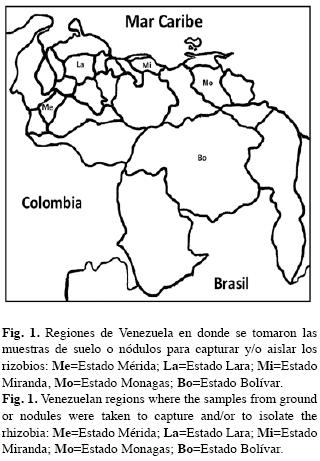
<body><![CDATA[<font size="2"><span style="font-family: verdana;"><span      style="font-weight: bold;">Aislados, cepas     bacterianas de     referencia y medios de cultivo:</span> La ubicaci&oacute;n     geogr&aacute;fica     de las regiones donde se tomaron las muestras de suelo o     n&oacute;dulos para capturar y/o aislar los rizobios se muestran en la     <a href="#fig1">Fig. 1</a>. Todos los aislados y cepas de referencia (<a      href="/img/revistas/rbt/v59n3/a05t1.gif">Cuadro 1</a>,<a      href="/img/revistas/rbt/v59n3/a05t2.gif"> 2</a>) han     ]]></body>
<body><![CDATA[sido&nbsp; conservadas en glicerol (20%) a -20&deg;C y cultivados en     medio YM l&iacute;quido modificado (manitol 2.5g/L, sacarosa 7.5g/L)     (YMLm) (Vincent 1975). La&nbsp; pureza de dichos cultivos fue     verificada mediante siembra por agotamiento en medios agarizados YM     modificado con rojo congo (25&#956;g/mL)&nbsp; (YMAmrc) y medio glucosa     peptona m&aacute;s p&uacute;rpura de bromocresol (100&#956;g/mL) (GPA)     (Rodr&iacute;guez-Mendoza &amp; Ferrera-Cerrato 1984).    <br>     <br>     <br> </span></font>     ]]></body>
<body><![CDATA[<div style="text-align: center;"><font size="2"><span      style="font-family: verdana;"><a name="fig1"></a><img alt=""      src="/img/revistas/rbt/v59n3/a05i1.jpg"      style="width: 320px; height: 461px;"></span></font><br      style="font-family: verdana;">     <font size="2"><span style="font-family: verdana;"></span></font></div>     <br style="font-family: verdana;">     <font size="2"><span style="font-family: verdana;">Todos los ensayos se     realizaron por     triplicado con cultivos de 10<sup>8</sup>cel/mL, incubados a 30&deg;C,     ]]></body>
<body><![CDATA[y en     agitaci&oacute;n continua (200rpm) cuando se trate de cultivos     l&iacute;quidos, salvo se indique lo contrario.</span></font><br      style="font-family: verdana;">     <br style="font-family: verdana;">     <font size="2"><span style="font-family: verdana;"><span      style="font-weight: bold;">Prueba de     infectividad:</span> La     autenticaci&oacute;n de los aislados se realiz&oacute; en <span      style="font-style: italic;">Macroptilium     ]]></body>
<body><![CDATA[lathyroides</span> (Siratro) (Bromfield &amp; Barran 1990) y <span      style="font-style: italic;">Crotalaria     </span>sp. Previamente se escarificaron las semillas con papel     lija     N&ordm; 280, y se esteriliz&oacute; con hipoclorito 0.5% durante 7min;     se germinaron a 26&ordm;C en medio TY agarizado (Beringer 1974) y     se sembraron en recipientes pl&aacute;sticos (7 x 15cm) con arena     est&eacute;ril, impregnada inicialmente con soluci&oacute;n     Hoagland&nbsp; (Taiz &amp; Zeiger 1998) con el nitr&oacute;geno diluido     a la mitad (nitr&oacute;geno de arranque). El ensayo contaba con 5     ]]></body>
<body><![CDATA[plantas/aislado y 5 plantas control sin&nbsp; inocular, estas     &uacute;ltimas se fertilizaron semanalmente con soluci&oacute;n de     Hoagland original. Despu&eacute;s de 35 d&iacute;as de inoculadas     (5mL/planta) se reaislaron los rizobios a partir de     n&oacute;dulos mediante el procedimiento se&ntilde;alado en el Manual     de Rhizobiolog&iacute;a (CiAT 1988).</span></font><br      style="font-family: verdana;">     <br style="font-family: verdana;">     <font size="2"><span style="font-family: verdana;"><span      style="font-weight: bold;">Caracterizaci&oacute;n     ]]></body>
<body><![CDATA[fenot&iacute;pica:</span> Primero se determin&oacute; las     caracter&iacute;sticas morfol&oacute;gicas de las colonias rizobianas     (<a href="/img/revistas/rbt/v59n3/a05t3.gif">Cuadro 3</a>) (CIAT 1988),     el&nbsp; crecimiento en el medio Luria Bertani     (LB) y la producci&oacute;n de &aacute;cido o base, de las cepas de     referencia y aislados rizobianos (Vincent 1975,&nbsp;     Rodr&iacute;guez-Mendoza 1993). Para probar la tolerancia a varias     temperaturas (20&ordm;, 27&ordm;, 30&ordm;, 35&ordm; y 40&ordm;C) y a     medios salinos con NaCl al 0.1, 1.0, 1.5,&nbsp; 2.0 y 2.5% (Wang <span      style="font-style: italic;">et al</span>.     ]]></body>
<body><![CDATA[1998) se colocaron 5&#956;L de cada cultivo de rizobios en el medio YMAmrc.</span></font><br      style="font-family: verdana;">     <br style="font-family: verdana;">     <font size="2"><span style="font-family: verdana;">La capacidad para     tolerar pH     &aacute;cidos se efect&uacute;o seg&uacute;n Ayanaba et al. (1983) con     modificaciones. Para ello se prepararon cajas de Petri con el&nbsp;     medio de Keyser &amp; Munns (1979) modificado, a pH 4.0, 4.4, 4.6, 5.0,     5.2, 5.6, 6.0 y 6.8. Tambi&eacute;n se comprob&oacute; la resistencia     intr&iacute;nseca a&nbsp; antibi&oacute;ticos, los cuales fueron     ]]></body>
<body><![CDATA[esterilizados por filtraci&oacute;n y adicionados al medio YMAmrc,     donde se sembraron al&iacute;cuotas de 5&#956;L de cada cultivo de&nbsp;     rizobio. Los antibi&oacute;ticos ensayados fueron los siguientes     (<span style="font-style: italic;">&micro;</span>g/ mL): gentamicina     (Gmc.) 2.5, 5, 25, 50 y 100. Lincomicina     (Lmc.), cloranfenicol&nbsp; (Cam.) 50, 100, 200, 300. Amikacina     (Amkc.), ampicilina (Amp.), doxiciclina (Doxi.), &aacute;cido     nalid&iacute;xico (Nal.) y tetraciclina (Tc.) 5, 25, 50, 100 y     200,&nbsp; kanamicina (Kan.) 5, 10, 25, 50, 8 y estreptomicina (Str.)     5, 10, 25, 50, 100 y 200 (Wang <span style="font-style: italic;">et al</span>.     ]]></body>
<body><![CDATA[1998).</span></font><br style="font-family: verdana;">     <br style="font-family: verdana;">     <font size="2"><span style="font-family: verdana;">Para el ensayo de     crecimiento en     diferentes fuentes carbonadas y nitrogenadas, se cultivaron las     bacterias en 5mL de medio YMmrc, en agitaci&oacute;n continua     (200rpm), durante 2-5d&iacute;as. Despu&eacute;s se efect&uacute;o el     lavado de las c&eacute;lulas con NaCl 0.8% y se permiti&oacute; el     crecimiento en medio basal salino M9 (Millar 1972) con biotina,     sin fuentes carbonadas y nitrogenadas (carenciamiento) durante 24h.     ]]></body>
<body><![CDATA[Posteriormente, se tomaron al&iacute;cuotas de 5&#956;L de cada una de     los cultivos bacterianos y se sembraron en medio YM agarizado con azul     de bromotimol (0.5mg/200mL) y las siguientes fuentes carbonadas     esterilizadas por filtraci&oacute;n: L-arabinosa, dulcitol, esculina,     D-fructosa, D-galactosa, glicerol, glucosa, inositol, D-lactosa,     maltosa, D- manosa, rhamnosa, rafinosa, sacarosa, L-sorbitol,     L-sorbosa, D-xilosa y las sales de los &aacute;cidos org&aacute;nicos:     succ&iacute;nico, c&iacute;trico, m&aacute;lico, pir&uacute;vico, &#945;-     cetoglutarato (todas a una concentraci&oacute;n del 0.1%). El     &aacute;cido nicot&iacute;nico y &aacute;cido asc&oacute;rbico se     ]]></body>
<body><![CDATA[utilizaron a una concentraci&oacute;n de 100 &#956;g/mL (Wang&nbsp; <span      style="font-style: italic;">et al</span>.     1998). Tambi&eacute;n se ensayaron 14 fuentes nitrogenadas     esterilizadas por filtraci&oacute;n: L-alanina, L-arginina,     L-asparagina, L-fenilalanina, L- glicina, L-histidina, L-homoserina,     L-leucina, L-metionina, L-treonina, L-triptofano, L-tirosina, L-valina     y urea (todas a una concentraci&oacute;n 0.5g /L)&nbsp; (Wang <span      style="font-style: italic;">et al</span>.     1998). Los cultivos bacterianos se incubaron a la misma temperatura que     los ensayos anteriores. En todos los ensayos el crecimiento&nbsp; fue     ]]></body>
<body><![CDATA[registrado de manera cualitativa durante 2-9 d&iacute;as. </span></font><br      style="font-family: verdana;">     <br style="font-family: verdana; font-weight: bold;">     <font style="font-weight: bold;" size="2"><span      style="font-family: verdana;">Caracterizaci&oacute;n     genot&iacute;pica de rizobios</span></font><br      style="font-family: verdana;">     <br style="font-family: verdana;">     <font size="2"><span style="font-family: verdana;"><span      style="font-weight: bold;">Perfil     ]]></body>
<body><![CDATA[plasm&iacute;dico:</span> Se     emple&oacute; una modificaci&oacute;n del m&eacute;todo de lisis     alcalina para aislar pl&aacute;smidos de alto peso molecular (Casse <span      style="font-style: italic;">et     al</span>. 1979), para&nbsp; ello se utiliz&oacute; cultivos frescos     crecidos     en agitaci&oacute;n (200 rpm) durante 1-3 d&iacute;as en 10mL de medio     YMLm.</span></font><br style="font-family: verdana;">     <br style="font-family: verdana;">     <font size="2"><span style="font-family: verdana;">La presencia de     ]]></body>
<body><![CDATA[pl&aacute;smidos de     alto peso molecular fue verificada mediante electroforesis en gel de     agarosa (0.9%) con tamp&oacute;n de corrida TBE 1X pH 8.0, 2h con     63 voltios y 100mA. Se utilizaron como marcadores de peso molecular     cepas de E. <span style="font-style: italic;">coli </span>K-12,     portadoras de cinco pl&aacute;smidos de     referencia provenientes del Centro Venezolano de Colecciones de     Microorganismos (CVCM) 1- CVCM 134, (pR478, 279 Kb); 2- CVCM 132     (pR27,&nbsp; 188 Kb); 3- CVCM 153 (pR1, 104 Kb), 4- CVCM 164 (pR64, 121     Kb), 5-CVCM 194 (pRP4, 60 Kb).</span></font><br     ]]></body>
<body><![CDATA[ style="font-family: verdana;">     <br style="font-family: verdana;">     <font size="2"><span style="font-family: verdana;"><span      style="font-weight: bold;">Extracci&oacute;n y     purificaci&oacute;n del ADN cromos&oacute;mico:</span> En el     procedimiento de     extracci&oacute;n y purificaci&oacute;n del ADN, se utiliz&oacute; el     Kit Wizard Genomic DNA Purification (Promega) &reg;, lavando     previamente las c&eacute;lulas con NaCl 0.8%.</span></font><br      style="font-family: verdana;">     ]]></body>
<body><![CDATA[<br style="font-family: verdana; font-weight: bold;">     <font size="2"><span style="font-family: verdana;"><span      style="font-weight: bold;">Amplificaci&oacute;n     del ADNr 16S,     mediante la Reacci&oacute;n en Cadena de la Polimerasa (PCR):</span> La     reacci&oacute;n de amplificaci&oacute;n fue llevada a cabo con     los&nbsp; oligonucle&oacute;tidos cebadores fD1 y rD1 descritos por     Weisburg <span style="font-style: italic;">et al</span>. (1991).</span></font><br      style="font-family: verdana;">     <br style="font-family: verdana;">     ]]></body>
<body><![CDATA[<font size="2"><span style="font-family: verdana;">La reacci&oacute;n     de PCR se     realiz&oacute; de acuerdo a Laguerre <span style="font-style: italic;">et     al</span>. (1994) con modificaciones     en un volumen de 50<span style="font-style: italic;">&micro;</span>L,     donde se emplearon entre 50 y 100ng     de ADN gen&oacute;mico y 1.25 U de <span style="font-style: italic;">Taq</span>     Polimerasa (Promega)&reg;. La     amplificaci&oacute;n fue realizada en un termociclador Gene Cycler     marca BiO-RAD&nbsp; modelo 170-6700-170-6701. Los amplificados     ]]></body>
<body><![CDATA[(5-6<span style="font-style: italic;">&micro;</span>L) fueron     visualizados mediante electroforesis en geles de     agarosa de uso rutinario para PCR, al&nbsp; 0.9% (12cm x 20cm) en     tamp&oacute;n TBE 1X pH 8.0, bajo las siguientes condiciones: 100     Voltios, 80mA, durante 4h.</span></font><br      style="font-family: verdana;">     <br style="font-family: verdana;">     <font size="2"><span style="font-family: verdana;"><span      style="font-weight: bold;">Ensayos de     restricci&oacute;n     ]]></body>
<body><![CDATA[(RFLP):</span> Al&iacute;cuotas de 8-12&micro;L de amplificados fueron     digeridos con 5 U de endonucleasas de restricci&oacute;n (Promega)     &reg; en un volumen de reacci&oacute;n de 20&micro;L a 37&ordm;C     durante 4h. Adem&aacute;s se utilizaron las siguientes enzimas de     restricci&oacute;n: M<span style="font-style: italic;">sp</span>i, R<span      style="font-style: italic;">sa</span>i, S<span      style="font-style: italic;">au</span> 3AI, y H<span      style="font-style: italic;">ha</span>I, &eacute;stas dos     &uacute;ltimas corresponden a endonucleasas, y a los     isoesquiz&oacute;meros de las enzimas CfoI y NdeII.</span></font><br     ]]></body>
<body><![CDATA[ style="font-family: verdana;">     <br style="font-family: verdana;">     <font size="2"><span style="font-family: verdana;">Los digeridos (10&#956;L     c/u) fueron     analizados en geles de poliacrilamida (8%), de grosor 0.75mm, en un     sistema de electroforesis vertical, Mini-Protean II cell (Bio     Rad), durante 2h aproximadamente. Luego se emple&oacute; un     tamp&oacute;n TBE 1X pH 8.0 a 19mA, 72 V. Los geles fueron     te&ntilde;idos por el m&eacute;todo de tinci&oacute;n con nitrato     de plata (Bassam <span style="font-style: italic;">et al</span>. 1991).</span></font><br     ]]></body>
<body><![CDATA[ style="font-family: verdana;">     <br style="font-family: verdana;">     <font size="2"><span style="font-family: verdana;">Las     caracter&iacute;sticas     fenot&iacute;picas y los patrones de restricci&oacute;n del ADNr 16S de     los rizobios fueron codificados en forma binaria (1, presencia de     la caracter&iacute;stica o de la banda; 0 ausencia de las mismas)     y analizados por Taxonom&iacute;a Num&eacute;rica, empleando el     programa estad&iacute;stico SPSS, versi&oacute;n 13 para     construir las matrices de similaridad de enlace simple y luego obtener     ]]></body>
<body><![CDATA[el &iacute;ndice de Disimilaridad (D<span style="font-style: italic;">sm</span>)     representado en los     dendrogramas, los cuales fueron elaborados mediante el algoritmo     Unweighted Pair-Group Method using Aritmethic Averages (UPGMA)     (Programa Statistica, versi&oacute;n 6.0).</span></font><br      style="font-family: verdana;">     <br style="font-family: verdana;">     <font style="font-weight: bold;" size="3"><span      style="font-family: verdana;">Resultados</span></font><br      style="font-family: verdana;">     ]]></body>
<body><![CDATA[<br style="font-family: verdana; font-weight: bold;">     <font size="2"><span style="font-family: verdana;"><span      style="font-weight: bold;">Prueba de     infectividad:</span> La     presencia de n&oacute;dulos de color marr&oacute;n rojizo,     permiti&oacute; considerar a todos los aislados rizobianos como     efectivos y eficientes.</span></font><br style="font-family: verdana;">     <br style="font-family: verdana; font-weight: bold;">     <font size="2"><span style="font-family: verdana;"><span      style="font-weight: bold;">Macroptilium     ]]></body>
<body><![CDATA[lathyroide</span>s (Siratro),     considerada una especie promiscua (Bromfiel &amp; Barran 1990) no fue     nodulada por el rizobio ME 01 pero s&iacute; form&oacute;     n&oacute;dulos eficientes en <span style="font-style: italic;">Crotalari</span>a     sp. y en <span style="font-style: italic;">Phaseolus vulgaris </span>L.     (datos no publicados).</span></font><br style="font-family: verdana;">     <br style="font-family: verdana;">     <font style="font-weight: bold;" size="2"><span      style="font-family: verdana;">Caracterizaci&oacute;n     fenot&iacute;pica</span></font><br     ]]></body>
<body><![CDATA[ style="font-family: verdana; font-weight: bold;">     <br style="font-family: verdana; font-weight: bold;">     <font size="2"><span style="font-family: verdana;"><span      style="font-weight: bold;">Caracter&iacute;sticas     morfol&oacute;gicas de las colonias de rizobios aut&oacute;ctonos y     tiempo de aparici&oacute;n de las colonias:</span> Las colonias de los     aislados rizobianos estudiados presentaron morfolog&iacute;as muy     diversas y tiempos de aparici&oacute;n diferentes. Los microsimbiontes     NB 1.1, NB 2.1, NB 4.1, NB 9.1,&nbsp; y NB 15.1, originaron colonias de     crecimiento lento y extralento (tiempo de aparici&oacute;n de las     ]]></body>
<body><![CDATA[colonias 5-6 d&iacute;as y de 7-9 d&iacute;as respectivamente),     de morfolog&iacute;a muy similar (<a      href="/img/revistas/rbt/v59n3/a05t3.gif">Cuadro 3</a>). El aislado     Tr&eacute;bol, a pesar de presentar crecimiento extralento se     diferenci&oacute; de los anteriores por formar colonias de aspecto     transl&uacute;cido y brillante de consistencia mucilaginosa, y el     aislado NB 23.1 con morfolog&iacute;a similar al primer grupo,     present&oacute; crecimiento r&aacute;pido (colonias apreciables a     los 3-4 d&iacute;as) (<a href="/img/revistas/rbt/v59n3/a05t3.gif">Cuadro     3</a>).</span></font><br style="font-family: verdana;">     ]]></body>
<body><![CDATA[<br style="font-family: verdana;">     <font size="2"><span style="font-family: verdana;">El aislado de     <span style="font-style: italic;">Phaseolus vulgaris</span>     L., Nod 2Rojo (Nod 2R), de crecimiento lento, origin&oacute; colonias     muy similares a <span style="font-style: italic;">Bradyrhizobium     elkanii</span> y <span style="font-style: italic;">B.&nbsp; japonicum</span>,     lo que     contrasta con las del simbionte ME 01, aislado tambi&eacute;n de     n&oacute;dulos de la misma especie vegetal, pero con     caracter&iacute;sticas&nbsp; similares a <span     ]]></body>
<body><![CDATA[ style="font-style: italic;">R. tropici</span> CIAT 899 (<a      href="/img/revistas/rbt/v59n3/a05t3.gif">Cuadros     3</a>, <a href="/img/revistas/rbt/v59n3/a05t4.gif">4</a>). Las     colonias de Rm Vivero (RmV) y Rm Borboll&oacute;n (RmB),     aislados de alfalfa, se diferenciaron por el&nbsp; color blanco crema y     blanco lechoso respectivamente y se constat&oacute; que ambas son de     crecimiento r&aacute;pido. El aislamiento proveniente de <span      style="font-style: italic;">Leucaena</span>&nbsp;     sp. [Leu 2A (1)2], tambi&eacute;n present&oacute; crecimiento     r&aacute;pido, pero difer&iacute;a de las anteriores, en cuanto a la     ]]></body>
<body><![CDATA[textura gomosa de las colonias y el aspecto semi-transl&uacute;cido.</span></font><br      style="font-family: verdana;">     <br style="font-family: verdana;">     <font size="2"><span style="font-family: verdana;">La     caracterizaci&oacute;n     fenot&iacute;pica de 12 aislados rizobianos, provenientes de diversas     regiones geogr&aacute;ficas de Venezuela, mostr&oacute; una     poblaci&oacute;n heterog&eacute;nea y se catalog&oacute; cuatro     categor&iacute;as en relaci&oacute;n al tiempo en que se apreci&oacute;     el crecimiento de las colonias, de acuerdo al criterio     ]]></body>
<body><![CDATA[relacionado a la velocidad de crecimiento de los rizobios,     se&ntilde;alado por Jordan (1984) y Rodr&iacute;guez-Mendoza (1993):</span></font><br      style="font-family: verdana;">     <br style="font-family: verdana;">     <font size="2"><span style="font-family: verdana;">Rizobios de     crecimiento     r&aacute;pido (colonia apreciable en 3-4 d&iacute;as). En este grupo se     incluy&oacute; los aislados NB 23.1, Leu 2A (1)2, Rm V, Rm B, de&nbsp;     condici&oacute;n semejante a la cepas, <span      style="font-style: italic;">Sinorhizobium meliloti</span> 41 y     ]]></body>
<body><![CDATA[<span style="font-style: italic;">Rhizobium etli </span>CFN42 (<a      href="/img/revistas/rbt/v59n3/a05t3.gif">Cuadros     3</a>, <a href="/img/revistas/rbt/v59n3/a05t4.gif">4</a>).</span></font><br      style="font-family: verdana;">     <br style="font-family: verdana;">     <font size="2"><span style="font-family: verdana;">Rizobios de     crecimiento muy     r&aacute;pido (colonia apreciable en 1-2 d&iacute;as), donde se     incluy&oacute; la cepa ME 01, muy similar a las cepas de referencia     <span style="font-style: italic;">R.&nbsp; tropici</span> CIAT 899, <span     ]]></body>
<body><![CDATA[ style="font-style: italic;">S. americanum</span> CFNEi 156 y <span      style="font-style: italic;">A. tumefaciens</span> C58     (<a href="/img/revistas/rbt/v59n3/a05t3.gif">Cuadros 3</a>, <a      href="/img/revistas/rbt/v59n3/a05t4.gif">4</a>).</span></font><br      style="font-family: verdana;">     <br style="font-family: verdana;">     <font size="2"><span style="font-family: verdana;">Rizobios de     crecimiento lento     (colonia apreciable en 5-6 d&iacute;as), se&ntilde;alando los     aislamientos, Nod 2R, NB 15.1 y<span style="font-style: italic;">     ]]></body>
<body><![CDATA[Bradyrhizobium</span> sp. CIAT 2453.</span></font><br      style="font-family: verdana;">     <br style="font-family: verdana;">     <font size="2"><span style="font-family: verdana;">Rizobios de     crecimiento extralento     (colonia apreciable en 7-9 d&iacute;as), agrup&oacute; los aislados NB     1.1, NB 2.1, NB 4.1, NB 9.1 y Tr&eacute;bol, similares a las&nbsp;     cepas de referencia<span style="font-style: italic;"> B. elkanii</span>     USDA 76 y <span style="font-style: italic;">B. canariense</span> BTA-1     y <span style="font-style: italic;">B.     ]]></body>
<body><![CDATA[japonicum</span> DSMZ 30131 (<a href="/img/revistas/rbt/v59n3/a05t3.gif">Cuadros     3</a>, <a href="/img/revistas/rbt/v59n3/a05t4.gif">4</a>).</span></font><br      style="font-family: verdana;">     <br style="font-family: verdana;">     <font size="2"><span style="font-family: verdana;"><span      style="font-weight: bold;">Caracter&iacute;sticas     bioqu&iacute;micas:</span> El 41.6% de los aislados produjeron     reacci&oacute;n     &aacute;cida (ME 01, Tr&eacute;bol, Rm V, Rm B y NB 23.1), todos de     crecimiento r&aacute;pido-m&aacute;s r&aacute;pido, con     ]]></body>
<body><![CDATA[excepci&oacute;n del aislado Tr&eacute;bol que es una bacteria de     crecimiento extralento, mientras el 58.3% restante que originaron     una reacci&oacute;n b&aacute;sica, eran de crecimiento     lento-extralento, e inclu&iacute;an el aislado Leu 2A(1) 2, a pesar de     presentar crecimiento r&aacute;pido (<a      href="/img/revistas/rbt/v59n3/a05t5.gif">Cuadro 5</a>).</span></font><br      style="font-family: verdana;">     <br style="font-family: verdana;">     <font size="2"><span style="font-family: verdana;">En relaci&oacute;n     al crecimiento     ]]></body>
<body><![CDATA[en medio LB, el 58.3% de los aislados mostraron resultados negativos,     representados por los simbiontes de crecimiento lento-extralento     a diferencia del resto o sea el 41.6% que si crecieron en este medio de     cultivo, de manera que inclu&iacute;an los aislados de     crecimiento r&aacute;pido-muy r&aacute;pido (<a      href="/img/revistas/rbt/v59n3/a05t5.gif">Cuadro 5</a>).</span></font><br      style="font-family: verdana;">     <br style="font-family: verdana;">     <font size="2"><span style="font-family: verdana;">Todos los aislados     analizados     ]]></body>
<body><![CDATA[utilizaron D-fructosa, inositol, glicerol, D(+) manosa, rafinosa y     sorbitol, adem&aacute;s del manitol y de menor preferencia fueron     los sustratos tales como: glucosa, esculina, D-xilosa y L(-) sorbosa,     no metabolizados por la mayor&iacute;a de los simbiontes (66%-83%),     mientras la D(+)galactosa, arabinosa, D-lactosa, sacarosa,     maltosa y rhamnosa no fueron aprovechados por un grupo de     microorganismos (16%-50%).</span></font><br      style="font-family: verdana;">     <br style="font-family: verdana;">     <font size="2"><span style="font-family: verdana;">Los &aacute;cidos     ]]></body>
<body><![CDATA[org&aacute;nicos     (citrato, &#945;-cetoglutarato, glutamato, L-malato, piruvato, succinato)     fueron metabolizados como fuente carbonada por todos los aislados     y el &aacute;cido asc&oacute;rbico no fue utilizado por el simbionte NB     23.1.</span></font><br style="font-family: verdana;">     <br style="font-family: verdana;">     <font size="2"><span style="font-family: verdana;">Todos los aislados     metabolizaron la     L-asparagina; mientras que los amino&aacute;cidos L-valina y     L-fenilalanina fueron los sustratos de menor preferencia como     ]]></body>
<body><![CDATA[fuente nitrogenada, metabolizados respectivamente por el 25% y 33% de     los aislados rizobianos y la L-homoserina no fue utilizada por&nbsp;     ninguno de los microsimbiontes aut&oacute;ctonos ni cepas de referencia.</span></font><br      style="font-family: verdana;">     <br style="font-family: verdana;">     <font size="2"><span style="font-family: verdana;">El dendrograma A de     la <a href="/img/revistas/rbt/v59n3/a05i2.jpg">Fig. 2</a>     elaborado con base a 40 atributos, relacionados a la utilizaci&oacute;n     de fuentes de carbono, nitr&oacute;geno, la producci&oacute;n de     &aacute;cido o &aacute;lcali y crecimiento en medio LB, permiti&oacute;     ]]></body>
<body><![CDATA[reconocer cuatro perfiles principales de actividad metab&oacute;lica.</span></font><br      style="font-family: verdana;">     <br style="font-family: verdana;">     <font size="2"><span style="font-family: verdana;">El Grupo I     incluy&oacute; una     mezcla heterog&eacute;nea de siete aislados aut&oacute;ctonos y siete     cepas de referencia, pertenecientes a diversos g&eacute;neros     (<span style="font-style: italic;">Rhizobium, Bradyrhizobium,     Sinorhizobium</span>), los cuales se     caracterizaron por utilizar L(+) arabinosa a excepci&oacute;n de NB     ]]></body>
<body><![CDATA[2.1. Este grupo de bacterias metabolizaron la mayor cantidad de     sustratos carbonados y nitrogenados suministrados (entre el 75% y 90%)     y el Grupo II conformado por 3 aislados aut&oacute;ctonos, no     utilizaron L(+) arabinosa como fuente de carbono.</span></font><br      style="font-family: verdana;">     <br style="font-family: verdana;">     <font size="2"><span style="font-family: verdana;">Dentro del Grupo I     se separaron los     siguientes subgrupos: el subgrupo Ia (ME 01) que metaboliz&oacute;     D(+)lactosa y L-fenilalanina y est&aacute; relacionado&nbsp; con un     ]]></body>
<body><![CDATA[nivel de disimilaridad D<span style="font-style: italic;">sm</span>=0.1     (90% similaridad) a <span style="font-style: italic;">Bradyrhizobium</span>     sp.     CIAT 2453, <span style="font-style: italic;">R. etli </span>CFN42 y <span      style="font-style: italic;">R. tropici </span>CIAT 899. El subgrupo     Ib (Nod     2&nbsp; R, NB 1.1, NB 4.1 y NB 23.1) que no utilizaron estos compuestos     con excepci&oacute;n del aislamiento NB 4.1 que creci&oacute; en     presencia del carbohidrato. El subgrupo Ic (S. meliloti 41) fue     incapaz de utilizar el &#945;-cetoglutarato. El subgrupo Id (NB 15.1) no     ]]></body>
<body><![CDATA[utiliz&oacute; sacarosa y tres amino&aacute;cidos, L-leucina, L-     metionina y L-tirosina, pero si L-fenilalanina, y finalmente el     subgrupo Ie (NB 2.1), caracterizado por no aprovechar L-alanina y     L-leucina. </span></font><br style="font-family: verdana;">     <br style="font-family: verdana;">     <font size="2"><span style="font-family: verdana;">El Grupo II     incluy&oacute; a Rm V y     Tr&eacute;bol que emplearon el 67.5% de la totalidad de fuentes     suministradas. Este &uacute;ltimo con 85% de similaridad&nbsp;     (D<span style="font-style: italic;">sm</span>=0.15) a A<span     ]]></body>
<body><![CDATA[ style="font-style: italic;">grobacterium tumefaciens</span> C58 y Rm B     utiliz&oacute; el     77.5% con 87% de similaridad a <span style="font-style: italic;">Sinorhizobium     americanum</span> CFN-EI     156&nbsp; (D<span style="font-style: italic;">sm</span>=0.13). Los     Grupos III y IV, conformados por NB 9.1 y Leu     2A (1)2 respectivamente, presentaron un estrecho rango de     auxotrof&iacute;a. El primero&nbsp; de ellos metaboliz&oacute; el 65%     de los sustratos y apenas el 52.5% de los compuestos carbonados y     nitrogenados fue aprovechado por Leu 2A(1)2, y&nbsp; se     ]]></body>
<body><![CDATA[diferenci&oacute; de los restantes por no emplear urea.</span></font><br      style="font-family: verdana;">     <br style="font-family: verdana;">     <font size="2"><span style="font-family: verdana;">Todos los aislados     fueron     resistentes a altos niveles de lincomicina (300<span      style="font-style: italic;">&micro;</span>g/mL),     gentamicina (2.5-100 <span style="font-style: italic;">&micro;</span>g/mL)     y &aacute;cido nalid&iacute;xico     (5-100<span style="font-style: italic;">&micro;</span>g/mL). La     ]]></body>
<body><![CDATA[mayor susceptibilidad se encontr&oacute;     con amikacina, doxiciclina y tetraciclina, inhibiendo el crecimiento en     el 19%, 33% y 28.6% respectivamente de </span></font><font size="2"><span      style="font-family: verdana;">las cepas estudiadas.</span></font><br      style="font-family: verdana;">     <br style="font-family: verdana;">     <font size="2"><span style="font-family: verdana;">El dendrograma B de     la <a href="/img/revistas/rbt/v59n3/a05i2.jpg">Fig. 2     </a>separ&oacute; cuatro grupos con base en la resistencia     intr&iacute;nseca a 10 antibi&oacute;ticos. El Grupo I conformado por     ]]></body>
<body><![CDATA[los siguientes subgrupos: Subgrupo Ia, ME 01 y la cepa de     referencia <span style="font-style: italic;">R. tropici</span> CIAT     899, las cuales presentaron un bajo D<span style="font-style: italic;">sm</span>=0.12     correspondiente a 88% de similaridad en relaci&oacute;n a la     resistencia (&#956;g/mL) a los siguientes antibi&oacute;ticos: gentamicina     (25), lincomicina (300), ampicilina (50), amikacina (5), estreptomicina     (200), cloranfenicol (100) y &aacute;cido     nalid&iacute;xico (100). El subgrupo Ib (Rm V y Rm B) se separ&oacute;     del grupo anterior con un D<span style="font-style: italic;">sm</span>     0.24&nbsp; (76% de similaridad) y junto a<span     ]]></body>
<body><![CDATA[ style="font-style: italic;">     S. meliloti</span> 41 y <span style="font-style: italic;">S. americanum</span>     CFN-Ei156 mostraron en com&uacute;n     resistencias a gentamicina (5&#956;g/mL), ampicilina,&nbsp; kanamicina (25),     &aacute;cido nalid&iacute;xico (100), estreptomicina (200),     lincomicina, cloranfenicol (300). Todas fueron susceptibles a     doxiciclina. El subgrupo Ic lo integr&oacute; <span      style="font-style: italic;">R. etli</span> CFN42     resultando susceptible a doxiciclina, ampicilina, cloranfenicol y     tetraciclina. </span></font><br style="font-family: verdana;">     ]]></body>
<body><![CDATA[<br style="font-family: verdana;">     <font size="2"><span style="font-family: verdana;">El grupo II (<a      href="/img/revistas/rbt/v59n3/a05i2.jpg">Fig.     2B</a>) lo integraron     la mayor&iacute;a de los aislados aut&oacute;ctonos: Nod 2R, NB 2.1, NB     4.1, NB 9.1, NB 15.1, NB 23.1, Leu 2A (1) 2 y NB 1.1, con una     similitud del 60% (D<span style="font-style: italic;">sm</span>=0.4)     respecto al Grupo I, incluyendo cuatro     cepas de referencia:<span style="font-style: italic;"> B. japonicum</span>     DSMZ 3011, <span style="font-style: italic;">B. canariense</span>     ]]></body>
<body><![CDATA[BTA-1, <span style="font-style: italic;">Bradyrhizobium</span> sp.     CIAT 2453 y<span style="font-style: italic;"> B. elkanii</span> USDA     76. Todos     mostraron     resistencia a los 10 antibi&oacute;ticos ensayados, excepto NB 1.1     (subgrupo IIb), el cual fue susceptible a amikacina. En total el     66% de los aislamientos fueron resistentes a todos los     antibi&oacute;ticos ensayados.</span></font><br      style="font-family: verdana;">     <br style="font-family: verdana;">     ]]></body>
<body><![CDATA[<font size="2"><span style="font-family: verdana;">El Grupo III (<a      href="/img/revistas/rbt/v59n3/a05i2.jpg">Fig.     2B</a>) integrado     por <span style="font-style: italic;">A. tumefaciens</span> C58, se     separ&oacute; de los grupos anteriores con     un D<span style="font-style: italic;">sm</span>=0.53 (47% de     similaridad), siendo susceptible a     cloranfenicol, amikacina y kanamicina, pero resistente a ampicilina     (200&micro;g/mL).</span></font><br style="font-family: verdana;">     <br style="font-family: verdana;">     ]]></body>
<body><![CDATA[<font size="2"><span style="font-family: verdana;">El Grupo IV,     present&oacute; un     D<span style="font-style: italic;">sm</span>=0.85 apenas con un 15% de     similaridad respecto a los grupos     restantes y lo conform&oacute; &uacute;nicamente el aislado     Tr&eacute;bol (<a href="/img/revistas/rbt/v59n3/a05i2.jpg">Fig. 2B</a>),     susceptible a los antibi&oacute;ticos     amikacina, doxiciclina, kanamicina streptomicina y tetraciclina; solo     present&oacute; resistencia a las concentraciones m&aacute;s     bajas de gentamicina (2.5<span style="font-style: italic;">&micro;</span>g/mL),     ]]></body>
<body><![CDATA[ampicilina (5<span style="font-style: italic;">&micro;</span>g/mL)     cloranfenicol (50<span style="font-style: italic;">&micro;</span>g/mL)     y &aacute;cido nalid&iacute;xico     (5-25<span style="font-style: italic;">&micro;</span>g/mL).</span></font><br      style="font-family: verdana;">     <br style="font-family: verdana; font-weight: bold;">     <font size="2"><span style="font-family: verdana;"><span      style="font-weight: bold;">An&aacute;lisis     fen&eacute;tico     general de las cepas:</span> Se elabor&oacute; un dendrograma con 94     ]]></body>
<body><![CDATA[caracteres referentes a la resistencia intr&iacute;nseca a varios     antibi&oacute;ticos, la tolerancia al pH, salinidad y     temperatura, la utilizaci&oacute;n de fuentes de carbono y     nitr&oacute;geno, la producci&oacute;n de &aacute;cido o base y el     crecimiento en medio LB, donde se distinguieron tres grupos (<a      href="/img/revistas/rbt/v59n3/a05i2.jpg">Fig.     2C</a>):</span></font><br style="font-family: verdana;">     <br style="font-family: verdana;">     <font size="2"><span style="font-family: verdana;">El Grupo I (25% de     rizobios     ]]></body>
<body><![CDATA[productores de &aacute;cido) se subdividi&oacute; en tres subgrupos. El     subgrupo Ia (ME 01), proveniente de <span style="font-style: italic;">P.     vulgaris</span> L., (D<span style="font-style: italic;">sm</span>=0.07),     mostr&oacute; un alto grado de similaridad (93%) a <span      style="font-style: italic;">R. tropici</span> CIAT 899.     <br>     <br>     Los microsimbiontes Rm V, Rm B (subgrupo Ib), presentaron     caracter&iacute;sticas similares a los rizobios <span      style="font-style: italic;">S. meliloti</span> 41 y <span     ]]></body>
<body><![CDATA[ style="font-style: italic;">S.     americanum</span> CFN-EI 156, con una similitud al subgrupo I del 80%     D<span style="font-style: italic;">sm</span>=0.20, excepto que Rm B no     fue tolerante a pH inferiores a 5.0     (<a href="/img/revistas/rbt/v59n3/a05t4.gif">Cuadro 4</a> y <a      href="/img/revistas/rbt/v59n3/a05t5.gif">5</a>). El subgrupo Ic     incluy&oacute; solo a <span style="font-style: italic;">A. tumefaciens</span>     C58. </span></font><br style="font-family: verdana;">     <br style="font-family: verdana;">     <font size="2"><span style="font-family: verdana;">El Grupo II (66%),     ]]></body>
<body><![CDATA[conformado por     los aislados de crecimiento lento-extralento, excepto NB 23.1 y Leu     2A(2)1 de crecimiento r&aacute;pido, los restantes mostraron     afinidad al g&eacute;nero <span style="font-style: italic;">Bradyrhizobium</span>     y se subdividi&oacute; en 2     subgrupos: El subgrupo IIa incluy&oacute; a Nod 2R con 85% de     similaridad (D<span style="font-style: italic;">sm</span>=0.15)     (<a href="/img/revistas/rbt/v59n3/a05i2.jpg">Fig. 2C</a>) a <span      style="font-style: italic;">B. japonicum</span> DSMZ     30131 y <span style="font-style: italic;">B.     ]]></body>
<body><![CDATA[canariense</span> BTA-1 (<a href="/img/revistas/rbt/v59n3/a05t4.gif">Cuadro     4</a>, <a href="/img/revistas/rbt/v59n3/a05t5.gif">5</a>), as&iacute;     como tambi&eacute;n a     los     aislados de diversos suelos del pa&iacute;s (NB 4.1, NB 15.1, NB     23.1 y NB 2.1, NB1.1 (D<span style="font-style: italic;">sm</span>=0.13-0.27),     con una similaridad mayor del 70%     a las cepas de referencia menos tolerantes a las condiciones salinas,     <span style="font-style: italic;">Bradyrhizobium</span> sp. CIAT 2453 y     <span style="font-style: italic;">B. elkanii</span> USDA 76 (<a     ]]></body>
<body><![CDATA[ href="/img/revistas/rbt/v59n3/a05i2.jpg">Fig. 2C</a>),     (<a href="/img/revistas/rbt/v59n3/a05t5.gif">Cuadro     5</a>). El subgrupo II b, conformado por Leu 2A (1)2 y NB 9.1, se     separ&oacute; de los subgrupos anteriores por presentar una     similaridad igual o menor al 70% (Dsm=0.3). Los aislados que lo     integran se caracterizaron por crecer en medios con un pH entre     5.0-6.6 y no en concentraciones de NaCl mayores a 0.1 y 1%     respectivamente (<a href="/img/revistas/rbt/v59n3/a05t5.gif">Cuadro 5</a>).</span></font><br      style="font-family: verdana;">     <br style="font-family: verdana;">     ]]></body>
<body><![CDATA[<font size="2"><span style="font-family: verdana;">El Grupo III (8.3%),     separ&oacute;     el aislado Tr&eacute;bol con el m&aacute;s bajo nivel de similaridad     respecto a los dem&aacute;s grupos 44% (D<span      style="font-style: italic;">sm</span>=0.56) (<a      href="/img/revistas/rbt/v59n3/a05i2.jpg">Fig. 2C</a>), el cual     se diferenci&oacute; de los restantes por poseer los     l&iacute;mites de tolerancia m&aacute;s estrechos a condiciones     extremas; creci&oacute; a pH iguales o superiores a 5.6,     condiciones de salinidad (0.1% NaCl), temperaturas entre 22&deg;C y     ]]></body>
<body><![CDATA[35&deg;C (<a href="/img/revistas/rbt/v59n3/a05t5.gif">Cuadro 5</a>),     adem&aacute;s fue el aislado que mostr&oacute;     susceptibilidad a 50% de los antibi&oacute;ticos ensayados.</span></font><br      style="font-family: verdana;">     <br style="font-family: verdana;">     <font size="2"><span style="font-family: verdana;"><span      style="font-weight: bold;">Caracterizaci&oacute;n     molecular:</span>     Tambi&eacute;n se detect&oacute; la presencia de un megapl&aacute;smido     de tama&ntilde;o aproximado a 279 Kb, en siete cepas rizobianas     ]]></body>
<body><![CDATA[de las doce analizadas, correspondientes a seis aislamientos     aut&oacute;ctonos: NB 2,1, NB 4.1, Nod 2R y Tr&eacute;bol de     crecimiento lentoextralento y NB 23.1 ME 01de crecimiento     r&aacute;pido-muy r&aacute;pido y la cepa tipo <span      style="font-style: italic;">Rhizobium tropici</span> CIAT     899 (<a href="/img/revistas/rbt/v59n3/a05i3.jpg">Fig. 3</a>). La     l&iacute;nea cinco de esta figura correspondi&oacute;     a Rm B, donde no se detect&oacute; megapl&aacute;smidos con el     m&eacute;todo utilizado.</span></font><br style="font-family: verdana;">     <br style="font-family: verdana;">     ]]></body>
<body><![CDATA[<font size="2"><span style="font-family: verdana;">Los amplificados del     ADN     ribos&oacute;mico 16S de los doce aislados aut&oacute;ctonos, nueve     cepas de referencia y <span style="font-style: italic;">Pseudomonas     fluorescens</span> BIOMI ALQ 7, originaron     una banda de 1 500pb aproximadamente.</span></font><br      style="font-family: verdana;">     <br style="font-family: verdana;">     <font size="2"><span style="font-family: verdana;">La     restricci&oacute;n con: M<span style="font-style: italic;">sp </span>I,     ]]></body>
<body><![CDATA[R<span style="font-style: italic;">sa</span> I, H<span      style="font-style: italic;">ha</span> I y <span      style="font-style: italic;">Sau</span> 3A I, gener&oacute; un     patr&oacute;n de 5, 6, 10 y     10 bandas, respectivamente. En el an&aacute;lisis s&oacute;lo se     incluyeron las bandas apreciables de tama&ntilde;o comprendido     entre 125pb y 800pb (<a href="/img/revistas/rbt/v59n3/a05i4.jpg">Fig. 4B</a>).</span></font><br      style="font-family: verdana;">     <br style="font-family: verdana;">     <font size="2"><span style="font-family: verdana;">Los perfiles de     ]]></body>
<body><![CDATA[restricci&oacute;n,     est&aacute;n constituidos por una combinaci&oacute;n de bandas, que     representan genotipos diferentes, 16 en 21 cepas analizadas&nbsp; (12     aislados aut&oacute;ctonos y 9 cepas de referencia) (<a      href="/img/revistas/rbt/v59n3/a05t5.gif">Cuadros 5</a>, <a      href="/img/revistas/rbt/v59n3/a05t6.gif">6</a>). El     orden num&eacute;rico de los genotipos se hizo con base al dendrograma     (<a href="/img/revistas/rbt/v59n3/a05i4.jpg">Fig. 4A</a>).</span></font><br      style="font-family: verdana;">     <br style="font-family: verdana;">     ]]></body>
<body><![CDATA[<font size="2"><span style="font-family: verdana;">Las enzimas de     restricci&oacute;n,     M<span style="font-style: italic;">sp</span> I, H<span      style="font-style: italic;">ha</span> I, y <span      style="font-style: italic;">Sau</span> 3AI(i-ii), permitieron detectar     un mayor     polimorfismo en el gen ribos&oacute;mico 16S, lo cual logr&oacute;     definir diversos genotipos (<a href="/img/revistas/rbt/v59n3/a05i4.jpg">Fig.     4B</a>).</span></font><br style="font-family: verdana;">     <br style="font-family: verdana;">     ]]></body>
<body><![CDATA[<font size="2"><span style="font-family: verdana;">El an&aacute;lisis     estad&iacute;stico de los ensayos de restricci&oacute;n realizados con     los amplificados, permiti&oacute; la separaci&oacute;n de tres grupos     (<a href="/img/revistas/rbt/v59n3/a05i4.jpg">Fig. 4A</a>): El Grupo A     conformado por el 42%, de los     microsimbiontes de crecimiento r&aacute;pido-muy r&aacute;pido, en su     mayor&iacute;a productores de &aacute;cido, excepto Leu 2A(1)2.     Se evidenci&oacute; que ME 01era 100% similar a <span      style="font-style: italic;">R. tropici</span> CIAT     899 y que los aislados Rm V y NB 23.1, eran id&eacute;nticos a <span     ]]></body>
<body><![CDATA[ style="font-style: italic;">S.     americanum</span> CFN-EI 156. El&nbsp; rizobio nativo Leu 2A(1)2, se     present&oacute; como un genotipo diferenciado, muy relacionado en un     97% (D<span style="font-style: italic;">sm</span>=0.03) a los dos     aislados anteriores.&nbsp; Finalmente, Rm B     present&oacute; un perfil polim&oacute;rfico caracter&iacute;stico     generado por<span style="font-style: italic;"> Sau</span> 3AI, R<span      style="font-style: italic;">sa</span> I, y M<span      style="font-style: italic;">sp</span> I, relacionado en un 80%     (Dsm=0.20)     ]]></body>
<body><![CDATA[a las&nbsp; especies tipo de crecimiento r&aacute;pido, <span      style="font-style: italic;">R. tropici</span> CIAT     899 y <span style="font-style: italic;">S. americanum</span> CFN-EI     156.</span></font><br style="font-family: verdana;">     <br style="font-family: verdana;">     <font size="2"><span style="font-family: verdana;">En el Grupo B se     incluyeron 50% de     los aislados analizados conformado por microsimbiontes de crecimiento     lento productores de &aacute;lcali, donde dos aislados     aut&oacute;ctonos NB 2.1 y NB1.1 y la cepa de referencia <span     ]]></body>
<body><![CDATA[ style="font-style: italic;">B. canariense</span>     BTA-1 conformaron una terna 100% similar entre s&iacute;. En este grupo     se identific&oacute; el genotipo, NB 9.1, muy relacionado con la cepa     de referencia citado anteriormente con un bajo &iacute;ndice de     disimilaridad (D<span style="font-style: italic;">sm</span>=0.1),     lo&nbsp; ual representa un 90% de     similaridad respecto a la terna anterior.</span></font><br      style="font-family: verdana;">     <br style="font-family: verdana;">     <font size="2"><span style="font-family: verdana;">El microsimbionte     ]]></body>
<body><![CDATA[Nod 2R, desde el     punto de vista fenot&iacute;pico, se mostr&oacute; af&iacute;n a <span      style="font-style: italic;">B.     japonicum</span> DSMZ 30131 y <span style="font-style: italic;">Bradyrhizobium     canariense</span> BTA-1 y el     an&aacute;lisis de polimorfismo del gen 16Sr (PCR-RFLP) tambi&eacute;n     revel&oacute; que est&aacute; relacionado con un alto grado de     similaridad 97% (D<span style="font-style: italic;">sm</span>=0.03)     con <span style="font-style: italic;">Bradyrhizobium japonicum</span>     DSMZ. La     ]]></body>
<body><![CDATA[bacteria nativa NB15.1, se relacion&oacute; con los integrantes del     grupo B citados anteriormente en un 75% de similaridad (D<span      style="font-style: italic;">sm</span>=0.25)     y el microsimbionte NB 4.1, mostr&oacute; un 80% de similaridad     (D<span style="font-style: italic;">sm</span>=0.2), con <span      style="font-style: italic;">Bradyrhizobium elkanii </span>USDA 76.</span></font><br      style="font-family: verdana;">     <br style="font-family: verdana;">     <font size="2"><span style="font-family: verdana;">El Grupo C,     separ&oacute;     ]]></body>
<body><![CDATA[individualmente al aislado Tr&eacute;bol como uno de los rizobios con     el m&aacute;s alto coeficiente de disimilaridad (0.45) respecto a     los restantes, el cual muestra apenas 55% de similaridad con las     cepas de referencia analizadas desde el punto de vista     genot&iacute;pico.</span></font><br style="font-family: verdana;">     <br style="font-family: verdana;">     <font style="font-weight: bold;" size="3"><span      style="font-family: verdana;">Discusi&oacute;n</span></font><br      style="font-family: verdana;">     <br style="font-family: verdana;">     ]]></body>
<body><![CDATA[<font size="2"><span style="font-family: verdana;">Las cuatro     categor&iacute;as     establecidas en relaci&oacute;n a la velocidad de crecimiento de los 12     aislados, basadas en el tiempo en que fueron apreciables las     colonias, mostraron divergencias con los resultados planteados por     Jordan (1984) &amp; Rodr&iacute;guez-Mendoza (1993), quienes     se&ntilde;alaron solo 2 categor&iacute;as: cepas de crecimiento     r&aacute;pido y lento, a pesar de emplear el mismo criterio. En este     sentido, la clasificaci&oacute;n propuesta por Jordan en&nbsp; 1984, no     indic&oacute; formas extremas o intermedias, probablemente debido al     ]]></body>
<body><![CDATA[muestreo reducido de leguminosas, el cual no fue representativo de la     poblaci&oacute;n total (Mart&iacute;nez-Romero &amp; Caballero-Mellado     1996). Por lo tanto, se ha se&ntilde;alado la inconveniencia de tomar     en cuenta s&oacute;lo los&nbsp; aislamientos nodulares, porque se pasa     por alto la gran diversidad de los grupos de rizobios existentes en el     suelo (Bromfield <span style="font-style: italic;">et al</span>.     1995), adem&aacute;s,&nbsp; se conoce la     existencia de un grupo de rizobios no simbi&oacute;ticos presentes en     &eacute;l (Sullivan <span style="font-style: italic;">et al</span>.     1996). Este criterio es relativo y subjetivo     ]]></body>
<body><![CDATA[(B&eacute;cquer&nbsp; <span style="font-style: italic;">et al</span>.     2000), puesto que va a depender en parte     de las condiciones del medio de cultivo, las cuales son:     composici&oacute;n, pH, temperatura y origen de la cepa, sean     provenientes de un aislamiento nodular o de repiques frecuentes de     cepas ya aisladas y conservadas en el laboratorio, factores que&nbsp;     modifican la velocidad de crecimiento. En general, a medida que se     avanza en los estudios de diversidad rizobiana, se reconocen m&aacute;s     categor&iacute;as&nbsp; (intermedias y m&aacute;s extremas) en cuanto a     la velocidad de crecimiento (Odee <span style="font-style: italic;">et     ]]></body>
<body><![CDATA[al</span>. 1997), lo cual indica la     heterogeneidad en los patrones de crecimiento.</span></font><br      style="font-family: verdana;">     <br style="font-family: verdana;">     <font size="2"><span style="font-family: verdana;">El an&aacute;lisis     fenot&iacute;pico incluy&oacute; los aislados NB 23.1 y Leu 2A (1)2 de     crecimiento r&aacute;pido en el grupo <span style="font-style: italic;">Bradyrhizobium     </span>de crecimiento     lento. Esta contradicci&oacute;n se explicar&iacute;a por no     incluirse en estos an&aacute;lisis la velocidad de crecimiento como     ]]></body>
<body><![CDATA[caracter&iacute;stica diferencial. Sin embargo, el aislado Leu 2A     (1)2 desde el punto de vista genot&iacute;pico, se encontr&oacute; muy     relacionado con <span style="font-style: italic;">Sinorhizobium.     americanum</span> CFN-EI 156, tambi&eacute;n de     crecimiento r&aacute;pido (<a href="/img/revistas/rbt/v59n3/a05i4.jpg">Fig.     4A</a>) y podr&iacute;a referirse al     simbionte Leu 2A(1)2, aislado de <span style="font-style: italic;">Leucaena     leucocephala</span> (planta     introducida en Venezuela), como un rizobio&nbsp; propio de la zona     tropical de crecimiento r&aacute;pido, esta &uacute;ltima     ]]></body>
<body><![CDATA[caracter&iacute;stica tambi&eacute;n ha sido referida por Trinick 1968,     (citado por Allen &amp; Allen&nbsp; 1981). Tambi&eacute;n, se ha     sugerido que esta leguminosa arb&oacute;rea, una planta con una     relativa promiscuidad, es capaz de asociarse con diversos&nbsp;     g&eacute;neros rizobianos aut&oacute;ctonos de crecimiento     r&aacute;pido o menos r&aacute;pido, <span style="font-style: italic;">Rhizobium,     Mesorhizobium,     Sinorhizobium</span> y <span style="font-style: italic;">Agrobacterium</span>,     lo cual ha sido determinado     mediante an&aacute;lisis de PCR-RFLP del ADNr 16S y el ITS de la     ]]></body>
<body><![CDATA[regi&oacute;n espaciadora 16S-23S. Esta propiedad le ha conferido el     &eacute;xito de su&nbsp; </span></font><font size="2"><span      style="font-family: verdana;">establecimiento en     suelos     tropicales seg&uacute;n Bala et al. (2003).</span></font><br      style="font-family: verdana;">     <br style="font-family: verdana;">     <font size="2"><span style="font-family: verdana;">En el presente     estudio, se     demostr&oacute; que los aislados rizobianos de crecimiento     ]]></body>
<body><![CDATA[r&aacute;pido provenientes de diversas regiones de Venezuela,     fueron tolerantes a pH &aacute;cidos, resultados que presentaron     una incongruencia respecto al se&ntilde;alamiento que consider&oacute;     a las cepas de crecimiento r&aacute;pido, especialmente <span      style="font-style: italic;">Rhizobium     meliloti</span> (Sin.<span style="font-style: italic;"> S. meliloti</span>)     (Munns &amp; Keyser 1981), menos tolerantes     a pH &aacute;cidos, en comparaci&oacute;n a las bacterias de     crecimiento lento del g&eacute;nero <span style="font-style: italic;">Bradyrhizobium</span>.     No obstante, se ha     ]]></body>
<body><![CDATA[evidenciado que especies de crecimiento r&aacute;pido tales como <span      style="font-style: italic;">R.     loti </span>y <span style="font-style: italic;">R. tropici</span>     pueden crecer a pH 4.0 (Mart&iacute;nez-Romero     et al. 1991). Los resultados de este trabajo tambi&eacute;n demostraron     que <span style="font-style: italic;">R. tropici</span> y <span      style="font-style: italic;">R. etli </span>CFN42&nbsp; toleraron un     pH entre 4.0 y 4.4     respectivamente (<a href="/img/revistas/rbt/v59n3/a05t5.gif">Cuadro 5</a>).     Valores similares se registraron en un     ]]></body>
<body><![CDATA[estudio con varias cepas (7) de <span style="font-style: italic;">R.     etli</span> aisladas de suelos </span></font><font size="2"><span      style="font-family: verdana;">de Egipto, en donde     la     mayor&iacute;a eran capaces de sobrevivir a pH 4.7 y <span      style="font-style: italic;">R. tropici</span> CIAT     899 a pH 4 (Shamseldin &amp; Werner 2005). Este hecho fue     valedero para las cepas de referencia <span style="font-style: italic;">S.     americanum </span>CFN-EI 156 y <span style="font-style: italic;">S.     meliloti</span> 41, todas de crecimiento r&aacute;pido al igual que los     ]]></body>
<body><![CDATA[rizobios aut&oacute;ctonos Rm V y Rm B capturados respectivamente     de n&oacute;dulos y suelo con pH 4.7.</span></font><br      style="font-family: verdana;">     <br style="font-family: verdana;">     <font size="2"><span style="font-family: verdana;">La tolerancia a la     salinidad es     otra propiedad presente en las cepas aut&oacute;ctonas de crecimiento     r&aacute;pido pertenecientes al g&eacute;nero <span      style="font-style: italic;">Rhizobium</span> en     relaci&oacute;n a los simbiontes de crecimiento lento del g&eacute;nero     ]]></body>
<body><![CDATA[<span style="font-style: italic;">Bradyrhizobium</span>, de tal manera     que coincide con lo se&ntilde;alado por     Elsheikh &amp; Wood (1995),&nbsp; Odee <span      style="font-style: italic;">et al</span>. (1997) y Shamseldin &amp;     Werner (2005). Los dos &uacute;ltimos autores se&ntilde;alaron que dos     de las cepas de <span style="font-style: italic;">R. etli</span> (EBRI     21 y EBRI 26), aisladas&nbsp; de los     suelos de Egipto mostraron ser tolerantes a elevadas concentraciones     salinas (4% NaCl) y estaban adaptadas a altas temperaturas (42&ordm;C).</span></font><br      style="font-family: verdana;">     ]]></body>
<body><![CDATA[<br style="font-family: verdana;">     <font size="2"><span style="font-family: verdana;">El 25% de los     aislados fueron     tolerantes a temperaturas altas (40&ordm;C), siendo 27&ordm;C-     35&ordm;C el rango &oacute;ptimo para el crecimiento de la     mayor&iacute;a de estos simbiontes, diferente al se&ntilde;alado     por Ek-Jander &amp; Fahraeus (1971), (28&ordm;C-31&ordm;C), sin     embargo, se ha citado que el &oacute;ptimo para<span      style="font-style: italic;"> R. meliloti</span> es     35&ordm;C (Allen &amp; Allen 1950). Inclusive se ha demostrado la     ]]></body>
<body><![CDATA[tolerancia de rizobios aislados de <span style="font-style: italic;">P.     vulgaris</span> a 45&ordm;C     (K&uuml;&ccedil;&uuml;K et al. 2006) y de cepas tipo como&nbsp; <span      style="font-style: italic;">R. tropici</span> a 40&ordm;C     (Mart&iacute;nez-Romero <span style="font-style: italic;">et al</span>.     1991).</span></font><br style="font-family: verdana;">     <br style="font-family: verdana;">     <font size="2"><span style="font-family: verdana;">Los tres aislados     aut&oacute;ctonos, ME 01, Rm V y Rm B, se pueden considerar como cepas     que poseen amplios l&iacute;mites de tolerancia a determinadas     ]]></body>
<body><![CDATA[condiciones ambientales (pH &aacute;cidos, salinidad, altas     temperaturas) y gran capacidad de metabolizar diversas fuentes     nutricionales adem&aacute;s de presentar susceptibilidad a los     antibi&oacute;ticos amikacina, doxiciclina y tetraciclina. Todos los     aislados aut&oacute;ctonos presentaron altos niveles de     resistencia intr&iacute;nseca a los antibi&oacute;ticos, particularidad     que tambi&eacute;n fue se&ntilde;alada por Bromfield <span      style="font-style: italic;">et al</span>. (2010) para     especies del g&eacute;nero <span style="font-style: italic;">Rhizobium</span>,     <span style="font-style: italic;">Ensifer </span>y <span     ]]></body>
<body><![CDATA[ style="font-style: italic;">Phyllobacterium</span>.     Seg&uacute;n Jord&aacute;n (1984), la mayor susceptibilidad es     caracter&iacute;stica del g&eacute;nero <span      style="font-style: italic;">Rhizobium</span> a diferencia de las     cepas de crecimiento lento del g&eacute;nero<span      style="font-style: italic;"> Bradyrhizobium</span>, las     cuales han mostrado un espectro m&aacute;s amplio de resistencia a los     antibi&oacute;ticos en cuanto al n&uacute;mero y concentraciones     ensayadas. Estos resultados son semejantes a los registrados en este     trabajo, donde el 66.6% de los aislados afines al g&eacute;nero     ]]></body>
<body><![CDATA[<span style="font-style: italic;">Bradyrhizobium</span>, presentaron     resistencia a los 10 antibi&oacute;ticos     aplicados, sin embargo, se contraponen a lo se&ntilde;alado por Odee <span      style="font-style: italic;">et     al</span>. (1997).</span></font><br style="font-family: verdana;">     <br style="font-family: verdana;">     <font size="2"><span style="font-family: verdana;">Por otra parte, los     an&aacute;lisis     fenot&iacute;picos revelaron un alto porcentaje de similaridad con el     an&aacute;lisis del polimorfismo de los RFLP del ADN     ]]></body>
<body><![CDATA[ribos&oacute;mico&nbsp; 16S, conformado por tres grupos en ambos casos,     y muestran una poblaci&oacute;n heterog&eacute;nea compuesta de     diversos g&eacute;neros rizobianos. Sin embargo, algunos estudios     de biodiversidad, no muestran coincidencia en el n&uacute;mero de     grupos conformados mediante el an&aacute;lisis fenot&iacute;pico y el     de la longitud de los RFLP del ADNr 16S, tal es el caso del     trabajo realizado a 48 aislados rizobianos formadores de n&oacute;dulos     en <span style="font-style: italic;">Cicer arietinum</span> L., donde     los autores registraron tres grupos     al analizar num&eacute;ricamente las caracter&iacute;sticas     ]]></body>
<body><![CDATA[fenot&iacute;picas e identificaron cuatro ribotipos en los ensayos de     los RFLP&nbsp; del ADNr 16S, en su mayor&iacute;a pertenecientes al     g&eacute;nero <span style="font-style: italic;">Mesorhizobium</span>     (Ma&acirc;tallah <span style="font-style: italic;">et al</span>.2002).</span></font><br      style="font-family: verdana;">     <br style="font-family: verdana;">     <font size="2"><span style="font-family: verdana;">De esta forma, en     este     an&aacute;lisis no se encontraron diferencias en cuanto al     n&uacute;mero y tama&ntilde;o de los pl&aacute;smidos de los rizobios     ]]></body>
<body><![CDATA[aislados, sin descartar la probabilidad de que existan     pl&aacute;smidos de mayor tama&ntilde;o, no detectados por la     metodolog&iacute;a empleada en este estudio y que podr&iacute;an     estar relacionados con la diversidad gen&eacute;tica     (Mart&iacute;nez-Romero &amp; Caballero-Mellado 1996).</span></font><br      style="font-family: verdana;">     <br style="font-family: verdana;">     <font size="2"><span style="font-family: verdana;">Asimismo, se     detect&oacute; un     pl&aacute;smido de aproximadamente 279Kb en la cepa tipo B (<span     ]]></body>
<body><![CDATA[ style="font-style: italic;">R. tropici</span>     CIAT 899), mediante la t&eacute;cnica de Casse <span      style="font-style: italic;">et al</span>. (1979)     (<a href="/img/revistas/rbt/v59n3/a05i3.jpg">Fig. 3</a>), la cual nos     permite identificar pl&aacute;smidos cercanos a     los 300 Kb. Sin embargo, en los 2 subgrupos A y B de <span      style="font-style: italic;">R. tropici</span>, CFN299     y CIAT 899 respectivamente, ha sido visualizado mediante el     m&eacute;todo de Eckhardt (1978), un megapl&aacute;smido mayor de     1000Kb no hom&oacute;logo (subgrupo&nbsp; espec&iacute;fico) (Geniaux     ]]></body>
<body><![CDATA[<span style="font-style: italic;">et al</span>. 1995). De igual manera     se ha evidenciado un pl&aacute;smido de     200Kb en la cepa tipo A (CFN 299), pero no en la tipo B (CIAT&nbsp;     899) (Mart&iacute;nez-Romero 2003).</span></font><br      style="font-family: verdana;">     <br style="font-family: verdana;">     <font size="2"><span style="font-family: verdana;">El an&aacute;lisis     del Polimorfismo     de los RFLP del ADN ribos&oacute;mico 16S, arroj&oacute; los siguientes     resultados: el 50% de los 12 aislados eran similares al     ]]></body>
<body><![CDATA[g&eacute;nero <span style="font-style: italic;">Bradyrhizobium</span>,     un 42 % estaban relacionados con     los g&eacute;neros <span style="font-style: italic;">Rhizobium</span>     y <span style="font-style: italic;">Sinorhizobium</span>, de ellos un     8% era     id&eacute;ntico al primer g&eacute;nero, un 25% similares al     segundo y el 8.3% restante era af&iacute;n a ambos. Esta es una     t&eacute;cnica adecuada para agrupar cepas a nivel de especies o     g&eacute;neros, adem&aacute;s puede ser usada para encontrar     nuevos taxa potenciales o clasificar filogen&eacute;ticamente un vasto     ]]></body>
<body><![CDATA[n&uacute;mero de rizobios (Vinuesa <span style="font-style: italic;">et     al</span>. 1998). Sin embargo, los     patrones gen&oacute;micos de un solo loci, en este caso el gen 16Sr, no     reflejan la complejidad del genoma de <span style="font-style: italic;">Rhizobium</span>,     el cual     est&aacute; generalmente fraccionado en varios replicones.</span></font><br      style="font-family: verdana;">     <br style="font-family: verdana;">     <font size="2"><span style="font-family: verdana;">El aislado     Tr&eacute;bol (8.3%)     ]]></body>
<body><![CDATA[present&oacute; el m&aacute;s bajo porcentaje de similaridad respecto a     las bacterias rizobianas, se mostr&oacute; m&aacute;s relacionada con     la cepa seleccionada como for&aacute;nea <span      style="font-style: italic;">Pseudomonas fluorescens     </span>BIOMI AlQ 7. Este microsimbionte revel&oacute; un patr&oacute;n     de     restricci&oacute;n caracter&iacute;stico, y sugiere la     probabilidad de tratarse de una bacteria end&eacute;mica de los suelos     venezolanos, que adquiri&oacute; los genes simbi&oacute;ticos por     transferencia horizontal, capaz de nodular a <span     ]]></body>
<body><![CDATA[ style="font-style: italic;">Trifolium</span> sp., una     planta introducida en Venezuela. En este sentido, Liu<span      style="font-style: italic;"> et al</span>. (2007)     demostraron que varias especies de <span style="font-style: italic;">Trifolium</span>     que crec&iacute;an en la     regi&oacute;n subtropical y tropical de China, se asociaban a diversos     especies rizobianas pertenecientes a <span style="font-style: italic;">Bradyrhizobium,     Mesorhizobium</span>,     <span style="font-style: italic;">Rhizobium</span> y<span      style="font-style: italic;"> Sinorhizobium</span>, sugiriendo la     ]]></body>
<body><![CDATA[posibilidad que los genes     espec&iacute;ficos para la nodulaci&oacute;n de <span      style="font-style: italic;">Trifolium</span>, hayan     sido&nbsp; transferidos desde <span style="font-style: italic;">R.     leguminosarum</span> a otras cepas     rizobianas, contrario a lo afirmado por Jordan (1984), quien     se&ntilde;al&oacute; en ese momento que <span      style="font-style: italic;">R. leguminosarum</span> bv.     <span style="font-style: italic;">trifolii</span> era el &uacute;nico     grupo rizobial asociado a <span style="font-style: italic;">Trifolium</span>     ]]></body>
<body><![CDATA[spp.</span></font><br style="font-family: verdana;">     <br style="font-family: verdana;">     <font size="2"><span style="font-family: verdana;">La transferencia     horizontal de     genes simbi&oacute;ticos es un evento que ha sido evidenciado entre     rizobios, que le confiere una ventaja ecol&oacute;gica a aquellas     que lo han adquirido, para establecer una simbiosis efectiva con     especies de leguminosas introducidas o ex&oacute;ticas (Barcillos <span      style="font-style: italic;">et     al</span>. 2007). Tambi&eacute;n se ha sugerido que la transferencia     ]]></body>
<body><![CDATA[horizontal de genes simbi&oacute;ticos puede ocurrir entre rizobios y     g&eacute;neros bacterianos filogen&eacute;ticamente relacionados     no simbi&oacute;ticos, tal como se ha evidenciado en el an&aacute;lisis     del ADNr 16S de bacterias que forman n&oacute;dulos y fijan     nitr&oacute;geno, provenientes de <span style="font-style: italic;">Crotalaria     </span>spp., pertenecientes     al g&eacute;nero <span style="font-style: italic;">Methylobacterium </span>y     donde se ha mostrado que el gen Nod     A de <span style="font-style: italic;">Methylobacterium nodulans</span>     est&aacute; estrechamente     ]]></body>
<body><![CDATA[relacionado a Nod A de <span style="font-style: italic;">Bradyrhizobium</span>     (Sy <span style="font-style: italic;">et al</span>. 2001).</span></font><br      style="font-family: verdana;">     <br style="font-family: verdana;">     <font size="2"><span style="font-family: verdana;">Las     caracter&iacute;sticas     fenot&iacute;picas y genot&iacute;picas tan particulares que     present&oacute; el aislado Tr&eacute;bol, con baja similaridad a las     cepas rizobianas de referencia bajo estudio, aunado al hecho de     ser un microsimbionte capaz de crecer en YMm l&iacute;quido con NH<sub>4</sub>NO<sub>3</sub>     ]]></body>
<body><![CDATA[y metanol (0.1%) como &uacute;nica&nbsp; fuente carbonada durante 96h,     en ausencia de luz y en agitaci&oacute;n (200rpm) (datos no     publicados), han permitido sugerir que se trata de una&nbsp; bacteria     metilotr&oacute;fica facultativa aer&oacute;bica, capaz de nodular a la     leguminosa Tr&eacute;bol y formar colonias no pigmentadas en medio YMAm     con Rojo&nbsp; Congo, con algunas caracter&iacute;sticas     fenot&iacute;picas similares a las se&ntilde;aladas por Sy <span      style="font-style: italic;">et al</span>.     (2001).</span></font><br style="font-family: verdana;">     <br style="font-family: verdana;">     ]]></body>
<body><![CDATA[<font size="2"><span style="font-family: verdana;">El an&aacute;lisis     del polimorfismo     de los fragmentos de restricci&oacute;n permiti&oacute; reconocer que     <span style="font-style: italic;">P. vulgaris</span> L. puede ser     nodulada por 2 g&eacute;neros rizobianos     con caracter&iacute;sticas fenot&iacute;picas y     genot&iacute;picas diferentes: un simbionte muy similar a<span      style="font-style: italic;"> R. tropici     </span>CIAT 899 y otro a <span style="font-style: italic;">B. japonicum</span>     DSMZ 30131(ME 01, Nod 2R     ]]></body>
<body><![CDATA[respectivamente). Esto no es extra&ntilde;o, debido a que la     asociaci&oacute;n simbi&oacute;tica establecida entre esta especie     vegetal y <span style="font-style: italic;">B. japonicum</span>     adem&aacute;s de </span></font><font size="2"><span      style="font-family: verdana;">otros g&eacute;neros     rizobianos que     incluyen <span style="font-style: italic;">R. etli, R. tropici, S.     fredii, M. loti, R. leguminosarum</span> bvs.     <span style="font-style: italic;">trifolii</span> y <span      style="font-style: italic;">viciae</span>, <span     ]]></body>
<body><![CDATA[ style="font-style: italic;">S. meliloti </span>y <span      style="font-style: italic;">Rhizobium</span> spp., ya han&nbsp; sido     se&ntilde;aladas por Bromfield &amp; Barran (1990) y Michiels <span      style="font-style: italic;">et     al</span>.(1998) como un hospedador no selectivo, aunque la     mayor&iacute;a de     estas asociaciones no&nbsp; eran efectivas. Sin embargo, el aislado Nod     2 R result&oacute; ser un microsimbionte eficiente en cuanto a la     capacidad fijadora de nitr&oacute;geno (datos no publicados).</span></font><br      style="font-family: verdana;">     ]]></body>
<body><![CDATA[<br style="font-family: verdana;">     <font size="2"><span style="font-family: verdana;">Resultados negativos     en la     nodulaci&oacute;n, como el que obtuvimos, tambi&eacute;n han sido     se&ntilde;alados en la simbiosis <span style="font-style: italic;">Rhizobium</span>-<span      style="font-style: italic;">P</span>.<span style="font-style: italic;">     vulgaris</span> L.     considerado&nbsp; este &uacute;ltimo tambi&eacute;n como un hospedador     promiscuo (Michiels <span style="font-style: italic;">et al</span>.     1998), aunque con un grado de preferencia     ]]></body>
<body><![CDATA[por ciertos rizobios (Pacovsky <span style="font-style: italic;">et al</span>.     1984, Aguilar <span style="font-style: italic;">et al</span>. 2001),     donde se sugiere que la baja infectividad en esta asociaci&oacute;n     simbi&oacute;tica, posiblemente se deba a fallas en la     interacci&oacute;n&nbsp; entre la bacteria y planta hu&eacute;sped, tal     como ha sido se&ntilde;alado por Bernal &amp; Graham (2001).</span></font><br      style="font-family: verdana;">     <br style="font-family: verdana;">     <font size="2"><span style="font-family: verdana;">En diversas regiones     de la China     ]]></body>
<body><![CDATA[han sido identificados varios aislados pertenecientes a <span      style="font-style: italic;">Agrobacterium     tumefaciens </span>y tres grupos del g&eacute;nero Bradyrhizobium, uno     de ellos <span style="font-style: italic;">B. japonicum</span>,     adem&aacute;s de <span style="font-style: italic;">R. leguminosarum</span>     bv. <span style="font-style: italic;">phaseoli</span>,     en <span style="font-style: italic;">P. vulgaris</span>, <span      style="font-style: italic;">Campylotropis</span> spp. y <span      style="font-style: italic;">Cassia</span> spp. Los mismos     autores han se&ntilde;alado este hecho como un caso de evoluci&oacute;n     ]]></body>
<body><![CDATA[convergente entre los rizobios y las leguminosas, puesto que las     poblaciones rizobianas asociadas con <span style="font-style: italic;">P.     vulgaris</span> en los suelos de     China eran completamente diferentes a las de M&eacute;xico, el sitio de     origen de <span style="font-style: italic;">P. vulgaris</span> (Han <span      style="font-style: italic;">et al</span>.2005).</span></font><br      style="font-family: verdana;">     <br style="font-family: verdana;">     <font size="2"><span style="font-family: verdana;">Los dos aislados     aut&oacute;ctonos     ]]></body>
<body><![CDATA[provenientes de Medicago sativa (alfalfa), Rm V y Rm B, tambi&eacute;n     mostraron diferencias entre ellos. Fenot&iacute;picamente eran     muy similares a <span style="font-style: italic;">Sinorhizobium     meliloti </span>41 (82%) y a <span style="font-style: italic;">Sinorhizobium     americanum</span> CFN-EI 156 (88%) respectivamente. Sin embargo, el     perfil     de restricci&oacute;n incluy&oacute; a Rm V en el grupo de <span      style="font-style: italic;">S.     americanum</span> CFN-EI 156 (100% similares) y a Rm B en un genotipo     diferente con 80% de similaridad a las cepas de referencia de     ]]></body>
<body><![CDATA[crecimiento r&aacute;pido <span style="font-style: italic;">R. tropici     </span>CIAT 899 y <span style="font-style: italic;">S. americanum</span>     CFNEI     156. Estos resultados son apoyados por los encontrados por     Bromfield <span style="font-style: italic;">et al</span>. (2010),     quienes han se&ntilde;alado a Medicago sativa     como una leguminosa, cuyos n&oacute;dulos estaban ocupados por varios     genotipos bacterianos, pertenecientes a los g&eacute;neros<span      style="font-style: italic;">     Ensifer</span>, <span style="font-style: italic;">Rhizobium</span> y <span     ]]></body>
<body><![CDATA[ style="font-style: italic;">Phyllobacterium</span>, este &uacute;ltimo     considerado     como oportunista.</span></font><br style="font-family: verdana;">     <br style="font-family: verdana;">     <font size="2"><span style="font-family: verdana;">Los resultados de     nuestro trabajo     concuerdan con algunos estudios realizados en regiones tropicales por     varios autores, en el sentido de hallar una diversidad de     especies rizobianas formadoras de n&oacute;dulos en varias leguminosas,     presentes en diferentes localidades. Ellos han indicado que los     ]]></body>
<body><![CDATA[tr&oacute;picos constituyen un importante reservorio de genes de     fijaci&oacute;n de N<sub>2 </sub>(Menna <span      style="font-style: italic;">et al</span>. 2006), y surge la idea de     considerarlos como un centro de biodiversidad y     diversificaci&oacute;n de bacterias que se asocian     simbi&oacute;ticamente con las leguminosas (Lafay &amp; Burdon 2007).</span></font><br      style="font-family: verdana;">     <br style="font-family: verdana;">     <font size="2"><span style="font-family: verdana;">Finalmente, en     suelos y     ]]></body>
<body><![CDATA[n&oacute;dulos radicales de leguminosas provenientes de varias regiones     de Venezuela, se encontr&oacute; una diversidad de especies     rizobianas pertenecientes a diferentes g&eacute;neros tales como     <span style="font-style: italic;">Rhizobium, Bradyrhizobium</span> y <span      style="font-style: italic;">Sinorhizobium</span>, adaptados a     distintas     condiciones ambientales, que abarcan un amplio rango de pH del     suelo desde 4.7 a 8.2 (datos no publicados), lo que representa una     extensa distribuci&oacute;n geogr&aacute;fica que comprende la     regi&oacute;n centro occidental y sur oriental del pa&iacute;s. Por     ]]></body>
<body><![CDATA[otra parte, se destac&oacute; el hecho que en una misma especie     de leguminosa, se pueden formar n&oacute;dulos por la     infecci&oacute;n de diferentes especies de rizobios. En     conclusi&oacute;n, se evidenci&oacute; que existen bacterias     formadoras de n&oacute;dulos no relacionadas gen&eacute;ticamente a las     cepas de referencia, que sugiere una posible transferencia horizontal     de los genes simbi&oacute;ticos que confieren esta propiedad. </span></font><br      style="font-family: verdana;">     <br style="font-family: verdana; font-weight: bold;">     <font style="font-weight: bold;" size="3"><span     ]]></body>
<body><![CDATA[ style="font-family: verdana;">Agradecimientos</span></font><br      style="font-family: verdana; font-weight: bold;">     <br style="font-family: verdana;">     <font size="2"><span style="font-family: verdana;">Este trabajo fue     financiado por el     Consejo de Desarrollo Cient&iacute;fico Human&iacute;stico y     Tecnol&oacute;gico (CDCHT) de la Universidad de Los Andes,     M&eacute;rida- Venezuela, proyecto C-725-95-03-D. Agradecemos A     Esperanza Mart&iacute;nez-Romero por donar gentilmente las seis cepas     rizobianas de referencia. Al laboratorio de Biotecnolog&iacute;a     ]]></body>
<body><![CDATA[de Microorganismos (BIOMI) de la Universidad de Los Andes,     M&eacute;rida, Venezuela, por facilitarnos la cepa de Pseudomonas     fluorescens BiOMi ALQ 07. A Pablo Garc&iacute;a, Guillermo L&oacute;pez     Corcuera&#8224;, Mar&iacute;a Fernanda Segovia&#8224;, Jes&uacute;s Pacheco,     Guillermo Bianchi y Armando Brice&ntilde;o.</span></font><br      style="font-family: verdana;">     <font style="font-weight: bold;" size="3"><span      style="font-family: verdana;"></span></font>     <hr style="width: 100%; height: 2px;"><font style="font-weight: bold;"      size="3"><span style="font-family: verdana;">Referencias</span></font><br     ]]></body>
<body><![CDATA[ style="font-family: verdana; font-weight: bold;">     <br style="font-family: verdana;">     <font size="2"><span style="font-family: verdana;">Aguilar, O.M., M.V.     L&oacute;pez     &amp; P.M. Riccilio 2001. The diversity of rhizobia nodulating beans in     northwest Argentina as a source of more efficient&nbsp; inoculant     <!-- ref -->strain. J. Biotechnol. 91: 181-188.    &nbsp;&nbsp;&nbsp;&nbsp;&nbsp;&nbsp;&nbsp;&nbsp;[&#160;<a href="javascript:void(0);" onclick="javascript: window.open('/scielo.php?script=sci_nlinks&ref=1733510&pid=S0034-7744201100030000500001&lng=','','width=640,height=500,resizable=yes,scrollbars=1,menubar=yes,');">Links</a>&#160;]<!-- end-ref --><!-- ref --></span></font><br  style="font-family: verdana;"> <br style="font-family: verdana;"> <font size="2"><span style="font-family: verdana;">Allen, O.N. &amp; E.K. Allen.1950. Biochemical and symbiotic properties of the rhizobia. Bacteriol. Rev. 14: 273-330.    &nbsp;&nbsp;&nbsp;&nbsp;&nbsp;&nbsp;&nbsp;&nbsp;[&#160;<a href="javascript:void(0);" onclick="javascript: window.open('/scielo.php?script=sci_nlinks&ref=1733511&pid=S0034-7744201100030000500002&lng=','','width=640,height=500,resizable=yes,scrollbars=1,menubar=yes,');">Links</a>&#160;]<!-- end-ref --><!-- ref --></span></font><br style="font-family: verdana;"> <br style="font-family: verdana;"> <font size="2"><span style="font-family: verdana;">Allen, O.N. &amp; E.K. Allen. 1981. The leguminosae. A source book of characteristics. Uses and nodulation. Macmillan, Londres, Reino Unido.    &nbsp;&nbsp;&nbsp;&nbsp;&nbsp;&nbsp;&nbsp;&nbsp;[&#160;<a href="javascript:void(0);" onclick="javascript: window.open('/scielo.php?script=sci_nlinks&ref=1733512&pid=S0034-7744201100030000500003&lng=','','width=640,height=500,resizable=yes,scrollbars=1,menubar=yes,');">Links</a>&#160;]<!-- end-ref --><!-- ref --></span></font><br  style="font-family: verdana;"> <br style="font-family: verdana;"> <font size="2"><span style="font-family: verdana;">Ayanaba, A., S. Asanuma &amp; D.N. Munns. 1983. An agar plate method for the rapid screening of <span  style="font-style: italic;">Rhizobium</span> for tolerante to acid - aluminium stress. Soil Sci. Soc. Am. J. 47: 256-258.    &nbsp;&nbsp;&nbsp;&nbsp;&nbsp;&nbsp;&nbsp;&nbsp;[&#160;<a href="javascript:void(0);" onclick="javascript: window.open('/scielo.php?script=sci_nlinks&ref=1733513&pid=S0034-7744201100030000500004&lng=','','width=640,height=500,resizable=yes,scrollbars=1,menubar=yes,');">Links</a>&#160;]<!-- end-ref --><!-- ref --></span></font><br style="font-family: verdana;"> <br style="font-family: verdana;"> <font size="2"><span style="font-family: verdana;">Bala, A., P. Murphy &amp; K.E. Giller. 2003. Distribution and diversity of rhizobia nodulating agroforestry legumes in soils from three continents in the tropic. Mol. Ecol. 12: 917-929.    &nbsp;&nbsp;&nbsp;&nbsp;&nbsp;&nbsp;&nbsp;&nbsp;[&#160;<a href="javascript:void(0);" onclick="javascript: window.open('/scielo.php?script=sci_nlinks&ref=1733514&pid=S0034-7744201100030000500005&lng=','','width=640,height=500,resizable=yes,scrollbars=1,menubar=yes,');">Links</a>&#160;]<!-- end-ref --><!-- ref --></span></font><br style="font-family: verdana;"> <br style="font-family: verdana;"> <font size="2"><span style="font-family: verdana;">Barcellos, G.F., P. Menna, J.S. da Silva Batista &amp; M. Hungria. 2007. Evidence of horizontal transfer of symbiotic genes from a <span style="font-style: italic;">Bradyrhizobium&nbsp; japonicum</span> inoculant strain to indigenous diazotrophs <span style="font-style: italic;">Sinorhizobium </span>(<span style="font-style: italic;">Ensifer</span>) <span  style="font-style: italic;">fredii</span> and <span style="font-style: italic;">Bradyrhizobium elkanii</span> in a Brazilian Savannah Soil. Appl.&nbsp; Environ. Microbiol. 73: 2635-2643.    &nbsp;&nbsp;&nbsp;&nbsp;&nbsp;&nbsp;&nbsp;&nbsp;[&#160;<a href="javascript:void(0);" onclick="javascript: window.open('/scielo.php?script=sci_nlinks&ref=1733515&pid=S0034-7744201100030000500006&lng=','','width=640,height=500,resizable=yes,scrollbars=1,menubar=yes,');">Links</a>&#160;]<!-- end-ref --><!-- ref --></span></font><br  style="font-family: verdana;"> <br style="font-family: verdana;"> <font size="2"><span style="font-family: verdana;">Bassam, B.J., G. Caetano-Anolles &amp; P.M. Gresshoff. 1991. Fast and sensitive silver staining of DNA in Polyacrylamide Gels. Anal. Biochem. 196: 80-83.    &nbsp;&nbsp;&nbsp;&nbsp;&nbsp;&nbsp;&nbsp;&nbsp;[&#160;<a href="javascript:void(0);" onclick="javascript: window.open('/scielo.php?script=sci_nlinks&ref=1733516&pid=S0034-7744201100030000500007&lng=','','width=640,height=500,resizable=yes,scrollbars=1,menubar=yes,');">Links</a>&#160;]<!-- end-ref --><!-- ref --></span></font><br  style="font-family: verdana;"> <br style="font-family: verdana;"> <font size="2"><span style="font-family: verdana;">B&eacute;cquer, C.J., D. Pr&eacute;vost &amp; A. Prieto. 2000. Caracterizaci&oacute;n fisiol&oacute;gica-bioqu&iacute;mica de cepas de rizobios, aislados en leguminosas forrajeras. Rev. Biol. 14: 57-65.    &nbsp;&nbsp;&nbsp;&nbsp;&nbsp;&nbsp;&nbsp;&nbsp;[&#160;<a href="javascript:void(0);" onclick="javascript: window.open('/scielo.php?script=sci_nlinks&ref=1733517&pid=S0034-7744201100030000500008&lng=','','width=640,height=500,resizable=yes,scrollbars=1,menubar=yes,');">Links</a>&#160;]<!-- end-ref --><!-- ref --></span></font><br  style="font-family: verdana;"> <br style="font-family: verdana;"> <font size="2"><span style="font-family: verdana;">Beringer, J.E. 1974. R Factor transfer in <span style="font-style: italic;">Rhizobium leguminosarum</span>. J. Gen. Microbiol. 84: 188-198.    &nbsp;&nbsp;&nbsp;&nbsp;&nbsp;&nbsp;&nbsp;&nbsp;[&#160;<a href="javascript:void(0);" onclick="javascript: window.open('/scielo.php?script=sci_nlinks&ref=1733518&pid=S0034-7744201100030000500009&lng=','','width=640,height=500,resizable=yes,scrollbars=1,menubar=yes,');">Links</a>&#160;]<!-- end-ref --><!-- ref --></span></font><br  style="font-family: verdana;"> <br style="font-family: verdana;"> <font size="2"><span style="font-family: verdana;">Bernal, G. &amp; P.H. Graham. 2001. Diversity in the rhizobia associated with <span  style="font-style: italic;">Phaseolus vulgaris</span> L. in Ecuador, and comparisons with Mexican bean rhizobia. Can. J. Microbiol. 47: 526-534.    &nbsp;&nbsp;&nbsp;&nbsp;&nbsp;&nbsp;&nbsp;&nbsp;[&#160;<a href="javascript:void(0);" onclick="javascript: window.open('/scielo.php?script=sci_nlinks&ref=1733519&pid=S0034-7744201100030000500010&lng=','','width=640,height=500,resizable=yes,scrollbars=1,menubar=yes,');">Links</a>&#160;]<!-- end-ref --><!-- ref --></span></font><br style="font-family: verdana;"> <br style="font-family: verdana;"> <font size="2"><span style="font-family: verdana;">Bromfield, E.S.P &amp; L.R. Barran. 1990. Promiscuous nodulation of Phaseolus vulgaris, Macroptilium atropurpureum and Leucaena leucocephala by&nbsp; indigenous Rhizobium meliloti. Can. J. Microbiol. 36: 369-372.    &nbsp;&nbsp;&nbsp;&nbsp;&nbsp;&nbsp;&nbsp;&nbsp;[&#160;<a href="javascript:void(0);" onclick="javascript: window.open('/scielo.php?script=sci_nlinks&ref=1733520&pid=S0034-7744201100030000500011&lng=','','width=640,height=500,resizable=yes,scrollbars=1,menubar=yes,');">Links</a>&#160;]<!-- end-ref --><!-- ref --></span></font><br  style="font-family: verdana;"> <br style="font-family: verdana;"> <font size="2"><span style="font-family: verdana;">Bromfield, E.S.P., L.R. Barran &amp; R. Wheatcroft. 1995. Relative genetic structure of a population of <span style="font-style: italic;">Rhizobium meliloti </span>isolated directly from soil and&nbsp; from nodules of alfalfa (<span style="font-style: italic;">Medicago sativa)</span> and sweet clover (<span style="font-style: italic;">Melilotus alba</span>). Mol. Ecol. 4: 183-188.    &nbsp;&nbsp;&nbsp;&nbsp;&nbsp;&nbsp;&nbsp;&nbsp;[&#160;<a href="javascript:void(0);" onclick="javascript: window.open('/scielo.php?script=sci_nlinks&ref=1733521&pid=S0034-7744201100030000500012&lng=','','width=640,height=500,resizable=yes,scrollbars=1,menubar=yes,');">Links</a>&#160;]<!-- end-ref --><!-- ref --></span></font><br style="font-family: verdana;"> <br style="font-family: verdana;"> <font size="2"><span style="font-family: verdana;">Bromfield, E.S.P., J.T. Tambong, S. Cloutier, D. Pr&eacute;vost, G. Laguerre, P. van Berkum, T.V. Tran Thi, R. Assabgui &amp; L.R. Barran. 2010. <span style="font-style: italic;">Ensifer</span>,&nbsp; <span style="font-style: italic;">Phyllobacterium</span> and <span style="font-style: italic;">Rhizobium</span> species occupy nodules of <span style="font-style: italic;">Medicago sativa</span> (alfalfa) and <span style="font-style: italic;">Melilotus alba</span> (sweet clover) grown at a Canadian site&nbsp; without a history of cultivation. Microbiology 156: 505-520.    &nbsp;&nbsp;&nbsp;&nbsp;&nbsp;&nbsp;&nbsp;&nbsp;[&#160;<a href="javascript:void(0);" onclick="javascript: window.open('/scielo.php?script=sci_nlinks&ref=1733522&pid=S0034-7744201100030000500013&lng=','','width=640,height=500,resizable=yes,scrollbars=1,menubar=yes,');">Links</a>&#160;]<!-- end-ref --><!-- ref --></span></font><br  style="font-family: verdana;"> <br style="font-family: verdana;"> <font size="2"><span style="font-family: verdana;">Casse, F., C. Boucher, J.S Julliot, M. Michel &amp; J. Denarie. 1979. isolation and Characterization of Large Plasmids in <span style="font-style: italic;">Rhizobium melilot</span>i Using Agarose&nbsp; Gel Electrophoresis. J. Gen. Microbiol. 113: 229-242.    &nbsp;&nbsp;&nbsp;&nbsp;&nbsp;&nbsp;&nbsp;&nbsp;[&#160;<a href="javascript:void(0);" onclick="javascript: window.open('/scielo.php?script=sci_nlinks&ref=1733523&pid=S0034-7744201100030000500014&lng=','','width=640,height=500,resizable=yes,scrollbars=1,menubar=yes,');">Links</a>&#160;]<!-- end-ref --><!-- ref --> </span></font><br  style="font-family: verdana;"> <br style="font-family: verdana;"> <font size="2"><span style="font-family: verdana;">CIAT (Centro internacional de Agricultura Tropical). 1988. Simbiosis leguminosa-<span  style="font-style: italic;">Rhizobium</span>.Manual de M&eacute;todos de Evaluaci&oacute;n, Selecci&oacute;n y Manejo&nbsp; Agron&oacute;mico Proyecto CiAT-UNDP de Evaluaci&oacute;n, selecci&oacute;n y manejo de la simbiosis leguminosa-rhizobio para aumentar la fijaci&oacute;n de nitr&oacute;geno.    &nbsp;&nbsp;&nbsp;&nbsp;&nbsp;&nbsp;&nbsp;&nbsp;[&#160;<a href="javascript:void(0);" onclick="javascript: window.open('/scielo.php?script=sci_nlinks&ref=1733524&pid=S0034-7744201100030000500015&lng=','','width=640,height=500,resizable=yes,scrollbars=1,menubar=yes,');">Links</a>&#160;]<!-- end-ref --><!-- ref --></span></font><br  style="font-family: verdana;"> <br style="font-family: verdana;"> <font size="2"><span style="font-family: verdana;">De Lajudie, P., A.Willems, B. Pot, D. Dewettinck, G. Maestrojuan, M. Heyra, M.D.Collins, B. Dreyfus, K. Kersters &amp; M. Gillis. 1994. Polyphasic&nbsp; taxonomy of rhizobia: Emendation of the genus <span style="font-style: italic;">Sinorhizobium </span>and description of <span style="font-style: italic;">Sinorhizobium meliloti</span> comb. nov., and <span style="font-style: italic;">Sinorhizobium teranga</span> sp.&nbsp; comb.nov. int. J. Syst. Bacteriol. 44: 715-733.    &nbsp;&nbsp;&nbsp;&nbsp;&nbsp;&nbsp;&nbsp;&nbsp;[&#160;<a href="javascript:void(0);" onclick="javascript: window.open('/scielo.php?script=sci_nlinks&ref=1733525&pid=S0034-7744201100030000500016&lng=','','width=640,height=500,resizable=yes,scrollbars=1,menubar=yes,');">Links</a>&#160;]<!-- end-ref --><!-- ref --></span></font><br  style="font-family: verdana;"> <br style="font-family: verdana;"> <font size="2"><span style="font-family: verdana;">Eckhardt, T. 1978. A rapid method for the identification of plasmid deoxyribonucleic acid in bacteria. Plasmid 1: 584-588.    &nbsp;&nbsp;&nbsp;&nbsp;&nbsp;&nbsp;&nbsp;&nbsp;[&#160;<a href="javascript:void(0);" onclick="javascript: window.open('/scielo.php?script=sci_nlinks&ref=1733526&pid=S0034-7744201100030000500017&lng=','','width=640,height=500,resizable=yes,scrollbars=1,menubar=yes,');">Links</a>&#160;]<!-- end-ref --><!-- ref --></span></font><br style="font-family: verdana;"> <br style="font-family: verdana;"> <font size="2"><span style="font-family: verdana;">Ek-Jander, J. &amp; G. Fahareus.1971.Adaptation of <span style="font-style: italic;">Rhizobium</span> to subartic environment in Scandinavia. Plant Soil (spec. Vol): 129-137.    &nbsp;&nbsp;&nbsp;&nbsp;&nbsp;&nbsp;&nbsp;&nbsp;[&#160;<a href="javascript:void(0);" onclick="javascript: window.open('/scielo.php?script=sci_nlinks&ref=1733527&pid=S0034-7744201100030000500018&lng=','','width=640,height=500,resizable=yes,scrollbars=1,menubar=yes,');">Links</a>&#160;]<!-- end-ref --><!-- ref --></span></font><br  style="font-family: verdana;"> <br style="font-family: verdana;"> <font size="2"><span style="font-family: verdana;">Elsheikh, E.A.E. &amp; M. Wood. 1995. Nodulation and N2 fixation by soy bean inoculated with sal-tolerant rhizobia o salt&#8211;sensitive<span style="font-style: italic;"> Bradyrhizobia</span> in saline. Soil. Biol. Biochem. 27: 656-661.    &nbsp;&nbsp;&nbsp;&nbsp;&nbsp;&nbsp;&nbsp;&nbsp;[&#160;<a href="javascript:void(0);" onclick="javascript: window.open('/scielo.php?script=sci_nlinks&ref=1733528&pid=S0034-7744201100030000500019&lng=','','width=640,height=500,resizable=yes,scrollbars=1,menubar=yes,');">Links</a>&#160;]<!-- end-ref --><!-- ref --></span></font><br  style="font-family: verdana;"> <br style="font-family: verdana;"> <font size="2"><span style="font-family: verdana;">Geniaux, F., M. Flores, R. Palacios &amp; E. Mart&iacute;nez-Romero. 1995. Presence of Megaplasmids in <span style="font-style: italic;">Rhizobium tropici </span>and further evidence of differences between two <span style="font-style: italic;">R. tropici </span>subtypes. int. J. Syst. Bacteriol. 45: 392-394.    &nbsp;&nbsp;&nbsp;&nbsp;&nbsp;&nbsp;&nbsp;&nbsp;[&#160;<a href="javascript:void(0);" onclick="javascript: window.open('/scielo.php?script=sci_nlinks&ref=1733529&pid=S0034-7744201100030000500020&lng=','','width=640,height=500,resizable=yes,scrollbars=1,menubar=yes,');">Links</a>&#160;]<!-- end-ref --><!-- ref --></span></font><br  style="font-family: verdana;"> <br style="font-family: verdana;"> <font size="2"><span style="font-family: verdana;">Han, S.Z., E.T. Wang &amp; W.X. Chen. 2005. Diverse bacteria isolated from root nodules of <span  style="font-style: italic;">Phaseolus vulgaris </span>and species within the genera&nbsp; <span  style="font-style: italic;">Campylotropis</span> and <span  style="font-style: italic;">Cassia</span> grown in China. Syst. Appl. Microbiol. 28: 265-76.    &nbsp;&nbsp;&nbsp;&nbsp;&nbsp;&nbsp;&nbsp;&nbsp;[&#160;<a href="javascript:void(0);" onclick="javascript: window.open('/scielo.php?script=sci_nlinks&ref=1733530&pid=S0034-7744201100030000500021&lng=','','width=640,height=500,resizable=yes,scrollbars=1,menubar=yes,');">Links</a>&#160;]<!-- end-ref --><!-- ref --></span></font><br  style="font-family: verdana;"> <br style="font-family: verdana;"> <font size="2"><span style="font-family: verdana;">Jordan, D.C. 1982. Transfer of <span style="font-style: italic;">Rhizobium japonicum</span> Buchanan 1980 to <span style="font-style: italic;">Bradyrhizobium</span> gen. nov., a genus of slow-growing, root nodule bacteria&nbsp; from leguminous plants. int. J. Syst. Bacteriol. 32: 136-139.    &nbsp;&nbsp;&nbsp;&nbsp;&nbsp;&nbsp;&nbsp;&nbsp;[&#160;<a href="javascript:void(0);" onclick="javascript: window.open('/scielo.php?script=sci_nlinks&ref=1733531&pid=S0034-7744201100030000500022&lng=','','width=640,height=500,resizable=yes,scrollbars=1,menubar=yes,');">Links</a>&#160;]<!-- end-ref --><!-- ref --></span></font><br  style="font-family: verdana;"> <br style="font-family: verdana;"> <font size="2"><span style="font-family: verdana;">Jordan, D.C. 1984. Rhizobiaceae, p. 234-256. In N.R. Krieg &amp; J.G. Holt (eds.). Bergey&acute;s manual of systematic bacteriology. Williams and Wilkins, Baltimore, EEUU.    &nbsp;&nbsp;&nbsp;&nbsp;&nbsp;&nbsp;&nbsp;&nbsp;[&#160;<a href="javascript:void(0);" onclick="javascript: window.open('/scielo.php?script=sci_nlinks&ref=1733532&pid=S0034-7744201100030000500023&lng=','','width=640,height=500,resizable=yes,scrollbars=1,menubar=yes,');">Links</a>&#160;]<!-- end-ref --><!-- ref --></span></font><br  style="font-family: verdana;"> <br style="font-family: verdana;"> <font size="2"><span style="font-family: verdana;">Keyser, H.H. &amp; D.N. Munns. 1979. Tolerance of rhizobia to acidity, aluminium and phosphate. Soil Sci Soc. Am. J. 43: 519-523.    &nbsp;&nbsp;&nbsp;&nbsp;&nbsp;&nbsp;&nbsp;&nbsp;[&#160;<a href="javascript:void(0);" onclick="javascript: window.open('/scielo.php?script=sci_nlinks&ref=1733533&pid=S0034-7744201100030000500024&lng=','','width=640,height=500,resizable=yes,scrollbars=1,menubar=yes,');">Links</a>&#160;]<!-- end-ref --><!-- ref --></span></font><br  style="font-family: verdana;"> <br style="font-family: verdana;"> <font size="2"><span style="font-family: verdana;">K&uuml;&ccedil;&uuml;k, C., M. Kivan&ccedil; &amp; E. Kinaci. 2006. Characterization of <span  style="font-style: italic;">Rhizobium</span> sp. isolated from bean. Turk. J. Biol. 30: 127-132.    &nbsp;&nbsp;&nbsp;&nbsp;&nbsp;&nbsp;&nbsp;&nbsp;[&#160;<a href="javascript:void(0);" onclick="javascript: window.open('/scielo.php?script=sci_nlinks&ref=1733534&pid=S0034-7744201100030000500025&lng=','','width=640,height=500,resizable=yes,scrollbars=1,menubar=yes,');">Links</a>&#160;]<!-- end-ref --><!-- ref --></span></font><br  style="font-family: verdana;"> <br style="font-family: verdana;"> <font size="2"><span style="font-family: verdana;">Kuykendall, L.D., B. Saxena, T.E. Devine &amp; S.E. Udell. 1993. Genetic diversity in <span  style="font-style: italic;">Bradyrhizobium japonicum</span> Jordan 1982 and a proposal for <span  style="font-style: italic;">Bradyrhizobium elkanii </span>sp. nov. Can. J. Microbiol. 38: 501-505.    &nbsp;&nbsp;&nbsp;&nbsp;&nbsp;&nbsp;&nbsp;&nbsp;[&#160;<a href="javascript:void(0);" onclick="javascript: window.open('/scielo.php?script=sci_nlinks&ref=1733535&pid=S0034-7744201100030000500026&lng=','','width=640,height=500,resizable=yes,scrollbars=1,menubar=yes,');">Links</a>&#160;]<!-- end-ref --><!-- ref --></span></font><br  style="font-family: verdana;"> <br style="font-family: verdana;"> <font size="2"><span style="font-family: verdana;">Lafay, B. &amp; J.J. Burdon. 2007. Molecular Diversity of Legume Root-Nodule Bacteria in Kakadu National Park, Northern Territory, Australia. PLoS ONE 2: e277.    &nbsp;&nbsp;&nbsp;&nbsp;&nbsp;&nbsp;&nbsp;&nbsp;[&#160;<a href="javascript:void(0);" onclick="javascript: window.open('/scielo.php?script=sci_nlinks&ref=1733536&pid=S0034-7744201100030000500027&lng=','','width=640,height=500,resizable=yes,scrollbars=1,menubar=yes,');">Links</a>&#160;]<!-- end-ref --><!-- ref --></span></font><br  style="font-family: verdana;"> <br style="font-family: verdana;"> <font size="2"><span style="font-family: verdana;">Laguerre, G., M.R. Allard, F. Revoy &amp; N. Amarger. 1994. Rapid identification of rhizobia by Restriction Fragment Length Polymorphism analysis of PCR-amplified 16S rRNA genes. Appl. Environ. Microbiol. 60: 56-63.    &nbsp;&nbsp;&nbsp;&nbsp;&nbsp;&nbsp;&nbsp;&nbsp;[&#160;<a href="javascript:void(0);" onclick="javascript: window.open('/scielo.php?script=sci_nlinks&ref=1733537&pid=S0034-7744201100030000500028&lng=','','width=640,height=500,resizable=yes,scrollbars=1,menubar=yes,');">Links</a>&#160;]<!-- end-ref --><!-- ref --></span></font><br  style="font-family: verdana;"> <br style="font-family: verdana;"> <font size="2"><span style="font-family: verdana;">Liu, X.Y., E.T. Wang, Y. Li. &amp; W.X. Chen. 2007. Diverse bacteria isolated from root nodules of <span style="font-style: italic;">Trifolium</span>, <span  style="font-style: italic;">Crotalaria</span> and <span  style="font-style: italic;">Mimosa</span> grown in the subtropical regions of China. Arch. Microbiol. 188: 1-14.    &nbsp;&nbsp;&nbsp;&nbsp;&nbsp;&nbsp;&nbsp;&nbsp;[&#160;<a href="javascript:void(0);" onclick="javascript: window.open('/scielo.php?script=sci_nlinks&ref=1733538&pid=S0034-7744201100030000500029&lng=','','width=640,height=500,resizable=yes,scrollbars=1,menubar=yes,');">Links</a>&#160;]<!-- end-ref --><!-- ref --></span></font><br  style="font-family: verdana;"> <br style="font-family: verdana;"> <font size="2"><span style="font-family: verdana;">Ludwig, W. &amp; K.H. Schleifer. 1994. Bacterial phylogeny based on 16S and 23S rRNA sequence analysis. FEMS Microbiol. Rev. 15: 155-173.    &nbsp;&nbsp;&nbsp;&nbsp;&nbsp;&nbsp;&nbsp;&nbsp;[&#160;<a href="javascript:void(0);" onclick="javascript: window.open('/scielo.php?script=sci_nlinks&ref=1733539&pid=S0034-7744201100030000500030&lng=','','width=640,height=500,resizable=yes,scrollbars=1,menubar=yes,');">Links</a>&#160;]<!-- end-ref --><!-- ref --></span></font><br  style="font-family: verdana;"> <br style="font-family: verdana;"> <font size="2"><span style="font-family: verdana;">Ma&Acirc;tallah, J., E.B. Berraho, S. Mu&ntilde;oz, J. Sanju&aacute;n &amp; C. Lluch. 2002. Phenotypic and molecular characterization of chickpea rhizobia isolated from different areas of Morocco. J. Appl. Microbiol. 93: 531-540.    &nbsp;&nbsp;&nbsp;&nbsp;&nbsp;&nbsp;&nbsp;&nbsp;[&#160;<a href="javascript:void(0);" onclick="javascript: window.open('/scielo.php?script=sci_nlinks&ref=1733540&pid=S0034-7744201100030000500031&lng=','','width=640,height=500,resizable=yes,scrollbars=1,menubar=yes,');">Links</a>&#160;]<!-- end-ref --><!-- ref --></span></font><br  style="font-family: verdana;"> <br style="font-family: verdana;"> <font size="2"><span style="font-family: verdana;">Mart&iacute;nez-Romero, E., L. Segovia, M. Martins, A. Franco, P. Graham &amp; M. Pardo. 1991. <span style="font-style: italic;">Rhizobium tropici</span>, a novel species nodulating <span style="font-style: italic;">Phaseolus&nbsp; vulgaris</span> L. beans and <span style="font-style: italic;">Leucaena</span> sp. trees. int. J. Syst. Bacteriol. 41: 417-426.    &nbsp;&nbsp;&nbsp;&nbsp;&nbsp;&nbsp;&nbsp;&nbsp;[&#160;<a href="javascript:void(0);" onclick="javascript: window.open('/scielo.php?script=sci_nlinks&ref=1733541&pid=S0034-7744201100030000500032&lng=','','width=640,height=500,resizable=yes,scrollbars=1,menubar=yes,');">Links</a>&#160;]<!-- end-ref --><!-- ref --></span></font><br  style="font-family: verdana;"> <br style="font-family: verdana;"> <font size="2"><span style="font-family: verdana;">Mart&iacute;nez-Romero, E. &amp; J. Caballero-Mellado. 1996. Rhizobium phylogenies and bacterial genetic diversity. Crit. Rev. Plant Sci. 15: 113-140.    &nbsp;&nbsp;&nbsp;&nbsp;&nbsp;&nbsp;&nbsp;&nbsp;[&#160;<a href="javascript:void(0);" onclick="javascript: window.open('/scielo.php?script=sci_nlinks&ref=1733542&pid=S0034-7744201100030000500033&lng=','','width=640,height=500,resizable=yes,scrollbars=1,menubar=yes,');">Links</a>&#160;]<!-- end-ref --><!-- ref --></span></font><br  style="font-family: verdana;"> <br style="font-family: verdana;"> <font size="2"><span style="font-family: verdana;">Mart&iacute;nez-Romero, E. 2003. Diversity of <span style="font-style: italic;">Rhizobium-Phaseolus vulgaris</span> symbiosis: overview and perspectives. Plant Soil. 252: 11-23.    &nbsp;&nbsp;&nbsp;&nbsp;&nbsp;&nbsp;&nbsp;&nbsp;[&#160;<a href="javascript:void(0);" onclick="javascript: window.open('/scielo.php?script=sci_nlinks&ref=1733543&pid=S0034-7744201100030000500034&lng=','','width=640,height=500,resizable=yes,scrollbars=1,menubar=yes,');">Links</a>&#160;]<!-- end-ref --><!-- ref --></span></font><br  style="font-family: verdana;"> <br style="font-family: verdana;"> <font size="2"><span style="font-family: verdana;">Menna, P., M. Hungria, F.G. Barcellos, E.V. Bangele, P.N. Hess &amp; E. Mart&iacute;nez-Romero. 2006. Molecular phylogeny based on the 16S rRNA gene of&nbsp; elite rhizobial strains used in Brazilian commercial inoculants. Syst. Appl. Microbiol. 29: 315-332.    &nbsp;&nbsp;&nbsp;&nbsp;&nbsp;&nbsp;&nbsp;&nbsp;[&#160;<a href="javascript:void(0);" onclick="javascript: window.open('/scielo.php?script=sci_nlinks&ref=1733544&pid=S0034-7744201100030000500035&lng=','','width=640,height=500,resizable=yes,scrollbars=1,menubar=yes,');">Links</a>&#160;]<!-- end-ref --><!-- ref --></span></font><br style="font-family: verdana;"> <br style="font-family: verdana;"> <font size="2"><span style="font-family: verdana;">Michiels, J., B. Dombrecht, N. Vermeiren, X. Chuanwu, E. Luyten &amp; J. Vanderleyden. 1998. A <span style="font-style: italic;">Phaseolus vulgaris</span> is a non selective host for nodulation. FEMS Microbiol. Ecol. 26: 193-205.    &nbsp;&nbsp;&nbsp;&nbsp;&nbsp;&nbsp;&nbsp;&nbsp;[&#160;<a href="javascript:void(0);" onclick="javascript: window.open('/scielo.php?script=sci_nlinks&ref=1733545&pid=S0034-7744201100030000500036&lng=','','width=640,height=500,resizable=yes,scrollbars=1,menubar=yes,');">Links</a>&#160;]<!-- end-ref --><!-- ref --></span></font><br  style="font-family: verdana;"> <br style="font-family: verdana;"> <font size="2"><span style="font-family: verdana;">Miller, J.H. 1972. Experiments in molecular genetics. Cold Spring Harbor Laboratory, Cold Spring Harbor, Nueva York, EEUU.    &nbsp;&nbsp;&nbsp;&nbsp;&nbsp;&nbsp;&nbsp;&nbsp;[&#160;<a href="javascript:void(0);" onclick="javascript: window.open('/scielo.php?script=sci_nlinks&ref=1733546&pid=S0034-7744201100030000500037&lng=','','width=640,height=500,resizable=yes,scrollbars=1,menubar=yes,');">Links</a>&#160;]<!-- end-ref --><!-- ref --></span></font><br style="font-family: verdana;"> <br style="font-family: verdana;"> <font size="2"><span style="font-family: verdana;">Munns, D.N. &amp; H.H. Keyser. 1981. Response of Rhizobium strains to acid and aluminum stress. Soil. Biol. Biochem. 13: 115-118.    &nbsp;&nbsp;&nbsp;&nbsp;&nbsp;&nbsp;&nbsp;&nbsp;[&#160;<a href="javascript:void(0);" onclick="javascript: window.open('/scielo.php?script=sci_nlinks&ref=1733547&pid=S0034-7744201100030000500038&lng=','','width=640,height=500,resizable=yes,scrollbars=1,menubar=yes,');">Links</a>&#160;]<!-- end-ref --><!-- ref --></span></font><br  style="font-family: verdana;"> <br style="font-family: verdana;"> <font size="2"><span style="font-family: verdana;">Odee, D.W., J.M. Sutherland, E.T. Makatiani, S.G. Mcinroy &amp; J.I. Sprent. 1997. Phenotypic characteristics and composition of rhizobia associated with woody legumes growing in diverse Kenyan conditions. Plant Soil 188: 65-75.    &nbsp;&nbsp;&nbsp;&nbsp;&nbsp;&nbsp;&nbsp;&nbsp;[&#160;<a href="javascript:void(0);" onclick="javascript: window.open('/scielo.php?script=sci_nlinks&ref=1733548&pid=S0034-7744201100030000500039&lng=','','width=640,height=500,resizable=yes,scrollbars=1,menubar=yes,');">Links</a>&#160;]<!-- end-ref --><!-- ref --></span></font><br  style="font-family: verdana;"> <br style="font-family: verdana;"> <font size="2"><span style="font-family: verdana;">Olsen, G.J. &amp; C.R. Woese. 1993. Ribosomal RNA: a key to phylogeny. Faseb. J. 7: 113-123.    &nbsp;&nbsp;&nbsp;&nbsp;&nbsp;&nbsp;&nbsp;&nbsp;[&#160;<a href="javascript:void(0);" onclick="javascript: window.open('/scielo.php?script=sci_nlinks&ref=1733549&pid=S0034-7744201100030000500040&lng=','','width=640,height=500,resizable=yes,scrollbars=1,menubar=yes,');">Links</a>&#160;]<!-- end-ref --><!-- ref --></span></font><br  style="font-family: verdana;"> <br style="font-family: verdana;"> <font size="2"><span style="font-family: verdana;">Rodr&iacute;guez-Mendoza, M.N. &amp; R. Ferrera-Cerrato. 1984. Estudio y caracterizaci&oacute;n de la relaci&oacute;n simbi&oacute;tica de <span style="font-style: italic;">Rhizobium phaseoli </span>en frijol (Phaseolus&nbsp; vulgaris) de distintos h&aacute;bitos de crecimiento. Memorias XII Reuni&oacute;n Latinoamericana sobre <span  style="font-style: italic;">Rhizobium</span>, Campinas, Sao Paulo, Brazil.    &nbsp;&nbsp;&nbsp;&nbsp;&nbsp;&nbsp;&nbsp;&nbsp;[&#160;<a href="javascript:void(0);" onclick="javascript: window.open('/scielo.php?script=sci_nlinks&ref=1733550&pid=S0034-7744201100030000500041&lng=','','width=640,height=500,resizable=yes,scrollbars=1,menubar=yes,');">Links</a>&#160;]<!-- end-ref --><!-- ref --></span></font><br style="font-family: verdana;"> <br style="font-family: verdana;"> <font size="2"><span style="font-family: verdana;">Rodr&iacute;guez-Mendoza, M.N. 1993. Asociaci&oacute;n <span style="font-style: italic;">Rhizobium-</span>leguminosa, p. 11-53. Composici&oacute;n de las soluciones empleadas, p. 21-30.<span  style="font-style: italic;"> In</span> R. Ferrera- Cerrato, M.C.A. Gonz&aacute;lez-Ch&aacute;vez &amp; M.N. Rodr&iacute;guez-Mendoza (eds.). Manual de Agromicrobiolog&iacute;a. Trillas, M&eacute;xico.    &nbsp;&nbsp;&nbsp;&nbsp;&nbsp;&nbsp;&nbsp;&nbsp;[&#160;<a href="javascript:void(0);" onclick="javascript: window.open('/scielo.php?script=sci_nlinks&ref=1733551&pid=S0034-7744201100030000500042&lng=','','width=640,height=500,resizable=yes,scrollbars=1,menubar=yes,');">Links</a>&#160;]<!-- end-ref --><!-- ref --></span></font><br style="font-family: verdana;"> <br style="font-family: verdana;"> <font size="2"><span style="font-family: verdana;">Segovia, L., J.P.W. Young &amp; E. Mart&iacute;nez-Romero. 1993. Reclassification of American <span  style="font-style: italic;">Rhizobium leguminosarum</span> biovar<span style="font-style: italic;"> phaseoli</span> type I Strains as&nbsp;&nbsp; <span style="font-style: italic;">Rhizobium etli</span> sp. nov. int. J. Syst. Bacteriol. 43: 374-377.    &nbsp;&nbsp;&nbsp;&nbsp;&nbsp;&nbsp;&nbsp;&nbsp;[&#160;<a href="javascript:void(0);" onclick="javascript: window.open('/scielo.php?script=sci_nlinks&ref=1733552&pid=S0034-7744201100030000500043&lng=','','width=640,height=500,resizable=yes,scrollbars=1,menubar=yes,');">Links</a>&#160;]<!-- end-ref --><!-- ref --></span></font><br  style="font-family: verdana;"> <br style="font-family: verdana;"> <font size="2"><span style="font-family: verdana;">Shamseldin, A. &amp; D. Werner. 2005. High salt and high pH tolerance of new isolated <span  style="font-style: italic;">Rhizobium etli </span>strains from Egyptian soils. Curr. Microbiol. 50: 11-6.    &nbsp;&nbsp;&nbsp;&nbsp;&nbsp;&nbsp;&nbsp;&nbsp;[&#160;<a href="javascript:void(0);" onclick="javascript: window.open('/scielo.php?script=sci_nlinks&ref=1733553&pid=S0034-7744201100030000500044&lng=','','width=640,height=500,resizable=yes,scrollbars=1,menubar=yes,');">Links</a>&#160;]<!-- end-ref --><!-- ref --></span></font><br  style="font-family: verdana;"> <br style="font-family: verdana;"> <font size="2"><span style="font-family: verdana;">Sicardi-Mallorca, M., E.J. Bedmar, P. Vinuesa-Fleischmann &amp; M.L. Izaguirre-Mayoral. 1998. Diversidad de rizobios nativos aislados de especies de&nbsp; Sesbania en diferentes zonas de Venezuela. Memorias XIX Reuni&oacute;n Latinoamericana de Rhizobiolog&iacute;a. Monagas, Venezuela.    &nbsp;&nbsp;&nbsp;&nbsp;&nbsp;&nbsp;&nbsp;&nbsp;[&#160;<a href="javascript:void(0);" onclick="javascript: window.open('/scielo.php?script=sci_nlinks&ref=1733554&pid=S0034-7744201100030000500045&lng=','','width=640,height=500,resizable=yes,scrollbars=1,menubar=yes,');">Links</a>&#160;]<!-- end-ref --><!-- ref --></span></font><br  style="font-family: verdana;"> <br style="font-family: verdana;"> <font size="2"><span style="font-family: verdana;">Sullivan, J.T., H.N. Patrick, W.L. Lowther, D.B. Scott &amp; C.W. Ronson. 1996. Nodulating strains of <span style="font-style: italic;">Rhizobium loti </span>arise through chromosomal&nbsp; symbiotic gene transfer in the environment. Proc. Natl. Acad. Sci. Unit States Am. 92: 8985-8989.    &nbsp;&nbsp;&nbsp;&nbsp;&nbsp;&nbsp;&nbsp;&nbsp;[&#160;<a href="javascript:void(0);" onclick="javascript: window.open('/scielo.php?script=sci_nlinks&ref=1733555&pid=S0034-7744201100030000500046&lng=','','width=640,height=500,resizable=yes,scrollbars=1,menubar=yes,');">Links</a>&#160;]<!-- end-ref --><!-- ref --></span></font><br style="font-family: verdana;"> <br style="font-family: verdana;"> <font size="2"><span style="font-family: verdana;">Sy, A., E. Giraud, P. Jourand, N. Garcia, A. Willems, P. De Lajudie, Y. Prin, M. Neyra, M. Gillis, C. Boivin-Masson &amp; B. Dreyfus. 2001. Methylotrophic <span  style="font-style: italic;">Methylobacterium</span> bacteria nodulate and fix nitrogen in symbiosis with legumes. J. Bacteriol. 183: 214-220.    &nbsp;&nbsp;&nbsp;&nbsp;&nbsp;&nbsp;&nbsp;&nbsp;[&#160;<a href="javascript:void(0);" onclick="javascript: window.open('/scielo.php?script=sci_nlinks&ref=1733556&pid=S0034-7744201100030000500047&lng=','','width=640,height=500,resizable=yes,scrollbars=1,menubar=yes,');">Links</a>&#160;]<!-- end-ref --><!-- ref --></span></font><br style="font-family: verdana;"> <br style="font-family: verdana;"> <font size="2"><span style="font-family: verdana;">Taiz, L. &amp; E. Zeiger. 1998. Mineral Nutrition, p. 103-124.<span style="font-style: italic;"> In</span> Plant Physiology. Sinauer Associates, Massachusetts, EEUU.    &nbsp;&nbsp;&nbsp;&nbsp;&nbsp;&nbsp;&nbsp;&nbsp;[&#160;<a href="javascript:void(0);" onclick="javascript: window.open('/scielo.php?script=sci_nlinks&ref=1733557&pid=S0034-7744201100030000500048&lng=','','width=640,height=500,resizable=yes,scrollbars=1,menubar=yes,');">Links</a>&#160;]<!-- end-ref --><!-- ref --></span></font><br style="font-family: verdana;"> <br style="font-family: verdana;"> <font size="2"><span style="font-family: verdana;">Toledo, I., L. LLoret &amp; E. Mart&iacute;nez-Romero. 2003. <span style="font-style: italic;">Sinorhizobium americanum</span> sp. nov.,a new <span style="font-style: italic;">Sinorhizobium</span> species nodulating native <span style="font-style: italic;">Acacia</span> spp. in Mexico. Syst. Appl. Microbiol. 26: 54-64.    &nbsp;&nbsp;&nbsp;&nbsp;&nbsp;&nbsp;&nbsp;&nbsp;[&#160;<a href="javascript:void(0);" onclick="javascript: window.open('/scielo.php?script=sci_nlinks&ref=1733558&pid=S0034-7744201100030000500049&lng=','','width=640,height=500,resizable=yes,scrollbars=1,menubar=yes,');">Links</a>&#160;]<!-- end-ref --><!-- ref --></span></font><br  style="font-family: verdana;"> <br style="font-family: verdana;"> <font size="2"><span style="font-family: verdana;">Vielma, M. 1999. Caracterizaci&oacute;n de cepas aut&oacute;ctonas de <span  style="font-style: italic;">Bradyrhizobium</span> sp. (Lupinus) aisladas de <span style="font-style: italic;">Lupinus</span> spp. Rev. Fac. Agron. (LUZ). 16: 495- 508.    &nbsp;&nbsp;&nbsp;&nbsp;&nbsp;&nbsp;&nbsp;&nbsp;[&#160;<a href="javascript:void(0);" onclick="javascript: window.open('/scielo.php?script=sci_nlinks&ref=1733559&pid=S0034-7744201100030000500050&lng=','','width=640,height=500,resizable=yes,scrollbars=1,menubar=yes,');">Links</a>&#160;]<!-- end-ref --><!-- ref --></span></font><br  style="font-family: verdana;"> <br style="font-family: verdana;"> <font size="2"><span style="font-family: verdana;">Vincent, J.M. 1975. Cultivo, aislamiento y conservaci&oacute;n de los rhizobios, p. 1-17. <span  style="font-style: italic;">In</span> J.M. Vincent (ed.). Manual pr&aacute;ctico de rizobiolog&iacute;a. Hemisferio Sur, Buenos Aires, Argentina.    &nbsp;&nbsp;&nbsp;&nbsp;&nbsp;&nbsp;&nbsp;&nbsp;[&#160;<a href="javascript:void(0);" onclick="javascript: window.open('/scielo.php?script=sci_nlinks&ref=1733560&pid=S0034-7744201100030000500051&lng=','','width=640,height=500,resizable=yes,scrollbars=1,menubar=yes,');">Links</a>&#160;]<!-- end-ref --><!-- ref --></span></font><br  style="font-family: verdana;"> <br style="font-family: verdana;"> <font size="2"><span style="font-family: verdana;">Vinuesa, P., J.L.W. Rademaker, F.J. De Bruijn &amp; D. Werner. 1998. Genotypic characterization of <span style="font-style: italic;">Bradyrhizobium</span> strains nodulating endemic woody&nbsp; legumes of the Canary islands by PCR- Restriction Fragment Length Polymorphism analysis of genes encoding 16S Rrna (16S rDNA) and 16S-23S&nbsp; rDNA intergenic spacers, repetitive extragenic palindromic PCR genomic fingerprinting and partial 16S rDNA sequencing. Appl. Environ. Microbiol. 64: 2096-2104.    &nbsp;&nbsp;&nbsp;&nbsp;&nbsp;&nbsp;&nbsp;&nbsp;[&#160;<a href="javascript:void(0);" onclick="javascript: window.open('/scielo.php?script=sci_nlinks&ref=1733561&pid=S0034-7744201100030000500052&lng=','','width=640,height=500,resizable=yes,scrollbars=1,menubar=yes,');">Links</a>&#160;]<!-- end-ref --><!-- ref --></span></font><br style="font-family: verdana;"> <br style="font-family: verdana;"> <font size="2"><span style="font-family: verdana;">Wang, E.T., P. Van Berkum, D. Beyene, X.H. Sui, O. Dorado, W.X. Chen &amp; E. Mart&iacute;nez- Romero. 1998. <span style="font-style: italic;">Rhizobium huatlense</span> sp, nov., a symbiont of&nbsp; <span style="font-style: italic;">Sesbania herbacea </span>that has a close phylogenetic relationship with R<span style="font-style: italic;">hizobium galegae</span>. int. J. System. Bacteriol. 48: 687-699.    &nbsp;&nbsp;&nbsp;&nbsp;&nbsp;&nbsp;&nbsp;&nbsp;[&#160;<a href="javascript:void(0);" onclick="javascript: window.open('/scielo.php?script=sci_nlinks&ref=1733562&pid=S0034-7744201100030000500053&lng=','','width=640,height=500,resizable=yes,scrollbars=1,menubar=yes,');">Links</a>&#160;]<!-- end-ref --><!-- ref --></span></font><br  style="font-family: verdana;"> <br style="font-family: verdana;"> <font size="2"><span style="font-family: verdana;">Wang, T., J. Romero-Mart&iacute;nez &amp; I. L&oacute;pez-Lara. 2001.<span style="font-style: italic;"> Rhizobium</span> y su destacada simbiosis, cap. 8. <span style="font-style: italic;">In</span> E. Mart&iacute;nez-Romero &amp; J. Mart&iacute;nez-Romero&nbsp; (eds.). Microbios. Centro de investigaciones sobre Fijaci&oacute;n de Nitr&oacute;geno. Universidad Nacional Aut&oacute;noma de M&eacute;xico, M&eacute;xico.    &nbsp;&nbsp;&nbsp;&nbsp;&nbsp;&nbsp;&nbsp;&nbsp;[&#160;<a href="javascript:void(0);" onclick="javascript: window.open('/scielo.php?script=sci_nlinks&ref=1733563&pid=S0034-7744201100030000500054&lng=','','width=640,height=500,resizable=yes,scrollbars=1,menubar=yes,');">Links</a>&#160;]<!-- end-ref --><!-- ref --></span></font><br  style="font-family: verdana;"> <br style="font-family: verdana;"> <font size="2"><span style="font-family: verdana;">Weisburg, W.G., S.M. Barns, D.A Pelletier &amp; D.J. Lane. 1991. 16S ribosomal DNA amplification for phylogenetic study. J. Bacteriol. 173: 697-703.    &nbsp;&nbsp;&nbsp;&nbsp;&nbsp;&nbsp;&nbsp;&nbsp;[&#160;<a href="javascript:void(0);" onclick="javascript: window.open('/scielo.php?script=sci_nlinks&ref=1733564&pid=S0034-7744201100030000500055&lng=','','width=640,height=500,resizable=yes,scrollbars=1,menubar=yes,');">Links</a>&#160;]<!-- end-ref --><!-- ref --></span></font><br  style="font-family: verdana;"> <br style="font-family: verdana;"> <font size="2"><span style="font-family: verdana;">Young, J.M., L.D. Kuykendall, E. Mart&iacute;nez-Romero, A. Kerr &amp; H. Sawada. 2001. A Revision of Rhizobium Frank 1889, with an emended description of&nbsp; the genus, and the inclusion of all species of <span style="font-style: italic;">Agrobacterium Conn</span> 1942 and <span style="font-style: italic;">Allorhizobium undicola</span> de Lajudie et al. 1998 as new combinations:&nbsp; <span style="font-style: italic;">Rhizobium radiobacter, R. rhizogenes, R. rubi, R. undicol</span>a and <span style="font-style: italic;">R. vitis</span>. int. J. Evol. Microbiol. 51: 89-103.    &nbsp;&nbsp;&nbsp;&nbsp;&nbsp;&nbsp;&nbsp;&nbsp;[&#160;<a href="javascript:void(0);" onclick="javascript: window.open('/scielo.php?script=sci_nlinks&ref=1733565&pid=S0034-7744201100030000500056&lng=','','width=640,height=500,resizable=yes,scrollbars=1,menubar=yes,');">Links</a>&#160;]<!-- end-ref --><!-- ref --></span></font><br  style="font-family: verdana;"> <br style="font-family: verdana;"> <font size="2"><span style="font-family: verdana;">Young, J.M. 2003. The Genus <span style="font-style: italic;">Ensifer Casida</span>. 1982 take priority over Sinorhizobium Chen <span  style="font-style: italic;">et al</span>. 1988, and <span style="font-style: italic;">Sinorhizobium morelense </span>Wang <span  style="font-style: italic;">et al</span>.&nbsp; 2002 is a later synonym of <span style="font-style: italic;">Ensifer adhaerens Casida</span> 1982. is the combination <span style="font-style: italic;">&#8216;Sinorhizobium adhaerens&#8217;</span> (Casida 1982) Willems <span  style="font-style: italic;">et al</span>. 2003&nbsp; legitimate? Request for an opinion. int. J. Syst. Evolu.</span></font> <font size="2"><span  style="font-family: verdana;">Microbiol. 53: 2107-2110.    &nbsp;&nbsp;&nbsp;&nbsp;&nbsp;&nbsp;&nbsp;&nbsp;[&#160;<a href="javascript:void(0);" onclick="javascript: window.open('/scielo.php?script=sci_nlinks&ref=1733566&pid=S0034-7744201100030000500057&lng=','','width=640,height=500,resizable=yes,scrollbars=1,menubar=yes,');">Links</a>&#160;]<!-- end-ref --></span></font><br  style="font-family: verdana;">     <br> <font size="2"><span style="font-family: verdana;"><a  name="correspondencia"></a>Correspondencia a: </span></font><font  size="2"><span style="font-family: verdana;">Mar&iacute;a Eugenia Marquina, N&eacute;stor Enrique Gonz&aacute;lez &amp; Yulimar Castro</span></font>. <font size="2"><span style="font-family: verdana;">Laboratorio de Fijaci&oacute;n Biol&oacute;gica de Nitr&oacute;geno y Cultivos de Tejidos Vegetales <span  style="font-style: italic;">in vitro</span>, Departamento de Biolog&iacute;a, Facultad de Ciencias, Universidad de Los Andes. N&uacute;cleo Pedro Rinc&oacute;n Guti&eacute;rrez, Edificio A, 2&ordm; piso, La Hechicera, M&eacute;rida, Venezuela; <a href="mailto:martu@ula.ve">martu@ula.ve</a>, <a href="mailto:ngonzalezv2007@gmail.com">ngonzalezv2007@gmail.com</a>, <a href="mailto:yulica@gmail.com">yulica@gmail.com</a>    <br>     <br> </span></font>     <div style="text-align: center;"><font size="2"><span  style="font-family: verdana;"></span></font> <hr style="width: 100%; height: 2px;"><font size="2"><span  style="font-family: verdana;">Recibido 10-VIII-2010. Corregido 08-I-2011. Aceptado 08-II-2011.</span></font><br  style="font-family: verdana;"> </div> </div>      ]]></body><back>
<ref-list>
<ref id="B1">
<nlm-citation citation-type="journal">
<person-group person-group-type="author">
<name>
<surname><![CDATA[Aguilar]]></surname>
<given-names><![CDATA[O.M]]></given-names>
</name>
<name>
<surname><![CDATA[López]]></surname>
<given-names><![CDATA[M.V]]></given-names>
</name>
<name>
<surname><![CDATA[Riccilio]]></surname>
<given-names><![CDATA[P.M]]></given-names>
</name>
</person-group>
<article-title xml:lang="en"><![CDATA[The diversity of rhizobia nodulating beans in northwest Argentina as a source of more efficient inoculant strain]]></article-title>
<source><![CDATA[J. Biotechnol]]></source>
<year>2001</year>
<volume>91</volume>
<page-range>181-188</page-range></nlm-citation>
</ref>
<ref id="B2">
<nlm-citation citation-type="journal">
<person-group person-group-type="author">
<name>
<surname><![CDATA[Allen]]></surname>
<given-names><![CDATA[O.N]]></given-names>
</name>
<name>
<surname><![CDATA[Allen]]></surname>
<given-names><![CDATA[E.K]]></given-names>
</name>
</person-group>
<article-title xml:lang="en"><![CDATA[Biochemical and symbiotic properties of the rhizobia]]></article-title>
<source><![CDATA[Bacteriol. Rev]]></source>
<year>1950</year>
<volume>14</volume>
<page-range>273-330</page-range></nlm-citation>
</ref>
<ref id="B3">
<nlm-citation citation-type="book">
<person-group person-group-type="author">
<name>
<surname><![CDATA[Allen]]></surname>
<given-names><![CDATA[O.N]]></given-names>
</name>
<name>
<surname><![CDATA[Allen]]></surname>
<given-names><![CDATA[E.K]]></given-names>
</name>
</person-group>
<source><![CDATA[The leguminosae. A source book of characteristics. Uses and nodulation]]></source>
<year>1981</year>
<publisher-loc><![CDATA[Londres ]]></publisher-loc>
<publisher-name><![CDATA[Macmillan]]></publisher-name>
</nlm-citation>
</ref>
<ref id="B4">
<nlm-citation citation-type="journal">
<person-group person-group-type="author">
<name>
<surname><![CDATA[Ayanaba]]></surname>
<given-names><![CDATA[A]]></given-names>
</name>
<name>
<surname><![CDATA[Asanuma]]></surname>
<given-names><![CDATA[S]]></given-names>
</name>
<name>
<surname><![CDATA[Munns]]></surname>
<given-names><![CDATA[D.N]]></given-names>
</name>
</person-group>
<article-title xml:lang="en"><![CDATA[An agar plate method for the rapid screening of Rhizobium for tolerante to acid - aluminium stress]]></article-title>
<source><![CDATA[Soil Sci. Soc. Am. J]]></source>
<year>1983</year>
<volume>47</volume>
<page-range>256-258</page-range></nlm-citation>
</ref>
<ref id="B5">
<nlm-citation citation-type="journal">
<person-group person-group-type="author">
<name>
<surname><![CDATA[Bala]]></surname>
<given-names><![CDATA[A]]></given-names>
</name>
<name>
<surname><![CDATA[Murphy]]></surname>
<given-names><![CDATA[P]]></given-names>
</name>
<name>
<surname><![CDATA[Giller]]></surname>
<given-names><![CDATA[K.E]]></given-names>
</name>
</person-group>
<article-title xml:lang="en"><![CDATA[Distribution and diversity of rhizobia nodulating agroforestry legumes in soils from three continents in the tropic]]></article-title>
<source><![CDATA[Mol. Ecol]]></source>
<year>2003</year>
<volume>12</volume>
<page-range>917-929</page-range></nlm-citation>
</ref>
<ref id="B6">
<nlm-citation citation-type="journal">
<person-group person-group-type="author">
<name>
<surname><![CDATA[Barcellos]]></surname>
<given-names><![CDATA[G.F]]></given-names>
</name>
<name>
<surname><![CDATA[Menna]]></surname>
<given-names><![CDATA[P]]></given-names>
</name>
<name>
<surname><![CDATA[da Silva Batista]]></surname>
<given-names><![CDATA[J.S]]></given-names>
</name>
<name>
<surname><![CDATA[Hungria]]></surname>
<given-names><![CDATA[M]]></given-names>
</name>
</person-group>
<article-title xml:lang="en"><![CDATA[Evidence of horizontal transfer of symbiotic genes from a Bradyrhizobium japonicum inoculant strain to indigenous diazotrophs Sinorhizobium (Ensifer) fredii and Bradyrhizobium elkanii in a Brazilian Savannah Soil]]></article-title>
<source><![CDATA[Appl. Environ. Microbiol]]></source>
<year>2007</year>
<volume>73</volume>
<page-range>2635-2643</page-range></nlm-citation>
</ref>
<ref id="B7">
<nlm-citation citation-type="journal">
<person-group person-group-type="author">
<name>
<surname><![CDATA[Bassam]]></surname>
<given-names><![CDATA[B.J]]></given-names>
</name>
<name>
<surname><![CDATA[Caetano-Anolles]]></surname>
<given-names><![CDATA[G]]></given-names>
</name>
<name>
<surname><![CDATA[Gresshoff]]></surname>
<given-names><![CDATA[P.M]]></given-names>
</name>
</person-group>
<article-title xml:lang="en"><![CDATA[Fast and sensitive silver staining of DNA in Polyacrylamide Gels]]></article-title>
<source><![CDATA[Anal. Biochem]]></source>
<year>1991</year>
<volume>196</volume>
<page-range>80-83</page-range></nlm-citation>
</ref>
<ref id="B8">
<nlm-citation citation-type="journal">
<person-group person-group-type="author">
<name>
<surname><![CDATA[Bécquer]]></surname>
<given-names><![CDATA[C.J]]></given-names>
</name>
<name>
<surname><![CDATA[Prévost]]></surname>
<given-names><![CDATA[D]]></given-names>
</name>
<name>
<surname><![CDATA[Prieto]]></surname>
<given-names><![CDATA[A]]></given-names>
</name>
</person-group>
<article-title xml:lang="es"><![CDATA[Caracterización fisiológica-bioquímica de cepas de rizobios, aislados en leguminosas forrajeras]]></article-title>
<source><![CDATA[Rev. Biol]]></source>
<year>2000</year>
<volume>14</volume>
<page-range>57-65</page-range></nlm-citation>
</ref>
<ref id="B9">
<nlm-citation citation-type="journal">
<person-group person-group-type="author">
<name>
<surname><![CDATA[Beringer]]></surname>
<given-names><![CDATA[J.E]]></given-names>
</name>
</person-group>
<article-title xml:lang="en"><![CDATA[R Factor transfer in Rhizobium leguminosarum]]></article-title>
<source><![CDATA[J. Gen. Microbiol]]></source>
<year>1974</year>
<volume>84</volume>
<page-range>188-198</page-range></nlm-citation>
</ref>
<ref id="B10">
<nlm-citation citation-type="journal">
<person-group person-group-type="author">
<name>
<surname><![CDATA[Bernal]]></surname>
<given-names><![CDATA[G]]></given-names>
</name>
<name>
<surname><![CDATA[Graham]]></surname>
<given-names><![CDATA[P.H]]></given-names>
</name>
</person-group>
<article-title xml:lang="en"><![CDATA[Diversity in the rhizobia associated with Phaseolus vulgaris L. in Ecuador, and comparisons with Mexican bean rhizobia]]></article-title>
<source><![CDATA[Can. J. Microbiol]]></source>
<year>2001</year>
<volume>47</volume>
<page-range>526-534</page-range></nlm-citation>
</ref>
<ref id="B11">
<nlm-citation citation-type="journal">
<person-group person-group-type="author">
<name>
<surname><![CDATA[Bromfield]]></surname>
<given-names><![CDATA[E.S.P]]></given-names>
</name>
<name>
<surname><![CDATA[Barran]]></surname>
<given-names><![CDATA[L.R]]></given-names>
</name>
</person-group>
<article-title xml:lang="en"><![CDATA[Promiscuous nodulation of Phaseolus vulgaris, Macroptilium atropurpureum and Leucaena leucocephala by indigenous Rhizobium meliloti]]></article-title>
<source><![CDATA[Can. J. Microbiol]]></source>
<year>1990</year>
<volume>36</volume>
<page-range>369-372</page-range></nlm-citation>
</ref>
<ref id="B12">
<nlm-citation citation-type="journal">
<person-group person-group-type="author">
<name>
<surname><![CDATA[Bromfield]]></surname>
<given-names><![CDATA[E.S.P]]></given-names>
</name>
<name>
<surname><![CDATA[Barran]]></surname>
<given-names><![CDATA[L.R]]></given-names>
</name>
<name>
<surname><![CDATA[Wheatcroft]]></surname>
<given-names><![CDATA[R]]></given-names>
</name>
</person-group>
<article-title xml:lang="en"><![CDATA[Relative genetic structure of a population of Rhizobium meliloti isolated directly from soil and from nodules of alfalfa (Medicago sativa) and sweet clover (Melilotus alba)]]></article-title>
<source><![CDATA[Mol. Ecol.]]></source>
<year>1995</year>
<volume>4</volume>
<page-range>183-188</page-range></nlm-citation>
</ref>
<ref id="B13">
<nlm-citation citation-type="journal">
<person-group person-group-type="author">
<name>
<surname><![CDATA[Bromfield]]></surname>
<given-names><![CDATA[E.S.P]]></given-names>
</name>
<name>
<surname><![CDATA[Tambong]]></surname>
<given-names><![CDATA[J.T]]></given-names>
</name>
<name>
<surname><![CDATA[Cloutier]]></surname>
<given-names><![CDATA[S]]></given-names>
</name>
<name>
<surname><![CDATA[Prévost]]></surname>
<given-names><![CDATA[D]]></given-names>
</name>
<name>
<surname><![CDATA[Laguerre]]></surname>
<given-names><![CDATA[G]]></given-names>
</name>
<name>
<surname><![CDATA[van Berkum]]></surname>
<given-names><![CDATA[P]]></given-names>
</name>
<name>
<surname><![CDATA[Tran Thi]]></surname>
<given-names><![CDATA[T.V]]></given-names>
</name>
<name>
<surname><![CDATA[Assabgui]]></surname>
<given-names><![CDATA[R]]></given-names>
</name>
<name>
<surname><![CDATA[Barran]]></surname>
<given-names><![CDATA[L.R]]></given-names>
</name>
</person-group>
<article-title xml:lang="en"><![CDATA[Ensifer, Phyllobacterium and Rhizobium species occupy nodules of Medicago sativa (alfalfa) and Melilotus alba (sweet clover) grown at a Canadian site without a history of cultivation]]></article-title>
<source><![CDATA[Microbiology]]></source>
<year>2010</year>
<volume>156</volume>
<page-range>505-520</page-range></nlm-citation>
</ref>
<ref id="B14">
<nlm-citation citation-type="journal">
<person-group person-group-type="author">
<name>
<surname><![CDATA[Casse]]></surname>
<given-names><![CDATA[F]]></given-names>
</name>
<name>
<surname><![CDATA[Boucher]]></surname>
<given-names><![CDATA[C]]></given-names>
</name>
<name>
<surname><![CDATA[Julliot]]></surname>
<given-names><![CDATA[J.S]]></given-names>
</name>
<name>
<surname><![CDATA[Michel]]></surname>
<given-names><![CDATA[M]]></given-names>
</name>
<name>
<surname><![CDATA[Denarie]]></surname>
<given-names><![CDATA[J]]></given-names>
</name>
</person-group>
<article-title xml:lang="en"><![CDATA[Isolation and Characterization of Large Plasmids in Rhizobium meliloti Using Agarose Gel Electrophoresis]]></article-title>
<source><![CDATA[J. Gen. Microbiol]]></source>
<year>1979</year>
<volume>113</volume>
<page-range>229-242</page-range></nlm-citation>
</ref>
<ref id="B15">
<nlm-citation citation-type="">
<collab>CIAT (Centro internacional de Agricultura Tropical)</collab>
<source><![CDATA[Simbiosis leguminosa-Rhizobium.Manual de Métodos de Evaluación, Selección y Manejo Agronómico Proyecto CiAT-UNDP de Evaluación, selección y manejo de la simbiosis leguminosa-rhizobio para aumentar la fijación de nitrógeno]]></source>
<year>1988</year>
</nlm-citation>
</ref>
<ref id="B16">
<nlm-citation citation-type="journal">
<person-group person-group-type="author">
<name>
<surname><![CDATA[De Lajudie]]></surname>
<given-names><![CDATA[P]]></given-names>
</name>
<name>
<surname><![CDATA[Willems]]></surname>
<given-names><![CDATA[A]]></given-names>
</name>
<name>
<surname><![CDATA[Pot]]></surname>
<given-names><![CDATA[B]]></given-names>
</name>
<name>
<surname><![CDATA[Dewettinck]]></surname>
<given-names><![CDATA[D]]></given-names>
</name>
<name>
<surname><![CDATA[Maestrojuan]]></surname>
<given-names><![CDATA[G]]></given-names>
</name>
<name>
<surname><![CDATA[Heyra]]></surname>
<given-names><![CDATA[M]]></given-names>
</name>
<name>
<surname><![CDATA[Collins]]></surname>
<given-names><![CDATA[M.D]]></given-names>
</name>
<name>
<surname><![CDATA[Dreyfus]]></surname>
<given-names><![CDATA[B]]></given-names>
</name>
<name>
<surname><![CDATA[Kersters]]></surname>
<given-names><![CDATA[K]]></given-names>
</name>
<name>
<surname><![CDATA[Gillis]]></surname>
<given-names><![CDATA[M]]></given-names>
</name>
</person-group>
<article-title xml:lang="en"><![CDATA[Polyphasic taxonomy of rhizobia: Emendation of the genus Sinorhizobium and description of Sinorhizobium meliloti comb. nov., and Sinorhizobium teranga sp. comb.nov. int]]></article-title>
<source><![CDATA[J. SystBacteriol]]></source>
<year>1994</year>
<volume>44</volume>
<page-range>715-733</page-range></nlm-citation>
</ref>
<ref id="B17">
<nlm-citation citation-type="journal">
<person-group person-group-type="author">
<name>
<surname><![CDATA[Eckhardt]]></surname>
<given-names><![CDATA[T]]></given-names>
</name>
</person-group>
<article-title xml:lang="en"><![CDATA[A rapid method for the identification of plasmid deoxyribonucleic acid in bacteria]]></article-title>
<source><![CDATA[Plasmid]]></source>
<year>1978</year>
<volume>1</volume>
<page-range>584-588</page-range></nlm-citation>
</ref>
<ref id="B18">
<nlm-citation citation-type="journal">
<person-group person-group-type="author">
<name>
<surname><![CDATA[Ek-Jander]]></surname>
<given-names><![CDATA[J]]></given-names>
</name>
<name>
<surname><![CDATA[Fahareus]]></surname>
<given-names><![CDATA[G]]></given-names>
</name>
</person-group>
<article-title xml:lang="en"><![CDATA[Adaptation of Rhizobium to subartic environment in Scandinavia]]></article-title>
<source><![CDATA[Plant Soil]]></source>
<year>1971</year>
<volume>spec. Vol</volume>
<page-range>129-137</page-range></nlm-citation>
</ref>
<ref id="B19">
<nlm-citation citation-type="journal">
<person-group person-group-type="author">
<name>
<surname><![CDATA[Elsheikh]]></surname>
<given-names><![CDATA[E.A.E]]></given-names>
</name>
<name>
<surname><![CDATA[Wood]]></surname>
<given-names><![CDATA[M]]></given-names>
</name>
</person-group>
<article-title xml:lang="en"><![CDATA[Nodulation and N2 fixation by soy bean inoculated with sal-tolerant rhizobia o salt-sensitive Bradyrhizobia in saline]]></article-title>
<source><![CDATA[Soil. Biol. Biochem]]></source>
<year>1995</year>
<volume>27</volume>
</nlm-citation>
</ref>
<ref id="B20">
<nlm-citation citation-type="journal">
<person-group person-group-type="author">
<name>
<surname><![CDATA[Geniaux]]></surname>
<given-names><![CDATA[F]]></given-names>
</name>
<name>
<surname><![CDATA[Flores]]></surname>
<given-names><![CDATA[M]]></given-names>
</name>
<name>
<surname><![CDATA[Palacios]]></surname>
<given-names><![CDATA[R]]></given-names>
</name>
<name>
<surname><![CDATA[Martínez-Romero]]></surname>
<given-names><![CDATA[E]]></given-names>
</name>
</person-group>
<article-title xml:lang="en"><![CDATA[Presence of Megaplasmids in Rhizobium tropici and further evidence of differences between two R. tropici subtypes. int]]></article-title>
<source><![CDATA[J. Syst. Bacteriol]]></source>
<year>1995</year>
<volume>45</volume>
<page-range>392-394</page-range></nlm-citation>
</ref>
<ref id="B21">
<nlm-citation citation-type="journal">
<person-group person-group-type="author">
<name>
<surname><![CDATA[Han]]></surname>
<given-names><![CDATA[S.Z]]></given-names>
</name>
<name>
<surname><![CDATA[Wang]]></surname>
<given-names><![CDATA[E.T]]></given-names>
</name>
<name>
<surname><![CDATA[Chen]]></surname>
<given-names><![CDATA[W.X]]></given-names>
</name>
</person-group>
<article-title xml:lang="en"><![CDATA[Diverse bacteria isolated from root nodules of Phaseolus vulgaris and species within the genera Campylotropis and Cassia grown in China]]></article-title>
<source><![CDATA[Syst. Appl. Microbiol]]></source>
<year>2005</year>
<volume>28</volume>
<page-range>265-76</page-range></nlm-citation>
</ref>
<ref id="B22">
<nlm-citation citation-type="journal">
<person-group person-group-type="author">
<name>
<surname><![CDATA[Jordan]]></surname>
<given-names><![CDATA[D.C]]></given-names>
</name>
</person-group>
<article-title xml:lang="en"><![CDATA[Transfer of Rhizobium japonicum Buchanan 1980 to Bradyrhizobium gen. nov., a genus of slow-growing, root nodule bacteria from leguminous plants. int]]></article-title>
<source><![CDATA[J. Syst. Bacteriol]]></source>
<year>1982</year>
<volume>32</volume>
<page-range>136-139</page-range></nlm-citation>
</ref>
<ref id="B23">
<nlm-citation citation-type="book">
<person-group person-group-type="author">
<name>
<surname><![CDATA[Jordan]]></surname>
<given-names><![CDATA[D.C]]></given-names>
</name>
</person-group>
<article-title xml:lang="en"><![CDATA[Rhizobiaceae]]></article-title>
<person-group person-group-type="editor">
<name>
<surname><![CDATA[Krieg]]></surname>
<given-names><![CDATA[N.R]]></given-names>
</name>
<name>
<surname><![CDATA[Holt]]></surname>
<given-names><![CDATA[J.G]]></given-names>
</name>
</person-group>
<source><![CDATA[Bergey´s manual of systematic bacteriology]]></source>
<year>1984</year>
<page-range>. 234-256</page-range><publisher-loc><![CDATA[Baltimore ]]></publisher-loc>
<publisher-name><![CDATA[Williams and Wilkins]]></publisher-name>
</nlm-citation>
</ref>
<ref id="B24">
<nlm-citation citation-type="journal">
<person-group person-group-type="author">
<name>
<surname><![CDATA[Keyser]]></surname>
<given-names><![CDATA[H.H]]></given-names>
</name>
<name>
<surname><![CDATA[Munns]]></surname>
<given-names><![CDATA[D.N]]></given-names>
</name>
</person-group>
<article-title xml:lang="en"><![CDATA[Tolerance of rhizobia to acidity, aluminium and phosphate]]></article-title>
<source><![CDATA[Soil Sci Soc. Am. J]]></source>
<year>1979</year>
<volume>43</volume>
<page-range>519-523</page-range></nlm-citation>
</ref>
<ref id="B25">
<nlm-citation citation-type="journal">
<person-group person-group-type="author">
<name>
<surname><![CDATA[Küçük]]></surname>
<given-names><![CDATA[C]]></given-names>
</name>
<name>
<surname><![CDATA[Kivanç]]></surname>
<given-names><![CDATA[M]]></given-names>
</name>
<name>
<surname><![CDATA[Kinaci]]></surname>
<given-names><![CDATA[E]]></given-names>
</name>
</person-group>
<article-title xml:lang="en"><![CDATA[Characterization of Rhizobium sp. isolated from bean]]></article-title>
<source><![CDATA[Turk. J. Biol.]]></source>
<year>2006</year>
<volume>30</volume>
<page-range>127-132</page-range></nlm-citation>
</ref>
<ref id="B26">
<nlm-citation citation-type="journal">
<person-group person-group-type="author">
<name>
<surname><![CDATA[Kuykendall,]]></surname>
<given-names><![CDATA[L.D]]></given-names>
</name>
<name>
<surname><![CDATA[Saxena]]></surname>
<given-names><![CDATA[B]]></given-names>
</name>
<name>
<surname><![CDATA[Devine]]></surname>
<given-names><![CDATA[T.E]]></given-names>
</name>
<name>
<surname><![CDATA[Udell]]></surname>
<given-names><![CDATA[S.E]]></given-names>
</name>
</person-group>
<article-title xml:lang="en"><![CDATA[Genetic diversity in Bradyrhizobium japonicum Jordan 1982 and a proposal for Bradyrhizobium elkanii sp. nov]]></article-title>
<source><![CDATA[Can. J. Microbiol]]></source>
<year>1993</year>
<volume>38</volume>
<page-range>501-505</page-range></nlm-citation>
</ref>
<ref id="B27">
<nlm-citation citation-type="journal">
<person-group person-group-type="author">
<name>
<surname><![CDATA[Lafay]]></surname>
<given-names><![CDATA[B]]></given-names>
</name>
<name>
<surname><![CDATA[Burdon]]></surname>
<given-names><![CDATA[J.J.]]></given-names>
</name>
</person-group>
<article-title xml:lang="en"><![CDATA[Molecular Diversity of Legume Root-Nodule Bacteria in Kakadu National Park, Northern Territory, Australia]]></article-title>
<source><![CDATA[PLoS ONE]]></source>
<year>2007</year>
<volume>2</volume>
<page-range>e277</page-range></nlm-citation>
</ref>
<ref id="B28">
<nlm-citation citation-type="journal">
<person-group person-group-type="author">
<name>
<surname><![CDATA[Laguerre]]></surname>
<given-names><![CDATA[G]]></given-names>
</name>
<name>
<surname><![CDATA[Allard]]></surname>
<given-names><![CDATA[M.R]]></given-names>
</name>
<name>
<surname><![CDATA[Revoy]]></surname>
<given-names><![CDATA[F]]></given-names>
</name>
<name>
<surname><![CDATA[Amarger]]></surname>
<given-names><![CDATA[N]]></given-names>
</name>
</person-group>
<article-title xml:lang="en"><![CDATA[Rapid identification of rhizobia by Restriction Fragment Length Polymorphism analysis of PCR-amplified 16S rRNA genes]]></article-title>
<source><![CDATA[Appl. Environ. Microbiol]]></source>
<year>1994</year>
<volume>60</volume>
<page-range>56-63</page-range></nlm-citation>
</ref>
<ref id="B29">
<nlm-citation citation-type="journal">
<person-group person-group-type="author">
<name>
<surname><![CDATA[Liu]]></surname>
<given-names><![CDATA[X.Y]]></given-names>
</name>
<name>
<surname><![CDATA[Wang]]></surname>
<given-names><![CDATA[E.T]]></given-names>
</name>
<name>
<surname><![CDATA[Li]]></surname>
<given-names><![CDATA[Y]]></given-names>
</name>
<name>
<surname><![CDATA[Chen]]></surname>
<given-names><![CDATA[W.X]]></given-names>
</name>
</person-group>
<article-title xml:lang="en"><![CDATA[Diverse bacteria isolated from root nodules of Trifolium, Crotalaria and Mimosa grown in the subtropical regions of China]]></article-title>
<source><![CDATA[Arch. Microbiol]]></source>
<year>2007</year>
<volume>188</volume>
<page-range>1-14</page-range></nlm-citation>
</ref>
<ref id="B30">
<nlm-citation citation-type="journal">
<person-group person-group-type="author">
<name>
<surname><![CDATA[Ludwig]]></surname>
<given-names><![CDATA[W]]></given-names>
</name>
<name>
<surname><![CDATA[Schleifer]]></surname>
<given-names><![CDATA[K.H]]></given-names>
</name>
</person-group>
<article-title xml:lang="en"><![CDATA[Bacterial phylogeny based on 16S and 23S rRNA sequence analysis]]></article-title>
<source><![CDATA[FEMS Microbiol. Rev]]></source>
<year>1994</year>
<volume>15</volume>
<page-range>155-173</page-range></nlm-citation>
</ref>
<ref id="B31">
<nlm-citation citation-type="journal">
<person-group person-group-type="author">
<name>
<surname><![CDATA[MaÂtallah]]></surname>
<given-names><![CDATA[J]]></given-names>
</name>
<name>
<surname><![CDATA[Berraho]]></surname>
<given-names><![CDATA[E.B]]></given-names>
</name>
<name>
<surname><![CDATA[Muñoz]]></surname>
<given-names><![CDATA[S]]></given-names>
</name>
<name>
<surname><![CDATA[Sanjuán]]></surname>
<given-names><![CDATA[J]]></given-names>
</name>
<name>
<surname><![CDATA[Lluch]]></surname>
<given-names><![CDATA[C]]></given-names>
</name>
</person-group>
<article-title xml:lang="en"><![CDATA[Phenotypic and molecular characterization of chickpea rhizobia isolated from different areas of Morocco]]></article-title>
<source><![CDATA[J. Appl. Microbiol]]></source>
<year>2002</year>
<volume>93</volume>
<page-range>531-540</page-range></nlm-citation>
</ref>
<ref id="B32">
<nlm-citation citation-type="journal">
<person-group person-group-type="author">
<name>
<surname><![CDATA[Martínez-Romero]]></surname>
<given-names><![CDATA[E]]></given-names>
</name>
<name>
<surname><![CDATA[Segovia]]></surname>
<given-names><![CDATA[L]]></given-names>
</name>
<name>
<surname><![CDATA[Martins]]></surname>
<given-names><![CDATA[M]]></given-names>
</name>
<name>
<surname><![CDATA[Franco]]></surname>
<given-names><![CDATA[A]]></given-names>
</name>
<name>
<surname><![CDATA[Graham]]></surname>
<given-names><![CDATA[P]]></given-names>
</name>
<name>
<surname><![CDATA[Pardo]]></surname>
<given-names><![CDATA[M]]></given-names>
</name>
</person-group>
<article-title xml:lang="en"><![CDATA[Rhizobium tropici, a novel species nodulating Phaseolus vulgaris L. beans and Leucaena sp. trees. int]]></article-title>
<source><![CDATA[J. Syst. Bacteriol]]></source>
<year>1991</year>
<volume>41</volume>
<page-range>417-426</page-range></nlm-citation>
</ref>
<ref id="B33">
<nlm-citation citation-type="journal">
<person-group person-group-type="author">
<name>
<surname><![CDATA[Martínez-Romero]]></surname>
<given-names><![CDATA[E]]></given-names>
</name>
<name>
<surname><![CDATA[Caballero-Mellado]]></surname>
<given-names><![CDATA[J]]></given-names>
</name>
</person-group>
<article-title xml:lang="en"><![CDATA[Rhizobium phylogenies and bacterial genetic diversity]]></article-title>
<source><![CDATA[Crit. Rev. Plant Sci]]></source>
<year>1996</year>
<volume>15</volume>
<page-range>113-140</page-range></nlm-citation>
</ref>
<ref id="B34">
<nlm-citation citation-type="journal">
<person-group person-group-type="author">
<name>
<surname><![CDATA[Martínez-Romero]]></surname>
<given-names><![CDATA[E]]></given-names>
</name>
</person-group>
<article-title xml:lang="en"><![CDATA[Diversity of Rhizobium-Phaseolus vulgaris symbiosis: overview and perspectives]]></article-title>
<source><![CDATA[Plant Soil.]]></source>
<year>2003</year>
<volume>252</volume>
<page-range>11-23</page-range></nlm-citation>
</ref>
<ref id="B35">
<nlm-citation citation-type="journal">
<person-group person-group-type="author">
<name>
<surname><![CDATA[Menna]]></surname>
<given-names><![CDATA[P]]></given-names>
</name>
<name>
<surname><![CDATA[Hungria]]></surname>
<given-names><![CDATA[M]]></given-names>
</name>
<name>
<surname><![CDATA[Barcellos]]></surname>
<given-names><![CDATA[F.G]]></given-names>
</name>
<name>
<surname><![CDATA[Bangele]]></surname>
<given-names><![CDATA[E.V]]></given-names>
</name>
<name>
<surname><![CDATA[Hess]]></surname>
<given-names><![CDATA[P.N]]></given-names>
</name>
<name>
<surname><![CDATA[Martínez-Romero]]></surname>
<given-names><![CDATA[E]]></given-names>
</name>
</person-group>
<article-title xml:lang="en"><![CDATA[Molecular phylogeny based on the 16S rRNA gene of elite rhizobial strains used in Brazilian commercial inoculants]]></article-title>
<source><![CDATA[Syst. Appl. Microbiol]]></source>
<year>2006</year>
<volume>29</volume>
<page-range>315-332</page-range></nlm-citation>
</ref>
<ref id="B36">
<nlm-citation citation-type="journal">
<person-group person-group-type="author">
<name>
<surname><![CDATA[Michiels]]></surname>
<given-names><![CDATA[J]]></given-names>
</name>
<name>
<surname><![CDATA[Dombrecht]]></surname>
<given-names><![CDATA[B]]></given-names>
</name>
<name>
<surname><![CDATA[Vermeiren]]></surname>
<given-names><![CDATA[N]]></given-names>
</name>
<name>
<surname><![CDATA[Chuanwu]]></surname>
<given-names><![CDATA[X]]></given-names>
</name>
<name>
<surname><![CDATA[Luyten]]></surname>
<given-names><![CDATA[E]]></given-names>
</name>
<name>
<surname><![CDATA[Vanderleyden]]></surname>
<given-names><![CDATA[J]]></given-names>
</name>
</person-group>
<article-title xml:lang="en"><![CDATA[A Phaseolus vulgaris is a non selective host for nodulation]]></article-title>
<source><![CDATA[FEMS Microbiol. Ecol]]></source>
<year>1998</year>
<volume>26</volume>
<page-range>193-205</page-range></nlm-citation>
</ref>
<ref id="B37">
<nlm-citation citation-type="book">
<person-group person-group-type="author">
<name>
<surname><![CDATA[Miller]]></surname>
<given-names><![CDATA[J.H]]></given-names>
</name>
</person-group>
<source><![CDATA[Experiments in molecular genetics]]></source>
<year>1972</year>
<publisher-loc><![CDATA[Cold Spring Harbor^eNueva York Nueva York]]></publisher-loc>
<publisher-name><![CDATA[Cold Spring Harbor Laboratory]]></publisher-name>
</nlm-citation>
</ref>
<ref id="B38">
<nlm-citation citation-type="journal">
<person-group person-group-type="author">
<name>
<surname><![CDATA[Munns]]></surname>
<given-names><![CDATA[D.N]]></given-names>
</name>
<name>
<surname><![CDATA[Keyser]]></surname>
<given-names><![CDATA[H.H]]></given-names>
</name>
</person-group>
<article-title xml:lang="en"><![CDATA[Response of Rhizobium strains to acid and aluminum stress]]></article-title>
<source><![CDATA[Soil. Biol. Biochem]]></source>
<year>1981</year>
<volume>13</volume>
<page-range>115-118</page-range></nlm-citation>
</ref>
<ref id="B39">
<nlm-citation citation-type="journal">
<person-group person-group-type="author">
<name>
<surname><![CDATA[Odee]]></surname>
<given-names><![CDATA[D.W]]></given-names>
</name>
<name>
<surname><![CDATA[Sutherland]]></surname>
<given-names><![CDATA[J.M]]></given-names>
</name>
<name>
<surname><![CDATA[Makatiani]]></surname>
<given-names><![CDATA[E.T]]></given-names>
</name>
<name>
<surname><![CDATA[Mcinroy]]></surname>
<given-names><![CDATA[S.G]]></given-names>
</name>
<name>
<surname><![CDATA[Sprent]]></surname>
<given-names><![CDATA[J.I]]></given-names>
</name>
</person-group>
<article-title xml:lang="en"><![CDATA[Phenotypic characteristics and composition of rhizobia associated with woody legumes growing in diverse Kenyan conditions]]></article-title>
<source><![CDATA[Plant Soil]]></source>
<year>1997</year>
<volume>188</volume>
<page-range>65-75</page-range></nlm-citation>
</ref>
<ref id="B40">
<nlm-citation citation-type="journal">
<person-group person-group-type="author">
<name>
<surname><![CDATA[Olsen]]></surname>
<given-names><![CDATA[G.J]]></given-names>
</name>
<name>
<surname><![CDATA[Woese]]></surname>
<given-names><![CDATA[C.R]]></given-names>
</name>
</person-group>
<article-title xml:lang="en"><![CDATA[Ribosomal RNA: a key to phylogeny]]></article-title>
<source><![CDATA[Faseb. J.]]></source>
<year>1993</year>
<volume>7</volume>
<page-range>113-123</page-range></nlm-citation>
</ref>
<ref id="B41">
<nlm-citation citation-type="confpro">
<person-group person-group-type="author">
<name>
<surname><![CDATA[Rodríguez-Mendoza]]></surname>
<given-names><![CDATA[M.N]]></given-names>
</name>
<name>
<surname><![CDATA[Ferrera-Cerrato]]></surname>
<given-names><![CDATA[R]]></given-names>
</name>
</person-group>
<source><![CDATA[Estudio y caracterización de la relación simbiótica de Rhizobium phaseoli en frijol (Phaseolus vulgaris) de distintos hábitos de crecimiento]]></source>
<year>1984</year>
<conf-name><![CDATA[ Memorias XII Reunión Latinoamericana sobre Rhizobium]]></conf-name>
<conf-loc>Campinas Sao Paulo</conf-loc>
</nlm-citation>
</ref>
<ref id="B42">
<nlm-citation citation-type="book">
<person-group person-group-type="author">
<name>
<surname><![CDATA[Rodríguez-Mendoza]]></surname>
<given-names><![CDATA[M.N]]></given-names>
</name>
</person-group>
<article-title xml:lang="eses"><![CDATA[Asociación Rhizobium-leguminosaComposición de las soluciones empleadas]]></article-title>
<person-group person-group-type="editor">
<name>
<surname><![CDATA[Ferrera- Cerrato]]></surname>
<given-names><![CDATA[R]]></given-names>
</name>
<name>
<surname><![CDATA[González-Chávez]]></surname>
<given-names><![CDATA[M.C.A]]></given-names>
</name>
<name>
<surname><![CDATA[Rodríguez-Mendoza]]></surname>
<given-names><![CDATA[M.N]]></given-names>
</name>
</person-group>
<source><![CDATA[Manual de Agromicrobiología]]></source>
<year>1993</year>
<page-range>11-53</page-range><page-range>21-30</page-range><publisher-name><![CDATA[Trillas]]></publisher-name>
</nlm-citation>
</ref>
<ref id="B43">
<nlm-citation citation-type="journal">
<person-group person-group-type="author">
<name>
<surname><![CDATA[Segovia]]></surname>
<given-names><![CDATA[L]]></given-names>
</name>
<name>
<surname><![CDATA[Young]]></surname>
<given-names><![CDATA[J.P.W]]></given-names>
</name>
<name>
<surname><![CDATA[Martínez-Romero]]></surname>
<given-names><![CDATA[E]]></given-names>
</name>
</person-group>
<article-title xml:lang="en"><![CDATA[Reclassification of American Rhizobium leguminosarum biovar phaseoli type I Strains as Rhizobium etli sp. nov. int]]></article-title>
<source><![CDATA[J. Syst. Bacteriol]]></source>
<year>1993</year>
<volume>43</volume>
<page-range>374-377</page-range></nlm-citation>
</ref>
<ref id="B44">
<nlm-citation citation-type="journal">
<person-group person-group-type="author">
<name>
<surname><![CDATA[Shamseldin]]></surname>
<given-names><![CDATA[A]]></given-names>
</name>
<name>
<surname><![CDATA[Werner]]></surname>
<given-names><![CDATA[D]]></given-names>
</name>
</person-group>
<article-title xml:lang="en"><![CDATA[High salt and high pH tolerance of new isolated Rhizobium etli strains from Egyptian soils]]></article-title>
<source><![CDATA[Curr. Microbiol]]></source>
<year>2005</year>
<volume>50</volume>
<page-range>11-6</page-range></nlm-citation>
</ref>
<ref id="B45">
<nlm-citation citation-type="confpro">
<person-group person-group-type="author">
<name>
<surname><![CDATA[Sicardi-Mallorca]]></surname>
<given-names><![CDATA[M]]></given-names>
</name>
<name>
<surname><![CDATA[Bedmar]]></surname>
<given-names><![CDATA[E.J]]></given-names>
</name>
<name>
<surname><![CDATA[Vinuesa-Fleischmann]]></surname>
<given-names><![CDATA[P]]></given-names>
</name>
<name>
<surname><![CDATA[Izaguirre-Mayoral]]></surname>
<given-names><![CDATA[M.L]]></given-names>
</name>
</person-group>
<source><![CDATA[Diversidad de rizobios nativos aislados de especies de Sesbania en diferentes zonas de Venezuela]]></source>
<year>1998</year>
<conf-name><![CDATA[ Memorias XIX Reunión Latinoamericana de Rhizobiología]]></conf-name>
<conf-loc>Monagas </conf-loc>
</nlm-citation>
</ref>
<ref id="B46">
<nlm-citation citation-type="journal">
<person-group person-group-type="author">
<name>
<surname><![CDATA[Sullivan]]></surname>
<given-names><![CDATA[J.T]]></given-names>
</name>
<name>
<surname><![CDATA[Patrick]]></surname>
<given-names><![CDATA[H.N]]></given-names>
</name>
<name>
<surname><![CDATA[Lowther]]></surname>
<given-names><![CDATA[W.L]]></given-names>
</name>
<name>
<surname><![CDATA[Scott]]></surname>
<given-names><![CDATA[D.B]]></given-names>
</name>
<name>
<surname><![CDATA[Ronson]]></surname>
<given-names><![CDATA[C.W]]></given-names>
</name>
</person-group>
<article-title xml:lang="en"><![CDATA[Nodulating strains of Rhizobium loti arise through chromosomal symbiotic gene transfer in the environment]]></article-title>
<source><![CDATA[Proc. Natl. Acad. Sci. Unit States Am]]></source>
<year>1996</year>
<volume>92</volume>
<page-range>8985-8989</page-range></nlm-citation>
</ref>
<ref id="B47">
<nlm-citation citation-type="journal">
<person-group person-group-type="author">
<name>
<surname><![CDATA[Sy]]></surname>
<given-names><![CDATA[A]]></given-names>
</name>
<name>
<surname><![CDATA[Giraud]]></surname>
<given-names><![CDATA[E]]></given-names>
</name>
<name>
<surname><![CDATA[Jourand]]></surname>
<given-names><![CDATA[P]]></given-names>
</name>
<name>
<surname><![CDATA[Garcia]]></surname>
<given-names><![CDATA[N]]></given-names>
</name>
<name>
<surname><![CDATA[Willems]]></surname>
<given-names><![CDATA[A]]></given-names>
</name>
<name>
<surname><![CDATA[De Lajudie]]></surname>
<given-names><![CDATA[P]]></given-names>
</name>
<name>
<surname><![CDATA[Prin]]></surname>
<given-names><![CDATA[Y]]></given-names>
</name>
<name>
<surname><![CDATA[Neyra]]></surname>
<given-names><![CDATA[M]]></given-names>
</name>
<name>
<surname><![CDATA[Gillis]]></surname>
<given-names><![CDATA[M]]></given-names>
</name>
<name>
<surname><![CDATA[Boivin-Masson]]></surname>
<given-names><![CDATA[C]]></given-names>
</name>
<name>
<surname><![CDATA[Dreyfus]]></surname>
<given-names><![CDATA[B]]></given-names>
</name>
</person-group>
<article-title xml:lang="en"><![CDATA[Methylotrophic Methylobacterium bacteria nodulate and fix nitrogen in symbiosis with legumes]]></article-title>
<source><![CDATA[. Bacteriol]]></source>
<year>2001</year>
<volume>183</volume>
<page-range>214-220</page-range></nlm-citation>
</ref>
<ref id="B48">
<nlm-citation citation-type="book">
<person-group person-group-type="author">
<name>
<surname><![CDATA[Taiz]]></surname>
<given-names><![CDATA[L]]></given-names>
</name>
<name>
<surname><![CDATA[Zeiger]]></surname>
<given-names><![CDATA[E]]></given-names>
</name>
</person-group>
<article-title xml:lang="en"><![CDATA[Mineral Nutrition]]></article-title>
<source><![CDATA[Plant Physiology]]></source>
<year>1998</year>
<page-range>103-124</page-range><publisher-loc><![CDATA[Massachusetts ]]></publisher-loc>
<publisher-name><![CDATA[Sinauer Associates]]></publisher-name>
</nlm-citation>
</ref>
<ref id="B49">
<nlm-citation citation-type="journal">
<person-group person-group-type="author">
<name>
<surname><![CDATA[Toledo]]></surname>
<given-names><![CDATA[I]]></given-names>
</name>
<name>
<surname><![CDATA[LLoret]]></surname>
<given-names><![CDATA[L]]></given-names>
</name>
<name>
<surname><![CDATA[Martínez-Romero]]></surname>
<given-names><![CDATA[E]]></given-names>
</name>
</person-group>
<article-title xml:lang="en"><![CDATA[Sinorhizobium americanum sp. nov.,a new Sinorhizobium species nodulating native Acacia spp. in Mexico]]></article-title>
<source><![CDATA[Syst. Appl. Microbiol]]></source>
<year>2003</year>
<volume>26</volume>
<page-range>54-64</page-range></nlm-citation>
</ref>
<ref id="B50">
<nlm-citation citation-type="journal">
<person-group person-group-type="author">
<name>
<surname><![CDATA[Vielma]]></surname>
<given-names><![CDATA[M]]></given-names>
</name>
</person-group>
<article-title xml:lang="es"><![CDATA[Caracterización de cepas autóctonas de Bradyrhizobium sp. (Lupinus) aisladas de Lupinus spp]]></article-title>
<source><![CDATA[Rev. Fac. Agron]]></source>
<year>1999</year>
<volume>16</volume>
<page-range>495- 508</page-range></nlm-citation>
</ref>
<ref id="B51">
<nlm-citation citation-type="book">
<person-group person-group-type="author">
<name>
<surname><![CDATA[Vincent]]></surname>
<given-names><![CDATA[J.M]]></given-names>
</name>
</person-group>
<article-title xml:lang="es"><![CDATA[Cultivo, aislamiento y conservación de los rhizobios]]></article-title>
<person-group person-group-type="editor">
<name>
<surname><![CDATA[Vincent]]></surname>
<given-names><![CDATA[J.M]]></given-names>
</name>
</person-group>
<source><![CDATA[Manual práctico de rizobiología]]></source>
<year>1975</year>
<page-range>1-17</page-range><publisher-loc><![CDATA[Buenos Aires ]]></publisher-loc>
<publisher-name><![CDATA[Hemisferio Sur]]></publisher-name>
</nlm-citation>
</ref>
<ref id="B52">
<nlm-citation citation-type="journal">
<person-group person-group-type="author">
<name>
<surname><![CDATA[Vinuesa]]></surname>
<given-names><![CDATA[P]]></given-names>
</name>
<name>
<surname><![CDATA[Rademaker]]></surname>
<given-names><![CDATA[J.L.W]]></given-names>
</name>
<name>
<surname><![CDATA[De Bruijn]]></surname>
<given-names><![CDATA[F.J]]></given-names>
</name>
<name>
<surname><![CDATA[Werner]]></surname>
<given-names><![CDATA[D]]></given-names>
</name>
</person-group>
<article-title xml:lang="en"><![CDATA[Genotypic characterization of Bradyrhizobium strains nodulating endemic woody legumes of the Canary islands by PCR- Restriction Fragment Length Polymorphism analysis of genes encoding 16S Rrna (16S rDNA) and 16S-23S rDNA intergenic spacers, repetitive extragenic palindromic PCR genomic fingerprinting and partial 16S rDNA sequencing]]></article-title>
<source><![CDATA[Appl. Environ. Microbiol]]></source>
<year>1998</year>
<volume>64</volume>
<page-range>2096-2104</page-range></nlm-citation>
</ref>
<ref id="B53">
<nlm-citation citation-type="journal">
<person-group person-group-type="author">
<name>
<surname><![CDATA[Wang]]></surname>
<given-names><![CDATA[E.T]]></given-names>
</name>
<name>
<surname><![CDATA[Van Berkum]]></surname>
<given-names><![CDATA[P]]></given-names>
</name>
<name>
<surname><![CDATA[Beyene]]></surname>
<given-names><![CDATA[D]]></given-names>
</name>
<name>
<surname><![CDATA[Sui]]></surname>
<given-names><![CDATA[X.H]]></given-names>
</name>
<name>
<surname><![CDATA[Dorado]]></surname>
<given-names><![CDATA[O]]></given-names>
</name>
<name>
<surname><![CDATA[Chen]]></surname>
<given-names><![CDATA[W.X]]></given-names>
</name>
<name>
<surname><![CDATA[Martínez- Romero]]></surname>
<given-names><![CDATA[E]]></given-names>
</name>
</person-group>
<article-title xml:lang="en"><![CDATA[Rhizobium huatlense sp, nov., a symbiont of Sesbania herbacea that has a close phylogenetic relationship with Rhizobium galegae]]></article-title>
<source><![CDATA[int. J. System. Bacteriol]]></source>
<year>1998</year>
<volume>48</volume>
<page-range>687-699</page-range></nlm-citation>
</ref>
<ref id="B54">
<nlm-citation citation-type="book">
<person-group person-group-type="author">
<name>
<surname><![CDATA[Wang]]></surname>
<given-names><![CDATA[T]]></given-names>
</name>
<name>
<surname><![CDATA[Romero-Martínez]]></surname>
<given-names><![CDATA[J]]></given-names>
</name>
<name>
<surname><![CDATA[López-Lara]]></surname>
<given-names><![CDATA[I]]></given-names>
</name>
</person-group>
<article-title xml:lang="es"><![CDATA[Rhizobium y su destacada simbiosis, cap. 8]]></article-title>
<person-group person-group-type="editor">
<name>
<surname><![CDATA[Martínez-Romero]]></surname>
<given-names><![CDATA[E]]></given-names>
</name>
<name>
<surname><![CDATA[Martínez-Romero]]></surname>
<given-names><![CDATA[J]]></given-names>
</name>
</person-group>
<source><![CDATA[Microbios]]></source>
<year>2001</year>
<publisher-name><![CDATA[Centro de investigaciones sobre Fijación de Nitrógeno. Universidad Nacional Autónoma de México]]></publisher-name>
</nlm-citation>
</ref>
<ref id="B55">
<nlm-citation citation-type="journal">
<person-group person-group-type="author">
<name>
<surname><![CDATA[Weisburg]]></surname>
<given-names><![CDATA[W.G]]></given-names>
</name>
<name>
<surname><![CDATA[Barns]]></surname>
<given-names><![CDATA[S.M]]></given-names>
</name>
<name>
<surname><![CDATA[Pelletier]]></surname>
<given-names><![CDATA[D.A]]></given-names>
</name>
<name>
<surname><![CDATA[Lane]]></surname>
<given-names><![CDATA[D.J]]></given-names>
</name>
</person-group>
<article-title xml:lang="en"><![CDATA[16S ribosomal DNA amplification for phylogenetic study]]></article-title>
<source><![CDATA[J. Bacteriol]]></source>
<year>1991</year>
<volume>173</volume>
<page-range>697-703</page-range></nlm-citation>
</ref>
<ref id="B56">
<nlm-citation citation-type="journal">
<person-group person-group-type="author">
<name>
<surname><![CDATA[Young]]></surname>
<given-names><![CDATA[J.M]]></given-names>
</name>
<name>
<surname><![CDATA[Kuykendall]]></surname>
<given-names><![CDATA[L.D]]></given-names>
</name>
<name>
<surname><![CDATA[Martínez-Romero]]></surname>
<given-names><![CDATA[E]]></given-names>
</name>
<name>
<surname><![CDATA[Kerr]]></surname>
<given-names><![CDATA[A]]></given-names>
</name>
<name>
<surname><![CDATA[Sawada]]></surname>
<given-names><![CDATA[H]]></given-names>
</name>
</person-group>
<article-title xml:lang="en"><![CDATA[A Revision of Rhizobium Frank 1889, with an emended description of the genus, and the inclusion of all species of Agrobacterium Conn 1942 and Allorhizobium undicola de Lajudie et al. 1998 as new combinations: Rhizobium radiobacter, R. rhizogenes, R. rubi, R. undicola and R. vitis]]></article-title>
<source><![CDATA[int. J. Evol. Microbiol]]></source>
<year>2001</year>
<volume>51</volume>
<page-range>89-103</page-range></nlm-citation>
</ref>
<ref id="B57">
<nlm-citation citation-type="journal">
<person-group person-group-type="author">
<name>
<surname><![CDATA[Young]]></surname>
<given-names><![CDATA[J.M]]></given-names>
</name>
</person-group>
<article-title xml:lang="en"><![CDATA[The Genus Ensifer Casida. 1982 take priority over Sinorhizobium Chen et al. 1988, and Sinorhizobium morelense Wang et al. 2002 is a later synonym of Ensifer adhaerens Casida 1982. is the combination &#8216;Sinorhizobium adhaerens&#8217; (Casida 1982) Willems et al. 2003 legitimate? Request for an opinion]]></article-title>
<source><![CDATA[int. J. Syst. Evolu. Microbiol]]></source>
<year>2003</year>
<volume>53</volume>
<page-range>2107-2110</page-range></nlm-citation>
</ref>
</ref-list>
</back>
</article>