<?xml version="1.0" encoding="ISO-8859-1"?><article xmlns:mml="http://www.w3.org/1998/Math/MathML" xmlns:xlink="http://www.w3.org/1999/xlink" xmlns:xsi="http://www.w3.org/2001/XMLSchema-instance">
<front>
<journal-meta>
<journal-id>0034-7744</journal-id>
<journal-title><![CDATA[Revista de Biología Tropical]]></journal-title>
<abbrev-journal-title><![CDATA[Rev. biol. trop]]></abbrev-journal-title>
<issn>0034-7744</issn>
<publisher>
<publisher-name><![CDATA[Universidad de Costa Rica]]></publisher-name>
</publisher>
</journal-meta>
<article-meta>
<article-id>S0034-77442011000300004</article-id>
<title-group>
<article-title xml:lang="en"><![CDATA[Characterization of Bacillus thuringiensis soil isolates from Cuba, with insecticidal activity against mosquitoes]]></article-title>
</title-group>
<contrib-group>
<contrib contrib-type="author">
<name>
<surname><![CDATA[González]]></surname>
<given-names><![CDATA[Aileen]]></given-names>
</name>
<xref ref-type="aff" rid="A01"/>
</contrib>
<contrib contrib-type="author">
<name>
<surname><![CDATA[Díaz]]></surname>
<given-names><![CDATA[Raúl]]></given-names>
</name>
<xref ref-type="aff" rid="A02"/>
</contrib>
<contrib contrib-type="author">
<name>
<surname><![CDATA[Díaz]]></surname>
<given-names><![CDATA[Manuel]]></given-names>
</name>
<xref ref-type="aff" rid="A01"/>
</contrib>
<contrib contrib-type="author">
<name>
<surname><![CDATA[Borrero]]></surname>
<given-names><![CDATA[Yainais]]></given-names>
</name>
<xref ref-type="aff" rid="A03"/>
</contrib>
<contrib contrib-type="author">
<name>
<surname><![CDATA[Bruzón]]></surname>
<given-names><![CDATA[Rosa Y]]></given-names>
</name>
<xref ref-type="aff" rid="A01"/>
</contrib>
<contrib contrib-type="author">
<name>
<surname><![CDATA[Carreras]]></surname>
<given-names><![CDATA[Bertha]]></given-names>
</name>
<xref ref-type="aff" rid="A04"/>
</contrib>
<contrib contrib-type="author">
<name>
<surname><![CDATA[Gato]]></surname>
<given-names><![CDATA[René]]></given-names>
</name>
<xref ref-type="aff" rid="A01"/>
</contrib>
</contrib-group>
<aff id="A01">
<institution><![CDATA[,Institute of Tropical Medicine Pedro Kourí Department of Vector Control ]]></institution>
<addr-line><![CDATA[Ciudad de La Habana ]]></addr-line>
<country>Cuba</country>
</aff>
<aff id="A02">
<institution><![CDATA[,Institute of Tropical Medicine Pedro Kourí Department of Bacteriology-Mycology ]]></institution>
<addr-line><![CDATA[Havana ]]></addr-line>
<country>Cuba</country>
</aff>
<aff id="A03">
<institution><![CDATA[,Institute of Tropical Medicine Pedro Kourí Department of Diagnostic Laboratory ]]></institution>
<addr-line><![CDATA[Havana ]]></addr-line>
<country>Cuba</country>
</aff>
<aff id="A04">
<institution><![CDATA[,INISAV Research Institute of Plant Protection  ]]></institution>
<addr-line><![CDATA[Havana ]]></addr-line>
<country>Cuba</country>
</aff>
<pub-date pub-type="pub">
<day>00</day>
<month>09</month>
<year>2011</year>
</pub-date>
<pub-date pub-type="epub">
<day>00</day>
<month>09</month>
<year>2011</year>
</pub-date>
<volume>59</volume>
<numero>3</numero>
<fpage>1007</fpage>
<lpage>1016</lpage>
<copyright-statement/>
<copyright-year/>
<self-uri xlink:href="http://www.scielo.sa.cr/scielo.php?script=sci_arttext&amp;pid=S0034-77442011000300004&amp;lng=en&amp;nrm=iso"></self-uri><self-uri xlink:href="http://www.scielo.sa.cr/scielo.php?script=sci_abstract&amp;pid=S0034-77442011000300004&amp;lng=en&amp;nrm=iso"></self-uri><self-uri xlink:href="http://www.scielo.sa.cr/scielo.php?script=sci_pdf&amp;pid=S0034-77442011000300004&amp;lng=en&amp;nrm=iso"></self-uri><abstract abstract-type="short" xml:lang="en"><p><![CDATA[Chemical insecticides may be toxic and cause environmental degradation. Consequently, biological control for insects represents an alternative with low ecological impact. In this work, three soil isolates (A21, A51 and C17) from different regions of the Cuban archipelago were identified, characterized and evaluated against Aedes aegypti and Culex quinquefasciatus. The new isolates were compared with reference IPS82 strain and two strains isolated from biolarvicides Bactivec and Bactoculicida, respectively. The differentiation was done by morphological, biochemical, bioassays activity and molecular methods (SDS-PAGE, plasmid profile and random amplified polymorphic analysis). All isolates were identified as Bacillus thuringiensis. The A21, A51 and C17 isolates showed higher larvicide activity than Bactivec&#8217;s isolated reference strain, against both A. aegypti and C. quinquefasciatus. A21 isolate had a protein profile similar to IPS82 and Bactivec strain. A51 and C17 isolates produced a characteristic proteins pattern. A21 and A51 isolates had plasmid patterns similar to IPS82 standard strain, while C17 isolate had different both plasmid profile and protein bands. All the studied isolates showed a diverse RAPD patterns and were different from the strains previously used in biological control in Cuba. Rev. Biol. Trop. 59 (3): 1007-1016. Epub 2011 September 01.]]></p></abstract>
<abstract abstract-type="short" xml:lang="es"><p><![CDATA[El uso prolongado de insecticidas ha conducido al desarrollo de resistencia en diferentes especies de mosquitos y al incremento de la degradación del ambiente. El control biológico de insectos ha devenido como una alternativa útil y de bajo impacto ambiental. En nuestro estudio fueron identificados, caracterizados tres aislamientos de suelos procedentes de diferentes regiones del archipiélago cubano y comparados con cepas de referencia: aisladas de los biolarvicidas Bactivec y Bactoculicida, además de IPS82. La diferenciación de los mismos se llevó a cabo mediante métodos morfológicos, bioquímicos y moleculares (SDSPAGE, perfil plasmídico, RAPD). Los aislamientos fueron identificados como Bacillus thuringiensis; A21, A51 y C17 mostraron una mayor actividad contra larvas de Aedes aegypti and Culex quinquefasciatus que la cepa aislada del biolarvicida Bactivec, utilizada como referencia en este estudio. Dos de los aislamientos poseían perfiles proteicos y plasmídicos similares al de la cepa control IPS82, pero el restante difería de ellos. Los tres mostraron patrones de RAPD diferentes lo que nos permitió su diferenciación. Estos patrones de RAPD también diferían del observado para las cepas utilizadas comúnmente en el control biológico en nuestro país.]]></p></abstract>
<kwd-group>
<kwd lng="es"><![CDATA[Bacillus thuringiensis]]></kwd>
<kwd lng="es"><![CDATA[biological control]]></kwd>
<kwd lng="es"><![CDATA[entomopathogenic bacteria]]></kwd>
<kwd lng="es"><![CDATA[Aedes aegypti]]></kwd>
<kwd lng="es"><![CDATA[Culex quinquefasciatus]]></kwd>
<kwd lng="es"><![CDATA[SDS-PAGE]]></kwd>
<kwd lng="es"><![CDATA[plasmid]]></kwd>
<kwd lng="es"><![CDATA[RAPD]]></kwd>
<kwd lng="es"><![CDATA[Bacillus thuringiensis]]></kwd>
<kwd lng="es"><![CDATA[control biológico]]></kwd>
<kwd lng="es"><![CDATA[bacterias entomopatógenas]]></kwd>
<kwd lng="es"><![CDATA[Aedes aegypti]]></kwd>
<kwd lng="es"><![CDATA[Culex quinquefasciatus]]></kwd>
<kwd lng="es"><![CDATA[SDS-PAGE]]></kwd>
<kwd lng="es"><![CDATA[plásmidos]]></kwd>
<kwd lng="es"><![CDATA[RAPD]]></kwd>
</kwd-group>
</article-meta>
</front><body><![CDATA[ <div style="text-align: justify; font-family: verdana;">     <div style="text-align: center;"><font size="4"><span  style="font-weight: bold;">Characterization of <span  style="font-style: italic;">Bacillus thuringiensis</span> soil isolates from Cuba, with insecticidal activity against mosquitoes</span></font><br  style="font-weight: bold;"> </div> <font size="2">    <br> </font>     <div style="text-align: left;"><font size="2">Aileen Gonz&aacute;lez<a  href="#aut1"><sup>1</sup></a>, Ra&uacute;l D&iacute;az<a href="#aut2"><sup>2</sup></a>, Manuel D&iacute;az<a href="#aut1"><sup>1</sup></a>, Yainais Borrero<a href="#aut3"><sup>3</sup></a>, Rosa Y. Bruz&oacute;n<a  href="#aut1"><sup>1</sup></a>, Bertha Carreras<a href="#aut4"><sup>4</sup></a> &amp; Ren&eacute; Gato<a href="#aut1"><sup>1</sup></a></font>    <br>     <br> <font size="2"><a name="aut1"></a>1. Department of Vector Control. Institute of Tropical Medicine &#8220;Pedro Kour&iacute;&#8221;, Havana, Cuba. PO Box 601, Marianao 13, Ciudad de La Habana, Cuba; <a href="mailto:aileen@ipk.sld.cu">aileen@ipk.sld.cu</a>, <a href="mailto:mdiazp@ipk.sld.cu">mdiazp@ipk.sld.cu</a>, <a  href="mailto:yirian@ipk.sld.cu">yirian@ipk.sld.cu</a>, <a href="mailto:rene@ipk.sld.cu">rene@ipk.sld.cu</a></font>    <br> <font size="2"><a name="aut2"></a>2. Department of Bacteriology-Mycology. Institute of Tropical Medicine &#8220;Pedro Kour&iacute;&#8221;, Havana, Cuba. PO Box 601, Marianao 13, Ciudad de La Habana, Cuba; <a href="mailto:raul.diaz@ipk.sld.cu">raul.diaz@ipk.sld.cu</a></font><span  style="text-decoration: underline;">    <br> </span><font size="2"><a name="aut3"></a>3. Department of Diagnostic Laboratory. Institute of Tropical Medicine &#8220;Pedro Kour&iacute;&#8221;, Havana, Cuba. PO Box 601, Marianao 13, Ciudad de La Habana, Cuba; <a href="mailto:yaini@ipk.sld.cu">yaini@ipk.sld.cu</a></font>    <br> <font size="2"><a name="aut4"></a>4. INISAV Research Institute of Plant Protection. Havana, Cuba; <a href="mailto:bcarreras@inisav.cu">bcarreras@inisav.cu</a></font>    <br> </div> <font size="2"><a href="#correspondencia">    ]]></body>
<body><![CDATA[<br> Direcci&oacute;n para correspondencia</a>    <br> </font> <hr style="width: 100%; height: 2px;"><font style="font-weight: bold;"  size="3">Abstract</font><font size="2">    <br>     <br> Chemical insecticides may be toxic and cause environmental degradation. Consequently, biological control for insects represents an alternative with low ecological impact. In this work, three soil isolates (A21, A51 and C17) from different regions of the Cuban archipelago were identified, characterized and evaluated against <span  style="font-style: italic;">Aedes aegypti </span>and <span  style="font-style: italic;">Culex quinquefasciatus</span>. The new isolates were compared with reference IPS82 strain and two strains isolated from biolarvicides Bactivec and Bactoculicida, respectively. The differentiation was done by morphological, biochemical, bioassays activity and molecular methods (SDS-PAGE, plasmid profile and random amplified polymorphic analysis). All isolates were identified as <span  style="font-style: italic;">Bacillus thuringiensis</span>. The A21, A51 and C17 isolates showed higher larvicide activity than Bactivec&#8217;s isolated reference strain, against both <span  style="font-style: italic;">A. aegypti </span>and <span style="font-style: italic;">C. quinquefasciatus</span>. A21 isolate had a protein profile similar to IPS82 and Bactivec strain. A51 and C17 isolates produced a characteristic proteins pattern. A21 and A51 isolates had plasmid patterns similar to IPS82 standard strain, while C17 isolate had different both plasmid profile and protein bands. All the studied isolates showed a diverse RAPD patterns and were different from the strains previously used in biological control in Cuba. Rev. Biol. Trop. 59 (3): 1007-1016. Epub 2011 September 01.    <br>     <br> <span style="font-weight: bold;">Key words:</span> <span  style="font-style: italic;">Bacillus thuringiensis</span>, biological control, entomopathogenic bacteria, <span style="font-style: italic;">Aedes aegypti</span>, <span  style="font-style: italic;">Culex quinquefasciatus</span>, SDS-PAGE, plasmid, RAPD    <br>     <br> <font size="3"><span style="font-weight: bold;">Resumen</span></font>    <br>     <br> El uso prolongado de insecticidas ha conducido al desarrollo de resistencia en diferentes especies de mosquitos y al incremento de la degradaci&oacute;n del ambiente. El control biol&oacute;gico de insectos ha devenido como una alternativa &uacute;til y de bajo impacto ambiental. En nuestro estudio fueron identificados, caracterizados tres aislamientos de suelos procedentes de diferentes regiones del archipi&eacute;lago cubano y comparados con cepas de referencia: aisladas de los biolarvicidas Bactivec y Bactoculicida, adem&aacute;s de IPS82. La diferenciaci&oacute;n de los mismos se llev&oacute; a cabo mediante m&eacute;todos morfol&oacute;gicos, bioqu&iacute;micos y moleculares (SDSPAGE, perfil plasm&iacute;dico, RAPD). Los aislamientos fueron identificados como <span style="font-style: italic;">Bacillus thuringiensis</span>; A21, A51 y C17 mostraron una mayor actividad contra larvas de <span  style="font-style: italic;">Aedes aegypti</span> and <span  style="font-style: italic;">Culex quinquefasciatus</span> que la cepa aislada del biolarvicida Bactivec, utilizada como referencia en este estudio. Dos de los aislamientos pose&iacute;an perfiles proteicos y plasm&iacute;dicos similares al de la cepa control IPS82, pero el restante difer&iacute;a de ellos. Los tres mostraron patrones de RAPD diferentes lo que nos permiti&oacute; su diferenciaci&oacute;n. Estos patrones de RAPD tambi&eacute;n difer&iacute;an del observado para las cepas utilizadas com&uacute;nmente en el control biol&oacute;gico en nuestro pa&iacute;s.    ]]></body>
<body><![CDATA[<br>     <br> <span style="font-weight: bold;">Palabras claves:</span> <span  style="font-style: italic;">Bacillus thuringiensis</span>, control biol&oacute;gico, bacterias entomopat&oacute;genas, <span style="font-style: italic;">Aedes aegypti</span>, <span style="font-style: italic;">Culex quinquefasciatus</span>, SDS-PAGE, pl&aacute;smidos, RAPD.    <br>     <br> </font> <hr style="width: 100%; height: 2px;"><font size="2">Vector-borne diseases are one of the major public health problems in developing countries. <span style="font-style: italic;">Aedes aegypti </span>(<span  style="font-style: italic;">A. aegypti</span>) (Diptera: Culicidae) is the main vector of Dengue fever and <span  style="font-style: italic;">Culex quinquefasciatus</span> (<span  style="font-style: italic;">C. quinquefasciatus</span>) (Diptera: Culicidae) could be vector of filariasis and West Nile encephalitis. Since vaccines are not available, the best control methods for these diseases are based on vector control. Chemicals insecticide applications had led to the emergence and spread of resistance in vectors of human diseases and to environmental degradation (Ben-Dov <span style="font-style: italic;">et al</span>. 1997, Ibarra <span style="font-style: italic;">et al</span>. 2003). Consequently, the biological control has been accepted as an alternative as part of the integrate pest management, with a low environmental impact (Nunes &amp; Fiuza 2003). The use of entomopathogenic bacteria like <span style="font-style: italic;">Bacillus thuringiensis</span> as larvicides is a viable alternative for insect control. Water-dispersible granules based on <span style="font-style: italic;">Bacillus thuringiensis</span> serovar. <span style="font-style: italic;">israelensis</span> (Bti) has been recommended by World Health Organization (WHO) for mosquito larvae control in container habitats (WHO 2009).    <br>     <br> <span style="font-style: italic;">B. thuringiensis </span>strains have showed a wide range of specificity for insects like Lepidopteran, Coleoptera, Hymenoptera, Homoptera, Mallophaga&nbsp; and Diptera. Intensive screening programs have isolated and characterized <span style="font-style: italic;">B. thuringiensis</span> from soil samples, plant surface, dead insects, stored&nbsp; grains and aquatic habitats (Bravo <span style="font-style: italic;">et al</span>. 1998, Reyes- Ramirez &amp; Ibarra 2005, Reyes-Ramirez &amp; Ibarra 2008).    <br>     <br> The entomopathogenic activity of this bacterium is principally due to the presence of proteinaceous inclusions known as insecticidal crystal&nbsp; proteins (Cry proteins). These Cry proteins are coded by cry genes harbored in megaplasmid and they exhibit a variety of biological actions,&nbsp; including cytolitic, haemolytic action, in addition to entomocidal activities (Lima <span  style="font-style: italic;">et al</span>. 2002).    <br>     <br> The detection and identification of wild Bacillus spp. isolates may be of great value due to highly specific action and with no effect on other non- target insects, plants and domestic animals (Lima <span  style="font-style: italic;">et al</span>. 2002). We identified, characterized and evaluated the insecticidal activity of <span style="font-style: italic;">Bacillus</span> environmental isolates from different regions of the Cuban archipelago.    ]]></body>
<body><![CDATA[<br>     <br> <font size="3"><span style="font-weight: bold;">Materials and methods</span></font>    <br> <br style="font-weight: bold;"> <span style="font-weight: bold;">Strains:</span> Reference strains used in the study are listed as below: IPS 82 from the International Entomopathogenic <span  style="font-style: italic;">Bacillus</span> Centre, Institute&nbsp; Pasteur, Paris, France (<span  style="font-style: italic;">B. thuringiensis</span> serotype H-14). Strains isolated from most extensive biolarvicides used in Cuba: Bactivec (Labiofam, Cuba;&nbsp; <span style="font-style: italic;">B. thuringiensis</span> serotype H-14) and Bactoculicida (powder formulation from the former Soviet Union, applied in Cuba in eighteen decade).    <br> <br style="font-weight: bold;"> <span style="font-weight: bold;">Native isolates:</span> Soil samples from different regions of Cuba were collected in glass flasks. About 1g of soil was cultured in 10mL of Nutrient Broth for 24h at 30&deg;C with orbital shaking at 150rpm. From the culture, 2mL was taken and heat-shocked in water bath at 60&deg;C for 1h. Then the samples were spread on Nutrient Agar plates, incubated at 30&deg;C for 24h and checked for the presence characteristic colonies of <span style="font-style: italic;">B. thuringiensis</span>. Qualitative evaluation of larvicidal activity against <span style="font-style: italic;">A. aegypti </span>was performed in order to select the most attractive isolates. Three isolates were taken from: A51, Cayo Largo del Sur (198&deg;819&#8217;72&#8221; N-444&deg;740&#8217;29&#8221; W); C17, Cayo Iguana (201&deg;758&#8217;13&#8221; N-441&deg;467&#8217;14&#8221; W) and A21, Santiago de&nbsp; Cuba city (171&deg;813&#8217;32&#8221; N-608&deg;837&#8217;76&#8221; W).    <br> <br style="font-weight: bold;"> <span style="font-weight: bold;">Biochemical and morphological characterization: </span>The microbiological identification of the isolates was done by: Gram, lecithinase and haemolytic activity, screening for presence of parasporal bodies by phase-contrast microscopy. Biochemical profile was determined by API&nbsp; identification system 50 CHB (Biomerieux, France).    <br>     <br> <span style="font-weight: bold;">Bioassays:</span> Preparation of active biomass (formulations): The isolates and Bactivec strain were grown in a fermentation medium based on sucrose, bacteriological peptone, yeast extract and inorganic salts (MgSO<sub>4</sub> 12.5mM; MnSO4 0.05mM; FeSO<sub>4</sub> 1.2 mM; ZnSO<sub>4</sub> 1.2mM; CaCl<sub>2</sub> 25mM) at 30&deg;C 48-72h, until the formation of large amounts of spores and parasporal bodies. The World Health Organization doseresponse assay protocol was&nbsp; used to evaluate the susceptibilities of <span style="font-style: italic;">A. aegypti</span> and <span style="font-style: italic;">C. quinquefasciatus</span> to liquid formulations based on A21, A51 and C17 isolates (WHO 1999).&nbsp; The bioassays were undertaken by placing groups of 25 late 3<sup>rd</sup> instar larvae in 100mL of distilled water in 125mL plastic cups with the desired concentration of the bacterial formulations. At least five concentrations giving mortality between 10 and 90% were tested and mortality was recorded at 24h. Four replicated per dose were performed. Bioassays were replicated on at least three different weeks. Fifty lethal concentrations (LC<sub>50</sub>) was determined using Log-probit analysis with a program indicating means and standard error (SE). The LC<sub>50</sub> were expressed in mg/L. A strain isolated from biolarvicide Bactivec was used as reference for comparing the results of bioassays.    <br>     <br> <span style="font-weight: bold;">Protein electrophoresis (SDS-PAGE):</span> The isolates were grown in nutrient broth (BioCen, Cuba) at 30&deg;C &plusmn; 1&deg;C under 175rpm agitation for 48-72h or until cellular lysis with releases spores and &#948;-endotoxin crystals. The suspensions were centrifuged (10 000g for 20min) and the pellets were washed twice with NaCl 1M and distilled water. The pellet was resuspended in 100<span  style="font-style: italic;">&micro;</span>L of distilled water and 100<span style="font-style: italic;">&micro;</span>L of sample buffer (Tris-HCl 500 mmol/L pH 6.8, 10% SDS, 4% 2-Mercaptoethanol, 8% Glycerol, 0.1% Bromophenol blue) and boiled at 100&deg;C for 6min.    <br>     ]]></body>
<body><![CDATA[<br> The protein profiles of the crystal components were determined through Sodium Dodecyl Sulfate (SDS)-Poliacrilamide gel electrophoresis (PAGE) (Laemmli &amp; Favre 1973) with 10% Acrylamide separating gels. Ten <span style="font-style: italic;">&micro;</span>L of each sample were loaded onto gel immediately before electrophoresis.    <br> <br style="font-weight: bold;"> <span style="font-weight: bold;">Plasmid DNA analysis:</span> Each strain was cultured in 50mL Luria-Bertani (LB) broth (Merck), to an optical density at 600nm of 0.9 to 1.1 at 30&deg;C and 250rpm shaking. Vegetative cells were centrifuged at 20 200g for 15 min at 4&deg;C. Each pellet was resuspended in 20mL cold TES buffer (30mM&nbsp; Tris base, 5mM EDTA, 50mM NaCl; pH 8.0) and centrifuged under the same conditions. Cells were resuspended in 2mL lysis buffer (TES buffer&nbsp; containing 20% Sucrose, 2mg/mL Lysozyme, and 1<span style="font-style: italic;">&micro;</span>L/ mL of RNase from a 10mg/mL stock solution) and incubated at 37&deg;C for 3h. The spheroplast&nbsp; suspension was supplemented with 3mL of 8% SDS in TES buffer and incubated at 68&deg;C for 10min. Then, 1.5mL of 3M Sodium acetate (pH 4.8)&nbsp; was added, and the suspension was incubated at -20&deg;C for 30min. The suspension was centrifuged at 20 200g for 20min at 4&deg;C. The supernatant&nbsp; was translucent; if it was not, another centrifugation was done, and ultimately, if still required, it was filtered. Two volumes of cold absolute&nbsp; ethanol were added to the supernatant and incubated overnight at -20&deg;C. Plasmid-enriched DNA was centrifuged at 20 200g for 20min at 4&deg;C.&nbsp; Each pellet was dissolved in 100<span  style="font-style: italic;">&micro;</span>L Tris-EDTA (pH 8.0) (10mM Tris-HCl, 1mM EDTA) and stored at -20&deg;C until further use.    <br>     <br> In order to visualize the plasmid pattern from each strain, 10<span  style="font-style: italic;">&micro;</span>L of each plasmidenriched DNA solution was loaded, along with the analytical marker DNA wide range (Promega), in 0.5% agarose gels (12 by 15cm) with 1x Tris-borate-EDTA buffer (45mM Tris-borate, 1mM EDTA), Ethidium bromide at 0.5<span style="font-style: italic;">&micro;</span>g/mL and run at 2V/cm for 20h. All gels included the plasmid preparation from IPS82 strain as a reference and strains isolated from&nbsp; biolarvicides Bactivec and Bactoculicida (Reyes- Ram&iacute;rez &amp; Ibarra 2008).    <br>     <br> <span style="font-weight: bold;">Random amplified polymorphic DNA (RAPD) analysis:</span> Bacterial cells were grown overnight in 5mL of LB broth at 28&deg;C with shaking. One mL of the culture was transferred to another tube with 2mL of Nuclisens lysis buffer. DNA extraction was performed following the instructions for Nuclisens Magnetic extraction (Biomerieux, France).     <br>     <br> RAPD test was performed using nine primers (8, 10, 11, 12, 14, 15, 16, 17 and 18) from OPA Kit A (Operon Technologies, USA). Each polymerase chain reaction (PCR) reaction (20<span style="font-style: italic;">&micro;</span>L final volume) contained 1<span style="font-style: italic;">&micro;</span>L of DNA, 0.25pmoles of each primer, 10mmol/L of dNTPs, 1.5mmol/L MgCl<sub>2</sub> and 1U Taq DNA polymerase (Promega, USA). DNA amplification reactions were performed in a DNA thermocycler PCT-150 (MJ Research, Inc, USA) programmed as follows: 2 min at 95&deg;C, followed by 35 cycles composed of 30 s at 95&deg;C, 1 min at 30&deg;C, 2 min at 72&deg;C and a final extension of 5 min at 72&deg;C.    <br>     <br> Amplified product were analyzed in 1% agarose gel in Tris Borate EDTA (TBE) with ethidium bromide and compared with the molecular markers &#955;HindIII (Promega, USA) and Gene Ruler 100 pb DNA ladder plus (Fermentas, Lithuania).    ]]></body>
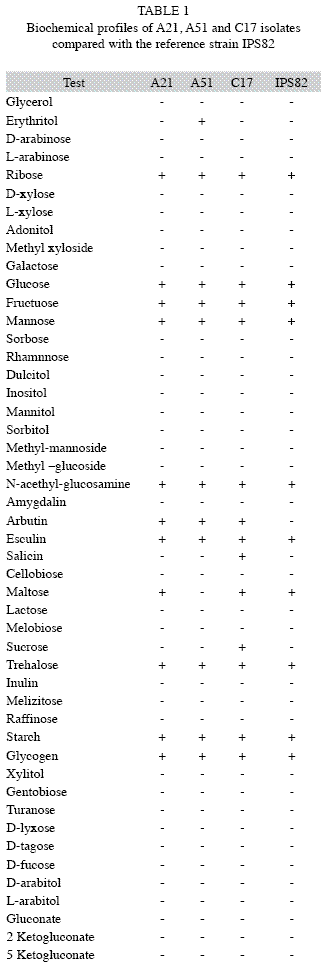
<body><![CDATA[<br>     <br> Each band produced in the RAPD reactions were considered as an individual character (present or absent).    <br>     <br> The results of API identification system 50 CHB and RAPD analysis were transformed into binary matrixes (1/0) and evaluated with the bioinformatic program Multivariate statistic package (MVSP 3.1) (Kovach company services, UK). Profile analysis was performed based on the calculation of the matching similarity coefficient (Jaccard coefficient), used to establish the similarity matrix. This matrix was transformed into a phenogram using the unweighted pair group method (UPGMA).    <br>     <br> <font size="3"><span style="font-weight: bold;">Results</span></font>    <br>     <br> Biochemical and morphological characterization: The three isolates were Gram positive rods, lecithinase positive, showed haemolytic activity&nbsp; in blood agar and produced spores in oval way. Biochemical test results of A21, A51, C17 isolates and the reference strain IPS 82 are shown in <a href="#t1">Table 1</a>. Based on the biochemical characteristics, the A21, A51 and C17 isolates had compatible patterns with <span style="font-style: italic;">Bacillus cereus</span>. Morphological&nbsp; observation under phase-contrast microscopy showed a single ovoid parasporal crystal, so the three strains were identified as <span style="font-style: italic;">B. thuringiensis</span>.&nbsp; A21, A51 and C17 isolates showed a similarity coefficient to 0.90, 0.83 and 0.76, respectively, in relation to the reference strain.    <br>     <br>     ]]></body>
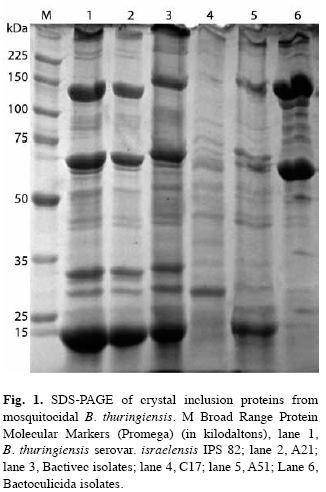
<body><![CDATA[<br> </font>     <div style="text-align: center;"><font size="2"><a name="t1"></a><img  alt="" src="/img/revistas/rbt/v59n3/a04t1.gif"  style="width: 326px; height: 964px;"></font>    <br> </div> <font size="2">    <br>     <br> <span style="font-weight: bold;">Bioassays:</span> Summary of data obtained from the series of bioassays using a WHO protocol (WHO 1999) is shown in <a  href="/img/revistas/rbt/v59n3/a04t2.gif">Table 2</a>. All the native isolates showed a better CL50 against both <span  style="font-style: italic;">A. aegypti</span> and <span  style="font-style: italic;">C. quinquefasciatus</span> than reference strain (Bactivec).    <br>     <br> <span style="font-weight: bold;">SDS-PAGE analysis:</span> The SDS-PAGE of spore-crystal suspensions of selected isolates is shown in <a href="#fig1">Fig. 1</a>. Each isolates produced a characteristic band pattern easily identified by the position of the major protein bands. The patterns were reproducible for the replicates of the strains in&nbsp; different gels. A21 had a protein profile similar to that reported for IPS82 (Ibarra <span  style="font-style: italic;">et al</span>. 2003) and Bactivec strain, with major proteins of 137, 70,&nbsp; 30, 28 and 18kDa. In the parasporal inclusions of A51 isolates a number of polypeptides with molecular masses of 18-137kDa were observed. C17 had different protein bands of 100, 85, 75, 52, 26 and 18kDa, with a major band to 26kDa. The electrophoretic gel patterns of A51 and C17 isolates were different to IPS82, Bactivec and Bactoculicida strains.    <br>     <br>     <br> </font>     ]]></body>
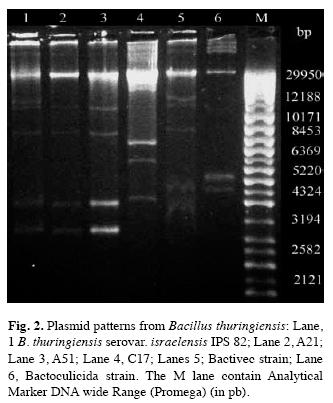
<body><![CDATA[<div style="text-align: center;"><font size="2"><a name="fig1"></a><img  alt="" src="/img/revistas/rbt/v59n3/a04i1.jpg"  style="width: 326px; height: 492px;"></font>    <br> </div> <font size="2">    <br> <span style="font-weight: bold;">Plasmid profile:</span> <a  href="#fig2">Fig. 2 </a>show the plasmid profile of all <span style="font-style: italic;">B. thuringiensis</span> strains included in this report. All strains had more than one plasmid. Megaplasmids were observed over chromosomal DNA. However, their poor migration into agarose gel made difficult the discrimination. But the plasmid migrating under chromosomal DNA allows us the comparison between the strains. A21 and A51 showed the same plasmid patterns to IPS82,&nbsp; but different to Bactivec and Bactoculicida strains. Moreover, C17 had a distinctive plasmid pattern.    <br>     <br>     <br> </font>     <div style="text-align: center;"><font size="2"><a name="fig2"></a><img  alt="" src="/img/revistas/rbt/v59n3/a04i2.jpg"  style="width: 333px; height: 403px;"></font>    <br> </div> <font size="2"><br style="font-weight: bold;"> <span style="font-weight: bold;">RAPD analysis:</span> The used of OPA primers produced a range of 2 to 11 bands, allowing to conform at least four different groups per primer. RAPD reactions with OPA 8 and OPA 12 primers yielded characteristic products of 4-6 bands ranging from 180 to 1800pb. In both cases, four different patterns were observed. Besides with OPA 10, 11, 14, 15, 16 and 17 primers five RAPD patterns were found. In contrast, OPA 18 primers exhibited six different patterns (<a  href="/img/revistas/rbt/v59n3/a04i3.jpg">Fig. 3</a>). In general, the OPA 8, 11, 12, 16, 17 and 18 primers showed a better discriminatory power (<a href="/img/revistas/rbt/v59n3/a04i3.jpg">Fig. 3</a>).    <br>     <br> A21 and A51 isolates showed the same electrophoretic patterns of IPS82 strain with OPA 8 and OPA 12 primers, but C17 isolate revealed a genetic distance of 0.22 with OPA 8 and 0.042 with OPA 12. On the other hand, A21 isolate and IPS82 showed identical RAPD pattern with the primers OPA 11 and 17, but A51 isolate varied the genetic distance from 0.90 (with OPA 11 primer) to 0.536 (with OPA 17 primer). The C17 isolate stayed distant of the control with the former primers (0.13 with OPA 11 and 0.35 with OPA 17). The obtained results with remain primers (OPA 10, 14, 15,&nbsp; 16 and 18) showed that A21 and A51 isolates increased the genetic distance in relation to the control. However, C17 isolate maintained a larger&nbsp; distance from them. With all used primers the three isolates were genetically distant from the biolarvicides Bactivec and Bactoculicida.    ]]></body>
<body><![CDATA[<br>     <br> The complete RAPD patterns were used to create the first dendrogram, where A21 and A51 isolates showed a similarity of 0.76 and 0.73 with the control strain. C17 isolate had genetic differences with the other isolates (Data no shown).    <br>     <br> The second dendrogram was built based on fragments generated by OPA 8, 11, 12, 16, 17 and 18 primers and suggested that A21 isolate is closer than IPS82. A51 isolate and IPS82 strain showed a 0.74 of similarity. On the contrary, C17 isolate results emphasize its dissimilarity with the other isolates and strains (<a  href="/img/revistas/rbt/v59n3/a04i4.jpg">Fig. 4</a>).    <br>     <br> </font><font size="3"><span style="font-weight: bold;">Discussion</span><br  style="font-weight: bold;"> </font><font size="2">    <br> The characterization of microorganisms is essential for microbial ecology studies. Classification, identification and differentiation of microbes have traditionally relied on test based on phenotypic characteristics (Porcar <span style="font-style: italic;">et al</span>. 1999). The phenotypic methods used for classifying <span style="font-style: italic;">B. thuringiensis</span>, H-serotyping and biochemical characters, have both contributed to the establishment of an useful classification (Iriarte<span style="font-style: italic;"> et al</span>. 2000, Khyami-Horani <span style="font-style: italic;">et al</span>. 2003).    <br>     <br> Here we report the identification and characterization of three Cuban <span style="font-style: italic;">Bacillus</span> isolates with larvicidal activity against <span style="font-style: italic;">A. aegypti</span> and <span style="font-style: italic;">C. quinquefasciatus</span>. There are previous studies in Cuba about native <span style="font-style: italic;">Bacillus</span> isolates, but focused on agricultural pest management (Carreras &amp; Piedra 2009).    <br>     ]]></body>
<body><![CDATA[<br> We have demonstrated that A21, A51 and C17 isolates share most of the phenotypic features of <span style="font-style: italic;">B. thuringiensis</span> strains previously classified (Lecadet <span style="font-style: italic;">et al</span>. 1999, Porcar <span  style="font-style: italic;">et al</span>. 1999, Iriarte <span  style="font-style: italic;">et al</span>. 2000). The numerical analysis of biochemical patterns showed that A21 and A51 were closer related to reference strain than C17. The biochemical pattern compatible with <span style="font-style: italic;">B. cereus</span> (by API 50 CH) and the presence of ovoid parasporal inclusion, allow us to classify the isolates as <span style="font-style: italic;">B. thuringiensis</span>. However, there are not enough evidences for differentiation of these isolates by these methods.    <br>     <br> In the biological assays, the isolates showed more efficacies against <span style="font-style: italic;">A. aegypti</span> and <span  style="font-style: italic;">C. quinquefasciatus</span> than the <span  style="font-style: italic;">B. thuringiensis</span> strain currently used in a program of mosquito control in Cuba (biolarvicide Bactivec) (<a href="/img/revistas/rbt/v59n3/a04t2.gif">Table 2</a>). A51 isolate had a better entomopathogenic activity of all strains. Interestingly, C17 had poor activity against <span style="font-style: italic;">A. aegypti</span>; the LC50 against <span style="font-style: italic;">C. quinquefasciatus</span> was eleven times higher than against<span style="font-style: italic;"> A. aegypti</span>.    <br>     <br> These data are in agreement with the expected protein composition observed in the SDS-PAGE analyses. A21 isolate showed a high similarity with the control strain IPS82 and Bactivec, by mean of mosquitocidal protein profile. This isolate showed proteins common in <span style="font-style: italic;">B. thuringiensis</span> serovar <span style="font-style: italic;">israelensis</span> strains (Porcar <span  style="font-style: italic;">et al</span>. 1999, Ibarra <span style="font-style: italic;">et al</span>. 2003, Sreshty <span  style="font-style: italic;">et al</span>. 2010).    <br>     <br> Analysis by protein profile of A51 revealed the presence of polypeptides with molecular masses of 18 to 137kDa. The 28kDa polypeptide is produced in low levels poorly visualized in SDS-PAGE compared with the control IPS82 and Bactivec. The proteins from C17 were different from A51 and A21; three of them (100, 75 and 26kDa) have been described as active against mosquitoes (Ibarra <span  style="font-style: italic;">et al</span>. 2003).    <br>     <br> The C17 isolate also had singular plasmid profile. On the other hand, the size of the plasmidic bands of A21 and A51 isolates were in the range described for other <span style="font-style: italic;">B. thuringiensis</span> serovar<span style="font-style: italic;"> israelensis </span>strains previously analyzed (Gonz&aacute;lez &amp; Carlton 1980, Porcar <span style="font-style: italic;">et al</span>. 1999, Reyes-Ramirez &amp; Ibarra 2008).    <br>     ]]></body>
<body><![CDATA[<br> Molecular methods have emerged as the most rapid reliable and simple alternatives to characterize and differentiate microorganisms (Rademarker <span style="font-style: italic;">et al</span>. 2005).    <br>     <br> Genotyping of bacteria using PCR based methods, such as RAPD analysis is a commonly used approach for strain typing because it is economic,&nbsp; fast and simple (Malkawi<span  style="font-style: italic;"> et al</span>. 1999, Romero &amp; Orduz 2002, Rivera &amp; Priest 2003, Vilas-B&ocirc;as &amp; Lemos 2004, Arango <span style="font-style: italic;">et al</span>. 2002). These methods&nbsp; also allow distinguishing isolates from commercial strains of <span  style="font-style: italic;">B. thuringiensis</span> (Brousseau <span style="font-style: italic;">et al</span>. 1993, Fredireksen <span style="font-style: italic;">et al</span>. 2006).    <br>     <br> The combination of classical and molecular methods helps us to group the isolates and give more details than a single classification method. The bioinformatic analysis of the RAPD fingerprints using the most discriminatory primers helped to differentiate the native isolates from the used&nbsp; control strains.    <br>     <br> We found that A21 was closer related to IPS82 strain than A51 and C17 isolates. Interestingly, the most genetically related isolates (A21 and A51) were obtained from distant geographical regions of Cuban archipelago (617km). Both, Santiago de Cuba and Canarreos archipelago have similar weather conditions and share most of the mosquito&#8217;s species, including <span style="font-style: italic;">C. quinquefasciatus</span> (Gonz&aacute;lez 2006).    <br>     <br> In contrast, C17 and A51 were isolated from close geographical keys of the same archipelago (separated by 4.4km) but showed great phenotypic and genetic differences. Although these small keys had been treated for years with <span style="font-style: italic;">B. thuringiensis</span> for larvicide, it was demonstrated that all isolates were different from the commercial strains present in the microbial larvicides used in Cuba.    <br>     ]]></body>
<body><![CDATA[<br> In conclusion, the new isolates showed a strong activity against <span  style="font-style: italic;">A. aegypti</span> and <span style="font-style: italic;">C. quinquefasciatus</span>. Due to their distinctive characteristics C17 and A51 isolates are great candidates for the development of new larvicide formulations. The isolation of native strains with activity against pests, gives us new tools to be introduced into the mosquito management program. This will decrease the disturbance of ecosystem balance through&nbsp; reducing the release of chemical pesticides or other exogenous biological products.    <br>     <br> <font size="3"><span style="font-weight: bold;"></span></font></font> <hr style="width: 100%; height: 2px;"><font size="2"><font size="3"><span  style="font-weight: bold;">References</span></font>    <br>     <!-- ref --><br> Arango, J.A., M. Romero &amp; S. Orduz. 2002. Diversity of <span  style="font-style: italic;">Bacillus thuringiensis</span> strains from Colombia with insecticidal activity against <span style="font-style: italic;">Spodoptera frugiperda</span> (Lepidoptera: Noctuidae). J. Appl. Microbiol. 92: 466-474.    &nbsp;&nbsp;&nbsp;&nbsp;&nbsp;&nbsp;&nbsp;&nbsp;[&#160;<a href="javascript:void(0);" onclick="javascript: window.open('/scielo.php?script=sci_nlinks&ref=1731993&pid=S0034-7744201100030000400001&lng=','','width=640,height=500,resizable=yes,scrollbars=1,menubar=yes,');">Links</a>&#160;]<!-- end-ref --><br>     <!-- ref --><br> Ben-Dov, E., A. Zaritsky, E. Dahan, Z. Barak, R. Sinai, R. Manasherob, A. Khamraev, E. Troistskaya, A. Dubitsky, N. Berezina &amp; Y. Margalith. 1997. Extended screening by PCR for seven Cry-group genes from field-collected strains of <span style="font-style: italic;">Bacillus thuringiensis</span>. Appl. Environ. Microbiol. 63: 4883-4890.    &nbsp;&nbsp;&nbsp;&nbsp;&nbsp;&nbsp;&nbsp;&nbsp;[&#160;<a href="javascript:void(0);" onclick="javascript: window.open('/scielo.php?script=sci_nlinks&ref=1731995&pid=S0034-7744201100030000400002&lng=','','width=640,height=500,resizable=yes,scrollbars=1,menubar=yes,');">Links</a>&#160;]<!-- end-ref --><br>     <!-- ref --><br> Bravo, A., S. Sarabia, L. L&oacute;pez, H. Ontiveros, C. Abarca, A. Ortiz, M. Ortiz, L. Lina, F. Villalobos, G. Pe&ntilde;a, M. Nu&ntilde;ez-Valdez, M. Soberon &amp; R. Quintero. 1998. Characterization of cry genes in Mexican <span  style="font-style: italic;">B. thuringiensis</span> strain collection. Appl. Environ. Microbiol. 64: 4965-4972.    &nbsp;&nbsp;&nbsp;&nbsp;&nbsp;&nbsp;&nbsp;&nbsp;[&#160;<a href="javascript:void(0);" onclick="javascript: window.open('/scielo.php?script=sci_nlinks&ref=1731997&pid=S0034-7744201100030000400003&lng=','','width=640,height=500,resizable=yes,scrollbars=1,menubar=yes,');">Links</a>&#160;]<!-- end-ref --><br>     ]]></body>
<body><![CDATA[<!-- ref --><br> Brousseau, R., A. Saint-Onge, G. Pr&eacute;fontaine, L. Masson &amp; J. Cabana. 1993. Arbitrary primer polymerase chain reaction a powerful method to&nbsp; identify <span style="font-style: italic;">Bacillus thuringiensis </span>serovars and strains. Appl. Environ. Microbiol. 59: 114-119.    &nbsp;&nbsp;&nbsp;&nbsp;&nbsp;&nbsp;&nbsp;&nbsp;[&#160;<a href="javascript:void(0);" onclick="javascript: window.open('/scielo.php?script=sci_nlinks&ref=1731999&pid=S0034-7744201100030000400004&lng=','','width=640,height=500,resizable=yes,scrollbars=1,menubar=yes,');">Links</a>&#160;]<!-- end-ref --><br>     <!-- ref --><br> Carreras, B., D. Rodr&iacute;guez &amp; F. Piedra. 2009. Evaluaci&oacute;n de cepas nativas de <span style="font-style: italic;">Bacillus thuringiensis</span> Berliner para el control de <span style="font-style: italic;">Heliothis virescens</span> Fabricius en el cultivo del tabaco en Cuba. Fitosanidad 13: 277-280.    &nbsp;&nbsp;&nbsp;&nbsp;&nbsp;&nbsp;&nbsp;&nbsp;[&#160;<a href="javascript:void(0);" onclick="javascript: window.open('/scielo.php?script=sci_nlinks&ref=1732001&pid=S0034-7744201100030000400005&lng=','','width=640,height=500,resizable=yes,scrollbars=1,menubar=yes,');">Links</a>&#160;]<!-- end-ref --><br>     <!-- ref --><br> Chaves, J.Q., C.F. Cavados &amp; L. Rabinovitch. 2008. Phenotypic and genotypic features of a new autoagglutinating <span  style="font-style: italic;">B. thuringiensis</span> strains. J. Invert. Pathol. 98: 85-92.    &nbsp;&nbsp;&nbsp;&nbsp;&nbsp;&nbsp;&nbsp;&nbsp;[&#160;<a href="javascript:void(0);" onclick="javascript: window.open('/scielo.php?script=sci_nlinks&ref=1732003&pid=S0034-7744201100030000400006&lng=','','width=640,height=500,resizable=yes,scrollbars=1,menubar=yes,');">Links</a>&#160;]<!-- end-ref --><br> &nbsp;    <!-- ref --><br> Frederiksen, K., H. Rosenquist, K. Jorgensen &amp; A. Wilcks. 2006. Occurrence of natural <span style="font-style: italic;">Bacillus thuringiensis</span> contaminants and residues of <span style="font-style: italic;">Bacillus thuringiensisbased </span>insecticides on fresh fruits and vegetables. Appl. Environ. Microbiol. 72: 3435-3440.    &nbsp;&nbsp;&nbsp;&nbsp;&nbsp;&nbsp;&nbsp;&nbsp;[&#160;<a href="javascript:void(0);" onclick="javascript: window.open('/scielo.php?script=sci_nlinks&ref=1732005&pid=S0034-7744201100030000400007&lng=','','width=640,height=500,resizable=yes,scrollbars=1,menubar=yes,');">Links</a>&#160;]<!-- end-ref --><br>     <!-- ref --><br> Gonz&aacute;lez, I. &amp; A. Carlton. 1980. Patterns of plasmid DNA in crystalliferous and acrystalliferous strains of<span  style="font-style: italic;"> B. thuringiensis.</span> Plasmid 3: 92-98.    &nbsp;&nbsp;&nbsp;&nbsp;&nbsp;&nbsp;&nbsp;&nbsp;[&#160;<a href="javascript:void(0);" onclick="javascript: window.open('/scielo.php?script=sci_nlinks&ref=1732007&pid=S0034-7744201100030000400008&lng=','','width=640,height=500,resizable=yes,scrollbars=1,menubar=yes,');">Links</a>&#160;]<!-- end-ref --><br>     ]]></body>
<body><![CDATA[<!-- ref --><br> Gonz&aacute;lez, R. 2006. Cul&iacute;cidos de Cuba. Editorial Cient&iacute;fico T&eacute;cnica. La Habana, Cuba.    &nbsp;&nbsp;&nbsp;&nbsp;&nbsp;&nbsp;&nbsp;&nbsp;[&#160;<a href="javascript:void(0);" onclick="javascript: window.open('/scielo.php?script=sci_nlinks&ref=1732009&pid=S0034-7744201100030000400009&lng=','','width=640,height=500,resizable=yes,scrollbars=1,menubar=yes,');">Links</a>&#160;]<!-- end-ref --><br>     <!-- ref --><br> Ibarra, J.E., M.C. del Rinc&oacute;n, S. Ord&uacute;z, D. Noriega, G. Benintende, R. Monnerat, L. Regis, C.M.F. de Oliveira, H. Lanz, M.H. Rodriguez, J. S&aacute;nchez, G. Pe&ntilde;a &amp; A. Bravo. 2003. Diversity of <span style="font-style: italic;">Bacillus thuringiensis </span>strains from Latin America with insecticidal activity against different mosquito species. Appl. Environ. Microbiol. 69: 5269-5274.    &nbsp;&nbsp;&nbsp;&nbsp;&nbsp;&nbsp;&nbsp;&nbsp;[&#160;<a href="javascript:void(0);" onclick="javascript: window.open('/scielo.php?script=sci_nlinks&ref=1732011&pid=S0034-7744201100030000400010&lng=','','width=640,height=500,resizable=yes,scrollbars=1,menubar=yes,');">Links</a>&#160;]<!-- end-ref --><br>     <!-- ref --><br> Iriarte, J., V.C. Dumanoir, Y. Bel, M. Porcar, M.D. Ferrandis, M.M. Lecadet, J. Ferre &amp; P. Caballero. 2000. Characterization of <span style="font-style: italic;">Bacillus thuringiensis</span> ser.<span style="font-style: italic;"> balearica</span> (Serotype H48) and ser. navarrensis (Serotype H50): two novel serovars isolated in Spain. Curr. Microbiol. 40: 17-22.    &nbsp;&nbsp;&nbsp;&nbsp;&nbsp;&nbsp;&nbsp;&nbsp;[&#160;<a href="javascript:void(0);" onclick="javascript: window.open('/scielo.php?script=sci_nlinks&ref=1732013&pid=S0034-7744201100030000400011&lng=','','width=640,height=500,resizable=yes,scrollbars=1,menubar=yes,');">Links</a>&#160;]<!-- end-ref --><br>     <!-- ref --><br> Khyami-Horani, H., M. Hajaij &amp; C. Jean-Francois. 2003. Characterization of<span style="font-style: italic;"> Bacillus thuringiensis</span> ser. Jordanica (Serotype H71), a novel serovariety isolated in Jordan. Curr. Microbiol. 47: 26-31.    &nbsp;&nbsp;&nbsp;&nbsp;&nbsp;&nbsp;&nbsp;&nbsp;[&#160;<a href="javascript:void(0);" onclick="javascript: window.open('/scielo.php?script=sci_nlinks&ref=1732015&pid=S0034-7744201100030000400012&lng=','','width=640,height=500,resizable=yes,scrollbars=1,menubar=yes,');">Links</a>&#160;]<!-- end-ref --><br>     <!-- ref --><br> Laemmli, U.K. &amp; M. Favre. 1973. Maturation of the head of bacteriophage T4. I. DNA packaging events. J. Mol. Biol. 80: 575-599.    &nbsp;&nbsp;&nbsp;&nbsp;&nbsp;&nbsp;&nbsp;&nbsp;[&#160;<a href="javascript:void(0);" onclick="javascript: window.open('/scielo.php?script=sci_nlinks&ref=1732017&pid=S0034-7744201100030000400013&lng=','','width=640,height=500,resizable=yes,scrollbars=1,menubar=yes,');">Links</a>&#160;]<!-- end-ref --><br>     ]]></body>
<body><![CDATA[<!-- ref --><br> Lecadet, M.M., E. Frachon, V. Cosmao, H. Ripouteau, S. Hamon, P. Laurent &amp; I. Thi&eacute;ry. 1999. Updating the H-antigen classification of <span style="font-style: italic;">Bacillus thuringiensis</span>. J. Appl. Microbiol. 86: 660-672.    &nbsp;&nbsp;&nbsp;&nbsp;&nbsp;&nbsp;&nbsp;&nbsp;[&#160;<a href="javascript:void(0);" onclick="javascript: window.open('/scielo.php?script=sci_nlinks&ref=1732019&pid=S0034-7744201100030000400014&lng=','','width=640,height=500,resizable=yes,scrollbars=1,menubar=yes,');">Links</a>&#160;]<!-- end-ref --><br>     <!-- ref --><br> Lima, A.S.G., A.M. Guidelli, I.L. Abreu &amp; M.V.F. Lemos. 2002. Identification of new isolates of Bacillus thuringiensis using rep-PCR products and &#948;-endotoxine electron microscopy. Gen. Mol. Biol. 25: 225-229.    &nbsp;&nbsp;&nbsp;&nbsp;&nbsp;&nbsp;&nbsp;&nbsp;[&#160;<a href="javascript:void(0);" onclick="javascript: window.open('/scielo.php?script=sci_nlinks&ref=1732021&pid=S0034-7744201100030000400015&lng=','','width=640,height=500,resizable=yes,scrollbars=1,menubar=yes,');">Links</a>&#160;]<!-- end-ref --><br>     <!-- ref --><br> Malkawi, H.I., F. Al-Momani, M.M. Meqdom, I. Saadoun &amp; M.J. Mohammad. 1999. Detection of genetic polymorphism by RAPD-PCR among isolates of <span style="font-style: italic;">B. thuringiensis</span>. New Microbiol. 22: 241-247.    &nbsp;&nbsp;&nbsp;&nbsp;&nbsp;&nbsp;&nbsp;&nbsp;[&#160;<a href="javascript:void(0);" onclick="javascript: window.open('/scielo.php?script=sci_nlinks&ref=1732023&pid=S0034-7744201100030000400016&lng=','','width=640,height=500,resizable=yes,scrollbars=1,menubar=yes,');">Links</a>&#160;]<!-- end-ref --><br>     <!-- ref --><br> Nunes, L.M. &amp; L.M. Fiuza. 2003. PCR and bioassays secreening of <span style="font-style: italic;">Bacillus thuringiensis</span> isolates from rice-fields of Rio Grande Do Sul, specific to lepidopterans and coleopterans. Braz. J. Microbiol. 34: 305-310.    &nbsp;&nbsp;&nbsp;&nbsp;&nbsp;&nbsp;&nbsp;&nbsp;[&#160;<a href="javascript:void(0);" onclick="javascript: window.open('/scielo.php?script=sci_nlinks&ref=1732025&pid=S0034-7744201100030000400017&lng=','','width=640,height=500,resizable=yes,scrollbars=1,menubar=yes,');">Links</a>&#160;]<!-- end-ref --><br>     <!-- ref --><br> Porcar, M., J. Iriarte, V. Cosmao, M.D. Ferrandis, M.M Lecadet, J. Ferr&eacute; &amp; P. Caballero. 1999. Identification and characterization of the new <span style="font-style: italic;">B. thuringiensis</span> serovars <span style="font-style: italic;">pirenaica</span> (serotype H57) and <span style="font-style: italic;">iberica</span> (serotype H59). J. Appl. Microbiol. 87: 640-648.    &nbsp;&nbsp;&nbsp;&nbsp;&nbsp;&nbsp;&nbsp;&nbsp;[&#160;<a href="javascript:void(0);" onclick="javascript: window.open('/scielo.php?script=sci_nlinks&ref=1732027&pid=S0034-7744201100030000400018&lng=','','width=640,height=500,resizable=yes,scrollbars=1,menubar=yes,');">Links</a>&#160;]<!-- end-ref --><br>     ]]></body>
<body><![CDATA[<!-- ref --><br> Rademarker, J.L., J.M. Aarts &amp; P. Vinuesa. 2005. Molecular typing of environmental isolates, p. 97-126. <span style="font-style: italic;">In</span> O. Mark &amp; C. Smith (eds.). Molecular Microbiol Ecology. New York, New York, USA.    &nbsp;&nbsp;&nbsp;&nbsp;&nbsp;&nbsp;&nbsp;&nbsp;[&#160;<a href="javascript:void(0);" onclick="javascript: window.open('/scielo.php?script=sci_nlinks&ref=1732029&pid=S0034-7744201100030000400019&lng=','','width=640,height=500,resizable=yes,scrollbars=1,menubar=yes,');">Links</a>&#160;]<!-- end-ref --><br>     <!-- ref --><br> Reyes-Ramires, A. &amp; J.E. Ibarra. 2005. Fingerprinting of <span  style="font-style: italic;">Bacillus thuringiensis</span> type strains and isolates by using <span  style="font-style: italic;">Bacillus cereus</span> group-specific repetitive extragenic palindromic sequence-based PCR analysis. Appl. Environ. Microbiol. 71: 1346-55.    &nbsp;&nbsp;&nbsp;&nbsp;&nbsp;&nbsp;&nbsp;&nbsp;[&#160;<a href="javascript:void(0);" onclick="javascript: window.open('/scielo.php?script=sci_nlinks&ref=1732031&pid=S0034-7744201100030000400020&lng=','','width=640,height=500,resizable=yes,scrollbars=1,menubar=yes,');">Links</a>&#160;]<!-- end-ref --><br>     <br> <span style="font-family: verdana;"></span></font>     <!-- ref --><p><font size="2">Reyes-Ram&iacute;rez, A. &amp; J.E. Ibarra. 2008. Plasmid patterns of B. <span  style="font-style: italic;">thuringiensis</span> type atrains. Appl. Environ. Microbiol. 74: 125-129.    &nbsp;&nbsp;&nbsp;&nbsp;&nbsp;&nbsp;&nbsp;&nbsp;[&#160;<a href="javascript:void(0);" onclick="javascript: window.open('/scielo.php?script=sci_nlinks&ref=1732034&pid=S0034-7744201100030000400021&lng=','','width=640,height=500,resizable=yes,scrollbars=1,menubar=yes,');">Links</a>&#160;]<!-- end-ref --></font></p> <span style="font-family: verdana;"><font size="2"> </font></span><span  style="font-family: verdana;"></span><font size="2">    <!-- ref --><br> Rivera, A.M. &amp; F.G. Priest. 2003. Molecular typing of <span  style="font-style: italic;">B. thuringiensis</span> serovars by RAPD-PCR. Syst. Appl. Microbiol. 26: 254-261.    &nbsp;&nbsp;&nbsp;&nbsp;&nbsp;&nbsp;&nbsp;&nbsp;[&#160;<a href="javascript:void(0);" onclick="javascript: window.open('/scielo.php?script=sci_nlinks&ref=1732036&pid=S0034-7744201100030000400022&lng=','','width=640,height=500,resizable=yes,scrollbars=1,menubar=yes,');">Links</a>&#160;]<!-- end-ref --><br>     <!-- ref --><br> Sreshty, M.A., S. Misra &amp; U.S. Murty. 2010. Interpreting the SDS-PAGE protein patterns with self-organizing maps: application for the characterization of mosquito- pathogenic <span  style="font-style: italic;">Bacillus</span> strains. J. Appl. Microbiol. 110: 239-247.    &nbsp;&nbsp;&nbsp;&nbsp;&nbsp;&nbsp;&nbsp;&nbsp;[&#160;<a href="javascript:void(0);" onclick="javascript: window.open('/scielo.php?script=sci_nlinks&ref=1732038&pid=S0034-7744201100030000400023&lng=','','width=640,height=500,resizable=yes,scrollbars=1,menubar=yes,');">Links</a>&#160;]<!-- end-ref --><br>     <!-- ref --><br> World Health Organization. 2009. Dengue: guidelines for diagnosis, treatment, prevention and control. WHO. (Accessed: 9 November 2010, whqlibdoc.who.int/publications/2009/9789241547871_eng.pdf.    &nbsp;&nbsp;&nbsp;&nbsp;&nbsp;&nbsp;&nbsp;&nbsp;[&#160;<a href="javascript:void(0);" onclick="javascript: window.open('/scielo.php?script=sci_nlinks&ref=1732040&pid=S0034-7744201100030000400024&lng=','','width=640,height=500,resizable=yes,scrollbars=1,menubar=yes,');">Links</a>&#160;]<!-- end-ref -->)    <br>     <!-- ref --><br> World Health Organization. 2009. Dengue: guidelines for diagnosis, treatment, prevention and control. WHO. (Accessed: 9 November 2010, whqlibdoc.who.int/publications/2009/9789241547871_eng.pdf)    &nbsp;&nbsp;&nbsp;&nbsp;&nbsp;&nbsp;&nbsp;&nbsp;[&#160;<a href="javascript:void(0);" onclick="javascript: window.open('/scielo.php?script=sci_nlinks&ref=1732043&pid=S0034-7744201100030000400025&lng=','','width=640,height=500,resizable=yes,scrollbars=1,menubar=yes,');">Links</a>&#160;]<!-- end-ref --><br>     <!-- ref --><br> Vilas-B&ocirc;as, G. &amp; M. Lemos. 2004. Diversity of cry genes and genetic characterization of <span style="font-style: italic;">Bacillus thuringiensis</span> isolated from Brazil. Can. J. Microbiol. 50: 605-613.    &nbsp;&nbsp;&nbsp;&nbsp;&nbsp;&nbsp;&nbsp;&nbsp;[&#160;<a href="javascript:void(0);" onclick="javascript: window.open('/scielo.php?script=sci_nlinks&ref=1732045&pid=S0034-7744201100030000400026&lng=','','width=640,height=500,resizable=yes,scrollbars=1,menubar=yes,');">Links</a>&#160;]<!-- end-ref --><br>     <br> <a name="correspondencia"></a>Correspondencia a: </font><font size="2">Aileen Gonz&aacute;lez, </font><font size="2">Manuel D&iacute;az, </font><font  size="2">Rosa Y. Bruz&oacute;n &amp; Ren&eacute; Gato. </font><font size="2">Department of Vector Control. Institute of Tropical Medicine &#8220;Pedro Kour&iacute;&#8221;, Havana, Cuba. PO Box 601, Marianao 13, Ciudad de La Habana, Cuba; <a href="mailto:aileen@ipk.sld.cu">aileen@ipk.sld.cu</a>, <a href="mailto:mdiazp@ipk.sld.cu">mdiazp@ipk.sld.cu</a>, <a  href="mailto:yirian@ipk.sld.cu">yirian@ipk.sld.cu</a>, <a href="mailto:rene@ipk.sld.cu">rene@ipk.sld.cu</a>    <br> </font><font size="2">Ra&uacute;l D&iacute;az. </font><font size="2">Department of Bacteriology-Mycology. Institute of Tropical Medicine &#8220;Pedro Kour&iacute;&#8221;, Havana, Cuba. PO Box 601, Marianao 13, Ciudad de La Habana, Cuba; <a href="mailto:raul.diaz@ipk.sld.cu">raul.diaz@ipk.sld.cu</a>    ]]></body>
<body><![CDATA[<br> </font><font size="2">Yainais Borrero. </font><font size="2">Department of Diagnostic Laboratory. Institute of Tropical Medicine &#8220;Pedro Kour&iacute;&#8221;, Havana, Cuba. PO Box 601, Marianao 13, Ciudad de La Habana, Cuba; <a href="mailto:yaini@ipk.sld.cu">yaini@ipk.sld.cu</a>    <br> </font><font size="2">Bertha Carreras. </font><font size="2">INISAV Research Institute of Plant Protection. Havana, Cuba; <a href="mailto:bcarreras@inisav.cu">bcarreras@inisav.cu</a></font><font  size="2">    <br> </font>     <div style="text-align: center;"> <hr style="width: 100%; height: 2px;"><font size="2">Received 17-VIII-2010. Corrected 04-I-2011. Accepted 27-I-2011.</font>    <br> </div> </div>      ]]></body><back>
<ref-list>
<ref id="B1">
<nlm-citation citation-type="journal">
<person-group person-group-type="author">
<name>
<surname><![CDATA[Arango]]></surname>
<given-names><![CDATA[J.A]]></given-names>
</name>
<name>
<surname><![CDATA[Romero]]></surname>
<given-names><![CDATA[M]]></given-names>
</name>
<name>
<surname><![CDATA[Orduz]]></surname>
<given-names><![CDATA[S]]></given-names>
</name>
</person-group>
<article-title xml:lang="en"><![CDATA[Diversity of Bacillus thuringiensis strains from Colombia with insecticidal activity against Spodoptera frugiperda (Lepidoptera: Noctuidae)]]></article-title>
<source><![CDATA[J. Appl. Microbiol]]></source>
<year>2002</year>
<volume>92</volume>
<page-range>466-474</page-range></nlm-citation>
</ref>
<ref id="B2">
<nlm-citation citation-type="journal">
<person-group person-group-type="author">
<name>
<surname><![CDATA[Ben-Dov]]></surname>
<given-names><![CDATA[E]]></given-names>
</name>
<name>
<surname><![CDATA[Zaritsky]]></surname>
<given-names><![CDATA[A]]></given-names>
</name>
<name>
<surname><![CDATA[Dahan]]></surname>
<given-names><![CDATA[E]]></given-names>
</name>
<name>
<surname><![CDATA[Barak]]></surname>
<given-names><![CDATA[Z]]></given-names>
</name>
<name>
<surname><![CDATA[Sinai]]></surname>
<given-names><![CDATA[R]]></given-names>
</name>
<name>
<surname><![CDATA[Manasherob]]></surname>
<given-names><![CDATA[R]]></given-names>
</name>
<name>
<surname><![CDATA[Khamraev]]></surname>
<given-names><![CDATA[A]]></given-names>
</name>
<name>
<surname><![CDATA[Troistskaya]]></surname>
<given-names><![CDATA[E]]></given-names>
</name>
<name>
<surname><![CDATA[Dubitsky]]></surname>
<given-names><![CDATA[A]]></given-names>
</name>
<name>
<surname><![CDATA[Berezina]]></surname>
<given-names><![CDATA[N]]></given-names>
</name>
<name>
<surname><![CDATA[Margalith]]></surname>
<given-names><![CDATA[Y]]></given-names>
</name>
</person-group>
<article-title xml:lang="en"><![CDATA[Extended screening by PCR for seven Cry-group genes from field-collected strains of Bacillus thuringiensis]]></article-title>
<source><![CDATA[Appl. Environ. Microbiol]]></source>
<year>1997</year>
<volume>63</volume>
<page-range>4883-4890</page-range></nlm-citation>
</ref>
<ref id="B3">
<nlm-citation citation-type="journal">
<person-group person-group-type="author">
<name>
<surname><![CDATA[Bravo]]></surname>
<given-names><![CDATA[A]]></given-names>
</name>
<name>
<surname><![CDATA[Sarabia]]></surname>
<given-names><![CDATA[S]]></given-names>
</name>
<name>
<surname><![CDATA[López]]></surname>
<given-names><![CDATA[L]]></given-names>
</name>
<name>
<surname><![CDATA[Ontiveros]]></surname>
<given-names><![CDATA[H]]></given-names>
</name>
<name>
<surname><![CDATA[Abarca]]></surname>
<given-names><![CDATA[C]]></given-names>
</name>
<name>
<surname><![CDATA[Ortiz]]></surname>
<given-names><![CDATA[A]]></given-names>
</name>
<name>
<surname><![CDATA[Ortiz]]></surname>
<given-names><![CDATA[M]]></given-names>
</name>
<name>
<surname><![CDATA[Lina]]></surname>
<given-names><![CDATA[L]]></given-names>
</name>
<name>
<surname><![CDATA[Villalobos]]></surname>
<given-names><![CDATA[F]]></given-names>
</name>
<name>
<surname><![CDATA[Peña]]></surname>
<given-names><![CDATA[G]]></given-names>
</name>
<name>
<surname><![CDATA[Nuñez-Valdez]]></surname>
<given-names><![CDATA[M]]></given-names>
</name>
<name>
<surname><![CDATA[Soberon]]></surname>
<given-names><![CDATA[M]]></given-names>
</name>
<name>
<surname><![CDATA[Quintero]]></surname>
<given-names><![CDATA[R]]></given-names>
</name>
</person-group>
<article-title xml:lang="en"><![CDATA[Characterization of cry genes in Mexican B. thuringiensis strain collection]]></article-title>
<source><![CDATA[Appl. Environ. Microbiol]]></source>
<year>1998</year>
<volume>64</volume>
<page-range>4965-4972</page-range></nlm-citation>
</ref>
<ref id="B4">
<nlm-citation citation-type="journal">
<person-group person-group-type="author">
<name>
<surname><![CDATA[Brousseau]]></surname>
<given-names><![CDATA[R]]></given-names>
</name>
<name>
<surname><![CDATA[Saint-Onge]]></surname>
<given-names><![CDATA[A]]></given-names>
</name>
<name>
<surname><![CDATA[Préfontaine]]></surname>
<given-names><![CDATA[G]]></given-names>
</name>
<name>
<surname><![CDATA[Masson]]></surname>
<given-names><![CDATA[L]]></given-names>
</name>
<name>
<surname><![CDATA[Cabana]]></surname>
<given-names><![CDATA[J]]></given-names>
</name>
</person-group>
<article-title xml:lang="en"><![CDATA[Arbitrary primer polymerase chain reaction a powerful method to identify Bacillus thuringiensis serovars and strains]]></article-title>
<source><![CDATA[Appl. Environ. Microbiol]]></source>
<year>1993</year>
<volume>59</volume>
<page-range>114-119</page-range></nlm-citation>
</ref>
<ref id="B5">
<nlm-citation citation-type="journal">
<person-group person-group-type="author">
<name>
<surname><![CDATA[Carreras]]></surname>
<given-names><![CDATA[B]]></given-names>
</name>
<name>
<surname><![CDATA[Rodríguez]]></surname>
<given-names><![CDATA[D]]></given-names>
</name>
<name>
<surname><![CDATA[Piedra]]></surname>
<given-names><![CDATA[F]]></given-names>
</name>
</person-group>
<article-title xml:lang="es"><![CDATA[Evaluación de cepas nativas de Bacillus thuringiensis Berliner para el control de Heliothis virescens Fabricius en el cultivo del tabaco en Cuba]]></article-title>
<source><![CDATA[Fitosanidad]]></source>
<year>2009</year>
<volume>13</volume>
<page-range>277-280</page-range></nlm-citation>
</ref>
<ref id="B6">
<nlm-citation citation-type="journal">
<person-group person-group-type="author">
<name>
<surname><![CDATA[Chaves]]></surname>
<given-names><![CDATA[J.Q]]></given-names>
</name>
<name>
<surname><![CDATA[Cavados]]></surname>
<given-names><![CDATA[C.F]]></given-names>
</name>
<name>
<surname><![CDATA[Rabinovitch]]></surname>
<given-names><![CDATA[L]]></given-names>
</name>
</person-group>
<article-title xml:lang="en"><![CDATA[Phenotypic and genotypic features of a new autoagglutinating B. thuringiensis strains]]></article-title>
<source><![CDATA[J. Invert. Pathol]]></source>
<year>2008</year>
<volume>98</volume>
<page-range>85-92</page-range></nlm-citation>
</ref>
<ref id="B7">
<nlm-citation citation-type="journal">
<person-group person-group-type="author">
<name>
<surname><![CDATA[Frederiksen]]></surname>
<given-names><![CDATA[K]]></given-names>
</name>
<name>
<surname><![CDATA[Rosenquist]]></surname>
<given-names><![CDATA[H]]></given-names>
</name>
<name>
<surname><![CDATA[Jorgensen]]></surname>
<given-names><![CDATA[K]]></given-names>
</name>
<name>
<surname><![CDATA[Wilcks]]></surname>
<given-names><![CDATA[A]]></given-names>
</name>
</person-group>
<article-title xml:lang="en"><![CDATA[Occurrence of natural Bacillus thuringiensis contaminants and residues of Bacillus thuringiensisbased insecticides on fresh fruits and vegetables]]></article-title>
<source><![CDATA[Appl. Environ. Microbiol]]></source>
<year>2006</year>
<volume>72</volume>
<page-range>3435-3440</page-range></nlm-citation>
</ref>
<ref id="B8">
<nlm-citation citation-type="journal">
<person-group person-group-type="author">
<name>
<surname><![CDATA[González]]></surname>
<given-names><![CDATA[I]]></given-names>
</name>
<name>
<surname><![CDATA[Carlton]]></surname>
<given-names><![CDATA[A]]></given-names>
</name>
</person-group>
<article-title xml:lang="en"><![CDATA[Patterns of plasmid DNA in crystalliferous and acrystalliferous strains of B. thuringiensis]]></article-title>
<source><![CDATA[Plasmid]]></source>
<year>1980</year>
<volume>3</volume>
<page-range>92-98</page-range></nlm-citation>
</ref>
<ref id="B9">
<nlm-citation citation-type="book">
<person-group person-group-type="author">
<name>
<surname><![CDATA[González]]></surname>
<given-names><![CDATA[R]]></given-names>
</name>
</person-group>
<source><![CDATA[Culícidos de Cuba]]></source>
<year>2006</year>
<publisher-loc><![CDATA[La Habana ]]></publisher-loc>
<publisher-name><![CDATA[Editorial Científico Técnica]]></publisher-name>
</nlm-citation>
</ref>
<ref id="B10">
<nlm-citation citation-type="journal">
<person-group person-group-type="author">
<name>
<surname><![CDATA[Ibarra]]></surname>
<given-names><![CDATA[J.E]]></given-names>
</name>
<name>
<surname><![CDATA[del Rincón]]></surname>
<given-names><![CDATA[M.C]]></given-names>
</name>
<name>
<surname><![CDATA[Ordúz]]></surname>
<given-names><![CDATA[S]]></given-names>
</name>
<name>
<surname><![CDATA[Noriega]]></surname>
<given-names><![CDATA[D]]></given-names>
</name>
<name>
<surname><![CDATA[Benintende]]></surname>
<given-names><![CDATA[G]]></given-names>
</name>
<name>
<surname><![CDATA[Monnerat]]></surname>
<given-names><![CDATA[R]]></given-names>
</name>
<name>
<surname><![CDATA[Regis]]></surname>
<given-names><![CDATA[L]]></given-names>
</name>
<name>
<surname><![CDATA[de Oliveira]]></surname>
<given-names><![CDATA[C.M.F]]></given-names>
</name>
<name>
<surname><![CDATA[Lanz]]></surname>
<given-names><![CDATA[H]]></given-names>
</name>
<name>
<surname><![CDATA[Rodriguez]]></surname>
<given-names><![CDATA[M.H]]></given-names>
</name>
<name>
<surname><![CDATA[Sánchez]]></surname>
<given-names><![CDATA[J]]></given-names>
</name>
<name>
<surname><![CDATA[Peña]]></surname>
<given-names><![CDATA[G]]></given-names>
</name>
<name>
<surname><![CDATA[Bravo]]></surname>
<given-names><![CDATA[A]]></given-names>
</name>
</person-group>
<article-title xml:lang="en"><![CDATA[Diversity of Bacillus thuringiensis strains from Latin America with insecticidal activity against different mosquito species]]></article-title>
<source><![CDATA[Appl. Environ. Microbiol]]></source>
<year>2003</year>
<volume>69</volume>
<page-range>5269-5274</page-range></nlm-citation>
</ref>
<ref id="B11">
<nlm-citation citation-type="journal">
<person-group person-group-type="author">
<name>
<surname><![CDATA[Iriarte]]></surname>
<given-names><![CDATA[J]]></given-names>
</name>
<name>
<surname><![CDATA[Dumanoir]]></surname>
<given-names><![CDATA[V.C.]]></given-names>
</name>
<name>
<surname><![CDATA[Bel]]></surname>
<given-names><![CDATA[Y]]></given-names>
</name>
<name>
<surname><![CDATA[Porcar]]></surname>
<given-names><![CDATA[M]]></given-names>
</name>
<name>
<surname><![CDATA[Ferrandis]]></surname>
<given-names><![CDATA[M.D]]></given-names>
</name>
<name>
<surname><![CDATA[Lecadet]]></surname>
<given-names><![CDATA[M.M]]></given-names>
</name>
<name>
<surname><![CDATA[Ferre]]></surname>
<given-names><![CDATA[J]]></given-names>
</name>
<name>
<surname><![CDATA[Caballero]]></surname>
<given-names><![CDATA[P]]></given-names>
</name>
</person-group>
<article-title xml:lang="en"><![CDATA[Characterization of Bacillus thuringiensis ser. balearica (Serotype H48) and ser. navarrensis (Serotype H50): two novel serovars isolated in Spain]]></article-title>
<source><![CDATA[Curr. Microbiol]]></source>
<year>2000</year>
<volume>40</volume>
<page-range>17-22</page-range></nlm-citation>
</ref>
<ref id="B12">
<nlm-citation citation-type="journal">
<person-group person-group-type="author">
<name>
<surname><![CDATA[Khyami-Horani]]></surname>
<given-names><![CDATA[H]]></given-names>
</name>
<name>
<surname><![CDATA[Hajaij]]></surname>
<given-names><![CDATA[M]]></given-names>
</name>
<name>
<surname><![CDATA[Jean-Francois]]></surname>
<given-names><![CDATA[C]]></given-names>
</name>
</person-group>
<article-title xml:lang="en"><![CDATA[Characterization of Bacillus thuringiensis ser. Jordanica (Serotype H71), a novel serovariety isolated in Jordan]]></article-title>
<source><![CDATA[Curr. Microbiol]]></source>
<year>2003</year>
<volume>47</volume>
<page-range>26-31</page-range></nlm-citation>
</ref>
<ref id="B13">
<nlm-citation citation-type="journal">
<person-group person-group-type="author">
<name>
<surname><![CDATA[Laemmli]]></surname>
<given-names><![CDATA[U.K]]></given-names>
</name>
<name>
<surname><![CDATA[Favre]]></surname>
<given-names><![CDATA[M]]></given-names>
</name>
</person-group>
<article-title xml:lang="en"><![CDATA[Maturation of the head of bacteriophage T4. I. DNA packaging events]]></article-title>
<source><![CDATA[J. Mol. Biol]]></source>
<year>1973</year>
<volume>80</volume>
<page-range>575-599</page-range></nlm-citation>
</ref>
<ref id="B14">
<nlm-citation citation-type="journal">
<person-group person-group-type="author">
<name>
<surname><![CDATA[Lecadet]]></surname>
<given-names><![CDATA[M.M]]></given-names>
</name>
<name>
<surname><![CDATA[Frachon]]></surname>
<given-names><![CDATA[E]]></given-names>
</name>
<name>
<surname><![CDATA[Cosmao]]></surname>
<given-names><![CDATA[V]]></given-names>
</name>
<name>
<surname><![CDATA[Ripouteau]]></surname>
<given-names><![CDATA[H]]></given-names>
</name>
<name>
<surname><![CDATA[Hamon]]></surname>
<given-names><![CDATA[S]]></given-names>
</name>
<name>
<surname><![CDATA[Laurent]]></surname>
<given-names><![CDATA[P]]></given-names>
</name>
<name>
<surname><![CDATA[Thiéry]]></surname>
<given-names><![CDATA[I]]></given-names>
</name>
</person-group>
<article-title xml:lang="en"><![CDATA[Updating the H-antigen classification of Bacillus thuringiensis]]></article-title>
<source><![CDATA[J. Appl. Microbiol]]></source>
<year>1999</year>
<volume>86</volume>
<page-range>660-672</page-range></nlm-citation>
</ref>
<ref id="B15">
<nlm-citation citation-type="journal">
<person-group person-group-type="author">
<name>
<surname><![CDATA[Lima]]></surname>
<given-names><![CDATA[A.S.G]]></given-names>
</name>
<name>
<surname><![CDATA[Guidelli]]></surname>
<given-names><![CDATA[A.M]]></given-names>
</name>
<name>
<surname><![CDATA[Abreu]]></surname>
<given-names><![CDATA[I.L]]></given-names>
</name>
<name>
<surname><![CDATA[Lemos]]></surname>
<given-names><![CDATA[M.V.F]]></given-names>
</name>
</person-group>
<article-title xml:lang="en"><![CDATA[Identification of new isolates of Bacillus thuringiensis using rep-PCR products and &#948;-endotoxine electron microscopy]]></article-title>
<source><![CDATA[Gen. Mol. Biol]]></source>
<year>2002</year>
<volume>25</volume>
<page-range>225-229</page-range></nlm-citation>
</ref>
<ref id="B16">
<nlm-citation citation-type="journal">
<person-group person-group-type="author">
<name>
<surname><![CDATA[Malkawi]]></surname>
<given-names><![CDATA[H.I]]></given-names>
</name>
<name>
<surname><![CDATA[Al-Momani]]></surname>
<given-names><![CDATA[F]]></given-names>
</name>
<name>
<surname><![CDATA[Meqdom]]></surname>
<given-names><![CDATA[M.M.]]></given-names>
</name>
<name>
<surname><![CDATA[Saadoun]]></surname>
<given-names><![CDATA[I]]></given-names>
</name>
<name>
<surname><![CDATA[Mohammad]]></surname>
<given-names><![CDATA[M.J]]></given-names>
</name>
</person-group>
<article-title xml:lang="en"><![CDATA[Detection of genetic polymorphism by RAPD-PCR among isolates of B. thuringiensis]]></article-title>
<source><![CDATA[New Microbiol]]></source>
<year>1999</year>
<volume>22</volume>
<page-range>241-247</page-range></nlm-citation>
</ref>
<ref id="B17">
<nlm-citation citation-type="journal">
<person-group person-group-type="author">
<name>
<surname><![CDATA[Nunes]]></surname>
<given-names><![CDATA[L.M]]></given-names>
</name>
<name>
<surname><![CDATA[Fiuza]]></surname>
<given-names><![CDATA[L.M]]></given-names>
</name>
</person-group>
<article-title xml:lang="en"><![CDATA[PCR and bioassays secreening of Bacillus thuringiensis isolates from rice-fields of Rio Grande Do Sul, specific to lepidopterans and coleopterans]]></article-title>
<source><![CDATA[Braz. J. Microbiol.]]></source>
<year>2003</year>
<volume>34</volume>
<page-range>305-310</page-range></nlm-citation>
</ref>
<ref id="B18">
<nlm-citation citation-type="journal">
<person-group person-group-type="author">
<name>
<surname><![CDATA[Porcar]]></surname>
<given-names><![CDATA[M]]></given-names>
</name>
<name>
<surname><![CDATA[Iriarte]]></surname>
<given-names><![CDATA[J]]></given-names>
</name>
<name>
<surname><![CDATA[Cosmao]]></surname>
<given-names><![CDATA[V]]></given-names>
</name>
<name>
<surname><![CDATA[Ferrandis]]></surname>
<given-names><![CDATA[M.D]]></given-names>
</name>
<name>
<surname><![CDATA[Lecadet]]></surname>
<given-names><![CDATA[M.M]]></given-names>
</name>
<name>
<surname><![CDATA[Ferré]]></surname>
<given-names><![CDATA[J]]></given-names>
</name>
<name>
<surname><![CDATA[Caballero]]></surname>
<given-names><![CDATA[P]]></given-names>
</name>
</person-group>
<article-title xml:lang="en"><![CDATA[Identification and characterization of the new B. thuringiensis serovars pirenaica (serotype H57) and iberica (serotype H59)]]></article-title>
<source><![CDATA[J. Appl. Microbiol]]></source>
<year>1999</year>
<volume>87</volume>
<page-range>640-648</page-range></nlm-citation>
</ref>
<ref id="B19">
<nlm-citation citation-type="">
<person-group person-group-type="author">
<name>
<surname><![CDATA[Rademarker]]></surname>
<given-names><![CDATA[J.L]]></given-names>
</name>
<name>
<surname><![CDATA[Aarts]]></surname>
<given-names><![CDATA[J.M]]></given-names>
</name>
<name>
<surname><![CDATA[Vinuesa]]></surname>
<given-names><![CDATA[P]]></given-names>
</name>
</person-group>
<article-title xml:lang="en"><![CDATA[Molecular typing of environmental isolates]]></article-title>
<person-group person-group-type="editor">
<name>
<surname><![CDATA[Mark]]></surname>
<given-names><![CDATA[O]]></given-names>
</name>
<name>
<surname><![CDATA[Smith]]></surname>
<given-names><![CDATA[C]]></given-names>
</name>
</person-group>
<source><![CDATA[Molecular Microbiol Ecology]]></source>
<year>2005</year>
<page-range>97-126</page-range><publisher-loc><![CDATA[New York^eNew York New York]]></publisher-loc>
</nlm-citation>
</ref>
<ref id="B20">
<nlm-citation citation-type="journal">
<person-group person-group-type="author">
<name>
<surname><![CDATA[Reyes-Ramires]]></surname>
<given-names><![CDATA[A]]></given-names>
</name>
<name>
<surname><![CDATA[Ibarra]]></surname>
<given-names><![CDATA[J.E]]></given-names>
</name>
</person-group>
<article-title xml:lang="en"><![CDATA[Fingerprinting of Bacillus thuringiensis type strains and isolates by using Bacillus cereus group-specific repetitive extragenic palindromic sequence-based PCR analysis]]></article-title>
<source><![CDATA[Appl. Environ. Microbiol]]></source>
<year>2005</year>
<volume>71</volume>
<page-range>1346-55</page-range></nlm-citation>
</ref>
<ref id="B21">
<nlm-citation citation-type="journal">
<person-group person-group-type="author">
<name>
<surname><![CDATA[Reyes-Ramírez]]></surname>
<given-names><![CDATA[A]]></given-names>
</name>
<name>
<surname><![CDATA[Ibarra]]></surname>
<given-names><![CDATA[J.E]]></given-names>
</name>
</person-group>
<article-title xml:lang="en"><![CDATA[Plasmid patterns of B: thuringiensis type atrains]]></article-title>
<source><![CDATA[Appl. Environ. Microbiol]]></source>
<year>2008</year>
<volume>74</volume>
<page-range>125-129</page-range></nlm-citation>
</ref>
<ref id="B22">
<nlm-citation citation-type="journal">
<person-group person-group-type="author">
<name>
<surname><![CDATA[Rivera]]></surname>
<given-names><![CDATA[A.M]]></given-names>
</name>
<name>
<surname><![CDATA[Priest]]></surname>
<given-names><![CDATA[F.G]]></given-names>
</name>
</person-group>
<article-title xml:lang="en"><![CDATA[Molecular typing of B. thuringiensis serovars by RAPD-PCR]]></article-title>
<source><![CDATA[Syst. Appl. Microbiol]]></source>
<year>2003</year>
<volume>26</volume>
<page-range>254-261</page-range></nlm-citation>
</ref>
<ref id="B23">
<nlm-citation citation-type="journal">
<person-group person-group-type="author">
<name>
<surname><![CDATA[Sreshty]]></surname>
<given-names><![CDATA[M.A]]></given-names>
</name>
<name>
<surname><![CDATA[Misra]]></surname>
<given-names><![CDATA[S]]></given-names>
</name>
<name>
<surname><![CDATA[Murty]]></surname>
<given-names><![CDATA[U.S]]></given-names>
</name>
</person-group>
<article-title xml:lang="en"><![CDATA[Interpreting the SDS-PAGE protein patterns with self-organizing maps: application for the characterization of mosquito- pathogenic Bacillus strains]]></article-title>
<source><![CDATA[J. Appl. Microbiol.]]></source>
<year>2010</year>
<volume>110</volume>
<page-range>239-247</page-range></nlm-citation>
</ref>
<ref id="B24">
<nlm-citation citation-type="book">
<collab>World Health Organization</collab>
<source><![CDATA[Dengue: guidelines for diagnosis, treatment, prevention and control]]></source>
<year>2009</year>
<publisher-name><![CDATA[WHO]]></publisher-name>
</nlm-citation>
</ref>
<ref id="B25">
<nlm-citation citation-type="book">
<collab>World Health Organization</collab>
<source><![CDATA[Dengue: guidelines for diagnosis, treatment, prevention and control]]></source>
<year>2009</year>
<publisher-name><![CDATA[WHO]]></publisher-name>
</nlm-citation>
</ref>
<ref id="B26">
<nlm-citation citation-type="journal">
<person-group person-group-type="author">
<name>
<surname><![CDATA[Vilas-Bôas]]></surname>
<given-names><![CDATA[G]]></given-names>
</name>
<name>
<surname><![CDATA[Lemos]]></surname>
<given-names><![CDATA[M]]></given-names>
</name>
</person-group>
<article-title xml:lang="en"><![CDATA[Diversity of cry genes and genetic characterization of Bacillus thuringiensis isolated from Brazil]]></article-title>
<source><![CDATA[Can. J. Microbiol]]></source>
<year>2004</year>
<volume>50</volume>
<page-range>605-613</page-range></nlm-citation>
</ref>
</ref-list>
</back>
</article>