<?xml version="1.0" encoding="ISO-8859-1"?><article xmlns:mml="http://www.w3.org/1998/Math/MathML" xmlns:xlink="http://www.w3.org/1999/xlink" xmlns:xsi="http://www.w3.org/2001/XMLSchema-instance">
<front>
<journal-meta>
<journal-id>0034-7744</journal-id>
<journal-title><![CDATA[Revista de Biología Tropical]]></journal-title>
<abbrev-journal-title><![CDATA[Rev. biol. trop]]></abbrev-journal-title>
<issn>0034-7744</issn>
<publisher>
<publisher-name><![CDATA[Universidad de Costa Rica]]></publisher-name>
</publisher>
</journal-meta>
<article-meta>
<article-id>S0034-77442011000200017</article-id>
<title-group>
<article-title xml:lang="en"><![CDATA[Bacterial infection of mudfish Clarias gariepinus (Siluriformes: Clariidae) fingerlings in tropical nursery ponds]]></article-title>
</title-group>
<contrib-group>
<contrib contrib-type="author">
<name>
<surname><![CDATA[Ikpi]]></surname>
<given-names><![CDATA[Gabriel]]></given-names>
</name>
<xref ref-type="aff" rid="A01"/>
</contrib>
<contrib contrib-type="author">
<name>
<surname><![CDATA[Offem]]></surname>
<given-names><![CDATA[Benedict]]></given-names>
</name>
<xref ref-type="aff" rid="A01"/>
</contrib>
</contrib-group>
<aff id="A01">
<institution><![CDATA[,Cross River University of Technology Faculty of Agriculture Department of Fisheries]]></institution>
<addr-line><![CDATA[ Cross River State]]></addr-line>
<country>Nigeria</country>
</aff>
<pub-date pub-type="pub">
<day>00</day>
<month>06</month>
<year>2011</year>
</pub-date>
<pub-date pub-type="epub">
<day>00</day>
<month>06</month>
<year>2011</year>
</pub-date>
<volume>59</volume>
<numero>2</numero>
<fpage>751</fpage>
<lpage>759</lpage>
<copyright-statement/>
<copyright-year/>
<self-uri xlink:href="http://www.scielo.sa.cr/scielo.php?script=sci_arttext&amp;pid=S0034-77442011000200017&amp;lng=en&amp;nrm=iso"></self-uri><self-uri xlink:href="http://www.scielo.sa.cr/scielo.php?script=sci_abstract&amp;pid=S0034-77442011000200017&amp;lng=en&amp;nrm=iso"></self-uri><self-uri xlink:href="http://www.scielo.sa.cr/scielo.php?script=sci_pdf&amp;pid=S0034-77442011000200017&amp;lng=en&amp;nrm=iso"></self-uri><abstract abstract-type="short" xml:lang="en"><p><![CDATA[Bacterial infection among the most common cultured mudfish Clarias gariepinus in Africa, has become a cause of concern, because it constitutes the largest economic loss in fish farms. In order to provide useful biological data of the pathogens for good management practices, samples were collected monthly between January 2008 and December 2009 in three monoculture nursery ponds, located in three different positions: upriver (A, grassland), mid-river (B, mixed forest and grassland) and downriver (C, rainforest) along 200km length of Cross River floodplains, Nigeria. A total of 720 fingerlings between 15.1 and 20.7g were analyzed to determine the degree of infection. The bacterial pathogens were taken from their external surfaces, and were isolated and identified by standard methods. The caudal fins of fingerlings from pond A had the highest bacterial load (5.8x10³cfu/g), while the least counts (1.2x10³cfu/g) were identified on the head of fish from pond C, with Flexibacter columnaris as the major etiological agent. Pseudomonas fluorescens, Aeromonas hydrophila, Escherichia coli, Staphylococcus aureus and Micrococcus luteus were identified as co-isolates with P. fluorescens as dominant (0.7x10²cfu/mL) co-isolates in pond water. Clinical signs of five white spots with red periphery appeared on the external surface of infected fish. All the fish sampled, died after 4 to 9 days. There was no significant difference in the bacterial counts between different ponds, but the difference between fish organs/parts examined was significant. Fish from these ponds are therefore potentially dangerous to consumers and highly devalued, with the economic impact to producers. Preventive methods to avoid these infections are recommended. Rev. Biol. Trop. 59 (2): 751-759. Epub 2011 June 01.]]></p></abstract>
<abstract abstract-type="short" xml:lang="es"><p><![CDATA[Las infeccines bacterianas son comunes en el pez de cultivo Clarias gariepinus, el cual es el más cultivado en Africa y se han convertido en una causa de preocupación, ya que constituye la mayor pérdida económica en las granjas piscícolas. Se proporcionan datos biológicos de los agentes patógenos con el fin de proporcionar información útil para buenas prácticas de gestión en las granjas. Las muestras fueron recolectadas mensualmente entre Enero 2008 y Diciembre 2009 en tres viveros de estanques de monocultivo, situados en tres posiciones diferentes: río arriba (A, pastizales), mitad del río (B, bosque mixto y pastos) y aguas abajo (C, bosque) a lo largo de 200km de longitud en las llanuras de inundación del río Cross, Nigeria. Un total de 720 alevines de entre 15.1 y 20.7g fueron analizados para determinar el grado de infección. Los patógenos bacteriales fueron tomados de las superficies externas, y fueron aislados e identificados por métodos estándar. Las aletas caudales de los alevines del estanque A tuvieron la mayor carga bacteriana (5.8x10³cfu/g), mientras el menor conteo de bacterias (1.2x10³cfu/g) fue identificado en la cabeza de los peces del estanque C, con Flexibacter columnaris como el agente etiológico más importante. Pseudomonas fluorescens, Aeromonas hydrophila, Escherichia coli, Staphylococcus aureus y Micrococcus luteus se identificaron como co-aislamientos con P. fluorescens, como dominantes (0.7x10²cfu/mL) co-aislados en el agua del estanque. Los signos clínicos fueron cinco puntos blancos con la periferia roja y aparecieron en la superficie externa de los peces infectados. Todos los peces de la muestra, murieron después de 4 a 9 días. No hubo diferencia significativa en los recuentos bacterianos entre los diferentes estanques, pero la diferencia entre los órganos y las partes de los peces examinados fue significativa. Los peces de estos estanques son potencialmente peligrosos para los consumidores y con alta devaluación, con un impacto económico para los productores. Se recomiendan métodos de prevención para evitar estas infecciones]]></p></abstract>
<kwd-group>
<kwd lng="en"><![CDATA[Clarias gariepinus fingerlings]]></kwd>
<kwd lng="en"><![CDATA[Flexibacter colummnaris]]></kwd>
<kwd lng="en"><![CDATA[bacteriogical examination]]></kwd>
<kwd lng="en"><![CDATA[fish farm]]></kwd>
<kwd lng="es"><![CDATA[alevines de Clarias gariepinus]]></kwd>
<kwd lng="es"><![CDATA[Flexibacter colummnaris]]></kwd>
<kwd lng="es"><![CDATA[análisis bacteriológico]]></kwd>
<kwd lng="es"><![CDATA[pez de cultivo]]></kwd>
</kwd-group>
</article-meta>
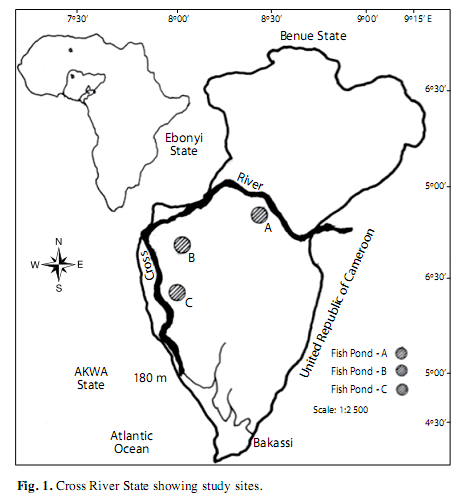
</front><body><![CDATA[ <div style="text-align: center;"><font size="4"><span  style="font-family: verdana; font-weight: bold;">Bacterial infection of mudfish <span style="font-style: italic;">Clarias gariepinus</span> (Siluriformes: Clariidae) fingerlings in tropical nursery ponds</span></font><br  style="font-family: verdana;"> </div> <font size="2"><br style="font-family: verdana;"> <span style="font-family: verdana;"><span style="font-weight: bold;">Gabriel Ikpi &amp; Benedict Offem</span>    <br> <br style="font-family: verdana;"> </span><span style="font-family: verdana;">Department of Fisheries, Faculty of Agriculture, Cross River University of Technology, Obubra Campus, Cross River State, Nigeria; <a href="mailto:benbeff06@yahoo.com">benbeff06@yahoo.com</a>, <a  href="mailto:gikpi@yahoo.com">gikpi@yahoo.com    <br> </a>    <br> <a href="#Correspondencia">Direcci&oacute;n de correspondencia.</a><br  style="font-family: verdana;"> </span><br style="font-family: verdana;"> </font>     <div style="text-align: justify;"><font size="3"><span  style="font-family: verdana;"><span style="font-weight: bold;"></span></span></font> <hr style="width: 100%; height: 2px;">    <br> <font size="3"><span style="font-family: verdana;"><span  style="font-weight: bold;">Abstract</span>    <br> <br style="font-family: verdana;"> </span></font><font size="2"><span style="font-family: verdana;">Bacterial infection among the most common cultured mudfish <span style="font-style: italic;">Clarias gariepinus</span> in Africa, has become a cause of concern, because it constitutes the largest economic loss in fish farms. In order to provide useful biological data of the pathogens for good management practices, samples were collected monthly between January 2008 and December 2009 in three monoculture nursery ponds, located in three different positions: upriver (A, grassland), mid-river (B, mixed forest and grassland) and downriver (C, rainforest) along 200km length of Cross River floodplains, Nigeria. A total of 720 fingerlings between 15.1 and 20.7g were analyzed to determine the degree of infection. The bacterial pathogens were taken from their external surfaces, and were isolated and identified by standard methods. The caudal fins of fingerlings from pond A had the highest bacterial load (5.8x10<sup>3</sup>cfu/g), while the least counts (1.2x10³cfu/g) were identified on the head of fish from pond C, with <span style="font-style: italic;">Flexibacter columnaris</span> as the major etiological agent.&nbsp; <span style="font-style: italic;">Pseudomonas fluorescens, Aeromonas hydrophila, Escherichia coli, Staphylococcus aureus</span> and <span  style="font-style: italic;">Micrococcus luteus </span>were identified as co-isolates with <span style="font-style: italic;">P. fluorescens</span> as dominant (0.7x10<sup>2</sup>cfu/mL) co-isolates in pond water. Clinical signs of five white spots with red periphery appeared on the external surface of infected fish. All the fish sampled, died after 4 to 9 days. There was no significant difference in the bacterial counts between different ponds, but the difference between fish organs/parts examined was significant. Fish from these ponds are therefore potentially dangerous to consumers and highly devalued, with the economic impact to producers. Preventive methods to avoid these infections are recommended. Rev. Biol. Trop. 59 (2): 751-759. Epub 2011 June 01.</span></font><br  style="font-family: verdana;"> <br style="font-family: verdana;"> <font size="2"><span style="font-family: verdana;"><span  style="font-weight: bold;">Key words: </span><span  style="font-style: italic;">Clarias gariepinus fingerlings, Flexibacter colummnaris,</span> bacteriogical examination, fish farm.</span></font><br  style="font-family: verdana;"> <br style="font-family: verdana;"> <font size="3"><span style="font-family: verdana;"><span  style="font-weight: bold;">Resumen</span>    <br> <br style="font-family: verdana;"> </span></font><font size="2"><span style="font-family: verdana;">Las infeccines bacterianas son comunes en el pez de cultivo <span style="font-style: italic;">Clarias gariepinus</span>, el cual es el m&aacute;s cultivado en Africa y se han convertido en una causa de preocupaci&oacute;n, ya que constituye la mayor p&eacute;rdida econ&oacute;mica en las granjas pisc&iacute;colas. Se proporcionan datos biol&oacute;gicos de los agentes pat&oacute;genos con el fin de proporcionar informaci&oacute;n &uacute;til para buenas pr&aacute;cticas de gesti&oacute;n en las granjas. Las muestras fueron recolectadas mensualmente entre Enero 2008 y Diciembre 2009 en tres viveros de estanques de monocultivo, situados en tres posiciones diferentes: r&iacute;o arriba (A, pastizales), mitad del r&iacute;o (B, bosque mixto y pastos) y aguas abajo (C, bosque) a lo largo de 200km de longitud en las llanuras de inundaci&oacute;n del r&iacute;o Cross, Nigeria. Un total de 720 alevines de entre 15.1 y 20.7g fueron analizados para determinar el grado de infecci&oacute;n. Los pat&oacute;genos bacteriales fueron tomados de las superficies externas, y fueron aislados e identificados por m&eacute;todos est&aacute;ndar. Las aletas caudales de los alevines del estanque A tuvieron la mayor carga bacteriana (5.8x10<sup>3</sup>cfu/g), mientras el menor conteo de bacterias (1.2x10³cfu/g) fue identificado en la cabeza de los peces del estanque C, con <span style="font-style: italic;">Flexibacter columnaris</span> como el agente etiol&oacute;gico m&aacute;s importante. <span  style="font-style: italic;">Pseudomonas fluorescens, Aeromonas hydrophila, Escherichia coli, Staphylococcus aureus </span>y <span style="font-style: italic;">Micrococcus luteus</span> se identificaron como co-aislamientos con <span  style="font-style: italic;">P. fluorescens</span>, como dominantes (0.7x10²cfu/mL) co-aislados en el agua del estanque. Los signos cl&iacute;nicos fueron cinco puntos blancos con la periferia roja y aparecieron en la superficie externa de los peces infectados. Todos los peces de la muestra, murieron despu&eacute;s de 4 a 9 d&iacute;as. No hubo diferencia significativa en los recuentos bacterianos entre los diferentes estanques, pero la diferencia entre los &oacute;rganos y las partes de los peces examinados fue significativa. Los peces de estos estanques son potencialmente peligrosos para los consumidores y con alta devaluaci&oacute;n, con un impacto econ&oacute;mico para los productores. Se recomiendan m&eacute;todos de prevenci&oacute;n para evitar estas infecciones.</span></font><br  style="font-family: verdana;"> <br style="font-family: verdana;"> <font size="2"><span style="font-family: verdana;"><span  style="font-weight: bold;">Palabras clave:</span> alevines de <span  style="font-style: italic;">Clarias gariepinus, Flexibacter colummnaris, </span>an&aacute;lisis bacteriol&oacute;gico, pez de cultivo.</span></font><br style="font-family: verdana;"> <br style="font-family: verdana;"> <font size="2"><span style="font-family: verdana;"></span></font> <hr style="width: 100%; height: 2px;">    <br> <font size="2"><span style="font-family: verdana;"><span  style="font-style: italic;">Clarias gariepinus </span>(Burchell, 1822) is a species of great economic importance in Africa and South-East Asia, especially as a food fish and vital in the local sustainability of the aquaculture activity (Teugels 1986, Venden Bossiche &amp; Bernacsek 1990). Their aquaculture attributes include ability to withstand handling stress, disease resistance, high growth rate, fecundity and palatability. There is acute reduction of these species in inland natural water bodies in Nigeria because of the over-exploitation methods of indigenous fishers that destroy the habitat and fisheries resources (Viser 1970). Nowadays, the effort made by the Nigerian government to conserve and propagate the aquaculture of this species is being hindered, since there is little information available to producers, on the species ecology and disease issues in Nigerian waters (Fagbenro&nbsp; et al. 1993, Okaeme &amp; Obiekezie 1990). Studies conducted by Ugwuzor <span  style="font-style: italic;">et al.</span> (1990), Ogbondeminu <span style="font-style: italic;">et al.</span> (1991), Ogbondeminu (1993), Ikpi &amp; Offem (2008), revealed incidence of <span  style="font-style: italic;">Flexibacter columnaris, Pseudomonas</span> sp., <span style="font-style: italic;">Aeromonas </span>sp., <span style="font-style: italic;">Vibrio</span> sp., enterobacteriaceae and Gram positive bacteria as common fish pathogens responsible for different bacterial diseases in fish farms in Nigeria.</span></font><br  style="font-family: verdana;"> <br style="font-family: verdana;"> <font size="2"><span style="font-family: verdana;">Fedoruk (1981), Plumb &amp; Olah (1984), Hanson &amp; Grizzle (1985), MacMillan &amp; Tucker (1985), Noga (2000) revealed that<span  style="font-style: italic;"> Flexibacter collumnaris </span>and many other bacterial diseases of fish, have a patho-physiological background related to environmental stressors. Examples of such stressors might be: husbandry factors like crowding (Ventura &amp; Grizzle 1987), capture and hauling, water related problems like toxicants (Tucker <span style="font-style: italic;">et al. </span>1984, Faisal&nbsp; <span style="font-style: italic;">et al.</span> 1988), temperature and oxygen extremes (Walters &amp; Plumb 1980, Plumb &amp; Olah 1984), transport (Blazer 1992) and rapid environmental changes (Ciembor<span style="font-style: italic;"> et al.</span> 1995). </span></font><br style="font-family: verdana;"> <br style="font-family: verdana;"> <font size="2"><span style="font-family: verdana;">The prevalence of infectious diseases depends on the interaction between fish pathogen and the environment (Klesius 1992, Mqolomba &amp; Plumb 1992, Boon &amp; Huisman 1996, Noga 2000). Besides, the pathogen spreading, mostly under unpredictable circumstances, can result in a sudden onset of a disease in an obviously healthy population. </span></font><br  style="font-family: verdana;"> <br style="font-family: verdana;"> <font size="2"><span style="font-family: verdana;">This investigation was developed after the outbreak of an uncommon disease of fish fingerlings purchased from the fish farms under investigation, also had clinical signs on their external surface. The study therefore includes isolation and identification of the bacterial pathogens and determination of the degree of infection of the fingerlings and to advice on management.</span></font><br  style="font-family: verdana;"> <br style="font-family: verdana;"> <font style="font-weight: bold;" size="3"><span  style="font-family: verdana;">Materials and Methods</span></font><br  style="font-family: verdana;"> <br style="font-family: verdana;"> <font size="2"><span style="font-family: verdana;"><span  style="font-weight: bold;">Study area: </span>The study site is the Cross River floodplain located at the Southeastern part of Nigeria (4&ordm;.25&#8217; - 7&ordm;.00&#8217; N; 7&ordm;.15&#8217; - 9&ordm;.30&#8217; E) (<a href="#fig1">Fig. 1</a>). It is bounded in the South by the Atlantic Ocean, East by the Republic of Cameroun, the Nigerian states of Benue in the North, Ebonyi and Abia in the West and Akwa Ibom in the Southwest. Climate of the study area is characterized by a dry season from November-March and a wet season from April-October. Highest precipitation (3 050&plusmn;230mm) occurs in August, and lowest (300&plusmn;23mm) in March.The mean annual temperature ranged from 15.5&plusmn;7.6&#1086;C in wet period to 32.6&plusmn;5.4&#1086;C in dry period. As obtained in river-floodplain system Cross River comprised a wide range of habitat types, from small upland streams, smooth glides of the middle sections, and broad, meandering river stretch, of the lowland. The principle driving force for the productivity of major biota in Cross River floodplain systems is the seasonal variation of the river flows or &#8220;flood pulse,&#8221; which produces periodic inundations of the floodplain. The bulk of the productivity is derived directly or indirectly within the floodplain itself. In this study, the three ponds (A, B, C) investigated were randomly sampled, each from the floodplains upriver, mid-river and downriver. The pond sites were located 18km apart with dimensions of 30x10 x1.7m (A), 15x10x1.5m (B) and 20x10x1.5m (C).    <br>     ]]></body>
<body><![CDATA[<br>     <br> </span></font>     <div style="text-align: center;"><font size="2"><span      style="font-family: verdana;"><a name="fig1"></a><img alt=""      src="/img/revistas/rbt/v59n2/a17i1.jpg"      style="width: 464px; height: 498px;"></span></font><br      style="font-family: verdana;">     <font size="2"><span style="font-family: verdana;"></span></font></div>     <br style="font-family: verdana;">     <font size="2"><span style="font-family: verdana;"><span     ]]></body>
<body><![CDATA[ style="font-weight: bold;">Sample Collection: </span>Samples     were collected monthly (8am-10am)     between January 2008 and December 2009 from three monoculture nursery     ponds located in three reaches; A: upriver (grassland), B: mid-river     (mixed forest and grassland) and C: downriver (rainforest) along 200km     length of Cross River floodplains, Nigeria. A total of 720     <span style="font-style: italic;">Clarias gariepinus </span>fingerlings     of weights between 15.1 and 20.7g were     sampled. Samples were held in six hapas (a net-like container used to     confine fish within its natural environment for experimental purposes)     ]]></body>
<body><![CDATA[placed in each of the three different fish ponds. The six fish were     placed in the hapas, one in each hapa. The size of hapa was     30x15x10cm<sup>3</sup>. Specimens were transported to the fisheries     laboratory and     held one in each rectangular glass aquaria with volume capacity of     35x26cm<sup>3</sup>. Sampling of fingerlings in the three fish ponds     was achieved     using a table of random numbers, as described by Akindele (1989). All     samples were then fixed in 10% formalin, and later preserved in 70%     ethanol, and deposited in the Fisheries Museum (Catalogue No.: CRUTECH     ]]></body>
<body><![CDATA[1090) at the Fisheries Department of Cross River University, Obubra     Campus, Nigeria.</span></font><br style="font-family: verdana;">     <br style="font-family: verdana;">     <font size="2"><span style="font-family: verdana;"><span      style="font-weight: bold;">Sampling methodology:</span> As     stated, fingerlings where held in hapas     and observed until appearance of clinical signs. The specimens that     showed early lesions were sampled as described in Noga (2000). The same     process was repeated in fingerlings held in aquaria in the laboratory     after a four hours acclimatization period. Areas examined for bacterial     ]]></body>
<body><![CDATA[infection in fish to determine pathogenicity were the gills, head, body     and caudal fin. They were all observed during the period of mortality.</span></font><br      style="font-family: verdana;">     <br style="font-family: verdana;">     <font size="2"><span style="font-family: verdana;"><span      style="font-weight: bold;">Bacteriological examination:</span> The     examination was conducted to isolate,     identify and confirm bacterial isolates. Early lesions were aseptically     inoculated for culture on Cytophaga Agar (CA) medium. The inoculated     media was cultured at 25<sup>o</sup>C for 18 to 48 hr. A random     ]]></body>
<body><![CDATA[selection of     colonies from various samples, were re-streak into fresh agar relates     to ensure purity. Pure cultures of the bacterial organisms were     identified using the standard procedures (Barrow &amp; Feltham 1993).     The test employed for the identification of isolates, was the Gram     stain, mobility test, biochemical test, sensitivity analysis, pigments     and colony morphology. The process was repeated for co-isolation of     other bacterial species with samples of other external surfaces without     lesions and the pond water. Co-isolations were aseptically inoculated     for culture on Trypticase Song Agar (TSA) and McConkey Agar (McC). The     ]]></body>
<body><![CDATA[inoculated media was cultured at different temperatures of 25 and 35<sup>o</sup>C     for 18 to 48 hr.</span></font><br style="font-family: verdana;">     <br style="font-family: verdana;">     <font size="2"><span style="font-family: verdana;"><span      style="font-weight: bold;">Biochemical and sensitivity test:</span>     Biochemical tests using Cytophaga     agar (CA) and Tripticase Song agar (TSA) were made following the     procedures described by Roberts (1989) and Inglis <span      style="font-style: italic;">et al.</span> (1994).     The culture medium was autoclaved for 15 min at 121<sup>o</sup>C and     ]]></body>
<body><![CDATA[115Hg. Cooled     slants were inoculated with bacterial culture suspension by streaking     slant and stabling bull. They were incubated at between 25<sup>o</sup>C     and 35<sup>o</sup>C     for 18 to 48 hr. Sensitivity test was carried out to confirm the     isolation of <span style="font-style: italic;">Flexibacter columnaris.     </span>The antibiotic used was Penicillin.</span></font><br      style="font-family: verdana;">     <br style="font-family: verdana;">     <font size="2"><span style="font-family: verdana;"><span     ]]></body>
<body><![CDATA[ style="font-weight: bold;">Bacterial enumeration: </span>Total viable     count (TVC) of bacteria from the     external surface of <span style="font-style: italic;">Clarias gariepinu</span>     fingerlings and pond water     were determined on Cytophoga Agar (CA). Trypticase Song Agar (TSA) and     McConkey Agar (McC) by the plate count technique (Roberts 1989,     Inglis&nbsp; et al. 1994). Colony forming units (cfu) were counted with     a Gallenkamp colony counter. Estimation of the bacterial populations     was reported as Cfu/mL or Cfu/g of sample.</span></font><br      style="font-family: verdana;">     ]]></body>
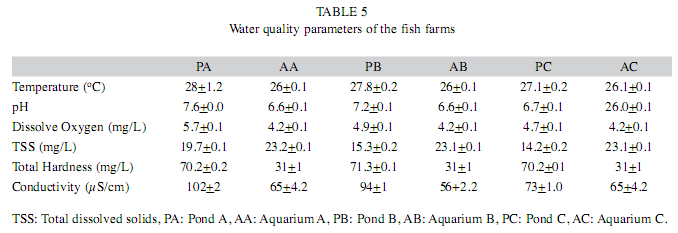
<body><![CDATA[<br style="font-family: verdana;">     <font size="2"><span style="font-family: verdana;"><span      style="font-weight: bold;">Water quality tests: </span>The water     quality parameters of the ponds and the     aquaria tanks included: temperature, pH, dissolved oxygen, total     suspended solids, total hardness and conductivity were determined     following the method described by APHA (1980). Water used in the     aquaria, was tap water acclimated for three days before use.</span></font><br      style="font-family: verdana;">     <br style="font-family: verdana;">     ]]></body>
<body><![CDATA[<font size="2"><span style="font-family: verdana;">Data obtained from     bacterial counts     made from the external surface and     parts of fish, pond water and aquaria were analyzed using descriptive     statistics. In addition, analysis of variance was used to compare     bacterial counts in the fish ponds and aquaria, as well as among the     various parts of the fish. The statistical method used in the analysis     was the Complete Randomize Block Design (CRBD)</span></font><br      style="font-family: verdana;">     <br style="font-family: verdana;">     ]]></body>
<body><![CDATA[<font style="font-weight: bold;" size="3"><span      style="font-family: verdana;">Results</span></font><br      style="font-family: verdana;">     <br style="font-family: verdana;">     <font size="2"><span style="font-family: verdana;"><span      style="font-weight: bold;">Pathogenicity and clinical symtoms:</span>     The results showed that     <span style="font-style: italic;">Flexibacter columnaris </span>species     was pathogenic as clinical signs were     observed in the external surface of fingerlings in the different fish     ]]></body>
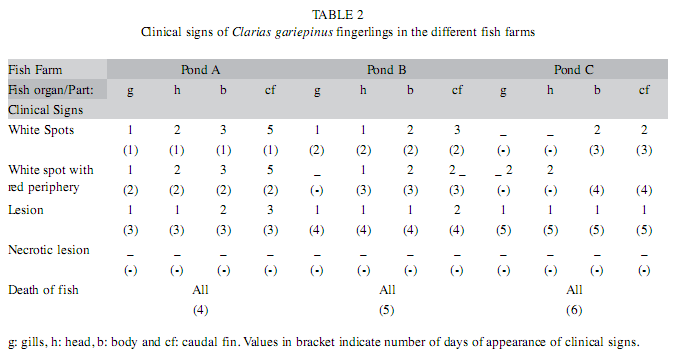
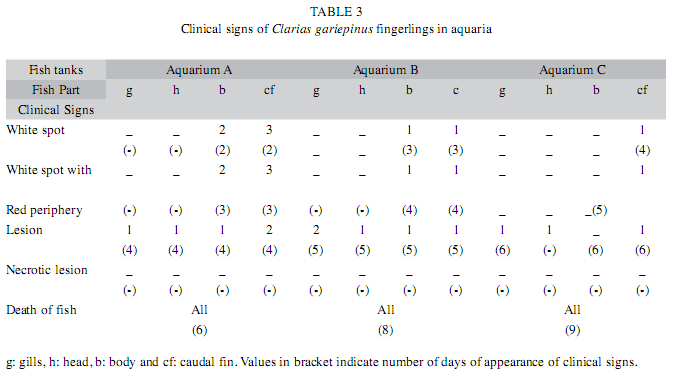
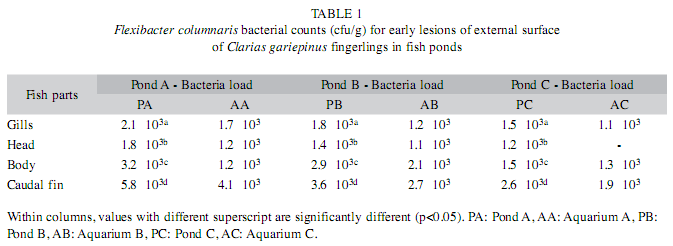
<body><![CDATA[ponds and suspected fish held in the aquarium. The clinical signs were     observed in the gills, head, body and caudal fin (<a      href="/img/revistas/rbt/v59n2/a17t1.gif">Table 1</a>). The     clinical signs on the external surface of <span      style="font-style: italic;">Clarias gariepinus</span>     fingerlings were white spots, white spots with red periphery, lesions     and death of fish specimens (<a href="/img/revistas/rbt/v59n2/a17t2.gif">Table     2</a> and <a href="/img/revistas/rbt/v59n2/a17t3.gif">3</a>). The     number of white spots     and white spots with red periphery were between one to five for fish     ]]></body>
<body><![CDATA[specimens from the different fish ponds, and between one to three for     fish held in aquarium. Lesions ranged between one to three, and one to     two for fish in fish ponds and aquaria, respectively. There was a 100%     mortality for fish samples in the different fish ponds and aquaria, but     there was a significant (p&lt;0.05) difference among the rate of     mortality between ponds and aquaria. Nevertheless, no lesions on the     head of the aquarium fingerlings were observed. The period of time,     between the appearance of clinical signs on fish and mortality, varied     in the different fish ponds.</span></font><br      style="font-family: verdana;">     ]]></body>
<body><![CDATA[<br style="font-family: verdana;">     <font size="2"><span style="font-family: verdana;"><span      style="font-weight: bold;">Bacterial load/counts:</span> Bacterial     load ranged from 1.2x10<sup>3</sup> to     5.8x10<sup>3</sup>cfu/g in the fish ponds samples, and from 1.1x10<sup>3</sup>cfu/g     to     4.1x10<sup>3</sup>cfu/g in aquaria samples (<a      href="/img/revistas/rbt/v59n2/a17t1.gif">Table 1</a>). The caudal fin     of     specimens     ]]></body>
<body><![CDATA[from pond A and aquaria A had the highest bacterial load of     5.8x10<sup>3</sup>cfu/g and 4.1x10<sup>3</sup>cfu/g respectively; while     the lowest counts     were obtained from the fish head (1.2x10<sup>3</sup>cfu/g) of fish from     pond C,     and gills (1.1x10<sup>3</sup>cfu/g) of fish from aquariam. No bacterial     infection     on the head of fish from aquaria C was observed. There was no     significant difference (p&gt;0.05) between log bacterial counts in fish     from different fish ponds but the difference between log counts for     ]]></body>
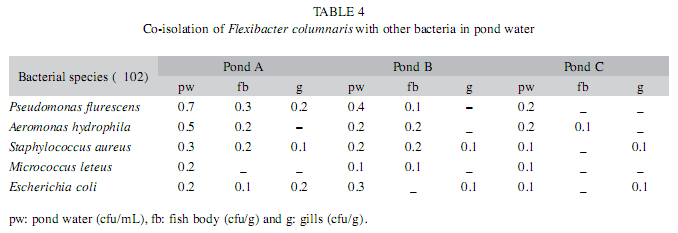
<body><![CDATA[different fish organs/parts was significant (p&lt;0.05). </span></font><br      style="font-family: verdana;">     <br style="font-family: verdana;">     <font size="2"><span style="font-family: verdana;"><span      style="font-weight: bold;">Co-isolation of F. columnaris with     other bacteria:</span> Five different     bacterial species were isolated and identified from pond water and fish     body. The bacterial species were <span style="font-style: italic;">Pseudomonas     flourescens,     Aeromonas hydrophila, Staphylococcus aureus, Micrococcus luteus     ]]></body>
<body><![CDATA[</span>and <span style="font-style: italic;">Escherichia coli</span>     (<a href="/img/revistas/rbt/v59n2/a17t4.gif">Table 4</a>). The dominant     co-isolated bacterial     species in the pond water and the fish body of the three ponds     was&nbsp; P. flurescens in pond A, with a bacterial load of     0.7x10<sup>2</sup>cfu/mL and 0.3x10<sup>2</sup>, respectively.</span></font><br      style="font-family: verdana;">     <br style="font-family: verdana;">     <font size="2"><span style="font-family: verdana;"><span      style="font-weight: bold;">Biochemical properties of <span     ]]></body>
<body><![CDATA[ style="font-style: italic;">F.     columnaris:</span></span><span style="font-style: italic;"> F.     columnaris </span>is a Gram-ve     bacteria and reacted positively with Cytochrome Oxidase, Catalase,     Voges-Proskauer reaction, H<sub>2</sub>S production, Nitrite reduction     and     negatively to Indole and oxidative/fermentative reaction. Its     sensitivity analysis showed that, it was sensitive to Penicillin.     Examination of wet mounts from lesions showed gliding motion.</span></font><br      style="font-family: verdana;">     ]]></body>
<body><![CDATA[<br style="font-family: verdana;">     <font size="2"><span style="font-family: verdana;">The biochemical     properties for the     co-isolates showed that <span style="font-style: italic;">P.     fluorescens, A. hydrophila </span>and <span      style="font-style: italic;">E. coli </span>are all Gram-ve bacteria     while&nbsp; <span style="font-style: italic;">S. aureus </span>and&nbsp;<span      style="font-style: italic;"> M. luteus </span>are Gram+ve bacteria. <span      style="font-style: italic;">P.     fluorescens, A. hydrophila </span>and <span     ]]></body>
<body><![CDATA[ style="font-style: italic;">M. luteus</span>, reacted     positively with Cytochrome oxidase, Catalase and Nitrite reduction     oxidative/fermentative reaction, Vogues Proskauer and H<sub>2</sub>S     production.     Although<span style="font-style: italic;"> P. fluorescens </span>reacted     negatively with H<sub>2</sub>S production and     oxidative/fermentative reaction, <span style="font-style: italic;">E.     coli </span>and <span style="font-style: italic;">S. aureus</span>     reacted     negatively with Cytochrome oxidase, Vogues-Proskauer, and H<sub>2</sub>S     ]]></body>
<body><![CDATA[production. However,&nbsp; S. aureus showed positive reaction with     Vogues-Proskauer and Nitrite reduction.</span></font><br      style="font-family: verdana;">     <br style="font-family: verdana;">     <font size="2"><span style="font-family: verdana;">Motility test showed     that <span style="font-style: italic;">M. luteus</span>     and <span style="font-style: italic;">S. aureus</span> are non-motile     while     <span style="font-style: italic;">P. fluorescens, A. hydrophila </span>and     <span style="font-style: italic;">E. coli </span>are motile.</span></font><br     ]]></body>
<body><![CDATA[ style="font-family: verdana;">     <br style="font-family: verdana;">     <font size="2"><span style="font-family: verdana;">Water quality     parameters recorded     during the study were temperature,     pH, Dissolved Oxygen, total suspended solids, total hardness and     conductivity (<a href="/img/revistas/rbt/v59n2/a17t5.gif">Table 5</a>).</span></font><br      style="font-family: verdana;">     <br style="font-family: verdana;">     <font style="font-weight: bold;" size="3"><span     ]]></body>
<body><![CDATA[ style="font-family: verdana;">Discussion </span></font><br      style="font-family: verdana;">     <br style="font-family: verdana;">     <font size="2"><span style="font-family: verdana;">The study showed     that <span style="font-style: italic;">Flexibacter     columnaris</span> is a Gram-ve bacteria, and     was pathogenic with the appearance of clinical signs on the external     surface and gills, followed by the eventual death of the fish specimens     in four to six days, and six to nine days, at temperatures between 21.1     and 28.7&deg;C for the fish farms and aquaria respectively. These     ]]></body>
<body><![CDATA[observations were in accordance with those reported by Wakabayashi     (1993) on the death of Weather fish within seven days at 15<sup>o</sup>C     and one     day at 35&deg;C. Chowdhury &amp; Wakabayashi (1988) reported that     infection     of Weather Fish with <span style="font-style: italic;">F. columnaris</span>     was also found to vary with     different water quality conditions.</span></font><br      style="font-family: verdana;">     <br style="font-family: verdana;">     ]]></body>
<body><![CDATA[<font size="2"><span style="font-family: verdana;">The outbreak of <span      style="font-style: italic;">F.     columnaris     </span>disease in the fish farms may have been a     result of purchase of fingerlings from infected fish farms, poor     husbandry practices and environmental factors (Ventura &amp; Grizzle     1987, Ciembor <span style="font-style: italic;">et al.</span> 1995 and     Noga 2000). The appearance of white     spots on the gills, head, body and caudal fin, with the later having     higher numbers at the first indication of infection and the white spots     ]]></body>
<body><![CDATA[surrounded by a zone of red tinge on the second day of infection were     similar as those reported by Inglis&nbsp; <span      style="font-style: italic;">et al. </span>(1994). Bacterial     counts of 5.8x10<sup>3</sup>cfu/g and 4.1x10<sup>3</sup>cfu/g for <span      style="font-style: italic;">Clarias gariepinus     </span>fingerlings in fish farms and aquaria respectively, was higher     than     3.5x10<sup>3</sup>cfu/g and 2.9x10<sup>3</sup>cfu/g for fish cultured     in a similar experiment     by Ikpi &amp; Offem (2008). Also, gill infection was common but less     ]]></body>
<body><![CDATA[severe in this study than that reported by Noga (2000), who observed     that although gill infection occurred, was not common in most fishes.     Lesions appeared within three and four days and were not necrotic for     fish in fish farms and aquaria. Similar observations has been made by     Roberts (1989), Ugwuzor <span style="font-style: italic;">et al.</span>     (1990), Olufemi <span style="font-style: italic;">et al.</span>     (1991), Inglis <span style="font-style: italic;">et     al.</span> (1994) and Noga (2000) but within 24 hours for Inglis <span      style="font-style: italic;">et al.</span>(1994)     and Noga (2000).</span></font><br style="font-family: verdana;">     ]]></body>
<body><![CDATA[<br style="font-family: verdana;">     <font size="2"><span style="font-family: verdana;">Co-isolation     of <span style="font-style: italic;">F. columnaris</span>     with other bacteria revealed five     different bacterial species, which were <span      style="font-style: italic;">Pseudomonas florescens,     Aeromonas hydrophila, Escherichia coli, Staphylococcus aureus </span>and     <span style="font-style: italic;">Micrococcus luteus</span>, the first     three are Gram-ve while the last     two bacterial species are Gram+ve with <span     ]]></body>
<body><![CDATA[ style="font-style: italic;">P. fluorescens </span>being dominant.     This was in accordance with Wiklund &amp; L&ouml;nnstr&ouml;m (1994)     who co-isolated <span style="font-style: italic;">Pseudomonas     anguilliseptica</span> with four bacterial     species which were <span style="font-style: italic;">Vibrio     anguillarum, Aeromonas salmonicida,     Pseudomonas</span> sp. and <span style="font-style: italic;">Aeromonas</span>     sp. from different species of fish in     finnish farms. Chowdhury &amp; Wakabayashi (1990), also observed     that <span style="font-style: italic;">F. columonaris</span>     ]]></body>
<body><![CDATA[successfully invaded fish in the presence of     other bacterial species. </span></font><br      style="font-family: verdana;">     <br style="font-family: verdana;">     <font size="2"><span style="font-family: verdana;">Although the mudfish     <span style="font-style: italic;">Clarias     gariepinus</span> is known to be     infectious-disease resistant, with the increasing trend of catfish     culture in this region without embarking on a training programme for     local fish farmers, that seem to have difficulties in the dynamics of     ]]></body>
<body><![CDATA[good aquaculture management practices.</span></font><br      style="font-family: verdana;">     <br style="font-family: verdana;">     <font style="font-weight: bold;" size="3"><span      style="font-family: verdana;">Acknowledgment </span></font><br      style="font-family: verdana;">     <br style="font-family: verdana;">     <font size="2"><span style="font-family: verdana;">We sincerely thank     the Dean of     Faculty of Agriculture and Forestry,     ]]></body>
<body><![CDATA[Cross River University of Technology, Obubra Campus, for allowing us     the use of part of the facility and research grants to carry out this     work.</span></font><br style="font-family: verdana;">     <br style="font-family: verdana;">     <font style="font-weight: bold;" size="3"><span      style="font-family: verdana;"></span></font>     <hr style="width: 100%; height: 2px;">    <!-- ref --><br> <font style="font-weight: bold;" size="3"><span  style="font-family: verdana;">References</span></font><br  style="font-family: verdana;"> <br style="font-family: verdana;"> <font size="2"><span style="font-family: verdana;">Akindele, S.O. 1989. Basic experimental designs in agricultural research. Montem, Akure, Nigeria.    &nbsp;&nbsp;&nbsp;&nbsp;&nbsp;&nbsp;&nbsp;&nbsp;[&#160;<a href="javascript:void(0);" onclick="javascript: window.open('/scielo.php?script=sci_nlinks&ref=1766296&pid=S0034-7744201100020001700001&lng=','','width=640,height=500,resizable=yes,scrollbars=1,menubar=yes,');">Links</a>&#160;]<!-- end-ref --><!-- ref --></span></font><br  style="font-family: verdana;"> <br style="font-family: verdana;"> <font size="2"><span style="font-family: verdana;">APHA. American Public Health Association. 1980. Standard Methods for the Examination of Water and Wastewaters. American Public Health Association, Washington D.C., USA.    &nbsp;&nbsp;&nbsp;&nbsp;&nbsp;&nbsp;&nbsp;&nbsp;[&#160;<a href="javascript:void(0);" onclick="javascript: window.open('/scielo.php?script=sci_nlinks&ref=1766297&pid=S0034-7744201100020001700002&lng=','','width=640,height=500,resizable=yes,scrollbars=1,menubar=yes,');">Links</a>&#160;]<!-- end-ref --><!-- ref --></span></font><br  style="font-family: verdana;"> <br style="font-family: verdana;"> <font size="2"><span style="font-family: verdana;">Barrow, G.I. &amp; R.K.A. Feltham. 1993. Cowan and Steel&#8217;s Manual for the Identification of Medical Bacteria. Cambridge, Cambridge, England.    &nbsp;&nbsp;&nbsp;&nbsp;&nbsp;&nbsp;&nbsp;&nbsp;[&#160;<a href="javascript:void(0);" onclick="javascript: window.open('/scielo.php?script=sci_nlinks&ref=1766298&pid=S0034-7744201100020001700003&lng=','','width=640,height=500,resizable=yes,scrollbars=1,menubar=yes,');">Links</a>&#160;]<!-- end-ref --><!-- ref --></span></font><br  style="font-family: verdana;"> <br style="font-family: verdana;"> <font size="2"><span style="font-family: verdana;">Blazer, V.S. 1992. Nutrition and disease resistance. Ann. Rev. Fish Dis. 1: 309-323.    &nbsp;&nbsp;&nbsp;&nbsp;&nbsp;&nbsp;&nbsp;&nbsp;[&#160;<a href="javascript:void(0);" onclick="javascript: window.open('/scielo.php?script=sci_nlinks&ref=1766299&pid=S0034-7744201100020001700004&lng=','','width=640,height=500,resizable=yes,scrollbars=1,menubar=yes,');">Links</a>&#160;]<!-- end-ref --><!-- ref --></span></font><br style="font-family: verdana;"> <br style="font-family: verdana;"> <font size="2"><span style="font-family: verdana;">Boon, J.H. &amp; E.A. Huisman. 1996. Viral, bacterial and fungal diseases of Siluroidei, cultured for human consumption. Aquat. Living Resour. 9: 153-164.    &nbsp;&nbsp;&nbsp;&nbsp;&nbsp;&nbsp;&nbsp;&nbsp;[&#160;<a href="javascript:void(0);" onclick="javascript: window.open('/scielo.php?script=sci_nlinks&ref=1766300&pid=S0034-7744201100020001700005&lng=','','width=640,height=500,resizable=yes,scrollbars=1,menubar=yes,');">Links</a>&#160;]<!-- end-ref --><!-- ref --></span></font><br style="font-family: verdana;"> <br style="font-family: verdana;"> <font size="2"><span style="font-family: verdana;">Chowdhury, M.B.R. &amp; H. Wakabayashi. 1988. Effects of competitive bacteria on the survival and infectivity of <span  style="font-style: italic;">Flexibacter columnaris</span>. Fish Pathol. 24: 9-15.    &nbsp;&nbsp;&nbsp;&nbsp;&nbsp;&nbsp;&nbsp;&nbsp;[&#160;<a href="javascript:void(0);" onclick="javascript: window.open('/scielo.php?script=sci_nlinks&ref=1766301&pid=S0034-7744201100020001700006&lng=','','width=640,height=500,resizable=yes,scrollbars=1,menubar=yes,');">Links</a>&#160;]<!-- end-ref --><!-- ref --></span></font><br style="font-family: verdana;"> <br style="font-family: verdana;"> <font size="2"><span style="font-family: verdana;">Chowdhury, M.B.R. &amp; H. Wakabayashi. 1990. Effects of co-existing bacteria on <span style="font-style: italic;">Flexibacter columnaris</span> infection in loach <span style="font-style: italic;">Misgurnus anguillicaudatus</span>, p. 651-654. <span style="font-style: italic;">In</span> T. Hirano &amp; I. Hanyu (eds.). The Second Asian Fisheries Forum. Asian Fisheries Society, Manila, Philippines.    &nbsp;&nbsp;&nbsp;&nbsp;&nbsp;&nbsp;&nbsp;&nbsp;[&#160;<a href="javascript:void(0);" onclick="javascript: window.open('/scielo.php?script=sci_nlinks&ref=1766302&pid=S0034-7744201100020001700007&lng=','','width=640,height=500,resizable=yes,scrollbars=1,menubar=yes,');">Links</a>&#160;]<!-- end-ref --><!-- ref --></span></font><br style="font-family: verdana;"> <br style="font-family: verdana;"> <font size="2"><span style="font-family: verdana;">Ciembor, P.G., V.S. Blazer, D. Dawe &amp; E.B. Shotts. 1995. Susceptibility of channel catfish to infection with <span  style="font-style: italic;">Edwardsiella ictaluri</span>: Effect of exposure methods. J. Aquat. Anim. Health 7: 132-140.    &nbsp;&nbsp;&nbsp;&nbsp;&nbsp;&nbsp;&nbsp;&nbsp;[&#160;<a href="javascript:void(0);" onclick="javascript: window.open('/scielo.php?script=sci_nlinks&ref=1766303&pid=S0034-7744201100020001700008&lng=','','width=640,height=500,resizable=yes,scrollbars=1,menubar=yes,');">Links</a>&#160;]<!-- end-ref --><!-- ref --></span></font><br style="font-family: verdana;"> <br style="font-family: verdana;"> <font size="2"><span style="font-family: verdana;">Fagbenro, O.A., C.O. Adedire, E.O. Owoseni, E.O. Ayotunde. 1993. Studies on the Biology and Aquacultural Potential of Feral Catfish, <span style="font-style: italic;">Hetrobranchus bidosalis</span> (Geoffroy St. Hilare 1809). (Clariidae). Trop. Zool. 6: 67-79.    &nbsp;&nbsp;&nbsp;&nbsp;&nbsp;&nbsp;&nbsp;&nbsp;[&#160;<a href="javascript:void(0);" onclick="javascript: window.open('/scielo.php?script=sci_nlinks&ref=1766304&pid=S0034-7744201100020001700009&lng=','','width=640,height=500,resizable=yes,scrollbars=1,menubar=yes,');">Links</a>&#160;]<!-- end-ref --><!-- ref --></span></font><br  style="font-family: verdana;"> <br style="font-family: verdana;"> <font size="2"><span style="font-family: verdana;">Faisal, M., E.L. Cooper, M. El-Mofty &amp; M.A. Sayed. 1988. Immunosupressor of&nbsp; <span style="font-style: italic;">Clarias lazera</span> (Pisces) by a mulluscicite. Develop. Comp. Immunol. 12: 85-97.    &nbsp;&nbsp;&nbsp;&nbsp;&nbsp;&nbsp;&nbsp;&nbsp;[&#160;<a href="javascript:void(0);" onclick="javascript: window.open('/scielo.php?script=sci_nlinks&ref=1766305&pid=S0034-7744201100020001700010&lng=','','width=640,height=500,resizable=yes,scrollbars=1,menubar=yes,');">Links</a>&#160;]<!-- end-ref --><!-- ref --></span></font><br  style="font-family: verdana;"> <br style="font-family: verdana;"> <font size="2"><span style="font-family: verdana;">Fedoruk, A.N. 1981. A management perspective on the stress&nbsp; and infectious diseases in <span style="font-style: italic;">Clarias</span> farming. National Inland Fisheries Institute, Bangkok, Thailand.    &nbsp;&nbsp;&nbsp;&nbsp;&nbsp;&nbsp;&nbsp;&nbsp;[&#160;<a href="javascript:void(0);" onclick="javascript: window.open('/scielo.php?script=sci_nlinks&ref=1766306&pid=S0034-7744201100020001700011&lng=','','width=640,height=500,resizable=yes,scrollbars=1,menubar=yes,');">Links</a>&#160;]<!-- end-ref --><!-- ref --></span></font><br  style="font-family: verdana;"> <br style="font-family: verdana;"> <font size="2"><span style="font-family: verdana;">Hanson, L.A. &amp; J.M. Grizzle. 1985. Nitrite-induced predisposition of channel catfish to bacterial diseases. Progr. Fish. Cult. 47: 98-121.    &nbsp;&nbsp;&nbsp;&nbsp;&nbsp;&nbsp;&nbsp;&nbsp;[&#160;<a href="javascript:void(0);" onclick="javascript: window.open('/scielo.php?script=sci_nlinks&ref=1766307&pid=S0034-7744201100020001700012&lng=','','width=640,height=500,resizable=yes,scrollbars=1,menubar=yes,');">Links</a>&#160;]<!-- end-ref --><!-- ref --></span></font><br  style="font-family: verdana;"> <br style="font-family: verdana;"> <font size="2"><span style="font-family: verdana;">Ikpi, G.U. &amp; B.O. Offem. 2008. Bacterial infection of cultural fishes is the fish farm of the Cross River University of Technology. Egyp. J. Microbiol. 21: 57-63.    &nbsp;&nbsp;&nbsp;&nbsp;&nbsp;&nbsp;&nbsp;&nbsp;[&#160;<a href="javascript:void(0);" onclick="javascript: window.open('/scielo.php?script=sci_nlinks&ref=1766308&pid=S0034-7744201100020001700013&lng=','','width=640,height=500,resizable=yes,scrollbars=1,menubar=yes,');">Links</a>&#160;]<!-- end-ref --><!-- ref --> </span></font><br  style="font-family: verdana;"> <br style="font-family: verdana;"> <font size="2"><span style="font-family: verdana;">Inglis, V., R.J. Roberts &amp; N.R. Bromage. 1994. Bacteria diseases of fish. Blackwell, London, England.    &nbsp;&nbsp;&nbsp;&nbsp;&nbsp;&nbsp;&nbsp;&nbsp;[&#160;<a href="javascript:void(0);" onclick="javascript: window.open('/scielo.php?script=sci_nlinks&ref=1766309&pid=S0034-7744201100020001700014&lng=','','width=640,height=500,resizable=yes,scrollbars=1,menubar=yes,');">Links</a>&#160;]<!-- end-ref --><!-- ref --></span></font><br  style="font-family: verdana;"> <br style="font-family: verdana;"> <font size="2"><span style="font-family: verdana;">Klesius, P. 1992. Carrier state of channel catfish infected with&nbsp;<span style="font-style: italic;"> Edwardsiella ictaluri</span>. J. Aquat. Anim. Health 4: 227-230.    &nbsp;&nbsp;&nbsp;&nbsp;&nbsp;&nbsp;&nbsp;&nbsp;[&#160;<a href="javascript:void(0);" onclick="javascript: window.open('/scielo.php?script=sci_nlinks&ref=1766310&pid=S0034-7744201100020001700015&lng=','','width=640,height=500,resizable=yes,scrollbars=1,menubar=yes,');">Links</a>&#160;]<!-- end-ref --><!-- ref --></span></font><br  style="font-family: verdana;"> <br style="font-family: verdana;"> <font size="2"><span style="font-family: verdana;">MacMillan, J.R. &amp; C.S. Tucker. 1985. Infectious diseases in channel catfish culture. Dev. Aquacult. Fish. Sci. 15: 405-496.    &nbsp;&nbsp;&nbsp;&nbsp;&nbsp;&nbsp;&nbsp;&nbsp;[&#160;<a href="javascript:void(0);" onclick="javascript: window.open('/scielo.php?script=sci_nlinks&ref=1766311&pid=S0034-7744201100020001700016&lng=','','width=640,height=500,resizable=yes,scrollbars=1,menubar=yes,');">Links</a>&#160;]<!-- end-ref --><!-- ref --> </span></font><br  style="font-family: verdana;"> <br style="font-family: verdana;"> <font size="2"><span style="font-family: verdana;">Mqolomba, T.N. &amp; J.A. Plumb. 1992. Longevity of <span style="font-style: italic;">Edwardsiella ictaluri</span> in the organs of experimentally infected channel catfish, <span style="font-style: italic;">Ictalurus punctatus</span>. Aquaculture 101: 1-6.    &nbsp;&nbsp;&nbsp;&nbsp;&nbsp;&nbsp;&nbsp;&nbsp;[&#160;<a href="javascript:void(0);" onclick="javascript: window.open('/scielo.php?script=sci_nlinks&ref=1766312&pid=S0034-7744201100020001700017&lng=','','width=640,height=500,resizable=yes,scrollbars=1,menubar=yes,');">Links</a>&#160;]<!-- end-ref --><!-- ref --></span></font><br style="font-family: verdana;"> <br style="font-family: verdana;"> <font size="2"><span style="font-family: verdana;">Noga, E.J. 2000. Fish disease diagnosis and treatment. Iowa State University, Iowa, USA.    &nbsp;&nbsp;&nbsp;&nbsp;&nbsp;&nbsp;&nbsp;&nbsp;[&#160;<a href="javascript:void(0);" onclick="javascript: window.open('/scielo.php?script=sci_nlinks&ref=1766313&pid=S0034-7744201100020001700018&lng=','','width=640,height=500,resizable=yes,scrollbars=1,menubar=yes,');">Links</a>&#160;]<!-- end-ref --><!-- ref --></span></font><br style="font-family: verdana;"> <br style="font-family: verdana;"> <font size="2"><span style="font-family: verdana;">Ogbondeminu, F.S. 1993. Bacterial flora associated with the production of mudfish (<span style="font-style: italic;">Clarias anguillaris</span> L.) in a hatchery in Bio. Res. Comm. 5: 33-38.    &nbsp;&nbsp;&nbsp;&nbsp;&nbsp;&nbsp;&nbsp;&nbsp;[&#160;<a href="javascript:void(0);" onclick="javascript: window.open('/scielo.php?script=sci_nlinks&ref=1766314&pid=S0034-7744201100020001700019&lng=','','width=640,height=500,resizable=yes,scrollbars=1,menubar=yes,');">Links</a>&#160;]<!-- end-ref --><!-- ref --></span></font><br style="font-family: verdana;"> <br style="font-family: verdana;"> <font size="2"><span style="font-family: verdana;">Ogbondeminu, F.S., C.T. Madu &amp; A.N. Okaeme. 1991. Bacteriological aspects of cultured fingerlings of <span style="font-style: italic;">Clarias anguillaris</span> L. in a hatchery complex in Nigeria. J. Aqua. Trop. 6: 45-54.    &nbsp;&nbsp;&nbsp;&nbsp;&nbsp;&nbsp;&nbsp;&nbsp;[&#160;<a href="javascript:void(0);" onclick="javascript: window.open('/scielo.php?script=sci_nlinks&ref=1766315&pid=S0034-7744201100020001700020&lng=','','width=640,height=500,resizable=yes,scrollbars=1,menubar=yes,');">Links</a>&#160;]<!-- end-ref --><!-- ref --></span></font><br  style="font-family: verdana;"> <br style="font-family: verdana;"> <font size="2"><span style="font-family: verdana;">Okaeme, A.N. &amp; A.O. Obiekezie. 1990. Some emergent Diseases and Management Problems of <span style="font-style: italic;">Oreochromis niloticus, Sarotherodon galileus</span> and <span style="font-style: italic;">Clarias</span> species in Nigeria J. Aquat. Sci. 2: 153-161.    &nbsp;&nbsp;&nbsp;&nbsp;&nbsp;&nbsp;&nbsp;&nbsp;[&#160;<a href="javascript:void(0);" onclick="javascript: window.open('/scielo.php?script=sci_nlinks&ref=1766316&pid=S0034-7744201100020001700021&lng=','','width=640,height=500,resizable=yes,scrollbars=1,menubar=yes,');">Links</a>&#160;]<!-- end-ref --><!-- ref --></span></font><br style="font-family: verdana;"> <br style="font-family: verdana;"> <font size="2"><span style="font-family: verdana;">Olufemi, B.E., D.A. Akinlabi &amp; S.A. Agbede. 1991. Aerobic bacterial Pathogens isolated from the African Catfish <span  style="font-style: italic;">Clarias gariepinus</span> (Burch). Trop. Vet. 9: 177-180.    &nbsp;&nbsp;&nbsp;&nbsp;&nbsp;&nbsp;&nbsp;&nbsp;[&#160;<a href="javascript:void(0);" onclick="javascript: window.open('/scielo.php?script=sci_nlinks&ref=1766317&pid=S0034-7744201100020001700022&lng=','','width=640,height=500,resizable=yes,scrollbars=1,menubar=yes,');">Links</a>&#160;]<!-- end-ref --><!-- ref --></span></font><br  style="font-family: verdana;"> <br style="font-family: verdana;"> <font size="2"><span style="font-family: verdana;">Plumb, J.A. &amp; J. Olah. 1984. Pathogens and environment in European Polyculture. Relationship of Water quality and infectious diseases in cultured channel catfish. Symp. Biol. Hung. 23: 182-199.    &nbsp;&nbsp;&nbsp;&nbsp;&nbsp;&nbsp;&nbsp;&nbsp;[&#160;<a href="javascript:void(0);" onclick="javascript: window.open('/scielo.php?script=sci_nlinks&ref=1766318&pid=S0034-7744201100020001700023&lng=','','width=640,height=500,resizable=yes,scrollbars=1,menubar=yes,');">Links</a>&#160;]<!-- end-ref --><!-- ref --></span></font><br  style="font-family: verdana;"> <br style="font-family: verdana;"> <font size="2"><span style="font-family: verdana;">Roberts, R.J. 1989. The Pathophysiological and Systemic Pathology of teleosts, p. 56-134. <span style="font-style: italic;">In</span> R.J. Roberts (ed.). Fish Pathology. Bailliere Tindall, London, England.    &nbsp;&nbsp;&nbsp;&nbsp;&nbsp;&nbsp;&nbsp;&nbsp;[&#160;<a href="javascript:void(0);" onclick="javascript: window.open('/scielo.php?script=sci_nlinks&ref=1766319&pid=S0034-7744201100020001700024&lng=','','width=640,height=500,resizable=yes,scrollbars=1,menubar=yes,');">Links</a>&#160;]<!-- end-ref --><!-- ref --></span></font><br style="font-family: verdana;"> <br style="font-family: verdana;"> <font size="2"><span style="font-family: verdana;">Tucker, C., S. MacMillan &amp; T.E. Schwedler. 1984. Influence of <span style="font-style: italic;">Edwardsiella ictaluri </span>septicemia on nitrite-induced methaemoglobinaemia in channel catfish (<span style="font-style: italic;">Ictalurus punctatus</span>). B. Environ. Contam. Tox. 32: 669-673.    &nbsp;&nbsp;&nbsp;&nbsp;&nbsp;&nbsp;&nbsp;&nbsp;[&#160;<a href="javascript:void(0);" onclick="javascript: window.open('/scielo.php?script=sci_nlinks&ref=1766320&pid=S0034-7744201100020001700025&lng=','','width=640,height=500,resizable=yes,scrollbars=1,menubar=yes,');">Links</a>&#160;]<!-- end-ref --><!-- ref --></span></font><br style="font-family: verdana;"> <br style="font-family: verdana;"> <font size="2"><span style="font-family: verdana;">Teugels, G.G. 1986. A systematic revision of the African species of the genus <span style="font-style: italic;">Clarias</span> (Pisces: Alariidae). Koninklijk Museum Voor Midden-Africa Tervuren, Belgie. Zool. Weten. Ann. 247: 35-41.    &nbsp;&nbsp;&nbsp;&nbsp;&nbsp;&nbsp;&nbsp;&nbsp;[&#160;<a href="javascript:void(0);" onclick="javascript: window.open('/scielo.php?script=sci_nlinks&ref=1766321&pid=S0034-7744201100020001700026&lng=','','width=640,height=500,resizable=yes,scrollbars=1,menubar=yes,');">Links</a>&#160;]<!-- end-ref --><!-- ref --> </span></font><br  style="font-family: verdana;"> <br style="font-family: verdana;"> <font size="2"><span style="font-family: verdana;">Ugwuzor, N.G., D.L. Anadu &amp; C. Ejike. 1990. Pseudomonad infection of catfish of the genus <span style="font-style: italic;">Clarias gariepinus</span> (Teugels 1984). J. Aquat. Sci. 5: 11-13.    &nbsp;&nbsp;&nbsp;&nbsp;&nbsp;&nbsp;&nbsp;&nbsp;[&#160;<a href="javascript:void(0);" onclick="javascript: window.open('/scielo.php?script=sci_nlinks&ref=1766322&pid=S0034-7744201100020001700027&lng=','','width=640,height=500,resizable=yes,scrollbars=1,menubar=yes,');">Links</a>&#160;]<!-- end-ref --><!-- ref --></span></font><br style="font-family: verdana;"> <br style="font-family: verdana;"> <font size="2"><span style="font-family: verdana;">Ven den Bossche, J.P. &amp; G.M. Bernacsek. 1990. Source book for the inland fisheries resources of Africa 2. CIFA Technical paper 18.2. FAO Fisheries Department, Rome, Italy.    &nbsp;&nbsp;&nbsp;&nbsp;&nbsp;&nbsp;&nbsp;&nbsp;[&#160;<a href="javascript:void(0);" onclick="javascript: window.open('/scielo.php?script=sci_nlinks&ref=1766323&pid=S0034-7744201100020001700028&lng=','','width=640,height=500,resizable=yes,scrollbars=1,menubar=yes,');">Links</a>&#160;]<!-- end-ref --><!-- ref --></span></font><br  style="font-family: verdana;"> <br style="font-family: verdana;"> <font size="2"><span style="font-family: verdana;">Ventura, M.T. &amp; J.M. Grizzle. 1987. Evaluation of Portals of entry of <span style="font-style: italic;">Aeromonas hydrophila</span> in channel catfish. Aquaculture 65: 205-214.    &nbsp;&nbsp;&nbsp;&nbsp;&nbsp;&nbsp;&nbsp;&nbsp;[&#160;<a href="javascript:void(0);" onclick="javascript: window.open('/scielo.php?script=sci_nlinks&ref=1766324&pid=S0034-7744201100020001700029&lng=','','width=640,height=500,resizable=yes,scrollbars=1,menubar=yes,');">Links</a>&#160;]<!-- end-ref --><!-- ref --></span></font><br  style="font-family: verdana;"> <br style="font-family: verdana;"> <font size="2"><span style="font-family: verdana;">Viser, S.A. 1970. Kainji, a Nigerian man-made lake. Kainji Lake studies. Nigerian Institute of Social and Economic Research, Ibadan.    &nbsp;&nbsp;&nbsp;&nbsp;&nbsp;&nbsp;&nbsp;&nbsp;[&#160;<a href="javascript:void(0);" onclick="javascript: window.open('/scielo.php?script=sci_nlinks&ref=1766325&pid=S0034-7744201100020001700030&lng=','','width=640,height=500,resizable=yes,scrollbars=1,menubar=yes,');">Links</a>&#160;]<!-- end-ref --><!-- ref --></span></font><br  style="font-family: verdana;"> <br style="font-family: verdana;"> <font size="2"><span style="font-family: verdana;">Wakabayashi, H. 1993. Columnaris disease, p. 23-39. <span style="font-style: italic;">In</span> V. Inglis, R.J. Roberts &amp; N. Bromage (eds.). Bacterial Diseases of Fish. Wiley-Blackwell, New York, USA.    &nbsp;&nbsp;&nbsp;&nbsp;&nbsp;&nbsp;&nbsp;&nbsp;[&#160;<a href="javascript:void(0);" onclick="javascript: window.open('/scielo.php?script=sci_nlinks&ref=1766326&pid=S0034-7744201100020001700031&lng=','','width=640,height=500,resizable=yes,scrollbars=1,menubar=yes,');">Links</a>&#160;]<!-- end-ref --><!-- ref --></span></font><br  style="font-family: verdana;"> <br style="font-family: verdana;"> <font size="2"><span style="font-family: verdana;">Walters, G.R. &amp; J.A. Plumb. 1980. Environmental stress and bacterial infection in Channel Catfish, <span  style="font-style: italic;">Ictalurus punctatus </span>Rafinesque. J. Fish Biol. 17: 177-185.    &nbsp;&nbsp;&nbsp;&nbsp;&nbsp;&nbsp;&nbsp;&nbsp;[&#160;<a href="javascript:void(0);" onclick="javascript: window.open('/scielo.php?script=sci_nlinks&ref=1766327&pid=S0034-7744201100020001700032&lng=','','width=640,height=500,resizable=yes,scrollbars=1,menubar=yes,');">Links</a>&#160;]<!-- end-ref --></span></font><br  style="font-family: verdana;"> <br style="font-family: verdana;"> <font size="2"><span style="font-family: verdana;">Wiklund, T. &amp; L. L&ouml;nnstr&ouml;m. 1994. Occurrence of <span style="font-style: italic;">Pseudomonas anguilliseptica</span> in Finnish fish farms. Aquaculture 126: 211-217.    ]]></body>
<body><![CDATA[<br>     <!-- ref --><br>     &nbsp;&nbsp;&nbsp;&nbsp;&nbsp;&nbsp;&nbsp;&nbsp;[&#160;<a href="javascript:void(0);" onclick="javascript: window.open('/scielo.php?script=sci_nlinks&ref=1766330&pid=S0034-7744201100020001700033&lng=','','width=640,height=500,resizable=yes,scrollbars=1,menubar=yes,');">Links</a>&#160;]<!-- end-ref --><br> <a name="Correspondencia"></a>Correspondencia a: </span></font><font  size="2"><span style="font-family: verdana;">Gabriel Ikpi &amp; Benedict Offem: </span><span style="font-family: verdana;">Department of Fisheries, Faculty of Agriculture, Cross River University of Technology, Obubra Campus, Cross River State, Nigeria; <a href="mailto:benbeff06@yahoo.com">benbeff06@yahoo.com</a>, <a  href="mailto:gikpi@yahoo.com">gikpi@yahoo.com</a></span></font>    <br> <br style="font-family: verdana;"> <font size="2"><span style="font-family: verdana;"></span></font> <hr style="width: 100%; height: 2px;">     <div style="text-align: center;"><font size="2"><span  style="font-family: verdana;">Received 29-I-2010.&nbsp;&nbsp;&nbsp;&nbsp;&nbsp;&nbsp;&nbsp; Corrected 01-XI-2010.&nbsp;&nbsp;&nbsp;&nbsp;&nbsp;&nbsp; Accepted 14-XII-2010.</span></font></div> </div>      ]]></body><back>
<ref-list>
<ref id="B1">
<nlm-citation citation-type="book">
<person-group person-group-type="author">
<name>
<surname><![CDATA[Akindele]]></surname>
<given-names><![CDATA[S.O.]]></given-names>
</name>
</person-group>
<source><![CDATA[Basic experimental designs in agricultural research]]></source>
<year>1989</year>
<publisher-loc><![CDATA[^eAkure Akure]]></publisher-loc>
<publisher-name><![CDATA[Montem]]></publisher-name>
</nlm-citation>
</ref>
<ref id="B2">
<nlm-citation citation-type="book">
<collab>APHA. American Public Health Association</collab>
<source><![CDATA[Standard Methods for the Examination of Water and Wastewaters]]></source>
<year>1980</year>
<publisher-loc><![CDATA[^eWashington D.C., Washington D.C.,]]></publisher-loc>
<publisher-name><![CDATA[American Public Health Association]]></publisher-name>
</nlm-citation>
</ref>
<ref id="B3">
<nlm-citation citation-type="">
<person-group person-group-type="author">
<name>
<surname><![CDATA[Barrow]]></surname>
<given-names><![CDATA[G.I.]]></given-names>
</name>
<name>
<surname><![CDATA[Feltham]]></surname>
<given-names><![CDATA[R.K.A.]]></given-names>
</name>
</person-group>
<source><![CDATA[Cowan and Steel&#8217;s Manual for the Identification of Medical Bacteria.]]></source>
<year>1993</year>
<publisher-loc><![CDATA[^eCambridge^eCambridge CambridgeCambridge]]></publisher-loc>
</nlm-citation>
</ref>
<ref id="B4">
<nlm-citation citation-type="journal">
<person-group person-group-type="author">
<name>
<surname><![CDATA[Blazer]]></surname>
<given-names><![CDATA[V.S.]]></given-names>
</name>
</person-group>
<article-title xml:lang="en"><![CDATA[Nutrition and disease resistance]]></article-title>
<source><![CDATA[Ann. Rev. Fish Dis.]]></source>
<year>1992</year>
<volume>1</volume>
<page-range>309-323</page-range></nlm-citation>
</ref>
<ref id="B5">
<nlm-citation citation-type="journal">
<person-group person-group-type="author">
<name>
<surname><![CDATA[Boon]]></surname>
<given-names><![CDATA[J.H.]]></given-names>
</name>
<name>
<surname><![CDATA[Huisman]]></surname>
<given-names><![CDATA[E.A.]]></given-names>
</name>
</person-group>
<article-title xml:lang="en"><![CDATA[Viral, bacterial and fungal diseases of Siluroidei, cultured for human consumption.]]></article-title>
<source><![CDATA[Aquat. Living Resour.]]></source>
<year>1996</year>
<volume>9</volume>
<page-range>153-164</page-range></nlm-citation>
</ref>
<ref id="B6">
<nlm-citation citation-type="journal">
<person-group person-group-type="author">
<name>
<surname><![CDATA[Chowdhury]]></surname>
<given-names><![CDATA[M.B.R.]]></given-names>
</name>
<name>
<surname><![CDATA[Wakabayashi]]></surname>
<given-names><![CDATA[H.]]></given-names>
</name>
</person-group>
<article-title xml:lang="en"><![CDATA[Effects of competitive bacteria on the survival and infectivity of Flexibacter columnaris]]></article-title>
<source><![CDATA[Fish Pathol.]]></source>
<year>1988</year>
<volume>24</volume>
<page-range>9-15</page-range></nlm-citation>
</ref>
<ref id="B7">
<nlm-citation citation-type="book">
<person-group person-group-type="author">
<name>
<surname><![CDATA[Chowdhury]]></surname>
<given-names><![CDATA[M.B.R.]]></given-names>
</name>
<name>
<surname><![CDATA[Wakabayashi]]></surname>
<given-names><![CDATA[H.]]></given-names>
</name>
</person-group>
<article-title xml:lang="en"><![CDATA[Effects of co-existing bacteria on Flexibacter columnaris infection in loach Misgurnus anguillicaudatus]]></article-title>
<person-group person-group-type="editor">
<name>
<surname><![CDATA[Hirano]]></surname>
<given-names><![CDATA[T.]]></given-names>
</name>
<name>
<surname><![CDATA[Hanyu]]></surname>
<given-names><![CDATA[I.]]></given-names>
</name>
</person-group>
<source><![CDATA[The Second Asian Fisheries Forum.]]></source>
<year>1990</year>
<page-range>651-654</page-range><publisher-loc><![CDATA[^eManila Manila]]></publisher-loc>
<publisher-name><![CDATA[Asian Fisheries Society]]></publisher-name>
</nlm-citation>
</ref>
<ref id="B8">
<nlm-citation citation-type="journal">
<person-group person-group-type="author">
<name>
<surname><![CDATA[Ciembor]]></surname>
<given-names><![CDATA[P.G.]]></given-names>
</name>
<name>
<surname><![CDATA[Blazer]]></surname>
<given-names><![CDATA[V.S.]]></given-names>
</name>
<name>
<surname><![CDATA[Dawe]]></surname>
<given-names><![CDATA[D.]]></given-names>
</name>
<name>
<surname><![CDATA[Shotts]]></surname>
<given-names><![CDATA[E.B.]]></given-names>
</name>
</person-group>
<article-title xml:lang="en"><![CDATA[usceptibility of channel catfish to infection with Edwardsiella ictaluri: Effect of exposure methods]]></article-title>
<source><![CDATA[J. Aquat. Anim. Health]]></source>
<year>1995</year>
<volume>7</volume>
<page-range>132-140</page-range></nlm-citation>
</ref>
<ref id="B9">
<nlm-citation citation-type="journal">
<person-group person-group-type="author">
<name>
<surname><![CDATA[Fagbenro]]></surname>
<given-names><![CDATA[O.A.]]></given-names>
</name>
<name>
<surname><![CDATA[Adedire]]></surname>
<given-names><![CDATA[C.O.]]></given-names>
</name>
<name>
<surname><![CDATA[Owoseni]]></surname>
<given-names><![CDATA[E.O.]]></given-names>
</name>
<name>
<surname><![CDATA[Ayotunde]]></surname>
<given-names><![CDATA[E.O.]]></given-names>
</name>
</person-group>
<article-title xml:lang="en"><![CDATA[Studies on the Biology and Aquacultural Potential of Feral Catfish, Hetrobranchus bidosalis (Geoffroy St. Hilare 1809).]]></article-title>
<source><![CDATA[Trop. Zool.]]></source>
<year>1993</year>
<volume>6</volume>
<page-range>67-79</page-range></nlm-citation>
</ref>
<ref id="B10">
<nlm-citation citation-type="journal">
<person-group person-group-type="author">
<name>
<surname><![CDATA[Faisal]]></surname>
<given-names><![CDATA[M]]></given-names>
</name>
<name>
<surname><![CDATA[Cooper]]></surname>
<given-names><![CDATA[E.L]]></given-names>
</name>
<name>
<surname><![CDATA[El-Mofty]]></surname>
<given-names><![CDATA[M]]></given-names>
</name>
<name>
<surname><![CDATA[Sayed]]></surname>
<given-names><![CDATA[M.A]]></given-names>
</name>
</person-group>
<article-title xml:lang="en"><![CDATA[Immunosupressor of Clarias lazera (Pisces) by a mulluscicite]]></article-title>
<source><![CDATA[Develop. Comp. Immunol]]></source>
<year>1988</year>
<volume>12</volume>
<page-range>85-97</page-range></nlm-citation>
</ref>
<ref id="B11">
<nlm-citation citation-type="book">
<person-group person-group-type="author">
<name>
<surname><![CDATA[Fedoruk]]></surname>
<given-names><![CDATA[A.N.]]></given-names>
</name>
</person-group>
<source><![CDATA[A management perspective on the stress and infectious diseases in Clarias farming]]></source>
<year>1981</year>
<publisher-loc><![CDATA[^eBangkok Bangkok]]></publisher-loc>
<publisher-name><![CDATA[National Inland Fisheries Institute]]></publisher-name>
</nlm-citation>
</ref>
<ref id="B12">
<nlm-citation citation-type="journal">
<person-group person-group-type="author">
<name>
<surname><![CDATA[Hanson]]></surname>
<given-names><![CDATA[L.A.]]></given-names>
</name>
<name>
<surname><![CDATA[Grizzle]]></surname>
<given-names><![CDATA[J.M.]]></given-names>
</name>
</person-group>
<article-title xml:lang="en"><![CDATA[Nitrite-induced predisposition of channel catfish to bacterial diseases]]></article-title>
<source><![CDATA[Progr. Fish. Cult.]]></source>
<year>1985</year>
<volume>47</volume>
<page-range>98-121</page-range></nlm-citation>
</ref>
<ref id="B13">
<nlm-citation citation-type="journal">
<person-group person-group-type="author">
<name>
<surname><![CDATA[Ikpi]]></surname>
<given-names><![CDATA[G.U.]]></given-names>
</name>
<name>
<surname><![CDATA[Offem]]></surname>
<given-names><![CDATA[B.O.]]></given-names>
</name>
</person-group>
<article-title xml:lang="en"><![CDATA[Bacterial infection of cultural fishes is the fish farm of the Cross River University of Technology.]]></article-title>
<source><![CDATA[Egyp. J. Microbiol]]></source>
<year>2008</year>
<volume>21</volume>
<page-range>57-63</page-range></nlm-citation>
</ref>
<ref id="B14">
<nlm-citation citation-type="">
<person-group person-group-type="author">
<name>
<surname><![CDATA[Inglis]]></surname>
<given-names><![CDATA[V.]]></given-names>
</name>
<name>
<surname><![CDATA[Roberts]]></surname>
<given-names><![CDATA[R.J.]]></given-names>
</name>
<name>
<surname><![CDATA[Bromage]]></surname>
<given-names><![CDATA[N.R.]]></given-names>
</name>
</person-group>
<source><![CDATA[Bacteria diseases of fish. Blackwell, London, England]]></source>
<year>1994</year>
</nlm-citation>
</ref>
<ref id="B15">
<nlm-citation citation-type="journal">
<person-group person-group-type="author">
<name>
<surname><![CDATA[Klesius]]></surname>
<given-names><![CDATA[P]]></given-names>
</name>
</person-group>
<article-title xml:lang="en"><![CDATA[Carrier state of channel catfish infected with Edwardsiella ictaluri]]></article-title>
<source><![CDATA[J. Aquat. Anim. Health]]></source>
<year>1992</year>
<volume>4</volume>
<page-range>227-230</page-range></nlm-citation>
</ref>
<ref id="B16">
<nlm-citation citation-type="journal">
<person-group person-group-type="author">
<name>
<surname><![CDATA[MacMillan]]></surname>
<given-names><![CDATA[J.R.]]></given-names>
</name>
<name>
<surname><![CDATA[Tucker]]></surname>
<given-names><![CDATA[C.S.]]></given-names>
</name>
</person-group>
<article-title xml:lang="en"><![CDATA[Infectious diseases in channel catfish culture]]></article-title>
<source><![CDATA[Dev. Aquacult. Fish. Sci.]]></source>
<year>1985</year>
<volume>15</volume>
<page-range>405-496</page-range></nlm-citation>
</ref>
<ref id="B17">
<nlm-citation citation-type="journal">
<person-group person-group-type="author">
<name>
<surname><![CDATA[Mqolomba]]></surname>
<given-names><![CDATA[T.N.]]></given-names>
</name>
<name>
<surname><![CDATA[Plumb]]></surname>
<given-names><![CDATA[J.A.]]></given-names>
</name>
</person-group>
<article-title xml:lang="en"><![CDATA[Longevity of Edwardsiella ictaluri in the organs of experimentally infected channel catfish, Ictalurus punctatus.]]></article-title>
<source><![CDATA[Aquaculture]]></source>
<year>1992</year>
<volume>101</volume>
<page-range>1-6</page-range></nlm-citation>
</ref>
<ref id="B18">
<nlm-citation citation-type="book">
<person-group person-group-type="author">
<name>
<surname><![CDATA[Noga]]></surname>
<given-names><![CDATA[E.J]]></given-names>
</name>
</person-group>
<source><![CDATA[Fish disease diagnosis and treatment.]]></source>
<year>2000</year>
<publisher-loc><![CDATA[^eIowa Iowa]]></publisher-loc>
<publisher-name><![CDATA[Iowa State University]]></publisher-name>
</nlm-citation>
</ref>
<ref id="B19">
<nlm-citation citation-type="journal">
<person-group person-group-type="author">
<name>
<surname><![CDATA[Ogbondeminu]]></surname>
<given-names><![CDATA[F.S.]]></given-names>
</name>
</person-group>
<article-title xml:lang="en"><![CDATA[Bacterial flora associated with the production of mudfish (Clarias anguillaris L.) in a hatchery]]></article-title>
<source><![CDATA[Bio. Res. Comm.]]></source>
<year>1993</year>
<volume>5</volume>
<page-range>33-38</page-range></nlm-citation>
</ref>
<ref id="B20">
<nlm-citation citation-type="journal">
<person-group person-group-type="author">
<name>
<surname><![CDATA[Ogbondeminu]]></surname>
<given-names><![CDATA[F.S.]]></given-names>
</name>
<name>
<surname><![CDATA[Madu]]></surname>
<given-names><![CDATA[C.T.]]></given-names>
</name>
<name>
<surname><![CDATA[Okaeme]]></surname>
<given-names><![CDATA[A.N.]]></given-names>
</name>
</person-group>
<article-title xml:lang="en"><![CDATA[Bacteriological aspects of cultured fingerlings of Clarias anguillaris L. in a hatchery]]></article-title>
<source><![CDATA[Nigeria. J. Aqua. Trop.]]></source>
<year>1991</year>
<volume>6</volume>
<page-range>45-54</page-range></nlm-citation>
</ref>
<ref id="B21">
<nlm-citation citation-type="journal">
<person-group person-group-type="author">
<name>
<surname><![CDATA[Okaeme]]></surname>
<given-names><![CDATA[A.N.]]></given-names>
</name>
<name>
<surname><![CDATA[Obiekezie]]></surname>
<given-names><![CDATA[A.O.]]></given-names>
</name>
</person-group>
<article-title xml:lang="en"><![CDATA[Some emergent Diseases and Management Problems of Oreochromis niloticus, Sarotherodon galileus and Clarias species]]></article-title>
<source><![CDATA[Nigeria J. Aquat. Sci.]]></source>
<year>1990</year>
<volume>2</volume>
<page-range>153-161</page-range></nlm-citation>
</ref>
<ref id="B22">
<nlm-citation citation-type="journal">
<person-group person-group-type="author">
<name>
<surname><![CDATA[lufemi]]></surname>
<given-names><![CDATA[B.E.]]></given-names>
</name>
<name>
<surname><![CDATA[Akinlabi]]></surname>
<given-names><![CDATA[D.A.]]></given-names>
</name>
<name>
<surname><![CDATA[Agbede]]></surname>
<given-names><![CDATA[S.A.]]></given-names>
</name>
</person-group>
<article-title xml:lang="en"><![CDATA[Aerobic bacterial Pathogens isolated from the African Catfish Clarias gariepinus (Burch)]]></article-title>
<source><![CDATA[Trop. Vet.]]></source>
<year>1991</year>
<volume>9</volume>
<page-range>177-180</page-range></nlm-citation>
</ref>
<ref id="B23">
<nlm-citation citation-type="journal">
<person-group person-group-type="author">
<name>
<surname><![CDATA[Plumb]]></surname>
<given-names><![CDATA[J.A]]></given-names>
</name>
<name>
<surname><![CDATA[Olah]]></surname>
<given-names><![CDATA[J]]></given-names>
</name>
</person-group>
<article-title xml:lang="en"><![CDATA[Pathogens and environment in European Polyculture: Relationship of Water quality and infectious diseases in cultured channel catfish]]></article-title>
<source><![CDATA[Symp. Biol. Hung]]></source>
<year>1984</year>
<volume>23</volume>
<page-range>182-199</page-range></nlm-citation>
</ref>
<ref id="B24">
<nlm-citation citation-type="book">
<person-group person-group-type="author">
<name>
<surname><![CDATA[Roberts]]></surname>
<given-names><![CDATA[R.J.]]></given-names>
</name>
</person-group>
<article-title xml:lang="en"><![CDATA[The Pathophysiological and Systemic Pathology of teleosts]]></article-title>
<person-group person-group-type="editor">
<name>
<surname><![CDATA[Roberts]]></surname>
<given-names><![CDATA[R.J.]]></given-names>
</name>
</person-group>
<source><![CDATA[Fish Pathology]]></source>
<year>1989</year>
<page-range>56-134</page-range><publisher-loc><![CDATA[^eLondon London]]></publisher-loc>
<publisher-name><![CDATA[Bailliere Tindall]]></publisher-name>
</nlm-citation>
</ref>
<ref id="B25">
<nlm-citation citation-type="journal">
<person-group person-group-type="author">
<name>
<surname><![CDATA[Tucker]]></surname>
<given-names><![CDATA[C.]]></given-names>
</name>
<name>
<surname><![CDATA[MacMillan]]></surname>
<given-names><![CDATA[S.]]></given-names>
</name>
<name>
<surname><![CDATA[Schwedler]]></surname>
<given-names><![CDATA[T.E.]]></given-names>
</name>
</person-group>
<article-title xml:lang="en"><![CDATA[Influence of Edwardsiella ictaluri septicemia on nitrite-induced methaemoglobinaemia in channel catfish (Ictalurus punctatus)]]></article-title>
<source><![CDATA[B. Environ. Contam. Tox.]]></source>
<year>1984</year>
<volume>32</volume>
<page-range>669-673</page-range></nlm-citation>
</ref>
<ref id="B26">
<nlm-citation citation-type="journal">
<person-group person-group-type="author">
<name>
<surname><![CDATA[Teugels]]></surname>
<given-names><![CDATA[G.G]]></given-names>
</name>
</person-group>
<article-title xml:lang="en"><![CDATA[A systematic revision of the African species of the genus Clarias (Pisces: Alariidae). Koninklijk Museum Voor Midden-Africa Tervuren, Belgie]]></article-title>
<source><![CDATA[Zool. Weten. Ann]]></source>
<year>1986</year>
<volume>247</volume>
<page-range>35-41</page-range></nlm-citation>
</ref>
<ref id="B27">
<nlm-citation citation-type="journal">
<person-group person-group-type="author">
<name>
<surname><![CDATA[Ugwuzor]]></surname>
<given-names><![CDATA[N.G.]]></given-names>
</name>
<name>
<surname><![CDATA[Anadu]]></surname>
<given-names><![CDATA[D.L.]]></given-names>
</name>
<name>
<surname><![CDATA[Ejike]]></surname>
<given-names><![CDATA[C.]]></given-names>
</name>
</person-group>
<article-title xml:lang="en"><![CDATA[Pseudomonad infection of catfish of the genus Clarias gariepinus (Teugels 1984)]]></article-title>
<source><![CDATA[J. Aquat. Sci.]]></source>
<year>1990</year>
<volume>5</volume>
<page-range>11-13</page-range></nlm-citation>
</ref>
<ref id="B28">
<nlm-citation citation-type="book">
<person-group person-group-type="author">
<name>
<surname><![CDATA[Ven den Bossche]]></surname>
<given-names><![CDATA[J.P.]]></given-names>
</name>
<name>
<surname><![CDATA[Bernacsek]]></surname>
<given-names><![CDATA[G.M.]]></given-names>
</name>
</person-group>
<source><![CDATA[Source book for the inland fisheries resources of Africa 2]]></source>
<year>1990</year>
<publisher-loc><![CDATA[^eRome Rome]]></publisher-loc>
<publisher-name><![CDATA[FAO Fisheries Department]]></publisher-name>
</nlm-citation>
</ref>
<ref id="B29">
<nlm-citation citation-type="journal">
<person-group person-group-type="author">
<name>
<surname><![CDATA[Ventura]]></surname>
<given-names><![CDATA[M.T.]]></given-names>
</name>
<name>
<surname><![CDATA[Grizzle]]></surname>
<given-names><![CDATA[M.]]></given-names>
</name>
</person-group>
<article-title xml:lang="en"><![CDATA[Evaluation of Portals of entry of Aeromonas hydrophila in channel catfish]]></article-title>
<source><![CDATA[Aquaculture]]></source>
<year>1987</year>
<volume>65</volume>
<page-range>205-214</page-range></nlm-citation>
</ref>
<ref id="B30">
<nlm-citation citation-type="book">
<person-group person-group-type="author">
<name>
<surname><![CDATA[Viser]]></surname>
<given-names><![CDATA[S.A.]]></given-names>
</name>
</person-group>
<source><![CDATA[Kainji, a Nigerian man-made lake. Kainji Lake studies]]></source>
<year>1970</year>
<publisher-loc><![CDATA[^eIbadan Ibadan]]></publisher-loc>
<publisher-name><![CDATA[Nigerian Institute of Social and Economic Research]]></publisher-name>
</nlm-citation>
</ref>
<ref id="B31">
<nlm-citation citation-type="">
<person-group person-group-type="author">
<name>
<surname><![CDATA[Wakabayashi]]></surname>
<given-names><![CDATA[H.]]></given-names>
</name>
</person-group>
<article-title xml:lang="en"><![CDATA[Columnaris disease]]></article-title>
<person-group person-group-type="editor">
<name>
<surname><![CDATA[Inglis]]></surname>
<given-names><![CDATA[V.]]></given-names>
</name>
<name>
<surname><![CDATA[Roberts]]></surname>
<given-names><![CDATA[R.J.]]></given-names>
</name>
<name>
<surname><![CDATA[Bromage]]></surname>
<given-names><![CDATA[N.]]></given-names>
</name>
</person-group>
<source><![CDATA[Bacterial Diseases of Fish. Wiley-Blackwell]]></source>
<year>1993</year>
<page-range>23-39</page-range><publisher-loc><![CDATA[^eNew York New York]]></publisher-loc>
</nlm-citation>
</ref>
<ref id="B32">
<nlm-citation citation-type="journal">
<person-group person-group-type="author">
<name>
<surname><![CDATA[Walters]]></surname>
<given-names><![CDATA[G.R.]]></given-names>
</name>
<name>
<surname><![CDATA[Plumb]]></surname>
<given-names><![CDATA[J.A.]]></given-names>
</name>
</person-group>
<article-title xml:lang="en"><![CDATA[Environmental stress and bacterial infection in Channel Catfish, Ictalurus punctatus Rafinesque]]></article-title>
<source><![CDATA[J. Fish Biol.]]></source>
<year>1980</year>
<volume>17</volume>
<page-range>177-185</page-range></nlm-citation>
</ref>
<ref id="B33">
<nlm-citation citation-type="journal">
<person-group person-group-type="author">
<name>
<surname><![CDATA[Wiklund]]></surname>
<given-names><![CDATA[T.]]></given-names>
</name>
<name>
<surname><![CDATA[Lönnström]]></surname>
<given-names><![CDATA[L.]]></given-names>
</name>
</person-group>
<article-title xml:lang="en"><![CDATA[Occurrence of Pseudomonas anguilliseptica in Finnish fish farms.]]></article-title>
<source><![CDATA[Aquaculture]]></source>
<year>1994</year>
<volume>126</volume>
<page-range>211-217</page-range></nlm-citation>
</ref>
</ref-list>
</back>
</article>