<?xml version="1.0" encoding="ISO-8859-1"?><article xmlns:mml="http://www.w3.org/1998/Math/MathML" xmlns:xlink="http://www.w3.org/1999/xlink" xmlns:xsi="http://www.w3.org/2001/XMLSchema-instance">
<front>
<journal-meta>
<journal-id>0034-7744</journal-id>
<journal-title><![CDATA[Revista de Biología Tropical]]></journal-title>
<abbrev-journal-title><![CDATA[Rev. biol. trop]]></abbrev-journal-title>
<issn>0034-7744</issn>
<publisher>
<publisher-name><![CDATA[Universidad de Costa Rica]]></publisher-name>
</publisher>
</journal-meta>
<article-meta>
<article-id>S0034-77442011000200015</article-id>
<title-group>
<article-title xml:lang="en"><![CDATA[Diet, reproduction and population structure of the introduced Amazonian fish Cichla piquiti (Perciformes: Cichlidae) in the Cachoeira Dourada reservoir (Paranaíba River, central Brazil)]]></article-title>
</title-group>
<contrib-group>
<contrib contrib-type="author">
<name>
<surname><![CDATA[Ferraz Luiz]]></surname>
<given-names><![CDATA[Tatiane]]></given-names>
</name>
<xref ref-type="aff" rid="A01"/>
</contrib>
<contrib contrib-type="author">
<name>
<surname><![CDATA[Roquetti Velludo]]></surname>
<given-names><![CDATA[Marcela]]></given-names>
</name>
<xref ref-type="aff" rid="A01"/>
</contrib>
<contrib contrib-type="author">
<name>
<surname><![CDATA[Carvalho Peret]]></surname>
<given-names><![CDATA[Alberto]]></given-names>
</name>
<xref ref-type="aff" rid="A01"/>
</contrib>
<contrib contrib-type="author">
<name>
<surname><![CDATA[Rodrigues Filho]]></surname>
<given-names><![CDATA[Jorge Luiz]]></given-names>
</name>
<xref ref-type="aff" rid="A01"/>
</contrib>
<contrib contrib-type="author">
<name>
<surname><![CDATA[Moldenhauer Peret]]></surname>
<given-names><![CDATA[André]]></given-names>
</name>
<xref ref-type="aff" rid="A01"/>
</contrib>
</contrib-group>
<aff id="A01">
<institution><![CDATA[,Federal University of São Carlos (UFSCar) Washington Luís Highway Department of Hydrobiology Population Dynamics Laboratory]]></institution>
<addr-line><![CDATA[São Carlos SP]]></addr-line>
<country>Brazil</country>
</aff>
<pub-date pub-type="pub">
<day>00</day>
<month>06</month>
<year>2011</year>
</pub-date>
<pub-date pub-type="epub">
<day>00</day>
<month>06</month>
<year>2011</year>
</pub-date>
<volume>59</volume>
<numero>2</numero>
<fpage>727</fpage>
<lpage>741</lpage>
<copyright-statement/>
<copyright-year/>
<self-uri xlink:href="http://www.scielo.sa.cr/scielo.php?script=sci_arttext&amp;pid=S0034-77442011000200015&amp;lng=en&amp;nrm=iso"></self-uri><self-uri xlink:href="http://www.scielo.sa.cr/scielo.php?script=sci_abstract&amp;pid=S0034-77442011000200015&amp;lng=en&amp;nrm=iso"></self-uri><self-uri xlink:href="http://www.scielo.sa.cr/scielo.php?script=sci_pdf&amp;pid=S0034-77442011000200015&amp;lng=en&amp;nrm=iso"></self-uri><abstract abstract-type="short" xml:lang="en"><p><![CDATA[The Blue Peacock Bass (Cichla piquiti), native to the Tocantins-Araguaia river basin of the Amazon system, was introduced into the basin of the Paranaíba River, Paraná River system. Cachoeira Dourada reservoir is one of a series of dams on the Paranaíba River in central Brazil, where this fish has become established. A study of its feeding spectrum, combined with information about its reproductive characteristics and population structure, would enable the current state of this species in the reservoir to be assessed and might provide useful data for the management of other species native to this habitat. This study showed that the peacock bass has no predators or natural competitors in the reservoir and that reproduces continuously, with high reproductive rates, and has a smaller median length at first maturity (L50) than other species of Cichla. Its successful establishment in habitats strongly affected by human activity should cause changes in the whole structure of the local fish communities. Nonetheless, in this reservoir, there appears to be some sharing of the functions of this species with native carnivorous fish, a situation that may be sustained by the presence of a wide variety of foraging fish. Rev. Biol. Trop. 59 (2): 727-741. Epub 2011 June 01.]]></p></abstract>
<abstract abstract-type="short" xml:lang="es"><p><![CDATA[El pez tucunaré (Cichla piquiti), nativo del sistema de la cuenca del rio Tocantins-Araguaia, fue introducido en la cuenca del río Paranaíba, parte del sistema del río Paraná. En este ecosistema trófico de planicie aluvial, las relaciones entre comunidades de peces están definidas por diferentes factores que pueden ser modificados debido a la represa del río, y da como resultado grandes cambios en la interacción biológica en éstos hábitats. La represa de Cachoeira Dourada forma parte de una serie de represas en el río Paranaíba en el Brasil central, donde el tucunaré se ha establecido. Una investigación sobre su espectro alimentario, combinado con información sobre sus características reproductivas y estructura poblacional, ha permitido evaluar el estado actual de esta especie y la obtención de datos útiles para el manejo de otras especies nativas en el mismo hábitat. Este estudio muestra que el tucunaré no tiene depredador o competidor natural en esta represa y se reproduce continuamente con tasas reproductivas muy altas, por lo tanto presenta una longitud media en su primera madurez (L50) más pequeña que otras especies de Cichla. El éxito de su establecimiento en estos hábitats fuertemente afectados por la actividad humana puede causar cambios en toda la estructura de la comunidad local. Sin embargo, en las represas parece que las funciones de estas especies son compartidas con las de los peces depredadores nativos, una situación que puede ser sustentada por la presencia de una larga variedad de peces forrajeros.]]></p></abstract>
<kwd-group>
<kwd lng="en"><![CDATA[Cichla piquiti]]></kwd>
<kwd lng="en"><![CDATA[invasive species]]></kwd>
<kwd lng="en"><![CDATA[population structure]]></kwd>
<kwd lng="en"><![CDATA[diet]]></kwd>
<kwd lng="en"><![CDATA[fish reproduction]]></kwd>
</kwd-group>
</article-meta>
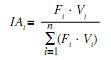
</front><body><![CDATA[ <div style="text-align: center;"><font style="font-weight: bold;"  size="4"><span style="font-family: verdana;">Diet, reproduction and population structure of the introduced Amazonian fish <span style="font-style: italic;">Cichla piquiti</span> (Perciformes: Cichlidae) in the Cachoeira Dourada reservoir (Parana&iacute;ba River, central Brazil)</span></font><br  style="font-family: verdana;"> </div> <font size="2"><br style="font-family: verdana;"> <span style="font-family: verdana;"><span style="font-weight: bold;">Tatiane Ferraz Luiz</span><a style="font-weight: bold;" href="#autor1"><sup>1</sup></a><span  style="font-weight: bold;">, Marcela Roquetti Velludo</span><span style="font-weight: bold;"><sup></sup></span><span  style="font-weight: bold;">, Alberto Carvalho Peret</span><span style="font-weight: bold;"></span><span  style="font-weight: bold;">, Jorge Luiz Rodrigues Filho</span><span  style="font-weight: bold;"></span><span style="font-weight: bold;"> &amp; Andr&eacute; Moldenhauer Peret</span><span style="font-weight: bold;"></span><br  style="font-weight: bold;"> <br style="font-family: verdana;"> </span><span style="font-family: verdana;"><a name="autor1"></a>1.&nbsp; Population Dynamics Laboratory, Department of Hydrobiology, Federal University of S&atilde;o Carlos (UFSCar) Washington Lu&iacute;s Highway (SP-310), km 235. S&atilde;o Carlos, SP, Brazil. Zip Code 13565-905; <a href="mailto:tatianeferrazluiz@hotmail.com">tatianeferrazluiz@hotmail.com</a>, <a href="mailto:marcelavelludo@gmail.com">marcelavelludo@gmail.com</a>, <a href="mailto:peret@ufscar.br">peret@ufscar.br</a>, <a  href="mailto:jorlrf@hotmail.com">jorlrf@hotmail.com</a>, <a  href="mailto:andreperet@yahoo.com">andreperet@yahoo.com</a>     <br>     <br> <a href="#Correspondencia">Direcci&oacute;n de correspondencia.</a>    <br> <br style="font-family: verdana;"> </span></font>     <div style="text-align: justify;"><font size="3"><span  style="font-family: verdana;"><span style="font-weight: bold;"></span></span></font> <hr style="width: 100%; height: 2px;">    <br> <font size="3"><span style="font-family: verdana;"><span  style="font-weight: bold;">Abstract</span></span></font>    <br> <font size="2"><span style="font-family: verdana;"></span></font><br  style="font-family: verdana;"> <font size="2"><span style="font-family: verdana;"></span><span  style="font-family: verdana;">The Blue Peacock Bass (<span style="font-style: italic;">Cichla piquiti</span>), native to the Tocantins-Araguaia river basin of the Amazon system, was introduced into the basin of the Parana&iacute;ba River, Paran&aacute; River system. Cachoeira Dourada reservoir is one of a series of dams on the Parana&iacute;ba River in central Brazil, where this fish has become established. A study of its feeding spectrum, combined with information about its reproductive characteristics and population structure, would enable the current state of this species in the reservoir to be assessed and might provide useful data for the management of other species native to this habitat. This study showed that the peacock bass has no predators or natural competitors in the reservoir and that reproduces continuously, with high reproductive rates, and has a smaller median length at first maturity (L50) than other species of <span style="font-style: italic;">Cichla</span>. Its successful establishment in habitats strongly affected by human activity should cause changes in the whole structure of the local fish communities. Nonetheless, in this reservoir, there appears to be some sharing of the functions of this species with native carnivorous fish, a situation that may be sustained by the presence of a wide variety of foraging fish. Rev. Biol. Trop. 59 (2): 727-741. Epub 2011 June 01.</span></font><br style="font-family: verdana;"> <font size="2"><span style="font-family: verdana;"></span></font>    <br> <font size="2"><span style="font-family: verdana;"><span  style="font-weight: bold;">Key words:</span> <span  style="font-style: italic;">Cichla piquiti</span>, invasive species, population structure, diet, fish reproduction. </span></font><br  style="font-family: verdana;"> <br style="font-family: verdana;"> <font size="3"><span style="font-family: verdana; font-weight: bold;">Resumen    <br> <br style="font-family: verdana;"> </span></font><font size="2"><span style="font-family: verdana;">El pez tucunar&eacute; (<span style="font-style: italic;">Cichla piquiti</span>), nativo del sistema de la cuenca del rio Tocantins-Araguaia, fue introducido en la cuenca del r&iacute;o Parana&iacute;ba, parte del sistema del r&iacute;o Paran&aacute;. En este ecosistema tr&oacute;fico de planicie aluvial, las relaciones entre comunidades de peces est&aacute;n definidas por diferentes factores que pueden ser modificados debido a la represa del r&iacute;o, y da como resultado grandes cambios en la interacci&oacute;n biol&oacute;gica en &eacute;stos h&aacute;bitats. La represa de Cachoeira Dourada forma parte de una serie de represas en el r&iacute;o Parana&iacute;ba en el Brasil central, donde el tucunar&eacute; se ha establecido. Una investigaci&oacute;n sobre su espectro alimentario, combinado con informaci&oacute;n sobre sus caracter&iacute;sticas reproductivas y estructura poblacional, ha permitido evaluar el estado actual de esta especie y la obtenci&oacute;n de datos &uacute;tiles para el manejo de otras especies nativas en el mismo h&aacute;bitat. Este estudio muestra que el tucunar&eacute; no tiene depredador o competidor natural en esta represa y se reproduce continuamente con tasas reproductivas muy altas, por lo tanto presenta una longitud media en su primera madurez (L50) m&aacute;s peque&ntilde;a que otras especies de <span  style="font-style: italic;">Cichla</span>. El &eacute;xito de su establecimiento en estos h&aacute;bitats fuertemente afectados por la actividad humana puede causar cambios en toda la estructura de la comunidad local. Sin embargo, en las represas parece que las funciones de estas especies son compartidas con las de los peces depredadores nativos, una situaci&oacute;n que puede ser sustentada por la presencia de una larga variedad de peces forrajeros.</span></font><br  style="font-family: verdana;"> <br style="font-family: verdana;"> <font size="2"><span style="font-family: verdana;"></span></font> </div> <hr  style="width: 100%; height: 2px; margin-left: 0px; margin-right: 0px;">     <div style="text-align: justify;">    ]]></body>
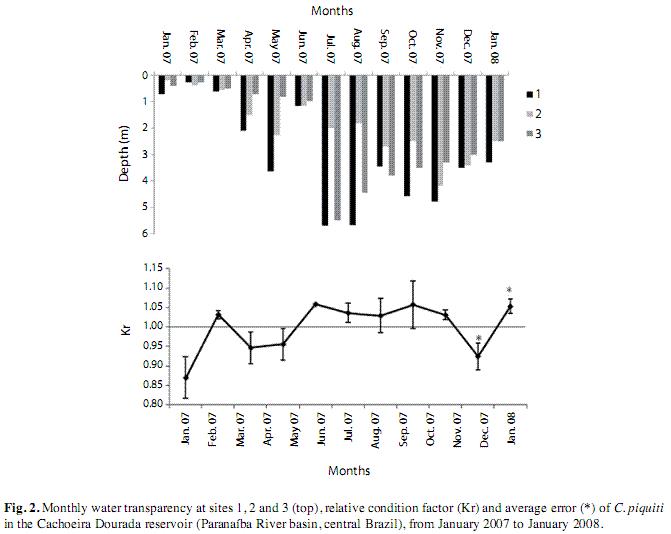
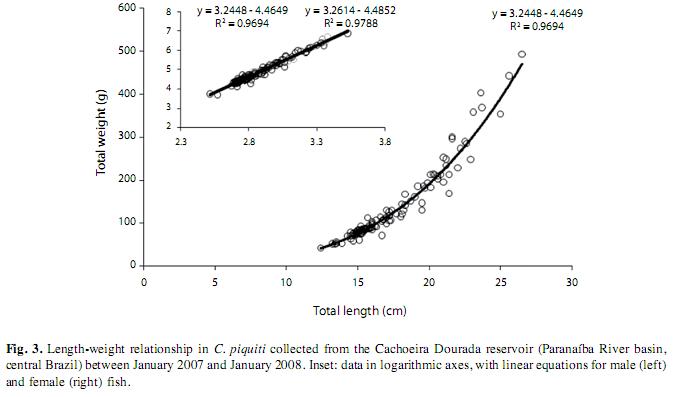
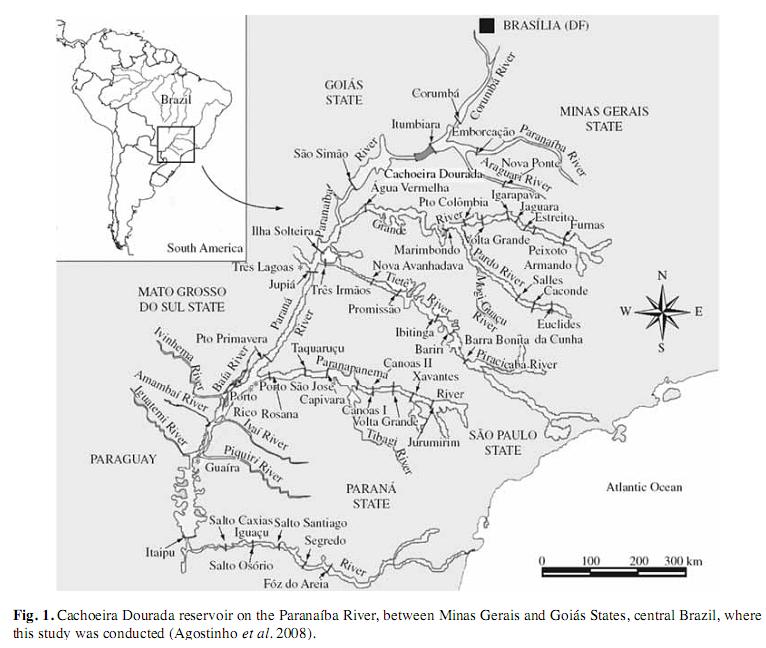
<body><![CDATA[<br> <font size="2"><span style="font-family: verdana;">The introduction of non-native species into new habitats is the second biggest cause of species extinctions, the first being disappearance of the habitats themselves (Simberloff 2003). Apart from causing local extinctions, the introduction of exotic or allochthonous species also has a wider impact on food chains, the balance among various community populations and functional relations in the ecosystems (Rocha <span  style="font-style: italic;">et al. </span>2005). The potential for a successful invasion is determined by the properties of the invading species, such as its tolerance of widely different environmental conditions, dispersion and fast colonization of the habitat, aggressiveness, competitiveness and high reproductive rate (Grime 1979), by its value to the fishing industry (Moyle <span  style="font-style: italic;">et al.</span>1986), and by the characteristics of the local species, namely their competitiveness and capacity to resist, and of the community being invaded (Sakai <span style="font-style: italic;">et al.</span> 2001). </span></font><br  style="font-family: verdana;"> <br style="font-family: verdana;"> <font size="2"><span style="font-family: verdana;">The impact of invasion by a fish is likely to be negative if the species introduced is carnivorous or piscivorous (Moyle &amp; Cech 1996). Being more aggressive than other species, carnivores are relatively easy to introduce and such invasions are recognized as one of the most powerful biological means of transforming native communities. When there are neither predators nor pathogens in the new community capable of attacking the invader, its population may grow very fast, owing to the greater resources available to it, which strengthen its competitiveness (Blossey &amp; Notzold 1995, Tilman 1999). The problem has worsened by the fact that a fish introduced into an ecosystem cannot be selectively eliminated (Kaufman 1992, Simberloff 2003). </span></font><br style="font-family: verdana;"> <br style="font-family: verdana;"> <font size="2"><span style="font-family: verdana;">The blue peacock bass (locally known as tucunar&eacute;), <span style="font-style: italic;">Cichla piquiti </span>Kullander &amp; Ferreira, 2006, occurs naturally in the drainage basin of the Tocantins and Araguaia Rivers (Kullander &amp; Ferreira 2006).&nbsp; In these floodplain ecosystems, the trophic relations of fish communities are affected by a number of factors, such as the properties of the surrounding ecosystem, the feeding flexibility of the species and the effects of seasonal variation on the availability of food resources. The seasonal changes in the water level provoke variations in limnological characteristics, in the availability of food and the migration of species. Thus, the trophic interactions in such systems are very dynamic and complex (Benedito-Cecilio &amp; Ara&uacute;jo-Lima 2002).</span></font><br style="font-family: verdana;"> <br style="font-family: verdana;"> <font size="2"><span style="font-family: verdana;">The blue peacock fish is now widely established in the reservoirs of the Paran&aacute; River basin in the Brazilian states of Minas Gerais and S&atilde;o Paulo, including the basin of the Parana&iacute;ba (Kullander &amp; Ferreira 2006). Several dams in this system lead to changes in its physical, chemical and biological attributes, greatly modifying the biotic interactions and resulting in a simplified ecosystem (Agostinho &amp; Zallewski 1995). Such changes lead to a decrease in recruitment, replacement of the fauna by opportunist species (Agostinho <span style="font-style: italic;">et al.</span> 1994) and modification of the food chain, often resulting in the disappearance of small species (Zaret &amp; Paine 1973, Godinho <span style="font-style: italic;">et al. </span>1994). In this context, a study of the feeding spectrum of <span style="font-style: italic;">Cichla piquiti</span> in the Cachoeira Dourada reservoir on the Parana&iacute;ba River, along with the data on its reproductive features and population structure, would contribute towards an assessment of the current state of this cichlid in the habitat and also provide information that could be used in the management of other exotic invaders.</span></font><br style="font-family: verdana;"> <br style="font-family: verdana;"> <font size="3"><span style="font-family: verdana; font-weight: bold;">Material and Methods</span></font><br style="font-family: verdana;"> <br style="font-family: verdana;"> <font size="2"><span style="font-family: verdana;">The Cachoeira Dourada reservoir (from 18&deg;30&#8217;11.47&#8217;&#8217; S - 49&deg;29&#8217;18.78&#8217;&#8217; W to 18&deg;34&#8217;5.27&#8217;&#8217; S - 49&deg;19&#8217;52.07&#8217;&#8217; W) is situated on the boundary between the states of Minas Gerais and Goi&aacute;s in the central region of Brazil (<a  href="/img/revistas/rbt/v59n2/a15i1.jpg">Fig. 1</a>). It has a volume of 524 000 000m<sup>3</sup> and was created in 1966 by the construction of one of a complex of dams along the Parana&iacute;ba River (tributary of the Paran&aacute;), whose drainage basin extends over 3 111km2 (Cabral et al. 2005).     <br>     <br> The original vegetation around the reservoir, composed of semi-deciduous tropical forest and cerrado (shrubby savannah), with transition zones between the two, has been cleared and replaced by cattle pasture and crop fields. The flow of water from the catchment area into the Parana&iacute;ba follows a well-defined seasonal pattern (Cabral <span style="font-style: italic;">et al. </span>2005). The one-year study reported herein covered the period of high water, from October to March, and drought, from April to September.</span></font><br  style="font-family: verdana;"> <br style="font-family: verdana;"> <font size="2"><span style="font-family: verdana;">The physical and chemical attributes of the water were measured with a Yellow Spring multiprobe. This revealed high levels of dissolved oxygen in the reservoir, varying from 5.28 to 9.16mg/L. The water temperature was rather high throughout the year of sampling, between 22.6 and 27.4&deg;C, while the electrical conductivity was low, from 0.02 to 0.04&#956;S/s, and the pH varied from 5.80 to 7.35. The trophic state of the reservoir varied from oligotrophic, in the dry period, to mesotrophic, when the reservoir was full, according to the Kratzer and Brezonik index (Kratzer &amp; Brezonik 1981).</span></font><br  style="font-family: verdana;"> <br style="font-family: verdana;"> <font size="2"><span style="font-family: verdana;">The blue peacock bass or blue peacock fish were collected monthly, from January 2007 to January 2008, at three sites covering the whole length of the reservoir. Two batteries of ten gill nets were extended at each site during the sampling, with range of meshes in each battery of 1.5 to 10.0cm between adjacent knots. The nets remained under the surface for 24h and were inspected at approximately 12h intervals. The fish were congealed and taken to the laboratory.</span></font><br  style="font-family: verdana;"> <br style="font-family: verdana;"> <font size="2"><span style="font-family: verdana;">In the laboratory, the standard and total lengths of fish were measured (&plusmn;1mm) and weighed (&plusmn;0.01g), the gonads were removed and weighed (&plusmn;0.01g). The size distribution of the population was analyzed in terms of size classes: class 1 included specimens of length 12.6 to 15.5cm, class 2 fish from 15.6 to 18.7cm, class 3 from 18.8 to 21.9cm, class 4 from 22.0 to 25.1cm, class 5 from 25.2 to 28.3cm, class 6 from 28.4 to 31.5cm and class 7 from 31.6 to 34.7cm. The relationship between weight and length, as suggested by Le Cren (1951), was analyzed for the two sexes as separate groups, and the gradients (b) of the linearized weight-length curves, describing the growth patterns followed by individual fish, were compared by the Student<span  style="font-style: italic;"> t</span> test (p=0.05), with n-1 degrees of freedom (Zar 1999). The relative condition factor (Kr=Lt/Wte) was calculated for all specimens and their average monthly compared with the central value of 1.0 by the Student <span style="font-style: italic;">t-test</span> (two-tail p=0.05, n-1). In order to check representativeness of the average we calculated their standard errors (Le Cren 1951). The water transparency was estimated by means of a Secchi disk, to determine whether it influenced Kr. The stage of maturity of individual fish was determined by macroscopic inspection of the color, transparency and vascularization of the gonads. Thus, female fish were assigned to four distinct stages as follows: A) immature, B) Maturing, C) Spawning and D) Post-spawning (Vazzoler 1996). Differences in male and female numbers in samples of the whole population and for each size class were detected by the chi-squared (&#967;<sup>2</sup>) test with Yates&#8217; correction (Zar 1999). The median length at first maturity (L50) was based on the frequency distribution (of females and/or males) of the length classes, being defined as the length of the class in which 50% of the fish have developing gonads, as described by Santos (1978). The female gonadosomatic index (GSI) was calculated, to indicate the functional stage of the ovaries (Vazzoler 1996), and used to produce the maturation curve from which the periods (dry or wet) of intensive reproductive activity were defined.</span></font><br  style="font-family: verdana;"> <br style="font-family: verdana;"> <font size="2"><span style="font-family: verdana;">To study the variation in feeding among the fish, their stomachs were removed, weighed and classified by their degree of fullness, from empty, medium and completely full (Vazzoler 1996). The stomach weight was plotted against total body weight, for each state of fullness. After weighing and classifying, the stomachs were fixed in 4% formaldehyde.</span></font><br style="font-family: verdana;"> <br style="font-family: verdana;"> <font size="2"><span style="font-family: verdana;">The fixed stomach contents were examined under the stereo-microscope and the items were identified to the lowest possible taxonomic level to calculate the percentage of occurrence (F<sub>i</sub>) of each type of item from total (Hyslop 1980). The total volume of item<span  style="font-style: italic;"> i</span> was also calculated from the volume (V<sub>i</sub>) of water displaced by item <span  style="font-style: italic;">i</span> in a measuring cylinder and the importance of this item in the diet of <span  style="font-style: italic;">C. piquiti</span> was assessed from the feeding index IAi (Kawakami &amp; Vazzoler 1980):</span></font><br  style="font-family: verdana;">     <br>     <div style="text-align: center;"><img alt=""  src="/img/revistas/rbt/v59n2/a15ia.jpg"  style="width: 111px; height: 60px;"><br style="font-family: verdana;"> </div> <br style="font-family: verdana;"> <font size="2"><span style="font-family: verdana;">where:&nbsp; IA<sub>i</sub> is the feeding index of food item&nbsp; <span style="font-style: italic;">i </span>(<span  style="font-style: italic;">i</span>=1,2,n); F<sub>i</sub> its frequency of occurrence in the diet (%) and V<sub>i</sub> its percent volume in the diet. </span></font><br style="font-family: verdana;"> <br style="font-family: verdana;"> <font size="3"><span style="font-family: verdana; font-weight: bold;">Results</span></font><br  style="font-family: verdana; font-weight: bold;"> <br style="font-family: verdana;"> <font size="2"><span style="font-family: verdana;">The transparency of the water (Secchi depth) and the condition factor of the blue peacock fish specimens were higher in the dry period. The low values of the errors of the mean (SE) indicated high representativeness of the parameter in relation to your samples (<a  href="/img/revistas/rbt/v59n2/a15i2.jpg">Fig. 2</a>). In all, 141 <span style="font-style: italic;">Cichla piquiti</span> were collected, with a total biomass of 23.50kg; 68% were male, 12% female and 20% juvenile. The specimens of each sex showed an exponential relation between weight and length (<a  href="/img/revistas/rbt/v59n2/a15i3.jpg">Fig. 3</a>), characterizing the growth as positive allometric (exponential coefficient, b&gt;3.0). The weight-length curve was linearized by using logarithmic axes (inset, <a href="/img/revistas/rbt/v59n2/a15i3.jpg">Fig. 3</a>) and coefficient b, the slope of this line, was found to be slightly greater for the females than for the males. However, Student&#8217;s&nbsp; t test (108 degrees of freedom) showed no significant difference between males and females (p&gt;0.05). P values are presented in <a href="#cuadro1">Table 1</a>. The linear plots had high coefficients of determination (r<sup>2</sup>), indicating a good fit between the model equation and data (<a href="/img/revistas/rbt/v59n2/a15i3.jpg">Fig. 3</a>).    <br>     <br>     <br> </span></font>     <div style="text-align: center;"><font size="2"><span      style="font-family: verdana;"><a name="cuadro1"></a><img alt=""     ]]></body>
<body><![CDATA[ src="/img/revistas/rbt/v59n2/a15t1.gif"      style="width: 328px; height: 350px;"></span></font><br      style="font-family: verdana;">     <font size="2"><span style="font-family: verdana;"></span></font></div>     <br style="font-family: verdana;">     <font size="2"><span style="font-family: verdana;">The fish of each sex     were grouped     in 7 length classes. The first one,     with the shortest fish, was the most numerous and the numbers of     specimens per class decreased steadily with rising length. Specimens of     ]]></body>
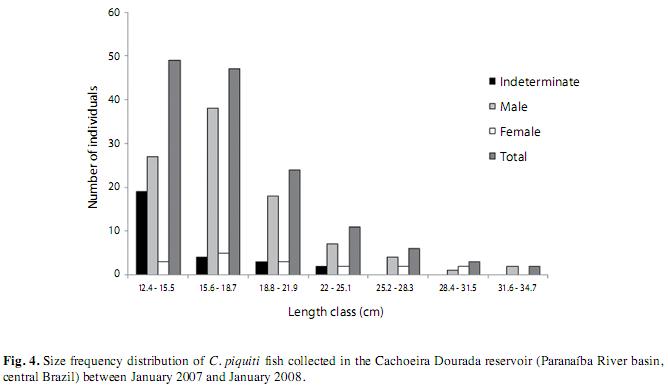
<body><![CDATA[indeterminate sex were found only in the first four classes, while     females were present in all classes up to the sixth and males in all     the size classes. The population of <span style="font-style: italic;">C.     piquiti </span>caught in the nets     consisted mainly of males, which exceeded the number of females with     the proportion of 5.5:1. By applying the &#967;<sup>2</sup> test to the     numbers of     male, female and indeterminate fish in each size class, it was found     that every class showed significant differences in its composition     (<a href="/img/revistas/rbt/v59n2/a15i4.jpg">Fig. 4</a>). The values of     ]]></body>
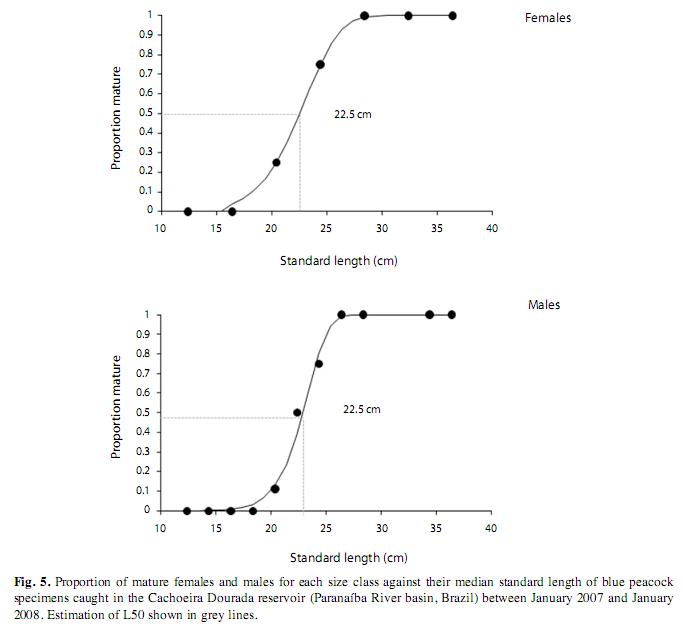
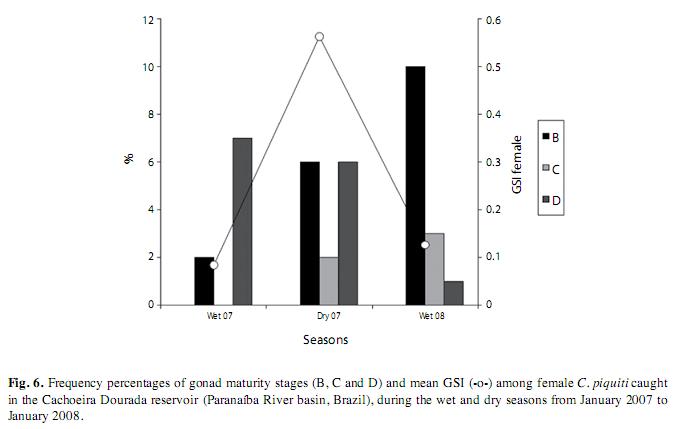
<body><![CDATA[L50 for male and female <span style="font-style: italic;">C. piquiti</span>     were both     22.5cm and those of L100 were 26.4 and 28.4cm, respectively (<a      href="/img/revistas/rbt/v59n2/a15i5.jpg">Fig. 5</a>).     The GSI of the females was higher in the dry period, when more of the     females were in the more advanced reproductive stages (<a      href="/img/revistas/rbt/v59n2/a15i6.jpg">Fig. 6</a>).</span></font><br      style="font-family: verdana;">     <br style="font-family: verdana;">     <font size="2"><span style="font-family: verdana;">Among the 82     ]]></body>
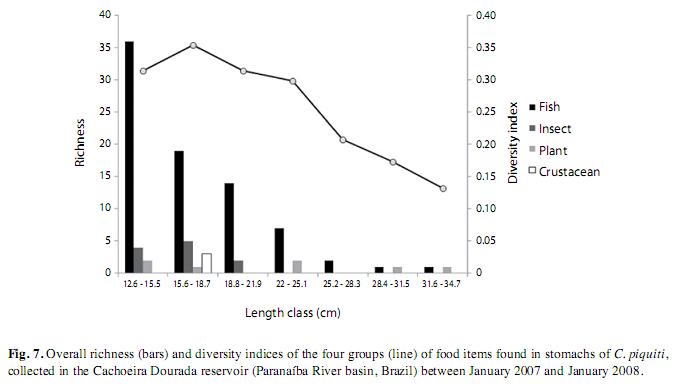
<body><![CDATA[analyzed stomachs, 25     of those from the fish caught during     the rainy seasons of 2007 and 2008 contained no food items. The types     and frequency of occurrence of items found in the stomachs of these     fish are listed in <a href="/img/revistas/rbt/v59n2/a15t2.gif">Table 2</a>.     These items were allocated to four groups:     fish, insects, crustaceans and plants. Fish constituted the majority of     the food in the blue peacock fish stomachs, revealing the predominantly     piscivorous diet of this fish at all stages of its growth (<a      href="/img/revistas/rbt/v59n2/a15i7.jpg">Fig. 7</a>).     ]]></body>
<body><![CDATA[Fragments of plants, insects and crustaceans played a less important     part in the feeding habits of <span style="font-style: italic;">C.     piquiti.</span> The diversity of food items     in the stomach was higher in the first four length classes and insects     were found only in the first three (<a      href="/img/revistas/rbt/v59n2/a15i7.jpg">Fig. 7</a>). Owing to the     advanced     stage of digestion, most of the fish found in the stomachs could not be     identified (82.26%). The following species were identified: <span      style="font-style: italic;">Satanoperca     ]]></body>
<body><![CDATA[papaterra</span> (Heckel 1840), <span style="font-style: italic;">Metynnis     maculatus</span> (Lacep&egrave;de, 1803),     <span style="font-style: italic;">Bryconamericus</span> sp., <span      style="font-style: italic;">Astyanax </span>sp., <span      style="font-style: italic;">Hoplias malabaricus</span> (Bloch 1974),     <span style="font-style: italic;">Hoplias lacerdae </span>(Ribeiro     1908), <span style="font-style: italic;">Pinirampus pirinampu</span>     (Spix &amp;     Agassiz, 1829), <span style="font-style: italic;">Pimelodella </span>sp.     and<span style="font-style: italic;"> Serrassalmus</span> sp. Some     ]]></body>
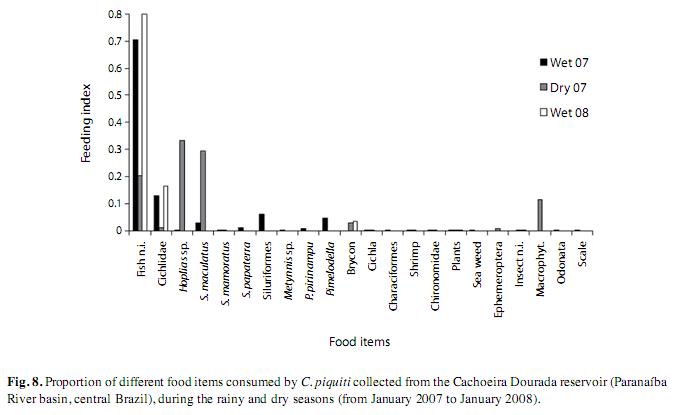
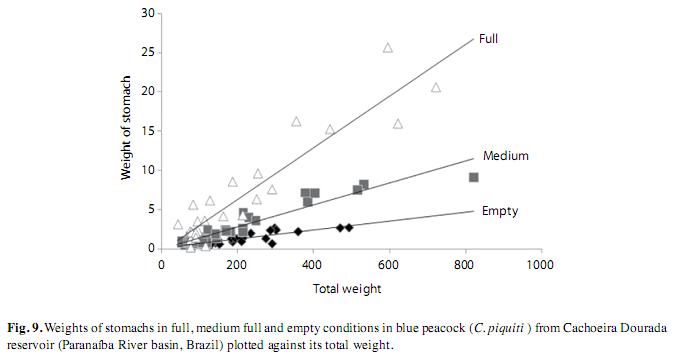
<body><![CDATA[cannibalism     was observed, mainly in the form of juvenile blue peacock fish in the     stomach contents. Fish belonging to the families Characidae, Cichlidae,     Pimelodidae and Symbranchidae, all of which are typical of lentic     habitats, were identified among the food items. The values of the     feeding indices for many different items consumed by <span      style="font-style: italic;">C. piquiti</span> in the     dry and wet seasons are shown in <a      href="/img/revistas/rbt/v59n2/a15i8.jpg">Fig. 8</a>. In <a      href="/img/revistas/rbt/v59n2/a15i9.jpg">Fig. 9</a>, the linear plots     ]]></body>
<body><![CDATA[of     the relation between the stomach weight and body weight, for empty,     medium full and completely full stomachs, are shown.</span></font><br      style="font-family: verdana;">     <br style="font-family: verdana;">     <font size="3"><span style="font-family: verdana; font-weight: bold;">Discussion</span></font><br      style="font-family: verdana;">     <br style="font-family: verdana;">     <font size="2"><span style="font-family: verdana;">The feeding and     hence the fattening     ]]></body>
<body><![CDATA[of fish in a given habitat are     strongly influenced by the environmental conditions along the whole     watercourse regulating the availability of food items (Gomiero &amp;     Braga 2005). The transparency of the water was a determining factor, as     blue peacock fish are diurnal predators that need clear water to see     and catch their prey. Agostinho <span style="font-style: italic;">et     al.</span> (2002) report that the     still water typical of some reservoirs becomes very transparent,     facilitating greatly the predator activity of diurnal fish such as <span      style="font-style: italic;">C.     ]]></body>
<body><![CDATA[piquiti.</span></span></font><br style="font-family: verdana;">     <br style="font-family: verdana;">     <font size="2"><span style="font-family: verdana;">The relative     condition factor (Kr)     observed in the blue peacock fish     specimens was close to 1.0, being slightly higher in the dry season. In     this period, the higher quality and transparency of the water     contributed to raising the efficiency of the fish in catching their     prey; this was also the season of fattening for reproduction and higher     values of GSI. The decrease of Kr in the rainy period coincided with     ]]></body>
<body><![CDATA[the end of the reproductive season of this species and a time of lower     feeding activity, during which a higher proportion of stomachs were     found to be empty.</span></font><br style="font-family: verdana;">     <br style="font-family: verdana;">     <font size="2"><span style="font-family: verdana;">The sex ratio showed     a clear     predominance of male blue peacock fish in     all the size classes. In species that exhibit biparental care, such a     difference may be expected for this ratio (Gomiero <span      style="font-style: italic;">et al. </span>2009).     ]]></body>
<body><![CDATA[According to Jepsen <span style="font-style: italic;">et al. </span>(1997),     more males tend to be caught during     the reproductive period, owing to their aggressive territorial defense     and protection of their offspring from any kind of invader. Females     guard the eggs and larvae while the males patrol the territory and     repel all possible predators (Barlow 1974). Natural mortality rates,     differential growth and methods of collection can be further causes of     such differences between the sexes (Vazzoler 1996).&nbsp; In the     reservoir under study, the maximum length of males was greater than     that of females. This can be explained partly in terms of the     ]]></body>
<body><![CDATA[expenditure of energy on sexual development. Gurgel (2004) points out     that the development of the testes is related more to the size of the     male fish than to the annual reproductive cycle, whereas in the     females, the amount of energy spent on egg formation handicaps their     general growth, resulting in smaller asymptotic lengths. Lowe-McConnell     (1969), Chellapa <span style="font-style: italic;">et al. </span>(2003)     and Mu&ntilde;oz <span style="font-style: italic;">et al.</span>     (2006) observed     length distribution frequencies in other species of <span      style="font-style: italic;">Cichla</span>, in which     ]]></body>
<body><![CDATA[the males grew longer than the females; however, in these cases,     pressures arising from fishing and unstable habitats may have     contributed to these differences (Winemiller 2001).</span></font><br      style="font-family: verdana;">     <br style="font-family: verdana;">     <font size="2"><span style="font-family: verdana;">An important     biological     characteristic in populations of introduced     fish is the change in the median length at first gonadal maturity from     the value in the native habitat. At present, it is impossible to verify     ]]></body>
<body><![CDATA[whether this length changed after the introduction of <span      style="font-style: italic;">C. piquiti</span> to     central Brazil, owing to the lack of research data on this variable in     the native populations of the Tocantins-Araguaia river basin. Up to     2006, blue peacock fish were grouped in 15 species and <span      style="font-style: italic;">C. piquiti</span> was     not defined as a separate species, being treated as a synonym of     several of them. For this reason, changes in biological characteristics     that may have occurred when this species was introduced into new     habitats cannot be checked until studies in the original river systems     ]]></body>
<body><![CDATA[have been completed. Therefore, the size at first gonadal maturity     (22.5cm) of <span style="font-style: italic;">C. piquiti </span>populations     in the Cachoeira Dourada reservoir,     which was the same for males and females and fell in the 4<sup>th</sup>     size     class, is compared here with those of other <span      style="font-style: italic;">Cichla</span> species elsewhere.     Zaret (1980) reported that in Lake Gatun, Panama, female and male<span      style="font-style: italic;"> C.     ocellaris</span> (Bloch &amp; Schneider 1801) start reproducing at     ]]></body>
<body><![CDATA[standard     lengths of 32.2 and 33.2cm, respectively. In Venezuela, Winemiller <span      style="font-style: italic;">et     al. </span>(1997), Jepsen <span style="font-style: italic;">et al.</span>     (1999) &amp; Winemiller (2001) found that the     standard length at first maturity varied with the species: 32.5cm for     <span style="font-style: italic;">C. temensis</span> (Humboldt 1821),     27.0cm for <span style="font-style: italic;">C. orinocensis</span>     (Humboldt 1821)     and 24.6cm for <span style="font-style: italic;">C. intermedia </span>(Machado-Allison     ]]></body>
<body><![CDATA[1971). However, in     southeast Brazil, Gomiero &amp; Braga (2004) found this length to be     shorter: 20.0cm for <span style="font-style: italic;">C. ocellaris</span>     and 21.5cm for <span style="font-style: italic;">C. monoculus</span>     (Spix     &amp; Agassiz 1831). Similarly, in the Lobo reservoir (state of     S&atilde;o Paulo), Souza et al. (2008) described the total length at     first maturity of C. kelberi (Kullander &amp; Ferreira 2006) as 20.7cm     for females and 21.5cm for males. Such variations in the length at     first maturity may be caused by a number of factors, such as species     ]]></body>
<body><![CDATA[differences, therefore several criteria used in the estimation,     adaptation of species to new lakes (Souza <span      style="font-style: italic;">et al.</span> 2008) or even seasonal     variations. Gomiero <span style="font-style: italic;">et al.</span>     (2009) suggest that the overpopulation and     full development of blue peacock fish at reduced sizes occur because of     the absence of natural predators in the ecosystem and the great     abundance of food.</span></font><br style="font-family: verdana;">     <br style="font-family: verdana;">     <font size="2"><span style="font-family: verdana;">The reproductive     ]]></body>
<body><![CDATA[activity of     species of <span style="font-style: italic;">Cichla </span>takes     place during the     dry season, after which spawning occurs when the rains comeand the     water level begins to rise (Lowe-McConnell 1969, Jepsen <span      style="font-style: italic;">et al.</span> 1999,     Winemiller 2001). Some mature gonads were found in specimens of <span      style="font-style: italic;">C.     piquiti </span>from the Cachoeira Dourada reservoir throughout the     year of     ]]></body>
<body><![CDATA[study, the numbers peaking in the dry period, suggesting a long     reproductive phase. The constant presence of mature gonads confirms the     continuous reproduction indicated by the observation that juveniles     were collected in all seasons of the year. Long reproductive periods     have been seen in natural habitats, in lakes and in reservoirs where     <span style="font-style: italic;">Cichla</span> spp. have been     introduced (Gomiero <span style="font-style: italic;">et al.</span>     2009).&nbsp; In the     case of <span style="font-style: italic;">C. kelberi </span>(Souza <span      style="font-style: italic;">et al. </span>2008) and <span     ]]></body>
<body><![CDATA[ style="font-style: italic;">C. monoculus</span> (Chellapa <span      style="font-style: italic;">et     al.</span> 2003), reproductive peaks occurred during the rainy periods,     when     the water was warmer. The tendency to synchronize reproduction can be     explained by the higher levels of food available to the recently     hatched fry (Gomiero <span style="font-style: italic;">et al. </span>2009).     Resende <span style="font-style: italic;">et al.</span> (2008), who     studied     the invasion of <span style="font-style: italic;">C. piquiti </span>in     ]]></body>
<body><![CDATA[the Central-west Brazilian swamplands     (Pantanal) of the Mato Grosso plateau, noted that a significant number     of mature and post-spawning (empty) gonads in an adult population of     invaders is a clear sign that the population has become well     established in the new habitat.</span></font><br      style="font-family: verdana;">     <br style="font-family: verdana;">     <font size="2"><span style="font-family: verdana;">The stomach contents     revealed that     <span style="font-style: italic;">C. piquiti</span> has a predominantly     ]]></body>
<body><![CDATA[piscivorous eating habit, but most stomachs were empty in the rainy     season. Seasonal availability of prey and variation of water     transparency may influence when the reproductive period occurs. During     the dry season, these fish consume more food and build up reserves for     the reproductive phase, investing all their energy in gonad     development. According to Zaret (1980) and Jepsen <span      style="font-style: italic;">et al.</span> (1997,     1999), <span style="font-style: italic;">Cichla</span> spp. do not     normally feed during spawning and while     caring for the young. This agrees with the observation that in     ]]></body>
<body><![CDATA[the Paraguay River 80% of blue peacock fish caught in the breeding     season had empty stomachs (Mu&ntilde;oz <span      style="font-style: italic;">et al.</span> 2006).</span></font><br      style="font-family: verdana;">     <br style="font-family: verdana;">     <font size="2"><span style="font-family: verdana;">Versatility of     feeding habit is     probably the chief reason for the     notable success of cichlids in colonizing new habitats (Novaes <span      style="font-style: italic;">et al.</span>     ]]></body>
<body><![CDATA[2004). Fish of their own genus, characid fish and benthic animals are     the food items often found in blue peacock fish stomachs (Jepsen <span      style="font-style: italic;">et al.</span>     1997, Williams <span style="font-style: italic;">et al.</span> 1998,     Lowe-MacConnell 1987). There are in fact 5     carnivorous fish species in Cachoeira Dourada reservoir:     <span style="font-style: italic;">Acestrorhynchus lacustris </span>(Lutken     1975), <span style="font-style: italic;">Hoplias malabaricus</span>, <span      style="font-style: italic;">H.     lacerdae</span>, <span style="font-style: italic;">Pinirampus pirinampu</span>     ]]></body>
<body><![CDATA[and <span style="font-style: italic;">Serrasalmus maculatus </span>(Kner     1858).     The introduced cichlid examined in our study attained a frequency     similar to these species and apparently does not form part of the diet     of <span style="font-style: italic;">P. pirinampu.</span> On the other     hand, the high incidence of young blue     peacock fish in the food items identified in the stomachs of adult blue     peacock fish demonstrates that the species practices a degree of     population control. Nikolsky (1963) suggested that many acts of     cannibalism to regulate abundance and reduce competition for food are a     ]]></body>
<body><![CDATA[result of overpopulation.&nbsp; In this study, the diversity of food     items in cichlid stomachs increased in the second size class and then,     from the fourth class on, the variety of food narrowed as the fish     reached sexual maturity. In Serra da Mesa reservoir (Brazil), adult <span      style="font-style: italic;">C.     monoculus</span> fed mainly on fish, whereas their young swallowed     microcrustaceans and insects, as well as fish. Moreover, insects and     plants sometimes found in the stomachs of some adults could be the     remains of food in the stomachs of their prey or material swallowed by     chance while they caught the prey (Novaes <span     ]]></body>
<body><![CDATA[ style="font-style: italic;">et al.</span> 2004).</span></font><br      style="font-family: verdana;">     <br style="font-family: verdana;">     <font size="2"><span style="font-family: verdana;">Piscivorous invaders     probably cause     the composition of the invaded     community to change more radically than invading omnivores or     detritivores (Moyle &amp; Light 1996). The presence of these highly     adapted and rapidly multiplying predators provokes serious damage to     the ichthyofauna by predation, competition and a cascade of effects     ]]></body>
<body><![CDATA[down the whole food chain (Arcifa &amp; Meschiatti 1993, Santos <span      style="font-style: italic;">et al.     </span>1994).&nbsp; In the Brazilian Rosana reservoir, biodiversity     declined     progressively and, several species of fish were lost completely in a     few years following the introduction of <span      style="font-style: italic;">C. kelberi</span> (Pelicice &amp;     Agostinho 2008). In Panama, when <span style="font-style: italic;">C.     ocellaris</span> spread to the region     around the Chagres River, a large number of fish species disappeared     ]]></body>
<body><![CDATA[and changes also occurred in the zooplankton, aquatic insects and     piscivorous birds, leading to a simplification of the food chain (Zaret     &amp; Paine 1973). Godinho <span style="font-style: italic;">et al. </span>(1994)     made a comparative study of     the ichthyofauna in the various lakes in the Rio Doce valley (Brazil)     and observed that in the lakes colonized by <span      style="font-style: italic;">C. ocellaris</span> small species     of fish had disappeared. Santos <span style="font-style: italic;">et     al.</span> (1994) reported that <span style="font-style: italic;">Cichla     </span>spp. and <span style="font-style: italic;">Plagioscion     ]]></body>
<body><![CDATA[squamosissimus</span> (Heckel 1840), both of which were exotic     in the Rio Grande basin (S.E. Brazil), dominated the community of fish     in the Furnas and Marimbondo reservoirs of that system.</span></font><br      style="font-family: verdana;">     <br style="font-family: verdana;">     <font size="2"><span style="font-family: verdana;">Changes in the     patterns of birth,     death and migration in populations of     native species result from ecological interactions between native and     invading species, directly either through, by predation and competition     ]]></body>
<body><![CDATA[or indirectly by alteration of habitats (Sakai <span      style="font-style: italic;">et al. </span>2001). According     to Lodge (2001), the Nile perch remained at low population levels for     many years after being introduced into Lake Victoria (in the 1950s).     However, it recently increased in abundance, provoking significant     changes in the behavior of native prey fish, leading to the extinction     of about 200 of the 400 cichlids in the lake.</span></font><br      style="font-family: verdana;">     <br style="font-family: verdana;">     <font size="2"><span style="font-family: verdana;">When the blue     ]]></body>
<body><![CDATA[peacock fish is     introduced into a system with the     simplified set of ecological relations, as those found in reservoirs, a     population explosion can be expected, owing to the species     characteristics observed in this study, namely the diminished size at     first maturity, continuous reproduction and highly successful breeding,     the absence of predators or natural competitors and the consumption of     carnivores. Nevertheless, in Cachoeira Dourada reservoir, species are     apparently not being excluded and the density of <span      style="font-style: italic;">C. piquiti</span> is near     ]]></body>
<body><![CDATA[that of other piscivores in the reservoir. Given that this cichlid has     become well established in an ecosystem where the ecological relations     have been greatly reduced as a result of anthropogenic activity,     modifications in the structure of the entire local community would be     expected. However, it seems that, for the moment, there is a balance in     which the blue peacock fish is sharing functions with the native     carnivore species, and that this situation may be sustained by the     diversity of foraging fish present in the reservoir.</span></font><br      style="font-family: verdana;">     <br style="font-family: verdana;">     ]]></body>
<body><![CDATA[<font size="3"><span style="font-family: verdana; font-weight: bold;">Acknowledgments     </span></font><br style="font-family: verdana;">     <br style="font-family: verdana;">     <font size="2"><span style="font-family: verdana;">We are grateful for     the financial     support from ENDESA and Capes.</span></font><br      style="font-family: verdana;">     <br style="font-family: verdana;">     <font size="3"><span style="font-family: verdana; font-weight: bold;"></span></font>     <hr style="width: 100%; height: 2px;">    ]]></body>
<body><![CDATA[<!-- ref --><br> <font size="3"><span style="font-family: verdana; font-weight: bold;">References</span></font><br  style="font-family: verdana;"> <br style="font-family: verdana;"> <font size="2"><span style="font-family: verdana;">Agostinho, A. &amp; A. Zalewski. 1995. The dependence of fish community struture and dynamics on floodplain and riparian ecotone zone in Paran&aacute; River, Brazil. Hydrobiologia 303: 141-148.    &nbsp;&nbsp;&nbsp;&nbsp;&nbsp;&nbsp;&nbsp;&nbsp;[&#160;<a href="javascript:void(0);" onclick="javascript: window.open('/scielo.php?script=sci_nlinks&ref=1755750&pid=S0034-7744201100020001500001&lng=','','width=640,height=500,resizable=yes,scrollbars=1,menubar=yes,');">Links</a>&#160;]<!-- end-ref --><!-- ref --></span></font><br  style="font-family: verdana;"> <br style="font-family: verdana;"> <font size="2"><span style="font-family: verdana;">Agostinho, A.A., H.F. J&uacute;lio Jr &amp; M.J. Petrere. 1994. Itaipu Reservoir (Brazil): impacts of the impoundment on the fish fauna and fisheries, p. 161-184. <span style="font-style: italic;">In</span> I.G. Cowx (ed.). Rehabilitation of freshwater fisheries. Fishing New Books, Oxford, England.    &nbsp;&nbsp;&nbsp;&nbsp;&nbsp;&nbsp;&nbsp;&nbsp;[&#160;<a href="javascript:void(0);" onclick="javascript: window.open('/scielo.php?script=sci_nlinks&ref=1755751&pid=S0034-7744201100020001500002&lng=','','width=640,height=500,resizable=yes,scrollbars=1,menubar=yes,');">Links</a>&#160;]<!-- end-ref --><!-- ref --></span></font><br  style="font-family: verdana;"> <br style="font-family: verdana;"> <font size="2"><span style="font-family: verdana;">Agostinho, A.A., L.C. Gomes, D.R. Fernandez &amp; H.I. Suzuki. 2002. Efficiency of fish ladders for neotropical ichthyofauna. River Res. Appl. 18: 299-306.    &nbsp;&nbsp;&nbsp;&nbsp;&nbsp;&nbsp;&nbsp;&nbsp;[&#160;<a href="javascript:void(0);" onclick="javascript: window.open('/scielo.php?script=sci_nlinks&ref=1755752&pid=S0034-7744201100020001500003&lng=','','width=640,height=500,resizable=yes,scrollbars=1,menubar=yes,');">Links</a>&#160;]<!-- end-ref --><!-- ref --></span></font><br style="font-family: verdana;"> <br style="font-family: verdana;"> <font size="2"><span style="font-family: verdana;">Agostinho, A.A., F.M. Pelicice &amp; L.C. Gomes. 2008. Dams and the fish fauna of the Neotropical region: impacts and management related to diversity and fisheries. Braz. J. Biol. 68: 1119-1132.    &nbsp;&nbsp;&nbsp;&nbsp;&nbsp;&nbsp;&nbsp;&nbsp;[&#160;<a href="javascript:void(0);" onclick="javascript: window.open('/scielo.php?script=sci_nlinks&ref=1755753&pid=S0034-7744201100020001500004&lng=','','width=640,height=500,resizable=yes,scrollbars=1,menubar=yes,');">Links</a>&#160;]<!-- end-ref --><!-- ref --></span></font><br  style="font-family: verdana;"> <br style="font-family: verdana;"> <font size="2"><span style="font-family: verdana;">Arcifa, M.S. &amp; A.J. Meschiatti. 1993. Distribution and feeding ecology of fishes in a Brazilian reservoir: Lake Monte Alegre. Interci&ecirc;ncia 18: 302-313.    &nbsp;&nbsp;&nbsp;&nbsp;&nbsp;&nbsp;&nbsp;&nbsp;[&#160;<a href="javascript:void(0);" onclick="javascript: window.open('/scielo.php?script=sci_nlinks&ref=1755754&pid=S0034-7744201100020001500005&lng=','','width=640,height=500,resizable=yes,scrollbars=1,menubar=yes,');">Links</a>&#160;]<!-- end-ref --><!-- ref --></span></font><br  style="font-family: verdana;"> <br style="font-family: verdana;"> <font size="2"><span style="font-family: verdana;">Barlow, G.W. 1974. Contrasts in social behavior between Central American cichlid fishes and coral-reef surgeon fishes. Am. Zool. 14: 9-34.    &nbsp;&nbsp;&nbsp;&nbsp;&nbsp;&nbsp;&nbsp;&nbsp;[&#160;<a href="javascript:void(0);" onclick="javascript: window.open('/scielo.php?script=sci_nlinks&ref=1755755&pid=S0034-7744201100020001500006&lng=','','width=640,height=500,resizable=yes,scrollbars=1,menubar=yes,');">Links</a>&#160;]<!-- end-ref --><!-- ref --></span></font><br style="font-family: verdana;"> <br style="font-family: verdana;"> <font size="2"><span style="font-family: verdana;">Benedito-Cecilio, E. &amp; C.A.R.M. Araujo-Lima. 2002. Variation in the carbon isotope composition of <span style="font-style: italic;">Semaprochilodus insignis</span>, a detritivorous fish associated with oligotrophic and eutrophic Amazonian rivers. J. Fish. Biol. 60: 1603-1607.    &nbsp;&nbsp;&nbsp;&nbsp;&nbsp;&nbsp;&nbsp;&nbsp;[&#160;<a href="javascript:void(0);" onclick="javascript: window.open('/scielo.php?script=sci_nlinks&ref=1755756&pid=S0034-7744201100020001500007&lng=','','width=640,height=500,resizable=yes,scrollbars=1,menubar=yes,');">Links</a>&#160;]<!-- end-ref --><!-- ref --></span></font><br  style="font-family: verdana;"> <br style="font-family: verdana;"> <font size="2"><span style="font-family: verdana;">Blossey, B. &amp; R. Notzold. 1995. Evolution of increased competitive ability in invasive non-indigenous plants: a hypothesis. J. Ecol. 83: 887-889.    &nbsp;&nbsp;&nbsp;&nbsp;&nbsp;&nbsp;&nbsp;&nbsp;[&#160;<a href="javascript:void(0);" onclick="javascript: window.open('/scielo.php?script=sci_nlinks&ref=1755757&pid=S0034-7744201100020001500008&lng=','','width=640,height=500,resizable=yes,scrollbars=1,menubar=yes,');">Links</a>&#160;]<!-- end-ref --><!-- ref --></span></font><br style="font-family: verdana;"> <br style="font-family: verdana;"> <font size="2"><span style="font-family: verdana;">Cabral, J.B.P., V.A. Bcegato,&nbsp; I. Scopel &amp; R.M. Lopes. 2005. Uso de t&eacute;cnicas de geoprocessamento para mapear o potencial natural de eros&atilde;o da chuva na Bacia Hidrogr&aacute;fica do Reservat&oacute;rio de Cachoeira Dourada &#8211; GO/MG. RA&acute;E GA. 10: 107-116.    &nbsp;&nbsp;&nbsp;&nbsp;&nbsp;&nbsp;&nbsp;&nbsp;[&#160;<a href="javascript:void(0);" onclick="javascript: window.open('/scielo.php?script=sci_nlinks&ref=1755758&pid=S0034-7744201100020001500009&lng=','','width=640,height=500,resizable=yes,scrollbars=1,menubar=yes,');">Links</a>&#160;]<!-- end-ref --><!-- ref --></span></font><br style="font-family: verdana;"> <br style="font-family: verdana;"> <font size="2"><span style="font-family: verdana;">Chellappa, S., M.R. C&acirc;mara, N.T. Chellappa, M.C.M. Beveridge &amp; F.A. Huntingford. 2003. Reproductive ecology of a neotropical cichlid fish, <span style="font-style: italic;">Cichla monoculus </span>(Osteichthyes: Cichlidae). Braz. J. Biol. 63: 17-26.    &nbsp;&nbsp;&nbsp;&nbsp;&nbsp;&nbsp;&nbsp;&nbsp;[&#160;<a href="javascript:void(0);" onclick="javascript: window.open('/scielo.php?script=sci_nlinks&ref=1755759&pid=S0034-7744201100020001500010&lng=','','width=640,height=500,resizable=yes,scrollbars=1,menubar=yes,');">Links</a>&#160;]<!-- end-ref --><!-- ref --></span></font><br style="font-family: verdana;"> <br style="font-family: verdana;"> <font size="2"><span style="font-family: verdana;">Godinho, A.L., M.T. Fonseca &amp; L.M. Ara&uacute;jo. 1994. The ecology of predator fish introductions: the case of Rio Doce Valley lakes, p. 77-85. <span style="font-style: italic;">In</span> R.M.P. Coelho, A. Giani &amp; E. Sperling. Ecology and human impacts on lakes and reservoirs in Minas Gerais with special reference to future and management strategies. Segrac, Belo Horizonte, Brazil.    &nbsp;&nbsp;&nbsp;&nbsp;&nbsp;&nbsp;&nbsp;&nbsp;[&#160;<a href="javascript:void(0);" onclick="javascript: window.open('/scielo.php?script=sci_nlinks&ref=1755760&pid=S0034-7744201100020001500011&lng=','','width=640,height=500,resizable=yes,scrollbars=1,menubar=yes,');">Links</a>&#160;]<!-- end-ref --><!-- ref --></span></font><br style="font-family: verdana;"> <br style="font-family: verdana;"> <font size="2"><span style="font-family: verdana;">Gomiero, L.M. &amp; F.M.S. Braga. 2004. Feeding of introduced species of <span style="font-style: italic;">Cichla</span> (Perciformes, Cichlidae) in Volta Grande reservoir, river Grande (MG/SP). Braz. J. Bio. 64: 787-795.    &nbsp;&nbsp;&nbsp;&nbsp;&nbsp;&nbsp;&nbsp;&nbsp;[&#160;<a href="javascript:void(0);" onclick="javascript: window.open('/scielo.php?script=sci_nlinks&ref=1755761&pid=S0034-7744201100020001500012&lng=','','width=640,height=500,resizable=yes,scrollbars=1,menubar=yes,');">Links</a>&#160;]<!-- end-ref --><!-- ref --></span></font><br  style="font-family: verdana;"> <br style="font-family: verdana;"> <font size="2"><span style="font-family: verdana;">Gomiero, L.M. &amp; F.M.S. Braga. 2005. The condition factor of fishes from two river basins in S&atilde;o Paulo state, Southeast of Brazil. Acta Sci. Biol. Sci. 27: 73-78.    &nbsp;&nbsp;&nbsp;&nbsp;&nbsp;&nbsp;&nbsp;&nbsp;[&#160;<a href="javascript:void(0);" onclick="javascript: window.open('/scielo.php?script=sci_nlinks&ref=1755762&pid=S0034-7744201100020001500013&lng=','','width=640,height=500,resizable=yes,scrollbars=1,menubar=yes,');">Links</a>&#160;]<!-- end-ref --><!-- ref --></span></font><br  style="font-family: verdana;"> <br style="font-family: verdana;"> <font size="2"><span style="font-family: verdana;">Gomiero, L.M., G.A. Villares Jr. &amp; F. Naous. 2009. Reproduction of <span style="font-style: italic;">Cichla kelberi </span>(Kullander and Ferreira,2006) introduced into an artificial lake in southeastern Brazil. Braz. J. Biol. 69: 175-183.    &nbsp;&nbsp;&nbsp;&nbsp;&nbsp;&nbsp;&nbsp;&nbsp;[&#160;<a href="javascript:void(0);" onclick="javascript: window.open('/scielo.php?script=sci_nlinks&ref=1755763&pid=S0034-7744201100020001500014&lng=','','width=640,height=500,resizable=yes,scrollbars=1,menubar=yes,');">Links</a>&#160;]<!-- end-ref --><!-- ref --></span></font><br  style="font-family: verdana;"> <br style="font-family: verdana;"> <font size="2"><span style="font-family: verdana;">Grime, J.P. 1979. Plant strategies and vegetation processes. Wiley, Chichester, United Kingdom.    &nbsp;&nbsp;&nbsp;&nbsp;&nbsp;&nbsp;&nbsp;&nbsp;[&#160;<a href="javascript:void(0);" onclick="javascript: window.open('/scielo.php?script=sci_nlinks&ref=1755764&pid=S0034-7744201100020001500015&lng=','','width=640,height=500,resizable=yes,scrollbars=1,menubar=yes,');">Links</a>&#160;]<!-- end-ref --><!-- ref --></span></font><br  style="font-family: verdana;"> <br style="font-family: verdana;"> <font size="2"><span style="font-family: verdana;">Gurgel, H.C.B. 2004. Estrutura populacional e &eacute;poca de reprodu&ccedil;&atilde;o de <span style="font-style: italic;">Astyanax fasciatus</span> (Cuvier) (Characidae, Tetragonopterinae) do Rio C&eacute;ara Mirim, Po&ccedil;o Branco, Rio Grande do Norte, Brasil. R. B. Zool. 21: 131-135.    &nbsp;&nbsp;&nbsp;&nbsp;&nbsp;&nbsp;&nbsp;&nbsp;[&#160;<a href="javascript:void(0);" onclick="javascript: window.open('/scielo.php?script=sci_nlinks&ref=1755765&pid=S0034-7744201100020001500016&lng=','','width=640,height=500,resizable=yes,scrollbars=1,menubar=yes,');">Links</a>&#160;]<!-- end-ref --><!-- ref --></span></font><br  style="font-family: verdana;"> <br style="font-family: verdana;"> <font size="2"><span style="font-family: verdana;">Hyslop, E.J. 1980. Stomach content analysis - a review of methods and their application. J. Fish Biol. 17: 411-429.    &nbsp;&nbsp;&nbsp;&nbsp;&nbsp;&nbsp;&nbsp;&nbsp;[&#160;<a href="javascript:void(0);" onclick="javascript: window.open('/scielo.php?script=sci_nlinks&ref=1755766&pid=S0034-7744201100020001500017&lng=','','width=640,height=500,resizable=yes,scrollbars=1,menubar=yes,');">Links</a>&#160;]<!-- end-ref --><!-- ref --></span></font><br  style="font-family: verdana;"> <br style="font-family: verdana;"> <font size="2"><span style="font-family: verdana;">Jepsen, D.B., K.O. Winemiller &amp; D.C. Taphorn. 1997. Temporal patterns of resource partitioning among <span  style="font-style: italic;">Cichla </span>species in a Venezuelan blackwater river. J. Fish Biol. 51: 1085-1108.    &nbsp;&nbsp;&nbsp;&nbsp;&nbsp;&nbsp;&nbsp;&nbsp;[&#160;<a href="javascript:void(0);" onclick="javascript: window.open('/scielo.php?script=sci_nlinks&ref=1755767&pid=S0034-7744201100020001500018&lng=','','width=640,height=500,resizable=yes,scrollbars=1,menubar=yes,');">Links</a>&#160;]<!-- end-ref --><!-- ref --></span></font><br  style="font-family: verdana;"> <br style="font-family: verdana;"> <font size="2"><span style="font-family: verdana;">Jepsen, D.B., K.O. Winemiller, D.C. Taphorn &amp; O.D. Rodriguez. 1999. Age structure and growth of peacock cichlids from rivers and reservoirs of Venezuela. J. Fish Biol. 55: 433-450.    &nbsp;&nbsp;&nbsp;&nbsp;&nbsp;&nbsp;&nbsp;&nbsp;[&#160;<a href="javascript:void(0);" onclick="javascript: window.open('/scielo.php?script=sci_nlinks&ref=1755768&pid=S0034-7744201100020001500019&lng=','','width=640,height=500,resizable=yes,scrollbars=1,menubar=yes,');">Links</a>&#160;]<!-- end-ref --><!-- ref --></span></font><br  style="font-family: verdana;"> <br style="font-family: verdana;"> <font size="2"><span style="font-family: verdana;">Kaufman, L. 1992. Catastrophic change in species-rich freshwater ecosystems: the lessons of Lake Victoria. BioSciense 42: 846-858.    &nbsp;&nbsp;&nbsp;&nbsp;&nbsp;&nbsp;&nbsp;&nbsp;[&#160;<a href="javascript:void(0);" onclick="javascript: window.open('/scielo.php?script=sci_nlinks&ref=1755769&pid=S0034-7744201100020001500020&lng=','','width=640,height=500,resizable=yes,scrollbars=1,menubar=yes,');">Links</a>&#160;]<!-- end-ref --><!-- ref --> </span></font><br  style="font-family: verdana;"> <br style="font-family: verdana;"> <font size="2"><span style="font-family: verdana;">Kawakami, E. &amp; G. Vazzoler. 1980. M&eacute;todo gr&aacute;fico e estimativa de &iacute;ndice alimentar aplicado no estudo de alimenta&ccedil;&atilde;o de peixes. Bol.&nbsp; Inst. Oceanogr. 29: 205-207.    &nbsp;&nbsp;&nbsp;&nbsp;&nbsp;&nbsp;&nbsp;&nbsp;[&#160;<a href="javascript:void(0);" onclick="javascript: window.open('/scielo.php?script=sci_nlinks&ref=1755770&pid=S0034-7744201100020001500021&lng=','','width=640,height=500,resizable=yes,scrollbars=1,menubar=yes,');">Links</a>&#160;]<!-- end-ref --><!-- ref --></span></font><br style="font-family: verdana;"> <br style="font-family: verdana;"> <font size="2"><span style="font-family: verdana;">Kratzer, C.R. &amp; P.L.A. Brezonik. 1981. Carlson-type trophic state index for nitrogen in Florida lakes. Water Resour. Bull. 17: 713-715.    &nbsp;&nbsp;&nbsp;&nbsp;&nbsp;&nbsp;&nbsp;&nbsp;[&#160;<a href="javascript:void(0);" onclick="javascript: window.open('/scielo.php?script=sci_nlinks&ref=1755771&pid=S0034-7744201100020001500022&lng=','','width=640,height=500,resizable=yes,scrollbars=1,menubar=yes,');">Links</a>&#160;]<!-- end-ref --><!-- ref --></span></font><br  style="font-family: verdana;"> <br style="font-family: verdana;"> <font size="2"><span style="font-family: verdana;">Kullander, s.O. &amp; E.J.G. Ferreira. 2006. A review of the South American cichlid genus <span style="font-style: italic;">Cichla</span>, with descriptions of nine new species (Teleostei: Cichlidae). Ichthyol. Expl. Freshwaters 17: 289-398.    &nbsp;&nbsp;&nbsp;&nbsp;&nbsp;&nbsp;&nbsp;&nbsp;[&#160;<a href="javascript:void(0);" onclick="javascript: window.open('/scielo.php?script=sci_nlinks&ref=1755772&pid=S0034-7744201100020001500023&lng=','','width=640,height=500,resizable=yes,scrollbars=1,menubar=yes,');">Links</a>&#160;]<!-- end-ref --><!-- ref --></span></font><br  style="font-family: verdana;"> <br style="font-family: verdana;"> <font size="2"><span style="font-family: verdana;">Le Cren, E.D. 1951. The length-weight relationship and seasonal cycle in gonad weight and condition in the perch (<span  style="font-style: italic;">Perca fluviatilis</span>). J. Anim. Ecol. 20: 201-219.    &nbsp;&nbsp;&nbsp;&nbsp;&nbsp;&nbsp;&nbsp;&nbsp;[&#160;<a href="javascript:void(0);" onclick="javascript: window.open('/scielo.php?script=sci_nlinks&ref=1755773&pid=S0034-7744201100020001500024&lng=','','width=640,height=500,resizable=yes,scrollbars=1,menubar=yes,');">Links</a>&#160;]<!-- end-ref --><!-- ref --></span></font><br style="font-family: verdana;"> <br style="font-family: verdana;"> <font size="2"><span style="font-family: verdana;">Lodge, D. 2001. Responses of lake biodiversity to global changes, p. 277-312. <span style="font-style: italic;">In</span> F.S. Chapin III, O.E. Sala &amp; E. Huber-Sannwald (eds.). Future scenarios of global biodiversity. Springer, New York, USA.    &nbsp;&nbsp;&nbsp;&nbsp;&nbsp;&nbsp;&nbsp;&nbsp;[&#160;<a href="javascript:void(0);" onclick="javascript: window.open('/scielo.php?script=sci_nlinks&ref=1755774&pid=S0034-7744201100020001500025&lng=','','width=640,height=500,resizable=yes,scrollbars=1,menubar=yes,');">Links</a>&#160;]<!-- end-ref --><!-- ref --></span></font><br  style="font-family: verdana;"> <br style="font-family: verdana;"> <font size="2"><span style="font-family: verdana;">Lowe-McConnell, R.H. 1969. The cichlid fishes of Guyana, South America, with notes on their ecology and breeding behavior. Zool. J. Linn. Soc. 48: 255-302.    &nbsp;&nbsp;&nbsp;&nbsp;&nbsp;&nbsp;&nbsp;&nbsp;[&#160;<a href="javascript:void(0);" onclick="javascript: window.open('/scielo.php?script=sci_nlinks&ref=1755775&pid=S0034-7744201100020001500026&lng=','','width=640,height=500,resizable=yes,scrollbars=1,menubar=yes,');">Links</a>&#160;]<!-- end-ref --><!-- ref --></span></font><br style="font-family: verdana;"> <br style="font-family: verdana;"> <font size="2"><span style="font-family: verdana;">Lowe-McConnell, R.H. 1987. Ecological studies in tropical fish communities. Cambridge, London, England.    &nbsp;&nbsp;&nbsp;&nbsp;&nbsp;&nbsp;&nbsp;&nbsp;[&#160;<a href="javascript:void(0);" onclick="javascript: window.open('/scielo.php?script=sci_nlinks&ref=1755776&pid=S0034-7744201100020001500027&lng=','','width=640,height=500,resizable=yes,scrollbars=1,menubar=yes,');">Links</a>&#160;]<!-- end-ref --><!-- ref --></span></font><br  style="font-family: verdana;"> <br style="font-family: verdana;"> <font size="2"><span style="font-family: verdana;">Moyle, P.B., H.W. Li &amp; B.A. Barton. 1986. The Frankenstein effect: impact of introduced fishes on native fishes in North America, p. 415-426. <span style="font-style: italic;">In</span> R.H. Stroud (ed.). Fish culture in fisheries management. American Fisheries Society, Bethesda, Maryland, USA.    &nbsp;&nbsp;&nbsp;&nbsp;&nbsp;&nbsp;&nbsp;&nbsp;[&#160;<a href="javascript:void(0);" onclick="javascript: window.open('/scielo.php?script=sci_nlinks&ref=1755777&pid=S0034-7744201100020001500028&lng=','','width=640,height=500,resizable=yes,scrollbars=1,menubar=yes,');">Links</a>&#160;]<!-- end-ref --><!-- ref --><br> <br style="font-family: verdana;"> </span></font><font size="2"><span style="font-family: verdana;">Moyle, P.B. &amp; J.J. Cech Jr. 1996. Fishes: an introduction to ichthyology. Prentice Hall, Englewood Cliffs, USA.    &nbsp;&nbsp;&nbsp;&nbsp;&nbsp;&nbsp;&nbsp;&nbsp;[&#160;<a href="javascript:void(0);" onclick="javascript: window.open('/scielo.php?script=sci_nlinks&ref=1755778&pid=S0034-7744201100020001500029&lng=','','width=640,height=500,resizable=yes,scrollbars=1,menubar=yes,');">Links</a>&#160;]<!-- end-ref --><br>     ]]></body>
<body><![CDATA[<!-- ref --><br> Moyle, P.B. &amp; T. Light. 1996. Biological invasions of fresh water: empirical rules and assembly theory. Biol. Conserv. 78: 149-161.    &nbsp;&nbsp;&nbsp;&nbsp;&nbsp;&nbsp;&nbsp;&nbsp;[&#160;<a href="javascript:void(0);" onclick="javascript: window.open('/scielo.php?script=sci_nlinks&ref=1755780&pid=S0034-7744201100020001500030&lng=','','width=640,height=500,resizable=yes,scrollbars=1,menubar=yes,');">Links</a>&#160;]<!-- end-ref --><br>     <!-- ref --><br> </span></font><font size="2"><span style="font-family: verdana;"></span></font><font  size="2"><span style="font-family: verdana;">Mu&ntilde;oz, H., P.A. Van Damme &amp; F. Duponchelle. 2006. Breeding behaviour and distribution of the tucunar&eacute; <span  style="font-style: italic;">Cichla </span>aff. <span  style="font-style: italic;">monoculus </span>in a clear water river of the Bolivian Amazon. J. Fish. Biol. 69: 1018-1030.    &nbsp;&nbsp;&nbsp;&nbsp;&nbsp;&nbsp;&nbsp;&nbsp;[&#160;<a href="javascript:void(0);" onclick="javascript: window.open('/scielo.php?script=sci_nlinks&ref=1755782&pid=S0034-7744201100020001500031&lng=','','width=640,height=500,resizable=yes,scrollbars=1,menubar=yes,');">Links</a>&#160;]<!-- end-ref --><!-- ref --></span></font><br style="font-family: verdana;"> <br style="font-family: verdana;"> <font size="2"><span style="font-family: verdana;">Nikolsky, G.V. 1963. The ecology of fishes. Academic, London, England.    &nbsp;&nbsp;&nbsp;&nbsp;&nbsp;&nbsp;&nbsp;&nbsp;[&#160;<a href="javascript:void(0);" onclick="javascript: window.open('/scielo.php?script=sci_nlinks&ref=1755783&pid=S0034-7744201100020001500032&lng=','','width=640,height=500,resizable=yes,scrollbars=1,menubar=yes,');">Links</a>&#160;]<!-- end-ref --><!-- ref --></span></font><br  style="font-family: verdana;"> <br style="font-family: verdana;"> <font size="2"><span style="font-family: verdana;">Novaes, J.L.C., E.P. Caramaschi &amp; K.O. Winemiller. 2004. Feeding of <span style="font-style: italic;">Cichla monoculus </span>Spix, 1829 (Teleostei: Cichlidae) during and after reservoir formation in the Tocantins River. Acta Limnol. Bras. 16: 41-49.    &nbsp;&nbsp;&nbsp;&nbsp;&nbsp;&nbsp;&nbsp;&nbsp;[&#160;<a href="javascript:void(0);" onclick="javascript: window.open('/scielo.php?script=sci_nlinks&ref=1755784&pid=S0034-7744201100020001500033&lng=','','width=640,height=500,resizable=yes,scrollbars=1,menubar=yes,');">Links</a>&#160;]<!-- end-ref --><!-- ref --></span></font><br style="font-family: verdana;"> <br style="font-family: verdana;"> <font size="2"><span style="font-family: verdana;">Pelicice, F.M. &amp; A.A. Agostinho. 2008. Fish fauna destruction after the introduction of a non-native predator (<span  style="font-style: italic;">Cichla kelberi</span>) in a Neotropical reservoir. Biol. Invasions 11: 1789-1801.    &nbsp;&nbsp;&nbsp;&nbsp;&nbsp;&nbsp;&nbsp;&nbsp;[&#160;<a href="javascript:void(0);" onclick="javascript: window.open('/scielo.php?script=sci_nlinks&ref=1755785&pid=S0034-7744201100020001500034&lng=','','width=640,height=500,resizable=yes,scrollbars=1,menubar=yes,');">Links</a>&#160;]<!-- end-ref --><!-- ref --></span></font><br  style="font-family: verdana;"> <br style="font-family: verdana;"> <font size="2"><span style="font-family: verdana;">Resende, E.K., D.K.S. Marques &amp; L.K.S.G. Ferreira. 2008. A successful case of biological invasion: the fish <span  style="font-style: italic;">Cichla piquiti</span>, an Amazonian species introduced into the Pantanal. Brazil. Braz. J. Biol. 68: 799-805.    &nbsp;&nbsp;&nbsp;&nbsp;&nbsp;&nbsp;&nbsp;&nbsp;[&#160;<a href="javascript:void(0);" onclick="javascript: window.open('/scielo.php?script=sci_nlinks&ref=1755786&pid=S0034-7744201100020001500035&lng=','','width=640,height=500,resizable=yes,scrollbars=1,menubar=yes,');">Links</a>&#160;]<!-- end-ref --><!-- ref --></span></font><br style="font-family: verdana;"> <br style="font-family: verdana;"> <font size="2"><span style="font-family: verdana;">Rocha, O., E.L.G. Esp&iacute;ndola, N. Fenerich-Verani, J.R. Verani &amp; A.C. Rietzler. 2005. Esp&eacute;cies invasoras em &aacute;guas doces estudos de caso e propostas de manejo. EDUFSCar, S&atilde;o Carlos, Brazil.    &nbsp;&nbsp;&nbsp;&nbsp;&nbsp;&nbsp;&nbsp;&nbsp;[&#160;<a href="javascript:void(0);" onclick="javascript: window.open('/scielo.php?script=sci_nlinks&ref=1755787&pid=S0034-7744201100020001500036&lng=','','width=640,height=500,resizable=yes,scrollbars=1,menubar=yes,');">Links</a>&#160;]<!-- end-ref --><!-- ref --></span></font><br style="font-family: verdana;"> <br style="font-family: verdana;"> <font size="2"><span style="font-family: verdana;">Sakai, A.K., F.W. Allendorf, J.S. Holt, D.M. Lodge, J. Molofsky, K.A. With, S. Baughman, R.J. Cabin, J.E. Cohen, N.C. Ellstrand, D.E. McCauley, P. O&#8217;Neil, I.M. Parker, J.N. Thompson &amp; S.G. Weller. 2001. The population biology of invasive species.&nbsp; Rev. Ecol. Syst. 32: 305-32.    &nbsp;&nbsp;&nbsp;&nbsp;&nbsp;&nbsp;&nbsp;&nbsp;[&#160;<a href="javascript:void(0);" onclick="javascript: window.open('/scielo.php?script=sci_nlinks&ref=1755788&pid=S0034-7744201100020001500037&lng=','','width=640,height=500,resizable=yes,scrollbars=1,menubar=yes,');">Links</a>&#160;]<!-- end-ref --></span></font>    ]]></body>
<body><![CDATA[<br>     <!-- ref --><br> <font size="2"><span style="font-family: verdana;">Santos, E.P. 1978. Din&acirc;mica de popula&ccedil;&otilde;es aplicada &agrave; pesca e piscicultura. Hucitec/Edusp, Sao Paulo. Brazil.    &nbsp;&nbsp;&nbsp;&nbsp;&nbsp;&nbsp;&nbsp;&nbsp;[&#160;<a href="javascript:void(0);" onclick="javascript: window.open('/scielo.php?script=sci_nlinks&ref=1755791&pid=S0034-7744201100020001500038&lng=','','width=640,height=500,resizable=yes,scrollbars=1,menubar=yes,');">Links</a>&#160;]<!-- end-ref --><br>     <!-- ref --><br> <font size="2"><span style="font-family: verdana;">Santos, G.B., P.M. Maia-Barbosa, A. Giani &amp; E.M. Von Sperling. 1994. Fish and zooplankton community structure in reservoirs of Southeastern Brazil: effects of the introduction of exotic predatory fish, p. 115-132.<span style="font-style: italic;"> In</span> R.M. Pinto, A. Giani &amp; E. Von Sperling (eds.). Ecology and human impact on lakes and reservoirs in Minas Gerais with special reference to future development and management strategies. Segrac, Belo Horizonte, Brazil    &nbsp;&nbsp;&nbsp;&nbsp;&nbsp;&nbsp;&nbsp;&nbsp;[&#160;<a href="javascript:void(0);" onclick="javascript: window.open('/scielo.php?script=sci_nlinks&ref=1755793&pid=S0034-7744201100020001500039&lng=','','width=640,height=500,resizable=yes,scrollbars=1,menubar=yes,');">Links</a>&#160;]<!-- end-ref --><br>     <!-- ref --><p>Simberloff, D. 2003. Confronting introduced species: a form of xenophobia? Biol. Invasions 5: 179-192&nbsp;&nbsp;&nbsp;&nbsp;&nbsp;&nbsp;&nbsp;&nbsp;[&#160;<a href="javascript:void(0);" onclick="javascript: window.open('/scielo.php?script=sci_nlinks&ref=1755795&pid=S0034-7744201100020001500040&lng=','','width=640,height=500,resizable=yes,scrollbars=1,menubar=yes,');">Links</a>&#160;]<!-- end-ref --><!-- ref --><p><font size="2"><span style="font-family: verdana;">Souza, J.E., E.N. Fragoso-Mouro, N. Fenerich-Verani, O. Rocha &amp; J.R. Verani. 2008. Population structure and reproductive biology of <span style="font-style: italic;">Cichla kelberi</span> (Perciformes, Cichlidae) in Lobo Reservoir, Brazil. Neotropical Ichthyology 6: 201-210</span></font>&nbsp;&nbsp;&nbsp;&nbsp;&nbsp;&nbsp;&nbsp;&nbsp;[&#160;<a href="javascript:void(0);" onclick="javascript: window.open('/scielo.php?script=sci_nlinks&ref=1755796&pid=S0034-7744201100020001500041&lng=','','width=640,height=500,resizable=yes,scrollbars=1,menubar=yes,');">Links</a>&#160;]<!-- end-ref --><!-- ref --><p><font size="2"><span style="font-family: verdana;">Tilman, D. 1999 The ecological consequences of changes in biodiversity: a search for general principles. Ecology 80: 1455-1474.    &nbsp;&nbsp;&nbsp;&nbsp;&nbsp;&nbsp;&nbsp;&nbsp;[&#160;<a href="javascript:void(0);" onclick="javascript: window.open('/scielo.php?script=sci_nlinks&ref=1755797&pid=S0034-7744201100020001500042&lng=','','width=640,height=500,resizable=yes,scrollbars=1,menubar=yes,');">Links</a>&#160;]<!-- end-ref --></span></font></p> <font size="2"><span style="font-family: verdana;">     <!-- ref --><p>Vazzoler, A.E.A.M. 1996. Biologia da reprodu&ccedil;&atilde;o de peixes tele&oacute;steos: teoria e pr&aacute;tica. EDUEM, Maring&aacute;, Brazil.    &nbsp;&nbsp;&nbsp;&nbsp;&nbsp;&nbsp;&nbsp;&nbsp;[&#160;<a href="javascript:void(0);" onclick="javascript: window.open('/scielo.php?script=sci_nlinks&ref=1755799&pid=S0034-7744201100020001500043&lng=','','width=640,height=500,resizable=yes,scrollbars=1,menubar=yes,');">Links</a>&#160;]<!-- end-ref --></p> </span></font></span></font>     <!-- ref --><p><font size="2"><span style="font-family: verdana;"><font size="2"><span  style="font-family: verdana;">Williams, J.D., K.O. Winemiller, D.C. Taphorn &amp; L. Balbas. 1998. Ecology and status of piscivores in Guri, and oligotrophic tropical reservoir. N. Am. J. Fish. Manag. 18: 274-285.    &nbsp;&nbsp;&nbsp;&nbsp;&nbsp;&nbsp;&nbsp;&nbsp;[&#160;<a href="javascript:void(0);" onclick="javascript: window.open('/scielo.php?script=sci_nlinks&ref=1755801&pid=S0034-7744201100020001500044&lng=','','width=640,height=500,resizable=yes,scrollbars=1,menubar=yes,');">Links</a>&#160;]<!-- end-ref --></span></font></span></font></p>     <!-- ref --><p><font size="2"><span style="font-family: verdana;"><font size="2"><span  style="font-family: verdana;">Winemiller, K.O., D.C. Taphorn &amp; A. Barbarino-Duque. 1997. Ecology of <span style="font-style: italic;">Cichla</span> (Cichlidae) in two blackwater rivers of southern Venezuela. Copeia 4: 690-696.    &nbsp;&nbsp;&nbsp;&nbsp;&nbsp;&nbsp;&nbsp;&nbsp;[&#160;<a href="javascript:void(0);" onclick="javascript: window.open('/scielo.php?script=sci_nlinks&ref=1755803&pid=S0034-7744201100020001500045&lng=','','width=640,height=500,resizable=yes,scrollbars=1,menubar=yes,');">Links</a>&#160;]<!-- end-ref --></span></font></span></font></p>     <!-- ref --><p><font size="2"><span style="font-family: verdana;"><font size="2"><span  style="font-family: verdana;"> Winemiller, K.O. 2001. Ecology of peacock cichlids (<span style="font-style: italic;">Cichla </span>spp.) in Venezuela. J. Aquaric. Aquat. Scien. 9: 93-112.    &nbsp;&nbsp;&nbsp;&nbsp;&nbsp;&nbsp;&nbsp;&nbsp;[&#160;<a href="javascript:void(0);" onclick="javascript: window.open('/scielo.php?script=sci_nlinks&ref=1755805&pid=S0034-7744201100020001500046&lng=','','width=640,height=500,resizable=yes,scrollbars=1,menubar=yes,');">Links</a>&#160;]<!-- end-ref --> </span></font></span></font></p>     <!-- ref --><p><font size="2"><font size="2"><span style="font-family: verdana;"> Zaret, T.M. &amp; R.T. Paine. 1973. Species introductions in a tropical lake. Science 182: 449-455.    &nbsp;&nbsp;&nbsp;&nbsp;&nbsp;&nbsp;&nbsp;&nbsp;[&#160;<a href="javascript:void(0);" onclick="javascript: window.open('/scielo.php?script=sci_nlinks&ref=1755807&pid=S0034-7744201100020001500047&lng=','','width=640,height=500,resizable=yes,scrollbars=1,menubar=yes,');">Links</a>&#160;]<!-- end-ref --> </span></font></font></p> <font size="2">     <!-- ref --><p><font size="2"><span style="font-family: verdana;">Zaret, T.M. 1980. Life history and growth relationships of <span style="font-style: italic;">Cichla ocellaris</span>, a predatory South American cichlid. Biotropica 12: 144-157.    &nbsp;&nbsp;&nbsp;&nbsp;&nbsp;&nbsp;&nbsp;&nbsp;[&#160;<a href="javascript:void(0);" onclick="javascript: window.open('/scielo.php?script=sci_nlinks&ref=1755809&pid=S0034-7744201100020001500048&lng=','','width=640,height=500,resizable=yes,scrollbars=1,menubar=yes,');">Links</a>&#160;]<!-- end-ref --> </span></font></p> </font></span></font><font size="2"> <font size="2"><span  style="font-family: verdana;"><font size="2"><span  style="font-family: verdana;">    <br>     <br>     <br> <a name="Correspondencia"></a>Correspondencia a: </span></font><font  size="2"><span style="font-family: verdana;">Tatiane Ferraz Luiz, Marcela Roquetti Velludo, Alberto Carvalho Peret, Jorge Luiz Rodrigues Filho &amp; Andr&eacute; Moldenhauer Peret: </span><span style="font-family: verdana;">Population Dynamics Laboratory, Department of Hydrobiology, Federal University of S&atilde;o Carlos (UFSCar) Washington Lu&iacute;s Highway (SP-310), km 235. S&atilde;o Carlos, SP, Brazil. Zip Code 13565-905; <a href="mailto:tatianeferrazluiz@hotmail.com">tatianeferrazluiz@hotmail.com</a>, <a href="mailto:marcelavelludo@gmail.com">marcelavelludo@gmail.com</a>, <a href="mailto:peret@ufscar.br">peret@ufscar.br</a>, <a  href="mailto:jorlrf@hotmail.com">jorlrf@hotmail.com</a>, <a  href="mailto:andreperet@yahoo.com">andreperet@yahoo.com</a> </span></font><br  style="font-family: verdana;"> <font size="2"><span style="font-family: verdana;"></span></font> <hr style="width: 100%; height: 2px;">     <div style="text-align: center;"><font size="2"><span  style="font-family: verdana;">Received 10-VI-2010.&nbsp;&nbsp;&nbsp;&nbsp;&nbsp;&nbsp;&nbsp; Corrected 02-XI-2010.&nbsp;&nbsp;&nbsp;&nbsp;&nbsp;&nbsp; Accepted 14-XII-2010.</span></font></div> </span></font></font></div>      ]]></body><back>
<ref-list>
<ref id="B1">
<nlm-citation citation-type="journal">
<person-group person-group-type="author">
<name>
<surname><![CDATA[Agostinho]]></surname>
<given-names><![CDATA[A.]]></given-names>
</name>
<name>
<surname><![CDATA[Zalewski]]></surname>
<given-names><![CDATA[A.]]></given-names>
</name>
</person-group>
<article-title xml:lang="en"><![CDATA[The dependence of fish community struture and dynamics on floodplain and riparian ecotone zone in Paraná River, Brazil]]></article-title>
<source><![CDATA[Hydrobiologia]]></source>
<year>1995</year>
<volume>303</volume>
<page-range>141-148</page-range></nlm-citation>
</ref>
<ref id="B2">
<nlm-citation citation-type="book">
<person-group person-group-type="author">
<name>
<surname><![CDATA[Agostinho,]]></surname>
<given-names><![CDATA[A.A.]]></given-names>
</name>
<name>
<surname><![CDATA[Júlio Jr]]></surname>
<given-names><![CDATA[H.F.]]></given-names>
</name>
<name>
<surname><![CDATA[Petrere]]></surname>
<given-names><![CDATA[M.J.]]></given-names>
</name>
</person-group>
<article-title xml:lang="en"><![CDATA[Itaipu Reservoir (Brazil):: impacts of the impoundment on the fish fauna and fisheries]]></article-title>
<person-group person-group-type="editor">
<name>
<surname><![CDATA[Cowx]]></surname>
<given-names><![CDATA[I.G.]]></given-names>
</name>
</person-group>
<source><![CDATA[.). Rehabilitation of freshwater fisheries.]]></source>
<year>1994</year>
<page-range>161-184</page-range><publisher-loc><![CDATA[^eOxford Oxford]]></publisher-loc>
<publisher-name><![CDATA[Fishing New Books]]></publisher-name>
</nlm-citation>
</ref>
<ref id="B3">
<nlm-citation citation-type="journal">
<person-group person-group-type="author">
<name>
<surname><![CDATA[Agostinho]]></surname>
<given-names><![CDATA[A.A.]]></given-names>
</name>
<name>
<surname><![CDATA[Gomes]]></surname>
<given-names><![CDATA[L.C.]]></given-names>
</name>
<name>
<surname><![CDATA[Fernandez]]></surname>
<given-names><![CDATA[D.R.]]></given-names>
</name>
<name>
<surname><![CDATA[Suzuki]]></surname>
<given-names><![CDATA[H.I.]]></given-names>
</name>
</person-group>
<article-title xml:lang="en"><![CDATA[Efficiency of fish ladders for neotropical ichthyofauna.]]></article-title>
<source><![CDATA[River Res. Appl.]]></source>
<year>2002</year>
<volume>18</volume>
<page-range>299-306</page-range></nlm-citation>
</ref>
<ref id="B4">
<nlm-citation citation-type="journal">
<person-group person-group-type="author">
<name>
<surname><![CDATA[Agostinho]]></surname>
<given-names><![CDATA[A.A.]]></given-names>
</name>
<name>
<surname><![CDATA[Pelicice]]></surname>
<given-names><![CDATA[F.M.]]></given-names>
</name>
<name>
<surname><![CDATA[Gomes]]></surname>
<given-names><![CDATA[L.C.]]></given-names>
</name>
</person-group>
<article-title xml:lang="en"><![CDATA[Dams and the fish fauna of the Neotropical region:: impacts and management related to diversity and fisheries]]></article-title>
<source><![CDATA[Braz. J. Biol.]]></source>
<year>2008</year>
<volume>68</volume>
<page-range>1119-1132</page-range></nlm-citation>
</ref>
<ref id="B5">
<nlm-citation citation-type="journal">
<person-group person-group-type="author">
<name>
<surname><![CDATA[Arcifa]]></surname>
<given-names><![CDATA[M.S.]]></given-names>
</name>
<name>
<surname><![CDATA[Meschiatti]]></surname>
<given-names><![CDATA[A.J.]]></given-names>
</name>
</person-group>
<article-title xml:lang="en"><![CDATA[Distribution and feeding ecology of fishes in a Brazilian reservoir:: Lake Monte Alegre]]></article-title>
<source><![CDATA[Interciência]]></source>
<year>1993</year>
<volume>18</volume>
<page-range>-313</page-range></nlm-citation>
</ref>
<ref id="B6">
<nlm-citation citation-type="journal">
<person-group person-group-type="author">
<name>
<surname><![CDATA[Barlow]]></surname>
<given-names><![CDATA[G.W.]]></given-names>
</name>
</person-group>
<article-title xml:lang="en"><![CDATA[Contrasts in social behavior between Central American cichlid fishes and coral-reef surgeon fishes]]></article-title>
<source><![CDATA[Am. Zool.]]></source>
<year>1974</year>
<volume>14</volume>
<page-range>9-34</page-range></nlm-citation>
</ref>
<ref id="B7">
<nlm-citation citation-type="journal">
<person-group person-group-type="author">
<name>
<surname><![CDATA[Benedito-Cecilio]]></surname>
<given-names><![CDATA[E.]]></given-names>
</name>
<name>
<surname><![CDATA[Araujo-Lima]]></surname>
<given-names><![CDATA[C.A.R.M.]]></given-names>
</name>
</person-group>
<article-title xml:lang="en"><![CDATA[Variation in the carbon isotope composition of Semaprochilodus insignis, a detritivorous fish associated with oligotrophic and eutrophic Amazonian rivers]]></article-title>
<source><![CDATA[Fish. Biol.]]></source>
<year>2002</year>
<volume>60</volume>
<page-range>1603-1607</page-range></nlm-citation>
</ref>
<ref id="B8">
<nlm-citation citation-type="journal">
<person-group person-group-type="author">
<name>
<surname><![CDATA[Blossey]]></surname>
<given-names><![CDATA[B.]]></given-names>
</name>
<name>
<surname><![CDATA[Notzold]]></surname>
<given-names><![CDATA[R.]]></given-names>
</name>
</person-group>
<article-title xml:lang="en"><![CDATA[Evolution of increased competitive ability in invasive non-indigenous plants:: a hypothesis]]></article-title>
<source><![CDATA[J. Ecol.]]></source>
<year>1995</year>
<volume>83</volume>
<page-range>887-889</page-range></nlm-citation>
</ref>
<ref id="B9">
<nlm-citation citation-type="journal">
<person-group person-group-type="author">
<name>
<surname><![CDATA[Cabral]]></surname>
<given-names><![CDATA[J.B.P.]]></given-names>
</name>
<name>
<surname><![CDATA[Bcegato]]></surname>
<given-names><![CDATA[V.A.]]></given-names>
</name>
<name>
<surname><![CDATA[Scopel]]></surname>
<given-names><![CDATA[I.]]></given-names>
</name>
<name>
<surname><![CDATA[Lopes]]></surname>
<given-names><![CDATA[R.M.]]></given-names>
</name>
</person-group>
<article-title xml:lang="pt"><![CDATA[Uso de técnicas de geoprocessamento para mapear o potencial natural de erosão da chuva na Bacia Hidrográfica do Reservatório de Cachoeira Dourada - GO/MG]]></article-title>
<source><![CDATA[RA´E GA.]]></source>
<year>2005</year>
<volume>10</volume>
<page-range>107-116</page-range></nlm-citation>
</ref>
<ref id="B10">
<nlm-citation citation-type="journal">
<person-group person-group-type="author">
<name>
<surname><![CDATA[Chellappa]]></surname>
<given-names><![CDATA[S.]]></given-names>
</name>
<name>
<surname><![CDATA[Câmara]]></surname>
<given-names><![CDATA[M.R.]]></given-names>
</name>
<name>
<surname><![CDATA[Chellappa]]></surname>
<given-names><![CDATA[N.T.]]></given-names>
</name>
<name>
<surname><![CDATA[Beveridge]]></surname>
<given-names><![CDATA[M.C.M.]]></given-names>
</name>
<name>
<surname><![CDATA[Huntingford]]></surname>
<given-names><![CDATA[F.A.]]></given-names>
</name>
</person-group>
<article-title xml:lang="en"><![CDATA[Reproductive ecology of a neotropical cichlid fish, Cichla monoculus (Osteichthyes: Cichlidae)]]></article-title>
<source><![CDATA[Braz. J. Biol.]]></source>
<year>2003</year>
<volume>63</volume>
<page-range>17-26</page-range></nlm-citation>
</ref>
<ref id="B11">
<nlm-citation citation-type="book">
<person-group person-group-type="author">
<name>
<surname><![CDATA[Godinho]]></surname>
<given-names><![CDATA[A.L.]]></given-names>
</name>
<name>
<surname><![CDATA[Fonseca]]></surname>
<given-names><![CDATA[M.T.]]></given-names>
</name>
<name>
<surname><![CDATA[Araújo]]></surname>
<given-names><![CDATA[L.M.]]></given-names>
</name>
</person-group>
<article-title xml:lang="en"><![CDATA[The ecology of predator fish introductions:: the case of Rio Doce Valley lakes]]></article-title>
<person-group person-group-type="editor">
<name>
<surname><![CDATA[Coelho]]></surname>
<given-names><![CDATA[R.M.P.]]></given-names>
</name>
<name>
<surname><![CDATA[Giani]]></surname>
<given-names><![CDATA[A.]]></given-names>
</name>
<name>
<surname><![CDATA[Sperling]]></surname>
<given-names><![CDATA[E.]]></given-names>
</name>
</person-group>
<source><![CDATA[Ecology and human impacts on lakes and reservoirs in Minas Gerais with special reference to future and management strategies]]></source>
<year>1994</year>
<page-range>77-85</page-range><publisher-loc><![CDATA[^eBelo Horizonte Belo Horizonte]]></publisher-loc>
<publisher-name><![CDATA[Segrac]]></publisher-name>
</nlm-citation>
</ref>
<ref id="B12">
<nlm-citation citation-type="journal">
<person-group person-group-type="author">
<name>
<surname><![CDATA[Gomiero]]></surname>
<given-names><![CDATA[L.M.]]></given-names>
</name>
<name>
<surname><![CDATA[Braga]]></surname>
<given-names><![CDATA[F.M.S.]]></given-names>
</name>
</person-group>
<article-title xml:lang="en"><![CDATA[Feeding of introduced species of Cichla (Perciformes, Cichlidae) in Volta Grande reservoir, river Grande (MG/SP)]]></article-title>
<source><![CDATA[Braz. J. Bio.]]></source>
<year>2004</year>
<volume>64</volume>
<page-range>787-795</page-range></nlm-citation>
</ref>
<ref id="B13">
<nlm-citation citation-type="journal">
<person-group person-group-type="author">
<name>
<surname><![CDATA[Gomiero]]></surname>
<given-names><![CDATA[L.M.]]></given-names>
</name>
<name>
<surname><![CDATA[Braga]]></surname>
<given-names><![CDATA[F.M.S.]]></given-names>
</name>
</person-group>
<article-title xml:lang="en"><![CDATA[The condition factor of fishes from two river basins in São Paulo state, Southeast of Brazil]]></article-title>
<source><![CDATA[Acta Sci. Biol. Sci.]]></source>
<year>2005</year>
<volume>27</volume>
<page-range>73-78</page-range></nlm-citation>
</ref>
<ref id="B14">
<nlm-citation citation-type="journal">
<person-group person-group-type="author">
<name>
<surname><![CDATA[Gomiero]]></surname>
<given-names><![CDATA[L.M.]]></given-names>
</name>
<name>
<surname><![CDATA[Villares Jr.]]></surname>
<given-names><![CDATA[G.A.]]></given-names>
</name>
<name>
<surname><![CDATA[Naous]]></surname>
<given-names><![CDATA[F.]]></given-names>
</name>
</person-group>
<article-title xml:lang="en"><![CDATA[Reproduction of Cichla kelberi (Kullander and Ferreira,2006) introduced into an artificial lake in southeastern Brazil]]></article-title>
<source><![CDATA[Braz. J. Biol.]]></source>
<year>2009</year>
<volume>69</volume>
<page-range>175-183</page-range></nlm-citation>
</ref>
<ref id="B15">
<nlm-citation citation-type="book">
<person-group person-group-type="author">
<name>
<surname><![CDATA[Grime]]></surname>
<given-names><![CDATA[J.P.]]></given-names>
</name>
</person-group>
<source><![CDATA[Plant strategies and vegetation processes]]></source>
<year>1979</year>
<publisher-loc><![CDATA[^eChichester Chichester]]></publisher-loc>
<publisher-name><![CDATA[Wiley]]></publisher-name>
</nlm-citation>
</ref>
<ref id="B16">
<nlm-citation citation-type="journal">
<person-group person-group-type="author">
<name>
<surname><![CDATA[Gurgel]]></surname>
<given-names><![CDATA[H.C.B.]]></given-names>
</name>
</person-group>
<article-title xml:lang="pt"><![CDATA[Estrutura populacional e época de reprodução de Astyanax fasciatus (Cuvier) (Characidae, Tetragonopterinae) do Rio Céara Mirim, Poço Branco, Rio Grande do Norte, Brasil.]]></article-title>
<source><![CDATA[R. B. Zool.]]></source>
<year>2004</year>
<volume>21</volume>
<page-range>131-135</page-range></nlm-citation>
</ref>
<ref id="B17">
<nlm-citation citation-type="journal">
<person-group person-group-type="author">
<name>
<surname><![CDATA[Hyslop]]></surname>
<given-names><![CDATA[E.J.]]></given-names>
</name>
</person-group>
<article-title xml:lang="en"><![CDATA[Stomach content analysis - a review of methods and their application]]></article-title>
<source><![CDATA[J. Fish Biol.]]></source>
<year>1980</year>
<volume>17</volume>
<page-range>411-429</page-range></nlm-citation>
</ref>
<ref id="B18">
<nlm-citation citation-type="journal">
<person-group person-group-type="author">
<name>
<surname><![CDATA[Jepsen]]></surname>
<given-names><![CDATA[D.B.]]></given-names>
</name>
<name>
<surname><![CDATA[Winemiller]]></surname>
<given-names><![CDATA[K.O.]]></given-names>
</name>
<name>
<surname><![CDATA[Taphorn]]></surname>
<given-names><![CDATA[D.C.]]></given-names>
</name>
</person-group>
<article-title xml:lang="en"><![CDATA[Temporal patterns of resource partitioning among Cichla species in a Venezuelan blackwater river.]]></article-title>
<source><![CDATA[J. Fish Biol.]]></source>
<year>1997</year>
<volume>51</volume>
<page-range>1085-1108</page-range></nlm-citation>
</ref>
<ref id="B19">
<nlm-citation citation-type="journal">
<person-group person-group-type="author">
<name>
<surname><![CDATA[Jepsen]]></surname>
<given-names><![CDATA[D.B.]]></given-names>
</name>
<name>
<surname><![CDATA[Winemiller]]></surname>
<given-names><![CDATA[K.O.]]></given-names>
</name>
<name>
<surname><![CDATA[Taphorn]]></surname>
<given-names><![CDATA[D.C.]]></given-names>
</name>
<name>
<surname><![CDATA[Rodriguez]]></surname>
<given-names><![CDATA[O.D.]]></given-names>
</name>
</person-group>
<article-title xml:lang="en"><![CDATA[Age structure and growth of peacock cichlids from rivers and reservoirs of Venezuela.]]></article-title>
<source><![CDATA[J. Fish Biol.]]></source>
<year>1999</year>
<volume>55</volume>
<page-range>433-450</page-range></nlm-citation>
</ref>
<ref id="B20">
<nlm-citation citation-type="journal">
<person-group person-group-type="author">
<name>
<surname><![CDATA[Kaufman]]></surname>
<given-names><![CDATA[L]]></given-names>
</name>
</person-group>
<article-title xml:lang="en"><![CDATA[Catastrophic change in species-rich freshwater ecosystems: the lessons of Lake Victoria]]></article-title>
<source><![CDATA[BioSciense]]></source>
<year>1992</year>
<volume>42</volume>
<page-range>846-858</page-range></nlm-citation>
</ref>
<ref id="B21">
<nlm-citation citation-type="journal">
<person-group person-group-type="author">
<name>
<surname><![CDATA[Kawakami]]></surname>
<given-names><![CDATA[E.]]></given-names>
</name>
<name>
<surname><![CDATA[Vazzoler]]></surname>
<given-names><![CDATA[G.]]></given-names>
</name>
</person-group>
<article-title xml:lang="pt"><![CDATA[Método gráfico e estimativa de índice alimentar aplicado no estudo de alimentação de peixes]]></article-title>
<source><![CDATA[Bol. Inst. Oceanogr.]]></source>
<year>1980</year>
<volume>29</volume>
<page-range>205-207</page-range></nlm-citation>
</ref>
<ref id="B22">
<nlm-citation citation-type="journal">
<person-group person-group-type="author">
<name>
<surname><![CDATA[Kratzer]]></surname>
<given-names><![CDATA[C.R.]]></given-names>
</name>
<name>
<surname><![CDATA[Brezonik]]></surname>
<given-names><![CDATA[P.L.A.]]></given-names>
</name>
</person-group>
<article-title xml:lang="en"><![CDATA[arlson-type trophic state index for nitrogen in Florida lakes]]></article-title>
<source><![CDATA[Water Resour. Bull.]]></source>
<year>1981</year>
<volume>17</volume>
<page-range>713-715</page-range></nlm-citation>
</ref>
<ref id="B23">
<nlm-citation citation-type="journal">
<person-group person-group-type="author">
<name>
<surname><![CDATA[Kullander]]></surname>
<given-names><![CDATA[s.O.]]></given-names>
</name>
<name>
<surname><![CDATA[Ferreira]]></surname>
<given-names><![CDATA[E.J.G.]]></given-names>
</name>
</person-group>
<article-title xml:lang="en"><![CDATA[A review of the South American cichlid genus Cichla, with descriptions of nine new species (Teleostei: Cichlidae)]]></article-title>
<source><![CDATA[Ichthyol. Expl. Freshwaters]]></source>
<year>2006</year>
<volume>17</volume>
<page-range>289-398</page-range></nlm-citation>
</ref>
<ref id="B24">
<nlm-citation citation-type="journal">
<person-group person-group-type="author">
<name>
<surname><![CDATA[Le Cren]]></surname>
<given-names><![CDATA[E.D.]]></given-names>
</name>
</person-group>
<article-title xml:lang="en"><![CDATA[The length-weight relationship and seasonal cycle in gonad weight and condition in the perch (Perca fluviatilis)]]></article-title>
<source><![CDATA[J. Anim. Ecol.]]></source>
<year>1951</year>
<volume>20</volume>
<page-range>201-219</page-range></nlm-citation>
</ref>
<ref id="B25">
<nlm-citation citation-type="book">
<person-group person-group-type="author">
<name>
<surname><![CDATA[Lodge]]></surname>
<given-names><![CDATA[D.]]></given-names>
</name>
</person-group>
<article-title xml:lang="en"><![CDATA[Responses of lake biodiversity to global changes]]></article-title>
<person-group person-group-type="editor">
<name>
<surname><![CDATA[Chapin III]]></surname>
<given-names><![CDATA[F.S.]]></given-names>
</name>
<name>
<surname><![CDATA[Sala]]></surname>
<given-names><![CDATA[O.E.]]></given-names>
</name>
<name>
<surname><![CDATA[Huber-Sannwald]]></surname>
<given-names><![CDATA[E.]]></given-names>
</name>
</person-group>
<source><![CDATA[Future scenarios of global biodiversity]]></source>
<year>2001</year>
<page-range>277-312</page-range><publisher-loc><![CDATA[^eNew York New York]]></publisher-loc>
<publisher-name><![CDATA[Springer]]></publisher-name>
</nlm-citation>
</ref>
<ref id="B26">
<nlm-citation citation-type="journal">
<person-group person-group-type="author">
<name>
<surname><![CDATA[Lowe-McConnell]]></surname>
<given-names><![CDATA[R.H.]]></given-names>
</name>
</person-group>
<article-title xml:lang="en"><![CDATA[The cichlid fishes of Guyana, South America, with notes on their ecology and breeding behavior]]></article-title>
<source><![CDATA[Zool. J. Linn. Soc.]]></source>
<year>1969</year>
<volume>48</volume>
<page-range>255-302</page-range></nlm-citation>
</ref>
<ref id="B27">
<nlm-citation citation-type="">
<person-group person-group-type="author">
<name>
<surname><![CDATA[Lowe-McConnell]]></surname>
<given-names><![CDATA[R.H]]></given-names>
</name>
</person-group>
<source><![CDATA[Ecological studies in tropical fish communities]]></source>
<year>1987</year>
<publisher-loc><![CDATA[Cambridge^eLondon London]]></publisher-loc>
</nlm-citation>
</ref>
<ref id="B28">
<nlm-citation citation-type="book">
<person-group person-group-type="author">
<name>
<surname><![CDATA[Moyle]]></surname>
<given-names><![CDATA[P.B.]]></given-names>
</name>
<name>
<surname><![CDATA[Li]]></surname>
<given-names><![CDATA[H.W.]]></given-names>
</name>
<name>
<surname><![CDATA[Barton]]></surname>
<given-names><![CDATA[B.A.]]></given-names>
</name>
</person-group>
<article-title xml:lang="en"><![CDATA[The Frankenstein effect: impact of introduced fishes on native fishes in North America]]></article-title>
<person-group person-group-type="editor">
<name>
<surname><![CDATA[Stroud]]></surname>
<given-names><![CDATA[R.H.]]></given-names>
</name>
</person-group>
<source><![CDATA[Fish culture in fisheries management.]]></source>
<year>1986</year>
<page-range>415-426</page-range><publisher-loc><![CDATA[Bethesda^eMaryland Maryland]]></publisher-loc>
<publisher-name><![CDATA[American Fisheries Society]]></publisher-name>
</nlm-citation>
</ref>
<ref id="B29">
<nlm-citation citation-type="book">
<person-group person-group-type="author">
<name>
<surname><![CDATA[Moyle]]></surname>
<given-names><![CDATA[P.B.]]></given-names>
</name>
<name>
<surname><![CDATA[Cech Jr.]]></surname>
<given-names><![CDATA[J.J.]]></given-names>
</name>
</person-group>
<source><![CDATA[Fishes:: an introduction to ichthyology]]></source>
<year>1996</year>
<publisher-loc><![CDATA[Englewood Cliffs ]]></publisher-loc>
<publisher-name><![CDATA[Prentice Hall]]></publisher-name>
</nlm-citation>
</ref>
<ref id="B30">
<nlm-citation citation-type="journal">
<person-group person-group-type="author">
<name>
<surname><![CDATA[Moyle]]></surname>
<given-names><![CDATA[P.B.]]></given-names>
</name>
<name>
<surname><![CDATA[Light]]></surname>
<given-names><![CDATA[T.]]></given-names>
</name>
</person-group>
<article-title xml:lang="en"><![CDATA[Biological invasions of fresh water:: empirical rules and assembly theory.]]></article-title>
<source><![CDATA[Biol. Conserv.]]></source>
<year>1996</year>
<volume>78</volume>
<page-range>149-161</page-range></nlm-citation>
</ref>
<ref id="B31">
<nlm-citation citation-type="journal">
<person-group person-group-type="author">
<name>
<surname><![CDATA[Muñoz]]></surname>
<given-names><![CDATA[H.]]></given-names>
</name>
<name>
<surname><![CDATA[Van Damme]]></surname>
<given-names><![CDATA[P.A.]]></given-names>
</name>
<name>
<surname><![CDATA[Duponchelle]]></surname>
<given-names><![CDATA[F.]]></given-names>
</name>
</person-group>
<article-title xml:lang="en"><![CDATA[Breeding behaviour and distribution of the tucunaré Cichla aff. monoculus in a clear water river of the Bolivian Amazon]]></article-title>
<source><![CDATA[J. Fish. Biol.]]></source>
<year>2006</year>
<volume>69</volume>
<page-range>1018-1030</page-range></nlm-citation>
</ref>
<ref id="B32">
<nlm-citation citation-type="book">
<person-group person-group-type="author">
<name>
<surname><![CDATA[Nikolsky]]></surname>
<given-names><![CDATA[G.V.]]></given-names>
</name>
</person-group>
<source><![CDATA[The ecology of fishes]]></source>
<year>1963</year>
<publisher-loc><![CDATA[^eLondon London]]></publisher-loc>
<publisher-name><![CDATA[Academic]]></publisher-name>
</nlm-citation>
</ref>
<ref id="B33">
<nlm-citation citation-type="journal">
<person-group person-group-type="author">
<name>
<surname><![CDATA[Novaes]]></surname>
<given-names><![CDATA[J.L.C.]]></given-names>
</name>
<name>
<surname><![CDATA[Caramaschi]]></surname>
<given-names><![CDATA[E.P.]]></given-names>
</name>
<name>
<surname><![CDATA[Winemiller]]></surname>
<given-names><![CDATA[K.O.]]></given-names>
</name>
</person-group>
<article-title xml:lang="en"><![CDATA[Feeding of Cichla monoculus Spix, 1829 (Teleostei: Cichlidae) during and after reservoir formation in the Tocantins River]]></article-title>
<source><![CDATA[Acta Limnol. Bras.]]></source>
<year>2004</year>
<volume>16</volume>
<page-range>41-49</page-range></nlm-citation>
</ref>
<ref id="B34">
<nlm-citation citation-type="journal">
<person-group person-group-type="author">
<name>
<surname><![CDATA[Pelicice]]></surname>
<given-names><![CDATA[F.M.]]></given-names>
</name>
<name>
<surname><![CDATA[Agostinho]]></surname>
<given-names><![CDATA[A.A.]]></given-names>
</name>
</person-group>
<article-title xml:lang="en"><![CDATA[Fish fauna destruction after the introduction of a non-native predator (Cichla kelberi) in a Neotropical reservoir.]]></article-title>
<source><![CDATA[Biol. Invasions]]></source>
<year>2008</year>
<volume>11</volume>
<page-range>1789-1801</page-range></nlm-citation>
</ref>
<ref id="B35">
<nlm-citation citation-type="journal">
<person-group person-group-type="author">
<name>
<surname><![CDATA[Resende]]></surname>
<given-names><![CDATA[E.K.]]></given-names>
</name>
<name>
<surname><![CDATA[Marques]]></surname>
<given-names><![CDATA[D.K.S.]]></given-names>
</name>
<name>
<surname><![CDATA[Ferreira]]></surname>
<given-names><![CDATA[L.K.S.G.]]></given-names>
</name>
</person-group>
<article-title xml:lang="en"><![CDATA[A successful case of biological invasion:: the fish Cichla piquiti, an Amazonian species introduced into the Pantanal. Brazil]]></article-title>
<source><![CDATA[Braz. J. Biol.]]></source>
<year>2008</year>
<volume>68</volume>
<page-range>799-805</page-range></nlm-citation>
</ref>
<ref id="B36">
<nlm-citation citation-type="book">
<person-group person-group-type="author">
<name>
<surname><![CDATA[Rocha]]></surname>
<given-names><![CDATA[O]]></given-names>
</name>
<name>
<surname><![CDATA[Espíndola]]></surname>
<given-names><![CDATA[E.L.G]]></given-names>
</name>
<name>
<surname><![CDATA[Fenerich-Verani]]></surname>
<given-names><![CDATA[N]]></given-names>
</name>
<name>
<surname><![CDATA[Verani]]></surname>
<given-names><![CDATA[J.R]]></given-names>
</name>
<name>
<surname><![CDATA[Rietzler]]></surname>
<given-names><![CDATA[A.C]]></given-names>
</name>
</person-group>
<source><![CDATA[Espécies invasoras em águas doces estudos de caso e propostas de manejo]]></source>
<year>2005</year>
<publisher-loc><![CDATA[São Carlos ]]></publisher-loc>
<publisher-name><![CDATA[EDUFSCar]]></publisher-name>
</nlm-citation>
</ref>
<ref id="B37">
<nlm-citation citation-type="journal">
<person-group person-group-type="author">
<name>
<surname><![CDATA[Sakai]]></surname>
<given-names><![CDATA[A.K.]]></given-names>
</name>
<name>
<surname><![CDATA[Allendorf]]></surname>
<given-names><![CDATA[F.W.]]></given-names>
</name>
<name>
<surname><![CDATA[Holt]]></surname>
<given-names><![CDATA[J.S.]]></given-names>
</name>
<name>
<surname><![CDATA[Lodge]]></surname>
<given-names><![CDATA[D.M.]]></given-names>
</name>
<name>
<surname><![CDATA[Molofsky]]></surname>
<given-names><![CDATA[J.]]></given-names>
</name>
<name>
<surname><![CDATA[With]]></surname>
<given-names><![CDATA[K.A.]]></given-names>
</name>
<name>
<surname><![CDATA[Baughman]]></surname>
<given-names><![CDATA[S.]]></given-names>
</name>
<name>
<surname><![CDATA[Cabin]]></surname>
<given-names><![CDATA[R.J.]]></given-names>
</name>
<name>
<surname><![CDATA[Cohen]]></surname>
<given-names><![CDATA[J.E.]]></given-names>
</name>
<name>
<surname><![CDATA[Ellstrand]]></surname>
<given-names><![CDATA[N.C.]]></given-names>
</name>
<name>
<surname><![CDATA[McCauley]]></surname>
<given-names><![CDATA[D.E.]]></given-names>
</name>
<name>
<surname><![CDATA[O&#8217;Neil]]></surname>
<given-names><![CDATA[P.]]></given-names>
</name>
<name>
<surname><![CDATA[Parker]]></surname>
<given-names><![CDATA[I.M.]]></given-names>
</name>
<name>
<surname><![CDATA[Thompson]]></surname>
<given-names><![CDATA[J.N.]]></given-names>
</name>
<name>
<surname><![CDATA[Weller]]></surname>
<given-names><![CDATA[S.G.]]></given-names>
</name>
</person-group>
<article-title xml:lang="en"><![CDATA[The population biology of invasive species]]></article-title>
<source><![CDATA[Rev. Ecol. Syst]]></source>
<year>2001</year>
<volume>32</volume>
<page-range>305-32</page-range></nlm-citation>
</ref>
<ref id="B38">
<nlm-citation citation-type="book">
<person-group person-group-type="author">
<name>
<surname><![CDATA[Santos]]></surname>
<given-names><![CDATA[E.P]]></given-names>
</name>
</person-group>
<source><![CDATA[Dinâmica de populações aplicada à pesca e piscicultura]]></source>
<year>1978</year>
<publisher-loc><![CDATA[^eSao Paulo Sao Paulo]]></publisher-loc>
<publisher-name><![CDATA[Hucitec/Edusp]]></publisher-name>
</nlm-citation>
</ref>
<ref id="B39">
<nlm-citation citation-type="book">
<person-group person-group-type="author">
<name>
<surname><![CDATA[Santos]]></surname>
<given-names><![CDATA[G.B.]]></given-names>
</name>
<name>
<surname><![CDATA[Maia-Barbosa]]></surname>
<given-names><![CDATA[P.M.]]></given-names>
</name>
<name>
<surname><![CDATA[Giani]]></surname>
<given-names><![CDATA[A.]]></given-names>
</name>
<name>
<surname><![CDATA[Von Sperling]]></surname>
<given-names><![CDATA[E.M.]]></given-names>
</name>
</person-group>
<article-title xml:lang="en"><![CDATA[Fish and zooplankton community structure in reservoirs of Southeastern Brazil:: effects of the introduction of exotic predatory fish]]></article-title>
<person-group person-group-type="editor">
<name>
<surname><![CDATA[Pinto]]></surname>
<given-names><![CDATA[R.M.]]></given-names>
</name>
<name>
<surname><![CDATA[Giani]]></surname>
<given-names><![CDATA[A.]]></given-names>
</name>
<name>
<surname><![CDATA[Von Sperling]]></surname>
<given-names><![CDATA[E.]]></given-names>
</name>
</person-group>
<source><![CDATA[Ecology and human impact on lakes and reservoirs in Minas Gerais with special reference to future development and management strategies]]></source>
<year>1994</year>
<page-range>115-132</page-range><publisher-loc><![CDATA[^eBelo Horizonte Belo Horizonte]]></publisher-loc>
<publisher-name><![CDATA[Segrac]]></publisher-name>
</nlm-citation>
</ref>
<ref id="B40">
<nlm-citation citation-type="journal">
<person-group person-group-type="author">
<name>
<surname><![CDATA[Simberloff]]></surname>
<given-names><![CDATA[D]]></given-names>
</name>
</person-group>
<article-title xml:lang="en"><![CDATA[Confronting introduced species: a form of xenophobia]]></article-title>
<source><![CDATA[Biol. Invasions]]></source>
<year>2003</year>
<volume>5</volume>
<page-range>179-192</page-range></nlm-citation>
</ref>
<ref id="B41">
<nlm-citation citation-type="journal">
<person-group person-group-type="author">
<name>
<surname><![CDATA[Souza]]></surname>
<given-names><![CDATA[J.E]]></given-names>
</name>
<name>
<surname><![CDATA[Fragoso-Mouro]]></surname>
<given-names><![CDATA[E.N]]></given-names>
</name>
<name>
<surname><![CDATA[Fenerich-Verani]]></surname>
<given-names><![CDATA[N]]></given-names>
</name>
<name>
<surname><![CDATA[Rocha]]></surname>
<given-names><![CDATA[O]]></given-names>
</name>
<name>
<surname><![CDATA[Verani]]></surname>
<given-names><![CDATA[J.R]]></given-names>
</name>
</person-group>
<article-title xml:lang="en"><![CDATA[Population structure and reproductive biology of Cichla kelberi (Perciformes, Cichlidae) in Lobo Reservoir, Brazil]]></article-title>
<source><![CDATA[Neotropical Ichthyology]]></source>
<year>2008</year>
<volume>6</volume>
<page-range>201-210</page-range></nlm-citation>
</ref>
<ref id="B42">
<nlm-citation citation-type="journal">
<person-group person-group-type="author">
<name>
<surname><![CDATA[Tilman]]></surname>
<given-names><![CDATA[D]]></given-names>
</name>
</person-group>
<article-title xml:lang="en"><![CDATA[The ecological consequences of changes in biodiversity: a search for general principle]]></article-title>
<source><![CDATA[Ecology]]></source>
<year>1999</year>
<volume>80</volume>
<page-range>1455-1474</page-range></nlm-citation>
</ref>
<ref id="B43">
<nlm-citation citation-type="book">
<person-group person-group-type="author">
<name>
<surname><![CDATA[Vazzoler]]></surname>
<given-names><![CDATA[A.E.A.M.]]></given-names>
</name>
</person-group>
<source><![CDATA[Biologia da reprodução de peixes teleósteos:: teoria e prática]]></source>
<year>1996</year>
<publisher-loc><![CDATA[^eMaringá Maringá]]></publisher-loc>
<publisher-name><![CDATA[EDUEM]]></publisher-name>
</nlm-citation>
</ref>
<ref id="B44">
<nlm-citation citation-type="journal">
<person-group person-group-type="author">
<name>
<surname><![CDATA[Williams]]></surname>
<given-names><![CDATA[J.D.]]></given-names>
</name>
<name>
<surname><![CDATA[Winemiller]]></surname>
<given-names><![CDATA[K.O.]]></given-names>
</name>
<name>
<surname><![CDATA[Taphorn]]></surname>
<given-names><![CDATA[D.C.]]></given-names>
</name>
<name>
<surname><![CDATA[Balbas]]></surname>
<given-names><![CDATA[L.]]></given-names>
</name>
</person-group>
<article-title xml:lang="en"><![CDATA[Ecology and status of piscivores in Guri, and oligotrophic tropical reservoir]]></article-title>
<source><![CDATA[N. Am. J. Fish. Manag.]]></source>
<year>1998</year>
<volume>18</volume>
<page-range>274-285</page-range></nlm-citation>
</ref>
<ref id="B45">
<nlm-citation citation-type="journal">
<person-group person-group-type="author">
<name>
<surname><![CDATA[Winemiller]]></surname>
<given-names><![CDATA[K.O]]></given-names>
</name>
<name>
<surname><![CDATA[Taphorn]]></surname>
<given-names><![CDATA[D.C]]></given-names>
</name>
<name>
<surname><![CDATA[Barbarino-Duque]]></surname>
<given-names><![CDATA[A]]></given-names>
</name>
</person-group>
<article-title xml:lang="en"><![CDATA[Ecology of Cichla (Cichlidae) in two blackwater rivers of southern Venezuela]]></article-title>
<source><![CDATA[Copeia]]></source>
<year>1997</year>
<volume>4</volume>
<page-range>690-696</page-range></nlm-citation>
</ref>
<ref id="B46">
<nlm-citation citation-type="journal">
<person-group person-group-type="author">
<name>
<surname><![CDATA[Winemiller]]></surname>
<given-names><![CDATA[K.O]]></given-names>
</name>
</person-group>
<article-title xml:lang="en"><![CDATA[Ecology of peacock cichlids (Cichla spp.) in Venezuela]]></article-title>
<source><![CDATA[J. Aquaric. Aquat. Scien.]]></source>
<year>2001</year>
<volume>9</volume>
<page-range>93-112</page-range></nlm-citation>
</ref>
<ref id="B47">
<nlm-citation citation-type="journal">
<person-group person-group-type="author">
<name>
<surname><![CDATA[Zaret]]></surname>
<given-names><![CDATA[T.M.]]></given-names>
</name>
<name>
<surname><![CDATA[Paine]]></surname>
<given-names><![CDATA[R.T.]]></given-names>
</name>
</person-group>
<article-title xml:lang="en"><![CDATA[Species introductions in a tropical lake]]></article-title>
<source><![CDATA[Science]]></source>
<year>1973</year>
<volume>182</volume>
<page-range>449-455</page-range></nlm-citation>
</ref>
<ref id="B48">
<nlm-citation citation-type="journal">
<person-group person-group-type="author">
<name>
<surname><![CDATA[Zaret]]></surname>
<given-names><![CDATA[T.M]]></given-names>
</name>
</person-group>
<article-title xml:lang="en"><![CDATA[Life history and growth relationships of Cichla ocellaris, a predatory South American cichlid]]></article-title>
<source><![CDATA[Biotropica]]></source>
<year>1980</year>
<volume>12</volume>
<page-range>144-157</page-range></nlm-citation>
</ref>
</ref-list>
</back>
</article>