<?xml version="1.0" encoding="ISO-8859-1"?><article xmlns:mml="http://www.w3.org/1998/Math/MathML" xmlns:xlink="http://www.w3.org/1999/xlink" xmlns:xsi="http://www.w3.org/2001/XMLSchema-instance">
<front>
<journal-meta>
<journal-id>0034-7744</journal-id>
<journal-title><![CDATA[Revista de Biología Tropical]]></journal-title>
<abbrev-journal-title><![CDATA[Rev. biol. trop]]></abbrev-journal-title>
<issn>0034-7744</issn>
<publisher>
<publisher-name><![CDATA[Universidad de Costa Rica]]></publisher-name>
</publisher>
</journal-meta>
<article-meta>
<article-id>S0034-77442011000200011</article-id>
<title-group>
<article-title xml:lang="en"><![CDATA[Reproductive biology of common snook Centropomus undecimalis (Perciformes: Centropomidae) in two tropical habitats]]></article-title>
</title-group>
<contrib-group>
<contrib contrib-type="author">
<name>
<surname><![CDATA[Perera-García]]></surname>
<given-names><![CDATA[Martha A.]]></given-names>
</name>
<xref ref-type="aff" rid="A01"/>
</contrib>
<contrib contrib-type="author">
<name>
<surname><![CDATA[Mendoza-Carranza]]></surname>
<given-names><![CDATA[Manuel]]></given-names>
</name>
<xref ref-type="aff" rid="A02"/>
</contrib>
<contrib contrib-type="author">
<name>
<surname><![CDATA[Contreras-Sánchez]]></surname>
<given-names><![CDATA[Wilfrido M.]]></given-names>
</name>
<xref ref-type="aff" rid="A03"/>
</contrib>
<contrib contrib-type="author">
<name>
<surname><![CDATA[Huerta-Ortíz]]></surname>
<given-names><![CDATA[Maricela]]></given-names>
</name>
<xref ref-type="aff" rid="A03"/>
</contrib>
<contrib contrib-type="author">
<name>
<surname><![CDATA[Pérez-Sánchez]]></surname>
<given-names><![CDATA[Eunice]]></given-names>
</name>
<xref ref-type="aff" rid="A03"/>
</contrib>
</contrib-group>
<aff id="A01">
<institution><![CDATA[,Universidad Juárez Autónoma de Tabasco División Académica Multidisciplinaria de los Ríos ]]></institution>
<addr-line><![CDATA[Tenosique Tabasco]]></addr-line>
<country>México</country>
</aff>
<aff id="A02">
<institution><![CDATA[,El Colegio de la Frontera Sur (ECOSUR)  ]]></institution>
<addr-line><![CDATA[Villahermosa Tabasco]]></addr-line>
<country>México</country>
</aff>
<aff id="A03">
<institution><![CDATA[,Universidad Juárez Autónoma de Tabasco División Académica de Ciencias Biológicas ]]></institution>
<addr-line><![CDATA[Villahermosa Tabasco]]></addr-line>
<country>México</country>
</aff>
<pub-date pub-type="pub">
<day>00</day>
<month>06</month>
<year>2011</year>
</pub-date>
<pub-date pub-type="epub">
<day>00</day>
<month>06</month>
<year>2011</year>
</pub-date>
<volume>59</volume>
<numero>2</numero>
<fpage>669</fpage>
<lpage>681</lpage>
<copyright-statement/>
<copyright-year/>
<self-uri xlink:href="http://www.scielo.sa.cr/scielo.php?script=sci_arttext&amp;pid=S0034-77442011000200011&amp;lng=en&amp;nrm=iso"></self-uri><self-uri xlink:href="http://www.scielo.sa.cr/scielo.php?script=sci_abstract&amp;pid=S0034-77442011000200011&amp;lng=en&amp;nrm=iso"></self-uri><self-uri xlink:href="http://www.scielo.sa.cr/scielo.php?script=sci_pdf&amp;pid=S0034-77442011000200011&amp;lng=en&amp;nrm=iso"></self-uri><abstract abstract-type="short" xml:lang="en"><p><![CDATA[In Southeastern Mexico, Centropomus undecimalis is an important fish species of sport and commercial fisheries for coastal and riverine communities. Fisheries along rivers and coasts depend on migratory habits of this species, and these movements are probably related to reproduction. In spite of its economic importance, few studies have been conducted focusing on its reproductive biology, and this research aims to analyze these habits. Samples (fork length, somatic and gonads weight, and macroscopic maturity stages) were obtained from organisms collected by fishermen from the largest fishing cooperatives along the coastal and riverine areas of Tabasco, from July 2006 to March 2008. Fish size ranged from 34 to 112cm fork length, with an average age of 6.42 years for males and 9.12 years for females. In riverine areas, fish sizes ranged from 30 to 85cm and the average age was 5.5 years for males and 6.6 years for females. Significant differences were recorded between lengths of males and females from the two areas (Kruskal-Wallis, p<0.05). The male:female ratio was 1:0.68 in the coast, and 1:0.16 in riverine areas. The length-weight relationship did not vary between both sexes among areas (ANCOVA, p&gt;0.05). A curve for eviscerated weight was calculated for both sexes, for coastal fishes SW=0.0059(FL) 3.07, and the riverine ones SW=0.0086(FL) 2.98, with an isometric growth (b=3). The period of maximum reproduction was from July to August, with temperatures of 28 to 30°C. A significant correlation between the gonadosomatic index (GSI) and rainfall was recorded for samples of both males and females from coastal areas (r=0.63, r=0.70) whereas only one positive correlation was recorded for riverine females (r=0.57). The size at first maturity (L50) was estimated at 60cm and 80cm (FL), corresponding to 5.5 and 8.5 years of age, for males and females, respectively. An important proportion of mature females of eight years and older, suggests that these ages contribute significantly to the reproductive biomass. The results indicate that due to changes in the exploitation period, we recommend to protect populations of the common snook. Rev. Biol. Trop. 59 (2): 669-681. Epub 2011 June 01.]]></p></abstract>
<abstract abstract-type="short" xml:lang="es"><p><![CDATA[En este estudio, se analizó la biología reproductiva y poblacional del robalo blanco (Centropomus undecimalis). El material biológico se obtuvo en los desembarcos de la pesca artesanal de las cooperativas de mayor contribución en la zona costera y ribereña durante julio de 2006 a marzo de 2008. En la zona costera las tallas oscilaron entre 34 a 112cm (LF) y en la zona ribereña entre 30 a 85cm. Se encontraron diferencias significativas entre las longitudes de machos y hembras en ambas zonas de estudio (Kruskal-Wallis, p<0.05). La proporción machos:hembras fue 1:0.68 en la costa y 1:0.16 para la zona ribereña. La relación longitud-peso no difirió entre sexos en las dos zonas de estudio (ANCOVA, p&gt;0.05). El periodo máximo reproductivo fue de julio a agosto. En la zona costera, se encontró una correlación significativa entre el iGS y precipitación pluvial para machos y hembras (r=0.63, r=0.70), en la zona ribereña solo se encontró un correlación positiva en las hembras (r=0.57). La talla de primera madurez (L50) se estimó a los 60cm para hembras y 80cm (LF) para machos correspondiendo a 5.5 y 8.5 años de edad respectivamente. Los resultados sugieren un cambio en el periodo de explotación para la conservación de las poblaciones del robalo blanco y su producción.]]></p></abstract>
<kwd-group>
<kwd lng="en"><![CDATA[migration]]></kwd>
<kwd lng="en"><![CDATA[reproduction]]></kwd>
<kwd lng="en"><![CDATA[size at maturity]]></kwd>
<kwd lng="en"><![CDATA[Centropomus undecimalis.]]></kwd>
<kwd lng="es"><![CDATA[pesquería]]></kwd>
<kwd lng="es"><![CDATA[dinámica poblacional]]></kwd>
<kwd lng="es"><![CDATA[reproducción]]></kwd>
<kwd lng="es"><![CDATA[Centropomus undecimalis]]></kwd>
</kwd-group>
</article-meta>
</front><body><![CDATA[ <div style="text-align: center;"><font style="font-weight: bold;"  size="4"><span style="font-family: verdana;">Reproductive biology of common snook <span style="font-style: italic;">Centropomus undecimalis</span> (Perciformes: Centropomidae) in two tropical habitats</span></font><br  style="font-family: verdana;"> </div> <font size="2"><br style="font-family: verdana;"> <span style="font-family: verdana;"><span style="font-weight: bold;">Martha A. Perera-Garc&iacute;a</span><a style="font-weight: bold;"  href="#autor1"><sup>1</sup></a><span style="font-weight: bold;">, Manuel Mendoza-Carranza</span><a style="font-weight: bold;"  href="#autor2"><sup>2</sup></a><span style="font-weight: bold;">, Wilfrido M. Contreras-S&aacute;nchez</span><a style="font-weight: bold;"  href="#autor3"><sup>3</sup></a><span style="font-weight: bold;">, Maricela Huerta-Ort&iacute;z</span><a style="font-weight: bold;" href="#autor3"><sup>3</sup></a><span  style="font-weight: bold;"> &amp; Eunice P&eacute;rez-S&aacute;nchez</span><a style="font-weight: bold;"  href="#autor3"><sup>3</sup></a>    <br> <br style="font-family: verdana;"> </span><span style="font-family: verdana;"><a name="autor1"></a>1.&nbsp; Divisi&oacute;n Acad&eacute;mica Multidisciplinaria de los R&iacute;os, Universidad Ju&aacute;rez Aut&oacute;noma de Tabasco, Col. Solidaridad S/N, C.P. 86901, Tenosique, Tabasco, M&eacute;xico; <a href="mailto:martha.perera@damr.ujat.mx">martha.perera@damr.ujat.mx</a></span><br  style="font-family: verdana;"> <span style="font-family: verdana;"><a name="autor2"></a>2.&nbsp; El Colegio de la Frontera Sur (ECOSUR), Carretera Villahermosa/Reforma, Kil&oacute;metro 15.5, Rancher&iacute;a Guineo 2a. Secci&oacute;n, C.P. 86280, Villahermosa, Tabasco, M&eacute;xico; <a href="mailto:mcarranza@ecosur.mx">mcarranza@ecosur.mx</a></span><br  style="font-family: verdana;"> <span style="font-family: verdana;"><a name="autor3"></a>3.&nbsp; Divisi&oacute;n Acad&eacute;mica de Ciencias Biol&oacute;gicas, Universidad Ju&aacute;rez Aut&oacute;noma de Tabasco, 967 Villahermosa, Tabasco, M&eacute;xico; <a  href="mailto:contrerw@hotmail.com">contrerw@hotmail.com </a>    <br>     <br> <a href="#Correspondencia">Direcci&oacute;n de correspondencia</a>    <br> <br style="font-family: verdana;"> </span></font>     <div style="text-align: justify;"><font size="3"><span  style="font-family: verdana;"><span style="font-weight: bold;"></span></span></font> <hr style="width: 100%; height: 2px;">    <br> <font size="3"><span style="font-family: verdana;"><span  style="font-weight: bold;">Abstract </span></span></font>    <br> <font size="2"><span style="font-family: verdana;"></span></font><br  style="font-family: verdana;"> <font size="2"><span style="font-family: verdana;"></span><span  style="font-family: verdana;">In Southeastern Mexico, <span  style="font-style: italic;">Centropomus undecimalis</span> is an important fish species of sport and commercial fisheries for coastal and riverine communities. Fisheries along rivers and coasts depend on migratory habits of this species, and these movements are probably related to reproduction. In spite of its economic importance, few studies have been conducted focusing on its reproductive biology, and this research aims to analyze these habits. Samples (fork length, somatic and gonads weight, and macroscopic maturity stages) were obtained from organisms collected by fishermen from the largest fishing cooperatives along the coastal and riverine areas of Tabasco, from July 2006 to March 2008. Fish size ranged from 34 to 112cm fork length, with an average age of 6.42 years for males and 9.12 years for females. In riverine areas, fish sizes ranged from 30 to 85cm and the average age was 5.5 years for males and 6.6 years for females. Significant differences were recorded between lengths of males and females from the two areas (Kruskal-Wallis, p&lt;0.05). The male:female ratio was 1:0.68 in the coast, and 1:0.16 in riverine areas. The length-weight relationship did not vary between both sexes among areas (ANCOVA, p&gt;0.05). A curve for eviscerated weight was calculated for both sexes, for coastal fishes SW=0.0059(FL) <sup>3.07</sup>, and the riverine ones SW=0.0086(FL) <sup>2.98</sup>, with an isometric growth (b=3). The period of maximum reproduction was from July to August, with temperatures of 28 to 30&deg;C. A significant correlation between the gonadosomatic index (GSI) and rainfall was recorded for samples of both males and females from coastal areas (r=0.63, r=0.70) whereas only one positive correlation was recorded for riverine females (r=0.57). The size at first maturity (L<sub>50</sub>) was estimated at 60cm and 80cm (FL), corresponding to 5.5 and 8.5 years of age, for males and females, respectively. An important proportion of mature females of eight years and older, suggests that these ages contribute significantly to the reproductive biomass. The results indicate that due to changes in the exploitation period, we recommend to protect populations of the common snook. Rev. Biol. Trop. 59 (2): 669-681. Epub 2011 June 01.</span></font><br  style="font-family: verdana;"> <font size="2"><span style="font-family: verdana;"><span  style="font-weight: bold;"></span></span></font>    <br> <font size="2"><span style="font-family: verdana;"><span  style="font-weight: bold;">Key words:</span> migration, reproduction, size at maturity, <span style="font-style: italic;">Centropomus undecimalis</span>.</span></font><br style="font-family: verdana;"> <br style="font-family: verdana;"> <font size="3"><span style="font-family: verdana;"><span  style="font-weight: bold;">Resumen</span></span></font>    <br> <font size="2"><span style="font-family: verdana;"></span></font><br  style="font-family: verdana;"> <font size="2"><span style="font-family: verdana;"></span><span  style="font-family: verdana;">En este estudio, se analiz&oacute; la biolog&iacute;a reproductiva y poblacional del robalo blanco (<span style="font-style: italic;">Centropomus undecimalis</span>). El material biol&oacute;gico se obtuvo en los desembarcos de la pesca artesanal de las cooperativas de mayor contribuci&oacute;n en la zona costera y ribere&ntilde;a durante julio de 2006 a marzo de 2008. En la zona costera las tallas oscilaron entre 34 a 112cm (LF) y en la zona ribere&ntilde;a entre 30 a 85cm. Se encontraron diferencias significativas entre las longitudes de machos y hembras en ambas zonas de estudio (Kruskal-Wallis, p&lt;0.05). La proporci&oacute;n machos:hembras fue 1:0.68 en la costa y 1:0.16 para la zona ribere&ntilde;a. La relaci&oacute;n longitud-peso no difiri&oacute; entre sexos en las dos zonas de estudio (ANCOVA, p&gt;0.05). El periodo m&aacute;ximo reproductivo fue de julio a agosto. En la zona costera, se encontr&oacute; una correlaci&oacute;n significativa entre el&nbsp; iGS y precipitaci&oacute;n pluvial para machos y hembras (r=0.63, r=0.70), en la zona ribere&ntilde;a solo se encontr&oacute; un correlaci&oacute;n positiva en las hembras (r=0.57). La talla de primera madurez (L<sub>50</sub>) se estim&oacute; a los 60cm para hembras y 80cm (LF) para machos correspondiendo a 5.5 y 8.5 a&ntilde;os de edad respectivamente. Los resultados sugieren un cambio en el periodo de explotaci&oacute;n para la conservaci&oacute;n de las poblaciones del robalo blanco y su producci&oacute;n.</span></font><br  style="font-family: verdana;"> <font size="2"><span style="font-family: verdana;"><span  style="font-weight: bold;">    ]]></body>
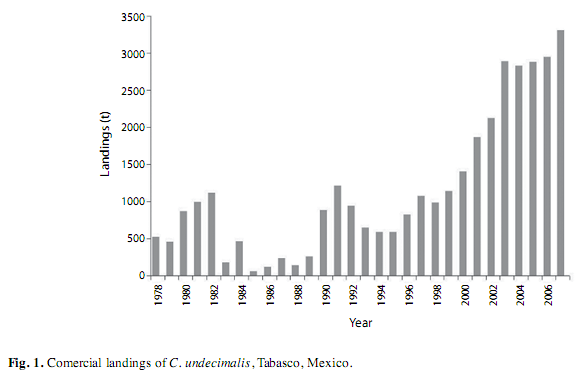
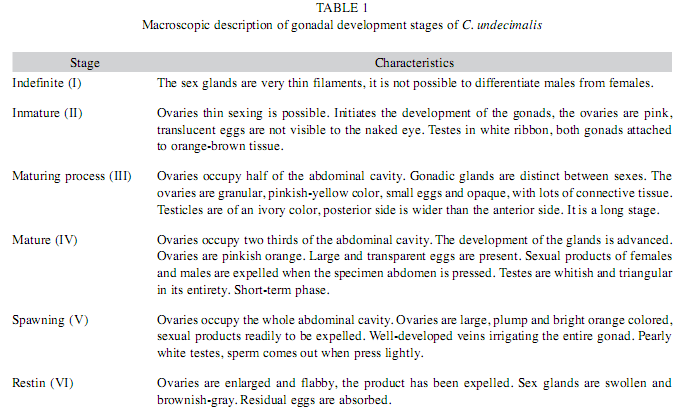
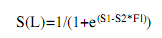
<body><![CDATA[<br> Palabras clave: </span>pesquer&iacute;a, din&aacute;mica poblacional, reproducci&oacute;n, <span style="font-style: italic;">Centropomus undecimalis</span>.</span></font><br style="font-family: verdana;"> <br style="font-family: verdana;"> <font size="2"><span style="font-family: verdana;"></span></font> <hr style="width: 100%; height: 2px;">    <br> <font size="2"><span style="font-family: verdana;">The common snook <span style="font-style: italic;">Centropomus undecimalis</span> is a tropical protandric hermaphrodite fish, with euryhaline and diadromous habits (Taylor <span  style="font-style: italic;">et al. </span>2000, Tavares &amp; Luque 2003, Muller &amp; Taylor 2006). It is distributed from the Western coast of the Atlantic Ocean in North America (Florida, USA) to South America (Rio de Janeiro, Brazil), including the Gulf of Mexico and the Caribbean Sea (Brennan <span  style="font-style: italic;">et al.</span> 2006, Zarza-Meza <span style="font-style: italic;">et al. </span>2006). A close relationship with rivers and coastal lagoons has been observed for the common snook throughout its distribution range (Peters <span style="font-style: italic;">et al.</span> 1998, Aliaume et al. 2005). These systems are used by the species for its periodic migrations when it feeds, grows and reproduces (Stevens <span style="font-style: italic;">et al.</span> 2007). In Southeastern Mexico, <span style="font-style: italic;">C. undecimalis</span> is an important species for sport fishing and commercial fisheries for people from coastal and riverine communities (Muller &amp; Taylor 2006, Perera-Garc&iacute;a <span  style="font-style: italic;">et al.</span> 2008), due to its migratory habits and its size of up to 130cm (Tringali &amp; Leber 1999, Perera-Garc&iacute;a <span style="font-style: italic;">et al.</span> 2008).&nbsp; In Tabasco, the official catch data for common snook date from 1978, maximum catch were recorded in the last five years of the analyzed time series reaching up to 2 800 metric tons (SAGARPA 2008, <a  href="/img/revistas/rbt/v59n2/a11i1.jpg">Fig. 1</a>).</span></font><br  style="font-family: verdana;"> <br style="font-family: verdana;"> <font size="2"><span style="font-family: verdana;">Despite its economic importance, few studies have focused on various aspects of the biology of the common snook. Previous studies have established the migrations of the species, associated with massive spawnings at river mouths (Lau &amp; Shafland 1982, Tucker &amp; Campbell 1988, Peters<span style="font-style: italic;"> et al.</span> 1998, Taylor <span style="font-style: italic;">et al. </span>2000, Lowerre-Barbieri <span style="font-style: italic;">et al.</span> 2003).&nbsp;<span  style="font-style: italic;"> Centropomus undecimalis </span>spawning along the Tabasco coast has been recorded once per year between May and July, when migrations among estuaries and freshwater tributaries take place (Caballero 2003, Perera-Garc&iacute;a <span style="font-style: italic;">et al.</span> 2008). For this reason, the main purpose of this study was to describe the reproductive biology of <span style="font-style: italic;">C. undecimalis</span> based on samplings from the coastal Gulf of Mexico and the riverine region of the Usumacinta River in Tabasco, and examine the potential relationship between the monthly gonad development and water temperature and rainfall.</span></font><br  style="font-family: verdana;"> <br style="font-family: verdana;"> <font size="3"><span style="font-family: verdana; font-weight: bold;">Materials and Methods</span></font><br style="font-family: verdana;"> <br style="font-family: verdana;"> <font size="2"><span style="font-family: verdana;">Sampling site. Specimens of <span style="font-style: italic;">C. undecimalis</span> were obtained from the stocks collected by the artisanal fishery from the coastal area of Barra el Bosque (18&deg;36&#8217;52&#8217;&#8217; N - 92&deg;41&#8217;07&#8217;&#8217; W) and Barra San Pedro (18&deg;38&#8217;59&#8217;&#8217; N - 92&deg;41&#8217;07&#8217;&#8217; W), and the riverine area of Tres Brazos (18&deg;23&#8217;50&#8217;&#8217; N - 92&deg;38&#8217;52&#8217;&#8217;W) and San Pedro (17&deg;46&#8217;13&#8217;&#8217;N - 91&deg;09&#8217;17&#8217;&#8217; W). Samples were obtained monthly from July 2006 to March 2008, (total of N=790; coastal area n=323, riverine area n=467).</span></font><br style="font-family: verdana;"> <br style="font-family: verdana;"> <font size="2"><span style="font-family: verdana;">Fork length (FL, cm), somatic weight (SW, g) were measured, and sagittal otoliths were removed, sex and stage of gonadic maturity were recorded for each individual. Sex and sexual maturity were determined using the morphological characteristics and color of the gonad, following the criteria established by Vazzoler (1996), Peters<span  style="font-style: italic;"> et al. </span>(1998) and Taylor <span style="font-style: italic;">et al.</span> (1998) for sequential spawners (<a  href="/img/revistas/rbt/v59n2/a11t1.gif">Table 1</a>).</span></font><br  style="font-family: verdana;"> <br style="font-family: verdana;"> <font size="2"><span style="font-family: verdana;">The fork length-somatic weight relationship (Ricker 1975) was calculated separately for the two sexes after the mathematical relationship: SW=aFL<sup>b</sup>, where: SW is the somatic weight, <span  style="font-style: italic;">a</span> is the intercept (initial growth coefficient or condition factor), FL is the fork length, and <span style="font-style: italic;">b</span> is the slope (growth coefficient, that indicates the isometric or allometric growth).    <br>     <br> Monthly sex ratios were calculated for the different stages of maturity. Gonadosomatic index (GSI) was calculated according to Rodr&iacute;guez-Guti&eacute;rrez (1992): GSI=GW/SW*100, where GW is the gonad weight and SW is the somatic weight of each individual.</span></font><br  style="font-family: verdana;"> <br style="font-family: verdana;"> <font size="2"><span style="font-family: verdana;">The average size and age at sexual maturity defined as the size and age at which 50% of the fish are sexually mature (L<sub>50</sub> and A<sub>50</sub>), and at which all organisms are capable of actively participate in the reproductive process (L<sub>100</sub> and A<sub>100</sub>), was obtained from the common snook male and female accumulated relative frequencies of macroscopically determined maturity stages between II and V (Vazzoler 1996, Luksenburg &amp; Pedersen, 2002). The values were smoothed with the logistic equation of Sparre &amp; Venema (1998):</span></font><br  style="font-family: verdana;">     <br>     <div style="text-align: center;"><img alt=""      src="/img/revistas/rbt/v59n2/a11ia.jpg"      style="width: 162px; height: 38px;"><br style="font-family: verdana;">     </div>     <br style="font-family: verdana;">     ]]></body>
<body><![CDATA[<font size="2"><span style="font-family: verdana;">where S(L) is the     accumulated     relative frequency, S1 is the constant or     intercept (a), S2 is the constant or slope (b), and FL is the fork     length (cm).</span></font><br style="font-family: verdana;">     <br style="font-family: verdana;">     <font size="2"><span style="font-family: verdana;">The age was     determined by     interpreting growth rings on the otoliths. A     low speed Buehler&reg; IsoMet&reg; 1000 saw was used to cut     ]]></body>
<body><![CDATA[sections approximately 0.5mm thick (Taylor <span      style="font-style: italic;">et al.</span> 2000). Sections were     mounted onto clean slides with Crystal Bond<sup>TM</sup> #509     thermoplastic cement     (Electron Microscopy Supply, Inc.), polished, and viewed under     transmitted light using a stereoscopic microscope, fitted with a     CannonTM Power Shot G6 digital camera. Enlarged 7.5 megapixel images     were used to enumerate the age marks by two independent readers. A     translucent band and an adjacent opaque band were assumed to represent     one year of growth (Taylor <span style="font-style: italic;">et al.</span>     ]]></body>
<body><![CDATA[2000, Campana 2005). Each sectioned     otolith was read twice and only coincident readings were accepted     (Beamish &amp; McFarlane 1983, Taylor <span style="font-style: italic;">et     al.</span> 2000).</span></font><br style="font-family: verdana;">     <br style="font-family: verdana;">     <font size="2"><span style="font-family: verdana;">Monthly mean between     fork lengths     of males and females were compared     with a Kruskal-Wallis non-parametric analysis of variance (Zar 1999,     Sokal &amp; Rohlf 1996). A multiple correlation and a covariance     ]]></body>
<body><![CDATA[(ANCOVA) analysis were applied to the FL-SW regressions to assess     differences between sexes (Gulland 1983, Sparre &amp; Venema 1998). The     allometric growth equations were obtained with logarithmic     transformations (Zar 1999, Sokal &amp; Rohlf 1996). A t-test (&#945;= 0.05)     was used to the value of the slope b to determine the type of growth     (ib&aacute;&ntilde;ez &amp; Fern&aacute;ndez 2006). Monthly GSI, water     temperature and the rainfall, were examined with a cross-correlation     analysis to examine their relationship (Pyper &amp; Peterman 1998).     Besides, a Chi-square (X<sup>2</sup>) was utilized to compare monthly     sex ratio by     ]]></body>
<body><![CDATA[length class (Underwood 1997).</span></font><br      style="font-family: verdana;">     <br style="font-family: verdana;">     <font size="3"><span style="font-family: verdana; font-weight: bold;">Results</span></font><br      style="font-family: verdana;">     <br style="font-family: verdana;">     <font size="2"><span style="font-family: verdana;"><span      style="font-weight: bold;">Size structure.</span> The     size range of     common snook collected along the     ]]></body>
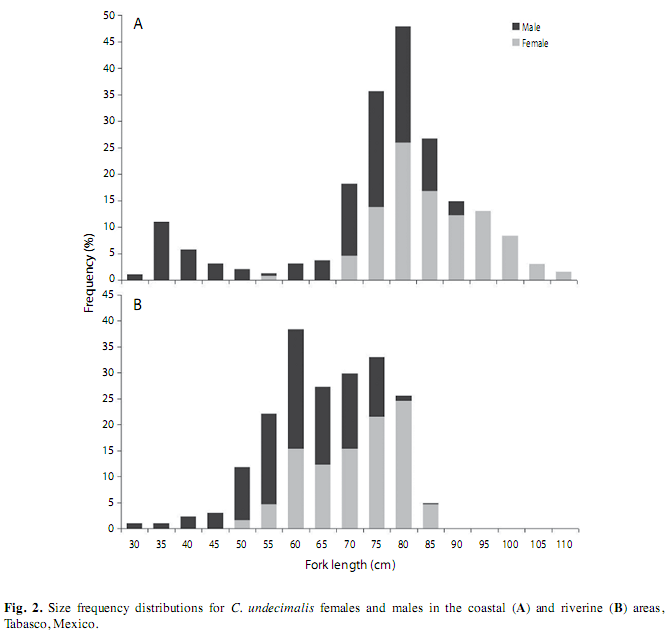
<body><![CDATA[coastal area was 34 to 112cm FL (<a      href="/img/revistas/rbt/v59n2/a11i2.jpg">Fig. 2A</a>). The minimum,     average and     maximum lengths recorded were 33.7, 69.1 and 94.5cm for males, and     58.2, 88.4 and 111.5cm for females, respectively. The size range of     specimens from the riverine area was from 30 to 85cm FL (<a      href="/img/revistas/rbt/v59n2/a11i2.jpg">Fig. 2B</a>). The     minimum, average and maximum lengths were 30, 62.8 and 88.5cm for     males, and 54.5, 74 and 88cm for females, respectively. Female were     significantly larger in both marine (KW=112.43, p&lt;0.05) and riverine     ]]></body>
<body><![CDATA[(KW=49.52, p&lt;0.05) environments.</span></font><br      style="font-family: verdana;">     <br style="font-family: verdana;">     <font size="2"><span style="font-family: verdana;"><span      style="font-weight: bold;">Length-weight     relationship.</span>     Length-weight relationship were not     statistically different between the males and females for coastal     (ANCOVA, F=1.84, p&gt;0.174) and for riverine (ANCOVA, F=0.46,     p&gt;0.493) areas. Individual length-weight equations were: coastal     ]]></body>
<body><![CDATA[females SW=0.0133(FL)<sup>2.90</sup>; r<sup>2</sup>=0.88, coastal     males, SW=0.0045(FL)<sup>3.14</sup>;     r<sup>2</sup>=0.95; and coastal both sexes, SW=0.0059(FL)<sup>3.07</sup>;     riverine females     SW=0.0071(FL)<sup>3.04</sup>; r<sup>2</sup>=0.85; riverine males,     SW=0.0098(FL)<sup>2.95</sup>;     r<sup>2</sup>=0.90; and riverine both sexes SW=0.0086(FL)<sup>2.98</sup>.     The <span style="font-style: italic;">b</span> value     observed for both study areas was not different from three, confirming     that the growth of <span style="font-style: italic;">C. undecimalis</span>     ]]></body>
<body><![CDATA[is isometric (t=1.63, p&gt;0.05).</span></font><br      style="font-family: verdana;">     <br style="font-family: verdana;">     <font size="2"><span style="font-family: verdana;"><span      style="font-weight: bold;">Sex ratio. </span>The males     collected     along the coast represented 59% (n=192)     of the sampled organisms, and the females 41% (n=131). The overall     ratio of male:female was 1.46:1, diverging significantly from     1:1.(X<sup>2</sup>=61.09, p&lt;0.001). The greatest proportions of     ]]></body>
<body><![CDATA[males were     observed in July (79%), August (77%) and November (93%) of 2006, and in     May (91%) and December (70%) of 2007; furthermore, females were     observed during July (63%) and August (73%) of 2007. in the case of the     riverine area, males represented 86% (402) and females 14% (65), with a     male:female ratio of 6.18:1 which was different from the expected ratio     of 1:1 (X<sup>2</sup>=26.23, p&lt;0.001). Males dominated during the     whole     sampling period, with a greater number of females only in May (53%) of     2007. </span></font><br style="font-family: verdana;">     ]]></body>
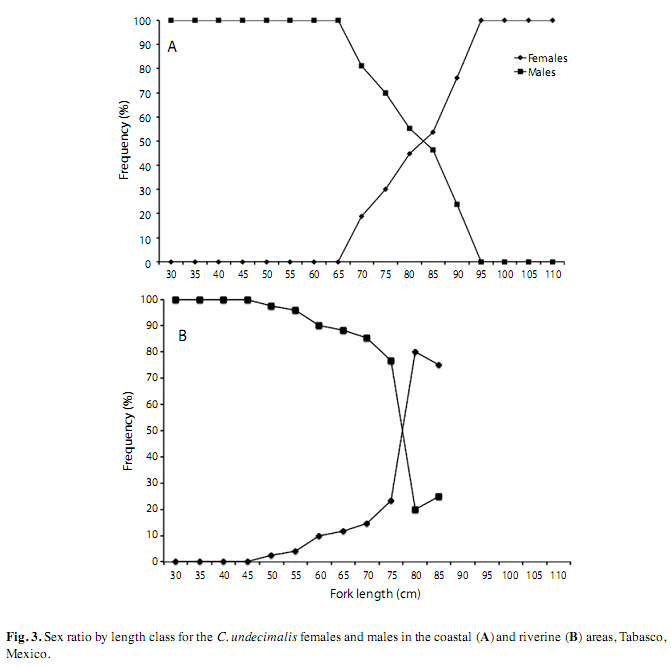
<body><![CDATA[<br style="font-family: verdana;">     <font size="2"><span style="font-family: verdana;">Sex ratio by length     class in the     coastal area for males showed     significant differences (X<sup>2</sup>; p&lt;0.05) between the 30-75cm     and the     90cm FL, and females of 70-75cm and 90-110cm FL (<a      href="/img/revistas/rbt/v59n2/a11i3.jpg">Fig. 3A</a>).&nbsp; In the     riverine area, significant differences were observed in the classes of     30-70 and 80-85cm FL for males, and females of 50-70 and 80-85cm FL     ]]></body>
<body><![CDATA[(<a href="/img/revistas/rbt/v59n2/a11i3.jpg">Fig. 3B</a>).</span></font><br      style="font-family: verdana;">     <br style="font-family: verdana;">     <font size="2"><span style="font-family: verdana;"><span      style="font-weight: bold;">Gonadosomatic index.     </span>For the     coastal area, the monthly average of the     GSI of males and females was similar, with greater values in July,     August and September of 2006, and in July and August of 2007. The other     months presented low values (<a href="/img/revistas/rbt/v59n2/a11i4.jpg">Fig.     ]]></body>
<body><![CDATA[4A</a>). The maximum GSI values of both     sexes were correlated with water temperatures of 26 to 30&deg;C (<a      href="/img/revistas/rbt/v59n2/a11i4.jpg">Fig.     4B</a>). For the riverine area, the monthly GSI indicated no     reproductive     activity and no relationship with rainfall and temperature, showing     that <span style="font-style: italic;">C. undecimalis</span>     reproduction does not occur in this riverine area.</span></font><br      style="font-family: verdana;">     <br style="font-family: verdana;">     ]]></body>
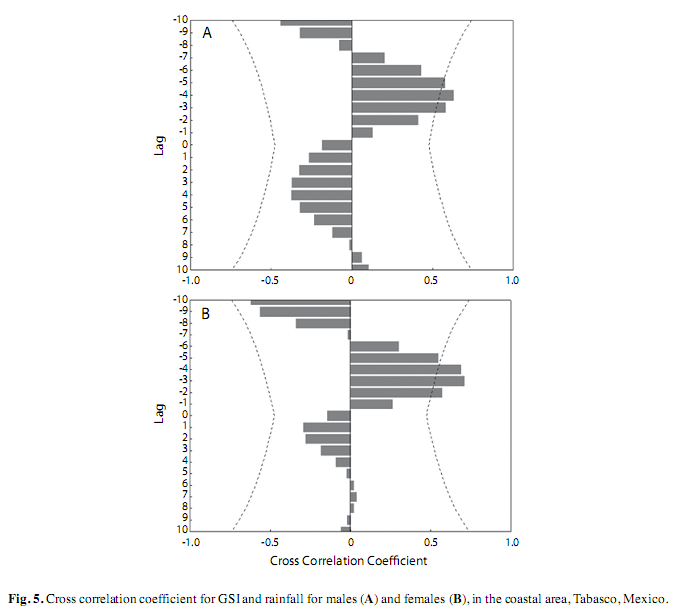
<body><![CDATA[<font size="2"><span style="font-family: verdana;">The     cross-correlation analysis     showed a three month lag from maximum     rainfall to maximum GSI for coastal males (r=0.63) and four months for     females (r=0.70) (<a href="/img/revistas/rbt/v59n2/a11i5.jpg">Fig. 5 A,     B</a>).</span></font><br style="font-family: verdana;">     <br style="font-family: verdana; font-weight: bold;">     <font size="2"><span style="font-family: verdana;"><span      style="font-weight: bold;">Distribution of     sexual maturity     ]]></body>
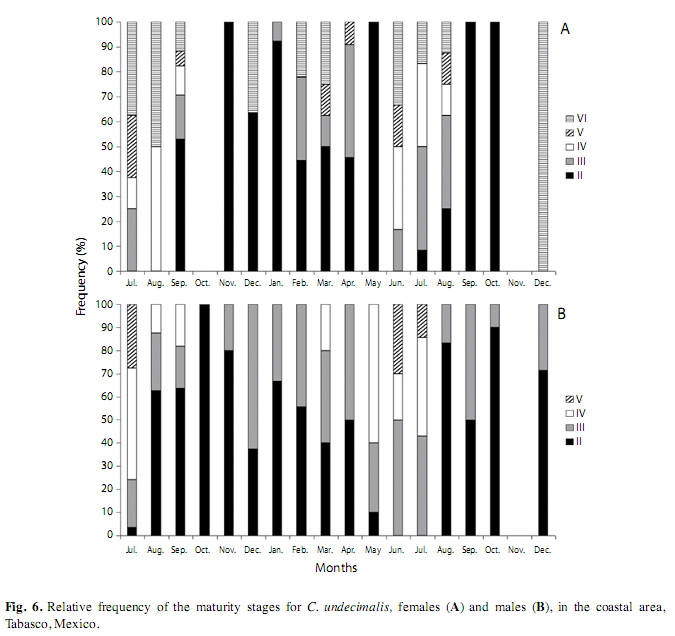
<body><![CDATA[stages. </span>The largest number of the     classified females and males of the coastal area presented stages II     and III, and these were frequent in most sampling months. Most of     mature females (stage IV) were observed in August 2006 (50%) and June     to July 2007 (33.3%), and most of mature males were present in July     2006 (48.2%), and from May (60%) to July (42.8%) of 2007. Stage V,     which represents the maximum spawning period was observed for females     in July 2006 (25%), and in March (12.5%), June (16.6%) and August     (12.5%) 2007 (<a href="/img/revistas/rbt/v59n2/a11i6.jpg">Fig. 6A</a>),     as well as for males in July 2006 (27.5%) and     ]]></body>
<body><![CDATA[July 2007 (14.2%). The resting phase (VI, gonads without eggs) was     observed in females in July (37.5%), August (50%) and December (36.3%)     2006, also in February (22%), March (25%), June (33%), July (16.6%) and     August (12.5%) 2007. It was not possible to observe this phase in males     (<a href="/img/revistas/rbt/v59n2/a11i6.jpg">Fig. 6B</a>).</span></font><br      style="font-family: verdana;">     <br style="font-family: verdana;">     <font size="2"><span style="font-family: verdana;">In the case of the     riverine area,     advanced stages were not observed in     ]]></body>
<body><![CDATA[either females or males. Stage II was predominant during the sampling     period. Stage III was observed in the females only in August (25%) and     September (33.3%) of 2006.</span></font><br      style="font-family: verdana;">     <br style="font-family: verdana;">     <font size="2"><span style="font-family: verdana;"><span      style="font-weight: bold;">First gonadic     maturity (L<sub>50</sub>).</span> In     the coastal area, the size at which     50% of the population matured (L<sub>50</sub>) was recorded at     ]]></body>
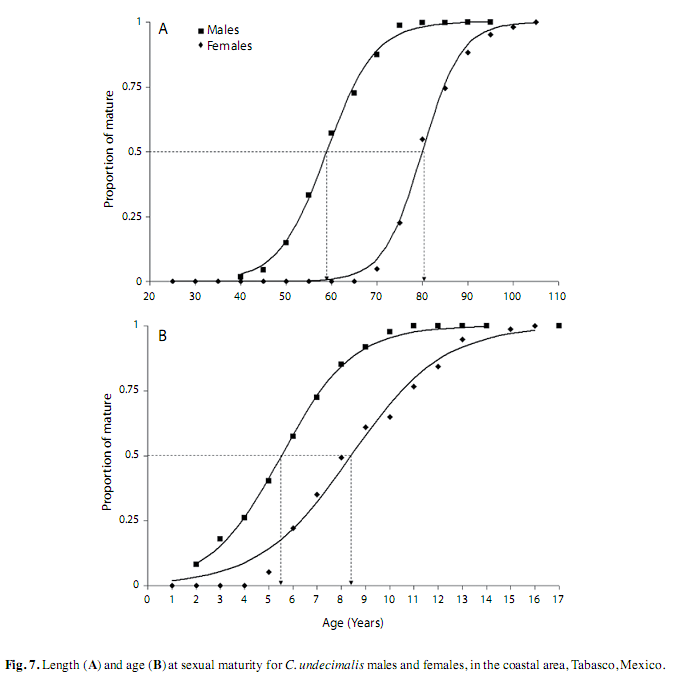
<body><![CDATA[approximately 60cm     fork length for males and 80cm for females, whereas the size of 100% of     each sex was mature (L<sub>100</sub>) was estimated at 95cm for males     and 100cm     for females (<a href="/img/revistas/rbt/v59n2/a11i7.jpg">Fig. 7A</a>).     The average age of sexual maturity (A<sub>50</sub>)     was     recorded as 5.5 years for males and approximately 8.5 for females (<a      href="/img/revistas/rbt/v59n2/a11i7.jpg">Fig.     7B</a>). Most males were sexually mature at 11 years of age, in     ]]></body>
<body><![CDATA[contrast,     females were mature at approximately 13 years of age. The size and age     of first maturity were not estimated for the riverine area, as only     organisms in stages II and III were found.</span></font><br      style="font-family: verdana;">     <br style="font-family: verdana;">     <font size="3"><span style="font-family: verdana; font-weight: bold;">Discussion</span></font><br      style="font-family: verdana;">     <br style="font-family: verdana;">     <font size="2"><span style="font-family: verdana;">Common snook     ]]></body>
<body><![CDATA[throughout their range     conducts to annual reproductive     migrations similar to the patterns we recognize for snooks in Tabasco,     Mexico (Marshall 1958, Peters <span style="font-style: italic;">et al.</span>     1998, Taylor <span style="font-style: italic;">et al.</span> 2000).     Common     snook historically occur in the upland rivers, streams, and lakes     during the late fall and winter where they find refuge from large     marine predators and forage on ample food reserves (Stevens <span      style="font-style: italic;">et al.</span>     ]]></body>
<body><![CDATA[2007). Vast schools aggregate in inlets and around the mouths of     coastal rivers during the late spring, summer, and early fall to spawn.     </span></font><br style="font-family: verdana;">     <br style="font-family: verdana;">     <font size="2"><span style="font-family: verdana;">However, we found     reproduction to     occur only in the coastal areas     during April to September even though females of mature sizes occur in     the riverine areas, they showed no reproductive activity which confirms     that spawning and reproduction of <span style="font-style: italic;">C.     ]]></body>
<body><![CDATA[undecimalis</span> takes place in the     coastal area (Stevens <span style="font-style: italic;">et al.</span>     2007). Several authors have reported     similar results with respect to the reproductive period and spawning     sites for common snook (Marshall 1958, Volpe 1959, Gilmore <span      style="font-style: italic;">et al.</span> 1983,     McMichael <span style="font-style: italic;">et al.</span> 1989, Taylor     <span style="font-style: italic;">et al.</span> 1998, Caballero 2003,     Perera-Garcia <span style="font-style: italic;">et al.</span> 2008). </span></font><br      style="font-family: verdana;">     ]]></body>
<body><![CDATA[<br style="font-family: verdana;">     <font size="2"><span style="font-family: verdana;">Results from this     study show that     the mean length of females when the     sex ratio of the population is 1.46M:1.0F (&gt;80cm) is larger than     that of males. This is a classic response to the reproductive strategy     of a protandric hermaphrodite (Sadovy &amp; Shapiro, 1987, Taylor et     al. 2000). Vazzoler (1996) and Devlin &amp; Nagahama (2002) reported     that protandric hermaphroditism is an advantageous reproductive     strategy because successful spawning and fecundity are of a greater     ]]></body>
<body><![CDATA[magnitude with higher rates of reproductive success in species with     greater lengths than smaller species at comparable ages. Common harvest     practices of fishermen along the Usumacinta, San Pedro, and San Pablo     rivers take advantage of the reproductive migrations of common snook to     collect these larger specimens with nets that obstruct the entire river     (Perera-Garc&iacute;a <span style="font-style: italic;">et al.</span>     2008). Consequently, the wise use of this     important resource is in jeopardy because the local fishery focuses on     the larger reproductive individuals (Hesp <span      style="font-style: italic;">et al. </span>2004, Sadovy &amp; Liu     ]]></body>
<body><![CDATA[2008).</span></font><br style="font-family: verdana;">     <br style="font-family: verdana;">     <font size="2"><span style="font-family: verdana;">Both, coastal and     riverine areas     harbored more males than females;     however, larger females were more abundant in the coastal area in     comparison with the riverine area. These differences in the sex ratio     may be related to reproduction or to sexual differences in growth,     migratory habits, or mortality. Selectivity caused by type and size of     fishing gear may also affect the collection of larger individual males     ]]></body>
<body><![CDATA[or females (Viana <span style="font-style: italic;">et al.</span>     2000, Braccini &amp; Chiaramonte 2002,     Siegel <span style="font-style: italic;">et al.</span> 2008); but,     specific studies are needed to     demonstrate these relationships. </span></font><br      style="font-family: verdana;">     <br style="font-family: verdana;">     <font size="2"><span style="font-family: verdana;">The predominance of     small males in     the population is a function of the     ]]></body>
<body><![CDATA[rate of sex reversal in the population; the absence of males in the     larger size classes means that reversal is obligatory but does not     occur simultaneously in all males (Devlin &amp; Nagahama 2002, Villamil     <span style="font-style: italic;">et al.</span> 2002, Hesp <span      style="font-style: italic;">et al.</span> 2004).</span></font><br      style="font-family: verdana;">     <br style="font-family: verdana;">     <font size="2"><span style="font-family: verdana;">Common snook is a     synchronous     spawner and aggregate near or along the     ]]></body>
<body><![CDATA[coast during the warmer season, when rains initiate the onset of     primary production. The timing of these annual events provide     additional food resources and habitat for successful recruitment which     is characteristic of teleosts of the family Centropomidae (Peters <span      style="font-style: italic;">et     al. </span>1998, Taylor <span style="font-style: italic;">et al.</span>     1998, Lozano &amp; Olaya-Nieto 2004, Alonzo     &amp; Mangel 2005, Maldonado-Garc&iacute;a <span      style="font-style: italic;">et al.</span> 2005).</span></font><br      style="font-family: verdana;">     ]]></body>
<body><![CDATA[<br style="font-family: verdana;">     <font size="2"><span style="font-family: verdana;">Various     environmental factors may     affect the synchrony of the     reproductive process, including the temperature, salinity, rainfall and     full moons (Peters <span style="font-style: italic;">et al.</span>     1998, Aliaume <span style="font-style: italic;">et al.</span> 2005,     Shinozaki-Mendes <span style="font-style: italic;">et al.</span>     2007). According to Wootton (1990),     temperature is the most important environmental factor that affects     ]]></body>
<body><![CDATA[reproduction in fish, as it modulates the dynamics of the gonadal cycle     and influences the secretion of gonadotropic hormones. </span></font><br      style="font-family: verdana;">     <br style="font-family: verdana;">     <font size="2"><span style="font-family: verdana;">In this study, <span      style="font-style: italic;">C.     undecimalis</span> was     found to spawn from three to four     months before the heavy rains when temperatures were 26 to 30&deg;C.     These snooks were stimulated to migrate from the rivers to the     ]]></body>
<body><![CDATA[estuaries where they form large reproductive groups along the local     coastal regions (Peters <span style="font-style: italic;">et al. </span>1998).     Aliaume <span style="font-style: italic;">et al.</span> (2005)     reported     that the common snook aggregate at or near the onset of the rainy     season to insure that the requirements for young-of-the-year are in     place. This strategy guarantees the survival of a greater number of     offspring, because there is ample available food for small fish in     nutrient-rich areas (Pinheiro 2005, Stevens<span      style="font-style: italic;"> et al.</span> 2007). </span></font><br     ]]></body>
<body><![CDATA[ style="font-family: verdana;">     <br style="font-family: verdana;">     <font size="2"><span style="font-family: verdana;">The average size and     age of first     sexual maturity estimated for <span style="font-style: italic;">C.     undecimalis </span>in the coastal area were approximately 60cm (5.5     years) for     males, and 80cm (8.5 years) for females. These results differ from     those reported by Caballero (2003) and Perera-Garc&iacute;a <span      style="font-style: italic;">et al.</span>     ]]></body>
<body><![CDATA[(2008), but are similar to sizes of snooks in Florida reported by     Taylor <span style="font-style: italic;">et al.</span> (2000).</span></font><br      style="font-family: verdana;">     <br style="font-family: verdana;">     <font size="2"><span style="font-family: verdana;">These differences     and similarities     in ages and sizes at first sexual     maturity from different regions may be the result of different     selectivity of the gear used to collect the specimens or from     differential fishery exploitation (DeMartini <span     ]]></body>
<body><![CDATA[ style="font-style: italic;">et al.</span>&nbsp; 2005,     Motta <span style="font-style: italic;">et al.</span> 2005), because     at high levels of exploitation,     larger and older fishes are harvested. Biological effects and/or     excessive harvest may lead to a modification of their reproductive     strategies: decreasing their L<sub>50</sub> and increasing their     reproduction     effort (Csirke 1993, Kovacic 2004, Perera-Garc&iacute;a <span      style="font-style: italic;">et al. </span>2008).     However, environmental pressures may also play an important part in the     ]]></body>
<body><![CDATA[changes in these life characteristics, including temperature, latitude,     water quality, and flooding cycles that occur along natal rivers     (Urriola <span style="font-style: italic;">et al.</span> 2004,     G&oacute;mez &amp; Guzm&aacute;n 2005). The     potential effects of inordinate harvest pressure must not be overlooked     even though historical sizes and ages at first maturity unknown, we do     know that the fishing pressure on common snook has drastically     increased in the states of Tabasco and Campeche in recent years     (Caballero 2003, Perera-Garc&iacute;a <span style="font-style: italic;">et     al.</span> (2008). Future research     ]]></body>
<body><![CDATA[should focus on determining the survival rate for the highly exploited     common snook in this region.</span></font><br      style="font-family: verdana;">     <br style="font-family: verdana;">     <font size="2"><span style="font-family: verdana;">Then, an     understanding of the     complete biology of common snook in this     region is fundamental to its population equilibrium and successful     management. We must conclude a thorough survey of the genetics of the     snook population in this region to determine the possible existence of     ]]></body>
<body><![CDATA[different stocks in the coastal and riverine areas. Future studies,     must focus on population dynamics, reproductive biology, migrations,     recruitment dynamics, and fishery demographics to ensure that these     biological processes remain in balance with harvest rates to insure     healthy local stocks.</span></font><br style="font-family: verdana;">     <br style="font-family: verdana;">     <font size="3"><span style="font-family: verdana; font-weight: bold;">Acknowledgments</span></font><br      style="font-family: verdana;">     <br style="font-family: verdana;">     <font size="2"><span style="font-family: verdana;">The authors thank     ]]></body>
<body><![CDATA[the fishermen and     fishing cooperatives of San Pedro,     Barra el Bosque, Tres Brazos and San Pedro Balanc&aacute;n for sharing     their data, the Consejo Nacional de Ciencia y Tecnolog&iacute;a     (CONACyT), the Universidad Ju&aacute;rez Aut&oacute;noma de Tabasco     (UJAT) and the Colegio de la Frontera Sur (ECOSUR) for financing the     study. Also, we thank Lenin &Aacute;rias Rodr&iacute;guez and     Salom&oacute;n P&aacute;ramo Delgadillo for their collaboration and     comments.</span></font><br style="font-family: verdana;">     <br style="font-family: verdana;">     ]]></body>
<body><![CDATA[<font size="3"><span style="font-family: verdana; font-weight: bold;"></span></font>     <hr style="width: 100%; height: 2px;">    <!-- ref --><br> <font size="3"><span style="font-family: verdana; font-weight: bold;">References</span></font><br  style="font-family: verdana;"> <br style="font-family: verdana;"> <font size="2"><span style="font-family: verdana;">Aliaume, C., A. Zerbi &amp; J.M. Miller. 2005. Juvenile snook species in Puerto Rico estuaries: Distribution, abundance and habitat description. Proc. Gulf Carib. Fish. Inst. 47: 499-519.    &nbsp;&nbsp;&nbsp;&nbsp;&nbsp;&nbsp;&nbsp;&nbsp;[&#160;<a href="javascript:void(0);" onclick="javascript: window.open('/scielo.php?script=sci_nlinks&ref=1753177&pid=S0034-7744201100020001100001&lng=','','width=640,height=500,resizable=yes,scrollbars=1,menubar=yes,');">Links</a>&#160;]<!-- end-ref --><!-- ref --></span></font><br  style="font-family: verdana;"> <br style="font-family: verdana;"> <font size="2"><span style="font-family: verdana;">Alonzo, S.H. &amp; M. Mangel. 2005. Sex-change rules, stock dynamics, and the performance of spawning-per-recruit measures in protogynous stocks. Fish. Bull-NOAA 103: 229-245.    &nbsp;&nbsp;&nbsp;&nbsp;&nbsp;&nbsp;&nbsp;&nbsp;[&#160;<a href="javascript:void(0);" onclick="javascript: window.open('/scielo.php?script=sci_nlinks&ref=1753178&pid=S0034-7744201100020001100002&lng=','','width=640,height=500,resizable=yes,scrollbars=1,menubar=yes,');">Links</a>&#160;]<!-- end-ref --><!-- ref --></span></font><br  style="font-family: verdana;"> <br style="font-family: verdana;"> <font size="2"><span style="font-family: verdana;">Beamish, R.J. &amp; G.A. McFarlane. 1983. The forgotten requirement for age validation in fisheries biology. Trans. Am. Fish. Soc. 112: 735-743.    &nbsp;&nbsp;&nbsp;&nbsp;&nbsp;&nbsp;&nbsp;&nbsp;[&#160;<a href="javascript:void(0);" onclick="javascript: window.open('/scielo.php?script=sci_nlinks&ref=1753179&pid=S0034-7744201100020001100003&lng=','','width=640,height=500,resizable=yes,scrollbars=1,menubar=yes,');">Links</a>&#160;]<!-- end-ref --><!-- ref --></span></font><br  style="font-family: verdana;"> <br style="font-family: verdana;"> <font size="2"><span style="font-family: verdana;">Braccini, J.M. &amp; G.E. Chiaramonte. 2002. Reproducti ve biology of <span style="font-style: italic;">Psammobatis extenta</span>. J. Fish. Biol. 61: 272-288.    &nbsp;&nbsp;&nbsp;&nbsp;&nbsp;&nbsp;&nbsp;&nbsp;[&#160;<a href="javascript:void(0);" onclick="javascript: window.open('/scielo.php?script=sci_nlinks&ref=1753180&pid=S0034-7744201100020001100004&lng=','','width=640,height=500,resizable=yes,scrollbars=1,menubar=yes,');">Links</a>&#160;]<!-- end-ref --><!-- ref --></span></font><br style="font-family: verdana;"> <br style="font-family: verdana;"> <font size="2"><span style="font-family: verdana;">Brennan, N.P., M.C. Darcy &amp; K.M. Leber. 2006. Predator-free enclosures improve post-release survival of stocked common snook. J. Exp. Mar. Biol. Ecol. 335: 302-311.    &nbsp;&nbsp;&nbsp;&nbsp;&nbsp;&nbsp;&nbsp;&nbsp;[&#160;<a href="javascript:void(0);" onclick="javascript: window.open('/scielo.php?script=sci_nlinks&ref=1753181&pid=S0034-7744201100020001100005&lng=','','width=640,height=500,resizable=yes,scrollbars=1,menubar=yes,');">Links</a>&#160;]<!-- end-ref --><!-- ref --></span></font><br  style="font-family: verdana;"> <br style="font-family: verdana;"> <font size="2"><span style="font-family: verdana;">Caballero, C.V. 2003. Estudio biol&oacute;gico pesquero del robalo <span style="font-style: italic;">Centropomus undecimalis</span> en el suroeste de Campeche. Tesis de Maestr&iacute;a, Universidad Nacional Aut&oacute;noma de M&eacute;xico, M&eacute;xico, D.F., M&eacute;xico.    &nbsp;&nbsp;&nbsp;&nbsp;&nbsp;&nbsp;&nbsp;&nbsp;[&#160;<a href="javascript:void(0);" onclick="javascript: window.open('/scielo.php?script=sci_nlinks&ref=1753182&pid=S0034-7744201100020001100006&lng=','','width=640,height=500,resizable=yes,scrollbars=1,menubar=yes,');">Links</a>&#160;]<!-- end-ref --><!-- ref --></span></font><br  style="font-family: verdana;"> <br style="font-family: verdana;"> <font size="2"><span style="font-family: verdana;">Campana, S.E. 2005. Otolith science entering the 21st century. Mar. Freshwater Res. 56: 485-495.    &nbsp;&nbsp;&nbsp;&nbsp;&nbsp;&nbsp;&nbsp;&nbsp;[&#160;<a href="javascript:void(0);" onclick="javascript: window.open('/scielo.php?script=sci_nlinks&ref=1753183&pid=S0034-7744201100020001100007&lng=','','width=640,height=500,resizable=yes,scrollbars=1,menubar=yes,');">Links</a>&#160;]<!-- end-ref --><!-- ref --></span></font><br  style="font-family: verdana;"> <br style="font-family: verdana;"> <font size="2"><span style="font-family: verdana;">Csirke, J. 1993. Introducci&oacute;n a la din&aacute;mica de poblaciones de peces. FAO, Roma, Italia.    &nbsp;&nbsp;&nbsp;&nbsp;&nbsp;&nbsp;&nbsp;&nbsp;[&#160;<a href="javascript:void(0);" onclick="javascript: window.open('/scielo.php?script=sci_nlinks&ref=1753184&pid=S0034-7744201100020001100008&lng=','','width=640,height=500,resizable=yes,scrollbars=1,menubar=yes,');">Links</a>&#160;]<!-- end-ref --><!-- ref --></span></font><br  style="font-family: verdana;"> <br style="font-family: verdana;"> <font size="2"><span style="font-family: verdana;">DeMartini, E.E., A.M. Friedlander &amp; S.R. Holzwarth. 2005. Size at sex change in protogynous labroids, prey body size distributions, and apex predator densities at NW Hawaiian atolls. Mar. Ecol. Prog. Ser. 297: 259-271.    &nbsp;&nbsp;&nbsp;&nbsp;&nbsp;&nbsp;&nbsp;&nbsp;[&#160;<a href="javascript:void(0);" onclick="javascript: window.open('/scielo.php?script=sci_nlinks&ref=1753185&pid=S0034-7744201100020001100009&lng=','','width=640,height=500,resizable=yes,scrollbars=1,menubar=yes,');">Links</a>&#160;]<!-- end-ref --><!-- ref --></span></font><br style="font-family: verdana;"> <br style="font-family: verdana;"> <font size="2"><span style="font-family: verdana;">Devlin, H.D. &amp; Y. Nagahama. 2002. Sex determination and sex differentiation in fish: an overview of genetic, physiological, and environmental influences. Aquaculture 208: 191-364.    &nbsp;&nbsp;&nbsp;&nbsp;&nbsp;&nbsp;&nbsp;&nbsp;[&#160;<a href="javascript:void(0);" onclick="javascript: window.open('/scielo.php?script=sci_nlinks&ref=1753186&pid=S0034-7744201100020001100010&lng=','','width=640,height=500,resizable=yes,scrollbars=1,menubar=yes,');">Links</a>&#160;]<!-- end-ref --><!-- ref --></span></font><br  style="font-family: verdana;"> <br style="font-family: verdana;"> <font size="2"><span style="font-family: verdana;">Gilmore, R., C. Donohoe &amp; D. Cooke. 1983. Observations on the distribution and biology of east-central Florida populations of the common snook, <span style="font-style: italic;">Centropomus undecimalis</span> (Bloch). Fla. Sci. 46: 313-336.    &nbsp;&nbsp;&nbsp;&nbsp;&nbsp;&nbsp;&nbsp;&nbsp;[&#160;<a href="javascript:void(0);" onclick="javascript: window.open('/scielo.php?script=sci_nlinks&ref=1753187&pid=S0034-7744201100020001100011&lng=','','width=640,height=500,resizable=yes,scrollbars=1,menubar=yes,');">Links</a>&#160;]<!-- end-ref --><!-- ref --></span></font><br  style="font-family: verdana;"> <br style="font-family: verdana;"> <font size="2"><span style="font-family: verdana;">G&oacute;mez, G. &amp; R. Guzm&aacute;n. 2005. Aspectos de la din&aacute;mica reproductiva y poblacional del roncador, <span style="font-style: italic;">Micropogonias furnieri</span>, en el golfo de Paria, estado Sucre, Venezuela. Zootecnia Trop. 23: 69-90.    &nbsp;&nbsp;&nbsp;&nbsp;&nbsp;&nbsp;&nbsp;&nbsp;[&#160;<a href="javascript:void(0);" onclick="javascript: window.open('/scielo.php?script=sci_nlinks&ref=1753188&pid=S0034-7744201100020001100012&lng=','','width=640,height=500,resizable=yes,scrollbars=1,menubar=yes,');">Links</a>&#160;]<!-- end-ref --><!-- ref --></span></font><br  style="font-family: verdana;"> <br style="font-family: verdana;"> <font size="2"><span style="font-family: verdana;">Gulland, J.A. 1983. Fish stock assessment: a manual of basic methods. FAO, Wiley, Chichester, United Kingdom.    &nbsp;&nbsp;&nbsp;&nbsp;&nbsp;&nbsp;&nbsp;&nbsp;[&#160;<a href="javascript:void(0);" onclick="javascript: window.open('/scielo.php?script=sci_nlinks&ref=1753189&pid=S0034-7744201100020001100013&lng=','','width=640,height=500,resizable=yes,scrollbars=1,menubar=yes,');">Links</a>&#160;]<!-- end-ref --><br>     <!-- ref --><br> Hesp, S.A., I.C. Potter &amp; G.N. Hall. 2004. Reproductive biology and protandrous hermaphroditism in <span style="font-style: italic;">Acanthopagrus latus</span>.&nbsp; Environ. Biol. Fish. 70: 257-272.    &nbsp;&nbsp;&nbsp;&nbsp;&nbsp;&nbsp;&nbsp;&nbsp;[&#160;<a href="javascript:void(0);" onclick="javascript: window.open('/scielo.php?script=sci_nlinks&ref=1753191&pid=S0034-7744201100020001100014&lng=','','width=640,height=500,resizable=yes,scrollbars=1,menubar=yes,');">Links</a>&#160;]<!-- end-ref --><!-- ref --></span></font><br  style="font-family: verdana;"> <br style="font-family: verdana;"> <font size="2"><span style="font-family: verdana;">Iba&ntilde;ez, A.A.L. &amp; B.L.A. Fern&aacute;ndez. 2006. Manual t&eacute;cnico de crecimiento relativo y an&aacute;lisis morfom&eacute;trico. Universidad Aut&oacute;noma Metropolitana, M&eacute;xico, D.F., M&eacute;xico.    &nbsp;&nbsp;&nbsp;&nbsp;&nbsp;&nbsp;&nbsp;&nbsp;[&#160;<a href="javascript:void(0);" onclick="javascript: window.open('/scielo.php?script=sci_nlinks&ref=1753192&pid=S0034-7744201100020001100015&lng=','','width=640,height=500,resizable=yes,scrollbars=1,menubar=yes,');">Links</a>&#160;]<!-- end-ref --><!-- ref --></span></font><br  style="font-family: verdana;"> <br style="font-family: verdana;"> <font size="2"><span style="font-family: verdana;">Kovacic, M. 2004. Reproductive biology of the striped goby, <span style="font-style: italic;">Gobius vittatus</span> (Gobiidae) in the northern Adriatic Sea. Sci. Mar. 71: 145-151.    &nbsp;&nbsp;&nbsp;&nbsp;&nbsp;&nbsp;&nbsp;&nbsp;[&#160;<a href="javascript:void(0);" onclick="javascript: window.open('/scielo.php?script=sci_nlinks&ref=1753193&pid=S0034-7744201100020001100016&lng=','','width=640,height=500,resizable=yes,scrollbars=1,menubar=yes,');">Links</a>&#160;]<!-- end-ref --><!-- ref --></span></font><br style="font-family: verdana;"> <br style="font-family: verdana;"> <font size="2"><span style="font-family: verdana;">Lau, S.R. &amp; P.L. Shafland. 1982. Larval development of snook, <span style="font-style: italic;">Centroponus undecimalis </span>(Pisces: <span style="font-style: italic;">Centropomidae</span>). Copeia 3: 618-627.    &nbsp;&nbsp;&nbsp;&nbsp;&nbsp;&nbsp;&nbsp;&nbsp;[&#160;<a href="javascript:void(0);" onclick="javascript: window.open('/scielo.php?script=sci_nlinks&ref=1753194&pid=S0034-7744201100020001100017&lng=','','width=640,height=500,resizable=yes,scrollbars=1,menubar=yes,');">Links</a>&#160;]<!-- end-ref --><!-- ref --></span></font><br style="font-family: verdana;"> <br style="font-family: verdana;"> <font size="2"><span style="font-family: verdana;">Lowerre-Barbieri, S.K., F.E. Vose &amp; J.A. Whittington. 2003. Catch-and-release fishing on a spawning aggregation of common snook: does it affect reproductive output. T. Am. Fish. Soc. 132: 940-952.    &nbsp;&nbsp;&nbsp;&nbsp;&nbsp;&nbsp;&nbsp;&nbsp;[&#160;<a href="javascript:void(0);" onclick="javascript: window.open('/scielo.php?script=sci_nlinks&ref=1753195&pid=S0034-7744201100020001100018&lng=','','width=640,height=500,resizable=yes,scrollbars=1,menubar=yes,');">Links</a>&#160;]<!-- end-ref --><!-- ref --></span></font><br  style="font-family: verdana;"> <br style="font-family: verdana;"> <font size="2"><span style="font-family: verdana;">Lozano, G.E. &amp; C.W. Olaya-Nieto. 2004. Reproductive aspects of common snook (<span style="font-style: italic;">Centropomus undecimalis</span>) in the Cispata Bay, Colombia. Proc. Gulf Carib. Fish. Inst. 55: 1029.    &nbsp;&nbsp;&nbsp;&nbsp;&nbsp;&nbsp;&nbsp;&nbsp;[&#160;<a href="javascript:void(0);" onclick="javascript: window.open('/scielo.php?script=sci_nlinks&ref=1753196&pid=S0034-7744201100020001100019&lng=','','width=640,height=500,resizable=yes,scrollbars=1,menubar=yes,');">Links</a>&#160;]<!-- end-ref --><!-- ref --></span></font><br  style="font-family: verdana;"> <br style="font-family: verdana;"> <font size="2"><span style="font-family: verdana;">Luksenburg, J.A. &amp; T. Pedersen. 2002. Sexual and geographical variation in life history parameters of the shorthorn sculpin. J. Fish. Biol. 61: 1453-1464.    &nbsp;&nbsp;&nbsp;&nbsp;&nbsp;&nbsp;&nbsp;&nbsp;[&#160;<a href="javascript:void(0);" onclick="javascript: window.open('/scielo.php?script=sci_nlinks&ref=1753197&pid=S0034-7744201100020001100020&lng=','','width=640,height=500,resizable=yes,scrollbars=1,menubar=yes,');">Links</a>&#160;]<!-- end-ref --><!-- ref --></span></font><br style="font-family: verdana;"> <br style="font-family: verdana;"> <font size="2"><span style="font-family: verdana;">Maldonado-Garc&iacute;a, M., V. Gracia-L&oacute;pez, M. Carrillo, A. Hern&aacute;ndez-Herrera &amp; C. Rodr&iacute;guez-Jaramillo. 2005. Stages of gonad development during the reproductive cycle of the blackfin snook, <span style="font-style: italic;">Centropomus medius</span> G&uuml;nther. Aquacult. Res. 36: 554-563.    &nbsp;&nbsp;&nbsp;&nbsp;&nbsp;&nbsp;&nbsp;&nbsp;[&#160;<a href="javascript:void(0);" onclick="javascript: window.open('/scielo.php?script=sci_nlinks&ref=1753198&pid=S0034-7744201100020001100021&lng=','','width=640,height=500,resizable=yes,scrollbars=1,menubar=yes,');">Links</a>&#160;]<!-- end-ref --><!-- ref --></span></font><br style="font-family: verdana;"> <br style="font-family: verdana;"> <font size="2"><span style="font-family: verdana;">Marshall, A.R. 1958. A survey of the snook fishery of Florida, with studies of the biology of the principal species, <span  style="font-style: italic;">Centropomus undecimalis</span> (Bloch). Fla. Board Conserv. Mar. Res. Lab. Tech. Ser. 22.    &nbsp;&nbsp;&nbsp;&nbsp;&nbsp;&nbsp;&nbsp;&nbsp;[&#160;<a href="javascript:void(0);" onclick="javascript: window.open('/scielo.php?script=sci_nlinks&ref=1753199&pid=S0034-7744201100020001100022&lng=','','width=640,height=500,resizable=yes,scrollbars=1,menubar=yes,');">Links</a>&#160;]<!-- end-ref --><!-- ref --></span></font><br style="font-family: verdana;"> <br style="font-family: verdana;"> <font size="2"><span style="font-family: verdana;">McMichael, R.H., K.M. Peters &amp; G.R. Parsons. 1989. Early life history of the snook,<span style="font-style: italic;"> Centropomus undecimalis</span> in Tampa Bay, Florida. Northeast Gulf Sci. 10: 113-126.    &nbsp;&nbsp;&nbsp;&nbsp;&nbsp;&nbsp;&nbsp;&nbsp;[&#160;<a href="javascript:void(0);" onclick="javascript: window.open('/scielo.php?script=sci_nlinks&ref=1753200&pid=S0034-7744201100020001100023&lng=','','width=640,height=500,resizable=yes,scrollbars=1,menubar=yes,');">Links</a>&#160;]<!-- end-ref --><!-- ref --></span></font><br  style="font-family: verdana;"> <br style="font-family: verdana;"> <font size="2"><span style="font-family: verdana;">Motta, F.S., O.B.F. Gadig &amp; R.C. Namora. 2005. Size and sex compositions, length weight relationship, and occurrence of the Brazilian sharpnose shark, <span style="font-style: italic;">Rhizoprionodon lalandii</span>, caught by artisanal fishery from southeastern Brazil. Fish. Res. 74: 116-126.    &nbsp;&nbsp;&nbsp;&nbsp;&nbsp;&nbsp;&nbsp;&nbsp;[&#160;<a href="javascript:void(0);" onclick="javascript: window.open('/scielo.php?script=sci_nlinks&ref=1753201&pid=S0034-7744201100020001100024&lng=','','width=640,height=500,resizable=yes,scrollbars=1,menubar=yes,');">Links</a>&#160;]<!-- end-ref --><!-- ref --></span></font><br  style="font-family: verdana;"> <br style="font-family: verdana;"> <font size="2"><span style="font-family: verdana;">Muller, R.G. &amp; R.G. Taylor. 2006. The 2006 stock assessment update of common snook, <span style="font-style: italic;">Centropomus undecimalis</span>. Florida Marine Research Institute. St. Petersburg, Florida, USA.    &nbsp;&nbsp;&nbsp;&nbsp;&nbsp;&nbsp;&nbsp;&nbsp;[&#160;<a href="javascript:void(0);" onclick="javascript: window.open('/scielo.php?script=sci_nlinks&ref=1753202&pid=S0034-7744201100020001100025&lng=','','width=640,height=500,resizable=yes,scrollbars=1,menubar=yes,');">Links</a>&#160;]<!-- end-ref --><!-- ref --></span></font><br  style="font-family: verdana;"> <br style="font-family: verdana;"> <font size="2"><span style="font-family: verdana;">Perera-Garc&iacute;a, M.A., M. Mendoza-Carranza &amp; S. P&aacute;ramo-Delgadillo. 2008. Din&aacute;mica reproductiva y poblacional del robalo <span style="font-style: italic;">Centropomus undecimalis</span>, en Barra San Pedro, Centla, M&eacute;xico. Universidad y Ciencia 24: 49-59.    &nbsp;&nbsp;&nbsp;&nbsp;&nbsp;&nbsp;&nbsp;&nbsp;[&#160;<a href="javascript:void(0);" onclick="javascript: window.open('/scielo.php?script=sci_nlinks&ref=1753203&pid=S0034-7744201100020001100026&lng=','','width=640,height=500,resizable=yes,scrollbars=1,menubar=yes,');">Links</a>&#160;]<!-- end-ref --><!-- ref --></span></font><br  style="font-family: verdana;"> <br style="font-family: verdana;"> <font size="2"><span style="font-family: verdana;">Peters, K.M., R.E. Matheson &amp; R.G. Taylor. 1998. Reproduction and early life history of common snook, <span style="font-style: italic;">Centropomus undecimalis</span> (Bloch), in Florida. Bull. Mar. Sci. 62: 509-529.    &nbsp;&nbsp;&nbsp;&nbsp;&nbsp;&nbsp;&nbsp;&nbsp;[&#160;<a href="javascript:void(0);" onclick="javascript: window.open('/scielo.php?script=sci_nlinks&ref=1753204&pid=S0034-7744201100020001100027&lng=','','width=640,height=500,resizable=yes,scrollbars=1,menubar=yes,');">Links</a>&#160;]<!-- end-ref --><!-- ref --></span></font><br  style="font-family: verdana;"> <br style="font-family: verdana;"> <font size="2"><span style="font-family: verdana;">Pinheiro, P.R. 2005. Aspectos reprodutivos do robalo peba, <span style="font-style: italic;">Centropomus parallelus</span>, na foz do rio doce, Linha-res/es. Master Tesis, Universidade Federal do Esp&iacute;rito Santo, Vit&oacute;ria, Brasil.    &nbsp;&nbsp;&nbsp;&nbsp;&nbsp;&nbsp;&nbsp;&nbsp;[&#160;<a href="javascript:void(0);" onclick="javascript: window.open('/scielo.php?script=sci_nlinks&ref=1753205&pid=S0034-7744201100020001100028&lng=','','width=640,height=500,resizable=yes,scrollbars=1,menubar=yes,');">Links</a>&#160;]<!-- end-ref --><!-- ref --></span></font><br  style="font-family: verdana;"> <br style="font-family: verdana;"> <font size="2"><span style="font-family: verdana;">Pyper, B.J. &amp; R.M.Peterman. 1998. Comparison of methods to account for autocorrelation in correlation analyses of fish data. Can. J. Fish. Aquat. Sci. 55: 2127-2140.    &nbsp;&nbsp;&nbsp;&nbsp;&nbsp;&nbsp;&nbsp;&nbsp;[&#160;<a href="javascript:void(0);" onclick="javascript: window.open('/scielo.php?script=sci_nlinks&ref=1753206&pid=S0034-7744201100020001100029&lng=','','width=640,height=500,resizable=yes,scrollbars=1,menubar=yes,');">Links</a>&#160;]<!-- end-ref --><!-- ref --></span></font><br  style="font-family: verdana;"> <br style="font-family: verdana;"> <font size="2"><span style="font-family: verdana;">Ricker, W.E. 1975. Computation and interpretation of biological statistics of fish populations. B. Fish. Res. Board Can. 191: 1-382.    &nbsp;&nbsp;&nbsp;&nbsp;&nbsp;&nbsp;&nbsp;&nbsp;[&#160;<a href="javascript:void(0);" onclick="javascript: window.open('/scielo.php?script=sci_nlinks&ref=1753207&pid=S0034-7744201100020001100030&lng=','','width=640,height=500,resizable=yes,scrollbars=1,menubar=yes,');">Links</a>&#160;]<!-- end-ref --><!-- ref --></span></font><br  style="font-family: verdana;"> <br style="font-family: verdana;"> <font size="2"><span style="font-family: verdana;">Rodr&iacute;guez-Guti&eacute;rrez, M. 1992. T&eacute;cnicas de evaluaci&oacute;n cuantitativa de la madurez gon&aacute;dica en peces. AGT, M&eacute;xico, D.F., M&eacute;xico.    &nbsp;&nbsp;&nbsp;&nbsp;&nbsp;&nbsp;&nbsp;&nbsp;[&#160;<a href="javascript:void(0);" onclick="javascript: window.open('/scielo.php?script=sci_nlinks&ref=1753208&pid=S0034-7744201100020001100031&lng=','','width=640,height=500,resizable=yes,scrollbars=1,menubar=yes,');">Links</a>&#160;]<!-- end-ref --><!-- ref --></span></font><br  style="font-family: verdana;"> <br style="font-family: verdana;"> <font size="2"><span style="font-family: verdana;">Sadovy, M.Y. &amp; M. Liu. 2008. Functional hermaphroditism in teleosts. Fish Fish. 9: 1-43.    &nbsp;&nbsp;&nbsp;&nbsp;&nbsp;&nbsp;&nbsp;&nbsp;[&#160;<a href="javascript:void(0);" onclick="javascript: window.open('/scielo.php?script=sci_nlinks&ref=1753209&pid=S0034-7744201100020001100032&lng=','','width=640,height=500,resizable=yes,scrollbars=1,menubar=yes,');">Links</a>&#160;]<!-- end-ref --><!-- ref --></span></font><br  style="font-family: verdana;"> <br style="font-family: verdana;"> <font size="2"><span style="font-family: verdana;">Sadovy, M.Y. &amp; D.Y. Shapiro. 1987. Criteria for the diagnosis of hermaphroditism in fishes. Copeia: 136-156.    &nbsp;&nbsp;&nbsp;&nbsp;&nbsp;&nbsp;&nbsp;&nbsp;[&#160;<a href="javascript:void(0);" onclick="javascript: window.open('/scielo.php?script=sci_nlinks&ref=1753210&pid=S0034-7744201100020001100033&lng=','','width=640,height=500,resizable=yes,scrollbars=1,menubar=yes,');">Links</a>&#160;]<!-- end-ref --><!-- ref --></span></font><br  style="font-family: verdana;"> <br style="font-family: verdana;"> <font size="2"><span style="font-family: verdana;">SAGARPA, 2008. Anuario Estad&iacute;stico de Pesca 2008. Secretar&iacute;a de Agricultura, Ganader&iacute;a, Desarrollo Rural, Pesca y Alimentaci&oacute;n, M&eacute;xico, D.F.    &nbsp;&nbsp;&nbsp;&nbsp;&nbsp;&nbsp;&nbsp;&nbsp;[&#160;<a href="javascript:void(0);" onclick="javascript: window.open('/scielo.php?script=sci_nlinks&ref=1753211&pid=S0034-7744201100020001100034&lng=','','width=640,height=500,resizable=yes,scrollbars=1,menubar=yes,');">Links</a>&#160;]<!-- end-ref --><!-- ref --></span></font><br  style="font-family: verdana;"> <br style="font-family: verdana;"> <font size="2"><span style="font-family: verdana;">Shinozaki-Mendes, R.A., F.H.H. Vieira, P.O. Guilherme &amp; F.C. Correia. 2007. Reproductive biology of the squirrelfish, <span  style="font-style: italic;">Holocentrus adscensionis</span> (Osbeck, 1765), caught off the coast of Pernambuco, Brazil. Sci. Mar. 71: 715-722.    &nbsp;&nbsp;&nbsp;&nbsp;&nbsp;&nbsp;&nbsp;&nbsp;[&#160;<a href="javascript:void(0);" onclick="javascript: window.open('/scielo.php?script=sci_nlinks&ref=1753212&pid=S0034-7744201100020001100035&lng=','','width=640,height=500,resizable=yes,scrollbars=1,menubar=yes,');">Links</a>&#160;]<!-- end-ref --><!-- ref --></span></font><br  style="font-family: verdana;"> <br style="font-family: verdana;"> <font size="2"><span style="font-family: verdana;">Siegel, V., U. Damm &amp; T. Neudecker. 2008. Sex-ratio, seasonality and long-term variation in maduration and spawning of the brown shrimp <span style="font-style: italic;">Crangon crangon</span> (L.) in the German Bight (North Sea). Helgon Mar. Res. 63: 339-349.    &nbsp;&nbsp;&nbsp;&nbsp;&nbsp;&nbsp;&nbsp;&nbsp;[&#160;<a href="javascript:void(0);" onclick="javascript: window.open('/scielo.php?script=sci_nlinks&ref=1753213&pid=S0034-7744201100020001100036&lng=','','width=640,height=500,resizable=yes,scrollbars=1,menubar=yes,');">Links</a>&#160;]<!-- end-ref --><!-- ref --></span></font><br style="font-family: verdana;"> <br style="font-family: verdana;"> <font size="2"><span style="font-family: verdana;">Sokal, R.R. &amp; F.J. Rohlf. 1996. Biometry: The Principles and Practice of Statistics in Biological Research. Freeman, New York, USA.    &nbsp;&nbsp;&nbsp;&nbsp;&nbsp;&nbsp;&nbsp;&nbsp;[&#160;<a href="javascript:void(0);" onclick="javascript: window.open('/scielo.php?script=sci_nlinks&ref=1753214&pid=S0034-7744201100020001100037&lng=','','width=640,height=500,resizable=yes,scrollbars=1,menubar=yes,');">Links</a>&#160;]<!-- end-ref --><!-- ref --></span></font><br  style="font-family: verdana;"> <br style="font-family: verdana;"> <font size="2"><span style="font-family: verdana;">Sparre, P. &amp; S.C. Venema. 1998. Introducci&oacute;n a la evaluaci&oacute;n de recursos pesqueros tropicales, Parte 1 manual. FAO, Santiago de Chile, Chile.    &nbsp;&nbsp;&nbsp;&nbsp;&nbsp;&nbsp;&nbsp;&nbsp;[&#160;<a href="javascript:void(0);" onclick="javascript: window.open('/scielo.php?script=sci_nlinks&ref=1753215&pid=S0034-7744201100020001100038&lng=','','width=640,height=500,resizable=yes,scrollbars=1,menubar=yes,');">Links</a>&#160;]<!-- end-ref --><!-- ref --></span></font><br  style="font-family: verdana;"> <br style="font-family: verdana;"> <font size="2"><span style="font-family: verdana;">Stevens, P.W., D.A. Blewett &amp; G.R. Poulakis. 2007. Variable habitat use by juvenile common snook, <span style="font-style: italic;">Centropomus undecimalis</span> (PISCES: CENTROPOMIDAE): Applying a life-history model in a southwest Florida estuary. B. Mar. Sci. 80: 93-108.    &nbsp;&nbsp;&nbsp;&nbsp;&nbsp;&nbsp;&nbsp;&nbsp;[&#160;<a href="javascript:void(0);" onclick="javascript: window.open('/scielo.php?script=sci_nlinks&ref=1753216&pid=S0034-7744201100020001100039&lng=','','width=640,height=500,resizable=yes,scrollbars=1,menubar=yes,');">Links</a>&#160;]<!-- end-ref --><!-- ref --></span></font><br  style="font-family: verdana;"> <br style="font-family: verdana;"> <font size="2"><span style="font-family: verdana;">Tavares, L.E.R. &amp; J.L. Luque. 2003. A new species of Acantholochus (Copepoda: Bomolochidae) parasitic on <span style="font-style: italic;">Centropomus undecimalis</span> (Osteichthyes: Centropomidae) from the coastal zone of the State of Rio de Janeiro, Brazil. Mem. inst. 98: 241-245.    &nbsp;&nbsp;&nbsp;&nbsp;&nbsp;&nbsp;&nbsp;&nbsp;[&#160;<a href="javascript:void(0);" onclick="javascript: window.open('/scielo.php?script=sci_nlinks&ref=1753217&pid=S0034-7744201100020001100040&lng=','','width=640,height=500,resizable=yes,scrollbars=1,menubar=yes,');">Links</a>&#160;]<!-- end-ref --><!-- ref --></span></font><br  style="font-family: verdana;"> <br style="font-family: verdana;"> <font size="2"><span style="font-family: verdana;">Taylor, G.R., H.J. Grier &amp; J.A. Witthington. 1998. Spawning rhythms of common snook in Florida. J. Fish. Biol. 53: 502-520.    &nbsp;&nbsp;&nbsp;&nbsp;&nbsp;&nbsp;&nbsp;&nbsp;[&#160;<a href="javascript:void(0);" onclick="javascript: window.open('/scielo.php?script=sci_nlinks&ref=1753218&pid=S0034-7744201100020001100041&lng=','','width=640,height=500,resizable=yes,scrollbars=1,menubar=yes,');">Links</a>&#160;]<!-- end-ref --><!-- ref --></span></font><br  style="font-family: verdana;"> <br style="font-family: verdana;"> <font size="2"><span style="font-family: verdana;">Taylor, G.R., J.A. Wittington &amp; H.J. Grier. 2000. Age growth, maduration and protandric sex reversal in the common snook <span  style="font-style: italic;">Centropomus undecimalis</span>, from the east and west coasts of south Florida. Fish. Bull. 98: 612-624.    &nbsp;&nbsp;&nbsp;&nbsp;&nbsp;&nbsp;&nbsp;&nbsp;[&#160;<a href="javascript:void(0);" onclick="javascript: window.open('/scielo.php?script=sci_nlinks&ref=1753219&pid=S0034-7744201100020001100042&lng=','','width=640,height=500,resizable=yes,scrollbars=1,menubar=yes,');">Links</a>&#160;]<!-- end-ref --><!-- ref --></span></font><br style="font-family: verdana;"> <br style="font-family: verdana;"> <font size="2"><span style="font-family: verdana;">Tringali, M.D. &amp; K.M. Leber. 1999. Genetic considerations during the experimental and expanded phases of snook stock enhancement. Bull. Natl. Res.&nbsp; Inst. Aquacult. Suppl. 1: 109-119.    &nbsp;&nbsp;&nbsp;&nbsp;&nbsp;&nbsp;&nbsp;&nbsp;[&#160;<a href="javascript:void(0);" onclick="javascript: window.open('/scielo.php?script=sci_nlinks&ref=1753220&pid=S0034-7744201100020001100043&lng=','','width=640,height=500,resizable=yes,scrollbars=1,menubar=yes,');">Links</a>&#160;]<!-- end-ref --><!-- ref --></span></font><br  style="font-family: verdana;"> <br style="font-family: verdana;"> <font size="2"><span style="font-family: verdana;">Tucker, J.W. &amp; S.W. Campbell. 1988. Spawning season of common snook along the central Florida coast. Florida Scientist. Q. J. Fla. Acad. of Sci. 51: 1-6.    &nbsp;&nbsp;&nbsp;&nbsp;&nbsp;&nbsp;&nbsp;&nbsp;[&#160;<a href="javascript:void(0);" onclick="javascript: window.open('/scielo.php?script=sci_nlinks&ref=1753221&pid=S0034-7744201100020001100044&lng=','','width=640,height=500,resizable=yes,scrollbars=1,menubar=yes,');">Links</a>&#160;]<!-- end-ref --><!-- ref --></span></font><br style="font-family: verdana;"> <br style="font-family: verdana;"> <font size="2"><span style="font-family: verdana;">Underwood, A.J. 1997. Experiments in ecology. Their logical design and interpretation using analysis of variance. Cambridge University, Cambridge, United Kingdon.    &nbsp;&nbsp;&nbsp;&nbsp;&nbsp;&nbsp;&nbsp;&nbsp;[&#160;<a href="javascript:void(0);" onclick="javascript: window.open('/scielo.php?script=sci_nlinks&ref=1753222&pid=S0034-7744201100020001100045&lng=','','width=640,height=500,resizable=yes,scrollbars=1,menubar=yes,');">Links</a>&#160;]<!-- end-ref --><!-- ref --></span></font><br  style="font-family: verdana;"> <br style="font-family: verdana;"> <font size="2"><span style="font-family: verdana;">Urriola, M.H., P.J. Cabrera &amp; Q.M. Protti. 2004. Composici&oacute;n, crecimiento e &iacute;ndice de condici&oacute;n de una poblaci&oacute;n de <span style="font-style: italic;">Poecilia reticulata </span>(Pisces: Poeciliidae), en un estanque en Heredia, Costa Rica. Rev. Biol. Trop. 52: 157-162.    &nbsp;&nbsp;&nbsp;&nbsp;&nbsp;&nbsp;&nbsp;&nbsp;[&#160;<a href="javascript:void(0);" onclick="javascript: window.open('/scielo.php?script=sci_nlinks&ref=1753223&pid=S0034-7744201100020001100046&lng=','','width=640,height=500,resizable=yes,scrollbars=1,menubar=yes,');">Links</a>&#160;]<!-- end-ref --><!-- ref --></span></font><br  style="font-family: verdana;"> <br style="font-family: verdana;"> <font size="2"><span style="font-family: verdana;">Vazzoler, A.E.A. 1996. Biologia da reprodu&ccedil;&atilde;o de peixes tele&oacute;steos: Teoria e pr&aacute;tica. Maring&aacute;, S&atilde;o Paulo, Brasil.    &nbsp;&nbsp;&nbsp;&nbsp;&nbsp;&nbsp;&nbsp;&nbsp;[&#160;<a href="javascript:void(0);" onclick="javascript: window.open('/scielo.php?script=sci_nlinks&ref=1753224&pid=S0034-7744201100020001100047&lng=','','width=640,height=500,resizable=yes,scrollbars=1,menubar=yes,');">Links</a>&#160;]<!-- end-ref --><!-- ref --></span></font><br style="font-family: verdana;"> <br style="font-family: verdana;"> <font size="2"><span style="font-family: verdana;">Viana, F.A., A. Acu&ntilde;a &amp; E. Danulat. 2000. Testes morphology and reproductive aspects of male Brazilian codling (<span  style="font-style: italic;">Urophycis brasiliensis</span> Kaup, 1858). J. Appl. Ichthyol. 16: 134-135.    &nbsp;&nbsp;&nbsp;&nbsp;&nbsp;&nbsp;&nbsp;&nbsp;[&#160;<a href="javascript:void(0);" onclick="javascript: window.open('/scielo.php?script=sci_nlinks&ref=1753225&pid=S0034-7744201100020001100048&lng=','','width=640,height=500,resizable=yes,scrollbars=1,menubar=yes,');">Links</a>&#160;]<!-- end-ref --><!-- ref --></span></font><br  style="font-family: verdana;"> <br style="font-family: verdana;"> <font size="2"><span style="font-family: verdana;">Villamil, M.M., J.M. Lorenzo, J.G. Pajuelo, A. Ramos &amp; J. Coca. 2002. Aspects of the life history of the salema, <span  style="font-style: italic;">Sarpa salpa</span> (Pisces, Sparidae), off the Canarian Archipelago (central-east Atlantic). Environ. Biol. Fish. 63: 183-192.    &nbsp;&nbsp;&nbsp;&nbsp;&nbsp;&nbsp;&nbsp;&nbsp;[&#160;<a href="javascript:void(0);" onclick="javascript: window.open('/scielo.php?script=sci_nlinks&ref=1753226&pid=S0034-7744201100020001100049&lng=','','width=640,height=500,resizable=yes,scrollbars=1,menubar=yes,');">Links</a>&#160;]<!-- end-ref --><!-- ref --></span></font><br  style="font-family: verdana;"> <br style="font-family: verdana;"> <font size="2"><span style="font-family: verdana;">Volpe, A. 1959. Aspects of the biology of the common snook <span style="font-style: italic;">Centropomus undecimalis</span> (Bloch) of southwest Florida. Tech. Ser. Fla. Bd. Conserv. 37: 1-37.    &nbsp;&nbsp;&nbsp;&nbsp;&nbsp;&nbsp;&nbsp;&nbsp;[&#160;<a href="javascript:void(0);" onclick="javascript: window.open('/scielo.php?script=sci_nlinks&ref=1753227&pid=S0034-7744201100020001100050&lng=','','width=640,height=500,resizable=yes,scrollbars=1,menubar=yes,');">Links</a>&#160;]<!-- end-ref --><!-- ref --></span></font><br style="font-family: verdana;"> <br style="font-family: verdana;"> <font size="2"><span style="font-family: verdana;">Wootton, R.J. 1990. Ecology of teleost fishes. Chapman and Hall, Londres, Inglaterra.    &nbsp;&nbsp;&nbsp;&nbsp;&nbsp;&nbsp;&nbsp;&nbsp;[&#160;<a href="javascript:void(0);" onclick="javascript: window.open('/scielo.php?script=sci_nlinks&ref=1753228&pid=S0034-7744201100020001100051&lng=','','width=640,height=500,resizable=yes,scrollbars=1,menubar=yes,');">Links</a>&#160;]<!-- end-ref --><!-- ref --> </span></font><br style="font-family: verdana;"> <br style="font-family: verdana;"> <font size="2"><span style="font-family: verdana;">Zar, J.H. 1999. Biostatistical Analysis. Prentice-Hall, New Jersey, USA.    &nbsp;&nbsp;&nbsp;&nbsp;&nbsp;&nbsp;&nbsp;&nbsp;[&#160;<a href="javascript:void(0);" onclick="javascript: window.open('/scielo.php?script=sci_nlinks&ref=1753229&pid=S0034-7744201100020001100052&lng=','','width=640,height=500,resizable=yes,scrollbars=1,menubar=yes,');">Links</a>&#160;]<!-- end-ref --><!-- ref --></span></font><br  style="font-family: verdana;"> <br style="font-family: verdana;"> <font size="2"><span style="font-family: verdana;">Zar, J.H. 1999. Biostatistical analysis. Fourth edition. Prentice Hall, Englewood Cliffs, New Jersey, USA.    &nbsp;&nbsp;&nbsp;&nbsp;&nbsp;&nbsp;&nbsp;&nbsp;[&#160;<a href="javascript:void(0);" onclick="javascript: window.open('/scielo.php?script=sci_nlinks&ref=1753230&pid=S0034-7744201100020001100053&lng=','','width=640,height=500,resizable=yes,scrollbars=1,menubar=yes,');">Links</a>&#160;]<!-- end-ref --><!-- ref --></span></font><br  style="font-family: verdana;"> <br style="font-family: verdana;"> <font size="2"><span style="font-family: verdana;">Zarza-Meza, A.E., J.B. Villalobos, C.P. V&aacute;squez &amp; P.T. &Aacute;lvarez. 2006. Cultivo experimental del robalo <span  style="font-style: italic;">Centropomus undecimalis</span> (Bloch, 1792) y chucumite <span  style="font-style: italic;">Centropomus parallelus </span>(Poey, 1860) (Perciformes: Centropomidae) en agua dulce en un estanque de concreto en Alvarado, Veracruz, M&eacute;xico. Vet. M&eacute;x. 37: 327-333.    &nbsp;&nbsp;&nbsp;&nbsp;&nbsp;&nbsp;&nbsp;&nbsp;[&#160;<a href="javascript:void(0);" onclick="javascript: window.open('/scielo.php?script=sci_nlinks&ref=1753231&pid=S0034-7744201100020001100054&lng=','','width=640,height=500,resizable=yes,scrollbars=1,menubar=yes,');">Links</a>&#160;]<!-- end-ref --><br>     <br>     <br> <a name="Correspondencia"></a>Correspondencia a: </span></font><font  size="2"><span style="font-family: verdana;">Martha A. Perera-Garc&iacute;a: </span></font><font size="2"><span  style="font-family: verdana;">Divisi&oacute;n Acad&eacute;mica Multidisciplinaria de los R&iacute;os, Universidad Ju&aacute;rez Aut&oacute;noma de Tabasco, Col. Solidaridad S/N, C.P. 86901, Tenosique, Tabasco, M&eacute;xico; <a href="mailto:martha.perera@damr.ujat.mx">martha.perera@damr.ujat.mx</a>    ]]></body>
<body><![CDATA[<br> </span></font><font size="2"><span style="font-family: verdana;">Manuel Mendoza-Carranza: </span></font><font size="2"><span  style="font-family: verdana;">El Colegio de la Frontera Sur (ECOSUR), Carretera Villahermosa/Reforma, Kil&oacute;metro 15.5, Rancher&iacute;a Guineo 2a. Secci&oacute;n, C.P. 86280, Villahermosa, Tabasco, M&eacute;xico; <a href="mailto:mcarranza@ecosur.mx">mcarranza@ecosur.mx</a>    <br> </span></font><font size="2"><span style="font-family: verdana;">Wilfrido M. Contreras-S&aacute;nchez, Maricela Huerta-Ort&iacute;z &amp; Eunice P&eacute;rez-S&aacute;nchez: </span></font><font size="2"><span  style="font-family: verdana;">Divisi&oacute;n Acad&eacute;mica de Ciencias Biol&oacute;gicas, Universidad Ju&aacute;rez Aut&oacute;noma de Tabasco, 967 Villahermosa, Tabasco, M&eacute;xico; <a  href="mailto:contrerw@hotmail.com">contrerw@hotmail.com</a>     <br> </span></font><br style="font-family: verdana;"> <font size="2"><span style="font-family: verdana;"></span></font> <hr style="width: 100%; height: 2px;">     <div style="text-align: center;"><font size="2"><span  style="font-family: verdana;">Received 23-IV-2010.&nbsp;&nbsp;&nbsp;&nbsp;&nbsp;&nbsp;&nbsp; Corrected 08-X-2010.&nbsp;&nbsp;&nbsp;&nbsp;&nbsp;&nbsp; Accepted 08-XI-2010.</span></font></div> </div>      ]]></body><back>
<ref-list>
<ref id="B1">
<nlm-citation citation-type="journal">
<person-group person-group-type="author">
<name>
<surname><![CDATA[Aliaume]]></surname>
<given-names><![CDATA[C.]]></given-names>
</name>
<name>
<surname><![CDATA[Zerbi]]></surname>
<given-names><![CDATA[A.]]></given-names>
</name>
<name>
<surname><![CDATA[Miller]]></surname>
<given-names><![CDATA[J.M.]]></given-names>
</name>
</person-group>
<article-title xml:lang="en"><![CDATA[Juvenile snook species in Puerto Rico estuaries:: Distribution, abundance and habitat description.]]></article-title>
<source><![CDATA[Proc. Gulf Carib. Fish. Inst.]]></source>
<year>2005</year>
<volume>47</volume>
<page-range>499-519</page-range></nlm-citation>
</ref>
<ref id="B2">
<nlm-citation citation-type="journal">
<person-group person-group-type="author">
<name>
<surname><![CDATA[Alonzo]]></surname>
<given-names><![CDATA[S.H.]]></given-names>
</name>
<name>
<surname><![CDATA[Mangel]]></surname>
<given-names><![CDATA[M.]]></given-names>
</name>
</person-group>
<article-title xml:lang="en"><![CDATA[Sex-change rules, stock dynamics, and the performance of spawning-per-recruit measures in protogynous stocks]]></article-title>
<source><![CDATA[Fish. Bull-NOAA]]></source>
<year>2005</year>
<volume>103</volume>
<page-range>229-245</page-range></nlm-citation>
</ref>
<ref id="B3">
<nlm-citation citation-type="journal">
<person-group person-group-type="author">
<name>
<surname><![CDATA[Beamish]]></surname>
<given-names><![CDATA[R.J.]]></given-names>
</name>
<name>
<surname><![CDATA[McFarlane]]></surname>
<given-names><![CDATA[G.A.]]></given-names>
</name>
</person-group>
<article-title xml:lang="en"><![CDATA[The forgotten requirement for age validation in fisheries biology]]></article-title>
<source><![CDATA[Trans. Am. Fish. Soc.]]></source>
<year>1983</year>
<volume>112</volume>
<page-range>735-743</page-range></nlm-citation>
</ref>
<ref id="B4">
<nlm-citation citation-type="journal">
<person-group person-group-type="author">
<name>
<surname><![CDATA[Braccini]]></surname>
<given-names><![CDATA[J.M.]]></given-names>
</name>
<name>
<surname><![CDATA[Chiaramonte]]></surname>
<given-names><![CDATA[G.E.]]></given-names>
</name>
</person-group>
<article-title xml:lang="en"><![CDATA[Reproductive biology of Psammobatis extenta]]></article-title>
<source><![CDATA[J. Fish. Biol.]]></source>
<year>2002</year>
<month>.</month>
<volume>61</volume>
<page-range>272-288</page-range></nlm-citation>
</ref>
<ref id="B5">
<nlm-citation citation-type="journal">
<person-group person-group-type="author">
<name>
<surname><![CDATA[Brennan]]></surname>
<given-names><![CDATA[N.P]]></given-names>
</name>
<name>
<surname><![CDATA[Darcy]]></surname>
<given-names><![CDATA[M.C]]></given-names>
</name>
<name>
<surname><![CDATA[Leber]]></surname>
<given-names><![CDATA[K.M]]></given-names>
</name>
</person-group>
<article-title xml:lang="en"><![CDATA[Predator-free enclosures improve post-release survival of stocked common snook]]></article-title>
<source><![CDATA[J. Exp. Mar. Biol. Ecol]]></source>
<year>2006</year>
<volume>335</volume>
<page-range>302-311</page-range></nlm-citation>
</ref>
<ref id="B6">
<nlm-citation citation-type="">
<person-group person-group-type="author">
<name>
<surname><![CDATA[Caballero]]></surname>
<given-names><![CDATA[C.V.]]></given-names>
</name>
</person-group>
<source><![CDATA[Estudio biológico pesquero del robalo Centropomus undecimalis en el suroeste de Campeche]]></source>
<year>2003</year>
</nlm-citation>
</ref>
<ref id="B7">
<nlm-citation citation-type="journal">
<person-group person-group-type="author">
<name>
<surname><![CDATA[Campana]]></surname>
<given-names><![CDATA[S.E.]]></given-names>
</name>
</person-group>
<article-title xml:lang="en"><![CDATA[Otolith science entering the 21st century]]></article-title>
<source><![CDATA[Mar. Freshwater Res.]]></source>
<year>2005</year>
<volume>56</volume>
<page-range>485-495</page-range></nlm-citation>
</ref>
<ref id="B8">
<nlm-citation citation-type="book">
<person-group person-group-type="author">
<name>
<surname><![CDATA[Csirke]]></surname>
<given-names><![CDATA[J.]]></given-names>
</name>
</person-group>
<source><![CDATA[Introducción a la dinámica de poblaciones de peces.]]></source>
<year>1993</year>
<publisher-loc><![CDATA[^eRoma Roma]]></publisher-loc>
<publisher-name><![CDATA[FAO]]></publisher-name>
</nlm-citation>
</ref>
<ref id="B9">
<nlm-citation citation-type="journal">
<person-group person-group-type="author">
<name>
<surname><![CDATA[DeMartini]]></surname>
<given-names><![CDATA[E.E]]></given-names>
</name>
<name>
<surname><![CDATA[Friedlander]]></surname>
<given-names><![CDATA[A.M.]]></given-names>
</name>
<name>
<surname><![CDATA[Holzwarth]]></surname>
<given-names><![CDATA[S.R.]]></given-names>
</name>
</person-group>
<article-title xml:lang="en"><![CDATA[Size at sex change in protogynous labroids, prey body size distributions, and apex predator densities at NW Hawaiian atolls]]></article-title>
<source><![CDATA[Mar. Ecol. Prog. Ser.]]></source>
<year>2005</year>
<volume>297</volume>
<page-range>259-271</page-range></nlm-citation>
</ref>
<ref id="B10">
<nlm-citation citation-type="journal">
<person-group person-group-type="author">
<name>
<surname><![CDATA[Devlin]]></surname>
<given-names><![CDATA[H.D.]]></given-names>
</name>
<name>
<surname><![CDATA[Nagahama]]></surname>
<given-names><![CDATA[Y.]]></given-names>
</name>
</person-group>
<article-title xml:lang="en"><![CDATA[Sex determination and sex differentiation in fish:: an overview of genetic, physiological, and environmental influences]]></article-title>
<source><![CDATA[Aquaculture]]></source>
<year>2002</year>
<volume>208</volume>
<page-range>191-364</page-range></nlm-citation>
</ref>
<ref id="B11">
<nlm-citation citation-type="journal">
<person-group person-group-type="author">
<name>
<surname><![CDATA[Gilmore]]></surname>
<given-names><![CDATA[R.]]></given-names>
</name>
<name>
<surname><![CDATA[Donohoe]]></surname>
<given-names><![CDATA[C.]]></given-names>
</name>
<name>
<surname><![CDATA[Cooke]]></surname>
<given-names><![CDATA[D.]]></given-names>
</name>
</person-group>
<article-title xml:lang="en"><![CDATA[on the distribution and biology of east-central Florida populations of the common snook, Centropomus undecimalis (Bloch)]]></article-title>
<source><![CDATA[Fla. Sci.]]></source>
<year>1983</year>
<volume>46</volume>
<page-range>313-336</page-range></nlm-citation>
</ref>
<ref id="B12">
<nlm-citation citation-type="journal">
<person-group person-group-type="author">
<name>
<surname><![CDATA[Gómez]]></surname>
<given-names><![CDATA[G.]]></given-names>
</name>
<name>
<surname><![CDATA[Guzmán]]></surname>
<given-names><![CDATA[R.]]></given-names>
</name>
</person-group>
<article-title xml:lang="es"><![CDATA[Aspectos de la dinámica reproductiva y poblacional del roncador, Micropogonias furnieri, en el golfo de Paria, estado Sucre, Venezuela]]></article-title>
<source><![CDATA[Zootecnia Trop.]]></source>
<year>2005</year>
<volume>23</volume>
<page-range>69-90</page-range></nlm-citation>
</ref>
<ref id="B13">
<nlm-citation citation-type="book">
<person-group person-group-type="author">
<name>
<surname><![CDATA[Gulland]]></surname>
<given-names><![CDATA[J.A.]]></given-names>
</name>
</person-group>
<source><![CDATA[Fish stock assessment: a manual of basic methods.]]></source>
<year>1983</year>
<publisher-loc><![CDATA[Wiley^eChichester Chichester]]></publisher-loc>
<publisher-name><![CDATA[FAO]]></publisher-name>
</nlm-citation>
</ref>
<ref id="B14">
<nlm-citation citation-type="journal">
<person-group person-group-type="author">
<name>
<surname><![CDATA[Hesp]]></surname>
<given-names><![CDATA[S.A.]]></given-names>
</name>
<name>
<surname><![CDATA[Potter]]></surname>
<given-names><![CDATA[I.C.]]></given-names>
</name>
<name>
<surname><![CDATA[Hall]]></surname>
<given-names><![CDATA[G.N.]]></given-names>
</name>
</person-group>
<article-title xml:lang="en"><![CDATA[Reproductive biology and protandrous hermaphroditism in Acanthopagrus latus]]></article-title>
<source><![CDATA[Environ. Biol. Fish.]]></source>
<year>2004</year>
<volume>70</volume>
<page-range>257-272</page-range></nlm-citation>
</ref>
<ref id="B15">
<nlm-citation citation-type="book">
<person-group person-group-type="author">
<name>
<surname><![CDATA[Ibañez]]></surname>
<given-names><![CDATA[A.A.L]]></given-names>
</name>
<name>
<surname><![CDATA[Fernández]]></surname>
<given-names><![CDATA[B.L.A]]></given-names>
</name>
</person-group>
<source><![CDATA[Manual técnico de crecimiento relativo y análisis morfométrico]]></source>
<year>2006</year>
<publisher-loc><![CDATA[^eMéxico, D.F México, D.F]]></publisher-loc>
<publisher-name><![CDATA[Universidad Autónoma Metropolitana]]></publisher-name>
</nlm-citation>
</ref>
<ref id="B16">
<nlm-citation citation-type="journal">
<person-group person-group-type="author">
<name>
<surname><![CDATA[Kovacic]]></surname>
<given-names><![CDATA[M.]]></given-names>
</name>
</person-group>
<article-title xml:lang="en"><![CDATA[Reproductive biology of the striped goby, Gobius vittatus (Gobiidae) in the northern Adriatic Sea.]]></article-title>
<source><![CDATA[Sci. Mar.]]></source>
<year>2004</year>
<volume>71:</volume>
<page-range>145-151</page-range></nlm-citation>
</ref>
<ref id="B17">
<nlm-citation citation-type="journal">
<person-group person-group-type="author">
<name>
<surname><![CDATA[Lau]]></surname>
<given-names><![CDATA[S.R.]]></given-names>
</name>
<name>
<surname><![CDATA[Shafland]]></surname>
<given-names><![CDATA[P.L.]]></given-names>
</name>
</person-group>
<article-title xml:lang="en"><![CDATA[Larval development of snook, Centroponus undecimalis (Pisces: Centropomidae)]]></article-title>
<source><![CDATA[Copeia]]></source>
<year>1982</year>
<volume>3</volume>
<page-range>618-627</page-range></nlm-citation>
</ref>
<ref id="B18">
<nlm-citation citation-type="journal">
<person-group person-group-type="author">
<name>
<surname><![CDATA[Lowerre-Barbieri]]></surname>
<given-names><![CDATA[S.K]]></given-names>
</name>
<name>
<surname><![CDATA[Vose]]></surname>
<given-names><![CDATA[F.E]]></given-names>
</name>
<name>
<surname><![CDATA[Whittington]]></surname>
<given-names><![CDATA[J.A]]></given-names>
</name>
</person-group>
<article-title xml:lang="en"><![CDATA[Catch-and-release fishing on a spawning aggregation of common snook: does it affect reproductive output]]></article-title>
<source><![CDATA[T. Am. Fish. Soc]]></source>
<year>2003</year>
<volume>132</volume>
<page-range>940-952</page-range></nlm-citation>
</ref>
<ref id="B19">
<nlm-citation citation-type="journal">
<person-group person-group-type="author">
<name>
<surname><![CDATA[Lozano]]></surname>
<given-names><![CDATA[G.E.]]></given-names>
</name>
<name>
<surname><![CDATA[Olaya-Nieto]]></surname>
<given-names><![CDATA[C.W.]]></given-names>
</name>
</person-group>
<article-title xml:lang="en"><![CDATA[Reproductive aspects of common snook (Centropomus undecimalis) in the Cispata Bay, Colombia.]]></article-title>
<source><![CDATA[Proc. Gulf Carib. Fish. Inst.]]></source>
<year>2004</year>
<month>.</month>
<volume>55</volume>
<page-range>1029</page-range></nlm-citation>
</ref>
<ref id="B20">
<nlm-citation citation-type="journal">
<person-group person-group-type="author">
<name>
<surname><![CDATA[Luksenburg]]></surname>
<given-names><![CDATA[J.A]]></given-names>
</name>
<name>
<surname><![CDATA[Pedersen]]></surname>
<given-names><![CDATA[T]]></given-names>
</name>
</person-group>
<article-title xml:lang="en"><![CDATA[Sexual and geographical variation in life history parameters of the shorthorn sculpin]]></article-title>
<source><![CDATA[J. Fish. Biol]]></source>
<year>2002</year>
<volume>61</volume>
<page-range>1453-1464</page-range></nlm-citation>
</ref>
<ref id="B21">
<nlm-citation citation-type="journal">
<person-group person-group-type="author">
<name>
<surname><![CDATA[Maldonado-García]]></surname>
<given-names><![CDATA[M]]></given-names>
</name>
<name>
<surname><![CDATA[Gracia-López]]></surname>
<given-names><![CDATA[V.]]></given-names>
</name>
<name>
<surname><![CDATA[Carrillo]]></surname>
<given-names><![CDATA[M.]]></given-names>
</name>
<name>
<surname><![CDATA[Hernández-Herrera]]></surname>
<given-names><![CDATA[A.]]></given-names>
</name>
<name>
<surname><![CDATA[Rodríguez-Jaramillo]]></surname>
<given-names><![CDATA[C.]]></given-names>
</name>
</person-group>
<article-title xml:lang="en"><![CDATA[Stages of gonad development during the reproductive cycle of the blackfin snook, Centropomus medius Günther]]></article-title>
<source><![CDATA[Aquacult. Res.]]></source>
<year>2005</year>
<volume>36</volume>
<page-range>554-563</page-range></nlm-citation>
</ref>
<ref id="B22">
<nlm-citation citation-type="journal">
<person-group person-group-type="author">
<name>
<surname><![CDATA[Marshall]]></surname>
<given-names><![CDATA[A.R.]]></given-names>
</name>
</person-group>
<article-title xml:lang="en"><![CDATA[A survey of the snook fishery of Florida, with studies of the biology of the principal species, Centropomus undecimalis (Bloch)]]></article-title>
<source><![CDATA[Fla. Board Conserv. Mar. Res. Lab. Tech. Ser.]]></source>
<year>1958</year>
<volume>22</volume>
</nlm-citation>
</ref>
<ref id="B23">
<nlm-citation citation-type="journal">
<person-group person-group-type="author">
<name>
<surname><![CDATA[McMichael]]></surname>
<given-names><![CDATA[R.H]]></given-names>
</name>
<name>
<surname><![CDATA[Peters]]></surname>
<given-names><![CDATA[K.M.]]></given-names>
</name>
<name>
<surname><![CDATA[Parsons]]></surname>
<given-names><![CDATA[G.R.]]></given-names>
</name>
</person-group>
<article-title xml:lang="en"><![CDATA[Early life history of the snook, Centropomus undecimalis in Tampa Bay, Florida.]]></article-title>
<source><![CDATA[Northeast Gulf Sci.]]></source>
<year>1989</year>
<volume>10</volume>
<page-range>113-126</page-range></nlm-citation>
</ref>
<ref id="B24">
<nlm-citation citation-type="journal">
<person-group person-group-type="author">
<name>
<surname><![CDATA[Motta]]></surname>
<given-names><![CDATA[F.S.]]></given-names>
</name>
<name>
<surname><![CDATA[Gadig]]></surname>
<given-names><![CDATA[O.B.F.]]></given-names>
</name>
<name>
<surname><![CDATA[Namora]]></surname>
<given-names><![CDATA[R.C.]]></given-names>
</name>
</person-group>
<article-title xml:lang="en"><![CDATA[Size and sex compositions, length weight relationship, and occurrence of the Brazilian sharpnose shark, Rhizoprionodon lalandii, caught by artisanal fishery from southeastern Brazil]]></article-title>
<source><![CDATA[Fish. Res.]]></source>
<year>2005</year>
<volume>74</volume>
<page-range>116-126</page-range></nlm-citation>
</ref>
<ref id="B25">
<nlm-citation citation-type="book">
<person-group person-group-type="author">
<name>
<surname><![CDATA[Muller]]></surname>
<given-names><![CDATA[R.G.]]></given-names>
</name>
<name>
<surname><![CDATA[Taylor]]></surname>
<given-names><![CDATA[R.G.]]></given-names>
</name>
</person-group>
<source><![CDATA[The 2006 stock assessment update of common snook, Centropomus undecimalis.]]></source>
<year>2006</year>
<publisher-loc><![CDATA[St. Petersburg^eFlorida Florida]]></publisher-loc>
<publisher-name><![CDATA[Florida Marine Research Institute.]]></publisher-name>
</nlm-citation>
</ref>
<ref id="B26">
<nlm-citation citation-type="journal">
<person-group person-group-type="author">
<name>
<surname><![CDATA[Perera-García]]></surname>
<given-names><![CDATA[M.A.]]></given-names>
</name>
<name>
<surname><![CDATA[Mendoza-Carranza]]></surname>
<given-names><![CDATA[M.]]></given-names>
</name>
<name>
<surname><![CDATA[Páramo-Delgadillo]]></surname>
<given-names><![CDATA[S.]]></given-names>
</name>
</person-group>
<article-title xml:lang="es"><![CDATA[Dinámica reproductiva y poblacional del robalo Centropomus undecimalis, en Barra San Pedro, Centla, México]]></article-title>
<source><![CDATA[Universidad y Ciencia]]></source>
<year>2008</year>
<volume>24</volume>
<page-range>49-59</page-range></nlm-citation>
</ref>
<ref id="B27">
<nlm-citation citation-type="journal">
<person-group person-group-type="author">
<name>
<surname><![CDATA[Peters]]></surname>
<given-names><![CDATA[K.M.]]></given-names>
</name>
<name>
<surname><![CDATA[Matheson]]></surname>
<given-names><![CDATA[R.E.]]></given-names>
</name>
<name>
<surname><![CDATA[Taylor]]></surname>
<given-names><![CDATA[R.G.]]></given-names>
</name>
</person-group>
<article-title xml:lang="en"><![CDATA[Reproduction and early life history of common snook, Centropomus undecimalis (Bloch), in Florida]]></article-title>
<source><![CDATA[Bull. Mar. Sci.]]></source>
<year>1998</year>
<volume>62</volume>
<page-range>509-529</page-range></nlm-citation>
</ref>
<ref id="B28">
<nlm-citation citation-type="">
<person-group person-group-type="author">
<name>
<surname><![CDATA[Pinheiro]]></surname>
<given-names><![CDATA[P.R.]]></given-names>
</name>
</person-group>
<source><![CDATA[Aspectos reprodutivos do robalo peba, Centropomus parallelus, na foz do rio doce, Linha-res/es.]]></source>
<year>2005</year>
</nlm-citation>
</ref>
<ref id="B29">
<nlm-citation citation-type="journal">
<person-group person-group-type="author">
<name>
<surname><![CDATA[Pyper]]></surname>
<given-names><![CDATA[B.J.]]></given-names>
</name>
<name>
<surname><![CDATA[Peterman]]></surname>
<given-names><![CDATA[R.M.]]></given-names>
</name>
</person-group>
<article-title xml:lang="en"><![CDATA[Comparison of methods to account for autocorrelation in correlation analyses of fish data]]></article-title>
<source><![CDATA[Can. J. Fish. Aquat. Sci.]]></source>
<year>1998</year>
<volume>55</volume>
<page-range>2127-2140</page-range></nlm-citation>
</ref>
<ref id="B30">
<nlm-citation citation-type="journal">
<person-group person-group-type="author">
<name>
<surname><![CDATA[Ricker]]></surname>
<given-names><![CDATA[W.E.]]></given-names>
</name>
</person-group>
<article-title xml:lang="en"><![CDATA[Computation and interpretation of biological statistics of fish populations]]></article-title>
<source><![CDATA[B. Fish. Res. Board Can.]]></source>
<year>1975</year>
<volume>191</volume>
<page-range>1-382</page-range></nlm-citation>
</ref>
<ref id="B31">
<nlm-citation citation-type="book">
<person-group person-group-type="author">
<name>
<surname><![CDATA[Rodríguez-Gutiérrez]]></surname>
<given-names><![CDATA[M.]]></given-names>
</name>
</person-group>
<source><![CDATA[Técnicas de evaluación cuantitativa de la madurez gonádica en peces]]></source>
<year>1992</year>
<publisher-loc><![CDATA[^eMéxico, D.F. México, D.F.]]></publisher-loc>
<publisher-name><![CDATA[AGT]]></publisher-name>
</nlm-citation>
</ref>
<ref id="B32">
<nlm-citation citation-type="journal">
<person-group person-group-type="author">
<name>
<surname><![CDATA[Sadovy]]></surname>
<given-names><![CDATA[M.Y.]]></given-names>
</name>
<name>
<surname><![CDATA[Liu]]></surname>
<given-names><![CDATA[M.]]></given-names>
</name>
</person-group>
<article-title xml:lang="en"><![CDATA[Functional hermaphroditism in teleosts]]></article-title>
<source><![CDATA[Fish Fish.]]></source>
<year>2008</year>
<volume>9</volume>
<page-range>1-43</page-range></nlm-citation>
</ref>
<ref id="B33">
<nlm-citation citation-type="journal">
<person-group person-group-type="author">
<name>
<surname><![CDATA[Sadovy]]></surname>
<given-names><![CDATA[M.Y.]]></given-names>
</name>
<name>
<surname><![CDATA[Shapiro]]></surname>
<given-names><![CDATA[D.Y.]]></given-names>
</name>
</person-group>
<article-title xml:lang="en"><![CDATA[Criteria for the diagnosis of hermaphroditism in fishes.]]></article-title>
<source><![CDATA[Copeia]]></source>
<year>1987</year>
<page-range>136-156</page-range></nlm-citation>
</ref>
<ref id="B34">
<nlm-citation citation-type="book">
<collab>SAGARPA</collab>
<source><![CDATA[Anuario Estadístico de Pesca 2008]]></source>
<year>2008</year>
<publisher-loc><![CDATA[^eD.F. D.F.]]></publisher-loc>
<publisher-name><![CDATA[Secretaría de Agricultura, Ganadería, Desarrollo Rural, Pesca y Alimentación]]></publisher-name>
</nlm-citation>
</ref>
<ref id="B35">
<nlm-citation citation-type="journal">
<person-group person-group-type="author">
<name>
<surname><![CDATA[Shinozaki-Mendes]]></surname>
<given-names><![CDATA[R.A.]]></given-names>
</name>
<name>
<surname><![CDATA[Vieira]]></surname>
<given-names><![CDATA[F.H.H.]]></given-names>
</name>
<name>
<surname><![CDATA[Guilherme]]></surname>
<given-names><![CDATA[P.O.]]></given-names>
</name>
<name>
<surname><![CDATA[Correia]]></surname>
<given-names><![CDATA[F.C.]]></given-names>
</name>
</person-group>
<article-title xml:lang="en"><![CDATA[Reproductive biology of the squirrelfish, Holocentrus adscensionis (Osbeck, 1765), caught off the coast of Pernambuco, Brazil]]></article-title>
<source><![CDATA[Sci. Mar]]></source>
<year>2007</year>
<volume>71</volume>
<page-range>715-722</page-range></nlm-citation>
</ref>
<ref id="B36">
<nlm-citation citation-type="journal">
<person-group person-group-type="author">
<name>
<surname><![CDATA[Siegel]]></surname>
<given-names><![CDATA[V.]]></given-names>
</name>
<name>
<surname><![CDATA[Damm]]></surname>
<given-names><![CDATA[U.]]></given-names>
</name>
<name>
<surname><![CDATA[Neudecker]]></surname>
<given-names><![CDATA[T.]]></given-names>
</name>
</person-group>
<article-title xml:lang="en"><![CDATA[Sex-ratio, seasonality and long-term variation in maduration and spawning of the brown shrimp Crangon crangon (L.) in the German Bight (North Sea)]]></article-title>
<source><![CDATA[Helgon Mar. Res.]]></source>
<year>2008</year>
<volume>63</volume>
<page-range>339-349</page-range></nlm-citation>
</ref>
<ref id="B37">
<nlm-citation citation-type="book">
<person-group person-group-type="author">
<name>
<surname><![CDATA[Sokal]]></surname>
<given-names><![CDATA[R.R.]]></given-names>
</name>
<name>
<surname><![CDATA[Rohlf]]></surname>
<given-names><![CDATA[F.J.]]></given-names>
</name>
</person-group>
<source><![CDATA[Biometry:: The Principles and Practice of Statistics in Biological Research.]]></source>
<year>1996</year>
<publisher-loc><![CDATA[^eNew York New York]]></publisher-loc>
<publisher-name><![CDATA[Freeman]]></publisher-name>
</nlm-citation>
</ref>
<ref id="B38">
<nlm-citation citation-type="book">
<person-group person-group-type="author">
<name>
<surname><![CDATA[Sparre]]></surname>
<given-names><![CDATA[P]]></given-names>
</name>
<name>
<surname><![CDATA[Venema]]></surname>
<given-names><![CDATA[S.C]]></given-names>
</name>
</person-group>
<source><![CDATA[Introducción a la evaluación de recursos pesqueros tropicales, Parte 1 manual]]></source>
<year>1998</year>
<publisher-loc><![CDATA[Santiago de Chile ]]></publisher-loc>
<publisher-name><![CDATA[FAO]]></publisher-name>
</nlm-citation>
</ref>
<ref id="B39">
<nlm-citation citation-type="journal">
<person-group person-group-type="author">
<name>
<surname><![CDATA[Stevens]]></surname>
<given-names><![CDATA[P.W.]]></given-names>
</name>
<name>
<surname><![CDATA[Blewett]]></surname>
<given-names><![CDATA[D.A.]]></given-names>
</name>
<name>
<surname><![CDATA[Poulakis]]></surname>
<given-names><![CDATA[G.R.]]></given-names>
</name>
</person-group>
<article-title xml:lang="en"><![CDATA[Variable habitat use by juvenile common snook, Centropomus undecimalis (PISCES: CENTROPOMIDAE):: Applying a life-history model in a southwest Florida estuary]]></article-title>
<source><![CDATA[B. Mar. Sci.]]></source>
<year>2007</year>
<volume>80</volume>
<page-range>93-108</page-range></nlm-citation>
</ref>
<ref id="B40">
<nlm-citation citation-type="journal">
<person-group person-group-type="author">
<name>
<surname><![CDATA[Tavares]]></surname>
<given-names><![CDATA[L.E.R.]]></given-names>
</name>
<name>
<surname><![CDATA[Luque]]></surname>
<given-names><![CDATA[J.L.]]></given-names>
</name>
</person-group>
<article-title xml:lang="en"><![CDATA[A new species of Acantholochus (Copepoda: Bomolochidae) parasitic on Centropomus undecimalis (Osteichthyes: Centropomidae) from the coastal zone of the State of Rio de Janeiro, Brazil]]></article-title>
<source><![CDATA[Mem. Inst.]]></source>
<year>2003</year>
<volume>98</volume>
<page-range>241-245</page-range></nlm-citation>
</ref>
<ref id="B41">
<nlm-citation citation-type="journal">
<person-group person-group-type="author">
<name>
<surname><![CDATA[Taylor]]></surname>
<given-names><![CDATA[G.R.]]></given-names>
</name>
<name>
<surname><![CDATA[Grier]]></surname>
<given-names><![CDATA[H.J.]]></given-names>
</name>
<name>
<surname><![CDATA[Witthington]]></surname>
<given-names><![CDATA[J.A.]]></given-names>
</name>
</person-group>
<article-title xml:lang="en"><![CDATA[Spawning rhythms of common snook in Florida]]></article-title>
<source><![CDATA[J. Fish. Biol.]]></source>
<year>1998</year>
<volume>53</volume>
<page-range>502-520</page-range></nlm-citation>
</ref>
<ref id="B42">
<nlm-citation citation-type="journal">
<person-group person-group-type="author">
<name>
<surname><![CDATA[Taylor]]></surname>
<given-names><![CDATA[G.R.]]></given-names>
</name>
<name>
<surname><![CDATA[Wittington]]></surname>
<given-names><![CDATA[J.A.]]></given-names>
</name>
<name>
<surname><![CDATA[Grier]]></surname>
<given-names><![CDATA[H.J.]]></given-names>
</name>
</person-group>
<article-title xml:lang="en"><![CDATA[Age growth, maduration and protandric sex reversal in the common snook Centropomus undecimalis, from the east and west coasts of south Florida]]></article-title>
<source><![CDATA[Fish. Bull.]]></source>
<year>2000</year>
<volume>98</volume>
<page-range>612-624</page-range></nlm-citation>
</ref>
<ref id="B43">
<nlm-citation citation-type="journal">
<person-group person-group-type="author">
<name>
<surname><![CDATA[Tringali]]></surname>
<given-names><![CDATA[M.D.]]></given-names>
</name>
<name>
<surname><![CDATA[Leber]]></surname>
<given-names><![CDATA[K.M.]]></given-names>
</name>
</person-group>
<article-title xml:lang="en"><![CDATA[Genetic considerations during the experimental and expanded phases of snook stock enhancement]]></article-title>
<source><![CDATA[Bull. Natl. Res. Inst. Aquacult. Suppl.]]></source>
<year>1999</year>
<volume>1</volume>
<page-range>109-119</page-range></nlm-citation>
</ref>
<ref id="B44">
<nlm-citation citation-type="journal">
<person-group person-group-type="author">
<name>
<surname><![CDATA[Tucker]]></surname>
<given-names><![CDATA[J.W.]]></given-names>
</name>
<name>
<surname><![CDATA[Campbell]]></surname>
<given-names><![CDATA[S.W.]]></given-names>
</name>
</person-group>
<article-title xml:lang="en"><![CDATA[Spawning season of common snook along the central Florida coast]]></article-title>
<source><![CDATA[Florida Scientist. Q. J. Fla. Acad. of Sci.]]></source>
<year>1988</year>
<volume>51</volume>
<page-range>1-6</page-range></nlm-citation>
</ref>
<ref id="B45">
<nlm-citation citation-type="book">
<person-group person-group-type="author">
<name>
<surname><![CDATA[Underwood]]></surname>
<given-names><![CDATA[A.J.]]></given-names>
</name>
</person-group>
<source><![CDATA[Experiments in ecology.: Their logical design and interpretation using analysis of variance]]></source>
<year>1997</year>
<publisher-loc><![CDATA[^eCambridge Cambridge]]></publisher-loc>
<publisher-name><![CDATA[Cambridge University]]></publisher-name>
</nlm-citation>
</ref>
<ref id="B46">
<nlm-citation citation-type="journal">
<person-group person-group-type="author">
<name>
<surname><![CDATA[Urriola]]></surname>
<given-names><![CDATA[M.H.]]></given-names>
</name>
<name>
<surname><![CDATA[Cabrera]]></surname>
<given-names><![CDATA[P.J.]]></given-names>
</name>
<name>
<surname><![CDATA[Protti]]></surname>
<given-names><![CDATA[Q.M.]]></given-names>
</name>
</person-group>
<article-title xml:lang="es"><![CDATA[Composición, crecimiento e índice de condición de una población de Poecilia reticulata (Pisces: Poeciliidae), en un estanque en Heredia, Costa Rica]]></article-title>
<source><![CDATA[Rev. Biol. Trop.]]></source>
<year>2004</year>
<volume>52</volume>
<page-range>157-162</page-range></nlm-citation>
</ref>
<ref id="B47">
<nlm-citation citation-type="">
<person-group person-group-type="author">
<name>
<surname><![CDATA[Vazzoler]]></surname>
<given-names><![CDATA[A.E.A.]]></given-names>
</name>
</person-group>
<source><![CDATA[Biologia da reprodução de peixes teleósteos:: Teoria e prática]]></source>
<year>1996</year>
<publisher-loc><![CDATA[Maringá^eSão Paulo São Paulo]]></publisher-loc>
</nlm-citation>
</ref>
<ref id="B48">
<nlm-citation citation-type="journal">
<person-group person-group-type="author">
<name>
<surname><![CDATA[Viana]]></surname>
<given-names><![CDATA[F.A.]]></given-names>
</name>
<name>
<surname><![CDATA[Acuña]]></surname>
<given-names><![CDATA[A.]]></given-names>
</name>
<name>
<surname><![CDATA[Danulat]]></surname>
<given-names><![CDATA[E.]]></given-names>
</name>
</person-group>
<article-title xml:lang="en"><![CDATA[Testes morphology and reproductive aspects of male Brazilian codling (Urophycis brasiliensis Kaup, 1858)]]></article-title>
<source><![CDATA[J. Appl. Ichthyol.]]></source>
<year>2000</year>
<volume>16</volume>
<page-range>134-135</page-range></nlm-citation>
</ref>
<ref id="B49">
<nlm-citation citation-type="journal">
<person-group person-group-type="author">
<name>
<surname><![CDATA[Villamil]]></surname>
<given-names><![CDATA[M.M.]]></given-names>
</name>
<name>
<surname><![CDATA[Lorenzo]]></surname>
<given-names><![CDATA[J.M.]]></given-names>
</name>
<name>
<surname><![CDATA[Pajuelo]]></surname>
<given-names><![CDATA[J.G.]]></given-names>
</name>
<name>
<surname><![CDATA[Ramos]]></surname>
<given-names><![CDATA[A.]]></given-names>
</name>
<name>
<surname><![CDATA[Coca]]></surname>
<given-names><![CDATA[J.]]></given-names>
</name>
</person-group>
<article-title xml:lang="en"><![CDATA[Aspects of the life history of the salema, Sarpa salpa (Pisces, Sparidae), off the Canarian Archipelago (central-east Atlantic)]]></article-title>
<source><![CDATA[Environ. Biol. Fish.]]></source>
<year>2002</year>
<volume>63</volume>
<page-range>183-192</page-range></nlm-citation>
</ref>
<ref id="B50">
<nlm-citation citation-type="journal">
<person-group person-group-type="author">
<name>
<surname><![CDATA[Volpe]]></surname>
<given-names><![CDATA[A.]]></given-names>
</name>
</person-group>
<article-title xml:lang="en"><![CDATA[spects of the biology of the common snook Centropomus undecimalis (Bloch) of southwest Florida]]></article-title>
<source><![CDATA[Tech. Ser. Fla. Bd. Conserv.]]></source>
<year>1959</year>
<volume>37</volume>
<page-range>1-37</page-range></nlm-citation>
</ref>
<ref id="B51">
<nlm-citation citation-type="book">
<person-group person-group-type="author">
<name>
<surname><![CDATA[Wootton]]></surname>
<given-names><![CDATA[R.J.]]></given-names>
</name>
</person-group>
<source><![CDATA[Ecology of teleost fishes]]></source>
<year>1990</year>
<publisher-loc><![CDATA[^eLondres Londres]]></publisher-loc>
<publisher-name><![CDATA[Chapman and Hall]]></publisher-name>
</nlm-citation>
</ref>
<ref id="B52">
<nlm-citation citation-type="book">
<person-group person-group-type="author">
<name>
<surname><![CDATA[Zar]]></surname>
<given-names><![CDATA[J.H.]]></given-names>
</name>
</person-group>
<source><![CDATA[Biostatistical Analysis.]]></source>
<year>1999</year>
<publisher-loc><![CDATA[^eNew Jersey New Jersey]]></publisher-loc>
<publisher-name><![CDATA[Prentice-Hall]]></publisher-name>
</nlm-citation>
</ref>
<ref id="B53">
<nlm-citation citation-type="book">
<person-group person-group-type="author">
<name>
<surname><![CDATA[Zar]]></surname>
<given-names><![CDATA[J.H.]]></given-names>
</name>
</person-group>
<source><![CDATA[Biostatistical analysis]]></source>
<year>1999</year>
<edition>Fourth</edition>
<publisher-loc><![CDATA[Englewood Cliffs^eNew Jersey New Jersey]]></publisher-loc>
<publisher-name><![CDATA[Prentice Hall]]></publisher-name>
</nlm-citation>
</ref>
<ref id="B54">
<nlm-citation citation-type="journal">
<person-group person-group-type="author">
<name>
<surname><![CDATA[Zarza-Meza]]></surname>
<given-names><![CDATA[A.E.]]></given-names>
</name>
<name>
<surname><![CDATA[Villalobos]]></surname>
<given-names><![CDATA[J.B.]]></given-names>
</name>
<name>
<surname><![CDATA[Vásquez]]></surname>
<given-names><![CDATA[C.P.]]></given-names>
</name>
<name>
<surname><![CDATA[Álvarez]]></surname>
<given-names><![CDATA[P.T.]]></given-names>
</name>
</person-group>
<article-title xml:lang="es"><![CDATA[Cultivo experimental del robalo Centropomus undecimalis (Bloch, 1792) y chucumite Centropomus parallelus (Poey, 1860) (Perciformes: Centropomidae) en agua dulce en un estanque de concreto en Alvarado, Veracruz, México]]></article-title>
<source><![CDATA[Vet. Méx.]]></source>
<year>2006</year>
<volume>37</volume>
<page-range>327-333</page-range></nlm-citation>
</ref>
</ref-list>
</back>
</article>