<?xml version="1.0" encoding="ISO-8859-1"?><article xmlns:mml="http://www.w3.org/1998/Math/MathML" xmlns:xlink="http://www.w3.org/1999/xlink" xmlns:xsi="http://www.w3.org/2001/XMLSchema-instance">
<front>
<journal-meta>
<journal-id>0034-7744</journal-id>
<journal-title><![CDATA[Revista de Biología Tropical]]></journal-title>
<abbrev-journal-title><![CDATA[Rev. biol. trop]]></abbrev-journal-title>
<issn>0034-7744</issn>
<publisher>
<publisher-name><![CDATA[Universidad de Costa Rica]]></publisher-name>
</publisher>
</journal-meta>
<article-meta>
<article-id>S0034-77442011000200009</article-id>
<title-group>
<article-title xml:lang="es"><![CDATA[Insectos acuáticos y calidad del agua en la cuenca y embalse del río Peñas Blancas, Costa Rica]]></article-title>
</title-group>
<contrib-group>
<contrib contrib-type="author">
<name>
<surname><![CDATA[Guevara Mora]]></surname>
<given-names><![CDATA[Meyer]]></given-names>
</name>
<xref ref-type="aff" rid="A01"/>
</contrib>
</contrib-group>
<aff id="A01">
<institution><![CDATA[,Instituto Costarricense de Electricidad UEN Proyectos y Servicios Asociados Unidad de Cuenca del río Peñas Blancas]]></institution>
<addr-line><![CDATA[San José ]]></addr-line>
<country>Costa Rica</country>
</aff>
<pub-date pub-type="pub">
<day>00</day>
<month>06</month>
<year>2011</year>
</pub-date>
<pub-date pub-type="epub">
<day>00</day>
<month>06</month>
<year>2011</year>
</pub-date>
<volume>59</volume>
<numero>2</numero>
<fpage>635</fpage>
<lpage>654</lpage>
<copyright-statement/>
<copyright-year/>
<self-uri xlink:href="http://www.scielo.sa.cr/scielo.php?script=sci_arttext&amp;pid=S0034-77442011000200009&amp;lng=en&amp;nrm=iso"></self-uri><self-uri xlink:href="http://www.scielo.sa.cr/scielo.php?script=sci_abstract&amp;pid=S0034-77442011000200009&amp;lng=en&amp;nrm=iso"></self-uri><self-uri xlink:href="http://www.scielo.sa.cr/scielo.php?script=sci_pdf&amp;pid=S0034-77442011000200009&amp;lng=en&amp;nrm=iso"></self-uri><abstract abstract-type="short" xml:lang="en"><p><![CDATA[Aquatic insects and water quality in Peñas Blancas watershed and reservoir. The aquatic insects have been used to evaluate water quality of aquatic environments. The population of aquatic insects and the water quality of the area were characterized according to the natural and human alterations present in the study site. During the monthly-survey, pH, DO, temperature, water level, DBO, PO4 and NO3 were measured. Biological indexes (abundance, species richness and the BMWP-CR) were used to evaluate the water quality. No relation between environmental and aquatic insects was detected. Temporal and spatial differences attributed to the flow events (temporal) and the presence of Peñas Blancas reservoir (spatial). In the future, the investigations in Peñas Blancas watershed need to be focused on determining the real influence of the flows, sediment release and the possible water quality degradation because of agriculture activities. Rev. Biol. Trop. 59 (2): 635-654. Epub 2011 June 01.]]></p></abstract>
<abstract abstract-type="short" xml:lang="es"><p><![CDATA[La población de insectos acuáticos y la calidad del agua fueron caracterizadas tomando en cuenta las alteraciones humanas y naturales en el área de estudio. Durante los muestreos mensuales, el pH, OD, temperatura, nivel del agua, DBO, PO4 y NO3 fueron medidos. Los índices biológicos (abundancia, riqueza de especies y el BMWP-CR) se evaluaron para determinar la calidad del agua. No se detectaron relaciones entre las variables ambientales y los insectos acuáticos, pero las diferencias espaciales y temporales en la abundancia y riqueza fueron asociadas con las crecidas del río (temporal) y a la presencia del embalse Peñas Blancas (espacial). En el futuro las investigaciones en la cuenca Peñas Blancas deben de ser dirigidas a determinar la magnitud de la influencia de los caudales, liberación de sedimentos y la posible degradación de la calidad del agua por efluentes de aguas servidas que se lleguen a ubicar en la cuenca.]]></p></abstract>
<kwd-group>
<kwd lng="en"><![CDATA[water quality]]></kwd>
<kwd lng="en"><![CDATA[BMWP-CR]]></kwd>
<kwd lng="en"><![CDATA[aquatic insects]]></kwd>
<kwd lng="en"><![CDATA[Peñas Blancas river]]></kwd>
<kwd lng="en"><![CDATA[flow events]]></kwd>
<kwd lng="en"><![CDATA[dams]]></kwd>
<kwd lng="es"><![CDATA[calidad del agua]]></kwd>
<kwd lng="es"><![CDATA[BMWP-CR]]></kwd>
<kwd lng="es"><![CDATA[insectos acuáticos]]></kwd>
<kwd lng="es"><![CDATA[río Peñas Blancas]]></kwd>
<kwd lng="es"><![CDATA[crecidas del río]]></kwd>
<kwd lng="es"><![CDATA[represas]]></kwd>
</kwd-group>
</article-meta>
</front><body><![CDATA[ <div style="text-align: center;"><font size="4"><span  style="font-family: verdana; font-weight: bold;">Insectos acu&aacute;ticos y calidad del agua en la cuenca y embalse del r&iacute;o Pe&ntilde;as Blancas, Costa Rica</span></font><br  style="font-family: verdana;"> </div> <font size="2"><br style="font-family: verdana;"> <span style="font-family: verdana;"><span style="font-weight: bold;">Meyer Guevara Mora</span>    <br> <br style="font-family: verdana;"> </span><span style="font-family: verdana;">Unidad de Cuenca del r&iacute;o Pe&ntilde;as Blancas, UEN Proyectos y Servicios Asociados, Instituto Costarricense de Electricidad, San Jos&eacute;, Costa Rica, Apdo. 10032-1000; <a  href="mailto:entomomeyer@gmail.com">entomomeyer@gmail.com</a></span><br  style="font-family: verdana;">     <br> </font><font size="2"><span style="font-family: verdana;"><a  href="#Correspondencia">Direcci&oacute;n de correspondencia.    <br> </a><br style="font-family: verdana;"> </span></font>     <div style="text-align: justify;"><span  style="font-family: verdana; font-weight: bold;"></span> <hr style="width: 100%; height: 2px;">    <br> <span style="font-family: verdana; font-weight: bold;"><font size="3">Abstract    <br> <br style="font-family: verdana;"> </font></span><font size="2"><span style="font-family: verdana;"><span  style="font-weight: bold;">Aquatic insects and water quality in Pe&ntilde;as Blancas watershed and reservoir.</span> The aquatic insects have been used to evaluate water quality of aquatic environments. The population of aquatic insects and the water quality of the area were characterized according to the natural and human alterations present in the study site. During the monthly-survey, pH, DO, temperature, water level, DBO, PO<sub>4</sub> and NO<sub>3</sub> were measured. Biological indexes (abundance, species richness and the BMWP-CR) were used to evaluate the water quality. No relation between environmental and aquatic insects was detected. Temporal and spatial differences attributed to the flow events (temporal) and the presence of Pe&ntilde;as Blancas reservoir (spatial). In the future, the investigations in Pe&ntilde;as Blancas watershed need to be focused on determining the real influence of the flows, sediment release and the possible water quality degradation because of agriculture activities. Rev. Biol. Trop. 59 (2): 635-654. Epub 2011 June 01.</span><br  style="font-family: verdana;"> <span style="font-family: verdana;">    <br> <span style="font-weight: bold;">Key words:</span> water quality, BMWP-CR, aquatic insects, Pe&ntilde;as Blancas river, flow events, dams.</span><br  style="font-family: verdana;"> <br style="font-family: verdana;"> <font style="font-weight: bold;" size="3"><span  style="font-family: verdana;">Resumen    <br> <br style="font-family: verdana;"> </span></font><span style="font-family: verdana;">La poblaci&oacute;n de insectos acu&aacute;ticos y la calidad del agua fueron caracterizadas tomando en cuenta las alteraciones humanas y naturales en el &aacute;rea de estudio. Durante los muestreos mensuales, el pH, OD, temperatura, nivel del agua, DBO, PO<sub>4</sub> y NO<sub>3</sub> fueron medidos. Los &iacute;ndices biol&oacute;gicos (abundancia, riqueza de especies y el BMWP-CR) se evaluaron para determinar la calidad del agua. No se detectaron relaciones entre las variables ambientales y los insectos acu&aacute;ticos, pero las diferencias espaciales y temporales en la abundancia y riqueza fueron asociadas con las crecidas del r&iacute;o (temporal) y a la presencia del embalse Pe&ntilde;as Blancas (espacial). En el futuro las investigaciones en la cuenca Pe&ntilde;as Blancas deben de ser dirigidas a determinar la magnitud de la influencia de los caudales, liberaci&oacute;n de sedimentos y la posible degradaci&oacute;n de la calidad del agua por efluentes de aguas servidas que se lleguen a ubicar en la cuenca.</span><br  style="font-family: verdana;"> <span style="font-family: verdana;"><span style="font-weight: bold;">    <br> Palabras clave: </span>calidad del agua, BMWP-CR, insectos acu&aacute;ticos, r&iacute;o Pe&ntilde;as Blancas, crecidas del r&iacute;o, represas.</span><br  style="font-family: verdana;"> <span style="font-family: verdana;"></span><br  style="font-family: verdana;"> <span style="font-family: verdana;"></span></font> <hr style="width: 100%; height: 2px;">    ]]></body>
<body><![CDATA[<br>     <font size="2"><span style="font-family: verdana;">El m&eacute;todo     m&aacute;s     utilizado en Costa Rica para la     generaci&oacute;n de la energ&iacute;a el&eacute;ctrica es la     hidroelectricidad, la cual requiere de la construcci&oacute;n de     represas o embalses que ocasionan impactos en la corriente del agua y     cambios en las tasas de deposici&oacute;n de material org&aacute;nico a     lo largo del r&iacute;o (Grubbs et al. 2004, Sharma <span      style="font-style: italic;">et al.</span> 2005).     ]]></body>
<body><![CDATA[Durante los a&ntilde;os 90 se construyeron m&aacute;s de 30 proyectos     hidroel&eacute;ctricos, los cuales en la actualidad proporcionan     aproximadamente el 80% de la electricidad consumida en Costa Rica, con     costos ambientales relacionados con la distribuci&oacute;n y abundancia     de la biota con migraciones (Anderson <span style="font-style: italic;">et     al. </span>2006).</span><br style="font-family: verdana;">     <br style="font-family: verdana;">     <span style="font-family: verdana;">Adem&aacute;s de los efectos     ocasionados por las represas     hidroel&eacute;ctricas tambi&eacute;n existen actividades humanas que     ]]></body>
<body><![CDATA[cambian la composici&oacute;n qu&iacute;mica del agua, lo cual se     refleja en la presencia o ausencia de taxones sensibles a la     contaminaci&oacute;n (Gage<span style="font-style: italic;"> et al. </span>2004)     o cambios f&iacute;sicos     relacionados con la profundidad de pozas, sinuosidad, ancho y     profundidad del cauce (Richards<span style="font-style: italic;"> et     al. </span>1994, Ometo<span style="font-style: italic;"> et al. </span>2000,     Diamond     <span style="font-style: italic;">et al. </span>2002) lo cual     repercute en las poblaciones acu&aacute;ticas.</span><br     ]]></body>
<body><![CDATA[ style="font-family: verdana;">     <br style="font-family: verdana;">     <span style="font-family: verdana;">El grupo m&aacute;s abundante en     los sistemas acu&aacute;ticos es el de     los insectos acu&aacute;ticos, cuya permanencia en los cuerpos de agua,     sensibilidad a los cambios ambientales y su rol como fuente de alimento     para otros miembros de las cadenas tr&oacute;ficas de los ambientes     acu&aacute;ticos han sido razones para su estudio (Rosenberg <span      style="font-style: italic;">et al.</span>     1993a, Ram&iacute;rez <span style="font-style: italic;">et al. </span>1998b,     ]]></body>
<body><![CDATA[Ram&iacute;rez<span style="font-style: italic;"> et al.</span> 1998a). </span><br      style="font-family: verdana;">     <br style="font-family: verdana;">     <span style="font-family: verdana;">Entre los cambios que se pueden     detectar con los insectos     acu&aacute;ticos est&aacute;n: alteraciones del h&aacute;bitat, cambios     de temperatura, sustrato y concentraci&oacute;n de desechos     dom&eacute;sticos e industriales (Rosenberg <span      style="font-style: italic;">et al.</span> 1993b), en     funci&oacute;n del tiempo de ocurrencia e intensidad del evento. Es     ]]></body>
<body><![CDATA[as&iacute; como &eacute;stas caracter&iacute;sticas posibilitan su uso     como herramientas para la evaluaci&oacute;n espacio temporal de los     cambios en la calidad del agua de cuerpos de agua superficial mediante     el seguimiento biol&oacute;gico (Rosenberg <span      style="font-style: italic;">et al. </span>1993a). </span><br      style="font-family: verdana;">     <br style="font-family: verdana;">     <span style="font-family: verdana;">En t&eacute;rminos generales, los     programas de seguimiento     biol&oacute;gico deben considerar variables como: diversidad de     ]]></body>
<body><![CDATA[h&aacute;bitat, densidad de poblaciones, composici&oacute;n     taxon&oacute;mica y estructura de las comunidades b&eacute;nticas en el     ecosistema, lo cual proporciona criterios suficientes para estimar la     condici&oacute;n del agua a bajo costo y con variedad de     metodolog&iacute;as (Rosenberg <span style="font-style: italic;">et al.</span>     1993a).</span><br style="font-family: verdana;">     <br style="font-family: verdana;">     <span style="font-family: verdana;">El objetivo de este trabajo fue     establecer los patrones espaciales de     diversidad, riqueza y abundancia de insectos acu&aacute;ticos para     ]]></body>
<body><![CDATA[determinar la calidad del agua y como se relaciona con la presencia del     embalse Hidroel&eacute;ctrico Pe&ntilde;as Blancas. Tambi&eacute;n se     analiza el patr&oacute;n de distribuci&oacute;n temporal y c&oacute;mo     se asocia con eventos naturales ocurridos en el &aacute;rea durante el     periodo de estudio.</span><br style="font-family: verdana;">     <br style="font-family: verdana;">     <font style="font-weight: bold;" size="3"><span      style="font-family: verdana;">Materiales y M&eacute;todos</span></font><br      style="font-family: verdana; font-weight: bold;">     <br style="font-family: verdana;">     ]]></body>
<body><![CDATA[<span style="font-family: verdana;"><span style="font-weight: bold;">&Aacute;rea     de estudio:</span> La     investigaci&oacute;n se realiz&oacute; en la     cuenca del r&iacute;o Pe&ntilde;as Blancas (10&deg;15&#8217;-10&deg;32&#8217; N,     84&deg;28&#8217;-84&deg;48&#8217; W), la cual est&aacute; influenciada por el clima     del Caribe y Zona Norte de Costa Rica en lo referente a los procesos de     formaci&oacute;n de lluvias, se caracteriza por la ausencia de     &eacute;poca seca, con marzo y abril como los meses de menor     precipitaci&oacute;n. La parte alta de la cuenca tiene el 95% bajo     cobertura boscosa en r&eacute;gimen de protecci&oacute;n,     ]]></body>
<body><![CDATA[aleda&ntilde;o al Bosque Eterno de los Ni&ntilde;os y la Reserva     Biol&oacute;gica Monteverde. La matriz de la parte media y baja     est&aacute; conformada por cultivos agr&iacute;colas, pastos y     poblados. De acuerdo con la clasificaci&oacute;n de Holdridge (1978)     hay 10 zonas de vida, las m&aacute;s representativas son: el Bosque     Pluvial Premontano y el Bosque H&uacute;medo Premontano     Transici&oacute;n a Basal. El m&aacute;ximo valor h&iacute;drico es 6     de acuerdo con la clasificaci&oacute;n de Horton (1945).</span><br      style="font-family: verdana;">     <br style="font-family: verdana;">     ]]></body>
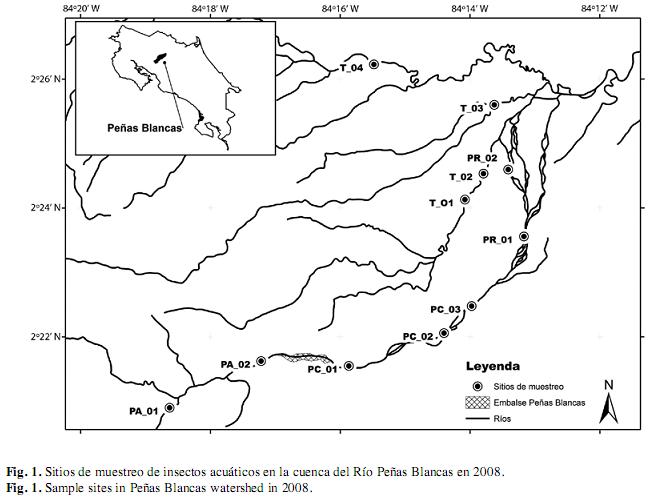
<body><![CDATA[<span style="font-family: verdana;">Durante el periodo de estudio     (enero a noviembre 2008) se hicieron 12     recolectas de insectos acu&aacute;ticos en 11 sitios de muestreo     ubicados en el cauce principal del r&iacute;o Pe&ntilde;as Blancas     (PA1, PA2, PC1, PC2, PC3, PR1 y PR2) y tributarios (T1, T2, T3 y T4)     seleccionados de acuerdo con las facilidades de acceso y siguiendo el     gradiente de la cuenca (<a href="/img/revistas/rbt/v59n2/a09i1.jpg">Fig.     1</a>). Dos de los sitios est&aacute;n     ubicados aguas arriba del embalse (PA 1 y PA 2), tres en el sector     entre la represa y la zona donde se restituye el agua luego de la     ]]></body>
<body><![CDATA[generaci&oacute;n el&eacute;ctrica (PC1 a PC3; aproximadamente 4 km de     distancia), dos entre los tributarios y la restituci&oacute;n (PR1 y     PR2) y cuatro ubicados en los tributarios (T1 a T4). En cada visita a     los sitios se realiz&oacute; un muestreo de insectos acu&aacute;ticos y     cuantificaci&oacute;n de variables f&iacute;sico-qu&iacute;micas.     &Uacute;nicamente el r&iacute;o Pe&ntilde;as Blancas tiene influencia     directa de la represa Hidroel&eacute;ctrica Pe&ntilde;as Blancas y las     etapas tempranas de construcci&oacute;n del proyecto     hidroel&eacute;ctrico Pocosol (<a      href="/img/revistas/rbt/v59n2/a09i1.jpg">Fig. 1</a>).</span><br     ]]></body>
<body><![CDATA[ style="font-family: verdana;">     <br style="font-family: verdana;">     <span style="font-family: verdana;"><span style="font-weight: bold;">Variables     f&iacute;sico     qu&iacute;micas y ambientales:</span> Del 8 de enero     al 18 de noviembre del 2008 se realizaron muestreos en la parte media y     alta de la cuenca del r&iacute;o Pe&ntilde;as Blancas. La     determinaci&oacute;n del ox&iacute;geno disuelto (O.D.&plusmn;0.01ppm)     y la temperatura del agua (&plusmn;0.1&ordm;C) se realiz&oacute;     mediante un oxigen&oacute;metro port&aacute;til YSI DO 200. El grado de     ]]></body>
<body><![CDATA[acidez del agua se midi&oacute; con un sensor pHTestr 2 (&plusmn;0.1).     La profundidad del sector de muestreo se calcul&oacute; a partir de     cinco mediciones al azar de en el tramo de recolecta de insectos     acu&aacute;ticos (<span style="font-style: italic;">&#967;</span> prof). Se     aplic&oacute; un ANOVA no     param&eacute;trico (Kruskall-Wallis, p&#8804;0.05) a las variables     ambientales para detectar diferencias estad&iacute;sticas entre los     sitios y fechas de muestreo mediante StathGraphics Centurion XV     (Versi&oacute;n 15.1.02).</span><br style="font-family: verdana;">     <br style="font-family: verdana;">     ]]></body>
<body><![CDATA[<span style="font-family: verdana;">Igualmente se determin&oacute; el     pH, temperatura, ox&iacute;geno     disuelto, s&oacute;lidos suspendidos, s&oacute;lidos disueltos,     s&oacute;lidos totales, DBO, PO<sub>4</sub>, NO<sub>3</sub> y turbidez     en tres sitios (PA 1,     PC 2 y PR 1) mediante visitas mensuales. Los sitios se seleccionaron     por su representatividad respecto a las condiciones ambientales del     r&iacute;o principal Pe&ntilde;as Blancas. En cada visita se     tom&oacute; una muestra de agua que se transport&oacute; al Laboratorio     Qu&iacute;mico de Hidrolog&iacute;a, ICE para su respectivo     ]]></body>
<body><![CDATA[an&aacute;lisis de acuerdo con los par&aacute;metros establecidos enel     Standard Methods for the Examination of Waster and Wastewater (APHA     1985). Diferencias estad&iacute;sticamente significativas (espacial y     temporal) se calcularon con ANOVA no param&eacute;trico     (Kruskall-Wallis, p&#8804;0.05).</span><br style="font-family: verdana;">     <span style="font-family: verdana; font-weight: bold;">&nbsp;</span><br      style="font-family: verdana; font-weight: bold;">     <span style="font-family: verdana;"><span style="font-weight: bold;">Muestreo     de insectos     acu&aacute;ticos:</span> En cada sitio de muestreo se     ]]></body>
<body><![CDATA[seleccionaron cuatro micro ambientes: acumulaciones de hojas, fondo     rocoso, fondo arenoso y lodoso. Durante cinco minutos, dos personas     removieron el sustrato para la captura de los insectos acu&aacute;ticos     corriente abajo en dos redes triangulares Wildco con apertura 305 x 305     x 305mm, bolsa de 152mm de profundidad y malla de 800 x 900mm nylon     multifilamento (tiempo total de esfuerzo 10min). El material colectado     fue separado en bandejas de color claro para distinguir los organismos     capturados. Todos los individuos fueron preservados en envases     pl&aacute;sticos con alcohol et&iacute;lico al 70% para su posterior     traslado e identificaci&oacute;n en el laboratorio. </span><br     ]]></body>
<body><![CDATA[ style="font-family: verdana;">     <br style="font-family: verdana;">     <span style="font-family: verdana;">El reconocimiento taxon&oacute;mico     se efectu&oacute; con las claves     taxon&oacute;micas disponibles (McCafferty 1981, Edmunds<span      style="font-style: italic;"> et al.</span> 1996,     Evans <span style="font-style: italic;">et al. </span>1996, Morse <span      style="font-style: italic;">et al. </span>1996, Polhemus 1996,     Rold&aacute;n     1996, Stewart <span style="font-style: italic;">et al.</span> 1996,     ]]></body>
<body><![CDATA[Westfall <span style="font-style: italic;">et al.</span> 1996, White <span      style="font-style: italic;">et al.</span> 1996,     Wiggins 1996, Springer <span style="font-style: italic;">et al.</span>     2010 en prensa), al nivel m&aacute;s     detallado posible, en la mayor&iacute;a de los casos a nivel de     g&eacute;nero y los individuos identificados de un mismo tax&oacute;n     se preservaronnen frascos individuales con alcohol et&iacute;lico al     70% y se registr&oacute; la abundancia num&eacute;rica de cada grupo. </span><br      style="font-family: verdana;">     <br style="font-family: verdana;">     ]]></body>
<body><![CDATA[<span style="font-family: verdana;">Para determinar la calidad del agua     se aplic&oacute; el &iacute;ndice     BMWP-CR el cual emplea las familias de insectos acu&aacute;ticos     asociadas con los cuerpos de agua y est&aacute; incorporado en la     normativa ambiental de Costa Rica. Tanto la abundancia como la riqueza     por fecha de muestreo y sitio fueron analizados estad&iacute;sticamente     mediante ANOVA no param&eacute;trico (Kruskall-Wallis, p&#8804;0.05) (Sokal     <span style="font-style: italic;">et al.</span> 1979) a trav&eacute;s     del paquete estad&iacute;stico     StathGraphics Centurion XV, Version 15.1.02.</span><br     ]]></body>
<body><![CDATA[ style="font-family: verdana;">     <br style="font-family: verdana;">     <span style="font-family: verdana;">Mediante una matriz de abundancia     num&eacute;rica total de los taxa por     sitio de muestreo se calcul&oacute; la similitud entre parejas de     sitios muestreados, mediante la comparaci&oacute;n de la frecuencia de     niveles en los que existi&oacute; relaci&oacute;n con todos los lugares     involucrados, se utiliz&oacute; como criterio de asociaci&oacute;n el     coeficiente de comparaci&oacute;n de Morisita-Horn y la     ponderaci&oacute;n UPGMA seg&uacute;n el m&eacute;todo de ligamiento     ]]></body>
<body><![CDATA[simple o agrupamiento del vecino m&aacute;s cercano (Pielou 1984). La     graficaci&oacute;n de los resultados se gener&oacute; empleando el     programa ACON3.BAS (Navarro 1984).</span><br      style="font-family: verdana;">     <br style="font-family: verdana;">     <span style="font-family: verdana;">Para estimar la diversidad     entomofaun&iacute;stica se calcul&oacute; el     &iacute;ndice de Shannon-Wiener (H`) de acuerdo con las     especificaciones de Henderson &amp; Seaby (1997). Las diferencias     estad&iacute;sticamente significativas (p&#8804;0.05) de la diversidad     ]]></body>
<body><![CDATA[gen&eacute;rica total durante el periodo de estudio para cada par de     sitios y fechas de muestreo se calcul&oacute; mediante la prueba de t,     siguiendo los criterios de Magurran (1988). Tanto la abundancia como     riqueza gen&eacute;rica fueron analizadas con ANOVA no     param&eacute;trica (Kruskall-Wallis, p&#8804;0.05) (Sokal <span      style="font-style: italic;">et al.</span> 1979)     mediante StathGraphics Centurion XV, Version 15.1.02. </span><br      style="font-family: verdana;">     <br style="font-family: verdana;">     <font style="font-weight: bold;" size="3"><span     ]]></body>
<body><![CDATA[ style="font-family: verdana;">Resultados</span></font><br      style="font-family: verdana;">     <br style="font-family: verdana; font-weight: bold;">     <span style="font-family: verdana;"><span style="font-weight: bold;">Variables     f&iacute;sico     qu&iacute;micas:</span> En los sitios PA 1, PC 2 y PR     1 la temperatura (KW11=19.64, p=0.0002), pH (KW11=12.43, p=0.006) y el     ox&iacute;geno disuelto (KW11=12.89, p=0.0048) presentaron diferencias     estad&iacute;sticamente significativas. Las variables PO<sub>4</sub>, NO<sub>3</sub>     y DBO<sub>5</sub>,     ]]></body>
<body><![CDATA[las cuales se asocian a contaminaci&oacute;n org&aacute;nica, no     presentaron valores en intervalos nocivos para la permanencia de     poblaciones de insectos en el cauce del r&iacute;o Pe&ntilde;as Blancas     (<a href="/img/revistas/rbt/v59n2/a09t1.gif">Cuadro 1</a>). Sin     embargo, las variables asociadas con el acarreo de     materiales (s&oacute;lidos suspendidos, s&oacute;lidos disueltos y     s&oacute;lidos totales) presentaron valores altos, principalmente en el     muestreo de octubre 2008.</span><br style="font-family: verdana;">     <br style="font-family: verdana;">     <span style="font-family: verdana;">De acuerdo con las variables     ]]></body>
<body><![CDATA[evaluadas en la totalidad de los sitios de     muestreo (pH, temperatura, ox&iacute;geno disuelto y turbidez) no se     observaron valores desfavorables para el desarrollo de poblaciones de     insectos acu&aacute;ticos (<a href="/img/revistas/rbt/v59n2/a09t2.gif">Cuadro     2</a>). En t&eacute;rminos generales la     turbidez es variable, aparentemente en funci&oacute;n del caudal     presente en cada uno de los muestreos. El ox&iacute;geno disuelto     (KW<sub>11</sub>=30.91, p=0.000607), la temperatura (KW<sub>11</sub>=61.82,     p=1.63x10<sup>-9</sup>) y el     pH (KW<sub>11</sub>=28.68, p=0.0014) mostraron diferencias     ]]></body>
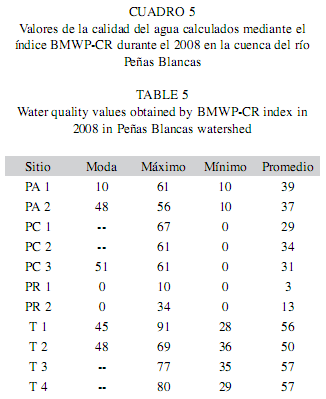
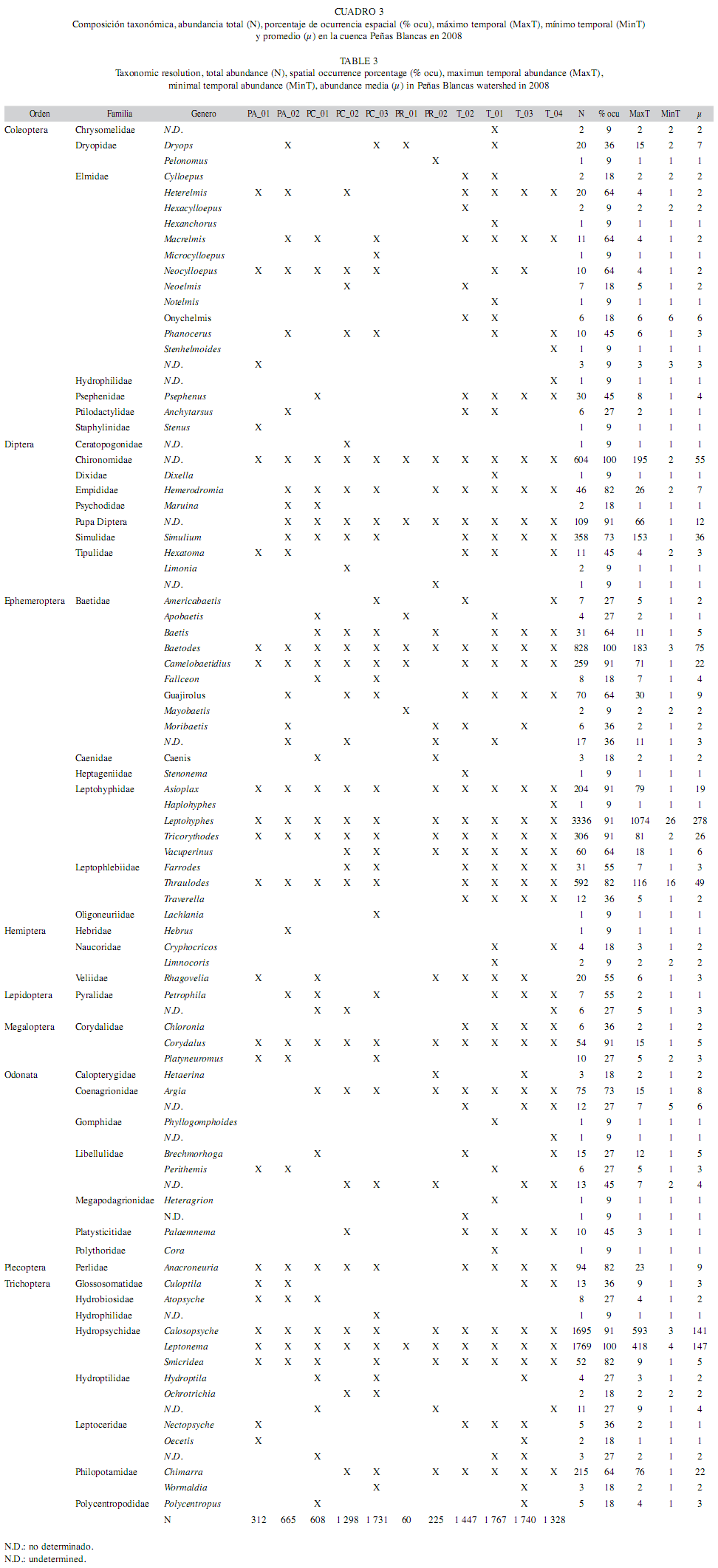
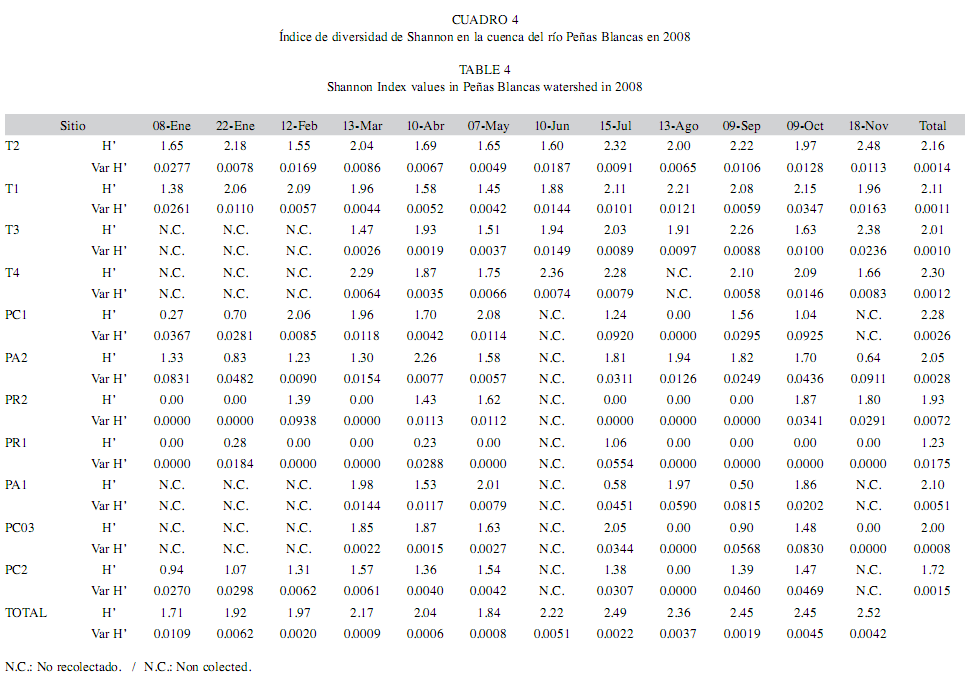
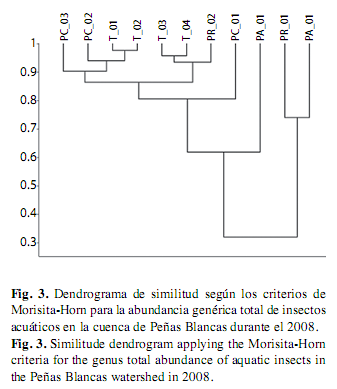
<body><![CDATA[significativas a nivel     espacial.</span><br style="font-family: verdana;">     <span style="font-family: verdana;"><span style="font-weight: bold;">    <br> Variables biol&oacute;gicas: </span>Se recolectaron 9 &oacute;rdenes, 41 familias y 72 g&eacute;neros en un total de 11 181 individuos, de los cuales el 93% fue identificado a nivel de g&eacute;nero. La mayor&iacute;a de los individuos determinados &uacute;nicamente a nivel de familia corresponden al orden Diptera, del cual en Costa Rica se tiene una escasa informaci&oacute;n taxon&oacute;mica de la asociaci&oacute;n larva-adulto (<a  href="/img/revistas/rbt/v59n2/a09t3.gif">Cuadro 3</a>).</span><br  style="font-family: verdana;"> <br style="font-family: verdana;"> <span style="font-family: verdana;">A nivel de orden los taxones que presentaron la mayor abundancia fueron Ephemeroptera (n=5 779), Trichoptera (n=3 788) y Diptera (n=1 135); el resto de los &oacute;rdenes mostraron abundancias por debajo de los 200 individuos. Leptohyphidae, Hydropsychidae y Baetidae fueron las familias m&aacute;s abundantes (n=3 907, n=3 516 y n=1 323, respectivamente). Los g&eacute;neros con mayor distribuci&oacute;n espacial fueron: <span style="font-style: italic;">Baetodes</span> y <span  style="font-style: italic;">Leptonema</span> (presentes en todos los sitios), seguidos de <span style="font-style: italic;">Asioplax, Calosopsyche, Camelobaetidius, Corydalus, Leptohyphes </span>y <span style="font-style: italic;">Tricorythodes</span>, los cuales se localizaron en 10 sitios &uacute;nicamente (<a href="/img/revistas/rbt/v59n2/a09t3.gif">Cuadro 3</a>).</span><br style="font-family: verdana;"> <br style="font-family: verdana;"> <span style="font-family: verdana;">Para la abundancia total por sitio de muestreo, el 83% est&aacute; distribuido en los sitios denominados PC2, T4, T2, T1, T3 y PC3, todos con abundancias superiores a los mil individuos (Kruskall-Wallis, F<sub>10</sub>=28.23, p=0.0016), ubicados principalmente en los tributarios y el sector de compensaci&oacute;n. En la riqueza gen&eacute;rica, los mayores valores registrados se encuentran en los tributarios y PC3 (Kruskall-Wallis, F<sub>10</sub>=44.99, p&lt;0.0001). En general la tendencia de los sitios ubicados en el cauce de compensaci&oacute;n es aumentar sus valores de abundancia conforme se alejan del embalse (<a  href="/img/revistas/rbt/v59n2/a09i2.jpg">Fig. 2</a>).</span><br  style="font-family: verdana;"> <br style="font-family: verdana;"> <span style="font-family: verdana;">Considerando los valores registrados por fecha de muestreo, los meses con mayor abundancia fueron: abril (n=2 986), mayo (n=2 364) y marzo (n=1 847), los cuales presentaron diferencias significativas (Kruskall-Wallis, F<sub>11,93</sub>=35.48, p&lt;0.0001). En t&eacute;rminos de riqueza el valor m&aacute;ximo se obtuvo en marzo (n=40) y el m&iacute;nimo en el muestreo de enero (n=13); sin embargo, no presentan diferencias significativas (Kruskall-Wallis, F<sub>11,93</sub>=16.45, p=0.12) (<a href="/img/revistas/rbt/v59n2/a09i2.jpg">Fig. 2</a>).</span><br  style="font-family: verdana;"> <br style="font-family: verdana;"> <span style="font-family: verdana;">Al agrupar los sitios de muestreo por sector en la cuenca (Aguas Arriba del Embalse, Compensaci&oacute;n, Restituci&oacute;n y Tributario), la m&aacute;xima abundancia total se detect&oacute; en Tributario (n=6 282) y Compensaci&oacute;n (n=3 637) (Kruskall-Wallis, F<sub>3,40</sub>=18.16, p&lt;0.0001), as&iacute; mismo los valores m&aacute;ximos de riqueza se detectaron en estos sectores (n=59, Tributarios; n=44, Compensaci&oacute;n) (Kruskall-Wallis, F<sub>3,40</sub>=22.5, p=5.08*10-4). En cuanto a la diversidad, el valor m&aacute;ximo se obtuvo en T2 (H&#8217;=2.48) y el m&iacute;nimo en PC1, PR2, PR1, PC3 y PC2 (H&#8217;=0). De acuerdo con la abundancia total por sitio de muestreo la m&aacute;xima se detect&oacute; en Empacadora (H&#8217;=2.30) seguido de PC1 (H&#8217;=2.28) y la m&iacute;nima en PR1 (H&#8217;=1.23); de acuerdo a la fecha de muestreo la m&aacute;xima total se obtuvo en noviembre (H&#8217;=2.52), la m&iacute;nima se obtuvo en el primer muestreo de enero (H&#8217;=1.71) (<a  href="/img/revistas/rbt/v59n2/a09t4.gif">Cuadro 4</a>).</span><br  style="font-family: verdana;"> <br style="font-family: verdana;"> <span style="font-family: verdana;">La prueba de t para H&acute; (p&#8804;0.05) revel&oacute; que existen diferencias significativas entre la diversidad total a nivel espacial como temporal para los sitios de muestreo y las fechas de muestreo. Asimismo, existen diferencias en cuanto la diversidad total por sitio de muestreo.</span><br style="font-family: verdana;"> <br style="font-family: verdana;"> <span style="font-family: verdana;">La aplicaci&oacute;n del &iacute;ndice BMWP revel&oacute; que la mayor&iacute;a de los sitios de muestreo tienen variaciones temporales de la calidad del agua, sin embargo, la categor&iacute;a predominante es aguas de calidad mala, contaminadas; as&iacute; mismo, la calidad de agua muy mala, extremadamente contaminada se detect&oacute; en aguas del r&iacute;o Pe&ntilde;as Blancas (<a href="#cuadro5">Cuadro 5</a>).    <br>     <br>     <br> </span></font>     <div style="text-align: center;"><font size="2"><span  style="font-family: verdana;"><a name="cuadro5"></a><img alt=""  src="/img/revistas/rbt/v59n2/a09t5.gif"  style="width: 326px; height: 399px;"></span></font><br  style="font-family: verdana;"> <font size="2"><span style="font-family: verdana;"></span></font></div> <font size="2"><br style="font-family: verdana;"> <span style="font-family: verdana;">Seg&uacute;n los criterios de Morisita-Horn, los sitios con mayor similitud son T2 y T1 (97% similitud), mientras que PA1y PR1 son los que m&aacute;s se diferencian del resto de sitios (47% de similitud) (<a href="#fig3">Fig. 3</a>).    <br>     <br> </span></font>     ]]></body>
<body><![CDATA[<div style="text-align: center;"><font size="2"><span      style="font-family: verdana;"><a name="fig3"></a><img alt=""      src="/img/revistas/rbt/v59n2/a09i3.jpg"      style="width: 337px; height: 389px;"></span></font><br      style="font-family: verdana;">     <font size="2"><span style="font-family: verdana;"></span></font></div>     <font size="2"><br style="font-family: verdana;">     <font style="font-weight: bold;" size="3"><span      style="font-family: verdana;">Discusi&oacute;n</span></font><br      style="font-family: verdana;">     ]]></body>
<body><![CDATA[<br style="font-family: verdana;">     <span style="font-family: verdana;">Los cambios ambientales tienen una     fuerte influencia en la     distribuci&oacute;n, abundancia y riqueza de insectos acu&aacute;ticos     en los cuerpos de agua (Hawkins <span style="font-style: italic;">et     al.</span> 1982, Ometo <span style="font-style: italic;">et al.</span>     2000, Shieh     <span style="font-style: italic;">et al.</span> 2000, Ocon <span      style="font-style: italic;">et al. </span>2004). Ward (1992)     mencion&oacute; que la     ]]></body>
<body><![CDATA[temperatura, substrato, corriente y nivel del agua son los principales     factores en condicionar la permanencia de estas poblaciones. Sin     embargo, estos cambios pueden ser ocasionados por alteraciones     antropog&eacute;nicas o de car&aacute;cter natural. De acuerdo con     Posada <span style="font-style: italic;">et al.</span> (2000) las     variaciones estacionales de los     organismos est&aacute;n en funci&oacute;n del efecto que ocasionan las     lluvias o las sequ&iacute;as en el volumen de agua transportado, el     cual altera la disponibilidad de h&aacute;bitats y por tanto compromete     la sobrevivencia de los animales asociados con ellos.</span><br     ]]></body>
<body><![CDATA[ style="font-family: verdana;">     <br style="font-family: verdana;">     <span style="font-family: verdana;">Cuando existen alteraciones de     car&aacute;cter antropog&eacute;nico, la     condici&oacute;n f&iacute;sico qu&iacute;mica del agua presenta     variaciones que limitan a las poblaciones de insectos acu&aacute;ticos.     El ox&iacute;geno disuelto est&aacute; influenciado por la actividad     biol&oacute;gica, temperatura y turbulencia del agua (Flanagan 1992,     Rold&aacute;n 2003), los ambientes contaminados son los que m&aacute;s     se relacionan con bajos valores de ox&iacute;geno disuelto, en     ]]></body>
<body><![CDATA[comparaci&oacute;n con el rango normal de condiciones naturales     (7.0-8.0mg/L) (Flanagan 1992). En el &aacute;rea de estudio los valores     de ox&iacute;geno disuelto se encuentran en el intervalo para la     permanencia de poblaciones saludables, similar a lo reportado en     estudios previos (Posada <span style="font-style: italic;">et al. </span>2000,     Ocon<span style="font-style: italic;"> et al.</span> 2004) y     coincidente     con lo reportado por Cortes <span style="font-style: italic;">et al. </span>(1998)     en r&iacute;os de     Brasil con influencia de represas. Las diferencias     ]]></body>
<body><![CDATA[estad&iacute;sticamente significativas para los valores obtenidos en     campo y laboratorio podr&iacute;an ser atribuidas a condiciones     particulares de cada h&aacute;bitat, ya que en ocasiones se analizaron     h&aacute;bitat l&oacute;ticos o lentos, en funci&oacute;n del caudal     del r&iacute;o, sin embargo se carece de informaci&oacute;n detallada     para corroborar esta situaci&oacute;n.</span><br      style="font-family: verdana;">     <br style="font-family: verdana;">     <span style="font-family: verdana;">Seg&uacute;n Flanagan (1992) el     &aacute;mbito normal en el cual pueden     ]]></body>
<body><![CDATA[fluctuar los valores de pH es de 6.5 a 8.0, rango en el cual se     encuentran los valores detectados en el presente estudio y lo reportado     por Nelson &amp; Lieberman (2002). En el caso del &aacute;rea de     estudio, aguas arriba del Embalse Pe&ntilde;as Blancas, se detectaron     venas volc&aacute;nicas que podr&iacute;an ocasionar condiciones     &aacute;cidas del agua (obs. per.), sin embargo, las pruebas     estad&iacute;sticas aplicadas a los valores reportados en laboratorio     no detectaron diferencias estad&iacute;sticamente significativas lo     cual podr&iacute;a estar relacionado con la carga de s&oacute;lidos     disueltos, los cuales tienen capacidad para amortiguar los cambios en     ]]></body>
<body><![CDATA[pH. Otros estudios (Courtney <span style="font-style: italic;">et al. </span>2000,     Fjellheim <span style="font-style: italic;">et al. </span>2001,     <span style="font-style: italic;">Bradley et al. </span>2002, Lepori <span      style="font-style: italic;">et al.</span> 2003) evidencian la     sensibilidad de     los macroinvertebrados a la acidificaci&oacute;n del agua, por lo cual,     si se mantienen las condiciones actuales, se podr&iacute;a descartar     esta variable como una limitante para el desarrollo de las comunidades     de insectos acu&aacute;ticos en el r&iacute;o Pe&ntilde;as Blancas.</span><br      style="font-family: verdana;">     ]]></body>
<body><![CDATA[<br style="font-family: verdana;">     <span style="font-family: verdana;">Las variables ambientales pueden     cambiar seg&uacute;n los gradientes     altitudinales, lo cual puede ser m&aacute;s notorio en la temperatura     del agua, generando divergencia en los patrones de distribuci&oacute;n,     abundancia y diversidad de los insectos acu&aacute;ticos (Wallace <span      style="font-style: italic;">et     al.</span> 1996). Los valores obtenidos para la temperatura en el     presente     estudio fueron similares a otros estudios realizados en sistemas     ]]></body>
<body><![CDATA[l&oacute;ticos (Posada <span style="font-style: italic;">et al. </span>2000,     Figueroa <span style="font-style: italic;">et al. </span>2003). Las     diferencias estad&iacute;sticas reportadas podr&iacute;an ser     explicadas por cambios altitudinales entre los sitios de muestreo, el     horario de muestreo y la descarga de la planta Pe&ntilde;as Blancas     luego de la generaci&oacute;n el&eacute;ctrica, principalmente en los     sitios del sector de restituci&oacute;n (PR1 y PR2). </span><br      style="font-family: verdana;">     <br style="font-family: verdana;">     <span style="font-family: verdana;">Igualmente, la relativa estabilidad     ]]></body>
<body><![CDATA[de los valores ambientales puede     estar relacionado con la poca profundidad y volumen del embalse     Pe&ntilde;as Blancas, lo cual fue validado por Palau (1998) quien     durante tres a&ntilde;os de investigaci&oacute;n en el r&iacute;o Esera     (influenciado por el Embalse Barahona) detect&oacute; que la media y la     variaci&oacute;n de la temperatura aumentaron de acuerdo con el estado     de estratificaci&oacute;n del embalse antes del vaciado, el volumen de     agua embalsado y la temperatura media del embalse. </span><br      style="font-family: verdana;">     <br style="font-family: verdana;">     ]]></body>
<body><![CDATA[<span style="font-family: verdana;">Con respecto a la turbidez para la     cuenca del r&iacute;o Pe&ntilde;as     Blancas, el principal aporte de sedimentos proviene de fuentes     naturales asociadas con altas y frecuentes precipitaciones     (Rold&aacute;n 2003); sin embargo, existe un aporte     antropog&eacute;nico relacionado con las etapas de construcci&oacute;n     del proyecto hidroel&eacute;ctrico Pocosol aguas arriba del embalse     Pe&ntilde;as Blancas. As&iacute; mismo disturbios naturales como     deslizamientos pueden tener un impacto sobre las comunidades de     animales acu&aacute;ticos (por ejemplo, peces), y por lo tanto alterar     ]]></body>
<body><![CDATA[los patrones normales de la abundancia que tienden a estabilizarse     luego del evento (Liang-Hsien <span style="font-style: italic;">et al.     </span>2004), situaci&oacute;n que     podr&iacute;a darse en la parte alta de la cuenca del r&iacute;o     Pe&ntilde;as Blancas por la tendencia a deslizamientos en masa por la     pendiente de las monta&ntilde;as. </span><br      style="font-family: verdana;">     <br style="font-family: verdana;">     <span style="font-family: verdana;">No obstante durante la &eacute;poca     de mayor precipitaci&oacute;n en la     ]]></body>
<body><![CDATA[cuenca de Pe&ntilde;as Blancas existe un aumento en la     concentraci&oacute;n de sedimentos acarreados por el agua; no se     descarta que las concentraciones detectadas durante setiembre y octubre     tengan un componente asociado a las maniobras de desalojo de sedimentos     en los sitios aguas abajo del embalse, sin embargo, se carece de la     informaci&oacute;n que permita distinguir el aporte natural     antropog&eacute;nico, la cual podr&iacute;a consistir en una propuesta     futura de investigaci&oacute;n en el &aacute;rea de estudio.</span><br      style="font-family: verdana;">     <br style="font-family: verdana;">     ]]></body>
<body><![CDATA[<span style="font-family: verdana;">De acuerdo con lo estipulado por     Ward (1992), quien establece que las     fluctuaciones en el nivel del agua tienen influencia en los insectos     acu&aacute;ticos seg&uacute;n la duraci&oacute;n y extensi&oacute;n del     evento, en la cuenca del r&iacute;o Pe&ntilde;as Blancas las crecidas     del r&iacute;o y la generaci&oacute;n el&eacute;ctrica influyeron en el     comportamiento de las poblaciones de macroinvertebrados, fue m&aacute;s     notorio durante la &eacute;poca de mayor precipitaci&oacute;n (abril     2008 en adelante) cuando la din&aacute;mica de los h&aacute;bitats     disponibles y las poblaciones cambia (Kohler 1985, Ram&iacute;rez <span     ]]></body>
<body><![CDATA[ style="font-style: italic;">et     al. </span>1998b, Shearer <span style="font-style: italic;">et al.</span>     2003, Bass 2004).</span><br style="font-family: verdana;">     <br style="font-family: verdana;">     <span style="font-family: verdana;">De acuerdo con las condiciones     ambientales observadas, el sector de     restituci&oacute;n es de especial inter&eacute;s en la cuenca, debido a     que en estos sitios se reportaron los valores m&aacute;s bajos de las     variables biol&oacute;gicas evaluadas, lo cual se relacion&oacute; con     las fluctuaciones de caudal generadas por los picos de     ]]></body>
<body><![CDATA[producci&oacute;n el&eacute;ctrica, coincidente con lo reportado en     otros estudios (Malmqvist <span style="font-style: italic;">et al. </span>1996,     Cortes <span style="font-style: italic;">et al.</span> 1998, Nelson <span      style="font-style: italic;">et     al. </span>2002).</span><br style="font-family: verdana;">     <br style="font-family: verdana;">     <span style="font-family: verdana;">En t&eacute;rminos de abundancia de     macroinvertebrados, el grupo     m&aacute;s abundante fue el de los efemer&oacute;pteros, lo cual se     relacion&oacute; con los m&uacute;ltiples ciclos de reproducci&oacute;n     ]]></body>
<body><![CDATA[en el a&ntilde;o (polivoltinos) y su capacidad de colonizar (Cortes <span      style="font-style: italic;">et     al.</span> 1998, Palau 1998). En otras investigaciones realizadas por     Malmqvist &amp; Englund (1996) y Cort&eacute;s <span      style="font-style: italic;">et al.     </span>(1998) se determin&oacute; que este grupo taxon&oacute;mico     est&aacute;     fuertemente afectado por las fluctuaciones diarias de caudal en     r&iacute;os regulados por represas hidroel&eacute;ctricas, por lo cual     se pueden considerar como un indicador de la perturbaci&oacute;n del     ]]></body>
<body><![CDATA[ambiente del r&iacute;o Pe&ntilde;as Blancas, sea por actividades     humanas como las maniobras de desalojo de sedimentos o por crecidas     naturales, principalmente en el sector de restituci&oacute;n, en el     momento que se detecten disminuciones en su abundancia. En general, la     entomofauna reportada contin&uacute;a siendo similar a lo detectado en     estudios efectuados en la cuenca del r&iacute;o San Carlos (Barrantes     <span style="font-style: italic;">et al</span>. 2003a, Barrantes<span      style="font-style: italic;"> et al.</span> 2003b, Chaves 2007).</span><br      style="font-family: verdana;">     <br style="font-family: verdana;">     ]]></body>
<body><![CDATA[<span style="font-family: verdana;">Seg&uacute;n trabajos realizados     por Stout (1980), Benstead (1996) y     Benstead &amp; Pringle (2004) los c&uacute;mulos de hojas y el detrito     org&aacute;nico de origen natural tienen amplio valor para la     alimentaci&oacute;n y desarrollo de las poblaciones de insectos     acu&aacute;ticos. En el caso particular de la cuenca Pe&ntilde;as     Blancas, al considerar que la &eacute;poca lluviosa afecta por igual a     toda el &aacute;rea, el aumento en los vol&uacute;menes de agua generan     la remoci&oacute;n y dificultan la permanencia de c&uacute;mulos de     hojas, lo cual podr&iacute;a ser uno de los factores que disminuye la     ]]></body>
<body><![CDATA[abundancia de insectos acu&aacute;ticos luego del inicio del periodo de     lluvias.</span><br style="font-family: verdana;">     <br style="font-family: verdana;">     <span style="font-family: verdana;">Sin embargo, a pesar de que los     caudales tambi&eacute;n afectan a los     tributarios, la m&aacute;xima abundancia de efemer&oacute;pteros y     tric&oacute;pteros en este sector de la cuenca est&aacute; relacionado     con la presencia de microh&aacute;bitats para la permanencia de     poblaciones abundantes (Ram&iacute;rez <span      style="font-style: italic;">et al. </span>1998, Reice 1980),     ]]></body>
<body><![CDATA[lo cual se podr&iacute;a relacionar con la ausencia de represas que     alteren la condici&oacute;n del r&iacute;o (Ligon <span      style="font-style: italic;">et al.</span> 1995).</span><br      style="font-family: verdana;">     <br style="font-family: verdana;">     <span style="font-family: verdana;">Durante el periodo de menor     precipitaci&oacute;n en la cuenca del     r&iacute;o Pe&ntilde;as Blancas se report&oacute; una mayor abundancia     de insectos acu&aacute;ticos, la cual disminuy&oacute; cuando     inici&oacute; el periodo de lluvias, atribuible a que durante los     ]]></body>
<body><![CDATA[eventos de crecidas del r&iacute;o las poblaciones de insectos se     mantienen poco abundantes por la falta de h&aacute;bitats y el     desprendimiento de los sustratos a los cuales se adhieren (Scrimgeour     <span style="font-style: italic;">et al. </span>1989, Nelson <span      style="font-style: italic;">et al</span>. 2002), generando un proceso     denominado     deriva (Anderson <span style="font-style: italic;">et al.</span> 1968,     Collier <span style="font-style: italic;">et al.</span> 2003, Bass     2004, Callisto     <span style="font-style: italic;">et al. </span>2005). Para el     ]]></body>
<body><![CDATA[&aacute;rea de estudio se descarta la influencia     de descargas de aguas servidas y alteraciones por los procesos     agr&iacute;colas aleda&ntilde;as al r&iacute;o como condicionantes para     la permanencia de poblaciones de insectos acu&aacute;ticos abundantes,     previamente evaluado en otros estudios (Herlihy <span      style="font-style: italic;">et al.</span> 2005, Harding<span      style="font-style: italic;"> et     al. </span>2006, Kasangaki <span style="font-style: italic;">et al. </span>2006),     por lo cual los insectos     acu&aacute;ticos pueden servir a futuro para observar el grado de     ]]></body>
<body><![CDATA[degradaci&oacute;n que sufra el r&iacute;o con respecto a la     intervenci&oacute;n humana en lo referente a las aguas negras.</span><br      style="font-family: verdana;">     <br style="font-family: verdana;">     <span style="font-family: verdana;">Para el sector de     restituci&oacute;n, los bajos valores de abundancia     son atribuidos a las fluctuaciones e inestabilidad del h&aacute;bitat     por las variaciones del caudal en funci&oacute;n de la     generaci&oacute;n el&eacute;ctrica, similar a lo observado por otros     autores en sistemas dulceacu&iacute;colas con influencia de represas     ]]></body>
<body><![CDATA[para la generaci&oacute;n de electricidad (Troelstrup <span      style="font-style: italic;">et al. </span>1990,     Chaves 2007).</span><br style="font-family: verdana;">     <br style="font-family: verdana;">     <span style="font-family: verdana;">Seg&uacute;n Chaves (2007) para la     cuenca del r&iacute;o Pe&ntilde;as     Blancas la mayor abundancia y riqueza de g&eacute;neros se     detect&oacute; en los tributarios, coincide con el periodo en estudio.     A pesar de que la represa tiene influencia en la permanencia de     poblaciones de insectos acu&aacute;ticos, para el &aacute;rea de     ]]></body>
<body><![CDATA[estudio, se debe tener en cuenta que tanto los tributarios como el     r&iacute;o Pe&ntilde;as Blancas tienen sustratos y patrones de caudales     diferentes, los cuales pueden ser variables que alteren la     interpretaci&oacute;n de los resultados.</span><br      style="font-family: verdana;">     <br style="font-family: verdana;">     <span style="font-family: verdana;">Considerando que el &iacute;ndice     BMWP-CR fue dise&ntilde;ado de     acuerdo a la tolerancia de las familias de macroinvertebrados a la     contaminaci&oacute;n del agua y sus &oacute;ptimos para desarrollo     ]]></body>
<body><![CDATA[(Alba-Tercedor 1996), las diferencias detectadas en la presente     investigaci&oacute;n est&aacute;n relacionadas con las variaciones     temporales de la riqueza a nivel de familia (Morais <span      style="font-style: italic;">et al. </span>2004).     Contrario a lo propuesto por Zamora-Mu&ntilde;oz <span      style="font-style: italic;">et al.</span> (1995)     quienes estimaron que el &iacute;ndice BMWP es v&aacute;lido por cuanto     los valores obtenidos tuvieron relaci&oacute;n con las condiciones     ambientales y los valores m&aacute;ximos no alteraron la     interpretaci&oacute;n de la condici&oacute;n ambiental, para el     ]]></body>
<body><![CDATA[presente estudio se detectaron valores de 0 que har&iacute;an suponer     que la calidad del agua mala, extremadamente contaminada en el sitio de     estudio, contrario a lo detectado por medios f&iacute;sico     qu&iacute;micos.</span><br style="font-family: verdana;">     <br style="font-family: verdana;">     <span style="font-family: verdana;">Al igual que lo reportado por     Morais <span style="font-style: italic;">et al.</span> (2004) en una     cuenca del     Portugal, el &iacute;ndice BMWP-CR en la cuenca del r&iacute;o     Pe&ntilde;as Blancas no est&aacute; relacionado con     ]]></body>
<body><![CDATA[caracter&iacute;sticas f&iacute;sico qu&iacute;micas que normalmente     est&aacute;n relacionadas con la calidad del agua (pH, temperatura,     ox&iacute;geno disuelto, entre otros), por lo que otras variables como     los caudales o la presencia de embalses condicionan el comportamiento     de las poblaciones de insectos acu&aacute;ticos, y por ende, el     &iacute;ndice BMWP-CR.</span><br style="font-family: verdana;">     <br style="font-family: verdana;">     <span style="font-family: verdana;">El otro factor que influye en la     composici&oacute;n de la entomofauna     acu&aacute;tica en la cuenca es la presencia del embalse Pe&ntilde;as     ]]></body>
<body><![CDATA[Blancas que genera sectorizaci&oacute;n, siendo m&aacute;s notables los     efectos en la regi&oacute;n adyacente a la restituci&oacute;n del agua     luego del proceso de generaci&oacute;n el&eacute;ctrica por los     fluctuaciones del caudal y transporte de sedimentos (Malmqvist <span      style="font-style: italic;">et al.     </span>1996, Cortes <span style="font-style: italic;">et al.</span>     1998, Sharma <span style="font-style: italic;">et al.</span> 2005).</span><br      style="font-family: verdana;">     <br style="font-family: verdana;">     <span style="font-family: verdana;">Asociado al embalse tambi&eacute;n     ]]></body>
<body><![CDATA[se tienen que desarrollar     actividades de mantenimiento para liberar los sedimentos acumulados,     para lo cual se aprovecha la &eacute;poca de mayores caudales y eventos     naturales los cuales son factores que perjudican la entomofauna por la     p&eacute;rdida de h&aacute;bitats y el arrastre por los     vol&uacute;menes de agua, sin embargo, por la capacidad de     recolonizaci&oacute;n que tienen los insectos acu&aacute;ticos, muy     r&aacute;pidamente pueden aumentar en abundancia y diversidad, tal y     como fue observado por Palau (1998) luego de las maniobras de     mantenimiento del embalse de Barasona en Espa&ntilde;a y lo reportado     ]]></body>
<body><![CDATA[por Chaves (2007) para el r&iacute;o Pe&ntilde;as Blancas.</span><br      style="font-family: verdana;">     <br style="font-family: verdana;">     <span style="font-family: verdana;">En t&eacute;rminos generales los     resultados de esta     investigaci&oacute;n evidencian el impacto de las represas     hidroel&eacute;ctricas en los sistemas dulceacu&iacute;colas,     principalmente en el sector posterior a la restituci&oacute;n del agua,     sin embargo, eventos naturales como las crecidas, periodo de lluvias y     capacidad de transporte del agua tambi&eacute;n influyen en las     ]]></body>
<body><![CDATA[poblaciones de insectos acu&aacute;ticos, por lo cual se recomienda     tener en cuenta estas variables cuando se interpreta su comportamiento     con respecto a factores antropog&eacute;nicos que causan estr&eacute;s     en la cuenca del r&iacute;o Pe&ntilde;as Blancas.</span><br      style="font-family: verdana;">     <br style="font-family: verdana;">     <font style="font-weight: bold;" size="3"><span      style="font-family: verdana;">Agradecimientos</span></font><br      style="font-family: verdana;">     <br style="font-family: verdana;">     ]]></body>
<body><![CDATA[<span style="font-family: verdana;">El desarrollo de este trabajo no     hubiera sido posible sin el apoyo de     Unidad de Cuenca del r&iacute;o Pe&ntilde;as Blancas, UEN PySA, ICE y     el Centro de Servicio Ambiente y Cuencas, CG Toro, UEN     Producci&oacute;n, ICE en la log&iacute;stica y materiales para la     recolecta de insectos acu&aacute;ticos. As&iacute; mismo se agradece a     Jos&eacute; F. Fern&aacute;ndez Araya, del Laboratorio Qu&iacute;mico     de Hidrolog&iacute;a, Centro de Estudios B&aacute;sicos     Ingenier&iacute;a, ICE por el an&aacute;lisis de las variables     f&iacute;sico qu&iacute;micas del agua. A Alfonso Garita y Juan     ]]></body>
<body><![CDATA[Jos&eacute; Rodr&iacute;guez Alfaro en la parte de mapas y     georeferenciaci&oacute;n. Muchas gracias a Julio Gamboa Ram&iacute;rez     y Carlos Delgado Ledezma por la colaboraci&oacute;n en las recolectas     de campo y la preparaci&oacute;n de las muestras de insectos     acu&aacute;ticos. Muchas gracias a Mauricio Herrera Campos, Armando     Escobedo y revisores an&oacute;nimos por su aporte de ideas y     observaciones durante el desarrollo de la investigaci&oacute;n.</span><br      style="font-family: verdana;">     <br style="font-family: verdana; font-weight: bold;">     <font style="font-weight: bold;" size="3"><span     ]]></body>
<body><![CDATA[ style="font-family: verdana;"></span></font></font>     <hr style="width: 100%; height: 2px;">    <!-- ref --><br> <font size="2"><font style="font-weight: bold;" size="3"><span  style="font-family: verdana;">Referencias</span></font><br  style="font-family: verdana;"> <br style="font-family: verdana;"> <span style="font-family: verdana;">Alba-Tercedor, J. 1996. Macroinvertebrados acu&aacute;ticos y calidad de las aguas de los r&iacute;os. IV Simposio del Agua en Andaluc&iacute;a (SIAGA). Almer&iacute;a 2: 203-213.    &nbsp;&nbsp;&nbsp;&nbsp;&nbsp;&nbsp;&nbsp;&nbsp;[&#160;<a href="javascript:void(0);" onclick="javascript: window.open('/scielo.php?script=sci_nlinks&ref=1751548&pid=S0034-7744201100020000900001&lng=','','width=640,height=500,resizable=yes,scrollbars=1,menubar=yes,');">Links</a>&#160;]<!-- end-ref --><!-- ref --></span><br  style="font-family: verdana;"> <br style="font-family: verdana;"> <span style="font-family: verdana;">Anderson, E.P., C.M. Pringle &amp; M. Rojas. 2006. Transforming tropical rivers: an environmental perspective on hydropower development in Costa Rica. Aquatic Conserv: Mar. Freshw. Ecosyst. 16: 679-693.    &nbsp;&nbsp;&nbsp;&nbsp;&nbsp;&nbsp;&nbsp;&nbsp;[&#160;<a href="javascript:void(0);" onclick="javascript: window.open('/scielo.php?script=sci_nlinks&ref=1751549&pid=S0034-7744201100020000900002&lng=','','width=640,height=500,resizable=yes,scrollbars=1,menubar=yes,');">Links</a>&#160;]<!-- end-ref --><!-- ref --></span><br  style="font-family: verdana;"> <br style="font-family: verdana;"> <span style="font-family: verdana;">Anderson, N.H. &amp; D.M. Lehmkuhl. 1968. Catastrophic drift of insects in a woodland stream. Ecology 49: 198-206.    &nbsp;&nbsp;&nbsp;&nbsp;&nbsp;&nbsp;&nbsp;&nbsp;[&#160;<a href="javascript:void(0);" onclick="javascript: window.open('/scielo.php?script=sci_nlinks&ref=1751550&pid=S0034-7744201100020000900003&lng=','','width=640,height=500,resizable=yes,scrollbars=1,menubar=yes,');">Links</a>&#160;]<!-- end-ref --><!-- ref --></span><br  style="font-family: verdana;"> <br style="font-family: verdana;"> <span style="font-family: verdana;">Apha. 1985. Standard methods for the examination of water and wastewater. American Public Health Association, Washington D.C., EEUU.    &nbsp;&nbsp;&nbsp;&nbsp;&nbsp;&nbsp;&nbsp;&nbsp;[&#160;<a href="javascript:void(0);" onclick="javascript: window.open('/scielo.php?script=sci_nlinks&ref=1751551&pid=S0034-7744201100020000900004&lng=','','width=640,height=500,resizable=yes,scrollbars=1,menubar=yes,');">Links</a>&#160;]<!-- end-ref --><!-- ref --></span><br  style="font-family: verdana;"> <br style="font-family: verdana;"> <span style="font-family: verdana;">Barrantes, U., M. Springer &amp; G. Mora. 2003a. Condici&oacute;n de la fauna bent&oacute;nica en r&iacute;os de la cuenca del R&iacute;o San Carlos. Tecnolog&iacute;a en Marcha 16: 110-118.    &nbsp;&nbsp;&nbsp;&nbsp;&nbsp;&nbsp;&nbsp;&nbsp;[&#160;<a href="javascript:void(0);" onclick="javascript: window.open('/scielo.php?script=sci_nlinks&ref=1751552&pid=S0034-7744201100020000900005&lng=','','width=640,height=500,resizable=yes,scrollbars=1,menubar=yes,');">Links</a>&#160;]<!-- end-ref --><!-- ref --></span><br  style="font-family: verdana;"> <br style="font-family: verdana;"> <span style="font-family: verdana;">Barrantes, U., M. Springer &amp; C. Moya. 2003b. La comunidad insectil en el bentos de r&iacute;os de la Cuenca del r&iacute;o San Carlos. Tecnolog&iacute;a en Marcha 16: 101-109.    &nbsp;&nbsp;&nbsp;&nbsp;&nbsp;&nbsp;&nbsp;&nbsp;[&#160;<a href="javascript:void(0);" onclick="javascript: window.open('/scielo.php?script=sci_nlinks&ref=1751553&pid=S0034-7744201100020000900006&lng=','','width=640,height=500,resizable=yes,scrollbars=1,menubar=yes,');">Links</a>&#160;]<!-- end-ref --><!-- ref --></span><br  style="font-family: verdana;"> <br style="font-family: verdana;"> <span style="font-family: verdana;">Bass, D. 2004. Diurnal stream drift of benthic macroinvertebrates on the small oceanic island of Dominica, West Indies. Caribb. J. Sci. 40: 245-252.    &nbsp;&nbsp;&nbsp;&nbsp;&nbsp;&nbsp;&nbsp;&nbsp;[&#160;<a href="javascript:void(0);" onclick="javascript: window.open('/scielo.php?script=sci_nlinks&ref=1751554&pid=S0034-7744201100020000900007&lng=','','width=640,height=500,resizable=yes,scrollbars=1,menubar=yes,');">Links</a>&#160;]<!-- end-ref --><!-- ref --></span><br style="font-family: verdana;"> <br style="font-family: verdana;"> <span style="font-family: verdana;">Benstead, J.P. 1996. Macroinvertebrates and the procession of leaf letter in a tropical stream. Biotropica 28: 367-375.    &nbsp;&nbsp;&nbsp;&nbsp;&nbsp;&nbsp;&nbsp;&nbsp;[&#160;<a href="javascript:void(0);" onclick="javascript: window.open('/scielo.php?script=sci_nlinks&ref=1751555&pid=S0034-7744201100020000900008&lng=','','width=640,height=500,resizable=yes,scrollbars=1,menubar=yes,');">Links</a>&#160;]<!-- end-ref --><!-- ref --></span><br  style="font-family: verdana;"> <br style="font-family: verdana;"> <span style="font-family: verdana;">Benstead, J.P. &amp; C.M. Pringle. 2004. Deforestation alters the resource base and biomass of endemic stream insects in eastern Madagascar. Freshwater Biol. 49: 490-501.    &nbsp;&nbsp;&nbsp;&nbsp;&nbsp;&nbsp;&nbsp;&nbsp;[&#160;<a href="javascript:void(0);" onclick="javascript: window.open('/scielo.php?script=sci_nlinks&ref=1751556&pid=S0034-7744201100020000900009&lng=','','width=640,height=500,resizable=yes,scrollbars=1,menubar=yes,');">Links</a>&#160;]<!-- end-ref --><!-- ref --></span><br  style="font-family: verdana;"> <br style="font-family: verdana;"> <span style="font-family: verdana;">Bradley, D.C. &amp; S.J. Ormerod. 2002. Long-term effects of catchment liming on invertebrates in upland streams. Freshwater Biol. 47: 161-171.    &nbsp;&nbsp;&nbsp;&nbsp;&nbsp;&nbsp;&nbsp;&nbsp;[&#160;<a href="javascript:void(0);" onclick="javascript: window.open('/scielo.php?script=sci_nlinks&ref=1751557&pid=S0034-7744201100020000900010&lng=','','width=640,height=500,resizable=yes,scrollbars=1,menubar=yes,');">Links</a>&#160;]<!-- end-ref --><!-- ref --></span><br  style="font-family: verdana;"> <br style="font-family: verdana;"> <span style="font-family: verdana;">Callisto, M. &amp; M. Goulart. 2005. Invertebrate drift along a longitudinal gradient in a neotropical stream in Serra do Cipo National Park, Brazil. Hydrobiologia 539: 47-56.    &nbsp;&nbsp;&nbsp;&nbsp;&nbsp;&nbsp;&nbsp;&nbsp;[&#160;<a href="javascript:void(0);" onclick="javascript: window.open('/scielo.php?script=sci_nlinks&ref=1751558&pid=S0034-7744201100020000900011&lng=','','width=640,height=500,resizable=yes,scrollbars=1,menubar=yes,');">Links</a>&#160;]<!-- end-ref --><!-- ref --></span><br  style="font-family: verdana;"> <br style="font-family: verdana;"> <span style="font-family: verdana;">Collier, K.J. &amp; J.M. Quinn. 2003. Land-use influences macroinvertebrate community response following a pulse disturbance. Freshwater Biol. 48: 1462-1481.    &nbsp;&nbsp;&nbsp;&nbsp;&nbsp;&nbsp;&nbsp;&nbsp;[&#160;<a href="javascript:void(0);" onclick="javascript: window.open('/scielo.php?script=sci_nlinks&ref=1751559&pid=S0034-7744201100020000900012&lng=','','width=640,height=500,resizable=yes,scrollbars=1,menubar=yes,');">Links</a>&#160;]<!-- end-ref --><!-- ref --></span><br style="font-family: verdana;"> <br style="font-family: verdana;"> <span style="font-family: verdana;">Cortes, R.M.V., M.T. Ferreira, S.V. Oliveira &amp; F. Godinho. 1998. Contrasting impact of small dams on the macroinvertebrates of two Iberian mountain rivers. Hydrobiologia 389: 51-61.    &nbsp;&nbsp;&nbsp;&nbsp;&nbsp;&nbsp;&nbsp;&nbsp;[&#160;<a href="javascript:void(0);" onclick="javascript: window.open('/scielo.php?script=sci_nlinks&ref=1751560&pid=S0034-7744201100020000900013&lng=','','width=640,height=500,resizable=yes,scrollbars=1,menubar=yes,');">Links</a>&#160;]<!-- end-ref --><!-- ref --></span><br  style="font-family: verdana;"> <br style="font-family: verdana;"> <span style="font-family: verdana;">Courtney, L.A. &amp; W.H. Clements. 2000. Sensitivity to acidic pH in benthic invertebrate assemblages with different histories of exposure to metals. J. N. Am. Benthol. Soc. 19: 112-127.    &nbsp;&nbsp;&nbsp;&nbsp;&nbsp;&nbsp;&nbsp;&nbsp;[&#160;<a href="javascript:void(0);" onclick="javascript: window.open('/scielo.php?script=sci_nlinks&ref=1751561&pid=S0034-7744201100020000900014&lng=','','width=640,height=500,resizable=yes,scrollbars=1,menubar=yes,');">Links</a>&#160;]<!-- end-ref --><!-- ref --></span><br  style="font-family: verdana;"> <br style="font-family: verdana;"> <span style="font-family: verdana;">Chaves, R. 2007. Efectos de las represas hidroel&eacute;ctricas sobre las comunidades de macroinvertebrados. Tesis de Maestr&iacute;a, Universidad de Costa Rica, San Pedro, Costa Rica.    &nbsp;&nbsp;&nbsp;&nbsp;&nbsp;&nbsp;&nbsp;&nbsp;[&#160;<a href="javascript:void(0);" onclick="javascript: window.open('/scielo.php?script=sci_nlinks&ref=1751562&pid=S0034-7744201100020000900015&lng=','','width=640,height=500,resizable=yes,scrollbars=1,menubar=yes,');">Links</a>&#160;]<!-- end-ref --><!-- ref --></span><br  style="font-family: verdana;"> <br style="font-family: verdana;"> <span style="font-family: verdana;">Diamond, J.M., D.W. Bressler &amp; V.B. Serveiss. 2002. Assessing relationships between human land uses and the decline of native mussels, fish, and macroinvertebrates in the clinch and powell river watershed, USA. Environ. Toxicol. Chem. 21: 1147-1155.    &nbsp;&nbsp;&nbsp;&nbsp;&nbsp;&nbsp;&nbsp;&nbsp;[&#160;<a href="javascript:void(0);" onclick="javascript: window.open('/scielo.php?script=sci_nlinks&ref=1751563&pid=S0034-7744201100020000900016&lng=','','width=640,height=500,resizable=yes,scrollbars=1,menubar=yes,');">Links</a>&#160;]<!-- end-ref --><!-- ref --></span><br  style="font-family: verdana;"> <br style="font-family: verdana;"> <span style="font-family: verdana;">Edmunds, G.F. &amp; R.D. Walts. 1996. Ephemeroptera, p.126-163. <span style="font-style: italic;">In </span>R.W. Merritt, K.W. Cummins (eds.). Aquatic insects of North America. Kendall/Hunt, EEUU.    &nbsp;&nbsp;&nbsp;&nbsp;&nbsp;&nbsp;&nbsp;&nbsp;[&#160;<a href="javascript:void(0);" onclick="javascript: window.open('/scielo.php?script=sci_nlinks&ref=1751564&pid=S0034-7744201100020000900017&lng=','','width=640,height=500,resizable=yes,scrollbars=1,menubar=yes,');">Links</a>&#160;]<!-- end-ref --><!-- ref --></span><br style="font-family: verdana;"> <br style="font-family: verdana;"> <span style="font-family: verdana;">Evans, E.D. &amp; H.H. Neunzing. 1996. Megaloptera and aquatic Neuroptera, p.298-308.<span style="font-style: italic;"> In </span>R.W. Merritt, K.W. Cummins (eds.). Aquatic insects of North America. Kendall/Hunt, EEUU.    &nbsp;&nbsp;&nbsp;&nbsp;&nbsp;&nbsp;&nbsp;&nbsp;[&#160;<a href="javascript:void(0);" onclick="javascript: window.open('/scielo.php?script=sci_nlinks&ref=1751565&pid=S0034-7744201100020000900018&lng=','','width=640,height=500,resizable=yes,scrollbars=1,menubar=yes,');">Links</a>&#160;]<!-- end-ref --><!-- ref --></span><br  style="font-family: verdana;"> <br style="font-family: verdana;"> <span style="font-family: verdana;">Figueroa, R., C. Valdovinos, E. Araya &amp; O. Parra. 2003. Macroinvertebrados bent&oacute;nicos como indicadores de calidad de agua de r&iacute;os del sur de Chile. Rev. Chil. Hist. Nat. 76: 275-285.    &nbsp;&nbsp;&nbsp;&nbsp;&nbsp;&nbsp;&nbsp;&nbsp;[&#160;<a href="javascript:void(0);" onclick="javascript: window.open('/scielo.php?script=sci_nlinks&ref=1751566&pid=S0034-7744201100020000900019&lng=','','width=640,height=500,resizable=yes,scrollbars=1,menubar=yes,');">Links</a>&#160;]<!-- end-ref --><!-- ref --></span><br  style="font-family: verdana;"> <br style="font-family: verdana;"> <span style="font-family: verdana;">Fjellheim, A. &amp; G.G. Raddum. 2001. Acidification and liming of River Vikedal, western Norway. A 20 year study of responses in the benthic invertebrate fauna. Water Air Soil Pollut. 130: 1379-1384.    &nbsp;&nbsp;&nbsp;&nbsp;&nbsp;&nbsp;&nbsp;&nbsp;[&#160;<a href="javascript:void(0);" onclick="javascript: window.open('/scielo.php?script=sci_nlinks&ref=1751567&pid=S0034-7744201100020000900020&lng=','','width=640,height=500,resizable=yes,scrollbars=1,menubar=yes,');">Links</a>&#160;]<!-- end-ref --><!-- ref --></span><br  style="font-family: verdana;"> <br style="font-family: verdana;"> <span style="font-family: verdana;">Flanagan, P. 1992. Parameters of water quality. Environmental Research Unit, Irlanda.    &nbsp;&nbsp;&nbsp;&nbsp;&nbsp;&nbsp;&nbsp;&nbsp;[&#160;<a href="javascript:void(0);" onclick="javascript: window.open('/scielo.php?script=sci_nlinks&ref=1751568&pid=S0034-7744201100020000900021&lng=','','width=640,height=500,resizable=yes,scrollbars=1,menubar=yes,');">Links</a>&#160;]<!-- end-ref --><!-- ref --></span><br style="font-family: verdana;"> <br style="font-family: verdana;"> <span style="font-family: verdana;">Gage, M.S., A. Spivak &amp; C.J. Paradise. 2004. Effects of land use an disturbance on benthic insects in head-water streams draining small watersheds North of Charlotte, N.C. Southeast. Nat. 3: 345-358.    &nbsp;&nbsp;&nbsp;&nbsp;&nbsp;&nbsp;&nbsp;&nbsp;[&#160;<a href="javascript:void(0);" onclick="javascript: window.open('/scielo.php?script=sci_nlinks&ref=1751569&pid=S0034-7744201100020000900022&lng=','','width=640,height=500,resizable=yes,scrollbars=1,menubar=yes,');">Links</a>&#160;]<!-- end-ref --><!-- ref --></span><br  style="font-family: verdana;"> <br style="font-family: verdana;"> <span style="font-family: verdana;">Grubbs, S.A. &amp; J.M. Taylor. 2004. The influence of flow impoundment and river regulation on the distribution of riverine macroinvertebrates at Mammoth Cave National Park, Kentucky, U.S.A. Hydrobiologia 520: 19-28.    &nbsp;&nbsp;&nbsp;&nbsp;&nbsp;&nbsp;&nbsp;&nbsp;[&#160;<a href="javascript:void(0);" onclick="javascript: window.open('/scielo.php?script=sci_nlinks&ref=1751570&pid=S0034-7744201100020000900023&lng=','','width=640,height=500,resizable=yes,scrollbars=1,menubar=yes,');">Links</a>&#160;]<!-- end-ref --><!-- ref --></span><br style="font-family: verdana;"> <br style="font-family: verdana;"> <span style="font-family: verdana;">Harding, J.S., K. Claassen &amp; N. Evers. 2006. Can forest fragments reset physical and water quality conditions in agricultural catchments and act as refugia for forest stream invertebrates? Hydrobiologia 568: 391-402.    &nbsp;&nbsp;&nbsp;&nbsp;&nbsp;&nbsp;&nbsp;&nbsp;[&#160;<a href="javascript:void(0);" onclick="javascript: window.open('/scielo.php?script=sci_nlinks&ref=1751571&pid=S0034-7744201100020000900024&lng=','','width=640,height=500,resizable=yes,scrollbars=1,menubar=yes,');">Links</a>&#160;]<!-- end-ref --><!-- ref --></span><br style="font-family: verdana;"> <br style="font-family: verdana;"> <span style="font-family: verdana;">Hawkins, C.P., M.M. Murphy &amp; N.H. Anderson. 1982. Effects of canopy, substrate composition, and gradient on the structure of macroinvertebrate communities in Cascade Range streams of Oregon. Ecology 63: 1840-1856.    &nbsp;&nbsp;&nbsp;&nbsp;&nbsp;&nbsp;&nbsp;&nbsp;[&#160;<a href="javascript:void(0);" onclick="javascript: window.open('/scielo.php?script=sci_nlinks&ref=1751572&pid=S0034-7744201100020000900025&lng=','','width=640,height=500,resizable=yes,scrollbars=1,menubar=yes,');">Links</a>&#160;]<!-- end-ref --><!-- ref --></span><br style="font-family: verdana;"> <br style="font-family: verdana;"> <span style="font-family: verdana;">Henderson, P. &amp; R. Seaby. 1997. Species diversity &amp; richness. Projecto Mamira&uacute;a, Pennigton, Reino Unido.    &nbsp;&nbsp;&nbsp;&nbsp;&nbsp;&nbsp;&nbsp;&nbsp;[&#160;<a href="javascript:void(0);" onclick="javascript: window.open('/scielo.php?script=sci_nlinks&ref=1751573&pid=S0034-7744201100020000900026&lng=','','width=640,height=500,resizable=yes,scrollbars=1,menubar=yes,');">Links</a>&#160;]<!-- end-ref --><!-- ref --></span><br  style="font-family: verdana;"> <br style="font-family: verdana;"> <span style="font-family: verdana;">Herlihy, A.T., W.J. Gerth, J. Li &amp; J.L. Banks. 2005. Macroinvertebrate community response to natural and forest harvest gradients in western Oregon head-water streams. Freshwater Biol. 50: 905-919.    &nbsp;&nbsp;&nbsp;&nbsp;&nbsp;&nbsp;&nbsp;&nbsp;[&#160;<a href="javascript:void(0);" onclick="javascript: window.open('/scielo.php?script=sci_nlinks&ref=1751574&pid=S0034-7744201100020000900027&lng=','','width=640,height=500,resizable=yes,scrollbars=1,menubar=yes,');">Links</a>&#160;]<!-- end-ref --><!-- ref --></span><br style="font-family: verdana;"> <br style="font-family: verdana;"> <span style="font-family: verdana;">Holdridge, L. 1978. Ecolog&iacute;a basada en zonas de vida. IICA, San Jos&eacute;, Costa Rica.    &nbsp;&nbsp;&nbsp;&nbsp;&nbsp;&nbsp;&nbsp;&nbsp;[&#160;<a href="javascript:void(0);" onclick="javascript: window.open('/scielo.php?script=sci_nlinks&ref=1751575&pid=S0034-7744201100020000900028&lng=','','width=640,height=500,resizable=yes,scrollbars=1,menubar=yes,');">Links</a>&#160;]<!-- end-ref --><!-- ref --></span><br style="font-family: verdana;"> <br style="font-family: verdana;"> <span style="font-family: verdana;">Horton, R.E. 1945. Erosional development of streams and their drainage basins; hydrophysical approach to quantitative morphology. Bull. Geol. Soc. Am. 56: 275-370.    &nbsp;&nbsp;&nbsp;&nbsp;&nbsp;&nbsp;&nbsp;&nbsp;[&#160;<a href="javascript:void(0);" onclick="javascript: window.open('/scielo.php?script=sci_nlinks&ref=1751576&pid=S0034-7744201100020000900029&lng=','','width=640,height=500,resizable=yes,scrollbars=1,menubar=yes,');">Links</a>&#160;]<!-- end-ref --><!-- ref --></span><br style="font-family: verdana;"> <br style="font-family: verdana;"> <span style="font-family: verdana;">Kasangaki, A., D. Babaasa, J. Efitre, A. Mcneilage &amp; R. Bitariho. 2006. Links between anthropogenic perturbations and benthic macroinvertebrate assemblages in afromontane forest streams in Uganda. Hydrobiologia 563: 231-245.    &nbsp;&nbsp;&nbsp;&nbsp;&nbsp;&nbsp;&nbsp;&nbsp;[&#160;<a href="javascript:void(0);" onclick="javascript: window.open('/scielo.php?script=sci_nlinks&ref=1751577&pid=S0034-7744201100020000900030&lng=','','width=640,height=500,resizable=yes,scrollbars=1,menubar=yes,');">Links</a>&#160;]<!-- end-ref --><!-- ref --></span><br style="font-family: verdana;"> <br style="font-family: verdana;"> <span style="font-family: verdana;">Kohler, S.L. 1985. Identification of stream drift mechanism: an experimental and observational approach. Ecology 66: 1749-1761.    &nbsp;&nbsp;&nbsp;&nbsp;&nbsp;&nbsp;&nbsp;&nbsp;[&#160;<a href="javascript:void(0);" onclick="javascript: window.open('/scielo.php?script=sci_nlinks&ref=1751578&pid=S0034-7744201100020000900031&lng=','','width=640,height=500,resizable=yes,scrollbars=1,menubar=yes,');">Links</a>&#160;]<!-- end-ref --><!-- ref --></span><br  style="font-family: verdana;"> <br style="font-family: verdana;"> <span style="font-family: verdana;">Lepori, F., A. Barbieri &amp; S.J. Ormerod. 2003. Effects of episodic acidification on macroinvertebrate assemblages in Swiss Alpine streams. Freshwater Biol. 48: 1873-1885.    &nbsp;&nbsp;&nbsp;&nbsp;&nbsp;&nbsp;&nbsp;&nbsp;[&#160;<a href="javascript:void(0);" onclick="javascript: window.open('/scielo.php?script=sci_nlinks&ref=1751579&pid=S0034-7744201100020000900032&lng=','','width=640,height=500,resizable=yes,scrollbars=1,menubar=yes,');">Links</a>&#160;]<!-- end-ref --><!-- ref --></span><br style="font-family: verdana;"> <br style="font-family: verdana;"> <span style="font-family: verdana;">Liang-Hsien, C., K.C.M. Chu &amp; C. Yu-Wen. 2004. Impacts of natural disturbance on fish communities in the Tachia River, Taiwan. Hydrobiologia 522: 149-164.    &nbsp;&nbsp;&nbsp;&nbsp;&nbsp;&nbsp;&nbsp;&nbsp;[&#160;<a href="javascript:void(0);" onclick="javascript: window.open('/scielo.php?script=sci_nlinks&ref=1751580&pid=S0034-7744201100020000900033&lng=','','width=640,height=500,resizable=yes,scrollbars=1,menubar=yes,');">Links</a>&#160;]<!-- end-ref --><!-- ref --></span><br style="font-family: verdana;"> <br style="font-family: verdana;"> <span style="font-family: verdana;">Ligon, F.K., W.E. Dietrich &amp; W.J. Trush. 1995. Downstream ecological effects of dams. BioScience 45: 183-192.    &nbsp;&nbsp;&nbsp;&nbsp;&nbsp;&nbsp;&nbsp;&nbsp;[&#160;<a href="javascript:void(0);" onclick="javascript: window.open('/scielo.php?script=sci_nlinks&ref=1751581&pid=S0034-7744201100020000900034&lng=','','width=640,height=500,resizable=yes,scrollbars=1,menubar=yes,');">Links</a>&#160;]<!-- end-ref --><!-- ref --></span><br  style="font-family: verdana;"> <br style="font-family: verdana;"> <span style="font-family: verdana;">Magurran, A.E. 1988. Ecological diversity and its measurement. Princeton University, New Jersey, EEUU.    &nbsp;&nbsp;&nbsp;&nbsp;&nbsp;&nbsp;&nbsp;&nbsp;[&#160;<a href="javascript:void(0);" onclick="javascript: window.open('/scielo.php?script=sci_nlinks&ref=1751582&pid=S0034-7744201100020000900035&lng=','','width=640,height=500,resizable=yes,scrollbars=1,menubar=yes,');">Links</a>&#160;]<!-- end-ref --><!-- ref --></span><br  style="font-family: verdana;"> <br style="font-family: verdana;"> <span style="font-family: verdana;">Malmqvist, B. &amp; G. Englund. 1996. Effects of hydropower-induced flow perturbations on mayfly (Ephemeroptera) richness and abundance in north Swedish river rapids. Hydrobiologia 341: 145-158.    &nbsp;&nbsp;&nbsp;&nbsp;&nbsp;&nbsp;&nbsp;&nbsp;[&#160;<a href="javascript:void(0);" onclick="javascript: window.open('/scielo.php?script=sci_nlinks&ref=1751583&pid=S0034-7744201100020000900036&lng=','','width=640,height=500,resizable=yes,scrollbars=1,menubar=yes,');">Links</a>&#160;]<!-- end-ref --><!-- ref --></span><br  style="font-family: verdana;"> <br style="font-family: verdana;"> <span style="font-family: verdana;">Mccafferty, W.P. 1981. Aquatic entomology. The fishermen&#8217;s and ecologist&acute;s illustrated guide to the insects and their relatives. Jones and Bartlett, Londres, Inlgaterra.    &nbsp;&nbsp;&nbsp;&nbsp;&nbsp;&nbsp;&nbsp;&nbsp;[&#160;<a href="javascript:void(0);" onclick="javascript: window.open('/scielo.php?script=sci_nlinks&ref=1751584&pid=S0034-7744201100020000900037&lng=','','width=640,height=500,resizable=yes,scrollbars=1,menubar=yes,');">Links</a>&#160;]<!-- end-ref --><!-- ref --></span><br  style="font-family: verdana;"> <br style="font-family: verdana;"> <span style="font-family: verdana;">Morais, M., P. Pinto, P. Guilherme, J. Rosado &amp; I. Antunes. 2004. Assessment of temporary streams: the robustness of metric and multimetric indices under different hydrological conditions. Hydrobiologia 516: 229-249.    &nbsp;&nbsp;&nbsp;&nbsp;&nbsp;&nbsp;&nbsp;&nbsp;[&#160;<a href="javascript:void(0);" onclick="javascript: window.open('/scielo.php?script=sci_nlinks&ref=1751585&pid=S0034-7744201100020000900038&lng=','','width=640,height=500,resizable=yes,scrollbars=1,menubar=yes,');">Links</a>&#160;]<!-- end-ref --><!-- ref --></span><br style="font-family: verdana;"> <br style="font-family: verdana;"> <span style="font-family: verdana;">Morse, J.C. &amp; R.W. Holzenthal. 1996. Trichoptera genera, p.350-386.&nbsp; <span style="font-style: italic;">In</span> R.W. Merritt, K.W. Cummins (eds.). Aquatic insects of North America. Kendall/Hunt, EEUU.    &nbsp;&nbsp;&nbsp;&nbsp;&nbsp;&nbsp;&nbsp;&nbsp;[&#160;<a href="javascript:void(0);" onclick="javascript: window.open('/scielo.php?script=sci_nlinks&ref=1751586&pid=S0034-7744201100020000900039&lng=','','width=640,height=500,resizable=yes,scrollbars=1,menubar=yes,');">Links</a>&#160;]<!-- end-ref --><!-- ref --></span><br  style="font-family: verdana;"> <br style="font-family: verdana;"> <span style="font-family: verdana;">Navarro, R. 1984. Programa computacional para el an&aacute;lisis num&eacute;rico de comunidades Medio ambiente, Chile 7: 82-87.    &nbsp;&nbsp;&nbsp;&nbsp;&nbsp;&nbsp;&nbsp;&nbsp;[&#160;<a href="javascript:void(0);" onclick="javascript: window.open('/scielo.php?script=sci_nlinks&ref=1751587&pid=S0034-7744201100020000900040&lng=','','width=640,height=500,resizable=yes,scrollbars=1,menubar=yes,');">Links</a>&#160;]<!-- end-ref --><!-- ref --></span><br  style="font-family: verdana;"> <br style="font-family: verdana;"> <span style="font-family: verdana;">Nelson, S.M. &amp; D.M. Lieberman. 2002. The influence of flow and other environmental factors on benthic invertebrates in the Sacramento River, U.S.A. Hydrobiologia 489: 117-129.    &nbsp;&nbsp;&nbsp;&nbsp;&nbsp;&nbsp;&nbsp;&nbsp;[&#160;<a href="javascript:void(0);" onclick="javascript: window.open('/scielo.php?script=sci_nlinks&ref=1751588&pid=S0034-7744201100020000900041&lng=','','width=640,height=500,resizable=yes,scrollbars=1,menubar=yes,');">Links</a>&#160;]<!-- end-ref --><!-- ref --></span><br  style="font-family: verdana;"> <br style="font-family: verdana;"> <span style="font-family: verdana;">Ocon, C.S. &amp; A. Rodrigues. 2004. Presence and abundance of Ephemeroptera and other sensitive macroinvertebrates in relation with habitat conditions in pampean streams (Buenos Aires, Argentina). Arch. Hydrobiol 159: 473-487.    &nbsp;&nbsp;&nbsp;&nbsp;&nbsp;&nbsp;&nbsp;&nbsp;[&#160;<a href="javascript:void(0);" onclick="javascript: window.open('/scielo.php?script=sci_nlinks&ref=1751589&pid=S0034-7744201100020000900042&lng=','','width=640,height=500,resizable=yes,scrollbars=1,menubar=yes,');">Links</a>&#160;]<!-- end-ref --><!-- ref --></span><br style="font-family: verdana;"> <br style="font-family: verdana;"> <span style="font-family: verdana;">Ometo, J.P., L.A. Matinelli, M.V. Ballester, A. Gessner, A.V. Krusche, R.L. Victoria &amp; M. Williams. 2000. Effects of land use water chemistry and macroinvertebrate in two streams of the Piracicaba river basin, south-east Brazil. Freshwater Biol. 44: 327-337.    &nbsp;&nbsp;&nbsp;&nbsp;&nbsp;&nbsp;&nbsp;&nbsp;[&#160;<a href="javascript:void(0);" onclick="javascript: window.open('/scielo.php?script=sci_nlinks&ref=1751590&pid=S0034-7744201100020000900043&lng=','','width=640,height=500,resizable=yes,scrollbars=1,menubar=yes,');">Links</a>&#160;]<!-- end-ref --><!-- ref --></span><br  style="font-family: verdana;"> <br style="font-family: verdana;"> <span style="font-family: verdana;">Palau, A. 1998. Estudio limnol&oacute;gico del ecosistema fluvial afectado por los vaciados del embalse de Barasona. Limn&eacute;tica 14: 1-15.    &nbsp;&nbsp;&nbsp;&nbsp;&nbsp;&nbsp;&nbsp;&nbsp;[&#160;<a href="javascript:void(0);" onclick="javascript: window.open('/scielo.php?script=sci_nlinks&ref=1751591&pid=S0034-7744201100020000900044&lng=','','width=640,height=500,resizable=yes,scrollbars=1,menubar=yes,');">Links</a>&#160;]<!-- end-ref --><!-- ref --></span><br style="font-family: verdana;"> <br style="font-family: verdana;"> <span style="font-family: verdana;">Pielou, E.C. 1984. The interpretation of ecological data. A primer on classification and ordination. John Wiley and Sons, Nueva York, EEUU.    &nbsp;&nbsp;&nbsp;&nbsp;&nbsp;&nbsp;&nbsp;&nbsp;[&#160;<a href="javascript:void(0);" onclick="javascript: window.open('/scielo.php?script=sci_nlinks&ref=1751592&pid=S0034-7744201100020000900045&lng=','','width=640,height=500,resizable=yes,scrollbars=1,menubar=yes,');">Links</a>&#160;]<!-- end-ref --><!-- ref --></span><br  style="font-family: verdana;"> <br style="font-family: verdana;"> <span style="font-family: verdana;">Polhemus, J.T. 1996. Aquatic and semiacuatic Hemiptera, p.267-297.&nbsp;<span style="font-style: italic;"> In</span> R.W. Merritt, K.W. Cummins (eds.). Aquatic insects of North America. Kendall/Hunt, EEUU.    &nbsp;&nbsp;&nbsp;&nbsp;&nbsp;&nbsp;&nbsp;&nbsp;[&#160;<a href="javascript:void(0);" onclick="javascript: window.open('/scielo.php?script=sci_nlinks&ref=1751593&pid=S0034-7744201100020000900046&lng=','','width=640,height=500,resizable=yes,scrollbars=1,menubar=yes,');">Links</a>&#160;]<!-- end-ref --><!-- ref --></span><br  style="font-family: verdana;"> <br style="font-family: verdana;"> <span style="font-family: verdana;">Posada, J., G. Rold&aacute;n &amp; R. Ram&iacute;rez. 2000. Caracterizaci&oacute;n fisioqu&iacute;mica y biol&oacute;gica de la calidad de aguas de la cuenca de la quebrada Piedras Blancas, Antioquia, Colombia. Rev. Biol. Trop 48: 59-70.    &nbsp;&nbsp;&nbsp;&nbsp;&nbsp;&nbsp;&nbsp;&nbsp;[&#160;<a href="javascript:void(0);" onclick="javascript: window.open('/scielo.php?script=sci_nlinks&ref=1751594&pid=S0034-7744201100020000900047&lng=','','width=640,height=500,resizable=yes,scrollbars=1,menubar=yes,');">Links</a>&#160;]<!-- end-ref --><!-- ref --></span><br  style="font-family: verdana;"> <br style="font-family: verdana;"> <span style="font-family: verdana;">Ram&iacute;rez, A. &amp; C.M. Pringle. 1998a. Structure and production of a benthic insect assemblage in a neotropical stream. J. N. Am. Benthol. Soc. 17: 443-463.    &nbsp;&nbsp;&nbsp;&nbsp;&nbsp;&nbsp;&nbsp;&nbsp;[&#160;<a href="javascript:void(0);" onclick="javascript: window.open('/scielo.php?script=sci_nlinks&ref=1751595&pid=S0034-7744201100020000900048&lng=','','width=640,height=500,resizable=yes,scrollbars=1,menubar=yes,');">Links</a>&#160;]<!-- end-ref --><!-- ref --></span><br style="font-family: verdana;"> <br style="font-family: verdana;"> <span style="font-family: verdana;">Ram&iacute;rez, A. &amp; C.M. Pringle. 1998b. Invertebrate drift and benthic community dynamics in a lowland neotropical stream, Costa Rica. Hydrobiologia 386: 19-26.    &nbsp;&nbsp;&nbsp;&nbsp;&nbsp;&nbsp;&nbsp;&nbsp;[&#160;<a href="javascript:void(0);" onclick="javascript: window.open('/scielo.php?script=sci_nlinks&ref=1751596&pid=S0034-7744201100020000900049&lng=','','width=640,height=500,resizable=yes,scrollbars=1,menubar=yes,');">Links</a>&#160;]<!-- end-ref --><!-- ref --></span><br style="font-family: verdana;"> <br style="font-family: verdana;"> <span style="font-family: verdana;">Reice, S.R. 1980. The role of substratum in benthic macroinvertebrate microdistribution and litter decomposition in a woodland stream. Ecology 61: 580-590.    &nbsp;&nbsp;&nbsp;&nbsp;&nbsp;&nbsp;&nbsp;&nbsp;[&#160;<a href="javascript:void(0);" onclick="javascript: window.open('/scielo.php?script=sci_nlinks&ref=1751597&pid=S0034-7744201100020000900050&lng=','','width=640,height=500,resizable=yes,scrollbars=1,menubar=yes,');">Links</a>&#160;]<!-- end-ref --><!-- ref --></span><br style="font-family: verdana;"> <br style="font-family: verdana;"> <span style="font-family: verdana;">Richards, C. &amp; G. Host. 1994. Examining land use influences on stream habitats and macroinvertebreates: a GIS approach. Water Resour. Bull. 30: 729-738.    &nbsp;&nbsp;&nbsp;&nbsp;&nbsp;&nbsp;&nbsp;&nbsp;[&#160;<a href="javascript:void(0);" onclick="javascript: window.open('/scielo.php?script=sci_nlinks&ref=1751598&pid=S0034-7744201100020000900051&lng=','','width=640,height=500,resizable=yes,scrollbars=1,menubar=yes,');">Links</a>&#160;]<!-- end-ref --><!-- ref --></span><br style="font-family: verdana;"> <br style="font-family: verdana;"> <span style="font-family: verdana;">Rold&aacute;n, G. 1996. Gu&iacute;a para el estudio de los macroinvertebrados acu&aacute;ticos del Departamento de Antioquia. Impreades Presencia, Bogot&aacute;, Colombia.    &nbsp;&nbsp;&nbsp;&nbsp;&nbsp;&nbsp;&nbsp;&nbsp;[&#160;<a href="javascript:void(0);" onclick="javascript: window.open('/scielo.php?script=sci_nlinks&ref=1751599&pid=S0034-7744201100020000900052&lng=','','width=640,height=500,resizable=yes,scrollbars=1,menubar=yes,');">Links</a>&#160;]<!-- end-ref --><!-- ref --></span><br  style="font-family: verdana;"> <br style="font-family: verdana;"> <span style="font-family: verdana;">Rold&aacute;n, G. 2003. Bioindicaci&oacute;n de la calidad del agua en Colombia. Propuesta para el uso del m&eacute;todo BMWP/Col. Universidad de Antioquia, Antioquia, Colombia.    &nbsp;&nbsp;&nbsp;&nbsp;&nbsp;&nbsp;&nbsp;&nbsp;[&#160;<a href="javascript:void(0);" onclick="javascript: window.open('/scielo.php?script=sci_nlinks&ref=1751600&pid=S0034-7744201100020000900053&lng=','','width=640,height=500,resizable=yes,scrollbars=1,menubar=yes,');">Links</a>&#160;]<!-- end-ref --><!-- ref --></span><br  style="font-family: verdana;"> <br style="font-family: verdana;"> <span style="font-family: verdana;">Rosenberg, D.M. &amp; V. Resh. 1993a. Rapid assessment approches to biomonitoring using benthic macroinvertebrates, p. 195-233. <span  style="font-style: italic;">In</span> V. Resh, H.K. Jackson (eds.). Freshwater biomonitoring and benthic macroinvertebrates. Chapman &amp; Hall, Londres, Inglaterra.    &nbsp;&nbsp;&nbsp;&nbsp;&nbsp;&nbsp;&nbsp;&nbsp;[&#160;<a href="javascript:void(0);" onclick="javascript: window.open('/scielo.php?script=sci_nlinks&ref=1751601&pid=S0034-7744201100020000900054&lng=','','width=640,height=500,resizable=yes,scrollbars=1,menubar=yes,');">Links</a>&#160;]<!-- end-ref --><!-- ref --></span><br  style="font-family: verdana;"> <br style="font-family: verdana;"> <span style="font-family: verdana;">Rosenberg, D.M. &amp; V.H. Resh. 1993b. Introduction to freshwater biomonitoring and benthic macroinvertebrates, p. 1-9. <span  style="font-style: italic;">In</span> D.M. Rosenberg, V.H. Resh (eds.). Freshwater biomonitoring and benthic macroinvertebrates. Chapman &amp; Hall, Nueva York, EEUU.    &nbsp;&nbsp;&nbsp;&nbsp;&nbsp;&nbsp;&nbsp;&nbsp;[&#160;<a href="javascript:void(0);" onclick="javascript: window.open('/scielo.php?script=sci_nlinks&ref=1751602&pid=S0034-7744201100020000900055&lng=','','width=640,height=500,resizable=yes,scrollbars=1,menubar=yes,');">Links</a>&#160;]<!-- end-ref --><!-- ref --></span><br  style="font-family: verdana;"> <br style="font-family: verdana;"> <span style="font-family: verdana;">Scrimgeour, G.J. &amp; M.J. Winterbourn. 1989. Effects of floods on epilithon and benthic macroinvertebrate populations in an unstable New Zealand river. Hydrobiologia 171: 33-44.    &nbsp;&nbsp;&nbsp;&nbsp;&nbsp;&nbsp;&nbsp;&nbsp;[&#160;<a href="javascript:void(0);" onclick="javascript: window.open('/scielo.php?script=sci_nlinks&ref=1751603&pid=S0034-7744201100020000900056&lng=','','width=640,height=500,resizable=yes,scrollbars=1,menubar=yes,');">Links</a>&#160;]<!-- end-ref --><!-- ref --></span><br  style="font-family: verdana;"> <br style="font-family: verdana;"> <span style="font-family: verdana;">Sharma, C.M., S. Sharma, R. Borgstrom &amp; I. Bryceson. 2005. Impacts of a small dam on macroinvertebrates: A case study in the Tinau River, Nepal. Aquat. Ecosyst. Health &amp; Manag. 8: 267-275.    &nbsp;&nbsp;&nbsp;&nbsp;&nbsp;&nbsp;&nbsp;&nbsp;[&#160;<a href="javascript:void(0);" onclick="javascript: window.open('/scielo.php?script=sci_nlinks&ref=1751604&pid=S0034-7744201100020000900057&lng=','','width=640,height=500,resizable=yes,scrollbars=1,menubar=yes,');">Links</a>&#160;]<!-- end-ref --><!-- ref --></span><br  style="font-family: verdana;"> <br style="font-family: verdana;"> <span style="font-family: verdana;">Shearer, K.A., J.D. Stark, J.W. Hayes &amp; R.G. Young. 2003. Relationships between drifting and benthic invertebrates in three New Zealand rivers: implications for drift-feeding fish. N. Z. J. Mar. Freshw. Res. 37: 809-820.    &nbsp;&nbsp;&nbsp;&nbsp;&nbsp;&nbsp;&nbsp;&nbsp;[&#160;<a href="javascript:void(0);" onclick="javascript: window.open('/scielo.php?script=sci_nlinks&ref=1751605&pid=S0034-7744201100020000900058&lng=','','width=640,height=500,resizable=yes,scrollbars=1,menubar=yes,');">Links</a>&#160;]<!-- end-ref --><!-- ref --></span><br style="font-family: verdana;"> <br style="font-family: verdana;"> <span style="font-family: verdana;">Shieh, S.H. &amp; P.S. Yang. 2000. Community structure and functional organization of aquatic insects in an agricultural mountain stream of Taiwan: 1985-1986 and 1995-1996. Zool. Stud. 39: 191-202.    &nbsp;&nbsp;&nbsp;&nbsp;&nbsp;&nbsp;&nbsp;&nbsp;[&#160;<a href="javascript:void(0);" onclick="javascript: window.open('/scielo.php?script=sci_nlinks&ref=1751606&pid=S0034-7744201100020000900059&lng=','','width=640,height=500,resizable=yes,scrollbars=1,menubar=yes,');">Links</a>&#160;]<!-- end-ref --><!-- ref --></span><br  style="font-family: verdana;"> <br style="font-family: verdana;"> <span style="font-family: verdana;">Sokal, R.R. &amp; F.J. Rohlf. 1979. Biometr&iacute;a. Principios y m&eacute;todos estad&iacute;sticos en la investigaci&oacute;n biol&oacute;gica. H. Blume, Madrid, Espa&ntilde;a.    &nbsp;&nbsp;&nbsp;&nbsp;&nbsp;&nbsp;&nbsp;&nbsp;[&#160;<a href="javascript:void(0);" onclick="javascript: window.open('/scielo.php?script=sci_nlinks&ref=1751607&pid=S0034-7744201100020000900060&lng=','','width=640,height=500,resizable=yes,scrollbars=1,menubar=yes,');">Links</a>&#160;]<!-- end-ref --><!-- ref --></span><br  style="font-family: verdana;"> <br style="font-family: verdana;"> <span style="font-family: verdana;">Springer, M., A. Ram&iacute;rez &amp; P. Hanson. 2010. Macroinvertebrados de agua dulce de Costa Rica I. Rev. Biol. Trop. Suppl. 58 (Supl. 4).    &nbsp;&nbsp;&nbsp;&nbsp;&nbsp;&nbsp;&nbsp;&nbsp;[&#160;<a href="javascript:void(0);" onclick="javascript: window.open('/scielo.php?script=sci_nlinks&ref=1751608&pid=S0034-7744201100020000900061&lng=','','width=640,height=500,resizable=yes,scrollbars=1,menubar=yes,');">Links</a>&#160;]<!-- end-ref --><!-- ref --></span><br style="font-family: verdana;"> <br style="font-family: verdana;"> <span style="font-family: verdana;">Stewart, K.W. &amp; P.P. Harper. 1996. Plecoptera, p. 217-266. In R.W. Merritt, K.W. Cummins (eds.). Aquatic insects of North America. Kendall/Hunt, EEUU.    &nbsp;&nbsp;&nbsp;&nbsp;&nbsp;&nbsp;&nbsp;&nbsp;[&#160;<a href="javascript:void(0);" onclick="javascript: window.open('/scielo.php?script=sci_nlinks&ref=1751609&pid=S0034-7744201100020000900062&lng=','','width=640,height=500,resizable=yes,scrollbars=1,menubar=yes,');">Links</a>&#160;]<!-- end-ref --><!-- ref --></span><br style="font-family: verdana;"> <br style="font-family: verdana;"> <span style="font-family: verdana;">Stout, J. 1980. Leaf decomposition rates in Costa Rican lowland tropical rainforest streams. Biotropica 12: 264-272.    &nbsp;&nbsp;&nbsp;&nbsp;&nbsp;&nbsp;&nbsp;&nbsp;[&#160;<a href="javascript:void(0);" onclick="javascript: window.open('/scielo.php?script=sci_nlinks&ref=1751610&pid=S0034-7744201100020000900063&lng=','','width=640,height=500,resizable=yes,scrollbars=1,menubar=yes,');">Links</a>&#160;]<!-- end-ref --><!-- ref --></span><br  style="font-family: verdana;"> <br style="font-family: verdana;"> <span style="font-family: verdana;">Troelstrup, N. &amp; G.L. Hergenrader. 1990. Effect of hydropower peaking flow fluctuation on community structure and feeding guilds of invertebrates colonizing artificial substrates in a large impounded river. Hydrobiologia 199: 217-228.    &nbsp;&nbsp;&nbsp;&nbsp;&nbsp;&nbsp;&nbsp;&nbsp;[&#160;<a href="javascript:void(0);" onclick="javascript: window.open('/scielo.php?script=sci_nlinks&ref=1751611&pid=S0034-7744201100020000900064&lng=','','width=640,height=500,resizable=yes,scrollbars=1,menubar=yes,');">Links</a>&#160;]<!-- end-ref --><!-- ref --></span><br  style="font-family: verdana;"> <br style="font-family: verdana;"> <span style="font-family: verdana;">Wallace, J.B. &amp; N.H. Anderson. 1996. Habitat, life history and behavioral adaptations of aquatic insects, p.41-73.<span  style="font-style: italic;"> In</span> R.W. Merritt, K.W. Cummins (eds.). Aquatic insects of North America. Kendall/Hunt, EEUU.    &nbsp;&nbsp;&nbsp;&nbsp;&nbsp;&nbsp;&nbsp;&nbsp;[&#160;<a href="javascript:void(0);" onclick="javascript: window.open('/scielo.php?script=sci_nlinks&ref=1751612&pid=S0034-7744201100020000900065&lng=','','width=640,height=500,resizable=yes,scrollbars=1,menubar=yes,');">Links</a>&#160;]<!-- end-ref --><!-- ref --></span><br style="font-family: verdana;"> <br style="font-family: verdana;"> <span style="font-family: verdana;">Ward, J.V. 1992. Aquatic insects ecology. 1. Biology and habitat. John Wiley &amp; Sons, Nueva York, EEUU.    &nbsp;&nbsp;&nbsp;&nbsp;&nbsp;&nbsp;&nbsp;&nbsp;[&#160;<a href="javascript:void(0);" onclick="javascript: window.open('/scielo.php?script=sci_nlinks&ref=1751613&pid=S0034-7744201100020000900066&lng=','','width=640,height=500,resizable=yes,scrollbars=1,menubar=yes,');">Links</a>&#160;]<!-- end-ref --><!-- ref --></span><br  style="font-family: verdana;"> <br style="font-family: verdana;"> <span style="font-family: verdana;">Westfall, M.J. &amp; K.J. Tennessen. 1996. Odonata, p.164-211.<span style="font-style: italic;"> In</span> R.W. Merritt, K.W. Cummins (eds.). Aquatic insects of North America. Kendall/Hunt, EEUU.    &nbsp;&nbsp;&nbsp;&nbsp;&nbsp;&nbsp;&nbsp;&nbsp;[&#160;<a href="javascript:void(0);" onclick="javascript: window.open('/scielo.php?script=sci_nlinks&ref=1751614&pid=S0034-7744201100020000900067&lng=','','width=640,height=500,resizable=yes,scrollbars=1,menubar=yes,');">Links</a>&#160;]<!-- end-ref --><!-- ref --></span><br style="font-family: verdana;"> <br style="font-family: verdana;"> <span style="font-family: verdana;">White, D.S. &amp; W.U. Brigham. 1996. Aquatic Coleoptera, p. 399-473<span style="font-style: italic;">. In</span> R.W. Merritt, K.W. Cummins (eds.). Aquatic insects of North America. Kendall/Hunt, EEUU.    &nbsp;&nbsp;&nbsp;&nbsp;&nbsp;&nbsp;&nbsp;&nbsp;[&#160;<a href="javascript:void(0);" onclick="javascript: window.open('/scielo.php?script=sci_nlinks&ref=1751615&pid=S0034-7744201100020000900068&lng=','','width=640,height=500,resizable=yes,scrollbars=1,menubar=yes,');">Links</a>&#160;]<!-- end-ref --><!-- ref --></span><br style="font-family: verdana;"> <br style="font-family: verdana;"> <span style="font-family: verdana;">Wiggins, G.B. 1996. Trichoptera families, p.309-349.<span style="font-style: italic;"> In</span> R.W. Merritt, K.W. Cummins (eds.). Aquatic insects of North America. Kendall/Hunt, EEUU.    &nbsp;&nbsp;&nbsp;&nbsp;&nbsp;&nbsp;&nbsp;&nbsp;[&#160;<a href="javascript:void(0);" onclick="javascript: window.open('/scielo.php?script=sci_nlinks&ref=1751616&pid=S0034-7744201100020000900069&lng=','','width=640,height=500,resizable=yes,scrollbars=1,menubar=yes,');">Links</a>&#160;]<!-- end-ref --><!-- ref --></span><br style="font-family: verdana;"> <br style="font-family: verdana;"> <span style="font-family: verdana;">Zamora-Mu&ntilde;oz, C., C.E. S&aacute;inz-Cantero, A. S&aacute;nchez-Ortega &amp; J. Alba-Tercedor. 1995. Are biological indices BMWP&#8217; and ASPT&#8217; and their significance regarding water quality seasonally dependent? Factors explaining their variations. Wat. Res. 29: 285-290.    &nbsp;&nbsp;&nbsp;&nbsp;&nbsp;&nbsp;&nbsp;&nbsp;[&#160;<a href="javascript:void(0);" onclick="javascript: window.open('/scielo.php?script=sci_nlinks&ref=1751617&pid=S0034-7744201100020000900070&lng=','','width=640,height=500,resizable=yes,scrollbars=1,menubar=yes,');">Links</a>&#160;]<!-- end-ref --></span><br style="font-family: verdana;"> </font></div> <font size="2">    <br>     <br> <span style="font-family: verdana;"><a name="Correspondencia"></a>Correspondencia a: </span></font><font size="2"><span style="font-family: verdana;">Meyer Guevara Mora: </span><span style="font-family: verdana;">Unidad de Cuenca del r&iacute;o Pe&ntilde;as Blancas, UEN Proyectos y Servicios Asociados, Instituto Costarricense de Electricidad, San Jos&eacute;, Costa Rica, Apdo. 10032-1000; <a  href="mailto:entomomeyer@gmail.com">entomomeyer@gmail.com</a>    <br> </span></font><font size="2"><span style="font-family: verdana;"></span><br  style="font-family: verdana;"> </font>     <div style="text-align: center;"><span style="font-family: verdana;"></span> <hr style="width: 100%; height: 2px;"><span  style="font-family: verdana;"><font size="2">Recibido 08-II-2010.&nbsp;&nbsp;&nbsp;&nbsp;&nbsp;&nbsp; Corregido 17-I-2011.&nbsp;&nbsp;&nbsp;&nbsp;&nbsp;&nbsp; Aceptado 18-I-2011.</font></span><font  size="2">    <br> </font></div>      ]]></body><back>
<ref-list>
<ref id="B1">
<nlm-citation citation-type="journal">
<person-group person-group-type="author">
<name>
<surname><![CDATA[Alba-Tercedor]]></surname>
<given-names><![CDATA[J]]></given-names>
</name>
</person-group>
<article-title xml:lang="es"><![CDATA[Macroinvertebrados acuáticos y calidad de las aguas de los ríos]]></article-title>
<source><![CDATA[Almería]]></source>
<year>1996</year>
<volume>2</volume>
<conf-name><![CDATA[IV Simposio del Agua en Andalucía (SIAGA)]]></conf-name>
<conf-loc> </conf-loc>
<page-range>203-213</page-range></nlm-citation>
</ref>
<ref id="B2">
<nlm-citation citation-type="journal">
<person-group person-group-type="author">
<name>
<surname><![CDATA[Anderson]]></surname>
<given-names><![CDATA[E.P]]></given-names>
</name>
<name>
<surname><![CDATA[Pringle]]></surname>
<given-names><![CDATA[C.M]]></given-names>
</name>
<name>
<surname><![CDATA[Rojas]]></surname>
<given-names><![CDATA[M]]></given-names>
</name>
</person-group>
<article-title xml:lang="en"><![CDATA[Transforming tropical rivers: an environmental perspective on hydropower development in Costa Rica]]></article-title>
<source><![CDATA[Aquatic Conserv: Mar. Freshw. Ecosyst]]></source>
<year>2006</year>
<volume>16</volume>
<page-range>679-693</page-range></nlm-citation>
</ref>
<ref id="B3">
<nlm-citation citation-type="journal">
<person-group person-group-type="author">
<name>
<surname><![CDATA[Anderson]]></surname>
<given-names><![CDATA[N.H]]></given-names>
</name>
<name>
<surname><![CDATA[Lehmkuhl]]></surname>
<given-names><![CDATA[D.M]]></given-names>
</name>
</person-group>
<article-title xml:lang="en"><![CDATA[Catastrophic drift of insects in a woodland stream]]></article-title>
<source><![CDATA[Ecology]]></source>
<year>1968</year>
<volume>49</volume>
<page-range>198-206</page-range></nlm-citation>
</ref>
<ref id="B4">
<nlm-citation citation-type="book">
<collab>Apha</collab>
<source><![CDATA[Standard methods for the examination of water and wastewater]]></source>
<year>1985</year>
<publisher-loc><![CDATA[^eWashington D.C Washington D.C]]></publisher-loc>
<publisher-name><![CDATA[American Public Health Association]]></publisher-name>
</nlm-citation>
</ref>
<ref id="B5">
<nlm-citation citation-type="journal">
<person-group person-group-type="author">
<name>
<surname><![CDATA[Barrantes]]></surname>
<given-names><![CDATA[U]]></given-names>
</name>
<name>
<surname><![CDATA[Springer]]></surname>
<given-names><![CDATA[M]]></given-names>
</name>
<name>
<surname><![CDATA[Mora]]></surname>
<given-names><![CDATA[G]]></given-names>
</name>
</person-group>
<article-title xml:lang="es"><![CDATA[Condición de la fauna bentónica en ríos de la cuenca del Río San Carlos]]></article-title>
<source><![CDATA[Tecnología en Marcha]]></source>
<year>2003</year>
<volume>16</volume>
<page-range>110-118</page-range></nlm-citation>
</ref>
<ref id="B6">
<nlm-citation citation-type="journal">
<person-group person-group-type="author">
<name>
<surname><![CDATA[Barrantes]]></surname>
<given-names><![CDATA[U]]></given-names>
</name>
<name>
<surname><![CDATA[Springer]]></surname>
<given-names><![CDATA[M]]></given-names>
</name>
<name>
<surname><![CDATA[Moya]]></surname>
<given-names><![CDATA[C]]></given-names>
</name>
</person-group>
<article-title xml:lang="es"><![CDATA[La comunidad insectil en el bentos de ríos de la Cuenca del río San Carlos]]></article-title>
<source><![CDATA[Tecnología en Marcha]]></source>
<year>2003</year>
<volume>16</volume>
<page-range>101-109</page-range></nlm-citation>
</ref>
<ref id="B7">
<nlm-citation citation-type="journal">
<person-group person-group-type="author">
<name>
<surname><![CDATA[Bass]]></surname>
<given-names><![CDATA[D]]></given-names>
</name>
</person-group>
<article-title xml:lang="en"><![CDATA[Diurnal stream drift of benthic macroinvertebrates on the small oceanic island of Dominica, West Indies]]></article-title>
<source><![CDATA[Caribb. J. Sci]]></source>
<year>2004</year>
<volume>40</volume>
<page-range>245-252</page-range></nlm-citation>
</ref>
<ref id="B8">
<nlm-citation citation-type="journal">
<person-group person-group-type="author">
<name>
<surname><![CDATA[Benstead]]></surname>
<given-names><![CDATA[J.P]]></given-names>
</name>
</person-group>
<article-title xml:lang="en"><![CDATA[Macroinvertebrates and the procession of leaf letter in a tropical stream]]></article-title>
<source><![CDATA[Biotropica]]></source>
<year>1996</year>
<volume>28</volume>
<page-range>367-375</page-range></nlm-citation>
</ref>
<ref id="B9">
<nlm-citation citation-type="journal">
<person-group person-group-type="author">
<name>
<surname><![CDATA[Benstead]]></surname>
<given-names><![CDATA[J.P]]></given-names>
</name>
<name>
<surname><![CDATA[Pringle]]></surname>
<given-names><![CDATA[C.M]]></given-names>
</name>
</person-group>
<article-title xml:lang="en"><![CDATA[Deforestation alters the resource base and biomass of endemic stream insects in eastern Madagasca]]></article-title>
<source><![CDATA[Freshwater Biol]]></source>
<year>2004</year>
<volume>49</volume>
<page-range>490-501</page-range></nlm-citation>
</ref>
<ref id="B10">
<nlm-citation citation-type="journal">
<person-group person-group-type="author">
<name>
<surname><![CDATA[Bradley]]></surname>
<given-names><![CDATA[D.C]]></given-names>
</name>
<name>
<surname><![CDATA[Ormerod]]></surname>
<given-names><![CDATA[S.J]]></given-names>
</name>
</person-group>
<article-title xml:lang="en"><![CDATA[Long-term effects of catchment liming on invertebrates in upland streams]]></article-title>
<source><![CDATA[Freshwater Biol]]></source>
<year>2002</year>
<volume>47</volume>
<page-range>161-171</page-range></nlm-citation>
</ref>
<ref id="B11">
<nlm-citation citation-type="journal">
<person-group person-group-type="author">
<name>
<surname><![CDATA[Callisto]]></surname>
<given-names><![CDATA[M]]></given-names>
</name>
<name>
<surname><![CDATA[Goulart]]></surname>
<given-names><![CDATA[M]]></given-names>
</name>
</person-group>
<article-title xml:lang="en"><![CDATA[Invertebrate drift along a longitudinal gradient in a neotropical stream in Serra do Cipo National Park, Brazil]]></article-title>
<source><![CDATA[Hydrobiologia]]></source>
<year>2005</year>
<volume>539</volume>
<page-range>47-56</page-range></nlm-citation>
</ref>
<ref id="B12">
<nlm-citation citation-type="journal">
<person-group person-group-type="author">
<name>
<surname><![CDATA[Collier]]></surname>
<given-names><![CDATA[K.J]]></given-names>
</name>
<name>
<surname><![CDATA[Quinn]]></surname>
<given-names><![CDATA[J.M]]></given-names>
</name>
</person-group>
<article-title xml:lang="en"><![CDATA[Land-use influences macroinvertebrate community response following a pulse disturbance]]></article-title>
<source><![CDATA[Freshwater Biol]]></source>
<year>2003</year>
<volume>48</volume>
<page-range>1462-1481</page-range></nlm-citation>
</ref>
<ref id="B13">
<nlm-citation citation-type="journal">
<person-group person-group-type="author">
<name>
<surname><![CDATA[Cortes]]></surname>
<given-names><![CDATA[R.M.V]]></given-names>
</name>
<name>
<surname><![CDATA[Ferreira]]></surname>
<given-names><![CDATA[M.T]]></given-names>
</name>
<name>
<surname><![CDATA[Oliveira]]></surname>
<given-names><![CDATA[S.V]]></given-names>
</name>
<name>
<surname><![CDATA[Godinho]]></surname>
<given-names><![CDATA[F]]></given-names>
</name>
</person-group>
<article-title xml:lang="en"><![CDATA[Contrasting impact of small dams on the macroinvertebrates of two Iberian mountain rivers]]></article-title>
<source><![CDATA[Hydrobiologia]]></source>
<year>1998</year>
<volume>389</volume>
<page-range>51-61</page-range></nlm-citation>
</ref>
<ref id="B14">
<nlm-citation citation-type="journal">
<person-group person-group-type="author">
<name>
<surname><![CDATA[Courtney]]></surname>
<given-names><![CDATA[L.A]]></given-names>
</name>
<name>
<surname><![CDATA[Clements]]></surname>
<given-names><![CDATA[W.H]]></given-names>
</name>
</person-group>
<article-title xml:lang="en"><![CDATA[Sensitivity to acidic pH in benthic invertebrate assemblages with different histories of exposure to metals]]></article-title>
<source><![CDATA[J. N. Am. Benthol. Soc]]></source>
<year>2000</year>
<volume>19</volume>
<page-range>112-127</page-range></nlm-citation>
</ref>
<ref id="B15">
<nlm-citation citation-type="">
<person-group person-group-type="author">
<name>
<surname><![CDATA[Chaves]]></surname>
<given-names><![CDATA[R]]></given-names>
</name>
</person-group>
<source><![CDATA[Efectos de las represas hidroeléctricas sobre las comunidades de macroinvertebrados]]></source>
<year>2007</year>
</nlm-citation>
</ref>
<ref id="B16">
<nlm-citation citation-type="journal">
<person-group person-group-type="author">
<name>
<surname><![CDATA[Diamond]]></surname>
<given-names><![CDATA[J.M.]]></given-names>
</name>
<name>
<surname><![CDATA[Bressler]]></surname>
<given-names><![CDATA[D.W.]]></given-names>
</name>
<name>
<surname><![CDATA[Serveiss]]></surname>
<given-names><![CDATA[V.B.]]></given-names>
</name>
</person-group>
<article-title xml:lang="en"><![CDATA[Assessing relationships between human land uses and the decline of native mussels, fish, and macroinvertebrates in the clinch and powell river watershed, USA]]></article-title>
<source><![CDATA[Environ. Toxicol. Chem]]></source>
<year>2002</year>
<volume>21</volume>
<page-range>1147-1155</page-range></nlm-citation>
</ref>
<ref id="B17">
<nlm-citation citation-type="book">
<person-group person-group-type="author">
<name>
<surname><![CDATA[Edmunds]]></surname>
<given-names><![CDATA[G.F.]]></given-names>
</name>
</person-group>
<person-group person-group-type="editor">
<name>
<surname><![CDATA[Merritt]]></surname>
<given-names><![CDATA[R.W.]]></given-names>
</name>
<name>
<surname><![CDATA[Cummins]]></surname>
<given-names><![CDATA[K.W.]]></given-names>
</name>
</person-group>
<source><![CDATA[Aquatic insects of North America]]></source>
<year></year>
<publisher-name><![CDATA[Kendall/Hunt]]></publisher-name>
</nlm-citation>
</ref>
<ref id="B18">
<nlm-citation citation-type="book">
<person-group person-group-type="author">
<name>
<surname><![CDATA[Evans]]></surname>
<given-names><![CDATA[E.D.]]></given-names>
</name>
<name>
<surname><![CDATA[Neunzing]]></surname>
<given-names><![CDATA[H.H.]]></given-names>
</name>
</person-group>
<article-title xml:lang="en"><![CDATA[Megaloptera and aquatic Neuroptera]]></article-title>
<person-group person-group-type="editor">
<name>
<surname><![CDATA[Merritt]]></surname>
<given-names><![CDATA[R.W.]]></given-names>
</name>
<name>
<surname><![CDATA[Cummins]]></surname>
<given-names><![CDATA[K.W.]]></given-names>
</name>
</person-group>
<source><![CDATA[Aquatic insects of North America]]></source>
<year>1996</year>
<page-range>298-308</page-range><publisher-name><![CDATA[Kendall/Hunt]]></publisher-name>
</nlm-citation>
</ref>
<ref id="B19">
<nlm-citation citation-type="journal">
<person-group person-group-type="author">
<name>
<surname><![CDATA[Figueroa]]></surname>
<given-names><![CDATA[R.]]></given-names>
</name>
<name>
<surname><![CDATA[Valdovinos]]></surname>
<given-names><![CDATA[C.]]></given-names>
</name>
<name>
<surname><![CDATA[Araya]]></surname>
<given-names><![CDATA[E.]]></given-names>
</name>
<name>
<surname><![CDATA[Parra]]></surname>
<given-names><![CDATA[O.]]></given-names>
</name>
</person-group>
<article-title xml:lang="es"><![CDATA[Macroinvertebrados bentónicos como indicadores de calidad de agua de ríos del sur de Chile]]></article-title>
<source><![CDATA[Rev. Chil. Hist. Nat.]]></source>
<year>2003</year>
<volume>76</volume>
<page-range>275-285</page-range></nlm-citation>
</ref>
<ref id="B20">
<nlm-citation citation-type="journal">
<person-group person-group-type="author">
<name>
<surname><![CDATA[Fjellheim]]></surname>
<given-names><![CDATA[A.]]></given-names>
</name>
<name>
<surname><![CDATA[Raddum]]></surname>
<given-names><![CDATA[G.G.]]></given-names>
</name>
</person-group>
<article-title xml:lang="en"><![CDATA[Acidification and liming of River Vikedal, western Norway: A 20 year study of responses in the benthic invertebrate fauna]]></article-title>
<source><![CDATA[Water Air Soil Pollut]]></source>
<year>2001</year>
<volume>130</volume>
<page-range>1379-1384</page-range></nlm-citation>
</ref>
<ref id="B21">
<nlm-citation citation-type="book">
<person-group person-group-type="author">
<name>
<surname><![CDATA[Flanagan]]></surname>
<given-names><![CDATA[P]]></given-names>
</name>
</person-group>
<source><![CDATA[Parameters of water quality]]></source>
<year>1992</year>
<publisher-name><![CDATA[Environmental Research Unit]]></publisher-name>
</nlm-citation>
</ref>
<ref id="B22">
<nlm-citation citation-type="journal">
<person-group person-group-type="author">
<name>
<surname><![CDATA[Gage]]></surname>
<given-names><![CDATA[M.S]]></given-names>
</name>
<name>
<surname><![CDATA[Spivak]]></surname>
<given-names><![CDATA[A.]]></given-names>
</name>
<name>
<surname><![CDATA[Paradise]]></surname>
<given-names><![CDATA[C.J]]></given-names>
</name>
</person-group>
<article-title xml:lang="en"><![CDATA[Effects of land use an disturbance on benthic insects in head-water streams draining small watersheds North of Charlotte, N.C]]></article-title>
<source><![CDATA[Southeast. Nat.]]></source>
<year>2004</year>
<volume>3</volume>
<page-range>345-358</page-range></nlm-citation>
</ref>
<ref id="B23">
<nlm-citation citation-type="journal">
<person-group person-group-type="author">
<name>
<surname><![CDATA[Grubbs]]></surname>
<given-names><![CDATA[S.A.]]></given-names>
</name>
<name>
<surname><![CDATA[Taylor]]></surname>
<given-names><![CDATA[J.M.]]></given-names>
</name>
</person-group>
<article-title xml:lang="en"><![CDATA[The influence of flow impoundment and river regulation on the distribution of riverine macroinvertebrates at Mammoth Cave National Park, Kentucky, U.S.A.]]></article-title>
<source><![CDATA[Hydrobiologia]]></source>
<year>2004</year>
<volume>520</volume>
<page-range>19-28</page-range></nlm-citation>
</ref>
<ref id="B24">
<nlm-citation citation-type="journal">
<person-group person-group-type="author">
<name>
<surname><![CDATA[Harding]]></surname>
<given-names><![CDATA[J.S.]]></given-names>
</name>
<name>
<surname><![CDATA[Claassen]]></surname>
<given-names><![CDATA[K.]]></given-names>
</name>
<name>
<surname><![CDATA[Evers]]></surname>
<given-names><![CDATA[N.]]></given-names>
</name>
</person-group>
<article-title xml:lang="en"><![CDATA[Can forest fragments reset physical and water quality conditions in agricultural catchments and act as refugia for forest stream invertebrates?]]></article-title>
<source><![CDATA[Hydrobiologia]]></source>
<year>2006</year>
<volume>568</volume>
<page-range>391-402</page-range></nlm-citation>
</ref>
<ref id="B25">
<nlm-citation citation-type="journal">
<person-group person-group-type="author">
<name>
<surname><![CDATA[Hawkins]]></surname>
<given-names><![CDATA[C.P.]]></given-names>
</name>
<name>
<surname><![CDATA[Murphy]]></surname>
<given-names><![CDATA[M.M.]]></given-names>
</name>
<name>
<surname><![CDATA[Anderson]]></surname>
<given-names><![CDATA[N.H.]]></given-names>
</name>
</person-group>
<article-title xml:lang="en"><![CDATA[Effects of canopy, substrate composition, and gradient on the structure of macroinvertebrate communities in Cascade Range streams of Oregon]]></article-title>
<source><![CDATA[Ecology]]></source>
<year>1982</year>
<volume>63</volume>
<page-range>1840-1856</page-range></nlm-citation>
</ref>
<ref id="B26">
<nlm-citation citation-type="book">
<person-group person-group-type="author">
<name>
<surname><![CDATA[Henderson]]></surname>
<given-names><![CDATA[P.]]></given-names>
</name>
<name>
<surname><![CDATA[Seaby]]></surname>
<given-names><![CDATA[R.]]></given-names>
</name>
</person-group>
<source><![CDATA[Species diversity & richness]]></source>
<year>1997</year>
<publisher-loc><![CDATA[Pennigton ]]></publisher-loc>
<publisher-name><![CDATA[Projecto Mamiraúa]]></publisher-name>
</nlm-citation>
</ref>
<ref id="B27">
<nlm-citation citation-type="journal">
<person-group person-group-type="author">
<name>
<surname><![CDATA[Herlihy]]></surname>
<given-names><![CDATA[A.T.]]></given-names>
</name>
<name>
<surname><![CDATA[Gerth]]></surname>
<given-names><![CDATA[W.J.]]></given-names>
</name>
<name>
<surname><![CDATA[Li]]></surname>
<given-names><![CDATA[J.]]></given-names>
</name>
<name>
<surname><![CDATA[Banks]]></surname>
<given-names><![CDATA[J.L.]]></given-names>
</name>
</person-group>
<article-title xml:lang="en"><![CDATA[Macroinvertebrate community response to natural and forest harvest gradients in western Oregon head-water streams]]></article-title>
<source><![CDATA[Freshwater Biol.]]></source>
<year>2005</year>
<volume>50</volume>
<page-range>905-919</page-range></nlm-citation>
</ref>
<ref id="B28">
<nlm-citation citation-type="book">
<person-group person-group-type="author">
<name>
<surname><![CDATA[Holdridge]]></surname>
<given-names><![CDATA[L.]]></given-names>
</name>
</person-group>
<source><![CDATA[Ecología basada en zonas de vida]]></source>
<year>1978</year>
<publisher-loc><![CDATA[San José ]]></publisher-loc>
<publisher-name><![CDATA[IICA]]></publisher-name>
</nlm-citation>
</ref>
<ref id="B29">
<nlm-citation citation-type="journal">
<person-group person-group-type="author">
<name>
<surname><![CDATA[Horton]]></surname>
<given-names><![CDATA[R.E]]></given-names>
</name>
</person-group>
<article-title xml:lang="en"><![CDATA[Erosional development of streams and their drainage basins; hydrophysical approach to quantitative morphology]]></article-title>
<source><![CDATA[Bull. Geol. Soc. Am]]></source>
<year>1945</year>
<volume>56</volume>
<page-range>275-370</page-range></nlm-citation>
</ref>
<ref id="B30">
<nlm-citation citation-type="journal">
<person-group person-group-type="author">
<name>
<surname><![CDATA[Kasangaki]]></surname>
<given-names><![CDATA[A]]></given-names>
</name>
<name>
<surname><![CDATA[Babaasa]]></surname>
<given-names><![CDATA[D.]]></given-names>
</name>
<name>
<surname><![CDATA[Efitre]]></surname>
<given-names><![CDATA[J.]]></given-names>
</name>
<name>
<surname><![CDATA[Mcneilage]]></surname>
<given-names><![CDATA[A.]]></given-names>
</name>
<name>
<surname><![CDATA[Bitariho]]></surname>
<given-names><![CDATA[R.]]></given-names>
</name>
</person-group>
<article-title xml:lang="en"><![CDATA[Links between anthropogenic perturbations and benthic macroinvertebrate assemblages in afromontane forest streams in Uganda]]></article-title>
<source><![CDATA[Hydrobiologia]]></source>
<year>2006</year>
<volume>563</volume>
<page-range>231-245</page-range></nlm-citation>
</ref>
<ref id="B31">
<nlm-citation citation-type="journal">
<person-group person-group-type="author">
<name>
<surname><![CDATA[Kohler]]></surname>
<given-names><![CDATA[S.L]]></given-names>
</name>
</person-group>
<article-title xml:lang="en"><![CDATA[Identification of stream drift mechanism: an experimental and observational approach]]></article-title>
<source><![CDATA[Ecology]]></source>
<year>1985</year>
<volume>66</volume>
<page-range>1749-1761</page-range></nlm-citation>
</ref>
<ref id="B32">
<nlm-citation citation-type="journal">
<person-group person-group-type="author">
<name>
<surname><![CDATA[Lepori]]></surname>
<given-names><![CDATA[F.]]></given-names>
</name>
<name>
<surname><![CDATA[Barbieri]]></surname>
<given-names><![CDATA[A.]]></given-names>
</name>
<name>
<surname><![CDATA[Ormerod]]></surname>
<given-names><![CDATA[S.J.]]></given-names>
</name>
</person-group>
<article-title xml:lang="en"><![CDATA[Effects of episodic acidification on macroinvertebrate assemblages in Swiss Alpine streams]]></article-title>
<source><![CDATA[Freshwater Biol]]></source>
<year>2003</year>
<volume>48</volume>
<page-range>1873-1885</page-range></nlm-citation>
</ref>
<ref id="B33">
<nlm-citation citation-type="journal">
<person-group person-group-type="author">
<name>
<surname><![CDATA[Liang-Hsien]]></surname>
<given-names><![CDATA[C]]></given-names>
</name>
<name>
<surname><![CDATA[Chu]]></surname>
<given-names><![CDATA[K.C.M.]]></given-names>
</name>
<name>
<surname><![CDATA[Yu-Wen]]></surname>
<given-names><![CDATA[C.]]></given-names>
</name>
</person-group>
<article-title xml:lang="en"><![CDATA[Impacts of natural disturbance on fish communities in the Tachia River, Taiwan]]></article-title>
<source><![CDATA[Hydrobiologia]]></source>
<year>2004</year>
<volume>522</volume>
<page-range>149-164</page-range></nlm-citation>
</ref>
<ref id="B34">
<nlm-citation citation-type="journal">
<person-group person-group-type="author">
<name>
<surname><![CDATA[Ligon]]></surname>
<given-names><![CDATA[F.K.]]></given-names>
</name>
<name>
<surname><![CDATA[Dietrich]]></surname>
<given-names><![CDATA[W.E.]]></given-names>
</name>
<name>
<surname><![CDATA[Trush]]></surname>
<given-names><![CDATA[W.J.]]></given-names>
</name>
</person-group>
<article-title xml:lang="en"><![CDATA[Downstream ecological effects of dams]]></article-title>
<source><![CDATA[BioScience]]></source>
<year>1995</year>
<volume>45</volume>
<page-range>183-192</page-range></nlm-citation>
</ref>
<ref id="B35">
<nlm-citation citation-type="book">
<person-group person-group-type="author">
<name>
<surname><![CDATA[Magurran]]></surname>
<given-names><![CDATA[A.E.]]></given-names>
</name>
</person-group>
<source><![CDATA[Ecological diversity and its measurement]]></source>
<year>1988</year>
<publisher-loc><![CDATA[New Jersey ]]></publisher-loc>
<publisher-name><![CDATA[Princeton University]]></publisher-name>
</nlm-citation>
</ref>
<ref id="B36">
<nlm-citation citation-type="journal">
<person-group person-group-type="author">
<name>
<surname><![CDATA[Malmqvist]]></surname>
<given-names><![CDATA[B.]]></given-names>
</name>
<name>
<surname><![CDATA[Englund]]></surname>
<given-names><![CDATA[G.]]></given-names>
</name>
</person-group>
<article-title xml:lang="en"><![CDATA[Effects of hydropower-induced flow perturbations on mayfly (Ephemeroptera) richness and abundance in north Swedish river rapids]]></article-title>
<source><![CDATA[Hydrobiologia]]></source>
<year>1996</year>
<volume>341</volume>
<page-range>145-158</page-range></nlm-citation>
</ref>
<ref id="B37">
<nlm-citation citation-type="book">
<person-group person-group-type="author">
<name>
<surname><![CDATA[Mccafferty]]></surname>
<given-names><![CDATA[W.P]]></given-names>
</name>
</person-group>
<source><![CDATA[Aquatic entomology: The fishermen&#8217;s and ecologist´s illustrated guide to the insects and their relatives]]></source>
<year>1981</year>
<publisher-loc><![CDATA[Londres ]]></publisher-loc>
<publisher-name><![CDATA[Jones and Bartlett]]></publisher-name>
</nlm-citation>
</ref>
<ref id="B38">
<nlm-citation citation-type="journal">
<person-group person-group-type="author">
<name>
<surname><![CDATA[Morais]]></surname>
<given-names><![CDATA[M]]></given-names>
</name>
<name>
<surname><![CDATA[Pinto]]></surname>
<given-names><![CDATA[P.]]></given-names>
</name>
<name>
<surname><![CDATA[Guilherme]]></surname>
<given-names><![CDATA[P.]]></given-names>
</name>
<name>
<surname><![CDATA[Rosado]]></surname>
<given-names><![CDATA[J.]]></given-names>
</name>
<name>
<surname><![CDATA[Antunes]]></surname>
<given-names><![CDATA[I.]]></given-names>
</name>
</person-group>
<article-title xml:lang="en"><![CDATA[Assessment of temporary streams: the robustness of metric and multimetric indices under different hydrological conditions]]></article-title>
<source><![CDATA[Hydrobiologia]]></source>
<year>2004</year>
<volume>516</volume>
<page-range>229-249</page-range></nlm-citation>
</ref>
<ref id="B39">
<nlm-citation citation-type="book">
<person-group person-group-type="author">
<name>
<surname><![CDATA[Morse]]></surname>
<given-names><![CDATA[J.C.]]></given-names>
</name>
<name>
<surname><![CDATA[Holzenthal]]></surname>
<given-names><![CDATA[R.W.]]></given-names>
</name>
</person-group>
<article-title xml:lang="en"><![CDATA[Trichoptera genera]]></article-title>
<person-group person-group-type="editor">
<name>
<surname><![CDATA[Merritt]]></surname>
<given-names><![CDATA[R.W.]]></given-names>
</name>
<name>
<surname><![CDATA[Cummins]]></surname>
<given-names><![CDATA[K.W.]]></given-names>
</name>
</person-group>
<source><![CDATA[Aquatic insects of North America]]></source>
<year>1996</year>
<page-range>350-386</page-range><publisher-name><![CDATA[Kendall/Hunt]]></publisher-name>
</nlm-citation>
</ref>
<ref id="B40">
<nlm-citation citation-type="">
<person-group person-group-type="author">
<name>
<surname><![CDATA[Navarro]]></surname>
<given-names><![CDATA[R]]></given-names>
</name>
</person-group>
<source><![CDATA[Programa computacional para el análisis numérico de comunidades Medio ambiente, Chile]]></source>
<year>1984</year>
<volume>7</volume>
<page-range>82-87</page-range></nlm-citation>
</ref>
<ref id="B41">
<nlm-citation citation-type="journal">
<person-group person-group-type="author">
<name>
<surname><![CDATA[Nelson]]></surname>
<given-names><![CDATA[S.M.]]></given-names>
</name>
<name>
<surname><![CDATA[Lieberman]]></surname>
<given-names><![CDATA[D.M.]]></given-names>
</name>
</person-group>
<article-title xml:lang="en"><![CDATA[The influence of flow and other environmental factors on benthic invertebrates in the Sacramento River, U.S.A.]]></article-title>
<source><![CDATA[Hydrobiologia]]></source>
<year>2002</year>
<volume>489</volume>
<page-range>117-129</page-range></nlm-citation>
</ref>
<ref id="B42">
<nlm-citation citation-type="journal">
<person-group person-group-type="author">
<name>
<surname><![CDATA[Ocon]]></surname>
<given-names><![CDATA[C.S.]]></given-names>
</name>
<name>
<surname><![CDATA[Rodrigues]]></surname>
<given-names><![CDATA[A.]]></given-names>
</name>
</person-group>
<article-title xml:lang="en"><![CDATA[Presence and abundance of Ephemeroptera and other sensitive macroinvertebrates in relation with habitat conditions in pampean streams (Buenos Aires, Argentina)]]></article-title>
<source><![CDATA[Arch. Hydrobiol]]></source>
<year>2004</year>
<volume>159</volume>
<page-range>473-487</page-range></nlm-citation>
</ref>
<ref id="B43">
<nlm-citation citation-type="journal">
<person-group person-group-type="author">
<name>
<surname><![CDATA[Ometo]]></surname>
<given-names><![CDATA[J.P.]]></given-names>
</name>
</person-group>
<article-title xml:lang="en"><![CDATA[Effects of land use water chemistry and macroinvertebrate in two streams of the Piracicaba river basin, south-east Brazil]]></article-title>
<source><![CDATA[Freshwater Biol.]]></source>
<year>2000</year>
<volume>44</volume>
<page-range>327-337</page-range></nlm-citation>
</ref>
<ref id="B44">
<nlm-citation citation-type="journal">
<person-group person-group-type="author">
<name>
<surname><![CDATA[Palau]]></surname>
<given-names><![CDATA[A]]></given-names>
</name>
</person-group>
<article-title xml:lang="es"><![CDATA[Estudio limnológico del ecosistema fluvial afectado por los vaciados del embalse de Barasona]]></article-title>
<source><![CDATA[Limnética]]></source>
<year>1998</year>
<volume>14</volume>
<page-range>1-15</page-range></nlm-citation>
</ref>
<ref id="B45">
<nlm-citation citation-type="book">
<person-group person-group-type="author">
<name>
<surname><![CDATA[Pielou]]></surname>
<given-names><![CDATA[E.C.]]></given-names>
</name>
</person-group>
<source><![CDATA[The interpretation of ecological data. A primer on classification and ordination]]></source>
<year>1984</year>
<publisher-loc><![CDATA[Nueva York ]]></publisher-loc>
<publisher-name><![CDATA[John Wiley and Sons]]></publisher-name>
</nlm-citation>
</ref>
<ref id="B46">
<nlm-citation citation-type="book">
<person-group person-group-type="author">
<name>
<surname><![CDATA[Polhemus]]></surname>
<given-names><![CDATA[J.T.]]></given-names>
</name>
</person-group>
<article-title xml:lang="en"><![CDATA[Aquatic and semiacuatic Hemiptera]]></article-title>
<person-group person-group-type="editor">
<name>
<surname><![CDATA[Merritt]]></surname>
<given-names><![CDATA[R.W.]]></given-names>
</name>
<name>
<surname><![CDATA[Cummins]]></surname>
<given-names><![CDATA[K.W.]]></given-names>
</name>
</person-group>
<source><![CDATA[Aquatic insects of North America]]></source>
<year>1996</year>
<page-range>267-297</page-range><publisher-name><![CDATA[Kendall/Hunt]]></publisher-name>
</nlm-citation>
</ref>
<ref id="B47">
<nlm-citation citation-type="journal">
<person-group person-group-type="author">
<name>
<surname><![CDATA[Posada]]></surname>
<given-names><![CDATA[J.]]></given-names>
</name>
<name>
<surname><![CDATA[Roldán]]></surname>
<given-names><![CDATA[G.]]></given-names>
</name>
<name>
<surname><![CDATA[Ramírez]]></surname>
<given-names><![CDATA[R.]]></given-names>
</name>
</person-group>
<article-title xml:lang="es"><![CDATA[Caracterización fisioquímica y biológica de la calidad de aguas de la cuenca de la quebrada Piedras Blancas, Antioquia, Colombia]]></article-title>
<source><![CDATA[Rev. Biol. Trop]]></source>
<year>2000</year>
<volume>48</volume>
<page-range>59-70</page-range></nlm-citation>
</ref>
<ref id="B48">
<nlm-citation citation-type="journal">
<person-group person-group-type="author">
<name>
<surname><![CDATA[Ramírez]]></surname>
<given-names><![CDATA[A]]></given-names>
</name>
<name>
<surname><![CDATA[Pringle]]></surname>
<given-names><![CDATA[C.M.]]></given-names>
</name>
</person-group>
<article-title xml:lang="en"><![CDATA[Structure and production of a benthic insect assemblage in a neotropical stream]]></article-title>
<source><![CDATA[J. N. Am. Benthol. Soc]]></source>
<year>1998</year>
<volume>17</volume>
<page-range>443-463</page-range></nlm-citation>
</ref>
<ref id="B49">
<nlm-citation citation-type="journal">
<person-group person-group-type="author">
<name>
<surname><![CDATA[Ramírez]]></surname>
<given-names><![CDATA[A]]></given-names>
</name>
<name>
<surname><![CDATA[Pringle]]></surname>
<given-names><![CDATA[C.M.]]></given-names>
</name>
</person-group>
<article-title xml:lang="en"><![CDATA[Invertebrate drift and benthic community dynamics in a lowland neotropical stream, Costa Rica]]></article-title>
<source><![CDATA[Hydrobiologia]]></source>
<year>1998</year>
<volume>386</volume>
<page-range>19-26</page-range></nlm-citation>
</ref>
<ref id="B50">
<nlm-citation citation-type="journal">
<person-group person-group-type="author">
<name>
<surname><![CDATA[Reice]]></surname>
<given-names><![CDATA[S.R.]]></given-names>
</name>
</person-group>
<article-title xml:lang="en"><![CDATA[The role of substratum in benthic macroinvertebrate microdistribution and litter decomposition in a woodland stream]]></article-title>
<source><![CDATA[Ecology]]></source>
<year>1980</year>
<volume>61</volume>
<page-range>580-590</page-range></nlm-citation>
</ref>
<ref id="B51">
<nlm-citation citation-type="journal">
<person-group person-group-type="author">
<name>
<surname><![CDATA[Richards]]></surname>
<given-names><![CDATA[C]]></given-names>
</name>
<name>
<surname><![CDATA[Host]]></surname>
<given-names><![CDATA[G.]]></given-names>
</name>
</person-group>
<article-title xml:lang="en"><![CDATA[Examining land use influences on stream habitats and macroinvertebreates: a GIS approach]]></article-title>
<source><![CDATA[Water Resour. Bull]]></source>
<year>1994</year>
<volume>30</volume>
<page-range>729-738</page-range></nlm-citation>
</ref>
<ref id="B52">
<nlm-citation citation-type="book">
<person-group person-group-type="author">
<name>
<surname><![CDATA[Roldán]]></surname>
<given-names><![CDATA[G]]></given-names>
</name>
</person-group>
<source><![CDATA[Guía para el estudio de los macroinvertebrados acuáticos del Departamento de Antioquia]]></source>
<year>1996</year>
<publisher-loc><![CDATA[Bogotá ]]></publisher-loc>
<publisher-name><![CDATA[Impreades Presencia]]></publisher-name>
</nlm-citation>
</ref>
<ref id="B53">
<nlm-citation citation-type="book">
<person-group person-group-type="author">
<name>
<surname><![CDATA[Roldán]]></surname>
<given-names><![CDATA[G]]></given-names>
</name>
</person-group>
<source><![CDATA[Bioindicación de la calidad del agua en Colombia: Propuesta para el uso del método BMWP/Col]]></source>
<year>2003</year>
<publisher-loc><![CDATA[Antioquia ]]></publisher-loc>
<publisher-name><![CDATA[Universidad de Antioquia]]></publisher-name>
</nlm-citation>
</ref>
<ref id="B54">
<nlm-citation citation-type="book">
<person-group person-group-type="author">
<name>
<surname><![CDATA[Rosenberg]]></surname>
<given-names><![CDATA[D.M.]]></given-names>
</name>
<name>
<surname><![CDATA[Resh]]></surname>
<given-names><![CDATA[V.]]></given-names>
</name>
</person-group>
<article-title xml:lang="en"><![CDATA[Rapid assessment approches to biomonitoring using benthic macroinvertebrates]]></article-title>
<person-group person-group-type="editor">
<name>
<surname><![CDATA[Resh]]></surname>
<given-names><![CDATA[V.]]></given-names>
</name>
<name>
<surname><![CDATA[Jackson]]></surname>
<given-names><![CDATA[H.K.]]></given-names>
</name>
</person-group>
<source><![CDATA[Freshwater biomonitoring and benthic macroinvertebrates]]></source>
<year>1993</year>
<page-range>195-233</page-range><publisher-loc><![CDATA[Londres ]]></publisher-loc>
<publisher-name><![CDATA[Chapman & Hall]]></publisher-name>
</nlm-citation>
</ref>
<ref id="B55">
<nlm-citation citation-type="book">
<person-group person-group-type="author">
<name>
<surname><![CDATA[Rosenberg]]></surname>
<given-names><![CDATA[D.M]]></given-names>
</name>
<name>
<surname><![CDATA[Resh]]></surname>
<given-names><![CDATA[V.H]]></given-names>
</name>
</person-group>
<article-title xml:lang="en"><![CDATA[Introduction to freshwater biomonitoring and benthic macroinvertebrates]]></article-title>
<person-group person-group-type="editor">
<name>
<surname><![CDATA[Rosenberg]]></surname>
<given-names><![CDATA[D.M]]></given-names>
</name>
<name>
<surname><![CDATA[Resh]]></surname>
<given-names><![CDATA[V.H]]></given-names>
</name>
</person-group>
<source><![CDATA[Freshwater biomonitoring and benthic macroinvertebrates]]></source>
<year>1993</year>
<page-range>1-9</page-range><publisher-loc><![CDATA[Nueva York ]]></publisher-loc>
<publisher-name><![CDATA[Chapman & Hall]]></publisher-name>
</nlm-citation>
</ref>
<ref id="B56">
<nlm-citation citation-type="journal">
<person-group person-group-type="author">
<name>
<surname><![CDATA[Scrimgeour]]></surname>
<given-names><![CDATA[G.J]]></given-names>
</name>
<name>
<surname><![CDATA[Winterbourn]]></surname>
<given-names><![CDATA[M.J]]></given-names>
</name>
</person-group>
<article-title xml:lang="en"><![CDATA[Effects of floods on epilithon and benthic macroinvertebrate populations in an unstable New Zealand river]]></article-title>
<source><![CDATA[Hydrobiologia]]></source>
<year>1989</year>
<volume>171</volume>
<page-range>33-44</page-range></nlm-citation>
</ref>
<ref id="B57">
<nlm-citation citation-type="journal">
<person-group person-group-type="author">
<name>
<surname><![CDATA[Sharma]]></surname>
<given-names><![CDATA[C.M]]></given-names>
</name>
<name>
<surname><![CDATA[Sharma]]></surname>
<given-names><![CDATA[S.]]></given-names>
</name>
<name>
<surname><![CDATA[Borgstrom]]></surname>
<given-names><![CDATA[R.]]></given-names>
</name>
<name>
<surname><![CDATA[Bryceson]]></surname>
<given-names><![CDATA[I.]]></given-names>
</name>
</person-group>
<article-title xml:lang="en"><![CDATA[Impacts of a small dam on macroinvertebrates: A case study in the Tinau River, Nepal]]></article-title>
<source><![CDATA[Aquat. Ecosyst. Health & Manag]]></source>
<year>2005</year>
<volume>8</volume>
<page-range>267-275</page-range></nlm-citation>
</ref>
<ref id="B58">
<nlm-citation citation-type="journal">
<person-group person-group-type="author">
<name>
<surname><![CDATA[Shearer]]></surname>
<given-names><![CDATA[K.A]]></given-names>
</name>
<name>
<surname><![CDATA[Stark]]></surname>
<given-names><![CDATA[J.D]]></given-names>
</name>
<name>
<surname><![CDATA[Hayes]]></surname>
<given-names><![CDATA[J.W]]></given-names>
</name>
<name>
<surname><![CDATA[Young]]></surname>
<given-names><![CDATA[R.G]]></given-names>
</name>
</person-group>
<article-title xml:lang="en"><![CDATA[Relationships between drifting and benthic invertebrates in three New Zealand rivers: implications for drift-feeding fish]]></article-title>
<source><![CDATA[N. Z. J. Mar. Freshw. Res]]></source>
<year>2003</year>
<volume>37</volume>
<page-range>809-820</page-range></nlm-citation>
</ref>
<ref id="B59">
<nlm-citation citation-type="journal">
<person-group person-group-type="author">
<name>
<surname><![CDATA[Shieh]]></surname>
<given-names><![CDATA[S.H]]></given-names>
</name>
<name>
<surname><![CDATA[Yang]]></surname>
<given-names><![CDATA[P.S]]></given-names>
</name>
</person-group>
<article-title xml:lang="en"><![CDATA[Community structure and functional organization of aquatic insects in an agricultural mountain stream of Taiwan: 1985-1986 and 1995-1996]]></article-title>
<source><![CDATA[Zool. Stud.]]></source>
<year>2000</year>
<volume>39</volume>
<page-range>191-202</page-range></nlm-citation>
</ref>
<ref id="B60">
<nlm-citation citation-type="book">
<person-group person-group-type="author">
<name>
<surname><![CDATA[Sokal]]></surname>
<given-names><![CDATA[R.R]]></given-names>
</name>
<name>
<surname><![CDATA[Rohlf]]></surname>
<given-names><![CDATA[F.J]]></given-names>
</name>
</person-group>
<source><![CDATA[Biometría: Principios y métodos estadísticos en la investigación biológica]]></source>
<year>1979</year>
<publisher-loc><![CDATA[Madrid ]]></publisher-loc>
<publisher-name><![CDATA[H. Blume]]></publisher-name>
</nlm-citation>
</ref>
<ref id="B61">
<nlm-citation citation-type="journal">
<person-group person-group-type="author">
<name>
<surname><![CDATA[Springer]]></surname>
<given-names><![CDATA[M]]></given-names>
</name>
<name>
<surname><![CDATA[Ramírez]]></surname>
<given-names><![CDATA[A]]></given-names>
</name>
<name>
<surname><![CDATA[Hanson]]></surname>
<given-names><![CDATA[P]]></given-names>
</name>
</person-group>
<article-title xml:lang="es"><![CDATA[Macroinvertebrados de agua dulce de Costa Rica I]]></article-title>
<source><![CDATA[Rev. Biol. Trop. Suppl]]></source>
<year>2010</year>
<volume>58</volume>
<numero>^s4</numero>
<issue>^s4</issue>
<supplement>4</supplement>
</nlm-citation>
</ref>
<ref id="B62">
<nlm-citation citation-type="book">
<person-group person-group-type="author">
<name>
<surname><![CDATA[Stewart]]></surname>
<given-names><![CDATA[K.W]]></given-names>
</name>
<name>
<surname><![CDATA[Harper]]></surname>
<given-names><![CDATA[P.P]]></given-names>
</name>
</person-group>
<article-title xml:lang="es"><![CDATA[Plecoptera]]></article-title>
<person-group person-group-type="editor">
<name>
<surname><![CDATA[Merritt]]></surname>
<given-names><![CDATA[R.W]]></given-names>
</name>
<name>
<surname><![CDATA[Cummins]]></surname>
<given-names><![CDATA[K.W]]></given-names>
</name>
</person-group>
<source><![CDATA[Aquatic insects of North America]]></source>
<year>1996</year>
<page-range>217-266</page-range><publisher-name><![CDATA[Kendall/Hunt]]></publisher-name>
</nlm-citation>
</ref>
<ref id="B63">
<nlm-citation citation-type="journal">
<person-group person-group-type="author">
<name>
<surname><![CDATA[Stout]]></surname>
<given-names><![CDATA[J]]></given-names>
</name>
</person-group>
<article-title xml:lang="en"><![CDATA[Leaf decomposition rates in Costa Rican lowland tropical rainforest streams]]></article-title>
<source><![CDATA[Biotropica]]></source>
<year>1980</year>
<volume>12</volume>
<page-range>264-272</page-range></nlm-citation>
</ref>
<ref id="B64">
<nlm-citation citation-type="journal">
<person-group person-group-type="author">
<name>
<surname><![CDATA[Troelstrup]]></surname>
<given-names><![CDATA[N]]></given-names>
</name>
<name>
<surname><![CDATA[Hergenrader]]></surname>
<given-names><![CDATA[G.L]]></given-names>
</name>
</person-group>
<article-title xml:lang="en"><![CDATA[Effect of hydropower peaking flow fluctuation on community structure and feeding guilds of invertebrates colonizing artificial substrates in a large impounded river]]></article-title>
<source><![CDATA[Hydrobiologia]]></source>
<year>1990</year>
<volume>199</volume>
<page-range>217-228</page-range></nlm-citation>
</ref>
<ref id="B65">
<nlm-citation citation-type="book">
<person-group person-group-type="author">
<name>
<surname><![CDATA[Wallace]]></surname>
<given-names><![CDATA[J.B]]></given-names>
</name>
<name>
<surname><![CDATA[Anderson]]></surname>
<given-names><![CDATA[N.H]]></given-names>
</name>
</person-group>
<article-title xml:lang="en"><![CDATA[Habitat, life history and behavioral adaptations of aquatic insects]]></article-title>
<person-group person-group-type="editor">
<name>
<surname><![CDATA[Merritt]]></surname>
<given-names><![CDATA[R.W]]></given-names>
</name>
<name>
<surname><![CDATA[Cummins]]></surname>
<given-names><![CDATA[K.W]]></given-names>
</name>
</person-group>
<source><![CDATA[Aquatic insects of North America]]></source>
<year>1996</year>
<page-range>41-73</page-range><publisher-name><![CDATA[Kendall/Hunt]]></publisher-name>
</nlm-citation>
</ref>
<ref id="B66">
<nlm-citation citation-type="book">
<person-group person-group-type="author">
<name>
<surname><![CDATA[Ward]]></surname>
<given-names><![CDATA[J.V]]></given-names>
</name>
</person-group>
<source><![CDATA[Aquatic insects ecology: 1. Biology and habitat]]></source>
<year>1992</year>
<publisher-loc><![CDATA[Nueva York ]]></publisher-loc>
<publisher-name><![CDATA[John Wiley & Sons]]></publisher-name>
</nlm-citation>
</ref>
<ref id="B67">
<nlm-citation citation-type="book">
<person-group person-group-type="author">
<name>
<surname><![CDATA[Westfall]]></surname>
<given-names><![CDATA[M.J]]></given-names>
</name>
<name>
<surname><![CDATA[Tennessen]]></surname>
<given-names><![CDATA[K.J]]></given-names>
</name>
</person-group>
<article-title xml:lang="en"><![CDATA[Odonata]]></article-title>
<person-group person-group-type="editor">
<name>
<surname><![CDATA[Merritt]]></surname>
<given-names><![CDATA[R.W]]></given-names>
</name>
<name>
<surname><![CDATA[Cummins]]></surname>
<given-names><![CDATA[K.W]]></given-names>
</name>
</person-group>
<source><![CDATA[Aquatic insects of North America]]></source>
<year>1996</year>
<page-range>164-211</page-range><publisher-name><![CDATA[Kendall/Hunt]]></publisher-name>
</nlm-citation>
</ref>
<ref id="B68">
<nlm-citation citation-type="book">
<person-group person-group-type="author">
<name>
<surname><![CDATA[White]]></surname>
<given-names><![CDATA[D.S]]></given-names>
</name>
<name>
<surname><![CDATA[Brigham]]></surname>
<given-names><![CDATA[W.U]]></given-names>
</name>
</person-group>
<article-title xml:lang="en"><![CDATA[Aquatic Coleoptera]]></article-title>
<person-group person-group-type="editor">
<name>
<surname><![CDATA[Merritt]]></surname>
<given-names><![CDATA[R.W]]></given-names>
</name>
<name>
<surname><![CDATA[Cummins]]></surname>
<given-names><![CDATA[K.W]]></given-names>
</name>
</person-group>
<source><![CDATA[Aquatic insects of North America]]></source>
<year>1996</year>
<page-range>399-473</page-range><publisher-name><![CDATA[Kendall/Hunt]]></publisher-name>
</nlm-citation>
</ref>
<ref id="B69">
<nlm-citation citation-type="book">
<person-group person-group-type="author">
<name>
<surname><![CDATA[Wiggins]]></surname>
<given-names><![CDATA[G.B]]></given-names>
</name>
</person-group>
<article-title xml:lang="en"><![CDATA[Trichoptera families]]></article-title>
<person-group person-group-type="editor">
<name>
<surname><![CDATA[Merritt]]></surname>
<given-names><![CDATA[R.W]]></given-names>
</name>
<name>
<surname><![CDATA[Cummins]]></surname>
<given-names><![CDATA[K.W]]></given-names>
</name>
</person-group>
<source><![CDATA[Aquatic insects of North America]]></source>
<year>1996</year>
<page-range>309-349</page-range><publisher-name><![CDATA[Kendall/Hunt]]></publisher-name>
</nlm-citation>
</ref>
<ref id="B70">
<nlm-citation citation-type="journal">
<person-group person-group-type="author">
<name>
<surname><![CDATA[Zamora-Muñoz]]></surname>
<given-names><![CDATA[C]]></given-names>
</name>
<name>
<surname><![CDATA[Sáinz-Cantero]]></surname>
<given-names><![CDATA[C.E]]></given-names>
</name>
<name>
<surname><![CDATA[Sánchez-Ortega]]></surname>
<given-names><![CDATA[A]]></given-names>
</name>
<name>
<surname><![CDATA[Alba-Tercedor]]></surname>
<given-names><![CDATA[J.]]></given-names>
</name>
</person-group>
<article-title xml:lang="en"><![CDATA[Are biological indices BMWP&#8217; and ASPT&#8217; and their significance regarding water quality seasonally dependent?: Factors explaining their variations]]></article-title>
<source><![CDATA[Wat. Res]]></source>
<year>1995</year>
<volume>29</volume>
<page-range>285-290</page-range></nlm-citation>
</ref>
</ref-list>
</back>
</article>