<?xml version="1.0" encoding="ISO-8859-1"?><article xmlns:mml="http://www.w3.org/1998/Math/MathML" xmlns:xlink="http://www.w3.org/1999/xlink" xmlns:xsi="http://www.w3.org/2001/XMLSchema-instance">
<front>
<journal-meta>
<journal-id>0034-7744</journal-id>
<journal-title><![CDATA[Revista de Biología Tropical]]></journal-title>
<abbrev-journal-title><![CDATA[Rev. biol. trop]]></abbrev-journal-title>
<issn>0034-7744</issn>
<publisher>
<publisher-name><![CDATA[Universidad de Costa Rica]]></publisher-name>
</publisher>
</journal-meta>
<article-meta>
<article-id>S0034-77442011000200004</article-id>
<title-group>
<article-title xml:lang="en"><![CDATA[Phenotypic plasticity of Vaccinium meridionale (Ericaceae) in wild populations of mountain forests in Colombia]]></article-title>
</title-group>
<contrib-group>
<contrib contrib-type="author">
<name>
<surname><![CDATA[Ligarreto]]></surname>
<given-names><![CDATA[Gustavo A]]></given-names>
</name>
<xref ref-type="aff" rid="A01"/>
</contrib>
<contrib contrib-type="author">
<name>
<surname><![CDATA[Patiño]]></surname>
<given-names><![CDATA[Maria del Pilar]]></given-names>
</name>
<xref ref-type="aff" rid="A01"/>
</contrib>
<contrib contrib-type="author">
<name>
<surname><![CDATA[Magnitskiy]]></surname>
<given-names><![CDATA[Stanislav V]]></given-names>
</name>
<xref ref-type="aff" rid="A01"/>
</contrib>
</contrib-group>
<aff id="A01">
<institution><![CDATA[,Universidad de Colombia Ciudad Universitaria Facultad de Agronomía]]></institution>
<addr-line><![CDATA[Bogotá ]]></addr-line>
<country>Colombia</country>
</aff>
<pub-date pub-type="pub">
<day>00</day>
<month>06</month>
<year>2011</year>
</pub-date>
<pub-date pub-type="epub">
<day>00</day>
<month>06</month>
<year>2011</year>
</pub-date>
<volume>59</volume>
<numero>2</numero>
<fpage>569</fpage>
<lpage>583</lpage>
<copyright-statement/>
<copyright-year/>
<self-uri xlink:href="http://www.scielo.sa.cr/scielo.php?script=sci_arttext&amp;pid=S0034-77442011000200004&amp;lng=en&amp;nrm=iso"></self-uri><self-uri xlink:href="http://www.scielo.sa.cr/scielo.php?script=sci_abstract&amp;pid=S0034-77442011000200004&amp;lng=en&amp;nrm=iso"></self-uri><self-uri xlink:href="http://www.scielo.sa.cr/scielo.php?script=sci_pdf&amp;pid=S0034-77442011000200004&amp;lng=en&amp;nrm=iso"></self-uri><abstract abstract-type="short" xml:lang="en"><p><![CDATA[Vaccinium meridionale is a promising crop for the Andean region of South America and is currently available only in the wild. Spontaneous populations of this plant are found across the Colombian mountains, but very few published records on this plant morphology are available. A zonification study of V. meridionale was conducted in four principal areas of a low mountain forest of Colombia (Provinces of Boyacá, Cundinamarca, Santander and Nariño) in 2007. A total of 20 populations and 100 plants of V. meridionale were individually characterized and surveyed, using a list of 26 characters of morphological variables (9 quantitative and 17 qualitative characters). Our results indicated that natural populations of V. meridionale might be found in the tropical forest under a highly heterogeneous climate and microclimate conditions, at different mountain regions between 2 357 and 3 168masl. The shrubs of V. meridionale exhibited a high level of intra-population variation in several quantitative (plant height, stem diameter) and qualitative (growth habit, ramification density, presence of anthocyanins in stems) morphological characters, suggesting an environmentally induced phenotypic plasticity. Plant height, stem diameter and foliar density were the most variable morphological traits, with coefficients of variation higher than 50%. However, several quantitative characters of its reproductive potential, such as berry dimensions, rachis length and number of flowers per inflorescence, resulted with low plasticity with coefficients of variation lower than 30.2%, indicating that these characters were genetically determined. The highest correlation coefficients (p<0.05) resulted to be between fruit length and fruit width (0.90), leaf length and leaf width (0.78), plant height and stem diameter (0.60), and inflorescence length and flowers number per inflorescence (0.57). The results suggest that an important genetic resource exists for this species in the wild. Low variation in fruit size, which constitutes a target trait for plant breeders, could be useful for selection of cultivars of V. meridionale. The results of this study could also be applied in conservation programs aimed to protect these diverse populations in the mountain forests of Colombia. Rev. Biol. Trop. 59 (2): 569-583. Epub 2011 June 01.]]></p></abstract>
<abstract abstract-type="short" xml:lang="es"><p><![CDATA[Vaccinium meridionale es una planta promisoria para la región Andina de Sudamérica y está disponible actualmente sólo en forma silvestre. Las poblaciones espontáneas de esta planta se encuentran en las montañas colombianas y existen muy pocos reportes publicados respecto a su morfología. Se realizó un estudio de zonificación de V. meridionale en cuatro áreas principales de un bosque de baja montaña de Colombia (Provincias de Boyacá, Cundinamarca, Santander y Nariño) en 2007. Un total de 20 poblaciones y 100 plantas de V. meridionale fueron individualmente caracterizadas usando una lista de 26 descriptores de variables morfológicas (9 caracteres cuantitativos y 17 caracteres cualitativos). Nuestros resultados indicaron que las poblaciones naturales de V. meridionale podrían ser encontradas en el bosque tropical bajo unas condiciones de clima y microclima muy heterogéneas, en regiones de montaña diferentes entre 2 357 y 3 168masl. Los arbustos de V. meridionale presentaron un nivel alto de la variación intrapoblacional en varios caracteres morfológicos cuantitativos (altura de planta, diámetro de tallo) y cualitativos (hábito de crecimiento, densidad de ramificación, presencia de antocianinas en tallos), sugiriendo una plasticidad fenotípica ambientalmente inducida. La altura de planta, el diámetro de tallo y la densidad foliar fueron los rasgos morfológicos más variables, con coeficientes de variación superior al 50%. Sin embargo, varios caracteres cuantitativos de su potencial reproductivo, como dimensiones de baya, longitud de raquis y número de flores por inflorescencia, presentaron plasticidad baja con coeficientes de la variación inferior al 30.2%, indicando que estos caracteres fueron genéticamente determinados. Los coeficientes de correlación más altos (p<0.05) fueron para longitud de fruto y ancho de fruto (0.90), longitud de hoja y ancho de hoja (0.78), altura de planta y diámetro de tallo (0.60), y longitud de inflorescencia y número de flores por inflorescencia (0.57). Los resultados sugieren que en condiciones naturales existe un recurso genético importante para esta especie. La poca variación en el tamaño de fruto, puede ser útil para la selección de cultivares de V. meridionale y se constituye un rasgo objetivo para fitomejoradores. Los resultados de este estudio también pueden ser aplicados en programas de conservación para proteger estas poblaciones diversas en los bosques de montaña de Colombia.]]></p></abstract>
<kwd-group>
<kwd lng="en"><![CDATA[plant morphological characters]]></kwd>
<kwd lng="en"><![CDATA[Vaccinium meridionale]]></kwd>
<kwd lng="en"><![CDATA[tropical forest]]></kwd>
<kwd lng="en"><![CDATA[in situ characterization]]></kwd>
<kwd lng="en"><![CDATA[Andean region]]></kwd>
<kwd lng="en"><![CDATA[Colombia]]></kwd>
<kwd lng="es"><![CDATA[caracteres morfológicos de planta]]></kwd>
<kwd lng="es"><![CDATA[Vaccinium meridionale]]></kwd>
<kwd lng="es"><![CDATA[bosque tropical]]></kwd>
<kwd lng="es"><![CDATA[in situ caracterización]]></kwd>
<kwd lng="es"><![CDATA[región Andina]]></kwd>
<kwd lng="es"><![CDATA[Colombia]]></kwd>
</kwd-group>
</article-meta>
</front><body><![CDATA[  <b><font face="Verdana">     <p align="center"><font size="4">Phenotypic plasticity of <i>Vaccinium meridionale </i>(Ericaceae) in wild populations of mountain forests in Colombia</font></p> </font><font face="Verdana" size="2"> </font></b>     <p style="font-weight: bold;"><font face="Verdana" size="2">Gustavo A. Ligarreto, Maria del Pilar Pati&ntilde;o &amp; Stanislav V. Magnitskiy</font></p>     <p><font face="Verdana" size="2">Facultad de Agronom&iacute;a, Universidad Nacional de Colombia, Ciudad Universitaria, Av. Carrera 30 N&deg; 45-03, Bogot&aacute;, Colombia; <a href="mailto:galigarretom@unal.edu.co">galigarretom@unal.edu.co</a>, <a href="mailto:mppatinog@unal.edu.co">mppatinog@unal.edu.co</a>, <a  href="mailto:svmagnitskiy@unal.edu.co">svmagnitskiy@unal.edu.co</a>    <br> </font></p>     <p><font face="Verdana" size="2"><a href="#correspondencia">Direcci&oacute;n para correspondencia</a>    <br> </font></p> <b><font face="Verdana" size="3"> </font></b>     <div style="text-align: justify;"> <hr style="width: 100%; height: 2px;"><b><font face="Verdana" size="3">     <p>Abstract</p> </font><font face="Verdana" size="2"> </font></b></div>     <p style="text-align: justify;"><font face="Verdana" size="2"><i>Vaccinium meridionale </i>is a promising crop for the Andean region of South America and is currently available only in the wild. Spontaneous populations of this plant are found across the Colombian mountains, but very few published records on this plant morphology are available. A zonification study of <i>V. meridionale </i>was conducted in four principal areas of a low mountain forest of Colombia (Provinces of Boyac&aacute;, Cundinamarca, Santander and Nari&ntilde;o) in 2007. A total of 20 populations and 100 plants of <i>V. meridionale </i>were individually characterized and surveyed, using a list of 26 characters of morphological variables (9 quantitative and 17 qualitative characters). Our results indicated that natural populations of <i>V. meridionale </i>might be found in the tropical forest under a highly heterogeneous climate and microclimate conditions, at different mountain regions between 2 357 and 3 168masl. The shrubs of <i>V. meridionale </i>exhibited a high level of intra- population variation in several quantitative (plant height, stem diameter) and qualitative (growth habit, ramification density, presence of anthocyanins in stems) morphological characters, suggesting an environmentally induced phenotypic plasticity. Plant height, stem diameter and foliar density were the most variable morphological traits, with coefficients of variation higher than 50%. However, several quantitative characters of its reproductive potential, such as berry dimensions, rachis length and number of flowers per inflorescence, resulted with low plasticity with coefficients of variation lower than 30.2%, indicating that these characters were genetically determined. The highest correlation coefficients (p&lt;0.05) resulted to be between fruit length and fruit width (0.90), leaf length and leaf width (0.78), plant height and stem diameter (0.60), and inflorescence length and flowers number per inflorescence (0.57). The results suggest that an important genetic resource exists for this species in the wild. Low variation in fruit size, which constitutes a target trait for plant breeders, could be useful for selection of cultivars of <i>V. meridionale</i>. The results of this study could also be applied in conservation programs aimed to protect these diverse populations in the mountain forests of Colombia. Rev. Biol. Trop. 59 (2): 569-583. Epub 2011 June 01. </font></p>     ]]></body>
<body><![CDATA[<div style="text-align: justify;"><font face="Verdana" size="2"><b> </b></font></div>     <p style="text-align: justify;"><font face="Verdana" size="2"><b>Key words: </b>plant morphological characters, <i>Vaccinium meridionale</i>, tropical forest, <i>in situ </i>characterization, Andean region, Colombia.</font></p>     <div style="text-align: justify;"><b><font face="Verdana" size="3">     <p>Resumen</p> </font></b><font face="Verdana" size="2"> </font></div>     <p style="text-align: justify;"><font face="Verdana" size="2"><i>Vaccinium meridionale </i>es una planta promisoria para la regi&oacute;n Andina de Sudam&eacute;rica y est&aacute; disponible actualmente s&oacute;lo en forma silvestre. Las poblaciones espont&aacute;neas de esta planta se encuentran en las monta&ntilde;as colombianas y existen muy pocos reportes publicados respecto a su morfolog&iacute;a. Se realiz&oacute; un estudio de zonificaci&oacute;n de <i>V. meridionale </i>en cuatro &aacute;reas principales de un bosque de baja monta&ntilde;a de Colombia (Provincias de Boyac&aacute;, Cundinamarca, Santander y Nari&ntilde;o) en 2007. Un total de 20 poblaciones y 100 plantas de <i>V. meridionale </i>fueron individualmente caracterizadas usando una lista de 26 descriptores de variables morfol&oacute;gicas (9 caracteres cuantitativos y 17 caracteres cualitativos). Nuestros resultados indicaron que las poblaciones naturales de <i>V. meridionale </i>podr&iacute;an ser encontradas en el bosque tropical bajo unas condiciones de clima y microclima muy heterog&eacute;neas, en regiones de monta&ntilde;a diferentes entre 2 357 y 3 168masl. Los arbustos de <i>V. meridionale </i>presentaron un nivel alto de la variaci&oacute;n intrapoblacional en varios caracteres morfol&oacute;gicos cuantitativos (altura de planta, di&aacute;metro de tallo) y cualitativos (h&aacute;bito de crecimiento, densidad de ramificaci&oacute;n, presencia de antocianinas en tallos), sugiriendo una plasticidad fenot&iacute;pica ambientalmente inducida. La altura de planta, el di&aacute;metro de tallo y la densidad foliar fueron los rasgos morfol&oacute;gicos m&aacute;s variables, con coeficientes de variaci&oacute;n superior al 50%. Sin embargo, varios caracteres cuantitativos de su potencial reproductivo, como dimensiones de baya, longitud de raquis y n&uacute;mero de flores por inflorescencia, presentaron plasticidad baja con coeficientes de la variaci&oacute;n inferior al 30.2%, indicando que estos caracteres fueron gen&eacute;ticamente determinados. Los coeficientes de correlaci&oacute;n m&aacute;s altos (p&lt;0.05) fueron para longitud de fruto y ancho de fruto (0.90), longitud de hoja y ancho de hoja (0.78), altura de planta y di&aacute;metro de tallo (0.60), y longitud de inflorescencia y n&uacute;mero de flores por inflorescencia (0.57). Los resultados sugieren que en condiciones naturales existe un recurso gen&eacute;tico importante para esta especie. La poca variaci&oacute;n en el tama&ntilde;o de fruto, puede ser &uacute;til para la selecci&oacute;n de cultivares de <i>V. meridionale </i>y se constituye un rasgo objetivo para fitomejoradores. Los resultados de este estudio tambi&eacute;n pueden ser aplicados en programas de conservaci&oacute;n para proteger estas poblaciones diversas en los bosques de monta&ntilde;a de Colombia.</font></p>     <div style="text-align: justify;"><font face="Verdana" size="2"><b> </b></font></div>     <p style="text-align: justify;"><font face="Verdana" size="2"><b>Palabras clave: </b>caracteres morfol&oacute;gicos de planta, <i>Vaccinium meridionale</i>, bosque tropical, in situ caracterizaci&oacute;n, regi&oacute;n Andina, Colombia.</font></p> <hr style="width: 100%; height: 2px;">     <p style="text-align: justify;"><font face="Verdana" size="2">The genus <i>Vaccinium </i>of the family Ericaceae includes about 450 species of trees, shrubs, subshrubs, and hemiepiphytes that are mainly distributed in the tropics of the Old World, Malaysia, and Southeast Asia (Luteyn 2002, Vander Kloet &amp; Dickinson 2009, Vander Kloet &amp; Avery, 2010). According to Luteyn (2002), the neotropics are part of the center of diversity for the family Ericaceae, with most species in Colombia and Ecuador. From the approximately 40 species of <i>Vaccinium </i>present in the neotropics (Luteyn 2002), five native species are reported in Colombia: <i>V. meridionale </i>Swartz, <i>V. floribundum </i>Kunth., <i>V. corymbodendron </i>Dunal.<i>, V. euryanthum </i>A C Smith and <i>V. singularis </i>Salinas (Salinas &amp; Betancur 2007). These species occur in Andean cloud forests and the regions of p&aacute;ramo Gentry 1994, Luteyn 2002), with an exception of <i>V. euryanthum</i>, which may be encountered in the lowlands of Guiana Shield (Salinas &amp; Betancur 2007). Among these plants, <i>V. meridionale </i>and <i>V. floribundum </i>are the foremost species that have edible fruits, but these are underutilized and are not domesticated species (&Aacute;vila Diaz- Granados <i>et al</i>. 2009 and references therein, Vasco <i>et al</i>. 2009). <i>V. meridionale</i>, known by its local names as agraz, morti&ntilde;o, Colombian blueberry<i>, </i>Andean blueberry, or Jamaican bilberry, is a wild evergreen shrub in the low mountain forests of Colombia, Ecuador, Peru, Venezuela and Jamaica (Tanner 1982, Gentry 1994, Izco <i>et al</i>. 2007). In mountain areas of Colombia, <i>V. meridionale </i>and <i>V. floribundum </i>may be frequently found growing in associations, in which the latter species is generally of smaller size, higher ramification and smaller fruits when compared to <i>V. meridionale</i>. The species of genus <i>Vaccinium </i>compose the group of clonal plants (Albert <i>et al</i>. 2005) that could be propagated both sexually and vegetatively, with vegetative progenitors well established rapidly through rhizomes or stolons (Wilbur &amp; Luteyn 2008). <i>V. meridionale </i>is known to be partially self-fertile (Tanner 1982), and, in Colombia, the European honey-bee (<i>Apis mellifera</i>) may be important for its crosspollination (Arjona 2001, pers. comm.), however vegetative growth is considered to be a principal strategy of the species propagation in natural habitats (Tanner 1982, McDonald <i>et al</i>. 2003, &Aacute;vila Diaz- Granados <i>et al</i>. 2009).</font></p>     <p style="text-align: justify;"><font face="Verdana" size="2">The fruits of <i>V. meridionale </i>have significant economic potential for the international markets due to the high contents of polyphenolic compounds that are known for their beneficial effects for human health including anticancerigenic properties. The average contents of total anthocyanins and total phenols in fruits of <i>V. meridionale </i>were measured 201 cya-3-glu mg/100 g FW and 609 gallic ac. mg/100 g FW, respectively; whereas total antioxidant activity (FRAP) reached 58.1 TE mkM/g (Gaviria <i>et al</i>. 2009). The values comparable to or exceeded those reported for the wild berries of <i>V. myrtillus </i>L. (Giovanelli &amp; Buratti 2009) or <i>V. ovalifolium </i>Smith (Lee <i>et al</i>. 2004). In the Andean region, consumption of fruits of <i>V. meridionale </i>over the centuries maintained importance due to their nutritional and organoleptic qualities However, all activities related to plant usage are limited to recollection of berries in the wild and selling these on the market places or roads nearby to recollection sites as well as artisanal methods of fruit processing for juices, vines and marmalades. Tree damage made through inadequate practices of fruit harvest, tree lodging and branches recollection for charcoal in a low mountain forest (which constitutes a natural habitat of <i>V. meridionale</i>), turns the species currently under risk of genetic erosion (Hern&aacute;ndez <i>et al</i>. 2009).</font></p>     <p style="text-align: justify;"><font face="Verdana" size="2">In South America, <i>V. meridionale </i>is currently accessible only in the wild and, in Colombia, a wide variation in the plant morphology is anticipated across the country. According to Ligarreto (2009), the quantitative characteristics of the species in a single Colombian metapopulation, exhibited a broad phenotypic diversity among the studied plants, with coefficients of variation ranging between 18 and 34%. This range implies that phenotypic features are affected by the environment and may be considered as an indicator of genetic variability, especially in variables of broad dispersion of values. Additionally, a wide qualitative variation, with detection of polymorphism in 16 qualitative variables in plants of <i>V. meridionale</i>, was reported (Ligarreto 2009). This type of variation, in general, refers to a high heritability <i>h2 </i>(Hill <i>et al</i>. 1998) that corresponds, according to Van Hintum (1995), to an alleles expression of specific genes, due to which these qualitative variables could be employed as genetic markers.</font></p>     ]]></body>
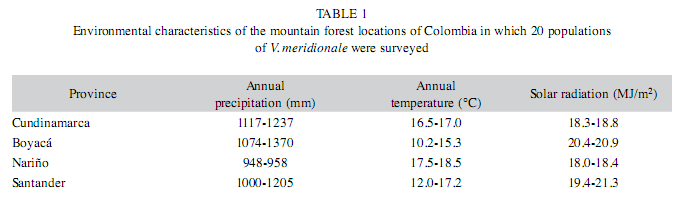
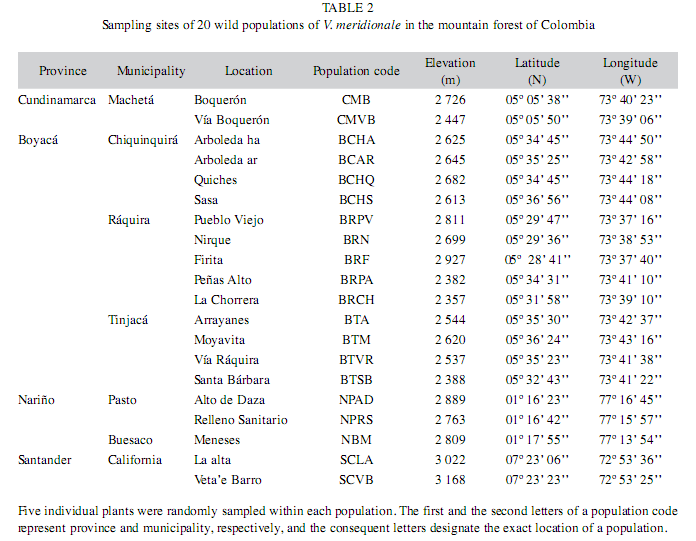
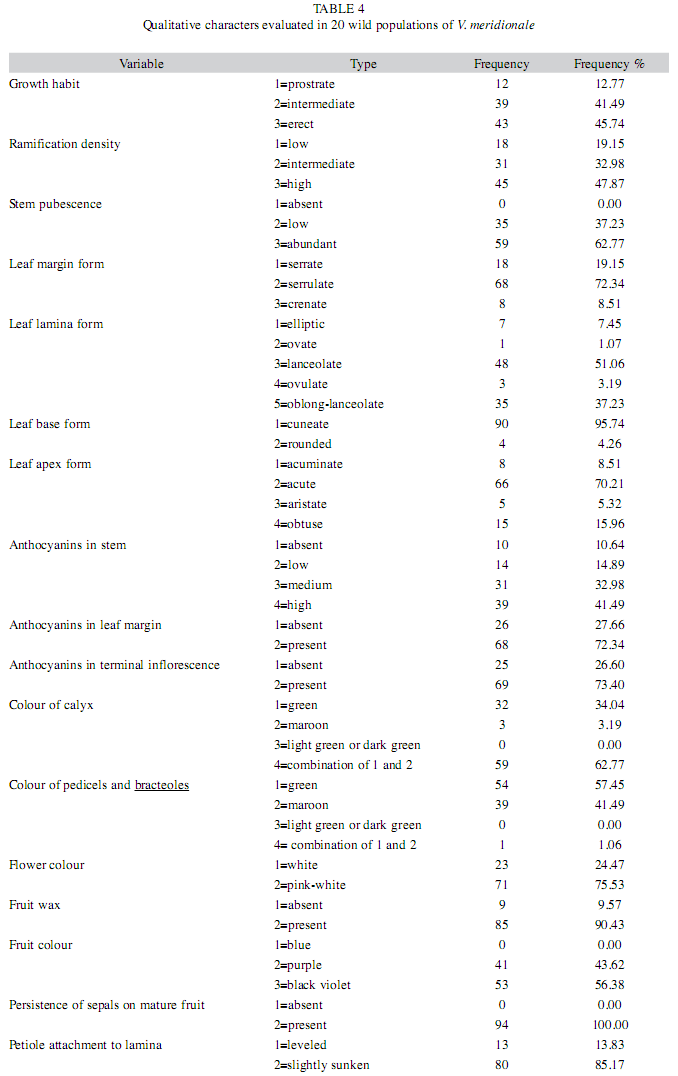
<body><![CDATA[<p style="text-align: justify;"><font face="Verdana" size="2">Colombia is one of the main natural centers where <i>V. meridionale </i>might be encountered in the wild, nevertheless, the distribution of its natural populations in the country is poorly characterized. To our knowledge, the populations of <i>V. meridionale </i>in the North East (Provincy of Santander) and South Pacific (Provincy of Nari&ntilde;o) mountain regions of the country were neither assessed nor characterized, and the knowledge on their possible existence in these areas was based essentially on local reports. Additionally, almost no published records on plant morphology in locations where the spontaneous populations were earlier found (Provinces Cundinamarca and Boyc&aacute;) are available (Medina &amp; Lobo 2004, Ligarreto 2009). Thus, the goal of this study was to characterize <i>in situ </i>the basic aspects of phenotypic plasticity of <i>V. meridionale </i>within its natural populations in four principal Provinces of Colombia: Cundinamarca, Boyac&aacute;, Santander and Nari&ntilde;o; occupied with a tropical mountain forest. The morphological variation degree among wild populations of <i>V. meridionale</i>, constitutes a fundamental question that should be addressed in order to: a) conservation efforts to the diverse populations of <i>V. meridionale in situ </i>and <i>ex situ </i>and b) to obtain plant material for breeding purposes, and promote its cultivation in world agriculture.</font></p>     <div style="text-align: justify;"> </div>     <p style="text-align: justify;"><b><font face="Verdana" size="3">Materials and methods</font></b></p>     <div style="text-align: justify;"><b><font face="Verdana" size="2"> </font></b></div>     <p style="text-align: justify;"><b><font face="Verdana" size="2">Plant material: </font></b><font face="Verdana" size="2">Information from previous field studies and reported cases of <i>V. meridionale </i>Swartz from the Colombian mountain areas were studied using herbaria of Instituto de Ciencias Naturales, Universidad Nacional de Colombia as well as publications (Luteyn 2002) and personal communications. These data further was used to systematize the reports and to elaborate maps of possible location of the species in the wild.</font></p>     <div style="text-align: justify;"><font face="Verdana" size="2"><b> </b></font></div>     <p style="text-align: justify;"><font face="Verdana" size="2"><b>Field survey: </b>According to the preliminary field studies conducted in a pilot zone in Cundinamarca, the presence of <i>V. meridionale </i>populations was tested in the similar habitats through the Provinces, making this study one of the first ones to make a geographic distribution of this species in Colombia. Spontaneous populations of <i>V. meridionale </i>were surveyed in the Provinces of Boyac&aacute;, Cundinamarca, Santander and Nari&ntilde;o located in a low mountain area (between 2 100 and 3 200m elevation) in Colombia (<a href="/img/revistas/rbt/v59n2/a04t1.gif">Table 1</a>). Each plant was labeled with an identification code, where the first and the second letters represent province and municipality, respectively, the subsequent letters designate the exact location of a population, and a number indicates the plant organism assessed in the population (<a href="/img/revistas/rbt/v59n2/a04t2.gif">Table 2</a>). The field studies were conducted during May-June 2007, that corresponded to the dry season, when berries of <i>V. meridionale </i>are usually collected in the mountain areas across the country. The populations were assessed randomly and the sampling scheme was intended to cover the range of precipitation and temperature regimes anticipated for the species (Luteyn 2002), and also taking into account that, in Colombia, <i>V. meridionale </i>is scarcely reported growing at elevations above 3 200m and below 2 300m. The population was considered a group of plants in a reproductive state growing under free solar exposure or in understory. Data were taken on populations located at 5km minimal distance one from another. In total 100 plants of <i>V. meridionale </i>were characterized individually in 20 spontaneous populations located in the mountain forests of four Provinces. For a given population, each morphological character was accessed in 5 randomly selected plants to evaluate intra-population variability and raw data were then averaged for the statistical analyses.</font></p>     <p style="text-align: justify;"><font face="Verdana" size="2">Soil samples that included the whole topsoil were collected for chemical analysis in all surveyed sites and soil pH (soil:water 1:1) was measured in the Laboratory for Soil Analyses of the Faculty of Agronomy, National University of Colombia, Bogot&aacute; campus. The climate data were obtained from the meteorological stations of IDEAM, Colombia.</font></p>     <div style="text-align: justify;"><font face="Verdana" size="2"><b> </b></font></div>     <p style="text-align: justify;"><font face="Verdana" size="2"><b>Morphological measurements: </b>Description of plant morphology <i>in situ </i>was performed using a list of variables consisting of 9 quantitative and 17 qualitative characters according to Lopera (2005). Quantitative variables, excluding plant height, were measured with a digital caliper in mm to two decimal places. Plant height (PH) was measured as a distance between the soil level and the highest point of a principal orthotropic shoot. For measurements of stem diameter (SD), the mid-section of a principal stem was evaluated in each plant. In order to measure leaf density (LD), number of leaves was counted on 10cm segments of a single branch taken from the mid-part of the plant. Equally, leaf length (LL) and leaf width (LW) were measured in the mid-section of fully expanded leaves. For quantitative fruit variables, diameter of mature fruits was measured in the longest (fruit length, FL) and the shortest (fruit width, FW) sections of the fruits. Number of flowers per inflorescence (FI) and inflorescence length (IL) were counted on a terminal inflorescence located at the same branch, where the fruit characters were evaluated. The stem, leaf, and floral qualitative characters were evaluated subjectively as following: growth habit (1=prostrate, 2=intermediate, 3=erect), ramification density (1=low, no branches; 2=intermediate, 1 or 2 orders of ramification; 3=high, 3 or 4 orders of ramification), stem pubescence (1=absent, 2=low, 3=abundant), form of leaf margin on fully expanded leaves (1=serrate, number of points: &gt;12/cm; 2=serrulate, number of points: 12-6/cm; 3=crenate, number of points: &lt;6/ cm), form of leaf lamina (1=elliptic, 2=ovate, 3=lanceolate, 4=ovulate, 5=oblong-lanceolate), form of leaf base (1=cuneate, 2=rounded), form of leaf apex (1=acuminate, 2=acute, 3=aristate, 4=obtuse), anthocyanins in stem (1=absent, 2=low, 3=medium, 4=high), anthocyanins in leaf margin (1=absent, green margins; 2=present, maroon margins), anthocyanins in terminal inflorescence (1=absent, 2=present), colour of calyx (1=green, 2=maroon, 3=light green or dark green, 4=combination of 1 and 2), colour of pedicels and bracteoles (1=green, 2=maroon, 3=light green or dark green, 4= combination of 1 and 2), flower colour (1=white, 2=pink-white), fruit wax (1=absent, 2=present), fruit colour (1=blue, 2=purple, 3=black violet), persistence of sepals on mature fruit (1=absent, 2=present), petiole attachment to lamina (1=leveled, 2=slightly sunken).</font></p>     ]]></body>
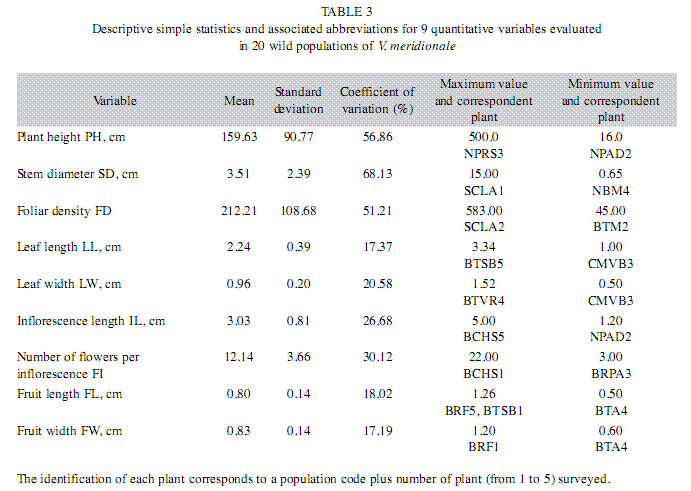
<body><![CDATA[<p style="text-align: justify;"><font face="Verdana" size="2">Summary statistics were used to describe the variation in morphology of <i>V. meridionale</i>, and a correlation analysis was conducted on the full set of quantitative morphological traits. Differences were considered significant at p&lt;0.05 level. A Principal Component Analysis (PCA) was undertaken on quantitative characters using SPAD 4.5 program (Pag&egrave;s 2004). Since distributions of all quantitative characters were approximately normal, no data transformation for PCA was required.</font></p>     <div style="text-align: justify;"> </div>     <p style="text-align: justify;"><b><font face="Verdana" size="3">Results</font></b></p>     <div style="text-align: justify;"><b><font face="Verdana" size="2"> </font></b></div>     <p style="text-align: justify;"><b><font face="Verdana" size="2">Natural environments of the populations: </font></b><font face="Verdana" size="2">Wild populations of <i>V. meridionale </i>were found in four mountain forest regions of Colombia, within the elevations 2 357 and 3 168m (<a  href="/img/revistas/rbt/v59n2/a04t2.gif">Table 2</a>). Based on the preliminary zonification studies conducted for this species in the Provincy of Cundinamarca, the wild populations of <i>V. meridionale </i>in Boyac&aacute;, Santander and Nari&ntilde;o were identified and characterized. In general, the populations were found in locations with slopes of 3 to 50%, and vegetation typical of life zones of lower dry montane and lower wet montane forests, that were rich in array&aacute;n (<i>Myrcianthes leucoxyla </i>(Ortega) McVaugh), laurel (<i>Myrica parvifolia </i>Benth.), Ericaceae of genera <i>Pernettya </i>and <i>Cavendishia</i>, epiphytes (Bromeleaceae), and hemiepiphytes (Clusiaceae).</font></p>     <p style="text-align: justify;"><font face="Verdana" size="2">Most of the plants of <i>V. meridionale </i>in each population were found growing under free solar exposure; also, the plants were observed as a co-dominant species growing over the litter coverage and associated with oak (<i>Quercus humboldtii </i>Bonpl.) and pine patula (<i>Pinus patula </i>Schiede ex Schltdl. &amp; Cham.), making this last association very common in all studied Provinces. Other frequent species in forest locations of <i>V. meridionale </i>were <i>Dendropanax macrophyllum </i>Cuatrec and <i>Bombacopsis patinoi </i>Dugand &amp; Robyns (Nari&ntilde;o) and <i>Alnus acuminata </i>Kunth. (Cundinamarca, Boyac&aacute; and Santander). For Nari&ntilde;o locations, the third typical species were <i>Ossaea macrophylla </i>(Bentham) Cogniaux as well as various Rubiaceae species, especially <i>Elaeagia utilis </i>(Goudot) Wedd. and <i>Rubus </i>spp. Ground vegetation in all studied sites consisted mainly of mosses (<i>Sphagnum </i>spp.) and ferns, having total percentage coverage of more than 80%.</font></p>     <p style="text-align: justify;"><font face="Verdana" size="2">The climate factors that apparently affected the distribution of populations <i>V. meridionale </i>in the wild were temperature, precipitation, and radiation. Climate conditions, where the populations were found across the studied zones, highly differed in mean daily temperatures (8.4-23.6&deg;C) and annual precipitation rates that ranged from 948mm (very dry areas) up to 1 237mm (very humid areas); the variation in solar radiation was relatively low, between 18.0 and 21.3MJ/m<sup>2</sup> (<a  href="/img/revistas/rbt/v59n2/a04t1.gif">Table 1</a>).</font></p>     <p style="text-align: justify;"><font face="Verdana" size="2">A constant condition was the soil acidity, where pH ranging from 3.8 to 5.3, with pH 4.6 on average. All soils of the study zones presented good drainage and udic moisture regime. Plants were found growing in soils ranging from large A horizons that exceeded 50cm to very superficial soils, e.g. directly on the parental rock material, as in a particular case of populations BRPV and BRF located in R&aacute;quira, Boyac&aacute;.</font></p>     <div style="text-align: justify;"><font face="Verdana" size="2"><b> </b></font></div>     <p style="text-align: justify;"><font face="Verdana" size="2"><b>Quantitative characterization of species morphology in populations: </b>Plant height, stem diameter and foliar density were the most variable quantitative morphological traits, with coefficients of variation higher than 50% (<a  href="/img/revistas/rbt/v59n2/a04t3.gif">Table 3</a>). The mean plant height of 159.63cm was characterized with a standard deviation of 90.77cm indicating high degree of data dispersion (<a  href="/img/revistas/rbt/v59n2/a04t3.gif">Table 3</a>). The stem diameter presented a mean value of 3.51cm with a standard deviation of 2.39cm, apparently affected by the presence of very dissimilar data, as may be seen in Table 3. High data variation was equally observed for foliar density, with a standard deviation of 108.68cm with respect to a mean value of 212.21cm (<a  href="/img/revistas/rbt/v59n2/a04t3.gif">Table 3</a>).</font></p>     ]]></body>
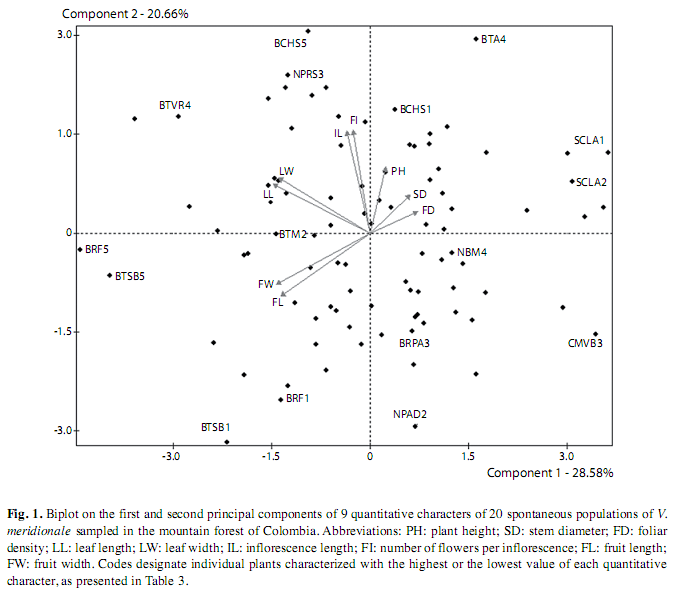
<body><![CDATA[<p style="text-align: justify;"><font face="Verdana" size="2">Leaf and fruit size characters, namely length and width, had narrow amplitude of variation, with coefficients of variation lower than 21%, indicating that these were relatively homogeneous characters of low phenotypic plasticity in all populations (<a href="/img/revistas/rbt/v59n2/a04t3.gif">Table 3</a>). The leaves were on average 2.24cm long and 0.96cm wide with standard deviations of 0.39 and 0.20cm, respectively, while fruit length and fruit width presented mean values of 0.80 and 0.83cm with standard deviations of 0.18 and 0.17cm, respectively. Although the behavior of fruit size characters was of low plasticity in the studied metapopulation, in some habitats of the highest elevations, plants had a tendency to produce leaves and fruits of the smallest sizes. These patterns were also observed with increasing number of fruits per inflorescence, suggesting a competition among the fruits; however, on rare occasions fruit diameters were less than 6mm. Inflorescence length and number of flowers per inflorescence were characterized as more heterogeneous, with coefficients of variation of 26.68% and 30.12%, respectively (<a href="/img/revistas/rbt/v59n2/a04t3.gif">Table 3</a>).</font></p>     <p style="text-align: justify;"><font face="Verdana" size="2">Among the characters observed, the highest correlation coefficients (p&lt;0.05) were between fruit length and fruit width (0.90), leaf length and leaf width (0.78), plant height and stem diameter (0.60), and inflorescence length and number of flowers per inflorescence (0.57). No relationships between inflorescence length and fruit length or fruit width were found. The weak negative correlations were observed between foliar density, on one side, and leaf length (-0.20) or leaf width (-0.21), on the other side, indicating that, in a ramet with smaller number of leaves, these tended to be larger. Stem diameter had a positive correlation with foliar density (0.36). The leaf size characteristics were correlated with fruit size and inflorescence size, such as the positive correlations were established between leaf length, on one side, and fruit length (0.29), fruit width (0.38), or inflorescence length (0.20) on the other side. Leaf width had the positive correlations with fruit length (0.20), fruit width (0.28) or inflorescence length (0.21).</font></p>     <p style="text-align: justify;"><font face="Verdana" size="2">The PCA revealed that fruit size variables, namely fruit length and fruit width, contributed to the first component (F1) that accounted for 28.58% total variance (<a  href="/img/revistas/rbt/v59n2/a04i1.jpg">Fig. 1</a>). Number of flowers per inflorescence and inflorescence length were the major loading characters to the second component (F2) that explained 20.66% total variance. It may be noticed that the plants with extreme (maximum or minimum) states of quantitative characters were observed within the same area as well as in different geographical locations (<a href="/img/revistas/rbt/v59n2/a04i1.jpg">Fig. 1</a>, <a  href="/img/revistas/rbt/v59n2/a04t3.gif">Table 3</a>). For example, the plants located in Pasto, Nari&ntilde;o presented both the highest (5.0m, NPRS3 that exceeded the height ranges typical for the shrubs of Vaccinioideae (Gentry 1994, Lens <i>et al</i>. 2004) and the lowest height (0.16m, NPAD2) within all populations evaluated. The latest individual also had the smallest inflorescence length (1.2cm), while the longest inflorescence (5.0cm) was observed on a plant in Chiquinquir&aacute;, Boyac&aacute; (BCHS5), located in the positive quadrant of F2, for which the variable of inflorescence length has the highest contribution (<a href="/img/revistas/rbt/v59n2/a04i1.jpg">Fig. 1</a>). The highest leaf length (3.34cm) was measured in a plant from Santa B&aacute;rbara, Boyac&aacute; (BTSB5) located in the negative quadrant of F1, whereas the smallest leaf length (1.0cm) was recorded for a plant CMVB3 from V&iacute;a Boquer&oacute;n, Boyac&aacute; (<a href="/img/revistas/rbt/v59n2/a04t3.gif">Table 3</a>), located in the opposite quadrant of the plot (<a  href="/img/revistas/rbt/v59n2/a04i1.jpg">Fig. 1</a>). In general, the PCA revealed a high dispersion of characters without correlation with their location, which indicates a genetic diversity of plants within the metapopulation. Equally, the PCA demonstrated a high dispersion in quantitative characters within some populations, showing a high intrapopulational morphological variation in plants of <i>V. meridionale</i>.</font></p>     <div style="text-align: justify;"><font face="Verdana" size="2"><b> </b></font></div>     <p style="text-align: justify;"><font face="Verdana" size="2"><b>Qualitative characterization of species morphology in populations: </b>A qualitative description of <i>V. meridionale </i>in wild populations illustrated that plant growth habit varied among intermediate and erect, with similar frequencies of 41.9% and 45.74%, respectively. Ramification was predominantly dense with 47.87% individual plants located within this category; however, there were 32.98% plants of intermediate density (<a  href="/img/revistas/rbt/v59n2/a04t4.gif">Table 4</a>).</font></p>     <p style="text-align: justify;"><font face="Verdana" size="2">The variables of leaf form, such as forms of margin, apex, lamina and base had lower ranges of dispersion than the above-mentioned characters, so that the predominant leaf forms may be distinguished. In the 51.06% of studied plants, leaf lamina form was lanceolate followed by 37.23% oblong-lanceolate. Serrulate leaf margins constituted a distinctive feature of <i>V. meridionale </i>plants having a frequency of 72.34% in all populations. The majority of plants presented leaves with cuneate foliar base (95.74%) and acute apex (70.21%) (<a href="/img/revistas/rbt/v59n2/a04t4.gif">Table 4</a>).</font></p>     <p style="text-align: justify;"><font face="Verdana" size="2">Anthocyanin contents in the mid-section of plant stems were mostly high (32.98%), medium (41.49%), low (14.89%) and only 10.64% of plants completely lack this product. Accumulation of anthocyanins in leaf margins and inflorescences was detected in more than 72% of evaluated plants. Calyx colour varied among green, maroon, and a combination of these, showing maroon on the margins and green on the central part of the calyces. The combination of green and maroon was the most frequent colour (62.77%) followed by the one with complete green calyx (34.04%). Colour of pedicels was predominantly green (57.45%), but maroon pedicels were also observed (41.49%). Colour of bell-shaped flowers was characteristically pink- white to almost fuchsia (75.53%), whereas some flowers were completely white (24.47%). Pubescence in mid-sections of stems was present for 62.77% plants and absent for 37.23% plants assessed in the study (<a  href="/img/revistas/rbt/v59n2/a04t4.gif">Table 4</a>).</font></p>     <p style="text-align: justify;"><font face="Verdana" size="2">Fruit colour was purple (43.62%) or black violet (56.38%), while no fruits were found with a the characteristically blue colour of <i>V. corymbosum </i>or <i>V. myrtillus</i>, that may vary from blue to almost black. However, some mature berries of <i>V. meridionale </i>had white and light rose colour, which may be the possible mutants of structural or regulatory genes involved in anthocyanin synthesis, as it was shown for <i>V. myrtillus </i>(Jaakola <i>et al</i>. 2002).</font></p>     <p style="text-align: justify;"><font face="Verdana" size="2">Some characters of fruit morphology, such as wax presence on fruit surface (90.43%) or the form of petiole insertion, and for which the major form was slightly sunken (85.17%), had very low variation. Persistence of sepals was a constant feature for mature fruits in all evaluated populations, with 100% plants grouped in the category "present" (<a  href="/img/revistas/rbt/v59n2/a04t4.gif">Table 4</a>).</font></p>     <div style="text-align: justify;"> </div>     ]]></body>
<body><![CDATA[<p style="text-align: justify;"><b><font face="Verdana" size="3">Discussion</font></b></p>     <div style="text-align: justify;"><font face="Verdana" size="2">     <p>Our results indicated that natural populations of <i>V. meridionale </i>might be found under highly heterogeneous climate and microclimate conditions in a tropical mountain forest, in different geographic areas of Colombia. The location of wild populations of <i>V. meridionale </i>in the studied zones corresponded to the habitats previously described by Luteyn (2002) who mentioned preference of neotropical <i>Vaccinium </i>spp. to humid and undisturbed mountain habitats. The plants of <i>V. meridionale </i>were found growing under partial shade or free solar exposure as well as in canopy gaps suggesting high rates of adaptability to different microenvironments including those of solar radiation within a same study area.</p>     <p>Plant height, stem diameter and foliar density were highly variable morphological traits (<a href="/img/revistas/rbt/v59n2/a04t3.gif">Table 3</a>), and, while plant height is a subject of phenotypic variation in wild clones of <i>Vaccinium </i>spp. (Gustavsson 2001), in our study, this variable might not provide a consistent comparison across the plants because their ages were unknown. High variability of the above mentioned descriptors may be due to the fact that, in wild populations, there were plants of various age stages, reproduction strategies, light, water, and nutrient regimes - all these differences, when combined with occasional distortion of plant habitats by tree lodging, generated populations highly heterogeneous in plant height, stem diameter and foliar density. On the contrary, a low variation in fruit length and fruit width of <i>V. meridionale </i>(<a href="/img/revistas/rbt/v59n2/a04t3.gif">Table 3</a>), indicates a low phenotypic plasticity of these characters and could be attributed to a low environmental effect over the fruit size that, in turn, implies that characterization of fruit morphology <i>in situ </i>could be used to estimate the levels of genetic diversity (Vargas &amp; Blanco 2000). Fruit size in <i>Vaccinium </i>sp. is known to be affected both by genetic and environmental factors; among the latest, pollination (Eck 1988) and irrigation regimes (Hicklenton 2000, Mingeau 2001); a reduction in leaf size with increasing altitude, which is commonly observed in deciduous <i>Vaccinium </i>spp., that could be due to withstanding nitrogen limitation and low temperatures (Woodward 1986). Inflorescence length and number of flowers per inflorescence might also serve as indicators of plant adaptation to certain environments, as in the case of <i>V. corymbosum</i>, for which the flower number was reduced under moderate water stress (Mingeau 2001). These characters describe a reproductive state of the species; however, as in case of fruit or leaf size, low or moderate variation in inflorescence length and number of flowers per inflorescence (CV&lt;30.2%, <a href="/img/revistas/rbt/v59n2/a04t3.gif">Table 3</a>) indicates their low phenotypic plasticity.</p>     <p>In general, different environments that represented microclimates, influenced the variation of quantitative characters. Our findings are consistent with the pioneer studies of Medina &amp; Lobo (2004) of wild populations of <i>V. meridionale </i>in the Provincy of Antioquia, Colombia, who revealed that plant height and stem diameter were highly variable morphological characters. The positive correlation established between plant height and stem diameter might be explained by plant age. Additionally, in Ericaceae, an environment might have a significant effect over the stem diameter, such as the trends in decreasing stem diameter with increasing altitude of plant habitat (Woodward 1986, Merev &amp; Yavuz 2000) or microclimate changes including low availability of soil water (Mingeau 2001).</p>     <p>The PCA revealed that fruit length, fruit width, number of flowers per inflorescence, and inflorescence length were the main loading characters that accounted for a total variance (<a  href="/img/revistas/rbt/v59n2/a04i1.jpg">Fig. 1</a>). These characters, especially fruit size, are useful in characterization of sexual reproductive potential of <i>V. meridionale</i>, taking into account that the largest seeds (up to 1.9mm length and 1.4mm width) have the highest germination rates, and could be obtained from the largest fruits (Valencia &amp; Ram&iacute;rez 1993). The latest data may have an importance for sexual recruitment of the species in the wild, however, the rates of seedling establishment in natural habitats, in case of <i>V. meridionale</i>, are unknown, and, in case of other <i>Vaccinium </i>spp. (Eriksson 1989), might be negligible. However, it is worth mentioning that propagation by seeds, as well as somatic mutagenesis and initial genetic diversity in a given population, are the main factors that increase a genetic variation in clonal populations of <i>Vaccinium </i>spp. (Persson &amp; Gustavsson 2001, Albert <i>et al</i>. 2005). The results of the PCA demonstrated a genetic diversity of <i>V. meridionale </i>within the metapopulation as well as an intrapopulational variation in plant morphology for some populations.</p>     <p>The morphological traits that, in the majority of plants, respond to the environmental stimuli changes are elongation of stem and foliar growth (Fordyce 2006). Thus, within a given population, the tallest plants of <i>V. meridionale </i>were frequently found in partial shade, while those of arbustive prostrate growth were typical of open sites; as shown for other Ericaceae (Dawson &amp; Heenan 2004). Additionally, <i>V. meridionale </i>is a plant of clonal propagation through stolons and rhizomes (McDonald <i>et al</i>. 2003), and variation in form of growth in clonal plants also represents a particular case of plasticity (Navas &amp; Garnier 2002) observable in other <i>Vaccinium </i>spp.; as for example, a reduction in layering stem growth under intense radiation (Moola &amp; Mallik 1998) or during fruit production (Elle 1996, Gustavsson 2001). The fact that plants were studied in highly heterogeneous environments makes it feasible to conduct further studies on the contribution of phenotypic plasticity to morphological variability of <i>V. meridionale</i>.</p>     <p>Several qualitative characters of species morphology were highly variable, which at least partially, could be attributed to phenotypic plasticity. Phenotypic plasticity related to changes in plant height and shape may be directed, in particularly, to optimize light use efficiency in natural populations (Dawson &amp; Heenan 2004, Wang <i>et al</i>. 2006). This could explain a high variability in height (plant height, stem diameter) and shape (growth habit, ramification density) characters of <i>V. meridionale, </i>and, indirectly, indicate that plants in the studied metapopulation experienced a certain environmental pressure. At the same time, some qualitative characters of fruit or leaf morphology had very low (wax presence on fruit surface, form of petiole insertion) or null (persistence of sepals on mature fruits) variation demonstrating that these characters were genetically determined.</p>     <p>The variables that characterize colour of stems, flowers and leaves in <i>Vaccinium </i>depend on anthocyanins contents in these plant organs (Eck 1988). Phenotypic variation in fruit colour, as the one shown in our study, is readily apparent among wild clones of lowbush blueberry (Kalt <i>et al</i>. 2001) and attributed to tissue levels of anthocyanins and other flavonoid compounds (Eck 1988). Synthesis of anthocyanins in leaves and fruits of <i>Vaccinium </i>is developmentally regulated (Witzell <i>et al</i>. 2003) and could be highly variable when stimulated by numerous environmental factors, including light, UV radiation, fungal infection, wounding, drought or low nitrogen status (Jaakola <i>et al</i>. 2004, Witzell &amp; Shevtsova 2004). Direct sunlight activates the synthesis of anthocyanins in leaves, fruits and flowers of <i>V. myrtillus </i>(Jaakola <i>et al</i>. 2004 and references therein), so that tissue concentrations of anthocyanins tend to increase conferring a higher desiccation tolerance and photoprotection of cells, especially at low temperatures (Tahkokorpi <i>et al</i>. 2007), the normal conditions with increasing altitudes in plant habitat. While the current relationship may not be always recognizable (Rieger <i>et al</i>. 2008), in our study, the highest levels of anthocyanins in leaves, fruits and flowers were scored mostly on plants growing in the Provinces of Boyac&aacute; and Santander that are characterized with the highest solar radiation levels (Table 1). Flowers colour variation among the populations might also have an effect on the reproductive traits and genetic diversity. Thus, in temperate climates, plants of lingonberry with more pinkish corollas began flowering later than plants with white flowers (Gustavsson 2001); this feature, under dry-rainy seasonality conditions in a tropical mountain forest, might be used to synchronize flowering and fructification with cycles of pollinators and frugivores, respectively (Hilty 1980).</p>     <p>In general, our studies revealed a wide morphological variation in the metapopulation of <i>V. meridionale </i>across the study areas. Several quantitative (plant height, stem diameter) and qualitative (growth habit, ramification density, presence of anthocyanins in stem) descriptors of the species morphology were highly influenced by the environment. Our results suggested that an important genetic resource exists for <i>V. meridionale </i>in the wild that could provide a basis for introduction of this species into world agriculture. Thus, low variation in fruit size (CV&lt;18.02%), which constitutes a target trait for plant breeders, might be useful for the development of breeding programs aiming to the selection of cultivars of <i>V. meridionale</i>. Additionally, the studies on genetic diversity in <i>V. meridionale </i>at the molecular level would help to implement a conservation strategy for this species. Alteration of the species habitat results in reduction of population size that, in turn, could diminish a degree the morphological variation within and among the populations, the process that would further determine ecotypes formation of <i>V. meridionale</i>. While some habitats of natural populations of <i>V. meridionale </i>in Santander and, especially, Nari&ntilde;o, remain undisturbed and practically inaccessible in the near future, fragmentation of a mountain forest, and reduction in populations size are increasing in other regions, such as Cundinamarca and Boyac&aacute;, so that the development of strategies to prevent genetic erosion of <i>V. meridionale </i>in its natural habitats should be addressed.</p> </font><b><font face="Verdana" size="3">     ]]></body>
<body><![CDATA[<p>Acknowledgments</p> </font></b><font face="Verdana" size="2">     <p>This research was conducted under the project "Estandarizaci&oacute;n de m&eacute;todos de propagaci&oacute;n y escalamiento de producci&oacute;n de pl&aacute;ntulas de agraz (<i>Vaccinium meridionale </i>Swartz)" funded by The Ministry of Agriculture and Rural Development of Colombia and The National University of Colombia, Bogot&aacute; campus, Colombia. The authors express their gratitude to C&eacute;sar Pacheco Chaparro (Annonaceae Research Project, Agronomy Faculty, National University of Colombia) for the help with data analyses and Alia Rodr&iacute;guez (Agronomy Faculty, National University of Colombia) for review of the manuscript and help with the English translation.</p> </font><b><font face="Verdana" size="3"> </font></b> <hr style="width: 100%; height: 2px;"><b><font face="Verdana" size="3">     <p>References</p> </font></b><font face="Verdana" size="2">     <!-- ref --><p>Albert, T., O. Raspe &amp; A.L. Jacquemart. 2005. Diversity and spatial structure of clones in <i>Vaccinium uliginosum </i>populations. Can. J. Bot. 83: 211-218.    &nbsp;&nbsp;&nbsp;&nbsp;&nbsp;&nbsp;&nbsp;&nbsp;[&#160;<a href="javascript:void(0);" onclick="javascript: window.open('/scielo.php?script=sci_nlinks&ref=1760876&pid=S0034-7744201100020000400001&lng=','','width=640,height=500,resizable=yes,scrollbars=1,menubar=yes,');">Links</a>&#160;]<!-- end-ref --></p>     <!-- ref --><p>&Aacute;vila D&iacute;az-Granados, R.A., O.J. Orozco Silva, G. Ligarreto Moreno, S. Magnitskiy &amp; A. Rodr&iacute;guez. 2009. Influence of mycorrhizal fungi on the rooting of stem and stolon cuttings of the Colombian blueberry (<i>Vaccinium meridionale </i>Swartz). Inter. J. Fruit Sci. 9: 372-384.    &nbsp;&nbsp;&nbsp;&nbsp;&nbsp;&nbsp;&nbsp;&nbsp;[&#160;<a href="javascript:void(0);" onclick="javascript: window.open('/scielo.php?script=sci_nlinks&ref=1760878&pid=S0034-7744201100020000400002&lng=','','width=640,height=500,resizable=yes,scrollbars=1,menubar=yes,');">Links</a>&#160;]<!-- end-ref --></p>     <!-- ref --><p>Dawson, M.I. &amp; P.B. Heenan. 2004. Morphological variation of the <i>Leucopogon fraseri </i>complex (Ericaceae: Styphelieae) in New Zealand, and recognition of a new species, <i>L. nanum</i>. New Zeal. J. Bot. 42: 537-564.    &nbsp;&nbsp;&nbsp;&nbsp;&nbsp;&nbsp;&nbsp;&nbsp;[&#160;<a href="javascript:void(0);" onclick="javascript: window.open('/scielo.php?script=sci_nlinks&ref=1760880&pid=S0034-7744201100020000400003&lng=','','width=640,height=500,resizable=yes,scrollbars=1,menubar=yes,');">Links</a>&#160;]<!-- end-ref --></p>     <!-- ref --><p>Eck, P. 1988. Blueberry science. Rutgers University, New Brunswick, New Jersey, USA.    &nbsp;&nbsp;&nbsp;&nbsp;&nbsp;&nbsp;&nbsp;&nbsp;[&#160;<a href="javascript:void(0);" onclick="javascript: window.open('/scielo.php?script=sci_nlinks&ref=1760882&pid=S0034-7744201100020000400004&lng=','','width=640,height=500,resizable=yes,scrollbars=1,menubar=yes,');">Links</a>&#160;]<!-- end-ref --> </p>     <!-- ref --><p>Elle, E. 1996. Reproductive trade-offs in genetically distinct clones of <i>Vaccinium macrocarpon, </i>the American cranberry. Oecologia 107: 61-70.    &nbsp;&nbsp;&nbsp;&nbsp;&nbsp;&nbsp;&nbsp;&nbsp;[&#160;<a href="javascript:void(0);" onclick="javascript: window.open('/scielo.php?script=sci_nlinks&ref=1760884&pid=S0034-7744201100020000400005&lng=','','width=640,height=500,resizable=yes,scrollbars=1,menubar=yes,');">Links</a>&#160;]<!-- end-ref --></p>     <!-- ref --><p>Errikson, O. 1989. Seedling dynamics and life histories in clonal plants. Oikos 55: 231-238.    &nbsp;&nbsp;&nbsp;&nbsp;&nbsp;&nbsp;&nbsp;&nbsp;[&#160;<a href="javascript:void(0);" onclick="javascript: window.open('/scielo.php?script=sci_nlinks&ref=1760886&pid=S0034-7744201100020000400006&lng=','','width=640,height=500,resizable=yes,scrollbars=1,menubar=yes,');">Links</a>&#160;]<!-- end-ref --></p>     <!-- ref --><p>Fordyce, J.A. 2006. The evolutionary consequences of ecological interactions mediated through phenotypic plasticity. J. Exp. Biol. 209: 2377-2383.    &nbsp;&nbsp;&nbsp;&nbsp;&nbsp;&nbsp;&nbsp;&nbsp;[&#160;<a href="javascript:void(0);" onclick="javascript: window.open('/scielo.php?script=sci_nlinks&ref=1760888&pid=S0034-7744201100020000400007&lng=','','width=640,height=500,resizable=yes,scrollbars=1,menubar=yes,');">Links</a>&#160;]<!-- end-ref --></p>     <!-- ref --><p>Gaviria, C.A., N. Ochoa, C.I. S&aacute;nchez, C.I. Medina, M. Lobo, P. Galeano, A.J. Mosquera, A. Tamayo, Y. Lopera &amp; B. Rojano. 2009. Actividad antioxidante e inhibici&oacute;n de la peroxidaci&oacute;n lip&iacute;dica de extractos de frutos de morti&ntilde;o (<i>Vaccinium meridionale </i>SW). Bolet&iacute;n Latinoam. Caribe Plantas Medic. Arom&aacute;t. 8: 519-528.    &nbsp;&nbsp;&nbsp;&nbsp;&nbsp;&nbsp;&nbsp;&nbsp;[&#160;<a href="javascript:void(0);" onclick="javascript: window.open('/scielo.php?script=sci_nlinks&ref=1760890&pid=S0034-7744201100020000400008&lng=','','width=640,height=500,resizable=yes,scrollbars=1,menubar=yes,');">Links</a>&#160;]<!-- end-ref --></p>     <!-- ref --><p>Gentry, A.H. 1996. A field guide to the families and genera of woody plants of northwest South America (Colombia, Ecuador, Peru) with supplementary notes on herbaceous taxa. The University of Chicago, Chicago, USA.    &nbsp;&nbsp;&nbsp;&nbsp;&nbsp;&nbsp;&nbsp;&nbsp;[&#160;<a href="javascript:void(0);" onclick="javascript: window.open('/scielo.php?script=sci_nlinks&ref=1760892&pid=S0034-7744201100020000400009&lng=','','width=640,height=500,resizable=yes,scrollbars=1,menubar=yes,');">Links</a>&#160;]<!-- end-ref --> </p>     <!-- ref --><p>Giovanelli, G. &amp; S. Buratti. 2009. Comparison of polyphenolic composition and antioxidant activity of wild Italian blueberries and some cultivated varieties. Food Chem. 112: 903-908.    &nbsp;&nbsp;&nbsp;&nbsp;&nbsp;&nbsp;&nbsp;&nbsp;[&#160;<a href="javascript:void(0);" onclick="javascript: window.open('/scielo.php?script=sci_nlinks&ref=1760894&pid=S0034-7744201100020000400010&lng=','','width=640,height=500,resizable=yes,scrollbars=1,menubar=yes,');">Links</a>&#160;]<!-- end-ref --></p>     <p> </p>     <!-- ref --><p>Gustavsson, B.A. 2001. Genetic variation in horticulturally important traits of fifteen wild lingonberry <i>Vaccinium vitis-idaea </i>L. populations. Euphytica 120: 173-182.    &nbsp;&nbsp;&nbsp;&nbsp;&nbsp;&nbsp;&nbsp;&nbsp;[&#160;<a href="javascript:void(0);" onclick="javascript: window.open('/scielo.php?script=sci_nlinks&ref=1760897&pid=S0034-7744201100020000400011&lng=','','width=640,height=500,resizable=yes,scrollbars=1,menubar=yes,');">Links</a>&#160;]<!-- end-ref --></p>     <!-- ref --><p>Hern&aacute;ndez, M.I., M. Lobo, C.I. Medina, J.R. Cartagena &amp; O.A. Delgado. 2009. Comportamiento de la germinaci&oacute;n y categorizaci&oacute;n de la latencia en semillas de morti&ntilde;o (<i>Vaccinium meridionale </i>Swartz). Agron. Colomb. 27: 15-23.    &nbsp;&nbsp;&nbsp;&nbsp;&nbsp;&nbsp;&nbsp;&nbsp;[&#160;<a href="javascript:void(0);" onclick="javascript: window.open('/scielo.php?script=sci_nlinks&ref=1760899&pid=S0034-7744201100020000400012&lng=','','width=640,height=500,resizable=yes,scrollbars=1,menubar=yes,');">Links</a>&#160;]<!-- end-ref --></p>     <!-- ref --><p>Hicklenton, P.R., J.Y. Reekie &amp; R.J. Gordon. 2000. Physiological and morphological traits of lowbush blueberry (<i>Vaccinium angustifolium </i>Ait.) plants in relation to posttransplant conditions and water availability<i>. </i>Can. J. Plant Sci. 80: 861-867.    &nbsp;&nbsp;&nbsp;&nbsp;&nbsp;&nbsp;&nbsp;&nbsp;[&#160;<a href="javascript:void(0);" onclick="javascript: window.open('/scielo.php?script=sci_nlinks&ref=1760901&pid=S0034-7744201100020000400013&lng=','','width=640,height=500,resizable=yes,scrollbars=1,menubar=yes,');">Links</a>&#160;]<!-- end-ref --></p>     ]]></body>
<body><![CDATA[<!-- ref --><p>Hill, J., H.C. Becker &amp; P.M.A. Tigerstedt. 1998. Quantitative and ecological aspects of plant breeding. Chapman and Hall, London, United Kingdom.    &nbsp;&nbsp;&nbsp;&nbsp;&nbsp;&nbsp;&nbsp;&nbsp;[&#160;<a href="javascript:void(0);" onclick="javascript: window.open('/scielo.php?script=sci_nlinks&ref=1760903&pid=S0034-7744201100020000400014&lng=','','width=640,height=500,resizable=yes,scrollbars=1,menubar=yes,');">Links</a>&#160;]<!-- end-ref --></p>     <!-- ref --><p>Hilty, S.L. 1980. Flowering and fruiting periodicity in a premontane rain forest in Pacific Colombia. Biotropica 12: 292-306.    &nbsp;&nbsp;&nbsp;&nbsp;&nbsp;&nbsp;&nbsp;&nbsp;[&#160;<a href="javascript:void(0);" onclick="javascript: window.open('/scielo.php?script=sci_nlinks&ref=1760905&pid=S0034-7744201100020000400015&lng=','','width=640,height=500,resizable=yes,scrollbars=1,menubar=yes,');">Links</a>&#160;]<!-- end-ref --></p>     <!-- ref --><p>Izco, J., &Iacute;. Pulgar, Z. Aguirre &amp; F. Santin 2007. Estudio flor&iacute;stico de los p&aacute;ramos de pajonal meridionales de Ecuador. Rev. Peru. Biol. 14: 237-246.    &nbsp;&nbsp;&nbsp;&nbsp;&nbsp;&nbsp;&nbsp;&nbsp;[&#160;<a href="javascript:void(0);" onclick="javascript: window.open('/scielo.php?script=sci_nlinks&ref=1760907&pid=S0034-7744201100020000400016&lng=','','width=640,height=500,resizable=yes,scrollbars=1,menubar=yes,');">Links</a>&#160;]<!-- end-ref --></p>     <!-- ref --><p>Jaakola, L., K. M&auml;&auml;tt&auml;, A.M. Pirttil&auml;, R. T&ouml;rr&ouml;nen, S. K&auml;renlampi &amp; A. Hohtola. 2002. Expression of genes involved in anthocyanin biosynthesis in relation to anthocyanin, proanthocyanidin, and flavonol levels during bilberry fruit development. Plant Physiol. 130: 729-739.    &nbsp;&nbsp;&nbsp;&nbsp;&nbsp;&nbsp;&nbsp;&nbsp;[&#160;<a href="javascript:void(0);" onclick="javascript: window.open('/scielo.php?script=sci_nlinks&ref=1760909&pid=S0034-7744201100020000400017&lng=','','width=640,height=500,resizable=yes,scrollbars=1,menubar=yes,');">Links</a>&#160;]<!-- end-ref --></p>     <!-- ref --><p>Jaakola, L., K. M&auml;&auml;tt&auml;-Riihinen, S. K&auml;renlampi &amp; A. Hohtola. 2004. Activation of flavonoid biosynthesis by solar radiation in bilberry (<i>Vaccinium myrtillus </i>L.) leaves. Planta 218: 721-728.    &nbsp;&nbsp;&nbsp;&nbsp;&nbsp;&nbsp;&nbsp;&nbsp;[&#160;<a href="javascript:void(0);" onclick="javascript: window.open('/scielo.php?script=sci_nlinks&ref=1760911&pid=S0034-7744201100020000400018&lng=','','width=640,height=500,resizable=yes,scrollbars=1,menubar=yes,');">Links</a>&#160;]<!-- end-ref --></p>     ]]></body>
<body><![CDATA[<!-- ref --><p>Kalt, W., D.A.J. Ryan, J.C. Duy, R.L. Prior, M.K. Ehlenfeldt &amp; S.P. Vander Kloet. 2001. Interspecific variation in anthocyanins, phenolics, and antioxidant capacity among genotypes of highbush and lowbush blueberries (<i>Vaccinium </i>Section <i>Cyanococcus</i>). J. Agric. Food Chem. 49: 4761-4767.    &nbsp;&nbsp;&nbsp;&nbsp;&nbsp;&nbsp;&nbsp;&nbsp;[&#160;<a href="javascript:void(0);" onclick="javascript: window.open('/scielo.php?script=sci_nlinks&ref=1760913&pid=S0034-7744201100020000400019&lng=','','width=640,height=500,resizable=yes,scrollbars=1,menubar=yes,');">Links</a>&#160;]<!-- end-ref --></p>     <!-- ref --><p>Lee, J., C.E. Finn &amp; R.E. Wrolstad. 2004. Anthocyanin pigment and total phenolic content of three <i>Vaccinium </i>species native to the Pacific Northwest of North America. HortScience 39: 959-964.    &nbsp;&nbsp;&nbsp;&nbsp;&nbsp;&nbsp;&nbsp;&nbsp;[&#160;<a href="javascript:void(0);" onclick="javascript: window.open('/scielo.php?script=sci_nlinks&ref=1760915&pid=S0034-7744201100020000400020&lng=','','width=640,height=500,resizable=yes,scrollbars=1,menubar=yes,');">Links</a>&#160;]<!-- end-ref --></p>     <!-- ref --><p>Lens, F., J.L. Luteyn, E. Smets &amp; S. Jansen. 2004. Ecological trends in the wood anatomy of Vaccinioideae (Ericaceae s.l.). Flora 199: 309-319.    &nbsp;&nbsp;&nbsp;&nbsp;&nbsp;&nbsp;&nbsp;&nbsp;[&#160;<a href="javascript:void(0);" onclick="javascript: window.open('/scielo.php?script=sci_nlinks&ref=1760917&pid=S0034-7744201100020000400021&lng=','','width=640,height=500,resizable=yes,scrollbars=1,menubar=yes,');">Links</a>&#160;]<!-- end-ref --></p>     <!-- ref --><p>Ligarreto, G.A. 2009. Selecci&oacute;n de poblaciones in situ de agraz (<i>Vaccinium meridionale </i>Swartz) por atributos fenot&iacute;picos reproductivos. Pp. 69 XI Congreso de Asociaci&oacute;n Colombiana de Fitomejoramiento y Producci&oacute;n de Cultivos. Octubre 28- 30 2009, Palmira, Colombia.    &nbsp;&nbsp;&nbsp;&nbsp;&nbsp;&nbsp;&nbsp;&nbsp;[&#160;<a href="javascript:void(0);" onclick="javascript: window.open('/scielo.php?script=sci_nlinks&ref=1760919&pid=S0034-7744201100020000400022&lng=','','width=640,height=500,resizable=yes,scrollbars=1,menubar=yes,');">Links</a>&#160;]<!-- end-ref --></p>     <!-- ref --><p>Lopera, S.A. 2005. Colecta, conservaci&oacute;n y caracterizaci&oacute;n de diversas poblaciones de <i>Vaccinium meriodionale </i>(morti&ntilde;o) presentes en los bosques altoandinos de la jurisdicci&oacute;n de Corantioquia, para promover su utilizaci&oacute;n sostenible. Tesis, Universidad Cat&oacute;lica de Oriente, Rionegro, Antioquia, Colombia.    &nbsp;&nbsp;&nbsp;&nbsp;&nbsp;&nbsp;&nbsp;&nbsp;[&#160;<a href="javascript:void(0);" onclick="javascript: window.open('/scielo.php?script=sci_nlinks&ref=1760921&pid=S0034-7744201100020000400023&lng=','','width=640,height=500,resizable=yes,scrollbars=1,menubar=yes,');">Links</a>&#160;]<!-- end-ref --></p>     ]]></body>
<body><![CDATA[<!-- ref --><p>Luteyn, J. 2002. Diversity, adaptation, and endemism in neotropical Ericaceae: Biogeographical patterns in the Vaccinieae. Botan. Rev. 68: 55-87.    &nbsp;&nbsp;&nbsp;&nbsp;&nbsp;&nbsp;&nbsp;&nbsp;[&#160;<a href="javascript:void(0);" onclick="javascript: window.open('/scielo.php?script=sci_nlinks&ref=1760923&pid=S0034-7744201100020000400024&lng=','','width=640,height=500,resizable=yes,scrollbars=1,menubar=yes,');">Links</a>&#160;]<!-- end-ref --></p>     <!-- ref --><p>McDonald, M.A., A. Hofny-Collins, J.R.T. Healey &amp; C.R. Goodland. 2003. Evaluation of trees indigenous to the montane forest of the Blue Mountains, Jamaica for reforestation and agroforestry. Forest Ecol. Manag. 175: 379-401.    &nbsp;&nbsp;&nbsp;&nbsp;&nbsp;&nbsp;&nbsp;&nbsp;[&#160;<a href="javascript:void(0);" onclick="javascript: window.open('/scielo.php?script=sci_nlinks&ref=1760925&pid=S0034-7744201100020000400025&lng=','','width=640,height=500,resizable=yes,scrollbars=1,menubar=yes,');">Links</a>&#160;]<!-- end-ref --></p>     <!-- ref --><p>Medina, C.I. &amp; M. Lobo. 2004. Informe final t&eacute;cnico del proyecto "Colecta, conservaci&oacute;n y caracterizaci&oacute;n de diversas poblaciones de <i>Vaccinium meridionale </i>(morti&ntilde;o), presentes en los bosques altoandinos de la jurisdicci&oacute;n de Corantioquia para promover su utilizaci&oacute;n sostenible. I Fase". Rionegro, Antioquia, Colombia.    &nbsp;&nbsp;&nbsp;&nbsp;&nbsp;&nbsp;&nbsp;&nbsp;[&#160;<a href="javascript:void(0);" onclick="javascript: window.open('/scielo.php?script=sci_nlinks&ref=1760927&pid=S0034-7744201100020000400026&lng=','','width=640,height=500,resizable=yes,scrollbars=1,menubar=yes,');">Links</a>&#160;]<!-- end-ref --></p>     <!-- ref --><p>Merev, N. &amp; H. Yavuz. 2000. Ecological wood anatomy of Turkish <i>Rhododendron </i>L. (Ericaceae). Intraspecific variation. Turk. J. Bot. 24: 227-237.    &nbsp;&nbsp;&nbsp;&nbsp;&nbsp;&nbsp;&nbsp;&nbsp;[&#160;<a href="javascript:void(0);" onclick="javascript: window.open('/scielo.php?script=sci_nlinks&ref=1760929&pid=S0034-7744201100020000400027&lng=','','width=640,height=500,resizable=yes,scrollbars=1,menubar=yes,');">Links</a>&#160;]<!-- end-ref --></p>     <!-- ref --><p>Mingeau, M., C. Perrier &amp; T. Am&eacute;glio. 2001. Evidence of drought-sensitive periods from flowering to maturity on highbush blueberry. Sci. Hortic. 89: 23-40.    &nbsp;&nbsp;&nbsp;&nbsp;&nbsp;&nbsp;&nbsp;&nbsp;[&#160;<a href="javascript:void(0);" onclick="javascript: window.open('/scielo.php?script=sci_nlinks&ref=1760931&pid=S0034-7744201100020000400028&lng=','','width=640,height=500,resizable=yes,scrollbars=1,menubar=yes,');">Links</a>&#160;]<!-- end-ref --></p>     ]]></body>
<body><![CDATA[<!-- ref --><p>Moola, F.M. &amp; A.U. Mallik. 1998. Morphological plasticity and regeneration strategies of velvet leaf blueberry (<i>Vaccinium myrtilloides </i>Michx) following canopy disturbance in boreal mixedwood forests. Forest Ecol. Manag. 111: 35-50.    &nbsp;&nbsp;&nbsp;&nbsp;&nbsp;&nbsp;&nbsp;&nbsp;[&#160;<a href="javascript:void(0);" onclick="javascript: window.open('/scielo.php?script=sci_nlinks&ref=1760933&pid=S0034-7744201100020000400029&lng=','','width=640,height=500,resizable=yes,scrollbars=1,menubar=yes,');">Links</a>&#160;]<!-- end-ref --></p>     <!-- ref --><p>Navas, M.L. &amp; E. Garnier. 2002. Plasticity of whole plant and leaf traits in <i>Rubia peregrina </i>in response to light, nutrient and water availability. Acta Oecol. 23: 375-383.    &nbsp;&nbsp;&nbsp;&nbsp;&nbsp;&nbsp;&nbsp;&nbsp;[&#160;<a href="javascript:void(0);" onclick="javascript: window.open('/scielo.php?script=sci_nlinks&ref=1760935&pid=S0034-7744201100020000400030&lng=','','width=640,height=500,resizable=yes,scrollbars=1,menubar=yes,');">Links</a>&#160;]<!-- end-ref --></p>     <!-- ref --><p>Pag&egrave;s, J. 2004. Analyse factorielle de donnees mixtes: principe et exemple d&#8217;application. Laboratoire de math&eacute;matiques appliqu&eacute;es. Agrocampus, Rennes cedex, France.    &nbsp;&nbsp;&nbsp;&nbsp;&nbsp;&nbsp;&nbsp;&nbsp;[&#160;<a href="javascript:void(0);" onclick="javascript: window.open('/scielo.php?script=sci_nlinks&ref=1760937&pid=S0034-7744201100020000400031&lng=','','width=640,height=500,resizable=yes,scrollbars=1,menubar=yes,');">Links</a>&#160;]<!-- end-ref --></p>     <!-- ref --><p>Persson, H.A. &amp; B.A. Gustavsson. 2001. The extent of clonality and genetic diversity in lingonberry (<i>Vaccinium vitis-idaea </i>L.) revealed by RAPDs and leaf-shape analysis. Molec. Ecol. 10: 1385-1397.    &nbsp;&nbsp;&nbsp;&nbsp;&nbsp;&nbsp;&nbsp;&nbsp;[&#160;<a href="javascript:void(0);" onclick="javascript: window.open('/scielo.php?script=sci_nlinks&ref=1760939&pid=S0034-7744201100020000400032&lng=','','width=640,height=500,resizable=yes,scrollbars=1,menubar=yes,');">Links</a>&#160;]<!-- end-ref --></p>     <!-- ref --><p>Rieger, G., M. M&uuml;ller, H. Guttenberger &amp; F. Bucar. 2008. Influence of altitudinal variation on the content of phenolic compounds in wild populations of <i>Calluna vulgaris</i>, <i>Sambucus nigra</i>, and <i>Vaccinium myrtillus</i>. J. Agric. Food Chem. 56: 9080-9086.    &nbsp;&nbsp;&nbsp;&nbsp;&nbsp;&nbsp;&nbsp;&nbsp;[&#160;<a href="javascript:void(0);" onclick="javascript: window.open('/scielo.php?script=sci_nlinks&ref=1760941&pid=S0034-7744201100020000400033&lng=','','width=640,height=500,resizable=yes,scrollbars=1,menubar=yes,');">Links</a>&#160;]<!-- end-ref --></p>     ]]></body>
<body><![CDATA[<!-- ref --><p>Salinas, R.N. &amp; J. Betancur 2007. Novedades taxon&oacute;micas de las Ericaceaes del suroccidente de Colombia. Caldasia 29: 51-58.    &nbsp;&nbsp;&nbsp;&nbsp;&nbsp;&nbsp;&nbsp;&nbsp;[&#160;<a href="javascript:void(0);" onclick="javascript: window.open('/scielo.php?script=sci_nlinks&ref=1760943&pid=S0034-7744201100020000400034&lng=','','width=640,height=500,resizable=yes,scrollbars=1,menubar=yes,');">Links</a>&#160;]<!-- end-ref --></p>     <!-- ref --><p>Tahkokorpi, M., K. Taulavuori, K. Laine &amp; E. Taulavuori. 2007. After-effects of drought-related winter stress in previous and current year stems of <i>Vaccinium myrtillus </i>L. Environ. Exp. Bot. 61: 85-93.    &nbsp;&nbsp;&nbsp;&nbsp;&nbsp;&nbsp;&nbsp;&nbsp;[&#160;<a href="javascript:void(0);" onclick="javascript: window.open('/scielo.php?script=sci_nlinks&ref=1760945&pid=S0034-7744201100020000400035&lng=','','width=640,height=500,resizable=yes,scrollbars=1,menubar=yes,');">Links</a>&#160;]<!-- end-ref --></p>     <!-- ref --><p>Tanner, E.V.J. 1982. Species diversity and reproductive mechanisms in Jamaican trees. Biol. J. Linn. Soc. 18: 263-278.    &nbsp;&nbsp;&nbsp;&nbsp;&nbsp;&nbsp;&nbsp;&nbsp;[&#160;<a href="javascript:void(0);" onclick="javascript: window.open('/scielo.php?script=sci_nlinks&ref=1760947&pid=S0034-7744201100020000400036&lng=','','width=640,height=500,resizable=yes,scrollbars=1,menubar=yes,');">Links</a>&#160;]<!-- end-ref --></p>     <!-- ref --><p>Valencia, M.L.C. de &amp; F. Ram&iacute;rez. 1993. Notas sobre la morfolog&iacute;a, anatom&iacute;a y germinaci&oacute;n del Agraz (<i>Vaccinium meridionale </i>Swartz.). Agron. Colomb. 10: 151-159.    &nbsp;&nbsp;&nbsp;&nbsp;&nbsp;&nbsp;&nbsp;&nbsp;[&#160;<a href="javascript:void(0);" onclick="javascript: window.open('/scielo.php?script=sci_nlinks&ref=1760949&pid=S0034-7744201100020000400037&lng=','','width=640,height=500,resizable=yes,scrollbars=1,menubar=yes,');">Links</a>&#160;]<!-- end-ref --></p>     <!-- ref --><p>Vasco, C., K. Riihinen, J. Ruales &amp; A. Kamal-Eldin. 2009. Chemical composition and phenolic compound profile of morti&ntilde;o (<i>Vaccinium floribundum </i>Kunth). J. Agric. Food Chem. 57: 8274-8281.    &nbsp;&nbsp;&nbsp;&nbsp;&nbsp;&nbsp;&nbsp;&nbsp;[&#160;<a href="javascript:void(0);" onclick="javascript: window.open('/scielo.php?script=sci_nlinks&ref=1760951&pid=S0034-7744201100020000400038&lng=','','width=640,height=500,resizable=yes,scrollbars=1,menubar=yes,');">Links</a>&#160;]<!-- end-ref --></p>     ]]></body>
<body><![CDATA[<p> </p>     <!-- ref --><p>Vander Kloet, S.P. &amp; T.A. Dickinson. 2009. A subgeneric classification of the genus <i>Vaccinium </i>and the metamorphosis of <i>V</i>. section <i>Bracteata </i>Nakai: more terrestrial and less epiphytic in habit, more continental and less insular in distribution. J. Plant Res. 122: 253-268.    &nbsp;&nbsp;&nbsp;&nbsp;&nbsp;&nbsp;&nbsp;&nbsp;[&#160;<a href="javascript:void(0);" onclick="javascript: window.open('/scielo.php?script=sci_nlinks&ref=1760954&pid=S0034-7744201100020000400039&lng=','','width=640,height=500,resizable=yes,scrollbars=1,menubar=yes,');">Links</a>&#160;]<!-- end-ref --></p>     <!-- ref --><p>Vander Kloet, S.P. &amp; T.S. Avery. 2010. <i>Vaccinium </i>on the edge. Edinburgh J. Bot. 67: 7-24.    &nbsp;&nbsp;&nbsp;&nbsp;&nbsp;&nbsp;&nbsp;&nbsp;[&#160;<a href="javascript:void(0);" onclick="javascript: window.open('/scielo.php?script=sci_nlinks&ref=1760956&pid=S0034-7744201100020000400040&lng=','','width=640,height=500,resizable=yes,scrollbars=1,menubar=yes,');">Links</a>&#160;]<!-- end-ref --></p>     <!-- ref --><p>Van Hintum, T.J.L. 1995. Hierachical approaches to the analisis of genetic diversity in crop plants, p. 23-34. <i>In </i>T.J.L. Van Hintum, A.H.D. Brown, C. Spillane &amp; T. Hodgkin (eds.). Core collections of plant genetic resources. John Wiley and Sons, New York, USA.    &nbsp;&nbsp;&nbsp;&nbsp;&nbsp;&nbsp;&nbsp;&nbsp;[&#160;<a href="javascript:void(0);" onclick="javascript: window.open('/scielo.php?script=sci_nlinks&ref=1760958&pid=S0034-7744201100020000400041&lng=','','width=640,height=500,resizable=yes,scrollbars=1,menubar=yes,');">Links</a>&#160;]<!-- end-ref --></p>     <!-- ref --><p>Vargas, A. &amp; D.A. Blanco. 2000. Fruit characterization of <i>Cocos nuficera </i>L. (Arecaceae) cultivars from the Pacific coast of Costa Rica and the Philippines. Genet. Resour. Crop Evol. 47: 483-487.    &nbsp;&nbsp;&nbsp;&nbsp;&nbsp;&nbsp;&nbsp;&nbsp;[&#160;<a href="javascript:void(0);" onclick="javascript: window.open('/scielo.php?script=sci_nlinks&ref=1760960&pid=S0034-7744201100020000400042&lng=','','width=640,height=500,resizable=yes,scrollbars=1,menubar=yes,');">Links</a>&#160;]<!-- end-ref --></p>     <!-- ref --><p>Wang, W., S.B. Franklin, Y. Ren &amp; J.R. Ouellette. 2006. Growth of bamboo <i>Fargesia qinlingensis </i>and regeneration of trees in a mixed hardwood-conifer forest in the Qinling Mountains, China. Forest Ecol. Manag. 234: 107-115.    &nbsp;&nbsp;&nbsp;&nbsp;&nbsp;&nbsp;&nbsp;&nbsp;[&#160;<a href="javascript:void(0);" onclick="javascript: window.open('/scielo.php?script=sci_nlinks&ref=1760962&pid=S0034-7744201100020000400043&lng=','','width=640,height=500,resizable=yes,scrollbars=1,menubar=yes,');">Links</a>&#160;]<!-- end-ref --></p>     <!-- ref --><p>Wilbur, R.L. &amp; J.L. Luteyn. 2008. A synopsis of the mexican and central American species of <i>Vaccinium </i>(Ericaceae). J. Bot. Res. Inst. Texas 2: 207-241.    &nbsp;&nbsp;&nbsp;&nbsp;&nbsp;&nbsp;&nbsp;&nbsp;[&#160;<a href="javascript:void(0);" onclick="javascript: window.open('/scielo.php?script=sci_nlinks&ref=1760964&pid=S0034-7744201100020000400044&lng=','','width=640,height=500,resizable=yes,scrollbars=1,menubar=yes,');">Links</a>&#160;]<!-- end-ref --></p>     <!-- ref --><p>Witzell, J., R. Gref &amp; T. N&auml;sholm. 2003. Plant-part specific and temporal variation in phenolic compounds of boreal bilberry (<i>Vaccinium myrtillus</i>) plants. Biochem. Systemat. Ecol. 31: 115-127.    &nbsp;&nbsp;&nbsp;&nbsp;&nbsp;&nbsp;&nbsp;&nbsp;[&#160;<a href="javascript:void(0);" onclick="javascript: window.open('/scielo.php?script=sci_nlinks&ref=1760966&pid=S0034-7744201100020000400045&lng=','','width=640,height=500,resizable=yes,scrollbars=1,menubar=yes,');">Links</a>&#160;]<!-- end-ref --></p>     <!-- ref --><p>Witzell, J. &amp; A. Shevtsova. 2004. Nitrogen-induced changes in phenolics of <i>Vaccinium myrtillus </i>&#8211; Implications for interaction with a parasitic fungus. J. Chem. Ecol. 30: 1937-1956.    &nbsp;&nbsp;&nbsp;&nbsp;&nbsp;&nbsp;&nbsp;&nbsp;[&#160;<a href="javascript:void(0);" onclick="javascript: window.open('/scielo.php?script=sci_nlinks&ref=1760968&pid=S0034-7744201100020000400046&lng=','','width=640,height=500,resizable=yes,scrollbars=1,menubar=yes,');">Links</a>&#160;]<!-- end-ref --></p>     <!-- ref --><p>Woodward, F.I. 1986. Ecophysiological studies on the shrub <i>Vaccinium myrtillus </i>L. taken from a wide altitudinal range. Oecologia 70: 580-586.    &nbsp;&nbsp;&nbsp;&nbsp;&nbsp;&nbsp;&nbsp;&nbsp;[&#160;<a href="javascript:void(0);" onclick="javascript: window.open('/scielo.php?script=sci_nlinks&ref=1760970&pid=S0034-7744201100020000400047&lng=','','width=640,height=500,resizable=yes,scrollbars=1,menubar=yes,');">Links</a>&#160;]<!-- end-ref --><br> </p>     <p>    ]]></body>
<body><![CDATA[<br> </p>     <p><a name="correspondencia"></a>Correspondencia a: <font  face="Verdana" size="2">Gustavo A. Ligarreto, Maria del Pilar Pati&ntilde;o &amp; Stanislav V. Magnitskiy. </font><font  face="Verdana" size="2">Facultad de Agronom&iacute;a, Universidad Nacional de Colombia, Ciudad Universitaria, Av. Carrera 30 N&deg; 45-03, Bogot&aacute;, Colombia; <a href="mailto:galigarretom@unal.edu.co">galigarretom@unal.edu.co</a>, <a href="mailto:mppatinog@unal.edu.co">mppatinog@unal.edu.co</a>, svmagnitskiy@unal.edu.co</font></p> </font></div> <hr style="width: 100%; height: 2px;"><font face="Verdana" size="2">     <p align="center">Received 18-V-2010. Corrected 15-XII-2010. Accepted 17-I-2011.</p> </font>      ]]></body><back>
<ref-list>
<ref id="B1">
<nlm-citation citation-type="journal">
<person-group person-group-type="author">
<name>
<surname><![CDATA[Albert]]></surname>
<given-names><![CDATA[T]]></given-names>
</name>
<name>
<surname><![CDATA[Raspe]]></surname>
<given-names><![CDATA[O]]></given-names>
</name>
<name>
<surname><![CDATA[Jacquemart]]></surname>
<given-names><![CDATA[A.L]]></given-names>
</name>
</person-group>
<article-title xml:lang="en"><![CDATA[Diversity and spatial structure of clones in Vaccinium uliginosum populations]]></article-title>
<source><![CDATA[Can. J. Bot]]></source>
<year>2005</year>
<volume>83</volume>
<page-range>211-218</page-range></nlm-citation>
</ref>
<ref id="B2">
<nlm-citation citation-type="journal">
<person-group person-group-type="author">
<name>
<surname><![CDATA[Ávila Díaz-Granados]]></surname>
<given-names><![CDATA[R.A.]]></given-names>
</name>
<name>
<surname><![CDATA[Orozco Silva]]></surname>
<given-names><![CDATA[O.J.]]></given-names>
</name>
<name>
<surname><![CDATA[Ligarreto Moreno]]></surname>
<given-names><![CDATA[G.]]></given-names>
</name>
<name>
<surname><![CDATA[Magnitskiy]]></surname>
<given-names><![CDATA[S.]]></given-names>
</name>
<name>
<surname><![CDATA[Rodríguez]]></surname>
<given-names><![CDATA[A.]]></given-names>
</name>
</person-group>
<article-title xml:lang="en"><![CDATA[Influence of mycorrhizal fungi on the rooting of stem and stolon cuttings of the Colombian blueberry (Vaccinium meridionale Swartz)]]></article-title>
<source><![CDATA[Inter. J. Fruit Sci.]]></source>
<year>2009</year>
<volume>9</volume>
<page-range>372-384</page-range></nlm-citation>
</ref>
<ref id="B3">
<nlm-citation citation-type="journal">
<person-group person-group-type="author">
<name>
<surname><![CDATA[Dawson]]></surname>
<given-names><![CDATA[M.I.]]></given-names>
</name>
<name>
<surname><![CDATA[Heenan]]></surname>
<given-names><![CDATA[P.B.]]></given-names>
</name>
</person-group>
<article-title xml:lang="en"><![CDATA[Morphological variation of the Leucopogon fraseri complex (Ericaceae: Styphelieae) in New Zealand, and recognition of a new species, L. nanum]]></article-title>
<source><![CDATA[New Zeal. J. Bot.]]></source>
<year>2004</year>
<volume>42</volume>
<page-range>537-564</page-range></nlm-citation>
</ref>
<ref id="B4">
<nlm-citation citation-type="book">
<person-group person-group-type="author">
<name>
<surname><![CDATA[Eck]]></surname>
<given-names><![CDATA[P]]></given-names>
</name>
</person-group>
<source><![CDATA[Blueberry science.]]></source>
<year>1988</year>
<publisher-loc><![CDATA[New Brunswick^eNew Jersey New Jersey]]></publisher-loc>
<publisher-name><![CDATA[Rutgers University]]></publisher-name>
</nlm-citation>
</ref>
<ref id="B5">
<nlm-citation citation-type="journal">
<person-group person-group-type="author">
<name>
<surname><![CDATA[Elle]]></surname>
<given-names><![CDATA[E.]]></given-names>
</name>
</person-group>
<article-title xml:lang="en"><![CDATA[Reproductive trade-offs in genetically distinct clones of Vaccinium macrocarpon, the American cranberry]]></article-title>
<source><![CDATA[Oecologia]]></source>
<year>1996</year>
<volume>107</volume>
<page-range>61-70</page-range></nlm-citation>
</ref>
<ref id="B6">
<nlm-citation citation-type="journal">
<person-group person-group-type="author">
<name>
<surname><![CDATA[Errikson]]></surname>
<given-names><![CDATA[O]]></given-names>
</name>
</person-group>
<article-title xml:lang="en"><![CDATA[Seedling dynamics and life histories in clonal plants]]></article-title>
<source><![CDATA[Oikos]]></source>
<year>1989</year>
<volume>55</volume>
<page-range>231-238</page-range></nlm-citation>
</ref>
<ref id="B7">
<nlm-citation citation-type="journal">
<person-group person-group-type="author">
<name>
<surname><![CDATA[Fordyce]]></surname>
<given-names><![CDATA[J.A]]></given-names>
</name>
</person-group>
<article-title xml:lang="en"><![CDATA[The evolutionary consequences of ecological interactions mediated through phenotypic plasticity]]></article-title>
<source><![CDATA[J. Exp. Biol.]]></source>
<year>2006</year>
<volume>209</volume>
<page-range>2377-2383</page-range></nlm-citation>
</ref>
<ref id="B8">
<nlm-citation citation-type="journal">
<person-group person-group-type="author">
<name>
<surname><![CDATA[Gaviria]]></surname>
<given-names><![CDATA[C.A]]></given-names>
</name>
<name>
<surname><![CDATA[Ochoa]]></surname>
<given-names><![CDATA[N.]]></given-names>
</name>
<name>
<surname><![CDATA[Sánchez]]></surname>
<given-names><![CDATA[C.I.]]></given-names>
</name>
<name>
<surname><![CDATA[Medina]]></surname>
<given-names><![CDATA[C.I.]]></given-names>
</name>
<name>
<surname><![CDATA[Lobo]]></surname>
<given-names><![CDATA[M.]]></given-names>
</name>
<name>
<surname><![CDATA[Galeano]]></surname>
<given-names><![CDATA[P.]]></given-names>
</name>
<name>
<surname><![CDATA[Mosquera]]></surname>
<given-names><![CDATA[A.J.]]></given-names>
</name>
<name>
<surname><![CDATA[Tamayo]]></surname>
<given-names><![CDATA[A.]]></given-names>
</name>
<name>
<surname><![CDATA[Lopera]]></surname>
<given-names><![CDATA[Y.]]></given-names>
</name>
<name>
<surname><![CDATA[Rojano]]></surname>
<given-names><![CDATA[B.]]></given-names>
</name>
</person-group>
<article-title xml:lang="es"><![CDATA[Actividad antioxidante e inhibición de la peroxidación lipídica de extractos de frutos de mortiño (Vaccinium meridionale SW)]]></article-title>
<source><![CDATA[Boletín Latinoam. Caribe Plantas Medic. Aromát.]]></source>
<year>2009</year>
<volume>8</volume>
<page-range>519-528</page-range></nlm-citation>
</ref>
<ref id="B9">
<nlm-citation citation-type="book">
<person-group person-group-type="author">
<name>
<surname><![CDATA[Gentry]]></surname>
<given-names><![CDATA[A.H.]]></given-names>
</name>
</person-group>
<source><![CDATA[A field guide to the families and genera of woody plants of northwest South America (Colombia, Ecuador, Peru) with supplementary notes on herbaceous taxa]]></source>
<year>1996</year>
<publisher-loc><![CDATA[Chicago ]]></publisher-loc>
<publisher-name><![CDATA[The University of Chicago]]></publisher-name>
</nlm-citation>
</ref>
<ref id="B10">
<nlm-citation citation-type="journal">
<person-group person-group-type="author">
<name>
<surname><![CDATA[Giovanelli]]></surname>
<given-names><![CDATA[G.]]></given-names>
</name>
<name>
<surname><![CDATA[Buratti]]></surname>
<given-names><![CDATA[S.]]></given-names>
</name>
</person-group>
<article-title xml:lang="en"><![CDATA[Comparison of polyphenolic composition and antioxidant activity of wild Italian blueberries and some cultivated varieties]]></article-title>
<source><![CDATA[Food Chem.]]></source>
<year>2009</year>
<volume>112</volume>
<page-range>903-908</page-range></nlm-citation>
</ref>
<ref id="B11">
<nlm-citation citation-type="journal">
<person-group person-group-type="author">
<name>
<surname><![CDATA[Gustavsson]]></surname>
<given-names><![CDATA[B.A.]]></given-names>
</name>
</person-group>
<article-title xml:lang="en"><![CDATA[Genetic variation in horticulturally important traits of fifteen wild lingonberry Vaccinium vitis-idaea L. populations]]></article-title>
<source><![CDATA[Euphytica]]></source>
<year>2001</year>
<volume>120</volume>
<page-range>173-182</page-range></nlm-citation>
</ref>
<ref id="B12">
<nlm-citation citation-type="journal">
<person-group person-group-type="author">
<name>
<surname><![CDATA[Hernández]]></surname>
<given-names><![CDATA[M.I.]]></given-names>
</name>
<name>
<surname><![CDATA[Lobo]]></surname>
<given-names><![CDATA[M.]]></given-names>
</name>
<name>
<surname><![CDATA[Medina]]></surname>
<given-names><![CDATA[C.I.]]></given-names>
</name>
<name>
<surname><![CDATA[Cartagena]]></surname>
<given-names><![CDATA[J.R.]]></given-names>
</name>
<name>
<surname><![CDATA[Delgado]]></surname>
<given-names><![CDATA[O.A.]]></given-names>
</name>
</person-group>
<article-title xml:lang="es"><![CDATA[Comportamiento de la germinación y categorización de la latencia en semillas de mortiño (Vaccinium meridionale Swartz)]]></article-title>
<source><![CDATA[Agron. Colomb]]></source>
<year>2009</year>
<volume>27</volume>
<page-range>15-23</page-range></nlm-citation>
</ref>
<ref id="B13">
<nlm-citation citation-type="journal">
<person-group person-group-type="author">
<name>
<surname><![CDATA[Hicklenton]]></surname>
<given-names><![CDATA[P.R.]]></given-names>
</name>
<name>
<surname><![CDATA[Reekie]]></surname>
<given-names><![CDATA[J.Y.]]></given-names>
</name>
<name>
<surname><![CDATA[Gordon]]></surname>
<given-names><![CDATA[R.J.]]></given-names>
</name>
</person-group>
<article-title xml:lang="en"><![CDATA[Physiological and morphological traits of lowbush blueberry (Vaccinium angustifolium Ait.) plants in relation to posttransplant conditions and water availability]]></article-title>
<source><![CDATA[Can. J. Plant Sci.]]></source>
<year>2000</year>
<volume>80</volume>
<page-range>861-867</page-range></nlm-citation>
</ref>
<ref id="B14">
<nlm-citation citation-type="book">
<person-group person-group-type="author">
<name>
<surname><![CDATA[Hill]]></surname>
<given-names><![CDATA[J.]]></given-names>
</name>
<name>
<surname><![CDATA[Becker]]></surname>
<given-names><![CDATA[H.C.]]></given-names>
</name>
<name>
<surname><![CDATA[Tigerstedt]]></surname>
<given-names><![CDATA[P.M.A.]]></given-names>
</name>
</person-group>
<source><![CDATA[Quantitative and ecological aspects of plant breeding]]></source>
<year>1998</year>
<publisher-loc><![CDATA[London ]]></publisher-loc>
<publisher-name><![CDATA[Chapman and Hall]]></publisher-name>
</nlm-citation>
</ref>
<ref id="B15">
<nlm-citation citation-type="journal">
<person-group person-group-type="author">
<name>
<surname><![CDATA[Hilty]]></surname>
<given-names><![CDATA[S.L]]></given-names>
</name>
</person-group>
<article-title xml:lang="en"><![CDATA[Flowering and fruiting periodicity in a premontane rain forest in Pacific Colombia]]></article-title>
<source><![CDATA[Biotropica]]></source>
<year>1980</year>
<volume>12</volume>
<page-range>292-306</page-range></nlm-citation>
</ref>
<ref id="B16">
<nlm-citation citation-type="journal">
<person-group person-group-type="author">
<name>
<surname><![CDATA[Izco]]></surname>
<given-names><![CDATA[J]]></given-names>
</name>
<name>
<surname><![CDATA[Pulgar]]></surname>
<given-names><![CDATA[Í.]]></given-names>
</name>
<name>
<surname><![CDATA[Aguirre]]></surname>
<given-names><![CDATA[Z.]]></given-names>
</name>
<name>
<surname><![CDATA[Santin]]></surname>
<given-names><![CDATA[F.]]></given-names>
</name>
</person-group>
<article-title xml:lang="es"><![CDATA[Estudio florístico de los páramos de pajonal meridionales de Ecuador]]></article-title>
<source><![CDATA[Rev. Peru. Biol.]]></source>
<year>2007</year>
<volume>14</volume>
<page-range>237-246</page-range></nlm-citation>
</ref>
<ref id="B17">
<nlm-citation citation-type="journal">
<person-group person-group-type="author">
<name>
<surname><![CDATA[Jaakola]]></surname>
<given-names><![CDATA[L.]]></given-names>
</name>
<name>
<surname><![CDATA[Määttä]]></surname>
<given-names><![CDATA[K.]]></given-names>
</name>
<name>
<surname><![CDATA[Pirttilä]]></surname>
<given-names><![CDATA[A.M.]]></given-names>
</name>
<name>
<surname><![CDATA[Törrönen]]></surname>
<given-names><![CDATA[R.]]></given-names>
</name>
<name>
<surname><![CDATA[Kärenlampi]]></surname>
<given-names><![CDATA[S.]]></given-names>
</name>
<name>
<surname><![CDATA[Hohtola]]></surname>
<given-names><![CDATA[A.]]></given-names>
</name>
</person-group>
<article-title xml:lang="en"><![CDATA[Expression of genes involved in anthocyanin biosynthesis in relation to anthocyanin, proanthocyanidin, and flavonol levels during bilberry fruit development]]></article-title>
<source><![CDATA[Plant Physiol.]]></source>
<year>2002</year>
<volume>130</volume>
<page-range>729-739</page-range></nlm-citation>
</ref>
<ref id="B18">
<nlm-citation citation-type="journal">
<person-group person-group-type="author">
<name>
<surname><![CDATA[Jaakola]]></surname>
<given-names><![CDATA[L.]]></given-names>
</name>
<name>
<surname><![CDATA[Määttä-Riihinen]]></surname>
<given-names><![CDATA[K.]]></given-names>
</name>
<name>
<surname><![CDATA[Kärenlampi]]></surname>
<given-names><![CDATA[S.]]></given-names>
</name>
<name>
<surname><![CDATA[Hohtola]]></surname>
<given-names><![CDATA[A.]]></given-names>
</name>
</person-group>
<article-title xml:lang="en"><![CDATA[Activation of flavonoid biosynthesis by solar radiation in bilberry (Vaccinium myrtillus L.) leaves]]></article-title>
<source><![CDATA[Planta]]></source>
<year>2004</year>
<volume>218</volume>
<page-range>721-728</page-range></nlm-citation>
</ref>
<ref id="B19">
<nlm-citation citation-type="journal">
<person-group person-group-type="author">
<name>
<surname><![CDATA[Kalt]]></surname>
<given-names><![CDATA[W.]]></given-names>
</name>
<name>
<surname><![CDATA[Ryan]]></surname>
<given-names><![CDATA[D.A.J.]]></given-names>
</name>
<name>
<surname><![CDATA[Duy]]></surname>
<given-names><![CDATA[J.C.]]></given-names>
</name>
<name>
<surname><![CDATA[Prior]]></surname>
<given-names><![CDATA[R.L.]]></given-names>
</name>
<name>
<surname><![CDATA[Ehlenfeldt]]></surname>
<given-names><![CDATA[M.K.]]></given-names>
</name>
<name>
<surname><![CDATA[Vander Kloet]]></surname>
<given-names><![CDATA[S.P.]]></given-names>
</name>
</person-group>
<article-title xml:lang="en"><![CDATA[Interspecific variation in anthocyanins, phenolics, and antioxidant capacity among genotypes of highbush and lowbush blueberries (Vaccinium Section Cyanococcus)]]></article-title>
<source><![CDATA[J. Agric. Food Chem.]]></source>
<year>2001</year>
<volume>49</volume>
<page-range>4761-4767</page-range></nlm-citation>
</ref>
<ref id="B20">
<nlm-citation citation-type="journal">
<person-group person-group-type="author">
<name>
<surname><![CDATA[Lee]]></surname>
<given-names><![CDATA[J.]]></given-names>
</name>
<name>
<surname><![CDATA[Finn]]></surname>
<given-names><![CDATA[C.E.]]></given-names>
</name>
<name>
<surname><![CDATA[Wrolstad]]></surname>
<given-names><![CDATA[R.E.]]></given-names>
</name>
</person-group>
<article-title xml:lang="en"><![CDATA[Anthocyanin pigment and total phenolic content of three Vaccinium species native to the Pacific Northwest of North America]]></article-title>
<source><![CDATA[HortScience]]></source>
<year>2004</year>
<volume>39</volume>
<page-range>959-964</page-range></nlm-citation>
</ref>
<ref id="B21">
<nlm-citation citation-type="journal">
<person-group person-group-type="author">
<name>
<surname><![CDATA[Lens]]></surname>
<given-names><![CDATA[F.]]></given-names>
</name>
<name>
<surname><![CDATA[Luteyn]]></surname>
<given-names><![CDATA[J.L.]]></given-names>
</name>
<name>
<surname><![CDATA[Smets]]></surname>
<given-names><![CDATA[E.]]></given-names>
</name>
<name>
<surname><![CDATA[Jansen]]></surname>
<given-names><![CDATA[S.]]></given-names>
</name>
</person-group>
<article-title xml:lang="en"><![CDATA[Ecological trends in the wood anatomy of Vaccinioideae (Ericaceae s.l.)]]></article-title>
<source><![CDATA[Flora]]></source>
<year>2004</year>
<volume>199</volume>
<page-range>309-319</page-range></nlm-citation>
</ref>
<ref id="B22">
<nlm-citation citation-type="confpro">
<person-group person-group-type="author">
<name>
<surname><![CDATA[Ligarreto]]></surname>
<given-names><![CDATA[G.A]]></given-names>
</name>
</person-group>
<source><![CDATA[Selección de poblaciones in situ de agraz (Vaccinium meridionale Swartz) por atributos fenotípicos reproductivos]]></source>
<year>2009</year>
<conf-name><![CDATA[ Congreso de Asociación Colombiana de Fitomejoramiento y Producción de Cultivos]]></conf-name>
<conf-date>Octubre 28-30 2009</conf-date>
<conf-loc>Palmira </conf-loc>
<page-range>69 XI</page-range></nlm-citation>
</ref>
<ref id="B23">
<nlm-citation citation-type="">
<person-group person-group-type="author">
<name>
<surname><![CDATA[Lopera]]></surname>
<given-names><![CDATA[S.A]]></given-names>
</name>
</person-group>
<source><![CDATA[Colecta, conservación y caracterización de diversas poblaciones de Vaccinium meriodionale (mortiño) presentes en los bosques altoandinos de la jurisdicción de Corantioquia, para promover su utilización sostenible]]></source>
<year>2005</year>
</nlm-citation>
</ref>
<ref id="B24">
<nlm-citation citation-type="journal">
<person-group person-group-type="author">
<name>
<surname><![CDATA[Luteyn]]></surname>
<given-names><![CDATA[J]]></given-names>
</name>
</person-group>
<article-title xml:lang="en"><![CDATA[Diversity, adaptation, and endemism in neotropical Ericaceae: Biogeographical patterns in the Vaccinieae]]></article-title>
<source><![CDATA[Botan. Rev.]]></source>
<year>2002</year>
<volume>68</volume>
<page-range>55-87</page-range></nlm-citation>
</ref>
<ref id="B25">
<nlm-citation citation-type="journal">
<person-group person-group-type="author">
<name>
<surname><![CDATA[McDonald]]></surname>
<given-names><![CDATA[M.A.]]></given-names>
</name>
<name>
<surname><![CDATA[Hofny-Collins]]></surname>
<given-names><![CDATA[A.]]></given-names>
</name>
<name>
<surname><![CDATA[Healey]]></surname>
<given-names><![CDATA[J.R.T.]]></given-names>
</name>
<name>
<surname><![CDATA[Goodland]]></surname>
<given-names><![CDATA[C.R.]]></given-names>
</name>
</person-group>
<article-title xml:lang="en"><![CDATA[Evaluation of trees indigenous to the montane forest of the Blue Mountains, Jamaica for reforestation and agroforestry]]></article-title>
<source><![CDATA[Forest Ecol. Manag.]]></source>
<year>2003</year>
<volume>175</volume>
<page-range>379-401</page-range></nlm-citation>
</ref>
<ref id="B26">
<nlm-citation citation-type="">
<person-group person-group-type="author">
<name>
<surname><![CDATA[Medina]]></surname>
<given-names><![CDATA[C.I.]]></given-names>
</name>
<name>
<surname><![CDATA[Lobo]]></surname>
<given-names><![CDATA[M.]]></given-names>
</name>
</person-group>
<source><![CDATA[Informe final técnico del proyecto &#8220;Colecta, conservación y caracterización de diversas poblaciones de Vaccinium meridionale (mortiño), presentes en los bosques altoandinos de la jurisdicción de Corantioquia para promover su utilización sostenible. I Fase&#8221;]]></source>
<year>2004</year>
<publisher-loc><![CDATA[Rionegro^eAntioquia Antioquia]]></publisher-loc>
</nlm-citation>
</ref>
<ref id="B27">
<nlm-citation citation-type="journal">
<person-group person-group-type="author">
<name>
<surname><![CDATA[Merev]]></surname>
<given-names><![CDATA[N.]]></given-names>
</name>
<name>
<surname><![CDATA[Yavuz]]></surname>
<given-names><![CDATA[H.]]></given-names>
</name>
</person-group>
<article-title xml:lang="en"><![CDATA[Ecological wood anatomy of Turkish Rhododendron L. (Ericaceae): Intraspecific variation]]></article-title>
<source><![CDATA[Turk. J. Bot.]]></source>
<year>2000</year>
<volume>24</volume>
<page-range>227-237</page-range></nlm-citation>
</ref>
<ref id="B28">
<nlm-citation citation-type="journal">
<person-group person-group-type="author">
<name>
<surname><![CDATA[Mingeau]]></surname>
<given-names><![CDATA[M.]]></given-names>
</name>
<name>
<surname><![CDATA[Perrier]]></surname>
<given-names><![CDATA[C.]]></given-names>
</name>
<name>
<surname><![CDATA[Améglio]]></surname>
<given-names><![CDATA[T.]]></given-names>
</name>
</person-group>
<article-title xml:lang="en"><![CDATA[Evidence of drought-sensitive periods from flowering to maturity on highbush blueberry]]></article-title>
<source><![CDATA[Sci. Hortic.]]></source>
<year>2001</year>
<volume>89</volume>
<page-range>23-40</page-range></nlm-citation>
</ref>
<ref id="B29">
<nlm-citation citation-type="journal">
<person-group person-group-type="author">
<name>
<surname><![CDATA[Moola]]></surname>
<given-names><![CDATA[F.M.]]></given-names>
</name>
<name>
<surname><![CDATA[Mallik]]></surname>
<given-names><![CDATA[A.U.]]></given-names>
</name>
</person-group>
<article-title xml:lang="en"><![CDATA[Morphological plasticity and regeneration strategies of velvet leaf blueberry (Vaccinium myrtilloides Michx) following canopy disturbance in boreal mixedwood forests]]></article-title>
<source><![CDATA[Forest Ecol. Manag.]]></source>
<year>1998</year>
<volume>111</volume>
<page-range>35-50</page-range></nlm-citation>
</ref>
<ref id="B30">
<nlm-citation citation-type="journal">
<person-group person-group-type="author">
<name>
<surname><![CDATA[Navas]]></surname>
<given-names><![CDATA[M.L.]]></given-names>
</name>
<name>
<surname><![CDATA[Garnier]]></surname>
<given-names><![CDATA[E.]]></given-names>
</name>
</person-group>
<article-title xml:lang="en"><![CDATA[Plasticity of whole plant and leaf traits in Rubia peregrina in response to light, nutrient and water availability]]></article-title>
<source><![CDATA[Acta Oecol.]]></source>
<year>2002</year>
<volume>23</volume>
<page-range>375-383</page-range></nlm-citation>
</ref>
<ref id="B31">
<nlm-citation citation-type="book">
<person-group person-group-type="author">
<name>
<surname><![CDATA[Pagès]]></surname>
<given-names><![CDATA[J.]]></given-names>
</name>
</person-group>
<source><![CDATA[Analyse factorielle de donnees mixtes: principe et exemple d&#8217;application]]></source>
<year>2004</year>
<publisher-name><![CDATA[Laboratoire de mathématiques appliquées. Agrocampus, Rennes cedex]]></publisher-name>
</nlm-citation>
</ref>
<ref id="B32">
<nlm-citation citation-type="journal">
<person-group person-group-type="author">
<name>
<surname><![CDATA[Persson]]></surname>
<given-names><![CDATA[H.A.]]></given-names>
</name>
<name>
<surname><![CDATA[Gustavsson]]></surname>
<given-names><![CDATA[B.A.]]></given-names>
</name>
</person-group>
<article-title xml:lang="en"><![CDATA[The extent of clonality and genetic diversity in lingonberry (Vaccinium vitis-idaea L.) revealed by RAPDs and leaf-shape analysis]]></article-title>
<source><![CDATA[Molec. Ecol.]]></source>
<year>2001</year>
<volume>10</volume>
<page-range>1385-1397</page-range></nlm-citation>
</ref>
<ref id="B33">
<nlm-citation citation-type="journal">
<person-group person-group-type="author">
<name>
<surname><![CDATA[Rieger]]></surname>
<given-names><![CDATA[G.]]></given-names>
</name>
<name>
<surname><![CDATA[Müller]]></surname>
<given-names><![CDATA[M.]]></given-names>
</name>
<name>
<surname><![CDATA[Guttenberger]]></surname>
<given-names><![CDATA[H.]]></given-names>
</name>
<name>
<surname><![CDATA[Bucar]]></surname>
<given-names><![CDATA[F.]]></given-names>
</name>
</person-group>
<article-title xml:lang="en"><![CDATA[Influence of altitudinal variation on the content of phenolic compounds in wild populations of Calluna vulgaris, Sambucus nigra, and Vaccinium myrtillus]]></article-title>
<source><![CDATA[J. Agric. Food Chem]]></source>
<year>2008</year>
<volume>56</volume>
<page-range>9080-9086</page-range></nlm-citation>
</ref>
<ref id="B34">
<nlm-citation citation-type="journal">
<person-group person-group-type="author">
<name>
<surname><![CDATA[Salinas]]></surname>
<given-names><![CDATA[R.N.]]></given-names>
</name>
<name>
<surname><![CDATA[Betancur]]></surname>
<given-names><![CDATA[J.]]></given-names>
</name>
</person-group>
<article-title xml:lang="es"><![CDATA[Novedades taxonómicas de las Ericaceaes del suroccidente de Colombia]]></article-title>
<source><![CDATA[Caldasia]]></source>
<year>2007</year>
<volume>29</volume>
<page-range>51-58</page-range></nlm-citation>
</ref>
<ref id="B35">
<nlm-citation citation-type="journal">
<person-group person-group-type="author">
<name>
<surname><![CDATA[Tahkokorpi]]></surname>
<given-names><![CDATA[M.]]></given-names>
</name>
<name>
<surname><![CDATA[Taulavuori]]></surname>
<given-names><![CDATA[K.]]></given-names>
</name>
<name>
<surname><![CDATA[Laine]]></surname>
<given-names><![CDATA[K.]]></given-names>
</name>
<name>
<surname><![CDATA[Taulavuori]]></surname>
<given-names><![CDATA[E.]]></given-names>
</name>
</person-group>
<article-title xml:lang="en"><![CDATA[After-effects of drought-related winter stress in previous and current year stems of Vaccinium myrtillus L]]></article-title>
<source><![CDATA[Environ. Exp. Bot.]]></source>
<year>2007</year>
<volume>61</volume>
<page-range>85-93</page-range></nlm-citation>
</ref>
<ref id="B36">
<nlm-citation citation-type="journal">
<person-group person-group-type="author">
<name>
<surname><![CDATA[Tanner]]></surname>
<given-names><![CDATA[E.V.J.]]></given-names>
</name>
</person-group>
<article-title xml:lang="en"><![CDATA[Species diversity and reproductive mechanisms in Jamaican trees]]></article-title>
<source><![CDATA[Biol. J. Linn. Soc.]]></source>
<year>1982</year>
<volume>18</volume>
<page-range>263-278</page-range></nlm-citation>
</ref>
<ref id="B37">
<nlm-citation citation-type="journal">
<person-group person-group-type="author">
<name>
<surname><![CDATA[Valencia]]></surname>
<given-names><![CDATA[M.L.C. de]]></given-names>
</name>
<name>
<surname><![CDATA[Ramírez]]></surname>
<given-names><![CDATA[F.]]></given-names>
</name>
</person-group>
<article-title xml:lang="es"><![CDATA[Notas sobre la morfología, anatomía y germinación del Agraz (Vaccinium meridionale Swartz.)]]></article-title>
<source><![CDATA[Agron. Colomb.]]></source>
<year>1993</year>
<volume>10</volume>
<page-range>151-159</page-range></nlm-citation>
</ref>
<ref id="B38">
<nlm-citation citation-type="journal">
<person-group person-group-type="author">
<name>
<surname><![CDATA[Vasco]]></surname>
<given-names><![CDATA[C.]]></given-names>
</name>
<name>
<surname><![CDATA[Riihinen]]></surname>
<given-names><![CDATA[K.]]></given-names>
</name>
<name>
<surname><![CDATA[Ruales]]></surname>
<given-names><![CDATA[J.]]></given-names>
</name>
<name>
<surname><![CDATA[Kamal-Eldin]]></surname>
<given-names><![CDATA[A.]]></given-names>
</name>
</person-group>
<article-title xml:lang="en"><![CDATA[Chemical composition and phenolic compound profile of mortiño (Vaccinium floribundum Kunth)]]></article-title>
<source><![CDATA[J. Agric. Food Chem]]></source>
<year>2009</year>
<volume>57</volume>
<page-range>8274-8281</page-range></nlm-citation>
</ref>
<ref id="B39">
<nlm-citation citation-type="journal">
<person-group person-group-type="author">
<name>
<surname><![CDATA[Vander Kloet]]></surname>
<given-names><![CDATA[S.P.]]></given-names>
</name>
<name>
<surname><![CDATA[Dickinson]]></surname>
<given-names><![CDATA[T.A.]]></given-names>
</name>
</person-group>
<article-title xml:lang="en"><![CDATA[A subgeneric classification of the genus Vaccinium and the metamorphosis of V. section Bracteata Nakai: more terrestrial and less epiphytic in habit, more continental and less insular in distribution]]></article-title>
<source><![CDATA[J. Plant Res.]]></source>
<year>2009</year>
<volume>122</volume>
<page-range>253-268</page-range></nlm-citation>
</ref>
<ref id="B40">
<nlm-citation citation-type="journal">
<person-group person-group-type="author">
<name>
<surname><![CDATA[Vander Kloet]]></surname>
<given-names><![CDATA[S.P.]]></given-names>
</name>
<name>
<surname><![CDATA[Avery]]></surname>
<given-names><![CDATA[T.S.]]></given-names>
</name>
</person-group>
<article-title xml:lang="en"><![CDATA[Vaccinium on the edge]]></article-title>
<source><![CDATA[Edinburgh J. Bot.]]></source>
<year>2010</year>
<volume>67</volume>
<page-range>7-24</page-range></nlm-citation>
</ref>
<ref id="B41">
<nlm-citation citation-type="book">
<person-group person-group-type="author">
<name>
<surname><![CDATA[Van Hintum]]></surname>
<given-names><![CDATA[T.J.L]]></given-names>
</name>
</person-group>
<article-title xml:lang="en"><![CDATA[Hierachical approaches to the analisis of genetic diversity in crop plants]]></article-title>
<person-group person-group-type="editor">
<name>
<surname><![CDATA[Van Hintum]]></surname>
<given-names><![CDATA[T.J.L.]]></given-names>
</name>
<name>
<surname><![CDATA[Brown]]></surname>
<given-names><![CDATA[A.H.D.]]></given-names>
</name>
<name>
<surname><![CDATA[Spillane]]></surname>
<given-names><![CDATA[C.]]></given-names>
</name>
<name>
<surname><![CDATA[Hodgkin]]></surname>
<given-names><![CDATA[T.]]></given-names>
</name>
</person-group>
<source><![CDATA[Core collections of plant genetic resources]]></source>
<year>1995</year>
<page-range>23-34</page-range><publisher-loc><![CDATA[New York ]]></publisher-loc>
<publisher-name><![CDATA[John Wiley and Sons]]></publisher-name>
</nlm-citation>
</ref>
<ref id="B42">
<nlm-citation citation-type="journal">
<person-group person-group-type="author">
<name>
<surname><![CDATA[Vargas]]></surname>
<given-names><![CDATA[A.]]></given-names>
</name>
<name>
<surname><![CDATA[Blanco]]></surname>
<given-names><![CDATA[D.A.]]></given-names>
</name>
</person-group>
<article-title xml:lang="en"><![CDATA[Fruit characterization of Cocos nuficera L. (Arecaceae) cultivars from the Pacific coast of Costa Rica and the Philippines]]></article-title>
<source><![CDATA[Genet. Resour. Crop Evol]]></source>
<year>2000</year>
<volume>47</volume>
<page-range>483-487</page-range></nlm-citation>
</ref>
<ref id="B43">
<nlm-citation citation-type="journal">
<person-group person-group-type="author">
<name>
<surname><![CDATA[Wang]]></surname>
<given-names><![CDATA[W.]]></given-names>
</name>
<name>
<surname><![CDATA[Franklin]]></surname>
<given-names><![CDATA[S.B]]></given-names>
</name>
<name>
<surname><![CDATA[Ren]]></surname>
<given-names><![CDATA[Y.]]></given-names>
</name>
<name>
<surname><![CDATA[Ouellette]]></surname>
<given-names><![CDATA[J.R.]]></given-names>
</name>
</person-group>
<article-title xml:lang="en"><![CDATA[Growth of bamboo Fargesia qinlingensis and regeneration of trees in a mixed hardwood-conifer forest in the Qinling Mountains, China]]></article-title>
<source><![CDATA[Forest Ecol. Manag.]]></source>
<year>2006</year>
<volume>234</volume>
<page-range>107-115</page-range></nlm-citation>
</ref>
<ref id="B44">
<nlm-citation citation-type="journal">
<person-group person-group-type="author">
<name>
<surname><![CDATA[Wilbur]]></surname>
<given-names><![CDATA[R.L.]]></given-names>
</name>
<name>
<surname><![CDATA[Luteyn]]></surname>
<given-names><![CDATA[J.L.]]></given-names>
</name>
</person-group>
<article-title xml:lang="en"><![CDATA[A synopsis of the mexican and central American species of Vaccinium (Ericaceae)]]></article-title>
<source><![CDATA[. Bot. Res. Inst. Texas]]></source>
<year>2008</year>
<volume>2</volume>
<page-range>207-241</page-range></nlm-citation>
</ref>
<ref id="B45">
<nlm-citation citation-type="journal">
<person-group person-group-type="author">
<name>
<surname><![CDATA[Witzell]]></surname>
<given-names><![CDATA[J]]></given-names>
</name>
<name>
<surname><![CDATA[Gref]]></surname>
<given-names><![CDATA[R]]></given-names>
</name>
<name>
<surname><![CDATA[Näsholm]]></surname>
<given-names><![CDATA[T]]></given-names>
</name>
</person-group>
<article-title xml:lang="en"><![CDATA[Plant-part specific and temporal variation in phenolic compounds of boreal bilberry (Vaccinium myrtillus) plants]]></article-title>
<source><![CDATA[Biochem. Systemat. Ecol]]></source>
<year>2003</year>
<volume>31</volume>
<page-range>115-127</page-range></nlm-citation>
</ref>
<ref id="B46">
<nlm-citation citation-type="journal">
<person-group person-group-type="author">
<name>
<surname><![CDATA[Witzell]]></surname>
<given-names><![CDATA[J]]></given-names>
</name>
<name>
<surname><![CDATA[Shevtsova]]></surname>
<given-names><![CDATA[A]]></given-names>
</name>
</person-group>
<article-title xml:lang="en"><![CDATA[Nitrogen-induced changes in phenolics of Vaccinium myrtillus - Implications for interaction with a parasitic fungus]]></article-title>
<source><![CDATA[J. Chem. Ecol]]></source>
<year>2004</year>
<volume>30</volume>
<page-range>1937-1956</page-range></nlm-citation>
</ref>
<ref id="B47">
<nlm-citation citation-type="journal">
<person-group person-group-type="author">
<name>
<surname><![CDATA[Woodward]]></surname>
<given-names><![CDATA[F.I.]]></given-names>
</name>
</person-group>
<article-title xml:lang="en"><![CDATA[Ecophysiological studies on the shrub Vaccinium myrtillus L. taken from a wide altitudinal range]]></article-title>
<source><![CDATA[Oecologia]]></source>
<year>1986</year>
<volume>70</volume>
<page-range>580-586</page-range></nlm-citation>
</ref>
</ref-list>
</back>
</article>