<?xml version="1.0" encoding="ISO-8859-1"?><article xmlns:mml="http://www.w3.org/1998/Math/MathML" xmlns:xlink="http://www.w3.org/1999/xlink" xmlns:xsi="http://www.w3.org/2001/XMLSchema-instance">
<front>
<journal-meta>
<journal-id>0034-7744</journal-id>
<journal-title><![CDATA[Revista de Biología Tropical]]></journal-title>
<abbrev-journal-title><![CDATA[Rev. biol. trop]]></abbrev-journal-title>
<issn>0034-7744</issn>
<publisher>
<publisher-name><![CDATA[Universidad de Costa Rica]]></publisher-name>
</publisher>
</journal-meta>
<article-meta>
<article-id>S0034-77442011000200002</article-id>
<title-group>
<article-title xml:lang="en"><![CDATA[Macrophytes in the upper Paraná river floodplain: checklist and comparison with other large South American wetlands]]></article-title>
</title-group>
<contrib-group>
<contrib contrib-type="author">
<name>
<surname><![CDATA[Alves Ferreira]]></surname>
<given-names><![CDATA[Fernando]]></given-names>
</name>
</contrib>
<contrib contrib-type="author">
<name>
<surname><![CDATA[Mormul]]></surname>
<given-names><![CDATA[Roger Paulo]]></given-names>
</name>
</contrib>
<contrib contrib-type="author">
<name>
<surname><![CDATA[Thomaz]]></surname>
<given-names><![CDATA[Sidinei Magela]]></given-names>
</name>
</contrib>
<contrib contrib-type="author">
<name>
<surname><![CDATA[Pott]]></surname>
<given-names><![CDATA[Arnildo]]></given-names>
</name>
</contrib>
<contrib contrib-type="author">
<name>
<surname><![CDATA[Pott]]></surname>
<given-names><![CDATA[Vali Joana]]></given-names>
</name>
</contrib>
</contrib-group>
<aff id="A01">
<institution><![CDATA[,Universidad Estadual de Maringá Postgraduate Program In Ecology of Continental Aquiatic Environments ]]></institution>
<addr-line><![CDATA[Maringá Paraná]]></addr-line>
<country>Brazil</country>
</aff>
<aff id="A02">
<institution><![CDATA[,Universidade Estadual de Maringá-UEM Biological Science Department Research Group in Limnology, Ichthyology and Aquaculture-Nupelia]]></institution>
<addr-line><![CDATA[Maringá Paraná]]></addr-line>
<country>Brazil</country>
</aff>
<aff id="A03">
<institution><![CDATA[,Universidade Federal do Mato Grosso do Sul Biological Science Department ]]></institution>
<addr-line><![CDATA[Campo Grande MS]]></addr-line>
<country>Brazil</country>
</aff>
<pub-date pub-type="pub">
<day>00</day>
<month>06</month>
<year>2011</year>
</pub-date>
<pub-date pub-type="epub">
<day>00</day>
<month>06</month>
<year>2011</year>
</pub-date>
<volume>59</volume>
<numero>2</numero>
<fpage>541</fpage>
<lpage>556</lpage>
<copyright-statement/>
<copyright-year/>
<self-uri xlink:href="http://www.scielo.sa.cr/scielo.php?script=sci_arttext&amp;pid=S0034-77442011000200002&amp;lng=en&amp;nrm=iso"></self-uri><self-uri xlink:href="http://www.scielo.sa.cr/scielo.php?script=sci_abstract&amp;pid=S0034-77442011000200002&amp;lng=en&amp;nrm=iso"></self-uri><self-uri xlink:href="http://www.scielo.sa.cr/scielo.php?script=sci_pdf&amp;pid=S0034-77442011000200002&amp;lng=en&amp;nrm=iso"></self-uri><abstract abstract-type="short" xml:lang="en"><p><![CDATA[Neotropical aquatic ecosystems have a rich aquatic flora. In this report, we have isted the aquatic flora of various habitats of the upper Paraná River floodplain by compiling data rom literature and records of our own continuous collections conducted during the period 2007-2009. Our main purposes were to assess the macrophyte richness in the Paraná floodplain, to compare it with other South American wetlands and to assess whether the number of species recorded in South American inventories has already reached an asymptote. We recorded a total of 153 species of macrophytes in the Upper Paraná River floodplain, belonging to 100 genera and 47 families. In our comparative analysis, a clear floristic split from other South American wetlands was shown, except for the Pantanal, which is the closest wetland to the Paraná floodplain and, therefore, could be considered a floristic extension of the Pantanal. The species accumulation curve provides evidence that sampling efforts should be reinforced in order to compile a macrophyte flora census for South America. The high dissimilarity among South American wetlands, together with the lack of an asymptote in our species accumulation curve, indicates that the sampling effort needs to be increased to account for the actual species richness of macrophytes in this region. Rev. Biol. Trop. 59 (2): 541-556. Epub 2011 June 01.]]></p></abstract>
<abstract abstract-type="short" xml:lang="es"><p><![CDATA[Los ecosistemas acuáticos neotropicales tienen una rica flora acuática. En este informe, hemos hecho una lista de la flora acuática de diversos hábitats de la alta planicie de inundación del río Paraná mediante la compilación de datos de la literatura y los registros de nuestras colecciones propias realizadas durante el período 2007-2009. Nuestros principales objetivos fueron evaluar la riqueza de macrófitos en la llanura aluvial del Paraná, para compararlo con otros humedales de América del Sur y evaluar si el número de especies registradas en los inventarios suramericanos ya han alcanzado una asíntota. Se registraron un total de 153 especies de macrófitas en la llanura de inundación del Río Alto Paraná, pertenecientes a 100 géneros y 47 familias. En nuestro análisis comparativo, se mostró una clara división florística de otros humedales de América del Sur, con excepción del Pantanal, que es el más cercano a los humedales de la planicie de inundación del Paraná y, por tanto, podría considerarse una extensión florística del Pantanal. La curva de acumulación de especies demuestra que los esfuerzos de muestreo deben ser reforzados con el fin de elaborar un censo de la flora de acrófitos para América del Sur. La alta disimilitud entre los humedales de América del Sur, junto con la falta de una asíntota en nuestra curva de acumulación de especies, indica que el esfuerzo de muestreo debe ser mayor para dar cuenta de la riqueza real de las especies de acrófitos en esta región.]]></p></abstract>
<kwd-group>
<kwd lng="en"><![CDATA[floristic survey]]></kwd>
<kwd lng="en"><![CDATA[
<kwd lng="en"><![CDATA[aquatic plants]]></kwd>
<kwd lng="en"><![CDATA[Brazil]]></kwd>
<kwd lng="es"><![CDATA[Inventario florístico]]></kwd>
<kwd lng="es"><![CDATA[diversidad de plantas]]></kwd>
<kwd lng="es"><![CDATA[plantas acuáticas]]></kwd>
<kwd lng="es"><![CDATA[Brasil]]></kwd>
</kwd-group>
</article-meta>
</front><body><![CDATA[  <b><font face="Verdana">     <p align="center"><font size="4">Macrophytes in the upper Paran&aacute; river floodplain: checklist and comparison with other large South American wetlands</font></p> </font><font face="Verdana" size="2"> </font></b>     <p style="font-weight: bold;"><font face="Verdana" size="2">Fernando Alves Ferreira<a href="#autor1"><sup>1</sup></a>, Roger Paulo Mormul<a href="#autor1"><sup>1</sup></a>, Sidinei Magela Thomaz<sup><a  href="#autor2">2</a></sup>, Arnildo Pott<a href="#autor3"><sup>3</sup></a> &amp; Vali Joana Pott<a href="#autor3"><sup>3</sup></a></font></p> <font face="Verdana" size="2"><a name="autor1"></a>1. Postgraduate Program in Ecology of Continental Aquatic Environments, Universidade Estadual de Maring&aacute;- UEM, Av. Colombo 5790, bloco H-90, CEP 87020-900, Maring&aacute;, Paran&aacute;, Brazil; </font><a href="mailto:ferreirabot@gmail.com"><font  face="Verdana" size="2">ferreirabot@gmail.com</font></a><font  face="Verdana" size="2">, <a href="mailto:roger.mormul@gmail.com">roger.mormul@gmail.com</a>    <br> <a name="autor2"></a>2. Research Group in Limnology, Ichthyology and Aquaculture-Nupelia, Biological Science Department, Universidade Estadual de Maring&aacute;-UEM, Av. Colombo 5790, bloco H-90, CEP 87020-900, Maring&aacute;, Paran&aacute;, Brazil; <a  href="mailto:smthomaz@nupelia.uem.br">smthomaz@nupelia.uem.br</a></font><font  face="Verdana" size="2">    <br> <a name="autor3"></a>3. Biological Science Department, Universidade Federal do Mato Grosso do Sul - UFMS CEP 79.070-900, Caixa - Postal 549, Campo Grande, MS, Brazil; <a  href="mailto:arnildo.pott@gmail.com">arnildo.pott@gmail.com</a>, <a href="mailto:vali.pott@gmail.com">vali.pott@gmail.com</a>    <br>     <br> <a href="#correspondencia">Direcci&oacute;n para correspondencia</a></font>     <div style="text-align: justify;"> <hr style="width: 100%; height: 2px;"><b><font face="Verdana" size="3">     <p>Abstract</p> </font><font face="Verdana" size="2"> </font></b></div>     <div style="text-align: justify;"><font face="Verdana" size="2">Neotropical aquatic ecosystems have a rich aquatic flora. In this report, we have listed the aquatic flora of various habitats of the upper Paran&aacute; River floodplain by compiling data from literature and records of our own continuous collections conducted during the period 2007-2009. Our main purposes were to assess the macrophyte richness in the Paran&aacute; floodplain, to compare it with other South American wetlands and to assess whether the number of species recorded in South American inventories has already reached an asymptote. We recorded a total of 153 species of macrophytes in the Upper Paran&aacute; River floodplain, belonging to 100 genera and 47 families. In our comparative analysis, a clear floristic split from other South American wetlands was shown, except for the Pantanal, which is the closest wetland to the Paran&aacute; floodplain and, therefore, could be considered a floristic extension of the Pantanal. The species accumulation curve provides evidence that sampling efforts should be reinforced in order to compile a macrophyte flora census for South America. The high dissimilarity among South American wetlands, together with the lack of an asymptote in our species accumulation curve, indicates that the sampling effort needs to be increased to account for the actual species richness of macrophytes in this region. Rev. Biol. Trop. 59 (2): 541-556. Epub 2011 June 01.</font></div>     ]]></body>
<body><![CDATA[<p style="text-align: justify;"><font face="Verdana" size="2"><b>Key words: </b>floristic survey, plant diversity, aquatic plants, Brazil.</font></p>     <div style="text-align: justify;"><b><font face="Verdana" size="3">     <p>Resumen</p> </font></b><font face="Verdana" size="2"> </font></div>     <p style="text-align: justify;"><font face="Verdana" size="2">Los ecosistemas acu&aacute;ticos neotropicales tienen una rica flora acu&aacute;tica. En este informe, hemos hecho una lista de la flora acu&aacute;tica de diversos h&aacute;bitats de la alta planicie de inundaci&oacute;n del r&iacute;o Paran&aacute; mediante la compilaci&oacute;n de datos de la literatura y los registros de nuestras colecciones propias realizadas durante el per&iacute;odo 2007-2009. Nuestros principales objetivos fueron evaluar la riqueza de macr&oacute;fitos en la llanura aluvial del Paran&aacute;, para compararlo con otros humedales de Am&eacute;rica del Sur y evaluar si el n&uacute;mero de especies registradas en los inventarios suramericanos ya han alcanzado una as&iacute;ntota. Se registraron un total de 153 especies de macr&oacute;fitas en la llanura de inundaci&oacute;n del R&iacute;o Alto Paran&aacute;, pertenecientes a 100 g&eacute;neros y 47 familias. En nuestro an&aacute;lisis comparativo, se mostr&oacute; una clara divisi&oacute;n flor&iacute;stica de otros humedales de Am&eacute;rica del Sur, con excepci&oacute;n del Pantanal, que es el m&aacute;s cercano a los humedales de la planicie de inundaci&oacute;n del Paran&aacute; y, por tanto, podr&iacute;a considerarse una extensi&oacute;n flor&iacute;stica del Pantanal. La curva de acumulaci&oacute;n de especies demuestra que los esfuerzos de muestreo deben ser reforzados con el fin de elaborar un censo de la flora de macr&oacute;fitos para Am&eacute;rica del Sur. La alta disimilitud entre los humedales de Am&eacute;rica del Sur, junto con la falta de una as&iacute;ntota en nuestra curva de acumulaci&oacute;n de especies, indica que el esfuerzo de muestreo debe ser mayor para dar cuenta de la riqueza real de las especies de macr&oacute;fitos en esta regi&oacute;n.</font></p>     <p style="text-align: justify;"><font face="Verdana" size="2"><b>Palabras clave: </b>Inventario flor&iacute;stico, diversidad de plantas, plantas acu&aacute;ticas, Brasil.</font></p> <hr style="width: 100%; height: 2px;">     <div style="text-align: justify;"><span style="font-family: verdana;"><font  size="2"> Wetlands are important sites for biological conservation because they support rich biodiversity and present high productivity (Mitsch &amp; Gosselink 2000). The study of wetland plants has been of interest to botanists for many years, but the effort to identify and understand these plants has increased dramatically since the 1970s, when ecologists began to emphasize the vital role that wetlands play in our landscapes (Cronk &amp; Fennessy 2001).</font></span></div>     <p style="text-align: justify;"><font face="Verdana" size="2">One of the main ecological characteristics of South America is the existence of large wetlands (Neiff 2001). Inventories of wetlands provide an indication of the sites with the highest biological diversity and productivity (Taylor <i>et al. </i>1995), and the information collected through inventories is a necessary prerequisite for conservation policies (Pressey &amp; Adam 1995).</font></p>     <p style="text-align: justify;"><font face="Verdana" size="2">Approximately 50% of the inventoried wetlands in South America are located in Brazil (Naranjo 1995). However, specific information related to aquatic macrophytes is extremely scarce. Diegues (1994) performed the first inventory of wetlands in Brazil, and his work provided valuable data for evaluating ecological and economic aspects of these regions. According to Neiff (1978, 1986), aquatic macrophytes are important in shallow ecosystems, such as river-floodplain ecosystems, where they colonize extensive areas and exhibit high rates of primary productivity. In addition, macrophytes are a key component of riverfloodplain ecosystems because they enhance nutrient cycling, increase habitat heterogeneity and provide food for a variety of organisms (Esteves 1998).</font></p>     <p style="text-align: justify;"><font face="Verdana" size="2">Floodplains are known as ecosystems with a high diversity of habitats and aquatic and terrestrial species (Junk <i>et al</i>. 2000). Due to their high complexity and seasonal changes in physico-chemistry, these ecosystems are characterized by a variety of assemblages, which differ in richness and composition according to the water level. In the Upper Paran&aacute; River floodplain, for example, the vegetation is highly conditioned by geomorphology (Souza-Filho 1993); trees dominate the more elevated areas (levees), and shrubs colonize less elevated areas that remain flood- free most of the year, while aquatic macrophytes grow in permanently inundated areas of the wetlands.</font></p>     <p style="text-align: justify;"><font face="Verdana" size="2">Despite the importance of these macrophytes in the Upper Paran&aacute; River floodplain, a stretch of this river that is key in maintaining the biodiversity of Brazilian inland waters, information about the aquatic vegetation in this region is scattered among several different papers and reports (Bini 1996, Kita &amp; Souza 2003, Thomaz <i>et al. </i>2004, Thomaz <i>et al. </i>2009); most of these studies emphasized that the flood pulse and changes in water physico-chemistry are important factors controlling macrophyte populations and communities.</font></p>     ]]></body>
<body><![CDATA[<p style="text-align: justify;"><font face="Verdana" size="2">In the present study, we first addressed the number of macrophyte species in the main habitats of the Upper Paran&aacute; River and its floodplain (herein only Paran&aacute; floodplain), using records gathered since 1997 and intensive collections performed between 2007 and 2009. Secondly, we used this dataset to compare the species richness and similarity of this area with other South American wetlands. Finally, using species accumulation curves, we examined whether the number of species described in South America is reaching an asymptote, or if more sampling efforts are still necessary to accomplish a comprehensive inventory of the rich aquatic flora of this area.</font></p>     <p style="text-align: justify;"><font face="Verdana" size="2">To accomplish these objectives, we adopted the conceptualization of aquatic macrophytes proposed by Cook (1996), in which the author includes plants which photosynthetically active organs are either permanently, or for several months of the year, total or partially submersed in freshwater or floating in aquatic habitats. More recently, Chambers <i>et al. </i>(2008) also included Charophytes within the definition of macrophytes. To avoid any confusion, we did not use in any part of our text the term "vascular plants" but, instead, consistently used the term "aquatic macrophytes".</font></p>     <div style="text-align: justify;"><b><font face="Verdana" size="3">     <p>Materials and methods</p> </font></b><font face="Verdana" size="2">     <p>Study area: The floodplain of the Paran&aacute; River is located downstream from the Porto Primavera Reservoir. This stretch has a length of 160km and is the last region of the river that remains not dammed in Brazilian territory. Thus, it is of key importance to the conservation of the aquatic biodiversity of the Paran&aacute; Basin (Agostinho &amp; Zalewiski 1995).</p>     <p>According to the K&ouml;ppen system, the climate in this region is classified as tropical and sub-tropical, with warm summers (mean annual temperature 22oC) and a mean annual rainfall of 1 500mm (Maack 2002).</p>     <p>The compiled list of taxa was based on records of samplings conducted in the floodplain since 1997. In addition, we utilized several other studies (published and unpublished) that had been conducted in the floodplain. Macrophytes were collected in a variety of habitats, such as the river main channel, lateral channels (anabranches), temporary and permanent lakes, and in the aquatic-terrestrial transition zone (ATTZ, <i>sensu </i>Junk <i>et al</i>. 1989). We also analyzed and revised specimens deposited in the Laboratory of Macrophytes and in the Herbarium (HUEM) of the University of Maring&aacute;. To complement the list of species recorded in previous investigations, we carried out additional samplings between 2007 and 2009 in six habitats that are being monitored in the Brazilian Long Term Ecological Research Program (site 6; Thomaz <i>et al</i>. 2009).</p>     <p>In each lake, the aquatic macrophytes were analyzed by boat at a slow speed along the entire shoreline. In the ATTZ, samplings were carried out on foot. We used a grapple attached to a line to record submersed species. Because ponds and lakes have small areas (from 0.006 to 113.8ha) and samplings were carried out on the entire shores, we considered the recorded species as the actual richness of these habitats, and did not correct the results to account for sampling effort (rarefaction curves, for example).</p>     <p>Identification followed comparative morphology and a specialized bibliography (e.g<i>.</i>, Hoehne 1948, Cook 1996, Pott &amp; Pott 2000, Amaral <i>et al</i>. 2008, Bove &amp; Paz 2009). The list of taxa contains families and genera according to the "Angiosperm Phylogeny Group-APG II" (2003) for Magnoliophyta (Angiospermae), Willis (1973) for Pteridophyta, and Crandall-Stotler (1980) for Hepatophyta.</p>     <p>Plant life forms were chosen according to Pedralli (1990), and we followed Tur (1972) for epiphytic forms. Plants growing in wet soils (marshes locally known as "varj&atilde;o" or "v&aacute;rzea") were included in the category of amphibious (Irgang &amp; Gastal 1996).</p>     ]]></body>
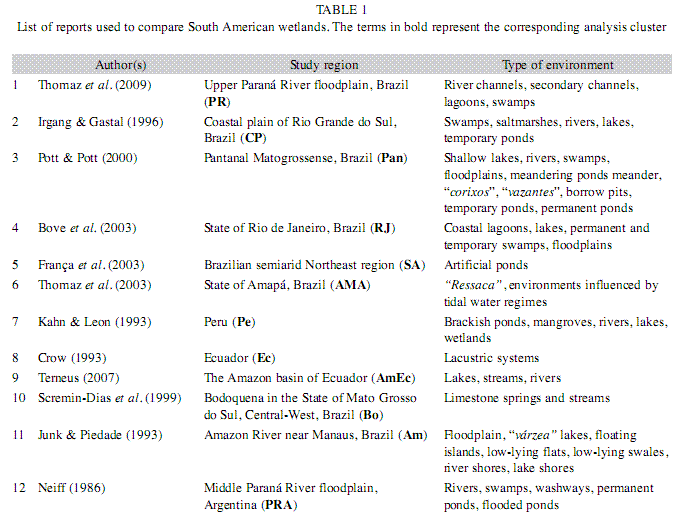
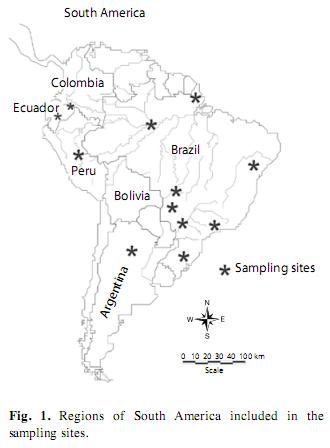
<body><![CDATA[<p>In order to make comparisons among South American wetlands, we used the following lists of macrophytes obtained in long-term surveys (<a  href="/img/revistas/rbt/v59n2/a02t1.gif">Table 1</a>).</p>     <p>All of the investigations and the lists of species that we used were carried out by specialists and included several types of habitats (<a  href="#fig1">Fig. 1</a>). Although there are several other papers describing single habitats, we did not use these studies. It is difficult to guarantee that all studies follow the same methodology, but we believe that they are similar enough to at least contribute a first tentative of comparison of Neotropical wetlands to make inferences about the richness of macrophytes in this region.    <br> </p>     <p>    <br> </p> </font>     <div style="text-align: center;"><a name="fig1"></a><img alt=""  src="/img/revistas/rbt/v59n2/a02i1.jpg"  style="width: 330px; height: 448px;">    <br>     <br> </div> <font size="2"><font face="Verdana" size="2">     <p>To find similarity among these surveys, we first converted all data into a large matrix containing species occurrence presence/absence. A matrix of similarity was built using the Bray-Curtis distance coefficient (Krebs 1999). To compare all surveys, we used the method of complete linkage (Sneath &amp; Sokal 1973). A dendrogram of similarities was built using the PRIMER v. 6 software, Plymouth Routines in Multivariate Ecological Research (Clarke &amp; Gorley 2006).</p>     <p>Using the entire dataset, which included all wetlands, we assessed whether the richness of macrophytes in South America reaches an asymptote, or if there are many species yet to be found. The expected species accumulation curve was calculated according to a Mao Tau function. Using an accumulative curve with "studies" as units of sampling effort, an asymptote would indicate whether almost all species have already been recorded; however, the lack of an asymptote would indicate that the number of aquatic macrophyte species found until now is still far from the real total of these species. We also estimated the richness of macrophytes using a first-order Jacknife estimator (Jack1) with the objective to assess the extent to which the number of macrophyte species in South America remains underestimated. Accumulation and estimation curves were constructed using the EstimateS program (Colwell 2009).</p> </font><b><font face="Verdana" size="3">     ]]></body>
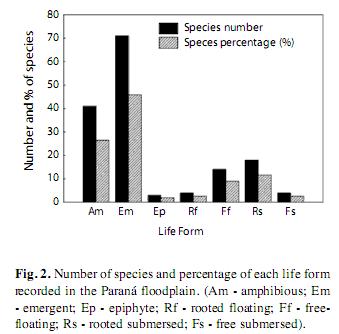
<body><![CDATA[<p>Results</p> </font></b><font face="Verdana" size="2">     <p>A total of 153 species of macrophytes was recorded in the Upper Paran&aacute; River floodplain. These species were distributed in 100 genera and 37 families (<a href="/img/revistas/rbt/v59n2/a02a1.gif">Appendix 1</a>), representing a variety of taxonomic groups (Charophyta Bryophyta, Pteridophyta, Basal Angiospermae and Angiospermae).</p>     <p>Sixteen of the recorded species are cryptogams and are classified as follows: two charophytes, two hepatophytes and 12 pteridophytes. Of the Angiospermae, Poales exhibited the highest number of taxa (40), followed by Alismatales (17), Myrtales and Lamiales (12 species each). The families with the highest numbers of species were Poaceae (21), Cyperaceae (17), Pontederiaceae (8), Hydrocharitaceae (7), Polygonaceae and Onagraceae (6) and Fabaceae (5). Araceae, Alismataceae, Commelinaceae, Amaranthaceae and Plantaginaceae were represented by four species each and the other families by three or fewer species.</p>     <p>All life forms were found in the area, and emergent and amphibious types were the most representative macrophytes, contributing 45% and 26% of the species, respectively (<a href="#fig2">Fig. 2</a>). Rooted submersed (11%) and free-floating species (9%) were also important, while the lowest numbers of species were found for rooted floating and free-submersed types (2%) and epiphytes (1%).    <br> </p>     <p>    <br> </p> </font> </font>     <div style="text-align: center;"><font face="Verdana" size="2">     <p><a name="fig2"></a><img alt=""  src="/img/revistas/rbt/v59n2/a02i2.jpg"  style="width: 339px; height: 334px;">    <br> </p> </font>    ]]></body>
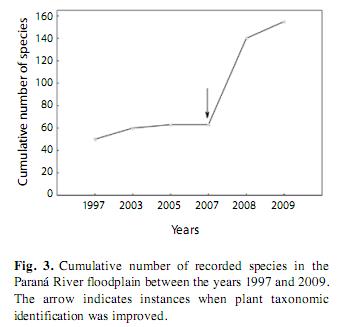
<body><![CDATA[<br> </div> <font face="Verdana" size="2">     <p>The number of species recorded in the Paran&aacute; River and its floodplain consistently increased over time (<a href="#fig3">Fig. 3</a>). The greatest increase occurred between 2007 and 2009, due to intensified sampling efforts and refined taxonomic identification, which led to the addition of 105 species to the recorded flora of the Upper Paran&aacute; River floodplain.    <br> </p>     <p>    <br>     <br> </p> </font>     <div style="text-align: center;"><a name="fig3"></a><img alt=""  src="/img/revistas/rbt/v59n2/a02i3.jpg"  style="width: 339px; height: 327px;">    <br>     <br>     <br> </div> <font size="2"><font face="Verdana" size="2">     ]]></body>
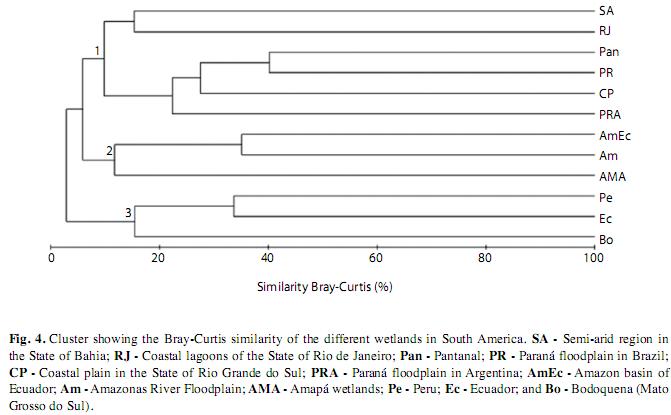
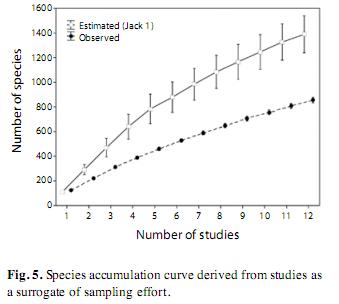
<body><![CDATA[<p>The Paran&aacute; floodplain exhibits the third highest richness of macrophytes (153 species) of the 12 areas for which we have data in South America. The coastal area of the State of Rio Grande do Sul (Brazil) ranked first (321 species), and the Pantanal Matogrossense, one of the largest wetlands in the world, ranked second (247 species).</p> A dendrogram built using the Bray-Curtis coefficient of distance showed that South American wetlands are dissimilar with respect to macrophyte assemblages (<a href="/img/revistas/rbt/v59n2/a02i4.jpg">Fig. 4</a>). We can roughly recognize three groups of wetlands. The first includes the seasonal ponds (Northeast Brazil), coastal lagoons of the State of Rio de Janeiro, Pantanal, Paran&aacute; floodplain in Brazil, the coastal plain in the State of Rio Grande do Sul and the Paran&aacute; floodplain in Argentina, with a similarity of 11.7% (<a href="/img/revistas/rbt/v59n2/a02i4.jpg">Fig. 4</a>). These areas share only two species in common, <i>Polygonum ferrugineum </i>and <i>Nymphoides indica</i>, both of which are widespread hydrophytes. In this first group, the most similar areas were the Paran&aacute; floodplain and the Pantanal Matogrossense with 40.2% similarity and 79 species in common (9% of the total species)     <p>The second group included the Amazon basin of Ecuador, Amazon River floodplain and Amap&aacute; wetlands, with a similarity of 13% and sharing four species, <i>Eichhornia azurea</i>, <i>Hymenachne amplexicaulis</i>, <i>Salvinia auriculata </i>and <i>Utricularia foliosa</i>. Within this group, the aquatic flora of the Amazon River floodplain and the Amazon Basin of Ecuador share 13 species (2% of the total species) and exhibit 35.1% similarity. Finally, group three was formed by Peru, Ecuador and Bodoquena (Mato Grosso do Sul), with a similarity of 18% and sharing 11 species; within this group, Peru and Ecuador had the highest similarity of 33.6% and sharing 35 species (4% of all species).</p>     <p>Considering all of the surveys that we found for South America together with the survey we conducted in the Paran&aacute; floodplain, a total of 854 species of macrophytes was compiled. However, the species accumulation curve produced using these studies as a surrogate of sampling effort, did not reach an asymptote (<a href="#fig5">Fig. 5</a>). In fact, the number of species estimated through Jack1 was 1 388, indicating an approximate underestimation of 534 species.    <br> </p>     <p>    <br>     <br> </p> </font> </font>     <div style="text-align: center;"><a name="fig5"></a><img alt=""  src="/img/revistas/rbt/v59n2/a02i5.jpg"  style="width: 339px; height: 304px;">    <br>     <br> </div> <font size="2"><b><font face="Verdana" size="3">     ]]></body>
<body><![CDATA[<p>Discussion</p> </font></b><font face="Verdana" size="2">     <p>According to Chambers <i>et al</i>. (2008), the Neotropical region has the highest number of macrophyte species in the world (984 species). The number of species of macrophytes recorded in the Upper Paran&aacute; River and its floodplain (153 species; 16% of the Neotropical region) can be considered high due to the small relative area of this ecosystem (2 500km<sup>2</sup>) compared to other aquatic areas from this region, such as the Amazon and the Pantanal. Even considering the higher species richness found in the Pantanal Matogrossensse (247 species), our survey still indicates that the Paran&aacute; floodplain is highly diverse because the Pantanal is 55 times larger in area, extending over approximately 138 183km<sup>2</sup>. Thus, the conservation units contained inside this stretch of the Paran&aacute; River can be considered important for the conservation of aquatic macrophyte diversity. Again, we emphasize that the number of species we recorded does not represent the real species richness because there are a number of habitats not yet investigated in this stretch.</p>     <p>The comparison of the region investigated in this study with other dammed stretches suggests the importance of the Paran&aacute; floodplain as a hotspot of macrophyte species diversity in this basin. In a survey of 18 reservoirs of the Paran&aacute; River and some of its main tributaries, Martins <i>et al</i>. (2008) found only 39 species of macrophytes. Even in the Itaipu Reservoir, which is dendritic (and thus, favorable for macrophyte colonization), a long-term dataset showed a total of 110 species (Mormul <i>et al</i>. 2010). The same conclusion can be made when we compare our data with reservoirs from other basins; for example, only 23 species of macrophytes were recorded in the Guri Reservoir, Venezuela (Vilarrubia &amp; Cova 1993). The great variety of habitats found in the Paran&aacute; floodplain, together with the natural disturbance caused by seasonal oscillations in the water level, might explain these differences in relation to different reservoirs. On the other hand, the sampling effort was not controlled in these different surveys, and thus the results should be viewed with caution. However, this pitfall might be minimized because all of the investigations that we included in this report were floristic surveys, which tend to maximize the sampling within a region. In addition, there may be differences in the definition of macrophytes used in different surveys. Considering species composition, the assemblages of the Paran&aacute; floodplain can be considered as a sample of the aquatic flora from the Pantanal, as was previously pointed out by Thomaz <i>et al</i>. (2009). In fact, the most representative families in number of species are largely the same for both ecosystems (Poaceae and Cyperaceae, Onagraceae, Pontederiaceae, Plantaginaceae and Fabaceae). The families with few species in both ecosystems are also the same (Typhaceae, Cucurbitaceae, Maranthaceae, Haloragaceae, Solanaceae and Orchidaceae). Our cluster analysis also indicated that these three wetlands are the most similar amongst all ecosystems in our dataset, which could be due to their geographical proximity and to hydrological similarities (all areas are subjected to seasonal variation in the water level and also include a great variety of habitats). Furthermore, both wetlands belong to the same larger Paran&aacute; basin.</p>     <p>However, some families differ considerably in the number of species between these two wetlands. For example, there are only two species of Nymphaeaceae in the Paran&aacute; floodplain, whereas there are eight in the Pantanal that occur mainly in rain- fed shallow ponds and seasonal standing or slow flowing water in addition to in the river floodplain, except for <i>Victoria amazonica</i>, which grows in oxbow lakes. Similarly, 10 species of Characeae were found in the Pantanal, which is attributed to the alkaline and brackish waters in the Southwestern Pantanal (Bueno 1993, Pott &amp; Pott 1997), but only two were identified in the Paran&aacute; floodplain, where acid soils predominate and charophytes do not thrive. The importance of the type of habitat in determining species composition can also be observed if we compare a survey carried out on lakes, reservoirs and wetlands in the Southern Paran&aacute; State (Cervi <i>et al</i>. 2009), only 200km away, that shares only 23% of macrophytes with the Paran&aacute; floodplain.</p>     <p>The low richness of aquatic epiphytes reported in the Paran&aacute; floodplain is related to the small sampling effort that has been carried out on floating meadows. Epiphytes usually colonize advanced stages of aquatic succession (Pott &amp; Pott 2003). For example, surveys carried out by Tur (1972) and Neiff (1982) in the Middle Paran&aacute; (Argentina) identified 70 species of epiphytes. Even though both regions are on the Paran&aacute; River, the flood pulses differ between the Middle and the Upper Paran&aacute; basins, which may influence the accumulation of organic matter and, thus, the formation of floating-substrates, as well as the displacement of these islands, and this may explain the differences in the richness of epiphytes found in these wetlands.</p>     <p>The species number increase over time reported for the Paran&aacute; floodplain can be mainly attributed to the refinement of the taxonomic searches and identification carried out. In addition to this effect, we also considered a higher sampling effort in the Paran&aacute; floodplain, with collections made in habitats not previously investigated (e.g., rocks in the Paran&aacute; channel) and the arrival of new species (e.g. <i>Hydrilla verticillata</i>). The high level of species richness that we found indicates that the Paran&aacute; floodplain is still in a good conservation state, despite the strong anthropogenic pressures in the region related to changes in hydrometric levels, nutrient cycling and suspended solid loadings (Souza-Filho 2009).</p>     <p>However, despite the good status of conservation with respect to the aquatic flora, we contend that there is a concern related to the presence of two invasive species, <i>H. verticillata </i>and <i>Urochloa subquadripara</i>. The first is a submersed species native to Asia and the North of Africa, that colonizes the Paran&aacute; main channel and has a high competitive ability, threatening native species due its rapid regeneration following hydrological disturbances (Sousa <i>et al</i>. 2009, Thomaz <i>et al</i>. 2009). Its success in the Paran&aacute; main channel is associated with the same effect leading to an increase in the colonization by submersed species, <i>i.e.</i>, the increase in water transparency and propagule pressures originating in the upstream reservoirs (Thomaz <i>et al</i>. 2009). <i>Hydrilla verticillata </i>has not yet colonized lakes in either the Ba&iacute;a or Ivinhema river habitats (Sousa <i>et al</i>. 2009). The second species, <i>U. subquadripara</i>, belongs to the family Poaceae, which contributes with several invasive species (Petenon &amp; Pivello 2008). Although <i>U. subquadripara </i>has been rarely recorded in the Paran&aacute; floodplain, it reduced significantly the diversity of macrophytes in a lake close to the Ba&iacute;a River, the only place where it occurs with high biomass in this floodplain (Michelan <i>et al</i>. 2010). Disturbances associated with the oscillation in water levels may explain why this species is so rare in most habitats in the floodplain, but in light of its severe threat to macrophyte diversity, its monitoring is a priority, especially in the best preserved areas of this region.</p>     <p>The results of our cluster analysis indicate that Neotropical wetlands are different regarding macrophyte composition. Thus, we infer that such differences may be due to multiple factors, such as climate, flood regime and geography.</p>     <p>In fact, the most similar areas (Pantanal and Paran&aacute; floodplain) share many similarities: they are both large floodplains located from 80-160 m.a.s.l., have a great variety of habitats and are subjected to seasonal water level fluctuations (Agostinho &amp; Zalewiski 1995, Vila da Silva 1995). However, the cluster analysis also shows that South American wetlands are diverse regarding macrophyte assemblages, and even ecosystems located in the same basin may differ considerably (e.g., the upper and middle/lower Paran&aacute; floodplains). The differences observed for these two floodplains may be accounted for by differences in their nutrient regimes (the Argentinean floodplains receive high phosphorus inputs from the Andes tributaries) and also to the types of habitats investigated (e.g., the widespread occurrence of floating meadows in Argentina with a high richness of epiphytes). As previously mentioned, the groups formed by the cluster analysis suggest that, though they represent geographically distant environments, such as the Amazonian floodplains and the Argentina plain, the sampled landscapes are determinant in forming groupings.</p>     <p>The accumulation curve reflects the differences found in the cluster analysis. In other words, the great differences among the South American surveys included in the cluster analysis indicate a high <i>beta</i>-diversity, leading to a lack of an asymptote in the accumulation curve. The total number of species found in all 12 surveys represents 87% of the number found by Chambers <i>et al. </i>(2008) for the Neotropical region. Despite the fact that our findings are close to the total number of Neotropical macrophytes, the lack of an asymptote, together with the high underestimation of true richness suggested by the Jack1 estimator, indicates that we are still far from describing the actual richness for this region. The number of plants to be described in Brazil, what may reflect the situation of South America, is considered very high (Pimm <i>et al. </i>2010). In fact, there has been a clear lack of investigations conducted in pristine habitats in South America, such as in parts of the Amazon and the Andes, which are areas of high biodiversity. Future investigations at these sites, together with the description of new species (e.g., Bove <i>et al</i>. 2006, Amaral &amp; Bittrich 2008), will certainly increase the number of species of Neotropical macrophytes recorded and give a better idea of the biodiversity provided by the great variety of ecosystems of this biogeographical region.</p>     ]]></body>
<body><![CDATA[<p>Our results reinforce the hypothesis of Irgang &amp; Gastal (1996) that Uruguay, North Argentina, Paraguay and South Brazil form a phytogeographic unit, and therefore, the sampled number of species does not closely correlate with other evaluated areas. There are many other large wetlands in South America that should be included in this analysis but that were not included because of insufficient floristic inventories, such as Guapor&eacute; and Ilha do Bananal.</p>     <p>In summary, this report highlights the flora of different wetlands of South America and indicates that the actual species richness of macrophytes of this continent is far from being well understood. Our hypothesis sustains that macrophyte records, together with existing surveys, indicate a continuous need for carrying out increasing numbers of collections in new areas in the upper Paran&aacute; river-floodplain system and in other South American wetlands, as the number of species so far reported remains far from the predicted total. The checklist generated in this study is intended to support other research in wetlands and, in particular, to assure the continuity of ongoing long-term ecological programs, and it reveals a rich flora that is practically unknown to botanists and ecologists.</p> </font><b><font face="Verdana" size="3">     <p>Acknowledgments</p> </font></b><font face="Verdana" size="2">     <p>This study was funded by the Brazilian Council of Research (CNPq) through a Long Term Ecological Program (site number 6). S. M. Thomaz received a CNPq Productivity Research Grant and acknowledges this agency for long-term funding. A. Pott received a CNPq and CAPES Productivity Research. Additionally, F. A. Ferreira and R. P. Mormul acknowledge CNPq and CAPES (Coordena&ccedil;&atilde;o de Aperfei&ccedil;oamento de Pessoal de N&iacute;vel Superior) for furnishing Ph.D. fellowships, respectively.</p> </font><b><font face="Verdana" size="3"> </font></b></font> <hr style="width: 100%; height: 2px;"><b><font face="Verdana" size="3">     <p>References</p> </font></b><font face="Verdana" size="2">     <!-- ref --><p>Agostinho, A.A. &amp; M. Zalewski. 1995. The dependence of fish community structure and dynamics on floodplain and riparian ecotone zone in Parana River, Brazil. Hydrobiologia 303: 141-148.    &nbsp;&nbsp;&nbsp;&nbsp;&nbsp;&nbsp;&nbsp;&nbsp;[&#160;<a href="javascript:void(0);" onclick="javascript: window.open('/scielo.php?script=sci_nlinks&ref=1758397&pid=S0034-7744201100020000200001&lng=','','width=640,height=500,resizable=yes,scrollbars=1,menubar=yes,');">Links</a>&#160;]<!-- end-ref --></p>     <!-- ref --><p>Amaral, M.C., V. Bittrich, A.F. Faria, L.A. Anderson &amp; L.Y.S. Aona 2008. Guia de campo para plantas aqu&aacute;ticas e palustres do Estado de S&atilde;o Paulo. Holos, Ribeir&atilde;o Preto, S&atilde;o Paulo, Brazil.    &nbsp;&nbsp;&nbsp;&nbsp;&nbsp;&nbsp;&nbsp;&nbsp;[&#160;<a href="javascript:void(0);" onclick="javascript: window.open('/scielo.php?script=sci_nlinks&ref=1758399&pid=S0034-7744201100020000200002&lng=','','width=640,height=500,resizable=yes,scrollbars=1,menubar=yes,');">Links</a>&#160;]<!-- end-ref --></p>     <!-- ref --><p>APG II. 2003. An update of the Angiosperm Phylogeny Group classification for orders and families of flowering plants: APG II. Bot. J. Linn. Soc. 141: 399-436.    &nbsp;&nbsp;&nbsp;&nbsp;&nbsp;&nbsp;&nbsp;&nbsp;[&#160;<a href="javascript:void(0);" onclick="javascript: window.open('/scielo.php?script=sci_nlinks&ref=1758401&pid=S0034-7744201100020000200003&lng=','','width=640,height=500,resizable=yes,scrollbars=1,menubar=yes,');">Links</a>&#160;]<!-- end-ref --></p>     <!-- ref --><p>Bini, L.M. 1996. Influ&ecirc;ncia do pulso de inunda&ccedil;&atilde;o nos valores de fitomassa de tr&ecirc;s esp&eacute;cies de macr&oacute;fitas aqu&aacute;ticas. Braz. Arch. Biol. Techn. 39: 715-721.    &nbsp;&nbsp;&nbsp;&nbsp;&nbsp;&nbsp;&nbsp;&nbsp;[&#160;<a href="javascript:void(0);" onclick="javascript: window.open('/scielo.php?script=sci_nlinks&ref=1758403&pid=S0034-7744201100020000200004&lng=','','width=640,height=500,resizable=yes,scrollbars=1,menubar=yes,');">Links</a>&#160;]<!-- end-ref --></p>     <!-- ref --><p>Bove, C.P., C.T. Philbrick &amp; A.R. Novelo R. 2006. A new species of <i>Cipoia </i>(Podostemaceae) from Minas Gerais, Brazil. Syst. Bot. 31: 822-825.    &nbsp;&nbsp;&nbsp;&nbsp;&nbsp;&nbsp;&nbsp;&nbsp;[&#160;<a href="javascript:void(0);" onclick="javascript: window.open('/scielo.php?script=sci_nlinks&ref=1758405&pid=S0034-7744201100020000200005&lng=','','width=640,height=500,resizable=yes,scrollbars=1,menubar=yes,');">Links</a>&#160;]<!-- end-ref --></p>     <!-- ref --><p>Bove, C.P. &amp; J. Paz. 2009. Guia de campo das plantas aqu&aacute;ticas do Parque Nacional da Restinga de Jurubatiba. Museu Nacional, Rio de Janeiro, Rio de Janeiro, Brazil.    &nbsp;&nbsp;&nbsp;&nbsp;&nbsp;&nbsp;&nbsp;&nbsp;[&#160;<a href="javascript:void(0);" onclick="javascript: window.open('/scielo.php?script=sci_nlinks&ref=1758407&pid=S0034-7744201100020000200006&lng=','','width=640,height=500,resizable=yes,scrollbars=1,menubar=yes,');">Links</a>&#160;]<!-- end-ref --></p>     <!-- ref --><p>Bueno, N.C. 1993. Characeae do Pantanal de Mato Grosso do Sul, Brasil, Levantamento Flor&iacute;stico. Master Thesis. Universidade Federal do Paran&aacute;, Curitiba, Paran&aacute;, Brazil.    &nbsp;&nbsp;&nbsp;&nbsp;&nbsp;&nbsp;&nbsp;&nbsp;[&#160;<a href="javascript:void(0);" onclick="javascript: window.open('/scielo.php?script=sci_nlinks&ref=1758409&pid=S0034-7744201100020000200007&lng=','','width=640,height=500,resizable=yes,scrollbars=1,menubar=yes,');">Links</a>&#160;]<!-- end-ref --></p>     <!-- ref --><p>Cervi, A.C., C. Bona, M.C.C. Mo&ccedil;o &amp; L. Linsingen. 2009. Macr&oacute;fitas aqu&aacute;ticas de General Carneiro, Paran&aacute;, Brasil. Biota Neotrop. 9: 215-222.    &nbsp;&nbsp;&nbsp;&nbsp;&nbsp;&nbsp;&nbsp;&nbsp;[&#160;<a href="javascript:void(0);" onclick="javascript: window.open('/scielo.php?script=sci_nlinks&ref=1758411&pid=S0034-7744201100020000200008&lng=','','width=640,height=500,resizable=yes,scrollbars=1,menubar=yes,');">Links</a>&#160;]<!-- end-ref --></p>     <!-- ref --><p>Chambers, P.A., P. Lacoul, K.J. Murphy &amp; S.M. Thomaz. 2008. Global diversity of aquatic macrophytes in freshwater. Hydrobiologia 595: 9-26.    &nbsp;&nbsp;&nbsp;&nbsp;&nbsp;&nbsp;&nbsp;&nbsp;[&#160;<a href="javascript:void(0);" onclick="javascript: window.open('/scielo.php?script=sci_nlinks&ref=1758413&pid=S0034-7744201100020000200009&lng=','','width=640,height=500,resizable=yes,scrollbars=1,menubar=yes,');">Links</a>&#160;]<!-- end-ref --></p>     <!-- ref --><p>Clarke, K.R. &amp; R.N. Gorley. 2006. Primer v6: User Manual/Tutorial, Primer-E, Plymouth, United Kingdom.    &nbsp;&nbsp;&nbsp;&nbsp;&nbsp;&nbsp;&nbsp;&nbsp;[&#160;<a href="javascript:void(0);" onclick="javascript: window.open('/scielo.php?script=sci_nlinks&ref=1758415&pid=S0034-7744201100020000200010&lng=','','width=640,height=500,resizable=yes,scrollbars=1,menubar=yes,');">Links</a>&#160;]<!-- end-ref --></p>     <!-- ref --><p>Colwell, R.K. 2009. EstimatesS: statistical estimation of species richness and shared species from samples EstimateS. Version 8.2.0. (Downloaded: February 08, 2010, <a  href="http://viceroy.eeb.uconn.edu/estimates">http://viceroy.eeb.uconn.edu/estimates</a>).    &nbsp;&nbsp;&nbsp;&nbsp;&nbsp;&nbsp;&nbsp;&nbsp;[&#160;<a href="javascript:void(0);" onclick="javascript: window.open('/scielo.php?script=sci_nlinks&ref=1758417&pid=S0034-7744201100020000200011&lng=','','width=640,height=500,resizable=yes,scrollbars=1,menubar=yes,');">Links</a>&#160;]<!-- end-ref --></p>     <!-- ref --><p>Cook, C.D.K. 1996. Aquatic plant book. Amsterdam and New York, SPB, The Hague, The Netherlands.    &nbsp;&nbsp;&nbsp;&nbsp;&nbsp;&nbsp;&nbsp;&nbsp;[&#160;<a href="javascript:void(0);" onclick="javascript: window.open('/scielo.php?script=sci_nlinks&ref=1758419&pid=S0034-7744201100020000200012&lng=','','width=640,height=500,resizable=yes,scrollbars=1,menubar=yes,');">Links</a>&#160;]<!-- end-ref --></p>     <!-- ref --><p>Crandall-Stotler, B. 1980. Morphogenetic desings and theory of bryophyte origins and divergence. BioScience 30: 580-585.    &nbsp;&nbsp;&nbsp;&nbsp;&nbsp;&nbsp;&nbsp;&nbsp;[&#160;<a href="javascript:void(0);" onclick="javascript: window.open('/scielo.php?script=sci_nlinks&ref=1758421&pid=S0034-7744201100020000200013&lng=','','width=640,height=500,resizable=yes,scrollbars=1,menubar=yes,');">Links</a>&#160;]<!-- end-ref --></p>     <!-- ref --><p>Cronk, J.K. &amp; M.S. Fennessy 2001. Wetland plants: biology and ecology. Lewis, Florida, USA.    &nbsp;&nbsp;&nbsp;&nbsp;&nbsp;&nbsp;&nbsp;&nbsp;[&#160;<a href="javascript:void(0);" onclick="javascript: window.open('/scielo.php?script=sci_nlinks&ref=1758423&pid=S0034-7744201100020000200014&lng=','','width=640,height=500,resizable=yes,scrollbars=1,menubar=yes,');">Links</a>&#160;]<!-- end-ref --></p>     <!-- ref --><p>Diegues A.C. 1994. An Inventory of Brazilian Wetlands. IUCN, Gland, Switzerland.    &nbsp;&nbsp;&nbsp;&nbsp;&nbsp;&nbsp;&nbsp;&nbsp;[&#160;<a href="javascript:void(0);" onclick="javascript: window.open('/scielo.php?script=sci_nlinks&ref=1758425&pid=S0034-7744201100020000200015&lng=','','width=640,height=500,resizable=yes,scrollbars=1,menubar=yes,');">Links</a>&#160;]<!-- end-ref --></p>     <!-- ref --><p>Esteves, F.A. 1998. Fundamentos de Limnologia. Interci&ecirc;ncia/FINEP, Rio de Janeiro, Brazil.    &nbsp;&nbsp;&nbsp;&nbsp;&nbsp;&nbsp;&nbsp;&nbsp;[&#160;<a href="javascript:void(0);" onclick="javascript: window.open('/scielo.php?script=sci_nlinks&ref=1758427&pid=S0034-7744201100020000200016&lng=','','width=640,height=500,resizable=yes,scrollbars=1,menubar=yes,');">Links</a>&#160;]<!-- end-ref --></p>     <!-- ref --><p>Hoehne, F.C. 1948. Plantas aqu&aacute;ticas. Secretaria da Agricultura, S&atilde;o Paulo, S&atilde;o Paulo, Brazil.    &nbsp;&nbsp;&nbsp;&nbsp;&nbsp;&nbsp;&nbsp;&nbsp;[&#160;<a href="javascript:void(0);" onclick="javascript: window.open('/scielo.php?script=sci_nlinks&ref=1758429&pid=S0034-7744201100020000200017&lng=','','width=640,height=500,resizable=yes,scrollbars=1,menubar=yes,');">Links</a>&#160;]<!-- end-ref --></p>     <!-- ref --><p>Irgang, B.E. &amp; C.V.S. Gastal Jr. 1996. Macr&oacute;fitas Aqu&aacute;ticas da plan&iacute;cie costeira do RS. CPG - Bot&acirc;nica/ UFRGS, Porto Alegre, Rio Grande do Sul, Brazil&nbsp;&nbsp;&nbsp;&nbsp;&nbsp;&nbsp;&nbsp;&nbsp;[&#160;<a href="javascript:void(0);" onclick="javascript: window.open('/scielo.php?script=sci_nlinks&ref=1758431&pid=S0034-7744201100020000200018&lng=','','width=640,height=500,resizable=yes,scrollbars=1,menubar=yes,');">Links</a>&#160;]<!-- end-ref --><!-- ref --><p>Junk, W.J., P.B. Bayley &amp; R.E. Sparks. 1989. The flood pulse concept in river- floodplain systems. Can. J. Fish. Aquat. Sci. 106: 110-127.    &nbsp;&nbsp;&nbsp;&nbsp;&nbsp;&nbsp;&nbsp;&nbsp;[&#160;<a href="javascript:void(0);" onclick="javascript: window.open('/scielo.php?script=sci_nlinks&ref=1758432&pid=S0034-7744201100020000200019&lng=','','width=640,height=500,resizable=yes,scrollbars=1,menubar=yes,');">Links</a>&#160;]<!-- end-ref --></p>     <!-- ref --><p>Junk, W.J., J.J. Ohly, M.T.F. Piedade &amp; M.G.M. Soares. 2000. The Central Amazon floodplain: Actual use and options for sustainable management. Backhuys, Leiden, The Netherlands.    &nbsp;&nbsp;&nbsp;&nbsp;&nbsp;&nbsp;&nbsp;&nbsp;[&#160;<a href="javascript:void(0);" onclick="javascript: window.open('/scielo.php?script=sci_nlinks&ref=1758434&pid=S0034-7744201100020000200020&lng=','','width=640,height=500,resizable=yes,scrollbars=1,menubar=yes,');">Links</a>&#160;]<!-- end-ref --></p>     <!-- ref --><p>Kita, K.K. &amp; M.C. Souza. 2003. Levantamento flor&iacute;stico e fitofisionomia da lagoa Figueira e seu entorno, plan&iacute;cie alag&aacute;vel do alto rio Paran&aacute;, Porto Rico, Estado do Paran&aacute;, Brasil. Acta Sci. Biol. Sci. 25: 145-155.    &nbsp;&nbsp;&nbsp;&nbsp;&nbsp;&nbsp;&nbsp;&nbsp;[&#160;<a href="javascript:void(0);" onclick="javascript: window.open('/scielo.php?script=sci_nlinks&ref=1758436&pid=S0034-7744201100020000200021&lng=','','width=640,height=500,resizable=yes,scrollbars=1,menubar=yes,');">Links</a>&#160;]<!-- end-ref --></p>     <!-- ref --><p>Krebs, C.J. 1999. Ecological methodology. A. Wesley Longman, New York, New York, USA.    &nbsp;&nbsp;&nbsp;&nbsp;&nbsp;&nbsp;&nbsp;&nbsp;[&#160;<a href="javascript:void(0);" onclick="javascript: window.open('/scielo.php?script=sci_nlinks&ref=1758438&pid=S0034-7744201100020000200022&lng=','','width=640,height=500,resizable=yes,scrollbars=1,menubar=yes,');">Links</a>&#160;]<!-- end-ref --></p>     <!-- ref --><p>Maack, R. 2002. Geografia f&iacute;sica do Estado do Paran&aacute;. Curitiba, Paran&aacute;, Brazil.    &nbsp;&nbsp;&nbsp;&nbsp;&nbsp;&nbsp;&nbsp;&nbsp;[&#160;<a href="javascript:void(0);" onclick="javascript: window.open('/scielo.php?script=sci_nlinks&ref=1758440&pid=S0034-7744201100020000200023&lng=','','width=640,height=500,resizable=yes,scrollbars=1,menubar=yes,');">Links</a>&#160;]<!-- end-ref --></p>     ]]></body>
<body><![CDATA[<!-- ref --><p>Martins, D., N.V. Costa, M.A. Terra &amp; S.R. Marchi. 2008. Caracteriza&ccedil;&atilde;o da comunidade de plantas aqu&aacute;ticas de dezoito reservat&oacute;rios pertencentes a cinco bacias hidrogr&aacute;ficas do estado de S&atilde;o Paulo. Planta Daninha 26: 17-32.    &nbsp;&nbsp;&nbsp;&nbsp;&nbsp;&nbsp;&nbsp;&nbsp;[&#160;<a href="javascript:void(0);" onclick="javascript: window.open('/scielo.php?script=sci_nlinks&ref=1758442&pid=S0034-7744201100020000200024&lng=','','width=640,height=500,resizable=yes,scrollbars=1,menubar=yes,');">Links</a>&#160;]<!-- end-ref --></p>     <!-- ref --><p>Michelan, T.S., S.M. Thomaz, R.P. Mormul &amp; P. Carvalho. 2010. Effects of an exotic invasive macrophyte (tropical signalgrass) on native plant community composition, species richness and functional diversity. Freshwat. Biol. 55: 1315-1326.    &nbsp;&nbsp;&nbsp;&nbsp;&nbsp;&nbsp;&nbsp;&nbsp;[&#160;<a href="javascript:void(0);" onclick="javascript: window.open('/scielo.php?script=sci_nlinks&ref=1758444&pid=S0034-7744201100020000200025&lng=','','width=640,height=500,resizable=yes,scrollbars=1,menubar=yes,');">Links</a>&#160;]<!-- end-ref --></p>     <!-- ref --><p>Mobot, Missouri Botanical Garden. W Tropicos. (Downloaded: February 08, 2010, <a href="http://mobot.mobot.Org/W3T/search/vast.html">http://mobot.mobot.Org/W3T/search/vast.html</a>).    &nbsp;&nbsp;&nbsp;&nbsp;&nbsp;&nbsp;&nbsp;&nbsp;[&#160;<a href="javascript:void(0);" onclick="javascript: window.open('/scielo.php?script=sci_nlinks&ref=1758446&pid=S0034-7744201100020000200026&lng=','','width=640,height=500,resizable=yes,scrollbars=1,menubar=yes,');">Links</a>&#160;]<!-- end-ref --></p>     <!-- ref --><p>Mormul, R.P., F.A. Ferreira, P. Carvalho, T.S. Michelan, M.J. Silveira &amp; S.M. Thomaz. 2010. Aquatic macrophytes in the large, sub-tropical Itaipu Reservoir. Brazil Rev. Biol. Trop. 58: 1437-1452.    &nbsp;&nbsp;&nbsp;&nbsp;&nbsp;&nbsp;&nbsp;&nbsp;[&#160;<a href="javascript:void(0);" onclick="javascript: window.open('/scielo.php?script=sci_nlinks&ref=1758448&pid=S0034-7744201100020000200027&lng=','','width=640,height=500,resizable=yes,scrollbars=1,menubar=yes,');">Links</a>&#160;]<!-- end-ref --></p>     <!-- ref --><p>Naranjo, L.G. 1995. An evaluation of the first inventory of South American wetlands. Vegetatio 118: 125-129.    &nbsp;&nbsp;&nbsp;&nbsp;&nbsp;&nbsp;&nbsp;&nbsp;[&#160;<a href="javascript:void(0);" onclick="javascript: window.open('/scielo.php?script=sci_nlinks&ref=1758450&pid=S0034-7744201100020000200028&lng=','','width=640,height=500,resizable=yes,scrollbars=1,menubar=yes,');">Links</a>&#160;]<!-- end-ref --></p>     ]]></body>
<body><![CDATA[<!-- ref --><p>Neiff, J.J. 1978. Fluctuaciones de la vegetacion acuatica en ambientes del valle de inundacion del Paran&aacute; medio. Physis 38: 41-53.    &nbsp;&nbsp;&nbsp;&nbsp;&nbsp;&nbsp;&nbsp;&nbsp;[&#160;<a href="javascript:void(0);" onclick="javascript: window.open('/scielo.php?script=sci_nlinks&ref=1758452&pid=S0034-7744201100020000200029&lng=','','width=640,height=500,resizable=yes,scrollbars=1,menubar=yes,');">Links</a>&#160;]<!-- end-ref --></p>     <!-- ref --><p>Neiff, J.J. 1982. Esquema sucesional de la vegetacion en Islas Flotantes del Chaco Argentino. Bol. Soc. Arg. Bot. 21: 325-341.    &nbsp;&nbsp;&nbsp;&nbsp;&nbsp;&nbsp;&nbsp;&nbsp;[&#160;<a href="javascript:void(0);" onclick="javascript: window.open('/scielo.php?script=sci_nlinks&ref=1758454&pid=S0034-7744201100020000200030&lng=','','width=640,height=500,resizable=yes,scrollbars=1,menubar=yes,');">Links</a>&#160;]<!-- end-ref --></p>     <!-- ref --><p>Neiff, J.J. 1986. Aquatic plants of the Paran&aacute; System, p. 557-571. <i>In </i>B.R. Davies &amp; K.F. Walker (eds.). The Ecology of River Systems. Dr. W. Junk, Dordrecht, Netherlands.    &nbsp;&nbsp;&nbsp;&nbsp;&nbsp;&nbsp;&nbsp;&nbsp;[&#160;<a href="javascript:void(0);" onclick="javascript: window.open('/scielo.php?script=sci_nlinks&ref=1758456&pid=S0034-7744201100020000200031&lng=','','width=640,height=500,resizable=yes,scrollbars=1,menubar=yes,');">Links</a>&#160;]<!-- end-ref --></p>     <!-- ref --><p>Neiff, J.J. 2001. Diversity in some tropical wetland systems of South America. <i>In </i>B. Gopal, B. Junk, W.J. &amp; J.A. Davies (eds.). Biodiversity in wetland: assessment, function and conservation. Backhuys, Leiden, Netherlands.    &nbsp;&nbsp;&nbsp;&nbsp;&nbsp;&nbsp;&nbsp;&nbsp;[&#160;<a href="javascript:void(0);" onclick="javascript: window.open('/scielo.php?script=sci_nlinks&ref=1758458&pid=S0034-7744201100020000200032&lng=','','width=640,height=500,resizable=yes,scrollbars=1,menubar=yes,');">Links</a>&#160;]<!-- end-ref --></p>     <!-- ref --><p>Pedralli, G. 1990. Macr&oacute;fitos aqu&aacute;ticos: t&eacute;cnicas e m&eacute;todos de estudos. Est. Biol. 26: 5-24.    &nbsp;&nbsp;&nbsp;&nbsp;&nbsp;&nbsp;&nbsp;&nbsp;[&#160;<a href="javascript:void(0);" onclick="javascript: window.open('/scielo.php?script=sci_nlinks&ref=1758460&pid=S0034-7744201100020000200033&lng=','','width=640,height=500,resizable=yes,scrollbars=1,menubar=yes,');">Links</a>&#160;]<!-- end-ref --></p>     ]]></body>
<body><![CDATA[<!-- ref --><p>Petenon, D. &amp; V.R. Pivello. 2008. Plantas invasoras: representatividade da pesquisa dos pa&iacute;ses tropicais no contexto mundial. Natureza &amp; Conserva&ccedil;&atilde;o 6: 65-77.    &nbsp;&nbsp;&nbsp;&nbsp;&nbsp;&nbsp;&nbsp;&nbsp;[&#160;<a href="javascript:void(0);" onclick="javascript: window.open('/scielo.php?script=sci_nlinks&ref=1758462&pid=S0034-7744201100020000200034&lng=','','width=640,height=500,resizable=yes,scrollbars=1,menubar=yes,');">Links</a>&#160;]<!-- end-ref --></p>     <!-- ref --><p>Pimm, S.L., C.N. Jenkins, L.N. Joppa, D.L. Roberts &amp; G.J. Russell. 2010. How many endangered species remain to be discovered in Brazil? Natureza &amp; Conserva&ccedil;&atilde;o 8: 71-77.    &nbsp;&nbsp;&nbsp;&nbsp;&nbsp;&nbsp;&nbsp;&nbsp;[&#160;<a href="javascript:void(0);" onclick="javascript: window.open('/scielo.php?script=sci_nlinks&ref=1758464&pid=S0034-7744201100020000200035&lng=','','width=640,height=500,resizable=yes,scrollbars=1,menubar=yes,');">Links</a>&#160;]<!-- end-ref --></p>     <!-- ref --><p>Pott, V.J. &amp; A. Pott. 1997. Checklist das macr&oacute;fitas aqu&aacute;ticas do Pantanal, Brasil. Acta Bot. Bras. 11: 315-327.    &nbsp;&nbsp;&nbsp;&nbsp;&nbsp;&nbsp;&nbsp;&nbsp;[&#160;<a href="javascript:void(0);" onclick="javascript: window.open('/scielo.php?script=sci_nlinks&ref=1758466&pid=S0034-7744201100020000200036&lng=','','width=640,height=500,resizable=yes,scrollbars=1,menubar=yes,');">Links</a>&#160;]<!-- end-ref --></p>     <!-- ref --><p>Pott, V.J. &amp; A. Pott. 2000. Plantas aqu&aacute;ticas do Pantanal. Embrapa, Bras&iacute;lia, Brazil.    &nbsp;&nbsp;&nbsp;&nbsp;&nbsp;&nbsp;&nbsp;&nbsp;[&#160;<a href="javascript:void(0);" onclick="javascript: window.open('/scielo.php?script=sci_nlinks&ref=1758468&pid=S0034-7744201100020000200037&lng=','','width=640,height=500,resizable=yes,scrollbars=1,menubar=yes,');">Links</a>&#160;]<!-- end-ref --></p>     <!-- ref --><p>Pott, V.J. &amp; A. Pott. 2003. Din&acirc;mica da vegeta&ccedil;&atilde;o aqu&aacute;tica do Pantanal, p. 145-162. <i>In </i>S.M. Thomaz &amp; L.M. Bini (eds.). Ecologia e manejo de macr&oacute;fitas aqu&aacute;ticas. EDUEM, Maring&aacute;, Paran&aacute;, Brazil.    &nbsp;&nbsp;&nbsp;&nbsp;&nbsp;&nbsp;&nbsp;&nbsp;[&#160;<a href="javascript:void(0);" onclick="javascript: window.open('/scielo.php?script=sci_nlinks&ref=1758470&pid=S0034-7744201100020000200038&lng=','','width=640,height=500,resizable=yes,scrollbars=1,menubar=yes,');">Links</a>&#160;]<!-- end-ref --></p>     ]]></body>
<body><![CDATA[<!-- ref --><p>Pressey, R.L. &amp; P. Adam. 1995. A review of wetland inventory and classification in Australia. Vegetatio 118: 81-101.    &nbsp;&nbsp;&nbsp;&nbsp;&nbsp;&nbsp;&nbsp;&nbsp;[&#160;<a href="javascript:void(0);" onclick="javascript: window.open('/scielo.php?script=sci_nlinks&ref=1758472&pid=S0034-7744201100020000200039&lng=','','width=640,height=500,resizable=yes,scrollbars=1,menubar=yes,');">Links</a>&#160;]<!-- end-ref --></p>     <!-- ref --><p>R Development Core Team, 2010. R: A language and environment for statistical computing. R Foundation for Statistical Computing, Vienna, Austria. (Downloaded: February 08, 2010, <a href="www.R-project.org">www.R-project.org</a>).    &nbsp;&nbsp;&nbsp;&nbsp;&nbsp;&nbsp;&nbsp;&nbsp;[&#160;<a href="javascript:void(0);" onclick="javascript: window.open('/scielo.php?script=sci_nlinks&ref=1758474&pid=S0034-7744201100020000200040&lng=','','width=640,height=500,resizable=yes,scrollbars=1,menubar=yes,');">Links</a>&#160;]<!-- end-ref --></p>     <!-- ref --><p>Sneath, P.H. &amp; R.R. Sokal. 1973. Numerical Taxonomy: The principles and practice of numerical classification. W.H. Freeman, San Francisco, USA.    &nbsp;&nbsp;&nbsp;&nbsp;&nbsp;&nbsp;&nbsp;&nbsp;[&#160;<a href="javascript:void(0);" onclick="javascript: window.open('/scielo.php?script=sci_nlinks&ref=1758476&pid=S0034-7744201100020000200041&lng=','','width=640,height=500,resizable=yes,scrollbars=1,menubar=yes,');">Links</a>&#160;]<!-- end-ref --></p>     <!-- ref --><p>Souza Filho, E.E. 1993. Aspectos da geologia e estratigrafia dos dep&oacute;sitos sedimentares do rio Paran&aacute; entre Porto Primavera (MS) e Gua&iacute;ra (PR). Ph.D. Thesis, Universidade de S&atilde;o Paulo, S&atilde;o Paulo, Brazil.    &nbsp;&nbsp;&nbsp;&nbsp;&nbsp;&nbsp;&nbsp;&nbsp;[&#160;<a href="javascript:void(0);" onclick="javascript: window.open('/scielo.php?script=sci_nlinks&ref=1758478&pid=S0034-7744201100020000200042&lng=','','width=640,height=500,resizable=yes,scrollbars=1,menubar=yes,');">Links</a>&#160;]<!-- end-ref --></p>     <!-- ref --><p>Souza-Filho, E.E. 2009. Evaluation of the Upper Paran&aacute; River discharge controlled by reservoirs. Braz. J. Biol. 69: 707-716.    &nbsp;&nbsp;&nbsp;&nbsp;&nbsp;&nbsp;&nbsp;&nbsp;[&#160;<a href="javascript:void(0);" onclick="javascript: window.open('/scielo.php?script=sci_nlinks&ref=1758480&pid=S0034-7744201100020000200043&lng=','','width=640,height=500,resizable=yes,scrollbars=1,menubar=yes,');">Links</a>&#160;]<!-- end-ref --></p>     ]]></body>
<body><![CDATA[<!-- ref --><p>Sousa, W.T.Z., S.M. Thomaz, K.J. Murphy, M.J. Silveira &amp; R.P. Mormul. 2009. Environmental predictors of the occurrence of exotic <i>Hydrilla verticillata </i>(L.f.) Royle and native <i>Egeria najas </i>Planch. in a sub-tropical river floodplain: the Upper River Paran&aacute;, Brazil. Hydrobiologia 632: 65-78.    &nbsp;&nbsp;&nbsp;&nbsp;&nbsp;&nbsp;&nbsp;&nbsp;[&#160;<a href="javascript:void(0);" onclick="javascript: window.open('/scielo.php?script=sci_nlinks&ref=1758482&pid=S0034-7744201100020000200044&lng=','','width=640,height=500,resizable=yes,scrollbars=1,menubar=yes,');">Links</a>&#160;]<!-- end-ref --></p>     <!-- ref --><p>Taylor, A.R.D., G.W. Howard &amp; G.W. Begg. 1995. Developing wetland inventories in Southern Africa: A review. Vegetatio 118: 57-79.    &nbsp;&nbsp;&nbsp;&nbsp;&nbsp;&nbsp;&nbsp;&nbsp;[&#160;<a href="javascript:void(0);" onclick="javascript: window.open('/scielo.php?script=sci_nlinks&ref=1758484&pid=S0034-7744201100020000200045&lng=','','width=640,height=500,resizable=yes,scrollbars=1,menubar=yes,');">Links</a>&#160;]<!-- end-ref --></p>     <!-- ref --><p>Thomaz, S.M., T.A. Pagioro, L.M. Bini &amp; D.C. Sousa. 2004. Aquatic macrophytes from the upper Paran&aacute; river floodplain: species list and patterns of diversity in large scale. <i>In </i>A.A. Agostinho, L. Rodrigues, L.C. Gomes, S.M. Thomaz &amp; L.E. Miranda (eds.). Structure and functioning of the Paran&aacute; River and is floodplain. EDUEM, Maring&aacute;, Paran&aacute;, Brazil.    &nbsp;&nbsp;&nbsp;&nbsp;&nbsp;&nbsp;&nbsp;&nbsp;[&#160;<a href="javascript:void(0);" onclick="javascript: window.open('/scielo.php?script=sci_nlinks&ref=1758486&pid=S0034-7744201100020000200046&lng=','','width=640,height=500,resizable=yes,scrollbars=1,menubar=yes,');">Links</a>&#160;]<!-- end-ref --></p>     <!-- ref --><p>Thomaz, S.M., P. Carvalho, A.A. Padial &amp; J.T. Kobayashi. 2009. Temporal and spatial patterns of aquatic macrophyte diversity in the Upper Paran&aacute; River floodplain. Braz. J. Biol. 69: 617-625.    &nbsp;&nbsp;&nbsp;&nbsp;&nbsp;&nbsp;&nbsp;&nbsp;[&#160;<a href="javascript:void(0);" onclick="javascript: window.open('/scielo.php?script=sci_nlinks&ref=1758488&pid=S0034-7744201100020000200047&lng=','','width=640,height=500,resizable=yes,scrollbars=1,menubar=yes,');">Links</a>&#160;]<!-- end-ref --></p>     <!-- ref --><p>Tur, N.M. 1972. Embalsados y Camalotes de la Regi&oacute;n Isle&ntilde;a Del Paran&aacute; M&eacute;dio. Darwiniana 7: 397-407.    &nbsp;&nbsp;&nbsp;&nbsp;&nbsp;&nbsp;&nbsp;&nbsp;[&#160;<a href="javascript:void(0);" onclick="javascript: window.open('/scielo.php?script=sci_nlinks&ref=1758490&pid=S0034-7744201100020000200048&lng=','','width=640,height=500,resizable=yes,scrollbars=1,menubar=yes,');">Links</a>&#160;]<!-- end-ref --></p>     ]]></body>
<body><![CDATA[<!-- ref --><p>Vila da Silva, J.S. 1995. Elementos fisiogr&aacute;ficos para delimita&ccedil;&atilde;o do ecossistema Pantanal: Discuss&atilde;o e proposta, p. 439-458. <i>In </i>F.A. Esteves (ed.) Oecologia Brasiliensis, Estrutura, Funcionamento e Manejo de Ecossistemas Brasileiros. PPGEUFRJ, Rio de Janeiro, Brazil.    &nbsp;&nbsp;&nbsp;&nbsp;&nbsp;&nbsp;&nbsp;&nbsp;[&#160;<a href="javascript:void(0);" onclick="javascript: window.open('/scielo.php?script=sci_nlinks&ref=1758492&pid=S0034-7744201100020000200049&lng=','','width=640,height=500,resizable=yes,scrollbars=1,menubar=yes,');">Links</a>&#160;]<!-- end-ref --></p>     <!-- ref --><p>Vilarrubia, V.T. &amp; M. Cova. 1993. Estudio sobre la distribucion y ecologia de macrofitos acuaticos en el embalse de Guri. Interciencia 18: 77-82.    &nbsp;&nbsp;&nbsp;&nbsp;&nbsp;&nbsp;&nbsp;&nbsp;[&#160;<a href="javascript:void(0);" onclick="javascript: window.open('/scielo.php?script=sci_nlinks&ref=1758494&pid=S0034-7744201100020000200050&lng=','','width=640,height=500,resizable=yes,scrollbars=1,menubar=yes,');">Links</a>&#160;]<!-- end-ref --></p>     <!-- ref --><p>Willis, J.C. 1973. A dictionary of the flowering plant and ferns. Cambridge University, Cambridge, England.    &nbsp;&nbsp;&nbsp;&nbsp;&nbsp;&nbsp;&nbsp;&nbsp;[&#160;<a href="javascript:void(0);" onclick="javascript: window.open('/scielo.php?script=sci_nlinks&ref=1758496&pid=S0034-7744201100020000200051&lng=','','width=640,height=500,resizable=yes,scrollbars=1,menubar=yes,');">Links</a>&#160;]<!-- end-ref --><br> </p>     <br>     <p><a name="correspondencia"></a>Correspondencia a: Fernando Alves Ferreira &amp; Roger Paulo Mormul. Postgraduate Program in Ecology of Continental Aquatic Environments, Universidade Estadual de Maring&aacute;- UEM, Av. Colombo 5790, bloco H-90, CEP 87020-900, Maring&aacute;, Paran&aacute;, Brazil; <a  href="mailto:ferreirabot@gmail.com">ferreirabot@gmail.com</a>, <a  href="mailto:roger.mormul@gmail.com">roger.mormul@gmail.com</a>    <br> Sidinei Magela Thomaz. Research Group in Limnology, Ichthyology and Aquaculture-Nupelia, Biological Science Department, Universidade Estadual de Maring&aacute;-UEM, Av. Colombo 5790, bloco H-90, CEP 87020-900, Maring&aacute;, Paran&aacute;, Brazil; <a  href="mailto:smthomaz@nupelia.uem.br">smthomaz@nupelia.uem.br </a>    <br> <font face="Verdana" size="2">Arnildo Pott &amp; Vali Joana Pott Biological Science Department, Universidade Federal do Mato Grosso do Sul - UFMS CEP 79.070-900, Caixa - Postal 549, Campo Grande, MS, Brazil; <a href="mailto:arnildo.pott@gmail.com">arnildo.pott@gmail.com</a>, <a href="mailto:vali.pott@gmail.com">vali.pott@gmail.com</a> </font>    ]]></body>
<body><![CDATA[<br> </p> </font></div> <hr style="width: 100%; height: 2px;"><font face="Verdana" size="2">     <p align="center">Received 04-VI-2010. Corrected 30-XI-2010. Accepted 07-I-2011.</p> </font>      ]]></body><back>
<ref-list>
<ref id="B1">
<nlm-citation citation-type="journal">
<person-group person-group-type="author">
<name>
<surname><![CDATA[Agostinho]]></surname>
<given-names><![CDATA[A.A.]]></given-names>
</name>
<name>
<surname><![CDATA[Zalewski]]></surname>
<given-names><![CDATA[M.]]></given-names>
</name>
</person-group>
<article-title xml:lang="es"><![CDATA[The dependence of fish community structure and dynamics on floodplain and riparian ecotone zone in Parana River , Brazil]]></article-title>
<source><![CDATA[Hydrobiologia]]></source>
<year>1995</year>
<volume>303</volume>
<page-range>141-148</page-range></nlm-citation>
</ref>
<ref id="B2">
<nlm-citation citation-type="">
<person-group person-group-type="author">
<name>
<surname><![CDATA[Amaral]]></surname>
<given-names><![CDATA[M.C]]></given-names>
</name>
<name>
<surname><![CDATA[Bittrich]]></surname>
<given-names><![CDATA[V.]]></given-names>
</name>
<name>
<surname><![CDATA[Faria]]></surname>
<given-names><![CDATA[A.F]]></given-names>
</name>
<name>
<surname><![CDATA[Anderson]]></surname>
<given-names><![CDATA[L.A.]]></given-names>
</name>
<name>
<surname><![CDATA[Aona]]></surname>
<given-names><![CDATA[L.Y.S]]></given-names>
</name>
</person-group>
<source><![CDATA[Guia de campo para plantas aquáticas e palustres do Estado de São Paulo]]></source>
<year>2008</year>
<publisher-loc><![CDATA[Holos, Ribeirão Preto^eSão Paulo São Paulo]]></publisher-loc>
</nlm-citation>
</ref>
<ref id="B3">
<nlm-citation citation-type="journal">
<collab>APG II</collab>
<article-title xml:lang="en"><![CDATA[An update of the Angiosperm Phylogeny Group classification for orders and families of flowering plants: APG II]]></article-title>
<source><![CDATA[Bot. J. Linn. Soc]]></source>
<year>2003</year>
<volume>141</volume>
<page-range>399-436</page-range></nlm-citation>
</ref>
<ref id="B4">
<nlm-citation citation-type="journal">
<person-group person-group-type="author">
<name>
<surname><![CDATA[Bini]]></surname>
<given-names><![CDATA[L.M]]></given-names>
</name>
</person-group>
<article-title xml:lang="pt"><![CDATA[Influência do pulso de inundação nos valores de fitomassa de três espécies de macrófitas aquáticas]]></article-title>
<source><![CDATA[Braz. Arch. Biol. Techn]]></source>
<year>1996</year>
<volume>39</volume>
<page-range>715-721</page-range></nlm-citation>
</ref>
<ref id="B5">
<nlm-citation citation-type="journal">
<person-group person-group-type="author">
<name>
<surname><![CDATA[Bove]]></surname>
<given-names><![CDATA[C.P]]></given-names>
</name>
<name>
<surname><![CDATA[Philbrick]]></surname>
<given-names><![CDATA[C.T]]></given-names>
</name>
<name>
<surname><![CDATA[Novelo R]]></surname>
<given-names><![CDATA[A.R.]]></given-names>
</name>
</person-group>
<article-title xml:lang="en"><![CDATA[A new species of Cipoia (Podostemaceae) from Minas Gerais, Brazil]]></article-title>
<source><![CDATA[Syst. Bot.]]></source>
<year>2006</year>
<volume>31</volume>
<page-range>822-825</page-range></nlm-citation>
</ref>
<ref id="B6">
<nlm-citation citation-type="book">
<person-group person-group-type="author">
<name>
<surname><![CDATA[Bove]]></surname>
<given-names><![CDATA[C.P]]></given-names>
</name>
<name>
<surname><![CDATA[Paz]]></surname>
<given-names><![CDATA[J]]></given-names>
</name>
</person-group>
<source><![CDATA[Guia de campo das plantas aquáticas do Parque Nacional da Restinga de Jurubatiba]]></source>
<year>2009</year>
<publisher-loc><![CDATA[Rio de Janeiro^eRio de Janeiro Rio de Janeiro]]></publisher-loc>
<publisher-name><![CDATA[Museu Nacional]]></publisher-name>
</nlm-citation>
</ref>
<ref id="B7">
<nlm-citation citation-type="">
<person-group person-group-type="author">
<name>
<surname><![CDATA[Bueno]]></surname>
<given-names><![CDATA[N.C]]></given-names>
</name>
</person-group>
<source><![CDATA[Characeae do Pantanal de Mato Grosso do Sul, Brasil, Levantamento Florístico]]></source>
<year>1993</year>
</nlm-citation>
</ref>
<ref id="B8">
<nlm-citation citation-type="journal">
<person-group person-group-type="author">
<name>
<surname><![CDATA[Cervi]]></surname>
<given-names><![CDATA[A.C]]></given-names>
</name>
<name>
<surname><![CDATA[Bona]]></surname>
<given-names><![CDATA[C.]]></given-names>
</name>
<name>
<surname><![CDATA[Moço]]></surname>
<given-names><![CDATA[M.C.C]]></given-names>
</name>
<name>
<surname><![CDATA[Linsingen]]></surname>
<given-names><![CDATA[L.]]></given-names>
</name>
</person-group>
<article-title xml:lang="pt"><![CDATA[Macrófitas aquáticas de General Carneiro, Paraná, Brasil]]></article-title>
<source><![CDATA[Biota Neotrop]]></source>
<year>2009</year>
<volume>9</volume>
<page-range>215-222</page-range></nlm-citation>
</ref>
<ref id="B9">
<nlm-citation citation-type="journal">
<person-group person-group-type="author">
<name>
<surname><![CDATA[Chambers]]></surname>
<given-names><![CDATA[P.A]]></given-names>
</name>
<name>
<surname><![CDATA[Lacoul]]></surname>
<given-names><![CDATA[P]]></given-names>
</name>
<name>
<surname><![CDATA[Murphy]]></surname>
<given-names><![CDATA[K.J]]></given-names>
</name>
<name>
<surname><![CDATA[Thomaz]]></surname>
<given-names><![CDATA[S.M]]></given-names>
</name>
</person-group>
<article-title xml:lang="en"><![CDATA[Global diversity of aquatic macrophytes in freshwater]]></article-title>
<source><![CDATA[Hydrobiologia]]></source>
<year>2008</year>
<volume>595</volume>
<page-range>9-26</page-range></nlm-citation>
</ref>
<ref id="B10">
<nlm-citation citation-type="">
<person-group person-group-type="author">
<name>
<surname><![CDATA[Clarke]]></surname>
<given-names><![CDATA[K.R]]></given-names>
</name>
<name>
<surname><![CDATA[Gorley]]></surname>
<given-names><![CDATA[R.N]]></given-names>
</name>
</person-group>
<source><![CDATA[User Manual/Tutorial, Primer-E]]></source>
<year>2006</year>
<volume>6</volume>
<publisher-loc><![CDATA[Plymouth ]]></publisher-loc>
</nlm-citation>
</ref>
<ref id="B11">
<nlm-citation citation-type="">
<person-group person-group-type="author">
<name>
<surname><![CDATA[Colwell]]></surname>
<given-names><![CDATA[R.K]]></given-names>
</name>
</person-group>
<source><![CDATA[EstimatesS: statistical estimation of species richness and shared species from samples EstimateS]]></source>
<year>2009</year>
</nlm-citation>
</ref>
<ref id="B12">
<nlm-citation citation-type="book">
<person-group person-group-type="author">
<name>
<surname><![CDATA[Cook]]></surname>
<given-names><![CDATA[C.D.K]]></given-names>
</name>
</person-group>
<source><![CDATA[Aquatic plant book]]></source>
<year>1996</year>
<publisher-loc><![CDATA[The Hague ]]></publisher-loc>
<publisher-name><![CDATA[Amsterdam and New York, SPB]]></publisher-name>
</nlm-citation>
</ref>
<ref id="B13">
<nlm-citation citation-type="journal">
<person-group person-group-type="author">
<name>
<surname><![CDATA[Crandall-Stotler]]></surname>
<given-names><![CDATA[B]]></given-names>
</name>
</person-group>
<article-title xml:lang="en"><![CDATA[Morphogenetic desings and theory of bryophyte origins and divergence]]></article-title>
<source><![CDATA[BioScience]]></source>
<year>1980</year>
<volume>30</volume>
<page-range>580-585</page-range></nlm-citation>
</ref>
<ref id="B14">
<nlm-citation citation-type="">
<person-group person-group-type="author">
<name>
<surname><![CDATA[Cronk]]></surname>
<given-names><![CDATA[J.K]]></given-names>
</name>
<name>
<surname><![CDATA[Fennessy]]></surname>
<given-names><![CDATA[M.S]]></given-names>
</name>
</person-group>
<source><![CDATA[Wetland plants: biology and ecology]]></source>
<year>2001</year>
<publisher-loc><![CDATA[Lewis^eFlorida Florida]]></publisher-loc>
</nlm-citation>
</ref>
<ref id="B15">
<nlm-citation citation-type="book">
<person-group person-group-type="author">
<name>
<surname><![CDATA[Diegues]]></surname>
<given-names><![CDATA[A.C]]></given-names>
</name>
</person-group>
<source><![CDATA[An Inventory of Brazilian Wetlands]]></source>
<year>1994</year>
<publisher-loc><![CDATA[Gland ]]></publisher-loc>
<publisher-name><![CDATA[IUCN]]></publisher-name>
</nlm-citation>
</ref>
<ref id="B16">
<nlm-citation citation-type="book">
<person-group person-group-type="author">
<name>
<surname><![CDATA[Esteves]]></surname>
<given-names><![CDATA[F.A]]></given-names>
</name>
</person-group>
<source><![CDATA[Fundamentos de Limnologia]]></source>
<year>1998</year>
<publisher-loc><![CDATA[^eRio de Janeiro Rio de Janeiro]]></publisher-loc>
<publisher-name><![CDATA[Interciência/FINEP]]></publisher-name>
</nlm-citation>
</ref>
<ref id="B17">
<nlm-citation citation-type="book">
<person-group person-group-type="author">
<name>
<surname><![CDATA[Hoehne]]></surname>
<given-names><![CDATA[F.C]]></given-names>
</name>
</person-group>
<source><![CDATA[Plantas aquáticas]]></source>
<year>1948</year>
<publisher-loc><![CDATA[^eSão Paulo São Paulo]]></publisher-loc>
<publisher-name><![CDATA[Secretaria da Agricultura, São Paulo]]></publisher-name>
</nlm-citation>
</ref>
<ref id="B18">
<nlm-citation citation-type="book">
<person-group person-group-type="author">
<name>
<surname><![CDATA[Irgang]]></surname>
<given-names><![CDATA[B.E]]></given-names>
</name>
<name>
<surname><![CDATA[Gastal Jr]]></surname>
<given-names><![CDATA[C.V.S]]></given-names>
</name>
</person-group>
<source><![CDATA[Macrófitas Aquáticas da planície costeira do RS]]></source>
<year>1996</year>
<publisher-loc><![CDATA[Porto Alegre^eRio Grande do Sul Rio Grande do Sul]]></publisher-loc>
<publisher-name><![CDATA[CPG - Botânica/UFRGS]]></publisher-name>
</nlm-citation>
</ref>
<ref id="B19">
<nlm-citation citation-type="journal">
<person-group person-group-type="author">
<name>
<surname><![CDATA[Junk]]></surname>
<given-names><![CDATA[W.J]]></given-names>
</name>
<name>
<surname><![CDATA[Bayley]]></surname>
<given-names><![CDATA[P.B]]></given-names>
</name>
<name>
<surname><![CDATA[Sparks]]></surname>
<given-names><![CDATA[R.E]]></given-names>
</name>
</person-group>
<article-title xml:lang="en"><![CDATA[The flood pulse concept in river-floodplain systems]]></article-title>
<source><![CDATA[Can. J. Fish. Aquat. Sci.]]></source>
<year>1989</year>
<volume>106</volume>
<page-range>110-127</page-range></nlm-citation>
</ref>
<ref id="B20">
<nlm-citation citation-type="book">
<person-group person-group-type="author">
<name>
<surname><![CDATA[Junk]]></surname>
<given-names><![CDATA[W.J]]></given-names>
</name>
<name>
<surname><![CDATA[Ohly]]></surname>
<given-names><![CDATA[J.J.]]></given-names>
</name>
<name>
<surname><![CDATA[Piedade]]></surname>
<given-names><![CDATA[M.T.F]]></given-names>
</name>
<name>
<surname><![CDATA[Soares]]></surname>
<given-names><![CDATA[M.G.M]]></given-names>
</name>
</person-group>
<source><![CDATA[The Central Amazon floodplain: Actual use and options for sustainable management]]></source>
<year>2000</year>
<publisher-loc><![CDATA[^eLeiden Leiden]]></publisher-loc>
<publisher-name><![CDATA[Backhuys]]></publisher-name>
</nlm-citation>
</ref>
<ref id="B21">
<nlm-citation citation-type="journal">
<person-group person-group-type="author">
<name>
<surname><![CDATA[Kita]]></surname>
<given-names><![CDATA[K.K]]></given-names>
</name>
<name>
<surname><![CDATA[Souza]]></surname>
<given-names><![CDATA[M.C]]></given-names>
</name>
</person-group>
<article-title xml:lang="pt"><![CDATA[Levantamento florístico e fitofisionomia da lagoa Figueira e seu entorno, planície alagável do alto rio Paraná, Porto Rico, Estado do Paraná, Brasil.]]></article-title>
<source><![CDATA[Acta Sci. Biol. Sci.]]></source>
<year>2003</year>
<volume>25</volume>
<page-range>145-155</page-range></nlm-citation>
</ref>
<ref id="B22">
<nlm-citation citation-type="book">
<person-group person-group-type="author">
<name>
<surname><![CDATA[Krebs]]></surname>
<given-names><![CDATA[C.J]]></given-names>
</name>
</person-group>
<source><![CDATA[Ecological methodology]]></source>
<year>1999</year>
<publisher-loc><![CDATA[^eNew York New York]]></publisher-loc>
<publisher-name><![CDATA[A. Wesley Longman, New York]]></publisher-name>
</nlm-citation>
</ref>
<ref id="B23">
<nlm-citation citation-type="">
<person-group person-group-type="author">
<name>
<surname><![CDATA[Maack]]></surname>
<given-names><![CDATA[R]]></given-names>
</name>
</person-group>
<source><![CDATA[Geografia física do Estado do Paraná]]></source>
<year>2002</year>
<publisher-loc><![CDATA[Curitiba^eParaná Paraná]]></publisher-loc>
</nlm-citation>
</ref>
<ref id="B24">
<nlm-citation citation-type="journal">
<person-group person-group-type="author">
<name>
<surname><![CDATA[Martins]]></surname>
<given-names><![CDATA[D.]]></given-names>
</name>
<name>
<surname><![CDATA[Costa]]></surname>
<given-names><![CDATA[N.V]]></given-names>
</name>
<name>
<surname><![CDATA[Terra]]></surname>
<given-names><![CDATA[M.A]]></given-names>
</name>
<name>
<surname><![CDATA[Marchi]]></surname>
<given-names><![CDATA[S.R.]]></given-names>
</name>
</person-group>
<article-title xml:lang="pt"><![CDATA[Caracterização da comunidade de plantas aquáticas de dezoito reservatórios pertencentes a cinco bacias hidrográficas do estado de São Paulo]]></article-title>
<source><![CDATA[Planta Daninha]]></source>
<year>2008</year>
<volume>26</volume>
<page-range>17-32</page-range></nlm-citation>
</ref>
<ref id="B25">
<nlm-citation citation-type="journal">
<person-group person-group-type="author">
<name>
<surname><![CDATA[Michelan]]></surname>
<given-names><![CDATA[T.S]]></given-names>
</name>
<name>
<surname><![CDATA[Thomaz]]></surname>
<given-names><![CDATA[S.M]]></given-names>
</name>
<name>
<surname><![CDATA[Mormul]]></surname>
<given-names><![CDATA[R.P]]></given-names>
</name>
<name>
<surname><![CDATA[Carvalho]]></surname>
<given-names><![CDATA[P.]]></given-names>
</name>
</person-group>
<article-title xml:lang="en"><![CDATA[Effects of an exotic invasive macrophyte (tropical signalgrass) on native plant community composition, species richness and functional diversity]]></article-title>
<source><![CDATA[Freshwat. Biol.]]></source>
<year>2010</year>
<volume>55</volume>
<page-range>1315-1326</page-range></nlm-citation>
</ref>
<ref id="B26">
<nlm-citation citation-type="">
<collab>Mobot, Missouri Botanical Garden^dW Tropicos</collab>
<source><![CDATA[]]></source>
<year></year>
</nlm-citation>
</ref>
<ref id="B27">
<nlm-citation citation-type="journal">
<person-group person-group-type="author">
<name>
<surname><![CDATA[Mormul]]></surname>
<given-names><![CDATA[R.P]]></given-names>
</name>
<name>
<surname><![CDATA[Ferreira]]></surname>
<given-names><![CDATA[F.A.]]></given-names>
</name>
<name>
<surname><![CDATA[Carvalho]]></surname>
<given-names><![CDATA[P.]]></given-names>
</name>
<name>
<surname><![CDATA[Michelan]]></surname>
<given-names><![CDATA[T.S]]></given-names>
</name>
<name>
<surname><![CDATA[Silveira]]></surname>
<given-names><![CDATA[M.J.]]></given-names>
</name>
<name>
<surname><![CDATA[Thomaz]]></surname>
<given-names><![CDATA[S.M]]></given-names>
</name>
</person-group>
<article-title xml:lang="en"><![CDATA[Aquatic macrophytes in the large, sub-tropical Itaipu Reservoir]]></article-title>
<source><![CDATA[Brazil Rev. Biol. Trop.]]></source>
<year>2010</year>
<volume>58</volume>
<page-range>1437-1452</page-range></nlm-citation>
</ref>
<ref id="B28">
<nlm-citation citation-type="journal">
<person-group person-group-type="author">
<name>
<surname><![CDATA[Naranjo]]></surname>
<given-names><![CDATA[L.G]]></given-names>
</name>
</person-group>
<article-title xml:lang="en"><![CDATA[An evaluation of the first inventory of South American wetlands]]></article-title>
<source><![CDATA[Vegetatio]]></source>
<year>1995</year>
<volume>118</volume>
<page-range>125-129</page-range></nlm-citation>
</ref>
<ref id="B29">
<nlm-citation citation-type="journal">
<person-group person-group-type="author">
<name>
<surname><![CDATA[Neiff]]></surname>
<given-names><![CDATA[J.J]]></given-names>
</name>
</person-group>
<article-title xml:lang="es"><![CDATA[Fluctuaciones de la vegetacion acuatica en ambientes del valle de inundacion del Paraná medio]]></article-title>
<source><![CDATA[Physis]]></source>
<year>1978</year>
<volume>38</volume>
<page-range>41-53</page-range></nlm-citation>
</ref>
<ref id="B30">
<nlm-citation citation-type="journal">
<person-group person-group-type="author">
<name>
<surname><![CDATA[Neiff]]></surname>
<given-names><![CDATA[J.J]]></given-names>
</name>
</person-group>
<article-title xml:lang="es"><![CDATA[Esquema sucesional de la vegetacion en Islas Flotantes del Chaco Argentino]]></article-title>
<source><![CDATA[Bol. Soc. Arg. Bot]]></source>
<year>1982</year>
<volume>21</volume>
<page-range>325-341</page-range></nlm-citation>
</ref>
<ref id="B31">
<nlm-citation citation-type="book">
<person-group person-group-type="author">
<name>
<surname><![CDATA[Neiff]]></surname>
<given-names><![CDATA[J.J]]></given-names>
</name>
</person-group>
<article-title xml:lang="en"><![CDATA[Aquatic plants of the Paraná System]]></article-title>
<person-group person-group-type="editor">
<name>
<surname><![CDATA[Davies]]></surname>
<given-names><![CDATA[B.R.]]></given-names>
</name>
<name>
<surname><![CDATA[Walker]]></surname>
<given-names><![CDATA[K.F]]></given-names>
</name>
</person-group>
<source><![CDATA[The Ecology of River Systems]]></source>
<year>1986</year>
<page-range>557-571</page-range><publisher-loc><![CDATA[Dordrecht ]]></publisher-loc>
<publisher-name><![CDATA[Dr. W. Junk]]></publisher-name>
</nlm-citation>
</ref>
<ref id="B32">
<nlm-citation citation-type="book">
<person-group person-group-type="author">
<name>
<surname><![CDATA[Neiff]]></surname>
<given-names><![CDATA[J.J]]></given-names>
</name>
</person-group>
<article-title xml:lang="en"><![CDATA[Diversity in some tropical wetland systems of South America]]></article-title>
<person-group person-group-type="editor">
<name>
<surname><![CDATA[Gopal]]></surname>
<given-names><![CDATA[B.]]></given-names>
</name>
<name>
<surname><![CDATA[W.J.]]></surname>
<given-names><![CDATA[B. Junk]]></given-names>
</name>
<name>
<surname><![CDATA[Davies]]></surname>
<given-names><![CDATA[J.A.]]></given-names>
</name>
</person-group>
<source><![CDATA[Biodiversity in wetland: assessment, function and conservation]]></source>
<year>2001</year>
<publisher-loc><![CDATA[^eLeiden Leiden]]></publisher-loc>
<publisher-name><![CDATA[Backhuys]]></publisher-name>
</nlm-citation>
</ref>
<ref id="B33">
<nlm-citation citation-type="journal">
<person-group person-group-type="author">
<name>
<surname><![CDATA[Pedralli]]></surname>
<given-names><![CDATA[G]]></given-names>
</name>
</person-group>
<article-title xml:lang="pt"><![CDATA[Macrófitos aquáticos: técnicas e métodos de estudos]]></article-title>
<source><![CDATA[Est. Biol]]></source>
<year>1990</year>
<volume>26</volume>
<page-range>5-24</page-range></nlm-citation>
</ref>
<ref id="B34">
<nlm-citation citation-type="journal">
<person-group person-group-type="author">
<name>
<surname><![CDATA[Petenon]]></surname>
<given-names><![CDATA[D.]]></given-names>
</name>
<name>
<surname><![CDATA[Pivello]]></surname>
<given-names><![CDATA[V.R.]]></given-names>
</name>
</person-group>
<article-title xml:lang="pt"><![CDATA[Plantas invasoras: epresentativida de da pesquisa dos países tropicais no contexto mundial]]></article-title>
<source><![CDATA[Natureza & Conservação]]></source>
<year>2008</year>
<volume>6</volume>
<page-range>65-77</page-range></nlm-citation>
</ref>
<ref id="B35">
<nlm-citation citation-type="journal">
<person-group person-group-type="author">
<name>
<surname><![CDATA[Pimm]]></surname>
<given-names><![CDATA[S.L]]></given-names>
</name>
<name>
<surname><![CDATA[Jenkins]]></surname>
<given-names><![CDATA[C.N.]]></given-names>
</name>
<name>
<surname><![CDATA[Joppa]]></surname>
<given-names><![CDATA[L.N.]]></given-names>
</name>
<name>
<surname><![CDATA[Roberts]]></surname>
<given-names><![CDATA[D.L.]]></given-names>
</name>
<name>
<surname><![CDATA[Russell]]></surname>
<given-names><![CDATA[G.J.]]></given-names>
</name>
</person-group>
<article-title xml:lang="en"><![CDATA[How many endangered species remain to be discovered in Brazil?]]></article-title>
<source><![CDATA[Natureza & Conservação]]></source>
<year>2010</year>
<volume>8</volume>
<page-range>71-77</page-range></nlm-citation>
</ref>
<ref id="B36">
<nlm-citation citation-type="journal">
<person-group person-group-type="author">
<name>
<surname><![CDATA[Pott]]></surname>
<given-names><![CDATA[V.J]]></given-names>
</name>
<name>
<surname><![CDATA[Pott]]></surname>
<given-names><![CDATA[A]]></given-names>
</name>
</person-group>
<article-title xml:lang="en"><![CDATA[Checklist das macrófitas aquáticas do Pantanal, Brasil]]></article-title>
<source><![CDATA[Acta Bot. Bras]]></source>
<year>1997</year>
<volume>11</volume>
<page-range>315-327</page-range></nlm-citation>
</ref>
<ref id="B37">
<nlm-citation citation-type="book">
<person-group person-group-type="author">
<name>
<surname><![CDATA[Pott]]></surname>
<given-names><![CDATA[V.J]]></given-names>
</name>
<name>
<surname><![CDATA[Pott]]></surname>
<given-names><![CDATA[A]]></given-names>
</name>
</person-group>
<source><![CDATA[Plantas aquáticas do Pantanal]]></source>
<year>2000</year>
<publisher-loc><![CDATA[^eBrasília Brasília]]></publisher-loc>
<publisher-name><![CDATA[Embrapa]]></publisher-name>
</nlm-citation>
</ref>
<ref id="B38">
<nlm-citation citation-type="book">
<person-group person-group-type="author">
<name>
<surname><![CDATA[Pott]]></surname>
<given-names><![CDATA[V.J]]></given-names>
</name>
<name>
<surname><![CDATA[Pott]]></surname>
<given-names><![CDATA[A]]></given-names>
</name>
</person-group>
<article-title xml:lang="pt"><![CDATA[Dinâmica da vegetação aquática do Pantanal]]></article-title>
<person-group person-group-type="editor">
<name>
<surname><![CDATA[Thomaz]]></surname>
<given-names><![CDATA[S.M]]></given-names>
</name>
<name>
<surname><![CDATA[Bini]]></surname>
<given-names><![CDATA[L.M]]></given-names>
</name>
</person-group>
<source><![CDATA[Ecologia e manejo de macrófitas aquáticas]]></source>
<year>2003</year>
<page-range>145-162</page-range><publisher-loc><![CDATA[Maringá^eParaná Paraná]]></publisher-loc>
<publisher-name><![CDATA[EDUEM]]></publisher-name>
</nlm-citation>
</ref>
<ref id="B39">
<nlm-citation citation-type="journal">
<person-group person-group-type="author">
<name>
<surname><![CDATA[Pressey]]></surname>
<given-names><![CDATA[R.L]]></given-names>
</name>
<name>
<surname><![CDATA[Adam]]></surname>
<given-names><![CDATA[P]]></given-names>
</name>
</person-group>
<article-title xml:lang="en"><![CDATA[A review of wetland inventory and classification in Australia]]></article-title>
<source><![CDATA[Vegetatio]]></source>
<year>1995</year>
<volume>118</volume>
<page-range>81-101</page-range></nlm-citation>
</ref>
<ref id="B40">
<nlm-citation citation-type="book">
<collab>R Development Core Team</collab>
<source><![CDATA[R: A language and environment for statistical computing]]></source>
<year>2010</year>
<publisher-loc><![CDATA[^eVienna Vienna]]></publisher-loc>
<publisher-name><![CDATA[R Foundation for Statistical Computing]]></publisher-name>
</nlm-citation>
</ref>
<ref id="B41">
<nlm-citation citation-type="book">
<person-group person-group-type="author">
<name>
<surname><![CDATA[Sneath]]></surname>
<given-names><![CDATA[P.H]]></given-names>
</name>
<name>
<surname><![CDATA[Sokal]]></surname>
<given-names><![CDATA[R.R]]></given-names>
</name>
</person-group>
<source><![CDATA[Numerical Taxonomy: The principles and practice of numerical classification]]></source>
<year>1973</year>
<publisher-loc><![CDATA[San Francisco ]]></publisher-loc>
<publisher-name><![CDATA[W.H. Freeman]]></publisher-name>
</nlm-citation>
</ref>
<ref id="B42">
<nlm-citation citation-type="">
<person-group person-group-type="author">
<name>
<surname><![CDATA[Souza Filho]]></surname>
<given-names><![CDATA[E.E]]></given-names>
</name>
</person-group>
<source><![CDATA[Aspectos da geologia e estratigrafia dos depósitos sedimentares do rio Paraná entre Porto Primavera (MS) e Guaíra (PR)]]></source>
<year>1993</year>
</nlm-citation>
</ref>
<ref id="B43">
<nlm-citation citation-type="journal">
<person-group person-group-type="author">
<name>
<surname><![CDATA[Souza-Filho]]></surname>
<given-names><![CDATA[E.E]]></given-names>
</name>
</person-group>
<article-title xml:lang="en"><![CDATA[Evaluation of the Upper Paraná River discharge controlled by reservoirs]]></article-title>
<source><![CDATA[Braz. J. Biol]]></source>
<year>2009</year>
<volume>69</volume>
<page-range>707-716</page-range></nlm-citation>
</ref>
<ref id="B44">
<nlm-citation citation-type="journal">
<person-group person-group-type="author">
<name>
<surname><![CDATA[Sousa]]></surname>
<given-names><![CDATA[W.T.Z]]></given-names>
</name>
<name>
<surname><![CDATA[Thomaz]]></surname>
<given-names><![CDATA[S.M]]></given-names>
</name>
<name>
<surname><![CDATA[Murphy]]></surname>
<given-names><![CDATA[K.J]]></given-names>
</name>
<name>
<surname><![CDATA[Silveira]]></surname>
<given-names><![CDATA[M.J]]></given-names>
</name>
<name>
<surname><![CDATA[Mormul]]></surname>
<given-names><![CDATA[R.P]]></given-names>
</name>
</person-group>
<article-title xml:lang="en"><![CDATA[Environmental predictors of the occurrence of exotic Hydrilla verticillata (L.f.) Royle and native Egeria najas Planch. in a sub-tropical river floodplain: the Upper River Paraná, Brazil]]></article-title>
<source><![CDATA[Hydrobiologia]]></source>
<year>2009</year>
<volume>632</volume>
<page-range>65-78</page-range></nlm-citation>
</ref>
<ref id="B45">
<nlm-citation citation-type="journal">
<person-group person-group-type="author">
<name>
<surname><![CDATA[Taylor]]></surname>
<given-names><![CDATA[A.R.D]]></given-names>
</name>
<name>
<surname><![CDATA[Howard]]></surname>
<given-names><![CDATA[G.W]]></given-names>
</name>
<name>
<surname><![CDATA[Begg]]></surname>
<given-names><![CDATA[G.W]]></given-names>
</name>
</person-group>
<article-title xml:lang="en"><![CDATA[Developing wetland inventories in Southern Africa: A review]]></article-title>
<source><![CDATA[Vegetatio]]></source>
<year>1995</year>
<volume>118</volume>
<page-range>57-79</page-range></nlm-citation>
</ref>
<ref id="B46">
<nlm-citation citation-type="book">
<person-group person-group-type="author">
<name>
<surname><![CDATA[Thomaz]]></surname>
<given-names><![CDATA[S.M]]></given-names>
</name>
<name>
<surname><![CDATA[Pagioro]]></surname>
<given-names><![CDATA[T.A]]></given-names>
</name>
<name>
<surname><![CDATA[Bini]]></surname>
<given-names><![CDATA[L.M.]]></given-names>
</name>
<name>
<surname><![CDATA[Sousa]]></surname>
<given-names><![CDATA[D.C.]]></given-names>
</name>
</person-group>
<article-title xml:lang="en"><![CDATA[Aquatic macrophytes from the upper Paraná river floodplain: species list and patterns of diversity in large scale]]></article-title>
<person-group person-group-type="editor">
<name>
<surname><![CDATA[Agostinho]]></surname>
<given-names><![CDATA[A.]]></given-names>
</name>
<name>
<surname><![CDATA[Rodrigues]]></surname>
<given-names><![CDATA[L.]]></given-names>
</name>
<name>
<surname><![CDATA[Gomes]]></surname>
<given-names><![CDATA[L.C.]]></given-names>
</name>
<name>
<surname><![CDATA[Thomaz]]></surname>
<given-names><![CDATA[S.M]]></given-names>
</name>
<name>
<surname><![CDATA[Miranda]]></surname>
<given-names><![CDATA[L.E.]]></given-names>
</name>
</person-group>
<source><![CDATA[Structure and functioning of the Paraná River and is floodplain]]></source>
<year>2004</year>
<publisher-loc><![CDATA[Maringá^eParaná Paraná]]></publisher-loc>
<publisher-name><![CDATA[EDUEM]]></publisher-name>
</nlm-citation>
</ref>
<ref id="B47">
<nlm-citation citation-type="journal">
<person-group person-group-type="author">
<name>
<surname><![CDATA[Thomaz]]></surname>
<given-names><![CDATA[S.M]]></given-names>
</name>
<name>
<surname><![CDATA[Carvalho]]></surname>
<given-names><![CDATA[P.]]></given-names>
</name>
<name>
<surname><![CDATA[Padial]]></surname>
<given-names><![CDATA[A.A]]></given-names>
</name>
<name>
<surname><![CDATA[Kobayashi]]></surname>
<given-names><![CDATA[J.T.]]></given-names>
</name>
</person-group>
<article-title xml:lang="en"><![CDATA[Temporal and spatial patterns of aquatic macrophyte diversity in the Upper Paraná River floodplain.]]></article-title>
<source><![CDATA[Braz. J. Biol.]]></source>
<year>2009</year>
<volume>69</volume>
<page-range>617-625</page-range></nlm-citation>
</ref>
<ref id="B48">
<nlm-citation citation-type="journal">
<person-group person-group-type="author">
<name>
<surname><![CDATA[Tur]]></surname>
<given-names><![CDATA[N.M.]]></given-names>
</name>
</person-group>
<article-title xml:lang="es"><![CDATA[Embalsados y Camalotes de la Región Isleña Del Paraná Médio]]></article-title>
<source><![CDATA[Darwiniana]]></source>
<year>1972</year>
<volume>7</volume>
<page-range>397-407</page-range></nlm-citation>
</ref>
<ref id="B49">
<nlm-citation citation-type="book">
<person-group person-group-type="author">
<name>
<surname><![CDATA[Vila da Silva]]></surname>
<given-names><![CDATA[J.S]]></given-names>
</name>
</person-group>
<article-title xml:lang="pt"><![CDATA[Elementos fisiográficos para delimitação do ecossistema Pantanal: Discussão e proposta]]></article-title>
<person-group person-group-type="editor">
<name>
<surname><![CDATA[Esteves]]></surname>
<given-names><![CDATA[F.A]]></given-names>
</name>
</person-group>
<source><![CDATA[Oecologia Brasiliensis, Estrutura, Funcionamento e Manejo de Ecossistemas Brasileiros]]></source>
<year>1995</year>
<month>.</month>
<page-range>439-458</page-range><publisher-loc><![CDATA[^eRio de Janeiro Rio de Janeiro]]></publisher-loc>
<publisher-name><![CDATA[PPGEUFRJ]]></publisher-name>
</nlm-citation>
</ref>
<ref id="B50">
<nlm-citation citation-type="journal">
<person-group person-group-type="author">
<name>
<surname><![CDATA[Vilarrubia]]></surname>
<given-names><![CDATA[V.T.]]></given-names>
</name>
<name>
<surname><![CDATA[Cova]]></surname>
<given-names><![CDATA[M.]]></given-names>
</name>
</person-group>
<article-title xml:lang="es"><![CDATA[Estudio sobre la distribucion y ecologia de macrofitos acuaticos en el embalse de Guri.]]></article-title>
<source><![CDATA[Interciencia]]></source>
<year>1993</year>
<volume>18</volume>
<page-range>77-82</page-range></nlm-citation>
</ref>
<ref id="B51">
<nlm-citation citation-type="book">
<person-group person-group-type="author">
<name>
<surname><![CDATA[Willis]]></surname>
<given-names><![CDATA[J.C]]></given-names>
</name>
</person-group>
<source><![CDATA[A dictionary of the flowering plant and ferns]]></source>
<year>1973</year>
<publisher-loc><![CDATA[^eCambridge Cambridge]]></publisher-loc>
<publisher-name><![CDATA[Cambridge University]]></publisher-name>
</nlm-citation>
</ref>
</ref-list>
</back>
</article>