<?xml version="1.0" encoding="ISO-8859-1"?><article xmlns:mml="http://www.w3.org/1998/Math/MathML" xmlns:xlink="http://www.w3.org/1999/xlink" xmlns:xsi="http://www.w3.org/2001/XMLSchema-instance">
<front>
<journal-meta>
<journal-id>0034-7744</journal-id>
<journal-title><![CDATA[Revista de Biología Tropical]]></journal-title>
<abbrev-journal-title><![CDATA[Rev. biol. trop]]></abbrev-journal-title>
<issn>0034-7744</issn>
<publisher>
<publisher-name><![CDATA[Universidad de Costa Rica]]></publisher-name>
</publisher>
</journal-meta>
<article-meta>
<article-id>S0034-77442011000100039</article-id>
<title-group>
<article-title xml:lang="en"><![CDATA[Diversity and composition of understory vegetation in the tropical seasonal rain forest of Xishuangbanna, SW China]]></article-title>
</title-group>
<contrib-group>
<contrib contrib-type="author">
<name>
<surname><![CDATA[Xiao-Tao]]></surname>
<given-names><![CDATA[Lü]]></given-names>
</name>
<xref ref-type="aff" rid="A02"/>
</contrib>
<contrib contrib-type="author">
<name>
<surname><![CDATA[Jiang-Xia]]></surname>
<given-names><![CDATA[Yin]]></given-names>
</name>
<xref ref-type="aff" rid="A03"/>
</contrib>
<contrib contrib-type="author">
<name>
<surname><![CDATA[Jian-Wei]]></surname>
<given-names><![CDATA[Tang]]></given-names>
</name>
<xref ref-type="aff" rid="A01"/>
</contrib>
</contrib-group>
<aff id="A01">
<institution><![CDATA[,Chinese Academy of Sciences Xishuangbanna Tropical Botanical Garden ]]></institution>
<addr-line><![CDATA[Yunnan ]]></addr-line>
<country>China</country>
</aff>
<aff id="A02">
<institution><![CDATA[,Chinese Academy of Sciences Institute of Applied Ecology ]]></institution>
<addr-line><![CDATA[Shenyang ]]></addr-line>
<country>China</country>
</aff>
<aff id="A03">
<institution><![CDATA[,Liaoning University School of Life Science ]]></institution>
<addr-line><![CDATA[Shenyang ]]></addr-line>
<country>China</country>
</aff>
<pub-date pub-type="pub">
<day>00</day>
<month>03</month>
<year>2011</year>
</pub-date>
<pub-date pub-type="epub">
<day>00</day>
<month>03</month>
<year>2011</year>
</pub-date>
<volume>59</volume>
<numero>1</numero>
<fpage>455</fpage>
<lpage>463</lpage>
<copyright-statement/>
<copyright-year/>
<self-uri xlink:href="http://www.scielo.sa.cr/scielo.php?script=sci_arttext&amp;pid=S0034-77442011000100039&amp;lng=en&amp;nrm=iso"></self-uri><self-uri xlink:href="http://www.scielo.sa.cr/scielo.php?script=sci_abstract&amp;pid=S0034-77442011000100039&amp;lng=en&amp;nrm=iso"></self-uri><self-uri xlink:href="http://www.scielo.sa.cr/scielo.php?script=sci_pdf&amp;pid=S0034-77442011000100039&amp;lng=en&amp;nrm=iso"></self-uri><abstract abstract-type="short" xml:lang="en"><p><![CDATA[Tropical forests vegetation and community research have tended to focus on the tree component, and limited attention has been paid to understory vegetation. Species diversity and composition of the understory of tropical seasonal rain forest were inventoried in a 625m˛ area (for sapling layer) and a 100m˛ area (for herb/seedling layer) in three 1ha plots. We found 3068 individuals belonging to 309 species, 192 genera and 89 families. The most important family as determined by the Family Importance Value (FIV) was Rubiaceae in both sapling and herb/seedling layers. In terms of Importance Value Index (IVI), the shrub Mycetia gracilis (Rubiaceae) was the most important species in the sapling layer and the pteridophyte Selaginella delicatula (Selaginellaceae) was the most ecological significant species in the herb/seedling layer. Much more vascular plant species were registered in the understory than in the tree layer totaled among the three plots. The species diversity did not differ significantly among the tree layer, sapling layer and herb/seedling layer. Given that we still know little about the understory plant community for growth forms other than trees, the results from the present study indicate that more attention should be paid to the understory vegetation during the decision-making process for biodiversity conservation in the tropical forests. Rev. Biol. Trop. 59 (1): 455-463. Epub 2011 March 01.]]></p></abstract>
<abstract abstract-type="short" xml:lang="es"><p><![CDATA[La investigación de la vegetación y las comunidades presentes en bosques tropicales han tendido a centrarse en el componente arbóreo, y se ha prestado poca atención a la vegetación del sotobosque. La diversidad de especies y la composición del sotobosque de los bosques tropicales estacionales fueron inventariados en un área de 625m˛ (identificación de árboles jóvenes) y un área de 100 m˛ (capa de plántulas/hierbas) en tres parcelas de 1 ha. Hemos encontrado 3 068 individuos pertenecientes a 309 especies, 192 géneros y 89 familias. La familia más importante según lo determinado por el Valor de Importancia por Familia (FIVFamily Important Value) fue Rubiaceae, tanto en la capa de árboles jóvenes como para la de plántulas y hierbas. En términos del Índice de Valor de Importancia (IVI-Importance Value Index), el arbusto Mycetia gracilis (Rubiaceae) fue la especie más importante en la capa de árboles jóvenes y la pteridofitas Selaginella delicatula (Selaginellaceae) fue la especie más importante ecológica en la capa de plántulas e hierbas. Mucho más especies de plantas vasculares fueron inventariadas en el sotobosque que en el estrato arbóreo de las tres parcelas juntas. La diversidad de especies no difirió significativamente entre la capa de árboles, la de árboles jóvenes y la de plántulas y de hierbas. Teniendo en cuenta que aún sabemos poco sobre la comunidad de plantas del sotobosque, los resultados del presente estudio indican que debe prestarse más atención a la vegetación del sotobosque durante el proceso de toma de decisiones para la conservación de la biodiversidad en los bosques tropicales.]]></p></abstract>
<kwd-group>
<kwd lng="en"><![CDATA[herb]]></kwd>
<kwd lng="en"><![CDATA[non-dipterocarp tropical forest]]></kwd>
<kwd lng="en"><![CDATA[sapling]]></kwd>
<kwd lng="en"><![CDATA[shrub]]></kwd>
<kwd lng="en"><![CDATA[species richness]]></kwd>
<kwd lng="en"><![CDATA[seedling]]></kwd>
<kwd lng="en"><![CDATA[understory plants]]></kwd>
<kwd lng="es"><![CDATA[hierba]]></kwd>
<kwd lng="es"><![CDATA[bosque tropical no-dipterocárpico]]></kwd>
<kwd lng="es"><![CDATA[muestreo]]></kwd>
<kwd lng="es"><![CDATA[arbusto]]></kwd>
<kwd lng="es"><![CDATA[riqueza de especies]]></kwd>
<kwd lng="es"><![CDATA[plátulas]]></kwd>
<kwd lng="es"><![CDATA[plantas de sotobosque]]></kwd>
</kwd-group>
</article-meta>
</front><body><![CDATA[  <b><font face="Verdana" size="4">     <p align="center">Diversity and composition of understory vegetation in the tropical seasonal rain forest of Xishuangbanna, SW China</p> </font><font face="Verdana" size="2"> </font></b>     <p align="justify" style="font-weight: bold;"><font face="Verdana"  size="2">Xiao-Tao L&uuml;<sup><a href="#autor1">1</a>,<a href="#autor2">2</a></sup>, Jiang-Xia Yin<a href="#autor3"><sup>3</sup></a> &amp; Jian-Wei Tang<a  href="#autor1"><sup>1</sup></a></font></p>     <p align="justify"><font face="Verdana" size="2"><a name="autor1"></a>1. Xishuangbanna Tropical Botanical Garden, Chinese Academy of Sciences. Mengla County, Yunnan 666303, China; <a href="mailto:lvxiaotao@gmail.com">lvxiaotao@gmail.com</a>, <a href="mailto:tangjw@xtbg.org.cn">tangjw@xtbg.org.cn</a>    <br> <a name="autor2"></a>2. Institute of Applied Ecology, Chinese Academy of Sciences, Shenyang 110016, China; <a href="mailto:xia0615@126.com">xia0615@126.com</a>    <br> <a name="autor3"></a>3. School of Life Science, Liaoning University, Shenyang 110036, China; <a href="mailto:yinjiangxia@gmail.com">yinjiangxia@gmail.com</a>, <a  href="mailto:tangjw@xtbg.org.cn">tangjw@xtbg.org.cn</a>    <br> </font></p>     <p align="justify"><font face="Verdana" size="2"><a  href="#correspondencia">Descripci&oacute;n para correpondencia</a>    <br> </font></p> <b><font face="Verdana" size="3"> </font></b> <hr style="width: 100%; height: 2px;"><b><font face="Verdana" size="3">     <p align="justify">Abstract</p> </font></b>     ]]></body>
<body><![CDATA[<p align="justify"><font face="Verdana" size="2">Tropical forests vegetation and community research have tended to focus on the tree component, and limited attention has been paid to understory vegetation. Species diversity and composition of the understory of tropical seasonal rain forest were inventoried in a 625m<sup>2</sup> area (for sapling layer) and a 100m<sup>2</sup> area (for herb/seedling layer) in three 1ha plots. We found 3068 individuals belonging to 309 species, 192 genera and 89 families. The most important family as determined by the Family Importance Value (FIV) was Rubiaceae in both sapling and herb/seedling layers. In terms of Importance Value Index (IVI), the shrub <i>Mycetia gracilis (</i>Rubiaceae<i>) </i>was the most important species in the sapling layer and the pteridophyte <i>Selaginella delicatula </i>(Selaginellaceae) was the most ecological significant species in the herb/seedling layer. Much more vascular plant species were registered in the understory than in the tree layer totaled among the three plots. The species diversity did not differ significantly among the tree layer, sapling layer and herb/seedling layer. Given that we still know little about the understory plant community for growth forms other than trees, the results from the present study indicate that more attention should be paid to the understory vegetation during the decision-making process for biodiversity conservation in the tropical forests. Rev. Biol. Trop. 59 (1): 455-463. Epub 2011 March 01.</font></p>     <p align="justify"><font face="Verdana" size="2"><b>Key words: </b>herb, non-dipterocarp tropical forest, sapling, shrub, species richness, seedling, understory plants.</font></p> <b><font face="Verdana" size="3">     <p align="justify">Resumen</p> </font></b>     <p align="justify"><font face="Verdana" size="2">La investigaci&oacute;n de la vegetaci&oacute;n y las comunidades presentes en bosques tropicales han tendido a centrarse en el componente arb&oacute;reo, y se ha prestado poca atenci&oacute;n a la vegetaci&oacute;n del sotobosque. La diversidad de especies y la composici&oacute;n del sotobosque de los bosques tropicales estacionales fueron inventariados en un &aacute;rea de 625m<sup>2</sup> (identificaci&oacute;n de &aacute;rboles j&oacute;venes) y un &aacute;rea de 100 m<sup>2</sup> (capa de pl&aacute;ntulas/hierbas) en tres parcelas de 1 ha. Hemos encontrado 3 068 individuos pertenecientes a 309 especies, 192 g&eacute;neros y 89 familias. La familia m&aacute;s importante seg&uacute;n lo determinado por el Valor de Importancia por Familia (FIVFamily Important Value) fue Rubiaceae, tanto en la capa de &aacute;rboles j&oacute;venes como para la de pl&aacute;ntulas y hierbas. En t&eacute;rminos del &Iacute;ndice de Valor de Importancia (IVI-Importance Value Index), el arbusto <i>Mycetia gracilis </i>(Rubiaceae) fue la especie m&aacute;s importante en la capa de &aacute;rboles j&oacute;venes y la pteridofitas <i>Selaginella delicatula </i>(Selaginellaceae) fue la especie m&aacute;s importante ecol&oacute;gica en la capa de pl&aacute;ntulas e hierbas. Mucho m&aacute;s especies de plantas vasculares fueron inventariadas en el sotobosque que en el estrato arb&oacute;reo de las tres parcelas juntas. La diversidad de especies no difiri&oacute; significativamente entre la capa de &aacute;rboles, la de &aacute;rboles j&oacute;venes y la de pl&aacute;ntulas y de hierbas. Teniendo en cuenta que a&uacute;n sabemos poco sobre la comunidad de plantas del sotobosque, los resultados del presente estudio indican que debe prestarse m&aacute;s atenci&oacute;n a la vegetaci&oacute;n del sotobosque durante el proceso de toma de decisiones para la conservaci&oacute;n de la biodiversidad en los bosques tropicales.</font></p>     <p align="justify"><font face="Verdana" size="2"><b>Palabras clave: </b>hierba, bosque tropical no-dipteroc&aacute;rpico, muestreo, arbusto, riqueza de especies, pl&aacute;tulas, plantas de sotobosque.</font></p> <hr style="width: 100%; height: 2px;">     <p align="justify"><font face="Verdana" size="2">The understory is an integral component of forest ecosystems generally supporting a large fraction of total community floristic diversity (Gentry &amp; Dodson 1987, Gentry &amp; Emmons 1987, Mayfield &amp; Daily 2005, Tchouto <i>et al. </i>2006) and providing habitats and food sources for many kinds of animals (Gentry &amp; Emmons 1987, Hirao <i>et al. </i>2009). Understory vegetation could also influence community dynamics and succession patterns (Newbery <i>et al. </i>1999, Royo &amp; Carson 2006) and contribute to nutrient cycling (Nilsson &amp; Wardle 2005). Understory composition usually varies considerably among different forest types (Hart &amp; Chen 2008). Several factors have been suggested to account for this variation, including overstory structure and composition (Hart &amp; Chen 2008, Sangar <i>et al. </i>2008), soil nutrient and moisture availability (Poulsen &amp; Pendry 1995, Newbery <i>et al. </i>1996), succession history (LaFrankie <i>et al. </i>2006), forest management strategies (Hart &amp; Chen 2008, Ares <i>et al. </i>2009), and fragmentation (Benitez-Malvido &amp; Martinez-Ramos 2003, Rasingam &amp; Parthasarathy 2009).</font></p>     <p align="justify"><font face="Verdana" size="2">Tropical rain forests are among the most species rich communities on Earth. Many studies on vascular plants in tropical forests have focused on trees with diameter at breast height (DBH) &#8805;10cm, whereas the understory remains the least understood. In fact, the understory of tropical forests may also be species-rich (Tchouto <i>et al</i>. 2006). In a tropical wet forest in Rio Palenque of Ecuador, 32 species were recorded in the overstory (DBH&#8805;10cm); in contrast, 176 species (herbs, shrubs, and saplings) were enumerated in the underlayer within a 0.1ha plot (Gentry &amp; Dodson 1987). In a permanent plot of 30ha in the tropical forest in Western Ghats of India, 148 tree species (GBH&#8805;30cm) and 155 species of understory plants were recorded (Annaselvam &amp; Parthasarathy 1999). Thus, it is important to include the understory vegetation in a biodiversity inventory. Otherwise, the plant species richness would be underestimated.</font></p>     <p align="justify"><font face="Verdana" size="2">Xishuangbanna, located in the Northern margin of the tropical Asia, maintains large areas of tropical forests. However, tropical forests in this area are rapidly being destroyed due to increased human activities (Li <i>et al. </i>2008), such as rubber plantation (Ziegler <i>et al. </i>2009). In the fragmented forests, species composition of overstory has been changed and species richness has declined (Zhu <i>et al. </i>2004). Although the understory is more sensitive to forest fragmentation and biological invasion than the overstory (Muthuramkumar <i>et al. </i>2006) and herbaceous plant species have higher extinction rates than woody species (Levin &amp; Levin 2001), we still lack an understanding how understory vegetation will change in face of the clearance and fragmentation occurring in this area. Even worse, we have limited information on the understory vegetation in the old-growth tropical forests in this area. If forests should differ in the understory composition, they would differ greatly in terms of the number of flowers and fruits and show different patterns of forest dynamics (Gentry &amp; Emmons 1987, Harms <i>et al</i>. 2004, LaFrankie <i>et al</i>. 2006).</font></p>     <p align="justify"><font face="Verdana" size="2">In this study, we compared the plant diversity and composition of understory vegetation (shrubs, tree saplings (DBH&lt;2cm, height&gt;1m), tree seedlings (height&lt;1m), and herbs) among three sites based on a biodiversity inventory carried out in old-growth tropical seasonal rain forests in Xishuangbanna, SW China. The results of alpha and beta diversity of adult lianas (L&uuml; <i>et al. </i>2009) and trees (L&uuml; <i>et al. </i>2010) are already available. This study is the first attempt to study the diversity patterns in the understory vegetation of tropical forests in Xishuangbanna. These data will increase our understanding of the tropical forests in this area by presenting a full view of the understory.</font></p>     <p align="justify"><b><font face="Verdana" size="3">Materials and methods</font></b></p>     ]]></body>
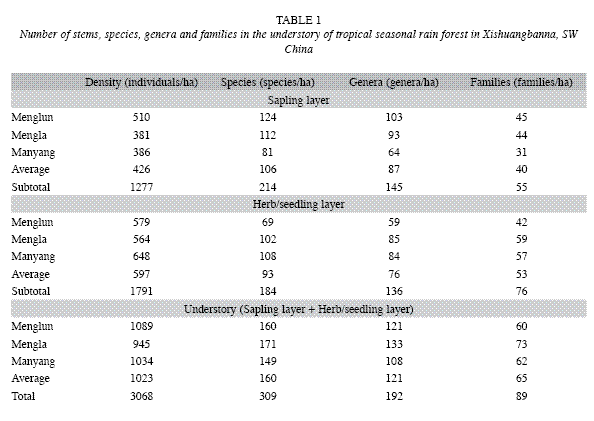
<body><![CDATA[<p align="justify"><b><font face="Verdana" size="2">Study area: </font></b><font  face="Verdana" size="2">This study was conducted in three localities in Xishuangbanna (21&deg;08&#8217;- 22&deg;36&#8217; N-99&deg;56&#8217;-101&deg;50&#8217; E), SW China, those were referred as: Menglun (21&deg;57&#8217; N-101&deg;12&#8217; E; 730m), Mengla (21&deg;32&#8217; N-101&deg;33&#8217; E; 581m) and Manyang (21&deg;27&#8217; N- 101&deg;36&#8217; E; 643m). Xishuangbanna borders Myanmar in the Southwest and Laos in the Southeast, and has mountainous topography, with mountain ridges running in a North&#8211;South direction, decreasing in elevation Southward (Cao <i>et al. </i>2006). This area has a typical monsoon climate with three distinct seasons: a humid hot rainy season (May-October), a foggy cool-dry season (November- February) and a hot-dry season (March-April). The mean annual temperature is 21.7&deg;C and there is little variation between years. The average annual rainfall is 1 550mm, with 87% occurring in the rainy season and 13% in the dry season. During the dry season, fog occurs almost every day and is heaviest from midnight until mid-morning. The mean relative humidity is 87%. The soil is classified as Latosol (pH 4.5-5.5) developed from purple sandstone (Cao <i>et al. </i>2006). The canopies of the forests in this study are dominated by the trees <i>Pometia tomentosa </i>and <i>Terminalia myriocarpa </i>(L&uuml; <i>et al</i>. 2010). While all these forests are old-growth ones, the forest in Manyang plot had been disturbed (about 10 stems DBH&gt;40cm had been logged by local people) before it was included in the nature reserve.</font></p>     <p align="justify"><font face="Verdana" size="2"><b>Field sampling: </b>Fieldwork was undertaken during December 2004 to April 2005. Each 1ha plot was divided into 100 subplots (10m&times;10m) to facilitate the inventory. The understory vegetation was stratified into two categories, sapling layer (individuals with height&#8805;1m but DBH&lt;2cm) and herb/seedling layer (individuals with height&lt;1m). In each plot, all individuals taller than 1m and with DBH less than 2cm were measured (DBH and height), labeled and identified to species within 25 quadrats of 5m&times;5m (bottom right of corresponding 10m&times;10m subplot, with the total area of 625m<sup>2</sup>) spaced systematically within each 1ha plot. Within each 5m&times;5m quadrat, seedlings (woody plants less than 1m tall) and herbs were sampled in the same way in a 2m&times;2m grid (bottom right of corresponding quadrat, with the total area of 100m<sup>2</sup>). Nomenclature of species follows Li <i>et al</i>. (1996).</font></p>     <p align="justify"><font face="Verdana" size="2">The number of species and individuals of saplings, seedlings, and herbs were recorded in each 5m&times;5m quadrat and 2m&times;2m grid. The most commonly used species diversity indices such as Shannon (H&#8217;), Simpson (</font><font><font face="Verdana"  size="2">&#955;</font></font><font face="Verdana" size="2">), Fisher&#8217;s </font><!-- big --><font  style="font-family: times new roman;"><font size="2"><!-- big -->&#945;<!-- /big --></font></font><!-- /big --><font  face="Verdana" size="2">, Hill&#8217;s diversity indices (N1 and N2) and evenness (E) were calculated. We also calculated the Sorenson Index (SI) and Jaccard Coefficient (J), which are good indicators of floristic similarity between two communities. A modified importance value index (IVI) for each species was calculated by summing its relative density and relative frequency in each plot, following Rasingam &amp; Parthasarathy (2009). The modified family importance value (FIV) for each family was estimated as the sum of relative diversity and relative density of the individuals in that family. Species diversity and composition were compared among the three different sites in order to examine the variation of understory composition in tropical seasonal forests.</font></p>     <p align="justify"><b><font face="Verdana" size="3">Results</font></b></p>     <p align="justify"><b><font face="Verdana" size="2">Species richness and diversity: </font></b><font face="Verdana" size="2">A total of 1277 individuals with DBH&lt;2cm and height&gt;1m (sapling layer) was recorded. They belonged to 214 species, 145 genera and 55 families (<a href="#tabla1">Table 1</a>). In addition, 1791 individuals of vascular plants &lt;1m (tree seedlings, shrubs, herbs and hemi-epiphytes) belonging to 184 species, 136 genera and 76 families (herb/seedling layer) were recorded. Overall, 309 species of vascular plants belonging to 192 genera and 89 families were recorded in the understory of three 1ha plots. All the species registered in this study are native to this area.    <br> </font></p>     <p align="justify"><font face="Verdana" size="2">    <br>     <br> </font></p>     <p style="text-align: center;"><font face="Verdana" size="2"><a  name="tabla1"></a><img src="/img/revistas/rbt/v59n1/a39t1.gif" title="" alt=""  style="width: 594px; height: 421px;">    ]]></body>
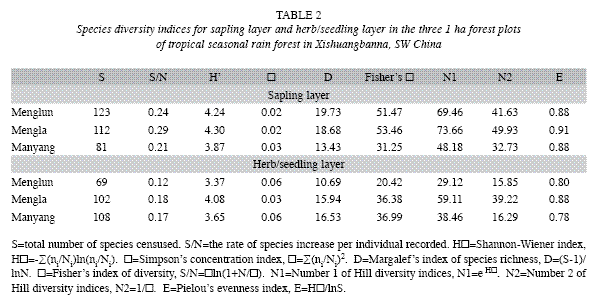
<body><![CDATA[<br>     <br> </font></p>     <p align="justify"><font face="Verdana" size="2">The number of vascular plant species per hectare was similar for both sapling and herb/ seedling layers, whereas the number of individuals per hectare was higher in the herb/seedling layer than the sapling layer (<a  href="#tabla1">Table 1</a>). The number of species in the sapling layer varied from 81 (Manyang) to 124 (Menglun), in the herb/seedling layer from 69 (Menglun) to 108 (Manyang). In terms of most of the diversity indices, the sapling layer was the most diverse in Mengla (<a href="#tabla2">Table 2</a>) and was the least diverse in Manyang. The herb/seedling layer was least diverse in Menglun caused by the lowest species richness. Mengla was more diverse than Manyang when Shannon-Wiener and Hill&#8217;s diversity indices were considered. However, Manyang was more diverse than Mengla when Margalef&#8217;s and Fisher&#8217;s indices of species richness were considered. The higher evenness in the herb/seedling layer of Mengla may contribute to this contrasting pattern.    <br> </font></p>     <p align="justify"><font face="Verdana" size="2">    <br>     <br> </font></p>     <p style="text-align: center;"><font face="Verdana" size="2"><a  name="tabla2"></a><img src="/img/revistas/rbt/v59n1/a39t2.gif" title="" alt=""  style="width: 594px; height: 307px;">    <br>     <br> </font></p>     ]]></body>
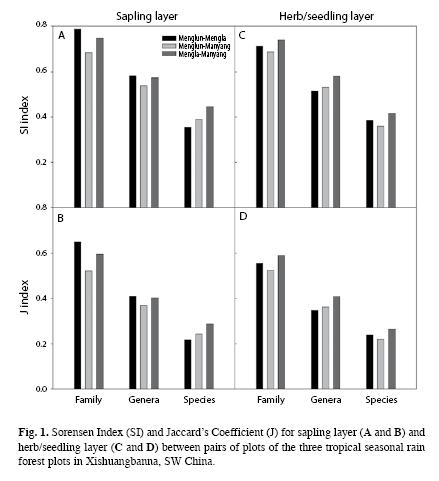
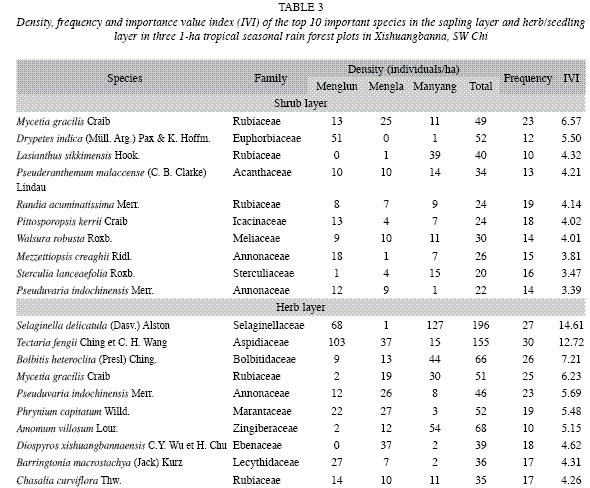
<body><![CDATA[<p align="justify"><font face="Verdana" size="2">In terms of both SI and J, the composition of sapling layer in Menglun and Mengla was the most similar pair at family level (<a href="#fig1">Fig. 1A</a>, <a  href="#fig1">B</a>). In contrast, Mengla and Manyang were the most similar pair at species level. For the herb/ seedling layer, the composition of Mengla and Manyang was the most similar at all the three taxonomic levels (<a href="#fig1">Fig. 1C</a>, <a href="#fig1">D</a>).    <br> </font></p>     <p align="justify"><font face="Verdana" size="2">    <br>     <br> </font></p>     <p style="text-align: center;"><font face="Verdana" size="2"><a  name="fig1"></a><img src="/img/revistas/rbt/v59n1/a39f1.jpg" title="" alt=""  style="width: 439px; height: 481px;">    <br>     <br> </font></p>     <p align="justify"><font face="Verdana" size="2"><b>Understory composition and structure: </b>No species accounted for more than 4% of the combined importance value (<a href="#tabla3">Table 3</a>) of the sapling layer. With 49 individuals the shrub <i>Mycetia gracilis </i>(Rubiaceae) was the most frequent species, and consequently, holding the highest importance value. The 10 most important species in the sapling layer accounted for 20% of the combined importance value. In contrast, this proportion was 35% in the herb/seedling layer. Three pteridophyte species, <i>Selaginella delicatula </i>(Dasv.) Alston (Selaginellaceae), <i>Tectaria fengii </i>Ching et C. H. Wang (Aspidiaceae) <i>and Bolbitis heteroclita </i>(Presl) Ching. (Bolbitidaceae), were the top three species with the highest IVIs due to the highest number and frequency of individuals (<a  href="#tabla3">Table 3</a>). In terms of IVI, only two species (the shrub <i>Mycetia gracilis </i>Craib and the tree <i>Pseuduvaria indochinensis </i>Merr.<i>) </i>appeared in the top tens in both sapling and herb/seedling layers. Averaged across the three 1ha plots, three-fourths of the species were represented by less than five individuals in both the sapling and herb/seedling layers, accounting for 37% and 23% of the total stems in each layer, respectively. On average, there was only one species in the sapling layer and five species in the herb/seedling layer with &gt;20 individuals in each plot, accounting for 1% and 41% of total stems in each stratum, respectively.    <br> </font></p>     ]]></body>
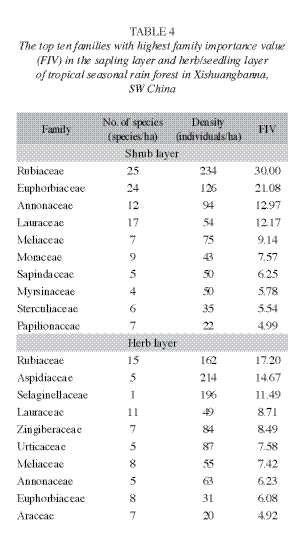
<body><![CDATA[<p align="justify"><font face="Verdana" size="2">    <br> </font></p>     <p align="justify"><font face="Verdana" size="2">    <br> </font></p>     <div style="text-align: center;"><a name="tabla3"></a><img  src="/img/revistas/rbt/v59n1/a39t3.gif" title="" alt=""  style="width: 590px; height: 488px;">    <br>     <br> </div>     <p align="justify"><font face="Verdana" size="2">The 10 most important families made up 58% of the combined importance value in the sapling layer and 46% of the total in the herb/seedling layer. Rubiaceae was the most species-rich and the most important family in both sapling and herb/seedling layers (<a href="#tabla4">Table 4</a>). Aspidiaceae, with the highest density, was the second most important family in the herb/seedling layer. Selaginellaceae, within which only one species recorded in the three plots, was ranked third in importance in the herb/seedling layer due to a very high density of this species. With respect to FIV, Rubiaceae, Euphorbiaceae, Lauraceae, Annonacae and Meliaceae were the five families found in the top ten in both sapling and herb/seedling layers (<a href="#tabla4">Table 4</a>).    <br> </font></p>     <p align="justify"><font face="Verdana" size="2">    ]]></body>
<body><![CDATA[<br> </font></p>     <p align="justify"><font face="Verdana" size="2">    <br> </font></p>     <div style="text-align: center;"><a name="tabla4"></a><img  src="/img/revistas/rbt/v59n1/a39t4.gif" title="" alt=""  style="width: 298px; height: 534px;">    <br>     <br> </div>     <p align="justify"><b><font face="Verdana" size="3">Discussion</font></b></p> <font face="Verdana" size="2"> </font>     <p align="justify"><font face="Verdana" size="2">In terms of the tree layer (DBH&#8805;10cm), the tropical seasonal forests in Xishuangbanna share several similar ecological characteristics, including forest profiles, physiognomic characteristics, species richness, density of stems for individual tree species and diameter sizeclasses with equatorial lowland rain forests (Zhu 1997). However, tropical forests with similar ecological characters in the tree layer may demonstrate major differences in understory structure and composition (LaFrankie <i>et al</i>. 2006). With 309 species recorded in the area of 1 875m<sup>2</sup> in three 1ha plots, the understory vegetation in the tropical seasonal rain forest in Xishuangbanna was much more diverse than the tropical evergreen forest in Anamalais (155 species in three thousand 4m<sup>2</sup> quadrats in a 30ha plot; Annaselvam &amp; Parthasarathy 1999) and Kolli Hills (52 species in eight hundred 4m<sup>2</sup> quadrats in a 8ha plot; Chittibabu &amp; Parthasarathy 2000) and tropical lowland forests of Little Andaman Island (108 species in eight hundred 1m<sup>2</sup> quadrats in eight 1ha plots, Rasingam &amp; Parthasarathy 2009) in India. In the tropical wet forest of Rio Palenque in Ecuador, 176 species were recorded in the understory (height&lt;3m) in a 0.1ha plot (Gentry &amp; Dodson 1987). Similarly, 121 herb species were enumerated in three 50m<sup>2</sup> plots in the tropical forests of Brunei (Poulsen &amp; Pendry 1995). In the tropical forests of Cameroon, 99-229 species per hectare in the herbacous layer (1cm&#8804;DBH&lt;1.5cm) were registered (Tchouto <i>et al</i>. 2006). The comparisons made between these data and our own highlights the high species diversity in the understory of tropical seasonal rain forest. Also, it is worth mentioning that it is difficult to do direct comparison of a number of features and statistics among the studies focused on understory due to the variation in criteria and methods used and also difficult to give comparisons among different strata in a particular forest due to the different sampling intensity for each stratum.</font></p>     <p align="justify"><font face="Verdana" size="2">The H&#8217; index ranged (3.87-4.24) in sapling layer and (3.37-4.08) in the herb/seedling layer, suggesting higher variation of species diversity in the herb/seedling layer than in the sapling layer among the three plots. Compared to other studies, the high H&#8217; index and low <font><font face="Verdana" size="2">&#955;</font></font>&#61472;index of the understory indicate that the species diversity of the understory in this forest is mainly constituted by rare species. This can also be seen from the distribution pattern of species and abundance in various frequency classes of individuals in the plots. For all the three plots, the evenness of sapling layer were relatively high (0.88-0.91) indicating that no species clearly dominates each plot. However, in the herb/seedling layer, the evenness index was higher in Mengla than Menglun and Manyang. Menglun plot was dominated by <i>Tectaria fengii </i>with 103 individuals, while Manyang plot was dominated by <i>Selaginella delicatula </i>with 127. In contrast, no species with more than 40 individuals was recorded in Mengla. The higher dominance in Manyang may be partly related to a more open canopy compared with other two plots due to the lower density of large trees (DBH &#8805;70cm). There are 17 and 19 stems with DBH&#8805;70cm in Menglun and Mengla, while only 10 stems in Manyang (L&uuml; <i>et al</i>. 2010).</font></p>     <p align="justify"><font face="Verdana" size="2">In this study, we found that the species richness of understory plants (309 species) is higher than the overstory (207 species, DBH&#8805;10cm) enumerated in the same plots (L&uuml; <i>et al</i>. 2010). Even when other widely used diversity indices were considered, there was no statistical significant difference among the tree layer, sapling layer and herb/seedling layer (One-way ANOVA, p&gt;0.05). This suggests either the sapling layer or the herb/seedling layer may have equal number of species with the tree layer in this forest. Our results are partly in line with those of Tchouto <i>et al</i>. (2006), who found that the shrub layer was the most species rich in all the strata of the Campo-Ma&#8217;an rain forest in Cameroon and consequently suggested that the diversity of trees may not reflect the overall diversity of the tropical forest. Results from the present study and those from Tchouto <i>et al</i>. (2006) confirm that species richness of the understory is usually as high as even higher than that of the tree layer, indicating that understory deserves more attention during biodiversity inventories in the future.</font></p>     ]]></body>
<body><![CDATA[<p align="justify"><font face="Verdana" size="2">Rubiaceae, Euphorbiaceae, Annonaceae, Lauraceae, Meliaceae, and Sapindaceae are the dominant families with the highest FIVs in the sapling layer. Similarly, they also dominate the tree layer (L&uuml; <i>et al</i>. 2010). It is understandable because a high proportion of the large tree species exist as saplings in the understory. In contrast, the family composition of the herb/ seedling layer differed considerably with that of the tree layer and sapling layer due to the dominance of ferns. Pteridophytes have been found to be dominant in the herb layer of both neotropical and paleotropical forests (Poulsen &amp; Nielsen 1995, Poulsen &amp; Pendry 1995). Although Acanthaceae, Poaceae and Asteraceae have been suggested to be the predominant families of ground herbs in tropical rainforests (Richards 1996), this was not the case in our study. We suspect this may result from the competition between ferns and other herbs. The five families, Euphorbiaceae, Annonaceae, Lauraceae, Sapindaceae and Meliaceae, were among the dominant ones not only in the tree layer (L&uuml; <i>et al</i>. 2010) but also in both sapling and herb/seedling layers. This indicates that the seedlings and saplings of these families contributed strongly to the composition of the understory in this forest.</font></p>     <p align="justify"><font face="Verdana" size="2">In summary, this study has demonstrated that the understory could contribute a lot to the total species richness of tropical seasonal rain forests. The sapling layer (individuals with height&gt;1m but DBH&lt;2cm) and herb/seedling layer (individuals with height&lt;1m) may hold as many species as the tree layer (DBH&#8805;10cm). All these results suggest that the understory vegetation should be given full consideration for the assessment of biodiversity patterns in tropical forests. The increased interest in forest understory has resulted in many different methods used to census understory composition. Differences in censusing methods result in substantially different results and confound comparisons among studies. Consequently, a standard protocol for understory censuses, especially for tropical forests, is critically needed.</font></p> <b><font face="Verdana" size="3">     <p align="justify">Acknowledgments</p> </font></b><font face="Verdana" size="2">     <p align="justify">We thank Chen Defu and Lu Yun for their assistance in the field and, Tao Guoda, Wang Hong, and Li Baogui for help in species identification. The manuscript was greatly improved by comments and suggestions from three anonymous reviewers. This study was jointly supported by the CAS Project of Knowledge Innovation (No.KZCX1-SW-01), "Light of Western China" of CAS and the Field Station Foundation of CAS.</p> </font><b><font face="Verdana" size="3"> </font></b> <hr style="width: 100%; height: 2px;"><b><font face="Verdana" size="3">     <p align="justify">References</p> </font></b><font face="Verdana" size="2"> </font>     <!-- ref --><p align="justify"><font face="Verdana" size="2">Annaselvam, J. &amp; N. Parthasarathy. 1999. Inventories of understory plants in a tropical evergreen forest in the Anamalais, Western Ghats, India. Ecotropica 5:197-211.    &nbsp;&nbsp;&nbsp;&nbsp;&nbsp;&nbsp;&nbsp;&nbsp;[&#160;<a href="javascript:void(0);" onclick="javascript: window.open('/scielo.php?script=sci_nlinks&ref=1718457&pid=S0034-7744201100010003900001&lng=','','width=640,height=500,resizable=yes,scrollbars=1,menubar=yes,');">Links</a>&#160;]<!-- end-ref --></font></p>     <!-- ref --><p align="justify"><font face="Verdana" size="2">Ares, A., S.D. Berryman &amp; K.J. Puettmann. 2009. Understory vegetation response to thinning disturbance of varying complexity in coniferous stands. Appl. Veg. Sci. 12: 472-487.    &nbsp;&nbsp;&nbsp;&nbsp;&nbsp;&nbsp;&nbsp;&nbsp;[&#160;<a href="javascript:void(0);" onclick="javascript: window.open('/scielo.php?script=sci_nlinks&ref=1718459&pid=S0034-7744201100010003900002&lng=','','width=640,height=500,resizable=yes,scrollbars=1,menubar=yes,');">Links</a>&#160;]<!-- end-ref --></font></p>     <!-- ref --><p align="justify"><font face="Verdana" size="2">Benitez-Malvido, J. &amp; M. Martinez-Ramos. 2003. Impact of forest fragmentation on understory plant species richness in Amazonia. Conservat. Biol. 17: 389-400.    &nbsp;&nbsp;&nbsp;&nbsp;&nbsp;&nbsp;&nbsp;&nbsp;[&#160;<a href="javascript:void(0);" onclick="javascript: window.open('/scielo.php?script=sci_nlinks&ref=1718461&pid=S0034-7744201100010003900003&lng=','','width=640,height=500,resizable=yes,scrollbars=1,menubar=yes,');">Links</a>&#160;]<!-- end-ref --><!-- ref --> Cao, M., X.M. Zou, M. Warren &amp; H. Zhu. 2006. Tropical forests of Xishuangbanna, China. Biotropica 38: 306-309.    &nbsp;&nbsp;&nbsp;&nbsp;&nbsp;&nbsp;&nbsp;&nbsp;[&#160;<a href="javascript:void(0);" onclick="javascript: window.open('/scielo.php?script=sci_nlinks&ref=1718462&pid=S0034-7744201100010003900004&lng=','','width=640,height=500,resizable=yes,scrollbars=1,menubar=yes,');">Links</a>&#160;]<!-- end-ref --></font></p>     <!-- ref --><p align="justify"><font face="Verdana" size="2">Chittibabu, C.V. &amp; N. Parthasarathy. 2000. Understory plant diversity in a tropical evergreen forest in the Kolli Hills, eastern Ghants, India. Ecotropica 6: 129-140.    &nbsp;&nbsp;&nbsp;&nbsp;&nbsp;&nbsp;&nbsp;&nbsp;[&#160;<a href="javascript:void(0);" onclick="javascript: window.open('/scielo.php?script=sci_nlinks&ref=1718464&pid=S0034-7744201100010003900005&lng=','','width=640,height=500,resizable=yes,scrollbars=1,menubar=yes,');">Links</a>&#160;]<!-- end-ref --></font></p>     <!-- ref --><p align="justify"><font face="Verdana" size="2">Gentry, A.H. &amp; C.D. Dodson. 1987. Contribution of nontrees to species richness of a tropical rain forest. Biotropica 19: 149-156.    &nbsp;&nbsp;&nbsp;&nbsp;&nbsp;&nbsp;&nbsp;&nbsp;[&#160;<a href="javascript:void(0);" onclick="javascript: window.open('/scielo.php?script=sci_nlinks&ref=1718466&pid=S0034-7744201100010003900006&lng=','','width=640,height=500,resizable=yes,scrollbars=1,menubar=yes,');">Links</a>&#160;]<!-- end-ref --></font></p>     <!-- ref --><p align="justify"><font face="Verdana" size="2">Gentry, A.H. &amp; L.H. Emmons. 1987. Geographical variation in fertility, phenology, and composition of the understory of Neotropical forests. Biotropica 19: 216-227.    &nbsp;&nbsp;&nbsp;&nbsp;&nbsp;&nbsp;&nbsp;&nbsp;[&#160;<a href="javascript:void(0);" onclick="javascript: window.open('/scielo.php?script=sci_nlinks&ref=1718468&pid=S0034-7744201100010003900007&lng=','','width=640,height=500,resizable=yes,scrollbars=1,menubar=yes,');">Links</a>&#160;]<!-- end-ref --></font></p>     <!-- ref --><p align="justify"><font face="Verdana" size="2">Harms, K.E., J.S. Powers &amp; R.A. Montgomery. 2004. Variation in small sapling density, understory cover, and resource availability in four Neotropical forests. Biotropica 36: 40-51.    &nbsp;&nbsp;&nbsp;&nbsp;&nbsp;&nbsp;&nbsp;&nbsp;[&#160;<a href="javascript:void(0);" onclick="javascript: window.open('/scielo.php?script=sci_nlinks&ref=1718470&pid=S0034-7744201100010003900008&lng=','','width=640,height=500,resizable=yes,scrollbars=1,menubar=yes,');">Links</a>&#160;]<!-- end-ref --></font></p>     ]]></body>
<body><![CDATA[<!-- ref --><p align="justify"><font face="Verdana" size="2">Hart, S.A. &amp; H.Y.H. Chen. 2008. Fire, logging, and overstory affect understory abundance, diversity, and composition in boreal forest. Ecol.Monogr.78: 123-140.    &nbsp;&nbsp;&nbsp;&nbsp;&nbsp;&nbsp;&nbsp;&nbsp;[&#160;<a href="javascript:void(0);" onclick="javascript: window.open('/scielo.php?script=sci_nlinks&ref=1718472&pid=S0034-7744201100010003900009&lng=','','width=640,height=500,resizable=yes,scrollbars=1,menubar=yes,');">Links</a>&#160;]<!-- end-ref --></font></p>     <!-- ref --><p align="justify"><font face="Verdana" size="2">Hirao, T., M. Murakami &amp; A. Kashizaki. 2009. Importance of the understory stratum to entomofaunal diversity in a temperate deciduous forest. Ecol. Res. 24: 263-272.    &nbsp;&nbsp;&nbsp;&nbsp;&nbsp;&nbsp;&nbsp;&nbsp;[&#160;<a href="javascript:void(0);" onclick="javascript: window.open('/scielo.php?script=sci_nlinks&ref=1718474&pid=S0034-7744201100010003900010&lng=','','width=640,height=500,resizable=yes,scrollbars=1,menubar=yes,');">Links</a>&#160;]<!-- end-ref --></font></p>     <!-- ref --><p align="justify"><font face="Verdana" size="2">LaFrankie, J.V., P.S. Ashton, G.B. Chuyong, L. Co, R. Condit, S.J. Davies, R. Foster, S.P. Hubbell, D. Kenfack, D. Lagunzad, E.C. Losos, N.S.M. Nor, S. Tan, D.W. Thomas, R. Valencia &amp; G. Villa. 2006. Contrasting structure and composition of the understory in species-rich tropical rain forests. Ecology 87: 2298-2305.    &nbsp;&nbsp;&nbsp;&nbsp;&nbsp;&nbsp;&nbsp;&nbsp;[&#160;<a href="javascript:void(0);" onclick="javascript: window.open('/scielo.php?script=sci_nlinks&ref=1718476&pid=S0034-7744201100010003900011&lng=','','width=640,height=500,resizable=yes,scrollbars=1,menubar=yes,');">Links</a>&#160;]<!-- end-ref --></font></p>     <!-- ref --><p align="justify"><font face="Verdana" size="2">Levin, P.S. &amp; D.A. Levin. 2001. The real biodiversity crisis. Am. Sci. 90: 6-8.    &nbsp;&nbsp;&nbsp;&nbsp;&nbsp;&nbsp;&nbsp;&nbsp;[&#160;<a href="javascript:void(0);" onclick="javascript: window.open('/scielo.php?script=sci_nlinks&ref=1718478&pid=S0034-7744201100010003900012&lng=','','width=640,height=500,resizable=yes,scrollbars=1,menubar=yes,');">Links</a>&#160;]<!-- end-ref --></font></p>     <!-- ref --><p align="justify"><font face="Verdana" size="2">Li, Y., S.J. Pei &amp; Z.F. Xu. 1996. List of Plants in Xishuangbanna. Yunnan Nationality, Kunming, China.    &nbsp;&nbsp;&nbsp;&nbsp;&nbsp;&nbsp;&nbsp;&nbsp;[&#160;<a href="javascript:void(0);" onclick="javascript: window.open('/scielo.php?script=sci_nlinks&ref=1718480&pid=S0034-7744201100010003900013&lng=','','width=640,height=500,resizable=yes,scrollbars=1,menubar=yes,');">Links</a>&#160;]<!-- end-ref --></font></p>     ]]></body>
<body><![CDATA[<!-- ref --><p align="justify"><font face="Verdana" size="2">Li, H.M., Y.X. Ma, T.M. Aide &amp; W.J. Liu. 2008. Past, present and future land-use in Xishuangbanna, China and the implications for carbon dynamics. Forest Ecol. Manag. 255: 16-24.    &nbsp;&nbsp;&nbsp;&nbsp;&nbsp;&nbsp;&nbsp;&nbsp;[&#160;<a href="javascript:void(0);" onclick="javascript: window.open('/scielo.php?script=sci_nlinks&ref=1718482&pid=S0034-7744201100010003900014&lng=','','width=640,height=500,resizable=yes,scrollbars=1,menubar=yes,');">Links</a>&#160;]<!-- end-ref --></font></p>     <!-- ref --><p align="justify"><font face="Verdana" size="2">L&uuml;, X.T., J.W. Tang, Z.L. Feng &amp; M.H. Li. 2009. Diversity and aboveground biomass of lianas in the tropical seasonal rain forests of Xishuangbanna, SW China. Rev. Biol. Trop. 57: 211-222.    &nbsp;&nbsp;&nbsp;&nbsp;&nbsp;&nbsp;&nbsp;&nbsp;[&#160;<a href="javascript:void(0);" onclick="javascript: window.open('/scielo.php?script=sci_nlinks&ref=1718484&pid=S0034-7744201100010003900015&lng=','','width=640,height=500,resizable=yes,scrollbars=1,menubar=yes,');">Links</a>&#160;]<!-- end-ref --></font></p>     <!-- ref --><p align="justify"><font face="Verdana" size="2">L&uuml;, X.T., J.X. Yin &amp; J.W. Tang. 2010. Structure, tree pecies diversity and composition of tropical seasonal rainforests in Xishuangbanna, South-West China. J. Trop. Forest. Sci. 22: 260-270.    &nbsp;&nbsp;&nbsp;&nbsp;&nbsp;&nbsp;&nbsp;&nbsp;[&#160;<a href="javascript:void(0);" onclick="javascript: window.open('/scielo.php?script=sci_nlinks&ref=1718486&pid=S0034-7744201100010003900016&lng=','','width=640,height=500,resizable=yes,scrollbars=1,menubar=yes,');">Links</a>&#160;]<!-- end-ref --></font></p>     <!-- ref --><p align="justify"><font face="Verdana" size="2">Mayfield, M.M. &amp; G.C. Daily. 2005. Countryside biogeography of neotropical herbaceous and shrubby plants. Ecol. Appl. 15: 423-439.    &nbsp;&nbsp;&nbsp;&nbsp;&nbsp;&nbsp;&nbsp;&nbsp;[&#160;<a href="javascript:void(0);" onclick="javascript: window.open('/scielo.php?script=sci_nlinks&ref=1718488&pid=S0034-7744201100010003900017&lng=','','width=640,height=500,resizable=yes,scrollbars=1,menubar=yes,');">Links</a>&#160;]<!-- end-ref --></font></p>     <!-- ref --><p align="justify"><font face="Verdana" size="2">Muthuramkumar, S., N. Ayyappan, N. Parthasarathy, D. Mudappa, T.R.S. Raman, M.A. Selwyn &amp; L.A. Pragasan. 2006. Plant community structure in tropical rain forest fragments of the western Ghats, India. Biotropica 38: 143-160.    &nbsp;&nbsp;&nbsp;&nbsp;&nbsp;&nbsp;&nbsp;&nbsp;[&#160;<a href="javascript:void(0);" onclick="javascript: window.open('/scielo.php?script=sci_nlinks&ref=1718490&pid=S0034-7744201100010003900018&lng=','','width=640,height=500,resizable=yes,scrollbars=1,menubar=yes,');">Links</a>&#160;]<!-- end-ref --></font></p>     ]]></body>
<body><![CDATA[<!-- ref --><p align="justify"><font face="Verdana" size="2">Newbery, D.M., E.J.F. Campbell, J. Proctor &amp; M.J. Still. 1996. Primary lowland dipterocarp forest at Danum Valley, Sabah, Malaysia. Species composition and patterns in the understorey. Vegetatio 122: 193-220.    &nbsp;&nbsp;&nbsp;&nbsp;&nbsp;&nbsp;&nbsp;&nbsp;[&#160;<a href="javascript:void(0);" onclick="javascript: window.open('/scielo.php?script=sci_nlinks&ref=1718492&pid=S0034-7744201100010003900019&lng=','','width=640,height=500,resizable=yes,scrollbars=1,menubar=yes,');">Links</a>&#160;]<!-- end-ref --></font></p>     <!-- ref --><p align="justify"><font face="Verdana" size="2">Newbery, D.M., D.N. Kennedy, G.H. Petol, L. Madani &amp; C.E. Ridsdale. 1999. Primary forest dynamics in lowland dipterocarp forest at Danum Valley, Sabah, Malaysia, and the role of the understorey. Philos. T. Roy. Soc. B 354: 1763-1782.    &nbsp;&nbsp;&nbsp;&nbsp;&nbsp;&nbsp;&nbsp;&nbsp;[&#160;<a href="javascript:void(0);" onclick="javascript: window.open('/scielo.php?script=sci_nlinks&ref=1718494&pid=S0034-7744201100010003900020&lng=','','width=640,height=500,resizable=yes,scrollbars=1,menubar=yes,');">Links</a>&#160;]<!-- end-ref --></font></p>     <!-- ref --><p align="justify"><font face="Verdana" size="2">Nilsson, M.C. &amp; D.A. Wardle. 2005. Understory vegetation as a forest ecosystem driver: evidence from the northern Swedish boreal forest. Front. Ecol. Environ. 3: 421-428.    &nbsp;&nbsp;&nbsp;&nbsp;&nbsp;&nbsp;&nbsp;&nbsp;[&#160;<a href="javascript:void(0);" onclick="javascript: window.open('/scielo.php?script=sci_nlinks&ref=1718496&pid=S0034-7744201100010003900021&lng=','','width=640,height=500,resizable=yes,scrollbars=1,menubar=yes,');">Links</a>&#160;]<!-- end-ref --></font></p>     <!-- ref --><p align="justify"><font face="Verdana" size="2">Poulsen A.D. &amp; I.H. Nielsen. 1995. How many ferns are there in one hectare of tropical rain forest? Am. Fern J. 85: 29-35.    &nbsp;&nbsp;&nbsp;&nbsp;&nbsp;&nbsp;&nbsp;&nbsp;[&#160;<a href="javascript:void(0);" onclick="javascript: window.open('/scielo.php?script=sci_nlinks&ref=1718498&pid=S0034-7744201100010003900022&lng=','','width=640,height=500,resizable=yes,scrollbars=1,menubar=yes,');">Links</a>&#160;]<!-- end-ref --></font></p>     <!-- ref --><p align="justify"><font face="Verdana" size="2">Poulsen, A.D. &amp; C.A. Pendry. 1995. Inventories of ground herbs at three altitudes on Bukit Belalong, Brunei, Borneo. Biodivers. Conserv. 4: 745-757.    &nbsp;&nbsp;&nbsp;&nbsp;&nbsp;&nbsp;&nbsp;&nbsp;[&#160;<a href="javascript:void(0);" onclick="javascript: window.open('/scielo.php?script=sci_nlinks&ref=1718500&pid=S0034-7744201100010003900023&lng=','','width=640,height=500,resizable=yes,scrollbars=1,menubar=yes,');">Links</a>&#160;]<!-- end-ref --></font></p>     ]]></body>
<body><![CDATA[<!-- ref --><p align="justify"><font face="Verdana" size="2">Rasingam, L. &amp; N. Parthasarathy. 2009. Diversity of understory plants in undisturbed and disturbed tropical lowland forests of Little Andaman Island, India. Biodivers. Conserv. 18: 1045-1065.    &nbsp;&nbsp;&nbsp;&nbsp;&nbsp;&nbsp;&nbsp;&nbsp;[&#160;<a href="javascript:void(0);" onclick="javascript: window.open('/scielo.php?script=sci_nlinks&ref=1718502&pid=S0034-7744201100010003900024&lng=','','width=640,height=500,resizable=yes,scrollbars=1,menubar=yes,');">Links</a>&#160;]<!-- end-ref --></font></p>     <!-- ref --><p align="justify"><font face="Verdana" size="2">Richards, P.W. 1996. The Tropical Rain Forest. Cambridge University, Cambridge.    &nbsp;&nbsp;&nbsp;&nbsp;&nbsp;&nbsp;&nbsp;&nbsp;[&#160;<a href="javascript:void(0);" onclick="javascript: window.open('/scielo.php?script=sci_nlinks&ref=1718504&pid=S0034-7744201100010003900025&lng=','','width=640,height=500,resizable=yes,scrollbars=1,menubar=yes,');">Links</a>&#160;]<!-- end-ref --></font></p>     <!-- ref --><p align="justify"><font face="Verdana" size="2">Royo, A.A. &amp; W.P Carson. 2006. On the formation of dense understory layers in forests worldwide: consequences and implications for forest dynamics, biodiversity, and succession. Can. J. Forest Res. 36: 1345-1362.    &nbsp;&nbsp;&nbsp;&nbsp;&nbsp;&nbsp;&nbsp;&nbsp;[&#160;<a href="javascript:void(0);" onclick="javascript: window.open('/scielo.php?script=sci_nlinks&ref=1718506&pid=S0034-7744201100010003900026&lng=','','width=640,height=500,resizable=yes,scrollbars=1,menubar=yes,');">Links</a>&#160;]<!-- end-ref --></font></p>     <!-- ref --><p align="justify"><font face="Verdana" size="2">Sangar, R., A. Singh &amp; J.S. Singh. 2008. Differential effect of woody plant canopies on species composition and diversity of ground vegetation: a case study. Trop. Ecol. 49: 189-197.    &nbsp;&nbsp;&nbsp;&nbsp;&nbsp;&nbsp;&nbsp;&nbsp;[&#160;<a href="javascript:void(0);" onclick="javascript: window.open('/scielo.php?script=sci_nlinks&ref=1718508&pid=S0034-7744201100010003900027&lng=','','width=640,height=500,resizable=yes,scrollbars=1,menubar=yes,');">Links</a>&#160;]<!-- end-ref --></font></p>     <!-- ref --><p align="justify"><font face="Verdana" size="2">Tchouto, M.G.P., W.F. De Boer, J. De Wilde &amp; L.J.G. Van der Maesen. 2006. Diversity patterns in the flora of the Campo-Ma&#8217;an rain forest, Cameroon: do tree species tell it all? Biodivers. Conserv. 15: 1353-1374.    &nbsp;&nbsp;&nbsp;&nbsp;&nbsp;&nbsp;&nbsp;&nbsp;[&#160;<a href="javascript:void(0);" onclick="javascript: window.open('/scielo.php?script=sci_nlinks&ref=1718510&pid=S0034-7744201100010003900028&lng=','','width=640,height=500,resizable=yes,scrollbars=1,menubar=yes,');">Links</a>&#160;]<!-- end-ref --></font></p>     ]]></body>
<body><![CDATA[<!-- ref --><p align="justify"><font face="Verdana" size="2">Zhu, H. 1997. Ecological and biogeographical studies on the tropical rain forest of south Yunnan, SW China with a special reference to its relation with rain forests in tropical Asia. J. Biogeogr. 24: 647-662.    &nbsp;&nbsp;&nbsp;&nbsp;&nbsp;&nbsp;&nbsp;&nbsp;[&#160;<a href="javascript:void(0);" onclick="javascript: window.open('/scielo.php?script=sci_nlinks&ref=1718512&pid=S0034-7744201100010003900029&lng=','','width=640,height=500,resizable=yes,scrollbars=1,menubar=yes,');">Links</a>&#160;]<!-- end-ref --></font></p>     <!-- ref --><p align="justify"><font face="Verdana" size="2">Zhu, H., Z.F. Xu, H.Wang &amp; B.G. Li. 2004. Tropical rain forest fragmentation and its ecological and species diversity changes in southern Yunnan. Biodivers. Conserv. 13: 1355-1372.    &nbsp;&nbsp;&nbsp;&nbsp;&nbsp;&nbsp;&nbsp;&nbsp;[&#160;<a href="javascript:void(0);" onclick="javascript: window.open('/scielo.php?script=sci_nlinks&ref=1718514&pid=S0034-7744201100010003900030&lng=','','width=640,height=500,resizable=yes,scrollbars=1,menubar=yes,');">Links</a>&#160;]<!-- end-ref --></font></p>     <!-- ref --><p align="justify"><font face="Verdana" size="2">Ziegler, A.D., J.M. Fox &amp; J.C. Xu. 2009. The Rubber Juggernaut. Science 324: 1024-1025.    &nbsp;&nbsp;&nbsp;&nbsp;&nbsp;&nbsp;&nbsp;&nbsp;[&#160;<a href="javascript:void(0);" onclick="javascript: window.open('/scielo.php?script=sci_nlinks&ref=1718516&pid=S0034-7744201100010003900031&lng=','','width=640,height=500,resizable=yes,scrollbars=1,menubar=yes,');">Links</a>&#160;]<!-- end-ref --><br> </font></p>     <p align="justify"><font face="Verdana" size="2">    <br> </font></p>     <p align="justify"><font face="Verdana" size="2"><a  name="correspondencia"></a>Correspondencia a: <font face="Verdana"  size="2">Xiao-Tao L&uuml;. </font><font face="Verdana" size="2">Xishuangbanna Tropical Botanical Garden, Chinese Academy of Sciences. Mengla County, Yunnan 666303, China; lvxiaotao@gmail.com / Institute of Applied Ecology, Chinese Academy of Sciences, Shenyang 110016, China; <a href="mailto:xia0615@126.com">xia0615@126.com</a>    <br> </font><font face="Verdana" size="2">Jian-Wei Tang. </font><font  face="Verdana" size="2">Xishuangbanna Tropical Botanical Garden, Chinese Academy of Sciences. Mengla County, Yunnan 666303, China;<a href="mailto:tangjw@xtbg.org.cn">tangjw@xtbg.org.cn</a>    ]]></body>
<body><![CDATA[<br> </font><font face="Verdana" size="2">Jiang-Xia Yin. </font><font  face="Verdana" size="2">School of Life Science, Liaoning University, Shenyang 110036, China; <a href="mailto:yinjiangxia@gmail.com">yinjiangxia@gmail.com</a>, <a  href="mailto:tangjw@xtbg.org.cn">tangjw@xtbg.org.cn</a></font></font></p> <hr style="width: 100%; height: 2px;"><font face="Verdana" size="2"> </font>     <p align="center"><font face="Verdana" size="2">Received 22-III-2010. Corrected 28-VIII-2010. Accepted 28-IX-2010.</font></p>      ]]></body><back>
<ref-list>
<ref id="B1">
<nlm-citation citation-type="journal">
<person-group person-group-type="author">
<name>
<surname><![CDATA[Annaselvam]]></surname>
<given-names><![CDATA[J]]></given-names>
</name>
<name>
<surname><![CDATA[Parthasarathy]]></surname>
<given-names><![CDATA[N]]></given-names>
</name>
</person-group>
<article-title xml:lang="en"><![CDATA[Inventories of understory plants in a tropical evergreen forest in the Anamalais, Western Ghats, India]]></article-title>
<source><![CDATA[Ecotropica]]></source>
<year>1999</year>
<volume>5</volume>
<page-range>197-211</page-range></nlm-citation>
</ref>
<ref id="B2">
<nlm-citation citation-type="journal">
<person-group person-group-type="author">
<name>
<surname><![CDATA[Ares]]></surname>
<given-names><![CDATA[A]]></given-names>
</name>
<name>
<surname><![CDATA[Berryman]]></surname>
<given-names><![CDATA[S.D]]></given-names>
</name>
<name>
<surname><![CDATA[Puettmann]]></surname>
<given-names><![CDATA[K.J]]></given-names>
</name>
</person-group>
<article-title xml:lang="en"><![CDATA[Understory vegetation response to thinning disturbance of varying complexity in coniferous stands]]></article-title>
<source><![CDATA[Appl. Veg. Sci]]></source>
<year>2009</year>
<volume>12</volume>
<page-range>472-487</page-range></nlm-citation>
</ref>
<ref id="B3">
<nlm-citation citation-type="journal">
<person-group person-group-type="author">
<name>
<surname><![CDATA[Benitez-Malvido]]></surname>
<given-names><![CDATA[J]]></given-names>
</name>
<name>
<surname><![CDATA[Martinez-Ramos]]></surname>
<given-names><![CDATA[M]]></given-names>
</name>
</person-group>
<article-title xml:lang="en"><![CDATA[Impact of forest fragmentation on understory plant species richness in Amazonia]]></article-title>
<source><![CDATA[Conservat. Biol]]></source>
<year>2003</year>
<volume>17</volume>
<page-range>389-400</page-range></nlm-citation>
</ref>
<ref id="B4">
<nlm-citation citation-type="journal">
<person-group person-group-type="author">
<name>
<surname><![CDATA[Cao]]></surname>
<given-names><![CDATA[M]]></given-names>
</name>
<name>
<surname><![CDATA[Zou]]></surname>
<given-names><![CDATA[X.M]]></given-names>
</name>
<name>
<surname><![CDATA[Warren]]></surname>
<given-names><![CDATA[M]]></given-names>
</name>
<name>
<surname><![CDATA[Zhu]]></surname>
<given-names><![CDATA[H]]></given-names>
</name>
</person-group>
<article-title xml:lang="en"><![CDATA[Tropical forests of Xishuangbanna, China]]></article-title>
<source><![CDATA[Biotropica]]></source>
<year>2006</year>
<volume>38</volume>
<page-range>306-309</page-range></nlm-citation>
</ref>
<ref id="B5">
<nlm-citation citation-type="journal">
<person-group person-group-type="author">
<name>
<surname><![CDATA[Chittibabu]]></surname>
<given-names><![CDATA[C.V]]></given-names>
</name>
<name>
<surname><![CDATA[Parthasarathy]]></surname>
<given-names><![CDATA[N]]></given-names>
</name>
</person-group>
<article-title xml:lang="en"><![CDATA[Understory plant diversity in a tropical evergreen forest in the Kolli Hills, eastern Ghants, India]]></article-title>
<source><![CDATA[Ecotropica]]></source>
<year>2000</year>
<volume>6</volume>
<page-range>129-140</page-range></nlm-citation>
</ref>
<ref id="B6">
<nlm-citation citation-type="journal">
<person-group person-group-type="author">
<name>
<surname><![CDATA[Gentry]]></surname>
<given-names><![CDATA[A.H]]></given-names>
</name>
<name>
<surname><![CDATA[Dodson]]></surname>
<given-names><![CDATA[C.D]]></given-names>
</name>
</person-group>
<article-title xml:lang="en"><![CDATA[Contribution of nontrees to species richness of a tropical rain forest]]></article-title>
<source><![CDATA[Biotropica]]></source>
<year>1987</year>
<volume>19</volume>
<page-range>149-156</page-range></nlm-citation>
</ref>
<ref id="B7">
<nlm-citation citation-type="journal">
<person-group person-group-type="author">
<name>
<surname><![CDATA[Gentry]]></surname>
<given-names><![CDATA[A.H]]></given-names>
</name>
<name>
<surname><![CDATA[Emmons]]></surname>
<given-names><![CDATA[L.H]]></given-names>
</name>
</person-group>
<article-title xml:lang="en"><![CDATA[Geographical variation in fertility, phenology, and composition of the understory of Neotropical forests]]></article-title>
<source><![CDATA[Biotropica]]></source>
<year>1987</year>
<volume>19</volume>
<page-range>216-227</page-range></nlm-citation>
</ref>
<ref id="B8">
<nlm-citation citation-type="journal">
<person-group person-group-type="author">
<name>
<surname><![CDATA[Harms]]></surname>
<given-names><![CDATA[K.E]]></given-names>
</name>
<name>
<surname><![CDATA[Powers]]></surname>
<given-names><![CDATA[J.S]]></given-names>
</name>
<name>
<surname><![CDATA[Montgomery]]></surname>
<given-names><![CDATA[R.A]]></given-names>
</name>
</person-group>
<article-title xml:lang="en"><![CDATA[Variation in small sapling density, understory cover, and resource availability in four Neotropical forests]]></article-title>
<source><![CDATA[Biotropica]]></source>
<year>2004</year>
<volume>36</volume>
<page-range>40-51</page-range></nlm-citation>
</ref>
<ref id="B9">
<nlm-citation citation-type="journal">
<person-group person-group-type="author">
<name>
<surname><![CDATA[Hart]]></surname>
<given-names><![CDATA[S.A]]></given-names>
</name>
<name>
<surname><![CDATA[Chen]]></surname>
<given-names><![CDATA[H.Y.H]]></given-names>
</name>
</person-group>
<article-title xml:lang="en"><![CDATA[Fire, logging, and overstory affect understory abundance, diversity, and composition in boreal forest]]></article-title>
<source><![CDATA[Ecol.Monogr]]></source>
<year>2008</year>
<volume>78</volume>
<page-range>123-140</page-range></nlm-citation>
</ref>
<ref id="B10">
<nlm-citation citation-type="journal">
<person-group person-group-type="author">
<name>
<surname><![CDATA[Hirao]]></surname>
<given-names><![CDATA[T]]></given-names>
</name>
<name>
<surname><![CDATA[Murakami]]></surname>
<given-names><![CDATA[M]]></given-names>
</name>
<name>
<surname><![CDATA[Kashizaki]]></surname>
<given-names><![CDATA[A]]></given-names>
</name>
</person-group>
<article-title xml:lang="en"><![CDATA[Importance of the understory stratum to entomofaunal diversity in a temperate deciduous forest]]></article-title>
<source><![CDATA[Ecol. Res]]></source>
<year>2009</year>
<volume>24</volume>
<page-range>263-272</page-range></nlm-citation>
</ref>
<ref id="B11">
<nlm-citation citation-type="journal">
<person-group person-group-type="author">
<name>
<surname><![CDATA[LaFrankie]]></surname>
<given-names><![CDATA[J.V]]></given-names>
</name>
<name>
<surname><![CDATA[Ashton]]></surname>
<given-names><![CDATA[P.S]]></given-names>
</name>
<name>
<surname><![CDATA[Chuyong]]></surname>
<given-names><![CDATA[G.B]]></given-names>
</name>
<name>
<surname><![CDATA[Co]]></surname>
<given-names><![CDATA[L]]></given-names>
</name>
<name>
<surname><![CDATA[Condit]]></surname>
<given-names><![CDATA[R]]></given-names>
</name>
<name>
<surname><![CDATA[Davies]]></surname>
<given-names><![CDATA[S.J]]></given-names>
</name>
<name>
<surname><![CDATA[Foster]]></surname>
<given-names><![CDATA[R]]></given-names>
</name>
<name>
<surname><![CDATA[Hubbell]]></surname>
<given-names><![CDATA[S.P]]></given-names>
</name>
<name>
<surname><![CDATA[Kenfack]]></surname>
<given-names><![CDATA[D]]></given-names>
</name>
<name>
<surname><![CDATA[Lagunzad]]></surname>
<given-names><![CDATA[D]]></given-names>
</name>
<name>
<surname><![CDATA[Losos]]></surname>
<given-names><![CDATA[E.C]]></given-names>
</name>
<name>
<surname><![CDATA[Nor]]></surname>
<given-names><![CDATA[N.S.M]]></given-names>
</name>
<name>
<surname><![CDATA[Tan]]></surname>
<given-names><![CDATA[S]]></given-names>
</name>
<name>
<surname><![CDATA[Thomas]]></surname>
<given-names><![CDATA[D.W]]></given-names>
</name>
<name>
<surname><![CDATA[Valencia]]></surname>
<given-names><![CDATA[R]]></given-names>
</name>
<name>
<surname><![CDATA[Villa]]></surname>
<given-names><![CDATA[G]]></given-names>
</name>
</person-group>
<article-title xml:lang="en"><![CDATA[Contrasting structure and composition of the understory in species-rich tropical rain forests]]></article-title>
<source><![CDATA[Ecology]]></source>
<year>2006</year>
<volume>87</volume>
<page-range>2298-2305</page-range></nlm-citation>
</ref>
<ref id="B12">
<nlm-citation citation-type="journal">
<person-group person-group-type="author">
<name>
<surname><![CDATA[Levin]]></surname>
<given-names><![CDATA[P.S]]></given-names>
</name>
<name>
<surname><![CDATA[Levin]]></surname>
<given-names><![CDATA[D.A]]></given-names>
</name>
</person-group>
<article-title xml:lang="en"><![CDATA[The real biodiversity crisis]]></article-title>
<source><![CDATA[Am. Sci]]></source>
<year>2001</year>
<volume>90</volume>
<page-range>6-8</page-range></nlm-citation>
</ref>
<ref id="B13">
<nlm-citation citation-type="book">
<person-group person-group-type="author">
<name>
<surname><![CDATA[Li]]></surname>
<given-names><![CDATA[Y]]></given-names>
</name>
<name>
<surname><![CDATA[Pei]]></surname>
<given-names><![CDATA[S.J]]></given-names>
</name>
<name>
<surname><![CDATA[Xu]]></surname>
<given-names><![CDATA[Z.F]]></given-names>
</name>
</person-group>
<source><![CDATA[List of Plants in Xishuangbanna]]></source>
<year>1996</year>
<publisher-loc><![CDATA[Kunming ]]></publisher-loc>
<publisher-name><![CDATA[Yunnan Nationality]]></publisher-name>
</nlm-citation>
</ref>
<ref id="B14">
<nlm-citation citation-type="journal">
<person-group person-group-type="author">
<name>
<surname><![CDATA[Li]]></surname>
<given-names><![CDATA[H.M]]></given-names>
</name>
<name>
<surname><![CDATA[Ma]]></surname>
<given-names><![CDATA[Y.X]]></given-names>
</name>
<name>
<surname><![CDATA[Aide]]></surname>
<given-names><![CDATA[T.M]]></given-names>
</name>
<name>
<surname><![CDATA[Liu]]></surname>
<given-names><![CDATA[W.J]]></given-names>
</name>
</person-group>
<article-title xml:lang="en"><![CDATA[Past, present and future land-use in Xishuangbanna, China and the implications for carbon dynamics]]></article-title>
<source><![CDATA[Forest Ecol. Manag]]></source>
<year>2008</year>
<volume>255</volume>
<page-range>16-24</page-range></nlm-citation>
</ref>
<ref id="B15">
<nlm-citation citation-type="journal">
<person-group person-group-type="author">
<name>
<surname><![CDATA[Lü]]></surname>
<given-names><![CDATA[X.T]]></given-names>
</name>
<name>
<surname><![CDATA[Tang]]></surname>
<given-names><![CDATA[J.W]]></given-names>
</name>
<name>
<surname><![CDATA[Feng]]></surname>
<given-names><![CDATA[Z.L]]></given-names>
</name>
<name>
<surname><![CDATA[Li]]></surname>
<given-names><![CDATA[M.H]]></given-names>
</name>
</person-group>
<article-title xml:lang="en"><![CDATA[Diversity and aboveground biomass of lianas in the tropical seasonal rain forests of Xishuangbanna, SW China]]></article-title>
<source><![CDATA[Rev. Biol. Trop]]></source>
<year>2009</year>
<volume>57</volume>
<page-range>211-222</page-range></nlm-citation>
</ref>
<ref id="B16">
<nlm-citation citation-type="journal">
<person-group person-group-type="author">
<name>
<surname><![CDATA[Lü]]></surname>
<given-names><![CDATA[X.T]]></given-names>
</name>
<name>
<surname><![CDATA[Yin]]></surname>
<given-names><![CDATA[J.X]]></given-names>
</name>
<name>
<surname><![CDATA[Tang]]></surname>
<given-names><![CDATA[J.W]]></given-names>
</name>
</person-group>
<article-title xml:lang="en"><![CDATA[Structure, tree pecies diversity and composition of tropical seasonal rainforests in Xishuangbanna, South-West China]]></article-title>
<source><![CDATA[J. Trop. Forest. Sci]]></source>
<year>2010</year>
<volume>22</volume>
<page-range>260-270</page-range></nlm-citation>
</ref>
<ref id="B17">
<nlm-citation citation-type="journal">
<person-group person-group-type="author">
<name>
<surname><![CDATA[Mayfield]]></surname>
<given-names><![CDATA[M.M]]></given-names>
</name>
<name>
<surname><![CDATA[Daily]]></surname>
<given-names><![CDATA[G.C]]></given-names>
</name>
</person-group>
<article-title xml:lang="en"><![CDATA[Countryside biogeography of neotropical herbaceous and shrubby plants]]></article-title>
<source><![CDATA[Ecol. Appl]]></source>
<year>2005</year>
<volume>15</volume>
<page-range>423-439</page-range></nlm-citation>
</ref>
<ref id="B18">
<nlm-citation citation-type="journal">
<person-group person-group-type="author">
<name>
<surname><![CDATA[Muthuramkumar]]></surname>
<given-names><![CDATA[S]]></given-names>
</name>
<name>
<surname><![CDATA[Ayyappan]]></surname>
<given-names><![CDATA[N]]></given-names>
</name>
<name>
<surname><![CDATA[Parthasarathy]]></surname>
<given-names><![CDATA[N]]></given-names>
</name>
<name>
<surname><![CDATA[Mudappa]]></surname>
<given-names><![CDATA[D]]></given-names>
</name>
<name>
<surname><![CDATA[Raman]]></surname>
<given-names><![CDATA[T.R.S]]></given-names>
</name>
<name>
<surname><![CDATA[Selwyn]]></surname>
<given-names><![CDATA[M.A]]></given-names>
</name>
<name>
<surname><![CDATA[Pragasan]]></surname>
<given-names><![CDATA[L.A]]></given-names>
</name>
</person-group>
<article-title xml:lang="en"><![CDATA[Plant community structure in tropical rain forest fragments of the western Ghats, India]]></article-title>
<source><![CDATA[Biotropica]]></source>
<year>2006</year>
<volume>38</volume>
<page-range>143-160</page-range></nlm-citation>
</ref>
<ref id="B19">
<nlm-citation citation-type="journal">
<person-group person-group-type="author">
<name>
<surname><![CDATA[Newbery]]></surname>
<given-names><![CDATA[D.M]]></given-names>
</name>
<name>
<surname><![CDATA[Campbell]]></surname>
<given-names><![CDATA[E.J.F]]></given-names>
</name>
<name>
<surname><![CDATA[Proctor]]></surname>
<given-names><![CDATA[J]]></given-names>
</name>
<name>
<surname><![CDATA[Still]]></surname>
<given-names><![CDATA[M.J]]></given-names>
</name>
</person-group>
<article-title xml:lang="en"><![CDATA[Primary lowland dipterocarp forest at Danum Valley, Sabah, Malaysia: Species composition and patterns in the understorey]]></article-title>
<source><![CDATA[Vegetatio]]></source>
<year>1996</year>
<volume>122</volume>
<page-range>193-220</page-range></nlm-citation>
</ref>
<ref id="B20">
<nlm-citation citation-type="journal">
<person-group person-group-type="author">
<name>
<surname><![CDATA[Newbery]]></surname>
<given-names><![CDATA[D.M]]></given-names>
</name>
<name>
<surname><![CDATA[Kennedy]]></surname>
<given-names><![CDATA[D. N]]></given-names>
</name>
<name>
<surname><![CDATA[Petol]]></surname>
<given-names><![CDATA[G.H]]></given-names>
</name>
<name>
<surname><![CDATA[Madani]]></surname>
<given-names><![CDATA[L]]></given-names>
</name>
<name>
<surname><![CDATA[Ridsdale]]></surname>
<given-names><![CDATA[C.E]]></given-names>
</name>
</person-group>
<article-title xml:lang="en"><![CDATA[Primary forest dynamics in lowland dipterocarp forest at Danum Valley, Sabah, Malaysia, and the role of the understorey]]></article-title>
<source><![CDATA[Philos. T. Roy. Soc. B]]></source>
<year>1999</year>
<volume>354</volume>
<page-range>1763-1782</page-range></nlm-citation>
</ref>
<ref id="B21">
<nlm-citation citation-type="journal">
<person-group person-group-type="author">
<name>
<surname><![CDATA[Nilsson]]></surname>
<given-names><![CDATA[M.C]]></given-names>
</name>
<name>
<surname><![CDATA[Wardle]]></surname>
<given-names><![CDATA[D.A]]></given-names>
</name>
</person-group>
<article-title xml:lang="en"><![CDATA[Understory vegetation as a forest ecosystem driver: evidence from the northern Swedish boreal forest]]></article-title>
<source><![CDATA[Front. Ecol. Environ]]></source>
<year>2005</year>
<volume>3</volume>
<page-range>421-428</page-range></nlm-citation>
</ref>
<ref id="B22">
<nlm-citation citation-type="journal">
<person-group person-group-type="author">
<name>
<surname><![CDATA[Poulsen]]></surname>
<given-names><![CDATA[A.D]]></given-names>
</name>
<name>
<surname><![CDATA[Nielsen]]></surname>
<given-names><![CDATA[I.H]]></given-names>
</name>
</person-group>
<article-title xml:lang="en"><![CDATA[How many ferns are there in one hectare of tropical rain forest]]></article-title>
<source><![CDATA[Am. Fern J]]></source>
<year>1995</year>
<volume>85</volume>
<page-range>29-35</page-range></nlm-citation>
</ref>
<ref id="B23">
<nlm-citation citation-type="journal">
<person-group person-group-type="author">
<name>
<surname><![CDATA[Poulsen]]></surname>
<given-names><![CDATA[A.D]]></given-names>
</name>
<name>
<surname><![CDATA[Pendry]]></surname>
<given-names><![CDATA[C.A]]></given-names>
</name>
</person-group>
<article-title xml:lang="en"><![CDATA[Inventories of ground herbs at three altitudes on Bukit Belalong, Brunei, Borneo]]></article-title>
<source><![CDATA[Biodivers. Conserv]]></source>
<year>1995</year>
<volume>4</volume>
<page-range>745-757</page-range></nlm-citation>
</ref>
<ref id="B24">
<nlm-citation citation-type="journal">
<person-group person-group-type="author">
<name>
<surname><![CDATA[Rasingam]]></surname>
<given-names><![CDATA[L]]></given-names>
</name>
<name>
<surname><![CDATA[Parthasarathy]]></surname>
<given-names><![CDATA[N]]></given-names>
</name>
</person-group>
<article-title xml:lang="en"><![CDATA[Diversity of understory plants in undisturbed and disturbed tropical lowland forests of Little Andaman Island, India]]></article-title>
<source><![CDATA[Biodivers. Conserv]]></source>
<year>2009</year>
<volume>18</volume>
<page-range>1045-1065</page-range></nlm-citation>
</ref>
<ref id="B25">
<nlm-citation citation-type="book">
<person-group person-group-type="author">
<name>
<surname><![CDATA[Richards]]></surname>
<given-names><![CDATA[P.W]]></given-names>
</name>
</person-group>
<source><![CDATA[The Tropical Rain Forest]]></source>
<year>1996</year>
<publisher-loc><![CDATA[Cambridge ]]></publisher-loc>
<publisher-name><![CDATA[Cambridge University]]></publisher-name>
</nlm-citation>
</ref>
<ref id="B26">
<nlm-citation citation-type="journal">
<person-group person-group-type="author">
<name>
<surname><![CDATA[Royo]]></surname>
<given-names><![CDATA[A.A]]></given-names>
</name>
<name>
<surname><![CDATA[Carson]]></surname>
<given-names><![CDATA[W.P]]></given-names>
</name>
</person-group>
<article-title xml:lang="en"><![CDATA[On the formation of dense understory layers in forests worldwide: consequences and implications for forest dynamics, biodiversity, and succession]]></article-title>
<source><![CDATA[Can. J. Forest Res]]></source>
<year>2006</year>
<volume>36</volume>
<page-range>1345-1362</page-range></nlm-citation>
</ref>
<ref id="B27">
<nlm-citation citation-type="journal">
<person-group person-group-type="author">
<name>
<surname><![CDATA[Sangar]]></surname>
<given-names><![CDATA[R]]></given-names>
</name>
<name>
<surname><![CDATA[Singh]]></surname>
<given-names><![CDATA[A]]></given-names>
</name>
<name>
<surname><![CDATA[Singh]]></surname>
<given-names><![CDATA[J.S]]></given-names>
</name>
</person-group>
<article-title xml:lang="en"><![CDATA[Differential effect of woody plant canopies on species composition and diversity of ground vegetation: a case study]]></article-title>
<source><![CDATA[Trop. Ecol]]></source>
<year>2008</year>
<volume>49</volume>
<page-range>189-197</page-range></nlm-citation>
</ref>
<ref id="B28">
<nlm-citation citation-type="journal">
<person-group person-group-type="author">
<name>
<surname><![CDATA[Tchouto]]></surname>
<given-names><![CDATA[M.G.P]]></given-names>
</name>
<name>
<surname><![CDATA[De Boer]]></surname>
<given-names><![CDATA[W.F]]></given-names>
</name>
<name>
<surname><![CDATA[De Wilde]]></surname>
<given-names><![CDATA[J]]></given-names>
</name>
<name>
<surname><![CDATA[Van der Maesen]]></surname>
<given-names><![CDATA[L.J.G]]></given-names>
</name>
</person-group>
<article-title xml:lang="en"><![CDATA[Diversity patterns in the flora of the Campo-Ma’an rain forest, Cameroon: do tree species tell it all]]></article-title>
<source><![CDATA[Biodivers. Conserv]]></source>
<year>2006</year>
<volume>15</volume>
<page-range>1353-1374</page-range></nlm-citation>
</ref>
<ref id="B29">
<nlm-citation citation-type="journal">
<person-group person-group-type="author">
<name>
<surname><![CDATA[Zhu]]></surname>
<given-names><![CDATA[H]]></given-names>
</name>
</person-group>
<article-title xml:lang="en"><![CDATA[Ecological and biogeographical studies on the tropical rain forest of south Yunnan, SW China with a special reference to its relation with rain forests in tropical Asia]]></article-title>
<source><![CDATA[J. Biogeogr]]></source>
<year>1997</year>
<volume>24</volume>
<page-range>647-662</page-range></nlm-citation>
</ref>
<ref id="B30">
<nlm-citation citation-type="journal">
<person-group person-group-type="author">
<name>
<surname><![CDATA[Zhu]]></surname>
<given-names><![CDATA[H]]></given-names>
</name>
<name>
<surname><![CDATA[Xu]]></surname>
<given-names><![CDATA[Z.F]]></given-names>
</name>
<name>
<surname><![CDATA[Wang]]></surname>
<given-names><![CDATA[H]]></given-names>
</name>
<name>
<surname><![CDATA[Li]]></surname>
<given-names><![CDATA[B.G]]></given-names>
</name>
</person-group>
<article-title xml:lang="en"><![CDATA[Tropical rain forest fragmentation and its ecological and species diversity changes in southern Yunnan]]></article-title>
<source><![CDATA[Biodivers. Conserv]]></source>
<year>2004</year>
<volume>13</volume>
<page-range>1355-1372</page-range></nlm-citation>
</ref>
<ref id="B31">
<nlm-citation citation-type="journal">
<person-group person-group-type="author">
<name>
<surname><![CDATA[Ziegler]]></surname>
<given-names><![CDATA[A.D]]></given-names>
</name>
<name>
<surname><![CDATA[Fox]]></surname>
<given-names><![CDATA[J.M]]></given-names>
</name>
<name>
<surname><![CDATA[Xu]]></surname>
<given-names><![CDATA[J.C]]></given-names>
</name>
</person-group>
<article-title xml:lang="en"><![CDATA[The Rubber Juggernaut]]></article-title>
<source><![CDATA[Science]]></source>
<year>2009</year>
<volume>324</volume>
<page-range>1024-1025</page-range></nlm-citation>
</ref>
</ref-list>
</back>
</article>