<?xml version="1.0" encoding="ISO-8859-1"?><article xmlns:mml="http://www.w3.org/1998/Math/MathML" xmlns:xlink="http://www.w3.org/1999/xlink" xmlns:xsi="http://www.w3.org/2001/XMLSchema-instance">
<front>
<journal-meta>
<journal-id>0034-7744</journal-id>
<journal-title><![CDATA[Revista de Biología Tropical]]></journal-title>
<abbrev-journal-title><![CDATA[Rev. biol. trop]]></abbrev-journal-title>
<issn>0034-7744</issn>
<publisher>
<publisher-name><![CDATA[Universidad de Costa Rica]]></publisher-name>
</publisher>
</journal-meta>
<article-meta>
<article-id>S0034-77442011000100030</article-id>
<title-group>
<article-title xml:lang="en"><![CDATA[Thermal parameters changes in males of Rhinella arenarum (Anura:Bufonidae) related to reproductive periods]]></article-title>
</title-group>
<contrib-group>
<contrib contrib-type="author">
<name>
<surname><![CDATA[Sanabria]]></surname>
<given-names><![CDATA[Eduardo Alfredo]]></given-names>
</name>
<xref ref-type="aff" rid="A01"/>
</contrib>
<contrib contrib-type="author">
<name>
<surname><![CDATA[Quiroga]]></surname>
<given-names><![CDATA[Lorena Beatriz]]></given-names>
</name>
</contrib>
</contrib-group>
<aff id="A01">
<institution><![CDATA[,Universidad Nacional de San Juan Facultad de C iencias Exactas, Físicas y Naturales Departamento de Biología]]></institution>
<addr-line><![CDATA[ ]]></addr-line>
<country>Argentina</country>
</aff>
<pub-date pub-type="pub">
<day>00</day>
<month>03</month>
<year>2011</year>
</pub-date>
<pub-date pub-type="epub">
<day>00</day>
<month>03</month>
<year>2011</year>
</pub-date>
<volume>59</volume>
<numero>1</numero>
<fpage>347</fpage>
<lpage>353</lpage>
<copyright-statement/>
<copyright-year/>
<self-uri xlink:href="http://www.scielo.sa.cr/scielo.php?script=sci_arttext&amp;pid=S0034-77442011000100030&amp;lng=en&amp;nrm=iso"></self-uri><self-uri xlink:href="http://www.scielo.sa.cr/scielo.php?script=sci_abstract&amp;pid=S0034-77442011000100030&amp;lng=en&amp;nrm=iso"></self-uri><self-uri xlink:href="http://www.scielo.sa.cr/scielo.php?script=sci_pdf&amp;pid=S0034-77442011000100030&amp;lng=en&amp;nrm=iso"></self-uri><abstract abstract-type="short" xml:lang="en"><p><![CDATA[The regulation of body temperature in ectotherms has a major impact in their physiological and behavioral processes. Observing changes in thermal parameters related with reproduction allows us to better understand how Rhinella arenarum optimizes a thermal resource. The aim of this study was to compare the thermal parameters of this species between breeding and non-breeding periods. In the field, we recorded the body temperature from captured animals, the air temperature, and the temperature of the substrate. In the laboratory, we measured the temperature R. arenarum selected on a thermal gradient and the critical extreme temperatures. The results of our study show variations in thermal parameters between the two situations studied. This species makes efficient use of thermal resources during the breeding period by basking to significantly increase body temperature. Because calling is energetically costly for males, this behavior results in increased efficiency to callers during the breeding period. Rev. Biol. Trop. 59 (1): 347-353. Epub 2011 March 01.]]></p></abstract>
<abstract abstract-type="short" xml:lang="es"><p><![CDATA[La regulación de la temperatura en ectotérmos tiene gran importancia en los procesos fisiológicos y comportamentales. Los cambios en los parámetros térmicos relacionados con la reproducción nos permiten entender de qué manera Rhinella arenarum optimiza el recurso térmico. El objetivo del presente trabajo fue comparar los parámetros térmicos de la especie entre el periodo reproductivo y no reproductivo. En el campo se registraron la temperatura corporal de los animales capturados, la temperatura del aire y del sustrato. Además, en laboratorio se registro la temperatura selecta en un gradiente térmico. Como así también las temperaturas criticas máxima y mínima. Los resultados de nuestro estudio muestran variaciones de los parámetros térmicos entre ambas situaciones estudiadas. Aparentemente esta especie hace un uso eficiente del recurso térmico durante el periodo reproductivo ya que el basking le permite aumentar considerablemente la temperatura corporal, probablemente este comportamiento esté relacionado con el aumento de la eficacia para emitir el canto durante el periodo de reproducción ya que el mismo es energéticamente costoso para los machos.]]></p></abstract>
<kwd-group>
<kwd lng="en"><![CDATA[Argentina]]></kwd>
<kwd lng="en"><![CDATA[Rhinella arenarum]]></kwd>
<kwd lng="en"><![CDATA[thermal extremes]]></kwd>
<kwd lng="en"><![CDATA[selected temperature]]></kwd>
<kwd lng="en"><![CDATA[reproduction]]></kwd>
<kwd lng="es"><![CDATA[Argentina]]></kwd>
<kwd lng="es"><![CDATA[Rhinella arenarum]]></kwd>
</kwd-group>
</article-meta>
</front><body><![CDATA[ <p align="center"><b><font face="Verdana" size="4">Thermal parameters changes in males of </font></b><font face="Verdana" size="4"><i>Rhinella arenarum </i><b>(Anura:Bufonidae) related to reproductive periods</b></font></p> <b><font face="Verdana" size="2"> </font></b>     <p align="justify" style="font-weight: bold;"><font face="Verdana"  size="2">Eduardo Alfredo Sanabria &amp; Lorena Beatriz Quiroga</font></p>     <p align="justify"><font face="Verdana" size="2">Departamento de Biolog&iacute;a, Facultad de Ciencias Exactas, F&iacute;sicas y Naturales, Universidad Nacional de San Juan, Avenida Ignacio de la Roza 590 (O), C&oacute;digo Postal 5400, Argentina; </font><a  href="mailto:sanabria.eduardoa@gmail.com"><font face="Verdana" size="2">sanabria.eduardoa@gmail.com</font></a><font  face="Verdana" size="2">, </font><font face="Verdana" size="2"><a  href="mailto:quiroga_lore@yahoo.com.ar">quiroga_lore@yahoo.com.ar</a>    <br> </font></p>     <p align="justify"><font face="Verdana" size="2"><a  href="#correspondencia">Direcci&oacute;n para correspondencia</a>    <br> </font></p> <font face="Verdana" size="2"> </font><b><font face="Verdana" size="3"></font></b> <hr style="width: 100%; height: 2px;"><b><font face="Verdana" size="3">     <p align="justify">Abstract</p> </font></b>     <p align="justify"><font face="Verdana" size="2">The regulation of body temperature in ectotherms has a major impact in their physiological and behavioral processes. Observing changes in thermal parameters related with reproduction allows us to better understand how <i>Rhinella arenarum </i>optimizes a thermal resource. The aim of this study was to compare the thermal parameters of this species between breeding and non-breeding periods. In the field, we recorded the body temperature from captured animals, the air temperature, and the temperature of the substrate. In the laboratory, we measured the temperature <i>R. arenarum </i>selected on a thermal gradient and the critical extreme temperatures. The results of our study show variations in thermal parameters between the two situations studied. This species makes efficient use of thermal resources during the breeding period by basking to significantly increase body temperature. Because calling is energetically costly for males, this behavior results in increased efficiency to callers during the breeding period. Rev. Biol. Trop. 59 (1): 347-353. Epub 2011 March 01.</font></p>     <p align="justify"><font face="Verdana" size="2"><b>Key words</b>: Argentina, <i>Rhinella arenarum</i>, thermal extremes, selected temperature, reproduction.</font></p>     <p align="justify"><b><font face="Verdana" size="3">Resumen</font></b></p>     ]]></body>
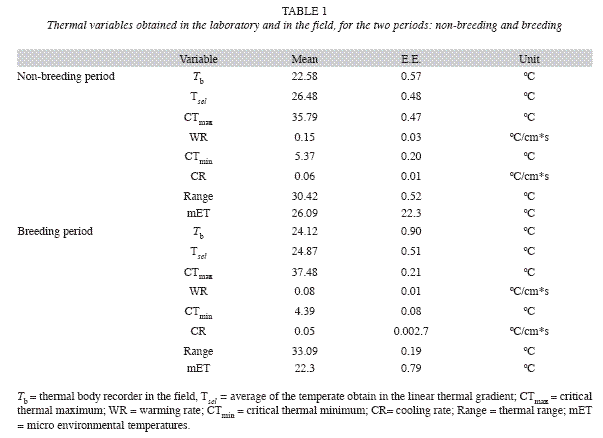
<body><![CDATA[<p align="justify"><font face="Verdana" size="2">La regulaci&oacute;n de la temperatura en ectot&eacute;rmos tiene gran importancia en los procesos fisiol&oacute;gicos y comportamentales. Los cambios en los par&aacute;metros t&eacute;rmicos relacionados con la reproducci&oacute;n nos permiten entender de qu&eacute; manera <i>Rhinella arenarum </i>optimiza el recurso t&eacute;rmico. El objetivo del presente trabajo fue comparar los par&aacute;metros t&eacute;rmicos de la especie entre el periodo reproductivo y no reproductivo. En el campo se registraron la temperatura corporal de los animales capturados, la temperatura del aire y del sustrato. Adem&aacute;s, en laboratorio se registro la temperatura selecta en un gradiente t&eacute;rmico. Como as&iacute; tambi&eacute;n las temperaturas criticas m&aacute;xima y m&iacute;nima. Los resultados de nuestro estudio muestran variaciones de los par&aacute;metros t&eacute;rmicos entre ambas situaciones estudiadas. Aparentemente esta especie hace un uso eficiente del recurso t&eacute;rmico durante el periodo reproductivo ya que el basking le permite aumentar considerablemente la temperatura corporal, probablemente este comportamiento est&eacute; relacionado con el aumento de la eficacia para emitir el canto durante el periodo de reproducci&oacute;n ya que el mismo es energ&eacute;ticamente costoso para los machos.</font></p>     <p align="justify"><font face="Verdana" size="2"><b>Palabras clave: </b>Argentina, <i>Rhinella arenarum</i>, Extremos t&eacute;rmicos, Temperatura selecta, Reproducci&oacute;n.</font></p> <hr style="width: 100%; height: 2px;">     <p align="justify"><font face="Verdana" size="2">The regulation of body temperature in ectotherms has a major impact on their physiological and behavioral processes (Angilletta 2009). Body temperature in amphibians regulates a wide range of physiological processes including several aspects of male calls (Navas 1996, Pough <i>et al. </i>2001), determining the pulse rate and the correlation with temperature (Zweifel 1968, Schneider &amp; Sinsch 1992, Luddecke &amp; S&aacute;nchez 2002).</font></p>     <p align="justify"><font face="Verdana" size="2">In species such as <i>Lithobates catesbeianus </i>(Bee 2002) or <i>Rana clamitans </i>(Wells 1977b), males actively defend areas that have favorable nesting conditions (Brown 1964, Wells 1977a) or defend important resources for females or tadpoles (Pough <i>et al. </i>2001). In species with prolonged breeding season such as <i>Hyla versicolor </i>or <i>Pseudacris crucifer, </i>the males defend the calling place. Because the energy for territory defense is thermo-dependent, these different cases of territorial behavior imply a mobility reduction via an energy budget tradeoff (Fellers 1979, Marshall <i>et al. </i>2003).Therefore, a change in the strategy to obtain thermal energy is to be expected.</font></p>     <p align="justify"><font face="Verdana" size="2">Some amphibians have a wide adaptability to thermal environmental changes (Brattstrom 1979), situation that demands a balance between body temperature and hydrological dynamics (Tracy 1976). In some cases this balance is compensated by the change of diurnal to nocturnal activity (Dullman &amp; Trueb 1986).</font></p>     <p align="justify"><font face="Verdana" size="2">In the study area, <i>R. arenarum, </i>presents two reproductive events per year, in August and November (Sanabria <i>et al. </i>2005a), during the reproductive period toads have a mean body temperature of 20&ordm;C (Sanabria <i>et al. </i>2005b). The aim of this work was to compare thermal parameters of males of <i>R. arenarum </i>in the field and in the laboratory, during breeding and no breeding periods.</font></p>     <p align="justify"><b><font face="Verdana" size="3">Materials and methods</font></b></p>     <p align="justify"><font face="Verdana" size="2">The present work was carried out in the Zonda Department, San Juan province, Argentina (31.55 S; 68.70 W; Datum WGS 84, elevation 650m). The fieldwork was conduced from August 10 of 2007 to February 20 of 2008. All determinations of temperatures in the laboratory were recorded in August to November 2007 as the breeding period (BP), and from December 2007 to February 2008 as the nonbreeding period (NBP). We collected 26 males by hand, 16 were collected during the breeding and 10 during the non-breeding period. </font></p>     <p align="justify"><font face="Verdana" size="2">Body temperature was recorded with a digital thermometer TES 1312 (TES Electrical Electronic Corp., Taipei, Taiwan, &plusmn;0.1&ordm;C) immediately after capture, by inserting the thermocouple in the toad cloaca. Air temperature was recorded (TES TPK02 gas probe) at 1cm over substrate and the substrate temperature was measured for direct contact of thermocouple (TES TPK03 substrate probe). The microenvironment temperature (mET) was determined by the mean between the air temperature and the substrate temperature. The data was recorded for each captured toad. The body length (snout-vent length; SVL) were measured with digital calipers (0.01mm precision).</font></p>     <p align="justify"><font face="Verdana" size="2"><b>Determination of selected temperature (</b><i>T</i><sub>sel</sub><b>): </b>After being captured, toads were transferred to the laboratory and placed in open-top terraria (120cm long x 60cm wide x 40cm height), which was divided in four 15cm x 14cm height compartments, to avoid interactions between neighboring animals (Light 1966). The terrarium had a linear thermal gradient, generated by a heat source underneath one end of the metallic floor. The warm side of the gradient was heated from 30cm above with an electric resistance (400W), and the temperature was controlled with a digital thermostat (AG, model TC-120L, San Juan, Argentina) to maintain a smooth thermal gradient ranging from 19.0-49.0 (&plusmn;2.0&deg;C). To avoid organism dehydration, the terrarium floor was covered with a moistened cotton cloth (water without chlorine). The <i>T</i><sub>sel </sub>was determined by placing the frogs in a time gradient, from 09:30-18:30h. We recorded body temperatures (<i>T</i><sub>b</sub>) each hour. The <i>T</i><sub>sel </sub>was considered as the average temperature recorded for each hour. A <i>T</i><sub>sel </sub>was determined for each toad.</font></p>     ]]></body>
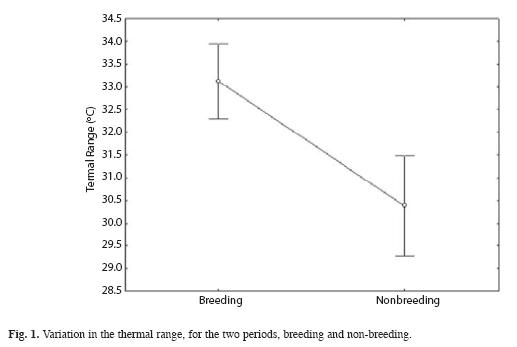
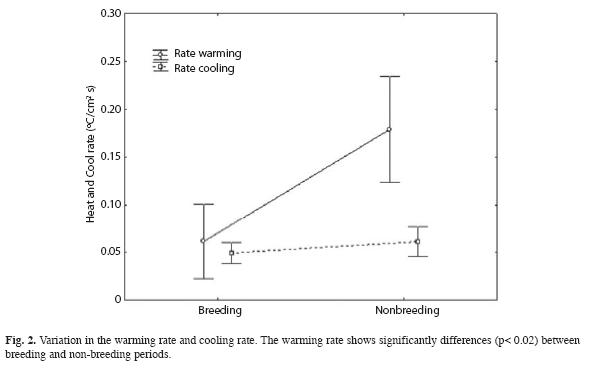
<body><![CDATA[<p align="justify"><font face="Verdana" size="2"><b>Determination of the critical thermal maximum (CT<sub>max</sub>) and minimum (CT<sub>min</sub>)</b>: The CT<sub>max</sub> and CT<sub>min</sub> were determined by Hutchinson method (1961). For CT<sub>max</sub> the toads were placed in the glass with 300mL of water at environmental temperature. An electrical heating mantle raised the temperature about 1&ordm;C per minute. For determination of the CT<sub>min</sub> we placed the toads in the glass with 300mL of water at environmental temperature. We placed the glass inside a plastic box with water, and the ice decreased the temperature about 1&ordm;C per minute. The righting reflex was checked at regular intervals by turning the toads on their backs. If the righting reflex was lost, its body temperature was recorded and we considered this temperature as the CT<sub>max</sub> and CT<sub>min</sub>.</font></p>     <p align="justify"><font face="Verdana" size="2"><b>Determination of warming rate (WR) and cooling rate (CR)</b>: WR and CR was calculated using the following equation: (warming or cooling rate = (T<sub>0</sub>-T<sub>F</sub>)/t*SVL) where: T<sub>0</sub>= initial body temperature (&ordm;C); T<sub>F</sub>= Final body temperature (&ordm;C); T= required time to pass from T<sub>0</sub> to T<sub>F</sub> (seconds) and SVL= Snout Vent Length (mm). For calculating the WR, initial temperature was laboratory temperature 25&plusmn;2&ordm;C and the final body temperature was the CT<sub>max</sub>. For calculating CR the initial temperature was laboratory temperature 25&plusmn;2&ordm;C and the final body temperature was the CT<sub>min</sub>.</font></p>     <p align="justify"><font face="Verdana" size="2">All toads were released at the end of laboratory experiments. We used descriptive statistical analysis (mean&plusmn;standard error). For comparison between breeding and non-breeding period we used Mann Whitney test. We use the PAST version 2.03 (Hommer <i>et al. </i>2001) statistical free software for data analysis.</font></p>     <p align="justify"><b><font face="Verdana" size="3">Results</font></b></p> <font face="Verdana" size="2"> </font>     <p align="justify"><font face="Verdana" size="2">During BP we recorded thermal data of 16 toads (SVL= 9.7&plusmn;0.16) and 10 (SVL= 9.8&plusmn;0.11) in NBP. The environmental temperature reported significant differences between BP and NBP (Mann Whitney, U= 33, P&lt; 0.01), resulting higher in NBP. The <i>T</i><sub>sel </sub>does not registered significant differences between BP and NBP (p<i>&gt; </i>0.07); but the <i>T</i><sub>b</sub> was significantly different between BP and NBP (Mann Whitney, U=42, p&lt; 0.04), being NBP higher. During BP not significant differences were detected between <i>T</i><sub>b</sub> and mET (Sing Test: Z= 1.25, p&gt; 0.21); in other hand, the <i>T</i>b was significantly different from the mET during NBP (Sing Test: Z= 2.84, p&lt; 0.004).</font></p>     <p align="justify"><font face="Verdana" size="2">The CT<sub>max</sub> was significantly higher for the BP (Mann Whitney, U= 19.5, p&lt; 0.002), and the CT<sub>min</sub> was significantly lower for BP (Mann Whitney, U= 10, p&lt; 0.0002). The thermal range shows differences between BP and NBP (Mann Whitney, U= 66, p&lt; 0.0003), being higher in BP (<a href="#fig1">Fig. 1</a>). The warming rate was significantly different (Mann Whitney, U= 37, p&lt; 0.02) for the BP, but the cooling rate did not showed differences (p&gt; 0.36) between both situations (<a href="#fig2">Fig. 2</a>).    <br> </font></p>     <p align="justify"><font face="Verdana" size="2">    <br> </font></p>     <p align="justify"><font face="Verdana" size="2">    ]]></body>
<body><![CDATA[<br> </font></p>     <div style="text-align: center;"><a name="fig1"></a><img  src="/img/revistas/rbt/v59n1/a30f1.jpg" title="" alt=""  style="width: 517px; height: 347px;">    <br>     <br>     <br>     <br>     <br> <a name="fig2"></a><img src="/img/revistas/rbt/v59n1/a30f2.jpg" title="" alt=""  style="width: 592px; height: 370px;">    <br>     <br> </div> <b><font face="Verdana" size="3">     <p align="justify">Discussion</p> </font></b><font face="Verdana" size="2"> </font>     ]]></body>
<body><![CDATA[<p align="justify"><font face="Verdana" size="2">Our results show that <i>R. arenarum </i>exhibits a narrow range of <i>T</i><sub>sel</sub> despite changes in temperature during BP and NBP. Also, we found <i>T</i><sub>b</sub> to be different among periods; during BP, toads maintain a higher <i>T</i><sub>b</sub> than they do during NBP. The thermal tolerance range (Pough <i>et al. </i>2001) was different between periods; during BP the range was higher than in NBP. The thermal tolerance range is related to the availability of thermal energy in the microenvironment and the adaptability of the toads (Huey &amp; Stevenson 1979), because thermoregulation in amphibians is largely behavioral (Brattstrom 1963). The thermal tolerance range is limited by the thermal extremes, CT<sub>max</sub> and CT<sub>min</sub> (Pough <i>et al</i>. 2001). During BP, toads show an elevated CT<sub>max</sub>. The elevated values recorded for this parameter have a direct relationship with the basking behaviour (diurnal activity) of the toads. The lower CT<sub>min</sub>, values are a consequence of low environmental temperatures at night. The thermal range recorded for the breeding period is broader than the non-breeding period. Apparently, during BP the toads show acclimatization to the environmental temperatures, since the toads used all the temperatures available in the environment. Amphibians are organisms with a high plasticity regarding body temperature; whereby their ability to acclimate allows them to move between extreme thermal gradients (Brasttstrom &amp; Lawrence 1962). We found the thermal gain to be significantly slower during BP than during NBP. This slower warming rate may be attributed to their calling behavior, since during BP they call while in the water. It is possible that the toads less water through the skin freely during the BP since call inside the water, being the warming rate slower.    <br> </font></p>     <p align="justify"><font face="Verdana" size="2">    <br>     <br> </font></p>     <p style="text-align: center;"><font face="Verdana" size="2"><img  src="/img/revistas/rbt/v59n1/a30t1.gif" title="" alt=""  style="width: 603px; height: 438px;">    <br>     <br> </font></p>     <p align="justify"><font face="Verdana" size="2">Basking is well known in some frogs (<i>Rana mucosa</i>, <i>Rana septentrionalis</i>), but these frogs bask either partially submerged in water or on moistened substrates (Bradford 1984, Heeden 1975). During this period, water is not a limiting resource and toads select adequate temperatures to obtain a maximal performance (Tracy <i>et al. </i>1993).</font></p>     <p align="justify"><font face="Verdana" size="2">During the non-breeding period, the availability of water for <i>R. arenarum </i>is limited and toads have to walk further to reach habitats with suitable moisture levels (Sanabria <i>et al. </i>2005a). Cutaneous transpiration is the principal mechanism that diminishes body temperature in amphibians (Spight 1967, Johnson 1971, Tracy 1976, Sinsch 1989, Shoemaker <i>et al. </i>1992). Toads search for food during the night and select low temperatures in order to avoid water loss. In the case of <i>Bufo americanus, </i>different moisture conditions of the ground control the animals&#8217; temperature (dry ground results in lower body temperatures than wet ground) (Tracy <i>et al. </i>1993).</font></p>     ]]></body>
<body><![CDATA[<p align="justify"><font face="Verdana" size="2">The cooling rate of <i>R. arenarum </i>does not vary between reproductive and non-reproductive seasons. A possible cause for this is that amphibians do not generate metabolic heat to avoid this thermal loss (Brattstrom 1963).</font></p>     <p align="justify"><font face="Verdana" size="2">The change in activity of <i>R. arenarum </i>(nocturnal to diurnal) during the reproductive period implies a thermal benefit that allows the toads to increase call performance. The call is strongly related to the body temperature (Duellman &amp;Trueb 1986, Wells 2001). During BP, the principal activity of male toads is to call for females. While spending long periods of time calling, mobility is reduced and obtaining food is more difficult. Quiroga (pers. comm.) observed that during reproductive periods toads have prolonged fasts, in which the stomach contains only their own skin. In others bufonid toads, this behavior (ingesting their own skin) is well known and is apparently related with energy budget (Weldon <i>et al. </i>1993). Although feeding is scarce during the reproductive period of <i>R. arenarum, </i>it appears that there is a physiological or behavioral mechanism that allows the adjustement of the optimum thermal range for reproduction. It is possible that <i>R. arenarum </i>uses stored fat, as do <i>Elachistoclaeis bicolor, Rhinella fernandezae, </i>and <i>Leptodactylus latinasus. </i>In these species, evidence shows an inverse relationship between the somatic index of the testicles and amount of body fat (Martori <i>et al. </i>2005). Females prefer males with greater total sound energy in terms of calling rate, call duration, and loudness (Gerhardt 1994, Schwartz 2001). These attributes of calling activity impose a high energetic cost for male toads (Wells 2001). In this framework, <i>R. arenarum </i>gains energy from the environment during the day (basking for calling), to compensate for these energetic costs and to ultimately increase reproductive success.</font></p> <b><font face="Verdana" size="3">     <p align="justify">Acknowledgments</p> </font></b><font face="Verdana" size="2">     <p align="justify">We give special thanks to Daniel Flores and Guillermo Ripalta for their help in the field, Juliana Nates and Jason Warner for the English review, and Myriam Iturra Cid for the helpful comments that improved this manuscript. We thank the Provincial Fauna Office of San Juan for permission to conduct our research. This research was partially supported by a graduate fellowship from CICITCA-UNSJ awarded to Eduardo A. Sanabria.</p> </font><b><font face="Verdana" size="3"> </font></b> <hr style="width: 100%; height: 2px;"><b><font face="Verdana" size="3">     <p align="justify">References</p> </font></b><font face="Verdana" size="2"> </font>     <!-- ref --><p align="justify"><font face="Verdana" size="2">Angilletta M.J. Jr., 2009. Thermal adaptation a theoretical and empirical synthesis. Oxford University, New York, USA.    &nbsp;&nbsp;&nbsp;&nbsp;&nbsp;&nbsp;&nbsp;&nbsp;[&#160;<a href="javascript:void(0);" onclick="javascript: window.open('/scielo.php?script=sci_nlinks&ref=1704209&pid=S0034-7744201100010003000001&lng=','','width=640,height=500,resizable=yes,scrollbars=1,menubar=yes,');">Links</a>&#160;]<!-- end-ref --></font></p>     <!-- ref --><p align="justify"><font face="Verdana" size="2">Bee M.A. 2002. Territorial male bullfrogs (<i>Rana catesbeiana</i>) do not assess fighting ability based on size-related variation in acoustic signals. Behav. Ecol. 13:109-124</font>&nbsp;&nbsp;&nbsp;&nbsp;&nbsp;&nbsp;&nbsp;&nbsp;[&#160;<a href="javascript:void(0);" onclick="javascript: window.open('/scielo.php?script=sci_nlinks&ref=1704211&pid=S0034-7744201100010003000002&lng=','','width=640,height=500,resizable=yes,scrollbars=1,menubar=yes,');">Links</a>&#160;]<!-- end-ref --><!-- ref --><p align="justify"><font face="Verdana" size="2">Brattstrom B.H. &amp; P. Lawrence. 1962. The rate of thermal acclimation in anuran amphibians. Physiol. Zool. 35: 148-156.    &nbsp;&nbsp;&nbsp;&nbsp;&nbsp;&nbsp;&nbsp;&nbsp;[&#160;<a href="javascript:void(0);" onclick="javascript: window.open('/scielo.php?script=sci_nlinks&ref=1704212&pid=S0034-7744201100010003000003&lng=','','width=640,height=500,resizable=yes,scrollbars=1,menubar=yes,');">Links</a>&#160;]<!-- end-ref --></font></p>     ]]></body>
<body><![CDATA[<!-- ref --><p align="justify"><font face="Verdana" size="2">Brattstrom B.H. 1963. Preliminary revision of the thermal requierements of the amphibians. Ecology 44: 238-255.    &nbsp;&nbsp;&nbsp;&nbsp;&nbsp;&nbsp;&nbsp;&nbsp;[&#160;<a href="javascript:void(0);" onclick="javascript: window.open('/scielo.php?script=sci_nlinks&ref=1704214&pid=S0034-7744201100010003000004&lng=','','width=640,height=500,resizable=yes,scrollbars=1,menubar=yes,');">Links</a>&#160;]<!-- end-ref --></font></p>     <!-- ref --><p align="justify"><font face="Verdana" size="2">Bradford D.F. 1984. Temperature modulation in highelevation amphibians<i>, Rana mucosa</i>. Copeia 1984: 966-976.    &nbsp;&nbsp;&nbsp;&nbsp;&nbsp;&nbsp;&nbsp;&nbsp;[&#160;<a href="javascript:void(0);" onclick="javascript: window.open('/scielo.php?script=sci_nlinks&ref=1704216&pid=S0034-7744201100010003000005&lng=','','width=640,height=500,resizable=yes,scrollbars=1,menubar=yes,');">Links</a>&#160;]<!-- end-ref --></font></p>     <!-- ref --><p align="justify"><font face="Verdana" size="2">Brown J.L. 1964. The evolution of diversity in avian territorial systems. Wilson Bull. 76: 160-169.    &nbsp;&nbsp;&nbsp;&nbsp;&nbsp;&nbsp;&nbsp;&nbsp;[&#160;<a href="javascript:void(0);" onclick="javascript: window.open('/scielo.php?script=sci_nlinks&ref=1704218&pid=S0034-7744201100010003000006&lng=','','width=640,height=500,resizable=yes,scrollbars=1,menubar=yes,');">Links</a>&#160;]<!-- end-ref --></font></p>     <!-- ref --><p align="justify"><font face="Verdana" size="2">Duellman W.E. &amp; L. Trueb. 1986. Biology of amphibians. McGraw-Hill, Baltimore, Maryland, USA.    &nbsp;&nbsp;&nbsp;&nbsp;&nbsp;&nbsp;&nbsp;&nbsp;[&#160;<a href="javascript:void(0);" onclick="javascript: window.open('/scielo.php?script=sci_nlinks&ref=1704220&pid=S0034-7744201100010003000007&lng=','','width=640,height=500,resizable=yes,scrollbars=1,menubar=yes,');">Links</a>&#160;]<!-- end-ref --></font></p>     <!-- ref --><p align="justify"><font face="Verdana" size="2">Fellers G.M. 1979. Aggression, territoriality, and mating behaviour in North American treefrogs. Anim. Behav. 27: 107-119.    &nbsp;&nbsp;&nbsp;&nbsp;&nbsp;&nbsp;&nbsp;&nbsp;[&#160;<a href="javascript:void(0);" onclick="javascript: window.open('/scielo.php?script=sci_nlinks&ref=1704222&pid=S0034-7744201100010003000008&lng=','','width=640,height=500,resizable=yes,scrollbars=1,menubar=yes,');">Links</a>&#160;]<!-- end-ref --></font></p>     ]]></body>
<body><![CDATA[<!-- ref --><p align="justify"><font face="Verdana" size="2">Gerhardt H.C. 1994. The evolution of vocalization in frogs and toads. Annu. Rev. Ecol. Syst. 25: 293-324.    &nbsp;&nbsp;&nbsp;&nbsp;&nbsp;&nbsp;&nbsp;&nbsp;[&#160;<a href="javascript:void(0);" onclick="javascript: window.open('/scielo.php?script=sci_nlinks&ref=1704224&pid=S0034-7744201100010003000009&lng=','','width=640,height=500,resizable=yes,scrollbars=1,menubar=yes,');">Links</a>&#160;]<!-- end-ref --></font></p>     <!-- ref --><p align="justify"><font face="Verdana" size="2">Heeden S.E. 1975. Body temperature of the mink frog, <i>Rana septentrionalis </i>Baird. J. Herpetol. 5: 211-212.    &nbsp;&nbsp;&nbsp;&nbsp;&nbsp;&nbsp;&nbsp;&nbsp;[&#160;<a href="javascript:void(0);" onclick="javascript: window.open('/scielo.php?script=sci_nlinks&ref=1704226&pid=S0034-7744201100010003000010&lng=','','width=640,height=500,resizable=yes,scrollbars=1,menubar=yes,');">Links</a>&#160;]<!-- end-ref --></font></p>     <!-- ref --><p align="justify"><font face="Verdana" size="2">Hammer &Oslash;., D.A. T Harper &amp; P.D. Ryan. 2001. PAST: paleontological statistics software package for education and data analysis. Paleontolog&iacute;a Electr&oacute;nica 4: 9. (http://palaeo-electronica.org/2001_1/past/issue1_01.htm)</font>&nbsp;&nbsp;&nbsp;&nbsp;&nbsp;&nbsp;&nbsp;&nbsp;[&#160;<a href="javascript:void(0);" onclick="javascript: window.open('/scielo.php?script=sci_nlinks&ref=1704228&pid=S0034-7744201100010003000011&lng=','','width=640,height=500,resizable=yes,scrollbars=1,menubar=yes,');">Links</a>&#160;]<!-- end-ref --><!-- ref --><p align="justify"><font face="Verdana" size="2">Hutchison V.H. 1961. Critical thermal maxima in salamanders. Physiol. Zool. 2, 92-125.    &nbsp;&nbsp;&nbsp;&nbsp;&nbsp;&nbsp;&nbsp;&nbsp;[&#160;<a href="javascript:void(0);" onclick="javascript: window.open('/scielo.php?script=sci_nlinks&ref=1704229&pid=S0034-7744201100010003000012&lng=','','width=640,height=500,resizable=yes,scrollbars=1,menubar=yes,');">Links</a>&#160;]<!-- end-ref --></font></p>     <!-- ref --><p align="justify"><font face="Verdana" size="2">Huey R.B. &amp; R.D. Stevenson. 1979. Integrating thermal physiology and ecology of ectoterms: a discussion of approaches. <i>Am. </i>Zool. 19: 357-366.    &nbsp;&nbsp;&nbsp;&nbsp;&nbsp;&nbsp;&nbsp;&nbsp;[&#160;<a href="javascript:void(0);" onclick="javascript: window.open('/scielo.php?script=sci_nlinks&ref=1704231&pid=S0034-7744201100010003000013&lng=','','width=640,height=500,resizable=yes,scrollbars=1,menubar=yes,');">Links</a>&#160;]<!-- end-ref --></font></p>     <!-- ref --><p align="justify"><font face="Verdana" size="2">Johnson C.R. 1971. Thermal relations and water balance in the day frog, <i>Taudactylus diurnus</i>, from an Australian rain forest. Aus. J. Zool. 19:35-39.    &nbsp;&nbsp;&nbsp;&nbsp;&nbsp;&nbsp;&nbsp;&nbsp;[&#160;<a href="javascript:void(0);" onclick="javascript: window.open('/scielo.php?script=sci_nlinks&ref=1704233&pid=S0034-7744201100010003000014&lng=','','width=640,height=500,resizable=yes,scrollbars=1,menubar=yes,');">Links</a>&#160;]<!-- end-ref --></font></p>     <!-- ref --><p align="justify"><font face="Verdana" size="2">Light, P., W. Dawson., V. Shoemaker &amp; A. R. Main. 1966. Observation on the thermal relations of Western Australian Lizards. Copeia 1966: 97-110.    &nbsp;&nbsp;&nbsp;&nbsp;&nbsp;&nbsp;&nbsp;&nbsp;[&#160;<a href="javascript:void(0);" onclick="javascript: window.open('/scielo.php?script=sci_nlinks&ref=1704235&pid=S0034-7744201100010003000015&lng=','','width=640,height=500,resizable=yes,scrollbars=1,menubar=yes,');">Links</a>&#160;]<!-- end-ref --></font></p>     <!-- ref --><p align="justify"><font face="Verdana" size="2">Luddecke H. &amp; O. R. S&aacute;nchez. 2002. Are tropical highland frog calls cold-adapted? The case of the Andean Frog <i>Hyla labialis</i>. Biotropica 34: 281-288.    &nbsp;&nbsp;&nbsp;&nbsp;&nbsp;&nbsp;&nbsp;&nbsp;[&#160;<a href="javascript:void(0);" onclick="javascript: window.open('/scielo.php?script=sci_nlinks&ref=1704237&pid=S0034-7744201100010003000016&lng=','','width=640,height=500,resizable=yes,scrollbars=1,menubar=yes,');">Links</a>&#160;]<!-- end-ref --></font></p>     <!-- ref --><p align="justify"><font face="Verdana" size="2">Marshall, V. T., S. C. Humfeld &amp; M. A. Bee. 2003. Plasticity of aggressive signaling and its evolution in male spring peepers, <i>Pseudacris crucifer</i>. Anim. Beha. 65: 1223-1234.    &nbsp;&nbsp;&nbsp;&nbsp;&nbsp;&nbsp;&nbsp;&nbsp;[&#160;<a href="javascript:void(0);" onclick="javascript: window.open('/scielo.php?script=sci_nlinks&ref=1704239&pid=S0034-7744201100010003000017&lng=','','width=640,height=500,resizable=yes,scrollbars=1,menubar=yes,');">Links</a>&#160;]<!-- end-ref --></font></p>     <!-- ref --><p align="justify"><font face="Verdana" size="2">Martori R., L. Aun, A. Bierri, C. Rozzi Gim&eacute;nez &amp; E. Heredia. 2005. Reproducci&oacute;n comparada de tres especies de anuros sint&oacute;picos de una localidad del sudoeste de C&oacute;rdoba. Cuad. Herpetol. 18: 43-59.    &nbsp;&nbsp;&nbsp;&nbsp;&nbsp;&nbsp;&nbsp;&nbsp;[&#160;<a href="javascript:void(0);" onclick="javascript: window.open('/scielo.php?script=sci_nlinks&ref=1704241&pid=S0034-7744201100010003000018&lng=','','width=640,height=500,resizable=yes,scrollbars=1,menubar=yes,');">Links</a>&#160;]<!-- end-ref --></font></p>     <!-- ref --><p align="justify"><font face="Verdana" size="2">Navas C.A. 1996. Thermal dependency of field locomotor and vocal performance of high-elevation anuran in the tropical Andes. J. Herpetol. 30: 478- 487.    &nbsp;&nbsp;&nbsp;&nbsp;&nbsp;&nbsp;&nbsp;&nbsp;[&#160;<a href="javascript:void(0);" onclick="javascript: window.open('/scielo.php?script=sci_nlinks&ref=1704243&pid=S0034-7744201100010003000019&lng=','','width=640,height=500,resizable=yes,scrollbars=1,menubar=yes,');">Links</a>&#160;]<!-- end-ref --></font></p>     <!-- ref --><p align="justify"><font face="Verdana" size="2">Pough F., R. Andrews, E. Cadle, M. Crump, A. Zavitzky &amp; R. Wells. 2001. Energetic and perfomance, 196-227. <i>In </i>Herpetology. Princenton Hall, New Jersey, USA.    &nbsp;&nbsp;&nbsp;&nbsp;&nbsp;&nbsp;&nbsp;&nbsp;[&#160;<a href="javascript:void(0);" onclick="javascript: window.open('/scielo.php?script=sci_nlinks&ref=1704245&pid=S0034-7744201100010003000020&lng=','','width=640,height=500,resizable=yes,scrollbars=1,menubar=yes,');">Links</a>&#160;]<!-- end-ref --></font></p>     <!-- ref --><p align="justify"><font face="Verdana" size="2">Sanabria E.A., L.B. Quiroga &amp;. J.C. Acosta. 2005a. Patrones de actividad temporal estacional y uso de microh&aacute;bitat de una poblaci&oacute;n de adultos de <i>Bufo arenarum</i>, en los humedales de Zonda, San Juan, Argentina. Bol. Soc. Herpetol. Mex. 13: 61-65.    &nbsp;&nbsp;&nbsp;&nbsp;&nbsp;&nbsp;&nbsp;&nbsp;[&#160;<a href="javascript:void(0);" onclick="javascript: window.open('/scielo.php?script=sci_nlinks&ref=1704247&pid=S0034-7744201100010003000021&lng=','','width=640,height=500,resizable=yes,scrollbars=1,menubar=yes,');">Links</a>&#160;]<!-- end-ref --></font></p>     <!-- ref --><p align="justify"><font face="Verdana" size="2">Sanabria E.A., L.B. Quiroga &amp;. J.C. Acosta. 2005b. Termorregulaci&oacute;n de adultos de <i>Bufo arenarum </i>(Anura: Bufonidae) en diferentes microh&aacute;bitat en los humedales de Zonda, San Juan, Argentina. Rev. Esp. Herpetol. 19: 127-132.    &nbsp;&nbsp;&nbsp;&nbsp;&nbsp;&nbsp;&nbsp;&nbsp;[&#160;<a href="javascript:void(0);" onclick="javascript: window.open('/scielo.php?script=sci_nlinks&ref=1704249&pid=S0034-7744201100010003000022&lng=','','width=640,height=500,resizable=yes,scrollbars=1,menubar=yes,');">Links</a>&#160;]<!-- end-ref --></font></p>     <!-- ref --><p align="justify"><font face="Verdana" size="2">Schwartz J.J. 2001. Call monitoring and interactive playback systems in the study of acoustic interactions among male anurans, p. 183-204. <i>In </i>M. J. Ryan (ed.). Anuran communication. Smithsonian Institution, Washington DC. , USA.    &nbsp;&nbsp;&nbsp;&nbsp;&nbsp;&nbsp;&nbsp;&nbsp;[&#160;<a href="javascript:void(0);" onclick="javascript: window.open('/scielo.php?script=sci_nlinks&ref=1704251&pid=S0034-7744201100010003000023&lng=','','width=640,height=500,resizable=yes,scrollbars=1,menubar=yes,');">Links</a>&#160;]<!-- end-ref --></font></p>     <!-- ref --><p align="justify"><font face="Verdana" size="2">Schneider H. &amp; U. Sinsch. 1992. Mating call variation in lake frogs referred to as <i>Rana ridibunda </i>Pallas, 1771. Taxonomic implications. Z. Zool. Syst. Evolutionsforsch. 30: 297-315.    &nbsp;&nbsp;&nbsp;&nbsp;&nbsp;&nbsp;&nbsp;&nbsp;[&#160;<a href="javascript:void(0);" onclick="javascript: window.open('/scielo.php?script=sci_nlinks&ref=1704253&pid=S0034-7744201100010003000024&lng=','','width=640,height=500,resizable=yes,scrollbars=1,menubar=yes,');">Links</a>&#160;]<!-- end-ref --></font></p>     <!-- ref --><p align="justify"><font face="Verdana" size="2">Shoemaker V.H., S.S. Hillman, S.D. Hillyard, D.C. Jackson, L.L. McClanahan,. P.C Withers &amp; M. L. Wygoda. 1992. Exchange of water, ions, and respiratory gases in terrestrial amphibians. p. 125-150. <i>In </i>W.W. Burggren (ed.) Environmental physiology of the amphibians. University of Chicago, Chicago, USA.    &nbsp;&nbsp;&nbsp;&nbsp;&nbsp;&nbsp;&nbsp;&nbsp;[&#160;<a href="javascript:void(0);" onclick="javascript: window.open('/scielo.php?script=sci_nlinks&ref=1704255&pid=S0034-7744201100010003000025&lng=','','width=640,height=500,resizable=yes,scrollbars=1,menubar=yes,');">Links</a>&#160;]<!-- end-ref --></font></p>     <!-- ref --><p align="justify"><font face="Verdana" size="2">Sinsch U. 1989. Behavioural thermoregulation of the Andean toad (<i>Bufo spinolosus</i>) at high altitudes. Oecologia 80:32-38.    &nbsp;&nbsp;&nbsp;&nbsp;&nbsp;&nbsp;&nbsp;&nbsp;[&#160;<a href="javascript:void(0);" onclick="javascript: window.open('/scielo.php?script=sci_nlinks&ref=1704257&pid=S0034-7744201100010003000026&lng=','','width=640,height=500,resizable=yes,scrollbars=1,menubar=yes,');">Links</a>&#160;]<!-- end-ref --></font></p>     <!-- ref --><p align="justify"><font face="Verdana" size="2">Spight T.M. 1967. Evaporation from toads and water surfaces. Nature 214:835-836.    &nbsp;&nbsp;&nbsp;&nbsp;&nbsp;&nbsp;&nbsp;&nbsp;[&#160;<a href="javascript:void(0);" onclick="javascript: window.open('/scielo.php?script=sci_nlinks&ref=1704259&pid=S0034-7744201100010003000027&lng=','','width=640,height=500,resizable=yes,scrollbars=1,menubar=yes,');">Links</a>&#160;]<!-- end-ref --></font></p>     <!-- ref --><p align="justify"><font face="Verdana" size="2">Tracy R.C. 1976. A model of the dynamic exchange of water and energy between a terrestrial amphibian and its environment. Ecol. Monogr. 46: 293-326.    &nbsp;&nbsp;&nbsp;&nbsp;&nbsp;&nbsp;&nbsp;&nbsp;[&#160;<a href="javascript:void(0);" onclick="javascript: window.open('/scielo.php?script=sci_nlinks&ref=1704261&pid=S0034-7744201100010003000028&lng=','','width=640,height=500,resizable=yes,scrollbars=1,menubar=yes,');">Links</a>&#160;]<!-- end-ref --></font></p>     <p align="justify"><font face="Verdana" size="2"> </font></p>     ]]></body>
<body><![CDATA[<!-- ref --><p align="justify"><font face="Verdana" size="2">Tracy R.C., K.A. Christian, M.P. O&acute;Connor &amp; C. R. Tracy. 1993. Behavioral thermoregulation by <i>Bufo americanus</i>: the importance of the hydric environment. Herpetologica 49: 375-382.    &nbsp;&nbsp;&nbsp;&nbsp;&nbsp;&nbsp;&nbsp;&nbsp;[&#160;<a href="javascript:void(0);" onclick="javascript: window.open('/scielo.php?script=sci_nlinks&ref=1704264&pid=S0034-7744201100010003000029&lng=','','width=640,height=500,resizable=yes,scrollbars=1,menubar=yes,');">Links</a>&#160;]<!-- end-ref --></font></p>     <!-- ref --><p align="justify"><font face="Verdana" size="2">Wells K.D. 1977a. The social behavior of anuran amphibians. Anim. Behav. 25: 666-693.    &nbsp;&nbsp;&nbsp;&nbsp;&nbsp;&nbsp;&nbsp;&nbsp;[&#160;<a href="javascript:void(0);" onclick="javascript: window.open('/scielo.php?script=sci_nlinks&ref=1704266&pid=S0034-7744201100010003000030&lng=','','width=640,height=500,resizable=yes,scrollbars=1,menubar=yes,');">Links</a>&#160;]<!-- end-ref --></font></p>     <!-- ref --><p align="justify"><font face="Verdana" size="2">Wells K.D. 1977b. Territoriality and male mating success in the Green Frog (<i>Rana clamitans</i>). Ecology 58: 750-762.    &nbsp;&nbsp;&nbsp;&nbsp;&nbsp;&nbsp;&nbsp;&nbsp;[&#160;<a href="javascript:void(0);" onclick="javascript: window.open('/scielo.php?script=sci_nlinks&ref=1704268&pid=S0034-7744201100010003000031&lng=','','width=640,height=500,resizable=yes,scrollbars=1,menubar=yes,');">Links</a>&#160;]<!-- end-ref --></font></p>     <!-- ref --><p align="justify"><font face="Verdana" size="2">Wells K.D. 2001. The energetics of calling in frog, p. 45-60. <i>In </i>M. J. Ryan (ed.). Anuran communication. Smithsonian Institution, Washington, DC. USA.    &nbsp;&nbsp;&nbsp;&nbsp;&nbsp;&nbsp;&nbsp;&nbsp;[&#160;<a href="javascript:void(0);" onclick="javascript: window.open('/scielo.php?script=sci_nlinks&ref=1704270&pid=S0034-7744201100010003000032&lng=','','width=640,height=500,resizable=yes,scrollbars=1,menubar=yes,');">Links</a>&#160;]<!-- end-ref --></font></p>     <!-- ref --><p align="justify"><font face="Verdana" size="2">Zweifel R.G. 1968. Effects of temperature, body size, and hybridization on mating calls of toads, <i>Bufo a. americanus </i>and <i>Bufo woodhousii fowleri</i>. Copeia 1968: 269-285.    &nbsp;&nbsp;&nbsp;&nbsp;&nbsp;&nbsp;&nbsp;&nbsp;[&#160;<a href="javascript:void(0);" onclick="javascript: window.open('/scielo.php?script=sci_nlinks&ref=1704272&pid=S0034-7744201100010003000033&lng=','','width=640,height=500,resizable=yes,scrollbars=1,menubar=yes,');">Links</a>&#160;]<!-- end-ref --></font></p>     ]]></body>
<body><![CDATA[<!-- ref --><p align="justify"><font face="Verdana" size="2">Weldon P., B. Demeter &amp; Rosscoe, R. 1993. A survey of shed skin-eating (Dermatophagy) in amphibians and reptiles. J. Herpetol. 27: 219-228.    &nbsp;&nbsp;&nbsp;&nbsp;&nbsp;&nbsp;&nbsp;&nbsp;[&#160;<a href="javascript:void(0);" onclick="javascript: window.open('/scielo.php?script=sci_nlinks&ref=1704274&pid=S0034-7744201100010003000034&lng=','','width=640,height=500,resizable=yes,scrollbars=1,menubar=yes,');">Links</a>&#160;]<!-- end-ref --><br> </font></p>     <p align="justify"><font face="Verdana" size="2">    <br> </font></p>     <p align="justify"><font face="Verdana" size="2"><a  name="correspondencia"></a>Correspondencia a: <font face="Verdana"  size="2">Eduardo Alfredo Sanabria &amp; Lorena Beatriz Quiroga. </font><font face="Verdana"  size="2">Departamento de Biolog&iacute;a, Facultad de Ciencias Exactas, F&iacute;sicas y Naturales, Universidad Nacional de San Juan, Avenida Ignacio de la Roza 590 (O), C&oacute;digo Postal 5400, Argentina; </font><a  href="mailto:sanabria.eduardoa@gmail.com"><font face="Verdana" size="2">sanabria.eduardoa@gmail.com</font></a><font  face="Verdana" size="2">, </font><a  href="mailto:quiroga_lore@yahoo.com.ar"><font face="Verdana" size="2">quiroga_lore@yahoo.com.ar</font></a></font></p> <hr style="width: 100%; height: 2px;"><font face="Verdana" size="2">     <p align="center">Received 20-V-2010. Corrected 30-IX-2010. Accepted 29-X-2010.</p> </font>      ]]></body><back>
<ref-list>
<ref id="B1">
<nlm-citation citation-type="book">
<person-group person-group-type="author">
<name>
<surname><![CDATA[Angilletta]]></surname>
<given-names><![CDATA[M.J. Jr]]></given-names>
</name>
</person-group>
<source><![CDATA[Thermal adaptation a theoretical and empirical synthesis]]></source>
<year>2009</year>
<publisher-loc><![CDATA[^eNew York New York]]></publisher-loc>
<publisher-name><![CDATA[Oxford University]]></publisher-name>
</nlm-citation>
</ref>
<ref id="B2">
<nlm-citation citation-type="journal">
<person-group person-group-type="author">
<name>
<surname><![CDATA[Bee]]></surname>
<given-names><![CDATA[M.A]]></given-names>
</name>
</person-group>
<article-title xml:lang="en"><![CDATA[Territorial male bullfrogs (Rana catesbeiana) do not assess fighting ability based on size-related variation in acoustic signals]]></article-title>
<source><![CDATA[Behav. Ecol]]></source>
<year>2002</year>
<volume>13</volume>
<page-range>109-124</page-range></nlm-citation>
</ref>
<ref id="B3">
<nlm-citation citation-type="journal">
<person-group person-group-type="author">
<name>
<surname><![CDATA[Brattstrom]]></surname>
<given-names><![CDATA[B.H]]></given-names>
</name>
<name>
<surname><![CDATA[Lawrence]]></surname>
<given-names><![CDATA[P]]></given-names>
</name>
</person-group>
<article-title xml:lang="en"><![CDATA[The rate of thermal acclimation in anuran amphibians]]></article-title>
<source><![CDATA[Physiol. Zool]]></source>
<year>1962</year>
<volume>35</volume>
<page-range>148-156</page-range></nlm-citation>
</ref>
<ref id="B4">
<nlm-citation citation-type="journal">
<person-group person-group-type="author">
<name>
<surname><![CDATA[Brattstrom]]></surname>
<given-names><![CDATA[B.H]]></given-names>
</name>
</person-group>
<article-title xml:lang="en"><![CDATA[Preliminary revision of the thermal requierements of the amphibians]]></article-title>
<source><![CDATA[Ecology]]></source>
<year>1963</year>
<volume>44</volume>
<page-range>238-255</page-range></nlm-citation>
</ref>
<ref id="B5">
<nlm-citation citation-type="journal">
<person-group person-group-type="author">
<name>
<surname><![CDATA[Bradford]]></surname>
<given-names><![CDATA[D.F]]></given-names>
</name>
</person-group>
<article-title xml:lang="en"><![CDATA[Temperature modulation in highelevation amphibians, Rana mucosa]]></article-title>
<source><![CDATA[Copeia]]></source>
<year>1984</year>
<volume>1984</volume>
<page-range>966-976</page-range></nlm-citation>
</ref>
<ref id="B6">
<nlm-citation citation-type="journal">
<person-group person-group-type="author">
<name>
<surname><![CDATA[Brown]]></surname>
<given-names><![CDATA[J.L]]></given-names>
</name>
</person-group>
<article-title xml:lang="en"><![CDATA[The evolution of diversity in avian territorial systems]]></article-title>
<source><![CDATA[Wilson Bull]]></source>
<year>1964</year>
<volume>76</volume>
<page-range>160-169</page-range></nlm-citation>
</ref>
<ref id="B7">
<nlm-citation citation-type="book">
<person-group person-group-type="author">
<name>
<surname><![CDATA[Duellman]]></surname>
<given-names><![CDATA[W.E]]></given-names>
</name>
<name>
<surname><![CDATA[Trueb]]></surname>
<given-names><![CDATA[L]]></given-names>
</name>
</person-group>
<source><![CDATA[Biology of amphibians]]></source>
<year>1986</year>
<publisher-loc><![CDATA[Baltimore^eMaryland Maryland]]></publisher-loc>
<publisher-name><![CDATA[McGraw-Hill]]></publisher-name>
</nlm-citation>
</ref>
<ref id="B8">
<nlm-citation citation-type="journal">
<person-group person-group-type="author">
<name>
<surname><![CDATA[Fellers]]></surname>
<given-names><![CDATA[G.M]]></given-names>
</name>
</person-group>
<article-title xml:lang="en"><![CDATA[Aggression, territoriality, and mating behaviour in North American treefrogs]]></article-title>
<source><![CDATA[Anim. Behav]]></source>
<year>1979</year>
<volume>27</volume>
<page-range>107-119</page-range></nlm-citation>
</ref>
<ref id="B9">
<nlm-citation citation-type="journal">
<person-group person-group-type="author">
<name>
<surname><![CDATA[Gerhardt]]></surname>
<given-names><![CDATA[H.C]]></given-names>
</name>
</person-group>
<article-title xml:lang="en"><![CDATA[The evolution of vocalization in frogs and toads]]></article-title>
<source><![CDATA[Annu. Rev. Ecol. Syst]]></source>
<year>1994</year>
<volume>25</volume>
<page-range>293-32</page-range></nlm-citation>
</ref>
<ref id="B10">
<nlm-citation citation-type="journal">
<person-group person-group-type="author">
<name>
<surname><![CDATA[Heeden]]></surname>
<given-names><![CDATA[S.E]]></given-names>
</name>
</person-group>
<article-title xml:lang="en"><![CDATA[Body temperature of the mink frog, Rana septentrionalis Baird]]></article-title>
<source><![CDATA[J. Herpetol]]></source>
<year>1975</year>
<volume>5</volume>
<page-range>211-212</page-range></nlm-citation>
</ref>
<ref id="B11">
<nlm-citation citation-type="journal">
<person-group person-group-type="author">
<name>
<surname><![CDATA[Hammer]]></surname>
<given-names><![CDATA[Ø]]></given-names>
</name>
<name>
<surname><![CDATA[T Harper]]></surname>
<given-names><![CDATA[D.A]]></given-names>
</name>
<name>
<surname><![CDATA[Ryan]]></surname>
<given-names><![CDATA[P.D]]></given-names>
</name>
</person-group>
<article-title xml:lang="en"><![CDATA[PAST: paleontological statistics software package for education and data analysis]]></article-title>
<source><![CDATA[Paleontología Electrónica]]></source>
<year>2001</year>
<volume>4</volume>
<numero>9</numero>
<issue>9</issue>
</nlm-citation>
</ref>
<ref id="B12">
<nlm-citation citation-type="journal">
<person-group person-group-type="author">
<name>
<surname><![CDATA[Hutchison]]></surname>
<given-names><![CDATA[V.H]]></given-names>
</name>
</person-group>
<article-title xml:lang="en"><![CDATA[Critical thermal maxima in salamanders]]></article-title>
<source><![CDATA[Physiol. Zool]]></source>
<year>1961</year>
<volume>2</volume>
<page-range>92-125</page-range></nlm-citation>
</ref>
<ref id="B13">
<nlm-citation citation-type="journal">
<person-group person-group-type="author">
<name>
<surname><![CDATA[Huey]]></surname>
<given-names><![CDATA[R.B]]></given-names>
</name>
<name>
<surname><![CDATA[Stevenson]]></surname>
<given-names><![CDATA[R.D]]></given-names>
</name>
</person-group>
<article-title xml:lang="en"><![CDATA[Integrating thermal physiology and ecology of ectoterms: a discussion of approaches]]></article-title>
<source><![CDATA[Am. Zool]]></source>
<year>1979</year>
<volume>19</volume>
<page-range>357-366</page-range></nlm-citation>
</ref>
<ref id="B14">
<nlm-citation citation-type="journal">
<person-group person-group-type="author">
<name>
<surname><![CDATA[Johnson]]></surname>
<given-names><![CDATA[C.R]]></given-names>
</name>
</person-group>
<article-title xml:lang="en"><![CDATA[Thermal relations and water balance in the day frog, Taudactylus diurnus, from an Australian rain forest]]></article-title>
<source><![CDATA[Aus. J. Zool]]></source>
<year>1971</year>
<volume>19</volume>
<page-range>35-39</page-range></nlm-citation>
</ref>
<ref id="B15">
<nlm-citation citation-type="journal">
<person-group person-group-type="author">
<name>
<surname><![CDATA[Light]]></surname>
<given-names><![CDATA[P]]></given-names>
</name>
<name>
<surname><![CDATA[Dawson]]></surname>
<given-names><![CDATA[W]]></given-names>
</name>
<name>
<surname><![CDATA[Shoemaker]]></surname>
<given-names><![CDATA[V]]></given-names>
</name>
<name>
<surname><![CDATA[Main]]></surname>
<given-names><![CDATA[A. R]]></given-names>
</name>
</person-group>
<article-title xml:lang="en"><![CDATA[Observation on the thermal relations of Western Australian Lizards]]></article-title>
<source><![CDATA[Copeia]]></source>
<year>1966</year>
<volume>1966</volume>
<page-range>97-110</page-range></nlm-citation>
</ref>
<ref id="B16">
<nlm-citation citation-type="journal">
<person-group person-group-type="author">
<name>
<surname><![CDATA[Luddecke]]></surname>
<given-names><![CDATA[H]]></given-names>
</name>
<name>
<surname><![CDATA[Sánchez]]></surname>
<given-names><![CDATA[O. R]]></given-names>
</name>
</person-group>
<article-title xml:lang="en"><![CDATA[Are tropical highland frog calls cold-adapted: The case of the Andean Frog Hyla labialis]]></article-title>
<source><![CDATA[Biotropica]]></source>
<year>2002</year>
<volume>34</volume>
<page-range>281-288</page-range></nlm-citation>
</ref>
<ref id="B17">
<nlm-citation citation-type="journal">
<person-group person-group-type="author">
<name>
<surname><![CDATA[Marshall]]></surname>
<given-names><![CDATA[V. T]]></given-names>
</name>
<name>
<surname><![CDATA[Humfeld]]></surname>
<given-names><![CDATA[S. C]]></given-names>
</name>
<name>
<surname><![CDATA[Bee]]></surname>
<given-names><![CDATA[M. A]]></given-names>
</name>
</person-group>
<source><![CDATA[Anim. Beha]]></source>
<year>2003</year>
<volume>65</volume>
<page-range>1223-1234</page-range></nlm-citation>
</ref>
<ref id="B18">
<nlm-citation citation-type="journal">
<person-group person-group-type="author">
<name>
<surname><![CDATA[Martori]]></surname>
<given-names><![CDATA[R]]></given-names>
</name>
<name>
<surname><![CDATA[Aun]]></surname>
<given-names><![CDATA[L]]></given-names>
</name>
<name>
<surname><![CDATA[Bierri]]></surname>
<given-names><![CDATA[A]]></given-names>
</name>
<name>
<surname><![CDATA[Rozzi Giménez]]></surname>
<given-names><![CDATA[C]]></given-names>
</name>
<name>
<surname><![CDATA[Heredia]]></surname>
<given-names><![CDATA[E]]></given-names>
</name>
</person-group>
<article-title xml:lang="es"><![CDATA[Reproducción comparada de tres especies de anuros sintópicos de una localidad del sudoeste de Córdoba]]></article-title>
<source><![CDATA[Cuad. Herpetol]]></source>
<year>2005</year>
<volume>18</volume>
<page-range>43-59</page-range></nlm-citation>
</ref>
<ref id="B19">
<nlm-citation citation-type="journal">
<person-group person-group-type="author">
<name>
<surname><![CDATA[Navas]]></surname>
<given-names><![CDATA[C.A]]></given-names>
</name>
</person-group>
<article-title xml:lang="en"><![CDATA[Thermal dependency of field locomotor and vocal performance of high-elevation anuran in the tropical Andes]]></article-title>
<source><![CDATA[J. Herpetol]]></source>
<year>1996</year>
<volume>30</volume>
<page-range>478- 487</page-range></nlm-citation>
</ref>
<ref id="B20">
<nlm-citation citation-type="book">
<person-group person-group-type="author">
<name>
<surname><![CDATA[Pough]]></surname>
<given-names><![CDATA[F]]></given-names>
</name>
<name>
<surname><![CDATA[Andrews]]></surname>
<given-names><![CDATA[R]]></given-names>
</name>
<name>
<surname><![CDATA[Cadle]]></surname>
<given-names><![CDATA[E]]></given-names>
</name>
<name>
<surname><![CDATA[Crump]]></surname>
<given-names><![CDATA[M]]></given-names>
</name>
<name>
<surname><![CDATA[Zavitzky]]></surname>
<given-names><![CDATA[A]]></given-names>
</name>
<name>
<surname><![CDATA[Wells]]></surname>
<given-names><![CDATA[R]]></given-names>
</name>
</person-group>
<article-title xml:lang="en"><![CDATA[Energetic and perfomance]]></article-title>
<source><![CDATA[Herpetology]]></source>
<year>2001</year>
<page-range>196-227</page-range><publisher-loc><![CDATA[^eNew Jersey New Jersey]]></publisher-loc>
<publisher-name><![CDATA[Princenton Hall]]></publisher-name>
</nlm-citation>
</ref>
<ref id="B21">
<nlm-citation citation-type="journal">
<person-group person-group-type="author">
<name>
<surname><![CDATA[Sanabria]]></surname>
<given-names><![CDATA[E.A]]></given-names>
</name>
<name>
<surname><![CDATA[Quiroga]]></surname>
<given-names><![CDATA[L.B]]></given-names>
</name>
<name>
<surname><![CDATA[Acosta]]></surname>
<given-names><![CDATA[J.C]]></given-names>
</name>
</person-group>
<article-title xml:lang="es"><![CDATA[Patrones de actividad temporal estacional y uso de microhábitat de una población de adultos de Bufo arenarum, en los humedales de Zonda, San Juan, Argentina]]></article-title>
<source><![CDATA[Bol. Soc. Herpetol. Mex]]></source>
<year>2005</year>
<volume>13</volume>
<page-range>61-65</page-range></nlm-citation>
</ref>
<ref id="B22">
<nlm-citation citation-type="journal">
<person-group person-group-type="author">
<name>
<surname><![CDATA[Sanabria]]></surname>
<given-names><![CDATA[E.A]]></given-names>
</name>
<name>
<surname><![CDATA[Quiroga]]></surname>
<given-names><![CDATA[L.B]]></given-names>
</name>
<name>
<surname><![CDATA[Acosta]]></surname>
<given-names><![CDATA[J.C]]></given-names>
</name>
</person-group>
<article-title xml:lang="es"><![CDATA[Termorregulación de adultos de Bufo arenarum (Anura: Bufonidae) en diferentes microhábitat en los humedales de Zonda, San Juan, Argentina]]></article-title>
<source><![CDATA[Rev. Esp. Herpetol]]></source>
<year>2005</year>
<volume>19</volume>
<page-range>127-132</page-range></nlm-citation>
</ref>
<ref id="B23">
<nlm-citation citation-type="book">
<person-group person-group-type="author">
<name>
<surname><![CDATA[Schwartz]]></surname>
<given-names><![CDATA[J.J]]></given-names>
</name>
</person-group>
<article-title xml:lang="en"><![CDATA[Call monitoring and interactive playback systems in the study of acoustic interactions among male anurans]]></article-title>
<person-group person-group-type="editor">
<name>
<surname><![CDATA[Ryan]]></surname>
<given-names><![CDATA[M. J]]></given-names>
</name>
</person-group>
<source><![CDATA[Anuran communication]]></source>
<year>2001</year>
<publisher-loc><![CDATA[Washington DC ]]></publisher-loc>
<publisher-name><![CDATA[Smithsonian Institution]]></publisher-name>
</nlm-citation>
</ref>
<ref id="B24">
<nlm-citation citation-type="journal">
<person-group person-group-type="author">
<name>
<surname><![CDATA[Schneider]]></surname>
<given-names><![CDATA[H]]></given-names>
</name>
<name>
<surname><![CDATA[Sinsch]]></surname>
<given-names><![CDATA[U]]></given-names>
</name>
</person-group>
<article-title xml:lang="en"><![CDATA[Mating call variation in lake frogs referred to as Rana ridibunda Pallas, 1771. Taxonomic implications]]></article-title>
<source><![CDATA[Z. Zool. Syst. Evolutionsforsch]]></source>
<year>1992</year>
<volume>30</volume>
<page-range>297-315</page-range></nlm-citation>
</ref>
<ref id="B25">
<nlm-citation citation-type="book">
<person-group person-group-type="author">
<name>
<surname><![CDATA[Shoemaker]]></surname>
<given-names><![CDATA[V.H]]></given-names>
</name>
<name>
<surname><![CDATA[Hillman]]></surname>
<given-names><![CDATA[S.S]]></given-names>
</name>
<name>
<surname><![CDATA[Hillyard]]></surname>
<given-names><![CDATA[S.D]]></given-names>
</name>
<name>
<surname><![CDATA[Jackson]]></surname>
<given-names><![CDATA[D.C]]></given-names>
</name>
<name>
<surname><![CDATA[McClanahan]]></surname>
<given-names><![CDATA[L.L]]></given-names>
</name>
<name>
<surname><![CDATA[Withers]]></surname>
<given-names><![CDATA[P.C]]></given-names>
</name>
<name>
<surname><![CDATA[Wygoda]]></surname>
<given-names><![CDATA[M. L]]></given-names>
</name>
</person-group>
<article-title xml:lang="en"><![CDATA[Exchange of water, ions, and respiratory gases in terrestrial amphibians]]></article-title>
<person-group person-group-type="editor">
<name>
<surname><![CDATA[Burggren]]></surname>
<given-names><![CDATA[W.W]]></given-names>
</name>
</person-group>
<source><![CDATA[Environmental physiology of the amphibians]]></source>
<year>1992</year>
<page-range>125-150</page-range><publisher-loc><![CDATA[Chicago ]]></publisher-loc>
<publisher-name><![CDATA[University of Chicago]]></publisher-name>
</nlm-citation>
</ref>
<ref id="B26">
<nlm-citation citation-type="journal">
<person-group person-group-type="author">
<name>
<surname><![CDATA[Sinsch]]></surname>
<given-names><![CDATA[U]]></given-names>
</name>
</person-group>
<article-title xml:lang="en"><![CDATA[Behavioural thermoregulation of the Andean toad (Bufo spinolosus) at high altitudes]]></article-title>
<source><![CDATA[Oecologia]]></source>
<year>1989</year>
<volume>80</volume>
<page-range>32-38</page-range></nlm-citation>
</ref>
<ref id="B27">
<nlm-citation citation-type="journal">
<person-group person-group-type="author">
<name>
<surname><![CDATA[Spight]]></surname>
<given-names><![CDATA[T.M]]></given-names>
</name>
</person-group>
<article-title xml:lang="en"><![CDATA[Evaporation from toads and water surfaces]]></article-title>
<source><![CDATA[Nature]]></source>
<year>1967</year>
<volume>214</volume>
<page-range>835-836</page-range></nlm-citation>
</ref>
<ref id="B28">
<nlm-citation citation-type="journal">
<person-group person-group-type="author">
<name>
<surname><![CDATA[Tracy]]></surname>
<given-names><![CDATA[R.C]]></given-names>
</name>
</person-group>
<article-title xml:lang="en"><![CDATA[A model of the dynamic exchange of water and energy between a terrestrial amphibian and its environment]]></article-title>
<source><![CDATA[Ecol. Monogr]]></source>
<year>1976</year>
<volume>46</volume>
<page-range>293-326</page-range></nlm-citation>
</ref>
<ref id="B29">
<nlm-citation citation-type="journal">
<person-group person-group-type="author">
<name>
<surname><![CDATA[Tracy]]></surname>
<given-names><![CDATA[R.C]]></given-names>
</name>
<name>
<surname><![CDATA[Christian]]></surname>
<given-names><![CDATA[K.A]]></given-names>
</name>
<name>
<surname><![CDATA[O´Connor]]></surname>
<given-names><![CDATA[M.P]]></given-names>
</name>
<name>
<surname><![CDATA[Tracy]]></surname>
<given-names><![CDATA[C. R]]></given-names>
</name>
</person-group>
<article-title xml:lang="en"><![CDATA[Behavioral thermoregulation by Bufo americanus: the importance of the hydric environment]]></article-title>
<source><![CDATA[Herpetologica]]></source>
<year>1993</year>
<volume>49</volume>
<page-range>375-382</page-range></nlm-citation>
</ref>
<ref id="B30">
<nlm-citation citation-type="journal">
<person-group person-group-type="author">
<name>
<surname><![CDATA[Wells]]></surname>
<given-names><![CDATA[K.D]]></given-names>
</name>
</person-group>
<article-title xml:lang="en"><![CDATA[The social behavior of anuran amphibians]]></article-title>
<source><![CDATA[Anim. Behav]]></source>
<year>1977</year>
<volume>25</volume>
<page-range>666-693</page-range></nlm-citation>
</ref>
<ref id="B31">
<nlm-citation citation-type="journal">
<person-group person-group-type="author">
<name>
<surname><![CDATA[Wells]]></surname>
<given-names><![CDATA[K.D]]></given-names>
</name>
</person-group>
<article-title xml:lang="en"><![CDATA[Territoriality and male mating success in the Green Frog (Rana clamitans)]]></article-title>
<source><![CDATA[Ecology]]></source>
<year>1977</year>
<volume>58</volume>
<page-range>750-762</page-range></nlm-citation>
</ref>
<ref id="B32">
<nlm-citation citation-type="book">
<person-group person-group-type="author">
<name>
<surname><![CDATA[Wells]]></surname>
<given-names><![CDATA[K.D]]></given-names>
</name>
</person-group>
<article-title xml:lang="en"><![CDATA[The energetics of calling in frog]]></article-title>
<person-group person-group-type="editor">
<name>
<surname><![CDATA[Ryan]]></surname>
<given-names><![CDATA[M. J]]></given-names>
</name>
</person-group>
<source><![CDATA[Anuran communication]]></source>
<year>2001</year>
<page-range>45-60</page-range><publisher-loc><![CDATA[Washington, DC ]]></publisher-loc>
<publisher-name><![CDATA[Smithsonian Institution]]></publisher-name>
</nlm-citation>
</ref>
<ref id="B33">
<nlm-citation citation-type="journal">
<person-group person-group-type="author">
<name>
<surname><![CDATA[Zweifel]]></surname>
<given-names><![CDATA[R.G]]></given-names>
</name>
</person-group>
<article-title xml:lang="en"><![CDATA[Effects of temperature, body size, and hybridization on mating calls of toads, Bufo a. americanus and Bufo woodhousii fowleri]]></article-title>
<source><![CDATA[Copeia]]></source>
<year>1968</year>
<volume>1968</volume>
<page-range>269-285</page-range></nlm-citation>
</ref>
<ref id="B34">
<nlm-citation citation-type="journal">
<person-group person-group-type="author">
<name>
<surname><![CDATA[Weldon]]></surname>
<given-names><![CDATA[P]]></given-names>
</name>
<name>
<surname><![CDATA[Demeter]]></surname>
<given-names><![CDATA[B]]></given-names>
</name>
<name>
<surname><![CDATA[Rosscoe]]></surname>
<given-names><![CDATA[R]]></given-names>
</name>
</person-group>
<article-title xml:lang="en"><![CDATA[A survey of shed skin-eating (Dermatophagy) in amphibians and reptiles]]></article-title>
<source><![CDATA[J. Herpetol]]></source>
<year>1993</year>
<volume>27</volume>
<page-range>219-228</page-range></nlm-citation>
</ref>
</ref-list>
</back>
</article>
