<?xml version="1.0" encoding="ISO-8859-1"?><article xmlns:mml="http://www.w3.org/1998/Math/MathML" xmlns:xlink="http://www.w3.org/1999/xlink" xmlns:xsi="http://www.w3.org/2001/XMLSchema-instance">
<front>
<journal-meta>
<journal-id>0034-7744</journal-id>
<journal-title><![CDATA[Revista de Biología Tropical]]></journal-title>
<abbrev-journal-title><![CDATA[Rev. biol. trop]]></abbrev-journal-title>
<issn>0034-7744</issn>
<publisher>
<publisher-name><![CDATA[Universidad de Costa Rica]]></publisher-name>
</publisher>
</journal-meta>
<article-meta>
<article-id>S0034-77442011000100016</article-id>
<title-group>
<article-title xml:lang="en"><![CDATA[On Mellitella stokesii and Amphipholis geminata (Echinodermata), from an intertidal flat in the upper Gulf of Nicoya estuary, Pacific, Costa Rica]]></article-title>
</title-group>
<contrib-group>
<contrib contrib-type="author">
<name>
<surname><![CDATA[Vargas]]></surname>
<given-names><![CDATA[José A]]></given-names>
</name>
<xref ref-type="aff" rid="A01"/>
</contrib>
<contrib contrib-type="author">
<name>
<surname><![CDATA[Solano]]></surname>
<given-names><![CDATA[Sylvia]]></given-names>
</name>
<xref ref-type="aff" rid="A02"/>
</contrib>
</contrib-group>
<aff id="A01">
<institution><![CDATA[,Universidad de Costa Rica Centro de Investigación en Ciencias del Mar y Limonología ]]></institution>
<addr-line><![CDATA[San José ]]></addr-line>
<country>Costa Rica</country>
</aff>
<aff id="A02">
<institution><![CDATA[,Universidad de Costa Rica Escuela de Biollogía ]]></institution>
<addr-line><![CDATA[San José ]]></addr-line>
<country>Costa Rica</country>
</aff>
<pub-date pub-type="pub">
<day>00</day>
<month>03</month>
<year>2011</year>
</pub-date>
<pub-date pub-type="epub">
<day>00</day>
<month>03</month>
<year>2011</year>
</pub-date>
<volume>59</volume>
<numero>1</numero>
<fpage>193</fpage>
<lpage>198</lpage>
<copyright-statement/>
<copyright-year/>
<self-uri xlink:href="http://www.scielo.sa.cr/scielo.php?script=sci_arttext&amp;pid=S0034-77442011000100016&amp;lng=en&amp;nrm=iso"></self-uri><self-uri xlink:href="http://www.scielo.sa.cr/scielo.php?script=sci_abstract&amp;pid=S0034-77442011000100016&amp;lng=en&amp;nrm=iso"></self-uri><self-uri xlink:href="http://www.scielo.sa.cr/scielo.php?script=sci_pdf&amp;pid=S0034-77442011000100016&amp;lng=en&amp;nrm=iso"></self-uri><abstract abstract-type="short" xml:lang="en"><p><![CDATA[Information on changes over time in the biodiversity and ecology of tropical systems is of increasing importance against the background of local, regional, and global dynamics. This study aimed to contribute with long-term data on the abundance fluctuations of two species of echinoderms from a tropical tidal flat. From February 1984 to December 1986, March 1985 to April 1987, and July 1994 to September 1996 (total: 76 dates), core samples (17.7cm², 15cm deep) were collected at low tide at a mud-sand flat in the mid upper Gulf of Nicoya estuary, Costa Rica, as part of a survey of the benthic community. Among more than 100 taxa, the burrowing brittle star, Amphipholis geminata, and the sand dollar, Mellitella stokesii, consistently appeared in the samples over the study period. A total of 63 M. stokesii and 149 A. geminata were collected. The 43 sand dollars found during 1984-1985, give an approximate density of 35 ind./m² , which is within the range reported for this species. M. stokesii was almost absent from 1994 to 1996, while A. geminata had its peak of abundance at the end of 1995. Low abundances of the sand dollar during the rainy seasons (May-November) and slight increments in dry seasons (December-April) cores, also agrees with a report from the region. A. geminata also presented an irregular pattern of abundance, with slight increases at the end of the rainy seasons or during the dry seasons, when higher salinities are more suitable for echinoderms. The patchy spatial distribution of both species makes difficult the detection of patterns with a corer. Nevertheless, this information is unique due to its extensive time coverage and provides a baseline for future surveys designed specifically for the study of tropical intertidal estuarine echinoderms. Rev. Biol. Trop. 59 (1): 193-198. Epub 2011 March 01.]]></p></abstract>
<abstract abstract-type="short" xml:lang="es"><p><![CDATA[La información sobre cambios en el tiempo, en la biodiversidad y ecología de los sistemas tropicales, es de importancia creciente en el contexto de la dinámica local, regional, o global. Este estudio tuvo por objetivo el contribuir con información de largo-plazo sobre fluctuaciones en la abundancia de dos especies de equinodermos en una planicie mareal tropical. De febrero 1984 a diciembre 1986, marzo 1985 a abril 1987, y julio 1994 a septiembre 1996 (total: 76 fechas), muestras de barreno (17.7cm², 15cm de profundidad) fueron recolectadas durante la marea baja en una planicie fangosa-arenosa en la región media del estuario del Golfo de Nicoya, Costa Rica, como parte de un estudio de la comunidad bentónica. Entre las más de 100 especies, la estrella frágil excavadora, Amphipholis geminata y la galleta de mar, Mellitella stokesii, aparecieron en las muestras a lo largo del estudio. Un total de 63 M. stokesii, y 149 A. geminata fueron recolectadas. Las 43 galletas de mar encontradas durante 1984-1985, dan una densidad aproximada de 35 ind./m², la que está dentro del ámbito informado para esta especie. M. stokesii estuvo casi ausente entre 1994 y 1996, mientras que A. geminata tuvo su pico de abundancia a fines de 1995. Escasa abundancia de la galleta durante la estación de lluvias (Mayo a Noviembre), y pequeños incrementos durante la estación seca (Diciembre a Abril), también están dentro de lo informado para la región. A. geminata también presentó un patrón irregular de abundancia, con pequeños incrementos durante el fin de la estación de lluvias o durante la estación seca, cuando las salinidades altas son más adecuadas para los equinodermos. La distribución agregada de ambas especies hace difícil la identificación de patrones con el barrreno. No obstante, esta información es única debido a lo amplio de la cobertura temporal, y provee una línea base para futuros muestreos diseñados específicamente para el estudio de los equinodermos estuarinos tropicales de la zona de entre-mareas.]]></p></abstract>
<kwd-group>
<kwd lng="en"><![CDATA[Mellitella stokesii]]></kwd>
<kwd lng="en"><![CDATA[Amphipholis geminata]]></kwd>
<kwd lng="en"><![CDATA[estuary]]></kwd>
<kwd lng="en"><![CDATA[tidal flat]]></kwd>
<kwd lng="en"><![CDATA[Gulf of Nicoya]]></kwd>
<kwd lng="en"><![CDATA[Costa Rica]]></kwd>
<kwd lng="es"><![CDATA[Mellitella stokesii]]></kwd>
<kwd lng="es"><![CDATA[Amphipholis geminata]]></kwd>
<kwd lng="es"><![CDATA[estuario]]></kwd>
<kwd lng="es"><![CDATA[planicie fangosa]]></kwd>
<kwd lng="es"><![CDATA[Golfo de Nicoya]]></kwd>
<kwd lng="es"><![CDATA[Costa Rica]]></kwd>
</kwd-group>
</article-meta>
</front><body><![CDATA[  <b><font face="Verdana" size="4">     <p align="center">On <i>Mellitella stokesii </i>and <i>Amphipholis geminata </i>(Echinodermata), from an intertidal flat in the upper Gulf of Nicoya estuary, Pacific, Costa Rica</p> </font></b>     <p style="font-weight: bold;" align="justify"><font face="Verdana"  size="2">Jos&eacute; A. Vargas<sup><a href="#autor1">1</a>,<a  href="#autor2">2</a> </sup>&amp; Sylvia Solano<a href="#autor2"><sup>2</sup></a></font></p>     <p align="justify"><font face="Verdana" size="2"><a name="autor1"></a>1. Centro de Investigaci&oacute;n en Ciencias del Mar y Limnolog&iacute;a (CIMAR), Universidad de Costa Rica, 2060, San Jos&eacute;, Costa Rica; <a  href="mailto:javargas@biologia.ucr.ac.cr">javargas@biologia.ucr.ac.cr</a>    <br> <a name="autor2"></a>2. Escuela de Biolog&iacute;a, Universidad de Costa Rica, 2060, San Jos&eacute;, Costa Rica; <a href="mailto:ssolano@biologia.ucr.ac.cr">ssolano@biologia.ucr.ac.cr</a>    <br> </font></p>     <p align="justify"><font face="Verdana" size="2">Direcci&oacute;n para correspondencia    <br> </font></p> <hr style="width: 100%; height: 2px;">     <p align="justify"><b><font face="Verdana" size="3">Abstract</font></b></p>     <p align="justify"><font face="Verdana" size="2">Information on changes over time in the biodiversity and ecology of tropical systems is of increasing importance against the background of local, regional, and global dynamics. This study aimed to contribute with long-term data on the abundance fluctuations of two species of echinoderms from a tropical tidal flat. From February 1984 to December 1986, March 1985 to April 1987, and July 1994 to September 1996 (total: 76 dates), core samples (17.7cm<sup>2</sup>, 15cm deep) were collected at low tide at a mud-sand flat in the mid upper Gulf of Nicoya estuary, Costa Rica, as part of a survey of the benthic community. Among more than 100 taxa, the burrowing brittle star, <i>Amphipholis geminata</i>, and the sand dollar, <i>Mellitella stokesii</i>, consistently appeared in the samples over the study period. A total of 63 <i>M. stokesii </i>and 149 <i>A. geminata </i>were collected. The 43 sand dollars found during 1984-1985, give an approximate density of 35 ind./m<sup>2</sup> , which is within the range reported for this species. <i>M. stokesii </i>was almost absent from 1994 to 1996, while <i>A. geminata </i>had its peak of abundance at the end of 1995. Low abundances of the sand dollar during the rainy seasons (May-November) and slight increments in dry seasons (December-April) cores, also agrees with a report from the region. <i>A</i>. <i>geminata </i>also presented an irregular pattern of abundance, with slight increases at the end of the rainy seasons or during the dry seasons, when higher salinities are more suitable for echinoderms. The patchy spatial distribution of both species makes difficult the detection of patterns with a corer. Nevertheless, this information is unique due to its extensive time coverage and provides a baseline for future surveys designed specifically for the study of tropical intertidal estuarine echinoderms. Rev. Biol. Trop. 59 (1): 193-198. Epub 2011 March 01.</font></p>     ]]></body>
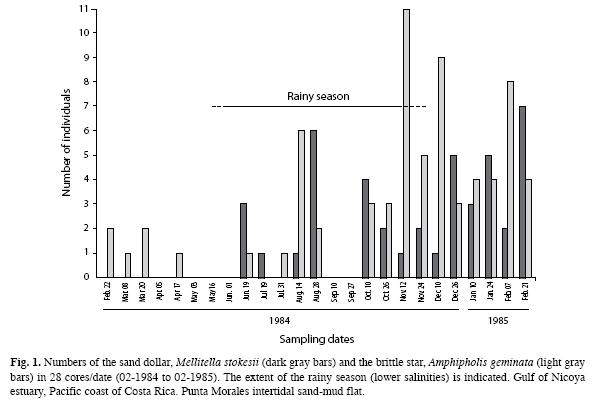
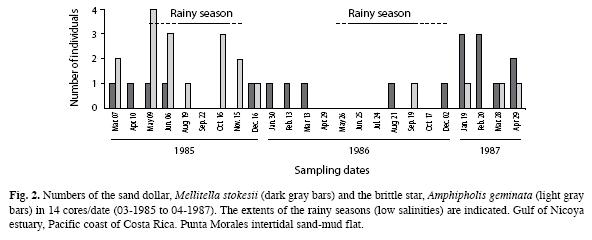
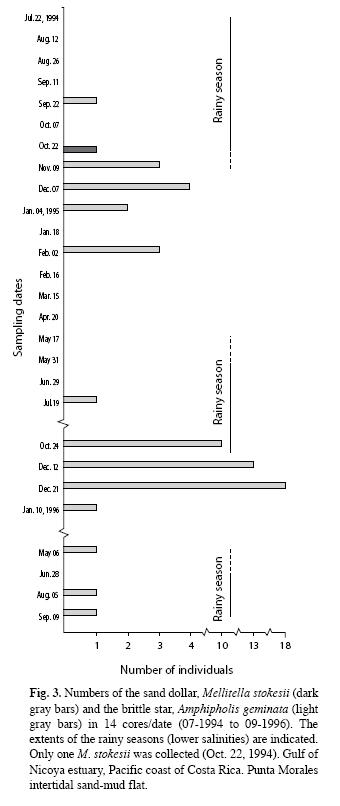
<body><![CDATA[<p align="justify"><font face="Verdana" size="2"><b>Key words: </b><i>Mellitella stokesii</i>, <i>Amphipholis geminata</i>, estuary, tidal flat, Gulf of Nicoya, Costa Rica.</font></p>     <p align="justify"><b><font face="Verdana" size="3">Resumen</font></b></p>     <p align="justify"><font face="Verdana" size="2">La informaci&oacute;n sobre cambios en el tiempo, en la biodiversidad y ecolog&iacute;a de los sistemas tropicales, es de importancia creciente en el contexto de la din&aacute;mica local, regional, o global. Este estudio tuvo por objetivo el contribuir con informaci&oacute;n de largo-plazo sobre fluctuaciones en la abundancia de dos especies de equinodermos en una planicie mareal tropical. De febrero 1984 a diciembre 1986, marzo 1985 a abril 1987, y julio 1994 a septiembre 1996 (total: 76 fechas), muestras de barreno (17.7cm<sup>2</sup>, 15cm de profundidad) fueron recolectadas durante la marea baja en una planicie fangosa-arenosa en la regi&oacute;n media del estuario del Golfo de Nicoya, Costa Rica, como parte de un estudio de la comunidad bent&oacute;nica. Entre las m&aacute;s de 100 especies, la estrella fr&aacute;gil excavadora, <i>Amphipholis geminata </i>y la galleta de mar, <i>Mellitella stokesii</i>, aparecieron en las muestras a lo largo del estudio. Un total de 63 <i>M. stokesii</i>, y 149 <i>A. geminata </i>fueron recolectadas. Las 43 galletas de mar encontradas durante 1984-1985, dan una densidad aproximada de 35 ind./m<sup>2</sup>, la que est&aacute; dentro del &aacute;mbito informado para esta especie. <i>M. stokesii </i>estuvo casi ausente entre 1994 y 1996, mientras que <i>A. geminata </i>tuvo su pico de abundancia a fines de 1995. Escasa abundancia de la galleta durante la estaci&oacute;n de lluvias (Mayo a Noviembre), y peque&ntilde;os incrementos durante la estaci&oacute;n seca (Diciembre a Abril), tambi&eacute;n est&aacute;n dentro de lo informado para la regi&oacute;n. <i>A</i>. <i>geminata </i>tambi&eacute;n present&oacute; un patr&oacute;n irregular de abundancia, con peque&ntilde;os incrementos durante el fin de la estaci&oacute;n de lluvias o durante la estaci&oacute;n seca, cuando las salinidades altas son m&aacute;s adecuadas para los equinodermos. La distribuci&oacute;n agregada de ambas especies hace dif&iacute;cil la identificaci&oacute;n de patrones con el barrreno. No obstante, esta informaci&oacute;n es &uacute;nica debido a lo amplio de la cobertura temporal, y provee una l&iacute;nea base para futuros muestreos dise&ntilde;ados espec&iacute;ficamente para el estudio de los equinodermos estuarinos tropicales de la zona de entre-mareas.</font></p>     <p align="justify"><font face="Verdana" size="2"><b>Palabras clave</b>: <i>Mellitella stokesii</i>, <i>Amphipholis geminata</i>, estuario, planicie fangosa, Golfo de Nicoya, Costa Rica. </font></p> <hr style="width: 100%; height: 2px;">     <p align="justify"><font face="Verdana" size="2">In 1980-83, physical, chemical and biological (subtidal benthos and fish) surveys were conducted at the Gulf of Nicoya estuary, on the Pacific coast (10&deg; N - 85&deg; W), of Costa Rica. The surveys were aimed at providing baseline information on the estuary in support of management policies. More than 100 papers were published, making the Gulf of Nicoya one of the best known tropical estuaries worldwide (see references in Vargas 1995). These studies were followed by a survey of an intertidal site in the mid upper estuary. The baseline information collected in the Gulf of Nicoya is of increasing importance, especially when changes over decades in the biodiversity and ecology of the estuary need to be evaluated against the background of local, regional and global dynamics (Vargas &amp; Mata 2004).</font></p>     <p align="justify"><font face="Verdana" size="2">The intertidal survey methods were aimed at identifying the seasonal patterns of the macrofaunal community in general (Vargas 1987, 1988, 1989) and not specifically designed for the study of a particular species. Among the more than 100 taxa collected, however, the burrowing brittle star, <i>Amphipholis geminata </i>(Le Conte, 1851) and the sand dollar (formerly in the genus <i>Encope</i>), <i>Mellitella stokesii </i>(L.Agassiz, 1841), appeared in the samples over the study period. The availability of long term data sets for tropical echinoderms is rare in the literature, and published reports deal maily with the description of benthic population patterns over the annual cycle, as in <i>M. stokesii </i>from Panama (Dexter 1977), or on the abundance of planktonic larvae over longer periods, as in Williams &amp; Garc&iacute;a-Sais (2010). A total of 229 species of echinoderms have been reported from Costa Rica, with the Echinoidea (55 species) and the Ophiuroidea (69), as the more diverse groups (Alvarado &amp; Cort&eacute;s 2009) but little information is available on the ecology of species from intertidal sedimentary habitats. Thus, the objective of this note is to make accesible data on, <i>M. stokesii </i>and <i>A. geminate </i>found on a tidal flat in Gulf of Nicoya estuary.</font></p>     <p align="justify"><b><font face="Verdana" size="3">Materials and methods</font></b></p> <font face="Verdana" size="2">     <p align="justify">From February 1984 to February 1985, March 1985 to April 1987, and July 1994 to September 1996 (total: 76 dates), core samples were collected at low tide at the Punta Morales intertidal (mean tidal range: 3m) muddy sand flat in the mid upper Gulf of Nicoya. In order to minimize sediment spatial variability, sampling was restricted to a 400m<sup>2</sup> area of the flat, using a corer (17.7cm<sup>2</sup>), to a depth of 15cm. Samples were preserved with 5% buffered formalin is sea water stained with Rose Bengal, and later washed on a 500 micron mesh sieve. Sorted specimens were stored in 70% alcohol. Only ophiuroid specimens containing the central disk, and intact sand dollars were counted. In 1984 and 1985, a total of 28 cores (0.05m<sup>2</sup>) were collected at intervals ranging from 12 to 18 days (25 dates, <a href="#fig1">Fig. 1</a>). Sampling (14 cores, 0.02m<sup>2</sup>), at monthly intervals was conducted from 1985 to 1987 (22 dates, <a href="#fig2">Fig. 2</a>). Collection of samples with the same gear and at varying intervals was conducted from 1994 to 1996 (27 dates, <a  href="#fig3">Fig. 3</a>), and analyzed by the junior author (Solano 2007).    <br> </p>     <p align="justify">    ]]></body>
<body><![CDATA[<br> </p>     <p align="justify">    <br> </p> </font>     <div style="text-align: center;"><font face="Verdana" size="2">     <p align="justify"></p> </font>     <div style="text-align: center;"><a name="fig1"></a><img  src="/img/revistas/rbt/v59n1/a16f1.jpg" title="" alt=""  style="width: 598px; height: 406px;">    <br>     <br>     <br>     <br> <a name="fig2"></a><img src="/img/revistas/rbt/v59n1/a16f2.jpg" title=""  alt="" style="width: 592px; height: 240px;">    ]]></body>
<body><![CDATA[<br>     <br>     <br>     <br> <a name="fig3"></a><img src="/img/revistas/rbt/v59n1/a16f3.jpg" title=""  alt="" style="width: 340px; height: 806px;">    <br>     <br> </div> </div> <font face="Verdana" size="2"></font><b><font face="Verdana" size="3">     <p align="justify">Results</p> </font></b><font face="Verdana" size="2"> </font>     <p align="justify"><font face="Verdana" size="2">On average, the sediments at the flat were 65% sand, 32% silt + clay and less than 2% organic matter (by combustion at 500&deg;C): Eh measurements indicated reduction potentials of up to -200mV at 1cm below the surface. The sediments were soft enough as to make it difficult for a person to walk without sinking to knee height. A brown organic layer of about 5mm thickness was on top of the dark gray reducing sediments, and the surface was dotted by tubes of polychaete onuphid worms, crustacean holes, hemichordate fecal mounds, and feeding tracks of the predatory snail, <i>Natica unifasciata</i>. Many species of resident and migrant charadriiform birds were observed feeding on the flat during the study. When the 15cm long sediment cores were extruded, sometimes broken arms of <i>A. geminata </i>were observed sticking out of the end of the sediment core, indicating that this species seems capable of burrowing deeper, perhaps taking advantage of the meshwork of invertebrate burrows. The rising tide covers the low relief flat in about 30 minutes, with no apparent disturbance of the sediment surface. Water temperatures of the rising tide ranged from 27 to 40&deg;C, depending on direct sunlight exposure. Salinity varied seasonally from a low of 24&#8240; (rainy season) to a high of 34&#8240; (dry season) and also varied daily (2 to 4&#8240;) with the tide. Because of the protected location of the flat, waves with amplitudes greater than 0.5m were rarely observed. The total numbers of <i>M. stokesii </i>and <i>A. geminata </i>found in cores per sampling date at different intevals from 1984 to 1985, 1985 to 1987, and 1994 to 1996, are included in <a href="#fig1">Figs.1</a>, <a href="#fig2">2</a>, <a href="#fig3">3</a>, respectively. <i>M. stokesii </i>was almost absent from 1994 to 1996, while <i>A. geminata </i>had its peak of abundance at the end of 1995 (<a href="#fig3">F</a><a href="#fig3">ig. 3</a>). A total of 63 <i>M. stokesii </i>and 149 <i>A. geminate </i>were found in the core samples during the 76 visits to the flat.    <br> </font></p> <font style="font-weight: bold;" face="Verdana" size="3">     <p align="justify">Discussion</p> </font>     ]]></body>
<body><![CDATA[<p align="justify"><i><font face="Verdana" size="2">Mellitella stokesii </font></i><font face="Verdana" size="2">is found from Punta Arena, Baja California (Mexico) to Tumbes (Peru) and the Galapagos islands (Dexter 1977). Alvarado &amp; Cort&eacute;s (2009), reported it as <i>M. stokessi </i>from the Gulf of Nicoya, and the Museum of Zoology of the University of Costa Rica has specimens (MZUCR-420), collected from this estuary. It has been reported as <i>Encope </i>(<i>Mellitella</i>) <i>stokesii </i>from El Salvador (Pacific, Gulf of Fonseca), by Barraza &amp; Hasb&uacute;n (2005). Lessios (2005) reported its presence in Panama from intertidal habitats to a depth of 10m.</font></p>     <p align="justify"><font face="Verdana" size="2">Dexter (1977), described population fluctuations of <i>M. stokesii </i>over a one year period in a Pacific intertidal habitat near the Panama canal. She found that this species had a life span of less than a year, an estimated average density of 39 ind./m<sup>2</sup> (range 19 to 65) with a peak in February (dry season), a patchy distribution and continuous recruitment during the sampling period. Dexter (1977) also found that <i>M. stokesii </i>migrates towards the sediment surface during low tide, when the sediment is covered with diatom and detrital films. A similar behavior was observed at the Punta Morales flat, where the sand dollars moved around under a few mm thick pennate-diatom/organicdetritus/ fine-sediment films during low tide. This strategy presumably allowed the organisms some protection from demersal predators, direct sunlight and high temperatures (up to 40&deg;C) during exposure (about three hours during spring low tides).</font></p>     <p align="justify"><font face="Verdana" size="2">The 43 specimens of <i>M. stokesii </i>collected during 1984-1985 (<a href="#fig1">Fig. 1</a>), from a total core area of 1.24 m<sup>2</sup>, give an approximate density of 35 ind./ m<sup>2</sup> (range 0 to 140), which is within that reported by Dexter (1977). The low abundance of the sand dollar during the rainy seasons, and its slight increment in dry seasons cores (<a href="#fig1">Figs. 1</a>, <a  href="#fig2">2</a>), also agrees with the results of Dexter (1977). Its near absence in samples collected from 1994 to 1996, is noteworthy. In the Gulf of Nicoya the dry (December-April) and rainy seasons (May-November), exert significant impacts on water parameters of the estuary (Voorhis <i>et al </i>1983). This seasonality is also reflected at the community level (Vargas 1988, 1989), and in the use of the tidal flats over the year by more than 27 species of migratory and resident shore-birds, which have been observed in the Gulf of Nicoya foraging at low tide on bivalves, worms, crabs, shrimps and other prey items (Pereira 1990). We are uncertain as to whether or not these birds prey on, <i>M. stokesii </i>at the study site<i>. </i>However, among the more abundant birds, <i>Catoptrophorus semipalmatus </i>and <i>Limnodromus griseus </i>(Scolopacidae), captured and ingested specimens of the brittle star, <i>Amphipholis geminata </i>at the nearby sand flat of Cocorocas (Pereira 1990).</font></p>     <p align="justify"><font face="Verdana" size="2"><i>A. geminata </i>is mentioned by Clark (1940) as a long-armed brittle star that prefers muddy bottoms in the Gulf of Fonseca (El Salvador), the Gulf of Nicoya estuary and also in Panama, from the lower intertidal to about 10m depth. More recently it has been reported from offshore waters of the Gulf of California and from coastal waters of Sinaloa (Mexico) by Sol&iacute;s-Mar&iacute;n <i>et al </i>(2005). Alvarado &amp; Cort&eacute;s (2009), included this species in their updated list of marine echinoderms of Costa Rica, and the Museum of Zoology of the University of Costa Rica has specimens from the Gulf of Nicoya (MZUCR-421). It is also found in Colombia on intertidal muddy bottoms (Neira &amp; Cantera 2005).</font></p>     <p align="justify"><font face="Verdana" size="2">Reise (1991), points out that comparisons of tidal flat faunas based on related species occupying similar niches, or on unrelated species playing analogous ecological roles, are useful to understand the functioning (energy flow) of these ecosystems. Vargas (1996), pointed out that <i>M. stokesii</i>, as a detritus feeder/ sediment-reworker-stabilizer/producer of sediment tracks, may play a similar ecological role than its temperate counterpart, <i>Mellita quiquesperforata. </i>Dittman &amp; Vargas (2001) compared the faunas of tidal flats and identified a hemichordate-sand dollar- hermit crab flat in the Haughton estuary (Australia), and a sand dollar-hermit crab flat in the Gulf of Nicoya. Although there were no species in common, they found comparable life forms (like sand dollars) and trophic roles (for example, detritus feeders), and similarities of 0.89 and 0.97 (Sorensen index) at the Order and Class levels, respectively. This indicates that energy is being transferred along similar pathways at both flats. These comparative exercises may speed up the definition of international policies in support of the management of tidal flats as ecosystems.</font></p>     <p align="justify"><font face="Verdana" size="2">The Punta Morales sand-mud flat is under the influence of seasonal salinity fluctuations, being the dry season the most suitable for echinoderms and the rainy season the most difficult for them to cope with. Recruitment at the site may also follow this seasonal pattern, with peaks centered on the dry season as observed by Dexter (1977), and less evident in this study. Strong population fluctuations during 1984-1986 were observed at the site for other species of infaunal organisms (Vargas 1988, 1989, 1996). A group of species were characterized by seasonal temporal patterns, while others showed irregular oscillations, probably related to the vagaries of recruitment at a fringing environment, as it appears to be the case for <i>M. stokesii </i>and <i>A. geminata</i>. The patchy spatial distribution of both species also makes it difficult the detection of patterns with the sampling gear used in this study. Temporal and spatial patchy abundances appear to be characteristic of echinoderms in general, as emphasized by Williams &amp; Garc&iacute;a-Sais (2010). Nevertheless, the data presented herein is unique due to its extensive time coverage, and provides a baseline for future studies designed specifically for the study of tropical intertidal estuarine echinoderms.</font></p> <b><font face="Verdana" size="3">     <p align="justify">Acknowledgments</p> </font></b><font face="Verdana" size="2">     <p align="justify">We thank Harlan K. Dean for a review of the first draft of this paper, and for his help with the literature search. Gordon Hendler identified the two species of echinoderms in 1985, when the senior author was conducting research for his Ph.D. dissertation at the University of Rhode Island (U.S.A.).</p> </font> <hr style="width: 100%; height: 2px;"><b><font face="Verdana" size="3">     <p align="justify">References</p> </font></b><font face="Verdana" size="2"> </font>     <!-- ref --><p align="justify"><font face="Verdana" size="2">Alvarado, J.J. &amp; J. Cort&eacute;s. 2009. Echinoderms, p. 421-433, CD p. 392-408. <i>In </i>I. Wehrtmann &amp; J. Cort&eacute;s (eds). Marine biodiversity of Costa Rica, Central America. Monographiae Biologicae 86. Springer, Dordrecht, The Netherlands.    &nbsp;&nbsp;&nbsp;&nbsp;&nbsp;&nbsp;&nbsp;&nbsp;[&#160;<a href="javascript:void(0);" onclick="javascript: window.open('/scielo.php?script=sci_nlinks&ref=1706918&pid=S0034-7744201100010001600001&lng=','','width=640,height=500,resizable=yes,scrollbars=1,menubar=yes,');">Links</a>&#160;]<!-- end-ref --></font></p>     <!-- ref --><p align="justify"><font face="Verdana" size="2">Barraza, J.E. &amp; C.R. Hasb&uacute;n. 2005. Los equinodermos (Echinodermata) de El Salvador. Rev. Biol. Trop. 53: 139-146.    &nbsp;&nbsp;&nbsp;&nbsp;&nbsp;&nbsp;&nbsp;&nbsp;[&#160;<a href="javascript:void(0);" onclick="javascript: window.open('/scielo.php?script=sci_nlinks&ref=1706920&pid=S0034-7744201100010001600002&lng=','','width=640,height=500,resizable=yes,scrollbars=1,menubar=yes,');">Links</a>&#160;]<!-- end-ref --></font></p>     <!-- ref --><p align="justify"><font face="Verdana" size="2">Clark, H.L. 1940. Eastern Pacific Expeditions of the New York Zoological Society XXI. Notes on echinoderms from the West coast of Central America. Zool&oacute;gica XXV: 331-352.    &nbsp;&nbsp;&nbsp;&nbsp;&nbsp;&nbsp;&nbsp;&nbsp;[&#160;<a href="javascript:void(0);" onclick="javascript: window.open('/scielo.php?script=sci_nlinks&ref=1706922&pid=S0034-7744201100010001600003&lng=','','width=640,height=500,resizable=yes,scrollbars=1,menubar=yes,');">Links</a>&#160;]<!-- end-ref --></font></p>     <!-- ref --><p align="justify"><font face="Verdana" size="2">Dexter, D.M. 1977. A natural history of the sand dollar <i>Encope stokesi </i>L.Agassiz in Panama. Bull. Mar. Sci. 27: 544-551.    &nbsp;&nbsp;&nbsp;&nbsp;&nbsp;&nbsp;&nbsp;&nbsp;[&#160;<a href="javascript:void(0);" onclick="javascript: window.open('/scielo.php?script=sci_nlinks&ref=1706924&pid=S0034-7744201100010001600004&lng=','','width=640,height=500,resizable=yes,scrollbars=1,menubar=yes,');">Links</a>&#160;]<!-- end-ref --></font></p>     <!-- ref --><p align="justify"><font face="Verdana" size="2">Dittman, S. &amp; J. A. Vargas. 2001. Tropical tidal flat benthos compared between Australia and Central America, p. 275-293. <i>In </i>K. Reise (ed.). Ecological comparisons of sedimentary shores. Ecological Studies Vol. 151. Springer, Berlin, Germany.    &nbsp;&nbsp;&nbsp;&nbsp;&nbsp;&nbsp;&nbsp;&nbsp;[&#160;<a href="javascript:void(0);" onclick="javascript: window.open('/scielo.php?script=sci_nlinks&ref=1706926&pid=S0034-7744201100010001600005&lng=','','width=640,height=500,resizable=yes,scrollbars=1,menubar=yes,');">Links</a>&#160;]<!-- end-ref --></font></p>     <!-- ref --><p align="justify"><font face="Verdana" size="2">Lessios, H.A. 2005. Echinoids of the Pacific waters of Panama: State of knowledge and new records. Rev. Biol. Trop. 53 (Suppl. 3): 147-170.    &nbsp;&nbsp;&nbsp;&nbsp;&nbsp;&nbsp;&nbsp;&nbsp;[&#160;<a href="javascript:void(0);" onclick="javascript: window.open('/scielo.php?script=sci_nlinks&ref=1706928&pid=S0034-7744201100010001600006&lng=','','width=640,height=500,resizable=yes,scrollbars=1,menubar=yes,');">Links</a>&#160;]<!-- end-ref --></font></p>     <!-- ref --><p align="justify"><font face="Verdana" size="2">Neira, R. &amp; J.R. Cantera. 2005. Composici&oacute;n taxon&oacute;mica y distribuci&oacute;n de las asociaciones de equinodermos en los ecosistemas litorales del Pac&iacute;fico Colombiano. Rev. Biol. Trop. 53 (Suppl. 3): 195-206.    &nbsp;&nbsp;&nbsp;&nbsp;&nbsp;&nbsp;&nbsp;&nbsp;[&#160;<a href="javascript:void(0);" onclick="javascript: window.open('/scielo.php?script=sci_nlinks&ref=1706930&pid=S0034-7744201100010001600007&lng=','','width=640,height=500,resizable=yes,scrollbars=1,menubar=yes,');">Links</a>&#160;]<!-- end-ref --></font></p>     <!-- ref --><p align="justify"><font face="Verdana" size="2">Pereira, A.I. 1990. Ecolog&iacute;a de la alimentaci&oacute;n de los correlimos (Aves: Scolopacidae) de una playa fangosa del Golfo de Nicoya, Costa Rica. Tesis de Maestr&iacute;a, Universidad de Costa Rica, San Jos&eacute;, Costa Rica.    &nbsp;&nbsp;&nbsp;&nbsp;&nbsp;&nbsp;&nbsp;&nbsp;[&#160;<a href="javascript:void(0);" onclick="javascript: window.open('/scielo.php?script=sci_nlinks&ref=1706932&pid=S0034-7744201100010001600008&lng=','','width=640,height=500,resizable=yes,scrollbars=1,menubar=yes,');">Links</a>&#160;]<!-- end-ref --></font></p>     <!-- ref --><p align="justify"><font face="Verdana" size="2">Reise, K. 1991. Macrofauna in mud and sand of tropical and temperate tidal flats, p. 211-216. <i>In </i>M. Elliot &amp; J.P. Ducrotoy (eds.). Estuaries and coasts. Spatial and temporal intercomparisons. Olsen &amp; Olsen, Fredensborg, Denmark.    &nbsp;&nbsp;&nbsp;&nbsp;&nbsp;&nbsp;&nbsp;&nbsp;[&#160;<a href="javascript:void(0);" onclick="javascript: window.open('/scielo.php?script=sci_nlinks&ref=1706934&pid=S0034-7744201100010001600009&lng=','','width=640,height=500,resizable=yes,scrollbars=1,menubar=yes,');">Links</a>&#160;]<!-- end-ref --></font></p>     <!-- ref --><p align="justify"><font face="Verdana" size="2">Solano, S. 2007. Estudio comparativo de la estructura de la comunidad de macrofauna b&eacute;ntica en la zona fangosa de Playa Blanca, Punta Morales, Golfo de Nicoya, Costa Rica. Tesis de Maestr&iacute;a, Universidad de Costa Rica, San Jos&eacute;, Costa Rica.    &nbsp;&nbsp;&nbsp;&nbsp;&nbsp;&nbsp;&nbsp;&nbsp;[&#160;<a href="javascript:void(0);" onclick="javascript: window.open('/scielo.php?script=sci_nlinks&ref=1706936&pid=S0034-7744201100010001600010&lng=','','width=640,height=500,resizable=yes,scrollbars=1,menubar=yes,');">Links</a>&#160;]<!-- end-ref --></font></p>     <!-- ref --><p align="justify"><font face="Verdana" size="2">Sol&iacute;s-Mar&iacute;n, F.A., A. Laguarda-Figueras &amp; A. Dur&aacute;n- Gonz&aacute;lez. 2005. Equinodermos (Echinodermata) del Golfo de California, M&eacute;xico. Rev. Biol. Trop. 53 (Suppl. 3): 123-137.    &nbsp;&nbsp;&nbsp;&nbsp;&nbsp;&nbsp;&nbsp;&nbsp;[&#160;<a href="javascript:void(0);" onclick="javascript: window.open('/scielo.php?script=sci_nlinks&ref=1706938&pid=S0034-7744201100010001600011&lng=','','width=640,height=500,resizable=yes,scrollbars=1,menubar=yes,');">Links</a>&#160;]<!-- end-ref --></font></p>     <!-- ref --><p align="justify"><font face="Verdana" size="2">Vargas, J.A. 1987. The benthic community of an intertidal mud flat in the Gulf of Nicoya, Costa Rica. Description of the community. Rev. Biol. Trop. 35: 229-316.    &nbsp;&nbsp;&nbsp;&nbsp;&nbsp;&nbsp;&nbsp;&nbsp;[&#160;<a href="javascript:void(0);" onclick="javascript: window.open('/scielo.php?script=sci_nlinks&ref=1706940&pid=S0034-7744201100010001600012&lng=','','width=640,height=500,resizable=yes,scrollbars=1,menubar=yes,');">Links</a>&#160;]<!-- end-ref --> </font></p>     <!-- ref --><p align="justify"><font face="Verdana" size="2">Vargas, J.A. 1988. Community structure of macrobenthos and the results of macropredator exclusion on a tropical mud flat. Rev. Biol. Trop. 36: 287-308.    &nbsp;&nbsp;&nbsp;&nbsp;&nbsp;&nbsp;&nbsp;&nbsp;[&#160;<a href="javascript:void(0);" onclick="javascript: window.open('/scielo.php?script=sci_nlinks&ref=1706942&pid=S0034-7744201100010001600013&lng=','','width=640,height=500,resizable=yes,scrollbars=1,menubar=yes,');">Links</a>&#160;]<!-- end-ref --> </font></p>     <!-- ref --><p align="justify"><font face="Verdana" size="2">Vargas, J.A. 1989. A three year survey of the macrofauna of an intertidal mud flat in the Gulf of Nicoya, Costa Rica, p. 1905-1919. <i>In </i>O. Magoon, M. Converse, D. Miner, L.T. Tobin &amp; D. Clark (eds.). Proc. 6th Symp. on Coastal and Ocean Management, Vol. 2. Amer. Soc. Civil Eng. New York, U.S.A.    &nbsp;&nbsp;&nbsp;&nbsp;&nbsp;&nbsp;&nbsp;&nbsp;[&#160;<a href="javascript:void(0);" onclick="javascript: window.open('/scielo.php?script=sci_nlinks&ref=1706944&pid=S0034-7744201100010001600014&lng=','','width=640,height=500,resizable=yes,scrollbars=1,menubar=yes,');">Links</a>&#160;]<!-- end-ref --></font></p>     <!-- ref --><p align="justify"><font face="Verdana" size="2">Vargas, J.A. 1995. The Gulf of Nicoya estuary, Costa Rica. Past, present, and future cooperative research. Helgol&auml;nder Meeresunters 49: 821-828.    &nbsp;&nbsp;&nbsp;&nbsp;&nbsp;&nbsp;&nbsp;&nbsp;[&#160;<a href="javascript:void(0);" onclick="javascript: window.open('/scielo.php?script=sci_nlinks&ref=1706946&pid=S0034-7744201100010001600015&lng=','','width=640,height=500,resizable=yes,scrollbars=1,menubar=yes,');">Links</a>&#160;]<!-- end-ref --></font></p>     <!-- ref --><p align="justify"><font face="Verdana" size="2">Vargas, J.A. 1996. Ecological dynamics of a tropical intertidal mudflat community, p. 355-371. <i>In </i>K.F. Nordstrom &amp; C.T. Roman (eds.). Estuarine shores: evolution, environments and human alterations. John Wiley &amp; Sons, London, England.    &nbsp;&nbsp;&nbsp;&nbsp;&nbsp;&nbsp;&nbsp;&nbsp;[&#160;<a href="javascript:void(0);" onclick="javascript: window.open('/scielo.php?script=sci_nlinks&ref=1706948&pid=S0034-7744201100010001600016&lng=','','width=640,height=500,resizable=yes,scrollbars=1,menubar=yes,');">Links</a>&#160;]<!-- end-ref --></font></p>     <!-- ref --><p align="justify"><font face="Verdana" size="2">Vargas, J.A. &amp; A. Mata. 2004. Where the dry forest feeds the sea: The Gulf of Nicoya estuary, p. 126-135. <i>In </i>G.W. Frankie, A. Mata &amp; S.B. Vinson (eds.). Biodiversity conservation in Costa Rica; Learning the lessons in a seasonal dry forest. University of California, Berkeley, U.S.A.    &nbsp;&nbsp;&nbsp;&nbsp;&nbsp;&nbsp;&nbsp;&nbsp;[&#160;<a href="javascript:void(0);" onclick="javascript: window.open('/scielo.php?script=sci_nlinks&ref=1706950&pid=S0034-7744201100010001600017&lng=','','width=640,height=500,resizable=yes,scrollbars=1,menubar=yes,');">Links</a>&#160;]<!-- end-ref --> </font></p>     <!-- ref --><p align="justify"><font face="Verdana" size="2">Voorhis, A., C. E. Epifanio, D. Maurer, A.I. Dittel &amp; JA. Vargas. 1983. The estuarine character of the Gulf of Nicoya, an embayment on the Pacific coast of Central America. Hydrobiologia 99: 225-237.    &nbsp;&nbsp;&nbsp;&nbsp;&nbsp;&nbsp;&nbsp;&nbsp;[&#160;<a href="javascript:void(0);" onclick="javascript: window.open('/scielo.php?script=sci_nlinks&ref=1706952&pid=S0034-7744201100010001600018&lng=','','width=640,height=500,resizable=yes,scrollbars=1,menubar=yes,');">Links</a>&#160;]<!-- end-ref --></font></p>     <!-- ref --><p align="justify"><font face="Verdana" size="2">Williams, S.M. &amp; J. Garc&iacute;a-Sais. 2010. Temporal and spatial distribution patterns of echinoderm larvae in La Parguera, Puerto Rico. Rev. Biol. Trop. 58 (Suppl. 3): 81-88.    &nbsp;&nbsp;&nbsp;&nbsp;&nbsp;&nbsp;&nbsp;&nbsp;[&#160;<a href="javascript:void(0);" onclick="javascript: window.open('/scielo.php?script=sci_nlinks&ref=1706954&pid=S0034-7744201100010001600019&lng=','','width=640,height=500,resizable=yes,scrollbars=1,menubar=yes,');">Links</a>&#160;]<!-- end-ref --><br> </font></p>     <p align="justify"><font face="Verdana" size="2">    <br> <a name="correspondencia"></a>Correspondencia a: <font face="Verdana"  size="2">Jos&eacute; A. Vargas. </font><font face="Verdana" size="2">Centro de Investigaci&oacute;n en Ciencias del Mar y Limnolog&iacute;a (CIMAR), Universidad de Costa Rica, 2060, San Jos&eacute;, Costa Rica; <a href="mailto:javargas@biologia.ucr.ac.cr">javargas@biologia.ucr.ac.cr</a> / </font><font face="Verdana" size="2">Escuela de Biolog&iacute;a, Universidad de Costa Rica, 2060, San Jos&eacute;, Costa Rica    <br> </font><font face="Verdana" size="2">Sylvia Solano. </font><font  face="Verdana" size="2">Escuela de Biolog&iacute;a, Universidad de Costa Rica, 2060, San Jos&eacute;, Costa Rica; <a  href="mailto:ssolano@biologia.ucr.ac.cr">ssolano@biologia.ucr.ac.cr</a></font></font></p> <hr style="width: 100%; height: 2px;"><font face="Verdana" size="2">     ]]></body>
<body><![CDATA[<p align="center">Received 12-X-2010. Corrected 29-IX-2010. Accepted 30-X-2010.</p> </font>      ]]></body><back>
<ref-list>
<ref id="B1">
<nlm-citation citation-type="book">
<person-group person-group-type="author">
<name>
<surname><![CDATA[Alvarado]]></surname>
<given-names><![CDATA[J.J]]></given-names>
</name>
<name>
<surname><![CDATA[Cortés]]></surname>
<given-names><![CDATA[J]]></given-names>
</name>
</person-group>
<article-title xml:lang="en"><![CDATA[Echinoderms]]></article-title>
<person-group person-group-type="editor">
<name>
<surname><![CDATA[Wehrtmann]]></surname>
<given-names><![CDATA[I]]></given-names>
</name>
<name>
<surname><![CDATA[Cortés]]></surname>
<given-names><![CDATA[J]]></given-names>
</name>
</person-group>
<source><![CDATA[Marine biodiversity of Costa Rica, Central America]]></source>
<year>2009</year>
<volume>86</volume>
<page-range>421-433, CD p. 392-408</page-range><publisher-loc><![CDATA[Dordrecht ]]></publisher-loc>
<publisher-name><![CDATA[Springer]]></publisher-name>
</nlm-citation>
</ref>
<ref id="B2">
<nlm-citation citation-type="journal">
<person-group person-group-type="author">
<name>
<surname><![CDATA[Barraza]]></surname>
<given-names><![CDATA[J.E]]></given-names>
</name>
<name>
<surname><![CDATA[Hasbún]]></surname>
<given-names><![CDATA[C.R]]></given-names>
</name>
</person-group>
<article-title xml:lang="es"><![CDATA[Los equinodermos (Echinodermata) de El Salvador]]></article-title>
<source><![CDATA[Rev. Biol. Trop]]></source>
<year>2005</year>
<volume>53</volume>
<page-range>139-146</page-range></nlm-citation>
</ref>
<ref id="B3">
<nlm-citation citation-type="journal">
<person-group person-group-type="author">
<name>
<surname><![CDATA[Clark]]></surname>
<given-names><![CDATA[H.L]]></given-names>
</name>
</person-group>
<article-title xml:lang="en"><![CDATA[Eastern Pacific Expeditions of the New York Zoological Society XXI. Notes on echinoderms from the West coast of Central America]]></article-title>
<source><![CDATA[Zoológica]]></source>
<year>1940</year>
<volume>XXV</volume>
<page-range>331-352</page-range></nlm-citation>
</ref>
<ref id="B4">
<nlm-citation citation-type="journal">
<person-group person-group-type="author">
<name>
<surname><![CDATA[Dexter]]></surname>
<given-names><![CDATA[D.M]]></given-names>
</name>
</person-group>
<article-title xml:lang="en"><![CDATA[A natural history of the sand dollar Encope stokesi L.Agassiz in Panama]]></article-title>
<source><![CDATA[Bull. Mar. Sci]]></source>
<year>1977</year>
<volume>27</volume>
<page-range>544-551</page-range></nlm-citation>
</ref>
<ref id="B5">
<nlm-citation citation-type="book">
<person-group person-group-type="author">
<name>
<surname><![CDATA[Dittman]]></surname>
<given-names><![CDATA[S]]></given-names>
</name>
<name>
<surname><![CDATA[Vargas]]></surname>
<given-names><![CDATA[J. A]]></given-names>
</name>
</person-group>
<article-title xml:lang="en"><![CDATA[Tropical tidal flat benthos compared between Australia and Central America]]></article-title>
<person-group person-group-type="editor">
<name>
<surname><![CDATA[Reise]]></surname>
<given-names><![CDATA[K]]></given-names>
</name>
</person-group>
<source><![CDATA[Ecological comparisons of sedimentary shores]]></source>
<year>2001</year>
<volume>151</volume>
<page-range>275-293</page-range><publisher-loc><![CDATA[Berlin ]]></publisher-loc>
<publisher-name><![CDATA[Springer]]></publisher-name>
</nlm-citation>
</ref>
<ref id="B6">
<nlm-citation citation-type="journal">
<person-group person-group-type="author">
<name>
<surname><![CDATA[Lessios]]></surname>
<given-names><![CDATA[H.A]]></given-names>
</name>
</person-group>
<article-title xml:lang="en"><![CDATA[Echinoids of the Pacific waters of Panama: State of knowledge and new records]]></article-title>
<source><![CDATA[Rev. Biol. Trop]]></source>
<year>2005</year>
<volume>53</volume>
<numero>^s3</numero>
<issue>^s3</issue>
<supplement>3</supplement>
<page-range>147-170</page-range></nlm-citation>
</ref>
<ref id="B7">
<nlm-citation citation-type="journal">
<person-group person-group-type="author">
<name>
<surname><![CDATA[Neira]]></surname>
<given-names><![CDATA[R]]></given-names>
</name>
<name>
<surname><![CDATA[Cantera]]></surname>
<given-names><![CDATA[J.R]]></given-names>
</name>
</person-group>
<article-title xml:lang="es"><![CDATA[Composición taxonómica y distribución de las asociaciones de equinodermos en los ecosistemas litorales del Pacífico Colombiano]]></article-title>
<source><![CDATA[Rev. Biol. Trop]]></source>
<year>2005</year>
<volume>53</volume>
<numero>^s3</numero>
<issue>^s3</issue>
<supplement>3</supplement>
<page-range>195-206</page-range></nlm-citation>
</ref>
<ref id="B8">
<nlm-citation citation-type="">
<person-group person-group-type="author">
<name>
<surname><![CDATA[Pereira]]></surname>
<given-names><![CDATA[A.I]]></given-names>
</name>
</person-group>
<source><![CDATA[Ecología de la alimentación de los correlimos (Aves: Scolopacidae) de una playa fangosa del Golfo de Nicoya, Costa Rica]]></source>
<year>1990</year>
</nlm-citation>
</ref>
<ref id="B9">
<nlm-citation citation-type="book">
<person-group person-group-type="author">
<name>
<surname><![CDATA[Reise]]></surname>
<given-names><![CDATA[K]]></given-names>
</name>
</person-group>
<article-title xml:lang="en"><![CDATA[Macrofauna in mud and sand of tropical and temperate tidal flats]]></article-title>
<person-group person-group-type="editor">
<name>
<surname><![CDATA[Elliot]]></surname>
<given-names><![CDATA[M]]></given-names>
</name>
<name>
<surname><![CDATA[Ducrotoy]]></surname>
<given-names><![CDATA[J.P]]></given-names>
</name>
</person-group>
<source><![CDATA[Estuaries and coasts. Spatial and temporal intercomparisons]]></source>
<year>1991</year>
<page-range>211-216</page-range><publisher-loc><![CDATA[Fredensborg ]]></publisher-loc>
<publisher-name><![CDATA[Olsen & Olsen]]></publisher-name>
</nlm-citation>
</ref>
<ref id="B10">
<nlm-citation citation-type="">
<person-group person-group-type="author">
<name>
<surname><![CDATA[Solano]]></surname>
<given-names><![CDATA[S]]></given-names>
</name>
</person-group>
<source><![CDATA[Estudio comparativo de la estructura de la comunidad de macrofauna béntica en la zona fangosa de Playa Blanca, Punta Morales, Golfo de Nicoya, Costa Rica]]></source>
<year>2007</year>
</nlm-citation>
</ref>
<ref id="B11">
<nlm-citation citation-type="journal">
<person-group person-group-type="author">
<name>
<surname><![CDATA[Solís-Marín]]></surname>
<given-names><![CDATA[F.A]]></given-names>
</name>
<name>
<surname><![CDATA[Laguarda-Figueras]]></surname>
<given-names><![CDATA[A]]></given-names>
</name>
<name>
<surname><![CDATA[Durán- González]]></surname>
<given-names><![CDATA[A]]></given-names>
</name>
</person-group>
<article-title xml:lang="es"><![CDATA[Equinodermos (Echinodermata) del Golfo de California, México]]></article-title>
<source><![CDATA[Rev. Biol. Trop]]></source>
<year>2005</year>
<volume>53</volume>
<numero>^s3</numero>
<issue>^s3</issue>
<supplement>3</supplement>
<page-range>123-137</page-range></nlm-citation>
</ref>
<ref id="B12">
<nlm-citation citation-type="journal">
<person-group person-group-type="author">
<name>
<surname><![CDATA[Vargas]]></surname>
<given-names><![CDATA[J.A]]></given-names>
</name>
</person-group>
<article-title xml:lang="en"><![CDATA[The benthic community of an intertidal mud flat in the Gulf of Nicoya, Costa Rica. Description of the community]]></article-title>
<source><![CDATA[Rev. Biol. Trop]]></source>
<year>1987</year>
<volume>35</volume>
<page-range>229-316</page-range></nlm-citation>
</ref>
<ref id="B13">
<nlm-citation citation-type="journal">
<person-group person-group-type="author">
<name>
<surname><![CDATA[Vargas]]></surname>
<given-names><![CDATA[J.A]]></given-names>
</name>
</person-group>
<article-title xml:lang="en"><![CDATA[Community structure of macrobenthos and the results of macropredator exclusion on a tropical mud flat]]></article-title>
<source><![CDATA[Rev. Biol. Trop]]></source>
<year>1988</year>
<volume>36</volume>
<page-range>287-308</page-range></nlm-citation>
</ref>
<ref id="B14">
<nlm-citation citation-type="book">
<person-group person-group-type="author">
<name>
<surname><![CDATA[Vargas]]></surname>
<given-names><![CDATA[J.A]]></given-names>
</name>
</person-group>
<article-title xml:lang="en"><![CDATA[A three year survey of the macrofauna of an intertidal mud flat in the Gulf of Nicoya, Costa Rica]]></article-title>
<person-group person-group-type="editor">
<name>
<surname><![CDATA[Magoon]]></surname>
<given-names><![CDATA[O]]></given-names>
</name>
<name>
<surname><![CDATA[Converse]]></surname>
<given-names><![CDATA[M]]></given-names>
</name>
<name>
<surname><![CDATA[Miner]]></surname>
<given-names><![CDATA[D]]></given-names>
</name>
<name>
<surname><![CDATA[Tobin]]></surname>
<given-names><![CDATA[L.T]]></given-names>
</name>
<name>
<surname><![CDATA[Clark]]></surname>
<given-names><![CDATA[D]]></given-names>
</name>
</person-group>
<source><![CDATA[Proc. 6th Symp. on Coastal and Ocean Management]]></source>
<year>1989</year>
<volume>2</volume>
<page-range>1905-1919</page-range><publisher-loc><![CDATA[New York ]]></publisher-loc>
<publisher-name><![CDATA[Amer. Soc. Civil Eng]]></publisher-name>
</nlm-citation>
</ref>
<ref id="B15">
<nlm-citation citation-type="journal">
<person-group person-group-type="author">
<name>
<surname><![CDATA[Vargas]]></surname>
<given-names><![CDATA[J.A]]></given-names>
</name>
</person-group>
<article-title xml:lang="en"><![CDATA[The Gulf of Nicoya estuary, Costa Rica. Past, present, and future cooperative research]]></article-title>
<source><![CDATA[Helgoländer Meeresunters]]></source>
<year>1995</year>
<volume>49</volume>
<page-range>821-828</page-range></nlm-citation>
</ref>
<ref id="B16">
<nlm-citation citation-type="book">
<person-group person-group-type="author">
<name>
<surname><![CDATA[Vargas]]></surname>
<given-names><![CDATA[J.A]]></given-names>
</name>
</person-group>
<article-title xml:lang="en"><![CDATA[Ecological dynamics of a tropical intertidal mudflat community]]></article-title>
<person-group person-group-type="editor">
<name>
<surname><![CDATA[Nordstrom]]></surname>
<given-names><![CDATA[K.F]]></given-names>
</name>
<name>
<surname><![CDATA[Roman]]></surname>
<given-names><![CDATA[C.T]]></given-names>
</name>
</person-group>
<source><![CDATA[Estuarine shores: evolution, environments and human alterations]]></source>
<year>1996</year>
<page-range>355-371</page-range><publisher-loc><![CDATA[London ]]></publisher-loc>
<publisher-name><![CDATA[John Wiley & Sons]]></publisher-name>
</nlm-citation>
</ref>
<ref id="B17">
<nlm-citation citation-type="book">
<person-group person-group-type="author">
<name>
<surname><![CDATA[Vargas]]></surname>
<given-names><![CDATA[J.A]]></given-names>
</name>
<name>
<surname><![CDATA[Mata]]></surname>
<given-names><![CDATA[A]]></given-names>
</name>
</person-group>
<article-title xml:lang="en"><![CDATA[Where the dry forest feeds the sea: The Gulf of Nicoya estuary]]></article-title>
<person-group person-group-type="editor">
<name>
<surname><![CDATA[Frankie]]></surname>
<given-names><![CDATA[G.W]]></given-names>
</name>
<name>
<surname><![CDATA[Mata]]></surname>
<given-names><![CDATA[A]]></given-names>
</name>
<name>
<surname><![CDATA[Vinson]]></surname>
<given-names><![CDATA[S.B]]></given-names>
</name>
</person-group>
<source><![CDATA[Biodiversity conservation in Costa Rica; Learning the lessons in a seasonal dry forest]]></source>
<year>2004</year>
<page-range>126-135</page-range><publisher-loc><![CDATA[Berkeley ]]></publisher-loc>
<publisher-name><![CDATA[University of California]]></publisher-name>
</nlm-citation>
</ref>
<ref id="B18">
<nlm-citation citation-type="journal">
<person-group person-group-type="author">
<name>
<surname><![CDATA[Voorhis]]></surname>
<given-names><![CDATA[A]]></given-names>
</name>
<name>
<surname><![CDATA[Epifanio]]></surname>
<given-names><![CDATA[C. E]]></given-names>
</name>
<name>
<surname><![CDATA[Maurer]]></surname>
<given-names><![CDATA[D]]></given-names>
</name>
<name>
<surname><![CDATA[Dittel]]></surname>
<given-names><![CDATA[A.I]]></given-names>
</name>
<name>
<surname><![CDATA[Vargas]]></surname>
<given-names><![CDATA[JA]]></given-names>
</name>
</person-group>
<article-title xml:lang="en"><![CDATA[The estuarine character of the Gulf of Nicoya, an embayment on the Pacific coast of Central America]]></article-title>
<source><![CDATA[Hydrobiologia]]></source>
<year>1983</year>
<volume>99</volume>
<page-range>225-237</page-range></nlm-citation>
</ref>
<ref id="B19">
<nlm-citation citation-type="journal">
<person-group person-group-type="author">
<name>
<surname><![CDATA[Williams]]></surname>
<given-names><![CDATA[S.M]]></given-names>
</name>
<name>
<surname><![CDATA[García-Sais]]></surname>
<given-names><![CDATA[J]]></given-names>
</name>
</person-group>
<article-title xml:lang="en"><![CDATA[Temporal and spatial distribution patterns of echinoderm larvae in La Parguera, Puerto Rico]]></article-title>
<source><![CDATA[Rev. Biol. Trop]]></source>
<year>2010</year>
<volume>58</volume>
<numero>^s3</numero>
<issue>^s3</issue>
<supplement>3</supplement>
<page-range>81-88</page-range></nlm-citation>
</ref>
</ref-list>
</back>
</article>