<?xml version="1.0" encoding="ISO-8859-1"?><article xmlns:mml="http://www.w3.org/1998/Math/MathML" xmlns:xlink="http://www.w3.org/1999/xlink" xmlns:xsi="http://www.w3.org/2001/XMLSchema-instance">
<front>
<journal-meta>
<journal-id>0034-7744</journal-id>
<journal-title><![CDATA[Revista de Biología Tropical]]></journal-title>
<abbrev-journal-title><![CDATA[Rev. biol. trop]]></abbrev-journal-title>
<issn>0034-7744</issn>
<publisher>
<publisher-name><![CDATA[Universidad de Costa Rica]]></publisher-name>
</publisher>
</journal-meta>
<article-meta>
<article-id>S0034-77442011000100007</article-id>
<title-group>
<article-title xml:lang="en"><![CDATA[Quality and digestibility of food ingested by various trophic fish groups in the Upper Paraná River floodplain]]></article-title>
</title-group>
<contrib-group>
<contrib contrib-type="author">
<name>
<surname><![CDATA[Esper Amaro de Faria]]></surname>
<given-names><![CDATA[Anna Christina]]></given-names>
</name>
<xref ref-type="aff" rid="A01"/>
</contrib>
<contrib contrib-type="author">
<name>
<surname><![CDATA[Benedito]]></surname>
<given-names><![CDATA[Evanilde]]></given-names>
</name>
<xref ref-type="aff" rid="A02"/>
</contrib>
</contrib-group>
<aff id="A01">
<institution><![CDATA[,Parque do Ingá  ]]></institution>
<addr-line><![CDATA[Maringá Paraná]]></addr-line>
<country>Brasil</country>
</aff>
<aff id="A02">
<institution><![CDATA[,Universidade Estadual de Maringá  ]]></institution>
<addr-line><![CDATA[Maringá Paraná]]></addr-line>
<country>Brasil</country>
</aff>
<pub-date pub-type="pub">
<day>00</day>
<month>03</month>
<year>2011</year>
</pub-date>
<pub-date pub-type="epub">
<day>00</day>
<month>03</month>
<year>2011</year>
</pub-date>
<volume>59</volume>
<numero>1</numero>
<fpage>85</fpage>
<lpage>101</lpage>
<copyright-statement/>
<copyright-year/>
<self-uri xlink:href="http://www.scielo.sa.cr/scielo.php?script=sci_arttext&amp;pid=S0034-77442011000100007&amp;lng=en&amp;nrm=iso"></self-uri><self-uri xlink:href="http://www.scielo.sa.cr/scielo.php?script=sci_abstract&amp;pid=S0034-77442011000100007&amp;lng=en&amp;nrm=iso"></self-uri><self-uri xlink:href="http://www.scielo.sa.cr/scielo.php?script=sci_pdf&amp;pid=S0034-77442011000100007&amp;lng=en&amp;nrm=iso"></self-uri><abstract abstract-type="short" xml:lang="en"><p><![CDATA[Determining quality of food ingested and digestibility can be helpful in understanding the mechanisms that determine trophic plasticity, which is the ability of a given species to use a more advantageous food source at a given time. In this study, the chemical composition and digestibility of food ingested by various trophic fish groups at different sites of the Upper River Paraná floodplain are evaluated. Specimens of Pseudoplatystoma corruscans, Prochilodus lineatus, Leporinus friderici, Pterodoras granulosus and Schizodon borellii from the Baía, Ivinheima and Paraná Rivers and from Fechada and Ventura Lagoons were taken as samples (3-16cm-mesh net). Volume participation analyses of food items were determined and contents from the stomach and the intestine’s latter quarter were removed for bromatological analysis (energy, crude protein, ash and dry matter). Internal marker acid- insoluble ash was employed for apparent digestibility coefficients. P. lineatus and P. corruscans had an intake with lower and higher energy and crude protein contents, respectively. P. corruscans had slight variations in food items and composition, whereas P. granulosus had the greatest variation. Whereas P. lineatus had the highest apparent digestibility coefficients in energy, S. borellii showed least variation in diet. P. granulosus and P. lineatus had the higher percentages of dry matter in the stomach in the Paraná River, whereas P. corruscans had similar use in the Baía Rivers and Ventura Lagoon. S. borellii showed low utilization of germanous energy. It may be concluded that the site determined the variation in quality and use of diet by L. friderici, P. granulosus and S. borellii. The generalist species L. friderici demonstrated a good use of different food items ingested at the site; likewise, the generalist species P. corruscans had a similar diet and the same use of food. Rev. Biol. Trop. 59 (1): 85-101. Epub 2011 March 01.]]></p></abstract>
<abstract abstract-type="short" xml:lang="es"><p><![CDATA[Determining quality of food ingested and digestibility can be helpful in understanding the mechanisms that determine trophic plasticity, which is the ability of a given species to use a more advantageous food source at a given time). El objetivo de este estudio fue evaluar la composición química y la digestibilidad de los alimentos consumidos por los peces de los diferentes grupos tróficos en diferentes lugares de la llanura de inundación del alto río Paraná. Fueron colectados (red 3 a 16cm de tela) individuos de Pseudoplatystoma corruscans, Prochilodus lineatus, Leporinus friderici, Pterodoras granulosus y Schizodon borellii en los ríos Baía (Rbai) Ivinheima (RIvi) y Paraná (RPar), lagunas Fechado (LFec) y Ventura (LVen). Se realizaron análisis de la participación en volumen de elementos alimentarios como contenido estomacal y el contenido de la cuarta parte final del intestino fue removido para análisis bromatológicos (energía, proteína, cenizas y materia seca). Se determinaron los coeficientes de digestibilidad aparente (CDA) utilizando las cenizas insolubles en ácido como marcador interno. P. lineatus y P. corruscans consumieron alimentos con menores y mayores contenidos de energía y proteína bruta, respectivamente con P. corruscans teniendo poca variación en los elementos y en la composición del alimento, mientras que PG presentó la mayor variación de estos. P. lineatus tuvo mejores CDA de la energía y S. borellii presentó la menor utilización de energía alimentaria. P. granulosus y P. lineatus tuvieron un mejor uso del alimento en el RPar y P. corruscans presentó aprovechamiento similar en el RBai y Lven. Schizodon borellii tuvo bajo aprovechamiento de la energía proveniente de las gramíneas. Se concluye que L. friderici, P. granulosus e S. borellii presentaron variación en la calidad y en el aprovechamiento del alimento consumido debido a los subsistemas. El L. friderici, especie generalista, presentó buena utilización de los diferentes alimentos consumidos en los subsistemas, mientras que P. corruscans, especialista, tenía una dieta similar y el mismo aprovechamiento.]]></p></abstract>
<kwd-group>
<kwd lng="en"><![CDATA[fish]]></kwd>
<kwd lng="en"><![CDATA[diet]]></kwd>
<kwd lng="en"><![CDATA[energy]]></kwd>
<kwd lng="en"><![CDATA[nutrition]]></kwd>
<kwd lng="en"><![CDATA[trophic levels]]></kwd>
<kwd lng="es"><![CDATA[Paraná river]]></kwd>
<kwd lng="es"><![CDATA[peces]]></kwd>
<kwd lng="es"><![CDATA[dieta]]></kwd>
<kwd lng="es"><![CDATA[energía]]></kwd>
<kwd lng="es"><![CDATA[nutrición]]></kwd>
<kwd lng="es"><![CDATA[niveles tróficos]]></kwd>
<kwd lng="es"><![CDATA[Río Paraná]]></kwd>
</kwd-group>
</article-meta>
</front><body><![CDATA[  <b><font face="Verdana" size="4">     <p align="center">Quality and digestibility of food ingested by various trophic fish groups in the Upper Paraná River floodplain</p> </font><font face="Verdana" size="2"> </font></b>     <p style="font-weight: bold;" align="justify"><font face="Verdana"  size="2">Anna Christina Esper Amaro de Faria<a href="#a1"><sup>1</sup></a> &amp; Evanilde Benedito<a  href="#a2"><sup>2</sup></a></font></p>     <p align="justify"><font face="Verdana" size="2"><a name="a1"></a>1. Parque do Ingá, Avenida São Paulo, S/N. Maringá, Paraná, Brasil. Phone: +55 (44) 9914-6640; <a href="mailto:annacfaria@yahoo.com.br">annacfaria@yahoo.com.br</a>    <br> <a name="a2"></a>2. Universidade Estadual de Maringá. Avenida Colombo, 5790, Maringá, Paraná, Brasil. Phone: +55 (44) 3011-4605;<a href="mailto:eva@nupelia.uem.br">eva@nupelia.uem.br</a>    <br> </font></p>     <p align="justify"><font face="Verdana" size="2"><a href="#correp">Dirección de correspondencia</a>    <br> </font></p> <hr style="width: 100%; height: 2px;"><font face="Verdana" size="3"> <b>     <p align="justify">Abstract</p> </b></font>     <p align="justify"><font face="Verdana" size="2">Determining quality of food ingested and digestibility can be helpful in understanding the mechanisms that determine trophic plasticity, which is the ability of a given species to use a more advantageous food source at a given time. In this study, the chemical composition and digestibility of food ingested by various trophic fish groups at different sites of the Upper River Paraná floodplain are evaluated. Specimens of <i>Pseudoplatystoma corruscans</i>, <i>Prochilodus lineatus</i>, <i>Leporinus friderici</i>, <i>Pterodoras granulosus </i>and <i>Schizodon borellii </i>from the Baía, Ivinheima and Paraná Rivers and from Fechada and Ventura Lagoons were taken as samples (3-16cm-mesh net). Volume participation analyses of food items were determined and contents from the stomach and the intestine’s latter quarter were removed for bromatological analysis (energy, crude protein, ash and dry matter). Internal marker acid- insoluble ash was employed for apparent digestibility coefficients. <i>P. lineatus </i>and <i>P. corruscans </i>had an intake with lower and higher energy and crude protein contents, respectively. <i>P. corruscans </i>had slight variations in food items and composition, whereas <i>P. granulosus </i>had the greatest variation. Whereas <i>P. lineatus </i>had the highest apparent digestibility coefficients in energy, <i>S. borellii </i>showed least variation in diet. <i>P. granulosus </i>and <i>P. lineatus </i>had the higher percentages of dry matter in the stomach in the Paraná River, whereas <i>P. corruscans </i>had similar use in the Baía Rivers and Ventura Lagoon. <i>S. borellii </i>showed low utilization of germanous energy. It may be concluded that the site determined the variation in quality and use of diet by <i>L. friderici</i>, <i>P. granulosus </i>and <i>S. borellii</i>. The generalist species <i>L. friderici </i>demonstrated a good use of different food items ingested at the site; likewise, the generalist species <i>P. corruscans </i>had a similar diet and the same use of food. Rev. Biol. Trop. 59 (1): 85-101. Epub 2011 March 01.</font></p>     ]]></body>
<body><![CDATA[<p align="justify"><font face="Verdana" size="2"><b>Key words: </b>fish, diet, energy, nutrition, trophic levels, Paraná river.</font></p>     <p align="justify"><b><font face="Verdana" size="3">Resumen</font></b></p>     <p align="justify"><font face="Verdana" size="2">Determining quality of food ingested and digestibility can be helpful in understanding the mechanisms that determine trophic plasticity, which is the ability of a given species to use a more advantageous food source at a given time). El objetivo de este estudio fue evaluar la composición química y la digestibilidad de los alimentos consumidos por los peces de los diferentes grupos tróficos en diferentes lugares de la llanura de inundación del alto río Paraná. Fueron colectados (red 3 a 16cm de tela) individuos de <i>Pseudoplatystoma corruscans</i>, <i>Prochilodus lineatus</i>, <i>Leporinus friderici</i>, <i>Pterodoras granulosus </i>y <i>Schizodon borellii </i>en los ríos Baía (Rbai) Ivinheima (RIvi) y Paraná (RPar), lagunas Fechado (LFec) y Ventura (LVen). Se realizaron análisis de la participación en volumen de elementos alimentarios como contenido estomacal y el contenido de la cuarta parte final del intestino fue removido para análisis bromatológicos (energía, proteína, cenizas y materia seca). Se determinaron los coeficientes de digestibilidad aparente (CDA) utilizando las cenizas insolubles en ácido como marcador interno. <i>P. lineatus </i>y <i>P. corruscans </i>consumieron alimentos con menores y mayores contenidos de energía y proteína bruta, respectivamente con <i>P</i>. <i>corruscans </i>teniendo poca variación en los elementos y en la composición del alimento, mientras que PG presentó la mayor variación de estos. <i>P</i>. <i>lineatus </i>tuvo mejores CDA de la energía y <i>S</i>. <i>borellii </i>presentó la menor utilización de energía alimentaria. <i>P. granulosus </i>y <i>P</i>. <i>lineatus </i>tuvieron un mejor uso del alimento en el RPar y <i>P. corruscans </i>presentó aprovechamiento similar en el RBai y Lven. <i>Schizodon borellii </i>tuvo bajo aprovechamiento de la energía proveniente de las gramíneas. Se concluye que <i>L. friderici</i>, <i>P. granulosus </i>e <i>S. borellii </i>presentaron variación en la calidad y en el aprovechamiento del alimento consumido debido a los subsistemas. El <i>L. friderici</i>, especie generalista, presentó buena utilización de los diferentes alimentos consumidos en los subsistemas, mientras que <i>P. corruscans</i>, especialista, tenía una dieta similar y el mismo aprovechamiento.</font></p>     <p align="justify"><font face="Verdana" size="2"><b>Palabras clave: </b>peces, dieta, energía, nutrición, niveles tróficos, Río Paraná.</font></p> <hr style="width: 100%; height: 2px;">     <p align="justify"><font face="Verdana" size="2">Knowledge of fish diets, which are obtained from the analysis of stomach contents, makes it possible to evaluate the interactive processes within aquatic communities (Winemiller 1989) as well as indicate the composition of ingested items. Such knowledge does not, however, provide information on the assimilation and ratio of the sources of organic nutrients that guarantee the maintenance of these communities as components of the system (Thomas &amp; Cahoon 1993). As such, the caloric value and nutrient levels (Bowen <i>et al. </i>1995) indicate the quality of ingested food. Additionally, determining digestibility can be helpful in understanding the mechanisms that determine trophic plasticity, which is the ability of a given species to use more advantageous food sources at a given time (Gerking 1994). Trophic plasticity depends on adaptations in the morphology of the digestive system as well as on behavior regarding capture strategies and digestive capacity (Gerking 1994, Abelha <i>et al. </i>2001). Additionally, digestibility provides useful information on the ratios of high or low food utilization levels by fish.</font></p>     <p align="justify"><font face="Verdana" size="2">One of the most relevant aspects of the biological efficiency of a food source is its digestibility, which indicates the capacity of animals to digest and absorb the nutrients from a given food component (Hanley 1987), by determining the fraction of nutrient or energy of the ingested food source that is not excreted in feces (NRC 1993). These studies have revealed different availabilities of energy and protein among varied food items for different species and development stages according to food intake habits and the consequent changes in digestion physiology (Bowen <i>et al. </i>1995, Degani <i>et al. </i>1997).</font></p>     <p align="justify"><font face="Verdana" size="2">To analyze food intake and its quality, the apparent digestibility coefficients (ADCs) are obtained for energy and macronutrients (protein, carbohydrates, lipids). The availability rates of micronutrients are also important indicators of food quality (Bowen <i>et al. </i>1995, Hemre <i>et al. </i>2003) because they reveal each species' capacity to utilize the food resources available in the environment.</font></p>     <p align="justify"><font face="Verdana" size="2">In nutrition studies, the bromatological analysis of an ingested food item is the starting point to determine its quality. This value depends not only on the nutrient content but also on its digestibility. Among the different fish species, there is considerable variation in the ability to digest protein, which is due to the nature and specific activities of each species' proteolytic enzymes (Smith 1978). Nose (1966) reports that, in general, protein is adequately digested by most fish species, except for a few plant protein sources or in the presence of high levels of carbohydrates in the diet. Few studies have been developed in Brazil with this focus in natural environments (Yossa &amp; Araújo-Lima 1998, Silva <i>et al. </i>2000). Some research has shown that the effective assimilation of food by fish depends also on the hydrological regime, environmental condition, water temperature, food intake, and nutrient quantity and quality, as well as the physical state of food items (Silva <i>et al. </i>2000).</font></p>     <p align="justify"><font face="Verdana" size="2">The ecological system of the Upper Paraná River floodplain is composed of rivers, channels, and lagoons and has proved to be complex in regards to the energy flow among its biological compartments and fish species belonging to different trophic groups (Agostinho <i>et al. </i>1997). Studies discussing the digestibility of food resources by the different fish species have not yet been conducted in this system.</font></p>     <p align="justify"><font face="Verdana" size="2">In this context, the objective of the present study is to determine the quality and digestibility of the diet ingested by fish belonging to different trophic groups of the Upper Paraná River floodplain, assuming that the following are true: i) individuals of the same species in different environments present various digestibility rates; ii) species with different feeding habits in the same environment present diverse diet utilization; and iii) generalist species satisfactorily use different diets.</font></p>     ]]></body>
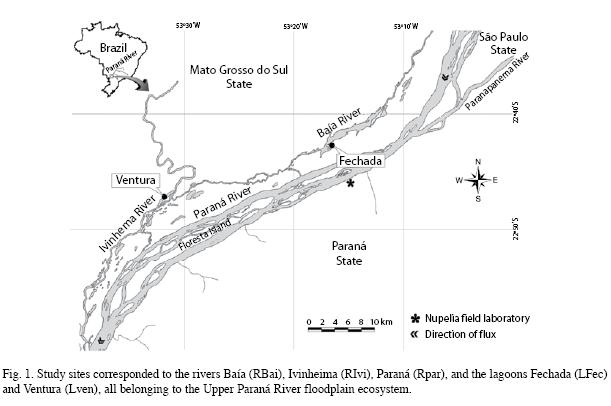
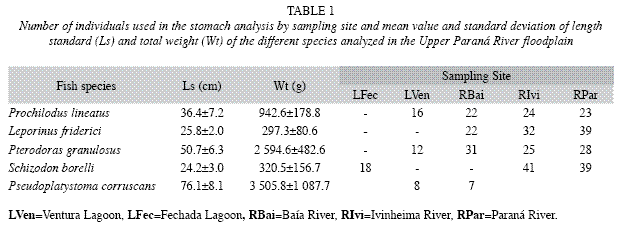
<body><![CDATA[<p align="justify"><b><font face="Verdana" size="3">Material and methods</font></b></p>     <p align="justify"><font face="Verdana" size="2">The study sites corresponded to the rivers Baía (RBai), Ivinheima (RIvi), Paraná (Rpar), and the lagoons Fechada (LFec) and Ventura (Lven), all belonging to the Upper Paraná River floodplain ecosystem (22</font><font  face="Verdana" size="2">°</font><font face="Verdana" size="2">40</font><span  style="font-family: verdana;">´</span><font face="Verdana" size="2">to 22</font><font face="Verdana" size="2">°</font><font face="Verdana"  size="2"> 50</font><span style="font-family: verdana;">´</span><font  face="Verdana" size="2">S; 53</font><font face="Verdana" size="2">°</font><font  face="Verdana" size="2"> 10 to 53</font><font face="Verdana" size="2">°</font><font  face="Verdana" size="2"> 40</font><span style="font-family: verdana;">´</span><font  face="Verdana" size="2"> W (<a href="/img/revistas/rbt/v59n1/a07f1.jpg">Fig. 1</a>).    <br> </font></p>     <p align="justify"><font face="Verdana" size="2">Samplings were conducted using gillnets with mesh sizes varying between 3 and 16cm between opposite knots that were set for 24 hours and thereafter checked in 8h intervals (16:00h, 24:00h and 8:00h).</font></p>     <p align="justify"><font face="Verdana" size="2">Quarterly field activities were conducted over six days and took place between February 2001 and February 2003, which included the rainy season and a drought period. Five fish species with different feeding habits were selected: <i>Pseudoplatystoma corruscans </i>(Agassiz <i>in </i>Spix <i>&amp; </i>Agassiz 1829) (piscivore); <i>Schizodon borellii </i>(Boulenger 1900) (herbivore), <i>Prochilodus lineatus </i>(Valenciennes 1836) (iliophagous); <i>Leporinus friderici </i>(Bloch 1794) and <i>Pterodoras granulosus </i>(Valenciennes <i>in </i>Humboldt &amp; Valenciennes 1821) (omnivores).</font></p>     <p align="justify"><font face="Verdana" size="2">For diet analysis, 369 adult individuals were studied that belonged to different species and were from the same sampling site and time (<a  href="/img/revistas/rbt/v59n1/a07t1.gif">Table 1</a>).    <br> </font></p>     <p align="justify"><font face="Verdana" size="2">Stomach contents were removed, fixed in 4% formalin, and examined under a stereoscopic microscope; items were identified to the lowest possible taxonomic level. This analysis was conducted according to the volumetric method (Hyslop 1980) in which the volume of the items is obtained through displacement of the water column using graduated cylinders. For food items with volumes smaller than 0.1ml, a millimetric plate was used with the volume expressed in mm3 and later converted to ml (Hellawel &amp; Abel 1971).</font></p>     <p align="justify"><font face="Verdana" size="2">From each species, at least five specimens were used from each sampling site. For the analyses of the apparent digestibility coefficient, only the individuals with more than 100mg of material in the stomach and intestine were selected.</font></p>     <p align="justify"><font face="Verdana" size="2">After measuring their standard lengths (Ls) and total weights (Wt) (<a  href="/img/revistas/rbt/v59n1/a07t1.gif">Table 1</a>), the fish were immediately dissected, and their digestive tracts were extracted. Stomach contents and the contents from the fourth quarter of the intestine were carefully removed so as to avoid mixing mucus with the content. After storage, the samples were kept on ice and later in a freezer (-5</font><font face="Verdana" size="2">°</font><font  face="Verdana" size="2">C) until the bromatological composition analysis.</font></p>     ]]></body>
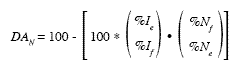
<body><![CDATA[<p align="justify"><font face="Verdana" size="2">The samples with stomach and intestinal contents were dehydrated in a forced ventilation greenhouse (55</font><font face="Verdana" size="2">°</font><font  face="Verdana" size="2">C) for 72h, and later ground (ball mill), refrigerated (-5</font><font face="Verdana" size="2">°</font><span  style="font-family: verdana;">c</span><font face="Verdana" size="2">) and analyzed for dry matter, mineral matter (ash), and crude protein according to the methodology described by Silva &amp; Queiroz (2002). To obtain crude energy values, the samples were subjected to combustion in a calorimeter (Parr 1261) at the Energy Ecology Laboratory of the State University of Maringá (UEM), Maringá, Paraná, Brazil. </font></p>     <p align="justify"><font face="Verdana" size="2">The apparent digestibility coefficients (ADC) were obtained for dry matter, mineral matter, crude energy, and crude protein through the difference between their ratios and those of the internal marker at the beginning and end of the digestive tract. Acid-insoluble ash was used as the internal marker and quantified according to the methodology proposed by Keulen &amp; Young (1977). To determine the ADCs of dry matter and diet nutrients, the expressions described by Maynard &amp; Loosly (1979) were used.</font></p> <font face="Verdana" size="2"><b>     <p align="justify">Apparent digestibility of diet nutrients (DAN):    <br> </p> </b></font>     <div style="text-align: center;">    <br> <img src="/img/revistas/rbt/v59n1/a07for1.gif" title="" alt=""  style="width: 243px; height: 83px;">    <br> </div>     <p align="justify"><font face="Verdana" size="2">In which DAN=apparent digestibility of the nutrient; %Ie and % IF=percentages of indicator in the stomach and at the end of the digestive tract, respectively; %Ne and %NF=percentages of nutrient in the stomach and at the end of the digestive tract, respectively.</font></p>     <p align="justify"><font face="Verdana" size="2"><b>For data analysis, </b>the assumptions of normality (Shapiro-Wilk test) and homocedasticity (Levene´s test) were previously tested to perform the test analyses (MANOVA, ANOVA) using the computer software STASTISTICA 6.0. Tukey´s t-test was applied whenever significant differences were detected between the means. The significance level assumed for all tests was p&lt;0.05.</font></p>     <p align="justify"><b><font face="Verdana" size="3">Results</font></b></p>     ]]></body>
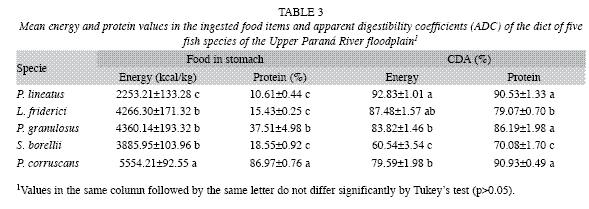
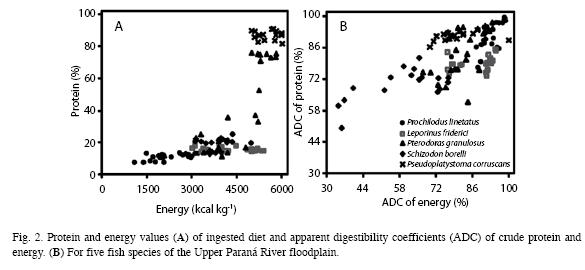
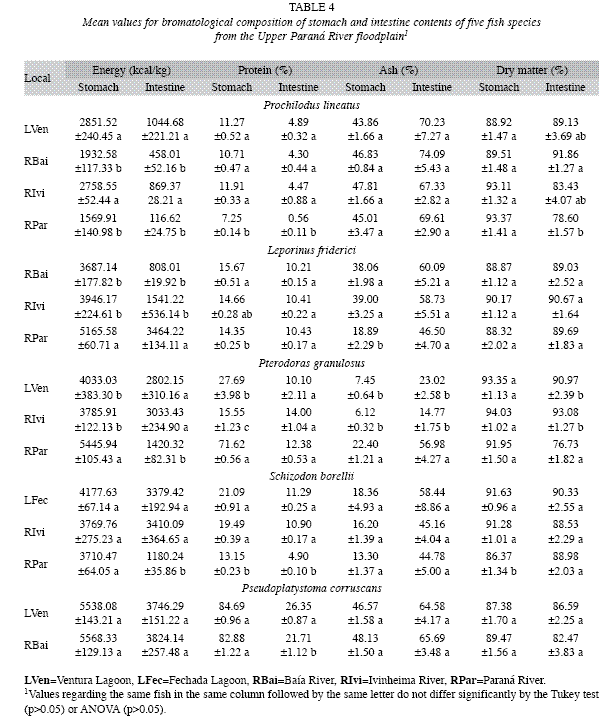
<body><![CDATA[<p align="justify"><b><font face="Verdana" size="2">Feeding: </font></b><font  face="Verdana" size="2">The volumetric frequency values for the items in the diet of <i>Prochilodus lineatus</i>, <i>Leporinus friderici</i>, <i>Pterodoras granulosus</i>, <i>Schizodon borellii</i>, and <i>Pseudoplatystoma corruscans </i>in the different subsystems of the Upper Paraná River floodplain are presented in <a href="/img/revistas/rbt/v59n1/a07t2.gif">Table 2.</a> The participation of food items in the diet of <i>P. lineatus </i>was similar in all subsystems, with a predominance of sediment/detritus.    <br> </font></p>     <p align="justify"><font face="Verdana" size="2">For <i>L. friderici</i>, a variation was observed in the prevalence of the fish, with the greatest volumetric frequency values of the food items ingested in the Baía River (RBai) followed by the Paraná (RPar) and Ivinheima (RIvi) rivers. At RBai, <i>L. friderici </i>consumed fewer insects compared with others systems of the Upper Paraná River Floodplain. For <i>P. granulosus</i>, there was a more significant consumption of bivalves (<i>Limnoperma fortunei </i>and <i>Corbicula fluminea</i>) and other mollusks and lower consumption of plants at RPar, as compared to LVen and RIvi. The results of stomach content analysis of <i>S. borellii </i>and <i>P. corruscans </i>determined there was a predominance of plants and fish, respectively, in all subsystems where these species were sampled. However, <i>S. borellii </i>presented differences in ingested items, with the predominance of macrophytes at LFec and RPar and gramineae at RIvi. At RPar, conversely, there was an unusual and noteworthy consumption of fruits and seeds in the stomachs of <i>S. borellii</i>.</font></p>     <p align="justify"><font face="Verdana" size="2"><b>Chemical composition and diet digestibility:</b></font></p>     <p align="justify"><font face="Verdana" size="2"><b>a) Interspecific comparisons: </b>Caloric content values and crude protein levels in the food items ingested by different species and the digestibility coefficients (ADC) of food items (<a href="#f2">Fig. 2</a> and <a  href="#t3">Table 3</a>) (MANOVA, F<sub>16, 294</sub>=39.18, p&lt;0.01) showed that the food ingested by <i>P. lineatus </i>had lower energy levels (ANOVA, F<sub>4,99</sub>=39.18, p&lt;0.01) than the other species (Tukey, p&lt;0.001) and lower protein levels (ANOVA, F<sub>4,99</sub>=90.47, p&gt;0.01) in comparison with <i>P. corruscans </i>and <i>P. granulosus </i>(Tukey, p&gt;0.01). Conversely, <i>P corruscans </i>had the highest levels of energy and protein (Tukey, p&lt;0.001). The diet of <i>L. friderici </i>had energy values similar to those of <i>P. granulosus </i>and <i>S. borellii</i>, whereas the protein level was similar only to that of <i>S. borellii </i>(Tukey, p&gt;0.05) and was lower than that of <i>P. granulosus </i>(Tukey, p&lt;0.001).    <br> </font></p>     <p style="text-align: center;"><font face="Verdana" size="2"><img  src="/img/revistas/rbt/v59n1/a07t3.gif" title="" alt=""  style="width: 589px; height: 209px;"><a name="t3"></a>    <br>     <br> </font></p>     <p style="text-align: center;"><font face="Verdana" size="2"><img  src="/img/revistas/rbt/v59n1/a07f2.jpg" title="" alt=""  style="width: 585px; height: 270px;"><a name="f2"></a>    ]]></body>
<body><![CDATA[<br> </font></p>     <p align="justify"><font face="Verdana" size="2">The results of ADC analysis showed <i>P. lineatus </i>had better food utilization rates (ANOVA, F<sub>4,99</sub>=37.918, p=0.0001) than <i>P. corruscans, P. granulosus </i>and <i>S. borellii </i>(Tukey, p=0.0003; 0.0045 and 0.0011, respectively) and similar rates to <i>L. friderici </i>(Tukey, p&gt;0.05) (<a  href="#f2">Fig. 2</a> and <a href="/img/revistas/rbt/v59n1/a07t4.gif">Table 4</a>). On the other hand, the protein ADC (ANOVA, F4, 99=30.047, p&lt;0.001) for this species was higher than those of <i>L. friderici </i>and <i>S. borellii </i>(Tukey, p&lt;0.001) yet similar to <i>P. granulosus </i>and <i>P. corruscans </i>(p&gt;0.05). <i>Schizodon borellii </i>had the lowest energy and protein utilization levels (Tukey, p&lt;0.001) of all other species. The ADC values of <i>L. friderici </i>were similar for energy when compared to <i>P. granulosus </i>and <i>P. corruscans </i>(Tukey, p=0.6105 and 0.0699, respectively); however, the protein ADCs for <i>L. friderici </i>were lower than those of of <i>P. granulosus </i>(Tukey, p&lt;0.05) and <i>P. corruscans </i>(Tukey, p&lt;0.001). <i>Pterodoras granulosus </i>and <i>P. corruscans </i>had similar energy utilization (Tukey, p&gt;0.05) and protein levels (Tukey, p&gt;0.05).    <br> </font></p> <font face="Verdana" size="2"><b>b) Spatial comparisons: </b>The study observed an effect of the site on the chemical composition (energy, crude protein, mineral matter, and dry matter) and digestibility coefficients (ADC) of the diet for <i>P. lineatus </i>(MANOVA, F<sub>36, 24</sub>, <sub>365</sub>=5.1558, p=0.0004), <i>P. granulosus</i>, (MANOVA, F<sub>24, 26</sub>=17.335, p=0.0001), <i>L. friderici </i>(MANOVA, F2<sub>4, 14</sub>=5.100, p=0.001), and <i>S. borellii </i>(MANOVA, F<sub>24, 8</sub>=39.164, p=0.00001). For <i>P. corruscans, </i>however, an effect was observed only for protein content in the intestine (MANOVA, F<sub>12, 2</sub>=0.87095, p=0.65027).</font>     <p align="justify"><font face="Verdana" size="2"><b><i>Prochilodus lineatus: </i></b>The energy content of food in the stomach (ANOV, F3, 19=18.989, p=0.00001) and intestine of this species (ANOVA, F<sub>3, 19</sub>=16.927, p=0.00001) was higher for specimens sampled at LVen in comparison with those from RBai (Tukey, p&lt;0.001) and RPar (Tukey, p&lt;0.05). However, these levels did not differ from those observed for RIvi (Tukey, p&gt;0.0001) (<a  href="/img/revistas/rbt/v59n1/a07t4.gif">Table 4</a>). </font></p>     <p align="justify"><font face="Verdana" size="2">The percentages of crude protein in the stomach (ANOVA, F<sub>3,19</sub>=30.779, p=0.000001) and intestine (ANOVA, F<sub>3, 19</sub>=14.207, p=0.00004) were greater at RIvi than at RPar (Tukey, p=0.00181 and p=0.0004, respectively). These values, however, did not differ from the values observed at LVen (Tukey, p=0.656264 and p=0.9502, respectively) and RBai (Tukey, p=0.136501 and p=0.9950, respectively). The levels of crude protein at LVen in the stomach (Tukey, p=0.00182) and intestine (Tukey, p=0.0003) and at RBai in the stomach (Tukey, p=0.0019) and intestine (Tukey, p=0.0006) were also greater than those obtained at RPar but did not differ among themselves (Tukey, p=0.741662 and p=0.870485, respectively). </font></p>     <p align="justify"><font face="Verdana" size="2">There was no difference between the values for mineral matter in the stomachs (ANOVA F<sub>3, 19</sub>=0.64019, p=0.59847) and intestines (ANOVA, F<sub>3, 19</sub>=0.37043, p=0.77522) as well as in dry matter in the stomachs of the individuals sampled at the different sites. However, a greater level of dry matter was observed in the intestine at RBai (ANOVA, F<sub>3, 19</sub>=4.4096, p&lt;0.05) compared to at RPar (Tukey, p&lt;0.05), although no differences were observed among the other averages (<a  href="/img/revistas/rbt/v59n1/a07t4.gif">Table 4</a>).</font></p>     <p align="justify"><font face="Verdana" size="2"><b><i>Leporinus friderici: </i></b>For this species, the energy contents of the stomach (ANOVA, F<sub>2, 18</sub>=0.0001) and intestine (ANOVA, F2, 18=18.459, p=0.0004) were higher at RPar (Tukey, p&lt;0.001) when compared to RBai. The mean obtained at RPar for both the stomach (Tukey, p&lt;0.001) and the intestine (Tukey, p=0.00142) was higher than at RIvi (Tukey, p&lt;0.001). No differences were observed betweeb RBai and Rivi values in either portion of the digestive tract (Tukey, p=0.053624 and p=0.0261651, respectively) (<a  href="/img/revistas/rbt/v59n1/a07t4.gif">Table 4</a>).</font></p>     <p align="justify"><font face="Verdana" size="2">The level of crude protein in the stomach (ANOVA, F<sub>2, 18</sub>=3.5951, p=0.04857) was higher at RBai in comparison to RPar (Tukey, p=0.0490). The values at both RBai (Tukey, p=0.150367) and RPar (Tukey, p=0.821744) did not differ from those for RIvi with no significant differences in the intestine (ANOVA, F2, 18=0.45712, p=0.64026) among crude protein levels for this species, regardless of sampling site.</font></p>     <p align="justify"><font face="Verdana" size="2"><b><i>Pterodoras granulosus: </i></b>The energy value of stomach contents (ANOVA, F<sub>2, 24</sub>=13.099; p&lt;0.01) was higher at RPar in relation to RIvi (Tukey, p&lt;0.001); in the intestine, (ANOVA, F<sub>2, 24</sub>=12.693, p=0.00017) the energy value was higher at RIvi than at RPar (Tukey, p&lt;0.001) (<a  href="/img/revistas/rbt/v59n1/a07t4.gif">Table 4</a>). </font></p>     <p align="justify"><font face="Verdana" size="2">The level of crude protein in the stomach (ANOVA, F<sub>2, 24</sub>=138.73, p&lt;0.01) was different in all environments (Tukey, p&lt;0.01); however, no differences were observed among the values of these nutrients (ANOVA, F<sub>2, 24</sub>=2.0149, p=0.15527) in the intestines of fish from the different sites.</font></p>     ]]></body>
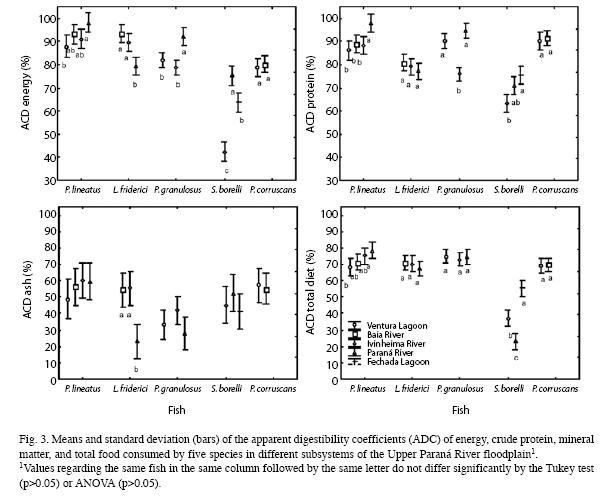
<body><![CDATA[<p align="justify"><font face="Verdana" size="2">The levels of ash in the stomach (ANOVA, F<sub>2, 24</sub>=137.44, p=0.000001) and the intestine (ANOVA, F<sub>2, 24</sub>=57.957, p=0.000001) of fish from RPar were higher than those from RIvi (Tukey, p&lt;0.001). At Lven, the obtained values did not differ from the stomach (Tukey, p&gt;0.05) and intestine (Tukey, p&gt;0.05) values for fish from RIvi and Rpar. These were, however, different values from those obtained at RPar for the stomach (Tukey, p&lt;0.001) and intestine (Tukey, p&lt;0.001).</font></p>     <p align="justify"><font face="Verdana" size="2">There was no effect of the subsystems on the means obtained for dry matter in the stomach (ANOVA, F<sub>2, 24</sub>=075.915, p=0.47898). However, intestinal levels of individuals from LVen and RIvi did not differ (Tukey, p&gt;0.05) but were higher than those observed for RPar (Tukey, p&lt;0.001).</font></p>     <p align="justify"><font face="Verdana" size="2"><b><i>Schizodon borellii: </i></b>The results of the ANOVA obtained for <i>S. borellii </i>indicated that there were no differences in the stomach energy contents (F<sub>2, 15</sub>=2.3003, p=0.13449), ash in the stomach (F<sub>2, 15</sub>=0.68770, p=0.5179), ash in the intestine (F<sub>2, 15</sub>=1.5158, p=0.25144), and dry matter in the intestine (F<sub>2, 15</sub>=0.16542, p=0.84906) as a result of the subsystems. However, differences were found in the intestine energy contents (F<sub>2, 15</sub>=28.6020, p=0.00001) with higher values at RPar than at LFec (Tukey, p&lt;0.001) and RIvi (Tukey, p&lt;0.001); however, the latter two sites had similar means (Tukey, p=0.9956) (<a  href="/img/revistas/rbt/v59n1/a07t4.gif">Table 4</a>).</font></p>     <p align="justify"><font face="Verdana" size="2">In regards to the levels of crude protein in the stomach (ANOVA, F<sub>2, 15</sub>=51.678, p=0.0001) and intestine (ANOVA, F<sub>2, 15</sub>=375.44, p=0.000001), observed mean values were lower at RPar in relation to LFec (Tukey, p&lt;0.001) and RIvi (Tukey, p&lt;0.001); however, there was no difference between values in the stomach (Tukey, p=0.163479) and intestine (Tukey, p=0.3293) at LFec and RIvi.</font></p>     <p align="justify"><font face="Verdana" size="2">For dry matter level in the stomach, differences were observed (ANOVA, F<sub>2, 15</sub>=6.9641, p=0.00726) with lower values at RPar than at LFec (Tukey, p&lt;0.05) and RIvi (Tukey, p&lt;0.05) (<a href="/img/revistas/rbt/v59n1/a07t4.gif">Table 4</a>).</font></p>     <p align="justify"><font face="Verdana" size="2">There was an effect of the subsystems for ash values in the stomach (ANOVA, F<sub>2, 18</sub>=19.585, p=0.00003) with similar mean values for RIvi and RBai (Tukey, p=0.964032), which were higher than at RPar (Tukey, p&lt;0.001). There were no differences in ash values in the intestine (ANOVA, F<sub>2, 18</sub>=2.1134, p=0.14982) or in dry matter percentages in the stomach (ANOVA, F<sub>3, 19</sub>=4.4096, p=0.01628) and intestine (ANOVA, F<sub>2, 18</sub>=0.16413, p=0.84988).</font></p>     <p align="justify"><font face="Verdana" size="2"><b><i> </i></b></font></p>     <p align="justify"><font face="Verdana" size="2"><b><i>Pseudoplatystoma corruscans: </i></b>No differences were observed in the mean values of subsystems LVen and RBai for energy contents in the stomach F<sub>1, 13</sub>=0.2473, p=0.8775) and intestine (F=0.6295, p=0.80582), protein levels in the stomach (F=1.3081, p=0.27336), ash in the stomach (F=0.51517, p=0.48561) and intestine (F=0.04274, p=0.83941), and dry matter in the stomach (F=0.82332, p=0.38072) and intestine (F=0.79658, p=0.38839). However, protein levels in the intestine at LVen were higher (F=10.258, p=0.00693) than those at Rbai (<a  href="/img/revistas/rbt/v59n1/a07t4.gif">Table 4</a>).</font></p>     <p align="justify"><font face="Verdana" size="2"><b>Diet digestibility: Energy (<a href="/img/revistas/rbt/v59n1/a07f3.jpg">Fig. 3A</a>): </b>In regards to the Apparent Digestibility Coefficients (ADC) of energy (ANOVA, F<sub>3, 19</sub>=8.6852, p&lt;0.01) (<a href="/img/revistas/rbt/v59n1/a07f3.jpg">Fig. 3A</a>) for <i>P. lineatus</i>, the values obtained at RPar were higher than at RIvi (Tukey, p=0.0114) and LVen (Tukey, p=0.006) but did not differ from those observed for RBai (Tukey, p=0.0903). The ADC for this species at LVen did not differ from those found at RIvi (Tukey, p=0.4210) and RBai (Tukey, p=0.0881). No differences were observed (Tukey, p=0.7482) between the values for RBai and RIvi.</font></p>     <p align="justify"><font face="Verdana" size="2">For <i>P. granulosus</i>, the energy ADC at RPar (ANOVA, F<sub>2, 24</sub>=15.413, p&lt;0.01) was higher than at LVen (Tukey, p&lt;0.01) and RIvi (Tukey, p&lt;0.01). However, there was no difference between the values at LVen and RIvi (Tukey, p=0.277615). For <i>L. friderici </i>(ANOVA, F2, 18=32.405, p&lt;0.01), a lower ADC value was observed at RPar than at RBai and RIvi (Tukey, p&lt;0.01), but the values for RBai and RIvi were similar to one another (Tukey, p=0.173612).</font></p>     ]]></body>
<body><![CDATA[<p align="justify"><font face="Verdana" size="2">The energy ADCs of the diet of <i>S. borellii </i>(ANOVA, F2, 15=55.040, p&lt;0.01) were different in all subsystems with higher values at RPar than at LFec (Tukey, p&lt;0.01) and RIvi (Tukey, p&lt;0.01), whereas the values observed at RIvi were lower (Tukey, p&lt;0.01) than those for LFec. For <i>P. corruscans</i>, the energy ADCs at RBai and LVen were similar (ANOVA, F12, 2=0.87095, p=0.65027).</font></p>     <p align="justify"><font face="Verdana" size="2"><b>Protein (<a  href="/img/revistas/rbt/v59n1/a07f3.jpg">Fig. 3B</a>): </b>The crude energy ADC for <i>P. lineatus </i>(ANOVA, F3, 19=7.2201, p=0.00199) was higher at RPar than at LVen (Tukey, p&lt;0.01), RBai (Tukey, p&lt;0.05) and RIvi (Tukey, p&lt;0.05). However, the values at RBai were similar to those at LVen (Tukey, p=0.756804) and RIvi (Tukey, p=0.9973). The latter two subsystems featured values that did not differ from one another (Tukey, p=0.8597). </font></p>     <p align="justify"><font face="Verdana" size="2">For <i>L. friderici</i>, there was no difference in the crude protein ADCs (ANOVA, F<sub>2, 18</sub>=3.2318, p=0.06321) in the subsystems. For <i>P. granulosus </i>(ANOVA, F<sub>2, 24</sub>=18.823, p&lt;0.01), RPar and LVen had similar values (Tukey, p=0.365568), which were higher than those observed at RIvi (Tukey, p&lt;0.01). The digestibility of this nutrient for <i>S. borellii </i>(ANOVA, F<sub>2, 15</sub>=7.7988, p&lt;0.01) was greater at LFec than at RIvi (Tukey, p&lt;0.01); however, both environments had values that did not differ from those obtained at RPar (Tukey, p=0.313759 and p=0.071818, respectively). The protein ADCs at LVen and RBai for <i>P. cor- ruscans </i>(ANOVA, F<sub>1, 13</sub>=0.24448, p=0.62924) were statistically similar.</font></p>     <p align="justify"><font face="Verdana" size="2"><b>Ash (mineral matter) (<a href="/img/revistas/rbt/v59n1/a07f3.jpg">Fig. 3C</a>): </b>The ANOVA of the mineral matter ADC for <i>P. lineatus </i>(F<sub>3, 19</sub>=1.0578; p=0.3902), P. granulosus (F<sub>2, 24</sub>=1.1296, p=0.33975), <i>S. borellii </i>(F<sub>2, 15</sub>=2.015, p=0.16785), and <i>P. corruscans </i>(F<sub>1, 13</sub>=0.23525, p=0.63573) were not affected by the different sites. However, for L. friderici (ANOVA, F<sub>2, 18</sub>=29.086, p=0.0001), a lower ADC was observed at RPar than at RBai and RIvi (Tukey, p&lt;0.001), whereas the values for RBai and RIvi did not differ from one another (Tukey, p=0.9730).</font></p>     <p align="justify"><font face="Verdana" size="2"><b>Total diet (<a  href="/img/revistas/rbt/v59n1/a07f3.jpg">Fig. 3D</a>): </b>No effects of the subsystems were observed on the total diet ADCs for <i>L. friderici </i>(ANOVA, F<sub>2, 18</sub>=1.5897, p=0.23132) and for <i>P. granulosus </i>(ANOVA, F<sub>2, 24</sub>=0.25180, p=0.77943). For <i>P. lineatus </i>individuals (ANOVA, F<span style="font-family: monospace;">3, 19</span>=4.4653, p=0.01554), the total diet digestibility at RPar did not differ from RBai (Tukey, p=0.01097) and RIvi (Tukey, p=0.7079) but was higher than that at LVen (Tukey, p=0.0145). The values for LVen did not differ from those for RBai (Tukey, p=0.6878) and RIvi (Tukey, p=0.1154). The total diet digestibility at RBai was similar to that for RIvi (Tukey, p=0.5554).</font></p>     <p align="justify"><font face="Verdana" size="2">The total diet ADC for <i>S. borellii </i>(ANOVA, F<sub>2, 15</sub>=17.501, p&gt;0.001) at LFec was higher than at RIvi and RPar (Tukey, p=0.0116 and p&lt;0.001, respectively). However, the values at RIvi and RPar did not differ from one another (Tukey, p&gt;0.05). No differences were found between the total diet digestibility at RPar and LVen (ANOVA, F<sub>1, 13</sub>=0.02424, p=0.87866) for <i>P. corruscans </i>individuals<i>.    <br> </i></font></p>     <p align="justify"><b><font face="Verdana" size="3">Discussion</font></b></p>     <p align="justify"><b><i><font face="Verdana" size="2">Prochilodus lineatus: </font></i></b><font face="Verdana" size="2">In spite of having the ingested food with the lowest energy and protein contents, <i>P. lineatus </i>had elevated Apparent Digestibility Coefficients (ADC) for both measurements, which indicates that this species possesses a digestive system that is able to efficiently use a nutritionally poor food source (Bowen <i>et al. </i>1995). Another strategy that allows such efficiency is the ability to ingest large quantities of food in relation to body weight (Yossa &amp; Araújo-Lima 1998). The fact that there were discrepancies in energy, protein, and ADC contents for <i>P. lineatus </i>may be related to the quantity of ingested food because the diet of <i>P. lineatus </i>is mainly composed of detritus and sediment (<a href="/img/revistas/rbt/v59n1/a07t1.gif">Table 1</a>) (Hahn <i>et al. </i>2002). Although the energy levels at Rpar were higher than at LVen and RIvi, the higher total diet ADCs of both at the site indicates that the diet was composed of more digestible items for that species.</font></p>     <p align="justify"><font face="Verdana" size="2">The food energy values at Rpar and values of crude protein (7.25 to 11.27%) in the food consumed by <i>P. lineatus </i>in this study are similar to those found by Bowen <i>et al. </i>(1984), with 7.3 to 18.3% in the detritus ingested by <i>Prochilodus platensis </i>in the Mid Paraná, Río de la Plata, Argentina, and slightly higher than that found for <i>P. nigricans </i>by Yossa &amp; Araújo- Lima (1998).</font></p>     ]]></body>
<body><![CDATA[<p align="justify"><font face="Verdana" size="2">Total diet and protein ADCs found for <i>P. lineatus </i>in this study for all environments are higher than those reported by Yossa &amp; Araújo- Lima (1998) for <i>Prochilodus nigricans </i>and <i>Liposarcus pardalis </i>in lagoons of the Central Amazon floodplain and by Bowen (1981) for <i>Tilapia mossambica </i>consuming periphyton attached to the detritus. Yossa (2002) reported low food digestibility of Curimatidae and Prochilodontidae from the Amazon basin, which indicates that the food items consumed by <i>Prochilodus </i>in the Paraná River basin are more digestible.</font></p>     <p align="justify"><font face="Verdana" size="2">Although <i>P. lineatus </i>had similar intake habits in the different subsystems, the levels of energy, protein, and ash in the stomach varied according to site, especially for the data from Rpar and Lven. These differences are probably due to the variations in organism participation in the decomposition chain, such as algae, bacteria and fungi, which were not observed in the stomach content analysis due to the high level of decomposition.</font></p>     <p align="justify"><font face="Verdana" size="2">The high level of ash (43 to 47%) observed in the food ingested by <i>P. lineatus </i>is in accordance with reports for other detrivorous species, which have diets comprised of between 10 and 70% organic matter (Bowen 1984, Araújo-Lima &amp; Hardy 1987). However, Yossa &amp; Araújo-Lima (1998) observed lower values for <i>P. nigricans </i>than those values for <i>P. lineatus </i>in this study. This elevated participation of mineral matter in the food ingested by <i>P. lineatus </i>is justified by the strategy of food collection by detrivorous fish species.</font></p>     <p align="justify"><font face="Verdana" size="2"><b><i>Leporinus friderici: </i></b>Although differences were identified for protein levels and consumed items in the different subsystems, protein ADCs did not differ, which indicates that this species equally utilizes protein from different sources, such as fish and insects, which demonstrates its omnivorous eating habits (Hahn <i>et al. </i>1997, Hahn <i>et al. </i>1998; Balassa <i>et al. </i>2004) and opportunist behaviors (Balassa <i>et al. </i>2004). The higher energy value and lower energy ADC at RPar reflects a difference in the chemical composition of the ingested food item, which is reinforced by the lower level of mineral matter in the diet of fish from RPar. Thus, even though this fish presented the same feeding habit in the different environments, there was an intake of higher energy items (animal or plant) at RPar. The protein levels verified for the diet ingested by <i>L. friderici </i>were slightly below those observed for <i>Colossoma macropomum </i>during the flood period (11 to 15%) by Silva <i>et al. </i>(2000) when fruits and plants are the basis of this species´ diet.</font></p>     <p align="justify"><font face="Verdana" size="2">The satisfactory utilization of food by <i>L. friderici </i>with varying chemical compositions among the subsystems may enable feeding plasticity, which occurs in this species and a few others in the floodplain due to the ecosystem diversity and the hydrologic regime, which cause seasonal variation in food availability (Hahn <i>et al. </i>2002, Marçal-Simabuku &amp; Peret, 2002). Cyrino (1984) and Oliveira-Filho &amp; Fracalossi (2006) also did not observe differences in the utilization of animal or vegetal protein for <i>Brycon cephalus </i>and <i>Rhamdia quelen</i>, respectively, both of which are omnivores. However, Borghetti <i>et al. </i>(1991) report that <i>Piaractus mesopotamicus </i>requires part of its diet (23%) to be of animal origin, although it features high ADCs for energy and protein for food from animal and plant sources (Abimorad &amp; Carneiro 2004), whereas Meer <i>et al. </i>(1995) and Faria <i>et al. </i>(2001) highlight that <i>Colossoma macropomum </i>and <i>Leporinus macrocephalus</i>, respectively, utilize vegetal protein more favorably than other species.</font></p>     <p align="justify"><font face="Verdana" size="2"><b><i>Pterodoras granulosus: </i></b>The food items consumed by <i>P. granulosus </i>had the highest variation in composition, in terms of ingested items, caloric values, and levels of protein and ash in the subsystems. The higher levels of protein and ash found at RPar are due to the greater participation of bivalves in the food ingested in that environment. This greater capacity to utilize food energy and protein at RPar indicates that this fish, although it displays great diet plasticity, also better utilizes animal prey, such as bivalves. This result supports studies by Silva <i>et al. </i>(2005). These authors affirm that <i>P. granulosus </i>is able to utilize soft tissues from both <i>C. fluminea </i>and <i>L. fortunei </i>without damaging their shells. The possibility that <i>C. fluminea </i>represents up to 90% of the diet was reported by Gaspar da Luz <i>et al. </i>(2002). As such, although this species is considered omnivorous in the Upper Paraná River floodplain (Hahn <i>et al. </i>1992, Hahn <i>et al. </i>1998; Gaspar da Luz <i>et al. </i>2002) with a diet that reflects the abundance of feeding resources in the different environments of that plain (Cantanhêde <i>et al. </i>2006) with a strong tendency towards herbivory (Hahn <i>et al. </i>1992), the results indicate the species makes better use of an animal-based diet in the absence of plant-based sources. This was also demonstrated through stable isotope analysis, given its trophic position, which occupied the third trophic level (Faria 2007).</font></p>     <p align="justify"><font face="Verdana" size="2">A variation in the composition of the ingested diet, similar to that observed in this work for <i>P. granulosus</i>, was reported by Silva <i>et al. </i>(2000) for <i>Colossoma macropomum</i>. They noted that this species´ energy and protein levels markedly increased from season to season due to zooplankton intake, varying between 11% and 57% of protein and 484.6 to 574.2kcal/g in the drought and flood seasons, respectively.</font></p>     <p align="justify"><font face="Verdana" size="2">The better utilization of animal-based protein by <i>P. granulosus </i>differed from that observed by Meer <i>et al. </i>(1995) for <i>C. macropomum</i>, which are species considered to be omnivorous with a strong herbivore tendency. These authors affirmed that individuals from this species make better use of plant- based protein.</font></p>     <p align="justify"><font face="Verdana" size="2">During dissection of the final portion of the digestive tract of <i>P. granulosus</i>, it was observed that <i>C. fluminea </i>shells were intact (without their inner content). This low digestibility of the shell is due to the fact it is composed basically of calcium, a nutrient that is required in low quantities for fish (approximately 1%, NRC 1993) and is therefore poorly absorbed in high levels, as in the diet of <i>P. granulosus </i>at Rpar.</font></p>     <p align="justify"><font face="Verdana" size="2">The fact that <i>P. granulosus </i>has better digestibility of animal-based food items may be related to the enzymatic activity of this species and the composition of vegetal tissues. According to Gerking (1994), the digestion level of food items varies according to their origin, and vegetal-based sources are less digested than animal-based items for most fish. This is because the cellular wall hinders the penetration and action of digestive enzymes. Thus, compounds such as cellulose and lignin reduce the digestibility of ingested food items.</font></p>     ]]></body>
<body><![CDATA[<p align="justify"><font face="Verdana" size="2"><b><i>Schizodon borellii</i></b><i>: </i>The variation in the participation of ingested items at the different sites, as indicated by the stomach content analysis of <i>S. borellii</i>, was confirmed by the results of the bromatological composition. Thus, at the sites where more plants (macrophytes or gramineae) were consumed, the levels of protein were similar.</font></p>     <p align="justify"><font face="Verdana" size="2">The different energy ADCs for <i>S. borellii </i>in the different environments was influenced by a better utilization of food items containing macrophytes and fruits. At RPar, this is due to the fact that fruit and seed tissues are more digestible than structural tissue (Bowen <i>et al. </i>1995); some Brazilian fish species have better utilization of seeds and grains than of fish meal (Faria <i>et al. </i>2001, Silva <i>et al. </i>2003). It is important to emphasize that the energy and protein digestibility of gramineae (RIvi) was lower than that of macrophytes (LFec), which indicates higher availability of these nutrients in macrophytes. Even so, <i>S. borellii </i>is a strictly herbivorous species (Hahn <i>et al. </i>2002) and it had variations in diet utilization; this difference is due to fact that Gramineae have more support tissue, which results in lower energy content (Bowen <i>et al. </i>1995). The caloric content utilization of Gramineae (RIvi) by <i>S. borellii </i>was similar to that obtained by Buddington (1979) for <i>Najas guadalupensis </i>ingested by <i>Tilapia zilli </i>(45.4%), whereas macrophytes (Lfec) presented higher energy digestibility.</font></p>     <p align="justify"><font face="Verdana" size="2">Total diet ADCs, which recorded only plants (RIvi and Lfec), were lower than those found for cichlid <i>Etroplus suratensis </i>fed with <i>Hydrilla verticellata </i>(50-51.9%) by De Silva &amp; Perera (1983), <i>Tilapia nilotica </i>fed with Cyanophyta (43%) by Moriarty &amp; Moriarty (1973) and <i>Stegaster nigricans </i>fed with <i>Enteromorpha </i>algae (75%) by Galetto &amp; Bellwood (1994). On the other hand, they were higher than those values reported by Buddington (1979) for <i>T. zilli </i>feeding on <i>Najas guadalupensis </i>(29.3%). Protein digestibility at RIvi (Gramineae) was similar to that obtained by De Silva &amp; Perera (1983) feeding <i>H. verticellata </i>to <i>E. suratensis </i>(65.6%). However, at LVen (macrophytes), protein utilization by <i>S. borellii </i>was higher than those reported in this study. </font></p>     <p align="justify"><font face="Verdana" size="2">Protein digestibility of macrophytes (LFec) in this study was similar to that found in <i>Najas guadalupensis </i>for <i>T. zilli </i>(75.1%) by Buddington (1979) and for the algae <i>Enteromorpha </i>for <i>S. nigricans </i>by Galetto &amp; Bellwood (1994).</font></p>     <p align="justify"><font face="Verdana" size="2"><b><i>Pseudoplatystoma corruscans: </i></b><i>Pseudoplatystoma corruscans </i>ingested mainly fish, which resulted in a small variation in ingested items, with individuals at RBai featuring a small reduction in the participation of <i>Hoplias malabaricus </i>and the occurrence of <i>Hoplosternum littorale. </i>At RBai, there were no oscillations in food quality (bromatological composition) or in digestibility, and ADCs remained high (about 70% of ACD total diet). This is due to the fact that <i>P. corruscans </i>is a specialist species and therefore has few diet alterations (Bowen 1983, Gerking 1994, Hahn <i>et al. </i>2002).</font></p>     <p align="justify"><font face="Verdana" size="2">With the objective of determining the digestibility coefficient for <i>P. corruscans </i>in an experimental essay, Gonçalves &amp; Carneiro (2003) found values of 84.1% for protein and 72.8% for energy when fish were fed with fish meal and lower values when fed with plantbased protein-rich items. In the present study, the energy and protein ADC values for <i>P. corruscans </i>are higher than those reported by the aforementioned authors. These differences are possibly due to the fact that fish meal contains residue from processing (Faria <i>et al. </i>2001) and therefore has higher levels of ash, which reduces food digestibility.</font></p>     <p align="justify"><font face="Verdana" size="2">The present study made it possible to verify the existence of a wide range in the composition of ingested food items, especially in regards to energy contents and protein levels by the different species. In some cases, as in that for <i>P. granulosus</i>, variations were found in the diet ingested by the same species at different sites. In general, these variations agree with those described by Bowen <i>et al. </i>(1995). Thus, the lowest caloric values and crude protein levels occurred in the food items ingested by the detrivorous species (<i>P. lineatus</i>), followed by the herbivores (<i>S. borellii</i>) and omnivorous species (<i>L. friderici </i>and <i>P. granulosus</i>), with the highest energy and protein values obtained in the diet of <i>P. corruscans </i>(piscivore).</font></p>     <p align="justify"><font face="Verdana" size="2">The occurrence of ash absorption by all species analyzed in this study and also reported by Bowen (1981) for <i>T. mossambica</i>, as well as the difference in their ADCs for <i>L. friderici</i>, contributes to the hypothesis that, although it is used as an indicator in several fish studies (Ge achew 1988), ash may not represent the best indicator for digestibility studies in natural environments for the species in this report. In this study, acid-insoluble ash was used as the internal marker, which according to Buddington (1980), Bowen (1981) Galetto &amp; Bellwood (1994), Yossa &amp; Araújo-Lima (1998) and Vidal <i>et al. </i>(2004), constitutes a good indicator in fish digestibility studies because it is not affected by the digestion process and is not assimilated.</font></p>     <p align="justify"><font face="Verdana" size="2">Deforestation, overfishing, stocking of exotic species, pollution, and construction of dams have changed, and overfishing has drastically changed, the main ecosystems, both in relation to stocks and biodiversity (Barbarino- Duque <i>et al. </i>1998). The Paraná River Basin, the second largest in South America, suffers from the many dams that constrict the movement of stocks of the commercial fish species examined in this study (Okada <i>et al</i>. 2005). The only free stretch of the basin, the floodplain of the Paraná River, has guaranteed suitable ecological conditions for breeding, feeding, and growth to sustain the stocks exploited in the downstream, the Itaipu Reservoir, where the community depends on the riverside commercial fishing, (artisanal, and subsistence fisheries). Therefore, it is important to remove the old practices (pollution, stocking) and maintain the forest on the banks of major rivers that form the basin. The present study provides evidence for conservation of the natural environment, and further investigations are needed to understand the influence of seasons and physiological characteristics of the species (sex and maturity stage) so that fish managers can better inform themselves for the drafting of legislation that will be more appropriate both for fishing and for the protection of biodiversity. Determining food digestibility in a natural environment may provide guidelines for conservation and management practice of commercially important fish stocks in the Upper Paraná River floodplain, in addition to providing valuable information on ecological aspects of the different fish species. This knowledge could also be used in aquaculture to determine feeding management and the formulation of rations.</font></p> <b><font face="Verdana" size="3">     <p align="justify">Acknowledgments</p> </font></b><font face="Verdana" size="2">     ]]></body>
<body><![CDATA[<p align="justify">To the Graduate Program in Continental Aquatic Environments of the State University of Maringá (PEA-UEM); to Capes for financial support; to the field teams of the PELD Long- Term Ecological Project (UEM-NUPELIA) for their help in collecting biological materials; to the Limnology laboratory of Research Nucleus in Limnology, Ichthyology and Aquaculture (NUPELIA) and the Animal Science Department (Food Analysis laboratory) for giving access to equipment; to Sara Rodrigues, for assisting in the analysis; to Célia de Almeida Lopes and Gislaine Iachstel Manetta for the suggestions; to Marcelo Dalpasquale for the English version of this manuscript.</p> </font> <hr style="width: 100%; height: 2px;"><b><font face="Verdana" size="3">     <p align="justify">References</p> </font></b><font face="Verdana" size="2"> </font>     <!-- ref --><p align="justify"><font face="Verdana" size="2">Abelha, M.C.F., A.A. Agostinho &amp; E. Goulart. 2001. Plasticidade trófica em peixes de água doce. Acta Sci. Biol. Sci. 23: 425-434.    &nbsp;&nbsp;&nbsp;&nbsp;&nbsp;&nbsp;&nbsp;&nbsp;[&#160;<a href="javascript:void(0);" onclick="javascript: window.open('/scielo.php?script=sci_nlinks&ref=1699970&pid=S0034-7744201100010000700001&lng=','','width=640,height=500,resizable=yes,scrollbars=1,menubar=yes,');">Links</a>&#160;]<!-- end-ref --></font></p>     <!-- ref --><p align="justify"><font face="Verdana" size="2">Abimorad, E. &amp; D.J. Carneiro. 2004. Métodos de coleta de fezes e determinação dos coeficientes de digestibilidade da fração protéica e da energia de alimentos para o pacu, <i>Piaractus mesopotamicus </i>(Holmberg, 1887). Rev. Bras. Zootec. 33: 1101-1109.    &nbsp;&nbsp;&nbsp;&nbsp;&nbsp;&nbsp;&nbsp;&nbsp;[&#160;<a href="javascript:void(0);" onclick="javascript: window.open('/scielo.php?script=sci_nlinks&ref=1699972&pid=S0034-7744201100010000700002&lng=','','width=640,height=500,resizable=yes,scrollbars=1,menubar=yes,');">Links</a>&#160;]<!-- end-ref --></font></p>     <!-- ref --><p align="justify"><font face="Verdana" size="2">Agostinho, A.A., N.S. Hahn, L.C. Gomes &amp; L.M. Bini. 1997. Estrutura Trófica, p. 229-248. <i>In </i>A.E.A.A.M. Vazoller, A.A. Agostinho &amp; N.S. Hahn (eds.). A planície de inundação do rio Paraná: aspectos físicos, biológicos e socioeconômicos. EDUEM/NUPELIA, Maringá, Paraná, Brasil.    &nbsp;&nbsp;&nbsp;&nbsp;&nbsp;&nbsp;&nbsp;&nbsp;[&#160;<a href="javascript:void(0);" onclick="javascript: window.open('/scielo.php?script=sci_nlinks&ref=1699974&pid=S0034-7744201100010000700003&lng=','','width=640,height=500,resizable=yes,scrollbars=1,menubar=yes,');">Links</a>&#160;]<!-- end-ref --></font></p>     <!-- ref --><p align="justify"><font face="Verdana" size="2">Araújo-Lima, C.A.R.M. &amp; E. Hardy. 1987. Aspectos biológicos de peixes amazônicos. VIII. A alimentação dos alevinos de jaraqui (<i>Semaprochilodus insignis</i>). Amazoniana 10: 127-136.    &nbsp;&nbsp;&nbsp;&nbsp;&nbsp;&nbsp;&nbsp;&nbsp;[&#160;<a href="javascript:void(0);" onclick="javascript: window.open('/scielo.php?script=sci_nlinks&ref=1699976&pid=S0034-7744201100010000700004&lng=','','width=640,height=500,resizable=yes,scrollbars=1,menubar=yes,');">Links</a>&#160;]<!-- end-ref --></font></p>     ]]></body>
<body><![CDATA[<!-- ref --><p align="justify"><font face="Verdana" size="2">Balassa, G.C., R. Fugi, N.S. Hahn &amp; A.B. Galina. 2004. Dieta de espécies de Anostomidae (Teleostei, Characiformes) na área de influencia do reservatório de Manso, Mato Grosso, Brasil. Iheringia 94: 77-82.    &nbsp;&nbsp;&nbsp;&nbsp;&nbsp;&nbsp;&nbsp;&nbsp;[&#160;<a href="javascript:void(0);" onclick="javascript: window.open('/scielo.php?script=sci_nlinks&ref=1699978&pid=S0034-7744201100010000700005&lng=','','width=640,height=500,resizable=yes,scrollbars=1,menubar=yes,');">Links</a>&#160;]<!-- end-ref --><!-- ref --></font>&nbsp;&nbsp;&nbsp;&nbsp;&nbsp;&nbsp;&nbsp;&nbsp;[&#160;<a href="javascript:void(0);" onclick="javascript: window.open('/scielo.php?script=sci_nlinks&ref=1699979&pid=S0034-7744201100010000700006&lng=','','width=640,height=500,resizable=yes,scrollbars=1,menubar=yes,');">Links</a>&#160;]<!-- end-ref --></font>     <!-- ref --><p align="justify"><font face="Verdana" size="2">Borghetti, J.R., E.M. Lepeleire &amp; D.R. Fernandez. 1991. Os efeitos da origem da proteína no crescimento do pacu (<i>Piaractus mesopotamicus</i>) criado em tanques rede. Rev. Bras. Biol. 51: 689-694.    &nbsp;&nbsp;&nbsp;&nbsp;&nbsp;&nbsp;&nbsp;&nbsp;[&#160;<a href="javascript:void(0);" onclick="javascript: window.open('/scielo.php?script=sci_nlinks&ref=1699981&pid=S0034-7744201100010000700007&lng=','','width=640,height=500,resizable=yes,scrollbars=1,menubar=yes,');">Links</a>&#160;]<!-- end-ref --></font></p>     <!-- ref --><p align="justify"><font face="Verdana" size="2">Bowen, S.H. 1981. Digestion and Assimilation of periphytic detrital Agregate by <i>Tilapia mossambica. </i>Am. Fish. Soc. 110: 239-245.    &nbsp;&nbsp;&nbsp;&nbsp;&nbsp;&nbsp;&nbsp;&nbsp;[&#160;<a href="javascript:void(0);" onclick="javascript: window.open('/scielo.php?script=sci_nlinks&ref=1699983&pid=S0034-7744201100010000700008&lng=','','width=640,height=500,resizable=yes,scrollbars=1,menubar=yes,');">Links</a>&#160;]<!-- end-ref --></font></p>     <!-- ref --><p align="justify"><font face="Verdana" size="2">Bowen, S.H. 1983. Detritivory in neotropical fish communities. Environ. Biol. Fish. 9: 137-144.    &nbsp;&nbsp;&nbsp;&nbsp;&nbsp;&nbsp;&nbsp;&nbsp;[&#160;<a href="javascript:void(0);" onclick="javascript: window.open('/scielo.php?script=sci_nlinks&ref=1699985&pid=S0034-7744201100010000700009&lng=','','width=640,height=500,resizable=yes,scrollbars=1,menubar=yes,');">Links</a>&#160;]<!-- end-ref --></font></p>     <!-- ref --><p align="justify"><font face="Verdana" size="2">Bowen, S.H. 1984. Detritivory in neotropical fish communities, p. 59-66. <i>In </i>T.M. Zaret (ed.). Evolutionary ecology of neotropical freshwater fish. Dr. W. Junk, The Hague, Netherland.    &nbsp;&nbsp;&nbsp;&nbsp;&nbsp;&nbsp;&nbsp;&nbsp;[&#160;<a href="javascript:void(0);" onclick="javascript: window.open('/scielo.php?script=sci_nlinks&ref=1699987&pid=S0034-7744201100010000700010&lng=','','width=640,height=500,resizable=yes,scrollbars=1,menubar=yes,');">Links</a>&#160;]<!-- end-ref --></font></p>     <!-- ref --><p align="justify"><font face="Verdana" size="2">Bowen, S.H., A.A. Bonetto &amp; M.O. Ahlgren. 1984. Microorganisms and detritus in the diet of a typical neotropical riverine detritivore, <i>Prochilodus platensis </i>(Pisces: Prochilodontidae). Limnol. Oceanogr. 29: 1120-1122.    &nbsp;&nbsp;&nbsp;&nbsp;&nbsp;&nbsp;&nbsp;&nbsp;[&#160;<a href="javascript:void(0);" onclick="javascript: window.open('/scielo.php?script=sci_nlinks&ref=1699989&pid=S0034-7744201100010000700011&lng=','','width=640,height=500,resizable=yes,scrollbars=1,menubar=yes,');">Links</a>&#160;]<!-- end-ref --></font></p>     <!-- ref --><p align="justify"><font face="Verdana" size="2">Bowen, S.H., E.V. Lutz &amp; M.O. Ahlgren. 1995. Dietary protein and energy as determinants of food quality: Trophic strategies compared. Ecol. 76: 899- 907.    &nbsp;&nbsp;&nbsp;&nbsp;&nbsp;&nbsp;&nbsp;&nbsp;[&#160;<a href="javascript:void(0);" onclick="javascript: window.open('/scielo.php?script=sci_nlinks&ref=1699991&pid=S0034-7744201100010000700012&lng=','','width=640,height=500,resizable=yes,scrollbars=1,menubar=yes,');">Links</a>&#160;]<!-- end-ref --></font></p>     <!-- ref --><p align="justify"><font face="Verdana" size="2">Buddington, R.K. 1979. Digestion of an aquatic macrophyte by <i>Tilapia zilli </i>(gervis). J. Fish. Biol. 15: 449-455.    &nbsp;&nbsp;&nbsp;&nbsp;&nbsp;&nbsp;&nbsp;&nbsp;[&#160;<a href="javascript:void(0);" onclick="javascript: window.open('/scielo.php?script=sci_nlinks&ref=1699993&pid=S0034-7744201100010000700013&lng=','','width=640,height=500,resizable=yes,scrollbars=1,menubar=yes,');">Links</a>&#160;]<!-- end-ref --></font></p>     <!-- ref --><p align="justify"><font face="Verdana" size="2">Buddington, R.K. 1980. Hydrolysis-resistant organic matter as a reference for measurement of fish digestive efficiency. Trans. Am. Fish. Soc. 109: 653-656.    &nbsp;&nbsp;&nbsp;&nbsp;&nbsp;&nbsp;&nbsp;&nbsp;[&#160;<a href="javascript:void(0);" onclick="javascript: window.open('/scielo.php?script=sci_nlinks&ref=1699995&pid=S0034-7744201100010000700014&lng=','','width=640,height=500,resizable=yes,scrollbars=1,menubar=yes,');">Links</a>&#160;]<!-- end-ref --></font></p>     <!-- ref --><p align="justify"><font face="Verdana" size="2">Cantanhêde, G., N.S. Hahn, E.G. Gubiani &amp; R. Fugi. 2006. Invasive molluscs in the diet of <i>Pterodoras granulosus </i>(Valenciennes, 1821) (Pisces, Doradidae) in the Upper Paraná River floodplain, Brazil. Ecol. Fresh. Fish 17: 47-53.    &nbsp;&nbsp;&nbsp;&nbsp;&nbsp;&nbsp;&nbsp;&nbsp;[&#160;<a href="javascript:void(0);" onclick="javascript: window.open('/scielo.php?script=sci_nlinks&ref=1699997&pid=S0034-7744201100010000700015&lng=','','width=640,height=500,resizable=yes,scrollbars=1,menubar=yes,');">Links</a>&#160;]<!-- end-ref --></font></p>     <!-- ref --><p align="justify"><font face="Verdana" size="2">Cyrino, J.E.P. 1984. Digestibilidade da proteína de origem animal e vegetal pelo matrinxã <i>Brycon cephalus </i>Günter, 1869 (Euteleostei, Characoidei, Characidae). Master Thesis, Fundação Universidade do Amazonas - INPA, Manaus, Brasil.    &nbsp;&nbsp;&nbsp;&nbsp;&nbsp;&nbsp;&nbsp;&nbsp;[&#160;<a href="javascript:void(0);" onclick="javascript: window.open('/scielo.php?script=sci_nlinks&ref=1699999&pid=S0034-7744201100010000700016&lng=','','width=640,height=500,resizable=yes,scrollbars=1,menubar=yes,');">Links</a>&#160;]<!-- end-ref --></font></p>     <!-- ref --><p align="justify"><font face="Verdana" size="2">De Silva, S.S. &amp; M.K. Perera. 1983. Digestibility of aquatic macrophyte by the cichid <i>Etroplus suratensis </i>(Bloch) with observations on the relative merits of three indigenous components as markers and daily changes in protein digestibility. J. Fish Biol. 23: 675-684.    &nbsp;&nbsp;&nbsp;&nbsp;&nbsp;&nbsp;&nbsp;&nbsp;[&#160;<a href="javascript:void(0);" onclick="javascript: window.open('/scielo.php?script=sci_nlinks&ref=1700001&pid=S0034-7744201100010000700017&lng=','','width=640,height=500,resizable=yes,scrollbars=1,menubar=yes,');">Links</a>&#160;]<!-- end-ref --></font></p>     <!-- ref --><p align="justify"><font face="Verdana" size="2">Degani, G., S. Viola &amp; Y. Yehuda. 1997. Apparent digestibility of protein and carbohidrate in feed ingredients for adult tilapia (<i>Oreochromis aureus </i>x <i>Oreochromis niloticus</i>). Isr. J. Aquac. 49: 115-123.    &nbsp;&nbsp;&nbsp;&nbsp;&nbsp;&nbsp;&nbsp;&nbsp;[&#160;<a href="javascript:void(0);" onclick="javascript: window.open('/scielo.php?script=sci_nlinks&ref=1700003&pid=S0034-7744201100010000700018&lng=','','width=640,height=500,resizable=yes,scrollbars=1,menubar=yes,');">Links</a>&#160;]<!-- end-ref --></font></p>     <!-- ref --><p align="justify"><font face="Verdana" size="2">Faria, A.C.E.A. 2007. Fontes de energia, posição trófica e digestibilidade de peixes de diferentes níveis tróficos da planície de inundação do alto rio Paraná. Ph.D. Thesis, Universidade Estadual de Maringá, Maringá, Brasil.    &nbsp;&nbsp;&nbsp;&nbsp;&nbsp;&nbsp;&nbsp;&nbsp;[&#160;<a href="javascript:void(0);" onclick="javascript: window.open('/scielo.php?script=sci_nlinks&ref=1700005&pid=S0034-7744201100010000700019&lng=','','width=640,height=500,resizable=yes,scrollbars=1,menubar=yes,');">Links</a>&#160;]<!-- end-ref --></font></p>     <!-- ref --><p align="justify"><font face="Verdana" size="2">Faria, A.C.E.A., C. Hayashi &amp; C.M. Soares. 2001. Substituição parcial e total da farinha de peixe pelo farelo de soja em dietas para alevinos de piavuçu, <i>Leporinus macrocephalus </i>(Garavello <i>and </i>Britski, 1988). Acta Scientia 23: 835-840.    &nbsp;&nbsp;&nbsp;&nbsp;&nbsp;&nbsp;&nbsp;&nbsp;[&#160;<a href="javascript:void(0);" onclick="javascript: window.open('/scielo.php?script=sci_nlinks&ref=1700007&pid=S0034-7744201100010000700020&lng=','','width=640,height=500,resizable=yes,scrollbars=1,menubar=yes,');">Links</a>&#160;]<!-- end-ref --></font></p>     <!-- ref --><p align="justify"><font face="Verdana" size="2">Galetto, M.J. &amp; D.R. Bellwood. 1994. Digestion of algae by <i>Stegastes nigricans </i>and <i>Amphiprion akindynos </i>(Pisces: Pomacentridae), with an evaluation of methods used in digestibility studies. J. Fish Biol. 44: 415-428.    &nbsp;&nbsp;&nbsp;&nbsp;&nbsp;&nbsp;&nbsp;&nbsp;[&#160;<a href="javascript:void(0);" onclick="javascript: window.open('/scielo.php?script=sci_nlinks&ref=1700009&pid=S0034-7744201100010000700021&lng=','','width=640,height=500,resizable=yes,scrollbars=1,menubar=yes,');">Links</a>&#160;]<!-- end-ref --></font></p>     <!-- ref --><p align="justify"><font face="Verdana" size="2">Gaspar Da Luz, K.D., R. Fugi, F. Abujanra, A.A. Agostinho &amp; L.C. Gomes. 2002. Alterations in the <i>Pterodoras granulosus </i>(Valenciennes, 1983) (Osteichthyes, Doradidae) diet due to the abundance variation of a bivalve invader species in the Itaipu REservoir, Brazil. Acta Sci. Biol. Sci. 24: 427-432.    &nbsp;&nbsp;&nbsp;&nbsp;&nbsp;&nbsp;&nbsp;&nbsp;[&#160;<a href="javascript:void(0);" onclick="javascript: window.open('/scielo.php?script=sci_nlinks&ref=1700011&pid=S0034-7744201100010000700022&lng=','','width=640,height=500,resizable=yes,scrollbars=1,menubar=yes,');">Links</a>&#160;]<!-- end-ref --></font></p>     <!-- ref --><p align="justify"><font face="Verdana" size="2">Gerking, S.D. 1994. Feeding ecology of fish. Academic Press, San Diego, USA.    &nbsp;&nbsp;&nbsp;&nbsp;&nbsp;&nbsp;&nbsp;&nbsp;[&#160;<a href="javascript:void(0);" onclick="javascript: window.open('/scielo.php?script=sci_nlinks&ref=1700013&pid=S0034-7744201100010000700023&lng=','','width=640,height=500,resizable=yes,scrollbars=1,menubar=yes,');">Links</a>&#160;]<!-- end-ref --> </font></p>     <!-- ref --><p align="justify"><font face="Verdana" size="2">Getachew, T. 1988. Digestive efficiency and nutrient composition gradient in the gut of <i>Orechromis niloticus </i>L. in Lake Awasa, Ethiopia. J. Fish Biol. 33: 501-509.    &nbsp;&nbsp;&nbsp;&nbsp;&nbsp;&nbsp;&nbsp;&nbsp;[&#160;<a href="javascript:void(0);" onclick="javascript: window.open('/scielo.php?script=sci_nlinks&ref=1700015&pid=S0034-7744201100010000700024&lng=','','width=640,height=500,resizable=yes,scrollbars=1,menubar=yes,');">Links</a>&#160;]<!-- end-ref --></font></p>     <!-- ref --><p align="justify"><font face="Verdana" size="2">Gonçalves, E.G. &amp; D.J. Carneiro. 2003. Coeficientes de digestibilidade aparente da proteína e energia para alguns ingredientes utilizados em dietas para o Pintado (<i>Pseudoplatystoma corruscans</i>). Rev. Bras. Zootec. 32: 779-786.    &nbsp;&nbsp;&nbsp;&nbsp;&nbsp;&nbsp;&nbsp;&nbsp;[&#160;<a href="javascript:void(0);" onclick="javascript: window.open('/scielo.php?script=sci_nlinks&ref=1700017&pid=S0034-7744201100010000700025&lng=','','width=640,height=500,resizable=yes,scrollbars=1,menubar=yes,');">Links</a>&#160;]<!-- end-ref --></font></p>     <!-- ref --><p align="justify"><font face="Verdana" size="2">Hahn, N.S., A. Monfredinho Jr., R. Fugi &amp; A.A. Agostinho. 1992. Aspectos da alimentação do armado, <i>Pterodoras granulosus </i>(Ostariophysi, Doradidae) em distintos ambientes do Alto rio Paraná. Rev. UNIMAR 14: 163-176.    &nbsp;&nbsp;&nbsp;&nbsp;&nbsp;&nbsp;&nbsp;&nbsp;[&#160;<a href="javascript:void(0);" onclick="javascript: window.open('/scielo.php?script=sci_nlinks&ref=1700019&pid=S0034-7744201100010000700026&lng=','','width=640,height=500,resizable=yes,scrollbars=1,menubar=yes,');">Links</a>&#160;]<!-- end-ref --></font></p>     <!-- ref --><p align="justify"><font face="Verdana" size="2">Hahn, N.S., I.F. Andrian, R. Fugi &amp; V.L.L. Almeida. 1997. Ecologia trófica, p. 209-228. <i>In </i>A.E.A.M. Vazzoler, A.A. Agostinho &amp; N.S. Hahn (eds.). A planície de inundação do alto rio Paraná: aspectos físicos, biológicos e sócio-econômicos. EDUEM/NUPELIA, Maringá, Paraná, Brasil.    &nbsp;&nbsp;&nbsp;&nbsp;&nbsp;&nbsp;&nbsp;&nbsp;[&#160;<a href="javascript:void(0);" onclick="javascript: window.open('/scielo.php?script=sci_nlinks&ref=1700021&pid=S0034-7744201100010000700027&lng=','','width=640,height=500,resizable=yes,scrollbars=1,menubar=yes,');">Links</a>&#160;]<!-- end-ref --></font></p>     <!-- ref --><p align="justify"><font face="Verdana" size="2">Hahn, N.S., A.A. Agostinho, L.C. Gomes &amp; L.M. Bini. 1998. Estrutura trófica da ictiofauna do reservatório de Itaipu (Paraná-Brasil) nos primeiros anos de sua formação. Interciência 23: 299-305.    &nbsp;&nbsp;&nbsp;&nbsp;&nbsp;&nbsp;&nbsp;&nbsp;[&#160;<a href="javascript:void(0);" onclick="javascript: window.open('/scielo.php?script=sci_nlinks&ref=1700023&pid=S0034-7744201100010000700028&lng=','','width=640,height=500,resizable=yes,scrollbars=1,menubar=yes,');">Links</a>&#160;]<!-- end-ref --></font></p>     <!-- ref --><p align="justify"><font face="Verdana" size="2">Hahn, N.S., R. Fugi, D. Peretti, M.R. Russo &amp; V.E.C. Loureiro. 2002. Estrutura Trófica da Ictiofauna da Planície de Inundação do Alto rio Paraná, p 131- 135. <i>In </i>A.A. Agostinho, S.M. Thomaz, L. Rodrigues &amp; L.C. Gomes. A Planície de Inundação do Alto rio Paraná<i>. </i>Universidade Estadual De Maringá. Nupelia- PELD-CNP, Maringá, Brasil.    &nbsp;&nbsp;&nbsp;&nbsp;&nbsp;&nbsp;&nbsp;&nbsp;[&#160;<a href="javascript:void(0);" onclick="javascript: window.open('/scielo.php?script=sci_nlinks&ref=1700025&pid=S0034-7744201100010000700029&lng=','','width=640,height=500,resizable=yes,scrollbars=1,menubar=yes,');">Links</a>&#160;]<!-- end-ref --></font></p>     <!-- ref --><p align="justify"><font face="Verdana" size="2">Hanley, F. 1987. The digestibility of foodstuffs and the effects of feeding selectivity determinations in Tilapia (<i>Oreochromis niloticus </i>L). Aquac. Res. 66: 163-179.    &nbsp;&nbsp;&nbsp;&nbsp;&nbsp;&nbsp;&nbsp;&nbsp;[&#160;<a href="javascript:void(0);" onclick="javascript: window.open('/scielo.php?script=sci_nlinks&ref=1700027&pid=S0034-7744201100010000700030&lng=','','width=640,height=500,resizable=yes,scrollbars=1,menubar=yes,');">Links</a>&#160;]<!-- end-ref --></font></p>     <!-- ref --><p align="justify"><font face="Verdana" size="2">Helawel, J.M. &amp; R. Abel. 1971. A rapid volumetric method for the analysis of the food of fishes. J. Fish Biol. 3: 29-37.    &nbsp;&nbsp;&nbsp;&nbsp;&nbsp;&nbsp;&nbsp;&nbsp;[&#160;<a href="javascript:void(0);" onclick="javascript: window.open('/scielo.php?script=sci_nlinks&ref=1700029&pid=S0034-7744201100010000700031&lng=','','width=640,height=500,resizable=yes,scrollbars=1,menubar=yes,');">Links</a>&#160;]<!-- end-ref --></font></p>     <!-- ref --><p align="justify"><font face="Verdana" size="2">Hemre, G.I., O. Karlsen, A. Mangor-Jensen &amp; G. Rosenlund. 2003. Digestibility of dry matter, protein, starch and lipid by cod, <i>Gadus morhua</i>: comparison of sampling methods. Aquaculture 225: 225-232.    &nbsp;&nbsp;&nbsp;&nbsp;&nbsp;&nbsp;&nbsp;&nbsp;[&#160;<a href="javascript:void(0);" onclick="javascript: window.open('/scielo.php?script=sci_nlinks&ref=1700031&pid=S0034-7744201100010000700032&lng=','','width=640,height=500,resizable=yes,scrollbars=1,menubar=yes,');">Links</a>&#160;]<!-- end-ref --></font></p>     <!-- ref --><p align="justify"><font face="Verdana" size="2">Hyslop, E.J. 1980. Stomach contents analysis, a review of methods and their application. J. Fish Biol. 17: 411-429.    &nbsp;&nbsp;&nbsp;&nbsp;&nbsp;&nbsp;&nbsp;&nbsp;[&#160;<a href="javascript:void(0);" onclick="javascript: window.open('/scielo.php?script=sci_nlinks&ref=1700033&pid=S0034-7744201100010000700033&lng=','','width=640,height=500,resizable=yes,scrollbars=1,menubar=yes,');">Links</a>&#160;]<!-- end-ref --></font></p>     <!-- ref --><p align="justify"><font face="Verdana" size="2">Keulen, V. &amp; B.A. Young. 1977. Evaluation of acid-insoluble ash as natural marker in ruminant digestibility studies. J. Anim. Sc. 44: 238-287.    &nbsp;&nbsp;&nbsp;&nbsp;&nbsp;&nbsp;&nbsp;&nbsp;[&#160;<a href="javascript:void(0);" onclick="javascript: window.open('/scielo.php?script=sci_nlinks&ref=1700035&pid=S0034-7744201100010000700034&lng=','','width=640,height=500,resizable=yes,scrollbars=1,menubar=yes,');">Links</a>&#160;]<!-- end-ref --></font></p>     <!-- ref --><p align="justify"><font face="Verdana" size="2">Marçal-Simabuku, M.A. &amp; A.C. Peret. 2002. Alimentação de peixes (Osteichthyes, Characiformes) em duas lagoas de uma planície de inundação brasileira da bacia do rio Paraná. Interciência 27: 299-306.    &nbsp;&nbsp;&nbsp;&nbsp;&nbsp;&nbsp;&nbsp;&nbsp;[&#160;<a href="javascript:void(0);" onclick="javascript: window.open('/scielo.php?script=sci_nlinks&ref=1700037&pid=S0034-7744201100010000700035&lng=','','width=640,height=500,resizable=yes,scrollbars=1,menubar=yes,');">Links</a>&#160;]<!-- end-ref --> </font></p>     <!-- ref --><p align="justify"><font face="Verdana" size="2">Maynard, L.A. &amp; J.K. Loosly. 1979. Animal nutrition. McGraw-Hill, New York, USA.    &nbsp;&nbsp;&nbsp;&nbsp;&nbsp;&nbsp;&nbsp;&nbsp;[&#160;<a href="javascript:void(0);" onclick="javascript: window.open('/scielo.php?script=sci_nlinks&ref=1700039&pid=S0034-7744201100010000700036&lng=','','width=640,height=500,resizable=yes,scrollbars=1,menubar=yes,');">Links</a>&#160;]<!-- end-ref --></font></p>     <!-- ref --><p align="justify"><font face="Verdana" size="2">Meer, M.B., M.A.M. Machiels &amp; M.C.J. Verdegem. 1995. The effect of dietary protein level on growth, protein utilization and body composition of <i>Colossoma macropomum </i>(Cuvier). Aquacult. Res. 26: 901-909.    &nbsp;&nbsp;&nbsp;&nbsp;&nbsp;&nbsp;&nbsp;&nbsp;[&#160;<a href="javascript:void(0);" onclick="javascript: window.open('/scielo.php?script=sci_nlinks&ref=1700041&pid=S0034-7744201100010000700037&lng=','','width=640,height=500,resizable=yes,scrollbars=1,menubar=yes,');">Links</a>&#160;]<!-- end-ref --></font></p>     <!-- ref --><p align="justify"><font face="Verdana" size="2">Moriarty, C.M. &amp; D.W.J. Moriarty. 1973. Quantitative estimation of the daily ingestion of phytoplankton by <i>Tilapia nilotica </i>and <i>Haplochromis nigripinnis </i>in lake George, Uganda. Proc. Zool. Soc. Lond. 171: 15-23.    &nbsp;&nbsp;&nbsp;&nbsp;&nbsp;&nbsp;&nbsp;&nbsp;[&#160;<a href="javascript:void(0);" onclick="javascript: window.open('/scielo.php?script=sci_nlinks&ref=1700043&pid=S0034-7744201100010000700038&lng=','','width=640,height=500,resizable=yes,scrollbars=1,menubar=yes,');">Links</a>&#160;]<!-- end-ref --></font></p>     <!-- ref --><p align="justify"><font face="Verdana" size="2">Nose, T. 1966. Recent advances in the study of fish digestion in Japan. Symposium on Finfish Nutrition and Fish Feed Technology, European Inland Fisheries Advisory Commission/FAO, Belgrade, Serbia.    &nbsp;&nbsp;&nbsp;&nbsp;&nbsp;&nbsp;&nbsp;&nbsp;[&#160;<a href="javascript:void(0);" onclick="javascript: window.open('/scielo.php?script=sci_nlinks&ref=1700045&pid=S0034-7744201100010000700039&lng=','','width=640,height=500,resizable=yes,scrollbars=1,menubar=yes,');">Links</a>&#160;]<!-- end-ref --></font></p>     <!-- ref --><p align="justify"><font face="Verdana" size="2">N.R.C. National Research Council. 1993. Nutrient requirements of fish. National Academic, Washington D.C., USA.    &nbsp;&nbsp;&nbsp;&nbsp;&nbsp;&nbsp;&nbsp;&nbsp;[&#160;<a href="javascript:void(0);" onclick="javascript: window.open('/scielo.php?script=sci_nlinks&ref=1700047&pid=S0034-7744201100010000700040&lng=','','width=640,height=500,resizable=yes,scrollbars=1,menubar=yes,');">Links</a>&#160;]<!-- end-ref --></font></p>     <!-- ref --><p align="justify"><font face="Verdana" size="2">Okada, E.K., A.A. Agostinho &amp; L.C. Gomes. 2005. Spatial and temporal gradients in artisanal fisheries of a large Neotropical reservoir, the Itaipu Reservoir, Brazil. Canadian Journal of Fisheries and Aquatic Sciences. 62: 714-724.    &nbsp;&nbsp;&nbsp;&nbsp;&nbsp;&nbsp;&nbsp;&nbsp;[&#160;<a href="javascript:void(0);" onclick="javascript: window.open('/scielo.php?script=sci_nlinks&ref=1700049&pid=S0034-7744201100010000700041&lng=','','width=640,height=500,resizable=yes,scrollbars=1,menubar=yes,');">Links</a>&#160;]<!-- end-ref --></font></p>     <!-- ref --><p align="justify"><font face="Verdana" size="2">Oliveira-Filho, P.R.C. &amp; D.M. Fracalossi. 2006. Coeficientes de digestibilidade aparente de ingredientes para juvenis de jundiá. Rev. Bras. Zootec<i>. </i>35: 1581-1587.    &nbsp;&nbsp;&nbsp;&nbsp;&nbsp;&nbsp;&nbsp;&nbsp;[&#160;<a href="javascript:void(0);" onclick="javascript: window.open('/scielo.php?script=sci_nlinks&ref=1700051&pid=S0034-7744201100010000700042&lng=','','width=640,height=500,resizable=yes,scrollbars=1,menubar=yes,');">Links</a>&#160;]<!-- end-ref --></font></p>     <!-- ref --><p align="justify"><font face="Verdana" size="2">Silva, D.J. &amp; A.C. Queiroz. 2002. Análise de Alimentos: métodos químicos e biológicos. Universidade Federal de Viçosa, Viçosa, Brasil.    &nbsp;&nbsp;&nbsp;&nbsp;&nbsp;&nbsp;&nbsp;&nbsp;[&#160;<a href="javascript:void(0);" onclick="javascript: window.open('/scielo.php?script=sci_nlinks&ref=1700053&pid=S0034-7744201100010000700043&lng=','','width=640,height=500,resizable=yes,scrollbars=1,menubar=yes,');">Links</a>&#160;]<!-- end-ref --></font></p>     <!-- ref --><p align="justify"><font face="Verdana" size="2">Silva, G.C., N.S. Hahn, E. Gubiani &amp; R. Fugi. 2005. Composição da dieta de Pterodoras granulosus (Valenciennes, 1821) após o estabelecimento dos moluscos invasores na planície de inundação do alto rio Paraná, PR/MS. Exame Geral de Qualificação. Universidade Estadual de Maringá, Maringá, Brasil.    &nbsp;&nbsp;&nbsp;&nbsp;&nbsp;&nbsp;&nbsp;&nbsp;[&#160;<a href="javascript:void(0);" onclick="javascript: window.open('/scielo.php?script=sci_nlinks&ref=1700055&pid=S0034-7744201100010000700044&lng=','','width=640,height=500,resizable=yes,scrollbars=1,menubar=yes,');">Links</a>&#160;]<!-- end-ref --></font></p>     <!-- ref --><p align="justify"><font face="Verdana" size="2">Silva, J.A.M., M. Pereira-Filho &amp; M.I. Oliveira-Pereira. 2000. Seasonal variation of nutrients and energy in tambaqui’s (<i>Colossoma macropomum </i>CUVIER, 1818) natural food. Rev. Bras. Biol. 60: 599-605.    &nbsp;&nbsp;&nbsp;&nbsp;&nbsp;&nbsp;&nbsp;&nbsp;[&#160;<a href="javascript:void(0);" onclick="javascript: window.open('/scielo.php?script=sci_nlinks&ref=1700057&pid=S0034-7744201100010000700045&lng=','','width=640,height=500,resizable=yes,scrollbars=1,menubar=yes,');">Links</a>&#160;]<!-- end-ref --></font></p>     <!-- ref --><p align="justify"><font face="Verdana" size="2">Silva, J.A.M., M. Pereira-Filho &amp; M.I. Oliveira-Pereira. 2003. Frutos e sementes consumidos pelo tambaqui, <i>Colossoma macrompum </i>(Cuvier, 1818) incorporados em rações. Digestibilidade e velocidade de trânsitopelo trato gastrointestinal. Rev. Bras. Zootec. 32: 1815-1824.    &nbsp;&nbsp;&nbsp;&nbsp;&nbsp;&nbsp;&nbsp;&nbsp;[&#160;<a href="javascript:void(0);" onclick="javascript: window.open('/scielo.php?script=sci_nlinks&ref=1700059&pid=S0034-7744201100010000700046&lng=','','width=640,height=500,resizable=yes,scrollbars=1,menubar=yes,');">Links</a>&#160;]<!-- end-ref --></font></p>     <!-- ref --><p align="justify"><font face="Verdana" size="2">Smith, R.R. 1978. Method for determination of digestibility and metabolizable energy of feedstuffs for finfish, p. 453-459. <i>In </i>J.E. Halver &amp; K. Thiews (eds.). Proceedings of the World Symposium on FinfishNutrition and Fish Feed Technology. Heenemann, Berlin, Germany.    &nbsp;&nbsp;&nbsp;&nbsp;&nbsp;&nbsp;&nbsp;&nbsp;[&#160;<a href="javascript:void(0);" onclick="javascript: window.open('/scielo.php?script=sci_nlinks&ref=1700061&pid=S0034-7744201100010000700047&lng=','','width=640,height=500,resizable=yes,scrollbars=1,menubar=yes,');">Links</a>&#160;]<!-- end-ref --></font></p>     <!-- ref --><p align="justify"><font face="Verdana" size="2">Thomas, C.J. &amp; L.B. Cahoon. 1993. Stable isotope analyses differentiate between different trophic pathways supporting rocky-reef fishes. Mar. Ecol. Progr. 95: 19-24.    &nbsp;&nbsp;&nbsp;&nbsp;&nbsp;&nbsp;&nbsp;&nbsp;[&#160;<a href="javascript:void(0);" onclick="javascript: window.open('/scielo.php?script=sci_nlinks&ref=1700063&pid=S0034-7744201100010000700048&lng=','','width=640,height=500,resizable=yes,scrollbars=1,menubar=yes,');">Links</a>&#160;]<!-- end-ref --></font></p>     <!-- ref --><p align="justify"><font face="Verdana" size="2">Vidal, M.V., J.L. Donzele, D.R. Andrade &amp; L.C. Santos. 2004. Determinação da digestibilidade da matéria seca e da proteína bruta do fubá de milho e do farelo de soja para tambaqui (<i>Colossoma macropomum</i>), utilizando-se técnicas com uso de indicadores internos e externos. Rev. Bras. Zootec. 33: 2193-2200.    &nbsp;&nbsp;&nbsp;&nbsp;&nbsp;&nbsp;&nbsp;&nbsp;[&#160;<a href="javascript:void(0);" onclick="javascript: window.open('/scielo.php?script=sci_nlinks&ref=1700065&pid=S0034-7744201100010000700049&lng=','','width=640,height=500,resizable=yes,scrollbars=1,menubar=yes,');">Links</a>&#160;]<!-- end-ref --></font></p>     <!-- ref --><p align="justify"><font face="Verdana" size="2">Winemiller, K.O. 1989. Ontogenetic diet shifts and resource partitioning among piscivorous fishes in the Venezuelan llanos. Environ. Biol. Fishes 26: 177-199.    &nbsp;&nbsp;&nbsp;&nbsp;&nbsp;&nbsp;&nbsp;&nbsp;[&#160;<a href="javascript:void(0);" onclick="javascript: window.open('/scielo.php?script=sci_nlinks&ref=1700067&pid=S0034-7744201100010000700050&lng=','','width=640,height=500,resizable=yes,scrollbars=1,menubar=yes,');">Links</a>&#160;]<!-- end-ref --></font></p>     <!-- ref --><p align="justify"><font face="Verdana" size="2">Yossa, M.I. 2002. Estratégia alimentar de peixes detritívoros das bacias do Orinoco e do Amazonas. INPA, 2002. Ph. D. Thesis, Universidade do Amazonas, Manaus, Amazônia, Brasil.    &nbsp;&nbsp;&nbsp;&nbsp;&nbsp;&nbsp;&nbsp;&nbsp;[&#160;<a href="javascript:void(0);" onclick="javascript: window.open('/scielo.php?script=sci_nlinks&ref=1700069&pid=S0034-7744201100010000700051&lng=','','width=640,height=500,resizable=yes,scrollbars=1,menubar=yes,');">Links</a>&#160;]<!-- end-ref --></font></p>     <!-- ref --><p align="justify"><font face="Verdana" size="2">Yossa, M.I. &amp; C.A.R.M. Araújo-Lima. 1998. Detritivory in two amazonian fish species. J. Fish Biol. 52: 1141-1153.    &nbsp;&nbsp;&nbsp;&nbsp;&nbsp;&nbsp;&nbsp;&nbsp;[&#160;<a href="javascript:void(0);" onclick="javascript: window.open('/scielo.php?script=sci_nlinks&ref=1700071&pid=S0034-7744201100010000700052&lng=','','width=640,height=500,resizable=yes,scrollbars=1,menubar=yes,');">Links</a>&#160;]<!-- end-ref --><br> </font></p>     <p align="justify"><font face="Verdana" size="2">    <br> <a name="correp"></a>Correspondencia a:</font><font face="verdana"  size="2">Anna Christina Esper Amaro de Faria. <font face="Verdana" size="2">Parque do Ingá, Avenida São Paulo, S/N. Maringá, Paraná, Brasil. Phone: +55 (44) 9914-6640; <a href="mailto:annacfaria@yahoo.com.br">annacfaria@yahoo.com.br</a>    <br> </font><font face="Verdana" size="2">Evanilde Benedito. </font><font  face="Verdana" size="2">Universidade Estadual de Maringá. Avenida Colombo, 5790, Maringá, Paraná, Brasil. Phone: +55 (44) 3011-4605;<a href="mailto:eva@nupelia.uem.br">eva@nupelia.uem.br</a></font></font></p> <hr style="width: 100%; height: 2px;">     <div style="text-align: center;"><font face="verdana" size="2"><font  face="Verdana" size="2">Received 02-X-2009. Corrected 27-VII-2010. Accepted 31 VIII-2010</font></font></div> <font face="verdana" size="2"><font face="Verdana" size="2"> </font></font>      ]]></body><back>
<ref-list>
<ref id="B1">
<nlm-citation citation-type="journal">
<person-group person-group-type="author">
<name>
<surname><![CDATA[Abelha]]></surname>
<given-names><![CDATA[M.C.F]]></given-names>
</name>
<name>
<surname><![CDATA[Agostinho]]></surname>
<given-names><![CDATA[A.A]]></given-names>
</name>
<name>
<surname><![CDATA[Goulart]]></surname>
<given-names><![CDATA[E]]></given-names>
</name>
</person-group>
<article-title xml:lang="fr"><![CDATA[Plasticidade trófica em peixes de água doce]]></article-title>
<source><![CDATA[Acta Sci. Biol. Sci]]></source>
<year>2001</year>
<volume>23</volume>
<page-range>425-434</page-range></nlm-citation>
</ref>
<ref id="B2">
<nlm-citation citation-type="journal">
<person-group person-group-type="author">
<name>
<surname><![CDATA[Abimorad]]></surname>
<given-names><![CDATA[E]]></given-names>
</name>
<name>
<surname><![CDATA[Carneiro]]></surname>
<given-names><![CDATA[D.J]]></given-names>
</name>
</person-group>
<article-title xml:lang="pt"><![CDATA[Métodos de coleta de fezes e determinação dos coeficientes de digestibilidade da fração protéica e da energia de alimentos para o pacu, Piaractus mesopotamicus (Holmberg, 1887)]]></article-title>
<source><![CDATA[Rev. Bras. Zootec]]></source>
<year>2004</year>
<volume>33</volume>
<page-range>1101-1109</page-range></nlm-citation>
</ref>
<ref id="B3">
<nlm-citation citation-type="book">
<person-group person-group-type="author">
<name>
<surname><![CDATA[Agostinho]]></surname>
<given-names><![CDATA[A.A]]></given-names>
</name>
<name>
<surname><![CDATA[Hahn]]></surname>
<given-names><![CDATA[N.S]]></given-names>
</name>
<name>
<surname><![CDATA[Gomes]]></surname>
<given-names><![CDATA[L.C]]></given-names>
</name>
<name>
<surname><![CDATA[Bini]]></surname>
<given-names><![CDATA[L.M]]></given-names>
</name>
</person-group>
<article-title xml:lang="es"><![CDATA[Estrutura Trófica]]></article-title>
<person-group person-group-type="editor">
<name>
<surname><![CDATA[Vazoller]]></surname>
<given-names><![CDATA[A.E.A.A.M]]></given-names>
</name>
<name>
<surname><![CDATA[Agostinho]]></surname>
<given-names><![CDATA[A.A]]></given-names>
</name>
<name>
<surname><![CDATA[Hahn]]></surname>
<given-names><![CDATA[N.S]]></given-names>
</name>
</person-group>
<source><![CDATA[A planície de inundação do rio Paraná: aspectos físicos, biológicos e socioeconômicos]]></source>
<year>1997</year>
<page-range>229-248</page-range><publisher-loc><![CDATA[Maringá^eParaná Paraná]]></publisher-loc>
<publisher-name><![CDATA[EDUEM/NUPELIA]]></publisher-name>
</nlm-citation>
</ref>
<ref id="B4">
<nlm-citation citation-type="journal">
<person-group person-group-type="author">
<name>
<surname><![CDATA[Araújo-Lima]]></surname>
<given-names><![CDATA[C.A.R.M]]></given-names>
</name>
<name>
<surname><![CDATA[Hardy]]></surname>
<given-names><![CDATA[E]]></given-names>
</name>
</person-group>
<article-title xml:lang="pt"><![CDATA[Aspectos biológicos de peixes amazônicos. VIII. A alimentação dos alevinos de jaraqui (Semaprochilodus insignis)]]></article-title>
<source><![CDATA[Amazoniana]]></source>
<year>1987</year>
<volume>10</volume>
<page-range>127-136</page-range></nlm-citation>
</ref>
<ref id="B5">
<nlm-citation citation-type="journal">
<person-group person-group-type="author">
<name>
<surname><![CDATA[Balassa]]></surname>
<given-names><![CDATA[G.C]]></given-names>
</name>
<name>
<surname><![CDATA[Fugi]]></surname>
<given-names><![CDATA[R]]></given-names>
</name>
<name>
<surname><![CDATA[Hahn]]></surname>
<given-names><![CDATA[N.S]]></given-names>
</name>
<name>
<surname><![CDATA[Galina]]></surname>
<given-names><![CDATA[A.B]]></given-names>
</name>
</person-group>
<article-title xml:lang="pt"><![CDATA[Dieta de espécies de Anostomidae (Teleostei, Characiformes) na área de influencia do reservatório de Manso, Mato Grosso, Brasil]]></article-title>
<source><![CDATA[Iheringia]]></source>
<year>2004</year>
<volume>94</volume>
<page-range>77-82</page-range></nlm-citation>
</ref>
<ref id="B6">
<nlm-citation citation-type="journal">
<person-group person-group-type="author">
<name>
<surname><![CDATA[Barbarino-Duque]]></surname>
<given-names><![CDATA[A]]></given-names>
</name>
<name>
<surname><![CDATA[Taphorn]]></surname>
<given-names><![CDATA[D.C]]></given-names>
</name>
<name>
<surname><![CDATA[Winemiller]]></surname>
<given-names><![CDATA[K.O]]></given-names>
</name>
</person-group>
<article-title xml:lang="en"><![CDATA[Ecology of the coporo, Prochilodus mariae (Characiformes, Prochilodontidae), and status of annual migrations in western Venezuela]]></article-title>
<source><![CDATA[Environmental Biology of Fishes]]></source>
<year>1998</year>
<volume>53</volume>
<page-range>33-46</page-range></nlm-citation>
</ref>
<ref id="B7">
<nlm-citation citation-type="journal">
<person-group person-group-type="author">
<name>
<surname><![CDATA[Borghetti]]></surname>
<given-names><![CDATA[J.R]]></given-names>
</name>
<name>
<surname><![CDATA[Lepeleire]]></surname>
<given-names><![CDATA[E.M]]></given-names>
</name>
<name>
<surname><![CDATA[Fernandez]]></surname>
<given-names><![CDATA[D.R]]></given-names>
</name>
</person-group>
<article-title xml:lang="pt"><![CDATA[Os efeitos da origem da proteína no crescimento do pacu (Piaractus mesopotamicus) criado em tanques rede]]></article-title>
<source><![CDATA[Rev. Bras. Biol]]></source>
<year>1991</year>
<volume>51</volume>
<page-range>689-694</page-range></nlm-citation>
</ref>
<ref id="B8">
<nlm-citation citation-type="journal">
<person-group person-group-type="author">
<name>
<surname><![CDATA[Bowen]]></surname>
<given-names><![CDATA[S.H]]></given-names>
</name>
</person-group>
<article-title xml:lang="en"><![CDATA[Digestion and Assimilation of periphytic detrital Agregate by Tilapia mossambica]]></article-title>
<source><![CDATA[Am. Fish. Soc]]></source>
<year>1981</year>
<volume>110</volume>
<page-range>239-245</page-range></nlm-citation>
</ref>
<ref id="B9">
<nlm-citation citation-type="journal">
<person-group person-group-type="author">
<name>
<surname><![CDATA[Bowen]]></surname>
<given-names><![CDATA[S.H]]></given-names>
</name>
</person-group>
<article-title xml:lang="en"><![CDATA[Detritivory in neotropical fish communities]]></article-title>
<source><![CDATA[Environ. Biol. Fish]]></source>
<year>1983</year>
<volume>9</volume>
<page-range>137-144</page-range></nlm-citation>
</ref>
<ref id="B10">
<nlm-citation citation-type="">
<person-group person-group-type="author">
<name>
<surname><![CDATA[Bowen]]></surname>
<given-names><![CDATA[S.H]]></given-names>
</name>
</person-group>
<article-title xml:lang="en"><![CDATA[Detritivory in neotropical fish communities]]></article-title>
<person-group person-group-type="editor">
<name>
<surname><![CDATA[Zaret]]></surname>
<given-names><![CDATA[T.M]]></given-names>
</name>
</person-group>
<source><![CDATA[Evolutionary ecology of neotropical freshwater fish. Dr. W. Junk]]></source>
<year>1984</year>
<page-range>59-66</page-range><publisher-loc><![CDATA[The Hague ]]></publisher-loc>
</nlm-citation>
</ref>
<ref id="B11">
<nlm-citation citation-type="journal">
<person-group person-group-type="author">
<name>
<surname><![CDATA[Bowen]]></surname>
<given-names><![CDATA[S.H]]></given-names>
</name>
<name>
<surname><![CDATA[Bonetto]]></surname>
<given-names><![CDATA[A.A]]></given-names>
</name>
<name>
<surname><![CDATA[Ahlgren]]></surname>
<given-names><![CDATA[M.O]]></given-names>
</name>
</person-group>
<article-title xml:lang="en"><![CDATA[Microorganisms and detritus in the diet of a typical neotropical riverine detritivore, Prochilodus platensis (Pisces: Prochilodontidae)]]></article-title>
<source><![CDATA[Limnol. Oceanogr]]></source>
<year>1984</year>
<volume>29</volume>
<page-range>1120-1122</page-range></nlm-citation>
</ref>
<ref id="B12">
<nlm-citation citation-type="journal">
<person-group person-group-type="author">
<name>
<surname><![CDATA[Bowen]]></surname>
<given-names><![CDATA[S.H]]></given-names>
</name>
<name>
<surname><![CDATA[Lutz]]></surname>
<given-names><![CDATA[E.V]]></given-names>
</name>
<name>
<surname><![CDATA[Ahlgren]]></surname>
<given-names><![CDATA[M.O]]></given-names>
</name>
</person-group>
<article-title xml:lang="en"><![CDATA[Dietary protein and energy as determinants of food quality: Trophic strategies compared]]></article-title>
<source><![CDATA[Ecol]]></source>
<year>1995</year>
<volume>76</volume>
<page-range>899- 907</page-range></nlm-citation>
</ref>
<ref id="B13">
<nlm-citation citation-type="journal">
<person-group person-group-type="author">
<name>
<surname><![CDATA[Buddington]]></surname>
<given-names><![CDATA[R.K]]></given-names>
</name>
</person-group>
<article-title xml:lang="en"><![CDATA[Digestion of an aquatic macrophyte by Tilapia zilli (gervis)]]></article-title>
<source><![CDATA[J. Fish. Biol]]></source>
<year>1979</year>
<volume>15</volume>
<page-range>449-455</page-range></nlm-citation>
</ref>
<ref id="B14">
<nlm-citation citation-type="journal">
<person-group person-group-type="author">
<name>
<surname><![CDATA[Buddington]]></surname>
<given-names><![CDATA[R.K]]></given-names>
</name>
</person-group>
<article-title xml:lang="en"><![CDATA[Hydrolysis-resistant organic matter as a reference for measurement of fish digestive efficiency]]></article-title>
<source><![CDATA[Trans. Am. Fish. Soc]]></source>
<year>1980</year>
<volume>109</volume>
<page-range>653-656</page-range></nlm-citation>
</ref>
<ref id="B15">
<nlm-citation citation-type="journal">
<person-group person-group-type="author">
<name>
<surname><![CDATA[Cantanhêde]]></surname>
<given-names><![CDATA[G]]></given-names>
</name>
<name>
<surname><![CDATA[Hahn]]></surname>
<given-names><![CDATA[N.S]]></given-names>
</name>
<name>
<surname><![CDATA[Gubiani]]></surname>
<given-names><![CDATA[E.G]]></given-names>
</name>
<name>
<surname><![CDATA[Fugi]]></surname>
<given-names><![CDATA[R]]></given-names>
</name>
</person-group>
<article-title xml:lang="en"><![CDATA[Invasive molluscs in the diet of Pterodoras granulosus (Valenciennes, 1821) (Pisces, Doradidae) in the Upper Paraná River floodplain, Brazil]]></article-title>
<source><![CDATA[Ecol. Fresh. Fish]]></source>
<year>2006</year>
<volume>17</volume>
<page-range>47-53</page-range></nlm-citation>
</ref>
<ref id="B16">
<nlm-citation citation-type="">
<person-group person-group-type="author">
<name>
<surname><![CDATA[Cyrino]]></surname>
<given-names><![CDATA[J.E.P]]></given-names>
</name>
</person-group>
<source><![CDATA[Digestibilidade da proteína de origem animal e vegetal pelo matrinxã Brycon cephalus Günter, 1869 (Euteleostei, Characoidei, Characidae)]]></source>
<year>1984</year>
</nlm-citation>
</ref>
<ref id="B17">
<nlm-citation citation-type="journal">
<person-group person-group-type="author">
<name>
<surname><![CDATA[De Silva]]></surname>
<given-names><![CDATA[S.S]]></given-names>
</name>
<name>
<surname><![CDATA[Perera]]></surname>
<given-names><![CDATA[M.K]]></given-names>
</name>
</person-group>
<article-title xml:lang="en"><![CDATA[Digestibility of aquatic macrophyte by the cichid Etroplus suratensis (Bloch) with observations on the relative merits of three indigenous components as markers and daily changes in protein digestibility]]></article-title>
<source><![CDATA[J. Fish Biol]]></source>
<year>1983</year>
<volume>23</volume>
<page-range>675-684</page-range></nlm-citation>
</ref>
<ref id="B18">
<nlm-citation citation-type="journal">
<person-group person-group-type="author">
<name>
<surname><![CDATA[Degani]]></surname>
<given-names><![CDATA[G]]></given-names>
</name>
<name>
<surname><![CDATA[Viola]]></surname>
<given-names><![CDATA[S]]></given-names>
</name>
<name>
<surname><![CDATA[Yehuda]]></surname>
<given-names><![CDATA[Y]]></given-names>
</name>
</person-group>
<article-title xml:lang="en"><![CDATA[Apparent digestibility of protein and carbohidrate in feed ingredients for adult tilapia (Oreochromis aureus x Oreochromis niloticus)]]></article-title>
<source><![CDATA[Isr. J. Aquac]]></source>
<year>1997</year>
<volume>49</volume>
<page-range>115-123</page-range></nlm-citation>
</ref>
<ref id="B19">
<nlm-citation citation-type="">
<person-group person-group-type="author">
<name>
<surname><![CDATA[Faria]]></surname>
<given-names><![CDATA[A.C.E.A]]></given-names>
</name>
</person-group>
<source><![CDATA[Fontes de energia, posição trófica e digestibilidade de peixes de diferentes níveis tróficos da planície de inundação do alto rio Paraná]]></source>
<year>2007</year>
</nlm-citation>
</ref>
<ref id="B20">
<nlm-citation citation-type="journal">
<person-group person-group-type="author">
<name>
<surname><![CDATA[Faria]]></surname>
<given-names><![CDATA[A.C.E.A]]></given-names>
</name>
<name>
<surname><![CDATA[Hayashi]]></surname>
<given-names><![CDATA[C]]></given-names>
</name>
<name>
<surname><![CDATA[Soares]]></surname>
<given-names><![CDATA[C.M]]></given-names>
</name>
</person-group>
<article-title xml:lang="pt"><![CDATA[Substituição parcial e total da farinha de peixe pelo farelo de soja em dietas para alevinos de piavuçu, Leporinus macrocephalus (Garavello and Britski, 1988)]]></article-title>
<source><![CDATA[Acta Scientia]]></source>
<year>2001</year>
<volume>23</volume>
<page-range>835-840</page-range></nlm-citation>
</ref>
<ref id="B21">
<nlm-citation citation-type="journal">
<person-group person-group-type="author">
<name>
<surname><![CDATA[Galetto]]></surname>
<given-names><![CDATA[M.J]]></given-names>
</name>
<name>
<surname><![CDATA[Bellwood]]></surname>
<given-names><![CDATA[D.R]]></given-names>
</name>
</person-group>
<article-title xml:lang="en"><![CDATA[Digestion of algae by Stegastes nigricans and Amphiprion akindynos (Pisces: Pomacentridae), with an evaluation of methods used in digestibility studies]]></article-title>
<source><![CDATA[J. Fish Biol]]></source>
<year>1994</year>
<volume>44</volume>
<page-range>415-428</page-range></nlm-citation>
</ref>
<ref id="B22">
<nlm-citation citation-type="journal">
<person-group person-group-type="author">
<name>
<surname><![CDATA[Gaspar Da Luz]]></surname>
<given-names><![CDATA[K.D]]></given-names>
</name>
<name>
<surname><![CDATA[Fugi]]></surname>
<given-names><![CDATA[R]]></given-names>
</name>
<name>
<surname><![CDATA[Abujanra]]></surname>
<given-names><![CDATA[F]]></given-names>
</name>
<name>
<surname><![CDATA[Agostinho]]></surname>
<given-names><![CDATA[A.A]]></given-names>
</name>
<name>
<surname><![CDATA[Gomes]]></surname>
<given-names><![CDATA[L.C]]></given-names>
</name>
</person-group>
<article-title xml:lang="en"><![CDATA[Alterations in the Pterodoras granulosus (Valenciennes, 1983) (Osteichthyes, Doradidae) diet due to the abundance variation of a bivalve invader species in the Itaipu REservoir, Brazil]]></article-title>
<source><![CDATA[Acta Sci. Biol. Sci]]></source>
<year>2002</year>
<volume>24</volume>
<page-range>427-432</page-range></nlm-citation>
</ref>
<ref id="B23">
<nlm-citation citation-type="book">
<person-group person-group-type="author">
<name>
<surname><![CDATA[Gerking]]></surname>
<given-names><![CDATA[S.D]]></given-names>
</name>
</person-group>
<source><![CDATA[Feeding ecology of fish]]></source>
<year>1994</year>
<publisher-loc><![CDATA[San Diego ]]></publisher-loc>
<publisher-name><![CDATA[Academic Press]]></publisher-name>
</nlm-citation>
</ref>
<ref id="B24">
<nlm-citation citation-type="journal">
<person-group person-group-type="author">
<name>
<surname><![CDATA[Getachew]]></surname>
<given-names><![CDATA[T]]></given-names>
</name>
</person-group>
<article-title xml:lang="en"><![CDATA[Digestive efficiency and nutrient composition gradient in the gut of Orechromis niloticus L. in Lake Awasa, Ethiopia]]></article-title>
<source><![CDATA[J. Fish Biol]]></source>
<year>1988</year>
<volume>33</volume>
<page-range>501-509</page-range></nlm-citation>
</ref>
<ref id="B25">
<nlm-citation citation-type="journal">
<person-group person-group-type="author">
<name>
<surname><![CDATA[Gonçalves]]></surname>
<given-names><![CDATA[E.G]]></given-names>
</name>
<name>
<surname><![CDATA[Carneiro]]></surname>
<given-names><![CDATA[D.J]]></given-names>
</name>
</person-group>
<article-title xml:lang="es"><![CDATA[Coeficientes de digestibilidade aparente da proteína e energia para alguns ingredientes utilizados em dietas para o Pintado (Pseudoplatystoma corruscans)]]></article-title>
<source><![CDATA[Rev. Bras. Zootec]]></source>
<year>2003</year>
<volume>32</volume>
<page-range>779-786</page-range></nlm-citation>
</ref>
<ref id="B26">
<nlm-citation citation-type="journal">
<person-group person-group-type="author">
<name>
<surname><![CDATA[Hahn]]></surname>
<given-names><![CDATA[N.S]]></given-names>
</name>
<name>
<surname><![CDATA[Monfredinho]]></surname>
<given-names><![CDATA[A]]></given-names>
</name>
<name>
<surname><![CDATA[Fugi]]></surname>
<given-names><![CDATA[R]]></given-names>
</name>
<name>
<surname><![CDATA[Agostinho]]></surname>
<given-names><![CDATA[A.A]]></given-names>
</name>
</person-group>
<article-title xml:lang="pt"><![CDATA[Aspectos da alimentação do armado, Pterodoras granulosus (Ostariophysi, Doradidae) em distintos ambientes do Alto rio Paraná]]></article-title>
<source><![CDATA[Rev. UNIMAR]]></source>
<year>1992</year>
<volume>14</volume>
<page-range>163-176</page-range></nlm-citation>
</ref>
<ref id="B27">
<nlm-citation citation-type="book">
<person-group person-group-type="author">
<name>
<surname><![CDATA[Hahn]]></surname>
<given-names><![CDATA[N.S]]></given-names>
</name>
<name>
<surname><![CDATA[Andrian]]></surname>
<given-names><![CDATA[I.F]]></given-names>
</name>
<name>
<surname><![CDATA[Fugi]]></surname>
<given-names><![CDATA[R]]></given-names>
</name>
<name>
<surname><![CDATA[Almeida]]></surname>
<given-names><![CDATA[V.L.L]]></given-names>
</name>
</person-group>
<article-title xml:lang="es"><![CDATA[Ecologia trófica]]></article-title>
<person-group person-group-type="editor">
<name>
<surname><![CDATA[Vazzoler]]></surname>
<given-names><![CDATA[A.E.A.M]]></given-names>
</name>
<name>
<surname><![CDATA[Agostinho]]></surname>
<given-names><![CDATA[A.A]]></given-names>
</name>
<name>
<surname><![CDATA[Hahn]]></surname>
<given-names><![CDATA[N.S]]></given-names>
</name>
</person-group>
<source><![CDATA[A planície de inundação do alto rio Paraná: aspectos físicos, biológicos e sócio-econômicos]]></source>
<year>1997</year>
<page-range>209-228</page-range><publisher-loc><![CDATA[Maringá^eParaná Paraná]]></publisher-loc>
<publisher-name><![CDATA[EDUEM/NUPELIA]]></publisher-name>
</nlm-citation>
</ref>
<ref id="B28">
<nlm-citation citation-type="journal">
<person-group person-group-type="author">
<name>
<surname><![CDATA[Hahn]]></surname>
<given-names><![CDATA[N.S]]></given-names>
</name>
<name>
<surname><![CDATA[Agostinho]]></surname>
<given-names><![CDATA[A.A]]></given-names>
</name>
<name>
<surname><![CDATA[Gomes]]></surname>
<given-names><![CDATA[L.C]]></given-names>
</name>
<name>
<surname><![CDATA[Bini]]></surname>
<given-names><![CDATA[L.M]]></given-names>
</name>
</person-group>
<article-title xml:lang="pt"><![CDATA[Estrutura trófica da ictiofauna do reservatório de Itaipu (Paraná-Brasil) nos primeiros anos de sua formação]]></article-title>
<source><![CDATA[Interciência]]></source>
<year>1998</year>
<volume>23</volume>
<page-range>299-305</page-range></nlm-citation>
</ref>
<ref id="B29">
<nlm-citation citation-type="book">
<person-group person-group-type="author">
<name>
<surname><![CDATA[Hahn]]></surname>
<given-names><![CDATA[N.S]]></given-names>
</name>
<name>
<surname><![CDATA[Fugi]]></surname>
<given-names><![CDATA[R]]></given-names>
</name>
<name>
<surname><![CDATA[Peretti]]></surname>
<given-names><![CDATA[D]]></given-names>
</name>
<name>
<surname><![CDATA[Russo]]></surname>
<given-names><![CDATA[M.R]]></given-names>
</name>
<name>
<surname><![CDATA[Loureiro]]></surname>
<given-names><![CDATA[V.E.C]]></given-names>
</name>
</person-group>
<article-title xml:lang="pt"><![CDATA[Estrutura Trófica da Ictiofauna da Planície de Inundação do Alto rio Paraná]]></article-title>
<person-group person-group-type="editor">
<name>
<surname><![CDATA[Agostinho]]></surname>
<given-names><![CDATA[A.A]]></given-names>
</name>
<name>
<surname><![CDATA[Thomaz]]></surname>
<given-names><![CDATA[S.M]]></given-names>
</name>
<name>
<surname><![CDATA[Rodrigues]]></surname>
<given-names><![CDATA[L]]></given-names>
</name>
<name>
<surname><![CDATA[Gomes]]></surname>
<given-names><![CDATA[L.C]]></given-names>
</name>
</person-group>
<source><![CDATA[A Planície de Inundação do Alto rio Paraná]]></source>
<year>2002</year>
<page-range>131- 135</page-range><publisher-loc><![CDATA[Maringá ]]></publisher-loc>
<publisher-name><![CDATA[Universidade Estadual De Maringá. Nupelia- PELD-CNP]]></publisher-name>
</nlm-citation>
</ref>
<ref id="B30">
<nlm-citation citation-type="journal">
<person-group person-group-type="author">
<name>
<surname><![CDATA[Hanley]]></surname>
<given-names><![CDATA[F]]></given-names>
</name>
</person-group>
<article-title xml:lang="en"><![CDATA[The digestibility of foodstuffs and the effects of feeding selectivity determinations in Tilapia (Oreochromis niloticus L)]]></article-title>
<source><![CDATA[Aquac. Res]]></source>
<year>1987</year>
<volume>66</volume>
<page-range>163-179</page-range></nlm-citation>
</ref>
<ref id="B31">
<nlm-citation citation-type="journal">
<person-group person-group-type="author">
<name>
<surname><![CDATA[Helawel]]></surname>
<given-names><![CDATA[J.M]]></given-names>
</name>
<name>
<surname><![CDATA[Abel]]></surname>
<given-names><![CDATA[R]]></given-names>
</name>
</person-group>
<article-title xml:lang="en"><![CDATA[A rapid volumetric method for the analysis of the food of fishes]]></article-title>
<source><![CDATA[J. Fish Biol]]></source>
<year>1971</year>
<volume>3</volume>
<page-range>29-37</page-range></nlm-citation>
</ref>
<ref id="B32">
<nlm-citation citation-type="journal">
<person-group person-group-type="author">
<name>
<surname><![CDATA[Hemre]]></surname>
<given-names><![CDATA[G.I]]></given-names>
</name>
<name>
<surname><![CDATA[Karlsen]]></surname>
<given-names><![CDATA[O]]></given-names>
</name>
<name>
<surname><![CDATA[Mangor-Jensen]]></surname>
<given-names><![CDATA[A]]></given-names>
</name>
<name>
<surname><![CDATA[Rosenlund]]></surname>
<given-names><![CDATA[G]]></given-names>
</name>
</person-group>
<article-title xml:lang="en"><![CDATA[Digestibility of dry matter, protein, starch and lipid by cod, Gadus morhua: comparison of sampling methods]]></article-title>
<source><![CDATA[Aquaculture]]></source>
<year>2003</year>
<volume>225</volume>
<page-range>225-232</page-range></nlm-citation>
</ref>
<ref id="B33">
<nlm-citation citation-type="journal">
<person-group person-group-type="author">
<name>
<surname><![CDATA[Hyslop]]></surname>
<given-names><![CDATA[E.J]]></given-names>
</name>
</person-group>
<article-title xml:lang="en"><![CDATA[Stomach contents analysis, a review of methods and their application]]></article-title>
<source><![CDATA[J. Fish Biol]]></source>
<year>1980</year>
<volume>17</volume>
<page-range>411-429</page-range></nlm-citation>
</ref>
<ref id="B34">
<nlm-citation citation-type="journal">
<person-group person-group-type="author">
<name>
<surname><![CDATA[Keulen]]></surname>
<given-names><![CDATA[V]]></given-names>
</name>
<name>
<surname><![CDATA[Young]]></surname>
<given-names><![CDATA[B.A]]></given-names>
</name>
</person-group>
<article-title xml:lang="en"><![CDATA[Evaluation of acid-insoluble ash as natural marker in ruminant digestibility studies]]></article-title>
<source><![CDATA[J. Anim. Sc]]></source>
<year>1977</year>
<volume>44</volume>
<page-range>238-287</page-range></nlm-citation>
</ref>
<ref id="B35">
<nlm-citation citation-type="journal">
<person-group person-group-type="author">
<name>
<surname><![CDATA[Marçal-Simabuku]]></surname>
<given-names><![CDATA[M.A]]></given-names>
</name>
<name>
<surname><![CDATA[Peret]]></surname>
<given-names><![CDATA[A.C]]></given-names>
</name>
</person-group>
<article-title xml:lang="pt"><![CDATA[Alimentação de peixes (Osteichthyes, Characiformes) em duas lagoas de uma planície de inundação brasileira da bacia do rio Paraná]]></article-title>
<source><![CDATA[Interciência]]></source>
<year>2002</year>
<volume>27</volume>
<page-range>299-306</page-range></nlm-citation>
</ref>
<ref id="B36">
<nlm-citation citation-type="book">
<person-group person-group-type="author">
<name>
<surname><![CDATA[Maynard]]></surname>
<given-names><![CDATA[L.A]]></given-names>
</name>
<name>
<surname><![CDATA[Loosly]]></surname>
<given-names><![CDATA[J.K]]></given-names>
</name>
</person-group>
<source><![CDATA[Animal nutrition]]></source>
<year>1979</year>
<publisher-loc><![CDATA[New York ]]></publisher-loc>
<publisher-name><![CDATA[McGraw-Hill]]></publisher-name>
</nlm-citation>
</ref>
<ref id="B37">
<nlm-citation citation-type="journal">
<person-group person-group-type="author">
<name>
<surname><![CDATA[Meer]]></surname>
<given-names><![CDATA[M.B]]></given-names>
</name>
<name>
<surname><![CDATA[Machiels]]></surname>
<given-names><![CDATA[M.A.M]]></given-names>
</name>
<name>
<surname><![CDATA[Verdegem]]></surname>
<given-names><![CDATA[M.C.J]]></given-names>
</name>
</person-group>
<article-title xml:lang="en"><![CDATA[The effect of dietary protein level on growth, protein utilization and body composition of Colossoma macropomum (Cuvier)]]></article-title>
<source><![CDATA[Aquacult. Res]]></source>
<year>1995</year>
<volume>26</volume>
<page-range>901-909</page-range></nlm-citation>
</ref>
<ref id="B38">
<nlm-citation citation-type="journal">
<person-group person-group-type="author">
<name>
<surname><![CDATA[Moriarty]]></surname>
<given-names><![CDATA[C.M]]></given-names>
</name>
<name>
<surname><![CDATA[Moriarty]]></surname>
<given-names><![CDATA[D.W.J]]></given-names>
</name>
</person-group>
<article-title xml:lang="en"><![CDATA[Quantitative estimation of the daily ingestion of phytoplankton by Tilapia nilotica and Haplochromis nigripinnis in lake George, Uganda]]></article-title>
<source><![CDATA[Proc. Zool. Soc. Lond]]></source>
<year>1973</year>
<volume>171</volume>
<page-range>15-23</page-range></nlm-citation>
</ref>
<ref id="B39">
<nlm-citation citation-type="confpro">
<person-group person-group-type="author">
<name>
<surname><![CDATA[Nose]]></surname>
<given-names><![CDATA[T]]></given-names>
</name>
</person-group>
<source><![CDATA[Recent advances in the study of fish digestion in Japan]]></source>
<year>1966</year>
<conf-name><![CDATA[ Symposium on Finfish Nutrition and Fish Feed Technology]]></conf-name>
<conf-loc>Belgrade </conf-loc>
</nlm-citation>
</ref>
<ref id="B40">
<nlm-citation citation-type="book">
<collab>N.R.C. National Research Council</collab>
<source><![CDATA[Nutrient requirements of fish]]></source>
<year>1993</year>
<publisher-loc><![CDATA[Washington D.C. ]]></publisher-loc>
<publisher-name><![CDATA[National Academic]]></publisher-name>
</nlm-citation>
</ref>
<ref id="B41">
<nlm-citation citation-type="journal">
<person-group person-group-type="author">
<name>
<surname><![CDATA[Okada]]></surname>
<given-names><![CDATA[E.K]]></given-names>
</name>
<name>
<surname><![CDATA[Agostinho]]></surname>
<given-names><![CDATA[A.A]]></given-names>
</name>
<name>
<surname><![CDATA[Gomes]]></surname>
<given-names><![CDATA[L.C]]></given-names>
</name>
</person-group>
<article-title xml:lang="en"><![CDATA[Spatial and temporal gradients in artisanal fisheries of a large Neotropical reservoir, the Itaipu Reservoir, Brazil]]></article-title>
<source><![CDATA[Canadian Journal of Fisheries and Aquatic Sciences]]></source>
<year>2005</year>
<volume>62</volume>
<page-range>714-724</page-range></nlm-citation>
</ref>
<ref id="B42">
<nlm-citation citation-type="journal">
<person-group person-group-type="author">
<name>
<surname><![CDATA[Oliveira-Filho]]></surname>
<given-names><![CDATA[P.R.C]]></given-names>
</name>
<name>
<surname><![CDATA[Fracalossi]]></surname>
<given-names><![CDATA[D.M]]></given-names>
</name>
</person-group>
<article-title xml:lang="es"><![CDATA[Coeficientes de digestibilidade aparente de ingredientes para juvenis de jundiá]]></article-title>
<source><![CDATA[Rev. Bras. Zootec]]></source>
<year>2006</year>
<volume>35</volume>
<page-range>1581-1587</page-range></nlm-citation>
</ref>
<ref id="B43">
<nlm-citation citation-type="book">
<person-group person-group-type="author">
<name>
<surname><![CDATA[Silva]]></surname>
<given-names><![CDATA[D.J]]></given-names>
</name>
<name>
<surname><![CDATA[Queiroz]]></surname>
<given-names><![CDATA[A.C]]></given-names>
</name>
</person-group>
<source><![CDATA[Análise de Alimentos: métodos químicos e biológicos]]></source>
<year>2002</year>
<publisher-loc><![CDATA[Viçosa ]]></publisher-loc>
<publisher-name><![CDATA[Universidade Federal de Viçosa]]></publisher-name>
</nlm-citation>
</ref>
<ref id="B44">
<nlm-citation citation-type="book">
<person-group person-group-type="author">
<name>
<surname><![CDATA[Silva]]></surname>
<given-names><![CDATA[G.C]]></given-names>
</name>
<name>
<surname><![CDATA[Hahn]]></surname>
<given-names><![CDATA[N.S]]></given-names>
</name>
<name>
<surname><![CDATA[Gubiani]]></surname>
<given-names><![CDATA[E]]></given-names>
</name>
<name>
<surname><![CDATA[Fugi]]></surname>
<given-names><![CDATA[R]]></given-names>
</name>
</person-group>
<source><![CDATA[Composição da dieta de Pterodoras granulosus (Valenciennes, 1821) após o estabelecimento dos moluscos invasores na planície de inundação do alto rio Paraná, PR/MS. Exame Geral de Qualificação]]></source>
<year>2005</year>
<publisher-loc><![CDATA[Maringá ]]></publisher-loc>
<publisher-name><![CDATA[Universidade Estadual de Maringá]]></publisher-name>
</nlm-citation>
</ref>
<ref id="B45">
<nlm-citation citation-type="journal">
<person-group person-group-type="author">
<name>
<surname><![CDATA[Silva]]></surname>
<given-names><![CDATA[J.A.M]]></given-names>
</name>
<name>
<surname><![CDATA[Pereira-Filho]]></surname>
<given-names><![CDATA[M]]></given-names>
</name>
<name>
<surname><![CDATA[Oliveira-Pereira]]></surname>
<given-names><![CDATA[M.I]]></given-names>
</name>
</person-group>
<article-title xml:lang="en"><![CDATA[Seasonal variation of nutrients and energy in tambaqui’s (Colossoma macropomum CUVIER, 1818) natural food]]></article-title>
<source><![CDATA[Rev. Bras. Biol]]></source>
<year>2000</year>
<volume>60</volume>
<page-range>599-605</page-range></nlm-citation>
</ref>
<ref id="B46">
<nlm-citation citation-type="journal">
<person-group person-group-type="author">
<name>
<surname><![CDATA[Silva]]></surname>
<given-names><![CDATA[J.A.M]]></given-names>
</name>
<name>
<surname><![CDATA[Pereira-Filho]]></surname>
<given-names><![CDATA[M]]></given-names>
</name>
<name>
<surname><![CDATA[Oliveira-Pereira]]></surname>
<given-names><![CDATA[M.I]]></given-names>
</name>
</person-group>
<article-title xml:lang="en"><![CDATA[Frutos e sementes consumidos pelo tambaqui, Colossoma macrompum (Cuvier, 1818) incorporados em rações. Digestibilidade e velocidade de trânsitopelo trato gastrointestinal]]></article-title>
<source><![CDATA[Rev. Bras. Zootec]]></source>
<year>2003</year>
<volume>32</volume>
<page-range>1815-1824</page-range></nlm-citation>
</ref>
<ref id="B47">
<nlm-citation citation-type="book">
<person-group person-group-type="author">
<name>
<surname><![CDATA[Smith]]></surname>
<given-names><![CDATA[R.R]]></given-names>
</name>
</person-group>
<article-title xml:lang="en"><![CDATA[Method for determination of digestibility and metabolizable energy of feedstuffs for finfish]]></article-title>
<person-group person-group-type="editor">
<name>
<surname><![CDATA[Halver]]></surname>
<given-names><![CDATA[J.E]]></given-names>
</name>
<name>
<surname><![CDATA[Thiews]]></surname>
<given-names><![CDATA[K]]></given-names>
</name>
</person-group>
<source><![CDATA[Proceedings of the World Symposium on FinfishNutrition and Fish Feed Technology]]></source>
<year>1978</year>
<page-range>453-459</page-range><publisher-loc><![CDATA[Berlin ]]></publisher-loc>
<publisher-name><![CDATA[Heenemann]]></publisher-name>
</nlm-citation>
</ref>
<ref id="B48">
<nlm-citation citation-type="journal">
<person-group person-group-type="author">
<name>
<surname><![CDATA[Thomas]]></surname>
<given-names><![CDATA[C.J]]></given-names>
</name>
<name>
<surname><![CDATA[Cahoon]]></surname>
<given-names><![CDATA[L.B]]></given-names>
</name>
</person-group>
<article-title xml:lang="en"><![CDATA[Stable isotope analyses differentiate between different trophic pathways supporting rocky-reef fishes]]></article-title>
<source><![CDATA[Mar. Ecol. Progr]]></source>
<year>1993</year>
<volume>95</volume>
<page-range>19-24</page-range></nlm-citation>
</ref>
<ref id="B49">
<nlm-citation citation-type="journal">
<person-group person-group-type="author">
<name>
<surname><![CDATA[Vidal]]></surname>
<given-names><![CDATA[M.V]]></given-names>
</name>
<name>
<surname><![CDATA[Donzele]]></surname>
<given-names><![CDATA[J.L]]></given-names>
</name>
<name>
<surname><![CDATA[Andrade]]></surname>
<given-names><![CDATA[D.R]]></given-names>
</name>
<name>
<surname><![CDATA[Santos]]></surname>
<given-names><![CDATA[L.C]]></given-names>
</name>
</person-group>
<article-title xml:lang="pt"><![CDATA[Determinação da digestibilidade da matéria seca e da proteína bruta do fubá de milho e do farelo de soja para tambaqui (Colossoma macropomum), utilizando-se técnicas com uso de indicadores internos e externos]]></article-title>
<source><![CDATA[Rev. Bras. Zootec]]></source>
<year>2004</year>
<volume>33</volume>
<page-range>2193-2200</page-range></nlm-citation>
</ref>
<ref id="B50">
<nlm-citation citation-type="journal">
<person-group person-group-type="author">
<name>
<surname><![CDATA[Winemiller]]></surname>
<given-names><![CDATA[K.O]]></given-names>
</name>
</person-group>
<article-title xml:lang="en"><![CDATA[Ontogenetic diet shifts and resource partitioning among piscivorous fishes in the Venezuelan llanos]]></article-title>
<source><![CDATA[Environ. Biol. Fishes]]></source>
<year>1989</year>
<volume>26</volume>
<page-range>177-199</page-range></nlm-citation>
</ref>
<ref id="B51">
<nlm-citation citation-type="book">
<person-group person-group-type="author">
<name>
<surname><![CDATA[Yossa]]></surname>
<given-names><![CDATA[M.I]]></given-names>
</name>
</person-group>
<source><![CDATA[Estratégia alimentar de peixes detritívoros das bacias do Orinoco e do Amazonas]]></source>
<year>2002</year>
<publisher-name><![CDATA[INPA]]></publisher-name>
</nlm-citation>
</ref>
<ref id="B52">
<nlm-citation citation-type="journal">
<person-group person-group-type="author">
<name>
<surname><![CDATA[Yossa]]></surname>
<given-names><![CDATA[M.I]]></given-names>
</name>
<name>
<surname><![CDATA[Araújo-Lima]]></surname>
<given-names><![CDATA[C.A.R.M]]></given-names>
</name>
</person-group>
<article-title xml:lang="en"><![CDATA[Detritivory in two amazonian fish species]]></article-title>
<source><![CDATA[J. Fish Biol]]></source>
<year>1998</year>
<volume>52</volume>
<page-range>1141-1153</page-range></nlm-citation>
</ref>
</ref-list>
</back>
</article>