<?xml version="1.0" encoding="ISO-8859-1"?><article xmlns:mml="http://www.w3.org/1998/Math/MathML" xmlns:xlink="http://www.w3.org/1999/xlink" xmlns:xsi="http://www.w3.org/2001/XMLSchema-instance">
<front>
<journal-meta>
<journal-id>0034-7744</journal-id>
<journal-title><![CDATA[Revista de Biología Tropical]]></journal-title>
<abbrev-journal-title><![CDATA[Rev. biol. trop]]></abbrev-journal-title>
<issn>0034-7744</issn>
<publisher>
<publisher-name><![CDATA[Universidad de Costa Rica]]></publisher-name>
</publisher>
</journal-meta>
<article-meta>
<article-id>S0034-77442011000100006</article-id>
<title-group>
<article-title xml:lang="en"><![CDATA[Population structure and stock assessment of Hoplias malabaricus (Characiformes: Erythrinidae) caught by artisanal fishermen in river-reservoir transition area in Brazil]]></article-title>
</title-group>
<contrib-group>
<contrib contrib-type="author">
<name>
<surname><![CDATA[Costa Novaes]]></surname>
<given-names><![CDATA[José Luís]]></given-names>
</name>
<xref ref-type="aff" rid="A01"/>
</contrib>
<contrib contrib-type="author">
<name>
<surname><![CDATA[Carvalho]]></surname>
<given-names><![CDATA[Edmir Daniel]]></given-names>
</name>
<xref ref-type="aff" rid="A02"/>
</contrib>
</contrib-group>
<aff id="A01">
<institution><![CDATA[,Universidade Federal Rural do Semi-Árido Departamento de Ciências Animais ]]></institution>
<addr-line><![CDATA[Mossoró RN]]></addr-line>
<country>Brasil</country>
</aff>
<aff id="A02">
<institution><![CDATA[,Universidade Estadual Paulista Instituto de Biociências Departamento de Morfologia]]></institution>
<addr-line><![CDATA[Botucatu SP]]></addr-line>
<country>Brasil</country>
</aff>
<pub-date pub-type="pub">
<day>00</day>
<month>03</month>
<year>2011</year>
</pub-date>
<pub-date pub-type="epub">
<day>00</day>
<month>03</month>
<year>2011</year>
</pub-date>
<volume>59</volume>
<numero>1</numero>
<fpage>71</fpage>
<lpage>83</lpage>
<copyright-statement/>
<copyright-year/>
<self-uri xlink:href="http://www.scielo.sa.cr/scielo.php?script=sci_arttext&amp;pid=S0034-77442011000100006&amp;lng=en&amp;nrm=iso"></self-uri><self-uri xlink:href="http://www.scielo.sa.cr/scielo.php?script=sci_abstract&amp;pid=S0034-77442011000100006&amp;lng=en&amp;nrm=iso"></self-uri><self-uri xlink:href="http://www.scielo.sa.cr/scielo.php?script=sci_pdf&amp;pid=S0034-77442011000100006&amp;lng=en&amp;nrm=iso"></self-uri><abstract abstract-type="short" xml:lang="en"><p><![CDATA[Hoplias malabaricus is a viable economic alternative for artisanal fishermen who used to live on the banks of rivers that now are dammed in Brazil. In order to preserve the species’ natural stock, the main objectives of this study were to obtain bio-ecological information on this species reproduction, feeding dynamics and the description of the extent of its exploitation in river-reservoir transition area in Brazil. This way, from January to December 2005, different fishery catches were made with gill nets by artisanal fishermen, and a total of 426 individual H. malabaricus were obtained and sampled. From each specimen, the following biometric and biological data were analyzed: standard length, total weight, stomach contents, reproductive data such as sex, weight and gonadal maturation stage; with these data we estimated sex ratio, reproduction period and feeding habits. To assess growth parameters and infer on the degree of exploitation, the standard length frequency data were analysed using the FISAT (ELEFAN I) computer program. Data revealed a sex ratio of 0.8:1 (M:F), that reproduction occurs all year around, being more intense during spring and summer; it also showed that H. malabaricus is piscivorous. The growth parameters and mortality were estimated at: L&#8734;=35.18cm, k=0.32 year, longevity=9.3 years, Z=1.25 years, M=0.63 year and F=0.62 year. The weight-length relationship was: ln Wt=-3.1663+2.7456 ln Lp. The yield-per-recruit analysis produced the following values: E=0.496, Emax=0.916, E0.1=0.701 and E0.5=0.378. Overall, our data suggest that the stock of H. malabaricus is not yet overfished in the studied area. Rev. Biol. Trop. 59 (1): 71-83. Epub 2011 March 01.]]></p></abstract>
<abstract abstract-type="short" xml:lang="es"><p><![CDATA[Hoplias malabaricus representa una alternativa económica viable para los pescadores artesanales que viven a la orilla de ríos que actualmente cuentan con represas en Brasil. El objeto del presente estudio fue evaluar la dinámica de la reproducción, alimentación, crecimiento y nivel de explotación de la especie nativa Hoplias malabaricus, capturada por pescadores artesanales en la zona de transición entre el río Paranapanema y el Embalse de Jurumirim. En 2005, los especimenes de H. malabaricus se obtuvieron utilizando redes agalleras de forma mensual y se registraron las siguientes características y datos biológicos de cada uno: longitud estándar, peso corporal, sexo, estadio reproductivo, peso de las gónadas y contenido estomacal. Estos datos fueron utilizados para estimar la proporción sexual, el período reproductivo y los hábitos alimenticios. Para evaluar los parámetros de crecimiento y el grado de explotación, los datos de frecuencia de la longitud estándar fueron analizados utilizando el software FISAT a través de la rutina ELEFAN I. Según los resultados obtenidos, la proporción sexual fue de 0.8:1 (macho:hembra); la reproducción fue observada durante todo el año, pero sobre todo en la primavera y el verano. El hábito alimentario fue piscívoro. Los parámetros de crecimiento y mortalidad fueron estimados en: L&#8734;=35.18cm, k=0.32/año; longevidad= 9.3, Z=1.25/año, M=0.63/año y F=0.62/año. La relación longitud-peso fue: Wt=-3.1663+2.7456lnLp. El análisis de rendimiento por recluta estimó los siguientes valores: E=0.496, Emax=0.916, E0.1=0.701 y E0.5=0.378. Puede concluirse que la población de H. malabaricus en la región estudiada todavía no está siendo altamente explotada.]]></p></abstract>
<kwd-group>
<kwd lng="en"><![CDATA[mortality]]></kwd>
<kwd lng="en"><![CDATA[reproduction]]></kwd>
<kwd lng="en"><![CDATA[feeding]]></kwd>
<kwd lng="en"><![CDATA[Hoplias malabaricus]]></kwd>
<kwd lng="en"><![CDATA[Upper Paraná]]></kwd>
<kwd lng="en"><![CDATA[yield-per-recruit]]></kwd>
<kwd lng="en"><![CDATA[growth]]></kwd>
<kwd lng="es"><![CDATA[mortalidad]]></kwd>
<kwd lng="es"><![CDATA[reproducción]]></kwd>
<kwd lng="es"><![CDATA[alimentación]]></kwd>
<kwd lng="es"><![CDATA[Hoplias malabaricus]]></kwd>
<kwd lng="es"><![CDATA[producción-por-recluta]]></kwd>
<kwd lng="es"><![CDATA[crecimiento]]></kwd>
</kwd-group>
</article-meta>
</front><body><![CDATA[ <p align="center"><b><font face="Verdana" size="4">Population structure and stock assessment of </font></b><font face="Verdana" size="4"><i>Hoplias malabaricus </i><b>(Characiformes: Erythrinidae) caught by artisanal fishermen in river-reservoir transition area in Brazil</b></font></p>     <p style="font-weight: bold;" align="justify"><font face="Verdana"  size="2">José Luís Costa Novaes<a href="#a1"><sup>1</sup></a> &amp; Edmir Daniel Carvalho<a  href="#a2"><sup>2</sup></a></font></p>     <p align="justify"><font face="Verdana" size="2"><a name="a1"></a>1. Departamento de Ciências Animais-Universidade Federal Rural do Semi-Árido, BR 110, km 47 s/nº, Bairro: Costa e Silva, CEP 59.625-900, Mossoró/RN, Brasil; <a href="mailto:novaes@ufersa.edu.br">novaes@ufersa.edu.br</a>    <br> <a name="a2"></a>2. Departamento de Morfologia, Instituto de Biociências, Universidade Estadual Paulista, Distrito de Rubião Jr. s/nº, CEP 18.618-000, Botucatu/SP, Brasil; </font><a  href="mailto:carvalho@ibb.unesp.br"><font face="Verdana" size="2">carvalho@ibb.unesp.br</font></a>    <br> </p>     <p align="justify"><a href="#correp"><small><span  style="font-family: verdana;">Dirección de correspondencia</span></small></a>    <br> </p> <hr style="width: 100%; height: 2px;"><font face="Verdana" size="2"> </font><b><font face="Verdana" size="3">     <p align="justify">Abstract</p> </font></b>     <p align="justify"><font face="Verdana" size="2"><i>Hoplias malabaricus </i>is a viable economic alternative for artisanal fishermen who used to live on the banks of rivers that now are dammed in Brazil. In order to preserve the species’ natural stock, the main objectives of this study were to obtain bio-ecological information on this species reproduction, feeding dynamics and the description of the extent of its exploitation in river-reservoir transition area in Brazil. This way, from January to December 2005, different fishery catches were made with gill nets by artisanal fishermen, and a total of 426 individual <i>H. malabaricus </i>were obtained and sampled. From each specimen, the following biometric and biological data were analyzed: standard length, total weight, stomach contents, reproductive data such as sex, weight and gonadal maturation stage; with these data we estimated sex ratio, reproduction period and feeding habits. To assess growth parameters and infer on the degree of exploitation, the standard length frequency data were analysed using the FISAT (ELEFAN I) computer program. Data revealed a sex ratio of 0.8:1 (M:F), that reproduction occurs all year around, being more intense during spring and summer; it also showed that <i>H. malabaricus </i>is piscivorous. The growth parameters and mortality were estimated at: L<sub>&#8734;</sub>=35.18cm, k=0.32 year, longevity=9.3 years, Z=1.25 years, M=0.63 year and F=0.62 year. The weight-length relationship was: ln Wt=–3.1663+2.7456 ln Lp. The yield-per-recruit analysis produced the following values: E=0.496, E<sub>max</sub>=0.916, E<sub>0.1</sub>=0.701 and E<sub>0.5</sub>=0.378. Overall, our data suggest that the stock of <i>H. malabaricus </i>is not yet overfished in the studied area. Rev. Biol. Trop. 59 (1): 71-83. Epub 2011 March 01.</font></p>     <p align="justify"><font face="Verdana" size="2"><b>Key words: </b>mortality, reproduction, feeding, <i>Hoplias malabaricus</i>, Upper Paraná, yield-per-recruit, growth.</font></p> <b><font face="Verdana" size="3">     ]]></body>
<body><![CDATA[<p align="justify">Resumen</p> </font></b>     <p align="justify"><font face="Verdana" size="2"><i>Hoplias malabaricus </i>representa una alternativa económica viable para los pescadores artesanales que viven a la orilla de ríos que actualmente cuentan con represas en Brasil. El objeto del presente estudio fue evaluar la dinámica de la reproducción, alimentación, crecimiento y nivel de explotación de la especie nativa <i>Hoplias malabaricus</i>, capturada por pescadores artesanales en la zona de transición entre el río Paranapanema y el Embalse de Jurumirim. En 2005, los especimenes de <i>H. malabaricus </i>se obtuvieron utilizando redes agalleras de forma mensual y se registraron las siguientes características y datos biológicos de cada uno: longitud estándar, peso corporal, sexo, estadio reproductivo, peso de las gónadas y contenido estomacal. Estos datos fueron utilizados para estimar la proporción sexual, el período reproductivo y los hábitos alimenticios. Para evaluar los parámetros de crecimiento y el grado de explotación, los datos de frecuencia de la longitud estándar fueron analizados utilizando el software FISAT a través de la rutina ELEFAN I. Según los resultados obtenidos, la proporción sexual fue de 0.8:1 (macho:hembra); la reproducción fue observada durante todo el año, pero sobre todo en la primavera y el verano. El hábito alimentario fue piscívoro. Los parámetros de crecimiento y mortalidad fueron estimados en: L<sub>&#8734;</sub>=35.18cm, k=0.32/año; longevidad= 9.3, Z=1.25/año, M=0.63/año y F=0.62/año. La relación longitud-peso fue: Wt=-3.1663+2.7456lnLp. El análisis de rendimiento por recluta estimó los siguientes valores: E=0.496, E<sub>max</sub>=0.916, E<sub>0.1</sub>=0.701 y E<sub>0.5</sub>=0.378. Puede concluirse que la población de <i>H. malabaricus </i>en la región estudiada todavía no está siendo altamente explotada.</font></p>     <p align="justify"><font face="Verdana" size="2"><b>Palabras claves: </b>mortalidad, reproducción, alimentación, <i>Hoplias malabaricus</i>, Alto Paraná, producción-por-recluta, crecimiento.</font></p> <hr style="width: 100%; height: 2px;">     <p align="justify"><font face="Verdana" size="2">The species <i>Hoplias malabaricus </i>(Bloch 1794), known as traíra, is a common predator at the top of the food chain during its adult. It lives in various aquatic microhabitats, such as river beds, lagoons, and flooded grasslands, which are principally shallow water environments that are near marginal submersed vegetation. <i>H. malabaricus </i>is present in almost all of Brazil’s hydrographic basins (Winemiller 1989, Carvalho <i>et al. </i>2002). Because <i>H. malabaricus </i>sells for a good price due to the quality and taste of its flesh (Loureiro &amp; Hahn 1996) and because it can easily adapt to semi-lentic environments (Suzuki &amp; Agostinho 1997, Prado <i>et al. </i>2006), this species is a viable economic alternative for artisanal fishermen who used to live on the banks of rivers that now are dammed. Moreover, the species is a good, ecologically responsible option compared to the alarming practice of introducing allochthonous and/or exotic species; in decades past, such species abounded along the entire main axis of the Paranapanema River without ever producing satisfactory results (Carvalho <i>et al. </i>2005). Therefore, it is crucial that the institution that manages <i>H. malabaricus </i>develop a management and conservation program to i) preserve this economically viable and sustainable artisanal fishery in traditional riverine communities and ii) mitigate the damages occasioned on a local and regional scale by building large reservoirs.</font></p>     <p align="justify"><font face="Verdana" size="2">At the Jurumirim Reservoir, which is located in the upper Paranapanema River Basin, artisanal fishing is practiced by a small group of fishermen (approximately 24 families) living in a small village on the banks of the Paranapanema River, at the point where it empties into the reservoir. Carvalho <i>et al</i>. (1998) reported that the aquatic resources in the reservoir consist mainly of native species, despite the unsuccessful and indiscriminate attempts made by fish stocking programs during the 1970/1980 by the former energy concessionaire in compliance with then prevailing legislation. A survey conducted in this small fishing community reported the productivity of the fishery to be 15.7 kg/ha/year, with a yield of 12.5 tons/year; the stretch of river surveyed is one of the most productive among the reservoirs of the Upper Paraná River Basin and <i>H. malabaricus </i>is one of its principal fish species (Novaes 2008). Therefore, bio-ecological studies and assessment of the population dynamics of <i>H. malabaricus </i>are necessary to estimate the current stock in this unique section of the reservoir. Results of such studies can be used to regulate fishery activities within the context of multiple uses of the open public water resources. </font></p>     <p align="justify"><font face="Verdana" size="2">The aim of this survey was to characterize the population biology of <i>H. malabaricus</i>. In particular, we evaluated reproduction (e.g., breeding season and possible influences of environment and/or limnological variables on reproduction dynamics), feeding, growth parameters (L&#8734;, k) and mortality (total, natural and fishery). We also estimated the present day stock of this species using Beverton &amp; Holt’s yield-per-recruit analysis by model based on data from the artisanal fisheries catches.</font></p>     <p align="justify"><b><font face="Verdana" size="3">Materials and methods </font></b></p>     <p align="justify"><b><font face="Verdana" size="2">Data collection: </font></b><font  face="Verdana" size="2"><i>H. malabaricus </i>specimens were caught on a monthly basis with gill nets (with meshes with 10cm between opposing knots) by artisanal fishermen, from January to December 2005. The fish were landed at the fishing village of Bairro da Ponte, which is located at the mouth of the Paranapanema River at the point where it empties into the Jurumirim Reservoir (23º28'30" S - 48º37</font><span  style="font-family: verdana;">'</span><font face="Verdana" size="2">59" W). This stretch of the Paranapanema River is characterized by a transition ecosystem between river and reservoir; it features various marginal oxbowtype lagoons and reasonably well-preserved segments of riparian woods (Carvalho <i>et al. </i>2009). This study analyzed a total of 426 fish. For each specimen sampled, total weight (g), standard length (cm), sex, gonad weight (g) and maturation stage were determined. The stomachs that were partially full and full (repletion degree) were extracted, weighed and fixed in 5% formaldehyde for later analysis.</font></p>     <p align="justify"><font face="Verdana" size="2">Each month the follo</font><font face="Verdana" size="2">wing limnological variables were measured <i>in situ </i>with a Horiba model U22 water quality analyzer: pH, water temperature, dissolved oxygen and electrical conductivity. The transparency of the water was also determined <i>in situ </i>using a Secchi disk. Water samples (~500ml) were collected in appropriate bottles for laboratory analysis of total alkalinity and chlorophyll <i>a </i>contents. In the laboratory, the total alkalinity was estimated by titration with 0.1 N of H2SO4 and chlorophyll <i>a </i>content was estimated using Millipore AP20 membranes and cold acetone (90%) extraction (Nogueira <i>et al. </i>1999). The limnological variables and water samples were obtained at a distance of approximately 50m from the river bank. Information about monthly accumulated rainfall and the reservoir’s water level benchmark was supplied by the concessionaire of the Jurumirim Hydroelectric Plant (Duke-Energy Generation Paranapanema).</font></p>     <p align="justify"><font face="Verdana" size="2"><b>Data analysis: </b>To analyze reproduction dynamics and feeding data, the data were grouped into the following seasons: summer (January, February, March of 2005), autumn (April, May, June of 2005), winter (July, August and September of 2005) and spring (October, November and December of 2005).</font></p>     ]]></body>
<body><![CDATA[<p align="justify"><font face="Verdana" size="2"><b>Reproduction dynamics: </b>The sex ratio was ascertained using the gender data from the 426 individuals sampled; the data were subjected to the x2 test (p&lt;0.05) to test the null hypothesis that the sex ratio was 1:1.</font></p>     <p align="justify"><font face="Verdana" size="2">Because the reproduction characteristics of females are better than those of males as an indicator of the reproduction period (Wootton 1995), only individuals of the female sex (240 individuals) were used to analyze reproduction dynamics. The following parameters were evaluated: i) the seasonal distribution of the macroscopic stages (immature, maturing, ripe, spent, and at rest) of development of the gonads; and ii) variation of the mean gonadosomatic index (GSI) (weight of gonads expressed as a percentage of body weight) as a function of time. A one-way ANOVA (p&lt;0.05) was used to test the null hypothesis that the GSI mean values were the same during all seasons. The abiotic data did not meet the normality and homogeneity of variance criteria required for the use of parametric statistics, so we used the non-parametric Spearman correlation (p&lt;0.05) to investigate the relationship between GSI and limnological and environmental variables.</font></p>     <p align="justify"><font face="Verdana" size="2"><b>Feeding: </b>Only stomachs with contents were analyzed (n=101). Stomach contents were extracted, sorted, separated by item, counted and weighed. The food items were grouped into taxonomic categories (Family or Order) or in large groups. Occurrence frequency and group volumes (Hyslop 1980) were calculated and used to calculate the food index (IAi) proposed by Kawakami &amp; Vazzoler (1980). The IAi results are shown as a percentage.</font></p>     <p align="justify"><font face="Verdana" size="2"><b>Length-weight relationships: </b>For this analysis we used data from all 426 individuals. Exploratory data analysis (<i>t </i>test) showed no statistical difference in the value of b between females and males, thus we grouped males and females for further analysis. To examine the length-weight relationship, we used the following mathematical expression after logarithmic transformation of the data: ln Wt=a+blnLp, where Wt=total weight, Lp=standard length, a=a constant and b=inclination of slope. The parameters a and b were evaluated using the least squares method (Zar 1996). A <i>t </i>test (p&lt;0.05) was performed to test the null hypotheses that b=0 and b<i>=</i>3 (isometric condition).</font></p>     <p align="justify"><font face="Verdana" size="2"><b>Length growth: </b>Based on the monthly distributions of standard length frequency, the following growth parameters were obtained: L<sub>&#8734;</sub>=asymptotic standard length (cm) and k=growth coefficient (years). These parameters were evaluated using the ELEFAN I routine within the computer program FiSAT II (Gayanilo Jr. <i>et al. </i>2005), which is based on the Von Bertalanffy equation: L<sub>t</sub>=L<sub>&#8734;</sub>[1–exp(<sup>–k(t– t0)</sup>)], where L<sub>t</sub>=length in age t, L<sub>&#8734;</sub>=asymptotic standard length; k=growth coefficient and t0=parameter referring to length of fish at birth.</font></p>     <p align="justify"><font face="Verdana" size="2"><b>Length and age structure: </b>The lengthage structure was evaluated using the Von Bertalanffy equation (described above). We use the parameters L&#8734; and k calculated in this paper and replaced <i>t </i>with ages that ranged from 0 to 9.5 years. The parameter t0 was considered to be 0 because biologically speaking it is not significant (Sparre &amp; Venema 1997).</font></p>     <p align="justify"><font face="Verdana" size="2"><b>Longevity potential: </b>This parameter was evaluated using Pauly’s equation (1980): <i>T</i><sub>max</sub>&#8776;3/K.</font></p>     <p align="justify"><font face="Verdana" size="2"><b>Mortality rate: </b>The natural mortality rate was evaluated using Pauly´s (1980) empirical model: lnM=– 0.0152–0.279lnL<sub>&#8734;</sub>+0.6543lnK+0.4634lnT, where L<sub>&#8734;</sub> and k are the growth parameters obtained in this study from the Von Bertalanffy equation and T=mean water temperature (°C), which was 21.6°C. Total mortality rate (Z) was estimated using the following two techniques in an effort to diminish the degree of uncertainty associated with this evaluation: (i) Beverton &amp; Holt’s model: Z=k*(L<sub>&#8734;</sub>–L<sub>m</sub>)/(L<sub>m</sub>–Lc), where Lc=mean length of first capture (i.e., the time at which the fish are recruited for the fishery) and Lm=mean length starting from Lc. For the purpose of this study Lc was considered to be 19.0cm and Lm was 22.3cm. L<sub>&#8734;</sub> and k were obtained from the Von Bertalanffy equation; (ii) Ault &amp; Ehrhardt´s model: [(</font><font face="Verdana" size="2">L<sub>&#8734;</sub></font><font  face="Verdana" size="2">–L<sub>max</sub>)/(</font><font face="Verdana"  size="2">L<sub>&#8734;</sub></font><font face="Verdana" size="2">–Lc)] z/k=Z(Lc–L)+k(</font><font face="Verdana" size="2">L<sub>&#8734;</sub></font><font  face="Verdana" size="2">–Lm)/Z(L<sub>max</sub>–Lm)+k(</font><font  face="Verdana" size="2">L<sub>&#8734;</sub></font><font face="Verdana"  size="2">– L<sub>m</sub>), wher Lmax=the largest individual sampled (33.3cm) and </font><font face="Verdana" size="2">L<sub>&#8734;</sub></font><font  face="Verdana" size="2">, Lc, Lm and k are the same parameters described above. The mortality rate due to fishing (F) was calculated as the difference between the total mortality rate (Z) and the natural mortality rate (M) (i.e., F=Z–M).</font></p>     <p align="justify"><font face="Verdana" size="2"><b>Relative yield per recruit: (Y´/R): </b>This parameter was calculated using Beverton &amp; Holt’s method and the Knife Edges option in the program FiSAT II (Gayanilo Jr. <i>et al. </i>2005) according to the following model: Y'/R=EUM/K[1–(3U/1+m)+(3U2/1+2m)– U3/1+3m)], where m=(1–E)/(M/k)=k/Z; U=1– (Lc/</font><font face="Verdana" size="2">L<sub>&#8734;</sub></font><font  face="Verdana" size="2">) and E=F/Z (exploitation rate). Because the values Z and F calculated using Beverton &amp; Holt's method and Ault &amp; Ehrhardt´s method were similar, we opted to use the data obtained by the first technique for further analysis. FiSAT II also was used to evaluate the following: Emax (exploitation rate of maximum sustainable yield); E0.1 (exploitation rate at which the marginal increment of Y'/R is 10% of its virgin stock) and E0.5 (exploitation rate that will result in a 50% reduction of the non-exploited biomass).</font></p>     <p align="justify"><font face="Verdana" size="2">Biomass per recruit (B</font><font face="Verdana" size="2">´</font><font face="Verdana"  size="2">/R): This parameter is a measure of the mean survivor biomass as a function of the mortality caused by the fishery. It was evaluated using the mathematical expression: B´/R=(Y´/R)/F, where Y´/ R=relative yield per recruit and F=mortality caused by the fishery.</font></p>     ]]></body>
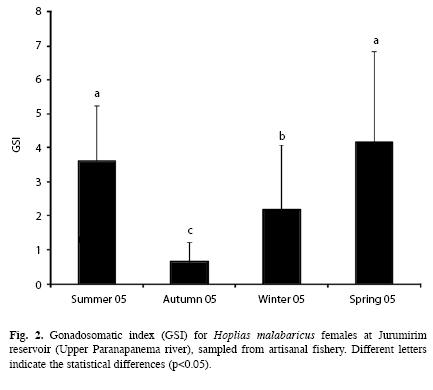
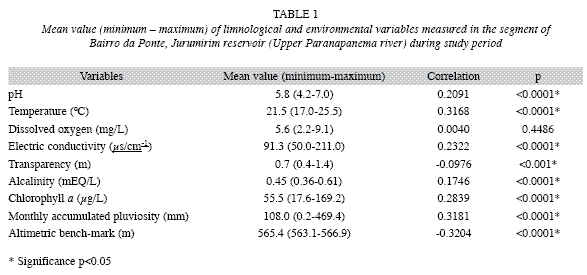
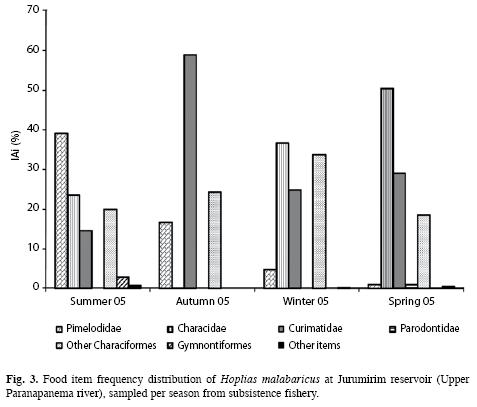
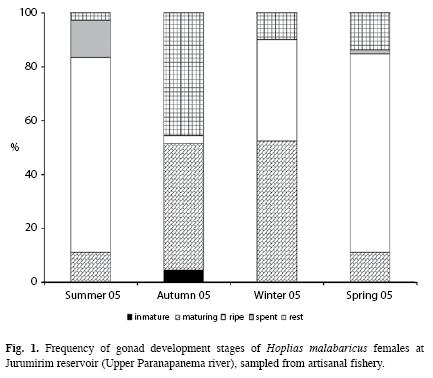
<body><![CDATA[<p align="justify"><b><font face="Verdana" size="3">Results</font></b></p>     <p align="justify"><font face="Verdana" size="2">Reproduction dynamics: In this study, males represented 43.7% of the fish captured (n=186) and females represented 56.3% (n=240), which resulted in the following M:F ratio:0.8:1 (x<sup>2</sup>=6.594, p&lt;0.0102). Seasonally, males predominated in summer [males=38% (51.4%), M:F=1:0.9; X<sup>2</sup>=0.014, p&lt;0.9075] and females during the remaining seasons of the year: autumn [females=68% (57.1%), M:F=0.7:1, x<sup>2</sup>=2.151, p&lt;0.1425]; winter [females=64% (52.0%), M:F=0.9:1, x<sup>2</sup>=0.23, p&lt;0.7183] and spring [females=72% (65.5%), M:F=0.5:1, x<sup>2</sup>=9.90, p&lt;0.0017]. Specimens of ripe females were sampled during all four seasons of the year but the relative frequencies (%) were higher in summer (72.2%) and spring (73.6%) (<a  href="#f1">Fig. 1</a>). The statistical analysis rejected the null hypothesis of equal mean values of the GSI (ANOVA, F (3.236)=43.979, p&lt;0.0000) and revealed that values in spring and summer were statistically different (higher) than those in autumn and winter (<a href="#f2">Fig. 2</a>). Spearman correlation analysis showed that the highest correlations occurred between GSI and temperature, precipitation, (positive) and the water level benchmark (negative) (<a href="#t1">Table 1</a>).    <br> </font></p>     <p style="text-align: center;"><font face="Verdana" size="2"><img  src="/img/revistas/rbt/v59n1/a06f1.jpg" title="" alt=""  style="width: 433px; height: 378px;"><a name="f1"></a>    <br> </font></p>     <p style="text-align: center;"><font face="Verdana" size="2"><img  src="/img/revistas/rbt/v59n1/a06f2.jpg" title="" alt=""  style="width: 433px; height: 390px;"><a name="f2"></a>    <br> </font></p>     <p style="text-align: center;"><font face="Verdana" size="2"><img  src="/img/revistas/rbt/v59n1/a06t1.gif" title="" alt=""  style="width: 587px; height: 275px;"><a name="t1"></a>    <br> </font></p>     <p align="justify"><font face="Verdana" size="2"><b>Feeding: </b>The diet of <i>H. malabaricus </i>consisted almost exclusively of fish. Items such as Anuro, land insects, aquatic insects and vegetable material had little impact on the IAi frequency and totalled &lt;1%. Among the fish items, a seasonal variation in the frequency of the IAi can be clearly observed; in summer the Pimelodidae had a higher frequency (39.12%); in autumn the Curimatidae predominated (with 58.92%) and in winter and spring the Characidae predominated (36.68% and 50.48%, respectively) (<a href="#f3">Fig. 3</a>).    ]]></body>
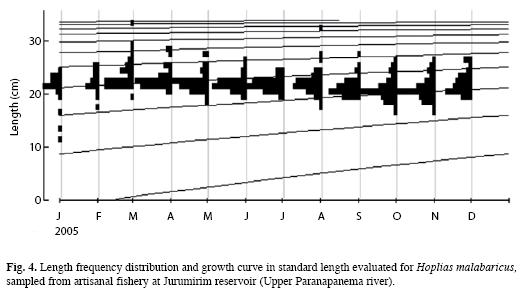
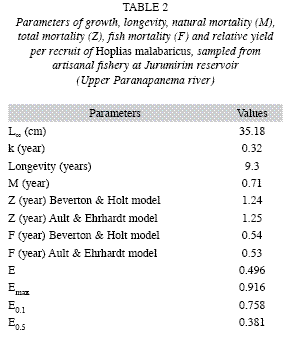
<body><![CDATA[<br> </font></p>     <p style="text-align: center;"><font face="Verdana" size="2"><img  src="/img/revistas/rbt/v59n1/a06f3.jpg" title="" alt=""  style="width: 477px; height: 407px;"><a name="f3"></a>    <br> </font></p>     <p align="justify"><font face="Verdana" size="2"><b>Length-weight relationships: </b>The standard length and total weight of captured specimens ranged from 11.1 to 33.3cm (Lp<sub>average</sub>=22.0cm; SD=2.2) and from 29.59 to 722.01g (Wt<sub>average</sub>=209.7g, SD=67.4), respectively. The linear regression of the transformed data for the length-weight relationship can be described by the following equation: ln Wt=–3.1663+2.7456 lnLp and R<sup>2</sup>=0.9012. The <i>t </i>test result refuted the null hypothesis that b=zero(<i>t</i><sub>(1.430)</sub>=62.62, p=0.00) and that b=3 (<i>t</i><sub>(1.430)</sub>=5.90, p&lt;0.01), which indicates that <i>H. malabaricus </i>exhibits negative allometric growth at the Jurumirim Reservoir.</font></p>     <p align="justify"><font face="Verdana" size="2"><b>Length growth: </b>The values of the parameters that describe the length growth of <i>H. malabaricus </i>were: </font><font face="Verdana" size="2">L<sub>&#8734;</sub></font><font  face="Verdana" size="2">=35.18cm and k=0.32 year (<a href="#t2">Table 2</a>). Therefore, the Von Bertalanffy growth equation can be described as follows: Lt=35.18[1–exp(<sup>–0.32(t–t0)</sup>)]. The length growth curve suggests the presence of four cohorts in the captured sample, although this result is specific to the gear used by the artisanal fishermen in a particular section of the Jurumirim Reservoir (<a href="#f4">Fig. 4</a>).    <br> </font></p>     <p style="text-align: center;"><font face="Verdana" size="2"><img  src="/img/revistas/rbt/v59n1/a06f4.jpg" title="" alt=""  style="width: 526px; height: 300px;"><a name="f4"></a>    <br> </font></p>     <p style="text-align: center;"><font face="Verdana" size="2"><img  src="/img/revistas/rbt/v59n1/a06t2.gif" title="" alt=""  style="width: 293px; height: 349px;"><a name="t2"></a>    <br> </font></p>     ]]></body>
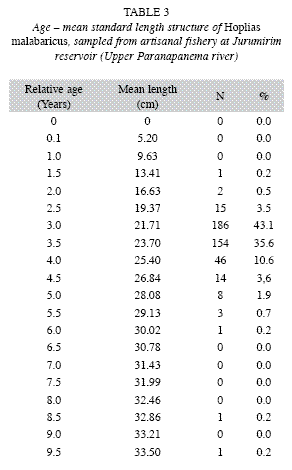
<body><![CDATA[<p align="justify"><font face="Verdana" size="2"><b>Length and age structure: </b>The lengthage structure of the studied population (<a href="#t3">Table 3</a>) demonstrated that capture of <i>H. malabaricus </i>by the artisanal fishery concentrated on individuals 2.5-4.5 years of age with a standard length of 19.37-26.84cm; these fish represented 96.4% of the population. Individuals between 3.0 and 3.5 years old were the most representative of this kind of fishery in the Jurumirim Reservoir, at 43.1% and 35.6% of the captures, respectively.    <br> </font></p>     <p style="text-align: center;"><font face="Verdana" size="2"><img  src="/img/revistas/rbt/v59n1/a06t3.gif" title="" alt=""  style="width: 292px; height: 470px;"><a name="t3"></a>    <br> </font></p>     <p align="justify"><font face="Verdana" size="2"><b>Longevity potential: </b>The maximum life expectancy of <i>H. malabaricus </i>(<i>t<sub>max</sub></i>) was estimated to be 9.3 years (<a href="#t2">Table 2</a>).</font></p>     <p align="justify"><font face="Verdana" size="2"><b>Mortality rates: </b>The natural mortality rate (M) was estimated to be 0.71 year. The total mortality rates calculated using the methods of Beverton &amp; Holt and Ault &amp; Ehrhardt were 1.25 years and 1.24 years, respectively. The mortality rate due to fishing (F) was evaluated to be 0.54 year (Z=model Beverton &amp; Holt) and 0.53 year (Z=model Ault &amp; Ehrhardt) (<a href="#t2">Table 2</a>). Thus, the rate of natural mortality was higher than the rate of mortality due to fishing (M&gt;F).</font></p>     <p align="justify"><font face="Verdana" size="2"><b>Yield (Y´/R) and biomass (B´/Y) per recruit: </b>The present exploitation level of the stock of <i>H. malabaricus </i>was E=0.496. This value was less than E<sub>max</sub>=0.916 and E0.1=0.758 and higher than E<sub>0.5</sub>=0.381 (<a href="#t2">Table 2</a>). Because E was &lt;E<sub>max</sub>, we infer that the stock of this species is not being overfished by this group of artisanal fishermen.</font></p>     <p align="justify"><b><font face="Verdana" size="3">Discussion</font></b></p>     <p align="justify"><b><font face="Verdana" size="2">Reproduction dynamics: </font></b><font face="Verdana" size="2">The sex ratio of fish populations tends to be 1:1, although deviations may occur and seasonal variations are common (Nikolsky 1963). The sex ratio is governed by diverse factors, including mortality, longevity and growth rate, that lead to differences in capturing rates of the two sexes (King &amp; Etim 2004). The sex ratio for <i>H. malabaricus </i>caught in the artisanal fishery at Bairro da Ponte deviated significantly from 1:1, with a predominance of females. Two possible explanations for this difference are as follows: (1) Behavioral differences between sexes leave females more vulnerable to capture. Males of the species are more territory conscious (Barbieri 1989, Prado <i>et al. </i>2006) and also provide parental care by guarding the nest. The eggs are deposited at the bottom in small depressions, tree trunks, and under leaves or other surfaces. After spawning the females tend to leave the site, whereas the males remain to take care of the nest (Prado <i>et al. </i>2006). For this reason, females tend to be more susceptible to be captured by fishing gears than males. (2) Differences between genders in growth and mortality rates affect capture. However, exploratory analyses of the growth data indicated no differences in these parameters between the sexes of <i>H. malabaricus </i>in Jurumirim Reservoir. Barbieri (1989) did not detect any growth difference between males and females of this species population inhabiting the Monjolinho Reservoir in Southeastern Brazil. Based on these results, we infer that the observed differences in sex ratio found in this study may be more related to reproductive behavior than to growth and mortality rates.</font></p>     <p align="justify"><font face="Verdana" size="2"><i>H. malabaricus </i>exhibited a long reproduction period that encompassed spring and summer. The reproduction period also was positively correlated with water temperature and the monthly mean rainfall. Studies of the reproductive biology of <i>H. malabaricus </i>made in various environments, repeatedly gave similar results: greater reproductive intensity during the rainy season (Barbieri 1989, Suzuki &amp; Agostinho 1997, Marques <i>et al. </i>2001, Prado <i>et al. </i>2006). Wootton (1995) and Lowe-McConnell (1987) reported that various exogenous factors can affect the reproduction process; some of these "triggers" for the reproduction of tropical fish include photoperiod, temperature, water flow, water level and rainfall. Our findings thus corroborate the results of previous studies that show that precipitation is one of the principal reproduction triggers for <i>H. malabaricus.</i></font></p>     ]]></body>
<body><![CDATA[<p align="justify"><font face="Verdana" size="2">Because <i>H. malabaricus </i>uses reproductive and behavioral tactics such as parental care, nest construction and reproduction in shallow environments and close to river margins, abrupt oscillations in the reservoir water level that cause retraction and expansion of the margins may increase the mortality rate of eggs and larvae, thereby may impact recruitment (Suzuki &amp; Agostinho 1997) and ultimately affect the renewal capacity of the fish stock. Such changes may be accompanied by a drop in the fishery catch.</font></p>     <p align="justify"><font face="Verdana" size="2"><b>Feeding: </b>In the studied area of the Jurumirim Reservoir, stomach contents of <i>H. malabaricus </i>consisted almost exclusively of fish; the presence of aquatic and land insects, vegetable matter, and Anuro was considered to be incidental. The piscivorous habit of adults is typical for this species (Winemiller 1989, Loureiro &amp; Hahn 1996, Carvalho <i>et al. </i>2002, Luz- Agostinho <i>et al. </i>2006). A pattern of seasonality in feeding was clearly evident, with a predominance of Pimelodidae in summer, Curimatidae in autumn and Characidae (lambaris and piquira) in spring. The opportunistic choice of food seems to be one of the species' characteristics (Carvalho <i>et al. </i>2002); which efficiently exploits the environment's available resources at a given time. Adaptability to a different diet is one life the tactics of a great number of tropical fish species (Lowe-McConnell 1987, Hahn &amp; Fugi 2007) and is of great importance to <i>H. malabaricus</i>, as it allows adjustments to environmental conditions without alterations in population biomass.</font></p>     <p align="justify"><font face="Verdana" size="2">The fact that <i>H. malabaricus </i>is a predator at the top of the chain (second and sometimes third order) at the Jurumirim Reservoir, may have a negative impact on the fishery. In long trophic chains, energy is lost after it moves from one level to the other and therefore the biomass sustained at the top of the chain tends to decrease. These long food chains, in tropical and particularly Brazilian reservoirs, are one of the reported causes for low fishery productivity (Fernando &amp; Holcik 1982, Petrere Jr. 1996, Gomes &amp; Miranda 2001).</font></p>     <p align="justify"><font face="Verdana" size="2"><b>Length-weight relationships: </b>As a result of the capture gear employed (gill nets with meshes with more than 10cm between opposing knots), the catches of <i>H. malabaricus </i>by the artisanal fishery consist almost entirely of adult individuals, thus preserving juveniles. From this point of view, it seems that fishing pressure does not yet constitute a threat to the stock and the recruitment of the species. However, fishery pressure exerted only on larger individuals may lead to genetic degradation of the population, as reported by Conover &amp; Munch (2002). In other words, the removal of larger individuals favours the survival of the smaller and slower growing individuals, which alters the genetic variability of the population by eliminating the genes that promote quick growth of the population (Conover &amp; Munch 2002). Therefore, we agree with Agostinho <i>et al. </i>(2007, 2008) premise that the paradigms established in relation to the minimum size of first capture should be reviewed, as the preservation of longer individuals is of vital importance to maintain an economically viable fishery and for stock resilience.</font></p>     <p align="justify"><font face="Verdana" size="2">In our study, <i>H. malabaricus </i>demonstrated a negative allometric growth pattern (i.e., it grew more quickly in length than in weight). This result differs from other findings for this species in different Brazilian reservoirs [Lobo, b<i>=</i>3.0 (Barbieri <i>et al. </i>1982) and Monjolinho, b=3.1 (Barbieri 1989)], which both indicated isometric growth in those two environments. Even so, the value of b found in this study (2.7456) remained within the range of oscillation (2.5-3.5) reported by Le Cren (1951). The length-weight relationships provided a good model for the variables evaluation (R<sup>2</sup>=0.9012).</font></p>     <p align="justify"><font face="Verdana" size="2">Various factors can influence fish growth, such as sex, age, season of the year, type of nutrition, physiological conditions, difference in availability of food, period of reproduction and growth increment (Lalèyè 2006). When studying <i>Geophagus brasiliensis </i>(Cichlidae) in the Lages Reservoir, Dos Santos <i>et al. </i>(2004) concluded that the oligotrophic characteristic and the resulting lack of food combined with stress produced by the variation of the reservoir´s water level, might contribute to negative allometric growth of the species. At the point where the Paranapanema River flows into the Jurumirim Reservoir, its trophic state varies between oligotrophic and mesotrophic depending on the season of the year (Nogueira <i>et al. </i>1999). In addition, the water levels of the marginal lagoons and channel of that section of the river vary considerably (4m between low and high water) as a result of the operational system of the Jurumirim Hydroelectric Plant (Granado &amp; Henry 2008). It is therefore reasonable to assume that availability of food in the aquatic environment may also vary seasonally and thus influence this (negative allometric) growth coefficient, despite the fact that the species efficiently uses the available resources.</font></p>     <p align="justify"><font face="Verdana" size="2"><b>Length growth and longevity potential: </b>The growth parameters estimated for <i>H. malabaricus </i>(L<sub>&#8734;</sub>=35.18cm, k=0.32 years and longevity of 9.3 years) indicated that this species grows slowly. According to some authors, species with specialized food and elevated trophic level have a tendency to slower growth, great longevity and retarded gonads maturation (Lowe-McConnel 1987, Winnemiller 1989, Wootton 1995). We thus include <i>H. malabaricus </i>from this part of the Jurumirim Reservoir in this category because of its specialized food consumption (piscivorous), high trophic level (consumer of second and/or third order) and great longevity.</font></p>     <p align="justify"><font face="Verdana" size="2">Studies of growth parameters of <i>H. malabaricus </i>in other environments revealed different values of L<sub>&#8734;</sub>, k and longevity (Barbieri 1989, Angelini &amp; Agostinho 2005). Because various endogenous and exogenous factors affect fish growth and longevity (Wootton 1995), it is difficult to identify the causal factors for these different results.</font></p>     <p align="justify"><font face="Verdana" size="2"><b>Length and age structure: </b>Evaluation of the age structure indicated that individuals between 3.0 and 3.5 years old made up the bulk of captures in the artisanal fishery; they represented 78.7% of landings and consisted of specimens with a standard length of &gt;21.0cm. The individuals within these age classes were adults that may have reproduced once already, as the gonad analysis revealed that all individuals greater than &gt;17.1cm long are mature. </font></p>     <p align="justify"><font face="Verdana" size="2"><b>Mortality rates: </b>In this study, the natural mortality rate (M) exceeded the fishery mortality rate (F). Caddy &amp; Mahon (1995) discussed the relationship between M and F and considered the maximum sustainable yield (MSY) to occur when F=M. Based on this concept, as the biological reference point (BRP), the exploitation of the stock of <i>H. malabaricus </i>in the study area does not suggest overfishing. However, scant evidence exists of such a relationship between M and F, so the maximum sustainable yield might be higher than M in certain cases (Caddy &amp; Mahon 1995).</font></p>     ]]></body>
<body><![CDATA[<p align="justify"><font face="Verdana" size="2"><b>Yield and biomass per recruit: </b>The relative yield-per-recruit analysis indicated that E (0.496) was bellow the values E<sub>0.1</sub>(0.758) and Emax(0.916). E<sub>0.1</sub> has been adopted as the BRP for many fisheries and is defined as the exploitation rate at which the marginal increase of Y'/R is 10% of its virgin stock. In this study, the value of E remained below E<sub>0.1</sub>, which indicates that the stock of <i>H. malabaricus </i>is not yet overfished, which in turn would warrant a natural increase of fishing effort. On the other hand, the value of E exceeded the value of E<sub>0.5</sub>, which means that F diminished the stock's virgin biomass by 50%. Thus, a more conservative stance should be assumed and an increase in the level of fishery effort is not advisable.</font></p>     <p align="justify"><font face="Verdana" size="2">Our study of the population dynamics of <i>H. malabaricus </i>based on samples derived from an artisanal fishery located in the Jurumirim Reservoir in the transition area between the Paranapanema River and the reservoir led to the following conclusions: i) <i>H. malabaricus </i>exhibited reproduction dynamics and diet similar to those determined in other ecosystems, such as a long reproduction period, more intense reproductive activity during the rainy season, and piscivorous and opportunistic habits; ii) the fishery stock did not show evidence of overfishing and thus may continue to be exploited in a sustainable way by the artisanal fishing community; iii) <i>H. malabaricus </i>continues to represent an important source of income for these fishermen, thus mitigating the negative effects of damming on migratory species; iv) we recommend emphatically that no increase in fishery effort should be tolerated, lest the stock of this species be threatened.</font></p>     <p align="justify"><b><font face="Verdana" size="3">Acknowledgments</font></b></p> <font face="Verdana" size="2">     <p align="justify">We wish to thank the fishermen of the fisher community Bairro da Ponte who answered willingly and spontaneously the production forms; Joel Marques who assisted us in establishing contacts with local fishermen; the laboratory technicians Ricardo André dos Santos Teixeira and Renato Devidé; the entire team of the Laboratory for Fish Ecology of UNESPBotucatu; the COORDENAÇÃO DE APERFEIÇOAMENTO DE PESSOAL DE NÍVEL SUPERIOR (CAPES), for concession of a scholarship and Armin Schmid for assistance in the English version.</p> </font> <hr style="width: 100%; height: 2px;"><b><font face="Verdana" size="3">     <p align="justify">References</p> </font></b>     <!-- ref --><p align="justify"><font face="Verdana" size="2">Agostinho, A.A., L.C. Gomes &amp; F.M. Pelicice. 2007. Ecologia e manejo de recursos pesqueiros em reservatórios do Brasil. Eduem, Maringá, Brasil.    &nbsp;&nbsp;&nbsp;&nbsp;&nbsp;&nbsp;&nbsp;&nbsp;[&#160;<a href="javascript:void(0);" onclick="javascript: window.open('/scielo.php?script=sci_nlinks&ref=1699749&pid=S0034-7744201100010000600001&lng=','','width=640,height=500,resizable=yes,scrollbars=1,menubar=yes,');">Links</a>&#160;]<!-- end-ref --></font></p>     <!-- ref --><p align="justify"><font face="Verdana" size="2">Agostinho, A.A., F.M. Pelicice &amp; L.C. Gomes. 2008. Dams and de fish fauna of the Neotropical region: impacts and management related to diversity and fisheries. Braz. J. Bio. 68: 1119-1132.    &nbsp;&nbsp;&nbsp;&nbsp;&nbsp;&nbsp;&nbsp;&nbsp;[&#160;<a href="javascript:void(0);" onclick="javascript: window.open('/scielo.php?script=sci_nlinks&ref=1699751&pid=S0034-7744201100010000600002&lng=','','width=640,height=500,resizable=yes,scrollbars=1,menubar=yes,');">Links</a>&#160;]<!-- end-ref --></font></p>     <!-- ref --><p align="justify"><font face="Verdana" size="2">Angelini, R. &amp; A.A. Agostinho. 2005. Parameter estimates for fishes of the Upper Paraná river floodplain and Iatipu reservoir (Brazil). NAGA 1-2: 53-57.    &nbsp;&nbsp;&nbsp;&nbsp;&nbsp;&nbsp;&nbsp;&nbsp;[&#160;<a href="javascript:void(0);" onclick="javascript: window.open('/scielo.php?script=sci_nlinks&ref=1699753&pid=S0034-7744201100010000600003&lng=','','width=640,height=500,resizable=yes,scrollbars=1,menubar=yes,');">Links</a>&#160;]<!-- end-ref --></font></p>     <!-- ref --><p align="justify"><font face="Verdana" size="2">Barbieri, G., J. Verani &amp; M.C. Barbieri. 1982. Dinâmica quantitativa da nutrição de <i>Hoplias malabaricus </i>(Bloch, 1974), na represa do Lobo (Brotas- Itirapinas/ SP.). (Pices, Erythrinidae). Rev. Bras. Biol. 42: 295-302.    &nbsp;&nbsp;&nbsp;&nbsp;&nbsp;&nbsp;&nbsp;&nbsp;[&#160;<a href="javascript:void(0);" onclick="javascript: window.open('/scielo.php?script=sci_nlinks&ref=1699755&pid=S0034-7744201100010000600004&lng=','','width=640,height=500,resizable=yes,scrollbars=1,menubar=yes,');">Links</a>&#160;]<!-- end-ref --></font></p>     <!-- ref --><p align="justify"><font face="Verdana" size="2">Barbieri, G. 1989. Dinâmica da reprodução e crescimento de <i>Hoplias malabaricus </i>(Bloch, 1974) (Osteichthyes, erutrhynidae) da represa do Monjolinho, São Carlos/ SP. Rev. Bras. Zool. 6: 225-233.    &nbsp;&nbsp;&nbsp;&nbsp;&nbsp;&nbsp;&nbsp;&nbsp;[&#160;<a href="javascript:void(0);" onclick="javascript: window.open('/scielo.php?script=sci_nlinks&ref=1699757&pid=S0034-7744201100010000600005&lng=','','width=640,height=500,resizable=yes,scrollbars=1,menubar=yes,');">Links</a>&#160;]<!-- end-ref --></font></p>     <!-- ref --><p align="justify"><font face="Verdana" size="2">Caddy, J.F. &amp; R. Mahon. 1995. Reference points for fisheries management. FAO, Roma.    &nbsp;&nbsp;&nbsp;&nbsp;&nbsp;&nbsp;&nbsp;&nbsp;[&#160;<a href="javascript:void(0);" onclick="javascript: window.open('/scielo.php?script=sci_nlinks&ref=1699759&pid=S0034-7744201100010000600006&lng=','','width=640,height=500,resizable=yes,scrollbars=1,menubar=yes,');">Links</a>&#160;]<!-- end-ref --></font></p>     <!-- ref --><p align="justify"><font face="Verdana" size="2">Carvalho, E.D., C.Y. Fujihara &amp; R. Henry. 1998. A study of the ichthyofauna of the Jurumirim reservoir (Paranapanema River, São Paulo, Brzil): fish production and dominant species at three sites. Verh. Int. Verein. Limn. 26: 2199-2202.    &nbsp;&nbsp;&nbsp;&nbsp;&nbsp;&nbsp;&nbsp;&nbsp;[&#160;<a href="javascript:void(0);" onclick="javascript: window.open('/scielo.php?script=sci_nlinks&ref=1699761&pid=S0034-7744201100010000600007&lng=','','width=640,height=500,resizable=yes,scrollbars=1,menubar=yes,');">Links</a>&#160;]<!-- end-ref --></font></p>     <!-- ref --><p align="justify"><font face="Verdana" size="2">Carvalho, L.N., C.H.V. Fernandes &amp; V.S.S. Moreira. 2002. Alimentação de <i>Hoplias malabaricus </i>(Bloch, 1794) (Osteichthyes, Erytrinidae) no rio Vermelho, Pantanal Mato-grossense. Rev. Bras. Zoocie. 4: 227-236.    &nbsp;&nbsp;&nbsp;&nbsp;&nbsp;&nbsp;&nbsp;&nbsp;[&#160;<a href="javascript:void(0);" onclick="javascript: window.open('/scielo.php?script=sci_nlinks&ref=1699763&pid=S0034-7744201100010000600008&lng=','','width=640,height=500,resizable=yes,scrollbars=1,menubar=yes,');">Links</a>&#160;]<!-- end-ref --></font></p>     <!-- ref --><p align="justify"><font face="Verdana" size="2">Carvalho, E.D., R.J. de Castro, V.F.B. da Silva &amp; A.P. Vidotto. 2003. A estrutura das assembléias de peixes nas zonas de ecótono da represa de Jurumirim (Alto rio Paranapanema, SP), p. 249-278. <i>In </i>R. Henry (ed.). Ecótonos nas interfaces dos ecossistemas aquáticos. RiMA, São Carlos, Brasil.    &nbsp;&nbsp;&nbsp;&nbsp;&nbsp;&nbsp;&nbsp;&nbsp;[&#160;<a href="javascript:void(0);" onclick="javascript: window.open('/scielo.php?script=sci_nlinks&ref=1699765&pid=S0034-7744201100010000600009&lng=','','width=640,height=500,resizable=yes,scrollbars=1,menubar=yes,');">Links</a>&#160;]<!-- end-ref --></font></p>     <!-- ref --><p align="justify"><font face="Verdana" size="2">Carvalho, E.D., S.G. de C. Britto &amp; M.L. Orsi. 2005. O panorama das introduções de peixes na bacia hidrográfica do rio Paranapanema, Alto Paraná, Brasil, p. 253-274. <i>In </i>O. Rocha, E.L.G. Espíndola, N. Fenerich-Verani, J.R. Verani &amp; A.C. Reitzler (eds.). Espécies invasoras em águas doces – estudo de caso e propostas de manejo. Edufscar, São Carlos, Brasil.    &nbsp;&nbsp;&nbsp;&nbsp;&nbsp;&nbsp;&nbsp;&nbsp;[&#160;<a href="javascript:void(0);" onclick="javascript: window.open('/scielo.php?script=sci_nlinks&ref=1699767&pid=S0034-7744201100010000600010&lng=','','width=640,height=500,resizable=yes,scrollbars=1,menubar=yes,');">Links</a>&#160;]<!-- end-ref --></font></p>     <!-- ref --><p align="justify"><font face="Verdana" size="2">Conover, D.O. &amp; S. Munch. 2002. Sustaining fisheries yields over evolutionary time scales. Science 297: 94-96.    &nbsp;&nbsp;&nbsp;&nbsp;&nbsp;&nbsp;&nbsp;&nbsp;[&#160;<a href="javascript:void(0);" onclick="javascript: window.open('/scielo.php?script=sci_nlinks&ref=1699769&pid=S0034-7744201100010000600011&lng=','','width=640,height=500,resizable=yes,scrollbars=1,menubar=yes,');">Links</a>&#160;]<!-- end-ref --></font></p>     <!-- ref --><p align="justify"><font face="Verdana" size="2">Fernando, C.H. &amp; J. Hol</font><font face="Verdana" size="2">&#269;ík. </font><font  face="Verdana" size="2">1982. The nature of fish communities: A factor influencing the fishery potential and yields of tropical lakes and reservoirs. Hydrobiologia 97: 127-140.    &nbsp;&nbsp;&nbsp;&nbsp;&nbsp;&nbsp;&nbsp;&nbsp;[&#160;<a href="javascript:void(0);" onclick="javascript: window.open('/scielo.php?script=sci_nlinks&ref=1699771&pid=S0034-7744201100010000600012&lng=','','width=640,height=500,resizable=yes,scrollbars=1,menubar=yes,');">Links</a>&#160;]<!-- end-ref --></font></p>     <!-- ref --><p align="justify"><font face="Verdana" size="2">Gayanilo Jr., F.C., P. Sparre &amp; D. Pauly. 2005. FAOICLARM stock assessment tools II (FiSAT II). Revised version. User's guide. FAO Computerized Information Serie (Fisheries), Roma, Italia.    &nbsp;&nbsp;&nbsp;&nbsp;&nbsp;&nbsp;&nbsp;&nbsp;[&#160;<a href="javascript:void(0);" onclick="javascript: window.open('/scielo.php?script=sci_nlinks&ref=1699773&pid=S0034-7744201100010000600013&lng=','','width=640,height=500,resizable=yes,scrollbars=1,menubar=yes,');">Links</a>&#160;]<!-- end-ref --></font></p>     <!-- ref --><p align="justify"><font face="Verdana" size="2">Gomes, L.C. &amp; L.E. Miranda. 2001. Riverine characteristics dicate composition of fish assemblages and limit fisheries in reservoirs of the Upper Paraná River basin. Regulated River: Research &amp; Management 17: 67-76.    &nbsp;&nbsp;&nbsp;&nbsp;&nbsp;&nbsp;&nbsp;&nbsp;[&#160;<a href="javascript:void(0);" onclick="javascript: window.open('/scielo.php?script=sci_nlinks&ref=1699775&pid=S0034-7744201100010000600014&lng=','','width=640,height=500,resizable=yes,scrollbars=1,menubar=yes,');">Links</a>&#160;]<!-- end-ref --></font></p>     <!-- ref --><p align="justify"><font face="Verdana" size="2">Granado, D.C. &amp; R. Henry. 2008. The influence of the hydrologic pulse on the water physical and chemical variables of lateral lakes with different connection levels to Paranapanema River in the mouth zone at Jurumirim Reservoir (São Paulo, Brazil). Acta Limnol. Bras. 20: 265-275.    &nbsp;&nbsp;&nbsp;&nbsp;&nbsp;&nbsp;&nbsp;&nbsp;[&#160;<a href="javascript:void(0);" onclick="javascript: window.open('/scielo.php?script=sci_nlinks&ref=1699777&pid=S0034-7744201100010000600015&lng=','','width=640,height=500,resizable=yes,scrollbars=1,menubar=yes,');">Links</a>&#160;]<!-- end-ref --></font></p>     <!-- ref --><p align="justify"><font face="Verdana" size="2">Hahn, N. &amp; R. Fugi. 2007. Alimentação de peixes em reservatórios brasileiros: alterações e conseqüências nos estágios iniciais do represamento. Oecol. Bras. 11: 469-480.    &nbsp;&nbsp;&nbsp;&nbsp;&nbsp;&nbsp;&nbsp;&nbsp;[&#160;<a href="javascript:void(0);" onclick="javascript: window.open('/scielo.php?script=sci_nlinks&ref=1699779&pid=S0034-7744201100010000600016&lng=','','width=640,height=500,resizable=yes,scrollbars=1,menubar=yes,');">Links</a>&#160;]<!-- end-ref --></font></p>     <!-- ref --><p align="justify"><font face="Verdana" size="2">Hyslop, E.J. 1980. Stomach Contents Analysis – a Review of Methods and their Application. J. Fish. Biol. 17: 411-429.    &nbsp;&nbsp;&nbsp;&nbsp;&nbsp;&nbsp;&nbsp;&nbsp;[&#160;<a href="javascript:void(0);" onclick="javascript: window.open('/scielo.php?script=sci_nlinks&ref=1699781&pid=S0034-7744201100010000600017&lng=','','width=640,height=500,resizable=yes,scrollbars=1,menubar=yes,');">Links</a>&#160;]<!-- end-ref --></font></p>     <!-- ref --><p align="justify"><font face="Verdana" size="2">Kawakami, E. &amp; G. Vazzoler. 1980. Método gráfico e estimativa de índices alimentares aplicado no estudo de alimentação de peixes. Bol. Inst. Oceanogr. 29: 205-207.    &nbsp;&nbsp;&nbsp;&nbsp;&nbsp;&nbsp;&nbsp;&nbsp;[&#160;<a href="javascript:void(0);" onclick="javascript: window.open('/scielo.php?script=sci_nlinks&ref=1699783&pid=S0034-7744201100010000600018&lng=','','width=640,height=500,resizable=yes,scrollbars=1,menubar=yes,');">Links</a>&#160;]<!-- end-ref --></font></p>     <!-- ref --><p align="justify"><font face="Verdana" size="2">King, R.P. &amp; L. Etim. 2004. Reproduction, growth, mortality and yield of <i>Tilapia mariae </i>Boulenger 1899 (Cichlidae) in a Nigerian rainforest wetland stream. J. Appl. Ichthyol. 20: 502-510.    &nbsp;&nbsp;&nbsp;&nbsp;&nbsp;&nbsp;&nbsp;&nbsp;[&#160;<a href="javascript:void(0);" onclick="javascript: window.open('/scielo.php?script=sci_nlinks&ref=1699785&pid=S0034-7744201100010000600019&lng=','','width=640,height=500,resizable=yes,scrollbars=1,menubar=yes,');">Links</a>&#160;]<!-- end-ref --></font></p>     <!-- ref --><p align="justify"><font face="Verdana" size="2">Lalèyè, P.A. 2006. Length-weight and length-length relationships of fish from the Ouémé River in Bénin (West Africa). J. Appl. Ichthyol. 22: 502-510.    &nbsp;&nbsp;&nbsp;&nbsp;&nbsp;&nbsp;&nbsp;&nbsp;[&#160;<a href="javascript:void(0);" onclick="javascript: window.open('/scielo.php?script=sci_nlinks&ref=1699787&pid=S0034-7744201100010000600020&lng=','','width=640,height=500,resizable=yes,scrollbars=1,menubar=yes,');">Links</a>&#160;]<!-- end-ref --></font></p>     <!-- ref --><p align="justify"><font face="Verdana" size="2">Le Cren, E.D. 1951. The length-weight relationship and seasonal cycle in gonad weight and condition in Perch (<i>Perca fluviatilis</i>). J. Anim. Ecol. 20: 201- 219.    &nbsp;&nbsp;&nbsp;&nbsp;&nbsp;&nbsp;&nbsp;&nbsp;[&#160;<a href="javascript:void(0);" onclick="javascript: window.open('/scielo.php?script=sci_nlinks&ref=1699789&pid=S0034-7744201100010000600021&lng=','','width=640,height=500,resizable=yes,scrollbars=1,menubar=yes,');">Links</a>&#160;]<!-- end-ref --> </font></p>     <!-- ref --><p align="justify"><font face="Verdana" size="2">Loureiro, V.E. &amp; N. Hahn. 1996. Dieta e atividade alimentar da traíra, <i>Hoplias malabaricus </i>(Bloch, 1794) (Osteichthyes: Erythrinidae), nos primeiros anos de formação do reservatório de Segredo – PR. Acta Limn. Bras. 8: 195-205.    &nbsp;&nbsp;&nbsp;&nbsp;&nbsp;&nbsp;&nbsp;&nbsp;[&#160;<a href="javascript:void(0);" onclick="javascript: window.open('/scielo.php?script=sci_nlinks&ref=1699791&pid=S0034-7744201100010000600022&lng=','','width=640,height=500,resizable=yes,scrollbars=1,menubar=yes,');">Links</a>&#160;]<!-- end-ref --> </font></p>     <!-- ref --><p align="justify"><font face="Verdana" size="2">Lowe-McConnell, R.H. 1987. Ecological studies in tropical fish communities. Cambridge, Cambridge, Great Britain.    &nbsp;&nbsp;&nbsp;&nbsp;&nbsp;&nbsp;&nbsp;&nbsp;[&#160;<a href="javascript:void(0);" onclick="javascript: window.open('/scielo.php?script=sci_nlinks&ref=1699793&pid=S0034-7744201100010000600023&lng=','','width=640,height=500,resizable=yes,scrollbars=1,menubar=yes,');">Links</a>&#160;]<!-- end-ref --></font></p>     <!-- ref --><p align="justify"><font face="Verdana" size="2">Luz-Agostinho, K.D.G., L.M. Bini, R. Fugi, A.A. Agostinho &amp; H.F. Júlio Jr. 2006. Food spectrum and trophic structure of the ichthyofauna of Corumbá reservoir, Paraná river basin, Brazil. Neotrop. Ichthyol. 4: 61-68.    &nbsp;&nbsp;&nbsp;&nbsp;&nbsp;&nbsp;&nbsp;&nbsp;[&#160;<a href="javascript:void(0);" onclick="javascript: window.open('/scielo.php?script=sci_nlinks&ref=1699795&pid=S0034-7744201100010000600024&lng=','','width=640,height=500,resizable=yes,scrollbars=1,menubar=yes,');">Links</a>&#160;]<!-- end-ref --></font></p>     <!-- ref --><p align="justify"><font face="Verdana" size="2">Marques, D.K.S., H. de C.B. Gurgel &amp; I. Lucena. 2001. Época de reprodução de <i>Hoplias malabaricus </i>Bloch, 1794 (Osteichthyes, Erythrinidae) da barragem do rio Gramame, Alhandra, Paraíba, Brasil. Rev. Bras. Zoocie. 3: 61-67.    &nbsp;&nbsp;&nbsp;&nbsp;&nbsp;&nbsp;&nbsp;&nbsp;[&#160;<a href="javascript:void(0);" onclick="javascript: window.open('/scielo.php?script=sci_nlinks&ref=1699797&pid=S0034-7744201100010000600025&lng=','','width=640,height=500,resizable=yes,scrollbars=1,menubar=yes,');">Links</a>&#160;]<!-- end-ref --></font></p>     <!-- ref --><p align="justify"><font face="Verdana" size="2">Nikolsky, G.V. 1963. The Ecology of Fishes. Academic, London, Great Britain.    &nbsp;&nbsp;&nbsp;&nbsp;&nbsp;&nbsp;&nbsp;&nbsp;[&#160;<a href="javascript:void(0);" onclick="javascript: window.open('/scielo.php?script=sci_nlinks&ref=1699799&pid=S0034-7744201100010000600026&lng=','','width=640,height=500,resizable=yes,scrollbars=1,menubar=yes,');">Links</a>&#160;]<!-- end-ref --></font></p>     <!-- ref --><p align="justify"><font face="Verdana" size="2">Nogueira, M.G., R. Henry &amp; F.E. Maricatto. 1999. Spatial and temporal heterogeneity in the Jurumirim reservoir, São Paulo, Brazil. <i>Lake and Reservoir Management </i>4: 107-120.    &nbsp;&nbsp;&nbsp;&nbsp;&nbsp;&nbsp;&nbsp;&nbsp;[&#160;<a href="javascript:void(0);" onclick="javascript: window.open('/scielo.php?script=sci_nlinks&ref=1699801&pid=S0034-7744201100010000600027&lng=','','width=640,height=500,resizable=yes,scrollbars=1,menubar=yes,');">Links</a>&#160;]<!-- end-ref --></font></p>     <!-- ref --><p align="justify"><font face="Verdana" size="2">Novaes, J.L.C. 2008. Estudo comparativo da pesca artesanal em dois grandes reservatórios do alto Paraná: Barra Bonita (rio Tietê) e Jurumirim (rio Paranapanema). Ph.D. Thesis, Universidade Estadual Paulista, Botucatu, Brasil.    &nbsp;&nbsp;&nbsp;&nbsp;&nbsp;&nbsp;&nbsp;&nbsp;[&#160;<a href="javascript:void(0);" onclick="javascript: window.open('/scielo.php?script=sci_nlinks&ref=1699803&pid=S0034-7744201100010000600028&lng=','','width=640,height=500,resizable=yes,scrollbars=1,menubar=yes,');">Links</a>&#160;]<!-- end-ref --></font></p>     <!-- ref --><p align="justify"><font face="Verdana" size="2">Pauly, D. 1980. On the interrelationships between natural mortality, growth parameters and mean environmental temperature in 175 stocks. J. Cons. CIEM. 39: 175-192.    &nbsp;&nbsp;&nbsp;&nbsp;&nbsp;&nbsp;&nbsp;&nbsp;[&#160;<a href="javascript:void(0);" onclick="javascript: window.open('/scielo.php?script=sci_nlinks&ref=1699805&pid=S0034-7744201100010000600029&lng=','','width=640,height=500,resizable=yes,scrollbars=1,menubar=yes,');">Links</a>&#160;]<!-- end-ref --></font></p>     <!-- ref --><p align="justify"><font face="Verdana" size="2">Petrere Jr., M. 1996. Fisheries in large tropical reservoirs in South America. Lakes &amp; <i>Reservoirs</i>: Research and Management 2: 111-133.    &nbsp;&nbsp;&nbsp;&nbsp;&nbsp;&nbsp;&nbsp;&nbsp;[&#160;<a href="javascript:void(0);" onclick="javascript: window.open('/scielo.php?script=sci_nlinks&ref=1699807&pid=S0034-7744201100010000600030&lng=','','width=640,height=500,resizable=yes,scrollbars=1,menubar=yes,');">Links</a>&#160;]<!-- end-ref --></font></p>     <!-- ref --><p align="justify"><font face="Verdana" size="2">Prado, C.P.A., L.M. Gomeiro &amp; O. Froehlich. 2006. Spawning and parental care in <i>Hoplias malabaricus </i>(Teleostei, Characiformes, Erytrinidae) in the Southern pantanal, Brazil. Braz. J. Biol. 66: 697-702.    &nbsp;&nbsp;&nbsp;&nbsp;&nbsp;&nbsp;&nbsp;&nbsp;[&#160;<a href="javascript:void(0);" onclick="javascript: window.open('/scielo.php?script=sci_nlinks&ref=1699809&pid=S0034-7744201100010000600031&lng=','','width=640,height=500,resizable=yes,scrollbars=1,menubar=yes,');">Links</a>&#160;]<!-- end-ref --></font></p>     <!-- ref --><p align="justify"><font face="Verdana" size="2">Dos Santos, A.F.G.N., L.N dos Santos &amp; F.G. Araújo. 2004. Water level influences on body condition of <i>Geophagus brasiliensis </i>(Perciformes: Cichlidae) in a Brazilian oligotrophic reservoir. Neotrop. Ichthyol. 2: 151-156.    &nbsp;&nbsp;&nbsp;&nbsp;&nbsp;&nbsp;&nbsp;&nbsp;[&#160;<a href="javascript:void(0);" onclick="javascript: window.open('/scielo.php?script=sci_nlinks&ref=1699811&pid=S0034-7744201100010000600032&lng=','','width=640,height=500,resizable=yes,scrollbars=1,menubar=yes,');">Links</a>&#160;]<!-- end-ref --></font></p>     <!-- ref --><p align="justify"><font face="Verdana" size="2">Sparre, P. &amp; S.C. Venama. 1997. Introdução à avaliação de mananciais de peixes tropicais. Parte 1: Manual. FAO, Roma, Italia.    &nbsp;&nbsp;&nbsp;&nbsp;&nbsp;&nbsp;&nbsp;&nbsp;[&#160;<a href="javascript:void(0);" onclick="javascript: window.open('/scielo.php?script=sci_nlinks&ref=1699813&pid=S0034-7744201100010000600033&lng=','','width=640,height=500,resizable=yes,scrollbars=1,menubar=yes,');">Links</a>&#160;]<!-- end-ref --></font></p>     <!-- ref --><p align="justify"><font face="Verdana" size="2">Suzuki, H.I. &amp; A.A Agostinho. 1997. Reprodução de peixes do reservatório de Segredo, p. 163-183. <i>In </i>A.A. Agostinho &amp; L.C. Gomes (eds.). Reservatório de Segredo: bases ecológicas para o manejo. Eduem, Maringá, Brasil.    &nbsp;&nbsp;&nbsp;&nbsp;&nbsp;&nbsp;&nbsp;&nbsp;[&#160;<a href="javascript:void(0);" onclick="javascript: window.open('/scielo.php?script=sci_nlinks&ref=1699815&pid=S0034-7744201100010000600034&lng=','','width=640,height=500,resizable=yes,scrollbars=1,menubar=yes,');">Links</a>&#160;]<!-- end-ref --></font></p>     <!-- ref --><p align="justify"><font face="Verdana" size="2">Winemiller, K.O. 1989. Ontogenetic diet shifts and resource portioning among piscivorous fishes in the Venezuela llanos. Environ. Biol. Fishes 26: 177-199.    &nbsp;&nbsp;&nbsp;&nbsp;&nbsp;&nbsp;&nbsp;&nbsp;[&#160;<a href="javascript:void(0);" onclick="javascript: window.open('/scielo.php?script=sci_nlinks&ref=1699817&pid=S0034-7744201100010000600035&lng=','','width=640,height=500,resizable=yes,scrollbars=1,menubar=yes,');">Links</a>&#160;]<!-- end-ref --></font></p>     <!-- ref --><p align="justify"><font face="Verdana" size="2">Wootton, R.J. 1995. Ecology of teleost fishes. Chapman and Hall, London, Great Britain.    &nbsp;&nbsp;&nbsp;&nbsp;&nbsp;&nbsp;&nbsp;&nbsp;[&#160;<a href="javascript:void(0);" onclick="javascript: window.open('/scielo.php?script=sci_nlinks&ref=1699819&pid=S0034-7744201100010000600036&lng=','','width=640,height=500,resizable=yes,scrollbars=1,menubar=yes,');">Links</a>&#160;]<!-- end-ref --> </font></p>     <!-- ref --><p align="justify"><font face="Verdana" size="2">Zar, J.H. 1996. Biostatistical analysis. Prentice-Hall, New Jersey, USA.    &nbsp;&nbsp;&nbsp;&nbsp;&nbsp;&nbsp;&nbsp;&nbsp;[&#160;<a href="javascript:void(0);" onclick="javascript: window.open('/scielo.php?script=sci_nlinks&ref=1699821&pid=S0034-7744201100010000600037&lng=','','width=640,height=500,resizable=yes,scrollbars=1,menubar=yes,');">Links</a>&#160;]<!-- end-ref --><br> </font></p>     <p align="justify"><font face="Verdana" size="2">    ]]></body>
<body><![CDATA[<br> <a name="correp"></a>Correspondencia a:</font><font face="Verdana"  size="2">José Luis Costa Novaes. </font><font face="Verdana" size="2">Departamento de Ciências Animais-Universidade Federal Rural do Semi-Árido, BR 110, km 47 s/nº, Bairro: Costa e Silva, CEP 59.625-900, Mossoró/RN, Brasil; <a href="mailto:novaes@ufersa.edu.br">novaes@ufersa.edu.br</a>    <br> </font><font face="Verdana" size="2">Edmir Daniel Carvalho </font><font  face="Verdana" size="2">Departamento de Morfologia, Instituto de Biociências, Universidade Estadual Paulista, Distrito de Rubião Jr. s/nº, CEP 18.618-000, Botucatu/SP, Brasil; </font><a  href="mailto:carvalho@ibb.unesp.br"><font face="Verdana" size="2">carvalho@ibb.unesp.br</font></a></p> <hr style="width: 100%; height: 2px;">     <p align="center"><font face="Verdana" size="2">Received 22-IV-2010. Corrected 10-IX-2010. Accepted 12-X-2010.</font></p>      ]]></body><back>
<ref-list>
<ref id="B1">
<nlm-citation citation-type="book">
<person-group person-group-type="author">
<name>
<surname><![CDATA[Agostinho]]></surname>
<given-names><![CDATA[A.A]]></given-names>
</name>
<name>
<surname><![CDATA[Gomes]]></surname>
<given-names><![CDATA[L.C]]></given-names>
</name>
<name>
<surname><![CDATA[Pelicice]]></surname>
<given-names><![CDATA[F.M]]></given-names>
</name>
</person-group>
<source><![CDATA[Ecologia e manejo de recursos pesqueiros em reservatórios do Brasil]]></source>
<year>2007</year>
<publisher-loc><![CDATA[Maringá ]]></publisher-loc>
<publisher-name><![CDATA[Eduem]]></publisher-name>
</nlm-citation>
</ref>
<ref id="B2">
<nlm-citation citation-type="journal">
<person-group person-group-type="author">
<name>
<surname><![CDATA[Agostinho]]></surname>
<given-names><![CDATA[A.A]]></given-names>
</name>
<name>
<surname><![CDATA[Pelicice]]></surname>
<given-names><![CDATA[F.M]]></given-names>
</name>
<name>
<surname><![CDATA[Gomes]]></surname>
<given-names><![CDATA[L.C]]></given-names>
</name>
</person-group>
<article-title xml:lang="en"><![CDATA[Dams and de fish fauna of the Neotropical region: impacts and management related to diversity and fisheries]]></article-title>
<source><![CDATA[Braz. J. Bio]]></source>
<year>2008</year>
<volume>68</volume>
<page-range>1119-1132</page-range></nlm-citation>
</ref>
<ref id="B3">
<nlm-citation citation-type="journal">
<person-group person-group-type="author">
<name>
<surname><![CDATA[Angelini]]></surname>
<given-names><![CDATA[R]]></given-names>
</name>
<name>
<surname><![CDATA[Agostinho]]></surname>
<given-names><![CDATA[A.A]]></given-names>
</name>
</person-group>
<article-title xml:lang="en"><![CDATA[Parameter estimates for fishes of the Upper Paraná river floodplain and Iatipu reservoir (Brazil)]]></article-title>
<source><![CDATA[NAGA]]></source>
<year>2005</year>
<volume>1-2</volume>
<page-range>53-57</page-range></nlm-citation>
</ref>
<ref id="B4">
<nlm-citation citation-type="journal">
<person-group person-group-type="author">
<name>
<surname><![CDATA[Barbieri]]></surname>
<given-names><![CDATA[G]]></given-names>
</name>
<name>
<surname><![CDATA[Verani]]></surname>
<given-names><![CDATA[J]]></given-names>
</name>
<name>
<surname><![CDATA[Barbieri]]></surname>
<given-names><![CDATA[M.C]]></given-names>
</name>
</person-group>
<article-title xml:lang="pt"><![CDATA[Dinâmica quantitativa da nutrição de Hoplias malabaricus (Bloch, 1974), na represa do Lobo (Brotas- Itirapinas/ SP.). (Pices, Erythrinidae)]]></article-title>
<source><![CDATA[Rev. Bras. Biol]]></source>
<year>1982</year>
<volume>42</volume>
<page-range>295-302</page-range></nlm-citation>
</ref>
<ref id="B5">
<nlm-citation citation-type="journal">
<person-group person-group-type="author">
<name>
<surname><![CDATA[Barbieri]]></surname>
<given-names><![CDATA[G]]></given-names>
</name>
</person-group>
<article-title xml:lang="pt"><![CDATA[Dinâmica da reprodução e crescimento de Hoplias malabaricus (Bloch, 1974) (Osteichthyes, erutrhynidae) da represa do Monjolinho, São Carlos/ SP]]></article-title>
<source><![CDATA[Rev. Bras. Zool]]></source>
<year>1989</year>
<volume>6</volume>
<page-range>225-233</page-range></nlm-citation>
</ref>
<ref id="B6">
<nlm-citation citation-type="book">
<person-group person-group-type="author">
<name>
<surname><![CDATA[Caddy]]></surname>
<given-names><![CDATA[J.F]]></given-names>
</name>
<name>
<surname><![CDATA[Mahon]]></surname>
<given-names><![CDATA[R]]></given-names>
</name>
</person-group>
<source><![CDATA[Reference points for fisheries management]]></source>
<year>1995</year>
<publisher-loc><![CDATA[Roma ]]></publisher-loc>
<publisher-name><![CDATA[FAO]]></publisher-name>
</nlm-citation>
</ref>
<ref id="B7">
<nlm-citation citation-type="journal">
<person-group person-group-type="author">
<name>
<surname><![CDATA[Carvalho]]></surname>
<given-names><![CDATA[E.D]]></given-names>
</name>
<name>
<surname><![CDATA[Fujihara]]></surname>
<given-names><![CDATA[C.Y]]></given-names>
</name>
<name>
<surname><![CDATA[Henry]]></surname>
<given-names><![CDATA[R]]></given-names>
</name>
</person-group>
<article-title xml:lang="en"><![CDATA[A study of the ichthyofauna of the Jurumirim reservoir (Paranapanema River, São Paulo, Brzil): fish production and dominant species at three sites]]></article-title>
<source><![CDATA[Verh. Int. Verein. Limn]]></source>
<year>1998</year>
<volume>26</volume>
<page-range>2199-2202</page-range></nlm-citation>
</ref>
<ref id="B8">
<nlm-citation citation-type="journal">
<person-group person-group-type="author">
<name>
<surname><![CDATA[Carvalho]]></surname>
<given-names><![CDATA[L.N]]></given-names>
</name>
<name>
<surname><![CDATA[Fernandes]]></surname>
<given-names><![CDATA[C.H.V]]></given-names>
</name>
<name>
<surname><![CDATA[Moreira]]></surname>
<given-names><![CDATA[V.S.S]]></given-names>
</name>
</person-group>
<article-title xml:lang="pt"><![CDATA[Alimentação de Hoplias malabaricus (Bloch, 1794) (Osteichthyes, Erytrinidae) no rio Vermelho, Pantanal Mato-grossense]]></article-title>
<source><![CDATA[Rev. Bras. Zoocie]]></source>
<year>2002</year>
<volume>4</volume>
<page-range>227-236</page-range></nlm-citation>
</ref>
<ref id="B9">
<nlm-citation citation-type="book">
<person-group person-group-type="author">
<name>
<surname><![CDATA[Carvalho]]></surname>
<given-names><![CDATA[E.D]]></given-names>
</name>
<name>
<surname><![CDATA[de Castro]]></surname>
<given-names><![CDATA[R.J]]></given-names>
</name>
<name>
<surname><![CDATA[da Silva]]></surname>
<given-names><![CDATA[V.F.B]]></given-names>
</name>
<name>
<surname><![CDATA[Vidotto]]></surname>
<given-names><![CDATA[A.P]]></given-names>
</name>
</person-group>
<article-title xml:lang="pt"><![CDATA[A estrutura das assembléias de peixes nas zonas de ecótono da represa de Jurumirim (Alto rio Paranapanema, SP)]]></article-title>
<person-group person-group-type="editor">
<name>
<surname><![CDATA[Henry]]></surname>
<given-names><![CDATA[R]]></given-names>
</name>
</person-group>
<source><![CDATA[Ecótonos nas interfaces dos ecossistemas aquáticos]]></source>
<year>2003</year>
<page-range>49-278</page-range><publisher-loc><![CDATA[São Carlos ]]></publisher-loc>
<publisher-name><![CDATA[RiMA]]></publisher-name>
</nlm-citation>
</ref>
<ref id="B10">
<nlm-citation citation-type="book">
<person-group person-group-type="author">
<name>
<surname><![CDATA[Carvalho]]></surname>
<given-names><![CDATA[E.D]]></given-names>
</name>
<name>
<surname><![CDATA[de C. Britto]]></surname>
<given-names><![CDATA[S.G]]></given-names>
</name>
<name>
<surname><![CDATA[Orsi]]></surname>
<given-names><![CDATA[M.L]]></given-names>
</name>
</person-group>
<article-title xml:lang="pt"><![CDATA[O panorama das introduções de peixes na bacia hidrográfica do rio Paranapanema, Alto Paraná, Brasil]]></article-title>
<person-group person-group-type="editor">
<name>
<surname><![CDATA[Rocha]]></surname>
<given-names><![CDATA[O]]></given-names>
</name>
<name>
<surname><![CDATA[Espíndola]]></surname>
<given-names><![CDATA[E.L.G]]></given-names>
</name>
<name>
<surname><![CDATA[Fenerich-Verani]]></surname>
<given-names><![CDATA[N]]></given-names>
</name>
<name>
<surname><![CDATA[Verani]]></surname>
<given-names><![CDATA[J.R]]></given-names>
</name>
<name>
<surname><![CDATA[Reitzler]]></surname>
<given-names><![CDATA[A.C]]></given-names>
</name>
</person-group>
<source><![CDATA[Espécies invasoras em águas doces - estudo de caso e propostas de manejo]]></source>
<year>2005</year>
<page-range>253-274</page-range><publisher-loc><![CDATA[São Carlos ]]></publisher-loc>
<publisher-name><![CDATA[Edufscar]]></publisher-name>
</nlm-citation>
</ref>
<ref id="B11">
<nlm-citation citation-type="journal">
<person-group person-group-type="author">
<name>
<surname><![CDATA[Conover]]></surname>
<given-names><![CDATA[D.O]]></given-names>
</name>
<name>
<surname><![CDATA[Munch]]></surname>
<given-names><![CDATA[S]]></given-names>
</name>
</person-group>
<article-title xml:lang="en"><![CDATA[Sustaining fisheries yields over evolutionary time scales]]></article-title>
<source><![CDATA[Science]]></source>
<year>2002</year>
<page-range>297</page-range><page-range>94-96</page-range></nlm-citation>
</ref>
<ref id="B12">
<nlm-citation citation-type="journal">
<person-group person-group-type="author">
<name>
<surname><![CDATA[Fernando]]></surname>
<given-names><![CDATA[C.H]]></given-names>
</name>
<name>
<surname><![CDATA[Hol&#269;ík]]></surname>
<given-names><![CDATA[J]]></given-names>
</name>
</person-group>
<article-title xml:lang="en"><![CDATA[The nature of fish communities: A factor influencing the fishery potential and yields of tropical lakes and reservoirs]]></article-title>
<source><![CDATA[Hydrobiologia]]></source>
<year>1982</year>
<volume>97</volume>
<page-range>127-140</page-range></nlm-citation>
</ref>
<ref id="B13">
<nlm-citation citation-type="book">
<person-group person-group-type="author">
<name>
<surname><![CDATA[Gayanilo Jr]]></surname>
<given-names><![CDATA[F.C]]></given-names>
</name>
<name>
<surname><![CDATA[Sparre]]></surname>
<given-names><![CDATA[P]]></given-names>
</name>
<name>
<surname><![CDATA[Pauly]]></surname>
<given-names><![CDATA[D]]></given-names>
</name>
</person-group>
<source><![CDATA[FAOICLARM stock assessment tools II (FiSAT II): Revised version. User’s guide]]></source>
<year>2005</year>
<publisher-loc><![CDATA[Roma ]]></publisher-loc>
<publisher-name><![CDATA[FAO]]></publisher-name>
</nlm-citation>
</ref>
<ref id="B14">
<nlm-citation citation-type="journal">
<person-group person-group-type="author">
<name>
<surname><![CDATA[Gomes]]></surname>
<given-names><![CDATA[L.C]]></given-names>
</name>
<name>
<surname><![CDATA[Miranda]]></surname>
<given-names><![CDATA[L.E]]></given-names>
</name>
</person-group>
<article-title xml:lang="en"><![CDATA[Riverine characteristics dicate composition of fish assemblages and limit fisheries in reservoirs of the Upper Paraná River basin]]></article-title>
<source><![CDATA[Regulated River: Research & Management]]></source>
<year>2001</year>
<volume>17</volume>
<page-range>67-76</page-range></nlm-citation>
</ref>
<ref id="B15">
<nlm-citation citation-type="journal">
<person-group person-group-type="author">
<name>
<surname><![CDATA[Granado]]></surname>
<given-names><![CDATA[D.C]]></given-names>
</name>
<name>
<surname><![CDATA[Henry]]></surname>
<given-names><![CDATA[R]]></given-names>
</name>
</person-group>
<article-title xml:lang="en"><![CDATA[The influence of the hydrologic pulse on the water physical and chemical variables of lateral lakes with different connection levels to Paranapanema River in the mouth zone at Jurumirim Reservoir (São Paulo, Brazil)]]></article-title>
<source><![CDATA[Acta Limnol. Bras]]></source>
<year>2008</year>
<volume>20</volume>
<page-range>265-275</page-range></nlm-citation>
</ref>
<ref id="B16">
<nlm-citation citation-type="journal">
<person-group person-group-type="author">
<name>
<surname><![CDATA[Hahn]]></surname>
<given-names><![CDATA[N]]></given-names>
</name>
<name>
<surname><![CDATA[Fugi]]></surname>
<given-names><![CDATA[R]]></given-names>
</name>
</person-group>
<article-title xml:lang="pt"><![CDATA[Alimentação de peixes em reservatórios brasileiros: alterações e conseqüências nos estágios iniciais do represamento]]></article-title>
<source><![CDATA[Oecol. Bras]]></source>
<year>2007</year>
<volume>11</volume>
<page-range>469-480</page-range></nlm-citation>
</ref>
<ref id="B17">
<nlm-citation citation-type="journal">
<person-group person-group-type="author">
<name>
<surname><![CDATA[Hyslop]]></surname>
<given-names><![CDATA[E.J]]></given-names>
</name>
</person-group>
<article-title xml:lang="en"><![CDATA[Stomach Contents Analysis - a Review of Methods and their Application]]></article-title>
<source><![CDATA[J. Fish. Biol]]></source>
<year>1980</year>
<volume>17</volume>
<page-range>411-429</page-range></nlm-citation>
</ref>
<ref id="B18">
<nlm-citation citation-type="journal">
<person-group person-group-type="author">
<name>
<surname><![CDATA[Kawakami]]></surname>
<given-names><![CDATA[E]]></given-names>
</name>
<name>
<surname><![CDATA[Vazzoler]]></surname>
<given-names><![CDATA[G]]></given-names>
</name>
</person-group>
<article-title xml:lang="pt"><![CDATA[Método gráfico e estimativa de índices alimentares aplicado no estudo de alimentação de peixes]]></article-title>
<source><![CDATA[Bol. Inst. Oceanogr]]></source>
<year>1980</year>
<volume>29</volume>
<page-range>205-207</page-range></nlm-citation>
</ref>
<ref id="B19">
<nlm-citation citation-type="journal">
<person-group person-group-type="author">
<name>
<surname><![CDATA[King]]></surname>
<given-names><![CDATA[R.P]]></given-names>
</name>
<name>
<surname><![CDATA[Etim]]></surname>
<given-names><![CDATA[L]]></given-names>
</name>
</person-group>
<article-title xml:lang="en"><![CDATA[Reproduction, growth, mortality and yield of Tilapia mariae Boulenger 1899 (Cichlidae) in a Nigerian rainforest wetland stream]]></article-title>
<source><![CDATA[J. Appl. Ichthyol]]></source>
<year>2004</year>
<volume>20</volume>
<page-range>502-510</page-range></nlm-citation>
</ref>
<ref id="B20">
<nlm-citation citation-type="journal">
<person-group person-group-type="author">
<name>
<surname><![CDATA[Lalèyè]]></surname>
<given-names><![CDATA[P.A]]></given-names>
</name>
</person-group>
<article-title xml:lang="en"><![CDATA[Length-weight and length-length relationships of fish from the Ouémé River in Bénin (West Africa)]]></article-title>
<source><![CDATA[J. Appl. Ichthyol]]></source>
<year>2006</year>
<volume>22</volume>
<page-range>502-510</page-range></nlm-citation>
</ref>
<ref id="B21">
<nlm-citation citation-type="journal">
<person-group person-group-type="author">
<name>
<surname><![CDATA[Le Cren]]></surname>
<given-names><![CDATA[E.D]]></given-names>
</name>
</person-group>
<article-title xml:lang="en"><![CDATA[The length-weight relationship and seasonal cycle in gonad weight and condition in Perch (Perca fluviatilis)]]></article-title>
<source><![CDATA[J. Anim. Ecol]]></source>
<year>1951</year>
<volume>20</volume>
<page-range>201- 219</page-range></nlm-citation>
</ref>
<ref id="B22">
<nlm-citation citation-type="">
<person-group person-group-type="author">
<name>
<surname><![CDATA[Loureiro]]></surname>
<given-names><![CDATA[V.E]]></given-names>
</name>
<name>
<surname><![CDATA[Hahn]]></surname>
<given-names><![CDATA[N]]></given-names>
</name>
</person-group>
<article-title xml:lang="pt"><![CDATA[Dieta e atividade alimentar da traíra, Hoplias malabaricus (Bloch, 1794) (Osteichthyes: Erythrinidae), nos primeiros anos de formação do reservatório de Segredo - PR]]></article-title>
<source><![CDATA[]]></source>
<year>1996</year>
</nlm-citation>
</ref>
<ref id="B23">
<nlm-citation citation-type="">
<person-group person-group-type="author">
<name>
<surname><![CDATA[Lowe-McConnell]]></surname>
<given-names><![CDATA[R.H]]></given-names>
</name>
</person-group>
<source><![CDATA[Ecological studies in tropical fish communities]]></source>
<year>1987</year>
<publisher-loc><![CDATA[Cambridge ]]></publisher-loc>
</nlm-citation>
</ref>
<ref id="B24">
<nlm-citation citation-type="journal">
<person-group person-group-type="author">
<name>
<surname><![CDATA[Luz-Agostinho]]></surname>
<given-names><![CDATA[K.D.G]]></given-names>
</name>
<name>
<surname><![CDATA[Bini]]></surname>
<given-names><![CDATA[L.M]]></given-names>
</name>
<name>
<surname><![CDATA[Fugi]]></surname>
<given-names><![CDATA[R]]></given-names>
</name>
<name>
<surname><![CDATA[Agostinho]]></surname>
<given-names><![CDATA[A.A]]></given-names>
</name>
<name>
<surname><![CDATA[Júlio Jr]]></surname>
<given-names><![CDATA[H.F]]></given-names>
</name>
</person-group>
<article-title xml:lang="en"><![CDATA[Food spectrum and trophic structure of the ichthyofauna of Corumbá reservoir, Paraná river basin, Brazil]]></article-title>
<source><![CDATA[Neotrop. Ichthyol]]></source>
<year>2006</year>
<volume>4</volume>
<page-range>61-68</page-range></nlm-citation>
</ref>
<ref id="B25">
<nlm-citation citation-type="journal">
<person-group person-group-type="author">
<name>
<surname><![CDATA[Marques]]></surname>
<given-names><![CDATA[D.K.S]]></given-names>
</name>
<name>
<surname><![CDATA[Gurgel]]></surname>
<given-names><![CDATA[H. de C.B]]></given-names>
</name>
<name>
<surname><![CDATA[Lucena]]></surname>
<given-names><![CDATA[I]]></given-names>
</name>
</person-group>
<article-title xml:lang="pt"><![CDATA[Época de reprodução de Hoplias malabaricus Bloch, 1794 (Osteichthyes, Erythrinidae) da barragem do rio Gramame, Alhandra, Paraíba, Brasil]]></article-title>
<source><![CDATA[Rev. Bras. Zoocie]]></source>
<year>2001</year>
<volume>3</volume>
<page-range>61-67</page-range></nlm-citation>
</ref>
<ref id="B26">
<nlm-citation citation-type="book">
<person-group person-group-type="author">
<name>
<surname><![CDATA[Nikolsky]]></surname>
<given-names><![CDATA[G.V]]></given-names>
</name>
</person-group>
<source><![CDATA[The Ecology of Fishes]]></source>
<year>1963</year>
<publisher-loc><![CDATA[London ]]></publisher-loc>
<publisher-name><![CDATA[Academic]]></publisher-name>
</nlm-citation>
</ref>
<ref id="B27">
<nlm-citation citation-type="journal">
<person-group person-group-type="author">
<name>
<surname><![CDATA[Nogueira]]></surname>
<given-names><![CDATA[M.G]]></given-names>
</name>
<name>
<surname><![CDATA[Henry]]></surname>
<given-names><![CDATA[R]]></given-names>
</name>
<name>
<surname><![CDATA[Maricatto]]></surname>
<given-names><![CDATA[F.E]]></given-names>
</name>
</person-group>
<article-title xml:lang="en"><![CDATA[Spatial and temporal heterogeneity in the Jurumirim reservoir, São Paulo, Brazil]]></article-title>
<source><![CDATA[Lake and Reservoir Management]]></source>
<year>1999</year>
<volume>4</volume>
<page-range>107-120</page-range></nlm-citation>
</ref>
<ref id="B28">
<nlm-citation citation-type="">
<person-group person-group-type="author">
<name>
<surname><![CDATA[Novaes]]></surname>
<given-names><![CDATA[J.L.C]]></given-names>
</name>
</person-group>
<source><![CDATA[Estudo comparativo da pesca artesanal em dois grandes reservatórios do alto Paraná: Barra Bonita (rio Tietê) e Jurumirim (rio Paranapanema)]]></source>
<year>2008</year>
</nlm-citation>
</ref>
<ref id="B29">
<nlm-citation citation-type="journal">
<person-group person-group-type="author">
<name>
<surname><![CDATA[Pauly]]></surname>
<given-names><![CDATA[D]]></given-names>
</name>
</person-group>
<article-title xml:lang="en"><![CDATA[On the interrelationships between natural mortality, growth parameters and mean environmental temperature in 175 stocks]]></article-title>
<source><![CDATA[J. Cons. CIEM]]></source>
<year>1980</year>
<volume>39</volume>
<page-range>175-192</page-range></nlm-citation>
</ref>
<ref id="B30">
<nlm-citation citation-type="journal">
<person-group person-group-type="author">
<name>
<surname><![CDATA[Petrere Jr]]></surname>
<given-names><![CDATA[M]]></given-names>
</name>
</person-group>
<article-title xml:lang="en"><![CDATA[Fisheries in large tropical reservoirs in South America]]></article-title>
<source><![CDATA[Lakes & Reservoirs: Research and Management]]></source>
<year>1996</year>
<volume>2</volume>
<page-range>111-133</page-range></nlm-citation>
</ref>
<ref id="B31">
<nlm-citation citation-type="journal">
<person-group person-group-type="author">
<name>
<surname><![CDATA[Prado]]></surname>
<given-names><![CDATA[C.P.A]]></given-names>
</name>
<name>
<surname><![CDATA[Gomeiro]]></surname>
<given-names><![CDATA[L.M]]></given-names>
</name>
<name>
<surname><![CDATA[Froehlich]]></surname>
<given-names><![CDATA[O]]></given-names>
</name>
</person-group>
<article-title xml:lang="en"><![CDATA[Spawning and parental care in Hoplias malabaricus (Teleostei, Characiformes, Erytrinidae) in the Southern pantanal, Brazil]]></article-title>
<source><![CDATA[Braz. J. Biol]]></source>
<year>2006</year>
<volume>66</volume>
<page-range>697-702</page-range></nlm-citation>
</ref>
<ref id="B32">
<nlm-citation citation-type="journal">
<person-group person-group-type="author">
<name>
<surname><![CDATA[Dos Santos]]></surname>
<given-names><![CDATA[A.F.G.N]]></given-names>
</name>
<name>
<surname><![CDATA[dos Santos]]></surname>
<given-names><![CDATA[L.N]]></given-names>
</name>
<name>
<surname><![CDATA[Araújo]]></surname>
<given-names><![CDATA[F.G]]></given-names>
</name>
</person-group>
<article-title xml:lang="en"><![CDATA[Water level influences on body condition of Geophagus brasiliensis (Perciformes: Cichlidae) in a Brazilian oligotrophic reservoir]]></article-title>
<source><![CDATA[Neotrop. Ichthyol]]></source>
<year>2004</year>
<volume>2</volume>
<page-range>151-156</page-range></nlm-citation>
</ref>
<ref id="B33">
<nlm-citation citation-type="book">
<person-group person-group-type="author">
<name>
<surname><![CDATA[Sparre]]></surname>
<given-names><![CDATA[P]]></given-names>
</name>
<name>
<surname><![CDATA[Venama]]></surname>
<given-names><![CDATA[S.C]]></given-names>
</name>
</person-group>
<source><![CDATA[Introdução à avaliação de mananciais de peixes tropicais. Parte 1: Manual]]></source>
<year>1997</year>
<publisher-loc><![CDATA[Roma ]]></publisher-loc>
<publisher-name><![CDATA[FAO]]></publisher-name>
</nlm-citation>
</ref>
<ref id="B34">
<nlm-citation citation-type="book">
<person-group person-group-type="author">
<name>
<surname><![CDATA[Suzuki]]></surname>
<given-names><![CDATA[H.I]]></given-names>
</name>
<name>
<surname><![CDATA[Agostinho]]></surname>
<given-names><![CDATA[A.A]]></given-names>
</name>
</person-group>
<article-title xml:lang="pt"><![CDATA[Reprodução de peixes do reservatório de Segredo]]></article-title>
<person-group person-group-type="editor">
<name>
<surname><![CDATA[Agostinho]]></surname>
<given-names><![CDATA[A.A]]></given-names>
</name>
<name>
<surname><![CDATA[Gomes]]></surname>
<given-names><![CDATA[L.C]]></given-names>
</name>
</person-group>
<source><![CDATA[Reservatório de Segredo: bases ecológicas para o manejo]]></source>
<year>1997</year>
<page-range>163-183</page-range><publisher-loc><![CDATA[Maringá ]]></publisher-loc>
<publisher-name><![CDATA[Eduem]]></publisher-name>
</nlm-citation>
</ref>
<ref id="B35">
<nlm-citation citation-type="journal">
<person-group person-group-type="author">
<name>
<surname><![CDATA[Winemiller]]></surname>
<given-names><![CDATA[K.O]]></given-names>
</name>
</person-group>
<article-title xml:lang="en"><![CDATA[Ontogenetic diet shifts and resource portioning among piscivorous fishes in the Venezuela llanos]]></article-title>
<source><![CDATA[Environ. Biol. Fishes]]></source>
<year>1989</year>
<volume>26</volume>
<page-range>177-199</page-range></nlm-citation>
</ref>
<ref id="B36">
<nlm-citation citation-type="book">
<person-group person-group-type="author">
<name>
<surname><![CDATA[Wootton]]></surname>
<given-names><![CDATA[R.J]]></given-names>
</name>
</person-group>
<source><![CDATA[Ecology of teleost fishes]]></source>
<year>1995</year>
<publisher-loc><![CDATA[London ]]></publisher-loc>
<publisher-name><![CDATA[Chapman and Hall]]></publisher-name>
</nlm-citation>
</ref>
<ref id="B37">
<nlm-citation citation-type="book">
<person-group person-group-type="author">
<name>
<surname><![CDATA[Zar]]></surname>
<given-names><![CDATA[J.H]]></given-names>
</name>
</person-group>
<source><![CDATA[Biostatistical analysis]]></source>
<year>1996</year>
<publisher-loc><![CDATA[^eNew Jersey New Jersey]]></publisher-loc>
<publisher-name><![CDATA[Prentice-Hall]]></publisher-name>
</nlm-citation>
</ref>
</ref-list>
</back>
</article>