<?xml version="1.0" encoding="ISO-8859-1"?><article xmlns:mml="http://www.w3.org/1998/Math/MathML" xmlns:xlink="http://www.w3.org/1999/xlink" xmlns:xsi="http://www.w3.org/2001/XMLSchema-instance">
<front>
<journal-meta>
<journal-id>0034-7744</journal-id>
<journal-title><![CDATA[Revista de Biología Tropical]]></journal-title>
<abbrev-journal-title><![CDATA[Rev. biol. trop]]></abbrev-journal-title>
<issn>0034-7744</issn>
<publisher>
<publisher-name><![CDATA[Universidad de Costa Rica]]></publisher-name>
</publisher>
</journal-meta>
<article-meta>
<article-id>S0034-77442011000100003</article-id>
<title-group>
<article-title xml:lang="en"><![CDATA[Plasma concentration of progesterone and 17ß-estradiol of black-rumped agouti (Dasyprocta prymnolopha) during the estrous cycle]]></article-title>
</title-group>
<contrib-group>
<contrib contrib-type="author">
<name>
<surname><![CDATA[Guimarães]]></surname>
<given-names><![CDATA[Diva Anelie]]></given-names>
</name>
<xref ref-type="aff" rid="A01"/>
</contrib>
<contrib contrib-type="author">
<name>
<surname><![CDATA[Ramos]]></surname>
<given-names><![CDATA[Rosemar Luz]]></given-names>
</name>
<xref ref-type="aff" rid="A01"/>
</contrib>
<contrib contrib-type="author">
<name>
<surname><![CDATA[Ohashi]]></surname>
<given-names><![CDATA[Otávio Mitio]]></given-names>
</name>
<xref ref-type="aff" rid="A01"/>
</contrib>
<contrib contrib-type="author">
<name>
<surname><![CDATA[Garcia]]></surname>
<given-names><![CDATA[Gary Wayne]]></given-names>
</name>
<xref ref-type="aff" rid="A02"/>
</contrib>
<contrib contrib-type="author">
<name>
<surname><![CDATA[Gomes Vale]]></surname>
<given-names><![CDATA[William]]></given-names>
</name>
<xref ref-type="aff" rid="A03"/>
</contrib>
</contrib-group>
<aff id="A01">
<institution><![CDATA[,Federal University of Pará Institute of Biological Sciences Laboratory of Animal Reproduction]]></institution>
<addr-line><![CDATA[Belém Pará]]></addr-line>
<country>Brazil</country>
</aff>
<aff id="A02">
<institution><![CDATA[,University of the West Indies Faculty of Science and Agriculture Department of Food Production The Opne Tropical Forage-Animal Production Laboratory]]></institution>
<addr-line><![CDATA[St. Augustine ]]></addr-line>
<country>Trinidad and Tobago</country>
</aff>
<aff id="A03">
<institution><![CDATA[,West Federal University of Pará Institue of Animal Health and Production Department of Bioscience and Forest]]></institution>
<addr-line><![CDATA[Santarém Pará]]></addr-line>
<country>Brazil</country>
</aff>
<pub-date pub-type="pub">
<day>00</day>
<month>03</month>
<year>2011</year>
</pub-date>
<pub-date pub-type="epub">
<day>00</day>
<month>03</month>
<year>2011</year>
</pub-date>
<volume>59</volume>
<numero>1</numero>
<fpage>29</fpage>
<lpage>35</lpage>
<copyright-statement/>
<copyright-year/>
<self-uri xlink:href="http://www.scielo.sa.cr/scielo.php?script=sci_arttext&amp;pid=S0034-77442011000100003&amp;lng=en&amp;nrm=iso"></self-uri><self-uri xlink:href="http://www.scielo.sa.cr/scielo.php?script=sci_abstract&amp;pid=S0034-77442011000100003&amp;lng=en&amp;nrm=iso"></self-uri><self-uri xlink:href="http://www.scielo.sa.cr/scielo.php?script=sci_pdf&amp;pid=S0034-77442011000100003&amp;lng=en&amp;nrm=iso"></self-uri><abstract abstract-type="short" xml:lang="en"><p><![CDATA[Plasma concentration of progesterone and 17&#946;-estradiol of black-rumped agouti (Dasyprocta prymnolopha) during the estrous cycle. The agouti is a game animal that have been raised in captivity for conservation and sustainability purposes. However, the management of wild animals in an intensive breeding system requires an assertive knowledge of its reproductive parameters, one of the most important features for production improvement. Besides, little information is available regarding changes in reproductive hormone profiles in agouti. The objective of this study was to evaluate the hormonal profile of progesterone and 17&#946;-estradiol during the estrous cycle of the agouti (Dasyprocta prymnolopha). The hormones were analyzed by radioimmunoassay. Blood samples were collected without sedation twice a week. The concentrations of progesterone were as follows: proestrus 0.78+0.39ng/ml, estrus 2.83+2.34ng/ml, metestrus 1.49+1.24ng/ml, diestrus 3.71+1.48ng/ml. In the estrous phase, an increase in the progesterone level was observed during a period of 24h. The average 17 &#946;-estradiol levels were as follows: proestrus 2 030.98+961.00pg/ml, estrus 1 910.56+650.54pg/ml, metestrus 1 724.83+767.28pg/ml, diestrus 1 939.94+725.29pg/ml. The current results suggest that the progesterone plasma concentration during the estrous cycle in the agouti has a similar increasing, stabilizing and decreasing pattern, as in domestic mammals. Agoutis have two phases of follicular development, as two periods of 17&#946;-estradiol peaks were observed, the first one in the metestrus and the second during the proestrus. Spontaneous ovulation seems to occur after the progesterone peak, possibly indicating that this hormone is associated with the ovulatory process. A more detailed investigation is needed for better understanding of how progesterone influences ovulation. Studies on the involvement of progesterone in follicular rupture can be carried out, using steroid biosynthesis inhibitors and observing the effect of this hormone on ovarian activity of proteolytic enzymes in the follicular wall. Rev. Biol. Trop. 59 (1): 29-35. Epub 2011 March 01.]]></p></abstract>
<abstract abstract-type="short" xml:lang="es"><p><![CDATA[El conocimiento de los procesos reproductivos de especies de importancia económica local son indispensables para apoyar su producción en cautiverio y garantizar su manejo sostenible. El objetivo del presente trabajo fue evaluar los niveles hormonales de progesterona y 17&#946;-estradiol durante el ciclo estral en agutí (Dasyprocta prymnolopha). La recolección de sangre se realizó dos veces por semana, sin sedación. Las hormonas fueron analizadas por radioinmunoanálisis. Los niveles de progesterona fueron los siguientes: proestro 0.78+0.39ng/ml, estro 2.83+2.34ng/ml, metaestro 1.49+1.24ng/ml y diestro 3.71+1.48ng/ml. En el estro se observó un aumento de los niveles de progesterona durante un periodo de 24h. Los niveles de 17 &#946;-estradiol fueron los siguientes: proestro 2 030.98+961.00pg/ml, estro 1 910.56+650.54pg/ml, metaesto 1 724.83+767.28pg/ml y diestro 1 939.94+725.29pg/ ml. Los resultados encontrados sugieren que los niveles plasmáticos de progesterona durante el ciclo estral en agutí siguen un patrón de aumento, estabilización y diminución, tal como en los mamíferos domésticos. Agutí tienen dos etapas de desarrollo folicular, puesto que se observaron dos altos valores de 17&#946;-estradiol, el primero en el metaestro y el segundo durante el proestro. La ovulación espontánea ocurre posiblemente después del aumento de la progesterona, indicando que esta hormona posiblemente está asociada con el proceso ovulatorio. Es necesario desarrollar un estudio más detallado para mejorar la comprensión del papel de la progesterona en la ovulación. Algunos estudios de la participación de la progesterona en la ruptura folicular se pueden realizar utilizando inhibidores de la biosíntesis de esteroides y observar el efecto de esta hormona sobre la actividad de las enzimas proteolíticas en la pared folicular.]]></p></abstract>
<kwd-group>
<kwd lng="en"><![CDATA[Dasyprocta prymnolopha]]></kwd>
<kwd lng="en"><![CDATA[reproduction]]></kwd>
<kwd lng="en"><![CDATA[estrous cycle]]></kwd>
<kwd lng="en"><![CDATA[progesterone]]></kwd>
<kwd lng="en"><![CDATA[17&#946;-estradiol]]></kwd>
<kwd lng="en"><![CDATA[Brazilian Amazon]]></kwd>
<kwd lng="es"><![CDATA[Dasyprocta prymnolopha]]></kwd>
<kwd lng="es"><![CDATA[reproducción]]></kwd>
<kwd lng="es"><![CDATA[ciclo estral]]></kwd>
<kwd lng="es"><![CDATA[progesterona]]></kwd>
<kwd lng="es"><![CDATA[17&#946;-estradiol]]></kwd>
<kwd lng="es"><![CDATA[Amazonia brasileña]]></kwd>
</kwd-group>
</article-meta>
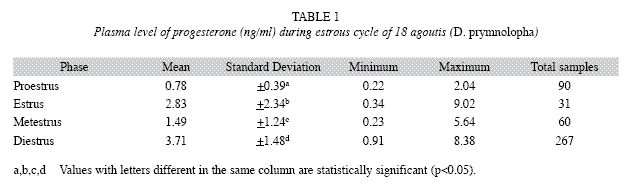
</front><body><![CDATA[ <p align="center"><b><font face="Verdana" size="4">Plasma concentration of progesterone and 17</font></b><font face="Verdana" size="4">&szlig;<b>-estradiol of black-rumped agouti (</b><i>Dasyprocta prymnolopha</i><b>) during the estrous cycle</b></font></p> <b><font face="Verdana" size="2"> </font></b>     <p style="font-weight: bold;" align="justify"><font face="Verdana"  size="2">Diva Anelie Guimar&atilde;es<a href="#autor1"><sup>1</sup></a>, Rosemar Luz Ramos<a  href="#autor1"><sup>1</sup></a>, Ot&aacute;vio Mitio Ohashi<a href="#autor1"><sup>1</sup></a>, Gary Wayne Garcia<a href="#autor2"><sup>2</sup></a> &amp; William Gomes Vale<a  href="#autor3"><sup>3</sup></a></font></p>     <p align="justify"><font face="Verdana" size="2"><a name="autor1"></a>1. Laboratory of Animal Reproduction, Institute of Biological Sciences, Federal University of Par&aacute;, Rua Augusto Corr&ecirc;a, 01, Guam&aacute;, CEP 66075-110, Bel&eacute;m, Par&aacute;, Brazil; <a href="mailto:diva@ufpa.br">diva@ufpa.br</a>, <a href="mailto:diva@ufpa.br">roseluz@ufpa.br</a>, <a href="mailto:ohashi@ufpa.br">ohashi@ufpa.br</a>    <br> <a name="autor2"></a>2. The University of the West Indies, St. Augustine Campus, Faculty of Science and Agriculture Department of Food Production, The Open Tropical Forage-Animal Production Laboratory, St. Augustine, Trinidad and Tobago, West Indies; <a href="mailto:garygwg1@gmail.com">garygwg1@gmail.com</a>    <br> <a name="autor3"></a>3. West Federal University of Par&aacute;, Institute for Animal Health and Production, Department of Bioscience and Forest, Campus Universitario do Tapaj&oacute;s, Av. Vera Paz s/n, Bairro Sal&eacute;, CEP 68040-070, Santar&eacute;m, Par&aacute;, Brazil; <a href="mailto:wmvale@hotmail.com">wmvale@hotmail.com</a>    <br> </font></p>     <p align="justify"><font face="Verdana" size="2"><a href="#corresp">Dirercci&oacute;n para correspondencia</a>    <br> </font></p> <b><font face="Verdana" size="3"> </font></b> <hr style="width: 100%; height: 2px;"><b><font face="Verdana" size="3">     <p align="justify">Abstract</p> </font></b>     <p align="justify"><font face="Verdana" size="2">Plasma concentration of progesterone and 17</font><font><font face="Verdana" size="2">&#946;</font></font><font  face="Verdana" size="2">-estradiol of black-rumped agouti (Dasyprocta prymnolopha) during the estrous cycle. The agouti is a game animal that have been raised in captivity for conservation and sustainability purposes. However, the management of wild animals in an intensive breeding system requires an assertive knowledge of its reproductive parameters, one of the most important features for production improvement. Besides, little information is available regarding changes in reproductive hormone profiles in agouti. The objective of this study was to evaluate the hormonal profile of progesterone and 17</font><font><font  face="Verdana" size="2">&#946;</font></font><font face="Verdana" size="2">-estradiol during the estrous cycle of the agouti (<i>Dasyprocta prymnolopha</i>). The hormones were analyzed by radioimmunoassay. Blood samples were collected without sedation twice a week. The concentrations of progesterone were as follows: proestrus 0.78+0.39ng/ml, estrus 2.83+2.34ng/ml, metestrus 1.49+1.24ng/ml, diestrus 3.71+1.48ng/ml. In the estrous phase, an increase in the progesterone level was observed during a period of 24h. The average 17 </font><font><font  face="Verdana" size="2">&#946;</font></font><font face="Verdana" size="2">-estradiol levels were as follows: proestrus 2 030.98+961.00pg/ml, estrus 1 910.56+650.54pg/ml, metestrus 1 724.83+767.28pg/ml, diestrus 1 939.94+725.29pg/ml. The current results suggest that the progesterone plasma concentration during the estrous cycle in the agouti has a similar increasing, stabilizing and decreasing pattern, as in domestic mammals. Agoutis have two phases of follicular development, as two periods of 17</font><font><font face="Verdana" size="2">&#946;</font></font><font  face="Verdana" size="2">-estradiol peaks were observed, the first one in the metestrus and the second during the proestrus. Spontaneous ovulation seems to occur after the progesterone peak, possibly indicating that this hormone is associated with the ovulatory process. A more detailed investigation is needed for better understanding of how progesterone influences ovulation. Studies on the involvement of progesterone in follicular rupture can be carried out, using steroid biosynthesis inhibitors and observing the effect of this hormone on ovarian activity of proteolytic enzymes in the follicular wall. Rev. Biol. Trop. 59 (1): 29-35. Epub 2011 March 01. </font></p>     ]]></body>
<body><![CDATA[<p align="justify"><font face="Verdana" size="2"><b>Key words: </b><i>Dasyprocta prymnolopha</i>, reproduction, estrous cycle, progesterone, 17</font><font><font face="Verdana" size="2">&#946;</font></font><font  face="Verdana" size="2">-estradiol, Brazilian Amazon.</font></p> <b><font face="Verdana" size="3">     <p align="justify">Resumen</p> </font></b>     <p align="justify"><font face="Verdana" size="2">El conocimiento de los procesos reproductivos de especies de importancia econ&oacute;mica local son indispensables para apoyar su producci&oacute;n en cautiverio y garantizar su manejo sostenible. El objetivo del presente trabajo fue evaluar los niveles hormonales de progesterona y 17</font><font><font face="Verdana"  size="2">&#946;</font></font><font face="Verdana" size="2">-estradiol durante el ciclo estral en agut&iacute; (<i>Dasyprocta prymnolopha</i>). La recolecci&oacute;n de sangre se realiz&oacute; dos veces por semana, sin sedaci&oacute;n. Las hormonas fueron analizadas por radioinmunoan&aacute;lisis. Los niveles de progesterona fueron los siguientes: proestro 0.78+0.39ng/ml, estro 2.83+2.34ng/ml, metaestro 1.49+1.24ng/ml y diestro 3.71+1.48ng/ml. En el estro se observ&oacute; un aumento de los niveles de progesterona durante un periodo de 24h. Los niveles de 17 </font><font><font face="Verdana" size="2">&#946;</font></font><font  face="Verdana" size="2">-estradiol fueron los siguientes: proestro 2 030.98+961.00pg/ml, estro 1 910.56+650.54pg/ml, metaesto 1 724.83+767.28pg/ml y diestro 1 939.94+725.29pg/ ml. Los resultados encontrados sugieren que los niveles plasm&aacute;ticos de progesterona durante el ciclo estral en agut&iacute; siguen un patr&oacute;n de aumento, estabilizaci&oacute;n y diminuci&oacute;n, tal como en los mam&iacute;feros dom&eacute;sticos. Agut&iacute; tienen dos etapas de desarrollo folicular, puesto que se observaron dos altos valores de 17</font><font><font face="Verdana"  size="2">&#946;</font></font><font face="Verdana" size="2">-estradiol, el primero en el metaestro y el segundo durante el proestro. La ovulaci&oacute;n espont&aacute;nea ocurre posiblemente despu&eacute;s del aumento de la progesterona, indicando que esta hormona posiblemente est&aacute; asociada con el proceso ovulatorio. Es necesario desarrollar un estudio m&aacute;s detallado para mejorar la comprensi&oacute;n del papel de la progesterona en la ovulaci&oacute;n. Algunos estudios de la participaci&oacute;n de la progesterona en la ruptura folicular se pueden realizar utilizando inhibidores de la bios&iacute;ntesis de esteroides y observar el efecto de esta hormona sobre la actividad de las enzimas proteol&iacute;ticas en la pared folicular.</font></p>     <p align="justify"><font face="Verdana" size="2"><b>Palabras claves: </b><i>Dasyprocta prymnolopha</i>, reproducci&oacute;n, ciclo estral, progesterona, 17</font><font><font face="Verdana" size="2">&#946;</font></font><font  face="Verdana" size="2">-estradiol, Amazonia brasile&ntilde;a.</font></p> <hr style="width: 100%; height: 2px;">     <p align="justify"><font face="Verdana" size="2">Successful wildlife management is directly related to reproduction programs, which require hormone monitoring to determine the estrous cycle, onset of puberty, duration of sexual receptivity, effect of season, pregnancy diagnosis, birth timing and physical fitness (Wildt &amp; Wemmer 1999). Reproductive hormones which can be measured in urine, feces, saliva and blood, are fundamental to regulate reproductive functions and may be used to improve reproductive management. </font></p>     <p align="justify"><font face="Verdana" size="2">The reproductive endocrinology of most wild mammals is largely unknown and the endocrine physiology of Amazon animals is even less known. Understanding how the animals reproduce may contribute to improve reproduction biotechnologies, including artificial insemination, <i>in vitro </i>fertilization, embryo transfer and cryopreservation (Fickel <i>et al. </i>2007). These are very important tools for <i>in situ </i>and <i>ex situ </i>wildlife conservation and animal production. </font></p>     <p align="justify"><font face="Verdana" size="2">Native of Central and South America animals, such as the rodents, paca <i>Agouti paca</i>, capybara <i>Hydrochoerus hydrochaeris </i>and agouti <i>Dasyprocta </i>sp<i>., </i>have potential for increase microlivestock production, since they represent the main protein sources for local populations (Bonaudo <i>et al</i>. 2005, National Research Council 1991). </font></p>     <p align="justify"><font face="Verdana" size="2">Considerable effort has improved the knowledge of the reproductive physiology of the agouti (Guimar&atilde;es 1993, 2000, Guimar&atilde;es <i>et al</i>. 2009, Heap <i>et al</i>. 1981, Miglino <i>et al</i>. 2002, 2004, 2008, Rodrigues <i>et al</i>. 2006, Weir 1971, 1974); however, this species still requires further study. </font></p>     <p align="justify"><font face="Verdana" size="2">The agouti is one of the most consumed game animals in the Brazilian Amazon (Bonaudo <i>et al. </i>2005). An intensive breeding system of this animal will contribute to its conservation and can provide an alternative sustainable production.</font></p>     <p align="justify"><font face="Verdana" size="2">Little information is available regarding changes in progesterone and estradiol levels during estrous cycle in agouti, compared to that in other hystricomorphs rodents (Adjanohoun 1992, Barta &amp; Jakubicka 1991, Croix &amp; Franchimont 1975, Faulkes <i>et al. </i>1990, Montes &amp; Baz 2006, Rowlands <i>et al. </i>1970, Tam 1973, Van Aarde 1985). It is expected that the physiological parameters of progesterone and estrogen during the estrous cycle in agouti are similar to other hystricomorphs.</font></p>     ]]></body>
<body><![CDATA[<p align="justify"><font face="Verdana" size="2">The aim of this work was to study the estrous cycle of the agouti (<i>Dasyprocta prymnolopha</i>) by analysis of reproductive hormones, progesterone and 17</font><font><font  face="Verdana" size="2">&#946;</font></font><font face="Verdana" size="2">-estradiol.</font></p>     <p align="justify"><b><font face="Verdana" size="3">Material and methods</font></b></p>     <p align="justify"><font face="Verdana" size="2">This research was conducted at the wildlife paddock (4m<sup>2</sup>) of the Animal Reproduction Laboratory of the Federal University of Par&aacute;, Bel&eacute;m, Brazil. Agoutis (<i>Dasyprocta prymnolopha</i>) were kept under natural lighting conditions. The paddocks annual average temperature was 28&ordm;C. Daily food supply was composed of corn bran (<i>Zea mays</i>), soy (<i>Glycine hispida</i>), pumpkin (<i>Curcibita pepo</i>), cassava (<i>Manihot utilissima</i>) and mineral salt; a nutritional complement (Potenay- Fort Dodge, Brazil) was provided periodically. All animals were born in captivity and belonged to F3 and F4 generations. The average weight of the experimental animals was 1.95+0.31kg.</font></p>     <p align="justify"><font face="Verdana" size="2">The animals were divided into two groups, young and adult females. To compare the level of progesterone of nulliparous and pluriparous females and also to clarify whether ovulation occurs spontaneously or is copulation-induced, 18 females and 7 males were selected. The experimental groups were as follows:</font></p>     <p align="justify"><font face="Verdana" size="2">Young females (9 months old): four groups of two nulliparous females and one vasectomized male.</font></p>     <p align="justify"><font face="Verdana" size="2">Adult females (3 to 5 years old): three groups of two pluriparous females and one vasectomized male, and two groups of two pluriparous females kept isolated without a male.</font></p>     <p align="justify"><font face="Verdana" size="2">Blood samples were collected without sedation twice a week (72h and 96h intervals) or in shorter periods (6h to 48h) next to the estrus by saphenous venipuncture. A 1ml syringe containing sodium heparin (Liquemine - Roche, Brazil) with a 26 &frac12; gauge needle (Baas <i>et al</i>. 1976) was used.</font></p>     <p align="justify"><font face="Verdana" size="2">After collection, the blood was put in polypropylene tubes and immediately centrifuged at 1 000rpm for 10min. The plasma was stored at </font><font  face="Agency FB,Trebuchet MS" size="2">&#8209;</font><font face="Verdana"  size="2">20&ordm;C until assaying. Progesterone concentrations in plasma were determined for all females and 17</font><font><font face="Verdana"  size="2">&#946;</font></font><font face="Verdana" size="2">-estradiol was measured in five of the adult coupled females.</font></p>     <p align="justify"><font face="Verdana" size="2">The hormone levels were measured by radioimmunoassay I<sup>125</sup> in the solid phase (Diagnostic Products Corporation, USA, for dosage of progesterone; Immunotech, France, for dosage of 17</font><font><font face="Arial" size="2">&#946;</font></font><font  face="Verdana" size="2">estradiol). The assay quality control samples containing high and low hormone concentrations were included in the beginning and at the end of each assay. Intra-assay and inter-assay coefficient of variations were 11% and 10%, respectively. The progesterone assay specificity was 100% (17-hydroxyprogesterone 0.3%, 20 </font><!-- big --><font style="font-family: times new roman;"><font  size="2"><!-- big -->&#945;<!-- /big --></font></font><!-- /big --><font face="Verdana" size="2">-dihydroprogesterone 2.0%) and sensitivity was 0.02ng/ml. The 17</font><font><font face="Verdana" size="2">&#946;</font></font><font  face="Verdana" size="2">estradiol assay specificity was 100% (estrone 1.3% and estriol 0.65%) and sensitivity was 3pg/ml.</font></p>     <p align="justify"><font face="Verdana" size="2">Colpocytology was performed to confirm the phase of the cycle and was applied according to Guimar&atilde;es (1993), were as follows: proestrus-higher frequency of superficial and intermediate cells; estrus- higher number of superficial cells; metestrus-predominance of intermediate cells and leukocytes; diestrusprevalence of parabasal cells and the increase of basal cells.</font></p>     ]]></body>
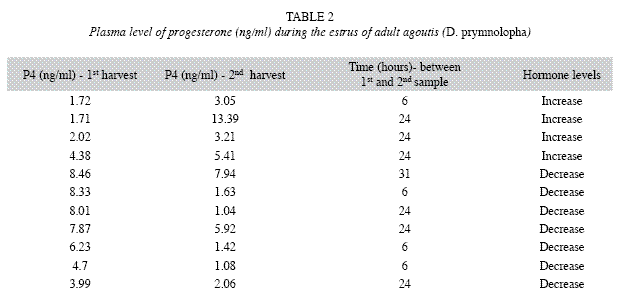
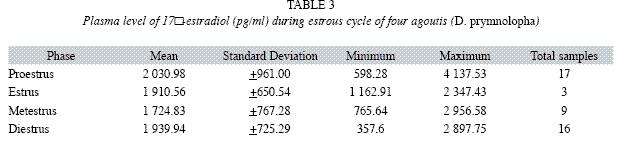
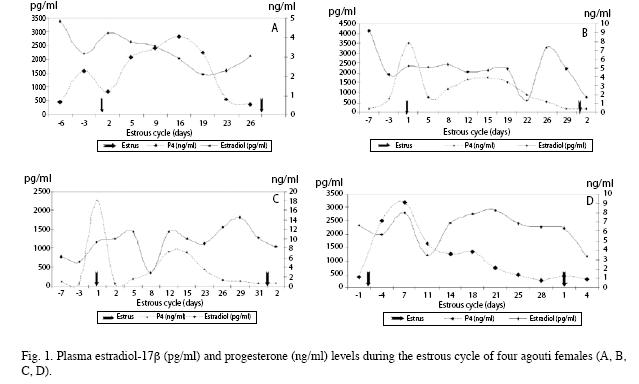
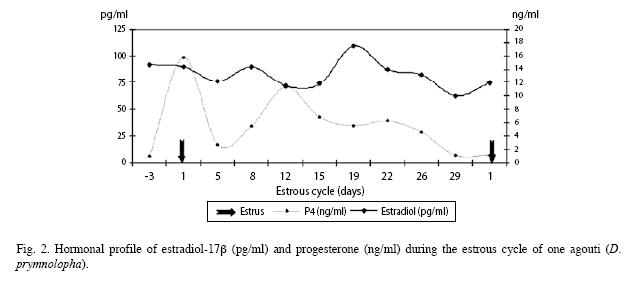
<body><![CDATA[<p align="justify"><font face="Verdana" size="2">Statistical analyses were performed using BioEstat version 5 (Ayres <i>et al</i>. 2008). The level of significance throughout the study was 0.05 (p&lt;0.05). Statistical differences on hormonal levels for each phase of the cycle were estimated by analysis of variance (ANOVA). Values are expressed as the mean &plusmn; standard deviation.</font></p> <b><font face="Verdana" size="3">     <p align="justify">Results</p> </font></b><font face="Verdana" size="2"> </font>     <p align="justify"><font face="Verdana" size="2">Twenty estrous cycles (32.05+4.17 days, 25 to 40 days) were verified in the adult females (n=10) and no statistical difference (p&gt;0.05) was observed in cycle length between mated and isolated females. The high levels of progesterone observed in isolated adult females after estrus confirmed spontaneous ovulation.</font></p>     <p align="justify"><font face="Verdana" size="2">Comparing young and adult females, there was no statistical difference (p&gt; 0.05) in the progesterone profile for each phase of the estrous cycle. However, the average progesterone concentration among the different phases of the estrous cycle phases was statistically significantly different (p&lt;0.05) (<a  href="/img/revistas/rbt/v59n1/a03t1.gif">Table 1</a>). </font></p>     <p align="justify"><font face="Verdana" size="2">In the estrus, the initial progesterone concentration was low but it quickly increased in less than 24h and seemed to remain constant for more than 31h. The progesterone concentration decreased in approximately 6h (<a  href="/img/revistas/rbt/v59n1/a03t2.gif">Table 2</a>). These data suggest that the estrus length is approximately 24h and that ovulation happens after the progesterone concentration peak.</font></p>     <p align="justify"><font face="Verdana" size="2">There was no statistical difference (p&gt;0.05) in the 17<font><font face="Verdana" size="2">&#946;</font></font>-estradiol levels between the cycle phases (<a href="/img/revistas/rbt/v59n1/a03t3.gif">Table 3</a>). However, two peaks periods of 17</font><font><font face="Verdana" size="2">&#946;</font></font><font  face="Verdana" size="2">-estradiol were observed for all samples, the first in the metestrus and the second during the proestrus (<a href="/img/revistas/rbt/v59n1/a03f1.jpg">Fig. 1</a>), suggesting that there are two phases of follicular development.</font></p>     <p align="justify"><font face="Verdana" size="2">The 17<font><font  face="Verdana" size="2">&#946;</font></font>-estradiol concentrations of one female, proestrus 77.26+20.71pg/ml (62.62- 91.91pg/ml), estrus 82.24+10.96pg/ml (74.49- 90pg/ml), metestrus 75.88pg/ml, diestrus 85.74+13.59pg/ml (71.93-109.37pg/ml), were low when compared to the samples mentioned above (<a href="/img/revistas/rbt/v59n1/a03f2.jpg">Fig. 2</a>).</font></p> <b><font face="Verdana" size="3">     <p align="justify">Discussion</p> </font></b><font face="Verdana" size="2"> </font>     <p align="justify"><font face="Verdana" size="2">The current results suggest that plasma progesterone concentration during the estrous cycle in the agouti (<i>D. prymnolopha</i>) define an increasing, stabilizing and decreasing pattern similar to those of domestic mammals. We have observed that the progesterone values reported here were similar to many hystricomorph rodents, as reported previously for the <i>Cavia porcellus </i>(Croix &amp; Franchimont 1975), <i>Hystrix africaeaustralis </i>(Van Aarde 1985) and <i>Agouti paca </i>(Montes &amp; Baz 2006). However, these values were lower than those observed in <i>Myoprocta pratti </i>(Rowlands <i>et al</i>. 1970), <i>Galea musteloides </i>(Tam 1973) and <i>Hetreocephalus glaber </i>(Faulkes <i>et al</i>. 1990). On the other hand, the data reported here were high, when compared to those observed in <i>Myocastor coypus </i>(Barta &amp; Jakubicka 1991) and <i>Thryonomys swinderianus </i>(Adjanohoun 1992). Presumptive the intra-species variation in progesterone levels is based on the function of the <i>corpus luteum </i>correlated with the metabolism of this steroid hormone.</font></p>     <p align="justify"><font face="Verdana" size="2">Spontaneous ovulation occurred after the progesterone peak, possibly indicating that it is associated with the ovulation process. This peak of progesterone was similar to that described by Feder <i>et al</i>. (1968) and Croix &amp; Franchmont (1975) for the <i>Cavia porcellus</i>. In this species, the peak occurred a few hours before ovulation, which suggests the importance of this hormone in the ovulation process in some hystricomorph rodents. The pre- ovulatory follicles are probably responsible for a high production of progesterone during estrus. This may be one of the most important aspects of this study, however future research should be performed to confirm.</font></p>     ]]></body>
<body><![CDATA[<p align="justify"><font face="Verdana" size="2">We found that the levels of 17<font><font face="Verdana" size="2">&#946;</font></font>-estradiol during the estrous cycle showed an individual variation, as was also reported for the <i>Cavia porcellus </i>(Croix &amp; Franchimont 1975) and <i>Hystrix africaeaustralis </i>(Van Aarde 1985). In effect, we believe that the agoutis appear to have two phases of follicular development, since two periods of 17<font><font face="Verdana" size="2">&#946;</font></font>-estradiol increase were found. This information will be useful when implementing reproductive biotechniques for conservation of this species.</font></p>     <p align="justify"><font face="Verdana" size="2">In addition to these characteristics that have been outlined, reduced levels of 17<font><font face="Verdana" size="2">&#946;</font></font>-estradiol were observed only in one female. Probably, the occurrence of low levels of this hormone may be correlated with slow follicular development. This has also been observed previously in species such as the <i>Cavia porcellus </i>(Croix &amp; Franchimont 1975), <i>Hystrix africaeaustralis </i>(Van Aarde 1985) and <i>Agouti paca </i>(Montes &amp; Baz 2006).</font></p>     <p align="justify"><font face="Verdana" size="2">This study is the first attempt to interpret the physiological events during the estrous cycle of the agouti. The present results indicate that plasma steroids (progesterone and 17<font><font face="Verdana" size="2">&#946;</font></font>-estradiol) monitoring provides an effective tool for obtaining information to improve reproductive programs of agouti conservation and production. Moreover, the data reported here also suggest the need for a more detailed investigation to better understand how progesterone influences the ovulatory mechanism in the agouti.</font></p> <b><font face="Verdana" size="3">     <p align="justify">Acknowledgments</p> </font></b><font face="Verdana" size="2">     <p align="justify">We thank the Federal University of Par&aacute;, their technicians for assistance in collecting materials for this research and the International Foundation for Science (Ref. B/2659-1) for supporting this project.</p> </font><b><font face="Verdana" size="3"> </font></b> <hr style="width: 100%; height: 2px;"><b><font face="Verdana" size="3">     <p align="justify">References</p> </font></b><font face="Verdana" size="2">     <!-- ref --><p align="justify">Adjanohoun, E. 1992. Le cycle sexuel et la reproduction de l&#8217;aulacode (<i>Thryonomys swinderianus </i>Temminck, 1827). Mammalia 56: 109-119.    &nbsp;&nbsp;&nbsp;&nbsp;&nbsp;&nbsp;&nbsp;&nbsp;[&#160;<a href="javascript:void(0);" onclick="javascript: window.open('/scielo.php?script=sci_nlinks&ref=1708829&pid=S0034-7744201100010000300001&lng=','','width=640,height=500,resizable=yes,scrollbars=1,menubar=yes,');">Links</a>&#160;]<!-- end-ref --></p>     <!-- ref --><p align="justify">Ayres M. Jr., D. Ayres &amp; A. Santos. 2008. Bioestat Vers&atilde;o 5.0. Sociedade Civil Mamirau&aacute;, MCT&#8211;CNPq, Brazil.    &nbsp;&nbsp;&nbsp;&nbsp;&nbsp;&nbsp;&nbsp;&nbsp;[&#160;<a href="javascript:void(0);" onclick="javascript: window.open('/scielo.php?script=sci_nlinks&ref=1708831&pid=S0034-7744201100010000300002&lng=','','width=640,height=500,resizable=yes,scrollbars=1,menubar=yes,');">Links</a>&#160;]<!-- end-ref --> </p>     ]]></body>
<body><![CDATA[<!-- ref --><p align="justify">Baas, E.J., S. Potkay &amp; J. Bacher. 1976. The agouti (<i>Dasyprocta </i>sp.) in biomedical research and captivity. Lab. Anim. Sci. 26: 788-796.    &nbsp;&nbsp;&nbsp;&nbsp;&nbsp;&nbsp;&nbsp;&nbsp;[&#160;<a href="javascript:void(0);" onclick="javascript: window.open('/scielo.php?script=sci_nlinks&ref=1708833&pid=S0034-7744201100010000300003&lng=','','width=640,height=500,resizable=yes,scrollbars=1,menubar=yes,');">Links</a>&#160;]<!-- end-ref --></p> </font>     <!-- ref --><p align="justify"><font face="Verdana" size="2">Barta, M. &amp; I. Jakubi&#269;ka. </font><font face="Verdana" size="2">1991. Progesterone concentration in peripheral blood of nutria (<i>Myocastor coypus</i>) during the ontogenesis, sexual cycle, gravidity and lactation. Pol&#8217;nohospod&aacute;rstvo 34: 371-389.    &nbsp;&nbsp;&nbsp;&nbsp;&nbsp;&nbsp;&nbsp;&nbsp;[&#160;<a href="javascript:void(0);" onclick="javascript: window.open('/scielo.php?script=sci_nlinks&ref=1708835&pid=S0034-7744201100010000300004&lng=','','width=640,height=500,resizable=yes,scrollbars=1,menubar=yes,');">Links</a>&#160;]<!-- end-ref --></font></p>     <!-- ref --><p align="justify"><font face="Verdana" size="2">Bonaudo, T., Y. Le Pendu, J.F. Faure &amp; D. Quanz. 2005. The effects of deforestation on wildlife along the transamazon highway. Eur. J. Wildlife Res. 51:199-206.    &nbsp;&nbsp;&nbsp;&nbsp;&nbsp;&nbsp;&nbsp;&nbsp;[&#160;<a href="javascript:void(0);" onclick="javascript: window.open('/scielo.php?script=sci_nlinks&ref=1708837&pid=S0034-7744201100010000300005&lng=','','width=640,height=500,resizable=yes,scrollbars=1,menubar=yes,');">Links</a>&#160;]<!-- end-ref --></font></p>     <!-- ref --><p align="justify"><font face="Verdana" size="2">Croix, D. &amp; P. Franchimont. 1975. Changes in the serum levels of gonadotrophins progesterona and estradiol during the estrous cycle of the guinea pig. Neuroendocrinology 19: 1-11.    &nbsp;&nbsp;&nbsp;&nbsp;&nbsp;&nbsp;&nbsp;&nbsp;[&#160;<a href="javascript:void(0);" onclick="javascript: window.open('/scielo.php?script=sci_nlinks&ref=1708839&pid=S0034-7744201100010000300006&lng=','','width=640,height=500,resizable=yes,scrollbars=1,menubar=yes,');">Links</a>&#160;]<!-- end-ref --></font></p>     <!-- ref --><p align="justify"><font face="Verdana" size="2">Faulkes, C.G., D.H. Abbott &amp; J.U.M. Jarvis. 1990. Social suppression of ovarian cyclicity in captive and wild colonies of naked mole-rats, <i>Heterocephalus glaber</i>. J. Reprod. Fertil. 88: 559-568.    &nbsp;&nbsp;&nbsp;&nbsp;&nbsp;&nbsp;&nbsp;&nbsp;[&#160;<a href="javascript:void(0);" onclick="javascript: window.open('/scielo.php?script=sci_nlinks&ref=1708841&pid=S0034-7744201100010000300007&lng=','','width=640,height=500,resizable=yes,scrollbars=1,menubar=yes,');">Links</a>&#160;]<!-- end-ref --></font></p>     ]]></body>
<body><![CDATA[<!-- ref --><p align="justify"><font face="Verdana" size="2">Feder, H.H., J.A. Resko &amp; R.W. Goy. 1968. Progesterone concentrations in the arterial plasma of guinea-pigs during the oestrous cycle. J. Endocrinol. 40: 505-513.    &nbsp;&nbsp;&nbsp;&nbsp;&nbsp;&nbsp;&nbsp;&nbsp;[&#160;<a href="javascript:void(0);" onclick="javascript: window.open('/scielo.php?script=sci_nlinks&ref=1708843&pid=S0034-7744201100010000300008&lng=','','width=640,height=500,resizable=yes,scrollbars=1,menubar=yes,');">Links</a>&#160;]<!-- end-ref --></font></p>     <!-- ref --><p align="justify"><font face="Verdana" size="2">Fickel, J., A. Wagcher &amp; A. Ludwig. 2007. Semen cryopreservation and the conservation of endangered species. Eur. J. Wildlife. Res. 53: 81-89.    &nbsp;&nbsp;&nbsp;&nbsp;&nbsp;&nbsp;&nbsp;&nbsp;[&#160;<a href="javascript:void(0);" onclick="javascript: window.open('/scielo.php?script=sci_nlinks&ref=1708845&pid=S0034-7744201100010000300009&lng=','','width=640,height=500,resizable=yes,scrollbars=1,menubar=yes,');">Links</a>&#160;]<!-- end-ref --></font></p>     <!-- ref --><p align="justify"><font face="Verdana" size="2">Guimar&atilde;es, D.A. 1993. Algumas caracter&iacute;sticas reprodutivas da cutia f&ecirc;mea <i>Dasyprocta prymnolopha </i>(Wagler, 1831) criada em cativeiro. MSc Thesis, Federal University of Par&aacute;, Bel&eacute;m, Brazil.    &nbsp;&nbsp;&nbsp;&nbsp;&nbsp;&nbsp;&nbsp;&nbsp;[&#160;<a href="javascript:void(0);" onclick="javascript: window.open('/scielo.php?script=sci_nlinks&ref=1708847&pid=S0034-7744201100010000300010&lng=','','width=640,height=500,resizable=yes,scrollbars=1,menubar=yes,');">Links</a>&#160;]<!-- end-ref --></font></p>     <!-- ref --><p align="justify"><font face="Verdana" size="2">Guimar&atilde;es, D.A. 2000. Aspectos reprodutivos e end&oacute;crinos da puberdade, ciclo estral, gesta&ccedil;&atilde;o e cio p&oacute;s-parto de cutias (Rodentia: Dasyproctidae), criadas em cativeiro. Ph.D. Thesis, Federal University of Par&aacute;, Bel&eacute;m, Brazil.    &nbsp;&nbsp;&nbsp;&nbsp;&nbsp;&nbsp;&nbsp;&nbsp;[&#160;<a href="javascript:void(0);" onclick="javascript: window.open('/scielo.php?script=sci_nlinks&ref=1708849&pid=S0034-7744201100010000300011&lng=','','width=640,height=500,resizable=yes,scrollbars=1,menubar=yes,');">Links</a>&#160;]<!-- end-ref --></font></p>     <!-- ref --><p align="justify"><font face="Verdana" size="2">Guimar&atilde;es, D.A., R.S.L. Ramos, G.W. Garcia &amp; O.M. Ohashi. 2009. The stimulatory effect of male agouti (<i>Dasyprocta prymnolopha</i>) on the onset of female puberty. Acta Amazon. 39: 759-762.    &nbsp;&nbsp;&nbsp;&nbsp;&nbsp;&nbsp;&nbsp;&nbsp;[&#160;<a href="javascript:void(0);" onclick="javascript: window.open('/scielo.php?script=sci_nlinks&ref=1708851&pid=S0034-7744201100010000300012&lng=','','width=640,height=500,resizable=yes,scrollbars=1,menubar=yes,');">Links</a>&#160;]<!-- end-ref --></font></p>     ]]></body>
<body><![CDATA[<!-- ref --><p align="justify"><font face="Verdana" size="2">Heap, R.B., D.N. Ackland &amp; B.J. Weir. 1981. Progesterone- binding proteins in plasma of guinea pigs and other hystricomorph rodents. J. Reprod. Fertil. 63: 477-489.    &nbsp;&nbsp;&nbsp;&nbsp;&nbsp;&nbsp;&nbsp;&nbsp;[&#160;<a href="javascript:void(0);" onclick="javascript: window.open('/scielo.php?script=sci_nlinks&ref=1708853&pid=S0034-7744201100010000300013&lng=','','width=640,height=500,resizable=yes,scrollbars=1,menubar=yes,');">Links</a>&#160;]<!-- end-ref --></font></p>     <!-- ref --><p align="justify"><font face="Verdana" size="2">Miglino, M.A., A.L. Franciolli, M.F. de Oliveira, C.E. Ambr&oacute;sio, M. Bonatelli, M.R. Machado &amp; A. Mess. 2008. Development of the inverted visceral yolk sac in three species of caviids (Rodentia, Caviomorpha, Caviidae). Placenta 29: 748-52.    &nbsp;&nbsp;&nbsp;&nbsp;&nbsp;&nbsp;&nbsp;&nbsp;[&#160;<a href="javascript:void(0);" onclick="javascript: window.open('/scielo.php?script=sci_nlinks&ref=1708855&pid=S0034-7744201100010000300014&lng=','','width=640,height=500,resizable=yes,scrollbars=1,menubar=yes,');">Links</a>&#160;]<!-- end-ref --></font></p>     <!-- ref --><p align="justify"><font face="Verdana" size="2">Miglino, M.A., A.M. Carter, C.E. Ambrosio, M. Bonatelli, M.F. de Oliveira, R.H. dos Santos Ferraz, R.F. Rodrigues &amp; T.C. Santos. 2004. Vascular organization of the hystricomorph placenta: a comparative study in the agouti, capybara, guinea pig, paca and rock cavy. Placenta 25: 438-48.    &nbsp;&nbsp;&nbsp;&nbsp;&nbsp;&nbsp;&nbsp;&nbsp;[&#160;<a href="javascript:void(0);" onclick="javascript: window.open('/scielo.php?script=sci_nlinks&ref=1708857&pid=S0034-7744201100010000300015&lng=','','width=640,height=500,resizable=yes,scrollbars=1,menubar=yes,');">Links</a>&#160;]<!-- end-ref --></font></p>     <!-- ref --><p align="justify"><font face="Verdana" size="2">Miglino, M.A., A.M. Carter, R.H. dos Santos Ferraz &amp; M.R. Fernandes Machado. 2002. Placentation in the capybara (<i>Hydrochaerus hydrochaeris</i>), Agouti (<i>Dasyprocta aguti</i>) and paca (<i>Agouti paca</i>). Placenta 23: 416-28.    &nbsp;&nbsp;&nbsp;&nbsp;&nbsp;&nbsp;&nbsp;&nbsp;[&#160;<a href="javascript:void(0);" onclick="javascript: window.open('/scielo.php?script=sci_nlinks&ref=1708859&pid=S0034-7744201100010000300016&lng=','','width=640,height=500,resizable=yes,scrollbars=1,menubar=yes,');">Links</a>&#160;]<!-- end-ref --></font></p>     <!-- ref --><p align="justify"><font face="Verdana" size="2">Montes, R.C. &amp; E.A.C. Baz. 2006. Actividad ov&aacute;rica del tepezcuintle <i>Agouti paca </i>(Rodentia: Agoutidae) en cautiverio. Rev. Biol. Trop. 54: 903-912.    &nbsp;&nbsp;&nbsp;&nbsp;&nbsp;&nbsp;&nbsp;&nbsp;[&#160;<a href="javascript:void(0);" onclick="javascript: window.open('/scielo.php?script=sci_nlinks&ref=1708861&pid=S0034-7744201100010000300017&lng=','','width=640,height=500,resizable=yes,scrollbars=1,menubar=yes,');">Links</a>&#160;]<!-- end-ref --></font></p>     ]]></body>
<body><![CDATA[<!-- ref --><p align="justify"><font face="Verdana" size="2">National Research Council. 1991. Microlivestock: little known animals with a promising economic future. National Academy, Washington D.C., USA.    &nbsp;&nbsp;&nbsp;&nbsp;&nbsp;&nbsp;&nbsp;&nbsp;[&#160;<a href="javascript:void(0);" onclick="javascript: window.open('/scielo.php?script=sci_nlinks&ref=1708863&pid=S0034-7744201100010000300018&lng=','','width=640,height=500,resizable=yes,scrollbars=1,menubar=yes,');">Links</a>&#160;]<!-- end-ref --></font></p>     <!-- ref --><p align="justify"><font face="Verdana" size="2">Rodrigues R.F., A.M. Carter, C.E. Ambrosio, T.C. dos Santos &amp; M.A. Miglino. 2006. The subplacenta of the red-rumped agouti (<i>Dasyprocta leporina </i>L). Reprod. Biol. Endocrinol. 4: 31.    &nbsp;&nbsp;&nbsp;&nbsp;&nbsp;&nbsp;&nbsp;&nbsp;[&#160;<a href="javascript:void(0);" onclick="javascript: window.open('/scielo.php?script=sci_nlinks&ref=1708865&pid=S0034-7744201100010000300019&lng=','','width=640,height=500,resizable=yes,scrollbars=1,menubar=yes,');">Links</a>&#160;]<!-- end-ref --></font></p>     <!-- ref --><p align="justify"><font face="Verdana" size="2">Rowlands, I.W., W.H. Tam &amp; D.G. Kleiman. 1970. Histological and biochemical studies on the ovary and of progesterone levels in the systemic blood of the green acouchi (<i>Myoprocta pratti</i>). J. Reprod. Fertil. 22: 533-545.    &nbsp;&nbsp;&nbsp;&nbsp;&nbsp;&nbsp;&nbsp;&nbsp;[&#160;<a href="javascript:void(0);" onclick="javascript: window.open('/scielo.php?script=sci_nlinks&ref=1708867&pid=S0034-7744201100010000300020&lng=','','width=640,height=500,resizable=yes,scrollbars=1,menubar=yes,');">Links</a>&#160;]<!-- end-ref --></font></p>     <!-- ref --><p align="justify"><font face="Verdana" size="2">Tam, W.H. 1973. Progesterone levels during the oestrous cycle and pregnancy in the cuis <i>Galea musteloides</i>. J. Reprod. Fertil. 35: 105-114.    &nbsp;&nbsp;&nbsp;&nbsp;&nbsp;&nbsp;&nbsp;&nbsp;[&#160;<a href="javascript:void(0);" onclick="javascript: window.open('/scielo.php?script=sci_nlinks&ref=1708869&pid=S0034-7744201100010000300021&lng=','','width=640,height=500,resizable=yes,scrollbars=1,menubar=yes,');">Links</a>&#160;]<!-- end-ref --></font></p>     <!-- ref --><p align="justify"><font face="Verdana" size="2">Van Aarde, R.J. 1985. Circulating progesterone and oestradiol- 17</font><font><font  face="Verdana" size="2">&#946;</font></font><font face="Verdana" size="2"> concentrations in cyclic cape porcupines, <i>Hystrix africaeaustralis</i>. J. Reprod. Fertil. 75: 583-591.    &nbsp;&nbsp;&nbsp;&nbsp;&nbsp;&nbsp;&nbsp;&nbsp;[&#160;<a href="javascript:void(0);" onclick="javascript: window.open('/scielo.php?script=sci_nlinks&ref=1708871&pid=S0034-7744201100010000300022&lng=','','width=640,height=500,resizable=yes,scrollbars=1,menubar=yes,');">Links</a>&#160;]<!-- end-ref --></font></p>     ]]></body>
<body><![CDATA[<!-- ref --><p align="justify"><font face="Verdana" size="2">Wildt, D.E. &amp; C. Wemmer. 1999. Sex and wildlife: the role of reproductive science in conservation. Biodivers. Conserv. 8: 965-976.    &nbsp;&nbsp;&nbsp;&nbsp;&nbsp;&nbsp;&nbsp;&nbsp;[&#160;<a href="javascript:void(0);" onclick="javascript: window.open('/scielo.php?script=sci_nlinks&ref=1708873&pid=S0034-7744201100010000300023&lng=','','width=640,height=500,resizable=yes,scrollbars=1,menubar=yes,');">Links</a>&#160;]<!-- end-ref --></font></p>     <!-- ref --><p align="justify"><font face="Verdana" size="2">Weir, B.J. 1971. Some observations on reproduction in the female agouti, <i>Dasyprocta agouti</i>. J. Reprod. Fertil. 24: 203-211.    &nbsp;&nbsp;&nbsp;&nbsp;&nbsp;&nbsp;&nbsp;&nbsp;[&#160;<a href="javascript:void(0);" onclick="javascript: window.open('/scielo.php?script=sci_nlinks&ref=1708875&pid=S0034-7744201100010000300024&lng=','','width=640,height=500,resizable=yes,scrollbars=1,menubar=yes,');">Links</a>&#160;]<!-- end-ref --></font></p>     <!-- ref --><p align="justify"><font face="Verdana" size="2">Weir, B.J. 1974. Reproductive characteristics of hystricomorph rodents. Symp. Zool. Soc. Lond. 34: 265-301.    &nbsp;&nbsp;&nbsp;&nbsp;&nbsp;&nbsp;&nbsp;&nbsp;[&#160;<a href="javascript:void(0);" onclick="javascript: window.open('/scielo.php?script=sci_nlinks&ref=1708877&pid=S0034-7744201100010000300025&lng=','','width=640,height=500,resizable=yes,scrollbars=1,menubar=yes,');">Links</a>&#160;]<!-- end-ref --><br> </font></p>     <p align="justify"><font face="Verdana" size="2">    <br> <a name="corresp"></a>Correspondencia a: </font><font face="Verdana"  size="2">Diva Anelie Guimar&atilde;es, Rosemar Luz Ramos &amp; Ot&aacute;vio Mitio Ohashi. </font><font  face="Verdana" size="2">Laboratory of Animal Reproduction, Institute of Biological Sciences, Federal University of Par&aacute;, Rua Augusto Corr&ecirc;a, 01, Guam&aacute;, CEP 66075-110, Bel&eacute;m, Par&aacute;, Brazil; <a href="mailto:diva@ufpa.br">diva@ufpa.br</a>, <a href="mailto:roseluz@ufpa.br">roseluz@ufpa.br</a>, <a href="mailto:ohashi@ufpa.br">ohashi@ufpa.br</a>    <br> </font><small><span style="font-family: verdana;">Gary Wayne Garcia. </span></small><font face="Verdana" size="2">The University of the West Indies, St. Augustine Campus, Faculty of Science and Agriculture Department of Food Production, The Open Tropical Forage-Animal Production Laboratory, St. Augustine, Trinidad&nbsp; and Tobago, West Indies; <a href="mailto:garygwg1@gmail.com">garygwg1@gmail.com</a>    <br> </font><span style="font-family: verdana;"></span><font face="Verdana"  size="2">William Gomes Vale. </font><font face="Verdana" size="2">West Federal University of Par&aacute;, Institute for Animal Health and Production, Department of Bioscience and Forest, Campus Universitario do Tapaj&oacute;s, Av. Vera Paz s/n, Bairro Sal&eacute;, CEP 68040-070, Santar&eacute;m, Par&aacute;, Brazil; <a href="mailto:wmvale@hotmail.com">wmvale@hotmail.com</a></font></p> <hr style="width: 100%; height: 2px;">     ]]></body>
<body><![CDATA[<p style="text-align: center;"><font face="Verdana" size="2">Received 15-II-2010. Corrected 22-VIII-2010. Accepted 20-IX-2010.</font></p>      ]]></body><back>
<ref-list>
<ref id="B1">
<nlm-citation citation-type="journal">
<person-group person-group-type="author">
<name>
<surname><![CDATA[Adjanohoun]]></surname>
<given-names><![CDATA[E]]></given-names>
</name>
</person-group>
<article-title xml:lang="en"><![CDATA[Le cycle sexuel et la reproduction de l&#8217;aulacode (Thryonomys swinderianus Temminck, 1827)]]></article-title>
<source><![CDATA[Mammalia]]></source>
<year>1992</year>
<volume>56</volume>
<page-range>109-119</page-range></nlm-citation>
</ref>
<ref id="B2">
<nlm-citation citation-type="">
<person-group person-group-type="author">
<name>
<surname><![CDATA[Ayres M]]></surname>
<given-names><![CDATA[Jr]]></given-names>
</name>
<name>
<surname><![CDATA[Ayres]]></surname>
<given-names><![CDATA[D]]></given-names>
</name>
<name>
<surname><![CDATA[Santos]]></surname>
<given-names><![CDATA[A]]></given-names>
</name>
</person-group>
<source><![CDATA[Bioestat Versão 5.0]]></source>
<year>2008</year>
</nlm-citation>
</ref>
<ref id="B3">
<nlm-citation citation-type="journal">
<person-group person-group-type="author">
<name>
<surname><![CDATA[Baas]]></surname>
<given-names><![CDATA[E.J]]></given-names>
</name>
<name>
<surname><![CDATA[Potkay]]></surname>
<given-names><![CDATA[S]]></given-names>
</name>
<name>
<surname><![CDATA[Bacher]]></surname>
<given-names><![CDATA[J]]></given-names>
</name>
</person-group>
<article-title xml:lang="en"><![CDATA[The agouti (Dasyprocta sp.) in biomedical research and captivity]]></article-title>
<source><![CDATA[Lab. Anim. Sci]]></source>
<year>1976</year>
<volume>26</volume>
<page-range>788-796</page-range></nlm-citation>
</ref>
<ref id="B4">
<nlm-citation citation-type="journal">
<person-group person-group-type="author">
<name>
<surname><![CDATA[Barta]]></surname>
<given-names><![CDATA[M]]></given-names>
</name>
<name>
<surname><![CDATA[Jakubi&#269;ka]]></surname>
<given-names><![CDATA[I]]></given-names>
</name>
</person-group>
<article-title xml:lang="en"><![CDATA[Progesterone concentration in peripheral blood of nutria (Myocastor coypus) during the ontogenesis, sexual cycle, gravidity and lactation]]></article-title>
<source><![CDATA[ol&#8217;nohospodárstvo]]></source>
<year>1991</year>
<volume>34</volume>
<page-range>371-389</page-range></nlm-citation>
</ref>
<ref id="B5">
<nlm-citation citation-type="journal">
<person-group person-group-type="author">
<name>
<surname><![CDATA[Bonaudo]]></surname>
<given-names><![CDATA[T]]></given-names>
</name>
<name>
<surname><![CDATA[Le Pendu]]></surname>
<given-names><![CDATA[Y]]></given-names>
</name>
<name>
<surname><![CDATA[Faure]]></surname>
<given-names><![CDATA[J.F]]></given-names>
</name>
<name>
<surname><![CDATA[Quanz]]></surname>
<given-names><![CDATA[D]]></given-names>
</name>
</person-group>
<article-title xml:lang="en"><![CDATA[The effects of deforestation on wildlife along the transamazon highway]]></article-title>
<source><![CDATA[Eur. J. Wildlife Res]]></source>
<year>2005</year>
<volume>51</volume>
<page-range>199-206</page-range></nlm-citation>
</ref>
<ref id="B6">
<nlm-citation citation-type="journal">
<person-group person-group-type="author">
<name>
<surname><![CDATA[Croix]]></surname>
<given-names><![CDATA[D]]></given-names>
</name>
<name>
<surname><![CDATA[Franchimont]]></surname>
<given-names><![CDATA[P]]></given-names>
</name>
</person-group>
<article-title xml:lang="en"><![CDATA[Changes in the serum levels of gonadotrophins progesterona and estradiol during the estrous cycle of the guinea pig]]></article-title>
<source><![CDATA[Neuroendocrinology]]></source>
<year>1975</year>
<volume>19</volume>
<page-range>1-11</page-range></nlm-citation>
</ref>
<ref id="B7">
<nlm-citation citation-type="journal">
<person-group person-group-type="author">
<name>
<surname><![CDATA[Faulkes]]></surname>
<given-names><![CDATA[C.G]]></given-names>
</name>
<name>
<surname><![CDATA[Abbott]]></surname>
<given-names><![CDATA[D.H]]></given-names>
</name>
<name>
<surname><![CDATA[Jarvis]]></surname>
<given-names><![CDATA[J.U.M]]></given-names>
</name>
</person-group>
<article-title xml:lang="en"><![CDATA[Social suppression of ovarian cyclicity in captive and wild colonies of naked mole-rats, Heterocephalus glaber]]></article-title>
<source><![CDATA[J. Reprod. Fertil]]></source>
<year>1990</year>
<volume>88</volume>
<page-range>559-568</page-range></nlm-citation>
</ref>
<ref id="B8">
<nlm-citation citation-type="journal">
<person-group person-group-type="author">
<name>
<surname><![CDATA[Feder]]></surname>
<given-names><![CDATA[H.H]]></given-names>
</name>
<name>
<surname><![CDATA[Resko]]></surname>
<given-names><![CDATA[J.A]]></given-names>
</name>
<name>
<surname><![CDATA[Goy]]></surname>
<given-names><![CDATA[R.W]]></given-names>
</name>
</person-group>
<article-title xml:lang="en"><![CDATA[Progesterone concentrations in the arterial plasma of guinea-pigs during the oestrous cycle]]></article-title>
<source><![CDATA[J. Endocrinol]]></source>
<year>1968</year>
<volume>40</volume>
<page-range>505-513</page-range></nlm-citation>
</ref>
<ref id="B9">
<nlm-citation citation-type="journal">
<person-group person-group-type="author">
<name>
<surname><![CDATA[Fickel]]></surname>
<given-names><![CDATA[J]]></given-names>
</name>
<name>
<surname><![CDATA[Wagcher]]></surname>
<given-names><![CDATA[A]]></given-names>
</name>
<name>
<surname><![CDATA[Ludwig]]></surname>
<given-names><![CDATA[A]]></given-names>
</name>
</person-group>
<article-title xml:lang="en"><![CDATA[Semen cryopreservation and the conservation of endangered species]]></article-title>
<source><![CDATA[Eur. J. Wildlife. Res]]></source>
<year>2007</year>
<volume>53</volume>
<page-range>81-89</page-range></nlm-citation>
</ref>
<ref id="B10">
<nlm-citation citation-type="">
<person-group person-group-type="author">
<name>
<surname><![CDATA[Guimarães]]></surname>
<given-names><![CDATA[D.A]]></given-names>
</name>
</person-group>
<source><![CDATA[Algumas características reprodutivas da cutia fêmea Dasyprocta prymnolopha (Wagler, 1831) criada em cativeiro]]></source>
<year>1993</year>
</nlm-citation>
</ref>
<ref id="B11">
<nlm-citation citation-type="">
<person-group person-group-type="author">
<name>
<surname><![CDATA[Guimarães]]></surname>
<given-names><![CDATA[D.A]]></given-names>
</name>
</person-group>
<source><![CDATA[Aspectos reprodutivos e endócrinos da puberdade, ciclo estral, gestação e cio pós-parto de cutias (Rodentia: Dasyproctidae), criadas em cativeiro]]></source>
<year>2000</year>
</nlm-citation>
</ref>
<ref id="B12">
<nlm-citation citation-type="journal">
<person-group person-group-type="author">
<name>
<surname><![CDATA[Guimarães]]></surname>
<given-names><![CDATA[D.A]]></given-names>
</name>
<name>
<surname><![CDATA[Ramos]]></surname>
<given-names><![CDATA[R.S.L]]></given-names>
</name>
<name>
<surname><![CDATA[Garcia]]></surname>
<given-names><![CDATA[G.W]]></given-names>
</name>
<name>
<surname><![CDATA[Ohashi]]></surname>
<given-names><![CDATA[O.M]]></given-names>
</name>
</person-group>
<article-title xml:lang="en"><![CDATA[The stimulatory effect of male agouti (Dasyprocta prymnolopha) on the onset of female puberty]]></article-title>
<source><![CDATA[Acta Amazon]]></source>
<year>2009</year>
<volume>39</volume>
<page-range>759-762</page-range></nlm-citation>
</ref>
<ref id="B13">
<nlm-citation citation-type="journal">
<person-group person-group-type="author">
<name>
<surname><![CDATA[Heap]]></surname>
<given-names><![CDATA[R.B]]></given-names>
</name>
<name>
<surname><![CDATA[Ackland]]></surname>
<given-names><![CDATA[D.N]]></given-names>
</name>
<name>
<surname><![CDATA[Weir]]></surname>
<given-names><![CDATA[B.J]]></given-names>
</name>
</person-group>
<article-title xml:lang="en"><![CDATA[Progesterone- binding proteins in plasma of guinea pigs and other hystricomorph rodents]]></article-title>
<source><![CDATA[J. Reprod. Fertil]]></source>
<year>1981</year>
<volume>63</volume>
<page-range>477-489</page-range></nlm-citation>
</ref>
<ref id="B14">
<nlm-citation citation-type="journal">
<person-group person-group-type="author">
<name>
<surname><![CDATA[Miglino]]></surname>
<given-names><![CDATA[M.]]></given-names>
</name>
<name>
<surname><![CDATA[Franciolli]]></surname>
<given-names><![CDATA[A.L]]></given-names>
</name>
<name>
<surname><![CDATA[de Oliveira]]></surname>
<given-names><![CDATA[M.F]]></given-names>
</name>
<name>
<surname><![CDATA[Ambrósio]]></surname>
<given-names><![CDATA[C.E]]></given-names>
</name>
<name>
<surname><![CDATA[Bonatelli]]></surname>
<given-names><![CDATA[M]]></given-names>
</name>
<name>
<surname><![CDATA[Machado]]></surname>
<given-names><![CDATA[M.R]]></given-names>
</name>
<name>
<surname><![CDATA[Mess]]></surname>
<given-names><![CDATA[A]]></given-names>
</name>
</person-group>
<article-title xml:lang="en"><![CDATA[Development of the inverted visceral yolk sac in three species of caviids (Rodentia, Caviomorpha, Caviidae)]]></article-title>
<source><![CDATA[Placenta]]></source>
<year>2008</year>
<volume>29</volume>
<page-range>748-52</page-range></nlm-citation>
</ref>
<ref id="B15">
<nlm-citation citation-type="journal">
<person-group person-group-type="author">
<name>
<surname><![CDATA[Miglino]]></surname>
<given-names><![CDATA[M.A]]></given-names>
</name>
<name>
<surname><![CDATA[Carter]]></surname>
<given-names><![CDATA[A.M]]></given-names>
</name>
<name>
<surname><![CDATA[Ambrosio]]></surname>
<given-names><![CDATA[C.E]]></given-names>
</name>
<name>
<surname><![CDATA[Bonatelli]]></surname>
<given-names><![CDATA[M]]></given-names>
</name>
<name>
<surname><![CDATA[de Oliveira]]></surname>
<given-names><![CDATA[M.F]]></given-names>
</name>
<name>
<surname><![CDATA[dos Santos Ferraz]]></surname>
<given-names><![CDATA[R.H]]></given-names>
</name>
<name>
<surname><![CDATA[Rodrigues]]></surname>
<given-names><![CDATA[R.F]]></given-names>
</name>
<name>
<surname><![CDATA[Santos]]></surname>
<given-names><![CDATA[T.C]]></given-names>
</name>
</person-group>
<article-title xml:lang="en"><![CDATA[Vascular organization of the hystricomorph placenta: a comparative study in the agouti, capybara, guinea pig, paca and rock cavy]]></article-title>
<source><![CDATA[Placenta]]></source>
<year>2004</year>
<volume>25</volume>
<page-range>438-48</page-range></nlm-citation>
</ref>
<ref id="B16">
<nlm-citation citation-type="journal">
<person-group person-group-type="author">
<name>
<surname><![CDATA[Miglino]]></surname>
<given-names><![CDATA[M.A]]></given-names>
</name>
<name>
<surname><![CDATA[Carter]]></surname>
<given-names><![CDATA[A.M]]></given-names>
</name>
<name>
<surname><![CDATA[dos Santos Ferraz]]></surname>
<given-names><![CDATA[R.H]]></given-names>
</name>
<name>
<surname><![CDATA[Fernandes Machado]]></surname>
<given-names><![CDATA[M.R]]></given-names>
</name>
</person-group>
<article-title xml:lang="en"><![CDATA[Placentation in the capybara (Hydrochaerus hydrochaeris), Agouti (Dasyprocta aguti) and paca (Agouti paca)]]></article-title>
<source><![CDATA[Placenta]]></source>
<year>2002</year>
<volume>23</volume>
<page-range>416-28</page-range></nlm-citation>
</ref>
<ref id="B17">
<nlm-citation citation-type="journal">
<person-group person-group-type="author">
<name>
<surname><![CDATA[Montes]]></surname>
<given-names><![CDATA[R.C]]></given-names>
</name>
<name>
<surname><![CDATA[Baz]]></surname>
<given-names><![CDATA[E.A.C]]></given-names>
</name>
</person-group>
<article-title xml:lang="es"><![CDATA[Actividad ovárica del tepezcuintle Agouti paca (Rodentia: Agoutidae) en cautiverio]]></article-title>
<source><![CDATA[Rev. Biol. Trop]]></source>
<year>2006</year>
<volume>54</volume>
<page-range>903-912</page-range></nlm-citation>
</ref>
<ref id="B18">
<nlm-citation citation-type="book">
<collab>National Research Council</collab>
<source><![CDATA[Microlivestock: little known animals with a promising economic future]]></source>
<year>1991</year>
<publisher-loc><![CDATA[^eWashington D.C Washington D.C]]></publisher-loc>
<publisher-name><![CDATA[National Academy]]></publisher-name>
</nlm-citation>
</ref>
<ref id="B19">
<nlm-citation citation-type="journal">
<person-group person-group-type="author">
<name>
<surname><![CDATA[Rodrigues]]></surname>
<given-names><![CDATA[R.F]]></given-names>
</name>
<name>
<surname><![CDATA[Carter]]></surname>
<given-names><![CDATA[A.M]]></given-names>
</name>
<name>
<surname><![CDATA[Ambrosio]]></surname>
<given-names><![CDATA[C.E]]></given-names>
</name>
<name>
<surname><![CDATA[dos Santos]]></surname>
<given-names><![CDATA[T.C]]></given-names>
</name>
<name>
<surname><![CDATA[Miglino]]></surname>
<given-names><![CDATA[M.A]]></given-names>
</name>
</person-group>
<article-title xml:lang="en"><![CDATA[The subplacenta of the red-rumped agouti (Dasyprocta leporina L]]></article-title>
<source><![CDATA[Reprod. Biol. Endocrinol]]></source>
<year>2006</year>
<volume>4</volume>
<page-range>31</page-range></nlm-citation>
</ref>
<ref id="B20">
<nlm-citation citation-type="journal">
<person-group person-group-type="author">
<name>
<surname><![CDATA[Rowlands]]></surname>
<given-names><![CDATA[I.W]]></given-names>
</name>
<name>
<surname><![CDATA[Tam]]></surname>
<given-names><![CDATA[W.H]]></given-names>
</name>
<name>
<surname><![CDATA[Kleiman]]></surname>
<given-names><![CDATA[D.G]]></given-names>
</name>
</person-group>
<article-title xml:lang="en"><![CDATA[Histological and biochemical studies on the ovary and of progesterone levels in the systemic blood of the green acouchi (Myoprocta pratti)]]></article-title>
<source><![CDATA[J. Reprod. Fertil]]></source>
<year>1970</year>
<volume>22</volume>
<page-range>533-545</page-range></nlm-citation>
</ref>
<ref id="B21">
<nlm-citation citation-type="journal">
<person-group person-group-type="author">
<name>
<surname><![CDATA[Tam]]></surname>
<given-names><![CDATA[W.H]]></given-names>
</name>
</person-group>
<article-title xml:lang="en"><![CDATA[Progesterone levels during the oestrous cycle and pregnancy in the cuis Galea musteloides]]></article-title>
<source><![CDATA[J. Reprod. Fertil]]></source>
<year>1973</year>
<volume>35</volume>
<page-range>105-114</page-range></nlm-citation>
</ref>
<ref id="B22">
<nlm-citation citation-type="journal">
<person-group person-group-type="author">
<name>
<surname><![CDATA[Van Aarde]]></surname>
<given-names><![CDATA[R.J]]></given-names>
</name>
</person-group>
<article-title xml:lang="en"><![CDATA[Circulating progesterone and oestradiol- 17&#946; concentrations in cyclic cape porcupines, Hystrix africaeaustralis]]></article-title>
<source><![CDATA[J. Reprod. Fertil]]></source>
<year>1985</year>
<volume>75</volume>
<page-range>583-591</page-range></nlm-citation>
</ref>
<ref id="B23">
<nlm-citation citation-type="journal">
<person-group person-group-type="author">
<name>
<surname><![CDATA[Wildt]]></surname>
<given-names><![CDATA[D.E]]></given-names>
</name>
<name>
<surname><![CDATA[Wemmer]]></surname>
<given-names><![CDATA[C]]></given-names>
</name>
</person-group>
<article-title xml:lang="en"><![CDATA[Sex and wildlife: the role of reproductive science in conservation]]></article-title>
<source><![CDATA[Biodivers. Conserv]]></source>
<year>1999</year>
<volume>8</volume>
<page-range>965-976</page-range></nlm-citation>
</ref>
<ref id="B24">
<nlm-citation citation-type="journal">
<person-group person-group-type="author">
<name>
<surname><![CDATA[Weir]]></surname>
<given-names><![CDATA[B.J]]></given-names>
</name>
</person-group>
<article-title xml:lang="en"><![CDATA[Some observations on reproduction in the female agouti, Dasyprocta agouti]]></article-title>
<source><![CDATA[J. Reprod. Fertil]]></source>
<year>1971</year>
<volume>24</volume>
<page-range>203-211</page-range></nlm-citation>
</ref>
<ref id="B25">
<nlm-citation citation-type="journal">
<person-group person-group-type="author">
<name>
<surname><![CDATA[Weir]]></surname>
<given-names><![CDATA[B.J]]></given-names>
</name>
</person-group>
<article-title xml:lang="en"><![CDATA[Reproductive characteristics of hystricomorph rodents]]></article-title>
<source><![CDATA[Symp. Zool. Soc. Lond]]></source>
<year>1974</year>
<volume>34</volume>
<page-range>265-301</page-range></nlm-citation>
</ref>
</ref-list>
</back>
</article>