<?xml version="1.0" encoding="ISO-8859-1"?><article xmlns:mml="http://www.w3.org/1998/Math/MathML" xmlns:xlink="http://www.w3.org/1999/xlink" xmlns:xsi="http://www.w3.org/2001/XMLSchema-instance">
<front>
<journal-meta>
<journal-id>0034-7744</journal-id>
<journal-title><![CDATA[Revista de Biología Tropical]]></journal-title>
<abbrev-journal-title><![CDATA[Rev. biol. trop]]></abbrev-journal-title>
<issn>0034-7744</issn>
<publisher>
<publisher-name><![CDATA[Universidad de Costa Rica]]></publisher-name>
</publisher>
</journal-meta>
<article-meta>
<article-id>S0034-77442010000700018</article-id>
<title-group>
<article-title xml:lang="en"><![CDATA[Coral reefs and residents of the U.S. Virgin Islands: A relationship of knowledge, outdoor activities and stewardship]]></article-title>
</title-group>
<contrib-group>
<contrib contrib-type="author">
<name>
<surname><![CDATA[Settar]]></surname>
<given-names><![CDATA[Christine]]></given-names>
</name>
</contrib>
<contrib contrib-type="author">
<name>
<surname><![CDATA[Turner]]></surname>
<given-names><![CDATA[Teresa]]></given-names>
</name>
</contrib>
</contrib-group>
<aff id="A01">
<institution><![CDATA[,University of the Virgin Islands Science and Math Department ]]></institution>
<addr-line><![CDATA[ ]]></addr-line>
</aff>
<pub-date pub-type="pub">
<day>00</day>
<month>10</month>
<year>2010</year>
</pub-date>
<pub-date pub-type="epub">
<day>00</day>
<month>10</month>
<year>2010</year>
</pub-date>
<volume>58</volume>
<fpage>197</fpage>
<lpage>212</lpage>
<copyright-statement/>
<copyright-year/>
<self-uri xlink:href="http://www.scielo.sa.cr/scielo.php?script=sci_arttext&amp;pid=S0034-77442010000700018&amp;lng=en&amp;nrm=iso"></self-uri><self-uri xlink:href="http://www.scielo.sa.cr/scielo.php?script=sci_abstract&amp;pid=S0034-77442010000700018&amp;lng=en&amp;nrm=iso"></self-uri><self-uri xlink:href="http://www.scielo.sa.cr/scielo.php?script=sci_pdf&amp;pid=S0034-77442010000700018&amp;lng=en&amp;nrm=iso"></self-uri><abstract abstract-type="short" xml:lang="en"><p><![CDATA[To test the hypotheses that U.S. Virgin Islanders’ knowledge about local coral reefs is correlated with behavior, and that different sociological groups of residents have different patterns of knowledge and behavior, a mixed approach to surveying residents was used: (1) personal interviews were held in public locations and (2) an online version of the survey was administered to residents of the U.S. Virgin Islands. From July-October 2008, 462 residents over 18 years old were surveyed. Results indicate that people who engaged in outdoor activities knew significantly more about coral reefs (Spearman p<0.01, r2=0.128). Those more knowledgeable about coral reefs engaged in more positive stewardship activities (e.g. beach clean-ups) (Spearman p<0.01, r2=0.127). Negative behaviors (e.g. anchoring on reef) were not significantly correlated with increased knowledge of coral reefs (Spearman p=0.911, r2=-0.000025). Fishers did not have greater ability in identifying Acropora palmate coral than non-fishers (&#967;2=4.138, p=0.126); however, swimmers, snorkelers and divers (as a class) were moreable to identify A. palmata than non-swimmers (&#967;2 =9.764, p=0.002). Most residents identified sea turtle species as endangered (hawksbill turtle, 78.9%) but only 48.2% of the responses included Acropora spp. as threatened. Resident attitudes towards conservation of local resources were overwhelmingly positive. Rev. Biol. Trop. 58 (Suppl. 3): 197-212. Epub 2010 October 01.]]></p></abstract>
<abstract abstract-type="short" xml:lang="en"><p><![CDATA[Para probar las hipótesis que el conocimiento de los pobladores de las Islas Vírgenes de EEUU con respecto a arrecifes de coral está correlacionado con su conducta, y que los grupos sociológicos de residentes tienen pautas diferentes de conocimiento y de conducta. Se utilizó un enfoque mezclado para analizar a los residentes: (1) entrevistas personales en ubicaciones públicas y (2) una versión en línea de la entrevista fue administrada a residentes de las Islas Vírgenes. De julio a octubre 2008, 462 residentes mayores de 18 años de edad fueron entrevistados. Los resultados indican que personas que practicaban actividades al aire libre sabían mucho más acerca de los arrecifes de coral (Spearman p<0.01, r2=0.128) y las más informadas sobre arrecifes de coral se involucraban en actividades más positivas para su manejo y conservación (Spearman p<0.01, r2=0.127). Las conductas negativas (por ejemplo, anclando en el arrecife) hacia el ambiente no estaban correlacionadas con un mayor conocimiento de los arrecifes de coral (Spearman p=0.911, r2 =-0.000025). Los pescadores no tenían una capacidad mayor de reconocer el coral Acropora palmata que no pescadores (&#967;2 =4.138, p=0.126); sin embargo, nadadores y buzos fueron más capaces de identificar A. palmata (&#967;2 =9.764, p=0.002). La mayoría de los residentes saben que las tortugas marinas están en peligro (Tortuga carey, 78.9%) pero solo el 48.2% saben que Acropora está anemazada. La actitutud de los residentes hacia la conservación de los recursos locales es altamente positiva.]]></p></abstract>
<kwd-group>
<kwd lng="en"><![CDATA[knowledge]]></kwd>
<kwd lng="en"><![CDATA[behavior]]></kwd>
<kwd lng="en"><![CDATA[stewardship]]></kwd>
<kwd lng="en"><![CDATA[coral reefs]]></kwd>
<kwd lng="en"><![CDATA[U.S. Virgin Islands]]></kwd>
<kwd lng="en"><![CDATA[survey]]></kwd>
<kwd lng="en"><![CDATA[Acropora]]></kwd>
<kwd lng="en"><![CDATA[conocimiento]]></kwd>
<kwd lng="en"><![CDATA[conducta]]></kwd>
<kwd lng="en"><![CDATA[responsabilidad]]></kwd>
<kwd lng="en"><![CDATA[arrecifes de coral]]></kwd>
<kwd lng="en"><![CDATA[Islas Vírgenes EEUU]]></kwd>
<kwd lng="en"><![CDATA[Acropora]]></kwd>
<kwd lng="en"><![CDATA[encuesta]]></kwd>
</kwd-group>
</article-meta>
</front><body><![CDATA[  <b><font face="Verdana" size="4">     <p align="center">Coral reefs and residents of the U.S. Virgin Islands: A relationship of knowledge, outdoor activities and stewardship</p> </font></b>     <p style="text-align: justify;"><b><font face="Verdana" size="2">Christine Settar &amp; Teresa Turner</font></b></p>     <div style="text-align: justify;"><font face="Verdana" size="2">University of the Virgin Islands, Science and Math Department, 2 John Brewers Bay, St. Thomas, US Virgin Island 00802; <a href="mailto:chrismsettar@gmail.com">chrismsettar@gmail.com</a>, <a  href="mailto:tturner@uvi.edu">tturner@uvi.edu</a></font>    <br> </div>     <p style="text-align: justify;"><font face="Verdana" size="2"><a  href="#a">Correspondencia</a>    <br> </font></p> <hr  style="width: 100%; height: 2px; margin-left: 0px; margin-right: 0px;">     <div style="text-align: justify;"><font face="Verdana" size="2"><span  style="font-weight: bold;">Abstract</span></font>    <br>     <br> <font face="Verdana" size="2">To test the hypotheses that U.S. Virgin Islanders</font><font face="Verdana" size="2">´</font><font  face="Verdana" size="2"> knowledge about local coral reefs is correlated with behavior, and that different sociological groups of residents have different patterns of knowledge and behavior, a mixed approach to surveying residents was used: (1) personal interviews were held in public locations and (2) an online version of the survey was administered to residents of the U.S. Virgin Islands. From July-October 2008, 462 residents over 18 years old were surveyed. Results indicate that people who engaged in outdoor activities knew significantly more about coral reefs (Spearman p&lt;0.01, r2=0.128). Those more knowledgeable about coral reefs engaged in more positive stewardship activities (e.g. beach clean-ups) (Spearman p&lt;0.01, r2=0.127). Negative behaviors (e.g. anchoring on reef) were not significantly correlated with increased knowledge of coral reefs (Spearman p=0.911, r2=-0.000025). Fishers did not have greater ability in identifying <i>Acropora palmate </i>coral than non-fishers (</font><font face="Verdana" size="2">&#967;</font><font  face="Verdana" size="2">2=4.138, p=0.126); however, swimmers, snorkelers and divers (as a class) were moreable to identify <i>A. palmata </i>than non-swimmers (</font><font face="Verdana" size="2">&#967;</font><font  face="Verdana" size="2">2 =9.764, p=0.002). Most residents identified sea turtle species as endangered (hawksbill turtle, 78.9%) but only 48.2% of the responses included <i>Acropora </i>spp. as threatened. Resident attitudes towards conservation of local resources were overwhelmingly positive. Rev. Biol. Trop. 58 </font><font  face="Verdana" size="2">(Suppl. 3): 197-212. Epub 2010 October 01.</font> </div>     ]]></body>
<body><![CDATA[<p style="text-align: justify;"><font face="Verdana" size="2"><b>Key words: </b>knowledge, behavior, stewardship, coral reefs, U.S. Virgin Islands, survey, <i>Acropora.</i></font></p>     <div style="text-align: justify;"><font face="Verdana" size="2"><b>     <p>Resumen</p> </b> </font><font face="Verdana" size="2">Para probar las hipótesis que el conocimiento de los pobladores de las Islas Vírgenes de EEUU con respecto a arrecifes de coral está correlacionado con su conducta, y que los grupos sociológicos de residentes tienen pautas diferentes de conocimiento y de conducta. Se utilizó un enfoque mezclado para analizar a los residentes: (1) entrevistas personales en ubicaciones públicas y (2) una versión en línea de la entrevista fue administrada a residentes de las Islas Vírgenes. De julio a octubre 2008, 462 residentes mayores de 18 años de edad fueron entrevistados. Los resultados indican que personas que practicaban actividades al aire libre sabían mucho más acerca de los arrecifes de coral (Spearman p&lt;0.01, r2=0.128) y las más informadas sobre arrecifes de coral se involucraban en actividades más positivas para su manejo y conservación (Spearman p&lt;0.01, r2=0.127). Las conductas negativas (por ejemplo, anclando en el arrecife) hacia el ambiente no </font><font face="Verdana" size="2">estaban correlacionadas con un mayor conocimiento de los arrecifes de coral (Spearman p=0.911, r2 =-0.000025). Los pescadores no tenían una capacidad mayor de reconocer el coral <i>Acropora palmata </i>que no pescadores (</font><font  face="Verdana" size="2">&#967;2 =4.138, </font><font face="Verdana"  size="2">p=0.126); sin embargo, nadadores y buzos fueron más capaces de identificar <i>A. palmata </i></font><font  face="Verdana" size="2">(&#967;2 =9.764, p=0.002). La</font><font  face="Verdana" size="2"> mayoría de los residentes saben que las tortugas marinas están en peligro (Tortuga carey, 78.9%) pero solo el 48.2% </font><font face="Verdana" size="2">saben que <i>Acropora </i>está anemazada. La actitutud de los residentes hacia la conservación de los recursos locales es altamente positiva.</font> </div>     <p style="text-align: justify;"><font face="Verdana" size="2"><b>Palabras clave: </b>conocimiento, conducta, responsabilidad, arrecifes de coral, Islas Vírgenes EEUU, <i>Acropora, </i>encuesta.</font></p> <hr  style="width: 100%; height: 2px; margin-left: 0px; margin-right: 0px;">     <div style="text-align: justify;"><font face="Verdana" size="2">A healthy coastal ecosystem provides irreplaceable goods and services to people and other species. Coastal resources provide protection from storms, are a source for medicinal substances, filter toxins and nutrients, produce oxygen, and sequester carbon dioxide. A healthy coastal ecosystem is integral to the way of life cherished by residents, as seen in the numerous economic, cultural and social benefits, ranging from food provisioning to tourism and recr eation (Panetta 2003). As part of the coast, coral reefs must deal with a multitude of stressors, including over-fishing, sedimentation, nutrient enrichment, coral bleaching, and disease; all of which are exacerbated by global climate change and ocean acidification (Drayton <i>et al. </i>2004, Kleypas 2006, Hoegh-Guldberg 2007, Hughes <i>et al</i>. 2007). Protecting coral reefs has become of utmost importance.Thus, natural resource managers, scientists, and policy makers must integrate human social dimensions into their consideration of the ecosystems (Weeks &amp; Packard 1997, Suman <i>et al</i>.1999, Young 1999, Hunter &amp; Rinner 2004, Fox <i>et al. </i>2006, Oigman-Pszczol <i>et al. </i>2007, Cinner <i>et al. </i>2009). Humans make decisions on a daily basis that directly and indirectly affect the present and future environment on a local and global scale (Alessa <i>et al</i>. 2003). We need to better understand the basis of human actions, how decisions are made, and what makes culture change.</font>     <br>     <br> <font face="Verdana" size="2">In many cases, knowledge impacts behavior. Surveys are a means to identifying&nbsp; behaviors, beliefs, attitudes, perceptions, and educational misconceptions, as well as sociological patterns, within a population. For example, a survey in the Pacific Rim National Park of British Columbia found that people with more knowledge engaged in more depreciative behaviors (such as littering, overturning </font><font  face="Verdana" size="2">rocks) within the intertidal Park than those with less knowledge; moreover, personal attribution and perception of the ecosystem were more important in determining a person´s behavior than knowledge (Alessa <i>et al</i>. 2003). In another </font><font face="Verdana" size="2">study, people of a tropical, coastal tourist town in Brazil had large misconceptions (Oigman- Pszczol <i>et al</i>. 2007). Residents and tourists did not correctly perceive or recognize corals, or understand what their function is in an ecosystem. Increased knowledge did not lead to a positive environmental attitude; people with more </font><font face="Verdana" size="2">knowledge pertaining to corals engaged in more depreciative behaviors (e.g. collecting organisms). Even those people that were employed in ocean-related jobs, such as divemasters, fisherman, and nautical store owners, had little knowledge of corals and their role in the ecosystem. If such a comprehension gap exists between resource users and resource managers in this coastal town, then what would a similar survey within the similarly-situated U.S. Virgin Islands (USVI) reveal? The objective of this study is to address the need for information on attitudes, beliefs, knowledge levels, and the demographics of marine resource users, and to investigate behavioral relationships between USVI residents and their environment.</font>     <br>     <br> <font face="Verdana" size="2">In the USVI, environmental education and outreach programs have traditionally been geared towards youth but the older age groups have not been as exposed to similar programs. Therefore, generational differences in knowledge, and therefore behavior, could exist between age groups. Shifting baselines (Pauly 1995, Knowlton &amp; Jackson 2008) might also apply to U.S. Virgin Islanders; older generations might perceive coastal ecosystems differently from younger generations, meaning that without the experience of living near a healthy reef, younger generations could perceive current reefs as being healthy, despite what they have learned about the poor status of today´s reefs. Also, because strong cultural traditions exist in </font><font  face="Verdana" size="2">the USVI, surveys could reveal a correlation of knowledge and behavior among sociological groups (e.g. fishermen). Some Islander families warn their children about engaging in outdoor activities, such as swimming, which they believe are harmful (pers. observ.). This fear of the water is passed on, and less involvement in </font><font face="Verdana" size="2">the outdoors may decrease knowledge and conservation ethic in these children, who eventually grow up and make important choices about their environment. Science-based management depends on people; although studies have been </font><font  face="Verdana" size="2">conducted elsewhere, no published record of resident knowledge and behavior with regards to coral reefs exists for the USVI. With a focus on coral reefs and residents, this study was designed to provide a link between scientists, local resource users, and resource managers. In general, we hypothesized that islanders´ knowledge </font><font face="Verdana" size="2">about coral reefs is positively correlated with their behavior, and different sociological groups of USVI residents exhibit different patterns of knowledge and behavior. </font> <b><font face="Verdana" size="3">     <p>Materials and methods</p> </font><font face="Verdana" size="2"> </font></b><b><font face="Verdana" size="2">Population and site description: </font></b><font face="Verdana" size="2">The U.S. Virgin Islands are a territory of the United States and include three large islands–St. Thomas, St. John and St. Croix. Tourism is the largest industry in both St. Thomas and St. John while in St. Croix, the largest and most populated island, the major industries are tourism and oil refining (Crossett <i>et al</i>. 2008). Accessible only by boat, St. John is approximately 6 km east of St. Thomas and mostly parkland or undeveloped. The primary language spoken in the home is English (68%), followed by Spanish or Spanish Creole (20%), French or French Creole (10%), and other languages (2%) (Crossett <i>et al</i>. 2008). St. Croix fishermen derive 62% of their income from fish traps whereas </font><font face="Verdana" size="2">the St. Thomas/St. John fleets derive 45% from fish traps, and the St. Thomas/St. John fleets are larger and more capital-intensive than the St. Croix fleet (Agar <i>et al</i>. 2008). Despite no-take zones and protected areas on all three islands, coral reefs and fish populations continue to suffer (Drayton <i>et al</i>. 2004).</font>     ]]></body>
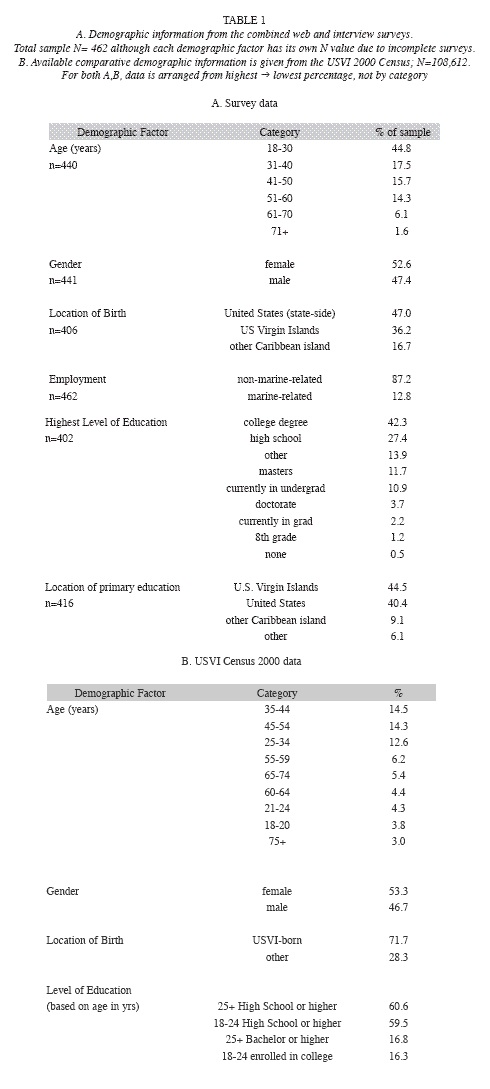
<body><![CDATA[<br>     <br> <font face="Verdana" size="2">All surveys took place on St. Thomas, St. John, and St. Croix. Sites for surveys included public areas such as Kmart, Tutu Park Mall, Frenchtown Deli, Coki Point, Nisky Center, Cruz Bay, Sunny Isle Shopping Center, Christiansted, Fredriksted, Bordeaux Farmers Market, and Cane Bay. The sample size was 462 individuals, which is large with respect to the population size of the USVI (112 812 people in 2007, U.S. Virgin Islands Bureau of Economic Research 2009). People that had resided in the islands for more than six consecutive months were considered a resident. Only residents over the age of 18 were included because they make </font><font  face="Verdana" size="2">decisions through voting, in contrast to tourists and children.</font>     <br>     <br> <font face="Verdana" size="2"><b>Survey approach: </b>To increase the number of responses and combine the advantages of different methods, a mixed approach to surveying residents was used: personal interviews were held in public locations utilizing either the (1) online version of the survey (created using www.Surveymonkey.com and accessed with laptop computers that had broadband internet service) or (2) a paper version of the survey. To maximize the number of web-based responses, the survey was advertised in the local newspapers and on a local radio station. Personal </font><font face="Verdana" size="2">interviews in public locations allowed participation by people who may have difficulty with reading (questions were read by interviewer) or who may not have internet access. Interviewers were trained undergraduates, all of which are native U.S. Virgin Islanders, working alongside the principal investigators.</font> </div>     <p style="text-align: justify;"><font face="Verdana" size="2"><b>Survey design: </b>The survey was designed to be completed it in less than 20 min. and the participants were informed of this at the beginning of the survey. A consent form stated that all information would be anonymous and that the results would be made available to the public. All protocols were followed in applying for human subject research, and the survey was deemed exempt by the University of the Virgin Islands Institutional Review Board. A pilot survey (June 2008) aided in the design of the official survey (July-October 2008). All questions were asked in a sensitive and objective manner, and each person had the option of terminating their survey session if they no longer wanted to participate for any reason (see Settar 2009 for survey). </font></p>     <p style="text-align: justify;"><font face="Verdana" size="2">This survey was designed to assess both knowledge and behavior in terms of coral reefs. "Knowledge" questions included (1) basic ecological definitions related to coral reefs, (2) identity of specific organisms typically found on and around reefs, and (3) awareness of status of federally endangered/threatened species. For example, "What is coral?" was asked to gauge whether islanders know that coral is a living animal. Residents were asked to identify a picture of <i>Acropora palmata</i>, elkhorn coral, because it was once a common reef-building coral (Bellwood <i>et al</i>. 2004) but has recently been federally listed as a threatened species (Anonymous 2005, Hogarth 2006). Residents were asked to identify the herbivorous urchin,</font></p>     <div style="text-align: justify;"><font face="Verdana" size="2"><i>Diadema antillarum</i>, because knowledge of its die-off in the 1980s (see Lessios <i>et al</i>. 1984; Hughes <i>et al. </i>1985; Carpenter 1990), and now its possible recovery (Edmunds &amp; Carpenter 2001; Knowlton 2001; Miller <i>et al</i>. 2003; Carpenter &amp; Edmunds 2006), is important for local understanding of reef management. "Behavior" inquiries included how each respondent directly or indirectly interacted with the reef, for example: snorkeling, fishing, and boating; walking, camping, or socializing on the beach. These interactions were labeled as "outdoor activities". Also, questions concerned environmental stewardship, such as participation in community beach clean-ups, or actions taken without regard to the reef, such as anchoring on coral. Demographic questions about employment, age, gender, and education levels were placed at the end of the survey.</font>     <br>     <br> <font face="Verdana" size="2"><b>Survey analysis: </b>To test for knowledge and behavior correlation, each individual received an overall score for general coral reef knowledge as well as a score for two separate behavior categories: coastal-related outdoor activities and environmental stewardship activities. Five knowledge questions comprised a total of nine points: three open-ended, organism identification questions; one multiple choice, endangered species question; and one multiple choice, definition of coral question.</font> <font face="Verdana" size="2">For the coastal-related outdoor activities score, one multiple choice question, which listed outdoor activities, yielded a possible thirteen points. For the stewardship score, one multiple choice question asked participants to list activities; positive or negative activities that were checked off on the list contributed to either the "positive stewardship" score or the "negative stewardship score". For all multiple choice questions, an "other" comment box was an option in case there were any choices that had been neglected in the listed choices, and these were included in the analysis. Taken together, these three overall scores were used for correlation </font><font face="Verdana" size="2">analyses. Interpretation of the correct answer for the open-ended identification questions was broad; for instance, if an individual answered the <i>Acropora palmata </i>picture identification question by writing "coral", instead of listing the scientific or common name, it was accepted as correct. Also, for the endangered species multiple choice question, respondents received positive points for all correct answers but did not have points subtracted if they also listed incorrect answers. The remainder of the survey was analyzed for descriptive statistics, and for differences between groups, chi-squared tests were used. Results were analyzed </font><font  face="Verdana" size="2">using the statistical software package SigmaPlot 11®.</font> <b><font face="Verdana" size="3">     <p>Results</p> </font><font face="Verdana" size="2"> </font></b><b><font face="Verdana" size="2">Description of Sample: </font></b><font  face="Verdana" size="2">462 people surveyed were clearly not a random sample of U.S. Virgin Islanders (<a href="#t1">Table 1</a>); many individuals and groups were not represented, mainly because of language barriers. A large portion (44.8%) of people fell in the "18-30 year old" age category, and the least amount (1.6%) were in the oldest, "71 and above". Slightly more females than males were surveyed and most of the sample was born in the continental U.S. (47%; <a href="#t1">Table 1</a>). A large proportion (40.4%) of people cited the continental U.S. as being where they received their primary education (pre-school through senior/12th grade); however, most (44.5%) received their primary education in the USVI (<a href="#t1">Table 1</a>). When asked to cite their highest level of education, 42.3% claimed to have a college undergraduate degree </font><font  face="Verdana" size="2">(<a href="#t1">Table 1</a>).</font>    ]]></body>
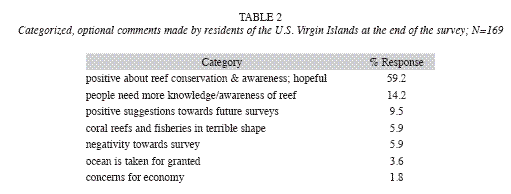
<body><![CDATA[<br> </div>     <br>     <div style="text-align: center;"><img alt=""  src="/img/revistas/rbt/v58s3/art18t1.gif"  style="width: 490px; height: 1089px;"><a name="t1"></a>    <br> </div>     <br>     <div style="text-align: justify;"><font face="Verdana" size="2">Although not enumerated, comments from those that did not want to participate in the survey revealed unease about "taking a test" and some did not want to take the survey because they felt they knew nothing about the ocean. Others felt strongly that the information gathered would be used against them at some point in the future so chose not to take the survey. Overall, optional comments from the people surveyed were overwhelmingly positive regarding conservation of their coastal environment as well as in learning more about their reefs, and how to take more conservation action (<a href="#t2">Table 2</a>). Many people expressed concern regarding the future of their coral reefs as well as concern for the attitudes and behaviors of </font><font face="Verdana" size="2">U.S. Virgin Islanders towards their coral reefs. </font>    <br> </div> <font face="Verdana" size="2">    <br> </font>     <div style="text-align: center;"><font face="Verdana" size="2"><img  alt="" src="/img/revistas/rbt/v58s3/art18t2.gif"  style="width: 511px; height: 194px;"><a name="t2"></a></font>    <br> </div> <font face="Verdana" size="2"><b> </b></font><font face="Verdana" size="2"><b>    ]]></body>
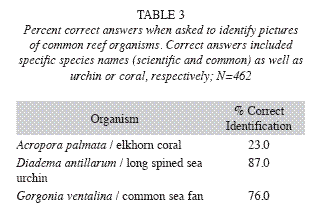
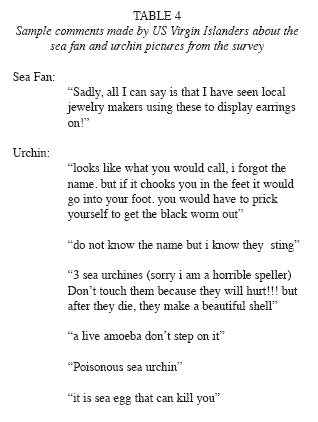
<body><![CDATA[<br> </b></font>     <div style="text-align: justify;"><font face="Verdana" size="2"><b>Knowledge: Reef Organism Picture Identification: </b>The USVI residents could generally identify some coral reef organisms. When presented with a picture of the once common coral, <i>Acropora palmata</i>, elkhorn coral, presently, federally listed as threatened, 110 people (23%) correctly identified the picture with either the common or scientific name (<a href="#t3">Table 3</a>); all except four of these people were swimmers, snorkelers or SCUBA divers. More people that swim, snorkel, and/or SCUBA dive were able to identify <i>A. palmata </i>than those that do not submerge themselves in the water (</font><font  face="Verdana" size="2">&#967;</font><font face="Verdana" size="2"> 2 =9.764, df=1, p=0.002). Of the 191 fishermen surveyed, 22 were commercial and 169 were recreational fishers (three fishers did not label themselves as either category). The act of fishing does not correlate with ability to identify the picture of <i>Acropora palmata </i>when fishers (both recreational and commercial) and non-fishers are compared (</font><font  face="Verdana" size="2">&#967;</font><font face="Verdana" size="2"> 2 =4.138, df=2, p=0.126). Employment in a marine-related job increased ability to identify this coral compared </font><font face="Verdana"  size="2">to others (</font><font face="Verdana" size="2">&#967;</font><font  face="Verdana" size="2"> 2=86.710, df=1, p&lt;0.001). Age also played an important role in identifying <i>Acropora palmata</i>; in the 18-30 year old age category, fewer people were able to identify elkhorn coral compared to older generations (</font><font  face="Verdana" size="2">&#967;</font><font face="Verdana" size="2">2=17.856, df=5, p=0.003). </font>    <br> </div> <font face="Verdana" size="2">    <br> </font>     <div style="text-align: center;"><font face="Verdana" size="2"><img  alt="" src="/img/revistas/rbt/v58s3/art18t3.gif"  style="width: 318px; height: 214px;"><a name="t3"></a></font>    <br> </div> <font face="Verdana" size="2">    <br> </font>     <div style="text-align: justify;"><font face="Verdana" size="2">Sea urchins were the most commonly recognized reef organism. A picture of the herbivorous invertebrate, <i>Diadema antillarum</i>, was identified correctly as urchin, sea egg (local term although not exactly correct), long-spined sea urchin, or <i>Diadema antillarum </i>(<a href="#t3">Table 3</a>) by 402 people (87.0%); some comments revealed misconceptions about the degree of danger of sea urchins (<a href="#t4">Table 4</a>). Of the correct respondents, only 37 (9.2%) of these were not swimmers, snorkelers or SCUBA divers. As we will see later, most of the sample listed themselves as "swimmers" (87.5%), so the sample was biased towards individuals that submerge themselves.</font> </div>     <p style="text-align: justify;"><font face="Verdana" size="2">Of the total group of non-swimmers, -snorkelers, or –divers (58 people), 64.4% were correct in identifying the urchin picture. </font></p>     <div style="text-align: justify;"><font face="Verdana" size="2">The U.S. Virgin Islanders sampled were generally knowledgeable about sea fans, which are common on USVI reefs, although not all respondents understood that a sea fan is a coral. When presented with a picture of the common sea fan, <i>Gorgonia ventalina</i>, 351 people 76.0%) correctly identified the picture as a fan coral, sea fan, coral, gorgonian, common sea fan, or the locally known "sifter coral" (used locally for sifting flour) (<a href="#t3">Table 3 </a>and see <a href="#t4">Table 4</a> for comment) and of these 351 people, 31 were not swimmers, snorkelers or SCUBA divers. Of those surveyed, 36% indicated that sea fans are coral. Of all responses only 11 people (3.3%) incorrectly labeled the sea fan as some sort of plant, five of which were non-swimmers.</font>     ]]></body>
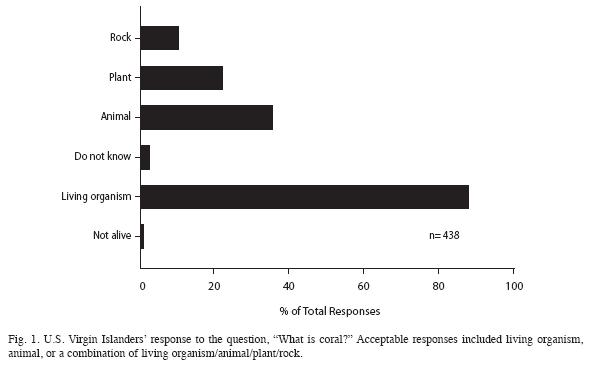
<body><![CDATA[<br> </div>     <br>     <div style="text-align: center;"><img alt=""  src="/img/revistas/rbt/v58s3/art18t4.gif"  style="width: 318px; height: 422px;"><a name="t4"></a>     <br> </div> <font face="Verdana" size="2"><b>    <br> </b></font>     <div style="text-align: justify;"><font face="Verdana" size="2"><b>Knowledge: What is coral? </b>U.S. Virgin Islanders from this sample have a good understanding of what a coral is. When asked "What is coral?" the most common response (based on number of responses and not number of people) was "living organism" (87.7%), followed by "animal" (35.4%) and then "plant" (22.1%) (<a  href="#f1">Fig. 1</a>). Several participants (n=24) also noted that a combination of the available choices on the survey, animal/plant/rock/living organism, was as appropriate as simply responding "living organism" or "animal".</font>     <br>     <br> <font face="Verdana" size="2"><b>Knowledge: Endangered Species </b>U.S. Virgin Islanders were familiar with some endangered species (<a  href="#f2">Fig. 2</a>). Overall, the leading response to, "Which of the following are endangered species according to the Endangered Species Act?", was the hawksbill turtle (79.0%), and the other four sea turtles listed took second, third, and fourth place as most recognized as endangered/threatened, while elkhorn/staghorn coral fell in at fifth place (48.0% ) for response to this question (<a href="#f2">Fig. 2</a>). Of all the people surveyed, 16.9% correctly identified the picture of <i>A. palmata </i>as well as knew that it is threatened, and all of them were swimmers, divers or snorkelers. Of this group, 69.0% were fishers. </font>    <br> </div> <font face="Verdana" size="2">    <br> </font>     ]]></body>
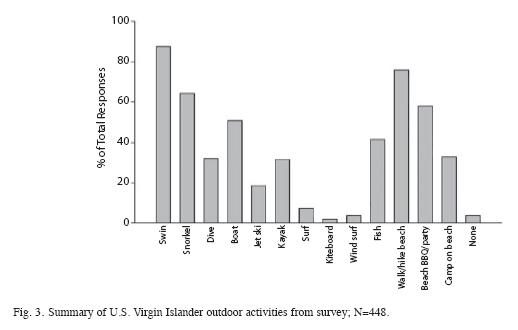
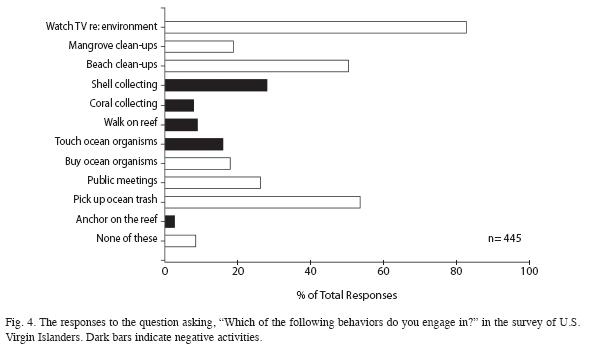
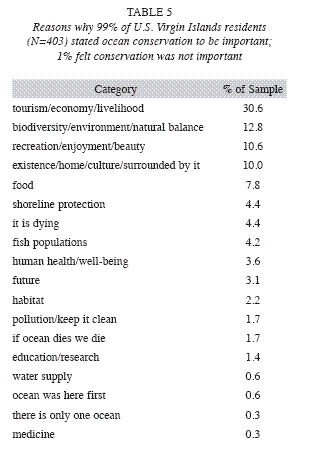
<body><![CDATA[<div style="text-align: center;"><font face="Verdana" size="2"><img  alt="" src="/img/revistas/rbt/v58s3/art18f1.jpg"  style="width: 591px; height: 369px;"><a name="f1"></a>    <br>     <br> <img alt="" src="/img/revistas/rbt/v58s3/art18f2.jpg"  style="width: 588px; height: 378px;"><a name="f2"></a>    <br> </font>    <br> </div> <font face="Verdana" size="2"><b>    <br> </b></font>     <div style="text-align: justify;"><font face="Verdana" size="2"><b>Behavior: Outdoor activities </b>Virgin Islanders engage in a variety of activities on land, on water and in water (<a href="#f3">Fig. 3</a>). The most cited activity was swimming (87.5%) and the least cited was kite-boarding (1.6%). Walking/ hiking on the beach was also a popular response (76.1%). Snorkeling was the third most common activity (64.5%) (<a href="#f3">Fig. 3</a>). Fishing comprised 41.7% of the responses and of those that fish, reef fish are the most targeted compared to other types of fish; rod and reel </font><font face="Verdana" size="2">(61.9%) and hand line (58.8%) are the most common method of fishing.</font></div>     <p style="text-align: center;"><font face="Verdana" size="2"><img alt=""  src="/img/revistas/rbt/v58s3/art18f3.jpg"  style="width: 518px; height: 330px;"><a name="f3"></a>    <br> </font></p>     <div style="text-align: justify;"><font face="Verdana" size="2"><b>Behavior: Stewardship </b>For Virgin Islanders in this sample, the most common positive stewardship activity was "watch TV programs about the environment" (82.7%) whereas the most common negative activity was "shellcollecting" (28.1%). "Picking up trash in the ocean" (53.5%) and "Beach clean-ups" (50.3%) </font><font  face="Verdana" size="2">were the second and third most common positive stewardship activities (<a href="#f4">Fig. 4</a>).</font> <font  face="Verdana" size="2">Some people recognized the importance of ecosystem goods and services as well as their role in impacting the ocean. When asked, "Do you feel you have an impact on the ocean?" 84.5% of people responded "yes", 12.2% replied "no", and 0.03% replied "minimal/not much/sometimes". Of the people that responded to the question, "Do you believe ocean conservation to be an important issue for residents of the U.S. Virgin Islands?" 99.0% responded "yes". When individuals were prompted for an explanation for their specific response of "yes", the most common reply was tourism/economy (37.0%), followed by "environment/biodiversity/</font><font  face="Verdana" size="2">natural balance" (13.0%), then "recreation/ enjoyment/beauty" (11.0%), and then "culture/ we are surrounded by it/it is our home" (10.0%) (<a href="#t5">Table 5</a>).</font>    ]]></body>
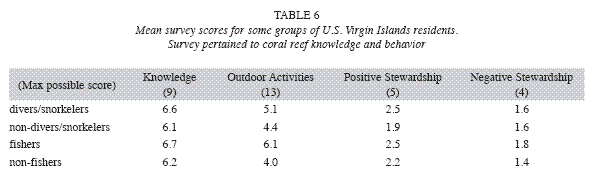
<body><![CDATA[<br> </div> <font face="Verdana" size="2">    <br> </font>     <div style="text-align: center;"><font face="Verdana" size="2"><img  alt="" src="/img/revistas/rbt/v58s3/art18f4.jpg"  style="width: 590px; height: 357px;"><a name="f4"></a>    <br>     <br> <img alt="" src="/img/revistas/rbt/v58s3/art18t5.gif"  style="width: 318px; height: 461px;"><a name="t5"></a>    <br> </font></div>     <p style="text-align: justify;"><font face="Verdana" size="2"><b>Knowledge and Behavior: Correlation analysis </b>Overall, in this sample people who engaged in more outdoor activities were more likely to have general knowledge of coral reefs, demonstrated by a weak but significant correlation (Spearman p&lt;0.01, df=100, r2=0.128). People who had general knowledge of coral reefs were more likely to engage in positive stewardship activities, for example, attending beach clean-ups or public events related to the local environment (Spearman p&lt;0.01, df=100, r2=0.127). Negative behaviors towards the environment, such as walking or anchoring on the reef, were not significantly correlated with increased knowledge of coral reefs (Spearman p=0.911, df=100, r2=-0.000025). A re-analysis with stricter scoring of correct answers did not change the overall results (Settar 2009).</font></p>     <div style="text-align: justify;"><font face="Verdana" size="2">The mean general knowledge score for the USVI sample was 6.4 points out of nine possible points. The mean outdoor activity behavior score was 4.9 points out of 13 possible activity points; sample mean for negative stewardship score was 1.6 points out of five and the mean positive stewardship score was 2.3 points out of five possible points. Various groups differed in their knowledge and behavior scores. Although fishers´ knowledge of coral reefs was not significantly greater than&nbsp; </font><font face="Verdana" size="2">non-fishers (mean=6.7 points for fishers, 6.2 for non-fishers; Mann-Whitney U=23006.5, p=0.052; <a  href="#t6">Table 6</a>), the mean number of outdoor activities participated in by fishers (6.1 points) was significantly greater than the mean of non-fishers (4.0 points) (Mann-Whitney U=14 410, p&#8804;0.001), as was the mean participation </font><font face="Verdana" size="2">in positive stewardship activities (mean=2.5 for fishers, 2.2 for non-fishers; Mann-Whitney U=22 685, p=0.029).</font> </div>     <p style="text-align: justify;"><font face="Verdana" size="2">People who SCUBA dive and snorkel are more knowledgeable about coral reefs, are more active outdoors, and participate in more positive stewardship activities compared to those that do not engage in these activities (<a href="#t6">Table 6</a>). The mean coral reef knowledge score for SCUBA divers and snorkelers (taken as a group) was 6.6 points, which was significantly greater than the mean knowledge score of 6.1 points for the non- SCUBA/snorkelers (Mann-Whitney U=13588, p&#8804;0.001). The SCUBA/ snorkeler group scored a mean of 5.1 points in outdoor activities, significantly greater than the mean 4.4 points scored by non-SCUBA/ snorkelers (Mann-Whitney U=5 071, p&#8804;0.001). People in the SCUBA/snorkeler group engage in significantly more positive stewardship activities (mean=2.5 points) compared to those that do not SCUBA dive or snorkel (1.9 points) (Mann-Whitney U=12 100.5, p&#8804;0.001); however, there is no difference between these two groups in terms of negative stewardship activities (both scored a mean of 1.6 points, Mann-Whitney U=2 595, p=0.381).    <br> </font></p>     ]]></body>
<body><![CDATA[<p style="text-align: center;"><font face="Verdana" size="2"><img alt=""  src="/img/revistas/rbt/v58s3/art18t6.gif"  style="width: 592px; height: 182px;"><a name="t6"></a>    <br> </font></p> <b><font face="Verdana" size="3">     <p>Discussion </p> </font></b>     <div style="text-align: justify;"><font face="Verdana" size="2">Survey design is extremely important in gaining robust results and making conclusions. As with any survey, objective results depend greatly on the honesty of the participant, as well as on the participants´ interpretation of the questions being asked (Yates 1971, Schuman &amp; Presser 1981); therefore, these results should be interpreted cautiously. This sample of Virgin Islands residents was not random and unfortunately some individuals and groups were not represented, for example, non-English speaking individuals (Spanish and Spanish-Creole, French and French-Creole, Census 2000), children under the age of 18, and residents that annually leave the islands in the summer months. That being acknowledged, the results from our survey indicate relationships that cannot be disregarded. </font>    <br>     <br> <font face="Verdana" size="2">The hypothesis that a person</font><font  face="Verdana" size="2">´</font><font face="Verdana" size="2">s knowledge is positively correlated with behavior is supported, albeit weakly. The more a U.S. Virgin Islander is physically involved with the coastal environment, the more general knowledge of coral reef organisms he or she has. In turn, the more informed a U.S. Virgin Islander is about local coral reefs, the more likely he or she will be involved in positive environmental stewardship activities. Negative behavior towards the reef, (like anchoring on the reef, collecting </font><font><font face="Verdana" size="2">corals and shells, etc.), was not significantly related to either high or low levels of coral reef knowledge. These findings contrast with the study in Brazil (Oigman-Pszczol <i>et al</i>. 2007) where increased knowledge did not necessarily lead to a positive environmental attitude and people with more knowledge engaged in more depreciative behaviors, such as coral collecting. Possibly this is due to cultural differences as well as the fact that their study included tourists. Also our USVI findings contrast with Alessa <i>et al</i>.´s (2003) study which concluded people with more knowledge of ecology engaged in more depreciative behaviors (for example, overturning rocks and littering) in a rocky intertidal area. Their finding might be attributed to cultural differences as well, and the types of people they approached in the Park could have been a specialized group and not necessarily a random sample of the public. Also, because rocky intertidal habitats are different from coral reefs, different behaviors could be inspired. In a survey of Americans in 2003, Steel <i>et al</i>. (2005) found that if people experience coastal environments and develop</font></font><font><font  face="Verdana" size="2">environmental values then they are brought closer to the problems faced in coastal and ocean areas. Thus, the results of Steel <i>et al</i>. (2005) are similar to our results.     <br>     <br> An interesting finding is that SCUBA divers and snorkelers are more knowledgeable about coral reefs, more active in the outdoors, and engage in more stewardship activities compared to people that do not dive or snorkel. The more a person is in the water and physically experiencing the coral reef environment, then the more curiosity is spurred, and this possibly even induces concern, and therefore positive actions towards the reef. Future outreach and education programs should probably be designed around snorkeling and SCUBA diving activities whenever possible.    <br>     <br> While U.S. Virgin Islanders are generally informed about their local reefs, and most feel that tourism is the major driving force behind ocean conservation (<a href="#t3">Table 3</a>), some misconceptions are apparent. Compared to their strong ability in identifying the status of sea turtles, U.S. Virgin Islanders were not very successful at identifying acroporid corals as a threatened species on the U.S. Federal Endangered Species List (<a href="#f3">Fig. 3</a>), and compared to pictures of urchins and sea fans, U.S. Virgin Islanders were the least familiar with the picture of <i>Acropora palmata </i>(<a href="#t3">Table 3</a>). Apparently Islanders are well-informed about sea turtles, which could be attributed to the regularly scheduled community outreach program conducted by local sea turtle researchers, or because sea turtles are charismatic megafauna. Also, acroporids were only recently listed as threatened while sea turtles have been listed for more than 30 years. The high recognition (87.0%) of sea urchins could be attributed to the fact that Islanders are wary of the danger of urchins. Some of the comments made by participants indicated that some U.S. Virgin Islanders believe urchins to be deathly poisonous, and at the very least extremely painful when stepped on (<a href="#t4">Table 4</a>). While <i>Diadema </i>do contain toxins in their spines, they are not life-threatening to humans.Some Virgin Islanders may fear getting in </font><font><font  face="Verdana" size="2">the water because of misconceptions about urchins, and therefore pass this information along to others. Other participants mentioned that many U.S.Virgin Islanders do not know how to swim (although the study population shows that 87.5% are swimmers, <a href="#f4">Fig. 4</a>), so the misconceptions of various dangers in the </font></font><font><font  face="Verdana" size="2">water could be keeping some Islanders from getting wet, and therefore, they may not be as knowledgeable about endangered species such as acroporid corals, given that outdoor activities increase knowledge of the reef. Other comments indicated that people do not know what "endangered" means; some participants said in conversation that they thought sharks and jellyfish were "endangered" because they are "dangerous".</font></font>    ]]></body>
<body><![CDATA[<br>     <br> <font face="Verdana" size="2">The ability to identify elkhorn coral, along with being educated of its threatened status, is important for several reasons. If a person is active in USVI waters, he or she may come across <i>Acropora </i>spp. at some point, if not regularly. Given that knowledge, behavior and stewardship are related (as shown in the correlation </font><font><font  face="Verdana" size="2">analyses), it could be expected that the individual would respect this coral and </font></font><font><font face="Verdana" size="2">steer clear of it while enjoying time in the ocean. Fishers could come into contact with <i>Acropora palmata. </i>Fishing, both commercial and recreational, is a vital component of the USVI community and economy (Agar <i>et al. </i>2008), and we found that reef species are the most targeted group of fish; thus, fishers will most likely encounter special challenges as they continue to fish amongst the coral reefs </font></font><font><font face="Verdana" size="2">of the Virgin Islands. Knowledge of reef species, as well as stewardship, is key. U.S. Virgin Islanders who engage in swimming, snorkeling and SCUBA diving are more able to identify <i>Acropora palmata, </i>than those that do not engage in such activities. Also, fishing does not increase the ability of identifying this coral, but people with marine-related jobs in general are more able to identify this endangered species&nbsp; </font></font><font><font face="Verdana"  size="2">compared to those in non-marine jobs. Careers in marine industries are an obvious choice for U.S. Virgin Islanders, although only 12.8% of the people surveyed reported having marinerelated jobs (<a href="#t1">Table 1</a>). This result is opposite to what Oigman-Pszczol <i>et al</i>. (2007) found: that people in marine industries were not familiar with common corals and the reef ecosystem. This could be due to cultural or educational differences between regions.</font></font>    <br>     <br> <font face="Verdana" size="2">The differing lengths of time that outreach and education programs regarding threatened and endangered sea turtles and corals has been available to the public might lead to differing levels of awareness across age groups in this study population. Older generations may have had experience with <i>Acropora </i>when it was more abundant in USVI waters (Gladfelter 1982), whereas younger generations probably do not encounter this coral as often. Another hypothesis is that younger generations are not as involved with decisions regarding the reef compared to older generations, so they are not as informed. Also, younger generations may spend more time with different technologies, such as portable internet devices, cell phones, and television, instead of going outside and experiencing their environments as older generations used to (Louv 2006, Karevia 2008, </font><font><font  face="Verdana" size="2">Pergams &amp; Zaradic 2008). This result is important because young people are the future decision-makers for the USVI; therefore, younger generations might need to be targeted for outreach and education on conservation issues.</font></font>    <br>     <br> <font face="Verdana" size="2">The highly positive attitudes of U.S. Virgin Islanders may be related to the high level of socioeconomic development and education. Cinner <i>et al. </i>(2009) recently described more healthy reefs in most highly developed areas of the Indian Ocean. They investigated relationships between human population density, a multi-dimensional index of socioeconomic development, reef complexity, and condition of coral reef populations, and found that in areas of intermediate levels of economic development, fish biomass was four times lower than at sites with low and high development. Taken together with the information gained in this study, further multi-disciplinary investigation which links social and ecological systems could be useful in the USVI, not only in designing effective education and outreach programs that parallel the changing resident populations, but also in maintaining marine protected and un-protected areas.     <p>In this study of USVI residents, the correlations between coral reef knowledge and behaviors with respect to coral reefs were weak. Involvement in outdoor activities, such as diving and snorkeling, only explains part of the coral reef knowledge levels of residents, as well as stewardship activities (both positive and negative). Most likely, a number of these factors act together throughout a person´s experience, leading to behavioral decisions. A further method of investigating what typically motivates a person to seek environmental knowledge or behave in a certain way towards the environment could be to ascertain "personal attribution", as Alessa <i>et al</i>. (2003) did in their study. Determining the extent to which a person feels responsible towards their local environment, in combination with determining knowledge levels, might explain why general knowledge of the reef is common but more explicit knowledge is not, or why negative behaviors towards the reef (like anchoring on coral or collecting coral) are still occurring. </p> Future surveys of U.S. Virgin Islanders should consider refining this survey. A larger sample size, which includes the multiple languages spoken in the USVI, would represent more of the population and could yield stronger results. A survey of the millions of tourists that come to the USVI, in conjunction with residents, would enable an interesting comparison, as would a survey of children´s knowledge and behavior. To understand how different education efforts influence behavior, it will be important to experimentally test how residents learn about the reefs and </font><font><font face="Verdana" size="2">apply information towards their behaviors. Previous experimental studies in other areas have demonstrated the effectiveness of specific interventions. For example, a study in the Chicago Zoo demonstrated increases in patrons</font></font></font><font face="Verdana" size="2">´</font><font><font><font  face="Verdana" size="2"> knowledge of apes after they received a short lesson (Ross <i>et al</i>. 2008). Littlefair &amp; Buckley (2008) demonstrated that trained guides within a World Heritage site altered patron behaviors, that guided interpretation reduced the impacts of litter and trampling,&nbsp; </font></font><font><font face="Verdana"  size="2">and that different interpretation techniques were more effective for different impacts. Would learning about coral reefs immediately affect a U.S. Virgin Islander´s behavior, and what approaches work best in favor of conservation&nbsp; </font></font><font><font face="Verdana"  size="2">education and behavioral change towards becoming better stewards of coral </font></font><font><font face="Verdana" size="2">reefs?</font></font>    <br> <font face="Verdana" size="2"> </font><b><font face="Verdana" size="3">     <p>Acknowledgments</p> </font></b><font face="Verdana" size="2">     <p>We thank the Lana Vento Charitable Trust and a U.S.G.S. State Partnership Program grant for funding this research. NSF-HBCUUP grant HRD-0506096 funded undergraduate assistants. This project would not have been possible without USVI community participation. We greatly appreciate R. Boulon, T. Corke, S. DeAnda, C. Ellis, K. Engerman, F. Fergusson, A. Frappier, S. Goode, S. Hale, B. Kojis, L. Noori and A. Rogers for help in administering surveys and advice.</p> </font> </font></div> <hr  style="width: 100%; height: 2px; margin-left: 0px; margin-right: 0px;">     ]]></body>
<body><![CDATA[<div style="text-align: justify;"><font><b><font face="Verdana" size="3">     <p>References</p> </font></b><font face="Verdana" size="2">     <!-- ref --><p>Agar, J.J., J.R. Waters, M. Valdes-Pizzini, M. Shivlani, T. Murray, J.E. Kirkley &amp; D. Suman. 2008. U.S. Caribbean fish trap fishery socioeconomic study. Bull. Mar. Sci. 82: 315-331.    &nbsp;&nbsp;&nbsp;&nbsp;&nbsp;&nbsp;&nbsp;&nbsp;[&#160;<a href="javascript:void(0);" onclick="javascript: window.open('/scielo.php?script=sci_nlinks&ref=1710647&pid=S0034-7744201000070001800001&lng=','','width=640,height=500,resizable=yes,scrollbars=1,menubar=yes,');">Links</a>&#160;]<!-- end-ref --></p>     <!-- ref --><p>Anonymous. 2005. Endangered and threatened species: proposed threatened status for elkhorn coral and staghorn coral. Federal Register 70: 24359-24365.    &nbsp;&nbsp;&nbsp;&nbsp;&nbsp;&nbsp;&nbsp;&nbsp;[&#160;<a href="javascript:void(0);" onclick="javascript: window.open('/scielo.php?script=sci_nlinks&ref=1710649&pid=S0034-7744201000070001800002&lng=','','width=640,height=500,resizable=yes,scrollbars=1,menubar=yes,');">Links</a>&#160;]<!-- end-ref --></p>     <!-- ref --><p>Alessa, L., S.M. Bennett &amp; A.D. Kliskey. 2003. Effects of knowledge, personal attribution and perception of ecosystem health on depreciative behaviors in the intertidal zone of Pacific Rim National Park and Reserve. J. Environ. Manag. 68: 207-218.    &nbsp;&nbsp;&nbsp;&nbsp;&nbsp;&nbsp;&nbsp;&nbsp;[&#160;<a href="javascript:void(0);" onclick="javascript: window.open('/scielo.php?script=sci_nlinks&ref=1710651&pid=S0034-7744201000070001800003&lng=','','width=640,height=500,resizable=yes,scrollbars=1,menubar=yes,');">Links</a>&#160;]<!-- end-ref --></p>     <!-- ref --><p>Carpenter, R. 1990. Mass mortality of <i>Diadema antillarum</i>. I. Long term effects on sea urchin population dynamics and coral reef algal communities. Mar. Biol. 104: 67-77.    &nbsp;&nbsp;&nbsp;&nbsp;&nbsp;&nbsp;&nbsp;&nbsp;[&#160;<a href="javascript:void(0);" onclick="javascript: window.open('/scielo.php?script=sci_nlinks&ref=1710653&pid=S0034-7744201000070001800004&lng=','','width=640,height=500,resizable=yes,scrollbars=1,menubar=yes,');">Links</a>&#160;]<!-- end-ref --></p>     ]]></body>
<body><![CDATA[<!-- ref --><p>Carpenter, R. &amp; P. Edmunds. 2006. Local and regional recovery of <i>Diadema </i>promotes recruitment of juvenile corals. Ecol. Lett. 9: 271-280.    &nbsp;&nbsp;&nbsp;&nbsp;&nbsp;&nbsp;&nbsp;&nbsp;[&#160;<a href="javascript:void(0);" onclick="javascript: window.open('/scielo.php?script=sci_nlinks&ref=1710655&pid=S0034-7744201000070001800005&lng=','','width=640,height=500,resizable=yes,scrollbars=1,menubar=yes,');">Links</a>&#160;]<!-- end-ref --></p>     <!-- ref --><p>Cinner, J.E., T.R. McClanahan, T.M Daw, N.A.J. Graham, S.K. Wilson &amp; T.P. Hughes. 2009. Linking social and ecological systems to sustain coral reef fisheries. Curr. Biol. 19: 206-212.    &nbsp;&nbsp;&nbsp;&nbsp;&nbsp;&nbsp;&nbsp;&nbsp;[&#160;<a href="javascript:void(0);" onclick="javascript: window.open('/scielo.php?script=sci_nlinks&ref=1710657&pid=S0034-7744201000070001800006&lng=','','width=640,height=500,resizable=yes,scrollbars=1,menubar=yes,');">Links</a>&#160;]<!-- end-ref --></p>     <!-- ref --><p>Crossett, K.M., C.G. Clement &amp; S.O. Rohmann. 2008. Demographic baseline report of U.S. territories and counties adjacent to coral reef habitats. NOAA, National Ocean Service, Special Projects. Silver Spring, Maryland, USA.    &nbsp;&nbsp;&nbsp;&nbsp;&nbsp;&nbsp;&nbsp;&nbsp;[&#160;<a href="javascript:void(0);" onclick="javascript: window.open('/scielo.php?script=sci_nlinks&ref=1710659&pid=S0034-7744201000070001800007&lng=','','width=640,height=500,resizable=yes,scrollbars=1,menubar=yes,');">Links</a>&#160;]<!-- end-ref --></p>     <!-- ref --><p>Drayton, N., C.S. Rogers &amp; B. Devine. 2004. The State of the Coral Reefs of the U.S. Virgin Islands. The Ocean Conservancy (also available on line: http://www.oceanconservancy.org/site/DocServer/Reefs_USVI_part2.pdf?docID=881).    &nbsp;&nbsp;&nbsp;&nbsp;&nbsp;&nbsp;&nbsp;&nbsp;[&#160;<a href="javascript:void(0);" onclick="javascript: window.open('/scielo.php?script=sci_nlinks&ref=1710661&pid=S0034-7744201000070001800008&lng=','','width=640,height=500,resizable=yes,scrollbars=1,menubar=yes,');">Links</a>&#160;]<!-- end-ref --></p>     <!-- ref --><p>Edmunds, P. &amp; R. Carpenter. 2001. Recovery of <i>Diadema antillarum </i>reduces macroalgal cover and increases abundance of juvenile corals on a Caribbean reef. Proc. Natl. Acad. Sci. USA 98: 5067-5071.    &nbsp;&nbsp;&nbsp;&nbsp;&nbsp;&nbsp;&nbsp;&nbsp;[&#160;<a href="javascript:void(0);" onclick="javascript: window.open('/scielo.php?script=sci_nlinks&ref=1710663&pid=S0034-7744201000070001800009&lng=','','width=640,height=500,resizable=yes,scrollbars=1,menubar=yes,');">Links</a>&#160;]<!-- end-ref --></p>     ]]></body>
<body><![CDATA[<!-- ref --><p>Fox, H.E., C. Christian, J.C. Nordby, O.R.W. Pergams, G.D. Peterson &amp; C.R. Pyke. 2006. Perceived barriers to integrating social science and conservation. Conserv. Biol. 20: 1817 1820.    &nbsp;&nbsp;&nbsp;&nbsp;&nbsp;&nbsp;&nbsp;&nbsp;[&#160;<a href="javascript:void(0);" onclick="javascript: window.open('/scielo.php?script=sci_nlinks&ref=1710665&pid=S0034-7744201000070001800010&lng=','','width=640,height=500,resizable=yes,scrollbars=1,menubar=yes,');">Links</a>&#160;]<!-- end-ref --></p>     <!-- ref --><p>Gladfelter, W.B. 1982. White band disease in <i>Acropora palmata</i>: implications for the structure and growth of shallow reefs. Bull. Mar. Sci. 32: 639-643.    &nbsp;&nbsp;&nbsp;&nbsp;&nbsp;&nbsp;&nbsp;&nbsp;[&#160;<a href="javascript:void(0);" onclick="javascript: window.open('/scielo.php?script=sci_nlinks&ref=1710667&pid=S0034-7744201000070001800011&lng=','','width=640,height=500,resizable=yes,scrollbars=1,menubar=yes,');">Links</a>&#160;]<!-- end-ref --></p>     <!-- ref --><p>Hoegh-Guldberg, O., P.J. Mumby, A.J. Hooten, R.S. Steneck, P. Greenfield, E. Gomez, C.D. Harvell, P.F. Sale, A.J. Edwards, K. Caldeira, N. Knowlton, C.M.&nbsp;&nbsp;&nbsp;&nbsp;&nbsp;&nbsp;&nbsp;&nbsp;[&#160;<a href="javascript:void(0);" onclick="javascript: window.open('/scielo.php?script=sci_nlinks&ref=1710669&pid=S0034-7744201000070001800012&lng=','','width=640,height=500,resizable=yes,scrollbars=1,menubar=yes,');">Links</a>&#160;]<!-- end-ref --><!-- ref --><p>Hogarth, W.T. 2006. Endangered and threatened species: final listing determinations for the elkhorn coral and staghorn coral. Federal Register: 26852-26861.    &nbsp;&nbsp;&nbsp;&nbsp;&nbsp;&nbsp;&nbsp;&nbsp;[&#160;<a href="javascript:void(0);" onclick="javascript: window.open('/scielo.php?script=sci_nlinks&ref=1710670&pid=S0034-7744201000070001800013&lng=','','width=640,height=500,resizable=yes,scrollbars=1,menubar=yes,');">Links</a>&#160;]<!-- end-ref --></p>     <!-- ref --><p>Hughes, T.P., B. Keller, J. Jackson &amp; M. Boyle. 1985. Mass mortality of the echinoid <i>Diadema antillarum </i>Phillipi in Jamaica. Bull. Mar. Sci. 36: 377-384.    &nbsp;&nbsp;&nbsp;&nbsp;&nbsp;&nbsp;&nbsp;&nbsp;[&#160;<a href="javascript:void(0);" onclick="javascript: window.open('/scielo.php?script=sci_nlinks&ref=1710672&pid=S0034-7744201000070001800014&lng=','','width=640,height=500,resizable=yes,scrollbars=1,menubar=yes,');">Links</a>&#160;]<!-- end-ref --></p>     <!-- ref --><p>Hughes, T.P., M.J. Rodrigues., D.R. Bellwood, D. Ceccarelli, O. Hoegh-Guldberg, L. McCook, N. Moltschaniwskyj, M.S. Pratchett, R.S. Steneck &amp; B. Willis. 2007. Phase shifts, herbivory, and the resilience of coral reefs to climate change. Curr. Biol. 17: 360-365.    &nbsp;&nbsp;&nbsp;&nbsp;&nbsp;&nbsp;&nbsp;&nbsp;[&#160;<a href="javascript:void(0);" onclick="javascript: window.open('/scielo.php?script=sci_nlinks&ref=1710674&pid=S0034-7744201000070001800015&lng=','','width=640,height=500,resizable=yes,scrollbars=1,menubar=yes,');">Links</a>&#160;]<!-- end-ref --></p>     <!-- ref --><p>Hunter, L.M. &amp; L. Rinner. 2004. The association between environmental perspective and knowledge and concern with species diversity. Soc. Nat. Resour. 17: 517-532&nbsp;&nbsp;&nbsp;&nbsp;&nbsp;&nbsp;&nbsp;&nbsp;[&#160;<a href="javascript:void(0);" onclick="javascript: window.open('/scielo.php?script=sci_nlinks&ref=1710676&pid=S0034-7744201000070001800016&lng=','','width=640,height=500,resizable=yes,scrollbars=1,menubar=yes,');">Links</a>&#160;]<!-- end-ref --><!-- ref --><p>Kareiva, P. 2008. Ominous trends in nature recreation. Proc. Natl. Acad. Sci. USA 105: 2757-2758.    &nbsp;&nbsp;&nbsp;&nbsp;&nbsp;&nbsp;&nbsp;&nbsp;[&#160;<a href="javascript:void(0);" onclick="javascript: window.open('/scielo.php?script=sci_nlinks&ref=1710677&pid=S0034-7744201000070001800017&lng=','','width=640,height=500,resizable=yes,scrollbars=1,menubar=yes,');">Links</a>&#160;]<!-- end-ref --> </p>     <!-- ref --><p>Kleypas J.A., R.A. Feely, V.J. Fabry, C. Langdon, C.L. Sabine &amp; L.L. Robbins. 2006. Impacts of ocean acidification on coral reefs and other marine calcifiers: A Guide for Future Research, report of a workshop held 18-20 April 2005, St. Petersburg, Florida,sponsored by NSF, NOAA, and the U.S. Geological Survey,USA.    &nbsp;&nbsp;&nbsp;&nbsp;&nbsp;&nbsp;&nbsp;&nbsp;[&#160;<a href="javascript:void(0);" onclick="javascript: window.open('/scielo.php?script=sci_nlinks&ref=1710679&pid=S0034-7744201000070001800018&lng=','','width=640,height=500,resizable=yes,scrollbars=1,menubar=yes,');">Links</a>&#160;]<!-- end-ref --> </p>     <!-- ref --><p>Knowlton, N. 2001. Sea urchin recovery from mass mortality: new hope for Caribbean coral reefs? Proc. Natl. Acad. Sci. USA 98: 4822-4824.    &nbsp;&nbsp;&nbsp;&nbsp;&nbsp;&nbsp;&nbsp;&nbsp;[&#160;<a href="javascript:void(0);" onclick="javascript: window.open('/scielo.php?script=sci_nlinks&ref=1710681&pid=S0034-7744201000070001800019&lng=','','width=640,height=500,resizable=yes,scrollbars=1,menubar=yes,');">Links</a>&#160;]<!-- end-ref --></p>     <!-- ref --><p>Knowlton, N. &amp; J.B.C. Jackson. 2008. Shifting baselines, local impacts, and global change on coral reefs. PLoS Biol. 6: e54. doi:10.1371/journal pbio.0060054. <a href="http://www.plosbiology.org/"><font  face="Verdana" size="2">www.plosbiology.org</font></a><font  face="Verdana" size="2">.    &nbsp;&nbsp;&nbsp;&nbsp;&nbsp;&nbsp;&nbsp;&nbsp;[&#160;<a href="javascript:void(0);" onclick="javascript: window.open('/scielo.php?script=sci_nlinks&ref=1710683&pid=S0034-7744201000070001800020&lng=','','width=640,height=500,resizable=yes,scrollbars=1,menubar=yes,');">Links</a>&#160;]<!-- end-ref --></font></p> </font></font></div>     ]]></body>
<body><![CDATA[<!-- ref --><p style="text-align: justify;"><font><font face="Verdana" size="2">Lessios H., D. Robertson &amp; J. Cubit. 1984. Spread of <i>Diadema </i>mass mortality through the Caribbean. Science 226: 335-337.    &nbsp;&nbsp;&nbsp;&nbsp;&nbsp;&nbsp;&nbsp;&nbsp;[&#160;<a href="javascript:void(0);" onclick="javascript: window.open('/scielo.php?script=sci_nlinks&ref=1710685&pid=S0034-7744201000070001800021&lng=','','width=640,height=500,resizable=yes,scrollbars=1,menubar=yes,');">Links</a>&#160;]<!-- end-ref --></font></font></p>     <!-- ref --><p style="text-align: justify;"><font><font face="Verdana" size="2"><font><font  face="Verdana" size="2">Littlefair, C. &amp; R. Buckley. 2008. Interpretation reduces ecological impacts of visitors to world heritage site. Ambio 37: 338-341.    &nbsp;&nbsp;&nbsp;&nbsp;&nbsp;&nbsp;&nbsp;&nbsp;[&#160;<a href="javascript:void(0);" onclick="javascript: window.open('/scielo.php?script=sci_nlinks&ref=1710687&pid=S0034-7744201000070001800022&lng=','','width=640,height=500,resizable=yes,scrollbars=1,menubar=yes,');">Links</a>&#160;]<!-- end-ref --></font></font></font></font></p>     <!-- ref --><p style="text-align: justify;"><font><font face="Verdana" size="2"><font><font  face="Verdana" size="2">Louv, R. 2006. Last Child in the Woods: Saving our Children from Nature-Deficit Disorder. Algonquin Books, Chapel Hill, North Carolina, USA.    &nbsp;&nbsp;&nbsp;&nbsp;&nbsp;&nbsp;&nbsp;&nbsp;[&#160;<a href="javascript:void(0);" onclick="javascript: window.open('/scielo.php?script=sci_nlinks&ref=1710689&pid=S0034-7744201000070001800023&lng=','','width=640,height=500,resizable=yes,scrollbars=1,menubar=yes,');">Links</a>&#160;]<!-- end-ref --></font></font></font></font></p>     <!-- ref --><p style="text-align: justify;"><font><font face="Verdana" size="2"><font><font  face="Verdana" size="2">Miller, R., A. Adams, N. Ogden, J. Ogden &amp; J. Ebersole. 2003. <i>Diadema antillarum </i>17 years after mass mortality: is recovery beginning on St. Croix? Coral Reefs 22: 181-187.    &nbsp;&nbsp;&nbsp;&nbsp;&nbsp;&nbsp;&nbsp;&nbsp;[&#160;<a href="javascript:void(0);" onclick="javascript: window.open('/scielo.php?script=sci_nlinks&ref=1710691&pid=S0034-7744201000070001800024&lng=','','width=640,height=500,resizable=yes,scrollbars=1,menubar=yes,');">Links</a>&#160;]<!-- end-ref --></font></font></font></font></p>     <!-- ref --><p style="text-align: justify;"><font><font face="Verdana" size="2"><font><font  face="Verdana" size="2">Oigman-Pszczol, S.S., A.E.S. Oliveira &amp; J.C. Creed. 2007. Perceptions of coral in a coastal tourist town in Brazil. Coral Reefs 26: 667-670.    &nbsp;&nbsp;&nbsp;&nbsp;&nbsp;&nbsp;&nbsp;&nbsp;[&#160;<a href="javascript:void(0);" onclick="javascript: window.open('/scielo.php?script=sci_nlinks&ref=1710693&pid=S0034-7744201000070001800025&lng=','','width=640,height=500,resizable=yes,scrollbars=1,menubar=yes,');">Links</a>&#160;]<!-- end-ref --></font></font></font></font></p>     ]]></body>
<body><![CDATA[<!-- ref --><p style="text-align: justify;"><font><font face="Verdana" size="2"><font><font  face="Verdana" size="2">Panetta, L.E. 2003. America</font></font></font></font><font face="Verdana"  size="2">´</font><font><font face="Verdana" size="2"><font><font  face="Verdana" size="2">s Living Oceans, Charting a Course for Sea Change: A Report to the Nation. Pew Oceans Commission, Arlington, Virginia, USA.    &nbsp;&nbsp;&nbsp;&nbsp;&nbsp;&nbsp;&nbsp;&nbsp;[&#160;<a href="javascript:void(0);" onclick="javascript: window.open('/scielo.php?script=sci_nlinks&ref=1710695&pid=S0034-7744201000070001800026&lng=','','width=640,height=500,resizable=yes,scrollbars=1,menubar=yes,');">Links</a>&#160;]<!-- end-ref --> </font></font></font></font></p>     <!-- ref --><p style="text-align: justify;"><font><font face="Verdana" size="2"><font><font  face="Verdana" size="2">Pauly, D. 1995. Anecdotes and the shifting baseline syndrome of fisheries. Trends Ecol. Evol. 10: 430.    &nbsp;&nbsp;&nbsp;&nbsp;&nbsp;&nbsp;&nbsp;&nbsp;[&#160;<a href="javascript:void(0);" onclick="javascript: window.open('/scielo.php?script=sci_nlinks&ref=1710697&pid=S0034-7744201000070001800027&lng=','','width=640,height=500,resizable=yes,scrollbars=1,menubar=yes,');">Links</a>&#160;]<!-- end-ref --> </font></font></font></font></p>     <!-- ref --><p style="text-align: justify;"><font><font face="Verdana" size="2"><font><font  face="Verdana" size="2">Pergams, O.R.W. &amp; P.A. Zaradic. 2008. Evidence for a fundamental and pervasive shift away from naturebased recreation. Proc. Natl. Acad. Sci. USA 105: 2295-2300.    &nbsp;&nbsp;&nbsp;&nbsp;&nbsp;&nbsp;&nbsp;&nbsp;[&#160;<a href="javascript:void(0);" onclick="javascript: window.open('/scielo.php?script=sci_nlinks&ref=1710699&pid=S0034-7744201000070001800028&lng=','','width=640,height=500,resizable=yes,scrollbars=1,menubar=yes,');">Links</a>&#160;]<!-- end-ref --></font></font></font></font></p>     <!-- ref --><p style="text-align: justify;"><font><font face="Verdana" size="2"><font><font  face="Verdana" size="2">Ross, S.R., K.E. Lukas, E.V. Lonsdorf, T.S. Stoinski, B. Hare, R. Shumaker &amp; J. Goodall. 2008. Inappropriate use and portrayal of chimpanzees. Science 319: 1487.    &nbsp;&nbsp;&nbsp;&nbsp;&nbsp;&nbsp;&nbsp;&nbsp;[&#160;<a href="javascript:void(0);" onclick="javascript: window.open('/scielo.php?script=sci_nlinks&ref=1710701&pid=S0034-7744201000070001800029&lng=','','width=640,height=500,resizable=yes,scrollbars=1,menubar=yes,');">Links</a>&#160;]<!-- end-ref --></font></font></font></font></p>     <!-- ref --><p style="text-align: justify;"><font><font face="Verdana" size="2"><font><font  face="Verdana" size="2">Schuman, H. &amp; S. Presser. 1981. Questions and Answers in Attitude Surveys: Experiments on Question Form, Wording and Context. Academic, New York, USA.    &nbsp;&nbsp;&nbsp;&nbsp;&nbsp;&nbsp;&nbsp;&nbsp;[&#160;<a href="javascript:void(0);" onclick="javascript: window.open('/scielo.php?script=sci_nlinks&ref=1710703&pid=S0034-7744201000070001800030&lng=','','width=640,height=500,resizable=yes,scrollbars=1,menubar=yes,');">Links</a>&#160;]<!-- end-ref --></font></font></font></font></p>     ]]></body>
<body><![CDATA[<!-- ref --><div style="text-align: justify;"><font><font face="Verdana" size="2"><font><font  face="Verdana" size="2">Settar, C. 2009. Coral reefs and residents of the U.S. Virgin Islands: a relationship of knowledge, outdoor activities, and stewardship. Masters Thesis, University of the Virgin Islands, USA.    &nbsp;&nbsp;&nbsp;&nbsp;&nbsp;&nbsp;&nbsp;&nbsp;[&#160;<a href="javascript:void(0);" onclick="javascript: window.open('/scielo.php?script=sci_nlinks&ref=1710705&pid=S0034-7744201000070001800031&lng=','','width=640,height=500,resizable=yes,scrollbars=1,menubar=yes,');">Links</a>&#160;]<!-- end-ref --></font> </font></font></font></div>     <!-- ref --><p style="text-align: justify;"><font><font face="Verdana" size="2"><font><font  face="Verdana" size="2">Steel, B.S., C. Smith, L. Opsommer, S. Curiel &amp; R. Warner- Steel. 2005. Public ocean literacy in the United States. Ocean Coast. Manag. 48: 97-114.    &nbsp;&nbsp;&nbsp;&nbsp;&nbsp;&nbsp;&nbsp;&nbsp;[&#160;<a href="javascript:void(0);" onclick="javascript: window.open('/scielo.php?script=sci_nlinks&ref=1710707&pid=S0034-7744201000070001800032&lng=','','width=640,height=500,resizable=yes,scrollbars=1,menubar=yes,');">Links</a>&#160;]<!-- end-ref --> |</font></font></font></font></p>     <!-- ref --><p style="text-align: justify;"><font><font face="Verdana" size="2"><font><font  face="Verdana" size="2">Suman, D., M. Shivlani &amp; J.W. Milon. 1999. Perceptions and attitudes regarding marine reserves: a comparison of stakeholder groups in the Florida Keys National Marine Sanctuary. Ocean Coast. Manag. 42: 019-040.    &nbsp;&nbsp;&nbsp;&nbsp;&nbsp;&nbsp;&nbsp;&nbsp;[&#160;<a href="javascript:void(0);" onclick="javascript: window.open('/scielo.php?script=sci_nlinks&ref=1710709&pid=S0034-7744201000070001800033&lng=','','width=640,height=500,resizable=yes,scrollbars=1,menubar=yes,');">Links</a>&#160;]<!-- end-ref --> </font></font></font></font></p>     <!-- ref --><div style="text-align: justify;"><font><font face="Verdana" size="2"><font><font  face="Verdana" size="2">U.S. Virgin Islands Bureau of Economic Research. 2009. U.S. Virgin Islands Annual Tourism Indicators. (Downloaded: March 30, 2009, http://www.usviber.org/publications.htm).    &nbsp;&nbsp;&nbsp;&nbsp;&nbsp;&nbsp;&nbsp;&nbsp;[&#160;<a href="javascript:void(0);" onclick="javascript: window.open('/scielo.php?script=sci_nlinks&ref=1710711&pid=S0034-7744201000070001800034&lng=','','width=640,height=500,resizable=yes,scrollbars=1,menubar=yes,');">Links</a>&#160;]<!-- end-ref --> </font> </font></font></font></div>     <!-- ref --><p style="text-align: justify;"><font><font face="Verdana" size="2"><font><font  face="Verdana" size="2">Weeks, P. &amp; J.M. Packard. 1997. Acceptance of scientific management by natural resource dependent communities. Conserv. Biol. 11: 236-245.    &nbsp;&nbsp;&nbsp;&nbsp;&nbsp;&nbsp;&nbsp;&nbsp;[&#160;<a href="javascript:void(0);" onclick="javascript: window.open('/scielo.php?script=sci_nlinks&ref=1710713&pid=S0034-7744201000070001800035&lng=','','width=640,height=500,resizable=yes,scrollbars=1,menubar=yes,');">Links</a>&#160;]<!-- end-ref --></font></font></font></font></p>     ]]></body>
<body><![CDATA[<!-- ref --><p style="text-align: justify;"><font><font face="Verdana" size="2"><font><font  face="Verdana" size="2">Yates, F. 1971. Sampling Methods for Censuses and Surveys. Griffin &amp; Company, London, England.    &nbsp;&nbsp;&nbsp;&nbsp;&nbsp;&nbsp;&nbsp;&nbsp;[&#160;<a href="javascript:void(0);" onclick="javascript: window.open('/scielo.php?script=sci_nlinks&ref=1710715&pid=S0034-7744201000070001800036&lng=','','width=640,height=500,resizable=yes,scrollbars=1,menubar=yes,');">Links</a>&#160;]<!-- end-ref --></font></font></font></font></p>     <!-- ref --><p style="text-align: justify;"><font><font face="Verdana" size="2"><font><font  face="Verdana" size="2">Young, E. 1999. Local people and conservation in Mexico´s El Vizcaino Biosphere Reserve. Geogr. Rev. 89: 364-390.    &nbsp;&nbsp;&nbsp;&nbsp;&nbsp;&nbsp;&nbsp;&nbsp;[&#160;<a href="javascript:void(0);" onclick="javascript: window.open('/scielo.php?script=sci_nlinks&ref=1710717&pid=S0034-7744201000070001800037&lng=','','width=640,height=500,resizable=yes,scrollbars=1,menubar=yes,');">Links</a>&#160;]<!-- end-ref --> </font></font></font></font></p>     <p style="text-align: justify;"><font><font face="Verdana" size="2"><font><font  face="Verdana" size="2"><a name="a"></a>Correspondencia: Christine Settar &amp; Teresa Turner. University of the Virgin Islands, Science and Math Department, 2 John Brewers Bay, St. Thomas, US Virgin Island 00802; chrismsettar@gmail.com, tturner@uvi.edu</font></font></font></font></p> <hr style="width: 100%; height: 2px;">     <p align="center"><font><font face="Verdana" size="2"><font><font  face="Verdana" size="2">Received 26-VII -2009. Corrected 05-II -2010. Accepted 12-VII -2010.</font></font></font></font></p>      ]]></body><back>
<ref-list>
<ref id="B1">
<nlm-citation citation-type="journal">
<person-group person-group-type="author">
<name>
<surname><![CDATA[Agar]]></surname>
<given-names><![CDATA[J.J]]></given-names>
</name>
<name>
<surname><![CDATA[Waters]]></surname>
<given-names><![CDATA[J.R]]></given-names>
</name>
<name>
<surname><![CDATA[Valdes-Pizzini]]></surname>
<given-names><![CDATA[M]]></given-names>
</name>
<name>
<surname><![CDATA[Shivlani]]></surname>
<given-names><![CDATA[M]]></given-names>
</name>
<name>
<surname><![CDATA[Murray]]></surname>
<given-names><![CDATA[T]]></given-names>
</name>
<name>
<surname><![CDATA[Kirkley]]></surname>
<given-names><![CDATA[J.E]]></given-names>
</name>
<name>
<surname><![CDATA[Suman]]></surname>
<given-names><![CDATA[D]]></given-names>
</name>
</person-group>
<article-title xml:lang="en"><![CDATA[U.S. Caribbean fish trap fishery socioeconomic study]]></article-title>
<source><![CDATA[Bull. Mar. Sci]]></source>
<year>2008</year>
<volume>82</volume>
<page-range>315-331</page-range></nlm-citation>
</ref>
<ref id="B2">
<nlm-citation citation-type="journal">
<person-group person-group-type="author">
<name>
</name>
<name>
</name>
</person-group>
<article-title xml:lang="en"><![CDATA[Endangered and threatened species: proposed threatened status for elkhorn coral and staghorn coral]]></article-title>
<source><![CDATA[Federal Register]]></source>
<year>2005</year>
<volume>70</volume>
<page-range>24359-24365</page-range></nlm-citation>
</ref>
<ref id="B3">
<nlm-citation citation-type="journal">
<person-group person-group-type="author">
<name>
<surname><![CDATA[Alessa]]></surname>
<given-names><![CDATA[L]]></given-names>
</name>
<name>
<surname><![CDATA[Bennett]]></surname>
<given-names><![CDATA[S.M]]></given-names>
</name>
<name>
<surname><![CDATA[Kliskey]]></surname>
<given-names><![CDATA[A.D]]></given-names>
</name>
</person-group>
<article-title xml:lang="en"><![CDATA[Effects of knowledge, personal attribution and perception of ecosystem health on depreciative behaviors inthe intertidal zone of Pacific Rim National Park and Reserve]]></article-title>
<source><![CDATA[J. Environ. Manag]]></source>
<year>2003</year>
<volume>68</volume>
<page-range>207-218</page-range></nlm-citation>
</ref>
<ref id="B4">
<nlm-citation citation-type="journal">
<person-group person-group-type="author">
<name>
<surname><![CDATA[Carpenter]]></surname>
<given-names><![CDATA[R]]></given-names>
</name>
</person-group>
<article-title xml:lang="en"><![CDATA[Mass mortality of Diadema antillarum. I. Long term effects on sea urchin population dynamics and coral reef algal communities]]></article-title>
<source><![CDATA[Mar. Biol]]></source>
<year>1990</year>
<volume>104</volume>
<page-range>67-77</page-range></nlm-citation>
</ref>
<ref id="B5">
<nlm-citation citation-type="journal">
<person-group person-group-type="author">
<name>
<surname><![CDATA[Carpenter]]></surname>
<given-names><![CDATA[R]]></given-names>
</name>
<name>
<surname><![CDATA[Edmunds]]></surname>
<given-names><![CDATA[P]]></given-names>
</name>
</person-group>
<article-title xml:lang="en"><![CDATA[Local and regional recovery of Diadema promotes recruitment of juvenile corals]]></article-title>
<source><![CDATA[Ecol. Lett]]></source>
<year>2006</year>
<volume>9</volume>
<page-range>271-280</page-range></nlm-citation>
</ref>
<ref id="B6">
<nlm-citation citation-type="journal">
<person-group person-group-type="author">
<name>
<surname><![CDATA[Cinner]]></surname>
<given-names><![CDATA[J.E]]></given-names>
</name>
<name>
<surname><![CDATA[McClanahan]]></surname>
<given-names><![CDATA[T.R]]></given-names>
</name>
<name>
<surname><![CDATA[Daw]]></surname>
<given-names><![CDATA[T.M]]></given-names>
</name>
<name>
<surname><![CDATA[Graham]]></surname>
<given-names><![CDATA[N.A.J]]></given-names>
</name>
<name>
<surname><![CDATA[Wilson]]></surname>
<given-names><![CDATA[S.K]]></given-names>
</name>
<name>
<surname><![CDATA[Hughes]]></surname>
<given-names><![CDATA[T.P]]></given-names>
</name>
</person-group>
<article-title xml:lang="en"><![CDATA[Linking social and ecological systems to sustain coral reef fisheries]]></article-title>
<source><![CDATA[Curr. Biol]]></source>
<year>2009</year>
<volume>19</volume>
<page-range>206-212</page-range></nlm-citation>
</ref>
<ref id="B7">
<nlm-citation citation-type="book">
<person-group person-group-type="author">
<name>
<surname><![CDATA[Crossett]]></surname>
<given-names><![CDATA[K.M]]></given-names>
</name>
<name>
<surname><![CDATA[Clement]]></surname>
<given-names><![CDATA[C.G]]></given-names>
</name>
<name>
<surname><![CDATA[Rohmann]]></surname>
<given-names><![CDATA[S.O]]></given-names>
</name>
</person-group>
<source><![CDATA[Demographic baseline report of U.S. territories and counties adjacent to coral reef habitats]]></source>
<year>2008</year>
<publisher-loc><![CDATA[Maryland ]]></publisher-loc>
<publisher-name><![CDATA[NOAA, National Ocean Service, Special Projects. Silver Spring]]></publisher-name>
</nlm-citation>
</ref>
<ref id="B8">
<nlm-citation citation-type="">
<person-group person-group-type="author">
<name>
<surname><![CDATA[Drayton]]></surname>
<given-names><![CDATA[N]]></given-names>
</name>
<name>
<surname><![CDATA[Rogers]]></surname>
<given-names><![CDATA[C.S]]></given-names>
</name>
<name>
<surname><![CDATA[Devine]]></surname>
<given-names><![CDATA[B]]></given-names>
</name>
</person-group>
<source><![CDATA[The State of the Coral Reefs of the U.S. Virgin Islands. The Ocean Conservancy]]></source>
<year>2004</year>
</nlm-citation>
</ref>
<ref id="B9">
<nlm-citation citation-type="journal">
<person-group person-group-type="author">
<name>
<surname><![CDATA[Edmunds]]></surname>
<given-names><![CDATA[P]]></given-names>
</name>
<name>
<surname><![CDATA[Carpenter]]></surname>
<given-names><![CDATA[R]]></given-names>
</name>
</person-group>
<article-title xml:lang="en"><![CDATA[Recovery of Diadema antillarum reduces macroalgal cover and increases abundance of juvenile corals on a Caribbean reef]]></article-title>
<source><![CDATA[Proc. Natl. Acad. Sci. USA]]></source>
<year>2001</year>
<volume>98</volume>
<page-range>5067-5071</page-range></nlm-citation>
</ref>
<ref id="B10">
<nlm-citation citation-type="journal">
<person-group person-group-type="author">
<name>
<surname><![CDATA[Fox]]></surname>
<given-names><![CDATA[H.E]]></given-names>
</name>
<name>
<surname><![CDATA[Christian]]></surname>
<given-names><![CDATA[C]]></given-names>
</name>
<name>
<surname><![CDATA[Nordby]]></surname>
<given-names><![CDATA[J.C]]></given-names>
</name>
<name>
<surname><![CDATA[Pergams]]></surname>
<given-names><![CDATA[O.R.W]]></given-names>
</name>
<name>
<surname><![CDATA[Peterson]]></surname>
<given-names><![CDATA[G.D]]></given-names>
</name>
<name>
<surname><![CDATA[Pyke]]></surname>
<given-names><![CDATA[C.R]]></given-names>
</name>
</person-group>
<article-title xml:lang="en"><![CDATA[Perceived barriers to integrating social science and conservation]]></article-title>
<source><![CDATA[Conserv. Biol]]></source>
<year>2006</year>
<volume>20</volume>
<page-range>1817 1820</page-range></nlm-citation>
</ref>
<ref id="B11">
<nlm-citation citation-type="journal">
<person-group person-group-type="author">
<name>
<surname><![CDATA[Gladfelter]]></surname>
<given-names><![CDATA[W.B]]></given-names>
</name>
</person-group>
<article-title xml:lang="en"><![CDATA[White band disease in Acropora palmata: implications for the structure and growth of shallow reefs]]></article-title>
<source><![CDATA[Bull. Mar. Sci]]></source>
<year>1982</year>
<volume>32</volume>
<page-range>639-643</page-range></nlm-citation>
</ref>
<ref id="B12">
<nlm-citation citation-type="journal">
<person-group person-group-type="author">
<name>
<surname><![CDATA[Hoegh-Guldberg]]></surname>
<given-names><![CDATA[O]]></given-names>
</name>
<name>
<surname><![CDATA[Mumby]]></surname>
<given-names><![CDATA[P.J]]></given-names>
</name>
<name>
<surname><![CDATA[Hooten]]></surname>
<given-names><![CDATA[A.J]]></given-names>
</name>
<name>
<surname><![CDATA[Steneck]]></surname>
<given-names><![CDATA[R.S]]></given-names>
</name>
<name>
<surname><![CDATA[Greenfield]]></surname>
<given-names><![CDATA[P]]></given-names>
</name>
<name>
<surname><![CDATA[Gomez]]></surname>
<given-names><![CDATA[E]]></given-names>
</name>
<name>
<surname><![CDATA[Harvell]]></surname>
<given-names><![CDATA[C.D]]></given-names>
</name>
<name>
<surname><![CDATA[Sale]]></surname>
<given-names><![CDATA[P.F]]></given-names>
</name>
<name>
<surname><![CDATA[Edwards]]></surname>
<given-names><![CDATA[A.J]]></given-names>
</name>
<name>
<surname><![CDATA[Caldeira]]></surname>
<given-names><![CDATA[K]]></given-names>
</name>
<name>
<surname><![CDATA[Knowlton]]></surname>
<given-names><![CDATA[N]]></given-names>
</name>
<name>
<surname><![CDATA[Eakin]]></surname>
<given-names><![CDATA[C.M]]></given-names>
</name>
<name>
<surname><![CDATA[Iglesias Prieto]]></surname>
<given-names><![CDATA[R]]></given-names>
</name>
<name>
<surname><![CDATA[Muthiga]]></surname>
<given-names><![CDATA[N]]></given-names>
</name>
<name>
<surname><![CDATA[Bradbury]]></surname>
<given-names><![CDATA[R.H]]></given-names>
</name>
<name>
<surname><![CDATA[Dubi]]></surname>
<given-names><![CDATA[A]]></given-names>
</name>
<name>
<surname><![CDATA[Hatziolos]]></surname>
<given-names><![CDATA[M.E]]></given-names>
</name>
</person-group>
<article-title xml:lang="en"><![CDATA[Coral reefs under rapid climate change and ocean acidification]]></article-title>
<source><![CDATA[Science]]></source>
<year>2007</year>
<volume>318</volume>
<page-range>1737-1742</page-range></nlm-citation>
</ref>
<ref id="B13">
<nlm-citation citation-type="journal">
<person-group person-group-type="author">
<name>
<surname><![CDATA[Hogarth]]></surname>
<given-names><![CDATA[W.T]]></given-names>
</name>
</person-group>
<article-title xml:lang="en"><![CDATA[Endangered and threatened species: final listing determinations for the elkhorn coral and staghorn coral]]></article-title>
<source><![CDATA[Federal Register]]></source>
<year>2006</year>
<page-range>26852-26861</page-range></nlm-citation>
</ref>
<ref id="B14">
<nlm-citation citation-type="journal">
<person-group person-group-type="author">
<name>
<surname><![CDATA[Hughes]]></surname>
<given-names><![CDATA[T.P]]></given-names>
</name>
<name>
<surname><![CDATA[Keller]]></surname>
<given-names><![CDATA[B]]></given-names>
</name>
<name>
<surname><![CDATA[Jackson]]></surname>
<given-names><![CDATA[J]]></given-names>
</name>
<name>
<surname><![CDATA[Boyle]]></surname>
<given-names><![CDATA[M]]></given-names>
</name>
</person-group>
<article-title xml:lang="en"><![CDATA[Mass mortality of the echinoid Diadema antillarum Phillipi in Jamaica]]></article-title>
<source><![CDATA[Bull. Mar. Sci]]></source>
<year>1985</year>
<volume>36</volume>
<page-range>377-384</page-range></nlm-citation>
</ref>
<ref id="B15">
<nlm-citation citation-type="journal">
<person-group person-group-type="author">
<name>
<surname><![CDATA[Hughes]]></surname>
<given-names><![CDATA[T.P]]></given-names>
</name>
<name>
<surname><![CDATA[Rodrigues]]></surname>
<given-names><![CDATA[M.J]]></given-names>
</name>
<name>
<surname><![CDATA[Bellwood]]></surname>
<given-names><![CDATA[D.R]]></given-names>
</name>
<name>
<surname><![CDATA[Ceccarelli]]></surname>
<given-names><![CDATA[D]]></given-names>
</name>
<name>
<surname><![CDATA[Hoegh-Guldberg]]></surname>
<given-names><![CDATA[O]]></given-names>
</name>
<name>
<surname><![CDATA[McCook]]></surname>
<given-names><![CDATA[L]]></given-names>
</name>
<name>
<surname><![CDATA[Moltschaniwskyj]]></surname>
<given-names><![CDATA[N]]></given-names>
</name>
<name>
<surname><![CDATA[Pratchett]]></surname>
<given-names><![CDATA[M.S]]></given-names>
</name>
<name>
<surname><![CDATA[Steneck]]></surname>
<given-names><![CDATA[R.S]]></given-names>
</name>
<name>
<surname><![CDATA[Willis]]></surname>
<given-names><![CDATA[B]]></given-names>
</name>
</person-group>
<article-title xml:lang="en"><![CDATA[Phase shifts, herbivory, and the resilience of coral reefs to climate change]]></article-title>
<source><![CDATA[Curr. Biol]]></source>
<year>2007</year>
<volume>17</volume>
<page-range>360-365</page-range></nlm-citation>
</ref>
<ref id="B16">
<nlm-citation citation-type="journal">
<person-group person-group-type="author">
<name>
<surname><![CDATA[Hunter]]></surname>
<given-names><![CDATA[L.M]]></given-names>
</name>
<name>
<surname><![CDATA[Rinner]]></surname>
<given-names><![CDATA[L]]></given-names>
</name>
</person-group>
<article-title xml:lang="en"><![CDATA[The association between environmental perspective and knowledge and concern with species diversity]]></article-title>
<source><![CDATA[Soc. Nat. Resour]]></source>
<year>2004</year>
<volume>17</volume>
<page-range>517-532</page-range></nlm-citation>
</ref>
<ref id="B17">
<nlm-citation citation-type="journal">
<person-group person-group-type="author">
<name>
<surname><![CDATA[Kareiva]]></surname>
<given-names><![CDATA[P]]></given-names>
</name>
</person-group>
<article-title xml:lang="en"><![CDATA[Ominous trends in nature recreation]]></article-title>
<source><![CDATA[Proc. Natl. Acad. Sci]]></source>
<year>2008</year>
<volume>105</volume>
<page-range>2757-2758</page-range></nlm-citation>
</ref>
<ref id="B18">
<nlm-citation citation-type="book">
<person-group person-group-type="author">
<name>
<surname><![CDATA[Kleypas]]></surname>
<given-names><![CDATA[J.A]]></given-names>
</name>
<name>
<surname><![CDATA[Feely]]></surname>
<given-names><![CDATA[R.A]]></given-names>
</name>
<name>
<surname><![CDATA[Fabry]]></surname>
<given-names><![CDATA[V.J]]></given-names>
</name>
<name>
<surname><![CDATA[Langdon]]></surname>
<given-names><![CDATA[C]]></given-names>
</name>
<name>
<surname><![CDATA[Sabine]]></surname>
<given-names><![CDATA[C.L]]></given-names>
</name>
<name>
<surname><![CDATA[Robbins]]></surname>
<given-names><![CDATA[L.L]]></given-names>
</name>
</person-group>
<source><![CDATA[Impacts of ocean acidification on coral reefs and other marine calcifiers: A Guide for Future Research, report of a workshop held 18-20 April 2005, St. Petersburg, Florida]]></source>
<year>2006</year>
<publisher-name><![CDATA[sponsored by NSF, NOAA, and the U.S. Geological Survey]]></publisher-name>
</nlm-citation>
</ref>
<ref id="B19">
<nlm-citation citation-type="journal">
<person-group person-group-type="author">
<name>
<surname><![CDATA[Knowlton]]></surname>
<given-names><![CDATA[N]]></given-names>
</name>
</person-group>
<article-title xml:lang="en"><![CDATA[Sea urchin recovery from mass mortality: new hope for Caribbean coral reefs?]]></article-title>
<source><![CDATA[Proc. Natl. Acad. Sci. USA]]></source>
<year>2001</year>
<volume>98</volume>
<page-range>4822-4824</page-range></nlm-citation>
</ref>
<ref id="B20">
<nlm-citation citation-type="journal">
<person-group person-group-type="author">
<name>
<surname><![CDATA[Knowlton]]></surname>
<given-names><![CDATA[N]]></given-names>
</name>
<name>
<surname><![CDATA[Jackson]]></surname>
<given-names><![CDATA[J.B.C]]></given-names>
</name>
</person-group>
<article-title xml:lang="en"><![CDATA[Shifting baselines, local impacts, and global change on coral reefs]]></article-title>
<source><![CDATA[PLoS Biol]]></source>
<year>2008</year>
<volume>6</volume>
<page-range>54</page-range></nlm-citation>
</ref>
<ref id="B21">
<nlm-citation citation-type="journal">
<person-group person-group-type="author">
<name>
<surname><![CDATA[Lessios]]></surname>
<given-names><![CDATA[H]]></given-names>
</name>
<name>
<surname><![CDATA[Robertson]]></surname>
<given-names><![CDATA[D]]></given-names>
</name>
<name>
<surname><![CDATA[Cubit]]></surname>
<given-names><![CDATA[J]]></given-names>
</name>
</person-group>
<article-title xml:lang="en"><![CDATA[Spread of Diadema mass mortality through the Caribbean]]></article-title>
<source><![CDATA[Science]]></source>
<year>1984</year>
<volume>226</volume>
<page-range>335-337</page-range></nlm-citation>
</ref>
<ref id="B22">
<nlm-citation citation-type="journal">
<person-group person-group-type="author">
<name>
<surname><![CDATA[Littlefair]]></surname>
<given-names><![CDATA[C]]></given-names>
</name>
<name>
<surname><![CDATA[Buckley]]></surname>
<given-names><![CDATA[R]]></given-names>
</name>
</person-group>
<article-title xml:lang="en"><![CDATA[Interpretation reduces ecological impacts of visitors to world heritage site]]></article-title>
<source><![CDATA[Ambio]]></source>
<year>2008</year>
<volume>37</volume>
<page-range>338-341</page-range></nlm-citation>
</ref>
<ref id="B23">
<nlm-citation citation-type="book">
<person-group person-group-type="author">
<name>
<surname><![CDATA[Louv]]></surname>
<given-names><![CDATA[R]]></given-names>
</name>
</person-group>
<source><![CDATA[Last Child in the Woods: Saving our Children from Nature-Deficit Disorder]]></source>
<year>2006</year>
<publisher-loc><![CDATA[North Carolina ]]></publisher-loc>
<publisher-name><![CDATA[Algonquin Books, Chapel Hill]]></publisher-name>
</nlm-citation>
</ref>
<ref id="B24">
<nlm-citation citation-type="journal">
<person-group person-group-type="author">
<name>
<surname><![CDATA[Miller]]></surname>
<given-names><![CDATA[R]]></given-names>
</name>
<name>
<surname><![CDATA[Adams]]></surname>
<given-names><![CDATA[A]]></given-names>
</name>
<name>
<surname><![CDATA[Ogden]]></surname>
<given-names><![CDATA[N]]></given-names>
</name>
<name>
<surname><![CDATA[Ogden]]></surname>
<given-names><![CDATA[J]]></given-names>
</name>
<name>
<surname><![CDATA[Ebersole]]></surname>
<given-names><![CDATA[J]]></given-names>
</name>
</person-group>
<article-title xml:lang="en"><![CDATA[Diadema antillarum 17 years after mass mortality: is recovery beginning on St. Croix?]]></article-title>
<source><![CDATA[Coral Reefs]]></source>
<year>2003</year>
<volume>22</volume>
<page-range>181-187</page-range></nlm-citation>
</ref>
<ref id="B25">
<nlm-citation citation-type="journal">
<person-group person-group-type="author">
<name>
<surname><![CDATA[Oigman-Pszczol]]></surname>
<given-names><![CDATA[S.S]]></given-names>
</name>
<name>
<surname><![CDATA[Oliveira]]></surname>
<given-names><![CDATA[A.E.S]]></given-names>
</name>
<name>
<surname><![CDATA[Creed]]></surname>
<given-names><![CDATA[J.C]]></given-names>
</name>
</person-group>
<article-title xml:lang="en"><![CDATA[Perceptions of coral in a coastal tourist town in Brazil]]></article-title>
<source><![CDATA[Coral Reefs]]></source>
<year>2007</year>
<volume>26</volume>
<page-range>667-670</page-range></nlm-citation>
</ref>
<ref id="B26">
<nlm-citation citation-type="book">
<person-group person-group-type="author">
<name>
<surname><![CDATA[Panetta]]></surname>
<given-names><![CDATA[L.E]]></given-names>
</name>
</person-group>
<source><![CDATA[America´ s Living Oceans, Charting a Course for Sea Change: A Report to the Nation]]></source>
<year>2003</year>
<publisher-loc><![CDATA[Arlington^eVirginia Virginia]]></publisher-loc>
<publisher-name><![CDATA[Pew Oceans Commission]]></publisher-name>
</nlm-citation>
</ref>
<ref id="B27">
<nlm-citation citation-type="journal">
<person-group person-group-type="author">
<name>
<surname><![CDATA[Pauly]]></surname>
<given-names><![CDATA[D]]></given-names>
</name>
</person-group>
<article-title xml:lang="en"><![CDATA[Anecdotes and the shifting baseline syndrome of fisheries]]></article-title>
<source><![CDATA[Trends Ecol. Evol]]></source>
<year>1995</year>
<volume>10</volume>
<page-range>430</page-range></nlm-citation>
</ref>
<ref id="B28">
<nlm-citation citation-type="journal">
<person-group person-group-type="author">
<name>
<surname><![CDATA[Pergams]]></surname>
<given-names><![CDATA[O.R.W]]></given-names>
</name>
<name>
<surname><![CDATA[Zaradic]]></surname>
<given-names><![CDATA[P.A]]></given-names>
</name>
</person-group>
<article-title xml:lang="en"><![CDATA[Evidence for a fundamental and pervasive shift away from naturebased recreation]]></article-title>
<source><![CDATA[Proc. Natl. Acad. Sci. USA]]></source>
<year>2008</year>
<volume>105</volume>
<page-range>2295-2300</page-range></nlm-citation>
</ref>
<ref id="B29">
<nlm-citation citation-type="journal">
<person-group person-group-type="author">
<name>
<surname><![CDATA[Ross]]></surname>
<given-names><![CDATA[S.R]]></given-names>
</name>
<name>
<surname><![CDATA[Lukas]]></surname>
<given-names><![CDATA[K.E]]></given-names>
</name>
<name>
<surname><![CDATA[Lonsdorf]]></surname>
<given-names><![CDATA[E.V]]></given-names>
</name>
<name>
<surname><![CDATA[Stoinski]]></surname>
<given-names><![CDATA[T.S]]></given-names>
</name>
<name>
<surname><![CDATA[Hare]]></surname>
<given-names><![CDATA[B]]></given-names>
</name>
<name>
<surname><![CDATA[Shumaker]]></surname>
<given-names><![CDATA[R]]></given-names>
</name>
<name>
<surname><![CDATA[Goodall]]></surname>
<given-names><![CDATA[J]]></given-names>
</name>
</person-group>
<article-title xml:lang="en"><![CDATA[Inappropriate use and portrayal of chimpanzees]]></article-title>
<source><![CDATA[Science]]></source>
<year>2008</year>
<volume>319</volume>
<page-range>1487</page-range></nlm-citation>
</ref>
<ref id="B30">
<nlm-citation citation-type="book">
<person-group person-group-type="author">
<name>
<surname><![CDATA[Schuman]]></surname>
<given-names><![CDATA[H]]></given-names>
</name>
<name>
<surname><![CDATA[Presser]]></surname>
<given-names><![CDATA[S]]></given-names>
</name>
</person-group>
<source><![CDATA[Questions and Answers in Attitude Surveys: Experiments on Question Form, Wording and Context]]></source>
<year>1981</year>
<publisher-loc><![CDATA[New York ]]></publisher-loc>
<publisher-name><![CDATA[Academic]]></publisher-name>
</nlm-citation>
</ref>
<ref id="B31">
<nlm-citation citation-type="">
<person-group person-group-type="author">
<name>
<surname><![CDATA[Settar]]></surname>
<given-names><![CDATA[C]]></given-names>
</name>
</person-group>
<source><![CDATA[Coral reefs and residents of the U.S. Virgin Islands: a relationship of knowledge, outdoor activities, and stewardship]]></source>
<year>2009</year>
</nlm-citation>
</ref>
<ref id="B32">
<nlm-citation citation-type="journal">
<person-group person-group-type="author">
<name>
<surname><![CDATA[Steel]]></surname>
<given-names><![CDATA[B.S]]></given-names>
</name>
<name>
<surname><![CDATA[Smith]]></surname>
<given-names><![CDATA[C]]></given-names>
</name>
<name>
<surname><![CDATA[Opsommer]]></surname>
<given-names><![CDATA[L]]></given-names>
</name>
<name>
<surname><![CDATA[Curiel]]></surname>
<given-names><![CDATA[S]]></given-names>
</name>
<name>
<surname><![CDATA[Warner- Steel]]></surname>
<given-names><![CDATA[R]]></given-names>
</name>
</person-group>
<article-title xml:lang="en"><![CDATA[Public ocean literacy in the United States]]></article-title>
<source><![CDATA[Ocean Coast. Manag]]></source>
<year>2005</year>
<volume>48</volume>
<page-range>97-114</page-range></nlm-citation>
</ref>
<ref id="B33">
<nlm-citation citation-type="journal">
<person-group person-group-type="author">
<name>
<surname><![CDATA[Suman]]></surname>
<given-names><![CDATA[D]]></given-names>
</name>
<name>
<surname><![CDATA[Shivlani]]></surname>
<given-names><![CDATA[M]]></given-names>
</name>
<name>
<surname><![CDATA[Milon]]></surname>
<given-names><![CDATA[J.W]]></given-names>
</name>
</person-group>
<article-title xml:lang="en"><![CDATA[Perceptions and attitudes regarding marine reserves: a comparison of stakeholder groups in the Florida Keys National Marine Sanctuary]]></article-title>
<source><![CDATA[Ocean Coast. Manag]]></source>
<year>1999</year>
<volume>42</volume>
<page-range>019-040</page-range></nlm-citation>
</ref>
<ref id="B34">
<nlm-citation citation-type="">
<collab>U.S. Virgin Islands Bureau of Economic Research</collab>
<source><![CDATA[U.S. Virgin Islands Annual Tourism Indicators]]></source>
<year>2009</year>
</nlm-citation>
</ref>
<ref id="B35">
<nlm-citation citation-type="journal">
<person-group person-group-type="author">
<name>
<surname><![CDATA[Weeks]]></surname>
<given-names><![CDATA[P]]></given-names>
</name>
<name>
<surname><![CDATA[Packard]]></surname>
<given-names><![CDATA[J.M]]></given-names>
</name>
</person-group>
<article-title xml:lang="en"><![CDATA[Acceptance of scientific management by natural resource dependent communities]]></article-title>
<source><![CDATA[Conserv. Biol]]></source>
<year>1997</year>
<volume>11</volume>
<page-range>236-245</page-range></nlm-citation>
</ref>
<ref id="B36">
<nlm-citation citation-type="book">
<person-group person-group-type="author">
<name>
<surname><![CDATA[Yates]]></surname>
<given-names><![CDATA[F]]></given-names>
</name>
</person-group>
<source><![CDATA[Sampling Methods for Censuses and Surveys]]></source>
<year>1971</year>
<publisher-loc><![CDATA[London ]]></publisher-loc>
<publisher-name><![CDATA[Griffin & Company]]></publisher-name>
</nlm-citation>
</ref>
<ref id="B37">
<nlm-citation citation-type="journal">
<person-group person-group-type="author">
<name>
<surname><![CDATA[Young]]></surname>
<given-names><![CDATA[E]]></given-names>
</name>
</person-group>
<article-title xml:lang="en"><![CDATA[Local people and conservation in Mexico’s El Vizcaino Biosphere Reserve]]></article-title>
<source><![CDATA[Geogr. Rev]]></source>
<year>1999</year>
<volume>89</volume>
<page-range>364-390</page-range></nlm-citation>
</ref>
</ref-list>
</back>
</article>