<?xml version="1.0" encoding="ISO-8859-1"?><article xmlns:mml="http://www.w3.org/1998/Math/MathML" xmlns:xlink="http://www.w3.org/1999/xlink" xmlns:xsi="http://www.w3.org/2001/XMLSchema-instance">
<front>
<journal-meta>
<journal-id>0034-7744</journal-id>
<journal-title><![CDATA[Revista de Biología Tropical]]></journal-title>
<abbrev-journal-title><![CDATA[Rev. biol. trop]]></abbrev-journal-title>
<issn>0034-7744</issn>
<publisher>
<publisher-name><![CDATA[Universidad de Costa Rica]]></publisher-name>
</publisher>
</journal-meta>
<article-meta>
<article-id>S0034-77442010000700013</article-id>
<title-group>
<article-title xml:lang="en"><![CDATA[Effect of severe hurricanes on Biorock Coral Reef Restoration Projects in Grand Turk, Turks and Caicos Islands]]></article-title>
</title-group>
<contrib-group>
<contrib contrib-type="author">
<name>
<surname><![CDATA[Wells]]></surname>
<given-names><![CDATA[Lucy]]></given-names>
</name>
</contrib>
<contrib contrib-type="author">
<name>
<surname><![CDATA[Perez]]></surname>
<given-names><![CDATA[Fernando]]></given-names>
</name>
</contrib>
<contrib contrib-type="author">
<name>
<surname><![CDATA[Hibbert]]></surname>
<given-names><![CDATA[Marlon]]></given-names>
</name>
</contrib>
<contrib contrib-type="author">
<name>
<surname><![CDATA[Clerveaux]]></surname>
<given-names><![CDATA[Luc]]></given-names>
</name>
</contrib>
<contrib contrib-type="author">
<name>
<surname><![CDATA[Johnson]]></surname>
<given-names><![CDATA[Jodi]]></given-names>
</name>
</contrib>
<contrib contrib-type="author">
<name>
<surname><![CDATA[Goreau]]></surname>
<given-names><![CDATA[Thomas J]]></given-names>
</name>
</contrib>
</contrib-group>
<aff id="A01">
<institution><![CDATA[,Department of Environment and Coastal Resources (DECR)  ]]></institution>
<addr-line><![CDATA[ ]]></addr-line>
</aff>
<aff id="A02">
<institution><![CDATA[,Global Coral Reef Alliance  ]]></institution>
<addr-line><![CDATA[Massachusetts ]]></addr-line>
<country>USA</country>
</aff>
<pub-date pub-type="pub">
<day>00</day>
<month>10</month>
<year>2010</year>
</pub-date>
<pub-date pub-type="epub">
<day>00</day>
<month>10</month>
<year>2010</year>
</pub-date>
<volume>58</volume>
<fpage>141</fpage>
<lpage>149</lpage>
<copyright-statement/>
<copyright-year/>
<self-uri xlink:href="http://www.scielo.sa.cr/scielo.php?script=sci_arttext&amp;pid=S0034-77442010000700013&amp;lng=en&amp;nrm=iso"></self-uri><self-uri xlink:href="http://www.scielo.sa.cr/scielo.php?script=sci_abstract&amp;pid=S0034-77442010000700013&amp;lng=en&amp;nrm=iso"></self-uri><self-uri xlink:href="http://www.scielo.sa.cr/scielo.php?script=sci_pdf&amp;pid=S0034-77442010000700013&amp;lng=en&amp;nrm=iso"></self-uri><abstract abstract-type="short" xml:lang="en"><p><![CDATA[Artificial reefs are often discouraged in shallow waters over concerns of storm damage to structures and surrounding habitat. Biorock coral reef restoration projects were initiated in waters around 5m deep in Grand Turk, at Oasis (October 2006) and at Governor’s Beach (November 2007). Hemi-cylindrical steel modules, 6m long were used, four modules at Oasis and six at Governor’s Beach. Each project has over 1200 corals transplanted from sites with high sedimentation damage, and are regularly monitored for coral growth, mortality and fish populations. Corals show immediate growth over wires used to attach corals. Growth has been measured from photographs using a software program and is faster at Governor’s Beach. After hurricanes Hanna and Ike (September 2008) the Governor’s Beach structure was fully standing since the waves passed straight through with little damage, the Oasis structures which were tie-wired rather than welded had one module collapse (since been replaced with a new, welded structure). Hurricane Ike was the strongest hurricane on record to hit Grand Turk. Most cables were replaced following the hurricanes due to damage from debris and high wave action. The projects lost about a third of the corals due to hurricanes. Most of those lost had only been wired a few days before and had not yet attached themselves firmly. These projects have regenerated corals and fish populations in areas of barren sand or bedrock and are now attractive to snorkelers. High coral survival and low structural damage after hurricanes indicate that Biorock reef restoration can be effective in storm-impacted areas. Rev. Biol. Trop. 58 (Suppl. 3): 141-149. Epub 2010 October 01.]]></p></abstract>
<abstract abstract-type="short" xml:lang="es"><p><![CDATA[Con frecuencia no se favorece la creación de arrecifes artificiales en aguas someras debido a que se estima que las tormentas pueden producir daños en las estructuras y en el hábitat circundante. En las aguas de Grand Turk, a unos 5m de profundidad, se iniciaron proyectos de restauración de arrecifes coralinos en Oasis (octubre 2006) y en Governor’s Beach (noviembre 2007). Se utilizaron módulos de acero semicilíndricos, 4 en Oasis y 6 en Governor’s Beach. A cada proyecto se han trasplantado más de 1200 corales desde sitios con un elevado daño por sedimentación y se monitorean regularmente para evaluar crecimiento y mortalidad de los corales, así como la población de peces. Los corales muestran un crecimiento inmediato sobre los alambres utilizados para asegurar los corales. Este crecimiento se ha medido usando fotografías y un programa de computación y es más rápido en Governor’s Beach. Después de los huracanes Hanna e Ike (setiembre 2008), las estructuras en Governor’s Beach se mantuvieron erectas debido a que las olas pasaron a través de las mismas sin afectarlas, una de las estructuras en Oasis colapsó debido a que todas se amarraron con alambre en vez de soldarse (desde entonces se sustituyó con una nueva, soldada esta vez). El huracán Ike ha sido el más fuerte de los históricamente registrados que ha impactado Grand Turk. La mayor pare de los cables fueron reemplazados debido a daños causados por la acción de detritus y de las grandes olas. Los proyectos perdieron alrededor de un tercio de los corales debido a los huracanes. La mayoría de los corales perdidos habían sido amarrados a las estructuras unos días antes de los huracanes y consecuentemente no se habían adosado firmemente a las mismas. Estos proyectos han regenerado poblaciones de corales y peces en áreas inhóspitas de arena o roca y constituyen ahora una atracción para el buceo superficial. La alta tasa de supervivencia de corales y el bajo daño a las estructuras después de los huracanes indican que la tecnología Biorock para restauración de arrecifes coralinos es efectiva en áreas impactadas por tormentas.]]></p></abstract>
<kwd-group>
<kwd lng="en"><![CDATA[Biorock]]></kwd>
<kwd lng="en"><![CDATA[reef restoration]]></kwd>
<kwd lng="en"><![CDATA[hurricanes]]></kwd>
<kwd lng="en"><![CDATA[Turks and Caicos Islands]]></kwd>
<kwd lng="es"><![CDATA[Biorock]]></kwd>
<kwd lng="es"><![CDATA[restauración de arrecifes coralinos]]></kwd>
<kwd lng="es"><![CDATA[huracanes]]></kwd>
<kwd lng="es"><![CDATA[Islas Turcas y Caicos]]></kwd>
</kwd-group>
</article-meta>
</front><body><![CDATA[  <b><font face="Verdana" size="4">     <p align="center">Effect of severe hurricanes on Biorock Coral Reef Restoration Projects in Grand Turk, Turks and Caicos Islands</p> </font><font face="Verdana" size="2"> </font></b>     <p><b><font face="Verdana" size="2">Lucy Wells<sup>1</sup>, Fernando Perez<sup>1</sup>, Marlon Hibbert<sup>1</sup>, Luc Clerveaux<sup>1</sup>, Jodi Johnson<sup>1</sup> &amp; Thomas J. Goreau<sup>2</sup></font></b></p>     <p><font face="Verdana" size="2">1. Department of Environment and Coastal Resources (DECR), Grand Turk, Turks and Caicos Islands; <a href="mailto:lucydwells@gmail.com">lucydwells@gmail.com</a>, <a  href="mailto:FDPerez@gov.tc">FDPerez@gov.tc</a>, <a  href="mailto:MHibbert@gov.tc">MHibbert@gov.tc</a>, <a href="mailto:lclerveaux@gmail.com">lclerveaux@gmail.com</a>, <a  href="mailto:JJohnson@gov.tc">JJohnson@gov.tc</a></font></p>     <p><font face="Verdana" size="2">2. Global Coral Reef Alliance, Cambridge, Massachusetts, USA; </font><a  href="mailto:goreau@bestweb.net"><font face="Verdana" size="2">goreau@bestweb.net</font></a>    <br> </p>     <p><a href="#a"><font face="Verdana" size="2">Correspondencia</font></a> </p> <hr style="width: 100%; height: 2px;">&nbsp;<font face="Verdana"  size="2"><b>     <p>Abstract</p> </b></font>     <div style="text-align: justify;"><font face="Verdana" size="2">Artificial reefs are often discouraged in shallow waters over concerns of storm damage to structures and surrounding habitat. Biorock coral reef restoration projects were initiated in waters around 5m deep in Grand Turk, at Oasis (October 2006) and at Governor´s Beach (November 2007). Hemi-cylindrical steel modules, 6m long were used, four modules at Oasis and six at Governor</font><font  face="Verdana" size="2">´</font><font face="Verdana" size="2">s Beach. Each project has over 1200 corals transplanted from sites with high sedimentation damage, and are regularly monitored for coral growth, mortality and fish populations. Corals show immediate growth over wires used to attach corals. Growth has been measured from photographs using a software program and is faster at Governor´s Beach. After hurricanes Hanna and Ike (September 2008) the Governor´s Beach structure was fully standing since the waves passed straight through with little damage, the Oasis structures which were tie-wired rather than welded had one module collapse (since been replaced with a new, welded structure). Hurricane Ike was the strongest hurricane on record to hit Grand Turk. Most cables were replaced following the hurricanes due to damage from debris and high wave action. The projects lost about a third of the corals due to hurricanes. Most of those lost had only been wired a few days before and had not yet attached themselves firmly. These projects have regenerated corals and fish populations in areas of barren sand or bedrock and are now attractive to snorkelers. High coral survival and low structural damage after hurricanes indicate that Biorock reef restoration can be effective in storm-impacted areas. Rev. Biol. Trop. 58 (Suppl. 3): 141-149. Epub 2010 October 01.</font> </div>     <p style="text-align: justify;"><font face="Verdana" size="2"><b>Key words: </b>Biorock, reef restoration, hurricanes, Turks and Caicos Islands.</font></p>     ]]></body>
<body><![CDATA[<div style="text-align: justify;"><font face="Verdana" size="2"><b>     <p>Resumen </p> </b> </font><font face="Verdana" size="2">Con frecuencia no se favorece la creación de arrecifes artificiales en aguas someras debido a que se estima que las tormentas pueden producir daños en las estructuras y en el hábitat circundante. En las aguas de Grand Turk, a unos 5m de profundidad, se iniciaron proyectos de restauración de arrecifes coralinos en Oasis (octubre 2006) y en Governor´s Beach (noviembre 2007). Se utilizaron módulos de acero semicilíndricos, 4 en Oasis y 6 en Governor´s Beach. A cada proyecto se han trasplantado más de 1200 corales desde sitios con un elevado daño por sedimentación y se monitorean regularmente para evaluar crecimiento y mortalidad de los corales, así como la población de peces. Los corales muestran un crecimiento inmediato sobre los alambres utilizados para asegurar los corales. Este crecimiento </font><font  face="Verdana" size="2">se ha medido usando fotografías y un programa de computación y es más rápido en Governor´s Beach. Después de los huracanes Hanna e Ike (setiembre 2008), las estructuras en Governor´s Beach se mantuvieron erectas debido a que las olas pasaron a través de las mismas sin afectarlas, una de las estructuras en Oasis colapsó debido a que todas se amarraron con alambre en vez de soldarse (desde entonces se sustituyó con una nueva, soldada esta vez). El huracán Ike ha sido el más fuerte de los históricamente registrados que ha impactado Grand Turk. La mayor pare de los cables fueron reemplazados debido a daños causados por </font><font face="Verdana"  size="2">la acción de detritus y de las grandes olas. Los proyectos perdieron alrededor de un tercio de los corales debido a los huracanes. La mayoría de los corales perdidos habían sido amarrados a las estructuras unos días antes de los huracanes </font><font  face="Verdana" size="2">y consecuentemente no se habían adosado firmemente a las mismas. Estos proyectos han regenerado poblaciones de corales y peces en áreas inhóspitas de arena o roca y constituyen ahora una atracción para el buceo superficial. </font><font  face="Verdana" size="2">La alta tasa de supervivencia de corales y el bajo daño a las estructuras después de los huracanes indican que la tecnología Biorock para restauración de arrecifes coralinos es efectiva en áreas impactadas por tormentas.</font> </div>     <p style="text-align: justify;"><font face="Verdana" size="2"><b>Palabras clave: </b>Biorock, restauración de arrecifes coralinos, huracanes, Islas Turcas y Caicos</font></p> <hr  style="width: 100%; height: 2px; margin-left: 0px; margin-right: 0px;">     <p style="text-align: justify;"><font face="Verdana" size="2"><b>&nbsp;</b></font></p>     <div style="text-align: justify;"><font face="Verdana" size="2"><b>Artificial reefs, reef restoration, and storm wave impacts: </b>Accelerating decline of coral reefs and fisheries habitat worldwide has stimulated artificial reef structures made from materials, such as concrete, steel, rubber tires, etc. Artificial reefs have very high damage and poor survival following hurricanes and storms (Turpin &amp; Bortone 2002, Lukens &amp; Selberg 2004). Artificial reef deployment is discouraged in shallow waters unless they are thoroughly anchored to avoid damage to nearby natural coral reefs (US Dept of Commerce &amp; NOAA 2007).</font>    <br>     <br> <font face="Verdana" size="2">After storms artificial reefs have been broken or moved long distances from where they were deployed, up to more than a km (Turpin &amp; Bortone 2002). A 155m long ship sunk at 40m depth, 10km offshore, was flipped upright and did damage to nearby reefs under only moderate wave conditions (Lukens &amp; Selberg 2004).</font><font  face="Verdana" size="2"> After Hurricane Andrew (1992) most south Florida artificial reefs, even those over 100km from the eye and up to 55m below the surface, suffered severe damage (Blair <i>et al. </i>1994). For some one, two, or many pieces were found, often far from where they had been sunk, for many no trace was ever seen. </font>    <br>     <br> <font face="Verdana" size="2">Massive concrete artificial reefs do not move as much as steel ship, airplane, car, or rubber tire reefs (Turpin &amp; Bortone 2002), but they increase sediment scour and erosion by channelling currents around them. Scouring extends for a horizontal distance about equal to the height of the structure, and a vertical depth of half the height (Shyue &amp; Yang 2002). These experiences suggest a strong need for artificial </font><font face="Verdana"  size="2">reefs in shallow water that are stable in strong wave forces and which do not accelerate erosion of sediments.</font> </div>     <p style="text-align: justify;"><font face="Verdana" size="2"><b>Need for reef restoration in TCI: </b>The Turks and Caicos Islands have some of the best coral reefs in the Caribbean, and the strongest management and protection of them, with 17% of fringing barrier reefs protected (Carleton &amp; Hambrey 2006). There is minimal pollution due to lack of industries, strong requirements that all developers treat their sewage and recycle all their wastewater as irrigation on their own property, and lack of rivers due to dry climate. Nevertheless the reefs have undergone decline, largely due to external factors like global warming and new diseases (Goreau <i>et al. </i>2008).</font></p>     ]]></body>
<body><![CDATA[<div style="text-align: justify;"><font face="Verdana" size="2">The Turks and Caicos (TCI) Government approved a project by the Department of Environment and Coastal Resources (DECR), financed by the Conservation Fund, for a national Coral Reef Assessment and National Coral Reef Restoration and Management Strategy. This was prepared based on field work was carried in June 2006 and submitted in October 2006. It identified areas of immediate concern for coral reef restoration areas in front of beaches important to the tourism economy </font><font face="Verdana" size="2">vulnerable to erosion, and two reef restoration pilot projects were installed in Grand Turk. </font> </div>     <p style="text-align: justify;"><font face="Verdana" size="2">The first phase of the implementation of Oasis pilot project (approximately June 2007) demonstrated that it was feasible in the local conditions of Grand Turk to restore coral reefs using Biorock technology. Consequently DECR budgeted funds to install a second project at Governor´s Beach, and the structures were built in late October 2007 and installed in November 2007.</font></p>     <div style="text-align: justify;"><font face="Verdana" size="2"><b>Types of reef restoration options, advantages and disadvantages: </b>It is long known that if broken live corals are fixed so they cannot move, and are in clean seawater, they will continue to grow (Darwin 1842). Since then, the major advance in coral restoration has been use of glues and cements instead of wooden stakes to fix the corals in place. Once fixed, corals do well as long as the water quality is good, but usually die if the water becomes too hot or polluted (Rinkevich 2005). Most reef restoration projects have been in sites where the original corals died because of excess sediments, nutrients, pollutants, or temperature and transplanted corals have largely died. Even in areas with excellent water quality, there has been mass mortality of transplanted corals due to bleaching caused by rising global temperatures (Goreau &amp; Hilbertz 2009). </font>    <br>     <br> <font face="Verdana" size="2">The Biorock method uses low voltage, low amperage and direct currents to cause electrolysis of seawater. High pH is generated on cathodic structures of any size or shape, causing precipitation and growth of minerals dissolved in seawater. When growth is less than 2cm per year, minerals are primarily aragonitic limestone, with up to three times the compressive load bearing strength of concrete made from ordinary Portland cement. Under faster growth the material is predominantly softer magnesium hydroxide minerals, which convert to aragonite with age (Hilbertz 1979, 1992). Low current charging rate and slow mineral growth on the </font><font  face="Verdana" size="2">Grand Turk projects results in slow growth of hard materials, but may not accelerate coral growth as much as higher charging rates. Caribbean and IndoPacific corals typically show Biorock coral growth rates 2-6 times faster than controls (Goreau &amp; Hilbertz 2005, 2008, 2009). Corals on Biorock in the Maldives had 16-50 times higher survival from bleaching in 1998 than corals on nearby reefs (Goreau <i>et al. </i>2000), Very high spontaneous coral settlement is observed on slowly growing Biorock structures, but on fast growing structures they are overgrown by mineral growth. Therefore naturally broken, but still live, corals are transplanted </font><font face="Verdana" size="2">onto Biorock to speed restoration. They are normally badly damaged by abrasion and sedimentation when transplanted, but heal very rapidly without releasing mucus, unlike controls. Visible skeletal growth is often visible within a day, and Biorock corals are more brightly colored and more densely branched than genetically identical controls, and feed more frequently during the daytime. Because Biorock is the only restoration method that greatly increases coral growth, healing from physical damage, settlement, and survival from high temperature and sedimentation stresses, it has unique advantages over any other method for keeping corals alive at locations affected by global warming and sedimentation, and restoring reefs in a few years in places where there is little or no recovery (Goreau &amp; Hilbertz 2005, 2007, 2008, 2009). </font></div>     <p style="text-align: justify;"><font face="Verdana" size="2"><b><font  face="Verdana" size="3">Materials and methods</font></b></font></p>     <div style="text-align: justify;"><font face="Verdana" size="2"><b><font  face="Verdana" size="2"> </font></b><b><font face="Verdana" size="2">1) Oasis: </font></b><font  face="Verdana" size="2">Oasis Project comprises four modules installed in October 2006. Each module is a semi-cylindrical structure of straight re-bars 6m long, with 3m arches at right angles, connected only with tie wire instead of welding. Due to anchor damage to the cable and delayed connection to the electrical grid, the project was without power for months. Many tie wires rusted, and since structures had not been under power long enough for mineral growth to hold them together one module sagged after Hurricanes Hanna and Ike. A new module was added above the collapsed structure. The project is approximately 6m deep, 212m from the power supplies. Average current ranges from 6 to 20Amps, with a charging rate </font><font  face="Verdana" size="2">of 0.17 to 0.55A/m2.</font> </font></div>     <p style="text-align: justify;"><font face="Verdana" size="2"><font  face="Verdana" size="2"><b>2) Governor´s Beach: </b>Six modules were the same as Oasis but re-bars were welded instead of tie-wired. Modules are approximately 4.5m depth and 170m from the power supplies. Average current ranges from 8 to 24Amps, or 0.13 to 0.4A/m2. These current densities are only 3% to 25% of those recommended for maximum growth rate of strong structural material, so they are growing much more slowly than typical Biorock projects. </font></font></p>     <div style="text-align: justify;"><font face="Verdana" size="2"><font  face="Verdana" size="2"><b>Coral transplantation: </b>Coral transplanted was chosen for vulnerability to sedimentation in the reef immediately down-current from areas dredged for the cruise ship port, subjected to sediment stirred up by cruise ship prop wash. Corals transplanted showed clear sedimentation damage, with dead sediment covered patches on top, or were broken by bioerosion of their bases and subsequent </font>    <br> <font face="Verdana" size="2">wave action. Coral growth and survival is documented photographically, and analyzed by a photograph area measurement program. Results of these long-term measurements will be presented elsewhere: this paper is to focuses on short-term hurricane responses. Galleries of photos of these projects are posted at:</font> </font></div>     ]]></body>
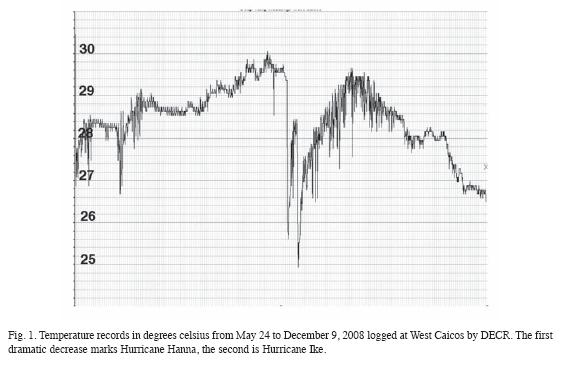
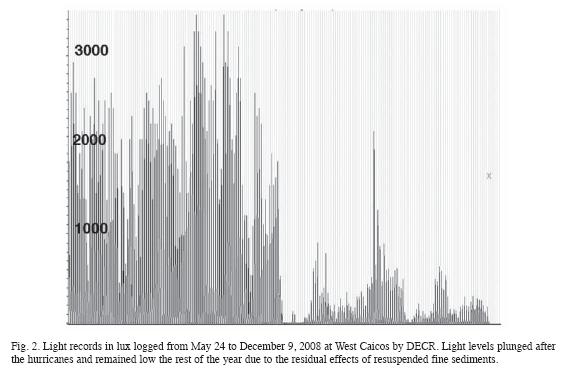
<body><![CDATA[<p style="text-align: justify;"><font face="Verdana" size="2"><a  href="http://www.flickr.com/photos/22251472@N04/sets/72157605703509121/"><font  face="Verdana" size="2">http://www.flickr.com/photos/22251472@N04/sets/72157605703509121/</font></a></font></p>     <p style="text-align: justify;"><font face="Verdana" size="2"><a  href="http://www.flickr.com/photos/22251472@N04/sets/72157605689429965/"><font  face="Verdana" size="2">http://www.flickr.com/photos/22251472@N04/sets/72157605689429965/</font></a></font></p>     <p style="text-align: justify;"><font face="Verdana" size="2"><a  href="http://www.flickr.com/photos/22251472@N04/sets/72157605689429965/"><font  face="Verdana" size="2">http://www.flickr.com/photos/22251472@N04/sets/72157605689429965/</font></a></font></p>     <p style="text-align: justify;"><font face="Verdana" size="2"><a  href="http://www.flickr.com/photos/22251472@N04/sets/72157606328793504/"><font  face="Verdana" size="2">http://www.flickr.com/photos/22251472@</font><font  face="Verdana" size="2">N04/sets/72157606328793504/</font></a></font></p>     <div style="text-align: justify;"><font face="Verdana" size="2"><b><font  face="Verdana" size="3">     <p>Results</p> </font><font face="Verdana" size="2"> </font></b><b><font face="Verdana" size="2">Physical Hurricane impacts on Grand Turk, maps of hurricane tracks: </font></b><font face="Verdana"  size="2">In 2008 Grand Turk suffered the worst hurricane damage on record. Hurricane Hanna hit August 31 to September 5, with the eye turning in a circle over TCI and causing prolonged wave damage from all directions. Two days later (September 7) Grand Turk was hit by the eye of Hurricane Ike, a category 4 hurricane, the strongest on record in TCI. Ike moved fast and straight, and although more severe in wind strength, the prolonged impact of Hanna may have caused more wave damage. Detailed tracks of these hurricanes and their strength are available at: </font><a  href="http://www.nhc.noaa.gov/2008atlan.shtml"><font face="Verdana"  size="2">http://www.nhc.noaa.gov/2008atlan.shtml</font></a> </font></div>     <p style="text-align: justify;"><font face="Verdana" size="2"><font  face="Verdana" size="2"><b>Physical damage on land: </b>Grand Turk suffered the worst hurricane damage in its history. Most wind damage came from Ike, but most wave damage on western Grand Turk was likely due to Hanna. At least 80% of all buildings on Grand Turk were destroyed or damaged (UNEP/OCHA 2008).</font></font></p>     <div style="text-align: justify;"><font face="Verdana" size="2"><font  face="Verdana" size="2"><b>Marine impacts: Temperature and light logs: </b>A recording datalogger measured temperature and light levels before, during, and after these hurricanes at a location 43 m deep in West Caicos. Temperatures plunged around 4oC after Hanna, rose about 2.5oC before Ike, and then dropped around 3.5oC after Ike. It took about a month to regain normal temperatures (<a href="#f1">Fig. 1</a>). Light measurements indicated near complete light extinction at depth during the week of the hurricanes, and that fine suspended particulates kept light levels roughly one tenth of normal for the succeeding four months (<a href="#f2">Fig. 2</a>). </font>    <br>     <br> <font face="Verdana" size="2">Several dives were made on Biorock projects in the weeks after the hurricanes. Sedimentation was not high as expected. Although local divers reported turbidity levels were elevated and persistent in some areas of Providenciales, West Caicos, French Cay, and West Sand Spit, dives in Grand Turk after the Hurricane Ike did not show a high level of turbidity (<a href="#f1">Fig. 1</a>).</font>    ]]></body>
<body><![CDATA[<br> </font></div> <font face="Verdana" size="2"><font face="Verdana" size="2">    <br> </font> </font>     <div style="text-align: center;"><font face="Verdana" size="2"><font  face="Verdana" size="2"><img alt=""  src="/img/revistas/rbt/v58s3/art13f1.jpg"  style="width: 564px; height: 365px;"><a name="f1"></a>    <br>     <br> <img alt="" src="/img/revistas/rbt/v58s3/art13f2.jpg"  style="width: 562px; height: 374px;"><a name="f2"></a>    <br> </font>    <br> </font></div>     <div style="text-align: justify;"><font face="Verdana" size="2"><font  face="Verdana" size="2"><b>Impacts of hurricane on Biorock Reef restoration projects: </b>Measurable accretion of limestone minerals on both projects was recorded (estimated from 3 to 5mm over a one year period). Corals grew quickly and there was visible growth of coral tissue over the wires used for attachment, especially <i>Acropora </i>sp., <i>Diploria </i>sp., <i>Montastraea cavernosa </i>and <i>Dichocoenia stokesi</i>. Some coral species show exceptional color and growth, others less. Fish populations rapidly increased with large numbers of juvenile fish along with seahorses, barracuda, turtles and stingrays. Details of long term coral growth and ecological interactions will be published elsewhere. Governor´s Beach appears to have higher growth rates, </font><font  face="Verdana" size="2">perhaps due to a shorter length of cable to the structure. Mortality of some corals following the hurricanes could be due to sand blasting since many corals healthy in August appeared damaged in January. Some corals succumbed to black band disease and white plague on both structures after the hurricane, perhaps due to </font><font face="Verdana" size="2">physical damage. </font>    <br>     <br> <font face="Verdana" size="2">Three out of four power supplies were fully functioning after the hurricanes. Due to extensive cable damage both projects were without power whilst the cables were repaired. Most cables were replaced following the hurricanes due to damage from debris and high wave action. Despite the collapsed structure at Oasis, the anodes were still in place in the centre of the structure. At Governor´s Beach major substrate shifting was observed and cinder blocks used to hold the anode in place were buried in sand, covering the anode. Otherwise very little damage was sustained to the anode. Damage to the cables was more pronounced further inshore where greater wave action was observed, and cables were replaced where sand blasting by hurricane waves had stripped off the insulation. Details on repairs and on monitoring procedures can be found at the Turks and Caicos Biorock Maintenance Manual (Wells <i>et al. </i>2009) at: </font><a  href="http://www.environment.tc/content/root/"><font face="Verdana"  size="2">http://www.environment.tc/content/root/</font></a><font  face="Verdana" size="2"> files/20090414105717-BiorockGuidelines- GrandTurk.pdf</font>     ]]></body>
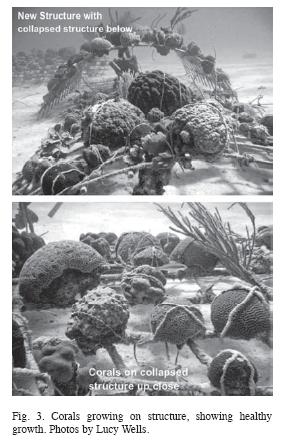
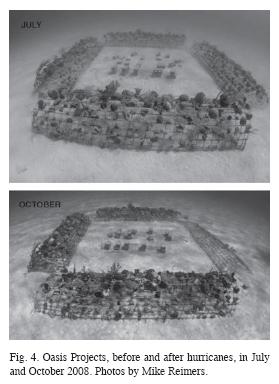
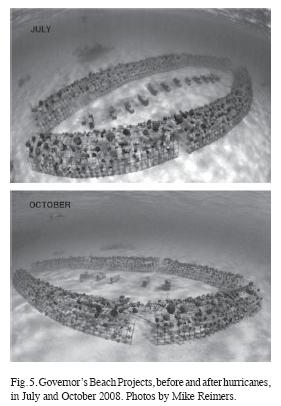
<body><![CDATA[<br>     <br> <font face="Verdana" size="2">After the hurricanes the Governor´s Beach structure was fully erect since the waves passed straight through with little damage. The Oasis structures, tie-wired rather than welded, had one module sag open in place (since replaced with a new, welded structure). However this structure was still intact, and when rewired, the corals continued to grow on it (<a href="#f3">Fig. 3</a>). The projects lost about 30% to 40% of corals due to the hurricanes. Most of those lost had only been wired a few days before and had not yet attached themselves firmly. However, high coral survival and low structural damage after hurricanes indicate that Biorock reef restoration can be effective in storm-impacted areas. Photographs of both projects before and after the hurricanes are shown in<a href="#f4"> Fig. 4</a> and <a  href="#f5">Fig. 5.</a></font>    <br> </font></div> <font face="Verdana" size="2"><font face="Verdana" size="2">    <br> </font> </font>     <div style="text-align: center;"><font face="Verdana" size="2"><font  face="Verdana" size="2"><img alt=""  src="/img/revistas/rbt/v58s3/art13f3.jpg"  style="width: 284px; height: 444px;"><a name="f3"></a>    <br>     <br> <img alt="" src="/img/revistas/rbt/v58s3/art13f4.jpg"  style="width: 279px; height: 384px;"><a name="f4"></a>    <br>     <br> <img alt="" src="/img/revistas/rbt/v58s3/art13f5.jpg"  style="width: 281px; height: 406px;"><a name="f5"></a>    <br> </font>    ]]></body>
<body><![CDATA[<br> <font face="Verdana" size="2"> </font></font></div>     <p><font face="Verdana" size="2"><!-- big --><font face="Verdana" size="2"><!-- big --><span  style="font-weight: bold;">Discussion</span> <!-- /big --></font><!-- /big --></font></p> <font face="Verdana" size="2"><font face="Verdana" size="2"><b> </b></font></font>     <div style="text-align: justify;"><font face="Verdana" size="2"><font  face="Verdana" size="2"><b>Biorock reefs and hurricane stress: </b>One question that has constantly come up with regard to Biorock reef restoration methods, despite their very visible results, has been whether they would survive hurricanes. Biorock structures built in Jamaica between in 1989, which received two years of power before the connections were cut, have survived all hurricanes hitting Jamaica for 20 years, and many of the original corals transplanted onto them are still alive, despite the high algae overgrowth caused by eutrophication from land-based sources of nutrients at this site. The Grand Turk structures are the first to be documented before and after a major hurricane. Even though the structures were sitting under their own weight on sand, and not fixed to the bottom, there was very little physical damage to structures or corals. The Governor´s Beach structures, which shallower and closer to shore, would have been expected to have more physical wave damage, but had little or none. The Oasis structures had one module sag. These structures at Oasis had not been welded, they had simply been hand tied with binding wire. This project received very little power for the first year due to repeated breakage of the cables by dragging anchors, until the area was made a No Anchor Zone. During extended periods of no power, binding wire did not receive complete protection from rusting by the electrical current, and many binding wires rusted and fell off. Nevertheless only one of the four structures sagged. The reason for the very minor physical damage is almost certainly that these structural volumes are more than 99% water, so waves passed right through the structures with minimal drag </font><font face="Verdana" size="2">forces. That might not have been the case had they had flat closed surfaces. The fact that these structures were severely undercharged implies that faster growing structures would have had even less damage. Accretion and coral growth could be further increased by delivering more power to the structures. </font>    <br>     <br> <font face="Verdana" size="2">Only a minority of corals (about 30-40%) were lost. The vast majority of corals had been transplanted onto the structure only a few weeks before the hurricanes, and many were very loosely attached and had not yet had time to be solidly cemented on. The low level of loss and damage is remarkable given the poor history of survival of artificial reefs in storms and hurricanes. On the other hand the relatively high level of disease seen on the Governor´s Beach structure may have been caused by physical injury to coral tissues from sand blasting abrasion, allowing the entry of pathogenic bacteria. The Oasis structures, deeper and further from shore, may have much less disease because of less tissue injury from sand, or alternatively, a locally lower abundance of pathogenic bacteria. Because Biorock corals show exceptionally rapid healing of tissue injury, it is hard to distinguish these alternatives, since corals looked completely healed on the structures by the first opportunity DECR staff had to get into the water after the hurricane.</font>    <br>     <br> <font face="Verdana" size="2">The exceptional survival and low damage of these structures despite their shallow location near shore, and not anchored to the bottom in any way, is in marked contrast to heavy damage and breakage seen in conventional artificial reefs even in deep waters. To our knowledge this is the first report of high survival of corals in a shallow artificial reef following a severe hurricane. The minimal damage to the structure and the corals is certainly due to the open framework that allowed waves to pass through them. The drag equation states that the surface drag force on an object in the direction of the flow, Fd=0.5CdDAV2 where Cd is the drag coefficient,</font> <font face="Verdana" size="2">D is the density of the fluid, A is the cross sectional area perpendicular to the flow vector, and V is the velocity. The drag coefficient is very low for thin cylinders oriented at right angles to the flow, but is very high for solid planar objects facing the flow. A flat object oriented perpendicular to the flow has a drag coefficient about a thousand times greater than one oriented parallel to the flow. That is why sunken ships, and closed steel or massive concrete artificial reefs, which have a high solid area cross section are so badly ripped apart, scoured, and moved in even moderate storms well below hurricane forces, and huge coral boulders, meters across, can be tossed on top of cliffs by hurricanes. Because the volume of the Biorock structure is more than 99% water, the actual solid material area cross section is very small compared to a solid object with the same dimensions. By careful attention to design that minimizes drag forces, our results show that viable artificial reefs can be constructed in shallow water and survive severe forces that would destroy conventional materials. This opens up many new possibilities for coral reef and fisheries habitat restoration structures in shallow habitats where they were previously impossible.</font>    <br>     <br> </font></div> <hr  style="width: 100%; height: 2px; margin-left: 0px; margin-right: 0px;">     <div style="text-align: justify;"><font face="Verdana" size="2"><b><font  face="Verdana" size="3">References </font></b>    ]]></body>
<body><![CDATA[<br>     <!-- ref --><br> <font face="Verdana" size="2">Blair, S.M., T.L. McIntosh &amp; B.J. Mostkoff. 1994. Impacts of Hurricane Andrew on the offshore reef systems of Central and Northern Dade County, Florida. Bull. Mar. Sci. 54: 961-973.    &nbsp;&nbsp;&nbsp;&nbsp;&nbsp;&nbsp;&nbsp;&nbsp;[&#160;<a href="javascript:void(0);" onclick="javascript: window.open('/scielo.php?script=sci_nlinks&ref=1715096&pid=S0034-7744201000070001300001&lng=','','width=640,height=500,resizable=yes,scrollbars=1,menubar=yes,');">Links</a>&#160;]<!-- end-ref --></font>    <br>     <!-- ref --><br> <font face="Verdana" size="2">Carleton, C. &amp; J. Hambrey. 2006. Review and Re- Assessment of the TCI Protected Area System. DECR and the Government of the Turks &amp; Caicos Islands. Grand Turk, Turks and Caicos Islands.    &nbsp;&nbsp;&nbsp;&nbsp;&nbsp;&nbsp;&nbsp;&nbsp;[&#160;<a href="javascript:void(0);" onclick="javascript: window.open('/scielo.php?script=sci_nlinks&ref=1715099&pid=S0034-7744201000070001300002&lng=','','width=640,height=500,resizable=yes,scrollbars=1,menubar=yes,');">Links</a>&#160;]<!-- end-ref --></font> </font></div>     <!-- ref --><p style="text-align: justify;"><font face="Verdana" size="2"><font  face="Verdana" size="2">Darwin, C. 1842. On the Structure and Distribution of Coral Reefs. Ward, Lock and Co., London, United Kingdom.    &nbsp;&nbsp;&nbsp;&nbsp;&nbsp;&nbsp;&nbsp;&nbsp;[&#160;<a href="javascript:void(0);" onclick="javascript: window.open('/scielo.php?script=sci_nlinks&ref=1715101&pid=S0034-7744201000070001300003&lng=','','width=640,height=500,resizable=yes,scrollbars=1,menubar=yes,');">Links</a>&#160;]<!-- end-ref --><br> </font></font></p>     <!-- ref --><p style="text-align: justify;"><font face="Verdana" size="2"><font  face="Verdana" size="2">Goreau T.J. &amp; W. Hilbertz. 2005. Marine ecosystem restoration: costs and benefits for coral reefs. World Res. Rev. 17: 375-409.    &nbsp;&nbsp;&nbsp;&nbsp;&nbsp;&nbsp;&nbsp;&nbsp;[&#160;<a href="javascript:void(0);" onclick="javascript: window.open('/scielo.php?script=sci_nlinks&ref=1715103&pid=S0034-7744201000070001300004&lng=','','width=640,height=500,resizable=yes,scrollbars=1,menubar=yes,');">Links</a>&#160;]<!-- end-ref --></font></font></p>     ]]></body>
<body><![CDATA[<!-- ref --><div style="text-align: justify;"><font face="Verdana" size="2"><font  face="Verdana" size="2">Goreau T.J. &amp; W. Hilbertz. 2007. Reef restoration as a fisheries management tool, in fisheries and aquaculture. <i>In </i>P. Safran (ed.). Encyclopedia of Life Support Systems (EOLSS), UNESCO. Eolss, Oxford, United Kingdom.    &nbsp;&nbsp;&nbsp;&nbsp;&nbsp;&nbsp;&nbsp;&nbsp;[&#160;<a href="javascript:void(0);" onclick="javascript: window.open('/scielo.php?script=sci_nlinks&ref=1715105&pid=S0034-7744201000070001300005&lng=','','width=640,height=500,resizable=yes,scrollbars=1,menubar=yes,');">Links</a>&#160;]<!-- end-ref --></font> </font></div>     <!-- ref --><p style="text-align: justify;"><font face="Verdana" size="2"><font  face="Verdana" size="2">Goreau, T.J. &amp; W. Hilbertz. 2008. Bottom-up communitybased coral reef and fisheries restoration in Indonesia, Panama, and Palau, p. 143-159. <i>In </i>R. France (ed.). Handbook of Regenerative Landscape Design. CRC, Boca Raton, Florida., USA.    &nbsp;&nbsp;&nbsp;&nbsp;&nbsp;&nbsp;&nbsp;&nbsp;[&#160;<a href="javascript:void(0);" onclick="javascript: window.open('/scielo.php?script=sci_nlinks&ref=1715107&pid=S0034-7744201000070001300006&lng=','','width=640,height=500,resizable=yes,scrollbars=1,menubar=yes,');">Links</a>&#160;]<!-- end-ref --></font></font></p>     <!-- ref --><div style="text-align: justify;"><font face="Verdana" size="2"><font  face="Verdana" size="2">Goreau, T.J. &amp; W. Hilbertz. 2009. Coral reef restoration for adaptation to global warming, p. 8. <i>In </i>T.J. Goreau &amp; S.T. Nielsen (eds.). The Green Disc: New Technologies for a New Future. Gibby Media Group, Spokane, Washington, USA.    &nbsp;&nbsp;&nbsp;&nbsp;&nbsp;&nbsp;&nbsp;&nbsp;[&#160;<a href="javascript:void(0);" onclick="javascript: window.open('/scielo.php?script=sci_nlinks&ref=1715109&pid=S0034-7744201000070001300007&lng=','','width=640,height=500,resizable=yes,scrollbars=1,menubar=yes,');">Links</a>&#160;]<!-- end-ref --></font> </font></div>     <!-- ref --><p style="text-align: justify;"><font face="Verdana" size="2"><font  face="Verdana" size="2">Goreau, T.J., W. Hilbertz, A. Azeez &amp; A. Hakeem. 2000. Increased coral and fish survival on mineral accretion reef structures in the Maldives after the 1998 bleaching event. Abs. 9th Int. Coral Reef Symp. 263.    &nbsp;&nbsp;&nbsp;&nbsp;&nbsp;&nbsp;&nbsp;&nbsp;[&#160;<a href="javascript:void(0);" onclick="javascript: window.open('/scielo.php?script=sci_nlinks&ref=1715111&pid=S0034-7744201000070001300008&lng=','','width=640,height=500,resizable=yes,scrollbars=1,menubar=yes,');">Links</a>&#160;]<!-- end-ref --></font></font></p>     <!-- ref --><div style="text-align: justify;"><font face="Verdana" size="2"><font  face="Verdana" size="2">Goreau, T.J., T. Fisher, F. Perez, K. Lockhart, M. Hibbert &amp; A. Lewin. 2008. Turks and Caicos Islands 2006 coral reef assessment: Large-scale environmental and ecological interactions and their management implications. Rev. Biol. Trop. 56: 25-49.    &nbsp;&nbsp;&nbsp;&nbsp;&nbsp;&nbsp;&nbsp;&nbsp;[&#160;<a href="javascript:void(0);" onclick="javascript: window.open('/scielo.php?script=sci_nlinks&ref=1715113&pid=S0034-7744201000070001300009&lng=','','width=640,height=500,resizable=yes,scrollbars=1,menubar=yes,');">Links</a>&#160;]<!-- end-ref --></font> </font></div>     ]]></body>
<body><![CDATA[<!-- ref --><p style="text-align: justify;"><font face="Verdana" size="2"><font  face="Verdana" size="2">Hilbertz, W.H. 1979. Electrodeposition in sea water: Experiments and applications. IEEE J. Ocean. Engin. 4: 94-113.    &nbsp;&nbsp;&nbsp;&nbsp;&nbsp;&nbsp;&nbsp;&nbsp;[&#160;<a href="javascript:void(0);" onclick="javascript: window.open('/scielo.php?script=sci_nlinks&ref=1715115&pid=S0034-7744201000070001300010&lng=','','width=640,height=500,resizable=yes,scrollbars=1,menubar=yes,');">Links</a>&#160;]<!-- end-ref --></font></font></p>     <!-- ref --><p style="text-align: justify;"><font face="Verdana" size="2"><font  face="Verdana" size="2">Hilbertz, W.H. 1992. Solar generated building materials from seawater as a sink of carbon. Ambio 21: 126-129.    &nbsp;&nbsp;&nbsp;&nbsp;&nbsp;&nbsp;&nbsp;&nbsp;[&#160;<a href="javascript:void(0);" onclick="javascript: window.open('/scielo.php?script=sci_nlinks&ref=1715117&pid=S0034-7744201000070001300011&lng=','','width=640,height=500,resizable=yes,scrollbars=1,menubar=yes,');">Links</a>&#160;]<!-- end-ref --></font></font></p>     <!-- ref --><p style="text-align: justify;"><font face="Verdana" size="2"><font  face="Verdana" size="2">Lukens, R.R. &amp; C. Selberg. 2004. Guidelines for marine artificial materials. Gulf Atlantic States Mar. Fish. Comm. 121: 1-198.    &nbsp;&nbsp;&nbsp;&nbsp;&nbsp;&nbsp;&nbsp;&nbsp;[&#160;<a href="javascript:void(0);" onclick="javascript: window.open('/scielo.php?script=sci_nlinks&ref=1715119&pid=S0034-7744201000070001300012&lng=','','width=640,height=500,resizable=yes,scrollbars=1,menubar=yes,');">Links</a>&#160;]<!-- end-ref --></font></font></p>     <!-- ref --><div style="text-align: justify;"><font face="Verdana" size="2"><font  face="Verdana" size="2">Rinkevich, B. 2005. Conservation of coral reefs through active restoration measures: Recent approaches and last decade progress. Environ. Sci. Technol. 39: 4333-4342.    &nbsp;&nbsp;&nbsp;&nbsp;&nbsp;&nbsp;&nbsp;&nbsp;[&#160;<a href="javascript:void(0);" onclick="javascript: window.open('/scielo.php?script=sci_nlinks&ref=1715121&pid=S0034-7744201000070001300013&lng=','','width=640,height=500,resizable=yes,scrollbars=1,menubar=yes,');">Links</a>&#160;]<!-- end-ref --></font> </font></div>     <!-- ref --><p style="text-align: justify;"><font face="Verdana" size="2"><font  face="Verdana" size="2">Shyue, S.W. &amp; K.S. Yang. 2002. Investigating terrain changes around artificial reefs by using a multi-beam echosounder. ICES J. Mar. Sci. 59: S338-S342.    &nbsp;&nbsp;&nbsp;&nbsp;&nbsp;&nbsp;&nbsp;&nbsp;[&#160;<a href="javascript:void(0);" onclick="javascript: window.open('/scielo.php?script=sci_nlinks&ref=1715123&pid=S0034-7744201000070001300014&lng=','','width=640,height=500,resizable=yes,scrollbars=1,menubar=yes,');">Links</a>&#160;]<!-- end-ref --> </font></font></p>     ]]></body>
<body><![CDATA[<!-- ref --><p style="text-align: justify;"><font face="Verdana" size="2"><font  face="Verdana" size="2">Turpin, R.K. &amp; S.A. Bortone. 2002. Pre- and post-hurricane assessment of artificial reefs: evidence for potential use as refugia in a fishery management strategy. ICES J. Mar. Sci. 59: S74-S82.    &nbsp;&nbsp;&nbsp;&nbsp;&nbsp;&nbsp;&nbsp;&nbsp;[&#160;<a href="javascript:void(0);" onclick="javascript: window.open('/scielo.php?script=sci_nlinks&ref=1715125&pid=S0034-7744201000070001300015&lng=','','width=640,height=500,resizable=yes,scrollbars=1,menubar=yes,');">Links</a>&#160;]<!-- end-ref --></font></font></p>     <!-- ref --><div style="text-align: justify;"><font face="Verdana" size="2"><font  face="Verdana" size="2">United Nations Environment Programme/Office for the Coordination of Humanitarian Affairs. 2008. Environmental Assessment: Hurricane Ike, Turks and Caicos, 8-21 September, 2008. UNEP/OCHA, Geneva, Switzerland.    &nbsp;&nbsp;&nbsp;&nbsp;&nbsp;&nbsp;&nbsp;&nbsp;[&#160;<a href="javascript:void(0);" onclick="javascript: window.open('/scielo.php?script=sci_nlinks&ref=1715127&pid=S0034-7744201000070001300016&lng=','','width=640,height=500,resizable=yes,scrollbars=1,menubar=yes,');">Links</a>&#160;]<!-- end-ref --> </font> </font></div>     <!-- ref --><p style="text-align: justify;"><font face="Verdana" size="2"><font  face="Verdana" size="2">United States Department of Commerce &amp; NOAA. 2007. National Artificial Reef Plan (as amended): Guidelines for Siting, Construction, Development, andAssessment of Artificial Reefs. NOAA, US Dept. Commerce, USA.    &nbsp;&nbsp;&nbsp;&nbsp;&nbsp;&nbsp;&nbsp;&nbsp;[&#160;<a href="javascript:void(0);" onclick="javascript: window.open('/scielo.php?script=sci_nlinks&ref=1715129&pid=S0034-7744201000070001300017&lng=','','width=640,height=500,resizable=yes,scrollbars=1,menubar=yes,');">Links</a>&#160;]<!-- end-ref --></font></font></p>     <!-- ref --><p style="text-align: justify;"><font face="Verdana" size="2"><font  face="Verdana" size="2">Wells, L., F. Perez, M. Hibbert, L. Clervaux &amp; P. Lightbourne. 2009. A guide to the Biorock® projects at Grand Turk, Turks and Caicos Islands. DECR, Grand Turk, Turks and Caicos Islands.    &nbsp;&nbsp;&nbsp;&nbsp;&nbsp;&nbsp;&nbsp;&nbsp;[&#160;<a href="javascript:void(0);" onclick="javascript: window.open('/scielo.php?script=sci_nlinks&ref=1715131&pid=S0034-7744201000070001300018&lng=','','width=640,height=500,resizable=yes,scrollbars=1,menubar=yes,');">Links</a>&#160;]<!-- end-ref --> </font></font></p>     <div style="text-align: justify;"><font face="Verdana" size="2"><font  face="Verdana" size="2"><a name="a"></a>Correspondencia: Lucy Wells. Department of Environment and Coastal Resources (DECR), Grand Turk, Turks and Caicos Islands; <a href="mailto:lucydwells@gmail.com">lucydwells@gmail.com</a></font><span  style="font-family: verdana;"></span>    <br> <small><!-- big -->Fernando Perez. Department of Environment and Coastal Resources (DECR), Grand Turk, Turks and Caicos Islands; <a href="mailto:FDPerez@gov.tc">FDPerez@gov.tc</a>,<!-- /big -->    ]]></body>
<body><![CDATA[<br> <font face="Verdana" size="2"><font face="Verdana" size="2">Marlon Hibbert. Department of Environment and Coastal Resources (DECR), Grand Turk, Turks and Caicos Islands; <a href="mailto:MHibbert@gov.tc">MHibbert@gov.tc</a><br  style="font-family: verdana;"> <font face="Verdana" size="2"><font face="Verdana" size="2">Luc Clerveaux. Department of Environment and Coastal Resources (DECR), Grand Turk, Turks and Caicos Islands; <a href="mailto:lclerveaux@gmail.com">lclerveaux@gmail.com</a></font></font></font></font><font  face="Verdana" size="2"><font face="Verdana" size="2"><font  face="Verdana" size="2"><font face="Verdana" size="2">    <br> Jodi Johnson. Department of Environment and Coastal Resources (DECR), Grand Turk, Turks and Caicos Islands; <a href="mailto:JJohnson@gov.tc">JJohnson@gov.tc</a><font  style="font-family: verdana;" face="Verdana" size="2">    <br> Thomas J. Goreau. Global Coral Reef Alliance, Cambridge, Massachusetts, USA;</font><a  href="mailto:goreau@bestweb.net"><span style="font-family: verdana;">goreau@bestweb.net</span></a></font></font></font></font></small></font></div> <hr style="width: 100%; height: 2px;">     <p><font face="Verdana" size="2"><font face="Verdana" size="2"><font  face="Verdana" size="2"><font face="Verdana" size="2"><small><font  face="Verdana" size="2"><small><span style="font-family: verdana;"></span></small></font></small></font></font></font></font></p> <font face="Verdana" size="2"><font face="Verdana" size="2"><font  face="Verdana" size="2"><font face="Verdana" size="2"><small><font  face="Verdana" size="2"><font face="Verdana" size="2">     <p align="center">Received 15-VII -2009. Corrected 19-VI-2010. Accepted 12-VII -2010.</p> </font> </font></small></font></font></font></font>      ]]></body><back>
<ref-list>
<ref id="B1">
<nlm-citation citation-type="journal">
<person-group person-group-type="author">
<name>
<surname><![CDATA[Blair]]></surname>
<given-names><![CDATA[S.M]]></given-names>
</name>
<name>
<surname><![CDATA[McIntosh]]></surname>
<given-names><![CDATA[T.L]]></given-names>
</name>
<name>
<surname><![CDATA[Mostkoff]]></surname>
<given-names><![CDATA[B.J]]></given-names>
</name>
</person-group>
<article-title xml:lang="en"><![CDATA[Impacts of Hurricane Andrew on the offshore reef systems of Central and Northern Dade County, Florida]]></article-title>
<source><![CDATA[Bull.Mar. Sci]]></source>
<year>1994</year>
<volume>54</volume>
<page-range>961-973</page-range></nlm-citation>
</ref>
<ref id="B2">
<nlm-citation citation-type="book">
<person-group person-group-type="author">
<name>
<surname><![CDATA[Carleton]]></surname>
<given-names><![CDATA[C]]></given-names>
</name>
<name>
<surname><![CDATA[Hambrey]]></surname>
<given-names><![CDATA[J]]></given-names>
</name>
</person-group>
<source><![CDATA[Review and Re- Assessment of the TCI Protected Area System]]></source>
<year>2006</year>
<publisher-loc><![CDATA[Turks ]]></publisher-loc>
<publisher-name><![CDATA[DECR and the Government of the Turks & Caicos Islands. Grand Turk]]></publisher-name>
</nlm-citation>
</ref>
<ref id="B3">
<nlm-citation citation-type="book">
<person-group person-group-type="author">
<name>
<surname><![CDATA[Darwin]]></surname>
<given-names><![CDATA[C]]></given-names>
</name>
</person-group>
<source><![CDATA[On the Structure and Distribution of Coral Reefs]]></source>
<year>1842</year>
<publisher-loc><![CDATA[London ]]></publisher-loc>
<publisher-name><![CDATA[Ward, Lock and Co]]></publisher-name>
</nlm-citation>
</ref>
<ref id="B4">
<nlm-citation citation-type="journal">
<person-group person-group-type="author">
<name>
<surname><![CDATA[Goreau]]></surname>
<given-names><![CDATA[T.J]]></given-names>
</name>
<name>
<surname><![CDATA[Hilbertz]]></surname>
<given-names><![CDATA[W]]></given-names>
</name>
</person-group>
<article-title xml:lang="en"><![CDATA[Marine ecosystem restoration: costs and benefits for coral reefs]]></article-title>
<source><![CDATA[World Res. Rev]]></source>
<year>2005</year>
<volume>17</volume>
<page-range>375-409</page-range></nlm-citation>
</ref>
<ref id="B5">
<nlm-citation citation-type="book">
<person-group person-group-type="author">
<name>
<surname><![CDATA[Goreau]]></surname>
<given-names><![CDATA[T.J]]></given-names>
</name>
<name>
<surname><![CDATA[Hilbertz]]></surname>
<given-names><![CDATA[W]]></given-names>
</name>
</person-group>
<article-title xml:lang="en"><![CDATA[Reef restoration as a fisheries management tool, in fisheries and aquaculture]]></article-title>
<person-group person-group-type="editor">
<name>
<surname><![CDATA[Safran]]></surname>
<given-names><![CDATA[P]]></given-names>
</name>
</person-group>
<source><![CDATA[Encyclopedia of Life Support Systems (EOLSS)]]></source>
<year>2007</year>
<publisher-loc><![CDATA[Eolss, Oxford ]]></publisher-loc>
<publisher-name><![CDATA[UNESCO]]></publisher-name>
</nlm-citation>
</ref>
<ref id="B6">
<nlm-citation citation-type="book">
<person-group person-group-type="author">
<name>
<surname><![CDATA[Goreau]]></surname>
<given-names><![CDATA[T.J]]></given-names>
</name>
<name>
<surname><![CDATA[Hilbertz]]></surname>
<given-names><![CDATA[W]]></given-names>
</name>
</person-group>
<article-title xml:lang="en"><![CDATA[Bottom-up communitybased coral reef and fisheries restoration in Indonesia, Panama, and Palau]]></article-title>
<person-group person-group-type="editor">
<name>
<surname><![CDATA[France]]></surname>
<given-names><![CDATA[R]]></given-names>
</name>
</person-group>
<source><![CDATA[Handbook of Regenerative Landscape Design]]></source>
<year>2008</year>
<page-range>143-159</page-range><publisher-loc><![CDATA[Boca Raton^eFlorida Florida]]></publisher-loc>
<publisher-name><![CDATA[CRC]]></publisher-name>
</nlm-citation>
</ref>
<ref id="B7">
<nlm-citation citation-type="book">
<person-group person-group-type="author">
<name>
<surname><![CDATA[Goreau]]></surname>
<given-names><![CDATA[T.J]]></given-names>
</name>
<name>
<surname><![CDATA[Hilbertz]]></surname>
<given-names><![CDATA[W]]></given-names>
</name>
</person-group>
<article-title xml:lang="en"><![CDATA[Coral reef restoration for adaptation to global warming]]></article-title>
<person-group person-group-type="editor">
<name>
<surname><![CDATA[Goreau]]></surname>
<given-names><![CDATA[T.J]]></given-names>
</name>
<name>
<surname><![CDATA[Nielsen]]></surname>
<given-names><![CDATA[S.T]]></given-names>
</name>
</person-group>
<source><![CDATA[The Green Disc: New Technologies for a New Future]]></source>
<year>2009</year>
<page-range>8</page-range><publisher-loc><![CDATA[Spokane^eWashington Washington]]></publisher-loc>
<publisher-name><![CDATA[Gibby Media Group]]></publisher-name>
</nlm-citation>
</ref>
<ref id="B8">
<nlm-citation citation-type="journal">
<person-group person-group-type="author">
<name>
<surname><![CDATA[Goreau]]></surname>
<given-names><![CDATA[T.J]]></given-names>
</name>
<name>
<surname><![CDATA[Hilbertz]]></surname>
<given-names><![CDATA[W]]></given-names>
</name>
<name>
<surname><![CDATA[Azeez]]></surname>
<given-names><![CDATA[A]]></given-names>
</name>
<name>
<surname><![CDATA[Hakeem]]></surname>
<given-names><![CDATA[A]]></given-names>
</name>
</person-group>
<article-title xml:lang="en"><![CDATA[Increased coral and fish survival on mineral accretion reef structures in the Maldives after the 1998 bleaching event]]></article-title>
<source><![CDATA[Abs. 9th Int. Coral Reef Symp]]></source>
<year>2000</year>
<page-range>263</page-range></nlm-citation>
</ref>
<ref id="B9">
<nlm-citation citation-type="journal">
<person-group person-group-type="author">
<name>
<surname><![CDATA[Goreau]]></surname>
<given-names><![CDATA[T.J]]></given-names>
</name>
<name>
<surname><![CDATA[Fisher]]></surname>
<given-names><![CDATA[T]]></given-names>
</name>
<name>
<surname><![CDATA[Perez]]></surname>
<given-names><![CDATA[F]]></given-names>
</name>
<name>
<surname><![CDATA[Lockhart]]></surname>
<given-names><![CDATA[K]]></given-names>
</name>
<name>
<surname><![CDATA[Hibbert]]></surname>
<given-names><![CDATA[M]]></given-names>
</name>
<name>
<surname><![CDATA[Lewin]]></surname>
<given-names><![CDATA[A]]></given-names>
</name>
</person-group>
<article-title xml:lang="en"><![CDATA[Turks and Caicos Islands 2006 coral reef assessment: Large-scale environmental and ecological interactions and their management implications]]></article-title>
<source><![CDATA[Rev. Biol. Trop]]></source>
<year>2008</year>
<volume>56</volume>
<page-range>25-49</page-range></nlm-citation>
</ref>
<ref id="B10">
<nlm-citation citation-type="journal">
<person-group person-group-type="author">
<name>
<surname><![CDATA[Hilbertz]]></surname>
<given-names><![CDATA[W.H]]></given-names>
</name>
</person-group>
<article-title xml:lang="en"><![CDATA[Electrodeposition in sea water: Experiments and applications]]></article-title>
<source><![CDATA[IEEE J. Ocean. Engin]]></source>
<year>1979</year>
<volume>4</volume>
<page-range>94-113</page-range></nlm-citation>
</ref>
<ref id="B11">
<nlm-citation citation-type="journal">
<person-group person-group-type="author">
<name>
<surname><![CDATA[Hilbertz]]></surname>
<given-names><![CDATA[W.H]]></given-names>
</name>
</person-group>
<article-title xml:lang="en"><![CDATA[Solar generated building materials from seawater as a sink of carbon]]></article-title>
<source><![CDATA[Ambio]]></source>
<year>1992</year>
<volume>21</volume>
<page-range>126-129</page-range></nlm-citation>
</ref>
<ref id="B12">
<nlm-citation citation-type="journal">
<person-group person-group-type="author">
<name>
<surname><![CDATA[Lukens]]></surname>
<given-names><![CDATA[R.R]]></given-names>
</name>
<name>
<surname><![CDATA[Selberg]]></surname>
<given-names><![CDATA[C]]></given-names>
</name>
</person-group>
<article-title xml:lang="en"><![CDATA[Guidelines for marine artificial materials]]></article-title>
<source><![CDATA[Gulf Atlantic States Mar. Fish. Comm]]></source>
<year>2004</year>
<volume>121</volume>
<page-range>1-198</page-range></nlm-citation>
</ref>
<ref id="B13">
<nlm-citation citation-type="journal">
<person-group person-group-type="author">
<name>
<surname><![CDATA[Rinkevich]]></surname>
<given-names><![CDATA[B]]></given-names>
</name>
</person-group>
<article-title xml:lang="en"><![CDATA[Conservation of coral reefs through active restoration measures: Recent approaches and last decade progress]]></article-title>
<source><![CDATA[Environ. Sci. Technol]]></source>
<year>2005</year>
<volume>39</volume>
<page-range>4333-4342</page-range></nlm-citation>
</ref>
<ref id="B14">
<nlm-citation citation-type="journal">
<person-group person-group-type="author">
<name>
<surname><![CDATA[Shyue]]></surname>
<given-names><![CDATA[S.W]]></given-names>
</name>
<name>
<surname><![CDATA[Yang]]></surname>
<given-names><![CDATA[K.S]]></given-names>
</name>
</person-group>
<article-title xml:lang="en"><![CDATA[Investigating terrain changes around artificial reefs by using a multi-beam echosounder]]></article-title>
<source><![CDATA[ICES J. Mar. Sci]]></source>
<year>2002</year>
<volume>59</volume>
<page-range>S338-S342</page-range></nlm-citation>
</ref>
<ref id="B15">
<nlm-citation citation-type="journal">
<person-group person-group-type="author">
<name>
<surname><![CDATA[Turpin]]></surname>
<given-names><![CDATA[R.K]]></given-names>
</name>
<name>
<surname><![CDATA[Bortone]]></surname>
<given-names><![CDATA[S.A]]></given-names>
</name>
</person-group>
<article-title xml:lang="en"><![CDATA[Pre- and post-hurricane assessment of artificial reefs: evidence for potential use as refugia in a fishery management strategy]]></article-title>
<source><![CDATA[ICES J. Mar. Sci]]></source>
<year>2002</year>
<volume>59</volume>
<page-range>S74-S82</page-range></nlm-citation>
</ref>
<ref id="B16">
<nlm-citation citation-type="book">
<collab>United Nations Environment Programme/Office for the Coordination of Humanitarian Affairs</collab>
<source><![CDATA[Environmental Assessment: Hurricane Ike, Turks and Caicos, 8-21 September, 2008.]]></source>
<year>2008</year>
<publisher-loc><![CDATA[Geneva ]]></publisher-loc>
<publisher-name><![CDATA[UNEP/OCHA]]></publisher-name>
</nlm-citation>
</ref>
<ref id="B17">
<nlm-citation citation-type="book">
<collab>United States Department of Commerce & NOAA</collab>
<source><![CDATA[National Artificial Reef Plan (as amended): Guidelines for Siting, Construction]]></source>
<year>2007</year>
<publisher-name><![CDATA[Development, andAssessment of Artificial Reefs. NOAA, US Dept. Commerce]]></publisher-name>
</nlm-citation>
</ref>
<ref id="B18">
<nlm-citation citation-type="">
<person-group person-group-type="author">
<name>
<surname><![CDATA[Wells]]></surname>
<given-names><![CDATA[L]]></given-names>
</name>
<name>
<surname><![CDATA[Perez]]></surname>
<given-names><![CDATA[F]]></given-names>
</name>
<name>
<surname><![CDATA[Hibbert]]></surname>
<given-names><![CDATA[M]]></given-names>
</name>
<name>
<surname><![CDATA[Clervaux]]></surname>
<given-names><![CDATA[L]]></given-names>
</name>
<name>
<surname><![CDATA[Lightbourne]]></surname>
<given-names><![CDATA[P]]></given-names>
</name>
</person-group>
<source><![CDATA[A guide to the Biorock® projects at Grand Turk, Turks and Caicos Islands. DECR, Grand Turk, Turks and Caicos Islands]]></source>
<year>2009</year>
</nlm-citation>
</ref>
</ref-list>
</back>
</article>