<?xml version="1.0" encoding="ISO-8859-1"?><article xmlns:mml="http://www.w3.org/1998/Math/MathML" xmlns:xlink="http://www.w3.org/1999/xlink" xmlns:xsi="http://www.w3.org/2001/XMLSchema-instance">
<front>
<journal-meta>
<journal-id>0034-7744</journal-id>
<journal-title><![CDATA[Revista de Biología Tropical]]></journal-title>
<abbrev-journal-title><![CDATA[Rev. biol. trop]]></abbrev-journal-title>
<issn>0034-7744</issn>
<publisher>
<publisher-name><![CDATA[Universidad de Costa Rica]]></publisher-name>
</publisher>
</journal-meta>
<article-meta>
<article-id>S0034-77442010000700009</article-id>
<title-group>
<article-title xml:lang="en"><![CDATA[The distribution of seagrasses in Dominica, Lesser Antilles]]></article-title>
</title-group>
<contrib-group>
<contrib contrib-type="author">
<name>
<surname><![CDATA[Steiner]]></surname>
<given-names><![CDATA[S.C.C]]></given-names>
</name>
</contrib>
<contrib contrib-type="author">
<name>
<surname><![CDATA[Macfarlane]]></surname>
<given-names><![CDATA[K.J]]></given-names>
</name>
</contrib>
<contrib contrib-type="author">
<name>
<surname><![CDATA[Price]]></surname>
<given-names><![CDATA[L.M]]></given-names>
</name>
</contrib>
<contrib contrib-type="author">
<name>
<surname><![CDATA[Willette]]></surname>
<given-names><![CDATA[D.A]]></given-names>
</name>
</contrib>
</contrib-group>
<aff id="A01">
<institution><![CDATA[,Institute for Tropical Marine Ecology Inc  ]]></institution>
<addr-line><![CDATA[ ]]></addr-line>
</aff>
<pub-date pub-type="pub">
<day>00</day>
<month>10</month>
<year>2010</year>
</pub-date>
<pub-date pub-type="epub">
<day>00</day>
<month>10</month>
<year>2010</year>
</pub-date>
<volume>58</volume>
<fpage>89</fpage>
<lpage>98</lpage>
<copyright-statement/>
<copyright-year/>
<self-uri xlink:href="http://www.scielo.sa.cr/scielo.php?script=sci_arttext&amp;pid=S0034-77442010000700009&amp;lng=en&amp;nrm=iso"></self-uri><self-uri xlink:href="http://www.scielo.sa.cr/scielo.php?script=sci_abstract&amp;pid=S0034-77442010000700009&amp;lng=en&amp;nrm=iso"></self-uri><self-uri xlink:href="http://www.scielo.sa.cr/scielo.php?script=sci_pdf&amp;pid=S0034-77442010000700009&amp;lng=en&amp;nrm=iso"></self-uri><abstract abstract-type="short" xml:lang="en"><p><![CDATA[Seagrass beds are the largest organism-built marine habitat in Dominica, yet have only been surveyed since 2007. Standardized examinations along a depth gradient between 0 and 24m, focusing on magnoliophyte species composition and benthic cover of shoots at 17 seagrass bed sites, were carried out between September 10 and December 7, 2008. The Cymodoceaceae Syringodium filiforme (Kuetzing 1860) and Halodule wrightii (Ascherson 1868), as well as the Hydrocharitaceae Halophila decipiens (Ostenfeld 1902), H. stipulacea (Fosskal & Ascherson 1867) and Thalassia testudinum (Banks ex König 1805) displayed distinct regional and horizontal distribution patterns. Syringodium filiforme is the island’s dominant seagrass along the western and northern coasts, occurring at depths between 2 and 18m and with a mean benthic cover ranging from 0.9-10% along the West coast. Along the North coast it grew between 0.2 and 1m depth with a mean maximum benthic cover of 48.9%. Halodule wrightii grew along the North and West coasts, in depths between 1 and 14m in areas of recent and chronic disturbances. Its delicate morphology and sparse benthic cover (<0.1%) did not constitute seagrass beds. Halophila decipiens grew along the deep, shallow and lateral margins of west coast S. filiforme beds and monospecifically in depths between 3 and 24m. Halophila stipulacea, an invasive species, was widespread along 45km of the West coast and was found in depths between 5 and 24m. Both Halophila species formed extensive beds at depths beyond the survey limit of 24m thus playing a potentially important role in the resettlement of shallow areas after storms. H. decipiens and H. stipulacea are currently the second and third most common seagrasses on the island respectively, despite their absence along the North coast. T. testudinum was confined to North coast’s sheltered reef flats at depths 1m or less with mean a benthic cover ranging from 2 to 76%. It grew monospecifically in the most turbulent and in the calmest locations, yet intermixed with S. filiforme in areas of moderate turbulence. Strong surge along the West coast (October 15-16, 2008), associated with Hurricane Omar, caused uprooting and burial of seagrass beds in varying degrees, in particular along the shallow margins between 2 and 10m depth. This event also demonstrated the dynamic nature of Dominica’s shallow seagrass bed margins and the resistance level of individual beds to storm disturbances. Rev. Biol. Trop. 58 (Suppl. 3): 89-98. Epub 2010 October 01.]]></p></abstract>
<abstract abstract-type="short" xml:lang="es"><p><![CDATA[Pastos marinos son los ambientes más grandes constituidos por organismos en Dominica. Sin embargo, sólo se han examinado desde 2007. Entre el 10 de septiembre y 9 de diciembre 2008, se examinaron la composicion de especies y la densidad de magnoliofitas en profundidades de 0 a 24m. Los Cymodoceaceae: Syringodium filiforme y Halodule wrightii, tal como los Hydrocharitaceae: Halophila decipiens, H. stipulacea y Thalassia testudinum, mostraron una distribución regional y horizontal muy distinta. Syringodium filiforme fue la especie dominante en las costas del oeste y del norte de la isla. Se encontró en profundidades de 2 a 18m y con un promedio de cobertura béntica de 0.9-10% en la costa del oeste. En las costas del norte creció entre 0.2 y 1m de profundidad con un pormedio de cobertura béntica de 48.9%. Halodule wrightii creció en las costad del norte y oeste, en profundidades de 1 a 14m en áreas de perturbaciones recientes o crónicas. Su morfología delicada y su baja cobertura béntica (<0.1%) no constituyeron pastos. Halophila decipiens creció en los márgenes profundos, llanos y laterales de pastos dominados por S. filiforme, pero también en forma mono-específica entre 3 y 24m. Halophila stipulacea, una especie invasora, se encontró comúnmente a lo largo de 45km de la costa del oeste en profundidades entre 5 y 24m. Ambas especies de Halophila formaron pastos extensos en profudidades mayores al límite de este estudio y puden ser importantes en la recolonización de áreas llanas después de tormentas destructivas. H. decipiens y H. stipulacea ahora son las especies más comunes después de S. filiforme, a pesar de su ausencia en la costa del norte. T. testudinum, sólo creció en la costa del norte, encima de áreas arrecifales con un pormedio de cobertura béntica entre 2 y 76%, en aguas con 1m o menos de profundidad. Crecieron mono-específicamente en áreas de turbulencia máxima y mínima, pero entre S. filiforme en áreas de turbulencia moderada. Oleaje fuerte en la costa del oeste (octubre 16), asociado con el Huracán Omar, causó la erosión y el enterramiento variado de las márgenes llanas de pastos marinos, particularmente entre 2 y 10m de profundidad. Este evento demostró la dinámica en las márgenes llanas de pastos marinos de Dominica y el nivel de resistencia a perturbaciones de pastos individuales.]]></p></abstract>
<kwd-group>
<kwd lng="en"><![CDATA[Seagrasses]]></kwd>
<kwd lng="en"><![CDATA[Syringodium]]></kwd>
<kwd lng="en"><![CDATA[Halodule]]></kwd>
<kwd lng="en"><![CDATA[Halophila]]></kwd>
<kwd lng="en"><![CDATA[Thalassia]]></kwd>
<kwd lng="es"><![CDATA[algas marinas]]></kwd>
<kwd lng="es"><![CDATA[Syringodium]]></kwd>
<kwd lng="es"><![CDATA[Halodule]]></kwd>
<kwd lng="es"><![CDATA[Halophila]]></kwd>
<kwd lng="es"><![CDATA[Thalassia]]></kwd>
<kwd lng="es"><![CDATA[Dominica]]></kwd>
</kwd-group>
</article-meta>
</front><body><![CDATA[  <b><font face="Verdana" size="4">     <p align="center">The distribution of seagrasses in Dominica, Lesser Antilles</p> </font><font face="Verdana" size="2"> </font></b>     <p><b><font face="Verdana" size="2">S.C.C. Steiner, K.J. Macfarlane, L.M. Price &amp; D.A. Willette</font></b></p> <font face="Verdana" size="2">Institute for Tropical Marine Ecology Inc. (ITME), P.O. Box 944, Roseau, Commonwealth of Dominica; </font><a  href="mailto:admin@itme.org"><font face="Verdana" size="2">admin@itme.org</font></a>     <p><a href="#a"><font face="Verdana" size="2">Correspondencia.</font></a></p> <hr style="width: 100%; height: 2px;"><font face="Verdana" size="2"><b>     <p>Abstract</p> </b></font>     <div style="text-align: justify;"><font face="Verdana" size="2">Seagrass beds are the largest organism-built marine habitat in Dominica, yet have only been surveyed since 2007. Standardized examinations along a depth gradient between 0 and 24m, focusing on magnoliophyte species composition and benthic cover of shoots at 17 seagrass bed sites, were carried out between September 10 and December 7, 2008. The Cymodoceaceae <i>Syringodium filiforme </i>(Kuetzing 1860) and <i>Halodule wrightii </i>(Ascherson 1868), as well as the Hydrocharitaceae <i>Halophila decipiens </i>(Ostenfeld 1902), <i>H. stipulacea </i>(Fosskal &amp; Ascherson 1867) and <i>Thalassia testudinum </i>(Banks ex König 1805) displayed distinct regional and horizontal distribution patterns. <i>Syringodium filiforme </i>is the island’s dominant seagrass along the western and northern coasts, occurring at depths between 2 and 18m and with a mean benthic cover ranging from 0.9-10% along the West coast. Along the North coast it grew between 0.2 and 1m depth with a mean maximum benthic cover of 48.9%. <i>Halodule wrightii </i>grew along the North and West coasts, in depths between 1 and 14m in areas of recent and chronic disturbances. Its delicate morphology and sparse benthic cover (&lt;0.1%) did not constitute seagrass </font><font face="Verdana"  size="2">beds. <i>Halophila decipiens </i>grew along the deep, shallow and lateral margins of west coast <i>S. filiforme </i>beds and monospecifically in depths between 3 and 24m. <i>Halophila stipulacea</i>, an invasive species, was widespread along 45km of the West coast and was found in depths between 5 and 24m. Both <i>Halophila </i>species formed extensive beds at depths beyond the survey limit of 24m thus playing a potentially important role in the resettlement of shallow areas after storms. <i>H. decipiens </i>and <i>H. stipulacea </i>are currently the second and third most common seagrasses on the island respectively, despite their absence along the North coast. <i>T. testudinum </i>was confined to North coast’s sheltered reef flats at depths 1m or less with mean a benthic cover ranging from 2 to 76%. It grew monospecifically in the most turbulent and in the calmest locations, yet intermixed with <i>S. filiforme </i>in areas </font><font  face="Verdana" size="2">of moderate turbulence. Strong surge along the West coast (October 15-16, 2008), associated with Hurricane Omar, caused uprooting and burial of seagrass beds in varying degrees, in particular along the shallow margins between 2 and 10m depth. This event also demonstrated the dynamic nature of Dominica’s shallow seagrass bed margins and the resistance level of individual beds to storm disturbances. Rev. Biol. Trop. 58 (Suppl. 3): 89-98. Epub 2010 October 01.</font> </div>     <p style="text-align: justify;"><font face="Verdana" size="2"><b>Key words: </b>Seagrasses, <i>Syringodium</i>, <i>Halodule</i>, <i>Halophila</i>, <i>Thalassia</i>, Dominica.</font></p>     <div style="text-align: justify;"><font face="Verdana" size="2"><b>     <p>Resumen </p> </b> </font><font face="Verdana" size="2">Pastos marinos son los ambientes más grandes constituidos por organismos en Dominica. Sin embargo, sólo se han examinado desde 2007. Entre el 10 de septiembre y 9 de diciembre 2008, se examinaron la composicion de especies y la densidad de magnoliofitas en profundidades de 0 a 24m. Los Cymodoceaceae: <i>Syringodium filiforme </i>y <i>Halodule wrightii</i>, tal como los Hydrocharitaceae: <i>Halophila decipiens</i>, <i>H. stipulacea </i>y <i>Thalassia testudinum</i>,</font><font face="Verdana" size="2">mostraron una distribución regional y horizontal muy distinta. <i>Syringodium filiforme </i>fue la especie dominante en las costas del oeste y del norte de la isla. Se encontró en profundidades de 2 a 18m y con un promedio de cobertura béntica de 0.9-10% en la costa del oeste. En las costas del norte creció entre 0.2 y 1m de profundidad con un pormedio de cobertura béntica de 48.9%. <i>Halodule wrightii </i>creció en </font><font face="Verdana" size="2">las costad del norte y oeste, en profundidades de 1 a 14m en áreas de perturbaciones recientes o crónicas. Su morfología delicada y su baja cobertura béntica (&lt;0.1%) no constituyeron pastos. <i>Halophila decipiens </i>creció en los márgenes profundos, llanos y laterales de pastos dominados por <i>S. filiforme</i>, pero también en forma mono-específica entre 3 y 24m. <i>Halophila stipulacea</i>, una especie invasora, se encontró comúnmente a lo largo de 45km de la costa del oeste en </font><font face="Verdana" size="2">profundidades entre 5 y 24m. Ambas especies de <i>Halophila </i>formaron pastos extensos en profudidades mayores al límite de este estudio y puden ser importantes en la recolonización de áreas llanas después de tormentas destructivas. <i>H. decipiens </i>y <i>H. stipulacea </i>ahora son las especies más comunes después de <i>S. filiforme, </i>a pesar de su ausencia en la costa del norte. <i>T. testudinum</i>, sólo creció en la costa del norte, encima de áreas arrecifales con un pormedio de cobertura béntica entre 2 y 76%, en aguas con 1m o menos de profundidad. Crecieron mono-específicamente en áreas de turbulencia máxima y mínima, pero entre <i>S. filiforme </i>en áreas de turbulencia moderada. Oleaje fuerte en la costa del oeste (octubre 16), asociado con el Huracán Omar, causó la erosión y el enterramiento variado de las márgenes llanas de pastos marinos, particularmente entre 2 y 10m de profundidad. Este evento demostró la dinámica en las márgenes llanas de pastos marinos de Dominica y el nivel de </font><font face="Verdana" size="2">resistencia a perturbaciones de pastos individuales.    <br> </font>     ]]></body>
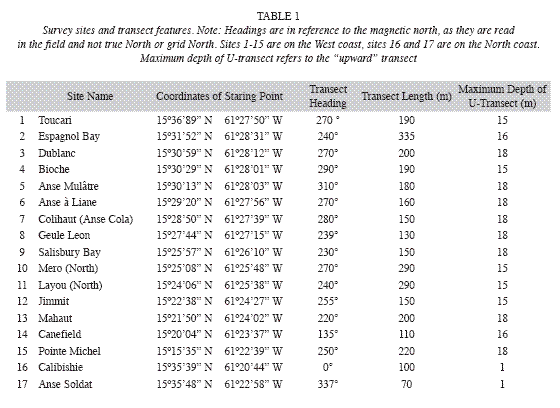
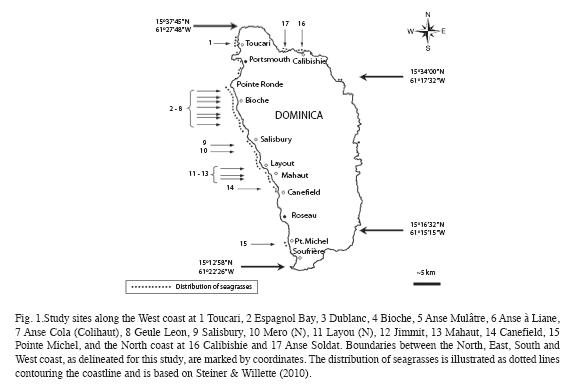
<body><![CDATA[<p><small><b style="font-family: verdana;">Palabras clave: </b><span  style="font-family: verdana;">algas marinas, <span style="font-style: italic;">Syringodium, Halodule, Halophila, Thalassia</span>, Dominica.</span></small></p> </div> <hr style="width: 100%; height: 2px;">     <div style="text-align: justify;"><font face="Verdana" size="2">Seagrass beds throughout the world provide many ecological and economic benefits to the coastal regions they line, including their role as a nursery for juvenile fishes and invertebrates (Randell 1965, Nagelkerken <i>et al</i>. 2000, Beck <i>et al., </i>2001, Peterson &amp; Heck 2001) and shelter for adult organisms (Baelde 1990, Boström &amp; Mattila 1999, Danovaro &amp; Gambi 2002); as well as their functions to </font><font face="Verdana" size="2">stabilize shorelines through wave attenuation (Fonseca &amp; Fisher 1986, Fonseca &amp; Cahalan 1992, Grizzle <i>et al. </i>1996, Chen <i>et. al</i>. 2007), decrease suspended material in the water column (Agawin &amp; Duarte 2002, Marbà <i>et al. </i>2006), recycle nutrients, increase oxygen loads and sequester CO2 (Lee &amp; Dunton 1999, Gacia <i>et al. </i>2005, Suzuki <i>et al. </i>2003). Seagrass beds also rank among the most productive ecosystems on the planet in terms of biomass and species diversity (Constanza <i>et al. </i>1998, Duarte &amp; Chiscano 1999, Duarte 2002). In Dominica, a young volcanic island, the characteristically narrow sublittoral zone provides a comparatively limited area for seagrasses and other light-dependent benthic communities to flourish. The first comprehensive island-wide survey of the distribution and size of benthic marine habitats that encompassed the assessment of seagrasses, was carried out in 2007 by Steiner &amp; Willette (2010). Results from these initial studies included that seagrass beds were (i) found along extensive portions of the West coast, on the reef flats of fringing reefs along North coast, and in the form of a single patch (&gt;100m2) along the East coast, yet absent along the South coast, (ii) that they are the island´s largest organism-built habitat covering a minimum of 265ha, more than the equally marginal coral reef systems covering only 72ha and (iii) that five seagrasses have been identified so far, the Cymodoceaceae <i>Syringodium filiforme </i>and <i>Halodule wrightii</i>, and the Hydrocharitaceae <i>Halophila decipiens, H. stipulacea </i>and <i>Thalassia testudinum</i>. An earlier report by Onuf <i>et al. </i>(2003) including seagrass distribution maps encompassing Dominica, was only marginally in accordance to the findings of Steiner &amp; Willette (2010), as it illustrates the distribution of seagrasses, without naming species, at locations along the North, West and East coast that do not have seagrass beds. The Government of Dominica (2005) illustrates the distribution of seagrasses, also without naming species and omitting the largest seagrass beds along the West coast, while claiming the presence of seagrass beds at northern and eastern locations marked by a high-energy rocky sublittoral zone, which is devoid of seagrasses. Similarly inaccurate is the distribution map published by UNEP-WCMC (2007), which shows seagrasses growing around the entire island. The information provided by Onuf <i>et al. </i>(2003), the Government of Dominica (2005) and UNEPWCMC (2007) does not suffice as baseline of Dominica´s seagrass resources and highlights the fundamental benefits of field surveys.</font>    <br> <span style="font-family: verdana;"></span>    <br> <span style="font-family: verdana;"></span><font face="Verdana" size="2">All of Dominica´s seagrass beds are close to human settlements and are historically and presently used as fishing areas, locally also referred to as "conch beds". The fisheries are artisanal and the fishing techniques applied include seine net fishing, the use of baited fish pots, spear fishing and occasionally the collection of the gastropods <i>Strombus gigas </i>and <i>S. costatus </i>and the echinoid <i>Tripneustes ventricosus</i>. Visible signs of stresses affecting seagrasses in Dominica are the burial and erosion of seagrasses, the contamination by solid wastes, and pulses in the colonization and growth of epiphytic organisms and macroalgae. Seagrasses are not yet specifically protected by the laws of Dominica or other conservation mechanisms as no major seagrass beds occur within the boundaries of the two existing marine protected areas, the Cabrits National Park and the Scott´s Head – Soufrière Marine Reserve. In order to expand our recent understanding of Dominica´s largest marine organism-built habitat type, and to provide the primary data based on field surveys, necessary for the sound development of environmental policies, this study examines the species composition and topography within </font><font face="Verdana" size="2">and between seagrass beds at depths ranging from 0 to 24m.</font> </div>     <p style="text-align: justify;"><b><font face="Verdana" size="3">Materials and methods</font></b><font face="Verdana" size="2">    <br> </font></p>     <p style="text-align: justify;"><font face="Verdana" size="2">Seagrass beds at fifteen sites along the West coast and two sites along the North coast (<a href="#f1">Fig. 1</a>) were surveyed between September 10 and December 7, 2008 (<a href="#t1">Table 1</a>). The sites were strategically selected to encompass all major areas of seagrass beds as ascertained by Steiner and Willette in 2007. At all west coast sites SCUBA dives were carried out following a compass heading perpendicular to the shoreline. Snorkeling gear was used to examine north coast sites. The coordinates of the starting point, and the heading, length and maximum depth of each transect were recorded for future reference (<a href="#t1">Table 1</a>). The survey protocol entailed a "downward" and an "upward" transect. During the downward transect, from shore to a depth of 24m or to where no more seagrasses were seen (whichever came first), qualitative descriptions of the seagrass bed margins (intact or eroded, species composition, height and benthic cover of leaf shoots) and the central parts (species composition, height and benthic cover of shoots, signs of endofauna, epiphytes, sessile and vagile fauna) were recorded. Seagrasses observed beyond the deep&nbsp; </font><font><font  face="Verdana" size="2">end of each transect were also noted and their benthic cover was estimated. At Espagnol Bay the deep margin of the <i>S. filiforme </i>bed was further than 335m from shore and was not reached during the survey. Each "upward" transect included quantitative assessments of "plots" consisting of three 1m2 quadrats, aligned perpendicular to shore and 1m apart from each other, first at a distance of 5m from the deep margin of the seagrass bed or at the deepest point of the "downward" transect if a seagrass bed margin was not reached, and repeated at 20m intervals towards shore. Intervals were measured with a 20m transect line extended in&nbsp; </font></font><font><font face="Verdana" size="2">the opposite direction of the compass heading used during the "downward" transect. At Toucari and Espagnol Bay a 40m interval was used to allow for the completion of the survey during a single dive. Within each quadrat, seagrass species composition, benthic cover and height of leaf shoots were assessed and the presence of macroalgae, epiphytes, sedentary and vagile epifauna was noted. The benthic cover of leaf shoots was visually estimated using 1m2 quadrats subdivided into four 0.25m2 squares. Each estimate was derived from the consensus of at least two surveyors and was based on eight hours of consistency training in the field and with the aid of projected images, to ensure that surveyors estimated the percent cover congruently. Shoots closest to five pre-marked spots along the quadrat were selected for <i>in situ </i>height measurements to the closest centimeter. </font></font><font><font  face="Verdana" size="2">Quantitative data of the three quadrats constituting each of the plots were pooled and the means used for the comparison within and between seagrass beds and depth. Species identification in the field was based on Littler &amp; Littler (2000). Voucher specimens were stored at the Institute for Tropical Marine Ecology.</font></font></p>     <div style="text-align: justify;"><font face="Verdana" size="2">     <p>Outer wind bands of Hurricane Omar caused strong swells along Dominica´s West coast during the night of October 15 and through most of the day on October 16, 2008. Field surveys were suspended due to poor visibility caused by the storm and resumed on October 23, 2008. Storm impacts in the form of erosion and burial of seagrasses in varying degrees, were evident in many seagrass beds. The width of seagrass beds and the species presence were subsequently reassessed.</p> </font>    <br> <font face="Verdana" size="2"> </font></div>     ]]></body>
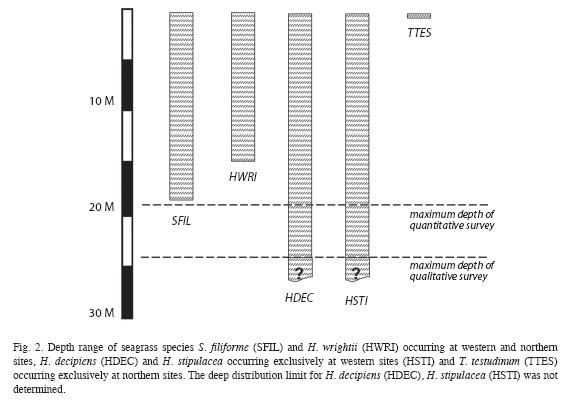
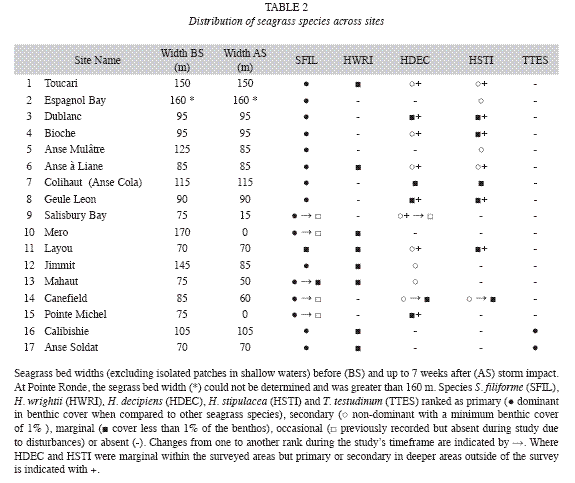
<body><![CDATA[<div style="text-align: center;"><font face="Verdana" size="2">     <p><img alt="" src="/img/revistas/rbt/v58s3/art09t1.gif"  style="width: 560px; height: 408px;"><a name="t1"></a>    <br> <img alt="" src="/img/revistas/rbt/v58s3/art09f1.jpg"  style="width: 571px; height: 388px;"><a name="f1"></a>    <br> </p> </font>    <br> </div> <b><font face="Verdana" size="3">     <p>Results</p> </font></b><i><font face="Verdana" size="2"> </font></i>     <div style="text-align: justify;"><i><font face="Verdana" size="2">Syringodium filiforme </font></i><font face="Verdana" size="2">was the principal component of all seagrass beds examined. It occurred at all sites (<a href="#t2">Table 2</a>) and grew at depths between 0.2 and 18m (<a href="#f2">Fig. 2</a>). Its mean benthic cover ranged between 0.9 and 10% among the west coast sites and gradually decreased from the shallow seagrass bed margins in depths &#8805;2m towards the deep margins. The mean blade height of <i>S. filiforme </i>ranged </font><font face="Verdana" size="2">from 14.3 to 33cm (n=205) and the highest mean values (24.7cm, n=180) consistently occurred within the deeper half of the seagrass beds at 14-15m depth. A single blade of 56cm was measured at Anse Mulâtre at a depth of 11m, outside of the quadrats. The deep margins of <i>S. filiforme </i>beds were all abrupt and intact, linear rather than undulating and without exposed rhizome layers. In contrast, its shallow margins were undulating, marked by a distinct drop in the terrain (ranging from 20 to 35cm) exposing rhizome layers. The widest and bestdeveloped <i>S. filiforme </i>bed of the West coast, in terms of its benthic cover of shoots and blade heights, was at Espagnol Bay. Along the North coast <i>S. filiforme </i>grew between 0.2 and 1m depth, on reef flats, with a mean benthic cover of 34.3% (n=18), a mean blade height of 17.3cm (n=60), and always intermixed with <i>T. testudinum</i>. Across beds, mean benthic cover and blade height increased from the off-shore margins (31% n=6, 15.5cm, n=30) towards the central portions (48.9%, n=6, 21.8cm, n=30) of the seagrass beds, from where they decreased towards the near-shore margins (22.5%, n=6, 14.7cm, n=30). Its off-shore distribution limits at were gradual transitions to areas of coral rubble where <i>T. testudinum </i>grew monospecifically. Its near-shore distribution limit at Calibishie were also smooth and marked by a gradual transition into monospecific areas of <i>T. testudinum, </i>however in sandy substrates. At Anse Soldat the near shore distribution limit of <i>S. filiforme </i>co-occurred with that of <i>T. testudinum </i>less than a meter from shore.</font>    <br> </div>     <p style="text-align: justify;"><font face="Verdana" size="2"><i>Halodule wrightii </i>grew in depths between 1 and 14m (<a href="#f2">Fig. 2</a>), in areas of recent (generally in shallow waters) and chronic disturbances (e.g. Layou river mouth), at western and northern sites, but did not occur in any of the 141 quantitatively examined quadrats. Its delicate morphology and sparse benthic cover (&lt;0.1%) did not constitute seagrass beds that shape their substrate. <i>H. decipiens </i>grew along the deep, shallow and lateral margins of the west coast <i>S. filiforme </i>beds and monospecifically in depths between 3 and 24m, however it did not occur in any of the quantitatively assessed quadrats. It was most commonly found along the deep margins of <i>S. filiforme </i>beds forming mono-specific beds with a benthic cover of shoots of up to 30% or in variegated or mixed assemblages with <i>H. stipulacea. </i>The latter was also widespread (<a href="#t2">Table 2</a>) along 45km of the West coast between Canefield and Toucari and occurred in depths from 5 to 24m, predominantly along the deep margins of <i>S. filiforme </i>beds and with benthic covers of up to 80%. Only at Canefield did <i>H. stipulacea </i>occur within the quantitatively surveyed quadrats, </font><font  face="Verdana" size="2">where its mean benthic cover of shoots was 21.4% (n=12) with a mean blade height of 6cm (n=60). Both <i>Halophila </i>species formed extensive beds at depths beyond the survey limit of this study at 24m (<a href="#f2">Fig. 2</a>) where <i>H. decipiens </i>still covered a greater portion of the seafloor than <i>H. stipulacea.</i></font></p>     <p style="text-align: justify;"><font face="Verdana" size="2"><i>Thalasssia testudinum </i>was confined to North coast where it occurred on sheltered reef flats at depths of 1m or less (<a href="#f2">Fig. 2</a>), with a mean benthic cover ranging from 2 to 76% (n=18). It grew monospecifically in the most turbulent locations (coral rubble sediments behind the reef crest) and the calmest locations (along the shore), yet intermixed with <i>S. filiforme </i>in areas of moderate turbulence (central portions of the seagrass bed). At Calibishie the mean benthic cover and blade height within the seagrass beds increased steadily from the offshore margin (most turbulent) to the near-shore margin (calmest) where they peaked at 76.6% (n=3) and 22.8cm (n=15) respectively. The same pattern was observed in the mean blade heights across the narrower seagrass bed at Anse Soldat, which increased steadily from the off-shore margin (11.1cm, n=15) towards shore (22.8cm, n=15). However, the mean benthic cover had a sinusoid distribution with a mean benthic cover of 7% (n=3) at the off shore and near shore margins and peaking at 19% (n=3) in the central portions of the seagrass bed. </font></p>     ]]></body>
<body><![CDATA[<div style="text-align: justify;"><font face="Verdana" size="2">The growth of epiphytic invertebrates (primarily hydroids) and algae (primarily phaeophytes and rhodophytes ) was most pronounced on the deep half of western seagrass beds, while northern segrass beds were characterized by dense epibenthic macroalgal communities in the space not covered by seagrasses. Epipsammic macro-invertebrates were uncommon throughout all sites except Bioche, which was characterized by the common occurrence of the gastropod <i>Strombus costatus </i>and the asteroid <i>Oreaster reticulatus. </i>Strong surge along the West coast (October </font><font face="Verdana" size="2">15 and 16, 2008) associated with Hurricane Omar caused uprooting and burial of seagrass beds in varying degrees, in particular along the shallow margins between 2 and 10m depth, leading to a decrease in the width of seagrass beds and the number of species at several locations (<a href="#t2">Table 2</a>). The complete or close-tocomplete </font><font face="Verdana" size="2">removal and burial of entire seagrass beds occurred at Salisbury Bay, Mero and Pt. </font><font  face="Verdana" size="2">Michel. <i>H. wrightii </i>was the only specie that reappeared in disturbed areas and within the survey time frame and as early as two weeks after the storm. North coast beds were not affected by this event.</font>    <br> </div>     <p><font face="Verdana" size="2">    <br> </font></p>     <p style="text-align: center;"><font face="Verdana" size="2"><img alt=""  src="/img/revistas/rbt/v58s3/art09f2.jpg"  style="width: 572px; height: 406px;"><a name="f2"></a>    <br> </font></p>     <p style="text-align: center;"><font face="Verdana" size="2"><img alt=""  src="/img/revistas/rbt/v58s3/art09t2.gif"  style="width: 575px; height: 483px;"><a name="t2"></a>    <br> </font></p>     <p><font face="Verdana" size="2">&nbsp;</font></p> <b><font face="Verdana" size="3">     <p>Discussion </p> </font></b><font face="Verdana" size="2"> </font>     ]]></body>
<body><![CDATA[<div style="text-align: justify;"><font face="Verdana" size="2">Dominica´s west coast (leeward) and east coast (windward) seagrass beds differed in seagrass species composition, depth range, and associated species. West coast beds were dominated by <i>S. filiforme, </i>and were typically found between 2 and 18m, in otherwise sandy regions. The narrow and steep shelf of the West coast, lacking wave energy dissipating structures such as shallow fringing reef systems, limits the space suitable for light dependent seagrasses. Near-shore turbulence creates unstable conditions for seagrasses and therefore Dominica´s west coast communities start growing in no less 2m and extend towards their physiological </font><font  face="Verdana" size="2">light limits, which in Dominica was at 18m for <i>S. filiforme</i>. Although <i>T. testudinum </i>is known to have lower minimum light requirements than <i>S. filiforme </i>(Lee <i>et al. </i>2007), self-shading by <i>T. testudinum </i>with blade-like leaves may be a disadvantage in these depths, possibly explaining its absence along the West coast. In contrast, windward beds were characterized by <i>T. testudinum </i>growing in depths of 0-1m in </font><font face="Verdana" size="2">back reef areas or behind other sheltering features like islands. <i>T. testudinum </i>has the deepest live rhizome mats of the five species (Duarte 1991, den Hartog 1970), and unbranched roots with substantial root-hairs that are adapted for a range of sediment types (Kuo &amp; den Hartog 2006). These attributes provide the necessary </font><font face="Verdana"  size="2">stability in the coral rubble substrates behind the reef crests of Anse Soldat and Calibishie. Close to shore, in calm waters where seagrasses lay submerged but flat during low tides, shading by the blade-like leaves of <i>T. testudinum </i>may be among the limiting factors for <i>S. filiforme </i>at these sites.</font> </div>     <p style="text-align: justify;"><font face="Verdana" size="2"><i>H. wrightii </i>displayed the sparsest yet most "opportunistic" distribution in that it occurred in areas of disturbance lining or within mixed and mono-specific seagrass beds, and patches of <i>S. filiforme </i>and <i>T. testudinum. </i>Furthermore, it was the first species to reappear at sites disturbed by Hurricane Omar. This is in accordance with their status as pioneer species and described by Mariani &amp; Alcoverro (1999).     <br> </font></p>     <p style="text-align: justify;"><font face="Verdana" size="2">Both <i>H. decipiens </i>and <i>H. stipulacea </i>were only found along the West coast. <i>H. decipiens </i></font><font face="Verdana" size="2">is known to grow at depths of up to 40 m (Williams &amp; Dennison 1990). <i>H. stipulacea </i>generally grows at depths of up to 50m (Beer &amp; Waisel 1981), but as deep as 85 m near the Great Barrier Reef and Cargolos (den Hartog 1970). The deep distribution limit for these species in Dominica has not yet been determined, </font><font face="Verdana" size="2">as this survey did not go beyond 24m depth. However, based on their wide distribution, in particular along the deep distribution limits of the west coast <i>S. filiforme </i>beds, first examined during this study, <i>Halophila </i>spp. must be considered </font><font face="Verdana" size="2">by hurricanes and also have the potential of locally resettling shallower waters after storm disturbances. Although all west coast seagrasses beds were affected by Hurricane Omar, the level of destruction varied greatly between sites. This is an indication as to which seagrass beds are more resistant to such disturbances (Espagnol Bay, Dublanc, Bioche, Colihaut), which in turn is a key insight for establishing conservation measures tailored specifically to the local conditions.</font><font face="Verdana"  size="2">&nbsp; </font></p>     <p style="text-align: justify;"><font face="Verdana" size="2">This study has discerned the differences in the seagrass species distribution of the leeward and windward coasts of Dominica, where all sublittoral ecosystems cover comparatively small areas along the island´s narrow shelf and close to coastal settlements. Dominica´s seagrass beds also undergo dynamic fluctuations in their benthic cover, resulting from storms, as observed here. In such a scenario, marine conservation measures aimed at multiple rather than single habitats (e.g. coral reefs) seem more appropriate given Dominica´s contiguous layout of seagrass beds and coral reefs described in Steiner &amp; Willette (2010). To date, Dominica´s marine habitat conservation measures and two marine protected areas (Scott´s Head-Soufrière Marine Reserve, Cabrits National Park) focus on coral reefs and areas of coral assemblages.Although seagrasses are Dominica´s largest organism-built habitat type, their investigation has only recently begun and non-anecdotal <font face="Verdana" size="2">information is now available for the incorporation into broader marine conservation efforts.</font></font></p> <font face="Verdana" size="2"><b><font face="Verdana" size="3">     <p>Acknowledgments</p> </font></b><font face="Verdana" size="2">     <p>Logistic and financial support was provided by the Institute for Tropical Marine Ecology Inc. (ITME RPfa09). The research license for this project (RP-09/248-1) was granted and issued by the Fisheries Development Division, Government of Dominica.</p> </font> </font> <hr style="width: 100%; height: 2px;"><font face="Verdana" size="2"><font  face="Verdana" size="2">     <p> </p> <!-- big --><span style="font-weight: bold;"></span>    <br> <span style="font-weight: bold;">References</span><!-- /big --> </font></font>     <!-- ref --><p style="text-align: justify;"><font face="Verdana" size="2"><font  face="Verdana" size="2"> Agawin, N.S.R. &amp; C.M. Duarte. 2002. Evidence of direct particle trapping by a tropical seagrass meadow. Estuaries 25: 1205-1209.    &nbsp;&nbsp;&nbsp;&nbsp;&nbsp;&nbsp;&nbsp;&nbsp;[&#160;<a href="javascript:void(0);" onclick="javascript: window.open('/scielo.php?script=sci_nlinks&ref=1708817&pid=S0034-7744201000070000900001&lng=','','width=640,height=500,resizable=yes,scrollbars=1,menubar=yes,');">Links</a>&#160;]<!-- end-ref --></font></font></p>     <!-- ref --><p style="text-align: justify;"><font face="Verdana" size="2"><font  face="Verdana" size="2">Baelde, P. 1990. Differences in the structure of fish assemblages in <i>Thalassia testudinum </i>beds in Guadeloupe, French West Indies, and their ecological signifficance. Mar. Biol. 105: 163-173.    &nbsp;&nbsp;&nbsp;&nbsp;&nbsp;&nbsp;&nbsp;&nbsp;[&#160;<a href="javascript:void(0);" onclick="javascript: window.open('/scielo.php?script=sci_nlinks&ref=1708819&pid=S0034-7744201000070000900002&lng=','','width=640,height=500,resizable=yes,scrollbars=1,menubar=yes,');">Links</a>&#160;]<!-- end-ref --></font></font></p>     <!-- ref --><div style="text-align: justify;"><font face="Verdana" size="2"><font  face="Verdana" size="2">Beck, M.W., K.L. Heck JR., K.W. Able, D.L. Childers, D.B. Eggleston, B.M. Gillanders, B. Halpern, C.G. Hays, K. Hoshino, T.J. Minello, R.J. Orth, P.F. Sheridan &amp; M.P. Weinstein. 2001. The identification, conservation and management of estuarine and marine nurseries for fish and invertebrates. Bioscience 51: 633-641.    &nbsp;&nbsp;&nbsp;&nbsp;&nbsp;&nbsp;&nbsp;&nbsp;[&#160;<a href="javascript:void(0);" onclick="javascript: window.open('/scielo.php?script=sci_nlinks&ref=1708821&pid=S0034-7744201000070000900003&lng=','','width=640,height=500,resizable=yes,scrollbars=1,menubar=yes,');">Links</a>&#160;]<!-- end-ref --></font> </font></div>     <!-- ref --><p style="text-align: justify;"><font face="Verdana" size="2"><font  face="Verdana" size="2">Beer, S. &amp; Y. Waisel. 1981. Effects of light and pressure on photosynthesis in two seagrasses. Aquat. Bot. 13: 331-337.    &nbsp;&nbsp;&nbsp;&nbsp;&nbsp;&nbsp;&nbsp;&nbsp;[&#160;<a href="javascript:void(0);" onclick="javascript: window.open('/scielo.php?script=sci_nlinks&ref=1708823&pid=S0034-7744201000070000900004&lng=','','width=640,height=500,resizable=yes,scrollbars=1,menubar=yes,');">Links</a>&#160;]<!-- end-ref --></font></font></p>     <!-- ref --><div style="text-align: justify;"><font face="Verdana" size="2"><font  face="Verdana" size="2">Boström, C. &amp; J. Mattila. 1999. The relative importance of food and shelter for seagrass-associated invertebrates: a latitudinal comparison of habitat choice by isopod grazers. Oceology 120: 162-170.    &nbsp;&nbsp;&nbsp;&nbsp;&nbsp;&nbsp;&nbsp;&nbsp;[&#160;<a href="javascript:void(0);" onclick="javascript: window.open('/scielo.php?script=sci_nlinks&ref=1708825&pid=S0034-7744201000070000900005&lng=','','width=640,height=500,resizable=yes,scrollbars=1,menubar=yes,');">Links</a>&#160;]<!-- end-ref --></font> </font></div>     <p style="text-align: justify;"><font face="Verdana" size="2"><font  face="Verdana" size="2"> </font></font></p>     ]]></body>
<body><![CDATA[<!-- ref --><div style="text-align: justify;"><font face="Verdana" size="2"><font  face="Verdana" size="2">Chen, S., L.P. Sanford, E.W. Koch, F. Shi &amp; E. Worth. 2007. A nearshore model to investigate the effects of seagrass geometry and wave attenuation and suspendet sediment transport. Est. Coast. 30: 296-310.    &nbsp;&nbsp;&nbsp;&nbsp;&nbsp;&nbsp;&nbsp;&nbsp;[&#160;<a href="javascript:void(0);" onclick="javascript: window.open('/scielo.php?script=sci_nlinks&ref=1708828&pid=S0034-7744201000070000900006&lng=','','width=640,height=500,resizable=yes,scrollbars=1,menubar=yes,');">Links</a>&#160;]<!-- end-ref --></font>     <br>     <!-- ref --><br> <font face="Verdana" size="2">Constanza, R., R. d´Arge, R. De Groot, S. Farber, M. Grasso, B. Hanon, K. Limburg, S. Naeem, R.V. O</font></font><font  face="Verdana" size="2"><font face="Verdana" size="2">´</font></font><font  face="Verdana" size="2"><font face="Verdana" size="2">Neill, J. Paruelo, R.G. Raskin, P. Sutton &amp; M. van den Belt. 1998. The value of the world</font></font><font face="Verdana" size="2"><font  face="Verdana" size="2">´</font></font><font face="Verdana" size="2"><font  face="Verdana" size="2">s ecosystem services and natural capital. Ecol. Econ. 25: 3-15.    &nbsp;&nbsp;&nbsp;&nbsp;&nbsp;&nbsp;&nbsp;&nbsp;[&#160;<a href="javascript:void(0);" onclick="javascript: window.open('/scielo.php?script=sci_nlinks&ref=1708831&pid=S0034-7744201000070000900007&lng=','','width=640,height=500,resizable=yes,scrollbars=1,menubar=yes,');">Links</a>&#160;]<!-- end-ref --></font>     <br>     <!-- ref --><br> <font face="Verdana" size="2">Danovaro, R. &amp; C. Gambi. 2002. Biodiversity and trophic structure of nematode assemblages in seagrass systems: evidence for a coupling with changes in food availability. Mar. Biol. 141: 667-677.    &nbsp;&nbsp;&nbsp;&nbsp;&nbsp;&nbsp;&nbsp;&nbsp;[&#160;<a href="javascript:void(0);" onclick="javascript: window.open('/scielo.php?script=sci_nlinks&ref=1708834&pid=S0034-7744201000070000900008&lng=','','width=640,height=500,resizable=yes,scrollbars=1,menubar=yes,');">Links</a>&#160;]<!-- end-ref --></font> </font></div>     <!-- ref --><p style="text-align: justify;"><font face="Verdana" size="2"><font  face="Verdana" size="2">Den Hartog, C. 1970. The Sea-Grasses of the World. North-Holland, Amsterdam, Netherlands. Duarte C.M. 1991. Allometric scaling of seagrass form and productivity. Mar. Ecol. Prog. Ser. 77: 289-300.    &nbsp;&nbsp;&nbsp;&nbsp;&nbsp;&nbsp;&nbsp;&nbsp;[&#160;<a href="javascript:void(0);" onclick="javascript: window.open('/scielo.php?script=sci_nlinks&ref=1708836&pid=S0034-7744201000070000900009&lng=','','width=640,height=500,resizable=yes,scrollbars=1,menubar=yes,');">Links</a>&#160;]<!-- end-ref --></font></font></p>     ]]></body>
<body><![CDATA[<!-- ref --><p style="text-align: justify;"><font face="Verdana" size="2"><font  face="Verdana" size="2">Duarte, C.M. 2002. The future of seagrass meadows. Environ. Conser. 29: 192-206.    &nbsp;&nbsp;&nbsp;&nbsp;&nbsp;&nbsp;&nbsp;&nbsp;[&#160;<a href="javascript:void(0);" onclick="javascript: window.open('/scielo.php?script=sci_nlinks&ref=1708838&pid=S0034-7744201000070000900010&lng=','','width=640,height=500,resizable=yes,scrollbars=1,menubar=yes,');">Links</a>&#160;]<!-- end-ref --> </font></font></p>     <!-- ref --><p style="text-align: justify;"><font face="Verdana" size="2"><font  face="Verdana" size="2">Duarte, C.M. &amp; C.L. Chiscano. 1999. Seagrass biomass and production: a reassessment. Aquat. Bot. 65:159-174.    &nbsp;&nbsp;&nbsp;&nbsp;&nbsp;&nbsp;&nbsp;&nbsp;[&#160;<a href="javascript:void(0);" onclick="javascript: window.open('/scielo.php?script=sci_nlinks&ref=1708840&pid=S0034-7744201000070000900011&lng=','','width=640,height=500,resizable=yes,scrollbars=1,menubar=yes,');">Links</a>&#160;]<!-- end-ref --></font></font></p>     <!-- ref --><p style="text-align: justify;"><font face="Verdana" size="2"><font  face="Verdana" size="2">Fonseca, M.S. &amp; J.A. Cahalan. 1992. A preliminary evaluation of wave attenuation by four species of seagrass. Est. Coast. Shelf Sci. 35: 565-576.    &nbsp;&nbsp;&nbsp;&nbsp;&nbsp;&nbsp;&nbsp;&nbsp;[&#160;<a href="javascript:void(0);" onclick="javascript: window.open('/scielo.php?script=sci_nlinks&ref=1708842&pid=S0034-7744201000070000900012&lng=','','width=640,height=500,resizable=yes,scrollbars=1,menubar=yes,');">Links</a>&#160;]<!-- end-ref --></font></font></p>     <!-- ref --><div style="text-align: justify;"><font face="Verdana" size="2"><font  face="Verdana" size="2">Fonseca, M.S. &amp; J.S. Fisher. 1986. A comparison of canopy friction and sediment movement between four species of seagrass with reference to their ecology and restoration. Mar. Ecol. Prog. Ser. 29: 15-22.    &nbsp;&nbsp;&nbsp;&nbsp;&nbsp;&nbsp;&nbsp;&nbsp;[&#160;<a href="javascript:void(0);" onclick="javascript: window.open('/scielo.php?script=sci_nlinks&ref=1708844&pid=S0034-7744201000070000900013&lng=','','width=640,height=500,resizable=yes,scrollbars=1,menubar=yes,');">Links</a>&#160;]<!-- end-ref --></font>    <br>     <!-- ref --><br> <font face="Verdana" size="2">Gacia, E., H. Kennedy, C.M. Duarte, J. Terrados, N. Marba, S. Papadimitriou &amp; M. Fortes. 2005. Light-dependence of the metabolic balance of a highly productive Philippine seagrass community. J. Exp. Mar. Biol. Ecol. 316: 55-67.    &nbsp;&nbsp;&nbsp;&nbsp;&nbsp;&nbsp;&nbsp;&nbsp;[&#160;<a href="javascript:void(0);" onclick="javascript: window.open('/scielo.php?script=sci_nlinks&ref=1708847&pid=S0034-7744201000070000900014&lng=','','width=640,height=500,resizable=yes,scrollbars=1,menubar=yes,');">Links</a>&#160;]<!-- end-ref --></font>     <br>     <!-- ref --><br> <font face="Verdana" size="2">Grizzle, R.E., F.T. Short, C.R. Newell, H. Hoven &amp; L. Kindblom. 1996. Hydrodynamically induced synchronous waving of seagrasses: "monamis" and its possible effects on larval mussel settlement. J. Exp. Mar. Biol. Ecol. 206: 165-177.    &nbsp;&nbsp;&nbsp;&nbsp;&nbsp;&nbsp;&nbsp;&nbsp;[&#160;<a href="javascript:void(0);" onclick="javascript: window.open('/scielo.php?script=sci_nlinks&ref=1708850&pid=S0034-7744201000070000900015&lng=','','width=640,height=500,resizable=yes,scrollbars=1,menubar=yes,');">Links</a>&#160;]<!-- end-ref --></font> </font></div>     <!-- ref --><p style="text-align: justify;"><font face="Verdana" size="2"><font  face="Verdana" size="2">Government of Dominica. 2005. Dominica´s Biodiversity Strategy Action Plan. Government of Dominica, Roseau, Commonwealth of Dominica.    &nbsp;&nbsp;&nbsp;&nbsp;&nbsp;&nbsp;&nbsp;&nbsp;[&#160;<a href="javascript:void(0);" onclick="javascript: window.open('/scielo.php?script=sci_nlinks&ref=1708852&pid=S0034-7744201000070000900016&lng=','','width=640,height=500,resizable=yes,scrollbars=1,menubar=yes,');">Links</a>&#160;]<!-- end-ref --> </font></font></p>     <!-- ref --><div style="text-align: justify;"><font face="Verdana" size="2"><font  face="Verdana" size="2">Kuo, J. &amp; C. den Hartog. 2006. Seagrass morphology, anatomy, and ultrastructure, p. x-x. <i>In </i>A.W.D. Larkum, R.J. Orth, C.M. Duarte (eds.). Seagrasses: Biology, Ecology and Conservation. Springer, Netherlands.    &nbsp;&nbsp;&nbsp;&nbsp;&nbsp;&nbsp;&nbsp;&nbsp;[&#160;<a href="javascript:void(0);" onclick="javascript: window.open('/scielo.php?script=sci_nlinks&ref=1708854&pid=S0034-7744201000070000900017&lng=','','width=640,height=500,resizable=yes,scrollbars=1,menubar=yes,');">Links</a>&#160;]<!-- end-ref --></font>    <br> <font face="Verdana" size="2">    <!-- ref --><br> Lee, K. &amp; K.H. Dunton. 1999. Inorganic nitrogen acquisition in the seagrass <i>Thalassia testudinum</i>: Development of a whole-plant nitrogen budget. Limnol. Oceanogr. 44: 1204-1215.    &nbsp;&nbsp;&nbsp;&nbsp;&nbsp;&nbsp;&nbsp;&nbsp;[&#160;<a href="javascript:void(0);" onclick="javascript: window.open('/scielo.php?script=sci_nlinks&ref=1708857&pid=S0034-7744201000070000900018&lng=','','width=640,height=500,resizable=yes,scrollbars=1,menubar=yes,');">Links</a>&#160;]<!-- end-ref --></font>    <br>     <!-- ref --><br> <font face="Verdana" size="2">Lee, K.S., S.R. Park &amp; Y.K. Kim. 2007. Effects of irradiance, temperature and nutrients on growth dynamics of seagrasses: A review. J. Exp. Mar. Biol. Ecol. 355: 144-175.    &nbsp;&nbsp;&nbsp;&nbsp;&nbsp;&nbsp;&nbsp;&nbsp;[&#160;<a href="javascript:void(0);" onclick="javascript: window.open('/scielo.php?script=sci_nlinks&ref=1708860&pid=S0034-7744201000070000900019&lng=','','width=640,height=500,resizable=yes,scrollbars=1,menubar=yes,');">Links</a>&#160;]<!-- end-ref --></font> </font></div>     <!-- ref --><p style="text-align: justify;"><font face="Verdana" size="2"><font  face="Verdana" size="2">Littler, D.S. &amp; M.M. Littler. 2000. Caribbean Reef Plants. Offshore Graphics, Washington, U.S.A.    &nbsp;&nbsp;&nbsp;&nbsp;&nbsp;&nbsp;&nbsp;&nbsp;[&#160;<a href="javascript:void(0);" onclick="javascript: window.open('/scielo.php?script=sci_nlinks&ref=1708862&pid=S0034-7744201000070000900020&lng=','','width=640,height=500,resizable=yes,scrollbars=1,menubar=yes,');">Links</a>&#160;]<!-- end-ref --> </font></font></p>     <!-- ref --><div style="text-align: justify;"><font face="Verdana" size="2"><font  face="Verdana" size="2">Marbà, N., M. Holmer, E. Gacia &amp; C. Barron. 2006 Seagrass beds and coastal biogeochemistry, p. x-x. <i>In </i>A.W.D. Larkum, R.J. Orth, C.M. Duarte (eds.). Seagrasses: Biology, Ecology and Conservation. Springer, Netherlands.    &nbsp;&nbsp;&nbsp;&nbsp;&nbsp;&nbsp;&nbsp;&nbsp;[&#160;<a href="javascript:void(0);" onclick="javascript: window.open('/scielo.php?script=sci_nlinks&ref=1708864&pid=S0034-7744201000070000900021&lng=','','width=640,height=500,resizable=yes,scrollbars=1,menubar=yes,');">Links</a>&#160;]<!-- end-ref --></font> </font></div>     <!-- ref --><p style="text-align: justify;"><font face="Verdana" size="2"><font  face="Verdana" size="2">Mariani, S. &amp; T. Alcoverro. 1999. A multiple-choice feeding-preference experiment utilizing seagrasses with a natural population of herbivorous fishes. Mar. Ecol. Prog. Ser. 189: 295-299.    &nbsp;&nbsp;&nbsp;&nbsp;&nbsp;&nbsp;&nbsp;&nbsp;[&#160;<a href="javascript:void(0);" onclick="javascript: window.open('/scielo.php?script=sci_nlinks&ref=1708866&pid=S0034-7744201000070000900022&lng=','','width=640,height=500,resizable=yes,scrollbars=1,menubar=yes,');">Links</a>&#160;]<!-- end-ref --></font></font></p>     ]]></body>
<body><![CDATA[<!-- ref --><div style="text-align: justify;"><font face="Verdana" size="2"><font  face="Verdana" size="2">Nagelkerken, I., G. van der Velde, M.W. Gorissen, G.J. Meijer, T. vant´t Hof &amp; C. den Hartog. 2000. Importance of mangroves, seagrass beds and the shallow coral reef as a nursery for tmpotrtant coral reef fishes. Using a visual census technique. Est. Coast. Shelf Sci. 51: 31-44.    &nbsp;&nbsp;&nbsp;&nbsp;&nbsp;&nbsp;&nbsp;&nbsp;[&#160;<a href="javascript:void(0);" onclick="javascript: window.open('/scielo.php?script=sci_nlinks&ref=1708868&pid=S0034-7744201000070000900023&lng=','','width=640,height=500,resizable=yes,scrollbars=1,menubar=yes,');">Links</a>&#160;]<!-- end-ref --></font>     <br>     <!-- ref --><br> <font face="Verdana" size="2">Onuf, C.P., R.C. Phillips, C.A. Moncreiff, A. Raz-Guzman &amp; J.A. Herrera-Silveira. 2003. The seagrasses of the Gulf of Mexico, p. 224-233. <i>In </i>E.P. Green &amp; F.T. Short (eds.). World Atlas of Seagrasses. University. Of California, Berkeley, California, U.S.A.    &nbsp;&nbsp;&nbsp;&nbsp;&nbsp;&nbsp;&nbsp;&nbsp;[&#160;<a href="javascript:void(0);" onclick="javascript: window.open('/scielo.php?script=sci_nlinks&ref=1708871&pid=S0034-7744201000070000900024&lng=','','width=640,height=500,resizable=yes,scrollbars=1,menubar=yes,');">Links</a>&#160;]<!-- end-ref --></font>    <br>     <!-- ref --><br> <font face="Verdana" size="2">Peterson, B.J. &amp; K.L. Heck. 2001. Positive interactions between suspension-feeding bivalves and seagrass – a facultative mutualism. Mar. Ecol. Prog. Ser. 213: 143-155.    &nbsp;&nbsp;&nbsp;&nbsp;&nbsp;&nbsp;&nbsp;&nbsp;[&#160;<a href="javascript:void(0);" onclick="javascript: window.open('/scielo.php?script=sci_nlinks&ref=1708874&pid=S0034-7744201000070000900025&lng=','','width=640,height=500,resizable=yes,scrollbars=1,menubar=yes,');">Links</a>&#160;]<!-- end-ref --></font> </font></div>     <!-- ref --><p style="text-align: justify;"><font face="Verdana" size="2"><font  face="Verdana" size="2">Randall, J.E. 1965. Grazing effect on sea grasses by herbivorous reef fishes in the West Indies. Ecology 46: 255-260.    &nbsp;&nbsp;&nbsp;&nbsp;&nbsp;&nbsp;&nbsp;&nbsp;[&#160;<a href="javascript:void(0);" onclick="javascript: window.open('/scielo.php?script=sci_nlinks&ref=1708876&pid=S0034-7744201000070000900026&lng=','','width=640,height=500,resizable=yes,scrollbars=1,menubar=yes,');">Links</a>&#160;]<!-- end-ref --></font></font></p>     ]]></body>
<body><![CDATA[<!-- ref --><p style="text-align: justify;"><font face="Verdana" size="2"><font  face="Verdana" size="2">Steiner, S.C.C. &amp; D.A. Willette. 2010. The distribution and size of benthic marine habitats in Dominica, Lesser Antilles. Rev. Biol. Trop. 58: 589-602.    &nbsp;&nbsp;&nbsp;&nbsp;&nbsp;&nbsp;&nbsp;&nbsp;[&#160;<a href="javascript:void(0);" onclick="javascript: window.open('/scielo.php?script=sci_nlinks&ref=1708878&pid=S0034-7744201000070000900027&lng=','','width=640,height=500,resizable=yes,scrollbars=1,menubar=yes,');">Links</a>&#160;]<!-- end-ref --></font></font></p>     <!-- ref --><div style="text-align: justify;"><font face="Verdana" size="2"><font  face="Verdana" size="2">Suzuki, Y., M. Fuji, B.E.Casareto, A. Furuta &amp; Y. Ishikawa. 2003. CO2 sequestration and fate of organic mat ters within seagrass (Z<i>ostera marina</i>) ecosystem. J. Chem. Eng. Japan 36: 417-427.    &nbsp;&nbsp;&nbsp;&nbsp;&nbsp;&nbsp;&nbsp;&nbsp;[&#160;<a href="javascript:void(0);" onclick="javascript: window.open('/scielo.php?script=sci_nlinks&ref=1708880&pid=S0034-7744201000070000900028&lng=','','width=640,height=500,resizable=yes,scrollbars=1,menubar=yes,');">Links</a>&#160;]<!-- end-ref --></font> </font></div>     <!-- ref --><p style="text-align: justify;"><font face="Verdana" size="2"><font  face="Verdana" size="2">UNEP-WCMC. 2007. (Downloaded: 21 December, 2009,www.stort.unep-wcmc.org/imaps/marine/ seagrass/viewer.htm).    &nbsp;&nbsp;&nbsp;&nbsp;&nbsp;&nbsp;&nbsp;&nbsp;[&#160;<a href="javascript:void(0);" onclick="javascript: window.open('/scielo.php?script=sci_nlinks&ref=1708882&pid=S0034-7744201000070000900029&lng=','','width=640,height=500,resizable=yes,scrollbars=1,menubar=yes,');">Links</a>&#160;]<!-- end-ref --></font></font></p>     <!-- ref --><div style="text-align: justify;"><font face="Verdana" size="2"><font  face="Verdana" size="2">Willette, D.A. &amp; R. Ambrose. 2009. The distribution and expansion of the invasive seagrass <i>Halophila stipulacea </i>in Dominica, West Indies, with a preliminary report from St. Lucia. Aquat. Bot. 91: 137-142.    &nbsp;&nbsp;&nbsp;&nbsp;&nbsp;&nbsp;&nbsp;&nbsp;[&#160;<a href="javascript:void(0);" onclick="javascript: window.open('/scielo.php?script=sci_nlinks&ref=1708884&pid=S0034-7744201000070000900030&lng=','','width=640,height=500,resizable=yes,scrollbars=1,menubar=yes,');">Links</a>&#160;]<!-- end-ref --></font>     <br> <font face="Verdana" size="2">    <!-- ref --><br> Williams, S.L. &amp; W.C. Dennison. 1990. Light availability and growth of a green macroalga (<i>Caulerpa cupressoiudes</i>) and a seagrass (<i>Halophila decipiens</i>). Mar. Biol. 106: 437-443.    &nbsp;&nbsp;&nbsp;&nbsp;&nbsp;&nbsp;&nbsp;&nbsp;[&#160;<a href="javascript:void(0);" onclick="javascript: window.open('/scielo.php?script=sci_nlinks&ref=1708887&pid=S0034-7744201000070000900031&lng=','','width=640,height=500,resizable=yes,scrollbars=1,menubar=yes,');">Links</a>&#160;]<!-- end-ref --></font> </font></div>     <p style="text-align: justify;"><font face="Verdana" size="2"><font  face="Verdana" size="2"><a name="a"></a>Correspondencia: S.C.C. Steiner, K.J. Macfarlane, L.M. Price &amp; D.A. Willette. Institute for Tropical Marine Ecology Inc. (ITME), P.O. Box 944, Roseau, Commonwealth of Dominica; </font><a href="mailto:admin@itme.org"><font  face="Verdana" size="2">admin@itme.org</font></a></font></p> <hr  style="width: 100%; height: 2px; margin-left: 0px; margin-right: 0px;"><font  face="Verdana" size="2"><font face="Verdana" size="2">     <p align="center">Received 15-VII -2009. Corrected 07-II -2010. Accepted 12-VII -2010.</p> </font> </font>      ]]></body><back>
<ref-list>
<ref id="B1">
<nlm-citation citation-type="journal">
<person-group person-group-type="author">
<name>
<surname><![CDATA[Agawin]]></surname>
<given-names><![CDATA[N.S.R]]></given-names>
</name>
<name>
<surname><![CDATA[Duarte]]></surname>
<given-names><![CDATA[C.M]]></given-names>
</name>
</person-group>
<article-title xml:lang="en"><![CDATA[Evidence of direct particle trapping by a tropical seagrass meadow]]></article-title>
<source><![CDATA[Estuaries]]></source>
<year>2002</year>
<volume>25</volume>
<page-range>1205-1209</page-range></nlm-citation>
</ref>
<ref id="B2">
<nlm-citation citation-type="journal">
<person-group person-group-type="author">
<name>
<surname><![CDATA[Baelde]]></surname>
<given-names><![CDATA[P]]></given-names>
</name>
</person-group>
<article-title xml:lang="en"><![CDATA[Differences in the structure of fish assemblages in Thalassia testudinum beds in Guadeloupe, French West Indies, and their ecological signifficance]]></article-title>
<source><![CDATA[Mar. Biol]]></source>
<year>1990</year>
<volume>105</volume>
<page-range>163-173</page-range></nlm-citation>
</ref>
<ref id="B3">
<nlm-citation citation-type="journal">
<person-group person-group-type="author">
<name>
<surname><![CDATA[Beck]]></surname>
<given-names><![CDATA[M.W]]></given-names>
</name>
<name>
<surname><![CDATA[Heck]]></surname>
<given-names><![CDATA[K.L]]></given-names>
</name>
<name>
<surname><![CDATA[Able]]></surname>
<given-names><![CDATA[K.W]]></given-names>
</name>
<name>
<surname><![CDATA[Childers]]></surname>
<given-names><![CDATA[D.L]]></given-names>
</name>
<name>
<surname><![CDATA[Eggleston]]></surname>
<given-names><![CDATA[D.B]]></given-names>
</name>
<name>
<surname><![CDATA[Gillanders]]></surname>
<given-names><![CDATA[B.M]]></given-names>
</name>
<name>
<surname><![CDATA[Halpern]]></surname>
<given-names><![CDATA[B]]></given-names>
</name>
<name>
<surname><![CDATA[Hays]]></surname>
<given-names><![CDATA[C.G]]></given-names>
</name>
<name>
<surname><![CDATA[Hoshino]]></surname>
<given-names><![CDATA[K]]></given-names>
</name>
<name>
<surname><![CDATA[Minello]]></surname>
<given-names><![CDATA[T.J]]></given-names>
</name>
<name>
<surname><![CDATA[Orth]]></surname>
<given-names><![CDATA[R.J]]></given-names>
</name>
<name>
<surname><![CDATA[Sheridan]]></surname>
<given-names><![CDATA[P.F]]></given-names>
</name>
<name>
<surname><![CDATA[Weinstein]]></surname>
<given-names><![CDATA[M.P]]></given-names>
</name>
</person-group>
<article-title xml:lang="en"><![CDATA[The identification, conservation and management of estuarine and marine nurseries for fish and invertebrates]]></article-title>
<source><![CDATA[Bioscience]]></source>
<year>2001</year>
<volume>51</volume>
<page-range>633-641</page-range></nlm-citation>
</ref>
<ref id="B4">
<nlm-citation citation-type="journal">
<person-group person-group-type="author">
<name>
<surname><![CDATA[Beer]]></surname>
<given-names><![CDATA[S]]></given-names>
</name>
<name>
<surname><![CDATA[Waisel]]></surname>
<given-names><![CDATA[Y]]></given-names>
</name>
</person-group>
<article-title xml:lang="en"><![CDATA[Effects of light and pressure on photosynthesis in two seagrasses]]></article-title>
<source><![CDATA[Aquat. Bot]]></source>
<year>1981</year>
<volume>13</volume>
<page-range>331-337</page-range></nlm-citation>
</ref>
<ref id="B5">
<nlm-citation citation-type="journal">
<person-group person-group-type="author">
<name>
<surname><![CDATA[Boström]]></surname>
<given-names><![CDATA[C]]></given-names>
</name>
<name>
<surname><![CDATA[Mattila]]></surname>
<given-names><![CDATA[J]]></given-names>
</name>
</person-group>
<article-title xml:lang="en"><![CDATA[The relative importance of food and shelter for seagrass-associated invertebrates: a latitudinal comparison of habitat choice by isopod grazers]]></article-title>
<source><![CDATA[Oceology]]></source>
<year>1999</year>
<volume>120</volume>
<page-range>162-170</page-range></nlm-citation>
</ref>
<ref id="B6">
<nlm-citation citation-type="journal">
<person-group person-group-type="author">
<name>
<surname><![CDATA[Chen]]></surname>
<given-names><![CDATA[S]]></given-names>
</name>
<name>
<surname><![CDATA[Sanford]]></surname>
<given-names><![CDATA[L.P]]></given-names>
</name>
<name>
<surname><![CDATA[Koch]]></surname>
<given-names><![CDATA[E.W]]></given-names>
</name>
<name>
<surname><![CDATA[Shi]]></surname>
<given-names><![CDATA[F]]></given-names>
</name>
<name>
<surname><![CDATA[Worth]]></surname>
<given-names><![CDATA[E]]></given-names>
</name>
</person-group>
<article-title xml:lang="en"><![CDATA[A nearshore model to investigate the effects of seagrass geometry and wave attenuation and suspendet sediment transport]]></article-title>
<source><![CDATA[Est. Coast]]></source>
<year>2007</year>
<volume>30</volume>
<page-range>296-310</page-range></nlm-citation>
</ref>
<ref id="B7">
<nlm-citation citation-type="journal">
<person-group person-group-type="author">
<name>
<surname><![CDATA[Constanza]]></surname>
<given-names><![CDATA[R]]></given-names>
</name>
<name>
<surname><![CDATA[d’Arge]]></surname>
<given-names><![CDATA[R]]></given-names>
</name>
<name>
<surname><![CDATA[De Groot]]></surname>
<given-names><![CDATA[R]]></given-names>
</name>
<name>
<surname><![CDATA[Farber]]></surname>
<given-names><![CDATA[S]]></given-names>
</name>
<name>
<surname><![CDATA[Grasso]]></surname>
<given-names><![CDATA[M]]></given-names>
</name>
<name>
<surname><![CDATA[Hanon]]></surname>
<given-names><![CDATA[B]]></given-names>
</name>
<name>
<surname><![CDATA[Limburg]]></surname>
<given-names><![CDATA[K]]></given-names>
</name>
<name>
<surname><![CDATA[Naeem]]></surname>
<given-names><![CDATA[S]]></given-names>
</name>
<name>
<surname><![CDATA[O’Neill]]></surname>
<given-names><![CDATA[R.V]]></given-names>
</name>
<name>
<surname><![CDATA[Paruelo]]></surname>
<given-names><![CDATA[J]]></given-names>
</name>
<name>
<surname><![CDATA[Raskin]]></surname>
<given-names><![CDATA[R.G]]></given-names>
</name>
<name>
<surname><![CDATA[Sutton]]></surname>
<given-names><![CDATA[P]]></given-names>
</name>
<name>
<surname><![CDATA[van den Belt]]></surname>
<given-names><![CDATA[M]]></given-names>
</name>
</person-group>
<article-title xml:lang="en"><![CDATA[The value of the world’s ecosystem services and natural capital]]></article-title>
<source><![CDATA[Ecol. Econ]]></source>
<year>1998</year>
<volume>25</volume>
<page-range>3-15</page-range></nlm-citation>
</ref>
<ref id="B8">
<nlm-citation citation-type="journal">
<person-group person-group-type="author">
<name>
<surname><![CDATA[Danovaro]]></surname>
<given-names><![CDATA[R]]></given-names>
</name>
<name>
<surname><![CDATA[Gambi]]></surname>
<given-names><![CDATA[C]]></given-names>
</name>
</person-group>
<article-title xml:lang="en"><![CDATA[Biodiversity and trophic structure of nematode assemblages in seagrass systems: evidence for a coupling with changes in food availability]]></article-title>
<source><![CDATA[Mar. Biol]]></source>
<year>2002</year>
<volume>141</volume>
<page-range>667-677</page-range></nlm-citation>
</ref>
<ref id="B9">
<nlm-citation citation-type="journal">
<person-group person-group-type="author">
<name>
<surname><![CDATA[Den Hartog]]></surname>
<given-names><![CDATA[C]]></given-names>
</name>
</person-group>
<article-title xml:lang="en"><![CDATA[The Sea-Grasses of the World. North-Holland, Amsterdam, Netherlands. Duarte C.M. 1991. Allometric scaling of seagrass form and productivity]]></article-title>
<source><![CDATA[Mar. Ecol. Prog. Ser]]></source>
<year>1970</year>
<volume>77</volume>
<page-range>289-300</page-range></nlm-citation>
</ref>
<ref id="B10">
<nlm-citation citation-type="journal">
<person-group person-group-type="author">
<name>
<surname><![CDATA[Duarte]]></surname>
<given-names><![CDATA[C.M]]></given-names>
</name>
</person-group>
<article-title xml:lang="en"><![CDATA[The future of seagrass meadows]]></article-title>
<source><![CDATA[Environ. Conser]]></source>
<year>2002</year>
<volume>29</volume>
<page-range>192-206</page-range></nlm-citation>
</ref>
<ref id="B11">
<nlm-citation citation-type="journal">
<person-group person-group-type="author">
<name>
<surname><![CDATA[Duarte]]></surname>
<given-names><![CDATA[C.M]]></given-names>
</name>
<name>
<surname><![CDATA[Chiscano]]></surname>
<given-names><![CDATA[C.L]]></given-names>
</name>
</person-group>
<article-title xml:lang="en"><![CDATA[Seagrass biomass and production: a reassessment]]></article-title>
<source><![CDATA[Aquat. Bot]]></source>
<year>1999</year>
<volume>65</volume>
<page-range>159-174</page-range></nlm-citation>
</ref>
<ref id="B12">
<nlm-citation citation-type="journal">
<person-group person-group-type="author">
<name>
<surname><![CDATA[Fonseca]]></surname>
<given-names><![CDATA[M.S]]></given-names>
</name>
<name>
<surname><![CDATA[Cahalan]]></surname>
<given-names><![CDATA[J.A]]></given-names>
</name>
</person-group>
<article-title xml:lang="en"><![CDATA[A preliminary evaluation of wave attenuation by four species of seagrass]]></article-title>
<source><![CDATA[Est. Coast. Shelf Sci]]></source>
<year>1992</year>
<volume>35</volume>
<page-range>565-576</page-range></nlm-citation>
</ref>
<ref id="B13">
<nlm-citation citation-type="journal">
<person-group person-group-type="author">
<name>
<surname><![CDATA[Fonseca]]></surname>
<given-names><![CDATA[M.S]]></given-names>
</name>
<name>
<surname><![CDATA[Fisher]]></surname>
<given-names><![CDATA[J.S]]></given-names>
</name>
</person-group>
<article-title xml:lang="en"><![CDATA[A comparison of canopy friction and sediment movement between four species of seagrass with reference to their ecology and restoration]]></article-title>
<source><![CDATA[Mar. Ecol. Prog. Ser]]></source>
<year>1986</year>
<volume>29</volume>
<page-range>15-22</page-range></nlm-citation>
</ref>
<ref id="B14">
<nlm-citation citation-type="journal">
<person-group person-group-type="author">
<name>
<surname><![CDATA[Gacia]]></surname>
<given-names><![CDATA[E]]></given-names>
</name>
<name>
<surname><![CDATA[Kennedy]]></surname>
<given-names><![CDATA[H]]></given-names>
</name>
<name>
<surname><![CDATA[Duarte]]></surname>
<given-names><![CDATA[C.M]]></given-names>
</name>
<name>
<surname><![CDATA[Terrados]]></surname>
<given-names><![CDATA[J]]></given-names>
</name>
<name>
<surname><![CDATA[Marba]]></surname>
<given-names><![CDATA[N]]></given-names>
</name>
<name>
<surname><![CDATA[Papadimitriou]]></surname>
<given-names><![CDATA[S]]></given-names>
</name>
<name>
<surname><![CDATA[Fortes]]></surname>
<given-names><![CDATA[M]]></given-names>
</name>
</person-group>
<article-title xml:lang="en"><![CDATA[Light-dependence of the metabolic balance of a highly productive Philippine seagrass community]]></article-title>
<source><![CDATA[J. Exp. Mar. Biol. Ecol]]></source>
<year>2005</year>
<volume>316</volume>
<page-range>55-67</page-range></nlm-citation>
</ref>
<ref id="B15">
<nlm-citation citation-type="journal">
<person-group person-group-type="author">
<name>
<surname><![CDATA[Grizzle]]></surname>
<given-names><![CDATA[R.E]]></given-names>
</name>
<name>
<surname><![CDATA[Short]]></surname>
<given-names><![CDATA[F.T]]></given-names>
</name>
<name>
<surname><![CDATA[Newell]]></surname>
<given-names><![CDATA[C.R]]></given-names>
</name>
<name>
<surname><![CDATA[Hoven]]></surname>
<given-names><![CDATA[H]]></given-names>
</name>
<name>
<surname><![CDATA[Kindblom]]></surname>
<given-names><![CDATA[L]]></given-names>
</name>
</person-group>
<article-title xml:lang="en"><![CDATA[Hydrodynamically induced synchronous waving of seagrasses: "monamis" and its possible effects on larval mussel settlement]]></article-title>
<source><![CDATA[J. Exp. Mar. Biol. Ecol]]></source>
<year>1996</year>
<volume>206</volume>
<page-range>165-177</page-range></nlm-citation>
</ref>
<ref id="B16">
<nlm-citation citation-type="">
<collab>Government of Dominica</collab>
<source><![CDATA[Dominica’s Biodiversity Strategy Action Plan. Government of Dominica]]></source>
<year>2005</year>
</nlm-citation>
</ref>
<ref id="B17">
<nlm-citation citation-type="book">
<person-group person-group-type="author">
<name>
<surname><![CDATA[Kuo]]></surname>
<given-names><![CDATA[J]]></given-names>
</name>
<name>
<surname><![CDATA[den Hartog]]></surname>
<given-names><![CDATA[C]]></given-names>
</name>
</person-group>
<article-title xml:lang="en"><![CDATA[Seagrass morphology, anatomy, and ultrastructure]]></article-title>
<person-group person-group-type="editor">
<name>
<surname><![CDATA[Larkum]]></surname>
<given-names><![CDATA[A.W.D]]></given-names>
</name>
<name>
<surname><![CDATA[Orth]]></surname>
<given-names><![CDATA[R.J]]></given-names>
</name>
<name>
<surname><![CDATA[Duarte]]></surname>
<given-names><![CDATA[C.M]]></given-names>
</name>
</person-group>
<source><![CDATA[Seagrasses: Biology, Ecology and Conservation]]></source>
<year>2006</year>
<page-range>x-x</page-range><publisher-loc><![CDATA[Netherlands ]]></publisher-loc>
<publisher-name><![CDATA[Springer]]></publisher-name>
</nlm-citation>
</ref>
<ref id="B18">
<nlm-citation citation-type="journal">
<person-group person-group-type="author">
<name>
<surname><![CDATA[Lee]]></surname>
<given-names><![CDATA[K]]></given-names>
</name>
<name>
<surname><![CDATA[Dunton]]></surname>
<given-names><![CDATA[K.H]]></given-names>
</name>
</person-group>
<article-title xml:lang="en"><![CDATA[Inorganic nitrogen acquisition in the seagrass Thalassia testudinum: Development of a whole-plant nitrogen budget]]></article-title>
<source><![CDATA[Limnol. Oceanogr]]></source>
<year>1999</year>
<volume>44</volume>
<page-range>1204-1215</page-range></nlm-citation>
</ref>
<ref id="B19">
<nlm-citation citation-type="journal">
<person-group person-group-type="author">
<name>
<surname><![CDATA[Lee]]></surname>
<given-names><![CDATA[K.S]]></given-names>
</name>
<name>
<surname><![CDATA[Park]]></surname>
<given-names><![CDATA[S.R]]></given-names>
</name>
<name>
<surname><![CDATA[Kim]]></surname>
<given-names><![CDATA[Y.K]]></given-names>
</name>
</person-group>
<article-title xml:lang="en"><![CDATA[Effects of irradiance, temperature and nutrients on growth dynamics of seagrasses: A review]]></article-title>
<source><![CDATA[J. Exp. Mar. Biol. Ecol]]></source>
<year>2007</year>
<volume>355</volume>
<page-range>144-175</page-range></nlm-citation>
</ref>
<ref id="B20">
<nlm-citation citation-type="book">
<person-group person-group-type="author">
<name>
<surname><![CDATA[Littler]]></surname>
<given-names><![CDATA[D.S]]></given-names>
</name>
<name>
<surname><![CDATA[Littler]]></surname>
<given-names><![CDATA[M.M]]></given-names>
</name>
</person-group>
<source><![CDATA[Caribbean Reef Plants]]></source>
<year>2000</year>
<publisher-loc><![CDATA[Washington ]]></publisher-loc>
<publisher-name><![CDATA[Offshore Graphics]]></publisher-name>
</nlm-citation>
</ref>
<ref id="B21">
<nlm-citation citation-type="book">
<person-group person-group-type="author">
<name>
<surname><![CDATA[Marbà]]></surname>
<given-names><![CDATA[N]]></given-names>
</name>
<name>
<surname><![CDATA[Holmer]]></surname>
<given-names><![CDATA[M]]></given-names>
</name>
<name>
<surname><![CDATA[Gacia]]></surname>
<given-names><![CDATA[E]]></given-names>
</name>
<name>
<surname><![CDATA[Barron]]></surname>
<given-names><![CDATA[C]]></given-names>
</name>
</person-group>
<article-title xml:lang="en"><![CDATA[Seagrass beds and coastal biogeochemistry]]></article-title>
<person-group person-group-type="editor">
<name>
<surname><![CDATA[Larkum]]></surname>
<given-names><![CDATA[A.W.D]]></given-names>
</name>
<name>
<surname><![CDATA[Orth]]></surname>
<given-names><![CDATA[R.J]]></given-names>
</name>
<name>
<surname><![CDATA[Duarte]]></surname>
<given-names><![CDATA[C.M]]></given-names>
</name>
</person-group>
<source><![CDATA[Seagrasses: Biology, Ecology and Conservation]]></source>
<year>2006</year>
<page-range>x-x</page-range><publisher-loc><![CDATA[Netherlands ]]></publisher-loc>
<publisher-name><![CDATA[Springer]]></publisher-name>
</nlm-citation>
</ref>
<ref id="B22">
<nlm-citation citation-type="journal">
<person-group person-group-type="author">
<name>
<surname><![CDATA[Mariani]]></surname>
<given-names><![CDATA[S]]></given-names>
</name>
<name>
<surname><![CDATA[Alcoverro]]></surname>
<given-names><![CDATA[T]]></given-names>
</name>
</person-group>
<article-title xml:lang="en"><![CDATA[A multiple-choice feeding-preference experiment utilizing seagrasses with a natural population of herbivorous fishes]]></article-title>
<source><![CDATA[Mar. Ecol. Prog. Ser]]></source>
<year>1999</year>
<volume>189</volume>
<page-range>295-299</page-range></nlm-citation>
</ref>
<ref id="B23">
<nlm-citation citation-type="journal">
<person-group person-group-type="author">
<name>
<surname><![CDATA[Nagelkerken]]></surname>
<given-names><![CDATA[I]]></given-names>
</name>
<name>
<surname><![CDATA[der Velde]]></surname>
<given-names><![CDATA[G]]></given-names>
</name>
<name>
<surname><![CDATA[Gorissen]]></surname>
<given-names><![CDATA[M.W]]></given-names>
</name>
<name>
<surname><![CDATA[Meijer]]></surname>
<given-names><![CDATA[G.J]]></given-names>
</name>
<name>
<surname><![CDATA[vant’t Hof]]></surname>
<given-names><![CDATA[T]]></given-names>
</name>
<name>
<surname><![CDATA[den Hartog]]></surname>
<given-names><![CDATA[C]]></given-names>
</name>
</person-group>
<article-title xml:lang="en"><![CDATA[Importance of mangroves, seagrass beds and the shallow coral reef as a nursery for tmpotrtant coral reef fishes. Using a visual census technique]]></article-title>
<source><![CDATA[Est. Coast. Shelf Sci]]></source>
<year>2000</year>
<volume>51</volume>
<page-range>31-44</page-range></nlm-citation>
</ref>
<ref id="B24">
<nlm-citation citation-type="book">
<person-group person-group-type="author">
<name>
<surname><![CDATA[Onuf]]></surname>
<given-names><![CDATA[C.P]]></given-names>
</name>
<name>
<surname><![CDATA[Phillips]]></surname>
<given-names><![CDATA[R.C]]></given-names>
</name>
<name>
<surname><![CDATA[Moncreiff]]></surname>
<given-names><![CDATA[C.A]]></given-names>
</name>
<name>
<surname><![CDATA[Raz-Guzman]]></surname>
<given-names><![CDATA[A]]></given-names>
</name>
<name>
<surname><![CDATA[Herrera-Silveira]]></surname>
<given-names><![CDATA[J.A]]></given-names>
</name>
</person-group>
<article-title xml:lang="en"><![CDATA[The seagrasses of the Gulf of Mexico]]></article-title>
<person-group person-group-type="editor">
<name>
<surname><![CDATA[Green]]></surname>
<given-names><![CDATA[E.P]]></given-names>
</name>
<name>
<surname><![CDATA[Short]]></surname>
<given-names><![CDATA[F.T]]></given-names>
</name>
</person-group>
<source><![CDATA[World Atlas of Seagrasses]]></source>
<year>2003</year>
<page-range>224-233</page-range><publisher-loc><![CDATA[Berkeley^eCalifornia California]]></publisher-loc>
<publisher-name><![CDATA[University. Of California]]></publisher-name>
</nlm-citation>
</ref>
<ref id="B25">
<nlm-citation citation-type="journal">
<person-group person-group-type="author">
<name>
<surname><![CDATA[Peterson]]></surname>
<given-names><![CDATA[B.J]]></given-names>
</name>
<name>
<surname><![CDATA[Heck]]></surname>
<given-names><![CDATA[K.L]]></given-names>
</name>
</person-group>
<article-title xml:lang="en"><![CDATA[Positive interactions between suspension-feeding bivalves and seagrass - a facultative mutualism]]></article-title>
<source><![CDATA[Mar. Ecol. Prog. Ser]]></source>
<year>2001</year>
<volume>213</volume>
<page-range>143-155</page-range></nlm-citation>
</ref>
<ref id="B26">
<nlm-citation citation-type="journal">
<person-group person-group-type="author">
<name>
<surname><![CDATA[Randall]]></surname>
<given-names><![CDATA[J.E]]></given-names>
</name>
</person-group>
<article-title xml:lang="en"><![CDATA[Grazing effect on sea grasses by herbivorous reef fishes in the West Indies]]></article-title>
<source><![CDATA[Ecology]]></source>
<year>1965</year>
<volume>46</volume>
<page-range>255-260</page-range></nlm-citation>
</ref>
<ref id="B27">
<nlm-citation citation-type="journal">
<person-group person-group-type="author">
<name>
<surname><![CDATA[Steiner]]></surname>
<given-names><![CDATA[S.C.C]]></given-names>
</name>
<name>
<surname><![CDATA[Willette]]></surname>
<given-names><![CDATA[D.A]]></given-names>
</name>
</person-group>
<article-title xml:lang="en"><![CDATA[The distribution and size of benthic marine habitats in Dominica, Lesser Antilles]]></article-title>
<source><![CDATA[Rev. Biol. Trop]]></source>
<year>2010</year>
<volume>58</volume>
<page-range>589-602</page-range></nlm-citation>
</ref>
<ref id="B28">
<nlm-citation citation-type="journal">
<person-group person-group-type="author">
<name>
<surname><![CDATA[Suzuki]]></surname>
<given-names><![CDATA[Y]]></given-names>
</name>
<name>
<surname><![CDATA[Fuji]]></surname>
<given-names><![CDATA[M]]></given-names>
</name>
<name>
<surname><![CDATA[Casareto]]></surname>
<given-names><![CDATA[B.E]]></given-names>
</name>
<name>
<surname><![CDATA[Furuta]]></surname>
<given-names><![CDATA[A]]></given-names>
</name>
<name>
<surname><![CDATA[Ishikawa]]></surname>
<given-names><![CDATA[Y]]></given-names>
</name>
</person-group>
<article-title xml:lang="en"><![CDATA[CO2 sequestration and fate of organic mat ters within seagrass (Zostera marina) ecosystem]]></article-title>
<source><![CDATA[J. Chem. Eng. Japan]]></source>
<year>2003</year>
<volume>36</volume>
<page-range>417-427</page-range></nlm-citation>
</ref>
<ref id="B29">
<nlm-citation citation-type="">
<collab>UNEP-WCMC</collab>
<source><![CDATA[]]></source>
<year>2007</year>
</nlm-citation>
</ref>
<ref id="B30">
<nlm-citation citation-type="journal">
<person-group person-group-type="author">
<name>
<surname><![CDATA[Willette]]></surname>
<given-names><![CDATA[D.A]]></given-names>
</name>
<name>
<surname><![CDATA[Ambrose]]></surname>
<given-names><![CDATA[R]]></given-names>
</name>
</person-group>
<article-title xml:lang="en"><![CDATA[The distribution and expansion of the invasive seagrass Halophila stipulacea in Dominica, West Indies, with a preliminary report from St. Lucia]]></article-title>
<source><![CDATA[Aquat. Bot]]></source>
<year>2009</year>
<volume>91</volume>
<page-range>137-142</page-range></nlm-citation>
</ref>
<ref id="B31">
<nlm-citation citation-type="journal">
<person-group person-group-type="author">
<name>
<surname><![CDATA[Williams]]></surname>
<given-names><![CDATA[S.L]]></given-names>
</name>
<name>
<surname><![CDATA[Dennison]]></surname>
<given-names><![CDATA[W.C]]></given-names>
</name>
</person-group>
<article-title xml:lang="en"><![CDATA[Light availability and growth of a green macroalga (Caulerpa cupressoiudes) and a seagrass (Halophila decipiens)]]></article-title>
<source><![CDATA[Mar. Biol]]></source>
<year>1990</year>
<volume>106</volume>
<page-range>437-443</page-range></nlm-citation>
</ref>
</ref-list>
</back>
</article>