<?xml version="1.0" encoding="ISO-8859-1"?><article xmlns:mml="http://www.w3.org/1998/Math/MathML" xmlns:xlink="http://www.w3.org/1999/xlink" xmlns:xsi="http://www.w3.org/2001/XMLSchema-instance">
<front>
<journal-meta>
<journal-id>0034-7744</journal-id>
<journal-title><![CDATA[Revista de Biología Tropical]]></journal-title>
<abbrev-journal-title><![CDATA[Rev. biol. trop]]></abbrev-journal-title>
<issn>0034-7744</issn>
<publisher>
<publisher-name><![CDATA[Universidad de Costa Rica]]></publisher-name>
</publisher>
</journal-meta>
<article-meta>
<article-id>S0034-77442010000700005</article-id>
<title-group>
<article-title xml:lang="en"><![CDATA[Temporal patterns in coral reef, seagrass and mangrove communities from Chengue bay CARICOMP site (Colombia): 1993-2008]]></article-title>
</title-group>
<contrib-group>
<contrib contrib-type="author">
<name>
<surname><![CDATA[Rodríguez-Ramírez]]></surname>
<given-names><![CDATA[Alberto]]></given-names>
</name>
</contrib>
<contrib contrib-type="author">
<name>
<surname><![CDATA[Garzón-Ferreira]]></surname>
<given-names><![CDATA[Jaime]]></given-names>
</name>
</contrib>
<contrib contrib-type="author">
<name>
<surname><![CDATA[Batista-Morales]]></surname>
<given-names><![CDATA[Angélica]]></given-names>
</name>
</contrib>
<contrib contrib-type="author">
<name>
<surname><![CDATA[L. Gil]]></surname>
<given-names><![CDATA[Diego]]></given-names>
</name>
</contrib>
<contrib contrib-type="author">
<name>
<surname><![CDATA[Gómez-López]]></surname>
<given-names><![CDATA[Diana Isabel]]></given-names>
</name>
</contrib>
<contrib contrib-type="author">
<name>
<surname><![CDATA[Gómez-Campo]]></surname>
<given-names><![CDATA[Kelly]]></given-names>
</name>
</contrib>
<contrib contrib-type="author">
<name>
<surname><![CDATA[López-Londoño]]></surname>
<given-names><![CDATA[Tomás]]></given-names>
</name>
</contrib>
<contrib contrib-type="author">
<name>
<surname><![CDATA[Navas-Camacho]]></surname>
<given-names><![CDATA[Raúl]]></given-names>
</name>
</contrib>
<contrib contrib-type="author">
<name>
<surname><![CDATA[Reyes-Nivia]]></surname>
<given-names><![CDATA[María Catalina]]></given-names>
</name>
</contrib>
<contrib contrib-type="author">
<name>
<surname><![CDATA[Vega-Sequeda]]></surname>
<given-names><![CDATA[Johanna]]></given-names>
</name>
</contrib>
</contrib-group>
<aff id="A01">
<institution><![CDATA[,The University of Queensland  ]]></institution>
<addr-line><![CDATA[ ]]></addr-line>
<country>Australia</country>
</aff>
<aff id="A02">
<institution><![CDATA[,Brewster Academy  ]]></institution>
<addr-line><![CDATA[ ]]></addr-line>
<country>USA</country>
</aff>
<aff id="A03">
<institution><![CDATA[,Instituto de Investigaciones Marinas y Costeras  ]]></institution>
<addr-line><![CDATA[Santa Marta ]]></addr-line>
<country>Colombia</country>
</aff>
<pub-date pub-type="pub">
<day>00</day>
<month>10</month>
<year>2010</year>
</pub-date>
<pub-date pub-type="epub">
<day>00</day>
<month>10</month>
<year>2010</year>
</pub-date>
<volume>58</volume>
<fpage>45</fpage>
<lpage>62</lpage>
<copyright-statement/>
<copyright-year/>
<self-uri xlink:href="http://www.scielo.sa.cr/scielo.php?script=sci_arttext&amp;pid=S0034-77442010000700005&amp;lng=en&amp;nrm=iso"></self-uri><self-uri xlink:href="http://www.scielo.sa.cr/scielo.php?script=sci_abstract&amp;pid=S0034-77442010000700005&amp;lng=en&amp;nrm=iso"></self-uri><self-uri xlink:href="http://www.scielo.sa.cr/scielo.php?script=sci_pdf&amp;pid=S0034-77442010000700005&amp;lng=en&amp;nrm=iso"></self-uri><abstract abstract-type="short" xml:lang="en"><p><![CDATA[Few monitoring programs have simultaneously assessed the dynamics of linked marine ecosystems (coral reefs, seagrass beds and mangroves) to document their temporal and spatial variability. Based on CARICOMP protocol we evaluated permanent stations in coral reefs, seagrass beds and mangroves from 1993 to 2008 in Chengue Bay at the Tayrona Natural Park, Colombian Caribbean. Overall, the studied ecosystems showed a remarkable stability pattern over the monitoring period. While there were annual variations in coral reefs (coral cover) and mangroves (litterfall) caused by hurricane Lenny in 1999, particular trends in seagrass (leaf area index and leaf productivity) appear to reflect the natural variability in this ecosystem. We suggest that monitoring sites at the three marine ecosystems had in general a healthy development in the last 16 years. Our results are critical to locally improve the management strategies (Tayrona Natural Park) and to understand the long-term dynamics of closely associated marine ecosystems in the Caribbean. Rev. Biol. Trop. 58 (Suppl. 3): 45-62. Epub 2010 October 01.]]></p></abstract>
<abstract abstract-type="short" xml:lang="es"><p><![CDATA[Pocos programas de monitoreo han estudiado simultáneamente la dinámica de ecosistemas marinos estrechamente relacionados (arrecifes coralinos, pastos marinos y manglares) para documentar su variabilidad espacial y temporal. Siguiendo el protocolo de monitoreo del programa CARICOMP, estaciones permanentes de monitoreo en estos ecosistemas fueron evaluadas entre 1993 y 2008 en la Bahía de Chengue del Parque Nacional Natural Tayrona (Caribe Colombiano). En general los ecosistemas monitoreados han presentado un patrón de estabilidad durante los años de estudio. Mientras los arrecifes coralinos (cobertura de coral) y manglares tuvieron algunas variaciones anuales debidas al paso del huracán Lenny en 1999, los pastos marinos registraron tendencias particulares de cambio (índicece de área foliar y productividad de hojas) que podrían estar reflejando la variabilidad natural de la pradera estudiada.Por lo tanto se sugiere que los sitios monitoreados en cada ecosistema han tenido un desarrollo saludable en los últimos 16 años. Estos resultados son importantes para mejorar localmente las estrategias de manejo (Parque Nacional Natural Tayrona) y para evaluar la dinámica a largo plazo en los ecosistemas marinos del Caribe.]]></p></abstract>
<kwd-group>
<kwd lng="en"><![CDATA[monitoring]]></kwd>
<kwd lng="en"><![CDATA[coral reef]]></kwd>
<kwd lng="en"><![CDATA[seagrass]]></kwd>
<kwd lng="en"><![CDATA[mangrove]]></kwd>
<kwd lng="en"><![CDATA[Chengue]]></kwd>
<kwd lng="en"><![CDATA[CARICOMP]]></kwd>
<kwd lng="en"><![CDATA[Colombian Caribbean]]></kwd>
<kwd lng="es"><![CDATA[Monitoreo]]></kwd>
<kwd lng="es"><![CDATA[arrecifes coralinos]]></kwd>
<kwd lng="es"><![CDATA[patos marinos]]></kwd>
<kwd lng="es"><![CDATA[manglares]]></kwd>
<kwd lng="es"><![CDATA[Chengue]]></kwd>
<kwd lng="es"><![CDATA[CARICOMP]]></kwd>
<kwd lng="es"><![CDATA[Caribe colombiano]]></kwd>
</kwd-group>
</article-meta>
</front><body><![CDATA[  <b><font face="Verdana" size="4">     <p align="center">&nbsp;Temporal patterns in coral reef, seagrass and mangrove communities from Chengue bay CARICOMP site (Colombia): 1993-2008</p> </font><font face="Verdana" size="2"> </font></b>     <p><b><font face="Verdana" size="2">Alberto Rodríguez-Ramírez<sup>1</sup>, Jaime Garzón-Ferreira<sup>2</sup>, Angélica Batista-Morales<sup>3</sup>, Diego L. Gil<sup>3</sup>, Diana Isabel Gómez-López<sup>3</sup>, Kelly Gómez-Campo<sup>3</sup>, Tomás López-Londoño<sup>3</sup>, Raúl Navas-Camacho<sup>3</sup>, María Catalina Reyes-Nivia<sup>1</sup> &amp; Johanna Vega-Sequeda<sup>3</sup></font></b></p>     <p><font face="Verdana" size="2">1. The University of Queensland, St. Lucia, Brisbane, QLD 4072, Australia; <a href="mailto:alberto.rodriguez@uq.edu.au">alberto.rodriguez@uq.edu.au</a>,<a  href="mailto:catalina.reyes@uq.edu.au">catalina.reyes@uq.edu.au</a></font></p>     <p><font face="Verdana" size="2">2. Brewster Academy, 80 Academy Drive, Wolfeboro, NH 03894, USA; <a href="mailto:anisotremus@gmail.com">anisotremus@gmail.com</a></font></p> <font face="Verdana" size="2">3. Instituto de Investigaciones Marinas y Costeras INVEMAR. A.A 1016 Santa Marta, Colombia; <a  href="mailto:angelica_batista@invemar.org.co">angelica_batista@invemar.org.co</a>, <a href="mailto:diego.gil@invemar.org.co">diego.gil@invemar.org.co</a>, <a href="mailto:digomez@invemar.org.co">digomez@invemar.org.co</a>, <a  href="mailto:kelly_gomez@invemar.org.co">kelly_gomez@invemar.org.co</a>, <a href="mailto:tomas_lopez@invemar.org.co">tomas_lopez@invemar.org.co</a>, <a href="mailto:rnavas@invemar.org.co,%20co">rnavas@invemar.org.co, co</a>, </font><a href="mailto:johanna_vega@invemar.org.co"><font face="Verdana"  size="2">johanna_vega@invemar.org.co</font></a>     <p><a href="#a"><font face="Verdana" size="2">Correspondencia</font></a></p> <hr style="width: 100%; height: 2px;"><font face="Verdana" size="2"><b>     <p>Abstract</p> </b></font>     <div style="text-align: justify;"><font face="Verdana" size="2">Few monitoring programs have simultaneously assessed the dynamics of linked marine ecosystems (coral reefs, seagrass beds and mangroves) to document their temporal and spatial variability. Based on CARICOMP protocol we evaluated permanent stations in coral reefs, seagrass beds and mangroves from 1993 to 2008 in Chengue Bay at the Tayrona Natural Park, Colombian Caribbean. Overall, the studied ecosystems showed a remarkable stability pattern over the monitoring period. While there were annual variations in coral reefs (coral cover) and mangroves (litterfall) caused by hurricane Lenny in 1999, particular trends in seagrass (leaf area index and leaf productivity) appear to reflect the natural variability in this ecosystem. We suggest that monitoring sites at the three marine ecosystems had in general a healthy development in the last 16 years. Our </font><font face="Verdana" size="2">results are critical to locally improve the management strategies (Tayrona Natural Park) and to understand the long-term dynamics of closely associated marine ecosystems in the Caribbean. Rev. Biol. Trop. 58 (Suppl. 3): 45-62. Epub 2010 October 01.</font> </div>     <p style="text-align: justify;"><font face="Verdana" size="2"><b>Key words: </b>monitoring, coral reef, seagrass, mangrove, Chengue, CARICOMP, Colombian Caribbean.</font></p>     <div style="text-align: justify;"><font face="Verdana" size="2"><b>     ]]></body>
<body><![CDATA[<p>Resumen </p> </b> </font></div>     <div style="text-align: justify;"><font face="Verdana" size="2">Pocos programas de monitoreo han estudiado simultáneamente la dinámica de ecosistemas marinos estrechamente relacionados (arrecifes coralinos, pastos marinos y manglares) para documentar su variabilidad espacial y temporal. Siguiendo el protocolo de monitoreo del programa CARICOMP, estaciones permanentes de monitoreo en estos ecosistemas fueron evaluadas entre 1993 y 2008 en la Bahía de Chengue del Parque Nacional Natural Tayrona (Caribe Colombiano). En general los ecosistemas monitoreados han presentado un patrón de estabilidad durante los años de estudio. Mientras los arrecifes coralinos (cobertura de coral) y manglares tuvieron algunas variaciones anuales debidas al paso del huracán Lenny en 1999, los pastos marinos registraron tendencias particulares de cambio (índicece de área foliar y productividad de hojas) que podrían estar reflejando la variabilidad natural de la pradera estudiada.Por lo tanto se sugiere que los sitios monitoreados en cada ecosistema han tenido un desarrollo saludable en los últimos 16 años. Estos resultados son importantes para mejorar localmente las estrategias de manejo (Parque Nacional Natural Tayrona) y para evaluar la dinámica a largo plazo en los ecosistemas marinos del Caribe.</font></div>     <p style="text-align: justify;"><font face="Verdana" size="2"><b>Palabras clave: </b>Monitoreo, arrecifes coralinos, patos marinos, manglares, Chengue, CARICOMP, Caribe colombiano.</font></p> <hr style="width: 100%; height: 2px;">     <div style="text-align: justify;"><font face="Verdana" size="2">Coral reefs, seagrass beds and mangroves are undoubtedly the most important ecosystems on the coastal areas of tropical seas. They contribute diverse benefits to the coastal zone of many regions including protection of shores from erosion, supporting high biodiversity and sustaining fisheries and tourism (Ogden &amp; Gladfelter 1983, Kjerfve <i>et al. </i>1998). Although each ecosystem can exist independently and has specific characteristics that make it different from the others, they frequently occur together in the same area and the resulting interactions could favor their own development and balance (Mumby <i>et al. </i>2004, Harborne <i>et al</i>. 2006). For example, coral reefs create barriers that reduce the impact of wave action and currents and therefore facilitate the development of sedimentary substrates where seagrasses and mangroves can flourish (Ogden 1988). Mangroves and seagrass beds function as sedimentary traps that retain </font><font face="Verdana" size="2">materials from coastal runoff, improving water transparency and favoring coral reef growth (Granek <i>et al</i>. 2009). Furthermore, it has been proposed that transfer of materials, nutrients and energy that occur among these three ecosystems are very important to sustain the high productivity and biodiversity in the coastal zone (Granek <i>et al</i>. 2009). On the other hand, Halpern <i>et al</i>. (2007) explain that interactions among these ecosystems will affect the impact of a threat in a particular area, both positive (dispersal-mediated recovery) and negative </font><font  face="Verdana" size="2">(threat transfer). Since mangroves and seagrass are capable of providing high-quality nursery habitats for juvenile reef fishes, their loss could have a large impact on coral reefs community fishes that depend upon these nursery habitats (Nagelkerken <i>et al</i>. 2000, Dorenbosch <i>et al</i>. 2004, Mumby <i>et al. </i>2004).</font>     <br>     <br> <font face="Verdana" size="2">Despite their importance to human welfare, these ecosystems have been strongly impacted by anthropogenic activities. Important portions of mangroves around the world are threatened, and present-day mangrove forest areas have declined substantially, with an average loss of 35% (Valiela <i>et al</i>. 2001). Destruction or loss of seagrass meadows have also been reported for most parts of the world; even if natural causes are often related with this condition (e.g. "wasting disease" or high energy storms), the destruction has been commonly associated with human activities due to coastal development and growing populations (Short &amp; Coles 2001, Duarte <i>et al</i>. 2006). Ecological degradation has lead to a decrease between 30 and 60% of seagrass beds around the world (Lotze <i>et al</i>. 2006, Waycott <i>et al</i>. 2009), and locally, some areas of the Colombian Caribbean have lost even more than 90% of seagrasses in the last 70 years (Díaz &amp; Gómez 2003). During the last three decades of the past century, coral reefs have been facing unprecedented changes and mortality events when compared with geological timescales (Aronson <i>et al. </i>2004, Pandolfi &amp; Jackson 2006, Pandolfi <i>et al. </i>2006). An unequivocal sign of these changes is the loss of living coral cover which was estimated around 5% per year until 2001 in the Caribbean (Gardner <i>et al. </i>2003, Côté <i>et al. </i>2005), 2% per year until 2004 in the Indo-Pacific (Bruno &amp; Selig 2007) and has been significant over the last 40 years in the GBR (Bellwood <i>et al. </i>2004). Although Colombian coral reefs have not been exempt from this worldwide process, no clear patterns of coral decline have been observed in recent years by monitoring programs (Rodríguez-Ramírez <i>et al. </i>2010, Zapata <i>et al. </i>2010). An international cooperative research network to advance understanding of the interactions and importance of the three major coastal ecosystems of the Caribbean was formulated at the beginning of the 1990s. The Caribbean Coastal Marine Productivity Program (CARICOMP) was created by this initiative and monitoring activities began in many countries of the region in 1992 (CARICOMP 1997a, Kjerfve <i>et al. </i>1998). The Institute of Marine and Coastal Research (INVEMAR) has represented Colombia and contributed to </font><font  face="Verdana" size="2">the CARICOMP program through provision of long term monitoring at Chengue Bay (Tayrona Natural Park) since 1992 (Garzón-Ferreira 1998). This site includes sampling stations in coral reef, seagrass and mangrove ecosystems. A second CARICOMP site was established in 1998 in Colombia at San Andrés Island under </font><font  face="Verdana" size="2">the responsibility of the Corporation for the Sustainable Development of the San Andrés and Providencia Archipelago (CORALINA). The experience obtained by INVEMAR while participating for several years in CARICOMP was essential for the creation and launch of the National Reef Monitoring System of Colombia (SIMAC). This program has been operating since 1998 without interruption and includes </font><font face="Verdana" size="2">monitoring stations in the Caribbean and the Pacific (Garzón-Ferreira &amp; Rodríguez-Ramírez 2010). </font> </div>     <p style="text-align: justify;"><font face="Verdana" size="2">This paper presents a synthesis of the results obtained during 16 years of environmental monitoring in Chengue Bay. Temporal patterns displayed by each studied variable are analyzed and discussed for each of the three ecosystems: coral reef, seagrass beds and mangrove forest.</font></p>     <p style="text-align: justify;"><b><font face="Verdana" size="3">Materials and methods</font></b></p>     <div style="text-align: justify;"><b><font face="Verdana" size="2"> </font></b></div>     <div style="text-align: center;">     ]]></body>
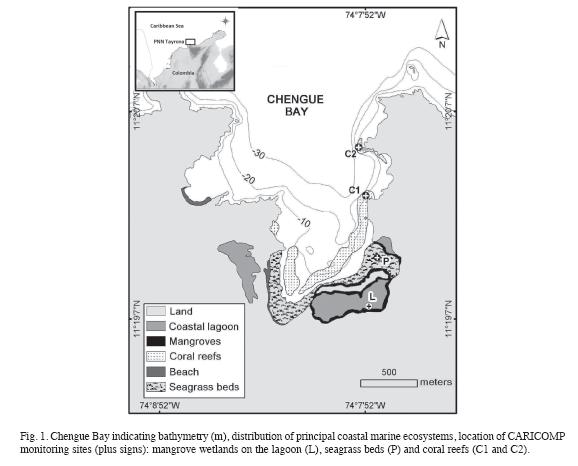
<body><![CDATA[<div style="text-align: justify;"><b><font face="Verdana" size="2">Study site: </font></b><font face="Verdana" size="2">Chengue is a small bay (surface area 3.3km2) located in the Parque Nacional Natural Tayrona, 14km northeast of the city of Santa Marta on the Caribbean coast of Colombia (11°20´ N, 74°08´W) (<a href="#f1">Fig. 1</a>). The coastal topography is heterogeneous, with steep relief due to the closeness of the Sierra Nevada de Santa Marta, the highest mountain system in Colombia (5 800m above sea level). Consequently, the landscape is shaped by numerous rocky headlands, islets, inlets, and bays with sedimentary beaches, small lagoons and small river discharges (Garzón-Ferreira &amp; Cano 1991). Regional climate and oceanography are determined by coastal topography and trade wind incidence, with a dry season from December to April, when strong NE trade winds (3.5ms-1) reduce precipitation and generate </font><font face="Verdana" size="2">an upwelling that transports cold water (mean 25.5°C) from 100-200m depth to the surface (Bula-Meyer 1977, Ramírez 1983); and a rainy season from May to November, with lower-velocity trade winds (mean 1.5m s-1), higher precipitation (&gt;80% of the annual total) and sea surface temperature (mean 28.0°C), and frequently turbid currents (continental runoff) entering the bay (Garzón-Ferreira 1998). A narrow continental shelf, with depths of 200m only 2km from shore, supports small but highly diverse biological communities and ecosystems. Chengue has low human intervention, although some activities have an impact </font><font  face="Verdana" size="2">on marine ecosystems.</font>    <br> </div> <font face="Verdana" size="2">    <br> </font> <font face="Verdana" size="2">    <br> <img alt="" src="/img/revistas/rbt/v58s3/art05f1.jpg"  style="width: 578px; height: 466px;"><a name="f1"></a></font></div>     <div style="text-align: justify;"><font face="Verdana" size="2">CARICOMP monitoring in Chengue Bay is conducted in three ecosystems: mangroves, seagrass beds, and coral reefs, which have developed at the eastern and southern shores (<a  href="#f1">Fig. 1</a>), where trade wind-induced wave action is low; instead, the bay’s NW shore is influenced by high wave energy and clearly dominated by rocky bottoms. Coral reef communities in Chengue have been reviewed by several authors (Werding &amp; Erhardt 1976, Solano 1987, Garzón-Ferreira &amp; Cano 1991), concluding in a general description of thirtyone species of hermatypic corals and three hydrocorals. Two main types of reefs are identified in Chengue (Garzón-Ferreira 1998): 1) narrow, short coastal fringing reefs growing over the belt of metamorphic rocks in the northern deep half of the bay, dominated by massive and encrusting corals (mainly <i>Diploria</i>, <i>Montastraea</i>, and <i>Colpophillia</i>), which form a reef slope extending to a depth of 15-25m and ; (2) extensive fringing reefs growing away from the shore on sedimentary flats of the bay, dominated by foliaceous and branching corals (<i>Acropora palmata</i>, <i>Agaricia tenuifolia </i></font><font face="Verdana"  size="2">and <i>Millepora</i>), which become reef slopes covered with massive corals at depths of 6-8m.</font>    <br>     <br> <font face="Verdana" size="2">All five species of seagrass beds occurring in Colombia are found in Chengue. <i>Thalassia testudinum </i>beds (where CARICOMP monitoring is conducted) are the most extensive, although restricted to shallow waters in the southern portion of the bay (&lt;3m depth) (Rodríguez-Ramírez &amp; Garzón-Ferreira 2003). Within these beds are found patches of <i>Syringodium filiforme </i>and, less frequently, <i>Halodule wrightii </i>and <i>Halophila baillonis</i>. In deeper waters of the eastern bay wide stands of <i>Halophila decipiens </i>also occur. <i>Thalassia </i>beds grow over calcareous sediments, mainly coarse sand and coral rubble. The calcareous algae <i>Halimeda opuntia </i>is particularly abundant, and in many places, is the dominant live component covering the bottom of <i>Thalassia </i>beds (Garzón-Ferreira &amp; Cano 1991). Chengue exhibits the most important mangrove formation in the national park, which is associated with a coastal lagoon (<a href="#f1">Fig. 1</a>) surrounded mostly by Red mangrove <i>Rhizophora mangle </i>reaching heights of 13m and densities of 3800 trees/ha (Garzón-Ferreira &amp; Cano 1991, Garzón-Ferreira 1998). Nearby, in less swampy terrain, three additional species are found: <i>Avicennia germinans</i>, <i>Conocarpus erectus, </i>and <i>Laguncularia racemosa</i>. More detailed information about coastal ecosystems in Chengue is provided by Rodríguez-Ramírez &amp; Garzón-Ferreira (2003) and Rodríguez-Ramírez <i>et al. </i>(2004). </font></div> <font face="Verdana" size="2"><b>     <p>Coral reef sampling and data analysis:</p> </b></font>     <p style="text-align: justify;"><font face="Verdana" size="2">The cover of benthic components was estimated annually along five 10 m permanent marked transects on two reef sites (<a href="#f1">Fig. 1</a>). Transects were sampled using a light chain; components beneath each link were recorded following categories used by CARICOMP (2001). Hard corals were identified to the lowest possible taxonomic level (genus or species). Incidence of coral diseases and bleaching were estimated by examining every hard coral colony (&gt;5cm) within a 2m wide band along each 10m transect. A PVC 1-m pipe marked every 5cm was used as a reference to estimate colony size and band width while swimming at each side of the transect line. Each colony was identified to species level and its surface examined carefully to record the presence of any disease or bleaching. The abundance of important mobile invertebrates (lobsters, octopuses, crabs and sea urchins) was also recorded along each belt transect (10x2m). </font></p>     <p style="text-align: justify;"><font face="Verdana" size="2">Prior to analyses, cover estimates were arcsine transformed. Overall means were calculated by averaging annual means values (averaging all transects per year) by each variable. Temporal trends of coral, algae (pooling turf, fleshy, encrusting and calcareous algae) and abiotic substrate were evaluated by repeated measures ANOVA. We used the univariate approach and the Greenhouse-Geisser corrected probability to test F (adjustment for multiple comparisons: Bonferroni).</font></p>     ]]></body>
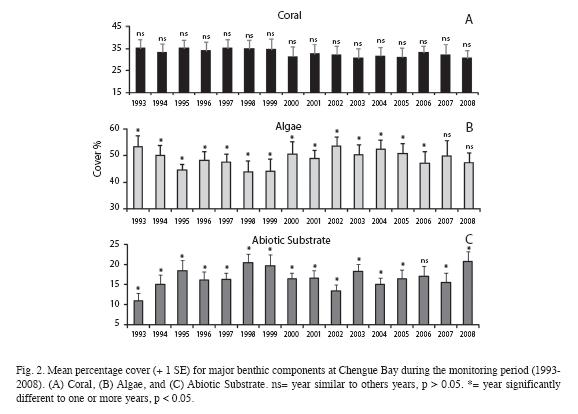
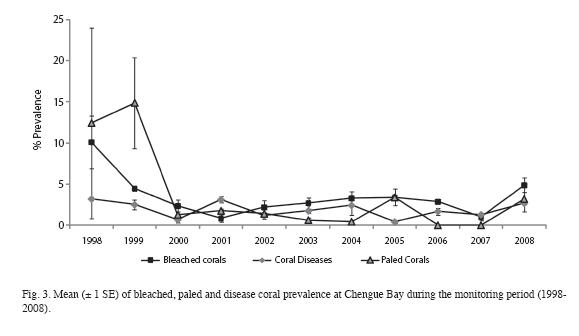
<body><![CDATA[<div style="text-align: justify;"><font face="Verdana" size="2"><b>Seagrass sampling and data analysis: </b>Seagrass community was monitored in two sampling stations to the SE in Chengue Bay which had luxuriant <i>Thalassia testudinum </i>beds (<a href="#f1">Fig. 1</a>). In each station, net above-ground productivity and shoot densities of <i>T. testudinum </i>were determined annually (each September) using the leaf marking technique from CARICOMP (2001). Shoots within six tagged wire quadrats (20x10cm) were marked a short distance above the green/white interface at the leaf base with a single punch of a needle. After a growth period of 8 days, the shoots were counted and extracted in order to estimate shoot densities. Each leaf was cut at the marked point and sorted into three fractions, -new leaves (unmarked leaves that had emerged after marking), old growth (the part of the leaves between the needle mark and meristem (=green-white interface) and old standing crop (the leaf part above the needle mark)-. Leaf fractions were decalcified in 10% hydrochloric acid, rinsed and dried at 75°C to constant weight for dry weight determination. Additionally, five shoots were collected from </font><font face="Verdana" size="2">each sampling station to estimate Leaf Area Index (LAI). Leaf blades were counted, and total length and width of each leaf measured. Leaf area per shoot and LAI, which is the product of leaf area per shoot and shoot density, were calculated. Environmental data at the sampling stations were registered; temperature and salinity were measured with data loggers and a hand refractometer, respectively. Light attenuation (water transparency) was measured horizontally with a Secchi disk and expressed as the length at which the disk no longer could be seen.</font> </div>     <p style="text-align: justify;"><font face="Verdana" size="2">Mean values of productivity (g/m2/day), shoot density (shoots/200cm2) and LAI were used to estimate temporal trends. A polynomial model was used to fit the data if R2&#8805;0.70. Pearson’s correlations were run to identify relationships between environmental variables and biological data.</font></p>     <div style="text-align: justify;"><font face="Verdana" size="2"><b>Mangrove sampling and data analysis: </b>Mangrove assessment was conducted following the CARICOMP monitoring methods (CARICOMP 2001). The site was established along the southeastern shore of Chengue Bay, where <i>Rhizophora mangle </i>appeared to be dominant in a fringing forest (<a href="#f1">Fig. 1</a>). To determine the structural attributes of the red mangrove, three plots of 10x10m (0.01ha) were established randomly inside the forest and monitored at one year intervals. Inside each plot, all trees with trunk diameter greater than 2.5cm inside a square 10m side were marked with consecutive numbers, and mapped to facilitate their relocation the following year. Height above sediment of the highest prop root (m), length of trunk (m), diameter at breast height or DBH (cm), basal area (ground space covered by trees in m2/ha), density (trees/100m2) and biomass (kg/m2) were all recorded annually. The latter variable was calculated using the DBH conversion factor of Golley <i>et al. </i>(1962). The complexity of the forest in terms of the structure of trees was estimated with the Holdridge index (Holdridge <i>et al. </i>1971). The mean annual structural variables were calculated averaging the three plots. Within each same plot, primary productivity was estimated based on litterfall (g/m2/day). Ten fall traps of 50x50cm (0.25m2) were deployed at regular intervals and collected one month later (October through November). Additionally, the interstitial salinity was measured. In the laboratory, the samples were classified (leaves, bracts, fruits, flowers, wood/ twigs, frass and branches) and oven dried to 70°C for 48 hours, before being weighed. Subsequently, means data for the traps in the three plots were calculated to obtain overall means for October and November.</font> </div>     <p style="text-align: justify;"><b><font face="Verdana" size="3">Results</font></b></p>     <div style="text-align: justify;"><b><font face="Verdana" size="2"> </font></b></div>     <div style="text-align: justify;"><b><font face="Verdana" size="2">Coral reefs: </font></b><font face="Verdana" size="2">Overall means of coral and algal cover at Chengue were 33% (SE±0.42) and 48.8% (SE±0.78) respectively. Algal turf was the most abundant biotic and algal component (mean=30.6% (SE±1.41) and the dominant coral species belonged to the <i>Montastraea annularis </i>complex (18.3% SE±0.47).Live coral cover has remained stable during the study period (no significant differences from 1993 to 2008, repeated measure ANOVA p&gt;0.05, <a href="#f2">Fig. 2A</a>). Only a slight decrease (~4%) in coral cover was registered between 1999 and 2000 (<a href="#f2">Fig. 2A</a>). In contrast, algal cover and abiotic substrate have showed high variability (<a href="#f2">Fig. 2B,C</a>). Algae ranged from 43.8% in 1998 to 53.5% in 2002 (<a href="#f2">Fig. 2B</a>) and abiotic substrate from 11% in 1993 to 20.7% in 2008 (<a href="#f2">Fig 2C</a>). These components displayed several significant differences among years but no clear trends (increase or decrease) were evident (<a href="#f2">Fig. 2B,C</a>).</font>    <br> </div>     <p style="text-align: center;"><font face="Verdana" size="2"><img alt=""  src="/img/revistas/rbt/v58s3/art05f2.jpg"  style="width: 578px; height: 414px;"><a name="f2"></a>    <br> </font></p>     <div style="text-align: justify;"><font face="Verdana" size="2">Few changes in disease prevalence, coral bleaching and paled corals were observed between 1998 and 2008 (<a  href="#f3">Fig. 3</a>). The major bleaching event occurred during 1998, the first year of monitoring; with 10% of corals being affected. In 1999, this percentage decreased to about 4%, and continued to decrease in successive years. Thereafter, bleaching rates were under 4%, until 2008 when bleached corals reached 5% of the total of colonies in the transects. Paled corals registered similar </font><font face="Verdana" size="2">tendencies to bleached corals, with values over 12% in 1998, increasing to close to 15% in 1999. After 1999, the registered percentage of paled corals stayed below 2%, except in 2005 and 2008, when the percentage of paled corals increased to over 3%. Coral diseases such as Black Band Disease, White Band Disease, Yellow Band Disease and White Plague have been observed in Chengue. The most prevalent coral diseases during the 10 years of monitoring were Dark Spots Disease (0.0%-2.5%) and White Plague (0.2%- 2.3%). Lobsters (<i>Panulirus </i>spp.) and octopuses (<i>Octopus </i>spp.) were sporadically observed in transects. Sea urchins (<i>Echinometra </i>spp<i>. </i>And <i>Diadema antillarum</i>) were scarce (maximum density 0.025 individuals/m</font><font face="Verdana" size="1">2 </font><font  face="Verdana" size="2">in 2007).</font>     ]]></body>
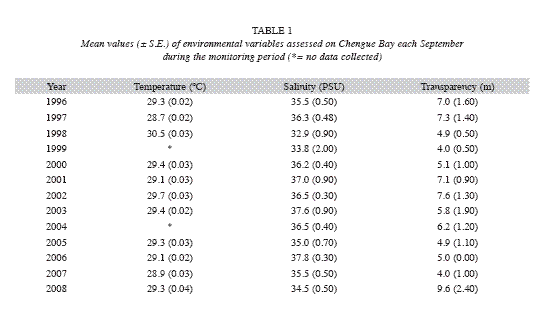
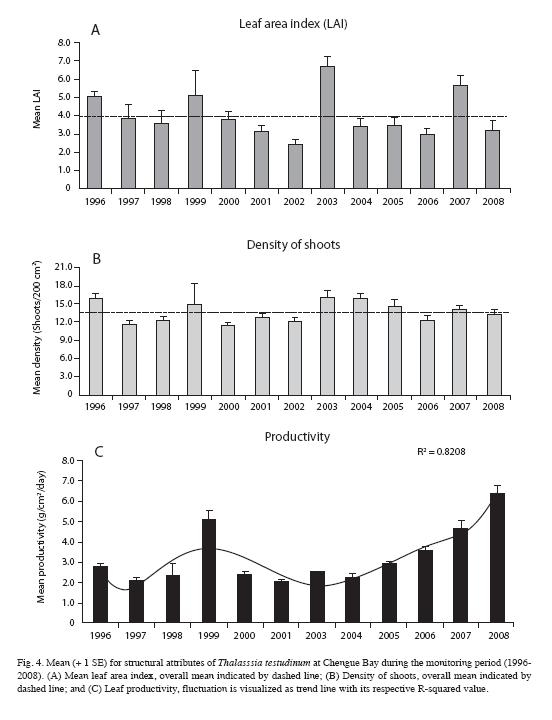
<body><![CDATA[<br>     <br> <font face="Verdana" size="2"><b>Seagrass beds: </b>Structural parameters of <i>T. testudinum </i>beds on Chengue Bay showed different trends over the monitoring time (<a href="#f4">Fig. 4</a>); thus: 1) LAI had periodic maximum peaks every 3-4 years, during 1996, 1999, 2003 and 2007; however, analysis showed no time trend (polynomial regression; R</font><font  face="Verdana" size="1">2</font><font face="Verdana" size="2">&lt;0.70). Overall mean value for LAI was 4.0±0.5, with fluctuations from 2.4± 0.3 (in 2002) to 6.7±0.5 (in 2003). 2) Density of shoots showed several fluctuations, but not as marked as LAI; maximum peaks were found in 1996, 1999, 2003, 2004 and 2005, and no time trend was evident (polynomial regression; R2 &lt;0.70). Overall mean value for shoot </font><font face="Verdana" size="2">density was 13.5±0.5 shoots/200cm2; with fluctuations from 11.3±0.5 (in 2002) to 16.1±1.1 (in 2003) shoots/200cm2. 3) Productivity was constant during most of the monitoring period (near 2.5 g/m2/day); however, during 1999 an extremely high value was evident, and since 2005 mean values showed a significant progressive increase (R2&gt;0.70). No correlations were identified between environmental variables and biological data (Pearson, all r values between </font><font face="Verdana" size="2">-0.390 and 0.135 and p values &gt;0.05). Means of environmental data during the sampling periods are shown in <a href="#t1">Table 1</a>.</font>    <br> </div> <font face="Verdana" size="2">    <br> </font>     <div style="text-align: center;"><font face="Verdana" size="2"><img  alt="" src="/img/revistas/rbt/v58s3/art05t1.gif"  style="width: 538px; height: 312px;"><a name="t1"></a>    <br>     <br> <img alt="" src="/img/revistas/rbt/v58s3/art05f3.jpg"  style="width: 579px; height: 336px;"><a name="f3"></a>    <br>     <br>     <br> <img alt="" src="/img/revistas/rbt/v58s3/art05f4.jpg"  style="width: 552px; height: 720px;"><a name="f4"></a>    ]]></body>
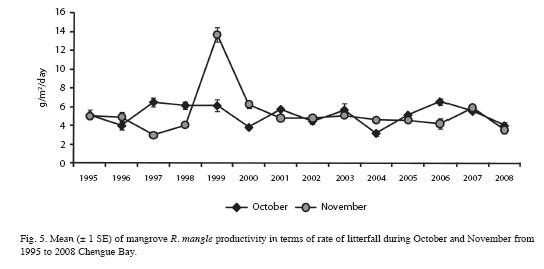
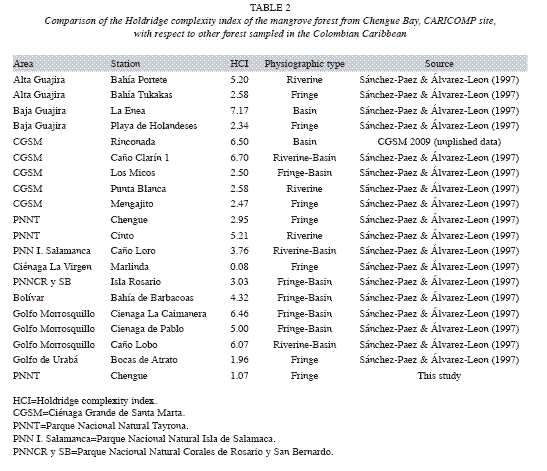
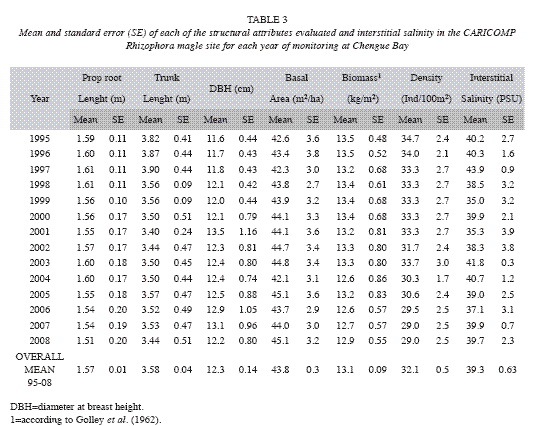
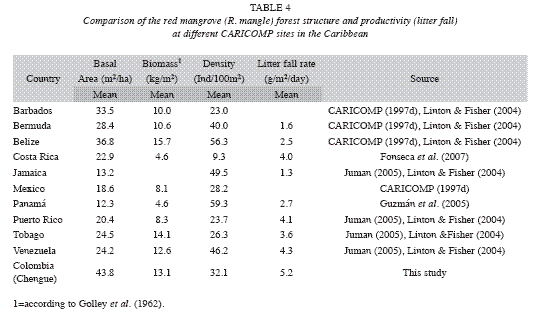
<body><![CDATA[<br>     <br> </font></div>     <div style="text-align: justify;"><font face="Verdana" size="2"><b>Mangrove: </b>Red mangrove (<i>R. mangle</i>) formations on the southeastern coastal lagoon, at Chengue, have been assessed annually since 1995 (13 years). The structural complexityaccording to the Holdridge index had a mean value of 1.07 (<a href="#t2">Table 2</a>). Key average characteristics of the Red mangrove included: 1) 1.57m highest prop root, 2) 3.58m trunk length, 3) 12.3cm of DBH, 4) 43.8m2/ha basal area, 5) 13.1kg/m2 biomass and 6) a density of 32.1 trees/100m2. The mean value of interstitial salinity was 39.3. No major structural changes in the mangrove stand have been recorded over the monitoring period. Detailed information on the values of each structural component is shown in <a href="#t3">Table 3</a>. The mean litter production </font><font face="Verdana" size="2">remained constant between 4.0 and 6.0g/m2/ day; however, a minimum value of 3.0 g/m2/ day was registered during 1997 and a remarkable maximum value of 13.7g/m2/day during 1999 (<a href="#f5">Fig. 5</a>).</font>    <br> </div> <font face="Verdana" size="2">    <br> </font>     <div style="text-align: center;"><font face="Verdana" size="2"><img  alt="" src="/img/revistas/rbt/v58s3/art05f5.jpg"  style="width: 544px; height: 269px;"><a name="f5"></a></font>    <br> </div>     <p><b><font face="Verdana" size="3">Discussion </font></b></p> <font face="Verdana" size="2"> </font>     <p style="text-align: justify;"><font face="Verdana" size="2">The results from this monitoring program are significant because they document the temporal variation of key structural and functional variables in local coral reefs, seagrass beds and mangroves over a 16 year monitoring period. Furthermore, they constitute a valuable baseline to assess the long-term dynamics of the most important marine ecosystems in the Caribbean. </font></p>     <div style="text-align: justify;">     ]]></body>
<body><![CDATA[<div style="text-align: justify;"><font face="Verdana" size="2"><b>Coral reefs: </b>Monitored sites in Chengue resemble many reefs across the Western Atlantic, Wider Caribbean and the Gulf of Mexico in terms of major benthic components. Overall, means of coral and algae cover are within maximum and minimum values registered on a regional scale by CARICOMP and AGRRA programs. Algal cover may range from less than 5% in Cayo Sombrero, Venezuela up to 90% in Puerto Morelos, México (CARICOMP <i>et al</i>. 2002, Linton &amp; Fisher 2004) and coral cover may vary from 2.5% in Costa Rica to 57.8% in Flower Garden Banks, USA (Kramer 2003). Both programs have found a dominance of <i>Montastraea annularis </i>complex and algal turfs (CARICOMP <i>et al. </i>2002, Kramer 2003). </font>    <br> </div>     <br> <font face="Verdana" size="2">Our findings showed that there is a pattern of stability for coral cover but there is no clear trend in algal cover at monitoring sites between 1993 and 2008. Thus coral cover has remained fairly unchanged during the last 16 years. Previous temporal analyses of coral cover at Chengue found a similar trend between 1993 and 2000 (CARICOMP <i>et al. </i>2002, Rodríguez- Ramírez &amp; Garzón Ferreira 2003). Although this appears to conflict with two meta-analyses pointing out significant trends of decline in the Caribbean region, in particular the loss of coral cover and/or increase in algae abundance (Gardner <i>et al. </i>2003, Côté <i>et al. </i>2005), recent studies on coral reef dynamics in the Caribbean and Florida Keys have documented similar patterns of stability in coral cover at local scales (CARICOMP <i>et al. </i>2002, Roggers &amp; Miller&nbsp; </font><font  face="Verdana" size="2">2006, Edmunds &amp; Elahi, 2007, Somerfield <i>et al. </i>2008, Rodríguez-Ramírez <i>et al. </i>2010). The minor reduction registered in coral cover was due to Hurricane Lenny, which touched marginally the north coast of South America by November 14-16, 1999 (Rodríguez-Ramírez &amp; Garzón-Ferreira 2003). However, the lack of changes in coral cover at the monitoring sites does not mean that these reefs may not have </font><font face="Verdana"  size="2">been under a process of decline. Temporal analyses of coral species show that significant losses have occurred in other reef assemblages in Chengue (Rodríguez-Ramírez <i>et al. </i>2010). </font>    <br>     <br> <font face="Verdana" size="2">Although previous analysis had revealed a decreasing trend in algal cover between 1993 and 1999 for monitoring sites in Chengue (CARICOMP <i>et al. </i>2002, Rodríguez-Ramírez &amp; Garzón-Ferreira 2003), our results showed that there is no overall pattern of decrease or increase from 1993 to 2008 (<a href="#f2">Fig. 2B</a>). Clearly, algal variations were not related to changes in coral cover. Instead they reflected transitions with the abiotic substrate. According to Rodríguez-Ramírez &amp; Garzón-Ferreira (2003) this concomitant variation between algae and abiotic substrate may represent some sampling bias laying out the chain on the substratum. On the other hand, algal variations could be associated with seasonal changes because surveys have been done during the rainy season (October-December) where algal communities experience noticeable changes in composition and abundance (Díaz-Pulido &amp; Garzón-Ferreira 2002). However further analyses are required to explain fully the relationship between algal and abiotic substrate variations. </font>    <br>     <br> <font face="Verdana" size="2">During the study period, Chengue reefs suffered from bleaching (in 1995, 1998, 1999, </font><font face="Verdana" size="2">2005 and 2008) and have been affected by coral diseases. Earlier studies recognized these stress factors caused minor coral mortality (CARICOMP 1997b, Rodríguez-Ramírez &amp; Garzón-Ferreira 2003, Gil-Agudelo <i>et al. </i>2006, Rodríguez-Ramírez <i>et al</i>. 2008). In general, the prevalence of bleached corals remained </font><font face="Verdana" size="2">below 4% and paled corals below 2%, which is considered normal for the Caribbean (Weil <i>et al</i>. 2006). In 2005, a major bleaching event occurred in the Caribbean region (Wilkinson &amp; Sauter 2008), but corals in Chengue Bay showed only a slight increase in the average of bleaching and paled corals (both close to 3.5%). This event did not have an effect in this area as large as in other places, probably due to </font><font face="Verdana"  size="2">local seasonal upwelling (Rodríguez-Ramírez <i>et al</i>. 2008). Regarding coral diseases, all the most important coral diseases reported for the Caribbean (Black Band Disease, White Band Disease, Yellow Band Disease; see Garzón- Ferreira <i>et al. </i>2001, Weil <i>et al. </i>2006) were observed in Chengue, but the most prevalent </font><font face="Verdana" size="2">coral </font><font face="Verdana" size="2">diseases were Dark Spots Disease and White Plague. The prevalence of coral diseases remained relatively low and stable during these 10 years of monitoring, usually staying below 2% and increasing to over 3% (in 1998 and 2001). Thus, the bleaching and diseases data suggest that, in comparison with other Caribbean </font><font face="Verdana" size="2">coral reefs, Chengue reefs have exhibited an important degree of resistance to mass bleaching events and coral diseases. </font>    <br>     <br> <font face="Verdana" size="2">Because there are no historical records about the abundance of mobile invertebrates of commercial value before the beginning of CARICOMP activities, it is not possible to assess if these organisms have suffered from overfishing or if their low density is a natural condition in Chengue. However, during the years of the monitoring program it has been possible to observe that Chengue is frequently visited by fishermen divers who capture lobsters, crabs, octopuses and other large invertebrates. </font> </div>     <p style="text-align: justify;"><font face="Verdana" size="2">Sea urchins results are consistent with composition and density patterns found elsewhere in the Caribbean by CARICOMP (CARICOMP <i>et al. </i>2002, Linton &amp; Fisher 2004) and support previous findings for these invertebrates at Chengue (Rodríguez-Ramírez &amp; Garzón-Ferreira 2003, Rodríguez-Ramírez <i>et al. </i>2006). Although few urchins were recorded in the monitoring transects, important populations of these organisms (including <i>D. antillarum</i>) have been observed is shallow reefs of Chengue. This suggests a depth-related spatial distribution of urchins that is probably controlled by the competitive interactions with the damselfish <i>Stegastes planifrons</i>. The territories of this fish species are abundant at the depth interval where monitoring transects are located in Chengue (Santodomingo <i>et al. </i>2002, Rodríguez-Ramírez <i>et al. </i>2006). Herbivorous sea urchins, such as <i>D. antillarum </i>and <i>Echinometra viridis</i>, are aggressively excluded from damselfish territories (see Ceccarelli <i>et al </i>2001 for review).</font></p>     ]]></body>
<body><![CDATA[<div style="text-align: justify;"><font face="Verdana" size="2"><b>Seagrass beds: </b>Structural parameters found in this study reveal a healthy and productive seagrass bed on the Chengue Bay monitoring site. LAI historical data showed periods of relative stability followed by peaks (<a href="#f4">Fig. 4A</a>); this pattern could be a sign of a cyclical renewal tendency in the ecosystem, in which the lower values for some years (<i>e.g. </i>1998, 2002 and 2006) indicate a greater number of new leaves (low leaf height and width) in a developing community. Height and width may also be indicators of stress in seagrass communities, both decreasing when plants are exposed to unfavourable environmental factors; however, considering the relative homogeneous fluctuation of LAI values during the monitoring period, stress may not be the cause of lower values in this case. Additionally, overall mean of leaf area index was high compared to other CARICOMP sites (CARICOMP 1997c, Linton &amp; Fisher 2004). Overall mean density of shoots in Chengue was higher compared to other CARICOMP sites (Linton &amp; Fisher 2004), and fluctuation among years remained near the mean value. These conditions could also be a sign of relative stability and healthy stands of <i>T. testudinum </i>on the Bay. Progressive increase of productivity of <i>T. testudinum </i>during the last years of monitoring reflects a healthy community developing under favourable environmental conditions. It is clear that production of seagrass beds is usually limited by resource availability (mainly nutrient concentration and light quality) and/or heavy losses caused by&nbsp; </font><font face="Verdana" size="2">physical disturbances (Powell <i>et al</i>. 1989, Duarte &amp; Chiscano 1999); according to this, it could be assumed that conditions within the Bay such as nutrient inputs from adjacent mangroves and from seasonal upwelling waters, low exposure to river discharges, and low human intervention, favour the productivity potential of <i>T. testudinum </i>beds. Our observations of productivity are limited to the above ground vegetative expansion, but wider quantitative measures including growth of the underground rhizomes and roots should be carried out to reflect other aspects of plant expansion and maturation (Short &amp; Coles 2001). </font>    <br>     <br> <font face="Verdana" size="2">Since no significant correlation was foundbetween environmental data (temperature, </font><font  style="font-family: verdana;" face="Times-Roman" size="2">water transparency and salinity) and biological parameters of </font><i><font face="Verdana" size="2">T. testudinum </font></i><font face="Verdana" size="2">beds (density of shoots, net above-ground productivity and LAI), it is assumed that fluctuations detected for some structural parameters are better explained by cyclical renewal tendencies more than a response of the community to interannual environmental changes. However samplings along the year are required to establish </font><span  style="font-family: verdana;"></span><font face="Verdana" size="2">potential relationships between environmental variables and biological data because our results are constrained to a single period during the year. </font>    <br>     <br> <font face="Verdana" size="2">Monitoring results may characterize the seagrass beds on Chengue Bay as a lush, healthy and productive ecosystem on the Colombian Caribbean. Its inclusion in a legally protected area with low human intervention, moderate continental influx, seasonal upwelling and its proximity to productive mangroves and coral reefs, are special characteristics that must favour the current condition of these seagrass beds. </font>    <br>     <br> <font face="Verdana" size="2"><b>Mangrove: </b>The Red mangrove forest in Chengue Bay has a low structural complexity compared with other mangrove forests along the Colombian Caribbean (<a href="#t2">Table 2</a>). Relatively small tree sizes, poorly defined wood, very intricate and branched forest (Garzón-Ferreira 1998) are essential characteristics of the site. These features are related to deficiencies in water flow, high salt content and soil conditions (<a href="#t3">Table 3</a>). In contrast with the mean structural attributes of some of these variables in other mangrove forests in the Caribbean (<a  href="#t4">Table 4</a>), most of the data in this study are close to the highest values reported for other CARICOMP</font><font face="Verdana" size="2"> network locations. The results showed that no major structural changes have occurred since 1995 (<a href="#t3">Table 3</a>). However, variations in biomass, basal area and density, were due mainly to the death of 18% of trees assessed inside the plots.</font> <font  face="Verdana" size="2">This may have been caused by insect damage (Rodríguez-Ramírez &amp; Garzon-Ferreira 2003). Attacks from xylophagous insects and other pests of some trees are part of the natural mangroves cycles that do not have a major influence on mangrove populations (Villalobos <i>et al. </i>1996). Human intervention could not have affected directly the structural development of the forest, considering that no evidence of human disturbance was observed on the sample plots. At global level, the mangrove ecosistema is severely threatened and has lost at least 35%</font> <font face="Verdana" size="2">of the area of mangrove forests in the past two decades. This is due partly to global changes, but mainly to human activities such as construction, mariculture and agriculture (Valiela <i>et al. </i>2001, Halpern <i>et al. </i>2007). In this context, it is suggested that the mangrove in Chengue differs from this scenario because it has not undergone major disturbances over the period of the study, with some alterations primarily influenced by natural degradation factors. </font>    <br> </div> <font face="Verdana" size="2">    <br> </font>     <div style="text-align: center;"><font face="Verdana" size="2"><img  alt="" src="/img/revistas/rbt/v58s3/art05t2.gif"  style="width: 547px; height: 471px;"><a name="t2"></a></font>    ]]></body>
<body><![CDATA[<br>     <br> </div> <font face="Verdana" size="2">    <br> </font>     <div style="text-align: justify;"><font face="Verdana" size="2">The cause of the decline in productivity (litterfall) recorded in November 1997 is unknown, but the high values obtained during November 1999 were related to the rains and strong winds associated with hurricane Lenny (Rodríguez-Ramírez &amp; Garzon-Ferreira 2003). Such factors may lead to defoliation, fragmentation and the downfall of the wood of the mangrove trees (Cintrón &amp; Schaeffer-Novelli 1983, Salazar-Vallejo 2002, Rodríguez-Ramírez &amp; Reyes-Nivia 2008). Compared to other CARICOMP areas in the Caribbean, Chengue is one of the most productive mangroves in terms of litterfall (<a href="#t4">Table 4</a>). This condition is related to the interstitial salinity (overall mean 39.3, <a  href="#t3">Table 3</a>), which is higher than the optimum range mentioned by Prahl (1990) (15 and 25) and a consequence of the fresh water deficit that causes defoliation. Moreover, October and November are rainy months, which promote litterfall and their transport out of the system. The high rate of litter production indicates that</font><font face="Verdana" size="2"> the mangrove is providing a significant input of energy and nutrients to adjacent ecosystems (seagrass beds and coral reef) within the bay. </font>    <br> </div> <font face="Verdana" size="2">    <br> </font>     <div style="text-align: center;"><font face="Verdana" size="2"><img  alt="" src="/img/revistas/rbt/v58s3/art05t3.gif"  style="width: 540px; height: 426px;"><a name="t3"></a>    <br>     <br> <img alt="" src="/img/revistas/rbt/v58s3/art05t4.gif"  style="width: 544px; height: 318px;"><a name="t4"></a>    <br> </font></div> <font face="Verdana" size="2">    ]]></body>
<body><![CDATA[<br>     <br> </font>     <div style="text-align: justify;"><font face="Verdana" size="2">The results of this study are meaningful because they illustrate a remarkable stability of the study sites at Chengue Bay contrasting with the recent context of decline at regional and global scales for marine ecosystems (Valiela <i>et al</i>. 2001, Gardner <i>et al. </i>2003, Lotze <i>et al</i>. 2006, Waycott <i>et al</i>. 2009). Although an analysis of the global network of Marine Protected Areas (MPAs) showed that management is very limited for the Tayrona Park-including Chengue bay- (Mora <i>et al. </i>2006), </font><font  face="Verdana" size="2">our outcomes suggest this park can preserve coastal marine communities as long as they are subjected to moderate levels of natural and anthropogenic disturbances. Given that human populations are largely dependent on marine ecosystems, the loss of these habitats and their associated biodiversity may have </font><font  face="Verdana" size="2">enormous implications for human societies around the world. Therefore, Chengue bay appears to be an essential refuge of biodiversity in the Colombian Caribbean and may have an important role in terms of resistance and resilience to the effects of climate change. </font>    <br>     <br> <font face="Verdana" size="2">In summary, we did not find evidence of decline trends in the coral reef, seagrass and mangrove sites at Chengue over the monitoring period. Annual variations in coral reefs and mangroves were related to the effects of an isolated event, namely Hurricane Lenny. The observed patterns in seagrasses appear to characterize the natural variability of cyclical renewal processes. Therefore, our results suggest that monitoring sites at the three ecosystems have had a healthy development in the last 16 years. This information is a unique upport for management and conservation purposes at Tayrona Natural Park. As Chengue ecosystems&nbsp; can be critical for ecological processes and also tourism benefits in the region, an effective enforcement on the marine ecosystems inside the Tayrona Park is required. </font> <b><font face="Verdana" size="3">     <p>Acknowledgments</p> </font></b><font face="Verdana" size="2"> This work has been funded in great part by grants from COLCIENCIAS, Ministerio del Medio Ambiente, Vivienda y Desarrollo Territorial (MAVDT), the Regional Coordinating Unit of the Caribbean Environment Programme of the United Nations Environment Programme (UNEP-CAR/RCU) and CARICOMP. The Instituto de Investigaciones Marinas y Costeras (INVEMAR) has provided most of the required logistics and indirect costs. Thanks to Francisco Arias (INVEMAR), John Ogden, Debby Haynes, Sandy Vargo and Dean Milliken (Florida Institute of Oceanography), Dulcie Linton (Data Management Center-Univ. West Indies, Jamaica) and Alessandra Vanzella (UNEP). Numerous colleagues and students from INVEMAR and other institutions have participated directly in the monitoring activities at Chengue; without their assistance, this study would not have been possible. We finally would like to thank four anonymous reviewers for their constructive criticisms which reatly improved the manuscript. Contribution No. CTRB-1055 from INVEMAR.     <p>&nbsp;</p> </font> </div> <hr ="">     <div style="text-align: justify;"><b><font face="Verdana" size="3">References    <br>     <!-- ref --><br> </font></b> <font face="Verdana" size="2">Aronson, R.B., I.G. MacIntyre, C.M. Wapnick &amp; M.W. O´Neill. 2004. Phase shifts, alternative states, and the unprecedented convergence of two reef systems. Ecology 85: 1876-1891.    &nbsp;&nbsp;&nbsp;&nbsp;&nbsp;&nbsp;&nbsp;&nbsp;[&#160;<a href="javascript:void(0);" onclick="javascript: window.open('/scielo.php?script=sci_nlinks&ref=1725509&pid=S0034-7744201000070000500001&lng=','','width=640,height=500,resizable=yes,scrollbars=1,menubar=yes,');">Links</a>&#160;]<!-- end-ref --></font> </div>     <!-- ref --><p style="text-align: justify;"><font face="Verdana" size="2">Bellwood, D.R., T.P. Hughes, C. Folke &amp; M. Nystrom. 2004. Confronting the coral reef crisis. Nature 429: 827-833.    &nbsp;&nbsp;&nbsp;&nbsp;&nbsp;&nbsp;&nbsp;&nbsp;[&#160;<a href="javascript:void(0);" onclick="javascript: window.open('/scielo.php?script=sci_nlinks&ref=1725511&pid=S0034-7744201000070000500002&lng=','','width=640,height=500,resizable=yes,scrollbars=1,menubar=yes,');">Links</a>&#160;]<!-- end-ref --></font></p>     <!-- ref --><p style="text-align: justify;"><font face="Verdana" size="2">Bruno, J. &amp; E.R. Selig. 2007. Regional decline of coral cover in the Indo-Pacific: Timing, extent, and subregional comparisons. PLoS ONE 2: e711.    &nbsp;&nbsp;&nbsp;&nbsp;&nbsp;&nbsp;&nbsp;&nbsp;[&#160;<a href="javascript:void(0);" onclick="javascript: window.open('/scielo.php?script=sci_nlinks&ref=1725513&pid=S0034-7744201000070000500003&lng=','','width=640,height=500,resizable=yes,scrollbars=1,menubar=yes,');">Links</a>&#160;]<!-- end-ref --> </font></p>     <!-- ref --><p style="text-align: justify;"><font face="Verdana" size="2">Bula-Meyer, G. 1977. Algas marinas bénticas indicadoras de un agua afectada por aguas de surgencia frente a la costa Caribe de Colombia. An. Inst. Invest. Mar. Punta Betín 9: 45-71.    &nbsp;&nbsp;&nbsp;&nbsp;&nbsp;&nbsp;&nbsp;&nbsp;[&#160;<a href="javascript:void(0);" onclick="javascript: window.open('/scielo.php?script=sci_nlinks&ref=1725515&pid=S0034-7744201000070000500004&lng=','','width=640,height=500,resizable=yes,scrollbars=1,menubar=yes,');">Links</a>&#160;]<!-- end-ref --></font></p>     <!-- ref --><p style="text-align: justify;"><font face="Verdana" size="2">CARICOMP. 1997a. Caribbean Coastal Marine Productivity (CARICOMP): A research and monitoring network of marine laboratories, parks and reserves. Proc. 8<sup>th</sup> Int. Coral Reef Symp. 1: 641-646.    &nbsp;&nbsp;&nbsp;&nbsp;&nbsp;&nbsp;&nbsp;&nbsp;[&#160;<a href="javascript:void(0);" onclick="javascript: window.open('/scielo.php?script=sci_nlinks&ref=1725517&pid=S0034-7744201000070000500005&lng=','','width=640,height=500,resizable=yes,scrollbars=1,menubar=yes,');">Links</a>&#160;]<!-- end-ref --> </font></p>     <!-- ref --><p style="text-align: justify;"><font face="Verdana" size="2">CARICOMP. 1997b. Studies on Caribbean coral bleaching, 1995-96. Proc. 8th Int. Coral Reef Symp. 1: 673-678.    &nbsp;&nbsp;&nbsp;&nbsp;&nbsp;&nbsp;&nbsp;&nbsp;[&#160;<a href="javascript:void(0);" onclick="javascript: window.open('/scielo.php?script=sci_nlinks&ref=1725519&pid=S0034-7744201000070000500006&lng=','','width=640,height=500,resizable=yes,scrollbars=1,menubar=yes,');">Links</a>&#160;]<!-- end-ref --> </font></p>     <!-- ref --><p style="text-align: justify;"><font face="Verdana" size="2">CARICOMP. 1997c. Variation in ecological parameters of <i>Thalassia testudinum </i>across the CARICOMP network. Proc. 8th Int. Coral Reef Symp. 1: 663-668.    &nbsp;&nbsp;&nbsp;&nbsp;&nbsp;&nbsp;&nbsp;&nbsp;[&#160;<a href="javascript:void(0);" onclick="javascript: window.open('/scielo.php?script=sci_nlinks&ref=1725521&pid=S0034-7744201000070000500007&lng=','','width=640,height=500,resizable=yes,scrollbars=1,menubar=yes,');">Links</a>&#160;]<!-- end-ref --></font></p>     <!-- ref --><p style="text-align: justify;"><font face="Verdana" size="2">CARICOMP. 1997d. Structure and productivity of mangrove forests in the greater Caribbean region. Proc. 8<sup>th</sup> Int. Coral Reef Symp. 1: 669-672.    &nbsp;&nbsp;&nbsp;&nbsp;&nbsp;&nbsp;&nbsp;&nbsp;[&#160;<a href="javascript:void(0);" onclick="javascript: window.open('/scielo.php?script=sci_nlinks&ref=1725523&pid=S0034-7744201000070000500008&lng=','','width=640,height=500,resizable=yes,scrollbars=1,menubar=yes,');">Links</a>&#160;]<!-- end-ref --></font></p>     <!-- ref --><p style="text-align: justify;"><font face="Verdana" size="2">CARICOMP. 2001. CARICOMP Methods Manual, Levels 1 and 2: Manual of methods for mapping and monitoring of physical and biological parameters in the coastal zone of the Caribbean. CARICOMP Data Management Center, University of West Indies, Jamaica.    &nbsp;&nbsp;&nbsp;&nbsp;&nbsp;&nbsp;&nbsp;&nbsp;[&#160;<a href="javascript:void(0);" onclick="javascript: window.open('/scielo.php?script=sci_nlinks&ref=1725525&pid=S0034-7744201000070000500009&lng=','','width=640,height=500,resizable=yes,scrollbars=1,menubar=yes,');">Links</a>&#160;]<!-- end-ref --></font></p>     <!-- ref --><p style="text-align: justify;"><font face="Verdana" size="2">CARICOMP. 2002. Status and temporal trends at CARICOMP coral reef sites. Proc. 9th Int. Coral Reef Symp. 1: 325-330.    &nbsp;&nbsp;&nbsp;&nbsp;&nbsp;&nbsp;&nbsp;&nbsp;[&#160;<a href="javascript:void(0);" onclick="javascript: window.open('/scielo.php?script=sci_nlinks&ref=1725527&pid=S0034-7744201000070000500010&lng=','','width=640,height=500,resizable=yes,scrollbars=1,menubar=yes,');">Links</a>&#160;]<!-- end-ref --></font></p>     <!-- ref --><p style="text-align: justify;"><font face="Verdana" size="2">Ceccarelli, D.M., G.P. Jones &amp; L.J. McCook. 2001. Territorial damselfishes as determinants of the structure of benthic communities on coral reefs. Oceanogr. Mar. Biol. Annu. Rev. 39: 355-389.    &nbsp;&nbsp;&nbsp;&nbsp;&nbsp;&nbsp;&nbsp;&nbsp;[&#160;<a href="javascript:void(0);" onclick="javascript: window.open('/scielo.php?script=sci_nlinks&ref=1725529&pid=S0034-7744201000070000500011&lng=','','width=640,height=500,resizable=yes,scrollbars=1,menubar=yes,');">Links</a>&#160;]<!-- end-ref --></font></p>     <!-- ref --><div style="text-align: justify;"><font face="Verdana" size="2">Cintrón, G. &amp; Y. Schaeffer-Novelli. 1983. Introducción a la ecología del manglar. UNESCO, Montevideo.    &nbsp;&nbsp;&nbsp;&nbsp;&nbsp;&nbsp;&nbsp;&nbsp;[&#160;<a href="javascript:void(0);" onclick="javascript: window.open('/scielo.php?script=sci_nlinks&ref=1725531&pid=S0034-7744201000070000500012&lng=','','width=640,height=500,resizable=yes,scrollbars=1,menubar=yes,');">Links</a>&#160;]<!-- end-ref --><br>     <!-- ref --><br> Côté, I.M., J.A. Gill, T.A. Gardner &amp; A.R. Watkinson. 2005. Measuring coral reef decline through metaanalyses. Phil. Trans. R. Soc. B. 360: 385-395.    &nbsp;&nbsp;&nbsp;&nbsp;&nbsp;&nbsp;&nbsp;&nbsp;[&#160;<a href="javascript:void(0);" onclick="javascript: window.open('/scielo.php?script=sci_nlinks&ref=1725533&pid=S0034-7744201000070000500013&lng=','','width=640,height=500,resizable=yes,scrollbars=1,menubar=yes,');">Links</a>&#160;]<!-- end-ref --></font> </div>     <!-- ref --><p style="text-align: justify;"><font face="Verdana" size="2">Díaz, J.M. &amp; D.I. Gómez. 2003. Cambios históricos en la distribución y abundancia de praderas de pastos marinos en la bahía de Cartagena y áreas aledañas (Colombia). Bol. Invest. Mar. Cost. 32: 57-74.    &nbsp;&nbsp;&nbsp;&nbsp;&nbsp;&nbsp;&nbsp;&nbsp;[&#160;<a href="javascript:void(0);" onclick="javascript: window.open('/scielo.php?script=sci_nlinks&ref=1725535&pid=S0034-7744201000070000500014&lng=','','width=640,height=500,resizable=yes,scrollbars=1,menubar=yes,');">Links</a>&#160;]<!-- end-ref --></font></p>     <!-- ref --><div style="text-align: justify;"><font face="Verdana" size="2">Díaz-Pulido, G. &amp; J. Garzón-Ferreira. 2002. Seasonality in algal assemblages on upwelling-influenced coral reefs in the Colombian Caribbean. Bot. Mar. 45: 284-292.    &nbsp;&nbsp;&nbsp;&nbsp;&nbsp;&nbsp;&nbsp;&nbsp;[&#160;<a href="javascript:void(0);" onclick="javascript: window.open('/scielo.php?script=sci_nlinks&ref=1725537&pid=S0034-7744201000070000500015&lng=','','width=640,height=500,resizable=yes,scrollbars=1,menubar=yes,');">Links</a>&#160;]<!-- end-ref --></font>     <br>     ]]></body>
<body><![CDATA[<!-- ref --><br> <font face="Verdana" size="2">Dorenbosch, M., M.C. van Riel, I. Nagelkerken &amp; G. van der Velde. 2004. The relationship of reef fish densities to the proximity of mangrove and seagrass nurseries. Estuar. Coast. Shelf Sci. 60: 37-48.    &nbsp;&nbsp;&nbsp;&nbsp;&nbsp;&nbsp;&nbsp;&nbsp;[&#160;<a href="javascript:void(0);" onclick="javascript: window.open('/scielo.php?script=sci_nlinks&ref=1725540&pid=S0034-7744201000070000500016&lng=','','width=640,height=500,resizable=yes,scrollbars=1,menubar=yes,');">Links</a>&#160;]<!-- end-ref --></font> </div>     <!-- ref --><p style="text-align: justify;"><font face="Verdana" size="2">Duarte, C.M. &amp; C.L. Chiscano. 1999. Seagrass biomass and production: a reassessment. Aquat. Bot. 65:159-174.    &nbsp;&nbsp;&nbsp;&nbsp;&nbsp;&nbsp;&nbsp;&nbsp;[&#160;<a href="javascript:void(0);" onclick="javascript: window.open('/scielo.php?script=sci_nlinks&ref=1725542&pid=S0034-7744201000070000500017&lng=','','width=640,height=500,resizable=yes,scrollbars=1,menubar=yes,');">Links</a>&#160;]<!-- end-ref --></font></p>     <!-- ref --><p style="text-align: justify;"><font face="Verdana" size="2">Duarte, C.M., J.W. Fourqurean, D. Krause-Jensen &amp; B. Olesen. 2006. Dynamics of seagrass stability and change, p. 271-294. <i>In </i>A.W.D. Larkum, R.J. Orth &amp; C.M. Duarte (eds.). Seagrasses: Biology, ecology and conservation. Springer, Amsterdam, Netherlands.    &nbsp;&nbsp;&nbsp;&nbsp;&nbsp;&nbsp;&nbsp;&nbsp;[&#160;<a href="javascript:void(0);" onclick="javascript: window.open('/scielo.php?script=sci_nlinks&ref=1725544&pid=S0034-7744201000070000500018&lng=','','width=640,height=500,resizable=yes,scrollbars=1,menubar=yes,');">Links</a>&#160;]<!-- end-ref --></font></p>     <!-- ref --><p style="text-align: justify;"><font face="Verdana" size="2">Edmunds, P.J. &amp; R. Elahi. 2007. The demographics of a 15-year decline in cover of the Caribbean reef coral <i>Montastraea annularis</i>. Ecol. Monogr. 77: 3-18.    &nbsp;&nbsp;&nbsp;&nbsp;&nbsp;&nbsp;&nbsp;&nbsp;[&#160;<a href="javascript:void(0);" onclick="javascript: window.open('/scielo.php?script=sci_nlinks&ref=1725546&pid=S0034-7744201000070000500019&lng=','','width=640,height=500,resizable=yes,scrollbars=1,menubar=yes,');">Links</a>&#160;]<!-- end-ref --></font></p>     <!-- ref --><p style="text-align: justify;"><font face="Verdana" size="2">Fonseca, A.C., J. Cortés &amp; P. Zamora. 2007. Monitoreo del manglar de Gandoca, Costa Rica (sitio CARICOMP). Rev. Biol. Trop. 55: 23-31.    &nbsp;&nbsp;&nbsp;&nbsp;&nbsp;&nbsp;&nbsp;&nbsp;[&#160;<a href="javascript:void(0);" onclick="javascript: window.open('/scielo.php?script=sci_nlinks&ref=1725548&pid=S0034-7744201000070000500020&lng=','','width=640,height=500,resizable=yes,scrollbars=1,menubar=yes,');">Links</a>&#160;]<!-- end-ref --></font></p>     ]]></body>
<body><![CDATA[<!-- ref --><p style="text-align: justify;"><font face="Verdana" size="2">Gardner, T.A., I.M. Côté, J.A. Gill, A. Grant &amp; A.R. Watkinson. 2003. Long-term region-wide declines in Caribbean corals. Science 301: 958-960.    &nbsp;&nbsp;&nbsp;&nbsp;&nbsp;&nbsp;&nbsp;&nbsp;[&#160;<a href="javascript:void(0);" onclick="javascript: window.open('/scielo.php?script=sci_nlinks&ref=1725550&pid=S0034-7744201000070000500021&lng=','','width=640,height=500,resizable=yes,scrollbars=1,menubar=yes,');">Links</a>&#160;]<!-- end-ref --></font></p>     <!-- ref --><p style="text-align: justify;"><font face="Verdana" size="2">Garzón-Ferreira, J. 1998. Bahía de Chengue, Parque Natural Tayrona, Colombia, p. 115-126. <i>In </i>B. Kjerfve (ed.). CARICOMP-Caribbean coral reef, seagrass and mangrove sites. Coastal region and small island papers 3, UNESCO, Paris, France.    &nbsp;&nbsp;&nbsp;&nbsp;&nbsp;&nbsp;&nbsp;&nbsp;[&#160;<a href="javascript:void(0);" onclick="javascript: window.open('/scielo.php?script=sci_nlinks&ref=1725552&pid=S0034-7744201000070000500022&lng=','','width=640,height=500,resizable=yes,scrollbars=1,menubar=yes,');">Links</a>&#160;]<!-- end-ref --></font></p>     <!-- ref --><p style="text-align: justify;"><font face="Verdana" size="2">Garzón-Ferreira, J. &amp; M. Cano. 1991. Tipos, distribución, extensión y estado de conservación de los ecosistemas marinos del Parque Nacional Natural Tayrona. Final Report, INVEMAR, Santa Marta, Colombia.    &nbsp;&nbsp;&nbsp;&nbsp;&nbsp;&nbsp;&nbsp;&nbsp;[&#160;<a href="javascript:void(0);" onclick="javascript: window.open('/scielo.php?script=sci_nlinks&ref=1725554&pid=S0034-7744201000070000500023&lng=','','width=640,height=500,resizable=yes,scrollbars=1,menubar=yes,');">Links</a>&#160;]<!-- end-ref --></font></p>     <!-- ref --><p style="text-align: justify;"><font face="Verdana" size="2">Garzón-Ferreira J. &amp; A. Rodríguez-Ramírez. 2010. SIMAC: Development and implementation of a coral reef monitoring network in Colombia. Rev. Biol. Trop. 58: 67-80.    &nbsp;&nbsp;&nbsp;&nbsp;&nbsp;&nbsp;&nbsp;&nbsp;[&#160;<a href="javascript:void(0);" onclick="javascript: window.open('/scielo.php?script=sci_nlinks&ref=1725556&pid=S0034-7744201000070000500024&lng=','','width=640,height=500,resizable=yes,scrollbars=1,menubar=yes,');">Links</a>&#160;]<!-- end-ref --></font></p>     <!-- ref --><div style="text-align: justify;"><font face="Verdana" size="2">Garzón-Ferreira, J., D.L. Gil-Agudelo, L.M. Barrios &amp; S. Zea. 2001. Stony coral diseases observed in Southwestern Caribbean Reefs. Hydrobiologia 460:65-69.    &nbsp;&nbsp;&nbsp;&nbsp;&nbsp;&nbsp;&nbsp;&nbsp;[&#160;<a href="javascript:void(0);" onclick="javascript: window.open('/scielo.php?script=sci_nlinks&ref=1725558&pid=S0034-7744201000070000500025&lng=','','width=640,height=500,resizable=yes,scrollbars=1,menubar=yes,');">Links</a>&#160;]<!-- end-ref --></font> </div>     ]]></body>
<body><![CDATA[<!-- ref --><p style="text-align: justify;"><font face="Verdana" size="2">Gil-Agudelo, D.L., J. Garzón-Ferreira, A. Rodríguez- Ramírez, M.C. Reyes-Nivia, R. Navas-Camacho, D.E. Venera-Pontón, G. Díaz-Pulido &amp; J.A. Sánchez. 2006. Blanqueamiento Coralino en Colombia Durante el Año 2005, p. 51-58. <i>In </i>INVEMAR (ed.). Informe del Estado de los Ambientes Marinos y Costeros en Colombia: Año 2005. Serie de publicaciones periódicas INVEMAR No. 8, Santa Marta, Colombia.    &nbsp;&nbsp;&nbsp;&nbsp;&nbsp;&nbsp;&nbsp;&nbsp;[&#160;<a href="javascript:void(0);" onclick="javascript: window.open('/scielo.php?script=sci_nlinks&ref=1725560&pid=S0034-7744201000070000500026&lng=','','width=640,height=500,resizable=yes,scrollbars=1,menubar=yes,');">Links</a>&#160;]<!-- end-ref --></font></p>     <!-- ref --><p style="text-align: justify;"><font face="Verdana" size="2">Golley, F., H.T. Odum &amp; R.F. Wilson. 1962. The structure and metabolism of a Puerto Rican red mangrove forest in May. Ecology 43: 9-19.    &nbsp;&nbsp;&nbsp;&nbsp;&nbsp;&nbsp;&nbsp;&nbsp;[&#160;<a href="javascript:void(0);" onclick="javascript: window.open('/scielo.php?script=sci_nlinks&ref=1725562&pid=S0034-7744201000070000500027&lng=','','width=640,height=500,resizable=yes,scrollbars=1,menubar=yes,');">Links</a>&#160;]<!-- end-ref --> </font></p>     <!-- ref --><p style="text-align: justify;"><font face="Verdana" size="2">Granek, E., J. Compton &amp; D. Phillips. 2009. Mangroveexported nutrient incorporation by sessile coral reef invertebrates. Ecosystems 12: 462-472.    &nbsp;&nbsp;&nbsp;&nbsp;&nbsp;&nbsp;&nbsp;&nbsp;[&#160;<a href="javascript:void(0);" onclick="javascript: window.open('/scielo.php?script=sci_nlinks&ref=1725564&pid=S0034-7744201000070000500028&lng=','','width=640,height=500,resizable=yes,scrollbars=1,menubar=yes,');">Links</a>&#160;]<!-- end-ref --></font></p>     <!-- ref --><div style="text-align: justify;"><font face="Verdana" size="2">Guzmán, H.M., P. Barnes, C. Lovelock &amp; I. Feller. 2005. A site description of the CARICOMP mangrove, seagrass and coral reef sites in Bocas del Toro, Panama. Carib. J. Sci. 41: 430-440.    &nbsp;&nbsp;&nbsp;&nbsp;&nbsp;&nbsp;&nbsp;&nbsp;[&#160;<a href="javascript:void(0);" onclick="javascript: window.open('/scielo.php?script=sci_nlinks&ref=1725566&pid=S0034-7744201000070000500029&lng=','','width=640,height=500,resizable=yes,scrollbars=1,menubar=yes,');">Links</a>&#160;]<!-- end-ref --></font><span style="font-family: verdana;"></span>    <br> <span style="font-family: verdana;"></span>    <!-- ref --><br> <span style="font-family: verdana;"></span><font face="Verdana" size="2">Harborne, A.R., P.J. Mumby, F. Micheli, C.T. Perry, C.P. Dahlgren, K.E. Holmes &amp; D.R. Brumbaugh. 2006. The functional value of caribbean coral reef, seagrass and mangrove habitats to ecosystem processes. Adv. Mar. Biol. 50: 57-189.    &nbsp;&nbsp;&nbsp;&nbsp;&nbsp;&nbsp;&nbsp;&nbsp;[&#160;<a href="javascript:void(0);" onclick="javascript: window.open('/scielo.php?script=sci_nlinks&ref=1725569&pid=S0034-7744201000070000500030&lng=','','width=640,height=500,resizable=yes,scrollbars=1,menubar=yes,');">Links</a>&#160;]<!-- end-ref --></font> </div>     <!-- ref --><p style="text-align: justify;"><font face="Verdana" size="2">Halpern, B.S., K.A. Selkoe, F. Micheli &amp; C.V. Kappel. 2007. Evaluating and ranking the vulnerability of global marine ecosystems to anthropogenic threats. Conserv. Biol. 21: 1301-1315.    &nbsp;&nbsp;&nbsp;&nbsp;&nbsp;&nbsp;&nbsp;&nbsp;[&#160;<a href="javascript:void(0);" onclick="javascript: window.open('/scielo.php?script=sci_nlinks&ref=1725571&pid=S0034-7744201000070000500031&lng=','','width=640,height=500,resizable=yes,scrollbars=1,menubar=yes,');">Links</a>&#160;]<!-- end-ref --></font></p>     <!-- ref --><p style="text-align: justify;"><font face="Verdana" size="2">Holdridge, L., W.C. Grenke, W.H. Hatheway, T. Liang &amp; J.A. Tosi. 1971. Forest Environment in Tropical Life Zones. Pergamon, New York, USA. Juman, R. 2005. Biomass, litterfall and decomposition rates for the fringed <i>Rhizophora mangle </i>forest lining the Bon Accord Lagoon, Tobago. Rev. Biol. Trop. 53: 207-217.    &nbsp;&nbsp;&nbsp;&nbsp;&nbsp;&nbsp;&nbsp;&nbsp;[&#160;<a href="javascript:void(0);" onclick="javascript: window.open('/scielo.php?script=sci_nlinks&ref=1725573&pid=S0034-7744201000070000500032&lng=','','width=640,height=500,resizable=yes,scrollbars=1,menubar=yes,');">Links</a>&#160;]<!-- end-ref --></font></p>     <!-- ref --><div style="text-align: justify;"><font face="Verdana" size="2">Kjerfve, B., J.C. Ogden, J. Garzón-Ferreira, E. Jordán-Dahlgren, K. De Meyer, P. Penchaszadeh, W. Wiebe, J.D. Woodley &amp; J. Zieman. 1998. CARICOMP: A Caribbean network of marine laboratories, parks, and reserves for coastal monitoring and scientific collaboration, p. 1-16. <i>In </i>B. Kjerfve (ed.). CARICOMP Caribbean coral reef, seagrass and mangrove sites. Coastal region and small island papers 3, UNESCO, Paris, France.    &nbsp;&nbsp;&nbsp;&nbsp;&nbsp;&nbsp;&nbsp;&nbsp;[&#160;<a href="javascript:void(0);" onclick="javascript: window.open('/scielo.php?script=sci_nlinks&ref=1725575&pid=S0034-7744201000070000500033&lng=','','width=640,height=500,resizable=yes,scrollbars=1,menubar=yes,');">Links</a>&#160;]<!-- end-ref --></font> </div>     <!-- ref --><p style="text-align: justify;"><font face="Verdana" size="2">Kramer, P.A. 2003. Synthesis of coral reef health indicators for the western Atlantic: Results of the AGRRA Program (1997-2000). Atoll Res. Bull. 496: 1-57.    &nbsp;&nbsp;&nbsp;&nbsp;&nbsp;&nbsp;&nbsp;&nbsp;[&#160;<a href="javascript:void(0);" onclick="javascript: window.open('/scielo.php?script=sci_nlinks&ref=1725577&pid=S0034-7744201000070000500034&lng=','','width=640,height=500,resizable=yes,scrollbars=1,menubar=yes,');">Links</a>&#160;]<!-- end-ref --></font></p>     <!-- ref --><p style="text-align: justify;"><font face="Verdana" size="2">Linton, D. &amp; T. Fisher (eds.). 2004. CARICOMP. Caribbean Coastal Marine Productivity Program. 1993-2003. CARICOMP, Kingston, Jamaica.    &nbsp;&nbsp;&nbsp;&nbsp;&nbsp;&nbsp;&nbsp;&nbsp;[&#160;<a href="javascript:void(0);" onclick="javascript: window.open('/scielo.php?script=sci_nlinks&ref=1725579&pid=S0034-7744201000070000500035&lng=','','width=640,height=500,resizable=yes,scrollbars=1,menubar=yes,');">Links</a>&#160;]<!-- end-ref --></font></p>     <!-- ref --><p style="text-align: justify;"><font face="Verdana" size="2">Lotze, H.K., H.S. Lenihan, B.J. Bourque, R.H. Bradbury, R.G. Cooke, M.C. Kay, S.M. Kidwell, M.X. Kirby, C.H. Peterson &amp; J.B.C. Jackson. 2006. Depletion, degradation, and recovery potential of estuaries and coastal seas. Science 312: 1806-1809.    &nbsp;&nbsp;&nbsp;&nbsp;&nbsp;&nbsp;&nbsp;&nbsp;[&#160;<a href="javascript:void(0);" onclick="javascript: window.open('/scielo.php?script=sci_nlinks&ref=1725581&pid=S0034-7744201000070000500036&lng=','','width=640,height=500,resizable=yes,scrollbars=1,menubar=yes,');">Links</a>&#160;]<!-- end-ref --></font></p>     <!-- ref --><p style="text-align: justify;"><font face="Verdana" size="2">Mora, C., S. Andrefouet, M.J. Costello, C. Kranenburg, A. Rollo, J. Veron, K.J. Gaston &amp; R.A. Myers. 2006. Coral reefs and the global network of marine protected areas. Science 312: 1750-1751.    &nbsp;&nbsp;&nbsp;&nbsp;&nbsp;&nbsp;&nbsp;&nbsp;[&#160;<a href="javascript:void(0);" onclick="javascript: window.open('/scielo.php?script=sci_nlinks&ref=1725583&pid=S0034-7744201000070000500037&lng=','','width=640,height=500,resizable=yes,scrollbars=1,menubar=yes,');">Links</a>&#160;]<!-- end-ref --></font></p>     <!-- ref --><p style="text-align: justify;"><font face="Verdana" size="2">Mumby, P.J., A.J. Edwards, J.E. Arias-Gonzalez, K.C. Lindeman, P.G. Blackwell, A. Gall, M.I. Gorczynska, A.R. Harborne, C.L. Pescod, H. Renken, C.C.C. Wabnitz &amp; G. Llewellyn. 2004. Mangroves enhance the biomass of coral reef fish communities in the Caribbean. Nature 427: 533-536.    &nbsp;&nbsp;&nbsp;&nbsp;&nbsp;&nbsp;&nbsp;&nbsp;[&#160;<a href="javascript:void(0);" onclick="javascript: window.open('/scielo.php?script=sci_nlinks&ref=1725585&pid=S0034-7744201000070000500038&lng=','','width=640,height=500,resizable=yes,scrollbars=1,menubar=yes,');">Links</a>&#160;]<!-- end-ref --></font></p>     <!-- ref --><p style="text-align: justify;"><font face="Verdana" size="2">Nagelkerken, I., G. van der Velde, M.W. Gorissen, G.J. Meijer, T. van</font><font face="Verdana" size="2">´</font><font  face="Verdana" size="2">t Hof &amp; C. den Hartog. 2000. Importance of mangroves, seagrass beds and the shallow coral reef as a nursery for important coral reef fishes, using a visual census technique. Estuar. Coast. Shelf S. 51: 31-44.    &nbsp;&nbsp;&nbsp;&nbsp;&nbsp;&nbsp;&nbsp;&nbsp;[&#160;<a href="javascript:void(0);" onclick="javascript: window.open('/scielo.php?script=sci_nlinks&ref=1725587&pid=S0034-7744201000070000500039&lng=','','width=640,height=500,resizable=yes,scrollbars=1,menubar=yes,');">Links</a>&#160;]<!-- end-ref --></font></p>     <!-- ref --><p style="text-align: justify;"><font face="Verdana" size="2">Ogden, J.C. 1988. The influence of adjacent systems on the structure and function of coral reefs. Proc. 6th Int. Coral Reef Symp. 1: 123-129.    &nbsp;&nbsp;&nbsp;&nbsp;&nbsp;&nbsp;&nbsp;&nbsp;[&#160;<a href="javascript:void(0);" onclick="javascript: window.open('/scielo.php?script=sci_nlinks&ref=1725589&pid=S0034-7744201000070000500040&lng=','','width=640,height=500,resizable=yes,scrollbars=1,menubar=yes,');">Links</a>&#160;]<!-- end-ref --></font></p>     <!-- ref --><p style="text-align: justify;"><font face="Verdana" size="2">Ogden, J. &amp; E.H. Gladfelter. 1983. Coral reefs, seagrass beds and mangroves: their interaction in the coastal zones of the Caribbean. UNESCO Rep. Mar. Sci. 23: 1-133.    &nbsp;&nbsp;&nbsp;&nbsp;&nbsp;&nbsp;&nbsp;&nbsp;[&#160;<a href="javascript:void(0);" onclick="javascript: window.open('/scielo.php?script=sci_nlinks&ref=1725591&pid=S0034-7744201000070000500041&lng=','','width=640,height=500,resizable=yes,scrollbars=1,menubar=yes,');">Links</a>&#160;]<!-- end-ref --></font></p>     <!-- ref --><p style="text-align: justify;"><font face="Verdana" size="2">Pandolfi, J.M., &amp; J.B.C. Jackson. 2006. Ecological persistence interrupted in Caribbean coral reefs. Ecol. Lett. 9: 818-826.    &nbsp;&nbsp;&nbsp;&nbsp;&nbsp;&nbsp;&nbsp;&nbsp;[&#160;<a href="javascript:void(0);" onclick="javascript: window.open('/scielo.php?script=sci_nlinks&ref=1725593&pid=S0034-7744201000070000500042&lng=','','width=640,height=500,resizable=yes,scrollbars=1,menubar=yes,');">Links</a>&#160;]<!-- end-ref --></font></p>     <!-- ref --><p style="text-align: justify;"><font face="Verdana" size="2">Pandolfi, J.M., R.H. Bradbury, E. Sala, T.P. Hughes, K.A. Bjorndal, R.G. Cooke, D. McArdle, L. McClenachan, M.J.H. Newman, G. Paredes, R.R. Warner &amp; J.B.C. Jackson. 2003. Global trajectories of the long-term decline of coral reef ecosystems. Science 301: 955-957.    &nbsp;&nbsp;&nbsp;&nbsp;&nbsp;&nbsp;&nbsp;&nbsp;[&#160;<a href="javascript:void(0);" onclick="javascript: window.open('/scielo.php?script=sci_nlinks&ref=1725595&pid=S0034-7744201000070000500043&lng=','','width=640,height=500,resizable=yes,scrollbars=1,menubar=yes,');">Links</a>&#160;]<!-- end-ref --></font></p>     <!-- ref --><p style="text-align: justify;"><font face="Verdana" size="2">Powell, G.V.N., W.J. Kenworthy &amp; J.W. Fourqurean. 1989. Experimental evidence for nutrient limitation of seagrass growth in a tropical estuary with restricted circulation. Bull. Mar. Sci. 44: 324-340.    &nbsp;&nbsp;&nbsp;&nbsp;&nbsp;&nbsp;&nbsp;&nbsp;[&#160;<a href="javascript:void(0);" onclick="javascript: window.open('/scielo.php?script=sci_nlinks&ref=1725597&pid=S0034-7744201000070000500044&lng=','','width=640,height=500,resizable=yes,scrollbars=1,menubar=yes,');">Links</a>&#160;]<!-- end-ref --></font></p>     <!-- ref --><p style="text-align: justify;"><font face="Verdana" size="2">Prahl, H. von. 1990. Manglares. Villegas, Bogotá, Colombia.    &nbsp;&nbsp;&nbsp;&nbsp;&nbsp;&nbsp;&nbsp;&nbsp;[&#160;<a href="javascript:void(0);" onclick="javascript: window.open('/scielo.php?script=sci_nlinks&ref=1725599&pid=S0034-7744201000070000500045&lng=','','width=640,height=500,resizable=yes,scrollbars=1,menubar=yes,');">Links</a>&#160;]<!-- end-ref --> </font></p>     <!-- ref --><p style="text-align: justify;"><font face="Verdana" size="2">Ramírez, G. 1983. Características físico-químicas de la bahía de Santa Marta (agosto 1980-Julio 1981). An. Inst. Inv. Mar. Punta de Betín 13: 111-121.    &nbsp;&nbsp;&nbsp;&nbsp;&nbsp;&nbsp;&nbsp;&nbsp;[&#160;<a href="javascript:void(0);" onclick="javascript: window.open('/scielo.php?script=sci_nlinks&ref=1725601&pid=S0034-7744201000070000500046&lng=','','width=640,height=500,resizable=yes,scrollbars=1,menubar=yes,');">Links</a>&#160;]<!-- end-ref --></font></p>     <!-- ref --><p style="text-align: justify;"><font face="Verdana" size="2">Rodríguez-Ramírez, A. &amp; J. Garzón-Ferreira. 2003. Monitoreo de arrecifes coralinos, pastos marinos y manglares en la Bahía de Chengue (Caribe colombiano): 1993-1999. INVEMAR. Serie de Publicaciones Especiales No. 8, Santa Marta, Colombia.    &nbsp;&nbsp;&nbsp;&nbsp;&nbsp;&nbsp;&nbsp;&nbsp;[&#160;<a href="javascript:void(0);" onclick="javascript: window.open('/scielo.php?script=sci_nlinks&ref=1725603&pid=S0034-7744201000070000500047&lng=','','width=640,height=500,resizable=yes,scrollbars=1,menubar=yes,');">Links</a>&#160;]<!-- end-ref --></font></p>     <!-- ref --><p style="text-align: justify;"><font face="Verdana" size="2">Rodríguez-Ramírez, A. &amp; M.C. Reyes-Nivia. 2008. Evaluación rápida de los arrecifes del huracán Beta en la Isla Providencia (Caribe colombiano). Bol. Invest. Mar. Cost. 37: 217-224.    &nbsp;&nbsp;&nbsp;&nbsp;&nbsp;&nbsp;&nbsp;&nbsp;[&#160;<a href="javascript:void(0);" onclick="javascript: window.open('/scielo.php?script=sci_nlinks&ref=1725605&pid=S0034-7744201000070000500048&lng=','','width=640,height=500,resizable=yes,scrollbars=1,menubar=yes,');">Links</a>&#160;]<!-- end-ref --></font></p>     <!-- ref --><p><font face="Verdana" size="2">Rodríguez-Ramírez, A., J. Nivia-Ruiz &amp; J. Garzón-Ferreira. 2004. Características estructurales y funcionales del manglar de <i>Avicennia germinans </i>en la bahía de Chengue (Caribe Colombiano). Bol. Invest. Mar. Cost. 33: 223-244.    &nbsp;&nbsp;&nbsp;&nbsp;&nbsp;&nbsp;&nbsp;&nbsp;[&#160;<a href="javascript:void(0);" onclick="javascript: window.open('/scielo.php?script=sci_nlinks&ref=1725607&pid=S0034-7744201000070000500049&lng=','','width=640,height=500,resizable=yes,scrollbars=1,menubar=yes,');">Links</a>&#160;]<!-- end-ref --></font></p>     <p style="text-align: justify;"><font face="Verdana" size="2"> </font></p>     ]]></body>
<body><![CDATA[<!-- ref --><div style="text-align: justify;"><font face="Verdana" size="2">Rodríguez-Ramírez, A., M.C. Reyes-Nivia, R. Navas-Camacho, S. Bejarano, J. Garzón-Ferreira &amp; F. Zapata. 2006. Status of the coral reefs of Colombia in 2003. Proc. 10th Int. Coral Reef Symp. 1: 976-981.    &nbsp;&nbsp;&nbsp;&nbsp;&nbsp;&nbsp;&nbsp;&nbsp;[&#160;<a href="javascript:void(0);" onclick="javascript: window.open('/scielo.php?script=sci_nlinks&ref=1725610&pid=S0034-7744201000070000500050&lng=','','width=640,height=500,resizable=yes,scrollbars=1,menubar=yes,');">Links</a>&#160;]<!-- end-ref --></font> </div>     <!-- ref --><p style="text-align: justify;"><font face="Verdana" size="2">Rodríguez-Ramírez, A., C. Bastidas, S. Rodríguez, Z. Leão, R. Kikuchi, M. Oliveira, D. Gil, J. Garzón- Ferreira, M.C. Reyes-Nivia, R. Navas-Camacho, N. Santodomingo, G. Diaz-Pulido, D. Venera-Ponton, L. Florez-Leiva, A. Rangel-Campo, C. Orozco, J.C Márquez, S. Zea, M. López-Victoria, J.A. Sánchez &amp; M.C. Hurtado. 2008. The effects of coral bleaching in the Southern Tropical America: Brazil, Colombia, and Venezuela, p 105-114. <i>In </i>C. Wilkinson &amp; D. Souter (eds.). Status of Caribbean Coral Reefs After the Bleaching and Hurricanes of 2005. GCRMN and RRRC, Townsville, Australia.    &nbsp;&nbsp;&nbsp;&nbsp;&nbsp;&nbsp;&nbsp;&nbsp;[&#160;<a href="javascript:void(0);" onclick="javascript: window.open('/scielo.php?script=sci_nlinks&ref=1725612&pid=S0034-7744201000070000500051&lng=','','width=640,height=500,resizable=yes,scrollbars=1,menubar=yes,');">Links</a>&#160;]<!-- end-ref --></font></p>     <!-- ref --><p style="text-align: justify;"><font face="Verdana" size="2">Rodríguez-Ramírez, A., M.C. Reyes-Nivia, S. Zea, P. Herron, R. Navas-Camacho, J. Garzón-Ferreira, S. Bejarano &amp; C. Orozco. 2010. Recent dynamics and condition of coral reefs in the Colombian Caribbean. Rev. Biol. Trop. 58: 107-131.    &nbsp;&nbsp;&nbsp;&nbsp;&nbsp;&nbsp;&nbsp;&nbsp;[&#160;<a href="javascript:void(0);" onclick="javascript: window.open('/scielo.php?script=sci_nlinks&ref=1725614&pid=S0034-7744201000070000500052&lng=','','width=640,height=500,resizable=yes,scrollbars=1,menubar=yes,');">Links</a>&#160;]<!-- end-ref --></font></p>     <!-- ref --><div style="text-align: justify;"><font face="Verdana" size="2">Rogers, C.S. &amp; J. Miller. 2006. Permanent </font><font face="Verdana" size="2">´</font><font  face="Verdana" size="2">phase shifts</font><font face="Verdana"  size="2">´</font><font face="Verdana" size="2"> or reversible declines in coral cover? Lack of recovery of two coral reefs in St. John, US Virgin Islands. Mar. Ecol. Prog. Ser. 306: 103-114.    &nbsp;&nbsp;&nbsp;&nbsp;&nbsp;&nbsp;&nbsp;&nbsp;[&#160;<a href="javascript:void(0);" onclick="javascript: window.open('/scielo.php?script=sci_nlinks&ref=1725616&pid=S0034-7744201000070000500053&lng=','','width=640,height=500,resizable=yes,scrollbars=1,menubar=yes,');">Links</a>&#160;]<!-- end-ref --></font> </div>     <!-- ref --><p style="text-align: justify;"><font face="Verdana" size="2">Salazar-Vallejo, S.I. 2002. Huracanes y biodiversidad costera tropical. Rev. Biol. Trop. 50: 415-428.    &nbsp;&nbsp;&nbsp;&nbsp;&nbsp;&nbsp;&nbsp;&nbsp;[&#160;<a href="javascript:void(0);" onclick="javascript: window.open('/scielo.php?script=sci_nlinks&ref=1725618&pid=S0034-7744201000070000500054&lng=','','width=640,height=500,resizable=yes,scrollbars=1,menubar=yes,');">Links</a>&#160;]<!-- end-ref --> </font></p>     ]]></body>
<body><![CDATA[<!-- ref --><div style="text-align: justify;"><font face="Verdana" size="2">Sánchez-Páez, H., R. Álvarez-León, F. Pinto-Nolla, A. Sánchez-Alférez, J. Pino-Renjilfo, I. García-Hasen &amp; M. Acosta-Peñaloza. 1997. Diagnóstico y zonificación preliminar de los manglares del Caribe de Colombia. Ministerio del Medio Ambiente, Bogotá, Colombia.    &nbsp;&nbsp;&nbsp;&nbsp;&nbsp;&nbsp;&nbsp;&nbsp;[&#160;<a href="javascript:void(0);" onclick="javascript: window.open('/scielo.php?script=sci_nlinks&ref=1725620&pid=S0034-7744201000070000500055&lng=','','width=640,height=500,resizable=yes,scrollbars=1,menubar=yes,');">Links</a>&#160;]<!-- end-ref --></font> </div>     <!-- ref --><p style="text-align: justify;"><font face="Verdana" size="2">Santodomingo, N., A. Rodríguez-Ramírez &amp; J. Garzón-Ferreira. 2002. Territorios del pez <i>Stegastes planifrons </i>en formaciones coralinas del Parque Nacional Natural Tayrona, Caribe Colombiano: un panorama general. Bol. Invest. Mar. Cost. 31: 65-84.    &nbsp;&nbsp;&nbsp;&nbsp;&nbsp;&nbsp;&nbsp;&nbsp;[&#160;<a href="javascript:void(0);" onclick="javascript: window.open('/scielo.php?script=sci_nlinks&ref=1725622&pid=S0034-7744201000070000500056&lng=','','width=640,height=500,resizable=yes,scrollbars=1,menubar=yes,');">Links</a>&#160;]<!-- end-ref --></font></p>     <!-- ref --><p style="text-align: justify;"><font face="Verdana" size="2">Short, F. &amp; R. Coles (eds.). 2001. Global Seagrass Research Methods. Elsevier Science B.V., Amsterdam, Netherlands.    &nbsp;&nbsp;&nbsp;&nbsp;&nbsp;&nbsp;&nbsp;&nbsp;[&#160;<a href="javascript:void(0);" onclick="javascript: window.open('/scielo.php?script=sci_nlinks&ref=1725624&pid=S0034-7744201000070000500057&lng=','','width=640,height=500,resizable=yes,scrollbars=1,menubar=yes,');">Links</a>&#160;]<!-- end-ref --> </font></p>     <!-- ref --><p style="text-align: justify;"><font face="Verdana" size="2">Solano, O.D. 1987. Estructura y diversidad de la comunidad de corales hermatípicos en la Bahía de Chengue. Tesis de Maestría, Universidad Nacional, Bogotá, Colombia.    &nbsp;&nbsp;&nbsp;&nbsp;&nbsp;&nbsp;&nbsp;&nbsp;[&#160;<a href="javascript:void(0);" onclick="javascript: window.open('/scielo.php?script=sci_nlinks&ref=1725626&pid=S0034-7744201000070000500058&lng=','','width=640,height=500,resizable=yes,scrollbars=1,menubar=yes,');">Links</a>&#160;]<!-- end-ref --></font></p>     <!-- ref --><div style="text-align: justify;"><font face="Verdana" size="2">Somerfield, P.J., W.C. Jaap, K.R. Clarke, M. Callahan, K. Hackett, J. Porter, M. Lybolt, C. Tsokos &amp; G. Yanev. 2008. Changes in coral reef communities among the Florida Keys, 1996-2003. Coral Reefs 27: 951-965.    &nbsp;&nbsp;&nbsp;&nbsp;&nbsp;&nbsp;&nbsp;&nbsp;[&#160;<a href="javascript:void(0);" onclick="javascript: window.open('/scielo.php?script=sci_nlinks&ref=1725628&pid=S0034-7744201000070000500059&lng=','','width=640,height=500,resizable=yes,scrollbars=1,menubar=yes,');">Links</a>&#160;]<!-- end-ref --></font> </div>     ]]></body>
<body><![CDATA[<!-- ref --><p style="text-align: justify;"><font face="Verdana" size="2">Valiela, I., J.L. Bowen &amp; J.K. York. 2001. Mangrove forests: One of the world</font><font  face="Verdana" size="2">´</font><font face="Verdana" size="2">s threatened major tropical environments. BioScience 51: 807-815.    &nbsp;&nbsp;&nbsp;&nbsp;&nbsp;&nbsp;&nbsp;&nbsp;[&#160;<a href="javascript:void(0);" onclick="javascript: window.open('/scielo.php?script=sci_nlinks&ref=1725630&pid=S0034-7744201000070000500060&lng=','','width=640,height=500,resizable=yes,scrollbars=1,menubar=yes,');">Links</a>&#160;]<!-- end-ref --></font></p>     <!-- ref --><p style="text-align: justify;"><font face="Verdana" size="2">Waycott, M., C.M. Duarte, T.J.B. Carruthers, R.J. Orth, W.C. Dennison, S. Olyarnik, A. Calladine, J.W. Fourqurean, K.L. Heck, A.R. Hughes, G.A. Kendrick, W.J. Kenworthy, F.T. Short &amp; S.L. Williams. 2009. Accelerating loss of seagrasses across the globe threatens coastal ecosystems. Proc. Natl. Acad. Sci. USA 106: 12377-12381.    &nbsp;&nbsp;&nbsp;&nbsp;&nbsp;&nbsp;&nbsp;&nbsp;[&#160;<a href="javascript:void(0);" onclick="javascript: window.open('/scielo.php?script=sci_nlinks&ref=1725632&pid=S0034-7744201000070000500061&lng=','','width=640,height=500,resizable=yes,scrollbars=1,menubar=yes,');">Links</a>&#160;]<!-- end-ref --></font></p>     <!-- ref --><p style="text-align: justify;"><font face="Verdana" size="2">Villalobos, R, J. Justavino, D. Henríquez, O. Ruiz, A. González, H. Mendoza, H. Barrios, C. Korytkowski &amp; A. Aiello. 1996. Plagas y enfermedades de los manglares. Instituto Nacional de Recursos Naturales Renovables. Organización Internacional de las Maderas Tropicales.    &nbsp;&nbsp;&nbsp;&nbsp;&nbsp;&nbsp;&nbsp;&nbsp;[&#160;<a href="javascript:void(0);" onclick="javascript: window.open('/scielo.php?script=sci_nlinks&ref=1725634&pid=S0034-7744201000070000500062&lng=','','width=640,height=500,resizable=yes,scrollbars=1,menubar=yes,');">Links</a>&#160;]<!-- end-ref --></font></p>     <!-- ref --><p style="text-align: justify;"><font face="Verdana" size="2">Weil, E., G.W. Smith &amp; D.L. Gil-Agudelo. 2006. Status and progress in coral reef disease research. Dis. Aquat. Org. 69: 1-7.    &nbsp;&nbsp;&nbsp;&nbsp;&nbsp;&nbsp;&nbsp;&nbsp;[&#160;<a href="javascript:void(0);" onclick="javascript: window.open('/scielo.php?script=sci_nlinks&ref=1725636&pid=S0034-7744201000070000500063&lng=','','width=640,height=500,resizable=yes,scrollbars=1,menubar=yes,');">Links</a>&#160;]<!-- end-ref --></font></p>     <!-- ref --><p style="text-align: justify;"><font face="Verdana" size="2">Werding, B. &amp; H. Erhardt. 1976. Los corales (Anthozoa y Hydrozoa) de la Bahía de Chengue en el Parque Nacional Tayrona (Colombia). Mitt. Inst. Colombo-Alemán Invest. Cient. Punta de Betín 8: 45-57.    &nbsp;&nbsp;&nbsp;&nbsp;&nbsp;&nbsp;&nbsp;&nbsp;[&#160;<a href="javascript:void(0);" onclick="javascript: window.open('/scielo.php?script=sci_nlinks&ref=1725638&pid=S0034-7744201000070000500064&lng=','','width=640,height=500,resizable=yes,scrollbars=1,menubar=yes,');">Links</a>&#160;]<!-- end-ref --></font></p>     ]]></body>
<body><![CDATA[<!-- ref --><p style="text-align: justify;"><font face="Verdana" size="2">Wilkinson, C. &amp; D. Souter (eds.). 2008. Status of Caribbean Coral Reefs After the Bleaching and Hurricanes of 2005. GCRMN and RRRC, Townsville, Australia.    &nbsp;&nbsp;&nbsp;&nbsp;&nbsp;&nbsp;&nbsp;&nbsp;[&#160;<a href="javascript:void(0);" onclick="javascript: window.open('/scielo.php?script=sci_nlinks&ref=1725640&pid=S0034-7744201000070000500065&lng=','','width=640,height=500,resizable=yes,scrollbars=1,menubar=yes,');">Links</a>&#160;]<!-- end-ref --></font></p>     <!-- ref --><div style="text-align: justify;"><font face="Verdana" size="2">Zapata, F.A., A. Rodríguez-Ramírez, C. Caro-Zambrano &amp; J. Garzón-Ferreira. 2010. Mid-term coral-algal dynamics and conservation status of a Gorgona Island (Tropical Eastern Pacific) coral reef. Rev. Biol. Trop. 58: 81-94.    &nbsp;&nbsp;&nbsp;&nbsp;&nbsp;&nbsp;&nbsp;&nbsp;[&#160;<a href="javascript:void(0);" onclick="javascript: window.open('/scielo.php?script=sci_nlinks&ref=1725642&pid=S0034-7744201000070000500066&lng=','','width=640,height=500,resizable=yes,scrollbars=1,menubar=yes,');">Links</a>&#160;]<!-- end-ref --></font>    <br>     <br> <font face="Verdana" size="2"><a name="a"></a>Correspondencia: Alberto Rodríguez-Ramírez. The University of Queensland, St. Lucia, Brisbane, QLD 4072, Australia; </font><a  href="mailto:alberto.rodriguez@uq.edu.au,catalina.reyes@uq.edu.au"><font  face="Verdana" size="2">alberto.rodriguez@uq.edu.au,catalina.reyes@uq.edu.au</font></a>    <br> <font face="Verdana" size="2">Jaime Garzón-Ferreira. Brewster Academy, 80 Academy Drive, Wolfeboro, NH 03894, USA; <a href="mailto:anisotremus@gmail.com">anisotremus@gmail.com</a></font>    <br> <font face="Verdana" size="2">Angélica Batista-Morales. Instituto de Investigaciones Marinas y Costeras INVEMAR. A.A 1016 Santa Marta, Colombia; <a href="mailto:angelica_batista@invemar.org.co">angelica_batista@invemar.org.co</a></font>    <br> <font face="Verdana" size="2">Diego L. Gil. Instituto de Investigaciones Marinas y Costeras INVEMAR. A.A 1016 Santa Marta, Colombia; <a href="mailto:diego.gil@invemar.org.co">diego.gil@invemar.org.co</a>,</font>    <br> <font face="Verdana" size="2">Diana Isabel Gómez-López. Instituto de Investigaciones Marinas y Costeras INVEMAR. A.A 1016 Santa Marta, Colombia; <a href="mailto:digomez@invemar.org.co">digomez@invemar.org.co</a></font>    ]]></body>
<body><![CDATA[<br> <font face="Verdana" size="2">Kelly Gómez-Campo. Instituto de Investigaciones Marinas y Costeras INVEMAR. A.A 1016 Santa Marta, Colombia; </font><a href="mailto:kelly_gomez@invemar.org.co"><font  face="Verdana" size="2">kelly_gomez@invemar.org.co</font></a>    <br> <font face="Verdana" size="2">Tomás López-Londoño. Instituto de Investigaciones Marinas y Costeras INVEMAR. A.A 1016 Santa Marta, Colombia; <a href="mailto:tomas_lopez@invemar.org.co">tomas_lopez@invemar.org.co</a></font>    <br> <font face="Verdana" size="2">Raúl Navas-Camacho. Instituto de Investigaciones Marinas y Costeras INVEMAR. A.A 1016 Santa Marta, Colombia; <a href="mailto:rnavas@invemar.org.co">rnavas@invemar.org.co</a></font>    <br> <font face="Verdana" size="2">María Catalina Reyes-Nivia1 &amp; Johanna Vega-Sequeda. Instituto de Investigaciones Marinas y Costeras INVEMAR. A.A 1016 Santa Marta, Colombia; </font><a  href="mailto:johanna_vega@invemar.org.co"><font face="Verdana" size="2">johanna_vega@invemar.org.co</font></a>    <br> </div> <b>    <br> </b> <hr style="width: 100%; height: 2px;">     <div style="text-align: center;">&nbsp;<b><font face="Verdana" size="2">Received 01-VIII -2009. Corrected 28-I-2010. Accepted 12-VII -2010.</font></b></div>      ]]></body><back>
<ref-list>
<ref id="B1">
<nlm-citation citation-type="journal">
<person-group person-group-type="author">
<name>
<surname><![CDATA[Aronson]]></surname>
<given-names><![CDATA[R.B]]></given-names>
</name>
<name>
<surname><![CDATA[MacIntyre]]></surname>
<given-names><![CDATA[I.G]]></given-names>
</name>
<name>
<surname><![CDATA[Wapnick]]></surname>
<given-names><![CDATA[C.M]]></given-names>
</name>
<name>
<surname><![CDATA[M.W]]></surname>
</name>
</person-group>
<article-title xml:lang="en"><![CDATA[Phase shifts, alternative states, and the unprecedented convergence of two reef systems]]></article-title>
<source><![CDATA[Ecology]]></source>
<year>2004</year>
<volume>85</volume>
<page-range>1876-1891</page-range></nlm-citation>
</ref>
<ref id="B2">
<nlm-citation citation-type="journal">
<person-group person-group-type="author">
<name>
<surname><![CDATA[Bellwood]]></surname>
<given-names><![CDATA[D.R]]></given-names>
</name>
<name>
<surname><![CDATA[Hughes]]></surname>
<given-names><![CDATA[T.P]]></given-names>
</name>
<name>
<surname><![CDATA[Folke]]></surname>
<given-names><![CDATA[C]]></given-names>
</name>
<name>
<surname><![CDATA[Nystrom]]></surname>
<given-names><![CDATA[M]]></given-names>
</name>
</person-group>
<article-title xml:lang="en"><![CDATA[Confronting the coral reef crisis]]></article-title>
<source><![CDATA[Nature]]></source>
<year>2004</year>
<volume>429</volume>
<page-range>827-833</page-range></nlm-citation>
</ref>
<ref id="B3">
<nlm-citation citation-type="journal">
<person-group person-group-type="author">
<name>
<surname><![CDATA[Bruno]]></surname>
<given-names><![CDATA[J]]></given-names>
</name>
<name>
<surname><![CDATA[Selig]]></surname>
<given-names><![CDATA[E.R]]></given-names>
</name>
</person-group>
<article-title xml:lang="en"><![CDATA[Regional decline of coral cover in the Indo-Pacific: Timing, extent, and subregional comparisons]]></article-title>
<source><![CDATA[PLoS ONE 2]]></source>
<year>2007</year>
<page-range>e711</page-range></nlm-citation>
</ref>
<ref id="B4">
<nlm-citation citation-type="journal">
<person-group person-group-type="author">
<name>
<surname><![CDATA[Bula-Meyer]]></surname>
<given-names><![CDATA[G]]></given-names>
</name>
</person-group>
<article-title xml:lang="es"><![CDATA[Algas marinas bénticas indicadoras de un agua afectada por aguas de surgencia frente a la costa Caribe de Colombia]]></article-title>
<source><![CDATA[An. Inst. Invest. Mar. Punta Betín]]></source>
<year>1977</year>
<volume>9</volume>
<page-range>45-71</page-range></nlm-citation>
</ref>
<ref id="B5">
<nlm-citation citation-type="journal">
<collab>CARICOMP</collab>
<article-title xml:lang="es"><![CDATA[Caribbean Coastal Marine Productivity (CARICOMP): A research and monitoring network of marine laboratories, parks and reserves]]></article-title>
<source><![CDATA[Proc. 8th Int. Coral Reef Symp]]></source>
<year>1997</year>
<volume>1</volume>
<page-range>641-646</page-range></nlm-citation>
</ref>
<ref id="B6">
<nlm-citation citation-type="journal">
<collab>CARICOMP</collab>
<article-title xml:lang="en"><![CDATA[Studies on Caribbean coral bleaching, 1995-96]]></article-title>
<source><![CDATA[Proc. 8th Int. Coral Reef Symp]]></source>
<year>1997</year>
<volume>1</volume>
<page-range>673-678</page-range></nlm-citation>
</ref>
<ref id="B7">
<nlm-citation citation-type="journal">
<collab>CARICOMP</collab>
<article-title xml:lang="en"><![CDATA[Variation in ecological parameters of Thalassia testudinum across the CARICOMP network]]></article-title>
<source><![CDATA[Proc. 8th Int. Coral Reef Symp]]></source>
<year>1997</year>
<volume>1</volume>
<page-range>663-668</page-range></nlm-citation>
</ref>
<ref id="B8">
<nlm-citation citation-type="journal">
<collab>CARICOMP</collab>
<article-title xml:lang="en"><![CDATA[Structure and productivity of mangrove forests in the greater Caribbean region]]></article-title>
<source><![CDATA[Proc. 8th Int. Coral Reef Symp]]></source>
<year>1997</year>
<volume>1</volume>
<page-range>669-672</page-range></nlm-citation>
</ref>
<ref id="B9">
<nlm-citation citation-type="book">
<collab>CARICOMP</collab>
<source><![CDATA[CARICOMP Methods Manual, Levels 1 and 2: Manual of methods for mapping and monitoring of physical and biological parameters in the coastal zone of the Caribbean]]></source>
<year>2001</year>
<publisher-name><![CDATA[CARICOMP Data Management Center, University of West Indies]]></publisher-name>
</nlm-citation>
</ref>
<ref id="B10">
<nlm-citation citation-type="journal">
<collab>CARICOMP</collab>
<article-title xml:lang="en"><![CDATA[Status and temporal trends at CARICOMP coral reef sites]]></article-title>
<source><![CDATA[Proc. 9th Int. Coral Reef Symp]]></source>
<year>2002</year>
<volume>1</volume>
<page-range>325-330</page-range></nlm-citation>
</ref>
<ref id="B11">
<nlm-citation citation-type="journal">
<person-group person-group-type="author">
<name>
<surname><![CDATA[Ceccarelli]]></surname>
<given-names><![CDATA[D.M]]></given-names>
</name>
<name>
<surname><![CDATA[Jones]]></surname>
<given-names><![CDATA[G.P]]></given-names>
</name>
<name>
<surname><![CDATA[McCook]]></surname>
<given-names><![CDATA[L.J]]></given-names>
</name>
</person-group>
<article-title xml:lang="en"><![CDATA[Territorial damselfishes as determinants of the structure of benthic communities on coral reefs. Oceanogr.]]></article-title>
<source><![CDATA[Mar. Biol. Annu. Rev]]></source>
<year>2001</year>
<volume>39</volume>
<page-range>355-389</page-range></nlm-citation>
</ref>
<ref id="B12">
<nlm-citation citation-type="book">
<person-group person-group-type="author">
<name>
<surname><![CDATA[Cintrón]]></surname>
<given-names><![CDATA[G]]></given-names>
</name>
<name>
<surname><![CDATA[Schaeffer-Novelli]]></surname>
<given-names><![CDATA[Y]]></given-names>
</name>
</person-group>
<source><![CDATA[Introducción a la ecología del manglar]]></source>
<year>1983</year>
<publisher-loc><![CDATA[Montevideo ]]></publisher-loc>
<publisher-name><![CDATA[UNESCO]]></publisher-name>
</nlm-citation>
</ref>
<ref id="B13">
<nlm-citation citation-type="journal">
<person-group person-group-type="author">
<name>
<surname><![CDATA[Côté]]></surname>
<given-names><![CDATA[I.M]]></given-names>
</name>
<name>
<surname><![CDATA[Gill]]></surname>
<given-names><![CDATA[J.A]]></given-names>
</name>
<name>
<surname><![CDATA[Gardne]]></surname>
<given-names><![CDATA[T.A]]></given-names>
</name>
<name>
<surname><![CDATA[Watkinson]]></surname>
<given-names><![CDATA[A.R]]></given-names>
</name>
</person-group>
<article-title xml:lang="en"><![CDATA[Measuring coral reef decline through metaanalyses]]></article-title>
<source><![CDATA[Phil. Trans. R. Soc. B]]></source>
<year>2005</year>
<volume>360</volume>
<page-range>385-395</page-range></nlm-citation>
</ref>
<ref id="B14">
<nlm-citation citation-type="journal">
<person-group person-group-type="author">
<name>
<surname><![CDATA[Díaz]]></surname>
<given-names><![CDATA[J.M]]></given-names>
</name>
<name>
<surname><![CDATA[Gómez]]></surname>
<given-names><![CDATA[D.I]]></given-names>
</name>
</person-group>
<article-title xml:lang="es"><![CDATA[Cambios históricos en la distribución y abundancia de praderas de pastos marinos en la bahía de Cartagena y áreas aledañas (Colombia)]]></article-title>
<source><![CDATA[Bol. Invest. Mar. Cost]]></source>
<year>2003</year>
<volume>32</volume>
<page-range>57-74</page-range></nlm-citation>
</ref>
<ref id="B15">
<nlm-citation citation-type="journal">
<person-group person-group-type="author">
<name>
<surname><![CDATA[Díaz-Pulido]]></surname>
<given-names><![CDATA[G]]></given-names>
</name>
<name>
<surname><![CDATA[Garzón-Ferreira]]></surname>
<given-names><![CDATA[J]]></given-names>
</name>
</person-group>
<article-title xml:lang="en"><![CDATA[Seasonality in algal assemblages on upwelling-influenced coral reefs in the Colombian Caribbean]]></article-title>
<source><![CDATA[Bot. Mar]]></source>
<year>2002</year>
<volume>45</volume>
<page-range>284-292</page-range></nlm-citation>
</ref>
<ref id="B16">
<nlm-citation citation-type="journal">
<person-group person-group-type="author">
<name>
<surname><![CDATA[Dorenbosch]]></surname>
<given-names><![CDATA[M]]></given-names>
</name>
<name>
<surname><![CDATA[van Riel]]></surname>
<given-names><![CDATA[M.C]]></given-names>
</name>
<name>
<surname><![CDATA[Nagelkerken]]></surname>
<given-names><![CDATA[I]]></given-names>
</name>
<name>
<surname><![CDATA[van der Velde]]></surname>
<given-names><![CDATA[G]]></given-names>
</name>
</person-group>
<article-title xml:lang="en"><![CDATA[The relationship of reef fish densities to the proximity of mangrove and seagrass nurseries]]></article-title>
<source><![CDATA[Estuar. Coast. Shelf Sci]]></source>
<year>2004</year>
<volume>60</volume>
<page-range>37-48</page-range></nlm-citation>
</ref>
<ref id="B17">
<nlm-citation citation-type="journal">
<person-group person-group-type="author">
<name>
<surname><![CDATA[Duarte]]></surname>
<given-names><![CDATA[C.M]]></given-names>
</name>
<name>
<surname><![CDATA[Chiscano]]></surname>
<given-names><![CDATA[C.L]]></given-names>
</name>
</person-group>
<article-title xml:lang="en"><![CDATA[Seagrass biomass and production: a reassessment]]></article-title>
<source><![CDATA[Aquat. Bot]]></source>
<year>1999</year>
<volume>65</volume>
<page-range>159-174</page-range></nlm-citation>
</ref>
<ref id="B18">
<nlm-citation citation-type="book">
<person-group person-group-type="author">
<name>
<surname><![CDATA[Duarte]]></surname>
<given-names><![CDATA[C.M]]></given-names>
</name>
<name>
<surname><![CDATA[Fourqurean]]></surname>
<given-names><![CDATA[J.W]]></given-names>
</name>
<name>
<surname><![CDATA[Krause-Jensen]]></surname>
<given-names><![CDATA[D]]></given-names>
</name>
<name>
<surname><![CDATA[Olesen]]></surname>
<given-names><![CDATA[B]]></given-names>
</name>
</person-group>
<article-title xml:lang="en"><![CDATA[Dynamics of seagrass stability and change]]></article-title>
<person-group person-group-type="editor">
<name>
<surname><![CDATA[Larkum]]></surname>
<given-names><![CDATA[A.W.D]]></given-names>
</name>
<name>
<surname><![CDATA[Orth]]></surname>
<given-names><![CDATA[R.J]]></given-names>
</name>
<name>
<surname><![CDATA[Duarte]]></surname>
<given-names><![CDATA[C.M]]></given-names>
</name>
</person-group>
<source><![CDATA[Seagrasses: Biology, ecology and conservation]]></source>
<year>2006</year>
<page-range>271-294</page-range><publisher-loc><![CDATA[Amsterdam ]]></publisher-loc>
<publisher-name><![CDATA[Springer]]></publisher-name>
</nlm-citation>
</ref>
<ref id="B19">
<nlm-citation citation-type="journal">
<person-group person-group-type="author">
<name>
<surname><![CDATA[Edmunds]]></surname>
<given-names><![CDATA[P.J]]></given-names>
</name>
<name>
<surname><![CDATA[Elahi]]></surname>
<given-names><![CDATA[R]]></given-names>
</name>
</person-group>
<article-title xml:lang="en"><![CDATA[The demographics of a 15-year decline in cover of the Caribbean reef coral Montastraea annularis]]></article-title>
<source><![CDATA[Ecol. Monogr]]></source>
<year>2007</year>
<volume>77</volume>
<page-range>3-18</page-range></nlm-citation>
</ref>
<ref id="B20">
<nlm-citation citation-type="journal">
<person-group person-group-type="author">
<name>
<surname><![CDATA[Fonseca]]></surname>
<given-names><![CDATA[A.C]]></given-names>
</name>
<name>
<surname><![CDATA[Cortés]]></surname>
<given-names><![CDATA[J]]></given-names>
</name>
<name>
<surname><![CDATA[Zamora]]></surname>
<given-names><![CDATA[P]]></given-names>
</name>
</person-group>
<article-title xml:lang="es"><![CDATA[Monitoreo del manglar de Gandoca, Costa Rica (sitio CARICOMP)]]></article-title>
<source><![CDATA[Rev. Biol. Trop]]></source>
<year>2007</year>
<volume>55</volume>
<page-range>23-31</page-range></nlm-citation>
</ref>
<ref id="B21">
<nlm-citation citation-type="journal">
<person-group person-group-type="author">
<name>
<surname><![CDATA[Gardner]]></surname>
<given-names><![CDATA[T.A]]></given-names>
</name>
<name>
<surname><![CDATA[Côté]]></surname>
<given-names><![CDATA[I.M]]></given-names>
</name>
<name>
<surname><![CDATA[Gill]]></surname>
<given-names><![CDATA[J.A]]></given-names>
</name>
<name>
<surname><![CDATA[Grant]]></surname>
<given-names><![CDATA[A]]></given-names>
</name>
<name>
<surname><![CDATA[Watkinson]]></surname>
<given-names><![CDATA[A.R]]></given-names>
</name>
</person-group>
<article-title xml:lang="en"><![CDATA[Long-term region-wide declines in Caribbean corals]]></article-title>
<source><![CDATA[Science]]></source>
<year>2003</year>
<volume>301</volume>
<page-range>958-960</page-range></nlm-citation>
</ref>
<ref id="B22">
<nlm-citation citation-type="book">
<person-group person-group-type="author">
<name>
<surname><![CDATA[Garzón-Ferreira]]></surname>
<given-names><![CDATA[J]]></given-names>
</name>
</person-group>
<article-title xml:lang="en"><![CDATA[Bahía de Chengue, Parque Natural Tayrona, Colombia]]></article-title>
<person-group person-group-type="editor">
<name>
<surname><![CDATA[Kjerfve]]></surname>
<given-names><![CDATA[B]]></given-names>
</name>
</person-group>
<source><![CDATA[CARICOMP-Caribbean coral reef, seagrass and mangrove sites. Coastal region and small island papers 3]]></source>
<year>1998</year>
<page-range>115-126</page-range><publisher-loc><![CDATA[Paris ]]></publisher-loc>
<publisher-name><![CDATA[UNESCO]]></publisher-name>
</nlm-citation>
</ref>
<ref id="B23">
<nlm-citation citation-type="book">
<person-group person-group-type="author">
<name>
<surname><![CDATA[Garzón-Ferreira]]></surname>
<given-names><![CDATA[J]]></given-names>
</name>
<name>
<surname><![CDATA[Cano]]></surname>
<given-names><![CDATA[M]]></given-names>
</name>
</person-group>
<source><![CDATA[Tipos, distribución, extensión y estado de conservación de los ecosistemas marinos del Parque Nacional Natural Tayrona. Final Report]]></source>
<year>1991</year>
<publisher-loc><![CDATA[Santa Marta ]]></publisher-loc>
<publisher-name><![CDATA[INVEMAR]]></publisher-name>
</nlm-citation>
</ref>
<ref id="B24">
<nlm-citation citation-type="journal">
<person-group person-group-type="author">
<name>
<surname><![CDATA[Garzón-Ferreira]]></surname>
<given-names><![CDATA[J]]></given-names>
</name>
<name>
<surname><![CDATA[Rodríguez-Ramírez]]></surname>
<given-names><![CDATA[A]]></given-names>
</name>
</person-group>
<article-title xml:lang="en"><![CDATA[SIMAC: Development and implementation of a coral reef monitoring network in Colombia]]></article-title>
<source><![CDATA[Rev. Biol. Trop]]></source>
<year>2010</year>
<volume>58</volume>
<page-range>67-80</page-range></nlm-citation>
</ref>
<ref id="B25">
<nlm-citation citation-type="journal">
<person-group person-group-type="author">
<name>
<surname><![CDATA[Garzón-Ferreira]]></surname>
<given-names><![CDATA[J]]></given-names>
</name>
<name>
<surname><![CDATA[Gil-Agudelo]]></surname>
<given-names><![CDATA[D.L]]></given-names>
</name>
<name>
<surname><![CDATA[Barrios]]></surname>
<given-names><![CDATA[L.M]]></given-names>
</name>
<name>
<surname><![CDATA[Zea]]></surname>
<given-names><![CDATA[S]]></given-names>
</name>
</person-group>
<article-title xml:lang="en"><![CDATA[Stony coral diseases observed in Southwestern Caribbean Reefs]]></article-title>
<source><![CDATA[Hydrobiologia]]></source>
<year>2001</year>
<volume>460</volume>
<page-range>65-69</page-range></nlm-citation>
</ref>
<ref id="B26">
<nlm-citation citation-type="">
<person-group person-group-type="author">
<name>
<surname><![CDATA[Agudelo]]></surname>
<given-names><![CDATA[Gil]]></given-names>
</name>
<name>
<surname><![CDATA[J. Garzón-Ferreira]]></surname>
<given-names><![CDATA[D.L]]></given-names>
</name>
<name>
<surname><![CDATA[Rodríguez- Ramírez]]></surname>
<given-names><![CDATA[A]]></given-names>
</name>
<name>
<surname><![CDATA[Reyes-Nivia]]></surname>
<given-names><![CDATA[M.C]]></given-names>
</name>
<name>
<surname><![CDATA[Navas-Camacho]]></surname>
<given-names><![CDATA[R]]></given-names>
</name>
<name>
<surname><![CDATA[Venera-Pontón]]></surname>
<given-names><![CDATA[D.E]]></given-names>
</name>
<name>
<surname><![CDATA[Díaz-Pulido]]></surname>
<given-names><![CDATA[G]]></given-names>
</name>
<name>
<surname><![CDATA[Sánchez]]></surname>
<given-names><![CDATA[J.A]]></given-names>
</name>
</person-group>
<article-title xml:lang="es"><![CDATA[Blanqueamiento Coralino en Colombia Durante el Año2005]]></article-title>
<collab>INVEMAR</collab>
<source><![CDATA[Informe del Estado de los Ambientes Marinos y Costeros en Colombia: Año 2005]]></source>
<year>2006</year>
<page-range>51-58</page-range><publisher-loc><![CDATA[Santa Marta ]]></publisher-loc>
</nlm-citation>
</ref>
<ref id="B27">
<nlm-citation citation-type="journal">
<person-group person-group-type="author">
<name>
<surname><![CDATA[Golley]]></surname>
<given-names><![CDATA[F]]></given-names>
</name>
<name>
<surname><![CDATA[Odum]]></surname>
<given-names><![CDATA[H.T]]></given-names>
</name>
<name>
<surname><![CDATA[Wilson]]></surname>
<given-names><![CDATA[R.F]]></given-names>
</name>
</person-group>
<article-title xml:lang="en"><![CDATA[The structure and metabolism of a Puerto Rican red mangrove forest in May]]></article-title>
<source><![CDATA[Ecology]]></source>
<year>1962</year>
<volume>43</volume>
<page-range>9-19</page-range></nlm-citation>
</ref>
<ref id="B28">
<nlm-citation citation-type="journal">
<person-group person-group-type="author">
<name>
<surname><![CDATA[Granek]]></surname>
<given-names><![CDATA[E]]></given-names>
</name>
<name>
<surname><![CDATA[Compton]]></surname>
<given-names><![CDATA[J]]></given-names>
</name>
<name>
<surname><![CDATA[Phillips]]></surname>
<given-names><![CDATA[D]]></given-names>
</name>
</person-group>
<article-title xml:lang="en"><![CDATA[Mangroveexported nutrient incorporation by sessile coral reef invertebrates]]></article-title>
<source><![CDATA[Ecosystems]]></source>
<year>2009</year>
<volume>12</volume>
<page-range>462-472</page-range></nlm-citation>
</ref>
<ref id="B29">
<nlm-citation citation-type="journal">
<person-group person-group-type="author">
<name>
<surname><![CDATA[Guzmán]]></surname>
<given-names><![CDATA[H.M]]></given-names>
</name>
<name>
<surname><![CDATA[Barnes]]></surname>
<given-names><![CDATA[P]]></given-names>
</name>
<name>
<surname><![CDATA[Lovelock]]></surname>
<given-names><![CDATA[C]]></given-names>
</name>
<name>
<surname><![CDATA[Feller]]></surname>
<given-names><![CDATA[I]]></given-names>
</name>
</person-group>
<article-title xml:lang="en"><![CDATA[A site description of the CARICOMP mangrove, seagrass and coral reef sites in Bocas del Toro, Panama. Carib]]></article-title>
<source><![CDATA[J. Sci]]></source>
<year>2005</year>
<volume>41</volume>
<page-range>430-440</page-range></nlm-citation>
</ref>
<ref id="B30">
<nlm-citation citation-type="journal">
<person-group person-group-type="author">
<name>
<surname><![CDATA[Harborne]]></surname>
<given-names><![CDATA[A.R]]></given-names>
</name>
<name>
<surname><![CDATA[Mumby]]></surname>
<given-names><![CDATA[P.J]]></given-names>
</name>
<name>
<surname><![CDATA[Micheli]]></surname>
<given-names><![CDATA[F]]></given-names>
</name>
<name>
<surname><![CDATA[Perry]]></surname>
<given-names><![CDATA[C.T]]></given-names>
</name>
<name>
<surname><![CDATA[Dahlgren]]></surname>
<given-names><![CDATA[C.P]]></given-names>
</name>
<name>
<surname><![CDATA[Holmes]]></surname>
<given-names><![CDATA[K.E]]></given-names>
</name>
<name>
<surname><![CDATA[Brumbaugh]]></surname>
<given-names><![CDATA[D.R]]></given-names>
</name>
</person-group>
<article-title xml:lang="en"><![CDATA[The functional value of caribbean coral reef, seagrass and mangrove habitats to ecosystem processes]]></article-title>
<source><![CDATA[Adv. Mar. Biol]]></source>
<year>2006</year>
<volume>50</volume>
<page-range>57-189</page-range></nlm-citation>
</ref>
<ref id="B31">
<nlm-citation citation-type="journal">
<person-group person-group-type="author">
<name>
<surname><![CDATA[Halpern]]></surname>
<given-names><![CDATA[B.S]]></given-names>
</name>
<name>
<surname><![CDATA[Selkoe]]></surname>
<given-names><![CDATA[K.A]]></given-names>
</name>
<name>
<surname><![CDATA[Micheli]]></surname>
<given-names><![CDATA[F]]></given-names>
</name>
<name>
<surname><![CDATA[Kappel]]></surname>
<given-names><![CDATA[C.V]]></given-names>
</name>
</person-group>
<article-title xml:lang="en"><![CDATA[Evaluating and ranking the vulnerability of global marine ecosystems to anthropogenic threats]]></article-title>
<source><![CDATA[Conserv. Biol]]></source>
<year>2007</year>
<volume>21</volume>
<page-range>1301-1315</page-range></nlm-citation>
</ref>
<ref id="B32">
<nlm-citation citation-type="journal">
<person-group person-group-type="author">
<name>
<surname><![CDATA[Holdridge]]></surname>
<given-names><![CDATA[L]]></given-names>
</name>
<name>
<surname><![CDATA[Grenke]]></surname>
<given-names><![CDATA[W.C]]></given-names>
</name>
<name>
<surname><![CDATA[Hatheway]]></surname>
<given-names><![CDATA[W.H]]></given-names>
</name>
<name>
<surname><![CDATA[Liang]]></surname>
<given-names><![CDATA[T]]></given-names>
</name>
<name>
<surname><![CDATA[Tosi]]></surname>
<given-names><![CDATA[J.A]]></given-names>
</name>
</person-group>
<article-title xml:lang="en"><![CDATA[Forest Environment in Tropical Life Zones. Pergamon, New York, USA. Juman, R. 2005. Biomass, litterfall and decomposition rates for the fringed Rhizophora mangle forest lining the Bon Accord Lagoon, Tobago]]></article-title>
<source><![CDATA[Rev. Biol. Trop]]></source>
<year>1971</year>
<volume>53</volume>
<page-range>207-217</page-range></nlm-citation>
</ref>
<ref id="B33">
<nlm-citation citation-type="book">
<person-group person-group-type="author">
<name>
<surname><![CDATA[Kjerfve]]></surname>
<given-names><![CDATA[B]]></given-names>
</name>
<name>
<surname><![CDATA[Ogden]]></surname>
<given-names><![CDATA[J.C]]></given-names>
</name>
<name>
<surname><![CDATA[Garzón-Ferreira]]></surname>
<given-names><![CDATA[J]]></given-names>
</name>
<name>
<surname><![CDATA[Jordán-Dahlgren]]></surname>
<given-names><![CDATA[E]]></given-names>
</name>
<name>
<surname><![CDATA[De Meyer]]></surname>
<given-names><![CDATA[K]]></given-names>
</name>
<name>
<surname><![CDATA[Penchaszadeh]]></surname>
<given-names><![CDATA[P]]></given-names>
</name>
<name>
<surname><![CDATA[Wiebe]]></surname>
<given-names><![CDATA[W]]></given-names>
</name>
<name>
<surname><![CDATA[Woodley]]></surname>
<given-names><![CDATA[J.D]]></given-names>
</name>
<name>
<surname><![CDATA[Zieman]]></surname>
<given-names><![CDATA[J]]></given-names>
</name>
</person-group>
<article-title xml:lang="en"><![CDATA[CARICOMP: A Caribbean network of marine laboratories, parks, and reserves for coastal monitoring and scientific collaboration]]></article-title>
<person-group person-group-type="editor">
<name>
<surname><![CDATA[Kjerfve]]></surname>
<given-names><![CDATA[B]]></given-names>
</name>
</person-group>
<source><![CDATA[CARICOMPCaribbean coral reef, seagrass and mangrove sites. Coastal region and small island papers 3]]></source>
<year>1998</year>
<page-range>1-16</page-range><publisher-loc><![CDATA[Paris ]]></publisher-loc>
<publisher-name><![CDATA[UNESCO]]></publisher-name>
</nlm-citation>
</ref>
<ref id="B34">
<nlm-citation citation-type="journal">
<person-group person-group-type="author">
<name>
<surname><![CDATA[Kramer]]></surname>
<given-names><![CDATA[P.A]]></given-names>
</name>
</person-group>
<article-title xml:lang="en"><![CDATA[Synthesis of coral reef health indicators for the western Atlantic: Results of the AGRRA Program (1997-2000)]]></article-title>
<source><![CDATA[Atoll Res. Bull]]></source>
<year>2003</year>
<volume>496</volume>
<page-range>1-57</page-range></nlm-citation>
</ref>
<ref id="B35">
<nlm-citation citation-type="book">
<person-group person-group-type="author">
<name>
<surname><![CDATA[Linton]]></surname>
<given-names><![CDATA[D]]></given-names>
</name>
<name>
<surname><![CDATA[Fisher]]></surname>
<given-names><![CDATA[T]]></given-names>
</name>
</person-group>
<source><![CDATA[CARICOMP. Caribbean Coastal Marine Productivity Program. 1993-2003.]]></source>
<year>2004</year>
<publisher-loc><![CDATA[Kingston ]]></publisher-loc>
<publisher-name><![CDATA[CARICOMP]]></publisher-name>
</nlm-citation>
</ref>
<ref id="B36">
<nlm-citation citation-type="journal">
<person-group person-group-type="author">
<name>
<surname><![CDATA[Lotze]]></surname>
<given-names><![CDATA[H.K]]></given-names>
</name>
<name>
<surname><![CDATA[Lenihan]]></surname>
<given-names><![CDATA[H.S]]></given-names>
</name>
<name>
<surname><![CDATA[Bourque]]></surname>
<given-names><![CDATA[B.J]]></given-names>
</name>
<name>
<surname><![CDATA[Bradbury]]></surname>
<given-names><![CDATA[R.H]]></given-names>
</name>
<name>
<surname><![CDATA[Cooke]]></surname>
<given-names><![CDATA[R.G]]></given-names>
</name>
<name>
<surname><![CDATA[Kay]]></surname>
<given-names><![CDATA[M.C]]></given-names>
</name>
<name>
<surname><![CDATA[Kidwell]]></surname>
<given-names><![CDATA[S.M]]></given-names>
</name>
<name>
<surname><![CDATA[Kirby]]></surname>
<given-names><![CDATA[M.X]]></given-names>
</name>
<name>
<surname><![CDATA[Peterson]]></surname>
<given-names><![CDATA[C.H]]></given-names>
</name>
<name>
<surname><![CDATA[Jackson]]></surname>
<given-names><![CDATA[J.B.C]]></given-names>
</name>
</person-group>
<article-title xml:lang="en"><![CDATA[Depletion, degradation, and recovery potential of estuaries and coastal seas]]></article-title>
<source><![CDATA[Science]]></source>
<year>2006</year>
<volume>312</volume>
<page-range>1806-1809</page-range></nlm-citation>
</ref>
<ref id="B37">
<nlm-citation citation-type="journal">
<person-group person-group-type="author">
<name>
<surname><![CDATA[Mora]]></surname>
<given-names><![CDATA[C]]></given-names>
</name>
<name>
<surname><![CDATA[Andrefouet]]></surname>
<given-names><![CDATA[S]]></given-names>
</name>
<name>
<surname><![CDATA[Costello]]></surname>
<given-names><![CDATA[M.J]]></given-names>
</name>
<name>
<surname><![CDATA[Kranenburg]]></surname>
<given-names><![CDATA[C]]></given-names>
</name>
<name>
<surname><![CDATA[Rollo]]></surname>
<given-names><![CDATA[A]]></given-names>
</name>
<name>
<surname><![CDATA[Veron]]></surname>
<given-names><![CDATA[J]]></given-names>
</name>
<name>
<surname><![CDATA[Gaston]]></surname>
<given-names><![CDATA[K.J]]></given-names>
</name>
<name>
<surname><![CDATA[Myers]]></surname>
<given-names><![CDATA[R.A]]></given-names>
</name>
</person-group>
<article-title xml:lang="en"><![CDATA[Coral reefs and the global network of marine protected areas]]></article-title>
<source><![CDATA[Science]]></source>
<year>2006</year>
<volume>312</volume>
<page-range>1750-1751</page-range></nlm-citation>
</ref>
<ref id="B38">
<nlm-citation citation-type="journal">
<person-group person-group-type="author">
<name>
<surname><![CDATA[Mumby]]></surname>
<given-names><![CDATA[P.J]]></given-names>
</name>
<name>
<surname><![CDATA[Edwards]]></surname>
<given-names><![CDATA[A.J]]></given-names>
</name>
<name>
<surname><![CDATA[Arias-Gonzalez]]></surname>
<given-names><![CDATA[J.E]]></given-names>
</name>
<name>
<surname><![CDATA[Lindeman]]></surname>
<given-names><![CDATA[K.C]]></given-names>
</name>
<name>
<surname><![CDATA[Blackwell]]></surname>
<given-names><![CDATA[P.G]]></given-names>
</name>
<name>
<surname><![CDATA[Gall]]></surname>
<given-names><![CDATA[A]]></given-names>
</name>
<name>
<surname><![CDATA[Gorczynska]]></surname>
<given-names><![CDATA[M.I]]></given-names>
</name>
<name>
<surname><![CDATA[Harborne]]></surname>
<given-names><![CDATA[A.R]]></given-names>
</name>
<name>
<surname><![CDATA[Pescod]]></surname>
<given-names><![CDATA[C.L]]></given-names>
</name>
<name>
<surname><![CDATA[Renken]]></surname>
<given-names><![CDATA[H]]></given-names>
</name>
<name>
<surname><![CDATA[Wabnitz]]></surname>
<given-names><![CDATA[C.C.C]]></given-names>
</name>
<name>
<surname><![CDATA[Llewellyn]]></surname>
<given-names><![CDATA[G]]></given-names>
</name>
</person-group>
<article-title xml:lang="en"><![CDATA[Mangroves enhance the biomass of coral reef fish communities in the Caribbean]]></article-title>
<source><![CDATA[Nature]]></source>
<year>2004</year>
<volume>427</volume>
<page-range>533-536</page-range></nlm-citation>
</ref>
<ref id="B39">
<nlm-citation citation-type="journal">
<person-group person-group-type="author">
<name>
<surname><![CDATA[Nagelkerken]]></surname>
<given-names><![CDATA[I]]></given-names>
</name>
<name>
<surname><![CDATA[van der Velde]]></surname>
<given-names><![CDATA[G]]></given-names>
</name>
<name>
<surname><![CDATA[Gorissen]]></surname>
<given-names><![CDATA[M.W]]></given-names>
</name>
<name>
<surname><![CDATA[Meijer]]></surname>
<given-names><![CDATA[G.J]]></given-names>
</name>
<name>
<surname><![CDATA[van’t Hof]]></surname>
<given-names><![CDATA[T]]></given-names>
</name>
<name>
<surname><![CDATA[den Hartog]]></surname>
<given-names><![CDATA[C]]></given-names>
</name>
</person-group>
<article-title xml:lang="en"><![CDATA[Importance of mangroves, seagrass beds and the shallow coral reef as a nursery for important coral reef fishes, using a visual census technique]]></article-title>
<source><![CDATA[Estuar. Coast. Shelf S]]></source>
<year>2000</year>
<volume>51</volume>
<page-range>31-44</page-range></nlm-citation>
</ref>
<ref id="B40">
<nlm-citation citation-type="journal">
<person-group person-group-type="author">
<name>
<surname><![CDATA[Ogden]]></surname>
<given-names><![CDATA[J.C]]></given-names>
</name>
</person-group>
<article-title xml:lang="en"><![CDATA[The influence of adjacent systems on the structure and function of coral reefs]]></article-title>
<source><![CDATA[Proc. 6th Int. Coral Reef Symp]]></source>
<year>1988</year>
<volume>1</volume>
<page-range>123-129</page-range></nlm-citation>
</ref>
<ref id="B41">
<nlm-citation citation-type="journal">
<person-group person-group-type="author">
<name>
<surname><![CDATA[Ogden]]></surname>
<given-names><![CDATA[J]]></given-names>
</name>
<name>
<surname><![CDATA[Gladfelter]]></surname>
<given-names><![CDATA[E.H]]></given-names>
</name>
</person-group>
<article-title xml:lang="en"><![CDATA[Coral reefs, seagrass beds and mangroves: their interaction in the coastal zones of the Caribbean. UNESCO]]></article-title>
<source><![CDATA[Rep. Mar. Sci]]></source>
<year>1983</year>
<volume>23</volume>
<page-range>1-133</page-range></nlm-citation>
</ref>
<ref id="B42">
<nlm-citation citation-type="journal">
<person-group person-group-type="author">
<name>
<surname><![CDATA[Pandolfi]]></surname>
<given-names><![CDATA[J.M]]></given-names>
</name>
<name>
<surname><![CDATA[Jackson]]></surname>
<given-names><![CDATA[J.B.C]]></given-names>
</name>
</person-group>
<article-title xml:lang="en"><![CDATA[Ecological persistence interrupted in Caribbean coral reefs]]></article-title>
<source><![CDATA[Ecol. Lett]]></source>
<year>2006</year>
<volume>9</volume>
<page-range>818-826</page-range></nlm-citation>
</ref>
<ref id="B43">
<nlm-citation citation-type="journal">
<person-group person-group-type="author">
<name>
<surname><![CDATA[Pandolfi]]></surname>
<given-names><![CDATA[J.M]]></given-names>
</name>
<name>
<surname><![CDATA[Bradbury]]></surname>
<given-names><![CDATA[R.H]]></given-names>
</name>
<name>
<surname><![CDATA[Sala]]></surname>
<given-names><![CDATA[E]]></given-names>
</name>
<name>
<surname><![CDATA[Hughes]]></surname>
<given-names><![CDATA[T.P]]></given-names>
</name>
<name>
<surname><![CDATA[Bjorndal]]></surname>
<given-names><![CDATA[K.A]]></given-names>
</name>
<name>
<surname><![CDATA[Cooke]]></surname>
<given-names><![CDATA[R.G]]></given-names>
</name>
<name>
<surname><![CDATA[McArdle]]></surname>
<given-names><![CDATA[D]]></given-names>
</name>
<name>
<surname><![CDATA[McClenachan]]></surname>
<given-names><![CDATA[L]]></given-names>
</name>
<name>
<surname><![CDATA[Newman]]></surname>
<given-names><![CDATA[M.J.H]]></given-names>
</name>
<name>
<surname><![CDATA[Paredes]]></surname>
<given-names><![CDATA[G]]></given-names>
</name>
<name>
<surname><![CDATA[Warner]]></surname>
<given-names><![CDATA[R.R]]></given-names>
</name>
<name>
<surname><![CDATA[Jackson]]></surname>
<given-names><![CDATA[J.B.C]]></given-names>
</name>
</person-group>
<article-title xml:lang="en"><![CDATA[Global trajectories of the long-term decline of coral reef ecosystems]]></article-title>
<source><![CDATA[Science]]></source>
<year>2003</year>
<volume>301</volume>
<page-range>955-957</page-range></nlm-citation>
</ref>
<ref id="B44">
<nlm-citation citation-type="journal">
<person-group person-group-type="author">
<name>
<surname><![CDATA[Powell]]></surname>
<given-names><![CDATA[G.V.N]]></given-names>
</name>
<name>
<surname><![CDATA[Kenworthy]]></surname>
<given-names><![CDATA[W.J]]></given-names>
</name>
<name>
<surname><![CDATA[Fourqurean]]></surname>
<given-names><![CDATA[J.W]]></given-names>
</name>
</person-group>
<article-title xml:lang="en"><![CDATA[Experimental evidence for nutrient limitation of seagrass growth in a tropical estuary with restricted circulation]]></article-title>
<source><![CDATA[Bull. Mar. Sci]]></source>
<year>1989</year>
<volume>44</volume>
<page-range>324-340</page-range></nlm-citation>
</ref>
<ref id="B45">
<nlm-citation citation-type="">
<person-group person-group-type="author">
<name>
<surname><![CDATA[Prahl]]></surname>
<given-names><![CDATA[H]]></given-names>
</name>
</person-group>
<source><![CDATA[Manglares]]></source>
<year>1990</year>
<publisher-loc><![CDATA[Villegas^eBogotá Bogotá]]></publisher-loc>
</nlm-citation>
</ref>
<ref id="B46">
<nlm-citation citation-type="journal">
<person-group person-group-type="author">
<name>
<surname><![CDATA[Ramírez]]></surname>
<given-names><![CDATA[G]]></given-names>
</name>
</person-group>
<article-title xml:lang="es"><![CDATA[Características físico-químicas de la bahía de Santa Marta (agosto 1980-Julio 1981)]]></article-title>
<source><![CDATA[An. Inst. Inv. Mar. Punta de Betín]]></source>
<year>1983</year>
<volume>13</volume>
<page-range>111-121</page-range></nlm-citation>
</ref>
<ref id="B47">
<nlm-citation citation-type="book">
<person-group person-group-type="author">
<name>
<surname><![CDATA[Rodríguez-Ramírez]]></surname>
<given-names><![CDATA[A]]></given-names>
</name>
<name>
<surname><![CDATA[Garzón-Ferreira]]></surname>
<given-names><![CDATA[J]]></given-names>
</name>
</person-group>
<source><![CDATA[Monitoreo de arrecifes coralinos, pastos marinos y manglares en la Bahía de Chengue (Caribe colombiano): 1993-1999]]></source>
<year>2003</year>
<publisher-loc><![CDATA[Santa Marta ]]></publisher-loc>
<publisher-name><![CDATA[INVEMAR]]></publisher-name>
</nlm-citation>
</ref>
<ref id="B48">
<nlm-citation citation-type="journal">
<person-group person-group-type="author">
<name>
<surname><![CDATA[Rodríguez-Ramírez]]></surname>
<given-names><![CDATA[A]]></given-names>
</name>
<name>
<surname><![CDATA[Reyes-Nivia]]></surname>
<given-names><![CDATA[M.C]]></given-names>
</name>
</person-group>
<article-title xml:lang="es"><![CDATA[Evaluación rápida de los arrecifes del huracán Beta en la Isla Providencia (Caribe colombiano)]]></article-title>
<source><![CDATA[Bol. Invest. Mar. Cost]]></source>
<year>2008</year>
<volume>37</volume>
<page-range>217-224</page-range></nlm-citation>
</ref>
<ref id="B49">
<nlm-citation citation-type="journal">
<person-group person-group-type="author">
<name>
<surname><![CDATA[Rodríguez-Ramírez]]></surname>
<given-names><![CDATA[A]]></given-names>
</name>
<name>
<surname><![CDATA[Nivia-Ruiz]]></surname>
<given-names><![CDATA[J]]></given-names>
</name>
<name>
<surname><![CDATA[Garzón-Ferreira]]></surname>
<given-names><![CDATA[J]]></given-names>
</name>
</person-group>
<article-title xml:lang="es"><![CDATA[Características estructurales y funcionales del manglar de Avicennia germinans en la bahía de Chengue (Caribe Colombiano)]]></article-title>
<source><![CDATA[Bol. Invest. Mar. Cost]]></source>
<year>2004</year>
<volume>33</volume>
<page-range>223-244</page-range></nlm-citation>
</ref>
<ref id="B50">
<nlm-citation citation-type="journal">
<person-group person-group-type="author">
<name>
<surname><![CDATA[Rodríguez-Ramírez]]></surname>
<given-names><![CDATA[A]]></given-names>
</name>
<name>
<surname><![CDATA[Reyes-Nivia]]></surname>
<given-names><![CDATA[M.C]]></given-names>
</name>
<name>
<surname><![CDATA[Navas-Camacho]]></surname>
<given-names><![CDATA[R]]></given-names>
</name>
<name>
<surname><![CDATA[Bejarano]]></surname>
<given-names><![CDATA[S]]></given-names>
</name>
<name>
<surname><![CDATA[Garzón-Ferreira]]></surname>
<given-names><![CDATA[J]]></given-names>
</name>
<name>
<surname><![CDATA[Zapata]]></surname>
<given-names><![CDATA[F]]></given-names>
</name>
</person-group>
<article-title xml:lang="en"><![CDATA[Status of the coral reefs of Colombia in 2003]]></article-title>
<source><![CDATA[Proc. 10th Int. Coral Reef Symp]]></source>
<year>2006</year>
<volume>1</volume>
<page-range>976-981</page-range></nlm-citation>
</ref>
<ref id="B51">
<nlm-citation citation-type="book">
<person-group person-group-type="author">
<name>
<surname><![CDATA[Rodríguez-Ramírez]]></surname>
<given-names><![CDATA[A]]></given-names>
</name>
<name>
<surname><![CDATA[Bastidas]]></surname>
<given-names><![CDATA[C]]></given-names>
</name>
<name>
<surname><![CDATA[Rodríguez]]></surname>
<given-names><![CDATA[S]]></given-names>
</name>
<name>
<surname><![CDATA[Leão]]></surname>
<given-names><![CDATA[Z]]></given-names>
</name>
<name>
<surname><![CDATA[Kikuchi]]></surname>
<given-names><![CDATA[R]]></given-names>
</name>
<name>
<surname><![CDATA[Oliveira]]></surname>
<given-names><![CDATA[M]]></given-names>
</name>
<name>
<surname><![CDATA[Gil]]></surname>
<given-names><![CDATA[D]]></given-names>
</name>
<name>
<surname><![CDATA[Garzón- Ferreira]]></surname>
<given-names><![CDATA[J]]></given-names>
</name>
<name>
<surname><![CDATA[Reyes-Nivia]]></surname>
<given-names><![CDATA[M.C]]></given-names>
</name>
<name>
<surname><![CDATA[Navas-Camacho]]></surname>
<given-names><![CDATA[R]]></given-names>
</name>
<name>
<surname><![CDATA[Santodomingo]]></surname>
<given-names><![CDATA[N]]></given-names>
</name>
<name>
<surname><![CDATA[Diaz-Pulido]]></surname>
<given-names><![CDATA[G]]></given-names>
</name>
<name>
<surname><![CDATA[Venera-Ponton]]></surname>
<given-names><![CDATA[D]]></given-names>
</name>
<name>
<surname><![CDATA[Leiva]]></surname>
<given-names><![CDATA[L]]></given-names>
</name>
<name>
<surname><![CDATA[Rangel-Campo]]></surname>
<given-names><![CDATA[A]]></given-names>
</name>
<name>
<surname><![CDATA[Orozco]]></surname>
<given-names><![CDATA[C]]></given-names>
</name>
<name>
<surname><![CDATA[Márquez]]></surname>
<given-names><![CDATA[J.C]]></given-names>
</name>
<name>
<surname><![CDATA[Zea]]></surname>
<given-names><![CDATA[S]]></given-names>
</name>
<name>
<surname><![CDATA[López-Victoria]]></surname>
<given-names><![CDATA[M]]></given-names>
</name>
<name>
<surname><![CDATA[Sánchez]]></surname>
<given-names><![CDATA[J.A]]></given-names>
</name>
<name>
<surname><![CDATA[Hurtado]]></surname>
<given-names><![CDATA[M.C]]></given-names>
</name>
</person-group>
<article-title xml:lang="en"><![CDATA[The effects of coral bleaching in the Southern Tropical America: Brazil, Colombia, and Venezuela]]></article-title>
<person-group person-group-type="editor">
<name>
<surname><![CDATA[Wilkinson]]></surname>
<given-names><![CDATA[C]]></given-names>
</name>
<name>
<surname><![CDATA[Souter]]></surname>
<given-names><![CDATA[D]]></given-names>
</name>
</person-group>
<source><![CDATA[Status of Caribbean Coral Reefs After the Bleaching and Hurricanes of 2005]]></source>
<year>2008</year>
<page-range>105-114</page-range><publisher-loc><![CDATA[Townsville ]]></publisher-loc>
<publisher-name><![CDATA[GCRMN and RRRC]]></publisher-name>
</nlm-citation>
</ref>
<ref id="B52">
<nlm-citation citation-type="journal">
<person-group person-group-type="author">
<name>
<surname><![CDATA[Rodríguez-Ramírez]]></surname>
<given-names><![CDATA[A]]></given-names>
</name>
<name>
<surname><![CDATA[Reyes-Nivia]]></surname>
<given-names><![CDATA[M.C]]></given-names>
</name>
<name>
<surname><![CDATA[Zea]]></surname>
<given-names><![CDATA[S]]></given-names>
</name>
<name>
<surname><![CDATA[Herron]]></surname>
<given-names><![CDATA[P]]></given-names>
</name>
<name>
<surname><![CDATA[Navas-Camacho]]></surname>
<given-names><![CDATA[R]]></given-names>
</name>
<name>
<surname><![CDATA[Garzón-Ferreira]]></surname>
<given-names><![CDATA[J]]></given-names>
</name>
<name>
<surname><![CDATA[Bejarano]]></surname>
<given-names><![CDATA[S]]></given-names>
</name>
<name>
<surname><![CDATA[Orozco]]></surname>
<given-names><![CDATA[C]]></given-names>
</name>
</person-group>
<article-title xml:lang="en"><![CDATA[Recent dynamics and condition of coral reefs in the Colombian Caribbean]]></article-title>
<source><![CDATA[Rev. Biol. Trop]]></source>
<year>2010</year>
<volume>58</volume>
<page-range>107-131</page-range></nlm-citation>
</ref>
<ref id="B53">
<nlm-citation citation-type="journal">
<person-group person-group-type="author">
<name>
<surname><![CDATA[Rogers]]></surname>
<given-names><![CDATA[C.S]]></given-names>
</name>
<name>
<surname><![CDATA[Miller]]></surname>
<given-names><![CDATA[J]]></given-names>
</name>
</person-group>
<article-title xml:lang="en"><![CDATA[Permanent ‘phase shifts’ or reversible declines in coral cover? Lack of recovery of two coral reefs in St. John, US Virgin Islands]]></article-title>
<source><![CDATA[Mar. Ecol. Prog. Ser]]></source>
<year>2006</year>
<volume>306</volume>
<page-range>103-114</page-range></nlm-citation>
</ref>
<ref id="B54">
<nlm-citation citation-type="journal">
<person-group person-group-type="author">
<name>
<surname><![CDATA[Salazar-Vallejo]]></surname>
<given-names><![CDATA[S.I]]></given-names>
</name>
</person-group>
<article-title xml:lang="es"><![CDATA[Huracanes y biodiversidad costera tropical]]></article-title>
<source><![CDATA[Rev. Biol. Trop]]></source>
<year>2002</year>
<volume>50</volume>
<page-range>415-428</page-range></nlm-citation>
</ref>
<ref id="B55">
<nlm-citation citation-type="book">
<person-group person-group-type="author">
<name>
<surname><![CDATA[Sánchez-Páez]]></surname>
<given-names><![CDATA[H]]></given-names>
</name>
<name>
<surname><![CDATA[Álvarez-León]]></surname>
<given-names><![CDATA[R]]></given-names>
</name>
<name>
<surname><![CDATA[Pinto-Nolla]]></surname>
<given-names><![CDATA[F]]></given-names>
</name>
<name>
<surname><![CDATA[Sánchez-Alférez]]></surname>
<given-names><![CDATA[A]]></given-names>
</name>
<name>
<surname><![CDATA[Pino-Renjilfo]]></surname>
<given-names><![CDATA[J]]></given-names>
</name>
<name>
<surname><![CDATA[García-Hasen]]></surname>
<given-names><![CDATA[I]]></given-names>
</name>
<name>
<surname><![CDATA[Acosta-Peñaloza]]></surname>
<given-names><![CDATA[M]]></given-names>
</name>
</person-group>
<source><![CDATA[Diagnóstico y zonificación preliminar de los manglares del Caribe de Colombia]]></source>
<year>1997</year>
<publisher-loc><![CDATA[Bogotá ]]></publisher-loc>
<publisher-name><![CDATA[Ministerio del Medio Ambiente]]></publisher-name>
</nlm-citation>
</ref>
<ref id="B56">
<nlm-citation citation-type="journal">
<person-group person-group-type="author">
<name>
<surname><![CDATA[Santodomingo]]></surname>
<given-names><![CDATA[N]]></given-names>
</name>
<name>
<surname><![CDATA[Rodríguez-Ramírez]]></surname>
<given-names><![CDATA[A]]></given-names>
</name>
<name>
<surname><![CDATA[Garzón-Ferreira]]></surname>
<given-names><![CDATA[J]]></given-names>
</name>
</person-group>
<article-title xml:lang="es"><![CDATA[Territorios del pez Stegastes planifrons en formaciones coralinas del Parque Nacional Natural Tayrona, Caribe Colombiano: un panorama general]]></article-title>
<source><![CDATA[Bol. Invest. Mar. Cost]]></source>
<year>2002</year>
<volume>31</volume>
<page-range>65-84</page-range></nlm-citation>
</ref>
<ref id="B57">
<nlm-citation citation-type="book">
<person-group person-group-type="author">
<name>
<surname><![CDATA[Short]]></surname>
<given-names><![CDATA[F]]></given-names>
</name>
<name>
<surname><![CDATA[Coles]]></surname>
<given-names><![CDATA[R]]></given-names>
</name>
</person-group>
<source><![CDATA[Global Seagrass Research Methods]]></source>
<year>2001</year>
<publisher-loc><![CDATA[Amsterdam ]]></publisher-loc>
<publisher-name><![CDATA[Elsevier Science B.V]]></publisher-name>
</nlm-citation>
</ref>
<ref id="B58">
<nlm-citation citation-type="">
<person-group person-group-type="author">
<name>
<surname><![CDATA[Solano]]></surname>
<given-names><![CDATA[O.D]]></given-names>
</name>
</person-group>
<source><![CDATA[Estructura y diversidad de la comunidad de corales hermatípicos en la Bahía de Chengue]]></source>
<year>1987</year>
</nlm-citation>
</ref>
<ref id="B59">
<nlm-citation citation-type="journal">
<person-group person-group-type="author">
<name>
<surname><![CDATA[Somerfield]]></surname>
<given-names><![CDATA[P.J]]></given-names>
</name>
<name>
<surname><![CDATA[Jaap]]></surname>
<given-names><![CDATA[W.C]]></given-names>
</name>
<name>
<surname><![CDATA[Clarke]]></surname>
<given-names><![CDATA[K.R]]></given-names>
</name>
<name>
<surname><![CDATA[Callahan]]></surname>
<given-names><![CDATA[M]]></given-names>
</name>
<name>
<surname><![CDATA[Hackett]]></surname>
<given-names><![CDATA[K]]></given-names>
</name>
<name>
<surname><![CDATA[Porter]]></surname>
<given-names><![CDATA[J]]></given-names>
</name>
<name>
<surname><![CDATA[Lybolt]]></surname>
<given-names><![CDATA[M]]></given-names>
</name>
<name>
<surname><![CDATA[Tsokos]]></surname>
<given-names><![CDATA[C]]></given-names>
</name>
<name>
<surname><![CDATA[Yanev]]></surname>
<given-names><![CDATA[G]]></given-names>
</name>
</person-group>
<article-title xml:lang="en"><![CDATA[Changes in coral reef communities among the Florida Keys, 1996-2003]]></article-title>
<source><![CDATA[Coral Reefs]]></source>
<year>2008</year>
<volume>27</volume>
<page-range>951-965</page-range></nlm-citation>
</ref>
<ref id="B60">
<nlm-citation citation-type="journal">
<person-group person-group-type="author">
<name>
<surname><![CDATA[Valiela]]></surname>
<given-names><![CDATA[I]]></given-names>
</name>
<name>
<surname><![CDATA[Bowen]]></surname>
<given-names><![CDATA[J.L]]></given-names>
</name>
<name>
<surname><![CDATA[York]]></surname>
<given-names><![CDATA[J.K]]></given-names>
</name>
</person-group>
<article-title xml:lang="en"><![CDATA[Mangrove forests: One of the world’s threatened major tropical environments]]></article-title>
<source><![CDATA[BioScience]]></source>
<year>2001</year>
<volume>51</volume>
<page-range>807-815</page-range></nlm-citation>
</ref>
<ref id="B61">
<nlm-citation citation-type="journal">
<person-group person-group-type="author">
<name>
<surname><![CDATA[Waycott]]></surname>
<given-names><![CDATA[M]]></given-names>
</name>
<name>
<surname><![CDATA[Duarte]]></surname>
<given-names><![CDATA[C.M]]></given-names>
</name>
<name>
<surname><![CDATA[Carruthers]]></surname>
<given-names><![CDATA[T.J.B]]></given-names>
</name>
<name>
<surname><![CDATA[Orth]]></surname>
<given-names><![CDATA[R.J]]></given-names>
</name>
<name>
<surname><![CDATA[Dennison]]></surname>
<given-names><![CDATA[W.C]]></given-names>
</name>
<name>
<surname><![CDATA[Olyarnik]]></surname>
<given-names><![CDATA[S]]></given-names>
</name>
<name>
<surname><![CDATA[Calladine]]></surname>
<given-names><![CDATA[A]]></given-names>
</name>
<name>
<surname><![CDATA[Fourqurean]]></surname>
<given-names><![CDATA[J.W]]></given-names>
</name>
<name>
<surname><![CDATA[Heck]]></surname>
<given-names><![CDATA[K.L]]></given-names>
</name>
<name>
<surname><![CDATA[Hughes]]></surname>
<given-names><![CDATA[A.R]]></given-names>
</name>
<name>
<surname><![CDATA[Kendrick]]></surname>
<given-names><![CDATA[G.A]]></given-names>
</name>
<name>
<surname><![CDATA[Kenworthy]]></surname>
<given-names><![CDATA[W.J]]></given-names>
</name>
<name>
<surname><![CDATA[Short]]></surname>
<given-names><![CDATA[F.T]]></given-names>
</name>
<name>
<surname><![CDATA[Williams]]></surname>
<given-names><![CDATA[S.L]]></given-names>
</name>
</person-group>
<article-title xml:lang="en"><![CDATA[Accelerating loss of seagrasses across the globe threatens coastal ecosystems]]></article-title>
<source><![CDATA[Proc. Natl. Acad. Sci. USA]]></source>
<year>2009</year>
<volume>106</volume>
<page-range>12377-12381</page-range></nlm-citation>
</ref>
<ref id="B62">
<nlm-citation citation-type="book">
<person-group person-group-type="author">
<name>
<surname><![CDATA[Villalobos]]></surname>
<given-names><![CDATA[R]]></given-names>
</name>
<name>
<surname><![CDATA[Justavino]]></surname>
<given-names><![CDATA[J]]></given-names>
</name>
<name>
<surname><![CDATA[Henríquez]]></surname>
<given-names><![CDATA[D]]></given-names>
</name>
<name>
<surname><![CDATA[Ruiz]]></surname>
<given-names><![CDATA[O]]></given-names>
</name>
<name>
<surname><![CDATA[González]]></surname>
<given-names><![CDATA[A]]></given-names>
</name>
<name>
<surname><![CDATA[Mendoza]]></surname>
<given-names><![CDATA[H]]></given-names>
</name>
<name>
<surname><![CDATA[Barrios]]></surname>
<given-names><![CDATA[H]]></given-names>
</name>
<name>
<surname><![CDATA[Korytkowski]]></surname>
<given-names><![CDATA[C]]></given-names>
</name>
<name>
<surname><![CDATA[Aiello]]></surname>
<given-names><![CDATA[A]]></given-names>
</name>
</person-group>
<source><![CDATA[Plagas y enfermedades de los manglares]]></source>
<year>1996</year>
<publisher-name><![CDATA[Instituto Nacional de Recursos Naturales Renovables. Organización Internacional de las Maderas Tropicales.]]></publisher-name>
</nlm-citation>
</ref>
<ref id="B63">
<nlm-citation citation-type="journal">
<person-group person-group-type="author">
<name>
<surname><![CDATA[Weil]]></surname>
<given-names><![CDATA[E]]></given-names>
</name>
<name>
<surname><![CDATA[Smith]]></surname>
<given-names><![CDATA[G.W]]></given-names>
</name>
<name>
<surname><![CDATA[Gil-Agudelo]]></surname>
<given-names><![CDATA[D.L]]></given-names>
</name>
</person-group>
<article-title xml:lang="en"><![CDATA[Status and progress in coral reef disease research]]></article-title>
<source><![CDATA[Dis. Aquat. Org]]></source>
<year>2006</year>
<volume>69</volume>
<page-range>1-7</page-range></nlm-citation>
</ref>
<ref id="B64">
<nlm-citation citation-type="journal">
<person-group person-group-type="author">
<name>
<surname><![CDATA[Werding]]></surname>
<given-names><![CDATA[B]]></given-names>
</name>
<name>
<surname><![CDATA[Erhardt]]></surname>
<given-names><![CDATA[H]]></given-names>
</name>
</person-group>
<article-title xml:lang="en"><![CDATA[Los corales (Anthozoa y Hydrozoa) de la Bahía de Chengue en el Parque Nacional Tayrona (Colombia)]]></article-title>
<source><![CDATA[Mitt. Inst. Colombo-Alemán Invest. Cient. Punta de Betín]]></source>
<year>1976</year>
<volume>8</volume>
<page-range>45-57</page-range></nlm-citation>
</ref>
<ref id="B65">
<nlm-citation citation-type="book">
<person-group person-group-type="author">
<name>
<surname><![CDATA[Wilkinson]]></surname>
<given-names><![CDATA[C]]></given-names>
</name>
<name>
<surname><![CDATA[Souter]]></surname>
<given-names><![CDATA[D]]></given-names>
</name>
</person-group>
<source><![CDATA[Status of Caribbean Coral Reefs After the Bleaching and Hurricanes of 2005]]></source>
<year>2008</year>
<publisher-loc><![CDATA[Townsville ]]></publisher-loc>
<publisher-name><![CDATA[GCRMN and RRRC]]></publisher-name>
</nlm-citation>
</ref>
<ref id="B66">
<nlm-citation citation-type="journal">
<person-group person-group-type="author">
<name>
<surname><![CDATA[Zapata]]></surname>
<given-names><![CDATA[F.A]]></given-names>
</name>
<name>
<surname><![CDATA[Rodríguez-Ramírez]]></surname>
<given-names><![CDATA[A]]></given-names>
</name>
<name>
<surname><![CDATA[Caro-Zambrano]]></surname>
<given-names><![CDATA[C]]></given-names>
</name>
<name>
<surname><![CDATA[Garzón-Ferreira]]></surname>
<given-names><![CDATA[J]]></given-names>
</name>
</person-group>
<article-title xml:lang="en"><![CDATA[Mid-term coral-algal dynamics and conservation status of a Gorgona Island (Tropical Eastern Pacific) coral reef]]></article-title>
<source><![CDATA[Rev. Biol. Trop]]></source>
<year>2010</year>
<volume>58</volume>
<page-range>81-94</page-range></nlm-citation>
</ref>
</ref-list>
</back>
</article>