<?xml version="1.0" encoding="ISO-8859-1"?><article xmlns:mml="http://www.w3.org/1998/Math/MathML" xmlns:xlink="http://www.w3.org/1999/xlink" xmlns:xsi="http://www.w3.org/2001/XMLSchema-instance">
<front>
<journal-meta>
<journal-id>0034-7744</journal-id>
<journal-title><![CDATA[Revista de Biología Tropical]]></journal-title>
<abbrev-journal-title><![CDATA[Rev. biol. trop]]></abbrev-journal-title>
<issn>0034-7744</issn>
<publisher>
<publisher-name><![CDATA[Universidad de Costa Rica]]></publisher-name>
</publisher>
</journal-meta>
<article-meta>
<article-id>S0034-77442010000700004</article-id>
<title-group>
<article-title xml:lang="en"><![CDATA[Environmental state and tendencies of the Puerto Morelos CARICOMP site, Mexico]]></article-title>
</title-group>
<contrib-group>
<contrib contrib-type="author">
<name>
<surname><![CDATA[Rodríguez-Martínez]]></surname>
<given-names><![CDATA[Rosa E]]></given-names>
</name>
</contrib>
<contrib contrib-type="author">
<name>
<surname><![CDATA[Ruíz-Rentería]]></surname>
<given-names><![CDATA[Francisco]]></given-names>
</name>
</contrib>
<contrib contrib-type="author">
<name>
<surname><![CDATA[Tussenbroek]]></surname>
<given-names><![CDATA[Brigitta van]]></given-names>
</name>
</contrib>
<contrib contrib-type="author">
<name>
<surname><![CDATA[Barba-Santos]]></surname>
<given-names><![CDATA[Guadalupe]]></given-names>
</name>
</contrib>
<contrib contrib-type="author">
<name>
<surname><![CDATA[Escalante-Mancera]]></surname>
<given-names><![CDATA[Edgar]]></given-names>
</name>
</contrib>
<contrib contrib-type="author">
<name>
<surname><![CDATA[Jordán-Garza]]></surname>
<given-names><![CDATA[Guillermo]]></given-names>
</name>
</contrib>
<contrib contrib-type="author">
<name>
<surname><![CDATA[Jordán-Dahlgren]]></surname>
<given-names><![CDATA[Eric]]></given-names>
</name>
</contrib>
</contrib-group>
<aff id="A01">
<institution><![CDATA[,Universidad Nacional Autónoma de México Instituto de Ciencias del Mar y Limnología ]]></institution>
<addr-line><![CDATA[Cancún ]]></addr-line>
<country>México</country>
</aff>
<pub-date pub-type="pub">
<day>00</day>
<month>10</month>
<year>2010</year>
</pub-date>
<pub-date pub-type="epub">
<day>00</day>
<month>10</month>
<year>2010</year>
</pub-date>
<volume>58</volume>
<fpage>23</fpage>
<lpage>43</lpage>
<copyright-statement/>
<copyright-year/>
<self-uri xlink:href="http://www.scielo.sa.cr/scielo.php?script=sci_arttext&amp;pid=S0034-77442010000700004&amp;lng=en&amp;nrm=iso"></self-uri><self-uri xlink:href="http://www.scielo.sa.cr/scielo.php?script=sci_abstract&amp;pid=S0034-77442010000700004&amp;lng=en&amp;nrm=iso"></self-uri><self-uri xlink:href="http://www.scielo.sa.cr/scielo.php?script=sci_pdf&amp;pid=S0034-77442010000700004&amp;lng=en&amp;nrm=iso"></self-uri><abstract abstract-type="short" xml:lang="en"><p><![CDATA[The CARICOMP site at Puerto Morelos, Mexico was monitored from 1993 to 2005. No significant changes in air temperature, wind patterns, periodicity and quantity of rainfall, sea-surface temperature and water transparency were observed between sampling years. During the study four hurricane impacts were registered. At the coral reef site overall mean cover of fleshy algae (47%) and turf algae (36%) were high, whereas cover of corals (2%) and sponges (3%), and abundance of sea-urchins (0.04 org m-2) were consistently low. Gorgonians were dominant and showed changes in their community structure; the number of species increased from 1993 to 1995, their abundance decreased after Hurricane Roxanne (1995) and recovered by 2001. At four seagrass sites total community biomass remained constant (707.1-929.6 g dry m-2) but the above-ground biomass of the seagrass Syringodium filiforme and fleshy algae increased gradually. Total biomass (531-699 g dry m-2) and leaf productivity (0.89-1.56 g dry m-2 d-1) of the seagrass Thalassia testudinum remained constant, but the species invested proportionally more biomass in above-ground leaf tissues at the end of the study. The minor hurricanes from 1993 until 2005 had no detectable impacts on the seagrass beds, however, the major Hurricane Wilma (October 2005) changed the community composition at three stations and caused complete burial of the vegetation at a coastal station. The gradual changes in the seagrass and reef communities recorded in the 12 years of continuous monitoring of the CARICOMP site may reflect the increased pollution caused by the rapid augment in urban and tourist developments along the coasts and inland from Puerto Morelos, coupled with poor water management practices. Rev. Biol. Trop. 58 (Suppl. 3): 23-43. Epub 2010 October 01.]]></p></abstract>
<abstract abstract-type="short" xml:lang="es"><p><![CDATA[El sitio CARICOMP en Puerto Morelos, México, se monitoreo de 1993 a 2005. No se registraron cambios significativos en la temperatura del aire, los patrones de viento, la periodicidad y cantidad de lluvia, la temperatura superficial del mar y la transparencia del agua entre los años de muestreo. Durante el estudio se registraron cuatro huracanes menores. En el sitio del arrecife coralino la cobertura global promedio de algas carnosas (47%) y de algas tipo tapete (36%) fue elevada, mientras que la cobertura de corales (2%), esponjas (3%) y la abundancia de erizos (0.04 m-2) fue consistentemente baja. Los gorgonáceos fueron dominantes y mostraron cambios en su estructura comunitaria; el número de especies aumentó de 1993 a 1995, su abundancia disminuyó después del Huracán Roxanne (1995) y se recuperó en el 2001. En cuatro estaciones de pastos marinos la biomasa total de la comunidad permaneció constante (707.1-929.6 gps m-2) pero la biomasa sobre el sustrato del pasto Syringodium filiforme y de algas carnosas aumentó gradualmente. La biomasa total (531-699 gps m-2) y productividad de hojas (0.89-1.56 gps m-2 d-1) del pasto Thalassia testudinum permaneció constante, pero la especie invirtió proporcionalmente más biomasa en el tejido de hojas sobre el sustrato al final del estudio. Los huracanes menores entre 1993 y 2005 no produjeron impactos detectables en las camas de pastos, sin embargo, el huracán mayor Wilma (Octubre 2005) cambió la composición de la comunidad en tres estaciones y causó el enterramiento completo de la vegetación en la estación costera. El cambio gradual en las comunidades de pastos marinos y arrecife registrado en 12 años de monitoreo continuo en el sitio CARICOMP puede reflejar un aumento en la contaminación causada por el rápido incremento en desarrollo urbano y turístico a lo largo de la costa y tierra adentro de Puerto Morelos, acompañado por malas prácticas de manejo del agua.]]></p></abstract>
<kwd-group>
<kwd lng="en"><![CDATA[environmental monitoring]]></kwd>
<kwd lng="en"><![CDATA[CARICOMP]]></kwd>
<kwd lng="en"><![CDATA[Mexico]]></kwd>
<kwd lng="en"><![CDATA[coral reef]]></kwd>
<kwd lng="en"><![CDATA[seagrass]]></kwd>
<kwd lng="es"><![CDATA[monitoreo ambiental]]></kwd>
<kwd lng="es"><![CDATA[CARICOMP]]></kwd>
<kwd lng="es"><![CDATA[México]]></kwd>
<kwd lng="es"><![CDATA[arrecife coralino]]></kwd>
<kwd lng="es"><![CDATA[pastos marino]]></kwd>
</kwd-group>
</article-meta>
</front><body><![CDATA[  <b><font face="Verdana" size="4">     <p align="center">Environmental state and tendencies of the Puerto Morelos</p>     <p align="center">CARICOMP site, Mexico</p> </font><font face="Verdana" size="2"> </font></b>     <p style="text-align: justify;"><b><font face="Verdana" size="2">Rosa E. Rodríguez-Martínez, Francisco Ruíz-Rentería, Brigitta van Tussenbroek, Guadalupe Barba-Santos, Edgar Escalante-Mancera, Guillermo Jordán-Garza &amp; Eric Jordán-Dahlgren</font></b></p>     <div style="text-align: justify;"></div>     <p style="text-align: justify;"><font face="Verdana" size="2">Instituto de Ciencias del Mar y Limnología, Universidad Nacional Autónoma de México. Ap. Postal 1152, 77500 Cancún, Q. Roo, México; <a href="mailto:rosaer@cmarl.unam.mx">rosaer@cmarl.unam.mx</a>, <a href="mailto:renteria@cmarl.unam.mx">renteria@cmarl.unam.mx</a>, <a  href="mailto:vantuss@cmarl.unam.mx">vantuss@cmarl.unam.mx</a>, <a  href="mailto:isis@cmarl.%20unam.mx">isis@cmarl. unam.mx</a>, <a href="mailto:escalant@cmarl.ail.com">escalant@cmarl.ail.com</a>, <a  href="mailto:nadroj_ome@hotmail.com">nadroj_ome@hotmail.com</a>, </font><a  href="mailto:jordan@cmarl.unam.mx"><font face="Verdana" size="2">jordan@cmarl.unam.mx</font></a></p>     <div style="text-align: justify;"><font face="Verdana" size="2"> </font></div>     <p style="text-align: justify;"><a href="#a"><font face="Verdana"  size="2">Correspondencia</font></a></p> <hr style="width: 100%; height: 2px;"><font face="Verdana" size="2"><b> </b></font>     <p style="text-align: justify;"><font face="Verdana" size="2"><b>Abstract    <br> </b></font></p>     ]]></body>
<body><![CDATA[<p style="text-align: justify;"><font face="Verdana" size="2">The CARICOMP site at Puerto Morelos, Mexico was monitored from 1993 to 2005. No significant changes in air temperature, wind patterns, periodicity and quantity of rainfall, sea-surface temperature and water transparency were observed between sampling years. During the study four hurricane impacts were registered. At the coral reef site overall mean cover of fleshy algae (47%) and turf algae (36%) were high, whereas cover of corals (2%) and sponges (3%), and abundance of sea-urchins (0.04 org m-2) were consistently low. Gorgonians were dominant and showed changes in their community structure; the number of species increased from 1993 to 1995, their abundance decreased after Hurricane Roxanne (1995) and recovered by 2001. At four seagrass sites total community biomass remained constant (707.1-929.6 g dry m-2) but the above-ground biomass of the seagrass <i style="font-family: verdana;">Syringodium filiforme </i><span style="font-family: verdana;">and fleshy algae increased gradually. Total biomass (531-699 g dry m-2) and leaf productivity (0.89-1.56 g dry m-2 d-1) of the seagrass </span><i  style="font-family: verdana;">Thalassia testudinum </i><span style="font-family: verdana;">remained constant, but the species i</span>nvested proportionally more biomass in above-ground leaf tissues at the end of the study. The minor hurricanes from 1993 until 2005 had no detectable impacts on the seagrass beds, however, the major Hurricane Wilma (October 2005) changed the community composition at three stations and caused complete burial of the vegetation at a coastal station. The gradual changes in the seagrass and reef communities recorded in the 12 years of continuous monitoring of the CARICOMP site may reflect the increased pollution caused by the rapid augment in urban and tourist developments along the coasts and inland from Puerto Morelos, coupled with poor water management practices. Rev. Biol. Trop. 58 (Suppl. 3): 23-43. Epub 2010 October 01.</font></p>     <div style="text-align: justify;"><font face="Verdana" size="2"><font  face="Verdana" size="2"><b> </b></font></font></div>     <p style="text-align: justify;"><font face="Verdana" size="2"><font  face="Verdana" size="2"><b>Key words: </b>environmental monitoring, CARICOMP, Mexico, coral reef, seagrass.    <br> </font></font></p>     <p><font face="Verdana" size="2"><font face="Verdana" size="2">    <br> </font></font></p>     <div style="text-align: justify;"><font face="Verdana" size="2"><font  face="Verdana" size="2"></font><b>Resumen</b><font  style="font-family: verdana; font-weight: bold;" face="Verdana"  size="2"> </font></font>    <br> <font face="Verdana" size="2"><font face="Verdana" size="2"></font></font></div>     <div style="text-align: justify;"></div>     <p style="text-align: justify;"><font face="Verdana" size="2"><font  face="Verdana" size="2"><span style="font-family: verdana;">El sitio CARICOMP en Puerto Morelos, México, se monitoreo de 1993 a 2005. No se registraron cambios significativos en la temperatura del aire, los patrones de viento, la periodicidad y cantidad de lluvia, la temperatura superficial del mar y la transparencia del agua entre los años de muestreo. Durante el estudio se registraron cuatro huracanes menores. En el sitio del arrecife coralino la cobertura global promedio de algas carnosas (47%) y de algas tipo tapete (36%) fue elevada, mientras que la cobertura de corales (2%), esponjas (3%) y la abundancia de erizos (0.04 m-2) fue consistentemente baja. Los gorgonáceos fueron dominantes y mostraron cambios en su estructura comunitaria; el número de especies aumentó de 1993 a 1995, su abundancia disminuyó después del Huracán Roxanne (1995) y se recuperó en el 2001. En cuatro estaciones de pastos marinos la biomasa total de la comunidad permaneció constante (707.1-929.6 gps m-2) pero la biomasa sobre el sustrato del pasto </span><i style="font-family: verdana;">Syringodium filiforme </i><span style="font-family: verdana;">y de algas carnosas aumentó gradualmente. La biomasa total (531-699 gps m-2) y productividad de hojas (0.89-1.56 gps m-2 d-1) del pasto </span><i  style="font-family: verdana;">Thalassia testudinum </i><span style="font-family: verdana;">permaneció constante, pero la especie invirtió proporcionalmente más biomasa en el tejido de hojas sobre el sustrato al final del estudio. Los huracanes menores entre 1993 y 2005 no produjeron impactos detectables en las camas de pastos, sin embargo, el huracán mayor Wilma (Octubre 2005) cambió la composición de la comunidad en tres estaciones y causó el enterramiento completo de la vegetación en la estación costera. El cambio gradual en las comunidades de pastos marinos y arrecife registrado en 12 años de monitoreo continuo en el sitio CARICOMP puede reflejar un aumento en la contaminación causada por el rápido incremento en desarrollo urbano y turístico a lo largo de la costa y tierra adentro de Puerto Morelos, acompañado por malas prácticas de manejo del agua.</span></font></font></p>     ]]></body>
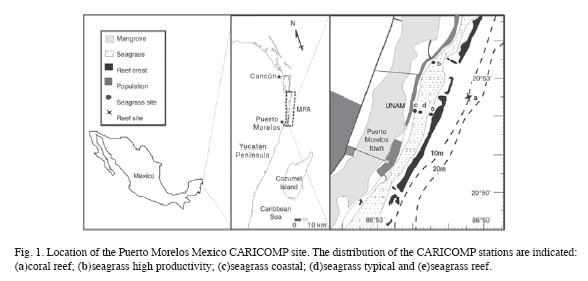
<body><![CDATA[<div style="text-align: justify;"><font face="Verdana" size="2"><font  face="Verdana" size="2"> </font></font></div>     <p style="text-align: justify;"><font face="Verdana" size="2"><font  face="Verdana" size="2"><font face="Verdana" size="2"><b>Palabras clave: </b>monitoreo ambiental, CARICOMP, México, arrecife coralino, pastos marino.</font></font></font></p> <hr style="width: 100%; height: 2px;">     <div style="text-align: justify;"><font face="Verdana" size="2"><font  face="Verdana" size="2"><font face="Verdana" size="2">Typical Caribbean coastal systems consist of the highly complex and productive coral reefs, seagrass beds and mangrove forests (Moberg &amp; Folke 1999), interconnected and linked to the open ocean and the nearby inland areas. Subject to many types of stressors, which often have community-specific impacts and may act in a synergistic rather than additive manner (Hughes &amp; Connell 1999), the community dynamics of these systems have yet to be fully understood (Hughes <i>et al. </i>1992, Done <i>et al. </i>1996). In addition, the serious decline of coral reefs (Hughes 1994), seagrass beds (Short &amp; Echeverria 1996) and mangroves (Farnsworth &amp; Ellison 1997) worldwide in the last decades led to a radical reassessment of the way these systems were monitored. Studies at small spatio-temporal scales provide information on the behavior of the system at a particular place and time but, can not be extrapolated to understand regional or long-term processes, because community dynamics are highly variable, even at local scales (Bythell <i>et al</i>. 2000, Fourqurean <i>et al. </i>2001). Also, the effect of major impacts, such as hurricanes, and subsequent possible primary or secondary succession, can only be evaluated with longer-term assessments of the communities. In 1992, the Caribbean Coral Reef Productivity (CARICOMP) Program was established with the objective of conducting a long-term region-wide monitoring program to analyze changes in the structure of the principal Caribbean coastal ecosystems: coral reefs, mangroves and seagrasses (CARICOMP 1994). To achieve this goal, a relatively simple sampling protocol was developed, such that could be implemented easily at any site in the region, regardless of the local infrastructure for scientific studies. </font>    <br>     <br> <font face="Verdana" size="2">In this study we report on the variations recorded in environmental variables and&nbsp; changes at the level of reef and seagrass communities between 1993 and 2005 at the Puerto Morelos CARICOMP site. Possible correlations between environmental parameters and changes at the reef and seagrass communities were assessed. The results obtained in this study provide a baseline that will allow for the evaluation of present and future potential impacts of the continuous increasing human developments along the Caribbean coasts of Mexico and global natural and anthropogenic disturbances.</font> </font></font></div>     <p style="text-align: justify;"><font face="Verdana" size="2"><font  face="Verdana" size="2"><b><font face="Verdana" size="3">Materials and methods</font></b></font></font></p>     <div style="text-align: justify;"><font face="Verdana" size="2"><font  face="Verdana" size="2"><font face="Verdana" size="2"> </font><font face="Verdana" size="2"><b>Study site: </b>The CARICOMP site in Mexico is located near Puerto Morelos on the NE coast of the Yucatan Peninsula (<a href="#f1">Fig. 1</a>). An extended fringing reef forms a 3-4m deep reef -lagoon, characterized by calcareous sand that is stabilized by seagrass meadows. The reef has well-developed back-reef and crest zones and a relatively flat fore-reef that descends gradually to 20-25m into an extensive sand platform. </font><font face="Verdana" size="2">Inland wetlands are separated from the sea by a 2-3m high, and 100-200m broad, sand bar. A detailed description of the study area is found in Ruíz-Renteria <i>et al</i>. (1998). Puerto Morelos was a small fishing village until the early 1980´s, when it developed rapidly as tourism became the main economic activity. During the </font><font face="Verdana" size="2">course of our study (1993-2005) the population and number of hotel rooms experienced a three-fold increase (<a href="#t1">Table 1</a>). By mid-2009, the local population was estimated at 15 000 and there were 6 000 hotel rooms. Coastal development </font><font  face="Verdana" size="2">poses several threats to the well-being of coastal systems including the increase of nutrients and pollutant levels in coastal waters due to the general lack of sewage treatment plants in the area (with the exception of some hotels), an underground water circulation system that outfalls in mangrove wetlands and submarine </font><font face="Verdana" size="2">springs and the seepage through the sand bar in response to rain inputs (Rodríguez-Martínez 2008). Sedimentation is not a major problem due to the lack of superficial rivers in the Yucatan peninsula, although beach restoration projects and construction of piers are potential sources of sediment inputs to the site. In 1998, Puerto Morelos reef was declared a marine protected area and in average it receives <i>ca</i>. 200 000 visitors per year (</font><a  href="http://www.conanp.gob.mx/"><font face="Verdana" size="2">http://www.conanp.gob.mx</font></a><font  face="Verdana" size="2">).</font> </font></font>    <br> <font face="Verdana" size="2"><font face="Verdana" size="2"></font></font>    <br> <font face="Verdana" size="2"><font face="Verdana" size="2"><font  face="Verdana" size="2"><b>Monitoring of environmental parameters. </b>From 1993 to 2005, sea-surface temperature, maximum-minimum air temperature and accumulated precipitation were sampled on near-daily basis following the CARICOMP level I protocol (CARICOMP 1994). Sea surface temperature was measured at the pier of the Universidad Nacional Autonóma de México (UNAM) research facilities at Puerto Morelos, Mexico where the depth is about 2.5m. Seasurface temperature and refractometer readings of salinity were measured weekly at the Reef, Typical and High-productivity seagrass stations (<a  href="#f1">Fig. 1</a>). Weekly Secchi disk (30cm diameter) measurements were carried at the Typical and High-productivity seagrass stations (horizontal measurements) and 2-3km east from the reef crest (vertical measurement). On some occasions measurements were taken at different times than the ones established by the protocol and usually no measurements were conducted on weekends and vacation periods. </font> </font></font>    <br>     ]]></body>
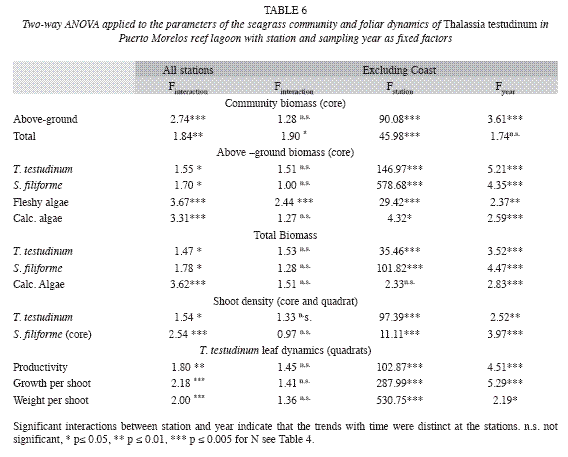
<body><![CDATA[<br> <font face="Verdana" size="2"><font face="Verdana" size="2"><b><font  face="Times-Bold" size="2"><span style="font-family: verdana;">Monitoring of the coral reef site:</span> </font></b><font face="Verdana" size="2">The reef site was established in 1993, approximately 3km offshore (20°53.11´ N-86°50.28" W) on a typical low-relief fore-reef as indicated by the CARICOMP protocol (<a href="#f1">Fig. 1</a>). Five permanent 10m transects were deployed randomly perpendicular to the slope at a depth of 10m. The end-points of each permanent transect were fixed with stainless steel stakes. Line intercept measurements were taken using a brass chain (link length=1.4cm) deployed between the fixed stakes. The number of chain-links covering a given benthic category/species provided an estimate of its proportion of relative cover along the chain, the main benthic categories where coral, gorgonian, algae (fleshy, alcareous, turf, coralline), sponges, rock and sediment. Identification of corals and gorgonians was carried out to species level. Gorgonians were counted when their branches or fronds crossed the transect line under the normal surge conditions, and in order to follow the standardization of the CARICOMP database were assigned to the following growth form categories: rod, feather and, fan. Sea urchin density was estimated by a visual inspection of 2m wide belt transect, whose center was the</font> <font face="Verdana" size="2">brass chain. Surveys were conducted between May and September, except those in 1994 and 1996 which were realized in October, and those of 2000 and 2002 that were omitted. The last survey was conducted in 2004. Some of the information reported here on coral bleaching and diseases was obtained using different protocols and surveys on other reef habitats (back-reef and scarce high relief sites on the fore-reef) of Puerto Morelos. </font></font></font>    <br> <font face="Verdana" size="2"><font face="Verdana" size="2"><font  face="Verdana" size="2"><b></b></font></font></font>    <br> <font face="Verdana" size="2"><font face="Verdana" size="2"><font  face="Verdana" size="2"><b>Monitoring of the seagrass community: </b>From 1993 to 2005, four stations were sampled within the Puerto Morelos reef lagoon representing the local seagrass range of environments (<a href="#f1">Fig. 1</a>): High Productivity (20</font>°<font  face="Verdana" size="2">53.76´ N, 86</font>°<font face="Verdana" size="2">51.07´ W), (2) Typical (20</font></font></font><font face="Verdana" size="2"><font  face="Verdana" size="2"><font face="Verdana" size="2">º5</font></font></font><font  face="Verdana" size="2"><font face="Verdana" size="2"><font  face="Verdana" size="2">2.063´ N, 86</font></font></font><font  face="Verdana" size="2"><font face="Verdana" size="2"><font  face="Verdana" size="2">º</font></font></font><font face="Verdana"  size="2"><font face="Verdana" size="2"><font face="Verdana" size="2">52.913´ W), (3) Reef (20</font></font></font><font face="Verdana" size="2"><font  face="Verdana" size="2"><font face="Verdana" size="2">º</font></font></font><font  face="Verdana" size="2"><font face="Verdana" size="2"><font  face="Verdana" size="2">51.851´ N, 8</font></font></font><font face="Verdana" size="2"><font  face="Verdana" size="2"><font face="Verdana" size="2">º</font></font></font><font  face="Verdana" size="2"><font face="Verdana" size="2"><font  face="Verdana" size="2">51.487´ W) and (4) Coast (20º52.038´ N, 86º52.025´W). The first two stations were located in the middle of the reef lagoon; the High Productivity station (High Prod) was in&nbsp; the vicinity of marine springs venting water from the mangrove wetlands, whereas the Typical station was away from obvious point sources of groundwater. The Reef station was ~200m shoreward from the reef tract, in an area with a relative high hydrodynamic regime, and the Coast station was ~30m from the coastline </font><font  face="Verdana" size="2">and represented the dense fringe vegetation. Depths at these stations varied between 2.5-3.5 m. Further descriptions of the study sites can be found in Van Tussenbroek (1995, 1998). Biomass and community composition of the seagrass communities were determined following the CARICOMP Level I protocol with the </font><font  face="Verdana" size="2">following modifications: a metal corer of 22cm diameter and depth of 30-35cm was employed instead of a PVC pipe (diameter 15cm) and three (rarely two), instead of four, haphazardly chosen replicates were collected at each sampling time per station. In addition to standard procedures, the number of foliar shoots of </font><font face="Verdana" size="2"><i>Thalassia testudinum </i>and the number of leaves of <i>Syringodium filiforme </i>were determined for each sample. Foliar dynamics of <i>T. testudinum </i>were determined according the standard CARICOMP methods employing 6 randomly placed quadrats of 10x20cm per site per sampling time. Weight per shoot was calculated by dividing </font><font face="Verdana" size="2">the leaf biomass by the number of shoots per quadrat and the time interval between the beginning of two successive leaves or leaf plastochron (PI</font><font face="Verdana"  size="1">leaf</font><font face="Verdana" size="2">) following Van Tussenbroek (1998). On occasions, one or two quadrats were lost reducing the number of samples. Sampling times were winter (December of the previous </font><font face="Verdana" size="2">year until February of the sampling year) and summer (June until August). In addition to the above-mentioned CARICOMP study period of 1993-2005, sampling was conducted in 2006 and 2009 to evaluate the impact of Hurricane Wilma which passed over the area in October 2005. </font></font></font>    <br> <font face="Verdana" size="2"><font face="Verdana" size="2"><font  face="Verdana" size="2"><b></b></font></font></font>    <br> <font face="Verdana" size="2"><font face="Verdana" size="2"><font  face="Verdana" size="2"><b>Statistical analyses: </b>Parametric statistical tests (e.g. repeated measures ANOVA, t-test, Tukey’s Honestly Significant Difference) were employed whenever assumptions of normality and homoscedasticity were satisfied; otherwise non-parametric procedures (e.g. Friedman ANOVA, Wilcoxon) were employed. The coral reef database had missing data, as two stakes were lost on occasions and two years were not sampled, and missing values were estimated using multiple linear regression and adding a random component from a t distribution to the regression estimates. To discern seasonal differences in the parameters of community biomas </font><font face="Verdana" size="2">and foliar dynamics of <i>T. testudinum</i>, summer data of all sampling years were pooled and compared with a Student t-test with the pooled data collected during the winter. To obtain an annual value of all sampled parameters the winter and summer values were pooled per sampling year. A two-way ANOVA was applied to latter parameters as independent factors, and station and year as fixed factors because they were specifically chosen as specified by the CARICOMP protocol. If necessary, the data were log transformed to comply with the prerequisites of the analysis of variance. Interannual fluctuations were of special interest; the interaction factor of the two-factor ANOVA indicated whether temporal tendencies were similar or distinct at the four sampling sites. If a station were to be responsible for significant interaction it will be eliminated from the twoway ANOVA analyses because general temporal patterns were of interest for the study. For all analyses alpha was set at 0.05. Statistical analyses were completed using Statistica version 6 software.</font></font></font>    <br> </div> <font face="Verdana" size="2"><font face="Verdana" size="2"><font  face="Verdana" size="2">    <br> </font> </font></font>     <div style="text-align: center;"><font face="Verdana" size="2"><font  face="Verdana" size="2"><font face="Verdana" size="2"><img alt=""  src="/img/revistas/rbt/v58s3/art04f1.jpg"  style="width: 588px; height: 281px;"><a name="f1"></a></font>    <br> <font face="Verdana" size="2"> </font></font></font></div>     <p><font face="Verdana" size="2"><font face="Verdana" size="2"><b><font  face="Verdana" size="3">Results</font></b></font></font></p> <font face="Verdana" size="2"><font face="Verdana" size="2"><b><font  face="Verdana" size="2"> </font></b></font></font>     ]]></body>
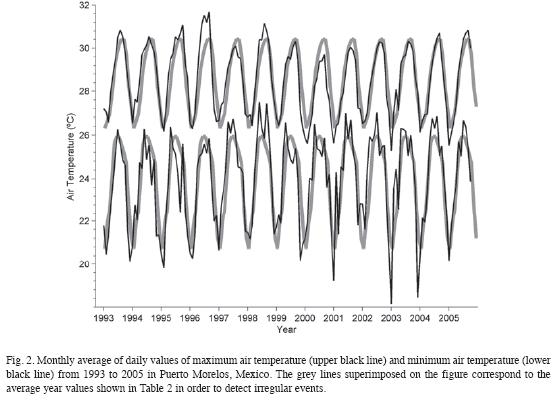
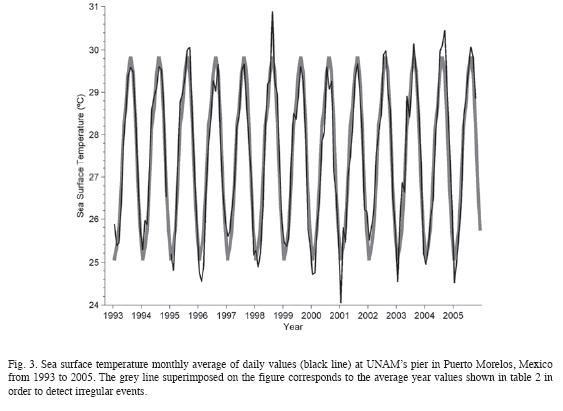
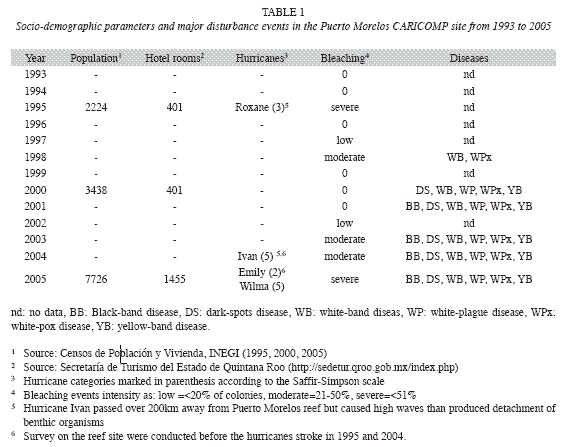
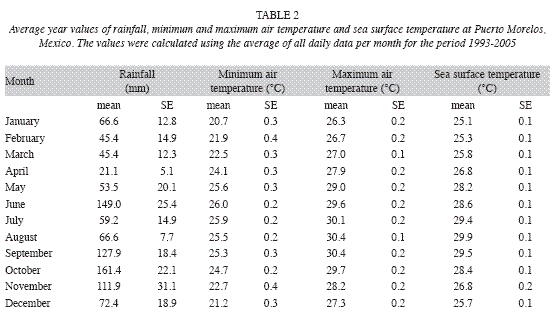
<body><![CDATA[<div style="text-align: justify;"><font face="Verdana" size="2"><font  face="Verdana" size="2"><b><font face="Verdana" size="2">Environment: </font></b><font  face="Verdana" size="2">Air and sea-water temperature showed seasonal variability throughout the study (<a href="#f2">Figs. 2</a>, <a  href="#f3">3</a>). Monthly averaged annual air temperature ranged from 20.7-30.4°C and sea surface temperature from 25.1-29.9°C, (<a href="#t2">Table 2</a>). The general trend was higher air</font><font face="Times-Roman" size="2"> </font><font  face="Verdana" size="2">(29.0-29.7°C) and sea surface (28.2-29.5°C) temperatures from May to October and a reduction of approximately ~1-4°C during the rest of the year (<a  href="#t2">Table 2</a>). From November to April cold fronts ("Nortes") produced a drop in the temperature and cool the surface of the ocean. From 1993 to 2004 the average rainfall was 1 060.6mm/year (±171.4). Average year rainfall values were minimum in April (21.1mm) and maximum in October (161.4mm). The dry season and the rainy season were not clearly defined, but there were two rain peaks, one in June and another from September to November (<a href="#t2">Table 2</a>). The hurricane season extends from June to November, peaking between August and September. Between 1993 and 2005, four hurricanes passed close to the study area (<a href="#t1">Table 1</a>) and lowered the sea surface temperature. Between 2000 and 2005 there appeared to be a gradual increase in maximum sea surface temperature and, with the exception of 2002, a slight decrease in minimum temperature (<a href="#f3">Fig. 3</a>).The maximum sea surface temperature exceeded the average year values in the summers of 1995, 1998, 2002, 2003, 2004 and 2005 (<a href="#f3">Fig. 3</a>). In all of these years bleaching events of different magnitude were recorded in Puerto Morelos reef (<a href="#t1">Table 1</a>). A mild bleaching event also occurred in 1997 (<a href="#t1">Table 1</a>) but sea surface temperature was not above the average year values (<a href="#f3">Fig. 3</a>). Secchi disk visibility distance was on average 5 m less in the lagoon zone (mean=15.4 m) than in the open ocean (21.2m) and had no noticeable pattern with the wet and dry seasons and no important variation throughout the study period. All refractometer salinity readings had a monthly average of 36ppt, except in a very few occasions consistent with periods of heavy rains and mangrove swamp runoff. </font></font></font>    <br> </div> <font face="Verdana" size="2"><font face="Verdana" size="2"><font  face="Verdana" size="2">    <br> </font> </font></font>     <div style="text-align: center;"><font face="Verdana" size="2"><font  face="Verdana" size="2"><font face="Verdana" size="2"><img alt=""  src="/img/revistas/rbt/v58s3/art04f2.jpg"  style="width: 559px; height: 401px;"><a name="f2"></a>    <br>     <br>     <br> <img alt="" src="/img/revistas/rbt/v58s3/art04f3.jpg"  style="width: 563px; height: 411px;"><a name="f3"></a>    <br>     <br>     <br> <img alt="" src="/img/revistas/rbt/v58s3/art04t1.gif"  style="width: 570px; height: 447px;"><a name="t1"></a>    ]]></body>
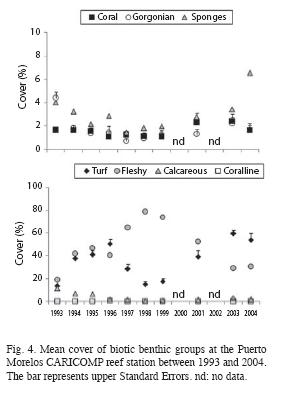
<body><![CDATA[<br>     <br> <img alt="" src="/img/revistas/rbt/v58s3/art04t2.gif"  style="width: 557px; height: 333px;"><a name="t2"></a>    <br> </font>    <br> </font></font></div> <font face="Verdana" size="2"><font face="Verdana" size="2"><font  face="Verdana" size="2"><b>    <br> </b></font></font></font>     <div style="text-align: justify;"><font face="Verdana" size="2"><font  face="Verdana" size="2"><font face="Verdana" size="2"><b>Coral reef site: </b>The main characteristic of the Puerto Morelos CARICOMP reef site were a low coral and sponge cover and a high cover of fleshy and turf algae (<a  href="#f4">Fig. 4</a>). This type of benthic coral community "coral grounds" is typical for the low-relief and low-slope forereef environments found in the northeastern Mexican Caribbean coast (Jordán-Dahlgren &amp; Rodríguez-Martínez 2003) and are also found colonizing similar hard ground environment all over the Caribbean (Goreau 1959). Coral cover was low (mean &lt;3%) because, although colony density is relatively high, colonies were small (over 75% of the colonies had diameters &lt;10cm), suggesting high coral recruitment rates but low probabilities of survival to larger sizes. Coverage by scleractinians remained without significant changes throughout the study (Friedman ANOVA (</font><font face="Verdana" size="2">&#967;</font><font face="Verdana"  size="2">2 [n=5, df=11]=10.6, p=0.46). Of the 26 species of scleractinian corals known for the fore-reef of Puerto Morelos (Jordán-Dahlgren 1979), 12 were recorded in the CARICOMP site throughout the study. <i>Montastraea cavernosa</i>, <i>Dichocoenia stokesii </i>and <i>Meandrina meandrites </i>were the most abundant coral species. Sponge cover fluctuated from 1.5 to 6.5%, it decreased significantly from 1993 to 1998 (rep ANOVA, F=2.2, df=11, p=0.03), and recovered by 2004 (<a href="#f4">Fig. 4</a>). Encrusting species (<i>Cliona </i>spp.) were most commonly recorded. Fleshy algae cover oscillated between 19% and 79% and changed significantly through the sampled years (</font><font  face="Verdana" size="2">&#967;</font><font face="Verdana" size="2">2 [n=5, df=11]=39.8, p&lt;0.001), the highest values were recorded from 1997 to 1999 and the lowest in 1993, 2003 and 2004 (<a href="#f4">Fig. 4</a>); differences were significant in all cases (Wilcoxon matched pairs tests, p&lt;0.05). The composition </font><font face="Verdana" size="2">of fleshy algae remained relatively constant throughout the study, with <i>Sargassum </i>spp. and <i>Dictyota </i>spp. being the dominant species. Turf algae cover also fluctuated throughout the study (14-60%) increasing significantly from 1993 to 1996 (Tukey post-hoc tests, p&lt;0.03 all cases), decreasing by 1998, when it had a similar value as in 1993 (Tukey, p=1.0), and increasing again by 2003 and 2004 (<a href="#f4">Fig. 4</a>). The cover by fleshy algae and turf algae had a significant inverse correlation (R2=-0.97, p&lt;0.001, N=9). Calcareous algae cover declined from 12% to 0.5% between 1993 and 1998 and remained low afterwards (<a href="#f4">Fig. 4</a>); changes in time were significant (Friedman ANOVA, (</font><font face="Verdana" size="2">&#967;</font><font  face="Verdana" size="2">2 [n=5, df=11]=37.3, p=0.001). The more abundant calcareous algae species in all surveys were <i>Halimeda tuna, Rhipocephalus phoenix </i>and <i>Penicillus capitatus. </i>Sediment cover declined significantly (p&lt;0.05) from&nbsp; </font><font  face="Verdana" size="2">1993 (37.4±10.5%) to 1995 (0.5±0.8%) and remained without subsequent changes afterward. Crustose coralline algae and bare rock were rarely recorded.</font></font></font>    <br> </div> <font face="Verdana" size="2"><font face="Verdana" size="2"><font  face="Verdana" size="2">    <br>     <br> </font> </font></font>     <div style="text-align: center;"><font face="Verdana" size="2"><font  face="Verdana" size="2"><font face="Verdana" size="2"><img alt=""  src="/img/revistas/rbt/v58s3/art04f4.jpg"  style="width: 282px; height: 394px;"><a name="f4"></a></font>    ]]></body>
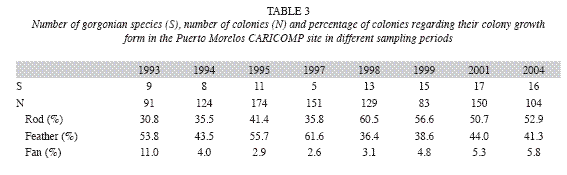
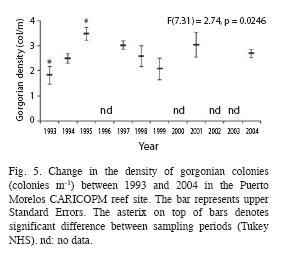
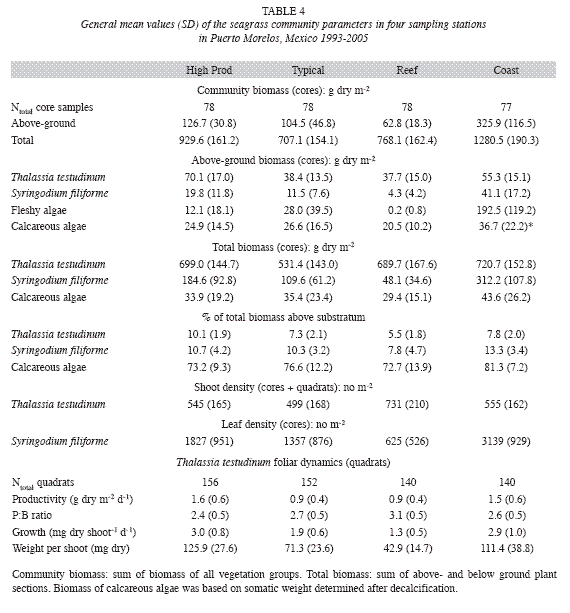
<body><![CDATA[<br> </font></font></div>     <div style="text-align: justify;"><font face="Verdana" size="2"><font  face="Verdana" size="2"><font face="Verdana" size="2">Gorgonians were the most conspicuous benthic fauna in the fore-reef environment. The density and composition of the gorgonian community was highly dynamic throughout the study. The number of gorgonian species increased from 9 in 1993 to 16 in 2004 (<a href="#t3">Table 3</a>), more likely due to a recovery process following the impact of Hurricane Gilbert (1988): as colonies grew they were more prone to be intercepted by the line intercept transect. Gorgonian density increased significantly between 1993 and 1995 (Tukey, p=0.02) and stabilized afterwards (<a href="#i5">Fig. 5</a>). Gorgonian species with feather and rod growth forms were more abundant than those with fan forms (<a href="#t3">Table 3</a>).The proportion between gorgonian colony growth forms changed significantly in time (Contingency table. G=53.27, df=14, p &lt;0.01). Between 1993 and 1997, feather growth forms were more abundant while in later surveys rod forms became more abundant (<a href="#t3">Table 3</a>). The dominant species throughout the study were <i>Pseudopterogorgia americana, Eunicea mammosa </i>and <i>Plexaura flexuosa</i>. From 1993 to 1997, these three species contributed with over 70% of all of the colonies recorded in the transects. In later surveys, their combined relative importance diminished gradually to 43% in 2004, as other species (<i>P. acerosa</i>, <i>E. </i></font><font face="Verdana" size="2"><i>tourneforti </i>and <i>Muricea muricata</i>) became more abundant. Other gorgonian species had low abundances throughout the study. Sea urchins were rare in all sampling </font><font  face="Verdana" size="2">years. Overall density fluctuated between 0 and 0.06 urchins m</font><font face="Verdana" size="1">-</font><font  face="Verdana" size="2">² between 1993 and 2003, and increased slightly in 2004 (0.14 ind m</font><font face="Verdana" size="1">-</font><font  face="Verdana" size="2">²), due to a relatively higher number of <i>Diadema antillarum </i>and <i>Echinometra viridis</i>. Other species recorded in the course of the study were <i>Eucidaris tribuloides </i>and <i>Meoma ventricosa</i>.</font></font></font>    <br> </div> <font face="Verdana" size="2"><font face="Verdana" size="2"><font  face="Verdana" size="2">    <br> </font> </font></font>     <div style="text-align: center;"><font face="Verdana" size="2"><font  face="Verdana" size="2"><font face="Verdana" size="2"><img alt=""  src="/img/revistas/rbt/v58s3/art04t3.gif"  style="width: 567px; height: 175px;"><a name="t3"></a>    <br>     <br>     <br> <img alt="" src="/img/revistas/rbt/v58s3/art04f5.jpg"  style="width: 283px; height: 255px;"><a name="i5"></a>    <br> </font><font face="Verdana" size="2"> </font></font></font></div>     <div style="text-align: justify;"><font face="Verdana" size="2"><font  face="Verdana" size="2"><font face="Verdana" size="2"><b>Seagrass site: </b>From 1993 to 2005, the total biomass of the seagrass community was consistently higher in the High Prod and Coastsites than at the other two sites (<a href="#t4">Table 4</a>). Total biomass (of above- and below-ground tissues) of <i>T. testudinum </i>was always higher than that of the other vegetation groups, the highest values were found in the High Prod and Coast sites, followed by the Typical site, whereas the lowest values were recorded in the more hydrodynamic Reef station. Foliar productivity of <i>T. testudinum </i>was highest at the High Prod and Coast stations, where the shoots attained comparable density size and growth rates. The </font><font face="Verdana" size="2">Typical site showed intermediate values of all parameters, while in the Reef site <i>T. testudinum </i>shoots were shorter, had a lower growth-rate, and were more abundant than at the other sites (<a href="#t4">Table 4</a>). Calcareous algae, mainly comprising species of the genera <i>Halimeda</i>, <i>Penicillus</i>, <i>Rhipocephalus </i>and <i>Udotea</i>, attained a similar biomass in all four sampling sites, although the relative contribution of these genera varied between sites (<a href="#t4">Table 4</a>). In the Coast site, a large portion of the above-ground biomass belonged to the group "fleshy algae" (mainly <i>Avrainvillea </i>spp. and <i>Cladocephalus </i>spp.).     ]]></body>
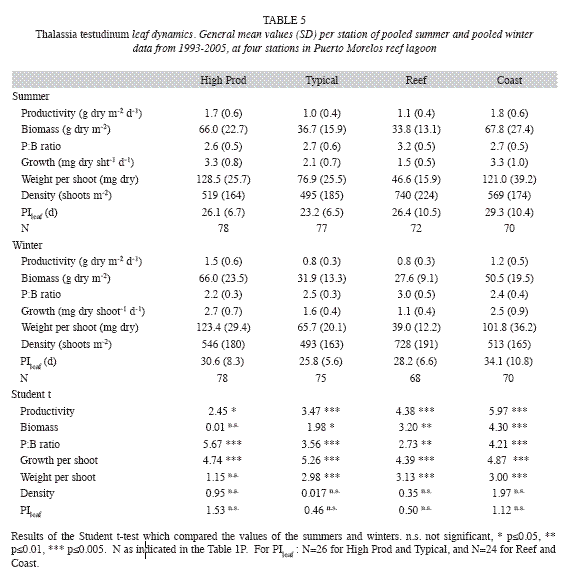
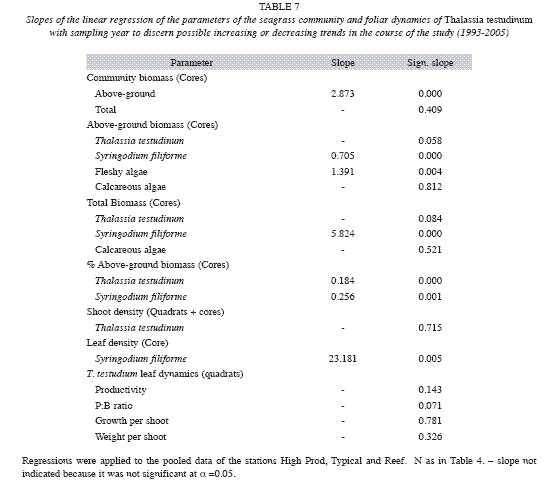
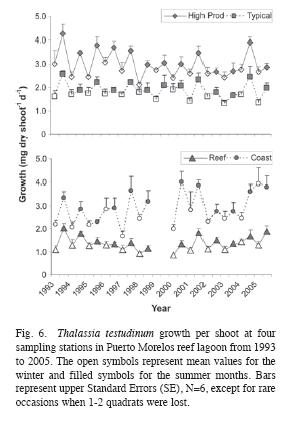
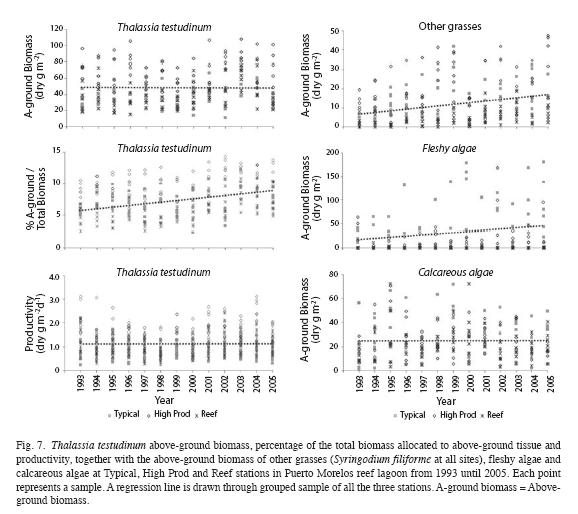
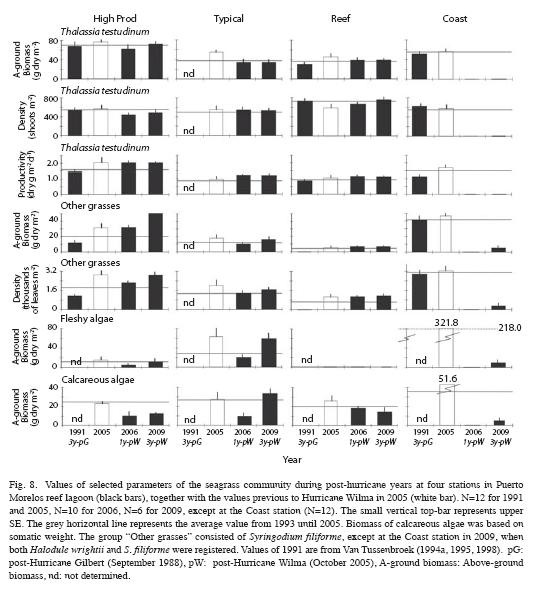
<body><![CDATA[<br>     <br> Seasonal variations were appreciated in the foliar dynamics of <i>T. testudinum</i>, presenting, in general, higher leaf growth (<a href="#f6">Fig. 6</a>) and </font><font  face="Verdana" size="2">productivity, and lower PI</font><font  face="Verdana" size="1">leaf </font><font face="Verdana" size="2">during the summer than in the winter (<a href="#t5">Table 5</a>). Shoot density, in contrast, remained constant throughout the year (<a href="#t5">Table 5</a>), and leaf biomass did not vary significantly between summer and winter in the High Prod site. The pooled summer values of the above-ground- and total biomass of all </font><font  face="Verdana" size="2">other vegetation groups did not vary from the pooled winter data, and the p of the Student t-test exceeded 0.1 in all cases.     <br>     <br> Interannual fluctuations of the studied </font><font face="Verdana"  size="2">parameters of the seagrass community did not show the same trends at all sampling stations, as indicated by their significant interaction between station and year of the two-way ANOVA (<a href="#t6">Table 6</a>). However, excluding the Coast station resulted in, interactions becoming insignificant for most parameters (except for total community biomass and for the biomass of the fleshy algae), and thus this station was omitted from further analysis. Differences between years were then significant for all parameters (<a href="#t6">Table 6</a>), but interannual variations of the parameters of foliar dynamics of <i>T. Testudinum </i>(<a href="#f7">Fig. 7</a>) and the biomass of the other eagrasses (<i>S. filiforme</i>), calcareous and fleshy algae were erratic, without an obvious </font><font face="Verdana" size="2">pattern. The clearest signals of changes in time, from 1993 until 2005, were ascending tendencies in the total biomass of the seagrass <i>Syringodium filiforme </i>(corresponding to the group "other seagrasses") and in the fleshy algal group (<a  href="#t7">Table 7</a>). <i>S. filiforme </i>also showed increased leaf density and both seagrass species </font><font face="Verdana" size="2">(<i>T. testudinum </i>and <i>S. filiforme</i>) showed an increment in the proportion of the biomass allocated to the above-ground leaves (% aboveground biomass) in the course of the study (<a href="#t7">Table 7</a>, <a href="#f7">Fig. 7</a>).     <br>     <br> The impact of the major Hurricane Wilma </font><font face="Verdana" size="2">(October 2005) on the sampling stations in the seagrass beds of Puerto Morelos reef lagoon was not severe, with exception of the vegetation at the Coast site, which was buried by a ~1-1.5m thick sand layer. In the persistent beds, above-ground biomass, shoot density, % of total biomass allocated to above-ground tissue and productivity of <i>T. testudinum </i>were often slightly lower, but within the range of "normal" fluctuations at these sites (<a href="#f8">Fig. 8</a>). In comparison with 2005, the abundance of <i>S. filiforme</i>, and fleshy and calcareous algae, decreased slightly after </font><font face="Verdana" size="2">passage of the hurricane at the High Prod and Typical sites (<a href="#f8">Fig. 8</a>), but at the Reef site declines in these vegetation groups were less notable or absent. In early 2009, three years after Hurricane Wilma, the composition of the vegetation in the High Prod, Typical and Reef sites were similar to those recorded during the CARICOMP observation period, although not always comparable with the pre-hurricane values recorded in 2005 (<a href="#f8">Fig. 8</a>). In 2009, the previously bare sandy area at the Coast station was sparsely colonized by calcareous and fleshy algae (<i>Caulerpa </i>spp.) and the seagrasses <i>Halodule wrightii </i>and <i>Syringodium filiforme </i>(<a  href="#f8">Fig. 8</a>).</font></font></font>    <br> </div> <font face="Verdana" size="2"><font face="Verdana" size="2"><font  face="Verdana" size="2">    <br> </font> </font></font>     <div style="text-align: center;"><span style="font-family: verdana;"><font  face="Verdana" size="2"><font face="Verdana" size="2"><img alt=""  src="/img/revistas/rbt/v58s3/art04t4.gif"  style="width: 570px; height: 613px;"><a name="t4"></a>    <br>     ]]></body>
<body><![CDATA[<br> <img alt="" src="/img/revistas/rbt/v58s3/art04t5.gif"  style="width: 569px; height: 582px;"><a name="t5"></a>    <br>     <br> <img alt="" src="/img/revistas/rbt/v58s3/art04t6.gif"  style="width: 568px; height: 457px;"><a name="t6"></a>    <br>     <br> <img alt="" src="/img/revistas/rbt/v58s3/art04t7.gif"  style="width: 551px; height: 486px;"><a name="t7"></a>    <br>     <br> <img alt="" src="/img/revistas/rbt/v58s3/art04f6.jpg"  style="width: 296px; height: 421px;"><a name="f6"></a>    <br>     <br> <img alt="" src="/img/revistas/rbt/v58s3/art04f7.jpg"  style="width: 578px; height: 514px;"><a name="f7"></a>    <br>     ]]></body>
<body><![CDATA[<br> <img alt="" src="/img/revistas/rbt/v58s3/art04f8.jpg"  style="width: 542px; height: 589px;"><a name="f8"></a>    <br> </font></font></span><font face="Verdana" size="2"><font face="Verdana"  size="2"><font face="Verdana" size="2"> </font></font></font></div> <font face="Verdana" size="2"><font face="Verdana" size="2"><font  style="font-weight: bold;" face="Verdana" size="3">     <p>Discussion</p> </font><font face="Verdana" size="2"> </font></font></font>     <div style="text-align: justify;"><font face="Verdana" size="2"><font  face="Verdana" size="2"><font face="Verdana" size="2">The longer-term monitoring at the Puerto Morelos CARICOMP site revealed gradual almost imperceptible changes in various parameters. The sea surface temperature showed a trend towards a slight increase in the maximum and a decrease in the minimum values, the coral reef community showed no recovery of hard corals 15 years after Hurricane Gilbert (1988), and the seagrass community slowly shifted towards a relative higher dominance of faster growing seagrasses and fleshy algae, and higher investment in above-ground plant parts. The relationships between the changes in the benthic community of the seagrasses and reefs were neither general nor straightforward, but rather system-, place- and time-specific. </font> </font></font></div>     <p style="text-align: justify;"><font face="Verdana" size="2"><font  face="Verdana" size="2"><font face="Verdana" size="2">At the reef site, the benthic community remained relatively stable throughout the study. Hard coral cover was consistently low (&lt;2.5%) and represented the lowest extreme of the coral cover values recorded in all of the CARICOMP sites. Species richness, cover and density values recorded were considerably lower than those reported for the same reef area in 1978 (Jordán-Dahlgren 1979), before the reef was impacted by major Hurricane Gilbert (1988, class V). That single event resulted in a reduction in species richness from 16 to 12, in coral cover from 8.4% (±3.1%) to 3.1% ±1.2%) and in coral colony density from 0.9 col m-1 (±0.2) to 0.3 col m-1 (±0.2), at a depth of 10m (Rodríguez-Martínez 1993). Fifteen years later, the reef community showed little recovery, which could be attributed to the locally low rugosity fore-reef. Although relatively frequent recruitment events could account for the relatively abundant small coral colonies, only a few of these recruits reached larger sizes (over 75% of the colonies had diameters &lt;10cm). Suggested forcing functions responsible for this type of community include high re-suspension of sediments, due to the gentle slope (&lt;5°), that drive the selection of resistant species such as <i>Montastraea cavernosa, Diploria strigosa, Dichocoenia stokesiis </i>and <i>Siderastrea siderea </i>(Loya 1976, Jordán-Dahlgren 1979). Further sediment abrasion and colony detachment during storms and hurricanes also accounted for dominance of juvenile stages in the population (Jordán-Garza 2004). </font></font></font></p>     <div style="text-align: justify;"></div>     <p style="text-align: justify;"><font face="Verdana" size="2"><font  face="Verdana" size="2"><font face="Verdana" size="2">During the study period the major forcing factors that affected the coral community where hurricanes, coral diseases and bleaching events. The effects of the minor hurricanes were small, considering that the community suffered a major impact by Hurricane Gilbert in 1988. In 1993, when the CARICOMP project started, gorgonians hadn´t fully recovered from the impact of Hurricane Gilbert, as their density (1.8±0.7 org m</font><font face="Verdana"  size="1">-1</font><font face="Verdana" size="2">) was lower than that recorded in the same area in 1978 (2.8 org m</font><font face="Verdana"  size="1">-1</font><font face="Verdana" size="2">±0.5; Jordán-Dahlgren 1979) but by 1995 gorgonian density (3.5±0.6 org m</font><font  face="Verdana" size="1">-1</font><font face="Verdana" size="2">) surpassed pre-hurricane values. In 1995, Hurricane Roxanne (class III) made land 100km south of Puerto Morelos and did not cause major damage to the reef, but in the next three years gorgonian density showed a down-trend pattern coupled with a change in the dominant gorgonian growth forms, from feather to rod, which could be the result of differential recruitment, different growth rates or competitive outcomes (Connell <i>et al</i>. 2004). By 2004, gorgonian composition and density (2.7±0.4 org m</font><font face="Verdana" size="1">-1</font><font  face="Verdana" size="2">) was very similar to that of 1978. Fluctuations through time in the cover of fleshy algae and turf algae were more likely the result of the time of the year when the surveys were conducted and the life history characteristics of the component species; when the surveys were done in the summer the abundance of fleshy algae, mainly <i>Sargassum </i>spp., increased and overgrew the turf algae. Coverage by fleshy and turf algae (84%) was higher than that found in other CARICOMP sites like Panamá (21%; Guzmán <i>et al</i>. 2005), Puerto Rico (maximum 38%, Linton &amp; Fisher 2004), Costa Rica (63%; Fonseca <i>et al</i>. 2006) and Jamaica (73%; Linton &amp; Fisher 2004). Density of sea urchins throughout the study (&lt;0.2 org m</font><font  face="Verdana" size="1">-</font><font face="Verdana" size="2">²) was low and comparable to that reported for other CARICOMP sites (Linton &amp; Fisher 2004). The population of <i>Diadema antillarum </i>increased slightly in our last survey but we can´t determine if this was the beginning of the recovery process. Density of <i>D. antillarum</i>, however, has increased in other Mexican reefs, such as Mahahual (7.3±4.2 org m</font><font face="Verdana" size="1">-</font><font  face="Verdana" size="2">²; Jordán-Garza <i>et al</i>. 2007) and Akumal (Rodríguez-Martínez pers. obs.) but mostly in shallow back-reef areas. </font></font></font></p>     <div style="text-align: justify;"></div>     <p style="text-align: justify;"><font face="Verdana" size="2"><font  face="Verdana" size="2"><font face="Verdana" size="2">Disease outbreaks were recorded and their effects measured throughout the study period in many areas of Puerto Morelos reef. The data set from the CARICOMP reef site showed no ignificant increase in the prevalence of coral diseases. However, the increment in the number and prevalence of coral diseases elsewhere in Puerto Morelos (Rodríguez-Martínez <i>et al</i>. 2001, Jordán-Dahlgren <i>et al. </i>2005) suggest that higher sea surface temperature trends observed in present study may be a causative factor, either by thermal stress on the host reducing coral resistance to infections or </font><font  style="font-family: verdana;" face="Times-Roman" size="2">thermally induced increase in pathogens´ virulence </font><font face="Verdana" size="2">(Bruno <i>et al</i>. 2007, Harvell <i>et al</i>. 2007). In 1998, only two diseases, white-band and white-pox, were recorded affecting colonies of <i>Acropora palmata</i>, in the back-reef of Puerto Morelos. In 2000, the number of recorded diseases had increased to five and by 2004 to six, reflecting the same situation that has been observed throughout the Caribbean. The first thermal bleaching event of corals and other reef organisms recorded at Puerto Morelos was in 1995 (CARICOMP 1997) and, since then, bleaching occurred in all of the years when the maximum sea surface temperature exceeded 30°C in the summer, except in the year of 1997. During the study period, however, no mass mortality of scleractinian corals associated with thermal coral bleaching was recorded on Puerto Morelos reef. The most severe bleaching events were recorded in 1995 and 2005 (<a href="#t1">Table 1</a>), when it was estimated that over 50% of the coral colonies were bleached at different intensities. The bleaching event of 1998, which caused catastrophic mortalities of corals around the world (Aronson <i>et al</i>. 2000), was recorded as moderate in Puerto Morelos reef (<a href="#t1">Table 1</a>). At the CARICOMP reef site, no significant bleaching was recorded possibly because surveys were carried out at months that coincided with the onset of the bleaching events. </font></font></font></p>     <div style="text-align: justify;"></div>     ]]></body>
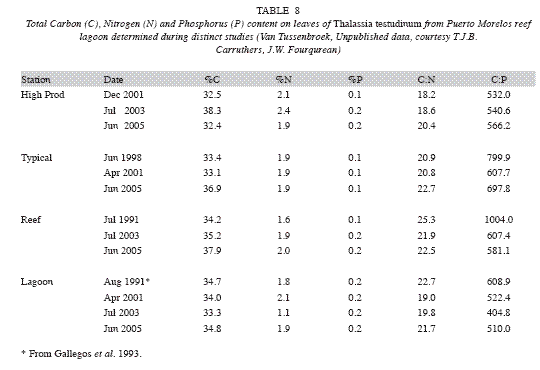
<body><![CDATA[<p style="text-align: justify;"><font face="Verdana" size="2"><font  face="Verdana" size="2"><font face="Verdana" size="2">Variations in the seagrass community were in many aspects distinct from those in the reef community and subject to different forcing factors. For example, the possible rise in seawater temperature most likely did cause detectable changes in the seagrass community structure during the study period. The temporal dynamics of the seagrass community occurred at three levels: (1) season, (2) gradual changes from 1993 until 2005, probably forced by increased nutrient inputs, and (3) perturbations due to the major Hurricanes Gilbert (1988) and Wilma (2005). In general, biomass, growth rates, and productivity, were lower in the winter than in the summer. Such seasonal fluctuations in the foliar dynamics of <i>Thalassia testudinum </i>have already been reported by Van Tussenbroek (1995) and were most likely related to variations in the solar cycle. In the present study, in some of the years the contrast between the summer highs and the winter lows in the growth rates and productivity were less obvious, more likely because the 7-10 days lasting observation periods were not always representative of the prevailing conditions during that season. Seasonal trends were not observed in the biomass of the other vegetation groups, but at this point it can´t be discerned whether this is a real trend or a sampling effect. The general-purpose and simple sampling design for the study of the composition seagrass communities of the CARICOMP project allowed for comparison between sites within a wide geographical area but possibly did not have the necessary resolution to discern small changes in the seagrass community. Sampled areas were limited to the small area covered by the cores and there was a very wide spread of the individual sampling points, as is demonstrated in <a href="#f7">figures 7</a> and <a  href="#f8">8</a>. Therefore, a signal of change must be exceptionally strong to be discerned and it is possible that the seasonal changes in biomass of the different vegetation groups remained undetected. </font></font></font></p>     <div style="text-align: justify;"><font face="Verdana" size="2"><font  face="Verdana" size="2"><font face="Verdana" size="2">Most parameters varied significantly between sampling years, but the interannual fluctuations did not coincide with extreme environmental conditions such as storms, periods of heavy rain, or extreme temperatures. On the other hand, the continuous sampling scheme detected low, but significant, changes in the course of the CARICOMP study from 1993 to 2005, as indicated by the positive and significant slopes of the regressions of these parameters against sampling year. These gradual, almost imperceptible changes in community structure most likely could be explained by an increasing nutrient load into this reef lagoon. Nutrient availability to seagrasses may be derived from C:N:P ratios in the leaf tissues (Duarte 1992, Fourqurean <i>et al</i>. 1992). Carbonate systems, such as Puerto Morelos reef lagoon are phosphorus limited (Powell <i>et al</i>. 1989, Short <i>et al</i>. 1990, Fourqurean <i>et al</i>. 1992, Carruthers <i>et al</i>. 2005) and the P contents in <i>T. testudinum </i>leaves, sampled on several occasions in the reef lagoon, gradually increased at all sites, except for the High Prod station, located near a mangrove discharge, which presented high P throughout the whole period (<a href="#t8">Table 8</a>). The gradual shifts of relatively higher biomass invested in above-ground tissues of <i>T. testudinum </i>and <i>S. filiforme </i>were consistent with an increasing nutrient load, as seagrasses tend to show higher proportional above-ground biomass under more eutrophic conditions (Zieman &amp; Wetzel 1980, Erftemeijer &amp; Middelburg 1993, Van Tussenbroek <i>et&nbsp; </i></font><font  face="Verdana" size="2"><i>al</i>. 1996). At the level of the seagrass community, the competitive superiority tends to shift to species with faster relative growth rates at increasing nutrient availability (Fourqurean <i>et al</i>. 1995, Rose &amp; Dawes 1999, Fourqurean &amp; Rutten 2003), which in the case of the study sites in Puerto Morelos reef lagoon, corresponded with the faster-growing seagrass <i>S. filiforme </i>and rooted and drifting fleshy algae. Latter vegetation groups gradually became more abundant, but they did not replace the dominant <i>T. testudinum, </i>causing an increment in total above-ground community biomass. Very noteworthy was the increasing presence of <i>S. filiforme </i>at the Reef station. Before the CARICOMP sampling program, during 1990- 1991, this seagrass was almost absent (Van Tussenbroek 1994a). In 1993, the majority of the samples had <i>S. filiforme </i>but at low densities (average density 329 leaves m</font><font face="Verdana" size="1">-2</font><font  face="Verdana" size="2">, SD=377), but </font><font face="Verdana"  size="2">by 2005, all samples contained this seagrass reporting on average 1070 leaves per m</font><font  face="Verdana" size="1">-2 </font><font face="Verdana" size="2">(SD=525). Above-mentioned gradual changes in the seagrass community, the increased P content of the <i>T. testudinum </i>leaves, and the finding of high phosphorus inputs through groundwater discharges into the system after heavy rain (Carruthers <i>et al</i>. 2005), together are strong indications that the Puerto Morelos reef system is slowly changing from a pristine to a more eutrophic system.</font> </font></font>    <br> </div> <font face="Verdana" size="2"><font face="Verdana" size="2">    <br> </font> </font>     <div style="text-align: center;"><font face="Verdana" size="2"><font  face="Verdana" size="2"><img alt=""  src="/img/revistas/rbt/v58s3/art04t8.gif"  style="width: 540px; height: 370px;"><a name="t8"></a>    <br> </font></font></div> <font face="Verdana" size="2"><font face="Verdana" size="2"><font  face="Verdana" size="2">    <br> </font></font></font>     <div style="text-align: justify;"><font face="Verdana" size="2"><font  face="Verdana" size="2"><font face="Verdana" size="2">The impact of Hurricane Wilma (class 4, duration &gt;60 h, October 2005), evaluated through comparison of pre- (2005) and </font><font face="Times-Roman" size="2">post- (2006) </font><font  face="Verdana" size="2">hurricane values of selected parameters of the seagrass community, showed only small changes in the community of the persistent beds. Not all vegetation groups were affected equally and at the High Prod and Typical Stations, <i>Syringodium filiforme </i>and the algae were more affected than <i>T. testudinum</i>. These findings are consistent with the selective </font><font face="Verdana" size="2">removal hypothesis of Cruz-Palacios and Van Tussenbroek (2005) and Van Tussenbroek <i>et al</i>. (2008), which postulate that different vegetation groups show differential susceptibility to removal by hurricane-induced burial, sedimentremoval </font><font  face="Verdana" size="2">or abrasion. In addition, the magnitude of the effects on the distinct groups was sitedependent, and the reef station, situated in a high hydrodynamic area, was least affected by Hurricane Wilma. The impact of Hurricane Gilbert (1988) on the seagrass community was not assessed directly, but retrospective analysis of shoots of <i>T. testudinum </i>indicated a decreased shoot density at the High Prod, Typical and Coast stations, whereas the number of shoots at the Reef station was not affected by this hurricane (van Tussenbroek 1994b). The seagrass community at the Coast station was wiped out completely by Hurricane Wilma, but this site presented a very lush and well-developed <i>T. testudinum</i>-dominated seagrass bed after Hurricane Gilbert (van Tussenbroek 1994a,b, 1995). Thus, the perturbations caused by Hurricanes Gilbert (1988) and Wilma (2005) on the same seagrass beds differed, which emphasizes again that the impacts of hurricanes are, in addition to the nature of the hurricane itself, site- and community-dependent (Fourqurean&amp;Rutten 2004, Cruz-Palacios &amp; Van Tussenbroek 2005, Cabaço <i>et al</i>. 2008). The sampling years 1991 (data from Van Tussenbroek, 1994,1995,1998) and 2009, were three years post Hurricanes Gilbert and Wilma respectively, and recovery of the persistent beds was relatively fast. Van Tussenbroek (1994b) </font><font face="Verdana" size="2">registered rapid population growth of <i>T. testudinum </i>1-3 years after Hurricane Gilbert and in 2009 the biomass values of the vegetation groups at the High Prod, Typical and Reef stations, were comparable to those observed during the CARICOMP observation period. Three years after complete eradication, the vegetation of the Coast station presented few calcareous algae and the early seagrass colonizers <i>Halodule wrightii </i>and <i>Syringodium filiforme </i>following the characteristic primary succession sequences described by Patriquin (1975), Williams (1990), Fourqurean &amp; Rutten (2004) and Van Tussenbroek <i>et al. </i>(2006) for seagrass communities in tropical Atlantic reef lagoons. </font> <b><font face="Verdana" size="3">     <p>Conclusion </p> </font></b><font face="Verdana" size="2">The CARICOMP research in Puerto Morelos, Mexico provided a baseline data set to detect environmental changes which will allow for the evaluation of present and future potential impacts of the continuous coastal development and global rise in temperature. Between 1993 and 2005, the benthic coral and seagrass communities at Puerto Morelos CARICOMP appeared stable, although sometrends of potential permanent changes were discerned. Gorgonian and seagrass communities recovered relatively fast from the impact of major hurricanes suggesting high ecological resilience (Nyström <i>et al</i>. 2008). Coral cover at the reef site was expected to recover from Hurricane Gilbert (1988) but remained low. The coral community seems to be on a semipermanent initial phase of development where recruitment is high but mortality is also high, seeming in a sense resilient to present conditions. However, algal outbreaks may change this situation as there is an ongoing increase in coastal development and there is no control of residual waters. Gradual changes in the seagrass community structure suggest an increasing nutrient load into the reef lagoon. We recommend the implementation of regulation measurements for the adjacent coastal zone, mainly for sewage and garbage treatment, in order to prevent deterioration of the coral reef and seagrass communities. </font><b><font face="Verdana" size="3">     <p>Acknowledgments</p> </font></b><font face="Verdana" size="2">This project was financed by the National University of Mexico and CARICOMP. We thank Miguel Angel Maldonado, Leonardo Vázquez, Daniel Gasca and all of the students that collaborated with the field work. Paul Blanchon and three anonymous reviewers made valuable comments to improve the manuscript.</font></font></font>    ]]></body>
<body><![CDATA[<br> <font face="Verdana" size="2"><font face="Verdana" size="2"><font  face="Verdana" size="2"></font></font></font>    <br> <font face="Verdana" size="2"><font face="Verdana" size="2"><font  face="Verdana" size="2"> <hr style="width: 100%; height: 2px;">     <p>&nbsp;</p> </font><b><font face="Verdana" size="3">     <p>References</p> </font></b><font face="Verdana" size="2"> </font></font></font></div>     <!-- ref --><p style="text-align: justify;"><font face="Verdana" size="2"><font  face="Verdana" size="2"><font face="Verdana" size="2">Aronson, R.B., W.F. Precht, I.G. Macintyre &amp; T.J.T. Murdoch. 2000. Coral bleach-out in Belize. Nature 405: 36.    &nbsp;&nbsp;&nbsp;&nbsp;&nbsp;&nbsp;&nbsp;&nbsp;[&#160;<a href="javascript:void(0);" onclick="javascript: window.open('/scielo.php?script=sci_nlinks&ref=1713062&pid=S0034-7744201000070000400001&lng=','','width=640,height=500,resizable=yes,scrollbars=1,menubar=yes,');">Links</a>&#160;]<!-- end-ref --></font></font></font></p>     <!-- ref --><div style="text-align: justify;"><font face="Verdana" size="2"><font  face="Verdana" size="2"><font face="Verdana" size="2">Bythell, J.C., Z.M. Hillis-Starr &amp; C.S. Rogers. 2000. Local variability but landscape stability in coral reef communities following repeated hurricane impacts. Mar. Ecol. Prog. Ser. 204: 93-100.    &nbsp;&nbsp;&nbsp;&nbsp;&nbsp;&nbsp;&nbsp;&nbsp;[&#160;<a href="javascript:void(0);" onclick="javascript: window.open('/scielo.php?script=sci_nlinks&ref=1713064&pid=S0034-7744201000070000400002&lng=','','width=640,height=500,resizable=yes,scrollbars=1,menubar=yes,');">Links</a>&#160;]<!-- end-ref --></font> </font></font></div>     <!-- ref --><p style="text-align: justify;"><font face="Verdana" size="2"><font  face="Verdana" size="2"><font face="Verdana" size="2">Bruno, J.F. &amp; E.R. Selig. 2007. Regional decline of coral cover in the Indo-Pacific: timing, extent, and subregional comparisons. <i>PLoS ONE: </i>2: e711.    &nbsp;&nbsp;&nbsp;&nbsp;&nbsp;&nbsp;&nbsp;&nbsp;[&#160;<a href="javascript:void(0);" onclick="javascript: window.open('/scielo.php?script=sci_nlinks&ref=1713066&pid=S0034-7744201000070000400003&lng=','','width=640,height=500,resizable=yes,scrollbars=1,menubar=yes,');">Links</a>&#160;]<!-- end-ref --></font></font></font></p>     ]]></body>
<body><![CDATA[<div style="text-align: justify;"></div>     <!-- ref --><p style="text-align: justify;"><font face="Verdana" size="2"><font  face="Verdana" size="2"><font face="Verdana" size="2">Cabaço, S., R. Santos &amp; C.M. Duarte. 2008. The impact of sediment burial and erosion on seagrasses: A review. Est. Coast. Shelf Sci. 79: 354-366.    &nbsp;&nbsp;&nbsp;&nbsp;&nbsp;&nbsp;&nbsp;&nbsp;[&#160;<a href="javascript:void(0);" onclick="javascript: window.open('/scielo.php?script=sci_nlinks&ref=1713069&pid=S0034-7744201000070000400004&lng=','','width=640,height=500,resizable=yes,scrollbars=1,menubar=yes,');">Links</a>&#160;]<!-- end-ref --></font></font></font></p>     <div style="text-align: justify;"></div>     <!-- ref --><p style="text-align: justify;"><font face="Verdana" size="2"><font  face="Verdana" size="2"><font face="Verdana" size="2">CARICOMP. 1994. CARICOMP Methods Manual-Level I: Manuals of methods for Mapping and monitoring of physical and biological parameters in the coastal zone of the Caribbean. Kingston, Jamaica: CARICOMP Data Management Centre, University of the West Indies.    &nbsp;&nbsp;&nbsp;&nbsp;&nbsp;&nbsp;&nbsp;&nbsp;[&#160;<a href="javascript:void(0);" onclick="javascript: window.open('/scielo.php?script=sci_nlinks&ref=1713072&pid=S0034-7744201000070000400005&lng=','','width=640,height=500,resizable=yes,scrollbars=1,menubar=yes,');">Links</a>&#160;]<!-- end-ref --></font></font></font></p>     <div style="text-align: justify;"></div>     <!-- ref --><p style="text-align: justify;"><font face="Verdana" size="2"><font  face="Verdana" size="2"><font face="Verdana" size="2">CARICOMP. 1997. Studies on Caribbean coral bleaching 1995-96. Proc. 8th Int. Coral Reef Symp, Panamá 1: 673-678.    &nbsp;&nbsp;&nbsp;&nbsp;&nbsp;&nbsp;&nbsp;&nbsp;[&#160;<a href="javascript:void(0);" onclick="javascript: window.open('/scielo.php?script=sci_nlinks&ref=1713075&pid=S0034-7744201000070000400006&lng=','','width=640,height=500,resizable=yes,scrollbars=1,menubar=yes,');">Links</a>&#160;]<!-- end-ref --> </font></font></font></p>     <div style="text-align: justify;"></div>     ]]></body>
<body><![CDATA[<!-- ref --><p style="text-align: justify;"><font face="Verdana" size="2"><font  face="Verdana" size="2"><font face="Verdana" size="2">Carruthers, T.J.B., B.I. van Tussenbroek &amp; W.C. Dennison. 2005. Influence of submarine springs and wastewater on nutrient dynamics of Caribbean seagrass meadows. Est. Coast. Shelf Sci. 64: 191-199.    &nbsp;&nbsp;&nbsp;&nbsp;&nbsp;&nbsp;&nbsp;&nbsp;[&#160;<a href="javascript:void(0);" onclick="javascript: window.open('/scielo.php?script=sci_nlinks&ref=1713078&pid=S0034-7744201000070000400007&lng=','','width=640,height=500,resizable=yes,scrollbars=1,menubar=yes,');">Links</a>&#160;]<!-- end-ref --></font></font></font></p>     <div style="text-align: justify;"></div>     <!-- ref --><p style="text-align: justify;"><font face="Verdana" size="2"><font  face="Verdana" size="2"><font face="Verdana" size="2">Connell, J.H., T.E. Hughes, C.C. Wallace, J.E. Tanner. K.E. Harms &amp; A.M. Kerr. 2004. A long-term study of competition and diversity of corals. Ecol. Monogr. 74: 179-210.    &nbsp;&nbsp;&nbsp;&nbsp;&nbsp;&nbsp;&nbsp;&nbsp;[&#160;<a href="javascript:void(0);" onclick="javascript: window.open('/scielo.php?script=sci_nlinks&ref=1713081&pid=S0034-7744201000070000400008&lng=','','width=640,height=500,resizable=yes,scrollbars=1,menubar=yes,');">Links</a>&#160;]<!-- end-ref --></font></font></font></p>     <div style="text-align: justify;"></div>     <!-- ref --><p style="text-align: justify;"><font face="Verdana" size="2"><font  face="Verdana" size="2"><font face="Verdana" size="2">Cruz-Palacios, V. &amp; B.I. van Tussenbroek. 2005. Simulation of hurricane-like disturbances on a Caribbean seagrass bed. J. Exp. Mar. Biol. Ecol. 324: 44-60.    &nbsp;&nbsp;&nbsp;&nbsp;&nbsp;&nbsp;&nbsp;&nbsp;[&#160;<a href="javascript:void(0);" onclick="javascript: window.open('/scielo.php?script=sci_nlinks&ref=1713084&pid=S0034-7744201000070000400009&lng=','','width=640,height=500,resizable=yes,scrollbars=1,menubar=yes,');">Links</a>&#160;]<!-- end-ref --></font></font></font></p>     <div style="text-align: justify;"></div>     <!-- ref --><p style="text-align: justify;"><font face="Verdana" size="2"><font  face="Verdana" size="2"><font face="Verdana" size="2">Done, T.J., J.C. Ogden, W.J. Wiebe &amp; B.R.Rosen. 1996. Biodiversity and ecosystem function of coral reefs, 393-429. <i>In </i>H.A. Mooney, J.H. Cushman, E. Medina, O.E. Sala &amp; E.D. Schulze (eds.). Functional Roles of Biodiversity: A Global Perspective. SCOPE 1996, John Wiley and Sons, New York. USA.    &nbsp;&nbsp;&nbsp;&nbsp;&nbsp;&nbsp;&nbsp;&nbsp;[&#160;<a href="javascript:void(0);" onclick="javascript: window.open('/scielo.php?script=sci_nlinks&ref=1713087&pid=S0034-7744201000070000400010&lng=','','width=640,height=500,resizable=yes,scrollbars=1,menubar=yes,');">Links</a>&#160;]<!-- end-ref --></font></font></font></p>     <div style="text-align: justify;"></div>     <!-- ref --><p style="text-align: justify;"><font face="Verdana" size="2"><font  face="Verdana" size="2"><font face="Verdana" size="2">Duarte, C.M. 1992. Nutrient concentrations of aquatic plants: patterns across species. Limnol. Oceanogr. 37: 882-889.    &nbsp;&nbsp;&nbsp;&nbsp;&nbsp;&nbsp;&nbsp;&nbsp;[&#160;<a href="javascript:void(0);" onclick="javascript: window.open('/scielo.php?script=sci_nlinks&ref=1713090&pid=S0034-7744201000070000400011&lng=','','width=640,height=500,resizable=yes,scrollbars=1,menubar=yes,');">Links</a>&#160;]<!-- end-ref --></font></font></font></p>     <!-- ref --><div style="text-align: justify;"><font face="Verdana" size="2"><font  face="Verdana" size="2"><font face="Verdana" size="2">Erftemeijer, P.L.A. &amp; J.J. Middelburg. 1993. Sedimentnutrient interactions in tropical seagrass beds: a comparison between a terrigenous and carbonate sedimentary environment in South Sulawesi (Indonesia). Mar. Ecol. Prog. Ser. 102: 187-198.    &nbsp;&nbsp;&nbsp;&nbsp;&nbsp;&nbsp;&nbsp;&nbsp;[&#160;<a href="javascript:void(0);" onclick="javascript: window.open('/scielo.php?script=sci_nlinks&ref=1713092&pid=S0034-7744201000070000400012&lng=','','width=640,height=500,resizable=yes,scrollbars=1,menubar=yes,');">Links</a>&#160;]<!-- end-ref --></font> </font></font></div>     <!-- ref --><p style="text-align: justify;"><font face="Verdana" size="2"><font  face="Verdana" size="2"><font face="Verdana" size="2">Farnsworth, E.J. &amp; A.M. Ellison. 1997. The global conservation status of mangroves. Ambio 26: 328-334.    &nbsp;&nbsp;&nbsp;&nbsp;&nbsp;&nbsp;&nbsp;&nbsp;[&#160;<a href="javascript:void(0);" onclick="javascript: window.open('/scielo.php?script=sci_nlinks&ref=1713094&pid=S0034-7744201000070000400013&lng=','','width=640,height=500,resizable=yes,scrollbars=1,menubar=yes,');">Links</a>&#160;]<!-- end-ref --></font></font></font></p>     <div style="text-align: justify;"></div>     <!-- ref --><p style="text-align: justify;"><font face="Verdana" size="2"><font  face="Verdana" size="2"><font face="Verdana" size="2">Fonseca A.C., E. Salas &amp; J. Cortés. 2006. Monitoreo del arrecife coralino Meager Shoal, Parque Nacional Cahuita, Costa Rica (sitio CARICOMP). Rev. Biol. Trop. 54: 755-763.    &nbsp;&nbsp;&nbsp;&nbsp;&nbsp;&nbsp;&nbsp;&nbsp;[&#160;<a href="javascript:void(0);" onclick="javascript: window.open('/scielo.php?script=sci_nlinks&ref=1713097&pid=S0034-7744201000070000400014&lng=','','width=640,height=500,resizable=yes,scrollbars=1,menubar=yes,');">Links</a>&#160;]<!-- end-ref --></font></font></font></p>     <div style="text-align: justify;"></div>     <!-- ref --><p style="text-align: justify;"><font face="Verdana" size="2"><font  face="Verdana" size="2"><font face="Verdana" size="2">Fourqurean, J.W., A. Willsie, C.D. Rose &amp; L.M. Rutten. 2001. Spatial and temporal pattern in seagrass community composition and productivity in south Florida. Mar. Biol. 138: 341-354.    &nbsp;&nbsp;&nbsp;&nbsp;&nbsp;&nbsp;&nbsp;&nbsp;[&#160;<a href="javascript:void(0);" onclick="javascript: window.open('/scielo.php?script=sci_nlinks&ref=1713100&pid=S0034-7744201000070000400015&lng=','','width=640,height=500,resizable=yes,scrollbars=1,menubar=yes,');">Links</a>&#160;]<!-- end-ref --></font></font></font></p>     <!-- ref --><div style="text-align: justify;"><font face="Verdana" size="2"><font  face="Verdana" size="2"><font face="Verdana" size="2">Fourqurean, J.W., G.V.N. Powell, W.J Kenworthy &amp; J.C. Zieman. 1995. The effects of long-term manipulation of nutrient supply on competition between seagrasses<i> Thalassia testudinum </i>and <i>Halodule wrightii </i>in Florida Bay. Oikos 72: 349-358.    &nbsp;&nbsp;&nbsp;&nbsp;&nbsp;&nbsp;&nbsp;&nbsp;[&#160;<a href="javascript:void(0);" onclick="javascript: window.open('/scielo.php?script=sci_nlinks&ref=1713102&pid=S0034-7744201000070000400016&lng=','','width=640,height=500,resizable=yes,scrollbars=1,menubar=yes,');">Links</a>&#160;]<!-- end-ref --><br>     <!-- ref --><br> </font></font></font></div> <font face="Verdana" size="2"><font face="Verdana" size="2"><font  face="Verdana" size="2">Fourqurean, J.W. &amp; L.M. Rutten. 2003. Competing goals of spatial and temporal resolution: monitoring seagrass ecosystem on a regional scale, p. 257-288. <i>In </i>D.E. Busch &amp; J.C. Trexler (eds.). Monitoring ecosystems. Island Press, Washington D.C., USA.    &nbsp;&nbsp;&nbsp;&nbsp;&nbsp;&nbsp;&nbsp;&nbsp;[&#160;<a href="javascript:void(0);" onclick="javascript: window.open('/scielo.php?script=sci_nlinks&ref=1713104&pid=S0034-7744201000070000400017&lng=','','width=640,height=500,resizable=yes,scrollbars=1,menubar=yes,');">Links</a>&#160;]<!-- end-ref --></font></font></font>     <div style="text-align: justify;"></div>     <!-- ref --><p style="text-align: justify;"><font face="Verdana" size="2"><font  face="Verdana" size="2"><font face="Verdana" size="2">Fourqurean, J.W. &amp; L.M. Rutten.2004. The impact of hurricane Georges on soft-bottom, back reef communities: site- and species-specific effects in South Florida seagrass beds. Bull. Mar. Sci. 75: 239-257.    &nbsp;&nbsp;&nbsp;&nbsp;&nbsp;&nbsp;&nbsp;&nbsp;[&#160;<a href="javascript:void(0);" onclick="javascript: window.open('/scielo.php?script=sci_nlinks&ref=1713107&pid=S0034-7744201000070000400018&lng=','','width=640,height=500,resizable=yes,scrollbars=1,menubar=yes,');">Links</a>&#160;]<!-- end-ref --></font></font></font></p>     <!-- ref --><div style="text-align: justify;"><font face="Verdana" size="2"><font  face="Verdana" size="2"><font face="Verdana" size="2">Fourqurean, J.W., J.C. Zieman &amp; G.V.N. Powell. 1992. Phosphorus limitation of primary production in Florida Bay: Evidence from C:P:N ratios of the dominantseagrass <i>Thalassia testudinum</i>. Limnol. Oceanogr. 37: 162-171.    &nbsp;&nbsp;&nbsp;&nbsp;&nbsp;&nbsp;&nbsp;&nbsp;[&#160;<a href="javascript:void(0);" onclick="javascript: window.open('/scielo.php?script=sci_nlinks&ref=1713109&pid=S0034-7744201000070000400019&lng=','','width=640,height=500,resizable=yes,scrollbars=1,menubar=yes,');">Links</a>&#160;]<!-- end-ref --></font> </font></font></div>     <!-- ref --><p style="text-align: justify;"><font face="Verdana" size="2"><font  face="Verdana" size="2"><font face="Verdana" size="2">Goreau, T.F. 1959. The Ecology of Jamaican Coral Reefs. I. Species composition and zonation. Ecology 40: 67-90.    &nbsp;&nbsp;&nbsp;&nbsp;&nbsp;&nbsp;&nbsp;&nbsp;[&#160;<a href="javascript:void(0);" onclick="javascript: window.open('/scielo.php?script=sci_nlinks&ref=1713111&pid=S0034-7744201000070000400020&lng=','','width=640,height=500,resizable=yes,scrollbars=1,menubar=yes,');">Links</a>&#160;]<!-- end-ref --></font></font></font></p>     <div style="text-align: justify;"></div>     <!-- ref --><p style="text-align: justify;"><font face="Verdana" size="2"><font  face="Verdana" size="2"><font face="Verdana" size="2">Guzmán, H.M., P.A.G. Barnes, C.E. Lovelock &amp; I.C. Feller. 2005. A site description of the CARICOMP mangrove, seagrass and coral reef sites in Bocas del Toro, Panama. Carib. J. Sci. 4: 430-440.    &nbsp;&nbsp;&nbsp;&nbsp;&nbsp;&nbsp;&nbsp;&nbsp;[&#160;<a href="javascript:void(0);" onclick="javascript: window.open('/scielo.php?script=sci_nlinks&ref=1713114&pid=S0034-7744201000070000400021&lng=','','width=640,height=500,resizable=yes,scrollbars=1,menubar=yes,');">Links</a>&#160;]<!-- end-ref --></font></font></font></p>     <!-- ref --><div style="text-align: justify;"><font face="Verdana" size="2"><font  face="Verdana" size="2"><font face="Verdana" size="2">Harvell, D., E. Jordán-Dahlgren, S. Merkel, E. Rosenberg, L. Raymundo, G. Smith, E. Weil &amp; B. Willis. 2007. Coral disease, environmental drivers, and the balance between coral and microbial associates. Oceanography 20: 58-81.    &nbsp;&nbsp;&nbsp;&nbsp;&nbsp;&nbsp;&nbsp;&nbsp;[&#160;<a href="javascript:void(0);" onclick="javascript: window.open('/scielo.php?script=sci_nlinks&ref=1713116&pid=S0034-7744201000070000400022&lng=','','width=640,height=500,resizable=yes,scrollbars=1,menubar=yes,');">Links</a>&#160;]<!-- end-ref --></font> </font></font></div>     ]]></body>
<body><![CDATA[<!-- ref --><p style="text-align: justify;"><font face="Verdana" size="2"><font  face="Verdana" size="2"><font face="Verdana" size="2">Hughes, T.P. 1994. Catastrophes, phase shifts, and largescale degradation of a Caribbean coral reef. Science 265: 1547-1551.    &nbsp;&nbsp;&nbsp;&nbsp;&nbsp;&nbsp;&nbsp;&nbsp;[&#160;<a href="javascript:void(0);" onclick="javascript: window.open('/scielo.php?script=sci_nlinks&ref=1713118&pid=S0034-7744201000070000400023&lng=','','width=640,height=500,resizable=yes,scrollbars=1,menubar=yes,');">Links</a>&#160;]<!-- end-ref --></font></font></font></p>     <div style="text-align: justify;"></div>     <!-- ref --><p style="text-align: justify;"><font face="Verdana" size="2"><font  face="Verdana" size="2"><font face="Verdana" size="2">Hughes, T.P., D. Ayer &amp; J.H. Connell. 1992. The evolutionary ecology of corals. Trends Ecol. Evol<i>. </i>7: 292-295.    &nbsp;&nbsp;&nbsp;&nbsp;&nbsp;&nbsp;&nbsp;&nbsp;[&#160;<a href="javascript:void(0);" onclick="javascript: window.open('/scielo.php?script=sci_nlinks&ref=1713121&pid=S0034-7744201000070000400024&lng=','','width=640,height=500,resizable=yes,scrollbars=1,menubar=yes,');">Links</a>&#160;]<!-- end-ref --></font></font></font></p>     <div style="text-align: justify;"></div>     <!-- ref --><p style="text-align: justify;"><font face="Verdana" size="2"><font  face="Verdana" size="2"><font face="Verdana" size="2">Hughes, T.P. &amp; J.H. Connell. 1999. Multiple Stressors on Coral Reefs: A Long-Term Perspective. Limnol. Oceanogr. 44: 932-940.    &nbsp;&nbsp;&nbsp;&nbsp;&nbsp;&nbsp;&nbsp;&nbsp;[&#160;<a href="javascript:void(0);" onclick="javascript: window.open('/scielo.php?script=sci_nlinks&ref=1713124&pid=S0034-7744201000070000400025&lng=','','width=640,height=500,resizable=yes,scrollbars=1,menubar=yes,');">Links</a>&#160;]<!-- end-ref --></font></font></font></p>     <!-- ref --><div style="text-align: justify;"><font face="Verdana" size="2"><font  face="Verdana" size="2"><font face="Verdana" size="2">Jordán-Dahlgren, E. 1979. Estructura y composición de arrecifes coralinos en la región noreste de la Península de Yucatán, México. An. Centro Cienc. del Mar y Limnol. Universidad Nacional Autónoma México 6: 69-86.    &nbsp;&nbsp;&nbsp;&nbsp;&nbsp;&nbsp;&nbsp;&nbsp;[&#160;<a href="javascript:void(0);" onclick="javascript: window.open('/scielo.php?script=sci_nlinks&ref=1713126&pid=S0034-7744201000070000400026&lng=','','width=640,height=500,resizable=yes,scrollbars=1,menubar=yes,');">Links</a>&#160;]<!-- end-ref --></font> </font></font>    ]]></body>
<body><![CDATA[<br> <font face="Verdana" size="2"><font face="Verdana" size="2"></font></font>    <!-- ref --><br> <font face="Verdana" size="2"><font face="Verdana" size="2"><font  face="Verdana" size="2">Jordán-Dahlgren, E. &amp; R.E. Rodríguez-Martínez. 2003. The Atlantic coral reefs of México, p. 131-158. <i>In </i>J. Cortés (ed.). Latin American Coral Reefs. Elsevier, Amsterdam, Holland.    &nbsp;&nbsp;&nbsp;&nbsp;&nbsp;&nbsp;&nbsp;&nbsp;[&#160;<a href="javascript:void(0);" onclick="javascript: window.open('/scielo.php?script=sci_nlinks&ref=1713129&pid=S0034-7744201000070000400027&lng=','','width=640,height=500,resizable=yes,scrollbars=1,menubar=yes,');">Links</a>&#160;]<!-- end-ref --></font></font></font>    <br> <font face="Verdana" size="2"><font face="Verdana" size="2"><font  face="Verdana" size="2"></font></font></font>    <!-- ref --><br> <font face="Verdana" size="2"><font face="Verdana" size="2"><font  face="Verdana" size="2"></font><font face="Verdana" size="2">Jordán-Dahlgren, E., M.A. Maldonado &amp; R.E. Rodríguez- Martínez. 2005. Incidence of coral diseases and colony mortality in the <i>Montastraea annularis </i>complex in reefs on the Southeastern Gulf of Mexico and Northwestern Mexican Caribbean. Dis. Aqua. Org. 63: 3-12.    &nbsp;&nbsp;&nbsp;&nbsp;&nbsp;&nbsp;&nbsp;&nbsp;[&#160;<a href="javascript:void(0);" onclick="javascript: window.open('/scielo.php?script=sci_nlinks&ref=1713132&pid=S0034-7744201000070000400028&lng=','','width=640,height=500,resizable=yes,scrollbars=1,menubar=yes,');">Links</a>&#160;]<!-- end-ref --></font> </font></font></div>     <!-- ref --><p style="text-align: justify;"><font face="Verdana" size="2"><font  face="Verdana" size="2"><font face="Verdana" size="2">Jordán-Garza, A.G. 2004. Efecto de la rugosidad del substrato sobre <i>Siderastrea siderea</i>, <i>Diploria strigosa </i>y <i>Montastraea cavernosa </i>en la costa Noreste de la Península de Yucatán, México. Bachelor Thesis, Facultad de Ciencias, Universidad Nacional Autónoma México, México D.F.    &nbsp;&nbsp;&nbsp;&nbsp;&nbsp;&nbsp;&nbsp;&nbsp;[&#160;<a href="javascript:void(0);" onclick="javascript: window.open('/scielo.php?script=sci_nlinks&ref=1713134&pid=S0034-7744201000070000400029&lng=','','width=640,height=500,resizable=yes,scrollbars=1,menubar=yes,');">Links</a>&#160;]<!-- end-ref --></font></font></font></p>     <div style="text-align: justify;"></div>     <!-- ref --><p style="text-align: justify;"><font face="Verdana" size="2"><font  face="Verdana" size="2"><font face="Verdana" size="2">Jordán-Garza, A.G., Maldonado M.A., Baker D.M. &amp; Rodríguez-Martínez R.E. 2008. High abundance of <i>Diadema antillarum </i>on a Mexican reef. Coral Reefs 27: 295.    &nbsp;&nbsp;&nbsp;&nbsp;&nbsp;&nbsp;&nbsp;&nbsp;[&#160;<a href="javascript:void(0);" onclick="javascript: window.open('/scielo.php?script=sci_nlinks&ref=1713137&pid=S0034-7744201000070000400030&lng=','','width=640,height=500,resizable=yes,scrollbars=1,menubar=yes,');">Links</a>&#160;]<!-- end-ref --></font></font></font></p>     <div style="text-align: justify;"></div>     <!-- ref --><p style="text-align: justify;"><font face="Verdana" size="2"><font  face="Verdana" size="2"><font face="Verdana" size="2">Linton, D. &amp; T. Fisher. 2004. Caribbean Coastal Marine Productivity Program, 1993-2004. CARICOMP, Kingston, Jamaica.    &nbsp;&nbsp;&nbsp;&nbsp;&nbsp;&nbsp;&nbsp;&nbsp;[&#160;<a href="javascript:void(0);" onclick="javascript: window.open('/scielo.php?script=sci_nlinks&ref=1713140&pid=S0034-7744201000070000400031&lng=','','width=640,height=500,resizable=yes,scrollbars=1,menubar=yes,');">Links</a>&#160;]<!-- end-ref --><br> </font></font></font></p>     <!-- ref --><p style="text-align: justify;"><font face="Verdana" size="2"><font  face="Verdana" size="2"><font face="Verdana" size="2">Loya, Y. 1976. Effects of water turbidity and sedimentation on the community structure of Puerto Rican corals. Bull. Mar. Sci. 26: 450-466.    &nbsp;&nbsp;&nbsp;&nbsp;&nbsp;&nbsp;&nbsp;&nbsp;[&#160;<a href="javascript:void(0);" onclick="javascript: window.open('/scielo.php?script=sci_nlinks&ref=1713142&pid=S0034-7744201000070000400032&lng=','','width=640,height=500,resizable=yes,scrollbars=1,menubar=yes,');">Links</a>&#160;]<!-- end-ref --></font></font></font></p>     <div style="text-align: justify;"></div>     <!-- ref --><p style="text-align: justify;"><font face="Verdana" size="2"><font  face="Verdana" size="2"><font face="Verdana" size="2">Moberg, F. &amp; C. Folke 1999. Ecological goods and services of coral reef ecosystems. Ecol. Econ. 29: 215-233.    &nbsp;&nbsp;&nbsp;&nbsp;&nbsp;&nbsp;&nbsp;&nbsp;[&#160;<a href="javascript:void(0);" onclick="javascript: window.open('/scielo.php?script=sci_nlinks&ref=1713145&pid=S0034-7744201000070000400033&lng=','','width=640,height=500,resizable=yes,scrollbars=1,menubar=yes,');">Links</a>&#160;]<!-- end-ref --> </font></font></font></p>     <!-- ref --><div style="text-align: justify;"><font face="Verdana" size="2"><font  face="Verdana" size="2"><font face="Verdana" size="2">Nyström, M., N.A.J. Graham, J. Lokranz &amp; A.V. Norström. 2008. Capturing the cornerstones of coral reef resilience: linking theory to practice. Coral Reefs 27: 795-809.    &nbsp;&nbsp;&nbsp;&nbsp;&nbsp;&nbsp;&nbsp;&nbsp;[&#160;<a href="javascript:void(0);" onclick="javascript: window.open('/scielo.php?script=sci_nlinks&ref=1713147&pid=S0034-7744201000070000400034&lng=','','width=640,height=500,resizable=yes,scrollbars=1,menubar=yes,');">Links</a>&#160;]<!-- end-ref --></font> </font></font>    <br> <font face="Verdana" size="2"><font face="Verdana" size="2"><font  face="Verdana" size="2"></font></font></font>    <!-- ref --><br> <font face="Verdana" size="2"><font face="Verdana" size="2"><font  face="Verdana" size="2">Patriquin, D.G. 1975. "Migration" of blowouts in seagrass beds at Barbados and Carriacou, West Indies, and its ecological and geological implications. Aquat. Bot. 1: 163-189.    &nbsp;&nbsp;&nbsp;&nbsp;&nbsp;&nbsp;&nbsp;&nbsp;[&#160;<a href="javascript:void(0);" onclick="javascript: window.open('/scielo.php?script=sci_nlinks&ref=1713150&pid=S0034-7744201000070000400035&lng=','','width=640,height=500,resizable=yes,scrollbars=1,menubar=yes,');">Links</a>&#160;]<!-- end-ref --></font> </font></font>    <br> <font face="Verdana" size="2"><font face="Verdana" size="2"><font  face="Verdana" size="2"></font></font></font>    <!-- ref --><br> <font face="Verdana" size="2"><font face="Verdana" size="2"><font  face="Verdana" size="2">Powell, G.V.N., W.J. Kenworthy &amp; J.W. Fourqurean. 1989. Experimental evidence for nutrient limitation of seagrass growth in a tropical estuary with restricted circulation. Bull. Mar. Sci. 44: 324-340.    &nbsp;&nbsp;&nbsp;&nbsp;&nbsp;&nbsp;&nbsp;&nbsp;[&#160;<a href="javascript:void(0);" onclick="javascript: window.open('/scielo.php?script=sci_nlinks&ref=1713153&pid=S0034-7744201000070000400036&lng=','','width=640,height=500,resizable=yes,scrollbars=1,menubar=yes,');">Links</a>&#160;]<!-- end-ref --></font> </font></font></div>     <!-- ref --><p style="text-align: justify;"><font face="Verdana" size="2"><font  face="Verdana" size="2"><font face="Verdana" size="2">Rodríguez-Martínez, R.E. 1993. Efectos de un ciclón en la estructura comunitaria de corales escleractinios. Bachelor Thesis. E.N.E.P. Iztacala. Universidad Nacional Autónoma México, México.    &nbsp;&nbsp;&nbsp;&nbsp;&nbsp;&nbsp;&nbsp;&nbsp;[&#160;<a href="javascript:void(0);" onclick="javascript: window.open('/scielo.php?script=sci_nlinks&ref=1713155&pid=S0034-7744201000070000400037&lng=','','width=640,height=500,resizable=yes,scrollbars=1,menubar=yes,');">Links</a>&#160;]<!-- end-ref --></font></font></font></p>     <div style="text-align: justify;"></div>     ]]></body>
<body><![CDATA[<!-- ref --><p style="text-align: justify;"><font face="Verdana" size="2"><font  face="Verdana" size="2"><font face="Verdana" size="2">Rodríguez-Martínez, R.E. 2008. Community involvement in marine protected areas: the case of Puerto Morelos reef, México. J. Environ. Manag. 88: 1151-1160.    &nbsp;&nbsp;&nbsp;&nbsp;&nbsp;&nbsp;&nbsp;&nbsp;[&#160;<a href="javascript:void(0);" onclick="javascript: window.open('/scielo.php?script=sci_nlinks&ref=1713158&pid=S0034-7744201000070000400038&lng=','','width=640,height=500,resizable=yes,scrollbars=1,menubar=yes,');">Links</a>&#160;]<!-- end-ref --></font></font></font></p>     <!-- ref --><div style="text-align: justify;"><font face="Verdana" size="2"><font  face="Verdana" size="2"><font face="Verdana" size="2">Rodríguez-Martínez, R.E., A.T. Banaszak &amp; E. Jordan-Dahlgren. 2001. Necrotic patches affect <i>Acropora palmata </i>(Scleractinia: Acroporidae) in the Mexican Caribbean. Dis. Aquat. Org. 47: 229-234.    &nbsp;&nbsp;&nbsp;&nbsp;&nbsp;&nbsp;&nbsp;&nbsp;[&#160;<a href="javascript:void(0);" onclick="javascript: window.open('/scielo.php?script=sci_nlinks&ref=1713160&pid=S0034-7744201000070000400039&lng=','','width=640,height=500,resizable=yes,scrollbars=1,menubar=yes,');">Links</a>&#160;]<!-- end-ref --></font> </font></font></div>     <!-- ref --><p style="text-align: justify;"><font face="Verdana" size="2"><font  face="Verdana" size="2"><font face="Verdana" size="2">Rose, C.D. &amp; C.J. Dawes. 1999. Effects of community structure on the seagrass <i>Thalassia testudinum</i>. Mar.Ecol. Prog. Ser. 184: 83-95.    &nbsp;&nbsp;&nbsp;&nbsp;&nbsp;&nbsp;&nbsp;&nbsp;[&#160;<a href="javascript:void(0);" onclick="javascript: window.open('/scielo.php?script=sci_nlinks&ref=1713162&pid=S0034-7744201000070000400040&lng=','','width=640,height=500,resizable=yes,scrollbars=1,menubar=yes,');">Links</a>&#160;]<!-- end-ref --></font></font></font></p>     <div style="text-align: justify;"></div>     <!-- ref --><p style="text-align: justify;"><font face="Verdana" size="2"><font  face="Verdana" size="2"><font face="Verdana" size="2">Ruíz-Rentería, F., Van Tussenbroek B.I. &amp; E. Jordán-Dahlgren. 1998. Puerto Morelos, Quintana Roo, Mexico, p 57-66. <i>In </i>B.J. Kjerfve (ed.). CARICOMP-Caribbean Coral Reef, Seagrass and Mangrove Sites. UNESCO, Paris.    &nbsp;&nbsp;&nbsp;&nbsp;&nbsp;&nbsp;&nbsp;&nbsp;[&#160;<a href="javascript:void(0);" onclick="javascript: window.open('/scielo.php?script=sci_nlinks&ref=1713165&pid=S0034-7744201000070000400041&lng=','','width=640,height=500,resizable=yes,scrollbars=1,menubar=yes,');">Links</a>&#160;]<!-- end-ref --></font></font></font></p>     <div style="text-align: justify;"></div>     ]]></body>
<body><![CDATA[<!-- ref --><p style="text-align: justify;"><font face="Verdana" size="2"><font  face="Verdana" size="2"><font face="Verdana" size="2">Short, F.T. &amp; S.W. Echeverria. 1996. Natural and humaninduced disturbance of seagrasses. Environm. Conserv. 23: 17-27.    &nbsp;&nbsp;&nbsp;&nbsp;&nbsp;&nbsp;&nbsp;&nbsp;[&#160;<a href="javascript:void(0);" onclick="javascript: window.open('/scielo.php?script=sci_nlinks&ref=1713168&pid=S0034-7744201000070000400042&lng=','','width=640,height=500,resizable=yes,scrollbars=1,menubar=yes,');">Links</a>&#160;]<!-- end-ref --></font></font></font></p>     <!-- ref --><div style="text-align: justify;"><font face="Verdana" size="2"><font  face="Verdana" size="2"><font face="Verdana" size="2">Short, F.T., W.C. Dennison &amp; D.G. Capone. 1990. Phosphorus limited growth of the tropical seagrass <i>Syringodium filiforme </i>in carbonate sediments. Mar. Ecol. Prog. Ser. 62: 169-174.    &nbsp;&nbsp;&nbsp;&nbsp;&nbsp;&nbsp;&nbsp;&nbsp;[&#160;<a href="javascript:void(0);" onclick="javascript: window.open('/scielo.php?script=sci_nlinks&ref=1713170&pid=S0034-7744201000070000400043&lng=','','width=640,height=500,resizable=yes,scrollbars=1,menubar=yes,');">Links</a>&#160;]<!-- end-ref --></font> </font></font></div>     <!-- ref --><p style="text-align: justify;"><font face="Verdana" size="2"><font  face="Verdana" size="2"><font face="Verdana" size="2">Van Tussenbroek, B.I. 1994a. Spatial and seasonal variability in biomass and leaf morphology of the manatee grass <i>Syringodium filiforme </i>in a tropical coral reef lagoon, Mexico. An. Inst. Cienc. del Mar y Limnol. UNAM 21: 15-22.    &nbsp;&nbsp;&nbsp;&nbsp;&nbsp;&nbsp;&nbsp;&nbsp;[&#160;<a href="javascript:void(0);" onclick="javascript: window.open('/scielo.php?script=sci_nlinks&ref=1713172&pid=S0034-7744201000070000400044&lng=','','width=640,height=500,resizable=yes,scrollbars=1,menubar=yes,');">Links</a>&#160;]<!-- end-ref --></font></font></font></p>     <!-- ref --><div style="text-align: justify;"><font face="Verdana" size="2"><font  face="Verdana" size="2"><font face="Verdana" size="2">Van Tussenbroek, B.I. 1994b. The impact of Hurricane Gilbert on the vegetative development of <i>Thalassia testudinum </i>in Puerto Morelos reef lagoon, Mexico: a retrospective study. Bot. Mar. 37: 421-428.    &nbsp;&nbsp;&nbsp;&nbsp;&nbsp;&nbsp;&nbsp;&nbsp;[&#160;<a href="javascript:void(0);" onclick="javascript: window.open('/scielo.php?script=sci_nlinks&ref=1713174&pid=S0034-7744201000070000400045&lng=','','width=640,height=500,resizable=yes,scrollbars=1,menubar=yes,');">Links</a>&#160;]<!-- end-ref --></font> </font></font></div>     <!-- ref --><p style="text-align: justify;"><font face="Verdana" size="2"><font  face="Verdana" size="2"><font face="Verdana" size="2">Van Tussenbroek, B.I. 1995. <i>Thalassia testudinum </i>leaf dynamics in a Mexican Caribbean reef lagoon. Mar. Biol. 122: 33-40.    &nbsp;&nbsp;&nbsp;&nbsp;&nbsp;&nbsp;&nbsp;&nbsp;[&#160;<a href="javascript:void(0);" onclick="javascript: window.open('/scielo.php?script=sci_nlinks&ref=1713176&pid=S0034-7744201000070000400046&lng=','','width=640,height=500,resizable=yes,scrollbars=1,menubar=yes,');">Links</a>&#160;]<!-- end-ref --></font></font></font></p>     ]]></body>
<body><![CDATA[<div style="text-align: justify;"></div>     <!-- ref --><p style="text-align: justify;"><font face="Verdana" size="2"><font  face="Verdana" size="2"><font face="Verdana" size="2">Van Tussenbroek, B.I. 1998. Above- and below-ground biomass and production of <i>Thalassia testudinum </i>in a tropical reef lagoon. Aquat. Bot. 61: 69-82.    &nbsp;&nbsp;&nbsp;&nbsp;&nbsp;&nbsp;&nbsp;&nbsp;[&#160;<a href="javascript:void(0);" onclick="javascript: window.open('/scielo.php?script=sci_nlinks&ref=1713179&pid=S0034-7744201000070000400047&lng=','','width=640,height=500,resizable=yes,scrollbars=1,menubar=yes,');">Links</a>&#160;]<!-- end-ref --></font></font></font></p>     <div style="text-align: justify;"></div>     <!-- ref --><p style="text-align: justify;"><font face="Verdana" size="2"><font  face="Verdana" size="2"><font face="Verdana" size="2">Van Tussenbroek, B.I., K. Hermus &amp; T. Tahey. 1996. <i>Thalassia testudinum </i>(Banks ex König) biomass and growth in a shallow tropical lagoon system, in relation to tourist development. Carib. J. Sci. 32: 357-364.    &nbsp;&nbsp;&nbsp;&nbsp;&nbsp;&nbsp;&nbsp;&nbsp;[&#160;<a href="javascript:void(0);" onclick="javascript: window.open('/scielo.php?script=sci_nlinks&ref=1713182&pid=S0034-7744201000070000400048&lng=','','width=640,height=500,resizable=yes,scrollbars=1,menubar=yes,');">Links</a>&#160;]<!-- end-ref --></font></font></font></p>     <div style="text-align: justify;"></div>     <!-- ref --><p style="text-align: justify;"><font face="Verdana" size="2"><font  face="Verdana" size="2"><font face="Verdana" size="2">Van Tussenbroek, B.I.,<b> </b>J.A. Vonk, J. Stapel, P.L.A. Erftemeijer, J.J. Middelburg &amp; J.C. Zieman. 2006. The biology of <i>Thalassia</i>, p. 409-439. <i>In </i>A.W.D. Larkum, R.J. Orth &amp; C.M. Duarte (eds.). Paradigms and Recent Advances in Research Seagrass Biology. Springer, The Netherlands.    &nbsp;&nbsp;&nbsp;&nbsp;&nbsp;&nbsp;&nbsp;&nbsp;[&#160;<a href="javascript:void(0);" onclick="javascript: window.open('/scielo.php?script=sci_nlinks&ref=1713185&pid=S0034-7744201000070000400049&lng=','','width=640,height=500,resizable=yes,scrollbars=1,menubar=yes,');">Links</a>&#160;]<!-- end-ref --></font></font></font></p>     <div style="text-align: justify;"></div>     ]]></body>
<body><![CDATA[<!-- ref --><p style="text-align: justify;"><font face="Verdana" size="2"><font  face="Verdana" size="2"><font face="Verdana" size="2">Van Tussenbroek, B.I., M.G. Barba Santos, J.K. van Dijk, S.N.M. Sanabria Alcaraz &amp; M.L. Téllez Calderón. 2008. Selective elimination of rooted plants from a tropical seagrass bed in a back-reef lagoon: a hypothesis tested by Hurricane Wilma (2005). J. Coast. Res. 24: 278-281.    &nbsp;&nbsp;&nbsp;&nbsp;&nbsp;&nbsp;&nbsp;&nbsp;[&#160;<a href="javascript:void(0);" onclick="javascript: window.open('/scielo.php?script=sci_nlinks&ref=1713188&pid=S0034-7744201000070000400050&lng=','','width=640,height=500,resizable=yes,scrollbars=1,menubar=yes,');">Links</a>&#160;]<!-- end-ref --></font></font></font></p>     <div style="text-align: justify;"></div>     <!-- ref --><p style="text-align: justify;"><font face="Verdana" size="2"><font  face="Verdana" size="2"><font face="Verdana" size="2">Williams, S.L. 1990. Experimental studies of Caribbean seagrass bed development. Ecol. Monogr. 60: 449- 469.    &nbsp;&nbsp;&nbsp;&nbsp;&nbsp;&nbsp;&nbsp;&nbsp;[&#160;<a href="javascript:void(0);" onclick="javascript: window.open('/scielo.php?script=sci_nlinks&ref=1713191&pid=S0034-7744201000070000400051&lng=','','width=640,height=500,resizable=yes,scrollbars=1,menubar=yes,');">Links</a>&#160;]<!-- end-ref --></font></font></font></p>     <div style="text-align: justify;"></div>     <!-- ref --><p style="text-align: justify;"><font face="Verdana" size="2"><font  face="Verdana" size="2"><font face="Verdana" size="2">Zieman, J.C. &amp; R.G. Wetzel. 1980. Productivity in seagrasses: methods and rates, p. 87-116. <i>In </i>R.C. Phillips &amp; C.P. McRoy (eds.). Handbook of Seagrass Biology: An Ecosystem Perspective. Garland STPM, New York, USA.    &nbsp;&nbsp;&nbsp;&nbsp;&nbsp;&nbsp;&nbsp;&nbsp;[&#160;<a href="javascript:void(0);" onclick="javascript: window.open('/scielo.php?script=sci_nlinks&ref=1713194&pid=S0034-7744201000070000400052&lng=','','width=640,height=500,resizable=yes,scrollbars=1,menubar=yes,');">Links</a>&#160;]<!-- end-ref --> </font></font></font></p>     <div style="text-align: justify;"></div> <font face="Verdana" size="2"><font face="Verdana" size="2"><font  face="Verdana" size="2"><a name="a"></a>Correspondencia: Rosa E. Rodríguez-Martínez.</font></font></font><font face="Verdana" size="2"><font  face="Verdana" size="2"><font face="Verdana" size="2"> Instituto de Ciencias del Mar y Limnología, Universidad Nacional Autónoma de México. Ap. Postal 1152, 77500 Cancún, Q. Roo, México; <a href="mailto:rosaer@cmarl.unam.mx">rosaer@cmarl.unam.mx</a>    <br> Francisco Ruíz-Rentería;</font></font></font><font face="Verdana"  size="2"><font face="Verdana" size="2"><font face="Verdana" size="2">Instituto de Ciencias del Mar y Limnología, Universidad Nacional Autónoma de México. Ap. Postal 1152, 77500 Cancún, Q. Roo, México;</font></font></font><font face="Verdana" size="2"><font  face="Verdana" size="2"><font face="Verdana" size="2"><a  href="mailto:renteria@cmarl.unam.mx">renteria@cmarl.unam.mx</a></font></font></font>    ]]></body>
<body><![CDATA[<br> <font face="Verdana" size="2"><font face="Verdana" size="2"><font  face="Verdana" size="2">Brigitta van Tussenbroek. </font></font></font><font  face="Verdana" size="2"><font face="Verdana" size="2"><font  face="Verdana" size="2">Instituto de Ciencias del Mar y Limnología, Universidad Nacional Autónoma de México. Ap. Postal 1152, 77500 Cancún, Q. Roo, México; </font></font></font><font face="Verdana" size="2"><font  face="Verdana" size="2"><font face="Verdana" size="2"><a  href="mailto:vantuss@cmarl.unam.mx">vantuss@cmarl.unam.mx</a></font></font></font><font  face="Verdana" size="2"><font face="Verdana" size="2"><font  face="Verdana" size="2"> </font></font></font>    <br> <font face="Verdana" size="2"><font face="Verdana" size="2"><font  face="Verdana" size="2">Guadalupe Barba-Santos. </font></font></font><font  face="Verdana" size="2"><font face="Verdana" size="2"><font  face="Verdana" size="2">Instituto de Ciencias del Mar y Limnología, Universidad Nacional Autónoma de México. Ap. Postal 1152, 77500 Cancún, Q. Roo, México; </font></font></font><font face="Verdana" size="2"><font  face="Verdana" size="2"><font face="Verdana" size="2"><a  href="mailto:isis@cmarl.%20unam.mx">isis@cmarl. unam.mx</a></font></font></font>    <br> <font face="Verdana" size="2"><font face="Verdana" size="2"><font  face="Verdana" size="2">Edgar Escalante-Mancera. </font></font></font><font  face="Verdana" size="2"><font face="Verdana" size="2"><font  face="Verdana" size="2">Instituto de Ciencias del Mar y Limnología, Universidad Nacional Autónoma de México. Ap. Postal 1152, 77500 Cancún, Q. Roo, México; </font></font></font><font face="Verdana" size="2"><font  face="Verdana" size="2"><font face="Verdana" size="2"><a  href="mailto:escalant@cmarl.ail.com">escalant@cmarl.ail.com</a></font></font></font><font  face="Verdana" size="2"><font face="Verdana" size="2"><font  face="Verdana" size="2"> </font></font></font><font face="Verdana"  size="2"><font face="Verdana" size="2"><font face="Verdana" size="2">    <br> Guillermo Jordán-Garza. </font></font></font><font face="Verdana" size="2"><font  face="Verdana" size="2"><font face="Verdana" size="2">Instituto de Ciencias del Mar y Limnología, Universidad Nacional Autónoma de México. Ap. Postal 1152, 77500 Cancún, Q. Roo, México; </font></font></font><font face="Verdana" size="2"><font  face="Verdana" size="2"><font face="Verdana" size="2"> <a  href="mailto:nadroj_ome@hotmail.com">nadroj_ome@hotmail.com</a>, </font><a  href="mailto:jordan@cmarl.unam.mx"><font face="Verdana" size="2"></font></a>    <br> </font></font><font face="Verdana" size="2"><font face="Verdana"  size="2"><font face="Verdana" size="2">Eric Jordán-Dahlgren. </font></font></font><font  face="Verdana" size="2"><font face="Verdana" size="2"><font  face="Verdana" size="2">Instituto de Ciencias del Mar y Limnología, Universidad Nacional Autónoma de México. Ap. Postal 1152, 77500 Cancún, Q. Roo, México; </font></font></font><font face="Verdana" size="2"><font  face="Verdana" size="2"><a href="mailto:jordan@cmarl.unam.mx"><font  face="Verdana" size="2">jordan@cmarl.unam.mx</font></a>&nbsp;</font></font> <hr style="width: 100%; height: 2px;"><font face="Verdana" size="2"><font  face="Verdana" size="2"><font face="Verdana" size="2">     <p>&nbsp;</p>     <p align="center">Received 10-VII -2009. Corrected 22-II -2010. Accepted 12-VII -2010.</p> </font> </font></font>      ]]></body><back>
<ref-list>
<ref id="B1">
<nlm-citation citation-type="journal">
<person-group person-group-type="author">
<name>
<surname><![CDATA[Aronson]]></surname>
<given-names><![CDATA[R.B]]></given-names>
</name>
<name>
<surname><![CDATA[Precht]]></surname>
<given-names><![CDATA[W.F]]></given-names>
</name>
<name>
<surname><![CDATA[Macintyre]]></surname>
<given-names><![CDATA[I.G]]></given-names>
</name>
<name>
<surname><![CDATA[Murdoch]]></surname>
<given-names><![CDATA[T.J.T]]></given-names>
</name>
</person-group>
<article-title xml:lang="en"><![CDATA[Coral bleach-out in Belize]]></article-title>
<source><![CDATA[Nature]]></source>
<year>2000</year>
<volume>405</volume>
<page-range>36</page-range></nlm-citation>
</ref>
<ref id="B2">
<nlm-citation citation-type="journal">
<person-group person-group-type="author">
<name>
<surname><![CDATA[Bythell]]></surname>
<given-names><![CDATA[J.C]]></given-names>
</name>
<name>
<surname><![CDATA[Hillis-Starr]]></surname>
<given-names><![CDATA[Z.M]]></given-names>
</name>
<name>
<surname><![CDATA[Rogers]]></surname>
<given-names><![CDATA[C.S]]></given-names>
</name>
</person-group>
<article-title xml:lang="en"><![CDATA[Local variability but landscape stability in coral reef communities following repeated hurricane impacts]]></article-title>
<source><![CDATA[Mar. Ecol. Prog. Ser]]></source>
<year>2000</year>
<volume>204</volume>
<page-range>93-100</page-range></nlm-citation>
</ref>
<ref id="B3">
<nlm-citation citation-type="journal">
<person-group person-group-type="author">
<name>
<surname><![CDATA[Bruno]]></surname>
<given-names><![CDATA[J.F]]></given-names>
</name>
<name>
<surname><![CDATA[Selig]]></surname>
<given-names><![CDATA[E.R]]></given-names>
</name>
</person-group>
<article-title xml:lang="en"><![CDATA[Regional decline of coral cover in the Indo-Pacific: timing, extent, and subregional comparisons]]></article-title>
<source><![CDATA[PLoS ONE]]></source>
<year>2007</year>
<volume>2</volume>
<page-range>711</page-range></nlm-citation>
</ref>
<ref id="B4">
<nlm-citation citation-type="journal">
<person-group person-group-type="author">
<name>
<surname><![CDATA[Cabaço]]></surname>
<given-names><![CDATA[S]]></given-names>
</name>
<name>
<surname><![CDATA[Santos]]></surname>
<given-names><![CDATA[R]]></given-names>
</name>
<name>
<surname><![CDATA[Duarte]]></surname>
<given-names><![CDATA[C.M]]></given-names>
</name>
</person-group>
<article-title xml:lang="en"><![CDATA[The impact of sediment burial and erosion on seagrasses: A review]]></article-title>
<source><![CDATA[Est. Coast. Shelf Sci]]></source>
<year>2008</year>
<volume>79</volume>
<page-range>354-366</page-range></nlm-citation>
</ref>
<ref id="B5">
<nlm-citation citation-type="book">
<collab>CARICOMP</collab>
<source><![CDATA[CARICOMP Methods Manual-Level I: Manuals of methods for Mapping and monitoring of physical and biological parameters in the coastal zone of the Caribbean. Kingston, Jamaica: CARICOMP Data Management Centre]]></source>
<year>1994</year>
<publisher-name><![CDATA[University of the West Indies]]></publisher-name>
</nlm-citation>
</ref>
<ref id="B6">
<nlm-citation citation-type="journal">
<collab>CARICOMP</collab>
<article-title xml:lang="en"><![CDATA[Studies on Caribbean coral bleaching 1995-96]]></article-title>
<source><![CDATA[Proc. 8th Int. Coral Reef Symp, Panamá]]></source>
<year>1997</year>
<volume>1</volume>
<page-range>673-678</page-range></nlm-citation>
</ref>
<ref id="B7">
<nlm-citation citation-type="journal">
<person-group person-group-type="author">
<name>
<surname><![CDATA[Carruthers]]></surname>
<given-names><![CDATA[T.J.B]]></given-names>
</name>
<name>
<surname><![CDATA[van Tussenbroek]]></surname>
<given-names><![CDATA[B.I]]></given-names>
</name>
<name>
<surname><![CDATA[Dennison]]></surname>
<given-names><![CDATA[W.C]]></given-names>
</name>
</person-group>
<article-title xml:lang="en"><![CDATA[Influence of submarine springs and wastewater on nutrient dynamics of Caribbean seagrass meadows]]></article-title>
<source><![CDATA[Est. Coast. Shelf Sci]]></source>
<year>2005</year>
<volume>64</volume>
<page-range>191-199</page-range></nlm-citation>
</ref>
<ref id="B8">
<nlm-citation citation-type="journal">
<person-group person-group-type="author">
<name>
<surname><![CDATA[Connell]]></surname>
<given-names><![CDATA[J.H]]></given-names>
</name>
<name>
<surname><![CDATA[Hughes]]></surname>
<given-names><![CDATA[T.E]]></given-names>
</name>
<name>
<surname><![CDATA[Wallace]]></surname>
<given-names><![CDATA[C.C]]></given-names>
</name>
<name>
<surname><![CDATA[Tanner]]></surname>
<given-names><![CDATA[J.E]]></given-names>
</name>
<name>
<surname><![CDATA[Harms]]></surname>
<given-names><![CDATA[K.E]]></given-names>
</name>
<name>
<surname><![CDATA[Kerr]]></surname>
<given-names><![CDATA[A.M]]></given-names>
</name>
</person-group>
<article-title xml:lang="en"><![CDATA[A long-term study of competition and diversity of corals]]></article-title>
<source><![CDATA[Ecol. Monogr]]></source>
<year>2004</year>
<volume>74</volume>
<page-range>179-210</page-range></nlm-citation>
</ref>
<ref id="B9">
<nlm-citation citation-type="journal">
<person-group person-group-type="author">
<name>
<surname><![CDATA[Cruz-Palacios]]></surname>
<given-names><![CDATA[V]]></given-names>
</name>
<name>
<surname><![CDATA[van Tussenbroek]]></surname>
<given-names><![CDATA[B.I]]></given-names>
</name>
</person-group>
<article-title xml:lang="en"><![CDATA[Simulation of hurricane-like disturbances on a Caribbean seagrass bed]]></article-title>
<source><![CDATA[J. Exp. Mar. Biol. Ecol]]></source>
<year>2005</year>
<volume>324</volume>
<page-range>44-60</page-range></nlm-citation>
</ref>
<ref id="B10">
<nlm-citation citation-type="book">
<person-group person-group-type="author">
<name>
<surname><![CDATA[Done]]></surname>
<given-names><![CDATA[T.J]]></given-names>
</name>
<name>
<surname><![CDATA[Ogden]]></surname>
<given-names><![CDATA[J.C]]></given-names>
</name>
<name>
<surname><![CDATA[Wiebe]]></surname>
<given-names><![CDATA[W.J]]></given-names>
</name>
<name>
<surname><![CDATA[Rosen]]></surname>
<given-names><![CDATA[B.R]]></given-names>
</name>
</person-group>
<article-title xml:lang="en"><![CDATA[Biodiversity and ecosystem function of coral reefs]]></article-title>
<person-group person-group-type="editor">
<name>
<surname><![CDATA[Mooney]]></surname>
<given-names><![CDATA[H.A]]></given-names>
</name>
<name>
<surname><![CDATA[Cushman]]></surname>
<given-names><![CDATA[J.H]]></given-names>
</name>
<name>
<surname><![CDATA[Medina]]></surname>
<given-names><![CDATA[E]]></given-names>
</name>
<name>
<surname><![CDATA[Sala]]></surname>
<given-names><![CDATA[O.E]]></given-names>
</name>
<name>
<surname><![CDATA[Schulze]]></surname>
<given-names><![CDATA[E.D]]></given-names>
</name>
</person-group>
<source><![CDATA[Functional Roles of Biodiversity: A Global Perspective]]></source>
<year>1996</year>
<page-range>393-429</page-range><publisher-loc><![CDATA[New York ]]></publisher-loc>
<publisher-name><![CDATA[SCOPE 1996, John Wiley and Sons]]></publisher-name>
</nlm-citation>
</ref>
<ref id="B11">
<nlm-citation citation-type="journal">
<person-group person-group-type="author">
<name>
<surname><![CDATA[Duarte]]></surname>
<given-names><![CDATA[C.M]]></given-names>
</name>
</person-group>
<article-title xml:lang="en"><![CDATA[Nutrient concentrations of aquatic plants: patterns across species]]></article-title>
<source><![CDATA[Limnol. Oceanogr]]></source>
<year>1992</year>
<volume>37</volume>
<page-range>882-889</page-range></nlm-citation>
</ref>
<ref id="B12">
<nlm-citation citation-type="journal">
<person-group person-group-type="author">
<name>
<surname><![CDATA[Erftemeijer]]></surname>
<given-names><![CDATA[P.L.A]]></given-names>
</name>
<name>
<surname><![CDATA[Middelburg]]></surname>
<given-names><![CDATA[J.J]]></given-names>
</name>
</person-group>
<article-title xml:lang="en"><![CDATA[Sedimentnutrient interactions in tropical seagrass beds: a comparison between a terrigenous and carbonate sedimentary environment in South Sulawesi (Indonesia)]]></article-title>
<source><![CDATA[Mar. Ecol. Prog. Ser]]></source>
<year>1993</year>
<volume>102</volume>
<page-range>187-198</page-range></nlm-citation>
</ref>
<ref id="B13">
<nlm-citation citation-type="journal">
<person-group person-group-type="author">
<name>
<surname><![CDATA[Farnsworth]]></surname>
<given-names><![CDATA[E.J]]></given-names>
</name>
<name>
<surname><![CDATA[Ellison]]></surname>
<given-names><![CDATA[A.M]]></given-names>
</name>
</person-group>
<article-title xml:lang="en"><![CDATA[The global conservation status of man]]></article-title>
<source><![CDATA[Ambio]]></source>
<year>1997</year>
<volume>26</volume>
<page-range>328-334</page-range></nlm-citation>
</ref>
<ref id="B14">
<nlm-citation citation-type="journal">
<person-group person-group-type="author">
<name>
<surname><![CDATA[Fonseca]]></surname>
<given-names><![CDATA[A.C]]></given-names>
</name>
<name>
<surname><![CDATA[Salas]]></surname>
<given-names><![CDATA[E]]></given-names>
</name>
<name>
<surname><![CDATA[Cortés]]></surname>
<given-names><![CDATA[J]]></given-names>
</name>
</person-group>
<article-title xml:lang="en"><![CDATA[Monitoreo del arrecife coralino Meager Shoal, Parque Nacional Cahuita, Costa Rica (sitio CARICOMP)]]></article-title>
<source><![CDATA[Rev. Biol. Trop]]></source>
<year>2006</year>
<volume>54</volume>
<page-range>755-763</page-range></nlm-citation>
</ref>
<ref id="B15">
<nlm-citation citation-type="journal">
<person-group person-group-type="author">
<name>
<surname><![CDATA[Fourqurean]]></surname>
<given-names><![CDATA[J.W]]></given-names>
</name>
<name>
<surname><![CDATA[Willsie]]></surname>
<given-names><![CDATA[A]]></given-names>
</name>
<name>
<surname><![CDATA[Rose]]></surname>
<given-names><![CDATA[C.D]]></given-names>
</name>
<name>
<surname><![CDATA[Rutten]]></surname>
<given-names><![CDATA[L.M]]></given-names>
</name>
</person-group>
<article-title xml:lang="en"><![CDATA[Spatial and temporal pattern in seagrass community composition and productivity in south Florida]]></article-title>
<source><![CDATA[Mar. Biol]]></source>
<year>2001</year>
<volume>138</volume>
<page-range>341-354</page-range></nlm-citation>
</ref>
<ref id="B16">
<nlm-citation citation-type="journal">
<person-group person-group-type="author">
<name>
<surname><![CDATA[Fourqurean]]></surname>
<given-names><![CDATA[J.W]]></given-names>
</name>
<name>
<surname><![CDATA[Powell]]></surname>
<given-names><![CDATA[G.V.N]]></given-names>
</name>
<name>
<surname><![CDATA[Kenworthy]]></surname>
<given-names><![CDATA[W.J]]></given-names>
</name>
<name>
<surname><![CDATA[Zieman]]></surname>
<given-names><![CDATA[J.C]]></given-names>
</name>
</person-group>
<article-title xml:lang="en"><![CDATA[The effects of long-term manipulation of nutrient supply on competition between seagrasses Thalassia testudinum and Halodule wrightii in Florida Bay]]></article-title>
<source><![CDATA[Oikos]]></source>
<year>1995</year>
<volume>72</volume>
<page-range>349-358</page-range></nlm-citation>
</ref>
<ref id="B17">
<nlm-citation citation-type="book">
<person-group person-group-type="author">
<name>
<surname><![CDATA[Fourqurean]]></surname>
<given-names><![CDATA[J.W]]></given-names>
</name>
<name>
<surname><![CDATA[Rutten]]></surname>
<given-names><![CDATA[L.M]]></given-names>
</name>
</person-group>
<article-title xml:lang="en"><![CDATA[Competing goals of spatial and temporal resolution: monitoring seagrass ecosystem on a regional scale]]></article-title>
<person-group person-group-type="editor">
<name>
<surname><![CDATA[Busch]]></surname>
<given-names><![CDATA[D.E]]></given-names>
</name>
<name>
<surname><![CDATA[Trexler]]></surname>
<given-names><![CDATA[J.C]]></given-names>
</name>
</person-group>
<source><![CDATA[Monitoring ecosystems]]></source>
<year>2003</year>
<page-range>257-288</page-range><publisher-loc><![CDATA[Washington D.C. ]]></publisher-loc>
<publisher-name><![CDATA[Island Press]]></publisher-name>
</nlm-citation>
</ref>
<ref id="B18">
<nlm-citation citation-type="journal">
<person-group person-group-type="author">
<name>
<surname><![CDATA[Fourqurean]]></surname>
<given-names><![CDATA[J.W]]></given-names>
</name>
<name>
<surname><![CDATA[Rutten]]></surname>
<given-names><![CDATA[L.M]]></given-names>
</name>
</person-group>
<article-title xml:lang="en"><![CDATA[The impact of hurricane Georges on soft-bottom, back reef communities: site- and species-specific effects in South Florida seagrass beds]]></article-title>
<source><![CDATA[Bull. Mar. Sci]]></source>
<year>2004</year>
<volume>75</volume>
<page-range>239-257</page-range></nlm-citation>
</ref>
<ref id="B19">
<nlm-citation citation-type="journal">
<person-group person-group-type="author">
<name>
<surname><![CDATA[Fourqurean]]></surname>
<given-names><![CDATA[J.W]]></given-names>
</name>
<name>
<surname><![CDATA[Zieman]]></surname>
<given-names><![CDATA[J.C]]></given-names>
</name>
<name>
<surname><![CDATA[Powell]]></surname>
<given-names><![CDATA[G.V.N]]></given-names>
</name>
</person-group>
<article-title xml:lang="en"><![CDATA[Phosphorus limitation of primary production in Florida Bay: Evidence from C:P:N ratios of the dominant seagrass Thalassia testudinum]]></article-title>
<source><![CDATA[Limnol. Oceanogr]]></source>
<year>1992</year>
<volume>37</volume>
<page-range>162-171</page-range></nlm-citation>
</ref>
<ref id="B20">
<nlm-citation citation-type="journal">
<person-group person-group-type="author">
<name>
<surname><![CDATA[Goreau]]></surname>
<given-names><![CDATA[T.F]]></given-names>
</name>
</person-group>
<article-title xml:lang="en"><![CDATA[The Ecology of Jamaican Coral Reefs. I. Species composition and zonation]]></article-title>
<source><![CDATA[Ecology]]></source>
<year>1959</year>
<volume>40</volume>
<page-range>67-90</page-range></nlm-citation>
</ref>
<ref id="B21">
<nlm-citation citation-type="journal">
<person-group person-group-type="author">
<name>
<surname><![CDATA[Guzmán]]></surname>
<given-names><![CDATA[H.M]]></given-names>
</name>
<name>
<surname><![CDATA[Barnes]]></surname>
<given-names><![CDATA[P.A.G]]></given-names>
</name>
<name>
<surname><![CDATA[Lovelock]]></surname>
<given-names><![CDATA[C.E]]></given-names>
</name>
<name>
<surname><![CDATA[Feller]]></surname>
<given-names><![CDATA[I.C]]></given-names>
</name>
</person-group>
<article-title xml:lang="en"><![CDATA[A site description of the CARICOMP mangrove, seagrass and coral reef sites in Bocas del Toro, Panama]]></article-title>
<source><![CDATA[Carib. J. Sci]]></source>
<year>2005</year>
<volume>4</volume>
<page-range>430-440</page-range></nlm-citation>
</ref>
<ref id="B22">
<nlm-citation citation-type="journal">
<person-group person-group-type="author">
<name>
<surname><![CDATA[Harvell]]></surname>
<given-names><![CDATA[D]]></given-names>
</name>
<name>
<surname><![CDATA[Jordán-Dahlgren]]></surname>
<given-names><![CDATA[E]]></given-names>
</name>
<name>
<surname><![CDATA[Merkel]]></surname>
<given-names><![CDATA[S]]></given-names>
</name>
<name>
<surname><![CDATA[Rosenberg]]></surname>
<given-names><![CDATA[E]]></given-names>
</name>
<name>
<surname><![CDATA[Raymundo]]></surname>
<given-names><![CDATA[L]]></given-names>
</name>
<name>
<surname><![CDATA[Smith]]></surname>
<given-names><![CDATA[G]]></given-names>
</name>
<name>
<surname><![CDATA[Weil]]></surname>
<given-names><![CDATA[E]]></given-names>
</name>
<name>
<surname><![CDATA[Willis]]></surname>
<given-names><![CDATA[B]]></given-names>
</name>
</person-group>
<article-title xml:lang="en"><![CDATA[Coral disease, environmental drivers, and the balance between coral and microbial associates]]></article-title>
<source><![CDATA[Oceanography]]></source>
<year>2007</year>
<volume>20</volume>
<page-range>58-81</page-range></nlm-citation>
</ref>
<ref id="B23">
<nlm-citation citation-type="journal">
<person-group person-group-type="author">
<name>
<surname><![CDATA[Hughes]]></surname>
<given-names><![CDATA[T.P]]></given-names>
</name>
</person-group>
<article-title xml:lang="en"><![CDATA[Catastrophes, phase shifts, and largescale degradation of a Caribbean coral reef]]></article-title>
<source><![CDATA[Science]]></source>
<year>1994</year>
<volume>265</volume>
<page-range>1547-1551</page-range></nlm-citation>
</ref>
<ref id="B24">
<nlm-citation citation-type="journal">
<person-group person-group-type="author">
<name>
<surname><![CDATA[Hughes]]></surname>
<given-names><![CDATA[T.P]]></given-names>
</name>
<name>
<surname><![CDATA[Ayer]]></surname>
<given-names><![CDATA[D]]></given-names>
</name>
<name>
<surname><![CDATA[Connell]]></surname>
<given-names><![CDATA[J.H]]></given-names>
</name>
</person-group>
<article-title xml:lang="en"><![CDATA[The evolutionary ecology of corals]]></article-title>
<source><![CDATA[Trends Ecol. Evol]]></source>
<year>1992</year>
<volume>7</volume>
<page-range>292-295</page-range></nlm-citation>
</ref>
<ref id="B25">
<nlm-citation citation-type="journal">
<person-group person-group-type="author">
<name>
<surname><![CDATA[Hughes]]></surname>
<given-names><![CDATA[T.P]]></given-names>
</name>
<name>
<surname><![CDATA[Connell]]></surname>
<given-names><![CDATA[J.H]]></given-names>
</name>
</person-group>
<article-title xml:lang="en"><![CDATA[Multiple Stressors on Coral Reefs: A Long-Term Perspective]]></article-title>
<source><![CDATA[Limnol. Oceanogr]]></source>
<year>1999</year>
<volume>44</volume>
<page-range>932-940</page-range></nlm-citation>
</ref>
<ref id="B26">
<nlm-citation citation-type="journal">
<person-group person-group-type="author">
<name>
<surname><![CDATA[Jordán-Dahlgren]]></surname>
<given-names><![CDATA[E]]></given-names>
</name>
</person-group>
<article-title xml:lang="es"><![CDATA[Estructura y composición de arrecifes coralinos en la región noreste de la Península de Yucatán, México]]></article-title>
<source><![CDATA[An. Centro Cienc. del Mar y Limnol]]></source>
<year>1979</year>
<volume>6</volume>
<page-range>69-86</page-range></nlm-citation>
</ref>
<ref id="B27">
<nlm-citation citation-type="book">
<person-group person-group-type="author">
<name>
<surname><![CDATA[Jordán-Dahlgren]]></surname>
<given-names><![CDATA[E]]></given-names>
</name>
<name>
<surname><![CDATA[Rodríguez-Martínez]]></surname>
<given-names><![CDATA[R.E]]></given-names>
</name>
</person-group>
<article-title xml:lang="en"><![CDATA[The Atlantic coral reefs of México]]></article-title>
<person-group person-group-type="editor">
<name>
<surname><![CDATA[Cortés]]></surname>
<given-names><![CDATA[J]]></given-names>
</name>
</person-group>
<source><![CDATA[Latin American Coral Reefs]]></source>
<year>2003</year>
<page-range>131-158</page-range><publisher-loc><![CDATA[Amsterdam ]]></publisher-loc>
<publisher-name><![CDATA[Elsevier]]></publisher-name>
</nlm-citation>
</ref>
<ref id="B28">
<nlm-citation citation-type="journal">
<person-group person-group-type="author">
<name>
<surname><![CDATA[Jordán-Dahlgren]]></surname>
<given-names><![CDATA[E]]></given-names>
</name>
<name>
<surname><![CDATA[Maldonado]]></surname>
<given-names><![CDATA[M.A]]></given-names>
</name>
<name>
<surname><![CDATA[Rodríguez- Martínez]]></surname>
<given-names><![CDATA[R.E]]></given-names>
</name>
</person-group>
<article-title xml:lang="en"><![CDATA[Incidence of coral diseases and colony mortality in the Montastraea annularis complex in reefs on the Southeastern Gulf of Mexico and Northwestern Mexican Caribbean]]></article-title>
<source><![CDATA[Dis. Aqua. Org]]></source>
<year>2005</year>
<volume>63</volume>
<page-range>3-12</page-range></nlm-citation>
</ref>
<ref id="B29">
<nlm-citation citation-type="">
<person-group person-group-type="author">
<name>
<surname><![CDATA[Jordán-Garza]]></surname>
<given-names><![CDATA[A.G]]></given-names>
</name>
</person-group>
<source><![CDATA[Efecto de la rugosidad del substrato sobre Siderastrea siderea, Diploria strigosa y Montastraea cavernosa en la costa Noreste de la Península de Yucatán, México]]></source>
<year>2004</year>
</nlm-citation>
</ref>
<ref id="B30">
<nlm-citation citation-type="journal">
<person-group person-group-type="author">
<name>
<surname><![CDATA[Jordán-Garza]]></surname>
<given-names><![CDATA[A.G]]></given-names>
</name>
<name>
<surname><![CDATA[Maldonado]]></surname>
<given-names><![CDATA[M.A]]></given-names>
</name>
<name>
<surname><![CDATA[Baker]]></surname>
<given-names><![CDATA[D.M]]></given-names>
</name>
<name>
<surname><![CDATA[Rodríguez-Martínez]]></surname>
<given-names><![CDATA[R.E]]></given-names>
</name>
</person-group>
<article-title xml:lang="en"><![CDATA[High abundance of Diadema antillarum on a Mexican reef]]></article-title>
<source><![CDATA[Coral Reefs]]></source>
<year>2008</year>
<volume>27</volume>
<page-range>295</page-range></nlm-citation>
</ref>
<ref id="B31">
<nlm-citation citation-type="book">
<person-group person-group-type="author">
<name>
<surname><![CDATA[Linton]]></surname>
<given-names><![CDATA[D]]></given-names>
</name>
<name>
<surname><![CDATA[Fisher]]></surname>
<given-names><![CDATA[T]]></given-names>
</name>
</person-group>
<source><![CDATA[Caribbean Coastal Marine Productivity Program, 1993-2004]]></source>
<year>2004</year>
<publisher-loc><![CDATA[Kingston ]]></publisher-loc>
<publisher-name><![CDATA[CARICOMP]]></publisher-name>
</nlm-citation>
</ref>
<ref id="B32">
<nlm-citation citation-type="journal">
<person-group person-group-type="author">
<name>
<surname><![CDATA[Loya]]></surname>
<given-names><![CDATA[Y]]></given-names>
</name>
</person-group>
<article-title xml:lang="en"><![CDATA[Effects of water turbidity and sedimentation on the community structure of Puerto Rican corals]]></article-title>
<source><![CDATA[Bull. Mar. Sci]]></source>
<year>1976</year>
<volume>26</volume>
<page-range>450-466</page-range></nlm-citation>
</ref>
<ref id="B33">
<nlm-citation citation-type="journal">
<person-group person-group-type="author">
<name>
<surname><![CDATA[Moberg]]></surname>
<given-names><![CDATA[F]]></given-names>
</name>
<name>
<surname><![CDATA[Folke]]></surname>
<given-names><![CDATA[C]]></given-names>
</name>
</person-group>
<article-title xml:lang="en"><![CDATA[Ecological goods and services of coral reef ecosystems]]></article-title>
<source><![CDATA[Ecol. Econ]]></source>
<year>1999</year>
<volume>29</volume>
<page-range>215-233</page-range></nlm-citation>
</ref>
<ref id="B34">
<nlm-citation citation-type="journal">
<person-group person-group-type="author">
<name>
<surname><![CDATA[Nyström]]></surname>
<given-names><![CDATA[M]]></given-names>
</name>
<name>
<surname><![CDATA[Graham]]></surname>
<given-names><![CDATA[N.A.J]]></given-names>
</name>
<name>
<surname><![CDATA[Lokranz]]></surname>
<given-names><![CDATA[J]]></given-names>
</name>
<name>
<surname><![CDATA[Norström]]></surname>
<given-names><![CDATA[A.V]]></given-names>
</name>
</person-group>
<article-title xml:lang="en"><![CDATA[Capturing the cornerstones of coral reef resilience: linking theory to practice]]></article-title>
<source><![CDATA[Coral Reefs]]></source>
<year>2008</year>
<volume>27</volume>
<page-range>795-809</page-range></nlm-citation>
</ref>
<ref id="B35">
<nlm-citation citation-type="journal">
<person-group person-group-type="author">
<name>
<surname><![CDATA[Patriquin]]></surname>
<given-names><![CDATA[D.G]]></given-names>
</name>
</person-group>
<article-title xml:lang="en"><![CDATA["Migration" of blowouts in seagrass beds at Barbados and Carriacou, West Indies, and its ecological and geological implications]]></article-title>
<source><![CDATA[Aquat. Bot]]></source>
<year>1975</year>
<volume>1</volume>
<page-range>163-189</page-range></nlm-citation>
</ref>
<ref id="B36">
<nlm-citation citation-type="journal">
<person-group person-group-type="author">
<name>
<surname><![CDATA[Powell]]></surname>
<given-names><![CDATA[G.V.N]]></given-names>
</name>
<name>
<surname><![CDATA[Kenworthy]]></surname>
<given-names><![CDATA[W.J]]></given-names>
</name>
<name>
<surname><![CDATA[Fourqurean]]></surname>
<given-names><![CDATA[J.W]]></given-names>
</name>
</person-group>
<article-title xml:lang="en"><![CDATA[Experimental evidence for nutrient limitation of seagrass growth in a tropical estuary with restricted circulation]]></article-title>
<source><![CDATA[Bull. Mar. Sci]]></source>
<year>1989</year>
<volume>44</volume>
<page-range>324-340</page-range></nlm-citation>
</ref>
<ref id="B37">
<nlm-citation citation-type="">
<person-group person-group-type="author">
<name>
<surname><![CDATA[Rodríguez-Martínez]]></surname>
<given-names><![CDATA[R.E]]></given-names>
</name>
</person-group>
<source><![CDATA[Efectos de un ciclón en la estructura comunitaria de corales escleractinios]]></source>
<year>1993</year>
</nlm-citation>
</ref>
<ref id="B38">
<nlm-citation citation-type="journal">
<person-group person-group-type="author">
<name>
<surname><![CDATA[Rodríguez-Martínez]]></surname>
<given-names><![CDATA[R.E]]></given-names>
</name>
</person-group>
<article-title xml:lang="en"><![CDATA[Community involvement in marine protected areas: the case of Puerto Morelos reef, México]]></article-title>
<source><![CDATA[J. Environ. Manag]]></source>
<year>2008</year>
<volume>88</volume>
<page-range>1151-1160</page-range></nlm-citation>
</ref>
<ref id="B39">
<nlm-citation citation-type="journal">
<person-group person-group-type="author">
<name>
<surname><![CDATA[Rodríguez-Martínez]]></surname>
<given-names><![CDATA[R.E]]></given-names>
</name>
<name>
<surname><![CDATA[Banaszak]]></surname>
<given-names><![CDATA[A.T]]></given-names>
</name>
<name>
<surname><![CDATA[Jordan-Dahlgren]]></surname>
<given-names><![CDATA[E]]></given-names>
</name>
</person-group>
<article-title xml:lang="en"><![CDATA[Necrotic patches affect Acropora palmata (Scleractinia: Acroporidae) in the Mexican Caribbean]]></article-title>
<source><![CDATA[Dis. Aquat. Org]]></source>
<year>2001</year>
<volume>47</volume>
<page-range>229-234</page-range></nlm-citation>
</ref>
<ref id="B40">
<nlm-citation citation-type="journal">
<person-group person-group-type="author">
<name>
<surname><![CDATA[Rose]]></surname>
<given-names><![CDATA[C.D]]></given-names>
</name>
<name>
<surname><![CDATA[Dawes]]></surname>
<given-names><![CDATA[C.J]]></given-names>
</name>
</person-group>
<article-title xml:lang="en"><![CDATA[Effects of community structure on the seagrass Thalassia testudinum]]></article-title>
<source><![CDATA[Mar.Ecol. Prog. Ser]]></source>
<year>1999</year>
<volume>184</volume>
<page-range>83-95</page-range></nlm-citation>
</ref>
<ref id="B41">
<nlm-citation citation-type="book">
<person-group person-group-type="author">
<name>
<surname><![CDATA[Ruíz-Rentería]]></surname>
<given-names><![CDATA[F]]></given-names>
</name>
<name>
<surname><![CDATA[Van Tussenbroek]]></surname>
<given-names><![CDATA[B.I]]></given-names>
</name>
<name>
<surname><![CDATA[Jordán-Dahlgren]]></surname>
<given-names><![CDATA[E]]></given-names>
</name>
</person-group>
<article-title xml:lang="es"><![CDATA[Puerto Morelos, Quintana Roo, Mexico]]></article-title>
<person-group person-group-type="editor">
<name>
<surname><![CDATA[Kjerfve]]></surname>
<given-names><![CDATA[B.J]]></given-names>
</name>
</person-group>
<source><![CDATA[CARICOMP-Caribbean Coral Reef, Seagrass and Mangrove Sites]]></source>
<year>1998</year>
<page-range>57-66</page-range><publisher-loc><![CDATA[Paris ]]></publisher-loc>
<publisher-name><![CDATA[UNESCO]]></publisher-name>
</nlm-citation>
</ref>
<ref id="B42">
<nlm-citation citation-type="journal">
<person-group person-group-type="author">
<name>
<surname><![CDATA[Short]]></surname>
<given-names><![CDATA[F.T]]></given-names>
</name>
<name>
<surname><![CDATA[Echeverria]]></surname>
<given-names><![CDATA[S.W]]></given-names>
</name>
</person-group>
<article-title xml:lang="en"><![CDATA[Natural and humaninduced disturbance of seagrasses]]></article-title>
<source><![CDATA[Environm. Conserv]]></source>
<year>1996</year>
<volume>23</volume>
<page-range>17-27</page-range></nlm-citation>
</ref>
<ref id="B43">
<nlm-citation citation-type="journal">
<person-group person-group-type="author">
<name>
<surname><![CDATA[Short]]></surname>
<given-names><![CDATA[F.T]]></given-names>
</name>
<name>
<surname><![CDATA[Dennison]]></surname>
<given-names><![CDATA[W.C]]></given-names>
</name>
<name>
<surname><![CDATA[Capone]]></surname>
<given-names><![CDATA[D.G]]></given-names>
</name>
</person-group>
<article-title xml:lang="en"><![CDATA[Phosphorus limited growth of the tropical seagrass Syringodium filiforme in carbonate sediments]]></article-title>
<source><![CDATA[Mar. Ecol. Prog. Ser]]></source>
<year>1990</year>
<volume>62</volume>
<page-range>169-174</page-range></nlm-citation>
</ref>
<ref id="B44">
<nlm-citation citation-type="journal">
<person-group person-group-type="author">
<name>
<surname><![CDATA[Van Tussenbroek]]></surname>
<given-names><![CDATA[B.I]]></given-names>
</name>
</person-group>
<article-title xml:lang="en"><![CDATA[Spatial and seasonal variability in biomass and leaf morphology of the manatee grass Syringodium filiforme in a tropical coral reef lagoon, Mexico]]></article-title>
<source><![CDATA[An. Inst. Cienc. del Mar y Limnol. UNAM]]></source>
<year>1994</year>
<volume>21</volume>
<page-range>15-22</page-range></nlm-citation>
</ref>
<ref id="B45">
<nlm-citation citation-type="journal">
<person-group person-group-type="author">
<name>
<surname><![CDATA[Van Tussenbroek]]></surname>
<given-names><![CDATA[B.I]]></given-names>
</name>
</person-group>
<article-title xml:lang="en"><![CDATA[The impact of Hurricane Gilbert on the vegetative development of Thalassia testudinum in Puerto Morelos reef lagoon, Mexico: a retrospective study]]></article-title>
<source><![CDATA[Bot. Mar]]></source>
<year>1994</year>
<volume>37</volume>
<page-range>421-428</page-range></nlm-citation>
</ref>
<ref id="B46">
<nlm-citation citation-type="journal">
<person-group person-group-type="author">
<name>
<surname><![CDATA[Van Tussenbroek]]></surname>
<given-names><![CDATA[B.I]]></given-names>
</name>
</person-group>
<article-title xml:lang="en"><![CDATA[Thalassia testudinum leaf dynamics in a Mexican Caribbean reef lagoon]]></article-title>
<source><![CDATA[Mar. Biol]]></source>
<year>1995</year>
<volume>122</volume>
<page-range>33-40</page-range></nlm-citation>
</ref>
<ref id="B47">
<nlm-citation citation-type="journal">
<person-group person-group-type="author">
<name>
<surname><![CDATA[Van Tussenbroek]]></surname>
<given-names><![CDATA[B.I]]></given-names>
</name>
</person-group>
<article-title xml:lang="en"><![CDATA[Above- and below-ground biomass and production of Thalassia testudinum in a tropical reef lagoon]]></article-title>
<source><![CDATA[Aquat. Bot]]></source>
<year>1998</year>
<volume>61</volume>
<page-range>69-82</page-range></nlm-citation>
</ref>
<ref id="B48">
<nlm-citation citation-type="journal">
<person-group person-group-type="author">
<name>
<surname><![CDATA[Van Tussenbroek]]></surname>
<given-names><![CDATA[B.I]]></given-names>
</name>
<name>
<surname><![CDATA[Hermus]]></surname>
<given-names><![CDATA[K]]></given-names>
</name>
<name>
<surname><![CDATA[Tahey]]></surname>
<given-names><![CDATA[T]]></given-names>
</name>
</person-group>
<article-title xml:lang="en"><![CDATA[Thalassia testudinum (Banks ex König) biomass and growth in a shallow tropical lagoon system, in relation to tourist development]]></article-title>
<source><![CDATA[Carib. J. Sci]]></source>
<year>1996</year>
<volume>32</volume>
<page-range>357-364</page-range></nlm-citation>
</ref>
<ref id="B49">
<nlm-citation citation-type="book">
<person-group person-group-type="author">
<name>
<surname><![CDATA[Van Tussenbroek]]></surname>
<given-names><![CDATA[B.I]]></given-names>
</name>
<name>
<surname><![CDATA[Vonk]]></surname>
<given-names><![CDATA[J.A]]></given-names>
</name>
<name>
<surname><![CDATA[Stapel]]></surname>
<given-names><![CDATA[J]]></given-names>
</name>
<name>
<surname><![CDATA[Erftemeijer]]></surname>
<given-names><![CDATA[P.L.A]]></given-names>
</name>
<name>
<surname><![CDATA[Middelburg]]></surname>
<given-names><![CDATA[J.J]]></given-names>
</name>
<name>
<surname><![CDATA[Zieman]]></surname>
<given-names><![CDATA[J.C]]></given-names>
</name>
</person-group>
<article-title xml:lang="en"><![CDATA[The biology of Thalassia]]></article-title>
<person-group person-group-type="editor">
<name>
<surname><![CDATA[Larkum]]></surname>
<given-names><![CDATA[A.W.D]]></given-names>
</name>
<name>
<surname><![CDATA[Orth]]></surname>
<given-names><![CDATA[R.J]]></given-names>
</name>
<name>
<surname><![CDATA[Duarte]]></surname>
<given-names><![CDATA[C.M]]></given-names>
</name>
</person-group>
<source><![CDATA[Paradigms and Recent Advances in Research Seagrass Biology]]></source>
<year>2006</year>
<page-range>409-439</page-range><publisher-name><![CDATA[Springer]]></publisher-name>
</nlm-citation>
</ref>
<ref id="B50">
<nlm-citation citation-type="journal">
<person-group person-group-type="author">
<name>
<surname><![CDATA[Van Tussenbroek]]></surname>
<given-names><![CDATA[B.I]]></given-names>
</name>
<name>
<surname><![CDATA[Barba Santos]]></surname>
<given-names><![CDATA[M.G]]></given-names>
</name>
<name>
<surname><![CDATA[van Dijk]]></surname>
<given-names><![CDATA[J.K]]></given-names>
</name>
<name>
<surname><![CDATA[Sanabria Alcaraz]]></surname>
<given-names><![CDATA[S.N.M]]></given-names>
</name>
<name>
<surname><![CDATA[Téllez Calderón]]></surname>
<given-names><![CDATA[M.L]]></given-names>
</name>
</person-group>
<article-title xml:lang="en"><![CDATA[Selective elimination of rooted plants from a tropical seagrass bed in a back-reef lagoon: a hypothesis tested by Hurricane Wilma (2005)]]></article-title>
<source><![CDATA[J. Coast. Res]]></source>
<year>2008</year>
<volume>24</volume>
<page-range>278-281</page-range></nlm-citation>
</ref>
<ref id="B51">
<nlm-citation citation-type="journal">
<person-group person-group-type="author">
<name>
<surname><![CDATA[Williams]]></surname>
<given-names><![CDATA[S.L]]></given-names>
</name>
</person-group>
<article-title xml:lang="en"><![CDATA[Experimental studies of Caribbean seagrass bed development]]></article-title>
<source><![CDATA[Ecol. Monogr]]></source>
<year>1990</year>
<volume>60</volume>
<page-range>449- 469</page-range></nlm-citation>
</ref>
<ref id="B52">
<nlm-citation citation-type="book">
<person-group person-group-type="author">
<name>
<surname><![CDATA[Zieman]]></surname>
<given-names><![CDATA[J.C]]></given-names>
</name>
<name>
<surname><![CDATA[Wetzel]]></surname>
<given-names><![CDATA[R.G]]></given-names>
</name>
</person-group>
<article-title xml:lang="en"><![CDATA[Productivity in seagrasses: methods and rates]]></article-title>
<person-group person-group-type="editor">
<name>
<surname><![CDATA[Phillips]]></surname>
<given-names><![CDATA[R.C]]></given-names>
</name>
<name>
<surname><![CDATA[McRoy]]></surname>
<given-names><![CDATA[C.P]]></given-names>
</name>
</person-group>
<source><![CDATA[Handbook of Seagrass Biology: An Ecosystem Perspective]]></source>
<year>1980</year>
<page-range>87-116</page-range><publisher-loc><![CDATA[New York ]]></publisher-loc>
<publisher-name><![CDATA[Garland STPM]]></publisher-name>
</nlm-citation>
</ref>
</ref-list>
</back>
</article>