<?xml version="1.0" encoding="ISO-8859-1"?><article xmlns:mml="http://www.w3.org/1998/Math/MathML" xmlns:xlink="http://www.w3.org/1999/xlink" xmlns:xsi="http://www.w3.org/2001/XMLSchema-instance">
<front>
<journal-meta>
<journal-id>0034-7744</journal-id>
<journal-title><![CDATA[Revista de Biología Tropical]]></journal-title>
<abbrev-journal-title><![CDATA[Rev. biol. trop]]></abbrev-journal-title>
<issn>0034-7744</issn>
<publisher>
<publisher-name><![CDATA[Universidad de Costa Rica]]></publisher-name>
</publisher>
</journal-meta>
<article-meta>
<article-id>S0034-77442010000700003</article-id>
<title-group>
<article-title xml:lang="en"><![CDATA[Monitoring coral reefs, seagrasses and mangroves in Costa Rica (CARICOMP)]]></article-title>
</title-group>
<contrib-group>
<contrib contrib-type="author">
<name>
<surname><![CDATA[Cortés]]></surname>
<given-names><![CDATA[Jorge]]></given-names>
</name>
</contrib>
<contrib contrib-type="author">
<name>
<surname><![CDATA[Fonseca]]></surname>
<given-names><![CDATA[Ana C]]></given-names>
</name>
</contrib>
<contrib contrib-type="author">
<name>
<surname><![CDATA[Nivia-Ruiz]]></surname>
<given-names><![CDATA[Jaime]]></given-names>
</name>
</contrib>
<contrib contrib-type="author">
<name>
<surname><![CDATA[Nielsen-Muñoz]]></surname>
<given-names><![CDATA[Vanessa]]></given-names>
</name>
</contrib>
<contrib contrib-type="author">
<name>
<surname><![CDATA[Samper-Villarreal]]></surname>
<given-names><![CDATA[Jimena]]></given-names>
</name>
</contrib>
<contrib contrib-type="author">
<name>
<surname><![CDATA[Salas]]></surname>
<given-names><![CDATA[Eva]]></given-names>
</name>
</contrib>
<contrib contrib-type="author">
<name>
<surname><![CDATA[Martínez]]></surname>
<given-names><![CDATA[Solciré]]></given-names>
</name>
</contrib>
<contrib contrib-type="author">
<name>
<surname><![CDATA[Zamora-Trejos]]></surname>
<given-names><![CDATA[Priscilla]]></given-names>
</name>
</contrib>
</contrib-group>
<aff id="A01">
<institution><![CDATA[,Universidad de Costa Rica Centro de Investigación en Ciencias del Mar y Limnología ]]></institution>
<addr-line><![CDATA[San José ]]></addr-line>
<country>Costa Rica.</country>
</aff>
<aff id="A02">
<institution><![CDATA[,Universidad de Costa Rica Escuela de Biología ]]></institution>
<addr-line><![CDATA[San José ]]></addr-line>
<country>Costa Rica</country>
</aff>
<aff id="A03">
<institution><![CDATA[,World Wildlife Fund  ]]></institution>
<addr-line><![CDATA[Miami ]]></addr-line>
<country>Florida</country>
</aff>
<pub-date pub-type="pub">
<day>00</day>
<month>10</month>
<year>2010</year>
</pub-date>
<pub-date pub-type="epub">
<day>00</day>
<month>10</month>
<year>2010</year>
</pub-date>
<volume>58</volume>
<fpage>1</fpage>
<lpage>22</lpage>
<copyright-statement/>
<copyright-year/>
<self-uri xlink:href="http://www.scielo.sa.cr/scielo.php?script=sci_arttext&amp;pid=S0034-77442010000700003&amp;lng=en&amp;nrm=iso"></self-uri><self-uri xlink:href="http://www.scielo.sa.cr/scielo.php?script=sci_abstract&amp;pid=S0034-77442010000700003&amp;lng=en&amp;nrm=iso"></self-uri><self-uri xlink:href="http://www.scielo.sa.cr/scielo.php?script=sci_pdf&amp;pid=S0034-77442010000700003&amp;lng=en&amp;nrm=iso"></self-uri><abstract abstract-type="short" xml:lang="en"><p><![CDATA[The coral reefs, seagrasses and mangroves from the Costa Rican Caribbean coast have been monitored since 1999 using the CARICOMP protocol. Live coral cover at Meager Shoal reef bank (7 to 10m depth) at the Parque Nacional Cahuita (National Park), increased from 13.3% in 1999, to 28.2% in 2003, but decreased during the next 5 years to around 17.5%. Algal cover increased significantly since 2003 from 36.6% to 61.3% in 2008. The density of Diadema antillarum oscillated between 2 and 7ind/m2, while Echinometra viridis decreased significantly from 20 to 0.6ind/m2. Compared to other CARICOMP sites, live coral cover, fish diversity and density, and sea urchin density were low, and algal cover was intermediate. The seagrass site, also in the Parque Nacional Cahuita, is dominated by Thalassia testudinum and showed an intermediate productivity (2.7±1.15 g/m2/d) and biomass (822.8±391.84 g/m2) compared to other CARICOMP sites. Coral reefs and seagrasses at the Parque Nacional Cahuita continue to be impacted by high sediment loads from terrestrial origin. The mangrove forest at Gandoca, within the Refugio Nacional de Vida Silvestre Gandoca-Manzanillo (National Wildlife Refuge), surrounds a lagoon and it is dominated by the red mangrove, Rhizophora mangle. Productivity and flower production peak was in July. Biomass (14kg/m2) and density (9.0±0.58 trees/100m2) in Gandoca were relatively low compared to other CARICOMP sites, while productivity in July in Costa Rica (4g/m2/d) was intermediate, similar to most CARICOMP sites. This mangrove is expanding and has low human impact thus far. Management actions should be taken to protect and preserve these important coastal ecosystems. Rev. Biol. Trop. 58 (Suppl. 3): 1-22. Epub 2010 October 01.]]></p></abstract>
<abstract abstract-type="short" xml:lang="es"><p><![CDATA[Los arrecifes coralinos, pastos marinos y manglares de la costa Caribe de Costa Rica han sido monitoreados desde 1999 siguiendo el protocolo de CARICOMP. La cobertura de coral vivo en el arrecife de Meager Shoal (7 a 10m de profundidad) en el Parque Nacional Cahuita, aumentó de 13.3% en 1999, a 28.2% en 2003, pero después bajó, por los siguientes 5 años, a aproximadamente 17.5%; la cobertura de algas aumentó significativamente de 36.6% en 2003 a 61.3% en 2008. La densidad de Diadema antillarum osciló entre 2 y 7 ind/m2 mientras que Echinometra viridis decreció significativamente de 20 a 0.6 ind/m2. Comparado con otros sitios CARICOMP, la cobertura de coral vivo, diversidad y densidad de peces, y densidades de erizos de mar fueron bajas y la cobertura algal intermedia. El sitio de pastos marinos, también en el Parque Nacional Cahuita, está dominado por Thalassia testudinum y tiene una productividad (2.7±1.15g/m2/d) y biomasa (822.8±391.84g/m2) intermedia comparado a otros sitios CARICOMP. Los arrecifes coralinos y pastos marinos en el Parque Nacional Cahuita continúan siendo impactados por sedimentos terrígenos. El bosque de manglar en Laguna Gandoca, dentro del Refugio Nacional de Vida Silvestre Gandoca-Manzanillo, está bordeado por una laguna y predomina el mangle rojo, Rhizophora mangle. El pico de productividad y producción de flores fue en julio. La biomasa (14 kg/m2) y densidad (9.0±0.58 árboles/100 m2) en Gandoca fueron relativamente bajas comparadas con otros sitios CARICOMP, mientras que la productividad en julio en Costa Rica (4g/m2/d) fue intermedia, similar a la mayoría de los sitios CARICOMP. Este manglar se está expandiendo y tiene muy poco impacto humano hasta ahora. Se deben tomar acciones de manejo para proteger y preservar estos importantes ecosistemas costeros.]]></p></abstract>
<kwd-group>
<kwd lng="en"><![CDATA[Cahuita]]></kwd>
<kwd lng="en"><![CDATA[Gandoca]]></kwd>
<kwd lng="en"><![CDATA[Caribbean]]></kwd>
<kwd lng="en"><![CDATA[Costa Rica]]></kwd>
<kwd lng="en"><![CDATA[coral reef]]></kwd>
<kwd lng="es"><![CDATA[productivity]]></kwd>
<kwd lng="es"><![CDATA[Thalassia testudinum]]></kwd>
<kwd lng="es"><![CDATA[Rhizophora mangle]]></kwd>
<kwd lng="es"><![CDATA[Diadema antillarum]]></kwd>
<kwd lng="es"><![CDATA[mangrove]]></kwd>
<kwd lng="es"><![CDATA[seagrass]]></kwd>
<kwd lng="es"><![CDATA[CARICOMP]]></kwd>
<kwd lng="es"><![CDATA[Cahuita]]></kwd>
<kwd lng="es"><![CDATA[Gandoca]]></kwd>
<kwd lng="es"><![CDATA[Caribe]]></kwd>
<kwd lng="es"><![CDATA[Costa Rica]]></kwd>
<kwd lng="es"><![CDATA[cobertura de coral]]></kwd>
<kwd lng="es"><![CDATA[productividad]]></kwd>
<kwd lng="es"><![CDATA[Thalassia testudinum]]></kwd>
<kwd lng="es"><![CDATA[Rhizophora mangle]]></kwd>
<kwd lng="es"><![CDATA[Diadema antillarum]]></kwd>
<kwd lng="es"><![CDATA[floración de Thalassia]]></kwd>
<kwd lng="es"><![CDATA[CARICOMP]]></kwd>
</kwd-group>
</article-meta>
</front><body><![CDATA[  <b><font face="Verdana" size="4">     <p align="center">Monitoring coral reefs, seagrasses and mangroves in Costa Rica (CARICOMP)</p> </font><font face="Verdana" size="2"> </font></b>     <p style="text-align: left;"><b><font face="Verdana" size="2">Jorge Cortés<sup>1, 2</sup>, Ana C. Fonseca<sup>1, 3</sup>, Jaime Nivia-Ruiz<sup>1</sup>, Vanessa Nielsen-Muñoz<sup>1</sup>, Jimena Samper-Villarreal<sup>1</sup>, Eva Salas<sup>1</sup>, Solciré Martínez<sup>1</sup> &amp; Priscilla Zamora-Trejos<sup>1     <br> </sup></font></b></p>     <p style="text-align: justify;"><font face="Verdana" size="2">1. Centro de Investigación en Ciencias del Mar y Limnología (CIMAR), Ciudad de la Investigación, Universidad de Costa Rica, San Pedro, 11501-2060 San José, Costa Rica. Fax (506) 2511-3280; </font><a href="mailto:jorge.cortes@ucr.ac.cr"><font  face="Verdana" size="2">jorge.cortes@ucr.ac.cr</font></a></p>     <div style="text-align: justify;"><font face="Verdana" size="2"> </font></div>     <p style="text-align: justify;"><font face="Verdana" size="2">2. Escuela de Biología, Universidad de Costa Rica, 11501-2060 San José, Costa Rica</font></p>     <p style="text-align: justify;"><font face="Verdana" size="2">3. World Wildlife Fund (WWF), San José, Costa Rica, Interlink #718, P.O. Box 02-5635, Miami, Florida 33102, USA.</font></p>     <p style="text-align: justify;"><a href="#a"><font face="Verdana"  size="2">Correspondencia</font></a></p> <hr  style="width: 100%; height: 2px; margin-left: 0px; margin-right: 0px;">     <p style="text-align: justify;"><font face="Verdana" size="2"> </font></p>     ]]></body>
<body><![CDATA[<div style="text-align: justify;"><font face="Verdana" size="2"><b>Abstract    <br>     <br> </b>The coral reefs, seagrasses and mangroves from the Costa Rican Caribbean coast have been monitored since 1999 using the CARICOMP protocol. Live coral cover at Meager Shoal reef bank (7 to 10m depth) at the Parque Nacional Cahuita (National Park), increased from 13.3% in 1999, to 28.2% in 2003, but decreased during the next 5 years to around 17.5%. Algal cover increased significantly since 2003 from 36.6% to 61.3% in 2008. The density of <i>Diadema antillarum </i>oscillated between 2 and 7ind/m2, while <i style="font-family: verdana;">Echinometra viridis </i></font><small><span  style="font-family: verdana;">decreased significantly from 20 to 0.6ind/m2. Compared to other CARICOMP sites, live coral cover, fish diversity and density, and sea urchin density were low, and algal cover was intermediate. The seagrass site, also in the Parque Nacional Cahuita, is dominated by </span><i style="font-family: verdana;">Thalassia testudinum </i><span style="font-family: verdana;">and showed an intermediate productivity (2.7±1.15 g/m2/d) and biomass (822.8±391.84 g/m2) compared to other CARICOMP sites. Coral reefs and seagrasses at the Parque Nacional Cahuita continue to be impacted by high sediment loads from terrestrial origin.The mangrove forest at Gandoca, within the Refugio Nacional de Vida Silvestre Gandoca-Manzanillo (National Wildlife Refuge), surrounds a lagoon and it is dominated by the red mangrove, </span><i style="font-family: verdana;">Rhizophora mangle</i><span  style="font-family: verdana;">. Productivity </span></small><font  face="Verdana" size="2">and flower production peak was in July. Biomass (14kg/m2) and density (9.0±0.58 trees/100m2) in Gandoca were relatively low compared to other CARICOMP sites, while productivity in July in Costa Rica (4g/m2/d) was intermediate, similar to most CARICOMP sites. This mangrove is expanding and has low human impact thus </font><font face="Verdana" size="2">far. Management actions should be taken to protect and preserve these important coastal ecosystems. Rev. Biol. Trop. 58 (Suppl. 3): 1-22. Epub 2010 October 01.</font> </div>     <p style="text-align: justify;"><font face="Verdana" size="2"><b>Key words: </b>Cahuita, Gandoca, Caribbean, Costa Rica, coral reef, productivity, <i>Thalassia testudinum, Rhizophora mangle, Diadema antillarum, </i>mangrove, seagrass, CARICOMP.</font></p>     <div style="text-align: justify;"><font face="Verdana" size="2"><b>     <p>Resumen </p> </b> </font></div>     <p style="text-align: justify;"><font face="Verdana" size="2">Los arrecifes coralinos, pastos marinos y manglares de la costa Caribe de Costa Rica han sido monitoreados desde 1999 siguiendo el protocolo de CARICOMP. La cobertura de coral vivo en el arrecife de Meager Shoal (7 a 10m de profundidad) en el Parque Nacional Cahuita, aumentó de 13.3% en 1999, a 28.2% en 2003, pero después bajó, por los siguientes 5 años, a aproximadamente 17.5%; la cobertura de algas aumentó significativamente de 36.6% en 2003 a 61.3% en 2008. La densidad de <i>Diadema antillarum </i>osciló entre 2 y 7 ind/m2 mientras que <i>Echinometra viridis </i>decreció significativamente de 20 a 0.6 ind/m2. Comparado con otros sitios CARICOMP, la cobertura de coral vivo, diversidad y densidad de peces, y densidades de erizos de mar fueron bajas y la cobertura algal intermedia. El sitio de pastos marinos, también en el Parque Nacional Cahuita, está dominado por <i>Thalassia testudinum </i>y tiene una productividad (2.7±1.15g/m2/d) y biomasa (822.8±391.84g/m2) intermedia comparado a otros sitios CARICOMP. Los arrecifes coralinos y pastos marinos en el Parque Nacional Cahuita continúan siendo impactados por sedimentos terrígenos. El bosque de manglar en Laguna Gandoca, dentro del Refugio Nacional de Vida Silvestre Gandoca-Manzanillo, está bordeado por una laguna y predomina el mangle rojo, <i>Rhizophora mangle</i>. El pico de productividad y producción de flores fue en julio. La biomasa (14 kg/m2) y densidad (9.0±0.58 árboles/100 m2) en Gandoca fueron relativamente bajas comparadas con otros sitios CARICOMP, mientras que la productividad en julio en Costa Rica (4g/m2/d) fue intermedia, similar a la mayoría de los sitios CARICOMP. Este manglar se está expandiendo y tiene muy poco impacto humano hasta ahora. Se deben tomar acciones de manejo para proteger y preservar estos importantes ecosistemas costeros.</font></p>     <p style="text-align: justify;"><font face="Verdana" size="2"><b>Palabras claves: </b>Cahuita, Gandoca, Caribe, Costa Rica, cobertura de coral, productividad, <i>Thalassia testudinum</i>, <i>Rhizophora mangle</i>, <i>Diadema antillarum</i>, floración de <i>Thalassia</i>, CARICOMP.</font></p> <hr  style="width: 100%; height: 2px; margin-left: 0px; margin-right: 0px;">     <div style="text-align: justify;"> <font face="Verdana" size="2">Coral reefs, seagrasses and mangroves are the most productive coastal ecosystems in the tropics. However, their productivity, biodiversity and importance for the well being of local communities and their importance to the global living systems is compromised due to existing natural and human impacts (Short &amp; Wyllie- Echeverria 1996, Valiela <i>et al. </i>2001, Hughes <i>et al. </i>2003, Pandolfi <i>et al. </i>2003, Hoegh-Guldberg <i>et al. </i>2007, Waycott <i>et al. </i>2009). Monitoring programs are being set up to evaluate those changes. In the Caribbean, the international collaborative program CARICOMP (Caribbean Coastal Marine Productivity) has been monitoring mangroves, seagrasses and coral reefs (CARICOMP 1997a, Linton &amp; Fisher </font><font face="Verdana" size="2">2004). In Costa Rica, the reef and seagrasses at Cahuita National Park (PNC), and mangroves of the Gandoca-Manzanillo National Wildlife Refuge (REGAMA) have been monitored following the CARICOMP protocol since 1999. Seagrasses at Cahuita are found in the coral reef lagoon (Risk <i>et al. </i>1980, Cortés &amp; Guzmán 1985a, Cortés &amp; Jiménez 2003), and are therefore closely associated, while the mangroves of Gandoca are approximately 30 km south of Cahuita (Coll <i>et al. </i>2001). The objective of this paper is to summarize and integrate the tendencies of the permanent CARICOMP monitoring stations of Costa Rica (coral reef, seagrass and mangrove) and compare them with other studies in the region. </font></div>     <div style="text-align: justify;"><font face="Verdana" size="2"><b> </b></font></div>     ]]></body>
<body><![CDATA[<p style="text-align: justify;"><b><font face="Verdana" size="3">Materials and methods</font></b></p>     <div style="text-align: justify;"><b><font face="Verdana" size="2"> </font></b></div>     <p style="text-align: justify;"><b><font face="Verdana" size="2">Site descriptions</font></b></p>     <p style="text-align: justify;"><font face="Verdana" size="2">The climate of the Caribbean coast of Costa Rica consists of two rainy seasons, November to March and June to August. Annual rainfall rate in this southern section of the Caribbean coast is lower (2 500mm) than in the northern section (6 000mm). The micro-climate within REGAMA is characterized by nightly rains and ample periods of sunlight during the day (Herrera 1984, Alfaro 2002). Tides are mixed, mainly diurnal, and range between 30 to 50cm (Lizano 2006). Wave direction depends on the position of the Intertropical Convergence Zone and is mainlyfrom the northeast between January and June, and from the east from July to December (Lizano 2007). Currents flow from northwest to southeast, with small eddies in the opposite direction (Cortés 1994), which transport terrestrial sediments and contaminants derived from deforested and urbanized lands in upstream watersheds and coasts (Cortés 1981, 1994, Cortés &amp; Risk 1985, Fonseca &amp; Cortés 2002). These sediments have been the main cause of coral reef and seagrass degradation during the last 50 years, combined with other increasing natural and anthropogenic disturbances (Cortés <i style="font-family: verdana;">et al. </i><span style="font-family: verdana;">1992, 1994, Fonseca &amp; Cortés 2002, Cortés &amp; Jiménez 2003, Fonseca 2003, Roder 2005, Roder </span><i  style="font-family: verdana;">et al. </i><span  style="font-family: verdana;">2009).</span>    <br> </font></p>     <div style="text-align: justify;"><font face="Verdana" size="2"><font  face="Verdana" size="2"><b>     <p>Coral reef and seagrasses of Cahuita National Park (PNC)</p> </b></font> <font face="Verdana" size="2">PNC is located on the southern Caribbean coast of Costa Rica (<a href="#fi">Fig. 1</a>). It was created in 1970 and consists of 1 100ha of lowland rainforest and 22 400ha of arine territory, of which 600ha correspond to coral reef substrate. This is the largest and most studied fringing coral reef and associated seagrasses of Costa Rica (Cortés &amp; Risk 1985, Cortés &amp; Jiménez 2003, Fonseca 2003, Cortés 2009a). The coral reef at PNC consists of three reef crests; the main one (5 km long) along the front of Punta Cahuita and the other two on either sides of this point. A narrow spur-and-groove system reaches depths of 10-15 m on the fore-reef of the main crest. Several small patch reefs and seagrass beds occur in the lagoon and there are several offshore carbonate banks (Risk <i>et al. </i>1980, Cortés &amp; Risk 1985). This reef also has one of the highest diversities in the country, including: three species of stony hydroids (Cortés 1992), 31 species of zooxanthellate scleractinian corals (Cortés &amp; Guzmán 1985b, Cortés 2009b), six species of azooxanthellate corals (Cortés 2009b) and 19 species of octocorals (Guzmán &amp; Cortés 1985, Breedy 2009). There are also four species of seagrass (Wellington 1974, Cortés &amp; Salas 2009). </font> </font></div>     <p style="text-align: justify;"><font face="Verdana" size="2"><font  face="Verdana" size="2">The coral reef at PNC is considered an economic asset to the local region estimated at over US $1.4 million a year (Blair <i>et al</i>. 1996). The population of Cahuita increased from 3 000 to 4 000 inhabitants in the last 13 years, and it receives more than 50 000 tourists per year (MINAE pers. comm.). The main economic activities in the town are tourism and fishing (Cortés in prep.). The coral reef monitoring site is the reef bank known as Meager Shoal (9º43´50" N 82º48´32" W), located 1km offshore from the beach of Puerto Vargas and south from the main reef crest of Cahuita (<a  href="#fi">Fig. 1</a>). It has a circular area of about 10 000m2, and the base of the bank is 10m deep while the top is at 7m. Corals were restricted to the top and the dominant species were <i>Agaricia agaricites</i>, <i>Porites astreoides</i>, <i>Siderastrea siderea </i>and <i>Montastraea faveolata</i>. Other coral species present were <i>Mycetophyllia </i>spp., <i>Madracis decactis, Dichocoenia stokesii </i>and <i>Siderastrea radians</i>. This reef bank was surrounded by terrestrial mud, which was easily re-suspended by the prevailing currents and strong waves. There are 10 permanent transects located at this site (Fonseca <i>et al. </i>2006). </font></font></p>     <p style="text-align: justify;"><font face="Verdana" size="2"><font  face="Verdana" size="2">The seagrass monitoring site is known by local fishermen as "Perezoso" (9°44´13.3" N-82°48´24" W), located 500m north of the Perezoso (Sloth) creek, within the lagoon of the fringing reef of Cahuita (&lt;1m deep). The is dominated by turtle grass, <i>Thalassia testudinum</i>, intermixed with manatee grass, <i>Syringodium filiforme </i>(Risk <i>et al</i>. 1980, Cortés &amp; Guzmán 1985a, Paynter <i>et al</i>. 2001, Fonseca <i>et al. </i>2007a, Nielsen-Muñoz &amp; Cortés 2008). Flowering of <i>T. testudinum </i>occurred between March and June (Fonseca <i>et al. </i>2007a, Nielsen- Muñoz &amp; Cortés 2008). The permanent station for atmospheric temperature and rainfall measurements at PNC was located in the park rangers’ house at Puerto Vargas (9º43´56" N-82º48´58" W).    <br> </font></font></p>     ]]></body>
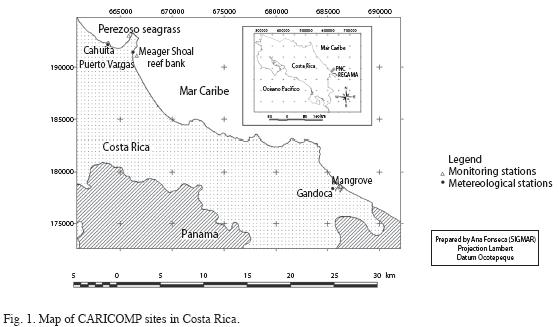
<body><![CDATA[<p style="text-align: center;"><font face="Verdana" size="2"><font  face="Verdana" size="2"><img alt=""  src="/img/revistas/rbt/v58s3/art03f1.jpg"  style="width: 559px; height: 327px;"><a name="fi"></a>    <br> </font></font></p>     <div style="text-align: justify;"><font face="Verdana" size="2"><font  face="Verdana" size="2"><b>     <p>Mangrove of the Gandoca-Manzanillo National Wildlife Refuge (REGAMA)    <br> </p> </b></font> <font face="Verdana" size="2">The REGAMA is located at the southeastern most tip of the Caribbean coast of Costa Rica (<a  href="#fi">Fig. 1</a>). It is surrounded by the Sixaola River at the Panama-Costa Rica border to the east, a row of mountains of the Talamanca Cordillera to the south and on the north side by the Caribbean Sea (<a href="#fi">Fig. 1</a>). It was created in 1985 and has a territory of 5 013 terrestrial ha and 4 436 marine ha, 80% of it is privately owned and 20% is owned by the government. The Gandoca wetlands are protected by the REGAMA and were designated as a RAMSAR site of international importance in 1995. Gandoca is the largest, least disturbed and most studied mangrove in the Caribbean coast of Costa Rica (Coll <i>et al. </i>2001). Only at Gandoca and Corcovado, in the south Pacific coast of Costa Rica, is the tropical rain forest to mangrove continuum preserved (Cortés 1991). The mangrove is located in the south-east section of the refuge, around the Gandoca lagoon. The area of the lagoon and the surrounding vegetation is 266ha, and the mangrove alone has an area of 12.5ha. It is dominated by the red mangrove <i>Rhizophora mangle</i>, with <i>Avicennia germinans </i>(black mangrove), <i>Laguncularia racemosa </i>(white mangrove) and <i>Conocarpus erectus </i>(buttonwood) also present. Moving inland, the mangroves gradually change into a tropical rain forest (Coll <i>et al</i>. 2001). Land use in adjacent areas includes banana and forestry plantations. Levels of pesticides in the lagoon were very low (Coll <i>et al</i>. 2004). Water exchange between the lagoon and the ocean depends on precipitation and run-off. There is more freshwater in the system than marine water that enters. The lagoon outlet varies in size, from 0 to several meters wide, which affects the water table in the mangrove soil during the year but doesn´t seem to affect the trees (Cortés 1998). The mangrove monitoring site (9°35´23" N-82°35´54" W) was located approximately 300m inwards from the mouth of the Gandoca lagoon (<a href="#fi">Fig. 1</a>). The dominant species was the red mangrove <i>Rhizophora mangle </i>(Fonseca et al. 2007b). The meteorological station in REGAMA was located about 1.5 km from the monitoring site (9º35´11.2" N-82º36´04." W), at the house owned by Aquiles Rodríguez, an active member of the Gandoca community and CARICOMP volunteer.</font> <font face="Verdana" size="2"><b>     <p>Methods</p> </b></font> </font></div>     <p style="text-align: justify;"><font face="Verdana" size="2"><font  face="Verdana" size="2">We used the Caribbean Coastal Marine Productivity (CARICOMP Level I and II) methodology (http://isis.uwimona.edu.jm/centres/cms/caricomp/carinew.htm) to compare our monitoring results with those from other Caribbean countries. This protocol was established in the region since 1990. In Costa Rica, attempts to set up a permanent station at the coral reef of Cahuita were carried out in 1997, but without local community involvement the rods marking the sites were frequently lost (Cortés 1998). In 1999 new locations in the three ecosystems were marked and although data is only complete for some years, they have been evaluated yearly since. Concurrently, the local communities were educated about the importance of marine and coastal ecosystems and trained to collaborate with the scientists togather information, specially the weekly physical measurements.</font></font></p>     <div style="text-align: justify;"><font face="Verdana" size="2"><font  face="Verdana" size="2"><b>     <p>Daily measurements</p> </b></font> </font></div>     <p style="text-align: justify;"><font face="Verdana" size="2"><font  face="Verdana" size="2">Continuously recording temperature sensors gathered air and water temperature information every 15 minutes; precipitation was measured in the meteorological stations by the park rangers and volunteers.</font></font></p>     ]]></body>
<body><![CDATA[<div style="text-align: justify;"><font face="Verdana" size="2"><font  face="Verdana" size="2"><b>     <p>Weekly measurements</p> </b></font> </font></div>     <p style="text-align: justify;"><font face="Verdana" size="2"><font  face="Verdana" size="2">Weekly, volunteers from the local communities measured surface water emperature and salinity in Cahuita.</font></font></p>     <div style="text-align: justify;"><font face="Verdana" size="2"><font  face="Verdana" size="2"><b>     <p>Coral reef</p> </b></font><font face="Verdana" size="2">Meager Shoal has 10 permanent 10m long transects, and substrate relative cover is assessed yearly with the continuous intercept chain method, as is sea urchin density using the 1m wide belt method. Additionally, four transects (20x2m) were set to evaluate coral colony density and diseases. On September 13 2000, ten samples were taken to assess the algal biomass. From 1999 to 2005, two water samples (2 liters each), were taken during the rainy and dry seasons to determine the suspended particulate matter (SPM). Fish composition and density were evaluated from 2005 to 2007 following the AGRRA (Atlantic and Gulf Rapid Reef Assessment) protocol, i.e. 30x2 m belt transects (n=10), and in 2004, 2005 and 2007 using the REEF (Reef Environmental Education Foundation) rover diver </font><font face="Verdana" size="2">method. Water temperature was recorded with an underwater temperature sensor, salinity with a refractometer and transparency with a Secchi disk in 1999, 2000 and 2001.</font> <font face="Verdana" size="2"><b>     <p>Seagrasses</p> </b> </font></font></div>     <p style="text-align: justify;"><font face="Verdana" size="2"><font  face="Verdana" size="2">The first year, samples (n=6) were taken monthly, from March 1999 to April 2000, in order to determine seasonal productivity. Data from May and December, 1999 and February and March 2000 could not be collected because of water turbulence and low visibility. Based on the monthly sampling between 1999 and 2000, June showed the highest productivity and February the lowest. Productivity was supposed to be evaluated afterward in these two months yearly; however, in recent years, rough seas precluded data taking in July. Only one month was sampled in 2001, 2003, 2006 and 2007, two in 2004, three in 2000 and 2005 and four in 2008. At present, there is an underwater temperature sensor to monitor the water temperature around the seagrasses at 15 min intervals. At the same time, the local community was educated about the importance of seagrasses and scientific research and on gathering information, specially marking the shoots for growth measurements.</font></font></p>     <div style="text-align: justify;"><font face="Verdana" size="2"><font  face="Verdana" size="2"><b>     <p>Mangrove</p> </b></font> </font></div>     <p style="text-align: justify;"><font face="Verdana" size="2"><font  face="Verdana" size="2">Three 10x10m plots were established in 1999 to evaluate biomass, productivity, seedlings and forest structure. They were located in an accessible area, close to the boundary between the mangrove and the lagoon´s water body. There was a permanent underwater sensor to monitor the water temperature within the mangrove roots (at a depth of 0.1m). Unfortunately, the mangrove plots were lost due to flooding in January 2005, so new ones have been established. The first year, samples were taken monthly, from June 1999 to March 2000, to determine the productivity peaks. During the rainy season, July showed the highest productivity. Therefore, productivity was evaluated again in July 2000, 2001, 2004, 2007 and 2008. At the same time, the local community was educated about the importance of mangroves and trained to help scientific studies, specially collecting litter fall from the productivity boxes.<b> </b></font></font></p>     ]]></body>
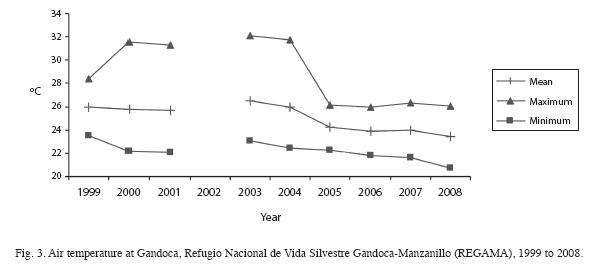
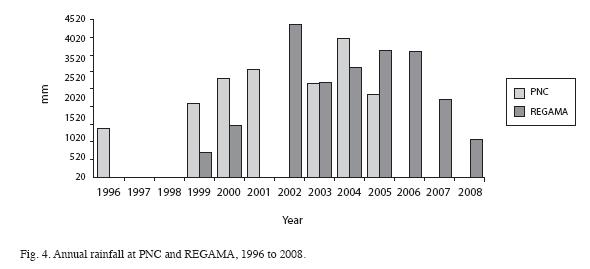
<body><![CDATA[<p style="text-align: justify;"><font face="Verdana" size="2"><font  face="Verdana" size="2"><b>Statistical analysis</b></font></font></p>     <div style="text-align: justify;"><font face="Verdana" size="2"><font  face="Verdana" size="2">Part of the data sets (1999-2004) were analyzed in previous papers (Fonseca <i>et al</i>. 2006, 2007a, b). Since data sets were complete only for some years, repeated measures analysis was not applied (von Ende 1993). Normality and heterogeneity of variances were tested on all the data sets, and transformed when possible. Coral reef and seagrass data were normalized and analyzed with one-way ANOVA´s and Bonferroni or Tukey post hoc tests depending on sample size (Underwood 1997). Variables for forest structure and productivity determination were transformed to a normal distribution with log in base 10. A factorial MANOVA was carried out, and because there was no interaction between the independent variables "plot" and "date", the main effect of "date" was tested with an ANOVA. The data of seasonal productivity could not be normalized and was analyzed with the non parametric test of Kruskall Wallis (H) (Underwood 1997). </font> </font></div>     <p style="text-align: justify;"><font face="Verdana" size="2"><b><font  face="Verdana" size="3">Results</font></b></font></p>     <div style="text-align: justify;"><font face="Verdana" size="2"><b><font  face="Verdana" size="2">     <p>Atmospheric temperature and rainfall</p> </font></b> </font></div>     <p style="text-align: justify;"><font face="Verdana" size="2"><font  face="Verdana" size="2">In the last 10 years, air temperature oscillated between 22.5 and 35.1°C, averaging around 26.5°C at PNC (<a href="#f2">Fig. 2</a>) and between 20.7 and 32.1°C, with an average around 26°C at REGAMA (<a href="#f3">Fig. 3</a>). Yearly rainfall ranged from approximately 1 400 to 4 000 mm at PNC and from approximately 1 400mm at REGAMA (<a href="#f4">Fig. 4</a>). The warmest months were May to June and September to October at both locations.    <br> </font></font></p>     <p style="text-align: center;"><font face="Verdana" size="2"><font  face="Verdana" size="2"><img alt=""  src="/img/revistas/rbt/v58s3/art03f2.jpg"  style="width: 612px; height: 285px;"><a name="f2"></a>    <br> </font></font></p>     <p style="text-align: center;"><font face="Verdana" size="2"><font  face="Verdana" size="2"><img alt=""  src="/img/revistas/rbt/v58s3/art03f3.jpg"  style="width: 599px; height: 272px;"><a name="f3"></a>    ]]></body>
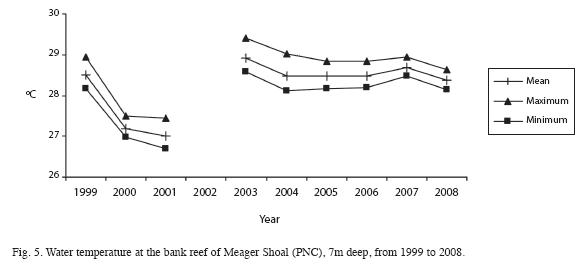
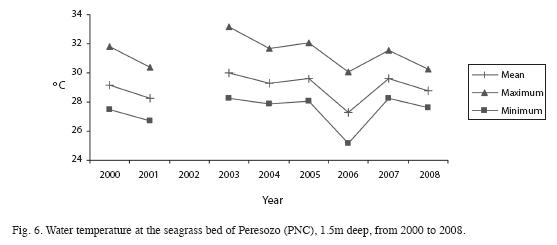
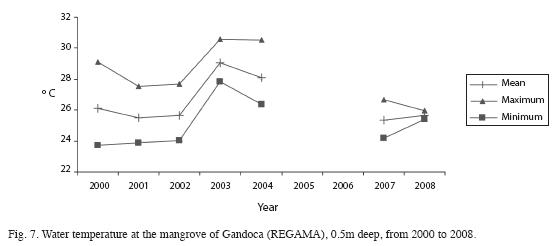
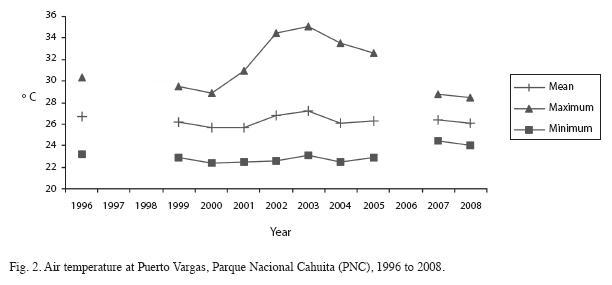
<body><![CDATA[<br> </font></font></p>     <p style="text-align: justify;"><font face="Verdana" size="2"><font  face="Verdana" size="2">    <br> </font></font></p>     <div style="text-align: center;"><font face="Verdana" size="2"><font  face="Verdana" size="2"><img alt=""  src="/img/revistas/rbt/v58s3/art03f4.jpg"  style="width: 590px; height: 269px;"><a name="f4"></a></font>    <br> </font></div>     <div style="text-align: justify;"><font face="Verdana" size="2"><font  face="Verdana" size="2"><b>     <p>Water temperature, salinity and suspended particulate matter</p> </b>     <p>In PNC, water temperature at 7m depth ranged from 26.6 to 29.6<b>°</b>C (<a href="#f5">Fig. 5</a>) and from 25.3 to 33.1<b>°</b>C at 1.5m depth (<a href="#f6">Fig. 6</a>). The maximum water temperature was recorded in 2003 and the minimum in 2001. Salinity at the PNC coral reef ranged from 34.2±1.2 to 37.8±0.8 PSU (n=19) and the mean Secchi depth was 3.5±2.2 m (n=19). Suspended particulate matter ranged from 4.1 to 34.5mg/l, with an average of 17.5±2.4 mg/l.In REGAMA, water temperature within the mangrove roots ranged from 23.7 to 30.5<b>°</b>C, with spikes as low as 21.9°C and as high as 36.1°C. The highest water temperatures were in October 2004 and the lowest temperatures in February 2001 (<a href="#f7">Fig. 7</a>). Salinity of interstitial waters ranged from 6 PSU (April) to 14 PSU (September), with an average of 8.2±4.1 between 1999 and 2009.</p>     <p>Overall, temperature seems to be decreasing, from 2003 to 2008 at the reef site (<a href="#f5">Fig. 5</a>),but was higher than previous recorded years. The seagrass site (<a href="#f6">Fig. 6</a>) also presents a decrease in temperature from a high in 2003 to levels similar to those recorded in previous years.</p> </font>    <br> <font face="Verdana" size="2"> </font></font></div>     ]]></body>
<body><![CDATA[<div style="text-align: center;"><font face="Verdana" size="2"><font  face="Verdana" size="2">     <p><img alt="" src="/img/revistas/rbt/v58s3/art03f5.jpg"  style="width: 583px; height: 265px;"><a name="f5"></a></p> </font>    <br> <font face="Verdana" size="2"> </font></font></div> <font face="Verdana" size="2"><font face="Verdana" size="2">     <p>    <br> </p> </font> </font>     <div style="text-align: center;"><font face="Verdana" size="2"><img  alt="" src="/img/revistas/rbt/v58s3/art03f6.jpg"  style="width: 557px; height: 245px;"><a name="f6"></a>    <br> </font></div> <font face="Verdana" size="2"><font face="Verdana" size="2"> </font></font>     <div style="text-align: center;"><font face="Verdana" size="2"><font  face="Verdana" size="2">     <p><img alt="" src="/img/revistas/rbt/v58s3/art03f7.jpg"  style="width: 556px; height: 246px;"><a name="f7"></a></p> </font>    <br> <font face="Verdana" size="2"> </font></font></div> <font face="Verdana" size="2">    ]]></body>
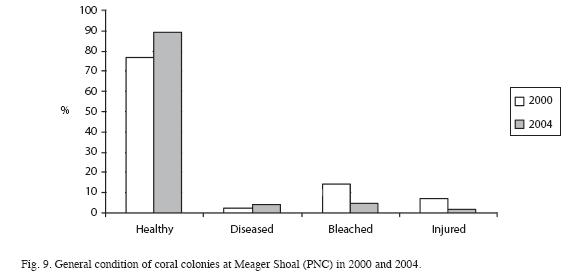
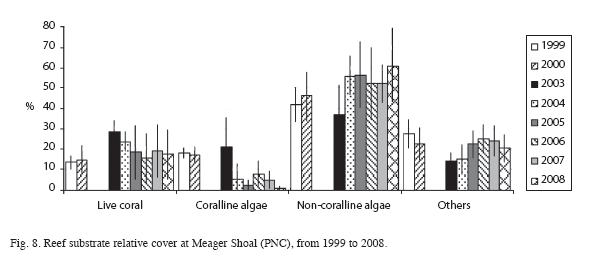
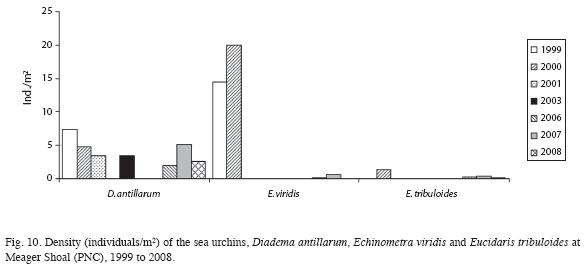
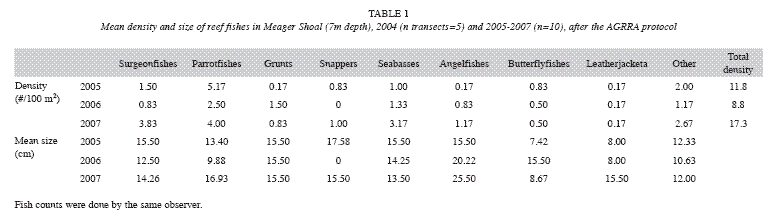
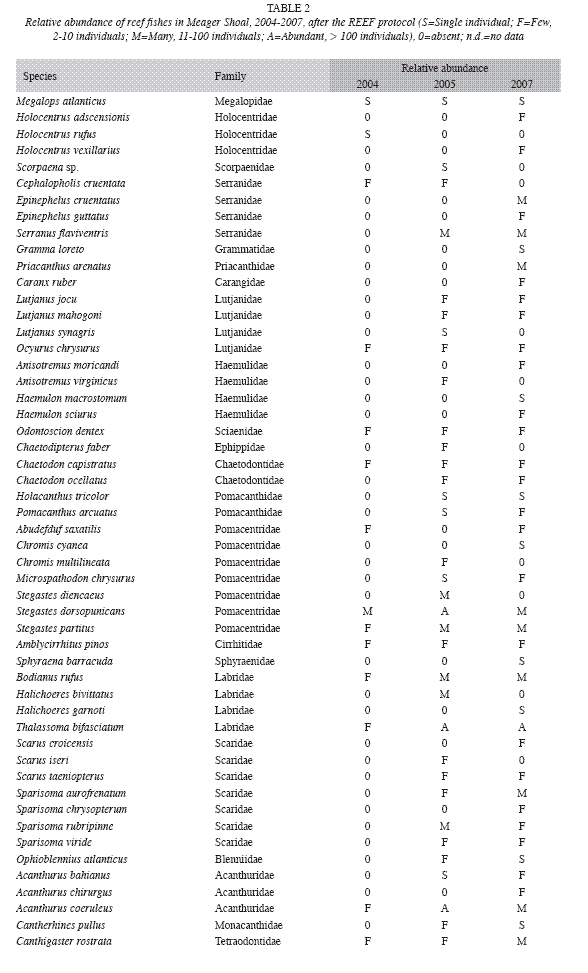
<body><![CDATA[<br> </font>     <div style="text-align: justify;"><font face="Verdana" size="2"><font  face="Verdana" size="2"><b>     <p>Coral reef</p> </b>     <p>Live coral cover ranged from a low of 13.3% in 1999 to a high of 28.3% in 2003, dropping to a little less than 20% (with difference less than 3%) from 2005 to 2008. However, non-coralline algae increased 20% (F=6.9, df=1, p&lt;0.05), and coralline algae decreased 11% (F=17.9, df=1, p&lt;0.05). Total algae cover was higher than the live coral cover, and has an increasing trend, especially between 2000 and 2004 (F=7.2, df=1, p&lt;0.05) (<a href="#f8">Fig. 8</a>). Algal biomass was 1.92±1.29g/100m2 in 2000. Turf algae (&lt;1cm high) was dominant and macroalgae biomass was low. The mean density of coral colonies has been decreasing, from as high as 4.6 colonies/ m2 in 1999 to 3.0 colonies/m2 in 2004 (using the AGRRA method). In 2008, using the ARICOMP method, there were 2.3±0.4 colonies/m2 in areas with dense cover and 0.5±0.3 colonies/ m2 in lower density areas. The dominant coral species were <i>Agaricia agaricites</i>, <i>Porites astreoides</i>, and <i>Siderastrea siderea</i>. The proportion of affected colonies by diseases, injuries and bleaching decreased from 24% in 2000 to 11% in 2004; however, but the difference is not statistically significant (F=0.7, df=1, p&gt;0.05) (<a href="#f9">Fig. 9</a>). In both years White Plague Disease (WPD) and Dark Spot Disease I (DSD-1) were the main diseases. Diseases affected mainly colonies of <i>S. siderea</i>, and bleaching was seen mainly in <i>S</i>. <i>siderea </i>and <i>P. astreoides</i>. Black Band Disease (BBD), Yellow Band Disease (YBD), Dark Spot Disease (DSD-II), White Band Disease (WBD) and <i>Aspergillosis </i>(ASP) were not observed. No diseased or bleached corals were encountered in 2008. Density of <i>Diadema antillarum </i>(between 2 and 7ind/m2) and <i>Eucidaris tribuloides </i>were low in Meager Shoal, though there was an increase in the first species. Density of <i>Echinometra viridis </i>was relatively high, yet decreased significantly from 20 to 0.6ind/m2 between 2000 to 2008 (F=10.8, df=1, p&lt;0.05) (<a  href="#f10">Fig. 10</a>). Fish density ranged from 8.8 to 17.3ind/100m2, with the parrot fishes the most abundant group. The largest fish were encountered in 2006 (20cm angelfishes) and most fishes had a mean size of less than 15cm with the AGRRA protocol (<a href="#t1">Table 1</a>). Using the REEF protocol, pomacentrids and labrids were the most abundant fishes in Meager Shoal (<a href="#t2">Table 2</a>). A total of 51 fish species were ncountered after four years of fish counts (<a href="#t2">Table 2</a>).</p> </font>    <br> <font face="Verdana" size="2"> </font></font></div>     <div style="text-align: center;"><font face="Verdana" size="2"><font  face="Verdana" size="2">     <p><img alt="" src="/img/revistas/rbt/v58s3/art03f8.jpg"  style="width: 589px; height: 259px;"><a name="f8"></a></p> </font>    <br> <font face="Verdana" size="2"> </font></font></div> <font face="Verdana" size="2"><font face="Verdana" size="2">     <p>    <br> </p> </font> </font>     ]]></body>
<body><![CDATA[<div style="text-align: center;"><font face="Verdana" size="2"><img  alt="" src="/img/revistas/rbt/v58s3/art03f9.jpg"  style="width: 571px; height: 278px;"><a name="f9"></a>    <br> </font></div> <font face="Verdana" size="2"><font face="Verdana" size="2"> </font><font face="Verdana" size="2">     <p>    <br> </p> </font> </font>     <div style="text-align: center;"><font face="Verdana" size="2"><img  alt="" src="/img/revistas/rbt/v58s3/art03f10.jpg"  style="width: 586px; height: 273px;"><a name="f10"></a>    <br> </font></div> <font face="Verdana" size="2"><font face="Verdana" size="2">     <p>    <br> </p> </font> </font>     <div style="text-align: center;"><font face="Verdana" size="2"><font  face="Verdana" size="2">     <p><img alt="" src="/img/revistas/rbt/v58s3/art03t1.gif"  style="width: 771px; height: 221px;"><a name="t1"></a></p> </font>    ]]></body>
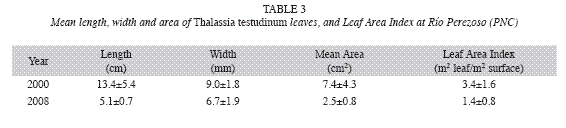
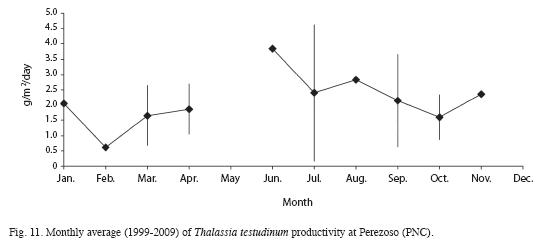
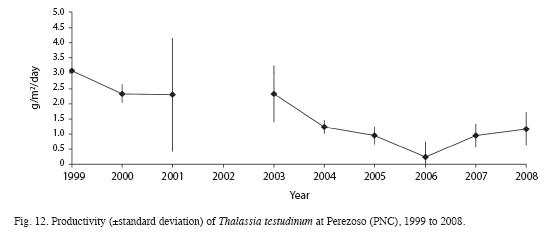
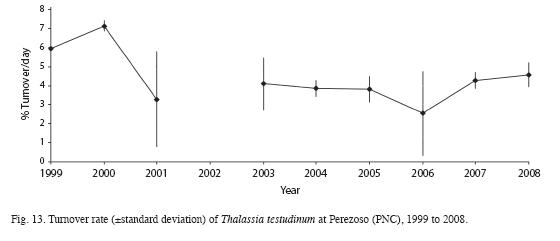
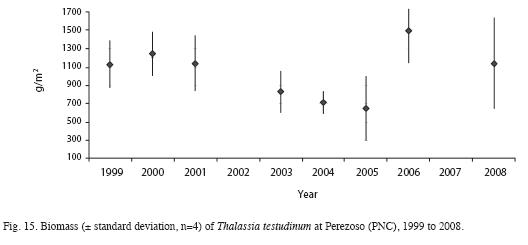
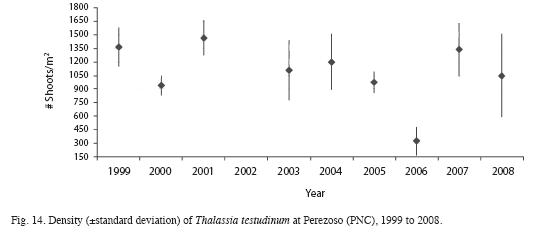
<body><![CDATA[<br> <font face="Verdana" size="2"> </font></font></div>     <div style="text-align: center;"><font face="Verdana" size="2"><font  face="Verdana" size="2">     <p><img alt="" src="/img/revistas/rbt/v58s3/art03t2.gif"  style="width: 588px; height: 973px;"><a name="t2"></a></p> </font>    <br> <font face="Verdana" size="2"> </font></font></div> <font face="Verdana" size="2">    <br> <font face="Verdana" size="2">     <p> </p> </font>    <br> </font>     <div style="text-align: justify;"><font face="Verdana" size="2"><font  face="Verdana" size="2"><b>     <p>Seagrasses </p> </b>Mean length, width and area of <i>Thalassia testudinum </i>leaves and Leaf Area Index have decreased from the 2000 survey compared to 2008 (<a href="#t3">Table 3</a>). Sexual reproduction was observed between March and June. Productivity was highest in June and lowest in February (<a  href="#f11">Fig. 11</a>). Between 1999 and 2008, productivity decreased from 3.1 to 0.24g/m2/day (<a href="#f12">Fig. 12</a>). Turnover rate was also higher in 1999-2000 than the rest of the period, and has remained relatively stable since 2001 around 4% (<a href="#f13">Fig. 13</a>). Shoot density has oscillated between 900 and 1 500shoots/m2, with an outlier of 300shoots/m2 in 2006 (<a href="#f14">Fig. 14</a>). Density was considerably higher in April 1999, compared to September 1999 and March 2000 (F=3.65, df=8.95, p&lt;0.05). There are highly significant differences between years in terms of productivity (ANOVA, F=13.13; df=4.47, p&lt;0.000; <a  href="#f12">Fig. 12</a>). The Tukey <i>a posteriori </i>test indicates that differences are highly significant (p&lt;0.001) during 1999-2003 and the remaining years. Turnover rate was also significantly different between years (ANOVA, F=8.327, p=0.000; <a href="#f13">Fig. 13</a>), specifically during 1999-2000 and the remaining years (Tukey, p&lt;0.01). Seagrass density was significantly lower in March 2000 when compared to March 1999 and March 2001 (F=4.25, df=4, p&lt;0.05) (<a href="#f14">Fig. 14</a>). Mean seagrasses biomass (<i>T. testudinum</i>) at Perezoso in March, from 1999 to 2008 has oscillated between a minimum of 650g/m2 in 2005 and a maximum of 1 500 g/m2 in 2006 (<a href="#f15">Fig. 15</a>). Biomass decreased with time (F=3.84, df=4, p&lt;0.05) and was significantly lower in 2005 than in 1999; however, it has gone up since then, to some of the highest levels so far. Seagrass biomass showed a high inverse correlation with mean (r=-0.87), minimum (-0.66) and especially with maximum temperature (-0.97). Productivity also showed a high inverse correlation with maximum temperature (-0.74).</font>    <br>     ]]></body>
<body><![CDATA[<br>     <br>     <br> </font></div>     <div style="text-align: center;"><font face="Verdana" size="2"><font  face="Verdana" size="2"><img alt=""  src="/img/revistas/rbt/v58s3/art03t3.gif"  style="width: 566px; height: 128px;"><a name="t3"></a></font>    <br> </font></div> <font face="Verdana" size="2"><font face="Verdana" size="2">    <br> </font>    <br> </font>     <div style="text-align: justify;"><font face="Verdana" size="2">    <br> </font></div>     <div style="text-align: center;"><font face="Verdana" size="2"><font  face="Verdana" size="2"><img alt=""  src="/img/revistas/rbt/v58s3/art03f11.jpg"  style="width: 543px; height: 249px;"><a name="f11"></a></font>    ]]></body>
<body><![CDATA[<br> </font></div> <font face="Verdana" size="2"><font face="Verdana" size="2">    <br>     <br> </font> </font>     <div style="text-align: center;"><font face="Verdana" size="2"><font  face="Verdana" size="2"><img alt=""  src="/img/revistas/rbt/v58s3/art03f12.jpg"  style="width: 546px; height: 241px;"><a name="f12"></a></font>    <br> </font></div> <font face="Verdana" size="2"><font face="Verdana" size="2">    <br>     <br> </font> </font>     <div style="text-align: center;"><font face="Verdana" size="2"><font  face="Verdana" size="2"><img alt=""  src="/img/revistas/rbt/v58s3/art03f13.jpg"  style="width: 560px; height: 241px;"><a name="f13"></a></font>    <br> </font></div> <font face="Verdana" size="2"><font face="Verdana" size="2">    <br> </font> </font>     ]]></body>
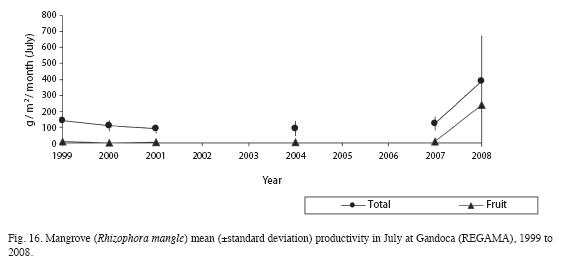
<body><![CDATA[<div style="text-align: center;"><font face="Verdana" size="2"><font  face="Verdana" size="2"><img alt=""  src="/img/revistas/rbt/v58s3/art03f14.jpg"  style="width: 539px; height: 232px;"><a name="f14"></a></font>    <br> </font></div> <font face="Verdana" size="2"><font face="Verdana" size="2">    <br> </font> </font>     <div style="text-align: center;"><font face="Verdana" size="2"><font  face="Verdana" size="2"><img alt=""  src="/img/revistas/rbt/v58s3/art03f15.jpg"  style="width: 528px; height: 245px;"><a name="f15"></a></font>    <br> </font></div> <font face="Verdana" size="2"><font face="Verdana" size="2">    <br> </font>    <br> </font>     <div style="text-align: justify;"><font face="Verdana" size="2"><font  face="Verdana" size="2"><b>     <p>Mangrove</p> </b>     <p>The variables measured to determine forest structure showed no significant differences between years (F=0.32, df=4, 160, p&gt;0.05). Mean circumference at breast height of <i>R. mangle </i>was 46.0±31.3cm, prop root length 2.2±1.2m, trunk length 2.5±2.8m, tree height 11.8±2.2m, trunk diameter 14.8±9.8cm, basal area 22.9±9.1m2/ ha, and trunk volume 0.3±0.2m3. With a mean density of 9.3±1.3trees/10 m2, mean biomass was 4.6±0.7kg/m2, after Golley <i>et al</i>. (1962), and 13.9±5.6kg/m2 using Cintron and Schaeffer- Novelli (1984) equation. Sapling mortality from 1999 to 2000 was 46%, and 66.4% during 2007-2008; mean sapling height was 45.2±18.8cm. Total productivity was significantly higher in July (H=76.43, df=9, p&lt;0.05) and averaged 156.6±37.7g/m2/month. Flower production was also significantly higher in July (H=128.95, df=9, p&lt;0.05), while fruit production was low and highly variable without significant difference between months (H=15.09, df=9, p&gt;0.05). Leaves corresponded to 67% of total litter fall, flowers 13%, bracts 7%, fruits 7%, branches 6% and 0.21% is miscellaneous material.</p>     ]]></body>
<body><![CDATA[<p>Yearly productivity was significantly higher in July 1999 than the same month in 2001 and 2004 (F=12.34, df=3, p&lt;0.05, <a href="#f16">Fig. 16</a>). However, when this period is compared to 2007-2008, productivity is currently significantly higher (F=13.26, df=3, p&lt;0.001). The water table in the mangrove forest rises to 33 cm above the floor and the salinity is as low as 7PSU.</p> </font>    <br> <font face="Verdana" size="2"> </font></font></div>     <div style="text-align: center;"><font face="Verdana" size="2"><font  face="Verdana" size="2">     <p><img alt="" src="/img/revistas/rbt/v58s3/art03f16.jpg"  style="width: 561px; height: 267px;"><a name="f16"></a></p> </font></font></div> <font face="Verdana" size="2">    <br> </font>     <div style="text-align: justify;"><font face="Verdana" size="2"><b><font  face="Verdana" size="3">     <p>Discussion</p> </font></b><font face="Verdana" size="2"> <b>     <p>Coral reef</p> </b></font> </font></div>     <p style="text-align: justify;"><font face="Verdana" size="2"><font  face="Verdana" size="2">Water temperatures were optimal for coral growth at the study site, which is close to the corals upper tolerance level. But, in 2003 and 2005 there were warming events that caused coral bleaching (Fonseca <i>et al</i>. 2006, McField <i>et al. </i>2008, Fonseca &amp; Nielsen-Muñoz in prep.). Although the proportion of diseased colonies decreased by 14%, live coral and coralline algae cover are low, while non-coralline and turf algae dominated the substrate and have increased. Since the decline in live coral cover, from 40% in the late 1970´s to 11% in the early 1990´s (Cortés 1994), in the last four years it has remained relatively stable at around 18%. Suspended particulate matter continues to be the main source of stress and have increased between 1979 (9mg/l) and 1992 (~20mg/l) (Cortés 1994), reaching 24mg/l in 2005 (Roder 2005, Roder <i>et al. </i>2009). It seems that live coral cover cannot increase due to the presence of these sediments, possibly affecting coral recruitment as well as the diversity of reef-building coral species that can grow under those conditions. The sea urchin <i>D. antillarum</i>, a key herbivore species, was common in Cahuita (43 ind/10m2; Cortés 1981) before the 1983 mass mortality in the Caribbean region (Lessios <i>et al</i>. 1984; Murillo &amp; Cortés 1984). Since then, the density of <i>D. antillarum </i>decreased (0.01ind/10m2, Cortés 1994) but seems to be recovering as densities are now higher than 10 years ago, with 0.1-1ind/10m2 in shallower sites of Cahuita (Fonseca 2003, Alvarado <i>et al. </i>2004) and 2-7ind/10m2 from 2000 to 2008 in Meager Shoal. Additionally, several individuals were seen spawning in 2000 (Fonseca 2003). In the last eight years the densities of <i>E. viridis </i>decreased significantly (Fonseca <i>et al</i>. 2006 and <a href="#f10">Fig. 10</a>). It has been observed at other coastal points that populations of <i>E. viridis </i>vary widely during the year apparently due to changes in algal density (J.J. Alvarado, pers. com. 2010).</font></font></p>     <div style="text-align: justify;"><font face="Verdana" size="2"><font  face="Verdana" size="2">Fish density was low perhaps as a result of the low relief of this reef (Phillips &amp; Pérez-Cruet 1984) and has decreased from 20ind/100m2 in 1999 (Fonseca &amp; Gamboa 2003), to approximately 17.3ind/100m2 in 2007, with lower densities in 2005 and 2006 (<a href="#t1">Table 1</a>). Fish diversity and density is lower in Cahuita (Fonseca &amp; Gamboa 2003, this study) relative to other Caribbean reef areas (49ind/100m2, Ginsburg &amp; Lang 2003), possibly related to the poor condition of the coral reef. Fishing pressure was comparatively low as only line fishing was allowed inside the park (Fonseca &amp; Gamboa 2003). Fish declines have also been observed in other Caribbean reefs (Paddack <i>et al. </i>2009). Comparing our data for 2000 with data published for other CARICOMP sites in the wider Caribbean for that same year (CARICOMP 2002, Linton &amp; Fisher 2004), live coral cover was low (14.5%) but not the lowest, as cover ranged from 1.1% in Puerto Morelos, Mexico, to 44.8% in La Parguera, Puerto Rico and was similar to coral cover at Carrie Bow Cay, Belize, and Discovery Bay, Jamaica (both 12.1%). Live coral cover has been low (&lt;50%) at all CARICOMP sites since the 1980´s. On the other hand algae cover was intermediate (62.9%) compared to the CARICOMP range (0.1% in Cayo Sombrero, Venezuela and 92.8% in Puerto Morelos, Mexico) and was also similar to Carrie Bow Cay (53.7%) and Discovery Bay (56.1%). The density of <i>D. antillarum </i>(5 ind/10m2) was low, compared to the maximum density found in Barbados (19.4 ind/10m2) yet similar to other CARICOMP sites like Jamaica. The populations of <i>E. viridis </i>were also low. Algal biomass is also considered to be low, because turf is the dominant form in Meager Shoal (Fonseca <i>et al</i>. 2006). The coral reef at PNC, as other CARICOMP sites, does not show a strong recovery since the 1980´s.</font> <font face="Verdana" size="2"><b>     ]]></body>
<body><![CDATA[<p>Seagrasses</p> </b> </font></font></div>     <p style="text-align: justify;"><font face="Verdana" size="2"><font  face="Verdana" size="2">Seasonal differences in <i>T. testudinum </i>density, biomass and primary production, with maximum values in the summer and minimum values in winter, have been reported by Zieman (1974a, b, 1975), Thorhaug and Roesler (1977) and Van Tussenbroek (1995) for sites in the United States and Mexico. Leaf production reaches peak levels from May to July, in the Gulf of Mexico (Van Tussenbroek 1995), which coincides with the peak of productivity and turnover rate found in June in this study. Kaldy &amp; Dunton (2000), found that seasonal fluctuations are the dominant controls on growth and production of <i>T. testudinum </i>in a subtropical coastal lagoon (Lower Laguna Madre, Texas). The more stable light and temperature conditions in tropical regions are reflected in a generally more uniform biomass throughout the year (Duarte 1989, Hillman <i>et al</i>. 1989). However, considerable seasonal biomass fluctuations have been observed in the tropics. Moderate changes in daily light period and temperature in some cases partially explain such observations (Mellors <i>et al. </i>1993, Lanyon &amp; Marsh 1995).</font></font></p>     <div style="text-align: justify;"><font face="Verdana" size="2"><font  face="Verdana" size="2">Fonseca <i>et al</i>. (2007a) reported a decrease in seagrass productivity and biomass between 1999 and 2005. A further decrease was observed in 2006, but then an increase in 2007 and 2008. There is an overall decreasing trend, yet no significant correlation with temperature increase was found. Furthermore, turnover rate and temperature were also not correlated. However, leaf growth, biomass and primary production were found to be inversely correlated with water temperature in a Mexican Caribbean coral reef lagoon (Van Tussenbroek 1995). Plants run the risk of experiencing thermal stress, which can be detrimental and result in plant death (Zieman &amp; Wood 1975). The major influence of temperature on seagrasses is physiological, relating to the individual species thermal tolerances and their optimum temperatures for photosynthesis, respiration and growth (Short <i>et al. </i>2001). Light, temperature, and inorganic nutrients affect biochemical processes of organisms and are considered as a major factor controlling seagrass growth. Lower leaf biomass and size are early plant responses to light reduction (Lee &amp; Dunton 1977, Lee <i>et al. </i>2007). Between March and April of 1995 (Cortés 1998), at another seagrass site in the lagoon in front of Cahuita Point, <i>Thalassia </i>density was 1035±38 shoots/m2 and its productivity was 3.0±3.20g/m2/day using the CARICOMP protocol. In 1999, (March-April), a density of 1418 shoots/m2 and a productivity of 2.4 g/m2/ day were recorded at Perezoso (Paynter <i>et al. </i>2001), while Fonseca <i>et al. </i>(2007a) report values of 1184±335 shoots/m2 and 2.7±1.2g/m2/d respectively. This study reported a mean density of 1079±250 shoots/m2 and productivity 1.6±0.7g/m2/d. At Perezoso, the density, abundance and frequency of <i>T. testudinum</i>, showed peaks in January, May and September. The abundance of <i>T. testudinum </i>was highest in July, the rainiest month (Nielsen-Muñoz 2007).</font> </font></div>     <p style="text-align: justify;"><font face="Verdana" size="2"><font  face="Verdana" size="2">Total above and below ground biomass was highest (&gt;4 000g/m2) in Belize, lowest in Tobago and Curacao (200-500g/m2), and intermediate to high (750-1 500g/m2) at all other CARICOMP sites (Colombia, Cuba, Mexico, Puerto Rico and Venezuela), including Costa Rica (978.6±281.6 g/m2, n=42). Intermediate biomass of <i>Thalassia testudinum </i>in Costa Rica could be attributed to greater abundance of epiphytes on their leaves as reported for Mochima Bay, Venezuela (Díaz-Díaz &amp; Liñero-Arana 2007). Productivity in the Caribbean varies from &lt;0.5g/m2/d (Bahamas) to &gt;5g/m2/d (Venezuela) and turnover rates average 3.9%/d. In Costa Rica, productivity (1.6±0.7g/m2/d, n=74) is also intermediate, compared to other sites, and similar to that found in Colombia. Turnover rates are high (4.4±1.2%, n=74) compared to what was found in March and August at other sites. Similar values were found between March and June in Barbados, México, Bermudas and Puerto Rico (Linton &amp; Fisher 2004). Turnover rates are probably higher in seagrass beds growing along the shorelines of continents or big islands subjected to a higher discharge of terrestrial nutrients, which makes them more vigorous. Shoot densities average 725shoots/m2 in the Caribbean region but in Costa Rica are higher (1079±250.0shoots/m2) perhaps due to the sampling sites being in a protected area. Average leaf length and width in the entire region were 14.4cm and 10.6mm, respectively, which are higher than in Costa Rica (9.2cm and 7.9mm respectively). The average leaf area index for the Caribbean sites is 3.4, while it is 2.4 in Costa Rica (CARICOMP 1997b, Creed <i>et al. </i>2003, Linton &amp; Fisher 2004).</font></font></p>     <p style="text-align: justify;"><font face="Verdana" size="2"><font  face="Verdana" size="2">Since the seagrass beds in Cahuita are found adjacent to the fringing coral reef, they are in close interaction and serve as nursery and feeding ground for reef organisms. Recreational boating, swimmers and nutrient loading from deforested lands in the coast, the upstream rivers and local pollution (Roder 2005, Roder <i>et al. </i>2009) are all potential sources of impact to seagrass cover and productivity and therefore to the fishing activity of the coastal community (Creed <i>et al. </i>2003). These interaction need to be evaluated in the near future. Furthermore, establishing the habitat requirements of each seagrass species and evaluating their particular response to water quality and sediment types is also needed. </font></font></p>     <div style="text-align: justify;"><font face="Verdana" size="2"><font  face="Verdana" size="2"><b>     <p>Mangrove </p> </b> </font></font></div>     <p style="text-align: justify;"><font face="Verdana" size="2"><font  face="Verdana" size="2">The peak of productivity and flower production of <i>R. mangle </i>in Costa Rica were in July. Mangrove productivity decreased since 2001, and water temperature seems to have decreased; however, more sampling is needed to determine if they are correlated. The productivity trend for CARICOMP sites was clearly related to temperature, and also appears to be affected by rainfall, yet a more extensive data set will be necessary to evaluate this relationship.     <br> </font></font></p>     <div style="text-align: justify;"><font face="Verdana" size="2"><font  face="Verdana" size="2">Only Pool <i>et al. </i>(1977) have published on Caribbean coast mangroves of Costa Rica, and this was at Moín. However, it is important to note that the Moín mangrove is riverine and the dominant species was <i>Pterocarpus officinales</i>, differing from Gandoca. The mean basal area of all trees at Moín was higher (96.5 m2/ha; Pool <i>et al. </i>1977), than Gandoca (22.91±9.14m2/ha), because there the mangrove is lagoonar and dominated by <i>R. mangle</i>. Mean mangrove tree height found in the Caribbean coast of Costa Rica is similar to that of the Pacific coast; however, basal area was in some cases lower in the Caribbean than in the Pacific (Jiménez &amp; Soto 1985, Jiménez 1988, 1994). Similarities in forest structure are found between the Caribbean and the Pacific when they have similar Holdridge climatic complexity indices (Jiménez &amp; Soto 1985). However these observations are not conclusive (Fonseca <i>et al</i>. 2007b) since studies from the Pacific (Jiménez 1994) include other mangrove species besides <i>R. mangle</i>. Biomass at eleven CARICOMP sites in 1995, measured using the Cintron and chaeffer- Novelli (1984) equation, varied from about 1 kg/m2 in Bahamas and Carry Bow Cay, Belize, to 19kg/m2 in Colombia and Venezuela; while the number of trees per plot (10x10m) varied from 9 in Venezuela to 87 in Dominican Republic (CARICOMP 1997c). Therefore biomass in Costa Rica (14kg/m2) was intermediate, while density (9 trees/plot) was relatively low. Biomass was similar to Bermuda (12kg/ m2) and its density the same as that found in Venezuela (9 trees/plot). Yearly productivity ranged from about 1g/m2/day in Bahamas and Bermuda, to 10g/m2/day in Venezuela. The productivity found for July in Costa Rica (5g/ m2/day) is similar to that found for most reported CARICOMP sites as Cayman, Trinidad and Bermuda in that same month (in all cases the month with the highest temperature); yet lower from that found in Venezuela. In Venezuela and Cayman, as in Costa Rica, July was the&nbsp;</font><font face="Verdana" size="2">most productive month of the year. The highest published estimates for above-ground biomass of <i>Rhizophora </i>dominated mangroves stands in Asia and the Pacific were over 70kg/m2, and average productivity 3g/m2/day (Clough 1992), therefore, most of the CARICOMP biomass data, including Costa Rica, fall within the lower half of the biomass range and the productivity approaches the global litter fall average. Mangroves act as exporters of nutrients and sediment traps, and there is no doubt that their removal adversely affects coastal water quality (CARICOMP 1997c). The Gandoca mangrove tripled its area from 1976 to 2000, due mainly to sedimentation processes originated by runoff from the river catchment, since most of the growth was toward the lagoon, and to sea level rise caused by sinking of the lagoon during the April 1991 earthquake, with some new mangrove inland (Denyer 1998, Coll <i>et al</i>. 2001). Apart from a flood that washed away some trees, this mangrove seems to have very little impact from the local community, which is rather small (Coll <i>et al</i>. 2001); logging is not systematic, and locals are shifting their agricultural practices to ecotourism in the area of the lagoon. Levels of pesticide pollution were very low (Coll <i>et al. </i>2004). Environmental awareness of the inhabitants of Gandoca and the protected status of this mangrove by the Gandoca Manzanillo National Wildlife Refuge might guarantee the mangrove´s survival, expansion and functionality, as well as better quality of life for the Gandoca inhabitants. It is recommended to keep updating information on mangrove cover at Gandoca and search deeper into the causes of this beneficial expansion. </font> </font></div>     ]]></body>
<body><![CDATA[<p style="font-weight: bold; text-align: justify;"><font face="Verdana"  size="2"><font face="Verdana" size="3">Conclusions</font></font></p>     <p style="text-align: justify;"><font face="Verdana" size="2"><font  face="Verdana" size="2">-Coral reefs at Cahuita National Park continue to be impacted by terrigenous sediments.</font></font></p>     <p style="text-align: justify;"><font face="Verdana" size="2"><font  face="Verdana" size="2">-Compared to other CARICOMP sites, live coral cover, fish diversity and density, and sea urchin density were low, while algal cover was intermediate. Seagrass productivity, biomass, average leaf length and width were intermediate, and seagrass turnover rates, shoot density nd leaf area index were rather high. Mangrove biomass and density were relatively low, while productivity was intermediate.</font></font></p>     <p style="text-align: justify;"><font face="Verdana" size="2"><font  face="Verdana" size="2">-Management actions, mainly inland, should be considered in order to protect and preserve these important coastal ecosystems. The recovery of forest cover, especially riverine forests, in the watersheds must be a priority to reduce sediments loads that reach the coral reefs.</font></font></p>     <div style="text-align: justify;"><font face="Verdana" size="2"><font  face="Verdana" size="3"><b>     <p>Acknowledgments</p> </b> </font></font></div>     <p style="text-align: justify;"><font face="Verdana" size="2"><font  face="Verdana" size="2">Monitoring the coastal ecosystems of our Caribbean coast have been possible thanks to the support of CARICOMP, Vicerrectoría deInvestigación and CIMAR (Universidad de Costa Rica), Consejo Nacional de Investigaciones Científicas y Tecnológicas (CONICIT), and the United Nations Environmental Program- Jamaica (UNEP). Thanks also to the local communities of Cahuita and Gandoca, all the personnel at Cahuita National Park and the REGAMA and the assistants and administrators from CIMAR for their help. We appreciate the review of the paper by Christopher S. Vaughan, and the detailed comments and suggestion of two anonymous reviewers.</font></font></p> <hr  style="width: 100%; height: 2px; margin-left: 0px; margin-right: 0px;">     <div style="text-align: justify;"><font face="Verdana" size="2"><font  face="Verdana" size="2">&nbsp;</font> </font></div>     <p style="font-weight: bold; text-align: justify;"><font face="Verdana"  size="2"><font face="Verdana" size="3">Literature cited</font></font></p>     <!-- ref --><p style="text-align: justify;"><font face="Verdana" size="2"><font  face="Verdana" size="2">Alfaro, E.J. 2002. Some characteristics of the annual precipitation cycle in Central America and their relationships with its surrounding tropical oceans. Tóp. Meteorol. Oceanogr. 9: 88-103.    &nbsp;&nbsp;&nbsp;&nbsp;&nbsp;&nbsp;&nbsp;&nbsp;[&#160;<a href="javascript:void(0);" onclick="javascript: window.open('/scielo.php?script=sci_nlinks&ref=1716960&pid=S0034-7744201000070000300001&lng=','','width=640,height=500,resizable=yes,scrollbars=1,menubar=yes,');">Links</a>&#160;]<!-- end-ref --> </font></font></p>     <!-- ref --><div style="text-align: justify;"><font face="Verdana" size="2">A<font  face="Verdana" size="2">lvarado, J.J., J. Cortés &amp; E. Salas. 2004. Population densities of <i>Diadema antillarum </i>Philippi at Cahuita National Park (1977-2003), Costa Rica. Carib. J. Sci. 40: 257-259.    &nbsp;&nbsp;&nbsp;&nbsp;&nbsp;&nbsp;&nbsp;&nbsp;[&#160;<a href="javascript:void(0);" onclick="javascript: window.open('/scielo.php?script=sci_nlinks&ref=1716962&pid=S0034-7744201000070000300002&lng=','','width=640,height=500,resizable=yes,scrollbars=1,menubar=yes,');">Links</a>&#160;]<!-- end-ref --></font>    <br>     <!-- ref --><br> <font face="Verdana" size="2">Blair, N., C. Geraghty, G. Gund &amp; B. Jones. 1996. An economic evaluation of Cahuita National Park: establishing&nbsp; the economic value of an environmental asset. Kellogg Graduate School of Management, Boston. Tech Rept. 24 p.    &nbsp;&nbsp;&nbsp;&nbsp;&nbsp;&nbsp;&nbsp;&nbsp;[&#160;<a href="javascript:void(0);" onclick="javascript: window.open('/scielo.php?script=sci_nlinks&ref=1716965&pid=S0034-7744201000070000300003&lng=','','width=640,height=500,resizable=yes,scrollbars=1,menubar=yes,');">Links</a>&#160;]<!-- end-ref --></font> </font></div>     <!-- ref --><p style="text-align: justify;"><font face="Verdana" size="2"><font  face="Verdana" size="2">Breedy, O. 2009. Octocorals. Text: Pp. 161-167, Species List: Compact Disc Pp. 108-111. <i>In</i>: I.S. Wehrtmann and J. Cortés (Eds.). Marine Biodiversity of Costa Rica, Central America. Monogr. Biol. 86. Springer + Business Media B.V., Berlin, Germany.    &nbsp;&nbsp;&nbsp;&nbsp;&nbsp;&nbsp;&nbsp;&nbsp;[&#160;<a href="javascript:void(0);" onclick="javascript: window.open('/scielo.php?script=sci_nlinks&ref=1716967&pid=S0034-7744201000070000300004&lng=','','width=640,height=500,resizable=yes,scrollbars=1,menubar=yes,');">Links</a>&#160;]<!-- end-ref --><br> </font></font></p>     <!-- ref --><p style="text-align: justify;"><font face="Verdana" size="2">C<font  face="Verdana" size="2">ARICOMP. 1997a. Caribbean coastal marine productivity (CARICOMP): a research and monitoring network of marine laboratories, parks, and reserves. Proc. 8<sup>th</sup> Int. Coral Reef Symp., Panamá 1: 641-646.    &nbsp;&nbsp;&nbsp;&nbsp;&nbsp;&nbsp;&nbsp;&nbsp;[&#160;<a href="javascript:void(0);" onclick="javascript: window.open('/scielo.php?script=sci_nlinks&ref=1716969&pid=S0034-7744201000070000300005&lng=','','width=640,height=500,resizable=yes,scrollbars=1,menubar=yes,');">Links</a>&#160;]<!-- end-ref --></font></font></p>     ]]></body>
<body><![CDATA[<!-- ref --><p style="text-align: justify;"><font face="Verdana" size="2"><font  face="Verdana" size="2">CARICOMP 1997b. Variation in ecological parameters of <i>Thalassia testudinum </i>across the CARICOMP Network. Proc. 8th Int. Coral Reef Symp., Panamá 1: 663-668.    &nbsp;&nbsp;&nbsp;&nbsp;&nbsp;&nbsp;&nbsp;&nbsp;[&#160;<a href="javascript:void(0);" onclick="javascript: window.open('/scielo.php?script=sci_nlinks&ref=1716971&pid=S0034-7744201000070000300006&lng=','','width=640,height=500,resizable=yes,scrollbars=1,menubar=yes,');">Links</a>&#160;]<!-- end-ref --> </font></font></p>     <!-- ref --><p style="text-align: justify;"><font face="Verdana" size="2"><font  face="Verdana" size="2">CARICOMP. 1997c. Structure and productivity of mangrove forests in the Greater Caribbean Region. CARICOMP. Proc. of the 8th ICRS, Panamá 1: 669-672.    &nbsp;&nbsp;&nbsp;&nbsp;&nbsp;&nbsp;&nbsp;&nbsp;[&#160;<a href="javascript:void(0);" onclick="javascript: window.open('/scielo.php?script=sci_nlinks&ref=1716973&pid=S0034-7744201000070000300007&lng=','','width=640,height=500,resizable=yes,scrollbars=1,menubar=yes,');">Links</a>&#160;]<!-- end-ref --></font></font></p>     <!-- ref --><p style="text-align: justify;"><font face="Verdana" size="2"><font  face="Verdana" size="2">CARICOMP. 2002. Status and temporal trends at CARICOMP coral reef sites. Proc. 9th Int. Coral Reef Symp., Bali, Indonesia 1: 325-330.    &nbsp;&nbsp;&nbsp;&nbsp;&nbsp;&nbsp;&nbsp;&nbsp;[&#160;<a href="javascript:void(0);" onclick="javascript: window.open('/scielo.php?script=sci_nlinks&ref=1716975&pid=S0034-7744201000070000300008&lng=','','width=640,height=500,resizable=yes,scrollbars=1,menubar=yes,');">Links</a>&#160;]<!-- end-ref --></font></font></p>     <!-- ref --><p style="text-align: justify;"><font face="Verdana" size="2"><font  face="Verdana" size="2">Cintrón, G. &amp; Y. Schaeffer-Novelli. 1984. Methods for studying mangrove structure. Pp. 91-113. <i>In </i>S.C. Snedaker and J.G. Snedaker (eds.). The Mangrove Ecosystem: Research Methods. UNESCO, Bungay, United Kingdom.    &nbsp;&nbsp;&nbsp;&nbsp;&nbsp;&nbsp;&nbsp;&nbsp;[&#160;<a href="javascript:void(0);" onclick="javascript: window.open('/scielo.php?script=sci_nlinks&ref=1716977&pid=S0034-7744201000070000300009&lng=','','width=640,height=500,resizable=yes,scrollbars=1,menubar=yes,');">Links</a>&#160;]<!-- end-ref --></font></font></p>     <!-- ref --><p style="text-align: justify;"><font face="Verdana" size="2"><font  face="Verdana" size="2">Clough, B.F. 1992. Primary productivity and growth of mangrove forests. Pp. 225-249. <i>In </i>A.I. Robertson and D.M. Alongi (Eds.). Tropical Mangrove Ecosystems. Amer. Geophys. Union, Washington, D.C., USA.    &nbsp;&nbsp;&nbsp;&nbsp;&nbsp;&nbsp;&nbsp;&nbsp;[&#160;<a href="javascript:void(0);" onclick="javascript: window.open('/scielo.php?script=sci_nlinks&ref=1716979&pid=S0034-7744201000070000300010&lng=','','width=640,height=500,resizable=yes,scrollbars=1,menubar=yes,');">Links</a>&#160;]<!-- end-ref --></font></font></p>     ]]></body>
<body><![CDATA[<!-- ref --><p style="text-align: justify;"><font face="Verdana" size="2"><font  face="Verdana" size="2">Coll, M., A.C. Fonseca &amp; J. Cortés. 2001. El manglar y otras asociaciones vegetales de la laguna Gandoca, Limón, Costa Rica. Rev. Biol. Trop. 49: 321-329.    &nbsp;&nbsp;&nbsp;&nbsp;&nbsp;&nbsp;&nbsp;&nbsp;[&#160;<a href="javascript:void(0);" onclick="javascript: window.open('/scielo.php?script=sci_nlinks&ref=1716981&pid=S0034-7744201000070000300011&lng=','','width=640,height=500,resizable=yes,scrollbars=1,menubar=yes,');">Links</a>&#160;]<!-- end-ref --></font></font></p>     <!-- ref --><p style="text-align: justify;"><font face="Verdana" size="2"><font  face="Verdana" size="2">Coll, M., J. Cortés &amp; D. Sauma. 2004. Características físico-químicas y determinación de plaguicidas en el agua de la laguna de Gandoca, Limón, Costa Rica. Rev. Biol. Trop. 52: 33-42.    &nbsp;&nbsp;&nbsp;&nbsp;&nbsp;&nbsp;&nbsp;&nbsp;[&#160;<a href="javascript:void(0);" onclick="javascript: window.open('/scielo.php?script=sci_nlinks&ref=1716983&pid=S0034-7744201000070000300012&lng=','','width=640,height=500,resizable=yes,scrollbars=1,menubar=yes,');">Links</a>&#160;]<!-- end-ref --></font></font></p>     <!-- ref --><p style="text-align: justify;"><font face="Verdana" size="2"><font  face="Verdana" size="2">Cortés, J. 1981. The Coral Reef at Cahuita, Costa Rica: A Reef Under Stress. M.Sc. thesis, McMaster University, Hamilton, Ontario, Canada.    &nbsp;&nbsp;&nbsp;&nbsp;&nbsp;&nbsp;&nbsp;&nbsp;[&#160;<a href="javascript:void(0);" onclick="javascript: window.open('/scielo.php?script=sci_nlinks&ref=1716985&pid=S0034-7744201000070000300013&lng=','','width=640,height=500,resizable=yes,scrollbars=1,menubar=yes,');">Links</a>&#160;]<!-- end-ref --></font></font></p>     <!-- ref --><p style="text-align: justify;"><font face="Verdana" size="2"><font  face="Verdana" size="2">Cortés, J. 1991. Ambientes y organismos marinos del Refugio Nacional de Vida Silvestre Gandoca Manzanillo, Limón, Costa Rica. Geoistmo 5: 62-68.    &nbsp;&nbsp;&nbsp;&nbsp;&nbsp;&nbsp;&nbsp;&nbsp;[&#160;<a href="javascript:void(0);" onclick="javascript: window.open('/scielo.php?script=sci_nlinks&ref=1716987&pid=S0034-7744201000070000300014&lng=','','width=640,height=500,resizable=yes,scrollbars=1,menubar=yes,');">Links</a>&#160;]<!-- end-ref --></font></font></p>     <!-- ref --><p style="text-align: justify;"><font face="Verdana" size="2"><font  face="Verdana" size="2">Cortés, J. 1992. Organismos de los arrecifes coralinos de Costa Rica: V. Descripción y distribución geográfica de hidrocorales (Cnidaria; Hydrozoa: Milleporina and Stylasterina) de la costa Caribe. Brenesia 38: 45-50.    &nbsp;&nbsp;&nbsp;&nbsp;&nbsp;&nbsp;&nbsp;&nbsp;[&#160;<a href="javascript:void(0);" onclick="javascript: window.open('/scielo.php?script=sci_nlinks&ref=1716989&pid=S0034-7744201000070000300015&lng=','','width=640,height=500,resizable=yes,scrollbars=1,menubar=yes,');">Links</a>&#160;]<!-- end-ref --></font></font></p>     ]]></body>
<body><![CDATA[<!-- ref --><p style="text-align: justify;"><font face="Verdana" size="2"><font  face="Verdana" size="2">Cortés, J. 1994. A reef under siltation stress: a decade of degradation. Pp. 240-246. <i>In </i>R.N. Ginsburg (Compiler). Proc. Colloquium and Forum on Global Aspects of Coral Reefs: Health, Hazards and History. RSMAS, University of Miami, Miami, Florida.    &nbsp;&nbsp;&nbsp;&nbsp;&nbsp;&nbsp;&nbsp;&nbsp;[&#160;<a href="javascript:void(0);" onclick="javascript: window.open('/scielo.php?script=sci_nlinks&ref=1716991&pid=S0034-7744201000070000300016&lng=','','width=640,height=500,resizable=yes,scrollbars=1,menubar=yes,');">Links</a>&#160;]<!-- end-ref --></font></font></p>     <!-- ref --><p style="text-align: justify;"><font face="Verdana" size="2"><font  face="Verdana" size="2">Cortés, J. 1998. Cahuita and Laguna Gandoca, CostaRica. Pp. 107-113. <i>In </i>B. Kjerfve (ed.). CARICOMP: Caribbean Coral Reef, Seagrass and Mangrove Sites.UNESCO, Paris.    &nbsp;&nbsp;&nbsp;&nbsp;&nbsp;&nbsp;&nbsp;&nbsp;[&#160;<a href="javascript:void(0);" onclick="javascript: window.open('/scielo.php?script=sci_nlinks&ref=1716993&pid=S0034-7744201000070000300017&lng=','','width=640,height=500,resizable=yes,scrollbars=1,menubar=yes,');">Links</a>&#160;]<!-- end-ref --></font></font></p>     <!-- ref --><p style="text-align: justify;"><font face="Verdana" size="2"><font  face="Verdana" size="2">Cortés, J. 2009a. A history of marine biodiversity scientific research in Costa Rica, p. 47-80. <i>In </i>I.S. Wehrtmann &amp; J. Cortés (eds.). Marine Biodiversity of Costa Rica,Central America. Monogr. Biol. 86. Springer + Business Media B.V., Berlin, Germany.    &nbsp;&nbsp;&nbsp;&nbsp;&nbsp;&nbsp;&nbsp;&nbsp;[&#160;<a href="javascript:void(0);" onclick="javascript: window.open('/scielo.php?script=sci_nlinks&ref=1716995&pid=S0034-7744201000070000300018&lng=','','width=640,height=500,resizable=yes,scrollbars=1,menubar=yes,');">Links</a>&#160;]<!-- end-ref --></font></font></p>     <!-- ref --><p style="text-align: justify;"><font face="Verdana" size="2"><font  face="Verdana" size="2">Cortés, J. 2009b. Stony corals, p. 169-173. Species List: Compact Disc p. 112-118. <i>In </i>I.S. Wehrtmann and J. Cortés (eds.). Marine Biodiversity of Costa Rica,Central America. Monogr. Biol. 86. Springer + Business Media B.V., Berlin, Germany.    &nbsp;&nbsp;&nbsp;&nbsp;&nbsp;&nbsp;&nbsp;&nbsp;[&#160;<a href="javascript:void(0);" onclick="javascript: window.open('/scielo.php?script=sci_nlinks&ref=1716997&pid=S0034-7744201000070000300019&lng=','','width=640,height=500,resizable=yes,scrollbars=1,menubar=yes,');">Links</a>&#160;]<!-- end-ref --></font></font></p>     <!-- ref --><p style="text-align: justify;"><font face="Verdana" size="2"><font  face="Verdana" size="2">Cortés, J. &amp; H.M. Guzmán. 1985a. Arrecifes coralinos de la costa Atlántica de Costa Rica. Brenesia 23: 275-292.    &nbsp;&nbsp;&nbsp;&nbsp;&nbsp;&nbsp;&nbsp;&nbsp;[&#160;<a href="javascript:void(0);" onclick="javascript: window.open('/scielo.php?script=sci_nlinks&ref=1716999&pid=S0034-7744201000070000300020&lng=','','width=640,height=500,resizable=yes,scrollbars=1,menubar=yes,');">Links</a>&#160;]<!-- end-ref --></font></font></p>     ]]></body>
<body><![CDATA[<!-- ref --><p style="text-align: justify;"><font face="Verdana" size="2"><font  face="Verdana" size="2">Cortés, J. &amp; H.M. Guzmán. 1985b. Organismos de los arrecifes coralinos de Costa Rica: III. Descripción y distribución geográfica de corales escleractinios (Cnidaria; Anthozoa: Scleractinia) de la costa Caribe. Brenesia 24: 63-124.    &nbsp;&nbsp;&nbsp;&nbsp;&nbsp;&nbsp;&nbsp;&nbsp;[&#160;<a href="javascript:void(0);" onclick="javascript: window.open('/scielo.php?script=sci_nlinks&ref=1717001&pid=S0034-7744201000070000300021&lng=','','width=640,height=500,resizable=yes,scrollbars=1,menubar=yes,');">Links</a>&#160;]<!-- end-ref --></font></font></p>     <!-- ref --><p style="text-align: justify;"><font face="Verdana" size="2"><font  face="Verdana" size="2">Cortés, J. &amp; C.E. Jiménez. 2003. Past, present and future of the coral reefs of the Caribbean coast of Costa Rica, p. 223-239. <i>In </i>J. Cortés (ed.). Latin American Coral Reefs. Elsevier Science B.V., Amsterdam, Holland.    &nbsp;&nbsp;&nbsp;&nbsp;&nbsp;&nbsp;&nbsp;&nbsp;[&#160;<a href="javascript:void(0);" onclick="javascript: window.open('/scielo.php?script=sci_nlinks&ref=1717003&pid=S0034-7744201000070000300022&lng=','','width=640,height=500,resizable=yes,scrollbars=1,menubar=yes,');">Links</a>&#160;]<!-- end-ref --></font></font></p>     <!-- ref --><p style="text-align: justify;"><font face="Verdana" size="2"><font  face="Verdana" size="2">Cortés, J. &amp; M.J. Risk. 1985. A reef under siltation stress: Cahuita, Costa Rica. Bull. Mar. Sci. 36: 339-356.    &nbsp;&nbsp;&nbsp;&nbsp;&nbsp;&nbsp;&nbsp;&nbsp;[&#160;<a href="javascript:void(0);" onclick="javascript: window.open('/scielo.php?script=sci_nlinks&ref=1717005&pid=S0034-7744201000070000300023&lng=','','width=640,height=500,resizable=yes,scrollbars=1,menubar=yes,');">Links</a>&#160;]<!-- end-ref --></font></font></p>     <!-- ref --><p style="text-align: justify;"><font face="Verdana" size="2"><font  face="Verdana" size="2">Cortés, J. &amp; E. Salas. 2009. Seagrasses, p. 119-122. Species List: Compact Disc p. 71-72. <i>In </i>I.S. Wehrtmann &amp; J. Cortés (eds.). Marine Biodiversity of Costa Rica, Central America. Monogr. Biol. 86. Springer + Business Media B.V., Berlin, Germany.    &nbsp;&nbsp;&nbsp;&nbsp;&nbsp;&nbsp;&nbsp;&nbsp;[&#160;<a href="javascript:void(0);" onclick="javascript: window.open('/scielo.php?script=sci_nlinks&ref=1717007&pid=S0034-7744201000070000300024&lng=','','width=640,height=500,resizable=yes,scrollbars=1,menubar=yes,');">Links</a>&#160;]<!-- end-ref --></font></font></p>     <!-- ref --><p style="text-align: justify;"><font face="Verdana" size="2"><font  face="Verdana" size="2">Cortés, J., R. Soto, C. Jiménez &amp; A. Astorga. 1992. Death of intertidal and coral reef organisms as a result of a 7.5 earthquake. Proc. 7th Int. Coral Reef Symp., Guam 1: 235-240.    &nbsp;&nbsp;&nbsp;&nbsp;&nbsp;&nbsp;&nbsp;&nbsp;[&#160;<a href="javascript:void(0);" onclick="javascript: window.open('/scielo.php?script=sci_nlinks&ref=1717009&pid=S0034-7744201000070000300025&lng=','','width=640,height=500,resizable=yes,scrollbars=1,menubar=yes,');">Links</a>&#160;]<!-- end-ref --></font></font></p>     ]]></body>
<body><![CDATA[<!-- ref --><p style="text-align: justify;"><font face="Verdana" size="2"><font  face="Verdana" size="2">Cortés, J., R. Soto &amp; C. Jiménez. 1994. Efectos ecológicos del terremoto de Limón. Rev. Geol. Amér. Central, Vol. Esp. Terremoto de Limón: 187-192.    &nbsp;&nbsp;&nbsp;&nbsp;&nbsp;&nbsp;&nbsp;&nbsp;[&#160;<a href="javascript:void(0);" onclick="javascript: window.open('/scielo.php?script=sci_nlinks&ref=1717011&pid=S0034-7744201000070000300026&lng=','','width=640,height=500,resizable=yes,scrollbars=1,menubar=yes,');">Links</a>&#160;]<!-- end-ref --> </font></font></p>     <!-- ref --><p style="text-align: justify;"><font face="Verdana" size="2"><font  face="Verdana" size="2">Creed, J.C., R.C. Phillips &amp; B.I. Van Tussenbroek. 2003. The seagrasses of the Caribbean, p. 234-242. <i>In </i>E.P. Green &amp; F.T. Short. World Atlas of Seagrasses: Present Status and Future Conservation. University of California, Berkeley, USA.    &nbsp;&nbsp;&nbsp;&nbsp;&nbsp;&nbsp;&nbsp;&nbsp;[&#160;<a href="javascript:void(0);" onclick="javascript: window.open('/scielo.php?script=sci_nlinks&ref=1717013&pid=S0034-7744201000070000300027&lng=','','width=640,height=500,resizable=yes,scrollbars=1,menubar=yes,');">Links</a>&#160;]<!-- end-ref --></font></font></p>     <!-- ref --><p style="text-align: justify;"><font face="Verdana" size="2"><font  face="Verdana" size="2">Denyer, P. 1998. Historic-prehistoric earthquakes, seismic hazards and Tertiary and Quaternary geology of the Gandoca-Manzanillo National Wildlife Refuge, Limón, Costa Rica. Rev. Biol. Trop. 46: 237-250.    &nbsp;&nbsp;&nbsp;&nbsp;&nbsp;&nbsp;&nbsp;&nbsp;[&#160;<a href="javascript:void(0);" onclick="javascript: window.open('/scielo.php?script=sci_nlinks&ref=1717015&pid=S0034-7744201000070000300028&lng=','','width=640,height=500,resizable=yes,scrollbars=1,menubar=yes,');">Links</a>&#160;]<!-- end-ref --></font></font></p>     <!-- ref --><p style="text-align: justify;"><font face="Verdana" size="2"><font  face="Verdana" size="2">Díaz-Díaz, O. &amp; I. Liñero-Arana. 2007. Biomass and density of <i>Thalassia testudinum </i>beds in Mochima Bay, Venezuela. Acta Bot. Venez. 30: 217-226.    &nbsp;&nbsp;&nbsp;&nbsp;&nbsp;&nbsp;&nbsp;&nbsp;[&#160;<a href="javascript:void(0);" onclick="javascript: window.open('/scielo.php?script=sci_nlinks&ref=1717017&pid=S0034-7744201000070000300029&lng=','','width=640,height=500,resizable=yes,scrollbars=1,menubar=yes,');">Links</a>&#160;]<!-- end-ref --></font></font></p>     <!-- ref --><p style="text-align: justify;"><font face="Verdana" size="2"><font  face="Verdana" size="2">Duarte, C.M. 1989. Temporal biomass variability and production/biomass relationships of seagrass communities. Mar. Ecol. Prog. Ser: 269-76.    &nbsp;&nbsp;&nbsp;&nbsp;&nbsp;&nbsp;&nbsp;&nbsp;[&#160;<a href="javascript:void(0);" onclick="javascript: window.open('/scielo.php?script=sci_nlinks&ref=1717019&pid=S0034-7744201000070000300030&lng=','','width=640,height=500,resizable=yes,scrollbars=1,menubar=yes,');">Links</a>&#160;]<!-- end-ref --></font></font></p>     ]]></body>
<body><![CDATA[<p style="text-align: justify;"><font face="Verdana" size="2"><font  face="Verdana" size="2"> </font></font></p>     <!-- ref --><p style="text-align: justify;"><font face="Verdana" size="2"><font  face="Verdana" size="2">Fonseca, A.C. 2003. A rapid assessment at Cahuita National Park, Costa Rica, 1999 (Part I: stony corals and algae). <i>In </i>J.C. Lang (Ed.). Status of Coral Reefs in the Western Atlantic: Results of Initial Surveys, Atlantic and Gulf Rapid Reef Assessment (AGRRA) Program. Atoll Res. Bull. 496: 249-257.    &nbsp;&nbsp;&nbsp;&nbsp;&nbsp;&nbsp;&nbsp;&nbsp;[&#160;<a href="javascript:void(0);" onclick="javascript: window.open('/scielo.php?script=sci_nlinks&ref=1717022&pid=S0034-7744201000070000300031&lng=','','width=640,height=500,resizable=yes,scrollbars=1,menubar=yes,');">Links</a>&#160;]<!-- end-ref --></font></font></p>     <!-- ref --><p style="text-align: justify;"><font face="Verdana" size="2"><font  face="Verdana" size="2">Fonseca, A.C. &amp; J. Cortés. 2002. Land use in the La Estrella River basin and soil erosion effects on the Cahuita reef system, Costa Rica: 68-82 and 114-118. <i>In: </i>B. Kjerfve, W.J. Wiebe, H.H. Kremer, W. Salomons and J.I. Marshall Crossland (Eds.). Caribbean Basins: LOICZ Global Change Assessment and Synthesis of River Catchment/ Island-Coastal Sea Interaction and Human Dimension. LOICZ Reports and Studies No. 27. LOICZ, Texel, The Netherlands.    &nbsp;&nbsp;&nbsp;&nbsp;&nbsp;&nbsp;&nbsp;&nbsp;[&#160;<a href="javascript:void(0);" onclick="javascript: window.open('/scielo.php?script=sci_nlinks&ref=1717024&pid=S0034-7744201000070000300032&lng=','','width=640,height=500,resizable=yes,scrollbars=1,menubar=yes,');">Links</a>&#160;]<!-- end-ref --></font></font></p>     <!-- ref --><p style="text-align: justify;"><font face="Verdana" size="2"><font  face="Verdana" size="2">Fonseca, A.C. &amp; C. Gamboa 2003. A rapid assessment at Cahuita National Park, Costa Rica, 1999 (Part 2: Reef fishes). <i>In </i>J.C. Lang (Ed.). Status of Coral Reefs in the Western Atlantic: Results of Initial Surveys, Atlantic and Gulf Rapid Reef Assessment (AGRRA) Program. Atoll Res. Bull. 496: 258-266.    &nbsp;&nbsp;&nbsp;&nbsp;&nbsp;&nbsp;&nbsp;&nbsp;[&#160;<a href="javascript:void(0);" onclick="javascript: window.open('/scielo.php?script=sci_nlinks&ref=1717026&pid=S0034-7744201000070000300033&lng=','','width=640,height=500,resizable=yes,scrollbars=1,menubar=yes,');">Links</a>&#160;]<!-- end-ref --></font></font></p>     <!-- ref --><p style="text-align: justify;"><font face="Verdana" size="2"><font  face="Verdana" size="2">Fonseca, A.C., E. Salas &amp; J. Cortés. 2006. Monitoreo Del arrecife coralino Meager Shoal, Parque Nacional Cahuita (sitio CARICOMP). Rev. Biol. Trop. 54: 755-763.    &nbsp;&nbsp;&nbsp;&nbsp;&nbsp;&nbsp;&nbsp;&nbsp;[&#160;<a href="javascript:void(0);" onclick="javascript: window.open('/scielo.php?script=sci_nlinks&ref=1717028&pid=S0034-7744201000070000300034&lng=','','width=640,height=500,resizable=yes,scrollbars=1,menubar=yes,');">Links</a>&#160;]<!-- end-ref --></font></font></p>     <!-- ref --><p style="text-align: justify;"><font face="Verdana" size="2"><font  face="Verdana" size="2">Fonseca, A.C., V. Nielsen &amp; J. Cortés. 2007a. Monitoreo de pastos marinos en Perezoso, sitio CARICOMP en Cahuita, Costa Rica. Rev. Biol. Trop. 55: 55-66.    &nbsp;&nbsp;&nbsp;&nbsp;&nbsp;&nbsp;&nbsp;&nbsp;[&#160;<a href="javascript:void(0);" onclick="javascript: window.open('/scielo.php?script=sci_nlinks&ref=1717030&pid=S0034-7744201000070000300035&lng=','','width=640,height=500,resizable=yes,scrollbars=1,menubar=yes,');">Links</a>&#160;]<!-- end-ref --></font></font></p>     <!-- ref --><p style="text-align: justify;"><font face="Verdana" size="2"><font  face="Verdana" size="2">Fonseca, A.C., J. Cortés &amp; P. Zamora. 2007b. Monitoreo del manglar de Gandoca, Costa Rica (Sitio CARICOMP). Rev. Biol. Trop. 55: 23-31.    &nbsp;&nbsp;&nbsp;&nbsp;&nbsp;&nbsp;&nbsp;&nbsp;[&#160;<a href="javascript:void(0);" onclick="javascript: window.open('/scielo.php?script=sci_nlinks&ref=1717032&pid=S0034-7744201000070000300036&lng=','','width=640,height=500,resizable=yes,scrollbars=1,menubar=yes,');">Links</a>&#160;]<!-- end-ref --></font></font></p>     <!-- ref --><p style="text-align: justify;"><font face="Verdana" size="2"><font  face="Verdana" size="2">Ginsburg, R.N. &amp; J. Lang. 2003. Foreword. <i>In </i>J.C. Lang (Ed.). Status of Coral Reefs in the Western Atlantic: Results of Initial Surveys, Atlantic and Gulf Rapid Reef Assessment (AGRRA) Program. Atoll Res. Bull. 496: vii-xiii.    &nbsp;&nbsp;&nbsp;&nbsp;&nbsp;&nbsp;&nbsp;&nbsp;[&#160;<a href="javascript:void(0);" onclick="javascript: window.open('/scielo.php?script=sci_nlinks&ref=1717034&pid=S0034-7744201000070000300037&lng=','','width=640,height=500,resizable=yes,scrollbars=1,menubar=yes,');">Links</a>&#160;]<!-- end-ref --></font></font></p>     <!-- ref --><p style="text-align: justify;"><font face="Verdana" size="2"><font  face="Verdana" size="2">Golley, F., H.T. Odum &amp; R.F. Wilson. 1962. The structure and metabolism of a Puerto Rican red mangrove forest in May. Ecology 43: 9-19.    &nbsp;&nbsp;&nbsp;&nbsp;&nbsp;&nbsp;&nbsp;&nbsp;[&#160;<a href="javascript:void(0);" onclick="javascript: window.open('/scielo.php?script=sci_nlinks&ref=1717036&pid=S0034-7744201000070000300038&lng=','','width=640,height=500,resizable=yes,scrollbars=1,menubar=yes,');">Links</a>&#160;]<!-- end-ref --></font></font></p>     <!-- ref --><p style="text-align: justify;"><font face="Verdana" size="2"><font  face="Verdana" size="2">Guzmán, H.M. &amp; J. Cortés. 1985. Organismos de los arrecifes coralinos de Costa Rica: IV. Descripción y distribución geográfica de octocoralarios de la costa Caribe. Brenesia 24: 125-174.    &nbsp;&nbsp;&nbsp;&nbsp;&nbsp;&nbsp;&nbsp;&nbsp;[&#160;<a href="javascript:void(0);" onclick="javascript: window.open('/scielo.php?script=sci_nlinks&ref=1717038&pid=S0034-7744201000070000300039&lng=','','width=640,height=500,resizable=yes,scrollbars=1,menubar=yes,');">Links</a>&#160;]<!-- end-ref --> </font></font></p>     <!-- ref --><p style="text-align: justify;"><font face="Verdana" size="2"><font  face="Verdana" size="2">Herrera, W. 1984. Clima de Costa Rica. Editorial Universidad Estatal a Distancia (EUNED), San José, Costa Rica, 118 p.    &nbsp;&nbsp;&nbsp;&nbsp;&nbsp;&nbsp;&nbsp;&nbsp;[&#160;<a href="javascript:void(0);" onclick="javascript: window.open('/scielo.php?script=sci_nlinks&ref=1717040&pid=S0034-7744201000070000300040&lng=','','width=640,height=500,resizable=yes,scrollbars=1,menubar=yes,');">Links</a>&#160;]<!-- end-ref --></font></font></p>     <!-- ref --><p style="text-align: justify;"><font face="Verdana" size="2"><font  face="Verdana" size="2">Hillman, K., D.I. Walker, A.W.D Larkum &amp; A.J. McComb.1989. Productivity and nutrient limitation, p. 635-685. <i>In </i>A.W.D. Larkum, A.J. McComb &amp; S.A. Shepherd (eds.). Biology of Seagrasses. Elsevier, Amsterdam, Holland.    &nbsp;&nbsp;&nbsp;&nbsp;&nbsp;&nbsp;&nbsp;&nbsp;[&#160;<a href="javascript:void(0);" onclick="javascript: window.open('/scielo.php?script=sci_nlinks&ref=1717042&pid=S0034-7744201000070000300041&lng=','','width=640,height=500,resizable=yes,scrollbars=1,menubar=yes,');">Links</a>&#160;]<!-- end-ref --></font></font></p>     <!-- ref --><p style="text-align: justify;"><font face="Verdana" size="2"><font  face="Verdana" size="2">Hoegh-Guldberg, O., P.J. Mumby, A.J. Hooten, R.S. Steneck, P. Greenfield, E. Gomez, C.D. Harvell, P.F. Sale, A.J. Edwards, K. Caldeira, N. Knowlton, C.M. Eakin, R. Iglesias-Prieto, N. Muthinga, R.H. Bradbury, A. Dubi &amp; M.E. Hatziolos. 2007. Coral reefs under rapid climate change and ocean acidification. Science 318: 1737-1742.    &nbsp;&nbsp;&nbsp;&nbsp;&nbsp;&nbsp;&nbsp;&nbsp;[&#160;<a href="javascript:void(0);" onclick="javascript: window.open('/scielo.php?script=sci_nlinks&ref=1717044&pid=S0034-7744201000070000300042&lng=','','width=640,height=500,resizable=yes,scrollbars=1,menubar=yes,');">Links</a>&#160;]<!-- end-ref --></font></font></p>     <!-- ref --><p style="text-align: justify;"><font face="Verdana" size="2"><font  face="Verdana" size="2">Hughes, T.P., A.H. Baird, D.R. Bellwood, M. Card, S.R. Connolly, C. Folke, R. Grosberg, O. Hoegh-Guldberg, J.B.C. Jackson, J. Kleypas, J.M. Lough, P. Marshall, M. Nyström, S.R. Palumbi, J.M. Pandolfi, B. Rosen &amp; J. Roughgarden. 2003. Climate change, human impacts, and the resilience of coral reefs. Science 301: 929-933.    &nbsp;&nbsp;&nbsp;&nbsp;&nbsp;&nbsp;&nbsp;&nbsp;[&#160;<a href="javascript:void(0);" onclick="javascript: window.open('/scielo.php?script=sci_nlinks&ref=1717046&pid=S0034-7744201000070000300043&lng=','','width=640,height=500,resizable=yes,scrollbars=1,menubar=yes,');">Links</a>&#160;]<!-- end-ref --></font></font></p>     <!-- ref --><p style="text-align: justify;"><font face="Verdana" size="2"><font  face="Verdana" size="2">Jiménez, J.A. 1988. The dynamics of <i>Rhizophora racemosa </i>Meyer, forests on the Pacific coast of Costa Rica. Brenesia 30: 1-12.    &nbsp;&nbsp;&nbsp;&nbsp;&nbsp;&nbsp;&nbsp;&nbsp;[&#160;<a href="javascript:void(0);" onclick="javascript: window.open('/scielo.php?script=sci_nlinks&ref=1717048&pid=S0034-7744201000070000300044&lng=','','width=640,height=500,resizable=yes,scrollbars=1,menubar=yes,');">Links</a>&#160;]<!-- end-ref --></font></font></p>     <!-- ref --><p style="text-align: justify;"><font face="Verdana" size="2"><font  face="Verdana" size="2">Jiménez, J.A. 1994. Los Manglares del Pacífico Centroamericano. EFUNA, Heredia, Costa Rica. 352 p.    &nbsp;&nbsp;&nbsp;&nbsp;&nbsp;&nbsp;&nbsp;&nbsp;[&#160;<a href="javascript:void(0);" onclick="javascript: window.open('/scielo.php?script=sci_nlinks&ref=1717050&pid=S0034-7744201000070000300045&lng=','','width=640,height=500,resizable=yes,scrollbars=1,menubar=yes,');">Links</a>&#160;]<!-- end-ref --></font></font></p>     <!-- ref --><p style="text-align: justify;"><font face="Verdana" size="2"><font  face="Verdana" size="2">Jiménez, J.A. &amp; R. Soto. 1985. Patrones regionales en la estructura y composición florística de los manglares de la costa Pacífica de Costa Rica. Rev. Biol. Trop. 33: 25-37.    &nbsp;&nbsp;&nbsp;&nbsp;&nbsp;&nbsp;&nbsp;&nbsp;[&#160;<a href="javascript:void(0);" onclick="javascript: window.open('/scielo.php?script=sci_nlinks&ref=1717052&pid=S0034-7744201000070000300046&lng=','','width=640,height=500,resizable=yes,scrollbars=1,menubar=yes,');">Links</a>&#160;]<!-- end-ref --></font></font></p>     <!-- ref --><p style="text-align: justify;"><font face="Verdana" size="2"><font  face="Verdana" size="2">Kaldy, J.E. &amp; K.H. Dunton. 2000. Above-and belowground production, biomass and reproductive ecology of <i>Thalassia testudinum </i>(turtle grass) in a subtropical coastal lagoon. Mar. Ecol. Prog. Ser. 193: 271-283.    &nbsp;&nbsp;&nbsp;&nbsp;&nbsp;&nbsp;&nbsp;&nbsp;[&#160;<a href="javascript:void(0);" onclick="javascript: window.open('/scielo.php?script=sci_nlinks&ref=1717054&pid=S0034-7744201000070000300047&lng=','','width=640,height=500,resizable=yes,scrollbars=1,menubar=yes,');">Links</a>&#160;]<!-- end-ref --></font></font></p>     <!-- ref --><p style="text-align: justify;"><font face="Verdana" size="2"><font  face="Verdana" size="2">Lanyon, J.M. &amp; H. Marsh. 1995. Temporal changes in the abundance of some tropical intertidal sea grasses in North Queensland. Aquat. Bot. 217-37.    &nbsp;&nbsp;&nbsp;&nbsp;&nbsp;&nbsp;&nbsp;&nbsp;[&#160;<a href="javascript:void(0);" onclick="javascript: window.open('/scielo.php?script=sci_nlinks&ref=1717056&pid=S0034-7744201000070000300048&lng=','','width=640,height=500,resizable=yes,scrollbars=1,menubar=yes,');">Links</a>&#160;]<!-- end-ref --></font></font></p>     <!-- ref --><p style="text-align: justify;"><font face="Verdana" size="2"><font  face="Verdana" size="2">Lee, K.S. &amp; K.H. Dunton. 1997. Effects of in situ light reduction on the maintenance, growth and partitioning of carbon resources in <i>Thalassia testudinum </i>Banks ex König. J. Exp. Mar. Biol. Ecol. 210: 53-73.    &nbsp;&nbsp;&nbsp;&nbsp;&nbsp;&nbsp;&nbsp;&nbsp;[&#160;<a href="javascript:void(0);" onclick="javascript: window.open('/scielo.php?script=sci_nlinks&ref=1717058&pid=S0034-7744201000070000300049&lng=','','width=640,height=500,resizable=yes,scrollbars=1,menubar=yes,');">Links</a>&#160;]<!-- end-ref --></font></font></p>     <!-- ref --><p style="text-align: justify;"><font face="Verdana" size="2"><font  face="Verdana" size="2">Lee, K.S., S.R. Park &amp; Y.K. Kim. 2007. Effects of irradiance, temperature, and nutrients on growth dynamics of seagrasses: A review. J. Exp. Mar. Biol. Ecol. 350: 144-175.    &nbsp;&nbsp;&nbsp;&nbsp;&nbsp;&nbsp;&nbsp;&nbsp;[&#160;<a href="javascript:void(0);" onclick="javascript: window.open('/scielo.php?script=sci_nlinks&ref=1717060&pid=S0034-7744201000070000300050&lng=','','width=640,height=500,resizable=yes,scrollbars=1,menubar=yes,');">Links</a>&#160;]<!-- end-ref --></font></font></p>     <!-- ref --><p style="text-align: justify;"><font face="Verdana" size="2"><font  face="Verdana" size="2">Lessios, H.A., D.R. Robertson &amp; J.D. Cubit. 1984. Spread of <i>Diadema </i>mass mortality through the Caribbean. Science 226: 335-337.    &nbsp;&nbsp;&nbsp;&nbsp;&nbsp;&nbsp;&nbsp;&nbsp;[&#160;<a href="javascript:void(0);" onclick="javascript: window.open('/scielo.php?script=sci_nlinks&ref=1717062&pid=S0034-7744201000070000300051&lng=','','width=640,height=500,resizable=yes,scrollbars=1,menubar=yes,');">Links</a>&#160;]<!-- end-ref --></font></font></p>     <!-- ref --><p style="text-align: justify;"><font face="Verdana" size="2"><font  face="Verdana" size="2">Linton, D. &amp; T. Fisher. 2004. Caribbean Coastal Marine Productivity Program, 1993-2004. CARICOMP, Kingston, Jamaica.    &nbsp;&nbsp;&nbsp;&nbsp;&nbsp;&nbsp;&nbsp;&nbsp;[&#160;<a href="javascript:void(0);" onclick="javascript: window.open('/scielo.php?script=sci_nlinks&ref=1717064&pid=S0034-7744201000070000300052&lng=','','width=640,height=500,resizable=yes,scrollbars=1,menubar=yes,');">Links</a>&#160;]<!-- end-ref --></font></font></p>     <!-- ref --><p style="text-align: justify;"><font face="Verdana" size="2"><font  face="Verdana" size="2">Lizano, O.G. 2006. Algunas características de las mareas en las costa Pacífica y Caribe de Centroamérica. Cienc. Tecnol. 24: 51-64.    &nbsp;&nbsp;&nbsp;&nbsp;&nbsp;&nbsp;&nbsp;&nbsp;[&#160;<a href="javascript:void(0);" onclick="javascript: window.open('/scielo.php?script=sci_nlinks&ref=1717066&pid=S0034-7744201000070000300053&lng=','','width=640,height=500,resizable=yes,scrollbars=1,menubar=yes,');">Links</a>&#160;]<!-- end-ref --></font></font></p>     <!-- ref --><p style="text-align: justify;"><font face="Verdana" size="2"><font  face="Verdana" size="2">Lizano, O.G. 2007. Climatología del viento y oleaje frente a las costas de Costa Rica. Cienc. Tecnol. 25: 43-56.    &nbsp;&nbsp;&nbsp;&nbsp;&nbsp;&nbsp;&nbsp;&nbsp;[&#160;<a href="javascript:void(0);" onclick="javascript: window.open('/scielo.php?script=sci_nlinks&ref=1717068&pid=S0034-7744201000070000300054&lng=','','width=640,height=500,resizable=yes,scrollbars=1,menubar=yes,');">Links</a>&#160;]<!-- end-ref --></font></font></p>     <!-- ref --><p style="text-align: justify;"><font face="Verdana" size="2"><font  face="Verdana" size="2">McField, M., N. Bood, A. Fonseca, A. Arrivillaga, A. Franquesa- Rinos &amp; R.M. Loreto-Viruel. 2008. Status of the Mesoamerican reef after the 2005 coral bleaching event: 45-60. <i>In</i>: C. Wilkinson &amp; D. Souter (eds.). Status of Caribbean Coral Reefs after Bleaching and Hurricanes in 2005. GCRMN &amp; RRRC, Townsville, Australia.    &nbsp;&nbsp;&nbsp;&nbsp;&nbsp;&nbsp;&nbsp;&nbsp;[&#160;<a href="javascript:void(0);" onclick="javascript: window.open('/scielo.php?script=sci_nlinks&ref=1717070&pid=S0034-7744201000070000300055&lng=','','width=640,height=500,resizable=yes,scrollbars=1,menubar=yes,');">Links</a>&#160;]<!-- end-ref --></font></font></p>     <!-- ref --><p style="text-align: justify;"><font face="Verdana" size="2"><font  face="Verdana" size="2">Mellors, J.E., H. Marsh &amp; R.G. Coles. 1993. Intra-annual changes in seagrass standing crop, Green Island, Northern Queensland. Austr. J. Mar. Freshwater Res. 44: 33-41.    &nbsp;&nbsp;&nbsp;&nbsp;&nbsp;&nbsp;&nbsp;&nbsp;[&#160;<a href="javascript:void(0);" onclick="javascript: window.open('/scielo.php?script=sci_nlinks&ref=1717072&pid=S0034-7744201000070000300056&lng=','','width=640,height=500,resizable=yes,scrollbars=1,menubar=yes,');">Links</a>&#160;]<!-- end-ref --></font></font></p>     <!-- ref --><p style="text-align: justify;"><font face="Verdana" size="2"><font  face="Verdana" size="2">Murillo, M.M. &amp; J. Cortés. 1984. Alta mortalidad en la población del erizo de mar <i>Diadema antillarum </i>Philippi (Echinodermata: Echinoidea), en el Parque Nacional Cahuita, Limón, Costa Rica. Rev. Biol. Trop. 32: 167-169.    &nbsp;&nbsp;&nbsp;&nbsp;&nbsp;&nbsp;&nbsp;&nbsp;[&#160;<a href="javascript:void(0);" onclick="javascript: window.open('/scielo.php?script=sci_nlinks&ref=1717074&pid=S0034-7744201000070000300057&lng=','','width=640,height=500,resizable=yes,scrollbars=1,menubar=yes,');">Links</a>&#160;]<!-- end-ref --></font></font></p>     <!-- ref --><p style="text-align: justify;"><font face="Verdana" size="2"><font  face="Verdana" size="2">Nielsen-Muñoz, V. 2007. Abundancia, biomasa y floración de <i>Thalassia testudinum </i>(Hydrocharitaceae) en el Caribe de Costa Rica. Thesis, Universidad de Costa Rica, San Pedro, San José, Costa Rica.    &nbsp;&nbsp;&nbsp;&nbsp;&nbsp;&nbsp;&nbsp;&nbsp;[&#160;<a href="javascript:void(0);" onclick="javascript: window.open('/scielo.php?script=sci_nlinks&ref=1717076&pid=S0034-7744201000070000300058&lng=','','width=640,height=500,resizable=yes,scrollbars=1,menubar=yes,');">Links</a>&#160;]<!-- end-ref --></font></font></p>     <!-- ref --><p style="text-align: justify;"><font face="Verdana" size="2"><font  face="Verdana" size="2">Nielsen-Muñoz, V. &amp; J. Cortés. 2008. Abundancia, biomasa y floración de <i>Thalassia testudinum </i>(Hydrocharitaceae en el Caribe de Costa Rica. Rev. Biol. Trop. 56: 175-189.    &nbsp;&nbsp;&nbsp;&nbsp;&nbsp;&nbsp;&nbsp;&nbsp;[&#160;<a href="javascript:void(0);" onclick="javascript: window.open('/scielo.php?script=sci_nlinks&ref=1717078&pid=S0034-7744201000070000300059&lng=','','width=640,height=500,resizable=yes,scrollbars=1,menubar=yes,');">Links</a>&#160;]<!-- end-ref --><br> </font></font></p>     <!-- ref --><p style="text-align: justify;"><font face="Verdana" size="2"><font  face="Verdana" size="2">Paddack, M.J., J.D. Reynolds, C. Aguilar, R.S. Appeldoorn, J. Beets, E.W. Burkett, P.M. Chittaro, K. Clarke, R. Esteves, A.C. Fonseca, G.E. Forrester, A.M. Friedlander, J. García-Sais, G. González-Sansoón, L.K.B. Jordan, D.B. McClellan, M.W. Miller, P.P. Molloy, P.J. Mumby, I. Nagelkerken, M. Nemeth, R. Navas- Camacho, J. Pitt, N.V.C. Polunin, M.C. Reyes-Nivia, D.R. Robertson, A. Rodríguez-Ramírez, E. Salas, S.R. Smith, R.E. Spieler, M.A. Steele, I.D. Williams, C.L. Wormald, A.R. Watkinson &amp; I.M. Côté. 2009. Recent region-wide declines in Caribbean reef fish abundance. Curr. Biol. 19: 1-6.    &nbsp;&nbsp;&nbsp;&nbsp;&nbsp;&nbsp;&nbsp;&nbsp;[&#160;<a href="javascript:void(0);" onclick="javascript: window.open('/scielo.php?script=sci_nlinks&ref=1717080&pid=S0034-7744201000070000300060&lng=','','width=640,height=500,resizable=yes,scrollbars=1,menubar=yes,');">Links</a>&#160;]<!-- end-ref --></font></font></p>     <!-- ref --><p style="text-align: justify;"><font face="Verdana" size="2"><font  face="Verdana" size="2">Pandolfi, J.M., R.H. Bradbury, E. Sala, T.P. Hughes, K.A. Bjorndal, R.G. Cooke, D. McArdle, L. McClenachan, M.J.H. Newman, G. Paredes, R.R. Warner &amp; J.B.C. Jackson. 2003. Global trajectories of the long-term decline of coral reef ecosystems. Science 301: 955-958.    &nbsp;&nbsp;&nbsp;&nbsp;&nbsp;&nbsp;&nbsp;&nbsp;[&#160;<a href="javascript:void(0);" onclick="javascript: window.open('/scielo.php?script=sci_nlinks&ref=1717082&pid=S0034-7744201000070000300061&lng=','','width=640,height=500,resizable=yes,scrollbars=1,menubar=yes,');">Links</a>&#160;]<!-- end-ref --></font></font></p>     <!-- ref --><p style="text-align: justify;"><font face="Verdana" size="2"><font  face="Verdana" size="2">Paynter, C., J. Cortés &amp; M. Engels. 2001. Biomass, productivity and density of the sea grass <i>Thalassia testudinum </i>at three sites in Cahuita National Park, Costa Rica. Rev. Biol. Trop. 49: 265-272.    &nbsp;&nbsp;&nbsp;&nbsp;&nbsp;&nbsp;&nbsp;&nbsp;[&#160;<a href="javascript:void(0);" onclick="javascript: window.open('/scielo.php?script=sci_nlinks&ref=1717084&pid=S0034-7744201000070000300062&lng=','','width=640,height=500,resizable=yes,scrollbars=1,menubar=yes,');">Links</a>&#160;]<!-- end-ref --></font></font></p>     <!-- ref --><p style="text-align: justify;"><font face="Verdana" size="2"><font  face="Verdana" size="2">Phillips, P.C. &amp; M.J. Pérez-Cruet. 1984. A comparative survey of reef fishes in Caribbean and Pacific of Costa Rica. Rev. Biol. Trop. 32: 95-102.    &nbsp;&nbsp;&nbsp;&nbsp;&nbsp;&nbsp;&nbsp;&nbsp;[&#160;<a href="javascript:void(0);" onclick="javascript: window.open('/scielo.php?script=sci_nlinks&ref=1717086&pid=S0034-7744201000070000300063&lng=','','width=640,height=500,resizable=yes,scrollbars=1,menubar=yes,');">Links</a>&#160;]<!-- end-ref --></font></font></p>     <!-- ref --><p style="text-align: justify;"><font face="Verdana" size="2"><font  face="Verdana" size="2">Pool, D.J., S.C. Snedaker &amp; A.E. Lugo. 1977. Structure of mangrove forests in Florida, Puerto Rico, Mexico, and Costa Rica. Biotropica 9: 195-212.    &nbsp;&nbsp;&nbsp;&nbsp;&nbsp;&nbsp;&nbsp;&nbsp;[&#160;<a href="javascript:void(0);" onclick="javascript: window.open('/scielo.php?script=sci_nlinks&ref=1717088&pid=S0034-7744201000070000300064&lng=','','width=640,height=500,resizable=yes,scrollbars=1,menubar=yes,');">Links</a>&#160;]<!-- end-ref --></font></font></p>     <!-- ref --><p style="text-align: justify;"><font face="Verdana" size="2"><font  face="Verdana" size="2">Risk, M.J., M.M. Murillo &amp; J. Cortés. 1980. Observaciones biológicas preliminares sobre el arrecife coralino en el Parque Nacional Cahuita, Costa Rica. Rev. Biol. Trop. 28: 361-382.    &nbsp;&nbsp;&nbsp;&nbsp;&nbsp;&nbsp;&nbsp;&nbsp;[&#160;<a href="javascript:void(0);" onclick="javascript: window.open('/scielo.php?script=sci_nlinks&ref=1717090&pid=S0034-7744201000070000300065&lng=','','width=640,height=500,resizable=yes,scrollbars=1,menubar=yes,');">Links</a>&#160;]<!-- end-ref --></font></font></p>     <!-- ref --><p style="text-align: justify;"><font face="Verdana" size="2"><font  face="Verdana" size="2">Roder, C. 2005. Land-based pollution on the Caribbean coast of Costa Rica: nutritional and skeletal characteristics of the reef-building coral <i>Siderastrea sidereal </i>as a response. M.Sc. Thesis, ISATEC, University of Bremen. Bremen, Germany.    &nbsp;&nbsp;&nbsp;&nbsp;&nbsp;&nbsp;&nbsp;&nbsp;[&#160;<a href="javascript:void(0);" onclick="javascript: window.open('/scielo.php?script=sci_nlinks&ref=1717092&pid=S0034-7744201000070000300066&lng=','','width=640,height=500,resizable=yes,scrollbars=1,menubar=yes,');">Links</a>&#160;]<!-- end-ref --></font></font></p>     <!-- ref --><p style="text-align: justify;"><font face="Verdana" size="2"><font  face="Verdana" size="2">Roder, C., J. Cortés, C. Jiménez &amp; R. Lara. 2009. Riverine input of particulate material and inorganic nutrients to a coastal reef ecosystem at the Caribbean coast of Costa Rica. Mar. Poll. Bull. 58: 1937-1943.    &nbsp;&nbsp;&nbsp;&nbsp;&nbsp;&nbsp;&nbsp;&nbsp;[&#160;<a href="javascript:void(0);" onclick="javascript: window.open('/scielo.php?script=sci_nlinks&ref=1717094&pid=S0034-7744201000070000300067&lng=','','width=640,height=500,resizable=yes,scrollbars=1,menubar=yes,');">Links</a>&#160;]<!-- end-ref --></font></font></p>     <!-- ref --><p style="text-align: justify;"><font face="Verdana" size="2"><font  face="Verdana" size="2">Short, F.T. &amp; S. Wyllie-Echeverria. 1996. Natural and human-induced disturbances of sea grass. Environ. Conserv. 23: 17-27.    &nbsp;&nbsp;&nbsp;&nbsp;&nbsp;&nbsp;&nbsp;&nbsp;[&#160;<a href="javascript:void(0);" onclick="javascript: window.open('/scielo.php?script=sci_nlinks&ref=1717096&pid=S0034-7744201000070000300068&lng=','','width=640,height=500,resizable=yes,scrollbars=1,menubar=yes,');">Links</a>&#160;]<!-- end-ref --></font></font></p>     <!-- ref --><p style="text-align: justify;"><font face="Verdana" size="2"><font  face="Verdana" size="2">Short, F.T., R.G. Coles &amp; C. Pergent-Martini. 2001. Global seagrass distribution, p. 5-30. <i>In </i>F.T. Short &amp; R.G. Coles (eds.). Global Seagrass Research Methods. Elsevier Sci. Publ., Amsterdam, Holland.    &nbsp;&nbsp;&nbsp;&nbsp;&nbsp;&nbsp;&nbsp;&nbsp;[&#160;<a href="javascript:void(0);" onclick="javascript: window.open('/scielo.php?script=sci_nlinks&ref=1717098&pid=S0034-7744201000070000300069&lng=','','width=640,height=500,resizable=yes,scrollbars=1,menubar=yes,');">Links</a>&#160;]<!-- end-ref --></font></font></p>     <!-- ref --><p style="text-align: justify;"><font face="Verdana" size="2"><font  face="Verdana" size="2">Thorhaug, A. &amp; M.A. Roesler. 1977. Seagrass community dynamics in a subtropical estuarine lagoon. Aquaculture 12: 253-277.    &nbsp;&nbsp;&nbsp;&nbsp;&nbsp;&nbsp;&nbsp;&nbsp;[&#160;<a href="javascript:void(0);" onclick="javascript: window.open('/scielo.php?script=sci_nlinks&ref=1717100&pid=S0034-7744201000070000300070&lng=','','width=640,height=500,resizable=yes,scrollbars=1,menubar=yes,');">Links</a>&#160;]<!-- end-ref --></font></font></p>     <!-- ref --><p style="text-align: justify;"><font face="Verdana" size="2"><font  face="Verdana" size="2">Underwood, A. 1997. Experiments in Ecology: Their Logical Design and Interpretation Using Analysis of Variance. University of Cambridge, Cambridge, England.    &nbsp;&nbsp;&nbsp;&nbsp;&nbsp;&nbsp;&nbsp;&nbsp;[&#160;<a href="javascript:void(0);" onclick="javascript: window.open('/scielo.php?script=sci_nlinks&ref=1717102&pid=S0034-7744201000070000300071&lng=','','width=640,height=500,resizable=yes,scrollbars=1,menubar=yes,');">Links</a>&#160;]<!-- end-ref --></font></font></p>     <!-- ref --><p style="text-align: justify;"><font face="Verdana" size="2"><font  face="Verdana" size="2">Valiela, I., J.L. Bowen &amp; J.K. York. 2001. Mangrove forests: one of the world´s threatened major tropical environments. BioScience 51: 807-815.    &nbsp;&nbsp;&nbsp;&nbsp;&nbsp;&nbsp;&nbsp;&nbsp;[&#160;<a href="javascript:void(0);" onclick="javascript: window.open('/scielo.php?script=sci_nlinks&ref=1717104&pid=S0034-7744201000070000300072&lng=','','width=640,height=500,resizable=yes,scrollbars=1,menubar=yes,');">Links</a>&#160;]<!-- end-ref --></font></font></p>     <!-- ref --><p style="text-align: justify;"><font face="Verdana" size="2"><font  face="Verdana" size="2">Van Tussenbroek, B.I. 1995. <i>Thalassia testudinum </i>leaf dynamics in a Mexican Caribbean coral reef lagoon. Mar. Biol. 122: 33-40.    &nbsp;&nbsp;&nbsp;&nbsp;&nbsp;&nbsp;&nbsp;&nbsp;[&#160;<a href="javascript:void(0);" onclick="javascript: window.open('/scielo.php?script=sci_nlinks&ref=1717106&pid=S0034-7744201000070000300073&lng=','','width=640,height=500,resizable=yes,scrollbars=1,menubar=yes,');">Links</a>&#160;]<!-- end-ref --></font></font></p>     <!-- ref --><p style="text-align: justify;"><font face="Verdana" size="2"><font  face="Verdana" size="2">von Ende, C.N. 1993. Repeated-measures analysis: growth and other time-dependent measures, p. 134-157. <i>In </i>S. Scheiner &amp; J. Gurevich (eds.). Design and Analysis of Ecological Experiments. Oxford University, Oxford, England.    &nbsp;&nbsp;&nbsp;&nbsp;&nbsp;&nbsp;&nbsp;&nbsp;[&#160;<a href="javascript:void(0);" onclick="javascript: window.open('/scielo.php?script=sci_nlinks&ref=1717108&pid=S0034-7744201000070000300074&lng=','','width=640,height=500,resizable=yes,scrollbars=1,menubar=yes,');">Links</a>&#160;]<!-- end-ref --></font></font></p>     <!-- ref --><p style="text-align: justify;"><font face="Verdana" size="2"><font  face="Verdana" size="2">Waycott, M., C.M. Duarte, T.J.B. Carruthers, R.J. Orth, W.C. Dennison, S. Olyarnik, A. Calladine, J.W. Fourqurean, K.L. Heck, Jr., A.R. Hughes, G.A. Kendrick, W.J. Kenworthy, F.T. Short &amp; S.L Williams. 2009. Accelerating loss of seagrasses across the globe threatens coastal ecosystems. Proc. Nat. Acad. Sci. (</font><a  href="http://www.pnas.org_cgi_doi_10.1073_pnas.0905620106/"><font  face="Verdana" size="2">www.pnas.org_cgi_doi_10.1073_pnas.0905620106</font></a><font  face="Verdana" size="2">).    &nbsp;&nbsp;&nbsp;&nbsp;&nbsp;&nbsp;&nbsp;&nbsp;[&#160;<a href="javascript:void(0);" onclick="javascript: window.open('/scielo.php?script=sci_nlinks&ref=1717110&pid=S0034-7744201000070000300075&lng=','','width=640,height=500,resizable=yes,scrollbars=1,menubar=yes,');">Links</a>&#160;]<!-- end-ref --></font></font></p>     <!-- ref --><p style="text-align: justify;"><font face="Verdana" size="2"><font  face="Verdana" size="2">Wellington, G.M. 1974. The benthic flora of Punta Cahuita: annotated list of species with additions to the Costa Rican Atlantic flora. Brenesia 3: 19-30.    &nbsp;&nbsp;&nbsp;&nbsp;&nbsp;&nbsp;&nbsp;&nbsp;[&#160;<a href="javascript:void(0);" onclick="javascript: window.open('/scielo.php?script=sci_nlinks&ref=1717112&pid=S0034-7744201000070000300076&lng=','','width=640,height=500,resizable=yes,scrollbars=1,menubar=yes,');">Links</a>&#160;]<!-- end-ref --></font></font></p>     <!-- ref --><p style="text-align: justify;"><font face="Verdana" size="2"><font  face="Verdana" size="2">Zieman, J.C. 1974a. Methods for the study of the growth and production of turtle grass, <i>Thalassia testudinum </i>König. Aquaculture 4: 139-143.    &nbsp;&nbsp;&nbsp;&nbsp;&nbsp;&nbsp;&nbsp;&nbsp;[&#160;<a href="javascript:void(0);" onclick="javascript: window.open('/scielo.php?script=sci_nlinks&ref=1717114&pid=S0034-7744201000070000300077&lng=','','width=640,height=500,resizable=yes,scrollbars=1,menubar=yes,');">Links</a>&#160;]<!-- end-ref --></font></font></p>     <!-- ref --><div style="text-align: justify;"><font face="Verdana" size="2"><font  face="Verdana" size="2">Zieman, J.C. 1974b. Quantitative and dynamic aspects of the ecology of turtle grass, <i>Thalassia testudinum</i>, p. 541-562. <i>In </i>L.E. Cronin (ed.). Recent Advances in Estuarine Research, Vol. 1. Academic, New York,USA.    &nbsp;&nbsp;&nbsp;&nbsp;&nbsp;&nbsp;&nbsp;&nbsp;[&#160;<a href="javascript:void(0);" onclick="javascript: window.open('/scielo.php?script=sci_nlinks&ref=1717116&pid=S0034-7744201000070000300078&lng=','','width=640,height=500,resizable=yes,scrollbars=1,menubar=yes,');">Links</a>&#160;]<!-- end-ref --></font> </font></div>     <!-- ref --><p style="text-align: justify;"><font face="Verdana" size="2"><font  face="Verdana" size="2">Zieman, J.C. 1975. Seasonal variation of turtle grass, <i>Thalassia testudinum </i>Konig, with reference to temperature and salinity effects. Aquat. Bot. 1: 107-123.    &nbsp;&nbsp;&nbsp;&nbsp;&nbsp;&nbsp;&nbsp;&nbsp;[&#160;<a href="javascript:void(0);" onclick="javascript: window.open('/scielo.php?script=sci_nlinks&ref=1717118&pid=S0034-7744201000070000300079&lng=','','width=640,height=500,resizable=yes,scrollbars=1,menubar=yes,');">Links</a>&#160;]<!-- end-ref --></font></font></p>     <!-- ref --><p style="text-align: justify;"><font face="Verdana" size="2"><font  face="Verdana" size="2">Zieman, J.C. &amp; E.J.F. Wood. 1975. Effects of thermal pollution of tropical-type estuaries, with emphasis on Biscayne Bay, Florida, p. 75-98. <i>In </i>E.J.F. Wood &amp; R. Johannes (eds.). Tropical Marine Pollution. Elsevier, Amsterdam, Holland.    &nbsp;&nbsp;&nbsp;&nbsp;&nbsp;&nbsp;&nbsp;&nbsp;[&#160;<a href="javascript:void(0);" onclick="javascript: window.open('/scielo.php?script=sci_nlinks&ref=1717120&pid=S0034-7744201000070000300080&lng=','','width=640,height=500,resizable=yes,scrollbars=1,menubar=yes,');">Links</a>&#160;]<!-- end-ref --></font></font></p>     <div style="text-align: justify;"><font face="Verdana" size="2"><font  face="Verdana" size="2"><a name="a"></a>Correspondencia: Jorge Cortés.<b> </b>Centro de Investigación en Ciencias del Mar y Limnología (CIMAR), Ciudad de la Investigación, Universidad de Costa Rica, San Pedro, 11501-2060 San José, Costa Rica. Fax (506) 2511-3280; </font><a  href="mailto:jorge.cortes@ucr.ac.cr"><font face="Verdana" size="2">jorge.cortes@ucr.ac.cr</font></a><font  face="Verdana" size="2"> / Escuela de Biología, Universidad de Costa Rica, 11501-2060 San José, Costa Rica</font>    <br> <font face="Verdana" size="2">Ana C. Fonseca. Centro de Investigación en Ciencias del Mar y Limnología (CIMAR), Ciudad de la Investigación, Universidad de Costa Rica, San Pedro, 11501-2060 San José, Costa Rica. Fax (506) 2511-3280 / World Wildlife Fund (WWF), San José, Costa Rica, Interlink #718, P.O. Box 02-5635, Miami, Florida 33102, USA.</font>    <br> <font face="Verdana" size="2">Jaime Nivia-Ruiz. Centro de Investigación en Ciencias del Mar y Limnología (CIMAR), Ciudad de la Investigación, Universidad de Costa Rica, San Pedro, 11501-2060 San José, Costa Rica. Fax (506) 2511-3280</font>    <br> <font face="Verdana" size="2">Vanessa Nielsen-Muñoz.<b> </b>Centro de Investigación en Ciencias del Mar y Limnología (CIMAR), Ciudad de la Investigación, Universidad de Costa Rica, San Pedro, 11501-2060 San José, Costa Rica. Fax (506) 2511-3280</font>    <br> <font face="Verdana" size="2">Jimena Samper-Villarreal<b> </b>Centro de Investigación en Ciencias del Mar y Limnología (CIMAR), Ciudad de la Investigación, Universidad de Costa Rica, San Pedro, 11501-2060 San José, Costa Rica. Fax (506) 2511-3280</font>    <br> <font face="Verdana" size="2">Eva Salas.<b> </b>Centro de Investigación en Ciencias del Mar y Limnología (CIMAR), Ciudad de la Investigación, Universidad de Costa Rica, San Pedro, 11501-2060 San José, Costa Rica. Fax (506) 2511-3280</font><font face="Verdana"  size="2">Solciré Martínez.<b> </b>Centro de Investigación en Ciencias del Mar y Limnología (CIMAR), Ciudad de la Investigación, Universidad de Costa Rica, San Pedro, 11501-2060 San José, Costa Rica. Fax (506) 2511-3280</font>    <br> <font face="Verdana" size="2">Priscilla Zamora-Trejos. Centro de Investigación en Ciencias del Mar y Limnología (CIMAR), Ciudad de la Investigación, Universidad de Costa Rica, San Pedro, 11501-2060 San José, Costa Rica. Fax (506) 2511-3280</font> </font></div>     <p style="text-align: justify;"><font face="Verdana" size="2"><font  face="Verdana" size="2">&nbsp;</font></font></p> <hr style="width: 100%; height: 2px;">     <p align="center"><font face="Verdana" size="2"><font face="Verdana"  size="2">Received 03-VIII -2009. Corrected 17-II -2010. Accepted 12-VII -2010.</font></font></p>     ]]></body>
<body><![CDATA[ ]]></body><back>
<ref-list>
<ref id="B1">
<nlm-citation citation-type="journal">
<person-group person-group-type="author">
<name>
<surname><![CDATA[Alfaro]]></surname>
<given-names><![CDATA[E.J]]></given-names>
</name>
</person-group>
<article-title xml:lang="en"><![CDATA[Some characteristics of the annual precipitation cycle in Central America and their relationships with its surrounding tropical oceans]]></article-title>
<source><![CDATA[Tóp. Meteorol. Oceanogr]]></source>
<year>2002</year>
<volume>9</volume>
<page-range>88-103</page-range></nlm-citation>
</ref>
<ref id="B2">
<nlm-citation citation-type="journal">
<person-group person-group-type="author">
<name>
<surname><![CDATA[Alvarado]]></surname>
<given-names><![CDATA[J.J]]></given-names>
</name>
<name>
<surname><![CDATA[Cortés]]></surname>
<given-names><![CDATA[J]]></given-names>
</name>
<name>
<surname><![CDATA[Salas]]></surname>
<given-names><![CDATA[E]]></given-names>
</name>
</person-group>
<article-title xml:lang="en"><![CDATA[Population densities of Diadema antillarum Philippi at Cahuita National Park (1977-2003), Costa Rica]]></article-title>
<source><![CDATA[Carib. J. Sci]]></source>
<year>2004</year>
<volume>40</volume>
<page-range>257-259</page-range></nlm-citation>
</ref>
<ref id="B3">
<nlm-citation citation-type="">
<person-group person-group-type="author">
<name>
<surname><![CDATA[Blair]]></surname>
<given-names><![CDATA[N]]></given-names>
</name>
<name>
<surname><![CDATA[Geraghty]]></surname>
<given-names><![CDATA[C]]></given-names>
</name>
<name>
<surname><![CDATA[Gund]]></surname>
<given-names><![CDATA[G]]></given-names>
</name>
<name>
<surname><![CDATA[Jones]]></surname>
<given-names><![CDATA[B]]></given-names>
</name>
</person-group>
<source><![CDATA[An economic evaluation of Cahuita National Park: establishing the economic value of an environmental asset. Kellogg Graduate School of Management]]></source>
<year>1996</year>
<page-range>24</page-range><publisher-loc><![CDATA[Boston ]]></publisher-loc>
</nlm-citation>
</ref>
<ref id="B4">
<nlm-citation citation-type="book">
<person-group person-group-type="author">
<name>
<surname><![CDATA[Breedy]]></surname>
<given-names><![CDATA[O]]></given-names>
</name>
</person-group>
<article-title xml:lang="en"><![CDATA[Octocorals. Text]]></article-title>
<person-group person-group-type="editor">
<name>
<surname><![CDATA[Wehrtmann]]></surname>
<given-names><![CDATA[I.S]]></given-names>
</name>
<name>
<surname><![CDATA[Cortés]]></surname>
<given-names><![CDATA[J]]></given-names>
</name>
</person-group>
<source><![CDATA[Marine Biodiversity of Costa Rica, Central America. Monogr. Biol. 86]]></source>
<year>2009</year>
<page-range>161-167</page-range><publisher-loc><![CDATA[Berlin ]]></publisher-loc>
<publisher-name><![CDATA[Springer + Business Media B.V.]]></publisher-name>
</nlm-citation>
</ref>
<ref id="B5">
<nlm-citation citation-type="journal">
<collab>CARICOMP</collab>
<article-title xml:lang="en"><![CDATA[Caribbean coastal marine productivity (CARICOMP): a research and monitoring network of marine laboratories, parks, and reserves]]></article-title>
<source><![CDATA[Proc. 8th Int. Coral Reef Symp., Panamá]]></source>
<year>1997</year>
<volume>1</volume>
<page-range>641-646</page-range></nlm-citation>
</ref>
<ref id="B6">
<nlm-citation citation-type="journal">
<collab>CARICOMP</collab>
<article-title xml:lang="en"><![CDATA[Variation in ecological parameters of Thalassia testudinum across the CARICOMP Network]]></article-title>
<source><![CDATA[Proc. 8th Int. Coral Reef Symp., Panamá]]></source>
<year>1997</year>
<volume>1</volume>
<page-range>663-668</page-range></nlm-citation>
</ref>
<ref id="B7">
<nlm-citation citation-type="journal">
<collab>CARICOMP</collab>
<article-title xml:lang="en"><![CDATA[Structure and productivity of mangrove forests in the Greater Caribbean Region. CARICOMP]]></article-title>
<source><![CDATA[Proc. of the 8th ICRS, Panamá]]></source>
<year>1997</year>
<volume>1</volume>
<page-range>669-672</page-range></nlm-citation>
</ref>
<ref id="B8">
<nlm-citation citation-type="journal">
<collab>CARICOMP</collab>
<article-title xml:lang="en"><![CDATA[Status and temporal trends at CARICOMP coral reef sites]]></article-title>
<source><![CDATA[Proc. 9th Int. Coral Reef Symp., Bali, Indonesia]]></source>
<year>2002</year>
<volume>1</volume>
<page-range>325-330</page-range></nlm-citation>
</ref>
<ref id="B9">
<nlm-citation citation-type="book">
<person-group person-group-type="author">
<name>
<surname><![CDATA[Cintrón]]></surname>
<given-names><![CDATA[G]]></given-names>
</name>
<name>
<surname><![CDATA[Schaeffer-Novelli]]></surname>
<given-names><![CDATA[Y]]></given-names>
</name>
</person-group>
<article-title xml:lang="en"><![CDATA[Methods for studying mangrove structure]]></article-title>
<person-group person-group-type="editor">
<name>
<surname><![CDATA[Snedaker]]></surname>
<given-names><![CDATA[S.C]]></given-names>
</name>
<name>
<surname><![CDATA[Snedaker]]></surname>
<given-names><![CDATA[J.G]]></given-names>
</name>
</person-group>
<source><![CDATA[The Mangrove Ecosystem: Research Methods]]></source>
<year>1984</year>
<page-range>91-113</page-range><publisher-loc><![CDATA[Bungay ]]></publisher-loc>
<publisher-name><![CDATA[UNESCO]]></publisher-name>
</nlm-citation>
</ref>
<ref id="B10">
<nlm-citation citation-type="book">
<person-group person-group-type="author">
<name>
<surname><![CDATA[Clough]]></surname>
<given-names><![CDATA[B.F]]></given-names>
</name>
</person-group>
<article-title xml:lang="en"><![CDATA[Primary productivity and growth of mangrove forests]]></article-title>
<person-group person-group-type="editor">
<name>
<surname><![CDATA[Robertson]]></surname>
<given-names><![CDATA[A.I]]></given-names>
</name>
<name>
<surname><![CDATA[Alongi]]></surname>
<given-names><![CDATA[D.M]]></given-names>
</name>
</person-group>
<source><![CDATA[Tropical Mangrove Ecosystems]]></source>
<year>1992</year>
<page-range>225-249</page-range><publisher-loc><![CDATA[Washington, D.C ]]></publisher-loc>
<publisher-name><![CDATA[Amer. Geophys. Union]]></publisher-name>
</nlm-citation>
</ref>
<ref id="B11">
<nlm-citation citation-type="journal">
<person-group person-group-type="author">
<name>
<surname><![CDATA[Coll]]></surname>
<given-names><![CDATA[M]]></given-names>
</name>
<name>
<surname><![CDATA[Fonseca]]></surname>
<given-names><![CDATA[A.C]]></given-names>
</name>
<name>
<surname><![CDATA[Cortés]]></surname>
<given-names><![CDATA[J]]></given-names>
</name>
</person-group>
<article-title xml:lang="es"><![CDATA[El manglar y otras asociaciones vegetales de la laguna Gandoca Limón, Costa Rica]]></article-title>
<source><![CDATA[Rev. Biol. Trop]]></source>
<year>2001</year>
<volume>49</volume>
<page-range>321-329</page-range></nlm-citation>
</ref>
<ref id="B12">
<nlm-citation citation-type="journal">
<person-group person-group-type="author">
<name>
<surname><![CDATA[Coll]]></surname>
<given-names><![CDATA[M]]></given-names>
</name>
<name>
<surname><![CDATA[Cortés]]></surname>
<given-names><![CDATA[J]]></given-names>
</name>
<name>
<surname><![CDATA[Sauma]]></surname>
<given-names><![CDATA[D]]></given-names>
</name>
</person-group>
<article-title xml:lang="es"><![CDATA[Características físico-químicas y determinación de plaguicidas en el agua de la laguna de Gandoca, Limón, Costa Rica]]></article-title>
<source><![CDATA[Rev. Biol. Trop]]></source>
<year>2004</year>
<volume>52</volume>
<page-range>33-42</page-range></nlm-citation>
</ref>
<ref id="B13">
<nlm-citation citation-type="">
<person-group person-group-type="author">
<name>
<surname><![CDATA[Cortés]]></surname>
<given-names><![CDATA[J]]></given-names>
</name>
</person-group>
<source><![CDATA[The Coral Reef at Cahuita, Costa Rica: A Reef Under Stress]]></source>
<year>1981</year>
</nlm-citation>
</ref>
<ref id="B14">
<nlm-citation citation-type="journal">
<person-group person-group-type="author">
<name>
<surname><![CDATA[Cortés]]></surname>
<given-names><![CDATA[J]]></given-names>
</name>
</person-group>
<article-title xml:lang="es"><![CDATA[Ambientes y organismos marinos del Refugio Nacional de Vida Silvestre Gandoca Manzanillo, Limón, Costa Rica]]></article-title>
<source><![CDATA[Geoistmo]]></source>
<year>1991</year>
<volume>5</volume>
<page-range>62-68</page-range></nlm-citation>
</ref>
<ref id="B15">
<nlm-citation citation-type="journal">
<person-group person-group-type="author">
<name>
<surname><![CDATA[Cortés]]></surname>
<given-names><![CDATA[J]]></given-names>
</name>
</person-group>
<article-title xml:lang="es"><![CDATA[Organismos de los arrecifes coralinos de Costa Rica: V. Descripción y distribución geográfica de hidrocorales (Cnidaria; Hydrozoa: Milleporina and Stylasterina) de la costa Caribe]]></article-title>
<source><![CDATA[Brenesia]]></source>
<year>1992</year>
<volume>38</volume>
<page-range>45-50</page-range></nlm-citation>
</ref>
<ref id="B16">
<nlm-citation citation-type="book">
<person-group person-group-type="author">
<name>
<surname><![CDATA[Cortés]]></surname>
<given-names><![CDATA[J]]></given-names>
</name>
</person-group>
<article-title xml:lang="en"><![CDATA[A reef under siltation stress: a decade of degradation]]></article-title>
<person-group person-group-type="editor">
<name>
<surname><![CDATA[Ginsburg]]></surname>
<given-names><![CDATA[R.N]]></given-names>
</name>
</person-group>
<source><![CDATA[Proc. Colloquium and Forum on Global Aspects of Coral Reefs: Health, Hazards and History]]></source>
<year>1994</year>
<page-range>240-246</page-range><publisher-loc><![CDATA[Miami ]]></publisher-loc>
<publisher-name><![CDATA[RSMAS, University of Miami]]></publisher-name>
</nlm-citation>
</ref>
<ref id="B17">
<nlm-citation citation-type="book">
<person-group person-group-type="author">
<name>
<surname><![CDATA[Cortés]]></surname>
<given-names><![CDATA[J]]></given-names>
</name>
</person-group>
<article-title xml:lang="en"><![CDATA[Cahuita and Laguna Gandoca, CostaRica]]></article-title>
<person-group person-group-type="editor">
<name>
<surname><![CDATA[Kjerfve]]></surname>
<given-names><![CDATA[B]]></given-names>
</name>
</person-group>
<source><![CDATA[CARICOMP: Caribbean Coral Reef, Seagrass and Mangrove Sites]]></source>
<year>1998</year>
<page-range>107-113</page-range><publisher-name><![CDATA[UNESCO]]></publisher-name>
</nlm-citation>
</ref>
<ref id="B18">
<nlm-citation citation-type="book">
<person-group person-group-type="author">
<name>
<surname><![CDATA[Cortés]]></surname>
<given-names><![CDATA[J]]></given-names>
</name>
</person-group>
<article-title xml:lang="en"><![CDATA[A history of marine biodiversity scientific research in Costa Rica]]></article-title>
<person-group person-group-type="editor">
<name>
<surname><![CDATA[Wehrtmann]]></surname>
<given-names><![CDATA[I.S]]></given-names>
</name>
<name>
<surname><![CDATA[Cortés]]></surname>
<given-names><![CDATA[J]]></given-names>
</name>
</person-group>
<source><![CDATA[Marine Biodiversity of Costa Rica,Central America. Monogr. Biol. 86. Springer]]></source>
<year>2009</year>
<page-range>47-80</page-range><publisher-loc><![CDATA[Berlin ]]></publisher-loc>
<publisher-name><![CDATA[Business Media B.V.]]></publisher-name>
</nlm-citation>
</ref>
<ref id="B19">
<nlm-citation citation-type="book">
<person-group person-group-type="author">
<name>
<surname><![CDATA[Cortés]]></surname>
<given-names><![CDATA[J]]></given-names>
</name>
</person-group>
<article-title xml:lang="en"><![CDATA[Stony corals]]></article-title>
<person-group person-group-type="editor">
<name>
<surname><![CDATA[Wehrtmann]]></surname>
<given-names><![CDATA[I.S]]></given-names>
</name>
<name>
<surname><![CDATA[Cortés]]></surname>
<given-names><![CDATA[J]]></given-names>
</name>
</person-group>
<source><![CDATA[Marine Biodiversity of Costa Rica,Central America. Monogr. Biol. 86. Springer]]></source>
<year>2009</year>
<page-range>169-173</page-range><publisher-loc><![CDATA[Berlin ]]></publisher-loc>
<publisher-name><![CDATA[Business Media B.V.]]></publisher-name>
</nlm-citation>
</ref>
<ref id="B20">
<nlm-citation citation-type="journal">
<person-group person-group-type="author">
<name>
<surname><![CDATA[Cortés]]></surname>
<given-names><![CDATA[J]]></given-names>
</name>
<name>
<surname><![CDATA[Guzmán]]></surname>
<given-names><![CDATA[H.M]]></given-names>
</name>
</person-group>
<article-title xml:lang="es"><![CDATA[Arrecifes coralinos de la costa Atlántica de Costa Rica]]></article-title>
<source><![CDATA[Brenesia]]></source>
<year>1985</year>
<volume>23</volume>
<page-range>275-292</page-range></nlm-citation>
</ref>
<ref id="B21">
<nlm-citation citation-type="journal">
<person-group person-group-type="author">
<name>
<surname><![CDATA[Cortés]]></surname>
<given-names><![CDATA[J]]></given-names>
</name>
<name>
<surname><![CDATA[Guzmán]]></surname>
<given-names><![CDATA[H.M]]></given-names>
</name>
</person-group>
<article-title xml:lang="es"><![CDATA[Organismos de los arrecifes coralinos de Costa Rica: III. Descripción y distribución geográfica de corales escleractinios (Cnidaria; Anthozoa: Scleractinia) de la costa Caribe]]></article-title>
<source><![CDATA[Brenesia]]></source>
<year>1985</year>
<volume>24</volume>
<page-range>63-124</page-range></nlm-citation>
</ref>
<ref id="B22">
<nlm-citation citation-type="book">
<person-group person-group-type="author">
<name>
<surname><![CDATA[Cortés]]></surname>
<given-names><![CDATA[J]]></given-names>
</name>
<name>
<surname><![CDATA[Jiménez]]></surname>
<given-names><![CDATA[C.E]]></given-names>
</name>
</person-group>
<article-title xml:lang="en"><![CDATA[Past, present and future of the coral reefs of the Caribbean coast of Costa Rica]]></article-title>
<person-group person-group-type="editor">
<name>
<surname><![CDATA[Cortés]]></surname>
<given-names><![CDATA[J]]></given-names>
</name>
</person-group>
<source><![CDATA[Latin American Coral Reefs]]></source>
<year>2003</year>
<page-range>223-239</page-range><publisher-loc><![CDATA[Amsterdam ]]></publisher-loc>
<publisher-name><![CDATA[Elsevier Science B.V.]]></publisher-name>
</nlm-citation>
</ref>
<ref id="B23">
<nlm-citation citation-type="journal">
<person-group person-group-type="author">
<name>
<surname><![CDATA[Cortés]]></surname>
<given-names><![CDATA[J]]></given-names>
</name>
<name>
<surname><![CDATA[Risk]]></surname>
<given-names><![CDATA[M.J]]></given-names>
</name>
</person-group>
<article-title xml:lang="en"><![CDATA[A reef under siltation stress: Cahuita, Costa Rica]]></article-title>
<source><![CDATA[Bull. Mar. Sci]]></source>
<year>1985</year>
<volume>36</volume>
<page-range>339-356</page-range></nlm-citation>
</ref>
<ref id="B24">
<nlm-citation citation-type="book">
<person-group person-group-type="author">
<name>
<surname><![CDATA[Cortés]]></surname>
<given-names><![CDATA[J]]></given-names>
</name>
<name>
<surname><![CDATA[Salas]]></surname>
<given-names><![CDATA[E]]></given-names>
</name>
</person-group>
<article-title xml:lang="en"><![CDATA[Seagrasses]]></article-title>
<person-group person-group-type="editor">
<name>
<surname><![CDATA[Wehrtmann]]></surname>
<given-names><![CDATA[I.S]]></given-names>
</name>
<name>
<surname><![CDATA[Cortés]]></surname>
<given-names><![CDATA[J]]></given-names>
</name>
</person-group>
<source><![CDATA[Marine Biodiversity of Costa Rica, Central America]]></source>
<year>2009</year>
<page-range>119-122</page-range><publisher-loc><![CDATA[Berlin ]]></publisher-loc>
<publisher-name><![CDATA[Monogr. Biol. 86. Springer + Business Media B.V.]]></publisher-name>
</nlm-citation>
</ref>
<ref id="B25">
<nlm-citation citation-type="journal">
<person-group person-group-type="author">
<name>
<surname><![CDATA[Cortés]]></surname>
<given-names><![CDATA[J]]></given-names>
</name>
<name>
<surname><![CDATA[Soto]]></surname>
<given-names><![CDATA[R]]></given-names>
</name>
<name>
<surname><![CDATA[Jiménez]]></surname>
<given-names><![CDATA[C]]></given-names>
</name>
<name>
<surname><![CDATA[Astorga]]></surname>
<given-names><![CDATA[A]]></given-names>
</name>
</person-group>
<article-title xml:lang="en"><![CDATA[Death of intertidal and coral reef organisms as a result of a 7.5 earthquake]]></article-title>
<source><![CDATA[Proc. 7th Int. Coral Reef Symp., Guam]]></source>
<year>1992</year>
<volume>1</volume>
<page-range>235-240</page-range></nlm-citation>
</ref>
<ref id="B26">
<nlm-citation citation-type="journal">
<person-group person-group-type="author">
<name>
<surname><![CDATA[Cortés]]></surname>
<given-names><![CDATA[J]]></given-names>
</name>
<name>
<surname><![CDATA[Soto]]></surname>
<given-names><![CDATA[R]]></given-names>
</name>
<name>
<surname><![CDATA[Jiménez]]></surname>
<given-names><![CDATA[C]]></given-names>
</name>
</person-group>
<article-title xml:lang="es"><![CDATA[Efectos ecológicos del terremoto de Limón]]></article-title>
<source><![CDATA[Rev. Geol. Amér. Central, Vol. Esp. Terremoto de Limón]]></source>
<year>1994</year>
<page-range>187-192</page-range></nlm-citation>
</ref>
<ref id="B27">
<nlm-citation citation-type="book">
<person-group person-group-type="author">
<name>
<surname><![CDATA[Creed]]></surname>
<given-names><![CDATA[J.C]]></given-names>
</name>
<name>
<surname><![CDATA[Phillips]]></surname>
<given-names><![CDATA[R.C]]></given-names>
</name>
<name>
<surname><![CDATA[Van Tussenbroek]]></surname>
<given-names><![CDATA[B.I]]></given-names>
</name>
</person-group>
<article-title xml:lang="en"><![CDATA[The seagrasses of the Caribbean]]></article-title>
<person-group person-group-type="editor">
<name>
<surname><![CDATA[Green]]></surname>
<given-names><![CDATA[E.P]]></given-names>
</name>
</person-group>
<source><![CDATA[F.T. Short. World Atlas of Seagrasses: Present Status and Future Conservation]]></source>
<year>2003</year>
<page-range>234-242</page-range><publisher-loc><![CDATA[Berkeley ]]></publisher-loc>
<publisher-name><![CDATA[University of California]]></publisher-name>
</nlm-citation>
</ref>
<ref id="B28">
<nlm-citation citation-type="journal">
<person-group person-group-type="author">
<name>
<surname><![CDATA[Denyer]]></surname>
<given-names><![CDATA[P]]></given-names>
</name>
</person-group>
<article-title xml:lang="en"><![CDATA[Historic-prehistoric earthquakes, seismic hazards and Tertiary and Quaternary geology of the Gandoca-Manzanillo National Wildlife Refuge, Limón, Costa Rica]]></article-title>
<source><![CDATA[Rev. Biol. Trop]]></source>
<year>1998</year>
<volume>46</volume>
<page-range>237-250</page-range></nlm-citation>
</ref>
<ref id="B29">
<nlm-citation citation-type="journal">
<person-group person-group-type="author">
<name>
<surname><![CDATA[Díaz-Díaz]]></surname>
<given-names><![CDATA[O]]></given-names>
</name>
<name>
<surname><![CDATA[Liñero-Arana]]></surname>
<given-names><![CDATA[I]]></given-names>
</name>
</person-group>
<article-title xml:lang="en"><![CDATA[Biomass and density of Thalassia testudinum beds in Mochima Bay, Venezuela]]></article-title>
<source><![CDATA[Acta Bot. Venez]]></source>
<year>2007</year>
<volume>30</volume>
<page-range>217-226</page-range></nlm-citation>
</ref>
<ref id="B30">
<nlm-citation citation-type="journal">
<person-group person-group-type="author">
<name>
<surname><![CDATA[Duarte]]></surname>
<given-names><![CDATA[C.M]]></given-names>
</name>
</person-group>
<article-title xml:lang="en"><![CDATA[Temporal biomass variability and production/biomass relationships of seagrass communities]]></article-title>
<source><![CDATA[Mar. Ecol. Prog. Ser]]></source>
<year>1989</year>
<page-range>269-76</page-range></nlm-citation>
</ref>
<ref id="B31">
<nlm-citation citation-type="">
<person-group person-group-type="author">
<name>
<surname><![CDATA[Fonseca]]></surname>
<given-names><![CDATA[A.C]]></given-names>
</name>
</person-group>
<article-title xml:lang="en"><![CDATA[A rapid assessment at Cahuita National Park, Costa Rica, 1999 (Part I: stony corals and algae)]]></article-title>
<person-group person-group-type="editor">
<name>
<surname><![CDATA[Lang]]></surname>
<given-names><![CDATA[J.C]]></given-names>
</name>
</person-group>
<source><![CDATA[Status of Coral Reefs in the Western Atlantic: Results of Initial Surveys, Atlantic and Gulf Rapid Reef Assessment (AGRRA) Program]]></source>
<year>2003</year>
</nlm-citation>
</ref>
<ref id="B32">
<nlm-citation citation-type="">
<person-group person-group-type="author">
<name>
<surname><![CDATA[Fonseca]]></surname>
<given-names><![CDATA[A.C]]></given-names>
</name>
<name>
<surname><![CDATA[Cortés]]></surname>
<given-names><![CDATA[J]]></given-names>
</name>
</person-group>
<article-title xml:lang="en"><![CDATA[Land use in the La Estrella River basin and soil erosion effects on the Cahuita reef system, Costa Rica]]></article-title>
<person-group person-group-type="editor">
<name>
<surname><![CDATA[Kjerfve]]></surname>
<given-names><![CDATA[B]]></given-names>
</name>
<name>
<surname><![CDATA[Wiebe]]></surname>
<given-names><![CDATA[W.J]]></given-names>
</name>
<name>
<surname><![CDATA[Kremer]]></surname>
<given-names><![CDATA[H.H]]></given-names>
</name>
<name>
<surname><![CDATA[Salomons]]></surname>
<given-names><![CDATA[W]]></given-names>
</name>
<name>
<surname><![CDATA[Marshall Crossland]]></surname>
<given-names><![CDATA[J.I]]></given-names>
</name>
</person-group>
<source><![CDATA[Caribbean Basins: LOICZ Global Change Assessment and Synthesis of River Catchment/ Island-Coastal Sea Interaction and Human Dimension. LOICZ Reports and Studies No. 27. LOICZ, Texel]]></source>
<year>2002</year>
<page-range>68-82 and 114-118</page-range></nlm-citation>
</ref>
<ref id="B33">
<nlm-citation citation-type="">
<person-group person-group-type="author">
<name>
<surname><![CDATA[Fonseca]]></surname>
<given-names><![CDATA[A.C]]></given-names>
</name>
<name>
<surname><![CDATA[Gamboa]]></surname>
<given-names><![CDATA[C]]></given-names>
</name>
</person-group>
<article-title xml:lang="en"><![CDATA[A rapid assessment at Cahuita National Park, Costa Rica, 1999 (Part 2: Reef fishes)]]></article-title>
<person-group person-group-type="editor">
<name>
<surname><![CDATA[Lang]]></surname>
<given-names><![CDATA[J.C]]></given-names>
</name>
</person-group>
<source><![CDATA[Status of Coral Reefs in the Western Atlantic: Results of Initial Surveys, Atlantic and Gulf Rapid Reef Assessment (AGRRA) Program]]></source>
<year>2003</year>
</nlm-citation>
</ref>
<ref id="B34">
<nlm-citation citation-type="journal">
<person-group person-group-type="author">
<name>
<surname><![CDATA[Fonseca]]></surname>
<given-names><![CDATA[A.C]]></given-names>
</name>
<name>
<surname><![CDATA[Salas]]></surname>
<given-names><![CDATA[E]]></given-names>
</name>
<name>
<surname><![CDATA[Cortés]]></surname>
<given-names><![CDATA[J]]></given-names>
</name>
</person-group>
<article-title xml:lang="en"><![CDATA[Monitoreo Del arrecife coralino Meager Shoal, Parque Nacional Cahuita (sitio CARICOMP)]]></article-title>
<source><![CDATA[Rev. Biol. Trop]]></source>
<year>2006</year>
<volume>54</volume>
<page-range>755-763</page-range></nlm-citation>
</ref>
<ref id="B35">
<nlm-citation citation-type="journal">
<person-group person-group-type="author">
<name>
<surname><![CDATA[Fonseca]]></surname>
<given-names><![CDATA[A.C]]></given-names>
</name>
<name>
<surname><![CDATA[Nielsen]]></surname>
<given-names><![CDATA[V]]></given-names>
</name>
<name>
<surname><![CDATA[Corté]]></surname>
<given-names><![CDATA[J]]></given-names>
</name>
</person-group>
<article-title xml:lang="es"><![CDATA[Monitoreo de pastos marinos en Perezoso, sitio CARICOMP en Cahuita, Costa Rica]]></article-title>
<source><![CDATA[Rev. Biol. Trop]]></source>
<year>2007</year>
<volume>55</volume>
<page-range>55-66</page-range></nlm-citation>
</ref>
<ref id="B36">
<nlm-citation citation-type="journal">
<person-group person-group-type="author">
<name>
<surname><![CDATA[Fonseca]]></surname>
<given-names><![CDATA[A.C]]></given-names>
</name>
<name>
<surname><![CDATA[Cortés]]></surname>
<given-names><![CDATA[J]]></given-names>
</name>
<name>
<surname><![CDATA[Zamora]]></surname>
<given-names><![CDATA[P]]></given-names>
</name>
</person-group>
<article-title xml:lang="es"><![CDATA[Monitoreo del manglar de Gandoca, Costa Rica (Sitio CARICOMP)]]></article-title>
<source><![CDATA[Rev. Biol. Trop]]></source>
<year>2007</year>
<volume>55</volume>
<page-range>23-31</page-range></nlm-citation>
</ref>
<ref id="B37">
<nlm-citation citation-type="">
<person-group person-group-type="author">
<name>
<surname><![CDATA[Ginsburg]]></surname>
<given-names><![CDATA[R.N]]></given-names>
</name>
<name>
<surname><![CDATA[Lang]]></surname>
<given-names><![CDATA[J]]></given-names>
</name>
</person-group>
<article-title xml:lang="es"><![CDATA[Foreword]]></article-title>
<person-group person-group-type="editor">
<name>
<surname><![CDATA[Lang]]></surname>
<given-names><![CDATA[J.C]]></given-names>
</name>
</person-group>
<source><![CDATA[Status of Coral Reefs in the Western Atlantic: Results of Initial Surveys, Atlantic and Gulf Rapid Reef Assessment (AGRRA) Program]]></source>
<year>2003</year>
</nlm-citation>
</ref>
<ref id="B38">
<nlm-citation citation-type="journal">
<person-group person-group-type="author">
<name>
<surname><![CDATA[Golley]]></surname>
<given-names><![CDATA[F]]></given-names>
</name>
<name>
<surname><![CDATA[Odum]]></surname>
<given-names><![CDATA[H.T]]></given-names>
</name>
<name>
<surname><![CDATA[Wilson]]></surname>
<given-names><![CDATA[R.F]]></given-names>
</name>
</person-group>
<article-title xml:lang="en"><![CDATA[The structure and metabolism of a Puerto Rican red mangrove forest in May]]></article-title>
<source><![CDATA[Ecology]]></source>
<year>1962</year>
<volume>43</volume>
<page-range>9-19</page-range></nlm-citation>
</ref>
<ref id="B39">
<nlm-citation citation-type="journal">
<person-group person-group-type="author">
<name>
<surname><![CDATA[Guzmán]]></surname>
<given-names><![CDATA[H.M]]></given-names>
</name>
<name>
<surname><![CDATA[Cortés]]></surname>
<given-names><![CDATA[J]]></given-names>
</name>
</person-group>
<article-title xml:lang="es"><![CDATA[Organismos de los arrecifes coralinos de Costa Rica: IV. Descripción y distribución geográfica de octocoralarios de la costa Caribe]]></article-title>
<source><![CDATA[Brenesia]]></source>
<year>1985</year>
<volume>24</volume>
<page-range>125-174</page-range></nlm-citation>
</ref>
<ref id="B40">
<nlm-citation citation-type="book">
<person-group person-group-type="author">
<name>
<surname><![CDATA[Herrera]]></surname>
<given-names><![CDATA[W]]></given-names>
</name>
</person-group>
<source><![CDATA[Clima de Costa Rica]]></source>
<year>1984</year>
<page-range>118</page-range><publisher-loc><![CDATA[San José ]]></publisher-loc>
<publisher-name><![CDATA[Editorial Universidad Estatal a Distancia (EUNED)]]></publisher-name>
</nlm-citation>
</ref>
<ref id="B41">
<nlm-citation citation-type="book">
<person-group person-group-type="author">
<name>
<surname><![CDATA[Hillman]]></surname>
<given-names><![CDATA[K]]></given-names>
</name>
<name>
<surname><![CDATA[Walker]]></surname>
<given-names><![CDATA[D.I]]></given-names>
</name>
<name>
<surname><![CDATA[Larkum]]></surname>
<given-names><![CDATA[A.W.D]]></given-names>
</name>
<name>
<surname><![CDATA[McComb]]></surname>
<given-names><![CDATA[A.J]]></given-names>
</name>
</person-group>
<article-title xml:lang="en"><![CDATA[Productivity and nutrient limitation]]></article-title>
<person-group person-group-type="editor">
<name>
<surname><![CDATA[Larkum]]></surname>
<given-names><![CDATA[A.W.D]]></given-names>
</name>
<name>
<surname><![CDATA[McComb]]></surname>
<given-names><![CDATA[A.J]]></given-names>
</name>
<name>
<surname><![CDATA[Shepherd]]></surname>
<given-names><![CDATA[S.A]]></given-names>
</name>
</person-group>
<source><![CDATA[Biology of Seagrasses]]></source>
<year>1989</year>
<page-range>635-685</page-range><publisher-loc><![CDATA[Amsterdam ]]></publisher-loc>
<publisher-name><![CDATA[Elsevier]]></publisher-name>
</nlm-citation>
</ref>
<ref id="B42">
<nlm-citation citation-type="journal">
<person-group person-group-type="author">
<name>
<surname><![CDATA[Hoegh-Guldberg]]></surname>
<given-names><![CDATA[O]]></given-names>
</name>
<name>
<surname><![CDATA[Mumby]]></surname>
<given-names><![CDATA[P.J]]></given-names>
</name>
<name>
<surname><![CDATA[Hooten]]></surname>
<given-names><![CDATA[A.J]]></given-names>
</name>
<name>
<surname><![CDATA[Steneck]]></surname>
<given-names><![CDATA[R.S]]></given-names>
</name>
<name>
<surname><![CDATA[Greenfield]]></surname>
<given-names><![CDATA[P]]></given-names>
</name>
<name>
<surname><![CDATA[Gomez]]></surname>
<given-names><![CDATA[E]]></given-names>
</name>
<name>
<surname><![CDATA[Harvell]]></surname>
<given-names><![CDATA[C.D]]></given-names>
</name>
<name>
<surname><![CDATA[Sale]]></surname>
<given-names><![CDATA[P.F]]></given-names>
</name>
<name>
<surname><![CDATA[Edwards]]></surname>
<given-names><![CDATA[A.J]]></given-names>
</name>
<name>
<surname><![CDATA[Caldeira]]></surname>
<given-names><![CDATA[K]]></given-names>
</name>
<name>
<surname><![CDATA[Knowlton]]></surname>
<given-names><![CDATA[N]]></given-names>
</name>
<name>
<surname><![CDATA[Eakin]]></surname>
<given-names><![CDATA[C.M]]></given-names>
</name>
<name>
<surname><![CDATA[Iglesias-Prieto]]></surname>
<given-names><![CDATA[R]]></given-names>
</name>
<name>
<surname><![CDATA[Muthinga]]></surname>
<given-names><![CDATA[N]]></given-names>
</name>
<name>
<surname><![CDATA[Bradbury]]></surname>
<given-names><![CDATA[R.H]]></given-names>
</name>
<name>
<surname><![CDATA[Dubi]]></surname>
<given-names><![CDATA[A]]></given-names>
</name>
<name>
<surname><![CDATA[Hatziolos]]></surname>
<given-names><![CDATA[M.E]]></given-names>
</name>
</person-group>
<article-title xml:lang="en"><![CDATA[Coral reefs under rapid climate change and ocean acidification]]></article-title>
<source><![CDATA[Science]]></source>
<year>2007</year>
<volume>318</volume>
<page-range>1737-1742</page-range></nlm-citation>
</ref>
<ref id="B43">
<nlm-citation citation-type="journal">
<person-group person-group-type="author">
<name>
<surname><![CDATA[Hughes]]></surname>
<given-names><![CDATA[T.P]]></given-names>
</name>
<name>
<surname><![CDATA[Baird]]></surname>
<given-names><![CDATA[A.H]]></given-names>
</name>
<name>
<surname><![CDATA[Bellwood]]></surname>
<given-names><![CDATA[D.R]]></given-names>
</name>
<name>
<surname><![CDATA[Card]]></surname>
<given-names><![CDATA[M]]></given-names>
</name>
<name>
<surname><![CDATA[Connolly]]></surname>
<given-names><![CDATA[S.R]]></given-names>
</name>
<name>
<surname><![CDATA[Folke]]></surname>
<given-names><![CDATA[C]]></given-names>
</name>
<name>
<surname><![CDATA[Grosberg]]></surname>
<given-names><![CDATA[R]]></given-names>
</name>
<name>
<surname><![CDATA[Hoegh-Guldberg]]></surname>
<given-names><![CDATA[O]]></given-names>
</name>
<name>
<surname><![CDATA[Jackson]]></surname>
<given-names><![CDATA[J.B.C]]></given-names>
</name>
<name>
<surname><![CDATA[Kleypas]]></surname>
<given-names><![CDATA[J]]></given-names>
</name>
<name>
<surname><![CDATA[Lough]]></surname>
<given-names><![CDATA[J.M]]></given-names>
</name>
<name>
<surname><![CDATA[Marshall]]></surname>
<given-names><![CDATA[P]]></given-names>
</name>
<name>
<surname><![CDATA[Nyström]]></surname>
<given-names><![CDATA[M]]></given-names>
</name>
<name>
<surname><![CDATA[Palumbi]]></surname>
<given-names><![CDATA[S.R]]></given-names>
</name>
<name>
<surname><![CDATA[Pandolfi]]></surname>
<given-names><![CDATA[J.M]]></given-names>
</name>
<name>
<surname><![CDATA[Rosen]]></surname>
<given-names><![CDATA[B]]></given-names>
</name>
<name>
<surname><![CDATA[Roughgarden]]></surname>
<given-names><![CDATA[J]]></given-names>
</name>
</person-group>
<article-title xml:lang="en"><![CDATA[Climate change, human impacts, and the resilience of coral reefs]]></article-title>
<source><![CDATA[Science]]></source>
<year>2003</year>
<volume>301</volume>
<page-range>929-933</page-range></nlm-citation>
</ref>
<ref id="B44">
<nlm-citation citation-type="journal">
<person-group person-group-type="author">
<name>
<surname><![CDATA[Jiménez]]></surname>
<given-names><![CDATA[J.A]]></given-names>
</name>
</person-group>
<article-title xml:lang="en"><![CDATA[The dynamics of Rhizophora racemosa Meyer, forests on the Pacific coast of Costa Rica]]></article-title>
<source><![CDATA[Brenesia]]></source>
<year>1988</year>
<volume>30</volume>
<page-range>1-12</page-range></nlm-citation>
</ref>
<ref id="B45">
<nlm-citation citation-type="book">
<person-group person-group-type="author">
<name>
<surname><![CDATA[Jiménez]]></surname>
<given-names><![CDATA[J.A]]></given-names>
</name>
</person-group>
<source><![CDATA[Los Manglares del Pacífico Centroamericano]]></source>
<year>1994</year>
<page-range>352</page-range><publisher-loc><![CDATA[Heredia ]]></publisher-loc>
<publisher-name><![CDATA[EFUNA]]></publisher-name>
</nlm-citation>
</ref>
<ref id="B46">
<nlm-citation citation-type="journal">
<person-group person-group-type="author">
<name>
<surname><![CDATA[Jiménez]]></surname>
<given-names><![CDATA[J.A]]></given-names>
</name>
<name>
<surname><![CDATA[Soto]]></surname>
<given-names><![CDATA[R]]></given-names>
</name>
</person-group>
<article-title xml:lang="es"><![CDATA[Patrones regionales en la estructura y composición florística de los manglares de la costa Pacífica de Costa Rica]]></article-title>
<source><![CDATA[Rev. Biol. Trop]]></source>
<year>1985</year>
<volume>33</volume>
<page-range>25-37</page-range></nlm-citation>
</ref>
<ref id="B47">
<nlm-citation citation-type="journal">
<person-group person-group-type="author">
<name>
<surname><![CDATA[Kaldy]]></surname>
<given-names><![CDATA[J.E]]></given-names>
</name>
<name>
<surname><![CDATA[Dunton]]></surname>
<given-names><![CDATA[K.H]]></given-names>
</name>
</person-group>
<article-title xml:lang="en"><![CDATA[Above-and belowground production, biomass and reproductive ecology of Thalassia testudinum (turtle grass) in a subtropical coastal lagoon]]></article-title>
<source><![CDATA[Mar. Ecol. Prog. Ser]]></source>
<year>2000</year>
<volume>193</volume>
<page-range>271-283</page-range></nlm-citation>
</ref>
<ref id="B48">
<nlm-citation citation-type="journal">
<person-group person-group-type="author">
<name>
<surname><![CDATA[Lanyon]]></surname>
<given-names><![CDATA[J.M]]></given-names>
</name>
<name>
<surname><![CDATA[Marsh]]></surname>
<given-names><![CDATA[H]]></given-names>
</name>
</person-group>
<article-title xml:lang="en"><![CDATA[Temporal changes in the abundance of some tropical intertidal sea grasses in North Queensland]]></article-title>
<source><![CDATA[Aquat. Bot]]></source>
<year>1995</year>
<page-range>217-37</page-range></nlm-citation>
</ref>
<ref id="B49">
<nlm-citation citation-type="journal">
<person-group person-group-type="author">
<name>
<surname><![CDATA[Lee]]></surname>
<given-names><![CDATA[K.S]]></given-names>
</name>
<name>
<surname><![CDATA[Dunton]]></surname>
<given-names><![CDATA[K.H]]></given-names>
</name>
</person-group>
<article-title xml:lang="en"><![CDATA[Effects of in situ light reduction on the maintenance, growth and partitioning of carbon resources in Thalassia testudinum Banks ex König]]></article-title>
<source><![CDATA[J. Exp. Mar. Biol. Ecol]]></source>
<year>1997</year>
<volume>210</volume>
<page-range>53-73</page-range></nlm-citation>
</ref>
<ref id="B50">
<nlm-citation citation-type="journal">
<person-group person-group-type="author">
<name>
<surname><![CDATA[Lee]]></surname>
<given-names><![CDATA[K.S]]></given-names>
</name>
<name>
<surname><![CDATA[Park]]></surname>
<given-names><![CDATA[S.R]]></given-names>
</name>
<name>
<surname><![CDATA[Kim]]></surname>
<given-names><![CDATA[Y.K]]></given-names>
</name>
</person-group>
<article-title xml:lang="en"><![CDATA[Effects of irradiance, temperature, and nutrients on growth dynamics of seagrasses: A review]]></article-title>
<source><![CDATA[J. Exp. Mar. Biol. Ecol]]></source>
<year>2007</year>
<volume>350</volume>
<page-range>144-175</page-range></nlm-citation>
</ref>
<ref id="B51">
<nlm-citation citation-type="journal">
<person-group person-group-type="author">
<name>
<surname><![CDATA[Lessios]]></surname>
<given-names><![CDATA[H.A]]></given-names>
</name>
<name>
<surname><![CDATA[Robertson]]></surname>
<given-names><![CDATA[D.R]]></given-names>
</name>
<name>
<surname><![CDATA[Cubit]]></surname>
<given-names><![CDATA[J.D]]></given-names>
</name>
</person-group>
<article-title xml:lang="en"><![CDATA[Spread of Diadema mass mortality through the Caribbean]]></article-title>
<source><![CDATA[Science]]></source>
<year>1984</year>
<volume>226</volume>
<page-range>335-337</page-range></nlm-citation>
</ref>
<ref id="B52">
<nlm-citation citation-type="book">
<person-group person-group-type="author">
<name>
<surname><![CDATA[Linton]]></surname>
<given-names><![CDATA[D]]></given-names>
</name>
<name>
<surname><![CDATA[Fisher]]></surname>
<given-names><![CDATA[T]]></given-names>
</name>
</person-group>
<source><![CDATA[Caribbean Coastal Marine Productivity Program, 1993-2004.]]></source>
<year>2004</year>
<publisher-loc><![CDATA[Kingston ]]></publisher-loc>
<publisher-name><![CDATA[CARICOMP]]></publisher-name>
</nlm-citation>
</ref>
<ref id="B53">
<nlm-citation citation-type="journal">
<person-group person-group-type="author">
<name>
<surname><![CDATA[Lizano]]></surname>
<given-names><![CDATA[O.G]]></given-names>
</name>
</person-group>
<article-title xml:lang="es"><![CDATA[Algunas características de las mareas en las costa Pacífica y Caribe de Centroamérica]]></article-title>
<source><![CDATA[Cienc. Tecnol]]></source>
<year>2006</year>
<volume>24</volume>
<page-range>51-64</page-range></nlm-citation>
</ref>
<ref id="B54">
<nlm-citation citation-type="journal">
<person-group person-group-type="author">
<name>
<surname><![CDATA[Lizano]]></surname>
<given-names><![CDATA[O.G]]></given-names>
</name>
</person-group>
<article-title xml:lang="es"><![CDATA[Climatología del viento y oleaje frente a las costas de Costa Rica]]></article-title>
<source><![CDATA[Cienc. Tecnol]]></source>
<year>2007</year>
<volume>25</volume>
<page-range>43-56</page-range></nlm-citation>
</ref>
<ref id="B55">
<nlm-citation citation-type="book">
<person-group person-group-type="author">
<name>
<surname><![CDATA[McField]]></surname>
<given-names><![CDATA[M]]></given-names>
</name>
<name>
<surname><![CDATA[Bood]]></surname>
<given-names><![CDATA[N]]></given-names>
</name>
<name>
<surname><![CDATA[Fonseca]]></surname>
<given-names><![CDATA[A]]></given-names>
</name>
<name>
<surname><![CDATA[Arrivillaga]]></surname>
<given-names><![CDATA[A]]></given-names>
</name>
<name>
<surname><![CDATA[Franquesa- Rinos]]></surname>
<given-names><![CDATA[A]]></given-names>
</name>
<name>
<surname><![CDATA[Loreto-Viruel]]></surname>
<given-names><![CDATA[R.M]]></given-names>
</name>
</person-group>
<article-title xml:lang="en"><![CDATA[Status of the Mesoamerican reef after the 2005 coral bleaching event: 45-60]]></article-title>
<person-group person-group-type="editor">
<name>
<surname><![CDATA[Wilkinson]]></surname>
<given-names><![CDATA[C]]></given-names>
</name>
<name>
<surname><![CDATA[Souter]]></surname>
<given-names><![CDATA[D]]></given-names>
</name>
</person-group>
<source><![CDATA[Status of Caribbean Coral Reefs after Bleaching and Hurricanes in 2005]]></source>
<year>2008</year>
<publisher-loc><![CDATA[Townsville ]]></publisher-loc>
<publisher-name><![CDATA[GCRMN & RRRC]]></publisher-name>
</nlm-citation>
</ref>
<ref id="B56">
<nlm-citation citation-type="journal">
<person-group person-group-type="author">
<name>
<surname><![CDATA[Mellors]]></surname>
<given-names><![CDATA[J.E]]></given-names>
</name>
<name>
<surname><![CDATA[Marsh]]></surname>
<given-names><![CDATA[H]]></given-names>
</name>
<name>
<surname><![CDATA[Coles]]></surname>
<given-names><![CDATA[R.G]]></given-names>
</name>
</person-group>
<article-title xml:lang="en"><![CDATA[Intra-annual changes in seagrass standing crop, Green Island, Northern Queensland]]></article-title>
<source><![CDATA[Austr. J. Mar. Freshwater Res]]></source>
<year>1993</year>
<volume>44</volume>
<page-range>33-41</page-range></nlm-citation>
</ref>
<ref id="B57">
<nlm-citation citation-type="journal">
<person-group person-group-type="author">
<name>
<surname><![CDATA[Murillo]]></surname>
<given-names><![CDATA[M.M]]></given-names>
</name>
<name>
<surname><![CDATA[Cortés]]></surname>
<given-names><![CDATA[J]]></given-names>
</name>
</person-group>
<article-title xml:lang="es"><![CDATA[Alta mortalidad en la población del erizo de mar Diadema antillarum Philippi (Echinodermata: Echinoidea), en el Parque Nacional Cahuita, Limón, Costa Rica]]></article-title>
<source><![CDATA[Rev. Biol. Trop]]></source>
<year>1984</year>
<volume>32</volume>
<page-range>167-169</page-range></nlm-citation>
</ref>
<ref id="B58">
<nlm-citation citation-type="">
<person-group person-group-type="author">
<name>
<surname><![CDATA[Nielsen-Muñoz]]></surname>
<given-names><![CDATA[V]]></given-names>
</name>
</person-group>
<source><![CDATA[Abundancia, biomasa y floración de Thalassia testudinum (Hydrocharitaceae) en el Caribe de Costa Rica]]></source>
<year>2007</year>
</nlm-citation>
</ref>
<ref id="B59">
<nlm-citation citation-type="journal">
<person-group person-group-type="author">
<name>
<surname><![CDATA[Nielsen-Muñoz]]></surname>
<given-names><![CDATA[V]]></given-names>
</name>
<name>
<surname><![CDATA[Cortés]]></surname>
<given-names><![CDATA[J]]></given-names>
</name>
</person-group>
<article-title xml:lang="es"><![CDATA[Abundancia, biomasa y floración de Thalassia testudinum (Hydrocharitaceae en el Caribe de Costa Rica]]></article-title>
<source><![CDATA[Rev. Biol. Trop]]></source>
<year>2008</year>
<volume>56</volume>
<page-range>175-189</page-range></nlm-citation>
</ref>
<ref id="B60">
<nlm-citation citation-type="journal">
<person-group person-group-type="author">
<name>
<surname><![CDATA[Paddack]]></surname>
<given-names><![CDATA[M.J]]></given-names>
</name>
<name>
<surname><![CDATA[Reynolds]]></surname>
<given-names><![CDATA[J.D]]></given-names>
</name>
<name>
<surname><![CDATA[Aguilar]]></surname>
<given-names><![CDATA[C]]></given-names>
</name>
<name>
<surname><![CDATA[Appeldoorn]]></surname>
<given-names><![CDATA[R.S]]></given-names>
</name>
<name>
<surname><![CDATA[Beets]]></surname>
<given-names><![CDATA[J]]></given-names>
</name>
<name>
<surname><![CDATA[Burkett]]></surname>
<given-names><![CDATA[E.W]]></given-names>
</name>
<name>
<surname><![CDATA[Chittaro]]></surname>
<given-names><![CDATA[P.M]]></given-names>
</name>
<name>
<surname><![CDATA[Clarke]]></surname>
<given-names><![CDATA[K]]></given-names>
</name>
<name>
<surname><![CDATA[Esteves]]></surname>
<given-names><![CDATA[R]]></given-names>
</name>
<name>
<surname><![CDATA[Fonseca]]></surname>
<given-names><![CDATA[A.C]]></given-names>
</name>
<name>
<surname><![CDATA[Forrester]]></surname>
<given-names><![CDATA[G.E]]></given-names>
</name>
<name>
<surname><![CDATA[Friedlander]]></surname>
<given-names><![CDATA[A.M]]></given-names>
</name>
<name>
<surname><![CDATA[García-Sais]]></surname>
<given-names><![CDATA[J]]></given-names>
</name>
<name>
<surname><![CDATA[González-Sansoón]]></surname>
<given-names><![CDATA[G]]></given-names>
</name>
<name>
<surname><![CDATA[Jordan]]></surname>
<given-names><![CDATA[L.K.B]]></given-names>
</name>
<name>
<surname><![CDATA[McClellan]]></surname>
<given-names><![CDATA[D.B]]></given-names>
</name>
<name>
<surname><![CDATA[Miller]]></surname>
<given-names><![CDATA[M.W]]></given-names>
</name>
<name>
<surname><![CDATA[Molloy]]></surname>
<given-names><![CDATA[P.P]]></given-names>
</name>
<name>
<surname><![CDATA[Mumby]]></surname>
<given-names><![CDATA[P.J]]></given-names>
</name>
<name>
<surname><![CDATA[Nagelkerken]]></surname>
<given-names><![CDATA[I]]></given-names>
</name>
<name>
<surname><![CDATA[Nemeth]]></surname>
<given-names><![CDATA[M]]></given-names>
</name>
<name>
<surname><![CDATA[Navas- Camacho]]></surname>
<given-names><![CDATA[R]]></given-names>
</name>
<name>
<surname><![CDATA[Pitt]]></surname>
<given-names><![CDATA[J]]></given-names>
</name>
<name>
<surname><![CDATA[Polunin]]></surname>
<given-names><![CDATA[N.V.C]]></given-names>
</name>
<name>
<surname><![CDATA[Reyes-Nivia]]></surname>
<given-names><![CDATA[M.C]]></given-names>
</name>
<name>
<surname><![CDATA[Robertson]]></surname>
<given-names><![CDATA[D.R]]></given-names>
</name>
<name>
<surname><![CDATA[Rodríguez-Ramírez]]></surname>
<given-names><![CDATA[A]]></given-names>
</name>
<name>
<surname><![CDATA[Salas]]></surname>
<given-names><![CDATA[E]]></given-names>
</name>
<name>
<surname><![CDATA[Smith]]></surname>
<given-names><![CDATA[S.R]]></given-names>
</name>
<name>
<surname><![CDATA[Spieler]]></surname>
<given-names><![CDATA[R.E]]></given-names>
</name>
<name>
<surname><![CDATA[Steele]]></surname>
<given-names><![CDATA[M.A]]></given-names>
</name>
<name>
<surname><![CDATA[Williams]]></surname>
<given-names><![CDATA[I.D]]></given-names>
</name>
<name>
<surname><![CDATA[Wormald]]></surname>
<given-names><![CDATA[C.L]]></given-names>
</name>
<name>
<surname><![CDATA[Watkinson]]></surname>
<given-names><![CDATA[A.R]]></given-names>
</name>
<name>
<surname><![CDATA[Côté]]></surname>
<given-names><![CDATA[I.M]]></given-names>
</name>
</person-group>
<article-title xml:lang="en"><![CDATA[Recent region-wide declines in Caribbean reef fish abundance]]></article-title>
<source><![CDATA[Curr. Biol]]></source>
<year>2009</year>
<volume>19</volume>
<page-range>1-6</page-range></nlm-citation>
</ref>
<ref id="B61">
<nlm-citation citation-type="journal">
<person-group person-group-type="author">
<name>
<surname><![CDATA[Pandolfi]]></surname>
<given-names><![CDATA[J.M]]></given-names>
</name>
<name>
<surname><![CDATA[Bradbury]]></surname>
<given-names><![CDATA[R.H]]></given-names>
</name>
<name>
<surname><![CDATA[Sala]]></surname>
<given-names><![CDATA[E]]></given-names>
</name>
<name>
<surname><![CDATA[Hughes]]></surname>
<given-names><![CDATA[T.P]]></given-names>
</name>
<name>
<surname><![CDATA[Bjorndal]]></surname>
<given-names><![CDATA[K.A]]></given-names>
</name>
<name>
<surname><![CDATA[Cooke]]></surname>
<given-names><![CDATA[R.G]]></given-names>
</name>
<name>
<surname><![CDATA[McArdle]]></surname>
<given-names><![CDATA[D]]></given-names>
</name>
<name>
<surname><![CDATA[McClenachan]]></surname>
<given-names><![CDATA[L]]></given-names>
</name>
<name>
<surname><![CDATA[Newman]]></surname>
<given-names><![CDATA[M.J.H]]></given-names>
</name>
<name>
<surname><![CDATA[Paredes]]></surname>
<given-names><![CDATA[G]]></given-names>
</name>
<name>
<surname><![CDATA[Warner]]></surname>
<given-names><![CDATA[R.R]]></given-names>
</name>
<name>
<surname><![CDATA[Jackson]]></surname>
<given-names><![CDATA[J.B.C]]></given-names>
</name>
</person-group>
<article-title xml:lang="en"><![CDATA[Global trajectories of the long-term decline of coral reef ecosystems]]></article-title>
<source><![CDATA[Science]]></source>
<year>2003</year>
<volume>301</volume>
<page-range>955-958</page-range></nlm-citation>
</ref>
<ref id="B62">
<nlm-citation citation-type="journal">
<person-group person-group-type="author">
<name>
<surname><![CDATA[Paynter]]></surname>
<given-names><![CDATA[C]]></given-names>
</name>
<name>
<surname><![CDATA[Cortés]]></surname>
<given-names><![CDATA[J]]></given-names>
</name>
<name>
<surname><![CDATA[Engels]]></surname>
<given-names><![CDATA[M]]></given-names>
</name>
</person-group>
<article-title xml:lang="en"><![CDATA[Biomass, productivity and density of the sea grass Thalassia testudinum at three sites in Cahuita National Park, Costa Rica]]></article-title>
<source><![CDATA[Rev. Biol. Trop]]></source>
<year>2001</year>
<volume>49</volume>
<page-range>265-272</page-range></nlm-citation>
</ref>
<ref id="B63">
<nlm-citation citation-type="journal">
<person-group person-group-type="author">
<name>
<surname><![CDATA[Phillips]]></surname>
<given-names><![CDATA[P.C]]></given-names>
</name>
<name>
<surname><![CDATA[Pérez-Cruet]]></surname>
<given-names><![CDATA[M.J]]></given-names>
</name>
</person-group>
<article-title xml:lang="en"><![CDATA[A comparative survey of reef fishes in Caribbean and Pacific of Costa Rica]]></article-title>
<source><![CDATA[Rev. Biol. Trop]]></source>
<year>1984</year>
<volume>32</volume>
<page-range>95-102</page-range></nlm-citation>
</ref>
<ref id="B64">
<nlm-citation citation-type="journal">
<person-group person-group-type="author">
<name>
<surname><![CDATA[Pool]]></surname>
<given-names><![CDATA[D.J]]></given-names>
</name>
<name>
<surname><![CDATA[Snedaker]]></surname>
<given-names><![CDATA[S.C]]></given-names>
</name>
<name>
<surname><![CDATA[Lugo]]></surname>
<given-names><![CDATA[A.E]]></given-names>
</name>
</person-group>
<article-title xml:lang="en"><![CDATA[Structure of mangrove forests in Florida, Puerto Rico, Mexico, and Costa Rica]]></article-title>
<source><![CDATA[Biotropica]]></source>
<year>1977</year>
<volume>9</volume>
<page-range>195-212</page-range></nlm-citation>
</ref>
<ref id="B65">
<nlm-citation citation-type="journal">
<person-group person-group-type="author">
<name>
<surname><![CDATA[Risk]]></surname>
<given-names><![CDATA[M.J]]></given-names>
</name>
<name>
<surname><![CDATA[Murillo]]></surname>
<given-names><![CDATA[M.M]]></given-names>
</name>
<name>
<surname><![CDATA[Cortés]]></surname>
<given-names><![CDATA[J]]></given-names>
</name>
</person-group>
<article-title xml:lang="es"><![CDATA[Observaciones biológicas preliminares sobre el arrecife coralino en el Parque Nacional Cahuita, Costa Rica]]></article-title>
<source><![CDATA[Rev. Biol. Trop]]></source>
<year>1980</year>
<volume>28</volume>
<page-range>361-382</page-range></nlm-citation>
</ref>
<ref id="B66">
<nlm-citation citation-type="">
<person-group person-group-type="author">
<name>
<surname><![CDATA[Roder]]></surname>
<given-names><![CDATA[C]]></given-names>
</name>
</person-group>
<source><![CDATA[Land-based pollution on the Caribbean coast of Costa Rica: nutritional and skeletal characteristics of the reef-building coral Siderastrea sidereal as a response]]></source>
<year>2005</year>
</nlm-citation>
</ref>
<ref id="B67">
<nlm-citation citation-type="journal">
<person-group person-group-type="author">
<name>
<surname><![CDATA[Roder]]></surname>
<given-names><![CDATA[C]]></given-names>
</name>
<name>
<surname><![CDATA[Cortés]]></surname>
<given-names><![CDATA[J]]></given-names>
</name>
<name>
<surname><![CDATA[Jiménez]]></surname>
<given-names><![CDATA[C]]></given-names>
</name>
<name>
<surname><![CDATA[Lara]]></surname>
<given-names><![CDATA[R]]></given-names>
</name>
</person-group>
<source><![CDATA[Mar. Poll. BullRiverine input of particulate material and inorganic nutrients to a coastal reef ecosystem at the Caribbean coast of Costa Rica]]></source>
<year>2009</year>
<volume>58</volume>
<page-range>1937-1943</page-range></nlm-citation>
</ref>
<ref id="B68">
<nlm-citation citation-type="journal">
<person-group person-group-type="author">
<name>
<surname><![CDATA[Short]]></surname>
<given-names><![CDATA[F.T]]></given-names>
</name>
<name>
<surname><![CDATA[Wyllie-Echeverria]]></surname>
<given-names><![CDATA[S]]></given-names>
</name>
</person-group>
<article-title xml:lang="en"><![CDATA[Natural and human-induced disturbances of sea grass]]></article-title>
<source><![CDATA[Environ. Conserv]]></source>
<year>1996</year>
<volume>23</volume>
<page-range>17-27</page-range></nlm-citation>
</ref>
<ref id="B69">
<nlm-citation citation-type="book">
<person-group person-group-type="author">
<name>
<surname><![CDATA[Short]]></surname>
<given-names><![CDATA[F.T]]></given-names>
</name>
<name>
<surname><![CDATA[Coles]]></surname>
<given-names><![CDATA[R.G]]></given-names>
</name>
<name>
<surname><![CDATA[Pergent-Martini]]></surname>
<given-names><![CDATA[C]]></given-names>
</name>
</person-group>
<article-title xml:lang="en"><![CDATA[Global seagrass distribution]]></article-title>
<person-group person-group-type="editor">
<name>
<surname><![CDATA[Short]]></surname>
<given-names><![CDATA[F.T]]></given-names>
</name>
<name>
<surname><![CDATA[Coles]]></surname>
<given-names><![CDATA[R.G]]></given-names>
</name>
</person-group>
<source><![CDATA[Global Seagrass Research Methods]]></source>
<year>2001</year>
<page-range>5-30</page-range><publisher-loc><![CDATA[Amsterdam ]]></publisher-loc>
<publisher-name><![CDATA[Elsevier Sci. Publ]]></publisher-name>
</nlm-citation>
</ref>
<ref id="B70">
<nlm-citation citation-type="journal">
<person-group person-group-type="author">
<name>
<surname><![CDATA[Thorhaug]]></surname>
<given-names><![CDATA[A]]></given-names>
</name>
<name>
<surname><![CDATA[Roesler]]></surname>
<given-names><![CDATA[M.A]]></given-names>
</name>
</person-group>
<article-title xml:lang="en"><![CDATA[Seagrass community dynamics in a subtropical estuarine lagoon]]></article-title>
<source><![CDATA[Aquaculture]]></source>
<year>1977</year>
<volume>12</volume>
<page-range>253-277</page-range></nlm-citation>
</ref>
<ref id="B71">
<nlm-citation citation-type="book">
<person-group person-group-type="author">
<name>
<surname><![CDATA[Underwood]]></surname>
<given-names><![CDATA[A]]></given-names>
</name>
</person-group>
<source><![CDATA[Experiments in Ecology: Their Logical Design and Interpretation Using Analysis of Variance]]></source>
<year>1997</year>
<publisher-loc><![CDATA[Cambridge ]]></publisher-loc>
<publisher-name><![CDATA[University of Cambridge]]></publisher-name>
</nlm-citation>
</ref>
<ref id="B72">
<nlm-citation citation-type="journal">
<person-group person-group-type="author">
<name>
<surname><![CDATA[Valiela]]></surname>
<given-names><![CDATA[I]]></given-names>
</name>
<name>
<surname><![CDATA[Bowen]]></surname>
<given-names><![CDATA[J.L]]></given-names>
</name>
<name>
<surname><![CDATA[York]]></surname>
<given-names><![CDATA[J.K]]></given-names>
</name>
</person-group>
<article-title xml:lang="en"><![CDATA[Mangrove forests: one of the world´s threatened major tropical environments]]></article-title>
<source><![CDATA[BioScience]]></source>
<year>2001</year>
<volume>51</volume>
<page-range>807-815</page-range></nlm-citation>
</ref>
<ref id="B73">
<nlm-citation citation-type="journal">
<person-group person-group-type="author">
<name>
<surname><![CDATA[Van Tussenbroek]]></surname>
<given-names><![CDATA[B.I]]></given-names>
</name>
</person-group>
<article-title xml:lang="en"><![CDATA[Thalassia testudinum leaf dynamics in a Mexican Caribbean coral reef lagoon]]></article-title>
<source><![CDATA[Mar. Biol]]></source>
<year>1995</year>
<volume>122</volume>
<page-range>33-40</page-range></nlm-citation>
</ref>
<ref id="B74">
<nlm-citation citation-type="book">
<person-group person-group-type="author">
<name>
<surname><![CDATA[von Ende]]></surname>
<given-names><![CDATA[C.N]]></given-names>
</name>
</person-group>
<article-title xml:lang="en"><![CDATA[Repeated-measures analysis: growth and other time-dependent measures]]></article-title>
<person-group person-group-type="editor">
<name>
<surname><![CDATA[Scheiner]]></surname>
<given-names><![CDATA[S]]></given-names>
</name>
<name>
<surname><![CDATA[Gurevich]]></surname>
<given-names><![CDATA[J]]></given-names>
</name>
</person-group>
<source><![CDATA[Design and Analysis of Ecological Experiments]]></source>
<year>1993</year>
<page-range>134-157</page-range><publisher-loc><![CDATA[Oxford ]]></publisher-loc>
<publisher-name><![CDATA[Oxford University]]></publisher-name>
</nlm-citation>
</ref>
<ref id="B75">
<nlm-citation citation-type="journal">
<person-group person-group-type="author">
<name>
<surname><![CDATA[Waycott]]></surname>
<given-names><![CDATA[M]]></given-names>
</name>
<name>
<surname><![CDATA[Duarte]]></surname>
<given-names><![CDATA[C.M]]></given-names>
</name>
<name>
<surname><![CDATA[Carruthers]]></surname>
<given-names><![CDATA[T.J.B]]></given-names>
</name>
<name>
<surname><![CDATA[Orth]]></surname>
<given-names><![CDATA[R.J]]></given-names>
</name>
<name>
<surname><![CDATA[Dennison]]></surname>
<given-names><![CDATA[W.C]]></given-names>
</name>
<name>
<surname><![CDATA[Olyarnik]]></surname>
<given-names><![CDATA[S]]></given-names>
</name>
<name>
<surname><![CDATA[Calladine]]></surname>
<given-names><![CDATA[A]]></given-names>
</name>
<name>
<surname><![CDATA[Fourqurean]]></surname>
<given-names><![CDATA[J.W]]></given-names>
</name>
<name>
<surname><![CDATA[Heck]]></surname>
<given-names><![CDATA[K.L]]></given-names>
</name>
<name>
<surname><![CDATA[Hughes]]></surname>
<given-names><![CDATA[A.R]]></given-names>
</name>
<name>
<surname><![CDATA[Kendrick]]></surname>
<given-names><![CDATA[G.A]]></given-names>
</name>
<name>
<surname><![CDATA[Kenworthy]]></surname>
<given-names><![CDATA[W.J]]></given-names>
</name>
<name>
<surname><![CDATA[Short]]></surname>
<given-names><![CDATA[F.T]]></given-names>
</name>
<name>
<surname><![CDATA[Williams]]></surname>
<given-names><![CDATA[S.L]]></given-names>
</name>
</person-group>
<article-title xml:lang="en"><![CDATA[Accelerating loss of seagrasses across the globe threatens coastal ecosystems]]></article-title>
<source><![CDATA[Proc. Nat. Acad. Sci]]></source>
<year>2009</year>
</nlm-citation>
</ref>
<ref id="B76">
<nlm-citation citation-type="journal">
<person-group person-group-type="author">
<name>
<surname><![CDATA[Wellington]]></surname>
<given-names><![CDATA[G.M]]></given-names>
</name>
</person-group>
<article-title xml:lang="en"><![CDATA[The benthic flora of Punta Cahuita: annotated list of species with additions to the Costa RicanAtlantic flora.]]></article-title>
<source><![CDATA[Brenesia]]></source>
<year>1974</year>
<volume>3</volume>
<page-range>19-30</page-range></nlm-citation>
</ref>
<ref id="B77">
<nlm-citation citation-type="journal">
<person-group person-group-type="author">
<name>
<surname><![CDATA[Zieman]]></surname>
<given-names><![CDATA[J.C]]></given-names>
</name>
</person-group>
<article-title xml:lang="en"><![CDATA[Methods for the study of the growth and production of turtle grass, Thalassia testudinum König]]></article-title>
<source><![CDATA[Aquaculture]]></source>
<year>1974</year>
<volume>4</volume>
<page-range>139-143</page-range></nlm-citation>
</ref>
<ref id="B78">
<nlm-citation citation-type="book">
<person-group person-group-type="author">
<name>
<surname><![CDATA[Zieman]]></surname>
<given-names><![CDATA[J.C]]></given-names>
</name>
</person-group>
<article-title xml:lang="en"><![CDATA[Quantitative and dynamic aspects of the ecology of turtle grass, Thalassia testudinum]]></article-title>
<person-group person-group-type="editor">
<name>
<surname><![CDATA[Cronin]]></surname>
<given-names><![CDATA[L.E]]></given-names>
</name>
</person-group>
<source><![CDATA[Recent Advances in Estuarine Research]]></source>
<year>1974</year>
<volume>1</volume>
<page-range>541-562</page-range><publisher-loc><![CDATA[New York ]]></publisher-loc>
<publisher-name><![CDATA[Academic]]></publisher-name>
</nlm-citation>
</ref>
<ref id="B79">
<nlm-citation citation-type="journal">
<person-group person-group-type="author">
<name>
<surname><![CDATA[Zieman]]></surname>
<given-names><![CDATA[J.C]]></given-names>
</name>
</person-group>
<article-title xml:lang="en"><![CDATA[Seasonal variation of turtle grass, Thalassia testudinum Konig, with reference to temperature and salinity effects]]></article-title>
<source><![CDATA[Aquat. Bot]]></source>
<year>1975</year>
<volume>1</volume>
<page-range>107-123</page-range></nlm-citation>
</ref>
<ref id="B80">
<nlm-citation citation-type="book">
<person-group person-group-type="author">
<name>
<surname><![CDATA[Zieman]]></surname>
<given-names><![CDATA[J.C]]></given-names>
</name>
<name>
<surname><![CDATA[Wood]]></surname>
<given-names><![CDATA[E.J.F]]></given-names>
</name>
</person-group>
<article-title xml:lang="en"><![CDATA[Effects of thermal pollution of tropical-type estuaries, with emphasis on Biscayne Bay, Florida]]></article-title>
<person-group person-group-type="editor">
<name>
<surname><![CDATA[Woo]]></surname>
<given-names><![CDATA[E.J.F]]></given-names>
</name>
<name>
<surname><![CDATA[Johannes]]></surname>
<given-names><![CDATA[R]]></given-names>
</name>
</person-group>
<source><![CDATA[Tropical Marine Pollution]]></source>
<year>1975</year>
<page-range>75-98</page-range><publisher-loc><![CDATA[Amsterdam ]]></publisher-loc>
<publisher-name><![CDATA[Elsevier]]></publisher-name>
</nlm-citation>
</ref>
</ref-list>
</back>
</article>