<?xml version="1.0" encoding="ISO-8859-1"?><article xmlns:mml="http://www.w3.org/1998/Math/MathML" xmlns:xlink="http://www.w3.org/1999/xlink" xmlns:xsi="http://www.w3.org/2001/XMLSchema-instance">
<front>
<journal-meta>
<journal-id>0034-7744</journal-id>
<journal-title><![CDATA[Revista de Biología Tropical]]></journal-title>
<abbrev-journal-title><![CDATA[Rev. biol. trop]]></abbrev-journal-title>
<issn>0034-7744</issn>
<publisher>
<publisher-name><![CDATA[Universidad de Costa Rica]]></publisher-name>
</publisher>
</journal-meta>
<article-meta>
<article-id>S0034-77442010000500011</article-id>
<title-group>
<article-title xml:lang="en"><![CDATA[First record and impact of the crown-of-thorns starfish, Acanthaster planci (Spinulosida: Acanthasteridae) on corals of Malpelo Island, Colombian Pacific]]></article-title>
</title-group>
<contrib-group>
<contrib contrib-type="author">
<name>
<surname><![CDATA[Narváez]]></surname>
<given-names><![CDATA[Krupskaya]]></given-names>
</name>
<xref ref-type="aff" rid="A01"/>
</contrib>
<contrib contrib-type="author">
<name>
<surname><![CDATA[Zapata]]></surname>
<given-names><![CDATA[Fernando A]]></given-names>
</name>
<xref ref-type="aff" rid="A02"/>
</contrib>
</contrib-group>
<aff id="A01">
<institution><![CDATA[,Fundación Malpelo y Otros Ecosistemas Marinos  ]]></institution>
<addr-line><![CDATA[Bogotá D.C. ]]></addr-line>
<country>Colombia</country>
</aff>
<aff id="A02">
<institution><![CDATA[,Universidad del Valle Departamento de Biología ]]></institution>
<addr-line><![CDATA[Cali ]]></addr-line>
<country>Colombia</country>
</aff>
<pub-date pub-type="pub">
<day>00</day>
<month>05</month>
<year>2010</year>
</pub-date>
<pub-date pub-type="epub">
<day>00</day>
<month>05</month>
<year>2010</year>
</pub-date>
<volume>58</volume>
<fpage>139</fpage>
<lpage>143</lpage>
<copyright-statement/>
<copyright-year/>
<self-uri xlink:href="http://www.scielo.sa.cr/scielo.php?script=sci_arttext&amp;pid=S0034-77442010000500011&amp;lng=en&amp;nrm=iso"></self-uri><self-uri xlink:href="http://www.scielo.sa.cr/scielo.php?script=sci_abstract&amp;pid=S0034-77442010000500011&amp;lng=en&amp;nrm=iso"></self-uri><self-uri xlink:href="http://www.scielo.sa.cr/scielo.php?script=sci_pdf&amp;pid=S0034-77442010000500011&amp;lng=en&amp;nrm=iso"></self-uri><abstract abstract-type="short" xml:lang="en"><p><![CDATA[The crown-of-thorns starfish, Acanthaster planci, is a major coral predator widely distributed in the Indo-Pacific region, where population outbreaks have caused dramatic impacts on coral reefs. In the Tropical Eastern Pacific (TEP) A. planci occurs at low population densities; it has been significantly abundant only in Panama and Cocos Island. We have recently found two individuals of A. planci at Malpelo Island, a small oceanic island with significant coral communities located off the Colombian Pacific coast. The recent discovery of A. planci at Malpelo is significant in light of recent reports of its increased frequency of observation at Cocos Island and occurrence at the Galapagos Islands. The individuals found at Malpelo have been repeatedly sighted since 2004, actively feeding on nine species of coral. Although densities of A. planci are low at Malpelo and other oceanic islands of the TEP, these islands may act as stepping stones for the colonization of other coral reef areas in the region. However, the low densities of A. planci suggest that it currently poses no threat to coral reefs in the TEP. Rev. Biol. Trop. 58 (Suppl. 1): 139-143. Epub 2010 May 01.]]></p></abstract>
<abstract abstract-type="short" xml:lang="es"><p><![CDATA[La estrella de mar corona de espinas Acanthaster planci, es un importante depredador de coral ampliamente distribuido en la región del Indo-Pacifico, donde explosiones poblacionales han causado dramáticos impactos sobre los arrecifes coralinos. En el Pacifico Oriental Tropical (POT) A. planci ocurre con densidades poblacionales bajas; solamente en Panamá e Isla de Cocos su abundancia ha sido significativa. Nosotros encontramos recientemente al menos dos individuos de A. planci en la Isla de Malpelo, una pequeña isla oceánica con comunidades coralinas importantes localizada en el Pacífico Colombiano. El hallazgo de A. planci en Malpelo es significativo a la luz de reportes recientes de un incremento en su frecuencia de observación en Isla de Cocos y su registro en Galápagos. Los individuos encontrados en Malpelo han sido repetidamente observados alimentándose activamente de nueve especies de coral desde 2004. Aunque las densidades de A. planci son bajas en Malpelo y otras islas oceánicas del POT, éstas pueden actuar como trampolín de dispersión para la colonización de otras áreas arrecifales en la región. Sin embargo, las bajas densidades de A. planci sugieren que actualmente ella no representa amenaza alguna para los arrecifes del POT.]]></p></abstract>
<kwd-group>
<kwd lng="en"><![CDATA[Acanthaster planci]]></kwd>
<kwd lng="en"><![CDATA[coral reefs]]></kwd>
<kwd lng="en"><![CDATA[crown-of-thorns starfish]]></kwd>
<kwd lng="en"><![CDATA[Malpelo Island]]></kwd>
<kwd lng="en"><![CDATA[Colombia]]></kwd>
<kwd lng="en"><![CDATA[Tropical Eastern Pacific]]></kwd>
<kwd lng="es"><![CDATA[Acanthaster planci]]></kwd>
<kwd lng="es"><![CDATA[arrecifes coralinos]]></kwd>
<kwd lng="es"><![CDATA[estrella de mar corona de espinas]]></kwd>
<kwd lng="es"><![CDATA[Isla Malpelo]]></kwd>
<kwd lng="es"><![CDATA[Colombia]]></kwd>
<kwd lng="es"><![CDATA[Pacífico Oriental Tropical]]></kwd>
</kwd-group>
</article-meta>
</front><body><![CDATA[ <p align="center"><b><font face="Verdana" size="4">First record and impact of the crown-of-thorns starfish, </font></b></p>     <p align="center"><font face="Verdana"><i>Acanthaster planci </i><b>(Spinulosida: Acanthasteridae) on corals </b></font></p>     <p align="center"><font face="Verdana" size="4"><b>of Malpelo Island, Colombian Pacific</b></font></p>     <p><b><font face="Verdana" size="2">Krupskaya Narváez<sup>1</sup> &amp; Fernando A. Zapata<sup>2</sup></font></b></p>     <p align="justify"><font face="Verdana" size="2">1. Fundación Malpelo y Otros Ecosistemas Marinos. Carrera 11 No. 87-51 Local 4, Bogotá D.C., Colombia; </font><a href="mailto:krupska@gmail.com"><font  face="Verdana" size="2">krupska@gmail.com</font></a></p> <font face="Verdana" size="2">2. Departamento de Biología, Universidad del Valle, Apartado Aéreo 25360, Cali, Colombia;<a  href="mailto:fernando.zapata@correounivalle.edu.co"><font  face="Verdana" size="2">fernando.zapata@correounivalle.edu.co</font></a> </font><a href="#a"><font face="Verdana" size="2">     <p>Dirección de correspondencia</p> </font></a> <hr style="width: 100%; height: 2px;"><font face="Verdana" size="2">     <p> </p> </font> <b><font face="Verdana" size="2"><!-- big -->Abstract<!-- /big -->    <br>     <br> </font></b>     <div style="text-align: justify;"><font face="Verdana" size="2">The crown-of-thorns starfish, <i>Acanthaster planci, </i>is a major coral predator widely distributed in the Indo-Pacific region, where population outbreaks have caused dramatic impacts on coral reefs. In the Tropical Eastern Pacific (TEP) <i>A. planci </i>occurs at low population densities; it has been significantly abundant only in Panama and Cocos Island. We have recently found two individuals of <i>A. planci </i>at Malpelo Island, a small oceanic island with significant coral communities located off the Colombian Pacific coast. The recent discovery of <i>A. planci </i>at Malpelo is significant in light of recent reports of its increased frequency of observation at Cocos Island and occurrence at the Galapagos Islands. The individuals found at Malpelo have been repeatedly sighted since 2004, actively feeding on nine species of coral. Although densities of <i>A. planci </i>are low at Malpelo and other oceanic islands of the TEP, these islands may act as stepping stones for the colonization of other coral reef areas in the region. However, the low densities of <i>A. planci </i>suggest that it currently poses no threat to coral reefs in the TEP. Rev. Biol. Trop. 58 (Suppl. 1): 139-143. Epub 2010 May 01.</font></div>     ]]></body>
<body><![CDATA[<p><font face="Verdana" size="2"><b>Key words: </b><i>Acanthaster planci, </i>coral reefs, crown-of-thorns starfish, Malpelo Island, Colombia, Tropical Eastern Pacific.    <br> </font></p>     <p><b><font face="Verdana" size="2">     <p><!-- big -->Resumen<!-- /big --> </p> </font></b> </p>     <p align="justify"><font face="Verdana" size="2">La estrella de mar corona de espinas <i>Acanthaster planci, </i>es un importante depredador de coral ampliamente distribuido en la región del Indo-Pacifico, donde explosiones poblacionales han causado dramáticos impactos sobre los arrecifes coralinos. En el Pacifico Oriental Tropical (POT) <i>A. planci </i>ocurre con densidades poblacionales bajas; solamente en Panamá e Isla de Cocos su abundancia ha sido significativa. Nosotros encontramos recientemente al menos dos individuos de <i>A. planci </i>en la Isla de Malpelo, una pequeña isla oceánica con comunidades coralinas importantes localizada en el Pacífico Colombiano. El hallazgo de <i>A. planci </i>en Malpelo es significativo a la luz de reportes recientes de un incremento en su frecuencia de observación en Isla de Cocos y su registro en Galápagos. Los individuos encontrados en Malpelo han sido repetidamente observados alimentándose activamente de nueve especies de coral desde 2004. Aunque las densidades de <i>A. planci </i>son bajas en Malpelo y otras islas oceánicas del POT, éstas pueden actuar como trampolín de dispersión para la colonización de otras áreas arrecifales en la región. Sin embargo, las bajas densidades de <i>A. planci </i>sugieren que actualmente ella no representa amenaza alguna para los arrecifes del POT.</font></p>     <p align="justify"><font face="Verdana" size="2"><b>Palabras clave: </b><i>Acanthaster planci, </i>arrecifes coralinos, estrella de mar corona de espinas, Isla Malpelo, Colombia, Pacífico Oriental Tropical.    <br>     <br> </font></p> <hr style="width: 100%; height: 2px;"><font face="Verdana" size="2">     <p align="justify">The crown-of-thorns starfish <i>Acanthaster planci </i>(Linnaeus, 1758) is a major predator of corals, and although a normal member of coral communities, widespread population explosions have caused dramatic reductions in coral cover on Indo-Pacific coral reefs (Endean 1982). The causes of such explosions are still not well understood (e.g., Pratchett 2005, Brodie <i>et al</i>. 2005) and because of their potentially catastrophic effects, the occurrence of <i>A. planci </i>in coral reef areas where it was previously absent is significant. High densities of <i>A. planci </i>can also affect the relative abundance and diversity of coral and associated plant and animal communities (Carpenter 1997).</p> </font> <font face="Verdana" size="2"></font>     <div style="text-align: justify;">     ]]></body>
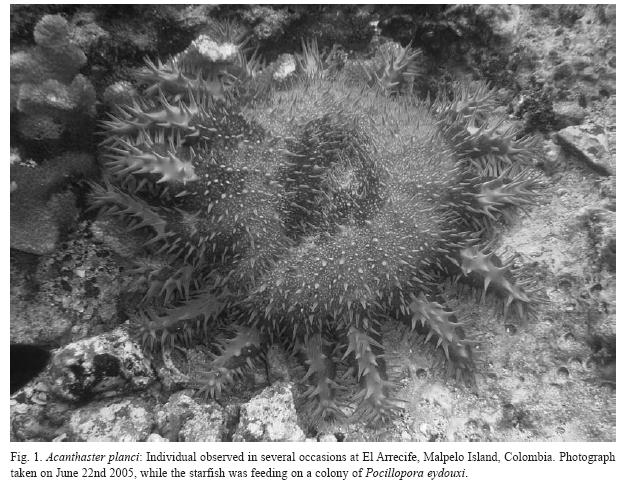
<body><![CDATA[<div style="text-align: justify;"><font face="Verdana" size="2">     <p>Before the mid-1970's <i>A. planci </i>was known to occur in the Tropical Eastern Pacific (TEP) in the Gulf of California, the Revillagigedo Islands, Cocos Island, mainland Costa Rica, and the Gulf of Chiriquí, Panamá (Porter 1972, Glynn 1974, Bakus 1975). Since then <i>A. planci </i>has also been reported for Isla del Caño, Costa Rica (Guzmán 1988), Clipperton Atoll (Glynn <i>et al</i>. 1996) and Galápagos Islands (Hickman 1998). <i>A. planci </i>has been generally considered to be absent from the Gulf of Panamá and the Colombian Pacific (e.g., Glynn 1974, Glynn &amp; Wellington 1983, Guzmán 1988, Reyes-Bonilla &amp; Calderón-Aguilera 1999), but most information available for Colombia is derived from studies carried out at Gorgona, a continental island, where <i>A. planci </i>has never been observed on coral reefs (Glynn <i>et al. </i>1982, Zapata &amp; Vargas-Ángel 2003). There is, however, one photographic record from the mid-1980's at a rocky outcrop on the Southernmost tip of Gorgona (J.R. Cantera, pers. comm.). Although <i>A. planci </i>was not observed at Malpelo Island in 1972 (Birkeland <i>et al</i>. 1975, Downey 1975), it was subsequently observed there by sport divers in 1991 at the site known as La Catedral (J. Vélez, pers. comm.), and since 1998 at the site known as La Nevera (S. Bessudo, pers. comm.). However, no formal report of these sightings were ever made. Here we report the occurrence of <i>A. planci </i>and comment on its impact on corals at Malpelo Island based on observations made since 2004.</p> </font></div> <font face="Verdana" size="2"></font></div> <font face="Verdana" size="2">     <p align="justify">Malpelo Island (4°00'05"N, 81°36'30"W) is a 1.6km-long rocky, oceanic island with significant coral communities and located approximately 500km West of the Colombian Pacific coast (Birkeland <i>et al</i>. 1975, Zapata &amp; Vargas-Ángel 2003). <i>A. planci </i>was first observed by one of us (K.N.) at Malpelo on August 8, 2004 at El Arrecife, a 2.4-ha coral community located on the Eastern side of the island. A single individual of 27cm in disc diameter with 17arms was observed at 19m depth, where the temperature was 28ºC. The aboral margins of the disc and arms were red, while their inner portions were purple-gray or pink, and the central portion of the disc had a 4cm-wide, circular red belt surrounding the central gray periproct with a single dark-red anus &lt;1cm in diameter. The spines were 1-2cm long, purple-red or pink and distributed throughout the aboral surface (<a href="#f1">Fig. 1</a>). This individual was over a colony of <i>Pavona varians </i>with its stomach everted and digesting the coral tissue. The same individual (based on size, number of arms and color pattern; see Glynn 1982) has been repeatedly seen at different sites in El Arrecife during &gt;40% of ~80 dives made between August 2004 and June 2006. A second individual of <i>A. planci </i>(22cm in disc diameter and 14 arms) was first observed at La Nevera, a 0.5-ha coral community located on the Western side of Malpelo, on 9 February 2005, at 15m depth where the temperature was 22ºC. This individual was first found with its stomach everted feeding on a colony of <i>Porites lobata </i>and was seen during 5 of 79 dives made between February and October 2005.    <br> </p> </font>     <div style="text-align: center;">     <div style="text-align: center;"><font face="Verdana" size="2">     <p align="justify">    <br> </p> </font><img alt="" src="/img/revistas/rbt/v58s1/art09f1.jpg"  style="width: 630px; height: 484px;"><a name="f1"></a>    <br> </div>     <br> <font face="Verdana" size="2">     ]]></body>
<body><![CDATA[<p align="justify"> </p> </font></div> <font face="Verdana" size="2"></font> <font face="Verdana" size="2">     <p align="justify">Around the sites where both <i>A. planci </i>individuals have been seen we usually found several coral colonies with evident signs of recent partial mortality, such as extensive white areas devoid of tissue or exposed skeletons beginning to be colonized by algae. Presumably, this damage was caused by <i>A. planci </i>predation. We directly observed <i>A. planci </i>preying on nine species of coral (<i>Pocillopora capitata, P. eydouxi, P. damicornis, Porites lobata, Pavona chiriquiensis, P. clavus, P. varians, P. gigantea </i>and <i>Gardineroseris planulata</i>). In general, the affected colonies were relatively large and were not consumed totally by the starfish; most had <u>&gt;</u>25% of living tissue remaining. By far the most frequently consumed corals were <i>P. lobata </i>and <i>P. eydouxi </i>in agreement with previous observations at Cocos Is. (Guzmán &amp; Cortés 1992). However, both of these corals are abundant at Malpelo (Birkeland <i>et al. </i>1975, Garzón-Ferreira &amp; Pinzón 1999) and there is no indication that <i>A. planci </i>is selectively feeding on particular coral species as it has been the case in Panama (Glynn 1974).</p> </font> <font face="Verdana" size="2">     <p align="justify">Population densities of <i>A. planci </i>have generally been low in the TEP, except in the Gulf of Chiriquí, Panama, and Cocos Is., Costa Rica, where densities as high as 28 ind./ha have been reported (Glynn 1974, 1990, Guzmán &amp; Cortés 1992, Cortés 1997; the value of 250 ind./ha listed by Reyes-Bonilla &amp; Calderón-Aguilera [1999] represents an outlier based on an extrapolation of an aggregation of 25 ind./0.1ha reported by Glynn [1974]; P.W. Glynn, pers. comm.). On the Great Barrier Reef, Australia, outbreaking populations of <i>A. planci </i>exhibit densities &gt;15 ind./ha (Moran &amp; De’ath 1992), although earlier studies suggested that much higher densities (140 ind./ha) were necessary for reef degradation (Endean 1977). It has been frequently stated that <i>A. planci </i>has never reached outbreaking levels in the TEP (Glynn 1974, Cortés 1997, Maté 2003) even though densities <u>&gt;</u>15 ind./ha occurred in Panama during 1976-1979 (Glynn 1985, 1990) and at Cocos Is. in 1973 and 1987 (Glynn 1974, Guzmán &amp; Cortés 1992). However, the absence of devastating effects of <i>Acanthaster </i>in Panama has been attributed to the presence within colonies of the dominant reef building corals (<i>Pocillopora </i>spp.) of crustacean symbionts that protect coral colonies, and a harlequin shrimp and a worm that prey on <i>Acanthaster </i>(Glynn 2004). All other populations of <i>A. planci </i>in the TEP have low densities (Reyes-Bonilla &amp; Calderón-Aguilera 1999). At Malpelo, based on estimates of coral reef areas at El Arrecife and La Nevera, one individual per reef represents 0.4 and 2.0 ind./ha, respectively.</p> </font> <font face="Verdana" size="2">     <p align="justify">The recent increased frequency of observation of <i>A. planci </i>at Cocos Island (N. Ghersinichen, pers. comm.), and its appearance where it was previously absent (Galápagos and Malpelo) suggests a gradual, albeit slow, increase of its geographic distribution in the TEP. Oceanic islands could act as stepping stones for further colonization in the region, but the low densities of <i>A. planci </i>on these islands suggest that these populations may not be significant sources of propagules. Furthermore, densities of <i>A. planci </i>in Panama have shown a decreasing trend in recent years (Fong &amp; Glynn 1998, Glynn 2004) and densities elsewhere in the TEP remain low. Although currently <i>A. planci </i>does not pose a threat to coral reefs in the TEP, evidence of further geographic spread or increased abundance in the region should receive attention.</p> </font> <b><font face="Verdana" size="3">     <p>Acknowledgments</p> </font></b><font face="Verdana" size="2">     <p align="justify">We thank the Unidad Administrativa Especial del Sistema de Parques Nacionales Naturales for permitting access to the Malpelo Island Sanctuary of Flora and Fauna, and N. Ghersinichen, J. Vélez, S. Bessudo and P.W. Glynn for information on <i>A. planci </i>at Cocos, Malpelo and Panama. We are grateful to Fundación Malpelo y Otros Ecosistemas Marinos for making this work possible.</p> </font> <hr style="width: 100%; height: 2px;"><font face="Verdana" size="2"></font>     <p><b><font face="Verdana" size="3">References</font></b></p> <font face="Verdana" size="2">     <!-- ref --><p align="justify">Bakus, G.J. 1975. Marine zonation and ecology of Cocos Island, off Central America. Atoll Res. Bull. 179: 1-9.    &nbsp;&nbsp;&nbsp;&nbsp;&nbsp;&nbsp;&nbsp;&nbsp;[&#160;<a href="javascript:void(0);" onclick="javascript: window.open('/scielo.php?script=sci_nlinks&ref=1839202&pid=S0034-7744201000050001100001&lng=','','width=640,height=500,resizable=yes,scrollbars=1,menubar=yes,');">Links</a>&#160;]<!-- end-ref --></p> </font>     <!-- ref --><p align="justify"><font face="Verdana" size="2">Birkeland, C., D.L. Meyer, J.P. Stames &amp; C.L. Buford. 1975. Subtidal communities of Malpelo Island. Smithson. Contrib. Zool. 176: 55-68.    &nbsp;&nbsp;&nbsp;&nbsp;&nbsp;&nbsp;&nbsp;&nbsp;[&#160;<a href="javascript:void(0);" onclick="javascript: window.open('/scielo.php?script=sci_nlinks&ref=1839204&pid=S0034-7744201000050001100002&lng=','','width=640,height=500,resizable=yes,scrollbars=1,menubar=yes,');">Links</a>&#160;]<!-- end-ref --></font></p>     <!-- ref --><p align="justify"><font face="Verdana" size="2">Brodie, J., K. Fabricius, G. De’ath &amp; K. Okaji. 2005. Are increased nutrient inputs responsible for more outbreaks of crown-of-thorns starfish? An appraisal of the evidence. Mar. Poll. Bull. 51: 266-278.    &nbsp;&nbsp;&nbsp;&nbsp;&nbsp;&nbsp;&nbsp;&nbsp;[&#160;<a href="javascript:void(0);" onclick="javascript: window.open('/scielo.php?script=sci_nlinks&ref=1839206&pid=S0034-7744201000050001100003&lng=','','width=640,height=500,resizable=yes,scrollbars=1,menubar=yes,');">Links</a>&#160;]<!-- end-ref --></font></p>     <!-- ref --><p align="justify"><font face="Verdana" size="2">Carpenter, R.C. 1997. Invertebrate predators and grazers, p. 198-229. <i>In </i>C. Birkeland (ed.). Life and death of coral reefs. Chapman &amp; Hall, New York, USA.    &nbsp;&nbsp;&nbsp;&nbsp;&nbsp;&nbsp;&nbsp;&nbsp;[&#160;<a href="javascript:void(0);" onclick="javascript: window.open('/scielo.php?script=sci_nlinks&ref=1839208&pid=S0034-7744201000050001100004&lng=','','width=640,height=500,resizable=yes,scrollbars=1,menubar=yes,');">Links</a>&#160;]<!-- end-ref --></font></p>     <!-- ref --><p><font face="Verdana" size="2">Cortés, J. 1997. Biology and geology of coral reefs of the Eastern Pacific. Coral Reefs 16: S39-S46.    &nbsp;&nbsp;&nbsp;&nbsp;&nbsp;&nbsp;&nbsp;&nbsp;[&#160;<a href="javascript:void(0);" onclick="javascript: window.open('/scielo.php?script=sci_nlinks&ref=1839210&pid=S0034-7744201000050001100005&lng=','','width=640,height=500,resizable=yes,scrollbars=1,menubar=yes,');">Links</a>&#160;]<!-- end-ref --> </font></p>     <!-- ref --><p align="justify"><font face="Verdana" size="2">Downey, M.E. 1975. Asteroidea from Malpelo Island with a description of a new species of the genus <i>Tamaria</i>. Smithson. Contrib. Zool. 176: 86-90.    &nbsp;&nbsp;&nbsp;&nbsp;&nbsp;&nbsp;&nbsp;&nbsp;[&#160;<a href="javascript:void(0);" onclick="javascript: window.open('/scielo.php?script=sci_nlinks&ref=1839212&pid=S0034-7744201000050001100006&lng=','','width=640,height=500,resizable=yes,scrollbars=1,menubar=yes,');">Links</a>&#160;]<!-- end-ref --></font></p>     <!-- ref --><p align="justify"><font face="Verdana" size="2">Endean, R. 1977. <i>Acanthaster planci </i>infestations of reefs of the Great Barrier Reef. Proc. 3rd Int. Coral Reef Symposium 1: 185-191.    &nbsp;&nbsp;&nbsp;&nbsp;&nbsp;&nbsp;&nbsp;&nbsp;[&#160;<a href="javascript:void(0);" onclick="javascript: window.open('/scielo.php?script=sci_nlinks&ref=1839214&pid=S0034-7744201000050001100007&lng=','','width=640,height=500,resizable=yes,scrollbars=1,menubar=yes,');">Links</a>&#160;]<!-- end-ref --></font></p>     <!-- ref --><p align="justify"><font face="Verdana" size="2">Endean, R. 1982. Crown-of-thorns starfish on the Great Barrier Reef. Endeavour 6: 10-14.    &nbsp;&nbsp;&nbsp;&nbsp;&nbsp;&nbsp;&nbsp;&nbsp;[&#160;<a href="javascript:void(0);" onclick="javascript: window.open('/scielo.php?script=sci_nlinks&ref=1839216&pid=S0034-7744201000050001100008&lng=','','width=640,height=500,resizable=yes,scrollbars=1,menubar=yes,');">Links</a>&#160;]<!-- end-ref --></font></p>     <!-- ref --><p align="justify"><font face="Verdana" size="2">Fong, P. &amp; P.W. Glynn. 1998. A dynamic size-structured population model: does disturbance control size structure of a population of the massive coral <i>Gardineroseris planulata </i>in the Eastern Pacific? Mar. Biol. 130: 663-674.    &nbsp;&nbsp;&nbsp;&nbsp;&nbsp;&nbsp;&nbsp;&nbsp;[&#160;<a href="javascript:void(0);" onclick="javascript: window.open('/scielo.php?script=sci_nlinks&ref=1839218&pid=S0034-7744201000050001100009&lng=','','width=640,height=500,resizable=yes,scrollbars=1,menubar=yes,');">Links</a>&#160;]<!-- end-ref --></font></p>     <!-- ref --><p align="justify"><font face="Verdana" size="2">Garzón-Ferreira, J. &amp; J. Pinzón. 1999. Evaluación rápida de estructura y salud de las formaciones coralinas de la Isla de Malpelo (Pacífico colombiano). Bol. Invest. Mar. Cost. 28: 137-154.    &nbsp;&nbsp;&nbsp;&nbsp;&nbsp;&nbsp;&nbsp;&nbsp;[&#160;<a href="javascript:void(0);" onclick="javascript: window.open('/scielo.php?script=sci_nlinks&ref=1839220&pid=S0034-7744201000050001100010&lng=','','width=640,height=500,resizable=yes,scrollbars=1,menubar=yes,');">Links</a>&#160;]<!-- end-ref --> </font></p>     <!-- ref --><p align="justify"><font face="Verdana" size="2">Glynn, P.W. 1974. The impact of <i>Acanthaster </i>on corals and coral reefs in the Eastern Pacific. Environ. Conserv. 1:295-304.    &nbsp;&nbsp;&nbsp;&nbsp;&nbsp;&nbsp;&nbsp;&nbsp;[&#160;<a href="javascript:void(0);" onclick="javascript: window.open('/scielo.php?script=sci_nlinks&ref=1839222&pid=S0034-7744201000050001100011&lng=','','width=640,height=500,resizable=yes,scrollbars=1,menubar=yes,');">Links</a>&#160;]<!-- end-ref --></font></p>     <!-- ref --><p align="justify"><font face="Verdana" size="2">Glynn, P.W. 1982. Individual recognition and phenotypic variability in <i>Acanthaster planci </i>(Echinodermata: Asteroidea). Coral Reefs 1: 89-94.    &nbsp;&nbsp;&nbsp;&nbsp;&nbsp;&nbsp;&nbsp;&nbsp;[&#160;<a href="javascript:void(0);" onclick="javascript: window.open('/scielo.php?script=sci_nlinks&ref=1839224&pid=S0034-7744201000050001100012&lng=','','width=640,height=500,resizable=yes,scrollbars=1,menubar=yes,');">Links</a>&#160;]<!-- end-ref --></font></p>     <!-- ref --><p align="justify"><font face="Verdana" size="2">Glynn, P.W. 1985. Corallivore population sizes and feeding effects following El Niño (1982-1983) associated coral mortality in Panama. Proc. 5th Int. Coral Reef Congr. 4: 183-188.    &nbsp;&nbsp;&nbsp;&nbsp;&nbsp;&nbsp;&nbsp;&nbsp;[&#160;<a href="javascript:void(0);" onclick="javascript: window.open('/scielo.php?script=sci_nlinks&ref=1839226&pid=S0034-7744201000050001100013&lng=','','width=640,height=500,resizable=yes,scrollbars=1,menubar=yes,');">Links</a>&#160;]<!-- end-ref --></font></p>     <!-- ref --><p align="justify"><font face="Verdana" size="2">Glynn, P.W. 1990. Coral mortality and disturbances to coral reefs in the tropical Eastern Pacific, p. 55-126. In P.W. Glynn (ed.). Global ecological consequences of the 1982-83 El Niño-Southern Oscillation. Elsevier Oceanography Series, Amsterdam, The Netherlands.    &nbsp;&nbsp;&nbsp;&nbsp;&nbsp;&nbsp;&nbsp;&nbsp;[&#160;<a href="javascript:void(0);" onclick="javascript: window.open('/scielo.php?script=sci_nlinks&ref=1839228&pid=S0034-7744201000050001100014&lng=','','width=640,height=500,resizable=yes,scrollbars=1,menubar=yes,');">Links</a>&#160;]<!-- end-ref --></font></p>     <!-- ref --><p align="justify"><font face="Verdana" size="2">Glynn, P.W. 2004. High complexity food webs in low-diversity Eastern Pacific reef-coral communities. Ecosystems 7: 358-367.    &nbsp;&nbsp;&nbsp;&nbsp;&nbsp;&nbsp;&nbsp;&nbsp;[&#160;<a href="javascript:void(0);" onclick="javascript: window.open('/scielo.php?script=sci_nlinks&ref=1839230&pid=S0034-7744201000050001100015&lng=','','width=640,height=500,resizable=yes,scrollbars=1,menubar=yes,');">Links</a>&#160;]<!-- end-ref --></font></p>     <!-- ref --><p align="justify"><font face="Verdana" size="2">Glynn, P.W. &amp; G.M. Wellington. 1983. Corals and coral reefs of the Galapagos Islands. University of California, Berkeley, USA.    &nbsp;&nbsp;&nbsp;&nbsp;&nbsp;&nbsp;&nbsp;&nbsp;[&#160;<a href="javascript:void(0);" onclick="javascript: window.open('/scielo.php?script=sci_nlinks&ref=1839232&pid=S0034-7744201000050001100016&lng=','','width=640,height=500,resizable=yes,scrollbars=1,menubar=yes,');">Links</a>&#160;]<!-- end-ref --></font></p>     <!-- ref --><p align="justify"><font face="Verdana" size="2">Glynn, P.W., H. von Prahl &amp; F. Guhl. 1982. Coral reefs of Gorgona Island, with special reference to corallivores and their influence on community structure and reef development. An. Inst. Inv. Mar. Punta Betín 12: 185-214.    &nbsp;&nbsp;&nbsp;&nbsp;&nbsp;&nbsp;&nbsp;&nbsp;[&#160;<a href="javascript:void(0);" onclick="javascript: window.open('/scielo.php?script=sci_nlinks&ref=1839234&pid=S0034-7744201000050001100017&lng=','','width=640,height=500,resizable=yes,scrollbars=1,menubar=yes,');">Links</a>&#160;]<!-- end-ref --></font></p>     <!-- ref --><p align="justify"><font face="Verdana" size="2">Glynn, P.W., J.E.N. Veron &amp; G.M. Wellington. 1996. Clipperton Atoll (Eastern Pacific): oceanography, geomorphology, reef-building coral ecology and biogeography. Coral Reefs 15: 71-99.    &nbsp;&nbsp;&nbsp;&nbsp;&nbsp;&nbsp;&nbsp;&nbsp;[&#160;<a href="javascript:void(0);" onclick="javascript: window.open('/scielo.php?script=sci_nlinks&ref=1839236&pid=S0034-7744201000050001100018&lng=','','width=640,height=500,resizable=yes,scrollbars=1,menubar=yes,');">Links</a>&#160;]<!-- end-ref --> </font></p>     <!-- ref --><p align="justify"><font face="Verdana" size="2">Guzmán, H.M. 1988. Distribución y abundancia de organismos coralívoros en los arrecifes coralinos de la Isla del Caño, Costa Rica. Rev. Biol. Trop. 36: 191-207.    &nbsp;&nbsp;&nbsp;&nbsp;&nbsp;&nbsp;&nbsp;&nbsp;[&#160;<a href="javascript:void(0);" onclick="javascript: window.open('/scielo.php?script=sci_nlinks&ref=1839238&pid=S0034-7744201000050001100019&lng=','','width=640,height=500,resizable=yes,scrollbars=1,menubar=yes,');">Links</a>&#160;]<!-- end-ref --></font></p>     <!-- ref --><p align="justify"><font face="Verdana" size="2">Guzmán, H.M. &amp; J. Cortés. 1992. Cocos Island (Pacific of Costa Rica) coral reefs after the 1982-83 El Niño disturbance. Rev. Biol. Trop. 40: 309-324.    &nbsp;&nbsp;&nbsp;&nbsp;&nbsp;&nbsp;&nbsp;&nbsp;[&#160;<a href="javascript:void(0);" onclick="javascript: window.open('/scielo.php?script=sci_nlinks&ref=1839240&pid=S0034-7744201000050001100020&lng=','','width=640,height=500,resizable=yes,scrollbars=1,menubar=yes,');">Links</a>&#160;]<!-- end-ref --></font></p>     <!-- ref --><p align="justify"><font face="Verdana" size="2">Hickman, C. P., Jr. 1998. A field guide to sea stars and other echinoderms of Galápagos. Galápagos Marine Life Series. Sugar Spring, Lexington, Virginia, USA.    &nbsp;&nbsp;&nbsp;&nbsp;&nbsp;&nbsp;&nbsp;&nbsp;[&#160;<a href="javascript:void(0);" onclick="javascript: window.open('/scielo.php?script=sci_nlinks&ref=1839242&pid=S0034-7744201000050001100021&lng=','','width=640,height=500,resizable=yes,scrollbars=1,menubar=yes,');">Links</a>&#160;]<!-- end-ref --></font></p>     <!-- ref --><p align="justify"><font face="Verdana" size="2">Maté, J.L. 2003. Corals and coral reefs of the Pacific coast of Panamá. p. 387-417. <i>In </i>J. Cortés (ed.). Latin American Coral Reefs. Elsevier Science B.V., Amsterdam, The Netherlands.    &nbsp;&nbsp;&nbsp;&nbsp;&nbsp;&nbsp;&nbsp;&nbsp;[&#160;<a href="javascript:void(0);" onclick="javascript: window.open('/scielo.php?script=sci_nlinks&ref=1839244&pid=S0034-7744201000050001100022&lng=','','width=640,height=500,resizable=yes,scrollbars=1,menubar=yes,');">Links</a>&#160;]<!-- end-ref --></font></p>     <!-- ref --><p align="justify"><font face="Verdana" size="2">Moran, P.J. &amp; G. De’ath. 1992. Estimates of the abundance of the crown-of-thorns starfish <i>Acanthaster planci </i>in outbreaking and non-outbreaking populations on reefs within the Great Barrier Reef. Mar. Biol. 113: 509-515.    &nbsp;&nbsp;&nbsp;&nbsp;&nbsp;&nbsp;&nbsp;&nbsp;[&#160;<a href="javascript:void(0);" onclick="javascript: window.open('/scielo.php?script=sci_nlinks&ref=1839246&pid=S0034-7744201000050001100023&lng=','','width=640,height=500,resizable=yes,scrollbars=1,menubar=yes,');">Links</a>&#160;]<!-- end-ref --></font></p>     <!-- ref --><p align="justify"><font face="Verdana" size="2">Porter, J. W.1972. Predation by <i>Acanthaster </i>and its effect on coral species diversity. Am. Nat. 106: 487-492.    &nbsp;&nbsp;&nbsp;&nbsp;&nbsp;&nbsp;&nbsp;&nbsp;[&#160;<a href="javascript:void(0);" onclick="javascript: window.open('/scielo.php?script=sci_nlinks&ref=1839248&pid=S0034-7744201000050001100024&lng=','','width=640,height=500,resizable=yes,scrollbars=1,menubar=yes,');">Links</a>&#160;]<!-- end-ref --></font></p>     <!-- ref --><p align="justify"><font face="Verdana" size="2">Pratchett, M.S. 2005. Dynamics of an outbreak population of <i>Acanthaster planci </i>at Lizard Island, northern Great Barrier Reef (1995–1999). Coral Reefs 24: 453-462.    &nbsp;&nbsp;&nbsp;&nbsp;&nbsp;&nbsp;&nbsp;&nbsp;[&#160;<a href="javascript:void(0);" onclick="javascript: window.open('/scielo.php?script=sci_nlinks&ref=1839250&pid=S0034-7744201000050001100025&lng=','','width=640,height=500,resizable=yes,scrollbars=1,menubar=yes,');">Links</a>&#160;]<!-- end-ref --></font></p>     <!-- ref --><p align="justify"><font face="Verdana" size="2">Reyes-Bonilla, H. &amp; L.E. Calderón-Aguilera. 1999. Population density, distribution and consumption rates of three corallivores at Cabo Pulmo reef, Gulf of California, México. P.S.N.Z.I. Mar. Ecol. 20: 347-357.    &nbsp;&nbsp;&nbsp;&nbsp;&nbsp;&nbsp;&nbsp;&nbsp;[&#160;<a href="javascript:void(0);" onclick="javascript: window.open('/scielo.php?script=sci_nlinks&ref=1839252&pid=S0034-7744201000050001100026&lng=','','width=640,height=500,resizable=yes,scrollbars=1,menubar=yes,');">Links</a>&#160;]<!-- end-ref --></font></p>     <!-- ref --><p><font face="Verdana" size="2">Zapata, F.A. &amp; Vargas-Ángel, B. 2003. Corals and coral reefs of the Pacific coast of Colombia. p. 419-447. <i>In </i>J. Cortés (ed.). Latin American Coral Reefs. Elsevier Science B.V., Amsterdam, The Netherlands.    &nbsp;&nbsp;&nbsp;&nbsp;&nbsp;&nbsp;&nbsp;&nbsp;[&#160;<a href="javascript:void(0);" onclick="javascript: window.open('/scielo.php?script=sci_nlinks&ref=1839254&pid=S0034-7744201000050001100027&lng=','','width=640,height=500,resizable=yes,scrollbars=1,menubar=yes,');">Links</a>&#160;]<!-- end-ref --> </font></p> <font face="Verdana" size="2"><a name="a"></a>Corresponde a: Krupskaya Narváez. Fundación Malpelo y Otros Ecosistemas Marinos. Carrera 11 No. 87-51 Local 4, Bogotá D.C., Colombia; </font><a  href="mailto:krupska@gmail.com"><font face="Verdana" size="2">krupska@gmail.com</font></a>    <br> <font face="Verdana" size="2">Fernando A. Zapata. Departamento de Biología, Universidad del Valle, Apartado Aéreo 25360, Cali, Colombia; </font><a  href="mailto:fernando.zapata@correounivalle.edu.co"><font  face="Verdana" size="2">fernando.zapata@correounivalle.edu.co</font></a> <hr style="width: 100%; height: 2px;"><font face="Verdana" size="2">     <p align="center">Received 30-VIII-2009. Corrected 11-XI-2009. Accepted 18-XII-2009.</p> </font>      ]]></body><back>
<ref-list>
<ref id="B1">
<nlm-citation citation-type="journal">
<person-group person-group-type="author">
<name>
<surname><![CDATA[Bakus]]></surname>
<given-names><![CDATA[G.J]]></given-names>
</name>
</person-group>
<article-title xml:lang="en"><![CDATA[Marine zonation and ecology of Cocos Island, off Central America]]></article-title>
<source><![CDATA[Atoll Res. Bull]]></source>
<year>1975</year>
<volume>179</volume>
<page-range>1-9</page-range></nlm-citation>
</ref>
<ref id="B2">
<nlm-citation citation-type="journal">
<person-group person-group-type="author">
<name>
<surname><![CDATA[Birkeland]]></surname>
<given-names><![CDATA[C]]></given-names>
</name>
<name>
<surname><![CDATA[Meyer]]></surname>
<given-names><![CDATA[D.L]]></given-names>
</name>
<name>
<surname><![CDATA[Stames]]></surname>
<given-names><![CDATA[J.P]]></given-names>
</name>
<name>
<surname><![CDATA[Buford]]></surname>
<given-names><![CDATA[C.L]]></given-names>
</name>
</person-group>
<article-title xml:lang="en"><![CDATA[Subtidal communities of Malpelo Island. Smithson]]></article-title>
<source><![CDATA[Contrib. Zool]]></source>
<year>1975</year>
<volume>176</volume>
<page-range>55-68</page-range></nlm-citation>
</ref>
<ref id="B3">
<nlm-citation citation-type="journal">
<person-group person-group-type="author">
<name>
<surname><![CDATA[Brodie]]></surname>
<given-names><![CDATA[J]]></given-names>
</name>
<name>
<surname><![CDATA[Fabricius]]></surname>
<given-names><![CDATA[K]]></given-names>
</name>
<name>
<surname><![CDATA[De’ath]]></surname>
<given-names><![CDATA[G]]></given-names>
</name>
<name>
<surname><![CDATA[Okaji]]></surname>
<given-names><![CDATA[K]]></given-names>
</name>
</person-group>
<article-title xml:lang="en"><![CDATA[Are increased nutrient inputs responsible for more outbreaks of crown-of-thorns starfish? An appraisal of the evidence]]></article-title>
<source><![CDATA[Mar. Poll. Bull]]></source>
<year>2005</year>
<volume>51</volume>
<page-range>266-278</page-range></nlm-citation>
</ref>
<ref id="B4">
<nlm-citation citation-type="book">
<person-group person-group-type="author">
<name>
<surname><![CDATA[Carpenter]]></surname>
<given-names><![CDATA[R.C]]></given-names>
</name>
</person-group>
<article-title xml:lang="en"><![CDATA[Invertebrate predators and grazers]]></article-title>
<person-group person-group-type="editor">
<name>
<surname><![CDATA[Birkeland]]></surname>
<given-names><![CDATA[C]]></given-names>
</name>
</person-group>
<source><![CDATA[Life and death of coral reefs]]></source>
<year>1997</year>
<page-range>198-229</page-range><publisher-loc><![CDATA[New York ]]></publisher-loc>
<publisher-name><![CDATA[Chapman & Hall]]></publisher-name>
</nlm-citation>
</ref>
<ref id="B5">
<nlm-citation citation-type="journal">
<person-group person-group-type="author">
<name>
<surname><![CDATA[Cortés]]></surname>
<given-names><![CDATA[J]]></given-names>
</name>
</person-group>
<article-title xml:lang="en"><![CDATA[Biology and geology of coral reefs of the Eastern Pacific]]></article-title>
<source><![CDATA[Coral Reefs]]></source>
<year>1997</year>
<volume>16</volume>
<page-range>S39-S46</page-range></nlm-citation>
</ref>
<ref id="B6">
<nlm-citation citation-type="journal">
<person-group person-group-type="author">
<name>
<surname><![CDATA[Downey]]></surname>
<given-names><![CDATA[M.E]]></given-names>
</name>
</person-group>
<article-title xml:lang="en"><![CDATA[Asteroidea from Malpelo Island with a description of a new species of the genus Tamaria]]></article-title>
<source><![CDATA[Smithson. Contrib. Zool]]></source>
<year>1975</year>
<volume>176</volume>
<page-range>86-90</page-range></nlm-citation>
</ref>
<ref id="B7">
<nlm-citation citation-type="journal">
<person-group person-group-type="author">
<name>
<surname><![CDATA[Endean]]></surname>
<given-names><![CDATA[R]]></given-names>
</name>
</person-group>
<article-title xml:lang="en"><![CDATA[Acanthaster planci infestations of reefs of the Great Barrier Reef]]></article-title>
<source><![CDATA[Proc. 3rd Int. Coral Reef Symposium]]></source>
<year>1977</year>
<volume>1</volume>
<page-range>185-191</page-range></nlm-citation>
</ref>
<ref id="B8">
<nlm-citation citation-type="journal">
<person-group person-group-type="author">
<name>
<surname><![CDATA[Endean]]></surname>
<given-names><![CDATA[R]]></given-names>
</name>
</person-group>
<article-title xml:lang="en"><![CDATA[Crown-of-thorns starfish on the Great Barrier Reef]]></article-title>
<source><![CDATA[Endeavour]]></source>
<year>1982</year>
<volume>6</volume>
<page-range>10-14</page-range></nlm-citation>
</ref>
<ref id="B9">
<nlm-citation citation-type="journal">
<person-group person-group-type="author">
<name>
<surname><![CDATA[Fong]]></surname>
<given-names><![CDATA[P]]></given-names>
</name>
<name>
<surname><![CDATA[Glynn]]></surname>
<given-names><![CDATA[P.W]]></given-names>
</name>
</person-group>
<article-title xml:lang="en"><![CDATA[A dynamic size-structured population model: does disturbance control size structure of a population of the massive coral Gardineroseris planulata in the Eastern Pacific?]]></article-title>
<source><![CDATA[Mar. Biol]]></source>
<year>1998</year>
<volume>130</volume>
<page-range>663-674</page-range></nlm-citation>
</ref>
<ref id="B10">
<nlm-citation citation-type="journal">
<person-group person-group-type="author">
<name>
<surname><![CDATA[Garzón-Ferreira]]></surname>
<given-names><![CDATA[J]]></given-names>
</name>
<name>
<surname><![CDATA[Pinzón]]></surname>
<given-names><![CDATA[J]]></given-names>
</name>
</person-group>
<article-title xml:lang="es"><![CDATA[Evaluación rápida de estructura y salud de las formaciones coralinas de la Isla de Malpelo (Pacífico colombiano)]]></article-title>
<source><![CDATA[Bol. Invest. Mar. Cost]]></source>
<year>1999</year>
<volume>28</volume>
<page-range>137-154</page-range></nlm-citation>
</ref>
<ref id="B11">
<nlm-citation citation-type="journal">
<person-group person-group-type="author">
<name>
<surname><![CDATA[Glynn]]></surname>
<given-names><![CDATA[P.W]]></given-names>
</name>
</person-group>
<article-title xml:lang="en"><![CDATA[The impact of Acanthaster on corals and coral reefs in the Eastern Pacific]]></article-title>
<source><![CDATA[Environ. Conserv]]></source>
<year>1974</year>
<volume>1</volume>
<page-range>295-304</page-range></nlm-citation>
</ref>
<ref id="B12">
<nlm-citation citation-type="journal">
<person-group person-group-type="author">
<name>
<surname><![CDATA[Glynn]]></surname>
<given-names><![CDATA[P.W]]></given-names>
</name>
</person-group>
<article-title xml:lang="en"><![CDATA[Individual recognition and phenotypic variability in Acanthaster planci (Echinodermata: Asteroidea)]]></article-title>
<source><![CDATA[Coral Reefs]]></source>
<year>1982</year>
<volume>1</volume>
<page-range>89-94</page-range></nlm-citation>
</ref>
<ref id="B13">
<nlm-citation citation-type="journal">
<person-group person-group-type="author">
<name>
<surname><![CDATA[Glynn]]></surname>
<given-names><![CDATA[P.W]]></given-names>
</name>
</person-group>
<article-title xml:lang="en"><![CDATA[Corallivore population sizes and feeding effects following El Niño (1982-1983) associated coral mortality in Panama]]></article-title>
<source><![CDATA[Proc. 5th Int. Coral Reef Congr]]></source>
<year>1985</year>
<volume>4</volume>
<page-range>183-188</page-range></nlm-citation>
</ref>
<ref id="B14">
<nlm-citation citation-type="book">
<person-group person-group-type="author">
<name>
<surname><![CDATA[Glynn]]></surname>
<given-names><![CDATA[P.W]]></given-names>
</name>
</person-group>
<article-title xml:lang="en"><![CDATA[Coral mortality and disturbances to coral reefs in the tropical Eastern Pacific]]></article-title>
<person-group person-group-type="editor">
<name>
<surname><![CDATA[Glynn]]></surname>
<given-names><![CDATA[P.W]]></given-names>
</name>
</person-group>
<source><![CDATA[Global ecological consequences of the 1982-83 El Niño-Southern Oscillation]]></source>
<year>1990</year>
<page-range>55-126</page-range><publisher-loc><![CDATA[Amsterdam ]]></publisher-loc>
<publisher-name><![CDATA[Elsevier Oceanography Series]]></publisher-name>
</nlm-citation>
</ref>
<ref id="B15">
<nlm-citation citation-type="journal">
<person-group person-group-type="author">
<name>
<surname><![CDATA[Glynn]]></surname>
<given-names><![CDATA[P.W]]></given-names>
</name>
</person-group>
<article-title xml:lang="en"><![CDATA[High complexity food webs in low-diversity Eastern Pacific reef-coral communities]]></article-title>
<source><![CDATA[Ecosystems]]></source>
<year>2004</year>
<volume>7</volume>
<page-range>358-367</page-range></nlm-citation>
</ref>
<ref id="B16">
<nlm-citation citation-type="book">
<person-group person-group-type="author">
<name>
<surname><![CDATA[Glynn]]></surname>
<given-names><![CDATA[P.W]]></given-names>
</name>
<name>
<surname><![CDATA[Wellington]]></surname>
<given-names><![CDATA[G.M]]></given-names>
</name>
</person-group>
<source><![CDATA[Corals and coral reefs of the Galapagos Islands]]></source>
<year>1983</year>
<publisher-loc><![CDATA[Berkeley ]]></publisher-loc>
<publisher-name><![CDATA[University of California]]></publisher-name>
</nlm-citation>
</ref>
<ref id="B17">
<nlm-citation citation-type="journal">
<person-group person-group-type="author">
<name>
<surname><![CDATA[Glynn]]></surname>
<given-names><![CDATA[P.W]]></given-names>
</name>
<name>
<surname><![CDATA[von Prahl]]></surname>
<given-names><![CDATA[H]]></given-names>
</name>
<name>
<surname><![CDATA[Guhl]]></surname>
<given-names><![CDATA[F]]></given-names>
</name>
</person-group>
<article-title xml:lang="en"><![CDATA[Coral reefs of Gorgona Island, with special reference to corallivores and their influence on community structure and reef development]]></article-title>
<source><![CDATA[An. Inst. Inv. Mar. Punta Betín]]></source>
<year>1982</year>
<volume>12</volume>
<page-range>185-214</page-range></nlm-citation>
</ref>
<ref id="B18">
<nlm-citation citation-type="journal">
<person-group person-group-type="author">
<name>
<surname><![CDATA[Glynn]]></surname>
<given-names><![CDATA[P.W]]></given-names>
</name>
<name>
<surname><![CDATA[Veron]]></surname>
<given-names><![CDATA[J.E.N]]></given-names>
</name>
<name>
<surname><![CDATA[Wellington]]></surname>
<given-names><![CDATA[G.M]]></given-names>
</name>
</person-group>
<article-title xml:lang="en"><![CDATA[Clipperton Atoll (Eastern Pacific): oceanography, geomorphology, reef-building coral ecology and biogeography]]></article-title>
<source><![CDATA[Coral Reefs]]></source>
<year>1996</year>
<volume>15</volume>
<page-range>71-99</page-range></nlm-citation>
</ref>
<ref id="B19">
<nlm-citation citation-type="journal">
<person-group person-group-type="author">
<name>
<surname><![CDATA[Guzmán]]></surname>
<given-names><![CDATA[H.M]]></given-names>
</name>
</person-group>
<article-title xml:lang="es"><![CDATA[Distribución y abundancia de organismos coralívoros en los arrecifes coralinos de la Isla del Caño, Costa Rica]]></article-title>
<source><![CDATA[Rev. Biol. Trop]]></source>
<year>1988</year>
<volume>36</volume>
<page-range>191-207</page-range></nlm-citation>
</ref>
<ref id="B20">
<nlm-citation citation-type="journal">
<person-group person-group-type="author">
<name>
<surname><![CDATA[Guzmán]]></surname>
<given-names><![CDATA[H.M]]></given-names>
</name>
<name>
<surname><![CDATA[Cortés]]></surname>
<given-names><![CDATA[J]]></given-names>
</name>
</person-group>
<article-title xml:lang="en"><![CDATA[Cocos Island (Pacific of Costa Rica) coral reefs after the 1982-83 El Niño disturbance]]></article-title>
<source><![CDATA[Rev. Biol. Trop]]></source>
<year>1992</year>
<volume>40</volume>
<page-range>309-324</page-range></nlm-citation>
</ref>
<ref id="B21">
<nlm-citation citation-type="book">
<person-group person-group-type="author">
<name>
<surname><![CDATA[Hickman]]></surname>
<given-names><![CDATA[C. P]]></given-names>
</name>
</person-group>
<source><![CDATA[A field guide to sea stars and other echinoderms of Galápagos]]></source>
<year>1998</year>
<publisher-loc><![CDATA[Virginia ]]></publisher-loc>
<publisher-name><![CDATA[Sugar Spring, Lexington]]></publisher-name>
</nlm-citation>
</ref>
<ref id="B22">
<nlm-citation citation-type="book">
<person-group person-group-type="author">
<name>
<surname><![CDATA[Maté]]></surname>
<given-names><![CDATA[J.L]]></given-names>
</name>
</person-group>
<article-title xml:lang="en"><![CDATA[Corals and coral reefs of the Pacific coast of Panamá]]></article-title>
<person-group person-group-type="editor">
<name>
<surname><![CDATA[Cortés]]></surname>
<given-names><![CDATA[J]]></given-names>
</name>
</person-group>
<source><![CDATA[Latin American Coral Reefs]]></source>
<year>2003</year>
<page-range>387-417</page-range><publisher-loc><![CDATA[Amsterdam ]]></publisher-loc>
<publisher-name><![CDATA[Elsevier Science B.V.]]></publisher-name>
</nlm-citation>
</ref>
<ref id="B23">
<nlm-citation citation-type="journal">
<person-group person-group-type="author">
<name>
<surname><![CDATA[Moran]]></surname>
<given-names><![CDATA[P.J]]></given-names>
</name>
<name>
<surname><![CDATA[De’ath]]></surname>
<given-names><![CDATA[G]]></given-names>
</name>
</person-group>
<article-title xml:lang="en"><![CDATA[Estimates of the abundance of the crown-of-thorns starfish Acanthaster planci in outbreaking and non-outbreaking populations on reefs within the Great Barrier Reef]]></article-title>
<source><![CDATA[Mar. Biol]]></source>
<year>1992</year>
<volume>113</volume>
<page-range>509-515</page-range></nlm-citation>
</ref>
<ref id="B24">
<nlm-citation citation-type="journal">
<person-group person-group-type="author">
<name>
<surname><![CDATA[Porter]]></surname>
<given-names><![CDATA[J. W]]></given-names>
</name>
</person-group>
<article-title xml:lang="en"><![CDATA[Predation by Acanthaster and its effect on coral species diversity]]></article-title>
<source><![CDATA[Am. Nat]]></source>
<year>1972</year>
<volume>106</volume>
<page-range>487-492</page-range></nlm-citation>
</ref>
<ref id="B25">
<nlm-citation citation-type="journal">
<person-group person-group-type="author">
<name>
<surname><![CDATA[Pratchett]]></surname>
<given-names><![CDATA[M.S]]></given-names>
</name>
</person-group>
<article-title xml:lang="en"><![CDATA[Dynamics of an outbreak population of Acanthaster planci at Lizard Island, northern Great Barrier Reef (1995-1999)]]></article-title>
<source><![CDATA[Coral Reefs]]></source>
<year>2005</year>
<volume>24</volume>
<page-range>453-462</page-range></nlm-citation>
</ref>
<ref id="B26">
<nlm-citation citation-type="journal">
<person-group person-group-type="author">
<name>
<surname><![CDATA[Reyes-Bonilla]]></surname>
<given-names><![CDATA[H]]></given-names>
</name>
<name>
<surname><![CDATA[Calderón-Aguilera]]></surname>
<given-names><![CDATA[L.E]]></given-names>
</name>
</person-group>
<article-title xml:lang="en"><![CDATA[Population density, distribution and consumption rates of three corallivores at Cabo Pulmo reef, Gulf of California, México. P.S.N.Z.I.]]></article-title>
<source><![CDATA[Mar. Ecol]]></source>
<year>1999</year>
<volume>20</volume>
<page-range>347-357</page-range></nlm-citation>
</ref>
<ref id="B27">
<nlm-citation citation-type="book">
<person-group person-group-type="author">
<name>
<surname><![CDATA[Zapata]]></surname>
<given-names><![CDATA[F.A]]></given-names>
</name>
<name>
<surname><![CDATA[Vargas-Ángel]]></surname>
<given-names><![CDATA[B]]></given-names>
</name>
</person-group>
<article-title xml:lang="en"><![CDATA[Corals and coral reefs of the Pacific coast of Colombia]]></article-title>
<person-group person-group-type="editor">
<name>
<surname><![CDATA[Cortés]]></surname>
<given-names><![CDATA[J]]></given-names>
</name>
</person-group>
<source><![CDATA[Latin American Coral Reefs]]></source>
<year>2003</year>
<page-range>419-447</page-range><publisher-loc><![CDATA[Amsterdam ]]></publisher-loc>
<publisher-name><![CDATA[Elsevier Science B.V.]]></publisher-name>
</nlm-citation>
</ref>
</ref-list>
</back>
</article>