<?xml version="1.0" encoding="ISO-8859-1"?><article xmlns:mml="http://www.w3.org/1998/Math/MathML" xmlns:xlink="http://www.w3.org/1999/xlink" xmlns:xsi="http://www.w3.org/2001/XMLSchema-instance">
<front>
<journal-meta>
<journal-id>0034-7744</journal-id>
<journal-title><![CDATA[Revista de Biología Tropical]]></journal-title>
<abbrev-journal-title><![CDATA[Rev. biol. trop]]></abbrev-journal-title>
<issn>0034-7744</issn>
<publisher>
<publisher-name><![CDATA[Universidad de Costa Rica]]></publisher-name>
</publisher>
</journal-meta>
<article-meta>
<article-id>S0034-77442010000500008</article-id>
<title-group>
<article-title xml:lang="en"><![CDATA[Coral diseases and bleaching on Colombian Caribbean coral reefs]]></article-title>
</title-group>
<contrib-group>
<contrib contrib-type="author">
<name>
<surname><![CDATA[Navas-Camacho]]></surname>
<given-names><![CDATA[Raúl]]></given-names>
</name>
</contrib>
<contrib contrib-type="author">
<name>
<surname><![CDATA[Gil-Agudelo]]></surname>
<given-names><![CDATA[Diego Luis]]></given-names>
</name>
</contrib>
<contrib contrib-type="author">
<name>
<surname><![CDATA[Rodríguez-Ramírez]]></surname>
<given-names><![CDATA[Alberto]]></given-names>
</name>
</contrib>
<contrib contrib-type="author">
<name>
<surname><![CDATA[Reyes-Nivia]]></surname>
<given-names><![CDATA[María Catalina]]></given-names>
</name>
</contrib>
<contrib contrib-type="author">
<name>
<surname><![CDATA[Garzón-Ferreira]]></surname>
<given-names><![CDATA[Jaime]]></given-names>
</name>
</contrib>
</contrib-group>
<aff id="A01">
<institution><![CDATA[,Instituto de Investigaciones Marinas y Costeras  ]]></institution>
<addr-line><![CDATA[Punta de Betín, Zona Portuaria, Santa Marta ]]></addr-line>
<country>Colombia</country>
</aff>
<aff id="A02">
<institution><![CDATA[,Brewster Academy  ]]></institution>
<addr-line><![CDATA[ ]]></addr-line>
</aff>
<pub-date pub-type="pub">
<day>00</day>
<month>05</month>
<year>2010</year>
</pub-date>
<pub-date pub-type="epub">
<day>00</day>
<month>05</month>
<year>2010</year>
</pub-date>
<volume>58</volume>
<fpage>95</fpage>
<lpage>106</lpage>
<copyright-statement/>
<copyright-year/>
<self-uri xlink:href="http://www.scielo.sa.cr/scielo.php?script=sci_arttext&amp;pid=S0034-77442010000500008&amp;lng=en&amp;nrm=iso"></self-uri><self-uri xlink:href="http://www.scielo.sa.cr/scielo.php?script=sci_abstract&amp;pid=S0034-77442010000500008&amp;lng=en&amp;nrm=iso"></self-uri><self-uri xlink:href="http://www.scielo.sa.cr/scielo.php?script=sci_pdf&amp;pid=S0034-77442010000500008&amp;lng=en&amp;nrm=iso"></self-uri><abstract abstract-type="short" xml:lang="en"><p><![CDATA[Since 1998 the National Monitoring System for the Coral Reefs of Colombia (SIMAC) has monitored the occurrence of coral bleaching and diseases in some Colombian coral reefs (permanent stations at San Andres Island, Rosario Islands, Tayrona, San Bernardo Islands and Urabá). The main purpose is to evaluate their health status and to understand the factors that have been contributing to their decline. To estimate these occurrences, annual surveys in 126 permanent belt transects (10x2m) with different depth intervals (3-6 meters, 9-12 meters and 15-18 meters) are performed at all reef sites. Data from the 1998-2004 period, revealed that San Andrés Island had many colonies with diseases (38.9 colonies/m2), and Urabá had high numbers with bleaching (54.4 colonies/m2). Of the seven reported coral diseases studied, Dark Spots Disease (DSD), and White Plague Disease (WPD) were noteworthy because they occurred in all Caribbean monitored sites, and because of their high interannual infection incidence. Thirty five species of scleractinian corals were affected by at least one disease and a high incidence of coral diseases on the main reef builders is documented. Bleaching was present in 34 species. During the whole monitoring period, Agaricia agaricites and Siderastrea siderea were the species most severely affected by DSD and bleaching, respectively. Diseases on species such as Agaricia fragilis, A.grahamae, A. humilis, Diploria clivosa, Eusmilia fastigiata, Millepora complanata, and Mycetophyllia aliciae are recorded for first time in Colombia. We present bleaching and disease incidences, kinds of diseases, coral species affected, reef localities studied, depth intervals of surveys, and temporal (years) variation for each geographic area. This variation makes difficult to clearly determine defined patterns or general trends for monitored reefs. This is the first long-term study of coral diseases and bleaching in the Southwestern Caribbean, and one of the few long term monitoring studies on coral diseases worldwide. Rev. Biol. Trop. 58 (Suppl. 1): 95-106. Epub 2010 May 01.]]></p></abstract>
<abstract abstract-type="short" xml:lang="es"><p><![CDATA[Desde 1998 el "Sistema Nacional de Monitoreo de Arrecifes Coralinos de Colombia" SIMAC, ha observado la ocurrencia de enfermedades coralinas y blanqueamiento en arrecifes colombianos (estaciones fijas en la Isla de San Tayrona, Islas del Rosario, Islas de San Bernardo y Urabá Chocoano). Para estimar la ocurrencia se ha examinado anualmente un total de 126 bandas permanentes (10x2m), dispuestas en diferentes rangos de profundidad en las áreas arrecifales objeto de estudio. El análisis de la información obtenida entre 1998 y el 2004 revela que San Andrés presenta altos promedios de colonias enfermas (38.9 colonias/100m2) y que Urabá exhibe ésta condición para el blanqueamiento (54.4 colonias/100m2). Del total de siete enfermedades detectadas, se destacan por su presencia en todas las áreas y la ocurrencia interanual, los Lunares Oscuros (DSD) y la Plaga Blanca (WPD). Un total de 35 especies de corales pétreos fueron registradas con al menos una enfermedad y se encontró una alta ocurrencia de enfermedades en las principales especies formadoras de arrecifes. El blanqueamiento se halló presente en 34 especies. Mientras WPD se halló en más especies (33), la DSD se registró un mayor número de veces. Agaricia agaricites fue la especie con mayor número de registros de DSD; por otra parte Siderastrea siderea fue vista un mayor número de veces con signos de blanqueamiento. Especies como Agaricia fragilis, A.grahamae, A. humilis, Diploria clivosa, Eusmilia fastigiata, Millepora complanata, Mycetophyllia aliciae y Siderastrea radians son registradas por primera vez con presencia de enfermedades en Colombia. Cada área geográfica presentó variaciones espaciales (localidades, rangos de profundidad) y temporales (años) en cuanto a las prevalencias, tipos de enfermedades y especies de corales afectadas, que dificultan determinar patrones claramente definidos o tendencias generales para los arrecifes evaluados.]]></p></abstract>
<kwd-group>
<kwd lng="en"><![CDATA[Monitoring]]></kwd>
<kwd lng="en"><![CDATA[SIMAC]]></kwd>
<kwd lng="en"><![CDATA[coral diseases]]></kwd>
<kwd lng="en"><![CDATA[bleaching]]></kwd>
<kwd lng="en"><![CDATA[coral reefs]]></kwd>
<kwd lng="en"><![CDATA[Colombian Caribbean]]></kwd>
<kwd lng="es"><![CDATA[Monitoreo]]></kwd>
<kwd lng="es"><![CDATA[SIMAC]]></kwd>
<kwd lng="es"><![CDATA[enfermedades coralinas]]></kwd>
<kwd lng="es"><![CDATA[blanqueamiento]]></kwd>
<kwd lng="es"><![CDATA[arrecifes coralinos]]></kwd>
<kwd lng="es"><![CDATA[Caribe colombiano]]></kwd>
</kwd-group>
</article-meta>
</front><body><![CDATA[  <b><font face="Verdana" size="4">     <p align="center">Coral diseases and bleaching on Colombian Caribbean coral reefs</p> </font></b> <font face="Verdana" size="2"><b>     <p>Raúl Navas-Camacho<sup>1</sup>, Diego Luis Gil-Agudelo<sup>1</sup>, Alberto Rodríguez-Ramírez<sup>1</sup>, María Catalina Reyes-Nivia<sup>1</sup> &amp; Jaime Garzón-Ferreira<sup>1, 2</sup></p> </b> </font>     <p align="justify"><font face="Verdana" size="2">1. Instituto de Investigaciones Marinas y Costeras, INVEMAR, Punta de Betín, Zona Portuaria, Santa Marta, Colombia; <a  href="mailto:rnavas@invemar.org.co">rnavas@invemar.org.co</a>, <a href="mailto:diego.gil@invemar.org.co">diego.gil@invemar.org.co</a>, <a href="mailto:betorod@invemar.org.co">betorod@invemar.org.co</a>, <a href="mailto:catareyes@invemar.org.co">catareyes@invemar.org.co</a>, </font><a href="mailto:jgarzon@invemar.org.co"><font face="Verdana"  size="2">jgarzon@invemar.org.co</font></a></p>     <p align="justify"><font face="Verdana" size="2">2. Present address: Brewster Academy, 80 Academy Drive, Wolfeboro, NH 03894, <a href="mailto:anisotremus@gmail.com">anisotremus@gmail.com</a>    <br> </font></p> <font face="Verdana" size="2"><a href="#a">Dirección de correspondencia</a>    <br>     <br> </font> <hr style="width: 100%; height: 2px;">     <div style="text-align: justify;"><!-- big --><font face="Verdana" size="2"><!-- big --><b>Abstract</b><!-- /big --></font><!-- /big -->    <br> </div>     ]]></body>
<body><![CDATA[<p style="text-align: justify;"><font face="Verdana" size="2">Since 1998 the National Monitoring System for the Coral Reefs of Colombia (SIMAC) has monitored the occurrence of coral bleaching and diseases in some Colombian coral reefs (permanent stations at San Andres Island, Rosario Islands, Tayrona, San Bernardo Islands and Urabá). The main purpose is to evaluate their health status and to understand the factors that have been contributing to their decline. To estimate these occurrences, annual surveys in 126 permanent belt transects (10x2m) with different depth intervals (3-6 meters, 9-12 meters and 15-18 meters) are performed at all reef sites. Data from the 1998-2004 period, revealed that San Andrés Island had many colonies with diseases (38.9 colonies/m2), and Urabá had high numbers with bleaching (54.4 colonies/m2). Of the seven reported coral diseases studied, Dark Spots Disease (DSD), and White Plague Disease (WPD) were noteworthy because they occurred in all Caribbean monitored sites, and because of their high interannual infection incidence. Thirty five species of scleractinian corals were affected by at least one disease and a high incidence of coral diseases on the main reef builders is documented. Bleaching was present in 34 species. During the whole monitoring period, <i>Agaricia agaricites </i>and <i>Siderastrea siderea </i>were the species most severely affected by DSD and bleaching, respectively. Diseases on species such as <i>Agaricia fragilis, A.grahamae, A. humilis</i>, <i>Diploria clivosa</i>, <i>Eusmilia fastigiata</i>, <i>Millepora complanata, </i>and <i>Mycetophyllia aliciae </i>are recorded for first time in Colombia. We present bleaching and disease incidences, kinds of diseases, coral species affected, reef localities studied, depth intervals of surveys, and temporal (years) variation for each geographic area. This variation makes difficult to clearly determine defined patterns or general trends for monitored reefs. This is the first long-term study of coral diseases and bleaching in the Southwestern Caribbean, and one of the few long term monitoring studies on coral diseases worldwide. Rev. Biol. Trop. 58 (Suppl. 1): 95-106. Epub 2010 May 01.</font></p>     <p><font face="Verdana" size="2"><b>Key words: </b>Monitoring, SIMAC, coral diseases, bleaching, coral reefs, Colombian Caribbean.    <br> </font></p>     <p><!-- big --><b><font face="Verdana" size="2"><!-- big -->Resumen<!-- /big --></font></b><!-- /big --></p>     <p align="justify"><font face="Verdana" size="2">Desde 1998 el "Sistema Nacional de Monitoreo de Arrecifes Coralinos de Colombia" SIMAC, ha observado la ocurrencia de enfermedades coralinas y blanqueamiento en arrecifes colombianos (estaciones fijas en la Isla de San Tayrona, Islas del Rosario, Islas de San Bernardo y Urabá Chocoano). Para estimar la ocurrencia se ha examinado anualmente un total de 126 bandas permanentes (10x2m), dispuestas en diferentes rangos de profundidad en las áreas arrecifales objeto de estudio. El análisis de la información obtenida entre 1998 y el 2004 revela que San Andrés presenta altos promedios de colonias enfermas (38.9 colonias/100m2) y que Urabá exhibe ésta condición para el blanqueamiento (54.4 colonias/100m2). Del total de siete enfermedades detectadas, se destacan por su presencia en todas las áreas y la ocurrencia interanual, los Lunares Oscuros (DSD) y la Plaga Blanca (WPD). Un total de 35 especies de corales pétreos fueron registradas con al menos una enfermedad y se encontró una alta ocurrencia de enfermedades en las principales especies formadoras de arrecifes. El blanqueamiento se halló presente en 34 especies. Mientras WPD se halló en más especies (33), la DSD se registró un mayor número de veces. <i>Agaricia agaricites </i>fue la especie con mayor número de registros de DSD; por otra parte <i>Siderastrea siderea </i>fue vista un mayor número de veces con signos de blanqueamiento. Especies como <i>Agaricia fragilis, A.grahamae, A. humilis</i>, <i>Diploria clivosa</i>, <i>Eusmilia fastigiata</i>, <i>Millepora complanata, Mycetophyllia aliciae </i>y <i>Siderastrea radians </i>son registradas por primera vez con presencia de enfermedades en Colombia. Cada área geográfica presentó variaciones espaciales (localidades, rangos de profundidad) y temporales (años) en cuanto a las prevalencias, tipos de enfermedades y especies de corales afectadas, que dificultan determinar patrones claramente definidos o tendencias generales para los arrecifes evaluados. </font></p>     <p align="justify"><font face="Verdana" size="2"><b>Palabras clave: </b>Monitoreo, SIMAC, enfermedades coralinas, blanqueamiento, arrecifes coralinos, Caribe colombiano.</font></p> <hr style="width: 100%; height: 2px;">     <p align="justify"><font face="Verdana" size="2">During the last three decades coral reefs have suffered extensive loss of living tissue mainly due to coral bleaching (Glynn 1993, Wilkinson 2000, Richard &amp; Precht 2001, Aronson <i>et al</i>. 2002, Rosenberg &amp; Ben-Haim 2002) and coral diseases (Peters 1997, Santavy &amp; Peters 1997, Goreau <i>et al</i>. 1998, Green &amp; Bruckner 2000, Sutherland <i>et al</i>. 2004). Disease is defined as "An interruption, cessation, or disorder of body function, system, or organ" (Stedman 2000). Since 1973 when the first coral disease was documented by Antonious, the numbers of illnesses that affect corals have increased rapidly, affecting reefs and reducing living tissue in these ecosystems throughout the world (Green &amp; Bruckner 2000, Rosenberg &amp; Ben-Haim 2002, Sutherland <i>et al. </i>2004). Usually, these affections cause the death of coral tissue, but their etiology is poorly understood, and the pathogenic agent responsible for most diseases are still unknown (Green &amp; Bruckner 2000, Rosenberg &amp; Ben-Haim 2002, Sutherland <i>et al</i>. 2004). Some of the most commonly observed diseases that affect Caribbean stony corals are Black Band Disease (BBD), White Band Disease (WBD), White Plague (WPD), Dark Spots Disease (DSD), Yellow Band Disease (YBD), and White Pox (WPx) (Richardson <i>et al</i>. 1997, 1998b, Gil-Agudelo &amp; Garzón-Ferreira 2001, Patterson <i>et al</i>. 2002, Gil-Agudelo <i>et al</i>. 2004, Borger 2005). </font></p> <font face="Verdana" size="2">     <p align="justify">Coral bleaching is defined as the loss of symbiotic algae and/or their photosynthetic pigments by coral polyps and has been frequently associated with drastic changes in the physicochemical conditions of the water (temperature, salinity, transparency, among others), extreme low tides and diseases (Brown 1997, Banin <i>et al</i>. 2000, Rosenberg &amp; Ben-Haim 2002, Sutherland <i>et al</i>. 2004). In most cases, if after several weeks or months the process responsible for bleaching is not reversed, the coral will die mainly because part of the nutrients used by corals are derived from their symbiotic relation with zooxanthellae (Glynn 1993, Rosenberg &amp; Ben-Haim 2002, Sutherland <i>et al</i>. 2004). In cases where bleaching has not caused coral mortality, a decrease in the reproductive capability of corals, and disruption of the normal coral development has been observed (Rosenberg &amp; Ben-Haim 2002). Extensive damage to reefs due to bleaching events has been documented in places such as in Indonesia (1983), Thailand (1991 and 1995), French Polynesia (1991 and 1994), and the Great Caribbean (1998) (Brown 1997, Aronson <i>et al</i>. 2002). In Colombia, massive corals deaths due to bleaching were documented by Prahl in Gorgona Island (1983 and 1985) and Vargas-Angel <i>et al</i>. (2001).</p>     <p align="justify">Although the importance of coral diseases and bleaching for Colombian Caribbean reefs are well recognized, studies have been restricted to only document their occurrence. Bleaching events have been reported for Santa Marta (Zea &amp; Duque-Tobón 1989, CARICOMP 1997, Pinzón <i>et al</i>. 1998, Rodríguez-Ramírez &amp; Garzón Ferreira 2003), Portete Bay (Solano 1994), and Rosario Islands (Navas-Suarez &amp; Moreno-Forero 1993, Solano <i>et al</i>. 1993, Garzón-Ferreira &amp; Kielman 1994). Other coral diseases reported for Colombian reefs include the disease occurrence documentation, host species determination, and their distribution (Garzón-Ferreira <i>et al</i>. 1996, Barrios 2000, Garzón-Ferreira <i>et al</i>. 2001, Weil <i>et al</i>. 2002). Only for the DSD case there are some detailed occurrence studies, development, and identification of the pathogen been carried out (Garcés 2000, Gil-Agudelo &amp; Garzón-Ferreira 2001, Gil-Agudelo <i>et al</i>. 2004).</p>     <p align="justify">The development of the "Sistema Nacional de Monitoreo de Arrecifes Coralinos en Colombia-National Monitoring System for the Coral Reefs of Colombia" (SIMAC) has allowed the on coral bleaching and diseases information collection since 1998. This have been done in a systematic and standardized manner in seven reef areas in the Colombian Caribbean (San Andrés Island, Rosario Archipelago, Tayrona, San Bernardo Archipelago and Urabá Gulf) (Prahl &amp; Erhardt 1985, Díaz <i>et al</i>. 1995, 1996, 2000). The present work synthesizes the results of coral bleaching and disease monitoring obtained by SIMAC between 1998 and 2004. This is the first study that analyzes spatial (monitoring areas and depth levels) and temporal (years) variation on the occurrence of coral diseases and bleaching in Colombia.</p> </font> <b><font face="Verdana" size="3">     ]]></body>
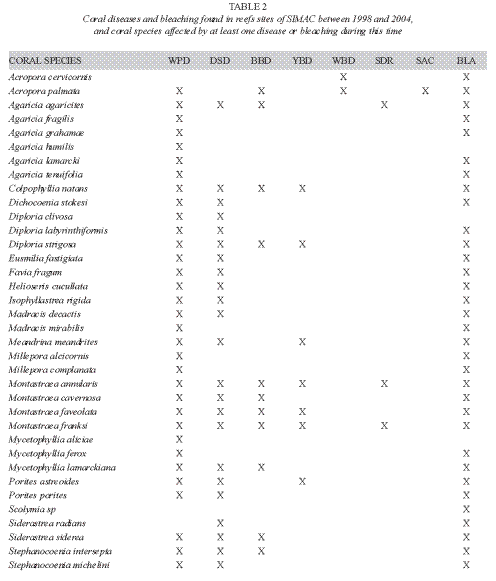
<body><![CDATA[<p>Materials and methods</p> </font></b>     <p align="justify"><b><font face="Verdana" size="2">Study sites: </font></b><font  face="Verdana" size="2">Permanent stations were evaluated from San Andres Island, Rosario Islands, Tayrona, San Bernardo Islands and Urabá (see <a href="#f1">Fig. 1</a>. in Garzón-Ferreira &amp; Rodríguez-Ramírez 2010). More detailed information on study sites may be found in Garzón-Ferreira <i>et al</i>. (2002) and Garzón-Ferreira &amp; Rodríguez-Ramírez (2010).</font></p>     <p align="justify"><font face="Verdana" size="2">Surveys and data collection: Annual reef monitoring was performed between 1998 and 2004 following the protocols described by Garzón-Ferreira &amp; Rodríguez-Ramírez (2010). For each of the seven areas monitored two or three depth levels were assessed: shallow (3-6m), mid-depth (9-12m) and deep (15-18m)- and, two or three reefs (or plots) by depth level were established permanently (see Garzón-Ferreira &amp; Rodríguez-Ramírez 2010). Due to logistic problems, the monitoring protocol was not carried out in Islas del Rosario in 2000, the deeper sites in San Andrés in 1998, and the deeper sites in San Andrés, Chengue, and Islas del Rosario in 2004. The sampling unit was a 10x2 meter belt transect, in which the central axis was the line extended between two stainless steel rods that delimited the permanent transect. The width of the transect was estimated by extending one meter PVC pipe on each side of the central line. All stony coral colonies larger than five centimeters on each side of the central line within the transect were recorded and examined for diseases and coral bleaching. The presence of coral diseases or bleaching was recorded over three to five permanent belt transects per reef site (see Garzón-Ferreira &amp; Rodríguez-Ramírez 2010). More details on this methodology and description of diseases recorded can be found in Garzón-Ferreira <i>et al</i>. (2002) and Garzón-Ferreira &amp; Rodríguez-Ramírez (2010).</font></p>     <p align="justify"><font face="Verdana" size="2">The total number of reported colonies with disease or bleaching signs was obtained by adding the transect data in each plot. The mean of diseased and bleached colonies by depth level and area were obtained for each year of the study. Since some of the reef sites (San Andrés, Rosario, and Tayrona) had 5 transects (=100m2) and others (San Bernardo and Urabá) had only 3 (=60m2), all results were standardized to 100m2. Graphic analyses of the occurrence of DSD and WPD were done for the surveyed areas, while the other diseases showed such low occurrence that in depth analyses were not performed. Due to inconstancies in the number of coral genets recorded every year, we decided not to express our results in percentages (prevalence). We present our data as occurrence (total number of colonies observed to be affected by the evaluated condition).    <br> </font></p>     <p style="text-align: center;"><font face="Verdana" size="2"><img alt=""  src="/img/revistas/rbt/v58s1/art06f1.jpg"  style="width: 644px; height: 369px;"><a name="f1"></a>    <br> </font></p> <b><font face="Verdana" size="3">     <p>Results</p> </font></b>     <p align="justify"><b><font face="Verdana" size="2">General observations</font></b><font  face="Verdana" size="2">: The presence of coral diseases was observed in all surveyed areas between 1998 and 2004 (<a href="#t1">Table 1</a>). San Andres and Tayrona showed the presence of the highest number of different diseases during this period. <i>Agaricia agaricites </i>was the species with the highest number of diseased colonies, followed by <i>Siderastrea siderea</i>. In contrast, <i>Agaricia undata</i>, <i>Isophyllia sinuosa</i>, <i>Madracis formosa</i>, <i>Madracis pharensis</i>, <i>Manicina areolata, Mussa angulosa, Mycetophyllia danaana, Porites colonensis, Solenastrea buornoni </i>and <i>Tubastrea coccinea </i>did not show signs of coral diseases during the study period.    <br> </font></p>     ]]></body>
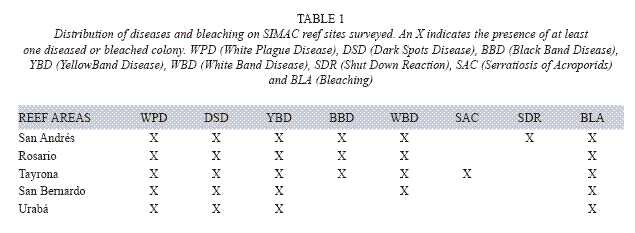
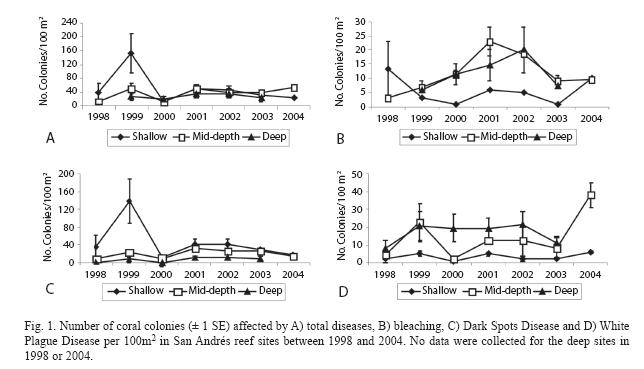
<body><![CDATA[<p style="text-align: center;"><font face="Verdana" size="2"><img alt=""  src="/img/revistas/rbt/v58s1/art06t1.gif"  style="width: 635px; height: 233px;"><a name="t1"></a>    <br> </font></p>     <p align="justify"><font face="Verdana" size="2">A total of 45 coral species were observed and recorded during SIMAC monitoring. A total of 35 of these (77.8%) showed signs of at least one disease, including some of the most important reef forming corals (<a href="#t2">Table 2</a>). The diseases that affected most coral species were WPD (33) followed by DSD (32) (<a href="#t2">Table 2</a>); these diseases were also found in all evaluated areas (<a href="#t1">Table 1</a>). <i>Montastraea annularis </i>and <i>Montastraea franksi </i>were found as the corals species susceptible to the most number of coral diseases (WPD, DSD, BBD, YBD, and shut-down reaction). From all coral species recorded with signs of diseases, only <i>Siderastrea radians </i>did not show signs of WPD (<a href="#t2">Table 2</a>).</font></p>     <p align="justify"><font face="Verdana" size="2">Coral bleaching was observed in all SIMAC sites (<a href="#t1">Table 1</a>). Bleaching signs were detected in 33 out of the 45 coral species recorded (73.3%) (<a href="#t2">Table 2</a>). The highest numbers of affected species (23) were found in the Tayrona site (<a  href="#t2">Table 2</a>). <i>Siderastrea siderea </i>had the highest number of colonies showing signs of bleaching. No bleaching signs were observed in <i>Acropora cervicornis, Agaricia humilis, A. undata, Diploria clivosa, Isophyllia sinuosa, Madrasis formosa, M. pharensis, Manicina areolata, Mussa angulosa, Mycetophyllia aliciae, M. danaana, Porites colonensis y Solenastrea buornoni </i>during the seven years of monitoring.    <br> </font></p>     <p style="text-align: center;"><font face="Verdana" size="2"><img alt=""  src="/img/revistas/rbt/v58s1/art06t2.gif"  style="width: 496px; height: 581px;"><a name="t2"></a>    <br>     <br> </font></p>     <p align="justify"><font face="Verdana" size="2"><b>Temporal variation of diseases and bleaching: </b>In San Andrés, disease occurrence averaged between 15.2 and 76.5 colonies per 100m2 and a general multiannual average of 38.9 colonies/100m2 for the seven years of monitoring. In this area a notable increase on the incidence of coral diseases happened during 1999, especially in the shallower sites, where occurrence rose to 151.0 colonies/100m2 (<a href="#f1">Fig. 1a</a>).</font></p>     <p align="justify"><font face="Verdana" size="2">Coral bleaching exhibited an average range of 5.3 to 14.5 colonies/100m2 and a general multiannual average of 9.5 colonies/100m2. It showed a notorious peak in 2001 of 23.0 colonies/100m2 (<a href="#f1">Fig. 1b</a>). The two analyzed diseases (DSD and WPD) behaved in a different way, with DSD increasing in shallow areas in 1999 (139.5 colonies/100m2) (<a href="#f1">Fig. 1c</a>) and WPD in intermediate depths in 2004 (38.0 colonies/100m2) (<a href="#f1">Fig. 1d</a>). These values influenced the general occurrence of all diseases studied. DSD exhibited an average range between 7.7 to 57.7 colonies/100m2 and a general multiannual average of 26.2 colonies/100m2. WPD showed a multiannual average of 12.0 and an average ranging from 4.8 to 16.3 colonies/100m2.    ]]></body>
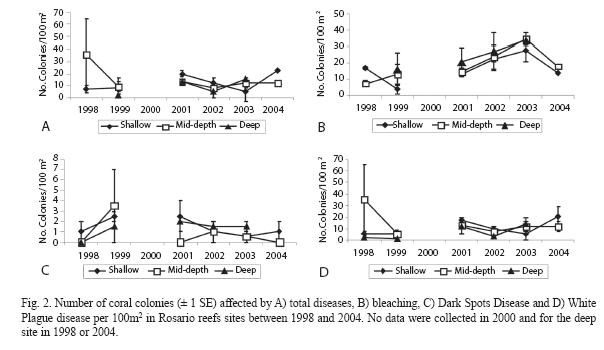
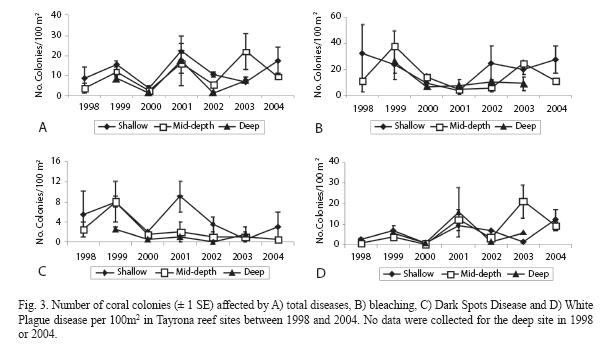
<body><![CDATA[<br> </font></p>     <div style="text-align: justify;"><font face="Verdana" size="2">In Rosario Islands, the multiannual diseases occurrence averaged 13.4 colonies/100m2, ranging from 6.7 to 21.5 colonies/100m2. Rosario Islands also showed a disease occurrence peak in 1998 with 36.0 colonies/100m2 for the intermediate depths (<a href="#f2">Fig 2a</a>). Bleaching fluctuated at all depths with a common peak in 2003 reaching up to 34.5 colonies/100m2 (<a href="#f2">Fig. 2b</a>). Bleaching exhibited an average between 11.0 and 31.8 colonies/100m2 and a multiannual average of 18.5 colonies/100m2. DSD exhibited a range between 0.3 and 2.5 colonies/100m2 and a multiannual average of 1.1 colonies/100 m2. The increase in DSD occurrence in 1999 (3.5 colonies/100m2) did not affect the general occurrence of diseases in the area (<a href="#f2">Fig. 2c</a>). On the contrary, in 1998, WPD showed a peak in the area for the intermediate depths that influenced the general mean (35.0 colonies/100m2) (<a href="#f2">Fig. 2d</a>). WPD exhibited a multiannual average of 11 colonies and a yearly average between 3.8 and 16.5 colonies/100m2.</font>    <br> </div> <font face="Verdana" size="2">    <br> </font>     <div style="text-align: center;"><font face="Verdana" size="2"><img  alt="" src="/img/revistas/rbt/v58s1/art06f2.jpg"  style="width: 604px; height: 350px;"><a name="f2"></a></font>    <br> </div>     <p align="justify"><font face="Verdana" size="2">In Tayrona, general diseases occurrence between 1998 and 2004 was 10.1 colonies/100m2, with averages fluctuating between 2.7 and 18.5 colonies/100m2. Higher values (22 colonies/100m2) were observed during 2001 and 2003 at different depths (<a href="#f3">Fig. 3a</a>). Coral bleaching exhibited its highest values during 1998 and 1999 (<a href="#f3">Fig. 3b</a>), decreasing in later years. The general multiannual average observed was 16.8 colonies/100m2 with an average between 5.2 and 29.2 colonies/100m2. In the area, DSD showed peaks in 1999 (8.0 colonies/100m2) and 2001 (9.0 colonies/100m2) (<a href="#f3">Fig. 3c</a>), which were similar to the peaks observed in the general diseases average. The multiannual average of DSD was 2.8 colonies/100m2 and annual average ranging between 1.0 and 6.2 colonies/100m2. Finally, WPD exhibited an annual average oscillating between 0.8 and 12.5 colonies/100m2 and a multiannual average of 6.4 colonies/100m2. WPD contributed substantially to the general diseases occurrence in 2001 and 2003, mainly for the intermediate depths in 2003 (<a href="#f3">Fig. 3d</a>).    <br> </font></p>     <p style="text-align: center;"><font face="Verdana" size="2"><img alt=""  src="/img/revistas/rbt/v58s1/art06f3.jpg"  style="width: 606px; height: 350px;"><a name="f3"></a>    <br> </font></p>     ]]></body>
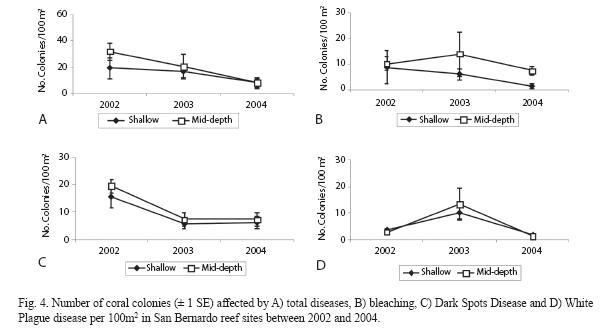
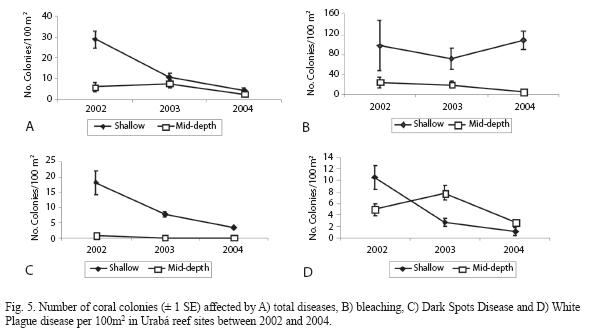
<body><![CDATA[<p align="justify"><font face="Verdana" size="2">Monitoring efforts in San Bernardo Islands started in 2002 with sampling sites at two different depth intervals, shallow and intermediate. During these years, general disease occurrence decreased since the beginning of the observations, from a maximum average of 25.8 to 8.3 colonies/100m2 with a multiannual average of 17.6 colonies/100m2. Disease occurrence was highest during 2002 at intermediate depths (<a href="#f4">Fig. 4a</a>). Bleaching showed a multinannual average of 6.0 and an average range between 2.5 and 8.6 colonies/100m2, with no distinguishable patterns between the two depth levels (<a href="#f4">Fig. 4b</a>). Regarding DSD and WPD, these diseases showed contrasting patterns during the monitoring. DSD was high in 2002 when monitoring efforts started, diminishing thereafter (<a href="#f4">Fig 4c</a>). The multiannual average in these three years of monitoring for DSD was 10.2 colonies/100m2 with a range between 6.4 and 17.5 colonies/100m2. Meanwhile, WPD showed an increase in occurrence in 2003 (<a href="#f4">Fig. 4d</a>), and an average range oscillating between 1.4 and 11.7 colonies/100m2 and an average of 5.4 colonies/100m2.    <br> </font></p>     <p style="text-align: center;"><font face="Verdana" size="2"><img alt=""  src="/img/revistas/rbt/v58s1/art06f4.jpg"  style="width: 604px; height: 335px;"><a name="f4"></a>    <br> </font></p>     <p align="justify"><font face="Verdana" size="2">The station in Urabá, with two depth levels, shallow and intermediate, was also installed in 2002. The general diseases occurrence showed a decrease throughout the years, especially in shallow sites (<a href="#f5">Fig. 5a</a>), with a general occurrence of 10.1 and an average range of 3.6 to 17.5 colonies/100m2. The multiannual average of bleaching was 54.4 with an annual average ranging from 45.8 to 60.8 colonies/100m2 (<a href="#f5">Fig. 5b</a>). DSD and WPD showed a behavior similar to all diseases, decreasing after 2002, especially in shallower sites (<a href="#f5">Figs. 5c and 5d</a>). DSD occurrence averaged between 1.7 and 9.5 colonies/100m2 with a multiannual average of 5.0 colonies/100m2. WPD also showed a multiannual average of 5.0 colonies/100m2 with an average ranging between 1.9 and 7.7 colonies/100m2.    <br> </font></p>     <p style="text-align: center;"><font face="Verdana" size="2"><img alt=""  src="/img/revistas/rbt/v58s1/art06f5.jpg"  style="width: 591px; height: 333px;"><a name="f5"></a>    <br> </font></p> <!-- big --><font style="font-weight: bold;" face="Verdana" size="2"><!-- big --> <!-- /big -->     <p><!-- big -->Discussion<!-- /big --></p> </font><!-- /big -->     <div style="text-align: justify;"><font face="Verdana" size="2">     ]]></body>
<body><![CDATA[<p align="justify">No temporal patterns were evident for diseases occurrence or bleaching throughout the seven years of monitoring, but all coral diseases reported for the Caribbean were found during this study affecting a large number of coral species. DSD and WPD were the coral diseases that contributed the most to the occurrence of diseases in the monitored coralline areas. Either or both diseases were the main contributors to the increase in the occurrence of coral diseases in areas such as Rosario Islands in 1998, San Andrés in 1999, San Bernardo in 2002, and Tayrona in 2001 and 2003. This shows that variation in the occurrence of diseases was not caused by regional or large scale processes, but seemed to be the result of local processes. </p> </font></div>     <div style="text-align: justify;"><font face="Verdana" size="2">     <p align="justify">The number of coral species affected by diseases increased throughout the study. In 1998, 16 coral species were found to be affected by at least one disease, while in 2004 this number increased to 35. This agrees with the observed increase of coral diseases and bleaching, and their direct link to the reduction of coral cover in the Caribbean (Bruckner &amp; Bruckner 1997, Santavy &amp; Peters 1997, Hayes &amp; Goreau 1998, Garzón-Ferreira <i>et al. </i>2001, Weil <i>et al</i>. 2002, Sutherland <i>et al</i>. 2004). Massive corals such as <i>Montastraea </i>spp<i>., Diploria </i>spp.<i>, Stephanocoenia michelini</i>, <i>Colpophyllia natans and Siderastrea siderea</i>, the foliaceus coral <i>Agaricia agaricites </i>and the branching coral <i>Acropora palmata </i>were the most affected by diseases. Some of these species constitute the framework of Caribbean reefs, and their condition might influence the whole ecosystem. Similar results have been found by Garzón-Ferreira <i>et al </i>(2001) and Weil <i>et al </i>(2002). Our documentation of diseases in the corals species of <i>Agaricia fragilis, A.grahamae, A. humilis</i>, <i>Diploria clivosa</i>, <i>Eusmilia fastigiata</i>, <i>Millepora complanata, Mycetophyllia aliciae </i>and <i>Siderastrea radians </i>increases the number of corals known to be affected by diseases in Colombia (Garzón-Ferreira <i>et al. </i>2001, Weil <i>et al. </i>2002). </p> </font></div> <font face="Verdana" size="2">     <p align="justify">No clear tendencies were found in the occurrence of coral bleaching throughout the present study. Also, no relationship between the occurrence of coral diseases and coral bleaching was evident. A total of 34 coral species were found with signs of bleaching during the seven years of monitoring. The most important Caribbean corals were affected by bleaching, and although a decrease in living tissue due to bleaching was not found during the monitoring of coral cover (Rodríguez-Ramírez <i>et al. </i>2010), these events potentially caused alteration of coral growth, reproduction, and other functions (Jokiel 2004) that contributed to the deterioration of Colombian reefs. Bleaching events on Colombian reefs have mainly been related to local and regional increases in seawater temperature. This is the case for the increased bleaching observed in 1999 in Tayrona, when the monthly average temperature was 1°C higher than the multiannual mean (CARICOMP 1997) for several months. Nonetheless, less than 5% mortality was documented (CARICOMP 1997).</p>     <p align="justify">DSD affected the largest number of coral colonies in SIMAC study sites. Similarly, Weil <i>et al</i>. (2002) established DSD as the most prevalent coral disease in the Caribbean affecting 1.3% of colonies (ranging from 0.2 to 7.6%), including a prevalence of 2.7% (±5.4%) for Colombian reefs. High occurrence of DSD in places like San Andrés and San Bernardo may be explained by the abundance of corals susceptible to this disease. We found a clumped distribution, which is an indication of a contagious nature. Although there were low numbers of infected corals, Urabá had a high percentage of colonies infected that were not reflected in the results shown in this report, mainly due to the high dominance of large <i>S. siderea </i>colonies (&gt;2m in diameter). DSD prevalence changes with variations in water temperature (Gil-Agudelo &amp; Garzón-Ferreira 2001, Borger 2005), which might help in controlling its expansion. This characteristic might have special importance in places like Tayrona, where climatological and oceanographical conditions create changes in water temperature of more than 8oC throughout the year (Rodríguez-Ramírez &amp; Garzón-Ferreira 2003), limiting DSD occurrence to only a few colonies per 100m2. </p>     <p align="justify">In San Andrés, after a noticeable peak of coral diseases in 1999, few fluctuations were observed. This peak was the result of a sudden increase in the number of corals with DSD in shallow stations. Weil <i>et al</i>. (2002) established that San Andrés was one of the places with the highest percentage of corals affected by this disease (1.3%) in the Caribbean. Similarly, Gil-Agudelo &amp; Garzón-Ferreira (2001) found that most corals affected by DSD are found in shallow waters, but there is no explanation for the sudden outbreak of this disease this year.</p>     <p align="justify">In SIMAC areas, the number of species affected by WPD was considerably higher than the other recorded diseases, which is in agreement with the results of other studies (Green &amp; Bruckner 2000, Garzón <i>et al</i>. 2001, Weil <i>et al</i>. 2002, Sutherland <i>et al</i>. 2004). Weil <i>et al</i>. (2002) found for WPD in the Caribbean, with a prevalence of 0.8% (ranging from 0.1 to 3.2%) and in Colombia ranging from 1.2 to 1.8%. This disease affects a wide range of coral species, and seems to be less susceptible to environmental variations than other diseases (Santavy &amp; Peters 1997, Goreau <i>et al</i>. 1998), but causes a high rate of tissue loss (Richardson <i>et al</i>. 1998a). WPD has been widely documented and studied in the Caribbean, and is responsible of high levels of coral mortality (Rutzler &amp; Santavy 1983, Edmunds 1991, Kuta &amp; Richardson 1996, 1997, Richardson <i>et al. </i>1997). Between 2003 and 2004 a noticeable increase in WPD was found in San Andrés Islands. This outbreak concurs with an outbreak of this disease observed in the central Caribbean (Sánchez <i>et al. </i>2010).</p>     <p align="justify">It is important to continue coral bleaching and disease monitoring efforts in order to understand the processes involved in disease occurrence and distribution in Colombian reefs. It is also important to extend the number of monitored areas in order to assess areas that have not been evaluated. We recommend, also adoption of new methodologies such as video and photographic recording, marking and following individual colonies, and use of biomarkers, among others. </p> </font><b><font face="Verdana" size="3">     <p>Acknowledgments</p> </font></b><font face="Verdana" size="2">     <p align="justify">The present work has been the result of an effort by many institutions and funding agencies. Financial support was provided by FONAM (environmental program agreement BID-7740C/CO), COLCIENCIAS (Proyecto Colciencias–BID 2105-09-327-97), UNEP-CAR/RCU, and the Colombian Institute for Marine and Coastal Research INVEMAR. Logistic support was provided by CEINER (Center for research, education, and recreation), CORALINA (Corporation for the sustainable development of San Andrés, Old Providence, and Saint Kathrina Archipelago), UAESPNN (National Natural Parks Special Administrative Unit), Colombian National University, Valle´s University, as well as private partners such as Punta Faro Hotel (San Bernardo Archipelago), Las Margaritas Hotel (Urabá), and The Dolphins Hotel (San Andrés Island). Finally, we want to acknowledge the active participation of Sonia Bejarano and many other researchers who contributed to the present work through their participation in field work. Thanks to Laurie Richardson for her comments on this document. Contribution No. CTBR-1040 from INVEMAR.</p> </font>    ]]></body>
<body><![CDATA[<br> <hr style="width: 100%; height: 2px;"><b><font face="Verdana" size="3">     <p>References</p> </font></b>     <!-- ref --><p align="justify"><font face="Verdana" size="2">Aronson, R.B., W.F. Precht, M.A. Toscano &amp; K.H. Koltes. 2002. The 1998 bleaching event and its aftermath on a coral ref. in Belice. Mar. Biol. 141: 435-447.    &nbsp;&nbsp;&nbsp;&nbsp;&nbsp;&nbsp;&nbsp;&nbsp;[&#160;<a href="javascript:void(0);" onclick="javascript: window.open('/scielo.php?script=sci_nlinks&ref=1838490&pid=S0034-7744201000050000800001&lng=','','width=640,height=500,resizable=yes,scrollbars=1,menubar=yes,');">Links</a>&#160;]<!-- end-ref --></font></p>     <!-- ref --><p align="justify"><font face="Verdana" size="2">Banin E., Y. Ben-Haim, T. Israely, Y. Loya &amp; E. Rosemberg. 2000. Effect of the environment on the bacterial bleaching of corals. Water Air Soil Poll. 123: 337-352 </font>&nbsp;&nbsp;&nbsp;&nbsp;&nbsp;&nbsp;&nbsp;&nbsp;[&#160;<a href="javascript:void(0);" onclick="javascript: window.open('/scielo.php?script=sci_nlinks&ref=1838492&pid=S0034-7744201000050000800002&lng=','','width=640,height=500,resizable=yes,scrollbars=1,menubar=yes,');">Links</a>&#160;]<!-- end-ref --><!-- ref --><p align="justify"><font face="Verdana" size="2">Barrios, L.M. 2000. Evaluación de las principales condiciones de deterioro de los corales pétreos en el Caribe colombiano. Tesis de maestría, Universidad Nacional de Colombia, Santa Marta, Colombia.    &nbsp;&nbsp;&nbsp;&nbsp;&nbsp;&nbsp;&nbsp;&nbsp;[&#160;<a href="javascript:void(0);" onclick="javascript: window.open('/scielo.php?script=sci_nlinks&ref=1838493&pid=S0034-7744201000050000800003&lng=','','width=640,height=500,resizable=yes,scrollbars=1,menubar=yes,');">Links</a>&#160;]<!-- end-ref --></font></p>     <!-- ref --><p align="justify"><font face="Verdana" size="2">Borger, J.L. 2005. Dark spot syndrome: A scleractinian coral disease or a general stress response? Coral Reefs 24: 139-144. Brown, B. 1997. Coral bleaching: Causes and consequences. Proc. 8th Int. Coral Reef Symposium 1: 65-74.    &nbsp;&nbsp;&nbsp;&nbsp;&nbsp;&nbsp;&nbsp;&nbsp;[&#160;<a href="javascript:void(0);" onclick="javascript: window.open('/scielo.php?script=sci_nlinks&ref=1838495&pid=S0034-7744201000050000800004&lng=','','width=640,height=500,resizable=yes,scrollbars=1,menubar=yes,');">Links</a>&#160;]<!-- end-ref --></font></p>     <!-- ref --><p align="justify"><font face="Verdana" size="2">Bruckner, A.W. &amp; R.J. Bruckner. 1977. The persistence of black band disease in Jamaica: impact on comjunity structure. Proc. 8th Int. Coral Reef Symposium 1: 601-606.    &nbsp;&nbsp;&nbsp;&nbsp;&nbsp;&nbsp;&nbsp;&nbsp;[&#160;<a href="javascript:void(0);" onclick="javascript: window.open('/scielo.php?script=sci_nlinks&ref=1838497&pid=S0034-7744201000050000800005&lng=','','width=640,height=500,resizable=yes,scrollbars=1,menubar=yes,');">Links</a>&#160;]<!-- end-ref --></font></p>     <!-- ref --><p align="justify"><font face="Verdana" size="2">CARICOMP. 1997. Studies on Caribbean coral bleaching.1995-1996 Proc. 8th Int. Coral Reef Symposium 1: 673-678.    &nbsp;&nbsp;&nbsp;&nbsp;&nbsp;&nbsp;&nbsp;&nbsp;[&#160;<a href="javascript:void(0);" onclick="javascript: window.open('/scielo.php?script=sci_nlinks&ref=1838499&pid=S0034-7744201000050000800006&lng=','','width=640,height=500,resizable=yes,scrollbars=1,menubar=yes,');">Links</a>&#160;]<!-- end-ref --></font></p>     <!-- ref --><p align="justify"><font face="Verdana" size="2">Díaz, J. M., J. Garzón-Ferreira &amp; S. Zea. 1995. Los arrecifes coralinos de la isla de San Andrés, Colombia; estado actual y perspectivas para su conservación. Acad. Colomb. Cien. Exac. Fis. Nat., Colec. Jorge Alvarez Lleras 7, Bogotá, Colombia.    &nbsp;&nbsp;&nbsp;&nbsp;&nbsp;&nbsp;&nbsp;&nbsp;[&#160;<a href="javascript:void(0);" onclick="javascript: window.open('/scielo.php?script=sci_nlinks&ref=1838501&pid=S0034-7744201000050000800007&lng=','','width=640,height=500,resizable=yes,scrollbars=1,menubar=yes,');">Links</a>&#160;]<!-- end-ref --></font></p>     <!-- ref --><p align="justify"><font face="Verdana" size="2">Díaz, J.M., G. Díaz-Pulido, J. Garzón-Ferreira, J. Geister, J. A. Sanchez &amp; S. Zea. 1996. Atlas de los arrecifes coralinos del Caribe colombiano. I. Complejos arrecifales oceánicos. INVEMAR, Serie Publicaciones Especiales No.2, Santa Marta, Colombia.    &nbsp;&nbsp;&nbsp;&nbsp;&nbsp;&nbsp;&nbsp;&nbsp;[&#160;<a href="javascript:void(0);" onclick="javascript: window.open('/scielo.php?script=sci_nlinks&ref=1838503&pid=S0034-7744201000050000800008&lng=','','width=640,height=500,resizable=yes,scrollbars=1,menubar=yes,');">Links</a>&#160;]<!-- end-ref --></font></p>     <!-- ref --><p align="justify"><font face="Verdana" size="2">Díaz, J.M., L,M. Barrios, M.H. Cendales, J. Garzón-Ferreira, J. Geister, M. López-Victoria, G.H. Ospina, F. Parra-Velandia, J. Pinzón, B. Vargas-Angel, F. Zapata &amp; S. Zea. 2000. Áreas coralinas de Colombia. INVEMAR, Serie de Publicaciones Especiales No.5, Santa Marta, Colombia.    &nbsp;&nbsp;&nbsp;&nbsp;&nbsp;&nbsp;&nbsp;&nbsp;[&#160;<a href="javascript:void(0);" onclick="javascript: window.open('/scielo.php?script=sci_nlinks&ref=1838505&pid=S0034-7744201000050000800009&lng=','','width=640,height=500,resizable=yes,scrollbars=1,menubar=yes,');">Links</a>&#160;]<!-- end-ref --></font></p>     <!-- ref --><p align="justify"><font face="Verdana" size="2">Edmunds, P.J. 1991. Extent and effect of Black Band Disease on a Caribbean reef. Coral Reefs 10: 161-165.    &nbsp;&nbsp;&nbsp;&nbsp;&nbsp;&nbsp;&nbsp;&nbsp;[&#160;<a href="javascript:void(0);" onclick="javascript: window.open('/scielo.php?script=sci_nlinks&ref=1838507&pid=S0034-7744201000050000800010&lng=','','width=640,height=500,resizable=yes,scrollbars=1,menubar=yes,');">Links</a>&#160;]<!-- end-ref --></font></p>     <!-- ref --><p align="justify"><font face="Verdana" size="2">Garcés, A. 2000. Desarrollo de la enfermedad de los lunares oscuros los corales pétreos <i>Montastraea annularis </i>y <i>Siderastrea siderea </i>en la Bahía de Gayraca, Caribe colombiano. Tesis de Biología Marina, Universidad Jorge Tadeo Lozano, Santa Marta, Colombia.    &nbsp;&nbsp;&nbsp;&nbsp;&nbsp;&nbsp;&nbsp;&nbsp;[&#160;<a href="javascript:void(0);" onclick="javascript: window.open('/scielo.php?script=sci_nlinks&ref=1838509&pid=S0034-7744201000050000800011&lng=','','width=640,height=500,resizable=yes,scrollbars=1,menubar=yes,');">Links</a>&#160;]<!-- end-ref --></font></p>     <!-- ref --><p align="justify"><font face="Verdana" size="2">Garzón-Ferreira, J. &amp; A. Rodríguez-Ramírez. 2010. SIMAC: Development and implementation of a coral reef monitoring network in Colombia. Rev. Biol. Trop. 58 (Suppl. 1): 67-80.    &nbsp;&nbsp;&nbsp;&nbsp;&nbsp;&nbsp;&nbsp;&nbsp;[&#160;<a href="javascript:void(0);" onclick="javascript: window.open('/scielo.php?script=sci_nlinks&ref=1838511&pid=S0034-7744201000050000800012&lng=','','width=640,height=500,resizable=yes,scrollbars=1,menubar=yes,');">Links</a>&#160;]<!-- end-ref --><!-- ref --></font>&nbsp;&nbsp;&nbsp;&nbsp;&nbsp;&nbsp;&nbsp;&nbsp;[&#160;<a href="javascript:void(0);" onclick="javascript: window.open('/scielo.php?script=sci_nlinks&ref=1838512&pid=S0034-7744201000050000800013&lng=','','width=640,height=500,resizable=yes,scrollbars=1,menubar=yes,');">Links</a>&#160;]<!-- end-ref --></font>     <!-- ref --><p align="justify"><font face="Verdana" size="2">Garzón-Ferreira, J., S. Zea &amp; J.M. Díaz. 1996. Coral health assessment in four Western Caribbean atolls. Abstr. 8th Int. Coral Reef Symposium.    &nbsp;&nbsp;&nbsp;&nbsp;&nbsp;&nbsp;&nbsp;&nbsp;[&#160;<a href="javascript:void(0);" onclick="javascript: window.open('/scielo.php?script=sci_nlinks&ref=1838514&pid=S0034-7744201000050000800014&lng=','','width=640,height=500,resizable=yes,scrollbars=1,menubar=yes,');">Links</a>&#160;]<!-- end-ref --></font></p>     <!-- ref --><p align="justify"><font face="Verdana" size="2">Garzón-Ferreira, J., D.L. Gil-Agudelo, L.M. Barrios &amp; S. Zea. 2001. Stony corals diseases observed in Caribbean reefs. Hydrobiologia 460: 65-69.    &nbsp;&nbsp;&nbsp;&nbsp;&nbsp;&nbsp;&nbsp;&nbsp;[&#160;<a href="javascript:void(0);" onclick="javascript: window.open('/scielo.php?script=sci_nlinks&ref=1838516&pid=S0034-7744201000050000800015&lng=','','width=640,height=500,resizable=yes,scrollbars=1,menubar=yes,');">Links</a>&#160;]<!-- end-ref --></font></p>     ]]></body>
<body><![CDATA[<!-- ref --><p align="justify"><font face="Verdana" size="2">Garzón-Ferreira, J., M. C. Reyes-Nivia &amp; A. Rodríguez-Ramírez. 2002. Manual de métodos del SIMAC. INVEMAR. Santa Marta, Colombia.    &nbsp;&nbsp;&nbsp;&nbsp;&nbsp;&nbsp;&nbsp;&nbsp;[&#160;<a href="javascript:void(0);" onclick="javascript: window.open('/scielo.php?script=sci_nlinks&ref=1838518&pid=S0034-7744201000050000800016&lng=','','width=640,height=500,resizable=yes,scrollbars=1,menubar=yes,');">Links</a>&#160;]<!-- end-ref --></font></p>     <!-- ref --><p align="justify"><font face="Verdana" size="2">Gil-Agudelo, D.L. &amp; J. Garzón-Ferreira. 2001. Spatial and seasonal variation of dark spots disease in coral communities of the Santa Marta area (Colombian Caribbean). Bull. Mar. Sci. 69: 619-629.    &nbsp;&nbsp;&nbsp;&nbsp;&nbsp;&nbsp;&nbsp;&nbsp;[&#160;<a href="javascript:void(0);" onclick="javascript: window.open('/scielo.php?script=sci_nlinks&ref=1838520&pid=S0034-7744201000050000800017&lng=','','width=640,height=500,resizable=yes,scrollbars=1,menubar=yes,');">Links</a>&#160;]<!-- end-ref --></font></p>     <!-- ref --><p align="justify"><font face="Verdana" size="2">Gil-Agudelo, D.L., G.W. Smith, J. Garzón-Ferreira, E. Weil &amp; D. Petersen. 2004. Dark Spot Disease and Yellow Band Disease, two poorly known coral diseases with high incidence in Caribbean reefs, p. 337-349. <i>In </i>E. Rosenberg &amp; Y. Loya, (eds. ). Coral health and disease. Springer-Verlag, Berlin, Germany.    &nbsp;&nbsp;&nbsp;&nbsp;&nbsp;&nbsp;&nbsp;&nbsp;[&#160;<a href="javascript:void(0);" onclick="javascript: window.open('/scielo.php?script=sci_nlinks&ref=1838522&pid=S0034-7744201000050000800018&lng=','','width=640,height=500,resizable=yes,scrollbars=1,menubar=yes,');">Links</a>&#160;]<!-- end-ref --></font></p>     <!-- ref --><p align="justify"><font face="Verdana" size="2">Glynn, P.W. 1993. Coral reef bleaching: Ecological perspectives. Coral Reefs 12: 1-17.    &nbsp;&nbsp;&nbsp;&nbsp;&nbsp;&nbsp;&nbsp;&nbsp;[&#160;<a href="javascript:void(0);" onclick="javascript: window.open('/scielo.php?script=sci_nlinks&ref=1838524&pid=S0034-7744201000050000800019&lng=','','width=640,height=500,resizable=yes,scrollbars=1,menubar=yes,');">Links</a>&#160;]<!-- end-ref --></font></p>     <!-- ref --><p align="justify"><font face="Verdana" size="2">Goreau, T.J., J. Cervino, M. Goreau, R. Hayes, M. Hayes, L. Richardson, G.W. Smith, K. DeMeyer, I. Nagelkerken, J. Garzón-Ferreira, D. Gil, G. Garrison, E.H. Williams, L. Bunkley-Williams, C. Quirolo, K. Paterson, J.W. Porter &amp; K. Porter. 1998. Rapid spread of diseases in Caribbean coral reefs. Rev. Biol. Trop. 46: 157-171.    &nbsp;&nbsp;&nbsp;&nbsp;&nbsp;&nbsp;&nbsp;&nbsp;[&#160;<a href="javascript:void(0);" onclick="javascript: window.open('/scielo.php?script=sci_nlinks&ref=1838526&pid=S0034-7744201000050000800020&lng=','','width=640,height=500,resizable=yes,scrollbars=1,menubar=yes,');">Links</a>&#160;]<!-- end-ref --></font></p>     ]]></body>
<body><![CDATA[<!-- ref --><p align="justify"><font face="Verdana" size="2">Green, E.P. &amp; A.W. Bruckner. 2000. The significance of coral disease epizootiology for coral reef conservation. Biol. Conserv. 96: 347-361.    &nbsp;&nbsp;&nbsp;&nbsp;&nbsp;&nbsp;&nbsp;&nbsp;[&#160;<a href="javascript:void(0);" onclick="javascript: window.open('/scielo.php?script=sci_nlinks&ref=1838528&pid=S0034-7744201000050000800021&lng=','','width=640,height=500,resizable=yes,scrollbars=1,menubar=yes,');">Links</a>&#160;]<!-- end-ref --></font></p>     <!-- ref --><p align="justify"><font face="Verdana" size="2">Hayes, R.L &amp; N.I. Goreau. 1998. The significance of emerging diseases in the tropical coral reef ecosystem. Rev. Bio. Trop. 46: 172-185.    &nbsp;&nbsp;&nbsp;&nbsp;&nbsp;&nbsp;&nbsp;&nbsp;[&#160;<a href="javascript:void(0);" onclick="javascript: window.open('/scielo.php?script=sci_nlinks&ref=1838530&pid=S0034-7744201000050000800022&lng=','','width=640,height=500,resizable=yes,scrollbars=1,menubar=yes,');">Links</a>&#160;]<!-- end-ref --></font></p>     <!-- ref --><p align="justify"><font face="Verdana" size="2">Jokiel, P.L. 2004. Temperature stress and coral bleaching, p. 401-425. <i>In </i>E. Rosenberg &amp; Y. Loya, (eds. ). Coral health and disease. Springer-Verlag, Berlin, Germany.    &nbsp;&nbsp;&nbsp;&nbsp;&nbsp;&nbsp;&nbsp;&nbsp;[&#160;<a href="javascript:void(0);" onclick="javascript: window.open('/scielo.php?script=sci_nlinks&ref=1838532&pid=S0034-7744201000050000800023&lng=','','width=640,height=500,resizable=yes,scrollbars=1,menubar=yes,');">Links</a>&#160;]<!-- end-ref --></font></p>     <!-- ref --><p align="justify"><font face="Verdana" size="2">Kuta, K.G. &amp; L.L. Richardson. 1996. Abundance and distribution of Black Band Disease on coral reefs in the Northern Florida keys. Coral Reefs 14: 1-5.    &nbsp;&nbsp;&nbsp;&nbsp;&nbsp;&nbsp;&nbsp;&nbsp;[&#160;<a href="javascript:void(0);" onclick="javascript: window.open('/scielo.php?script=sci_nlinks&ref=1838534&pid=S0034-7744201000050000800024&lng=','','width=640,height=500,resizable=yes,scrollbars=1,menubar=yes,');">Links</a>&#160;]<!-- end-ref --></font></p>     <!-- ref --><p align="justify"><font face="Verdana" size="2">Kuta, K.G. &amp; L.L. Richardson. 1997. Black band disease and the fate of disease coral colonies in the Florida Keys. Proc. 8th Int. Coral Reef Symp. 1: 575-578.    &nbsp;&nbsp;&nbsp;&nbsp;&nbsp;&nbsp;&nbsp;&nbsp;[&#160;<a href="javascript:void(0);" onclick="javascript: window.open('/scielo.php?script=sci_nlinks&ref=1838536&pid=S0034-7744201000050000800025&lng=','','width=640,height=500,resizable=yes,scrollbars=1,menubar=yes,');">Links</a>&#160;]<!-- end-ref --></font></p>     ]]></body>
<body><![CDATA[<!-- ref --><p align="justify"><font face="Verdana" size="2">Navas-Suarez, G. &amp; S.C. Moreno-Forero. 1993. Caracterización estructural de la comunidad bentónica asociada a <i>Acropora palmata </i>(Lamarck, 1816) muerto. Isla Grande, Islas del Rosario, Caribe colombiano. Tesis de Biología Marina. Universidad Jorge Tadeo Lozano. Cartagena, Colombia.    &nbsp;&nbsp;&nbsp;&nbsp;&nbsp;&nbsp;&nbsp;&nbsp;[&#160;<a href="javascript:void(0);" onclick="javascript: window.open('/scielo.php?script=sci_nlinks&ref=1838538&pid=S0034-7744201000050000800026&lng=','','width=640,height=500,resizable=yes,scrollbars=1,menubar=yes,');">Links</a>&#160;]<!-- end-ref --> </font></p>     <!-- ref --><p align="justify"><font face="Verdana" size="2">Patterson, K.L., J.W. Porter, K.B. Ritchie, S.W. Polson, E. Mueller, E.C. Peters, D.L. Santavy &amp; G.W. Smith. 2002. The etiology of white pox, a lethal disease of the Caribbean elkhorn coral Acropora palmata. P. Natl. Acad. Sci. USA 99: 8725-8730.    &nbsp;&nbsp;&nbsp;&nbsp;&nbsp;&nbsp;&nbsp;&nbsp;[&#160;<a href="javascript:void(0);" onclick="javascript: window.open('/scielo.php?script=sci_nlinks&ref=1838540&pid=S0034-7744201000050000800027&lng=','','width=640,height=500,resizable=yes,scrollbars=1,menubar=yes,');">Links</a>&#160;]<!-- end-ref --></font></p>     <!-- ref --><p align="justify"><font face="Verdana" size="2">Peters, E.C. 1997. Diseases of coral-reef organisms. P. 114-139. <i>In </i>C. Birkeland (ed.). Life and dead of coral reefs. Chapman &amp; Hall, New York, USA.    &nbsp;&nbsp;&nbsp;&nbsp;&nbsp;&nbsp;&nbsp;&nbsp;[&#160;<a href="javascript:void(0);" onclick="javascript: window.open('/scielo.php?script=sci_nlinks&ref=1838542&pid=S0034-7744201000050000800028&lng=','','width=640,height=500,resizable=yes,scrollbars=1,menubar=yes,');">Links</a>&#160;]<!-- end-ref --></font></p>     <!-- ref --><p align="justify"><font face="Verdana" size="2">Pinzón, J., A. Perdomo, O. Solano &amp; G. Navas. 1998. Blanqueamiento coralino de 1995 en la región de Santa Marta, Caribe colombiano. Caribb. J. Sci. 34: 330-333.    &nbsp;&nbsp;&nbsp;&nbsp;&nbsp;&nbsp;&nbsp;&nbsp;[&#160;<a href="javascript:void(0);" onclick="javascript: window.open('/scielo.php?script=sci_nlinks&ref=1838544&pid=S0034-7744201000050000800029&lng=','','width=640,height=500,resizable=yes,scrollbars=1,menubar=yes,');">Links</a>&#160;]<!-- end-ref --></font></p>     <!-- ref --><p align="justify"><font face="Verdana" size="2">Prahl, H. von. 1983. Blanqueo masivo y muerte de corales en la Isla de Gorgona, Pacífico colombiano. Cespedesia 12:125-29.    &nbsp;&nbsp;&nbsp;&nbsp;&nbsp;&nbsp;&nbsp;&nbsp;[&#160;<a href="javascript:void(0);" onclick="javascript: window.open('/scielo.php?script=sci_nlinks&ref=1838546&pid=S0034-7744201000050000800030&lng=','','width=640,height=500,resizable=yes,scrollbars=1,menubar=yes,');">Links</a>&#160;]<!-- end-ref --></font></p>     ]]></body>
<body><![CDATA[<!-- ref --><p align="justify"><font face="Verdana" size="2">Prahl, H. von. 1985. Blanqueamiento y muerte de corales hermatípicos en el Pacífico colombiano atribuidos al fenómeno del Niño 1982-83. Boletín EFREN 12: 22-24.    &nbsp;&nbsp;&nbsp;&nbsp;&nbsp;&nbsp;&nbsp;&nbsp;[&#160;<a href="javascript:void(0);" onclick="javascript: window.open('/scielo.php?script=sci_nlinks&ref=1838548&pid=S0034-7744201000050000800031&lng=','','width=640,height=500,resizable=yes,scrollbars=1,menubar=yes,');">Links</a>&#160;]<!-- end-ref --></font></p>     <!-- ref --><p align="justify"><font face="Verdana" size="2">Prahl, H. von &amp; H. Erhardt 1985. Colombia corales y arrecifes coralinos. FEN, Bogotá, Colombia.    &nbsp;&nbsp;&nbsp;&nbsp;&nbsp;&nbsp;&nbsp;&nbsp;[&#160;<a href="javascript:void(0);" onclick="javascript: window.open('/scielo.php?script=sci_nlinks&ref=1838550&pid=S0034-7744201000050000800032&lng=','','width=640,height=500,resizable=yes,scrollbars=1,menubar=yes,');">Links</a>&#160;]<!-- end-ref --></font></p>     <!-- ref --><p align="justify"><font face="Verdana" size="2">Richard, B.A. &amp; W.F. Precht. 2001. White-band disease and the changing face of Caribbean coral reefs. Hydrobiologia 460: 25-38.    &nbsp;&nbsp;&nbsp;&nbsp;&nbsp;&nbsp;&nbsp;&nbsp;[&#160;<a href="javascript:void(0);" onclick="javascript: window.open('/scielo.php?script=sci_nlinks&ref=1838552&pid=S0034-7744201000050000800033&lng=','','width=640,height=500,resizable=yes,scrollbars=1,menubar=yes,');">Links</a>&#160;]<!-- end-ref --></font></p>     <!-- ref --><p align="justify"><font face="Verdana" size="2">Richardson, L.L, K.G. Kuta, S. Schnell &amp; R.G. Carlton. 1997. Ecology of the black band disease microbial consortium. Proc. 8th Int. Coral Reef Symposium 1: 597-600.    &nbsp;&nbsp;&nbsp;&nbsp;&nbsp;&nbsp;&nbsp;&nbsp;[&#160;<a href="javascript:void(0);" onclick="javascript: window.open('/scielo.php?script=sci_nlinks&ref=1838554&pid=S0034-7744201000050000800034&lng=','','width=640,height=500,resizable=yes,scrollbars=1,menubar=yes,');">Links</a>&#160;]<!-- end-ref --></font></p>     <!-- ref --><p align="justify"><font face="Verdana" size="2">Richardson, L.L., W.M. Goldberg, R.G. Carlton &amp; J.C.Halas. 1998a. Coral disease outbreak in the Florida Keys: plague type II. Rev. Bio. Trop. 46: 187-198.    &nbsp;&nbsp;&nbsp;&nbsp;&nbsp;&nbsp;&nbsp;&nbsp;[&#160;<a href="javascript:void(0);" onclick="javascript: window.open('/scielo.php?script=sci_nlinks&ref=1838556&pid=S0034-7744201000050000800035&lng=','','width=640,height=500,resizable=yes,scrollbars=1,menubar=yes,');">Links</a>&#160;]<!-- end-ref --><br> </font></p>     ]]></body>
<body><![CDATA[<!-- ref --><p align="justify"><font face="Verdana" size="2">Richardson, L.L., W.M. Goldberg, K.G. Kuta, R.B. Aronson, G.W. Smith, K.B. Ritchie, J.C. Halas, J.S. Feingold &amp; S.L. Miller 1998b. Florida´s mystery coral killer identified. Nature 392:557-558.    &nbsp;&nbsp;&nbsp;&nbsp;&nbsp;&nbsp;&nbsp;&nbsp;[&#160;<a href="javascript:void(0);" onclick="javascript: window.open('/scielo.php?script=sci_nlinks&ref=1838558&pid=S0034-7744201000050000800036&lng=','','width=640,height=500,resizable=yes,scrollbars=1,menubar=yes,');">Links</a>&#160;]<!-- end-ref --></font></p>     <!-- ref --><p align="justify"><font face="Verdana" size="2"><font face="Verdana"  size="2">Rodríguez-Ramírez, A. &amp; J. Garzón-Ferreira. 2003. Monitoreo de arrecifes coralinos, pastos marinos y manglares en la Bahía de Chengue (Caribe colombiano): 1993-1999. INVEMAR, Serie de Publicaciones Especiales No. 8, Santa Marta, Colombia.    &nbsp;&nbsp;&nbsp;&nbsp;&nbsp;&nbsp;&nbsp;&nbsp;[&#160;<a href="javascript:void(0);" onclick="javascript: window.open('/scielo.php?script=sci_nlinks&ref=1838560&pid=S0034-7744201000050000800037&lng=','','width=640,height=500,resizable=yes,scrollbars=1,menubar=yes,');">Links</a>&#160;]<!-- end-ref --></font></font></p>     <!-- ref --><p align="justify"><font face="Verdana" size="2"><font face="Verdana"  size="2">Rodríguez-Ramírez, A., M. C. Reyes-Nivia, S. Zea, R. Navas-Camacho, J. Garzón-Ferreira, S. Bejarano, P. Herrón &amp; C. Orozco. 2010. Recent dynamics and condition of coral reefs in the Colombian Caribbean. Rev. Biol. Trop. 58 (Suppl. 1): 107-131.    &nbsp;&nbsp;&nbsp;&nbsp;&nbsp;&nbsp;&nbsp;&nbsp;[&#160;<a href="javascript:void(0);" onclick="javascript: window.open('/scielo.php?script=sci_nlinks&ref=1838562&pid=S0034-7744201000050000800038&lng=','','width=640,height=500,resizable=yes,scrollbars=1,menubar=yes,');">Links</a>&#160;]<!-- end-ref --></font></font></p>     <!-- ref --><p align="justify"><font face="Verdana" size="2"><font face="Verdana"  size="2">Rosenberg, E. &amp; Y. Bem-Haim. 2002. Microbial diseases of corals and global warming. Environ. Microbiol. 4:318-326.    &nbsp;&nbsp;&nbsp;&nbsp;&nbsp;&nbsp;&nbsp;&nbsp;[&#160;<a href="javascript:void(0);" onclick="javascript: window.open('/scielo.php?script=sci_nlinks&ref=1838564&pid=S0034-7744201000050000800039&lng=','','width=640,height=500,resizable=yes,scrollbars=1,menubar=yes,');">Links</a>&#160;]<!-- end-ref --></font></font></p>     <!-- ref --><p align="justify"><font face="Verdana" size="2"><font face="Verdana"  size="2">Rützler, K &amp; D. Santavy. 1983. The black band disease of Atlantic reef corals. I. Description of the cyanophyte pathogen. P.S.Z.N.I: Mar. Ecol. 4: 301-319.    &nbsp;&nbsp;&nbsp;&nbsp;&nbsp;&nbsp;&nbsp;&nbsp;[&#160;<a href="javascript:void(0);" onclick="javascript: window.open('/scielo.php?script=sci_nlinks&ref=1838566&pid=S0034-7744201000050000800040&lng=','','width=640,height=500,resizable=yes,scrollbars=1,menubar=yes,');">Links</a>&#160;]<!-- end-ref --></font></font></p>     ]]></body>
<body><![CDATA[<!-- ref --><p align="justify"><font face="Verdana" size="2"><font face="Verdana"  size="2">Sánchez, J.A., S. Herrera, R. Navas-Camacho, A. Rodríguez-Ramírez, P. Herron, V. Pizarro, A. R. Acosta, P. A. Castillo, P. Montoya &amp; C. Orozco. 2010. White plague-like coral disease in remote reefs of the Western Caribbean. Rev. Biol. Trop. 58 (Suppl. 1): 145-154.    &nbsp;&nbsp;&nbsp;&nbsp;&nbsp;&nbsp;&nbsp;&nbsp;[&#160;<a href="javascript:void(0);" onclick="javascript: window.open('/scielo.php?script=sci_nlinks&ref=1838568&pid=S0034-7744201000050000800041&lng=','','width=640,height=500,resizable=yes,scrollbars=1,menubar=yes,');">Links</a>&#160;]<!-- end-ref --></font></font></p>     <!-- ref --><p align="justify"><font face="Verdana" size="2"><font face="Verdana"  size="2">Santavy, K.L &amp; E.C. Peters. 1997. Microbial pests: coral disease in the Western Atlantic. Proc. 8th Int. Coral Reefs Symposium 1: 607-612.    &nbsp;&nbsp;&nbsp;&nbsp;&nbsp;&nbsp;&nbsp;&nbsp;[&#160;<a href="javascript:void(0);" onclick="javascript: window.open('/scielo.php?script=sci_nlinks&ref=1838570&pid=S0034-7744201000050000800042&lng=','','width=640,height=500,resizable=yes,scrollbars=1,menubar=yes,');">Links</a>&#160;]<!-- end-ref --></font></font></p>     <!-- ref --><p align="justify"><font face="Verdana" size="2"><font face="Verdana"  size="2">Solano, O.D. 1994. Corales, formaciones arrecifales y blanqueamiento de 1987 en Bahía Portete (Guajira, Colombia). An. Inst. Invest. Mar. Punta Betín, 23:149-163.    &nbsp;&nbsp;&nbsp;&nbsp;&nbsp;&nbsp;&nbsp;&nbsp;[&#160;<a href="javascript:void(0);" onclick="javascript: window.open('/scielo.php?script=sci_nlinks&ref=1838572&pid=S0034-7744201000050000800043&lng=','','width=640,height=500,resizable=yes,scrollbars=1,menubar=yes,');">Links</a>&#160;]<!-- end-ref --></font></font></p>     <!-- ref --><p align="justify"><font face="Verdana" size="2"><font face="Verdana"  size="2">Solano, O.D., G.R Navas &amp; S.K. Moreno, 1993. Blanqueamiento coralino de 1990 en el Parque Nacional Natural Corales del Rosario (Caribe colombiano) An. Inst. Invest. Mar. Punta Betín, 22: 97-111</font></font>&nbsp;&nbsp;&nbsp;&nbsp;&nbsp;&nbsp;&nbsp;&nbsp;[&#160;<a href="javascript:void(0);" onclick="javascript: window.open('/scielo.php?script=sci_nlinks&ref=1838574&pid=S0034-7744201000050000800044&lng=','','width=640,height=500,resizable=yes,scrollbars=1,menubar=yes,');">Links</a>&#160;]<!-- end-ref --><!-- ref --><p align="justify"><font face="Verdana" size="2"><font face="Verdana"  size="2">Stedman, T.L. 2000. Medical Dictionary. Lippincott Williams &amp; Wilkins, Philadelphia, USA.    &nbsp;&nbsp;&nbsp;&nbsp;&nbsp;&nbsp;&nbsp;&nbsp;[&#160;<a href="javascript:void(0);" onclick="javascript: window.open('/scielo.php?script=sci_nlinks&ref=1838575&pid=S0034-7744201000050000800045&lng=','','width=640,height=500,resizable=yes,scrollbars=1,menubar=yes,');">Links</a>&#160;]<!-- end-ref --></font></font></p>     <!-- ref --><p align="justify"><font face="Verdana" size="2"><font face="Verdana"  size="2">Sutherland, K.P., J.W. Porter &amp; C. Torres. 2004. Disease and immunity in Caribbean and Indo-Pacific zooxanthellate corals. Mar. Ecol. Prog. Ser. 266: 273-302.    &nbsp;&nbsp;&nbsp;&nbsp;&nbsp;&nbsp;&nbsp;&nbsp;[&#160;<a href="javascript:void(0);" onclick="javascript: window.open('/scielo.php?script=sci_nlinks&ref=1838577&pid=S0034-7744201000050000800046&lng=','','width=640,height=500,resizable=yes,scrollbars=1,menubar=yes,');">Links</a>&#160;]<!-- end-ref --></font></font></p>     <!-- ref --><p align="justify"><font face="Verdana" size="2"><font face="Verdana"  size="2">Vargas-Angel, V. F. Zapata, H. Hernández &amp; J. M. Jiménez. 2001. Corals and coral reefs responses to the 1997-1998 El Niño event on the Pacific coast of Colombia. Bull. Mar. Sci. 69: 111-132.    &nbsp;&nbsp;&nbsp;&nbsp;&nbsp;&nbsp;&nbsp;&nbsp;[&#160;<a href="javascript:void(0);" onclick="javascript: window.open('/scielo.php?script=sci_nlinks&ref=1838579&pid=S0034-7744201000050000800047&lng=','','width=640,height=500,resizable=yes,scrollbars=1,menubar=yes,');">Links</a>&#160;]<!-- end-ref --></font></font></p>     <!-- ref --><p align="justify"><font face="Verdana" size="2"><font face="Verdana"  size="2">Weil, E., I. Urreiztieta &amp; J. Garzón-Ferreira.2002.Geographic variability in the incidence of coral and octocoral diseases in the wider Caribbean. Proc. 9th Int. Coral Reef Symposium 2: 1231-1237.    &nbsp;&nbsp;&nbsp;&nbsp;&nbsp;&nbsp;&nbsp;&nbsp;[&#160;<a href="javascript:void(0);" onclick="javascript: window.open('/scielo.php?script=sci_nlinks&ref=1838581&pid=S0034-7744201000050000800048&lng=','','width=640,height=500,resizable=yes,scrollbars=1,menubar=yes,');">Links</a>&#160;]<!-- end-ref --></font></font></p>     <!-- ref --><p align="justify"><font face="Verdana" size="2"><font face="Verdana"  size="2">Wilkinson, C. (ed.). 2000. Status of the coral reefs of the world: 2000. Australian Institute of Marine Science, Townsville, Australia.    &nbsp;&nbsp;&nbsp;&nbsp;&nbsp;&nbsp;&nbsp;&nbsp;[&#160;<a href="javascript:void(0);" onclick="javascript: window.open('/scielo.php?script=sci_nlinks&ref=1838583&pid=S0034-7744201000050000800049&lng=','','width=640,height=500,resizable=yes,scrollbars=1,menubar=yes,');">Links</a>&#160;]<!-- end-ref --></font></font></p>     <!-- ref --><p><font face="Verdana" size="2"><font face="Verdana" size="2">Zea, S. &amp; F. Duque-Tobón. 1989. Bleaching of reef organisms in the Santa Marta region, Colombia: 1987 Caribbean-wide event. Trianea 3: 37-51.    &nbsp;&nbsp;&nbsp;&nbsp;&nbsp;&nbsp;&nbsp;&nbsp;[&#160;<a href="javascript:void(0);" onclick="javascript: window.open('/scielo.php?script=sci_nlinks&ref=1838585&pid=S0034-7744201000050000800050&lng=','','width=640,height=500,resizable=yes,scrollbars=1,menubar=yes,');">Links</a>&#160;]<!-- end-ref --> </font></font></p> <font face="Verdana" size="2"><font face="Verdana" size="2"><a name="a"></a>Corresponde a: Raúl Navas-Camacho. Instituto de Investigaciones Marinas y Costeras, INVEMAR, Punta de Betín, Zona Portuaria, Santa Marta, Colombia; </font><a  href="mailto:rnavas@invemar.org.co"><font face="Verdana" size="2">rnavas@invemar.org.co</font></a>    <br> <font face="Verdana" size="2">Diego Luis Gil-Agudelo. Instituto de Investigaciones Marinas y Costeras, INVEMAR, Punta de Betín, Zona Portuaria, Santa Marta, Colombia; diego.gil@invemar.org.co</font><font  face="Verdana" size="2">    ]]></body>
<body><![CDATA[<br> Alberto Rodríguez-Ramírez. Instituto de Investigaciones Marinas y Costeras, INVEMAR, Punta de Betín, Zona Portuaria, Santa Marta, Colombia; </font><a  href="mailto:betorod@invemar.org.co"><font face="Verdana" size="2">betorod@invemar.org.co</font></a><font  face="Verdana" size="2">    <br> María Catalina Reyes-Nivia. Instituto de Investigaciones Marinas y Costeras, INVEMAR, Punta de Betín, Zona Portuaria, Santa Marta, Colombia; </font><a  href="mailto:catareyes@invemar.org.co"><font face="Verdana" size="2">catareyes@invemar.org.co</font></a><font  face="Verdana" size="2">    <br> Jaime Garzón-Ferreira. Instituto de Investigaciones Marinas y Costeras, INVEMAR, Punta de Betín, Zona Portuaria, Santa Marta, Colombia; </font><a  href="mailto:jgarzon@invemar.org.co"><font face="Verdana" size="2">jgarzon@invemar.org.co</font></a><font  face="Verdana" size="2"> / Present address: Brewster Academy, 80 Academy Drive, Wolfeboro, NH 03894, anisotremus@gmail.com</font> </font> <hr style="width: 100%; height: 2px;">     <p align="center"><font face="Verdana" size="2"><font face="Verdana"  size="2">Received 31-VIII-2009. Corrected 07-XI-2009. Accepted 12-XII-2009.</font></font></p>      ]]></body><back>
<ref-list>
<ref id="B1">
<nlm-citation citation-type="journal">
<person-group person-group-type="author">
<name>
<surname><![CDATA[Aronson]]></surname>
<given-names><![CDATA[R.B]]></given-names>
</name>
<name>
<surname><![CDATA[Precht]]></surname>
<given-names><![CDATA[W.F]]></given-names>
</name>
<name>
<surname><![CDATA[Toscano]]></surname>
<given-names><![CDATA[M.A]]></given-names>
</name>
<name>
<surname><![CDATA[Koltes]]></surname>
<given-names><![CDATA[K.H]]></given-names>
</name>
</person-group>
<article-title xml:lang="en"><![CDATA[The 1998 bleaching event and its aftermath on a coral ref. in Belice]]></article-title>
<source><![CDATA[Mar. Biol]]></source>
<year>2002</year>
<volume>141</volume>
<page-range>435-447</page-range></nlm-citation>
</ref>
<ref id="B2">
<nlm-citation citation-type="journal">
<person-group person-group-type="author">
<name>
<surname><![CDATA[Banin]]></surname>
<given-names><![CDATA[E]]></given-names>
</name>
<name>
<surname><![CDATA[Ben-Haim]]></surname>
<given-names><![CDATA[Y]]></given-names>
</name>
<name>
<surname><![CDATA[Israely]]></surname>
<given-names><![CDATA[T]]></given-names>
</name>
<name>
<surname><![CDATA[Loya]]></surname>
<given-names><![CDATA[Y]]></given-names>
</name>
<name>
<surname><![CDATA[Rosemberg]]></surname>
<given-names><![CDATA[E]]></given-names>
</name>
</person-group>
<article-title xml:lang="en"><![CDATA[Effect of the environment on the bacterial bleaching of corals]]></article-title>
<source><![CDATA[Water Air Soil Poll]]></source>
<year>2000</year>
<volume>123</volume>
<page-range>337-352</page-range></nlm-citation>
</ref>
<ref id="B3">
<nlm-citation citation-type="">
<person-group person-group-type="author">
<name>
<surname><![CDATA[Barrios]]></surname>
<given-names><![CDATA[L.M]]></given-names>
</name>
</person-group>
<source><![CDATA[Evaluación de las principales condiciones de deterioro de los corales pétreos en el Caribe colombiano]]></source>
<year>2000</year>
</nlm-citation>
</ref>
<ref id="B4">
<nlm-citation citation-type="journal">
<person-group person-group-type="author">
<name>
<surname><![CDATA[Borger]]></surname>
<given-names><![CDATA[J.L]]></given-names>
</name>
</person-group>
<article-title xml:lang="en"><![CDATA[Dark spot syndrome: A scleractinian coral disease or a general stress response? Coral Reefs 24: 139-144. Brown, B. 1997. Coral bleaching: Causes and consequences]]></article-title>
<source><![CDATA[Proc. 8th Int. Coral Reef Symposium]]></source>
<year>2005</year>
<volume>1</volume>
<page-range>65-74</page-range></nlm-citation>
</ref>
<ref id="B5">
<nlm-citation citation-type="journal">
<person-group person-group-type="author">
<name>
<surname><![CDATA[Bruckner]]></surname>
<given-names><![CDATA[A.W]]></given-names>
</name>
<name>
<surname><![CDATA[Bruckner]]></surname>
<given-names><![CDATA[R.J]]></given-names>
</name>
</person-group>
<article-title xml:lang="en"><![CDATA[The persistence of black band disease in Jamaica: impact on comjunity structure]]></article-title>
<source><![CDATA[Proc. 8th Int. Coral Reef Symposium]]></source>
<year>1977</year>
<volume>1</volume>
<page-range>601-606</page-range></nlm-citation>
</ref>
<ref id="B6">
<nlm-citation citation-type="journal">
<collab>CARICOMP</collab>
<article-title xml:lang="en"><![CDATA[Studies on Caribbean coral bleaching.1995-1996]]></article-title>
<source><![CDATA[Proc 8th Int. Coral Reef Symposium]]></source>
<year>1997</year>
<volume>1</volume>
<page-range>673-678</page-range></nlm-citation>
</ref>
<ref id="B7">
<nlm-citation citation-type="book">
<person-group person-group-type="author">
<name>
<surname><![CDATA[Díaz]]></surname>
<given-names><![CDATA[J. M]]></given-names>
</name>
<name>
<surname><![CDATA[Garzón-Ferreira]]></surname>
<given-names><![CDATA[J]]></given-names>
</name>
<name>
<surname><![CDATA[Zea]]></surname>
<given-names><![CDATA[S]]></given-names>
</name>
</person-group>
<source><![CDATA[Los arrecifes coralinos de la isla de San Andrés, Colombia; estado actual y perspectivas para su conservación]]></source>
<year>1995</year>
<publisher-loc><![CDATA[Bogotá ]]></publisher-loc>
<publisher-name><![CDATA[Acad. Colomb. Cien. Exac. Fis. Nat., Colec. Jorge Alvarez Lleras 7]]></publisher-name>
</nlm-citation>
</ref>
<ref id="B8">
<nlm-citation citation-type="book">
<person-group person-group-type="author">
<name>
<surname><![CDATA[Díaz]]></surname>
<given-names><![CDATA[J.M]]></given-names>
</name>
<name>
<surname><![CDATA[Díaz-Pulido]]></surname>
<given-names><![CDATA[G]]></given-names>
</name>
<name>
<surname><![CDATA[Garzón-Ferreira]]></surname>
<given-names><![CDATA[J]]></given-names>
</name>
<name>
<surname><![CDATA[Geister]]></surname>
<given-names><![CDATA[J]]></given-names>
</name>
<name>
<surname><![CDATA[A. Sanchez]]></surname>
<given-names><![CDATA[J]]></given-names>
</name>
<name>
<surname><![CDATA[Zea]]></surname>
<given-names><![CDATA[S]]></given-names>
</name>
</person-group>
<source><![CDATA[Atlas de los arrecifes coralinos del Caribe colombiano. I. Complejos arrecifales oceánicos]]></source>
<year>1996</year>
<publisher-loc><![CDATA[Santa Marta ]]></publisher-loc>
<publisher-name><![CDATA[INVEMAR]]></publisher-name>
</nlm-citation>
</ref>
<ref id="B9">
<nlm-citation citation-type="book">
<person-group person-group-type="author">
<name>
<surname><![CDATA[Díaz]]></surname>
<given-names><![CDATA[J.M]]></given-names>
</name>
<name>
<surname><![CDATA[Barrios]]></surname>
<given-names><![CDATA[L,M]]></given-names>
</name>
<name>
<surname><![CDATA[Cendales]]></surname>
<given-names><![CDATA[M.H]]></given-names>
</name>
<name>
<surname><![CDATA[Garzón-Ferreira]]></surname>
<given-names><![CDATA[J]]></given-names>
</name>
<name>
<surname><![CDATA[Geister]]></surname>
<given-names><![CDATA[J]]></given-names>
</name>
<name>
<surname><![CDATA[López-Victoria]]></surname>
<given-names><![CDATA[M]]></given-names>
</name>
<name>
<surname><![CDATA[Ospina]]></surname>
<given-names><![CDATA[G.H]]></given-names>
</name>
<name>
<surname><![CDATA[Parra-Velandia]]></surname>
<given-names><![CDATA[F]]></given-names>
</name>
<name>
<surname><![CDATA[Pinzón]]></surname>
<given-names><![CDATA[J]]></given-names>
</name>
<name>
<surname><![CDATA[Vargas-Angel]]></surname>
<given-names><![CDATA[B]]></given-names>
</name>
<name>
<surname><![CDATA[Zapata]]></surname>
<given-names><![CDATA[F]]></given-names>
</name>
<name>
<surname><![CDATA[Zea]]></surname>
<given-names><![CDATA[S]]></given-names>
</name>
</person-group>
<source><![CDATA[Áreas coralinas de Colombia]]></source>
<year>2000</year>
<publisher-loc><![CDATA[Santa Marta ]]></publisher-loc>
<publisher-name><![CDATA[INVEMAR]]></publisher-name>
</nlm-citation>
</ref>
<ref id="B10">
<nlm-citation citation-type="journal">
<person-group person-group-type="author">
<name>
<surname><![CDATA[Edmunds]]></surname>
<given-names><![CDATA[P.J]]></given-names>
</name>
</person-group>
<article-title xml:lang="en"><![CDATA[Extent and effect of Black Band Disease on a Caribbean reef]]></article-title>
<source><![CDATA[Coral Reefs]]></source>
<year>1991</year>
<volume>10</volume>
<page-range>161-165</page-range></nlm-citation>
</ref>
<ref id="B11">
<nlm-citation citation-type="">
<person-group person-group-type="author">
<name>
<surname><![CDATA[Garcés]]></surname>
<given-names><![CDATA[A]]></given-names>
</name>
</person-group>
<source><![CDATA[Desarrollo de la enfermedad de los lunares oscuros los corales pétreos Montastraea annularis y Siderastrea siderea en la Bahía de Gayraca, Caribe colombiano]]></source>
<year>2000</year>
</nlm-citation>
</ref>
<ref id="B12">
<nlm-citation citation-type="journal">
<person-group person-group-type="author">
<name>
<surname><![CDATA[Garzón-Ferreira]]></surname>
<given-names><![CDATA[J]]></given-names>
</name>
<name>
<surname><![CDATA[Rodríguez-Ramírez]]></surname>
<given-names><![CDATA[A]]></given-names>
</name>
</person-group>
<article-title xml:lang="en"><![CDATA[SIMAC: Development and implementation of a coral reef monitoring network in Colombia]]></article-title>
<source><![CDATA[Rev. Biol. Trop]]></source>
<year>2010</year>
<volume>58</volume>
<numero>^s1</numero>
<issue>^s1</issue>
<supplement>1</supplement>
<page-range>67-80</page-range></nlm-citation>
</ref>
<ref id="B13">
<nlm-citation citation-type="book">
<person-group person-group-type="author">
<name>
<surname><![CDATA[Garzón-Ferreira]]></surname>
<given-names><![CDATA[J]]></given-names>
</name>
<name>
<surname><![CDATA[Kielman]]></surname>
<given-names><![CDATA[M]]></given-names>
</name>
</person-group>
<article-title xml:lang="en"><![CDATA[Extensive mortality of corals in the Colombian Caribbean during the last two decades]]></article-title>
<person-group person-group-type="editor">
<name>
<surname><![CDATA[Ginsburg]]></surname>
<given-names><![CDATA[R.N]]></given-names>
</name>
</person-group>
<source><![CDATA[Proceedings of the Colloquium on Global Aspect of Coral Reefs]]></source>
<year>1994</year>
<page-range>247-253</page-range><publisher-loc><![CDATA[Miami ]]></publisher-loc>
<publisher-name><![CDATA[Health, Hazards and History. RSMAS. University of Miami]]></publisher-name>
</nlm-citation>
</ref>
<ref id="B14">
<nlm-citation citation-type="">
<person-group person-group-type="author">
<name>
<surname><![CDATA[Garzón-Ferreira]]></surname>
<given-names><![CDATA[J]]></given-names>
</name>
<name>
<surname><![CDATA[Zea]]></surname>
<given-names><![CDATA[S]]></given-names>
</name>
<name>
<surname><![CDATA[Díaz]]></surname>
<given-names><![CDATA[J.M]]></given-names>
</name>
</person-group>
<source><![CDATA[Coral health assessment in four Western Caribbean atolls]]></source>
<year>1996</year>
</nlm-citation>
</ref>
<ref id="B15">
<nlm-citation citation-type="journal">
<person-group person-group-type="author">
<name>
<surname><![CDATA[Garzón-Ferreira]]></surname>
<given-names><![CDATA[J]]></given-names>
</name>
<name>
<surname><![CDATA[Gil-Agudelo]]></surname>
<given-names><![CDATA[D.L]]></given-names>
</name>
<name>
<surname><![CDATA[Barrios]]></surname>
<given-names><![CDATA[L.M]]></given-names>
</name>
<name>
<surname><![CDATA[Zea]]></surname>
<given-names><![CDATA[S]]></given-names>
</name>
</person-group>
<article-title xml:lang="en"><![CDATA[Stony corals diseases observed in Caribbean reefs]]></article-title>
<source><![CDATA[Hydrobiologia]]></source>
<year>2001</year>
<volume>460</volume>
<page-range>65-69</page-range></nlm-citation>
</ref>
<ref id="B16">
<nlm-citation citation-type="book">
<person-group person-group-type="author">
<name>
<surname><![CDATA[Garzón-Ferreira]]></surname>
<given-names><![CDATA[J]]></given-names>
</name>
<name>
<surname><![CDATA[Reyes-Nivia]]></surname>
<given-names><![CDATA[M. C]]></given-names>
</name>
<name>
<surname><![CDATA[Rodríguez-Ramírez]]></surname>
<given-names><![CDATA[A]]></given-names>
</name>
</person-group>
<source><![CDATA[Manual de métodos del SIMAC]]></source>
<year>2002</year>
<publisher-loc><![CDATA[Santa Marta ]]></publisher-loc>
<publisher-name><![CDATA[INVEMAR]]></publisher-name>
</nlm-citation>
</ref>
<ref id="B17">
<nlm-citation citation-type="journal">
<person-group person-group-type="author">
<name>
<surname><![CDATA[Gil-Agudelo]]></surname>
<given-names><![CDATA[D.L]]></given-names>
</name>
<name>
<surname><![CDATA[Garzón-Ferreira]]></surname>
<given-names><![CDATA[J]]></given-names>
</name>
</person-group>
<article-title xml:lang="en"><![CDATA[Spatial and seasonal variation of dark spots disease in coral communities of the Santa Marta area (Colombian Caribbean)]]></article-title>
<source><![CDATA[Bull. Mar. Sci]]></source>
<year>2001</year>
<volume>69</volume>
<page-range>619-629</page-range></nlm-citation>
</ref>
<ref id="B18">
<nlm-citation citation-type="book">
<person-group person-group-type="author">
<name>
<surname><![CDATA[Gil-Agudelo]]></surname>
<given-names><![CDATA[D.L]]></given-names>
</name>
<name>
<surname><![CDATA[Smith]]></surname>
<given-names><![CDATA[G.W]]></given-names>
</name>
<name>
<surname><![CDATA[Garzón-Ferreira]]></surname>
<given-names><![CDATA[J]]></given-names>
</name>
<name>
<surname><![CDATA[Weil]]></surname>
<given-names><![CDATA[E]]></given-names>
</name>
<name>
<surname><![CDATA[Petersen]]></surname>
<given-names><![CDATA[D]]></given-names>
</name>
</person-group>
<article-title xml:lang="en"><![CDATA[Dark Spot Disease and Yellow Band Disease, two poorly known coral diseases with high incidence in Caribbean reefs]]></article-title>
<person-group person-group-type="editor">
<name>
<surname><![CDATA[Rosenberg]]></surname>
<given-names><![CDATA[E]]></given-names>
</name>
<name>
<surname><![CDATA[Loya]]></surname>
<given-names><![CDATA[Y]]></given-names>
</name>
</person-group>
<source><![CDATA[Coral health and disease]]></source>
<year>2004</year>
<page-range>337-349</page-range><publisher-loc><![CDATA[Berlin ]]></publisher-loc>
<publisher-name><![CDATA[Springer-Verlag]]></publisher-name>
</nlm-citation>
</ref>
<ref id="B19">
<nlm-citation citation-type="journal">
<person-group person-group-type="author">
<name>
<surname><![CDATA[Glynn]]></surname>
<given-names><![CDATA[P.W]]></given-names>
</name>
</person-group>
<article-title xml:lang="en"><![CDATA[Coral reef bleaching: Ecological perspectives]]></article-title>
<source><![CDATA[Coral Reefs]]></source>
<year>1993</year>
<volume>12</volume>
<page-range>1-17</page-range></nlm-citation>
</ref>
<ref id="B20">
<nlm-citation citation-type="journal">
<person-group person-group-type="author">
<name>
<surname><![CDATA[Goreau]]></surname>
<given-names><![CDATA[T.J]]></given-names>
</name>
<name>
<surname><![CDATA[Cervino]]></surname>
<given-names><![CDATA[J]]></given-names>
</name>
<name>
<surname><![CDATA[Goreau]]></surname>
<given-names><![CDATA[M]]></given-names>
</name>
<name>
<surname><![CDATA[Hayes]]></surname>
<given-names><![CDATA[R]]></given-names>
</name>
<name>
<surname><![CDATA[Hayes]]></surname>
<given-names><![CDATA[M]]></given-names>
</name>
<name>
<surname><![CDATA[Richardson]]></surname>
<given-names><![CDATA[L]]></given-names>
</name>
<name>
<surname><![CDATA[Smith]]></surname>
<given-names><![CDATA[G.W]]></given-names>
</name>
<name>
<surname><![CDATA[DeMeyer]]></surname>
<given-names><![CDATA[K]]></given-names>
</name>
<name>
<surname><![CDATA[Nagelkerken]]></surname>
<given-names><![CDATA[I]]></given-names>
</name>
<name>
<surname><![CDATA[Garzón-Ferreira]]></surname>
<given-names><![CDATA[J]]></given-names>
</name>
<name>
<surname><![CDATA[Gil]]></surname>
<given-names><![CDATA[D]]></given-names>
</name>
<name>
<surname><![CDATA[Garrison]]></surname>
<given-names><![CDATA[G]]></given-names>
</name>
<name>
<surname><![CDATA[Williams]]></surname>
<given-names><![CDATA[E.H]]></given-names>
</name>
<name>
<surname><![CDATA[Bunkley-Williams]]></surname>
<given-names><![CDATA[L]]></given-names>
</name>
<name>
<surname><![CDATA[Quirolo]]></surname>
<given-names><![CDATA[C]]></given-names>
</name>
<name>
<surname><![CDATA[Paterson]]></surname>
<given-names><![CDATA[K]]></given-names>
</name>
<name>
<surname><![CDATA[Porter]]></surname>
<given-names><![CDATA[J.W]]></given-names>
</name>
<name>
<surname><![CDATA[Porter]]></surname>
<given-names><![CDATA[K]]></given-names>
</name>
</person-group>
<article-title xml:lang="en"><![CDATA[Rapid spread of diseases in Caribbean coral reefs]]></article-title>
<source><![CDATA[Rev. Biol. Trop]]></source>
<year>1998</year>
<volume>46</volume>
<page-range>157-171</page-range></nlm-citation>
</ref>
<ref id="B21">
<nlm-citation citation-type="journal">
<person-group person-group-type="author">
<name>
<surname><![CDATA[Green]]></surname>
<given-names><![CDATA[E.P]]></given-names>
</name>
<name>
<surname><![CDATA[Bruckner]]></surname>
<given-names><![CDATA[A.W]]></given-names>
</name>
</person-group>
<article-title xml:lang="en"><![CDATA[The significance of coral disease epizootiology for coral reef conservation]]></article-title>
<source><![CDATA[Biol. Conserv]]></source>
<year>2000</year>
<volume>96</volume>
<page-range>347-361</page-range></nlm-citation>
</ref>
<ref id="B22">
<nlm-citation citation-type="journal">
<person-group person-group-type="author">
<name>
<surname><![CDATA[Hayes]]></surname>
<given-names><![CDATA[R.L]]></given-names>
</name>
<name>
<surname><![CDATA[Goreau]]></surname>
<given-names><![CDATA[N.I]]></given-names>
</name>
</person-group>
<article-title xml:lang="en"><![CDATA[The significance of emerging diseases in the tropical coral reef ecosyste]]></article-title>
<source><![CDATA[Rev. Bio. Trop]]></source>
<year>1998</year>
<volume>46</volume>
<page-range>172-185</page-range></nlm-citation>
</ref>
<ref id="B23">
<nlm-citation citation-type="book">
<person-group person-group-type="author">
<name>
<surname><![CDATA[Jokiel]]></surname>
<given-names><![CDATA[P.L]]></given-names>
</name>
</person-group>
<article-title xml:lang="en"><![CDATA[Temperature stress and coral bleaching]]></article-title>
<person-group person-group-type="editor">
<name>
<surname><![CDATA[Rosenberg]]></surname>
<given-names><![CDATA[E]]></given-names>
</name>
<name>
<surname><![CDATA[Loya]]></surname>
<given-names><![CDATA[Y]]></given-names>
</name>
</person-group>
<source><![CDATA[Coral health and disease]]></source>
<year>2004</year>
<page-range>401-425</page-range><publisher-loc><![CDATA[Berlin ]]></publisher-loc>
<publisher-name><![CDATA[Springer-Verlag]]></publisher-name>
</nlm-citation>
</ref>
<ref id="B24">
<nlm-citation citation-type="journal">
<person-group person-group-type="author">
<name>
<surname><![CDATA[Kuta]]></surname>
<given-names><![CDATA[K.G]]></given-names>
</name>
<name>
<surname><![CDATA[Richardson]]></surname>
<given-names><![CDATA[L.L]]></given-names>
</name>
</person-group>
<article-title xml:lang="en"><![CDATA[Abundance and distribution of Black Band Disease on coral reefs in the Northern Florida keys]]></article-title>
<source><![CDATA[Coral Reefs]]></source>
<year>1996</year>
<volume>14</volume>
<page-range>1-5</page-range></nlm-citation>
</ref>
<ref id="B25">
<nlm-citation citation-type="journal">
<person-group person-group-type="author">
<name>
<surname><![CDATA[Kuta]]></surname>
<given-names><![CDATA[K.G]]></given-names>
</name>
<name>
<surname><![CDATA[Richardson]]></surname>
<given-names><![CDATA[L.L]]></given-names>
</name>
</person-group>
<article-title xml:lang="en"><![CDATA[Black band disease and the fate of disease coral colonies in the Florida Keys]]></article-title>
<source><![CDATA[Proc. 8th Int. Coral Reef Symp]]></source>
<year>1997</year>
<volume>1</volume>
<page-range>575-578</page-range></nlm-citation>
</ref>
<ref id="B26">
<nlm-citation citation-type="">
<person-group person-group-type="author">
<name>
<surname><![CDATA[Navas-Suarez]]></surname>
<given-names><![CDATA[G]]></given-names>
</name>
<name>
<surname><![CDATA[Moreno-Forero]]></surname>
<given-names><![CDATA[S.C]]></given-names>
</name>
</person-group>
<source><![CDATA[Caracterización estructural de la comunidad bentónica asociada a Acropora palmata (Lamarck, 1816) muerto. Isla Grande, Islas del Rosario, Caribe colombiano.]]></source>
<year>1993</year>
</nlm-citation>
</ref>
<ref id="B27">
<nlm-citation citation-type="journal">
<person-group person-group-type="author">
<name>
<surname><![CDATA[Patterson]]></surname>
<given-names><![CDATA[K.L]]></given-names>
</name>
<name>
<surname><![CDATA[Porter]]></surname>
<given-names><![CDATA[J.W]]></given-names>
</name>
<name>
<surname><![CDATA[Ritchie]]></surname>
<given-names><![CDATA[K.B]]></given-names>
</name>
<name>
<surname><![CDATA[Polson]]></surname>
<given-names><![CDATA[S.W]]></given-names>
</name>
<name>
<surname><![CDATA[Mueller]]></surname>
<given-names><![CDATA[E]]></given-names>
</name>
<name>
<surname><![CDATA[Peters]]></surname>
<given-names><![CDATA[E.C]]></given-names>
</name>
<name>
<surname><![CDATA[Santavy]]></surname>
<given-names><![CDATA[D.L]]></given-names>
</name>
<name>
<surname><![CDATA[Smith]]></surname>
<given-names><![CDATA[G.W]]></given-names>
</name>
</person-group>
<article-title xml:lang="en"><![CDATA[The etiology of white pox, a lethal disease of the Caribbean elkhorn coral Acropora palmata]]></article-title>
<source><![CDATA[P. Natl. Acad. Sci. USA]]></source>
<year>2002</year>
<volume>99</volume>
<page-range>8725-8730</page-range></nlm-citation>
</ref>
<ref id="B28">
<nlm-citation citation-type="book">
<person-group person-group-type="author">
<name>
<surname><![CDATA[Peters]]></surname>
<given-names><![CDATA[E.C]]></given-names>
</name>
</person-group>
<article-title xml:lang="en"><![CDATA[Diseases of coral-reef organisms]]></article-title>
<person-group person-group-type="editor">
<name>
<surname><![CDATA[Birkeland]]></surname>
<given-names><![CDATA[C]]></given-names>
</name>
</person-group>
<source><![CDATA[Life and dead of coral reefs]]></source>
<year>1997</year>
<page-range>114-139</page-range><publisher-loc><![CDATA[New York ]]></publisher-loc>
<publisher-name><![CDATA[Chapman & Hall]]></publisher-name>
</nlm-citation>
</ref>
<ref id="B29">
<nlm-citation citation-type="journal">
<person-group person-group-type="author">
<name>
<surname><![CDATA[Pinzón]]></surname>
<given-names><![CDATA[J]]></given-names>
</name>
<name>
<surname><![CDATA[Perdomo]]></surname>
<given-names><![CDATA[A]]></given-names>
</name>
<name>
<surname><![CDATA[Solano]]></surname>
<given-names><![CDATA[O]]></given-names>
</name>
<name>
<surname><![CDATA[Navas]]></surname>
<given-names><![CDATA[G]]></given-names>
</name>
</person-group>
<article-title xml:lang="es"><![CDATA[Blanqueamiento coralino de 1995 en la región de Santa Marta, Caribe colombiano.]]></article-title>
<source><![CDATA[Caribb. J. Sci]]></source>
<year>1998</year>
<volume>34</volume>
<page-range>330-333</page-range></nlm-citation>
</ref>
<ref id="B30">
<nlm-citation citation-type="journal">
<person-group person-group-type="author">
<name>
<surname><![CDATA[Prahl]]></surname>
<given-names><![CDATA[H. von]]></given-names>
</name>
</person-group>
<article-title xml:lang="es"><![CDATA[Blanqueo masivo y muerte de corales en la Isla de Gorgona, Pacífico colombiano]]></article-title>
<source><![CDATA[Cespedesia]]></source>
<year>1983</year>
<volume>12</volume>
<page-range>125-29</page-range></nlm-citation>
</ref>
<ref id="B31">
<nlm-citation citation-type="journal">
<person-group person-group-type="author">
<name>
<surname><![CDATA[Prahl]]></surname>
<given-names><![CDATA[H. von]]></given-names>
</name>
</person-group>
<article-title xml:lang="es"><![CDATA[Blanqueamiento y muerte de corales hermatípicos en el Pacífico colombiano atribuidos al fenómeno del Niño 1982-83]]></article-title>
<source><![CDATA[Boletín EFREN]]></source>
<year>1985</year>
<volume>12</volume>
<page-range>22-24</page-range></nlm-citation>
</ref>
<ref id="B32">
<nlm-citation citation-type="book">
<person-group person-group-type="author">
<name>
<surname><![CDATA[Prahl]]></surname>
<given-names><![CDATA[H. von]]></given-names>
</name>
<name>
<surname><![CDATA[Erhardt]]></surname>
<given-names><![CDATA[H]]></given-names>
</name>
</person-group>
<source><![CDATA[Colombia corales y arrecifes coralinos]]></source>
<year>1985</year>
<publisher-loc><![CDATA[Bogotá ]]></publisher-loc>
<publisher-name><![CDATA[FEN]]></publisher-name>
</nlm-citation>
</ref>
<ref id="B33">
<nlm-citation citation-type="journal">
<person-group person-group-type="author">
<name>
<surname><![CDATA[Richard]]></surname>
<given-names><![CDATA[B.A]]></given-names>
</name>
<name>
<surname><![CDATA[Precht]]></surname>
<given-names><![CDATA[W.F]]></given-names>
</name>
</person-group>
<article-title xml:lang="en"><![CDATA[White-band disease and the changing face of Caribbean coral reefs]]></article-title>
<source><![CDATA[Hydrobiologia]]></source>
<year>2001</year>
<volume>460</volume>
<page-range>25-38</page-range></nlm-citation>
</ref>
<ref id="B34">
<nlm-citation citation-type="journal">
<person-group person-group-type="author">
<name>
<surname><![CDATA[Richardson]]></surname>
<given-names><![CDATA[L.L]]></given-names>
</name>
<name>
<surname><![CDATA[Kuta]]></surname>
<given-names><![CDATA[K.G]]></given-names>
</name>
<name>
<surname><![CDATA[Schnell]]></surname>
<given-names><![CDATA[S]]></given-names>
</name>
<name>
<surname><![CDATA[Carlton]]></surname>
<given-names><![CDATA[R.G]]></given-names>
</name>
</person-group>
<article-title xml:lang="en"><![CDATA[Ecology of the black band disease microbial consortium]]></article-title>
<source><![CDATA[Proc. 8th Int. Coral Reef Symposium]]></source>
<year>1997</year>
<volume>1</volume>
<page-range>597-600</page-range></nlm-citation>
</ref>
<ref id="B35">
<nlm-citation citation-type="journal">
<person-group person-group-type="author">
<name>
<surname><![CDATA[Richardson]]></surname>
<given-names><![CDATA[L.L]]></given-names>
</name>
<name>
<surname><![CDATA[Goldberg]]></surname>
<given-names><![CDATA[W.M]]></given-names>
</name>
<name>
<surname><![CDATA[Carlton]]></surname>
<given-names><![CDATA[R.G]]></given-names>
</name>
<name>
<surname><![CDATA[Halas]]></surname>
<given-names><![CDATA[J.C]]></given-names>
</name>
</person-group>
<article-title xml:lang="en"><![CDATA[Coral disease outbreak in the Florida Keys: plague type II]]></article-title>
<source><![CDATA[Rev. Bio. Trop]]></source>
<year>1998</year>
<volume>46</volume>
<page-range>187-198</page-range></nlm-citation>
</ref>
<ref id="B36">
<nlm-citation citation-type="journal">
<person-group person-group-type="author">
<name>
<surname><![CDATA[Richardson]]></surname>
<given-names><![CDATA[L.L]]></given-names>
</name>
<name>
<surname><![CDATA[Goldberg]]></surname>
<given-names><![CDATA[W.M]]></given-names>
</name>
<name>
<surname><![CDATA[Kuta]]></surname>
<given-names><![CDATA[K.G]]></given-names>
</name>
<name>
<surname><![CDATA[Aronson]]></surname>
<given-names><![CDATA[R.B]]></given-names>
</name>
<name>
<surname><![CDATA[Smith]]></surname>
<given-names><![CDATA[G.W]]></given-names>
</name>
<name>
<surname><![CDATA[Ritchie]]></surname>
<given-names><![CDATA[K.B]]></given-names>
</name>
<name>
<surname><![CDATA[Halas]]></surname>
<given-names><![CDATA[J.C]]></given-names>
</name>
<name>
<surname><![CDATA[Feingold]]></surname>
<given-names><![CDATA[J.S]]></given-names>
</name>
<name>
<surname><![CDATA[Miller]]></surname>
<given-names><![CDATA[S.L]]></given-names>
</name>
</person-group>
<article-title xml:lang="en"><![CDATA[Florida´s mystery coral killer identified]]></article-title>
<source><![CDATA[Nature]]></source>
<year>1998</year>
<volume>392</volume>
<page-range>557-558</page-range></nlm-citation>
</ref>
<ref id="B37">
<nlm-citation citation-type="book">
<person-group person-group-type="author">
<name>
<surname><![CDATA[Rodríguez-Ramírez]]></surname>
<given-names><![CDATA[A]]></given-names>
</name>
<name>
<surname><![CDATA[Garzón-Ferreira]]></surname>
<given-names><![CDATA[J]]></given-names>
</name>
</person-group>
<source><![CDATA[Monitoreo de arrecifes coralinos, pastos marinos y manglares en la Bahía de Chengue (Caribe colombiano): 1993-1999]]></source>
<year>2003</year>
<publisher-loc><![CDATA[Santa Marta ]]></publisher-loc>
<publisher-name><![CDATA[INVEMAR]]></publisher-name>
</nlm-citation>
</ref>
<ref id="B38">
<nlm-citation citation-type="journal">
<person-group person-group-type="author">
<name>
<surname><![CDATA[Rodríguez-Ramírez]]></surname>
<given-names><![CDATA[A]]></given-names>
</name>
<name>
<surname><![CDATA[Reyes-Nivia]]></surname>
<given-names><![CDATA[M. C]]></given-names>
</name>
<name>
<surname><![CDATA[Zea]]></surname>
<given-names><![CDATA[S]]></given-names>
</name>
<name>
<surname><![CDATA[Navas-Camacho]]></surname>
<given-names><![CDATA[R]]></given-names>
</name>
<name>
<surname><![CDATA[Garzón-Ferreira]]></surname>
<given-names><![CDATA[J]]></given-names>
</name>
<name>
<surname><![CDATA[Bejarano]]></surname>
<given-names><![CDATA[S]]></given-names>
</name>
<name>
<surname><![CDATA[Herrón]]></surname>
<given-names><![CDATA[P]]></given-names>
</name>
<name>
<surname><![CDATA[Orozco]]></surname>
<given-names><![CDATA[C]]></given-names>
</name>
</person-group>
<article-title xml:lang="en"><![CDATA[Recent dynamics and condition of coral reefs in the Colombian Caribbean]]></article-title>
<source><![CDATA[Rev. Biol. Trop]]></source>
<year>2010</year>
<volume>58</volume>
<numero>^s1</numero>
<issue>^s1</issue>
<supplement>1</supplement>
<page-range>107-131</page-range></nlm-citation>
</ref>
<ref id="B39">
<nlm-citation citation-type="journal">
<person-group person-group-type="author">
<name>
<surname><![CDATA[Rosenberg]]></surname>
<given-names><![CDATA[E]]></given-names>
</name>
<name>
<surname><![CDATA[Bem-Haim]]></surname>
<given-names><![CDATA[Y]]></given-names>
</name>
</person-group>
<article-title xml:lang="en"><![CDATA[Microbial diseases of corals and global warming]]></article-title>
<source><![CDATA[Environ. Microbiol]]></source>
<year>2002</year>
<volume>4</volume>
<page-range>318-326</page-range></nlm-citation>
</ref>
<ref id="B40">
<nlm-citation citation-type="journal">
<person-group person-group-type="author">
<name>
<surname><![CDATA[Rützler]]></surname>
<given-names><![CDATA[K]]></given-names>
</name>
<name>
<surname><![CDATA[Santavy]]></surname>
<given-names><![CDATA[D]]></given-names>
</name>
</person-group>
<article-title xml:lang="en"><![CDATA[The black band disease of Atlantic reef corals. I. Description of the cyanophyte pathogen. P.S.Z.N.I]]></article-title>
<source><![CDATA[Mar. Ecol]]></source>
<year>1983</year>
<volume>4</volume>
<page-range>301-319</page-range></nlm-citation>
</ref>
<ref id="B41">
<nlm-citation citation-type="journal">
<person-group person-group-type="author">
<name>
<surname><![CDATA[Sánchez]]></surname>
<given-names><![CDATA[J.A]]></given-names>
</name>
<name>
<surname><![CDATA[Herrera]]></surname>
<given-names><![CDATA[S]]></given-names>
</name>
<name>
<surname><![CDATA[Navas-Camacho]]></surname>
<given-names><![CDATA[R]]></given-names>
</name>
<name>
<surname><![CDATA[Rodríguez-Ramírez]]></surname>
<given-names><![CDATA[A]]></given-names>
</name>
<name>
<surname><![CDATA[Herron]]></surname>
<given-names><![CDATA[P]]></given-names>
</name>
<name>
<surname><![CDATA[Pizarro]]></surname>
<given-names><![CDATA[V]]></given-names>
</name>
<name>
<surname><![CDATA[Acosta]]></surname>
<given-names><![CDATA[A. R]]></given-names>
</name>
<name>
<surname><![CDATA[Castillo]]></surname>
<given-names><![CDATA[P. A]]></given-names>
</name>
<name>
<surname><![CDATA[Montoya]]></surname>
<given-names><![CDATA[P]]></given-names>
</name>
<name>
<surname><![CDATA[Orozco]]></surname>
<given-names><![CDATA[C]]></given-names>
</name>
</person-group>
<article-title xml:lang="en"><![CDATA[White plague-like coral disease in remote reefs of the Western Caribbean]]></article-title>
<source><![CDATA[Rev. Biol. Trop]]></source>
<year>2010</year>
<volume>58</volume>
<numero>^s1</numero>
<issue>^s1</issue>
<supplement>1</supplement>
<page-range>145-154</page-range></nlm-citation>
</ref>
<ref id="B42">
<nlm-citation citation-type="journal">
<person-group person-group-type="author">
<name>
<surname><![CDATA[Santavy]]></surname>
<given-names><![CDATA[K.L]]></given-names>
</name>
<name>
<surname><![CDATA[Peters]]></surname>
<given-names><![CDATA[E.C]]></given-names>
</name>
</person-group>
<article-title xml:lang="en"><![CDATA[Microbial pests: coral disease in the Western Atlantic]]></article-title>
<source><![CDATA[Proc. 8th Int. Coral Reefs Symposium]]></source>
<year>1997</year>
<volume>1</volume>
<page-range>607-612</page-range></nlm-citation>
</ref>
<ref id="B43">
<nlm-citation citation-type="journal">
<person-group person-group-type="author">
<name>
<surname><![CDATA[Solano]]></surname>
<given-names><![CDATA[O.D]]></given-names>
</name>
</person-group>
<article-title xml:lang="es"><![CDATA[Corales, formaciones arrecifales y blanqueamiento de 1987 en Bahía Portete (Guajira, Colombia)]]></article-title>
<source><![CDATA[An. Inst. Invest. Mar. Punta Betín]]></source>
<year>1994</year>
<volume>23</volume>
<page-range>149-163</page-range></nlm-citation>
</ref>
<ref id="B44">
<nlm-citation citation-type="journal">
<person-group person-group-type="author">
<name>
<surname><![CDATA[Solano]]></surname>
<given-names><![CDATA[O.D]]></given-names>
</name>
<name>
<surname><![CDATA[Navas]]></surname>
<given-names><![CDATA[G.R]]></given-names>
</name>
<name>
<surname><![CDATA[Moreno]]></surname>
<given-names><![CDATA[S.K]]></given-names>
</name>
</person-group>
<article-title xml:lang="es"><![CDATA[Blanqueamiento coralino de 1990 en el Parque Nacional Natural Corales del Rosario (Caribe colombiano)]]></article-title>
<source><![CDATA[An. Inst. Invest. Mar. Punta Betín]]></source>
<year>1993</year>
<volume>22</volume>
<page-range>97-111</page-range></nlm-citation>
</ref>
<ref id="B45">
<nlm-citation citation-type="book">
<person-group person-group-type="author">
<name>
<surname><![CDATA[Stedman]]></surname>
<given-names><![CDATA[T.L]]></given-names>
</name>
</person-group>
<source><![CDATA[Medical Dictionary]]></source>
<year>2000</year>
<publisher-loc><![CDATA[Philadelphia ]]></publisher-loc>
<publisher-name><![CDATA[Lippincott Williams & Wilkins]]></publisher-name>
</nlm-citation>
</ref>
<ref id="B46">
<nlm-citation citation-type="journal">
<person-group person-group-type="author">
<name>
<surname><![CDATA[Sutherland]]></surname>
<given-names><![CDATA[K.P]]></given-names>
</name>
<name>
<surname><![CDATA[Porter]]></surname>
<given-names><![CDATA[J.W]]></given-names>
</name>
<name>
<surname><![CDATA[Torres]]></surname>
<given-names><![CDATA[C]]></given-names>
</name>
</person-group>
<article-title xml:lang="en"><![CDATA[Disease and immunity in Caribbean and Indo-Pacific zooxanthellate corals]]></article-title>
<source><![CDATA[Mar. Ecol. Prog. Ser]]></source>
<year>2004</year>
<volume>266</volume>
<page-range>273-302</page-range></nlm-citation>
</ref>
<ref id="B47">
<nlm-citation citation-type="journal">
<person-group person-group-type="author">
<name>
<surname><![CDATA[Vargas-Angel]]></surname>
<given-names><![CDATA[V]]></given-names>
</name>
<name>
<surname><![CDATA[Zapata]]></surname>
<given-names><![CDATA[F]]></given-names>
</name>
<name>
<surname><![CDATA[Hernández]]></surname>
<given-names><![CDATA[H]]></given-names>
</name>
<name>
<surname><![CDATA[Jiménez]]></surname>
<given-names><![CDATA[J. M]]></given-names>
</name>
</person-group>
<article-title xml:lang="en"><![CDATA[Corals and coral reefs responses to the 1997-1998 El Niño event on the Pacific coast of Colombia]]></article-title>
<source><![CDATA[Bull. Mar. Sci]]></source>
<year>2001</year>
<volume>69</volume>
<page-range>111-132</page-range></nlm-citation>
</ref>
<ref id="B48">
<nlm-citation citation-type="journal">
<person-group person-group-type="author">
<name>
<surname><![CDATA[Weil]]></surname>
<given-names><![CDATA[E]]></given-names>
</name>
<name>
<surname><![CDATA[Urreiztieta]]></surname>
<given-names><![CDATA[I]]></given-names>
</name>
<name>
<surname><![CDATA[Garzón-Ferreira]]></surname>
<given-names><![CDATA[J]]></given-names>
</name>
</person-group>
<article-title xml:lang="en"><![CDATA[Geographic variability in the incidence of coral and octocoral diseases in the wider Caribbean]]></article-title>
<source><![CDATA[Proc. 9th Int. Coral Reef Symposium]]></source>
<year>2002</year>
<volume>2</volume>
<page-range>1231-1237</page-range></nlm-citation>
</ref>
<ref id="B49">
<nlm-citation citation-type="book">
<person-group person-group-type="author">
<name>
<surname><![CDATA[Wilkinson]]></surname>
<given-names><![CDATA[C]]></given-names>
</name>
</person-group>
<source><![CDATA[Status of the coral reefs of the world: 2000]]></source>
<year>2000</year>
<publisher-loc><![CDATA[Townsville ]]></publisher-loc>
<publisher-name><![CDATA[Australian Institute of Marine Science]]></publisher-name>
</nlm-citation>
</ref>
<ref id="B50">
<nlm-citation citation-type="journal">
<person-group person-group-type="author">
<name>
<surname><![CDATA[Zea]]></surname>
<given-names><![CDATA[S]]></given-names>
</name>
<name>
<surname><![CDATA[Duque-Tobón]]></surname>
<given-names><![CDATA[F]]></given-names>
</name>
</person-group>
<article-title xml:lang="en"><![CDATA[Bleaching of reef organisms in the Santa Marta region, Colombia: 1987 Caribbean-wide event]]></article-title>
<source><![CDATA[Trianea]]></source>
<year>1989</year>
<volume>3</volume>
<page-range>37-51</page-range></nlm-citation>
</ref>
</ref-list>
</back>
</article>