<?xml version="1.0" encoding="ISO-8859-1"?><article xmlns:mml="http://www.w3.org/1998/Math/MathML" xmlns:xlink="http://www.w3.org/1999/xlink" xmlns:xsi="http://www.w3.org/2001/XMLSchema-instance">
<front>
<journal-meta>
<journal-id>0034-7744</journal-id>
<journal-title><![CDATA[Revista de Biología Tropical]]></journal-title>
<abbrev-journal-title><![CDATA[Rev. biol. trop]]></abbrev-journal-title>
<issn>0034-7744</issn>
<publisher>
<publisher-name><![CDATA[Universidad de Costa Rica]]></publisher-name>
</publisher>
</journal-meta>
<article-meta>
<article-id>S0034-77442010000500005</article-id>
<title-group>
<article-title xml:lang="en"><![CDATA[What can two years of monitoring tell us about Venezuelan coral reefs? The Southern Tropical America node of the Global Coral Reef Monitoring Network (STA-GCRMN)]]></article-title>
</title-group>
<contrib-group>
<contrib contrib-type="author">
<name>
<surname><![CDATA[Cróquer]]></surname>
<given-names><![CDATA[Aldo]]></given-names>
</name>
</contrib>
<contrib contrib-type="author">
<name>
<surname><![CDATA[Debrot]]></surname>
<given-names><![CDATA[Denise]]></given-names>
</name>
</contrib>
<contrib contrib-type="author">
<name>
<surname><![CDATA[Klein]]></surname>
<given-names><![CDATA[Eduardo]]></given-names>
</name>
</contrib>
<contrib contrib-type="author">
<name>
<surname><![CDATA[Kurten]]></surname>
<given-names><![CDATA[Martina]]></given-names>
</name>
</contrib>
<contrib contrib-type="author">
<name>
<surname><![CDATA[Rodríguez]]></surname>
<given-names><![CDATA[Sebastian]]></given-names>
</name>
</contrib>
<contrib contrib-type="author">
<name>
<surname><![CDATA[Bastidas]]></surname>
<given-names><![CDATA[Carolina]]></given-names>
</name>
</contrib>
</contrib-group>
<aff id="A01">
<institution><![CDATA[,Universidad Simón Bolívar Departamento Biología de Organismos ]]></institution>
<addr-line><![CDATA[ ]]></addr-line>
</aff>
<aff id="A02">
<institution><![CDATA[,Universidad Simón Bolívar Departamento de Estudios Ambientales ]]></institution>
<addr-line><![CDATA[ ]]></addr-line>
</aff>
<pub-date pub-type="pub">
<day>00</day>
<month>05</month>
<year>2010</year>
</pub-date>
<pub-date pub-type="epub">
<day>00</day>
<month>05</month>
<year>2010</year>
</pub-date>
<volume>58</volume>
<fpage>51</fpage>
<lpage>65</lpage>
<copyright-statement/>
<copyright-year/>
<self-uri xlink:href="http://www.scielo.sa.cr/scielo.php?script=sci_arttext&amp;pid=S0034-77442010000500005&amp;lng=en&amp;nrm=iso"></self-uri><self-uri xlink:href="http://www.scielo.sa.cr/scielo.php?script=sci_abstract&amp;pid=S0034-77442010000500005&amp;lng=en&amp;nrm=iso"></self-uri><self-uri xlink:href="http://www.scielo.sa.cr/scielo.php?script=sci_pdf&amp;pid=S0034-77442010000500005&amp;lng=en&amp;nrm=iso"></self-uri><abstract abstract-type="short" xml:lang="en"><p><![CDATA[In spite of their economic importance, coral reef communities of the world are rapidly decreasing, and an adequate management planification is needed. The benthic and fish communities of Dos Mosquises Sur and Madrizquí at Los Roques National Park, and Caiman and Cayo Norte at Morrocoy National Park, in Venezuela were monitored during 2003 and 2004. The CARICOMP method was used to describe the benthic community, and the AGRRA protocol was applied to the fish community assessment. The benthic cover of five broad living categories (i.e. corals, algae, sponge and octocorals) differed across the sites (Nested ANOVA, p < 0.05), but there were no statistical differences between parks. Despite being on different parks, the benthic cover in Dos Mosquises Sur and Cayo Norte was similar (76% based on Bray-Curtis), whereas Caiman differed greatly (57- 68%) from all other sites. The cover of hard coral, algae, sponges and octocorals was similar between 2003 and 2004 in all four sites. Similarly, the fish community structure of both parks did not change over time, and was dominated by herbivores (Pomacentridae, Scaridae and Acanthuridae). However, commercially important carnivores (e.g. Lutjanids and Serranids) were more abundant in Los Roques than in Morrocoy. Although it was expected that the benthic cover and fish community would reflect greater differences between Los Roques and Morrocoy, only the fish community appeared healthier in Los Roques, whereas Cayo Norte (Morrocoy), had a coral cover similar or higher than both sites of Los Roques. Thus, our results suggest that in Venezuela, oceanic reef sites are not necessarily ‘healthier’ (i.e. higher coral cover) than land-influenced coral communities. The addition of three new sites and the reincorporation of Caiman has improved and expanded the monitoring capabilities in Venezuela and it represents the first step towards the consolidation of a coral reef monitoring program for the country. Rev. Biol. Trop. 58 (Suppl. 1): 51-65. Epub 2010 May 01.]]></p></abstract>
<abstract abstract-type="short" xml:lang="es"><p><![CDATA[En este estudio se describe la condición de las comunidades bentónicas e ictícolas en cuatro arrecifes que fueron monitorizados durante 2003 y 2004 en Venezuela: Dos Mosquises Sur y Madrizquí en el Parque Nacional Archpiélago Los Roques y Caimán y Cayo Norte en el Parque Nacional Morrocoy. Para ello, empleamos los protocolos de CARICOMP y AGRRA para describir la comunidad bentónica e ictícola, respectivamente. La cobertura de los cinco principales grupos bentónicos difirió entre arrecifes (ANOVA anidado, p < 0.05) más no entre parques. A pesar de pertenecer a diferentes parques la estructura de la comunidad bentónica entre Dos Mosquises Sur y Cayo Norte mostró un índice de similitud (Bray-Curtis) de 76%, mientras que Caiman difirió entre 57 y 68% con respecto a todos los arrecifes. Como se esperaba, la cobertura coralina, algas esponjas y octocorales no cambió entre 2003 y 2004. De forma similar, la comunidad de peces tampoco cambió en el tiempo y estuvo dominada por especies de herbívoros (Pomacentridae, Scaridae and Labridae). Sin embargo, en Los Roques los carnívoros de importancia comercial (e.g. lutjanidos y serranidos) fueron más abundantes que en Morrocoy. Aunque se esperaba encontrar diferencias en la comunidad bentónica e ictícola de Los Roques y Morrocoy, solo la de peces reflejó las diferencias, encontrándose en mejor estado de salud en Los Roques, mientras que CNOR, localizado en Morrocoy, presentó una cobertura similar o ligeramente mayor que los arrecifes localizados en Los Roques. Por lo tanto, los resultados de este estudio muestran que los arrecifes oceánicos no necesariamente se encuentran en mejor estado que los costeros. La inclusión de 3 nuevos sitios y la reincorporación de Caimán ha expandido y mejorado las capacidades de monitoreo de Venezuela y representa el primer paso hacia la creación de un sistema de monitoreo de arrecifes en el país.]]></p></abstract>
<kwd-group>
<kwd lng="en"><![CDATA[GCRMN]]></kwd>
<kwd lng="en"><![CDATA[coral reefs]]></kwd>
<kwd lng="en"><![CDATA[benthic organisms]]></kwd>
<kwd lng="en"><![CDATA[reef fish]]></kwd>
<kwd lng="en"><![CDATA[monitoring]]></kwd>
<kwd lng="en"><![CDATA[CARICOMP]]></kwd>
<kwd lng="en"><![CDATA[AGRRA]]></kwd>
<kwd lng="en"><![CDATA[Venezuela]]></kwd>
<kwd lng="en"><![CDATA[Caribbean]]></kwd>
<kwd lng="es"><![CDATA[GCRMN]]></kwd>
<kwd lng="es"><![CDATA[Arrecifes coralinos]]></kwd>
<kwd lng="es"><![CDATA[organismos bentónicos]]></kwd>
<kwd lng="es"><![CDATA[peces arrecifales]]></kwd>
<kwd lng="es"><![CDATA[monitoreo]]></kwd>
<kwd lng="es"><![CDATA[CARICOMP]]></kwd>
<kwd lng="es"><![CDATA[AGRRA]]></kwd>
<kwd lng="es"><![CDATA[Venezuela]]></kwd>
<kwd lng="es"><![CDATA[Caribe]]></kwd>
</kwd-group>
</article-meta>
</front><body><![CDATA[  <b><font face="Verdana" size="4">     <p align="center">What can two years of monitoring tell us about Venezuelan coral reefs? </p> </font></b> <b><font face="Verdana" size="4">     <p align="center">The Southern Tropical America node of the Global Coral Reef </p>     <p align="center">Monitoring Network (STA-GCRMN)</p> </font></b>     <p><b><font face="Verdana" size="2">Aldo Cróquer<sup>1</sup>, Denise Debrot<sup><sub>1</sub></sup>, Eduardo Klein<sup>2</sup>, Martina Kurten<sup>2</sup>, Sebastian Rodríguez<sup>1</sup> &amp; Carolina Bastidas<sup>1</sup></font></b></p>     <p align="justify"><font face="Verdana" size="2">1. Universidad Simón Bolívar, Departamento Biología de Organismos, Caracas 1080-A, Venezuela; <a href="mailto:acroquer@usb.ve">acroquer@usb.ve</a>, <a  href="mailto:debrot@usb.ve">debrot@usb.ve</a>; <a  href="mailto:sebastianr@usb.ve">sebastianr@usb.ve</a>, </font><a  href="mailto:cbastidas@usb.ve"><font face="Verdana" size="2">cbastidas@usb.ve</font></a></p>     <p align="justify"><font face="Verdana" size="2">2. Universidad Simón Bolívar, Departamento de Estudios Ambientales, Caracas 1080-A, Venezuela; </font><a href="mailto:eklein@usb.ve"><font face="Verdana"  size="2">eklein@usb.ve</font></a>    <br> </p>     <p align="justify"><a href="#a"><small><span  style="font-family: verdana;">Dirección de correspondencia</span></small></a>    <br> </p> <hr style="width: 100%; height: 2px;"><font face="Verdana" size="2"> </font>     ]]></body>
<body><![CDATA[<p><font face="Verdana" size="2"><b>&nbsp;</b></font></p>     <p style="text-align: justify;"><font face="Verdana" size="2"><b><!-- big -->Abstract:<!-- /big --> </b>In spite of their economic importance, coral reef communities of the world are rapidly decreasing, and an adequate management planification is needed. The benthic and fish communities of Dos Mosquises Sur and Madrizquí at Los Roques National Park, and Caiman and Cayo Norte at Morrocoy National Park, in Venezuela were monitored during 2003 and 2004. The CARICOMP method was used to describe the benthic community, and the AGRRA protocol was applied to the fish community assessment. The benthic cover of five broad living categories (i.e. corals, algae, sponge and octocorals) differed across the sites (Nested ANOVA, p &lt; 0.05), but there were no statistical differences between parks. Despite being on different parks, the benthic cover in Dos Mosquises Sur and Cayo Norte was similar (76% based on Bray-Curtis), whereas Caiman differed greatly (57- 68%) from all other sites. The cover of hard coral, algae, sponges and octocorals was similar between 2003 and 2004 in all four sites. Similarly, the fish community structure of both parks did not change over time, and was dominated by herbivores (Pomacentridae, Scaridae and Acanthuridae). However, commercially important carnivores (e.g. Lutjanids and Serranids) were more abundant in Los Roques than in Morrocoy. Although it was expected that the benthic cover and fish community would reflect greater differences between Los Roques and Morrocoy, only the fish community appeared healthier in Los Roques, whereas Cayo Norte (Morrocoy), had a coral cover similar or higher than both sites of Los Roques. Thus, our results suggest that in Venezuela, oceanic reef sites are not necessarily 'healthier' (i.e. higher coral cover) than land-influenced coral communities. The addition of three new sites and the reincorporation of Caiman has improved and expanded the monitoring capabilities in Venezuela and it represents the first step towards the consolidation of a coral reef monitoring program for the country. Rev. Biol. Trop. 58 (Suppl. 1): 51-65. Epub 2010 May 01.</font></p>     <p><b><font face="Verdana" size="2">Key words: </font></b><font  face="Verdana" size="2">GCRMN, coral reefs, benthic organisms, reef fish, monitoring, CARICOMP, AGRRA, Venezuela, Caribbean.    <br> </font></p>     <p><!-- big --><b><font face="Verdana" size="2"><!-- big -->Resumen<!-- /big --></font></b><!-- /big --></p>     <p align="justify"><font face="Verdana" size="2">En este estudio se describe la condición de las comunidades bentónicas e ictícolas en cuatro arrecifes que fueron monitorizados durante 2003 y 2004 en Venezuela: Dos Mosquises Sur y Madrizquí en el Parque Nacional Archpiélago Los Roques y Caimán y Cayo Norte en el Parque Nacional Morrocoy. Para ello, empleamos los protocolos de CARICOMP y AGRRA para describir la comunidad bentónica e ictícola, respectivamente. La cobertura de los cinco principales grupos bentónicos difirió entre arrecifes (ANOVA anidado, p &lt; 0.05) más no entre parques. A pesar de pertenecer a diferentes parques la estructura de la comunidad bentónica entre Dos Mosquises Sur y Cayo Norte mostró un índice de similitud (Bray-Curtis) de 76%, mientras que Caiman difirió entre 57 y 68% con respecto a todos los arrecifes. Como se esperaba, la cobertura coralina, algas esponjas y octocorales no cambió entre 2003 y 2004. De forma similar, la comunidad de peces tampoco cambió en el tiempo y estuvo dominada por especies de herbívoros (Pomacentridae, Scaridae and Labridae). Sin embargo, en Los Roques los carnívoros de importancia comercial (e.g. lutjanidos y serranidos) fueron más abundantes que en Morrocoy. Aunque se esperaba encontrar diferencias en la comunidad bentónica e ictícola de Los Roques y Morrocoy, solo la de peces reflejó las diferencias, encontrándose en mejor estado de salud en Los Roques, mientras que CNOR, localizado en Morrocoy, presentó una cobertura similar o ligeramente mayor que los arrecifes localizados en Los Roques. Por lo tanto, los resultados de este estudio muestran que los arrecifes oceánicos no necesariamente se encuentran en mejor estado que los costeros. La inclusión de 3 nuevos sitios y la reincorporación de Caimán ha expandido y mejorado las capacidades de monitoreo de Venezuela y representa el primer paso hacia la creación de un sistema de monitoreo de arrecifes en el país.    <br> </font></p>     <p align="justify"><font face="Verdana" size="2"><b>Palabras clave: </b>GCRMN, Arrecifes coralinos, organismos bentónicos, peces arrecifales, monitoreo, CARICOMP, AGRRA, Venezuela, Caribe.    <br> </font></p> <hr style="width: 100%; height: 2px;"><font face="Verdana" size="2">    <br> </font>     ]]></body>
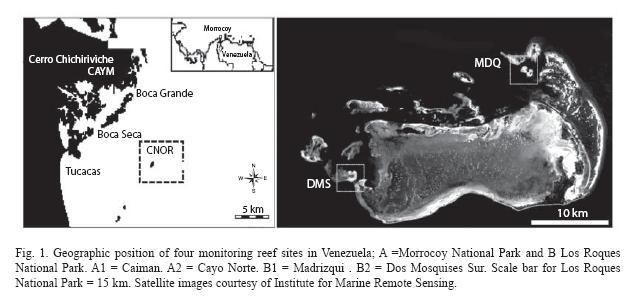
<body><![CDATA[<div style="text-align: justify;"><font face="Verdana" size="2">Over the past few decades coral reefs have undergone important changes world-wide (Hughes <i>et al. </i>2003). Since the 80's, the decline in coral cover has been often reported for the Caribbean (<i>e.g. </i>Gladfelter 1982, Dustan &amp; Hallas 1987, Hughes 1994, Jackson <i>et al. </i>2001, Gardner <i>et al</i>. 2003). In this region, the combination of both natural (<i>i.e. </i>storms and hurricanes) and anthropogenic impacts (<i>i.e. </i>sewage, eutrophication, coastal development, coral mining and over fishing), as well as other factors, such as epizootic events, had produced important changes in the structure and function of reef ecosystems (Carpenter 1990, Aronson &amp; Precht 2001, Jackson <i>et al. </i>2001, Guzmán <i>et al. </i>2004). In order to detect and understand these changes, different monitoring programs and protocols (<i>e.g. </i>CARICOMP, AGRRA) have been developed. </font></div>     <p align="justify"><font face="Verdana" size="2">In Venezuela, as in many other Caribbean countries, coral reefs represent the more important marine ecosystem in terms of biodiversity, profitable tourism, fisheries and other economic activities (Zubillaga 2001, Weil 2003). Corals and coral reefs in Venezuela have a narrow distribution as they are confined to specific sites (mostly oceanic islands) where conditions for reef growth prevail (Weil 2003). Along the Eastern coast of Venezuela, reef development is limited by high sedimentation rates and low salinities that result from the Orinoco River influence (Weil 2003), and also by low temperatures produced by seasonal upwelling (Pauls 1982). The steep slope that characterizes the central coast of Venezuela prevents extensive fringing reef formation; however, marginal coral communities are common (e.g. Ortíz 2002). The most extensive continental coral reefs are found at the Central-Western Venezuelan mainland (San Esteban and Morrocoy National Parks). Nevertheless at Morrocoy, coral reefs collapsed after a mass mortality event in 1996 (Villamizar 2000, Laboy-Nieves <i>et al. </i>2001).</font></p> <font face="Verdana" size="2">     <p align="justify">Coral reef studies in Venezuela have mainly focused on a point in time, in community description (<i>e.g. </i>Bone 1980, Weil 1980, Pauls 1982, Cróquer &amp; Villamizar 1998, Zubillaga 2001, Ramírez-Villaroel 2001). Monitoring activities started thirteen years ago when the "Instituto de Tecnología y Ciencias Marinas" (INTECMAR- Universidad Simón Bolívar) joined the CARICOMP network in 1992. During four years, INTECMAR’s personnel monitored the reef of Playa Caiman at the National Park of Morrocoy, however, due to the mass mortality event of 1996 at MNP, coral cover declined dramatically at Caiman (Laboy-Nieves <i>et al. </i>2001, Bastidas <i>et al. </i>2006), and the reef at Cayo Sombrero was substituted for Caiman in the monitoring program. Thus, the Sombrero reef has been monitored every six months, since 1996. Also, since 2002, the "Instituto de Investigaciones Marinas de Margarita" (EDIMAR) has been monitoring a coral reef in Margarita Island (Punta Ballena) as part of the CARICOMP network. In summary, from 1992 to 2002, three sites have been monitored in Venezuela (Caiman, Sombrero and only recently, Punta Ballena), but each one over a different lapse of time. Therefore, the major objective of the inclusion of the Venezuelan reefs in the Southern Tropical America Node of the Global Coral Reef Monitoring Network (STA-GCRMN) was to expand the monitoring capacities and, particularly, to incorporate reef sites from Los Roques National Park (LRNP), where the most extensive reefs in Venezuela are found. The final goal is the consolidation of a coral reef monitoring program in Venezuela for cooperating and sharing information with the other four countries of the STA-GCRMN. Data collected within this program should provide the status of Venezuelan coral reefs to incorporate them to a regional perspective. </p> </font>     <p align="justify"><b><font face="Verdana" size="2">The participation of Venezuela in the STA-GCRMN: </font></b><font face="Verdana" size="2">The GCRMN was created in 1995 to encourage and compile monitoring efforts world-wide to have a better global perspective on the status of coral reef (Garzón-Ferreira <i>et al. </i>2000). At end of 1999, Brazil, Colombia, Costa Rica, Panama and Venezuela organized the Southern Tropical America Regional Node (STA) of the GCRMN. This initiative has being coordinated by "Instituto de Investigaciones Marinas y Costeras" of Colombia (INVEMAR) with financial support of UNEP-RCU/CAR. In 2002, INVEMAR and INTECMAR signed a cooperative agreement to encourage coral monitoring in Venezuela, to improve existing monitoring programs and to expand these activities to sites of particular interest. Since 2003, INTECMAR expanded its monitoring program by adding four new sites: Madrizquí and Dos Mosquises Sur at Los Roques, and Cayo Norte and Caiman at Morrocoy National Park. In 2003 and 2004 these sites were monitored in order to evaluate the status of their benthic and fish communities. Comparisons of the benthic and fish communities between the reefs of two Parks (Los Roques and Morrocoy) were of particular interest because their oceanic and terrestrial influence, and potentiality to represent extremes of coral cover and reef conditions. Two reef sites at each park (Madrizqui, Dos Mosquises Sur, Cayo Norte and Caiman, respectively) were used to compare: (1) the health of benthic communities and (2) the abundance and composition of fish communities.</font></p>     <p align="justify"><font face="Verdana" size="2"> </font></p> <b><font face="Verdana" size="3">     <p>Materials and methods</p> </font></b>     <p align="justify"><b><font face="Verdana" size="2">Description of study area: </font></b><font face="Verdana" size="2">During July-August 2003 and August-September 2004 monitoring surveys were conducted at Madrizqui, Dos Mosquises Sur, Caiman and Cayo Norte. Madrizqui and Dos Mosquises reef sites were selected in view of the importance of Los Roques in terms of reef extension, development and diversity (Villamizar <i>et al. </i>2003, Weil 2003) and also because of their relative position within the park (<a href="#f1">Fig. 1</a>). Los Roques National Park was created in 1972 and it is an oceanic archipelago located 160km North of the Venezuelan mainland (11°44'30''-11°58'36'' N, 66°33'30''-66°57'27'' W). The park is divided into seven different management zones (i.e. integral protection, primitive, managed-natural environment, recreation, historic interest, services and special use). Both Dos Mosquises Sur and Madrizqui are fringing reefs; Dos Mosquises Sur is located at the South-Western edge of LRNP where human population is scarce (&lt;25 permanent residents) (11º48'03'' N, 66º53'30'' W) (<a href="#f1">Fig. 1</a>). On the contrary, Madrizqui is located close to Gran Roque Island, where the major human settlement of the archipelago is found (~1200 permanent residents) (11º56'33'' N, 66º39'38'' W). Caiman is located in the MNP &lt;2km away from Boca Grande, a channel that communicates the inner sectors of Morrocoy national Park with the open sea (10°52' N, 69°16' W faltan más coordenadas) (<a href="#f1">Fig. 1</a>). Morrocoy was declared a National Park in 1974 due to its importance in terms of biodiversity and richness of biotopes. Like Los Roques, the park is organized in different management zones (i.e. integral protection, primitive, managed-natural environment, area of natural recovery, recreation, services, areas for speleology, mitigation, areas of autochthon use and areas of especial use). Because data was available from 1993 to 1996 for the coral community in Caiman this reef was selected for monitoring in order to determine if there is any recovery pattern of its coral community. Contrarily, Cayo Norte is one of the few reefs that might not have been affected by the 1996 mortality event, and it may represent a reef in relatively good condition for the area of the Morrocoy National Park (10o52´ N, 68o16´W).</font></p> <font face="Verdana" size="2"> </font>     <div style="text-align: justify;"><font face="Verdana" size="2">     <p align="justify">At each site, the benthic community was described by evaluating the cover of live coral (massive, encrusting, branching, foliose and plate-like), algae (turf, fleshy, calcareous, encrusting algae and cyanobacteria), octocorals (erect or encrusting), sponge (massive, encrusting or erect) and other non-living substrate (gaps, rock, boulder, rubble and sand). For this, 10 transects at each site were surveyed following the CARICOMP protocol. Trained observers surveyed the fish community of these reefs by visual censuses, using the Atlantic and Gulf Rapid Reef Assessment (AGRRA) fish protocol (Version 3.1) with a modified list of 70 fish species. For this, 10 replicates consisting of belt-transects of 30m x 2m were surveyed at each site. Belt-transects for the fish and the benthic evaluation were in the same habitat and depth at each site.</p> </font>    <br> <font face="Verdana" size="2"> </font></div>     ]]></body>
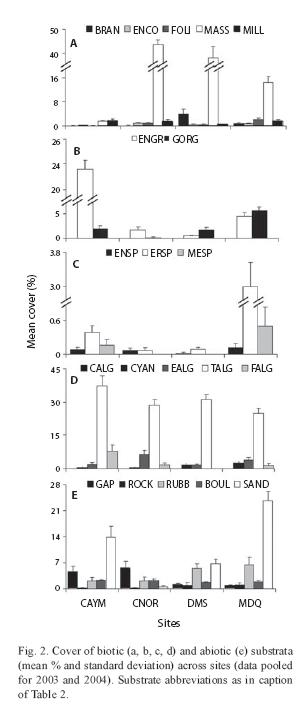
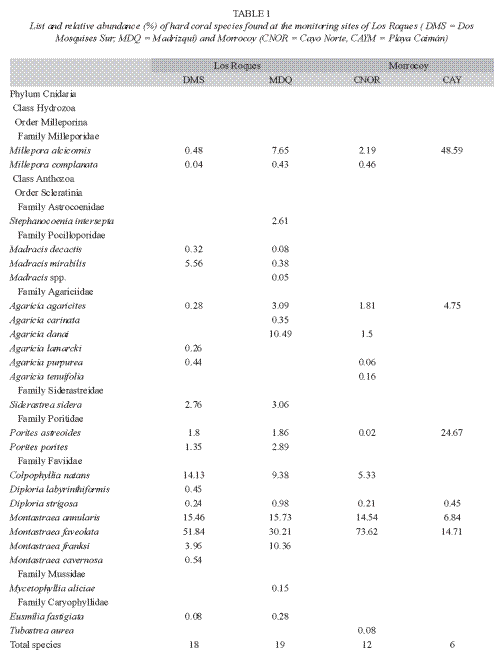
<body><![CDATA[<div style="text-align: center;"><span style="font-family: verdana;"><img  alt="" src="/img/revistas/rbt/v58s1/art03f1.jpg"  style="width: 635px; height: 298px;"><a name="f1"></a>    <br>     <br> </span></div>     <p align="justify"><b><font face="Verdana" size="2">Data analysis and sampling design: </font></b><font face="Verdana" size="2">In order to test the effect of spatial scales on the benthic community structure (cover of different substrata), a two-way (Site-within Park) nested ANOVA with 10 transects (replicates) per site and two replicate sites per park (Madrizqui-Dos Mosquises Sur at Los Roques, and Caiman-Cayo Norte at Morrocoy) was performed. A Least Significant Difference analysis (LSD) was applied to compare the benthic community in all sites and a Bray-Curtis dissimilarity index was used to evaluate differences in the benthic community among sites. We also tested differences in the benthic community cover between years (2003-2004) with a one-way repeated measure ANOVA for each of six summary variables (coral, octocoral, sponges, algae, sand and other substrates). Also, normality and homogeneity of variances was tested with the Shapiro-Wilks and Levene tests, respectively. Both site and parks were also grouped by comparing the cover of all substrate categories (benthic community) and the abundance of major fish guilds with a Principal Component Analysis (PCA).</font></p>     <p style="text-align: left; font-weight: bold;"><!-- big --><font  face="Verdana" size="2"><!-- big -->Results<!-- /big --></font><!-- /big --></p>     <p align="justify"><font face="Verdana" size="2"><b>Hard coral communities and species composition: </b>While 23 species of hard corals were identified in Los Roques only 12 species were found in Morrocoy (<a href="/img/revistas/rbt/v58s1/art03t1.gif">Table 1</a>). <i>Montastraea faveolata </i>was the dominant coral species in all sites, especially at Cayo Norte and Dos Mosquises where its relative cover was 73.62% and 51.84%, respectively. At these two sites <i>M. faveolata </i>and <i>M. annularis </i>form a massive framework that extends down to 15m depth. The species <i>M. annularis </i>(6.84-15.73%), <i>Colpophyllia natans </i>(5.33-14.13%), <i>M. franksi </i>(3.96-10.36%), <i>Madracis mirabilis </i>(0.38-5.56%) and <i>Agaricia agaricites </i>(0.28-4.75%) were also conspicuous at all sites (<a href="/img/revistas/rbt/v58s1/art03t1.gif">Table 1</a>).</font></p>     <p align="justify"><b><font face="Verdana" size="2">Abundance of major substrate categories: </font></b><font face="Verdana" size="2">At all sites, massive hard coral species were more abundant (1.5-46% of mean cover) than branching (0.04-3.9%), encrusting (0.15-0.87%), and foliose or plate-like forms of coral growth (0.32-2.1%) (<a href="#f2">Fig. 2a</a>). Contrarily to all other sites, encrusting gorgonians dominated the octocoral cover in Caiman where dead hard corals were frequently overgrown by <i>Erytropodium caribaeorum </i>and <i>Briareum asbestinun </i>(<a href="#f2">Fig. 2b</a>). Erect forms dominated the sponge cover at all sites, especially at Madrizqui where this group reached a maximum of 3% cover (<a href="#f2">Fig. 2c</a>). Also, at all sites, turf algae were more abundant (24-37%) than any other algal guild; and this category together with fleshy algae, had the largest cover at Caiman (<a href="#f2">Fig. 2d</a>). Sand was the predominant non-living substratum (0.25-3%), followed by rubble (0.9-2%) and gaps (0.27-1.9%) (<a href="#f2">Fig. 2e</a>).    <br> </font></p>     <p align="justify"><font face="Verdana" size="2">    <br> </font></p>     ]]></body>
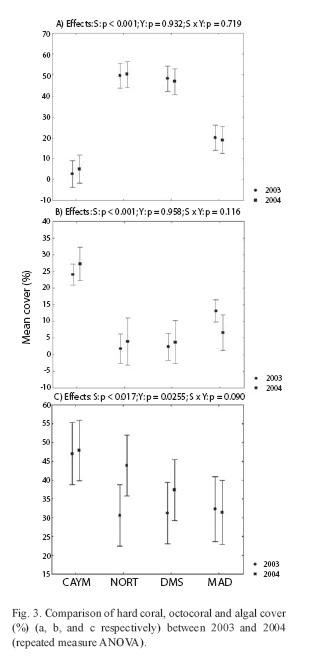
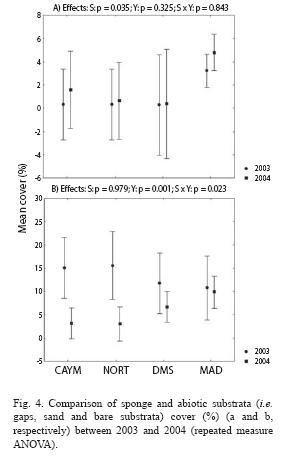
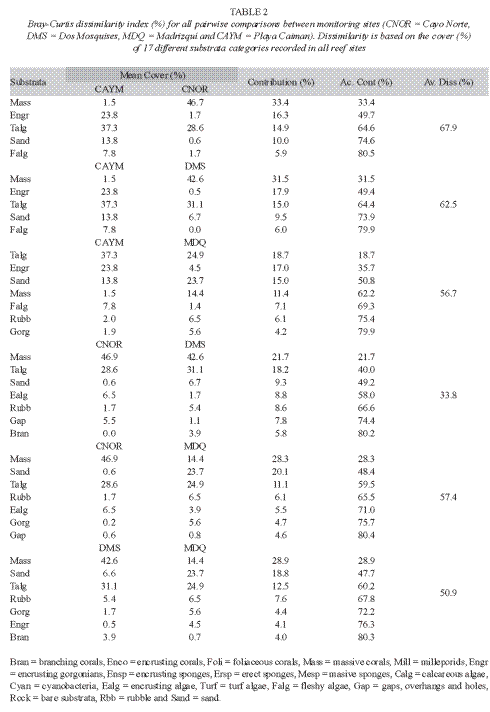
<body><![CDATA[<div style="text-align: center;"><font face="Verdana" size="2"><img  alt="" src="/img/revistas/rbt/v58s1/art03f2.jpg"  style="width: 307px; height: 710px;"><a name="f2"></a></font>    <br> </div>     <p align="justify"><font face="Verdana" size="2"><b>Spatial and temporal patterns of living cover: </b>The benthic community varied greatly among sites (Nested ANOVA, p&lt; 0.05), nevertheless there were no major differences across the parks. While the benthic community of Caiman and Cayo Norte, both in Morrocoy; was 68% dissimilar, Cayo Norte and Dos Mosquises Sur, which are from different parks only, differed in 34% (<a href="/img/revistas/rbt/v58s1/art03t2.gif">Table 2</a>). Five out of the six pairwise comparisons indicated that the cover of massive corals had the most influential contribution to the dissimilarity between sites. Encrusting gorgonians was the second most important type of substrata contributing approximately with 16% of the differences found between Caiman and the other three sites (<a  href="/img/revistas/rbt/v58s1/art03t2.gif">Table 2</a>).    <br> </font></p>     <div style="text-align: justify;"><font face="Verdana" size="2">The cover of live benthic components varied among sites, whereas only the algal and abiotic cover changed between years (repeated measures ANOVA, p &gt; 0.05) (see <a href="#f3">Fig. 3</a> and <a href="#f4">Fig. 4</a>). Live coral cover was significantly higher at Cayo Norte (50.3-51%) and Dos Mosquises Sur (48-43.7%), compared to Madrizqui (20-18.2%) and Caiman (2.6-4.2%) for both years (<a href="#f3">Fig. 3a</a>). Mean cover of sponges was highest at Madrizqui (3.5-4.8%) compared with similar values (0.5-1.8%) among Caiman, Cayo Norte and Dos Mosquises Sur (<a href="#f4">Fig.4a</a>). As mentioned before, the mean cover of abiotic substrates (i.e. gaps, sand and bare substrata) was significantly reduced in 2004 (repeated measures ANOVA p &lt; 0.05) from 15 to 3% only at both sites of Morrocoy (<a href="#f4">Fig. 4b</a>).</font>    <br> </div>     <p style="text-align: center;"><font face="Verdana" size="2"><img alt=""  src="/img/revistas/rbt/v58s1/art03f3.jpg"  style="width: 309px; height: 662px;"><a name="f3"></a>    <br> </font></p>     <p style="text-align: center;"><font face="Verdana" size="2"><img alt=""  src="/img/revistas/rbt/v58s1/art03f4.jpg"  style="width: 288px; height: 462px;"><a name="f4"></a>    <br> </font></p>     ]]></body>
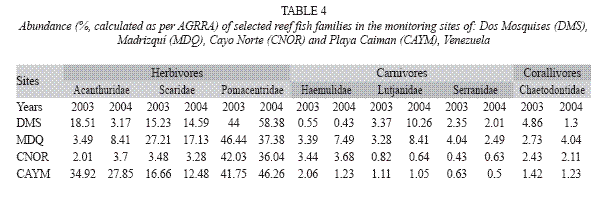
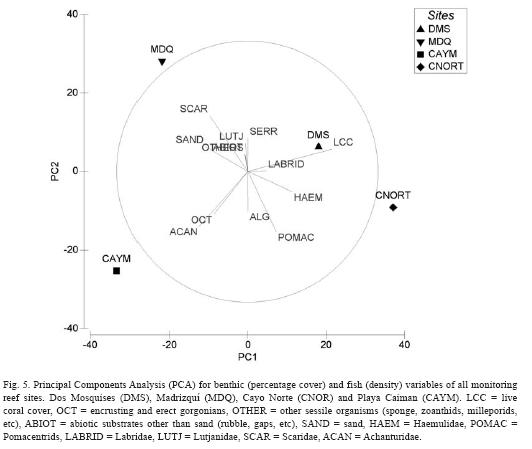
<body><![CDATA[<p align="justify"><font face="Verdana" size="2"><b>Description of fish communities; species richness and abundance of major guilds: </b>The two sites at Los Roques had the highest numbers of fish species. In Dos Mosquises Sur, 57 species were observed out of the 70 species in the fish database (modified from the original AGRRA list). The families with higher number of species among the studied sites were Scaridae (9), Serranidae (8) and Pomacentridae (7) (<a  href="/img/revistas/rbt/v58s1/art03t3.gif">Table 3</a>). In Madrizqui and Cayo Norte, respectively, 48 and 40 fish species were observed from the AGRRA list. Caiman was the site with the least number of fish species (28) of all sites (<a href="/img/revistas/rbt/v58s1/art03t3.gif">Table 3</a>). </font></p>     <p align="justify"><font face="Verdana" size="2">Overall, the fish community at all sites was dominated by herbivorous species, comprising mostly damselfishes (Pomacentridae), parrotfishes (Scaridae) and surgeonfishes (Acanthuridae) (<a href="#t4">Table 4</a>). Commercially important carnivores such as snappers (Lutjanidae) were more abundant at the two sites of Los Roques (Dos Mosquises and Madrizqui) (<a href="#t4">Table 4</a>).    <br> </font></p>     <p style="text-align: center;"><font face="Verdana" size="2"><img alt=""  src="/img/revistas/rbt/v58s1/art03t4.gif"  style="width: 608px; height: 197px;"><a name="t4"></a>    <br> </font></p>     <p align="justify"><font face="Verdana" size="2">In Dos Mosquises, the fish community was dominated by pomacentrids. The average density of this family varied from 14.45 individuals/100m2 in 2003, to 4.21 individuals/100m2 in 2004. In Madrizqui, pomacentrids showed the highest relative abundance in 2003 and 2004 (46% and 37%, respectively) (<a href="#f4">Table 4</a>), however, average densities were lower than in Dos Mosquises (10.12 and 1.25 individuals/100m2, in 2003 and 2004 respectively).</font></p>     <p align="justify"><font face="Verdana" size="2">In Cayo Norte (Morrocoy), pomacentrids also showed the highest relative abundance in both 2003 and 2004 (42% and 46%, respectively) (<a href="#t4">Table 4</a>). However, at this site, haemulids were also abundant in both years (34% and 37%, respectively), reaching an average density of 34.8 individulas/100m2 in 2003. Also at Morrocoy, Caiman was characterized by high abundance of pomacentrids (42-40.2 6%) and the highest abundance of acanthurids (34.92- 27.85%) compared with the other sites (<a href="#t4">Table 4</a>). </font></p>     <p style="text-align: justify;"><font face="Verdana" size="2"><b>Benthic and fish community across sites: </b>With 85% of the total variance explained by the two first axis, the PCA showed that sites from different parks (Cayo Norte-Dos Mosquises) had in common a high cover of live hard coral, turf algae and crustose-coralline algae, but high abundance of Haemulids only in Cayo Norte (<a href="#f5">Fig. 5</a>). In contrast, what we consider as the most disturbed reefs within each park (Caiman and Madrizqui), grouped together opposite to the other two sites. Although top carnivores were present in Madrizqui and were absent at Caiman, these "more disturbed" reefs had higher abundance of herbivores (<a href="#f5">Fig. 5</a>).    <br> </font></p>     <p style="text-align: center;"><font face="Verdana" size="2"><img alt=""  src="/img/revistas/rbt/v58s1/art03f5.jpg"  style="width: 532px; height: 449px;"><a name="f5"></a>    ]]></body>
<body><![CDATA[<br> </font></p> <b><font face="Verdana" size="3"> </font></b>     <p><b><font face="Verdana" size="3">Discussion </font></b></p> <font face="Verdana" size="2"> </font>     <div style="text-align: justify;"><font face="Verdana" size="2">     <p align="justify">Considering coral communities, two reef sites (Dos Mosquises and Cayo Norte) out of four monitoring reefs that are located in oceanic and coastal areas of Venezuela are healthier in terms of live hard coral cover and abundance of major fish guilds, than many Caribbean reef sites, where coral cover rarely exceeds 20% (Ogden <i>et al.</i>1997). These two relatively healthier sites from different parks (Los Roques and Morrocoy), have live coral cover &gt; 45%, algae cover &lt; 15%, high fish density (230-250 indv/100m2), and relatively high fish richness (40-57 species). On the other hand, Madrizqui had the lowest coral cover at Los Roques (16-19%), and Caiman at Morrocoy had the lowest live coral cover (&lt;3%) and the lowest fish species richness (28) among all sites. Thus, larger differences for both benthic and fish communities were found within reef sites of Los Roques and Morrocoy than between these two national parks. This trend is well exemplified comparing Cayo Norte with Dos Mosquises; from different parks and shelf positions (&lt;10km and &gt;100km from mainland, respectively), and yet, similar in terms of their benthic and fish communities. Considering the similar habitat type chosen in these reef sites, the results of this study suggest that ecological processes at the spatial scales of dozens of km can be more important than those at the scale of hundreds of km in structuring these communities. In other words, generalizations about the status of coral reefs should be taken carefully as each reef site seems subjected to different processes leading to particular benthic and fish community structures, regardless of its shelf position.</p> </font></div> <font face="Verdana" size="2">     <p align="justify">There is evidence indicating that different processes of mortality have occurred among sites, both at Los Roques and Morrocoy. For instance, the status of the coral reef at Madrizqui might be a consequence of a white plague type II (WP-II) epizootic event recorded in September 2000 (Cróquer <i>et al. </i>2003). This event affected major coral reef builders (i.e. <i>Montastraea </i>spp. <i>Colpophyllia natans </i>and <i>Stephanocoenia intersepta</i>), reaching up to 29% of prevalence among scleractinian species. By the end of 2001, the coral cover in this site had dropped from 34% to 28% over permanent transects (Cróquer <i>et al. </i>2005). Similar WP-II epizootics have been reported throughout the Caribbean region having significant effects on the populations of major reef-builders (i.e. partial mortality, loss of living tissues and coral cover) (Richardson <i>et al. </i>1998, Nughes 2002). Some other factors such as eutrophication might also be affecting corals at Madrizqui as this reef is &lt; 3km from Gran Roque, the island with the largest human population of the archipelago (~1200 people). On the contrary, the monitoring site of Dos Mosquises has not been extensively affected by white plague and this may have helped in maintaining its live coral cover above 40% in 2003 and 2004. Another example of differences in mortality process affecting all sites occurred in Caiman. In 1996, this site was severely impacted by a massive died off that affected the majority of reefs in Morrocoy (Villamizar 2000, Laboy-Nieves <i>et al </i>2001) but had no significant effects on Cayo Norte, despite both sites are relatively close to each other.</p>     <p align="justify">Although in Venezuela coral reefs are usually more extensive and well-developed in some of its oceanic islands compared to highly-impacted coral reefs closer to the mainland, prevalence and frequency of epizootics events can produce severe mortality in oceanic-"pristine" reefs, both in Venezuela and other Caribbean sites (Cróquer <i>et al. </i>2003, 2005, Weil 2003, 2004, Bruckner &amp; Bruckner 2003). Thus, this study in Venezuela supports that both "healthy and impacted" reef can be found both at oceanic and coastal locations. However, it is possible that the relative good condition of Cayo Norte is the exception and not the rule among reef sites at Morrocoy and/or other coastal areas. Thus, it is necessary to highlight that results from this study only provide a base line of the current status of coastal and oceanic reefs in Venezuela, and it would be desirable to have more sites at each locality. </p>     <p align="justify">Considering fish communities, fish density was similar between sites of Morrocoy, however, at Caiman only three species of two families (<i>Stegastes planifroms</i>, <i>S. partitus </i>and <i>Scarus iserti</i>) accounted for almost 80% of fish abundance; whereas up to seven species of three families (<i>Haemulon aurolineatum</i>, <i>S. partitus</i>, <i>S. planifrons</i>, <i>Clepticus parrae </i>and <i>Chromis multilineata</i>) reached a similar abundance in Cayo Norte. Due to the lack of data of fish communities at Caiman before the drop in coral cover in 1996; it would be difficult to link the differences in fish density and composition with the changes in the benthic community alone. However, it is possible that changes in coral and benthic community, like the ones that occurred in Caiman, could affect fish assemblages, particularly those fish species most heavily dependent on live coral cover for shelter or sustenance (Lindahl <i>et al. </i>2001, Cheal <i>et al</i>. 2002, Spalding &amp; Jarvis 2002, Halford <i>et al. </i>2004). Dos Mosquises, Madrizqui and Cayo Norte had similar fish communities in terms of species richness, relative family dominance and trophic composition, compared with other reefs in the Caribbean (Mejía &amp; Garzón-Ferreira 2000, Bruckner &amp; Bruckner 2003, Kramer <i>et al. </i>2003) and Florida (Bohnsack &amp; Banerot 1986). </p>     <p align="justify">In Los Roques, Posada <i>et al. </i>(2003) conducted AGRRA surveys in 1999 covering different reef habitats along the archipelago. In Dos Mosquises Sur (8m depth), they recorded 36 AGRRA fish species (out of a list of 70 species) and densities of 70.8 ind./100m2, where recorded live coral cover was 60% in the same year (Villamizar <i>et al. </i>2003). At the same site, but covering a wider depth range (4-8m), in this study, up to 57 fish species and less live coral cover (45%), were recorded. Overall, fish densities in Dos Mosquises Sur in 2003 (234.03 ind./100m2) and 2004 (115.83 indv/100m2) were higher than those reported for 1999 (70.8 ind./m2) by Posada <i>et al. </i>(2003) for the same site. However, because Posada <i>et al</i>. (2003) included only one species of Pomacentridae in their surveys, these estimates may not be comparable. Moreover, the fish community structure of DMS in 1999 was dominated by Scaridae, followed by Lutjanidae, which were two of the most abundant families, after Pomacentrids (<a href="#f4">Table 4</a>) in the present study, which suggest that at least by the end of 2003 and 2004, the fish community structure in Dos Mosquises Sur remains similar compared to previous data.</p> </font>     <div style="text-align: justify;"><font face="Verdana" size="2">     <p>In conclusion, major differences in both benthic and fish communities were observed among reef sites (Cayo Norte, Dos Mosquises Sur, Madrizqui and Caiman) rather than between the two parks (Los Roques and Morrocoy). This result supports the importance of local events or processes at spatial scales of few kilometers in structuring these coral reef communities. While fish communities were similar at both sites of Los Roques and at Cayo Norte, Cayman was different from these sites as only 2 families dominated the community. As expected, there were no major differences in the benthic or fish community between 2003 and 2004. The addition of Dos Mosquises, Madrizqui, and Cayo Norte and the reincorporation of Caiman as monitoring reef sites in Venezuela, have improved the capabilities for understanding our reefs. </p> </font></div> <b><font face="Verdana" size="3">     ]]></body>
<body><![CDATA[<p>Acknowledgments </p> </font></b>     <div style="text-align: justify;"><font face="Verdana" size="2">     <p align="justify">The authors want to thank Jaime Garzón-Ferreira and Alberto Rodriguez for his kind invitation to write this paper; the INTECMAR from Universidad Simón Bolívar and Fundación Científica Los Roques for providing access to their facilities in the field; William Velásquez, Pablo Mata and Moncho for their support in the field. UNEP/CAR provided funding for this study. We would also like to express special gratitude to Z. Leao, C. Jiménez, G. Warner and an anonymous reviewer for their valuable comments to improve this manuscript.</p> </font></div> <hr style="width: 100%; height: 2px;"><b><font face="Verdana" size="3">     <p>References</p> </font></b>     <!-- ref --><p align="justify"><font face="Verdana" size="2">Aronson, R.B. &amp; W.F. Precht. 2001. White-band disease and the changing face of Caribbean coral reefs. Hydrobiol. 460: 25-38.    &nbsp;&nbsp;&nbsp;&nbsp;&nbsp;&nbsp;&nbsp;&nbsp;[&#160;<a href="javascript:void(0);" onclick="javascript: window.open('/scielo.php?script=sci_nlinks&ref=1837717&pid=S0034-7744201000050000500001&lng=','','width=640,height=500,resizable=yes,scrollbars=1,menubar=yes,');">Links</a>&#160;]<!-- end-ref --></font></p>     <!-- ref --><p align="justify"><font face="Verdana" size="2">Bastidas, C., A. Cróquer &amp; D. Bone. 2006. Shifts of dominance species after a mass mortality on a Caribbean Reef. Proc. 10th Int. Coral Reef Symp. Okinawa, Japan.    &nbsp;&nbsp;&nbsp;&nbsp;&nbsp;&nbsp;&nbsp;&nbsp;[&#160;<a href="javascript:void(0);" onclick="javascript: window.open('/scielo.php?script=sci_nlinks&ref=1837719&pid=S0034-7744201000050000500002&lng=','','width=640,height=500,resizable=yes,scrollbars=1,menubar=yes,');">Links</a>&#160;]<!-- end-ref --></font></p>     <!-- ref --><p align="justify"><font face="Verdana" size="2">Bone, D. 1980. Impacto de las actividades del hombre sobre los arrecifes coralinos del Parque Nacional de Morrocoy, Estado Falcón. Tesis de Grado, Universidad Central de Venezuela, Caracas, Venezuela.    &nbsp;&nbsp;&nbsp;&nbsp;&nbsp;&nbsp;&nbsp;&nbsp;[&#160;<a href="javascript:void(0);" onclick="javascript: window.open('/scielo.php?script=sci_nlinks&ref=1837721&pid=S0034-7744201000050000500003&lng=','','width=640,height=500,resizable=yes,scrollbars=1,menubar=yes,');">Links</a>&#160;]<!-- end-ref --></font></p>     ]]></body>
<body><![CDATA[<!-- ref --><p align="justify"><font face="Verdana" size="2">Bone, D., A. Cróquer, E. Klein, D. Pérez, F. Losada, A. Martín, C. Bastidas, M. Rada, L. Galindo &amp; P. Penchaszadeh. 2001. Programa CARICOMP: Monitoreo a largo plazo de los ecosistemas marinos del Parque Nacional Morrocoy, Venezuela. Interciencia 26: 457-462.    &nbsp;&nbsp;&nbsp;&nbsp;&nbsp;&nbsp;&nbsp;&nbsp;[&#160;<a href="javascript:void(0);" onclick="javascript: window.open('/scielo.php?script=sci_nlinks&ref=1837723&pid=S0034-7744201000050000500004&lng=','','width=640,height=500,resizable=yes,scrollbars=1,menubar=yes,');">Links</a>&#160;]<!-- end-ref --> No está en el texto.</font></p>     <!-- ref --><p align="justify"><font face="Verdana" size="2">Bohnsack, J.A. &amp; S.P. Banerot. 1986. A stationary visual census technique for quantitatively assessing community structure of coral reef fishes. NOAA Techn. Report 41:1-15.    &nbsp;&nbsp;&nbsp;&nbsp;&nbsp;&nbsp;&nbsp;&nbsp;[&#160;<a href="javascript:void(0);" onclick="javascript: window.open('/scielo.php?script=sci_nlinks&ref=1837725&pid=S0034-7744201000050000500005&lng=','','width=640,height=500,resizable=yes,scrollbars=1,menubar=yes,');">Links</a>&#160;]<!-- end-ref --></font></p>     <!-- ref --><p align="justify"><font face="Verdana" size="2">Bruckner, A.W. &amp; R.J. Bruckner. 2003. Condition of coral reefs off less developed coastlines of Curaçao (part 2: reef fishes), p. 394-402. <i>In </i>J.C. Lang (ed.). Status of Coral reefs in the western Atlantic: Results of initial Surveys, Atlantic and Gulf Rapid Reef Assessment (AGRRA) Program. Atoll Res. Bull. 496.    &nbsp;&nbsp;&nbsp;&nbsp;&nbsp;&nbsp;&nbsp;&nbsp;[&#160;<a href="javascript:void(0);" onclick="javascript: window.open('/scielo.php?script=sci_nlinks&ref=1837727&pid=S0034-7744201000050000500006&lng=','','width=640,height=500,resizable=yes,scrollbars=1,menubar=yes,');">Links</a>&#160;]<!-- end-ref --></font></p>     <!-- ref --><p align="justify"><font face="Verdana" size="2">Carpenter, R.C. 1990. Mass mortality of <i>Diadema antillarum</i>. I. Long-term effects on sea urchin population-dynamics and coral reef algal communities. Mar. Biol. 104: 67-77.    &nbsp;&nbsp;&nbsp;&nbsp;&nbsp;&nbsp;&nbsp;&nbsp;[&#160;<a href="javascript:void(0);" onclick="javascript: window.open('/scielo.php?script=sci_nlinks&ref=1837729&pid=S0034-7744201000050000500007&lng=','','width=640,height=500,resizable=yes,scrollbars=1,menubar=yes,');">Links</a>&#160;]<!-- end-ref --></font></p>     <!-- ref --><p align="justify"><font face="Verdana" size="2">Cheal, A.J, G. Coleman, S. Delean, I. Miller, K. Osborne, H. Sweatman. 2002. Responses of coral and fish assemblages to a severe but short-lived tropical cyclone on the Great Barrier Reef, Australia. Coral Reefs 21: 131-142.    &nbsp;&nbsp;&nbsp;&nbsp;&nbsp;&nbsp;&nbsp;&nbsp;[&#160;<a href="javascript:void(0);" onclick="javascript: window.open('/scielo.php?script=sci_nlinks&ref=1837731&pid=S0034-7744201000050000500008&lng=','','width=640,height=500,resizable=yes,scrollbars=1,menubar=yes,');">Links</a>&#160;]<!-- end-ref --> </font></p>     ]]></body>
<body><![CDATA[<!-- ref --><p align="justify"><font face="Verdana" size="2">Cróquer, A. &amp; E. Villamizar. 1998. Las variaciones de la pendiente topográfica, un factor a considerar en la evaluación de la estructura de una comunidad. Rev. Biol. Trop. 46: 29-40.    &nbsp;&nbsp;&nbsp;&nbsp;&nbsp;&nbsp;&nbsp;&nbsp;[&#160;<a href="javascript:void(0);" onclick="javascript: window.open('/scielo.php?script=sci_nlinks&ref=1837733&pid=S0034-7744201000050000500009&lng=','','width=640,height=500,resizable=yes,scrollbars=1,menubar=yes,');">Links</a>&#160;]<!-- end-ref --></font></p>     <!-- ref --><p><font face="Verdana" size="2">Cróquer, A., S.M. Pauls &amp; A.L. Zubillaga. 2003. Coral disease outbreak in a coral reef at Los Roques National Park. Rev. Biol. Trop. 51: 39-45.    &nbsp;&nbsp;&nbsp;&nbsp;&nbsp;&nbsp;&nbsp;&nbsp;[&#160;<a href="javascript:void(0);" onclick="javascript: window.open('/scielo.php?script=sci_nlinks&ref=1837735&pid=S0034-7744201000050000500010&lng=','','width=640,height=500,resizable=yes,scrollbars=1,menubar=yes,');">Links</a>&#160;]<!-- end-ref --> </font></p>     <!-- ref --><p align="justify"><font face="Verdana" size="2">Cróquer, A., E. Weil, A.L. Zubillaga &amp; S.M. Márquez. 2005. Impact of a White Plague-II Outbreak on a Coral Reef in the Archipelago Los Roques National Park, Venezuela. Caribb. J. Sci. 41: 815-823.    &nbsp;&nbsp;&nbsp;&nbsp;&nbsp;&nbsp;&nbsp;&nbsp;[&#160;<a href="javascript:void(0);" onclick="javascript: window.open('/scielo.php?script=sci_nlinks&ref=1837737&pid=S0034-7744201000050000500011&lng=','','width=640,height=500,resizable=yes,scrollbars=1,menubar=yes,');">Links</a>&#160;]<!-- end-ref --> </font></p>     <!-- ref --><p align="justify"><font face="Verdana" size="2">Dustan, P. &amp; J. Hallas. 1987. Changes in the reef-coral community of Carysfort Reef Key Largo Florida: 1974-1982. Coral Reefs 6: 91-106.    &nbsp;&nbsp;&nbsp;&nbsp;&nbsp;&nbsp;&nbsp;&nbsp;[&#160;<a href="javascript:void(0);" onclick="javascript: window.open('/scielo.php?script=sci_nlinks&ref=1837739&pid=S0034-7744201000050000500012&lng=','','width=640,height=500,resizable=yes,scrollbars=1,menubar=yes,');">Links</a>&#160;]<!-- end-ref --></font></p>     <!-- ref --><p align="justify"><font face="Verdana" size="2">Gardner, T.A., I.M. Cote, J.A. Gill, A. Grant &amp; A.R. Watkinson. 2003. Long-term region-wide declines in Caribbean corals. Science 301: 958-960.    &nbsp;&nbsp;&nbsp;&nbsp;&nbsp;&nbsp;&nbsp;&nbsp;[&#160;<a href="javascript:void(0);" onclick="javascript: window.open('/scielo.php?script=sci_nlinks&ref=1837741&pid=S0034-7744201000050000500013&lng=','','width=640,height=500,resizable=yes,scrollbars=1,menubar=yes,');">Links</a>&#160;]<!-- end-ref --></font></p>     ]]></body>
<body><![CDATA[<!-- ref --><p align="justify"><font face="Verdana" size="2">Garzón-Ferreira, J., J. Cortés, A. Cróquer, H. Guzmán, Z. Leao &amp; A. Rodríguez-Ramírez. 2000. Status of coral reefs in Southern Tropical America: Brazil, Colombia, Costa Rica, Panama and Venezuela, p. 331-348. <i>In </i>C. Wilkinson (ed.). Status of Coral Reefs of the World: 2000. Australian Institute of Marine Science, Cape Ferguson.    &nbsp;&nbsp;&nbsp;&nbsp;&nbsp;&nbsp;&nbsp;&nbsp;[&#160;<a href="javascript:void(0);" onclick="javascript: window.open('/scielo.php?script=sci_nlinks&ref=1837743&pid=S0034-7744201000050000500014&lng=','','width=640,height=500,resizable=yes,scrollbars=1,menubar=yes,');">Links</a>&#160;]<!-- end-ref --></font></p>     <!-- ref --><p align="justify"><font face="Verdana" size="2">Gladfelter, W.B. 1982. White-band disease in <i>Acropora palmata</i>: implications for the structure and growth of shallow reefs. Bull. Mar. Sci. 32: 639-643.    &nbsp;&nbsp;&nbsp;&nbsp;&nbsp;&nbsp;&nbsp;&nbsp;[&#160;<a href="javascript:void(0);" onclick="javascript: window.open('/scielo.php?script=sci_nlinks&ref=1837745&pid=S0034-7744201000050000500015&lng=','','width=640,height=500,resizable=yes,scrollbars=1,menubar=yes,');">Links</a>&#160;]<!-- end-ref --> </font></p>     <!-- ref --><p align="justify"><font face="Verdana" size="2">Guzmán, H.M., C.A. Guevara &amp; O. Breedy. 2004. Distribution, diversity and conservation of coral reefs and coral communities in the largest marine protected area of Pacific Panama (Coiba Island). Environ. Conserv. 31: 1-11.    &nbsp;&nbsp;&nbsp;&nbsp;&nbsp;&nbsp;&nbsp;&nbsp;[&#160;<a href="javascript:void(0);" onclick="javascript: window.open('/scielo.php?script=sci_nlinks&ref=1837747&pid=S0034-7744201000050000500016&lng=','','width=640,height=500,resizable=yes,scrollbars=1,menubar=yes,');">Links</a>&#160;]<!-- end-ref --></font></p>     <!-- ref --><p align="justify"><font face="Verdana" size="2">Halford, A., A.J. Cheal, D. Ryan &amp; D.M. Williams. 2004. Resilience to large-scale disturbance in coral and fish assemblages on the Great Barrier Reef. Ecology 85: 1892-1905.    &nbsp;&nbsp;&nbsp;&nbsp;&nbsp;&nbsp;&nbsp;&nbsp;[&#160;<a href="javascript:void(0);" onclick="javascript: window.open('/scielo.php?script=sci_nlinks&ref=1837749&pid=S0034-7744201000050000500017&lng=','','width=640,height=500,resizable=yes,scrollbars=1,menubar=yes,');">Links</a>&#160;]<!-- end-ref --> </font></p>     <!-- ref --><p align="justify"><font face="Verdana" size="2">Hughes, T.P. 1994. Catastrophes, phase shifts, and large-scale degradation of a Caribbean coral reef. Science 265: 1547-1551.    &nbsp;&nbsp;&nbsp;&nbsp;&nbsp;&nbsp;&nbsp;&nbsp;[&#160;<a href="javascript:void(0);" onclick="javascript: window.open('/scielo.php?script=sci_nlinks&ref=1837751&pid=S0034-7744201000050000500018&lng=','','width=640,height=500,resizable=yes,scrollbars=1,menubar=yes,');">Links</a>&#160;]<!-- end-ref --></font></p>     ]]></body>
<body><![CDATA[<!-- ref --><p align="justify"><font face="Verdana" size="2">Hughes, T.P., A.H. Baird, D.R. Bellwood, M. Cards, S.R. Connolly, C. Folke, R. Grosberg, O. Heogh-Guldberg, J.B.C. Jackson, J. Kleypas, J.M. Lough, P. Marshall, M. Nystrom, S.R. Palumbi, J.M. Pandolfi, B. Rosen &amp; J. Roughgarden. 2003. Climate change, human impacts and the resilience of coral reefs. Science 301: 929-933.    &nbsp;&nbsp;&nbsp;&nbsp;&nbsp;&nbsp;&nbsp;&nbsp;[&#160;<a href="javascript:void(0);" onclick="javascript: window.open('/scielo.php?script=sci_nlinks&ref=1837753&pid=S0034-7744201000050000500019&lng=','','width=640,height=500,resizable=yes,scrollbars=1,menubar=yes,');">Links</a>&#160;]<!-- end-ref --></font></p>     <!-- ref --><p align="justify"><font face="Verdana" size="2">Jackson, J.B.C., M.X. Kirby, W.H. Berger, K.A. Bjorndal, L.W. Botsford, B.J. Bourque, R.H. Bradbury, R. Cooke, J. Erladson, J.A. Estes, T. Hughes, S. Kidwell, C.B. Lange, H.S. Leinhan, J.M. Pandolfi, C.H. Peterson, R.S. Steneck, M.J. Tegner &amp; R.R. Warner. 2001. Historical overfishing and the recent collapse of coastal ecosystems. Science 293: 629-637.    &nbsp;&nbsp;&nbsp;&nbsp;&nbsp;&nbsp;&nbsp;&nbsp;[&#160;<a href="javascript:void(0);" onclick="javascript: window.open('/scielo.php?script=sci_nlinks&ref=1837755&pid=S0034-7744201000050000500020&lng=','','width=640,height=500,resizable=yes,scrollbars=1,menubar=yes,');">Links</a>&#160;]<!-- end-ref --></font></p>     <!-- ref --><p><font face="Verdana" size="2">Kramer, P.A., K.W. Marks &amp; T.L Turnbull. 2003. Assessment of Andros island reef system, Bahamas (part 2: fishes). Atoll Res. Bull. 496: 100-122.    &nbsp;&nbsp;&nbsp;&nbsp;&nbsp;&nbsp;&nbsp;&nbsp;[&#160;<a href="javascript:void(0);" onclick="javascript: window.open('/scielo.php?script=sci_nlinks&ref=1837757&pid=S0034-7744201000050000500021&lng=','','width=640,height=500,resizable=yes,scrollbars=1,menubar=yes,');">Links</a>&#160;]<!-- end-ref --><!-- ref --> </font>&nbsp;&nbsp;&nbsp;&nbsp;&nbsp;&nbsp;&nbsp;&nbsp;[&#160;<a href="javascript:void(0);" onclick="javascript: window.open('/scielo.php?script=sci_nlinks&ref=1837758&pid=S0034-7744201000050000500022&lng=','','width=640,height=500,resizable=yes,scrollbars=1,menubar=yes,');">Links</a>&#160;]<!-- end-ref --></font>     <!-- ref --><p align="justify"><font face="Verdana" size="2">Laboy-Nieves, E.N., E. Klein, J.E. Conde, F. Losada, J.J. Cruz &amp; D. Bone. 2001. Mass mortality of tropical marine communities in Morrocoy, Venezuela. Bull. Mar. Sci. 68: 163-179.    &nbsp;&nbsp;&nbsp;&nbsp;&nbsp;&nbsp;&nbsp;&nbsp;[&#160;<a href="javascript:void(0);" onclick="javascript: window.open('/scielo.php?script=sci_nlinks&ref=1837760&pid=S0034-7744201000050000500023&lng=','','width=640,height=500,resizable=yes,scrollbars=1,menubar=yes,');">Links</a>&#160;]<!-- end-ref --> </font></p>     <!-- ref --><p align="justify"><font face="Verdana" size="2">Lindahl, U., M.C. Ohman &amp; C.K. Schelten. 2001. The 1997/1998 mass mortality of corals: Effects on fish communities on a Tanzanian coral reef. Mar. Pollut. Bull. 42: 127-131.    &nbsp;&nbsp;&nbsp;&nbsp;&nbsp;&nbsp;&nbsp;&nbsp;[&#160;<a href="javascript:void(0);" onclick="javascript: window.open('/scielo.php?script=sci_nlinks&ref=1837762&pid=S0034-7744201000050000500024&lng=','','width=640,height=500,resizable=yes,scrollbars=1,menubar=yes,');">Links</a>&#160;]<!-- end-ref --></font></p>     <!-- ref --><p align="justify"><font face="Verdana" size="2">Mejía, L.S. &amp; J. Garzón-Ferreira. 2000. Estructura de comunidades de peces arrecifales en cuatro atolones del Archipiélago de San Andrés y Providencia (Caribe sur occidental). Rev. Biol. Trop. 48: 883-896.    &nbsp;&nbsp;&nbsp;&nbsp;&nbsp;&nbsp;&nbsp;&nbsp;[&#160;<a href="javascript:void(0);" onclick="javascript: window.open('/scielo.php?script=sci_nlinks&ref=1837764&pid=S0034-7744201000050000500025&lng=','','width=640,height=500,resizable=yes,scrollbars=1,menubar=yes,');">Links</a>&#160;]<!-- end-ref --></font></p>     <!-- ref --><p align="justify"><font face="Verdana" size="2">Nughues, M.M. 2002. Impact of a coral disease outbreak on coral communities in St Lucia: what and how much has been lost? Mar. Ecol. Prog. Ser. 229: 61-71.    &nbsp;&nbsp;&nbsp;&nbsp;&nbsp;&nbsp;&nbsp;&nbsp;[&#160;<a href="javascript:void(0);" onclick="javascript: window.open('/scielo.php?script=sci_nlinks&ref=1837766&pid=S0034-7744201000050000500026&lng=','','width=640,height=500,resizable=yes,scrollbars=1,menubar=yes,');">Links</a>&#160;]<!-- end-ref --></font></p>     <!-- ref --><p align="justify"><font face="Verdana" size="2">Ogden, J., P. Alcolado, G. Alleng, K. Bonair, R. Laydoo, D. Bone, E. Klein, P. Penchaszadeh, K. Buchan, S. Walker, P. Bush, J. Cortés, K. DeMeyer, J. García, J. Garzón-Ferreira, P. Gayle, H. Guzmán, D. Gerace, F. Geraldes, E. Jordan-Dahlgren, F. Ruiz- Renteria, B. Kjerfve, K. Koltes, C. Parker, H. Oxenford, A. Patt, J. Azueta, M. McField, R. Peralta, L. Pors, J. Ramirez, J. Rojas-Galaviz, J. Ryan, J. Singh, S. Smith, J. Tschirky, R. Varela, J. Woodley, D. Linton, W. Wiebe &amp; J. Zieman. 1997. Caribbean Coastal Marine Productivity (CARICOMP): a research and monitoring network of marine laboratories, parks and reserves. Proc. 8th Int. Coral Reef Symp. 1: 641-646.    &nbsp;&nbsp;&nbsp;&nbsp;&nbsp;&nbsp;&nbsp;&nbsp;[&#160;<a href="javascript:void(0);" onclick="javascript: window.open('/scielo.php?script=sci_nlinks&ref=1837768&pid=S0034-7744201000050000500027&lng=','','width=640,height=500,resizable=yes,scrollbars=1,menubar=yes,');">Links</a>&#160;]<!-- end-ref --></font></p>     <!-- ref --><p align="justify"><font face="Verdana" size="2">Ortíz, J.C. 2002. Estructura de la comunidad de corales pétreos de la Ensenada de Chichiriviche de la Costa y efecto de un período intenso de precipitación<i>. </i>Trabajo Especial de Grado, Universidad Central de Venezuela, Caracas, Venezuela.    &nbsp;&nbsp;&nbsp;&nbsp;&nbsp;&nbsp;&nbsp;&nbsp;[&#160;<a href="javascript:void(0);" onclick="javascript: window.open('/scielo.php?script=sci_nlinks&ref=1837770&pid=S0034-7744201000050000500028&lng=','','width=640,height=500,resizable=yes,scrollbars=1,menubar=yes,');">Links</a>&#160;]<!-- end-ref --></font></p>     <!-- ref --><p align="justify"><font face="Verdana" size="2">Pauls, S.M. 1982. Estructura de las comunidades coralinas de la Bahía de Mochima, Venezuela. Tesis de Maestría. Universidad de Oriente. Cumaná, Venezuela.    &nbsp;&nbsp;&nbsp;&nbsp;&nbsp;&nbsp;&nbsp;&nbsp;[&#160;<a href="javascript:void(0);" onclick="javascript: window.open('/scielo.php?script=sci_nlinks&ref=1837772&pid=S0034-7744201000050000500029&lng=','','width=640,height=500,resizable=yes,scrollbars=1,menubar=yes,');">Links</a>&#160;]<!-- end-ref --></font></p>     <!-- ref --><p align="justify"><font face="Verdana" size="2">Posada, J., E. Villamizar &amp; D. Alvarado. 2003. Rapid assessment of coral reefs in the Archipielago de Los Roques National Park, Venezuela (Part 2: stony corals). Atoll Res. Bull. 496: 530-543.    &nbsp;&nbsp;&nbsp;&nbsp;&nbsp;&nbsp;&nbsp;&nbsp;[&#160;<a href="javascript:void(0);" onclick="javascript: window.open('/scielo.php?script=sci_nlinks&ref=1837774&pid=S0034-7744201000050000500030&lng=','','width=640,height=500,resizable=yes,scrollbars=1,menubar=yes,');">Links</a>&#160;]<!-- end-ref --></font></p>     <!-- ref --><p><font face="Verdana" size="2">Ramírez-Villarroel, P. 2001. Corales de Venezuela. Gráficas Internacional, Porlamar, Estado Nueva Esparta, Venezuela.    &nbsp;&nbsp;&nbsp;&nbsp;&nbsp;&nbsp;&nbsp;&nbsp;[&#160;<a href="javascript:void(0);" onclick="javascript: window.open('/scielo.php?script=sci_nlinks&ref=1837776&pid=S0034-7744201000050000500031&lng=','','width=640,height=500,resizable=yes,scrollbars=1,menubar=yes,');">Links</a>&#160;]<!-- end-ref --> </font></p>     <!-- ref --><p align="justify"><font face="Verdana" size="2">Richardson, L.L. &amp; J.D. Voss. 2005. Changes in a coral population of reef of the northern Florida keys following a coral disease epizootic. Mar. Ecol. Prog. Ser. 297: 147-156.    &nbsp;&nbsp;&nbsp;&nbsp;&nbsp;&nbsp;&nbsp;&nbsp;[&#160;<a href="javascript:void(0);" onclick="javascript: window.open('/scielo.php?script=sci_nlinks&ref=1837778&pid=S0034-7744201000050000500032&lng=','','width=640,height=500,resizable=yes,scrollbars=1,menubar=yes,');">Links</a>&#160;]<!-- end-ref --></font></p>     <!-- ref --><p align="justify"><font face="Verdana" size="2">Richardson, L.L., W.M. Goldberg, R.G. Carlton &amp; J.C. Halas. 1998. Coral disease outbreak in the Florida Keys: plague type II. Rev. Biol. Trop. 46:187–198.    &nbsp;&nbsp;&nbsp;&nbsp;&nbsp;&nbsp;&nbsp;&nbsp;[&#160;<a href="javascript:void(0);" onclick="javascript: window.open('/scielo.php?script=sci_nlinks&ref=1837780&pid=S0034-7744201000050000500033&lng=','','width=640,height=500,resizable=yes,scrollbars=1,menubar=yes,');">Links</a>&#160;]<!-- end-ref --></font></p>     <!-- ref --><p align="justify"><font face="Verdana" size="2">Spalding, M.D. &amp; G.E. Jarvis. 2002. The impact of the 1998 coral mortality on reef fish communities in the Seychelles. Mar. Pollut. Bull. 44: 309-321.    &nbsp;&nbsp;&nbsp;&nbsp;&nbsp;&nbsp;&nbsp;&nbsp;[&#160;<a href="javascript:void(0);" onclick="javascript: window.open('/scielo.php?script=sci_nlinks&ref=1837782&pid=S0034-7744201000050000500034&lng=','','width=640,height=500,resizable=yes,scrollbars=1,menubar=yes,');">Links</a>&#160;]<!-- end-ref --></font></p>     <!-- ref --><p align="justify"><font face="Verdana" size="2">Villamizar, E. 2000. Estructura de una comunidad arrecifal en Falcón, Venezuela, antes y después de una mortalidad masiva. Rev. Biol. Trop. 48: 19-30.    &nbsp;&nbsp;&nbsp;&nbsp;&nbsp;&nbsp;&nbsp;&nbsp;[&#160;<a href="javascript:void(0);" onclick="javascript: window.open('/scielo.php?script=sci_nlinks&ref=1837784&pid=S0034-7744201000050000500035&lng=','','width=640,height=500,resizable=yes,scrollbars=1,menubar=yes,');">Links</a>&#160;]<!-- end-ref --></font></p>     <!-- ref --><p align="justify"><font face="Verdana" size="2">Villamizar, E., J. Posada &amp; S. Gómez. 2003. Rapid assessment of coral reefs in the Archipielago de Los Roques National Park, Venezuela (Part 1: stony corals). Atoll Res. Bull. 496: 512-529.    &nbsp;&nbsp;&nbsp;&nbsp;&nbsp;&nbsp;&nbsp;&nbsp;[&#160;<a href="javascript:void(0);" onclick="javascript: window.open('/scielo.php?script=sci_nlinks&ref=1837786&pid=S0034-7744201000050000500036&lng=','','width=640,height=500,resizable=yes,scrollbars=1,menubar=yes,');">Links</a>&#160;]<!-- end-ref --></font></p>     <!-- ref --><p align="justify"><font face="Verdana" size="2">Warner, G.F., S.R. Smith, E. Jordan-Dahlgren, D.M. Linton, J.D. Woodley, P. Alcolado, K. Bonair, D. Bone, K.C. Buchan, P. Bush, J. Cortés, A. Cróquer, K. De Maeyer, R.J. Fernández, A. Fonseca, J.R. García, P. García-Parrado, J. Garzón-Ferreira, P. Gayle, D.T. Gerace, F.X. Geraldes, J. Gunther, R. Guppy, R. Juman, K.H. Koltes, E. Knobbe, E. Klein, R. Liadoo, F. Losada, G. Menendez, J.M. Mow-Robinson, G. Ostrander, H.A. Oxenford, C. Parker, L.P. Pors, D. Perez, A.R. Ramírez, R. Rodríguez, F. Ruiz-Renteria, J. Rayn, J.J. Tschirky &amp; E. Weil. 2003. Status and temporal trends at CARICOMP coral reefs. Proc. 10th Int. Coral Reef Symp. 1: 325-329.    &nbsp;&nbsp;&nbsp;&nbsp;&nbsp;&nbsp;&nbsp;&nbsp;[&#160;<a href="javascript:void(0);" onclick="javascript: window.open('/scielo.php?script=sci_nlinks&ref=1837788&pid=S0034-7744201000050000500037&lng=','','width=640,height=500,resizable=yes,scrollbars=1,menubar=yes,');">Links</a>&#160;]<!-- end-ref --></font></p>     <!-- ref --><p align="justify"><font face="Verdana" size="2">Weil, E. 1980. Papel del erizo <i>Diadema antillarum </i>Philippi en la regulación de la estructura de las comunidades coralinas. Tesis de Grado, Universidad Central de Venezuela, Caracas, Venezuela.    &nbsp;&nbsp;&nbsp;&nbsp;&nbsp;&nbsp;&nbsp;&nbsp;[&#160;<a href="javascript:void(0);" onclick="javascript: window.open('/scielo.php?script=sci_nlinks&ref=1837790&pid=S0034-7744201000050000500038&lng=','','width=640,height=500,resizable=yes,scrollbars=1,menubar=yes,');">Links</a>&#160;]<!-- end-ref --></font></p>     <!-- ref --><p align="justify"><font face="Verdana" size="2">Weil, E. 2003. Corals and coral reefs of Venezuela, p. 303-330. <i>In </i>J. Cortés (ed.). Latin American Coral Reefs. Elsevier Science B.V., Amsterdam, The Netherlands.    &nbsp;&nbsp;&nbsp;&nbsp;&nbsp;&nbsp;&nbsp;&nbsp;[&#160;<a href="javascript:void(0);" onclick="javascript: window.open('/scielo.php?script=sci_nlinks&ref=1837792&pid=S0034-7744201000050000500039&lng=','','width=640,height=500,resizable=yes,scrollbars=1,menubar=yes,');">Links</a>&#160;]<!-- end-ref --></font></p>     <!-- ref --><p align="justify"><font face="Verdana" size="2">Weil, E. 2004. Coral reef diseases in the wider Caribbean, p. 35-67 <i>In </i>E. Rosenberg &amp; Y. Loya (eds.). Coral health and disease. Springer-Verlag, Berlin, Germany.    &nbsp;&nbsp;&nbsp;&nbsp;&nbsp;&nbsp;&nbsp;&nbsp;[&#160;<a href="javascript:void(0);" onclick="javascript: window.open('/scielo.php?script=sci_nlinks&ref=1837794&pid=S0034-7744201000050000500040&lng=','','width=640,height=500,resizable=yes,scrollbars=1,menubar=yes,');">Links</a>&#160;]<!-- end-ref --></font></p>     <!-- ref --><p><font face="Verdana" size="2">Zubillaga, A.L. 2001. Evaluación del efecto de las actividades de buceo recreativo en la estructura comunitaria de algunos arrecifes coralinos del Parque Nacional Archipiélago de Los Roques<i>. </i>Trabajo Especial de Grado, Universidad Central de Venezuela, Caracas, Venezuela.    &nbsp;&nbsp;&nbsp;&nbsp;&nbsp;&nbsp;&nbsp;&nbsp;[&#160;<a href="javascript:void(0);" onclick="javascript: window.open('/scielo.php?script=sci_nlinks&ref=1837796&pid=S0034-7744201000050000500041&lng=','','width=640,height=500,resizable=yes,scrollbars=1,menubar=yes,');">Links</a>&#160;]<!-- end-ref --> </font></p> <font face="Verdana" size="2"><a name="a"></a>Corresponde a: Aldo Cróquer. Universidad Simón Bolívar, Departamento Biología de Organismos, Caracas 1080-A, Venezuela; </font><a href="mailto:acroquer@usb.ve"><font  face="Verdana" size="2">acroquer@usb.ve</font></a><font face="Verdana"  size="2">    <br> Denise Debrot. Universidad Simón Bolívar, Departamento Biología de Organismos, Caracas 1080-A, Venezuela; </font><a href="mailto:debrot@usb.ve"><font face="Verdana"  size="2">debrot@usb.ve</font></a><font face="Verdana" size="2">Eduardo Klein. Universidad Simón Bolívar, Departamento de Estudios Ambientales, Caracas 1080-A, Venezuela; </font><a href="mailto:eklein@usb.ve"><font face="Verdana"  size="2">eklein@usb.ve</font></a>    <br> <font face="Verdana" size="2">Martina Kurten. Universidad Simón Bolívar, Departamento de Estudios Ambientales, Caracas 1080-A, Venezuela; </font><a href="mailto:eklein@usb.ve"><font face="Verdana"  size="2">eklein@usb.ve</font></a><font face="Verdana" size="2">Sebastian Rodríguez. Universidad Simón Bolívar, Departamento Biología de Organismos, Caracas 1080-A, Venezuela; </font><a href="mailto:sebastianr@usb.ve"><font  face="Verdana" size="2">sebastianr@usb.ve</font></a>    <br> <small><span style="font-family: verdana;">Carolina Bastidas Universidad Simón Bolívar, Departamento Biología de Organismos, Caracas 1080-A, Venezuela; <a  href="mailto:cbastidas@usb.ve">cbastidas@usb.ve</a></span></small> <hr style="width: 100%; height: 2px;"><small><span  style="font-family: verdana;"></span></small><font face="Verdana"  size="2">     <p align="center">Received 30-VIII-2009. Corrected 04-X-2009. Accepted 04-XII-2009.</p> </font>      ]]></body><back>
<ref-list>
<ref id="B1">
<nlm-citation citation-type="journal">
<person-group person-group-type="author">
<name>
<surname><![CDATA[Aronson]]></surname>
<given-names><![CDATA[R.B]]></given-names>
</name>
<name>
<surname><![CDATA[Precht]]></surname>
<given-names><![CDATA[W.F]]></given-names>
</name>
</person-group>
<article-title xml:lang="en"><![CDATA[White-band disease and the changing face of Caribbean coral reefs]]></article-title>
<source><![CDATA[Hydrobiol]]></source>
<year>2001</year>
<volume>460</volume>
<page-range>25-38</page-range></nlm-citation>
</ref>
<ref id="B2">
<nlm-citation citation-type="book">
<person-group person-group-type="author">
<name>
<surname><![CDATA[Bastidas]]></surname>
<given-names><![CDATA[C]]></given-names>
</name>
<name>
<surname><![CDATA[Cróquer]]></surname>
<given-names><![CDATA[A]]></given-names>
</name>
<name>
<surname><![CDATA[Bone]]></surname>
<given-names><![CDATA[D]]></given-names>
</name>
</person-group>
<source><![CDATA[Shifts of dominance species after a mass mortality on a Caribbean Reef]]></source>
<year>2006</year>
<publisher-loc><![CDATA[Okinawa ]]></publisher-loc>
<publisher-name><![CDATA[Proc. 10th Int. Coral Reef Symp]]></publisher-name>
</nlm-citation>
</ref>
<ref id="B3">
<nlm-citation citation-type="book">
<person-group person-group-type="author">
<name>
<surname><![CDATA[Bone]]></surname>
<given-names><![CDATA[D]]></given-names>
</name>
</person-group>
<source><![CDATA[Impacto de las actividades del hombre sobre los arrecifes coralinos del Parque Nacional de Morrocoy, Estado Falcón]]></source>
<year>1980</year>
<publisher-loc><![CDATA[Caracas ]]></publisher-loc>
<publisher-name><![CDATA[Universidad Central de Venezuela]]></publisher-name>
</nlm-citation>
</ref>
<ref id="B4">
<nlm-citation citation-type="journal">
<person-group person-group-type="author">
<name>
<surname><![CDATA[Bone]]></surname>
<given-names><![CDATA[D]]></given-names>
</name>
<name>
<surname><![CDATA[Cróquer]]></surname>
<given-names><![CDATA[A]]></given-names>
</name>
<name>
<surname><![CDATA[Klein]]></surname>
<given-names><![CDATA[E]]></given-names>
</name>
<name>
<surname><![CDATA[Pérez]]></surname>
<given-names><![CDATA[D]]></given-names>
</name>
<name>
<surname><![CDATA[Losada]]></surname>
<given-names><![CDATA[F]]></given-names>
</name>
<name>
<surname><![CDATA[Martín]]></surname>
<given-names><![CDATA[A]]></given-names>
</name>
<name>
<surname><![CDATA[Bastidas]]></surname>
<given-names><![CDATA[C]]></given-names>
</name>
<name>
<surname><![CDATA[Rada]]></surname>
<given-names><![CDATA[M]]></given-names>
</name>
<name>
<surname><![CDATA[Galindo]]></surname>
<given-names><![CDATA[L]]></given-names>
</name>
<name>
<surname><![CDATA[Penchaszadeh]]></surname>
<given-names><![CDATA[P]]></given-names>
</name>
</person-group>
<article-title xml:lang="es"><![CDATA[Programa CARICOMP: Monitoreo a largo plazo de los ecosistemas marinos del Parque Nacional Morrocoy, Venezuela]]></article-title>
<source><![CDATA[Interciencia]]></source>
<year>2001</year>
<volume>26</volume>
<page-range>457-462</page-range></nlm-citation>
</ref>
<ref id="B5">
<nlm-citation citation-type="journal">
<person-group person-group-type="author">
<name>
<surname><![CDATA[Bohnsack]]></surname>
<given-names><![CDATA[J.A]]></given-names>
</name>
<name>
<surname><![CDATA[Banerot]]></surname>
<given-names><![CDATA[S.P]]></given-names>
</name>
</person-group>
<article-title xml:lang="en"><![CDATA[A stationary visual census technique for quantitatively assessing community structure of coral reef fishes]]></article-title>
<source><![CDATA[NOAA Techn. Report]]></source>
<year>1986</year>
<volume>41</volume>
<page-range>1-15</page-range></nlm-citation>
</ref>
<ref id="B6">
<nlm-citation citation-type="">
<person-group person-group-type="author">
<name>
<surname><![CDATA[Bruckner]]></surname>
<given-names><![CDATA[A.W]]></given-names>
</name>
<name>
<surname><![CDATA[Bruckner]]></surname>
<given-names><![CDATA[R.J]]></given-names>
</name>
</person-group>
<article-title xml:lang="en"><![CDATA[Condition of coral reefs off less developed coastlines of Curaçao (part 2: reef fishes)]]></article-title>
<person-group person-group-type="editor">
<name>
<surname><![CDATA[Lang]]></surname>
<given-names><![CDATA[J.C]]></given-names>
</name>
</person-group>
<source><![CDATA[Status of Coral reefs in the western Atlantic: Results of initial Surveys, Atlantic and Gulf Rapid Reef Assessment (AGRRA) Program. Atoll Res. Bull]]></source>
<year>2003</year>
<page-range>394-402</page-range><page-range>496</page-range></nlm-citation>
</ref>
<ref id="B7">
<nlm-citation citation-type="journal">
<person-group person-group-type="author">
<name>
<surname><![CDATA[Carpenter]]></surname>
<given-names><![CDATA[R.C]]></given-names>
</name>
</person-group>
<article-title xml:lang="en"><![CDATA[Mass mortality of Diadema antillarum. I. Long-term effects on sea urchin population-dynamics and coral reef algal communities]]></article-title>
<source><![CDATA[Mar. Biol]]></source>
<year>1990</year>
<volume>104</volume>
<page-range>67-77</page-range></nlm-citation>
</ref>
<ref id="B8">
<nlm-citation citation-type="journal">
<person-group person-group-type="author">
<name>
<surname><![CDATA[Cheal]]></surname>
<given-names><![CDATA[A.J]]></given-names>
</name>
<name>
<surname><![CDATA[Coleman]]></surname>
<given-names><![CDATA[G]]></given-names>
</name>
<name>
<surname><![CDATA[Delean]]></surname>
<given-names><![CDATA[S]]></given-names>
</name>
<name>
<surname><![CDATA[Miller]]></surname>
<given-names><![CDATA[I]]></given-names>
</name>
<name>
<surname><![CDATA[Osborne]]></surname>
<given-names><![CDATA[K]]></given-names>
</name>
<name>
<surname><![CDATA[Sweatman]]></surname>
<given-names><![CDATA[H]]></given-names>
</name>
</person-group>
<article-title xml:lang="en"><![CDATA[Responses of coral and fish assemblages to a severe but short-lived tropical cyclone on the Great Barrier Reef , Australia]]></article-title>
<source><![CDATA[Coral Reefs]]></source>
<year>2002</year>
<volume>21</volume>
<page-range>131-142</page-range></nlm-citation>
</ref>
<ref id="B9">
<nlm-citation citation-type="journal">
<person-group person-group-type="author">
<name>
<surname><![CDATA[Cróquer]]></surname>
<given-names><![CDATA[A]]></given-names>
</name>
<name>
<surname><![CDATA[Villamizar]]></surname>
<given-names><![CDATA[E]]></given-names>
</name>
</person-group>
<article-title xml:lang="es"><![CDATA[Las variaciones de la pendiente topográfica, un factor a considerar en la evaluación de la estructura de una comunidad]]></article-title>
<source><![CDATA[Rev. Biol. Trop]]></source>
<year>1998</year>
<volume>46</volume>
<page-range>29-40</page-range></nlm-citation>
</ref>
<ref id="B10">
<nlm-citation citation-type="journal">
<person-group person-group-type="author">
<name>
<surname><![CDATA[Cróquer]]></surname>
<given-names><![CDATA[A]]></given-names>
</name>
<name>
<surname><![CDATA[Pauls]]></surname>
<given-names><![CDATA[S.M]]></given-names>
</name>
<name>
<surname><![CDATA[Zubillaga]]></surname>
<given-names><![CDATA[A.L]]></given-names>
</name>
</person-group>
<article-title xml:lang="en"><![CDATA[Coral disease outbreak in a coral reef at Los Roques National Park]]></article-title>
<source><![CDATA[Rev. Biol. Trop]]></source>
<year>2003</year>
<volume>51</volume>
<page-range>39-45</page-range></nlm-citation>
</ref>
<ref id="B11">
<nlm-citation citation-type="journal">
<person-group person-group-type="author">
<name>
<surname><![CDATA[Cróquer]]></surname>
<given-names><![CDATA[A]]></given-names>
</name>
<name>
<surname><![CDATA[Weil]]></surname>
<given-names><![CDATA[E]]></given-names>
</name>
<name>
<surname><![CDATA[Zubillaga]]></surname>
<given-names><![CDATA[A.L]]></given-names>
</name>
<name>
<surname><![CDATA[Márquez]]></surname>
<given-names><![CDATA[S.M]]></given-names>
</name>
</person-group>
<article-title xml:lang="en"><![CDATA[Impact of a White Plague-II Outbreak on a Coral Reef in the Archipelago Los Roques National Park, Venezuela]]></article-title>
<source><![CDATA[Caribb. J. Sci]]></source>
<year>2005</year>
<volume>41</volume>
<page-range>815-823</page-range></nlm-citation>
</ref>
<ref id="B12">
<nlm-citation citation-type="journal">
<person-group person-group-type="author">
<name>
<surname><![CDATA[Dustan]]></surname>
<given-names><![CDATA[P]]></given-names>
</name>
<name>
<surname><![CDATA[Hallas]]></surname>
<given-names><![CDATA[J]]></given-names>
</name>
</person-group>
<article-title xml:lang="en"><![CDATA[Changes in the reef-coral community of Carysfort Reef Key Largo Florida: 1974-1982]]></article-title>
<source><![CDATA[Coral Reefs]]></source>
<year>1987</year>
<volume>6</volume>
<page-range>91-106</page-range></nlm-citation>
</ref>
<ref id="B13">
<nlm-citation citation-type="journal">
<person-group person-group-type="author">
<name>
<surname><![CDATA[Gardner]]></surname>
<given-names><![CDATA[T.A]]></given-names>
</name>
<name>
<surname><![CDATA[Cote]]></surname>
<given-names><![CDATA[I.M]]></given-names>
</name>
<name>
<surname><![CDATA[Gill]]></surname>
<given-names><![CDATA[J.A]]></given-names>
</name>
<name>
<surname><![CDATA[Grant]]></surname>
<given-names><![CDATA[A]]></given-names>
</name>
<name>
<surname><![CDATA[Watkinson]]></surname>
<given-names><![CDATA[A.R]]></given-names>
</name>
</person-group>
<article-title xml:lang="en"><![CDATA[Long-term region-wide declines in Caribbean corals]]></article-title>
<source><![CDATA[Science]]></source>
<year>2003</year>
<volume>301</volume>
<page-range>958-960</page-range></nlm-citation>
</ref>
<ref id="B14">
<nlm-citation citation-type="">
<person-group person-group-type="author">
<name>
<surname><![CDATA[Garzón-Ferreira]]></surname>
<given-names><![CDATA[J]]></given-names>
</name>
<name>
<surname><![CDATA[Cortés]]></surname>
<given-names><![CDATA[J]]></given-names>
</name>
<name>
<surname><![CDATA[Cróquer]]></surname>
<given-names><![CDATA[A]]></given-names>
</name>
<name>
<surname><![CDATA[Guzmán]]></surname>
<given-names><![CDATA[H]]></given-names>
</name>
<name>
<surname><![CDATA[Leao]]></surname>
<given-names><![CDATA[Z]]></given-names>
</name>
<name>
<surname><![CDATA[Rodríguez-Ramírez]]></surname>
<given-names><![CDATA[A]]></given-names>
</name>
</person-group>
<article-title xml:lang="en"><![CDATA[Status of coral reefs in Southern Tropical America: Brazil, Colombia, Costa Rica, Panama and Venezuela]]></article-title>
<person-group person-group-type="editor">
<name>
<surname><![CDATA[Wilkinson]]></surname>
<given-names><![CDATA[C]]></given-names>
</name>
</person-group>
<source><![CDATA[Status of Coral Reefs of the World: 2000. Australian Institute of Marine Science, Cape Ferguson]]></source>
<year>2000</year>
<page-range>331-348</page-range></nlm-citation>
</ref>
<ref id="B15">
<nlm-citation citation-type="journal">
<person-group person-group-type="author">
<name>
<surname><![CDATA[Gladfelter]]></surname>
<given-names><![CDATA[W.B]]></given-names>
</name>
</person-group>
<article-title xml:lang="en"><![CDATA[White-band disease in Acropora palmata: implications for the structure and growth of shallow reefs]]></article-title>
<source><![CDATA[Bull. Mar. Sci.]]></source>
<year>1982</year>
<volume>32</volume>
<page-range>639-643</page-range></nlm-citation>
</ref>
<ref id="B16">
<nlm-citation citation-type="journal">
<person-group person-group-type="author">
<name>
<surname><![CDATA[Guzmán]]></surname>
<given-names><![CDATA[H.M]]></given-names>
</name>
<name>
<surname><![CDATA[Guevara]]></surname>
<given-names><![CDATA[C.A]]></given-names>
</name>
<name>
<surname><![CDATA[Breedy]]></surname>
<given-names><![CDATA[O]]></given-names>
</name>
</person-group>
<article-title xml:lang="en"><![CDATA[Distribution, diversity and conservation of coral reefs and coral communities in the largest marine protected area of Pacific Panama (Coiba Island)]]></article-title>
<source><![CDATA[Environ. Conserv]]></source>
<year>2004</year>
<volume>31</volume>
<page-range>1-11</page-range></nlm-citation>
</ref>
<ref id="B17">
<nlm-citation citation-type="journal">
<person-group person-group-type="author">
<name>
<surname><![CDATA[Halford]]></surname>
<given-names><![CDATA[A]]></given-names>
</name>
<name>
<surname><![CDATA[Cheal]]></surname>
<given-names><![CDATA[A.J]]></given-names>
</name>
<name>
<surname><![CDATA[Ryan]]></surname>
<given-names><![CDATA[D]]></given-names>
</name>
<name>
<surname><![CDATA[Williams]]></surname>
<given-names><![CDATA[D.M]]></given-names>
</name>
</person-group>
<article-title xml:lang="en"><![CDATA[Resilience to large-scale disturbance in coral and fish assemblages on the Great Barrier Reef]]></article-title>
<source><![CDATA[Ecology]]></source>
<year>2004</year>
<volume>85</volume>
<page-range>1892-1905</page-range></nlm-citation>
</ref>
<ref id="B18">
<nlm-citation citation-type="journal">
<person-group person-group-type="author">
<name>
<surname><![CDATA[Hughes]]></surname>
<given-names><![CDATA[T.P]]></given-names>
</name>
</person-group>
<article-title xml:lang="en"><![CDATA[Catastrophes, phase shifts, and large-scale degradation of a Caribbean coral reef]]></article-title>
<source><![CDATA[Science]]></source>
<year>1994</year>
<volume>265</volume>
<page-range>1547-1551</page-range></nlm-citation>
</ref>
<ref id="B19">
<nlm-citation citation-type="journal">
<person-group person-group-type="author">
<name>
<surname><![CDATA[Hughes]]></surname>
<given-names><![CDATA[T.P]]></given-names>
</name>
<name>
<surname><![CDATA[Baird]]></surname>
<given-names><![CDATA[A.H]]></given-names>
</name>
<name>
<surname><![CDATA[Bellwood]]></surname>
<given-names><![CDATA[D.R]]></given-names>
</name>
<name>
<surname><![CDATA[Cards]]></surname>
<given-names><![CDATA[M]]></given-names>
</name>
<name>
<surname><![CDATA[Connolly]]></surname>
<given-names><![CDATA[S.R]]></given-names>
</name>
<name>
<surname><![CDATA[Folke]]></surname>
<given-names><![CDATA[C]]></given-names>
</name>
<name>
<surname><![CDATA[Grosberg]]></surname>
<given-names><![CDATA[R]]></given-names>
</name>
<name>
<surname><![CDATA[Heogh-Guldberg]]></surname>
<given-names><![CDATA[O]]></given-names>
</name>
<name>
<surname><![CDATA[Jackson]]></surname>
<given-names><![CDATA[J.B.C]]></given-names>
</name>
<name>
<surname><![CDATA[Kleypas]]></surname>
<given-names><![CDATA[J]]></given-names>
</name>
<name>
<surname><![CDATA[Lough]]></surname>
<given-names><![CDATA[J.M]]></given-names>
</name>
<name>
<surname><![CDATA[Marshall]]></surname>
<given-names><![CDATA[P]]></given-names>
</name>
<name>
<surname><![CDATA[Nystrom]]></surname>
<given-names><![CDATA[M]]></given-names>
</name>
<name>
<surname><![CDATA[Palumbi]]></surname>
<given-names><![CDATA[S.R]]></given-names>
</name>
<name>
<surname><![CDATA[Pandolfi]]></surname>
<given-names><![CDATA[J.M]]></given-names>
</name>
<name>
<surname><![CDATA[Rosen]]></surname>
<given-names><![CDATA[B]]></given-names>
</name>
<name>
<surname><![CDATA[Roughgarden]]></surname>
<given-names><![CDATA[J]]></given-names>
</name>
</person-group>
<article-title xml:lang="en"><![CDATA[Climate change, human impacts and the resilience of coral reefs]]></article-title>
<source><![CDATA[Science]]></source>
<year>2003</year>
<volume>301</volume>
<page-range>929-933</page-range></nlm-citation>
</ref>
<ref id="B20">
<nlm-citation citation-type="journal">
<person-group person-group-type="author">
<name>
<surname><![CDATA[Jackson]]></surname>
<given-names><![CDATA[J.B.C]]></given-names>
</name>
<name>
<surname><![CDATA[Kirby]]></surname>
<given-names><![CDATA[M.X]]></given-names>
</name>
<name>
<surname><![CDATA[Berger]]></surname>
<given-names><![CDATA[W.H]]></given-names>
</name>
<name>
<surname><![CDATA[Bjorndal]]></surname>
<given-names><![CDATA[K.A]]></given-names>
</name>
<name>
<surname><![CDATA[Botsford]]></surname>
<given-names><![CDATA[L.W]]></given-names>
</name>
<name>
<surname><![CDATA[Bourque]]></surname>
<given-names><![CDATA[B.J]]></given-names>
</name>
<name>
<surname><![CDATA[Bradbury]]></surname>
<given-names><![CDATA[R.H]]></given-names>
</name>
<name>
<surname><![CDATA[Cooke]]></surname>
<given-names><![CDATA[R]]></given-names>
</name>
<name>
<surname><![CDATA[Erladson]]></surname>
<given-names><![CDATA[J]]></given-names>
</name>
<name>
<surname><![CDATA[Estes]]></surname>
<given-names><![CDATA[J.A]]></given-names>
</name>
<name>
<surname><![CDATA[Hughes]]></surname>
<given-names><![CDATA[T]]></given-names>
</name>
<name>
<surname><![CDATA[Kidwell]]></surname>
<given-names><![CDATA[S]]></given-names>
</name>
<name>
<surname><![CDATA[Lange]]></surname>
<given-names><![CDATA[C.B]]></given-names>
</name>
<name>
<surname><![CDATA[Leinhan]]></surname>
<given-names><![CDATA[H.S]]></given-names>
</name>
<name>
<surname><![CDATA[Pandolfi]]></surname>
<given-names><![CDATA[J.M]]></given-names>
</name>
<name>
<surname><![CDATA[Peterson]]></surname>
<given-names><![CDATA[C.H]]></given-names>
</name>
<name>
<surname><![CDATA[Steneck]]></surname>
<given-names><![CDATA[R.S]]></given-names>
</name>
<name>
<surname><![CDATA[Tegner]]></surname>
<given-names><![CDATA[M.J]]></given-names>
</name>
<name>
<surname><![CDATA[Warner]]></surname>
<given-names><![CDATA[R.R]]></given-names>
</name>
</person-group>
<article-title xml:lang="en"><![CDATA[Historical overfishing and the recent collapse of coastal ecosystems]]></article-title>
<source><![CDATA[Science]]></source>
<year>2001</year>
<volume>293</volume>
<page-range>629-637</page-range></nlm-citation>
</ref>
<ref id="B21">
<nlm-citation citation-type="journal">
<person-group person-group-type="author">
<name>
<surname><![CDATA[Kramer]]></surname>
<given-names><![CDATA[P.A]]></given-names>
</name>
<name>
<surname><![CDATA[Marks]]></surname>
<given-names><![CDATA[K.W]]></given-names>
</name>
<name>
<surname><![CDATA[Turnbull]]></surname>
<given-names><![CDATA[T.L]]></given-names>
</name>
</person-group>
<article-title xml:lang="en"><![CDATA[Assessment of Andros island reef system, Bahamas (part 2: fishes)]]></article-title>
<source><![CDATA[Atoll Res. Bull]]></source>
<year>2003</year>
<volume>496</volume>
<page-range>100-122</page-range></nlm-citation>
</ref>
<ref id="B22">
<nlm-citation citation-type="book">
<person-group person-group-type="author">
<name>
<surname><![CDATA[Kushmaro]]></surname>
<given-names><![CDATA[A]]></given-names>
</name>
<name>
<surname><![CDATA[Kramarsky-Winter]]></surname>
</name>
</person-group>
<article-title xml:lang="en"><![CDATA[Bacteria as a source of coral nutrition]]></article-title>
<source><![CDATA[Coral Health and Disease]]></source>
<year>2004</year>
<page-range>231-238</page-range><publisher-name><![CDATA[Springer Verlag]]></publisher-name>
</nlm-citation>
</ref>
<ref id="B23">
<nlm-citation citation-type="journal">
<person-group person-group-type="author">
<name>
<surname><![CDATA[Laboy-Nieves]]></surname>
<given-names><![CDATA[E.N]]></given-names>
</name>
<name>
<surname><![CDATA[Klein]]></surname>
<given-names><![CDATA[E]]></given-names>
</name>
<name>
<surname><![CDATA[Conde]]></surname>
<given-names><![CDATA[J.E]]></given-names>
</name>
<name>
<surname><![CDATA[Losada]]></surname>
<given-names><![CDATA[F]]></given-names>
</name>
<name>
<surname><![CDATA[Cruz]]></surname>
<given-names><![CDATA[J.J]]></given-names>
</name>
<name>
<surname><![CDATA[Bone]]></surname>
<given-names><![CDATA[D]]></given-names>
</name>
</person-group>
<article-title xml:lang="en"><![CDATA[Mass mortality of tropical marine communities in Morrocoy, Venezuela]]></article-title>
<source><![CDATA[Bull. Mar. Sci]]></source>
<year>2001</year>
<volume>68</volume>
<page-range>163-179</page-range></nlm-citation>
</ref>
<ref id="B24">
<nlm-citation citation-type="journal">
<person-group person-group-type="author">
<name>
<surname><![CDATA[Lindahl]]></surname>
<given-names><![CDATA[U]]></given-names>
</name>
<name>
<surname><![CDATA[Ohman]]></surname>
<given-names><![CDATA[M.C]]></given-names>
</name>
<name>
<surname><![CDATA[Schelten]]></surname>
<given-names><![CDATA[C.K]]></given-names>
</name>
</person-group>
<article-title xml:lang="en"><![CDATA[The 1997/1998 mass mortality of corals: Effects on fish communities on a Tanzanian coral reef]]></article-title>
<source><![CDATA[Mar. Pollut. Bull]]></source>
<year>2001</year>
<volume>42</volume>
<page-range>127-131</page-range></nlm-citation>
</ref>
<ref id="B25">
<nlm-citation citation-type="journal">
<person-group person-group-type="author">
<name>
<surname><![CDATA[Mejía]]></surname>
<given-names><![CDATA[L.S]]></given-names>
</name>
<name>
<surname><![CDATA[Garzón-Ferreira]]></surname>
<given-names><![CDATA[J]]></given-names>
</name>
</person-group>
<article-title xml:lang="es"><![CDATA[Estructura de comunidades de peces arrecifales en cuatro atolones del Archipiélago de San Andrés y Providencia (Caribe sur occidental)]]></article-title>
<source><![CDATA[Rev. Biol. Trop]]></source>
<year>2000</year>
<volume>48</volume>
<page-range>883-896</page-range></nlm-citation>
</ref>
<ref id="B26">
<nlm-citation citation-type="journal">
<person-group person-group-type="author">
<name>
<surname><![CDATA[Nughues]]></surname>
<given-names><![CDATA[M.M]]></given-names>
</name>
</person-group>
<article-title xml:lang="en"><![CDATA[Impact of a coral disease outbreak on coral communities in St Lucia: what and how much has been lost?]]></article-title>
<source><![CDATA[Mar. Ecol. Prog. Ser]]></source>
<year>2002</year>
<volume>229</volume>
<page-range>61-71</page-range></nlm-citation>
</ref>
<ref id="B27">
<nlm-citation citation-type="journal">
<person-group person-group-type="author">
<name>
<surname><![CDATA[Ogden]]></surname>
<given-names><![CDATA[J]]></given-names>
</name>
<name>
<surname><![CDATA[Alcolado]]></surname>
<given-names><![CDATA[P]]></given-names>
</name>
<name>
<surname><![CDATA[Alleng]]></surname>
<given-names><![CDATA[G]]></given-names>
</name>
<name>
<surname><![CDATA[Bonair]]></surname>
<given-names><![CDATA[K]]></given-names>
</name>
<name>
<surname><![CDATA[Laydoo]]></surname>
<given-names><![CDATA[R]]></given-names>
</name>
<name>
<surname><![CDATA[Bone]]></surname>
<given-names><![CDATA[D]]></given-names>
</name>
<name>
<surname><![CDATA[Klein]]></surname>
<given-names><![CDATA[E]]></given-names>
</name>
<name>
<surname><![CDATA[Penchaszadeh]]></surname>
<given-names><![CDATA[P]]></given-names>
</name>
<name>
<surname><![CDATA[Buchan]]></surname>
<given-names><![CDATA[K]]></given-names>
</name>
<name>
<surname><![CDATA[Walker]]></surname>
<given-names><![CDATA[S]]></given-names>
</name>
<name>
<surname><![CDATA[Bush]]></surname>
<given-names><![CDATA[P]]></given-names>
</name>
<name>
<surname><![CDATA[Cortés]]></surname>
<given-names><![CDATA[J]]></given-names>
</name>
<name>
<surname><![CDATA[DeMeyer]]></surname>
<given-names><![CDATA[K]]></given-names>
</name>
<name>
<surname><![CDATA[García]]></surname>
<given-names><![CDATA[J]]></given-names>
</name>
<name>
<surname><![CDATA[Garzón-Ferreira]]></surname>
<given-names><![CDATA[J]]></given-names>
</name>
<name>
<surname><![CDATA[Gayle]]></surname>
<given-names><![CDATA[P]]></given-names>
</name>
<name>
<surname><![CDATA[Guzmán]]></surname>
<given-names><![CDATA[H]]></given-names>
</name>
<name>
<surname><![CDATA[Gerace]]></surname>
<given-names><![CDATA[D]]></given-names>
</name>
<name>
<surname><![CDATA[Geraldes]]></surname>
<given-names><![CDATA[F]]></given-names>
</name>
<name>
<surname><![CDATA[Jordan-Dahlgren]]></surname>
<given-names><![CDATA[E]]></given-names>
</name>
<name>
<surname><![CDATA[Ruiz- Renteria]]></surname>
<given-names><![CDATA[F]]></given-names>
</name>
<name>
<surname><![CDATA[Kjerfve]]></surname>
<given-names><![CDATA[B]]></given-names>
</name>
<name>
<surname><![CDATA[Koltes]]></surname>
<given-names><![CDATA[K]]></given-names>
</name>
<name>
<surname><![CDATA[Parker]]></surname>
<given-names><![CDATA[C]]></given-names>
</name>
<name>
<surname><![CDATA[Oxenford]]></surname>
<given-names><![CDATA[H]]></given-names>
</name>
<name>
<surname><![CDATA[Patt]]></surname>
<given-names><![CDATA[A]]></given-names>
</name>
<name>
<surname><![CDATA[Azueta]]></surname>
<given-names><![CDATA[J]]></given-names>
</name>
<name>
<surname><![CDATA[McField]]></surname>
<given-names><![CDATA[M]]></given-names>
</name>
<name>
<surname><![CDATA[Peralta]]></surname>
<given-names><![CDATA[R]]></given-names>
</name>
<name>
<surname><![CDATA[Pors]]></surname>
<given-names><![CDATA[L]]></given-names>
</name>
<name>
<surname><![CDATA[Ramirez]]></surname>
<given-names><![CDATA[J]]></given-names>
</name>
<name>
<surname><![CDATA[Rojas-Galaviz]]></surname>
<given-names><![CDATA[J]]></given-names>
</name>
<name>
<surname><![CDATA[Ryan]]></surname>
<given-names><![CDATA[J]]></given-names>
</name>
<name>
<surname><![CDATA[Singh]]></surname>
<given-names><![CDATA[J]]></given-names>
</name>
<name>
<surname><![CDATA[Smith]]></surname>
<given-names><![CDATA[S]]></given-names>
</name>
<name>
<surname><![CDATA[Tschirky]]></surname>
<given-names><![CDATA[J]]></given-names>
</name>
<name>
<surname><![CDATA[Varela]]></surname>
<given-names><![CDATA[R]]></given-names>
</name>
<name>
<surname><![CDATA[Woodley]]></surname>
<given-names><![CDATA[J]]></given-names>
</name>
<name>
<surname><![CDATA[Linton]]></surname>
<given-names><![CDATA[D]]></given-names>
</name>
<name>
<surname><![CDATA[Wiebe]]></surname>
<given-names><![CDATA[W]]></given-names>
</name>
<name>
<surname><![CDATA[Zieman]]></surname>
<given-names><![CDATA[J]]></given-names>
</name>
</person-group>
<article-title xml:lang="en"><![CDATA[Caribbean Coastal Marine Productivity (CARICOMP): a research and monitoring network of marine laboratories, parks and reserves]]></article-title>
<source><![CDATA[Proc. 8th Int. Coral Reef Symp]]></source>
<year>1997</year>
<volume>1</volume>
<page-range>641-646</page-range></nlm-citation>
</ref>
<ref id="B28">
<nlm-citation citation-type="">
<person-group person-group-type="author">
<name>
<surname><![CDATA[Ortíz]]></surname>
<given-names><![CDATA[J.C]]></given-names>
</name>
</person-group>
<source><![CDATA[Estructura de la comunidad de corales pétreos de la Ensenada de Chichiriviche de la Costa y efecto de un período intenso de precipitación.]]></source>
<year>2002</year>
</nlm-citation>
</ref>
<ref id="B29">
<nlm-citation citation-type="">
<person-group person-group-type="author">
<name>
<surname><![CDATA[Pauls]]></surname>
<given-names><![CDATA[S.M]]></given-names>
</name>
</person-group>
<source><![CDATA[Estructura de las comunidades coralinas de la Bahía de Mochima, Venezuela]]></source>
<year>1982</year>
</nlm-citation>
</ref>
<ref id="B30">
<nlm-citation citation-type="journal">
<person-group person-group-type="author">
<name>
<surname><![CDATA[Posada]]></surname>
<given-names><![CDATA[J]]></given-names>
</name>
<name>
<surname><![CDATA[Villamizar]]></surname>
<given-names><![CDATA[E]]></given-names>
</name>
<name>
<surname><![CDATA[Alvarado]]></surname>
<given-names><![CDATA[D]]></given-names>
</name>
</person-group>
<article-title xml:lang="en"><![CDATA[Rapid assessment of coral reefs in the Archipielago de Los Roques National Park, Venezuela (Part 2: stony corals)]]></article-title>
<source><![CDATA[Atoll Res. Bull]]></source>
<year>2003</year>
<volume>496</volume>
<page-range>530-543</page-range></nlm-citation>
</ref>
<ref id="B31">
<nlm-citation citation-type="book">
<person-group person-group-type="author">
<name>
<surname><![CDATA[Ramírez-Villarroel]]></surname>
<given-names><![CDATA[P]]></given-names>
</name>
</person-group>
<source><![CDATA[Corales de Venezuela]]></source>
<year>2001</year>
<publisher-loc><![CDATA[Estado Nueva Esparta ]]></publisher-loc>
<publisher-name><![CDATA[Gráficas Internacional, Porlamar]]></publisher-name>
</nlm-citation>
</ref>
<ref id="B32">
<nlm-citation citation-type="journal">
<person-group person-group-type="author">
<name>
<surname><![CDATA[Richardson]]></surname>
<given-names><![CDATA[L.L]]></given-names>
</name>
<name>
<surname><![CDATA[Voss]]></surname>
<given-names><![CDATA[J.D]]></given-names>
</name>
</person-group>
<article-title xml:lang="en"><![CDATA[Changes in a coral population of reef of the northern Florida keys following a coral disease epizootic]]></article-title>
<source><![CDATA[Mar. Ecol. Prog. Ser]]></source>
<year>2005</year>
<volume>297</volume>
<page-range>147-156</page-range></nlm-citation>
</ref>
<ref id="B33">
<nlm-citation citation-type="journal">
<person-group person-group-type="author">
<name>
<surname><![CDATA[Richardson]]></surname>
<given-names><![CDATA[L.L]]></given-names>
</name>
<name>
<surname><![CDATA[Goldberg]]></surname>
<given-names><![CDATA[W.M]]></given-names>
</name>
<name>
<surname><![CDATA[Carlton]]></surname>
<given-names><![CDATA[R.G]]></given-names>
</name>
<name>
<surname><![CDATA[Halas]]></surname>
<given-names><![CDATA[J.C]]></given-names>
</name>
</person-group>
<article-title xml:lang="en"><![CDATA[Coral disease outbreak in the Florida Keys: plague type II]]></article-title>
<source><![CDATA[Rev. Biol. Trop]]></source>
<year>1998</year>
<volume>46</volume>
<page-range>187-198</page-range></nlm-citation>
</ref>
<ref id="B34">
<nlm-citation citation-type="journal">
<person-group person-group-type="author">
<name>
<surname><![CDATA[Spalding]]></surname>
<given-names><![CDATA[M.D]]></given-names>
</name>
<name>
<surname><![CDATA[Jarvis]]></surname>
<given-names><![CDATA[G.E]]></given-names>
</name>
</person-group>
<article-title xml:lang="en"><![CDATA[The impact of the 1998 coral mortality on reef fish communities in the Seychelles]]></article-title>
<source><![CDATA[Mar. Pollut. Bull]]></source>
<year>2002</year>
<volume>44</volume>
<page-range>309-321</page-range></nlm-citation>
</ref>
<ref id="B35">
<nlm-citation citation-type="journal">
<person-group person-group-type="author">
<name>
<surname><![CDATA[Villamizar]]></surname>
<given-names><![CDATA[E]]></given-names>
</name>
</person-group>
<article-title xml:lang="en"><![CDATA[Estructura de una comunidad arrecifal en Falcón, Venezuela, antes y después de una mortalidad masiva]]></article-title>
<source><![CDATA[Rev. Biol. Trop]]></source>
<year>2000</year>
<volume>48</volume>
<page-range>19-30</page-range></nlm-citation>
</ref>
<ref id="B36">
<nlm-citation citation-type="journal">
<person-group person-group-type="author">
<name>
<surname><![CDATA[Villamizar]]></surname>
<given-names><![CDATA[E]]></given-names>
</name>
<name>
<surname><![CDATA[Posada]]></surname>
<given-names><![CDATA[J]]></given-names>
</name>
<name>
<surname><![CDATA[Gómez]]></surname>
<given-names><![CDATA[S]]></given-names>
</name>
</person-group>
<article-title xml:lang="en"><![CDATA[Rapid assessment of coral reefs in the Archipielago de Los Roques National Park, Venezuela (Part 1: stony corals)]]></article-title>
<source><![CDATA[Atoll Res. Bull]]></source>
<year>2003</year>
<volume>496</volume>
<page-range>512-529</page-range></nlm-citation>
</ref>
<ref id="B37">
<nlm-citation citation-type="journal">
<person-group person-group-type="author">
<name>
<surname><![CDATA[Warner]]></surname>
<given-names><![CDATA[G.F]]></given-names>
</name>
<name>
<surname><![CDATA[Smith]]></surname>
<given-names><![CDATA[S.R]]></given-names>
</name>
<name>
<surname><![CDATA[Jordan-Dahlgren]]></surname>
<given-names><![CDATA[E]]></given-names>
</name>
<name>
<surname><![CDATA[Linton]]></surname>
<given-names><![CDATA[D.M]]></given-names>
</name>
<name>
<surname><![CDATA[Woodley]]></surname>
<given-names><![CDATA[J.D]]></given-names>
</name>
<name>
<surname><![CDATA[Alcolado]]></surname>
<given-names><![CDATA[P]]></given-names>
</name>
<name>
<surname><![CDATA[Bonair]]></surname>
<given-names><![CDATA[K]]></given-names>
</name>
<name>
<surname><![CDATA[Bone]]></surname>
<given-names><![CDATA[D]]></given-names>
</name>
<name>
<surname><![CDATA[Buchan]]></surname>
<given-names><![CDATA[K.C]]></given-names>
</name>
<name>
<surname><![CDATA[Bush]]></surname>
<given-names><![CDATA[P]]></given-names>
</name>
<name>
<surname><![CDATA[Cortés]]></surname>
<given-names><![CDATA[J]]></given-names>
</name>
<name>
<surname><![CDATA[Cróquer]]></surname>
<given-names><![CDATA[A]]></given-names>
</name>
<name>
<surname><![CDATA[De Maeyer]]></surname>
<given-names><![CDATA[K]]></given-names>
</name>
<name>
<surname><![CDATA[Fernández]]></surname>
<given-names><![CDATA[R.J]]></given-names>
</name>
<name>
<surname><![CDATA[Fonseca]]></surname>
<given-names><![CDATA[A]]></given-names>
</name>
<name>
<surname><![CDATA[García]]></surname>
<given-names><![CDATA[J.R]]></given-names>
</name>
<name>
<surname><![CDATA[García-Parrado]]></surname>
<given-names><![CDATA[P]]></given-names>
</name>
<name>
<surname><![CDATA[Garzón-Ferreira]]></surname>
<given-names><![CDATA[J]]></given-names>
</name>
<name>
<surname><![CDATA[Gayle]]></surname>
<given-names><![CDATA[P]]></given-names>
</name>
<name>
<surname><![CDATA[Gerace]]></surname>
<given-names><![CDATA[D.T]]></given-names>
</name>
<name>
<surname><![CDATA[Geraldes]]></surname>
<given-names><![CDATA[F.X]]></given-names>
</name>
<name>
<surname><![CDATA[Gunther]]></surname>
<given-names><![CDATA[J]]></given-names>
</name>
<name>
<surname><![CDATA[Guppy]]></surname>
<given-names><![CDATA[R]]></given-names>
</name>
<name>
<surname><![CDATA[Juman]]></surname>
<given-names><![CDATA[R]]></given-names>
</name>
<name>
<surname><![CDATA[Koltes]]></surname>
<given-names><![CDATA[K.H]]></given-names>
</name>
<name>
<surname><![CDATA[Knobbe]]></surname>
<given-names><![CDATA[E]]></given-names>
</name>
<name>
<surname><![CDATA[Klein]]></surname>
<given-names><![CDATA[E]]></given-names>
</name>
<name>
<surname><![CDATA[Liadoo]]></surname>
<given-names><![CDATA[R]]></given-names>
</name>
<name>
<surname><![CDATA[Losada]]></surname>
<given-names><![CDATA[F]]></given-names>
</name>
<name>
<surname><![CDATA[Menendez]]></surname>
<given-names><![CDATA[G]]></given-names>
</name>
<name>
<surname><![CDATA[Mow-Robinson]]></surname>
<given-names><![CDATA[J.M]]></given-names>
</name>
<name>
<surname><![CDATA[Ostrander]]></surname>
<given-names><![CDATA[G]]></given-names>
</name>
<name>
<surname><![CDATA[Oxenford]]></surname>
<given-names><![CDATA[H.A]]></given-names>
</name>
<name>
<surname><![CDATA[Parker]]></surname>
<given-names><![CDATA[C]]></given-names>
</name>
<name>
<surname><![CDATA[Pors]]></surname>
<given-names><![CDATA[L.P]]></given-names>
</name>
<name>
<surname><![CDATA[Perez]]></surname>
<given-names><![CDATA[D]]></given-names>
</name>
<name>
<surname><![CDATA[Ramírez]]></surname>
<given-names><![CDATA[A.R]]></given-names>
</name>
<name>
<surname><![CDATA[Rodríguez]]></surname>
<given-names><![CDATA[R]]></given-names>
</name>
<name>
<surname><![CDATA[Ruiz-Renteria]]></surname>
<given-names><![CDATA[F]]></given-names>
</name>
<name>
<surname><![CDATA[Rayn]]></surname>
<given-names><![CDATA[J]]></given-names>
</name>
<name>
<surname><![CDATA[Tschirky]]></surname>
<given-names><![CDATA[J.J]]></given-names>
</name>
<name>
<surname><![CDATA[Weil]]></surname>
<given-names><![CDATA[E]]></given-names>
</name>
</person-group>
<article-title xml:lang="en"><![CDATA[Status and temporal trends at CARICOMP coral reefs]]></article-title>
<source><![CDATA[Proc. 10th Int. Coral Reef Symp]]></source>
<year>2003</year>
<volume>1</volume>
<page-range>325-329</page-range></nlm-citation>
</ref>
<ref id="B38">
<nlm-citation citation-type="">
<person-group person-group-type="author">
<name>
<surname><![CDATA[Weil]]></surname>
<given-names><![CDATA[E]]></given-names>
</name>
</person-group>
<source><![CDATA[Papel del erizo Diadema antillarum Philippi en la regulación de la estructura de las comunidades coralinas]]></source>
<year>1980</year>
</nlm-citation>
</ref>
<ref id="B39">
<nlm-citation citation-type="book">
<person-group person-group-type="author">
<name>
<surname><![CDATA[Weil]]></surname>
<given-names><![CDATA[E]]></given-names>
</name>
</person-group>
<article-title xml:lang="en"><![CDATA[Corals and coral reefs of Venezuela]]></article-title>
<person-group person-group-type="editor">
<name>
<surname><![CDATA[Cortés]]></surname>
<given-names><![CDATA[J]]></given-names>
</name>
</person-group>
<source><![CDATA[Latin American Coral Reefs]]></source>
<year>2003</year>
<page-range>303-330</page-range><publisher-loc><![CDATA[Amsterdam ]]></publisher-loc>
<publisher-name><![CDATA[Elsevier Science B.V.]]></publisher-name>
</nlm-citation>
</ref>
<ref id="B40">
<nlm-citation citation-type="book">
<person-group person-group-type="author">
<name>
<surname><![CDATA[Weil]]></surname>
<given-names><![CDATA[E]]></given-names>
</name>
</person-group>
<article-title xml:lang="en"><![CDATA[Coral reef diseases in the wider Caribbean]]></article-title>
<person-group person-group-type="editor">
<name>
<surname><![CDATA[Rosenberg]]></surname>
<given-names><![CDATA[E]]></given-names>
</name>
<name>
<surname><![CDATA[Loya]]></surname>
<given-names><![CDATA[Y]]></given-names>
</name>
</person-group>
<source><![CDATA[Coral health and disease]]></source>
<year>2004</year>
<page-range>35-67</page-range><publisher-loc><![CDATA[Berlin ]]></publisher-loc>
<publisher-name><![CDATA[Springer-Verlag]]></publisher-name>
</nlm-citation>
</ref>
<ref id="B41">
<nlm-citation citation-type="">
<person-group person-group-type="author">
<name>
<surname><![CDATA[Zubillaga]]></surname>
<given-names><![CDATA[A.L]]></given-names>
</name>
</person-group>
<source><![CDATA[Evaluación del efecto de las actividades de buceo recreativo en la estructura comunitaria de algunos arrecifes coralinos del Parque Nacional Archipiélago de Los Roques]]></source>
<year>2001</year>
</nlm-citation>
</ref>
</ref-list>
</back>
</article>