<?xml version="1.0" encoding="ISO-8859-1"?><article xmlns:mml="http://www.w3.org/1998/Math/MathML" xmlns:xlink="http://www.w3.org/1999/xlink" xmlns:xsi="http://www.w3.org/2001/XMLSchema-instance">
<front>
<journal-meta>
<journal-id>0034-7744</journal-id>
<journal-title><![CDATA[Revista de Biología Tropical]]></journal-title>
<abbrev-journal-title><![CDATA[Rev. biol. trop]]></abbrev-journal-title>
<issn>0034-7744</issn>
<publisher>
<publisher-name><![CDATA[Universidad de Costa Rica]]></publisher-name>
</publisher>
</journal-meta>
<article-meta>
<article-id>S0034-77442010000400030</article-id>
<title-group>
<article-title xml:lang="en"><![CDATA[Aquatic macrophytes in the large, sub-tropical Itaipu Reservoir, Brazil]]></article-title>
</title-group>
<contrib-group>
<contrib contrib-type="author">
<name>
<surname><![CDATA[Mormul]]></surname>
<given-names><![CDATA[Roger Paulo]]></given-names>
</name>
<xref ref-type="aff" rid="A01"/>
</contrib>
<contrib contrib-type="author">
<name>
<surname><![CDATA[Alves Ferreira]]></surname>
<given-names><![CDATA[Fernando]]></given-names>
</name>
<xref ref-type="aff" rid="A01"/>
</contrib>
<contrib contrib-type="author">
<name>
<surname><![CDATA[Sala Michelan]]></surname>
<given-names><![CDATA[Thaisa]]></given-names>
</name>
<xref ref-type="aff" rid="A02"/>
</contrib>
<contrib contrib-type="author">
<name>
<surname><![CDATA[Carvalho]]></surname>
<given-names><![CDATA[Priscilla]]></given-names>
</name>
<xref ref-type="aff" rid="A01"/>
</contrib>
<contrib contrib-type="author">
<name>
<surname><![CDATA[Silveira]]></surname>
<given-names><![CDATA[Marcio José]]></given-names>
</name>
<xref ref-type="aff" rid="A03"/>
</contrib>
<contrib contrib-type="author">
<name>
<surname><![CDATA[Thomaz]]></surname>
<given-names><![CDATA[Sidinei Magela]]></given-names>
</name>
<xref ref-type="aff" rid="A04"/>
</contrib>
</contrib-group>
<aff id="A01">
<institution><![CDATA[,Universidade Estadual de Maringá Postgraduate Program in Ecology of Continental Aquatic Environments ]]></institution>
<addr-line><![CDATA[Maringá Paraná]]></addr-line>
<country>Brazil</country>
</aff>
<aff id="A02">
<institution><![CDATA[,Universidade Federal de Goiás Postgraduate Program in Ecology and Evolution ]]></institution>
<addr-line><![CDATA[Goiânia Goiás]]></addr-line>
<country>Brazil</country>
</aff>
<aff id="A03">
<institution><![CDATA[,Universidade Estadual de Maringá Postgraduate Program in Compared Biology ]]></institution>
<addr-line><![CDATA[Maringá Paraná]]></addr-line>
<country>Brazil</country>
</aff>
<aff id="A04">
<institution><![CDATA[,Universidade Estadual de Maringá Biological Sciense Department/Nupélia ]]></institution>
<addr-line><![CDATA[Maringá Paraná]]></addr-line>
<country>Brazil</country>
</aff>
<pub-date pub-type="pub">
<day>00</day>
<month>12</month>
<year>2010</year>
</pub-date>
<pub-date pub-type="epub">
<day>00</day>
<month>12</month>
<year>2010</year>
</pub-date>
<volume>58</volume>
<numero>4</numero>
<fpage>1437</fpage>
<lpage>1451</lpage>
<copyright-statement/>
<copyright-year/>
<self-uri xlink:href="http://www.scielo.sa.cr/scielo.php?script=sci_arttext&amp;pid=S0034-77442010000400030&amp;lng=en&amp;nrm=iso"></self-uri><self-uri xlink:href="http://www.scielo.sa.cr/scielo.php?script=sci_abstract&amp;pid=S0034-77442010000400030&amp;lng=en&amp;nrm=iso"></self-uri><self-uri xlink:href="http://www.scielo.sa.cr/scielo.php?script=sci_pdf&amp;pid=S0034-77442010000400030&amp;lng=en&amp;nrm=iso"></self-uri><abstract abstract-type="short" xml:lang="en"><p><![CDATA[In the last three decades, rapid assessment surveys have become an important approach for measuring aquatic ecosystem biodiversity. These methods can be used to detect anthropogenic impacts and recognize local or global species extinctions. We present a floristic survey of the aquatic macrophytes along the Brazilian margin of the Itaipu Reservoir conducted in 2008 and compare this with a floristic survey conducted ten years earlier. We used ordination analysis to determine whether assemblage composition differed among reservoir arms. Macrophyte species were sampled in each of the 235 sampling stations using a boat, which was positioned inside three places of each macrophyte stand to record species and search for small plants. We also collected submerged plants using a rake with the boat moving at constant velocity for ten minutes. We assigned individual macrophyte species to life form and identified representative species for each life form. A total of 87 macrophyte taxa were identified. The "emergent" life forms contained the highest number of species, followed by "rooted submerged" life forms. The extensive survey of macrophytes undertaken in September 2008 recorded more species than a survey conducted between 1995 and 1998. This could be due to changes in water physico-chemistry, disturbances due to water drawdown and the long period between surveys, which may have allowed natural colonization by other species. Additionally, differences in the classification systems and taxonomic resolution used in the surveys may account for differences in the number of species recorded. Assemblage composition varied among the arms and was affected by underwater radiation (as measured using a Secchi disk) and fetch. Five non-native species were found. Two of these non-native species (Urochloa subquadripara and Hydrilla verticillata) are of special concern because they have a high frequency of occurrence and occupy large marginal areas of the reservoir. Future surveys should be conducted to determine the habitat most frequently colonized by these species. This would allow management strategies to be developed to protect native aquatic biota and prevent interference with the recreational and commercial uses of the Itaipu Reservoir. Rev. Biol. Trop. 58 (4): 1437-1452. Epub 2010 December 01.]]></p></abstract>
<abstract abstract-type="short" xml:lang="es"><p><![CDATA[En las últimas tres décadas, las evaluaciones ecológicas rápidas se han convertido en un método importante para medir la biodiversidad de los ecosistemas acuáticos. Estos métodos se pueden utilizar para detectar los impactos antropogénicos y reconocer las extinciones locales o globales de las especies. Se presenta un estudio florístico de las macrófitas acuáticas a lo largo del margen brasileño del embalse Itaipú en 2008 y se compara con un estudio florístico realizado diez años atrás. Se utilizó un análisis de ordenamiento para determinar si hay diferencias en la composición de asociaciones de especies entre los brazos del embalse. Se tomaron muestras de las especies de macrófitos en cada una de las 235 estaciones de muestreo utilizando una embarcación, que fue colocada en tres lugares por punto para registrar las especies de macrófitos y buscar plantas pequeñas. También se recolectaron plantas sumergidas mediante un barrido con la embarcación, moviéndose a velocidad constante durante diez minutos. A las especies de macrófitas individuales se les asignó una forma de vida y se identificaron especies representativas de cada una. Un total de 87 táxones de macrófitas fueron identificados. Las formas de vida "emergentes" tienen el mayor número de especies, seguido por las formas de vida "con raíces sumergidas". Un estudio amplio de los macrófitos realizado en septiembre de 2008 registró más especies que el estudio realizado entre 1995 y 1998. Esto podría deberse a cambios físico-químicos del agua, perturbaciones debidas al nivel del embalse y el largo período de tiempo que hay entre ambos estudios, que pudo haber permitido la colonización natural por otras especies. Además, diferencias en la clasificación de los sistemas y la resolución taxonómica usada en los estudios, que podría producir diferencias en el número de especies registradas. La composición de la asociación de especies varió entre los brazos y se vio afectada por la radiación bajo el agua (medido utilizando un disco de Secchi) y la obtención de información. Se encontraron cinco especies no nativas. Dos no son nativas (Urochloa subquadripara y Hydrilla verticillata) son de especial preocupación debido a que tienen una alta frecuencia de ocurrencia y ocupan grandes zonas marginales del embalse. Se deben llevar a cabo futuros estudios para determinar el hábitat más frecuentemente colonizado por estas especies. Esto permitiría desarrollar estrategias de manejo para proteger la biota acuática nativa y evitar interferencias con los usos recreativos y comerciales del embalse Itaipú.]]></p></abstract>
<kwd-group>
<kwd lng="en"><![CDATA[floristic survey]]></kwd>
<kwd lng="en"><![CDATA[aquatic plants]]></kwd>
<kwd lng="en"><![CDATA[life forms]]></kwd>
<kwd lng="en"><![CDATA[Brazil]]></kwd>
<kwd lng="es"><![CDATA[evaluaciones florísticas]]></kwd>
<kwd lng="es"><![CDATA[plantas acuáticas]]></kwd>
<kwd lng="es"><![CDATA[forma de vida]]></kwd>
<kwd lng="es"><![CDATA[Brasil]]></kwd>
<kwd lng="es"><![CDATA[embalse]]></kwd>
</kwd-group>
</article-meta>
</front><body><![CDATA[  <b><font face="Verdana" size="4">     <p align="center">Aquatic macrophytes in the large, sub-tropical Itaipu Reservoir, Brazil</p> </font><font size="2"> </font></b><font face="Verdana" size="2">     <p style="font-weight: bold;">Roger Paulo Mormul<a href="#autor1"><sup>1</sup></a>, Fernando Alves Ferreira<a href="#autor2"><sup>1</sup></a>, Thaisa Sala Michelan<a href="#autor2"><sup>2</sup></a>, Priscilla Carvalho<a  href="#autor1"><sup>1</sup></a>, Marcio Jos&eacute; Silveira<a href="#autor3"><sup>3</sup></a> &amp; Sidinei Magela Thomaz<a href="#autor4"><sup>4</sup></a></p>     <p><a name="autor1"></a>1. Ph.D. Student, Postgraduate Program in Ecology of Continental Aquatic Environments, Universidade Estadual de Maring&aacute; - UEM, Av Colombo 5790, bloco H-90, CEP 87020-900, Maring&aacute;, Paran&aacute;, Brazil; <a href="mailto:roger.mormul@gmail.com">roger.mormul@gmail.com</a>, <a  href="mailto:ferreirabot@gmail.com">ferreirabot@gmail.com</a>, <a  href="mailto:pcarvalho@hotmail.com">pcarvalho@hotmail.com</a>    <br> <a name="autor2"></a>2. Masters Student, Postgraduate Program in Ecology and Evolution, Universidade Federal de Goi&aacute;s - UFG, Campus II, Laboratory of Theoretical Ecology, CEP 74001-970, Goi&acirc;nia, Goi&aacute;s, Brazil; <a href="mailto:thaisamichelan@gmail.com">thaisamichelan@gmail.com</a>    <br> <a name="autor3"></a>3. Ph.D. Student, Postgraduate Program in Compared Biology, Universidade Estadual de Maring&aacute; - UEM, Av. Colombo 5790, bloco H-90, CEP 87020-900, Maring&aacute;, Paran&aacute;, Brazil; <a  href="mailto:s.marciojs@gmail.com">s.marciojs@gmail.com</a>    <br> <a name="autor4"></a>4. Biological Science Department/Nup&eacute;lia, Universidade Estadual de Maring&aacute; - UEM, Av. Colombo 5790, bloco H-90, CEP 87020-900, Maring&aacute;, Paran&aacute;, Brazil; <a href="mailto:smthomaz@nupelia.uem.br">smthomaz@nupelia.uem.br</a>; corresponding author    <br> </p>     <p><a href="#Correspondencia">Direcci&oacute;n para correspondencia</a>    <br> </p> </font><b><font face="Verdana" size="3"> </font></b> <hr style="width: 100%; height: 2px;"><b><font face="Verdana" size="3">     ]]></body>
<body><![CDATA[<p>Abstract</p> </font></b><font size="2"> </font><font face="Verdana" size="2"></font>     <p style="text-align: justify;"><font face="Verdana" size="2">In the last three decades, rapid assessment surveys have become an important approach for measuring aquatic ecosystem biodiversity. These methods can be used to detect anthropogenic impacts and recognize local or global species extinctions. We present a floristic survey of the aquatic macrophytes along the Brazilian margin of the Itaipu Reservoir conducted in 2008 and compare this with a floristic survey conducted ten years earlier. We used ordination analysis to determine whether assemblage composition differed among reservoir arms. Macrophyte species were sampled in each of the 235 sampling stations using a boat, which was positioned inside three places of each macrophyte stand to record species and search for small plants. We also collected submerged plants using a rake with the boat moving at constant velocity for ten minutes. We assigned individual macrophyte species to life form and identified representative species for each life form. A total of 87 macrophyte taxa were identified. The "emergent" life forms contained the highest number of species, followed by "rooted submerged" life forms. The extensive survey of macrophytes undertaken in September 2008 recorded more species than a survey conducted between 1995 and 1998. This could be due to changes in water physico-chemistry, disturbances due to water drawdown and the long period between surveys, which may have allowed natural colonization by other species. Additionally, differences in the classification systems and taxonomic resolution used in the surveys may account for differences in the number of species recorded. Assemblage composition varied among the arms and was affected by underwater radiation (as measured using a Secchi disk) and fetch. Five non-native species were found. Two of these non-native species (<i>Urochloa subquadripara </i>and <i>Hydrilla verticillata</i>) are of special concern because they have a high frequency of occurrence and occupy large marginal areas of the reservoir. Future surveys should be conducted to determine the habitat most frequently colonized by these species. This would allow management strategies to be developed to protect native aquatic biota and prevent interference with the recreational and commercial uses of the Itaipu Reservoir. Rev. Biol. Trop. 58 (4): 1437-1452. Epub 2010 December 01.</font></p> <b><font size="2"> </font></b>     <p><b><font face="Verdana" size="2">Key words: </font></b><font  face="Verdana" size="2">floristic survey, aquatic plants, life forms, Brazil.</font></p> <b><font face="Verdana" size="3">     <p>Resumen</p> </font></b><font size="2"> </font><font face="Verdana" size="2"></font>     <div style="text-align: justify;"><font face="Verdana" size="2">     <p>En las &uacute;ltimas tres d&eacute;cadas, las evaluaciones ecol&oacute;gicas r&aacute;pidas se han convertido en un m&eacute;todo importante para medir la biodiversidad de los ecosistemas acu&aacute;ticos. Estos m&eacute;todos se pueden utilizar para detectar los impactos antropog&eacute;nicos y reconocer las extinciones locales o globales de las especies. Se presenta un estudio flor&iacute;stico de las macr&oacute;fitas acu&aacute;ticas a lo largo del margen brasile&ntilde;o del embalse Itaip&uacute; en 2008 y se compara con un estudio flor&iacute;stico realizado diez a&ntilde;os atr&aacute;s. Se utiliz&oacute; un an&aacute;lisis de ordenamiento para determinar si hay diferencias en la composici&oacute;n de asociaciones de especies entre los brazos del embalse. Se tomaron muestras de las especies de macr&oacute;fitos en cada una de las 235 estaciones de muestreo utilizando una embarcaci&oacute;n, que fue colocada en tres lugares por punto para registrar las especies de macr&oacute;fitos y buscar plantas peque&ntilde;as. Tambi&eacute;n se recolectaron plantas sumergidas mediante un barrido con la embarcaci&oacute;n, movi&eacute;ndose a velocidad constante durante diez minutos. A las especies de macr&oacute;fitas individuales se les asign&oacute; una forma de vida y se identificaron especies representativas de cada una. Un total de 87 t&aacute;xones de macr&oacute;fitas fueron identificados. Las formas de vida "emergentes" tienen el mayor n&uacute;mero de especies, seguido por las formas de vida "con ra&iacute;ces sumergidas". Un estudio amplio de los macr&oacute;fitos realizado en septiembre de 2008 registr&oacute; m&aacute;s especies que el estudio realizado entre 1995 y 1998. Esto podr&iacute;a deberse a cambios f&iacute;sico-qu&iacute;micos del agua, perturbaciones debidas al nivel del embalse y el largo per&iacute;odo de tiempo que hay entre ambos estudios, que pudo haber permitido la colonizaci&oacute;n natural por otras especies. Adem&aacute;s, diferencias en la clasificaci&oacute;n de los sistemas y la resoluci&oacute;n taxon&oacute;mica usada en los estudios, que podr&iacute;a producir diferencias en el n&uacute;mero de especies registradas. La composici&oacute;n de la asociaci&oacute;n de especies vari&oacute; entre los brazos y se vio afectada por la radiaci&oacute;n bajo el agua (medido utilizando un disco de Secchi) y la obtenci&oacute;n de informaci&oacute;n. Se encontraron cinco especies no nativas. Dos no son nativas (<i>Urochloa subquadripara </i>y <i>Hydrilla verticillata</i>) son de especial preocupaci&oacute;n debido a que tienen una alta frecuencia de ocurrencia y ocupan grandes zonas marginales del embalse. Se deben llevar a cabo futuros estudios para determinar el h&aacute;bitat m&aacute;s frecuentemente colonizado por estas especies. Esto permitir&iacute;a desarrollar estrategias de manejo para proteger la biota acu&aacute;tica nativa y evitar interferencias con los usos recreativos y comerciales del embalse Itaip&uacute;.</p> </font></div> <font face="Verdana" size="2"></font><b><font size="2"> </font></b>     <p><b><font face="Verdana" size="2">Palabras clave: </font></b><font  face="Verdana" size="2">evaluaciones flor&iacute;sticas, plantas acu&aacute;ticas, forma de vida, Brasil, embalse.</font></p> <font size="2"> </font> <hr style="width: 100%; height: 2px;">     <p style="text-align: justify;"><font face="Verdana" size="2">Rapid assessment style surveys have become important tools to assess the status of biodiversity, especially in the last three decades because of the recognition that anthropogenic impacts are leading several species to local or global extinction (Maltchik &amp; Callisto 2004). By conducting floristic surveys, one can quantify species richness, identify possible threats to biodiversity, assess rare species and detect the presence of non-native, nuisance species in an ecosystem.</font></p>     <div style="text-align: justify;"></div>     <p style="text-align: justify;"><font face="Verdana" size="2">Macrophytes are important components of freshwater ecosystems because they enhance the physical structure of habitats and biological complexity, which increases biodiversity within littoral zones (Esteves 1998, Wetzel 2001, Agostinho <i>et al</i>. 2007, Pelicice <i>et al</i>. 2008). For example, fish diversity is positively related to macrophyte diversity in the Upper Paran&aacute; River Basin at both the large (between different ecosystems) and fine (within specific ecosystems) spatial scales (Agostinho <i>et al. </i>2003, 2007, Pelicice <i>et al</i>. 2008). In addition, both live and dead material (detritus) from aquatic macrophytes may serve as a food resource for aquatic and terrestrial organisms (Lopes <i>et al. </i>2007).</font></p>     ]]></body>
<body><![CDATA[<div style="text-align: justify;"></div>     <p style="text-align: justify;"><font face="Verdana" size="2">Surveys of macrophytes have been conducted in several types of ecosystems in Brazil, including rivers (Pedralli <i>et al</i>. 1993), lakes (Pott <i>et al. </i>1992, Kita &amp; Souza 2003) and reservoirs (Thomaz <i>et al. </i>1999, Martins <i>et al. </i>2008). In addition to quantifying biodiversity, surveys can provide ecological information regarding, for example, the presence of introduced species, increases or decreases in the frequency of native species with time and identify locations that have been colonised by species that could cause excessive, damaging growth and surveys are particularly useful when they are conducted in more than one time period within the same ecosystem. For example, surveys of the Itaipu Reservoir were conducted prior to its construction and 15 years after its construction (Thomaz <i>et al. </i>1999). Because the Itaipu reservoir has been undergoing temporal changes (Thomaz <i>et al</i>. 2006), surveys could provide ecological information on the temporal trends of macrophytes within this reservoir. </font></p>     <div style="text-align: justify;"></div>     <p style="text-align: justify;"><font face="Verdana" size="2">Different abiotic factors affect aquatic macrophytes. Submerged species, for example, are in general limited by underwater radiation, while floating forms are more limited by nutrients (Bini <i>et al</i>. 1999, Camargo <i>et al</i>. 2003). Despite the ecological importance of aquatic macrophytes, the excessive growth of some species may be considered a nuisance to some reservoir uses, such as recreation and electrical generation (Pieterse &amp; Murphy 1990). The most frequent impacts are caused by the floating species <i>Eichhornia crassipes </i>(Mart.) Solms and <i>Salvinia </i>spp. and the submerged species <i>Egeria densa </i>Planch. and <i>Egeria najas </i>Planch.</font></p>     <div style="text-align: justify;"></div>     <p style="text-align: justify;"><font face="Verdana" size="2">The construction of reservoirs causes major changes to rivers; for example, current velocity is reduced, shorelines may become more developed and sediment stability and water transparency may be affected (Agostinho <i>et al</i>. 2007). Moreover, depending on the limnological characteristics of the river, the reservoir may undergo rapid eutrophication, which is typically worst in the first reservoir of a series (Barbosa <i>et al. </i>1999). These changes can lead to the invasion and rapid development of different species and life forms of aquatic macrophytes (Pieterse &amp; Murphy 1990). In addition to nutrient contents, other physical characteristics, such as underwater radiation and fetch (a surrogate of wave disturbance), may also affect the composition of macrophyte assemblages (Thomaz <i>et al. </i>2003, Bini <i>et al. </i>1999).</font></p>     <p style="text-align: justify;"><font face="Verdana" size="2">The Itaipu Reservoir is located downstream of many conservation areas on the Paran&aacute; River Basin, which has high biodiversity. It is the largest hydroelectric reservoir in the world in terms of electric energy generation, producing 20% of the total energy consumed in Brazil and 94% of the energy in Paraguay. Macrophytes may become detached and obstruct turbines (although it never happened in Itaipu) and consequently, the monitoring of aquatic plants is important to energy production.</font></p>     <div style="text-align: justify;"></div>     <p style="text-align: justify;"><font face="Verdana" size="2">In this study, we present a floristic survey of the aquatic macrophytes along the Eastern margin (Brazilian border) of the Itaipu Reservoir; we compared the species composition of aquatic macrophytes in this survey with a floristic register collected between 1995 and 1998. We assigned individual macrophyte species to life form groups to determine the dominant life forms within the reservoir. Finally, using ordination techniques, we compared the composition among the reservoir arms and assessed the influence of abiotic factors (underwater light and fetch) on macrophyte composition. Using Cook&#8217;s classification, aquatic macrophytes were defined as plants with photosynthetic parts that are permanently or temporarily submerged or floating in water and visible with the human eye (Cook 1990).</font></p> <b><font face="Verdana" size="3">     <p>Materials and methods</p> </font><font size="2"> </font></b>     ]]></body>
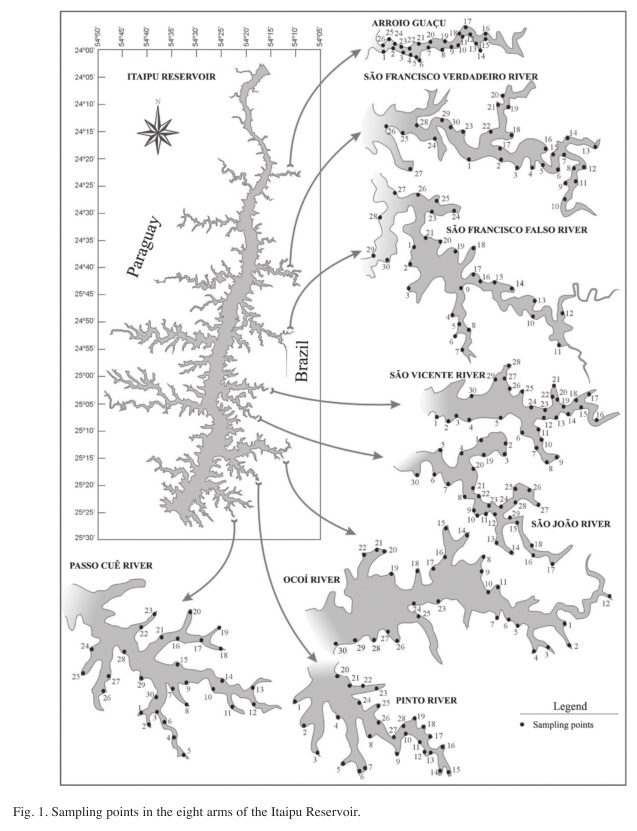
<body><![CDATA[<p style="text-align: justify;"><b><font face="Verdana" size="2">Study Area: </font></b><font face="Verdana" size="2">This study was conducted in eight arms of the Brazilian margin of the Itaipu Reservoir (Eastern margin; 24&deg;15&#8217; and 25&deg;33&#8217; S; 54&deg;00&#8217; and 54&deg;37&#8217; W (<a  href="/img/revistas/rbt/v58n4/a30i1.jpg">Fig. 1</a>). The reservoir was formed in October 1982 in the Paran&aacute; River. It has an area of 1 350km<sup>2</sup> at the normal operation water level (ca. 220m.a.s.l.) and a theoretical residence time of approximately 40 days. The water levels are relatively stable and typically fluctuate less than one meter per year; however, a conspicuous water drawdown of five meters occurred between November 1999 and March 2000 (Thomaz <i>et al. </i>2006).</font></p>     <div style="text-align: justify;"></div>     <p style="text-align: justify;"><font face="Verdana" size="2">Eight arms formed by lateral tributaries were investigated: Arroio Gua&ccedil;u River (AG), S&atilde;o Francisco Verdadeiro River (SFV), S&atilde;o Francisco Falso River (SFF), S&atilde;o Vicente River (SV), S&atilde;o Jo&atilde;o River (SJ), Oco&iacute; River (OC), Pinto River (PR) and Passo Cu&ecirc; River (PC) (<a href="/img/revistas/rbt/v58n4/a30i1.jpg">Fig. 1</a>). Five reservoir arms had total phosphorus concentrations lower than 30</font><font face="Verdana" size="2">&#956;</font><font face="Verdana"  size="2">g/L and thus were considered them mesotrophic, while in the other three arms (total phosphorus varied from 30 to 90</font><font  face="Verdana" size="2">&#956;</font><font face="Verdana" size="2">g/L) as eutrophic (Thomaz <i>et al. </i>2003). Additional limnological data can be found in Thomaz <i>et al. </i>(2003).</font></p>     <div style="text-align: justify;"><b><font size="2"> </font></b></div>     <p style="text-align: justify;"><b><font face="Verdana" size="2">Sampling: </font></b><font face="Verdana" size="2">The main results in this study were collected in a survey of aquatic macrophytes conducted from August 28 to September the 11, 2008. Surveys in this reservoir began in 1995 and in 1999, 235 permanent sampling stations were positioned in eight arms on the Brazilian side of the reservoir. Since 1999, surveys were conducted every six months at these stations and euhydrophytes (especially free floating and submerged species) were prioritized in these surveys. In this paper, we used only data obtained in August-September 2008 because during this time, the taxonomic resolution was improved with macrophyte taxonomists participation.</font></p>     <div style="text-align: justify;"></div>     <p style="text-align: justify;"><font face="Verdana" size="2">Thirty sampling points were selected in each arm except at the Arroio Gua&ccedil;u River and Pinto River, where we selected 26 and 29 sampling points, respectively, because their areas are smaller. The points were distributed to maximize the diversity of abiotic conditions (pH, conductivity, turbidity, dissolved oxygen and nutrient availability) within each arm. The geographic position of each sampling point (latitude and longitude) was obtained by GPS (Global Positioning System). Macrophyte species were sampled in each of the 235 sampling stations using a boat, which was positioned inside three places of each macrophyte stand to record species and search for small plants (<i>Lemna </i>sp., <i>Spirodela </i>sp. and <i>Utricularia </i>sp.). The species presence/absence was recorded by three persons from a boat moving at a constant, slow velocity along the shoreline for ca. 80-100m. In order to record data for submerged plants, we lifted these plants out of the water using a rake attached to a 4m long pipe. Although this method may not be precise in terms of covering the surveyed area in each stand, we used this same procedure in all stands. In addition, previous observations have shown that this procedure usually accurately estimates the number of species per stand (data not shown).</font></p>     <div style="text-align: justify;"></div>     <p style="text-align: justify;"><font face="Verdana" size="2">Species that could not be identified in the field were collected for later identification in the laboratory and kept in the Herbarium of the University of Maring&aacute; (HUEM). The submerged species were fixed in 70% alcohol. Taxonomic identification followed the specialized literature (Cook 1990, Kissman 1997, Kissman &amp; Groth 1999, 2000, Lorenzi 2000, Pott &amp; Pott 2000). Scientific names followed the APG II classification system (2003) and the spelling of names was revised according to the database of the Missouri Botanical Garden (2009).</font></p>     <div style="text-align: justify;"></div>     ]]></body>
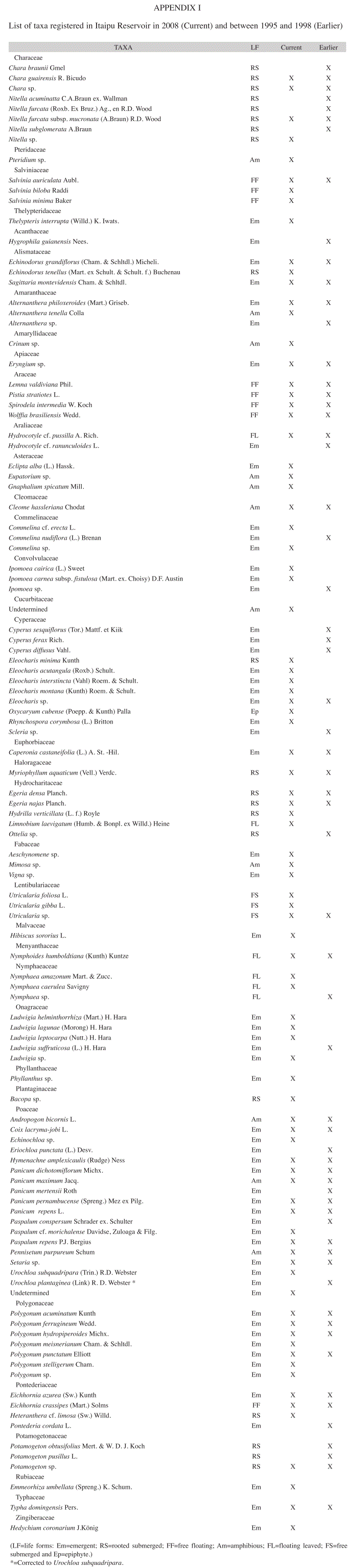
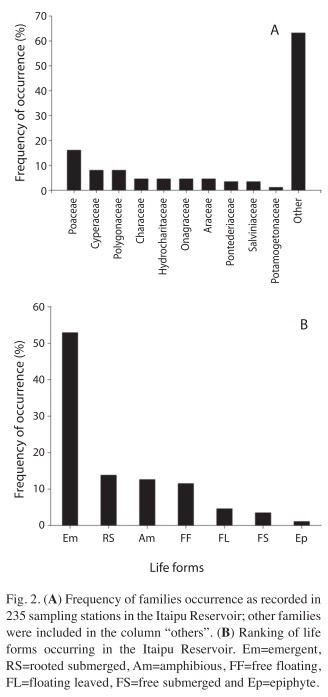
<body><![CDATA[<p style="text-align: justify;"><font face="Verdana" size="2">Species frequencies were obtained by dividing the number of occurrence of a species by 235 (total number of sampling stations). We also classified species according to their life forms because each life form colonises and uses water and sediment resources quite differently. In fact, different life forms occupy distinct positions in the water column (free floating, submerged and emergent), have different access to light (underwater and/or abovewater) and nutrients (sediment and/or water column) and consequently, these groups have different roles (or functions) in littoral regions. We based our seven life forms classification on Pedralli (1990): emergent, rooted submerged, free floating, amphibious, floating leaved, free submerged and epiphyte.</font></p> <b><font size="2"> </font></b>     <p style="text-align: justify;"><b><font face="Verdana" size="2">Analysis: </font></b><font face="Verdana" size="2">To investigate patterns in assemblage composition between reservoir arms, we calculated axis scores using a detrended correspondence analysis (DCA) and used an analysis of variance (ANOVA) to assess if there were significant differences among arms. In addition, correlations between the original data matrix and the DCA scores matrix were calculated and the species correlated to each axis were examined. We correlated the scores of the first (most important) axis of the DCA with two abiotic variables, underwater light (Secchi disk) and effective fetch, to assess if these variables affected macrophyte assemblage composition. Measurements of fetch followed Thomaz <i>et al</i>. (2003). We only used these two variables because previous investigations showed that they are important factors in structuring macrophyte assemblages in Itaipu (Bini <i>et al</i>. 1999, Thomaz <i>et al</i>. 2003) and because measurements of these two variables were obtained in each of the 235 sampling stations. </font></p> <b><font face="Verdana" size="3">     <p>Results</p> </font></b><font size="2"> </font>     <p style="text-align: justify;"><font face="Verdana" size="2">A total of 87 taxa of aquatic macrophytes belonging to 34 families and 57 genera were identified (<a href="/img/revistas/rbt/v58n4/a30t1a.gif">Appendix 1</a>). Of these, 60 taxa were identified to species level, but the lack of reproductive structures prevented some plants from being identified to species.</font></p>     <div style="text-align: justify;"></div>     <p style="text-align: justify;"><font face="Verdana" size="2">The families with the highest number of species were Poaceae (14 taxa), Cyperaceae and Polygonaceae (seven taxa each) and Characeae, Araceae, Hydrocharitaceae, Onagraceae (four taxa each). These families contributed 50.5% of the species recorded and together with Pontederiaceae, Salviniaceae and Potamogetonaceae, had the highest frequencies of occurrence in all arms (<a href="#fig2">Fig. 2a</a>).</font></p>     <div style="text-align: justify;"></div>     <p style="text-align: justify;"><font face="Verdana" size="2">The genus with the highest number of species was <i>Polygonum </i>(seven species), followed by <i>Eleocharis </i>(five), <i>Ludwigia </i>and <i>Panicum </i>(four species each). Two genera had three species each, ten genera had two species each and 41 genera were represented by a single species. The life form containing the highest number of species was emergent (52.9% of total), followed by rooted submerged (14.9%), amphibious (12.6%), free floating (9.2%), floating leaved (5.7%), free submerged (3.5%) and epiphyte (1.2%). Similarly, the frequency of occurrence of the life forms followed the same sequence (<a href="#fig2">Fig. 2b</a>). The most frequent genera in each life form included the following: emergent &#8211; <i>Hymenachne</i>, <i>Urochloa </i>and <i>Eleocharis</i>; rooted submerged &#8211; <i>Chara</i>, <i>Nitella</i>, <i>Egeria </i>and <i>Hydrilla</i>; free floating &#8211; <i>Eichhornia </i>and <i>Salvinia</i>; amphibious &#8211; <i>Panicum</i>; floating leaved &#8211; <i>Nymphoides </i>and <i>Nymphaea</i>; free submerged &#8211; <i>Utricularia</i>; epiphyte &#8211; <i>Oxycaryum</i>.    <br> </font></p>     <p><font face="Verdana" size="2">    ]]></body>
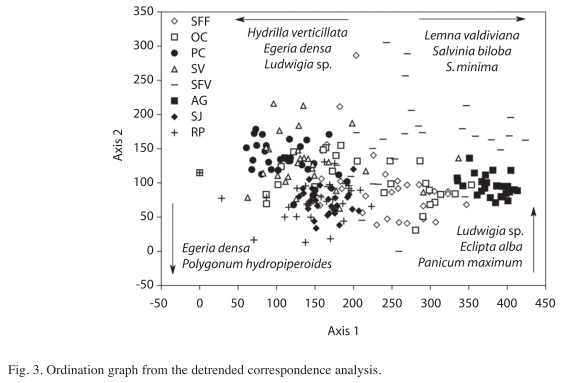
<body><![CDATA[<br> </font></p>     <div style="text-align: center;"><a name="fig2"></a><img  src="/img/revistas/rbt/v58n4/a30i2.jpg" title="" alt=""  style="width: 328px; height: 697px;">    <br>     <br> </div>     <p style="text-align: justify;"><font face="Verdana" size="2">The most frequent species were <i>Hymenachne amplexicaulis </i>(Rudge) Ness, <i>Urochloa subquadripara </i>(Trin.) R.D. Webster and <i>Egeria densa</i>, which were found in 70.63%, 70.21% and 49.78% of the sampling points, respectively<i>. Egeria najas</i>, <i>Polygonum ferrugineum </i>Wedd., <i>Hydrilla verticillata </i>(L. f.) Royle, <i>Panicum repens </i>L., <i>Nymphoides humboldtiana </i>(Kunth) Kuntze, <i>Panicum pernambucense </i>(Spreng.) Mez ex Pilg. and <i>Nitella furcata </i>subsp. <i>mucronata </i>(A. Braun) R.D. Wood were also important (25 to 40% of the sampling points).</font></p>     <div style="text-align: justify;"></div>     <p style="text-align: justify;"><font face="Verdana" size="2">It is worth noting that we found five non-native species: <i>U. subquadripara</i>, <i>H. verticillata</i>, <i>Nymphaea caerulea </i>Savigny, <i>Coix lacryma-jobi </i>L. and <i>Hedychium coronarium </i>J. K&ouml;nig. The first species occurred in 165 points and in elevated frequencies in all arms and the second species was recorded in 71 points in five arms. The other three non-native species occurred in low frequencies in the arms (28, three and three sampling stations, respectively). <i>N. caerulea </i>occurred in six arms, <i>C. lacrymajobi </i>was recorded only in one arm and <i>H. coronarium </i>in two arms. In addition, although the arm with the highest frequency of non-native species was the Arroio Gua&ccedil;u (all sampling points), the arms with the highest richness of non-native species were Oco&iacute; and Passo Cu&ecirc; River (four species).</font></p>     <div style="text-align: justify;"></div>     <p style="text-align: justify;"><font face="Verdana" size="2">The ordination analysis showed that species composition differed in the different reservoir arms (<a  href="/img/revistas/rbt/v58n4/a30i3.jpg">Fig. 3</a>). The DCA axis 1 shows the reservoir arms ordered according to their longitudinal position along the reservoir main body (riverine-lacustrine gradient): arms farther from the dam (Arroio Gua&ccedil;u and S&atilde;o Francisco Verdadeiro) were positioned on the right side of axis 1, while arms closer to the dam (Pinto and Passo Cu&ecirc;) were concentrated on the left side. In fact, there were significant differences among scores of axis 1 (ANOVA, F=60.2, p&lt;0.001). The main species found to be positively correlated to axis 1 were <i>Lemna valdiviana </i>Phil. (r=0.85), <i>Salvinia biloba </i>Raddi (r=0.64) and <i>Salvinia minima </i>Baker (r=0.63). Species negatively correlated to this axis were <i>H. verticillata </i>(r=-0.58), <i>E. densa </i>(r=-0.45) and <i>Ludwigia </i>sp. (r=-0.47) (see <a  href="/img/revistas/rbt/v58n4/a30i3.jpg">Fig. 3</a>).</font></p>     <div style="text-align: justify;"></div>     ]]></body>
<body><![CDATA[<p style="text-align: justify;"><font face="Verdana" size="2">DCA axis 2 shows the separation between Arroio Gua&ccedil;u, S&atilde;o Francisco Falso and Oco&iacute;, positioned in the lower part of <a href="/img/revistas/rbt/v58n4/a30i3.jpg">Figure 3</a>, from S&atilde;o Francisco Verdadeiro arm, positioned in the upper part of this figure. Species that were positively related to axis 2 were <i>Panicum maximum </i>Jacq. (r=0.41), <i>Ludwigia </i>sp. (r=0.38) and <i>Eclipta alba </i>(L.) Hassk. (r=0.37), while <i>E. densa </i>(r=-0.33) and <i>Polygonum hydropiperoides </i>Michx. (r=-0.3) were negatively correlated to this axis. Scores of axis 2 also differed significantly (ANOVA, F=16.74, p&lt;0.001).</font></p>     <div style="text-align: justify;"></div>     <p style="text-align: justify;"><font face="Verdana" size="2">Secchi disk depth varied between 0.5 and 6m and fetch varied between 0.45 and 30km. The scores of axis 1 were significantly and negatively correlated to Secchi disk depth and fetch (r=0.43, p&lt;0.001 and r=-0.36, p&lt;0.001, respectively), indicating that these two abiotic variables are important determinants of macrophyte assemblage composition.</font></p> <b><font face="Verdana" size="3">     <p>Discussion</p> </font></b><font size="2"> </font>     <p style="text-align: justify;"><font face="Verdana" size="2">Despite conducting the survey in a single, short (15 day) period, we found 87 macrophyte taxa in the eight arms located on the Brazilian side of the Itaipu Reservoir. In the first survey of macrophytes conducted ten years earlier in this reservoir, Thomaz <i>et al. </i>(1999) found 62 taxa belonging to 25 families and 42 genera. Among this total, 47 were identified at the species level and 33 species were common between both surveys. Similar to what we found in 2008, the Poaceae family was the best represented in terms of taxa in 1995-1998. There were many <i>Polygonum </i>species in both surveys; however, the other most specious genera in 2008 differed from those in 1995-1998. Differences in the number of species and the identity of genera between these two surveys indicate that macrophyte assemblages are still changing and are dynamic in this reservoir. In fact, conspicuous changes due to disturbances caused by water drawdown and alterations in water physico-chemistry (mainly underwater radiation) occurred in the Itaipu Reservoir (Thomaz <i>et al. </i>2006, 2009). The long period between surveys may have also allowed the natural colonization of other species. However, in addition to these environmental causes, differences between the two surveys may be attributable to distinct sampling protocols because the early surveys in the Itaipu Reservoir focused mainly on the euhydrophytes (especially rooted submerged and free floating species), while in the second survey, we followed Cook&#8217;s classification. In addition, many taxa were identified only to genus in the first survey; therefore, comparisons should be made with caution.</font></p>     <div style="text-align: justify;"></div>     <p style="text-align: justify;"><font face="Verdana" size="2">Compared with other reservoirs of the Upper Paran&aacute; River Basin, Itaipu has a rich macrophyte assemblage. For example, Martins <i>et al. </i>(2008) studied 18 reservoirs and found a total of 39 species in all of them and Thomaz <i>et al. </i>(2005) recorded 37 species in the Rosana Reservoir (Paranapanema River). Differences may be due to several non-independent factors, such as differences in area, physico-chemistry and even taxonomic resolution.</font></p>     <div style="text-align: justify;"></div>     <p style="text-align: justify;"><font face="Verdana" size="2">The families Poaceae and Cyperaceae, which are among the best-represented families in Itaipu, are also the most important families in other freshwater ecosystems of the Upper Paran&aacute; River, like floodplain lakes (Pott <i>et al</i>. 1992, Bini <i>et al. </i>1999, Kita &amp; Souza 2003) and reservoirs (Pedralli <i>et al. </i>1993, Martins <i>et al. </i>2008). Despite having similar families, the composition of the macrophyte assemblage in the Itaipu Reservoir differs from natural habitats in other parts of the Upper Paran&aacute; River. For example, in one lake in the Upper Paran&aacute; River floodplain, the genera <i>Cyperus</i>, <i>Paspalum </i>and <i>Solanum </i>had the highest number of species (Kita &amp; Souza 2003).</font></p>     <div style="text-align: justify;"></div>     ]]></body>
<body><![CDATA[<p style="text-align: justify;"><font face="Verdana" size="2">It is worth noting that free floating species, like <i>E. crassipes</i>, <i>Salvinia </i>spp. and <i>Pistia stratiotes </i>L., are very common in other Brazilian reservoirs (Carvalho <i>et al. </i>2003, 2005, Gastal Jr. <i>et al. </i>2003, Martins <i>et al. </i>2003) but are not among the most frequent species in Itaipu. Some arms of the Itaipu Reservoir have mesotrophic characteristics (Thomaz <i>et al. </i>2003) and thus the physico-chemistry in the Itaipu Reservoir is not favourable to this specific life form, which depends on water nutrients. Although considered to be one of the greatest nuisance species of macrophytes, free floating species have rarely grown extensively and caused trouble in the Itaipu Reservoir (Thomaz <i>et al. </i>2003). In contrast to free floating species, <i>H. amplexicaulis</i>, an emergent species, is the most frequent species in Itaipu, but it is not common in other reservoirs (Cavenaghi <i>et al. </i>2003, Carvalho <i>et al. </i>2003).</font></p>     <div style="text-align: justify;"></div>     <p style="text-align: justify;"><font face="Verdana" size="2">Although there is little threat from the fast growth of native species, two non-native species of macrophytes in Itaipu are of great concern: the emergent species, <i>U. subquadripara</i>, which has floating stems and the rooted submerged species, <i>H. verticillata</i>. <i>U. subquadripara </i>was also very frequent in the reservoir during a previous survey, but it was mistakenly named by Thomaz <i>et al. </i>(1999) as <i>Urochloa plantaginea </i>(Link) R.D. Webster. <i>U. subquadripara </i>is native to Africa and is one of the most common species in Itaipu and in several other Brazilian reservoirs (e.g., Carvalho <i>et al. </i>2003, 2005, Martins <i>et al. </i>2003, 2008). In Itaipu, it covers large areas and creates extensive stands, which compromise access to the water table and reduces the diversity of native species of macrophytes (Michelan <i>et al. </i>2010). <i>U. subquadripara</i>, recorded since the first survey in 1995, is continuously increasing in frequency of occurrence and is colonizing new areas in Itaipu (Thomaz <i>et al. </i>2009).</font></p>     <p style="text-align: justify;"><font face="Verdana" size="2">In contrast with <i>U. subquadripara</i>, <i>H. verticillata </i>was recorded only in the second extensive survey (2008)<i>. H. verticillata </i>was registered for the first time in Itaipu in January 2007 (Thomaz <i>et al. </i>2009) and has quickly colonized new sites since then. The invasion by <i>H. verticillata</i>, which is native to Asia and North Africa, has been facilitated in Itaipu since 2001 by increase in underwater radiation, which enables the rapid growth of this macrophyte (Thomaz <i>et al. </i>2009). According to Thomaz <i>et al. </i>(2009), <i>H. verticillata </i>arrived from the main river (Paran&aacute; River), where this species was recorded earlier than it was recorded in this reservoir. Together with <i>U. subquadripara</i>, <i>H. verticillata </i>causes concern because it can affect native aquatic assemblages (Hofstra <i>et al. </i>1999, Mony <i>et al. </i>2007, Theel <i>et al. </i>2008).</font></p>     <div style="text-align: justify;"><i><font size="2"> </font></i></div>     <p style="text-align: justify;"><i><font face="Verdana" size="2">N. caerulea </font></i><font face="Verdana" size="2">(native to South Africa), <i>C. lacryma-jobi </i>(native to Asia) and <i>H. coronarium </i>(native to the Himalayas and Madagascar) were rare in Itaipu and despite being non-native, cannot be considered invasive in this reservoir. This also appears to be the case in other reservoirs in the Upper Paran&aacute; Basin, where they have not been recorded (Cavenaghi <i>et al. </i>2003, Carvalho <i>et al. </i>2005, Martins <i>et al. </i>2008). However, <i>H. coronarium </i>has been found in natural ecosystems in the State of Minas Gerais (Santos <i>et al. </i>2005).</font></p>     <div style="text-align: justify;"></div>     <p style="text-align: justify;"><font face="Verdana" size="2">Differences in the species composition between arms showed a pattern of organization along the reservoir main axis. Assemblages were preferentially composed by free floating species in the arms closer to the riverine zone and by submerged species in the arms positioned from the middle portion of the reservoir down to the dam. These differences may reflect the higher inputs of nutrients in the first arms through the Paran&aacute; River and higher light penetration in the others. In fact, there is a conspicuous gradient of sedimentation along the Itaipu Reservoir, with higher inputs of solids and nutrients carried by the Paran&aacute; River (Pagioro &amp; Thomaz 2002). Both solids and nutrients decrease as the distance to the dam decreases, resulting in higher water transparency in the lacustrine zone of this reservoir (Pagioro &amp; Thomaz 2002). In accordance with this finding, the underwater light (measured with the Secchi disk) was negatively correlated to scores of the DCA axis 1 and thus, positively correlated with the predominance of two of the most important submerged species: <i>E. densa </i>and <i>H. verticillata. </i>It shows that underwater light is an important determinant of macrophyte assemblage composition in the Itaipu Reservoir.</font></p>     <div style="text-align: justify;"></div>     <p style="text-align: justify;"><font face="Verdana" size="2">Fetch was also an important variable in determining assemblage composition. Fetch is a surrogate of waves, which represent a disturbance to macrophytes; a correlation between fetch and the attributes of macrophyte populations and assemblages have been shown elsewhere (Chambers 1987, Rea <i>et al</i>. 1998). Earlier investigations in the Itaipu Reservoir, for example, showed that macrophyte richness was negatively affected by fetch (Thomaz <i>et al</i>. 2003).</font></p>     ]]></body>
<body><![CDATA[<p style="text-align: justify;"><font face="Verdana" size="2">In summary, the extensive survey of aquatic macrophytes conducted in September 2008 recorded more species than the survey conducted in 1995-1998. The increased number of species may be primarily due to changes in the water physico-chemistry and water drawdown disturbances, although differences in classification systems (s<i>ensu </i>Cook 1990) and taxonomic resolutions between the surveys may also account for such differences in species data between the years. Additionally, five of the 87 species recorded were non-native. Two of these non-natives are of special concern because they occur frequently and occupy large marginal areas in the reservoir. Finally, assemblage composition varied among arms and was at least in part determined by underwater radiation and fetch. Future surveys should examine the effects of other abiotic factors (e.g., nutrients) on assemblages and examine assemblage alterations in sites that have been colonized by exotic species. Together with our results, those of such future studies will help provide a scientific basis for the management of aquatic macrophytes and could be used to avoid damage to the reservoir biota and also to the potential water source that is the Itaipu Reservoir.</font></p> <b><font face="Verdana" size="3">     <p>Acknowledgments</p> </font></b><font size="2"> </font><font face="Verdana" size="2"></font>     <div style="text-align: justify;"><font face="Verdana" size="2">     <p>We thank Valmir Alves Teixeira and ValdenirFerreira de Souza for field assistance. R.P. Mormul acknowledges the "Coordena&ccedil;&atilde;o de Aperfei&ccedil;oamento de Pessoal de N&iacute;vel Superior" (CAPES) for providing scholarships. F.A. Ferreira and T.S. Michelan acknowledge the Brazilian Council of Research (CNPq). P. Carvalho and M.J. Silveira acknowledge the "Parque Tecnol&oacute;gico da Itaipu" (PDTA/FPTIBR). S.M. Thomaz is especially thankful to the CNPq for continuous funding through a Research Productivity Grant. This research was funded by Itaipu Binacional.</p> </font></div> <font face="Verdana" size="2"></font><b><font face="Verdana" size="3"> </font></b> <hr style="width: 100%; height: 2px;"><b><font face="Verdana" size="3">     <p>References</p> </font></b><font size="2"> </font><font face="Verdana" size="2"></font>     <!-- ref --><p><font face="Verdana" size="2">Agostinho, A.A., L.C. Gomes &amp; H.F. Julio Jr. 2003. Rela&ccedil;&otilde;es entre macr&oacute;fitas aqu&aacute;ticas e fauna de peixes, p. 261-277. <i>In </i>S.M. Thomaz &amp; L.M. Bini (eds.). Ecologia e Manejo de Macr&oacute;fitas Aqu&aacute;ticas. EDUEM, Maring&aacute;, Paran&aacute;, Brazil.    &nbsp;&nbsp;&nbsp;&nbsp;&nbsp;&nbsp;&nbsp;&nbsp;[&#160;<a href="javascript:void(0);" onclick="javascript: window.open('/scielo.php?script=sci_nlinks&ref=1400378&pid=S0034-7744201000040003000001&lng=','','width=640,height=500,resizable=yes,scrollbars=1,menubar=yes,');">Links</a>&#160;]<!-- end-ref --></font></p>     <!-- ref --><p><font face="Verdana" size="2">Agostinho, A.A., L.C. Gomes &amp; F.M. Pelicice. 2007. Ecologia e Manejo de Recurso Pesqueiro em Reservat&oacute;rios do Brasil. EDUEM, Maring&aacute;, Paran&aacute;, Brazil.    &nbsp;&nbsp;&nbsp;&nbsp;&nbsp;&nbsp;&nbsp;&nbsp;[&#160;<a href="javascript:void(0);" onclick="javascript: window.open('/scielo.php?script=sci_nlinks&ref=1400380&pid=S0034-7744201000040003000002&lng=','','width=640,height=500,resizable=yes,scrollbars=1,menubar=yes,');">Links</a>&#160;]<!-- end-ref --></font></p>     <!-- ref --><p><font face="Verdana" size="2">APG II. 2003. An update of the Angiosperm Phylogeny Group classification for orders and families of flowering plants: APG II. Bot. J. Linn. Soc. 141: 399-436.    &nbsp;&nbsp;&nbsp;&nbsp;&nbsp;&nbsp;&nbsp;&nbsp;[&#160;<a href="javascript:void(0);" onclick="javascript: window.open('/scielo.php?script=sci_nlinks&ref=1400382&pid=S0034-7744201000040003000003&lng=','','width=640,height=500,resizable=yes,scrollbars=1,menubar=yes,');">Links</a>&#160;]<!-- end-ref --></font></p>     <!-- ref --><p><font face="Verdana" size="2">Barbosa, F.A.R., J. Padis&aacute;k, E.L.G. Esp&iacute;ndola, G. Borics &amp; O. Rocha. 1999. The cascading reservoir continuum concept (CRCC) and its application to the river Tiet&ecirc;-basin, S&atilde;o Paulo State, Brazil, p. 452-437. <i>In </i>J.G. Tundisi &amp; M. Stra&#353;kraba (eds.). Theoretical Reservoir Ecology and Its Applications. International Institute of Ecology, Brazilian Academy of Sciences and Backhuys, Leiden, Netherlands.    &nbsp;&nbsp;&nbsp;&nbsp;&nbsp;&nbsp;&nbsp;&nbsp;[&#160;<a href="javascript:void(0);" onclick="javascript: window.open('/scielo.php?script=sci_nlinks&ref=1400384&pid=S0034-7744201000040003000004&lng=','','width=640,height=500,resizable=yes,scrollbars=1,menubar=yes,');">Links</a>&#160;]<!-- end-ref --></font></p>     <p><font face="Verdana" size="2"> </font></p>     <!-- ref --><p><font face="Verdana" size="2">Bini, L.M., S.M. Thomaz, K.J. Murphy &amp; A.F.M. Camargo. 1999. Aquatic macrophyte distribution in relation to water and sediment conditions in the Itaipu reservoir, Brazil. Hydrobiol. 415: 147-154.    &nbsp;&nbsp;&nbsp;&nbsp;&nbsp;&nbsp;&nbsp;&nbsp;[&#160;<a href="javascript:void(0);" onclick="javascript: window.open('/scielo.php?script=sci_nlinks&ref=1400387&pid=S0034-7744201000040003000005&lng=','','width=640,height=500,resizable=yes,scrollbars=1,menubar=yes,');">Links</a>&#160;]<!-- end-ref --></font></p>     <!-- ref --><p><font face="Verdana" size="2">Camargo, A.F.M.C., M.M. Pezzato &amp; G.G. Henry-Silva. 2003. Fatores limitantes &agrave; produ&ccedil;&atilde;o prim&aacute;ria de macr&oacute;fitas aqu&aacute;ticas, p. 59-84. <i>In </i>S.M. Thomaz &amp; L.M. Bini (eds.). Ecologia e Manejo de Macr&oacute;fitas Aqu&aacute;ticas. EDUEM, Maring&aacute;, Paran&aacute;, Brazil.    &nbsp;&nbsp;&nbsp;&nbsp;&nbsp;&nbsp;&nbsp;&nbsp;[&#160;<a href="javascript:void(0);" onclick="javascript: window.open('/scielo.php?script=sci_nlinks&ref=1400389&pid=S0034-7744201000040003000006&lng=','','width=640,height=500,resizable=yes,scrollbars=1,menubar=yes,');">Links</a>&#160;]<!-- end-ref --></font></p>     <!-- ref --><p><font face="Verdana" size="2">Carvalho, F.T., M.L.B.T. Galo, E.D. Velini &amp; D. Martins. 2003. Plantas aqu&aacute;ticas e n&iacute;vel de infesta&ccedil;&atilde;o das esp&eacute;cies presentes no reservat&oacute;rio de Barra Bonita, no rio Tiet&ecirc;. Planta Daninha 21: 15-19.    &nbsp;&nbsp;&nbsp;&nbsp;&nbsp;&nbsp;&nbsp;&nbsp;[&#160;<a href="javascript:void(0);" onclick="javascript: window.open('/scielo.php?script=sci_nlinks&ref=1400391&pid=S0034-7744201000040003000007&lng=','','width=640,height=500,resizable=yes,scrollbars=1,menubar=yes,');">Links</a>&#160;]<!-- end-ref --></font></p> <font size="2"> </font>     ]]></body>
<body><![CDATA[<!-- ref --><p><font face="Verdana" size="2">Carvalho, F.T., E.D. Velini &amp; D. Martins. 2005. Plantas aqu&aacute;ticas e n&iacute;vel de infesta&ccedil;&atilde;o das esp&eacute;cies presentes no reservat&oacute;rio de Bariri, no rio Tiet&ecirc;. Planta Daninha 23: 371-374.    &nbsp;&nbsp;&nbsp;&nbsp;&nbsp;&nbsp;&nbsp;&nbsp;[&#160;<a href="javascript:void(0);" onclick="javascript: window.open('/scielo.php?script=sci_nlinks&ref=1400393&pid=S0034-7744201000040003000008&lng=','','width=640,height=500,resizable=yes,scrollbars=1,menubar=yes,');">Links</a>&#160;]<!-- end-ref --></font></p>     <!-- ref --><p><font face="Verdana" size="2">Cavenaghi, A.L., E.D. Velini, M.L.B.T. Galo, F.T. Carvalho, E. Negrisoli, M.L.B. Trindade &amp; J.L.A. Simionato. 2003. Caracteriza&ccedil;&atilde;o da qualidade de &aacute;gua e sedimento relacionados com a ocorr&ecirc;ncia de plantas aqu&aacute;ticas em cinco reservat&oacute;rios da Bacia do Rio Tiet&ecirc;. Planta Daninha 21: 43-52.    &nbsp;&nbsp;&nbsp;&nbsp;&nbsp;&nbsp;&nbsp;&nbsp;[&#160;<a href="javascript:void(0);" onclick="javascript: window.open('/scielo.php?script=sci_nlinks&ref=1400395&pid=S0034-7744201000040003000009&lng=','','width=640,height=500,resizable=yes,scrollbars=1,menubar=yes,');">Links</a>&#160;]<!-- end-ref --></font></p>     <!-- ref --><p><font face="Verdana" size="2">Chambers, P.A. 1987. Nearshore occurrence of submersed aquatic macrophytes in relation to wave action. Can. J. Fish. Aquat. Sci. 44: 1666-1669.    &nbsp;&nbsp;&nbsp;&nbsp;&nbsp;&nbsp;&nbsp;&nbsp;[&#160;<a href="javascript:void(0);" onclick="javascript: window.open('/scielo.php?script=sci_nlinks&ref=1400397&pid=S0034-7744201000040003000010&lng=','','width=640,height=500,resizable=yes,scrollbars=1,menubar=yes,');">Links</a>&#160;]<!-- end-ref --></font></p>     <!-- ref --><p><font face="Verdana" size="2">Cook, C.D.K. 1990. Aquatic Plant Book. SBP Academic, The Hague, Netherlands.    &nbsp;&nbsp;&nbsp;&nbsp;&nbsp;&nbsp;&nbsp;&nbsp;[&#160;<a href="javascript:void(0);" onclick="javascript: window.open('/scielo.php?script=sci_nlinks&ref=1400399&pid=S0034-7744201000040003000011&lng=','','width=640,height=500,resizable=yes,scrollbars=1,menubar=yes,');">Links</a>&#160;]<!-- end-ref --></font></p>     <!-- ref --><p><font face="Verdana" size="2">Esteves, F.A. 1998. Fundamentos de Limnologia. Interci&ecirc;ncia, Rio de Janeiro, Brazil.    &nbsp;&nbsp;&nbsp;&nbsp;&nbsp;&nbsp;&nbsp;&nbsp;[&#160;<a href="javascript:void(0);" onclick="javascript: window.open('/scielo.php?script=sci_nlinks&ref=1400401&pid=S0034-7744201000040003000012&lng=','','width=640,height=500,resizable=yes,scrollbars=1,menubar=yes,');">Links</a>&#160;]<!-- end-ref --></font></p>     ]]></body>
<body><![CDATA[<!-- ref --><p><font face="Verdana" size="2">Gastal Jr, C.V.S., B.E. Irgang &amp; C. Moreira. 2003. Problemas com infesta&ccedil;&atilde;o de macr&oacute;fitas aqu&aacute;ticas na &aacute;rea de influ&ecirc;ncia da Usina Hidrel&eacute;trica de Ita. Actascientiae 5: 87-92.    &nbsp;&nbsp;&nbsp;&nbsp;&nbsp;&nbsp;&nbsp;&nbsp;[&#160;<a href="javascript:void(0);" onclick="javascript: window.open('/scielo.php?script=sci_nlinks&ref=1400403&pid=S0034-7744201000040003000013&lng=','','width=640,height=500,resizable=yes,scrollbars=1,menubar=yes,');">Links</a>&#160;]<!-- end-ref --></font></p>     <!-- ref --><p><font face="Verdana" size="2">Hofstra, D.E., J. Clayton, J.D. Green &amp; M. Auger. 1999. Competitive performance of <i>Hydrilla verticillata </i>in New Zealand. Aquat. Bot. 63: 305-324.    &nbsp;&nbsp;&nbsp;&nbsp;&nbsp;&nbsp;&nbsp;&nbsp;[&#160;<a href="javascript:void(0);" onclick="javascript: window.open('/scielo.php?script=sci_nlinks&ref=1400405&pid=S0034-7744201000040003000014&lng=','','width=640,height=500,resizable=yes,scrollbars=1,menubar=yes,');">Links</a>&#160;]<!-- end-ref --></font></p>     <!-- ref --><p><font face="Verdana" size="2">Kissman, K.G. 1997. Plantas infestantes e Nocivas. BASF, S&atilde;o Paulo, Brazil.    &nbsp;&nbsp;&nbsp;&nbsp;&nbsp;&nbsp;&nbsp;&nbsp;[&#160;<a href="javascript:void(0);" onclick="javascript: window.open('/scielo.php?script=sci_nlinks&ref=1400407&pid=S0034-7744201000040003000015&lng=','','width=640,height=500,resizable=yes,scrollbars=1,menubar=yes,');">Links</a>&#160;]<!-- end-ref --></font></p>     <!-- ref --><p><font face="Verdana" size="2">Kissman, K.G. &amp; D. Groth. 1999. Plantas infestantes e Nocivas. BASF, S&atilde;o Paulo, Brazil.    &nbsp;&nbsp;&nbsp;&nbsp;&nbsp;&nbsp;&nbsp;&nbsp;[&#160;<a href="javascript:void(0);" onclick="javascript: window.open('/scielo.php?script=sci_nlinks&ref=1400409&pid=S0034-7744201000040003000016&lng=','','width=640,height=500,resizable=yes,scrollbars=1,menubar=yes,');">Links</a>&#160;]<!-- end-ref --></font></p> <font size="2"> </font>     <!-- ref --><p><font face="Verdana" size="2">Kissman, K.G. &amp; D. Groth. 2000. Plantas infestantes e Nocivas. BASF, S&atilde;o Paulo, Brazil.    &nbsp;&nbsp;&nbsp;&nbsp;&nbsp;&nbsp;&nbsp;&nbsp;[&#160;<a href="javascript:void(0);" onclick="javascript: window.open('/scielo.php?script=sci_nlinks&ref=1400411&pid=S0034-7744201000040003000017&lng=','','width=640,height=500,resizable=yes,scrollbars=1,menubar=yes,');">Links</a>&#160;]<!-- end-ref --></font></p>     ]]></body>
<body><![CDATA[<!-- ref --><p><font face="Verdana" size="2">Kita, K.K. &amp; M.C. Souza. 2003. Levantamento flor&iacute;stico e fitofisionomia da lagoa Figueira e seu entorno, plan&iacute;cie alag&aacute;vel do alto rio Paran&aacute;, Porto Rico, Estado do Paran&aacute;, Brasil. Acta Sci. Biol. Sci. 25: 145-155.    &nbsp;&nbsp;&nbsp;&nbsp;&nbsp;&nbsp;&nbsp;&nbsp;[&#160;<a href="javascript:void(0);" onclick="javascript: window.open('/scielo.php?script=sci_nlinks&ref=1400413&pid=S0034-7744201000040003000018&lng=','','width=640,height=500,resizable=yes,scrollbars=1,menubar=yes,');">Links</a>&#160;]<!-- end-ref --></font></p>     <!-- ref --><p><font face="Verdana" size="2">Lopes, C.A., E. Benedito-Cecilio &amp; L.A. Martinelli. 2007. Variability in the carbon isotope signature of <i>Prochilodus lineatus </i>(Prochilodontidae, Characiformes) a bottom-feeding fish of the Neotropical region. J. Fish. Biol. 70: 1649-1659.    &nbsp;&nbsp;&nbsp;&nbsp;&nbsp;&nbsp;&nbsp;&nbsp;[&#160;<a href="javascript:void(0);" onclick="javascript: window.open('/scielo.php?script=sci_nlinks&ref=1400415&pid=S0034-7744201000040003000019&lng=','','width=640,height=500,resizable=yes,scrollbars=1,menubar=yes,');">Links</a>&#160;]<!-- end-ref --></font></p>     <!-- ref --><p><font face="Verdana" size="2">Lorenzi, H. 2000. Plantas Daninhas do Brasil: Terrestres, Aqu&aacute;ticas, Parasitas e T&oacute;xicas. Instituto Plantarum de Estudos da Flora, Nova Odessa, S&atilde;o Paulo, Brazil.    &nbsp;&nbsp;&nbsp;&nbsp;&nbsp;&nbsp;&nbsp;&nbsp;[&#160;<a href="javascript:void(0);" onclick="javascript: window.open('/scielo.php?script=sci_nlinks&ref=1400417&pid=S0034-7744201000040003000020&lng=','','width=640,height=500,resizable=yes,scrollbars=1,menubar=yes,');">Links</a>&#160;]<!-- end-ref --></font></p>     <!-- ref --><p><font face="Verdana" size="2">Maltchik, L. &amp; M. Callisto. 2004. The use of rapid assessment approach to discuss ecological theories in wetland systems, southern Brazil. Interciencia 29: 219-223.    &nbsp;&nbsp;&nbsp;&nbsp;&nbsp;&nbsp;&nbsp;&nbsp;[&#160;<a href="javascript:void(0);" onclick="javascript: window.open('/scielo.php?script=sci_nlinks&ref=1400419&pid=S0034-7744201000040003000021&lng=','','width=640,height=500,resizable=yes,scrollbars=1,menubar=yes,');">Links</a>&#160;]<!-- end-ref --></font></p>     <!-- ref --><p><font face="Verdana" size="2">Martins, D., E.D. Velini, R.A. Piteli, M.S. Tomazella &amp; E. Negrisoli. 2003. Ocorr&ecirc;ncia de plantas aqu&aacute;ticas nos reservat&oacute;rios da Light &#8211; RJ. Planta Daninha 21: 105-108.    &nbsp;&nbsp;&nbsp;&nbsp;&nbsp;&nbsp;&nbsp;&nbsp;[&#160;<a href="javascript:void(0);" onclick="javascript: window.open('/scielo.php?script=sci_nlinks&ref=1400421&pid=S0034-7744201000040003000022&lng=','','width=640,height=500,resizable=yes,scrollbars=1,menubar=yes,');">Links</a>&#160;]<!-- end-ref --></font></p>     ]]></body>
<body><![CDATA[<!-- ref --><p><font face="Verdana" size="2">Martins, D., N.V. Costa, M.A. Terra &amp; S.R. Marchi. 2008. Caracteriza&ccedil;&atilde;o da comunidade de plantas aqu&aacute;ticas de dezoito reservat&oacute;rios pertencentes a cinco bacias hidrogr&aacute;ficas do estado de S&atilde;o Paulo. Planta Daninha 26: 17-32.    &nbsp;&nbsp;&nbsp;&nbsp;&nbsp;&nbsp;&nbsp;&nbsp;[&#160;<a href="javascript:void(0);" onclick="javascript: window.open('/scielo.php?script=sci_nlinks&ref=1400423&pid=S0034-7744201000040003000023&lng=','','width=640,height=500,resizable=yes,scrollbars=1,menubar=yes,');">Links</a>&#160;]<!-- end-ref --></font></p>     <!-- ref --><p><font face="Verdana" size="2">Michelan, T.S., S.M. Thomaz, R.P. Mormul &amp; P. Carvalho. 2010. Effects of an exotic invasive macrophyte (tropical signalgrass) on native plant community composition, species richness and functional diversity. Freshwater Biol. 55: 1315-1326.    &nbsp;&nbsp;&nbsp;&nbsp;&nbsp;&nbsp;&nbsp;&nbsp;[&#160;<a href="javascript:void(0);" onclick="javascript: window.open('/scielo.php?script=sci_nlinks&ref=1400425&pid=S0034-7744201000040003000024&lng=','','width=640,height=500,resizable=yes,scrollbars=1,menubar=yes,');">Links</a>&#160;]<!-- end-ref --></font></p>     <!-- ref --><p><font face="Verdana" size="2">Missouri Botanical Garden, 2009. Tropicos. org. Missouri Botanical Garden. Missouri, USA. (Downloaded: July 01, 2009, www.tropicos.org).    &nbsp;&nbsp;&nbsp;&nbsp;&nbsp;&nbsp;&nbsp;&nbsp;[&#160;<a href="javascript:void(0);" onclick="javascript: window.open('/scielo.php?script=sci_nlinks&ref=1400427&pid=S0034-7744201000040003000025&lng=','','width=640,height=500,resizable=yes,scrollbars=1,menubar=yes,');">Links</a>&#160;]<!-- end-ref --></font></p>     <!-- ref --><p><font face="Verdana" size="2">Mony, C., T.J. Koschnick, W.T. Haller &amp; S. Muller. 2007. Competition between two invasive Hydrocharitaceae (<i>Hydrilla verticillata </i>(L.f.) (Royle) and <i>Egeria densa </i>(Planch) as influenced by sediment fertility and season. Aquat. Bot. 86: 236-242.    &nbsp;&nbsp;&nbsp;&nbsp;&nbsp;&nbsp;&nbsp;&nbsp;[&#160;<a href="javascript:void(0);" onclick="javascript: window.open('/scielo.php?script=sci_nlinks&ref=1400429&pid=S0034-7744201000040003000026&lng=','','width=640,height=500,resizable=yes,scrollbars=1,menubar=yes,');">Links</a>&#160;]<!-- end-ref --></font></p>     <!-- ref --><p><font face="Verdana" size="2">Pagioro, T.A. &amp; S.M. Thomaz. 2002. Longitudinal patterns of sedimentation in a deep, monomictic subtropical reservoir (Itaipu, Brazil-Paraguay). Arch. Hydrobiol. 154: 515-528.    &nbsp;&nbsp;&nbsp;&nbsp;&nbsp;&nbsp;&nbsp;&nbsp;[&#160;<a href="javascript:void(0);" onclick="javascript: window.open('/scielo.php?script=sci_nlinks&ref=1400431&pid=S0034-7744201000040003000027&lng=','','width=640,height=500,resizable=yes,scrollbars=1,menubar=yes,');">Links</a>&#160;]<!-- end-ref --></font></p>     ]]></body>
<body><![CDATA[<!-- ref --><p><font face="Verdana" size="2">Pelicice, F.M., S.M. Thomaz &amp; A.A. Agostinho. 2008. Simple relationships to predict attributes of fish assemblages in patches of submerged macrophytes. Neotrop. Ichthyol. 6: 543-550.    &nbsp;&nbsp;&nbsp;&nbsp;&nbsp;&nbsp;&nbsp;&nbsp;[&#160;<a href="javascript:void(0);" onclick="javascript: window.open('/scielo.php?script=sci_nlinks&ref=1400433&pid=S0034-7744201000040003000028&lng=','','width=640,height=500,resizable=yes,scrollbars=1,menubar=yes,');">Links</a>&#160;]<!-- end-ref --></font></p>     <!-- ref --><p><font face="Verdana" size="2">Pedralli, G. 1990. Macr&oacute;fitos aqu&aacute;ticos: t&eacute;cnicas e m&eacute;todos de estudos. Estudos de Biologia 26: 5-24.    &nbsp;&nbsp;&nbsp;&nbsp;&nbsp;&nbsp;&nbsp;&nbsp;[&#160;<a href="javascript:void(0);" onclick="javascript: window.open('/scielo.php?script=sci_nlinks&ref=1400435&pid=S0034-7744201000040003000029&lng=','','width=640,height=500,resizable=yes,scrollbars=1,menubar=yes,');">Links</a>&#160;]<!-- end-ref --></font></p>     <!-- ref --><p><font face="Verdana" size="2">Pedralli, G., S.T. Meyer, M.C. Teixeira &amp; J.R. Stehmann. 1993. Levantamento dos macr&oacute;fitos aqu&aacute;ticos e da mata ciliar do reservat&oacute;rio de Volta Grande, Minas Gerais, Brasil. Iheringia 43: 29-40.    &nbsp;&nbsp;&nbsp;&nbsp;&nbsp;&nbsp;&nbsp;&nbsp;[&#160;<a href="javascript:void(0);" onclick="javascript: window.open('/scielo.php?script=sci_nlinks&ref=1400437&pid=S0034-7744201000040003000030&lng=','','width=640,height=500,resizable=yes,scrollbars=1,menubar=yes,');">Links</a>&#160;]<!-- end-ref --></font></p>     <!-- ref --><p><font face="Verdana" size="2">Pieterse, A.H. &amp; K. Murphy. 1990. Aquatic Weeds. The Ecology and Management of Nuisance Aquatic Vegetation. Oxford Science, New York, USA.    &nbsp;&nbsp;&nbsp;&nbsp;&nbsp;&nbsp;&nbsp;&nbsp;[&#160;<a href="javascript:void(0);" onclick="javascript: window.open('/scielo.php?script=sci_nlinks&ref=1400439&pid=S0034-7744201000040003000031&lng=','','width=640,height=500,resizable=yes,scrollbars=1,menubar=yes,');">Links</a>&#160;]<!-- end-ref --></font></p>     <!-- ref --><p><font face="Verdana" size="2">Pott, V.J., N.C. Bueno &amp; M.P. Silva. 1992. Levantamento flor&iacute;stico e fitossociol&oacute;gico de macr&oacute;fitas aqu&aacute;ticas em lagoas da Fazenda Leque, Pantanal, MS. Anais do VIII Congresso da Sociedade Bot&acirc;nica de S&atilde;o Paulo, S&atilde;o Paulo, Brazil.    &nbsp;&nbsp;&nbsp;&nbsp;&nbsp;&nbsp;&nbsp;&nbsp;[&#160;<a href="javascript:void(0);" onclick="javascript: window.open('/scielo.php?script=sci_nlinks&ref=1400441&pid=S0034-7744201000040003000032&lng=','','width=640,height=500,resizable=yes,scrollbars=1,menubar=yes,');">Links</a>&#160;]<!-- end-ref --></font></p>     ]]></body>
<body><![CDATA[<!-- ref --><p><font face="Verdana" size="2">Pott, V.J. &amp; A. Pott. 2000. Plantas Aqu&aacute;ticas do Pantanal. Embrapa, Bras&iacute;lia, Distrito Federal, Brazil.    &nbsp;&nbsp;&nbsp;&nbsp;&nbsp;&nbsp;&nbsp;&nbsp;[&#160;<a href="javascript:void(0);" onclick="javascript: window.open('/scielo.php?script=sci_nlinks&ref=1400443&pid=S0034-7744201000040003000033&lng=','','width=640,height=500,resizable=yes,scrollbars=1,menubar=yes,');">Links</a>&#160;]<!-- end-ref --></font></p>     <!-- ref --><p><font face="Verdana" size="2">Rea, T.E., D.J. Karapatakis, K.K. Guy, J.E. Pinder &amp; H.E. Mackey Jr. 1998. The relative effects of water depth, fetch and other physical factors on the southeastern U.S. pond. Aquat. Bot. 61: 289-299.    &nbsp;&nbsp;&nbsp;&nbsp;&nbsp;&nbsp;&nbsp;&nbsp;[&#160;<a href="javascript:void(0);" onclick="javascript: window.open('/scielo.php?script=sci_nlinks&ref=1400445&pid=S0034-7744201000040003000034&lng=','','width=640,height=500,resizable=yes,scrollbars=1,menubar=yes,');">Links</a>&#160;]<!-- end-ref --></font></p> <font size="2"> </font><font face="Verdana" size="2">     <!-- ref --><p>Santos, S.B., G. Pedralli &amp; S.T. Meyer. 2005. Aspectos da fenologia e ecologia de <i>Hedychium coronarium </i>(Zingiberaceae) na esta&ccedil;&atilde;o ecol&oacute;gica do tripu&iacute;, Ouro Preto-MG. Planta Daninha 23: 175-180.    &nbsp;&nbsp;&nbsp;&nbsp;&nbsp;&nbsp;&nbsp;&nbsp;[&#160;<a href="javascript:void(0);" onclick="javascript: window.open('/scielo.php?script=sci_nlinks&ref=1400447&pid=S0034-7744201000040003000035&lng=','','width=640,height=500,resizable=yes,scrollbars=1,menubar=yes,');">Links</a>&#160;]<!-- end-ref --></p>     <!-- ref --><p>Theel, H.J., E.D. Dibble &amp; J.D. Madsen. 2008. Differential influence of a monotypic and diverse native aquatic plant bed on a macroinvertebrate assemblage; an experimental implication of exotic plant induced habitat. Hydrobiol. 600: 77-87.    &nbsp;&nbsp;&nbsp;&nbsp;&nbsp;&nbsp;&nbsp;&nbsp;[&#160;<a href="javascript:void(0);" onclick="javascript: window.open('/scielo.php?script=sci_nlinks&ref=1400449&pid=S0034-7744201000040003000036&lng=','','width=640,height=500,resizable=yes,scrollbars=1,menubar=yes,');">Links</a>&#160;]<!-- end-ref --></p>     <!-- ref --><p>Thomaz, S.M., L.M. Bini, M.C. Souza, K.K. Kita &amp; A.F.M. Camargo. 1999. Aquatic Macrophytes of Itaipu Reservoir, Brazil: Survey of Species and Ecological Considerations. Braz. Arch. Biol. Techn. 42: 15-22.    &nbsp;&nbsp;&nbsp;&nbsp;&nbsp;&nbsp;&nbsp;&nbsp;[&#160;<a href="javascript:void(0);" onclick="javascript: window.open('/scielo.php?script=sci_nlinks&ref=1400451&pid=S0034-7744201000040003000037&lng=','','width=640,height=500,resizable=yes,scrollbars=1,menubar=yes,');">Links</a>&#160;]<!-- end-ref --></p>     ]]></body>
<body><![CDATA[<!-- ref --><p>Thomaz, S.M., D.C. Souza &amp; L.M. Bini. 2003. Species richness and beta diversity of aquatic macrophytes in a large sub-tropical reservoir (Itaipu Reservoir, Brazil): the influence of limnology and morphometry. Hydrobiol. 505: 119-128.    &nbsp;&nbsp;&nbsp;&nbsp;&nbsp;&nbsp;&nbsp;&nbsp;[&#160;<a href="javascript:void(0);" onclick="javascript: window.open('/scielo.php?script=sci_nlinks&ref=1400453&pid=S0034-7744201000040003000038&lng=','','width=640,height=500,resizable=yes,scrollbars=1,menubar=yes,');">Links</a>&#160;]<!-- end-ref --></p>     <!-- ref --><p>Thomaz, S.M., T.A. Pagioro, L.M. Bini &amp; M.C. Roberto. 2005. Ocorr&ecirc;ncia e distribui&ccedil;&atilde;o espacial de macr&oacute;fitas aqu&aacute;ticas em reservat&oacute;rios, p. 281-292. <i>In </i>L. Rodrigues, S.M. Thomaz, A.A. Agostinho &amp; L.C. Gomes (eds.). Biocenoses em reservat&oacute;rios: padr&otilde;es espaciais e temporais. RiMa, S&atilde;o Carlos, S&atilde;o Paulo, Brazil.    &nbsp;&nbsp;&nbsp;&nbsp;&nbsp;&nbsp;&nbsp;&nbsp;[&#160;<a href="javascript:void(0);" onclick="javascript: window.open('/scielo.php?script=sci_nlinks&ref=1400455&pid=S0034-7744201000040003000039&lng=','','width=640,height=500,resizable=yes,scrollbars=1,menubar=yes,');">Links</a>&#160;]<!-- end-ref --></p>     <!-- ref --><p>Thomaz, S.M., T.A. Pagioro, L.M. Bini &amp; K.J. Murphy. 2006. Effect of reservoir drawdown on biomass of three species of aquatic macrophytes in a large subtropical reservoir (Itaipu, Brazil). Hydrobiol. 570: 53-59.    &nbsp;&nbsp;&nbsp;&nbsp;&nbsp;&nbsp;&nbsp;&nbsp;[&#160;<a href="javascript:void(0);" onclick="javascript: window.open('/scielo.php?script=sci_nlinks&ref=1400457&pid=S0034-7744201000040003000040&lng=','','width=640,height=500,resizable=yes,scrollbars=1,menubar=yes,');">Links</a>&#160;]<!-- end-ref --></p>     <!-- ref --><p>Thomaz, S.M., P. Carvalho, R.P. Mormul, F.A. Ferreira, M.J. Silveira &amp; T.S. Michelan. 2009. Temporal trends and effects of diversity on occurrence of exotic macrophytes in a large reservoir. Acta Oecol. 35: 614-620.    &nbsp;&nbsp;&nbsp;&nbsp;&nbsp;&nbsp;&nbsp;&nbsp;[&#160;<a href="javascript:void(0);" onclick="javascript: window.open('/scielo.php?script=sci_nlinks&ref=1400459&pid=S0034-7744201000040003000041&lng=','','width=640,height=500,resizable=yes,scrollbars=1,menubar=yes,');">Links</a>&#160;]<!-- end-ref --></p>     <!-- ref --><p>Wetzel, R.G. 2001. Limnology: lake and river ecosystems. Academic, San Diego, California, USA.    &nbsp;&nbsp;&nbsp;&nbsp;&nbsp;&nbsp;&nbsp;&nbsp;[&#160;<a href="javascript:void(0);" onclick="javascript: window.open('/scielo.php?script=sci_nlinks&ref=1400461&pid=S0034-7744201000040003000042&lng=','','width=640,height=500,resizable=yes,scrollbars=1,menubar=yes,');">Links</a>&#160;]<!-- end-ref --><br> </p>     ]]></body>
<body><![CDATA[<p>    <br> <a name="Correspondencia"></a>Correspondencia a: <font><font  face="Verdana" size="2">Roger Paulo Mormul, </font></font><font><font  face="Verdana" size="2">Fernando Alves Ferreira &amp; </font></font><font><font face="Verdana" size="2">Priscilla Carvalho. </font></font><font><font face="Verdana" size="2">Ph.D. Student, Postgraduate Program in Ecology of Continental Aquatic Environments, Universidade Estadual de Maring&aacute; - UEM, Av Colombo 5790, bloco H-90, CEP 87020-900, Maring&aacute;, Paran&aacute;, Brazil; <a href="mailto:roger.mormul@gmail.com">roger.mormul@gmail.com</a>, <a  href="mailto:ferreirabot@gmail.com">ferreirabot@gmail.com</a>, <a  href="mailto:pcarvalho@hotmail.com">pcarvalho@hotmail.com</a>.    <br> </font></font><font><font face="Verdana" size="2">Thaisa Sala Michelan. </font></font><font><font face="Verdana" size="2">Masters Student, Postgraduate Program in Ecology and Evolution, Universidade Federal de Goi&aacute;s - UFG, Campus II, Laboratory of Theoretical Ecology, CEP 74001-970, Goi&acirc;nia, Goi&aacute;s, Brazil; <a href="mailto:thaisamichelan@gmail.com">thaisamichelan@gmail.com</a>.    <br> </font></font><font><font face="Verdana" size="2">Marcio Jos&eacute; Silveira. </font></font><font><font face="Verdana" size="2">Ph.D. Student, Postgraduate Program in Compared Biology, Universidade Estadual de Maring&aacute; - UEM, Av. Colombo 5790, bloco H-90, CEP 87020-900, Maring&aacute;, Paran&aacute;, Brazil; <a  href="mailto:s.marciojs@gmail.com">s.marciojs@gmail.com</a>.    <br> </font></font><font><font face="Verdana" size="2">Sidinei Magela Thomaz. </font></font><font><font face="Verdana" size="2">Biological Science Department/Nup&eacute;lia, Universidade Estadual de Maring&aacute; - UEM, Av. Colombo 5790, bloco H-90, CEP 87020-900, Maring&aacute;, Paran&aacute;, Brazil; <a href="mailto:smthomaz@nupelia.uem.br">smthomaz@nupelia.uem.br</a></font></font></p> </font> <hr style="width: 100%; height: 2px;"><font size="2"></font><font  face="Verdana" size="2">     <p align="center">Received 08-XII-2009. Corrected 01-VI-2010. Accepted 05-VII-2010.</p> </font>      ]]></body><back>
<ref-list>
<ref id="B1">
<nlm-citation citation-type="book">
<person-group person-group-type="author">
<name>
<surname><![CDATA[Agostinho]]></surname>
<given-names><![CDATA[A.A]]></given-names>
</name>
<name>
<surname><![CDATA[Gomes]]></surname>
<given-names><![CDATA[L.C]]></given-names>
</name>
<name>
<surname><![CDATA[Julio Jr]]></surname>
<given-names><![CDATA[H.F]]></given-names>
</name>
</person-group>
<article-title xml:lang="pt"><![CDATA[Relações entre macrófitas aquáticas e fauna de peixes]]></article-title>
<person-group person-group-type="editor">
<name>
<surname><![CDATA[Thomaz]]></surname>
<given-names><![CDATA[S.M]]></given-names>
</name>
<name>
<surname><![CDATA[Bini]]></surname>
<given-names><![CDATA[L.M]]></given-names>
</name>
</person-group>
<source><![CDATA[Ecologia e Manejo de Macrófitas Aquáticas]]></source>
<year>2003</year>
<page-range>261-277</page-range><publisher-loc><![CDATA[Maringá^eParaná Paraná]]></publisher-loc>
<publisher-name><![CDATA[EDUEM]]></publisher-name>
</nlm-citation>
</ref>
<ref id="B2">
<nlm-citation citation-type="book">
<person-group person-group-type="author">
<name>
<surname><![CDATA[Agostinho]]></surname>
<given-names><![CDATA[A.A]]></given-names>
</name>
<name>
<surname><![CDATA[Gomes]]></surname>
<given-names><![CDATA[L.C]]></given-names>
</name>
<name>
<surname><![CDATA[Pelicice]]></surname>
<given-names><![CDATA[F.M]]></given-names>
</name>
</person-group>
<source><![CDATA[Ecologia e Manejo de Recurso Pesqueiro em Reservatórios do Brasil]]></source>
<year>2007</year>
<publisher-loc><![CDATA[Maringá^eParaná Paraná]]></publisher-loc>
<publisher-name><![CDATA[EDUEM]]></publisher-name>
</nlm-citation>
</ref>
<ref id="B3">
<nlm-citation citation-type="journal">
<collab>APG II</collab>
<article-title xml:lang="en"><![CDATA[An update of the Angiosperm Phylogeny Group classification for orders and families of flowering plants: APG II]]></article-title>
<source><![CDATA[Bot. J. Linn. Soc]]></source>
<year>2003</year>
<volume>141</volume>
<page-range>399-436</page-range></nlm-citation>
</ref>
<ref id="B4">
<nlm-citation citation-type="book">
<person-group person-group-type="author">
<name>
<surname><![CDATA[Barbosa]]></surname>
<given-names><![CDATA[F.A.R]]></given-names>
</name>
<name>
<surname><![CDATA[Padisák]]></surname>
<given-names><![CDATA[J]]></given-names>
</name>
<name>
<surname><![CDATA[Espíndola]]></surname>
<given-names><![CDATA[E.L.G]]></given-names>
</name>
<name>
<surname><![CDATA[Borics]]></surname>
<given-names><![CDATA[G]]></given-names>
</name>
<name>
<surname><![CDATA[Rocha]]></surname>
<given-names><![CDATA[O]]></given-names>
</name>
</person-group>
<article-title xml:lang="en"><![CDATA[The cascading reservoir continuum concept (CRCC) and its application to the river Tietê-basin, São Paulo State, Brazil]]></article-title>
<person-group person-group-type="editor">
<name>
<surname><![CDATA[Tundisi]]></surname>
<given-names><![CDATA[J.G]]></given-names>
</name>
<name>
<surname><![CDATA[Straškraba]]></surname>
<given-names><![CDATA[M]]></given-names>
</name>
</person-group>
<source><![CDATA[Theoretical Reservoir Ecology and Its Applications]]></source>
<year>1999</year>
<page-range>452-437</page-range><publisher-loc><![CDATA[Leiden ]]></publisher-loc>
<publisher-name><![CDATA[International Institute of Ecology, Brazilian Academy of Sciences and Backhuys]]></publisher-name>
</nlm-citation>
</ref>
<ref id="B5">
<nlm-citation citation-type="journal">
<person-group person-group-type="author">
<name>
<surname><![CDATA[Bini]]></surname>
<given-names><![CDATA[L.M]]></given-names>
</name>
<name>
<surname><![CDATA[Thomaz]]></surname>
<given-names><![CDATA[S.M]]></given-names>
</name>
<name>
<surname><![CDATA[Murphy]]></surname>
<given-names><![CDATA[K.J]]></given-names>
</name>
<name>
<surname><![CDATA[Camargo]]></surname>
<given-names><![CDATA[A.F.M]]></given-names>
</name>
</person-group>
<article-title xml:lang="en"><![CDATA[Aquatic macrophyte distribution in relation to water and sediment conditions in the Itaipu reservoir, Brazil]]></article-title>
<source><![CDATA[Hydrobiol]]></source>
<year>1999</year>
<volume>415</volume>
<page-range>147-154</page-range></nlm-citation>
</ref>
<ref id="B6">
<nlm-citation citation-type="book">
<person-group person-group-type="author">
<name>
<surname><![CDATA[Camargo]]></surname>
<given-names><![CDATA[A.F.M.C]]></given-names>
</name>
<name>
<surname><![CDATA[Pezzato]]></surname>
<given-names><![CDATA[M.M]]></given-names>
</name>
<name>
<surname><![CDATA[Henry-Silva]]></surname>
<given-names><![CDATA[G.G]]></given-names>
</name>
</person-group>
<article-title xml:lang="pt"><![CDATA[Fatores limitantes à produção primária de macrófitas aquáticas]]></article-title>
<person-group person-group-type="editor">
<name>
<surname><![CDATA[Thomaz]]></surname>
<given-names><![CDATA[S.M]]></given-names>
</name>
<name>
<surname><![CDATA[Bini]]></surname>
<given-names><![CDATA[L.M]]></given-names>
</name>
</person-group>
<source><![CDATA[Ecologia e Manejo de Macrófitas Aquáticas]]></source>
<year>2003</year>
<page-range>59-84</page-range><publisher-loc><![CDATA[Maringá^eParaná Paraná]]></publisher-loc>
<publisher-name><![CDATA[EDUEM]]></publisher-name>
</nlm-citation>
</ref>
<ref id="B7">
<nlm-citation citation-type="journal">
<person-group person-group-type="author">
<name>
<surname><![CDATA[Carvalho]]></surname>
<given-names><![CDATA[F.T]]></given-names>
</name>
<name>
<surname><![CDATA[Galo]]></surname>
<given-names><![CDATA[M.L.B.T]]></given-names>
</name>
<name>
<surname><![CDATA[Velini]]></surname>
<given-names><![CDATA[E.D]]></given-names>
</name>
<name>
<surname><![CDATA[Martins]]></surname>
<given-names><![CDATA[D]]></given-names>
</name>
</person-group>
<article-title xml:lang="pt"><![CDATA[Plantas aquáticas e nível de infestação das espécies presentes no reservatório de Barra Bonita, no rio Tietê]]></article-title>
<source><![CDATA[Planta Daninha]]></source>
<year>2003</year>
<volume>21</volume>
<page-range>15-19</page-range></nlm-citation>
</ref>
<ref id="B8">
<nlm-citation citation-type="journal">
<person-group person-group-type="author">
<name>
<surname><![CDATA[Carvalho]]></surname>
<given-names><![CDATA[F.T]]></given-names>
</name>
<name>
<surname><![CDATA[Velini]]></surname>
<given-names><![CDATA[E.D]]></given-names>
</name>
<name>
<surname><![CDATA[Martins]]></surname>
<given-names><![CDATA[D]]></given-names>
</name>
</person-group>
<article-title xml:lang="pt"><![CDATA[Plantas aquáticas e nível de infestação das espécies presentes no reservatório de Bariri, no rio Tietê]]></article-title>
<source><![CDATA[Planta Daninha]]></source>
<year>2005</year>
<volume>23</volume>
<page-range>371-374</page-range></nlm-citation>
</ref>
<ref id="B9">
<nlm-citation citation-type="journal">
<person-group person-group-type="author">
<name>
<surname><![CDATA[Cavenaghi]]></surname>
<given-names><![CDATA[A.L]]></given-names>
</name>
<name>
<surname><![CDATA[Velini]]></surname>
<given-names><![CDATA[E.D]]></given-names>
</name>
<name>
<surname><![CDATA[Galo]]></surname>
<given-names><![CDATA[M.L.B.T]]></given-names>
</name>
<name>
<surname><![CDATA[Carvalho]]></surname>
<given-names><![CDATA[F.T]]></given-names>
</name>
<name>
<surname><![CDATA[Negrisoli]]></surname>
<given-names><![CDATA[E]]></given-names>
</name>
<name>
<surname><![CDATA[Trindade]]></surname>
<given-names><![CDATA[M.L.B]]></given-names>
</name>
<name>
<surname><![CDATA[Simionato]]></surname>
<given-names><![CDATA[J.L.A]]></given-names>
</name>
</person-group>
<article-title xml:lang="pt"><![CDATA[Caracterização da qualidade de água e sedimento relacionados com a ocorrência de plantas aquáticas em cinco reservatórios da Bacia do Rio Tietê]]></article-title>
<source><![CDATA[Planta Daninha]]></source>
<year>2003</year>
<volume>21</volume>
<page-range>43-52</page-range></nlm-citation>
</ref>
<ref id="B10">
<nlm-citation citation-type="journal">
<person-group person-group-type="author">
<name>
<surname><![CDATA[Chambers]]></surname>
<given-names><![CDATA[P.A]]></given-names>
</name>
</person-group>
<article-title xml:lang="en"><![CDATA[Nearshore occurrence of submersed aquatic macrophytes in relation to wave action]]></article-title>
<source><![CDATA[Can. J. Fish. Aquat. Sci]]></source>
<year>1987</year>
<volume>44</volume>
<page-range>1666-1669</page-range></nlm-citation>
</ref>
<ref id="B11">
<nlm-citation citation-type="book">
<person-group person-group-type="author">
<name>
<surname><![CDATA[Cook]]></surname>
<given-names><![CDATA[C.D.K]]></given-names>
</name>
</person-group>
<source><![CDATA[Aquatic Plant Book]]></source>
<year>1990</year>
<publisher-loc><![CDATA[The Hague ]]></publisher-loc>
<publisher-name><![CDATA[SBP Academic]]></publisher-name>
</nlm-citation>
</ref>
<ref id="B12">
<nlm-citation citation-type="book">
<person-group person-group-type="author">
<name>
<surname><![CDATA[Esteves]]></surname>
<given-names><![CDATA[F.A]]></given-names>
</name>
</person-group>
<source><![CDATA[Fundamentos de Limnologia]]></source>
<year>1998</year>
<publisher-loc><![CDATA[Rio de Janeiro ]]></publisher-loc>
<publisher-name><![CDATA[nterciência]]></publisher-name>
</nlm-citation>
</ref>
<ref id="B13">
<nlm-citation citation-type="journal">
<person-group person-group-type="author">
<name>
<surname><![CDATA[Gastal Jr]]></surname>
<given-names><![CDATA[C.V.S]]></given-names>
</name>
<name>
<surname><![CDATA[Irgang]]></surname>
<given-names><![CDATA[B.E]]></given-names>
</name>
<name>
<surname><![CDATA[Moreira]]></surname>
<given-names><![CDATA[C]]></given-names>
</name>
</person-group>
<article-title xml:lang="pt"><![CDATA[Problemas com infestação de macrófitas aquáticas na área de influência da Usina Hidrelétrica de Ita]]></article-title>
<source><![CDATA[Actascientiae]]></source>
<year>2003</year>
<volume>5</volume>
<page-range>87-92</page-range></nlm-citation>
</ref>
<ref id="B14">
<nlm-citation citation-type="journal">
<person-group person-group-type="author">
<name>
<surname><![CDATA[Hofstra]]></surname>
<given-names><![CDATA[D.E]]></given-names>
</name>
<name>
<surname><![CDATA[Clayton]]></surname>
<given-names><![CDATA[J]]></given-names>
</name>
<name>
<surname><![CDATA[Green]]></surname>
<given-names><![CDATA[J.D]]></given-names>
</name>
<name>
<surname><![CDATA[Auger]]></surname>
<given-names><![CDATA[M]]></given-names>
</name>
</person-group>
<article-title xml:lang="en"><![CDATA[Competitive performance of Hydrilla verticillata in New Zealand]]></article-title>
<source><![CDATA[Aquat. Bot]]></source>
<year>1999</year>
<volume>63</volume>
<page-range>305-324</page-range></nlm-citation>
</ref>
<ref id="B15">
<nlm-citation citation-type="book">
<person-group person-group-type="author">
<name>
<surname><![CDATA[Kissman]]></surname>
<given-names><![CDATA[K.G]]></given-names>
</name>
</person-group>
<source><![CDATA[Plantas infestantes e Nocivas]]></source>
<year>1997</year>
<publisher-loc><![CDATA[São Paulo ]]></publisher-loc>
<publisher-name><![CDATA[BASF]]></publisher-name>
</nlm-citation>
</ref>
<ref id="B16">
<nlm-citation citation-type="book">
<person-group person-group-type="author">
<name>
<surname><![CDATA[Kissman]]></surname>
<given-names><![CDATA[K.G]]></given-names>
</name>
<name>
<surname><![CDATA[Groth]]></surname>
<given-names><![CDATA[D]]></given-names>
</name>
</person-group>
<source><![CDATA[Plantas infestantes e Nocivas]]></source>
<year>1999</year>
<publisher-loc><![CDATA[São Paulo ]]></publisher-loc>
<publisher-name><![CDATA[BASF]]></publisher-name>
</nlm-citation>
</ref>
<ref id="B17">
<nlm-citation citation-type="book">
<person-group person-group-type="author">
<name>
<surname><![CDATA[Kissman]]></surname>
<given-names><![CDATA[K.G]]></given-names>
</name>
<name>
<surname><![CDATA[Groth]]></surname>
<given-names><![CDATA[D]]></given-names>
</name>
</person-group>
<source><![CDATA[Plantas infestantes e Nocivas]]></source>
<year>2000</year>
<publisher-loc><![CDATA[São Paulo ]]></publisher-loc>
<publisher-name><![CDATA[BASF]]></publisher-name>
</nlm-citation>
</ref>
<ref id="B18">
<nlm-citation citation-type="journal">
<person-group person-group-type="author">
<name>
<surname><![CDATA[Kita]]></surname>
<given-names><![CDATA[K.K]]></given-names>
</name>
<name>
<surname><![CDATA[Souza]]></surname>
<given-names><![CDATA[M.C]]></given-names>
</name>
</person-group>
<article-title xml:lang="pt"><![CDATA[Levantamento florístico e fitofisionomia da lagoa Figueira e seu entorno, planície alagável do alto rio Paraná, Porto Rico, Estado do Paraná, Brasil]]></article-title>
<source><![CDATA[Acta Sci. Biol. Sci]]></source>
<year>2003</year>
<volume>25</volume>
<page-range>145-155</page-range></nlm-citation>
</ref>
<ref id="B19">
<nlm-citation citation-type="journal">
<person-group person-group-type="author">
<name>
<surname><![CDATA[Lopes]]></surname>
<given-names><![CDATA[C.A]]></given-names>
</name>
<name>
<surname><![CDATA[Benedito-Cecilio]]></surname>
<given-names><![CDATA[E]]></given-names>
</name>
<name>
<surname><![CDATA[Martinelli]]></surname>
<given-names><![CDATA[L.A]]></given-names>
</name>
</person-group>
<article-title xml:lang="en"><![CDATA[Variability in the carbon isotope signature of Prochilodus lineatus (Prochilodontidae, Characiformes) a bottom-feeding fish of the Neotropical region]]></article-title>
<source><![CDATA[J. Fish. Biol]]></source>
<year>2007</year>
<volume>70</volume>
<page-range>1649-1659</page-range></nlm-citation>
</ref>
<ref id="B20">
<nlm-citation citation-type="book">
<person-group person-group-type="author">
<name>
<surname><![CDATA[Lorenzi]]></surname>
<given-names><![CDATA[H]]></given-names>
</name>
</person-group>
<source><![CDATA[Plantas Daninhas do Brasil: Terrestres, Aquáticas, Parasitas e Tóxicas]]></source>
<year>2000</year>
<publisher-loc><![CDATA[Nova Odessa^eSão Paulo São Paulo]]></publisher-loc>
<publisher-name><![CDATA[Instituto Plantarum de Estudos da Flora]]></publisher-name>
</nlm-citation>
</ref>
<ref id="B21">
<nlm-citation citation-type="journal">
<person-group person-group-type="author">
<name>
<surname><![CDATA[Maltchik]]></surname>
<given-names><![CDATA[L]]></given-names>
</name>
<name>
<surname><![CDATA[Callisto]]></surname>
<given-names><![CDATA[M]]></given-names>
</name>
</person-group>
<article-title xml:lang="en"><![CDATA[The use of rapid assessment approach to discuss ecological theories in wetland systems, southern Brazil]]></article-title>
<source><![CDATA[Interciencia]]></source>
<year>2004</year>
<volume>29</volume>
<page-range>219-223</page-range></nlm-citation>
</ref>
<ref id="B22">
<nlm-citation citation-type="journal">
<person-group person-group-type="author">
<name>
<surname><![CDATA[Martins]]></surname>
<given-names><![CDATA[D]]></given-names>
</name>
<name>
<surname><![CDATA[Velini]]></surname>
<given-names><![CDATA[E.D]]></given-names>
</name>
<name>
<surname><![CDATA[Piteli]]></surname>
<given-names><![CDATA[R.A]]></given-names>
</name>
<name>
<surname><![CDATA[Tomazella]]></surname>
<given-names><![CDATA[M.S]]></given-names>
</name>
<name>
<surname><![CDATA[Negrisoli]]></surname>
<given-names><![CDATA[E]]></given-names>
</name>
</person-group>
<article-title xml:lang="pt"><![CDATA[Ocorrência de plantas aquáticas nos reservatórios da Light - RJ]]></article-title>
<source><![CDATA[Planta Daninha]]></source>
<year>2003</year>
<volume>21</volume>
<page-range>105-108</page-range></nlm-citation>
</ref>
<ref id="B23">
<nlm-citation citation-type="journal">
<person-group person-group-type="author">
<name>
<surname><![CDATA[Martins]]></surname>
<given-names><![CDATA[D]]></given-names>
</name>
<name>
<surname><![CDATA[Costa]]></surname>
<given-names><![CDATA[N.V]]></given-names>
</name>
<name>
<surname><![CDATA[Terra]]></surname>
<given-names><![CDATA[M.A]]></given-names>
</name>
<name>
<surname><![CDATA[Marchi]]></surname>
<given-names><![CDATA[S.R]]></given-names>
</name>
</person-group>
<article-title xml:lang="pt"><![CDATA[Caracterização da comunidade de plantas aquáticas de dezoito reservatórios pertencentes a cinco bacias hidrográficas do estado de São Paulo]]></article-title>
<source><![CDATA[Planta Daninha]]></source>
<year>2008</year>
<volume>26</volume>
<page-range>17-32</page-range></nlm-citation>
</ref>
<ref id="B24">
<nlm-citation citation-type="journal">
<person-group person-group-type="author">
<name>
<surname><![CDATA[Michelan]]></surname>
<given-names><![CDATA[T.S]]></given-names>
</name>
<name>
<surname><![CDATA[Thomaz]]></surname>
<given-names><![CDATA[S.M]]></given-names>
</name>
<name>
<surname><![CDATA[Mormul]]></surname>
<given-names><![CDATA[R.P]]></given-names>
</name>
<name>
<surname><![CDATA[Carvalho]]></surname>
<given-names><![CDATA[P]]></given-names>
</name>
</person-group>
<article-title xml:lang="en"><![CDATA[Effects of an exotic invasive macrophyte (tropical signalgrass) on native plant community composition, species richness and functional diversity]]></article-title>
<source><![CDATA[Freshwater Biol]]></source>
<year>2010</year>
<volume>55</volume>
<page-range>1315-1326</page-range></nlm-citation>
</ref>
<ref id="B25">
<nlm-citation citation-type="book">
<collab>Missouri Botanical Garden</collab>
<source><![CDATA[Tropicos. org]]></source>
<year>2009</year>
<publisher-loc><![CDATA[^eMissouri Missouri]]></publisher-loc>
<publisher-name><![CDATA[Missouri Botanical Garden]]></publisher-name>
</nlm-citation>
</ref>
<ref id="B26">
<nlm-citation citation-type="journal">
<person-group person-group-type="author">
<name>
<surname><![CDATA[Mony]]></surname>
<given-names><![CDATA[C]]></given-names>
</name>
<name>
<surname><![CDATA[Koschnick]]></surname>
<given-names><![CDATA[T.J]]></given-names>
</name>
<name>
<surname><![CDATA[Haller]]></surname>
<given-names><![CDATA[W.T]]></given-names>
</name>
<name>
<surname><![CDATA[Muller]]></surname>
<given-names><![CDATA[S]]></given-names>
</name>
</person-group>
<article-title xml:lang="en"><![CDATA[Competition between two invasive Hydrocharitaceae (Hydrilla verticillata (L.f.) (Royle) and Egeria densa (Planch) as influenced by sediment fertility and season]]></article-title>
<source><![CDATA[Aquat. Bot]]></source>
<year>2007</year>
<volume>86</volume>
<page-range>236-242</page-range></nlm-citation>
</ref>
<ref id="B27">
<nlm-citation citation-type="journal">
<person-group person-group-type="author">
<name>
<surname><![CDATA[Pagioro]]></surname>
<given-names><![CDATA[T.A]]></given-names>
</name>
<name>
<surname><![CDATA[Thomaz]]></surname>
<given-names><![CDATA[S.M]]></given-names>
</name>
</person-group>
<article-title xml:lang="en"><![CDATA[Longitudinal patterns of sedimentation in a deep, monomictic subtropical reservoir (Itaipu, Brazil-Paraguay)]]></article-title>
<source><![CDATA[Arch. Hydrobiol]]></source>
<year>2002</year>
<volume>154</volume>
<page-range>515-528</page-range></nlm-citation>
</ref>
<ref id="B28">
<nlm-citation citation-type="journal">
<person-group person-group-type="author">
<name>
<surname><![CDATA[Pelicice]]></surname>
<given-names><![CDATA[F.M]]></given-names>
</name>
<name>
<surname><![CDATA[Thomaz]]></surname>
<given-names><![CDATA[S.M]]></given-names>
</name>
<name>
<surname><![CDATA[Agostinho]]></surname>
<given-names><![CDATA[A.A]]></given-names>
</name>
</person-group>
<article-title xml:lang="en"><![CDATA[Simple relationships to predict attributes of fish assemblages in patches of submerged macrophytes]]></article-title>
<source><![CDATA[Neotrop. Ichthyol]]></source>
<year>2008</year>
<volume>6</volume>
<page-range>543-550</page-range></nlm-citation>
</ref>
<ref id="B29">
<nlm-citation citation-type="journal">
<person-group person-group-type="author">
<name>
<surname><![CDATA[Pedralli]]></surname>
<given-names><![CDATA[G]]></given-names>
</name>
</person-group>
<article-title xml:lang="pt"><![CDATA[Macrófitos aquáticos: técnicas e métodos de estudos]]></article-title>
<source><![CDATA[Estudos de Biologia]]></source>
<year>1990</year>
<volume>26</volume>
<page-range>5-24</page-range></nlm-citation>
</ref>
<ref id="B30">
<nlm-citation citation-type="journal">
<person-group person-group-type="author">
<name>
<surname><![CDATA[Pedralli]]></surname>
<given-names><![CDATA[G]]></given-names>
</name>
<name>
<surname><![CDATA[Meyer]]></surname>
<given-names><![CDATA[S.T]]></given-names>
</name>
<name>
<surname><![CDATA[Teixeira]]></surname>
<given-names><![CDATA[M.C]]></given-names>
</name>
<name>
<surname><![CDATA[Stehmann]]></surname>
<given-names><![CDATA[J.R]]></given-names>
</name>
</person-group>
<article-title xml:lang="pt"><![CDATA[Levantamento dos macrófitos aquáticos e da mata ciliar do reservatório de Volta Grande, Minas Gerais, Brasil]]></article-title>
<source><![CDATA[Iheringia]]></source>
<year>1993</year>
<volume>43</volume>
<page-range>29-40</page-range></nlm-citation>
</ref>
<ref id="B31">
<nlm-citation citation-type="book">
<person-group person-group-type="author">
<name>
<surname><![CDATA[Pieterse]]></surname>
<given-names><![CDATA[A.H]]></given-names>
</name>
<name>
<surname><![CDATA[Murphy]]></surname>
<given-names><![CDATA[K]]></given-names>
</name>
</person-group>
<source><![CDATA[Aquatic Weeds: The Ecology and Management of Nuisance Aquatic Vegetation]]></source>
<year>1990</year>
<publisher-loc><![CDATA[^eNew York New York]]></publisher-loc>
<publisher-name><![CDATA[Oxford Science]]></publisher-name>
</nlm-citation>
</ref>
<ref id="B32">
<nlm-citation citation-type="confpro">
<person-group person-group-type="author">
<name>
<surname><![CDATA[Pott]]></surname>
<given-names><![CDATA[V.J]]></given-names>
</name>
<name>
<surname><![CDATA[Bueno]]></surname>
<given-names><![CDATA[N.C]]></given-names>
</name>
<name>
<surname><![CDATA[Silva]]></surname>
<given-names><![CDATA[M.P]]></given-names>
</name>
</person-group>
<source><![CDATA[Levantamento florístico e fitossociológico de macrófitas aquáticas em lagoas da Fazenda Leque, Pantanal, MS]]></source>
<year>1992</year>
<conf-name><![CDATA[ Congresso da Sociedade Botânica de São Paulo]]></conf-name>
<conf-loc>São Paulo </conf-loc>
</nlm-citation>
</ref>
<ref id="B33">
<nlm-citation citation-type="book">
<person-group person-group-type="author">
<name>
<surname><![CDATA[Pott]]></surname>
<given-names><![CDATA[V.J]]></given-names>
</name>
<name>
<surname><![CDATA[Pott]]></surname>
<given-names><![CDATA[A]]></given-names>
</name>
</person-group>
<source><![CDATA[Plantas Aquáticas do Pantanal]]></source>
<year>2000</year>
<publisher-loc><![CDATA[^eBrasília, Distrito Federal Brasília, Distrito Federal]]></publisher-loc>
<publisher-name><![CDATA[Embrapa]]></publisher-name>
</nlm-citation>
</ref>
<ref id="B34">
<nlm-citation citation-type="journal">
<person-group person-group-type="author">
<name>
<surname><![CDATA[Rea]]></surname>
<given-names><![CDATA[T.E]]></given-names>
</name>
<name>
<surname><![CDATA[Karapatakis]]></surname>
<given-names><![CDATA[D.J]]></given-names>
</name>
<name>
<surname><![CDATA[Guy]]></surname>
<given-names><![CDATA[K.K]]></given-names>
</name>
<name>
<surname><![CDATA[Pinder]]></surname>
<given-names><![CDATA[J.E]]></given-names>
</name>
<name>
<surname><![CDATA[Mackey Jr]]></surname>
<given-names><![CDATA[H.E]]></given-names>
</name>
</person-group>
<article-title xml:lang="en"><![CDATA[The relative effects of water depth, fetch and other physical factors on the southeastern U.S. pond]]></article-title>
<source><![CDATA[Aquat. Bot]]></source>
<year>1998</year>
<volume>61</volume>
<page-range>289-299</page-range></nlm-citation>
</ref>
<ref id="B35">
<nlm-citation citation-type="journal">
<person-group person-group-type="author">
<name>
<surname><![CDATA[Santos]]></surname>
<given-names><![CDATA[S.B]]></given-names>
</name>
<name>
<surname><![CDATA[Pedralli]]></surname>
<given-names><![CDATA[G]]></given-names>
</name>
<name>
<surname><![CDATA[Meyer]]></surname>
<given-names><![CDATA[S.T]]></given-names>
</name>
</person-group>
<article-title xml:lang="pt"><![CDATA[Aspectos da fenologia e ecologia de Hedychium coronarium (Zingiberaceae) na estação ecológica do tripuí, Ouro Preto-MG]]></article-title>
<source><![CDATA[Planta Daninha]]></source>
<year>2005</year>
<volume>23</volume>
<page-range>175-180</page-range></nlm-citation>
</ref>
<ref id="B36">
<nlm-citation citation-type="journal">
<person-group person-group-type="author">
<name>
<surname><![CDATA[Theel]]></surname>
<given-names><![CDATA[H.J]]></given-names>
</name>
<name>
<surname><![CDATA[Dibble]]></surname>
<given-names><![CDATA[E.D]]></given-names>
</name>
<name>
<surname><![CDATA[Madsen]]></surname>
<given-names><![CDATA[J.D]]></given-names>
</name>
</person-group>
<article-title xml:lang="en"><![CDATA[Differential influence of a monotypic and diverse native aquatic plant bed on a macroinvertebrate assemblage; an experimental implication of exotic plant induced habitat]]></article-title>
<source><![CDATA[Hydrobiol]]></source>
<year>2008</year>
<volume>600</volume>
<page-range>77-87</page-range></nlm-citation>
</ref>
<ref id="B37">
<nlm-citation citation-type="journal">
<person-group person-group-type="author">
<name>
<surname><![CDATA[Thomaz]]></surname>
<given-names><![CDATA[S.M]]></given-names>
</name>
<name>
<surname><![CDATA[Bini]]></surname>
<given-names><![CDATA[L.M]]></given-names>
</name>
<name>
<surname><![CDATA[Souza]]></surname>
<given-names><![CDATA[M.C]]></given-names>
</name>
<name>
<surname><![CDATA[Kita]]></surname>
<given-names><![CDATA[K.K]]></given-names>
</name>
<name>
<surname><![CDATA[Camargo]]></surname>
<given-names><![CDATA[A.F.M]]></given-names>
</name>
</person-group>
<article-title xml:lang="en"><![CDATA[Aquatic Macrophytes of Itaipu Reservoir, Brazil: Survey of Species and Ecological Considerations]]></article-title>
<source><![CDATA[Braz. Arch. Biol. Techn]]></source>
<year>1999</year>
<volume>42</volume>
<page-range>15-22</page-range></nlm-citation>
</ref>
<ref id="B38">
<nlm-citation citation-type="journal">
<person-group person-group-type="author">
<name>
<surname><![CDATA[Thomaz]]></surname>
<given-names><![CDATA[S.M]]></given-names>
</name>
<name>
<surname><![CDATA[Souza]]></surname>
<given-names><![CDATA[D.C]]></given-names>
</name>
<name>
<surname><![CDATA[Bini]]></surname>
<given-names><![CDATA[L.M]]></given-names>
</name>
</person-group>
<article-title xml:lang="en"><![CDATA[Species richness and beta diversity of aquatic macrophytes in a large sub-tropical reservoir (Itaipu Reservoir, Brazil): the influence of limnology and morphometry]]></article-title>
<source><![CDATA[Hydrobiol]]></source>
<year>2003</year>
<volume>505</volume>
<page-range>119-128</page-range></nlm-citation>
</ref>
<ref id="B39">
<nlm-citation citation-type="book">
<person-group person-group-type="author">
<name>
<surname><![CDATA[Thomaz]]></surname>
<given-names><![CDATA[S.M]]></given-names>
</name>
<name>
<surname><![CDATA[Pagioro]]></surname>
<given-names><![CDATA[T.A]]></given-names>
</name>
<name>
<surname><![CDATA[L.M]]></surname>
<given-names><![CDATA[Bini]]></given-names>
</name>
<name>
<surname><![CDATA[Roberto]]></surname>
<given-names><![CDATA[M.C]]></given-names>
</name>
</person-group>
<article-title xml:lang="pt"><![CDATA[Ocorrência e distribuição espacial de macrófitas aquáticas em reservatórios]]></article-title>
<person-group person-group-type="editor">
<name>
<surname><![CDATA[Rodrigues]]></surname>
<given-names><![CDATA[L]]></given-names>
</name>
<name>
<surname><![CDATA[Thomaz]]></surname>
<given-names><![CDATA[S.M]]></given-names>
</name>
<name>
<surname><![CDATA[Agostinho]]></surname>
<given-names><![CDATA[A.A]]></given-names>
</name>
<name>
<surname><![CDATA[Gomes]]></surname>
<given-names><![CDATA[L.C]]></given-names>
</name>
</person-group>
<source><![CDATA[Biocenoses em reservatórios: padrões espaciais e temporais]]></source>
<year>2005</year>
<page-range>281-292</page-range><publisher-loc><![CDATA[São Carlos^eSão Paulo São Paulo]]></publisher-loc>
<publisher-name><![CDATA[RiMa]]></publisher-name>
</nlm-citation>
</ref>
<ref id="B40">
<nlm-citation citation-type="journal">
<person-group person-group-type="author">
<name>
<surname><![CDATA[Thomaz]]></surname>
<given-names><![CDATA[S.M]]></given-names>
</name>
<name>
<surname><![CDATA[Pagioro]]></surname>
<given-names><![CDATA[T.A]]></given-names>
</name>
<name>
<surname><![CDATA[Bini]]></surname>
<given-names><![CDATA[L.M]]></given-names>
</name>
<name>
<surname><![CDATA[Murphy]]></surname>
<given-names><![CDATA[K.J]]></given-names>
</name>
</person-group>
<article-title xml:lang="en"><![CDATA[Effect of reservoir drawdown on biomass of three species of aquatic macrophytes in a large subtropical reservoir (Itaipu, Brazil)]]></article-title>
<source><![CDATA[Hydrobiol]]></source>
<year>2006</year>
<volume>570</volume>
<page-range>53-59</page-range></nlm-citation>
</ref>
<ref id="B41">
<nlm-citation citation-type="journal">
<person-group person-group-type="author">
<name>
<surname><![CDATA[Thomaz]]></surname>
<given-names><![CDATA[S.M]]></given-names>
</name>
<name>
<surname><![CDATA[Carvalho]]></surname>
<given-names><![CDATA[P]]></given-names>
</name>
<name>
<surname><![CDATA[Mormul]]></surname>
<given-names><![CDATA[R.P]]></given-names>
</name>
<name>
<surname><![CDATA[Ferreira]]></surname>
<given-names><![CDATA[F.A]]></given-names>
</name>
<name>
<surname><![CDATA[Silveira]]></surname>
<given-names><![CDATA[M.J]]></given-names>
</name>
<name>
<surname><![CDATA[Michelan]]></surname>
<given-names><![CDATA[T.S]]></given-names>
</name>
</person-group>
<article-title xml:lang="en"><![CDATA[Temporal trends and effects of diversity on occurrence of exotic macrophytes in a large reservoir]]></article-title>
<source><![CDATA[Acta Oecol]]></source>
<year>2009</year>
<volume>35</volume>
<page-range>614-620</page-range></nlm-citation>
</ref>
<ref id="B42">
<nlm-citation citation-type="book">
<person-group person-group-type="author">
<name>
<surname><![CDATA[Wetzel]]></surname>
<given-names><![CDATA[R.G]]></given-names>
</name>
</person-group>
<source><![CDATA[Limnology: lake and river ecosystems]]></source>
<year>2001</year>
<publisher-loc><![CDATA[San Diego^eCalifornia California]]></publisher-loc>
<publisher-name><![CDATA[Academic]]></publisher-name>
</nlm-citation>
</ref>
</ref-list>
</back>
</article>