<?xml version="1.0" encoding="ISO-8859-1"?><article xmlns:mml="http://www.w3.org/1998/Math/MathML" xmlns:xlink="http://www.w3.org/1999/xlink" xmlns:xsi="http://www.w3.org/2001/XMLSchema-instance">
<front>
<journal-meta>
<journal-id>0034-7744</journal-id>
<journal-title><![CDATA[Revista de Biología Tropical]]></journal-title>
<abbrev-journal-title><![CDATA[Rev. biol. trop]]></abbrev-journal-title>
<issn>0034-7744</issn>
<publisher>
<publisher-name><![CDATA[Universidad de Costa Rica]]></publisher-name>
</publisher>
</journal-meta>
<article-meta>
<article-id>S0034-77442010000400029</article-id>
<title-group>
<article-title xml:lang="en"><![CDATA[Structure and dynamics of phytoplankton in an Amazon lake, Brazil]]></article-title>
</title-group>
<contrib-group>
<contrib contrib-type="author">
<name>
<surname><![CDATA[de Goreth Silva]]></surname>
<given-names><![CDATA[Ise]]></given-names>
</name>
<xref ref-type="aff" rid="A01"/>
</contrib>
<contrib contrib-type="author">
<name>
<surname><![CDATA[do Nascimento Moura]]></surname>
<given-names><![CDATA[Ariadne]]></given-names>
</name>
<xref ref-type="aff" rid="A02"/>
</contrib>
<contrib contrib-type="author">
<name>
<surname><![CDATA[Wocyli Dantas]]></surname>
<given-names><![CDATA[Enio]]></given-names>
</name>
<xref ref-type="aff" rid="A03"/>
</contrib>
<contrib contrib-type="author">
<name>
<surname><![CDATA[do Carmo Bittencourt-Oliveira]]></surname>
<given-names><![CDATA[Maria]]></given-names>
</name>
<xref ref-type="aff" rid="A04"/>
</contrib>
</contrib-group>
<aff id="A01">
<institution><![CDATA[,Universidad Federal de Roraima Departamento de Biología ]]></institution>
<addr-line><![CDATA[Boa Vista RR]]></addr-line>
<country>Brazil</country>
</aff>
<aff id="A02">
<institution><![CDATA[,Universidade Federal Rural de Pernambuco Departamento de Biología Área Botânica]]></institution>
<addr-line><![CDATA[Recife PE]]></addr-line>
<country>Brazil</country>
</aff>
<aff id="A03">
<institution><![CDATA[,Universidade Estadual da Paraíba Centro de Ciências Biológicas e Sociais Aplicadas Área Botânica]]></institution>
<addr-line><![CDATA[João Pessoa PB]]></addr-line>
<country>razil</country>
</aff>
<aff id="A04">
<institution><![CDATA[,Escola Superior de Agricultura Luiz de Queióz Departamento de Ciências Biológicas ]]></institution>
<addr-line><![CDATA[Piracicaba SP]]></addr-line>
<country>Brazil</country>
</aff>
<pub-date pub-type="pub">
<day>00</day>
<month>12</month>
<year>2010</year>
</pub-date>
<pub-date pub-type="epub">
<day>00</day>
<month>12</month>
<year>2010</year>
</pub-date>
<volume>58</volume>
<numero>4</numero>
<fpage>1421</fpage>
<lpage>1436</lpage>
<copyright-statement/>
<copyright-year/>
<self-uri xlink:href="http://www.scielo.sa.cr/scielo.php?script=sci_arttext&amp;pid=S0034-77442010000400029&amp;lng=en&amp;nrm=iso"></self-uri><self-uri xlink:href="http://www.scielo.sa.cr/scielo.php?script=sci_abstract&amp;pid=S0034-77442010000400029&amp;lng=en&amp;nrm=iso"></self-uri><self-uri xlink:href="http://www.scielo.sa.cr/scielo.php?script=sci_pdf&amp;pid=S0034-77442010000400029&amp;lng=en&amp;nrm=iso"></self-uri><abstract abstract-type="short" xml:lang="en"><p><![CDATA[Natural lake systems represent important reservoirs for residential water supply, fish production, recreational activities and enjoyment of their natural beauty. Nevertheless, human impacts may affect their health status resulting in degradation and loss of biodiversity. The aim of the present study was to obtain data on the health status of a natural lake located in an indigenous reservation in the Brazilian Amazon, using the phytoplankton community changes along the rainy (June) and dry (November) seasons of 2006. We collected water (temperature, pH, Secchi depth and conductivity) and phytoplankton samples from the subsurface, middle of the water column, and approximately 30cm above the bottom, over 24-hour sampling periods, from a central station in the lake. Samples taken from biotic and abiotic variables were correlated using canonical correspondence analysis (CCA). Results showed that the lake exhibited high temperatures in both seasons, and showed thermal stratification only during the rainy season. Dissolved oxygen exhibited a clinograde pattern in the rainy season and high oxygen in the hypolimnion in the dry season. In the rainy season, the water near the bottom was acidic, turbid and had a greater concentration of phosphorus. Dissolved oxygen, conductivity, pH, nitrite, total phosphorus and total dissolved phosphorus exhibited diel variations in the rainy season, whereas water temperature, dissolved oxygen, total nitrogen and total dissolved phosphorus exhibited significant differences between hours of the day in the dry season. The phytoplankton was represented by 39 taxa, and Chlorophyta showed the greatest species richness, totaling 25 taxa. Among Chlorophyta, desmids were the most diverse, accounting 52%. Bacillariophyta (nine species) was the second most diverse group. Cyanophyta was represented by three species, including Merismopedia tenuissima, the most abundant taxon. Despite the occurrence of taxa that indicate organic pollution, their biomass and frequency indicate that the system is not currently threatened. Lake Caracaranã is an oligotrophic system, with low algal density and isolated blooming episodes due to its shallow depth. Rev. Biol. Trop. 58 (4): 1421-1436. Epub 2010 December 01.]]></p></abstract>
<abstract abstract-type="short" xml:lang="es"><p><![CDATA[Los sistemas de lagos naturales constituyen reservorios importantes para el abastecimiento de agua residencial, la producción de peces, actividades recreativas y el disfrute de su belleza natural. Sin embargo, el impacto humano puede afectar su estado de salud como resultado de la degradación y la pérdida de biodiversidad. El objetivo del estudio fue determinar el estado de salud de un lago natural en una reserva indígena de la Amazonia brasileña, usando los cambios de la comunidad fitoplanctónica a lo largo de la época lluviosa (junio) y seca (de noviembre) en 2006. Se recogieron muestras de agua (temperatura, pH, conductividad y profundidad de Secchi) y fitoplancton del subsuelo, columna media del agua y a 30cm por encima del fondo, cada 24horas, en una estación central en el lago. Las variables bióticas y abióticas se correlacionaron mediante análisis de correspondencia canónica (CCA). Los resultados mostraron que el lago exhibió altas temperaturas en ambas temporadas, una estratificación térmica solamente durante la época lluviosa así como un patrón vertical de oxígeno disuelto, mientras que en la estación seca se observó una alta cantidad de oxígeno en el hipolimnion. En la época lluviosa, el agua cercana al fondo era ácida, turbia y tenía una mayor concentración de fósforo. Oxígeno disuelto, conductividad, pH, nitritos, fósforo total y disuelto mostraron variaciones diarias en la época lluviosa, mientras que la temperatura del agua, oxígeno disuelto, nitrógeno total y fósforo disuelto mostraron una diferencia significativa en las horas del día durante la estación seca. El fitoplancton estuvo representado por 39 táxones, y Chlorophyta mostró la mayor riqueza de especies, un total de 25 táxones. En Chlorophyta, los desmidios fueron los más diversos, lo que representa el 52%. Bacillariophyta (nueve especies) fue el segundo grupo más diverso. En Cyanophyta se encontraron tres especies, incluyendo Merismopedia tenuissima, el taxon más abundante. A pesar de la ocurrencia de taxones que indican contaminación orgánica, la biomasa y frecuencia sugieren que el sistema actualmente no está en peligro. Lago Caracaranã es un sistema oligotrófico, con baja densidad de algas y aislados episodios de afloramiento debido a su poca profundidad.]]></p></abstract>
<kwd-group>
<kwd lng="en"><![CDATA[Chlorophyta]]></kwd>
<kwd lng="en"><![CDATA[Cyanophyta]]></kwd>
<kwd lng="en"><![CDATA[diel variation]]></kwd>
<kwd lng="en"><![CDATA[oligotrophic system]]></kwd>
<kwd lng="en"><![CDATA[seasonal variation]]></kwd>
<kwd lng="en"><![CDATA[tropical lake]]></kwd>
<kwd lng="es"><![CDATA[Brazil]]></kwd>
<kwd lng="es"><![CDATA[Chlorophyta]]></kwd>
<kwd lng="es"><![CDATA[Cyanophyta]]></kwd>
<kwd lng="es"><![CDATA[variación diaria]]></kwd>
<kwd lng="es"><![CDATA[sistema oligotrófico]]></kwd>
<kwd lng="es"><![CDATA[variación estacional]]></kwd>
<kwd lng="es"><![CDATA[lago tropical]]></kwd>
<kwd lng="es"><![CDATA[Brasil]]></kwd>
</kwd-group>
</article-meta>
</front><body><![CDATA[  <b><font face="Verdana" size="4">     <p align="center">Structure and dynamics of phytoplankton in an Amazon lake, Brazil</p> </font><font size="2"> </font></b><font face="Verdana" size="2">     <p style="font-weight: bold;">Ise de Goreth Silva<a href="#autor1"><sup>1</sup></a>, Ariadne do Nascimento Moura<a href="#autor2"><sup>2*</sup></a>, Enio Wocyli Dantas<a href="#autor3"><sup>3</sup></a> &amp; Maria do Carmo Bittencourt-Oliveira<a href="#autor4"><sup>4</sup></a></p>     <p><a name="autor1"></a>1. Universidade Federal de Roraima, Departamento de Biologia, Av. Ene Garcez, 2413, Aeroporto, 69304-000, Boa Vista, RR, Brazil.    <br> <a name="autor2"></a>2. Universidade Federal Rural de Pernambuco, Departamento de Biologia, &Aacute;rea de Bot&acirc;nica, R. Dom Manoel de Medeiros, s/n, Dois Irm&atilde;os, 52171-030, Recife, PE, Brazil; <a  href="mailto:ariadne@db.ufrpe.br">ariadne@db.ufrpe.br</a><font><font  face="Verdana" size="2"> * Corresponding author.</font></font>    <br> <a name="autor3"></a>3. Universidade Estadual da Para&iacute;ba, Centro de Ci&ecirc;ncias Biol&oacute;gicas e Sociais Aplicadas, Rua Monsenhor Walfredo Leal, 487, Tambi&aacute;, 58020-540, Jo&atilde;o Pessoa, PB, Brazil.    <br> <a name="autor4"></a>4. Escola Superior de Agricultura Luiz de Queiroz, Departamento de Ci&ecirc;ncias Biol&oacute;gicas, Av. P&aacute;dua Dias, 11, C. Postal 9, 13418-900, Piracicaba, SP, Brazil.    <br> </p>     <p><a href="#Correspondencia">Direcci&oacute;n para correspondencia</a>    <br> </p> </font><b><font face="Verdana" size="3"> </font></b> <hr style="width: 100%; height: 2px;"><b><font face="Verdana" size="3">     ]]></body>
<body><![CDATA[<p>Abstract</p> </font><font size="2"> </font></b><font face="Verdana" size="2"></font>     <p style="text-align: justify;"><font face="Verdana" size="2">Natural lake systems represent important reservoirs for residential water supply, fish production, recreational activities and enjoyment of their natural beauty. Nevertheless, human impacts may affect their health status resulting in degradation and loss of biodiversity. The aim of the present study was to obtain data on the health status of a natural lake located in an indigenous reservation in the Brazilian Amazon, using the phytoplankton community changes along the rainy (June) and dry (November) seasons of 2006. We collected water (temperature, pH, Secchi depth and conductivity) and phytoplankton samples from the subsurface, middle of the water column, and approximately 30cm above the bottom, over 24-hour sampling periods, from a central station in the lake. Samples taken from biotic and abiotic variables were correlated using canonical correspondence analysis (CCA). Results showed that the lake exhibited high temperatures in both seasons, and showed thermal stratification only during the rainy season. Dissolved oxygen exhibited a clinograde pattern in the rainy season and high oxygen in the hypolimnion in the dry season. In the rainy season, the water near the bottom was acidic, turbid and had a greater concentration of phosphorus. Dissolved oxygen, conductivity, pH, nitrite, total phosphorus and total dissolved phosphorus exhibited diel variations in the rainy season, whereas water temperature, dissolved oxygen, total nitrogen and total dissolved phosphorus exhibited significant differences between hours of the day in the dry season. The phytoplankton was represented by 39 taxa, and Chlorophyta showed the greatest species richness, totaling 25 taxa. Among Chlorophyta, desmids were the most diverse, accounting 52%. Bacillariophyta (nine species) was the second most diverse group. Cyanophyta was represented by three species, including <i>Merismopedia tenuissima</i>, the most abundant taxon. Despite the occurrence of taxa that indicate organic pollution, their biomass and frequency indicate that the system is not currently threatened. Lake Caracaran&atilde; is an oligotrophic system, with low algal density and isolated blooming episodes due to its shallow depth. Rev. Biol. Trop. 58 (4): 1421-1436. Epub 2010 December 01.</font></p> <b><font size="2"> </font></b>     <p><b><font face="Verdana" size="2">Keywords: </font></b><font  face="Verdana" size="2">Chlorophyta, Cyanophyta, diel variation, oligotrophic system, seasonal variation, tropical lake, Brazil.</font></p> <b><font face="Verdana" size="3">     <p>Resumen</p> </font></b><font size="2"> </font><font face="Verdana" size="2"></font>     <div style="text-align: justify;"><font face="Verdana" size="2">     <p>Los sistemas de lagos naturales constituyen reservorios importantes para el abastecimiento de agua residencial, la producci&oacute;n de peces, actividades recreativas y el disfrute de su belleza natural. Sin embargo, el impacto humano puede afectar su estado de salud como resultado de la degradaci&oacute;n y la p&eacute;rdida de biodiversidad. El objetivo del estudio fue determinar el estado de salud de un lago natural en una reserva ind&iacute;gena de la Amazonia brasile&ntilde;a, usando los cambios de la comunidad fitoplanct&oacute;nica a lo largo de la &eacute;poca lluviosa (junio) y seca (de noviembre) en 2006. Se recogieron muestras de agua (temperatura, pH, conductividad y profundidad de Secchi) y fitoplancton del subsuelo, columna media del agua y a 30cm por encima del fondo, cada 24horas, en una estaci&oacute;n central en el lago. Las variables bi&oacute;ticas y abi&oacute;ticas se correlacionaron mediante an&aacute;lisis de correspondencia can&oacute;nica (CCA). Los resultados mostraron que el lago exhibi&oacute; altas temperaturas en ambas temporadas, una estratificaci&oacute;n t&eacute;rmica solamente durante la &eacute;poca lluviosa as&iacute; como un patr&oacute;n vertical de ox&iacute;geno disuelto, mientras que en la estaci&oacute;n seca se observ&oacute; una alta cantidad de ox&iacute;geno en el hipolimnion. En la &eacute;poca lluviosa, el agua cercana al fondo era &aacute;cida, turbia y ten&iacute;a una mayor concentraci&oacute;n de f&oacute;sforo. Ox&iacute;geno disuelto, conductividad, pH, nitritos, f&oacute;sforo total y disuelto mostraron variaciones diarias en la &eacute;poca lluviosa, mientras que la temperatura del agua, ox&iacute;geno disuelto, nitr&oacute;geno total y f&oacute;sforo disuelto mostraron una diferencia significativa en las horas del d&iacute;a durante la estaci&oacute;n seca. El fitoplancton estuvo representado por 39 t&aacute;xones, y Chlorophyta mostr&oacute; la mayor riqueza de especies, un total de 25 t&aacute;xones. En Chlorophyta, los desmidios fueron los m&aacute;s diversos, lo que representa el 52%. Bacillariophyta (nueve especies) fue el segundo grupo m&aacute;s diverso. En Cyanophyta se encontraron tres especies, incluyendo <i>Merismopedia tenuissima</i>, el taxon m&aacute;s abundante. A pesar de la ocurrencia de taxones que indican contaminaci&oacute;n org&aacute;nica, la biomasa y frecuencia sugieren que el sistema actualmente no est&aacute; en peligro. Lago Caracaran&atilde; es un sistema oligotr&oacute;fico, con baja densidad de algas y aislados episodios de afloramiento debido a su poca profundidad.</p> </font></div> <font face="Verdana" size="2"></font><b><font size="2"> </font></b>     <p><b><font face="Verdana" size="2">Palabras clave: </font></b><font  face="Verdana" size="2">Chlorophyta, Cyanophyta, variaci&oacute;n diaria, sistema oligotr&oacute;fico, variaci&oacute;n estacional, lago tropical, Brasil.</font></p> <font size="2"> </font><font face="Verdana" size="2"></font> <hr style="width: 100%; height: 2px;"><font face="Verdana" size="2"></font>     <p style="text-align: justify;"><font face="Verdana" size="2">The state of Roraima is located in the Brazilian Amazon and has a hydrographic basin with a large variety of aquatic systems, which are distinguished by their combination of physical, chemical and biological characteristics. Some lakes located in depressions of the Boa Vista Formation are generally small and isolated from large and medium-sized rivers. In these areas, lakes generally have clear waters, which may be either occupied by different species of aquatic macrophytes and filamentous algae or deprived of vegetation (Filho <i>et al</i>. 1997).</font></p>     <div style="text-align: justify;"></div>     <p style="text-align: justify;"><font face="Verdana" size="2">Lake systems in the savannas of the state of Roraima are important reservoirs for the residential water supply, fish production, recreational activities and enjoyment of their natural beauty. However, their existence is increasingly compromised by the human influence, such as landfills for real estate purposes and contamination from agriculture runoff. This affects the health status of ecosystems and produces negative effects, such as degradation and the loss of biodiversity.</font></p>     ]]></body>
<body><![CDATA[<div style="text-align: justify;"></div>     <p style="text-align: justify;"><font face="Verdana" size="2">Environmental changes affect algal structuring. The species best adapted to the new ecological situation become more abundant and there is a reorganization of the structure and dynamics of the community. Phytoplankton is a good indicator of changes in aquatic environments due to its rapid response within short time intervals, especially with regard to reproductive processes. Certain organisms are bioindicators of climatic, physical and chemical conditions as well as trophic state and biological pressure, such as predation (Reynolds 1998, Reynolds <i>et al</i>. 2002). These taxa can help researchers gain a better understanding of current processes and design intervention strategies for improving the health status of ecosystems.</font></p>     <div style="text-align: justify;"></div>     <p style="text-align: justify;"><font face="Verdana" size="2">A number of studies have been carried out on the floodplains of hydrographic basins in Argentina, Mexico, the United States, Spain, Japan and Colombia, addressing the structure and dynamics of the phytoplankton community and the main effects of variations in water level on the composition and functioning of these communities (Izaguirre <i>et al</i>. 2001, Takano <i>et al</i>. 2001; Maberly <i>et al</i>. 2002; Kom&aacute;rkov&aacute; &amp; Tavera 2003; Rodrigo <i>et al</i>. 2003; Domitrovic 2003; Schagerl &amp; Oduor 2003; Kangurt <i>et al</i>. 2003; Roozen <i>et al</i>. 2003; Schemel <i>et al</i>. 2004; Walks &amp; Cyr 2004; Pinilla 2006). The results of these studies demonstrate that cyanobacteria and Chlorophyta are important groups and often dominant groups in such environments.</font></p>     <div style="text-align: justify;"></div>     <p style="text-align: justify;"><font face="Verdana" size="2">In the Brazilian Amazon, studies addressing the phytoplankton community began in the 1940s, with the pioneering work of Gr&ouml;nblad (1945), followed by ten studies published in the 1960s, 70s and 80s. Investigations in the region began to intensify in the 1990s with studies by Bittencourt-Oliveira (1993), Menezes <i>et al</i>. (1995), Sophia &amp; Dias (1996), Huszar (1996a), Sophia &amp; Huszar (1996), Keppeler <i>et al</i>. (1999a, 1999b), Lopes &amp; Bicudo (2003), Roland (2000) and Souza <i>et al</i>. (2007). These taxonomic studies demonstrate that Chlorophyta is an important group in the phycological flora, with Desmidiaceae the most representative due to the acidic characteristics of the waters in Amazonian ecosystems. </font></p>     <div style="text-align: justify;"></div>     <p style="text-align: justify;"><font face="Verdana" size="2">Subsequent studies were carried out with a focus on phytoplankton ecology with assessments of biomass, density, primary production and hydrological variables (Huszar 1996b; Huszar &amp; Reynolds 1997; Huszar <i>et al</i>. 1998; Iba&ntilde;ez 1998; Kristiansen &amp; Menezes 1998; Huszar 2000; Dellamano-Oliveira <i>et al</i>. 2003). These studies demonstrate that temporal and spatial patterns of the structure of the phytoplankton community may be influenced by hydrological pulses.</font></p>     <div style="text-align: justify;"></div>     <p style="text-align: justify;"><font face="Verdana" size="2">The aim of the present study was to analyze the structure and dynamics of a phytoplankton community as a tool for gathering knowledge on the health status of aquatic systems. For this purpose, a natural lake in the Brazilian Amazon was studied during a circadian cycle in two distinct seasonal periods.</font></p> <b><font face="Verdana" size="3">     ]]></body>
<body><![CDATA[<p>Materials and methods</p> </font></b><font size="2"> </font>     <p style="text-align: justify;"><font face="Verdana" size="2">The present study was carried out in Lake Caracaran&atilde; (03&ordm;50&#8216; 41" N and 59&ordm;46&#8217;52" W), which is located in the depression of the Boa Vista Formation and distributed among savanna areas in the Northeastern region of the State de Roraima (Brazilian Amazon). The lake has a circumference of approximately 3.8km (Filho <i>et al</i>. 1997) and has clear waters, with a seasonal variation in depth ranging from 2.0 to 6.0m in the dry and rainy seasons, respectively. Lake Caracaran&atilde; is colonized by a dense community of immersed and submersed aquatic macrophytes. Based on the K&ouml;ppen-Geiger classification, the State of Roraima pertains to the A climatic group (humid tropical). The rainfall pattern is represented by two rather distinct periods: a rainy season (April to September) and a dry season (October to March) (Roraima Environment and Technology Foundation, 1994). Mean monthly rainfall during the study period ranged from 7mm (February) to 643.7mm (June) and temperature ranged from 26.4&ordm;C (July) to 29.4&ordm;C (November) (Brazilian National Meteorology Institute, 2006).</font></p>     <div style="text-align: justify;"></div>     <p style="text-align: justify;"><font face="Verdana" size="2">Water samples for nutrient analysis and the investigation of the phytoplankton community (taxonomic and density studies) were collected at the same time and with two repetitions with a vertical <i>van Dorn </i>bottle with a 3L of capacity at a central station in the lake over 24-hour sampling periods from the subsurface, middle of the water column and approximately 30cm above the bottom. Samples (n=2) were taken at four-hour intervals for a total of seven collections per period (Noon, 4 pm, 8 pm, 12 am, 4 am, 8 am and midnight). Sampling was performed once in the rainy season (June 2006) and dry season (November 2006).</font></p>     <div style="text-align: justify;"></div>     <p style="text-align: justify;"><font face="Verdana" size="2">Abiotic variables were determined <i>in situ </i>and included water temperature and dissolved oxygen (Schott Glaswerke Mainz, handylab OX1); conductivity and total dissolved solids (TSD) (Schott Glaswerke Mainz, handylab LF1); turbidity (Hanna Instruments, HI 93703); pH (Digimed, DMPH-2) and water transparency (Secchi disc 25cm in diameter). For the determination of dissolved and total nutrients, water aliquots were placed in 300ml polyethylene flasks and kept refrigerated until analysis. Samples were filtered through 47mm AP20 glass multi-pore filters for the determination of dissolved nutrients. Non-filtered aliquots were used for the determination of total nutrients. Analysis to determine concentrations of total nitrogen (</font><font face="Verdana" size="2">&#956;</font><font face="Verdana"  size="2">mol.TN/L), nitrite (</font><font face="Verdana" size="2">&#956;</font><font  face="Verdana" size="2">mol.N-NO<sub>2</sub>/L) and nitrate (</font><font  face="Verdana" size="2">&#956;</font><font face="Verdana" size="2">mol.N-NO<sub>3</sub>/L) followed the procedures described by Valderrama (1981), Mackereth <i>et al</i>. (1978) and Golterman <i>et al</i>. (1978), respectively. Total phosphorus (</font><font face="Verdana"  size="2">&#956;</font><font face="Verdana" size="2">mol. TP/L) and total dissolved phosphorus (</font><font face="Verdana" size="2">&#956;</font><font  face="Verdana" size="2">mol. TDP/L) were determined following Valderrama (1981). Orthophosphate (</font><font face="Verdana" size="2">&#956;</font><font  face="Verdana" size="2">mol.P-PO<sub>4</sub>/L) was determined following Strickland &amp; Parsons (1965).</font></p>     <p style="text-align: justify;"><font face="Verdana" size="2">The Carlson Trophic State Index adapted by Toledo Jr. <i>et al</i>. (1983) for tropical regions was used for the trophic characterization of the ecosystem. Calculations were based on values of chlorophyll <i>a</i>, Secchi depth, total phosphorus and orthophosphate. Ultra-oligotrophic (&#8804;20), oligotrophic (21 to 40), mesotrophic (41 to 50), eutrophic (51 to 60) and hypertrophic (&#8805;61) conditions were then determined (Kratzer &amp; Brezonik 1981).</font></p>     <div style="text-align: justify;"></div>     <p style="text-align: justify;"><font face="Verdana" size="2">Samples for taxonomic and density analyzes (n=2) were preserved in acetic Lugol&#8217;s solution. Morphometric features of the reproductive and vegetative phases were analyzed under a Zeiss microscope (model Axioskop) equipped with a light chamber, photographic camera and ocular with a measurement grid. Those for which identification was not possible were considered phytoflagellates. The samples were added to the collection at the Professor Vasconcelos Sobrinho Herbarium of the Universidade Federal Rural de Pernambuco.</font></p>     <div style="text-align: justify;"></div>     ]]></body>
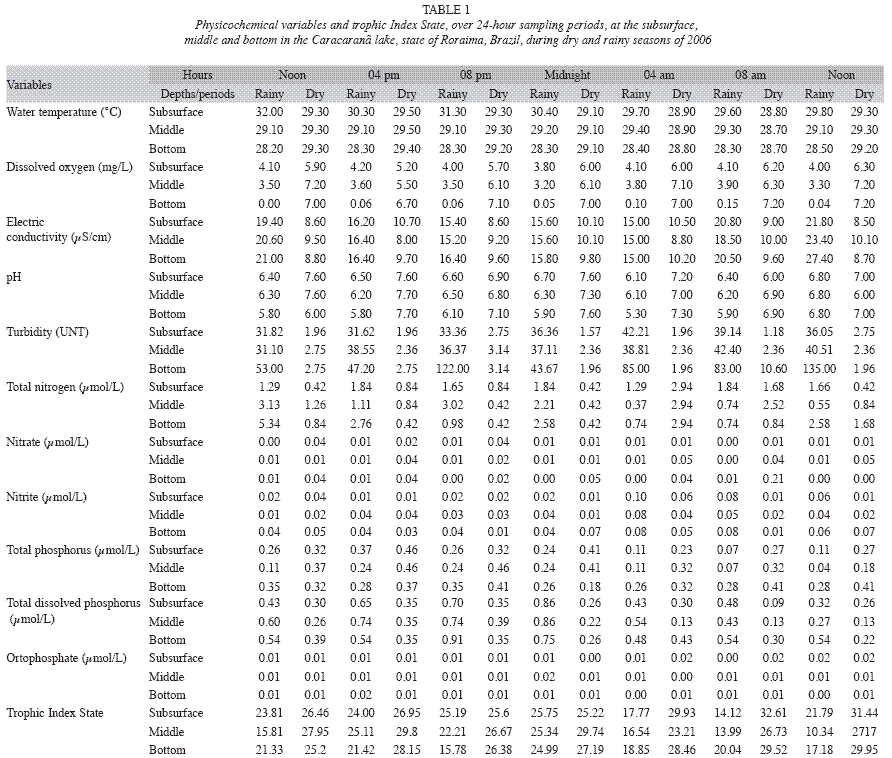
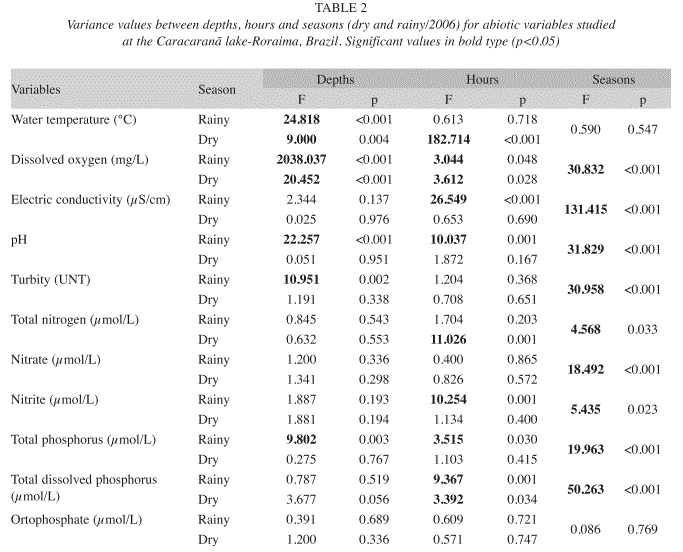
<body><![CDATA[<p style="text-align: justify;"><font face="Verdana" size="2">Densities (individuals per microliter) were estimated based on the method described by Uterm&ouml;hl (1958), using an inverted microscope (Zeiss, Axiovert). Organism counts were carried out with two repetitions for each depth sampled; the values are presented as the mean of the repetitions. The calculations were carried out based on the method described by Villafai&ntilde;e &amp; Reid (1995). Dominant and abundant species were determined based on the concepts described by Lobo &amp; Leighton (1986), for which a dominant species is that which surpasses 50% of the total phytoplankton density and an abundant species is that with a density value greater than the mean value of the community. The values are presented as the mean of the repetitions.</font></p>     <div style="text-align: justify;"></div>     <p style="text-align: justify;"><font face="Verdana" size="2">Analysis of variance (ANOVA) was used with a 5% level of significance to determine the degree of temporal variation (time of day and season), seasonal period and spatial variation (depth). Tukey&#8217;s multiple comparison tests was used to identify where differences were expressed in time and space. Analyses were performed using the Statistica 2004 software program (StatSoft, Inc., Tulsa, OK, USA). The Shannon-Wiener diversity index (H', bits/ind) was calculated (Shannon &amp; Weaver 1963); Evenness was assessed based on the H' of the Shannon-Wiener index. Canonical correspondence analysis (CCA) was used to determine correlations between biotic and abiotic variables. Only abundant and dominant species were considered for the analysis. The PC-ORD version 4.14 for Windows was used for the statistical analysis (McCune &amp; Mefford 1999).</font></p> <b><font face="Verdana" size="3">     <p>Results</p> </font></b><font size="2"> </font>     <p style="text-align: justify;"><font face="Verdana" size="2">Lake Caracaran&atilde; has high light availability, with transparency values of 2.90m in the rainy season and 2.00m in the dry season. High water temperatures occurred in both seasons. Thermal stratification occurred in the rainy season and there was no stratification in the dry season. Dissolved oxygen exhibited a clinograde pattern in the rainy season and high oxygenation in the hypolimnion in the dry season. Vertical variations were also recorded for pH, turbidity and total phosphorus in the rainy season, with the water near the sediment more acidic, turbid and with a greater concentration of phosphorus (<a href="/img/revistas/rbt/v58n4/a29t1.gif">Table 1</a>). The other parameters did not exhibit statistically significant vertical differences (p&gt;0.05) (<a href="/img/revistas/rbt/v58n4/a29t2.gif">Table 2</a>). Based on physiochemical characteristics, Lake Caracaran&atilde; is classified as an ultra-oligotrophic to oligotrophic system (<a  href="/img/revistas/rbt/v58n4/a29t1.gif">Table 1</a>).</font></p>     <div style="text-align: justify;"></div>     <p style="text-align: justify;"><font face="Verdana" size="2">Dissolved oxygen, conductivity, pH, nitrite, total phosphorus and total dissolved phosphorus exhibited significant diel variations in the rainy season, whereas water temperature, dissolved oxygen, total nitrogen and total dissolved phosphorus exhibited significant differences between times of the day in the dry season (p&lt;0.05) (<a href="/img/revistas/rbt/v58n4/a29t2.gif">Table 2</a>).</font></p>     <div style="text-align: justify;"></div>     <p style="text-align: justify;"><font face="Verdana" size="2">Significant seasonal differences were found for the abiotic variables, except water temperature and orthophosphate (p&gt;0.05) (<a href="/img/revistas/rbt/v58n4/a29t2.gif">Table 2</a>). Conductivity, turbidity, total nitrogen, nitrite and total dissolved phosphorus values were greater in the rainy season, whereas dissolved oxygen, pH, nitrate and total phosphorus were greater in the dry season (<a  href="/img/revistas/rbt/v58n4/a29t1.gif">Table 1</a>).</font></p>     <div style="text-align: justify;"></div>     ]]></body>
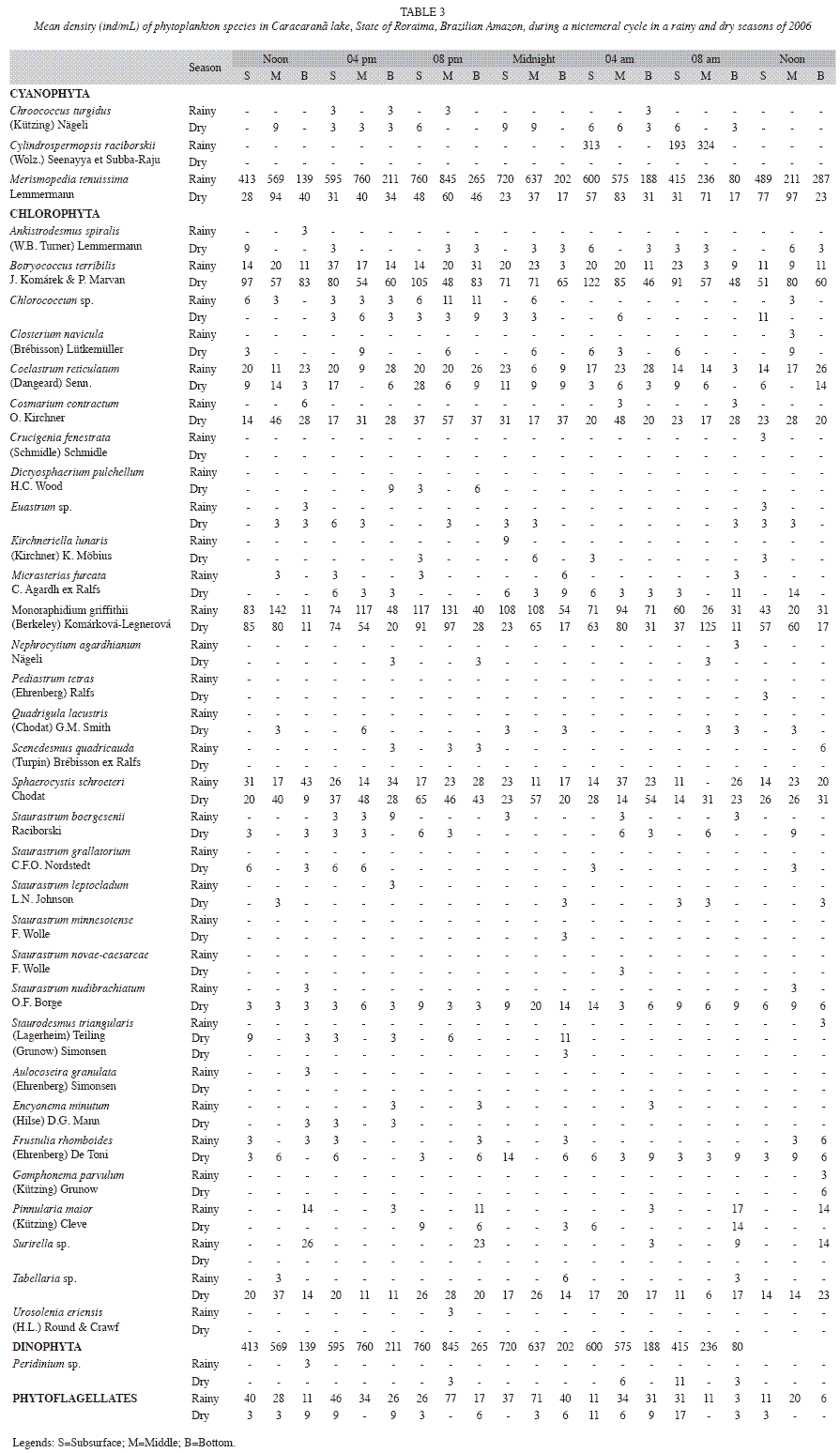
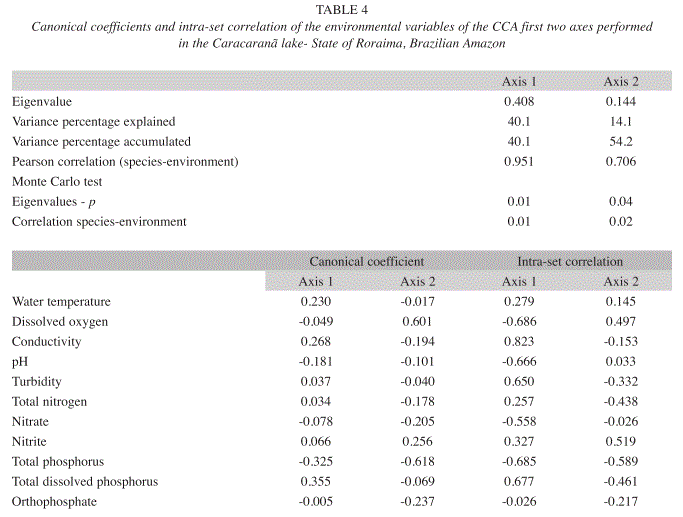
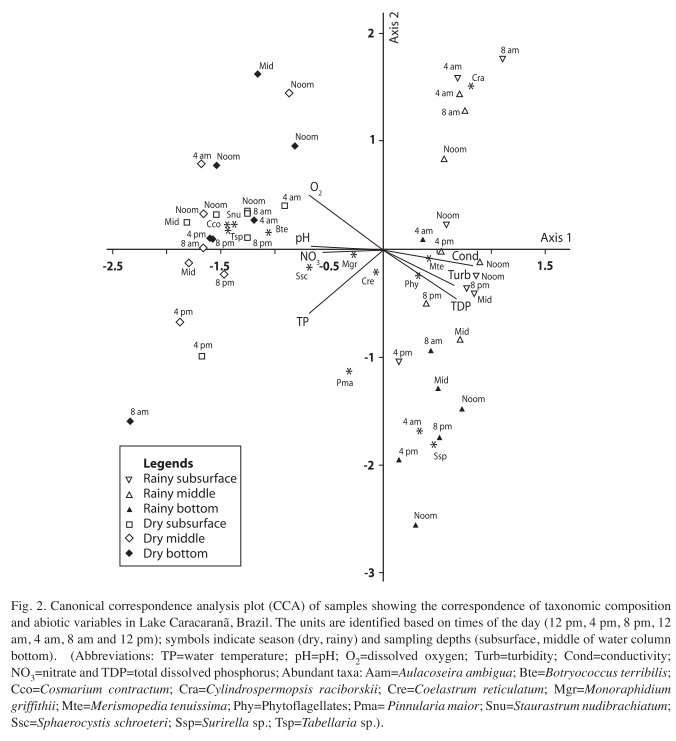
<body><![CDATA[<p style="text-align: justify;"><font face="Verdana" size="2">The phytoplankton comprised 39 taxa (<a href="/img/revistas/rbt/v58n4/a29t3.gif">Table 3</a>), with five identified on the genus level, 33 species and one group of phytoflagellates. Chlorophyta contributed the greatest species richness, totaling 25 taxa. Among the Chlorophyta, the desmids were the most diverse, accounting for 52% of the taxa of this division. The genus with the greatest number of species was <i>Staurastrum </i>(six species). Bacillariophyta was the second most diverse division, with nine species. Cyanophyta was represented by just three species.</font></p>     <div style="text-align: justify;"></div>     <p style="text-align: justify;"><font face="Verdana" size="2">Low phytoplankton densities were encountered throughout the study, with densities ranging from 202 individuals/mL (at the bottom, at 8 am in both seasons) to 1 135 ind/mL (in the middle of the water column at 8 pm in the rainy season) (<a  href="/img/revistas/rbt/v58n4/a29t3.gif">Table 3</a>). No significant variations in phytoplankton density were found between times in either the dry or the rainy season (p&gt;0.05). Total density exhibited significant vertical differences (p&lt;0.001) in both seasons (F=17.063 in the dry season; F=18.531 in the rainy season), with significantly lower values at the subsurface (p&lt;0.01).</font></p>     <div style="text-align: justify;"></div>     <p style="text-align: justify;"><font face="Verdana" size="2">Cyanophyta were dominant (73.41% of the total density) in the rainy season, whereas Chlorophyta were dominant (73.08%) in the dry season (<a href="/img/revistas/rbt/v58n4/a29i1.jpg">Figure 1A</a> and <a href="/img/revistas/rbt/v58n4/a29i1.jpg">1B</a>). Cyanophyta was abundant in 100% of the samples; Chlorophyta in 95.24%; Bacillariophyta in 42.86%; and phytoflagellates were abundant in just 2.38%. Thirteen taxa were classified as abundant, with the predominance of: <i>Merismopedia tenuissima </i>Lemmermann (50.66%), <i>Monoraphidium griffithii </i>(Berkeley) Kom&aacute;rkov&aacute;-Legnerov&aacute; (12.97%), <i>Botryococcus terribilis </i>J. Kom&aacute;rek &amp; P. Marvan (9.23%) and <i>Sphaerocystis schroeteri </i>Chodat (5.65%), (<a href="/img/revistas/rbt/v58n4/a29t3.gif">Table 3</a>).</font></p>     <p><font face="Verdana" size="2"> </font></p>     <p style="text-align: justify;"><font face="Verdana" size="2">Diel variations in the Shannon-Wiener diversity index ranged from 1.05 to 2.91 in the rainy season and 2.66 to 3.57 in the dry season. The phytoplankton community exhibited low evenness (0.35 to 0.75) in the rainy season and high evenness (0.70 to 0.87) in the dry season. Low evenness was associated with the predominance of <i>Merismopedia tenuissima</i>, which had higher density in the rainy season than the dry season.</font></p>     <div style="text-align: justify;"></div>     <p style="text-align: justify;"><font face="Verdana" size="2">The results of the canonical correspondence analysis (CCA) are displayed in <a  href="/img/revistas/rbt/v58n4/a29t4.gif">Table 4</a> and <a  href="/img/revistas/rbt/v58n4/a29i2.jpg">Figure 2</a>. The Monte Carlo test demonstrated that Axes 1 and 2 achieved statistical significance (p&lt;0.05), indicating correlations between the environmental variables and the phytoplankton community. The values of Axes 1 and 2 explained 54.2% of the variability in the data. Pearson&#8217;s correlation coefficient for the axes indicated a strong correlation between species and environmental variables.</font></p>     <div style="text-align: justify;"></div>     ]]></body>
<body><![CDATA[<p style="text-align: justify;"><font face="Verdana" size="2">On Axis 1, there was a separation of the sample units between the rainy and dry seasons. An analysis of the intra-set correlation coefficient reveals that conductivity, turbidity and total dissolved phosphorus were associated with the rainy season, whereas dissolved oxygen, pH, nitrate and total phosphorus were associated with the dry season. <i>Merismopedia tenuissima </i>and phytoflagellates were the most important taxa on this axis and associated with the rainy season. The following species were associated with the dry season: <i>Botryococcus terribilis</i>, <i>Cosmarium contractum</i>, <i>Monoraphidium griffithii</i>, <i>Sphaerocystis schroeteri</i>, <i>Staurastrum nudibrachiatum </i>and <i>Tabellaria </i>sp.</font></p>     <div style="text-align: justify;"></div>     <p style="text-align: justify;"><font face="Verdana" size="2">On Axis 2, there was vertical separation of the samples in both seasons. This axis revealed diel variation in the rainy season. Based on the canonical coefficient, the most important variables were dissolved oxygen and total phosphorus. The following species were associated with this axis: <i>Aulacoseira ambigua</i>, <i>Cylindrospermopsis raciborskii</i>, <i>Pinnularia maior </i>and <i>Surirella </i>sp.</font></p>     <p><b><font face="Verdana" size="3">Discussion</font></b></p> <font size="2"> </font><font face="Verdana" size="2"></font>     <p style="text-align: justify;"><font face="Verdana" size="2">Studies carried out in the Amazon have demonstrated that thermal behavior is a determinant factor in the daily variety of a number of limnological variables, whether in the reduction of dissolved oxygen or in the accumulation of nutrients at greater depths (Tundisi <i>et al</i>. 1984, Esteves <i>et al</i>. 1994). Pivato <i>et al</i>. (2006) found chemical stratification accompanied by thermal stratification in the Corumb&aacute; reservoir in Central-Western Brazil, with lower dissolved oxygen values at greater depths. In Lake Caracaran&atilde;, thermal stratification occurred in the rainy season, whereas the water column was homogeneous in the dry season. The clinograde profile in this lake may likewise be associated with thermal stratification.</font></p>     <div style="text-align: justify;"></div>     <p style="text-align: justify;"><font face="Verdana" size="2">The low pH values recorded in Lake Caracaran&atilde; corroborate findings on waters in ecosystems in the state of Roraima (Menezes, unpublished data), other areas of the Amazon (Sioli 1991, Panosso &amp; Kubrusly 2000) and other regions of the country (Esp&iacute;ndola <i>et al</i>. 1996, Dellamano-Oliveira <i>et al</i>. 2003). These values are associated with the acidic characteristics of the soils in savanna areas, decomposition of aquatic macrophytes (which release organic acids) and geochemical characteristics of the region.</font></p>     <div style="text-align: justify;"></div>     <p style="text-align: justify;"><font face="Verdana" size="2">The low conductivity values associated with low turbidity indicate that the waters of Lake Caracaran&atilde; have good quality. These results are similar to those described by other authors for different ecosystems in the Amazon and a savannah region in Brazil (Panosso &amp; Kubrusly 2000, Pivato <i>et al</i>. 2006).</font></p>     <div style="text-align: justify;"></div>     ]]></body>
<body><![CDATA[<p style="text-align: justify;"><font face="Verdana" size="2">Lake Caracaran&atilde; has low nutrient values due to the fact that it drains relatively nutrientpoor terrains, particularly tertiary sediments from the Boa Vista Formation that make up the drainage basin of this lake (Filho <i>et al. </i>1997). The low concentration of nutrients was confirmed by the Trophic State Index calculated for the two circadian cycles.</font></p>     <div style="text-align: justify;"></div>     <p style="text-align: justify;"><font face="Verdana" size="2">The composition of species found in Lake Caracaran&atilde; and the greater number of taxa from the Chlorophyta division are similar to findings reported in previous studies on Brazilian lakes (Huszar 1996a; Nogueira &amp; Leandro-Rodrigues 1999; Oliveira &amp; Calheiros 2000; Nabout <i>et al</i>. 2006). All of these surveys found have a high diversity of Chlorophyta. In Amazon waters, desmids are considered an important group due to the acidic conditions of the waters (Huszar 1996b, 2000, Keppeler <i>et al</i>. 1999a, 1999b).</font></p>     <div style="text-align: justify;"></div>     <p style="text-align: justify;"><font face="Verdana" size="2">Nabout <i>et al</i>. (2006) identified 292 species of algae in 21 lakes on the flood plains of the Araguaia River, with Chlorophyceae as the dominant group. Melo <i>et al</i>. (2004) recorded 108 phytoplankton taxa for the Batata and Mussur&aacute; Lakes of the Brazilian Amazon. In Lake Caracaran&atilde;, the number of phytoplankton taxa was lower than that described in the studies cited above, but comparable to values described by Esp&iacute;ndola <i>et al</i>. (1996) in the Pantanal wetlands of Brazil (83 taxa) as well as values described by Diaz <i>et al</i>. (1998) in Argentine lakes (40 taxa); in these studies, sampling efforts were greater, carried out over a period of one year and 11 months, respectively. The number of taxa was also similar to that described by Pivato <i>et al</i>. (2006) in an aquatic environment in a savanna region in Brazil (58 taxa), with nicthemeral collections in two seasonal periods, as in the present study.</font></p>     <div style="text-align: justify;"></div>     <p style="text-align: justify;"><font face="Verdana" size="2">The low densities of phytoplankton, homogeneity in the distribution of algae among the time of the day and a vertical and seasonal variations observed in Lake Caracaran&atilde; are the results of the oligotrophic condition of the system. Melo <i>et al</i>. (2004) report low phytoplankton densities for Amazon lakes. Occasional, limited blooms occurred, with densities of <i>Botryococcus terribilis</i>, <i>Cylindrospermopsis raciborskii</i>, <i>Merismopedia tenuissima </i>and <i>Monoraphidium griffithii </i>had densities greater than 100 ind/mL in at least one sampling unit. Based on CCA, the high density of Chlorophyta was attributed to higher pH values and concentrations of dissolved oxygen, total phosphorus and nitrate. The greater density of <i>M. tenuissima </i>is explained by higher conductivity and turbidity values as well as concentrations of total dissolved phosphorus, whereas the occurrence of <i>C. raciborskii </i>was associated with oxygenated layers of water in the rainy season.</font></p>     <p style="text-align: justify;"><font face="Verdana" size="2">Lake Caracaran&atilde; is a typical oligotrophic Amazonian lake, with low species richness and low algae densities. Knowledge on the phytoplankton in this lake contributes toward knowledge on algal diversity in a lake located on an indigenous reservation in the Brazilian Amazon. The occurrence of potentially toxic algae, such as <i>C. raciborskii, </i>does not indicate that the lake is undergoing a process of eutrophication, but monitoring is necessary in order to avoid future blooms. The occurrence of this species is the result of the shallow depth of Lake Caracaran&atilde; as well as its high temperatures and availability of light. Despite the occurrence of taxa that indicate organic pollution, the biomass and frequency of these taxa indicate that the system is not currently threatened.</font></p> <b><font face="Verdana" size="3">     <p>Acknowledgments</p> </font></b><font size="2"> </font><font face="Verdana" size="2">     <p>The authors are grateful to the Brazilian fostering agency Coordena&ccedil;&atilde;o de Aperfei&ccedil;oamento de Pessoal do Ensino Superior (CAPES - PQI 42).</p> </font><font size="2"> </font><b><font face="Verdana" size="3"></font></b> <hr style="width: 100%; height: 2px;"><b><font face="Verdana" size="3">     ]]></body>
<body><![CDATA[<p>References</p> </font></b><font size="2"> </font><font face="Verdana" size="2"></font>     <!-- ref --><p><font face="Verdana" size="2">Dellamano-Oliveira, M.J., P.A.C. Senna &amp; G.M. Taniguchi. 2003. Limnological characteristics and seasonal changes in density and diversity of the phytoplanktonic community at the Ca&ccedil;&oacute;-Pond, Maranh&atilde;o State, Brazil. Arch. Biol. Technol. 46: 641-651.    &nbsp;&nbsp;&nbsp;&nbsp;&nbsp;&nbsp;&nbsp;&nbsp;[&#160;<a href="javascript:void(0);" onclick="javascript: window.open('/scielo.php?script=sci_nlinks&ref=1407311&pid=S0034-7744201000040002900001&lng=','','width=640,height=500,resizable=yes,scrollbars=1,menubar=yes,');">Links</a>&#160;]<!-- end-ref --></font></p>     <!-- ref --><p><font face="Verdana" size="2">Diaz, M.M., F.L. Pedroso &amp; P.F. Temporetti. 1998. Phytoplankton of two Araucanian lakes of differing trophic status (Argentina). Hydrobiologia 369/370: 45-57.    &nbsp;&nbsp;&nbsp;&nbsp;&nbsp;&nbsp;&nbsp;&nbsp;[&#160;<a href="javascript:void(0);" onclick="javascript: window.open('/scielo.php?script=sci_nlinks&ref=1407313&pid=S0034-7744201000040002900002&lng=','','width=640,height=500,resizable=yes,scrollbars=1,menubar=yes,');">Links</a>&#160;]<!-- end-ref --></font></p>     <!-- ref --><p><font face="Verdana" size="2">Domitrovic, Y.Z. 2003. Effect of fluctuations in water level on phytoplankton development in three lakes of the Paran&aacute; River floodplain (Argentina). Hydrobiologia 510<b>: </b>175-193.    &nbsp;&nbsp;&nbsp;&nbsp;&nbsp;&nbsp;&nbsp;&nbsp;[&#160;<a href="javascript:void(0);" onclick="javascript: window.open('/scielo.php?script=sci_nlinks&ref=1407315&pid=S0034-7744201000040002900003&lng=','','width=640,height=500,resizable=yes,scrollbars=1,menubar=yes,');">Links</a>&#160;]<!-- end-ref --></font></p>     <!-- ref --><p><font face="Verdana" size="2">Esp&iacute;ndola, E.G., T. Matsumura-Tundisi &amp; I.D. Moreno. 1996. Estrutura da comunidade fitoplanct&ocirc;nica da lagoa Albuquerque (Pantanal Matogrossense), Mato Grosso do Sul, Brasil. Acta Limnol. Bras. 8: 13-37.    &nbsp;&nbsp;&nbsp;&nbsp;&nbsp;&nbsp;&nbsp;&nbsp;[&#160;<a href="javascript:void(0);" onclick="javascript: window.open('/scielo.php?script=sci_nlinks&ref=1407317&pid=S0034-7744201000040002900004&lng=','','width=640,height=500,resizable=yes,scrollbars=1,menubar=yes,');">Links</a>&#160;]<!-- end-ref --></font></p>     <!-- ref --><p><font face="Verdana" size="2">Esteves, F.A., S.M. Thomaz &amp; F. Roland. 1994. Comparison of the metabolism of two floodplain lakes of the Trombetas River (Par&aacute;, Brazil) based on study of diel variation. Amazoniana 13: 33-46.    &nbsp;&nbsp;&nbsp;&nbsp;&nbsp;&nbsp;&nbsp;&nbsp;[&#160;<a href="javascript:void(0);" onclick="javascript: window.open('/scielo.php?script=sci_nlinks&ref=1407319&pid=S0034-7744201000040002900005&lng=','','width=640,height=500,resizable=yes,scrollbars=1,menubar=yes,');">Links</a>&#160;]<!-- end-ref --></font></p>     <!-- ref --><p><font face="Verdana" size="2">Filho, F.S., B. Turcq, A.C. Filho &amp; A.G. Souza. 1997. Registros sedimentares de lagos e brejos dos campos de Roraima: implica&ccedil;&otilde;es paleoambientais ao longo do Holoceno, p.295-305. <i>In </i>R.I. Barbosa, E.J.G. Ferreira &amp; E.G. Castell&oacute;n (eds.). Homem, Ambiente e Ecologia no Estado de Roraima. Manaus, INPA, Brasil.    &nbsp;&nbsp;&nbsp;&nbsp;&nbsp;&nbsp;&nbsp;&nbsp;[&#160;<a href="javascript:void(0);" onclick="javascript: window.open('/scielo.php?script=sci_nlinks&ref=1407321&pid=S0034-7744201000040002900006&lng=','','width=640,height=500,resizable=yes,scrollbars=1,menubar=yes,');">Links</a>&#160;]<!-- end-ref --></font></p>     <!-- ref --><p><font face="Verdana" size="2">Golterman, H.L., R.S. Clymo &amp; M.Am Ohnstad. 1978. Methods or physical and chemical analysis of freshwater. IBP Handbook N&deg;8 Blackwell, Oxford, England.    &nbsp;&nbsp;&nbsp;&nbsp;&nbsp;&nbsp;&nbsp;&nbsp;[&#160;<a href="javascript:void(0);" onclick="javascript: window.open('/scielo.php?script=sci_nlinks&ref=1407323&pid=S0034-7744201000040002900007&lng=','','width=640,height=500,resizable=yes,scrollbars=1,menubar=yes,');">Links</a>&#160;]<!-- end-ref --></font></p>     <!-- ref --><p><font face="Verdana" size="2">Gr&ouml;nblad, R. 1945. De algis brasiliensisbus praecipue desmidiales, in regione inferiors, fluminis Amazonas e professore August Ginberger (Wien) MCMXVII collectis. Acta Soc. Sci. Fenn. Ser. B 2: 1-43.    &nbsp;&nbsp;&nbsp;&nbsp;&nbsp;&nbsp;&nbsp;&nbsp;[&#160;<a href="javascript:void(0);" onclick="javascript: window.open('/scielo.php?script=sci_nlinks&ref=1407325&pid=S0034-7744201000040002900008&lng=','','width=640,height=500,resizable=yes,scrollbars=1,menubar=yes,');">Links</a>&#160;]<!-- end-ref --></font></p>     <!-- ref --><p><font face="Verdana" size="2">Huszar, V.L.M. 1996a. Floristic composition and biogeographical aspects of phytoplankton of an Amazonian floodplain lake (Lago Batata, Par&aacute;, Brasil). Acta Limnol. Bras. 8: 127-136.    &nbsp;&nbsp;&nbsp;&nbsp;&nbsp;&nbsp;&nbsp;&nbsp;[&#160;<a href="javascript:void(0);" onclick="javascript: window.open('/scielo.php?script=sci_nlinks&ref=1407327&pid=S0034-7744201000040002900009&lng=','','width=640,height=500,resizable=yes,scrollbars=1,menubar=yes,');">Links</a>&#160;]<!-- end-ref --></font></p>     <!-- ref --><p><font face="Verdana" size="2">Huszar, V.L.M. 1996b. Planktonic algae other than desmids, of three Amazonian Systems Lake (Lake Batata, Lake Mussur&aacute; and Trombetas River), Par&aacute;, Brazil. Amazoniana 14: 37-73.    &nbsp;&nbsp;&nbsp;&nbsp;&nbsp;&nbsp;&nbsp;&nbsp;[&#160;<a href="javascript:void(0);" onclick="javascript: window.open('/scielo.php?script=sci_nlinks&ref=1407329&pid=S0034-7744201000040002900010&lng=','','width=640,height=500,resizable=yes,scrollbars=1,menubar=yes,');">Links</a>&#160;]<!-- end-ref --></font></p>     <!-- ref --><p><font face="Verdana" size="2">Huszar,V.L.M. &amp; C.S. Reynolds. 1997. Phytoplankton periodicity and sequences of dominance in an Amazonian flood-plain lake (Lago Batata, Par&aacute;, Brasil): responses to gradual environmental change. Hydrobiologia 346: 169-181.    &nbsp;&nbsp;&nbsp;&nbsp;&nbsp;&nbsp;&nbsp;&nbsp;[&#160;<a href="javascript:void(0);" onclick="javascript: window.open('/scielo.php?script=sci_nlinks&ref=1407331&pid=S0034-7744201000040002900011&lng=','','width=640,height=500,resizable=yes,scrollbars=1,menubar=yes,');">Links</a>&#160;]<!-- end-ref --></font></p>     <!-- ref --><p><font face="Verdana" size="2">Huszar,V.L.M., L. Silva, P. Domingos, M. Marinho &amp; S. Melo. 1998. Phytoplankton species composition is more sensitive than OECD criteria to the trophic status of three Brazilian tropical lakes. Hydrobiologia 369/370: 59-72.    &nbsp;&nbsp;&nbsp;&nbsp;&nbsp;&nbsp;&nbsp;&nbsp;[&#160;<a href="javascript:void(0);" onclick="javascript: window.open('/scielo.php?script=sci_nlinks&ref=1407333&pid=S0034-7744201000040002900012&lng=','','width=640,height=500,resizable=yes,scrollbars=1,menubar=yes,');">Links</a>&#160;]<!-- end-ref --></font></p>     <!-- ref --><p><font face="Verdana" size="2">Huszar, V.L.M. 2000. Fitopl&acirc;ncton, p. 91-104. <i>In </i>R.L Bozelli, F.A. Esteves &amp; F. Roland (eds.). Lago Batata: impacto e recupera&ccedil;&atilde;o de um ecossistema amaz&ocirc;nico. Rio de Janeiro, UFRJ/SBL, Brasil.    &nbsp;&nbsp;&nbsp;&nbsp;&nbsp;&nbsp;&nbsp;&nbsp;[&#160;<a href="javascript:void(0);" onclick="javascript: window.open('/scielo.php?script=sci_nlinks&ref=1407335&pid=S0034-7744201000040002900013&lng=','','width=640,height=500,resizable=yes,scrollbars=1,menubar=yes,');">Links</a>&#160;]<!-- end-ref --></font></p>     <!-- ref --><p><font face="Verdana" size="2">Iba&ntilde;ez, M.S.R. 1998. Phytoplankton composition and abundance of a central Amazonian floodplain lake. Hydrobiologia 362: 78-83.    &nbsp;&nbsp;&nbsp;&nbsp;&nbsp;&nbsp;&nbsp;&nbsp;[&#160;<a href="javascript:void(0);" onclick="javascript: window.open('/scielo.php?script=sci_nlinks&ref=1407337&pid=S0034-7744201000040002900014&lng=','','width=640,height=500,resizable=yes,scrollbars=1,menubar=yes,');">Links</a>&#160;]<!-- end-ref --></font></p>     <!-- ref --><p><font face="Verdana" size="2">Izaguirre, I., I. O&#8217;Farrell &amp; G. Tell. 2001. Variation in phytoplankton composition and limnological features in a water-water ecotone of the Lower Paran&aacute; Basin (Argentina). Freshw. Biol. 46: 63-74.    &nbsp;&nbsp;&nbsp;&nbsp;&nbsp;&nbsp;&nbsp;&nbsp;[&#160;<a href="javascript:void(0);" onclick="javascript: window.open('/scielo.php?script=sci_nlinks&ref=1407339&pid=S0034-7744201000040002900015&lng=','','width=640,height=500,resizable=yes,scrollbars=1,menubar=yes,');">Links</a>&#160;]<!-- end-ref --></font></p>     <!-- ref --><p><font face="Verdana" size="2">Kangurt, K., T. Mols, A. Milius &amp; R. Laugaste. 2003. Phytoplankton response to changed nutrient level in Lake Peipsi (Estonia) in 1992-2001. Hydrobiologia 506-509: 265-272.    &nbsp;&nbsp;&nbsp;&nbsp;&nbsp;&nbsp;&nbsp;&nbsp;[&#160;<a href="javascript:void(0);" onclick="javascript: window.open('/scielo.php?script=sci_nlinks&ref=1407341&pid=S0034-7744201000040002900016&lng=','','width=640,height=500,resizable=yes,scrollbars=1,menubar=yes,');">Links</a>&#160;]<!-- end-ref --></font></p>     <!-- ref --><p><font face="Verdana" size="2">Keppeler, E.C., M.R.M. Lopes &amp; C.S. Lima. 1999a. Ficofl&oacute;rula do lago Amap&aacute; em Rio Branco-Acre, I: Euglenophyceae. Rev. Bras. Biol. 59: 679-686.    &nbsp;&nbsp;&nbsp;&nbsp;&nbsp;&nbsp;&nbsp;&nbsp;[&#160;<a href="javascript:void(0);" onclick="javascript: window.open('/scielo.php?script=sci_nlinks&ref=1407343&pid=S0034-7744201000040002900017&lng=','','width=640,height=500,resizable=yes,scrollbars=1,menubar=yes,');">Links</a>&#160;]<!-- end-ref --></font></p>     <!-- ref --><p><font face="Verdana" size="2">Keppeler, E.C., M.R.M. Lopes &amp; C.S. Lima. 1999b. Ficofl&oacute;rula do lago Amap&aacute; em Rio Branco-Acre, II: Chlorophyta. Rev. Bras. Biol. 59: 687-691.    &nbsp;&nbsp;&nbsp;&nbsp;&nbsp;&nbsp;&nbsp;&nbsp;[&#160;<a href="javascript:void(0);" onclick="javascript: window.open('/scielo.php?script=sci_nlinks&ref=1407345&pid=S0034-7744201000040002900018&lng=','','width=640,height=500,resizable=yes,scrollbars=1,menubar=yes,');">Links</a>&#160;]<!-- end-ref --></font></p>     <!-- ref --><p><font face="Verdana" size="2">Kom&aacute;rkov&aacute;, J. &amp; R. Tavera. 2003. Steady state of phytoplankton assemblage in the tropical Lake Catemaco (Mexico). Hydrobiologia 502: 187-196.    &nbsp;&nbsp;&nbsp;&nbsp;&nbsp;&nbsp;&nbsp;&nbsp;[&#160;<a href="javascript:void(0);" onclick="javascript: window.open('/scielo.php?script=sci_nlinks&ref=1407347&pid=S0034-7744201000040002900019&lng=','','width=640,height=500,resizable=yes,scrollbars=1,menubar=yes,');">Links</a>&#160;]<!-- end-ref --></font></p>     <!-- ref --><p><font face="Verdana" size="2">Kratzer, C.R. &amp; P.L. Brezonik. 1981 A Carlson type trophic state index for nitrogen in Florida lakes<i>. </i>Water Resour. Bull. 17: 713-714.    &nbsp;&nbsp;&nbsp;&nbsp;&nbsp;&nbsp;&nbsp;&nbsp;[&#160;<a href="javascript:void(0);" onclick="javascript: window.open('/scielo.php?script=sci_nlinks&ref=1407349&pid=S0034-7744201000040002900020&lng=','','width=640,height=500,resizable=yes,scrollbars=1,menubar=yes,');">Links</a>&#160;]<!-- end-ref --></font></p>     <!-- ref --><p><font face="Verdana" size="2">Kristiansen, J. &amp; M. Menezes. 1998. Silica-scaled Chrysophytes from an Amazonian floodplain lake, Mussar&aacute; Lake, northern Brazil. Algol. Stud. 90: 97-118.    &nbsp;&nbsp;&nbsp;&nbsp;&nbsp;&nbsp;&nbsp;&nbsp;[&#160;<a href="javascript:void(0);" onclick="javascript: window.open('/scielo.php?script=sci_nlinks&ref=1407351&pid=S0034-7744201000040002900021&lng=','','width=640,height=500,resizable=yes,scrollbars=1,menubar=yes,');">Links</a>&#160;]<!-- end-ref --></font></p>     <!-- ref --><p><font face="Verdana" size="2">Lobo, E.A. &amp; G. Leighton. 1986. Estruturas comunit&aacute;rias de las fitocenosis planct&oacute;nicas de los sistemas de desembocaduras de r&iacute;os y esteros de la zona central de Chile. Rev. Biol. Mar. 22: 1-29.    &nbsp;&nbsp;&nbsp;&nbsp;&nbsp;&nbsp;&nbsp;&nbsp;[&#160;<a href="javascript:void(0);" onclick="javascript: window.open('/scielo.php?script=sci_nlinks&ref=1407353&pid=S0034-7744201000040002900022&lng=','','width=640,height=500,resizable=yes,scrollbars=1,menubar=yes,');">Links</a>&#160;]<!-- end-ref --></font></p>     <!-- ref --><p><font face="Verdana" size="2">Lopes, M.R.M. &amp; C.E.M. Bicudo. 2003. Desmidiofl&oacute;rula de um lago da plan&iacute;cie de inunda&ccedil;&atilde;o do Rio Acre, Estado do Amazonas, Brasil. Acta Amazon. 33: 167-212.    &nbsp;&nbsp;&nbsp;&nbsp;&nbsp;&nbsp;&nbsp;&nbsp;[&#160;<a href="javascript:void(0);" onclick="javascript: window.open('/scielo.php?script=sci_nlinks&ref=1407355&pid=S0034-7744201000040002900023&lng=','','width=640,height=500,resizable=yes,scrollbars=1,menubar=yes,');">Links</a>&#160;]<!-- end-ref --></font></p>     <!-- ref --><p><font face="Verdana" size="2">Maberly, S.C., L. King, M.M. Dent, R.I. Jones &amp; C.E. Gibson. 2002. Nutrient limitation of phytoplankton and periphyton growth in upland lakes. Freshw. Biol. 47: 2136-2152.    &nbsp;&nbsp;&nbsp;&nbsp;&nbsp;&nbsp;&nbsp;&nbsp;[&#160;<a href="javascript:void(0);" onclick="javascript: window.open('/scielo.php?script=sci_nlinks&ref=1407357&pid=S0034-7744201000040002900024&lng=','','width=640,height=500,resizable=yes,scrollbars=1,menubar=yes,');">Links</a>&#160;]<!-- end-ref --></font></p>     <!-- ref --><p><font face="Verdana" size="2">Mackereth, F.J.H., J. Heron &amp; J.F. Talling. 1978. Water analysis: some revised methods for limnologists. Kendall, Titus Wilson &amp; Son Ltd (Freshwater Biological Association. Scientific Publication N&deg; 36).    &nbsp;&nbsp;&nbsp;&nbsp;&nbsp;&nbsp;&nbsp;&nbsp;[&#160;<a href="javascript:void(0);" onclick="javascript: window.open('/scielo.php?script=sci_nlinks&ref=1407359&pid=S0034-7744201000040002900025&lng=','','width=640,height=500,resizable=yes,scrollbars=1,menubar=yes,');">Links</a>&#160;]<!-- end-ref --></font></p>     <!-- ref --><p><font face="Verdana" size="2">McCune, B. &amp; M.J. Mefford. 1999. PC-ORD for Windows. Multivariate Analysis of Ecological Data. MjM Software, Gleneden Beach, Oregon, USA.    &nbsp;&nbsp;&nbsp;&nbsp;&nbsp;&nbsp;&nbsp;&nbsp;[&#160;<a href="javascript:void(0);" onclick="javascript: window.open('/scielo.php?script=sci_nlinks&ref=1407361&pid=S0034-7744201000040002900026&lng=','','width=640,height=500,resizable=yes,scrollbars=1,menubar=yes,');">Links</a>&#160;]<!-- end-ref --></font></p>     <!-- ref --><p><font face="Verdana" size="2">Melo, S., V.L.M. Huszar, F. Roland, F.A. Esteves &amp; R. Bozelli. 2004. Phytoplankton diel variation and vertical distribution in two Amazonian floodplain lakes (Batata Lake and Mussur&aacute; Lake, Par&aacute;-Brasil) with different mixing regimes. Amazoniana 18: 1-10.    &nbsp;&nbsp;&nbsp;&nbsp;&nbsp;&nbsp;&nbsp;&nbsp;[&#160;<a href="javascript:void(0);" onclick="javascript: window.open('/scielo.php?script=sci_nlinks&ref=1407363&pid=S0034-7744201000040002900027&lng=','','width=640,height=500,resizable=yes,scrollbars=1,menubar=yes,');">Links</a>&#160;]<!-- end-ref --></font></p>     <!-- ref --><p><font face="Verdana" size="2">Menezes, M., C.G. Fonseca &amp; E.P. Nascimento. 1995. Algas de tr&ecirc;s ambientes de &aacute;guas claras do Munic&iacute;pio de Parintins, Estado do Amazonas, Brasil: Euglenophyceae e Dinophyceae. Hoehnea 22: 1-15.    &nbsp;&nbsp;&nbsp;&nbsp;&nbsp;&nbsp;&nbsp;&nbsp;[&#160;<a href="javascript:void(0);" onclick="javascript: window.open('/scielo.php?script=sci_nlinks&ref=1407365&pid=S0034-7744201000040002900028&lng=','','width=640,height=500,resizable=yes,scrollbars=1,menubar=yes,');">Links</a>&#160;]<!-- end-ref --></font></p>     <!-- ref --><p><font face="Verdana" size="2">Nabout, J.C., I.S. Nogueira &amp; L.G. Oliveira. 2006. Phytoplankton community of floodplain lakes of the Araguaia River, Brazil, in the rainy and dry seasons. J. Plankton Res. 28: 181-193.    &nbsp;&nbsp;&nbsp;&nbsp;&nbsp;&nbsp;&nbsp;&nbsp;[&#160;<a href="javascript:void(0);" onclick="javascript: window.open('/scielo.php?script=sci_nlinks&ref=1407367&pid=S0034-7744201000040002900029&lng=','','width=640,height=500,resizable=yes,scrollbars=1,menubar=yes,');">Links</a>&#160;]<!-- end-ref --></font></p>     <!-- ref --><p><font face="Verdana" size="2">Nogueira, I.S. &amp; N.C. Leandro-Rodrigues. 1999. Algas planct&ocirc;nicas de um lago artificial do Jardim Bot&acirc;nico Chico Mendes, Goi&acirc;nia, Goi&aacute;s: Flor&iacute;stica e algumas considera&ccedil;&otilde;es ecol&oacute;gicas. Rev. Bras. Biol. 59: 377- 395.    &nbsp;&nbsp;&nbsp;&nbsp;&nbsp;&nbsp;&nbsp;&nbsp;[&#160;<a href="javascript:void(0);" onclick="javascript: window.open('/scielo.php?script=sci_nlinks&ref=1407369&pid=S0034-7744201000040002900030&lng=','','width=640,height=500,resizable=yes,scrollbars=1,menubar=yes,');">Links</a>&#160;]<!-- end-ref --></font></p>     <!-- ref --><p><font face="Verdana" size="2">Oliveira, M.D. &amp; D.F. Calheiros. 2000. Flood pulse influence on phytoplankton communities of the south Pantanal floodplain, Brazil. Hydrobiologia 427: 101- 112.    &nbsp;&nbsp;&nbsp;&nbsp;&nbsp;&nbsp;&nbsp;&nbsp;[&#160;<a href="javascript:void(0);" onclick="javascript: window.open('/scielo.php?script=sci_nlinks&ref=1407371&pid=S0034-7744201000040002900031&lng=','','width=640,height=500,resizable=yes,scrollbars=1,menubar=yes,');">Links</a>&#160;]<!-- end-ref --></font></p>     <!-- ref --><p><font face="Verdana" size="2">Panosso, R. &amp; L. Kubrusly. 2000. Avalia&ccedil;&atilde;o espacial e temporal das vari&aacute;veis limnol&oacute;gicas b&aacute;sicas e nutrientes, p. 57-71. <i>In </i>R.L. Bozelli, F.A. Esteves &amp; F. Roland (eds.). Lago Batata: impacto e recupera&ccedil;&atilde;o de um ecossistema amaz&ocirc;nico. Rio de Janeiro, UFRJ/SBL, Brazil.    &nbsp;&nbsp;&nbsp;&nbsp;&nbsp;&nbsp;&nbsp;&nbsp;[&#160;<a href="javascript:void(0);" onclick="javascript: window.open('/scielo.php?script=sci_nlinks&ref=1407373&pid=S0034-7744201000040002900032&lng=','','width=640,height=500,resizable=yes,scrollbars=1,menubar=yes,');">Links</a>&#160;]<!-- end-ref --></font></p>     <!-- ref --><p><font face="Verdana" size="2">Pinilla, G.A. 2006. Vertical distribution of phytoplankton in a clear water lake of Colombian Amazon (Lake Boa, Middle Caquet&aacute;). Hydrobiologia 568: 79-90.    &nbsp;&nbsp;&nbsp;&nbsp;&nbsp;&nbsp;&nbsp;&nbsp;[&#160;<a href="javascript:void(0);" onclick="javascript: window.open('/scielo.php?script=sci_nlinks&ref=1407375&pid=S0034-7744201000040002900033&lng=','','width=640,height=500,resizable=yes,scrollbars=1,menubar=yes,');">Links</a>&#160;]<!-- end-ref --></font></p>     <!-- ref --><p><font face="Verdana" size="2">Pivato, M.B., S. Train &amp; L.C. Rodrigues. 2006. Din&acirc;mica nictemeral das assembl&eacute;ias fitoplanct&ocirc;nicas em um reservat&oacute;rio tropical (reservat&oacute;rio de Corumb&aacute;, Estado de Goi&aacute;s, Brasil), em dois per&iacute;odos do ciclo hidrol&oacute;gico. Acta Sci. Biol. Sci. 28: 19-29.    &nbsp;&nbsp;&nbsp;&nbsp;&nbsp;&nbsp;&nbsp;&nbsp;[&#160;<a href="javascript:void(0);" onclick="javascript: window.open('/scielo.php?script=sci_nlinks&ref=1407377&pid=S0034-7744201000040002900034&lng=','','width=640,height=500,resizable=yes,scrollbars=1,menubar=yes,');">Links</a>&#160;]<!-- end-ref --></font></p> <font size="2"> </font><font face="Verdana" size="2"></font>     <!-- ref --><p><font face="Verdana" size="2">Reynolds, C.S. 1998. What factors influence the species composition of phytoplankton in lakes of different trophic status? Hydrobiologia 369/370: 11-26.    &nbsp;&nbsp;&nbsp;&nbsp;&nbsp;&nbsp;&nbsp;&nbsp;[&#160;<a href="javascript:void(0);" onclick="javascript: window.open('/scielo.php?script=sci_nlinks&ref=1407379&pid=S0034-7744201000040002900035&lng=','','width=640,height=500,resizable=yes,scrollbars=1,menubar=yes,');">Links</a>&#160;]<!-- end-ref --></font></p>     <!-- ref --><p><font face="Verdana" size="2">Reynolds, C.S., V. Huszar, C. Kruk, L. Naselli-Flores &amp; S. Melo. 2002. Towards a functional classification of the freshwater phytoplankton. J. Plankton Res. 24: 417-428.    &nbsp;&nbsp;&nbsp;&nbsp;&nbsp;&nbsp;&nbsp;&nbsp;[&#160;<a href="javascript:void(0);" onclick="javascript: window.open('/scielo.php?script=sci_nlinks&ref=1407381&pid=S0034-7744201000040002900036&lng=','','width=640,height=500,resizable=yes,scrollbars=1,menubar=yes,');">Links</a>&#160;]<!-- end-ref --></font></p>     <!-- ref --><p><font face="Verdana" size="2">Rodrigo, M.A., C. Rojo &amp; L.X. Armengol. 2003. Plankton biodiversity in a landscape of shallow water bodies (Mediterranean coast, Spain). Hydrobiologia 506- 509: 317-326.    &nbsp;&nbsp;&nbsp;&nbsp;&nbsp;&nbsp;&nbsp;&nbsp;[&#160;<a href="javascript:void(0);" onclick="javascript: window.open('/scielo.php?script=sci_nlinks&ref=1407383&pid=S0034-7744201000040002900037&lng=','','width=640,height=500,resizable=yes,scrollbars=1,menubar=yes,');">Links</a>&#160;]<!-- end-ref --></font></p>     <!-- ref --><p><font face="Verdana" size="2">Roland, F. 2000. Produ&ccedil;&atilde;o prim&aacute;ria fitoplanct&ocirc;nica, p.107- 117. <i>In </i>R.L. Bozelli, F.A. Esteves &amp; F. Roland (eds.). Lago Batata: impacto e recupera&ccedil;&atilde;o de um ecossistema amaz&ocirc;nico. Rio de Janeiro: UFRJ/SBL, Brasil.    &nbsp;&nbsp;&nbsp;&nbsp;&nbsp;&nbsp;&nbsp;&nbsp;[&#160;<a href="javascript:void(0);" onclick="javascript: window.open('/scielo.php?script=sci_nlinks&ref=1407385&pid=S0034-7744201000040002900038&lng=','','width=640,height=500,resizable=yes,scrollbars=1,menubar=yes,');">Links</a>&#160;]<!-- end-ref --></font></p> <font size="2"> </font><font face="Verdana" size="2">     <!-- ref --><p>Roozen, F.C.J.M., G.J. Van Geest, B.W. Ibelings, R. Roijackers, M. Scheffer &amp; A.D. Buijse. 2003. Lake age and water level affect the turbidity of floodplain lakes along the lower Rhine. Freshw. Biol. 48: 519-531.    &nbsp;&nbsp;&nbsp;&nbsp;&nbsp;&nbsp;&nbsp;&nbsp;[&#160;<a href="javascript:void(0);" onclick="javascript: window.open('/scielo.php?script=sci_nlinks&ref=1407387&pid=S0034-7744201000040002900039&lng=','','width=640,height=500,resizable=yes,scrollbars=1,menubar=yes,');">Links</a>&#160;]<!-- end-ref --></p>     <!-- ref --><p>Roraima Environment and Technology Foundation. 1994. Roraima: O Brasil do hemisf&eacute;rio norte. Boa Vista, AMBTEC, Brasil.    &nbsp;&nbsp;&nbsp;&nbsp;&nbsp;&nbsp;&nbsp;&nbsp;[&#160;<a href="javascript:void(0);" onclick="javascript: window.open('/scielo.php?script=sci_nlinks&ref=1407389&pid=S0034-7744201000040002900040&lng=','','width=640,height=500,resizable=yes,scrollbars=1,menubar=yes,');">Links</a>&#160;]<!-- end-ref --></p>     <!-- ref --><p>Schagerl, M. &amp; S.O. Oduor. 2003. On the limnology of Lake Baringo (Kenya): II. Pelagic primary production and algal composition of Lake Baringo, Kenya. Hydrobiologia 506-509: 297-303.    &nbsp;&nbsp;&nbsp;&nbsp;&nbsp;&nbsp;&nbsp;&nbsp;[&#160;<a href="javascript:void(0);" onclick="javascript: window.open('/scielo.php?script=sci_nlinks&ref=1407391&pid=S0034-7744201000040002900041&lng=','','width=640,height=500,resizable=yes,scrollbars=1,menubar=yes,');">Links</a>&#160;]<!-- end-ref --></p>     <!-- ref --><p>Schemel, L.E., T.R. Sommer, A.B. Muller-Solger &amp; W. Harrell. 2004. Hydrologic variability, water chemistry, and phytoplankton biomass in a large floodplain of the Sacramento River, CA, USA. Hydrobiologia 513: 129-139.    &nbsp;&nbsp;&nbsp;&nbsp;&nbsp;&nbsp;&nbsp;&nbsp;[&#160;<a href="javascript:void(0);" onclick="javascript: window.open('/scielo.php?script=sci_nlinks&ref=1407393&pid=S0034-7744201000040002900042&lng=','','width=640,height=500,resizable=yes,scrollbars=1,menubar=yes,');">Links</a>&#160;]<!-- end-ref --></p>     <!-- ref --><p>Shannon, C.E. &amp; W. Weaver. 1963. The mathematical theory of communication. Urbana, Illinois University, USA.    &nbsp;&nbsp;&nbsp;&nbsp;&nbsp;&nbsp;&nbsp;&nbsp;[&#160;<a href="javascript:void(0);" onclick="javascript: window.open('/scielo.php?script=sci_nlinks&ref=1407395&pid=S0034-7744201000040002900043&lng=','','width=640,height=500,resizable=yes,scrollbars=1,menubar=yes,');">Links</a>&#160;]<!-- end-ref --></p>     <!-- ref --><p>Sioli, H. 1991. Amaz&ocirc;nia &#8211; Fundamentos da Ecologia da Maior Regi&atilde;o de Florestas Tropicais. Petr&oacute;polis, Vozes, Brasil.    &nbsp;&nbsp;&nbsp;&nbsp;&nbsp;&nbsp;&nbsp;&nbsp;[&#160;<a href="javascript:void(0);" onclick="javascript: window.open('/scielo.php?script=sci_nlinks&ref=1407397&pid=S0034-7744201000040002900044&lng=','','width=640,height=500,resizable=yes,scrollbars=1,menubar=yes,');">Links</a>&#160;]<!-- end-ref --></p>     <!-- ref --><p>Sophia, M.G. &amp; I.C.A. Dias. 1996. Algas de tr&ecirc;s ambientes de &aacute;guas claras do Munic&iacute;pio de Parintins, Estado do Amazonas, Brasil: Oedogoniophyceae. Hoehnea 23: 59-80.    &nbsp;&nbsp;&nbsp;&nbsp;&nbsp;&nbsp;&nbsp;&nbsp;[&#160;<a href="javascript:void(0);" onclick="javascript: window.open('/scielo.php?script=sci_nlinks&ref=1407399&pid=S0034-7744201000040002900045&lng=','','width=640,height=500,resizable=yes,scrollbars=1,menubar=yes,');">Links</a>&#160;]<!-- end-ref --></p> </font><font size="2"> </font><font face="Verdana" size="2">     <!-- ref --><p>Sophia, M.G. &amp; V.L.M. Huszar. 1996. Planktonic desmids of three Amazonian systems (Lake Batata, Lake Mussur&aacute; and Trombetas river), Par&aacute;, Brazil. Amazoniana 14: 75-90.    &nbsp;&nbsp;&nbsp;&nbsp;&nbsp;&nbsp;&nbsp;&nbsp;[&#160;<a href="javascript:void(0);" onclick="javascript: window.open('/scielo.php?script=sci_nlinks&ref=1407401&pid=S0034-7744201000040002900046&lng=','','width=640,height=500,resizable=yes,scrollbars=1,menubar=yes,');">Links</a>&#160;]<!-- end-ref --></p>     <!-- ref --><p>Souza, K.F., S. Melo &amp; F.F. Almeida. 2007. Desm&iacute;dias de um lago de inunda&ccedil;&atilde;o do Parque Nacional do Ja&uacute; (Amazonas &#8211; Brasil). Ver. Brasil. Bioc. 5: 24-26.    &nbsp;&nbsp;&nbsp;&nbsp;&nbsp;&nbsp;&nbsp;&nbsp;[&#160;<a href="javascript:void(0);" onclick="javascript: window.open('/scielo.php?script=sci_nlinks&ref=1407403&pid=S0034-7744201000040002900047&lng=','','width=640,height=500,resizable=yes,scrollbars=1,menubar=yes,');">Links</a>&#160;]<!-- end-ref --></p> </font><font size="2"> </font><font face="Verdana" size="2">     <!-- ref --><p>Strickland, J.D. &amp; T.R. Parsons. 1965. A manual of sea water analysis. Bull. Fish. Res. B. Can. 125: 1-185.    &nbsp;&nbsp;&nbsp;&nbsp;&nbsp;&nbsp;&nbsp;&nbsp;[&#160;<a href="javascript:void(0);" onclick="javascript: window.open('/scielo.php?script=sci_nlinks&ref=1407405&pid=S0034-7744201000040002900048&lng=','','width=640,height=500,resizable=yes,scrollbars=1,menubar=yes,');">Links</a>&#160;]<!-- end-ref --></p>     <!-- ref --><p>Takano, K., Y. Ishikawa, H. Mikami, S. Ban, T. Yoshida, T. Aono, K. Imada, R. Yasutomi, K. TakeuchI &amp; S. Hino. 2001. Analysis of the change in dominant phytoplankton species in unstratified Lake Oshima-Ohnuma estimated by a bottle incubation experiment. Limnology 2: 29-35.    &nbsp;&nbsp;&nbsp;&nbsp;&nbsp;&nbsp;&nbsp;&nbsp;[&#160;<a href="javascript:void(0);" onclick="javascript: window.open('/scielo.php?script=sci_nlinks&ref=1407407&pid=S0034-7744201000040002900049&lng=','','width=640,height=500,resizable=yes,scrollbars=1,menubar=yes,');">Links</a>&#160;]<!-- end-ref --></p>     <!-- ref --><p>Toledo Jr., A.P., M. Talarico, S.J. Chinez &amp; E.G. Agudo. 1983. A aplica&ccedil;&atilde;o de modelos simplificados para a avalia&ccedil;&atilde;o de processo da eutrofiza&ccedil;&atilde;o em lagos e reservat&oacute;rios tropicais, p. 1-34. <i>In </i>Anais do Congresso Brasileiro de Engenharia Sanit&aacute;ria e Ambiental, Cambori&uacute;, SC, Brasil.    &nbsp;&nbsp;&nbsp;&nbsp;&nbsp;&nbsp;&nbsp;&nbsp;[&#160;<a href="javascript:void(0);" onclick="javascript: window.open('/scielo.php?script=sci_nlinks&ref=1407409&pid=S0034-7744201000040002900050&lng=','','width=640,height=500,resizable=yes,scrollbars=1,menubar=yes,');">Links</a>&#160;]<!-- end-ref --></p>     <!-- ref --><p>Tundisi, J.G., B.R. Forsberg, A.H. Devol, T.M. Zaret, T.M. Tundisi, A. Santos, J.S. Ribeiro &amp; E.R. Hardy. 1984. Mixing patterns in Amazon lakes. Hydrobiologia 108: 3-15.    &nbsp;&nbsp;&nbsp;&nbsp;&nbsp;&nbsp;&nbsp;&nbsp;[&#160;<a href="javascript:void(0);" onclick="javascript: window.open('/scielo.php?script=sci_nlinks&ref=1407411&pid=S0034-7744201000040002900051&lng=','','width=640,height=500,resizable=yes,scrollbars=1,menubar=yes,');">Links</a>&#160;]<!-- end-ref --></p>     <!-- ref --><p>Uterm&ouml;hl, H. 1958. Zur vervollkommer der quantitative phytoplankton methodik. Mitt. Int. Ver. Theor. Angew. Limnol. 9: 1-38.    &nbsp;&nbsp;&nbsp;&nbsp;&nbsp;&nbsp;&nbsp;&nbsp;[&#160;<a href="javascript:void(0);" onclick="javascript: window.open('/scielo.php?script=sci_nlinks&ref=1407413&pid=S0034-7744201000040002900052&lng=','','width=640,height=500,resizable=yes,scrollbars=1,menubar=yes,');">Links</a>&#160;]<!-- end-ref --></p>     <!-- ref --><p>Valderrama, G.C. 1981. The simultaneous analysis of total nitrogen and total phosphorus in natural waters. Mar Chem. 10: 109-122.    &nbsp;&nbsp;&nbsp;&nbsp;&nbsp;&nbsp;&nbsp;&nbsp;[&#160;<a href="javascript:void(0);" onclick="javascript: window.open('/scielo.php?script=sci_nlinks&ref=1407415&pid=S0034-7744201000040002900053&lng=','','width=640,height=500,resizable=yes,scrollbars=1,menubar=yes,');">Links</a>&#160;]<!-- end-ref --></p>     <!-- ref --><p>Villafai&ntilde;e, V.E. &amp; F.M.H. Reid. 1995. M&eacute;todos de Microscop&iacute;a para la Cuantificaci&oacute;n del Fitoplancton. <i>In </i>K. Alveal, M.E. Ferraro, E.C. Oliveira &amp; E. Sar (eds.). Manual de M&eacute;todos Ficol&oacute;gicos. Universidad de Concepci&oacute;n, Chile.    &nbsp;&nbsp;&nbsp;&nbsp;&nbsp;&nbsp;&nbsp;&nbsp;[&#160;<a href="javascript:void(0);" onclick="javascript: window.open('/scielo.php?script=sci_nlinks&ref=1407417&pid=S0034-7744201000040002900054&lng=','','width=640,height=500,resizable=yes,scrollbars=1,menubar=yes,');">Links</a>&#160;]<!-- end-ref --></p>     <!-- ref --><p>Walks, D.J. &amp; H. Cyr. 2004. Movement of plankton through lake-stream systems. Freshw. Biol. 49: 745-759.    &nbsp;&nbsp;&nbsp;&nbsp;&nbsp;&nbsp;&nbsp;&nbsp;[&#160;<a href="javascript:void(0);" onclick="javascript: window.open('/scielo.php?script=sci_nlinks&ref=1407419&pid=S0034-7744201000040002900055&lng=','','width=640,height=500,resizable=yes,scrollbars=1,menubar=yes,');">Links</a>&#160;]<!-- end-ref --><br> </p>     <p>    <br> <a name="Correspondencia"></a>Correspondencia a: <font><font  face="Verdana" size="2">Ise de Goreth Silva. </font></font><font><font  face="Verdana" size="2">Universidade Federal de Roraima, Departamento de Biologia, Av. Ene Garcez, 2413, Aeroporto, 69304-000, Boa Vista, RR, Brazil.    <br> </font></font><font><font face="Verdana" size="2">Ariadne do Nascimento Moura. </font></font><font><font face="Verdana" size="2">Universidade Federal Rural de Pernambuco, Departamento de Biologia, &Aacute;rea de Bot&acirc;nica, R. Dom Manoel de Medeiros, s/n, Dois Irm&atilde;os, 52171-030, Recife, PE, Brazil; <a  href="mailto:ariadne@db.ufrpe.br">ariadne@db.ufrpe.br</a>.    <br> </font></font><font><font face="Verdana" size="2">Enio Wocyli Dantas. </font></font><font><font face="Verdana" size="2">Universidade Estadual da Para&iacute;ba, Centro de Ci&ecirc;ncias Biol&oacute;gicas e Sociais Aplicadas, Rua Monsenhor Walfredo Leal, 487, Tambi&aacute;, 58020-540, Jo&atilde;o Pessoa, PB, Brazil.    <br> </font></font><font><font face="Verdana" size="2">Maria do Carmo Bittencourt-Oliveira. </font></font><font><font face="Verdana" size="2">Escola Superior de Agricultura Luiz de Queiroz, Departamento de Ci&ecirc;ncias Biol&oacute;gicas, Av. P&aacute;dua Dias, 11, C. Postal 9, 13418-900, Piracicaba, SP, Brazil.    <br> </font></font></p> </font><font size="2"> </font> <hr style="width: 100%; height: 2px;"><font size="2"></font><font  face="Verdana" size="2"></font>     <p align="center"><font face="Verdana" size="2">Received 04-VIII-2009. Corrected 20-III-2010. Accepted 26-IV-2010.</font></p>      ]]></body><back>
<ref-list>
<ref id="B1">
<nlm-citation citation-type="journal">
<person-group person-group-type="author">
<name>
<surname><![CDATA[Dellamano-Oliveira]]></surname>
<given-names><![CDATA[M.J]]></given-names>
</name>
<name>
<surname><![CDATA[Senna]]></surname>
<given-names><![CDATA[P.A.C]]></given-names>
</name>
<name>
<surname><![CDATA[Taniguchi]]></surname>
<given-names><![CDATA[G.M]]></given-names>
</name>
</person-group>
<article-title xml:lang="en"><![CDATA[Limnological characteristics and seasonal changes in density and diversity of the phytoplanktonic community at the Caçó-Pond, Maranhão State, Brazil]]></article-title>
<source><![CDATA[Arch. Biol. Technol]]></source>
<year>2003</year>
<volume>46</volume>
<page-range>641-651</page-range></nlm-citation>
</ref>
<ref id="B2">
<nlm-citation citation-type="journal">
<person-group person-group-type="author">
<name>
<surname><![CDATA[Diaz]]></surname>
<given-names><![CDATA[M.M]]></given-names>
</name>
<name>
<surname><![CDATA[Pedroso]]></surname>
<given-names><![CDATA[F.L]]></given-names>
</name>
<name>
<surname><![CDATA[Temporetti]]></surname>
<given-names><![CDATA[P.F]]></given-names>
</name>
</person-group>
<article-title xml:lang="en"><![CDATA[Phytoplankton of two Araucanian lakes of differing trophic status (Argentina)]]></article-title>
<source><![CDATA[Hydrobiologia]]></source>
<year>1998</year>
<volume>369/370</volume>
<page-range>45-57</page-range></nlm-citation>
</ref>
<ref id="B3">
<nlm-citation citation-type="journal">
<person-group person-group-type="author">
<name>
<surname><![CDATA[Domitrovic]]></surname>
<given-names><![CDATA[Y.Z]]></given-names>
</name>
</person-group>
<article-title xml:lang="en"><![CDATA[Effect of fluctuations in water level on phytoplankton development in three lakes of the Paraná River floodplain (Argentina)]]></article-title>
<source><![CDATA[Hydrobiologia]]></source>
<year>2003</year>
<volume>510</volume>
<page-range>175-193</page-range></nlm-citation>
</ref>
<ref id="B4">
<nlm-citation citation-type="journal">
<person-group person-group-type="author">
<name>
<surname><![CDATA[Espíndola]]></surname>
<given-names><![CDATA[E.G]]></given-names>
</name>
<name>
<surname><![CDATA[Matsumura-Tundisi]]></surname>
<given-names><![CDATA[T]]></given-names>
</name>
<name>
<surname><![CDATA[Moreno]]></surname>
<given-names><![CDATA[I.D]]></given-names>
</name>
</person-group>
<article-title xml:lang="es"><![CDATA[Estrutura da comunidade fitoplanctônica da lagoa Albuquerque (Pantanal Matogrossense), Mato Grosso do Sul, Brasil]]></article-title>
<source><![CDATA[Acta Limnol. Bras]]></source>
<year>1996</year>
<volume>8</volume>
<page-range>13-37</page-range></nlm-citation>
</ref>
<ref id="B5">
<nlm-citation citation-type="journal">
<person-group person-group-type="author">
<name>
<surname><![CDATA[Esteves]]></surname>
<given-names><![CDATA[F.A]]></given-names>
</name>
<name>
<surname><![CDATA[Thomaz]]></surname>
<given-names><![CDATA[S.M]]></given-names>
</name>
<name>
<surname><![CDATA[Roland]]></surname>
<given-names><![CDATA[F]]></given-names>
</name>
</person-group>
<article-title xml:lang="en"><![CDATA[Comparison of the metabolism of two floodplain lakes of the Trombetas River (Pará, Brazil) based on study of diel variation]]></article-title>
<source><![CDATA[Amazoniana]]></source>
<year>1994</year>
<volume>13</volume>
<page-range>33-46</page-range></nlm-citation>
</ref>
<ref id="B6">
<nlm-citation citation-type="book">
<person-group person-group-type="author">
<name>
<surname><![CDATA[Filho]]></surname>
<given-names><![CDATA[F.S]]></given-names>
</name>
<name>
<surname><![CDATA[Turcq]]></surname>
<given-names><![CDATA[B]]></given-names>
</name>
<name>
<surname><![CDATA[Filho]]></surname>
<given-names><![CDATA[A.C]]></given-names>
</name>
<name>
<surname><![CDATA[Souza]]></surname>
<given-names><![CDATA[A.G]]></given-names>
</name>
</person-group>
<article-title xml:lang="pt"><![CDATA[Registros sedimentares de lagos e brejos dos campos de Roraima: implicações paleoambientais ao longo do Holoceno]]></article-title>
<person-group person-group-type="editor">
<name>
<surname><![CDATA[Barbosa]]></surname>
<given-names><![CDATA[R.I]]></given-names>
</name>
<name>
<surname><![CDATA[Ferreira]]></surname>
<given-names><![CDATA[E.J.G]]></given-names>
</name>
<name>
<surname><![CDATA[Castellón]]></surname>
<given-names><![CDATA[E.G]]></given-names>
</name>
</person-group>
<source><![CDATA[Homem, Ambiente e Ecologia no Estado de Roraima]]></source>
<year>1997</year>
<page-range>295-305</page-range><publisher-loc><![CDATA[Manaus ]]></publisher-loc>
<publisher-name><![CDATA[INPA]]></publisher-name>
</nlm-citation>
</ref>
<ref id="B7">
<nlm-citation citation-type="book">
<person-group person-group-type="author">
<name>
<surname><![CDATA[Golterman]]></surname>
<given-names><![CDATA[H.L]]></given-names>
</name>
<name>
<surname><![CDATA[Clymo]]></surname>
<given-names><![CDATA[R.S]]></given-names>
</name>
<name>
<surname><![CDATA[Am Ohnstad]]></surname>
<given-names><![CDATA[M]]></given-names>
</name>
</person-group>
<source><![CDATA[Methods or physical and chemical analysis of freshwater]]></source>
<year>1978</year>
<volume>8</volume>
<publisher-loc><![CDATA[Oxford ]]></publisher-loc>
<publisher-name><![CDATA[Blackwell]]></publisher-name>
</nlm-citation>
</ref>
<ref id="B8">
<nlm-citation citation-type="journal">
<person-group person-group-type="author">
<name>
<surname><![CDATA[Grönblad]]></surname>
<given-names><![CDATA[R]]></given-names>
</name>
</person-group>
<article-title xml:lang="en"><![CDATA[De algis brasiliensisbus praecipue desmidiales, in regione inferiors, fluminis Amazonas e professore August Ginberger (Wien) MCMXVII collectis]]></article-title>
<source><![CDATA[Acta Soc. Sci. Fenn. Ser. B]]></source>
<year>1945</year>
<volume>2</volume>
<page-range>1-43</page-range></nlm-citation>
</ref>
<ref id="B9">
<nlm-citation citation-type="journal">
<person-group person-group-type="author">
<name>
<surname><![CDATA[Huszar]]></surname>
<given-names><![CDATA[V.L.M]]></given-names>
</name>
</person-group>
<article-title xml:lang="en"><![CDATA[Floristic composition and biogeographical aspects of phytoplankton of an Amazonian floodplain lake (Lago Batata, Pará, Brasil)]]></article-title>
<source><![CDATA[Acta Limnol. Bras]]></source>
<year>1996</year>
<volume>8</volume>
<page-range>127-136</page-range></nlm-citation>
</ref>
<ref id="B10">
<nlm-citation citation-type="journal">
<person-group person-group-type="author">
<name>
<surname><![CDATA[Huszar]]></surname>
<given-names><![CDATA[V.L.M]]></given-names>
</name>
</person-group>
<article-title xml:lang="en"><![CDATA[Planktonic algae other than desmids, of three Amazonian Systems Lake (Lake Batata, Lake Mussurá and Trombetas River), Pará, Brazil]]></article-title>
<source><![CDATA[Amazoniana]]></source>
<year>1996</year>
<volume>14</volume>
<page-range>37-73</page-range></nlm-citation>
</ref>
<ref id="B11">
<nlm-citation citation-type="journal">
<person-group person-group-type="author">
<name>
<surname><![CDATA[Huszar]]></surname>
<given-names><![CDATA[V.L.M]]></given-names>
</name>
<name>
<surname><![CDATA[Reynolds]]></surname>
<given-names><![CDATA[C.S]]></given-names>
</name>
</person-group>
<article-title xml:lang="en"><![CDATA[Phytoplankton periodicity and sequences of dominance in an Amazonian flood-plain lake (Lago Batata, Pará, Brasil): responses to gradual environmental change]]></article-title>
<source><![CDATA[Hydrobiologia]]></source>
<year>1997</year>
<volume>346</volume>
<page-range>169-181</page-range></nlm-citation>
</ref>
<ref id="B12">
<nlm-citation citation-type="journal">
<person-group person-group-type="author">
<name>
<surname><![CDATA[Huszar]]></surname>
<given-names><![CDATA[V.L.M]]></given-names>
</name>
<name>
<surname><![CDATA[Silva]]></surname>
<given-names><![CDATA[L]]></given-names>
</name>
<name>
<surname><![CDATA[Domingos]]></surname>
<given-names><![CDATA[P]]></given-names>
</name>
<name>
<surname><![CDATA[Marinho]]></surname>
<given-names><![CDATA[M]]></given-names>
</name>
<name>
<surname><![CDATA[Melo]]></surname>
<given-names><![CDATA[S]]></given-names>
</name>
</person-group>
<article-title xml:lang="en"><![CDATA[Phytoplankton species composition is more sensitive than OECD criteria to the trophic status of three Brazilian tropical lakes]]></article-title>
<source><![CDATA[Hydrobiologia]]></source>
<year>1998</year>
<page-range>369/370</page-range><page-range>59-72</page-range></nlm-citation>
</ref>
<ref id="B13">
<nlm-citation citation-type="book">
<person-group person-group-type="author">
<name>
<surname><![CDATA[Huszar]]></surname>
<given-names><![CDATA[V.L.M]]></given-names>
</name>
</person-group>
<article-title xml:lang="pt"><![CDATA[Fitoplâncton]]></article-title>
<person-group person-group-type="editor">
<name>
<surname><![CDATA[L Bozelli]]></surname>
<given-names><![CDATA[R]]></given-names>
</name>
<name>
<surname><![CDATA[Esteves]]></surname>
<given-names><![CDATA[F.A]]></given-names>
</name>
<name>
<surname><![CDATA[Roland]]></surname>
<given-names><![CDATA[F]]></given-names>
</name>
</person-group>
<source><![CDATA[Lago Batata: impacto e recuperação de um ecossistema amazônico]]></source>
<year>2000</year>
<page-range>91-104</page-range><publisher-loc><![CDATA[Rio de Janeiro ]]></publisher-loc>
<publisher-name><![CDATA[UFRJ/SBL]]></publisher-name>
</nlm-citation>
</ref>
<ref id="B14">
<nlm-citation citation-type="journal">
<person-group person-group-type="author">
<name>
<surname><![CDATA[Ibañez]]></surname>
<given-names><![CDATA[M.S.R]]></given-names>
</name>
</person-group>
<article-title xml:lang="en"><![CDATA[Phytoplankton composition and abundance of a central Amazonian floodplain lake]]></article-title>
<source><![CDATA[Hydrobiologia]]></source>
<year>1998</year>
<volume>362</volume>
<page-range>78-83</page-range></nlm-citation>
</ref>
<ref id="B15">
<nlm-citation citation-type="journal">
<person-group person-group-type="author">
<name>
<surname><![CDATA[Izaguirre]]></surname>
<given-names><![CDATA[I]]></given-names>
</name>
<name>
<surname><![CDATA[O’Farrell]]></surname>
<given-names><![CDATA[I]]></given-names>
</name>
<name>
<surname><![CDATA[Tell]]></surname>
<given-names><![CDATA[G]]></given-names>
</name>
</person-group>
<article-title xml:lang="en"><![CDATA[Variation in phytoplankton composition and limnological features in a water-water ecotone of the Lower Paraná Basin (Argentina)]]></article-title>
<source><![CDATA[Freshw. Biol]]></source>
<year>2001</year>
<volume>46</volume>
<page-range>63-74</page-range></nlm-citation>
</ref>
<ref id="B16">
<nlm-citation citation-type="journal">
<person-group person-group-type="author">
<name>
<surname><![CDATA[Kangurt]]></surname>
<given-names><![CDATA[K]]></given-names>
</name>
<name>
<surname><![CDATA[Mols]]></surname>
<given-names><![CDATA[T]]></given-names>
</name>
<name>
<surname><![CDATA[Milius]]></surname>
<given-names><![CDATA[A]]></given-names>
</name>
<name>
<surname><![CDATA[Laugaste]]></surname>
<given-names><![CDATA[R]]></given-names>
</name>
</person-group>
<article-title xml:lang="en"><![CDATA[Phytoplankton response to changed nutrient level in Lake Peipsi (Estonia) in 1992-2001]]></article-title>
<source><![CDATA[Hydrobiologia]]></source>
<year>2003</year>
<volume>506-509</volume>
<page-range>265-272</page-range></nlm-citation>
</ref>
<ref id="B17">
<nlm-citation citation-type="journal">
<person-group person-group-type="author">
<name>
<surname><![CDATA[Keppeler]]></surname>
<given-names><![CDATA[E.C]]></given-names>
</name>
<name>
<surname><![CDATA[Lopes]]></surname>
<given-names><![CDATA[M.R.M]]></given-names>
</name>
<name>
<surname><![CDATA[Lima]]></surname>
<given-names><![CDATA[C.S]]></given-names>
</name>
</person-group>
<article-title xml:lang="pt"><![CDATA[Ficoflórula do lago Amapá em Rio Branco-Acre, I: Euglenophyceae]]></article-title>
<source><![CDATA[Rev. Bras. Biol]]></source>
<year>1999</year>
<volume>59</volume>
<page-range>679-686</page-range></nlm-citation>
</ref>
<ref id="B18">
<nlm-citation citation-type="journal">
<person-group person-group-type="author">
<name>
<surname><![CDATA[Keppeler]]></surname>
<given-names><![CDATA[E.C]]></given-names>
</name>
<name>
<surname><![CDATA[Lopes]]></surname>
<given-names><![CDATA[M.R.M]]></given-names>
</name>
<name>
<surname><![CDATA[Lima]]></surname>
<given-names><![CDATA[C.S]]></given-names>
</name>
</person-group>
<article-title xml:lang="pt"><![CDATA[Ficoflórula do lago Amapá em Rio Branco-Acre, II: Chlorophyta]]></article-title>
<source><![CDATA[Rev. Bras. Biol]]></source>
<year>1999</year>
<volume>59</volume>
<page-range>687-691</page-range></nlm-citation>
</ref>
<ref id="B19">
<nlm-citation citation-type="journal">
<person-group person-group-type="author">
<name>
<surname><![CDATA[Komárková]]></surname>
<given-names><![CDATA[J]]></given-names>
</name>
<name>
<surname><![CDATA[Tavera]]></surname>
<given-names><![CDATA[R]]></given-names>
</name>
</person-group>
<article-title xml:lang="en"><![CDATA[Steady state of phytoplankton assemblage in the tropical Lake Catemaco (Mexico)]]></article-title>
<source><![CDATA[Hydrobiologia]]></source>
<year>2003</year>
<volume>502</volume>
<page-range>187-196</page-range></nlm-citation>
</ref>
<ref id="B20">
<nlm-citation citation-type="journal">
<person-group person-group-type="author">
<name>
<surname><![CDATA[Kratzer]]></surname>
<given-names><![CDATA[C.R]]></given-names>
</name>
<name>
<surname><![CDATA[Brezonik]]></surname>
<given-names><![CDATA[P.L]]></given-names>
</name>
</person-group>
<article-title xml:lang="en"><![CDATA[A Carlson type trophic state index for nitrogen in Florida lakes]]></article-title>
<source><![CDATA[Water Resour. Bull]]></source>
<year>1981</year>
<volume>17</volume>
<page-range>713-714</page-range></nlm-citation>
</ref>
<ref id="B21">
<nlm-citation citation-type="journal">
<person-group person-group-type="author">
<name>
<surname><![CDATA[Kristiansen]]></surname>
<given-names><![CDATA[J]]></given-names>
</name>
<name>
<surname><![CDATA[Menezes]]></surname>
<given-names><![CDATA[M]]></given-names>
</name>
</person-group>
<article-title xml:lang="en"><![CDATA[Silica-scaled Chrysophytes from an Amazonian floodplain lake, Mussará Lake, northern Brazil]]></article-title>
<source><![CDATA[Algol. Stud]]></source>
<year>1998</year>
<volume>90</volume>
<page-range>97-118</page-range></nlm-citation>
</ref>
<ref id="B22">
<nlm-citation citation-type="journal">
<person-group person-group-type="author">
<name>
<surname><![CDATA[Lobo]]></surname>
<given-names><![CDATA[E.A]]></given-names>
</name>
<name>
<surname><![CDATA[Leighton]]></surname>
<given-names><![CDATA[G]]></given-names>
</name>
</person-group>
<article-title xml:lang="es"><![CDATA[Estruturas comunitárias de las fitocenosis planctónicas de los sistemas de desembocaduras de ríos y esteros de la zona central de Chile]]></article-title>
<source><![CDATA[Rev. Biol. Mar]]></source>
<year>1986</year>
<volume>22</volume>
<page-range>1-29</page-range></nlm-citation>
</ref>
<ref id="B23">
<nlm-citation citation-type="journal">
<person-group person-group-type="author">
<name>
<surname><![CDATA[Lopes]]></surname>
<given-names><![CDATA[M.R.M]]></given-names>
</name>
<name>
<surname><![CDATA[Bicudo]]></surname>
<given-names><![CDATA[C.E.M]]></given-names>
</name>
</person-group>
<article-title xml:lang="pt"><![CDATA[Desmidioflórula de um lago da planície de inundação do Rio Acre, Estado do Amazonas, Brasil]]></article-title>
<source><![CDATA[Acta Amazon]]></source>
<year>2003</year>
<volume>33</volume>
<page-range>167-212</page-range></nlm-citation>
</ref>
<ref id="B24">
<nlm-citation citation-type="journal">
<person-group person-group-type="author">
<name>
<surname><![CDATA[Maberly]]></surname>
<given-names><![CDATA[S.C]]></given-names>
</name>
<name>
<surname><![CDATA[King]]></surname>
<given-names><![CDATA[L]]></given-names>
</name>
<name>
<surname><![CDATA[Dent]]></surname>
<given-names><![CDATA[M.M]]></given-names>
</name>
<name>
<surname><![CDATA[Jones]]></surname>
<given-names><![CDATA[R.I]]></given-names>
</name>
<name>
<surname><![CDATA[Gibson]]></surname>
<given-names><![CDATA[C.E]]></given-names>
</name>
</person-group>
<article-title xml:lang="en"><![CDATA[Nutrient limitation of phytoplankton and periphyton growth in upland lakes]]></article-title>
<source><![CDATA[Freshw. Biol]]></source>
<year>2002</year>
<volume>47</volume>
<page-range>2136-2152</page-range></nlm-citation>
</ref>
<ref id="B25">
<nlm-citation citation-type="book">
<person-group person-group-type="author">
<name>
<surname><![CDATA[Mackereth]]></surname>
<given-names><![CDATA[F.J.H]]></given-names>
</name>
<name>
<surname><![CDATA[Heron]]></surname>
<given-names><![CDATA[J]]></given-names>
</name>
<name>
<surname><![CDATA[Talling]]></surname>
<given-names><![CDATA[J.F]]></given-names>
</name>
</person-group>
<source><![CDATA[Water analysis: some revised methods for limnologists]]></source>
<year>1978</year>
<volume>36</volume>
<publisher-name><![CDATA[Kendall, Titus Wilson & Son Ltd]]></publisher-name>
</nlm-citation>
</ref>
<ref id="B26">
<nlm-citation citation-type="">
<person-group person-group-type="author">
<name>
<surname><![CDATA[McCune]]></surname>
<given-names><![CDATA[B]]></given-names>
</name>
<name>
<surname><![CDATA[Mefford]]></surname>
<given-names><![CDATA[M.J]]></given-names>
</name>
</person-group>
<source><![CDATA[PC-ORD for Windows: Multivariate Analysis of Ecological Data]]></source>
<year>1999</year>
<publisher-loc><![CDATA[Gleneden Beach, Oregon ]]></publisher-loc>
</nlm-citation>
</ref>
<ref id="B27">
<nlm-citation citation-type="journal">
<person-group person-group-type="author">
<name>
<surname><![CDATA[Melo]]></surname>
<given-names><![CDATA[S]]></given-names>
</name>
<name>
<surname><![CDATA[Huszar]]></surname>
<given-names><![CDATA[V.L.M]]></given-names>
</name>
<name>
<surname><![CDATA[Roland]]></surname>
<given-names><![CDATA[F]]></given-names>
</name>
<name>
<surname><![CDATA[Esteves]]></surname>
<given-names><![CDATA[F.A]]></given-names>
</name>
<name>
<surname><![CDATA[Bozelli]]></surname>
<given-names><![CDATA[R]]></given-names>
</name>
</person-group>
<article-title xml:lang="en"><![CDATA[Phytoplankton diel variation and vertical distribution in two Amazonian floodplain lakes (Batata Lake and Mussurá Lake, Pará-Brasil) with different mixing regimes]]></article-title>
<source><![CDATA[Amazoniana]]></source>
<year>2004</year>
<volume>18</volume>
<page-range>1-10</page-range></nlm-citation>
</ref>
<ref id="B28">
<nlm-citation citation-type="journal">
<person-group person-group-type="author">
<name>
<surname><![CDATA[Menezes]]></surname>
<given-names><![CDATA[M]]></given-names>
</name>
<name>
<surname><![CDATA[Fonseca]]></surname>
<given-names><![CDATA[C.G]]></given-names>
</name>
<name>
<surname><![CDATA[Nascimento]]></surname>
<given-names><![CDATA[E.P]]></given-names>
</name>
</person-group>
<article-title xml:lang="pt"><![CDATA[Algas de três ambientes de águas claras do Município de Parintins, Estado do Amazonas, Brasil]]></article-title>
<source><![CDATA[Hoehnea]]></source>
<year>1995</year>
<volume>22</volume>
<page-range>1-15</page-range></nlm-citation>
</ref>
<ref id="B29">
<nlm-citation citation-type="journal">
<person-group person-group-type="author">
<name>
<surname><![CDATA[Nabout]]></surname>
<given-names><![CDATA[J.C]]></given-names>
</name>
<name>
<surname><![CDATA[Nogueira]]></surname>
<given-names><![CDATA[I.S]]></given-names>
</name>
<name>
<surname><![CDATA[Oliveira]]></surname>
<given-names><![CDATA[L.G]]></given-names>
</name>
</person-group>
<article-title xml:lang="en"><![CDATA[Phytoplankton community of floodplain lakes of the Araguaia River, Brazil, in the rainy and dry seasons]]></article-title>
<source><![CDATA[J. Plankton Res]]></source>
<year>2006</year>
<volume>28</volume>
<page-range>181-193</page-range></nlm-citation>
</ref>
<ref id="B30">
<nlm-citation citation-type="journal">
<person-group person-group-type="author">
<name>
<surname><![CDATA[Nogueira]]></surname>
<given-names><![CDATA[I.S]]></given-names>
</name>
<name>
<surname><![CDATA[Leandro-Rodrigues]]></surname>
<given-names><![CDATA[N.C]]></given-names>
</name>
</person-group>
<article-title xml:lang="pt"><![CDATA[Algas planctônicas de um lago artificial do Jardim Botânico Chico Mendes, Goiânia, Goiás: Florística e algumas considerações ecológicas]]></article-title>
<source><![CDATA[Rev. Bras. Biol]]></source>
<year>1999</year>
<volume>59</volume>
<page-range>377- 395</page-range></nlm-citation>
</ref>
<ref id="B31">
<nlm-citation citation-type="journal">
<person-group person-group-type="author">
<name>
<surname><![CDATA[Oliveira]]></surname>
<given-names><![CDATA[M.D]]></given-names>
</name>
<name>
<surname><![CDATA[Calheiros]]></surname>
<given-names><![CDATA[D.F]]></given-names>
</name>
</person-group>
<article-title xml:lang="en"><![CDATA[Flood pulse influence on phytoplankton communities of the south Pantanal floodplain, Brazil]]></article-title>
<source><![CDATA[Hydrobiologia]]></source>
<year>2000</year>
<volume>427</volume>
<page-range>101- 112</page-range></nlm-citation>
</ref>
<ref id="B32">
<nlm-citation citation-type="book">
<person-group person-group-type="author">
<name>
<surname><![CDATA[Panosso]]></surname>
<given-names><![CDATA[R]]></given-names>
</name>
<name>
<surname><![CDATA[Kubrusly]]></surname>
<given-names><![CDATA[L]]></given-names>
</name>
</person-group>
<article-title xml:lang="pt"><![CDATA[Avaliação espacial e temporal das variáveis limnológicas básicas e nutrientes]]></article-title>
<person-group person-group-type="editor">
<name>
<surname><![CDATA[Bozelli]]></surname>
<given-names><![CDATA[R.L]]></given-names>
</name>
<name>
<surname><![CDATA[Esteves]]></surname>
<given-names><![CDATA[F.A]]></given-names>
</name>
<name>
<surname><![CDATA[Roland]]></surname>
<given-names><![CDATA[F]]></given-names>
</name>
</person-group>
<source><![CDATA[Lago Batata: impacto e recuperação de um ecossistema amazônico]]></source>
<year>2000</year>
<page-range>57-71</page-range><publisher-loc><![CDATA[Rio de Janeiro ]]></publisher-loc>
<publisher-name><![CDATA[UFRJ/SBL]]></publisher-name>
</nlm-citation>
</ref>
<ref id="B33">
<nlm-citation citation-type="journal">
<person-group person-group-type="author">
<name>
<surname><![CDATA[Pinilla]]></surname>
<given-names><![CDATA[G.A]]></given-names>
</name>
</person-group>
<article-title xml:lang="en"><![CDATA[Vertical distribution of phytoplankton in a clear water lake of Colombian Amazon (Lake Boa, Middle Caquetá)]]></article-title>
<source><![CDATA[Hydrobiologia]]></source>
<year>2006</year>
<volume>568</volume>
<page-range>79-90</page-range></nlm-citation>
</ref>
<ref id="B34">
<nlm-citation citation-type="journal">
<person-group person-group-type="author">
<name>
<surname><![CDATA[Pivato]]></surname>
<given-names><![CDATA[M.B]]></given-names>
</name>
<name>
<surname><![CDATA[Train]]></surname>
<given-names><![CDATA[S]]></given-names>
</name>
<name>
<surname><![CDATA[Rodrigues]]></surname>
<given-names><![CDATA[L.C]]></given-names>
</name>
</person-group>
<article-title xml:lang="pt"><![CDATA[Dinâmica nictemeral das assembléias fitoplanctônicas em um reservatório tropical (reservatório de Corumbá, Estado de Goiás, Brasil), em dois períodos do ciclo hidrológico]]></article-title>
<source><![CDATA[Acta Sci. Biol. Sci]]></source>
<year>2006</year>
<volume>28</volume>
<page-range>19-29</page-range></nlm-citation>
</ref>
<ref id="B35">
<nlm-citation citation-type="journal">
<person-group person-group-type="author">
<name>
<surname><![CDATA[Reynolds]]></surname>
<given-names><![CDATA[C.S]]></given-names>
</name>
</person-group>
<article-title xml:lang="en"><![CDATA[What factors influence the species composition of phytoplankton in lakes of different trophic status]]></article-title>
<source><![CDATA[Hydrobiologia]]></source>
<year>1998</year>
<volume>369/370</volume>
<page-range>11-26</page-range></nlm-citation>
</ref>
<ref id="B36">
<nlm-citation citation-type="journal">
<person-group person-group-type="author">
<name>
<surname><![CDATA[Reynolds]]></surname>
<given-names><![CDATA[C.S]]></given-names>
</name>
<name>
<surname><![CDATA[Huszar]]></surname>
<given-names><![CDATA[V]]></given-names>
</name>
<name>
<surname><![CDATA[Kruk]]></surname>
<given-names><![CDATA[C]]></given-names>
</name>
<name>
<surname><![CDATA[Naselli-Flores]]></surname>
<given-names><![CDATA[L]]></given-names>
</name>
<name>
<surname><![CDATA[Melo]]></surname>
<given-names><![CDATA[S]]></given-names>
</name>
</person-group>
<article-title xml:lang="en"><![CDATA[Towards a functional classification of the freshwater phytoplankton]]></article-title>
<source><![CDATA[J. Plankton Res]]></source>
<year>2002</year>
<volume>24</volume>
<page-range>417-428</page-range></nlm-citation>
</ref>
<ref id="B37">
<nlm-citation citation-type="journal">
<person-group person-group-type="author">
<name>
<surname><![CDATA[Rodrigo]]></surname>
<given-names><![CDATA[M.A]]></given-names>
</name>
<name>
<surname><![CDATA[Rojo]]></surname>
<given-names><![CDATA[C]]></given-names>
</name>
<name>
<surname><![CDATA[Armengol]]></surname>
<given-names><![CDATA[L.X]]></given-names>
</name>
</person-group>
<article-title xml:lang="en"><![CDATA[Plankton biodiversity in a landscape of shallow water bodies (Mediterranean coast, Spain)]]></article-title>
<source><![CDATA[Hydrobiologia]]></source>
<year>2003</year>
<volume>506- 509</volume>
<page-range>317-326</page-range></nlm-citation>
</ref>
<ref id="B38">
<nlm-citation citation-type="book">
<person-group person-group-type="author">
<name>
<surname><![CDATA[Roland]]></surname>
<given-names><![CDATA[F]]></given-names>
</name>
</person-group>
<article-title xml:lang="pt"><![CDATA[Produção primária fitoplanctônica]]></article-title>
<person-group person-group-type="editor">
<name>
<surname><![CDATA[Bozelli]]></surname>
<given-names><![CDATA[R.L]]></given-names>
</name>
<name>
<surname><![CDATA[Esteves]]></surname>
<given-names><![CDATA[F.A]]></given-names>
</name>
<name>
<surname><![CDATA[Roland]]></surname>
<given-names><![CDATA[F]]></given-names>
</name>
</person-group>
<source><![CDATA[Lago Batata: impacto e recuperação de um ecossistema amazônico]]></source>
<year>2000</year>
<page-range>107- 117</page-range><publisher-loc><![CDATA[Rio de Janeiro ]]></publisher-loc>
<publisher-name><![CDATA[UFRJ/SBL]]></publisher-name>
</nlm-citation>
</ref>
<ref id="B39">
<nlm-citation citation-type="journal">
<person-group person-group-type="author">
<name>
<surname><![CDATA[Roozen]]></surname>
<given-names><![CDATA[F.C.J.M]]></given-names>
</name>
<name>
<surname><![CDATA[Van Geest]]></surname>
<given-names><![CDATA[G.J]]></given-names>
</name>
<name>
<surname><![CDATA[Ibelings]]></surname>
<given-names><![CDATA[B.W]]></given-names>
</name>
<name>
<surname><![CDATA[Roijackers]]></surname>
<given-names><![CDATA[R]]></given-names>
</name>
<name>
<surname><![CDATA[Scheffer]]></surname>
<given-names><![CDATA[M]]></given-names>
</name>
<name>
<surname><![CDATA[Buijse]]></surname>
<given-names><![CDATA[A.D]]></given-names>
</name>
</person-group>
<article-title xml:lang="en"><![CDATA[Lake age and water level affect the turbidity of floodplain lakes along the lower Rhine]]></article-title>
<source><![CDATA[Freshw. Biol]]></source>
<year>2003</year>
<volume>48</volume>
<page-range>519-531</page-range></nlm-citation>
</ref>
<ref id="B40">
<nlm-citation citation-type="book">
<collab>Roraima Environment and Technology Foundation</collab>
<source><![CDATA[Roraima: O Brasil do hemisfério norte]]></source>
<year>1994</year>
<publisher-loc><![CDATA[Boa Vista ]]></publisher-loc>
<publisher-name><![CDATA[AMBTEC]]></publisher-name>
</nlm-citation>
</ref>
<ref id="B41">
<nlm-citation citation-type="journal">
<person-group person-group-type="author">
<name>
<surname><![CDATA[Schagerl]]></surname>
<given-names><![CDATA[M]]></given-names>
</name>
<name>
<surname><![CDATA[Oduor]]></surname>
<given-names><![CDATA[S.O]]></given-names>
</name>
</person-group>
<article-title xml:lang="en"><![CDATA[On the limnology of Lake Baringo (Kenya): II. Pelagic primary production and algal composition of Lake Baringo, Keny]]></article-title>
<source><![CDATA[Hydrobiologia]]></source>
<year>2003</year>
<volume>506-509</volume>
<page-range>297-303</page-range></nlm-citation>
</ref>
<ref id="B42">
<nlm-citation citation-type="journal">
<person-group person-group-type="author">
<name>
<surname><![CDATA[Schemel]]></surname>
<given-names><![CDATA[L.E]]></given-names>
</name>
<name>
<surname><![CDATA[Sommer]]></surname>
<given-names><![CDATA[T.R]]></given-names>
</name>
<name>
<surname><![CDATA[Muller-Solger]]></surname>
<given-names><![CDATA[A.B]]></given-names>
</name>
<name>
<surname><![CDATA[Harrell]]></surname>
<given-names><![CDATA[W]]></given-names>
</name>
</person-group>
<article-title xml:lang="en"><![CDATA[Hydrologic variability, water chemistry, and phytoplankton biomass in a large floodplain of the Sacramento River, CA, USA]]></article-title>
<source><![CDATA[Hydrobiologia]]></source>
<year>2004</year>
<volume>513</volume>
<page-range>129-139</page-range></nlm-citation>
</ref>
<ref id="B43">
<nlm-citation citation-type="book">
<person-group person-group-type="author">
<name>
<surname><![CDATA[Shannon]]></surname>
<given-names><![CDATA[C.E]]></given-names>
</name>
<name>
<surname><![CDATA[Weaver]]></surname>
<given-names><![CDATA[W]]></given-names>
</name>
</person-group>
<source><![CDATA[The mathematical theory of communication]]></source>
<year>1963</year>
<publisher-loc><![CDATA[Urbana ]]></publisher-loc>
<publisher-name><![CDATA[Illinois University]]></publisher-name>
</nlm-citation>
</ref>
<ref id="B44">
<nlm-citation citation-type="book">
<person-group person-group-type="author">
<name>
<surname><![CDATA[Sioli]]></surname>
<given-names><![CDATA[H]]></given-names>
</name>
</person-group>
<source><![CDATA[Amazônia - Fundamentos da Ecologia da Maior Região de Florestas Tropicais]]></source>
<year>1991</year>
<publisher-name><![CDATA[Petrópolis, Vozes]]></publisher-name>
</nlm-citation>
</ref>
<ref id="B45">
<nlm-citation citation-type="journal">
<person-group person-group-type="author">
<name>
<surname><![CDATA[Sophia]]></surname>
<given-names><![CDATA[M.G]]></given-names>
</name>
<name>
<surname><![CDATA[Dias]]></surname>
<given-names><![CDATA[I.C.A]]></given-names>
</name>
</person-group>
<article-title xml:lang="pt"><![CDATA[Algas de três ambientes de águas claras do Município de Parintins, Estado do Amazonas, Brasil: Oedogoniophyceae]]></article-title>
<source><![CDATA[Hoehnea]]></source>
<year>1996</year>
<volume>23</volume>
<page-range>59-80</page-range></nlm-citation>
</ref>
<ref id="B46">
<nlm-citation citation-type="journal">
<person-group person-group-type="author">
<name>
<surname><![CDATA[Sophia]]></surname>
<given-names><![CDATA[M.G]]></given-names>
</name>
<name>
<surname><![CDATA[Huszar]]></surname>
<given-names><![CDATA[V.L.M]]></given-names>
</name>
</person-group>
<article-title xml:lang="en"><![CDATA[Planktonic desmids of three Amazonian systems (Lake Batata, Lake Mussurá and Trombetas river), Pará, Brazil]]></article-title>
<source><![CDATA[Amazoniana]]></source>
<year>1996</year>
<volume>14</volume>
<page-range>75-90</page-range></nlm-citation>
</ref>
<ref id="B47">
<nlm-citation citation-type="journal">
<person-group person-group-type="author">
<name>
<surname><![CDATA[Souza]]></surname>
<given-names><![CDATA[K.F]]></given-names>
</name>
<name>
<surname><![CDATA[Melo]]></surname>
<given-names><![CDATA[S]]></given-names>
</name>
<name>
<surname><![CDATA[Almeida]]></surname>
<given-names><![CDATA[F.F]]></given-names>
</name>
</person-group>
<article-title xml:lang="pt"><![CDATA[Desmídias de um lago de inundação do Parque Nacional do Jaú (Amazonas - Brasil)]]></article-title>
<source><![CDATA[Ver. Brasil. Bioc]]></source>
<year>2007</year>
<volume>5</volume>
<page-range>24-26</page-range></nlm-citation>
</ref>
<ref id="B48">
<nlm-citation citation-type="journal">
<person-group person-group-type="author">
<name>
<surname><![CDATA[Strickland]]></surname>
<given-names><![CDATA[J.D]]></given-names>
</name>
<name>
<surname><![CDATA[Parsons]]></surname>
<given-names><![CDATA[T.R]]></given-names>
</name>
</person-group>
<article-title xml:lang="en"><![CDATA[A manual of sea water analysis]]></article-title>
<source><![CDATA[Bull. Fish. Res. B. Can]]></source>
<year>1965</year>
<volume>125</volume>
<page-range>1-185</page-range></nlm-citation>
</ref>
<ref id="B49">
<nlm-citation citation-type="journal">
<person-group person-group-type="author">
<name>
<surname><![CDATA[Takano]]></surname>
<given-names><![CDATA[K]]></given-names>
</name>
<name>
<surname><![CDATA[Ishikawa]]></surname>
<given-names><![CDATA[Y]]></given-names>
</name>
<name>
<surname><![CDATA[Mikami]]></surname>
<given-names><![CDATA[H]]></given-names>
</name>
<name>
<surname><![CDATA[Ban]]></surname>
<given-names><![CDATA[S]]></given-names>
</name>
<name>
<surname><![CDATA[Yoshida]]></surname>
<given-names><![CDATA[T]]></given-names>
</name>
<name>
<surname><![CDATA[Aono]]></surname>
<given-names><![CDATA[T]]></given-names>
</name>
<name>
<surname><![CDATA[Imada]]></surname>
<given-names><![CDATA[K]]></given-names>
</name>
<name>
<surname><![CDATA[Yasutomi]]></surname>
<given-names><![CDATA[R]]></given-names>
</name>
<name>
<surname><![CDATA[TakeuchI]]></surname>
<given-names><![CDATA[K]]></given-names>
</name>
<name>
<surname><![CDATA[Hino]]></surname>
<given-names><![CDATA[S]]></given-names>
</name>
</person-group>
<article-title xml:lang="en"><![CDATA[Analysis of the change in dominant phytoplankton species in unstratified Lake Oshima-Ohnuma estimated by a bottle incubation experiment]]></article-title>
<source><![CDATA[Limnology]]></source>
<year>2001</year>
<volume>2</volume>
<page-range>29-35</page-range></nlm-citation>
</ref>
<ref id="B50">
<nlm-citation citation-type="confpro">
<person-group person-group-type="author">
<name>
<surname><![CDATA[Toledo Jr]]></surname>
<given-names><![CDATA[A.P]]></given-names>
</name>
<name>
<surname><![CDATA[Talarico]]></surname>
<given-names><![CDATA[M]]></given-names>
</name>
<name>
<surname><![CDATA[Chinez]]></surname>
<given-names><![CDATA[S.J]]></given-names>
</name>
<name>
<surname><![CDATA[Agudo]]></surname>
<given-names><![CDATA[E.G]]></given-names>
</name>
</person-group>
<article-title xml:lang="pt"><![CDATA[A aplicação de modelos simplificados para a avaliação de processo da eutrofização em lagos e reservatórios tropicais]]></article-title>
<source><![CDATA[]]></source>
<year>1983</year>
<conf-name><![CDATA[ Congresso Brasileiro de Engenharia Sanitária e Ambiental]]></conf-name>
<conf-loc>Camboriú SC</conf-loc>
<page-range>1-34</page-range></nlm-citation>
</ref>
<ref id="B51">
<nlm-citation citation-type="journal">
<person-group person-group-type="author">
<name>
<surname><![CDATA[Tundisi]]></surname>
<given-names><![CDATA[J.G]]></given-names>
</name>
<name>
<surname><![CDATA[Forsberg]]></surname>
<given-names><![CDATA[B.R]]></given-names>
</name>
<name>
<surname><![CDATA[Devol]]></surname>
<given-names><![CDATA[A.H]]></given-names>
</name>
<name>
<surname><![CDATA[Zaret]]></surname>
<given-names><![CDATA[T.M]]></given-names>
</name>
<name>
<surname><![CDATA[Tundisi]]></surname>
<given-names><![CDATA[T.M]]></given-names>
</name>
<name>
<surname><![CDATA[Santos]]></surname>
<given-names><![CDATA[A]]></given-names>
</name>
<name>
<surname><![CDATA[Ribeiro]]></surname>
<given-names><![CDATA[J.S]]></given-names>
</name>
<name>
<surname><![CDATA[Hardy]]></surname>
<given-names><![CDATA[E.R]]></given-names>
</name>
</person-group>
<article-title xml:lang="en"><![CDATA[Mixing patterns in Amazon lakes]]></article-title>
<source><![CDATA[Hydrobiologia]]></source>
<year>1984</year>
<volume>108</volume>
<page-range>3-15</page-range></nlm-citation>
</ref>
<ref id="B52">
<nlm-citation citation-type="journal">
<person-group person-group-type="author">
<name>
<surname><![CDATA[Utermöhl]]></surname>
<given-names><![CDATA[H]]></given-names>
</name>
</person-group>
<article-title xml:lang="de"><![CDATA[Zur vervollkommer der quantitative phytoplankton methodik]]></article-title>
<source><![CDATA[Mitt. Int. Ver. Theor. Angew. Limnol]]></source>
<year>1958</year>
<volume>9</volume>
<page-range>1-38</page-range></nlm-citation>
</ref>
<ref id="B53">
<nlm-citation citation-type="journal">
<person-group person-group-type="author">
<name>
<surname><![CDATA[Valderrama]]></surname>
<given-names><![CDATA[G.C]]></given-names>
</name>
</person-group>
<article-title xml:lang="en"><![CDATA[The simultaneous analysis of total nitrogen and total phosphorus in natural waters]]></article-title>
<source><![CDATA[Mar Chem]]></source>
<year>1981</year>
<volume>10</volume>
<page-range>109-122</page-range></nlm-citation>
</ref>
<ref id="B54">
<nlm-citation citation-type="book">
<person-group person-group-type="author">
<name>
<surname><![CDATA[Villafaiñe]]></surname>
<given-names><![CDATA[V.E]]></given-names>
</name>
<name>
<surname><![CDATA[Reid]]></surname>
<given-names><![CDATA[F.M.H]]></given-names>
</name>
</person-group>
<article-title xml:lang="es"><![CDATA[Métodos de Microscopía para la Cuantificación del Fitoplancton]]></article-title>
<person-group person-group-type="editor">
<name>
<surname><![CDATA[Alveal]]></surname>
<given-names><![CDATA[K]]></given-names>
</name>
<name>
<surname><![CDATA[Ferraro]]></surname>
<given-names><![CDATA[M.E]]></given-names>
</name>
<name>
<surname><![CDATA[Oliveira]]></surname>
<given-names><![CDATA[E.C]]></given-names>
</name>
<name>
<surname><![CDATA[Sar]]></surname>
<given-names><![CDATA[E]]></given-names>
</name>
</person-group>
<source><![CDATA[Manual de Métodos Ficológicos]]></source>
<year>1995</year>
<publisher-name><![CDATA[Universidad de Concepción]]></publisher-name>
</nlm-citation>
</ref>
<ref id="B55">
<nlm-citation citation-type="journal">
<person-group person-group-type="author">
<name>
<surname><![CDATA[Walks]]></surname>
<given-names><![CDATA[D.J]]></given-names>
</name>
<name>
<surname><![CDATA[Cyr]]></surname>
<given-names><![CDATA[H]]></given-names>
</name>
</person-group>
<article-title xml:lang="en"><![CDATA[Movement of plankton through lake-stream systems]]></article-title>
<source><![CDATA[Freshw. Biol]]></source>
<year>2004</year>
<volume>49</volume>
<page-range>745-759</page-range></nlm-citation>
</ref>
</ref-list>
</back>
</article>